Lithuanian
classical writer
Balys Sruoga
1896 - 1947
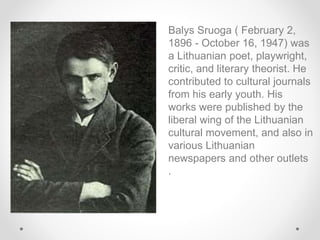
Balys Sruoga ( February 2,
1896 - October 16, 1947) was
a Lithuanian poet, playwright,
critic, and literary theorist. He
contributed to cultural journals
from his early youth. His
works were published by the
liberal wing of the Lithuanian
cultural movement, and also in
various Lithuanian
newspapers and other outlets
.
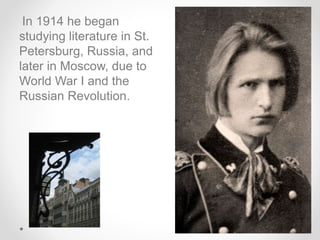
In 1914 he began
studying literature in St.
Petersburg, Russia, and
later in Moscow, due to
World War I and the
Russian Revolution.
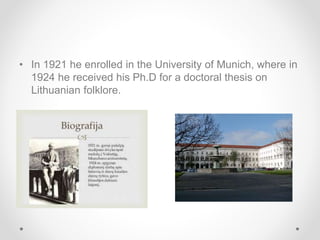
• In 1921 he enrolled in the University of Munich, where in
1924 he received his Ph.D for a doctoral thesis on
Lithuanian folklore.
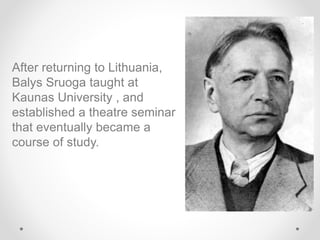
After returning to Lithuania,
Balys Sruoga taught at
Kaunas University , and
established a theatre seminar
that eventually became a
course of study.
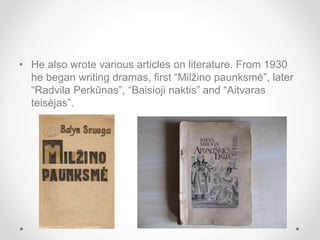
• He also wrote various articles on literature. From 1930
he began writing dramas, first “Milžino paunksmė”, later
“Radvila Perkūnas”, “Baisioji naktis” and “Aitvaras
teisėjas”.
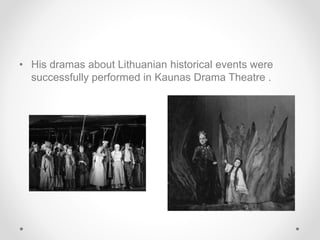
• His dramas about Lithuanian historical events were
successfully performed in Kaunas Drama Theatre .
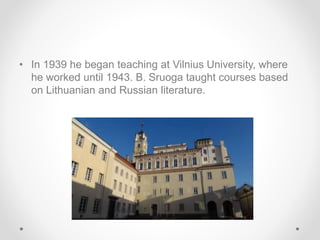
• In 1939 he began teaching at Vilnius University, where
he worked until 1943. B. Sruoga taught courses based
on Lithuanian and Russian literature.
The Sruoga family liked spending their vacations in
Palanga, a small resort near the sea.
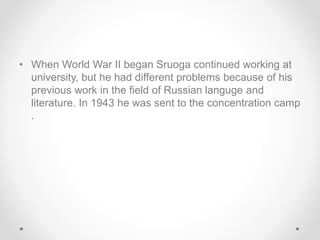
• When World War II began Sruoga continued working at
university, but he had different problems because of his
previous work in the field of Russian languge and
literature. In 1943 he was sent to the concentration camp
.
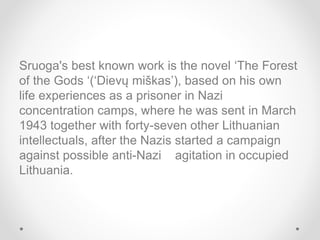
Sruoga's best known work is the novel ‘The Forest
of the Gods ‘(‘Dievų miškas’), based on his own
life experiences as a prisoner in Nazi
concentration camps, where he was sent in March
1943 together with forty-seven other Lithuanian
intellectuals, after the Nazis started a campaign
against possible anti-Nazi agitation in occupied
Lithuania.
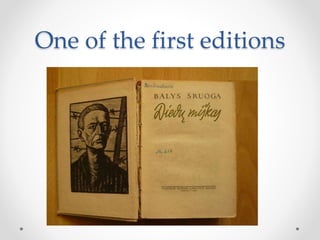
One of the first editions
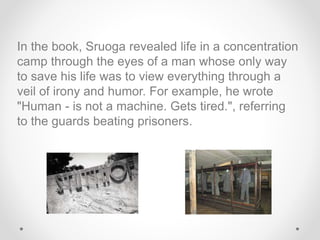
In the book, Sruoga revealed life in a concentration
camp through the eyes of a man whose only way
to save his life was to view everything through a
veil of irony and humor. For example, he wrote
"Human - is not a machine. Gets tired.", referring
to the guards beating prisoners.
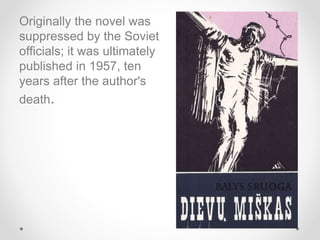
Originally the novel was
suppressed by the Soviet
officials; it was ultimately
published in 1957, ten
years after the author's
death.
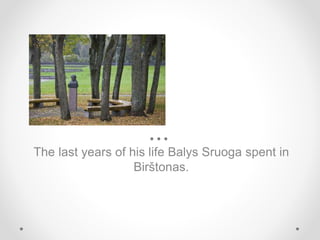
The last years of his life Balys Sruoga spent in
Birštonas.
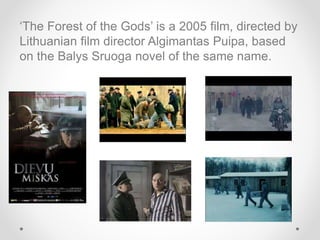
‘The Forest of the Gods’ is a 2005 film, directed by
Lithuanian film director Algimantas Puipa, based
on the Balys Sruoga novel of the same name.
Thank you for your
attention 

Lithuanian classical writer

  • 1.
  • 2.
  • 3.
    Balys Sruoga (February 2, 1896 - October 16, 1947) was a Lithuanian poet, playwright, critic, and literary theorist. He contributed to cultural journals from his early youth. His works were published by the liberal wing of the Lithuanian cultural movement, and also in various Lithuanian newspapers and other outlets .
  • 4.
    In 1914 hebegan studying literature in St. Petersburg, Russia, and later in Moscow, due to World War I and the Russian Revolution.
  • 5.
    • In 1921he enrolled in the University of Munich, where in 1924 he received his Ph.D for a doctoral thesis on Lithuanian folklore.
  • 6.
    After returning toLithuania, Balys Sruoga taught at Kaunas University , and established a theatre seminar that eventually became a course of study.
  • 7.
    • He alsowrote various articles on literature. From 1930 he began writing dramas, first “Milžino paunksmė”, later “Radvila Perkūnas”, “Baisioji naktis” and “Aitvaras teisėjas”.
  • 8.
    • His dramasabout Lithuanian historical events were successfully performed in Kaunas Drama Theatre .
  • 9.
    • In 1939he began teaching at Vilnius University, where he worked until 1943. B. Sruoga taught courses based on Lithuanian and Russian literature.
  • 10.
    The Sruoga familyliked spending their vacations in Palanga, a small resort near the sea.
  • 11.
    • When WorldWar II began Sruoga continued working at university, but he had different problems because of his previous work in the field of Russian languge and literature. In 1943 he was sent to the concentration camp .
  • 12.
    Sruoga's best knownwork is the novel ‘The Forest of the Gods ‘(‘Dievų miškas’), based on his own life experiences as a prisoner in Nazi concentration camps, where he was sent in March 1943 together with forty-seven other Lithuanian intellectuals, after the Nazis started a campaign against possible anti-Nazi agitation in occupied Lithuania.
  • 13.
    One of thefirst editions
  • 14.
    In the book,Sruoga revealed life in a concentration camp through the eyes of a man whose only way to save his life was to view everything through a veil of irony and humor. For example, he wrote "Human - is not a machine. Gets tired.", referring to the guards beating prisoners.
  • 15.
    Originally the novelwas suppressed by the Soviet officials; it was ultimately published in 1957, ten years after the author's death.
  • 16.
    The last yearsof his life Balys Sruoga spent in Birštonas.
  • 17.
    ‘The Forest ofthe Gods’ is a 2005 film, directed by Lithuanian film director Algimantas Puipa, based on the Balys Sruoga novel of the same name.
  • 18.
    Thank you foryour attention 

Editor's Notes

  • #17 The monument in Birstonas