Preparing for SuccessAdvanced Placement Literature and Composition Test
Format of the TestTest is broken into two major sectionsSection 1 – Multiple ChoiceAllowed 1 hourSection 2 – WritingAllowed 2 hours
Multiple ChoiceTypically there are 55 questions asked on the testTry to find a half way pointIf there are 60 questions, try to be at question 30 halfway through the allotted timeMultiple choice passages broken up in two waysProsePoetry
Multiple Choice - ProseRead actively and visually – underline and circleExamine organizational patternIdentify transitional words and phrasesAcknowledge point of viewEvaluate tone through diction and sentence structureBe especially watchful for irony and satireWatch for odd words that may shift the languagePay attention to punctuation for changes in toneUse context clues to identify any unknown vocabularyNotice and mark SOAPStoneSpeaker, occasion, audience, purpose, subject, tone
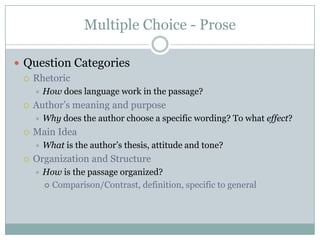
Multiple Choice - ProseQuestion CategoriesRhetoric How does language work in the passage?Author’s meaning and purposeWhy does the author choose a specific wording? To what effect?Main IdeaWhat is the author’s thesis, attitude and tone?Organization and StructureHow is the passage organized?Comparison/Contrast, definition, specific to general
Multiple Choice - PoetryPay attention to punctuation, looking for complete sentences indicated by periods, semi-colons, etc.Watch for shifts in tone, point of view, verb tense, and timeConsider repetitionsParallel syntax, imagery, simile/metaphorWhat is the logic?Asking – then answering questionsDeveloping an argumentStory with a conflict and climaxSeries of analogies and comparisons to prove a point
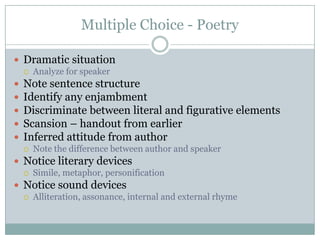
Multiple Choice - PoetryDramatic situationAnalyze for speakerNote sentence structureIdentify any enjambmentDiscriminate between literal and figurative elementsScansion – handout from earlierInferred attitude from authorNote the difference between author and speakerNotice literary devicesSimile, metaphor, personificationNotice sound devicesAlliteration, assonance, internal and external rhyme
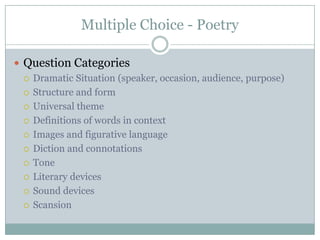
Multiple Choice - PoetryQuestion CategoriesDramatic Situation (speaker, occasion, audience, purpose)Structure and formUniversal themeDefinitions of words in contextImages and figurative languageDiction and connotationsToneLiterary devicesSound devicesScansion
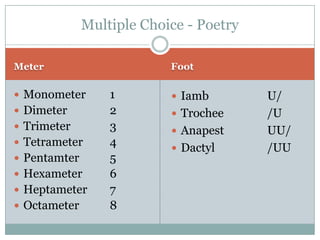
MeterFootMonometer	1Dimeter		2Trimeter		3Tetrameter	4Pentamter	5Hexameter	6Heptameter	7Octameter	8Iamb		U/Trochee		/UAnapest		UU/Dactyl		/UUMultiple Choice - Poetry
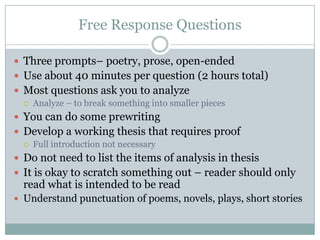
Free Response QuestionsThree prompts– poetry, prose, open-endedUse about 40 minutes per question (2 hours total)Most questions ask you to analyzeAnalyze – to break something into smaller piecesYou can do some prewritingDevelop a working thesis that requires proofFull introduction not necessaryDo not need to list the items of analysis in thesisIt is okay to scratch something out – reader should only read what is intended to be readUnderstand punctuation of poems, novels, plays, short stories
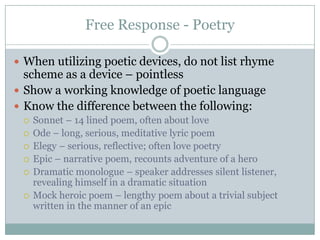
Free Response - PoetryWhen utilizing poetic devices, do not list rhyme scheme as a device – pointlessShow a working knowledge of poetic languageKnow the difference between the following:Sonnet – 14 lined poem, often about loveOde – long, serious, meditative lyric poemElegy – serious, reflective; often love poetryEpic – narrative poem, recounts adventure of a heroDramatic monologue – speaker addresses silent listener, revealing himself in a dramatic situationMock heroic poem – lengthy poem about a trivial subject written in the manner of an epic
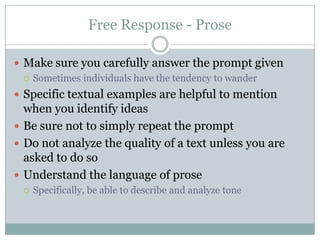
Free Response - ProseMake sure you carefully answer the prompt givenSometimes individuals have the tendency to wanderSpecific textual examples are helpful to mention when you identify ideasBe sure not to simply repeat the promptDo not analyze the quality of a text unless you are asked to do soUnderstand the language of proseSpecifically, be able to describe and analyze tone
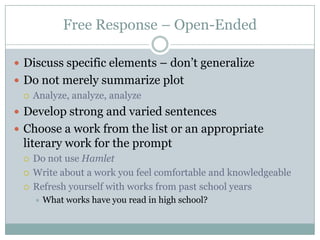
Free Response – Open-EndedDiscuss specific elements – don’t generalizeDo not merely summarize plotAnalyze, analyze, analyzeDevelop strong and varied sentencesChoose a work from the list or an appropriate literary work for the promptDo not use HamletWrite about a work you feel comfortable and knowledgeableRefresh yourself with works from past school yearsWhat works have you read in high school?
A few last thoughts…Come preparedGet plenty of rest the night beforeEat a good breakfast the morning of the testBe sure you are hydratedTest fatigue can set in, so be patient and mindfulEverything we have learned this year has been review for this testNovels, discussions, writing prompts, essays, practice passagesAsk me questions if you have anyjvanengen@sfcss.org – @j_man_v – (605) 759-3914

Ap lit comp test prep

  • 1.
    Preparing for SuccessAdvancedPlacement Literature and Composition Test
  • 2.
    Format of theTestTest is broken into two major sectionsSection 1 – Multiple ChoiceAllowed 1 hourSection 2 – WritingAllowed 2 hours
  • 3.
    Multiple ChoiceTypically thereare 55 questions asked on the testTry to find a half way pointIf there are 60 questions, try to be at question 30 halfway through the allotted timeMultiple choice passages broken up in two waysProsePoetry
  • 4.
    Multiple Choice -ProseRead actively and visually – underline and circleExamine organizational patternIdentify transitional words and phrasesAcknowledge point of viewEvaluate tone through diction and sentence structureBe especially watchful for irony and satireWatch for odd words that may shift the languagePay attention to punctuation for changes in toneUse context clues to identify any unknown vocabularyNotice and mark SOAPStoneSpeaker, occasion, audience, purpose, subject, tone
  • 5.
    Multiple Choice -ProseQuestion CategoriesRhetoric How does language work in the passage?Author’s meaning and purposeWhy does the author choose a specific wording? To what effect?Main IdeaWhat is the author’s thesis, attitude and tone?Organization and StructureHow is the passage organized?Comparison/Contrast, definition, specific to general
  • 6.
    Multiple Choice -PoetryPay attention to punctuation, looking for complete sentences indicated by periods, semi-colons, etc.Watch for shifts in tone, point of view, verb tense, and timeConsider repetitionsParallel syntax, imagery, simile/metaphorWhat is the logic?Asking – then answering questionsDeveloping an argumentStory with a conflict and climaxSeries of analogies and comparisons to prove a point
  • 7.
    Multiple Choice -PoetryDramatic situationAnalyze for speakerNote sentence structureIdentify any enjambmentDiscriminate between literal and figurative elementsScansion – handout from earlierInferred attitude from authorNote the difference between author and speakerNotice literary devicesSimile, metaphor, personificationNotice sound devicesAlliteration, assonance, internal and external rhyme
  • 8.
    Multiple Choice -PoetryQuestion CategoriesDramatic Situation (speaker, occasion, audience, purpose)Structure and formUniversal themeDefinitions of words in contextImages and figurative languageDiction and connotationsToneLiterary devicesSound devicesScansion
  • 9.
  • 10.
    Free Response QuestionsThreeprompts– poetry, prose, open-endedUse about 40 minutes per question (2 hours total)Most questions ask you to analyzeAnalyze – to break something into smaller piecesYou can do some prewritingDevelop a working thesis that requires proofFull introduction not necessaryDo not need to list the items of analysis in thesisIt is okay to scratch something out – reader should only read what is intended to be readUnderstand punctuation of poems, novels, plays, short stories
  • 11.
    Free Response -PoetryWhen utilizing poetic devices, do not list rhyme scheme as a device – pointlessShow a working knowledge of poetic languageKnow the difference between the following:Sonnet – 14 lined poem, often about loveOde – long, serious, meditative lyric poemElegy – serious, reflective; often love poetryEpic – narrative poem, recounts adventure of a heroDramatic monologue – speaker addresses silent listener, revealing himself in a dramatic situationMock heroic poem – lengthy poem about a trivial subject written in the manner of an epic
  • 12.
    Free Response -ProseMake sure you carefully answer the prompt givenSometimes individuals have the tendency to wanderSpecific textual examples are helpful to mention when you identify ideasBe sure not to simply repeat the promptDo not analyze the quality of a text unless you are asked to do soUnderstand the language of proseSpecifically, be able to describe and analyze tone
  • 13.
    Free Response –Open-EndedDiscuss specific elements – don’t generalizeDo not merely summarize plotAnalyze, analyze, analyzeDevelop strong and varied sentencesChoose a work from the list or an appropriate literary work for the promptDo not use HamletWrite about a work you feel comfortable and knowledgeableRefresh yourself with works from past school yearsWhat works have you read in high school?
  • 14.
    A few lastthoughts…Come preparedGet plenty of rest the night beforeEat a good breakfast the morning of the testBe sure you are hydratedTest fatigue can set in, so be patient and mindfulEverything we have learned this year has been review for this testNovels, discussions, writing prompts, essays, practice passagesAsk me questions if you have anyjvanengen@sfcss.org – @j_man_v – (605) 759-3914