Written Texts and the Rise of Literate Culture in Ancient Greece Lisa Eldred AL 805 Rhetorical Analysis 11/27/06
Table of Contents Why Written Texts? Harvey Yunis From Letters to Literature Andrew Ford Writing Religion Albert Henrichs Letters of the Law Michael Gagarin Writing, Law, and Legal Practice in the Athens Courts David Cohen Literacy and the Charlatan in Ancient Greek Medicine Lesley Dean-Jones Literacy in Chinese and Greek Science Geoffrey Lloyd Writing Philosophy Charles H. Kahn Prose Performance Texts Rosalind Thomas Writing for Reading Harvey Yunis Reflecting on Writing and Culture Richard Hunter
Context “Written Text and Transformations of Thought and Expression in Classical Greece”—April 2000, Rice University, Houston, Texas Follow-up gathering at Rice in November 2001 to fashion book out of 10 papers Eric Havelock: Literacy responsible for the development of abstract and analytical thinking Focus on understanding the effect of writing on specific cultural practices
The Role of Audience The present performer Sappho Homer Shakespeare The absent author Thucydides Herodotus Plato Reader Response Theory
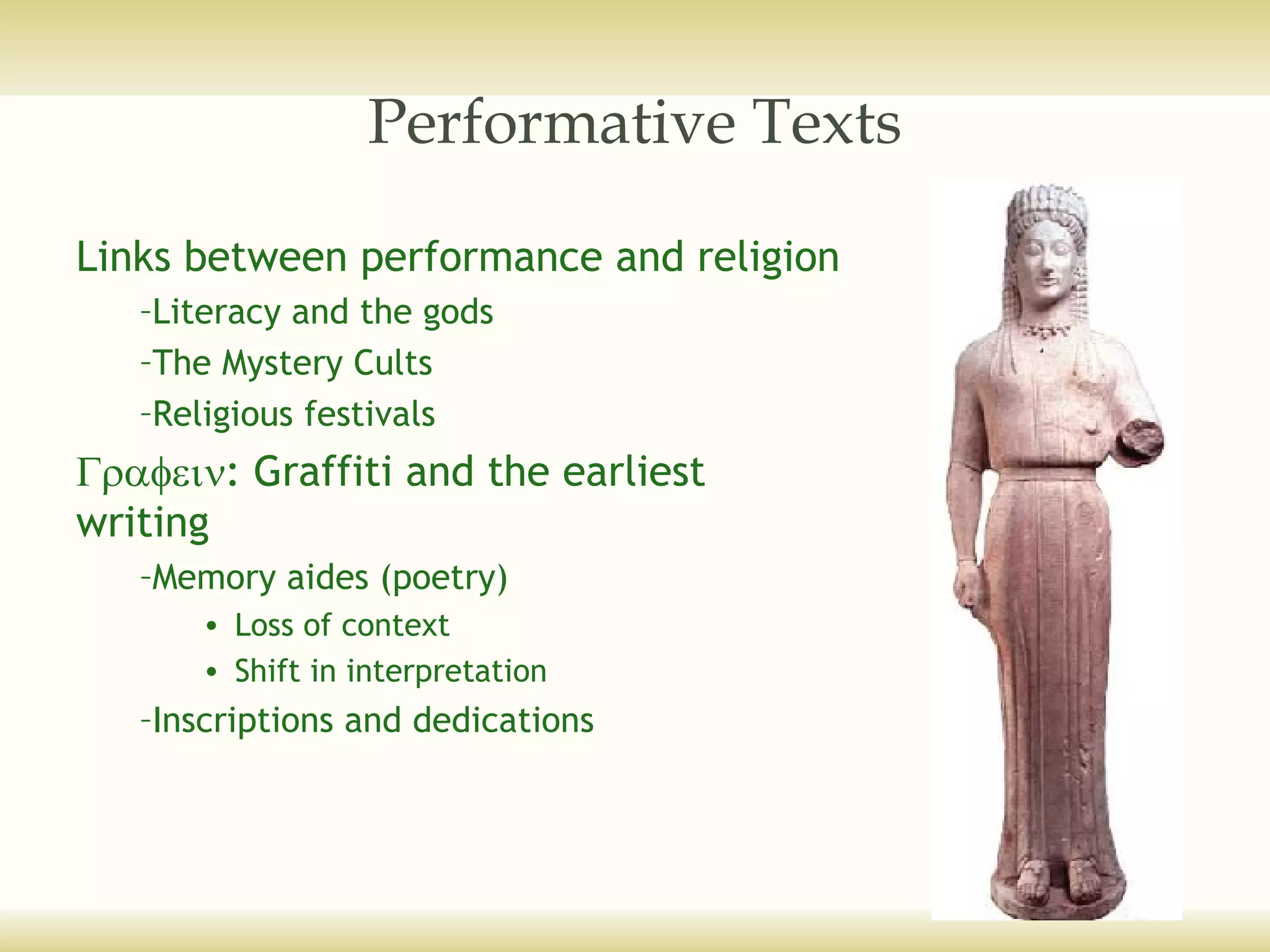
Performative Texts Links between performance and religion Literacy and the gods The Mystery Cults Religious festivals  : Graffiti and the earliest writing Memory aides (poetry) Loss of context Shift in interpretation Inscriptions and dedications
Writing the Law Early Legal Procedures Muses and the King Mnamon, the rememberer Solon’s laws The polis and public discourse of laws Nicomachus and the sacrificial laws Practical Applications of the Law Untrustworthiness of the deme registries Inheritance Laws Commercial Courts and specializations
Science and Specializations Medicine Literacy and the “examination of causes” Medical education: text and practice Medical texts and audience Pupils Dosages Mathematics The overall aim: “axiomatic-deductive proofs” Euclid’s invisibility
Philosophical Prose Treatises Popularized for the quasi-literate Works and Days The Sophists Writing for   Dissemination of works Notes on textual preservation Time and record of composition Hesiod and Homer vs. Anaximander
Mistrust of Rhetor Texts were largely unreliable External substantiation necessary Through word Through deed
Creating the Author Thucydides Specifically writes to be read Research is “superior” to those other writers of history (i.e. Herodotus) Seeking permanency Meanings change for each generation (intentionally) Plato Socrates and poets The Socratic dialogue
Some Cross-Cultural Comparisons “We shall certainly not be in a position to appreciate the differences literacy makes in a given society at a given period until we have some idea about the answers to questions [about differences in context]. To get a sense of those differences, we need, ideally, to take a range of different societies and periods into account: we need, in fact, a comparative approach.” Geoffrey Lloyd (122)
Literacy Across Cultures Ancient Chinese rhetoric Persuade the ruler, not the people Career-oriented schooling “ find the guiding principles […] that unify different areas of mathematics” The Mexica Preserved codices Spirituality and Anzaldúa West Africa Griots

Yunis01

  • 1.
    Written Texts andthe Rise of Literate Culture in Ancient Greece Lisa Eldred AL 805 Rhetorical Analysis 11/27/06
  • 2.
    Table of ContentsWhy Written Texts? Harvey Yunis From Letters to Literature Andrew Ford Writing Religion Albert Henrichs Letters of the Law Michael Gagarin Writing, Law, and Legal Practice in the Athens Courts David Cohen Literacy and the Charlatan in Ancient Greek Medicine Lesley Dean-Jones Literacy in Chinese and Greek Science Geoffrey Lloyd Writing Philosophy Charles H. Kahn Prose Performance Texts Rosalind Thomas Writing for Reading Harvey Yunis Reflecting on Writing and Culture Richard Hunter
  • 3.
    Context “Written Textand Transformations of Thought and Expression in Classical Greece”—April 2000, Rice University, Houston, Texas Follow-up gathering at Rice in November 2001 to fashion book out of 10 papers Eric Havelock: Literacy responsible for the development of abstract and analytical thinking Focus on understanding the effect of writing on specific cultural practices
  • 4.
    The Role ofAudience The present performer Sappho Homer Shakespeare The absent author Thucydides Herodotus Plato Reader Response Theory
  • 5.
    Performative Texts Linksbetween performance and religion Literacy and the gods The Mystery Cults Religious festivals  : Graffiti and the earliest writing Memory aides (poetry) Loss of context Shift in interpretation Inscriptions and dedications
  • 6.
    Writing the LawEarly Legal Procedures Muses and the King Mnamon, the rememberer Solon’s laws The polis and public discourse of laws Nicomachus and the sacrificial laws Practical Applications of the Law Untrustworthiness of the deme registries Inheritance Laws Commercial Courts and specializations
  • 7.
    Science and SpecializationsMedicine Literacy and the “examination of causes” Medical education: text and practice Medical texts and audience Pupils Dosages Mathematics The overall aim: “axiomatic-deductive proofs” Euclid’s invisibility
  • 8.
    Philosophical Prose TreatisesPopularized for the quasi-literate Works and Days The Sophists Writing for  Dissemination of works Notes on textual preservation Time and record of composition Hesiod and Homer vs. Anaximander
  • 9.
    Mistrust of RhetorTexts were largely unreliable External substantiation necessary Through word Through deed
  • 10.
    Creating the AuthorThucydides Specifically writes to be read Research is “superior” to those other writers of history (i.e. Herodotus) Seeking permanency Meanings change for each generation (intentionally) Plato Socrates and poets The Socratic dialogue
  • 11.
    Some Cross-Cultural Comparisons“We shall certainly not be in a position to appreciate the differences literacy makes in a given society at a given period until we have some idea about the answers to questions [about differences in context]. To get a sense of those differences, we need, ideally, to take a range of different societies and periods into account: we need, in fact, a comparative approach.” Geoffrey Lloyd (122)
  • 12.
    Literacy Across CulturesAncient Chinese rhetoric Persuade the ruler, not the people Career-oriented schooling “ find the guiding principles […] that unify different areas of mathematics” The Mexica Preserved codices Spirituality and Anzaldúa West Africa Griots