Figurative
language
guide
Miss S Pillay
hyperbole
An exaggerated
statement is used to
heighten the effect.
Example:
My house is a
million miles
away.
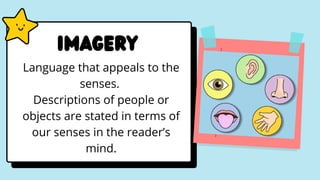
Imagery
Language that appeals to the
senses.
Descriptions of people or
objects are stated in terms of
our senses in the reader’s
mind.
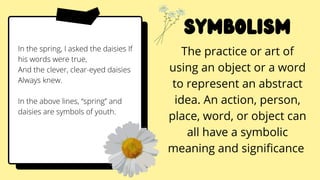
symbolism
The practice or art of
using an object or a word
to represent an abstract
idea. An action, person,
place, word, or object can
all have a symbolic
meaning and significance
In the spring, I asked the daisies If
his words were true,
And the clever, clear-eyed daisies
Always knew.
In the above lines, “spring” and
daisies are symbols of youth.
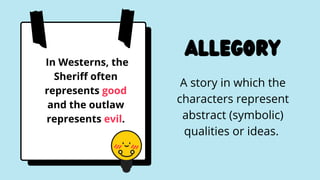
allegory
A story in which the
characters represent
abstract (symbolic)
qualities or ideas.
In Westerns, the
Sheriff often
represents good
and the outlaw
represents evil.
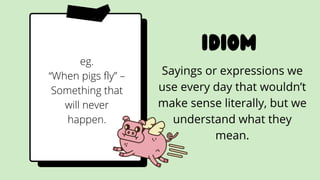
Idiom
Sayings or expressions we
use every day that wouldn’t
make sense literally, but we
understand what they
mean.
eg.
“When pigs fly” –
Something that
will never
happen.
irony
The expression of one's meaning by using language that normally
signifies the opposite, typically for humorous or emphatic effect.
Dramatic:
When the audience
knows something is
coming, but the
characters do not
Example:
In Home Alone – we
know Kevin planted
traps all over the
house but the
burglars didn’t.
Verbal:
opposite of what is
said is meant
(sarcasm).
Example:
You tell someone to
break a leg but you
mean to have a good
time.
Situational:
When the opposite
of what is expected
to happen,
happens.
Example:
a fire station burns
down.
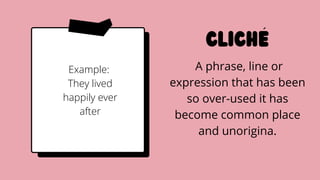
cliche
A phrase, line or
expression that has been
so over-used it has
become common place
and unorigina.
Example:
They lived
happily ever
after
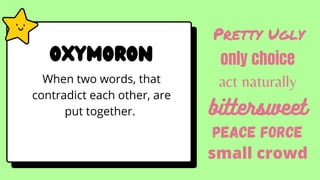
oxymoron
When two words, that
contradict each other, are
put together.
Pretty Ugly
only choice


act naturally
bittersweet
peace force
small crowd
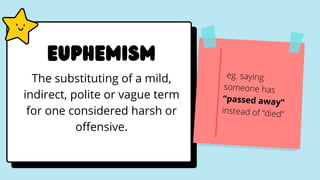
euphemism
The substituting of a mild,
indirect, polite or vague term
for one considered harsh or
offensive.
eg. saying
someone has
“passed away”
instead of “died”
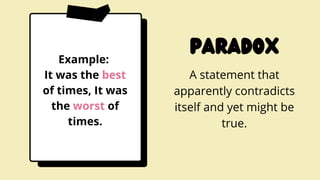
paradox
A statement that
apparently contradicts
itself and yet might be
true.
Example:
It was the best
of times, It was
the worst of
times.
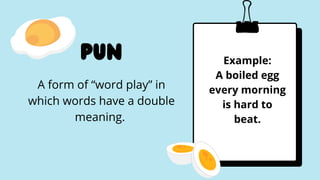
pun
A form of “word play” in
which words have a double
meaning.


Example:
A boiled egg
every morning
is hard to
beat.
poetic devices
that use
sound devices
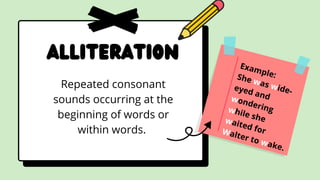
Alliteration
Repeated consonant
sounds occurring at the
beginning of words or
within words.
Example:
She was wide-
eyed and
wondering
while she
waited for
Walter to wake.
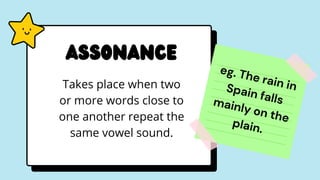
Assonance
Takes place when two
or more words close to
one another repeat the
same vowel sound.
eg. The rain in
Spain falls
mainly on the
plain.
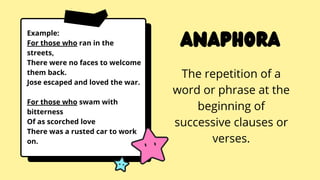
Anaphora
The repetition of a
word or phrase at the
beginning of
successive clauses or
verses.
Example:
For those who ran in the
streets,
There were no faces to welcome
them back.
Jose escaped and loved the war.
For those who swam with
bitterness
Of as scorched love
There was a rusted car to work
on.
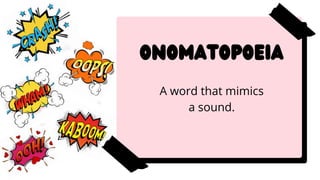
Onomatopoeia
A word that mimics
a sound.
Enjambment
When a sentence runs
on into the next line
without a break.
Example:
A thing of beauty is a joy forever:
Its loveliness increases; it will never
Pass into nothingness but still will keep
A bower quiet for us, and asleep
Full of sweet dreams, and health, and quiet breathing.
Figures of
speech that
use
comparisons
Simile
Comparison of two unlikely
things using “like” or “as.”


Example:
She is
as
sweet
as
candy.
Metaphor
A figure of speech that involves
an IMPLIED COMPARISON
between two relatively unlike
things using a form of be. The
comparison is not announced
by like or as.
Example:
All the
world is a
stage.
Personification
A figure of speech
that gives the
qualities of a person
to an animal, an
object, or an idea.
eg. The stars danced in
the moonlight.
Any
questions?

Figurative Language Guide

  • 1.
  • 2.
    hyperbole An exaggerated statement isused to heighten the effect. Example: My house is a million miles away.
  • 3.
    Imagery Language that appealsto the senses. Descriptions of people or objects are stated in terms of our senses in the reader’s mind.
  • 4.
    symbolism The practice orart of using an object or a word to represent an abstract idea. An action, person, place, word, or object can all have a symbolic meaning and significance In the spring, I asked the daisies If his words were true, And the clever, clear-eyed daisies Always knew. In the above lines, “spring” and daisies are symbols of youth.
  • 5.
    allegory A story inwhich the characters represent abstract (symbolic) qualities or ideas. In Westerns, the Sheriff often represents good and the outlaw represents evil.
  • 6.
    Idiom Sayings or expressionswe use every day that wouldn’t make sense literally, but we understand what they mean. eg. “When pigs fly” – Something that will never happen.
  • 7.
    irony The expression ofone's meaning by using language that normally signifies the opposite, typically for humorous or emphatic effect. Dramatic: When the audience knows something is coming, but the characters do not Example: In Home Alone – we know Kevin planted traps all over the house but the burglars didn’t. Verbal: opposite of what is said is meant (sarcasm). Example: You tell someone to break a leg but you mean to have a good time. Situational: When the opposite of what is expected to happen, happens. Example: a fire station burns down.
  • 8.
    cliche A phrase, lineor expression that has been so over-used it has become common place and unorigina. Example: They lived happily ever after
  • 9.
    oxymoron When two words,that contradict each other, are put together. Pretty Ugly only choice act naturally bittersweet peace force small crowd
  • 10.
    euphemism The substituting ofa mild, indirect, polite or vague term for one considered harsh or offensive. eg. saying someone has “passed away” instead of “died”
  • 11.
    paradox A statement that apparentlycontradicts itself and yet might be true. Example: It was the best of times, It was the worst of times.
  • 12.
    pun A form of“word play” in which words have a double meaning. Example: A boiled egg every morning is hard to beat.
  • 13.
  • 14.
    Alliteration Repeated consonant sounds occurringat the beginning of words or within words. Example: She was wide- eyed and wondering while she waited for Walter to wake.
  • 15.
    Assonance Takes place whentwo or more words close to one another repeat the same vowel sound. eg. The rain in Spain falls mainly on the plain.
  • 16.
    Anaphora The repetition ofa word or phrase at the beginning of successive clauses or verses. Example: For those who ran in the streets, There were no faces to welcome them back. Jose escaped and loved the war. For those who swam with bitterness Of as scorched love There was a rusted car to work on.
  • 17.
    Onomatopoeia A word thatmimics a sound.
  • 18.
    Enjambment When a sentenceruns on into the next line without a break. Example: A thing of beauty is a joy forever: Its loveliness increases; it will never Pass into nothingness but still will keep A bower quiet for us, and asleep Full of sweet dreams, and health, and quiet breathing.
  • 19.
  • 20.
    Simile Comparison of twounlikely things using “like” or “as.” Example: She is as sweet as candy.
  • 21.
    Metaphor A figure ofspeech that involves an IMPLIED COMPARISON between two relatively unlike things using a form of be. The comparison is not announced by like or as. Example: All the world is a stage.
  • 22.
    Personification A figure ofspeech that gives the qualities of a person to an animal, an object, or an idea. eg. The stars danced in the moonlight.
  • 23.