Literary TermsLiterary Terms
A General Introduction
So why learn these terms?
It gives us a common ground of vocabulary
to work with when talking about literature
(or most other art forms).
It helps us to see connections beyond the
surface level.
It helps us to read and think with specific
goals (particularly with works we don’t
understand or like).
Plot
“The plan or
groundwork for a
story, with the
actions resulting
from believable and
authentic human
responses to a
conflict” (Roberts
and Jacobs 1905).
“the sequence of
incidents or events of
which a story is
composed” (Arp
1492).
Conflict
“The opposition between
two characters (often
protagonist v. antagonist),
between groups of people,
or between protagonists and
larger forces such as natural
objects, ideas, modes of
behavior, public opinion,
and [even himself].
Conflict may also be
internal and psychological,
involving choices facing a
protagonist” (Roberts and
Jacobs 1896).
Setting
“The context in time
and place in which the
actions of a story
occurs” (Arp 1494).
Not just the physical
place action occurs,
but all that is involved
in that environment.
Character
Not just the people involved in
a story, poem or play, but also,
“an extended verbal
representation of a human
being, the inner self that
determines thought, speech and
behavior” (Roberts and Jacobs
1894).
Characters can be developing
(or dynamic), flat, round, static,
stock or stereotyped, or foils.
Theme
“The central idea of a
literary work” (Arp 1494).
“The theme of a piece of
fiction is its controlling
idea or its central insight.
It is the unifying
generalization about life
stated or implied by the
story” (102).
It is not the same thing as
a “moral” Mr. Arp points
out (104).
Imagery
“The
representation
through
language of
sense
experience”
(Arp 1489).
Language that appeals not only to the senses, but
also to the reader’s sense of something.
Symbol
“A specific word, idea, or
object that may stand for
ideas, values, persons, or
ways of life” (Roberts and
Jacobs 1910).
Symbols are first order
metaphors (one-for-one),
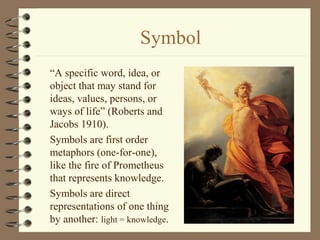
like the fire of Prometheus
that represents knowledge.
Symbols are direct
representations of one thing
by another: light = knowledge.
Irony
“Broadly, a means of
indirection. Language
that states the opposite of
what is intended is verbal
irony. The placement of
characters in a state of
ignorance is dramatic
irony, while emphasis on
powerlessness is
situational irony” (Roberts
and Jacobs 1901).
Archetype
“A character, action, or
situation that is a
prototype or pattern of
human life generally; a
situation that occurs over
and over again in
literature, such as a quest,
an initiation, or an attempt
to overcome evil. Many
myths are archetypes”
(Roberts and Jacobs
1893).
Point of View
“The angle of vision from
which a story is told” (Arp
1492).
Fundamental points of
view are omniscient,
limited omniscient, first
person, and objective
(dramatic).
Point of view can limit
what information is
known or shift between
different perspectives.
Metaphor
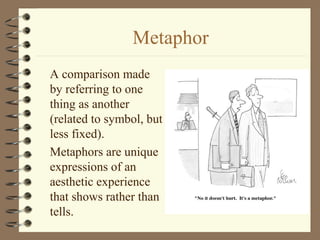
A comparison made
by referring to one
thing as another
(related to symbol, but
less fixed).
Metaphors are unique
expressions of an
aesthetic experience
that shows rather than
tells.
Allusion
Allusions are
brief references
to some other
person, event,
place, text, or
phrase.
The most commonly alluded to texts are the
Bible & Shakespeare’s works.
Keep in mind...
Your fundamental enjoyment of literature is
not determined by your understanding of
these terms any more than a lover of music
needs a class in music history or theory to
have an emotional response to a song.
Knowing the jargon helps. We might be
able to read more effectively and get more
out of the experience if we know what to
look for and know “what’s in a name.”

Lit terms

  • 1.
    Literary TermsLiterary Terms AGeneral Introduction
  • 2.
    So why learnthese terms? It gives us a common ground of vocabulary to work with when talking about literature (or most other art forms). It helps us to see connections beyond the surface level. It helps us to read and think with specific goals (particularly with works we don’t understand or like).
  • 3.
    Plot “The plan or groundworkfor a story, with the actions resulting from believable and authentic human responses to a conflict” (Roberts and Jacobs 1905). “the sequence of incidents or events of which a story is composed” (Arp 1492).
  • 4.
    Conflict “The opposition between twocharacters (often protagonist v. antagonist), between groups of people, or between protagonists and larger forces such as natural objects, ideas, modes of behavior, public opinion, and [even himself]. Conflict may also be internal and psychological, involving choices facing a protagonist” (Roberts and Jacobs 1896).
  • 5.
    Setting “The context intime and place in which the actions of a story occurs” (Arp 1494). Not just the physical place action occurs, but all that is involved in that environment.
  • 6.
    Character Not just thepeople involved in a story, poem or play, but also, “an extended verbal representation of a human being, the inner self that determines thought, speech and behavior” (Roberts and Jacobs 1894). Characters can be developing (or dynamic), flat, round, static, stock or stereotyped, or foils.
  • 7.
    Theme “The central ideaof a literary work” (Arp 1494). “The theme of a piece of fiction is its controlling idea or its central insight. It is the unifying generalization about life stated or implied by the story” (102). It is not the same thing as a “moral” Mr. Arp points out (104).
  • 8.
    Imagery “The representation through language of sense experience” (Arp 1489). Languagethat appeals not only to the senses, but also to the reader’s sense of something.
  • 9.
    Symbol “A specific word,idea, or object that may stand for ideas, values, persons, or ways of life” (Roberts and Jacobs 1910). Symbols are first order metaphors (one-for-one), like the fire of Prometheus that represents knowledge. Symbols are direct representations of one thing by another: light = knowledge.
  • 10.
    Irony “Broadly, a meansof indirection. Language that states the opposite of what is intended is verbal irony. The placement of characters in a state of ignorance is dramatic irony, while emphasis on powerlessness is situational irony” (Roberts and Jacobs 1901).
  • 11.
    Archetype “A character, action,or situation that is a prototype or pattern of human life generally; a situation that occurs over and over again in literature, such as a quest, an initiation, or an attempt to overcome evil. Many myths are archetypes” (Roberts and Jacobs 1893).
  • 12.
    Point of View “Theangle of vision from which a story is told” (Arp 1492). Fundamental points of view are omniscient, limited omniscient, first person, and objective (dramatic). Point of view can limit what information is known or shift between different perspectives.
  • 13.
    Metaphor A comparison made byreferring to one thing as another (related to symbol, but less fixed). Metaphors are unique expressions of an aesthetic experience that shows rather than tells.
  • 14.
    Allusion Allusions are brief references tosome other person, event, place, text, or phrase. The most commonly alluded to texts are the Bible & Shakespeare’s works.
  • 15.
    Keep in mind... Yourfundamental enjoyment of literature is not determined by your understanding of these terms any more than a lover of music needs a class in music history or theory to have an emotional response to a song. Knowing the jargon helps. We might be able to read more effectively and get more out of the experience if we know what to look for and know “what’s in a name.”