Argument Styles:Notes on Chapter 7, Everything’s an Argument
What are these things?Classical OrationRogerian ArgumentationToulmin ArgumentationWarrants
The classical oration:Exordium: introNarratio: facts and contextPartitio: Division into claim and key issuesConfirmatio: Support for the claim (logos)Refutatio: Counterarguments Peroratio: Summary
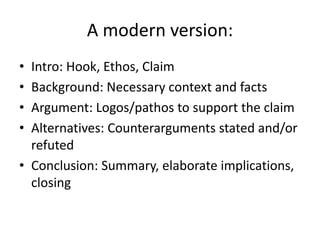
A modern version:Intro: Hook, Ethos, ClaimBackground: Necessary context and factsArgument: Logos/pathos to support the claimAlternatives: Counterarguments stated and/or refutedConclusion: Summary, elaborate implications, closing
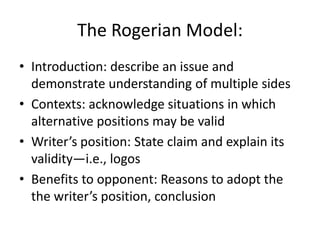
The Rogerian Model:Introduction: describe an issue and demonstrate understanding of multiple sidesContexts: acknowledge situations in which alternative positions may be validWriter’s position: State claim and explain its validity—i.e., logosBenefits to opponent: Reasons to adopt the the writer’s position, conclusion
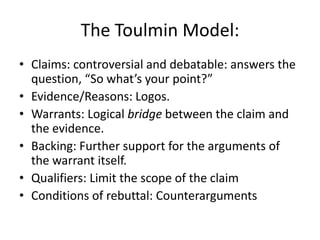
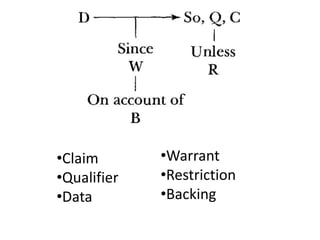
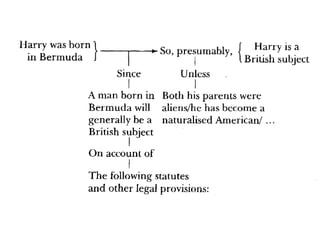
The Toulmin Model:Claims: controversial and debatable: answers the question, “So what’s your point?”Evidence/Reasons: Logos. Warrants: Logical bridge between the claim and the evidence.Backing: Further support for the arguments of the warrant itself.Qualifiers: Limit the scope of the claimConditions of rebuttal: Counterarguments
Warrant
Restriction
Backing

Argument styles condensed

  • 1.
    Argument Styles:Notes onChapter 7, Everything’s an Argument
  • 2.
    What are thesethings?Classical OrationRogerian ArgumentationToulmin ArgumentationWarrants
  • 3.
    The classical oration:Exordium:introNarratio: facts and contextPartitio: Division into claim and key issuesConfirmatio: Support for the claim (logos)Refutatio: Counterarguments Peroratio: Summary
  • 4.
    A modern version:Intro:Hook, Ethos, ClaimBackground: Necessary context and factsArgument: Logos/pathos to support the claimAlternatives: Counterarguments stated and/or refutedConclusion: Summary, elaborate implications, closing
  • 5.
    The Rogerian Model:Introduction:describe an issue and demonstrate understanding of multiple sidesContexts: acknowledge situations in which alternative positions may be validWriter’s position: State claim and explain its validity—i.e., logosBenefits to opponent: Reasons to adopt the the writer’s position, conclusion
  • 6.
    The Toulmin Model:Claims:controversial and debatable: answers the question, “So what’s your point?”Evidence/Reasons: Logos. Warrants: Logical bridge between the claim and the evidence.Backing: Further support for the arguments of the warrant itself.Qualifiers: Limit the scope of the claimConditions of rebuttal: Counterarguments
  • 7.
  • 8.
  • 9.

Editor's Notes

  • #10 What are the elements present here?