Interviewing People

NOVEMBER 12, 2013
11/12/13

PAGE 1
What we’ll
discuss today
"Listening is a magnetic and strange
thing, a creative force. The friends who
listen to us are the ones we move
toward. When we are listened to, it
creates us, makes us unfold and
expand." - Karl A. Menninger

The agenda

➳  Types
➳  The

of Research

Interview

➳  Interview

Tips & Tricks

11/12/13

PAGE 2
Why we interview
It’s not just about
pain-points, it’s
about insights

Their Experience

§ 

Stories

§ 

Emotion

§ 

Connections

§ 

We talk to people to gain a better
understanding of them, their context and
what they need to accomplish their goals.
The data we uncover feeds into our design
decisions and uncovers new opportunities.

§ 

Shared Experience

§ 

Empathy

§ 

Reframes

§ 

Possibilities

§ 

Customer Advocates

11/12/13

PAGE 3
Types of research

11/12/13

PAGE 4
“The more you can
think and feel like a
customer the better you
can imagine what
services to offer them.”
Indi Young

Types of research

11/12/13

PAGE 5
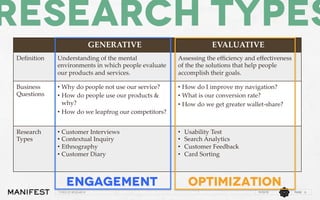
Research types
GENERATIVE

EVALUATIVE

Definition

Understanding  of  the  mental  
environments  in  which  people  evaluate  
our  products  and  services.

Assessing  the  efficiency  and  effectiveness  
of  the  the  solutions  that  help  people  
accomplish  their  goals.

Business  
Questions

•  Why  do  people  not  use  our  service?	
•  How  do  people  use  our  products  &  
why?	
•  How  do  we  leapfrog  our  competitors?	

•  How  do  I  improve  my  navigation?	
•  What  is  our  conversion  rate?	
•  How  do  we  get  greater  wallet-­‐‑share?	

Research  
Types

•  Customer  Interviews	
•  Contextual  Inquiry	
•  Ethnography	
•  Customer  Diary	

• 
• 
• 
• 

engagement
Types of research

Usability  Test	
Search  Analytics	
Customer  Feedback	
Card  Sorting	

optimization
11/12/13

PAGE 6
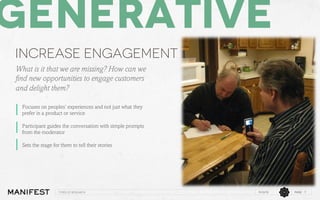
Generative
Increase engagement
What is it that we are missing? How can we
find new opportunities to engage customers
and delight them?
Focuses on peoples’ experiences and not just what they
prefer in a product or service
Participant guides the conversation with simple prompts
from the moderator
Sets the stage for them to tell their stories

Types of research

11/12/13

PAGE 7
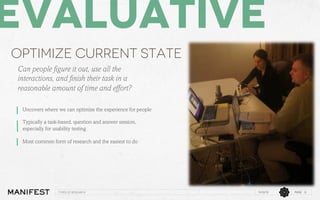
evaluative
Optimize current state
Can people figure it out, use all the
interactions, and finish their task in a
reasonable amount of time and effort?
Uncovers where we can optimize the experience for people
Typically a task-based, question and answer session,
especially for usability testing
Most common form of research and the easiest to do

Types of research

11/12/13

PAGE 8
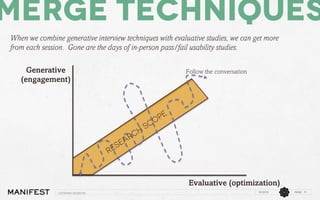
Merge techniques
When we combine generative interview techniques with evaluative studies, we can get more
from each session. Gone are the days of in-person pass/fail usability studies.
Generative
(engagement)

Follow the conversation

Evaluative (optimization)
Listening sessions

11/12/13

PAGE 9
The interview

11/12/13

PAGE 10
“Check your
worldview at
the door.”
Steve Portigal
The interview

11/12/13

PAGE 11
Listen much?
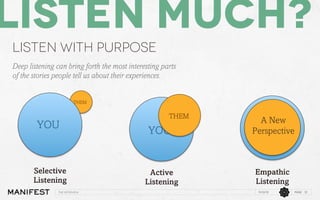
Listen with purpose
Deep listening can bring forth the most interesting parts
of the stories people tell us about their experiences.

THEM

THEM

YOU

Selective
Listening
The interview

YOU

A New
Perspective

Active
Listening

Empathic
Listening
11/12/13

PAGE 12
Keys to insights
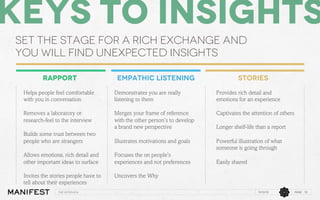
Set the stage for a rich exchange and
you will find unexpected insights
RAPPORT

Empathic listening

stories

Helps people feel comfortable
with you in conversation

Demonstrates you are really
listening to them

Provides rich detail and
emotions for an experience

Removes a laboratory or
research-feel to the interview

Merges your frame of reference
with the other person’s to develop
a brand new perspective

Captivates the attention of others

Builds some trust between two
people who are strangers

Illustrates motivations and goals

Powerful illustration of what
someone is going through

Allows emotions, rich detail and
other important ideas to surface

Focuses the on people’s
experiences and not preferences

Invites the stories people have to
tell about their experiences

Uncovers the Why

The interview

Longer shelf-life than a report

Easily shared

11/12/13

PAGE 13
Rapport
Skills & Tips

Eye-contact with a smile
Pre-interview introduction
Make small talk
Look for social cues
Open body language

"There's a big difference between showing
interest and really taking interest.” 
- Michael P. Nichols - The Lost Art of Listening

The interview

11/12/13

PAGE 14
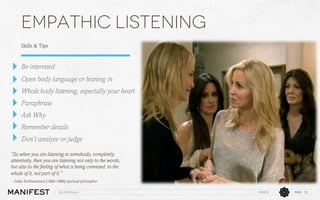
Empathic listening
Skills & Tips

Be interested
Open body language or leaning in
Whole body listening, especially your heart
Paraphrase
Ask Why
Remember details
Don’t analyze or judge
“So when you are listening to somebody, completely,
attentively, then you are listening not only to the words,
but also to the feeling of what is being conveyed, to the
whole of it, not part of it.”
- Jiddu Krishnamurti (1895-1986) spiritual philospher
The interview

11/12/13

PAGE 15
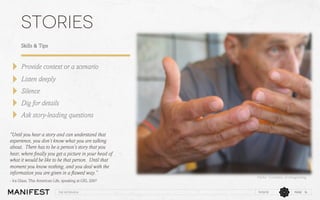
stories
Skills & Tips

Provide context or a scenario
Listen deeply
Silence
Dig for details
Ask story-leading questions
“Until you hear a story and can understand that
experience, you don’t know what you are talking
about. There has to be a person’s story that you
hear, where finally you get a picture in your head of
what it would be like to be that person. Until that
moment you know nothing, and you deal with the
information you are given in a flawed way.”
- Ira Glass, This American Life, speaking at GEL 2007
The interview

Flickr:    Courtesy  of  imageining  	

11/12/13

PAGE 16
Interviewing
tips & Tricks

11/12/13

PAGE 17
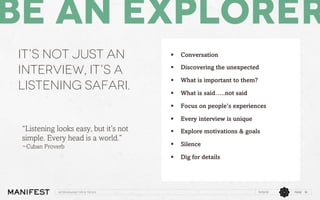
Be an Explorer
It’s not just an
interview, it’s a
Listening safari.

Discovering the unexpected

§ 

What is important to them?

§ 

What is said…..not said
Focus on people’s experiences
Every interview is unique

§ 

Explore motivations & goals

§ 

Silence

§ 

Interviewing Tips & Tricks

§ 

§ 

~Cuban Proverb

Conversation

§ 

“Listening looks easy, but it’s not
simple. Every head is a world.”

§ 

Dig for details

11/12/13

PAGE 18
Better Interviews
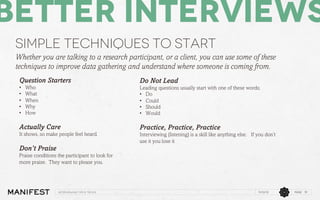
Simple techniques to start
Whether you are talking to a research participant, or a client, you can use some of these
techniques to improve data gathering and understand where someone is coming from.
Question Starters
• 
• 
• 
• 
• 

Who
What
When
Why
How

Do Not Lead
Leading questions usually start with one of these words;
•  Do
•  Could
•  Should
•  Would

Actually Care

Practice, Practice, Practice

It shows, so make people feel heard.

Interviewing (listening) is a skill like anything else. If you don’t
use it you lose it

Don’t Praise
Praise conditions the participant to look for
more praise. They want to please you.

Interviewing Tips & Tricks

11/12/13

PAGE 19
fin
@bwinters
brian.winters@manifestdigital.com

11/12/13

PAGE 20

Interviewing (Listening to) People

  • 1.
  • 2.
    What we’ll discuss today "Listeningis a magnetic and strange thing, a creative force. The friends who listen to us are the ones we move toward. When we are listened to, it creates us, makes us unfold and expand." - Karl A. Menninger The agenda ➳  Types ➳  The of Research Interview ➳  Interview Tips & Tricks 11/12/13 PAGE 2
  • 3.
    Why we interview It’snot just about pain-points, it’s about insights Their Experience §  Stories §  Emotion §  Connections §  We talk to people to gain a better understanding of them, their context and what they need to accomplish their goals. The data we uncover feeds into our design decisions and uncovers new opportunities. §  Shared Experience §  Empathy §  Reframes §  Possibilities §  Customer Advocates 11/12/13 PAGE 3
  • 4.
  • 5.
    “The more youcan think and feel like a customer the better you can imagine what services to offer them.” Indi Young Types of research 11/12/13 PAGE 5
  • 6.
    Research types GENERATIVE EVALUATIVE Definition Understanding  of the  mental   environments  in  which  people  evaluate   our  products  and  services. Assessing  the  efficiency  and  effectiveness   of  the  the  solutions  that  help  people   accomplish  their  goals. Business   Questions •  Why  do  people  not  use  our  service? •  How  do  people  use  our  products  &   why? •  How  do  we  leapfrog  our  competitors? •  How  do  I  improve  my  navigation? •  What  is  our  conversion  rate? •  How  do  we  get  greater  wallet-­‐‑share? Research   Types •  Customer  Interviews •  Contextual  Inquiry •  Ethnography •  Customer  Diary •  •  •  •  engagement Types of research Usability  Test Search  Analytics Customer  Feedback Card  Sorting optimization 11/12/13 PAGE 6
  • 7.
    Generative Increase engagement What isit that we are missing? How can we find new opportunities to engage customers and delight them? Focuses on peoples’ experiences and not just what they prefer in a product or service Participant guides the conversation with simple prompts from the moderator Sets the stage for them to tell their stories Types of research 11/12/13 PAGE 7
  • 8.
    evaluative Optimize current state Canpeople figure it out, use all the interactions, and finish their task in a reasonable amount of time and effort? Uncovers where we can optimize the experience for people Typically a task-based, question and answer session, especially for usability testing Most common form of research and the easiest to do Types of research 11/12/13 PAGE 8
  • 9.
    Merge techniques When wecombine generative interview techniques with evaluative studies, we can get more from each session. Gone are the days of in-person pass/fail usability studies. Generative (engagement) Follow the conversation Evaluative (optimization) Listening sessions 11/12/13 PAGE 9
  • 10.
  • 11.
    “Check your worldview at thedoor.” Steve Portigal The interview 11/12/13 PAGE 11
  • 12.
    Listen much? Listen withpurpose Deep listening can bring forth the most interesting parts of the stories people tell us about their experiences. THEM THEM YOU Selective Listening The interview YOU A New Perspective Active Listening Empathic Listening 11/12/13 PAGE 12
  • 13.
    Keys to insights Setthe stage for a rich exchange and you will find unexpected insights RAPPORT Empathic listening stories Helps people feel comfortable with you in conversation Demonstrates you are really listening to them Provides rich detail and emotions for an experience Removes a laboratory or research-feel to the interview Merges your frame of reference with the other person’s to develop a brand new perspective Captivates the attention of others Builds some trust between two people who are strangers Illustrates motivations and goals Powerful illustration of what someone is going through Allows emotions, rich detail and other important ideas to surface Focuses the on people’s experiences and not preferences Invites the stories people have to tell about their experiences Uncovers the Why The interview Longer shelf-life than a report Easily shared 11/12/13 PAGE 13
  • 14.
    Rapport Skills & Tips Eye-contactwith a smile Pre-interview introduction Make small talk Look for social cues Open body language "There's a big difference between showing interest and really taking interest.”  - Michael P. Nichols - The Lost Art of Listening The interview 11/12/13 PAGE 14
  • 15.
    Empathic listening Skills &Tips Be interested Open body language or leaning in Whole body listening, especially your heart Paraphrase Ask Why Remember details Don’t analyze or judge “So when you are listening to somebody, completely, attentively, then you are listening not only to the words, but also to the feeling of what is being conveyed, to the whole of it, not part of it.” - Jiddu Krishnamurti (1895-1986) spiritual philospher The interview 11/12/13 PAGE 15
  • 16.
    stories Skills & Tips Providecontext or a scenario Listen deeply Silence Dig for details Ask story-leading questions “Until you hear a story and can understand that experience, you don’t know what you are talking about. There has to be a person’s story that you hear, where finally you get a picture in your head of what it would be like to be that person. Until that moment you know nothing, and you deal with the information you are given in a flawed way.” - Ira Glass, This American Life, speaking at GEL 2007 The interview Flickr:    Courtesy  of  imageining   11/12/13 PAGE 16
  • 17.
  • 18.
    Be an Explorer It’snot just an interview, it’s a Listening safari. Discovering the unexpected §  What is important to them? §  What is said…..not said Focus on people’s experiences Every interview is unique §  Explore motivations & goals §  Silence §  Interviewing Tips & Tricks §  §  ~Cuban Proverb Conversation §  “Listening looks easy, but it’s not simple. Every head is a world.” §  Dig for details 11/12/13 PAGE 18
  • 19.
    Better Interviews Simple techniquesto start Whether you are talking to a research participant, or a client, you can use some of these techniques to improve data gathering and understand where someone is coming from. Question Starters •  •  •  •  •  Who What When Why How Do Not Lead Leading questions usually start with one of these words; •  Do •  Could •  Should •  Would Actually Care Practice, Practice, Practice It shows, so make people feel heard. Interviewing (listening) is a skill like anything else. If you don’t use it you lose it Don’t Praise Praise conditions the participant to look for more praise. They want to please you. Interviewing Tips & Tricks 11/12/13 PAGE 19
  • 20.