Geo Technical Engineering -1 ( Lab)
Presentation on Experiment No: 4
Determination of Liquid limit of Given soil Sample
Name: Muhammad Ehtisham Arshad
Reg NO: 18pwciv5189
Class No : 224
Section : A
Course Instructor : Engr Manzoor Elahi
Department of Civil Engineering UET Peshawar
Table of contents:
Research Papers
Abstract
What is Liquid Limit?
Why we want to know liquid limit of soil?
How to determine liquid limit of soil?
Table
Graphs
Conclusion
References
Determination of Liquid limit of Given soil Sample
Research Paper: 01
Author: Sivapullaiah Puvvadi and A. Sridharan
Research Paper: 02
Author: Stuart Kenneth Haigh
Research Paper: 03
Author: Rajesh P. Shukla and Jennie Gandhi
Research Paper: 04
Author: S N R Shah and Muhammad Aslam
Standard Refrences : ASTM D4318
Abstract:
 The liquid limit test is one of the most widely used tests in the soil engineering practice. Several
properties, including mechanical properties (for example, compressive index), have correlations with
the liquid limit.
 In this paper detailed investigations of the liquid limit of soil mixtures have been carried out using
sand (coarse grained, fine grained, rounded and angular shaped), and silts.
 liquid limits of soil mixtures are not governed by the linear law of mixtures.
 The shape of the sand was not found to influence the liquid limit, the size of sand particles had a
definit influence.
 Liquid limit obtained by the cone method is lesser than the limit obtained by using the Casagrande
apparatus. liquid limit of low plastic soil has been suggested.
 The liquid and plastic limits have received relatively lesser attention from research workers in the
past.
 The Atterberg limits are perhaps the oldest and most widely used of all the soil properties.
What is Liquid Limit?
When water is added to dry soil, it changes its state of consistency from hard to soft. If we add water to a fine
grained soil, then water will change its consistency from hard to semi hard. If we continue to add more water
then again the soil will change its state of consistency from semi hard to plastic and finally reach a liquid
consistency stage. When the soil reaches liquid consistency state, it has remain no cohesive strength to retain its
shape under its own weight. It will start to deform its shape. So the amount of water which is responsible for this
state of consistency of soil is called liquid limit of soil.
Why we want to know liquid limit of soil?
 Liquid limit of soil is a very important property of fine grained soil (or cohesive soil)
 Value of liquid limit is used to classify fine grained soil.
 It gives us information regarding the state of consistency of soil on site.
 Liquid limit of soil can be used to predict the consolidation properties of soil while calculating allowable
bearing capacity & settlement of foundation.
 Liquid limit value of soil is also used to calculate activity of clays and toughness index of soil.
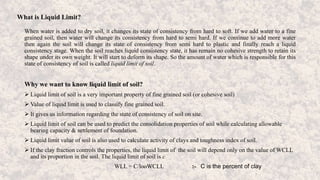
 If the clay fraction controls the properties, the liquid limit of the soil will depend only on the value of WCLL
and its proportion in the soil. The liquid limit of soil is c
WLL = C/looWCLL :- C is the percent of clay
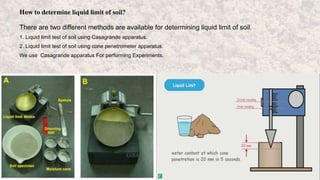
How to determine liquid limit of soil?
There are two different methods are available for determining liquid limit of soil.
1. Liquid limit test of soil using Casagrande apparatus.
2. Liquid limit test of soil using cone penetrometer apparatus.
We use Casagrande apparatus For performing Experiments.
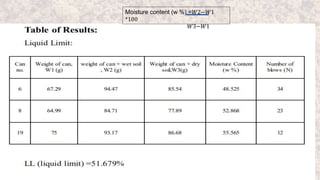
Moisture content (w %) =𝑊2−𝑊1
*100
𝑊3−𝑊1
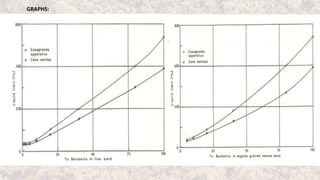
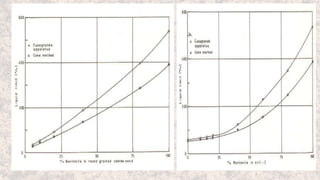
GRAPHS:
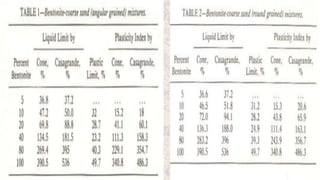
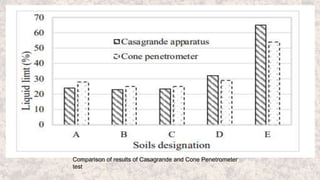
Comparison of results of Casagrande and Cone Penetrometer
test
Conclusions:
 The liquid limit of mixtures of soils is not governed by the linear law. In other words, the combined
liquid limit of soil mixtures is not equivalent to the sum of the liquid limits of the constituent soils after
correcting them to their respective percentages in the mixtures. This leads to the conclusion that the
liquid limit is not entirely a physical property.
 Study of the liquid limit of clay-sand mixtures also reveals that the size of the sand particle has more
influence than the shape (round or angular grained) of the sand particles.
 There is a good correlation between the liquid limit and plasticity index for all the mixtures. However,
no relation could be seen between liquid limit and plastic limit.
 The liquid limit obtained by the cone method has always yielded lesser values than those obtained by
the Casagrande apparatus. A good relationship exists between the liquid limits obtained by the
apparatus for liquid limits ranging up to 500%.
 Liquid limits of low plasticity soils could be obtained by finding the same liquid limits and mixing them
with soils of higher plasticity.
References:
• Christer's, B., A comparison of the Casagrande and fall cone penetrometer methods for
liquid limit determination in marls from Crete, Greece, Engineering Geology, 31 (2),131-142, (1991).
• Nagaraj, T. S. and Jayadevan, M.S., "Re-examination of One-Point Method of Liquid Limit
Determination," Geotechnique, Vol. 31, 1981, p. 413.
• Sridharan, A. and Rao, G. V., "Mechanisms Controlling the Liquid Limit of Clays," Proceedings of
6th International Conference on Soil Mechanics, Vol. 75, Istanbul Technical University, Istanbul,
Turkey, 1975.
THANK
You

Liquid Limit of soil sample

  • 2.
    Geo Technical Engineering-1 ( Lab) Presentation on Experiment No: 4 Determination of Liquid limit of Given soil Sample Name: Muhammad Ehtisham Arshad Reg NO: 18pwciv5189 Class No : 224 Section : A Course Instructor : Engr Manzoor Elahi Department of Civil Engineering UET Peshawar
  • 3.
    Table of contents: ResearchPapers Abstract What is Liquid Limit? Why we want to know liquid limit of soil? How to determine liquid limit of soil? Table Graphs Conclusion References
  • 4.
    Determination of Liquidlimit of Given soil Sample Research Paper: 01 Author: Sivapullaiah Puvvadi and A. Sridharan Research Paper: 02 Author: Stuart Kenneth Haigh Research Paper: 03 Author: Rajesh P. Shukla and Jennie Gandhi Research Paper: 04 Author: S N R Shah and Muhammad Aslam Standard Refrences : ASTM D4318
  • 5.
    Abstract:  The liquidlimit test is one of the most widely used tests in the soil engineering practice. Several properties, including mechanical properties (for example, compressive index), have correlations with the liquid limit.  In this paper detailed investigations of the liquid limit of soil mixtures have been carried out using sand (coarse grained, fine grained, rounded and angular shaped), and silts.  liquid limits of soil mixtures are not governed by the linear law of mixtures.  The shape of the sand was not found to influence the liquid limit, the size of sand particles had a definit influence.  Liquid limit obtained by the cone method is lesser than the limit obtained by using the Casagrande apparatus. liquid limit of low plastic soil has been suggested.  The liquid and plastic limits have received relatively lesser attention from research workers in the past.  The Atterberg limits are perhaps the oldest and most widely used of all the soil properties.
  • 6.
    What is LiquidLimit? When water is added to dry soil, it changes its state of consistency from hard to soft. If we add water to a fine grained soil, then water will change its consistency from hard to semi hard. If we continue to add more water then again the soil will change its state of consistency from semi hard to plastic and finally reach a liquid consistency stage. When the soil reaches liquid consistency state, it has remain no cohesive strength to retain its shape under its own weight. It will start to deform its shape. So the amount of water which is responsible for this state of consistency of soil is called liquid limit of soil. Why we want to know liquid limit of soil?  Liquid limit of soil is a very important property of fine grained soil (or cohesive soil)  Value of liquid limit is used to classify fine grained soil.  It gives us information regarding the state of consistency of soil on site.  Liquid limit of soil can be used to predict the consolidation properties of soil while calculating allowable bearing capacity & settlement of foundation.  Liquid limit value of soil is also used to calculate activity of clays and toughness index of soil.  If the clay fraction controls the properties, the liquid limit of the soil will depend only on the value of WCLL and its proportion in the soil. The liquid limit of soil is c WLL = C/looWCLL :- C is the percent of clay
  • 7.
    How to determineliquid limit of soil? There are two different methods are available for determining liquid limit of soil. 1. Liquid limit test of soil using Casagrande apparatus. 2. Liquid limit test of soil using cone penetrometer apparatus. We use Casagrande apparatus For performing Experiments.
  • 8.
    Moisture content (w%) =𝑊2−𝑊1 *100 𝑊3−𝑊1
  • 10.
  • 12.
    Comparison of resultsof Casagrande and Cone Penetrometer test
  • 13.
    Conclusions:  The liquidlimit of mixtures of soils is not governed by the linear law. In other words, the combined liquid limit of soil mixtures is not equivalent to the sum of the liquid limits of the constituent soils after correcting them to their respective percentages in the mixtures. This leads to the conclusion that the liquid limit is not entirely a physical property.  Study of the liquid limit of clay-sand mixtures also reveals that the size of the sand particle has more influence than the shape (round or angular grained) of the sand particles.  There is a good correlation between the liquid limit and plasticity index for all the mixtures. However, no relation could be seen between liquid limit and plastic limit.  The liquid limit obtained by the cone method has always yielded lesser values than those obtained by the Casagrande apparatus. A good relationship exists between the liquid limits obtained by the apparatus for liquid limits ranging up to 500%.  Liquid limits of low plasticity soils could be obtained by finding the same liquid limits and mixing them with soils of higher plasticity.
  • 14.
    References: • Christer's, B.,A comparison of the Casagrande and fall cone penetrometer methods for liquid limit determination in marls from Crete, Greece, Engineering Geology, 31 (2),131-142, (1991). • Nagaraj, T. S. and Jayadevan, M.S., "Re-examination of One-Point Method of Liquid Limit Determination," Geotechnique, Vol. 31, 1981, p. 413. • Sridharan, A. and Rao, G. V., "Mechanisms Controlling the Liquid Limit of Clays," Proceedings of 6th International Conference on Soil Mechanics, Vol. 75, Istanbul Technical University, Istanbul, Turkey, 1975.
  • 15.