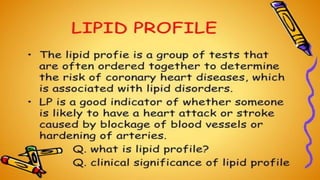
Lipid Profile
CH2
R
Fatty alcohol
OH C R
Fatty acid
HO
O
+
H2O
CH2
R O C R
O
Esterase (lipase) ester (lipid)
Definition ( Simple definition)
Lipids may be defined as organic compounds formed
mainly from alcohol and fatty acids combined together
by ester linkage.
• Lipids are insoluble in water, but soluble in fat or organic
solvents (ether, chloroform, benzene, acetone)
• Lipids are heterogenous in nature and comprise of fats,
oils, waxes and related compounds
• They are widely distributed in nature both in plants and in
animals
Biomedical Importance of Lipids
1. Lipids are more palatable and storable to a greater amount in
comparison to carbohydrates
2. Lipids have a high-energy value (25% of body needs) and they provide
more energy per gram ( 9 Cal) than carbohydrates and proteins ( 4
Cal), but carbohydrates are the preferred source of energy, in
general
3. Lipids supply the essential fatty acids that cannot be synthesized by
the body
4. Lipids provide the body with fat-soluble vitamins (A, D, E and K)
Biomedical Importance of Lipids
5. Lipids are important constituents of the nervous system
6. Tissue fat is an essential constituent of cell membrane and nervous
system. It is mainly phospholipid in nature and most importantly,
the status of phospholipids is not affected by starvation
7. Stored lipids /depot fat” is mainly subcutaneous and act as:
▪ A repository of energy.
▪ A protective pad for the internal organs to protect them from external
shock
▪ A subcutaneous thermal insulator against loss of body heat
8. Lipoproteins, which are complex of lipids and proteins, are
important in the extracellular transport of lipids
9.Cholesterol plays a role in membrane structure and is used for
synthesis of steroid hormones, vitamin D3 and bile acids
10. Chemistry of Lipids provide the essential basis for understanding
diseases such as obesity, metabolic syndrome, atherosclerosis,
lipid-storage diseases etc.,
Biomedical Importance of Lipids
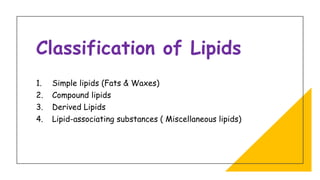
Classification of Lipids
1. Simple lipids (Fats & Waxes)
2. Compound lipids
3. Derived Lipids
4. Lipid-associating substances ( Miscellaneous lipids)
1) Simple Lipids:
Contain fatty acids and alcohol (trihydric or monohydric)
Oils: Unsaturated fatty acid + glycerol
Fats: Saturated fatty acids + glycerol
Waxes: Fatty acids + mono or dihydric alcohol
Simple glyceride: Contains same fatty acids
Mixed glyceride: Contains different fatty acids
2) Compound lipids: (Complex lipids):
Contain phosphoric acid, various sugars, sphingosine,
ethanolamine and serine in addition to fatty acids and glycerol
3) Derived Lipids: Hydrolytic products of simple and
compound lipids
i) Alcohols: Glycerol and other sterol
ii) Fatty acids
iii) Terpenoids
Lipid Profile.pdf
Lipid Profile.pdf
Lipid Profile.pdf
Lipid Profile.pdf
Lipid Profile.pdf
Lipid Profile.pdf
Lipid Profile.pdf
Lipid Profile.pdf
Lipid Profile.pdf
Lipid Profile.pdf
Lipid Profile.pdf
Lipid Profile.pdf
Lipid Profile.pdf
Lipid Profile.pdf
Lipid Profile.pdf
Lipid Profile.pdf
Lipid Profile.pdf
Lipid Profile.pdf
Lipid Profile.pdf
Lipid Profile.pdf
Lipid Profile.pdf
Lipid Profile.pdf
Lipid Profile.pdf
Lipid Profile.pdf
Lipid Profile.pdf
Lipid Profile.pdf

Lipid Profile.pdf

  • 1.
  • 2.
    CH2 R Fatty alcohol OH CR Fatty acid HO O + H2O CH2 R O C R O Esterase (lipase) ester (lipid) Definition ( Simple definition) Lipids may be defined as organic compounds formed mainly from alcohol and fatty acids combined together by ester linkage.
  • 3.
    • Lipids areinsoluble in water, but soluble in fat or organic solvents (ether, chloroform, benzene, acetone) • Lipids are heterogenous in nature and comprise of fats, oils, waxes and related compounds • They are widely distributed in nature both in plants and in animals
  • 4.
    Biomedical Importance ofLipids 1. Lipids are more palatable and storable to a greater amount in comparison to carbohydrates 2. Lipids have a high-energy value (25% of body needs) and they provide more energy per gram ( 9 Cal) than carbohydrates and proteins ( 4 Cal), but carbohydrates are the preferred source of energy, in general 3. Lipids supply the essential fatty acids that cannot be synthesized by the body 4. Lipids provide the body with fat-soluble vitamins (A, D, E and K)
  • 5.
    Biomedical Importance ofLipids 5. Lipids are important constituents of the nervous system 6. Tissue fat is an essential constituent of cell membrane and nervous system. It is mainly phospholipid in nature and most importantly, the status of phospholipids is not affected by starvation 7. Stored lipids /depot fat” is mainly subcutaneous and act as: ▪ A repository of energy. ▪ A protective pad for the internal organs to protect them from external shock ▪ A subcutaneous thermal insulator against loss of body heat
  • 6.
    8. Lipoproteins, whichare complex of lipids and proteins, are important in the extracellular transport of lipids 9.Cholesterol plays a role in membrane structure and is used for synthesis of steroid hormones, vitamin D3 and bile acids 10. Chemistry of Lipids provide the essential basis for understanding diseases such as obesity, metabolic syndrome, atherosclerosis, lipid-storage diseases etc., Biomedical Importance of Lipids
  • 7.
    Classification of Lipids 1.Simple lipids (Fats & Waxes) 2. Compound lipids 3. Derived Lipids 4. Lipid-associating substances ( Miscellaneous lipids)
  • 9.
    1) Simple Lipids: Containfatty acids and alcohol (trihydric or monohydric) Oils: Unsaturated fatty acid + glycerol Fats: Saturated fatty acids + glycerol Waxes: Fatty acids + mono or dihydric alcohol Simple glyceride: Contains same fatty acids Mixed glyceride: Contains different fatty acids
  • 10.
    2) Compound lipids:(Complex lipids): Contain phosphoric acid, various sugars, sphingosine, ethanolamine and serine in addition to fatty acids and glycerol 3) Derived Lipids: Hydrolytic products of simple and compound lipids i) Alcohols: Glycerol and other sterol ii) Fatty acids iii) Terpenoids