Linux Device Driver
Agenda

   History & Why Linux kernel?
   Device Driver.
       Purpose & Design
       Kernel mode & User mode
       Development
       Application & API
History and Why Linux kernel?

   First developed by Linus Torvals.
   Linux base on UNIX standard.
   Workgroup for implement driver
    & patch with kernel.org.
   ”Just for fun” - Linux Torvals
    History.
Pupose & Design

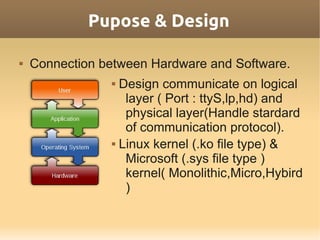
   Connection between Hardware and Software.
                 Design communicate on logical
                   layer ( Port : ttyS,lp,hd) and
                   physical layer(Handle stardard
                   of communication protocol).
                 Linux kernel (.ko file type) &

                   Microsoft (.sys file type )
                   kernel( Monolithic,Micro,Hybird
                   )
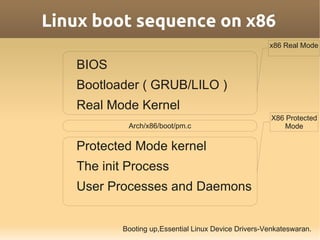
Linux boot sequence on x86
                                                     x86 Real Mode

   BIOS
   Bootloader ( GRUB/LILO )
   Real Mode Kernel
                                                      X86 Protected
            Arch/x86/boot/pm.c                            Mode

   Protected Mode kernel
   The init Process
   User Processes and Daemons


          Booting up,Essential Linux Device Drivers-Venkateswaran.
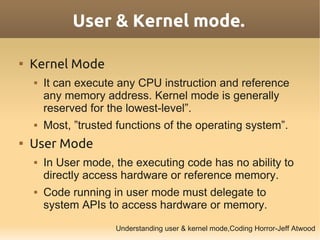
User & Kernel mode.


    Kernel Mode
       It can execute any CPU instruction and reference
        any memory address. Kernel mode is generally
        reserved for the lowest-level”.
       Most, ”trusted functions of the operating system”.

    User Mode
       In User mode, the executing code has no ability to
        directly access hardware or reference memory.
       Code running in user mode must delegate to
        system APIs to access hardware or memory.
                      Understanding user & kernel mode,Coding Horror-Jeff Atwood
Development

   Linux System Call.
   Device Drivers Development Supporting device
    drivers.
   Kernel Programming Environment.
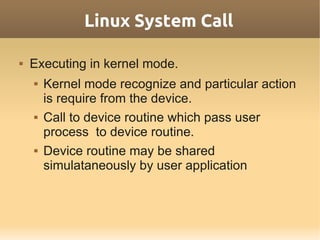
Linux System Call

   Executing in kernel mode.
       Kernel mode recognize and particular action
        is require from the device.
       Call to device routine which pass user
        process to device routine.
       Device routine may be shared
        simulataneously by user application
Device Drivers Development
      Supporting device drivers.
   A set of routines that communicate with a hardware
    device and provide a uniform interface to the operating
    system kernel.
   A self-contained component that can be added to, or
    removed from, the operating system dynamically.
   Management of data flow and c ontrol between user
    programs and a peripheral device.
   A user-defined section of the kernel that allows a
    program or a peripheral device to appear as a `` /dev
    '' device to the rest of the system's software.

                       Write a Linux Hardware Device Driver.FreeSoftware Mag.
Device Driver Programming
                                                         % make
#include <linux/init.h>
#include <linux/module.h>                                make[1]: Entering directory `/usr/src/linux-2.6.10'

MODULE_LICENSE("Dual BSD/GPL");                          CC [M] /home/ldd3/src/misc-modules/hello.o

                                                         Building modules, stage 2.
static int hello_init(void)                              MODPOST
{                                                        CC
printk(KERN_ALERT "Hello, worldn");
                                                         /home/ldd3/src/misc-modules/hello.mod.o
return 0;
                                                         LD [M] /home/ldd3/src/misc-modules/hello.ko
}
                                                         make[1]: Leaving directory `/usr/src/linux-2.6.10'

static void hello_exit(void)                             % su

{                                                        root# insmod ./hello.ko
printk(KERN_ALERT "Goodbye, cruel worldn");             Hello, world
}                                                        root# rmmod hello

                                                         Goodbye cruel world
module_init(hello_init);
                                                         root#
module_exit(hello_exit);


                                       Linux kernel in a nutshell,3rd-Greg Kroah-Hartman

Linux device driver

  • 1.
  • 2.
    Agenda  History & Why Linux kernel?  Device Driver.  Purpose & Design  Kernel mode & User mode  Development  Application & API
  • 3.
    History and WhyLinux kernel?  First developed by Linus Torvals.  Linux base on UNIX standard.  Workgroup for implement driver & patch with kernel.org.  ”Just for fun” - Linux Torvals History.
  • 4.
    Pupose & Design  Connection between Hardware and Software.  Design communicate on logical layer ( Port : ttyS,lp,hd) and physical layer(Handle stardard of communication protocol).  Linux kernel (.ko file type) & Microsoft (.sys file type ) kernel( Monolithic,Micro,Hybird )
  • 5.
    Linux boot sequenceon x86 x86 Real Mode BIOS Bootloader ( GRUB/LILO ) Real Mode Kernel X86 Protected Arch/x86/boot/pm.c Mode Protected Mode kernel The init Process User Processes and Daemons Booting up,Essential Linux Device Drivers-Venkateswaran.
  • 6.
    User & Kernelmode.  Kernel Mode  It can execute any CPU instruction and reference any memory address. Kernel mode is generally reserved for the lowest-level”.  Most, ”trusted functions of the operating system”.  User Mode  In User mode, the executing code has no ability to directly access hardware or reference memory.  Code running in user mode must delegate to system APIs to access hardware or memory. Understanding user & kernel mode,Coding Horror-Jeff Atwood
  • 7.
    Development  Linux System Call.  Device Drivers Development Supporting device drivers.  Kernel Programming Environment.
  • 8.
    Linux System Call  Executing in kernel mode.  Kernel mode recognize and particular action is require from the device.  Call to device routine which pass user process to device routine.  Device routine may be shared simulataneously by user application
  • 9.
    Device Drivers Development Supporting device drivers.  A set of routines that communicate with a hardware device and provide a uniform interface to the operating system kernel.  A self-contained component that can be added to, or removed from, the operating system dynamically.  Management of data flow and c ontrol between user programs and a peripheral device.  A user-defined section of the kernel that allows a program or a peripheral device to appear as a `` /dev '' device to the rest of the system's software. Write a Linux Hardware Device Driver.FreeSoftware Mag.
  • 10.
    Device Driver Programming % make #include <linux/init.h> #include <linux/module.h> make[1]: Entering directory `/usr/src/linux-2.6.10' MODULE_LICENSE("Dual BSD/GPL"); CC [M] /home/ldd3/src/misc-modules/hello.o Building modules, stage 2. static int hello_init(void) MODPOST { CC printk(KERN_ALERT "Hello, worldn"); /home/ldd3/src/misc-modules/hello.mod.o return 0; LD [M] /home/ldd3/src/misc-modules/hello.ko } make[1]: Leaving directory `/usr/src/linux-2.6.10' static void hello_exit(void) % su { root# insmod ./hello.ko printk(KERN_ALERT "Goodbye, cruel worldn"); Hello, world } root# rmmod hello Goodbye cruel world module_init(hello_init); root# module_exit(hello_exit); Linux kernel in a nutshell,3rd-Greg Kroah-Hartman