A
SEMINAR
ON
“REDHAT LINUX & NIS
SERVER”
PRESENTED TO :
HEAD, DEPTT. OF MCA
 PRESENTED BY :
 Priyanka bhadoriya
ABOUT LINUX
Linux was originally built by Linus
Torvalds at the University of Helsinki in
1991.
Linux is a Unix-like, Kernel-based, fully
memory-protected, multitasking operating
system
It runs on a wide range of hardware from
PCs to Macs.
FEATURES OF LINUX
 Linux is “OPEN SOURCE".
 Security
 Multi-user facility
 Free of Cost
 Virus-proof
 Choice of user-decided GUI
 Supports multiple copies of the Kernel
KERNEL OVERVIEW
 Kernel is the core of the Linux Operating
System. Kernel controls all hardware, enforce
security, and allocate memory.
 Kernel Duties:
Process Management:- scheduling, memory,
security, system
calls.
Hardware:- drivers, networking, file systems,
buffers, cache.
LINUX FILE SYSTEM
 /bin :- It contains all binary and executable
files.
 /sbin:- It contains all system executable and
binary files.
 /etc :- It contains all configuration files.
 /lib :- It contains the location for library
files.
 /boot:- It contains linux boot file and linux
kernel.
 /dev :- It contents all device files. eg.
CDROM, Harddisk.
 /var :- It contents login files and mails.
 /opt :- It contents typical location of
optional packages.
 /home:- It contents typical location for all users.
 /mnt :- It is a mount directory used to mount
CDROM , Floppy.
 /user/local:-It shows default location for
administrators.
Contd…
LINUX SHELL
 SHELL:- Shell is an interface between
the user and the kernel.
 TYPES OF SHELL
 bash
 sh
 nologin
 tcsh
 csh
 ksh
USERS,GROUPS AND
PERMISSIONS
 USERS
The concept of user accounts was created to
allow many individuals to share these precious
computing resources.
 TYPES OF USERS
Primary :- root (administrator)
Secondary :- other users
Contd….
 GROUPS
Sometimes users need to collaborate. This can
be accomplished by having users assigned to
groups and setting appropriate group
permissions for files or directories.
TYPES
User private group :- For private grouping.
Primary group :- By default.
Contd..
 PERMISSIONS
Permissions are used to restrict the files
user, files group and everyone else.
r: permission to read a file.
w: permission to write a file.
x: permission to execute a program or
change into a directory.
-: no permission
RAID DEVICE
 RAID (Redundant area of independent disks)
Raid Device are used to store the data in multiple storage
device simultaneously.
 TYPES OF RAID
RAID 0
RAID 1
RAID 5
RAID 6
LVM CONCEPT
 LVM (Logical Volume Manager)
It is a concept used by Linux to obtain the
maximum use of memory storage.
L.V.M. collects all the memory unallocated and
combines to form a volume group.
This volume group is Dynamic in size.
SNAPSHOT CONCEPT
 It is a new feature added in RHEL5 & RHEL5.2
 Snapshot provides the facility to save the
memory by reducing a big amount of data into a
very smaller memory space making a snap.
 We can only read the data.
LINUX
SERVER
CONFIGURATION
TYPES OF SERVERS
 NIS SERVER
 NFS SERVER
 DNS SERVER
 FTP SERVER
 DHCP SERVER
 SSH SERVER
 TELNET & XINETD SERVER
 SMTP SERVER
 SAMBA SERVER
 WEB SERVER
NIS SERVER
Network Information System(NIS)
NIS Server is Used to manage account &
system information on multiple system from a
central Server.
Software Required :- rpm –q portmap
rpm –q ypserv
Configuration File :- vim /etc/sysconfig/Network
vim /var/yp/Makefile
Service :- service portmap restart
service ypserv restart
service yppasswdd restart
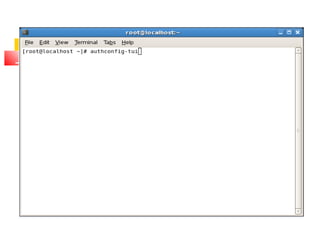
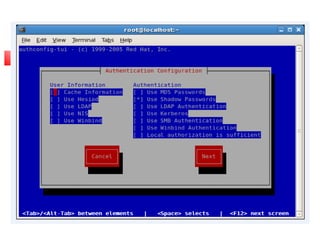
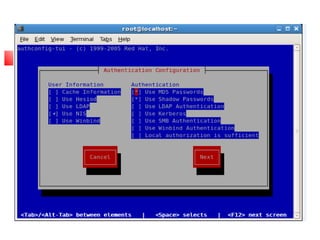
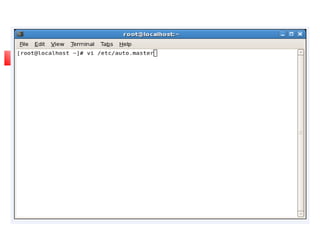
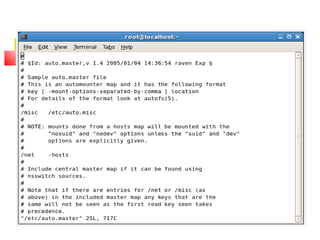
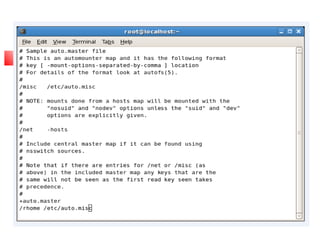
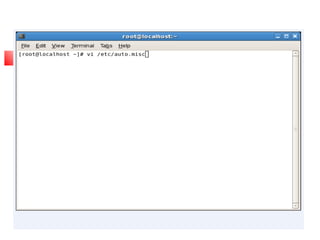
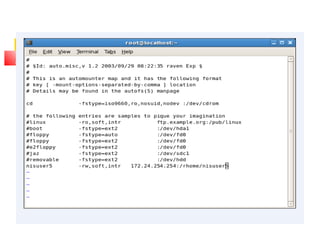
SCREENSHOTS
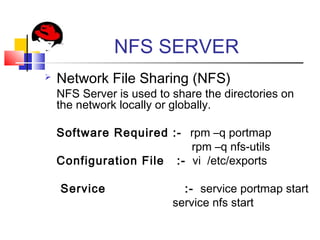
NFS SERVER
 Network File Sharing (NFS)
NFS Server is used to share the directories on
the network locally or globally.
Software Required :- rpm –q portmap
rpm –q nfs-utils
Configuration File :- vi /etc/exports
Service :- service portmap start
service nfs start
DNS SERVER
DNS(Domain Name System)
 Resolves hostnames into IP addresses
(Forward Lookup).
 Resolves IP addresses into hostnames
(Reverse Lookup).
 Allow machines to be logically grouped by
name domains.
 Provides E-Mail routing information.
Contd..
 Software Required :- rpm –q bind
rpm –q bind-
utils

Configuration File :- vi /etc/named.conf
vi /var/named/*
vi /etc/rndc.*
vi /etc/resolv.conf
 Script : named
 Ports : 53(domain), 953(rndc)
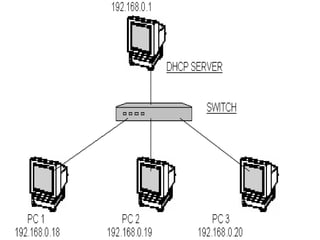
DHCP SERVER
 DHCP : Dynamic Host Configuring Protocol,
implemented via dhcpd
 It assigns IP address for its clients.
 In a Network , A computer needs information
like
I.P. address , dns server ,gate way,
subnetmask to
communicate to other computers.
 DHCP automatically give all client computers
on
Contd..
Obtaining an initial address
 Client broadcasts DISCOVER to locate theClient broadcasts DISCOVER to locate the
server.server.
 Server reply with its IP.Server reply with its IP.
 Client sends REQUEST for address on theClient sends REQUEST for address on the
received IP.received IP.
 Server commits allocation & returns ACKServer commits allocation & returns ACK
containing IP, Subnet Mask, DNS, Gateway etc.containing IP, Subnet Mask, DNS, Gateway etc.
FTP SERVER
 File transfer protocol (FTP) is a common method of
copying files between computer systems.
 TYPES OF FTP
Regular FTP:- This is used primarily to allow specific users
to download files to their systems.
Anonymous FTP:- This is used primarily to allow any
remote user to download files to their systems.
Contd..
Software Required :- rpm –q vsftpd
Configuration File :- vi /etc/vsftpd/vsftpd.conf
Service :- service vsftpd start
SSH SERVER
 SSH (Secure shell server) is used to access the full
control on the remote machine on network.
Software Required :- rpm –q openssh
rpm –q openssl
rpm –q openssh-server
rpm –q openssh-clients
Configuration File :- vi /etc/ssh/sshd-config
Service :- service sshd start
TELNET & XINETD SERVER
 XINETD
Xinetd is a program used to start and stop a variety of
Linux data communication applications. Some of these
applications, such as TELNET, are installed by default in
Red Hat Linux.
Software Required :- rpm –q telnet
rpm –q telnet-server
Configuration File :- vi /etc/xinetd.d/telnet
vi /etc/securetty
Service :- service xinetd start
SMTP SERVER

Simple Mail Transfer Protocol(SMTP) is used to send or
retrieve the received mails on the network.
Based on two Services
Pop:- Post Office Protocol
imap:- Internet message acess protocol
Software Required :- rpm –q sendmail
rpm –q sendmail-cf
rpm –q m4
rpm –q make
rpm –q procmail
Configuration File :- vi /etc/mail/sendmail.cf
vi /etc/mail/access
Service :- service sendmail restart
SAMBA SERVER
 To share the files and directories of linux with
window or other operating system then we use
samba server.
Software Required :- rpm –q samba
rpm –q samba-common
rpm –q samba-client
Configuration File :- vi /etc/samba/smb.conf
Apache Web Server
 Apache is Redhat Standard Web Server
 According to Net craft Web server survey
Apache is the most widely used Web
server.
 More than 50% Web sites are hosted on Apache
Web Server
 Apache is Free.
 Apache is extremely powerful and extendable.
 Easily available with any Linux distribution.
Configuration Of Apache
 Packages : httpd
 Default Port Number : 80
 Configuration Directory : /etc/httpd/
 Main Configuration File :
etc/httpd/conf/httpd.conf
 Service Daemon : httpd
THANKS FOR KIND
ATTENTION….
QUERIES
???......?

linux

  • 1.
    A SEMINAR ON “REDHAT LINUX &NIS SERVER” PRESENTED TO : HEAD, DEPTT. OF MCA  PRESENTED BY :  Priyanka bhadoriya
  • 2.
    ABOUT LINUX Linux wasoriginally built by Linus Torvalds at the University of Helsinki in 1991. Linux is a Unix-like, Kernel-based, fully memory-protected, multitasking operating system It runs on a wide range of hardware from PCs to Macs.
  • 3.
    FEATURES OF LINUX Linux is “OPEN SOURCE".  Security  Multi-user facility  Free of Cost  Virus-proof  Choice of user-decided GUI  Supports multiple copies of the Kernel
  • 4.
    KERNEL OVERVIEW  Kernelis the core of the Linux Operating System. Kernel controls all hardware, enforce security, and allocate memory.  Kernel Duties: Process Management:- scheduling, memory, security, system calls. Hardware:- drivers, networking, file systems, buffers, cache.
  • 5.
    LINUX FILE SYSTEM /bin :- It contains all binary and executable files.  /sbin:- It contains all system executable and binary files.  /etc :- It contains all configuration files.  /lib :- It contains the location for library files.  /boot:- It contains linux boot file and linux kernel.
  • 6.
     /dev :-It contents all device files. eg. CDROM, Harddisk.  /var :- It contents login files and mails.  /opt :- It contents typical location of optional packages.  /home:- It contents typical location for all users.  /mnt :- It is a mount directory used to mount CDROM , Floppy.  /user/local:-It shows default location for administrators. Contd…
  • 7.
    LINUX SHELL  SHELL:-Shell is an interface between the user and the kernel.  TYPES OF SHELL  bash  sh  nologin  tcsh  csh  ksh
  • 8.
    USERS,GROUPS AND PERMISSIONS  USERS Theconcept of user accounts was created to allow many individuals to share these precious computing resources.  TYPES OF USERS Primary :- root (administrator) Secondary :- other users
  • 9.
    Contd….  GROUPS Sometimes usersneed to collaborate. This can be accomplished by having users assigned to groups and setting appropriate group permissions for files or directories. TYPES User private group :- For private grouping. Primary group :- By default.
  • 10.
    Contd..  PERMISSIONS Permissions areused to restrict the files user, files group and everyone else. r: permission to read a file. w: permission to write a file. x: permission to execute a program or change into a directory. -: no permission
  • 11.
    RAID DEVICE  RAID(Redundant area of independent disks) Raid Device are used to store the data in multiple storage device simultaneously.  TYPES OF RAID RAID 0 RAID 1 RAID 5 RAID 6
  • 12.
    LVM CONCEPT  LVM(Logical Volume Manager) It is a concept used by Linux to obtain the maximum use of memory storage. L.V.M. collects all the memory unallocated and combines to form a volume group. This volume group is Dynamic in size.
  • 13.
    SNAPSHOT CONCEPT  Itis a new feature added in RHEL5 & RHEL5.2  Snapshot provides the facility to save the memory by reducing a big amount of data into a very smaller memory space making a snap.  We can only read the data.
  • 14.
  • 15.
    TYPES OF SERVERS NIS SERVER  NFS SERVER  DNS SERVER  FTP SERVER  DHCP SERVER  SSH SERVER  TELNET & XINETD SERVER  SMTP SERVER  SAMBA SERVER  WEB SERVER
  • 16.
    NIS SERVER Network InformationSystem(NIS) NIS Server is Used to manage account & system information on multiple system from a central Server. Software Required :- rpm –q portmap rpm –q ypserv Configuration File :- vim /etc/sysconfig/Network vim /var/yp/Makefile Service :- service portmap restart service ypserv restart service yppasswdd restart
  • 17.
  • 26.
    NFS SERVER  NetworkFile Sharing (NFS) NFS Server is used to share the directories on the network locally or globally. Software Required :- rpm –q portmap rpm –q nfs-utils Configuration File :- vi /etc/exports Service :- service portmap start service nfs start
  • 27.
    DNS SERVER DNS(Domain NameSystem)  Resolves hostnames into IP addresses (Forward Lookup).  Resolves IP addresses into hostnames (Reverse Lookup).  Allow machines to be logically grouped by name domains.  Provides E-Mail routing information.
  • 28.
    Contd..  Software Required:- rpm –q bind rpm –q bind- utils  Configuration File :- vi /etc/named.conf vi /var/named/* vi /etc/rndc.* vi /etc/resolv.conf  Script : named  Ports : 53(domain), 953(rndc)
  • 29.
    DHCP SERVER  DHCP: Dynamic Host Configuring Protocol, implemented via dhcpd  It assigns IP address for its clients.  In a Network , A computer needs information like I.P. address , dns server ,gate way, subnetmask to communicate to other computers.  DHCP automatically give all client computers on
  • 30.
    Contd.. Obtaining an initialaddress  Client broadcasts DISCOVER to locate theClient broadcasts DISCOVER to locate the server.server.  Server reply with its IP.Server reply with its IP.  Client sends REQUEST for address on theClient sends REQUEST for address on the received IP.received IP.  Server commits allocation & returns ACKServer commits allocation & returns ACK containing IP, Subnet Mask, DNS, Gateway etc.containing IP, Subnet Mask, DNS, Gateway etc.
  • 32.
    FTP SERVER  Filetransfer protocol (FTP) is a common method of copying files between computer systems.  TYPES OF FTP Regular FTP:- This is used primarily to allow specific users to download files to their systems. Anonymous FTP:- This is used primarily to allow any remote user to download files to their systems.
  • 33.
    Contd.. Software Required :-rpm –q vsftpd Configuration File :- vi /etc/vsftpd/vsftpd.conf Service :- service vsftpd start
  • 34.
    SSH SERVER  SSH(Secure shell server) is used to access the full control on the remote machine on network. Software Required :- rpm –q openssh rpm –q openssl rpm –q openssh-server rpm –q openssh-clients Configuration File :- vi /etc/ssh/sshd-config Service :- service sshd start
  • 35.
    TELNET & XINETDSERVER  XINETD Xinetd is a program used to start and stop a variety of Linux data communication applications. Some of these applications, such as TELNET, are installed by default in Red Hat Linux. Software Required :- rpm –q telnet rpm –q telnet-server Configuration File :- vi /etc/xinetd.d/telnet vi /etc/securetty Service :- service xinetd start
  • 36.
    SMTP SERVER  Simple MailTransfer Protocol(SMTP) is used to send or retrieve the received mails on the network. Based on two Services Pop:- Post Office Protocol imap:- Internet message acess protocol Software Required :- rpm –q sendmail rpm –q sendmail-cf rpm –q m4 rpm –q make rpm –q procmail Configuration File :- vi /etc/mail/sendmail.cf vi /etc/mail/access Service :- service sendmail restart
  • 37.
    SAMBA SERVER  Toshare the files and directories of linux with window or other operating system then we use samba server. Software Required :- rpm –q samba rpm –q samba-common rpm –q samba-client Configuration File :- vi /etc/samba/smb.conf
  • 38.
    Apache Web Server Apache is Redhat Standard Web Server  According to Net craft Web server survey Apache is the most widely used Web server.  More than 50% Web sites are hosted on Apache Web Server  Apache is Free.  Apache is extremely powerful and extendable.  Easily available with any Linux distribution.
  • 39.
    Configuration Of Apache Packages : httpd  Default Port Number : 80  Configuration Directory : /etc/httpd/  Main Configuration File : etc/httpd/conf/httpd.conf  Service Daemon : httpd
  • 40.
  • 41.