REDHAT Linux
A.K.SINGH
OVERVIEW
 operating system
 what is linux
 history of linux
why linux is so popular
 why we use linux
 advantages/disadvantages of using linux
The Business of Linux
 Is Linux Hard to learn ??
My vision
What is os
 operating system is program
or in common term a software.
A software or program which
manage your computer
hardware resource and
provide interface to run your
other program
What is linux
 Linux is a very popular Unix like
operating system. Linux was first
released in 1994 with version # 1.0.
Linux is a multi-tasking and multi-
user operating system
History of linux
GNU project
• Established in 1984 by Richard
Stallman, who believes that
software should be free from
restrictions against copying or
modification in order to make better
and efficient computer programs
Beginning of Linux
 A famous professor Andrew Tanenbaum
developed Minix, a simplified version of
UNIX that runs on PC
 Minix is for class teaching only. No
intention for commercial use
 In Sept 1991, Linus Torvalds, a second
year student of Computer Science at the
University of Helsinki, developed the
preliminary kernel of Linux, known as
Linux version 0.0.1
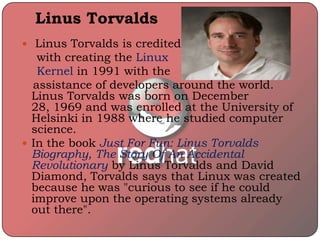
Linus Torvalds
 Linus Torvalds is credited
with creating the Linux
Kernel in 1991 with the
assistance of developers around the world.
Linus Torvalds was born on December
28, 1969 and was enrolled at the University of
Helsinki in 1988 where he studied computer
science.
 In the book Just For Fun: Linus Torvalds
Biography, The Story Of An Accidental
Revolutionary by Linus Torvalds and David
Diamond, Torvalds says that Linux was created
because he was "curious to see if he could
improve upon the operating systems already
out there".
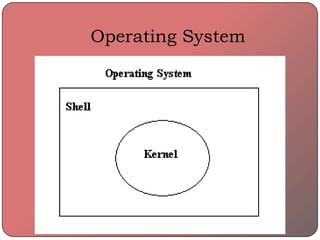
Kernel
 Core or nucleus of an operating
system
 Interacts with the hardware
 First program to get loaded when
the system starts and runs till the
session gets terminated
 Different from BIOS which is
hardware dependent.
 Kernel is software dependent
Shell
 Program that interacts with
kernel
 Bridge between kernel and the
user
 Command interpreter
 User can type command and the
command is conveyed to the
kernel and it will be executed
Operating System
Hardware Requirements
 Can run on very minimal hardware
 Recommend that computer have
minimum of:
 1 GB of free disk space
 64 MB of RAM
 For Red Hat Enterprise Linux
installations:
 256 MB of RAM
 300 MHZ CPU
 800 MB of free disk space
why linux is so
popular
So popular…...
 Linux is very popular, simple
reason behind this is Linux is very powerful.
But just think why?
 Main reason behind Linux power and
popularity is it open source nature
 If the product is initially good and
opensource then people can take it, modify it
and use as per it own way
open source
 Free software” is a matter of liberty, not price. To
understand the concept, you should think of
“free” as in “free speech”, not as in “free beer”.
 Free software is a matter of the users' freedom to
run, copy, distribute, study, change and improve
the software. More precisely, it refers to four
kinds of freedom, for the users of the software:
 The freedom to run the program, for any
purpose
 The freedom to study how the program
works, and adapt it to your needs . Access to the
source code is a precondition for this.
 The freedom to redistribute copies so you can
help your neighbor.
 The freedom to improve the program, and
release your improvements to the public, so that
the whole community benefits. Access to the
source code is a precondition for this.
Low cost
 You don’t need to spend time and money to
obtain licenses since Linux and much of its
software come with the GNU General Public
License. You can start to work immediately
without worrying that your software may
stop working anytime because the free trial
version expires. Additionally, there are large
repositories from which you can freely
download high quality software for almost
any task you can think of.
Stability
 Linux doesn’t need to be rebooted
periodically to maintain performance levels.
It doesn’t freeze up or slow down over time
due to memory leaks and such. Continuous
up-times of hundreds of days (up to a year
or more) are not uncommon.
Performance
 Linux provides persistent high performance
on workstations and on networks. It can
handle unusually large numbers of users
simultaneously, and can make old
computers sufficiently responsive to be
useful again
Fast and easy installation
 Most Linux distributions come with user-
friendly installation and setup programs.
Popular Linux distributions come with tools
that make installation of additional software
very user friendly as well.
Multitasking
Choice
 The large number of Linux distributions
gives you a choice. Each distribution is
developed and supported by a different
organization. You can pick the one you like
best; the core functionalities are the same;
most software runs on most distributions.
Distibution of linux
Dis…. Of Linux
Linux community is very big. So
many people comes with ideas
of improvement and lost of people
involve in implementing good ideas.
This is the big big reason for the
growth and popularity of Linux
operating system.
few popular Linux distributions
CentOS
Fedora
Suse Linux
Ubuntu
Red Hat Enterprise Linux
Linux Vs Windows OS
 Linux was established in 1971 while Microsoft
came into being in around in 1975. Both the
companies are supplying and catering to the
same market. However then why there is a huge
difference in market share of these software
giants.
 The most obvious reason is that Linux based its
early target market on servers only while left a
wide gap for Microsoft to avail the market
segment of home users. This is the reason that
now Microsoft accounts for total 90% market
share while leaving only 10 to 12% for Linux.
Key features of Linux Giving it
Edge over Microsoft
 Putting aside the market share if we try to
analyze the feature and performance of
Windows and Linux we would end up giving
more points to Linux
 There many reasons which would support
my argument. First and the foremost reason
is that Linux is a very low cost choice while
Windows on the other hand is burden on
one’s pocket
 Most promising edge of Linux is
that it is highly secure against
Malware threats. Whereas most
of the windows OS are blamed
for the poor security
conti….
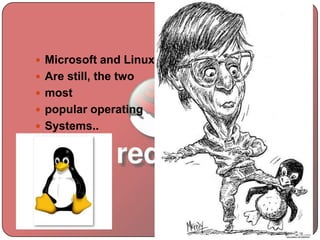
 Microsoft and Linux
 Are still, the two
 most
 popular operating
 Systems..
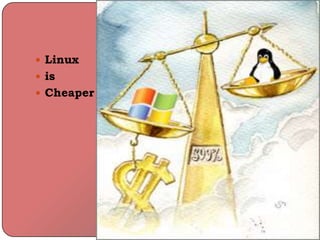
 Linux
 is
 Cheaper
Main Disadvantages of using
Linux
 Linux is an open source operating
system which has not released any
standard edition so far. There are
many variations of Linux which
makes it harder for the ultimate
buyer to choose the best one. It is
really difficult for the new users to
use and work well with the Linux
OS
Disadvantages…..
 its interface is not that user friendly.
One has to get used to it in order to
operate it well
 Linux is not really popular this is
the reason why it is really difficult to
find solution to the problems
Disadvantages…..
 Linux is an open source operating system
which provides its users the maximum
flexibility to use and modify the code
according to their choice. However, who is
that users who knows to modify the code.
Definitely they are trained professionals
and network administrators who have
expertise and skills to understand and
modify codes. Therefore one can say that
Linux is not an OS for layman and
common person
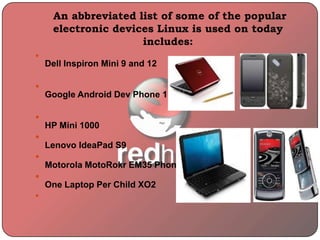
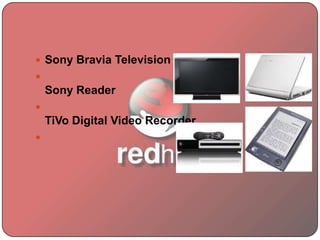
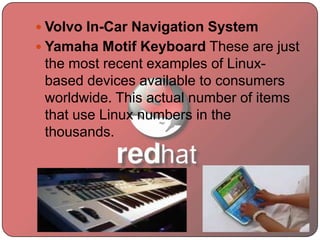
An abbreviated list of some of the popular
electronic devices Linux is used on today
includes:

Dell Inspiron Mini 9 and 12

Google Android Dev Phone 1

HP Mini 1000

Lenovo IdeaPad S9

Motorola MotoRokr EM35 Phone

One Laptop Per Child XO2

 Sony Bravia Television

Sony Reader

TiVo Digital Video Recorder

 Volvo In-Car Navigation System
 Yamaha Motif Keyboard These are just
the most recent examples of Linux-
based devices available to consumers
worldwide. This actual number of items
that use Linux numbers in the
thousands.
The Business of Linux
 Today, Linux is a multi-billion dollar
industry, with companies and governments
around the world taking advantage of the
operating system's security and flexibility.
Thousands of companies use Linux for day-
to-day use, attracted by the lower licensing
and support costs. Governments around the
world are deploying Linux to save money and
time, with some governments commissioning
their own versions of Linux.
The Business of Linux……
 In 2008, IDC analyst Al Gillen cited a
nearly 24 percent annual growth rate for
the Linux industry, which puts a $21
billion 2007 technology at $49 billion in
2011. The companies involved in Linux
include industry leaders such as
IBM, Fujitsu, Hewlett-
Packard, Oracle, Intel, Hitachi, NEC, an
d Novell. All have all invested
time, talent, and resources to bettering
Linux on their own and through the
Redhat
certifications
….
 Red Hat Certified System Administrator (RHCSA)
 Red Hat Certified Engineer (RHCE)
 Red Hat Certified Security Specialist (RHCSS)
 Red Hat Certified Datacenter Specialist (RHCDS)
 Red Hat Certified Virtualization Administrator
(RHCVA)
 Red Hat Certified Architect (RHCA)
 Red Hat Certified JBoss Administration (RHCJA)
 Red Hat Certified JBoss Developer (RHCJD)
For more info.-
http://en.wikipedia.org/wiki/Red_Hat_Certificati
on_Program
For more about redhat
certification
http://www.redhat
.com/training/certi
fications/
Careers in Linux
 System administrator
 Network administrator
 Software engineer
 Trainer
 Technical writer
 Product marketing
 Business consultant
Linux is as easy as
typing something on
notepad
Is Linux Hard to
learn ??
My vision
 I worked on many editions of Windows. Windows
(all editions) is costly operating system with lots
of vulnerabilites and errors but yet it is famous
because it is easy to use, stable & durable. For
Windows you must have an Anti virus software
(You have to purchase it separately) installed or
your system will get infected by virus, etc. Also
you should have MS Office Software to create
documents, excel sheet, etc (You also have to
purchase it separately, another shock on your
pocket). So now the Windows costs you around
half the price of your Computer.
My vision….
 But then why we should switch on to Linux?
Answer is that it is "FREE". More Companies
provide it free of cost & you are even free to
modify, distribute.
Linux is free from most of Viruses & it is
secure. Actually 95% of Viruses are designed
for Windows (one of the reason is that all
Windows editions are 'paid' where as Linux
is free).

linux introduction

  • 1.
  • 2.
    OVERVIEW  operating system what is linux  history of linux why linux is so popular  why we use linux  advantages/disadvantages of using linux The Business of Linux  Is Linux Hard to learn ?? My vision
  • 3.
    What is os operating system is program or in common term a software. A software or program which manage your computer hardware resource and provide interface to run your other program
  • 4.
    What is linux Linux is a very popular Unix like operating system. Linux was first released in 1994 with version # 1.0. Linux is a multi-tasking and multi- user operating system
  • 5.
  • 6.
    GNU project • Establishedin 1984 by Richard Stallman, who believes that software should be free from restrictions against copying or modification in order to make better and efficient computer programs
  • 7.
    Beginning of Linux A famous professor Andrew Tanenbaum developed Minix, a simplified version of UNIX that runs on PC  Minix is for class teaching only. No intention for commercial use  In Sept 1991, Linus Torvalds, a second year student of Computer Science at the University of Helsinki, developed the preliminary kernel of Linux, known as Linux version 0.0.1
  • 8.
    Linus Torvalds  LinusTorvalds is credited with creating the Linux Kernel in 1991 with the assistance of developers around the world. Linus Torvalds was born on December 28, 1969 and was enrolled at the University of Helsinki in 1988 where he studied computer science.  In the book Just For Fun: Linus Torvalds Biography, The Story Of An Accidental Revolutionary by Linus Torvalds and David Diamond, Torvalds says that Linux was created because he was "curious to see if he could improve upon the operating systems already out there".
  • 9.
    Kernel  Core ornucleus of an operating system  Interacts with the hardware  First program to get loaded when the system starts and runs till the session gets terminated  Different from BIOS which is hardware dependent.  Kernel is software dependent
  • 10.
    Shell  Program thatinteracts with kernel  Bridge between kernel and the user  Command interpreter  User can type command and the command is conveyed to the kernel and it will be executed
  • 11.
  • 12.
    Hardware Requirements  Canrun on very minimal hardware  Recommend that computer have minimum of:  1 GB of free disk space  64 MB of RAM  For Red Hat Enterprise Linux installations:  256 MB of RAM  300 MHZ CPU  800 MB of free disk space
  • 13.
    why linux isso popular
  • 14.
    So popular…...  Linuxis very popular, simple reason behind this is Linux is very powerful. But just think why?  Main reason behind Linux power and popularity is it open source nature  If the product is initially good and opensource then people can take it, modify it and use as per it own way
  • 15.
    open source  Freesoftware” is a matter of liberty, not price. To understand the concept, you should think of “free” as in “free speech”, not as in “free beer”.  Free software is a matter of the users' freedom to run, copy, distribute, study, change and improve the software. More precisely, it refers to four kinds of freedom, for the users of the software:  The freedom to run the program, for any purpose  The freedom to study how the program works, and adapt it to your needs . Access to the source code is a precondition for this.  The freedom to redistribute copies so you can help your neighbor.  The freedom to improve the program, and release your improvements to the public, so that the whole community benefits. Access to the source code is a precondition for this.
  • 16.
    Low cost  Youdon’t need to spend time and money to obtain licenses since Linux and much of its software come with the GNU General Public License. You can start to work immediately without worrying that your software may stop working anytime because the free trial version expires. Additionally, there are large repositories from which you can freely download high quality software for almost any task you can think of.
  • 17.
    Stability  Linux doesn’tneed to be rebooted periodically to maintain performance levels. It doesn’t freeze up or slow down over time due to memory leaks and such. Continuous up-times of hundreds of days (up to a year or more) are not uncommon.
  • 18.
    Performance  Linux providespersistent high performance on workstations and on networks. It can handle unusually large numbers of users simultaneously, and can make old computers sufficiently responsive to be useful again
  • 19.
    Fast and easyinstallation  Most Linux distributions come with user- friendly installation and setup programs. Popular Linux distributions come with tools that make installation of additional software very user friendly as well. Multitasking
  • 20.
    Choice  The largenumber of Linux distributions gives you a choice. Each distribution is developed and supported by a different organization. You can pick the one you like best; the core functionalities are the same; most software runs on most distributions.
  • 21.
  • 22.
    Dis…. Of Linux Linuxcommunity is very big. So many people comes with ideas of improvement and lost of people involve in implementing good ideas. This is the big big reason for the growth and popularity of Linux operating system.
  • 23.
    few popular Linuxdistributions CentOS Fedora Suse Linux Ubuntu Red Hat Enterprise Linux
  • 24.
    Linux Vs WindowsOS  Linux was established in 1971 while Microsoft came into being in around in 1975. Both the companies are supplying and catering to the same market. However then why there is a huge difference in market share of these software giants.  The most obvious reason is that Linux based its early target market on servers only while left a wide gap for Microsoft to avail the market segment of home users. This is the reason that now Microsoft accounts for total 90% market share while leaving only 10 to 12% for Linux.
  • 25.
    Key features ofLinux Giving it Edge over Microsoft  Putting aside the market share if we try to analyze the feature and performance of Windows and Linux we would end up giving more points to Linux  There many reasons which would support my argument. First and the foremost reason is that Linux is a very low cost choice while Windows on the other hand is burden on one’s pocket
  • 26.
     Most promisingedge of Linux is that it is highly secure against Malware threats. Whereas most of the windows OS are blamed for the poor security conti….
  • 27.
     Microsoft andLinux  Are still, the two  most  popular operating  Systems..
  • 28.
  • 29.
    Main Disadvantages ofusing Linux  Linux is an open source operating system which has not released any standard edition so far. There are many variations of Linux which makes it harder for the ultimate buyer to choose the best one. It is really difficult for the new users to use and work well with the Linux OS
  • 30.
    Disadvantages…..  its interfaceis not that user friendly. One has to get used to it in order to operate it well  Linux is not really popular this is the reason why it is really difficult to find solution to the problems
  • 31.
    Disadvantages…..  Linux isan open source operating system which provides its users the maximum flexibility to use and modify the code according to their choice. However, who is that users who knows to modify the code. Definitely they are trained professionals and network administrators who have expertise and skills to understand and modify codes. Therefore one can say that Linux is not an OS for layman and common person
  • 32.
    An abbreviated listof some of the popular electronic devices Linux is used on today includes:  Dell Inspiron Mini 9 and 12  Google Android Dev Phone 1  HP Mini 1000  Lenovo IdeaPad S9  Motorola MotoRokr EM35 Phone  One Laptop Per Child XO2 
  • 33.
     Sony BraviaTelevision  Sony Reader  TiVo Digital Video Recorder 
  • 34.
     Volvo In-CarNavigation System  Yamaha Motif Keyboard These are just the most recent examples of Linux- based devices available to consumers worldwide. This actual number of items that use Linux numbers in the thousands.
  • 35.
    The Business ofLinux  Today, Linux is a multi-billion dollar industry, with companies and governments around the world taking advantage of the operating system's security and flexibility. Thousands of companies use Linux for day- to-day use, attracted by the lower licensing and support costs. Governments around the world are deploying Linux to save money and time, with some governments commissioning their own versions of Linux.
  • 36.
    The Business ofLinux……  In 2008, IDC analyst Al Gillen cited a nearly 24 percent annual growth rate for the Linux industry, which puts a $21 billion 2007 technology at $49 billion in 2011. The companies involved in Linux include industry leaders such as IBM, Fujitsu, Hewlett- Packard, Oracle, Intel, Hitachi, NEC, an d Novell. All have all invested time, talent, and resources to bettering Linux on their own and through the
  • 38.
  • 39.
    ….  Red HatCertified System Administrator (RHCSA)  Red Hat Certified Engineer (RHCE)  Red Hat Certified Security Specialist (RHCSS)  Red Hat Certified Datacenter Specialist (RHCDS)  Red Hat Certified Virtualization Administrator (RHCVA)  Red Hat Certified Architect (RHCA)  Red Hat Certified JBoss Administration (RHCJA)  Red Hat Certified JBoss Developer (RHCJD) For more info.- http://en.wikipedia.org/wiki/Red_Hat_Certificati on_Program
  • 40.
    For more aboutredhat certification http://www.redhat .com/training/certi fications/
  • 41.
    Careers in Linux System administrator  Network administrator  Software engineer  Trainer  Technical writer  Product marketing  Business consultant
  • 42.
    Linux is aseasy as typing something on notepad Is Linux Hard to learn ??
  • 43.
    My vision  Iworked on many editions of Windows. Windows (all editions) is costly operating system with lots of vulnerabilites and errors but yet it is famous because it is easy to use, stable & durable. For Windows you must have an Anti virus software (You have to purchase it separately) installed or your system will get infected by virus, etc. Also you should have MS Office Software to create documents, excel sheet, etc (You also have to purchase it separately, another shock on your pocket). So now the Windows costs you around half the price of your Computer.
  • 44.
    My vision….  Butthen why we should switch on to Linux? Answer is that it is "FREE". More Companies provide it free of cost & you are even free to modify, distribute. Linux is free from most of Viruses & it is secure. Actually 95% of Viruses are designed for Windows (one of the reason is that all Windows editions are 'paid' where as Linux is free).

Editor's Notes

  • #45 You can download its image of 'Desktop Edition' from the website: http://www.ubuntu.com/ or you can order for a free CD from the website which may take the time of upto 6 weeks or above to deliver at your address. Please note that the UBUNTU Server Edition is without Graphic User Interface.