LINKED LISTS
Prepared by:
Muhammad Zohaib Azad
Hajra Israr
Ayesha Sajjad
What are linked lists?
A Linked Lists is a linear data structure.
Nodes make up linked lists.
Nodes are structures made up of data and a
pointer to another node.
Usually the pointer is called next.
5 * 6 * 7 * 8*
Null
head
Real Life Example:
A linked list is like scavenger hunt. You have a clue, and that
clue has a pointer to the next place having the next clue. So
you go to the next place and get another piece of data and
another pointer. To get something in the middle or at the end,
the only way is to follow the list from beginning.
Types of lists:
There are two types of lists:
1. Singly linked lists 2. Doubly linked lists
5 * 6*
Head
Node
NULLSingly list
5 * 6
Doubly list
5 *
Head
* *
NULL
prev
next
prev prev
next next
NULL
Basic Operation on a list
• Creating a list
• Inserting an element in a list
• Deleting an element in a list
• Searching a list
• Reversing a list
Creating a node
Struct node{
int data; //A simple node of a linked list
node*next;
}*start //Start points at the first node
Start =NULL; initialized to NULL at beginning
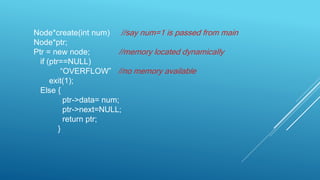
Node*create(int num) //say num=1 is passed from main
Node*ptr;
Ptr = new node; //memory located dynamically
if (ptr==NULL)
“OVERFLOW” //no memory available
exit(1);
Else {
ptr->data= num;
ptr->next=NULL;
return ptr;
}
Main function is:
void main()
{
node*ptr;
int data;
cin>>data;
ptr=create(data);
}
Inserting the nod in singly
linked list:
There are 3 cases here:
1. Insertion at the beginning
2. Insertion at the end
3. Insertion at the particular node
Insertion at the beginning:
There are two steps to be followed:
1. Make the next pointer of the node point towards the first node of the list.
2. Make the start pointer point towards this new node
If the list is empty simply make the start pointer point towards the new node;
5
65 5
Head
New
node
void insert_beg(node* p)
{ node* temp;
if(start==NULL) //if the list is empty
{
start=p;
cout<<”nNode inserted successfully at the beginning”;
}
else {
temp=start;
start=p;
p->next=temp; //making new node point at
} the first node of the list
}
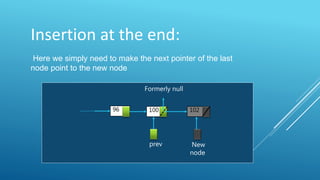
Insertion at the end:
Here we simply need to make the next pointer of the last
node point to the new node
96 100 102
prev New
node
Formerly null
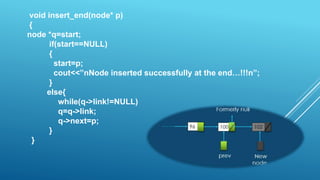
void insert_end(node* p)
{
node *q=start;
if(start==NULL)
{
start=p;
cout<<”nNode inserted successfully at the end…!!!n”;
}
else{
while(q->link!=NULL)
q=q->link;
q->next=p;
}
}
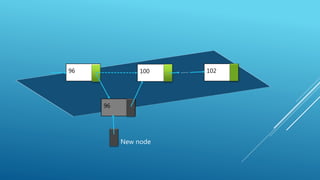
Inserting after an element:
Here we again need to do 2 steps :-
1. Make the next pointer of the node to be inserted point to
the next node of the node after which you want to insert the
node
2. Make the next pointer of the node after which the node is
to be inserted, point to the node to be inserted
96 100 102
96
New node
void insert_after(int c,node* p)
{
node* q;
q=start;
for(int i=1;i<c;i++)
{
q=q->link;
if(q==NULL)
cout<<”Less than “<<c<<” nodes in the list…!!!”;
}
p->link=q->link;
q->link=p;
cout<<”nNode inserted successfully”;
}
linked list

linked list

  • 2.
    LINKED LISTS Prepared by: MuhammadZohaib Azad Hajra Israr Ayesha Sajjad
  • 3.
    What are linkedlists? A Linked Lists is a linear data structure. Nodes make up linked lists. Nodes are structures made up of data and a pointer to another node. Usually the pointer is called next. 5 * 6 * 7 * 8* Null head
  • 4.
    Real Life Example: Alinked list is like scavenger hunt. You have a clue, and that clue has a pointer to the next place having the next clue. So you go to the next place and get another piece of data and another pointer. To get something in the middle or at the end, the only way is to follow the list from beginning.
  • 5.
    Types of lists: Thereare two types of lists: 1. Singly linked lists 2. Doubly linked lists 5 * 6* Head Node NULLSingly list 5 * 6 Doubly list 5 * Head * * NULL prev next prev prev next next NULL
  • 6.
    Basic Operation ona list • Creating a list • Inserting an element in a list • Deleting an element in a list • Searching a list • Reversing a list
  • 7.
    Creating a node Structnode{ int data; //A simple node of a linked list node*next; }*start //Start points at the first node Start =NULL; initialized to NULL at beginning
  • 8.
    Node*create(int num) //saynum=1 is passed from main Node*ptr; Ptr = new node; //memory located dynamically if (ptr==NULL) “OVERFLOW” //no memory available exit(1); Else { ptr->data= num; ptr->next=NULL; return ptr; }
  • 9.
    Main function is: voidmain() { node*ptr; int data; cin>>data; ptr=create(data); }
  • 10.
    Inserting the nodin singly linked list: There are 3 cases here: 1. Insertion at the beginning 2. Insertion at the end 3. Insertion at the particular node
  • 11.
    Insertion at thebeginning: There are two steps to be followed: 1. Make the next pointer of the node point towards the first node of the list. 2. Make the start pointer point towards this new node If the list is empty simply make the start pointer point towards the new node; 5 65 5 Head New node
  • 12.
    void insert_beg(node* p) {node* temp; if(start==NULL) //if the list is empty { start=p; cout<<”nNode inserted successfully at the beginning”; } else { temp=start; start=p; p->next=temp; //making new node point at } the first node of the list }
  • 13.
    Insertion at theend: Here we simply need to make the next pointer of the last node point to the new node 96 100 102 prev New node Formerly null
  • 14.
    void insert_end(node* p) { node*q=start; if(start==NULL) { start=p; cout<<”nNode inserted successfully at the end…!!!n”; } else{ while(q->link!=NULL) q=q->link; q->next=p; } }
  • 15.
    Inserting after anelement: Here we again need to do 2 steps :- 1. Make the next pointer of the node to be inserted point to the next node of the node after which you want to insert the node 2. Make the next pointer of the node after which the node is to be inserted, point to the node to be inserted
  • 16.
  • 17.
    void insert_after(int c,node*p) { node* q; q=start; for(int i=1;i<c;i++) { q=q->link; if(q==NULL) cout<<”Less than “<<c<<” nodes in the list…!!!”; } p->link=q->link; q->link=p; cout<<”nNode inserted successfully”; }