
Working with 
Smallholders 
A Handbook for Firms Building 
Sustainable Supply Chains
Photo Credits: 
Introduction: © Curt Carnemark / World Bank 
Page 1: © Charlotte Kesl / World Bank 
Chapter 1: © Stephan Bachenheimer/ World Bank 
Chapter 2: © IFC 
Chapter 3: © Bradford L.Roberts 
Page 29: © Gosia Nowakowska-Miller/ IFC 
Chapter 4: © Curt Carnemark / World Bank 
Page 43: © Ray Witlin / World Bank 
Chapter 5: © Gennadiy Ratushenko / World Bank 
Page 66: © IFC 
Chapter 6: © Scott Wallace/ World Bank 
Chapter 7: © Curt Carnemark / World Bank 
Chapter 8: © Tran Thiet Dung/ IFC 
Page 106: © Bruno Déméocq/ IFC 
Chapter 9: © Nugroho Nurdikiawan Sunjoyo / World Bank
Working with 
Smallholders 
A Handbook for Firms Building 
Sustainable Supply Chains
IFC, a member of the World Bank Group, creates opportunity for people to escape poverty and 
improve their lives. We foster sustainable economic growth in developing countries by supporting 
private sector development, mobilizing private capital, and providing advisory and risk mitigation 
services to businesses and governments. This report was commissioned by IFC through its Sustainable 
Business Advisory, which works with clients to promote sound environmental, social, governance, 
and industry standards; to catalyze investment in clean energy and resource efficiency; and to support 
sustainable supply chains and community investment. 
The conclusions and judgments contained in this report should not be attributed to, and do not 
necessarily represent the views of, IFC or its Board of Directors or the World Bank or its Executive 
Directors, or the countries they represent. IFC and the World Bank do not guarantee the accuracy of 
the data in this publication and accept no responsibility for any consequences of their use.
Table of Contents 
Introduction 1 
The Business Case for Working with Smallholder Farmers 11 
An Evidence-Based Approach to Program Design 19 
Aggregation Through Producer Organizations 29 
Effective Training and Communication Strategies for Changing Smallholder Behavior 43 
Standards and Certification of Smallholder Supply Chains 63 
Increasing Access to Inputs 75 
Improving Farm Management Skills 91 
Incorporating Gender into Supply Chain Interventions 101 
Measuring Results 117
Acknowledgements 
The preparation of this handbook was led by Dieter Fischer with significant input from 
Katherine Scaife Diaz, Anna Akhalkatsi, Mehnaz Haider, Kate Bottriell, Susan Pomar 
Queirolo, and Sanwaree Sethi. The views expressed in the handbook are those of the 
authors only. 
We would especially like to thank Usha Rao-Monari, John Kellenberg and Alan Johnson 
for their guidance and support throughout the development of the handbook. 
We would like to thank the following people who provided valuable comments, insights, 
and case studies. 
From IFC: 
Toyin Adeniji, Andi Wahyuni Baso, Ernest Bethe, Thu Hong Dang, Alexis Diamond, Sarak 
Duong, Mario João Gomes, Richard Henry, Deborah Horan, Ivan Ivanov, Ross Jaax, Rick Van 
der Kamp, Liana Korkotyan, Charles Lor, Natalie Macawaris, Maria Iturralde MacDicken, 
Emmanouela Markoglou, Carmen Niethammer, Liliana Miro Quesada, Chris Richards, 
Bradford Roberts, Christian Rahbek Rosenholm, and Colin Taylor. 
From firms and other organizations: 
Jane Abramovich (TechnoServe), Kwesi Acquah (Esoko), Fritz Brugger (Syngenta 
Foundation), Bai Akridge (National 4-H Council), Grahame Beaumont Dixie (World Bank), 
Karen Feely (Comprehensive Learning Solutions), David Feige (Making Cents), Andreanne 
Grimard (Solidaridad Network), Stephanie Hanson (One Acre Fund), Jan Lühmann 
(Sucafina), Alice Mostert (Solidaidad Network), Mark Neilson (Consultant), Laurens 
van Oeijen (UTZ Certified), Sylvain Roy (CNFA), Amanda Satterly (TechnoServe), Eugenia 
Serova (Food and Agriculture Organization), Alex Serrano (National Cooperative Business 
Association), and Lucas Simons (SCOPEinsight). 
The handbook was edited by Laura Mesko and designed by Ryan Clennan and Amy Orr 
of Studio Grafik. 
Please visit the website, www.farms2firms.org, to provide comments and to access 
updated information about new IFC publications and services.
Foreword 
One of our greatest challenges is meeting society’s food needs while simultaneously 
reducing agriculture’s environmental harm. This will require the “sustainable intensification” 
of agriculture: producing more food on less land in a more sustainable way. Growth 
in emerging markets and rising demand for higher quality food products mean huge 
opportunities for private firms along the whole value chain. More production of food 
with increasingly scarce land and water resources will require ingenuity, innovation, and 
considerable investments for decades to come. The future of agriculture depends in large 
part on innovative solutions emerging from private firms. But it also means new and 
innovative partnerships between different stakeholders in the food system. Firms need to 
establish and expand new ways of working with consumer groups, governments, research 
institutes, civil society organizations, and the millions of smallholder farmers—especially 
in emerging markets—who are critical to the future supply of many agricultural products 
including livestock, coffee, cocoa, vegetables, and oil palm. 
In the 2012 fiscal year, IFC doubled its programs in agriculture from $2 billion per annum 
to over $4 billion. We aim to double our investments again in another three years. We 
are scaling up programs that improve the livelihoods of smallholder farmers by linking 
them to modern supply chains providing opportunities to increase their productivity 
and improve their farming practices. IFC supports innovative partnerships between 
agribusiness, financial institutions, technical assistance providers, governments, donors, 
and other stakeholders in building new systems of sustainable food production. 
This handbook is a guide for firms who wish to expand their supply chains by working 
with smallholder farmers. The purpose is to enable more productive interactions between 
private firms and smallholders. This contribution is a part of our larger investment and 
advisory services in agribusiness that aim to shift our global food system to one where 
sustainable production is the norm and food and nutritional security is secured for this 
and for future generations. 
Usha Rao-Monari 
Director for Sustainable Business Advisory
Introduction
1 
Introduction 
Agribusinesses operate in a rapidly changing world. Demand for agricultural crops is expected 
to double as the world’s population reaches 9.1 billion by 2050. Food production will need to 
provide sufficient carbohydrates, proteins, and fats for the estimated 870 million people who 
currently lack food security. Concurrently, rising incomes and urbanization will drive increased 
consumption of meat, dairy, and bio-fuels. 
Increasing the quantity and quality of food in response to this growing demand will be a 
challenge for a variety of reasons. First, the remaining unused arable land is concentrated in a 
few countries and is difficult to access. Second, yields for staple crops, such as rice, maize, wheat, 
and soybeans, have stagnated or declined in one-quarter to one-third of their production areas 
during the past 40 years.1 Third, climate change, water scarcity, and an aging rural population 
also pose risks to agribusinesses seeking innovative solutions to sourcing their products. 
In the face of these challenges, firms recognize that the world’s 525 million smallholder 
farmers represent an opportunity to expand market share and secure a sustainable supply of 
key agricultural commodities. Sourcing directly from smallholders can expand a firm’s supply 
base, reduce margins paid to collectors and middlemen, and facilitate quality and productivity 
improvements. Smallholders also represent a potential customer base for firms marketing 
inputs, information, and financial services. 
However, sourcing from smallholders presents numerous challenges: 
• Productivity and crop quality are often low. 
• Smallholder suppliers may lack knowledge on how to mitigate social and environmental 
impacts. 
• Poor farm management skills and lack of aggregation reduce smallholders’ ability to 
achieve scale. 
• Transparency and traceability measures are needed along the supply chain to address food 
safety and sustainability. 
• Certification programs have difficulty evaluating the sustainability of farming practices 
through layers of collectors and middlemen. 
Responding to these challenges can require costly investments with returns spread over the 
short and long term.
2 
UNDERSTANDING SMALLHOLDER FARMERS 
Efforts to improve the quality and productivity of smallholder farmers can only be 
sustainable if those efforts incorporate farmers’ incentives. 
A smallholder farm in the developing world is typically a family-owned 
enterprise that produces crops or livestock on two or less 
hectares. In some countries and sectors, however, smallholdings can 
exceed 10 hectares. Many smallholders are not farmers by choice, 
but rather by default because they lack more lucrative opportunities. 
Family members provide most of the labor and derive their primary 
means of support from the farm. 
An estimated 525 million smallholder farms currently exist 
worldwide. The majority (388 million) are in Asia, with 44 million 
in Europe and the Russian Federation, 33 million in Africa, and five 
million in the Americas. The size of smallholdings in Asia and Africa 
has declined by 25 to 40 percent over the past 50 years, as these 
farms are passed from generation to generation. 
Smallholders work and live within traditional support and power 
structures, but increased access to information is changing the 
way smallholders organize and interact with markets. Typically, 
smallholders sell their crops through traditional supply chains, which 
begin with village collectors or producer organizations and continue 
through a series of aggregators. Smallholders may also wait by the 
roadside with their crops, hoping to sell to travelling traders. Village 
collectors usually extend credit and may also provide agricultural 
inputs, such as fertilizer, on loan basis, with repayment coming at 
the expected harvest. There may not be a clear distinction between 
traditional village collector networks and more democratic producer 
organizations or cooperatives. At the same time, the rapid spread 
of cell phones among farmers and their families allows farmers to 
increase their knowledge of and interaction with markets. 
Because smallholder farming is predominantly a household business, 
household dynamics affect farm decision making. Men often make 
the major decisions about farming and crop marketing, especially 
when cash crops are involved. Women often manage their own 
plots, particularly for food crops. However, the number of female-headed 
farms is increasing, particularly in Asia, where women head 
more than 20 percent of smallholder households in some areas. 
Quality and productivity vary widely among smallholder farmers 
depending on their ability to invest in production. The productive 
assets of a smallholding could be as basic as a hand hoe or as 
expensive as a tractor. Farmers may have no knowledge of post-harvest 
processing, or they may be capable of highly detailed 
grading and processing. In another example, as shown in the map 
on pages 4-5, fertilizer consumption is near zero in some African 
countries, while it exceeds 500 kg per hectare in China and Egypt. 
Literacy rates, which tend to be lower in rural areas, also vary 
considerably. 
388 44 33 
5 
Table 0.1. Global distribution of smallholders (Millions).
3 
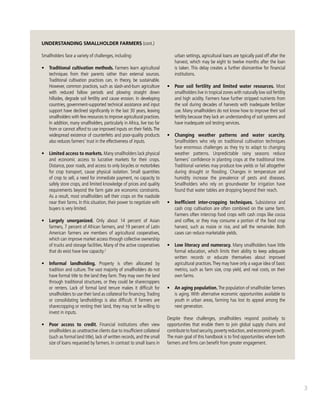
UNDERSTANDING SMALLHOLDER FARMERS (cont.) 
Smallholders face a variety of challenges, including: 
• Traditional cultivation methods. Farmers learn agricultural 
techniques from their parents rather than external sources. 
Traditional cultivation practices can, in theory, be sustainable. 
However, common practices, such as slash-and-burn agriculture 
with reduced fallow periods and plowing straight down 
hillsides, degrade soil fertility and cause erosion. In developing 
countries, government-supported technical assistance and input 
support have declined significantly in the last 30 years, leaving 
smallholders with few resources to improve agricultural practices. 
In addition, many smallholders, particularly in Africa, live too far 
from or cannot afford to use improved inputs on their fields. The 
widespread existence of counterfeits and poor-quality products 
also reduces farmers’ trust in the effectiveness of inputs. 
• Limited access to markets. Many smallholders lack physical 
and economic access to lucrative markets for their crops. 
Distance, poor roads, and access to only bicycles or motorbikes 
for crop transport, cause physical isolation. Small quantities 
of crop to sell, a need for immediate payment, no capacity to 
safely store crops, and limited knowledge of prices and quality 
requirements beyond the farm gate are economic constraints. 
As a result, most smallholders sell their crops on the roadside 
near their farms. In this situation, their power to negotiate with 
buyers is very limited. 
• Largely unorganized. Only about 14 percent of Asian 
farmers, 7 percent of African farmers, and 19 percent of Latin 
American farmers are members of agricultural cooperatives, 
which can improve market access through collective ownership 
of trucks and storage facilities. Many of the active cooperatives 
that do exist have low capacity.2 
• Informal landholding. Property is often allocated by 
tradition and culture. The vast majority of smallholders do not 
have formal title to the land they farm. They may own the land 
through traditional structures, or they could be sharecroppers 
or renters. Lack of formal land tenure makes it difficult for 
smallholders to use their land as collateral for financing. Trading 
or consolidating landholdings is also difficult. If farmers are 
sharecropping or renting their land, they may not be willing to 
invest in inputs. 
• Poor access to credit. Financial institutions often view 
smallholders as unattractive clients due to insufficient collateral 
(such as formal land title), lack of written records, and the small 
size of loans requested by farmers. In contrast to small loans in 
urban settings, agricultural loans are typically paid off after the 
harvest, which may be eight to twelve months after the loan 
is taken. This delay creates a further disincentive for financial 
institutions. 
• Poor soil fertility and limited water resources. Most 
smallholders live in tropical zones with naturally low soil fertility 
and high acidity. Farmers have further stripped nutrients from 
the soil during decades of harvests with inadequate fertilizer 
use. Many smallholders do not know how to improve their soil 
fertility because they lack an understanding of soil systems and 
have inadequate soil testing services. 
• Changing weather patterns and water scarcity. 
Smallholders who rely on traditional cultivation techniques 
face enormous challenges as they try to adapt to changing 
weather patterns. Unpredictable rainy seasons reduce 
farmers’ confidence in planting crops at the traditional time. 
Traditional varieties may produce low yields or fail altogether 
during drought or flooding. Changes in temperature and 
humidity increase the prevalence of pests and diseases. 
Smallholders who rely on groundwater for irrigation have 
found that water tables are dropping beyond their reach. 
• Inefficient inter-cropping techniques. Subsistence and 
cash crop cultivation are often combined on the same farm. 
Farmers often intercrop food crops with cash crops like cocoa 
and coffee, or they may consume a portion of the food crop 
harvest, such as maize or rice, and sell the remainder. Both 
cases can reduce marketable yields. 
• Low literacy and numeracy. Many smallholders have little 
formal education, which limits their ability to keep adequate 
written records or educate themselves about improved 
agricultural practices. They may have only a vague idea of basic 
metrics, such as farm size, crop yield, and real costs, on their 
own farms. 
• An aging population. The population of smallholder farmers 
is aging. With alternative economic opportunities available to 
youth in urban areas, farming has lost its appeal among the 
next generation. 
Despite these challenges, smallholders respond positively to 
opportunities that enable them to join global supply chains and 
contribute to food security, poverty reduction, and economic growth. 
The main goal of this handbook is to find opportunities where both 
farmers and firms can benefit from greater engagement.
4 
MEXICO 
Average Farm Size: 25 Ha 
Literacy Rate: 93% 
Fertilizer Consumption: 
54.5 Kg/Ha/Yr 
NICARAGUA 
Average Farm Size: 4 Ha 
Literacy Rate: 78% 
Fertilizer Consumption: 
30 Kg/Ha/Yr 
PERU 
Average Farm Size: 20 Ha 
Literacy Rate: 90% 
Fertilizer Consumption: 
106 Kg/Ha/Yr 
A GLOBAL SNAPSHOT OF SMALLHOLDER FARMERS
5 
DEMOCRATIC 
REPUBLIC OF 
CONGO 
Average Farm Size: 0.5 Ha 
Literacy Rate: 67% 
Fertilizer Consumption: 
0.5 Kg/Ha/Yr 
CHINA 
Average Farm Size: 0.7 Ha 
Literacy Rate: 94% 
Fertilizer Consumption: 
504 Kg/Ha/Yr 
VIETNAM 
Average Farm Size: 0.5 Ha 
Literacy Rate: 93% 
Fertilizer Consumption: 
404 Kg/Ha/Yr 
ETHIOPIA 
Average Farm Size: 1 Ha 
Literacy Rate: 30% 
Fertilizer Consumption: 
18 Kg/Ha/Yr 
INDONESIA 
Average Farm Size: 0.9 Ha 
Literacy Rate: 93% 
Fertilizer Consumption: 
181 Kg/Ha/Yr 
RUSSIAN 
FEDERATION 
Average Farm Size: 50 Ha 
Literacy Rate: 100% 
Fertilizer Consumption: 
INDIA 
Average Farm Size: 1.6 Ha 
Literacy Rate: 63% 
Fertilizer Consumption: 
167 Kg/Ha/Yr 
16Kg/Ha/Yr 
GHANA 
Average Farm Size: 2.3 Ha 
Literacy Rate: 67% 
Fertilizer Consumption: 
20.3 Kg/Ha/Yr
6 
This handbook responds to the challenges agribusinesses face by laying out the business case 
for working with smallholder farmers. It also provides a framework for decision making and 
recommends tools and resources for firms engaging with smallholder farmers. 
Intended Audience for the Handbook 
This handbook is designed for operational managers who are responsible for integrating 
smallholder farmers into value chains as suppliers , clients, or customers. Examples include: 
• Product and sales managers for input manufacturers, distributors, wholesalers, and retailers 
• Field managers for financial institutions 
• Managers for training service providers working with smallholders 
• Supply chain and sustainability managers for off-takers 
• Sustainability managers for processors and food companies 
Although the handbook is designed for the private sector, it may also be useful to governmental 
or nongovernmental agricultural development programs working with smallholders. 
How the Handbook Is Organized 
Working with Smallholders leads firms through the three phases of planning, implementing, 
and evaluating a smallholder engagement initiative. The following is an overview of the 
handbook’s content: 
• Chapter 1 presents the business case for working with smallholders. 
• Chapter 2 details the steps for planning and designing a cost-effective engagement strategy 
(Step 1 in Figure 0.1 below). 
• Chapters 3 through 8 each examine one of six interventions (Step 2 in Figure 0.1). Each of these 
chapters begins with the business case for the intervention discussed before turning to solutions, 
strategies, and best practices. The chapters close by reviewing important considerations for 
firms when implementing these tools. A list of useful resources and references, including service 
providers, practice groups, and relevant research, is located at the end of each chapter. 
• Chapter 9 presents tools and strategies to help firms incorporate the third phase (Step 3 
in Figure 0.1), results measurement, into their smallholder engagement strategies. 
Figure 0.1. Developing effective programs requires a step-by-step approach. 
PLAN AND DESIGN IMPLEMENT MEASURE RESULTS 
Aggregation 
Farm 
Management 
1 2 3 
Inputs Training 
Standards 
GENDER 
Gender is a consideration in each phase of a supply chain intervention
7 
Throughout the handbook, boxes titled “In Practice” highlight innovative approaches 
implemented by firms and service providers when working with smallholder farmers. These 
examples are drawn from projects that IFC and other firms or nongovernmental organizations 
have implemented in Latin America, Africa, and Asia. Best practices are highlighted by an icon 
of a trophy alongside a summary of the essential points. The handbook’s companion website 
provides more information on these topics as well as tools and updated content of interest to 
firms working with smallholders. The website address is www.farms2firms.org. 
IFC Expertise in Agribusinesses and Supporting Smallholder Supply Chains 
IFC has made agribusiness a priority because of its potential for broad development impact and 
its especially strong role reaching rural areas where three-quarters of the world’s poor live. IFC 
has doubled financing for agribusiness to address critical constraints along the agribusiness 
value chain, and IFC aims to double investments again by 2016, bringing total investments 
in agribusiness to $8 billion. Through investments and advisory services, IFC helps the private 
sector address higher demand and escalating food prices in an environmentally sustainable 
and socially inclusive way. IFC also supports global initiatives for sustainable production of 
agricultural commodities. 
IFC works with agribusinesses, trading companies, and financial intermediaries, particularly 
in low-income countries, to improve smallholders’ access to markets, financing, technical 
assistance, and inputs like fertilizer and seeds. These initiatives include efforts to strengthen 
firms’ supply chains by helping smallholder farmers increase productivity and apply appropriate 
environmental, social, and quality standards. IFC aims to bring land into sustainable production, 
to improve the use of inputs by transferring technologies and practices, and to make the 
best use of water and other resources. IFC seeks commercially viable solutions and helps 
companies set benchmarks for responsible production in line with industry best practices. 
In addition to direct and indirect financing and investments, IFC provides advisory service support to 
agribusinesses, including: 
• Improving practices of farmers and small businesses 
• Supporting increased knowledge and access to agricultural inputs 
• Facilitating market development of local supply by helping farmers meet quality and quantity 
requirements so they can access and develop markets 
• Working with banks and other financial institutions to provide access to credit and insurance 
• Raising standards of corporate governance and business transparency 
• Supporting the development and uptake of eco-standards for global commodity value chains
8 
NOTES 
1. Ray, Deepak, Ramankutty, Navin et al. “Recent Patterns of Crop Yield Growth and Stagnation,” 
Nature Communications. December 18, 2012. 
2. Mayo, Ed. Global Business Ownership 2012: Members and Shareholders Across the World. 
Co-Operatives UK, 2012.
9
10
E 
CHAPTER 1 
The Business Case 
for Working with 
Smallholder Farmers
F 
Why read this chapter? 
Working with smallholder farmers presents firms 
with the opportunity to expand market share 
by increasing access to sustainable supply and 
reaching new markets for sales of firms’ agricultural 
inputs and services. This chapter lays out the 
business case for smallholder engagement by first 
presenting the drivers for working with smallholder 
farmers and then exploring the risks of investing in 
smallholder supply chains.
11 
The Business Case for Working with 
Smallholder Farmers 
THE DRIVERS FOR WORKING WITH SMALLHOLDER FARMERS 
The drivers behind firms’ decisions to work with smallholders include the need to: 
• Meet global food demand in a resource-scarce world. 
• Respond to consumer demand for increased sustainability. 
• Prevent contamination and food-borne illness. 
Meeting Global Demand for Food and Raw Materials 
While world food production must increase by 50 percent by 2030 to meet growing global 
food demand, unused arable land for expansion is constrained. Globally, 1.5 billion hectares of 
land are used for crop production, and another 1.4 billion hectares are theoretically available 
for agricultural expansion. However, nearly half of this potentially arable land is concentrated 
in just seven countries: Brazil, Argentina, Sudan, China, the Democratic Republic of the 
Congo, Angola, and Mozambique. In these countries and elsewhere, the remaining arable 
land is often inaccessible by road and includes steep and relatively infertile terrain. Clearing 
forested land for crops is no longer acceptable due to the negative impacts on biodiversity 
and climate change. Due to their preponderance in these countries, smallholders will be 
crucial to future food security. 
Increased raw material supplies can be met through cooperation with smallholders, either 
through provision of necessary inputs and technical information or through greater control of 
production. A growing reality is that local resistance to land privatization in many indigenous 
areas means that large exporters must work with smallholders and their small landholdings 
in order to increase exports. It is often less costly, both financially and socially, to co-opt 
smallholder production for a defined and profitable market opportunity than it is to invest in 
farmland directly. 
UPPER WEST AGRO-ENTERPRISE AND SOYBEAN PRODUCTION1 
A soybean processing enterprise in the upper west region of Ghana (Upper West Agro- Enterprise) 
partnered with smallholder farmers to supply soy beans. The processing enterprise provides farmers 
with tractor services for plowing, fertilizers, seed, and haulage services. Farmers provide land and labor 
for soybean production and deliver the produce to the processing enterprise at harvest. The grain is 
cleaned, weighed, and stored by the enterprise. When the farmer decides to sell, he is paid the current 
market price net of costs of inputs and services provided by the processing enterprise. The processing 
plant does not seem to have problems with marketing its output. Because these relations evolve over 
long periods of time and under different contexts (e.g. macroeconomic policy, trends in world market 
prices, and institutional and socio-cultural factors), a particular model that is successful in one socio-cultural 
context may not be successful at a different time or under a different context. It may therefore 
be inappropriate to prescribe one model as the most workable. Instead, it is beneficial to identify the 
ingredients that have facilitated successful contractual relationships.
12 
Simply put, the business case for an off-taker to work with smallholders is based on increasing 
the quantity, quality, and/or traceability of supply, while reducing procurement costs. For 
providers of inputs, financial services, or information, the business case is an expanded 
customer base at acceptable service delivery costs. 
In some sectors, such as coffee and cocoa, smallholder farmers dominate production, so 
firms must work with smallholders to secure supply. In other sectors, such as horticulture and 
other labor-intensive crops, smallholders may be more efficient than large farms. Smallholders 
can be competitive against larger suppliers when they bring a differentiated product to the 
market, such as a higher-quality grade or a niche-market product destined for fair trade, 
organic, or boutique markets. 
Responding to Demands for Increased Sustainability 
Growing consumer concern for safe and sustainably sourced food drives the expansion of the 
market for certified products from specialty retailers to high-volume retailers. Agribusinesses 
face environmental and social risks that can damage their businesses. These risks can occur at 
facilities directly under the firm’s control or further up the supply chain at smallholder farms. 
With the adoption of internationally recognized standards and certifications, agribusinesses 
face significant risk if their products fail to meet consumer expectations. For example, a food 
manufacturer could face reputational risk if it purchases palm oil that has been grown on 
deforested land. Purchasing cocoa that has been grown using child labor is an example of a 
social risk. Financial institutions loaning to agribusinesses face the same risks as their clients. 
By working more closely with smallholder farmers, firms create opportunities to learn about 
potential environmental and social risks occurring along the supply chain. This early warning 
system allows firms to proactively respond to issues before they become crises and liabilities. 
Responding to Food Safety Concerns 
Contaminated foods cause about 1.5 billion illnesses and three million deaths per year 
worldwide. While the number of reported and documented incidents is much lower, the 
reputational risk for firms and the potential for economic losses are significant. Understanding 
and mitigating risks to food safety are priorities, and often legal requirements, for firms. 
Food contamination can occur during production, post-harvest, or processing. For example, a 
common food safety concern is unapproved or improperly used pesticides. Another concern 
is Aflatoxin, a carcinogen produced by mold that grows on improperly dried or handled crops. 
The toxin can also be transmitted to livestock through contaminated feed. In 2004, maize 
contaminated with Aflatoxin caused 317 cases of liver failure and 125 deaths in Kenya and 
presented a liability to both suppliers and buyers. 
Firms that engage with smallholders to develop traceable supply chains are better able to 
monitor all the steps involved in production, harvest, and processing. When problems are 
detected, such as improper crop drying that could result in mold growth and Aflatoxin 
formation, firms will already have systems in place to rapidly and effectively train farmers on 
improved practices.
13 
IMPACT OF FOOD SAFETY STANDARDS ON EXPORT-ORIENTED SUPPLY CHAIN IN KENYA2 
Kenyan exports of Nile perch to the European Union provide a notable example of efforts to comply with stricter 
food safety requirements in industrial countries. Although food safety requirements had evolved over the past 
two decades in their major markets, most notably the EU, most Kenyan exporters made little attempt to upgrade 
their hygiene standards. Likewise, the legislative framework of food safety controls and facilities at landing sites 
remained largely unchanged. Both exporters and the Kenyan government were forced to take action when the 
EU applied a series of restrictions to exports between 1997 and 2000. Processors responded by upgrading their 
hygiene controls, but some facilities closed reflecting the significant costs of compliance within the context of 
excess capacity in the sector. Remaining facilities upgraded their hygiene controls and made efforts to diversify 
their export base away from the EU. Legislation and control mechanisms were also enhanced. While hygiene 
facilities at landing beaches were improved, they still remain a major area of weakness. 
The Kenyan case illustrates the significant impact that stricter food safety requirements can have on export-oriented 
supply chains. In Kenya, most of the concerted effort to comply with food safety requirements was 
stimulated by the sudden loss of market access in a “crisis management” mode of operation. The challenges of 
the Kenya case illustrate the importance of responding to emerging food safety requirements in a proactive rather 
than a reactive manner. 
THE CHALLENGES OF WORKING WITH SMALLHOLDERS COULD BE BUSINESS 
OPPORTUNITIES 
• Smallholders make up 85 percent of the world’s farmers and farms but own an average of just 
two hectares of land. In Africa, smallholders account for 60 percent of agricultural land. For many 
agribusinesses, working with smallholders is a necessity. Doing this work effectively can increase 
sales of inputs, expand supply of crops, and reduce costs. 
• Many smallholders lack access to advice, varieties, inputs, and finance. Providing these factors can 
significantly increase smallholder yields. 
• Many smallholders depend on insecure or volatile markets, making them vulnerable to food 
insecurity. Firms can provide secure markets and incomes, allowing smallholder household to 
increase investment in human and agricultural resources. 
• Many smallholders farm land with uncertain or contested land titles. They have few incentives to 
invest in their land through use of improved inputs. Firms can create incentives to adopt improved 
agricultural practices by gaining the trust and allegiance of farmers over the long term. 
• Social media allows rapid and extensive information sharing, creating both risks and opportunities 
for agribusinesses. Poor practices by suppliers, such as clearing tropical forests or using child labor 
to produce crops, can damage a firm’s reputation. Conversely, publicizing good practices, such as 
training smallholders and assisting them with certification, can improve a firm’s reputation. 
IN PRACTICE
14 
THE RISKS OF INVESTING IN SMALLHOLDER FARMERS 
Every investment carries a risk that the costs will outweigh the expected benefits. For agribusinesses, 
shifts in commodity prices and changes in weather patterns bring additional risk to investments 
aimed at improving supply. Working with smallholder farmers can also be a risk for firms. 
It is important to note that smallholder farmers are not a uniform group with a single risk 
profile. From region to region, and even within a single country, smallholder farmers and 
farms vary significantly in terms of capability and capacity, creating varying degrees of risk. 
Segmenting smallholders to evaluate risks and design engagement strategies is a best 
practice. Generally, however, firms face the following risks when working with smallholders: 
Side-Selling 
One of the greatest risks for off-takers is failing to recuperate the cost of their investment 
because farmers divert some or most of their increased productivity to other buyers, known 
as side-selling. The structure of the supply chain greatly affects the risk of side-selling. Risk 
is reduced in a “tight” supply chain where there are relatively few buyers and a high degree 
of supplier loyalty. In a “loose” supply chain, where many buyers exist and suppliers are 
fickle, investment is riskier because farmers are more likely to side-sell. The risk of side-selling 
also increases when farmers live on subsistence incomes or rent their land. When the threat 
of poverty is high, farmers cannot afford to consider the long-term benefits of building a 
relationship with a firm. Instead, their income strategy is to sell to the highest bidder. 
Chapters 4 and 6 present strategies to reduce side-selling by improving supplier loyalty. 
Farmers Fail to Adopt New Practices 
Another risk for firms is that farmers don’t adopt improved agricultural practices despite 
investments by the firm aimed at helping them do so. Non-adoption may occur when farmers 
are not sufficiently convinced that new practices will benefit them or when they cannot afford 
the new practices. Lack of access to financing and high interest rates can also contribute to 
the perceived high price tag of improved practices. 
The box, “Assessing Smallholder Constraints,” on the next page explores in detail the barriers 
to adoption that farmers may face. Strategies to address those constraints are presented in 
the implementation chapters (three through eight) of the handbook. 
Adoption Is Unsustainable for Farmers 
Related to the risk of non-adoption is the risk that the improved agricultural practices are 
not sustainable for smallholder farmers. While farmers initially may be enthusiastic about 
new practices, they ultimately may decide that practices aimed at increasing productivity are 
not cost-effective options for their businesses. For example, smallholders will reduce or stop 
using fertilizer if the required product and labor costs are higher than the income generated 
by the increased output. When adopting new inputs, smallholders often look for dramatic 
yield gains, partly because they do not measure their results closely enough to detect small 
gains. However, dramatic gains are rarely possible because smallholder yields are constrained 
by multiple factors that are difficult to address simultaneously. Efforts to incorporate farmers 
into a certification program run a similar risk. If farmers determine that the premium for 
certification is not enough to cover the additional labor requirements or more expensive 
inputs, they will discontinue the practices, and a firm will lose its investment. 
The implementation chapters of the handbook (chapters 3-8) highlight opportunities to align 
the incentives of firm and farmer to ensure the sustainability of an investment in smallholder 
supply chains.
15 
ASSESSING SMALLHOLDER CONSTRAINTS CAN HELP ALIGN INCENTIVES TO PROGRAM GOALS 
Ensuring that smallholder farmers adopt improved agricultural 
practices is a challenge even when the benefits of adopting new 
behaviors seem obvious to an outsider. Understanding smallholders’ 
constraints when presented with new techniques can help firms 
design interventions that increase the likelihood of success. 
LACK OF EDUCATION 
Literacy and education levels in rural populations vary widely across 
regions and within individual countries. Young men tend to have the 
most formal education while women and older populations have less 
education. Education levels influence farmers’ ability to capture and 
understand training material. Higher levels of education correlate 
with a greater capacity to experiment with improved agricultural 
techniques and to appropriately assess risk. 
Mitigating Strategy: Adapting training to participants’ educational 
levels can increase their ability to capture and retain knowledge. 
Chapter 4 elaborates on strategies for adapting training. 
LACK OF INFORMATION 
The gap between smallholders’ knowledge of agricultural practices 
and the knowledge available at agricultural research institutions 
is huge. The main sources of agricultural information for many 
smallholders are other farmers and occasional visits from government 
or non-profit extension staff. While radio, television, SMS, video, 
and agricultural newspapers represent increasingly important 
information sources, they are not universal, and the information they 
provide is not always sufficient. 
Mitigating Strategy: In-depth market research carried out 
before program design and implementation will help firms 
identify farmers’ information gaps and respond to their needs. 
Chapter 2 discusses farmer segmentation as a strategy for 
targeting training for farmers. 
LACK OF ACCESS TO HIGH-QUALITY INPUTS 
Few financial resources, poor technical knowledge, and physical 
distance conspire to inhibit smallholders’ ability to obtain and 
effectively use high-quality inputs. Many smallholders, particularly in 
Africa, do not have a well-stocked agro-retailer within a reasonable 
distance. Even when inputs are accessible, the widespread existence 
of counterfeits and poor-quality products reduces trust in the 
products’ effectiveness. 
Mitigating Strategy: Outgrower schemes and other models for 
channeling inputs to farmers can help smallholders gain access 
to quality inputs. When firms suspect that farmers might side-sell 
part of their harvest, partnership models with input suppliers and 
financial institutions can transfer some of the risk away from the 
off-taker. Chapter 6 discusses these options. 
LACK OF FARM RECORDS AND COLLATERAL 
Because most smallholders do not keep written records, their ability to 
accurately evaluate the benefits of new agricultural practices is reduced. 
Even if yields increase, most improved practices require additional inputs 
or labor which increases costs. Without the ability to compare costs and 
revenues, farmers may not be able to confidently assess whether their 
profitability has increased as a result of the improved practices. Without 
written records documenting the enterprise’s profitability, farmers 
also face greater difficulty obtaining bank financing. This problem is 
compounded by a lack of land titles or other collateral. 
Mitigating Strategy: Firms may consider including a farm 
management component, such as recordkeeping, within a larger 
training package. Chapter 7 discusses farm management training 
techniques. 
LACK OF LABOR 
The area and intensity of production on small farms is highly 
dependent on the amount of labor the family can provide. New 
practices, which may increase yields or sustainability, often require 
more labor. If the new practices increase revenue, farmers can hire 
casual labor to cover the extra work. However, farmers often lack 
the cash required to pay for extra labor until they sell their crops. 
In addition, potential laborers in rural areas are often smallholders 
themselves, so they may not be available when the work needs to 
be done. These dynamics may lead smallholders to employ children. 
Mitigating Strategy: A careful evaluation of increased 
requirements on farmers’ time can identify potential labor 
shortages before they arise. Firms might discuss the time 
demands with farmers to identify potential solutions including 
community labor-sharing groups or shifts in household 
responsibilities. Chapter 8 suggests strategies to help firms 
identify the time demands on both male and female participants. 
RISK AVERSION 
Smallholders tend to be highly risk averse and are often unwilling 
to adopt new practices if the outcomes are uncertain or the benefits 
take time to manifest themselves. Studies indicate that only 5 to 
10 percent of smallholders are willing to take risks, and 50 to 75 
percent of smallholders are moderately to extremely risk-averse. 
High risk aversion among smallholders makes sense when placed in 
economic context. Smallholder farmers face the same risks as large 
farms, including crop diseases, inadequate rainfall, flooding, high input 
prices, and low crop prices. However, these risks impact smallholders 
and larger farmers differently. Most smallholders lack access to risk 
mitigation mechanisms, such as crop insurance and hedging. While this 
is beginning to change in eastern and southern Africa, the insurance 
is relatively expensive. In addition, the consequences of failure are
16 
ASSESSING SMALLHOLDER CONSTRAINTS CAN HELP ALIGN INCENTIVES TO PROGRAM GOALS (cont.) 
more severe for smallholders. In countries with limited social services, 
a reduction in farm production or revenue can lead to malnourishment 
and an inability to afford medical services or children’s’ education. 
Risk taking has much greater consequences for smallholders lacking 
a financial or social safety net. Because of these consequences, firms 
that work with smallholders have a responsibility not to expose 
their suppliers or clients to excessive risks that could damage their 
livelihoods. For example, new agriculture practices should be carefully 
tested for efficacy before they are widely disseminated. 
Mitigating Strategy: Firms may encourage farmers to adopt 
new strategies on a portion of their land so they can experience 
the practices’ efficacy before expanding to their entire plot. 
Facilitating access to loans and crop insurance can also help 
ensure that farmers have a financial safety net in case crops fail. 
The tools and strategies identified throughout this handbook are 
intended to reduce risk for farmers and support their adoption of 
good practices. 
NEGATIVE ATTITUDES TOWARD SUCCESS 
In theory, a successful demonstration by a lead farmer should 
encourage neighboring farmers to adopt new production techniques. 
In practice, however, cultural attitudes towards success vary. In some 
contexts, dramatic increases in production may provoke fatalism, 
envy, theft, or even accusations of sorcery. Because some farmers 
may also have other income-generating activities, they may not 
want to put additional labor into their farms. These dynamics may 
dissuade farmers from seeking higher yields. 
Mitigating Strategy: Careful partnerships with farmer 
leaders during implementation can highlight negative 
community reactions that might emerge as a result of program 
implementation. Chapter 4 offers insights into working with 
farmer leaders.
17 
USEFUL RESOURCES 
Collier, Paul and Stefan Dercon. African Agriculture in 50 Years: Smallholders in a Rapidly Changing 
World? Presented at the FAO and UN Expert Meeting on How to Feed the World in 2050. Rome, Italy. 
June 24–26, 2009, ftp://ftp.fao.org/docrep/fao/012/ak983e/ak983e00.pdf 
Conference on New Directions for Smallholder Agriculture. International Fund for Agricultural 
Development (IFAD). January 24–25, 2011, www.ifad.org/events/agriculture/ 
Dalberg. Catalyzing Smallholder Agricultural Finance. September 2012, www.dalberg.com/documents/ 
Catalyzing_Smallholder_Ag_Finance.pdf 
Foley, J, N. Ramankutty, K. Brauman et al. “Solutions for a Cultivated Planet,” Nature 478 (October 20, 
2011). 
The Future of Small Farms. A research workshop jointly organized by the International Food Policy 
Research Institute (IFPRI), Overseas Development Institute (ODI) and the Imperial College, London. June 
26–29, 2005, www.ifpri.org/sites/default/publications/sfproc.pdf 
Guide to Developing Agricultural Markets and Agro-Enterprises, The World Bank, 2004, 
http://web.worldbank.org/WBSITE/EXTERNAL/TOPICS/EXTARD/0,,contentMDK:20445349~pagePK:2100 
58~piPK:210062~theSitePK:336682,00.html 
Pretty, et al. 2010. “The Top 100 Questions of Importance to the Future of Global Agriculture.” 
International Journal of Agricultural Sustainability 8(4). 
Smallholder Value Chains, 2012. This is Africa, http://www.thisisafricaonline.com/Media-Library/Files/ 
AGRICULTURE-Smallholder-value-chains-Special-report-English-version 
NOTES 
1. Ramatu M. Al-Hassan, Daniel B. Sarpong, Akwasi Mensah-Bonsu, Linking Smallholders to Markets 
(University of Ghana, 2006). Accessed via International Food Policy Research Institute website: http:// 
www.ifpri.org/sites/default/files/publications/gsspwp01.pdf 
2. Spencer Henson and Mitullah Winnie, Kenyan Exports of Nile Perch: The Impact of Food Safety 
Standards on an Export-Oriented Supply Chain (The World Bank, 2004). Accessed via The World Bank 
website: http://econ.worldbank.org/external/default/main?pagePK=64165259&theSitePK=544849&piP 
K=64165421&menuPK=64166093&entityID=000009486_20040730093127
18
G 
CHAPTER 2 
An Evidence-Based 
Approach to Program 
Design
H 
Why read this chapter? 
As with any investment, investing in smallholder 
supply chains requires a careful assessment of 
the costs, impacts, and external factors that may 
affect the project. Gathering and analyzing data 
on the sector, farmer suppliers, and potential 
environmental and social risks can help firms 
develop a program that comprehensively responds 
to smallholder constraints.
19 
An Evidence-Based Approach to Program Design 
No single model for strengthening smallholder supply chains applies universally. Different 
commodities, origins, regions, smallholder producer groups, supply chain structures, and 
retail market dynamics affect a project’s feasibility and effectiveness. Firms can increase the 
likelihood of success through careful planning and program design. 
This chapter lays the groundwork for a firm’s investment in smallholder supply chains with an 
overview of program design. The chapter also presents tools and resources for collecting and 
analyzing background information for a potential supply chain intervention. It then discusses 
ways to organize that information into an effective program design. 
Table 2.1 presents the two steps that are useful during the planning phase of smallholder 
engagement. The first step is to collect information about the sector, supply chain, and 
potential risks of engaging (or not engaging) with smallholder suppliers and customers. This 
information provides the basis for the second step, during which firms analyze the data to 
identify priority goals, develop a realistic timeline, evaluate the costs and benefits, and design 
a strategy that achieves program goals. 
Table 2.1. Knowledge and proper planning leads to effective program design. 
PHASE I: PLAN AND DESIGN 
STEP 1: COLLECT INFORMATION 
A. Perform a Thorough Sector Analysis 
Any supply chain investment begins with a thorough understanding of the supply chain and 
the crop sector. For off-takers, this usually involves one crop, while input producers, financial 
institutions, and training providers may need to consider multiple crops to best respond to 
smallholder clients’ needs. For example, farmers may use a particular fertilizer blend for 
several crops, or they may grow multiple crops that require financing. In such cases, it is useful 
to analyze the value chains of several important crops. 
Even an off-taker who has purchased a crop for many years may find that operational staff 
lack a complete understanding of the sector. In particular, staff may not be aware of the 
resources, such as improved varieties, new production techniques, and pest control measures, 
available at national, regional, and international research institutions and universities. Input 
manufacturers, such as seed companies, often do not understand the changing quality 
requirements of crop buyers or the effects of climate change. In both cases, a better 
understanding of the sector will enable more effective program design. 
Perform a 
sector analysis 
Prioritize goals 
and estimate 
timeframe 
Segment 
farmers 
Analyze costs 
and benefits 
Understand 
environmental 
and social risk 
Identify activities 
based on goals 
A B C A B C 
STEP 1: COLLECT INFORMATION STEP 2: ANALYZE AND DESIGN
20 
IFC, the United States Agency for International Development (USAID), and other organizations 
have developed tools that may be useful for firms interested in identifying potential 
interventions for improving smallholder supply chains. The USAID methodology, known as 
sub-sector analysis, is a useful tool for understanding an entire crop sector, including the 
firm and its competitors, as well as the subsector. The results of a subsector analysis can be 
summarized in a map, as shown in figure 2.1. First, a subsector is broadly defined, beginning 
with relevant research institutions for inputs and ending with export or final consumers 
of domestic crops. The presence or absence of formal and non-formal financial services is 
another important input to analyze. At each stage, the number of farmers, micro-enterprises, 
or firms is estimated, along with the volume and value of inputs and crops they handle. 
Data for subsector analysis comes from interviews with participants at each stage of the value 
chain. Interviewees are asked about their role in the value chain, as well as their knowledge of 
the links above and below them. By asking the same questions of people at various points in 
the chain, an accurate map summarizing the sector can be developed. Government statistics 
can also be useful, although they should be cross-checked in the field. 
The subsector analysis helps to identify potential interventions and to determine whether the 
supply chain is “tight” with suppliers linked closely to off-takers or “loose” with significant 
competition between buyers. Points of leverage can also be identified. For example, if farmers 
are using outdated varieties, multiplying new planting material from a research institution 
could be an effective intervention that would not require extensive farmer training. 
IFC has developed a variation on subsector analysis designed to enable off-takers to evaluate 
their supply chains. This set of tools, called the Supply Chain Diagnostic, consists of a series 
of questions that firms can adapt to suit their supply chains. Table 2.2 provides an overview 
of the tool. 
Figure 2.1. Map of an agricultural subsector. 
1 international institute 
for variety development 
1 national institute producing 
foundation seed 
1 seed company 
500,000 farmers with < 2 Ha 
1,000 village collectors 
12 exporters of high-grade crops 
2 fertilizer companies 
50,000 farmers with > 2 Ha 
100 town collectors and sorters (100) 
2 exporters of low-grade crops 
3 plantation > 300 ha 
20 domestic buyers 
5 agro-wholesalers 
100 agro-retailers 
Find a guide for performing 
sub-sector analysis on our 
website, www.farms2firms.org. 
IFC’s Supply Chain Diagnostic 
tool can be found on our 
website, www.farms2firms.org.
21 
Table 2.2. Components of IFC’s supply chain diagnostic tool. 
Diagnostic 
Purpose of diagnostic analysis 
component 
Firm To assess the firm’s capacity to invest in the supply chain. 
Smallholder 
supplier 
To analyze farm-level productivity and the critical issues that impact it. This should help 
firms identify critical points at the farm level that need to be addressed in order to make 
significant productivity gains. 
Post-harvest 
activities 
To analyze the efficiency of the supply chain and help identify leakage/ value erosion points 
that should be controlled to improve efficiency of the overall supply chain. 
Benchmarking To analyze the lead firm’s supply chain productivity compared with regional, national, and 
international productivity levels. 
Institutional 
mapping 
To understand the institutional context under which the supply chain operates and identify key 
stakeholders who have a significant role in productivity enhancement in the supply chain. 
B. Evaluate the Needs of Smallholder Farmers and Segment Smallholders 
Based on Individual Characteristics 
Firms can strengthen investments in a supply chain by first analyzing the needs and 
preferences of smallholder suppliers before designing and implementing a project. A robust 
understanding of smallholder suppliers and their families, including demographics, cultural 
practices, attitudes towards risk, and specific constraints, will ensure that a supply chain 
strengthening program addresses farmers’ unique needs and provides appropriate incentives. 
Segment Farmers 
In the past, firms have viewed smallholders as a single group with similar characteristics 
irrespective of geographic region. A more sophisticated approach is to segment smallholders 
in a supply chain and apply different approaches based on the particular characteristics of the 
farmer and farm that can influence program goals. 
Farmer segmentation identifies the varying capacity levels and constraints of farmer suppliers 
in order to tailor a supply chain intervention that best meets their needs. Factors such as 
literacy, farming knowledge, and age should be considered. As reflected in the box on page 
22, field surveys are an important tool for segmenting farmers. For example, while the 
average farm size may be reported as being two hectares, in reality, some farms will be 0.5 
hectares and others will be more than five hectares. The differences in land size could impact 
the selection of the most cost-effective machinery and agricultural practices. 
Segmentation is a common practice in the retail industry and is becoming an important tool 
for input providers and off-takers. However, it requires a sophisticated understanding of the 
supply chain and potential improvements, as well as the capacity to implement different 
engagement strategies for different segments. 
Farmer segmentation helps firms 
tailor programs to the different 
needs and capacities of their 
supplier farmers.
22 
FIELD SURVEYS PROVIDE ESSENTIAL DATA ABOUT SMALLHOLDER SUPPLIERS 
Surveys of a supply chain catchment area can be effective tools for segmenting a population of 
smallholder suppliers and identifying characteristics that will guide the development of a supply chain 
intervention. The survey may request the following information: 
• Name of farmer, village, and district 
• Age, gender, and number of household members 
• Highest grade attained by adults in household (men and women) 
• Ability to read and write (men and women) 
• Predominant language(s) spoken/written in household 
• Type of housing (thatch vs. metal roof, soil vs. cement floor and walls) 
• Productive and home assets (radio, bicycle, television, cell phone, motorbike, irrigation equipment, or 
walk-behind tractor). 
• Farm size—A sample of farms should be measured by pacing or with GPS to determine the accuracy 
of farm sizes provided by farmers during surveys. 
• Land tenure (legal tenure, traditional tenure, or leased) 
• Membership in farmer group or community association 
Align Incentives 
Supply chain interventions that guide smallholder farmers to sustainable, improved agricultural 
practices through a series of short-term welfare improvements will be most likely to succeed. 
While many firms have the resources and foresight for long-term planning, smallholders 
generally look for immediate financial benefits when deciding whether to adopt new practices 
or inputs. While longer-term benefits of environmental sustainability, such as maintaining soil 
fertility or bio-diversity, can also factor into smallholder decision making, they are often heavily 
discounted. Farmers are more likely to adopt new practices related to input use, crop production, 
and marketing if they are offered the right incentives and have help overcoming constraints. 
C. Assess Environmental and Social Risk 
Firms should include an assessment of environmental and social risks as part of an analysis of 
the investment potentials of a smallholder supply chain. Identifying environmental and social 
risks at the outset of a project allows the firm to proactively address potential concerns. For 
example, if sourcing from smallholders in a particular area carries the risk of purchasing crops 
grown with child labor, firms may mitigate the risk by assisting communities to construct 
schools close to the farms in order to facilitate school attendance. 
The logic for a “double bottom 
line” is simple—unless there are 
tangible benefits for both parties 
in the relationship, neither will 
have an incentive to implement 
and sustain new practices.
23 
IFC investment or advisory services clients must meet a series of eight performance standards, 
the first of which is conducting an environmental and social risk assessment. Based on this 
assessment, IFC and the firm develop a plan for meeting the other standards, including labor 
and working conditions and the sustainability standards most applicable to smallholder farmers. 
Once the risks are understood, effective environmental and social risk management requires 
a clear understanding of the production and processing stages of the chain by either the 
firm or proxies, such as third-party certification. At a more advanced level, firms may develop 
segregated supply chains, traceable back to individual suppliers. 
STEP 2: USE AN EVIDENCE-BASED APPROACH FOR PROGRAM DESIGN 
Background research on a potential smallholder supply chain investment becomes the basis 
for designing an effective engagement strategy with smallholder farmers. An engagement 
strategy includes: identifying priority intervention areas, estimating the amount of time needed, 
evaluating the costs and benefits, and identifying activities based on expected outcomes. 
A. Identify Priority Interventions and Timeframe 
Programs that focus on one intervention or a small number of interventions tend to be more 
successful than programs with too many goals. This handbook discusses five broad types of 
interventions: farmer aggregation in chapter 3, training and communication in chapter 4, 
providing certification and standards in chapter 5, increasing access to inputs in chapter 6, 
and improving farm management skills in chapter 7. 
The best practice is to design program implementation to take place in three phases: 
• Phase 1: Information collection, program design, cost-benefit analysis, training material 
development, and baseline data collection; may take up to 12 months. 
• Phase 2: Pilot phase with limited scope; may take up to three years, depending on how 
long it takes to achieve results. 
• Phase 3: Expansion phase; may take up to five years, depending on the number of farmers 
and crops. 
Given the need to meet annual performance and budget targets, firms may be tempted to 
shorten these phases. However, reducing these timeframes is risky, especially with tree crops 
that may take three years to begin producing a crop. 
The pilot phase is especially critical because it provides both the firm and the farmer with the 
opportunity to field test and fine-tune cost and benefit assumptions that were made during 
the design phase. Learning during the pilot phase also enables segmentation of the supply 
chain and provides the opportunity to create a well-trained and organized extension staff. The 
cost per farmer is likely to be higher during the pilot because approaches are not yet optimal, 
and the learning phase requires resources. This is justifiable as long as there is a concrete plan 
to reduce costs in the expansion phase. 
Details of the IFC performance 
standards and diagnostic tools 
for assessing environmental and 
social risk can be downloaded at 
www.farms2firms.org. 
Pilot phases can be 
more costly because 
they lack the benefits 
of scale, but they 
are an opportunity 
to improve 
implementation 
and increase the 
likelihood of success.
24 
B. Analyze the Costs and Benefits of Smallholder Engagement 
Firms should analyze the costs and benefits of smallholder engagement, just as they analyze costs 
and benefits before investing in a new piece of equipment. Costs can be divided into three categories: 
Start-up costs: These costs are associated with collecting data on the sector and supply 
chain, program planning, training material development, and the training of trainers. 
Pilot phase costs: Costs during this phase include costs per farmer per year for inputs, demonstration 
plots, field staff, vehicles and other logistics, written training materials, other forms of information 
dissemination, third-party certification costs, results measurement, and management. 
Expansion phase: In the expansion phase, cost per farmer should decrease because only the 
most effective interventions identified in the pilot phase are continued, and more efficient 
information delivery methods are used. 
The benefits of supply chain engagement range from more tangible: 
• Increased volumes of crops resulting from productivity gains 
• Increased volumes of crops resulting from greater supplier loyalty 
• Lower costs for procurement or input marketing 
• Lower processing due to greater on-farm sorting or processing 
• Increased sales of inputs, information, financial services, or training services 
• Higher-quality crops that can be sold for a premium price 
• Certified and/or traceable crops that can be sold for a premium price or open new markets 
To less tangible: 
• Reduced environmental and social risks 
• Reduced vulnerability to climate change 
• Improved brand image from providing support to smallholder farmers to improve their livelihoods 
• More sustainable land use, leading to stable production 
Benefits may differ depending on the length of the intervention. Table 2.3 details short-, medium-, 
and long-term benefits for different types of firms. The costs and benefits—and setting clear goals 
to reduce the costs and attain the benefits—should be completed by the end of the pilot phase. 
Table 2.3. The benefits of working with smallholder farmers depend on the investment’s time range and the business model. 
Short-term benefits Medium-term benefits Long-term benefits 
Input manufacturers and 
suppliers 
Increased sales More efficient distribution 
through groups 
Markets for new products designed 
for smallholders 
Financial institutions Large numbers of potential customers Development of outgrower 
arrangements to facilitate 
repayment 
-- Market for new financial products 
-- Loyalty among emerging medium-scale 
farmers 
Agricultural information 
and training providers 
Large numbers of potential customers, 
who can be reached via ICTs at low cost 
Partnerships with off-takers or 
input suppliers who may pay for 
services 
Information needed to develop new 
products and services 
Off-takers and processors -- Greater production from the same 
area 
-- Better quality 
-- More efficient logistics 
-- Traceability 
-- Certification 
-- Reduced environmental and 
social risk 
-- Stability of supply 
-- Increased supplier loyalty
25 
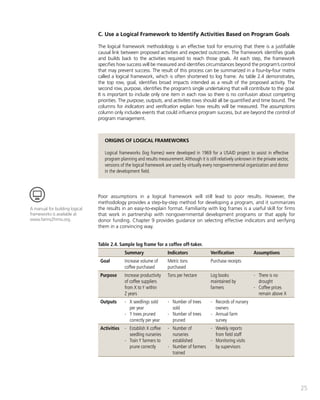
C. Use a Logical Framework to Identify Activities Based on Program Goals 
The logical framework methodology is an effective tool for ensuring that there is a justifiable 
causal link between proposed activities and expected outcomes. The framework identifies goals 
and builds back to the activities required to reach those goals. At each step, the framework 
specifies how success will be measured and identifies circumstances beyond the program’s control 
that may prevent success. The result of this process can be summarized in a four-by-four matrix 
called a logical framework, which is often shortened to log frame. As table 2.4 demonstrates, 
the top row, goal, identifies broad impacts intended as a result of the proposed activity. The 
second row, purpose, identifies the program’s single undertaking that will contribute to the goal. 
It is important to include only one item in each row so there is no confusion about competing 
priorities. The purpose, outputs, and activities rows should all be quantified and time bound. The 
columns for indicators and verification explain how results will be measured. The assumptions 
column only includes events that could influence program success, but are beyond the control of 
program management. 
Poor assumptions in a logical framework will still lead to poor results. However, the 
methodology provides a step-by-step method for developing a program, and it summarizes 
the results in an easy-to-explain format. Familiarity with log frames is a useful skill for firms 
that work in partnership with nongovernmental development programs or that apply for 
donor funding. Chapter 9 provides guidance on selecting effective indicators and verifying 
them in a convincing way. 
Table 2.4. Sample log frame for a coffee off-taker. 
Summary Indicators Verification Assumptions 
Goal Increase volume of 
coffee purchased 
Metric tons 
purchased 
Purchase receipts 
Purpose Increase productivity 
of coffee suppliers 
from X to Y within 
Z years 
Tons per hectare Log books 
maintained by 
farmers 
-- There is no 
drought 
-- Coffee prices 
remain above X 
Outputs -- X seedlings sold 
per year 
-- Y trees pruned 
correctly per year 
-- Number of trees 
sold 
-- Number of trees 
pruned 
-- Records of nursery 
owners 
-- Annual farm 
survey 
Activities -- Establish X coffee 
seedling nurseries 
-- Train Y farmers to 
prune correctly 
-- Number of 
nurseries 
established 
-- Number of farmers 
trained 
-- Weekly reports 
from field staff 
-- Monitoring visits 
by supervisors 
ORIGINS OF LOGICAL FRAMEWORKS 
Logical frameworks (log frames) were developed in 1969 for a USAID project to assist in effective 
program planning and results measurement. Although it is still relatively unknown in the private sector, 
versions of the logical framework are used by virtually every nongovernmental organization and donor 
in the development field. 
A manual for building logical 
frameworks is available at 
www.farms2firms.org.
26 
USEFUL RESOURCES 
A Field Manual for Subsector Practitioners: Tools for Microenterprise Programs: Nonfinancial Assistance 
Section, Haggblade, Steven and Matthew Gamser. Growth and Equity Through Microenterprise 
Investment and Institutions (GEMINI), November 1991. 
pdf.usaid.gov/pdf_docs/PNABJ797.pdf 
Christen, P. and J. Anderson. Segmentation of Smallholder Households, Consultative Group to Assist 
the Poor (CGAP), May 7, 2013. www.cgap.org 
Guide for Developing a Logical Framework, Center for International Development and Training. 
University of Wolverhampton, www.hedon.info/docs/logical_framework-CentreForInternationalDevelop 
mentAndTraining.pdf 
International Finance Corporation: Performance Standards on Environmental and Social Sustainability, 
http://www1.ifc.org/wps/wcm/connect/topics_ext_content/ifc_external_corporate_site/ifc+sustainability/ 
publications/publications_handbook_pps 
The Logical Framework, Food and Agriculture Organization (FAO), www.fao.org/WAIRdocs/x5405e/ 
x5405e0p.htm 
Demographic and technical information on crops may be obtained from a variety of sources, 
either online or in person. These include: 
The Food and Agriculture Organization has national data on crop production, input use, and many 
other topics. FAO also provides summaries and links to national agricultural censuses, which provide 
agricultural data in greater depth. 
Most countries conduct an agricultural census every 10 years. The websites for national statistics 
departments may contain regional or district data. Visiting statistical department offices at national or 
regional levels in person may uncover additional information at greater levels of disaggregation. 
The World Bank website has easily accessible data covering more than 8,000 indicators for every 
country in the world. The site also has in-depth reports on the agricultural sectors of many countries. 
The land grant universities in the United States conduct and publish research on international 
agricultural development topics. The Collaborative Research Support Programs focus on specific crops 
and topics (www.crsps.net). Universities with useful areas of expertise include: 
• Iowa State University: farmer training and extension 
• Michigan State University: Africa, supermarkets, Famine Early Warning System, pulses, and cotton 
• University of Nebraska: sorghum and millet 
• Oregon State: aquaculture and water use 
• Pennsylvania State University: dairy 
• University of California at Davis: risk management for smallholders and horticulture 
• University of Georgia: peanuts 
• Virginia Polytechnic Institute: integrated pest management 
• Washington State University: rural livelihoods 
The CGIAR Centers and other research institutes, such as CIRAD in France, have information on 
smallholder production of most crops. Important CGIAR centers include the International Research 
Institute for the Semi-Arid Tropics, the International Food Policy Research Institute, the International 
Center for Tropical Agriculture and the International Rice Research Institute. 
Donor-funded agricultural development projects usually conduct baseline surveys. These may or may 
not appear online, but they can usually be obtained with an email or personal visit.
27
28
I 
CHAPTER 3 
Aggregation 
Through Producer 
Organizations
J 
Why read this chapter? 
Producer organizations provide an opportunity 
to efficiently market inputs, procure supply, and 
convey information between firms and smallholder 
farmers. The scarcity of capable producer 
organizations means that firms may need to invest 
in organizing farmers or building capacity of farmer 
groups or partner with organizations that specialize 
in this field.
29 
Aggregation Through Producer Organizations 
THE BUSINESS CASE FOR SUPPORTING FARMER AGGREGATION 
The term aggregation describes the process of working with groups of smallholder farmers 
rather than individual farmers. When discussing farmer aggregation, this handbook uses the 
term producer organization because it includes small and large, as well as formal and informal 
groups. There are many types of producer organizations, including farmer field schools, 
rotating savings and credit associations, farmers’ associations, clubs, and cooperatives. 
In rural regions of developing countries, as few as 20 or as many as 80 percent of households 
are members of formal or informal organizations, depending on the country. Many of these 
organizations support agricultural or financial activities and may be useful partners for 
firms marketing inputs or procuring crops. The percentage of farmers belonging to formal 
cooperatives is 7 percent in Africa, 19 percent in the Americas, 14 percent in Asia Pacific, and 
16 percent in Europe. Despite their formal status, agricultural cooperatives in Africa and Asia 
tend to lack effective management and resources. 
Aggregating smallholder farmers into groups is both critical and challenging for agribusinesses 
building efficient supply chains. Aggregation is critical because firms cannot deal one-on-one 
with thousands of dispersed farmers, each producing small volumes. It is challenging because 
farmer groups are lacking in most regions, and those that exist often have limited capacity. 
Building new groups and raising capacity tends to be expensive and time consuming. 
However, aggregation presents numerous cost-saving opportunities, including: 
• Information dissemination: Aggregation reduces the cost of collecting and disseminating 
information for firms seeking certified crops or increased supplier productivity. 
• Logistical support: Aggregation reduces logistical costs and may be a tool for improving 
quality. Producer organizations can also add value to crops through sorting, drying, storing, 
and other functions, depending on their capacity. However, groups that lack transport may be 
unable to procure crops from a broad geographic area. Firms may need to combine purchasing 
from groups with other procurement methods to ensure comprehensive supply from an area. 
• Marketing and distribution: Aggregation can reduce marketing, distribution, loan-making, 
and servicing costs for firms marketing inputs or financial services to smallholders.
30 
FARMERS WHO ARE AGGREGATED CAN HELP EXPAND THE PIE INSTEAD OF 
REQUIRING A GREATER SLICE OF IT 
When farmers join producer organizations, their ability to negotiate higher prices with buyers is enhanced 
because they control larger volumes of crops. Some firms may view this as a disadvantage of aggregation. 
However, this is a short-sighted view for three reasons: 
• Increased margins for producer organizations usually come from middlemen, whose services are not 
needed when farmers themselves aggregate crops. 
• Aggregation presents opportunities to improve quality during marketing and through cleaning and 
sorting, which can justify higher prices. 
• When farmers receive equitable prices, they are more likely to invest in their farms. This investment 
raises productivity, which benefits both farmer and firm. This inclusive business model creates 
sustainable enterprises over the short and long term, giving the next generation of smallholders an 
incentive to continue farming. 
CHALLENGES OF WORKING WITH PRODUCER ORGANIZATIONS 
As with small businesses in general, many producer organizations fail in the first years. This is particularly true 
when donor-funded programs or governments have encouraged, or even forced, farmers to form organizations. 
Often, handouts, such as fertilizer, are given to groups, so there are few business incentives for the group to 
exist once the subsidy ends. Nepotism, corruption, and other forms of mismanagement are problems when 
members are not sufficiently involved in selecting and monitoring their organization’s leadership. Even with good 
management, producer organizations may lack financing or other critical inputs. High failure rates and limited 
effectiveness have given the term “cooperative” a negative connotation in many parts of the world. 
To procure significant volumes of crops, producer organizations usually need financing and infrastructure. 
Financing may be in the form of an advance from an off-taker or a loan from a financial institution. Infrastructure 
may range from a locally constructed building to a modern concrete or metal warehouse. 
Procuring perishable commodities, such as fruits, vegetables, or specialty coffee in cherry form, presents unique 
challenges. With these high-value crops, quality is evaluated at the time of purchase, and any post-harvest delay 
by a producer organization will degrade the quality of the product. In these cases, if producer organizations are 
procuring the crops, they must have vehicles and infrastructure, such as packing sheds, or firms must procure 
directly from individual farmers in spite of the cost. 
THE SPECTRUM OF PRODUCER ORGANIZATIONS 
Producer organization capacity is often evaluated from the perspective and needs of the 
producer organization. This handbook proposes an alternative system that responds to the 
needs of agribusinesses. The system groups producer organizations into three tiers (see figure 
3.1) that differentiate their capacity to manage information and resources such as crops, 
inputs, or money.
31 
Figure 3.1. Sample classification system for producer organization (PO) based on the needs of an off-taker. 
• PO markets inputs and/or procures crops using 
resources from outside the organization 
• PO is legally registered 
• PO has a storage facility and other assets 
• PO maintains auditable business records 
Class C Producer Organizations 
Class C organizations are farmer groups or assemblies (often informal) that have only basic 
capacity to manage information. An example is a group of farmers that attends regular training 
sessions on certification or improving productivity. Another example would be a milk purchase 
point and chilling facility owned by a dairy. Although the milk may come from individual farmers, 
the purchase point acts as a hub where trainings are held and information is disseminated. 
By gathering in one location, Class C organizations provide the firm with an efficient venue 
for disseminating information about techniques to improve productivity and certification 
requirements. Firms can also use these groups to collect information on farming practices. 
Similarly, an input provider or financial institution might explain a new product to the group 
of farmers, rather than to individuals. At this level of organization, it is not necessary for group 
• PO has a written membership list 
• PO has evidence of regular meetings 
• PO has a written membership list 
• PO has evidence of regular meetings 
• PO has a written membership list 
• PO has evidence of regular meetings 
• PO has a written membership list 
• PO has evidence of regular meetings 
• PO has a written membership list 
• PO has evidence of regular meetings 
• PO has a written membership list 
• PO has evidence of regular meetings 
• PO has a written membership list 
• PO has evidence of regular meetings 
• PO has a written membership list 
• PO has evidence of regular meetings 
• PO has a written membership list 
• PO has evidence of regular meetings 
• PO has a written membership list 
• PO has evidence of regular meetings 
• PO has a written membership list 
• PO has evidence of regular meetings 
• PO has a written membership list 
• PO has evidence of regular meetings 
• PO has a written membership list 
• PO has evidence of regular meetings 
• PO has a written membership list 
• PO has evidence of regular meetings 
• PO has a written membership list 
• PO has evidence of regular meetings 
• PO has a written membership list 
• PO has evidence of regular meetings 
• PO has a written membership list 
• PO has evidence of regular meetings 
• PO has a written membership list 
• PO has evidence of regular meetings 
• PO has a written membership list 
• PO has evidence of regular meetings 
• PO has a written membership list 
• PO has evidence of regular meetings 
• PO has a written membership list 
• PO has evidence of regular meetings 
• PO has a written membership list 
• PO has evidence of regular meetings 
• PO has a written membership list 
• PO has evidence of regular meetings 
• PO has a written membership list 
• PO has evidence of regular meetings 
• PO engages in collective business 
• PO procures crops using internal resources 
• PO maintains some business records 
• PO has a written membership list 
• PO has evidence of regular meetings 
A 
B 
C 
Sophistication 
Prevalence 
Well-defined categories are useful because they allow firms to map and identify producer organizations based on their capacity. If capacity 
development is necessary, categories may be used to chart progress. 
TRADITIONAL COMMUNITY GROUPS ARE BASIC PRODUCER ORGANIZATIONS 
Water user groups are a specialized type of producer organization that date back thousands of years. These 
organizations divide limited irrigation, livestock, or drinking water between families according to cultural 
norms or other systems. Members are allowed to open a canal to their fields for a set period of time or draw a 
certain number of buckets a day from a communal These groups could be leveraged as Class C organizations..
32 
members to have a shared purpose or even to trust one another. Since they are externally 
driven, these groups tend to exist only as long as useful information is being provided. 
Class C producer organizations can assist firms by: 
• Providing a central location for information transmission 
• Building and strengthening loyalty among suppliers 
• Identifying farmer leaders to support future interventions 
Class B Producer Organizations 
Class B producer organizations operate as small enterprises, collectively managing resources 
belonging to group members. Depending on the situation, the group might manage inputs, crops, 
savings, land, or water. Many such producer organizations have only 20 to 30 members, often from 
a single village. Their relatively small size means that aggregation is beneficial but may not lead to 
significant savings in procurement because the volumes remain too low to gain much efficiency. 
Class B groups may be formally registered with a bank account in the group’s name or tenure over 
a plot of land. However, formalization may matter less to the firm than the group’s cohesiveness. 
Collective management of resources requires trust in the group’s leadership and trust in one another. 
It also requires a shared vision of the group’s business plan and overall purpose. These elements of 
group dynamics are sometimes termed “cohesion” because cohesive groups have a shared vision 
and can take action together. Figure 3.2 compares the types of groups more likely to demonstrate 
group cohesion. Strong producer organizations often develop from religious organizations because 
members of the same religion generally trust each other and share a common outlook. 
Class B producer organizations can assist firms by providing the services of Class C 
organizations plus: 
• Pooling resources to purchase inputs in bulk 
• Sharing labor to grow crops on individual or communal land 
• Combining harvested crops to facilitate transport and marketing 
• Saving money as a group 
• Allocating and scheduling drinking or irrigation water use 
Producer 
organizations are 
most useful to firms 
when they generate 
bulk purchase of 
inputs and provide 
crop marketing 
services. 
Figure 3.2. Group cohesion in producer organizations. 
Group cohesion typically 
develops through traditional 
leadership structures or through 
democratic processes. 
Democratically 
Formed Organizations 
• May be more flexible 
and dynamic 
• May require more time 
to reach decisions 
Traditional Leadership 
Structures 
• May require less outside 
support to develop 
• May have difficulty 
incorporating into more 
complex aggregation 
structures 
Groups that 
form in response 
to shared needs that 
can be resolved through 
collective action are more 
likely to demonstrate 
cohesiveness.
33 
“SECOND-TIER” ORGANIZATIONS MAY FIT THE CLASS A 
CATEGORIZATION FOR FIRMS. 
The development community often refers to “second tier” organizations to describe networks 
of agricultural cooperatives or associations. The terminology “second-tier” may suggest that the 
organization would belong in Class B. However, according to this handbook’s methodology, using well-established, 
business-oriented cooperatives would likely meet the criteria for Class A organizations. 
Class A Producer Organizations 
Class A producer organizations can support supply chain efficiency and reduce the costs of 
marketing inputs and purchasing crops. They do so in part by managing external resources and 
coordinating farmer members throughout the production process. This role is similar to the 
role of a typical middleman because the producer organizations earn a margin from trading. 
In some cases, a number of grassroots producer organizations join together to increase input 
and crop volumes. These groups of producer organizations have been called “depots” or 
“fora.” In other cases, individual producer organizations (or groups of organizations) receive 
loans from financial institutions or advances from off-takers for crop purchases. 
Class A organizations are likely to be formally registered and actively operating in markets. 
Nevertheless, the organizations still have some business development needs. The cohesion of 
Class B groups—trust in leaders, trust in other members, and a shared purpose—is required 
to an even greater degree in Class A producer organizations. In addition, Class A groups 
need systems for managing cash, crops, and inventory. They also need time to develop these 
systems, establish a track record, and build trust with outside parties. 
Class A producer organizations can assist firms by providing the services of Class B and C 
organizations plus: 
• Aggregating crops from a significant geographic area 
• Managing loans to purchase inputs that might then be resold to other farmers 
• Taking advances from off-takers or loans to purchase from members and non-members 
• Coordinating post-harvest processing, drying, storage, and transport 
• Improving traceability to smallholder farms 
• Reducing side-selling through group cohesion 
• Facilitating fair trade certification, which requires crop purchases through formal producer 
organizations 
WIDESPREAD COMMUNITY BENEFITS FROM PRODUCER ORGANIZATIONS 
The farmers who belong to producer organizations benefit from access to information and higher prices due 
to increased volume, value-added processing, and brand development. Producer organizations can also earn 
margins by procuring crops from non-members and reselling them to larger firms. When producer organizations 
procure crops from their neighbors, the non-members benefit from increased market access. However, prices 
tend to be competitive for the area, reflecting the margin earned by the producer organization. 
Producer organizations may also provide social services, such as road repair or construction of health clinics, 
that benefit the wider community. Cooperatives that are certified by fair trade organizations receive social 
premiums, which are used to fund community initiatives.
34 
SOLUTIONS, STRATEGIES, AND BEST PRACTICES FOR BUILDING 
EFFECTIVE SUPPLY CHAINS WITH PRODUCER ORGANIZATIONS 
In most countries, the majority of smallholders belong to some sort of producer organization. 
It is likely that a number of Class C or B producer organizations are present in given a region, 
but they may fail to meet a firm’s expectations. Even the capacity of legally registered Class 
A cooperatives can be too low for a firm’s needs. If a firm only needs the organization as a 
means of transmitting information, such as agronomy advice or certification requirements, the 
capacity of existing groups may suffice. If however, the firm expects the producer organizations 
to manage advances, bulk crops, or process crops, additional capacity may be needed. For 
example, firms cannot transfer payment for crops electronically, which is a common assumption, 
if the producer organization with which it partners lacks a bank account and the capacity to 
manage one. Existing producer organizations may also have gaps in coverage, with geographic 
areas in which farmers do not belong to any group. These farmers may be selling their crops to 
collectors, taking the product out of the supply chain and impeding certification efforts. 
Building the capacity of producer organizations to be useful partners to firms is time 
consuming and expensive. However, firms can successfully undertake this process, especially 
in tight supply chains where a central processing mill creates a ready market. 
BUILDING THE CAPACITY OF PRODUCER ORGANIZATIONS IN THE OIL PALM SECTOR1 
PT Hindoli, a subsidiary of Cargill Tropical Palm Holdings, is purchasing oil palm fresh fruit bunches from 
8,880 independent smallholders located near its mill and plantation in South Sumatra. This is a specialized 
form of outgrower scheme called “nucleus/plasma.” The firm has 11 field staff members who work directly 
with 17 farmers’ cooperatives. This team provides training on agronomy, organizational development, financial 
management, human resources, and communications through the cooperative structure. PT Hindoli is also 
supporting the cooperatives to become certified by the Roundtable on Sustainable Palm Oil and to receive the 
more complex International Sustainable Carbon Certification. 
Develop Partnerships to Establish and Build Producer Group Capacity 
Building the capacity of Class C organizations to Class B or A levels usually requires training 
and mentoring over two or three production and marketing cycles. Firms may find the cost 
of extended training prohibitive, especially when combined with other supply chain activities, 
such as crop procurement, certification, and productivity training. Effective development of 
producer-organization capacity requires trainers with business development skills that typical 
agricultural extension agents may not possess. In addition, field staff often have multiple 
responsibilities including crop purchase, certification management, and farmer training. 
Building the capacity of producer organizations is relatively complex, so it may not be possible 
to task field staff with this additional responsibility. Conversely, employing dedicated staff to 
support the development of producer organizations is costly. 
Because of these constraints, many firms find that partnering with third parties, such as local and 
international national governmental organizations or the government, is an effective solution. Figure 
3.3 presents the advantages and disadvantages of each. International organizations or NGOs using 
donor funds can support a firm’s efforts to increase the capacity of a producer organization. In the 
most successful examples, the firms coordinate closely with the NGOs. However, some firms have 
built supply chains based on producer organizations without the assistance of NGOs and donors. 
IN PRACTICE
35 
Figure 3.3. Advantages and disadvantages of partnering with third parties. 
Expertise in producer organization 
development 
Best practices for collaboration between firms and third parties: 
• Develop a memorandum of understanding 
• Defining roles and responsibilities before a project’s launch can safeguard against 
misunderstandings. 
• Agree on common policies regarding critical issues 
• Firms and third parties should discuss the sanctions for side-selling and non-repayment of 
loans prior to entering into an agreement. 
• Agree on a uniform scale for benchmarking the capacity of Producer Organizations 
• Determine the producer organization’s performance benchmarks together before the 
program starts. 
• Base benchmarks in realistic assumptions of future performance and justifiable reasoning 
based on firm’s needs. 
Build Trust with Clear, Sequential Steps That Develop the Relationship 
Strategies at the operational level can increase efficiency, reduce costs, and build long-term 
relationships that benefit the firm, partner NGOs, and smallholder farmers. The first step for 
doing so includes building trust between the firm and farmers, as illustrated in figure 3.4. 
SOURCING ORGANIC COTTON THROUGH PRODUCER ORGANIZATIONS 
Solidaridad, a nongovernmental organization that specializes in support to producer organizations, is partnering 
with off-takers of organic and fair trade cotton in Senegal, Tanzania, Mali, and India. The firms provide ginning 
and markets for the high-value fiber, while Solidaridad provides agronomic training in organic production 
techniques and capacity building to the producer organizations. 
In India, the program is working with a producer organization called the Chetna Organic Farmers Association, which 
has more than 10,000 members. They are organized in three levels—730 self-help groups at village level, which 
form nine cooperatives, which are, in turn, federated into one apex organization. 
Training materials already 
developed 
May not share firm’s priorities 
Firm has no control over NGO 
funding 
Goals of organization can be 
aligned with firm 
Lack of track record can make 
fundraising difficult 
Linkage to national agriculture 
development program 
Staff may lack capacity in producer 
organization development 
Goverment development of 
cooperatives has a poor history 
EXISTING NGOS NEW NGO 
GOVERNMENT 
EXTENSION STAFF 
+ 
+ 
- 
- - 
- 
- 
+ + 
IN PRACTICE
36 
A FIRM’S LONG-TERM PERSPECTIVE DEVELOPS SUPPLIER LOYALTY 
In southeast Asia, Cooperative Business International has formed joint venture companies with cooperatives for 
the procurement and export of coffee and spices. These cooperatives have approximately 500,000 smallholder 
members. At the start of the process, CBI provides resources to create joint ventures, including working capital, 
logistics, and processing facilities, and usually owns a minimum of 51 percent of the JV shares. Over a number 
of years, the cooperatives purchase shares, eventually reaching 49 percent. During this process, CBI and its sister 
organization, the not-for-profit National Cooperative Business Association, provide mentoring and technical 
assistance to the cooperative and joint venture staff. This approach has increased productivity, built supplier 
loyalty, and curbed side-selling. 
Figure 3.4. Building trust allows partnerships between producer organizations and firms to begin taking on risk. 
Trust the truck will 
appear on time 
Risk that firm will not 
buy at agreed-upon price or 
quantity 
Risk of 
decapitalization 
Trust the agreed-upon 
price will be paid 
Risk that the 
organization can’t get another 
loan or loses its collateral 
Trust the crop will 
be the agreed- upon 
amount and quality 
Risk that the producer 
organization will 
not meet the terms of the 
agreement for volume or 
quality 
A firm sends a truck to a producer 
organization on a particular date, and 
members deliver their crops for purchase. 
Producer organization uses its own capital 
to buy member and non-member crops. 
Producer organization obtains bank loan to 
buy member and non-member crops. 
Firms advance funds to producer 
organizations to purchase farmers’ crops at 
agreed prices. 
Firm and producer organization share the 
margin between the commodity’s price at 
farm gate and export. More traceability 
and higher quality can increase export 
prices and the margins accruing to firm and 
producer organization. 
PHASE 1 
ESTABLISHING TRUST 
PHASE 2 
ASSUMING RISK 
PHASE 3 
SHARING INCENTIVES 
IN PRACTICE 
Producer Organizations 
Firms
37 
Best practices for using producer organizations to procure crops include: 
• Begin with groups that have already conducted business activities together, such as Class 
B organizations. 
• Use both traditional and democratically organized groups, which can be effective at village level. 
• Establish written agreements with producer organizations specifying crop quality and 
price (or premium above prevailing market price, depending on the value added by the 
producer organization). 
• Establish a dispute resolution process and clear consequences for not fulfilling agreements. 
• Encourage producer organizations to keep written records so annual profit/loss statements 
can be prepared. 
• Use automated systems, such as Frontline SMS, eSoko, and FarmForce, to collect and 
disseminate information about prices and crop volumes. 
• Encourage financial institutions to provide loans or basic supplies and equipment that enhance 
the producer organization’s ability to process and procure crops. These supplies may include 
empty grain bags, UV-resistant film for solar crop dryers, weighing scales, moisture meters, 
crop fumigants, and cement to seal the floors of traditional warehouses. In many countries, 
there are donor or government funds available to construct or improve rural crop storage 
facilities. Firms may assist producer organizations to apply for these resources. Providing 
producer organizations with empty grain bags is also a good strategy to reduce side-selling. 
Loans Can Help Producer Organizations Upgrade Their Capacity 
Producer organizations may be good customers for loans if they are legally registered, have 
written records, and can demonstrate strong relationships with input firms or buyers. These 
may be seasonal loans to individual members for crop production or shorter-term loans to the 
group for crop marketing. In the case of individual loans, the business plan might require a 
guarantee in the event of default. 
Producer organizations that work with livestock are also good customers for loans. Heifer 
Project International has developed a successful methodology in which loans of goats, cattle, 
and other livestock are repaid with offspring, which are passed to other members of the 
group to continue the cycle. Another successful model involves loans of young cows, which 
are fattened by group members and then sold by the group, with the increased value shared 
between the farmers and producer organization. For dairy producer organizations, loans to 
construct milk-collection and chilling facilities can improve quality by reducing transport time 
and cooling the fresh milk more quickly. 
When producer organizations receive loans as a group, it is a good practice to require a 
cash contribution, usually 10 percent of the loan amount. Typically, these funds come from 
previous business activities or members’ savings. This co-guarantee can be required in order 
to receive a loan, and it can be use as a guarantee against side-selling. 
When producer organization members receive production loans, good practice includes 
providing a combination of cash and inputs to ensure that the correct inputs are used and 
to provide living expenses during the growing season. Loans should follow standard good 
practices for micro-finance rules, such as using a smaller peer group to validate the need for 
the inputs/loans and to ensure their utilization.
38 
CONSIDERATIONS WHEN DECIDING ON ENGAGEMENT STRATEGIES 
Determine Firm Requirements for Aggregation 
Not all firms have the same requirements for smallholder aggregation. Depending on the 
firm’s presence in a region, the sector in which it works, and the quality requirements it 
seeks, firms may wish to work more or less closely with smallholder suppliers. During a supply 
chain analysis, as discussed in chapter 2, most agribusinesses discover that aggregating 
smallholders will reduce costs and provide other benefits. By taking that analysis one step 
further and specifying the class of producer organization the firm should work with, firms 
can then identify potential partners in the field. 
FARMER TRAINING AND PRODUCER ORGANIZATION CAPACITY BUILDING 
REQUIRE SIMILAR INVESTMENTS 
The opportunities and costs of increasing the capacity of producer organizations are similar to those 
encountered when improving communication with smallholder farmers. For both activities, firms must 
identify and manage extension agents, work with farmer leaders, and leverage print and ICT media to 
disseminate a message. The two activities are also interrelated in that producer organization capacity can 
strengthen the impact of messaging to farmers. Given the overlapping structures and outcomes, firms 
may choose to develop the capacity of farmers and farmer groups at the same time. Chapter 4 provides 
an in-depth exploration of farmer training and other communication channels. 
For example, analysis of an Indonesian cocoa supply chain revealed that productivity was 
extremely low due to limited and incorrect fertilizer use. To resolve these problems, the cocoa 
firm partnered with a bank and a fertilizer manufacturer to increase cocoa farmer productivity. 
As the initiative was designed, a number of requirements for producer organizations were 
identified. These requirements are summarized in table 3.2. 
Table 3.2. An outgrower scheme for cocoa that relies on producer organizations. 
The top row represents firm 
requirements that any class 
of producer organization can 
satisfy because they only involve 
information collection and 
dissemination. The second row 
represents activities involving 
group management of cash, 
fertilizer, and cocoa, which 
require the group cohesion and 
trust of a Class B organization. 
FERTILIZER MANUFACTURER FINANCIAL INSTITUTION COCOA EXPORTER 
• Receive payment as a group 
• Deliver cocoa to buying unit 
• Do not sell to other buyers 
• Grade cocoa before sale 
• Do not sell to other 
buyers 
• Distribute fertilizer 
to members from a 
central point 
• Hold monthly meetings on 
financial literacy 
• Hold meetings for 
certification 
• Hold meetings for GAP 
training 
• PO has a written membership list 
• PO has evidence of regular meetings 
ABC 
AB 
A
39 
A second example illustrated in Table 3.3 shows the requirements of three firms in two sesame 
supply chains in Mozambique. One supply chain is for certified sesame, and the other is for 
non-certified sesame. 
FINANCIAL INSTITUTION 
• Develop business plans and 
loan applications 
• Be legally registered and open 
bank account 
• Hold meetings to understand 
loan provisions 
• Provide 10 percent loan 
guarantee 
NON-CERTIFIED 
SESAME EXPORTER 
• Determine locations of 
sesame to purchase 
• Receive payment as a group 
• Grade and bag sesame 
• Manage loans of up to 
$5,000 for crop purchases 
• Manage cash advances 
to purchase sesame from 
farmers outside group 
ABC 
AB 
A 
Assess the Capacity of Producer Organizations 
CERTIFIED SESAME 
IMPORTER 
• Obtain and hold fair trade 
and organic certification 
• Hold meetings on 
certification requirements 
• Receive second payment 
after delivery 
• Grade and bag sesame 
• Hire a manager for logistics 
and export 
Once a firm has determined its requirements, the next step is to assess, or benchmark, the 
capacity of existing groups to fulfill those requirements. The most practical way to do this is 
to interview groups in the potential catchment area about their past activities and examine 
any documentation they possess. 
For firms interested in engaging outside expertise to evaluate producer organization capacity, 
organizations that have developed systems to evaluate producer organizations are listed in 
the “Useful Resources” section of this chapter. The cost of the evaluation may be covered by 
the producer organization itself, partner agribusinesses, or external organizations. 
In this example, the 
groups needed to be more 
sophisticated because they 
are managing bank loans 
and advances for crop 
purchases. The last row 
represents needs that only 
Class A organizations can 
fulfill. 
AN APPROACH TO ANALYZING PRODUCER ORGANIZATION CAPACITY 
Scopeinsight, a Netherlands-based firm, has developed an innovative system for independent assessment of 
producer organization capacity. The assessment creates rating profiles for agricultural producer organizations 
based on internal management, operation, financial administration, supply, market, sustainability, external 
risks, enablers, and financial performance. Producer organizations, financial institutions, and off-takers have 
commissioned assessments. Self-assessment tools are under development for less complex producer organizations. 
Firms interested in benchmarking 
producer organizations can visit 
www.farms2firms.org for terms 
of reference that can be adapted 
to collect information on 
producer organization capacity 
and improve supply chain 
efficiency. 
IN PRACTICE 
Table 3.3. Using producer organizations to procure sesame. 
• PO has a written membership list 
• PO has evidence of regular meetings
40 
USEFUL RESOURCES 
ACDI/VOCA, www.acdivoca.org 
Technical expertise with producer organizations. 
Agriterra, www.agriterra.org/en 
Technical expertise with producer organizations. 
Communication Cooperative International, www.cci.coop/home.html 
Expertise in communication with producer organizations. 
Contract Farming Resource Center, www.fao.org/ag/ags/contract-farming/en/ 
FAO-sponsored source of information on contract farming. 
Esoko, www.esoko.com 
Tools for communicating with producer organizations, such as scouting polling via SMS. 
Farmer Organization Support Center for Africa (FOSCA), www.agra-alliance.org/section/work/fosca_ 
prog 
Information and expertise with producer organizations. Initiative of the Alliance for a Green Revolution 
in Africa (AGRA). 
Food and Agriculture Organization (FAO), www.fao.org 
Information on producer organizations. 
Annual report on FAO activities in support of producers’ organizations and agricultural 
cooperatives, 2011, http://www.copac.coop/FAO%20annual%20reportfinalFeb2012.pdf 
Building Networks for Market Access: Lessons Learned from the Rural Knowledge Network Pilot for 
East Africa, 2011, www.fao.org/docrep/014/i2088e/i2088e00.pdf 
Frontline SMS, www.frontlinesms.com 
Tools for communicating with producer organizations. 
Global Forum for Rural Advisory Services, www.g-fras.org 
Source of expertise on producer organization training. 
International Food Policy Research Institute (IFPRI), www.ifpri.org 
Economic and technical research on producer organizations. 
Contracting Out of Poverty: Experimental Approaches to Innovation in Agricultural Markets with 
Small Farmers, http://www.ifpri.org/sites/default/files/publications/mtidspotlight_contracting.pdf 
International Fund for Agricultural Development (IFAD), www.ifad.org 
Information on producer organizations. 
IFAD and Farmers’ Organizations Partnership on Progress: 2008 to 2009, www.ifad.org/ 
farmer/2010/doc/prgrep_e.pdf 
INADES Formation, www.inadesfo.net/Notre-approche-d-intervention.html?Lang=en 
Organization active with producer organizations in West Africa. 
Land O’Lakes, http://www.idd.landolakes.com/ 
Technical expertise with dairy producer organizations. 
Mobile Transactions Zambia Limited, www.mtzl.net 
E-money technologies linking firms and producer organizations. 
National Cooperative Business Association (NCBA) and Cooperative League of USA (CLUSA), www.ncba. 
coop 
Technical expertise with producer organizations.
41 
Oiko Credit, www.oikocredit.org 
Financial institution providing credit to small and medium enterprises and cooperatives 
Overseas Cooperative Development Council. 
A group of nine U.S.-based organizations active in producer organization and cooperative development. 
Measuring Cooperative Success: Measurements for Tracking Indicators of Cooperative Success 
(METRICS), 2009, www.ocdc.coop/metrics.html 
Cooperatives: Pathways to Economic, Democratic and Social Development in the Global Economy, 
2007, www.ocdc.coop/pdf/coop_pathways_report.pdf 
Enabling Cooperative Development: Principles for Legal Reform, 2006, www.ocdc.coop/pdf/ 
enabling_coop_dev_english.pdf 
Oxfam. www.oxfam.org 
Nongovernmental organization providing producer organization training. 
Responsability, www.responsability.com 
Financial institution providing credit to producer organizations. 
Root Capital, www.rootcapital.org 
Financial institution providing credit to producer organizations. 
Scope Insight, www.scopeinsight.com 
Benchmarking system for producer organizations. 
Shared Interest, www.sharedinterest.org 
Financial institution providing credit to producer organizations. 
Solidaridad, www.solidaridadnetwork.org 
Dutch organization and network providing producer organization training. 
Triodos, www.triodos.com 
Financial institution providing credit to producer organizations and intermediaries. 
NOTES 
1. Anthony Yeow, Committing to Being World-Class Smallholders, Case Study 1: PT Hindoli 
Smallholders’ Relentless Pursuit of World-Class Achievements (PT Hindoli and Cargill Tropical Palm 
Holdings, 2012). Accessed via Roundtable for Sustainable Palm Oil website: Http://rt10.rspo.org/ 
ckfinder/userfiles/files/P5_4%20Anthony%20Yeow%20Presentation.pdf
42
K 
CHAPTER 4 
Effective Training 
and Communication 
Strategies 
for Changing 
Smallholder Behavior
L 
Why read this chapter? 
When firms work effectively with smallholders, 
information flows in both directions. Information 
channels include field staff, written training 
materials, and information and communication 
technologies. Selecting the right channel, or 
combination of channels, can achieve the desired 
results at an acceptable cost.
43 
Effective Training and Communication Strategies 
for Changing Smallholder Behavior 
THE BUSINESS CASE FOR FARMER TRAINING AND OTHER FORMS OF 
COMMUNICATION 
Businesses seeking to improve quality, traceability, and scale along their supply chain can do 
so by strengthening their communication channels with farmer suppliers. In traditional supply 
chains, off-takers purchase crops from independent middlemen and collectors, who can be 
two or more links removed from the farm gate. Although this supply chain strategy requires 
little investment, it poses four problems: 
• Off-takers have little leverage to improve crop quality, especially when problems originate 
on the farm. Because they are not interacting directly with farmers, off-takers cannot 
incentivize suppliers to improve farming and post-harvest techniques or to resolve disputes. 
• Off-takers have limited means to comply with traceability standards. Many firms in the 
food industry demand full traceability to ensure environmental and social sustainability 
standards. 
• In traditional supply chains, high-quality output is mixed with low-quality output from 
thousands of farms, often with minimal tracking. By the time crops reach middlemen and 
off-takers, the product requires expensive sorting to meet quality standards. 
• With layers of collectors between themselves and smallholders, off-takers face difficulties 
in providing inputs and technical advice to increase productivity. 
Each of these problems emerges because traditional supply chains lack essential communication 
channels between off-takers and farmers.
44 
SOLUTIONS, STRATEGIES, AND BEST PRACTICES IN FARMER TRAINING 
The types of communication that supply chain managers use to transmit and collect 
information affects the frequency of communication, its quality, and its reach among farmer 
suppliers. These communication channels can be broadly grouped into three categories: 
• Face-to-face interactions between firm or partner staff and farmers 
• Written materials such as manuals, brochures, and product labels 
• Information and communication technologies such as radio, Internet kiosks, tablet 
computers, video, and cell phones 
Effective communication strategies will likely use a combination of channels, with one 
reinforcing the other, as seen in figure 4.1. 
Figure 4.1. One-way and two-way communication channels between firms and farmers. 
SMS texting and mobile applications, Internet, call-in facilities. 
The amount and complexity of communication increases as supply chains become stronger 
and more developed. Basic supply chains may transmit delivery and payment information, 
while complex supply chains communicate information on crop prices, traceability, training 
on improved agricultural practices, certification data, product specifications, finance 
opportunities, and the weather. Communication along complex supply chains may also flow 
in both directions, from firms to farmers and from farmers to firms. Figure 4.2 maps types of 
information that firms may wish to convey according to their complexity and impact. 
Figure 4.2. Types of information disseminated or collected through training and other communication channels. 
• Crop purchase price 
• Location and quantity of crops to 
pick up 
• Quality requirements such as 
moisture content and purity 
• Increasing capacity of farmer 
organizations 
• Diagnosis of pests and diseases 
and analysis of soil nutrients 
• Training in farm management 
practices 
• Sources and prices of inputs 
• Terms and conditions for loans 
• Measuring productivity to 
assess side-selling 
• Agricultural practices to 
improve productivity or 
quality 
• Post-harvest practices to 
improve quality 
Longer-term 
impact 
Short-term 
impact 
Less complex Information More complex 
Off-takers 
Input 
suppliers 
Financial 
institutions 
Farmers 
Face-to-face interactions 
Written materials 
Radio, TV, videos 
Communication methods 
that relay information from 
firm to farmer and back to 
firm may be more useful than 
communication that goes just 
one way. Combining several 
communication channels can 
reinforce messaging while also 
ensuring that there is a feedback 
loop between firm and farmer.
45 
Field Staff—Effective but Costly 
Agricultural extension workers, also known as field staff, are often the first tool that firms 
think of when implementing a training or outreach program to farmers. While face-to-face 
communication can enable comprehensive and detailed messaging to farmers, it is a costly 
approach. The cost of face-to-face training typically ranges from $50 to more than $100 per 
farmer per year. Various factors influence the cost, such as prevailing salaries, farmer density, 
number of interactions per year, whether training materials are developed or adapted, and 
to what extent administrative and managerial overheads are included. Written materials and 
information and communication technologies, addressed below, can reduce the need for 
extension workers and, in some cases, replace them altogether. 
Firms employ field staff with a range of profiles and experience. At the upper end, in terms of 
cost and competence, are university-trained agronomists specializing in crop production. At the 
other end, are people with some practical experience but no formal schooling in agriculture. 
This includes farmers and sales staff for agricultural inputs who are trained to provide advice on 
a limited range of topics. Figure 4.3 details the various roles field staff may take on. 
To deploy field staff, firms have generally followed one or a combination of two models: 
Model 1: Place staff at a central location, such as crop buying stations, farmer training 
centers, or (in the case of input firms) agro-retailers, and let farmers come to them. 
Model 2: Send field staff to work with farmers on their farms. This traditional extension 
model is more expensive since field staff are required to travel. 
FIELD STAFF 
Figure 4.3. Firms usually give field staff multiple roles. 
Tasks can be complementary, 
but managers can improve 
staff members’ effectiveness by 
carefully reviewing logistics, time 
requirements, and staff training 
schedules. 
Providing 
technical advice to 
customers 
Collecting 
information for 
certification 
programs 
Training on 
productivity 
Purchasing crops 
and analyzing 
quality 
Marketing 
inputs and 
taking orders 
Leading field 
visits by buyers
46 
Establishing decentralized buying stations shortens the chain between farmers and off-takers 
and enables communication between the two. Farmers bring their crops directly to the station, 
where field staff conduct simple quality tests, including moisture and defect testing. The test results 
determine the price paid to farmers, creating incentives for farmers to improve crop quality. Training 
on quality and other topics can be held at the station to reinforce key messaging. Since the firm is 
directly involved in the crop’s purchase, field staff can track and segregate products by quality. 
While buying stations can improve crop quality, they have limited ability to improve traceability 
because interactions with farmers occur at the stations rather than at the farms. Furthermore, 
for most certification programs, firms must collect information on field locations and 
agricultural practices with farmers at their farms. Similarly, field staff placed at farm training 
centers and agro-retailers are limited because they do not regularly visit farms to provide on-site 
coaching directly to farmers. 
When field staff work with farmers directly, or through a network of farmers, training can 
take place in farmers’ own fields and address their specific concerns. This model is especially 
useful for building trust and goodwill among farmers, which can in turn reduce side-selling. 
Disputes between farmers and the firm can be resolved quickly. In other cases, a hybrid 
strategy makes sense. For example, a farmer training center could have fixed trainers for 
farmers attending center-based sessions and could also serve as a base for mobile staff. For 
input suppliers, staff based at agro-retailers could visit customers to diagnose problems as 
well as explain products to farmers who visit the shop. 
Figure 4.4. Develop a management plan for field staff before staff are hired. 
Develop the outreach 
plan and determine the 
number of staff needed 
An experienced labor lawyer 
can help design employment 
policies and staff contracts. 
Minimum wages, probationary 
periods, disciplinary action, 
performance evaluation, and 
retirement payments should be 
considered. 
Evaluate and train field staff 
Training will increase staff confi-dence 
and help ensure that they 
can respond accurately and ap-propriately 
to farmers’ questions. 
Training should cover agronomy 
for the crop in question, including 
the “why” behind the message. In 
addition, training in communica-tion 
skills and meeting facilitation 
are very useful. 
Provide ongoing 
performance supports 
Coaching and mentoring 
will build confidence among 
staff and help them vary their 
teaching methodologies. Op-portunities 
Send staff to the field 
Establish clear workplans 
and supervision. 
for advancement 
encourage staff retention and 
succession strategies when 
staff leave. 
Request farmer feedback 
on staff performance 
Identify high and low perform-ers 
among staff and under-score 
the farmers’ role as a 
stakeholder in the program’s 
success. 
Advertise for and hire 
field staff 
Extension staff with a mix of 
technical knowledge, teaching 
skills, and an understanding 
of the local farming context 
will be able to respond to 
farmers’ questions and relate 
to farmers’ concerns.
47 
Managing Field Staff 
Managing field staff cost-effectively is critical for a program’s success. Field staff for an off-taker 
may be responsible for crop procurement, certification, productivity training, and results 
measurement. Similarly, the field staff of an input company may be sales agents as well as 
technical resources. These multiple roles can be challenging to juggle. Clear messaging to 
staff on their expectations, schedules, and responsibilities can increase their effectiveness. 
Figure 4.4 describes a management plan to increase field staff effectiveness. 
Using female extension staff tends to increase the number of female farmers and leads in the 
program. In certain communities, female field staff may need additional training to perform 
traditionally male tasks. 
USEFUL SKILL SETS FOR EXTENSION WORKERS 
Desirable qualifications for extension staff include: 
• A degree in agronomy, although this is unlikely in many regions (particularly Africa). Consider 
recruitment strategies through agricultural schools and internships. 
• Practical experience with crop being produced. 
• Experience working on a smallholder farm. 
• Ability to speak the native language and/or dialect of target farmers. 
• Dynamic personality with a positive attitude. 
• Willingness to live and work in rural areas. 
Extending the Reach of Field Staff: The Role of Lead Farmers 
Working through lead farmers: In most cases, field staff are unable to interact directly with all 
of the farmers in a supply chain, given the number of staff (and cost) that would be required. 
Firms can extend the reach of field staff without significantly increasing costs by identifying 
lead farmers to transmit training messages to 20 to 30 farmers. An effective network of lead 
farmers (also called lead contact farmers or volunteer leaders) can dramatically extend an 
extension program’s reach by multiplying paid field staffs’ effort 20 to 30 times. 
Lead farmers are typically community members with leadership ability who volunteer to convey 
information from field staff to individual farmers. Effective lead farmers are literate, dynamic 
community members who earn their peers’ respect and are willing to try new techniques. 
Well-organized farmer groups typically have someone who assumes the role of lead farmer. 
Well-managed lead farmers will represent the firm in the community. It is therefore essential 
that lead farmers have the knowledge, resources, and capacity to train farmers when 
extension workers are absent. Best practices for increasing lead farmer effectiveness include: 
• Inclusion of members of the farmer group in the decision making to select lead farmers can 
ensure community support for the program and increase farmers’ investment in its success. 
• Careful consideration of community dynamics when identifying the right profile for a 
lead farmer. For example, younger farmers tend to be energetic, but in some cultures it is 
preferable to select older farmers because they are more respected. 
• Written contracts between firm, lead farmer, and farmer groups can clarify roles, responsibilities, 
and expectations before a program starts. Local labor laws should be consulted to clarify the 
firm’s potential obligations to provide lead farmers with salaries and/or benefits. 
Lead farmers are community 
leaders who can extend the 
reach of an extension system 
and create a sustainable 
reservoir of knowledge at the 
community level.
48 
AN EXTENSION SYSTEM LEVERAGING LEAD FARMERS 
In the sample design shown below, five paid staff train and 
oversee the output of 800 farmers, transmitting a new message 
each week according to the crop production calendar. A field 
supervisor coordinates the work of four field staff who deliver 
messages and training to lead farmers and farmer groups in an 
assigned territory. As described in chapter 3, the farmer groups 
could be pre-existing producer organizations or formed for the 
purpose of receiving agricultural training. 
Depending on travel time between farmer groups, an extension 
agent can typically meet with two farmer groups daily. This 
enables an agent to visit eight farmer groups in four days, 
reserving the fifth workday for meetings, planning, report writing, 
Sample organizational chart of an extension program. 
Extension 
agent LF 
25 
farmers 
25 
farmers 
LF 
25 
farmers 
25 
farmers 
25 
farmers 
25 
LF 
25 farmers 
farmers 
25 
farmers 
and vehicle maintenance. The fifth day might also include training 
from a contracted agronomist who develops the messages and 
training materials used by field staff. 
Firms often employ a “rolling design” that maximizes the number 
of trained farmers. If one crop cycle of intensive training is enough 
to reach a critical mass of trained farmers in a given area, the 
extension team will move on to a new location. The network of 
lead contact farmers and farmers’ groups will then support the 
learning of late adopters in the first area. The extension program 
may periodically provide additional performance support through 
less intensive refresher trainings to reinforce important messages. 
Agronomist 
Lead Farmer 
Field 
supervisor 
LF 
LF 
LF 
LF 
LF LF 
LF 
LF 
Extension 
LF agent 
LF 
LF 
LF LF 
LF 
LF 
LF 
Extension 
agent LF 
LF 
LF LF 
LF 
LF 
LF 
LF 
LF 
LF LF 
LF 
LF 
LF 
Extension 
agent
49 
In East Africa, the Grameen Foundation is experimenting with strategies to reduce field staff costs and increase 
motivation among lead farmers.1 In addition to supporting farmer training, the Grameen Foundation provides 
lead farmers with data-capable cell phones that can be used to conduct surveys for private firms or other 
NGOs. The lead farmers are paid for this service, helping to compensate for their voluntary role as community 
knowledge workers. 
• Off-site meetings and training sessions with groups of lead farmers can reinforce the 
training messages and improve facilitation skills. They also provide opportunities for lead 
farmers to share experiences and learn from each other. 
• Weekly schedules detailing each lead farmer’s tasks will help the firm, farmer, and farmer 
group track the lead farmer’s progress and achievements. 
Lead farmers do not usually receive a salary but their role may require significant time 
investment. Firms can motivate them and maintain their commitment with incentives such as: 
• Fertilizer and other inputs to create demonstration plots 
• Tools to facilitate training such as fuel for motorbikes, bicycles, hats, shirts, rain gear, 
backpacks, scales, notebooks, and calculators 
• Opportunities to be the first in their community to learn new techniques 
• Opportunities to travel for meetings or visit other successful programs 
• Community recognition during meetings or on radio programs 
• Opportunities to win prizes based on the results of farmers in their groups 
Of these incentives, providing inputs is both the most expensive and most effective measure. This 
is because the lead farmer gets a tangible benefit from higher yields, and there is a demonstration 
effect for neighbors, even if the lead farmer does no other training. Whatever incentive is chosen, 
it should motivate the lead farmer without negatively affecting other farmers. 
Good Performance Depends on Effective Logistics and Strong Monitoring 
Strategic scheduling, transportation, and staff management increase the effectiveness of an 
extension program. Best practices include: 
JK Paper, an IFC client in India, provided their field staff and selected community leaders with a two-day 
training of trainers (ToT) focused on meeting facilitation and communication skills. The goal of this training 
was to help field staff and influential community members explain JK Paper’s forestry outgrower program 
more effectively. Once the target of 5,000 potential outgrowers has been approached, the cost per farmer for 
the ToT will be about $4. 
Locate field staff as close to farmers as possible. Field staff and supervisors may prefer to 
live in larger towns rather than villages, but locations further away from farming communities 
increase commuting time and reduce work time. Living in close proximity to farmers increases 
trust and knowledge about farming practices and problems. Basing staff at the village level 
may require special provisions, such as four-day-on, three-day-off schedules and allowances 
to furnish and improve village housing. 
IN PRACTICE 
IN PRACTICE
50 
Closely monitor the daily activities of field staff. Extension staff work on their own most 
of the time. However, even with good planning and scheduling, field staff may not be working 
in the location where they are expected on a particular day. This could be due to constraints 
beyond their control, such as weather or road conditions, or it could be due to poor work 
habits. Given the expense of placing staff in the field, firms must know that the planned 
training is taking place or run the risk that objectives will not be realized. Unannounced visits 
by supervisors to observe training sessions, depending on the schedule, are the best way to 
monitor field staff performance and assess the effectiveness of extension messages. 
Stand-alone GPS units mounted on motorbikes and vehicles and the use of 3G phones 
are also useful ways to monitor field staff on location. The cost of these technologies has 
decreased significantly, and software packages exist that can display the locations of the 
entire extension force remotely. Most countries have several firms that offer systems for 
remote vehicle monitoring. 
Purchase high-quality motorbikes and develop clear policies about their use. Firms 
generally provide their field staff with 125 cc off-road motorbikes so staff can manage back roads 
between farms. It is a good policy to provide training for staff who are not experienced riders 
and to have a skills test that all staff need to pass before receiving their motorbikes. Even the 
best motorbikes will experience excessive repair costs after about three years of heavy use. Close 
monitoring of spare parts and fuel consumption will ensure proper service intervals and indicate 
when a bike has reached the end of its service life. Qualified shops are typically more capable of 
handling major repairs than village mechanics. A policy of giving (or selling) motorbikes to field 
staff at the end of their service life may encourage staff to take better care of them. Policies that 
prohibit riding without a helmet, limit the number of riders, restrict use of motorbikes after work, 
and establish procedures for notification of accidents can improve safety. 
Develop clear expense policies for staff, farmers, and lead farmers. Per diems, meals, and 
transport costs are all areas of potential contention. Programs with clear policies that are 
communicated to participants up-front avoid extended negotiations and perceived favoritism. 
Determine the Messages and How They are Conveyed 
When developing messages for farmers, it is useful to begin with an agricultural calendar for 
the crop or crops on which the training will focus. The calendar should detail all necessary 
activities on a weekly or bi-weekly basis throughout the year. With climate change affecting 
rainfall patterns in many regions, traditional agricultural calendars may need to be adjusted 
for new conditions. 
Extension messages should accompany each activity listed on the calendar. Depending on the 
roles of the field staff, this could include crop prices, agricultural productivity messages, or 
practices required for certification. 
Information that staff need to collect should also be included in the calendar. Again, depending 
on the roles of the field staff, this could include crop volumes, production information, and 
data (such as farm practices) needed for certification. 
There are three main training methodologies used to transmit information to smallholder 
farmers: demonstration and innovation, farmer field school, and farmer training centers. 
Demonstration and Innovation 
In this training method, field staff instruct contact farmers to create demonstration plots, also 
called dem plots, using best management practices and the recommended types and levels of 
inputs. Firms may provide the inputs both as a training tool and as an incentive for the lead 
contact farmers. 
The demonstration and train and 
visit models can be summarized 
by the saying: “First I do, then 
we do together, then you do.”
51 
Field staff then hold training sessions at the demonstration plots and on the farms of other 
group members. The training sessions consist of instruction reinforced by hands-on practice. 
Community field days can be held at the plots throughout the production cycle to present 
best practices and offer farmers an opportunity to practice their learning. These events can 
also serve as a tool to recruit new producers into the supply chain. 
A related methodology, called train and visit, is an older system that has been used by many 
government extension systems. This approach offers group training sessions at central 
locations followed by visits to individual farms to coach and mentor farmers. Although it is 
effective at transmitting messages, it is often too expensive for smallholders given the time 
needed to visit individual farms. However, demonstration and innovation can be combined 
with train and visit if a farmer has encountered a particular problem that can be resolved 
with a visit. By rotating the training location between the farmers in a group, some individual 
assistance can be provided while still training the whole group. 
Farmer Field School 
In this methodology, farmers discover improved techniques themselves through facilitated 
research and discussion, as seen in figure 4.5. For example, farmers might look at pest control 
techniques across several farms and determine which practices led to higher yields and at 
what cost. While the process is always guided by a trained extension agent, his or her role 
is not to instruct, but rather to facilitate experimentation and discussion. This participatory 
philosophy is an effective approach that leads to deeper learning and understanding. The 
farmer field school approach may be too time-consuming for firms trying to maximize the 
reach of their training, but extension programs can incorporate elements of the methodology 
throughout the production cycle. For example, farmers can analyze the productivity of a 
dem plot by comparing it to neighboring fields. Dem plots can also be designed with several 
treatments, such as low, medium, and high levels of fertilizer application, which can facilitate 
an analysis and discussion about the optimal fertilizer amount. 
DEMONSTRATION PLOTS—AN EFFECTIVE TRAINING TOOL 
A demonstration plot, often called a dem plot, is a smallholder plot that uses best practices for inputs and 
agricultural practices. Dem plots serve three purposes: 
• Show the effect of best practices on yields 
• Provide a site for hands-on training sessions 
• Provide a site for farmer-led research 
Dem plots should adhere to several principles to maximize their effectiveness: 
• Beginning with farmer-led research to identify best practices is a proven approach (farmer field 
school), but it requires more time than simple demonstration. 
• Demonstrated practices should be economically and technically feasible for the majority of 
surrounding farmers. 
• Farmers, not extension staff, should do work on the plots. 
• Field days involving neighboring farmers are an effective way to increase reach.
52 
Figure 4.5. Farmer field schools train farmers in the scientific method. 
Farmers identify 
problems in fields. 
Farmers research 
problems with 
guidance. 
Farmers 
apply 
conclusions 
to problems 
in their own 
field. 
Farmers evaluate 
outcomes. 
Farmers 
test 
hypotheses. 
Farmer Training Centers 
These centers provide classrooms and associated plots where improved techniques are 
demonstrated and practiced. The demonstration plots can be used as nurseries to produce 
improved planting materials for sale or distribution. However, since farmers learn techniques 
on model plots that may not mirror their own fields, they may have difficulty transferring 
their learning. Centers tend to be located near the communities that are targeted by the 
extension program, but some farmer training centers have dormitories to host farmers for 
multi-day trainings. A farmer training center can also serve as a base for the field staff in both 
demonstration and farmer field school systems. 
A related strategy is to work with local schools to incorporate agricultural themes into existing 
curricula. For example, math can be taught using agricultural examples and accounting 
principles for farm management. Similarly, biology classes can include discussions of plant 
nutrition. According to the 4H Foundation, when children learn good agricultural practices, 
they transmit these messages to their parents. Any initiatives involving children must avoid 
encouragement of child labor. However, developing a new generation of more professional 
smallholders is an important long-term approach for increasing productivity. 
Support Field Staff with Written Materials and Other Tools 
Written and electronic training materials, such as manuals, posters, calendars, and videos, are 
often used to support face-to-face training. Effective training tools are tailored to the needs and 
preferences of the target audience by adjusting the balance of text and artwork to the literacy 
level of the audience, using a local language if it is taught in schools and appears in other print 
media, and using a sturdy format that will withstand frequent use. For example, weatherproofing 
reference cards will increase their durability and practicality in the field. Drawings done by a skilled 
artist are usually preferable to photographs, because photographs do not reproduce as well as 
drawings. Figure 4.6 provides guidance on developing effective training materials. 
Extension manuals, farmer 
flips charts, videos, and other 
training tools are available at 
www.farms2firms.org.
53 
EXAMPLES OF EFFECTIVE TRAINING TOOLS 
Reference guides for field staff: These manuals provide both 
the theory behind the recommendations and a more detailed list of 
diagnoses for nutritional deficiencies, pests, and diseases. 
Manuals for farmers: Integrating simple, feasible messages 
into training materials for farmers will increase the likelihood that 
those messages are understood and adopted. Farmer manuals do 
not need to go into the detail of the reference guides for field staff. 
They should be developed in the local language, use pictures and 
graphics, and reflect the local context. Adult learning methodology 
and interactive practice exercises can promote learning more than 
rote memorization. 
Flip charts and posters: Hung in common meeting areas or used 
during trainings, these can be useful tools to supplement the trainer’s 
presentation with pictures and diagrams. 
Quick reference cards, pictorial guides, and crop-cycle 
calendars: These are shorter, less dense versions of the farmer best 
practices guides. With more graphics, these tools can be especially 
helpful when farmers’ literacy is low. Consider weather-proofing 
these materials to last longer and promote their use in the field. 
Video: Video, which is often in the form of DVDs, is an increasingly 
popular and effective training tool for farmers, who can watch 
individually or in groups with field staff. Some firms are also 
experimenting with digital tablets provided to field staff to show 
training videos and collect data. Anecdotal evidence on this 
approach is positive, suggesting that the use of ICTs increases 
farmers’ loyalty to the firm and trust in their learning. However, the 
cost effectiveness of this approach 
remains to be determined. Videos 
can be produced professionally or 
done by farmers themselves after 
some training. A USAID project, 
ICT for Ag, has produced a toolkit 
that includes best practices for 
training videos. 
Figure 4.6. Checklist for designing training materials. 
The letters in the word “ACTIONS” form a checklist for designing effective training materials. 
A 
Accessibility: 
The material 
must be 
accessible to 
the target 
audience. This 
means using 
the visual 
information 
for low-literacy 
audiences 
and ensuring 
that examples 
are culturally 
appropriate. 
C 
Cost: 
Consider the 
various costs of 
development, 
field testing, 
revision, 
layout, and 
dissemination. 
Some studies 
estimate that 
40 hours of 
advance work 
are needed for 
one hour of 
instruction time. 
T 
Teaching style: 
Training 
materials that 
encourage active 
participation 
by students is 
more effective. 
Elements such 
as role playing, 
problems 
solving, and 
participatory 
field exercises 
make learning 
active. Radio 
programs that 
allow listener 
participation are 
more effective 
than passive 
broadcasts. 
I 
Interactivity: 
Training 
materials 
that promote 
interactivity 
between trainer 
and trainee 
reinforce 
learning. 
The farmer 
field school 
methodology 
is based on 
interactivity, 
using examples 
from farmers’ 
fields and 
eliciting 
solutions from 
farmers, rather 
than providing 
prescriptive 
approaches. 
O 
Organizational 
support: 
Trainers require 
logistical 
(transportation 
and 
communication), 
administrative 
(salary, 
reimbursement 
of expenses, and 
record keeping) 
and managerial 
support so they 
can concentrate 
on preparing for 
training. 
N 
Novelty: 
It is important 
to make training 
interesting. 
This can involve 
mixing media, 
such as videos 
with face-to-face 
training, 
and using new 
communication 
technologies 
such as SMS. 
S 
Sustainability: 
Training by 
private sector 
firms must pay 
for itself to be 
sustainable. 
In some 
cases, fees for 
training may 
defray costs. 
However, with 
smallholder 
farmers, this 
is rare. More 
likely, increased 
revenue from 
productivity 
and quality 
needs to cover 
training costs.
54 
Mass Media and Information and Communication Technologies Can Reduce 
Costs and Increase Reach 
Mass media is a powerful tool for communicating with many farmers across broad distances. 
Newspapers, pamphlets, instructional labels, and inserts are some examples of print media, 
and firms can use an increasing variety of information and communication technologies to 
communicate with farmers. While the reach of mass media is an advantage over extension 
programs, the lack of opportunities to reinforce learning and monitor impact reduces the 
usefulness of mass media. 
Recently, ICTs have garnered much interest because they are less costly per farmer than face-to- 
face communications, can reach large numbers of farmers, and present opportunities for 
overcoming problems of reinforcement and impact assessment. According to the International 
Telecommunication Union, in 2011, there were 5.9 billion cellular telephone subscriptions with 
85.7 percent of the population having access. Ninety percent of the world is now covered by 
2G networks, and 45 percent is covered by 3G networks. Thirty-four percent of the world’s 
population uses the Internet, with 20 percent of the population in developing countries using 
the service. Many firms and organizations are developing systems to help farmers access and 
transmit information through the Internet, which may be a substitute for data collection within 
an extension program. Systems that rely on ICTs usually cost less than $50 per farmer annually, 
but the depth and complexity of information that can be collected or disseminated via ICTs 
remains limited. However, the limitations of ICTs are decreasing as 3G networks expand. Best 
practices for leveraging ICT tools for farmer training are illustrated in figure 4.7. 
With the field of ICT evolving 
so rapidly, print media often 
cannot keep pace. For current 
information on ICTs, please visit 
www.farms2firms.org. 
Base program 
development in field 
research. Use field 
research to identify 
the percentage and 
profile of radio owners, 
which stations farmers 
listen to, the extent of 
coverage areas, and 
when farmers tend to 
listen. 
Follow a set 
schedule. Shows 
should air at times 
convenient to farmers, 
such as in the evening 
or early in the morning. 
Keep messages 
simple. Simple 
messages that are 
repeated multiple times 
in different ways are 
particularly effective. 
Using various formats 
such as drama, phone-in 
programs, and field 
interviews maintains 
audience interest and 
reinforces learning. 
Feature real farmers. 
Whenever possible, 
include real farmers 
speaking in the 
predominate language 
of farmers in the 
coverage area. 
Evaluate impact. 
Assessing knowledge, 
attitudes, and practices 
are a good methodology 
to evaluate the impact 
of radio training 
programs. 
Figure 4.7. Best practices for communicating through ICTs. 
A long history of farm radio programs has generated a set of best practices, including: 
Additional links to best practice guides and other ICT resources are provided in the “Useful Resources” section at the end of this chapter. The 
practice groups are a good source of the latest information.
55 
The following are types of mass media that firms can incorporate into their communication 
strategies with farmers: 
Print media, such as agricultural newspapers, can update farmers on market developments 
and provide timely reminders about good agricultural practices throughout the production 
calendar. In India and other populous countries, locally produced print media advertise 
agricultural inputs and opportunities for crop marketing. 
Radio and television can be a cost-effective way to reach large numbers of farmers. A wide 
variety of formats have been used, including advertising, discussion programs about crops or 
products, farmer interviews, and call-in programs. A combination of face-to-face training and 
radio, during which farmers listen to radio programs with field staff and then practice the 
skills together, is also an effective strategy. 
USING RADIO TO REACH LARGE NUMBERS OF FARMERS2 
Farm Radio International, a Canadian non-profit organization, has partnered with the Gates Foundation to study 
the impact of radio programming on farmer practices in Africa. The initial report from this five-country study found 
that 39 percent of farmers who listened to interactive radio programs changed their agricultural practices, and 25 
percent changed their practices after listening passively (compared to only 4 percent in the control group). The 
cost of this program was less than $0.50 per farmer reached. Further research examined methods of combining 
radio with ICT approaches to increase effectiveness. 
In Cambodia, IFC is using radio to educate aromatic rice farmers about the benefits of improved planting 
seed, which include higher yields and greater uniformity. This initiative supports client mills that are multiplying 
improved seed for sale or distribution in their supply chains. The radio programs, which were broadcast in five 
provinces, included music, drama, interviews with successful farmers and advice from rice agronomists. A sample 
survey revealed that 101,000 households had heard the broadcasts and 22 percent of those gained a medium 
to large amount of information from the programs. The cost of development and air time for 17 programs was 
$0.49 per listening household and $2.21 per household that gained knowledge. 
2G (non-data) cellular telephones can be used to collect and disseminate small amounts 
of information via short message system or text messages. Firms and nongovernmental 
organizations have developed systems that use 2G platforms to disseminate prices and collect 
data on crop volumes and locations in a process known as “scout polling.” There are also 
firms that deliver fee-based weather and crop price data via SMS. Similar systems can be used 
to collect farm data, organize meetings, and solicit and respond to farmers’ questions. These 
systems often support the work of field staff. 
USING SMS FOR TWO-WAY COMMUNICATION 
The Ghanaian firm Esoko develops systems for firms to efficiently communicate with large numbers of smallholders 
via SMS. Esoko client Chitsosa Trading is a mid-sized firm that purchases grain from 3,000 farmers. This firm is 
using Esoko’s SMS Push! to notify farmers of prices, buying locations, pick-up dates, and quality requirements. 
This system enables Chitsosa to purchase larger volumes of grain on each trip, reducing transportation costs. 
IN PRACTICE 
IN PRACTICE
56 
2G phones are also used in mobile payment systems to purchase crops and pay for inputs. 
Funds are transferred directly into farmers’ bank accounts, reducing the risk of holding cash 
for both farmers and firms. Mobile payment systems also allow farmers to repay loans via SMS. 
Video can be a powerful tool for conveying information when it is well executed and conveys 
a clear message. The costs of professional video production can mount quickly, but low-cost 
production efforts can often be just as effective. USAID has developed a toolkit for practitioners 
interested in integrating low-cost video into agricultural projects. More information on their 
step-by-step guide and recommendations can be found in the “Useful Resources” section at 
the end of this chapter. 
FARMERS CREATE TRAINING VIDEOS FOR OTHER FARMERS 
India-based Digital Green has developed a cost-effective system for recording and disseminating agricultural 
training videos. Farmers are provided with basic cameras and training to shoot short films. Domain experts review 
the videos to ensure that the content follows best practices, and the films are made available to other farmers via 
communal video showings and DVDs. The more than 2,500 videos that have been produced have been viewed 
150,000 times. Firms and organizations using the system combine the videos with training by field staff. The 
combination of video and face-to-face training has succeeded in influencing behavior change. 
3G (data) cellular telephones are becoming more prevalent and affordable in some rural 
areas. With access to the Internet and the ability to download videos, self-directed learning 
through phones is possible. Organizations in India and elsewhere are experimenting with 
this technology by providing downloadable videos available for purchase, which has already 
demonstrated improved practices. As 3G networks expand and the cost of 3G phones 
decreases, this tool will become more prevalent. In areas without sufficient 3G penetration, 
videos may be shown on digital tablets or by vehicles with portable video screens. 
CONNECTING SMALLHOLDERS TO MARKETS AND THE INTERNET 
India’s ITC Limited employs a strategy for communicating directly with farmers that does not require the establishment 
of buying stations. Since 2000, ITC’s eChoupal program has placed 6,500 computer kiosks in villages throughout 
India. The computers are housed with village leaders and linked to ITC and the Internet through telephone lines or 
very small aperture terminals in more remote areas. The kiosks provide four million farmers with ITC, national, and 
international crop prices, as well as other agricultural information and Internet access. 
Remote sensing using satellite data and digital analysis can identify plant diseases, water 
stress, and other production problems. Large farmers are purchasing this data to manage 
their farms more effectively, and remote sensing firms are researching ways to provide this 
data to smallholders as well. 
IN PRACTICE 
IN PRACTICE
57 
Figure 4.8. Factors Impacting the Cost Per Farmer of Extension Systems. 
Typically, a firm or NGO might spend between $50 and $150 per farmer annually. 
Use 
of ICTs 
Population 
density 
characteristics 
Presence 
of NGOs 
Staff 
responsibilities 
Degree of 
aggregation 
Farmer 
BUDGET FARMERS REACHED 
CONSIDERATIONS FOR DECIDING ON AN ENGAGEMENT STRATEGY 
Designing an effective extension system involves balancing multiple competing factors that 
influence budget and farmer reach. Figure 4.8 describes the balance firms should seek 
between an affordable extension budget and reaching farmers. The following list of questions 
and activities, though not exhaustive, provides a guide for determining the form and function 
of an extension system: 
Farmer density: How many farmers need to be trained at each location or village? What is 
the distance between villages? How many farmer meetings can an extension hold per day? 
If farmers are widely dispersed, only one meeting per day may be possible. In higher-density 
areas, up to four meetings per day may be possible. 
Degree of aggregation: It is less expensive to train well-organized farmers because some 
groups can transmit information among members without outside assistance. If farmers are not 
aggregated, field staff may need to form simple groups before beginning technical training. 
Farmer characteristics: Training must be tailored to farmers’ socioeconomic characteristics, 
including literacy levels and income. In addition, farms’ physical characteristics, including farm 
size, and conditions, such as slope, age of tree crops, and soil fertility, affect farmers’ ability to 
utilize inputs and training. Firms should analyze and, if necessary, segment farm populations 
to ensure effective training. 
Presence of nongovernmental organizations: The presence of local or international NGOs 
can be either an opportunity or a challenge. Costs may be reduced if the firm’s objectives can 
be met by other organizations. However, the firm will likely have to match the NGO’s salaries 
or risk having its staff poached. In either case, close coordination between the NGO and firm 
is essential. A written memorandum of understanding may be useful to document the roles 
and responsibilities of each side. 
Low population density 
will increase staff and 
travel costs. 
Other projects and 
organizations working in the 
same area can either raise or 
lower costs. 
Combining field staff with ICT 
approaches may increase costs, but 
it will also increase efficiency. 
Staff roles may include crop 
buying, certification, productivity 
training, and results monitoring. 
It is less expensive to 
train well-organized 
farmers. 
Literacy, age of farmers, income 
level, and farm conditions affect 
training design. 
COST PER 
FARMER 
Many factors can inform a firm’s 
extension strategy, including 
geography, level of farmer 
organization, availability of ICTs, 
and NGO presence in the region.
58 
Figure 4.9. Indicative Comparison of Cost and Capacity for Various Information Delivery Methods. 
HIGH 
Cost per farmer per Year 
$5 
Mobile field staff 
Rural buying stations 
Information kiosks 
Training videos on DVDs 
Written materials 
Capacity to transmit information 
$50 
Smart phone 
<$1 
Radio 
SMS 
Lead farmers 
supported by firm 
LOW 
LOW 
HIGH 
ICT approaches: While combining field staff with ICTs will increase costs, it can also increase 
staff efficiency and effectiveness. For example, although digital tablets increase costs, they 
allow staff to use training videos and collect data. 
Budget: The costs, capacity, and intensity of various communication options vary widely. As figure 
4.9 shows, increases in the amount of information and the intensity of the channel correlate with 
an increase in the cost per farmer. Information delivered by field staff via farm visits can transmit a 
large amount of detailed information, but the intervention may cost more than $100 per farmer 
annually. Radio messages may cost less than $1 per farmer but transmit a limited amount of 
information with minimal interaction with message recipients. As a result, the impact of the 
message may be minimized, and the percentage of farmers adopting new behaviors will be lower. 
If the firm’s objectives require mobile field staff to interact with farmers, then it is important to 
design an extension system that meets these objectives while minimizing the cost per farmer. 
Wide variations in regional labor costs make it difficult to benchmark the cost per farmer 
of interventions that deploy mobile field staff. For example, hiring field staff in South Asia 
is significantly less expensive than in Africa where competition with NGO programs elevates 
costs. In general, however, a system that costs less than $50 per farmer per year is relatively 
inexpensive, while a system that costs more than $150 per farmer per year is relatively expensive. 
Expected return on investment: In order to effectively assess the benefits of various 
communication tools, clear training goals and a reasonable timeframe for obtaining a positive 
return on investment should be established. This can help manage expectations among 
farmers, field staff, and the firm. For annual crops, measurable productivity gains may be 
seen within two seasons. In contrast, a program renovating tree crops may not see increased 
productivity until five years after seedlings were planted. 
Cost metrics such as cost per farmer trained and number of farmers per extension agent can 
measure the return on investment. Tracking training’s impact is more complex because short-term, 
tangible benefits, such as crop quality, productivity, and certification are more easily measured 
than less-tangible, longer-term benefits, such as increased goodwill among suppliers. Chapter 9, 
on results measurement, provides more detail on how to measure return on investment.
59 
USEFUL RESOURCES 
aWhere, www.awhere.com 
Firm specializing in ICT solutions for the management and monitoring of development programs. 
4-H Youth Development Organization, www.4-h.org 
Information on involving youth in agriculture. 
Communication Cooperative International, www.cci.coop/home.html 
A U.S.-based NGO implementing ICT projects. 
Development Art, www.developmentart.com 
A website with a wide variety of copyright-free images of smallholders engaged in various farming 
activities. These drawings can be downloaded for use in training materials. 
Digital Green, www.digitalgreen.org 
India-based organization developing systems for farmers to produce and view training videos. 
Eiligmann, A and M. Gerster-Bentaya. “Assessment of the Effectiveness of Farmer Business Schools and 
Prospects for Rolling Out,” Deutsche Gesellschaft für Internationale Zusammenarbeit (GIZ) (September 
30, 2011). 
Esoko, www.esoko.com 
Communication systems using SMS. 
e-Agriculture, www.e-agriculture.org 
Online practice group for ICT applications in agriculture with many references. 
FACET, http://kdid.org/projects/field-support/facet 
Fostering agricultural competitiveness employing communication technologies. Fact sheets on various 
ICT programs. 
Integrating Low-Cost Video Into Agricultural Development Projects, FACET, http://ictforag.org/video/ 
index.html 
Farm Radio International, www.farmradio.org 
Partner in African Farm Radio Research Initiative, http://www.farmradio.org/publications/our-research/ 
Research results and best practices manual. 
Food and Agriculture Organization (FAO), www.fao.org 
Information on agricultural extension, particularly national extension systems. 
Improving Agricultural Extension: A Reference Manual, 1998, 
www.fao.org/docrep/W5830E/w5830e00.htm 
Office for Research and Extension, www.fao.org/oek/research-extension-systems/res-home/en/ 
Numerous reports and technical briefs. 
Frontline SMS, www.frontlinesms.com 
Using SMS to communicate with farmers. 
Global Alliance for ICTs and Development, www.un-gaid.org 
United Nations organization working in ICTs development with various resources. 
Global Forum for Rural Advisory Services, www.g-fras.org 
Source of expertise on farmer training.
60 
ICT in Agriculture, Agricultural and Rural Development Unit of the World Bank, www.ictinagriculture.org 
ICT to enhance Impact of Agricultural Development, USAID, www.communities.usaidallnet.gov/ictforag 
ICT Update by CTA, Technical Centre for Agricultural and Rural Development, www.ictupdate.cta.int/en 
Information and Communication Technologies for Development (ict4d), www.ic4d.org.uk 
A center for ICTs in development based at the University of London. 
International Association of Agricultural Information Specialists, www.iaaid.org 
Organization and discussion group with 400 members from 80 countries. 
International Centre for Communication and Development, www.iicd.org 
Organization implementing ICT projects. 
International Food Policy Research Institute (IFPRI), www.ifpri.org 
Economic and technical research on extension systems. 
Impact of Farmer Field Schools on Agricultural Productivity and Poverty in East Africa, 2010, www. 
ifpri.org/publication/impact-farmer-field-schools-agricultural-productivity-and-poverty-east-africa 
Farmers Information Needs and Search Behaviours, 2012, 
www.ifpri.org/publication/farmers-information-needs-and-search-behaviors 
ITC eChoupal Program, http://www.itcportal.com/sustainability/lets-put-india-first/echoupal.aspx 
What Works: ITC’s eChoupal and Profitable Rural Transformation, 2003, http://pdf.wri.org/dd_ 
echoupal.pdf 
Grameen Foundation, www.grameenfoundation.org/what-we-do/mobile-phone-solutions/agriculture 
Implementing community knowledge worker program. 
Mobile Active, www.mobileactive.org 
A global network of 20,000 people using mobile technologies. Information on various ICT tools. 
Mobile Transactions Zambia Limited, www.mtzl.net 
eMoney technologies linking firms and POs. 
Next Billion, www.nextbillion.net/ 
Case studies on the use of ICTs. 
Smallholder Acceleration and REDD+ Programmed, www.sharp-partnership.org 
Consortium of firms and organizations working to increase smallholder production of oil palm and 
other crops in the context of reducing emissions from deforestation and forest degradation. 
USAID, FHI 360 and World Vision. Integrating Very Poor Producers into Value Chains, October 2012, 
www.microlinks.kdid.org/library/integrating-very-poor-producers-value-chains-field-guide 
Value Chains 4 Poor, www.valuechains4poor.org/ 
Resources and best practices for training smallholder farmers. 
Wider Net at the University of Iowa, www.widernet.org/egranary/ 
This organization has developed a system called eGranary, which is a digital library pre-loaded with 
more than 14 million indexed documents from all fields, including agriculture. 
Including Coaching and Mentoring in Training Programs, www.valuechains4poor.org/file/ 
ToTCoachingguide.pdf 
WorldAgInfo, worldaginfo.org/files/WorldAgInfo Final Report Web.pdf 
A survey of best practices for agricultural information systems implemented by Cornell University.
61 
NOTES 
1. “Agriculture, Helping Rural Farmers Thrive,” Grameen Foundation, 
http://www.grameenfoundation.org/what-we-do/mobile-phone-solutions/agriculture 
2. African Farm Radio Research Initiative, series of three reports resulting from 42-month action 
research project implemented by Farm Radio International, in partnership with World University 
Service of Canada and with the support of the Bill & Melinda Gates Foundation. Accessed via Farm 
Radio International website: http://www.farmradio.org/publications/our-research/
62
M 
CHAPTER 5 
Standards and 
Certification of 
Smallholders 
Supply Chains
N 
Why read this chapter? 
Using standards to frame good agricultural, 
environmental, and social practices can be a useful 
approach for firms to manage their impact, increase 
security of supply, and respond to market demands. 
The choice to implement standards requires careful 
consideration of which standard scheme to use, the 
steps and timeline to full implementation, and the 
common incentives for smallholder farmers.
63 
Standards and Certification of Smallholders 
Supply Chains 
THE BUSINESS CASE FOR IMPLEMENTING STANDARDS ALONG 
SMALLHOLDER SUPPLY CHAINS 
Large agricultural commodity buyers, such as branded manufacturers, retailers, national 
governments, and downstream industries, increasingly require evidence of good social and 
environmental practices in primary production. Standards help firms ensure good agricultural and 
forestry practices and avoid potential social and environmental impacts. A firm’s decision to adopt 
and comply with standards along a smallholder supply chain weighs expected benefits against 
the costs associated with meeting the requirements of a standard and verification of compliance. 
Standards benefit firms sourcing from smallholders by: 
• Identifying and managing social and environmental impacts 
• Improving productivity, efficiency, and security of supply 
• Expanding market access through certification 
Identifying and Managing Social and Environmental Impacts 
Standards can help firms ensure good agricultural and forestry practices and manage social 
and environmental impacts. Standards can highlight potential problems in smallholder supply 
chains, such as transparency in pricing, land rights, soil fertility, erosion and degradation, 
water quality, pests and disease management, and health and safety. Firms sourcing directly 
from farmers or from local intermediaries can use standards as a framework for diagnosing 
which components of a supply chain need targeted capacity building and resources. 
Improving Productivity, Efficiency, and Security of Supply 
Implementing standards may require training farmers in the supply chain on practices that 
improve farm productivity and quality. These improved practices have the potential to increase 
farm income and to channel additional supply to sourcing firms. Better farmer organization, 
leveraged through group certification, can also help establish shared labor pools, micro credit 
unions, and other economies of scale. Investing in farmers in the context of implementing a 
standard can increase farmer loyalty to a firm. 
A standard is an norm or 
requirement that establishes a 
threshold of good practice. 
Certification is the mechanism 
for communicating that a firm 
has verified compliance with an 
established standard. 
Verification is the process for 
confirming compliance with a 
standard. 
Types of verification 
First party – A firm verifies 
compliance with standards 
using in-house staff. 
Second party – Buyers or 
other interested parties conduct 
verification of standards. 
Third party- An external, 
independent auditor checks 
compliance.
64 
Expanding Market Access 
Verifying compliance with standards and communicating compliance through certification is 
an important market access tool. In European markets and increasingly in U.S. markets, there 
is a significant consumer demand for goods that are certified for good social, environmental, 
and agricultural practices. Certification is a tool for communicating that a product originates 
from a farm that has verified its compliance with an established standard. 
In some cases, complying with standards may not increase market access. There may not be 
clear market direction, perhaps because the firm is a first mover or is getting mixed market 
signals. In these cases, firms should assess the other benefits of implementing standards, 
including reducing risk and increasing efficiency. A careful assessment of the available standards 
will identify the set of standards that best meets firms’ needs. Firms may find it helpful to 
participate in sector or industry roundtable discussions to understand and anticipate what will 
be required and to share best practices and lessons learned with others. 
Traceability is the ability to 
identify a product’s origin 
and subsequent movements 
throughout a supply chain. 
CERTIFICATION REDUCES THE NEED FOR TRACEABILITY ALONG A SUPPLY CHAIN 
Most certification programs use third-party verification, the most rigorous form of verification. In third-party 
Figure 5.1. Comparing the costs and benefits of standards and certification. 
Improve productivity 
Reduce inefficiencies 
Support better business practices 
Increase sustainability 
Increase market access 
Independent verification of supply 
chain practices 
+ + 
+ + 
++ 
verification, an external auditor checks compliance with a standard. Industry-accepted standards, 
used in combination with certification, allow the firm to communicate a large quantity of information 
about good practices in a simple way to their buyers. 
Buyers selling to markets demanding good production practices may prefer purchasing certified product 
because it can eliminate the need for costly tracking systems, also known as traceability. When buyers 
purchase product that has obtained certification, they have an assurance that the scheme’s control 
mechanisms ensure that producers maintain good practices. Full traceability is no longer necessary, even 
for product that has passed through a number of aggregators along the supply chain. 
Certification is a communication 
tool that can increase access to 
markets that demand verification 
of a firm’s good practices. If 
the market doesn’t demand 
compliance with standards, firms 
may find that implementation is 
cost-effective, but certification of 
standards is not. 
STANDARDS 
LOWER COSTS, AS IT IS AN 
INTERNAL PROCESS 
CERTIFICATION 
HIGHER COSTS DUE TO 
EXTERNAL CERTIFIERS
65 
A link to the Committee on 
Sustainability Assessment, which 
gathers data on the costs and 
benefits of standards, is available 
at www.farms2firms.org. 
Obtaining Price Premiums from Standards: The Exception but Not the Rule 
Complying with standards can increase a firm’s market access, but increased market access does 
not always ensure access to price premiums. In complex supply chains, premiums paid by the 
consumer may be absorbed by downstream retailers, manufacturers, and other middlemen. In 
other cases, retailers may determine that the market does not allow for price premiums. For 
example, large retailers in the U.S. and Europe have expanded their offering of certified products, 
but they are unwilling to pay premium prices that would have to be passed on their customers. 
Many consumers are willing to pay a premium for certified products, but the additional amount 
they are willing to pay is relatively narrow. A study of U.S. consumers found that 67 percent would 
pay a 5 percent premium for certified forest products, but only 13 percent would pay more than 
a 10 percent premium. In markets where certification has moved from the exception to the norm, 
increased supply of certified product may dilute past price premiums or eliminate them altogether. 
Even without price premiums, firms may find value from adopting standards and seeking 
certification, including those discussed above. 
Three Costs for Implementing Standards 
As with any supply chain investment, firms should weigh the expected value of adopting a 
standard and verification approach against the costs. The net value to a firm implementing a 
standard can vary. While efforts are underway to evaluate the costs and benefits of standards 
and certification across regions and sectors, firms should analyze the costs and benefits of 
their specific situation (see figure 5.1). This includes assessing the costs of: 
• Compliance: Consider how the baseline practices of smallholder suppliers; the existing 
degree of smallholder organization; the number of smallholders supplying the firm and the 
country in which they operate; market demands; and the level of performance required by 
the standard can all affect compliance costs. 
• Certification: Third-party verification as part of certification can add significant costs and may not 
be needed. Other costs, such as membership fees, may also be associated with certification. 
• Cost mitigation for suppliers: The value for the smallholders should also be considered. 
Firms should ensure that additional costs, such as additional labor or working hours, are 
fully understood and included in the cost-benefit analysis for farmers. 
The remainder of this chapter presents strategies for reducing costs when implementing 
standards along a smallholder supply chain. 
Firms that have already invested 
in strengthening smallholders 
through training and other 
supports may find the cost 
of compliance less because 
outreach infrastructure and 
relationships already exists. 
SMALLHOLDER CERTIFICATION IN PALM OIL 
Thailand’s oil palm sector is dominated by smallholders, representing more than 70 percent of production. In 
2012, the first independent smallholder certification for the Roundtable for Sustainable Palm Oil was achieved 
for smallholders after more than two years of work on the program. Around 400 smallholders were included 
in the first certification round with additional groups working towards compliance. While the Roundtable for 
Sustainable Palm Oil standard does not focus on productivity, farmers reported productivity increases attributed 
to better coordination and organization. The result of increased productivity meant additional income for farmers. 
Using the Roundtable for Sustainable Palm Oil certificate trading platform, the smallholders’ sustainable “credits” 
were purchased by a large multi-national personal-care and cosmetics company. 
IN PRACTICE
66 
EXAMPLES OF STANDARDS 
For primary production, standards can focus on social and 
environmental practices, including the following: in forestry, 
the Forest Stewardship Council Principles and Criteria; for soy, the 
Roundtable on Responsible Soy Standard and the Proterra Standard; 
for oil palm, the Roundtable on Sustainable Palm Oil; for coffee, cocoa, 
bananas, flowers, pineapple, and tea, the Sustainable Agriculture 
Network Standard; and also for coffee, cocoa, and tea, the UTZ 
Certified standards. These standards also typically include traceability 
and control systems for the supply chain. 
Primary producers may also apply standards that focus on good 
agricultural practices and traceability. These are particularly 
relevant for products directly consumed, in which case these types 
of standards are legally required for market access. These standards 
may also include elements of food safety. For example, GlobalGAP 
is applied to fruits and vegetables, combinable crops, coffee, tea, 
flowers, and ornamental plants. 
The following are examples of key standards: 
Food safety standards include the Global Food Safety Initiative, 
Safe Quality Food, British Retail Consortium, International Food 
Safety, and Food Safety System Certification 22000. These include 
practices in the supply chain and traceability back to source. 
Fair trade standards aim to ensure that producers are fairly paid. 
There are 25 national fair trade organizations that are members of 
Fairtrade International. These organizations use a standard that 
requires buyers to pay a price to producers that aims to cover the costs 
of sustainable production and to pay an additional sum that producers 
can invest in development. Advance payments and signed contracts 
are also included in the approach. The World Fairtrade Organization, 
the Network of European Worldshops, and the European Fair Trade 
Association are other examples. 
Organic certification is also used in primary production. Organic 
certification includes avoidance of synthetic chemical inputs 
not on the National List of Allowed and Prohibited Substances 
(fertilizer, pesticides, antibiotics, food additives), genetically 
modified organisms, irradiation, and the use of sewage sludge. 
The International Federation of Organic Agriculture Movements 
unites 750 member organizations in 116 countries. Non-genetically 
modified organisms standards are also available. 
Management system standards provide a framework for setting 
policy and developing and implementing policy and procedures but 
do not define what these should be. For example, the International 
Organization for Standardization’s 9000 series is for quality 
management, and their 14000 series is for environmental management.
67 
SOLUTIONS, STRATEGIES, AND BEST PRACTICES 
FOR IMPLEMENTING STANDARDS 
Strategies for firms interested in adopting standards along smallholder supply chains include: 
• Leveraging existing structures and relationships 
• Planning a step-wise approach 
• Using group certification 
Leveraging Existing Structures and Relationships 
Firms implementing good practices in their smallholder suppliers will benefit from integrating 
implementation into core business activities. As much as possible, firms should build on 
existing systems and programs within the organization. For example, traceability systems that 
are used for food safety, monitoring farmer productivity, quality, or payments can be extended 
to include additional social and environmental verification elements. Existing management 
systems, such as the Environmental and Social Management System, the International 
Organization for Standardization (ISO 14001 and ISO 2200), and Hazard Analysis and Critical 
Control Points can be valuable platforms for implementation. 
Building on existing external programs and groups that smallholders may be involved in is another 
efficient pathway for implementation. Existing farmer field schools and other farmer development 
programs operated by government, development agencies, or other nongovernmental 
organizations may provide useful synergies and partnerships. Building on existing farmer 
organizations, such as those described in chapter 3, can save time and money. Firms should also 
look beyond the more traditional farmer-based groups to villages, families and clans, schools, 
churches, and even sports groups to leverage existing relationships and trust between farmers. 
Working with these groups may require building capacity to implement traceability or to oversee 
group certification programs, which is discussed further below. 
It can be useful for firms to engage with others in the sector as partners for implementation, 
particularly in cases where there are potentially pre-competitive challenges, such as child labor, 
that would benefit from sector or national approaches. Partnerships and pooling of resources 
may be valuable when firms have limited leverage, such as cases in which smallholders have 
the flexibility of selling to multiple firms. 
Planning a Step-Wise Approach 
A step-wise approach to standards compliance may be a cost-effective strategy for responding to 
buyers’ demands for good environmental and social practices. When production practices among 
smallholder farmers are significantly out of compliance with the preferred standard scheme, a 
step-wise approach can lay out a roadmap for the firms, farmers, and buyers. Adopting this 
approach may require firms to negotiate with their buyers on the timescale of compliance. 
The first step should be to create a baseline understanding of the smallholders’ current status 
with respect to performance against the standard and the organizational status of farmers. Firms 
should also understand what the biggest challenges for compliance will be. It is also important to 
define the end goal of the program. End goals may include third-party certification of 100 percent 
of the smallholder supply base or measured improvements in specific smallholder practices. 
Interim goals may include setting up an internal verification system for the smallholder supply 
base, annual numerical targets for the number of farmers reached through training, or targets 
for the number of farmers included in the verification program. Benchmarking continuous 
improvement and targets for closing out non-compliances may also be used as an approach. 
Implementing standards in 
stages, known as a step-wise 
approach, reduces the up front 
costs to firms and farmers while 
communicating to consumers a 
firm’s commitment to standards.
68 
Firms may also start implementation with a handful of farmer groups and extend the program 
to the full smallholder supply base over time. This approach may allow firms to fulfill compliance/ 
certification requirements earlier with a smaller portion of supply. Alternatively, firms may stagger 
the roll-out of their smallholder program based on key issues. For example, training and verification 
may focus first on easy wins and proceed to more challenging implementation topics later. 
CREATING A STEPWISE APPROACH TO STANDARDS COMPLIANCE 
India is one of the largest and lowest cost producers of fruits and vegetables, but little of that production reaches 
global markets because supply chains fail to comply with stringent food-safety standards demanded by major importing 
countries. Indian firm Jain Irrigation System Ltd. is the largest mango puree producer in the world and the second-largest 
dehydrated onion producer. Jain determined that it would like to provide buyers with assurances on the use of 
good agricultural practices at the farm level, specifically around pesticide use and worker health and safety, without 
significantly increasing costs to farmers or the firm. 
With support from IFC, Jain developed and piloted a private “JAIN GAP” standard to apply to farmers in the 
supply chain. The JAIN GAP standard is a modified/simplified version of GLOBALGAP as a means to bring some 
measure of food safety and GAP standards to the JAIN supply base while minimizing the costs of compliance 
to both farmers and JAIN. The JAIN GAP standard is comprised of 74 compliance criteria of the total 256 
GLOBALGAP criteria. 
The firm trained 79 JAIN extensionists on the standard, who subsequently supported 1,340 farmers to achieve 
compliance with the standard, bringing 5,573 acres of land under the JAIN GAP system. Jain is now scaling up the 
standard to the rest of its direct farm suppliers. 
In addition to the direct impacts of the JAIN GAP, the project has also impacted the sector level. GLOBALGAP 
recognizes the JAIN GAP standard as a “primary farm assurance” standard. A basic requirement IndiaGAP 
standard was developed based on the JAIN GAP standard with significant input from IFC. Farmers will now have 
a two-step approach for compliance with IndiaGAP. 
Using Group Certification 
Group certification models issue one certificate to a number of smallholders complying with 
a standard. Depending on the buying relationship between the firm and the smallholders 
and the capacity of the producer organization, either the firm or the producer organization 
maintains an internal control system that manages compliance with the standard and 
facilitates certification. The internal control system documents each farmer in the group 
and coordinates an internal verification program (first or second party) that measures each 
farmer’s performance. The system also tracks non-compliances and remedial actions taken 
in response. In doing so, internal control systems provide full traceability of suppliers to the 
producer organization. Some systems include mechanisms to exclude non-performing farmers 
or farmer groups. Third-party verifiers inspect the functioning of the system and spot-check 
the practices of a sample of individual farmers. 
If smallholders sell to multiple firms or have a strong existing group organization, it may be more 
appropriate for the group to maintain and manage an internal control system for group verification. 
However, if the smallholders are effectively tied to the firm due to geography, land-lease and input 
agreements, or other contracts, it may be more appropriate for the firm to manage certification 
initially and build the group capacity to deploy some of the elements of the system. 
IN PRACTICE 
Group certification consolidates 
verification efforts at the 
producer organization level. It 
can reduce costs, but requires a 
fairly well-established producer 
organization.
69 
IFC worked with Unifrutti, Rainforest Alliance, and farmers’ cooperatives on a standards initiative in Mindanao, 
Philippines. The program had two goals: 1) to certify banana growers so their production could reach high-value 
markets in Japan, and 2) to establish a local capacity for third-party inspection and certification. 
Rainforest certified banana farmers increased their revenue by more than $300 per hectare, while reducing their 
costs by $50 per hectare. In addition, the certified farmers noted that it became easier for them to access bank 
financing and, because of the business training, they felt more confident to engage with banks. Since the end of 
the IFC program, the presence of three local inspectors has benefited firms and farmers in other sectors to obtain 
Rainforest Alliance certification. 
The internal control system may be tiered, in which groups of farmers are trained and verified, 
feeding results into a central system (much like a plantation might manage blocks or a large 
farm manages fields), or all farmers can feed directly into a single internal control system. 
When large numbers of smallholders exist, a sub-group approach is recommended. In many 
cases, standards systems require homogeneity of members in terms of geographical locations, 
production system, size of holding, and common marketing systems. 
BASIC REQUIREMENTS FOR GROUP CERTIFICATION 
Group certification generally requires: 
• A central body such as a producer organization 
• A defined group of smallholders 
• Files on all members 
• At least annual internal inspection 
• Set procedures and sanctions to address non-compliance 
BUILDING CAPACITY OF PRODUCER GROUPS CAN LEAD TO GROUP CERTIFICATION 
In Eastern Ghana, the Christian Impact Mission group organized farmers into small groupings of up to 15 farmers, 
teaching different methods of adaptation to climate change, selection of appropriate crops, rain water storage, 
and other farming methods. While the group primarily aims to mobilize communities to develop home-grown 
transformation initiatives, the organization of farmers has allowed them to access high-value export markets that 
they would not have been able to do as individuals. These types of existing groups can be developed to act as 
focal points for implementing group certification. 
IN PRACTICE 
IN PRACTICE
70 
CONSIDERATIONS WHEN DECIDING ON ENGAGEMENT STRATEGIES 
Identify the Resources Needed for Implementation 
When considering the approach to standards and certification, firms should budget for both 
the costs of compliance and the costs of certification. 
Within the firm, time for managing the implementation should be planned. Responsibility 
may sit within the function of a quality manager or a smallholder sourcing manager, and it 
is important to include additional staff time for planning and monitoring implementation, 
in addition to field activities. Firms working with smallholders should budget for activities 
such as strengthening farmer organization, gap assessment of current smallholder practices, 
training and other materials and resources to improve practice, and ongoing first-party 
verification of smallholders. Depending on the number of smallholders and the status of 
their current practices, these costs may vary significantly. However, if a firm is investing 
in strengthening smallholder supply chains, these may not be costs that are exclusive to 
standards implementation. 
Firms should budget for audits when third-party verification is used as part of a certification 
system. Full audits are typically undertaken every three to five years, with annual surveillance 
visits. Certification may include membership fees for the firm to join the national or global 
organization that administers the standards system and may also include a certification fee 
levied by the auditor. Budgeting for certification is straightforward. Price quotes can be 
obtained from certification bodies, or, using the guidance provided by the standards systems 
on auditing, firms can calculate the number of days it will take to audit their smallholder 
operators and estimate a day rate for auditing. 
Even in situations where certification is not sought, it can be useful to use third parties to 
provide an independent assessment of compliance as both a tool for managing the program 
internally and for risk management. Third-party auditors may also be used for pre-assessment, 
before undertaking a certification audit, to identify any final outstanding issues. 
Ensure That the Approach Is Sustainable for Smallholders 
As with any smallholder investment, it is important to ensure that smallholders’ incentives are 
aligned with the firm’s incentives when implementing a standards system. When determining 
an engagement strategy for standards and certification of smallholders, firms should consider 
not only the costs and benefits to their own organization, but also to the smallholders 
themselves. If farmers do not perceive benefits to changing their practices or are asked to 
incur additional costs, they may be unwilling to adopt and implement the practices required 
to comply with the standard.
71 
IMPROVED AGRICULTURAL PRACTICES ARE OFTEN LABOR INTENSIVE 
Pruning tree crops increases yields but requires labor with the technical knowledge and skills to prune 
effectively. When pruning has been neglected for a long time, the amount of labor needed may be 
beyond the capacity of farming households. 
Farmers can control weeds at the base of tree crops with herbicides, such as paraquat, motorized 
weed trimmers, or through hand cutting. However, since many certification programs ban paraquat, and 
smallholders might not have access to motorized weed trimmers, smallholders often use machetes to 
hand cut weeds. Hand cutting is a labor intensive and arduous task. 
For example, smallholder organic yields tend to be lower than farmers who use chemical 
fertilizer. Farmers who are certified organic may see a lower income if there is no price 
premium or if the premium does not recover the productivity loss. In certification programs 
like Rainforest Alliance and UTZ Certified, which permit judicious use of agricultural 
chemicals, farmers must purchase protective gear for spraying and construct secure storage 
for the chemicals. If these additional costs are more than the premium farmers receive from 
certification, they will likely discontinue the practices, and the firm will lose the investment. 
Some firms purchase these additional investments for farmer suppliers in order to mitigate 
farmers’ costs. In other cases, providing training to farmers on benefits to farmer health and 
groundwater protection may help farmers identify the non-financial benefits to compliance. 
Even if the firm is proposing to pay a higher price, the firm should calculate the likely 
costs of compliance and any additional costs that might be borne by the smallholders for 
certification. The firm should ensure that the farmer has a net positive outcome. The costs of 
compliance may include additional recordkeeping and maintaining an internal control system 
with first-party verification. If the benefits are too small or accrued only in the long-run, 
firms may propose a cost-sharing mechanism with farmers during the first few years of the 
program. The firm should ensure that part of the implementation program includes showing 
smallholders and groups of smallholders how to calculate cost-benefits for themselves, as 
well as encouraging smallholders to consider other benefits, such as health, drinking water, 
and other ecosystem values. 
COCOA TRADERS TAKE A PROACTIVE APPROACH TO ADDRESSING SOCIAL RISKS 
Some issues may be so endemic to a country or sector that partnerships are needed to transform the sector. 
For example, in Côte d’Ivoire, where 40 percent of the world’s cocoa is grown, it is estimated that hundreds 
of thousands of children, some as slaves, are working in the sector. The International Cocoa Initiative, with 
members such as Mars, Nestle, Hershey, Ferrero, and Mondelez (Kraft), has partnered with the International 
Labour Organization to combat child labor in 80 cocoa-growing communities (5,000 farmers) with funding 
from the U.S. Department of Labor. Transforming the sector will enable compliance by smallholders with cocoa 
standards such as the Sustainable Agriculture Network and UTZ . 
IN PRACTICE
72 
USEFUL RESOURCES 
Buying Green? Field Experimental Tests of Consumer Support for Environmentalism, Massachusetts 
Institute of Technology Political Science Department: Working Paper No. 2012-14, http://polisci2.ucsd. 
edu/pelg/hiscox_hainmueller_buying_green.pdf 
Certification and Roundtables: Do They Work?, World Wildlife Fund, 2010, http://assets.wwf.org.uk/ 
downloads/wwf_certification_and_roundtables_briefing.pdf 
The Committee on Sustainability Assessment (COSA), www.thecosa.org 
Collects data across regions and sectors to evaluate the costs and benefits of standards. 
Food and Agriculture: The Future of Sustainability, United Nations Division of Economic and Social 
Affairs. http://thecosa.org/future-of-sustainability.html 
ISEAL Common Requirements for Certification of Producer Groups, http://www.isealalliance.org/online-community/ 
resources/common-requirements-for-certification-of-producer-groups 
Focuses on requirements for the credible structure and functioning of a group. It applies primarily to 
agricultural producers but is intended to be generic enough for application to other sectors. 
Oil Palm Smallholder Certification 
Palm Oil Producer Support Initiative (POPSI), http://solidaridadnetwork.org/palmoil 
RSPO Principles and Criteria for Sustainable, Palm Oil Production, Guidance on Scheme Smallholders 
(2009), RSPO Guidance for Independent Smallholders under Group Certification and RSPO Standard for 
Group Certification (2010), http://www.rspo.org/en/document_smallholders_group_certification 
RSPO Smallholders Working Group, http://www.rspo.org/en/smallholders_working_group 
Soy Smallholder Certification 
Soy Producer Support Initiative (SOYPSI), http://solidaridadnetwork.org/soy-producer-support-initiative 
Helps owners of small- and medium-sized farms improve production and prepare for RTRS certification. In 
2011, more than 20,000 smallholders in India, Brazil, and Bolivia participated in SOYPSI projects. Thousands 
of smallholders in India, Brazil, Bolivia, and China are projected to get certified in the years after. 
Roundtable on Sustainable Soy Association (RTRS), www.responsiblesoy.org 
An international multi-stakeholder initiative founded in 2006 that promotes the use and growth of 
responsible production of soy. RTRS has developed a global standard for responsible soy production. 
Agriculture Smallholder Certification 
4C Association for Coffee. http://www.4c-coffeeassociation.org/ 
The 4C Association is a multi-stakeholder organization committed to addressing the sustainability issues 
of the coffee sector in a pre-competitive manner. The 4C Association defines and maintains the 4C 
Code of Conduct, the baseline standard for sustainability in the coffee sector 
Fairtrade International (FLO), The Fairtrade Foundation, the Fairtrade Federation and others, 
www.fairtrade.net, www.fairtrade.org.uk, www.fairtradefederation.org and others 
These organizations support and certify improved terms of trade between producers and consumers. 
Each organization focuses on consumers in a different part of the world, and they have varying 
standards and certification processes. 
FSC Smallholders Portal, https://ic.fsc.org/smallholder-support.152.htm 
The Forestry Stewardship Council provides guidance, resources, and communications directly from FSC 
on small, low-intensity, and community certificate holders. 
Generic Manual on Quality Management System for Smallholder Horticultural Farmer Groups in Kenya 
for Certification to EURGAP Option 2, (GTZ 2006). http://www1.globalgap.org/cms/upload/Documents/ 
QMS_Manual-Final-1.pdf
73 
GlobalGAP, http://www1.globalgap.org/cms/front_content.php?idcat=70 
Smallholder Implementation guidelines, practical tools, and global best practice guidelines to facilitate 
implementation of the standard by smallholders worldwide. 
The PEFC Group Forest Management Certification (PEFC ST 1002:2010). http://www.pefc.org/standards/ 
technical-documentation 
Sustainable Agriculture Network (SAN) standard and policy for group certification, http://sanstandards.org/ 
userfiles/SAN-S-3-1%20SAN%20Group%20Certification%20Standard%20March%202011%20v2.pdf 
Applies to producer groups, such as associations, cooperatives, and federations. 
Rainforest Alliance, www.rainforest-alliance.org 
Develops social and environmental standards in a variety of fields. The auditing division of Rainforest 
Alliance, RA-Cert, provides independent verification services based on these standards. 
Smithsonian Bird Friendly Certification, www.nationalzoo.si.edu/scbi/migratorybirds/coffee/roaster.cfm 
A program implemented by the Smithsonian Migratory Bird Center. It certifies coffee production that 
preserves bird habitats. 
UTZ Certified, www.utzcertified.org 
Develops social and environmental standards in the coffee, cocoa and tea sectors and provides 
independent verification services based on their standard. 
Organic Smallholder Certification 
IFOAM Smallholder Group Certification, Guidance Manual for Producer Organizations, http://www.imo. 
ch/portal/pics/documents/ics_guidance_manual.pdf 
Smallholder Group Certification—Training Curriculum for Producer Organizations, www.ifoam.org 
Provides trainers with the information and the training materials necessary to organize training on ICS 
for smallholder groups. Available from IFOAM, free for members.
74
O 
CHAPTER 6 
Increasing Access 
to Inputs
P 
Why read this chapter? 
Expanding smallholders’ use of inputs is an 
effective mechanism for increasing quality and 
productivity and usually costs less per farmer than 
training. Partnerships between off-takers, input 
suppliers, and financial institutions, known as 
outgrower schemes, can address the barriers to 
input of adoption and increase the likelihood of a 
project’s success.
75 
Increasing Access to Inputs 
THE BUSINESS CASE FOR INCREASING ACCESS TO INPUTS AMONG 
SMALLHOLDER FARMERS 
Low quality and productivity among smallholders results in part from their inefficient use of 
inputs such as planting seed, fertilizer, and crop protection products (see figure 6.1). Even 
when farmers employ inputs, they are often of poor quality and applied ineffectively. Farmers 
may lack irrigation and planting and post-harvest technology, relying instead on hand tools 
and labor-intensive methods that produce inferior results. The primary reasons for limited 
input use among smallholders are: 
• Lack of opportunities to purchase inputs due to physical distance, affordability, and financing 
• Lack of knowledge about the benefits and proper use of inputs 
• An unwillingness to take risks due to the tenuous and traditional nature of smallholder farming 
• A fear of counterfeit products with low efficacy 
For these reasons, firms that manufacture and distribute agricultural inputs may view smallholder 
farmers as a market that is difficult to serve and one that provides narrow profit margins. 
Addressing inefficient input use among smallholder farmers is a significant concern, not just 
for input firms, but for the agricultural industry as a whole. As global food demand rises, more 
effective input use among smallholders will allow for the intensification of production on marginal 
lands. Climate change also increases the need for inputs because farmers must adopt new crop 
varieties that are adapted to new and intensified weather patterns. Changing rainfall patterns and 
Inputs can be 
broadly defined to 
include: planting 
seed, tree seedlings, 
fertilizer, chemical 
and non-chemical 
crop protection 
products, agricultural 
hand tools, 
irrigation products 
(like drip systems), 
and mechanized 
equipment for 
production or 
processing. 
Figure 6.1. Symptoms of inefficient use of inputs. 
Low quality of smallholder supply can often be attributed to poor use of inputs. 
SMALL 
SEEDS 
TOO MUCH 
VARIABILITY 
LOW OIL 
CONTENT 
PEST 
DAMAGE 
DIFFICULT TO 
PROCESS 
Example: 
High-bean-count 
cocoa 
Cause: 
Poor plant nutrition 
Input needed: 
Fertilizer 
Example: 
Aromatic rice with 
mixed grain length 
Cause: 
Recycled seed that 
has become too 
variable 
Input needed: 
Improved seed 
Example: 
Oilseeds and cocoa 
Cause: 
Poor plant nutrition 
and/or variety 
Input needed: 
Improved planting 
material and/or 
fertilizer 
Example: 
Coffee yields reduced 
and trees dying 
Cause: 
Coffee rust virus 
(Hemileia vastatrix), 
possibly exacerbated 
by climate change 
Input needed: 
Seedlings for rust-resistant 
varieties 
and financing for 
replanting 
Example: 
Dura variety oil palm 
with hard shell 
Cause: 
Outdated variety 
often grown by 
smallholders 
Input needed: 
Input needed: 
Seedlings of the 
hybrid Tenera variety 
and financing for 
replanting
76 
groundwater depletion increases the need for irrigation. The rising price of chemical fertilizers and 
pesticides highlights the need to use petroleum-based inputs efficiently and effectively. 
Smallholders who produce cash crops are usually willing to purchase inputs if they have access 
to quality products and if they are convinced that the investment will increase their income. The 
right mechanisms for supplying smallholders with inputs have the potential to raise farm incomes, 
improve sustainability, and generate revenue for businesses. Smallholders who primarily grow food 
crops for family consumption have difficulty affording inputs. However, firms can create a market 
for inputs among subsistence farmers through strategies, such as conservation farming (described 
later in the chapter), that bridge the gap between subsistence and more commercial farming. 
SOLUTIONS, STRATEGIES, AND BEST PRACTICES 
FOR INCREASING ACCESS TO INPUTS 
This section addresses strategies and techniques for increasing demand for inputs among 
smallholder farmers and ensuring that farmers use inputs effectively. The uses and 
characteristics of each input is explored, followed by a discussion of strategies and best 
practices for marketing, distributing, and training farmers in the input’s use. 
Planting Material 
Planting material—seeds, seedlings, cuttings, and grafts—is the most basic input for any 
farmer, affecting both crop yield and quality. In most of Africa and isolated regions of Asia, 
farmers of staple crops such as maize, oilseeds, and rice use open-pollinated or inbred 
varieties and save their seed to replant year after year. Elsewhere in the developing world, 
where the “green revolution” has occurred, farmers tend to opt for more expensive hybrid 
seed because it is significantly more productive. In areas where farming is most advanced, 
genetically modified seed is available to smallholders. Seedlings and grafts to produce or 
improve tree crops can come from existing trees, seed, or cloned plant material. 
Even though improved planting material is a critical input for smallholders, it is difficult for 
agribusinesses to develop profitable business models around open-pollinated seed and tree 
seedlings produced from grafts or seeds. The margins for these products are low, and once 
farmers have acquired them, there is little repeat business. Many seed companies prefer to 
focus on hybrid and GMO seeds, but these seeds require significant investment costs, as 
described in figure 6.2. The costs of research and development raise the price of hybrid and 
GMO seeds, moving them beyond the range of affordability for many smallholders. This poses 
a problem for agribusinesses that work with smallholders who are still using poor-quality, 
open-pollinated seeds because improved, open-pollinated seeds are an affordable stepping 
stone to more productive hybrids. The Alliance for a Green Revolution in Africa and other 
organizations are developing innovative approaches to address this problem. 
Selection and 
breeding at 
research institutes 
or seed companies 
On-station 
testing under 
controlled 
conditions 
On-farm testing 
to determine 
suitability for 
agro-climate, 
yield, pest 
resistance, and 
crop quality 
Variety release 
by government 
seed regulators 
Production of 
breeders’ seed 
and foundation 
seed by research 
institutes or seed 
companies 
Bulking by seed 
companies, 
POs, and other 
entitites for sale 
or distribution to 
farmers 
Figure 6.2. Process to bring new varieties of seed to market.
77 
Increasing access to open-pollinated seed is an effective way to increase productivity, particularly 
if farmers have been recycling their seed for many years. As open-pollinated varieties are reused, 
the range of each attribute of the crop widens. For example, the number of days to crop 
maturity may be 60 to 65 days when the seed is three generations old and may expand to 
55 to 70 days when the seed is 10 generations old. Because there is no longer an optimum 
harvest date, most of the crop is either under-ripe or lost on the ground at harvest, and yield is 
significantly reduced. This is a typical situation in Africa and less developed parts of Asia. 
While low cost and ability to reuse the seed are advantages for farmers, these characteristics 
limit the profitability of open-pollinated seeds for seed companies. Open-pollinated seeds 
are usually produced by smallholder seed farmers who are under contract to a firm. They are 
typically paid 1.2 to two times the crop price to compensate for the extra labor that is required 
to grow planting seed. After processing, packaging, and distribution, open-pollinated seeds 
usually retail for two to three times the crop price. 
In contrast, hybrid seed is a more attractive product for seed companies. Hybrid seeds are developed 
under more complicated production techniques and at higher labor costs. The higher development 
cost is reflected in the price—hybrid seed retails for up to 10 times the price of the same crop. Most 
hybrid varieties are selected to make effective use of fertilizer, and they underperform when grown 
without enough fertilizer, reducing their cost-effectiveness. Therefore, hybrid seed and fertilizer 
should be thought of as a package. Farmers often lack the cash to purchase new seed at planting 
time. Lacking fresh seed, they may attempt to replant the crop as seed, reducing productivity. The 
higher cost and need for fertilizer makes hybrid seed riskier for off-takers to provide to suppliers on 
credit, especially in loose supply chains with significant side-selling. 
CAMBODIAN RICE MILLS PRODUCE PLANTING SEED TO IMPROVE MILLING QUALITY 
The green revolution that brought hybrid seeds to most of Asia never reached the rice sector in Cambodia. 
Consequently, smallholders have recycled their rice seed for many years. As a result, the grain length and color of 
the rice has become highly variable. This variation limits the quality of aromatic rice from Cambodia. Working with 
IFC, several mills have begun multiplying improved, aromatic rice seed for sale or distribution on credit to farmers 
in their supply chains. The improved seed has uniform grain length and color, resulting in 4 percent higher head 
rice recovery for the partner mills. For farmers, the improved inbred seed yields 20 percent more than recycled 
seed, and it can be reused for up to four seasons. 
Firms may also market tree seedlings to smallholders. Quality seedlings are critical for farmers 
of tree crops because the tree may produce fruit for 20 or 30 years. Tree seedlings are a 
relatively low-cost input when amortized over the crop’s life span. However, smallholders may 
have difficulty financing seedlings because the first crop isn’t harvested until several years after 
planting. Grafting can reduce the time between the investment in planting material and the 
first harvest by making use of existing rootstock. Under the right conditions and with the proper 
facilities and training, off-takers and smallholders can produce quality scions and graft their 
own trees. Input suppliers must compete with these “in-house” techniques when marketing 
seedlings and scions, creating similar challenges to marketing open-pollinated seed varieties. 
Firms that produce crops on plantations have traditionally conducted basic research on the 
crops they produce. The agronomic research and variety development done by firms in the oil 
palm sector is a good example. More recently, firms that procure and utilize crops produced 
by smallholders have begun to support basic research. Notable examples are the collaborative 
efforts initiated by Mars and General Mills to map the genomes of cocoa and vanilla to 
accelerate the development of new varieties. 
Improved, open-pollinated seeds 
are an affordable stepping stone 
for smallholders to transition to 
more productive hybrids. 
IN PRACTICE
78 
INCREASING PRODUCTIVITY THROUGH COFFEE SEEDLINGS 
In East Timor, the Cooperativa Café Timor has established a network of 420 farmer-owned seedling 
nurseries, which produce more than 1 million coffee seedlings per year. CCT provides training and poly 
bags to hold the seedlings, while the farmers produce compost and provide labor. CCT then purchases 
the seedlings at $0.10 each and distributes them to farmers in their supply chain to fill in gaps in their 
fields. This effort is supported by CCT’s partners, Cooperative Business International and the National 
Cooperative Business Association, with funding from USAID and New Zealand AID. 
For poultry, dairy, and livestock farmers, the analogous inputs are breeding stock or young 
animals selected for favorable attributes, such as size, milk production, or ability to efficiently 
convert feed into meat. For example, chicks that reach market size in six weeks have been bred 
to use feed far more efficiently than village chickens and are more profitable for smallholders. 
Marketing and Distribution Strategies for Supplying Planting Material 
Off-Takers 
Off-takers may reduce the cost of providing planting material if they grow planting seed or 
seedlings in-house. Firms that produce some crops on plantations and purchase the balance 
from smallholders may already have facilities to grow high-quality seedlings. For some tree 
crops, such as cocoa, disease-resistant clones for grafting are the recommended option. Seed 
for open-pollinated vegetables, such as paprika, can be collected during processing and 
cleaned for redistribution. 
Production of open-pollinated planting seed is not technically complex, as long as high-quality 
foundation seed is available. Winnowing, cleaning, and packing can be done by hand using 
temporary labor. Motorized seed-cleaning equipment is also available in a range of capacities. 
Seed Suppliers 
Seed companies or off-takers may also contract producer organizations to produce seed or 
seedlings. Producer organizations with the right foundational material and training can earn 
additional revenue through these activities. The organizations may also market fertilizer and 
other inputs. 
Sample packs accompanied by simple directions for sowing and production are a good way 
to allow farmers to experiment with a new crop or variety. 
Fertilizer 
Fertilizer replaces the nitrogen and other nutrients that crops absorb from a field and that 
are naturally lacking in many tropical soils. This section will focus primarily on the use of 
inorganic fertilizer by smallholders. However, effective farmers will use a combination or 
organic and inorganic nutrition sources. Other resources for working with smallholders on 
organic fertilizer and nitrogen-fixing crops may be found in the “Useful Resources” section 
at the end of this chapter.
79 
Table 6.1. Types of fertilizers and their roles in maintaining soil health. 
Inorganic fertilizer 
-- Soil testing is critical to understand soil defficiencies. 
-- Should be the correct blend of nitrogen, potassium, and phosphorus (NPK) and other elements for the soil 
and crop in question. 
-- Needs to be applied in the right location at the correct time. 
Organic fertilizer 
-- Compost can be made from manure, crop waste, or vegetation. 
-- Can be difficult to move from production areas to fields if farmers lack transport. 
-- Organic mulch reduces weeds and retains soil moisture. 
-- Necessary in organic production to avoid low yields. 
Nitrogen-fixing cover 
-- There are numerous leguminous cover crops that can be used in every situation. 
-- Some of these crops, like groundnuts, produce a food crop as well as improve the soil. 
-- Cover crops also reduce weed growth. 
-- Leguminous tree crops can provide shade for coffee and cocoa. 
The International Fertilizer Development Center developed a number of techniques and 
technologies to enable smallholders to utilize fertilizer more effectively. These include: 
• Banding—placing the fertilizer in proximity to the crop 
• Controlled-release pellets 
• Deep-placement fertilizer for rice production to prevent losses during irrigation 
A link to the International 
Fertilizer Development Center’s 
website can be found at 
www.farms2firms.org. 
SOIL TESTING IMPROVES FERTILIZER APPLICATION AMONG RWANDAN COFFEE FARMERS 
TechnoServe worked with the Rwandan Coffee Authority to conduct a national soil and leaf survey to determine 
the existing levels of key soil nutrients in all coffee production areas. This study found that highly acidic soils in 
many parts of Rwanda require application of lime to increase soil pH. The survey also found low levels of zinc, 
boron, and sulfur, which can have a deleterious effect on yields and coffee quality. The survey resulted in the 
development of two new fertilizer blends, which are now available for purchase, designed for Rwandan coffee 
farmers. The results of the survey were also used to develop fertilizer blend recommendations, based on location 
and application instructions, that have been disseminated to 30,000 farmers via demonstration plots. 
IN PRACTICE
80 
Smallholders may reduce the effectiveness of fertilizer through poor practices. Due to lack 
of knowledge or in an attempt to stretch their limited incomes, smallholders might apply an 
inappropriate amount of fertilizers or apply it at the wrong time. They might also choose the 
incorrect type or apply it incorrectly. Finally, they might resell fertilizer to pay for other expenses. 
Inadequate Amount: 
• Hybrid seeds or “heavy feeders,” like oil palm, will significantly under-produce without 
sufficient fertilizer. Smallholders may use less fertilizer than required if they lack financing 
to buy the appropriate amount. 
• An exacerbating factor is that farmers tend to have cash after the harvest, but not at 
planting time. Fertilizer prices tend to be lower at harvest, so simply shifting the time of 
purchace can provide benefits to farmers 
Wrong Timing: 
• Smallholders may not know the correct time to apply fertilizer, or they may lack the funds 
to purchase and apply it at the right time. Fertilizer that is applied at the wrong time, 
either in relation to rainfall patterns or crop stage, can have significantly reduced effect. 
Incorrect Application: 
• Farmers may lack the knowledge, equipment, or labor to properly apply fertilizer. Fertilizer 
that is not applied at the correct depth or location may wash away or fail to reach the crop’s 
roots. A related problem occurs when fields are not properly weeded, and the fertilizer 
nourishes the weeds instead of the crop. 
Inappropriate Type: 
• Farmers may use the wrong blend of nutrients for the particular crop and soil characteristics. 
Most crops and soil types require precise fertilizer formulations, but these may not be 
available to farmers. Soil and leaf-testing services can determine the correct blend but 
these too may be expensive or unavailable. 
Diversion: 
• When farmers receive fertilizer from off-takers or NGO programs for a particular crop, 
they may sell it to raise cash or apply it to other crops. Diversion to vegetables, which 
produce rapid returns, is common. 
Marketing and Distribution Strategies for Fertilizers 
Off-Takers 
If storage facilities are available in rural areas, it may be cost-effective to move fertilizer and other 
inputs in on the same trucks that take crops out. Such systems have functioned in southern 
Africa where many villages have under-utilized warehouses. The system can be beneficial for 
farmers because they can purchase fertilizer when they receive payment for crops. The system 
maximizes the likelihood that farmers will have cash on-hand for investing in fertilizer. Later in 
the year, when it is time to plant, farmers often lack cash to purchase inputs. 
Input Supply Companies 
Demonstration is the most effective way to market new products to smallholders. For 
production inputs, such as seed and fertilizer, demonstration plots managed by lead contact 
farmers are a good option. As discussed in chapter 4, lead contact farmers are community 
Ensuring the right blend and 
proper application will increase 
the fertilizer’s effectiveness 
on the plant and on farmers’ 
incomes.
81 
CONVEYING INFORMATION WITH INPUTS 
All inputs require some information to be used effectively. In some cases, this information can be 
conveyed on a label or brochure accompanying the product. However, in other cases, the information 
may be complex enough to require training. Sometimes, training and inputs work together synergistically. 
For example, training on correct pruning of tree crops has a number of benefits, one of which is more 
efficient fertilizer use. 
Even when farmers are knowledgeable about the proper use of inputs, they may lack the incentives to 
apply them appropriately. Certification programs such as Rainforest Alliance, UTZ Certified, and Global 
GAP are designed to ensure the correct use of inputs while increasing productivity. The programs create 
incentives for farmers and businesses at all points in the value chain to use optimum levels of good-quality 
inputs in a safe and effective manner. Chapter 5 provides more information on certification programs. 
members given specific duties and leadership in an extension program because they are 
interested in new ideas, have dynamic personalities, and are respected by other farmers. Their 
authority makes them well-positioned to demonstrate new inputs. 
Aligning the package sizes of fertilizer and crop protection products with average farm size 
can make the products both more affordable and safer for smallholder farmers. These farmers 
typically lack cash to purchase larger quantities, as well as secure storage facilities for partially 
used containers. 
CROP PROTECTION PRODUCTS 
Crop protection products, such as pesticides and herbicides, are available in a wide variety of 
chemical and non-chemical solutions. Most of these products can be used within sustainable 
production systems if they are correctly applied. However, there are approximately 20 
chemicals that are banned in many countries and which farmers in environmental certification 
programs are not allowed to use due to high toxicity and environmental persistence. 
The capacity of smallholders to effectively use crop protection products varies. A farmer 
with limited opportunities to educate him or herself on proper application techniques may 
misapply and waste crop protection products. If the farmer lacks protective gear and basic 
application equipment, such as backpack sprayers, application efforts may cause health risks 
to the farmer and the farmer’s family. Farmers with access to proper equipment and the 
ability to correctly diagnose pests and diseases can properly apply product, but they may face 
challenges distinguishing between genuine brands of product, good-quality generic products, 
poor-quality generic products, and counterfeits. 
Marketing and Distribution Strategies for Crop Protection Products 
Fertilizer and crop protection products are often sold in generic form or diluted and/or 
completely ineffective counterfeits. Government enforcement of copyright infringement may 
be weak, and the only way for farmers to tell whether products are effective is to try them. 
One strategy that has been developed for the same problem in the health sector is the use 
of codes hidden by scratch-off material that enables the consumer to verify the product’s 
authenticity by sending the firm a text message. An added benefit is that the firm collects 
contact information from its customers.
82 
NON-CHEMICAL ALTERNATIVES FOR CROP PROTECTION 
Researchers have developed non-chemical pest control technologies for a variety of crops. For example, the 
French research institute La Recharche Agronomique pour le Dévelopment has developed a trap for the coffee 
berry borer called the Brocap Trap. This trap uses red color and a sweet smelling attractant to attract the coffee 
berry borer pest. Another method to combat coffee berry borers is multiplication and application of a naturally 
occurring soil fungus called Beauveria bassiana. In some cases, off-takers can produce these technologies in-house, 
reducing their cost. Plastic row covers are another non-chemical control method for protecting vegetables 
from climate extremes and pests. 
IRRIGATION EQUIPMENT 
A variety of relatively affordable technologies can irrigate using surface water and sub-surface 
groundwater. Smallholders working lands with no accessible surface water and groundwater 
deep below the surface have fewer options and face greater financing difficulties. 
Irrigation may be a cost-effective investment for a farmer, but because it is relatively more 
expensive than other inputs, off-takers generally do not provide this equipment on credit. An 
exception might occur when the supply chain is tight and the crop is valuable. 
AFFORDABLE IRRIGATION TECHNOLOGIES FOR SMALLHOLDERS 
Small farm reservoirs and check dams: These small-scale civil works trap rainwater run-off for 
irrigation or livestock. They can be constructed by hand or using basic equipment. 
Well-auguring and jetting systems: These systems use hand augurs or small, motorized pumps to insert 
low-cost tube wells into shallow water tables. They are often used in combination with treadle pumps. 
Treadle pumps: These low-cost, foot-operated pumps draw water from up to seven meters and irrigate 
up to 0.5 hectares of land. They are ideal for vegetable and small-scale rice production. The price of 
treadle pumps ranges from $20 in Asia to $100 in Africa. Small, motorized pumps are also popular, but 
cost several hundred dollars for equivalent capacity. 
Drip irrigation: Low-cost drip systems increase productivity and conserve water by delivering the 
optimal amount of water to crop roots. They are typically used with tree crops and vegetables. The least 
expensive systems cost less than $500 per hectare. A very basic form of drip irrigation uses clay water 
containers buried next to plants. 
Marketing and Distribution Strategies for Irrigation Equipment 
Given the relatively larger investment that irrigation and other technologies represent for 
smallholders, adoption may be a challenge. Some extension programs begin with a rent-to-own 
policy on technology. This reduces the risk for initial adopters while getting products into 
the field for demonstration purposes. Another strategy is to demonstrate products at market 
days, when farmers are gathered together and have cash. Yet another strategy is a road 
show, during which a truck drives through villages conducting demonstrations, screening 
promotional videos, and selling the product. 
IN PRACTICE
83 
Vendors of irrigation pumps and other mechanical equipment should ensure the availability of 
spare parts and after-sales service. Agro-input agents, discussed below, may offer this service, 
but many small shops do not have qualified technicians on staff. Another option is to train the 
most dynamic customers to make simple repairs, as these farmers understand the technology 
and are accessible to other farmers. 
PRODUCTION AND POST-HARVEST PROCESSING EQUIPMENT 
Technologies that support farmers during planting, cultivating, and post-harvest processing 
can improve efficiency and productivity, as well as increase and maintain quality after harvest. 
They can also improve farmers’ welfare by reducing manual labor. 
EXAMPLES OF PRODUCTION AND POST-HARVEST PROCESSING EQUIPMENT 
There are a wide variety of technologies that are suitable for 
smallholders, and they tend to be crop-specific, so the following 
examples are not exhaustive. 
Conservation farming packages: These packages include 
techniques and tools for producing field crops, such as soy, 
groundnuts, maize, and cotton, in low-rainfall conditions. They 
originated in southern Africa and have been developed for manual, 
animal-traction, and motorized farming. At each technology level, the 
packages are designed to use inputs efficiently, while conserving soil 
moisture, nutrients, and structure. One interesting technology is the 
“weed wipe,” which allows smallholders to apply contact herbicide 
directly to weeds rapidly and safely. 
Seeding tools: These tools reduce labor by automating the planting 
process and help farmers grow the optimum number of plants per 
hectare. Examples include the International Rice Research Institute’s 
manual drum seeder for rice and the affordable seed drill for zero 
tillage agriculture, both of which are popular in India. 
Pollination: Insect pollinators are a crucial input for certain crops. 
For example, sunflower yields are improved if farmers keep bees 
nearby, so bee hives can be an important input. 
Manual and motorized equipment for harvesting, threshing, 
and winnowing: There are a wide variety of technologies for 
different crops, at varying levels of sophistication, that reduce labor 
costs, protect crop quality, and reduce the time from harvest to market 
during harvest. In many cases, small rural businesses use these 
technologies to provide services to smallholders. 
U.V.-resistant plastic film for crop drying: Firms provide plastic 
film to their suppliers to enable them to build low-cost bamboo drying 
racks for coffee and cocoa. The use of covered racks speeds drying 
and protects quality. 
Large grain bags: These are hermetic or open grain bags that hold 
up to one ton. Providing farmers with grain bags may reduce handling 
costs and pest infestations. 
INCREASING ACCESS TO INPUTS THROUGH AGRO-RETAILERS1 
CNFA and its Kenyan affiliate AGMARK provided training to more than 3,000 agro-retailer dealers in 64 districts 
across Kenya. Dealers were trained in safe handling and the use of plant protection products, crop husbandry 
practices, and business management. The dealers were also linked to input-supply companies to increase 
the range of products they carried. More than 7.1 million Kenyans have access to the dealer network. After 
completing the program, agro-retailers began to offer farmers a range of services, in addition to marketing an 
expanded range of inputs. They also created demonstration plots, held field days, and contacted village-based 
savings programs interested in purchasing inputs. 
IN PRACTICE
84 
OUTGROWER PROGRAMS MAY INCREASE CERTAINTY 
IN A SUPPLY CHAIN 
If an off-taker determines that activities in the input space may significantly improve 
productivity or crop quality, the next step is to determine how to provide inputs at minimal 
cost and risk. For the input supplier, the question is how to market and distribute inputs 
efficiently. 
Outgrower programs—partnerships between farmers, input suppliers, financial institutions, 
and off-takers—can create synergies and reduce risks. These arrangements are also called 
“contract farming.” 
In these programs, financial institutions and/or off-takers typically purchase inputs in bulk and 
loan them to farmers at the beginning of the season. In return, farmers agree to sell their 
crops to the off-taker. The loan is then recovered from the crop sales. The model ensures 
that farmers have access to inputs that stimulate productivity gains. Larger harvests generate 
enough revenue to repay the interest on the input loan. However, outgrower schemes present 
a number of risks, as detailed in figure 6.3. 
There are three main models for outgrower schemes. In the simplest form, an off-taker 
provides inputs to farmers and receives payment in the form of crops at the harvest. 
More complicated designs have intermediaries between the off-taker and farmers. These 
intermediaries may be private-sector collectors or middlemen, financial institutions, input 
providers, nongovernmental organizations, or a combination. Typically, these organizations 
bear part of the credit risk and/or can communicate more effectively with farmers than the 
off-taker. The third model, known as nucleus plasma, occurs when outgrowers surround a 
central plantation and processing facility. This model was developed for oil palm in Indonesia, 
but it has been successfully used in the tea, sugar, and cashew sectors. 
OUT-OF-THE-BOX INFORMATION AND COMMUNICATION TECHNOLOGY TOOLS FOR 
OUTGROWER MANAGEMENT EMERGE 
The right management software that can coordinate outgrower schemes in real time is key for scaling up. Many 
companies that aim to go beyond pen, paper, and excel have tried adapting systems for large farms or developing 
their own solution. Farmforce, an innovation of Syngenta Foundation, offers a third option—a “Software as 
a Service” solution that focuses on smallholder farmer management and allows companies to focus on their 
core business. Farmforce is a cloud-based, integrated mobile technology platform that simplifies outgrower 
management. The platform offers a suite of tools to manage outgrower schemes by organizing farmers, farmer 
groups, and field staff to manage production and harvest in compliance with a selected standard scheme and 
by providing full traceability starting from the farmer’s field. Expansion apps allow users to communicate with 
farmers through SMS, track input loans, oversee movements of goods in storage facilities, monitor the quality 
of farmer trainings, and perform surveys and assessments. As a cloud-based platform, Farmforce can be used 
in any geography and users don’t have to install a program on their own servers. Field officers working with 
farmers use the mobile phone with the Farmforce client and synchronize data with the cloud-based server. 
The management has access to real-time information through their web browser. This reduces start-up efforts 
and improves service. In addition, Farmforce offers on-site implementation support and training and on-going 
support service. Farmforce started productive roll-out in 2013 and is currently introduced in a number of value 
chain projects such as vegetables, rice, cotton, cocoa, and potato in Kenya, Ghana, Zimbabwe, Burkina Faso, and 
Nigeria. Syngenta plans to spin off Farmforce as an independent IT enterprise in 2014. 
Partnerships among off-takers, 
input suppliers, and financial 
institutions can reduce risks for 
firms and reduce barriers to input 
adoption among farmers. 
IN PRACTICE
85 
Figure 6.3. Good practices to reduce risk in channeling fertilizer to smallholders. 
RISK 
Farmers divert fertilizer to other crops or sell it to raise cash. Because the 
fertilizer was not used as anticipated, yields do not rise. 
Productivity does not increase as expected, so farmers’ net income 
declines after paying the loan’s principal and interest. 
Weather or disease reduces yields, again affecting farmers’ ability to pay. 
Crop prices rise and off-takers are unable to pay competitive prices. 
Farmers side-sell to other firms that offer higher prices and are not 
collecting loan repayments. 
Mitigating Strategies 
Loans that combine cash and physical inputs alleviate farmers’ cash 
needs at planting time. The combination loan increases the likelihood 
that fertilizer will be applied as intended. 
Test input packages among smallholders to ensure their efficacy. 
Facilitate farmers’ efforts to obtain crop insurance. 
Create written agreements between all parties, specifying harvest price 
relative to prevailing prices, quality, and penalties for side-selling. 
Perform field surveys during the production cycle to estimate harvests 
so that side-selling can be detected. 
Schedule rapid pick-up of harvested crops, settlement of loans, and 
payment. Provide empty grain bags to speed marketing and reduce 
side-selling. 
OUTGROWER PRODUCTION OF BARLEY2 
SABMiller India set a goal to produce all of its malting barley locally within five years. To accomplish this goal, they 
developed an outgrower scheme for barley production. In 2001, 7,400 farmers received technical assistance from 
30 SABMIller extension officers. The program cooperates closely with local government. For example, outgrowers 
were connected to sources of credit and subsidized planting seed. Yields have increased from 1.1 tons per hectare 
to 1.6 tons, and SABMiller was able to purchase 27,426 tons of malting barley in 2011. 
Producer organizations present an opportunity to reduce transaction costs for input delivery, 
marketing, and payment in an outgrower scheme. They can also help reduce side-selling. 
For example, if the producer organization contributes 10 percent of the loan, the group is 
more likely to prevent its members from side-selling in order to repay the loan and not lose 
the guarantee. Another incentive is to provide bonuses for producer organizations that reach 
volume targets. Chapter 3 provides additional details on working with producer organizations. 
CONSIDERATIONS WHEN DECIDING ON AN ENGAGEMENT STRATEGY 
An off-taker interested in providing inputs to suppliers will want to confirm that the 
investment is cost-effective. Most farmers will benefit from improved input use, but some 
farmers will benefit less than others, either because they are already using an efficient mix of 
inputs or because the land or climate is not appropriate for their crop. Comparative analysis 
will determine whether producers of a particular crop are significantly less productive than 
producers of the same crop in other, similar locations. Farmland that is less productive than 
comparable locations would likely benefit from improved inputs. Input producers may also 
consider a similar analysis to identify marketing opportunities. The following step-by-step 
guide offers recommendations for conducting the analysis: 
IN PRACTICE
86 
1. Identify productivity gaps: As a first step, use crop statistics compiled by the Food and 
Agriculture Organization’s online database, FAOSTAT, to compare yields in the target country 
with global and regional yields and with yields in competitor countries that have a similar climate. 
The data set also includes the volume of commercial seed produced for each crop, while the 
“resources” section contains information about fertilizer and pesticide use by country. 
• Data from a decade ago or longer may help identify trends and seasonal variability. 
• Crosscheck FAO data with country-specific yield and production data that is often 
available from government sources. It should be noted that FAO data is usually more 
reliable and comparable across regions. 
• Ultimately, recommendations to farmers on fertilizer use should be based on agronomic 
measurements because aggregate statistics from governments or the FAO may not be 
accurate enough. 
2. Determine the extent to which productivity or quality gaps can be addressed through 
input: Low productivity almost always results from a combination of limited input use and poor 
agricultural practices. In many cases, a combination of inputs and training will be necessary. 
However, in some cases, training to improve production and post-harvest practices may be 
as effective as the introduction of new inputs. In other cases, neither training nor inputs will 
improve production because, for example, farmers lack sufficient labor during planting and 
harvest. Sometimes, the climate and terrain is not suited for the crop, in which case any 
investment in improved input supply or administration will bring marginal results. 
3. Determine the type and quantity of inputs farmers use: Farmer surveys, fieldwork, 
and interviews with agro-retailers can contribute data to identify the input packages already 
being used by farmers. Firms may conduct a survey of randomly selected farmers to research 
their use of inputs and crop-protection products. Surveys may be supplemented by fieldwork 
of trained agronomists to observe crop varieties and agricultural practices. Fieldwork allows 
agronomists to take physical measurements of farms by pacing or GPS in order to check the 
accuracy of recall data about input application rates. Agro-retailers in the catchment area 
also provide insight about popular products and sales volumes. 
FARMER SURVEYS GENERATE LOCALIZED DATA ON INPUT USE. 
A farmer survey, described further in chapter 9, is a good first step towards understanding the causes of 
low productivity. Sample survey questions include: 
Do you use fertilizer? * Yes * No 
What form is the fertilizer? * Chemical * Manure * Compost 
Where do you obtain fertilizer? * Shop * Other farmer * Other 
How often do you purchase? * Annually * Other frequency _______ 
Specify quantity and type?____________________________(Choices will depend on what is available.) 
Which crops are fertilized?_ __________________________(Choices will depend on what is being grown.) 
How is fertilizer applied?_____________________________(Choices will depend on what is being grown.) 
A link to FAOSTAT can be found 
at www.farms2firms.org 
Input suppliers that target 
farmland that is less productive 
than neighboring farmland 
will find a stronger market and 
generate larger improvements to 
farmer welfare. 
More in-depth examples of 
field surveys available online at 
www.farms2firms.org.
87 
4. Consider losses to side-selling and consumption: An apparent productivity gap may be 
the result of side-selling to other off-takers or a farmer’s consumption of the food crop. 
Comparing reported yields with the quantities sold to an off-taker provides an indication 
of the amount lost to side-selling or consumption. When a large proportion of a potential 
crop is diverted for other uses, off-takers may have fewer incentives to invest in the 
provision of improved inputs. 
5. Determine production and post-harvest best practices for the crop in question: The 
results of fieldwork can be compared with global best practices for the crop being studied. 
FAO, the CGIAR centers, and other national and international research institutions are a 
good source of this information. It is also useful to determine the production practices 
in countries with a similar climate, but higher yields and quality. Unfortunately, the 
new varieties and knowledge that are available at these centers is rarely accessible to 
smallholders, especially those that rely on government extension services. Firms and 
nongovernmental organizations can be an ideal conduit for widespread dissemination. 
6. Design a package of technical advice and inputs. An agronomist should design the 
package and test it with a carefully monitored group of farmers to determine its efficacy 
before widespread dissemination. Best practice involves implementing the proposed 
package of inputs and/or training with a pilot group of farmers under normal conditions. 
Using a “quasi-experimental design” technique, described in chapter 9, firms can measure 
the impact and cost-effectiveness of the intervention. 
PROXIMITY AND INTEGRATED INPUT PACKAGES COMBINE TO INCREASE FARMER 
INCOME 
One Acre Fund supports efforts of more than 135,000 farmers in Kenya, Rwanda, and Burundi to increase 
their incorporation into agricultural value chains. With the motto of “farmers first,” the nonprofit organization’s 
operation is geared to treat smallholder farmers as customers and to offer them private-sector style services. This 
has led to the development of a bundle of agricultural services that many smallholder farmers need implemented 
through a deep rural distribution chain. The service bundle includes farm inputs, financing, training, and market 
facilitation. The inputs (seed and fertilizer) are delivered within 1.5 miles of where clients live. Those inputs are 
provided on credit so farmers do not have to pay cash up front before planting. Farmers repay the in-kind loan 
in cash over the course of the agriculture season. Meanwhile, they receive training sessions on topics such as 
planting, composting, and harvest techniques. Finally, One Acre Fund staff provide training and materials for safe 
post-harvest storage and training on how to connect to traders. This service bundle forms a complete value chain 
for a small farmer, enabling the farmer’s income-per-planted-acre to double. 
One Acre’s harvest measurement program verifies that farmers working with the organization double their 
income-per-planted-acre. The organization plans to expand to serve 1.5 million farm families by 2020 with 
operations in five to eight countries and more than 7,000 staff. This expansion would make OneAcre the largest 
network of smallholder farmers in Africa. 
IN PRACTICE
88 
USEFUL RESOURCES 
African Insect Science for Food and Health (ICIPE), www.icipe.org 
Kenya-based institution conducting research on insects and insect control strategies, including 
integrated pest management. 
Alliance for a Green Revolution in Africa (AGRA), www.agra-alliance.org 
Kenya-based organization that has three programs related to inputs – Seed Production for Africa, which 
finances local seed companies, the Agro Dealer Development Program and the Soil Health Program. 
Australian Centre for International Agricultural Research (ACIAR), www.aciar.gov.au 
Research on production and processing of cocoa, coffee, groundnuts, and other crops grown in the 
pacific region. 
Agricultural Research for Development (CIRAD), www.cirad.fr/en/ 
French institution conducting research on coffee, cocoa, and other tropical crops. Developer of the 
Brocap Trap for the coffee berry borer. 
Back Pack Farm, www.backpackfarm.com 
Kenyan firm marketing input and technical assistance packages at various levels for a range of crops. 
Catalyzing Smallholder Agricultural Finance, Dahlberg Global Development Advisors, 2012, http:// 
dalberg.com/documents/Catalyzing_Smallholder_Ag_Finance.pdf 
CGIAR centers, www.cgiar.org 
Global research institutions specializing in a wide variety of crops, including rice, wheat, maize, 
legumes, tubers, agroforestry, irrigation, livestock, and aquaculture. These centers are the source for 
many new crop varieties and agricultural technologies. 
Conservation Farming Unit, www.conservationagriculture.org 
Zambian organization working in East and Southern Africa on smallholder technology packages for 
conservation farming. 
Contract Farming in Developing Countries: A Review, Prowse, M., 
Institute of Development Policy and Management, University of Antwerp, February 2012. http://www. 
afd.fr/webdav/site/afd/shared/PUBLICATIONS/RECHERCHE/Scientifiques/A-savoir/12-VA-A-Savoir.pdf 
Experience With Outgrower Models: Key Success Factors and Best Practices in Outgrower Schemes, 
Holmes, S., TechnoServe at the Agribusiness Forum, 2012, http://www.emrc.be/documents/ 
document/20111107141531-agri11-workshop_v-technoserve.pdf 
eLeaf, www.eleaf.com 
Netherlands-based firm that uses satellite images to analyze farms for nutrition, irrigation, and disease 
problems. Currently used commercially by large farms, but eLeaf interested in smallholder market. 
Enterprise Works/VITA, www.enterpriseworks.org 
U.S-based, private voluntary organization promoting small-scale production and processing 
technologies and providing support to SMEs. 
FarmForce, www.farmforce.com 
ICT solutions to support outgrower schemes and provide traceability, developed by the Syngenta 
Foundation for Sustainable Agriculture. 
Food and Agriculture Organization (FAO), www.fao.org 
Multi-lateral institution providing technical information on the use of inputs of all kinds. For example: 
Fertilizers and Their Use: ftp://ftp.fao.org/agl/agll/docs/fertuse.pdf and 
Conservation Agriculture: http://www.fao.org/knowledge/goodpractices/bp-crop-systems/bp-conservation- 
agriculture/en/ 
Treadle Pumps for Irrigation in Africa. http://www.fao.org/docrep/005/X8293E/X8293E00.HTM
89 
International Development Enterprises (IDE), www.ideorg.org 
U.S.-based, private voluntary organization promoting small-scale irrigation technologies and supporting SMEs. 
International Fertilizer Development Center (IFDC), www.ifdc.org 
U.S.-based institution conducting research on plant nutrition and fertilizer use. Developing fertilizer 
technologies for smallholders. 
KickStart, www.kickstart.org 
Kenya-based, private voluntary organization promoting small-scale production and processing 
technologies and providing support to SMEs. 
One Acre Fund, www.oneacrefund.org 
Africa-based NGO promoting integrated package of inputs and technical assistance. 
Pedaling Out of Poverty: Social Impact of a Manual Irrigation Technology in South Asia, Shah, T., Alam, 
M., Kumar, M., Nagar, R.K., and Mahendra Singh, International Water Management Institute (IWMI), 
2000. http://www.iwmi.cgiar.org/Publications/IWMI_Research_Reports/PDF/Pub045/RR45.aspx 
Plantwise program of CABI. www.cabi.org/?site=170&page=2912 
CABI is a U.K.-based research institution. Plantwise is a system to collect and disseminate information 
about plant health. The program is setting up community-based plant clinics, where smallholder 
farmers can diagnose problems with their crops. Information on crop disease outbreaks, derived from 
the clinics, is then made available for public use. 
Rainforest Alliance, www.rainforestalliance.org 
This U.S.-based, private voluntary organization has established principles for safe and sustainable use of 
agricultural inputs and a system for independent third-party verification. 
Sasakawa Africa Association. Japan-based private voluntary organization working in Africa to introduce 
low cost input packages for smallholders. www.saa-safe.org 
Syngenta Foundation for Sustainable Agriculture, www.syngenta.org 
Developing and introducing input packages for smallholders. 
USAID’s Lending to Agricultural Sector: A Toolkit, Agriculture Finance Support Facility, United States 
Agency for International Development, www.agrifinfacility.org/usaid%E2%80%99s-lending-agriculture- 
sector-toolkit 
UTZ Certified, www.utzcertified.org 
This Netherlands-based private voluntary organization has established principles for safe and sustainable 
use of agricultural inputs and a system for independent third-party verification. 
World Bank, numerous resources, including: 
Fertilizer Use if Africa: Lessons Learned and Good Practice Guidelines, 
http://www-wds.worldbank.org/external/default/WDSContentServer/WDSP/IB/2007/03/15/0003106 
07_20070315153201/Rendered/PDF/390370AFR0Fert101OFFICIAL0USE0ONLY1.pdf 
Selection and Procurement of Pesticides 
http://web.worldbank.org/WBSITE/EXTERNAL/TOPICS/EXTARD/EXTPESTMGMT/0,,contentMDK:2029 
8585~menuPK:586874~pagePK:64168445~piPK:64168309~theSitePK:584320,00.html#3Selection 
World Economic Forum, Achieving the New Vision for Agriculture: New Models for Action, http://www. 
sabmiller.com/files/pdf/new_models_for_action_report.pdf 
NOTES 
1. Bell Okello et al., Agrodealerships in Western Kenya: How Promising for Agricultural Development and 
Women Farmers? (International Center for Research on Women). Accessed via International Center for 
Research on Women website: http://www.icrw.org/files/publications/Kenya%20Agrodealers%20FINAL.pdf 
2. “Progress Through Partnership—Barley Farmers in India,” SABMiller India, http://www.sabmiller.com/ 
index.asp?pageid=2362
90
Q 
CHAPTER 7 
Improving Farm 
Management Skills
R 
Why read this chapter? 
Farm management skills improve smallholders’ 
capacity to invest in inputs, adopt improved 
agricultural practices, and strengthen their finances. 
Firms may use the data collected by farmers to 
manage their farms in order to measure program 
results and to gauge creditworthiness. Farm 
management skills can be useful to both farmers 
and firms interested in adopting standards or 
certifications.
91 
Improving Farm Management Skills 
THE BUSINESS CASE FOR IMPROVING FARM MANAGEMENT SKILLS 
Most smallholders do not keep written records, which reduces their ability to accurately 
evaluate the benefits of new agricultural practices. Even if yields increase, most improved 
practices require additional inputs or labor, increasing costs. Without the ability to compare 
costs and revenues, farmers may not be able to confidently assess whether their increased 
profitability is a result of the improved practices. Without written records showing the 
profitability of the enterprise, farmers also face greater difficulty obtaining bank financing. 
This problem is compounded by a lack of formal land titles or other collateral. 
Low rates of literacy and numeracy among smallholder farmers limits their ability to effectively 
and adequately manage their farm’s resources through quantitative analysis. A basic level of 
numeracy is required to calculate farm areas, yields, costs, and revenues. Financial literacy is 
a prerequisite for conducting these analyses, especially when farmers access financial inputs 
such as loans and weather insurance. 
Improving farm management skills may not be the first intervention firms consider when 
assessing a supply chain investment. What benefit might a firm gain from improved farm 
management skills among suppliers? Moreover, smoothly functioning supply chains require 
attention in many areas. Do field staff already charged with crop purchasing, certification, 
aggregation, and productivity training have time to provide farm management training? 
While the incentives to improve farm management skills may not be as obvious as improving 
quality and productivity, training smallholders to run their farms as businesses establishes the 
foundation for improved agricultural practices in the field. 
A Variety of Firms Can Benefit from Improved Farm Management 
Banks and Other Financial Service Providers 
Smallholder farmers are an untapped financial market due in part to the difficulty of assessing 
their creditworthiness. Most farmers do not have records of past performance, input 
purchases, and crop sales. Farm management training for farmers would improve their ability 
to maintain records, demonstrate cash flow, and identify available funds to invest in a savings 
product. Banks may use data obtained from training to design more effective loan products 
and to reduce their risk. Once farmers obtain loans, basic financial literacy will increase their 
ability to plan for repayment. 
Off-Takers 
Off-takers know how much crop they are purchasing in each area. However, they often do 
not know how much their competitors are purchasing from the same farmers. In “tight” 
supply chains, where the percentage of side-selling is low, firms can invest more in farmers 
knowing that they will receive the majority of the benefits from increased production or quality. 
Comparing farm production records to crop purchases is the best way to determine the degree 
of side-selling to competitors and subsequently, the justifiable degree of investment. Training 
in farm management and recordkeeping can improve the reliability of farmers’ records. 
A second incentive for off-takers is that farmers who understand how to manage their 
finances and plan for upcoming expenses are better prepared to adopt inputs and costly 
production practices. Finally, the skills obtained through farm management training can be 
applied to data collection for most certification programs.
92 
Input Providers 
Smallholders often lack the financial resources needed to purchase inputs at the right time 
and fail to plan for long-term investments in machinery or improved tree stock, which 
would improve their productivity. Recordkeeping can help farmers understand and plan for 
upcoming expenses. Financial literacy can help them identify and save excess income. Farm 
records make them more attractive financial clients. Fostering these skills in farmer clients 
increases their ability to purchase inputs and their loyalty to the input supply firm that invested 
in them. Moreover, farm records are an opportunity for supply firms to better understand the 
type and amount of fertilizer and plant protection products that farmers use. 
SOLUTIONS, STRATEGIES, AND BEST PRACTICES FOR IMPROVING 
FARM MANAGEMENT SKILLS 
Farm management skills can be subdivided into two topics: financial literacy and business 
management skills, and agronomic skills. 
Firms should identify which aspects of farm management support their core business. 
Financial institutions are more likely to concentrate training on financial literacy and business 
management skills because financial literacy training increases loan repayment rates. Input 
providers and off-takers will likely concentrate on agronomic skills since soil analysis increases 
fertilizer sales and on-farm research accelerates the uptake of productivity training. Programs 
that involve several types of agribusinesses, such as outgrower arrangements in which off-takers, 
input providers, and financial institutions work together, can combine the financial 
and agronomic aspects of farm management into an integrated training program and share 
the costs. To date, there are few “off-the-shelf” training manuals that combine both aspects 
of farm management into a single curriculum. 
Each of these topics is discussed in detail below. 
ROLE-PLAYING IS AN EFFECTIVE WAY TO TEACH FARM MANAGEMENT1 
Making Cents, a U.S.-based organization, has developed an interactive simulation to develop agricultural 
enterprise management skills. In this simulation, smallholder clients play the roles of input suppliers, producers, 
and processors as they navigate through an agricultural cycle. This simulation allows clients to practice 
the outcomes of planning, timed sales of products and purchases of inputs, recordkeeping, savings, and 
working in groups. In Nigeria, this training tool is part of the Nigerian Agricultural Enterprise Curriculum—a 
curriculum that highlights agricultural enterprise management skills through applied learning methods. After 
participating in the curriculum, the prevalence of smallholder producers’ recordkeeping went from 21 percent 
to 100 percent, and formal written records rose from 3 to 35 percent. Smallholder producers who changed 
their input purchasing practices of fertilizer to right after harvest, when it is least expensive, increased from 49 
percent to 100 percent. These practices led to a 55 percent increase in monthly profitability for farmers who 
received the training over a three-year period. 
IN PRACTICE
93 
Increasing Financial Literacy and Business Management Skills 
A number of firms, nongovernmental organizations, and multi-lateral institutions have 
developed training materials designed to increase farm management skills and financial 
literacy among rural households and smallholder farmers. Using these open-source materials 
or partnering with other organizations are cost-effective ways of providing financial literacy 
training. Some of the topics covered in these training materials include: 
Financial literacy content 
• Definition of financial literacy 
• Financial concepts such as budgeting, savings, credit, investment, expenses, and profit 
• Working with financial service providers 
• Savings tools, including rotating savings groups, savings and credit cooperatives, 
banks, cash, and purchasing assets 
• Procedures and requirements when applying for credit 
Farming as a business content 
• Assessing farm productivity and finances and understanding break-even points 
• Advantages and disadvantages of family, hired, and communal labor 
• Advantages and disadvantages of contract farming 
• Marketing strategies, including adding value and group versus individual marketing 
• Financial and business planning for upcoming seasons 
• Recordkeeping and simple accounting 
• Risk management and mitigation 
Training methodologies 
• Strategies for adult learning 
• Group learning dynamics 
The topics are primarily related to developing basic financial literacy and teaching the 
economic aspects of farm management. Therefore, teaching these topics is probably most 
useful for firms offering financial products to smallholders. For off-takers and input providers, 
financial topics are less directly related to increased productivity and crop quality than technical 
training, so training costs may not be justified. 
PROVIDING LOW-COST FINANCIAL LITERACY TRAINING 
Opportunity International, a nongovernmental organization in Malawi, provides training on savings, credit 
management, budgeting, basic business skills, and insurance products to 250,000 savings clients. This training is 
provided inexpensively, through a set of videos that is shown while clients are waiting to conduct their transactions. 
Improving Agronomic Skills 
Input providers and off-takers may prefer to focus on the agronomic aspects of farm 
management because they are more directly related to their core businesses. Some aspects 
of farm management, such as soil analysis and weather forecasting, may not be realistic for 
smallholder farmers to handle on their own. By assisting smallholders in these areas, firms can 
build goodwill among their suppliers and support firm goals, such as increasing productivity. 
The section “Useful Resources” 
at the end of this chapter 
cites financial literacy esources 
and training materials 
that can be found online at 
www.farms2firms.org. 
Farmers who are financially 
literate are able to calculate the 
costs and potential revenue 
gains from adopting improved 
agricultural practices. 
IN PRACTICE
94 
Six farm management topics that can be woven into technical training sessions on improved 
practices are: 
• Agronomic calculations: Measuring production area, yield, and moisture content 
• Soil analysis: Identifying soil attributes to improve crop and input use 
• Water analysis: Understanding surface and groundwater resources for irrigation 
• Land use planning: Using techniques such as intercropping, fallow periods, and rationing 
to rejuvenate tree crops 
• Forecasting: Assessing weather to improve crop or variety selection, as well as production 
and post-harvest practices 
• On-farm research: Testing new crops or production techniques on the farm 
These topics are explored further below. 
Agronomic Calculations 
All farmers need to know the size of their production area. Surprisingly, many smallholder 
farmers do not know how much land they are farming. This makes it impossible for them to 
calculate yields or produce useful farm records. Even when farmers have an idea of their farm 
size, it may include the house or other non-productive areas, such as steep hillsides. Precision is 
important in area measurement because errors make it difficult to track typical yield gains of 10 
to 20 percent per year. Because most certification programs require farm maps and production 
areas, this is an ideal aspect of farm management for off-takers to include in training programs. 
Smallholders can be taught to measure and map the productive area of their farms by pacing, 
using a string with a measured length, or using the GPS function on more advanced cell 
phones. Formulas for calculating the area of rectangles and triangles may also be taught. 
Once farmers know the area they are farming, other basic agricultural calculations, such as 
yield and moisture content, can be taught in conjunction with technical training. For example, 
a training held at a demonstration plot during harvest time may include training on methods 
for yield calculation. Methods for estimating the moisture content of harvested crops may 
be discussed at training sessions on crop quality. Low-cost moisture meters, including one 
developed by the International Rice Research Institute in the Philippines, are becoming available. 
Improving farmers’ ability to 
run their farms as they would 
a business can improve the 
consistency of harvests. 
LOGBOOKS—A SIMPLE, EFFECTIVE TOOL TO SUPPORT GOOD FARM-MANAGEMENT SKILLS 
Farmers should be encouraged to keep logbooks, which provide a 
convenient place for farmers to record farm data, costs, and revenues. 
Logbooks are a useful tool for firms and farmers, helping both to 
better understand and professionalize smallholder farming. Off-takers 
and financial institutions usually find this data useful for identifying 
productivity and side-selling issues. For farmers of tree crops, logbooks 
are particularly useful for calculating yields because tree crops are 
harvested in small amounts over weeks or months. Without a written 
record, it is next to impossible for a farmer to recall the exact weights 
sold and prices received during the course of a year. 
However, without financial literacy and adequate training in data 
analysis, farmers may not benefit from logbooks. Without tangible 
benefits, farmers may soon neglect the logbooks. Farmers will need 
training on how to fill out the books properly and how to analyze the 
data to obtain metrics such as profitability and yield. Ensuring that 
the books are filled out and subsequently collecting, digitizing, and 
analyzing the data may involve significant costs. 
When designing a logbook, careful consideration should be given to 
properly recording labor, and family labor should be distinguished 
from paid labor. However, keeping track of the intermittent hours 
worked by each family member is difficult. Therefore, it is usually 
better to track only paid labor, which is usually paid by the day and 
often an important component of costs.
95 
Analysis of Soil and Water Resources 
Understanding soil characteristics and deficiencies is an important management tool for 
selecting crops and planning input use. Fertilizer companies or remote sensing firms can assist 
smallholders’ understanding of the soil conditions on their farms. Off-takers may build loyalty 
by providing this information to their suppliers. Input providers can provide soil testing as a 
tool to recruit new customers. 
Many smallholder farmers are not aware of the ground or surface water resources they can 
access. A farm management plan that does not consider these resources may not reach its full 
productivity. Construction of small farm reservoirs or check dams can increase access to water 
on a seasonal basis. Minimum tillage systems, such as conservation farming furrows or pits, 
can maximize rainwater infiltration. Various technologies, such as drip irrigation and low-lift 
pumps, may be options for some farmers, especially when combined with access to finance. 
Irrigation equipment firms may benefit from helping smallholders understand and plan for 
the use of their water resources. Farmers with wells and pumps also need information to plan 
their water use in order to prevent depletion of aquifers. 
INCREASING FERTILIZER SALES THROUGH SOIL TESTING 
IFC investment client Fertial is the largest fertilizer manufacturer in Algeria. To increase fertilizer use by small- and 
medium-scale farmers, Fertial provided training and equipment to six public soil-testing laboratories. The firm 
also provided training on the importance of soil testing for good farm management to 45 staff members at agro-retailers 
and 1,000 farmers. Farmers who followed the fertilizer application recommendations reported higher 
yields, and the firm found that fertilizer sales to small-scale and medium-scale farmers increased after the training. 
Land-Use Planning 
Using agronomic principles, such as crop rotation, planting nitrogen-fixing intercrops, creating 
windbreaks, and incorporating integrated pest management techniques in farm planning, 
can increase the profitability of smallholder farmers by increasing productivity and reducing 
costs. Off-takers have demonstrated that assisting smallholders with this type of land-use 
planning can benefit their suppliers, as well as their own businesses. For example: 
• Recommending that coffee farmers plant nitrogen-fixing shade trees and providing 
seedlings. This increases soil fertility and improves coffee quality. 
• Recommending that flower seed outgrowers plant Jatropha curcas as a border around 
their fields. This creates a windbreak and provides farmers with household energy or a 
second marketable crop. 
• Recommending that cashew tree farmers plant groundnuts as a cover crop while waiting 
for cashew seedlings to mature. This increases soil fertility and provides the firm and new 
farmers with an interim income source. 
• Recommending that paprika farmers plant marigolds as a border crop. This reduces pests 
in the paprika and provides the firm and farmers with another marketable crop (marigold 
flowers used as a colorant). 
IN PRACTICE
96 
Weather Forecasting 
Understanding current weather trends and having access to reliable weather forecasts is 
a critical part of farm management. Mitigating weather risks through crop insurance is an 
important part of commercial farm management. Weather index insurance products have 
been developed for smallholders. These products rely on independent data from a network of 
weather stations to trigger policy payout. 
Unfortunately, both current weather data and reliable forecasts are difficult for smallholders to 
obtain because accurately measuring temperature and rainfall requires equipment, and local 
governments often do not produce reliable data. Firms can assist smallholders by collecting 
basic weather data, such as temperature and rainfall, within the catchment areas of their 
supply chains. Often, this information is also critical for firm decision making. 
Firms can also assist in farm planning by identifying reliable weather forecasts and disseminating 
the information, along with recommendations. National weather services, the Famine Early 
Warning System, and the Intergovernmental Panel on Climate Change are good sources for 
forecast data. The Intergovernmental Panel on Climate Change’s fourth assessment contains 
maps showing projected changes in rainfall and temperature in the coming decades. These 
projections will be updated in the fifth assessment. 
CLIMATE CHANGE INTENSIFIES THE NEED FOR ADEQUATE FARM PLANNING 
Recently, weather forecasting has become both more difficult and more important. Climate change is 
causing shifts in temperature and rainfall patterns. These shifts may require new agricultural practices, 
new varieties, and even new crops. For example: 
• Extended rainy seasons in south Asia are altering cocoa and coffee drying practices. 
• Drought in southern Africa is accelerating a shift toward minimum tillage maize farming. 
• Saltwater intrusion in coastal areas of Asia is causing a shift toward salt-tolerant rice varieties. 
• Flooding in Asia is increasing demand for immersion-tolerant rice varieties. 
On-Farm Research 
To manage their farms effectively, farmers should conduct their own research on new varieties 
and agricultural practices. This simply involves trying the new variety or practice on a small, 
measured area of land and monitoring the results. Skills such as land area and yield measurement 
are the basis of this management tool. By encouraging participatory training approaches, 
such as farmer field schools, firms can develop the capacity for on-farm research among their 
suppliers. This will accelerate the uptake of new ideas and ultimately increase productivity.
97 
USEFUL RESOURCES 
Agro Pro Focus, http://api.ning.com/files/NjIsozTZFFeIMh7JvqhbpqLfituf8msJ1k5692QEWUUcSK9eZ-zVuEt8uH4kkFpFCAXZrLIu3j2mbHNRCcsftcVQGnq* 
4Tkle/ManualFinancialLiterancy.pdf 
Financial literacy curriculum for farmers. 
CARE International Pathways Program, http://southasia.oneworld.net/todaysheadlines/care-launches-program- 
to-empower-women-farmers-in-south-asia-and-africa/ 
Financial literacy training for women farmers. 
Famine Early Warning System (FEWS), www.fews.net/Pages/default.aspx 
Provides historical weather data, long range forecasts, and agricultural production forecasts 
Food and Agriculture Organization (FAO), www.fao.org 
Information on farm management. 
Farm Management Extension Systems: A Global Review 
http://www.fao.org/docrep/010/a1494e/a1494e00.htm 
Farm Business School Manual: Training of Facilitators Programme for South Asia 
www.fao.org/docrep/014/i2133e/i2133e00.htm 
Enhancing Farmers’ Financial Management Skills 
http://www.fao.org/ag/ags/ags-division/publications/publication/en/?dyna_fef%5Buid%5D=38394 
Farm Accounting, Agromisa Foundation, 2006, 
www.ruralfinance.org/fileadmin/templates/rflc/documents/1163528274908_Farm_accounting.pdf 
Intergovernmental Panel on Climate Change (IPCC), www.ipcc.ch 
Source of long-range weather forecasts and information on adaptation to climate change. 
Managing the Risks of Extreme Events and Disasters to Advance Climate Change Adaptation, 
www.ipcc.ch/publications_and_data/publications_and_data_reports.shtml - SREX 
IPCC Fourth Assessment Report (2007), (fifth assessment will be published in 2013/2014), www. 
ipcc.ch/publications_and_data/ar4/syr/en/contents.html 
International Food Policy Research Institute (IFPRI), 
www.ifpri.org/sites/default/files/publications/focus18.pdf 
Research on best practice in rural finance. 
International Rice Research Institute (IRRI), www.knowledgebank.irri.org/rkb/index.php/faq-measurements/ 
33-moisture-content-irri-moisture-tester and www.grainpro.com/grainpro-lowcost-moisture- 
meter.php 
Low-cost moisture meters and other tools for rice farmers. 
Making Cents International, www.makingcents.com/products_services/curriculum.php 
Farm management curriculum. 
Opportunity International, www.opportunity.org/blog/program-update-transformation-training-mozam-bique- 
smallholder-farmers/ - .UCLZE2lWrEU 
Financial literacy curriculum for farmers. 
Pro Poor Sourcing Models that Enable Smallholder Entrepreneurship, Wageningen University, www. 
lucsus.lu.se/ist2011/A10-2Becx_IST2011.pdf 
Pride Africa, www.prideafrica.com/ourwork.php 
Micro-finance institution linking agribusiness with financial services and training in DrumNet initiative. 
Rural Finance Learning Center, www.ruralfinance.org 
Implementing Improving Capacity Building in Rural Finance program. Financial literacy curriculum for 
trainers and farmers.
98 
TechnoServe, www.technoserve.org 
Financial-literacy curriculum for farmers. 
Zambia National Farmers Union, www.sccportal.org/Files/Filer/Africa/Study Circles/Financial_Literacy.pdf 
Financial literacy training for farmers. 
NOTES 
1. Report on the results of implementing the National Agricultural Enterprise Curriculum in Nigeria from 
Making Cents (www.makingcents.com).
99
100
S 
CHAPTER 8 
Incorporating Gender 
Into Supply Chain 
Interventions
T 
Why read this chapter? 
Increasing women’s participation in supply chains 
can lead to significant improvements in crop 
productivity, quality, and environmental and social 
sustainability. Female farmers can also deepen a 
firm’s supplier networks in a catchment area. By 
understanding the role of gender in the supply 
chain, firms can increase the cost-effectiveness of 
smallholder engagement strategies.
101 
Increasing the Participation of Women in Supply 
Chains 
THE BUSINESS CASE FOR INCREASING WOMEN’S PARTICIPATION IN 
SMALLHOLDER SUPPLY CHAINS 
Supply chains in which both women and men participate tend to see stronger growth than 
those in which women have low participation. Agricultural supply chains are no exception. 
Productivity rises and supply chains are strengthened when women participate in and benefit 
from agricultural market opportunities. 
Women’s underrepresentation in initiatives to strengthen smallholder supply chains is a lost 
commercial opportunity. Prioritizing women’s participation in smallholder supply chains leads to: 
Improved quality: Women pay more attention to detail at points in the supply chain that 
can improve quality, such as post-harvest handling and the identification of pests and disease. 
Better use of inputs: Women influence household financial decisions, such as spending on 
and application of inputs. Training women in the use of inputs will increase the likelihood that 
a family saves for purchases and correctly applies inputs in an optimal manner. 
Increased productivity: Female family members perform most of the field labor in certain 
commodities and sectors. Including women in farmer training will strengthen their skills and improve 
productivity. Ensuring that a household’s resources are shared more equally between women and 
men is likely to increase women’s interest in improving the productivity of family fields. 
Strengthened number and loyalty of suppliers: Within a household, men and women 
typically have control over the production and marketing of different crops. It is important to 
understand these gender dynamics to ensure that the correct gender is targeted for the crop 
of interest. Moreover, female-headed households make up a significant percentage of total 
farming households in some sectors. In rapidly growing economies, men often migrate to 
cities, leaving their wives in charge of the family farm. Targeting female-headed households 
can expand the number of suppliers in a catchment area. 
Improved brand image: Highlighting a company’s achievements in improving the role of 
women in the supply chain can strengthen the brand and increase access to premium markets. 
Reduced management costs: Female representation in the management of producer 
organizations can improve the management and efficacy of these organizations. Field research 
shows that female committee members tend to be more willing to share information, help 
resolve disputes, and represent the interests of the wider membership. In contrast, male 
representatives are often unwilling to share too much information. 
“Closing the gender 
gap in agriculture 
could increase yields 
on farms by 20 to 
30 percent which 
could raise total 
agricultural output in 
developing countries 
by 2.5 to 4 percent 
which could reduce 
the number of 
hungry people in the 
world by 12 to 17 
percent.”1
102 
WOMEN REPRESENT AN OPPORTUNITY FOR AGRIBUSINESSES 
Women constitute half of the agricultural workforce in the world’s least developed countries and 
produce more than half of the world’s food but are 20 to 30 percent less productive than men.2 Women 
tend to have lower productivity than men because they have limited access to productive resources, 
including land, financing, inputs, and technology. By addressing their constraints, agribusinesses can tap 
an underutilized source of supply. 
Table 8.1. The role of women in smallholder agriculture. 
Land Men are usually the formal landowners in both traditional and modern land tenure 
systems, even when women contribute significantly to agricultural production. For 
example, less than 2 percent of African women have ownership rights to their land. Lack 
of official landownership reduces women’s ability to access finance and other resources. 
Supply chain 
linkages 
Women are underrepresented in membership and governance of established 
producer organizations from which agribusinesses source. They are also less likely 
to participate in sustainability certification schemes. Fewer women are contract 
farmers or outgrowers. In addition to being excluded from the income of crop sales, 
women do not have access to services, such as training, financing, and provision of 
inputs, that are provided by off-takers. 
Training Just 5 percent of participants in extension services and capacity-building programs 
are women. This means that the off-takers may provide training and inputs to a 
person in the household who is not necessarily responsible for the associated task. 
Poor transfer of agricultural knowledge within households reduces the likelihood 
that the information and inputs are shared with those actually doing the work. 
Finance Women have less access to finance as a result of lower educational levels, cultural 
restrictions, and collateral requirements. 
Technology Women tend to use technology less than men, in part because of perceptions that 
women’s labor is less onerous or important than that of men. 
Attitudes 
toward risk 
Because of their limited access to resources and greater household responsibilities, 
women tend to be more risk conscious than men. 
Limited 
household 
decision 
making 
Limited land ownership is one reason that women often contribute much of the 
work but have less control over the income received from crop sales. In other cases, 
women may not identify themselves as farmers even though they have access to 
farm lands, co-decide with their husband what inputs to use on that land, hold the 
household income, and decide where to apply household finances. 
Time Requirements on women’s time at home reduce their ability to participate in 
training or sourcing programs. Women visit demonstration plots and attend 
extension services less frequently than men, but the gender gap narrows when 
extension services are offered at home. 
Mobility Restrictions on women’s social networks reduce their ability to develop vertical and 
horizontal value chain linkages.
103 
This chapter draws on the tools and strategies identified in previous chapters to provide 
recommendations for ensuring that women benefit from a firm’s smallholder engagement 
initiatives. The recommendations are not intended to create outreach programs designed 
exclusively for women. Rather, they provide gender-inclusive strategies for implementing typical 
smallholder engagement programs. 
SOLUTIONS, STRATEGIES, AND BEST PRACTICES FOR INCREASING 
WOMEN’S PARTICIPATION IN SUPLLY CHAINS 
Increasing women’s participation in a smallholder engagement strategy requires addressing 
women’s needs at each of the four phases of planning, design, implementation, and 
monitoring and evaluation. As seen in figure 8.1, a preliminary evaluation of gender roles 
and norms in the value chain will identify what interventions can be targeted towards women 
and the best way to reach women with those interventions. The design phase incorporates 
these findings into programs that provide appropriate and accessible information to women. 
At implementation, strategies that include women in a culturally sensitive manner are more 
likely to have a positive impact. Finally, monitoring an intervention and evaluating its benefit 
to women is an ongoing process that captures gender-related changes in the value chain. This 
section details each of these four phases. 
KEY STRATEGIES FOR MAINSTREAMING GENDER INTO SMALLHOLDER 
SOURCING AND SUPPORT PROGRAMS 
• Understand the barriers, opportunities, needs, and practices of women in the supply chain and 
associated attitudes, beliefs, and laws. 
• Design tools and interventions that address gender constraints and leverage opportunities. 
• Sensitize staff and extension workers on how to effectively integrate gender into the program. When 
possible, ensure that gender ratios of program staff are reflective of the program’s gender objectives. 
• Ensure women’s participation in relevant decision-making bodies, including program management, 
cooperative boards, and industry bodies. 
• Deliver information in a manner and through channels that are convenient and accessible to 
women. For example, information may need to be orally communicated rather than in written form, 
and the local language may need to be used. 
• Work with community leaders, husbands, and women themselves to ensure that the community 
accepts and understands why the program wants to engage with women. 
• Integrate gender indicators into project design and implementation and use gender disaggregated 
statistical data.
104 
Figure 8.1. Gender— an important consideration at each step of program design and implementation. 
PLAN IMPLEMENT 
PLAN ON ADDRESSING THE ROLE OF FEMALE FARMERS 
The planning phase of any outreach program identifies the needs and constraints of the 
farmers being targeted by the firm. Incorporating gender into this analysis will help specify 
program design and implementation. 
Gender mapping is the minimum gender-inclusion activity that all supply chain projects 
should employ. Gender mapping can provide insight into women’s roles throughout the 
production process and along the supply chain. The gender-mapping process employs the 
same tools referenced in chapter 2 for a supply chain analysis. These tools include surveys, 
key informant interviews, and producer organization membership analysis. A type of informal 
survey, called participatory rural appraisal or rapid rural appraisal can be particularly useful 
for understanding the demands on women’s time over the course of a day and their role in 
agricultural production and marketing. A participatory rural appraisal uses group discussion 
and simple markers, such as pebbles and sticks, to construct visual maps of complex household 
dynamics. The “Useful Resources” section at the end of this chapter provides ireferences for 
designing an effective participatory rural appraisal. Consulting women and men separately 
may ensure that participants feel comfortable sharing their priorities, needs, and motivations. 
Figure 8.2 details some of the information a gender-mapping analysis can provide. 
• Research gender roles in the value 
chain 
• Identify gender bias or limitations 
• Examine gender issues using 
a qualitative gender analysis 
framework 
• Build staff capacity to recognize 
gender constraints and 
opportunities 
• Gain support from the local 
community and leaders 
• Monitor regularly 
• Evaluate the project’s outcome 
and impact, segmenting for 
gender 
• Link gender analysis to program 
objectives 
• Choose interventions that take 
gender into account 
• Create ownership among farmer 
beneficiaries 
MONITOR & 
EVALUATE 
DESIGN
105 
Figure 8.2. Gender mapping generates a better understanding of women’s roles in supply chains. 
Two additional questions to consider when integrating gender components into a supply 
chain intervention include: 
• What impacts could the supply chain strengthening program have on women’s time, 
access to resources, financial independence, and relationship with other family members? 
• What impacts could a supply chain strengthening program have on a family’s decision 
making regarding resource allocation, such as women’s and children’s time or the family’s 
food and education budget? 
DESIGN A SUPPLY CHAIN INTERVENTION THAT INTEGRATES GENDER 
The results of gender mapping will help determine the role and importance of women in 
terms of participation in and decision-making authority for agricultural practices. These results 
inform the design of interventions that take gender into account. The process for designing 
a gender-inclusive supply chain intervention is the same as the one described in chapter 2. 
Some recommendations for incorporating a gender-inclusive model into a supply chain 
intervention include: 
Apply inclusive training and extension methods. All content should be tailored to fit 
farmers’ literacy, numeracy, language preferences, and cultural norms. In doing so, note that 
women and men may not share the same learning profiles. Women may have higher illiteracy 
rates or be monolingual in a traditional language. Segmenting the needs of male and female 
farmers will help identify how training content can be tailored to reach both. 
FARM 
RESOURCES 
LABOR 
RESOURCES 
PRODUCTION 
POST HARVEST 
MARKETING 
• What are the 
differences betweens 
men’s and women’s 
access to and control 
over: 
-- Formal and 
informal title to 
land 
-- Use of fertilizers, 
technology 
-- Household 
income (including 
non-agricultural 
income), budget, 
and financial 
products 
-- Membership 
in a producer 
organization 
• What additional 
responsibilities do 
men and women 
have outside 
agricultural 
production? 
• How do men’s and 
women’s learning 
preferences differ 
(timing, language, 
location)? 
• In which areas of 
production does one 
gender lead or do 80 
percent of the labor 
(for example, field 
labor, cleaning, farm 
repairs)? 
• Do women and men 
work separately or 
on the same plots 
of land? 
• Do women and men 
typically grow the 
same crops and/ 
or sell to the same 
markets? 
• In which aspects 
of post-harvest 
processing does 
one gender lead or 
do 80 percent of 
the labor? 
• Do the information 
sources women use 
to learn about post-harvest 
techniques 
differ from the 
sources men used 
by men? 
• Do men and women 
assume different 
roles in product 
marketing? 
• Are there women 
collectors or 
intermediaries in the 
supply chain? 
• What social 
limitations exist 
that might limit the 
sphere in which men 
and women market 
their products? 
A gender-inclusive design 
means taking into account the 
capabilities and limitations of all 
participants and ensuring that 
the program meets their needs. 
• PO has a written membership list 
• PO has evidence of regular meetings
106 
Some methods that promote learning among students with low levels of education include 
participatory training and facilitated discussions combined with visual tools, such as pictures, 
videos, and white boards. Using group-based and participatory approaches enables students 
to articulate their needs for services and provide feedback. 
Evaluate opportunities to increase women’s access to credit and technology. Entry 
and guarantee requirements for credit schemes may be too burdensome for women or 
may require documents and assets that they cannot access. Group-guarantee mechanisms 
can substitute for collateral requirements on a loan. Similarly, firms should review eligibility 
requirements to ensure that women will have an equal opportunity to obtain technology, 
equipment, and protective gear. 
Consider the benefits and opportunity cost to women. Why would a woman participate? 
Is the information relevant and useful enough to offset her other responsibilities? Will it 
provide a time savings, or will it require more of her time? If so, how can the firm offset this 
increased time investment? How can the program work towards more equitable sharing of 
benefits between women and men? 
TECHNOSERVE’S OUTREACH STRATEGY PROMOTES WOMEN’S ENGAGEMENT 
TechnoServe promotes gender inclusiveness during market systems interventions by incorporating women’s 
needs and barriers into an outreach strategy. For instance, offering childcare is a strong determinant of whether 
women will join formal labor opportunities. In TechnoServe’s Coffee Initiative, women represent 38 percent of the 
138 formally employed village-based farmer trainers. A key factor in women’s ability to succeed in this role has 
been assisting them in dealing with childcare demands. Potential candidates are invited to bring their children to 
interviews (several breastfeed during the interview), and when a farmer trainer is required to travel overnight for 
work, she is welcome to bring her baby and a childcare provider whose relatively minor costs of food, lodging, 
and transport are covered. As a result of these policies, female employee turnover has been extremely low, 
resulting in minimized human resources costs and high-quality service delivery. 
Reaching women with targeted messages can also prove difficult, given the gatekeeping role that fathers and 
husbands frequently play. One way to overcome these barriers is to actively include gatekeepers in the outreach 
process. For example, in TechnoServe’s women-only entrepreneurship development program in Uganda, more 
than 50 percent of the application forms are typically collected by husbands, who thereby place themselves as 
the gatekeeper between the program and their wives. To ensure success, the program reaches out and garners 
support from husbands for both their wife’s involvement and her increasing economic empowerment. 
A female farmer trainer with her child at work. 
IN PRACTICE
107 
Include gender-awareness modules in training content. In some contexts, the perceptions 
of farmers and clients may be that a woman’s role is limited to that of an assistant. Increasing 
awareness of and appreciation for women’s important roles and contributions can lead to the 
recognition of women’s contributions to agricultural production. This can also garner respect 
for women’s increased presence at training events and membership meetings and lead to 
greater gender equality. 
TAILOR ICT TOOLS TO BE GENDER-INCLUSIVE 
As discussed in chapter 4, the use of information and communication technologies can be a low-cost 
tool that expands the impact of an agricultural extension program. Some ICTs, such as radio, are 
particularly effective at reaching otherwise isolated communities. For this reason, ICTs may increase a 
firm’s communication with women when social or economic considerations reduce women’s ability 
to leave the house. Firms can ensure that women benefit from ICT interventions by undertaking the 
following recommendations: 
Include a gender component when assessing the benefits of an ICT-based intervention. 
Men and women may use technology differently and may access different types of technology. Some 
topics to consider as part of the assessment include: 1) men’s and women’s different reasons for 
using technology, 2) whether they own or borrow that technology, 3) if it is a subscription-based or 
pay-as you-go service, and 4) whether they prefer written or oral communication. Women may prefer 
communication transmitted via radio or other “hands-free” devices so they can listen as they work on 
other tasks. 
Address the ongoing maintenance and costs of the ICT, not just the initial acquisition. 
Like other assets, ICTs require ongoing, costly maintenance. For example, a mobile phone needs to be 
charged both with airtime and electricity. Due to the mobility barriers that women often face, charging a 
mobile phone can be a much greater challenge for women than it is for men. Similarly, women typically 
have less access to disposable income. Their ability to purchase the airtime and phone-charging services 
necessary to productively use a mobile phone may be limited. 
Advocate for a gender balance in staffing at agricultural-related ICT service providers. 
Female extension agents may find it difficult to travel to remote districts, and female farmers may 
feel intimidated asking men questions when they contact an ICT service provider. One solution is 
to hire female agents as call center consultants and operators. Women can also act as information 
intermediaries for other farmers, acting as liaisons between community members and agricultural 
information providers. Through their participation in content development, women will gain skills, earn 
income, and address women’s information needs. 
Combine ICT interventions with face-to-face learning. While mobile services are expanding and 
providing opportunities for reaching large populations, not all women have access to mobile phones 
or text-based information services. Using multiple approaches ensures that services reach a wider base 
of rural women in appropriate channels. For example, CARE’s Kenya Agricultural Commodity Exchange 
uses information kiosks located in local markets, a radio program, a short-message service, and an 
interactive voice-responsive service to provide market information.
108 
IMPLEMENT SUPPLY CHAIN INTERVENTIONS THAT ARE ACCESSIBLE 
TO WOMEN 
Content delivery is another opportunity to incorporate gender sensitivity into a smallholder 
sourcing program. Restrictions on women’s time and social activities can make it difficult 
for potential female participants to attend program events. Norms prohibiting women’s 
interaction with men may automatically exclude women from a project that aims to include 
them. Finally, if women were not historically included in outreach programs, firms may 
need to actively engage them through producer organizations or women-only groups. The 
observations below offer suggestions on ways to market interventions to meet women’s 
needs and preferences. 
Ensure Convenience 
The location and timing of program events greatly impacts women’s participation rates. An 
accessible location to which women can travel safely and conveniently will increase their 
comfort levels. Women can often make recommendations about a suitable place to hold 
events during the market research phase. 
Certain times of day and days of the week may be more convenient for women to attend. For 
example, in some countries, Sunday is the most convenient day of the week for women to 
participate in training. In other cases, Sunday is an inconvenient time for women if they attend 
religious services that day. Providing childcare during a session will relieve distractions. The best 
way to ensure that training is convenient is to ask women directly what suits them best. 
“Crop calendar” tools can help determine the best dates for arranging event and training 
schedules, but women’s schedules may need to be compared against the crop calendars to 
ensure their availability. For example, March may be a free month for cash crop production, 
but women may be busy harvesting crops for home consumption. Taking women’s schedules 
into account will improve participation. 
VIDEO VIEWING CLUBS SUPPORT LEARNING AMONG FEMALE COCOA FARMERS 
In Ghana, the Sustainable Tree Crops Program has developed video viewing clubs for illiterate women who are 
cocoa smallholders. The program ensures that training is accessible for women by involving women in selecting 
the training venue, length, and frequency. Trainees can easily capture content conveyed through short films, 
discussions supported by picture guides, and practical demonstrations at a trainee’s farms. 
Ensure That Staff Promote Women’s Participation 
Staff and extension agents are critical for ensuring that women feel safe, welcome, and valued 
in a supply chain strengthening program. Some strategies to sensitize staff to their role include: 
• Train field staff, staff from producer groups, third-party extension workers, and service 
providers on women’s constraints and concerns. 
IN PRACTICE
109 
• Hire female trainers and volunteers. Women in leadership positions are often more 
effective at reaching and supporting female farmers, especially in contexts where social 
norms limit women’s interactions with men. A mix of female and male extension agents 
can reduce barriers for women’s participation in the program. 
Firms may need to adjust selection criteria to recruit female trainers. For example, firms may 
select women whose community leadership roles stand in for educational and professional 
qualifications. 
A strong, gender-balanced team can further promote women’s participation by: 
• Ensuring that event invitations are extended directly to women farmers, including female 
household members of male contract farmers. In some cultures, firms may need to obtain 
men’s approval before extending invitations directly to women in order to avoid backlash 
or violence. 
• Encouraging women’s participation and respecting women’s opinions during discussions. 
• Encouraging women to lead group discussions and present group opinions. 
• Increasing the likelihood of program success by designing and implementing it in a way 
that incorporates the perspectives of women and men for greater program effectiveness. 
WOMEN TAKE THE LEAD IN TRAINING IN PAKISTAN 
In Pakistan, male entrepreneurs registered with the Swiss Agency for Development and Cooperation-funded Farm 
Forestry Support Project are encouraged to allow female family members to participate. The project trains and provides 
technical support for women to become master trainers in nursery entrepreneurship. The project recruits twice as many 
female staff as male staff in conservative areas and uses gender-sensitive operational guidelines and budgeting.3 
Respect Social Norms and Context 
Working with producer organizations and other membership groups is an opportunity for 
firms to model norms and values that respect women’s participation in agriculture. 
However, promoting women’s active engagement in traditionally male environments is not 
always the right strategy. Women and men often operate in different social spheres and 
encouraging engagement across genders may create conflict. 
Working with women-only groups can be an alternative to promoting women’s participation 
and leadership in established producer organizations. Firms can leverage existing women’s 
self-help, savings, or water groups to build capacity and source from women farmers. Table 
8.2 addresses the pros and cons of working with mixed and gender-segregated groups. 
IN PRACTICE
110 
Table 8.2. Two strategies for working with women. 
ENGAGE WOMEN IN MIXED-GENDER GROUPS ENGAGE WOMEN IN GENDER-SEGREGATED GROUPS 
+ ++ 
+ + 
- - 
May not improve women’s 
decision-making power 
Social norms and 
expectations can limit 
women’s participation 
Group priorities may not 
meet women’s needs 
Ensure Inclusiveness in Producer Organizations 
Firms may need to proactively recruit women into outgrower or contract-farming schemes 
since women often assume that it will be difficult to join. Firms should assure women that 
land ownership is not a prerequisite and that women are encouraged to join. Firms should 
also communicate information about company contract programs and their benefits. 
In addition to actively reaching out to female farmers, firms may also need to educate 
producer organizations on their gender values and priorities. Traditional values or historical 
economic structures may create unequal barriers to women’s participation in producer 
groups. Businesses can advocate for producer organizations to address underrepresentation 
of women in their membership or production by: 
• Encouraging men to give a share of their land or crops to their wives so women can join 
the group or program in their own right. 
• Ensure that outgrower registration and contracts are completed in the name of the 
individual who is the main producer or decision maker. Sometimes a woman will register 
under her husband’s name because it is more socially acceptable. As a result, she no 
longer has direct control over the resources and decision making at the group level. 
• Encourage joint contracts that require both the husband and wife to sign the contract and 
require that the money earned be distributed to both the husband and wife. 
• Discourage membership guidelines that effectively exclude women. Examples of guidelines 
that discourage the participation of women are: 
– requiring members to possess legal or traditional land rights, 
– setting minimum production volumes that make it difficult for women to join given 
the smaller size of their farms, and 
– registering only heads of household as members. 
Women-only groups 
lack vertical supply 
chain linkages that men 
typically control 
Men can feel excluded 
and attempt to sabotage 
the group 
Improves women’s access 
to producer groups and 
value chains 
Provides access to 
marketing, inputs, credit, 
and information 
More socially accepted 
Women are better able to 
voice opinions and needs 
Women can develop 
leadership skills 
- 
- 
- 
STARBUCKS SEES STRONG RETURNS ON INVESTMENT IN WOMEN 
In a joint project with Conservation International, Starbucks has worked with women’s groups to cultivate shade-grown 
coffee in El Triunfo Biosphere Reserve in Chiapas, Mexico. The project trains women in inter-cropping 
coffee with fruit trees and other shade-tolerant, crop-yielding plants. The technique generates income for women 
from the sales of the coffee harvest, as well as food for their families from the other crops. Starbucks’ investment 
in the women’s groups has also generated returns for the company—the women-produced coffee retails for 
one-third more than the company’s main product line. 
IN PRACTICE 
Firms can strengthen a supply 
chain by advocating for women’s 
full and active integration into 
producer organizations that they 
work with.
111 
Underrepresentation of women in leadership or management positions within producer 
groups and contract farming programs can be addressed through: 
• Introducing quotas for women’s representation on boards and committees of contract 
farming programs and producer groups 
• Encouraging and supporting women to stand for election to these committees. 
• Explaining the importance and benefits of women’s representation to men in order to help 
overcome likely cultural barriers and resistance to change. 
INCREASING INCLUSIVENESS IN OUTGROWER SCHEMES 
The FRICH project supports Finlays’ Kenyan tea outgrowers to establish five new cooperatives. To ensure that female 
outgrowers join the cooperatives, the project based membership eligibility on the ability to demonstrate control over 
the produce harvest from one’s land. The project expressly prohibits women registering under their husband’s names 
if the husband is not involved in farm labor. The cooperatives’ governance structures also reflect the prioritization 
of women’s involvement by incorporating quotas for female and youth participation at various management levels. 
As with any program, a gender-inclusive program will identify many needs among male and 
female farmer suppliers. The costs of addressing the entirety of farmers’ needs can mount 
quickly. Instead, firms must prioritize goals, as discussed in chapter 2, ensuring that program 
goals align with farmer incentives. Firms may be able to identify “quick wins” by empowering 
women through activities that were already planned. For example, if a firm is already planning 
on providing training through extension agents, ensuring that a significant proportion of 
trainers are women can encourage gender inclusiveness without additional cost. Establishing 
and building capacity within women’s producer groups is a strategy that will require a greater 
level of investment and careful consideration of the expected impacts. 
Ensure That Women Capture the Gains from Sustainability Certification 
Programs 
Sustainability standards do not specifically target women, but programs that support compliance 
with standards address areas in which women are particularly disadvantaged. When firms invest 
in upgrading standards compliance, women can benefit disproportionately due to increased 
access to training, markets, and market information. Improved standards compliance may also 
lead to more women registering as farm operators and joining producer organizations. 
However, there is no automatic correlation between women’s participation in sustainability standards 
and improvements to their well-being. Indeed, participation in programs that shift production from 
conventional to fair trade or organic methods appear to increase women’s involvement in both pre-and 
post-harvest labor. Women’s increased workload might reduce their contributions to personal 
income-generating activities, or it might reduce the amount of time they have to rest. 
• Assessing additional labor burdens generated for women (and men) as a result of the 
adoption of the certification standards. 
• Addressing these additional burdens at an early stage through informal labor-sharing 
agreements at the community or household level or through labor-saving recommendations. 
• When certification generates a premium paid to the group (such as fair trade premiums), 
ensuring that funds are spent on projects benefitting women as well as men. Women’s 
representation on the committees responsible for allocating premium funds increases the 
likelihood that women will benefit from them. 
• Supporting the development of women-driven brands. 
IN PRACTICE
112 
THE CAFÉ FEMENINO LABEL 
Café Feminino is a label that markets organically grown coffee and represents an emerging strategy to 
promote women’s brands. Originating out of eight Latin American countries—Peru, Brazil, Bolivia, Dominican 
Republic, Guatemala, Nicaragua, Mexico, and Colombia— the brand aims to create a niche market within the 
specialty coffee market that attributes a higher value to coffee produced entirely by women. In addition to 
creating opportunities to increase women’s vertical and horizontal linkages across the value chain, the label has 
strengthened women’s self-esteem and leadership skills. Café Feminino members in Peru produce in a “women-only” 
space in a mixed-gender producer organization, but as their technical skills improve, more women are 
taking on leadership positions within the larger organization. While the label may remain a niche-market player, 
it has expanded women’s role and participation in the supply chain. 
MONITOR AND EVALUATE 
As discussed in chapter 9, employing project monitoring and evaluation techniques throughout 
an intervention can ensure that a project stays on track towards its goals. Strong market 
research on women’s priorities and constraints can assist in the development of adequate 
outcome and impact indicators for gender. Monitoring goals for women’s participation and 
roles in the supply chain during project implementation may separate successful activities 
from activities that should be eliminated or modified. This allows a firm to ensure that a 
project attains its goals while changing women’s behavior and improving their livelihoods. 
Gender indicators must meet the same standards as any other indicator (see chapter 9 and 
Table 8.3) and should capture changes and evolution in gender-related norms. For example, 
an indicator that quantifies how many women joined a producer organization or attended 
a training session is less informative than an indicator that captures the percent change in 
women’s participation in producer organizations or training. 
Table 8.3. Gender-inclusive indicators track production and welfare outcomes from a gendered perspective. 
Instead of: Use: 
Hours women spend on farming Percent reduction/increase in women’s time spent farming 
Number of women in leadership positions Percent time that women speak during meetings 
Amount of money that women spend on farming inputs Spending on inputs as a percent of the overall household budget 
Number of women who received fertilizer credit Women as a percent of total recipients of fertilizer credit 
Number of women who receive farm equipment (typically a resource 
allocated to men) 
Women as a percent of total participants who have access to farm 
equipment 
Just as preliminary research into the smallholder context requires techniques that incorporate 
women’s opinions, monitoring and evaluation methods must similarly include women. Surveys that 
capture observations at the level of household members will capture more detailed information 
than surveys that aggregate responses at the household level. When surveys are too costly, 
gender-segregated focus groups may help identify concerns and opinions that men and women 
have about a project’s implementation. If a project uses farmer logbooks or other recordkeeping 
documents to track progress, the firm should identify whether it is more appropriate for men or 
women to be assigned with the task. In some cases, women may control the household budget 
and can therefore track spending more precisely. If a woman is assigned with tracking her partner’s 
farm labor, she may gain increased accountability over her husband’s actions. 
IN PRACTICE
113 
UNDERSTANDING WOMEN’S FARM LABOR CONTRIBUTIONS INCREASES THE 
EFFECTIVENESS OF TRAINING 
Female farmers constitute nearly 80 percent of coffee farm labor in North Sumatra, Indonesia, and 50 percent 
of farm labor in Lam Dong, Vietnam. Despite these high female participation rates, female farmers in the region 
are often excluded from extension services and other development activities. A 2010 IFC partnership with the 
Ecom Agroindustrial Corporation included a project promoting sustainable coffee cultivation practices among 
smallholder farmers that prioritized women’s engagement in training. 
The implementation team identified the following barriers to women’s engagement: 
1. Limited free time: In addition to farm work, female farmers are in charge of most of the household’s 
domestic work and rarely have time to attend training/workshops. 
2. Few assets: Family assets, especially land, are primarily owned by men. 
3. Poor outreach: Farmers’ associations, which organize extension training, mostly work with household 
heads, more than 90 percent of whom are male. 
4. Insufficient gender awareness: Lead firm staff and local extension staff lack the knowledge on gender 
issues necessary to apply a gender-sensitive approach to extension training activities. 
The implementation team’s approach aimed to increase women’s farming skills and improve overall coffee productivity 
and quality. To do so, the team identified women’s roles in on-farm supply chain work and deployed women trainers, 
volunteers, and the leaders of women’s unions, farmers’ associations, village heads, and extension staff to underscore 
the project’s prioritization of gender. Trainers adjusted training schedules to accommodate women’s needs and used 
gender-specific training materials. More visual aids, such as videos and pictures, accompanied traditional training 
materials in order to reach illiterate women in the audience. Recognizing women’s traditional role in managing 
household income, the team introduced a simple financial management tool to enable female farmers to document 
and analyze household and farm expenditures. 
By the project’s close in 2012, 1,596 Indonesian women received training, increasing women’s participation 
in training from 4 percent to 26 percent. In Vietnam, 2,317 women received training, more than doubling 
female participation in training workshops from less than 12 percent in 2010 to 25 percent in 2012. The project 
improved the adoption rate of improved agricultural practices that are primarily done by female farmers, such as 
pruning and fertilization. 
Two key benefits emerged from integrating women into the farmer training program. First, women’s access to 
technical training, extension services, and productive input has increased the adoption of Good Agricultural Practices. 
Coffee productivity was found to be higher among trained groups that included both men and women as compared 
with trained groups consisting only of men and with a control group that received no training from the project. 
Second, women applied the knowledge and skills they received through training to increase their household 
productivity. This additional knowledge helped farming families use their resources more efficiently, improving their 
livelihoods beyond the project’s expectations. 
Participants also expressed satisfaction with shifts in traditional household responsibilities as a result of the 
program. Men started taking on a greater role in childcare in order to free women’s time to participate in 
the program. Women who normally controlled much of the household budget started to include men in the 
decision-making process. 
IN PRACTICE
114 
USEFUL RESOURCES 
Agri-Gender Statistics Toolkit, http://www.fao.org/gender/agrigender/agri-gender-toolkit/en/ 
This database was developed by the Food and Agriculture Organization of the United Nations (FAO) in 
support of enhanced production and use of sex-disaggregated agricultural data. It presents examples of 
gender-relevant questions and tables jointly developed by national statisticians and FAO for agricultural 
censuses undertaken in Africa between 1993 and 2006. 
Evaluation Study: Gender and Value Chain Development, Riisgaard, Lone, Fibla, Anna Maria Escobar, 
and Stegano Ponte, The Danish Institute for International Studies, May 2010, 
http://www.oecd.org/derec/denmark/45670567.pdf 
The study examines which gender issues are important in value chains. While acknowledging that men 
are sometimes disadvantages in, or excluded from value chains, this study focuses on issues related to 
the impact of value chain interventions on women. 
Focus Notes: Designing & Marketing Mobile Information & Advisory Services for Women Smallholders, 
GSMA mAgri Programme, http://www.gsma.com/mobilefordevelopment/wp-content/uploads/2012/10/ 
Focus-Note-Designing-Marketing-Mobile-Information-Advisory-Services-for-Women-Smallholders.pdf 
and (http://www.gsma.com/mobilefordevelopment/programmes/magri) 
One of the focus areas for the mFarmer Initiative, a partnership between the GSMA, the Bill & Melinda 
Gates Foundation, and USAID, is to work with mobile service providers and agricultural organizations to 
ensure that their mobile agricultural information and advisory services are equally accessible to women 
smallholder farmers as they are to men. The purpose of this focus note is to introduce the gender 
theme and share practical, actionable lessons on reaching women (with a focus on service design and 
marketing). 
Gender in Agriculture: A World Bank Learning Module 
http://web.worldbank.org/WBSITE/EXTERNAL/TOPICS/EXTGENDER/0,,contentMDK:20193040~pagePK: 
210058~piPK:210062~theSitePK:336868,00.html 
This learning module has been developed to make basic information on gender issues in agriculture 
more accessible to those working in this area. 
Gender in Value Chains, http://genderinvaluechains.ning.com/profiles/blogs/agri-profocus-practical-toolkit- 
to-integrate-a-gender-perspective 
Agri-profocus practical toolkit to integrate a gender perspective in agricultural value chain development. 
Improving Opportunities for Women in Smallholder-Based Supply Chains, Chan, Man-Kwun, 2010. 
This guide presents practical, action-focused steps and sets out the business case for action; provides 
practical guidance about what food companies can do to encourage greater participation of, and 
support for, women in their smallholder-based supply chains; and presents over 40 good practice 
examples and seven in-depth case studies. 
http://www.gatesfoundation.org/learning/Documents/gender-value-chain-guide.pdf 
Integrating Gender into Extension Services: A Facilitator’s Guide to Incorporating Gender Awareness 
and Analysis into Extension Training and Programming, Colverson, Kathleen Earl, http://dl.dropbox. 
com/u/15810717/TM%20on%20Gender%20-%20Colverson%202012_06/index.html 
Making the Strongest Links: A Practical Guide to Mainstreaming Gender Analysis In Value Chain 
Development, http://www.ilo.org/wcmsp5/groups/public/---ed_emp/---emp_ent/documents/ 
instructionalmaterial/wcms_106538.pdf 
A guide developed by the International Labor Organization as a means to increase women 
entrepreneurs’ capacity to access markets and build sustainable enterprises that create decent work. 
This guide contains a framework and methodology, practical examples, checklists, and diagram tools. 
Rapid Rural Appraisal and Participatory Rural Appraisal: A Manual for CRS Field Workers and Partners. 
Schoonmaker Freundenberger, Karen, http://dmeforpeace.org/learn/rapid-rural-appraisal-and-participatory- 
rural-appraisal-manual-crs-field-workers-and-partners 
The Role of Women in Agriculture. Doss, Cheryl and the SOFA Team. Food and Agriculture 
Organization. ESA Working Paper No. 11-02. March 2011. www.fao.org/docrep/013/am307e/ 
am307e00.pdf
115 
Sourcing Gender: Gender Productivity and Sustainable Sourcing Strategies, Boodhna, Anoushka in 
collaboration with the International Institute for Environment and Development, Sustainable Food 
Lab. This paper is targeted at businesses and practitioners who want to engage with producers and 
farmers and develop more sustainable sourcing strategies. It aims to provide a deeper understanding of 
gender-specific features of the value chain. This paper does not advocate the exclusion of men. Rather, 
the interventions focused on women will support the performance of the whole value chain and bring 
benefits to the entire community. 
Women, Food Security and Agriculture in a Global Marketplace, Mehra, Rekha and Mary Hill Rojas, 
International Center for Research on Women, http://www.icrw.org/files/publications/A-Significant-Shift- 
Women-Food%20Security-and-Agriculture-in-a-Global-Marketplace.pdf 
ICRW’s (International Center for Research on Women) report makes a case for development assistance 
and agricultural investments to recognize and support women’s involvement in the full agricultural 
value chain from production to processing to marketing. The report reviews current thinking and 
practice on increasing agricultural productivity, both subsistence and commercial agriculture, and 
examines what is known about women’s roles in both sectors. 
The Women’s Empowerment in Agriculture Index, http://www.ifpri.org/publication/women-s-empowerment- 
agriculture-index 
IFPRI’s survey-based index designed to measure the empowerment, agency, and inclusion of women in 
the agricultural sector. The WEAI can also be used more generally to assess the state of empowerment 
and gender parity in agriculture, to identify key areas in which empowerment needs to be 
strengthened, and to track progress over time. The WEAI is an aggregate index, reported at the country 
or regional level, based on individual-level data collected by interviewing men and women within the 
same households. 
NOTES 
1.FAO, State of Food and Agriculture 2012: Investing in Agriculture for a Better Future (Food and 
Agriculture Organization, 2012). Accessed via Food and Agriculture Organization website: http://www. 
fao.org/docrep/017/i3028e/i3028e.pdf 
2. Cheryl Doss and the SOFA team, The Role of Women in Agriculture (Food and Agriculture 
Organization, ESA Working Paper No. 11-02, March 2011). Accessed via Food and Agriculture 
Organization website: www.fao.org/docrep/013/am307e/am307e00.pdf 
3. Lone Riisgaard, Anna Maria Escobar, and Stefano Ponte, Gender and Value Chain Development 
(Danish International Development Agency, 2010). Accessed via The Organisation for Economic Co-operation 
and Development website: http://www.fao.org/docrep/013/am310e/am310e00.pdf
116
U 
CHAPTER 9 
Measuring Results
V 
Why read this chapter? 
Monitoring and evaluation are powerful tools for 
informing management about the cost-effectiveness 
of smallholder supply chain initiatives. Not all tools 
have the same ability to measure and evaluate 
project impacts. Choosing the right tool depends on 
how the firm intends to use evaluation results.
117 
Measuring Results 
THE BUSINESS CASE FOR AN EVIDENCE-BASED APPROACH 
Working with smallholder farmers is a costly endeavor. Monitoring and evaluation tools can 
inform management about whether and how well a project is achieving its goals. Pilot programs 
that successfully demonstrate impact with a convincing evaluation component will garner 
more attention from senior management. As programs move from pilot phases to expansion, 
evaluations can provide recommendations on how to adapt approaches in response to changing 
market conditions or different target groups. Evaluations can test, and sometimes debunk, 
assumptions about the type of assistance smallholders need, increasing the cost-effectiveness 
of a firm’s investment. Independent evaluation findings can underscore a firm’s commitment to 
sustainability and corporate social responsibility among the broader public. 
In summary, there are several reasons to measure results in a rigorous manner: 
Learning: Tracking the efficiency and effectiveness of training, sales, procurement, and 
processing operations will facilitate an understanding of what really works and what the 
costs and benefits of different approaches are. 
Planning: Results can generate data for business planning, such as projecting crop volumes 
in order to plan construction of a new warehouse. 
Accountability: Results can be used to support product marketing, demonstrate corporate 
social responsibility, or justify the use of donor funds. Certified B or benefit corporations are 
required to evaluate social impact and give it equal weight alongside fiduciary responsibilities. 
SOLUTIONS, STRATEGIES, AND BEST PRACTICES FOR EVALUATING 
SUPPLY CHAIN INTERVENTIONS 
The Choice of Evaluation Methods Depends on the Evaluation’s Goals 
Firms have two options when evaluating projects. The first option is to observe and track 
changes in participant behavior using methodologies of a process evaluation. Process 
evaluations can be useful for firms looking to share stories about their work with farmers. The 
second option is an impact evaluation, which uses experimental or quasi-experimental data 
to measure and draw conclusions about the program’s effect on smallholder farmers. Impact 
evaluations measure the value of the intervention to the firm and can inform management’s 
decision making regarding future efforts. 
Impact evaluations may be costlier than process evaluations, so it is important to determine 
the level of rigor that is required before deciding on an evaluation methodology. For example, 
an impact evaluation using randomized control trials, discussed below, are considered a 
best practice for results measurement, but they can cost significantly more than before/after 
methods used in process evaluations. Publishing results in a professional journal requires the 
highest degree of confidence before attributing results, while promotional materials may not 
require as high a level of confidence. 
Process and impact evaluations are discussed in detail below.
118 
Process Evaluation 
Process evaluations identify whether the supply chain intervention delivered what it was 
supposed to deliver and whether the targeted smallholders received the intended results. 
This type of evaluation can help firms answer questions such as, “What percent of farmers 
in the supply chain are pruning their cocoa trees correctly?” It is a means of assessing the 
implementation of the program but does not explain how the results were achieved, nor can 
the results be generalized beyond the direct beneficiaries being evaluated. 
Tools that can be used to conduct a process evaluation are before-and-after evaluation 
methodologies and case studies. 
A SUMMARY OF PROGRAM AUDITING OR PROCESS EVALUATION 
• Use data taken before and after an intervention to assess a change in behavior or outcome. 
• Useful for telling stories about a firm’s smallholder strategy and for demonstrating improved 
livelihood outcomes. 
• Can identify which aspects of implementation were more successful than others. 
• Provide little feedback to firms about a strategy’s cost-effectiveness. 
Before-and-after evaluations: This methodology tracks selected indicators throughout the 
life of the program and compares the end results to baseline levels in order to assess changes 
during the program’s lifetime. The before-and-after method may be acceptable for some 
uses, such as demonstrating corporate social responsibility, but the method does not establish 
causality, limiting its usefulness as an input to effective program design. 
For example, a firm might train its suppliers to correctly prune their coffee trees. At the 
beginning of the program (or baseline), 10 percent of the farmers pruned correctly. A follow-up 
survey after two years of training finds that 90 percent prune correctly and that yields 
have increased by 20 percent. Farmers and firms may wish to attribute the increased yields 
to pruning. However, off-year/on-year production patterns or favorable weather may also be 
responsible. 
Case studies: This methodology provides a detailed review of outcomes based on the 
experiences of one or a group of participants. Case studies may use qualitative techniques to 
capture opinions and observations from various individuals, such as participants, field staff, 
and project managers, who are part of a project’s implementation. These observations are 
then integrated into a report that highlights program outcomes. 
Operations Research Through Impact Evaluation 
Impact evaluations assess the changes produced by an intervention by comparing the results 
achieved to a counterfactual. A counterfactual is what would have happened if there had 
not been an intervention. Since a counterfactual is impossible to measure (because it did 
not actually happen), impact evaluations produce a counterfactual by comparing a group 
of people who closely resemble the participants (but did not participate in the program) 
to the participants themselves. Measuring participant outcomes against outcomes in the 
counterfactual group is as close as firms can get to measuring what would have happened to 
farmers without the intervention.
119 
Impact evaluations are more costly than process evaluations, but they can provide firms with critical 
feedback on the efficacy of a supply chain strategy. By taking into account external influences, 
such as weather, seasonality, price changes, and political disruptions, impact evaluations help 
firms understand what real differences the program made for farmer participants. New tools 
and strategies are available that can reduce the cost of impact evaluations. 
Randomized control trials and quasi-experimental trials are two methodologies for conducting 
impact evaluations. 
A SUMMARY OF IMPACT EVALUATIONS 
• Use data from participant and non-participant farmers taken before and after an intervention. 
• Capable of quantifying by how much the project (as opposed to some other factor) resulted in 
specific changes in outcomes. 
• Useful for measuring the cost-effectiveness of an intervention. 
• Relatively expensive when compared with process evaluations, but the value of the information 
generated is greater. 
Experimental/randomized control trial: Randomized control trials estimate program 
effectiveness by comparing participant outcomes with those who did not participate. 
RCTs create a comparison group through random assignment. Randomized evaluations 
generate a statistically identical comparison group and therefore produce the most accurate 
(unbiased) results. 
Undertaking RCTs in agriculture can be challenging and costly, because as many as 400 
farmers may be needed in each group to insure statistical validity. One strategy is to stagger 
the delivery of the intervention into two or more rounds of treatment. This enables farmers 
who will receive training or other interventions in subsequent rounds to serve as a control 
group for the farmers receiving training in the first round. This approach also requires a 
sufficient time lag (at least one crop cycle) between rounds of service delivery to assess the 
results of the program. 
Quasi-experimental: Quasi-experimental studies use statistical methods to estimate the 
true causal effect of a development intervention by comparing a group receiving program 
assistance with a group of non-participants. However, unlike RCTs the two groups are not 
randomly assigned. Instead, program managers identify a group that is similar enough to the 
participant group that it may stand in as the counterfactual. 
Quasi-experimental methods can be particularly useful in agricultural interventions because 
they are more cost-effective when working with groups of farmers. The case study below on 
the efforts of an Indian company, DCM Shiram Consolidated Ltd, to measure program impact 
illustrates the usefulness of quasi-experimental methods. 
A more detailed description of 
these techniques can be found at 
www.farms2firms.org.
120 
IMPACT EVALUATION UNDERSCORES PROGRAM EFFECTIVENESS 
DCM Shiram Consolidated Ltd, or DSCL, produces sugar in four mills operating in India. As part of an advisory service 
project with IFC, DSCL undertook a quasi-experimental evaluation of a program to improve low sugarcane productivity 
among its smallholder suppliers. The program taught farmers improved farm-level practices using classroom training 
and tools, such as extension manuals and farmer flip charts. The goal was to train 2,000 farmers in DSCL’s supply chain 
on new agronomy practices and increase productivity of trained farmers by 25 percent over three years. 
The evaluation matched groups of 207 participating and 207 non-participating, or control group, farmers. The 
control group was constructed based on field size, financial status (no overdue loans), and distance from mill. 
Evaluators compared productivity from the two groups at key implementation stages through crop-cutting 
surveys among a sub-sample. The evaluation was supplemented with qualitative analysis, such as farmer 
snapshots (case studies) and focus group discussions. 
The results of the evaluation showed an 86 percent increase in productivity among farmers who received training 
versus a 19 percent increase in productivity for the control group. The results were so powerful for DSCL’s 
management, it is now scaling up the training to reach 12,000 farmers. 
Data Collection Is Critical to Ensure Reliable Evaluations 
Every evaluation methodology is based on a careful analysis of data collected from farmers 
and other stakeholders. Careful data collection is essential to ensure the reliability of the 
information on which an evaluation’s conclusions are drawn. Common data collection 
methods are presented below. 
Surveys capture data on specific questions related to program content and goals. Good 
practices for survey administration include: 
• Develop sampling guidelines to ensure that respondents reflect the broader population 
and are statistically valid. 
• Phrase questions in an unbiased manner. Participants may wish to please surveyors in an 
effort to ensure continued program support. Unbiased questions will reduce the likelihood 
that participants answer in the way they think managers want to hear. 
• Keep questions simple. Surveyors and farmers are more likely to understand and respond 
accurately to simple questions. Consider what language surveyors and farmers might prefer. 
• Select a reliable firm/partner with an established track record to undertake the survey data 
collection and/or analysis. 
Qualitative interviewing is a conversation-based data collection method that is more flexible 
than surveying, but it can only collect anecdotal evidence. Qualitative interviews may be 
applied to multiple project stakeholders including farmers, field staff, producer organization 
staff, and project managers. Individual interviews are helpful for gaining in-depth observations 
or for discussing sensitive information, while group interviews can gather multiple opinions 
and identify consensual or conflicting opinions. Data obtained through qualitative methods 
can supplement an evaluation. While survey data might identify whether or not a program 
was successful, qualitative interviews may identify possible reasons for the success or failure. 
Participatory appraisal (also called Rapid Rural Appraisal) is a form a qualitative data collection 
that involves guided group discussions. A trained facilitator works with a community group 
to answer a particular question, such as “How does women’s workload vary during the year?” 
Often, tangible markers, such as pebbles or sticks, are used to facilitate the discussion. A 
second facilitator records the comments for later synthesis. 
IN PRACTICE 
Combining qualitative methods 
with impact evaluations can 
provide richer detail about 
what worked in a supply chain 
intervention and why it worked.
121 
Farmer logbooks may be used to ask farmers to record real-time information on the use of 
inputs, productivity, sales, and household finances. Firms will need to follow up regularly with 
farmers to ensure proper use of farmer logbooks, and verification of some sample of the data 
should be undertaken. Chapter 7 provides additional information on the use of farmer logbooks. 
The Right Metrics Can Guide Overall Program Design 
The term “metrics” simply refers to what will be measured to assess a program’s effectiveness. 
The selection of metrics begins with a logical framework that lays out the causality and 
assumptions linking program activities to results (see chapter 2 for a discussion of logical 
frameworks). Metrics can be divided into outputs, outcomes, and impacts. As illustrated in figure 
9.1, output metrics measure the activities delivered by the project, such as “number of farmers 
trained.” Outcome metrics measure behavioral changes resulting from those activities, such as 
“number of farmers implementing recommendations (farmers using fertilizer correctly).” Finally, 
the impact indicators examine how those results have affected the beneficiaries. Impacts can 
measure things like “change in farmer revenue” or “change in farmer income.” 
A comprehensive list of indicators 
for measuring impact in 
agricultural interventions can be 
found at www.farms2firms.org. 
Figure 9.1. Measuring results is a process, not an end point. 
Metrics can be designed by working backwards from program goals to desired impacts, outcomes, and outputs. Expected outputs will then 
inform program activities and the amount of inputs (financing) the program may need. 
INPUTS ACTIVITIES OUTPUTS OUTCOMES IMPACTS 
• The resources that went 
into the project. 
• Example: Funding, 
technical expertise, 
administrative and 
logistical support.. 
• The activities’ 
immediate results. 
• Example: 250 farmers 
trained on proper 
pruning techniques. 
• How the outputs 
changed participant 
behavior. 
• Example: The 
percentage of farmers 
adopting new pruning 
techniques. 
• How the outcomes 
affected the overall 
program goals. 
• Example: The 
percentage increase 
in productivity after 
three years. 
• The specific actions 
undertaken within 
the project. 
• Example: 15 on-farm 
training sessions 
on proper pruning 
techniques. 
Impact Metrics to Consider for Smallholder Supply Chain Interventions 
Farmers Reached 
The most aggregated and basic metric a firm can use is farmers reached, which counts the 
number of farmers impacted by a supply chain intervention. For firms that have multiple supply 
chain interventions affecting farmers across various sectors using diverse methodologies, 
the farmers reached metric provides a single, summary number for the firm’s impact on 
smallholder farmers. However, the metric has a number of limitations. Farmers reached does 
not indicate by how much farmers’ livelihoods improved or how their production changed. 
It does not provide firms with information about how the supply chain was strengthened as 
a result of an intervention. Therefore, while farmers reached is useful for aggregating the 
impact of various projects, it should not be the sole impact metric used on a single project.
122 
Productivity 
A key intended impact of most farmer training programs includes methods of increasing farmer 
productivity. Productivity is the amount of crop harvested per unit of land (or fish per unit of 
pond area or liters per animal in the case of dairy). The most common metrics are kilograms 
or tons per hectare. Firms building traceable supply chains usually want to determine their 
suppliers’ productivity as a way to forecast crop procurement and calculate farm income. 
Productivity appears to be a simple metric. In practice, however, a number of factors make 
accurate measurement challenging: 
• Productivity data that is self-reported by the farmer is not always reliable. Projects should 
seek to triangulate data as much as possible, collecting from the farmer, through crop 
cutting, through records such as logbooks, and through the buyers. 
• When smallholders sell crops, they may only be partially dried. Therefore, crop weights collected 
at farm level should be adjusted to standard moisture levels for the crop, usually 12 to 15 percent, 
to be comparable with the Food and Agriculture Organization or other published statistics. 
• Because crops are often sold wet, many traders use volume measures, which may not 
correspond to standard metric volumes. To ensure data accuracy, firms should determine 
correct conversion factors. 
• Most tree crops are harvested a few kilograms at a time, over the course of several months or the 
entire year. Unless farmers keep written records, it is difficult for them to remember each sale. 
• If farmers are part of an outgrower scheme that provides inputs in exchange for crops at harvest, 
they may be reluctant to report crops that have been sold to other buyers (side-selling). 
• Many smallholders plant more than one crop on the same land. If the planting density 
for each crop is not optimal, yields will be lower than expected. However, producing two 
crops from the same land may increase overall profitability and reduce risk for the farmer. 
• Smallholders often do not know the exact size of their farms, especially if they have 
irregularly shaped plots or more than one plot. Even within a single plot, some areas 
may not be planted due to terrain or other nature features. Without accurate area 
measurement, productivity also cannot be determined accurately. 
Quality 
As with prices, firms usually collect data on the quality of the crops they purchase. The 
challenge is maintaining this data in a form that facilitates program design and measuring the 
results of training interventions. 
Figure 9.2. Key recommendations for developing metrics. 
S M A R T 
Specific Measurable Accurate Relevant Time-bound 
The acronym SMART is a 
reminder that good metrics are: 
Specific, Measurable, Accurate, 
Relevant and Time-bound.
123 
Income 
Reliably tracking changes in farmer incomes is a very challenging task. However, it is critical to 
understand farmer incomes because if new practices or inputs are not increasing household 
income, they will not be continued. In almost all cases, farmers do not keep track of all the 
costs associated with growing each individual crop on their plots. Firms must usually rely on 
self-reported data to understand changes in farmer income. 
In the absence of collecting detailed revenue and cost data at the farmer level, one approach 
for assessing household income is to rely on income scorecards. The scorecards need to be 
developed based on the specific circumstances of each individual project. The results from 
a scorecard survey are a proxy for income, based on more detailed surveys. An example 
of a simple poverty scorecard to assess income levels from Bangladesh is provided in table 
9.1.1 These tools predict whether a respondent is above or below the poverty line, and 
Supply chain interventions are 
sustainable when the incentives 
of farmers and firms are aligned. 
Tracking increases to farmer 
income will help a firm ensure 
that a project responds to 
common needs. 
Table 9.1. Bangladesh poverty scorecard. 
BANGLADESH SCORECARD 
Indicator Value Points Total 
1. What type of latrine does the household use? Open field 
Kacha (temporary or permanent) or pit Pacca 
Sanitary or water-seal Pacca 
0 
8 
15 
2. How many household members are 11 years old or younger? 4 or more 
3 
2 
1 
0 
0 
7 
12 
19 
27 
3. Does any household member work for a daily wage? Yes 
No 
0 
9 
4. How many rooms does the house have 
(excluding ones used for business)? 
1 
2 or 3 
4 or more 
0 
3 
12 
5. Do all children ages 6 to17 attend school? No 
No children ages 6 to 17 
Yes 
0 
4 
5 
6. Does the household own a television set? No 
Yes 
0 
13 
7. How many decimals of cultivable land does the household own? Less than 34 
34 to 99 
100 to 199 
200 or more 
0 
2 
4 
6 
8. What is the main construction material 
of the walls of the house? 
Hemp/Hay/Bamboo or Mud brick 
C.I. sheet/Wood 
Brick/Cement 
8 
6 
7 
9. Does the household own any cattle? No 
Yes 
0 
2 
10. Does the house have a separate kitchen? No 
Yes 
0 
5 
Total
124 
they cannot measure changes that occur below the poverty line established for a particular 
country. Another simple way of tracking household income is to query participants about 
their ownership of particular household assets, such as bicycles, motorcycles, type of roofing 
material, or use of cement in house construction. 
CONSIDERATIONS FOR IMPLEMENTING EVALUATIONS 
Including an evaluation component as part of a supply chain intervention inherently means 
increasing the investment’s cost. Evaluators should be adequately trained to properly design 
and implement a monitoring and evaluation program. A number of organizations offer 
courses and seminars to assist firms in understanding the basics of program design. A few 
observations drawn from IFC’s experience are included below: 
Evaluation design/planning starts at program design. Start planning an evaluation 
immediately to properly implement the evaluation and get stakeholder buy-in. Stakeholders 
include the farmers themselves, producer organizations, training groups, and other partners 
working on the project. 
Data collected during the season is more reliable than data obtained from farmer recall. 
When possible, identify data collection methods that can be performed during the season 
instead of asking farmers to recall data. Farmers may misremember their harvests, or they may 
not know the actual number, instead providing an estimate. Farmers may also face incentives to 
misrepresent data if, for example, they participated in side-selling or are unable to repay a loan. 
The control group of farmers is not the same as a laboratory control. Farmers who 
participate in the control group of an evaluation are independent actors who may frequently 
interact with the community of farmers participating in the intervention. The control farmers 
may observe and adopt the improved practices the participant farmers learn, weakening the 
demonstrable impact from the intervention. Control-group farmers may also decide to stop 
participating in the follow-up surveys or other data collection requests since it doesn’t directly 
benefit them. To counteract this, firms may create a larger-than-necessary control group to 
account for attrition. Another strategy is to share a timeline for program expansion with the 
control group so they realize that program benefits will eventually reach them. 
Program impacts may not be immediately measurable. Some supply chain interventions 
will immediately demonstrate improved outcomes, while other may take several harvest cycles 
or several years to produce results. Adopting appropriate fertilizer techniques will have a more 
immediate impact on productivity than pruning or replanting a tree crop. In the long run, 
however, increased fertilizer use may increase farmers’ income by less than the investment in 
improved trees. Firms should consider both the activities undertaken and the desired impacts 
when developing the evaluation framework. Firms should also include a sufficient time frame 
to accurately capture benefits to avoid underestimating or overestimating the results. 
USING DATA FOR DECISION MAKING 
Once data has been collected, it can be used for a variety of purposes. Most importantly, it 
should be used to inform program implementation, eliminating or redesigning activities that 
are not producing the desired results. 
It is a good practice to discuss survey results with farmers who provided the data. This 
increases their willingness to respond to future surveys and can be used as a training tool to 
reinforce the benefits of good agricultural practices. 
Finally, impact data is critical if a firm is seeking resources from a development organization, 
either directly or through an NGO partner.
125 
USEFUL RESOURCES 
Man-Kwun Chan, Improving Opportunities for Women in Smallholder-Based Supply Chains (Gates 
Foundation, 2010). 
Cheryl Doss, The Role of Women in Agriculture (Food and Agriculture Organization, ESA Working Paper 
No. 11-02, March 2011). 
CABI Plantwise Program, www.plantwise.org 
This is a global system for collecting data on the incidence of plant pests and diseases developed by the 
CABI plantwise program. 
eSoko, www.esoko.com 
This is a firm that produces SMS systems for collecting and disseminating information cost effectively. 
Famine Early Warning System (FEWS Net), www.fews.net 
This is a global system established by USAID that provides weather forecasts and data on food crop 
production. 
Farmers’ Estimations as a Source of Production Data, Murphy, Josette Murphy, Casley, and John Curry, 
World Bank, 1991. 
Food and Nutrition Technical Assistance (FANTA), www.fantaproject.org 
A USAID project that provides technical assistance and tools for measuring food production and 
consumption. Many useful resources, including: 
Agricultural Productivity Measurement, Diskin, Patrick, 1999. 
Frontline SMS, www.frontlinesms.com 
This is a firm that produces SMS systems for collecting and disseminating information cost effectively. 
Geotraceability, www.geotraceability.com 
This is service provider that assists off-takers in collecting, organizing and managing data about 
smallholders. 
Global Forum for Rural Advisory Services (GFRAS), www.g-fras.org 
Best practices for evaluating agricultural extension programs. These are many useful references at this 
site, including a Guide to Extension Evaluation. 
LSMS Data 
Grameen Foundation, Progress out of Poverty http://www.progressoutofpoverty.org/ 
Manual for the Implementation of USAID Poverty Tools. University of Maryland IRIS Center. May 2011. 
http://www.povertytools.org/USAID_documents/Manual/USAID%20PAT%20Implementation%20 
Manual%205-6-2011.pdf 
Living Standards Measurement Study, http://econ.worldbank.org/WBSITE/EXTERNAL/EXTDEC/EXTRESEARCH/ 
EXTLSMS/0,,contentMDK:21610833~pagePK:64168427~piPK:64168435~theSitePK:3358997,00.html 
Living Standards Measurement Study: Integrated Surveys on Agricultures, 
http://web.worldbank.org/WBSITE/EXTERNAL/EXTDEC/EXTRESEARCH/EXTLSMS/EXTSURAGRI/0,,content 
MDK:22802383~pagePK:64168427~piPK:64168435~theSitePK:7420261,00.html 
Evaluating Development Co-operation, 
http://www.oecd.org/dac/evaluationofdevelopmentprogrammes/dcdndep/41612905.pdf 
The Abdul Latif Jameel Poverty Action Lab (J-PAL), www.povertyactionlab.org 
A research center based at the Massachusetts Institute of Technology. It comprises a global network of 
researchers who use randomized evaluations to study interventions designed to reduce poverty.
126 
NOTES 
1. Mark Schreiner, Simple Poverty Scorecards (Microfinance Risk Management, L.L.C., October 19, 
2007. Reproduced from: http://www.microfinance.com/English/Papers/Scoring_Poverty_Simple.pdf
IFC Sustainable Business Advisory 
2121 Pennsylvania Avenue, NW 
Washington, DC 20433 USA 
AskSustainability@ifc.org 
July 2013

Handbook+ +working+with+smallholders

  • 1.
    Working with Smallholders A Handbook for Firms Building Sustainable Supply Chains
  • 2.
    Photo Credits: Introduction:© Curt Carnemark / World Bank Page 1: © Charlotte Kesl / World Bank Chapter 1: © Stephan Bachenheimer/ World Bank Chapter 2: © IFC Chapter 3: © Bradford L.Roberts Page 29: © Gosia Nowakowska-Miller/ IFC Chapter 4: © Curt Carnemark / World Bank Page 43: © Ray Witlin / World Bank Chapter 5: © Gennadiy Ratushenko / World Bank Page 66: © IFC Chapter 6: © Scott Wallace/ World Bank Chapter 7: © Curt Carnemark / World Bank Chapter 8: © Tran Thiet Dung/ IFC Page 106: © Bruno Déméocq/ IFC Chapter 9: © Nugroho Nurdikiawan Sunjoyo / World Bank
  • 3.
    Working with Smallholders A Handbook for Firms Building Sustainable Supply Chains
  • 4.
    IFC, a memberof the World Bank Group, creates opportunity for people to escape poverty and improve their lives. We foster sustainable economic growth in developing countries by supporting private sector development, mobilizing private capital, and providing advisory and risk mitigation services to businesses and governments. This report was commissioned by IFC through its Sustainable Business Advisory, which works with clients to promote sound environmental, social, governance, and industry standards; to catalyze investment in clean energy and resource efficiency; and to support sustainable supply chains and community investment. The conclusions and judgments contained in this report should not be attributed to, and do not necessarily represent the views of, IFC or its Board of Directors or the World Bank or its Executive Directors, or the countries they represent. IFC and the World Bank do not guarantee the accuracy of the data in this publication and accept no responsibility for any consequences of their use.
  • 5.
    Table of Contents Introduction 1 The Business Case for Working with Smallholder Farmers 11 An Evidence-Based Approach to Program Design 19 Aggregation Through Producer Organizations 29 Effective Training and Communication Strategies for Changing Smallholder Behavior 43 Standards and Certification of Smallholder Supply Chains 63 Increasing Access to Inputs 75 Improving Farm Management Skills 91 Incorporating Gender into Supply Chain Interventions 101 Measuring Results 117
  • 6.
    Acknowledgements The preparationof this handbook was led by Dieter Fischer with significant input from Katherine Scaife Diaz, Anna Akhalkatsi, Mehnaz Haider, Kate Bottriell, Susan Pomar Queirolo, and Sanwaree Sethi. The views expressed in the handbook are those of the authors only. We would especially like to thank Usha Rao-Monari, John Kellenberg and Alan Johnson for their guidance and support throughout the development of the handbook. We would like to thank the following people who provided valuable comments, insights, and case studies. From IFC: Toyin Adeniji, Andi Wahyuni Baso, Ernest Bethe, Thu Hong Dang, Alexis Diamond, Sarak Duong, Mario João Gomes, Richard Henry, Deborah Horan, Ivan Ivanov, Ross Jaax, Rick Van der Kamp, Liana Korkotyan, Charles Lor, Natalie Macawaris, Maria Iturralde MacDicken, Emmanouela Markoglou, Carmen Niethammer, Liliana Miro Quesada, Chris Richards, Bradford Roberts, Christian Rahbek Rosenholm, and Colin Taylor. From firms and other organizations: Jane Abramovich (TechnoServe), Kwesi Acquah (Esoko), Fritz Brugger (Syngenta Foundation), Bai Akridge (National 4-H Council), Grahame Beaumont Dixie (World Bank), Karen Feely (Comprehensive Learning Solutions), David Feige (Making Cents), Andreanne Grimard (Solidaridad Network), Stephanie Hanson (One Acre Fund), Jan Lühmann (Sucafina), Alice Mostert (Solidaidad Network), Mark Neilson (Consultant), Laurens van Oeijen (UTZ Certified), Sylvain Roy (CNFA), Amanda Satterly (TechnoServe), Eugenia Serova (Food and Agriculture Organization), Alex Serrano (National Cooperative Business Association), and Lucas Simons (SCOPEinsight). The handbook was edited by Laura Mesko and designed by Ryan Clennan and Amy Orr of Studio Grafik. Please visit the website, www.farms2firms.org, to provide comments and to access updated information about new IFC publications and services.
  • 7.
    Foreword One ofour greatest challenges is meeting society’s food needs while simultaneously reducing agriculture’s environmental harm. This will require the “sustainable intensification” of agriculture: producing more food on less land in a more sustainable way. Growth in emerging markets and rising demand for higher quality food products mean huge opportunities for private firms along the whole value chain. More production of food with increasingly scarce land and water resources will require ingenuity, innovation, and considerable investments for decades to come. The future of agriculture depends in large part on innovative solutions emerging from private firms. But it also means new and innovative partnerships between different stakeholders in the food system. Firms need to establish and expand new ways of working with consumer groups, governments, research institutes, civil society organizations, and the millions of smallholder farmers—especially in emerging markets—who are critical to the future supply of many agricultural products including livestock, coffee, cocoa, vegetables, and oil palm. In the 2012 fiscal year, IFC doubled its programs in agriculture from $2 billion per annum to over $4 billion. We aim to double our investments again in another three years. We are scaling up programs that improve the livelihoods of smallholder farmers by linking them to modern supply chains providing opportunities to increase their productivity and improve their farming practices. IFC supports innovative partnerships between agribusiness, financial institutions, technical assistance providers, governments, donors, and other stakeholders in building new systems of sustainable food production. This handbook is a guide for firms who wish to expand their supply chains by working with smallholder farmers. The purpose is to enable more productive interactions between private firms and smallholders. This contribution is a part of our larger investment and advisory services in agribusiness that aim to shift our global food system to one where sustainable production is the norm and food and nutritional security is secured for this and for future generations. Usha Rao-Monari Director for Sustainable Business Advisory
  • 9.
  • 11.
    1 Introduction Agribusinessesoperate in a rapidly changing world. Demand for agricultural crops is expected to double as the world’s population reaches 9.1 billion by 2050. Food production will need to provide sufficient carbohydrates, proteins, and fats for the estimated 870 million people who currently lack food security. Concurrently, rising incomes and urbanization will drive increased consumption of meat, dairy, and bio-fuels. Increasing the quantity and quality of food in response to this growing demand will be a challenge for a variety of reasons. First, the remaining unused arable land is concentrated in a few countries and is difficult to access. Second, yields for staple crops, such as rice, maize, wheat, and soybeans, have stagnated or declined in one-quarter to one-third of their production areas during the past 40 years.1 Third, climate change, water scarcity, and an aging rural population also pose risks to agribusinesses seeking innovative solutions to sourcing their products. In the face of these challenges, firms recognize that the world’s 525 million smallholder farmers represent an opportunity to expand market share and secure a sustainable supply of key agricultural commodities. Sourcing directly from smallholders can expand a firm’s supply base, reduce margins paid to collectors and middlemen, and facilitate quality and productivity improvements. Smallholders also represent a potential customer base for firms marketing inputs, information, and financial services. However, sourcing from smallholders presents numerous challenges: • Productivity and crop quality are often low. • Smallholder suppliers may lack knowledge on how to mitigate social and environmental impacts. • Poor farm management skills and lack of aggregation reduce smallholders’ ability to achieve scale. • Transparency and traceability measures are needed along the supply chain to address food safety and sustainability. • Certification programs have difficulty evaluating the sustainability of farming practices through layers of collectors and middlemen. Responding to these challenges can require costly investments with returns spread over the short and long term.
  • 12.
    2 UNDERSTANDING SMALLHOLDERFARMERS Efforts to improve the quality and productivity of smallholder farmers can only be sustainable if those efforts incorporate farmers’ incentives. A smallholder farm in the developing world is typically a family-owned enterprise that produces crops or livestock on two or less hectares. In some countries and sectors, however, smallholdings can exceed 10 hectares. Many smallholders are not farmers by choice, but rather by default because they lack more lucrative opportunities. Family members provide most of the labor and derive their primary means of support from the farm. An estimated 525 million smallholder farms currently exist worldwide. The majority (388 million) are in Asia, with 44 million in Europe and the Russian Federation, 33 million in Africa, and five million in the Americas. The size of smallholdings in Asia and Africa has declined by 25 to 40 percent over the past 50 years, as these farms are passed from generation to generation. Smallholders work and live within traditional support and power structures, but increased access to information is changing the way smallholders organize and interact with markets. Typically, smallholders sell their crops through traditional supply chains, which begin with village collectors or producer organizations and continue through a series of aggregators. Smallholders may also wait by the roadside with their crops, hoping to sell to travelling traders. Village collectors usually extend credit and may also provide agricultural inputs, such as fertilizer, on loan basis, with repayment coming at the expected harvest. There may not be a clear distinction between traditional village collector networks and more democratic producer organizations or cooperatives. At the same time, the rapid spread of cell phones among farmers and their families allows farmers to increase their knowledge of and interaction with markets. Because smallholder farming is predominantly a household business, household dynamics affect farm decision making. Men often make the major decisions about farming and crop marketing, especially when cash crops are involved. Women often manage their own plots, particularly for food crops. However, the number of female-headed farms is increasing, particularly in Asia, where women head more than 20 percent of smallholder households in some areas. Quality and productivity vary widely among smallholder farmers depending on their ability to invest in production. The productive assets of a smallholding could be as basic as a hand hoe or as expensive as a tractor. Farmers may have no knowledge of post-harvest processing, or they may be capable of highly detailed grading and processing. In another example, as shown in the map on pages 4-5, fertilizer consumption is near zero in some African countries, while it exceeds 500 kg per hectare in China and Egypt. Literacy rates, which tend to be lower in rural areas, also vary considerably. 388 44 33 5 Table 0.1. Global distribution of smallholders (Millions).
  • 13.
    3 UNDERSTANDING SMALLHOLDERFARMERS (cont.) Smallholders face a variety of challenges, including: • Traditional cultivation methods. Farmers learn agricultural techniques from their parents rather than external sources. Traditional cultivation practices can, in theory, be sustainable. However, common practices, such as slash-and-burn agriculture with reduced fallow periods and plowing straight down hillsides, degrade soil fertility and cause erosion. In developing countries, government-supported technical assistance and input support have declined significantly in the last 30 years, leaving smallholders with few resources to improve agricultural practices. In addition, many smallholders, particularly in Africa, live too far from or cannot afford to use improved inputs on their fields. The widespread existence of counterfeits and poor-quality products also reduces farmers’ trust in the effectiveness of inputs. • Limited access to markets. Many smallholders lack physical and economic access to lucrative markets for their crops. Distance, poor roads, and access to only bicycles or motorbikes for crop transport, cause physical isolation. Small quantities of crop to sell, a need for immediate payment, no capacity to safely store crops, and limited knowledge of prices and quality requirements beyond the farm gate are economic constraints. As a result, most smallholders sell their crops on the roadside near their farms. In this situation, their power to negotiate with buyers is very limited. • Largely unorganized. Only about 14 percent of Asian farmers, 7 percent of African farmers, and 19 percent of Latin American farmers are members of agricultural cooperatives, which can improve market access through collective ownership of trucks and storage facilities. Many of the active cooperatives that do exist have low capacity.2 • Informal landholding. Property is often allocated by tradition and culture. The vast majority of smallholders do not have formal title to the land they farm. They may own the land through traditional structures, or they could be sharecroppers or renters. Lack of formal land tenure makes it difficult for smallholders to use their land as collateral for financing. Trading or consolidating landholdings is also difficult. If farmers are sharecropping or renting their land, they may not be willing to invest in inputs. • Poor access to credit. Financial institutions often view smallholders as unattractive clients due to insufficient collateral (such as formal land title), lack of written records, and the small size of loans requested by farmers. In contrast to small loans in urban settings, agricultural loans are typically paid off after the harvest, which may be eight to twelve months after the loan is taken. This delay creates a further disincentive for financial institutions. • Poor soil fertility and limited water resources. Most smallholders live in tropical zones with naturally low soil fertility and high acidity. Farmers have further stripped nutrients from the soil during decades of harvests with inadequate fertilizer use. Many smallholders do not know how to improve their soil fertility because they lack an understanding of soil systems and have inadequate soil testing services. • Changing weather patterns and water scarcity. Smallholders who rely on traditional cultivation techniques face enormous challenges as they try to adapt to changing weather patterns. Unpredictable rainy seasons reduce farmers’ confidence in planting crops at the traditional time. Traditional varieties may produce low yields or fail altogether during drought or flooding. Changes in temperature and humidity increase the prevalence of pests and diseases. Smallholders who rely on groundwater for irrigation have found that water tables are dropping beyond their reach. • Inefficient inter-cropping techniques. Subsistence and cash crop cultivation are often combined on the same farm. Farmers often intercrop food crops with cash crops like cocoa and coffee, or they may consume a portion of the food crop harvest, such as maize or rice, and sell the remainder. Both cases can reduce marketable yields. • Low literacy and numeracy. Many smallholders have little formal education, which limits their ability to keep adequate written records or educate themselves about improved agricultural practices. They may have only a vague idea of basic metrics, such as farm size, crop yield, and real costs, on their own farms. • An aging population. The population of smallholder farmers is aging. With alternative economic opportunities available to youth in urban areas, farming has lost its appeal among the next generation. Despite these challenges, smallholders respond positively to opportunities that enable them to join global supply chains and contribute to food security, poverty reduction, and economic growth. The main goal of this handbook is to find opportunities where both farmers and firms can benefit from greater engagement.
  • 14.
    4 MEXICO AverageFarm Size: 25 Ha Literacy Rate: 93% Fertilizer Consumption: 54.5 Kg/Ha/Yr NICARAGUA Average Farm Size: 4 Ha Literacy Rate: 78% Fertilizer Consumption: 30 Kg/Ha/Yr PERU Average Farm Size: 20 Ha Literacy Rate: 90% Fertilizer Consumption: 106 Kg/Ha/Yr A GLOBAL SNAPSHOT OF SMALLHOLDER FARMERS
  • 15.
    5 DEMOCRATIC REPUBLICOF CONGO Average Farm Size: 0.5 Ha Literacy Rate: 67% Fertilizer Consumption: 0.5 Kg/Ha/Yr CHINA Average Farm Size: 0.7 Ha Literacy Rate: 94% Fertilizer Consumption: 504 Kg/Ha/Yr VIETNAM Average Farm Size: 0.5 Ha Literacy Rate: 93% Fertilizer Consumption: 404 Kg/Ha/Yr ETHIOPIA Average Farm Size: 1 Ha Literacy Rate: 30% Fertilizer Consumption: 18 Kg/Ha/Yr INDONESIA Average Farm Size: 0.9 Ha Literacy Rate: 93% Fertilizer Consumption: 181 Kg/Ha/Yr RUSSIAN FEDERATION Average Farm Size: 50 Ha Literacy Rate: 100% Fertilizer Consumption: INDIA Average Farm Size: 1.6 Ha Literacy Rate: 63% Fertilizer Consumption: 167 Kg/Ha/Yr 16Kg/Ha/Yr GHANA Average Farm Size: 2.3 Ha Literacy Rate: 67% Fertilizer Consumption: 20.3 Kg/Ha/Yr
  • 16.
    6 This handbookresponds to the challenges agribusinesses face by laying out the business case for working with smallholder farmers. It also provides a framework for decision making and recommends tools and resources for firms engaging with smallholder farmers. Intended Audience for the Handbook This handbook is designed for operational managers who are responsible for integrating smallholder farmers into value chains as suppliers , clients, or customers. Examples include: • Product and sales managers for input manufacturers, distributors, wholesalers, and retailers • Field managers for financial institutions • Managers for training service providers working with smallholders • Supply chain and sustainability managers for off-takers • Sustainability managers for processors and food companies Although the handbook is designed for the private sector, it may also be useful to governmental or nongovernmental agricultural development programs working with smallholders. How the Handbook Is Organized Working with Smallholders leads firms through the three phases of planning, implementing, and evaluating a smallholder engagement initiative. The following is an overview of the handbook’s content: • Chapter 1 presents the business case for working with smallholders. • Chapter 2 details the steps for planning and designing a cost-effective engagement strategy (Step 1 in Figure 0.1 below). • Chapters 3 through 8 each examine one of six interventions (Step 2 in Figure 0.1). Each of these chapters begins with the business case for the intervention discussed before turning to solutions, strategies, and best practices. The chapters close by reviewing important considerations for firms when implementing these tools. A list of useful resources and references, including service providers, practice groups, and relevant research, is located at the end of each chapter. • Chapter 9 presents tools and strategies to help firms incorporate the third phase (Step 3 in Figure 0.1), results measurement, into their smallholder engagement strategies. Figure 0.1. Developing effective programs requires a step-by-step approach. PLAN AND DESIGN IMPLEMENT MEASURE RESULTS Aggregation Farm Management 1 2 3 Inputs Training Standards GENDER Gender is a consideration in each phase of a supply chain intervention
  • 17.
    7 Throughout thehandbook, boxes titled “In Practice” highlight innovative approaches implemented by firms and service providers when working with smallholder farmers. These examples are drawn from projects that IFC and other firms or nongovernmental organizations have implemented in Latin America, Africa, and Asia. Best practices are highlighted by an icon of a trophy alongside a summary of the essential points. The handbook’s companion website provides more information on these topics as well as tools and updated content of interest to firms working with smallholders. The website address is www.farms2firms.org. IFC Expertise in Agribusinesses and Supporting Smallholder Supply Chains IFC has made agribusiness a priority because of its potential for broad development impact and its especially strong role reaching rural areas where three-quarters of the world’s poor live. IFC has doubled financing for agribusiness to address critical constraints along the agribusiness value chain, and IFC aims to double investments again by 2016, bringing total investments in agribusiness to $8 billion. Through investments and advisory services, IFC helps the private sector address higher demand and escalating food prices in an environmentally sustainable and socially inclusive way. IFC also supports global initiatives for sustainable production of agricultural commodities. IFC works with agribusinesses, trading companies, and financial intermediaries, particularly in low-income countries, to improve smallholders’ access to markets, financing, technical assistance, and inputs like fertilizer and seeds. These initiatives include efforts to strengthen firms’ supply chains by helping smallholder farmers increase productivity and apply appropriate environmental, social, and quality standards. IFC aims to bring land into sustainable production, to improve the use of inputs by transferring technologies and practices, and to make the best use of water and other resources. IFC seeks commercially viable solutions and helps companies set benchmarks for responsible production in line with industry best practices. In addition to direct and indirect financing and investments, IFC provides advisory service support to agribusinesses, including: • Improving practices of farmers and small businesses • Supporting increased knowledge and access to agricultural inputs • Facilitating market development of local supply by helping farmers meet quality and quantity requirements so they can access and develop markets • Working with banks and other financial institutions to provide access to credit and insurance • Raising standards of corporate governance and business transparency • Supporting the development and uptake of eco-standards for global commodity value chains
  • 18.
    8 NOTES 1.Ray, Deepak, Ramankutty, Navin et al. “Recent Patterns of Crop Yield Growth and Stagnation,” Nature Communications. December 18, 2012. 2. Mayo, Ed. Global Business Ownership 2012: Members and Shareholders Across the World. Co-Operatives UK, 2012.
  • 19.
  • 20.
  • 21.
    E CHAPTER 1 The Business Case for Working with Smallholder Farmers
  • 22.
    F Why readthis chapter? Working with smallholder farmers presents firms with the opportunity to expand market share by increasing access to sustainable supply and reaching new markets for sales of firms’ agricultural inputs and services. This chapter lays out the business case for smallholder engagement by first presenting the drivers for working with smallholder farmers and then exploring the risks of investing in smallholder supply chains.
  • 23.
    11 The BusinessCase for Working with Smallholder Farmers THE DRIVERS FOR WORKING WITH SMALLHOLDER FARMERS The drivers behind firms’ decisions to work with smallholders include the need to: • Meet global food demand in a resource-scarce world. • Respond to consumer demand for increased sustainability. • Prevent contamination and food-borne illness. Meeting Global Demand for Food and Raw Materials While world food production must increase by 50 percent by 2030 to meet growing global food demand, unused arable land for expansion is constrained. Globally, 1.5 billion hectares of land are used for crop production, and another 1.4 billion hectares are theoretically available for agricultural expansion. However, nearly half of this potentially arable land is concentrated in just seven countries: Brazil, Argentina, Sudan, China, the Democratic Republic of the Congo, Angola, and Mozambique. In these countries and elsewhere, the remaining arable land is often inaccessible by road and includes steep and relatively infertile terrain. Clearing forested land for crops is no longer acceptable due to the negative impacts on biodiversity and climate change. Due to their preponderance in these countries, smallholders will be crucial to future food security. Increased raw material supplies can be met through cooperation with smallholders, either through provision of necessary inputs and technical information or through greater control of production. A growing reality is that local resistance to land privatization in many indigenous areas means that large exporters must work with smallholders and their small landholdings in order to increase exports. It is often less costly, both financially and socially, to co-opt smallholder production for a defined and profitable market opportunity than it is to invest in farmland directly. UPPER WEST AGRO-ENTERPRISE AND SOYBEAN PRODUCTION1 A soybean processing enterprise in the upper west region of Ghana (Upper West Agro- Enterprise) partnered with smallholder farmers to supply soy beans. The processing enterprise provides farmers with tractor services for plowing, fertilizers, seed, and haulage services. Farmers provide land and labor for soybean production and deliver the produce to the processing enterprise at harvest. The grain is cleaned, weighed, and stored by the enterprise. When the farmer decides to sell, he is paid the current market price net of costs of inputs and services provided by the processing enterprise. The processing plant does not seem to have problems with marketing its output. Because these relations evolve over long periods of time and under different contexts (e.g. macroeconomic policy, trends in world market prices, and institutional and socio-cultural factors), a particular model that is successful in one socio-cultural context may not be successful at a different time or under a different context. It may therefore be inappropriate to prescribe one model as the most workable. Instead, it is beneficial to identify the ingredients that have facilitated successful contractual relationships.
  • 24.
    12 Simply put,the business case for an off-taker to work with smallholders is based on increasing the quantity, quality, and/or traceability of supply, while reducing procurement costs. For providers of inputs, financial services, or information, the business case is an expanded customer base at acceptable service delivery costs. In some sectors, such as coffee and cocoa, smallholder farmers dominate production, so firms must work with smallholders to secure supply. In other sectors, such as horticulture and other labor-intensive crops, smallholders may be more efficient than large farms. Smallholders can be competitive against larger suppliers when they bring a differentiated product to the market, such as a higher-quality grade or a niche-market product destined for fair trade, organic, or boutique markets. Responding to Demands for Increased Sustainability Growing consumer concern for safe and sustainably sourced food drives the expansion of the market for certified products from specialty retailers to high-volume retailers. Agribusinesses face environmental and social risks that can damage their businesses. These risks can occur at facilities directly under the firm’s control or further up the supply chain at smallholder farms. With the adoption of internationally recognized standards and certifications, agribusinesses face significant risk if their products fail to meet consumer expectations. For example, a food manufacturer could face reputational risk if it purchases palm oil that has been grown on deforested land. Purchasing cocoa that has been grown using child labor is an example of a social risk. Financial institutions loaning to agribusinesses face the same risks as their clients. By working more closely with smallholder farmers, firms create opportunities to learn about potential environmental and social risks occurring along the supply chain. This early warning system allows firms to proactively respond to issues before they become crises and liabilities. Responding to Food Safety Concerns Contaminated foods cause about 1.5 billion illnesses and three million deaths per year worldwide. While the number of reported and documented incidents is much lower, the reputational risk for firms and the potential for economic losses are significant. Understanding and mitigating risks to food safety are priorities, and often legal requirements, for firms. Food contamination can occur during production, post-harvest, or processing. For example, a common food safety concern is unapproved or improperly used pesticides. Another concern is Aflatoxin, a carcinogen produced by mold that grows on improperly dried or handled crops. The toxin can also be transmitted to livestock through contaminated feed. In 2004, maize contaminated with Aflatoxin caused 317 cases of liver failure and 125 deaths in Kenya and presented a liability to both suppliers and buyers. Firms that engage with smallholders to develop traceable supply chains are better able to monitor all the steps involved in production, harvest, and processing. When problems are detected, such as improper crop drying that could result in mold growth and Aflatoxin formation, firms will already have systems in place to rapidly and effectively train farmers on improved practices.
  • 25.
    13 IMPACT OFFOOD SAFETY STANDARDS ON EXPORT-ORIENTED SUPPLY CHAIN IN KENYA2 Kenyan exports of Nile perch to the European Union provide a notable example of efforts to comply with stricter food safety requirements in industrial countries. Although food safety requirements had evolved over the past two decades in their major markets, most notably the EU, most Kenyan exporters made little attempt to upgrade their hygiene standards. Likewise, the legislative framework of food safety controls and facilities at landing sites remained largely unchanged. Both exporters and the Kenyan government were forced to take action when the EU applied a series of restrictions to exports between 1997 and 2000. Processors responded by upgrading their hygiene controls, but some facilities closed reflecting the significant costs of compliance within the context of excess capacity in the sector. Remaining facilities upgraded their hygiene controls and made efforts to diversify their export base away from the EU. Legislation and control mechanisms were also enhanced. While hygiene facilities at landing beaches were improved, they still remain a major area of weakness. The Kenyan case illustrates the significant impact that stricter food safety requirements can have on export-oriented supply chains. In Kenya, most of the concerted effort to comply with food safety requirements was stimulated by the sudden loss of market access in a “crisis management” mode of operation. The challenges of the Kenya case illustrate the importance of responding to emerging food safety requirements in a proactive rather than a reactive manner. THE CHALLENGES OF WORKING WITH SMALLHOLDERS COULD BE BUSINESS OPPORTUNITIES • Smallholders make up 85 percent of the world’s farmers and farms but own an average of just two hectares of land. In Africa, smallholders account for 60 percent of agricultural land. For many agribusinesses, working with smallholders is a necessity. Doing this work effectively can increase sales of inputs, expand supply of crops, and reduce costs. • Many smallholders lack access to advice, varieties, inputs, and finance. Providing these factors can significantly increase smallholder yields. • Many smallholders depend on insecure or volatile markets, making them vulnerable to food insecurity. Firms can provide secure markets and incomes, allowing smallholder household to increase investment in human and agricultural resources. • Many smallholders farm land with uncertain or contested land titles. They have few incentives to invest in their land through use of improved inputs. Firms can create incentives to adopt improved agricultural practices by gaining the trust and allegiance of farmers over the long term. • Social media allows rapid and extensive information sharing, creating both risks and opportunities for agribusinesses. Poor practices by suppliers, such as clearing tropical forests or using child labor to produce crops, can damage a firm’s reputation. Conversely, publicizing good practices, such as training smallholders and assisting them with certification, can improve a firm’s reputation. IN PRACTICE
  • 26.
    14 THE RISKSOF INVESTING IN SMALLHOLDER FARMERS Every investment carries a risk that the costs will outweigh the expected benefits. For agribusinesses, shifts in commodity prices and changes in weather patterns bring additional risk to investments aimed at improving supply. Working with smallholder farmers can also be a risk for firms. It is important to note that smallholder farmers are not a uniform group with a single risk profile. From region to region, and even within a single country, smallholder farmers and farms vary significantly in terms of capability and capacity, creating varying degrees of risk. Segmenting smallholders to evaluate risks and design engagement strategies is a best practice. Generally, however, firms face the following risks when working with smallholders: Side-Selling One of the greatest risks for off-takers is failing to recuperate the cost of their investment because farmers divert some or most of their increased productivity to other buyers, known as side-selling. The structure of the supply chain greatly affects the risk of side-selling. Risk is reduced in a “tight” supply chain where there are relatively few buyers and a high degree of supplier loyalty. In a “loose” supply chain, where many buyers exist and suppliers are fickle, investment is riskier because farmers are more likely to side-sell. The risk of side-selling also increases when farmers live on subsistence incomes or rent their land. When the threat of poverty is high, farmers cannot afford to consider the long-term benefits of building a relationship with a firm. Instead, their income strategy is to sell to the highest bidder. Chapters 4 and 6 present strategies to reduce side-selling by improving supplier loyalty. Farmers Fail to Adopt New Practices Another risk for firms is that farmers don’t adopt improved agricultural practices despite investments by the firm aimed at helping them do so. Non-adoption may occur when farmers are not sufficiently convinced that new practices will benefit them or when they cannot afford the new practices. Lack of access to financing and high interest rates can also contribute to the perceived high price tag of improved practices. The box, “Assessing Smallholder Constraints,” on the next page explores in detail the barriers to adoption that farmers may face. Strategies to address those constraints are presented in the implementation chapters (three through eight) of the handbook. Adoption Is Unsustainable for Farmers Related to the risk of non-adoption is the risk that the improved agricultural practices are not sustainable for smallholder farmers. While farmers initially may be enthusiastic about new practices, they ultimately may decide that practices aimed at increasing productivity are not cost-effective options for their businesses. For example, smallholders will reduce or stop using fertilizer if the required product and labor costs are higher than the income generated by the increased output. When adopting new inputs, smallholders often look for dramatic yield gains, partly because they do not measure their results closely enough to detect small gains. However, dramatic gains are rarely possible because smallholder yields are constrained by multiple factors that are difficult to address simultaneously. Efforts to incorporate farmers into a certification program run a similar risk. If farmers determine that the premium for certification is not enough to cover the additional labor requirements or more expensive inputs, they will discontinue the practices, and a firm will lose its investment. The implementation chapters of the handbook (chapters 3-8) highlight opportunities to align the incentives of firm and farmer to ensure the sustainability of an investment in smallholder supply chains.
  • 27.
    15 ASSESSING SMALLHOLDERCONSTRAINTS CAN HELP ALIGN INCENTIVES TO PROGRAM GOALS Ensuring that smallholder farmers adopt improved agricultural practices is a challenge even when the benefits of adopting new behaviors seem obvious to an outsider. Understanding smallholders’ constraints when presented with new techniques can help firms design interventions that increase the likelihood of success. LACK OF EDUCATION Literacy and education levels in rural populations vary widely across regions and within individual countries. Young men tend to have the most formal education while women and older populations have less education. Education levels influence farmers’ ability to capture and understand training material. Higher levels of education correlate with a greater capacity to experiment with improved agricultural techniques and to appropriately assess risk. Mitigating Strategy: Adapting training to participants’ educational levels can increase their ability to capture and retain knowledge. Chapter 4 elaborates on strategies for adapting training. LACK OF INFORMATION The gap between smallholders’ knowledge of agricultural practices and the knowledge available at agricultural research institutions is huge. The main sources of agricultural information for many smallholders are other farmers and occasional visits from government or non-profit extension staff. While radio, television, SMS, video, and agricultural newspapers represent increasingly important information sources, they are not universal, and the information they provide is not always sufficient. Mitigating Strategy: In-depth market research carried out before program design and implementation will help firms identify farmers’ information gaps and respond to their needs. Chapter 2 discusses farmer segmentation as a strategy for targeting training for farmers. LACK OF ACCESS TO HIGH-QUALITY INPUTS Few financial resources, poor technical knowledge, and physical distance conspire to inhibit smallholders’ ability to obtain and effectively use high-quality inputs. Many smallholders, particularly in Africa, do not have a well-stocked agro-retailer within a reasonable distance. Even when inputs are accessible, the widespread existence of counterfeits and poor-quality products reduces trust in the products’ effectiveness. Mitigating Strategy: Outgrower schemes and other models for channeling inputs to farmers can help smallholders gain access to quality inputs. When firms suspect that farmers might side-sell part of their harvest, partnership models with input suppliers and financial institutions can transfer some of the risk away from the off-taker. Chapter 6 discusses these options. LACK OF FARM RECORDS AND COLLATERAL Because most smallholders do not keep written records, their ability to accurately evaluate the benefits of new agricultural practices is reduced. Even if yields increase, most improved practices require additional inputs or labor which increases costs. Without the ability to compare costs and revenues, farmers may not be able to confidently assess whether their profitability has increased as a result of the improved practices. Without written records documenting the enterprise’s profitability, farmers also face greater difficulty obtaining bank financing. This problem is compounded by a lack of land titles or other collateral. Mitigating Strategy: Firms may consider including a farm management component, such as recordkeeping, within a larger training package. Chapter 7 discusses farm management training techniques. LACK OF LABOR The area and intensity of production on small farms is highly dependent on the amount of labor the family can provide. New practices, which may increase yields or sustainability, often require more labor. If the new practices increase revenue, farmers can hire casual labor to cover the extra work. However, farmers often lack the cash required to pay for extra labor until they sell their crops. In addition, potential laborers in rural areas are often smallholders themselves, so they may not be available when the work needs to be done. These dynamics may lead smallholders to employ children. Mitigating Strategy: A careful evaluation of increased requirements on farmers’ time can identify potential labor shortages before they arise. Firms might discuss the time demands with farmers to identify potential solutions including community labor-sharing groups or shifts in household responsibilities. Chapter 8 suggests strategies to help firms identify the time demands on both male and female participants. RISK AVERSION Smallholders tend to be highly risk averse and are often unwilling to adopt new practices if the outcomes are uncertain or the benefits take time to manifest themselves. Studies indicate that only 5 to 10 percent of smallholders are willing to take risks, and 50 to 75 percent of smallholders are moderately to extremely risk-averse. High risk aversion among smallholders makes sense when placed in economic context. Smallholder farmers face the same risks as large farms, including crop diseases, inadequate rainfall, flooding, high input prices, and low crop prices. However, these risks impact smallholders and larger farmers differently. Most smallholders lack access to risk mitigation mechanisms, such as crop insurance and hedging. While this is beginning to change in eastern and southern Africa, the insurance is relatively expensive. In addition, the consequences of failure are
  • 28.
    16 ASSESSING SMALLHOLDERCONSTRAINTS CAN HELP ALIGN INCENTIVES TO PROGRAM GOALS (cont.) more severe for smallholders. In countries with limited social services, a reduction in farm production or revenue can lead to malnourishment and an inability to afford medical services or children’s’ education. Risk taking has much greater consequences for smallholders lacking a financial or social safety net. Because of these consequences, firms that work with smallholders have a responsibility not to expose their suppliers or clients to excessive risks that could damage their livelihoods. For example, new agriculture practices should be carefully tested for efficacy before they are widely disseminated. Mitigating Strategy: Firms may encourage farmers to adopt new strategies on a portion of their land so they can experience the practices’ efficacy before expanding to their entire plot. Facilitating access to loans and crop insurance can also help ensure that farmers have a financial safety net in case crops fail. The tools and strategies identified throughout this handbook are intended to reduce risk for farmers and support their adoption of good practices. NEGATIVE ATTITUDES TOWARD SUCCESS In theory, a successful demonstration by a lead farmer should encourage neighboring farmers to adopt new production techniques. In practice, however, cultural attitudes towards success vary. In some contexts, dramatic increases in production may provoke fatalism, envy, theft, or even accusations of sorcery. Because some farmers may also have other income-generating activities, they may not want to put additional labor into their farms. These dynamics may dissuade farmers from seeking higher yields. Mitigating Strategy: Careful partnerships with farmer leaders during implementation can highlight negative community reactions that might emerge as a result of program implementation. Chapter 4 offers insights into working with farmer leaders.
  • 29.
    17 USEFUL RESOURCES Collier, Paul and Stefan Dercon. African Agriculture in 50 Years: Smallholders in a Rapidly Changing World? Presented at the FAO and UN Expert Meeting on How to Feed the World in 2050. Rome, Italy. June 24–26, 2009, ftp://ftp.fao.org/docrep/fao/012/ak983e/ak983e00.pdf Conference on New Directions for Smallholder Agriculture. International Fund for Agricultural Development (IFAD). January 24–25, 2011, www.ifad.org/events/agriculture/ Dalberg. Catalyzing Smallholder Agricultural Finance. September 2012, www.dalberg.com/documents/ Catalyzing_Smallholder_Ag_Finance.pdf Foley, J, N. Ramankutty, K. Brauman et al. “Solutions for a Cultivated Planet,” Nature 478 (October 20, 2011). The Future of Small Farms. A research workshop jointly organized by the International Food Policy Research Institute (IFPRI), Overseas Development Institute (ODI) and the Imperial College, London. June 26–29, 2005, www.ifpri.org/sites/default/publications/sfproc.pdf Guide to Developing Agricultural Markets and Agro-Enterprises, The World Bank, 2004, http://web.worldbank.org/WBSITE/EXTERNAL/TOPICS/EXTARD/0,,contentMDK:20445349~pagePK:2100 58~piPK:210062~theSitePK:336682,00.html Pretty, et al. 2010. “The Top 100 Questions of Importance to the Future of Global Agriculture.” International Journal of Agricultural Sustainability 8(4). Smallholder Value Chains, 2012. This is Africa, http://www.thisisafricaonline.com/Media-Library/Files/ AGRICULTURE-Smallholder-value-chains-Special-report-English-version NOTES 1. Ramatu M. Al-Hassan, Daniel B. Sarpong, Akwasi Mensah-Bonsu, Linking Smallholders to Markets (University of Ghana, 2006). Accessed via International Food Policy Research Institute website: http:// www.ifpri.org/sites/default/files/publications/gsspwp01.pdf 2. Spencer Henson and Mitullah Winnie, Kenyan Exports of Nile Perch: The Impact of Food Safety Standards on an Export-Oriented Supply Chain (The World Bank, 2004). Accessed via The World Bank website: http://econ.worldbank.org/external/default/main?pagePK=64165259&theSitePK=544849&piP K=64165421&menuPK=64166093&entityID=000009486_20040730093127
  • 30.
  • 31.
    G CHAPTER 2 An Evidence-Based Approach to Program Design
  • 32.
    H Why readthis chapter? As with any investment, investing in smallholder supply chains requires a careful assessment of the costs, impacts, and external factors that may affect the project. Gathering and analyzing data on the sector, farmer suppliers, and potential environmental and social risks can help firms develop a program that comprehensively responds to smallholder constraints.
  • 33.
    19 An Evidence-BasedApproach to Program Design No single model for strengthening smallholder supply chains applies universally. Different commodities, origins, regions, smallholder producer groups, supply chain structures, and retail market dynamics affect a project’s feasibility and effectiveness. Firms can increase the likelihood of success through careful planning and program design. This chapter lays the groundwork for a firm’s investment in smallholder supply chains with an overview of program design. The chapter also presents tools and resources for collecting and analyzing background information for a potential supply chain intervention. It then discusses ways to organize that information into an effective program design. Table 2.1 presents the two steps that are useful during the planning phase of smallholder engagement. The first step is to collect information about the sector, supply chain, and potential risks of engaging (or not engaging) with smallholder suppliers and customers. This information provides the basis for the second step, during which firms analyze the data to identify priority goals, develop a realistic timeline, evaluate the costs and benefits, and design a strategy that achieves program goals. Table 2.1. Knowledge and proper planning leads to effective program design. PHASE I: PLAN AND DESIGN STEP 1: COLLECT INFORMATION A. Perform a Thorough Sector Analysis Any supply chain investment begins with a thorough understanding of the supply chain and the crop sector. For off-takers, this usually involves one crop, while input producers, financial institutions, and training providers may need to consider multiple crops to best respond to smallholder clients’ needs. For example, farmers may use a particular fertilizer blend for several crops, or they may grow multiple crops that require financing. In such cases, it is useful to analyze the value chains of several important crops. Even an off-taker who has purchased a crop for many years may find that operational staff lack a complete understanding of the sector. In particular, staff may not be aware of the resources, such as improved varieties, new production techniques, and pest control measures, available at national, regional, and international research institutions and universities. Input manufacturers, such as seed companies, often do not understand the changing quality requirements of crop buyers or the effects of climate change. In both cases, a better understanding of the sector will enable more effective program design. Perform a sector analysis Prioritize goals and estimate timeframe Segment farmers Analyze costs and benefits Understand environmental and social risk Identify activities based on goals A B C A B C STEP 1: COLLECT INFORMATION STEP 2: ANALYZE AND DESIGN
  • 34.
    20 IFC, theUnited States Agency for International Development (USAID), and other organizations have developed tools that may be useful for firms interested in identifying potential interventions for improving smallholder supply chains. The USAID methodology, known as sub-sector analysis, is a useful tool for understanding an entire crop sector, including the firm and its competitors, as well as the subsector. The results of a subsector analysis can be summarized in a map, as shown in figure 2.1. First, a subsector is broadly defined, beginning with relevant research institutions for inputs and ending with export or final consumers of domestic crops. The presence or absence of formal and non-formal financial services is another important input to analyze. At each stage, the number of farmers, micro-enterprises, or firms is estimated, along with the volume and value of inputs and crops they handle. Data for subsector analysis comes from interviews with participants at each stage of the value chain. Interviewees are asked about their role in the value chain, as well as their knowledge of the links above and below them. By asking the same questions of people at various points in the chain, an accurate map summarizing the sector can be developed. Government statistics can also be useful, although they should be cross-checked in the field. The subsector analysis helps to identify potential interventions and to determine whether the supply chain is “tight” with suppliers linked closely to off-takers or “loose” with significant competition between buyers. Points of leverage can also be identified. For example, if farmers are using outdated varieties, multiplying new planting material from a research institution could be an effective intervention that would not require extensive farmer training. IFC has developed a variation on subsector analysis designed to enable off-takers to evaluate their supply chains. This set of tools, called the Supply Chain Diagnostic, consists of a series of questions that firms can adapt to suit their supply chains. Table 2.2 provides an overview of the tool. Figure 2.1. Map of an agricultural subsector. 1 international institute for variety development 1 national institute producing foundation seed 1 seed company 500,000 farmers with < 2 Ha 1,000 village collectors 12 exporters of high-grade crops 2 fertilizer companies 50,000 farmers with > 2 Ha 100 town collectors and sorters (100) 2 exporters of low-grade crops 3 plantation > 300 ha 20 domestic buyers 5 agro-wholesalers 100 agro-retailers Find a guide for performing sub-sector analysis on our website, www.farms2firms.org. IFC’s Supply Chain Diagnostic tool can be found on our website, www.farms2firms.org.
  • 35.
    21 Table 2.2.Components of IFC’s supply chain diagnostic tool. Diagnostic Purpose of diagnostic analysis component Firm To assess the firm’s capacity to invest in the supply chain. Smallholder supplier To analyze farm-level productivity and the critical issues that impact it. This should help firms identify critical points at the farm level that need to be addressed in order to make significant productivity gains. Post-harvest activities To analyze the efficiency of the supply chain and help identify leakage/ value erosion points that should be controlled to improve efficiency of the overall supply chain. Benchmarking To analyze the lead firm’s supply chain productivity compared with regional, national, and international productivity levels. Institutional mapping To understand the institutional context under which the supply chain operates and identify key stakeholders who have a significant role in productivity enhancement in the supply chain. B. Evaluate the Needs of Smallholder Farmers and Segment Smallholders Based on Individual Characteristics Firms can strengthen investments in a supply chain by first analyzing the needs and preferences of smallholder suppliers before designing and implementing a project. A robust understanding of smallholder suppliers and their families, including demographics, cultural practices, attitudes towards risk, and specific constraints, will ensure that a supply chain strengthening program addresses farmers’ unique needs and provides appropriate incentives. Segment Farmers In the past, firms have viewed smallholders as a single group with similar characteristics irrespective of geographic region. A more sophisticated approach is to segment smallholders in a supply chain and apply different approaches based on the particular characteristics of the farmer and farm that can influence program goals. Farmer segmentation identifies the varying capacity levels and constraints of farmer suppliers in order to tailor a supply chain intervention that best meets their needs. Factors such as literacy, farming knowledge, and age should be considered. As reflected in the box on page 22, field surveys are an important tool for segmenting farmers. For example, while the average farm size may be reported as being two hectares, in reality, some farms will be 0.5 hectares and others will be more than five hectares. The differences in land size could impact the selection of the most cost-effective machinery and agricultural practices. Segmentation is a common practice in the retail industry and is becoming an important tool for input providers and off-takers. However, it requires a sophisticated understanding of the supply chain and potential improvements, as well as the capacity to implement different engagement strategies for different segments. Farmer segmentation helps firms tailor programs to the different needs and capacities of their supplier farmers.
  • 36.
    22 FIELD SURVEYSPROVIDE ESSENTIAL DATA ABOUT SMALLHOLDER SUPPLIERS Surveys of a supply chain catchment area can be effective tools for segmenting a population of smallholder suppliers and identifying characteristics that will guide the development of a supply chain intervention. The survey may request the following information: • Name of farmer, village, and district • Age, gender, and number of household members • Highest grade attained by adults in household (men and women) • Ability to read and write (men and women) • Predominant language(s) spoken/written in household • Type of housing (thatch vs. metal roof, soil vs. cement floor and walls) • Productive and home assets (radio, bicycle, television, cell phone, motorbike, irrigation equipment, or walk-behind tractor). • Farm size—A sample of farms should be measured by pacing or with GPS to determine the accuracy of farm sizes provided by farmers during surveys. • Land tenure (legal tenure, traditional tenure, or leased) • Membership in farmer group or community association Align Incentives Supply chain interventions that guide smallholder farmers to sustainable, improved agricultural practices through a series of short-term welfare improvements will be most likely to succeed. While many firms have the resources and foresight for long-term planning, smallholders generally look for immediate financial benefits when deciding whether to adopt new practices or inputs. While longer-term benefits of environmental sustainability, such as maintaining soil fertility or bio-diversity, can also factor into smallholder decision making, they are often heavily discounted. Farmers are more likely to adopt new practices related to input use, crop production, and marketing if they are offered the right incentives and have help overcoming constraints. C. Assess Environmental and Social Risk Firms should include an assessment of environmental and social risks as part of an analysis of the investment potentials of a smallholder supply chain. Identifying environmental and social risks at the outset of a project allows the firm to proactively address potential concerns. For example, if sourcing from smallholders in a particular area carries the risk of purchasing crops grown with child labor, firms may mitigate the risk by assisting communities to construct schools close to the farms in order to facilitate school attendance. The logic for a “double bottom line” is simple—unless there are tangible benefits for both parties in the relationship, neither will have an incentive to implement and sustain new practices.
  • 37.
    23 IFC investmentor advisory services clients must meet a series of eight performance standards, the first of which is conducting an environmental and social risk assessment. Based on this assessment, IFC and the firm develop a plan for meeting the other standards, including labor and working conditions and the sustainability standards most applicable to smallholder farmers. Once the risks are understood, effective environmental and social risk management requires a clear understanding of the production and processing stages of the chain by either the firm or proxies, such as third-party certification. At a more advanced level, firms may develop segregated supply chains, traceable back to individual suppliers. STEP 2: USE AN EVIDENCE-BASED APPROACH FOR PROGRAM DESIGN Background research on a potential smallholder supply chain investment becomes the basis for designing an effective engagement strategy with smallholder farmers. An engagement strategy includes: identifying priority intervention areas, estimating the amount of time needed, evaluating the costs and benefits, and identifying activities based on expected outcomes. A. Identify Priority Interventions and Timeframe Programs that focus on one intervention or a small number of interventions tend to be more successful than programs with too many goals. This handbook discusses five broad types of interventions: farmer aggregation in chapter 3, training and communication in chapter 4, providing certification and standards in chapter 5, increasing access to inputs in chapter 6, and improving farm management skills in chapter 7. The best practice is to design program implementation to take place in three phases: • Phase 1: Information collection, program design, cost-benefit analysis, training material development, and baseline data collection; may take up to 12 months. • Phase 2: Pilot phase with limited scope; may take up to three years, depending on how long it takes to achieve results. • Phase 3: Expansion phase; may take up to five years, depending on the number of farmers and crops. Given the need to meet annual performance and budget targets, firms may be tempted to shorten these phases. However, reducing these timeframes is risky, especially with tree crops that may take three years to begin producing a crop. The pilot phase is especially critical because it provides both the firm and the farmer with the opportunity to field test and fine-tune cost and benefit assumptions that were made during the design phase. Learning during the pilot phase also enables segmentation of the supply chain and provides the opportunity to create a well-trained and organized extension staff. The cost per farmer is likely to be higher during the pilot because approaches are not yet optimal, and the learning phase requires resources. This is justifiable as long as there is a concrete plan to reduce costs in the expansion phase. Details of the IFC performance standards and diagnostic tools for assessing environmental and social risk can be downloaded at www.farms2firms.org. Pilot phases can be more costly because they lack the benefits of scale, but they are an opportunity to improve implementation and increase the likelihood of success.
  • 38.
    24 B. Analyzethe Costs and Benefits of Smallholder Engagement Firms should analyze the costs and benefits of smallholder engagement, just as they analyze costs and benefits before investing in a new piece of equipment. Costs can be divided into three categories: Start-up costs: These costs are associated with collecting data on the sector and supply chain, program planning, training material development, and the training of trainers. Pilot phase costs: Costs during this phase include costs per farmer per year for inputs, demonstration plots, field staff, vehicles and other logistics, written training materials, other forms of information dissemination, third-party certification costs, results measurement, and management. Expansion phase: In the expansion phase, cost per farmer should decrease because only the most effective interventions identified in the pilot phase are continued, and more efficient information delivery methods are used. The benefits of supply chain engagement range from more tangible: • Increased volumes of crops resulting from productivity gains • Increased volumes of crops resulting from greater supplier loyalty • Lower costs for procurement or input marketing • Lower processing due to greater on-farm sorting or processing • Increased sales of inputs, information, financial services, or training services • Higher-quality crops that can be sold for a premium price • Certified and/or traceable crops that can be sold for a premium price or open new markets To less tangible: • Reduced environmental and social risks • Reduced vulnerability to climate change • Improved brand image from providing support to smallholder farmers to improve their livelihoods • More sustainable land use, leading to stable production Benefits may differ depending on the length of the intervention. Table 2.3 details short-, medium-, and long-term benefits for different types of firms. The costs and benefits—and setting clear goals to reduce the costs and attain the benefits—should be completed by the end of the pilot phase. Table 2.3. The benefits of working with smallholder farmers depend on the investment’s time range and the business model. Short-term benefits Medium-term benefits Long-term benefits Input manufacturers and suppliers Increased sales More efficient distribution through groups Markets for new products designed for smallholders Financial institutions Large numbers of potential customers Development of outgrower arrangements to facilitate repayment -- Market for new financial products -- Loyalty among emerging medium-scale farmers Agricultural information and training providers Large numbers of potential customers, who can be reached via ICTs at low cost Partnerships with off-takers or input suppliers who may pay for services Information needed to develop new products and services Off-takers and processors -- Greater production from the same area -- Better quality -- More efficient logistics -- Traceability -- Certification -- Reduced environmental and social risk -- Stability of supply -- Increased supplier loyalty
  • 39.
    25 C. Usea Logical Framework to Identify Activities Based on Program Goals The logical framework methodology is an effective tool for ensuring that there is a justifiable causal link between proposed activities and expected outcomes. The framework identifies goals and builds back to the activities required to reach those goals. At each step, the framework specifies how success will be measured and identifies circumstances beyond the program’s control that may prevent success. The result of this process can be summarized in a four-by-four matrix called a logical framework, which is often shortened to log frame. As table 2.4 demonstrates, the top row, goal, identifies broad impacts intended as a result of the proposed activity. The second row, purpose, identifies the program’s single undertaking that will contribute to the goal. It is important to include only one item in each row so there is no confusion about competing priorities. The purpose, outputs, and activities rows should all be quantified and time bound. The columns for indicators and verification explain how results will be measured. The assumptions column only includes events that could influence program success, but are beyond the control of program management. Poor assumptions in a logical framework will still lead to poor results. However, the methodology provides a step-by-step method for developing a program, and it summarizes the results in an easy-to-explain format. Familiarity with log frames is a useful skill for firms that work in partnership with nongovernmental development programs or that apply for donor funding. Chapter 9 provides guidance on selecting effective indicators and verifying them in a convincing way. Table 2.4. Sample log frame for a coffee off-taker. Summary Indicators Verification Assumptions Goal Increase volume of coffee purchased Metric tons purchased Purchase receipts Purpose Increase productivity of coffee suppliers from X to Y within Z years Tons per hectare Log books maintained by farmers -- There is no drought -- Coffee prices remain above X Outputs -- X seedlings sold per year -- Y trees pruned correctly per year -- Number of trees sold -- Number of trees pruned -- Records of nursery owners -- Annual farm survey Activities -- Establish X coffee seedling nurseries -- Train Y farmers to prune correctly -- Number of nurseries established -- Number of farmers trained -- Weekly reports from field staff -- Monitoring visits by supervisors ORIGINS OF LOGICAL FRAMEWORKS Logical frameworks (log frames) were developed in 1969 for a USAID project to assist in effective program planning and results measurement. Although it is still relatively unknown in the private sector, versions of the logical framework are used by virtually every nongovernmental organization and donor in the development field. A manual for building logical frameworks is available at www.farms2firms.org.
  • 40.
    26 USEFUL RESOURCES A Field Manual for Subsector Practitioners: Tools for Microenterprise Programs: Nonfinancial Assistance Section, Haggblade, Steven and Matthew Gamser. Growth and Equity Through Microenterprise Investment and Institutions (GEMINI), November 1991. pdf.usaid.gov/pdf_docs/PNABJ797.pdf Christen, P. and J. Anderson. Segmentation of Smallholder Households, Consultative Group to Assist the Poor (CGAP), May 7, 2013. www.cgap.org Guide for Developing a Logical Framework, Center for International Development and Training. University of Wolverhampton, www.hedon.info/docs/logical_framework-CentreForInternationalDevelop mentAndTraining.pdf International Finance Corporation: Performance Standards on Environmental and Social Sustainability, http://www1.ifc.org/wps/wcm/connect/topics_ext_content/ifc_external_corporate_site/ifc+sustainability/ publications/publications_handbook_pps The Logical Framework, Food and Agriculture Organization (FAO), www.fao.org/WAIRdocs/x5405e/ x5405e0p.htm Demographic and technical information on crops may be obtained from a variety of sources, either online or in person. These include: The Food and Agriculture Organization has national data on crop production, input use, and many other topics. FAO also provides summaries and links to national agricultural censuses, which provide agricultural data in greater depth. Most countries conduct an agricultural census every 10 years. The websites for national statistics departments may contain regional or district data. Visiting statistical department offices at national or regional levels in person may uncover additional information at greater levels of disaggregation. The World Bank website has easily accessible data covering more than 8,000 indicators for every country in the world. The site also has in-depth reports on the agricultural sectors of many countries. The land grant universities in the United States conduct and publish research on international agricultural development topics. The Collaborative Research Support Programs focus on specific crops and topics (www.crsps.net). Universities with useful areas of expertise include: • Iowa State University: farmer training and extension • Michigan State University: Africa, supermarkets, Famine Early Warning System, pulses, and cotton • University of Nebraska: sorghum and millet • Oregon State: aquaculture and water use • Pennsylvania State University: dairy • University of California at Davis: risk management for smallholders and horticulture • University of Georgia: peanuts • Virginia Polytechnic Institute: integrated pest management • Washington State University: rural livelihoods The CGIAR Centers and other research institutes, such as CIRAD in France, have information on smallholder production of most crops. Important CGIAR centers include the International Research Institute for the Semi-Arid Tropics, the International Food Policy Research Institute, the International Center for Tropical Agriculture and the International Rice Research Institute. Donor-funded agricultural development projects usually conduct baseline surveys. These may or may not appear online, but they can usually be obtained with an email or personal visit.
  • 41.
  • 42.
  • 43.
    I CHAPTER 3 Aggregation Through Producer Organizations
  • 44.
    J Why readthis chapter? Producer organizations provide an opportunity to efficiently market inputs, procure supply, and convey information between firms and smallholder farmers. The scarcity of capable producer organizations means that firms may need to invest in organizing farmers or building capacity of farmer groups or partner with organizations that specialize in this field.
  • 45.
    29 Aggregation ThroughProducer Organizations THE BUSINESS CASE FOR SUPPORTING FARMER AGGREGATION The term aggregation describes the process of working with groups of smallholder farmers rather than individual farmers. When discussing farmer aggregation, this handbook uses the term producer organization because it includes small and large, as well as formal and informal groups. There are many types of producer organizations, including farmer field schools, rotating savings and credit associations, farmers’ associations, clubs, and cooperatives. In rural regions of developing countries, as few as 20 or as many as 80 percent of households are members of formal or informal organizations, depending on the country. Many of these organizations support agricultural or financial activities and may be useful partners for firms marketing inputs or procuring crops. The percentage of farmers belonging to formal cooperatives is 7 percent in Africa, 19 percent in the Americas, 14 percent in Asia Pacific, and 16 percent in Europe. Despite their formal status, agricultural cooperatives in Africa and Asia tend to lack effective management and resources. Aggregating smallholder farmers into groups is both critical and challenging for agribusinesses building efficient supply chains. Aggregation is critical because firms cannot deal one-on-one with thousands of dispersed farmers, each producing small volumes. It is challenging because farmer groups are lacking in most regions, and those that exist often have limited capacity. Building new groups and raising capacity tends to be expensive and time consuming. However, aggregation presents numerous cost-saving opportunities, including: • Information dissemination: Aggregation reduces the cost of collecting and disseminating information for firms seeking certified crops or increased supplier productivity. • Logistical support: Aggregation reduces logistical costs and may be a tool for improving quality. Producer organizations can also add value to crops through sorting, drying, storing, and other functions, depending on their capacity. However, groups that lack transport may be unable to procure crops from a broad geographic area. Firms may need to combine purchasing from groups with other procurement methods to ensure comprehensive supply from an area. • Marketing and distribution: Aggregation can reduce marketing, distribution, loan-making, and servicing costs for firms marketing inputs or financial services to smallholders.
  • 46.
    30 FARMERS WHOARE AGGREGATED CAN HELP EXPAND THE PIE INSTEAD OF REQUIRING A GREATER SLICE OF IT When farmers join producer organizations, their ability to negotiate higher prices with buyers is enhanced because they control larger volumes of crops. Some firms may view this as a disadvantage of aggregation. However, this is a short-sighted view for three reasons: • Increased margins for producer organizations usually come from middlemen, whose services are not needed when farmers themselves aggregate crops. • Aggregation presents opportunities to improve quality during marketing and through cleaning and sorting, which can justify higher prices. • When farmers receive equitable prices, they are more likely to invest in their farms. This investment raises productivity, which benefits both farmer and firm. This inclusive business model creates sustainable enterprises over the short and long term, giving the next generation of smallholders an incentive to continue farming. CHALLENGES OF WORKING WITH PRODUCER ORGANIZATIONS As with small businesses in general, many producer organizations fail in the first years. This is particularly true when donor-funded programs or governments have encouraged, or even forced, farmers to form organizations. Often, handouts, such as fertilizer, are given to groups, so there are few business incentives for the group to exist once the subsidy ends. Nepotism, corruption, and other forms of mismanagement are problems when members are not sufficiently involved in selecting and monitoring their organization’s leadership. Even with good management, producer organizations may lack financing or other critical inputs. High failure rates and limited effectiveness have given the term “cooperative” a negative connotation in many parts of the world. To procure significant volumes of crops, producer organizations usually need financing and infrastructure. Financing may be in the form of an advance from an off-taker or a loan from a financial institution. Infrastructure may range from a locally constructed building to a modern concrete or metal warehouse. Procuring perishable commodities, such as fruits, vegetables, or specialty coffee in cherry form, presents unique challenges. With these high-value crops, quality is evaluated at the time of purchase, and any post-harvest delay by a producer organization will degrade the quality of the product. In these cases, if producer organizations are procuring the crops, they must have vehicles and infrastructure, such as packing sheds, or firms must procure directly from individual farmers in spite of the cost. THE SPECTRUM OF PRODUCER ORGANIZATIONS Producer organization capacity is often evaluated from the perspective and needs of the producer organization. This handbook proposes an alternative system that responds to the needs of agribusinesses. The system groups producer organizations into three tiers (see figure 3.1) that differentiate their capacity to manage information and resources such as crops, inputs, or money.
  • 47.
    31 Figure 3.1.Sample classification system for producer organization (PO) based on the needs of an off-taker. • PO markets inputs and/or procures crops using resources from outside the organization • PO is legally registered • PO has a storage facility and other assets • PO maintains auditable business records Class C Producer Organizations Class C organizations are farmer groups or assemblies (often informal) that have only basic capacity to manage information. An example is a group of farmers that attends regular training sessions on certification or improving productivity. Another example would be a milk purchase point and chilling facility owned by a dairy. Although the milk may come from individual farmers, the purchase point acts as a hub where trainings are held and information is disseminated. By gathering in one location, Class C organizations provide the firm with an efficient venue for disseminating information about techniques to improve productivity and certification requirements. Firms can also use these groups to collect information on farming practices. Similarly, an input provider or financial institution might explain a new product to the group of farmers, rather than to individuals. At this level of organization, it is not necessary for group • PO has a written membership list • PO has evidence of regular meetings • PO has a written membership list • PO has evidence of regular meetings • PO has a written membership list • PO has evidence of regular meetings • PO has a written membership list • PO has evidence of regular meetings • PO has a written membership list • PO has evidence of regular meetings • PO has a written membership list • PO has evidence of regular meetings • PO has a written membership list • PO has evidence of regular meetings • PO has a written membership list • PO has evidence of regular meetings • PO has a written membership list • PO has evidence of regular meetings • PO has a written membership list • PO has evidence of regular meetings • PO has a written membership list • PO has evidence of regular meetings • PO has a written membership list • PO has evidence of regular meetings • PO has a written membership list • PO has evidence of regular meetings • PO has a written membership list • PO has evidence of regular meetings • PO has a written membership list • PO has evidence of regular meetings • PO has a written membership list • PO has evidence of regular meetings • PO has a written membership list • PO has evidence of regular meetings • PO has a written membership list • PO has evidence of regular meetings • PO has a written membership list • PO has evidence of regular meetings • PO has a written membership list • PO has evidence of regular meetings • PO has a written membership list • PO has evidence of regular meetings • PO has a written membership list • PO has evidence of regular meetings • PO has a written membership list • PO has evidence of regular meetings • PO has a written membership list • PO has evidence of regular meetings • PO engages in collective business • PO procures crops using internal resources • PO maintains some business records • PO has a written membership list • PO has evidence of regular meetings A B C Sophistication Prevalence Well-defined categories are useful because they allow firms to map and identify producer organizations based on their capacity. If capacity development is necessary, categories may be used to chart progress. TRADITIONAL COMMUNITY GROUPS ARE BASIC PRODUCER ORGANIZATIONS Water user groups are a specialized type of producer organization that date back thousands of years. These organizations divide limited irrigation, livestock, or drinking water between families according to cultural norms or other systems. Members are allowed to open a canal to their fields for a set period of time or draw a certain number of buckets a day from a communal These groups could be leveraged as Class C organizations..
  • 48.
    32 members tohave a shared purpose or even to trust one another. Since they are externally driven, these groups tend to exist only as long as useful information is being provided. Class C producer organizations can assist firms by: • Providing a central location for information transmission • Building and strengthening loyalty among suppliers • Identifying farmer leaders to support future interventions Class B Producer Organizations Class B producer organizations operate as small enterprises, collectively managing resources belonging to group members. Depending on the situation, the group might manage inputs, crops, savings, land, or water. Many such producer organizations have only 20 to 30 members, often from a single village. Their relatively small size means that aggregation is beneficial but may not lead to significant savings in procurement because the volumes remain too low to gain much efficiency. Class B groups may be formally registered with a bank account in the group’s name or tenure over a plot of land. However, formalization may matter less to the firm than the group’s cohesiveness. Collective management of resources requires trust in the group’s leadership and trust in one another. It also requires a shared vision of the group’s business plan and overall purpose. These elements of group dynamics are sometimes termed “cohesion” because cohesive groups have a shared vision and can take action together. Figure 3.2 compares the types of groups more likely to demonstrate group cohesion. Strong producer organizations often develop from religious organizations because members of the same religion generally trust each other and share a common outlook. Class B producer organizations can assist firms by providing the services of Class C organizations plus: • Pooling resources to purchase inputs in bulk • Sharing labor to grow crops on individual or communal land • Combining harvested crops to facilitate transport and marketing • Saving money as a group • Allocating and scheduling drinking or irrigation water use Producer organizations are most useful to firms when they generate bulk purchase of inputs and provide crop marketing services. Figure 3.2. Group cohesion in producer organizations. Group cohesion typically develops through traditional leadership structures or through democratic processes. Democratically Formed Organizations • May be more flexible and dynamic • May require more time to reach decisions Traditional Leadership Structures • May require less outside support to develop • May have difficulty incorporating into more complex aggregation structures Groups that form in response to shared needs that can be resolved through collective action are more likely to demonstrate cohesiveness.
  • 49.
    33 “SECOND-TIER” ORGANIZATIONSMAY FIT THE CLASS A CATEGORIZATION FOR FIRMS. The development community often refers to “second tier” organizations to describe networks of agricultural cooperatives or associations. The terminology “second-tier” may suggest that the organization would belong in Class B. However, according to this handbook’s methodology, using well-established, business-oriented cooperatives would likely meet the criteria for Class A organizations. Class A Producer Organizations Class A producer organizations can support supply chain efficiency and reduce the costs of marketing inputs and purchasing crops. They do so in part by managing external resources and coordinating farmer members throughout the production process. This role is similar to the role of a typical middleman because the producer organizations earn a margin from trading. In some cases, a number of grassroots producer organizations join together to increase input and crop volumes. These groups of producer organizations have been called “depots” or “fora.” In other cases, individual producer organizations (or groups of organizations) receive loans from financial institutions or advances from off-takers for crop purchases. Class A organizations are likely to be formally registered and actively operating in markets. Nevertheless, the organizations still have some business development needs. The cohesion of Class B groups—trust in leaders, trust in other members, and a shared purpose—is required to an even greater degree in Class A producer organizations. In addition, Class A groups need systems for managing cash, crops, and inventory. They also need time to develop these systems, establish a track record, and build trust with outside parties. Class A producer organizations can assist firms by providing the services of Class B and C organizations plus: • Aggregating crops from a significant geographic area • Managing loans to purchase inputs that might then be resold to other farmers • Taking advances from off-takers or loans to purchase from members and non-members • Coordinating post-harvest processing, drying, storage, and transport • Improving traceability to smallholder farms • Reducing side-selling through group cohesion • Facilitating fair trade certification, which requires crop purchases through formal producer organizations WIDESPREAD COMMUNITY BENEFITS FROM PRODUCER ORGANIZATIONS The farmers who belong to producer organizations benefit from access to information and higher prices due to increased volume, value-added processing, and brand development. Producer organizations can also earn margins by procuring crops from non-members and reselling them to larger firms. When producer organizations procure crops from their neighbors, the non-members benefit from increased market access. However, prices tend to be competitive for the area, reflecting the margin earned by the producer organization. Producer organizations may also provide social services, such as road repair or construction of health clinics, that benefit the wider community. Cooperatives that are certified by fair trade organizations receive social premiums, which are used to fund community initiatives.
  • 50.
    34 SOLUTIONS, STRATEGIES,AND BEST PRACTICES FOR BUILDING EFFECTIVE SUPPLY CHAINS WITH PRODUCER ORGANIZATIONS In most countries, the majority of smallholders belong to some sort of producer organization. It is likely that a number of Class C or B producer organizations are present in given a region, but they may fail to meet a firm’s expectations. Even the capacity of legally registered Class A cooperatives can be too low for a firm’s needs. If a firm only needs the organization as a means of transmitting information, such as agronomy advice or certification requirements, the capacity of existing groups may suffice. If however, the firm expects the producer organizations to manage advances, bulk crops, or process crops, additional capacity may be needed. For example, firms cannot transfer payment for crops electronically, which is a common assumption, if the producer organization with which it partners lacks a bank account and the capacity to manage one. Existing producer organizations may also have gaps in coverage, with geographic areas in which farmers do not belong to any group. These farmers may be selling their crops to collectors, taking the product out of the supply chain and impeding certification efforts. Building the capacity of producer organizations to be useful partners to firms is time consuming and expensive. However, firms can successfully undertake this process, especially in tight supply chains where a central processing mill creates a ready market. BUILDING THE CAPACITY OF PRODUCER ORGANIZATIONS IN THE OIL PALM SECTOR1 PT Hindoli, a subsidiary of Cargill Tropical Palm Holdings, is purchasing oil palm fresh fruit bunches from 8,880 independent smallholders located near its mill and plantation in South Sumatra. This is a specialized form of outgrower scheme called “nucleus/plasma.” The firm has 11 field staff members who work directly with 17 farmers’ cooperatives. This team provides training on agronomy, organizational development, financial management, human resources, and communications through the cooperative structure. PT Hindoli is also supporting the cooperatives to become certified by the Roundtable on Sustainable Palm Oil and to receive the more complex International Sustainable Carbon Certification. Develop Partnerships to Establish and Build Producer Group Capacity Building the capacity of Class C organizations to Class B or A levels usually requires training and mentoring over two or three production and marketing cycles. Firms may find the cost of extended training prohibitive, especially when combined with other supply chain activities, such as crop procurement, certification, and productivity training. Effective development of producer-organization capacity requires trainers with business development skills that typical agricultural extension agents may not possess. In addition, field staff often have multiple responsibilities including crop purchase, certification management, and farmer training. Building the capacity of producer organizations is relatively complex, so it may not be possible to task field staff with this additional responsibility. Conversely, employing dedicated staff to support the development of producer organizations is costly. Because of these constraints, many firms find that partnering with third parties, such as local and international national governmental organizations or the government, is an effective solution. Figure 3.3 presents the advantages and disadvantages of each. International organizations or NGOs using donor funds can support a firm’s efforts to increase the capacity of a producer organization. In the most successful examples, the firms coordinate closely with the NGOs. However, some firms have built supply chains based on producer organizations without the assistance of NGOs and donors. IN PRACTICE
  • 51.
    35 Figure 3.3.Advantages and disadvantages of partnering with third parties. Expertise in producer organization development Best practices for collaboration between firms and third parties: • Develop a memorandum of understanding • Defining roles and responsibilities before a project’s launch can safeguard against misunderstandings. • Agree on common policies regarding critical issues • Firms and third parties should discuss the sanctions for side-selling and non-repayment of loans prior to entering into an agreement. • Agree on a uniform scale for benchmarking the capacity of Producer Organizations • Determine the producer organization’s performance benchmarks together before the program starts. • Base benchmarks in realistic assumptions of future performance and justifiable reasoning based on firm’s needs. Build Trust with Clear, Sequential Steps That Develop the Relationship Strategies at the operational level can increase efficiency, reduce costs, and build long-term relationships that benefit the firm, partner NGOs, and smallholder farmers. The first step for doing so includes building trust between the firm and farmers, as illustrated in figure 3.4. SOURCING ORGANIC COTTON THROUGH PRODUCER ORGANIZATIONS Solidaridad, a nongovernmental organization that specializes in support to producer organizations, is partnering with off-takers of organic and fair trade cotton in Senegal, Tanzania, Mali, and India. The firms provide ginning and markets for the high-value fiber, while Solidaridad provides agronomic training in organic production techniques and capacity building to the producer organizations. In India, the program is working with a producer organization called the Chetna Organic Farmers Association, which has more than 10,000 members. They are organized in three levels—730 self-help groups at village level, which form nine cooperatives, which are, in turn, federated into one apex organization. Training materials already developed May not share firm’s priorities Firm has no control over NGO funding Goals of organization can be aligned with firm Lack of track record can make fundraising difficult Linkage to national agriculture development program Staff may lack capacity in producer organization development Goverment development of cooperatives has a poor history EXISTING NGOS NEW NGO GOVERNMENT EXTENSION STAFF + + - - - - - + + IN PRACTICE
  • 52.
    36 A FIRM’SLONG-TERM PERSPECTIVE DEVELOPS SUPPLIER LOYALTY In southeast Asia, Cooperative Business International has formed joint venture companies with cooperatives for the procurement and export of coffee and spices. These cooperatives have approximately 500,000 smallholder members. At the start of the process, CBI provides resources to create joint ventures, including working capital, logistics, and processing facilities, and usually owns a minimum of 51 percent of the JV shares. Over a number of years, the cooperatives purchase shares, eventually reaching 49 percent. During this process, CBI and its sister organization, the not-for-profit National Cooperative Business Association, provide mentoring and technical assistance to the cooperative and joint venture staff. This approach has increased productivity, built supplier loyalty, and curbed side-selling. Figure 3.4. Building trust allows partnerships between producer organizations and firms to begin taking on risk. Trust the truck will appear on time Risk that firm will not buy at agreed-upon price or quantity Risk of decapitalization Trust the agreed-upon price will be paid Risk that the organization can’t get another loan or loses its collateral Trust the crop will be the agreed- upon amount and quality Risk that the producer organization will not meet the terms of the agreement for volume or quality A firm sends a truck to a producer organization on a particular date, and members deliver their crops for purchase. Producer organization uses its own capital to buy member and non-member crops. Producer organization obtains bank loan to buy member and non-member crops. Firms advance funds to producer organizations to purchase farmers’ crops at agreed prices. Firm and producer organization share the margin between the commodity’s price at farm gate and export. More traceability and higher quality can increase export prices and the margins accruing to firm and producer organization. PHASE 1 ESTABLISHING TRUST PHASE 2 ASSUMING RISK PHASE 3 SHARING INCENTIVES IN PRACTICE Producer Organizations Firms
  • 53.
    37 Best practicesfor using producer organizations to procure crops include: • Begin with groups that have already conducted business activities together, such as Class B organizations. • Use both traditional and democratically organized groups, which can be effective at village level. • Establish written agreements with producer organizations specifying crop quality and price (or premium above prevailing market price, depending on the value added by the producer organization). • Establish a dispute resolution process and clear consequences for not fulfilling agreements. • Encourage producer organizations to keep written records so annual profit/loss statements can be prepared. • Use automated systems, such as Frontline SMS, eSoko, and FarmForce, to collect and disseminate information about prices and crop volumes. • Encourage financial institutions to provide loans or basic supplies and equipment that enhance the producer organization’s ability to process and procure crops. These supplies may include empty grain bags, UV-resistant film for solar crop dryers, weighing scales, moisture meters, crop fumigants, and cement to seal the floors of traditional warehouses. In many countries, there are donor or government funds available to construct or improve rural crop storage facilities. Firms may assist producer organizations to apply for these resources. Providing producer organizations with empty grain bags is also a good strategy to reduce side-selling. Loans Can Help Producer Organizations Upgrade Their Capacity Producer organizations may be good customers for loans if they are legally registered, have written records, and can demonstrate strong relationships with input firms or buyers. These may be seasonal loans to individual members for crop production or shorter-term loans to the group for crop marketing. In the case of individual loans, the business plan might require a guarantee in the event of default. Producer organizations that work with livestock are also good customers for loans. Heifer Project International has developed a successful methodology in which loans of goats, cattle, and other livestock are repaid with offspring, which are passed to other members of the group to continue the cycle. Another successful model involves loans of young cows, which are fattened by group members and then sold by the group, with the increased value shared between the farmers and producer organization. For dairy producer organizations, loans to construct milk-collection and chilling facilities can improve quality by reducing transport time and cooling the fresh milk more quickly. When producer organizations receive loans as a group, it is a good practice to require a cash contribution, usually 10 percent of the loan amount. Typically, these funds come from previous business activities or members’ savings. This co-guarantee can be required in order to receive a loan, and it can be use as a guarantee against side-selling. When producer organization members receive production loans, good practice includes providing a combination of cash and inputs to ensure that the correct inputs are used and to provide living expenses during the growing season. Loans should follow standard good practices for micro-finance rules, such as using a smaller peer group to validate the need for the inputs/loans and to ensure their utilization.
  • 54.
    38 CONSIDERATIONS WHENDECIDING ON ENGAGEMENT STRATEGIES Determine Firm Requirements for Aggregation Not all firms have the same requirements for smallholder aggregation. Depending on the firm’s presence in a region, the sector in which it works, and the quality requirements it seeks, firms may wish to work more or less closely with smallholder suppliers. During a supply chain analysis, as discussed in chapter 2, most agribusinesses discover that aggregating smallholders will reduce costs and provide other benefits. By taking that analysis one step further and specifying the class of producer organization the firm should work with, firms can then identify potential partners in the field. FARMER TRAINING AND PRODUCER ORGANIZATION CAPACITY BUILDING REQUIRE SIMILAR INVESTMENTS The opportunities and costs of increasing the capacity of producer organizations are similar to those encountered when improving communication with smallholder farmers. For both activities, firms must identify and manage extension agents, work with farmer leaders, and leverage print and ICT media to disseminate a message. The two activities are also interrelated in that producer organization capacity can strengthen the impact of messaging to farmers. Given the overlapping structures and outcomes, firms may choose to develop the capacity of farmers and farmer groups at the same time. Chapter 4 provides an in-depth exploration of farmer training and other communication channels. For example, analysis of an Indonesian cocoa supply chain revealed that productivity was extremely low due to limited and incorrect fertilizer use. To resolve these problems, the cocoa firm partnered with a bank and a fertilizer manufacturer to increase cocoa farmer productivity. As the initiative was designed, a number of requirements for producer organizations were identified. These requirements are summarized in table 3.2. Table 3.2. An outgrower scheme for cocoa that relies on producer organizations. The top row represents firm requirements that any class of producer organization can satisfy because they only involve information collection and dissemination. The second row represents activities involving group management of cash, fertilizer, and cocoa, which require the group cohesion and trust of a Class B organization. FERTILIZER MANUFACTURER FINANCIAL INSTITUTION COCOA EXPORTER • Receive payment as a group • Deliver cocoa to buying unit • Do not sell to other buyers • Grade cocoa before sale • Do not sell to other buyers • Distribute fertilizer to members from a central point • Hold monthly meetings on financial literacy • Hold meetings for certification • Hold meetings for GAP training • PO has a written membership list • PO has evidence of regular meetings ABC AB A
  • 55.
    39 A secondexample illustrated in Table 3.3 shows the requirements of three firms in two sesame supply chains in Mozambique. One supply chain is for certified sesame, and the other is for non-certified sesame. FINANCIAL INSTITUTION • Develop business plans and loan applications • Be legally registered and open bank account • Hold meetings to understand loan provisions • Provide 10 percent loan guarantee NON-CERTIFIED SESAME EXPORTER • Determine locations of sesame to purchase • Receive payment as a group • Grade and bag sesame • Manage loans of up to $5,000 for crop purchases • Manage cash advances to purchase sesame from farmers outside group ABC AB A Assess the Capacity of Producer Organizations CERTIFIED SESAME IMPORTER • Obtain and hold fair trade and organic certification • Hold meetings on certification requirements • Receive second payment after delivery • Grade and bag sesame • Hire a manager for logistics and export Once a firm has determined its requirements, the next step is to assess, or benchmark, the capacity of existing groups to fulfill those requirements. The most practical way to do this is to interview groups in the potential catchment area about their past activities and examine any documentation they possess. For firms interested in engaging outside expertise to evaluate producer organization capacity, organizations that have developed systems to evaluate producer organizations are listed in the “Useful Resources” section of this chapter. The cost of the evaluation may be covered by the producer organization itself, partner agribusinesses, or external organizations. In this example, the groups needed to be more sophisticated because they are managing bank loans and advances for crop purchases. The last row represents needs that only Class A organizations can fulfill. AN APPROACH TO ANALYZING PRODUCER ORGANIZATION CAPACITY Scopeinsight, a Netherlands-based firm, has developed an innovative system for independent assessment of producer organization capacity. The assessment creates rating profiles for agricultural producer organizations based on internal management, operation, financial administration, supply, market, sustainability, external risks, enablers, and financial performance. Producer organizations, financial institutions, and off-takers have commissioned assessments. Self-assessment tools are under development for less complex producer organizations. Firms interested in benchmarking producer organizations can visit www.farms2firms.org for terms of reference that can be adapted to collect information on producer organization capacity and improve supply chain efficiency. IN PRACTICE Table 3.3. Using producer organizations to procure sesame. • PO has a written membership list • PO has evidence of regular meetings
  • 56.
    40 USEFUL RESOURCES ACDI/VOCA, www.acdivoca.org Technical expertise with producer organizations. Agriterra, www.agriterra.org/en Technical expertise with producer organizations. Communication Cooperative International, www.cci.coop/home.html Expertise in communication with producer organizations. Contract Farming Resource Center, www.fao.org/ag/ags/contract-farming/en/ FAO-sponsored source of information on contract farming. Esoko, www.esoko.com Tools for communicating with producer organizations, such as scouting polling via SMS. Farmer Organization Support Center for Africa (FOSCA), www.agra-alliance.org/section/work/fosca_ prog Information and expertise with producer organizations. Initiative of the Alliance for a Green Revolution in Africa (AGRA). Food and Agriculture Organization (FAO), www.fao.org Information on producer organizations. Annual report on FAO activities in support of producers’ organizations and agricultural cooperatives, 2011, http://www.copac.coop/FAO%20annual%20reportfinalFeb2012.pdf Building Networks for Market Access: Lessons Learned from the Rural Knowledge Network Pilot for East Africa, 2011, www.fao.org/docrep/014/i2088e/i2088e00.pdf Frontline SMS, www.frontlinesms.com Tools for communicating with producer organizations. Global Forum for Rural Advisory Services, www.g-fras.org Source of expertise on producer organization training. International Food Policy Research Institute (IFPRI), www.ifpri.org Economic and technical research on producer organizations. Contracting Out of Poverty: Experimental Approaches to Innovation in Agricultural Markets with Small Farmers, http://www.ifpri.org/sites/default/files/publications/mtidspotlight_contracting.pdf International Fund for Agricultural Development (IFAD), www.ifad.org Information on producer organizations. IFAD and Farmers’ Organizations Partnership on Progress: 2008 to 2009, www.ifad.org/ farmer/2010/doc/prgrep_e.pdf INADES Formation, www.inadesfo.net/Notre-approche-d-intervention.html?Lang=en Organization active with producer organizations in West Africa. Land O’Lakes, http://www.idd.landolakes.com/ Technical expertise with dairy producer organizations. Mobile Transactions Zambia Limited, www.mtzl.net E-money technologies linking firms and producer organizations. National Cooperative Business Association (NCBA) and Cooperative League of USA (CLUSA), www.ncba. coop Technical expertise with producer organizations.
  • 57.
    41 Oiko Credit,www.oikocredit.org Financial institution providing credit to small and medium enterprises and cooperatives Overseas Cooperative Development Council. A group of nine U.S.-based organizations active in producer organization and cooperative development. Measuring Cooperative Success: Measurements for Tracking Indicators of Cooperative Success (METRICS), 2009, www.ocdc.coop/metrics.html Cooperatives: Pathways to Economic, Democratic and Social Development in the Global Economy, 2007, www.ocdc.coop/pdf/coop_pathways_report.pdf Enabling Cooperative Development: Principles for Legal Reform, 2006, www.ocdc.coop/pdf/ enabling_coop_dev_english.pdf Oxfam. www.oxfam.org Nongovernmental organization providing producer organization training. Responsability, www.responsability.com Financial institution providing credit to producer organizations. Root Capital, www.rootcapital.org Financial institution providing credit to producer organizations. Scope Insight, www.scopeinsight.com Benchmarking system for producer organizations. Shared Interest, www.sharedinterest.org Financial institution providing credit to producer organizations. Solidaridad, www.solidaridadnetwork.org Dutch organization and network providing producer organization training. Triodos, www.triodos.com Financial institution providing credit to producer organizations and intermediaries. NOTES 1. Anthony Yeow, Committing to Being World-Class Smallholders, Case Study 1: PT Hindoli Smallholders’ Relentless Pursuit of World-Class Achievements (PT Hindoli and Cargill Tropical Palm Holdings, 2012). Accessed via Roundtable for Sustainable Palm Oil website: Http://rt10.rspo.org/ ckfinder/userfiles/files/P5_4%20Anthony%20Yeow%20Presentation.pdf
  • 58.
  • 59.
    K CHAPTER 4 Effective Training and Communication Strategies for Changing Smallholder Behavior
  • 60.
    L Why readthis chapter? When firms work effectively with smallholders, information flows in both directions. Information channels include field staff, written training materials, and information and communication technologies. Selecting the right channel, or combination of channels, can achieve the desired results at an acceptable cost.
  • 61.
    43 Effective Trainingand Communication Strategies for Changing Smallholder Behavior THE BUSINESS CASE FOR FARMER TRAINING AND OTHER FORMS OF COMMUNICATION Businesses seeking to improve quality, traceability, and scale along their supply chain can do so by strengthening their communication channels with farmer suppliers. In traditional supply chains, off-takers purchase crops from independent middlemen and collectors, who can be two or more links removed from the farm gate. Although this supply chain strategy requires little investment, it poses four problems: • Off-takers have little leverage to improve crop quality, especially when problems originate on the farm. Because they are not interacting directly with farmers, off-takers cannot incentivize suppliers to improve farming and post-harvest techniques or to resolve disputes. • Off-takers have limited means to comply with traceability standards. Many firms in the food industry demand full traceability to ensure environmental and social sustainability standards. • In traditional supply chains, high-quality output is mixed with low-quality output from thousands of farms, often with minimal tracking. By the time crops reach middlemen and off-takers, the product requires expensive sorting to meet quality standards. • With layers of collectors between themselves and smallholders, off-takers face difficulties in providing inputs and technical advice to increase productivity. Each of these problems emerges because traditional supply chains lack essential communication channels between off-takers and farmers.
  • 62.
    44 SOLUTIONS, STRATEGIES,AND BEST PRACTICES IN FARMER TRAINING The types of communication that supply chain managers use to transmit and collect information affects the frequency of communication, its quality, and its reach among farmer suppliers. These communication channels can be broadly grouped into three categories: • Face-to-face interactions between firm or partner staff and farmers • Written materials such as manuals, brochures, and product labels • Information and communication technologies such as radio, Internet kiosks, tablet computers, video, and cell phones Effective communication strategies will likely use a combination of channels, with one reinforcing the other, as seen in figure 4.1. Figure 4.1. One-way and two-way communication channels between firms and farmers. SMS texting and mobile applications, Internet, call-in facilities. The amount and complexity of communication increases as supply chains become stronger and more developed. Basic supply chains may transmit delivery and payment information, while complex supply chains communicate information on crop prices, traceability, training on improved agricultural practices, certification data, product specifications, finance opportunities, and the weather. Communication along complex supply chains may also flow in both directions, from firms to farmers and from farmers to firms. Figure 4.2 maps types of information that firms may wish to convey according to their complexity and impact. Figure 4.2. Types of information disseminated or collected through training and other communication channels. • Crop purchase price • Location and quantity of crops to pick up • Quality requirements such as moisture content and purity • Increasing capacity of farmer organizations • Diagnosis of pests and diseases and analysis of soil nutrients • Training in farm management practices • Sources and prices of inputs • Terms and conditions for loans • Measuring productivity to assess side-selling • Agricultural practices to improve productivity or quality • Post-harvest practices to improve quality Longer-term impact Short-term impact Less complex Information More complex Off-takers Input suppliers Financial institutions Farmers Face-to-face interactions Written materials Radio, TV, videos Communication methods that relay information from firm to farmer and back to firm may be more useful than communication that goes just one way. Combining several communication channels can reinforce messaging while also ensuring that there is a feedback loop between firm and farmer.
  • 63.
    45 Field Staff—Effectivebut Costly Agricultural extension workers, also known as field staff, are often the first tool that firms think of when implementing a training or outreach program to farmers. While face-to-face communication can enable comprehensive and detailed messaging to farmers, it is a costly approach. The cost of face-to-face training typically ranges from $50 to more than $100 per farmer per year. Various factors influence the cost, such as prevailing salaries, farmer density, number of interactions per year, whether training materials are developed or adapted, and to what extent administrative and managerial overheads are included. Written materials and information and communication technologies, addressed below, can reduce the need for extension workers and, in some cases, replace them altogether. Firms employ field staff with a range of profiles and experience. At the upper end, in terms of cost and competence, are university-trained agronomists specializing in crop production. At the other end, are people with some practical experience but no formal schooling in agriculture. This includes farmers and sales staff for agricultural inputs who are trained to provide advice on a limited range of topics. Figure 4.3 details the various roles field staff may take on. To deploy field staff, firms have generally followed one or a combination of two models: Model 1: Place staff at a central location, such as crop buying stations, farmer training centers, or (in the case of input firms) agro-retailers, and let farmers come to them. Model 2: Send field staff to work with farmers on their farms. This traditional extension model is more expensive since field staff are required to travel. FIELD STAFF Figure 4.3. Firms usually give field staff multiple roles. Tasks can be complementary, but managers can improve staff members’ effectiveness by carefully reviewing logistics, time requirements, and staff training schedules. Providing technical advice to customers Collecting information for certification programs Training on productivity Purchasing crops and analyzing quality Marketing inputs and taking orders Leading field visits by buyers
  • 64.
    46 Establishing decentralizedbuying stations shortens the chain between farmers and off-takers and enables communication between the two. Farmers bring their crops directly to the station, where field staff conduct simple quality tests, including moisture and defect testing. The test results determine the price paid to farmers, creating incentives for farmers to improve crop quality. Training on quality and other topics can be held at the station to reinforce key messaging. Since the firm is directly involved in the crop’s purchase, field staff can track and segregate products by quality. While buying stations can improve crop quality, they have limited ability to improve traceability because interactions with farmers occur at the stations rather than at the farms. Furthermore, for most certification programs, firms must collect information on field locations and agricultural practices with farmers at their farms. Similarly, field staff placed at farm training centers and agro-retailers are limited because they do not regularly visit farms to provide on-site coaching directly to farmers. When field staff work with farmers directly, or through a network of farmers, training can take place in farmers’ own fields and address their specific concerns. This model is especially useful for building trust and goodwill among farmers, which can in turn reduce side-selling. Disputes between farmers and the firm can be resolved quickly. In other cases, a hybrid strategy makes sense. For example, a farmer training center could have fixed trainers for farmers attending center-based sessions and could also serve as a base for mobile staff. For input suppliers, staff based at agro-retailers could visit customers to diagnose problems as well as explain products to farmers who visit the shop. Figure 4.4. Develop a management plan for field staff before staff are hired. Develop the outreach plan and determine the number of staff needed An experienced labor lawyer can help design employment policies and staff contracts. Minimum wages, probationary periods, disciplinary action, performance evaluation, and retirement payments should be considered. Evaluate and train field staff Training will increase staff confi-dence and help ensure that they can respond accurately and ap-propriately to farmers’ questions. Training should cover agronomy for the crop in question, including the “why” behind the message. In addition, training in communica-tion skills and meeting facilitation are very useful. Provide ongoing performance supports Coaching and mentoring will build confidence among staff and help them vary their teaching methodologies. Op-portunities Send staff to the field Establish clear workplans and supervision. for advancement encourage staff retention and succession strategies when staff leave. Request farmer feedback on staff performance Identify high and low perform-ers among staff and under-score the farmers’ role as a stakeholder in the program’s success. Advertise for and hire field staff Extension staff with a mix of technical knowledge, teaching skills, and an understanding of the local farming context will be able to respond to farmers’ questions and relate to farmers’ concerns.
  • 65.
    47 Managing FieldStaff Managing field staff cost-effectively is critical for a program’s success. Field staff for an off-taker may be responsible for crop procurement, certification, productivity training, and results measurement. Similarly, the field staff of an input company may be sales agents as well as technical resources. These multiple roles can be challenging to juggle. Clear messaging to staff on their expectations, schedules, and responsibilities can increase their effectiveness. Figure 4.4 describes a management plan to increase field staff effectiveness. Using female extension staff tends to increase the number of female farmers and leads in the program. In certain communities, female field staff may need additional training to perform traditionally male tasks. USEFUL SKILL SETS FOR EXTENSION WORKERS Desirable qualifications for extension staff include: • A degree in agronomy, although this is unlikely in many regions (particularly Africa). Consider recruitment strategies through agricultural schools and internships. • Practical experience with crop being produced. • Experience working on a smallholder farm. • Ability to speak the native language and/or dialect of target farmers. • Dynamic personality with a positive attitude. • Willingness to live and work in rural areas. Extending the Reach of Field Staff: The Role of Lead Farmers Working through lead farmers: In most cases, field staff are unable to interact directly with all of the farmers in a supply chain, given the number of staff (and cost) that would be required. Firms can extend the reach of field staff without significantly increasing costs by identifying lead farmers to transmit training messages to 20 to 30 farmers. An effective network of lead farmers (also called lead contact farmers or volunteer leaders) can dramatically extend an extension program’s reach by multiplying paid field staffs’ effort 20 to 30 times. Lead farmers are typically community members with leadership ability who volunteer to convey information from field staff to individual farmers. Effective lead farmers are literate, dynamic community members who earn their peers’ respect and are willing to try new techniques. Well-organized farmer groups typically have someone who assumes the role of lead farmer. Well-managed lead farmers will represent the firm in the community. It is therefore essential that lead farmers have the knowledge, resources, and capacity to train farmers when extension workers are absent. Best practices for increasing lead farmer effectiveness include: • Inclusion of members of the farmer group in the decision making to select lead farmers can ensure community support for the program and increase farmers’ investment in its success. • Careful consideration of community dynamics when identifying the right profile for a lead farmer. For example, younger farmers tend to be energetic, but in some cultures it is preferable to select older farmers because they are more respected. • Written contracts between firm, lead farmer, and farmer groups can clarify roles, responsibilities, and expectations before a program starts. Local labor laws should be consulted to clarify the firm’s potential obligations to provide lead farmers with salaries and/or benefits. Lead farmers are community leaders who can extend the reach of an extension system and create a sustainable reservoir of knowledge at the community level.
  • 66.
    48 AN EXTENSIONSYSTEM LEVERAGING LEAD FARMERS In the sample design shown below, five paid staff train and oversee the output of 800 farmers, transmitting a new message each week according to the crop production calendar. A field supervisor coordinates the work of four field staff who deliver messages and training to lead farmers and farmer groups in an assigned territory. As described in chapter 3, the farmer groups could be pre-existing producer organizations or formed for the purpose of receiving agricultural training. Depending on travel time between farmer groups, an extension agent can typically meet with two farmer groups daily. This enables an agent to visit eight farmer groups in four days, reserving the fifth workday for meetings, planning, report writing, Sample organizational chart of an extension program. Extension agent LF 25 farmers 25 farmers LF 25 farmers 25 farmers 25 farmers 25 LF 25 farmers farmers 25 farmers and vehicle maintenance. The fifth day might also include training from a contracted agronomist who develops the messages and training materials used by field staff. Firms often employ a “rolling design” that maximizes the number of trained farmers. If one crop cycle of intensive training is enough to reach a critical mass of trained farmers in a given area, the extension team will move on to a new location. The network of lead contact farmers and farmers’ groups will then support the learning of late adopters in the first area. The extension program may periodically provide additional performance support through less intensive refresher trainings to reinforce important messages. Agronomist Lead Farmer Field supervisor LF LF LF LF LF LF LF LF Extension LF agent LF LF LF LF LF LF LF Extension agent LF LF LF LF LF LF LF LF LF LF LF LF LF LF Extension agent
  • 67.
    49 In EastAfrica, the Grameen Foundation is experimenting with strategies to reduce field staff costs and increase motivation among lead farmers.1 In addition to supporting farmer training, the Grameen Foundation provides lead farmers with data-capable cell phones that can be used to conduct surveys for private firms or other NGOs. The lead farmers are paid for this service, helping to compensate for their voluntary role as community knowledge workers. • Off-site meetings and training sessions with groups of lead farmers can reinforce the training messages and improve facilitation skills. They also provide opportunities for lead farmers to share experiences and learn from each other. • Weekly schedules detailing each lead farmer’s tasks will help the firm, farmer, and farmer group track the lead farmer’s progress and achievements. Lead farmers do not usually receive a salary but their role may require significant time investment. Firms can motivate them and maintain their commitment with incentives such as: • Fertilizer and other inputs to create demonstration plots • Tools to facilitate training such as fuel for motorbikes, bicycles, hats, shirts, rain gear, backpacks, scales, notebooks, and calculators • Opportunities to be the first in their community to learn new techniques • Opportunities to travel for meetings or visit other successful programs • Community recognition during meetings or on radio programs • Opportunities to win prizes based on the results of farmers in their groups Of these incentives, providing inputs is both the most expensive and most effective measure. This is because the lead farmer gets a tangible benefit from higher yields, and there is a demonstration effect for neighbors, even if the lead farmer does no other training. Whatever incentive is chosen, it should motivate the lead farmer without negatively affecting other farmers. Good Performance Depends on Effective Logistics and Strong Monitoring Strategic scheduling, transportation, and staff management increase the effectiveness of an extension program. Best practices include: JK Paper, an IFC client in India, provided their field staff and selected community leaders with a two-day training of trainers (ToT) focused on meeting facilitation and communication skills. The goal of this training was to help field staff and influential community members explain JK Paper’s forestry outgrower program more effectively. Once the target of 5,000 potential outgrowers has been approached, the cost per farmer for the ToT will be about $4. Locate field staff as close to farmers as possible. Field staff and supervisors may prefer to live in larger towns rather than villages, but locations further away from farming communities increase commuting time and reduce work time. Living in close proximity to farmers increases trust and knowledge about farming practices and problems. Basing staff at the village level may require special provisions, such as four-day-on, three-day-off schedules and allowances to furnish and improve village housing. IN PRACTICE IN PRACTICE
  • 68.
    50 Closely monitorthe daily activities of field staff. Extension staff work on their own most of the time. However, even with good planning and scheduling, field staff may not be working in the location where they are expected on a particular day. This could be due to constraints beyond their control, such as weather or road conditions, or it could be due to poor work habits. Given the expense of placing staff in the field, firms must know that the planned training is taking place or run the risk that objectives will not be realized. Unannounced visits by supervisors to observe training sessions, depending on the schedule, are the best way to monitor field staff performance and assess the effectiveness of extension messages. Stand-alone GPS units mounted on motorbikes and vehicles and the use of 3G phones are also useful ways to monitor field staff on location. The cost of these technologies has decreased significantly, and software packages exist that can display the locations of the entire extension force remotely. Most countries have several firms that offer systems for remote vehicle monitoring. Purchase high-quality motorbikes and develop clear policies about their use. Firms generally provide their field staff with 125 cc off-road motorbikes so staff can manage back roads between farms. It is a good policy to provide training for staff who are not experienced riders and to have a skills test that all staff need to pass before receiving their motorbikes. Even the best motorbikes will experience excessive repair costs after about three years of heavy use. Close monitoring of spare parts and fuel consumption will ensure proper service intervals and indicate when a bike has reached the end of its service life. Qualified shops are typically more capable of handling major repairs than village mechanics. A policy of giving (or selling) motorbikes to field staff at the end of their service life may encourage staff to take better care of them. Policies that prohibit riding without a helmet, limit the number of riders, restrict use of motorbikes after work, and establish procedures for notification of accidents can improve safety. Develop clear expense policies for staff, farmers, and lead farmers. Per diems, meals, and transport costs are all areas of potential contention. Programs with clear policies that are communicated to participants up-front avoid extended negotiations and perceived favoritism. Determine the Messages and How They are Conveyed When developing messages for farmers, it is useful to begin with an agricultural calendar for the crop or crops on which the training will focus. The calendar should detail all necessary activities on a weekly or bi-weekly basis throughout the year. With climate change affecting rainfall patterns in many regions, traditional agricultural calendars may need to be adjusted for new conditions. Extension messages should accompany each activity listed on the calendar. Depending on the roles of the field staff, this could include crop prices, agricultural productivity messages, or practices required for certification. Information that staff need to collect should also be included in the calendar. Again, depending on the roles of the field staff, this could include crop volumes, production information, and data (such as farm practices) needed for certification. There are three main training methodologies used to transmit information to smallholder farmers: demonstration and innovation, farmer field school, and farmer training centers. Demonstration and Innovation In this training method, field staff instruct contact farmers to create demonstration plots, also called dem plots, using best management practices and the recommended types and levels of inputs. Firms may provide the inputs both as a training tool and as an incentive for the lead contact farmers. The demonstration and train and visit models can be summarized by the saying: “First I do, then we do together, then you do.”
  • 69.
    51 Field staffthen hold training sessions at the demonstration plots and on the farms of other group members. The training sessions consist of instruction reinforced by hands-on practice. Community field days can be held at the plots throughout the production cycle to present best practices and offer farmers an opportunity to practice their learning. These events can also serve as a tool to recruit new producers into the supply chain. A related methodology, called train and visit, is an older system that has been used by many government extension systems. This approach offers group training sessions at central locations followed by visits to individual farms to coach and mentor farmers. Although it is effective at transmitting messages, it is often too expensive for smallholders given the time needed to visit individual farms. However, demonstration and innovation can be combined with train and visit if a farmer has encountered a particular problem that can be resolved with a visit. By rotating the training location between the farmers in a group, some individual assistance can be provided while still training the whole group. Farmer Field School In this methodology, farmers discover improved techniques themselves through facilitated research and discussion, as seen in figure 4.5. For example, farmers might look at pest control techniques across several farms and determine which practices led to higher yields and at what cost. While the process is always guided by a trained extension agent, his or her role is not to instruct, but rather to facilitate experimentation and discussion. This participatory philosophy is an effective approach that leads to deeper learning and understanding. The farmer field school approach may be too time-consuming for firms trying to maximize the reach of their training, but extension programs can incorporate elements of the methodology throughout the production cycle. For example, farmers can analyze the productivity of a dem plot by comparing it to neighboring fields. Dem plots can also be designed with several treatments, such as low, medium, and high levels of fertilizer application, which can facilitate an analysis and discussion about the optimal fertilizer amount. DEMONSTRATION PLOTS—AN EFFECTIVE TRAINING TOOL A demonstration plot, often called a dem plot, is a smallholder plot that uses best practices for inputs and agricultural practices. Dem plots serve three purposes: • Show the effect of best practices on yields • Provide a site for hands-on training sessions • Provide a site for farmer-led research Dem plots should adhere to several principles to maximize their effectiveness: • Beginning with farmer-led research to identify best practices is a proven approach (farmer field school), but it requires more time than simple demonstration. • Demonstrated practices should be economically and technically feasible for the majority of surrounding farmers. • Farmers, not extension staff, should do work on the plots. • Field days involving neighboring farmers are an effective way to increase reach.
  • 70.
    52 Figure 4.5.Farmer field schools train farmers in the scientific method. Farmers identify problems in fields. Farmers research problems with guidance. Farmers apply conclusions to problems in their own field. Farmers evaluate outcomes. Farmers test hypotheses. Farmer Training Centers These centers provide classrooms and associated plots where improved techniques are demonstrated and practiced. The demonstration plots can be used as nurseries to produce improved planting materials for sale or distribution. However, since farmers learn techniques on model plots that may not mirror their own fields, they may have difficulty transferring their learning. Centers tend to be located near the communities that are targeted by the extension program, but some farmer training centers have dormitories to host farmers for multi-day trainings. A farmer training center can also serve as a base for the field staff in both demonstration and farmer field school systems. A related strategy is to work with local schools to incorporate agricultural themes into existing curricula. For example, math can be taught using agricultural examples and accounting principles for farm management. Similarly, biology classes can include discussions of plant nutrition. According to the 4H Foundation, when children learn good agricultural practices, they transmit these messages to their parents. Any initiatives involving children must avoid encouragement of child labor. However, developing a new generation of more professional smallholders is an important long-term approach for increasing productivity. Support Field Staff with Written Materials and Other Tools Written and electronic training materials, such as manuals, posters, calendars, and videos, are often used to support face-to-face training. Effective training tools are tailored to the needs and preferences of the target audience by adjusting the balance of text and artwork to the literacy level of the audience, using a local language if it is taught in schools and appears in other print media, and using a sturdy format that will withstand frequent use. For example, weatherproofing reference cards will increase their durability and practicality in the field. Drawings done by a skilled artist are usually preferable to photographs, because photographs do not reproduce as well as drawings. Figure 4.6 provides guidance on developing effective training materials. Extension manuals, farmer flips charts, videos, and other training tools are available at www.farms2firms.org.
  • 71.
    53 EXAMPLES OFEFFECTIVE TRAINING TOOLS Reference guides for field staff: These manuals provide both the theory behind the recommendations and a more detailed list of diagnoses for nutritional deficiencies, pests, and diseases. Manuals for farmers: Integrating simple, feasible messages into training materials for farmers will increase the likelihood that those messages are understood and adopted. Farmer manuals do not need to go into the detail of the reference guides for field staff. They should be developed in the local language, use pictures and graphics, and reflect the local context. Adult learning methodology and interactive practice exercises can promote learning more than rote memorization. Flip charts and posters: Hung in common meeting areas or used during trainings, these can be useful tools to supplement the trainer’s presentation with pictures and diagrams. Quick reference cards, pictorial guides, and crop-cycle calendars: These are shorter, less dense versions of the farmer best practices guides. With more graphics, these tools can be especially helpful when farmers’ literacy is low. Consider weather-proofing these materials to last longer and promote their use in the field. Video: Video, which is often in the form of DVDs, is an increasingly popular and effective training tool for farmers, who can watch individually or in groups with field staff. Some firms are also experimenting with digital tablets provided to field staff to show training videos and collect data. Anecdotal evidence on this approach is positive, suggesting that the use of ICTs increases farmers’ loyalty to the firm and trust in their learning. However, the cost effectiveness of this approach remains to be determined. Videos can be produced professionally or done by farmers themselves after some training. A USAID project, ICT for Ag, has produced a toolkit that includes best practices for training videos. Figure 4.6. Checklist for designing training materials. The letters in the word “ACTIONS” form a checklist for designing effective training materials. A Accessibility: The material must be accessible to the target audience. This means using the visual information for low-literacy audiences and ensuring that examples are culturally appropriate. C Cost: Consider the various costs of development, field testing, revision, layout, and dissemination. Some studies estimate that 40 hours of advance work are needed for one hour of instruction time. T Teaching style: Training materials that encourage active participation by students is more effective. Elements such as role playing, problems solving, and participatory field exercises make learning active. Radio programs that allow listener participation are more effective than passive broadcasts. I Interactivity: Training materials that promote interactivity between trainer and trainee reinforce learning. The farmer field school methodology is based on interactivity, using examples from farmers’ fields and eliciting solutions from farmers, rather than providing prescriptive approaches. O Organizational support: Trainers require logistical (transportation and communication), administrative (salary, reimbursement of expenses, and record keeping) and managerial support so they can concentrate on preparing for training. N Novelty: It is important to make training interesting. This can involve mixing media, such as videos with face-to-face training, and using new communication technologies such as SMS. S Sustainability: Training by private sector firms must pay for itself to be sustainable. In some cases, fees for training may defray costs. However, with smallholder farmers, this is rare. More likely, increased revenue from productivity and quality needs to cover training costs.
  • 72.
    54 Mass Mediaand Information and Communication Technologies Can Reduce Costs and Increase Reach Mass media is a powerful tool for communicating with many farmers across broad distances. Newspapers, pamphlets, instructional labels, and inserts are some examples of print media, and firms can use an increasing variety of information and communication technologies to communicate with farmers. While the reach of mass media is an advantage over extension programs, the lack of opportunities to reinforce learning and monitor impact reduces the usefulness of mass media. Recently, ICTs have garnered much interest because they are less costly per farmer than face-to- face communications, can reach large numbers of farmers, and present opportunities for overcoming problems of reinforcement and impact assessment. According to the International Telecommunication Union, in 2011, there were 5.9 billion cellular telephone subscriptions with 85.7 percent of the population having access. Ninety percent of the world is now covered by 2G networks, and 45 percent is covered by 3G networks. Thirty-four percent of the world’s population uses the Internet, with 20 percent of the population in developing countries using the service. Many firms and organizations are developing systems to help farmers access and transmit information through the Internet, which may be a substitute for data collection within an extension program. Systems that rely on ICTs usually cost less than $50 per farmer annually, but the depth and complexity of information that can be collected or disseminated via ICTs remains limited. However, the limitations of ICTs are decreasing as 3G networks expand. Best practices for leveraging ICT tools for farmer training are illustrated in figure 4.7. With the field of ICT evolving so rapidly, print media often cannot keep pace. For current information on ICTs, please visit www.farms2firms.org. Base program development in field research. Use field research to identify the percentage and profile of radio owners, which stations farmers listen to, the extent of coverage areas, and when farmers tend to listen. Follow a set schedule. Shows should air at times convenient to farmers, such as in the evening or early in the morning. Keep messages simple. Simple messages that are repeated multiple times in different ways are particularly effective. Using various formats such as drama, phone-in programs, and field interviews maintains audience interest and reinforces learning. Feature real farmers. Whenever possible, include real farmers speaking in the predominate language of farmers in the coverage area. Evaluate impact. Assessing knowledge, attitudes, and practices are a good methodology to evaluate the impact of radio training programs. Figure 4.7. Best practices for communicating through ICTs. A long history of farm radio programs has generated a set of best practices, including: Additional links to best practice guides and other ICT resources are provided in the “Useful Resources” section at the end of this chapter. The practice groups are a good source of the latest information.
  • 73.
    55 The followingare types of mass media that firms can incorporate into their communication strategies with farmers: Print media, such as agricultural newspapers, can update farmers on market developments and provide timely reminders about good agricultural practices throughout the production calendar. In India and other populous countries, locally produced print media advertise agricultural inputs and opportunities for crop marketing. Radio and television can be a cost-effective way to reach large numbers of farmers. A wide variety of formats have been used, including advertising, discussion programs about crops or products, farmer interviews, and call-in programs. A combination of face-to-face training and radio, during which farmers listen to radio programs with field staff and then practice the skills together, is also an effective strategy. USING RADIO TO REACH LARGE NUMBERS OF FARMERS2 Farm Radio International, a Canadian non-profit organization, has partnered with the Gates Foundation to study the impact of radio programming on farmer practices in Africa. The initial report from this five-country study found that 39 percent of farmers who listened to interactive radio programs changed their agricultural practices, and 25 percent changed their practices after listening passively (compared to only 4 percent in the control group). The cost of this program was less than $0.50 per farmer reached. Further research examined methods of combining radio with ICT approaches to increase effectiveness. In Cambodia, IFC is using radio to educate aromatic rice farmers about the benefits of improved planting seed, which include higher yields and greater uniformity. This initiative supports client mills that are multiplying improved seed for sale or distribution in their supply chains. The radio programs, which were broadcast in five provinces, included music, drama, interviews with successful farmers and advice from rice agronomists. A sample survey revealed that 101,000 households had heard the broadcasts and 22 percent of those gained a medium to large amount of information from the programs. The cost of development and air time for 17 programs was $0.49 per listening household and $2.21 per household that gained knowledge. 2G (non-data) cellular telephones can be used to collect and disseminate small amounts of information via short message system or text messages. Firms and nongovernmental organizations have developed systems that use 2G platforms to disseminate prices and collect data on crop volumes and locations in a process known as “scout polling.” There are also firms that deliver fee-based weather and crop price data via SMS. Similar systems can be used to collect farm data, organize meetings, and solicit and respond to farmers’ questions. These systems often support the work of field staff. USING SMS FOR TWO-WAY COMMUNICATION The Ghanaian firm Esoko develops systems for firms to efficiently communicate with large numbers of smallholders via SMS. Esoko client Chitsosa Trading is a mid-sized firm that purchases grain from 3,000 farmers. This firm is using Esoko’s SMS Push! to notify farmers of prices, buying locations, pick-up dates, and quality requirements. This system enables Chitsosa to purchase larger volumes of grain on each trip, reducing transportation costs. IN PRACTICE IN PRACTICE
  • 74.
    56 2G phonesare also used in mobile payment systems to purchase crops and pay for inputs. Funds are transferred directly into farmers’ bank accounts, reducing the risk of holding cash for both farmers and firms. Mobile payment systems also allow farmers to repay loans via SMS. Video can be a powerful tool for conveying information when it is well executed and conveys a clear message. The costs of professional video production can mount quickly, but low-cost production efforts can often be just as effective. USAID has developed a toolkit for practitioners interested in integrating low-cost video into agricultural projects. More information on their step-by-step guide and recommendations can be found in the “Useful Resources” section at the end of this chapter. FARMERS CREATE TRAINING VIDEOS FOR OTHER FARMERS India-based Digital Green has developed a cost-effective system for recording and disseminating agricultural training videos. Farmers are provided with basic cameras and training to shoot short films. Domain experts review the videos to ensure that the content follows best practices, and the films are made available to other farmers via communal video showings and DVDs. The more than 2,500 videos that have been produced have been viewed 150,000 times. Firms and organizations using the system combine the videos with training by field staff. The combination of video and face-to-face training has succeeded in influencing behavior change. 3G (data) cellular telephones are becoming more prevalent and affordable in some rural areas. With access to the Internet and the ability to download videos, self-directed learning through phones is possible. Organizations in India and elsewhere are experimenting with this technology by providing downloadable videos available for purchase, which has already demonstrated improved practices. As 3G networks expand and the cost of 3G phones decreases, this tool will become more prevalent. In areas without sufficient 3G penetration, videos may be shown on digital tablets or by vehicles with portable video screens. CONNECTING SMALLHOLDERS TO MARKETS AND THE INTERNET India’s ITC Limited employs a strategy for communicating directly with farmers that does not require the establishment of buying stations. Since 2000, ITC’s eChoupal program has placed 6,500 computer kiosks in villages throughout India. The computers are housed with village leaders and linked to ITC and the Internet through telephone lines or very small aperture terminals in more remote areas. The kiosks provide four million farmers with ITC, national, and international crop prices, as well as other agricultural information and Internet access. Remote sensing using satellite data and digital analysis can identify plant diseases, water stress, and other production problems. Large farmers are purchasing this data to manage their farms more effectively, and remote sensing firms are researching ways to provide this data to smallholders as well. IN PRACTICE IN PRACTICE
  • 75.
    57 Figure 4.8.Factors Impacting the Cost Per Farmer of Extension Systems. Typically, a firm or NGO might spend between $50 and $150 per farmer annually. Use of ICTs Population density characteristics Presence of NGOs Staff responsibilities Degree of aggregation Farmer BUDGET FARMERS REACHED CONSIDERATIONS FOR DECIDING ON AN ENGAGEMENT STRATEGY Designing an effective extension system involves balancing multiple competing factors that influence budget and farmer reach. Figure 4.8 describes the balance firms should seek between an affordable extension budget and reaching farmers. The following list of questions and activities, though not exhaustive, provides a guide for determining the form and function of an extension system: Farmer density: How many farmers need to be trained at each location or village? What is the distance between villages? How many farmer meetings can an extension hold per day? If farmers are widely dispersed, only one meeting per day may be possible. In higher-density areas, up to four meetings per day may be possible. Degree of aggregation: It is less expensive to train well-organized farmers because some groups can transmit information among members without outside assistance. If farmers are not aggregated, field staff may need to form simple groups before beginning technical training. Farmer characteristics: Training must be tailored to farmers’ socioeconomic characteristics, including literacy levels and income. In addition, farms’ physical characteristics, including farm size, and conditions, such as slope, age of tree crops, and soil fertility, affect farmers’ ability to utilize inputs and training. Firms should analyze and, if necessary, segment farm populations to ensure effective training. Presence of nongovernmental organizations: The presence of local or international NGOs can be either an opportunity or a challenge. Costs may be reduced if the firm’s objectives can be met by other organizations. However, the firm will likely have to match the NGO’s salaries or risk having its staff poached. In either case, close coordination between the NGO and firm is essential. A written memorandum of understanding may be useful to document the roles and responsibilities of each side. Low population density will increase staff and travel costs. Other projects and organizations working in the same area can either raise or lower costs. Combining field staff with ICT approaches may increase costs, but it will also increase efficiency. Staff roles may include crop buying, certification, productivity training, and results monitoring. It is less expensive to train well-organized farmers. Literacy, age of farmers, income level, and farm conditions affect training design. COST PER FARMER Many factors can inform a firm’s extension strategy, including geography, level of farmer organization, availability of ICTs, and NGO presence in the region.
  • 76.
    58 Figure 4.9.Indicative Comparison of Cost and Capacity for Various Information Delivery Methods. HIGH Cost per farmer per Year $5 Mobile field staff Rural buying stations Information kiosks Training videos on DVDs Written materials Capacity to transmit information $50 Smart phone <$1 Radio SMS Lead farmers supported by firm LOW LOW HIGH ICT approaches: While combining field staff with ICTs will increase costs, it can also increase staff efficiency and effectiveness. For example, although digital tablets increase costs, they allow staff to use training videos and collect data. Budget: The costs, capacity, and intensity of various communication options vary widely. As figure 4.9 shows, increases in the amount of information and the intensity of the channel correlate with an increase in the cost per farmer. Information delivered by field staff via farm visits can transmit a large amount of detailed information, but the intervention may cost more than $100 per farmer annually. Radio messages may cost less than $1 per farmer but transmit a limited amount of information with minimal interaction with message recipients. As a result, the impact of the message may be minimized, and the percentage of farmers adopting new behaviors will be lower. If the firm’s objectives require mobile field staff to interact with farmers, then it is important to design an extension system that meets these objectives while minimizing the cost per farmer. Wide variations in regional labor costs make it difficult to benchmark the cost per farmer of interventions that deploy mobile field staff. For example, hiring field staff in South Asia is significantly less expensive than in Africa where competition with NGO programs elevates costs. In general, however, a system that costs less than $50 per farmer per year is relatively inexpensive, while a system that costs more than $150 per farmer per year is relatively expensive. Expected return on investment: In order to effectively assess the benefits of various communication tools, clear training goals and a reasonable timeframe for obtaining a positive return on investment should be established. This can help manage expectations among farmers, field staff, and the firm. For annual crops, measurable productivity gains may be seen within two seasons. In contrast, a program renovating tree crops may not see increased productivity until five years after seedlings were planted. Cost metrics such as cost per farmer trained and number of farmers per extension agent can measure the return on investment. Tracking training’s impact is more complex because short-term, tangible benefits, such as crop quality, productivity, and certification are more easily measured than less-tangible, longer-term benefits, such as increased goodwill among suppliers. Chapter 9, on results measurement, provides more detail on how to measure return on investment.
  • 77.
    59 USEFUL RESOURCES aWhere, www.awhere.com Firm specializing in ICT solutions for the management and monitoring of development programs. 4-H Youth Development Organization, www.4-h.org Information on involving youth in agriculture. Communication Cooperative International, www.cci.coop/home.html A U.S.-based NGO implementing ICT projects. Development Art, www.developmentart.com A website with a wide variety of copyright-free images of smallholders engaged in various farming activities. These drawings can be downloaded for use in training materials. Digital Green, www.digitalgreen.org India-based organization developing systems for farmers to produce and view training videos. Eiligmann, A and M. Gerster-Bentaya. “Assessment of the Effectiveness of Farmer Business Schools and Prospects for Rolling Out,” Deutsche Gesellschaft für Internationale Zusammenarbeit (GIZ) (September 30, 2011). Esoko, www.esoko.com Communication systems using SMS. e-Agriculture, www.e-agriculture.org Online practice group for ICT applications in agriculture with many references. FACET, http://kdid.org/projects/field-support/facet Fostering agricultural competitiveness employing communication technologies. Fact sheets on various ICT programs. Integrating Low-Cost Video Into Agricultural Development Projects, FACET, http://ictforag.org/video/ index.html Farm Radio International, www.farmradio.org Partner in African Farm Radio Research Initiative, http://www.farmradio.org/publications/our-research/ Research results and best practices manual. Food and Agriculture Organization (FAO), www.fao.org Information on agricultural extension, particularly national extension systems. Improving Agricultural Extension: A Reference Manual, 1998, www.fao.org/docrep/W5830E/w5830e00.htm Office for Research and Extension, www.fao.org/oek/research-extension-systems/res-home/en/ Numerous reports and technical briefs. Frontline SMS, www.frontlinesms.com Using SMS to communicate with farmers. Global Alliance for ICTs and Development, www.un-gaid.org United Nations organization working in ICTs development with various resources. Global Forum for Rural Advisory Services, www.g-fras.org Source of expertise on farmer training.
  • 78.
    60 ICT inAgriculture, Agricultural and Rural Development Unit of the World Bank, www.ictinagriculture.org ICT to enhance Impact of Agricultural Development, USAID, www.communities.usaidallnet.gov/ictforag ICT Update by CTA, Technical Centre for Agricultural and Rural Development, www.ictupdate.cta.int/en Information and Communication Technologies for Development (ict4d), www.ic4d.org.uk A center for ICTs in development based at the University of London. International Association of Agricultural Information Specialists, www.iaaid.org Organization and discussion group with 400 members from 80 countries. International Centre for Communication and Development, www.iicd.org Organization implementing ICT projects. International Food Policy Research Institute (IFPRI), www.ifpri.org Economic and technical research on extension systems. Impact of Farmer Field Schools on Agricultural Productivity and Poverty in East Africa, 2010, www. ifpri.org/publication/impact-farmer-field-schools-agricultural-productivity-and-poverty-east-africa Farmers Information Needs and Search Behaviours, 2012, www.ifpri.org/publication/farmers-information-needs-and-search-behaviors ITC eChoupal Program, http://www.itcportal.com/sustainability/lets-put-india-first/echoupal.aspx What Works: ITC’s eChoupal and Profitable Rural Transformation, 2003, http://pdf.wri.org/dd_ echoupal.pdf Grameen Foundation, www.grameenfoundation.org/what-we-do/mobile-phone-solutions/agriculture Implementing community knowledge worker program. Mobile Active, www.mobileactive.org A global network of 20,000 people using mobile technologies. Information on various ICT tools. Mobile Transactions Zambia Limited, www.mtzl.net eMoney technologies linking firms and POs. Next Billion, www.nextbillion.net/ Case studies on the use of ICTs. Smallholder Acceleration and REDD+ Programmed, www.sharp-partnership.org Consortium of firms and organizations working to increase smallholder production of oil palm and other crops in the context of reducing emissions from deforestation and forest degradation. USAID, FHI 360 and World Vision. Integrating Very Poor Producers into Value Chains, October 2012, www.microlinks.kdid.org/library/integrating-very-poor-producers-value-chains-field-guide Value Chains 4 Poor, www.valuechains4poor.org/ Resources and best practices for training smallholder farmers. Wider Net at the University of Iowa, www.widernet.org/egranary/ This organization has developed a system called eGranary, which is a digital library pre-loaded with more than 14 million indexed documents from all fields, including agriculture. Including Coaching and Mentoring in Training Programs, www.valuechains4poor.org/file/ ToTCoachingguide.pdf WorldAgInfo, worldaginfo.org/files/WorldAgInfo Final Report Web.pdf A survey of best practices for agricultural information systems implemented by Cornell University.
  • 79.
    61 NOTES 1.“Agriculture, Helping Rural Farmers Thrive,” Grameen Foundation, http://www.grameenfoundation.org/what-we-do/mobile-phone-solutions/agriculture 2. African Farm Radio Research Initiative, series of three reports resulting from 42-month action research project implemented by Farm Radio International, in partnership with World University Service of Canada and with the support of the Bill & Melinda Gates Foundation. Accessed via Farm Radio International website: http://www.farmradio.org/publications/our-research/
  • 80.
  • 81.
    M CHAPTER 5 Standards and Certification of Smallholders Supply Chains
  • 82.
    N Why readthis chapter? Using standards to frame good agricultural, environmental, and social practices can be a useful approach for firms to manage their impact, increase security of supply, and respond to market demands. The choice to implement standards requires careful consideration of which standard scheme to use, the steps and timeline to full implementation, and the common incentives for smallholder farmers.
  • 83.
    63 Standards andCertification of Smallholders Supply Chains THE BUSINESS CASE FOR IMPLEMENTING STANDARDS ALONG SMALLHOLDER SUPPLY CHAINS Large agricultural commodity buyers, such as branded manufacturers, retailers, national governments, and downstream industries, increasingly require evidence of good social and environmental practices in primary production. Standards help firms ensure good agricultural and forestry practices and avoid potential social and environmental impacts. A firm’s decision to adopt and comply with standards along a smallholder supply chain weighs expected benefits against the costs associated with meeting the requirements of a standard and verification of compliance. Standards benefit firms sourcing from smallholders by: • Identifying and managing social and environmental impacts • Improving productivity, efficiency, and security of supply • Expanding market access through certification Identifying and Managing Social and Environmental Impacts Standards can help firms ensure good agricultural and forestry practices and manage social and environmental impacts. Standards can highlight potential problems in smallholder supply chains, such as transparency in pricing, land rights, soil fertility, erosion and degradation, water quality, pests and disease management, and health and safety. Firms sourcing directly from farmers or from local intermediaries can use standards as a framework for diagnosing which components of a supply chain need targeted capacity building and resources. Improving Productivity, Efficiency, and Security of Supply Implementing standards may require training farmers in the supply chain on practices that improve farm productivity and quality. These improved practices have the potential to increase farm income and to channel additional supply to sourcing firms. Better farmer organization, leveraged through group certification, can also help establish shared labor pools, micro credit unions, and other economies of scale. Investing in farmers in the context of implementing a standard can increase farmer loyalty to a firm. A standard is an norm or requirement that establishes a threshold of good practice. Certification is the mechanism for communicating that a firm has verified compliance with an established standard. Verification is the process for confirming compliance with a standard. Types of verification First party – A firm verifies compliance with standards using in-house staff. Second party – Buyers or other interested parties conduct verification of standards. Third party- An external, independent auditor checks compliance.
  • 84.
    64 Expanding MarketAccess Verifying compliance with standards and communicating compliance through certification is an important market access tool. In European markets and increasingly in U.S. markets, there is a significant consumer demand for goods that are certified for good social, environmental, and agricultural practices. Certification is a tool for communicating that a product originates from a farm that has verified its compliance with an established standard. In some cases, complying with standards may not increase market access. There may not be clear market direction, perhaps because the firm is a first mover or is getting mixed market signals. In these cases, firms should assess the other benefits of implementing standards, including reducing risk and increasing efficiency. A careful assessment of the available standards will identify the set of standards that best meets firms’ needs. Firms may find it helpful to participate in sector or industry roundtable discussions to understand and anticipate what will be required and to share best practices and lessons learned with others. Traceability is the ability to identify a product’s origin and subsequent movements throughout a supply chain. CERTIFICATION REDUCES THE NEED FOR TRACEABILITY ALONG A SUPPLY CHAIN Most certification programs use third-party verification, the most rigorous form of verification. In third-party Figure 5.1. Comparing the costs and benefits of standards and certification. Improve productivity Reduce inefficiencies Support better business practices Increase sustainability Increase market access Independent verification of supply chain practices + + + + ++ verification, an external auditor checks compliance with a standard. Industry-accepted standards, used in combination with certification, allow the firm to communicate a large quantity of information about good practices in a simple way to their buyers. Buyers selling to markets demanding good production practices may prefer purchasing certified product because it can eliminate the need for costly tracking systems, also known as traceability. When buyers purchase product that has obtained certification, they have an assurance that the scheme’s control mechanisms ensure that producers maintain good practices. Full traceability is no longer necessary, even for product that has passed through a number of aggregators along the supply chain. Certification is a communication tool that can increase access to markets that demand verification of a firm’s good practices. If the market doesn’t demand compliance with standards, firms may find that implementation is cost-effective, but certification of standards is not. STANDARDS LOWER COSTS, AS IT IS AN INTERNAL PROCESS CERTIFICATION HIGHER COSTS DUE TO EXTERNAL CERTIFIERS
  • 85.
    65 A linkto the Committee on Sustainability Assessment, which gathers data on the costs and benefits of standards, is available at www.farms2firms.org. Obtaining Price Premiums from Standards: The Exception but Not the Rule Complying with standards can increase a firm’s market access, but increased market access does not always ensure access to price premiums. In complex supply chains, premiums paid by the consumer may be absorbed by downstream retailers, manufacturers, and other middlemen. In other cases, retailers may determine that the market does not allow for price premiums. For example, large retailers in the U.S. and Europe have expanded their offering of certified products, but they are unwilling to pay premium prices that would have to be passed on their customers. Many consumers are willing to pay a premium for certified products, but the additional amount they are willing to pay is relatively narrow. A study of U.S. consumers found that 67 percent would pay a 5 percent premium for certified forest products, but only 13 percent would pay more than a 10 percent premium. In markets where certification has moved from the exception to the norm, increased supply of certified product may dilute past price premiums or eliminate them altogether. Even without price premiums, firms may find value from adopting standards and seeking certification, including those discussed above. Three Costs for Implementing Standards As with any supply chain investment, firms should weigh the expected value of adopting a standard and verification approach against the costs. The net value to a firm implementing a standard can vary. While efforts are underway to evaluate the costs and benefits of standards and certification across regions and sectors, firms should analyze the costs and benefits of their specific situation (see figure 5.1). This includes assessing the costs of: • Compliance: Consider how the baseline practices of smallholder suppliers; the existing degree of smallholder organization; the number of smallholders supplying the firm and the country in which they operate; market demands; and the level of performance required by the standard can all affect compliance costs. • Certification: Third-party verification as part of certification can add significant costs and may not be needed. Other costs, such as membership fees, may also be associated with certification. • Cost mitigation for suppliers: The value for the smallholders should also be considered. Firms should ensure that additional costs, such as additional labor or working hours, are fully understood and included in the cost-benefit analysis for farmers. The remainder of this chapter presents strategies for reducing costs when implementing standards along a smallholder supply chain. Firms that have already invested in strengthening smallholders through training and other supports may find the cost of compliance less because outreach infrastructure and relationships already exists. SMALLHOLDER CERTIFICATION IN PALM OIL Thailand’s oil palm sector is dominated by smallholders, representing more than 70 percent of production. In 2012, the first independent smallholder certification for the Roundtable for Sustainable Palm Oil was achieved for smallholders after more than two years of work on the program. Around 400 smallholders were included in the first certification round with additional groups working towards compliance. While the Roundtable for Sustainable Palm Oil standard does not focus on productivity, farmers reported productivity increases attributed to better coordination and organization. The result of increased productivity meant additional income for farmers. Using the Roundtable for Sustainable Palm Oil certificate trading platform, the smallholders’ sustainable “credits” were purchased by a large multi-national personal-care and cosmetics company. IN PRACTICE
  • 86.
    66 EXAMPLES OFSTANDARDS For primary production, standards can focus on social and environmental practices, including the following: in forestry, the Forest Stewardship Council Principles and Criteria; for soy, the Roundtable on Responsible Soy Standard and the Proterra Standard; for oil palm, the Roundtable on Sustainable Palm Oil; for coffee, cocoa, bananas, flowers, pineapple, and tea, the Sustainable Agriculture Network Standard; and also for coffee, cocoa, and tea, the UTZ Certified standards. These standards also typically include traceability and control systems for the supply chain. Primary producers may also apply standards that focus on good agricultural practices and traceability. These are particularly relevant for products directly consumed, in which case these types of standards are legally required for market access. These standards may also include elements of food safety. For example, GlobalGAP is applied to fruits and vegetables, combinable crops, coffee, tea, flowers, and ornamental plants. The following are examples of key standards: Food safety standards include the Global Food Safety Initiative, Safe Quality Food, British Retail Consortium, International Food Safety, and Food Safety System Certification 22000. These include practices in the supply chain and traceability back to source. Fair trade standards aim to ensure that producers are fairly paid. There are 25 national fair trade organizations that are members of Fairtrade International. These organizations use a standard that requires buyers to pay a price to producers that aims to cover the costs of sustainable production and to pay an additional sum that producers can invest in development. Advance payments and signed contracts are also included in the approach. The World Fairtrade Organization, the Network of European Worldshops, and the European Fair Trade Association are other examples. Organic certification is also used in primary production. Organic certification includes avoidance of synthetic chemical inputs not on the National List of Allowed and Prohibited Substances (fertilizer, pesticides, antibiotics, food additives), genetically modified organisms, irradiation, and the use of sewage sludge. The International Federation of Organic Agriculture Movements unites 750 member organizations in 116 countries. Non-genetically modified organisms standards are also available. Management system standards provide a framework for setting policy and developing and implementing policy and procedures but do not define what these should be. For example, the International Organization for Standardization’s 9000 series is for quality management, and their 14000 series is for environmental management.
  • 87.
    67 SOLUTIONS, STRATEGIES,AND BEST PRACTICES FOR IMPLEMENTING STANDARDS Strategies for firms interested in adopting standards along smallholder supply chains include: • Leveraging existing structures and relationships • Planning a step-wise approach • Using group certification Leveraging Existing Structures and Relationships Firms implementing good practices in their smallholder suppliers will benefit from integrating implementation into core business activities. As much as possible, firms should build on existing systems and programs within the organization. For example, traceability systems that are used for food safety, monitoring farmer productivity, quality, or payments can be extended to include additional social and environmental verification elements. Existing management systems, such as the Environmental and Social Management System, the International Organization for Standardization (ISO 14001 and ISO 2200), and Hazard Analysis and Critical Control Points can be valuable platforms for implementation. Building on existing external programs and groups that smallholders may be involved in is another efficient pathway for implementation. Existing farmer field schools and other farmer development programs operated by government, development agencies, or other nongovernmental organizations may provide useful synergies and partnerships. Building on existing farmer organizations, such as those described in chapter 3, can save time and money. Firms should also look beyond the more traditional farmer-based groups to villages, families and clans, schools, churches, and even sports groups to leverage existing relationships and trust between farmers. Working with these groups may require building capacity to implement traceability or to oversee group certification programs, which is discussed further below. It can be useful for firms to engage with others in the sector as partners for implementation, particularly in cases where there are potentially pre-competitive challenges, such as child labor, that would benefit from sector or national approaches. Partnerships and pooling of resources may be valuable when firms have limited leverage, such as cases in which smallholders have the flexibility of selling to multiple firms. Planning a Step-Wise Approach A step-wise approach to standards compliance may be a cost-effective strategy for responding to buyers’ demands for good environmental and social practices. When production practices among smallholder farmers are significantly out of compliance with the preferred standard scheme, a step-wise approach can lay out a roadmap for the firms, farmers, and buyers. Adopting this approach may require firms to negotiate with their buyers on the timescale of compliance. The first step should be to create a baseline understanding of the smallholders’ current status with respect to performance against the standard and the organizational status of farmers. Firms should also understand what the biggest challenges for compliance will be. It is also important to define the end goal of the program. End goals may include third-party certification of 100 percent of the smallholder supply base or measured improvements in specific smallholder practices. Interim goals may include setting up an internal verification system for the smallholder supply base, annual numerical targets for the number of farmers reached through training, or targets for the number of farmers included in the verification program. Benchmarking continuous improvement and targets for closing out non-compliances may also be used as an approach. Implementing standards in stages, known as a step-wise approach, reduces the up front costs to firms and farmers while communicating to consumers a firm’s commitment to standards.
  • 88.
    68 Firms mayalso start implementation with a handful of farmer groups and extend the program to the full smallholder supply base over time. This approach may allow firms to fulfill compliance/ certification requirements earlier with a smaller portion of supply. Alternatively, firms may stagger the roll-out of their smallholder program based on key issues. For example, training and verification may focus first on easy wins and proceed to more challenging implementation topics later. CREATING A STEPWISE APPROACH TO STANDARDS COMPLIANCE India is one of the largest and lowest cost producers of fruits and vegetables, but little of that production reaches global markets because supply chains fail to comply with stringent food-safety standards demanded by major importing countries. Indian firm Jain Irrigation System Ltd. is the largest mango puree producer in the world and the second-largest dehydrated onion producer. Jain determined that it would like to provide buyers with assurances on the use of good agricultural practices at the farm level, specifically around pesticide use and worker health and safety, without significantly increasing costs to farmers or the firm. With support from IFC, Jain developed and piloted a private “JAIN GAP” standard to apply to farmers in the supply chain. The JAIN GAP standard is a modified/simplified version of GLOBALGAP as a means to bring some measure of food safety and GAP standards to the JAIN supply base while minimizing the costs of compliance to both farmers and JAIN. The JAIN GAP standard is comprised of 74 compliance criteria of the total 256 GLOBALGAP criteria. The firm trained 79 JAIN extensionists on the standard, who subsequently supported 1,340 farmers to achieve compliance with the standard, bringing 5,573 acres of land under the JAIN GAP system. Jain is now scaling up the standard to the rest of its direct farm suppliers. In addition to the direct impacts of the JAIN GAP, the project has also impacted the sector level. GLOBALGAP recognizes the JAIN GAP standard as a “primary farm assurance” standard. A basic requirement IndiaGAP standard was developed based on the JAIN GAP standard with significant input from IFC. Farmers will now have a two-step approach for compliance with IndiaGAP. Using Group Certification Group certification models issue one certificate to a number of smallholders complying with a standard. Depending on the buying relationship between the firm and the smallholders and the capacity of the producer organization, either the firm or the producer organization maintains an internal control system that manages compliance with the standard and facilitates certification. The internal control system documents each farmer in the group and coordinates an internal verification program (first or second party) that measures each farmer’s performance. The system also tracks non-compliances and remedial actions taken in response. In doing so, internal control systems provide full traceability of suppliers to the producer organization. Some systems include mechanisms to exclude non-performing farmers or farmer groups. Third-party verifiers inspect the functioning of the system and spot-check the practices of a sample of individual farmers. If smallholders sell to multiple firms or have a strong existing group organization, it may be more appropriate for the group to maintain and manage an internal control system for group verification. However, if the smallholders are effectively tied to the firm due to geography, land-lease and input agreements, or other contracts, it may be more appropriate for the firm to manage certification initially and build the group capacity to deploy some of the elements of the system. IN PRACTICE Group certification consolidates verification efforts at the producer organization level. It can reduce costs, but requires a fairly well-established producer organization.
  • 89.
    69 IFC workedwith Unifrutti, Rainforest Alliance, and farmers’ cooperatives on a standards initiative in Mindanao, Philippines. The program had two goals: 1) to certify banana growers so their production could reach high-value markets in Japan, and 2) to establish a local capacity for third-party inspection and certification. Rainforest certified banana farmers increased their revenue by more than $300 per hectare, while reducing their costs by $50 per hectare. In addition, the certified farmers noted that it became easier for them to access bank financing and, because of the business training, they felt more confident to engage with banks. Since the end of the IFC program, the presence of three local inspectors has benefited firms and farmers in other sectors to obtain Rainforest Alliance certification. The internal control system may be tiered, in which groups of farmers are trained and verified, feeding results into a central system (much like a plantation might manage blocks or a large farm manages fields), or all farmers can feed directly into a single internal control system. When large numbers of smallholders exist, a sub-group approach is recommended. In many cases, standards systems require homogeneity of members in terms of geographical locations, production system, size of holding, and common marketing systems. BASIC REQUIREMENTS FOR GROUP CERTIFICATION Group certification generally requires: • A central body such as a producer organization • A defined group of smallholders • Files on all members • At least annual internal inspection • Set procedures and sanctions to address non-compliance BUILDING CAPACITY OF PRODUCER GROUPS CAN LEAD TO GROUP CERTIFICATION In Eastern Ghana, the Christian Impact Mission group organized farmers into small groupings of up to 15 farmers, teaching different methods of adaptation to climate change, selection of appropriate crops, rain water storage, and other farming methods. While the group primarily aims to mobilize communities to develop home-grown transformation initiatives, the organization of farmers has allowed them to access high-value export markets that they would not have been able to do as individuals. These types of existing groups can be developed to act as focal points for implementing group certification. IN PRACTICE IN PRACTICE
  • 90.
    70 CONSIDERATIONS WHENDECIDING ON ENGAGEMENT STRATEGIES Identify the Resources Needed for Implementation When considering the approach to standards and certification, firms should budget for both the costs of compliance and the costs of certification. Within the firm, time for managing the implementation should be planned. Responsibility may sit within the function of a quality manager or a smallholder sourcing manager, and it is important to include additional staff time for planning and monitoring implementation, in addition to field activities. Firms working with smallholders should budget for activities such as strengthening farmer organization, gap assessment of current smallholder practices, training and other materials and resources to improve practice, and ongoing first-party verification of smallholders. Depending on the number of smallholders and the status of their current practices, these costs may vary significantly. However, if a firm is investing in strengthening smallholder supply chains, these may not be costs that are exclusive to standards implementation. Firms should budget for audits when third-party verification is used as part of a certification system. Full audits are typically undertaken every three to five years, with annual surveillance visits. Certification may include membership fees for the firm to join the national or global organization that administers the standards system and may also include a certification fee levied by the auditor. Budgeting for certification is straightforward. Price quotes can be obtained from certification bodies, or, using the guidance provided by the standards systems on auditing, firms can calculate the number of days it will take to audit their smallholder operators and estimate a day rate for auditing. Even in situations where certification is not sought, it can be useful to use third parties to provide an independent assessment of compliance as both a tool for managing the program internally and for risk management. Third-party auditors may also be used for pre-assessment, before undertaking a certification audit, to identify any final outstanding issues. Ensure That the Approach Is Sustainable for Smallholders As with any smallholder investment, it is important to ensure that smallholders’ incentives are aligned with the firm’s incentives when implementing a standards system. When determining an engagement strategy for standards and certification of smallholders, firms should consider not only the costs and benefits to their own organization, but also to the smallholders themselves. If farmers do not perceive benefits to changing their practices or are asked to incur additional costs, they may be unwilling to adopt and implement the practices required to comply with the standard.
  • 91.
    71 IMPROVED AGRICULTURALPRACTICES ARE OFTEN LABOR INTENSIVE Pruning tree crops increases yields but requires labor with the technical knowledge and skills to prune effectively. When pruning has been neglected for a long time, the amount of labor needed may be beyond the capacity of farming households. Farmers can control weeds at the base of tree crops with herbicides, such as paraquat, motorized weed trimmers, or through hand cutting. However, since many certification programs ban paraquat, and smallholders might not have access to motorized weed trimmers, smallholders often use machetes to hand cut weeds. Hand cutting is a labor intensive and arduous task. For example, smallholder organic yields tend to be lower than farmers who use chemical fertilizer. Farmers who are certified organic may see a lower income if there is no price premium or if the premium does not recover the productivity loss. In certification programs like Rainforest Alliance and UTZ Certified, which permit judicious use of agricultural chemicals, farmers must purchase protective gear for spraying and construct secure storage for the chemicals. If these additional costs are more than the premium farmers receive from certification, they will likely discontinue the practices, and the firm will lose the investment. Some firms purchase these additional investments for farmer suppliers in order to mitigate farmers’ costs. In other cases, providing training to farmers on benefits to farmer health and groundwater protection may help farmers identify the non-financial benefits to compliance. Even if the firm is proposing to pay a higher price, the firm should calculate the likely costs of compliance and any additional costs that might be borne by the smallholders for certification. The firm should ensure that the farmer has a net positive outcome. The costs of compliance may include additional recordkeeping and maintaining an internal control system with first-party verification. If the benefits are too small or accrued only in the long-run, firms may propose a cost-sharing mechanism with farmers during the first few years of the program. The firm should ensure that part of the implementation program includes showing smallholders and groups of smallholders how to calculate cost-benefits for themselves, as well as encouraging smallholders to consider other benefits, such as health, drinking water, and other ecosystem values. COCOA TRADERS TAKE A PROACTIVE APPROACH TO ADDRESSING SOCIAL RISKS Some issues may be so endemic to a country or sector that partnerships are needed to transform the sector. For example, in Côte d’Ivoire, where 40 percent of the world’s cocoa is grown, it is estimated that hundreds of thousands of children, some as slaves, are working in the sector. The International Cocoa Initiative, with members such as Mars, Nestle, Hershey, Ferrero, and Mondelez (Kraft), has partnered with the International Labour Organization to combat child labor in 80 cocoa-growing communities (5,000 farmers) with funding from the U.S. Department of Labor. Transforming the sector will enable compliance by smallholders with cocoa standards such as the Sustainable Agriculture Network and UTZ . IN PRACTICE
  • 92.
    72 USEFUL RESOURCES Buying Green? Field Experimental Tests of Consumer Support for Environmentalism, Massachusetts Institute of Technology Political Science Department: Working Paper No. 2012-14, http://polisci2.ucsd. edu/pelg/hiscox_hainmueller_buying_green.pdf Certification and Roundtables: Do They Work?, World Wildlife Fund, 2010, http://assets.wwf.org.uk/ downloads/wwf_certification_and_roundtables_briefing.pdf The Committee on Sustainability Assessment (COSA), www.thecosa.org Collects data across regions and sectors to evaluate the costs and benefits of standards. Food and Agriculture: The Future of Sustainability, United Nations Division of Economic and Social Affairs. http://thecosa.org/future-of-sustainability.html ISEAL Common Requirements for Certification of Producer Groups, http://www.isealalliance.org/online-community/ resources/common-requirements-for-certification-of-producer-groups Focuses on requirements for the credible structure and functioning of a group. It applies primarily to agricultural producers but is intended to be generic enough for application to other sectors. Oil Palm Smallholder Certification Palm Oil Producer Support Initiative (POPSI), http://solidaridadnetwork.org/palmoil RSPO Principles and Criteria for Sustainable, Palm Oil Production, Guidance on Scheme Smallholders (2009), RSPO Guidance for Independent Smallholders under Group Certification and RSPO Standard for Group Certification (2010), http://www.rspo.org/en/document_smallholders_group_certification RSPO Smallholders Working Group, http://www.rspo.org/en/smallholders_working_group Soy Smallholder Certification Soy Producer Support Initiative (SOYPSI), http://solidaridadnetwork.org/soy-producer-support-initiative Helps owners of small- and medium-sized farms improve production and prepare for RTRS certification. In 2011, more than 20,000 smallholders in India, Brazil, and Bolivia participated in SOYPSI projects. Thousands of smallholders in India, Brazil, Bolivia, and China are projected to get certified in the years after. Roundtable on Sustainable Soy Association (RTRS), www.responsiblesoy.org An international multi-stakeholder initiative founded in 2006 that promotes the use and growth of responsible production of soy. RTRS has developed a global standard for responsible soy production. Agriculture Smallholder Certification 4C Association for Coffee. http://www.4c-coffeeassociation.org/ The 4C Association is a multi-stakeholder organization committed to addressing the sustainability issues of the coffee sector in a pre-competitive manner. The 4C Association defines and maintains the 4C Code of Conduct, the baseline standard for sustainability in the coffee sector Fairtrade International (FLO), The Fairtrade Foundation, the Fairtrade Federation and others, www.fairtrade.net, www.fairtrade.org.uk, www.fairtradefederation.org and others These organizations support and certify improved terms of trade between producers and consumers. Each organization focuses on consumers in a different part of the world, and they have varying standards and certification processes. FSC Smallholders Portal, https://ic.fsc.org/smallholder-support.152.htm The Forestry Stewardship Council provides guidance, resources, and communications directly from FSC on small, low-intensity, and community certificate holders. Generic Manual on Quality Management System for Smallholder Horticultural Farmer Groups in Kenya for Certification to EURGAP Option 2, (GTZ 2006). http://www1.globalgap.org/cms/upload/Documents/ QMS_Manual-Final-1.pdf
  • 93.
    73 GlobalGAP, http://www1.globalgap.org/cms/front_content.php?idcat=70 Smallholder Implementation guidelines, practical tools, and global best practice guidelines to facilitate implementation of the standard by smallholders worldwide. The PEFC Group Forest Management Certification (PEFC ST 1002:2010). http://www.pefc.org/standards/ technical-documentation Sustainable Agriculture Network (SAN) standard and policy for group certification, http://sanstandards.org/ userfiles/SAN-S-3-1%20SAN%20Group%20Certification%20Standard%20March%202011%20v2.pdf Applies to producer groups, such as associations, cooperatives, and federations. Rainforest Alliance, www.rainforest-alliance.org Develops social and environmental standards in a variety of fields. The auditing division of Rainforest Alliance, RA-Cert, provides independent verification services based on these standards. Smithsonian Bird Friendly Certification, www.nationalzoo.si.edu/scbi/migratorybirds/coffee/roaster.cfm A program implemented by the Smithsonian Migratory Bird Center. It certifies coffee production that preserves bird habitats. UTZ Certified, www.utzcertified.org Develops social and environmental standards in the coffee, cocoa and tea sectors and provides independent verification services based on their standard. Organic Smallholder Certification IFOAM Smallholder Group Certification, Guidance Manual for Producer Organizations, http://www.imo. ch/portal/pics/documents/ics_guidance_manual.pdf Smallholder Group Certification—Training Curriculum for Producer Organizations, www.ifoam.org Provides trainers with the information and the training materials necessary to organize training on ICS for smallholder groups. Available from IFOAM, free for members.
  • 94.
  • 95.
    O CHAPTER 6 Increasing Access to Inputs
  • 96.
    P Why readthis chapter? Expanding smallholders’ use of inputs is an effective mechanism for increasing quality and productivity and usually costs less per farmer than training. Partnerships between off-takers, input suppliers, and financial institutions, known as outgrower schemes, can address the barriers to input of adoption and increase the likelihood of a project’s success.
  • 97.
    75 Increasing Accessto Inputs THE BUSINESS CASE FOR INCREASING ACCESS TO INPUTS AMONG SMALLHOLDER FARMERS Low quality and productivity among smallholders results in part from their inefficient use of inputs such as planting seed, fertilizer, and crop protection products (see figure 6.1). Even when farmers employ inputs, they are often of poor quality and applied ineffectively. Farmers may lack irrigation and planting and post-harvest technology, relying instead on hand tools and labor-intensive methods that produce inferior results. The primary reasons for limited input use among smallholders are: • Lack of opportunities to purchase inputs due to physical distance, affordability, and financing • Lack of knowledge about the benefits and proper use of inputs • An unwillingness to take risks due to the tenuous and traditional nature of smallholder farming • A fear of counterfeit products with low efficacy For these reasons, firms that manufacture and distribute agricultural inputs may view smallholder farmers as a market that is difficult to serve and one that provides narrow profit margins. Addressing inefficient input use among smallholder farmers is a significant concern, not just for input firms, but for the agricultural industry as a whole. As global food demand rises, more effective input use among smallholders will allow for the intensification of production on marginal lands. Climate change also increases the need for inputs because farmers must adopt new crop varieties that are adapted to new and intensified weather patterns. Changing rainfall patterns and Inputs can be broadly defined to include: planting seed, tree seedlings, fertilizer, chemical and non-chemical crop protection products, agricultural hand tools, irrigation products (like drip systems), and mechanized equipment for production or processing. Figure 6.1. Symptoms of inefficient use of inputs. Low quality of smallholder supply can often be attributed to poor use of inputs. SMALL SEEDS TOO MUCH VARIABILITY LOW OIL CONTENT PEST DAMAGE DIFFICULT TO PROCESS Example: High-bean-count cocoa Cause: Poor plant nutrition Input needed: Fertilizer Example: Aromatic rice with mixed grain length Cause: Recycled seed that has become too variable Input needed: Improved seed Example: Oilseeds and cocoa Cause: Poor plant nutrition and/or variety Input needed: Improved planting material and/or fertilizer Example: Coffee yields reduced and trees dying Cause: Coffee rust virus (Hemileia vastatrix), possibly exacerbated by climate change Input needed: Seedlings for rust-resistant varieties and financing for replanting Example: Dura variety oil palm with hard shell Cause: Outdated variety often grown by smallholders Input needed: Input needed: Seedlings of the hybrid Tenera variety and financing for replanting
  • 98.
    76 groundwater depletionincreases the need for irrigation. The rising price of chemical fertilizers and pesticides highlights the need to use petroleum-based inputs efficiently and effectively. Smallholders who produce cash crops are usually willing to purchase inputs if they have access to quality products and if they are convinced that the investment will increase their income. The right mechanisms for supplying smallholders with inputs have the potential to raise farm incomes, improve sustainability, and generate revenue for businesses. Smallholders who primarily grow food crops for family consumption have difficulty affording inputs. However, firms can create a market for inputs among subsistence farmers through strategies, such as conservation farming (described later in the chapter), that bridge the gap between subsistence and more commercial farming. SOLUTIONS, STRATEGIES, AND BEST PRACTICES FOR INCREASING ACCESS TO INPUTS This section addresses strategies and techniques for increasing demand for inputs among smallholder farmers and ensuring that farmers use inputs effectively. The uses and characteristics of each input is explored, followed by a discussion of strategies and best practices for marketing, distributing, and training farmers in the input’s use. Planting Material Planting material—seeds, seedlings, cuttings, and grafts—is the most basic input for any farmer, affecting both crop yield and quality. In most of Africa and isolated regions of Asia, farmers of staple crops such as maize, oilseeds, and rice use open-pollinated or inbred varieties and save their seed to replant year after year. Elsewhere in the developing world, where the “green revolution” has occurred, farmers tend to opt for more expensive hybrid seed because it is significantly more productive. In areas where farming is most advanced, genetically modified seed is available to smallholders. Seedlings and grafts to produce or improve tree crops can come from existing trees, seed, or cloned plant material. Even though improved planting material is a critical input for smallholders, it is difficult for agribusinesses to develop profitable business models around open-pollinated seed and tree seedlings produced from grafts or seeds. The margins for these products are low, and once farmers have acquired them, there is little repeat business. Many seed companies prefer to focus on hybrid and GMO seeds, but these seeds require significant investment costs, as described in figure 6.2. The costs of research and development raise the price of hybrid and GMO seeds, moving them beyond the range of affordability for many smallholders. This poses a problem for agribusinesses that work with smallholders who are still using poor-quality, open-pollinated seeds because improved, open-pollinated seeds are an affordable stepping stone to more productive hybrids. The Alliance for a Green Revolution in Africa and other organizations are developing innovative approaches to address this problem. Selection and breeding at research institutes or seed companies On-station testing under controlled conditions On-farm testing to determine suitability for agro-climate, yield, pest resistance, and crop quality Variety release by government seed regulators Production of breeders’ seed and foundation seed by research institutes or seed companies Bulking by seed companies, POs, and other entitites for sale or distribution to farmers Figure 6.2. Process to bring new varieties of seed to market.
  • 99.
    77 Increasing accessto open-pollinated seed is an effective way to increase productivity, particularly if farmers have been recycling their seed for many years. As open-pollinated varieties are reused, the range of each attribute of the crop widens. For example, the number of days to crop maturity may be 60 to 65 days when the seed is three generations old and may expand to 55 to 70 days when the seed is 10 generations old. Because there is no longer an optimum harvest date, most of the crop is either under-ripe or lost on the ground at harvest, and yield is significantly reduced. This is a typical situation in Africa and less developed parts of Asia. While low cost and ability to reuse the seed are advantages for farmers, these characteristics limit the profitability of open-pollinated seeds for seed companies. Open-pollinated seeds are usually produced by smallholder seed farmers who are under contract to a firm. They are typically paid 1.2 to two times the crop price to compensate for the extra labor that is required to grow planting seed. After processing, packaging, and distribution, open-pollinated seeds usually retail for two to three times the crop price. In contrast, hybrid seed is a more attractive product for seed companies. Hybrid seeds are developed under more complicated production techniques and at higher labor costs. The higher development cost is reflected in the price—hybrid seed retails for up to 10 times the price of the same crop. Most hybrid varieties are selected to make effective use of fertilizer, and they underperform when grown without enough fertilizer, reducing their cost-effectiveness. Therefore, hybrid seed and fertilizer should be thought of as a package. Farmers often lack the cash to purchase new seed at planting time. Lacking fresh seed, they may attempt to replant the crop as seed, reducing productivity. The higher cost and need for fertilizer makes hybrid seed riskier for off-takers to provide to suppliers on credit, especially in loose supply chains with significant side-selling. CAMBODIAN RICE MILLS PRODUCE PLANTING SEED TO IMPROVE MILLING QUALITY The green revolution that brought hybrid seeds to most of Asia never reached the rice sector in Cambodia. Consequently, smallholders have recycled their rice seed for many years. As a result, the grain length and color of the rice has become highly variable. This variation limits the quality of aromatic rice from Cambodia. Working with IFC, several mills have begun multiplying improved, aromatic rice seed for sale or distribution on credit to farmers in their supply chains. The improved seed has uniform grain length and color, resulting in 4 percent higher head rice recovery for the partner mills. For farmers, the improved inbred seed yields 20 percent more than recycled seed, and it can be reused for up to four seasons. Firms may also market tree seedlings to smallholders. Quality seedlings are critical for farmers of tree crops because the tree may produce fruit for 20 or 30 years. Tree seedlings are a relatively low-cost input when amortized over the crop’s life span. However, smallholders may have difficulty financing seedlings because the first crop isn’t harvested until several years after planting. Grafting can reduce the time between the investment in planting material and the first harvest by making use of existing rootstock. Under the right conditions and with the proper facilities and training, off-takers and smallholders can produce quality scions and graft their own trees. Input suppliers must compete with these “in-house” techniques when marketing seedlings and scions, creating similar challenges to marketing open-pollinated seed varieties. Firms that produce crops on plantations have traditionally conducted basic research on the crops they produce. The agronomic research and variety development done by firms in the oil palm sector is a good example. More recently, firms that procure and utilize crops produced by smallholders have begun to support basic research. Notable examples are the collaborative efforts initiated by Mars and General Mills to map the genomes of cocoa and vanilla to accelerate the development of new varieties. Improved, open-pollinated seeds are an affordable stepping stone for smallholders to transition to more productive hybrids. IN PRACTICE
  • 100.
    78 INCREASING PRODUCTIVITYTHROUGH COFFEE SEEDLINGS In East Timor, the Cooperativa Café Timor has established a network of 420 farmer-owned seedling nurseries, which produce more than 1 million coffee seedlings per year. CCT provides training and poly bags to hold the seedlings, while the farmers produce compost and provide labor. CCT then purchases the seedlings at $0.10 each and distributes them to farmers in their supply chain to fill in gaps in their fields. This effort is supported by CCT’s partners, Cooperative Business International and the National Cooperative Business Association, with funding from USAID and New Zealand AID. For poultry, dairy, and livestock farmers, the analogous inputs are breeding stock or young animals selected for favorable attributes, such as size, milk production, or ability to efficiently convert feed into meat. For example, chicks that reach market size in six weeks have been bred to use feed far more efficiently than village chickens and are more profitable for smallholders. Marketing and Distribution Strategies for Supplying Planting Material Off-Takers Off-takers may reduce the cost of providing planting material if they grow planting seed or seedlings in-house. Firms that produce some crops on plantations and purchase the balance from smallholders may already have facilities to grow high-quality seedlings. For some tree crops, such as cocoa, disease-resistant clones for grafting are the recommended option. Seed for open-pollinated vegetables, such as paprika, can be collected during processing and cleaned for redistribution. Production of open-pollinated planting seed is not technically complex, as long as high-quality foundation seed is available. Winnowing, cleaning, and packing can be done by hand using temporary labor. Motorized seed-cleaning equipment is also available in a range of capacities. Seed Suppliers Seed companies or off-takers may also contract producer organizations to produce seed or seedlings. Producer organizations with the right foundational material and training can earn additional revenue through these activities. The organizations may also market fertilizer and other inputs. Sample packs accompanied by simple directions for sowing and production are a good way to allow farmers to experiment with a new crop or variety. Fertilizer Fertilizer replaces the nitrogen and other nutrients that crops absorb from a field and that are naturally lacking in many tropical soils. This section will focus primarily on the use of inorganic fertilizer by smallholders. However, effective farmers will use a combination or organic and inorganic nutrition sources. Other resources for working with smallholders on organic fertilizer and nitrogen-fixing crops may be found in the “Useful Resources” section at the end of this chapter.
  • 101.
    79 Table 6.1.Types of fertilizers and their roles in maintaining soil health. Inorganic fertilizer -- Soil testing is critical to understand soil defficiencies. -- Should be the correct blend of nitrogen, potassium, and phosphorus (NPK) and other elements for the soil and crop in question. -- Needs to be applied in the right location at the correct time. Organic fertilizer -- Compost can be made from manure, crop waste, or vegetation. -- Can be difficult to move from production areas to fields if farmers lack transport. -- Organic mulch reduces weeds and retains soil moisture. -- Necessary in organic production to avoid low yields. Nitrogen-fixing cover -- There are numerous leguminous cover crops that can be used in every situation. -- Some of these crops, like groundnuts, produce a food crop as well as improve the soil. -- Cover crops also reduce weed growth. -- Leguminous tree crops can provide shade for coffee and cocoa. The International Fertilizer Development Center developed a number of techniques and technologies to enable smallholders to utilize fertilizer more effectively. These include: • Banding—placing the fertilizer in proximity to the crop • Controlled-release pellets • Deep-placement fertilizer for rice production to prevent losses during irrigation A link to the International Fertilizer Development Center’s website can be found at www.farms2firms.org. SOIL TESTING IMPROVES FERTILIZER APPLICATION AMONG RWANDAN COFFEE FARMERS TechnoServe worked with the Rwandan Coffee Authority to conduct a national soil and leaf survey to determine the existing levels of key soil nutrients in all coffee production areas. This study found that highly acidic soils in many parts of Rwanda require application of lime to increase soil pH. The survey also found low levels of zinc, boron, and sulfur, which can have a deleterious effect on yields and coffee quality. The survey resulted in the development of two new fertilizer blends, which are now available for purchase, designed for Rwandan coffee farmers. The results of the survey were also used to develop fertilizer blend recommendations, based on location and application instructions, that have been disseminated to 30,000 farmers via demonstration plots. IN PRACTICE
  • 102.
    80 Smallholders mayreduce the effectiveness of fertilizer through poor practices. Due to lack of knowledge or in an attempt to stretch their limited incomes, smallholders might apply an inappropriate amount of fertilizers or apply it at the wrong time. They might also choose the incorrect type or apply it incorrectly. Finally, they might resell fertilizer to pay for other expenses. Inadequate Amount: • Hybrid seeds or “heavy feeders,” like oil palm, will significantly under-produce without sufficient fertilizer. Smallholders may use less fertilizer than required if they lack financing to buy the appropriate amount. • An exacerbating factor is that farmers tend to have cash after the harvest, but not at planting time. Fertilizer prices tend to be lower at harvest, so simply shifting the time of purchace can provide benefits to farmers Wrong Timing: • Smallholders may not know the correct time to apply fertilizer, or they may lack the funds to purchase and apply it at the right time. Fertilizer that is applied at the wrong time, either in relation to rainfall patterns or crop stage, can have significantly reduced effect. Incorrect Application: • Farmers may lack the knowledge, equipment, or labor to properly apply fertilizer. Fertilizer that is not applied at the correct depth or location may wash away or fail to reach the crop’s roots. A related problem occurs when fields are not properly weeded, and the fertilizer nourishes the weeds instead of the crop. Inappropriate Type: • Farmers may use the wrong blend of nutrients for the particular crop and soil characteristics. Most crops and soil types require precise fertilizer formulations, but these may not be available to farmers. Soil and leaf-testing services can determine the correct blend but these too may be expensive or unavailable. Diversion: • When farmers receive fertilizer from off-takers or NGO programs for a particular crop, they may sell it to raise cash or apply it to other crops. Diversion to vegetables, which produce rapid returns, is common. Marketing and Distribution Strategies for Fertilizers Off-Takers If storage facilities are available in rural areas, it may be cost-effective to move fertilizer and other inputs in on the same trucks that take crops out. Such systems have functioned in southern Africa where many villages have under-utilized warehouses. The system can be beneficial for farmers because they can purchase fertilizer when they receive payment for crops. The system maximizes the likelihood that farmers will have cash on-hand for investing in fertilizer. Later in the year, when it is time to plant, farmers often lack cash to purchase inputs. Input Supply Companies Demonstration is the most effective way to market new products to smallholders. For production inputs, such as seed and fertilizer, demonstration plots managed by lead contact farmers are a good option. As discussed in chapter 4, lead contact farmers are community Ensuring the right blend and proper application will increase the fertilizer’s effectiveness on the plant and on farmers’ incomes.
  • 103.
    81 CONVEYING INFORMATIONWITH INPUTS All inputs require some information to be used effectively. In some cases, this information can be conveyed on a label or brochure accompanying the product. However, in other cases, the information may be complex enough to require training. Sometimes, training and inputs work together synergistically. For example, training on correct pruning of tree crops has a number of benefits, one of which is more efficient fertilizer use. Even when farmers are knowledgeable about the proper use of inputs, they may lack the incentives to apply them appropriately. Certification programs such as Rainforest Alliance, UTZ Certified, and Global GAP are designed to ensure the correct use of inputs while increasing productivity. The programs create incentives for farmers and businesses at all points in the value chain to use optimum levels of good-quality inputs in a safe and effective manner. Chapter 5 provides more information on certification programs. members given specific duties and leadership in an extension program because they are interested in new ideas, have dynamic personalities, and are respected by other farmers. Their authority makes them well-positioned to demonstrate new inputs. Aligning the package sizes of fertilizer and crop protection products with average farm size can make the products both more affordable and safer for smallholder farmers. These farmers typically lack cash to purchase larger quantities, as well as secure storage facilities for partially used containers. CROP PROTECTION PRODUCTS Crop protection products, such as pesticides and herbicides, are available in a wide variety of chemical and non-chemical solutions. Most of these products can be used within sustainable production systems if they are correctly applied. However, there are approximately 20 chemicals that are banned in many countries and which farmers in environmental certification programs are not allowed to use due to high toxicity and environmental persistence. The capacity of smallholders to effectively use crop protection products varies. A farmer with limited opportunities to educate him or herself on proper application techniques may misapply and waste crop protection products. If the farmer lacks protective gear and basic application equipment, such as backpack sprayers, application efforts may cause health risks to the farmer and the farmer’s family. Farmers with access to proper equipment and the ability to correctly diagnose pests and diseases can properly apply product, but they may face challenges distinguishing between genuine brands of product, good-quality generic products, poor-quality generic products, and counterfeits. Marketing and Distribution Strategies for Crop Protection Products Fertilizer and crop protection products are often sold in generic form or diluted and/or completely ineffective counterfeits. Government enforcement of copyright infringement may be weak, and the only way for farmers to tell whether products are effective is to try them. One strategy that has been developed for the same problem in the health sector is the use of codes hidden by scratch-off material that enables the consumer to verify the product’s authenticity by sending the firm a text message. An added benefit is that the firm collects contact information from its customers.
  • 104.
    82 NON-CHEMICAL ALTERNATIVESFOR CROP PROTECTION Researchers have developed non-chemical pest control technologies for a variety of crops. For example, the French research institute La Recharche Agronomique pour le Dévelopment has developed a trap for the coffee berry borer called the Brocap Trap. This trap uses red color and a sweet smelling attractant to attract the coffee berry borer pest. Another method to combat coffee berry borers is multiplication and application of a naturally occurring soil fungus called Beauveria bassiana. In some cases, off-takers can produce these technologies in-house, reducing their cost. Plastic row covers are another non-chemical control method for protecting vegetables from climate extremes and pests. IRRIGATION EQUIPMENT A variety of relatively affordable technologies can irrigate using surface water and sub-surface groundwater. Smallholders working lands with no accessible surface water and groundwater deep below the surface have fewer options and face greater financing difficulties. Irrigation may be a cost-effective investment for a farmer, but because it is relatively more expensive than other inputs, off-takers generally do not provide this equipment on credit. An exception might occur when the supply chain is tight and the crop is valuable. AFFORDABLE IRRIGATION TECHNOLOGIES FOR SMALLHOLDERS Small farm reservoirs and check dams: These small-scale civil works trap rainwater run-off for irrigation or livestock. They can be constructed by hand or using basic equipment. Well-auguring and jetting systems: These systems use hand augurs or small, motorized pumps to insert low-cost tube wells into shallow water tables. They are often used in combination with treadle pumps. Treadle pumps: These low-cost, foot-operated pumps draw water from up to seven meters and irrigate up to 0.5 hectares of land. They are ideal for vegetable and small-scale rice production. The price of treadle pumps ranges from $20 in Asia to $100 in Africa. Small, motorized pumps are also popular, but cost several hundred dollars for equivalent capacity. Drip irrigation: Low-cost drip systems increase productivity and conserve water by delivering the optimal amount of water to crop roots. They are typically used with tree crops and vegetables. The least expensive systems cost less than $500 per hectare. A very basic form of drip irrigation uses clay water containers buried next to plants. Marketing and Distribution Strategies for Irrigation Equipment Given the relatively larger investment that irrigation and other technologies represent for smallholders, adoption may be a challenge. Some extension programs begin with a rent-to-own policy on technology. This reduces the risk for initial adopters while getting products into the field for demonstration purposes. Another strategy is to demonstrate products at market days, when farmers are gathered together and have cash. Yet another strategy is a road show, during which a truck drives through villages conducting demonstrations, screening promotional videos, and selling the product. IN PRACTICE
  • 105.
    83 Vendors ofirrigation pumps and other mechanical equipment should ensure the availability of spare parts and after-sales service. Agro-input agents, discussed below, may offer this service, but many small shops do not have qualified technicians on staff. Another option is to train the most dynamic customers to make simple repairs, as these farmers understand the technology and are accessible to other farmers. PRODUCTION AND POST-HARVEST PROCESSING EQUIPMENT Technologies that support farmers during planting, cultivating, and post-harvest processing can improve efficiency and productivity, as well as increase and maintain quality after harvest. They can also improve farmers’ welfare by reducing manual labor. EXAMPLES OF PRODUCTION AND POST-HARVEST PROCESSING EQUIPMENT There are a wide variety of technologies that are suitable for smallholders, and they tend to be crop-specific, so the following examples are not exhaustive. Conservation farming packages: These packages include techniques and tools for producing field crops, such as soy, groundnuts, maize, and cotton, in low-rainfall conditions. They originated in southern Africa and have been developed for manual, animal-traction, and motorized farming. At each technology level, the packages are designed to use inputs efficiently, while conserving soil moisture, nutrients, and structure. One interesting technology is the “weed wipe,” which allows smallholders to apply contact herbicide directly to weeds rapidly and safely. Seeding tools: These tools reduce labor by automating the planting process and help farmers grow the optimum number of plants per hectare. Examples include the International Rice Research Institute’s manual drum seeder for rice and the affordable seed drill for zero tillage agriculture, both of which are popular in India. Pollination: Insect pollinators are a crucial input for certain crops. For example, sunflower yields are improved if farmers keep bees nearby, so bee hives can be an important input. Manual and motorized equipment for harvesting, threshing, and winnowing: There are a wide variety of technologies for different crops, at varying levels of sophistication, that reduce labor costs, protect crop quality, and reduce the time from harvest to market during harvest. In many cases, small rural businesses use these technologies to provide services to smallholders. U.V.-resistant plastic film for crop drying: Firms provide plastic film to their suppliers to enable them to build low-cost bamboo drying racks for coffee and cocoa. The use of covered racks speeds drying and protects quality. Large grain bags: These are hermetic or open grain bags that hold up to one ton. Providing farmers with grain bags may reduce handling costs and pest infestations. INCREASING ACCESS TO INPUTS THROUGH AGRO-RETAILERS1 CNFA and its Kenyan affiliate AGMARK provided training to more than 3,000 agro-retailer dealers in 64 districts across Kenya. Dealers were trained in safe handling and the use of plant protection products, crop husbandry practices, and business management. The dealers were also linked to input-supply companies to increase the range of products they carried. More than 7.1 million Kenyans have access to the dealer network. After completing the program, agro-retailers began to offer farmers a range of services, in addition to marketing an expanded range of inputs. They also created demonstration plots, held field days, and contacted village-based savings programs interested in purchasing inputs. IN PRACTICE
  • 106.
    84 OUTGROWER PROGRAMSMAY INCREASE CERTAINTY IN A SUPPLY CHAIN If an off-taker determines that activities in the input space may significantly improve productivity or crop quality, the next step is to determine how to provide inputs at minimal cost and risk. For the input supplier, the question is how to market and distribute inputs efficiently. Outgrower programs—partnerships between farmers, input suppliers, financial institutions, and off-takers—can create synergies and reduce risks. These arrangements are also called “contract farming.” In these programs, financial institutions and/or off-takers typically purchase inputs in bulk and loan them to farmers at the beginning of the season. In return, farmers agree to sell their crops to the off-taker. The loan is then recovered from the crop sales. The model ensures that farmers have access to inputs that stimulate productivity gains. Larger harvests generate enough revenue to repay the interest on the input loan. However, outgrower schemes present a number of risks, as detailed in figure 6.3. There are three main models for outgrower schemes. In the simplest form, an off-taker provides inputs to farmers and receives payment in the form of crops at the harvest. More complicated designs have intermediaries between the off-taker and farmers. These intermediaries may be private-sector collectors or middlemen, financial institutions, input providers, nongovernmental organizations, or a combination. Typically, these organizations bear part of the credit risk and/or can communicate more effectively with farmers than the off-taker. The third model, known as nucleus plasma, occurs when outgrowers surround a central plantation and processing facility. This model was developed for oil palm in Indonesia, but it has been successfully used in the tea, sugar, and cashew sectors. OUT-OF-THE-BOX INFORMATION AND COMMUNICATION TECHNOLOGY TOOLS FOR OUTGROWER MANAGEMENT EMERGE The right management software that can coordinate outgrower schemes in real time is key for scaling up. Many companies that aim to go beyond pen, paper, and excel have tried adapting systems for large farms or developing their own solution. Farmforce, an innovation of Syngenta Foundation, offers a third option—a “Software as a Service” solution that focuses on smallholder farmer management and allows companies to focus on their core business. Farmforce is a cloud-based, integrated mobile technology platform that simplifies outgrower management. The platform offers a suite of tools to manage outgrower schemes by organizing farmers, farmer groups, and field staff to manage production and harvest in compliance with a selected standard scheme and by providing full traceability starting from the farmer’s field. Expansion apps allow users to communicate with farmers through SMS, track input loans, oversee movements of goods in storage facilities, monitor the quality of farmer trainings, and perform surveys and assessments. As a cloud-based platform, Farmforce can be used in any geography and users don’t have to install a program on their own servers. Field officers working with farmers use the mobile phone with the Farmforce client and synchronize data with the cloud-based server. The management has access to real-time information through their web browser. This reduces start-up efforts and improves service. In addition, Farmforce offers on-site implementation support and training and on-going support service. Farmforce started productive roll-out in 2013 and is currently introduced in a number of value chain projects such as vegetables, rice, cotton, cocoa, and potato in Kenya, Ghana, Zimbabwe, Burkina Faso, and Nigeria. Syngenta plans to spin off Farmforce as an independent IT enterprise in 2014. Partnerships among off-takers, input suppliers, and financial institutions can reduce risks for firms and reduce barriers to input adoption among farmers. IN PRACTICE
  • 107.
    85 Figure 6.3.Good practices to reduce risk in channeling fertilizer to smallholders. RISK Farmers divert fertilizer to other crops or sell it to raise cash. Because the fertilizer was not used as anticipated, yields do not rise. Productivity does not increase as expected, so farmers’ net income declines after paying the loan’s principal and interest. Weather or disease reduces yields, again affecting farmers’ ability to pay. Crop prices rise and off-takers are unable to pay competitive prices. Farmers side-sell to other firms that offer higher prices and are not collecting loan repayments. Mitigating Strategies Loans that combine cash and physical inputs alleviate farmers’ cash needs at planting time. The combination loan increases the likelihood that fertilizer will be applied as intended. Test input packages among smallholders to ensure their efficacy. Facilitate farmers’ efforts to obtain crop insurance. Create written agreements between all parties, specifying harvest price relative to prevailing prices, quality, and penalties for side-selling. Perform field surveys during the production cycle to estimate harvests so that side-selling can be detected. Schedule rapid pick-up of harvested crops, settlement of loans, and payment. Provide empty grain bags to speed marketing and reduce side-selling. OUTGROWER PRODUCTION OF BARLEY2 SABMiller India set a goal to produce all of its malting barley locally within five years. To accomplish this goal, they developed an outgrower scheme for barley production. In 2001, 7,400 farmers received technical assistance from 30 SABMIller extension officers. The program cooperates closely with local government. For example, outgrowers were connected to sources of credit and subsidized planting seed. Yields have increased from 1.1 tons per hectare to 1.6 tons, and SABMiller was able to purchase 27,426 tons of malting barley in 2011. Producer organizations present an opportunity to reduce transaction costs for input delivery, marketing, and payment in an outgrower scheme. They can also help reduce side-selling. For example, if the producer organization contributes 10 percent of the loan, the group is more likely to prevent its members from side-selling in order to repay the loan and not lose the guarantee. Another incentive is to provide bonuses for producer organizations that reach volume targets. Chapter 3 provides additional details on working with producer organizations. CONSIDERATIONS WHEN DECIDING ON AN ENGAGEMENT STRATEGY An off-taker interested in providing inputs to suppliers will want to confirm that the investment is cost-effective. Most farmers will benefit from improved input use, but some farmers will benefit less than others, either because they are already using an efficient mix of inputs or because the land or climate is not appropriate for their crop. Comparative analysis will determine whether producers of a particular crop are significantly less productive than producers of the same crop in other, similar locations. Farmland that is less productive than comparable locations would likely benefit from improved inputs. Input producers may also consider a similar analysis to identify marketing opportunities. The following step-by-step guide offers recommendations for conducting the analysis: IN PRACTICE
  • 108.
    86 1. Identifyproductivity gaps: As a first step, use crop statistics compiled by the Food and Agriculture Organization’s online database, FAOSTAT, to compare yields in the target country with global and regional yields and with yields in competitor countries that have a similar climate. The data set also includes the volume of commercial seed produced for each crop, while the “resources” section contains information about fertilizer and pesticide use by country. • Data from a decade ago or longer may help identify trends and seasonal variability. • Crosscheck FAO data with country-specific yield and production data that is often available from government sources. It should be noted that FAO data is usually more reliable and comparable across regions. • Ultimately, recommendations to farmers on fertilizer use should be based on agronomic measurements because aggregate statistics from governments or the FAO may not be accurate enough. 2. Determine the extent to which productivity or quality gaps can be addressed through input: Low productivity almost always results from a combination of limited input use and poor agricultural practices. In many cases, a combination of inputs and training will be necessary. However, in some cases, training to improve production and post-harvest practices may be as effective as the introduction of new inputs. In other cases, neither training nor inputs will improve production because, for example, farmers lack sufficient labor during planting and harvest. Sometimes, the climate and terrain is not suited for the crop, in which case any investment in improved input supply or administration will bring marginal results. 3. Determine the type and quantity of inputs farmers use: Farmer surveys, fieldwork, and interviews with agro-retailers can contribute data to identify the input packages already being used by farmers. Firms may conduct a survey of randomly selected farmers to research their use of inputs and crop-protection products. Surveys may be supplemented by fieldwork of trained agronomists to observe crop varieties and agricultural practices. Fieldwork allows agronomists to take physical measurements of farms by pacing or GPS in order to check the accuracy of recall data about input application rates. Agro-retailers in the catchment area also provide insight about popular products and sales volumes. FARMER SURVEYS GENERATE LOCALIZED DATA ON INPUT USE. A farmer survey, described further in chapter 9, is a good first step towards understanding the causes of low productivity. Sample survey questions include: Do you use fertilizer? * Yes * No What form is the fertilizer? * Chemical * Manure * Compost Where do you obtain fertilizer? * Shop * Other farmer * Other How often do you purchase? * Annually * Other frequency _______ Specify quantity and type?____________________________(Choices will depend on what is available.) Which crops are fertilized?_ __________________________(Choices will depend on what is being grown.) How is fertilizer applied?_____________________________(Choices will depend on what is being grown.) A link to FAOSTAT can be found at www.farms2firms.org Input suppliers that target farmland that is less productive than neighboring farmland will find a stronger market and generate larger improvements to farmer welfare. More in-depth examples of field surveys available online at www.farms2firms.org.
  • 109.
    87 4. Considerlosses to side-selling and consumption: An apparent productivity gap may be the result of side-selling to other off-takers or a farmer’s consumption of the food crop. Comparing reported yields with the quantities sold to an off-taker provides an indication of the amount lost to side-selling or consumption. When a large proportion of a potential crop is diverted for other uses, off-takers may have fewer incentives to invest in the provision of improved inputs. 5. Determine production and post-harvest best practices for the crop in question: The results of fieldwork can be compared with global best practices for the crop being studied. FAO, the CGIAR centers, and other national and international research institutions are a good source of this information. It is also useful to determine the production practices in countries with a similar climate, but higher yields and quality. Unfortunately, the new varieties and knowledge that are available at these centers is rarely accessible to smallholders, especially those that rely on government extension services. Firms and nongovernmental organizations can be an ideal conduit for widespread dissemination. 6. Design a package of technical advice and inputs. An agronomist should design the package and test it with a carefully monitored group of farmers to determine its efficacy before widespread dissemination. Best practice involves implementing the proposed package of inputs and/or training with a pilot group of farmers under normal conditions. Using a “quasi-experimental design” technique, described in chapter 9, firms can measure the impact and cost-effectiveness of the intervention. PROXIMITY AND INTEGRATED INPUT PACKAGES COMBINE TO INCREASE FARMER INCOME One Acre Fund supports efforts of more than 135,000 farmers in Kenya, Rwanda, and Burundi to increase their incorporation into agricultural value chains. With the motto of “farmers first,” the nonprofit organization’s operation is geared to treat smallholder farmers as customers and to offer them private-sector style services. This has led to the development of a bundle of agricultural services that many smallholder farmers need implemented through a deep rural distribution chain. The service bundle includes farm inputs, financing, training, and market facilitation. The inputs (seed and fertilizer) are delivered within 1.5 miles of where clients live. Those inputs are provided on credit so farmers do not have to pay cash up front before planting. Farmers repay the in-kind loan in cash over the course of the agriculture season. Meanwhile, they receive training sessions on topics such as planting, composting, and harvest techniques. Finally, One Acre Fund staff provide training and materials for safe post-harvest storage and training on how to connect to traders. This service bundle forms a complete value chain for a small farmer, enabling the farmer’s income-per-planted-acre to double. One Acre’s harvest measurement program verifies that farmers working with the organization double their income-per-planted-acre. The organization plans to expand to serve 1.5 million farm families by 2020 with operations in five to eight countries and more than 7,000 staff. This expansion would make OneAcre the largest network of smallholder farmers in Africa. IN PRACTICE
  • 110.
    88 USEFUL RESOURCES African Insect Science for Food and Health (ICIPE), www.icipe.org Kenya-based institution conducting research on insects and insect control strategies, including integrated pest management. Alliance for a Green Revolution in Africa (AGRA), www.agra-alliance.org Kenya-based organization that has three programs related to inputs – Seed Production for Africa, which finances local seed companies, the Agro Dealer Development Program and the Soil Health Program. Australian Centre for International Agricultural Research (ACIAR), www.aciar.gov.au Research on production and processing of cocoa, coffee, groundnuts, and other crops grown in the pacific region. Agricultural Research for Development (CIRAD), www.cirad.fr/en/ French institution conducting research on coffee, cocoa, and other tropical crops. Developer of the Brocap Trap for the coffee berry borer. Back Pack Farm, www.backpackfarm.com Kenyan firm marketing input and technical assistance packages at various levels for a range of crops. Catalyzing Smallholder Agricultural Finance, Dahlberg Global Development Advisors, 2012, http:// dalberg.com/documents/Catalyzing_Smallholder_Ag_Finance.pdf CGIAR centers, www.cgiar.org Global research institutions specializing in a wide variety of crops, including rice, wheat, maize, legumes, tubers, agroforestry, irrigation, livestock, and aquaculture. These centers are the source for many new crop varieties and agricultural technologies. Conservation Farming Unit, www.conservationagriculture.org Zambian organization working in East and Southern Africa on smallholder technology packages for conservation farming. Contract Farming in Developing Countries: A Review, Prowse, M., Institute of Development Policy and Management, University of Antwerp, February 2012. http://www. afd.fr/webdav/site/afd/shared/PUBLICATIONS/RECHERCHE/Scientifiques/A-savoir/12-VA-A-Savoir.pdf Experience With Outgrower Models: Key Success Factors and Best Practices in Outgrower Schemes, Holmes, S., TechnoServe at the Agribusiness Forum, 2012, http://www.emrc.be/documents/ document/20111107141531-agri11-workshop_v-technoserve.pdf eLeaf, www.eleaf.com Netherlands-based firm that uses satellite images to analyze farms for nutrition, irrigation, and disease problems. Currently used commercially by large farms, but eLeaf interested in smallholder market. Enterprise Works/VITA, www.enterpriseworks.org U.S-based, private voluntary organization promoting small-scale production and processing technologies and providing support to SMEs. FarmForce, www.farmforce.com ICT solutions to support outgrower schemes and provide traceability, developed by the Syngenta Foundation for Sustainable Agriculture. Food and Agriculture Organization (FAO), www.fao.org Multi-lateral institution providing technical information on the use of inputs of all kinds. For example: Fertilizers and Their Use: ftp://ftp.fao.org/agl/agll/docs/fertuse.pdf and Conservation Agriculture: http://www.fao.org/knowledge/goodpractices/bp-crop-systems/bp-conservation- agriculture/en/ Treadle Pumps for Irrigation in Africa. http://www.fao.org/docrep/005/X8293E/X8293E00.HTM
  • 111.
    89 International DevelopmentEnterprises (IDE), www.ideorg.org U.S.-based, private voluntary organization promoting small-scale irrigation technologies and supporting SMEs. International Fertilizer Development Center (IFDC), www.ifdc.org U.S.-based institution conducting research on plant nutrition and fertilizer use. Developing fertilizer technologies for smallholders. KickStart, www.kickstart.org Kenya-based, private voluntary organization promoting small-scale production and processing technologies and providing support to SMEs. One Acre Fund, www.oneacrefund.org Africa-based NGO promoting integrated package of inputs and technical assistance. Pedaling Out of Poverty: Social Impact of a Manual Irrigation Technology in South Asia, Shah, T., Alam, M., Kumar, M., Nagar, R.K., and Mahendra Singh, International Water Management Institute (IWMI), 2000. http://www.iwmi.cgiar.org/Publications/IWMI_Research_Reports/PDF/Pub045/RR45.aspx Plantwise program of CABI. www.cabi.org/?site=170&page=2912 CABI is a U.K.-based research institution. Plantwise is a system to collect and disseminate information about plant health. The program is setting up community-based plant clinics, where smallholder farmers can diagnose problems with their crops. Information on crop disease outbreaks, derived from the clinics, is then made available for public use. Rainforest Alliance, www.rainforestalliance.org This U.S.-based, private voluntary organization has established principles for safe and sustainable use of agricultural inputs and a system for independent third-party verification. Sasakawa Africa Association. Japan-based private voluntary organization working in Africa to introduce low cost input packages for smallholders. www.saa-safe.org Syngenta Foundation for Sustainable Agriculture, www.syngenta.org Developing and introducing input packages for smallholders. USAID’s Lending to Agricultural Sector: A Toolkit, Agriculture Finance Support Facility, United States Agency for International Development, www.agrifinfacility.org/usaid%E2%80%99s-lending-agriculture- sector-toolkit UTZ Certified, www.utzcertified.org This Netherlands-based private voluntary organization has established principles for safe and sustainable use of agricultural inputs and a system for independent third-party verification. World Bank, numerous resources, including: Fertilizer Use if Africa: Lessons Learned and Good Practice Guidelines, http://www-wds.worldbank.org/external/default/WDSContentServer/WDSP/IB/2007/03/15/0003106 07_20070315153201/Rendered/PDF/390370AFR0Fert101OFFICIAL0USE0ONLY1.pdf Selection and Procurement of Pesticides http://web.worldbank.org/WBSITE/EXTERNAL/TOPICS/EXTARD/EXTPESTMGMT/0,,contentMDK:2029 8585~menuPK:586874~pagePK:64168445~piPK:64168309~theSitePK:584320,00.html#3Selection World Economic Forum, Achieving the New Vision for Agriculture: New Models for Action, http://www. sabmiller.com/files/pdf/new_models_for_action_report.pdf NOTES 1. Bell Okello et al., Agrodealerships in Western Kenya: How Promising for Agricultural Development and Women Farmers? (International Center for Research on Women). Accessed via International Center for Research on Women website: http://www.icrw.org/files/publications/Kenya%20Agrodealers%20FINAL.pdf 2. “Progress Through Partnership—Barley Farmers in India,” SABMiller India, http://www.sabmiller.com/ index.asp?pageid=2362
  • 112.
  • 113.
    Q CHAPTER 7 Improving Farm Management Skills
  • 114.
    R Why readthis chapter? Farm management skills improve smallholders’ capacity to invest in inputs, adopt improved agricultural practices, and strengthen their finances. Firms may use the data collected by farmers to manage their farms in order to measure program results and to gauge creditworthiness. Farm management skills can be useful to both farmers and firms interested in adopting standards or certifications.
  • 115.
    91 Improving FarmManagement Skills THE BUSINESS CASE FOR IMPROVING FARM MANAGEMENT SKILLS Most smallholders do not keep written records, which reduces their ability to accurately evaluate the benefits of new agricultural practices. Even if yields increase, most improved practices require additional inputs or labor, increasing costs. Without the ability to compare costs and revenues, farmers may not be able to confidently assess whether their increased profitability is a result of the improved practices. Without written records showing the profitability of the enterprise, farmers also face greater difficulty obtaining bank financing. This problem is compounded by a lack of formal land titles or other collateral. Low rates of literacy and numeracy among smallholder farmers limits their ability to effectively and adequately manage their farm’s resources through quantitative analysis. A basic level of numeracy is required to calculate farm areas, yields, costs, and revenues. Financial literacy is a prerequisite for conducting these analyses, especially when farmers access financial inputs such as loans and weather insurance. Improving farm management skills may not be the first intervention firms consider when assessing a supply chain investment. What benefit might a firm gain from improved farm management skills among suppliers? Moreover, smoothly functioning supply chains require attention in many areas. Do field staff already charged with crop purchasing, certification, aggregation, and productivity training have time to provide farm management training? While the incentives to improve farm management skills may not be as obvious as improving quality and productivity, training smallholders to run their farms as businesses establishes the foundation for improved agricultural practices in the field. A Variety of Firms Can Benefit from Improved Farm Management Banks and Other Financial Service Providers Smallholder farmers are an untapped financial market due in part to the difficulty of assessing their creditworthiness. Most farmers do not have records of past performance, input purchases, and crop sales. Farm management training for farmers would improve their ability to maintain records, demonstrate cash flow, and identify available funds to invest in a savings product. Banks may use data obtained from training to design more effective loan products and to reduce their risk. Once farmers obtain loans, basic financial literacy will increase their ability to plan for repayment. Off-Takers Off-takers know how much crop they are purchasing in each area. However, they often do not know how much their competitors are purchasing from the same farmers. In “tight” supply chains, where the percentage of side-selling is low, firms can invest more in farmers knowing that they will receive the majority of the benefits from increased production or quality. Comparing farm production records to crop purchases is the best way to determine the degree of side-selling to competitors and subsequently, the justifiable degree of investment. Training in farm management and recordkeeping can improve the reliability of farmers’ records. A second incentive for off-takers is that farmers who understand how to manage their finances and plan for upcoming expenses are better prepared to adopt inputs and costly production practices. Finally, the skills obtained through farm management training can be applied to data collection for most certification programs.
  • 116.
    92 Input Providers Smallholders often lack the financial resources needed to purchase inputs at the right time and fail to plan for long-term investments in machinery or improved tree stock, which would improve their productivity. Recordkeeping can help farmers understand and plan for upcoming expenses. Financial literacy can help them identify and save excess income. Farm records make them more attractive financial clients. Fostering these skills in farmer clients increases their ability to purchase inputs and their loyalty to the input supply firm that invested in them. Moreover, farm records are an opportunity for supply firms to better understand the type and amount of fertilizer and plant protection products that farmers use. SOLUTIONS, STRATEGIES, AND BEST PRACTICES FOR IMPROVING FARM MANAGEMENT SKILLS Farm management skills can be subdivided into two topics: financial literacy and business management skills, and agronomic skills. Firms should identify which aspects of farm management support their core business. Financial institutions are more likely to concentrate training on financial literacy and business management skills because financial literacy training increases loan repayment rates. Input providers and off-takers will likely concentrate on agronomic skills since soil analysis increases fertilizer sales and on-farm research accelerates the uptake of productivity training. Programs that involve several types of agribusinesses, such as outgrower arrangements in which off-takers, input providers, and financial institutions work together, can combine the financial and agronomic aspects of farm management into an integrated training program and share the costs. To date, there are few “off-the-shelf” training manuals that combine both aspects of farm management into a single curriculum. Each of these topics is discussed in detail below. ROLE-PLAYING IS AN EFFECTIVE WAY TO TEACH FARM MANAGEMENT1 Making Cents, a U.S.-based organization, has developed an interactive simulation to develop agricultural enterprise management skills. In this simulation, smallholder clients play the roles of input suppliers, producers, and processors as they navigate through an agricultural cycle. This simulation allows clients to practice the outcomes of planning, timed sales of products and purchases of inputs, recordkeeping, savings, and working in groups. In Nigeria, this training tool is part of the Nigerian Agricultural Enterprise Curriculum—a curriculum that highlights agricultural enterprise management skills through applied learning methods. After participating in the curriculum, the prevalence of smallholder producers’ recordkeeping went from 21 percent to 100 percent, and formal written records rose from 3 to 35 percent. Smallholder producers who changed their input purchasing practices of fertilizer to right after harvest, when it is least expensive, increased from 49 percent to 100 percent. These practices led to a 55 percent increase in monthly profitability for farmers who received the training over a three-year period. IN PRACTICE
  • 117.
    93 Increasing FinancialLiteracy and Business Management Skills A number of firms, nongovernmental organizations, and multi-lateral institutions have developed training materials designed to increase farm management skills and financial literacy among rural households and smallholder farmers. Using these open-source materials or partnering with other organizations are cost-effective ways of providing financial literacy training. Some of the topics covered in these training materials include: Financial literacy content • Definition of financial literacy • Financial concepts such as budgeting, savings, credit, investment, expenses, and profit • Working with financial service providers • Savings tools, including rotating savings groups, savings and credit cooperatives, banks, cash, and purchasing assets • Procedures and requirements when applying for credit Farming as a business content • Assessing farm productivity and finances and understanding break-even points • Advantages and disadvantages of family, hired, and communal labor • Advantages and disadvantages of contract farming • Marketing strategies, including adding value and group versus individual marketing • Financial and business planning for upcoming seasons • Recordkeeping and simple accounting • Risk management and mitigation Training methodologies • Strategies for adult learning • Group learning dynamics The topics are primarily related to developing basic financial literacy and teaching the economic aspects of farm management. Therefore, teaching these topics is probably most useful for firms offering financial products to smallholders. For off-takers and input providers, financial topics are less directly related to increased productivity and crop quality than technical training, so training costs may not be justified. PROVIDING LOW-COST FINANCIAL LITERACY TRAINING Opportunity International, a nongovernmental organization in Malawi, provides training on savings, credit management, budgeting, basic business skills, and insurance products to 250,000 savings clients. This training is provided inexpensively, through a set of videos that is shown while clients are waiting to conduct their transactions. Improving Agronomic Skills Input providers and off-takers may prefer to focus on the agronomic aspects of farm management because they are more directly related to their core businesses. Some aspects of farm management, such as soil analysis and weather forecasting, may not be realistic for smallholder farmers to handle on their own. By assisting smallholders in these areas, firms can build goodwill among their suppliers and support firm goals, such as increasing productivity. The section “Useful Resources” at the end of this chapter cites financial literacy esources and training materials that can be found online at www.farms2firms.org. Farmers who are financially literate are able to calculate the costs and potential revenue gains from adopting improved agricultural practices. IN PRACTICE
  • 118.
    94 Six farmmanagement topics that can be woven into technical training sessions on improved practices are: • Agronomic calculations: Measuring production area, yield, and moisture content • Soil analysis: Identifying soil attributes to improve crop and input use • Water analysis: Understanding surface and groundwater resources for irrigation • Land use planning: Using techniques such as intercropping, fallow periods, and rationing to rejuvenate tree crops • Forecasting: Assessing weather to improve crop or variety selection, as well as production and post-harvest practices • On-farm research: Testing new crops or production techniques on the farm These topics are explored further below. Agronomic Calculations All farmers need to know the size of their production area. Surprisingly, many smallholder farmers do not know how much land they are farming. This makes it impossible for them to calculate yields or produce useful farm records. Even when farmers have an idea of their farm size, it may include the house or other non-productive areas, such as steep hillsides. Precision is important in area measurement because errors make it difficult to track typical yield gains of 10 to 20 percent per year. Because most certification programs require farm maps and production areas, this is an ideal aspect of farm management for off-takers to include in training programs. Smallholders can be taught to measure and map the productive area of their farms by pacing, using a string with a measured length, or using the GPS function on more advanced cell phones. Formulas for calculating the area of rectangles and triangles may also be taught. Once farmers know the area they are farming, other basic agricultural calculations, such as yield and moisture content, can be taught in conjunction with technical training. For example, a training held at a demonstration plot during harvest time may include training on methods for yield calculation. Methods for estimating the moisture content of harvested crops may be discussed at training sessions on crop quality. Low-cost moisture meters, including one developed by the International Rice Research Institute in the Philippines, are becoming available. Improving farmers’ ability to run their farms as they would a business can improve the consistency of harvests. LOGBOOKS—A SIMPLE, EFFECTIVE TOOL TO SUPPORT GOOD FARM-MANAGEMENT SKILLS Farmers should be encouraged to keep logbooks, which provide a convenient place for farmers to record farm data, costs, and revenues. Logbooks are a useful tool for firms and farmers, helping both to better understand and professionalize smallholder farming. Off-takers and financial institutions usually find this data useful for identifying productivity and side-selling issues. For farmers of tree crops, logbooks are particularly useful for calculating yields because tree crops are harvested in small amounts over weeks or months. Without a written record, it is next to impossible for a farmer to recall the exact weights sold and prices received during the course of a year. However, without financial literacy and adequate training in data analysis, farmers may not benefit from logbooks. Without tangible benefits, farmers may soon neglect the logbooks. Farmers will need training on how to fill out the books properly and how to analyze the data to obtain metrics such as profitability and yield. Ensuring that the books are filled out and subsequently collecting, digitizing, and analyzing the data may involve significant costs. When designing a logbook, careful consideration should be given to properly recording labor, and family labor should be distinguished from paid labor. However, keeping track of the intermittent hours worked by each family member is difficult. Therefore, it is usually better to track only paid labor, which is usually paid by the day and often an important component of costs.
  • 119.
    95 Analysis ofSoil and Water Resources Understanding soil characteristics and deficiencies is an important management tool for selecting crops and planning input use. Fertilizer companies or remote sensing firms can assist smallholders’ understanding of the soil conditions on their farms. Off-takers may build loyalty by providing this information to their suppliers. Input providers can provide soil testing as a tool to recruit new customers. Many smallholder farmers are not aware of the ground or surface water resources they can access. A farm management plan that does not consider these resources may not reach its full productivity. Construction of small farm reservoirs or check dams can increase access to water on a seasonal basis. Minimum tillage systems, such as conservation farming furrows or pits, can maximize rainwater infiltration. Various technologies, such as drip irrigation and low-lift pumps, may be options for some farmers, especially when combined with access to finance. Irrigation equipment firms may benefit from helping smallholders understand and plan for the use of their water resources. Farmers with wells and pumps also need information to plan their water use in order to prevent depletion of aquifers. INCREASING FERTILIZER SALES THROUGH SOIL TESTING IFC investment client Fertial is the largest fertilizer manufacturer in Algeria. To increase fertilizer use by small- and medium-scale farmers, Fertial provided training and equipment to six public soil-testing laboratories. The firm also provided training on the importance of soil testing for good farm management to 45 staff members at agro-retailers and 1,000 farmers. Farmers who followed the fertilizer application recommendations reported higher yields, and the firm found that fertilizer sales to small-scale and medium-scale farmers increased after the training. Land-Use Planning Using agronomic principles, such as crop rotation, planting nitrogen-fixing intercrops, creating windbreaks, and incorporating integrated pest management techniques in farm planning, can increase the profitability of smallholder farmers by increasing productivity and reducing costs. Off-takers have demonstrated that assisting smallholders with this type of land-use planning can benefit their suppliers, as well as their own businesses. For example: • Recommending that coffee farmers plant nitrogen-fixing shade trees and providing seedlings. This increases soil fertility and improves coffee quality. • Recommending that flower seed outgrowers plant Jatropha curcas as a border around their fields. This creates a windbreak and provides farmers with household energy or a second marketable crop. • Recommending that cashew tree farmers plant groundnuts as a cover crop while waiting for cashew seedlings to mature. This increases soil fertility and provides the firm and new farmers with an interim income source. • Recommending that paprika farmers plant marigolds as a border crop. This reduces pests in the paprika and provides the firm and farmers with another marketable crop (marigold flowers used as a colorant). IN PRACTICE
  • 120.
    96 Weather Forecasting Understanding current weather trends and having access to reliable weather forecasts is a critical part of farm management. Mitigating weather risks through crop insurance is an important part of commercial farm management. Weather index insurance products have been developed for smallholders. These products rely on independent data from a network of weather stations to trigger policy payout. Unfortunately, both current weather data and reliable forecasts are difficult for smallholders to obtain because accurately measuring temperature and rainfall requires equipment, and local governments often do not produce reliable data. Firms can assist smallholders by collecting basic weather data, such as temperature and rainfall, within the catchment areas of their supply chains. Often, this information is also critical for firm decision making. Firms can also assist in farm planning by identifying reliable weather forecasts and disseminating the information, along with recommendations. National weather services, the Famine Early Warning System, and the Intergovernmental Panel on Climate Change are good sources for forecast data. The Intergovernmental Panel on Climate Change’s fourth assessment contains maps showing projected changes in rainfall and temperature in the coming decades. These projections will be updated in the fifth assessment. CLIMATE CHANGE INTENSIFIES THE NEED FOR ADEQUATE FARM PLANNING Recently, weather forecasting has become both more difficult and more important. Climate change is causing shifts in temperature and rainfall patterns. These shifts may require new agricultural practices, new varieties, and even new crops. For example: • Extended rainy seasons in south Asia are altering cocoa and coffee drying practices. • Drought in southern Africa is accelerating a shift toward minimum tillage maize farming. • Saltwater intrusion in coastal areas of Asia is causing a shift toward salt-tolerant rice varieties. • Flooding in Asia is increasing demand for immersion-tolerant rice varieties. On-Farm Research To manage their farms effectively, farmers should conduct their own research on new varieties and agricultural practices. This simply involves trying the new variety or practice on a small, measured area of land and monitoring the results. Skills such as land area and yield measurement are the basis of this management tool. By encouraging participatory training approaches, such as farmer field schools, firms can develop the capacity for on-farm research among their suppliers. This will accelerate the uptake of new ideas and ultimately increase productivity.
  • 121.
    97 USEFUL RESOURCES Agro Pro Focus, http://api.ning.com/files/NjIsozTZFFeIMh7JvqhbpqLfituf8msJ1k5692QEWUUcSK9eZ-zVuEt8uH4kkFpFCAXZrLIu3j2mbHNRCcsftcVQGnq* 4Tkle/ManualFinancialLiterancy.pdf Financial literacy curriculum for farmers. CARE International Pathways Program, http://southasia.oneworld.net/todaysheadlines/care-launches-program- to-empower-women-farmers-in-south-asia-and-africa/ Financial literacy training for women farmers. Famine Early Warning System (FEWS), www.fews.net/Pages/default.aspx Provides historical weather data, long range forecasts, and agricultural production forecasts Food and Agriculture Organization (FAO), www.fao.org Information on farm management. Farm Management Extension Systems: A Global Review http://www.fao.org/docrep/010/a1494e/a1494e00.htm Farm Business School Manual: Training of Facilitators Programme for South Asia www.fao.org/docrep/014/i2133e/i2133e00.htm Enhancing Farmers’ Financial Management Skills http://www.fao.org/ag/ags/ags-division/publications/publication/en/?dyna_fef%5Buid%5D=38394 Farm Accounting, Agromisa Foundation, 2006, www.ruralfinance.org/fileadmin/templates/rflc/documents/1163528274908_Farm_accounting.pdf Intergovernmental Panel on Climate Change (IPCC), www.ipcc.ch Source of long-range weather forecasts and information on adaptation to climate change. Managing the Risks of Extreme Events and Disasters to Advance Climate Change Adaptation, www.ipcc.ch/publications_and_data/publications_and_data_reports.shtml - SREX IPCC Fourth Assessment Report (2007), (fifth assessment will be published in 2013/2014), www. ipcc.ch/publications_and_data/ar4/syr/en/contents.html International Food Policy Research Institute (IFPRI), www.ifpri.org/sites/default/files/publications/focus18.pdf Research on best practice in rural finance. International Rice Research Institute (IRRI), www.knowledgebank.irri.org/rkb/index.php/faq-measurements/ 33-moisture-content-irri-moisture-tester and www.grainpro.com/grainpro-lowcost-moisture- meter.php Low-cost moisture meters and other tools for rice farmers. Making Cents International, www.makingcents.com/products_services/curriculum.php Farm management curriculum. Opportunity International, www.opportunity.org/blog/program-update-transformation-training-mozam-bique- smallholder-farmers/ - .UCLZE2lWrEU Financial literacy curriculum for farmers. Pro Poor Sourcing Models that Enable Smallholder Entrepreneurship, Wageningen University, www. lucsus.lu.se/ist2011/A10-2Becx_IST2011.pdf Pride Africa, www.prideafrica.com/ourwork.php Micro-finance institution linking agribusiness with financial services and training in DrumNet initiative. Rural Finance Learning Center, www.ruralfinance.org Implementing Improving Capacity Building in Rural Finance program. Financial literacy curriculum for trainers and farmers.
  • 122.
    98 TechnoServe, www.technoserve.org Financial-literacy curriculum for farmers. Zambia National Farmers Union, www.sccportal.org/Files/Filer/Africa/Study Circles/Financial_Literacy.pdf Financial literacy training for farmers. NOTES 1. Report on the results of implementing the National Agricultural Enterprise Curriculum in Nigeria from Making Cents (www.makingcents.com).
  • 123.
  • 124.
  • 125.
    S CHAPTER 8 Incorporating Gender Into Supply Chain Interventions
  • 126.
    T Why readthis chapter? Increasing women’s participation in supply chains can lead to significant improvements in crop productivity, quality, and environmental and social sustainability. Female farmers can also deepen a firm’s supplier networks in a catchment area. By understanding the role of gender in the supply chain, firms can increase the cost-effectiveness of smallholder engagement strategies.
  • 127.
    101 Increasing theParticipation of Women in Supply Chains THE BUSINESS CASE FOR INCREASING WOMEN’S PARTICIPATION IN SMALLHOLDER SUPPLY CHAINS Supply chains in which both women and men participate tend to see stronger growth than those in which women have low participation. Agricultural supply chains are no exception. Productivity rises and supply chains are strengthened when women participate in and benefit from agricultural market opportunities. Women’s underrepresentation in initiatives to strengthen smallholder supply chains is a lost commercial opportunity. Prioritizing women’s participation in smallholder supply chains leads to: Improved quality: Women pay more attention to detail at points in the supply chain that can improve quality, such as post-harvest handling and the identification of pests and disease. Better use of inputs: Women influence household financial decisions, such as spending on and application of inputs. Training women in the use of inputs will increase the likelihood that a family saves for purchases and correctly applies inputs in an optimal manner. Increased productivity: Female family members perform most of the field labor in certain commodities and sectors. Including women in farmer training will strengthen their skills and improve productivity. Ensuring that a household’s resources are shared more equally between women and men is likely to increase women’s interest in improving the productivity of family fields. Strengthened number and loyalty of suppliers: Within a household, men and women typically have control over the production and marketing of different crops. It is important to understand these gender dynamics to ensure that the correct gender is targeted for the crop of interest. Moreover, female-headed households make up a significant percentage of total farming households in some sectors. In rapidly growing economies, men often migrate to cities, leaving their wives in charge of the family farm. Targeting female-headed households can expand the number of suppliers in a catchment area. Improved brand image: Highlighting a company’s achievements in improving the role of women in the supply chain can strengthen the brand and increase access to premium markets. Reduced management costs: Female representation in the management of producer organizations can improve the management and efficacy of these organizations. Field research shows that female committee members tend to be more willing to share information, help resolve disputes, and represent the interests of the wider membership. In contrast, male representatives are often unwilling to share too much information. “Closing the gender gap in agriculture could increase yields on farms by 20 to 30 percent which could raise total agricultural output in developing countries by 2.5 to 4 percent which could reduce the number of hungry people in the world by 12 to 17 percent.”1
  • 128.
    102 WOMEN REPRESENTAN OPPORTUNITY FOR AGRIBUSINESSES Women constitute half of the agricultural workforce in the world’s least developed countries and produce more than half of the world’s food but are 20 to 30 percent less productive than men.2 Women tend to have lower productivity than men because they have limited access to productive resources, including land, financing, inputs, and technology. By addressing their constraints, agribusinesses can tap an underutilized source of supply. Table 8.1. The role of women in smallholder agriculture. Land Men are usually the formal landowners in both traditional and modern land tenure systems, even when women contribute significantly to agricultural production. For example, less than 2 percent of African women have ownership rights to their land. Lack of official landownership reduces women’s ability to access finance and other resources. Supply chain linkages Women are underrepresented in membership and governance of established producer organizations from which agribusinesses source. They are also less likely to participate in sustainability certification schemes. Fewer women are contract farmers or outgrowers. In addition to being excluded from the income of crop sales, women do not have access to services, such as training, financing, and provision of inputs, that are provided by off-takers. Training Just 5 percent of participants in extension services and capacity-building programs are women. This means that the off-takers may provide training and inputs to a person in the household who is not necessarily responsible for the associated task. Poor transfer of agricultural knowledge within households reduces the likelihood that the information and inputs are shared with those actually doing the work. Finance Women have less access to finance as a result of lower educational levels, cultural restrictions, and collateral requirements. Technology Women tend to use technology less than men, in part because of perceptions that women’s labor is less onerous or important than that of men. Attitudes toward risk Because of their limited access to resources and greater household responsibilities, women tend to be more risk conscious than men. Limited household decision making Limited land ownership is one reason that women often contribute much of the work but have less control over the income received from crop sales. In other cases, women may not identify themselves as farmers even though they have access to farm lands, co-decide with their husband what inputs to use on that land, hold the household income, and decide where to apply household finances. Time Requirements on women’s time at home reduce their ability to participate in training or sourcing programs. Women visit demonstration plots and attend extension services less frequently than men, but the gender gap narrows when extension services are offered at home. Mobility Restrictions on women’s social networks reduce their ability to develop vertical and horizontal value chain linkages.
  • 129.
    103 This chapterdraws on the tools and strategies identified in previous chapters to provide recommendations for ensuring that women benefit from a firm’s smallholder engagement initiatives. The recommendations are not intended to create outreach programs designed exclusively for women. Rather, they provide gender-inclusive strategies for implementing typical smallholder engagement programs. SOLUTIONS, STRATEGIES, AND BEST PRACTICES FOR INCREASING WOMEN’S PARTICIPATION IN SUPLLY CHAINS Increasing women’s participation in a smallholder engagement strategy requires addressing women’s needs at each of the four phases of planning, design, implementation, and monitoring and evaluation. As seen in figure 8.1, a preliminary evaluation of gender roles and norms in the value chain will identify what interventions can be targeted towards women and the best way to reach women with those interventions. The design phase incorporates these findings into programs that provide appropriate and accessible information to women. At implementation, strategies that include women in a culturally sensitive manner are more likely to have a positive impact. Finally, monitoring an intervention and evaluating its benefit to women is an ongoing process that captures gender-related changes in the value chain. This section details each of these four phases. KEY STRATEGIES FOR MAINSTREAMING GENDER INTO SMALLHOLDER SOURCING AND SUPPORT PROGRAMS • Understand the barriers, opportunities, needs, and practices of women in the supply chain and associated attitudes, beliefs, and laws. • Design tools and interventions that address gender constraints and leverage opportunities. • Sensitize staff and extension workers on how to effectively integrate gender into the program. When possible, ensure that gender ratios of program staff are reflective of the program’s gender objectives. • Ensure women’s participation in relevant decision-making bodies, including program management, cooperative boards, and industry bodies. • Deliver information in a manner and through channels that are convenient and accessible to women. For example, information may need to be orally communicated rather than in written form, and the local language may need to be used. • Work with community leaders, husbands, and women themselves to ensure that the community accepts and understands why the program wants to engage with women. • Integrate gender indicators into project design and implementation and use gender disaggregated statistical data.
  • 130.
    104 Figure 8.1.Gender— an important consideration at each step of program design and implementation. PLAN IMPLEMENT PLAN ON ADDRESSING THE ROLE OF FEMALE FARMERS The planning phase of any outreach program identifies the needs and constraints of the farmers being targeted by the firm. Incorporating gender into this analysis will help specify program design and implementation. Gender mapping is the minimum gender-inclusion activity that all supply chain projects should employ. Gender mapping can provide insight into women’s roles throughout the production process and along the supply chain. The gender-mapping process employs the same tools referenced in chapter 2 for a supply chain analysis. These tools include surveys, key informant interviews, and producer organization membership analysis. A type of informal survey, called participatory rural appraisal or rapid rural appraisal can be particularly useful for understanding the demands on women’s time over the course of a day and their role in agricultural production and marketing. A participatory rural appraisal uses group discussion and simple markers, such as pebbles and sticks, to construct visual maps of complex household dynamics. The “Useful Resources” section at the end of this chapter provides ireferences for designing an effective participatory rural appraisal. Consulting women and men separately may ensure that participants feel comfortable sharing their priorities, needs, and motivations. Figure 8.2 details some of the information a gender-mapping analysis can provide. • Research gender roles in the value chain • Identify gender bias or limitations • Examine gender issues using a qualitative gender analysis framework • Build staff capacity to recognize gender constraints and opportunities • Gain support from the local community and leaders • Monitor regularly • Evaluate the project’s outcome and impact, segmenting for gender • Link gender analysis to program objectives • Choose interventions that take gender into account • Create ownership among farmer beneficiaries MONITOR & EVALUATE DESIGN
  • 131.
    105 Figure 8.2.Gender mapping generates a better understanding of women’s roles in supply chains. Two additional questions to consider when integrating gender components into a supply chain intervention include: • What impacts could the supply chain strengthening program have on women’s time, access to resources, financial independence, and relationship with other family members? • What impacts could a supply chain strengthening program have on a family’s decision making regarding resource allocation, such as women’s and children’s time or the family’s food and education budget? DESIGN A SUPPLY CHAIN INTERVENTION THAT INTEGRATES GENDER The results of gender mapping will help determine the role and importance of women in terms of participation in and decision-making authority for agricultural practices. These results inform the design of interventions that take gender into account. The process for designing a gender-inclusive supply chain intervention is the same as the one described in chapter 2. Some recommendations for incorporating a gender-inclusive model into a supply chain intervention include: Apply inclusive training and extension methods. All content should be tailored to fit farmers’ literacy, numeracy, language preferences, and cultural norms. In doing so, note that women and men may not share the same learning profiles. Women may have higher illiteracy rates or be monolingual in a traditional language. Segmenting the needs of male and female farmers will help identify how training content can be tailored to reach both. FARM RESOURCES LABOR RESOURCES PRODUCTION POST HARVEST MARKETING • What are the differences betweens men’s and women’s access to and control over: -- Formal and informal title to land -- Use of fertilizers, technology -- Household income (including non-agricultural income), budget, and financial products -- Membership in a producer organization • What additional responsibilities do men and women have outside agricultural production? • How do men’s and women’s learning preferences differ (timing, language, location)? • In which areas of production does one gender lead or do 80 percent of the labor (for example, field labor, cleaning, farm repairs)? • Do women and men work separately or on the same plots of land? • Do women and men typically grow the same crops and/ or sell to the same markets? • In which aspects of post-harvest processing does one gender lead or do 80 percent of the labor? • Do the information sources women use to learn about post-harvest techniques differ from the sources men used by men? • Do men and women assume different roles in product marketing? • Are there women collectors or intermediaries in the supply chain? • What social limitations exist that might limit the sphere in which men and women market their products? A gender-inclusive design means taking into account the capabilities and limitations of all participants and ensuring that the program meets their needs. • PO has a written membership list • PO has evidence of regular meetings
  • 132.
    106 Some methodsthat promote learning among students with low levels of education include participatory training and facilitated discussions combined with visual tools, such as pictures, videos, and white boards. Using group-based and participatory approaches enables students to articulate their needs for services and provide feedback. Evaluate opportunities to increase women’s access to credit and technology. Entry and guarantee requirements for credit schemes may be too burdensome for women or may require documents and assets that they cannot access. Group-guarantee mechanisms can substitute for collateral requirements on a loan. Similarly, firms should review eligibility requirements to ensure that women will have an equal opportunity to obtain technology, equipment, and protective gear. Consider the benefits and opportunity cost to women. Why would a woman participate? Is the information relevant and useful enough to offset her other responsibilities? Will it provide a time savings, or will it require more of her time? If so, how can the firm offset this increased time investment? How can the program work towards more equitable sharing of benefits between women and men? TECHNOSERVE’S OUTREACH STRATEGY PROMOTES WOMEN’S ENGAGEMENT TechnoServe promotes gender inclusiveness during market systems interventions by incorporating women’s needs and barriers into an outreach strategy. For instance, offering childcare is a strong determinant of whether women will join formal labor opportunities. In TechnoServe’s Coffee Initiative, women represent 38 percent of the 138 formally employed village-based farmer trainers. A key factor in women’s ability to succeed in this role has been assisting them in dealing with childcare demands. Potential candidates are invited to bring their children to interviews (several breastfeed during the interview), and when a farmer trainer is required to travel overnight for work, she is welcome to bring her baby and a childcare provider whose relatively minor costs of food, lodging, and transport are covered. As a result of these policies, female employee turnover has been extremely low, resulting in minimized human resources costs and high-quality service delivery. Reaching women with targeted messages can also prove difficult, given the gatekeeping role that fathers and husbands frequently play. One way to overcome these barriers is to actively include gatekeepers in the outreach process. For example, in TechnoServe’s women-only entrepreneurship development program in Uganda, more than 50 percent of the application forms are typically collected by husbands, who thereby place themselves as the gatekeeper between the program and their wives. To ensure success, the program reaches out and garners support from husbands for both their wife’s involvement and her increasing economic empowerment. A female farmer trainer with her child at work. IN PRACTICE
  • 133.
    107 Include gender-awarenessmodules in training content. In some contexts, the perceptions of farmers and clients may be that a woman’s role is limited to that of an assistant. Increasing awareness of and appreciation for women’s important roles and contributions can lead to the recognition of women’s contributions to agricultural production. This can also garner respect for women’s increased presence at training events and membership meetings and lead to greater gender equality. TAILOR ICT TOOLS TO BE GENDER-INCLUSIVE As discussed in chapter 4, the use of information and communication technologies can be a low-cost tool that expands the impact of an agricultural extension program. Some ICTs, such as radio, are particularly effective at reaching otherwise isolated communities. For this reason, ICTs may increase a firm’s communication with women when social or economic considerations reduce women’s ability to leave the house. Firms can ensure that women benefit from ICT interventions by undertaking the following recommendations: Include a gender component when assessing the benefits of an ICT-based intervention. Men and women may use technology differently and may access different types of technology. Some topics to consider as part of the assessment include: 1) men’s and women’s different reasons for using technology, 2) whether they own or borrow that technology, 3) if it is a subscription-based or pay-as you-go service, and 4) whether they prefer written or oral communication. Women may prefer communication transmitted via radio or other “hands-free” devices so they can listen as they work on other tasks. Address the ongoing maintenance and costs of the ICT, not just the initial acquisition. Like other assets, ICTs require ongoing, costly maintenance. For example, a mobile phone needs to be charged both with airtime and electricity. Due to the mobility barriers that women often face, charging a mobile phone can be a much greater challenge for women than it is for men. Similarly, women typically have less access to disposable income. Their ability to purchase the airtime and phone-charging services necessary to productively use a mobile phone may be limited. Advocate for a gender balance in staffing at agricultural-related ICT service providers. Female extension agents may find it difficult to travel to remote districts, and female farmers may feel intimidated asking men questions when they contact an ICT service provider. One solution is to hire female agents as call center consultants and operators. Women can also act as information intermediaries for other farmers, acting as liaisons between community members and agricultural information providers. Through their participation in content development, women will gain skills, earn income, and address women’s information needs. Combine ICT interventions with face-to-face learning. While mobile services are expanding and providing opportunities for reaching large populations, not all women have access to mobile phones or text-based information services. Using multiple approaches ensures that services reach a wider base of rural women in appropriate channels. For example, CARE’s Kenya Agricultural Commodity Exchange uses information kiosks located in local markets, a radio program, a short-message service, and an interactive voice-responsive service to provide market information.
  • 134.
    108 IMPLEMENT SUPPLYCHAIN INTERVENTIONS THAT ARE ACCESSIBLE TO WOMEN Content delivery is another opportunity to incorporate gender sensitivity into a smallholder sourcing program. Restrictions on women’s time and social activities can make it difficult for potential female participants to attend program events. Norms prohibiting women’s interaction with men may automatically exclude women from a project that aims to include them. Finally, if women were not historically included in outreach programs, firms may need to actively engage them through producer organizations or women-only groups. The observations below offer suggestions on ways to market interventions to meet women’s needs and preferences. Ensure Convenience The location and timing of program events greatly impacts women’s participation rates. An accessible location to which women can travel safely and conveniently will increase their comfort levels. Women can often make recommendations about a suitable place to hold events during the market research phase. Certain times of day and days of the week may be more convenient for women to attend. For example, in some countries, Sunday is the most convenient day of the week for women to participate in training. In other cases, Sunday is an inconvenient time for women if they attend religious services that day. Providing childcare during a session will relieve distractions. The best way to ensure that training is convenient is to ask women directly what suits them best. “Crop calendar” tools can help determine the best dates for arranging event and training schedules, but women’s schedules may need to be compared against the crop calendars to ensure their availability. For example, March may be a free month for cash crop production, but women may be busy harvesting crops for home consumption. Taking women’s schedules into account will improve participation. VIDEO VIEWING CLUBS SUPPORT LEARNING AMONG FEMALE COCOA FARMERS In Ghana, the Sustainable Tree Crops Program has developed video viewing clubs for illiterate women who are cocoa smallholders. The program ensures that training is accessible for women by involving women in selecting the training venue, length, and frequency. Trainees can easily capture content conveyed through short films, discussions supported by picture guides, and practical demonstrations at a trainee’s farms. Ensure That Staff Promote Women’s Participation Staff and extension agents are critical for ensuring that women feel safe, welcome, and valued in a supply chain strengthening program. Some strategies to sensitize staff to their role include: • Train field staff, staff from producer groups, third-party extension workers, and service providers on women’s constraints and concerns. IN PRACTICE
  • 135.
    109 • Hirefemale trainers and volunteers. Women in leadership positions are often more effective at reaching and supporting female farmers, especially in contexts where social norms limit women’s interactions with men. A mix of female and male extension agents can reduce barriers for women’s participation in the program. Firms may need to adjust selection criteria to recruit female trainers. For example, firms may select women whose community leadership roles stand in for educational and professional qualifications. A strong, gender-balanced team can further promote women’s participation by: • Ensuring that event invitations are extended directly to women farmers, including female household members of male contract farmers. In some cultures, firms may need to obtain men’s approval before extending invitations directly to women in order to avoid backlash or violence. • Encouraging women’s participation and respecting women’s opinions during discussions. • Encouraging women to lead group discussions and present group opinions. • Increasing the likelihood of program success by designing and implementing it in a way that incorporates the perspectives of women and men for greater program effectiveness. WOMEN TAKE THE LEAD IN TRAINING IN PAKISTAN In Pakistan, male entrepreneurs registered with the Swiss Agency for Development and Cooperation-funded Farm Forestry Support Project are encouraged to allow female family members to participate. The project trains and provides technical support for women to become master trainers in nursery entrepreneurship. The project recruits twice as many female staff as male staff in conservative areas and uses gender-sensitive operational guidelines and budgeting.3 Respect Social Norms and Context Working with producer organizations and other membership groups is an opportunity for firms to model norms and values that respect women’s participation in agriculture. However, promoting women’s active engagement in traditionally male environments is not always the right strategy. Women and men often operate in different social spheres and encouraging engagement across genders may create conflict. Working with women-only groups can be an alternative to promoting women’s participation and leadership in established producer organizations. Firms can leverage existing women’s self-help, savings, or water groups to build capacity and source from women farmers. Table 8.2 addresses the pros and cons of working with mixed and gender-segregated groups. IN PRACTICE
  • 136.
    110 Table 8.2.Two strategies for working with women. ENGAGE WOMEN IN MIXED-GENDER GROUPS ENGAGE WOMEN IN GENDER-SEGREGATED GROUPS + ++ + + - - May not improve women’s decision-making power Social norms and expectations can limit women’s participation Group priorities may not meet women’s needs Ensure Inclusiveness in Producer Organizations Firms may need to proactively recruit women into outgrower or contract-farming schemes since women often assume that it will be difficult to join. Firms should assure women that land ownership is not a prerequisite and that women are encouraged to join. Firms should also communicate information about company contract programs and their benefits. In addition to actively reaching out to female farmers, firms may also need to educate producer organizations on their gender values and priorities. Traditional values or historical economic structures may create unequal barriers to women’s participation in producer groups. Businesses can advocate for producer organizations to address underrepresentation of women in their membership or production by: • Encouraging men to give a share of their land or crops to their wives so women can join the group or program in their own right. • Ensure that outgrower registration and contracts are completed in the name of the individual who is the main producer or decision maker. Sometimes a woman will register under her husband’s name because it is more socially acceptable. As a result, she no longer has direct control over the resources and decision making at the group level. • Encourage joint contracts that require both the husband and wife to sign the contract and require that the money earned be distributed to both the husband and wife. • Discourage membership guidelines that effectively exclude women. Examples of guidelines that discourage the participation of women are: – requiring members to possess legal or traditional land rights, – setting minimum production volumes that make it difficult for women to join given the smaller size of their farms, and – registering only heads of household as members. Women-only groups lack vertical supply chain linkages that men typically control Men can feel excluded and attempt to sabotage the group Improves women’s access to producer groups and value chains Provides access to marketing, inputs, credit, and information More socially accepted Women are better able to voice opinions and needs Women can develop leadership skills - - - STARBUCKS SEES STRONG RETURNS ON INVESTMENT IN WOMEN In a joint project with Conservation International, Starbucks has worked with women’s groups to cultivate shade-grown coffee in El Triunfo Biosphere Reserve in Chiapas, Mexico. The project trains women in inter-cropping coffee with fruit trees and other shade-tolerant, crop-yielding plants. The technique generates income for women from the sales of the coffee harvest, as well as food for their families from the other crops. Starbucks’ investment in the women’s groups has also generated returns for the company—the women-produced coffee retails for one-third more than the company’s main product line. IN PRACTICE Firms can strengthen a supply chain by advocating for women’s full and active integration into producer organizations that they work with.
  • 137.
    111 Underrepresentation ofwomen in leadership or management positions within producer groups and contract farming programs can be addressed through: • Introducing quotas for women’s representation on boards and committees of contract farming programs and producer groups • Encouraging and supporting women to stand for election to these committees. • Explaining the importance and benefits of women’s representation to men in order to help overcome likely cultural barriers and resistance to change. INCREASING INCLUSIVENESS IN OUTGROWER SCHEMES The FRICH project supports Finlays’ Kenyan tea outgrowers to establish five new cooperatives. To ensure that female outgrowers join the cooperatives, the project based membership eligibility on the ability to demonstrate control over the produce harvest from one’s land. The project expressly prohibits women registering under their husband’s names if the husband is not involved in farm labor. The cooperatives’ governance structures also reflect the prioritization of women’s involvement by incorporating quotas for female and youth participation at various management levels. As with any program, a gender-inclusive program will identify many needs among male and female farmer suppliers. The costs of addressing the entirety of farmers’ needs can mount quickly. Instead, firms must prioritize goals, as discussed in chapter 2, ensuring that program goals align with farmer incentives. Firms may be able to identify “quick wins” by empowering women through activities that were already planned. For example, if a firm is already planning on providing training through extension agents, ensuring that a significant proportion of trainers are women can encourage gender inclusiveness without additional cost. Establishing and building capacity within women’s producer groups is a strategy that will require a greater level of investment and careful consideration of the expected impacts. Ensure That Women Capture the Gains from Sustainability Certification Programs Sustainability standards do not specifically target women, but programs that support compliance with standards address areas in which women are particularly disadvantaged. When firms invest in upgrading standards compliance, women can benefit disproportionately due to increased access to training, markets, and market information. Improved standards compliance may also lead to more women registering as farm operators and joining producer organizations. However, there is no automatic correlation between women’s participation in sustainability standards and improvements to their well-being. Indeed, participation in programs that shift production from conventional to fair trade or organic methods appear to increase women’s involvement in both pre-and post-harvest labor. Women’s increased workload might reduce their contributions to personal income-generating activities, or it might reduce the amount of time they have to rest. • Assessing additional labor burdens generated for women (and men) as a result of the adoption of the certification standards. • Addressing these additional burdens at an early stage through informal labor-sharing agreements at the community or household level or through labor-saving recommendations. • When certification generates a premium paid to the group (such as fair trade premiums), ensuring that funds are spent on projects benefitting women as well as men. Women’s representation on the committees responsible for allocating premium funds increases the likelihood that women will benefit from them. • Supporting the development of women-driven brands. IN PRACTICE
  • 138.
    112 THE CAFÉFEMENINO LABEL Café Feminino is a label that markets organically grown coffee and represents an emerging strategy to promote women’s brands. Originating out of eight Latin American countries—Peru, Brazil, Bolivia, Dominican Republic, Guatemala, Nicaragua, Mexico, and Colombia— the brand aims to create a niche market within the specialty coffee market that attributes a higher value to coffee produced entirely by women. In addition to creating opportunities to increase women’s vertical and horizontal linkages across the value chain, the label has strengthened women’s self-esteem and leadership skills. Café Feminino members in Peru produce in a “women-only” space in a mixed-gender producer organization, but as their technical skills improve, more women are taking on leadership positions within the larger organization. While the label may remain a niche-market player, it has expanded women’s role and participation in the supply chain. MONITOR AND EVALUATE As discussed in chapter 9, employing project monitoring and evaluation techniques throughout an intervention can ensure that a project stays on track towards its goals. Strong market research on women’s priorities and constraints can assist in the development of adequate outcome and impact indicators for gender. Monitoring goals for women’s participation and roles in the supply chain during project implementation may separate successful activities from activities that should be eliminated or modified. This allows a firm to ensure that a project attains its goals while changing women’s behavior and improving their livelihoods. Gender indicators must meet the same standards as any other indicator (see chapter 9 and Table 8.3) and should capture changes and evolution in gender-related norms. For example, an indicator that quantifies how many women joined a producer organization or attended a training session is less informative than an indicator that captures the percent change in women’s participation in producer organizations or training. Table 8.3. Gender-inclusive indicators track production and welfare outcomes from a gendered perspective. Instead of: Use: Hours women spend on farming Percent reduction/increase in women’s time spent farming Number of women in leadership positions Percent time that women speak during meetings Amount of money that women spend on farming inputs Spending on inputs as a percent of the overall household budget Number of women who received fertilizer credit Women as a percent of total recipients of fertilizer credit Number of women who receive farm equipment (typically a resource allocated to men) Women as a percent of total participants who have access to farm equipment Just as preliminary research into the smallholder context requires techniques that incorporate women’s opinions, monitoring and evaluation methods must similarly include women. Surveys that capture observations at the level of household members will capture more detailed information than surveys that aggregate responses at the household level. When surveys are too costly, gender-segregated focus groups may help identify concerns and opinions that men and women have about a project’s implementation. If a project uses farmer logbooks or other recordkeeping documents to track progress, the firm should identify whether it is more appropriate for men or women to be assigned with the task. In some cases, women may control the household budget and can therefore track spending more precisely. If a woman is assigned with tracking her partner’s farm labor, she may gain increased accountability over her husband’s actions. IN PRACTICE
  • 139.
    113 UNDERSTANDING WOMEN’SFARM LABOR CONTRIBUTIONS INCREASES THE EFFECTIVENESS OF TRAINING Female farmers constitute nearly 80 percent of coffee farm labor in North Sumatra, Indonesia, and 50 percent of farm labor in Lam Dong, Vietnam. Despite these high female participation rates, female farmers in the region are often excluded from extension services and other development activities. A 2010 IFC partnership with the Ecom Agroindustrial Corporation included a project promoting sustainable coffee cultivation practices among smallholder farmers that prioritized women’s engagement in training. The implementation team identified the following barriers to women’s engagement: 1. Limited free time: In addition to farm work, female farmers are in charge of most of the household’s domestic work and rarely have time to attend training/workshops. 2. Few assets: Family assets, especially land, are primarily owned by men. 3. Poor outreach: Farmers’ associations, which organize extension training, mostly work with household heads, more than 90 percent of whom are male. 4. Insufficient gender awareness: Lead firm staff and local extension staff lack the knowledge on gender issues necessary to apply a gender-sensitive approach to extension training activities. The implementation team’s approach aimed to increase women’s farming skills and improve overall coffee productivity and quality. To do so, the team identified women’s roles in on-farm supply chain work and deployed women trainers, volunteers, and the leaders of women’s unions, farmers’ associations, village heads, and extension staff to underscore the project’s prioritization of gender. Trainers adjusted training schedules to accommodate women’s needs and used gender-specific training materials. More visual aids, such as videos and pictures, accompanied traditional training materials in order to reach illiterate women in the audience. Recognizing women’s traditional role in managing household income, the team introduced a simple financial management tool to enable female farmers to document and analyze household and farm expenditures. By the project’s close in 2012, 1,596 Indonesian women received training, increasing women’s participation in training from 4 percent to 26 percent. In Vietnam, 2,317 women received training, more than doubling female participation in training workshops from less than 12 percent in 2010 to 25 percent in 2012. The project improved the adoption rate of improved agricultural practices that are primarily done by female farmers, such as pruning and fertilization. Two key benefits emerged from integrating women into the farmer training program. First, women’s access to technical training, extension services, and productive input has increased the adoption of Good Agricultural Practices. Coffee productivity was found to be higher among trained groups that included both men and women as compared with trained groups consisting only of men and with a control group that received no training from the project. Second, women applied the knowledge and skills they received through training to increase their household productivity. This additional knowledge helped farming families use their resources more efficiently, improving their livelihoods beyond the project’s expectations. Participants also expressed satisfaction with shifts in traditional household responsibilities as a result of the program. Men started taking on a greater role in childcare in order to free women’s time to participate in the program. Women who normally controlled much of the household budget started to include men in the decision-making process. IN PRACTICE
  • 140.
    114 USEFUL RESOURCES Agri-Gender Statistics Toolkit, http://www.fao.org/gender/agrigender/agri-gender-toolkit/en/ This database was developed by the Food and Agriculture Organization of the United Nations (FAO) in support of enhanced production and use of sex-disaggregated agricultural data. It presents examples of gender-relevant questions and tables jointly developed by national statisticians and FAO for agricultural censuses undertaken in Africa between 1993 and 2006. Evaluation Study: Gender and Value Chain Development, Riisgaard, Lone, Fibla, Anna Maria Escobar, and Stegano Ponte, The Danish Institute for International Studies, May 2010, http://www.oecd.org/derec/denmark/45670567.pdf The study examines which gender issues are important in value chains. While acknowledging that men are sometimes disadvantages in, or excluded from value chains, this study focuses on issues related to the impact of value chain interventions on women. Focus Notes: Designing & Marketing Mobile Information & Advisory Services for Women Smallholders, GSMA mAgri Programme, http://www.gsma.com/mobilefordevelopment/wp-content/uploads/2012/10/ Focus-Note-Designing-Marketing-Mobile-Information-Advisory-Services-for-Women-Smallholders.pdf and (http://www.gsma.com/mobilefordevelopment/programmes/magri) One of the focus areas for the mFarmer Initiative, a partnership between the GSMA, the Bill & Melinda Gates Foundation, and USAID, is to work with mobile service providers and agricultural organizations to ensure that their mobile agricultural information and advisory services are equally accessible to women smallholder farmers as they are to men. The purpose of this focus note is to introduce the gender theme and share practical, actionable lessons on reaching women (with a focus on service design and marketing). Gender in Agriculture: A World Bank Learning Module http://web.worldbank.org/WBSITE/EXTERNAL/TOPICS/EXTGENDER/0,,contentMDK:20193040~pagePK: 210058~piPK:210062~theSitePK:336868,00.html This learning module has been developed to make basic information on gender issues in agriculture more accessible to those working in this area. Gender in Value Chains, http://genderinvaluechains.ning.com/profiles/blogs/agri-profocus-practical-toolkit- to-integrate-a-gender-perspective Agri-profocus practical toolkit to integrate a gender perspective in agricultural value chain development. Improving Opportunities for Women in Smallholder-Based Supply Chains, Chan, Man-Kwun, 2010. This guide presents practical, action-focused steps and sets out the business case for action; provides practical guidance about what food companies can do to encourage greater participation of, and support for, women in their smallholder-based supply chains; and presents over 40 good practice examples and seven in-depth case studies. http://www.gatesfoundation.org/learning/Documents/gender-value-chain-guide.pdf Integrating Gender into Extension Services: A Facilitator’s Guide to Incorporating Gender Awareness and Analysis into Extension Training and Programming, Colverson, Kathleen Earl, http://dl.dropbox. com/u/15810717/TM%20on%20Gender%20-%20Colverson%202012_06/index.html Making the Strongest Links: A Practical Guide to Mainstreaming Gender Analysis In Value Chain Development, http://www.ilo.org/wcmsp5/groups/public/---ed_emp/---emp_ent/documents/ instructionalmaterial/wcms_106538.pdf A guide developed by the International Labor Organization as a means to increase women entrepreneurs’ capacity to access markets and build sustainable enterprises that create decent work. This guide contains a framework and methodology, practical examples, checklists, and diagram tools. Rapid Rural Appraisal and Participatory Rural Appraisal: A Manual for CRS Field Workers and Partners. Schoonmaker Freundenberger, Karen, http://dmeforpeace.org/learn/rapid-rural-appraisal-and-participatory- rural-appraisal-manual-crs-field-workers-and-partners The Role of Women in Agriculture. Doss, Cheryl and the SOFA Team. Food and Agriculture Organization. ESA Working Paper No. 11-02. March 2011. www.fao.org/docrep/013/am307e/ am307e00.pdf
  • 141.
    115 Sourcing Gender:Gender Productivity and Sustainable Sourcing Strategies, Boodhna, Anoushka in collaboration with the International Institute for Environment and Development, Sustainable Food Lab. This paper is targeted at businesses and practitioners who want to engage with producers and farmers and develop more sustainable sourcing strategies. It aims to provide a deeper understanding of gender-specific features of the value chain. This paper does not advocate the exclusion of men. Rather, the interventions focused on women will support the performance of the whole value chain and bring benefits to the entire community. Women, Food Security and Agriculture in a Global Marketplace, Mehra, Rekha and Mary Hill Rojas, International Center for Research on Women, http://www.icrw.org/files/publications/A-Significant-Shift- Women-Food%20Security-and-Agriculture-in-a-Global-Marketplace.pdf ICRW’s (International Center for Research on Women) report makes a case for development assistance and agricultural investments to recognize and support women’s involvement in the full agricultural value chain from production to processing to marketing. The report reviews current thinking and practice on increasing agricultural productivity, both subsistence and commercial agriculture, and examines what is known about women’s roles in both sectors. The Women’s Empowerment in Agriculture Index, http://www.ifpri.org/publication/women-s-empowerment- agriculture-index IFPRI’s survey-based index designed to measure the empowerment, agency, and inclusion of women in the agricultural sector. The WEAI can also be used more generally to assess the state of empowerment and gender parity in agriculture, to identify key areas in which empowerment needs to be strengthened, and to track progress over time. The WEAI is an aggregate index, reported at the country or regional level, based on individual-level data collected by interviewing men and women within the same households. NOTES 1.FAO, State of Food and Agriculture 2012: Investing in Agriculture for a Better Future (Food and Agriculture Organization, 2012). Accessed via Food and Agriculture Organization website: http://www. fao.org/docrep/017/i3028e/i3028e.pdf 2. Cheryl Doss and the SOFA team, The Role of Women in Agriculture (Food and Agriculture Organization, ESA Working Paper No. 11-02, March 2011). Accessed via Food and Agriculture Organization website: www.fao.org/docrep/013/am307e/am307e00.pdf 3. Lone Riisgaard, Anna Maria Escobar, and Stefano Ponte, Gender and Value Chain Development (Danish International Development Agency, 2010). Accessed via The Organisation for Economic Co-operation and Development website: http://www.fao.org/docrep/013/am310e/am310e00.pdf
  • 142.
  • 143.
    U CHAPTER 9 Measuring Results
  • 144.
    V Why readthis chapter? Monitoring and evaluation are powerful tools for informing management about the cost-effectiveness of smallholder supply chain initiatives. Not all tools have the same ability to measure and evaluate project impacts. Choosing the right tool depends on how the firm intends to use evaluation results.
  • 145.
    117 Measuring Results THE BUSINESS CASE FOR AN EVIDENCE-BASED APPROACH Working with smallholder farmers is a costly endeavor. Monitoring and evaluation tools can inform management about whether and how well a project is achieving its goals. Pilot programs that successfully demonstrate impact with a convincing evaluation component will garner more attention from senior management. As programs move from pilot phases to expansion, evaluations can provide recommendations on how to adapt approaches in response to changing market conditions or different target groups. Evaluations can test, and sometimes debunk, assumptions about the type of assistance smallholders need, increasing the cost-effectiveness of a firm’s investment. Independent evaluation findings can underscore a firm’s commitment to sustainability and corporate social responsibility among the broader public. In summary, there are several reasons to measure results in a rigorous manner: Learning: Tracking the efficiency and effectiveness of training, sales, procurement, and processing operations will facilitate an understanding of what really works and what the costs and benefits of different approaches are. Planning: Results can generate data for business planning, such as projecting crop volumes in order to plan construction of a new warehouse. Accountability: Results can be used to support product marketing, demonstrate corporate social responsibility, or justify the use of donor funds. Certified B or benefit corporations are required to evaluate social impact and give it equal weight alongside fiduciary responsibilities. SOLUTIONS, STRATEGIES, AND BEST PRACTICES FOR EVALUATING SUPPLY CHAIN INTERVENTIONS The Choice of Evaluation Methods Depends on the Evaluation’s Goals Firms have two options when evaluating projects. The first option is to observe and track changes in participant behavior using methodologies of a process evaluation. Process evaluations can be useful for firms looking to share stories about their work with farmers. The second option is an impact evaluation, which uses experimental or quasi-experimental data to measure and draw conclusions about the program’s effect on smallholder farmers. Impact evaluations measure the value of the intervention to the firm and can inform management’s decision making regarding future efforts. Impact evaluations may be costlier than process evaluations, so it is important to determine the level of rigor that is required before deciding on an evaluation methodology. For example, an impact evaluation using randomized control trials, discussed below, are considered a best practice for results measurement, but they can cost significantly more than before/after methods used in process evaluations. Publishing results in a professional journal requires the highest degree of confidence before attributing results, while promotional materials may not require as high a level of confidence. Process and impact evaluations are discussed in detail below.
  • 146.
    118 Process Evaluation Process evaluations identify whether the supply chain intervention delivered what it was supposed to deliver and whether the targeted smallholders received the intended results. This type of evaluation can help firms answer questions such as, “What percent of farmers in the supply chain are pruning their cocoa trees correctly?” It is a means of assessing the implementation of the program but does not explain how the results were achieved, nor can the results be generalized beyond the direct beneficiaries being evaluated. Tools that can be used to conduct a process evaluation are before-and-after evaluation methodologies and case studies. A SUMMARY OF PROGRAM AUDITING OR PROCESS EVALUATION • Use data taken before and after an intervention to assess a change in behavior or outcome. • Useful for telling stories about a firm’s smallholder strategy and for demonstrating improved livelihood outcomes. • Can identify which aspects of implementation were more successful than others. • Provide little feedback to firms about a strategy’s cost-effectiveness. Before-and-after evaluations: This methodology tracks selected indicators throughout the life of the program and compares the end results to baseline levels in order to assess changes during the program’s lifetime. The before-and-after method may be acceptable for some uses, such as demonstrating corporate social responsibility, but the method does not establish causality, limiting its usefulness as an input to effective program design. For example, a firm might train its suppliers to correctly prune their coffee trees. At the beginning of the program (or baseline), 10 percent of the farmers pruned correctly. A follow-up survey after two years of training finds that 90 percent prune correctly and that yields have increased by 20 percent. Farmers and firms may wish to attribute the increased yields to pruning. However, off-year/on-year production patterns or favorable weather may also be responsible. Case studies: This methodology provides a detailed review of outcomes based on the experiences of one or a group of participants. Case studies may use qualitative techniques to capture opinions and observations from various individuals, such as participants, field staff, and project managers, who are part of a project’s implementation. These observations are then integrated into a report that highlights program outcomes. Operations Research Through Impact Evaluation Impact evaluations assess the changes produced by an intervention by comparing the results achieved to a counterfactual. A counterfactual is what would have happened if there had not been an intervention. Since a counterfactual is impossible to measure (because it did not actually happen), impact evaluations produce a counterfactual by comparing a group of people who closely resemble the participants (but did not participate in the program) to the participants themselves. Measuring participant outcomes against outcomes in the counterfactual group is as close as firms can get to measuring what would have happened to farmers without the intervention.
  • 147.
    119 Impact evaluationsare more costly than process evaluations, but they can provide firms with critical feedback on the efficacy of a supply chain strategy. By taking into account external influences, such as weather, seasonality, price changes, and political disruptions, impact evaluations help firms understand what real differences the program made for farmer participants. New tools and strategies are available that can reduce the cost of impact evaluations. Randomized control trials and quasi-experimental trials are two methodologies for conducting impact evaluations. A SUMMARY OF IMPACT EVALUATIONS • Use data from participant and non-participant farmers taken before and after an intervention. • Capable of quantifying by how much the project (as opposed to some other factor) resulted in specific changes in outcomes. • Useful for measuring the cost-effectiveness of an intervention. • Relatively expensive when compared with process evaluations, but the value of the information generated is greater. Experimental/randomized control trial: Randomized control trials estimate program effectiveness by comparing participant outcomes with those who did not participate. RCTs create a comparison group through random assignment. Randomized evaluations generate a statistically identical comparison group and therefore produce the most accurate (unbiased) results. Undertaking RCTs in agriculture can be challenging and costly, because as many as 400 farmers may be needed in each group to insure statistical validity. One strategy is to stagger the delivery of the intervention into two or more rounds of treatment. This enables farmers who will receive training or other interventions in subsequent rounds to serve as a control group for the farmers receiving training in the first round. This approach also requires a sufficient time lag (at least one crop cycle) between rounds of service delivery to assess the results of the program. Quasi-experimental: Quasi-experimental studies use statistical methods to estimate the true causal effect of a development intervention by comparing a group receiving program assistance with a group of non-participants. However, unlike RCTs the two groups are not randomly assigned. Instead, program managers identify a group that is similar enough to the participant group that it may stand in as the counterfactual. Quasi-experimental methods can be particularly useful in agricultural interventions because they are more cost-effective when working with groups of farmers. The case study below on the efforts of an Indian company, DCM Shiram Consolidated Ltd, to measure program impact illustrates the usefulness of quasi-experimental methods. A more detailed description of these techniques can be found at www.farms2firms.org.
  • 148.
    120 IMPACT EVALUATIONUNDERSCORES PROGRAM EFFECTIVENESS DCM Shiram Consolidated Ltd, or DSCL, produces sugar in four mills operating in India. As part of an advisory service project with IFC, DSCL undertook a quasi-experimental evaluation of a program to improve low sugarcane productivity among its smallholder suppliers. The program taught farmers improved farm-level practices using classroom training and tools, such as extension manuals and farmer flip charts. The goal was to train 2,000 farmers in DSCL’s supply chain on new agronomy practices and increase productivity of trained farmers by 25 percent over three years. The evaluation matched groups of 207 participating and 207 non-participating, or control group, farmers. The control group was constructed based on field size, financial status (no overdue loans), and distance from mill. Evaluators compared productivity from the two groups at key implementation stages through crop-cutting surveys among a sub-sample. The evaluation was supplemented with qualitative analysis, such as farmer snapshots (case studies) and focus group discussions. The results of the evaluation showed an 86 percent increase in productivity among farmers who received training versus a 19 percent increase in productivity for the control group. The results were so powerful for DSCL’s management, it is now scaling up the training to reach 12,000 farmers. Data Collection Is Critical to Ensure Reliable Evaluations Every evaluation methodology is based on a careful analysis of data collected from farmers and other stakeholders. Careful data collection is essential to ensure the reliability of the information on which an evaluation’s conclusions are drawn. Common data collection methods are presented below. Surveys capture data on specific questions related to program content and goals. Good practices for survey administration include: • Develop sampling guidelines to ensure that respondents reflect the broader population and are statistically valid. • Phrase questions in an unbiased manner. Participants may wish to please surveyors in an effort to ensure continued program support. Unbiased questions will reduce the likelihood that participants answer in the way they think managers want to hear. • Keep questions simple. Surveyors and farmers are more likely to understand and respond accurately to simple questions. Consider what language surveyors and farmers might prefer. • Select a reliable firm/partner with an established track record to undertake the survey data collection and/or analysis. Qualitative interviewing is a conversation-based data collection method that is more flexible than surveying, but it can only collect anecdotal evidence. Qualitative interviews may be applied to multiple project stakeholders including farmers, field staff, producer organization staff, and project managers. Individual interviews are helpful for gaining in-depth observations or for discussing sensitive information, while group interviews can gather multiple opinions and identify consensual or conflicting opinions. Data obtained through qualitative methods can supplement an evaluation. While survey data might identify whether or not a program was successful, qualitative interviews may identify possible reasons for the success or failure. Participatory appraisal (also called Rapid Rural Appraisal) is a form a qualitative data collection that involves guided group discussions. A trained facilitator works with a community group to answer a particular question, such as “How does women’s workload vary during the year?” Often, tangible markers, such as pebbles or sticks, are used to facilitate the discussion. A second facilitator records the comments for later synthesis. IN PRACTICE Combining qualitative methods with impact evaluations can provide richer detail about what worked in a supply chain intervention and why it worked.
  • 149.
    121 Farmer logbooksmay be used to ask farmers to record real-time information on the use of inputs, productivity, sales, and household finances. Firms will need to follow up regularly with farmers to ensure proper use of farmer logbooks, and verification of some sample of the data should be undertaken. Chapter 7 provides additional information on the use of farmer logbooks. The Right Metrics Can Guide Overall Program Design The term “metrics” simply refers to what will be measured to assess a program’s effectiveness. The selection of metrics begins with a logical framework that lays out the causality and assumptions linking program activities to results (see chapter 2 for a discussion of logical frameworks). Metrics can be divided into outputs, outcomes, and impacts. As illustrated in figure 9.1, output metrics measure the activities delivered by the project, such as “number of farmers trained.” Outcome metrics measure behavioral changes resulting from those activities, such as “number of farmers implementing recommendations (farmers using fertilizer correctly).” Finally, the impact indicators examine how those results have affected the beneficiaries. Impacts can measure things like “change in farmer revenue” or “change in farmer income.” A comprehensive list of indicators for measuring impact in agricultural interventions can be found at www.farms2firms.org. Figure 9.1. Measuring results is a process, not an end point. Metrics can be designed by working backwards from program goals to desired impacts, outcomes, and outputs. Expected outputs will then inform program activities and the amount of inputs (financing) the program may need. INPUTS ACTIVITIES OUTPUTS OUTCOMES IMPACTS • The resources that went into the project. • Example: Funding, technical expertise, administrative and logistical support.. • The activities’ immediate results. • Example: 250 farmers trained on proper pruning techniques. • How the outputs changed participant behavior. • Example: The percentage of farmers adopting new pruning techniques. • How the outcomes affected the overall program goals. • Example: The percentage increase in productivity after three years. • The specific actions undertaken within the project. • Example: 15 on-farm training sessions on proper pruning techniques. Impact Metrics to Consider for Smallholder Supply Chain Interventions Farmers Reached The most aggregated and basic metric a firm can use is farmers reached, which counts the number of farmers impacted by a supply chain intervention. For firms that have multiple supply chain interventions affecting farmers across various sectors using diverse methodologies, the farmers reached metric provides a single, summary number for the firm’s impact on smallholder farmers. However, the metric has a number of limitations. Farmers reached does not indicate by how much farmers’ livelihoods improved or how their production changed. It does not provide firms with information about how the supply chain was strengthened as a result of an intervention. Therefore, while farmers reached is useful for aggregating the impact of various projects, it should not be the sole impact metric used on a single project.
  • 150.
    122 Productivity Akey intended impact of most farmer training programs includes methods of increasing farmer productivity. Productivity is the amount of crop harvested per unit of land (or fish per unit of pond area or liters per animal in the case of dairy). The most common metrics are kilograms or tons per hectare. Firms building traceable supply chains usually want to determine their suppliers’ productivity as a way to forecast crop procurement and calculate farm income. Productivity appears to be a simple metric. In practice, however, a number of factors make accurate measurement challenging: • Productivity data that is self-reported by the farmer is not always reliable. Projects should seek to triangulate data as much as possible, collecting from the farmer, through crop cutting, through records such as logbooks, and through the buyers. • When smallholders sell crops, they may only be partially dried. Therefore, crop weights collected at farm level should be adjusted to standard moisture levels for the crop, usually 12 to 15 percent, to be comparable with the Food and Agriculture Organization or other published statistics. • Because crops are often sold wet, many traders use volume measures, which may not correspond to standard metric volumes. To ensure data accuracy, firms should determine correct conversion factors. • Most tree crops are harvested a few kilograms at a time, over the course of several months or the entire year. Unless farmers keep written records, it is difficult for them to remember each sale. • If farmers are part of an outgrower scheme that provides inputs in exchange for crops at harvest, they may be reluctant to report crops that have been sold to other buyers (side-selling). • Many smallholders plant more than one crop on the same land. If the planting density for each crop is not optimal, yields will be lower than expected. However, producing two crops from the same land may increase overall profitability and reduce risk for the farmer. • Smallholders often do not know the exact size of their farms, especially if they have irregularly shaped plots or more than one plot. Even within a single plot, some areas may not be planted due to terrain or other nature features. Without accurate area measurement, productivity also cannot be determined accurately. Quality As with prices, firms usually collect data on the quality of the crops they purchase. The challenge is maintaining this data in a form that facilitates program design and measuring the results of training interventions. Figure 9.2. Key recommendations for developing metrics. S M A R T Specific Measurable Accurate Relevant Time-bound The acronym SMART is a reminder that good metrics are: Specific, Measurable, Accurate, Relevant and Time-bound.
  • 151.
    123 Income Reliablytracking changes in farmer incomes is a very challenging task. However, it is critical to understand farmer incomes because if new practices or inputs are not increasing household income, they will not be continued. In almost all cases, farmers do not keep track of all the costs associated with growing each individual crop on their plots. Firms must usually rely on self-reported data to understand changes in farmer income. In the absence of collecting detailed revenue and cost data at the farmer level, one approach for assessing household income is to rely on income scorecards. The scorecards need to be developed based on the specific circumstances of each individual project. The results from a scorecard survey are a proxy for income, based on more detailed surveys. An example of a simple poverty scorecard to assess income levels from Bangladesh is provided in table 9.1.1 These tools predict whether a respondent is above or below the poverty line, and Supply chain interventions are sustainable when the incentives of farmers and firms are aligned. Tracking increases to farmer income will help a firm ensure that a project responds to common needs. Table 9.1. Bangladesh poverty scorecard. BANGLADESH SCORECARD Indicator Value Points Total 1. What type of latrine does the household use? Open field Kacha (temporary or permanent) or pit Pacca Sanitary or water-seal Pacca 0 8 15 2. How many household members are 11 years old or younger? 4 or more 3 2 1 0 0 7 12 19 27 3. Does any household member work for a daily wage? Yes No 0 9 4. How many rooms does the house have (excluding ones used for business)? 1 2 or 3 4 or more 0 3 12 5. Do all children ages 6 to17 attend school? No No children ages 6 to 17 Yes 0 4 5 6. Does the household own a television set? No Yes 0 13 7. How many decimals of cultivable land does the household own? Less than 34 34 to 99 100 to 199 200 or more 0 2 4 6 8. What is the main construction material of the walls of the house? Hemp/Hay/Bamboo or Mud brick C.I. sheet/Wood Brick/Cement 8 6 7 9. Does the household own any cattle? No Yes 0 2 10. Does the house have a separate kitchen? No Yes 0 5 Total
  • 152.
    124 they cannotmeasure changes that occur below the poverty line established for a particular country. Another simple way of tracking household income is to query participants about their ownership of particular household assets, such as bicycles, motorcycles, type of roofing material, or use of cement in house construction. CONSIDERATIONS FOR IMPLEMENTING EVALUATIONS Including an evaluation component as part of a supply chain intervention inherently means increasing the investment’s cost. Evaluators should be adequately trained to properly design and implement a monitoring and evaluation program. A number of organizations offer courses and seminars to assist firms in understanding the basics of program design. A few observations drawn from IFC’s experience are included below: Evaluation design/planning starts at program design. Start planning an evaluation immediately to properly implement the evaluation and get stakeholder buy-in. Stakeholders include the farmers themselves, producer organizations, training groups, and other partners working on the project. Data collected during the season is more reliable than data obtained from farmer recall. When possible, identify data collection methods that can be performed during the season instead of asking farmers to recall data. Farmers may misremember their harvests, or they may not know the actual number, instead providing an estimate. Farmers may also face incentives to misrepresent data if, for example, they participated in side-selling or are unable to repay a loan. The control group of farmers is not the same as a laboratory control. Farmers who participate in the control group of an evaluation are independent actors who may frequently interact with the community of farmers participating in the intervention. The control farmers may observe and adopt the improved practices the participant farmers learn, weakening the demonstrable impact from the intervention. Control-group farmers may also decide to stop participating in the follow-up surveys or other data collection requests since it doesn’t directly benefit them. To counteract this, firms may create a larger-than-necessary control group to account for attrition. Another strategy is to share a timeline for program expansion with the control group so they realize that program benefits will eventually reach them. Program impacts may not be immediately measurable. Some supply chain interventions will immediately demonstrate improved outcomes, while other may take several harvest cycles or several years to produce results. Adopting appropriate fertilizer techniques will have a more immediate impact on productivity than pruning or replanting a tree crop. In the long run, however, increased fertilizer use may increase farmers’ income by less than the investment in improved trees. Firms should consider both the activities undertaken and the desired impacts when developing the evaluation framework. Firms should also include a sufficient time frame to accurately capture benefits to avoid underestimating or overestimating the results. USING DATA FOR DECISION MAKING Once data has been collected, it can be used for a variety of purposes. Most importantly, it should be used to inform program implementation, eliminating or redesigning activities that are not producing the desired results. It is a good practice to discuss survey results with farmers who provided the data. This increases their willingness to respond to future surveys and can be used as a training tool to reinforce the benefits of good agricultural practices. Finally, impact data is critical if a firm is seeking resources from a development organization, either directly or through an NGO partner.
  • 153.
    125 USEFUL RESOURCES Man-Kwun Chan, Improving Opportunities for Women in Smallholder-Based Supply Chains (Gates Foundation, 2010). Cheryl Doss, The Role of Women in Agriculture (Food and Agriculture Organization, ESA Working Paper No. 11-02, March 2011). CABI Plantwise Program, www.plantwise.org This is a global system for collecting data on the incidence of plant pests and diseases developed by the CABI plantwise program. eSoko, www.esoko.com This is a firm that produces SMS systems for collecting and disseminating information cost effectively. Famine Early Warning System (FEWS Net), www.fews.net This is a global system established by USAID that provides weather forecasts and data on food crop production. Farmers’ Estimations as a Source of Production Data, Murphy, Josette Murphy, Casley, and John Curry, World Bank, 1991. Food and Nutrition Technical Assistance (FANTA), www.fantaproject.org A USAID project that provides technical assistance and tools for measuring food production and consumption. Many useful resources, including: Agricultural Productivity Measurement, Diskin, Patrick, 1999. Frontline SMS, www.frontlinesms.com This is a firm that produces SMS systems for collecting and disseminating information cost effectively. Geotraceability, www.geotraceability.com This is service provider that assists off-takers in collecting, organizing and managing data about smallholders. Global Forum for Rural Advisory Services (GFRAS), www.g-fras.org Best practices for evaluating agricultural extension programs. These are many useful references at this site, including a Guide to Extension Evaluation. LSMS Data Grameen Foundation, Progress out of Poverty http://www.progressoutofpoverty.org/ Manual for the Implementation of USAID Poverty Tools. University of Maryland IRIS Center. May 2011. http://www.povertytools.org/USAID_documents/Manual/USAID%20PAT%20Implementation%20 Manual%205-6-2011.pdf Living Standards Measurement Study, http://econ.worldbank.org/WBSITE/EXTERNAL/EXTDEC/EXTRESEARCH/ EXTLSMS/0,,contentMDK:21610833~pagePK:64168427~piPK:64168435~theSitePK:3358997,00.html Living Standards Measurement Study: Integrated Surveys on Agricultures, http://web.worldbank.org/WBSITE/EXTERNAL/EXTDEC/EXTRESEARCH/EXTLSMS/EXTSURAGRI/0,,content MDK:22802383~pagePK:64168427~piPK:64168435~theSitePK:7420261,00.html Evaluating Development Co-operation, http://www.oecd.org/dac/evaluationofdevelopmentprogrammes/dcdndep/41612905.pdf The Abdul Latif Jameel Poverty Action Lab (J-PAL), www.povertyactionlab.org A research center based at the Massachusetts Institute of Technology. It comprises a global network of researchers who use randomized evaluations to study interventions designed to reduce poverty.
  • 154.
    126 NOTES 1.Mark Schreiner, Simple Poverty Scorecards (Microfinance Risk Management, L.L.C., October 19, 2007. Reproduced from: http://www.microfinance.com/English/Papers/Scoring_Poverty_Simple.pdf
  • 156.
    IFC Sustainable BusinessAdvisory 2121 Pennsylvania Avenue, NW Washington, DC 20433 USA AskSustainability@ifc.org July 2013