Darwin
• Language certainlyis not a true instinct, for
every language has to be learnt …however
man has an instinctive tendency to speak
• What does he mean?
– That man has been evolutionarily designed to
be able to speak but without being exposed to
language we will not just begin to use a
language
Before Chomsky
• Languagewas thought to be learned
through thing like conditioning or
generalization
– This would explain why some children who
have grown up without contact with language
did not acquire the ability to use language
6.
Problems with thisidea
• Reinforcement: most parents do not correct
ungrammatical usage but correct when the
information is not correct …parents’ verbal
reinforcement is based on the “truth value” not
grammaticality
• Imitation: children do not here phrase they
produce
ie: adults do not say things like “what the boy
hit?” and “mommy get it my ladder”
7.
What Chomsky hadnoticed
1. Even though each language has a finite number of
word, there are an infinite number of novel
sentences that a person can say that others in the
at language understand
• They must be using generative grammar-
Generative grammar- an unexpressed understanding of a
language that has established rules that specify all
grammatically correct sentences even though there are
an infinite number of possible sentences.
8.
Why language isnot just
something you learn
2. children are able to produce and understand
sentences that they have never heard before
• Children are able to do this despite their
poverty of input
Poverty of Input- lack of experience with the
language
• These two things lead Chomsky to believe that
language is more instinct then a learned behavior
9.
How is thisall possible when
language can be very different?
• Chomsky proposed the theory of a universal
grammar
– A basic set of rules that state the ‘rage of possible
grammars for all possible human languages’
• It determines the class of human language that can
be acquired unconsciously without instruction in the
early years of life
• Thus with universal grammar and the predisposition
to apply them to the language being heard children
can over come the poverty of the input
10.
Two basic tasksto learning a
language
1. Acquiring a vocabulary of words that stand for
concepts
– Most of the vocabulary is arbitrary linked to the
object they are referring to
Arbitrary- no physical connection between the sound and
the meaning/entities
ie: English: cat, Dutch: Kat, French: chat, Italian: gatto
2. Acquiring the rules for arranging sequences of
words – grammatical rules
– Children are very good at this but do fall pray to
some things like generalization….
11.
Is the universalgrammar really
what is at hand?
• Chomsky’s responses
super rules – a consistency in word order that forms part
of a child's innate universal grammar
– One of the first stages would be for the brain to
determine if the language to be used is more word
ordered or inflection based
– Once that has been determined then a new set of switch
will ‘appear’ and need to be flipped into any on or off
position
12.
Evidence that grammaticalrules
are under genetic control
• Myra Gopnik and Mc Gill suggest that there is a
dominate gene that causes familia dysphaisa
Familia dysphaisa- difficulties with the rules for
changing tense and forming plurals
– They had studied 16 family members that were spread
over 3 generations
– Family members also had difficulties with detecting
grammatical errors in both speech and writing
13.
Critical age hypothesis
•The ability to learn a native language
develops within a fixed period from birth to
puberty
– During this time learning is easy and does not
require very much instruction
– After this period a lot more instruction is
required and mastery of the language is never
fully achieved
14.
What happens whena child is not
exposed to language
• Amala & Kanala (grew up with wolves)
• Genie (kept in a small room from 18months to 14 years of
age
– No one spoke or knew any language
– They were unable to a acquire language even with linguistic
teaching
– Learned large vocabulary but syntax and morphology never fully
developed
Syntax- the rules for the formation of grammatical sentences in a
language
Morphology- patterns of word formation in a particular language
15.
What happens whena child is not
exposed to language
• Chelsea
– Originally diagnosed as retarded
– At age 31 was correctly diagnosed and fitted
for hearing aids
– Could not reach a 3year olds speech ability
16.
The result ofimmigration of people from
many location
• Pidgin- a simplified or broken form of language
– varies from speaker to speaker and from location to
location
– Lacks vocabulary, syntax, articles, conjunctions,
prepositions, tenses and auxiliary verbs
• Still more complex then imagined, still rule governed
– Word order is typically reflected by the rules of the
persons first language
– Used to communicate to others who did not speak the
same language ie: used for trading
– Created by adults and only spoken as a second language
• http://www.youtube.com/watch?v=qfoTsvnUCGM
17.
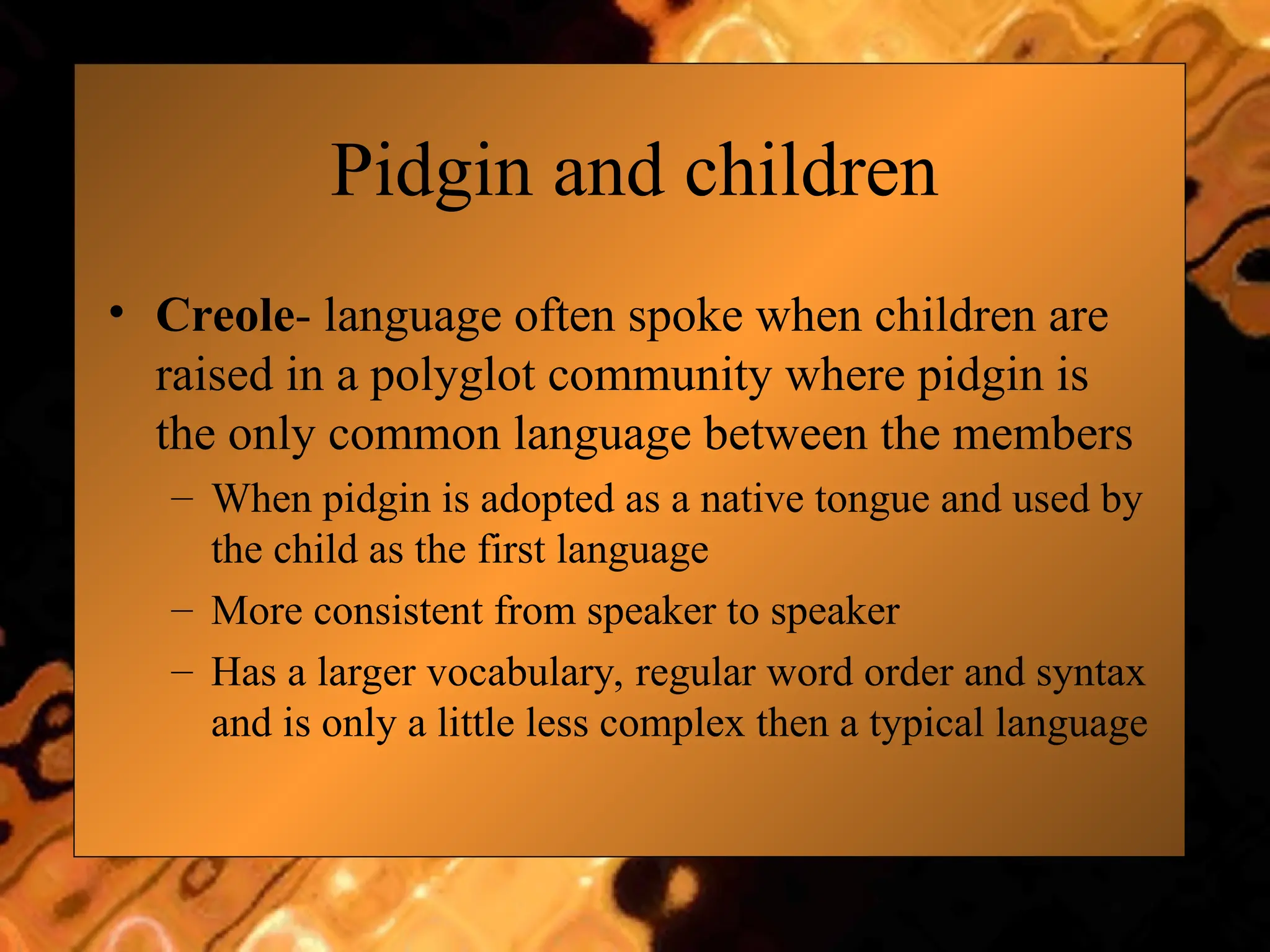
Pidgin and children
•Creole- language often spoke when children are
raised in a polyglot community where pidgin is
the only common language between the members
– When pidgin is adopted as a native tongue and used by
the child as the first language
– More consistent from speaker to speaker
– Has a larger vocabulary, regular word order and syntax
and is only a little less complex then a typical language
18.
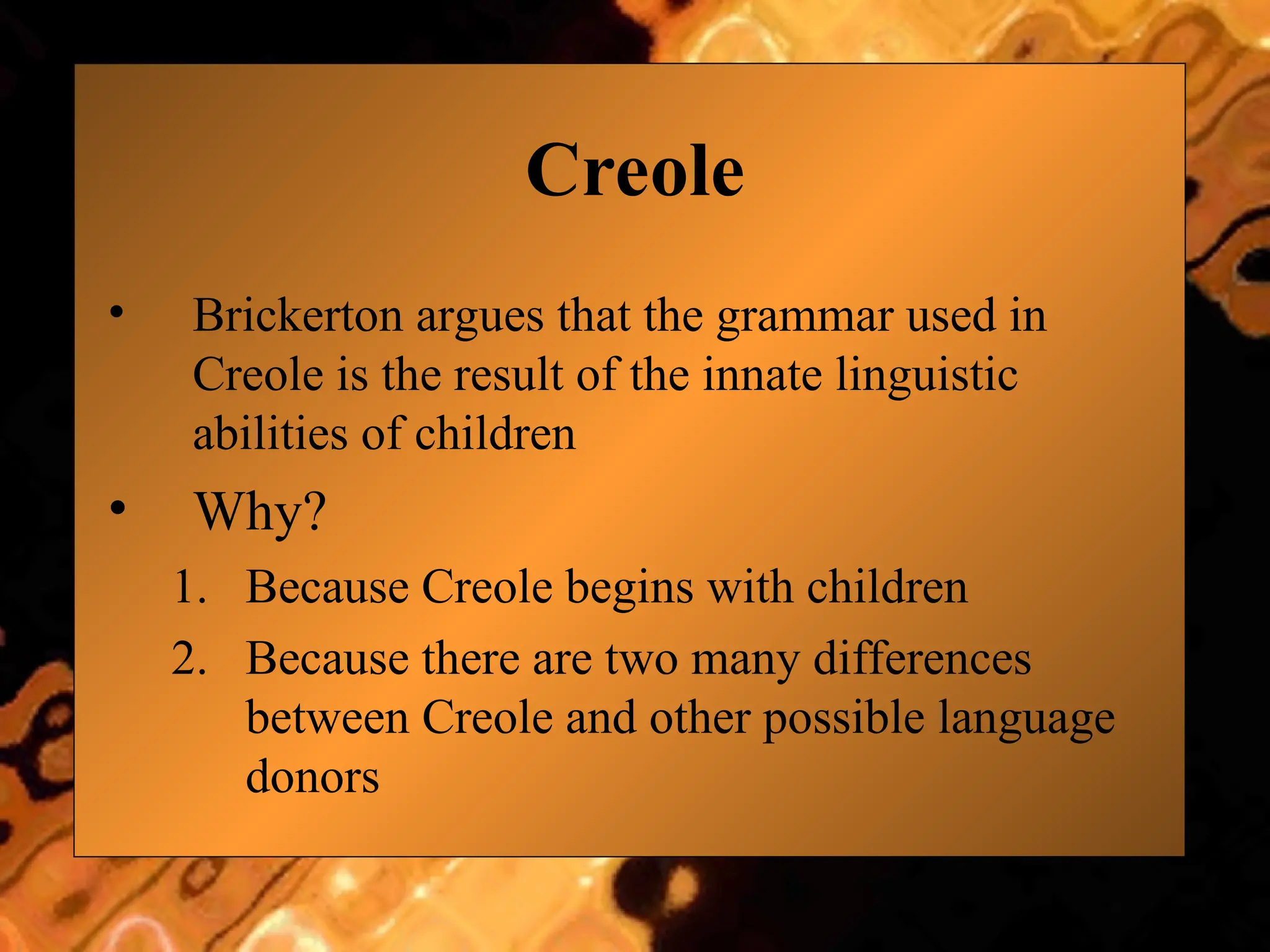
Creole
• Brickerton arguesthat the grammar used in
Creole is the result of the innate linguistic
abilities of children
• Why?
1. Because Creole begins with children
2. Because there are two many differences
between Creole and other possible language
donors
19.
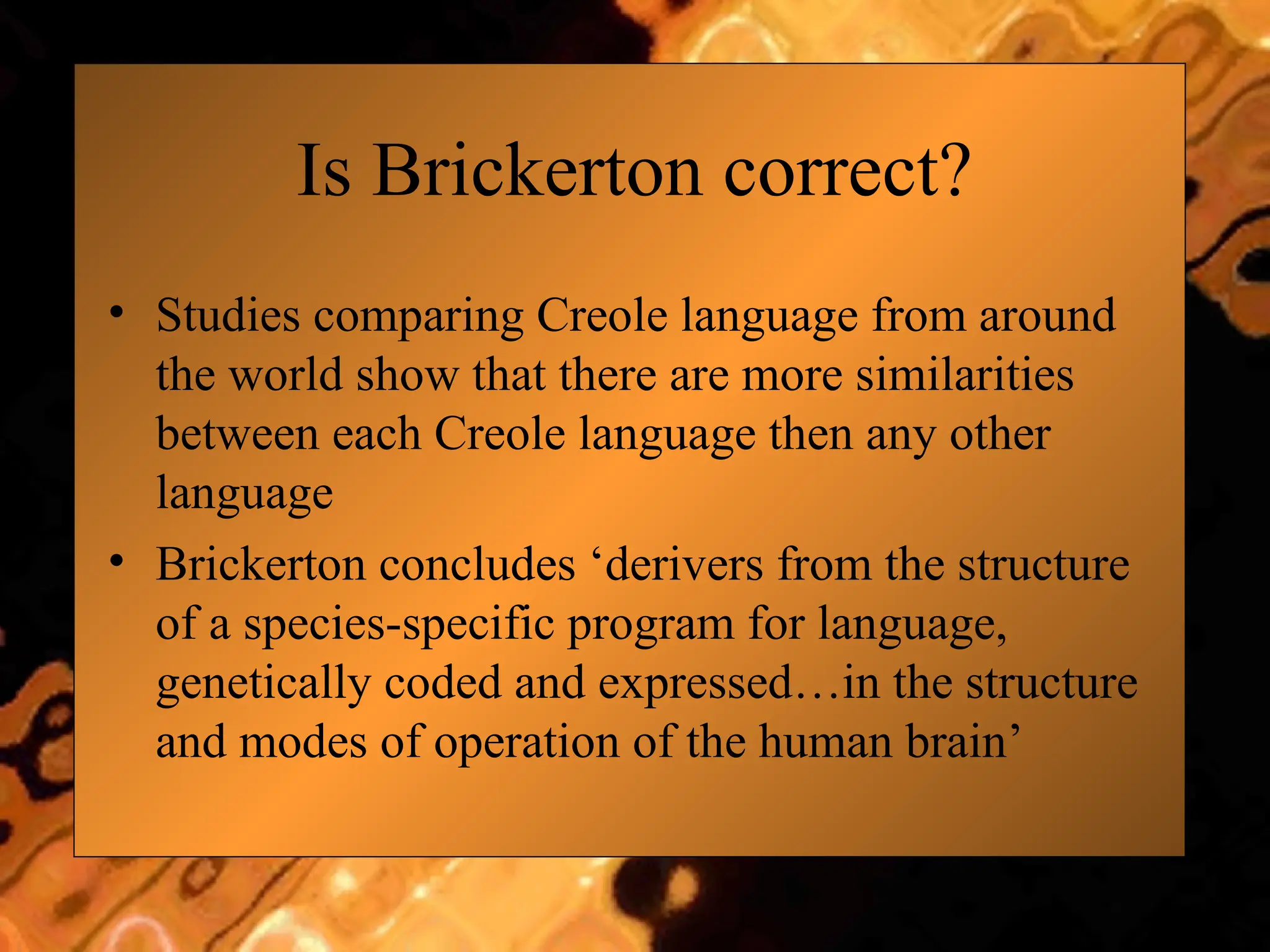
Is Brickerton correct?
•Studies comparing Creole language from around
the world show that there are more similarities
between each Creole language then any other
language
• Brickerton concludes ‘derivers from the structure
of a species-specific program for language,
genetically coded and expressed…in the structure
and modes of operation of the human brain’
20.
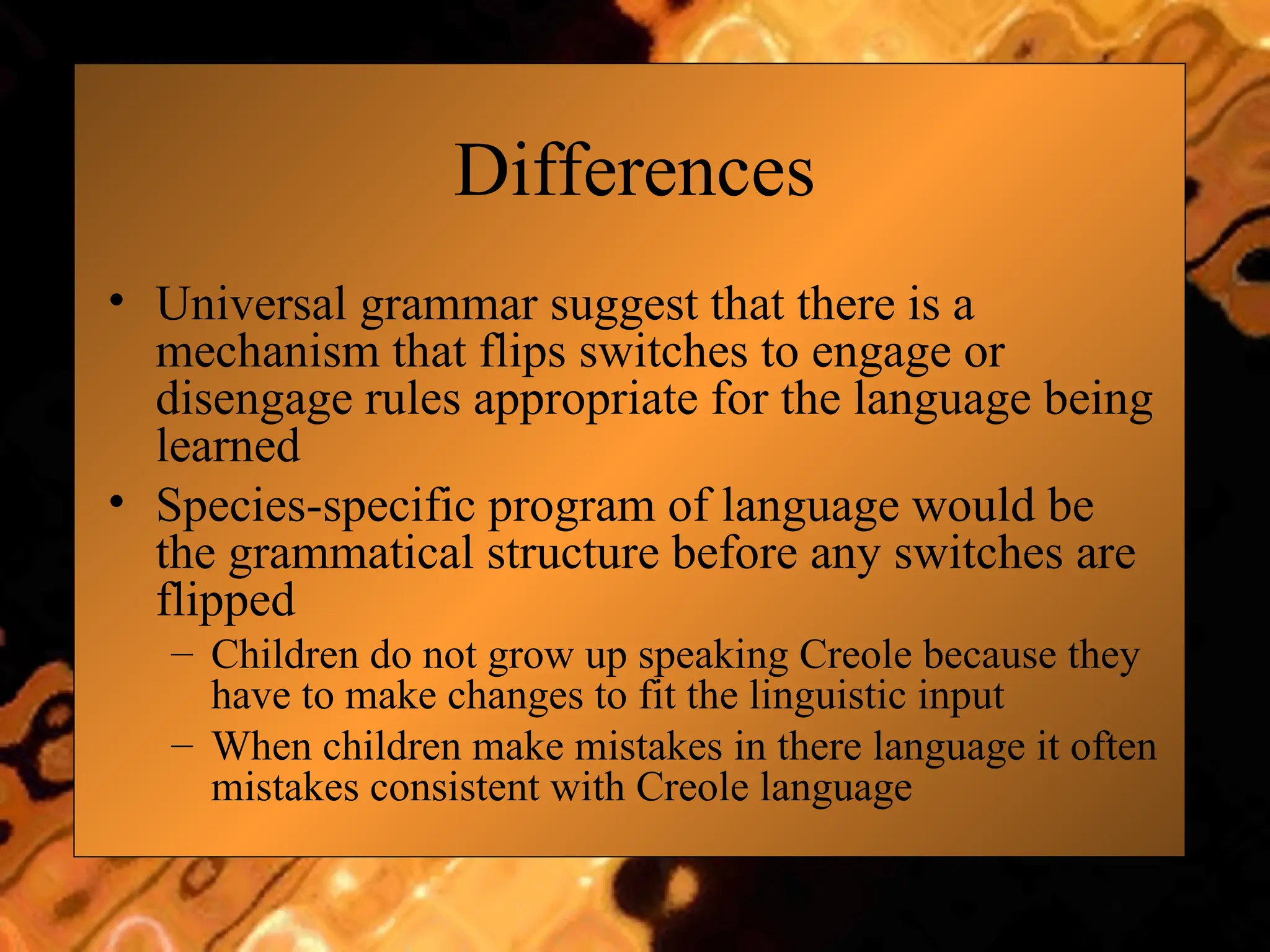
Differences
• Universal grammarsuggest that there is a
mechanism that flips switches to engage or
disengage rules appropriate for the language being
learned
• Species-specific program of language would be
the grammatical structure before any switches are
flipped
– Children do not grow up speaking Creole because they
have to make changes to fit the linguistic input
– When children make mistakes in there language it often
mistakes consistent with Creole language


![Theories Of Language Acquisition[1]](https://cdn.slidesharecdn.com/ss_thumbnails/theories-of-language-acquisition1-1225480010904742-8-thumbnail.jpg?width=640&height=640&fit=bounds)
![Theories%20of%20 Language%20 Acquisition[1]](https://cdn.slidesharecdn.com/ss_thumbnails/theories20of20language20acquisition1-1225479043858786-9-thumbnail.jpg?width=640&height=640&fit=bounds)
![Theories Of Language Acquisition[1]](https://cdn.slidesharecdn.com/ss_thumbnails/theories-of-language-acquisition1-1225479040063582-9-thumbnail.jpg?width=640&height=640&fit=bounds)


