Linear Programming
Problems in RUse linear programming tool in R to solve optimization problems.
Asst. Prof. Ashwini Mathur
LPP over
Operations research is a field of study where, we optimize performance under
given constraints.
Operations research also helps us develop models for decision making.
Linear programming problems have applications in various fields some of which
include manufacturing systems, publics systems, business, supply chain
management and analytics.
Now Let’s understand the
aspects of formulating a problem into
a linear programming problem.
Descriptive Problem Now Converted into Mathematical Problem
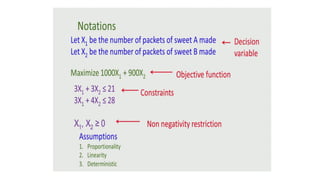
Now we are able to model or write a formulation which has an objective
function which is a linear function of the decision variables, constraints which
are linear inequalities or equations and explicit non-negativity restriction on
the decision variables,
## we have formulated a linear programming problem.
Why we study Linear Programming Problem ??
In linear programming, we try to optimize a linear objective function subject to
linear constraints and with non-negativity restrictions on the variables.
Every activity is carried out with an objective in mind and it is important to
optimize the objective.
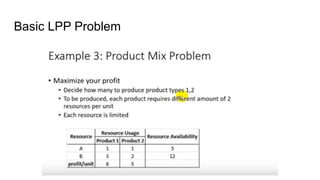
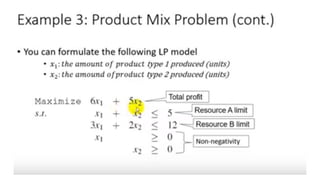
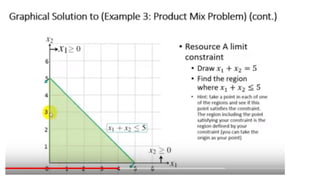
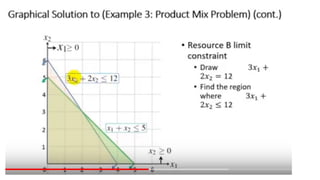
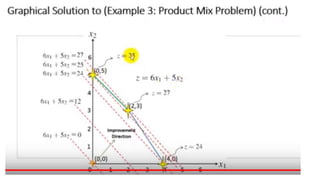
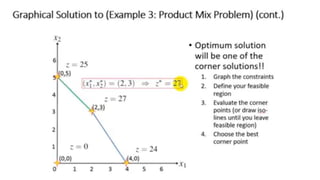
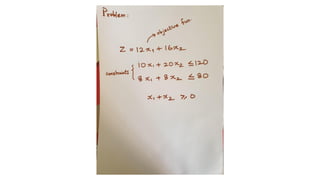
Basic LPP Problem
Let's Demonstrate this Problem in R
lpSolve (Library in R )
Description: Lp_solve is freely available software for solving linear, integer and
mixed integer programs.
License: LGPL-2
URL: https://github.com/gaborcsardi/lpSolve
Repository CRAN: Date/Publication 2020-01-24 22:20:02 UTC
Linear Programming using R
Description: Interface to lp_solve linear/integer programming system
Usage: lp (direction = "min", objective.in, const.mat, const.dir, const.rhs,
transpose.constraints = TRUE, int.vec, presolve=0, compute.sens=0, binary.vec,
all.int=FALSE, all.bin=FALSE, scale = 196, dense.const, num.bin.solns=1,
use.rw=FALSE)
Arguments
Direction: Character string giving direction of optimization: "min" (default) or
"max."
Objective.in: Numeric vector of coefficients of objective function const.mat Matrix
of numeric constraint coefficients, one row per constraint, one column per variable
(unless transpose.constraints = FALSE; see below).
Const.dir: Vector of character strings giving the direction of the constraint: each
value should be one of "<," "<=," "=," "==," ">," or ">=". (In each pair the two
values are identical.)
Const.rhs: Vector of numeric values for the right-hand sides of the constraints.

Linear programming optimization in r

  • 1.
    Linear Programming Problems inRUse linear programming tool in R to solve optimization problems. Asst. Prof. Ashwini Mathur
  • 2.
    LPP over Operations researchis a field of study where, we optimize performance under given constraints. Operations research also helps us develop models for decision making. Linear programming problems have applications in various fields some of which include manufacturing systems, publics systems, business, supply chain management and analytics.
  • 3.
    Now Let’s understandthe aspects of formulating a problem into a linear programming problem.
  • 6.
    Descriptive Problem NowConverted into Mathematical Problem Now we are able to model or write a formulation which has an objective function which is a linear function of the decision variables, constraints which are linear inequalities or equations and explicit non-negativity restriction on the decision variables, ## we have formulated a linear programming problem.
  • 7.
    Why we studyLinear Programming Problem ?? In linear programming, we try to optimize a linear objective function subject to linear constraints and with non-negativity restrictions on the variables. Every activity is carried out with an objective in mind and it is important to optimize the objective.
  • 8.
  • 14.
  • 16.
    lpSolve (Library inR ) Description: Lp_solve is freely available software for solving linear, integer and mixed integer programs. License: LGPL-2 URL: https://github.com/gaborcsardi/lpSolve Repository CRAN: Date/Publication 2020-01-24 22:20:02 UTC
  • 17.
    Linear Programming usingR Description: Interface to lp_solve linear/integer programming system Usage: lp (direction = "min", objective.in, const.mat, const.dir, const.rhs, transpose.constraints = TRUE, int.vec, presolve=0, compute.sens=0, binary.vec, all.int=FALSE, all.bin=FALSE, scale = 196, dense.const, num.bin.solns=1, use.rw=FALSE)
  • 18.
    Arguments Direction: Character stringgiving direction of optimization: "min" (default) or "max." Objective.in: Numeric vector of coefficients of objective function const.mat Matrix of numeric constraint coefficients, one row per constraint, one column per variable (unless transpose.constraints = FALSE; see below). Const.dir: Vector of character strings giving the direction of the constraint: each value should be one of "<," "<=," "=," "==," ">," or ">=". (In each pair the two values are identical.) Const.rhs: Vector of numeric values for the right-hand sides of the constraints.