1
2
Linear Density/ Count
Prepared By
MD. BIPLOB MIA
01706-442259
biplobmia2259@gmail.com
Year/Semester: 4/1
Session: 2023-2024
3
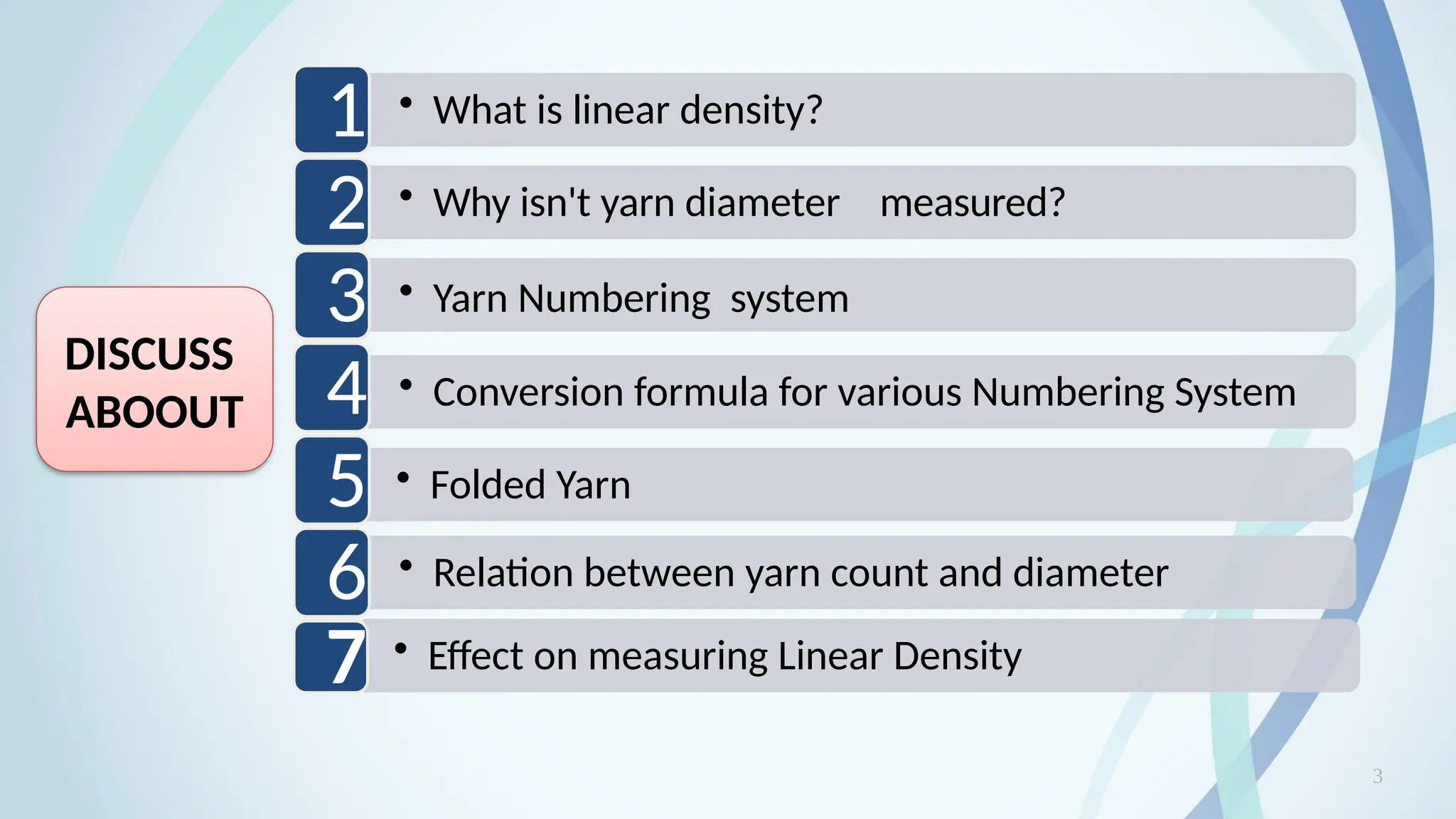
DISCUSS
ABOOUT
• What is linear density?
1
• Why isn't yarn diameter measured?
2
• Yarn Numbering system
3
• Conversion formula for various Numbering System
4
• Folded Yarn
5
• Relation between yarn count and diameter
6
• Effect on measuring Linear Density
7
4
Linear Density/
Count
The count of a yarn is a numerical expression
which defines its fineness. A number
indicating the mass per unit length or the
length per unit mass of yarn.
The thickness or diameter of a yarn is one of
the most fundamental properties of yarn.
However, it is not possible to measure the
diameter of a yarn in any meaningful way.
5
Why isn't yarn diameter
measured?
Soft and
Compressible
Outer Edge Thick & Thin
place
6
Yarn Numbering
System
Direct System:
The direct system of denoting the linear
density based on measuring the weight per
unit length of a yarn.
Indirect system:
The indirect system of denoting linear density
based on the measuring the length per unit
weight of a yarn.
7
Direct
System
 It is the fixed length system
 Higher the yarn count coarser the yarn and
 lower the yarn count finer the yarn.
 Formula:
Where,
N = Yarn count or numbering system
I = Unit of the length of the sample
W = Weight of the sample
L = Length of the sample
w= Unit weight of sample
8
Direct
System
It is further classified as:
 Tex System
Decitex
Militex
Kilotex
 Denier System
 Woolen System
 Spindle System
9
Direct
System
Numbering System Unit of Length (L) Unit of Weight(W)
Tex System (Tt) 1000 meters No. of Grams
Decitex (dtex) 1000 meters No. of Decigrams
Millitex (mtex) 1000 meters No. of Milligrams
Kilotex (ktex) 1000 meters No. of Kilograms
Denier (D or Td) 9000 meters No. of Grams
Woolen(American Grain) 20 Yards No. of Grain
Jute count 14,400 yards No. of Pounds (lb)
Tex Count: The tex of yarn indicates the weight in grams of 1000 meters
yarn, So that 40 Tex means 1000 meters of yarn weight 40 gram.
10
Relation Between Direct System
11
Direct System
 On a cone, there is 9800m yarn which weighs 490 gm. What is the Tex
and Denier of the yarn? Ans: Tex=50, D=450
12
Indirect System
 It is the fixed weight system
 Higher the yarn count finer the yarn and
 lower the yarn count coarser the yarn.
 Formula:
𝑁=
𝐿×𝑤
𝑙×𝑊 Where,
N = Yarn count or numbering system
L = Length of the sample
I = Unit of length of the sample
w = Unit of weight of the sample
W= Weight of the sample
13
Indirect
System
It is further classified as:
 English Count System
Cotton
Woolen
Linen (Bast fiber)
 Worsted System
 Metric System
14
Indirect
System
Numbering System Unit of Length (L) Unit of Weight (W)
English Cotton Count (Ne) 840 yards (yds) 1 pound (Ib)
Metric Count (Nm) 1000 meters/1 km 1 kg
Woolen Count (YSW) 256 yards 1 pound (Ib)
Worsted Count (NeK) 560 yards 1 pound (Ib)
Linen Count (NeL) 300 yards 1 pound (Ib)
English Cotton Count: The Ne indicates how many hanks of 840 yards
length weight of 1 pound. So that 32 Ne means 32 hanks of 840 yards i.e.
32840 yards length of 1 pound.
15
Relation Between Indirect System
16
Conversion formula for various Numbering System:
𝑁𝑒=
5315
𝐷
𝑁𝑒=
590.5
𝑇𝑒𝑥
𝑇𝑒𝑥=
590.5
𝑁𝑒
𝐷=
5315
𝑁𝑒
𝐷=
9000
𝑁𝑚
𝐷=
9000
𝑁𝑚
Example:
 Known value 32 Ne find the needed value Tex & Denier?
 Known value 1500D find the needed value of Ne & Tex?
17
Some Importants Conversion Factor:
1 yard=0.9144 meter
1 meter=1.0936 yard
1 meter= 39.37 inch
1 inch=2.54 cm
1 cm=0.3937 inch
1 gm=0.0353 oz
1 oz=28.35 gram
1 pound=453.56 gram
1 pound=0.4536 kg
1 kg=2.204 pound
18
Folded Yarn
 Yarns are produced by the combination of two or more single
yarns.
There are two possible ways of referring to
folded yarns:
1. One is based on the linear density of
the constituent yarns
2. And the other is based on the resultant
linear density of the whole
yarn.
19
Folded Yarn
For Direct System
 NR=N×n
 NR=N1+N2+N3+…...+Nn
For Indirect System
 NR=N/n
 1/NR=1/N1+1/N2+1/N3+……+1/Nn
Where,
NR = Ply or resultant count
N,N1,N2,N3,…Nn = Single yarn count
n = Number of yarns in the ply
20
Folded Yarn
Example:
 A ply consists of 2 single yarns, each having a count of
Nm 50, ply count? Ans: 25 Nm
 A ply consists of 2 single yarns, each having a count of
20 tex, ply count? Ans: 40 Tex
21
Folded Yarn
 What length of yarn is contained in 95 gm of yarn of Ne 50/2? Ans:
22
Relation between Yarn Count and Diameter
Let us consider, Yarn Count= N Tex
Diameter= d cm
Assuming that, Specific volume of the yarn= 1.1 cm3
/gm
So, weight of 1.1 cm3
=1 gm
In tex system,
Length of N gm yarn=1000 m
,, ,, 1 gm ,, =
Therefore,
Length of 1.1 cm3
yarn is
Volume =
1.1=
d=
Now,
Again,
23
Effect on Measuring Linear
Density
1. Sampling:
From Yarn Package
From Fabric
2. Effect on Moisture Content
3. Effect on Tension
4. Added and Subtracted Material
24
Application of Yarn with different count
Finer count :
 Luxury apparel
 Shirting fabrics
 Lingerie and Sleepwear
 Fine knits
 Scarves and shawls
 High quality home textile
 Crafting and hand knitting
Coarser count :
 Heavy duty fabrics
 Denim
 Rugs and Carpets
 Outerwear
 Industrial Textiles
 Accessories
 Home Textiles
25
26

"Yarn linear density measurement and its significance"

  • 1.
  • 2.
    2 Linear Density/ Count PreparedBy MD. BIPLOB MIA 01706-442259 biplobmia2259@gmail.com Year/Semester: 4/1 Session: 2023-2024
  • 3.
    3 DISCUSS ABOOUT • What islinear density? 1 • Why isn't yarn diameter measured? 2 • Yarn Numbering system 3 • Conversion formula for various Numbering System 4 • Folded Yarn 5 • Relation between yarn count and diameter 6 • Effect on measuring Linear Density 7
  • 4.
    4 Linear Density/ Count The countof a yarn is a numerical expression which defines its fineness. A number indicating the mass per unit length or the length per unit mass of yarn. The thickness or diameter of a yarn is one of the most fundamental properties of yarn. However, it is not possible to measure the diameter of a yarn in any meaningful way.
  • 5.
    5 Why isn't yarndiameter measured? Soft and Compressible Outer Edge Thick & Thin place
  • 6.
    6 Yarn Numbering System Direct System: Thedirect system of denoting the linear density based on measuring the weight per unit length of a yarn. Indirect system: The indirect system of denoting linear density based on the measuring the length per unit weight of a yarn.
  • 7.
    7 Direct System  It isthe fixed length system  Higher the yarn count coarser the yarn and  lower the yarn count finer the yarn.  Formula: Where, N = Yarn count or numbering system I = Unit of the length of the sample W = Weight of the sample L = Length of the sample w= Unit weight of sample
  • 8.
    8 Direct System It is furtherclassified as:  Tex System Decitex Militex Kilotex  Denier System  Woolen System  Spindle System
  • 9.
    9 Direct System Numbering System Unitof Length (L) Unit of Weight(W) Tex System (Tt) 1000 meters No. of Grams Decitex (dtex) 1000 meters No. of Decigrams Millitex (mtex) 1000 meters No. of Milligrams Kilotex (ktex) 1000 meters No. of Kilograms Denier (D or Td) 9000 meters No. of Grams Woolen(American Grain) 20 Yards No. of Grain Jute count 14,400 yards No. of Pounds (lb) Tex Count: The tex of yarn indicates the weight in grams of 1000 meters yarn, So that 40 Tex means 1000 meters of yarn weight 40 gram.
  • 10.
  • 11.
    11 Direct System  Ona cone, there is 9800m yarn which weighs 490 gm. What is the Tex and Denier of the yarn? Ans: Tex=50, D=450
  • 12.
    12 Indirect System  Itis the fixed weight system  Higher the yarn count finer the yarn and  lower the yarn count coarser the yarn.  Formula: 𝑁= 𝐿×𝑤 𝑙×𝑊 Where, N = Yarn count or numbering system L = Length of the sample I = Unit of length of the sample w = Unit of weight of the sample W= Weight of the sample
  • 13.
    13 Indirect System It is furtherclassified as:  English Count System Cotton Woolen Linen (Bast fiber)  Worsted System  Metric System
  • 14.
    14 Indirect System Numbering System Unitof Length (L) Unit of Weight (W) English Cotton Count (Ne) 840 yards (yds) 1 pound (Ib) Metric Count (Nm) 1000 meters/1 km 1 kg Woolen Count (YSW) 256 yards 1 pound (Ib) Worsted Count (NeK) 560 yards 1 pound (Ib) Linen Count (NeL) 300 yards 1 pound (Ib) English Cotton Count: The Ne indicates how many hanks of 840 yards length weight of 1 pound. So that 32 Ne means 32 hanks of 840 yards i.e. 32840 yards length of 1 pound.
  • 15.
  • 16.
    16 Conversion formula forvarious Numbering System: 𝑁𝑒= 5315 𝐷 𝑁𝑒= 590.5 𝑇𝑒𝑥 𝑇𝑒𝑥= 590.5 𝑁𝑒 𝐷= 5315 𝑁𝑒 𝐷= 9000 𝑁𝑚 𝐷= 9000 𝑁𝑚 Example:  Known value 32 Ne find the needed value Tex & Denier?  Known value 1500D find the needed value of Ne & Tex?
  • 17.
    17 Some Importants ConversionFactor: 1 yard=0.9144 meter 1 meter=1.0936 yard 1 meter= 39.37 inch 1 inch=2.54 cm 1 cm=0.3937 inch 1 gm=0.0353 oz 1 oz=28.35 gram 1 pound=453.56 gram 1 pound=0.4536 kg 1 kg=2.204 pound
  • 18.
    18 Folded Yarn  Yarnsare produced by the combination of two or more single yarns. There are two possible ways of referring to folded yarns: 1. One is based on the linear density of the constituent yarns 2. And the other is based on the resultant linear density of the whole yarn.
  • 19.
    19 Folded Yarn For DirectSystem  NR=N×n  NR=N1+N2+N3+…...+Nn For Indirect System  NR=N/n  1/NR=1/N1+1/N2+1/N3+……+1/Nn Where, NR = Ply or resultant count N,N1,N2,N3,…Nn = Single yarn count n = Number of yarns in the ply
  • 20.
    20 Folded Yarn Example:  Aply consists of 2 single yarns, each having a count of Nm 50, ply count? Ans: 25 Nm  A ply consists of 2 single yarns, each having a count of 20 tex, ply count? Ans: 40 Tex
  • 21.
    21 Folded Yarn  Whatlength of yarn is contained in 95 gm of yarn of Ne 50/2? Ans:
  • 22.
    22 Relation between YarnCount and Diameter Let us consider, Yarn Count= N Tex Diameter= d cm Assuming that, Specific volume of the yarn= 1.1 cm3 /gm So, weight of 1.1 cm3 =1 gm In tex system, Length of N gm yarn=1000 m ,, ,, 1 gm ,, = Therefore, Length of 1.1 cm3 yarn is Volume = 1.1= d= Now, Again,
  • 23.
    23 Effect on MeasuringLinear Density 1. Sampling: From Yarn Package From Fabric 2. Effect on Moisture Content 3. Effect on Tension 4. Added and Subtracted Material
  • 24.
    24 Application of Yarnwith different count Finer count :  Luxury apparel  Shirting fabrics  Lingerie and Sleepwear  Fine knits  Scarves and shawls  High quality home textile  Crafting and hand knitting Coarser count :  Heavy duty fabrics  Denim  Rugs and Carpets  Outerwear  Industrial Textiles  Accessories  Home Textiles
  • 25.
  • 26.