E L E M E N T S O F F A S H I O N D E S I G N :
L I N E I N S T R U C T U R A L A N D
D E C O R A T I V E M E T H O D S
2 8 . 0 2 . 2 0 1 8
I R E M A R I K A N E K Ş I
Dress is ‘an assemblage of modifications of the body and/or supplements to the
body’ (Eicher and Roach-Higgins, 1992; Roach-Higgins and Eicher, 1992).
Supplements to the body are material artifacts that have meaning (Kaiser, 1997).
!!! Where and how is the meaning created?
The meaning is created through visual + sensory codes in the production,
marketing and use of the supplement. Consumers can express their identities,
dreams, ideals and intentions through the visual + sensory code systems. So can
we claim that dress serves like a non verbal communication tool? (Eicher, 1995)
Question: !!! Are these visual and sensory codes
recognised or not recognised by the viewer?
“ COGNITIVE and EMOTIONAL processes of the
viewer“
Design is both product and process.
Design is a generation of several ideas which
are edited, redefined and refined by designer
or by a collaboration of designers team.
There must be a problem presenting itself.
How is this problem identified? Your problem
will create your concept, theme
PROBLEM IDENTIFICATION: **example: What is the category of apparel? evening wear, casual, sports
collection, shirts series, …? What is the wearer profile? age, income level, lifestyle…? What about
Season?
RESEARCH:**example: Where does the design problem’s potential influences come from? Industry,
culture, economy, history or inspiration…? Fabric and color trends?
IDEATION:**example: Create several solutions for one problem during design process, so you will
develop a sense, instinct, an eye for design. “Thinking outside the box„
LIMITATIONS AND CONSTRAINTS:** example: Amount of time to finish project, the availability and costs
of materials,
SELECTION:**Choose the best based on your research and on your constraints.
IMPLEMENTATION: Solve your problem. Draw and give form to the solution. Make a sample for your
design in one or more pieces.
EVALUATE: Examine the solution. Evaluate it for fit, silhouette, aesthetic appearance and communication
value
REFINEMENT: Make the changes necessary to refine your design.
PRESENTATION:Make a mood board and an oral presentation for your design.
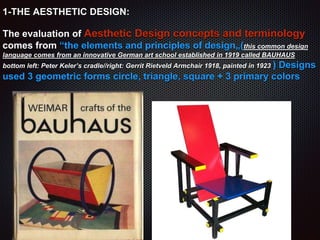
1-THE AESTHETIC DESIGN:
The evaluation of Aesthetic Design concepts and terminology
comes from “the elements and principles of design„(this common design
language comes from an innovative German art school established in 1919 called BAUHAUS
bottom left: Peter Keler’s cradle//right: Gerrit Rietveld Armchair 1918, painted in 1923 ) Designs
used 3 geometric forms circle, triangle, square + 3 primary colors
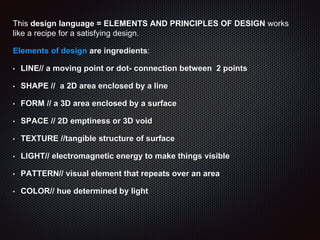
This design language = ELEMENTS AND PRINCIPLES OF DESIGN works
like a recipe for a satisfying design.
Elements of design are ingredients:
• LINE// a moving point or dot- connection between 2 points
• SHAPE // a 2D area enclosed by a line
• FORM // a 3D area enclosed by a surface
• SPACE // 2D emptiness or 3D void
• TEXTURE //tangible structure of surface
• LIGHT// electromagnetic energy to make things visible
• PATTERN// visual element that repeats over an area
• COLOR// hue determined by light
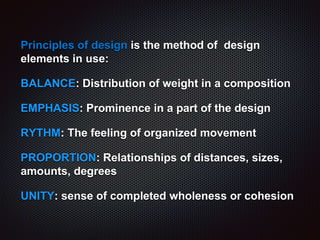
Principles of design is the method of design
elements in use:
BALANCE: Distribution of weight in a composition
EMPHASIS: Prominence in a part of the design
RYTHM: The feeling of organized movement
PROPORTION: Relationships of distances, sizes,
amounts, degrees
UNITY: sense of completed wholeness or cohesion
2- STRUCTURAL DESIGN: It determines form. It contributes to aesthetic attractiveness and lets
the garment function. It involves:
Cut of the fabric = how the pieces work with each other, how pieces work with human form
Seam: is a visual line in a garment// can be a dart(pens) ; can be a gathering(büzgü)
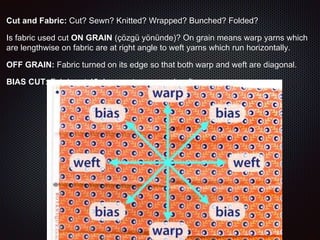
Cut and Fabric: Cut? Sewn? Knitted? Wrapped? Bunched? Folded?
Is fabric used cut ON GRAIN (çözgü yönünde)? On grain means warp yarns which
are lengthwise on fabric are at right angle to weft yarns which run horizontally.
OFF GRAIN: Fabric turned on its edge so that both warp and weft are diagonal.
BIAS CUT: Fabric cut 45 degrees to warp and weft
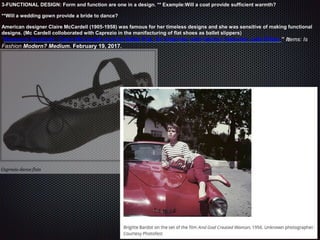
3-FUNCTIONAL DESIGN: Form and function are one in a design. ** Example:Will a coat provide sufficient warmth?
**Will a wedding gown provide a bride to dance?
American designer Claire McCardell (1905-1958) was famous for her timeless designs and she was sensitive of making functional
designs. (Mc Cardell colloborated with Caprezio in the manifacturing of flat shoes as ballet slippers)
“Research Spotlight: Claire McCardell and the Ballet Flat, An interview with fashion historian Julie Eilber.” Items: Is
Fashion Modern? Medium. February 19, 2017.
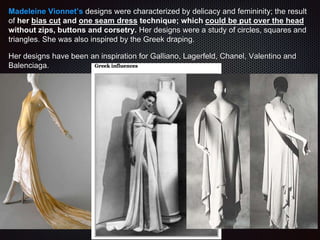
Madeleine Vionnet’s designs were characterized by delicacy and femininity; the result
of her bias cut and one seam dress technique; which could be put over the head
without zips, buttons and corsetry. Her designs were a study of circles, squares and
triangles. She was also inspired by the Greek draping.
Her designs have been an inspiration for Galliano, Lagerfeld, Chanel, Valentino and
Balenciaga.
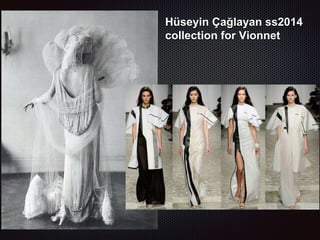
Hüseyin Çağlayan ss2014
collection for Vionnet
LINE: as design element
https://www.youtube.com/watch?v=_-buyDCDh4Y
(hat sanatı - calligraphy art)
https://www.youtube.com/watch?v=A-bNzAiA3xA
(chinese calligraphy)
https://www.youtube.com/watch?v=W5tRXr7iFJ4
(japanese calligraphy)
https://www.youtube.com/watch?v=LoqavHDlKZ0
(hititite in cuneiform)
Lines have two main categories: STRAIGHT and CURVED
Designers use line to:
1-make a shape, contour, define a boundary
2. create variety by using angular, broken, bent, thick or
thin lines
3. create rhythm with curved or straight lines, varied in
length
4. simulate texture
5. express movement or motion
6. create focus through direction
LINE ACTIVATES SPACE!!!!
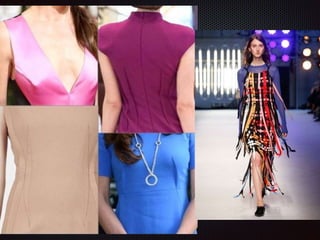
Line is applied to a garment
in 1-STRUCTURAL or/vs. 2-
DECORATIVE ways
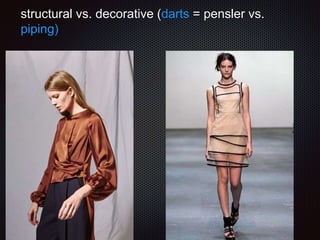
structural vs. decorative (darts = pensler vs.
piping)
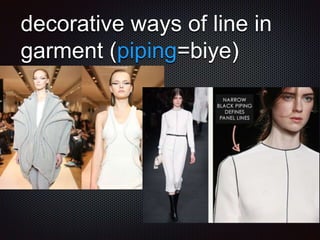
decorative ways of line in
garment (piping=biye)
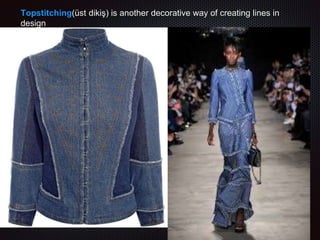
Topstitching(üst dikiş) is another decorative way of creating lines in
design
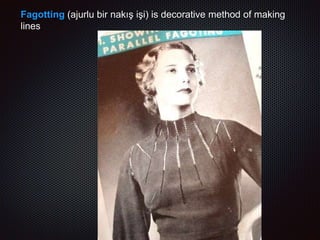
Fagotting (ajurlu bir nakış işi) is decorative method of making
lines
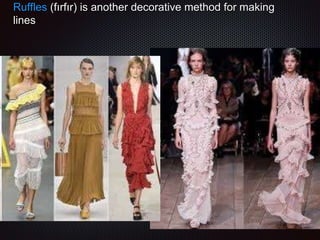
Ruffles (fırfır) is another decorative method for making
lines
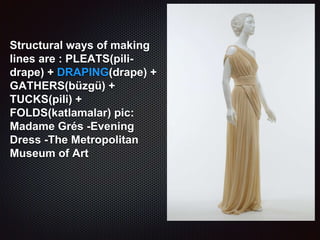
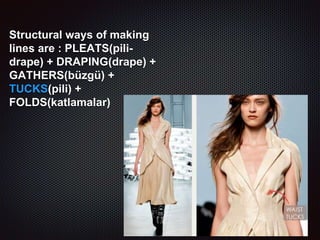
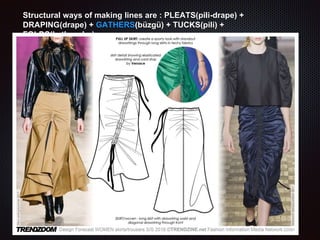
Structural ways of making
lines are : PLEATS(pili-
drape) + DRAPING(drape) +
GATHERS(büzgü) +
TUCKS(pili) +
FOLDS(katlamalar) pic:
Madame Grés -Evening
Dress -The Metropolitan
Museum of Art
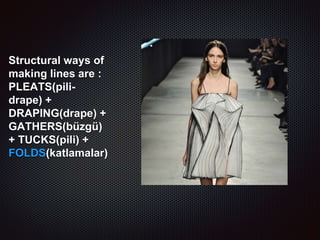
Structural ways of making
lines are : PLEATS(pili-
drape) + DRAPING(drape) +
GATHERS(büzgü) +
TUCKS(pili) +
FOLDS(katlamalar)
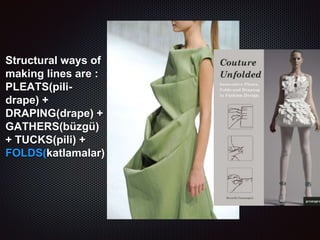
Structural ways of
making lines are :
PLEATS(pili-
drape) +
DRAPING(drape) +
GATHERS(büzgü)
+ TUCKS(pili) +
FOLDS(katlamalar)
Structural ways of
making lines are :
PLEATS(pili-
drape) +
DRAPING(drape) +
GATHERS(büzgü)
+ TUCKS(pili) +
FOLDS(katlamalar)
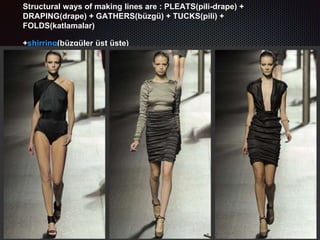
Structural ways of making lines are : PLEATS(pili-drape) +
DRAPING(drape) + GATHERS(büzgü) + TUCKS(pili) +
FOLDS(katlamalar)
+shirring(büzgüler üst üste)
Structural ways of making lines are : PLEATS(pili-drape) +
DRAPING(drape) + GATHERS(büzgü) + TUCKS(pili) +
FOLDS(katlamalar)
LINE DIRECTION = MOOD
Vertical Lines :communicates
tradition- firmness - Like the
columns of building - strength -
rigidity - dignity
Designers use VERTICAL LINES to
add an illusion of height to figure.
Vertical lines allow human figure to
appear slimmer.
VERTICAL LINES: Rows
of buttons, zips, elongated
shape of a contrasting
color, pleats, seams,
draped folds, they can
divide symmetrically or
asymmetrically
HORIZONTAL LINES: give
a feeling of horizon line,
rest, width, sports wear,
athletic attire
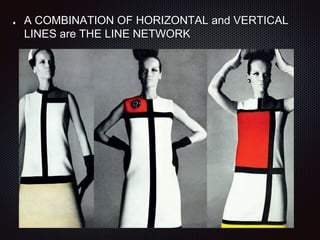
A COMBINATION OF HORIZONTAL and VERTICAL
LINES are THE LINE NETWORK
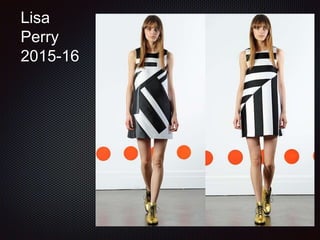
Lisa
Perry
2015-16
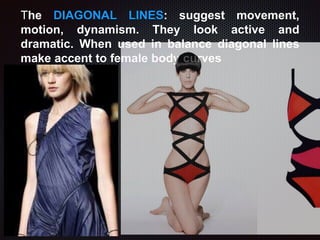
The DIAGONAL LINES: suggest movement,
motion, dynamism. They look active and
dramatic. When used in balance diagonal lines
make accent to female body curves
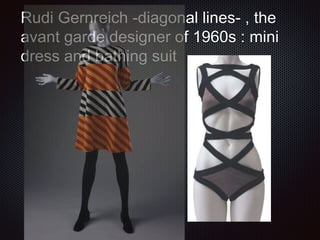
Rudi Gernreich -diagonal lines- , the
avant garde designer of 1960s : mini
dress and bathing suit
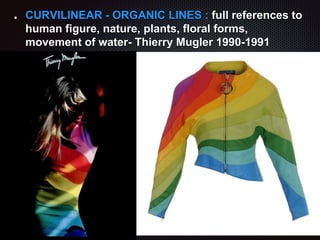
CURVILINEAR - ORGANIC LINES : full references to
human figure, nature, plants, floral forms,
movement of water- Thierry Mugler 1990-1991
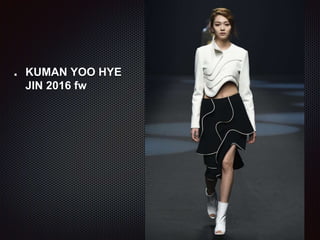
KUMAN YOO HYE
JIN 2016 fw
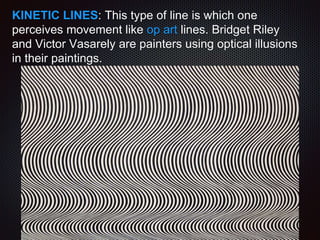
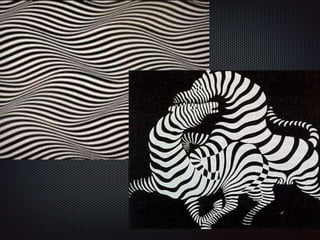
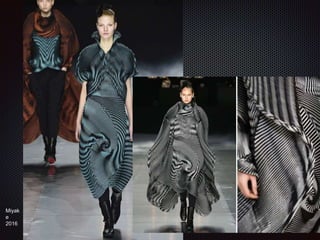
KINETIC LINES: This type of line is which one
perceives movement like op art lines. Bridget Riley
and Victor Vasarely are painters using optical illusions
in their paintings.
Miyak
e
2016

Line as fashion design element

  • 1.
    E L EM E N T S O F F A S H I O N D E S I G N : L I N E I N S T R U C T U R A L A N D D E C O R A T I V E M E T H O D S 2 8 . 0 2 . 2 0 1 8 I R E M A R I K A N E K Ş I
  • 2.
    Dress is ‘anassemblage of modifications of the body and/or supplements to the body’ (Eicher and Roach-Higgins, 1992; Roach-Higgins and Eicher, 1992). Supplements to the body are material artifacts that have meaning (Kaiser, 1997). !!! Where and how is the meaning created? The meaning is created through visual + sensory codes in the production, marketing and use of the supplement. Consumers can express their identities, dreams, ideals and intentions through the visual + sensory code systems. So can we claim that dress serves like a non verbal communication tool? (Eicher, 1995) Question: !!! Are these visual and sensory codes recognised or not recognised by the viewer? “ COGNITIVE and EMOTIONAL processes of the viewer“
  • 3.
    Design is bothproduct and process. Design is a generation of several ideas which are edited, redefined and refined by designer or by a collaboration of designers team. There must be a problem presenting itself. How is this problem identified? Your problem will create your concept, theme
  • 4.
    PROBLEM IDENTIFICATION: **example:What is the category of apparel? evening wear, casual, sports collection, shirts series, …? What is the wearer profile? age, income level, lifestyle…? What about Season? RESEARCH:**example: Where does the design problem’s potential influences come from? Industry, culture, economy, history or inspiration…? Fabric and color trends? IDEATION:**example: Create several solutions for one problem during design process, so you will develop a sense, instinct, an eye for design. “Thinking outside the box„ LIMITATIONS AND CONSTRAINTS:** example: Amount of time to finish project, the availability and costs of materials, SELECTION:**Choose the best based on your research and on your constraints. IMPLEMENTATION: Solve your problem. Draw and give form to the solution. Make a sample for your design in one or more pieces. EVALUATE: Examine the solution. Evaluate it for fit, silhouette, aesthetic appearance and communication value REFINEMENT: Make the changes necessary to refine your design. PRESENTATION:Make a mood board and an oral presentation for your design.
  • 5.
    1-THE AESTHETIC DESIGN: Theevaluation of Aesthetic Design concepts and terminology comes from “the elements and principles of design„(this common design language comes from an innovative German art school established in 1919 called BAUHAUS bottom left: Peter Keler’s cradle//right: Gerrit Rietveld Armchair 1918, painted in 1923 ) Designs used 3 geometric forms circle, triangle, square + 3 primary colors
  • 6.
    This design language= ELEMENTS AND PRINCIPLES OF DESIGN works like a recipe for a satisfying design. Elements of design are ingredients: • LINE// a moving point or dot- connection between 2 points • SHAPE // a 2D area enclosed by a line • FORM // a 3D area enclosed by a surface • SPACE // 2D emptiness or 3D void • TEXTURE //tangible structure of surface • LIGHT// electromagnetic energy to make things visible • PATTERN// visual element that repeats over an area • COLOR// hue determined by light
  • 7.
    Principles of designis the method of design elements in use: BALANCE: Distribution of weight in a composition EMPHASIS: Prominence in a part of the design RYTHM: The feeling of organized movement PROPORTION: Relationships of distances, sizes, amounts, degrees UNITY: sense of completed wholeness or cohesion
  • 8.
    2- STRUCTURAL DESIGN:It determines form. It contributes to aesthetic attractiveness and lets the garment function. It involves: Cut of the fabric = how the pieces work with each other, how pieces work with human form Seam: is a visual line in a garment// can be a dart(pens) ; can be a gathering(büzgü)
  • 9.
    Cut and Fabric:Cut? Sewn? Knitted? Wrapped? Bunched? Folded? Is fabric used cut ON GRAIN (çözgü yönünde)? On grain means warp yarns which are lengthwise on fabric are at right angle to weft yarns which run horizontally. OFF GRAIN: Fabric turned on its edge so that both warp and weft are diagonal. BIAS CUT: Fabric cut 45 degrees to warp and weft
  • 10.
    3-FUNCTIONAL DESIGN: Formand function are one in a design. ** Example:Will a coat provide sufficient warmth? **Will a wedding gown provide a bride to dance? American designer Claire McCardell (1905-1958) was famous for her timeless designs and she was sensitive of making functional designs. (Mc Cardell colloborated with Caprezio in the manifacturing of flat shoes as ballet slippers) “Research Spotlight: Claire McCardell and the Ballet Flat, An interview with fashion historian Julie Eilber.” Items: Is Fashion Modern? Medium. February 19, 2017.
  • 11.
    Madeleine Vionnet’s designswere characterized by delicacy and femininity; the result of her bias cut and one seam dress technique; which could be put over the head without zips, buttons and corsetry. Her designs were a study of circles, squares and triangles. She was also inspired by the Greek draping. Her designs have been an inspiration for Galliano, Lagerfeld, Chanel, Valentino and Balenciaga.
  • 12.
  • 13.
    LINE: as designelement https://www.youtube.com/watch?v=_-buyDCDh4Y (hat sanatı - calligraphy art) https://www.youtube.com/watch?v=A-bNzAiA3xA (chinese calligraphy) https://www.youtube.com/watch?v=W5tRXr7iFJ4 (japanese calligraphy) https://www.youtube.com/watch?v=LoqavHDlKZ0 (hititite in cuneiform)
  • 14.
    Lines have twomain categories: STRAIGHT and CURVED Designers use line to: 1-make a shape, contour, define a boundary 2. create variety by using angular, broken, bent, thick or thin lines 3. create rhythm with curved or straight lines, varied in length 4. simulate texture 5. express movement or motion 6. create focus through direction LINE ACTIVATES SPACE!!!!
  • 15.
    Line is appliedto a garment in 1-STRUCTURAL or/vs. 2- DECORATIVE ways
  • 17.
    structural vs. decorative(darts = pensler vs. piping)
  • 18.
    decorative ways ofline in garment (piping=biye)
  • 19.
    Topstitching(üst dikiş) isanother decorative way of creating lines in design
  • 20.
    Fagotting (ajurlu birnakış işi) is decorative method of making lines
  • 21.
    Ruffles (fırfır) isanother decorative method for making lines
  • 22.
    Structural ways ofmaking lines are : PLEATS(pili- drape) + DRAPING(drape) + GATHERS(büzgü) + TUCKS(pili) + FOLDS(katlamalar) pic: Madame Grés -Evening Dress -The Metropolitan Museum of Art
  • 23.
    Structural ways ofmaking lines are : PLEATS(pili- drape) + DRAPING(drape) + GATHERS(büzgü) + TUCKS(pili) + FOLDS(katlamalar)
  • 24.
    Structural ways of makinglines are : PLEATS(pili- drape) + DRAPING(drape) + GATHERS(büzgü) + TUCKS(pili) + FOLDS(katlamalar)
  • 25.
    Structural ways of makinglines are : PLEATS(pili- drape) + DRAPING(drape) + GATHERS(büzgü) + TUCKS(pili) + FOLDS(katlamalar)
  • 26.
    Structural ways ofmaking lines are : PLEATS(pili-drape) + DRAPING(drape) + GATHERS(büzgü) + TUCKS(pili) + FOLDS(katlamalar) +shirring(büzgüler üst üste)
  • 27.
    Structural ways ofmaking lines are : PLEATS(pili-drape) + DRAPING(drape) + GATHERS(büzgü) + TUCKS(pili) + FOLDS(katlamalar)
  • 28.
    LINE DIRECTION =MOOD Vertical Lines :communicates tradition- firmness - Like the columns of building - strength - rigidity - dignity Designers use VERTICAL LINES to add an illusion of height to figure. Vertical lines allow human figure to appear slimmer.
  • 29.
    VERTICAL LINES: Rows ofbuttons, zips, elongated shape of a contrasting color, pleats, seams, draped folds, they can divide symmetrically or asymmetrically
  • 30.
    HORIZONTAL LINES: give afeeling of horizon line, rest, width, sports wear, athletic attire
  • 31.
    A COMBINATION OFHORIZONTAL and VERTICAL LINES are THE LINE NETWORK
  • 32.
  • 33.
    The DIAGONAL LINES:suggest movement, motion, dynamism. They look active and dramatic. When used in balance diagonal lines make accent to female body curves
  • 34.
    Rudi Gernreich -diagonallines- , the avant garde designer of 1960s : mini dress and bathing suit
  • 35.
    CURVILINEAR - ORGANICLINES : full references to human figure, nature, plants, floral forms, movement of water- Thierry Mugler 1990-1991
  • 36.
  • 37.
    KINETIC LINES: Thistype of line is which one perceives movement like op art lines. Bridget Riley and Victor Vasarely are painters using optical illusions in their paintings.
  • 39.