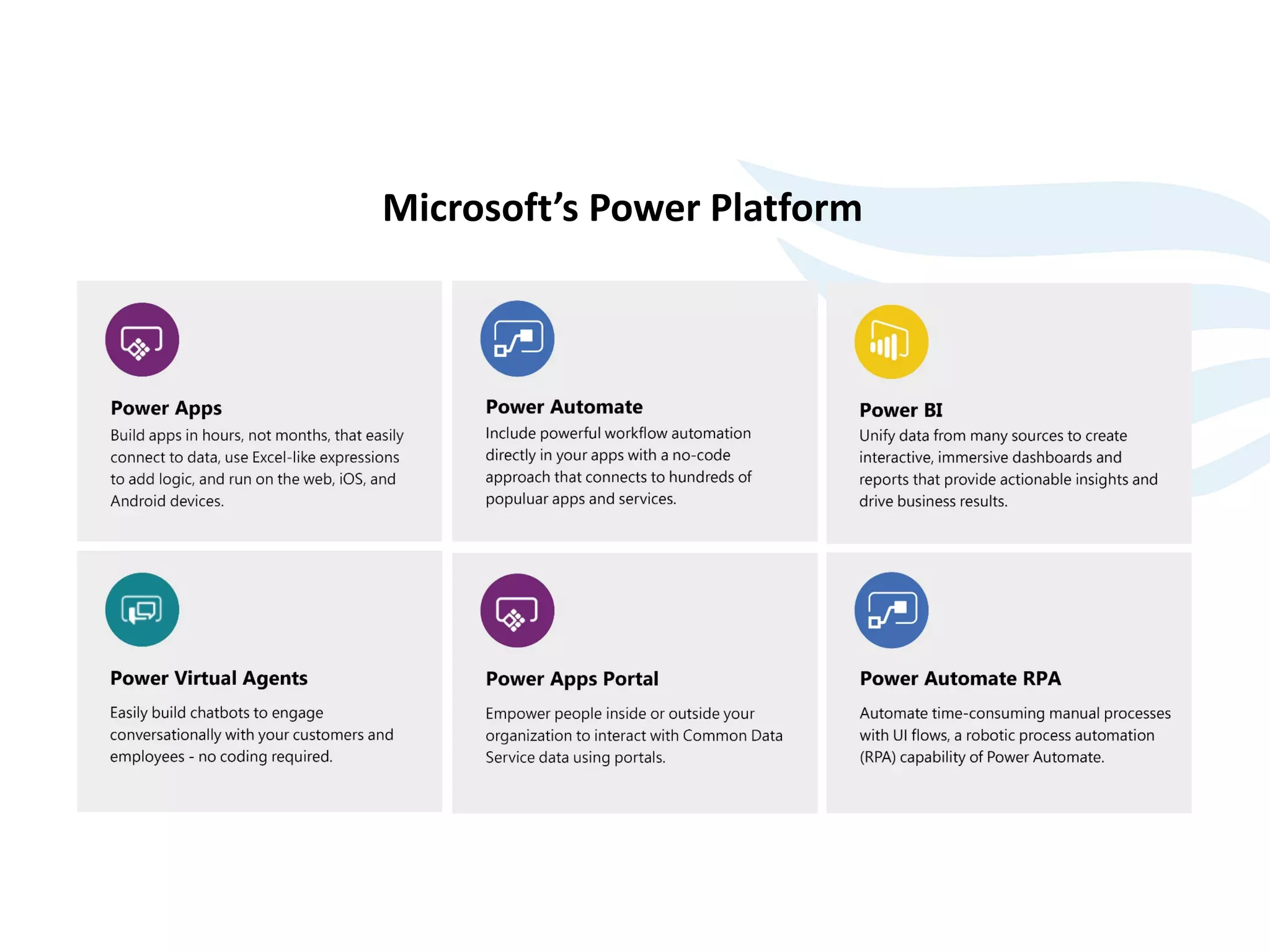
Microsoft’s Power Platform
|1| Are you on SharePoint 2010, 2013, 2016, or 2019 (that is, an on-
premises version of SharePoint)?
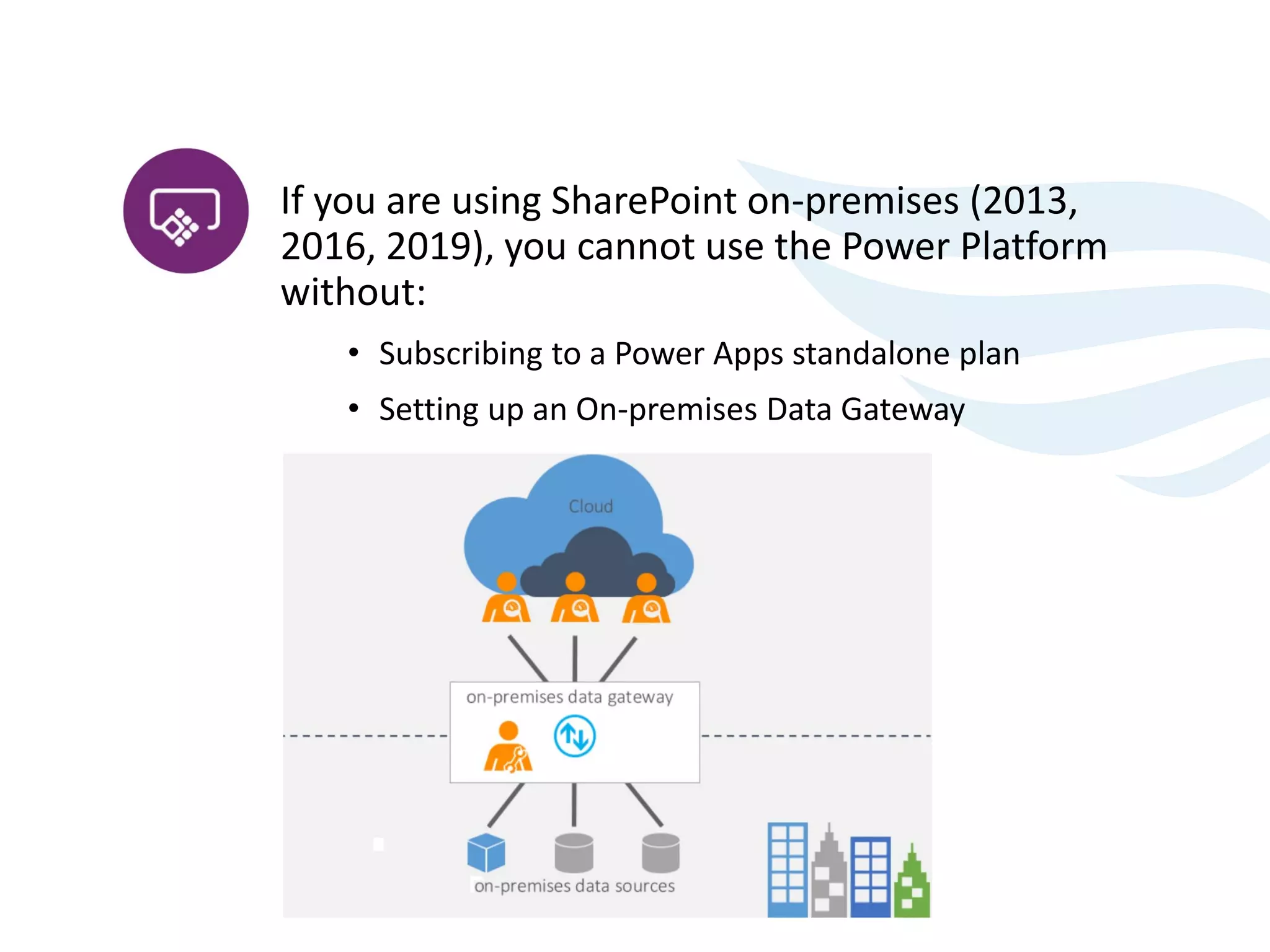
If you are using SharePoint on-premises, you cannot use the
Power Platform without:
• Subscribing to a Power Apps standalone plan
• Setting up an On-premises Data Gateway
High-level Overview
If you need the more comprehensive features the Power Platform
offers, you need to get standalone plans that include:
• Premium Connectors
• Model-driven Apps
• Use of the Common Data Service
• Power Apps Portals
• Power BI Pro or Premium
• Power Virtual Agents
• Power Automate with RPA (Robotics Process Automation)
|2| If you stay within the limited set of features that are included in Office 365, the
costs are mainly for development over and above the Office 365 subscription.
High-level Overview
Power Apps, Power Automate and Power
Virtual Agents Licensing Guide, February 2020
• “Customers that need general purpose and full capabilities of
the platform should license Power Apps on a standalone basis.”
• “Customers that need full-fledged, general purpose
workflow/business process automation capabilities, should
consider purchasing standalone Power Automate licenses.”
|3| Even with standalone plans, there are factors to consider:
• No built-in printing capabilities
• No offline options
• Limits to the number of API calls
• Need multiple subscriptions, complex pricing
• Uncertainties of cost as usage changes
• Development environments can be difficult
High-level Overview
Power Apps
Power Apps is a low code/no code
application platform for building
business applications and
customizing existing Office 365 and
Dynamics 365 applications.
https://powerapps.microsoft.com
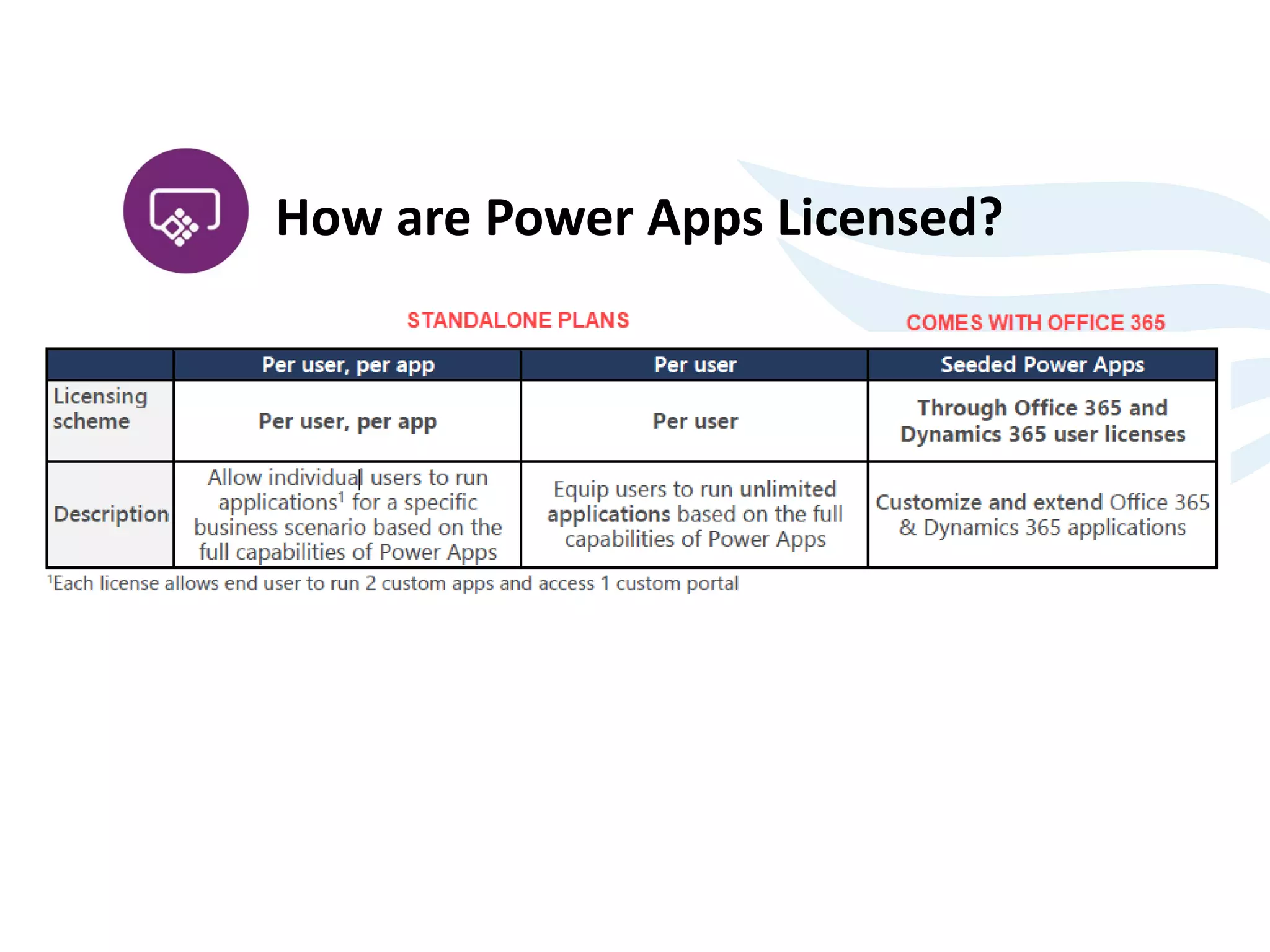
How are Power Apps Licensed?
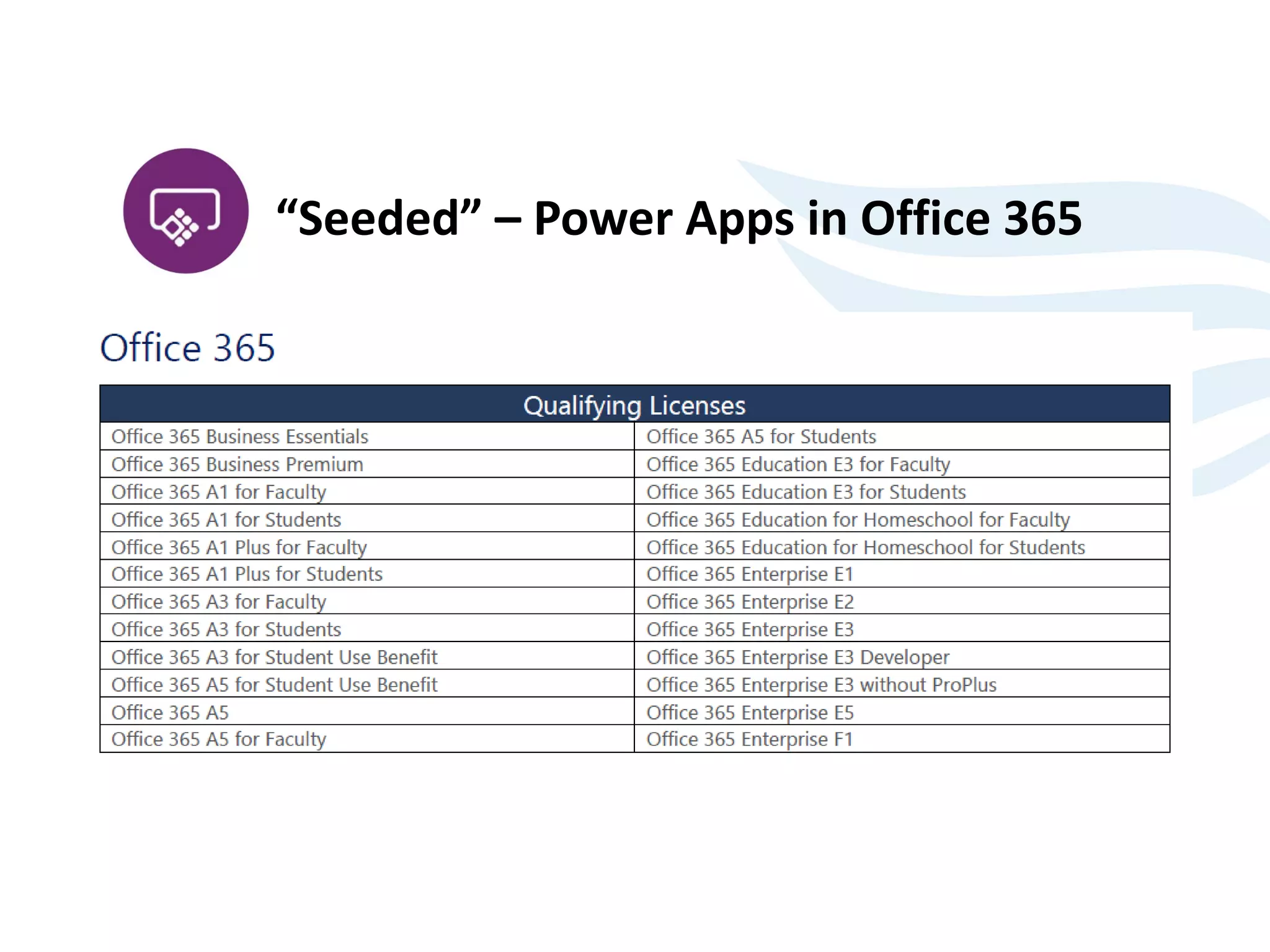
“Seeded” – Power Apps in Office 365
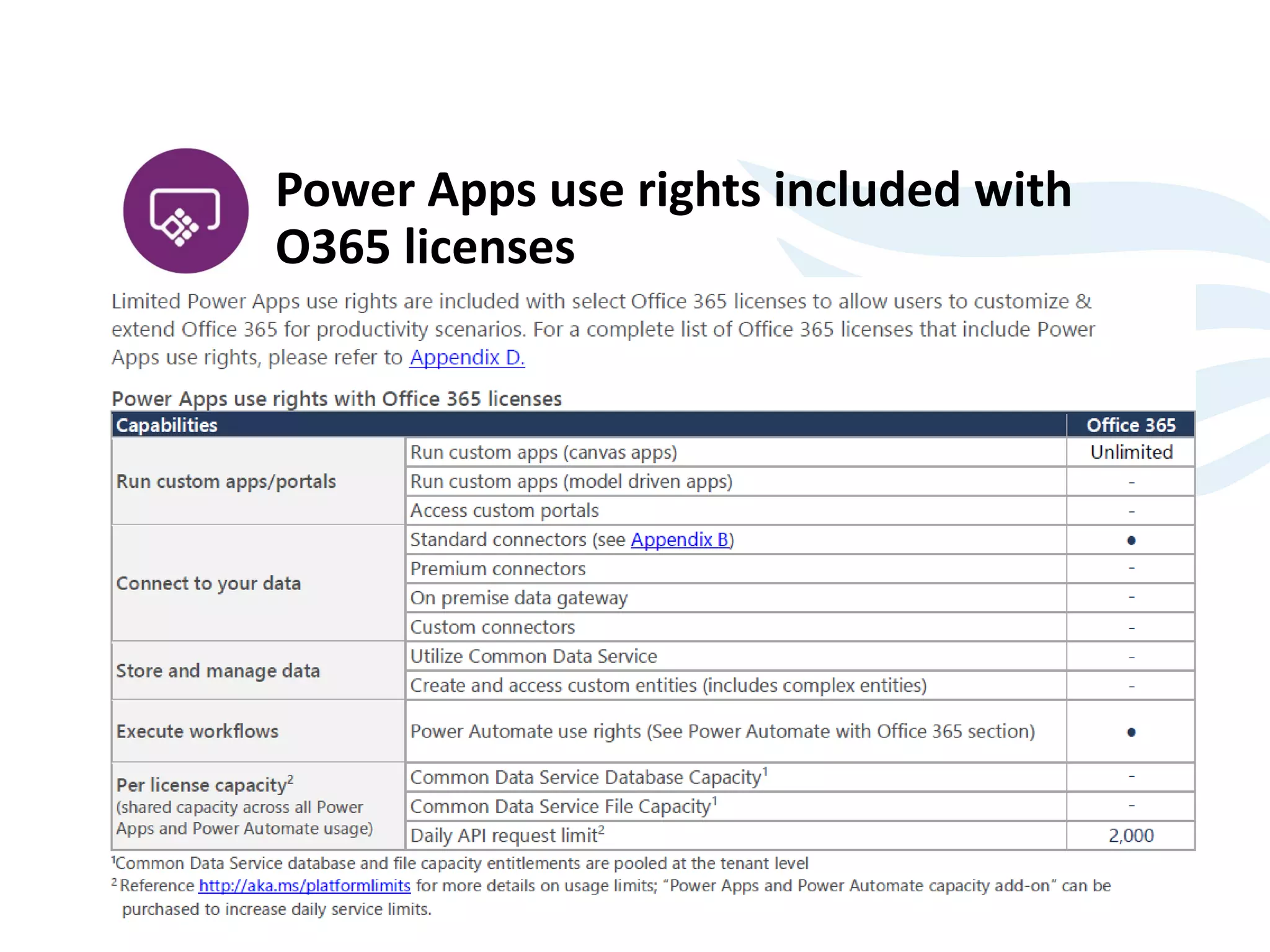
Power Apps use rights included with
O365 licenses
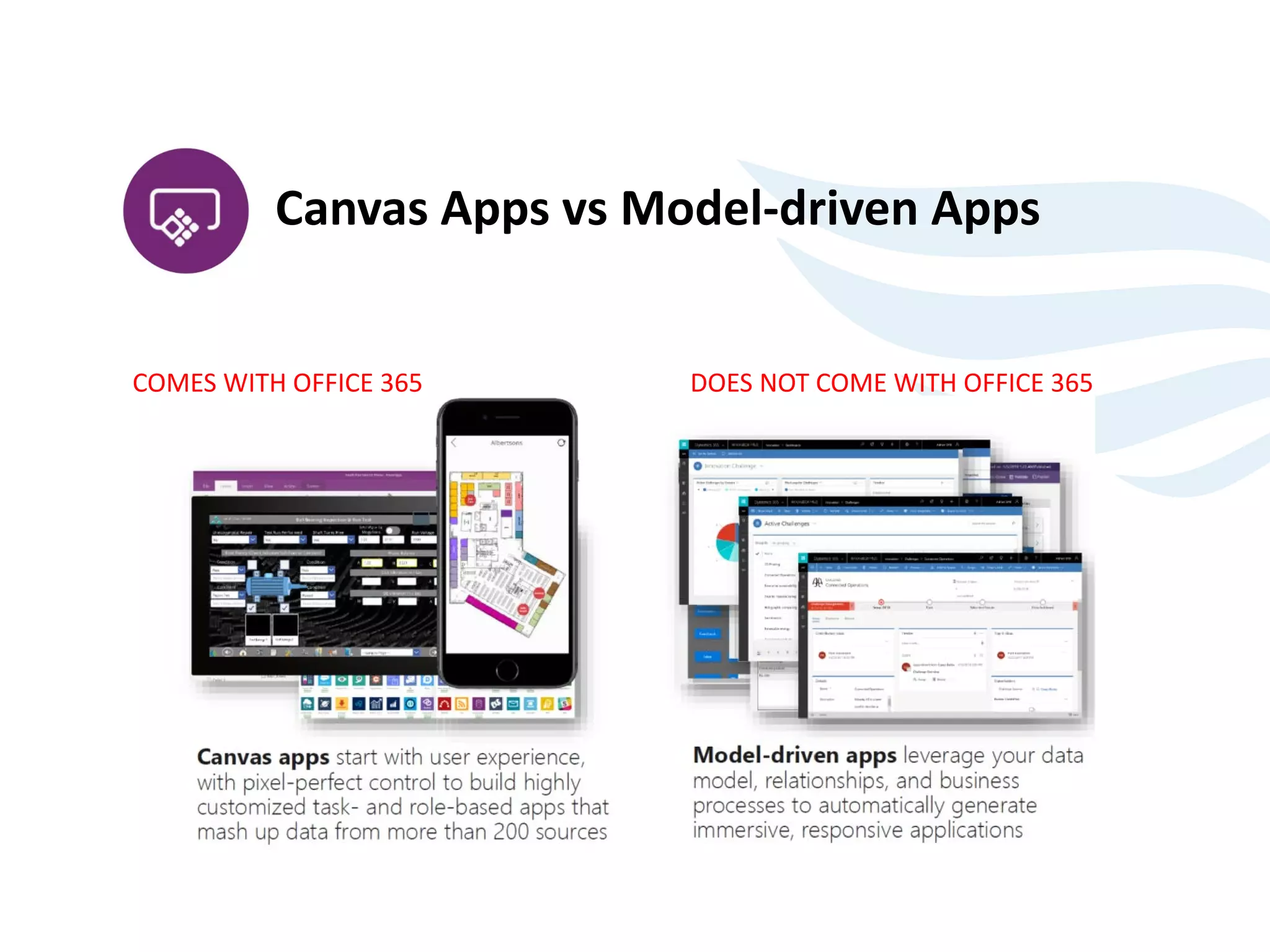
COMES WITH OFFICE 365 DOES NOT COME WITH OFFICE 365
Canvas Apps vs Model-driven Apps
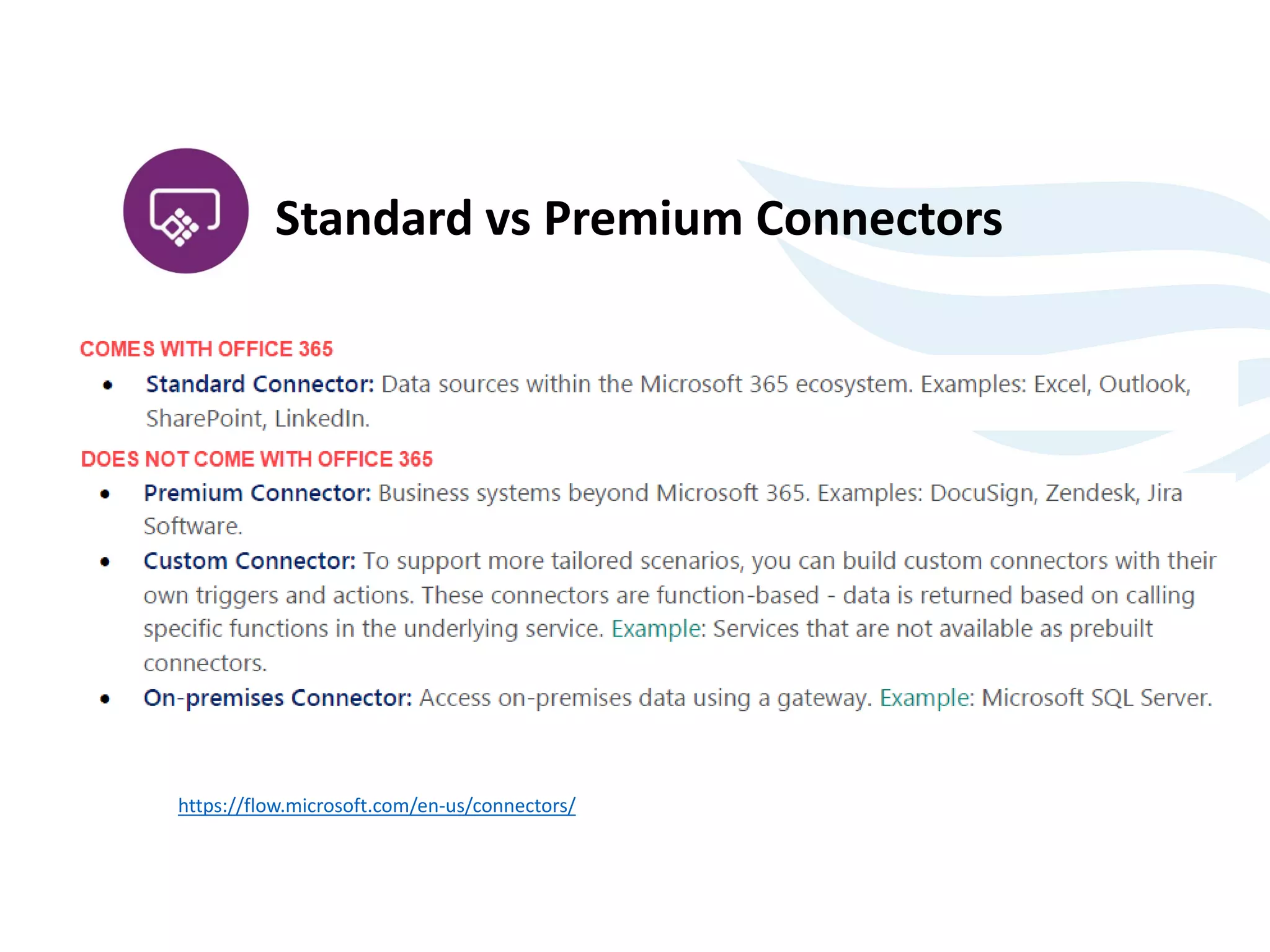
https://flow.microsoft.com/en-us/connectors/
Standard vs Premium Connectors
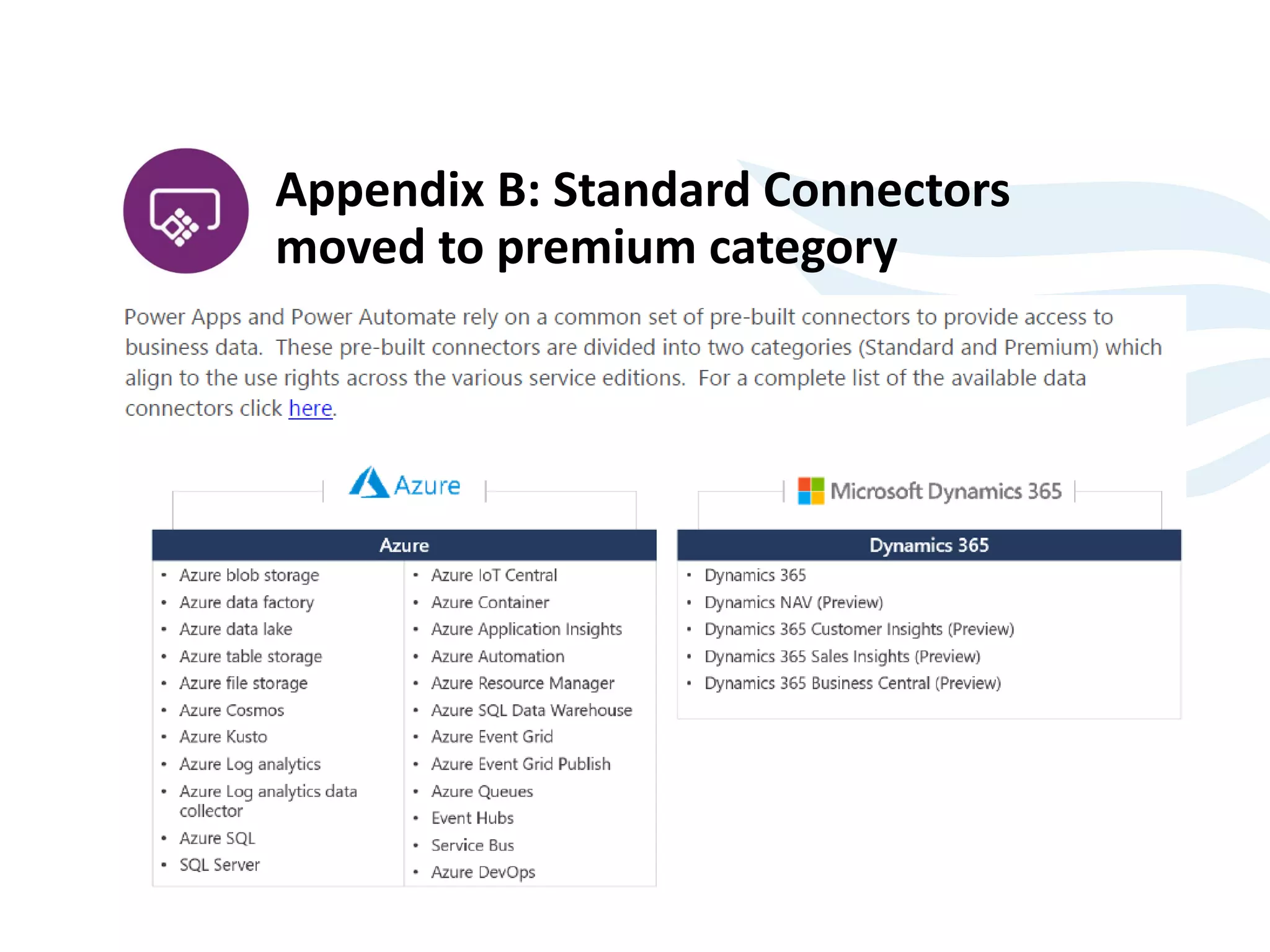
Appendix B: Standard Connectors
moved to premium category
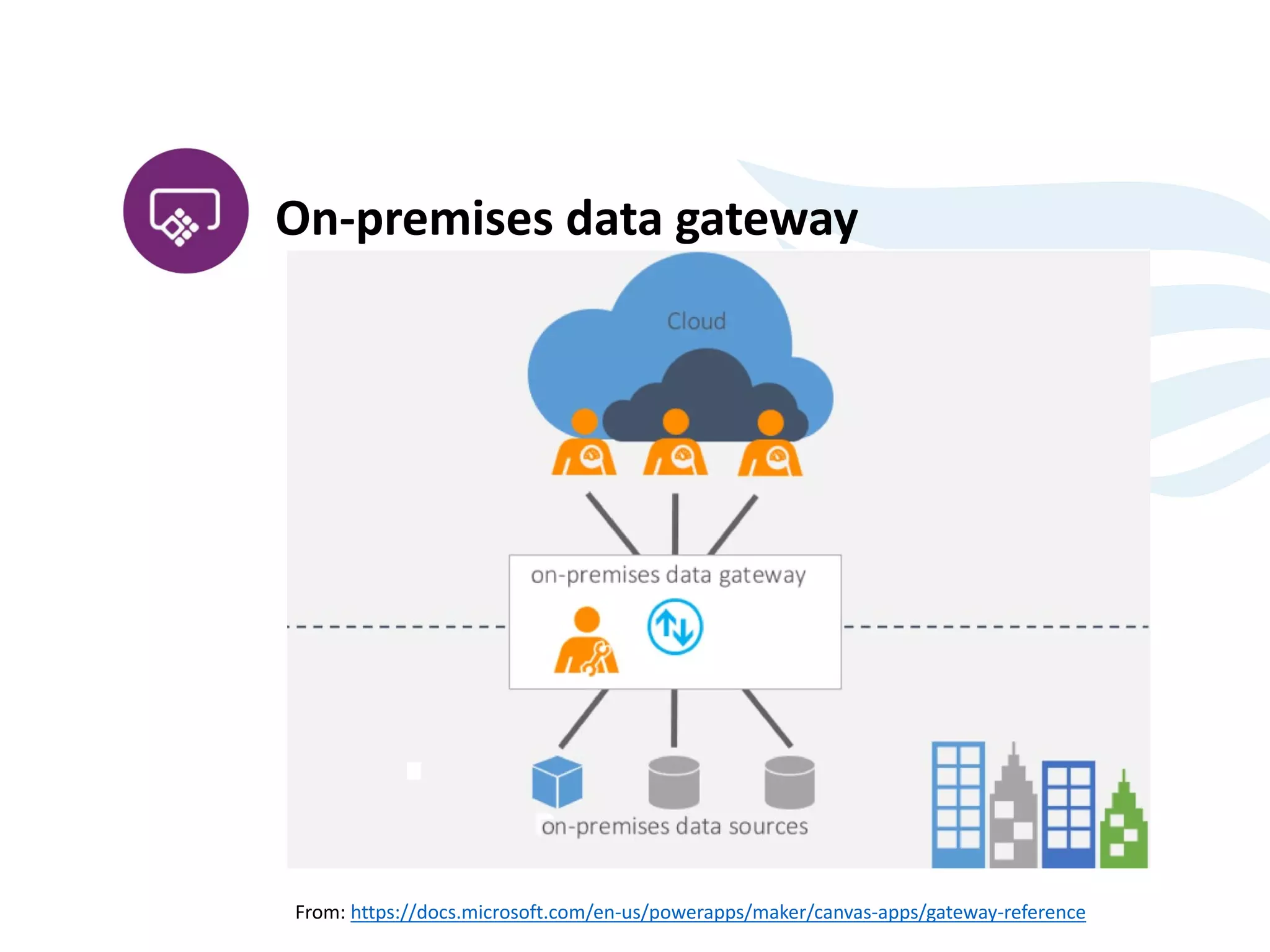
From: https://docs.microsoft.com/en-us/powerapps/maker/canvas-apps/gateway-reference
On-premises data gateway
If you are using SharePoint on-premises (2013,
2016, 2019), you cannot use the Power Platform
without:
• Subscribing to a Power Apps standalone plan
• Setting up an On-premises Data Gateway
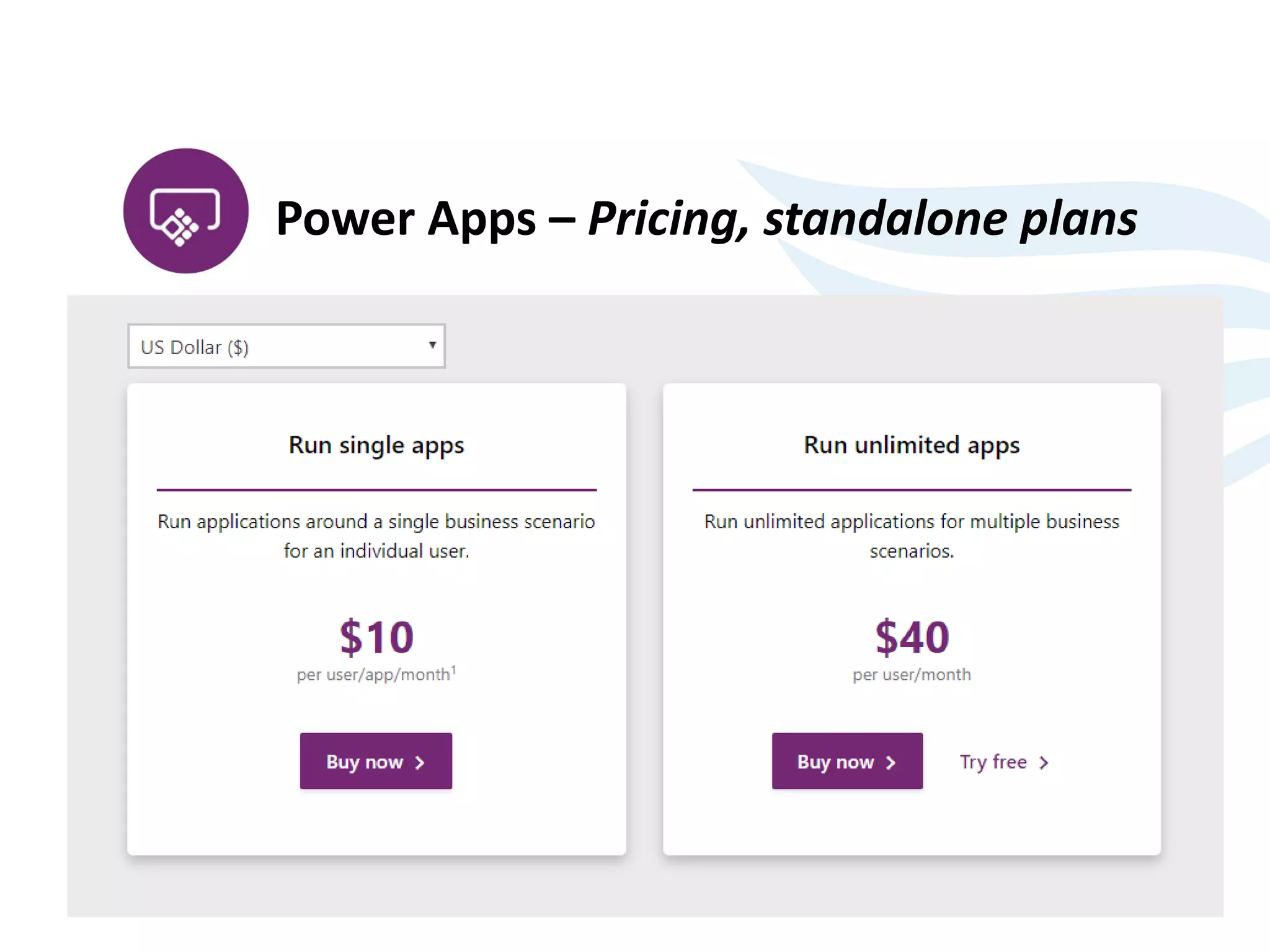
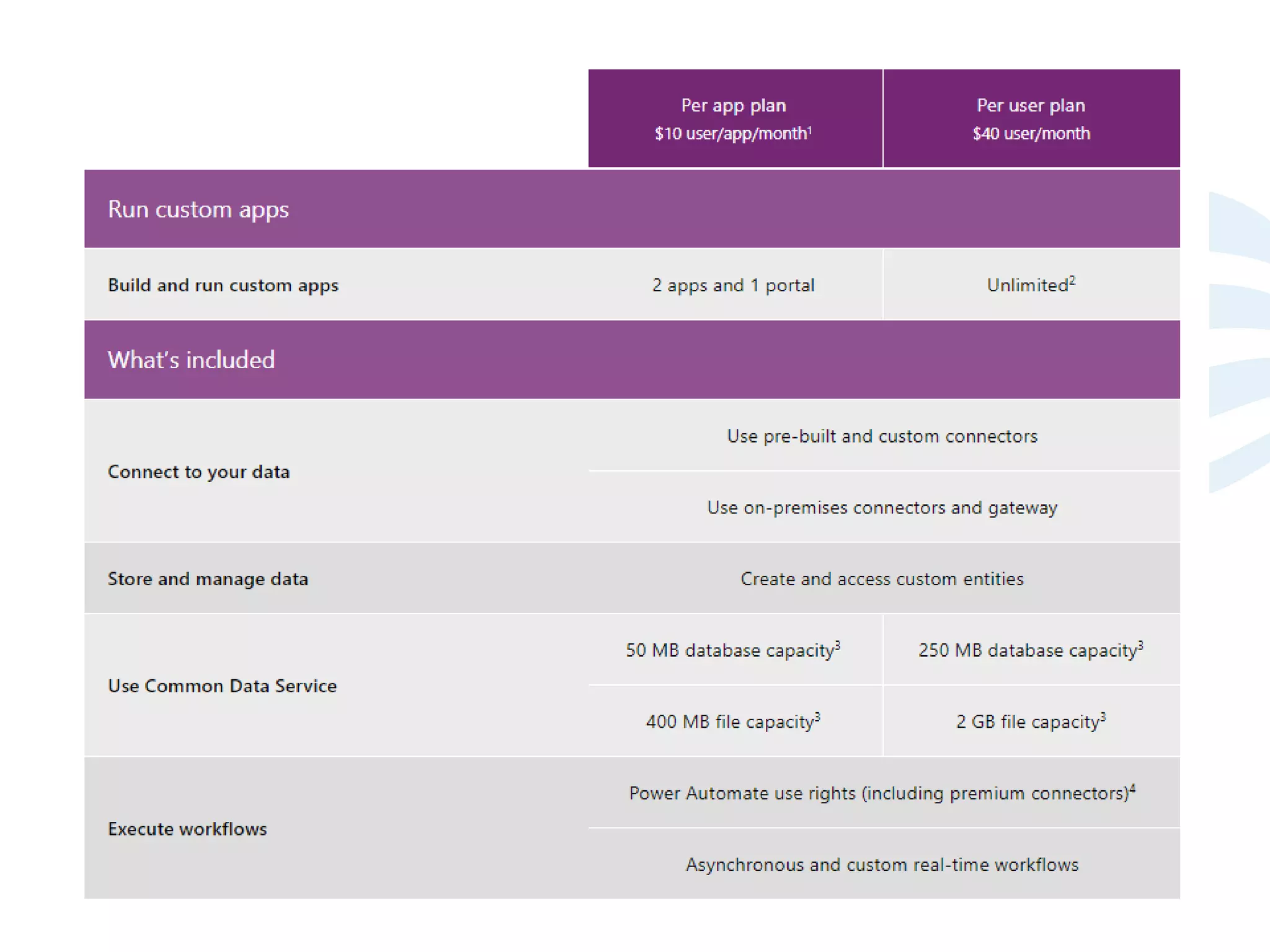
Power Apps – Pricing, standalone plans
Power Apps- per user plan,
$40/user/month
100 users, $40/user/month
$4,000/month
$48,000/year
500 users, $40/user/month
$20,000/month
$240,000/year
1,000 users, $40/user/month
$40,000/month
$480,000/year
Power Apps – Pricing, per user plans
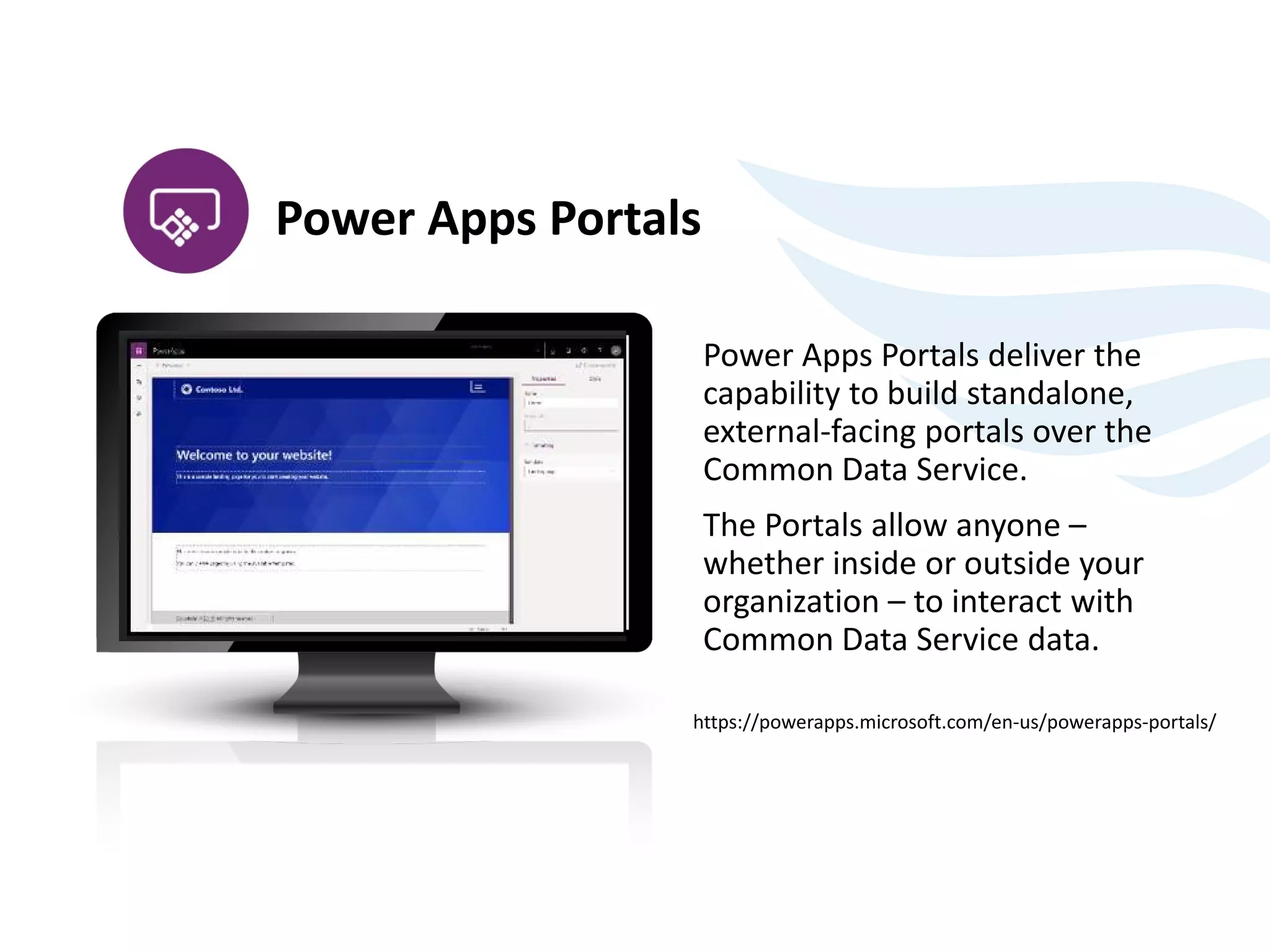
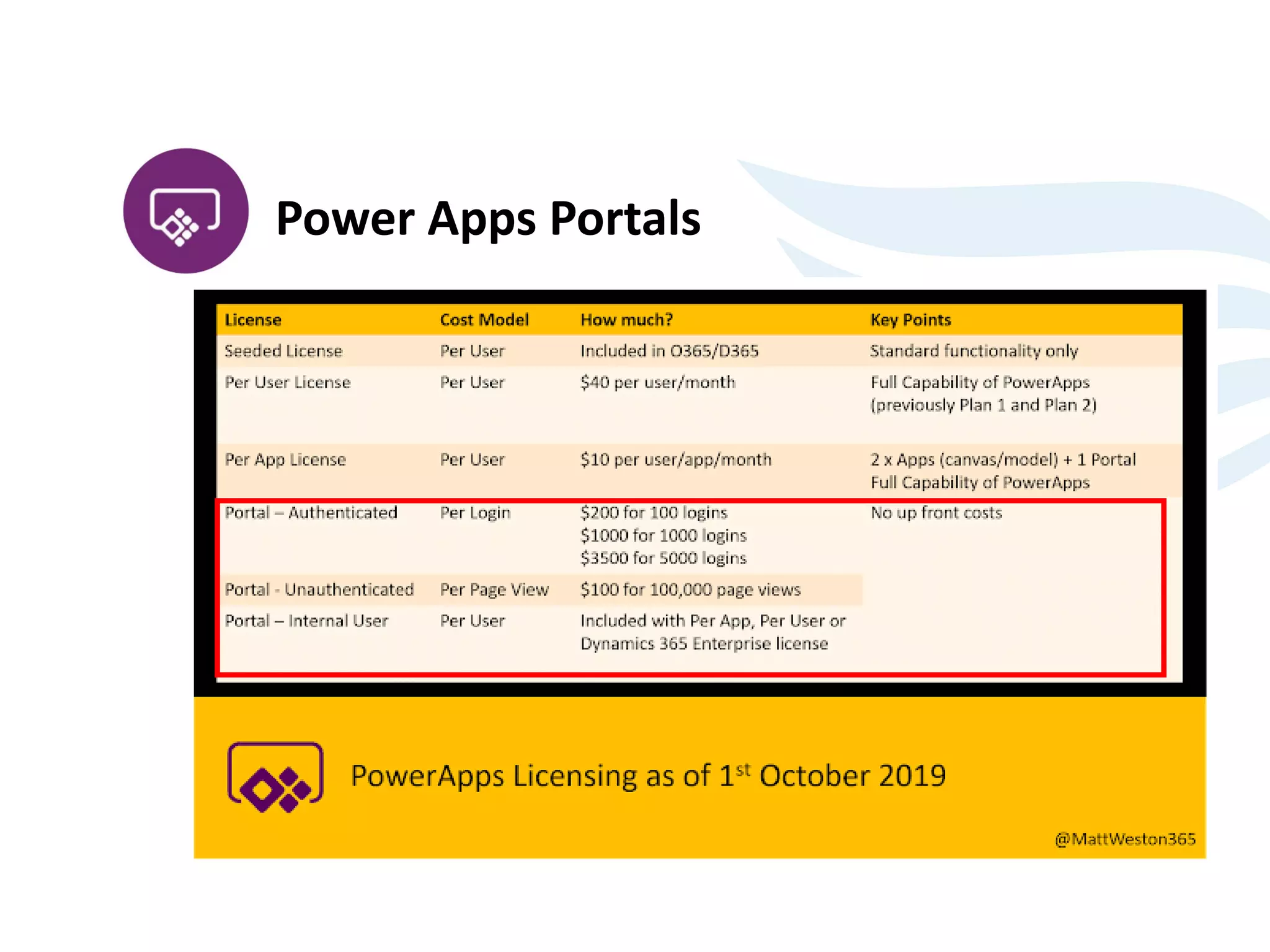
Power Apps Portals deliver the
capability to build standalone,
external-facing portals over the
Common Data Service.
The Portals allow anyone –
whether inside or outside your
organization – to interact with
Common Data Service data.
https://powerapps.microsoft.com/en-us/powerapps-portals/
Power Apps Portals
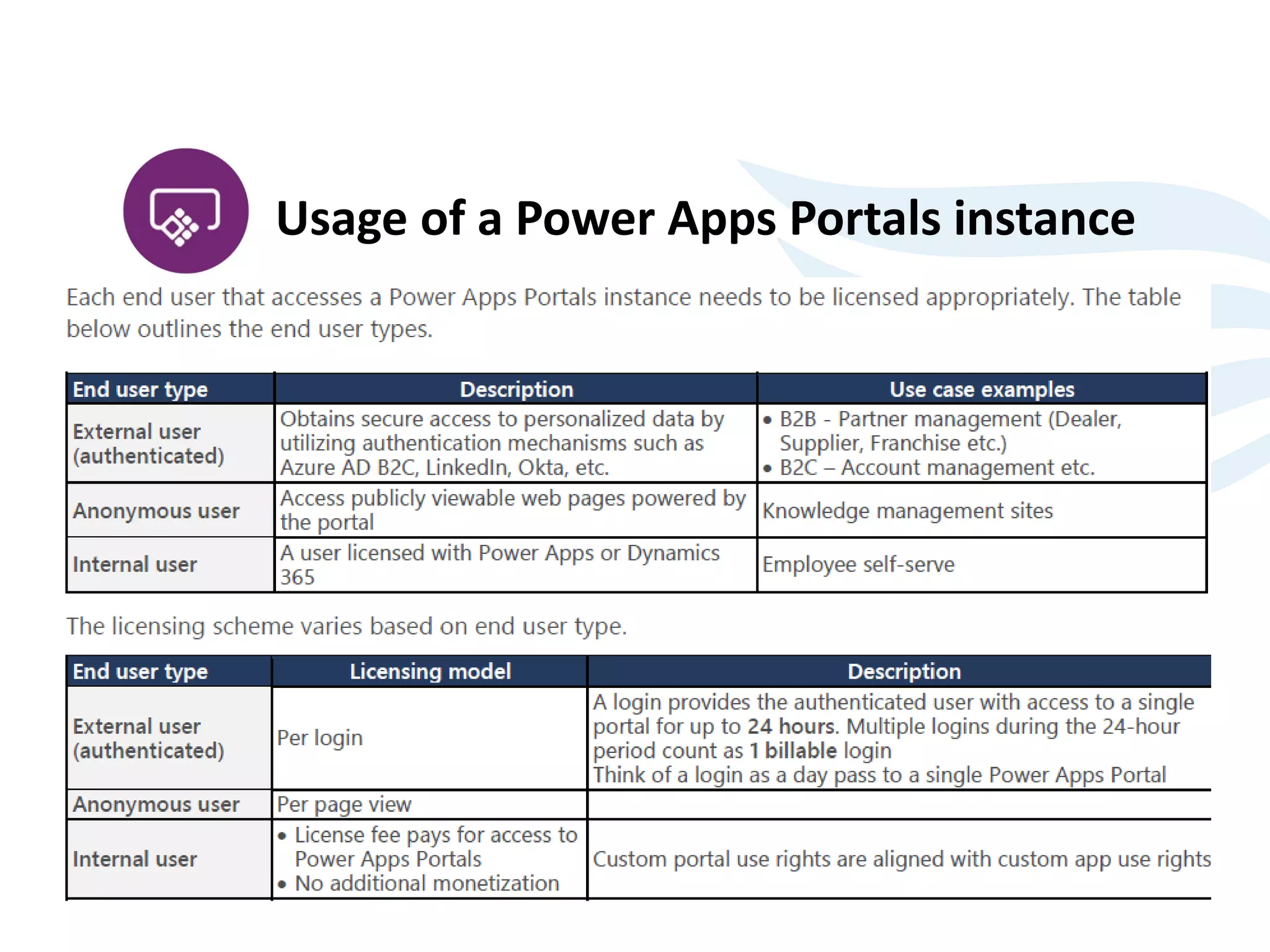
Usage of a Power Apps Portals instance
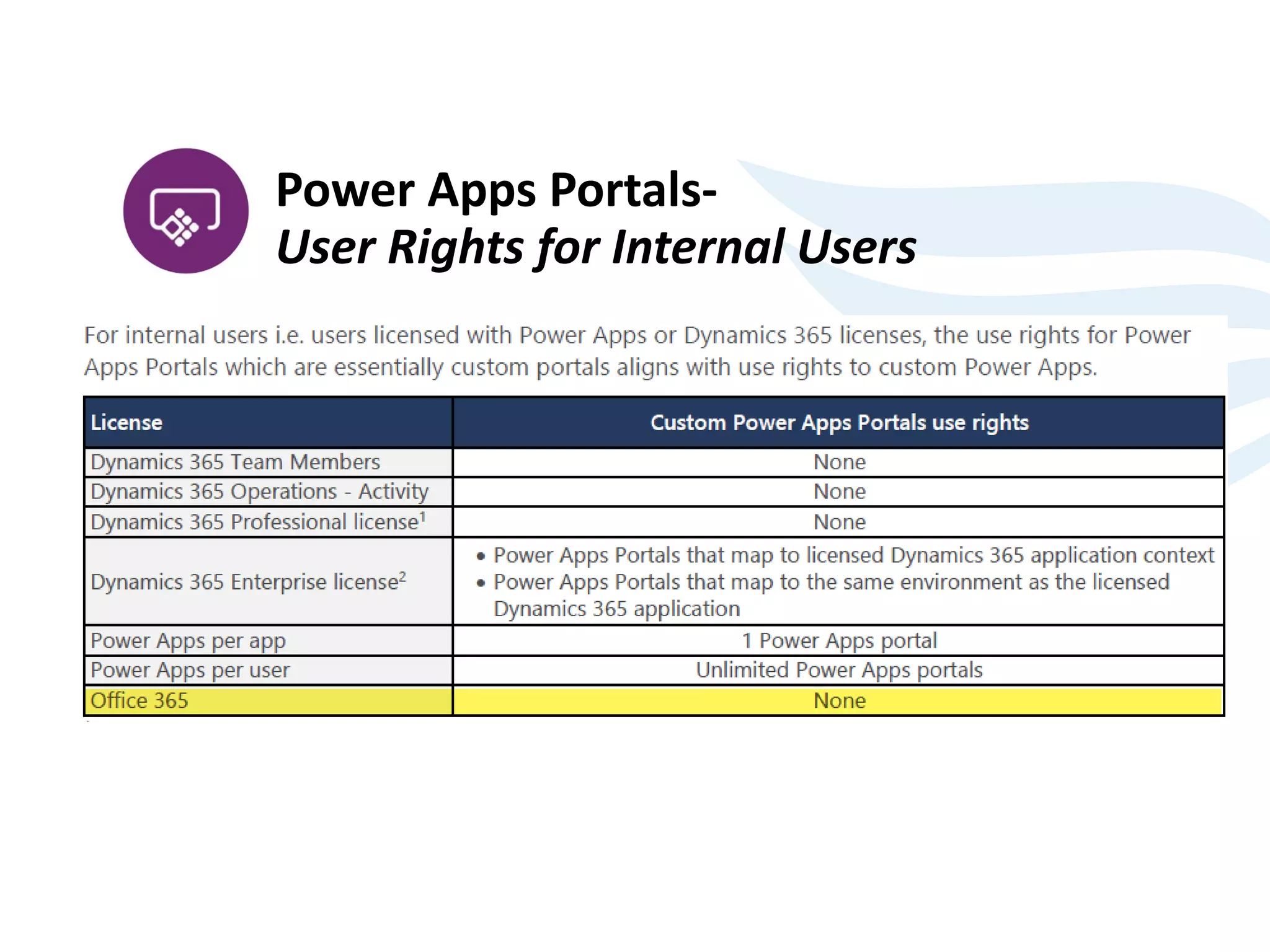
Power Apps Portals-
User Rights for Internal Users
Power Apps Portals
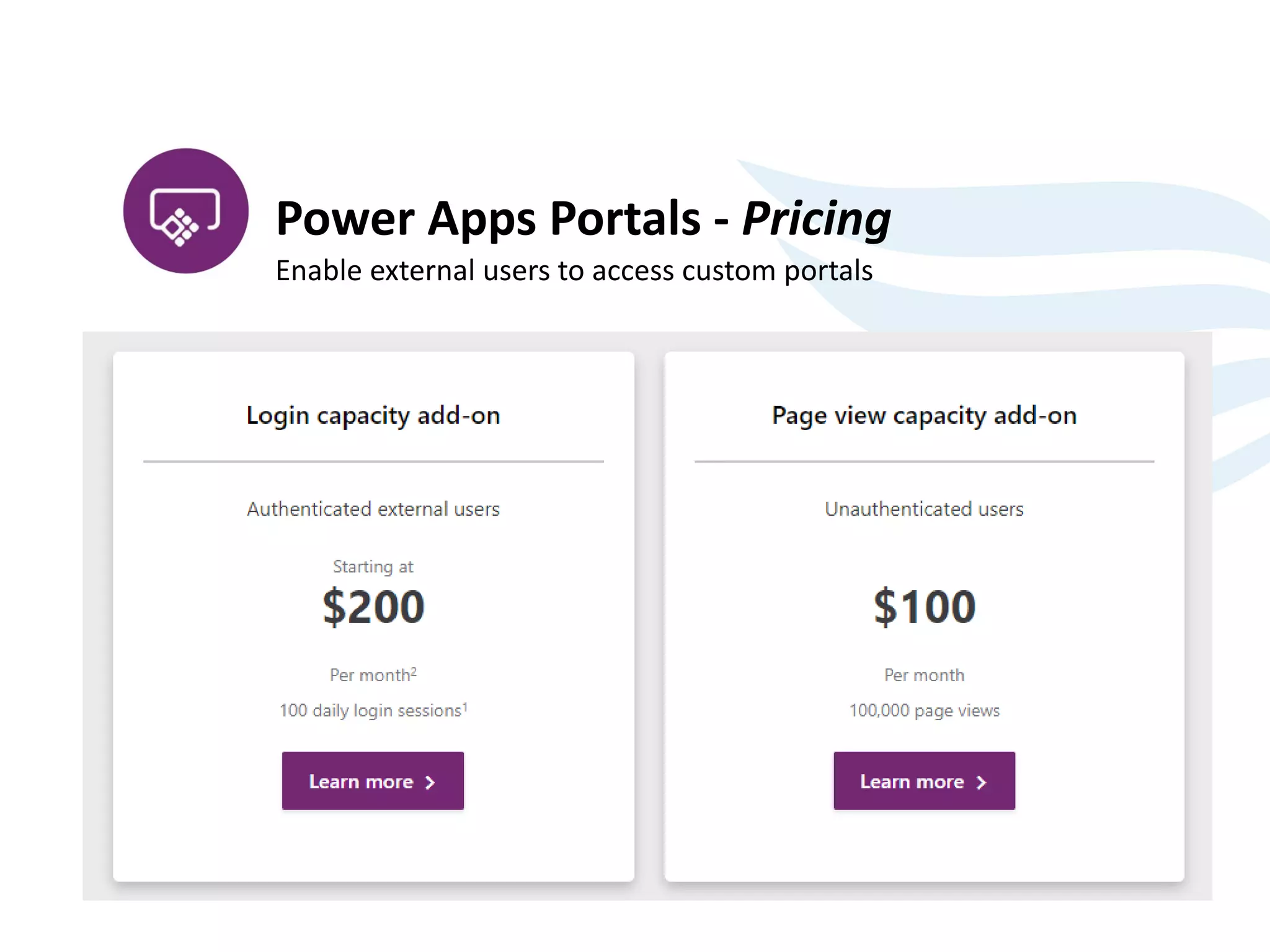
Power Apps Portals - Pricing
Enable external users to access custom portals
1) Does not include Premium Connectors.
2) Does not include on-premises connectivity.
3) Does not include Power Apps Portal licenses.
4) Subscription only allows "canvas apps", not "model-
driven apps".
5) There is a daily API request limit of 2,000.
According to Microsoft:
To use all the Power Apps capabilities, an organization
would need to go with either the $10/user/month for 2
apps + 1 portal or the $40/user/month for unlimited
apps and portals.
Power Apps in Office 365
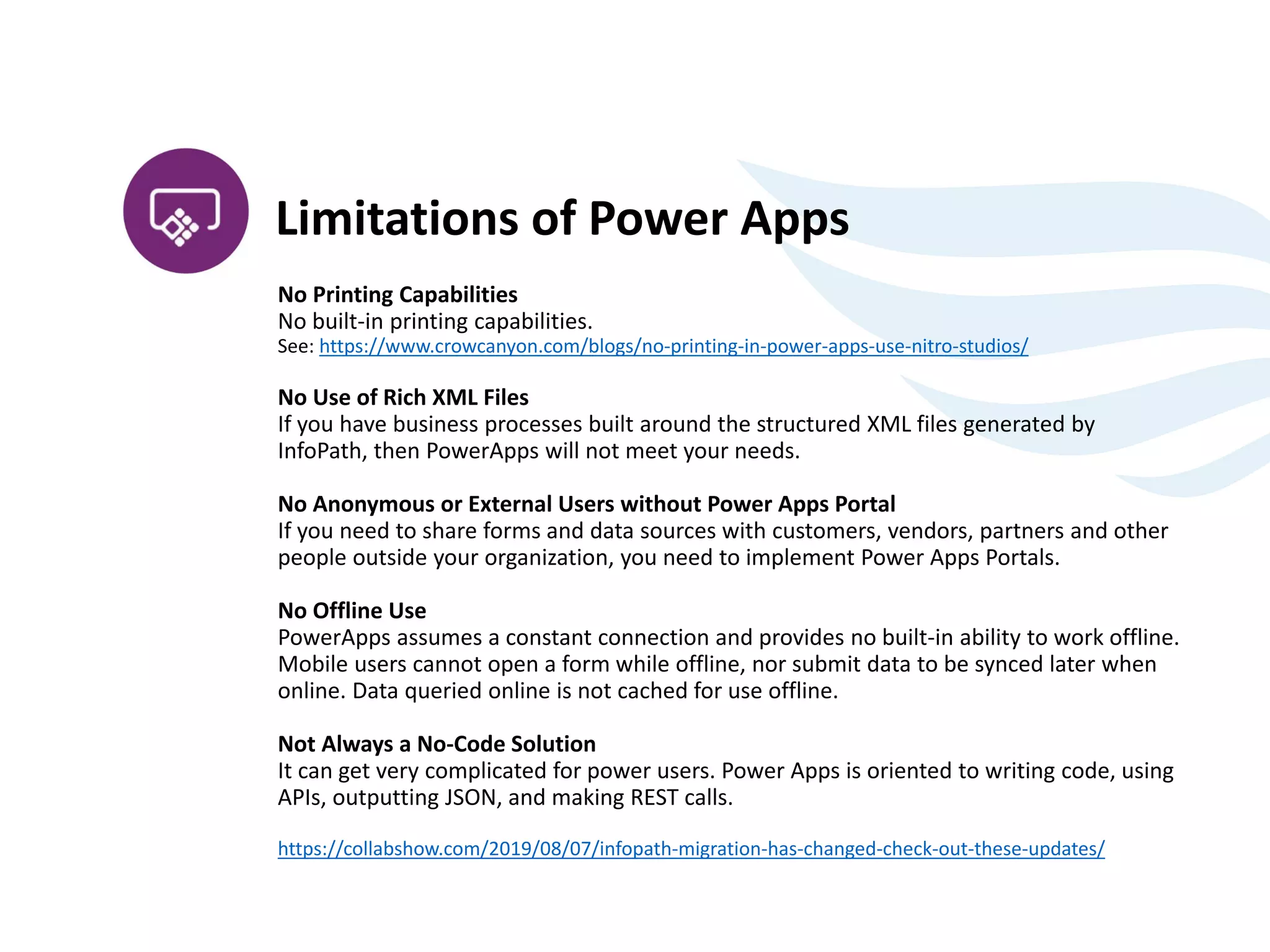
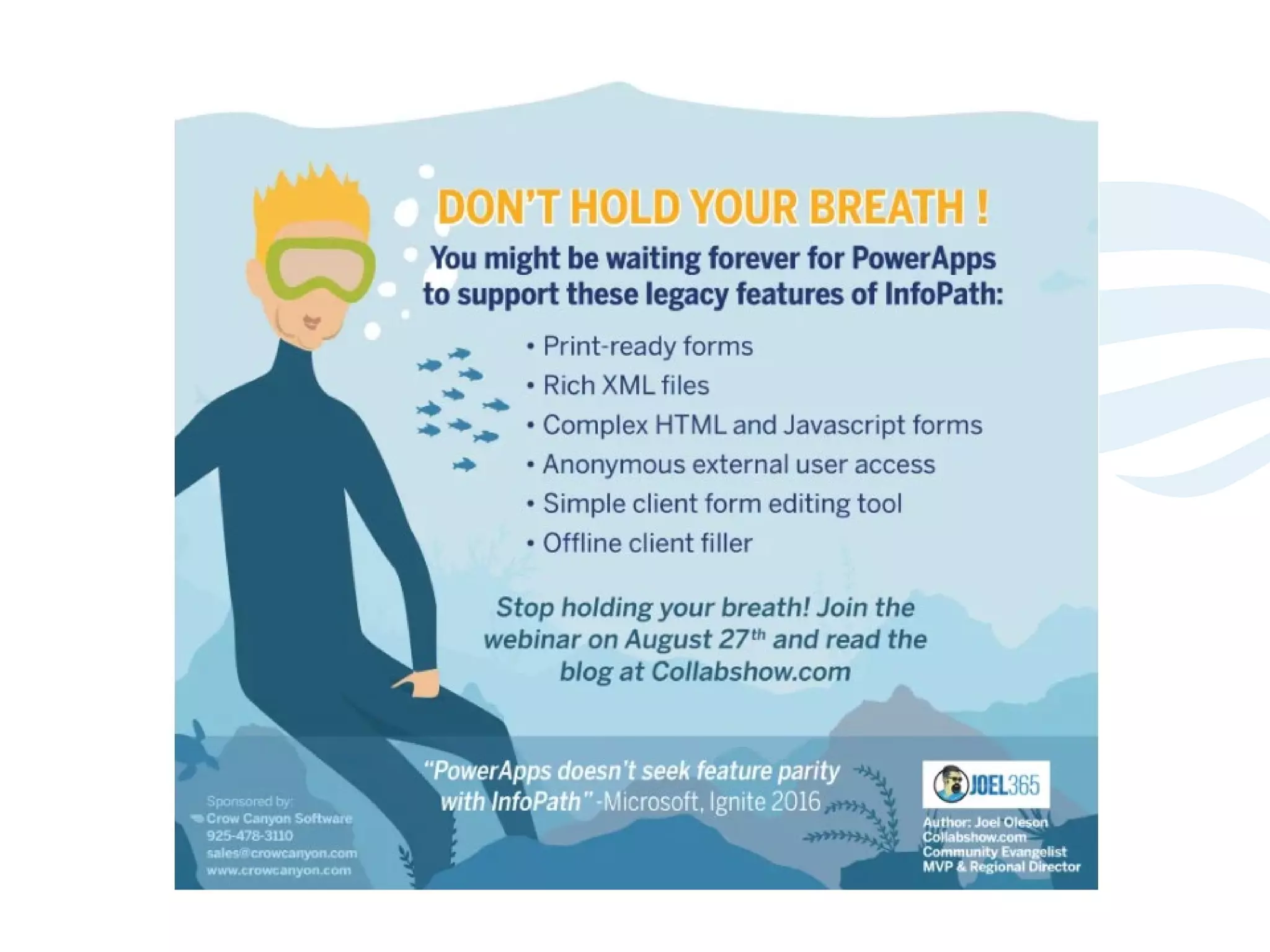
No Printing Capabilities
No built-in printing capabilities.
See: https://www.crowcanyon.com/blogs/no-printing-in-power-apps-use-nitro-studios/
No Use of Rich XML Files
If you have business processes built around the structured XML files generated by
InfoPath, then PowerApps will not meet your needs.
No Anonymous or External Users without Power Apps Portal
If you need to share forms and data sources with customers, vendors, partners and other
people outside your organization, you need to implement Power Apps Portals.
No Offline Use
PowerApps assumes a constant connection and provides no built-in ability to work offline.
Mobile users cannot open a form while offline, nor submit data to be synced later when
online. Data queried online is not cached for use offline.
Not Always a No-Code Solution
It can get very complicated for power users. Power Apps is oriented to writing code, using
APIs, outputting JSON, and making REST calls.
https://collabshow.com/2019/08/07/infopath-migration-has-changed-check-out-these-updates/
Limitations of Power Apps
Power Automate allows
enterprises to implement
automated workflows and
business processes and
achieve operational
efficiencies.
https://flow.microsoft.com
Power Automate (formerly Flow)
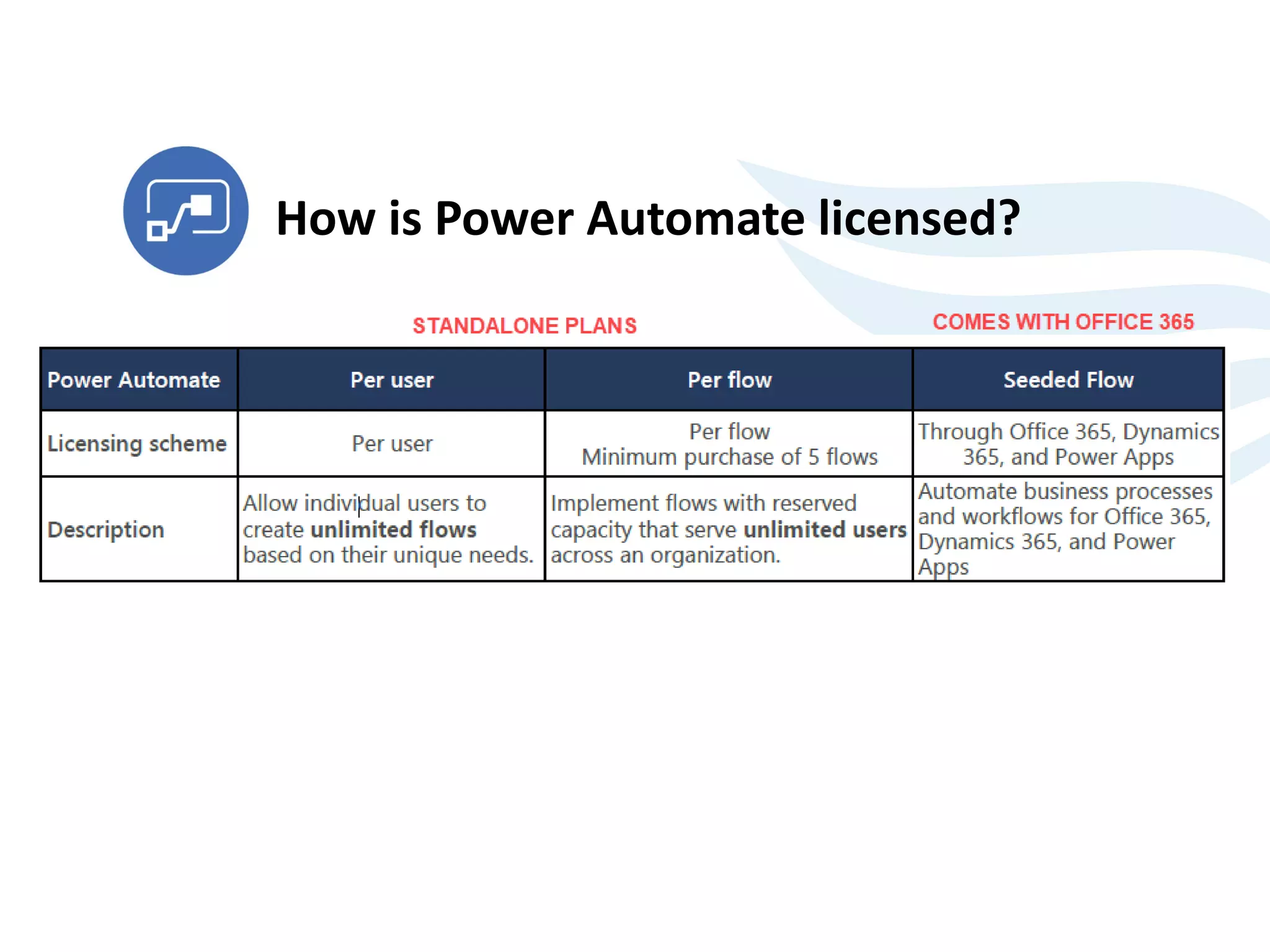
How is Power Automate licensed?
Power Automate
Power Automate – use with Office 365
Power Automate use within Office 365 is limited to the context of the
embedding Office 365 application.
For both triggers and actions, flows included within the Office 365
application can connect to:
• Any data source within the use rights of the Office 365 application
• Directly with the Office 365 application (via built in trigger/action)
If the embedded flow is not within the context of the Office 365
application or if the embedded flow needs to connect to a premium on-
premises or custom data source, standalone Power Automate licenses will
need to be purchased.
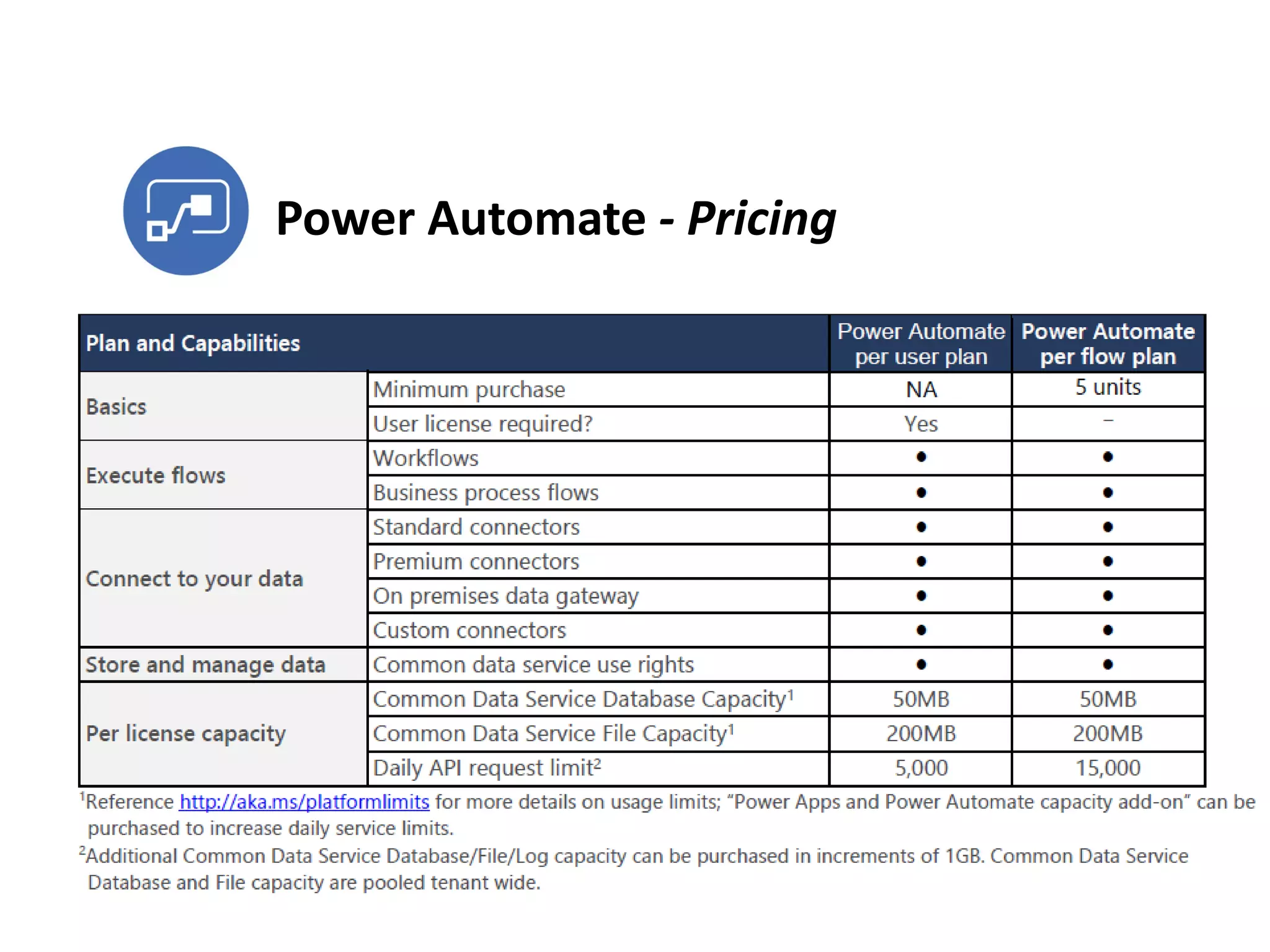
Power Automate - Pricing
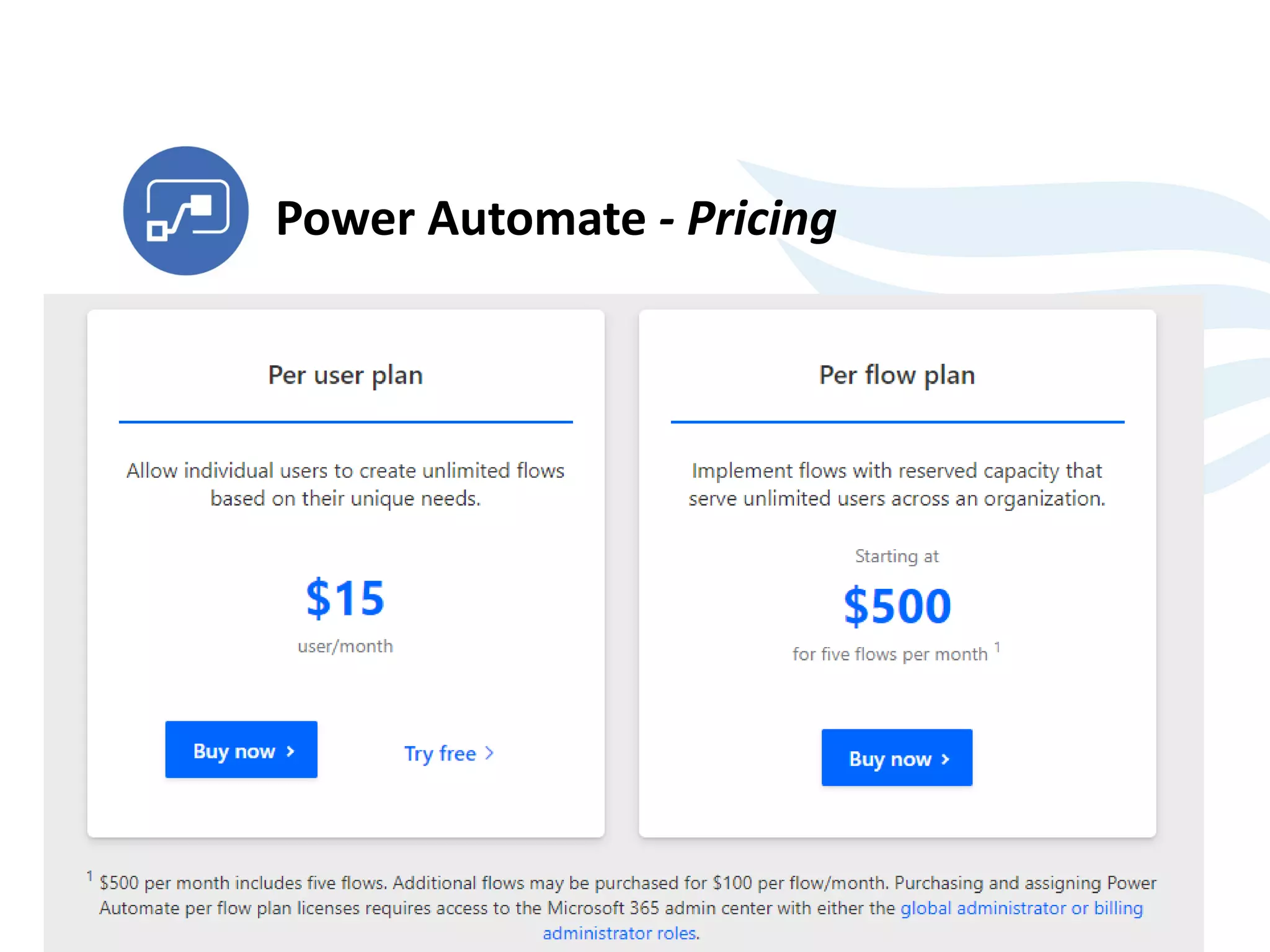
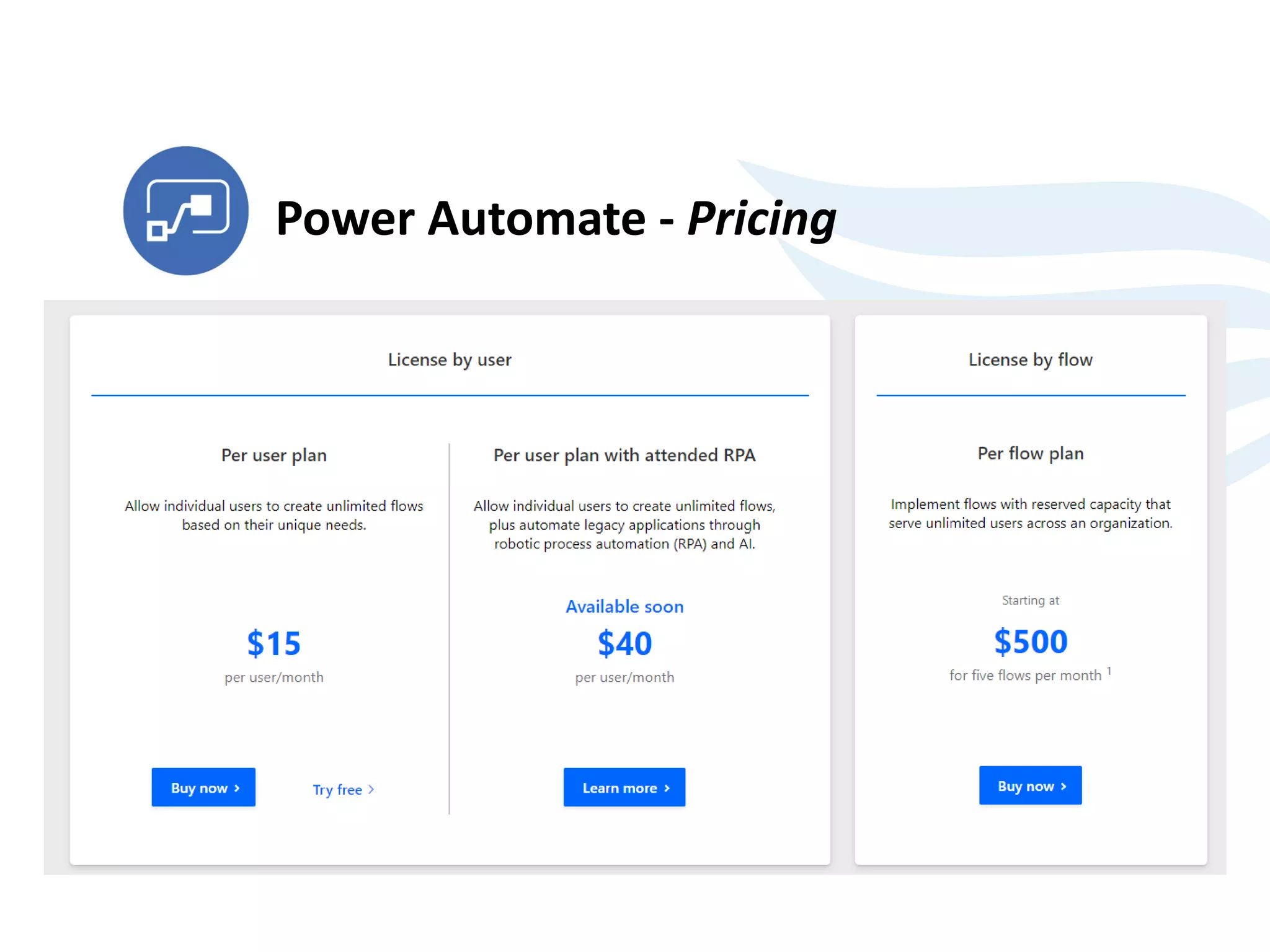
Power Automate per user plan
Power Automate per user plan equips individual users to create and run
unlimited workflows and business processes based on their unique needs. The
per user plan is intended to support the broad adoption of an automation
culture in an organization.
Should the entire organization be licensed with the Power Automate per user
plan, admins will have minimal overhead with tracking how many flows are
being activated/used within the organization.
Power Automate - Pricing
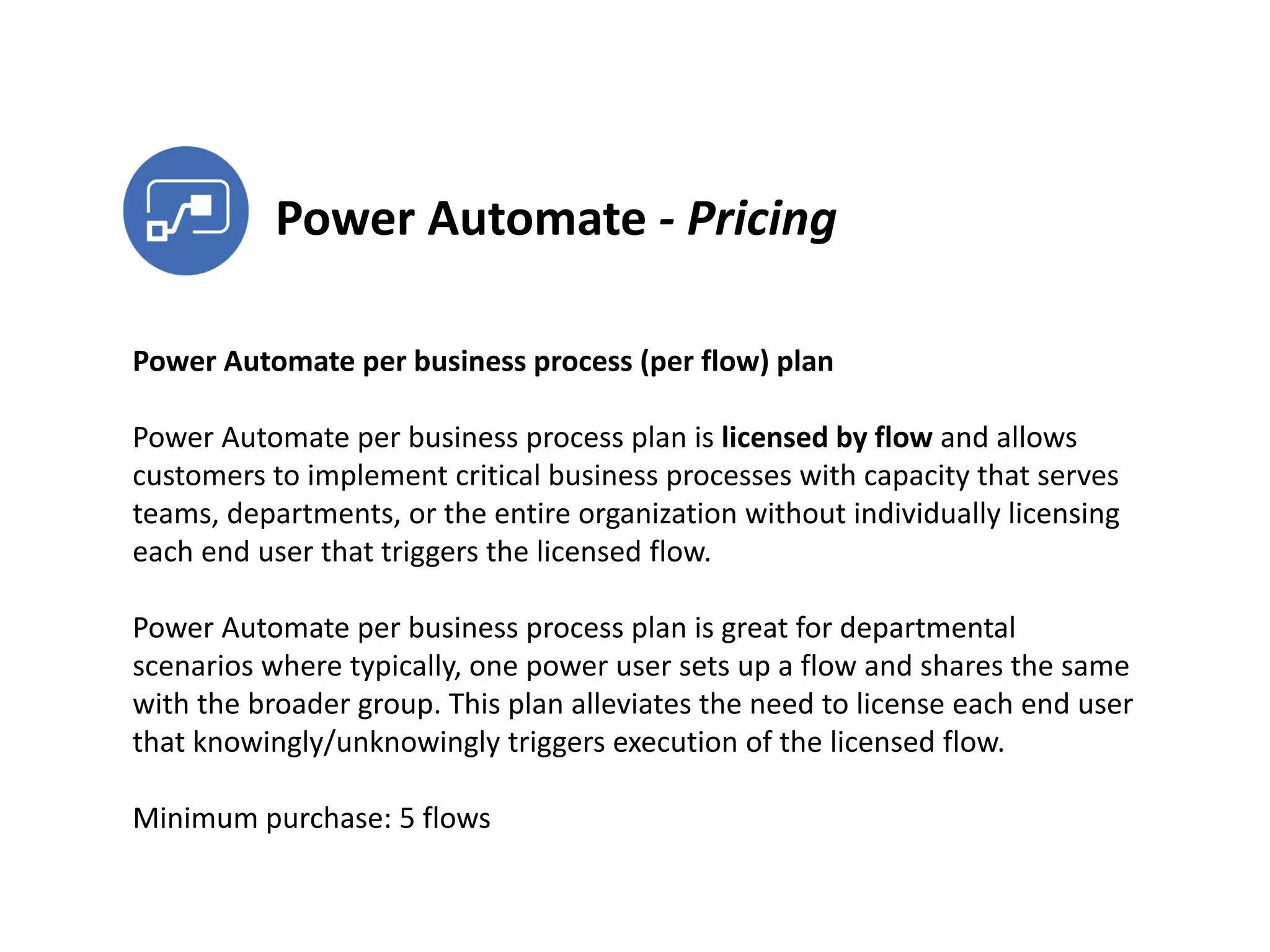
Power Automate per business process (per flow) plan
Power Automate per business process plan is licensed by flow and allows
customers to implement critical business processes with capacity that serves
teams, departments, or the entire organization without individually licensing
each end user that triggers the licensed flow.
Power Automate per business process plan is great for departmental
scenarios where typically, one power user sets up a flow and shares the same
with the broader group. This plan alleviates the need to license each end user
that knowingly/unknowingly triggers execution of the licensed flow.
Minimum purchase: 5 flows
Power Automate - Pricing
Power Automate – use with Power Apps
Power Apps licenses (both “Power Apps per app plan” and “Power Apps
per user plan”) include Power Automate use rights for the purpose of
automating workflows associated with the Power Apps application(s).
Power Automate use within Power Apps is limited to the context
of the Power Apps application. What this means is that for both
triggers and actions, flows included within a Power Apps application
can connect to:
• Any data source within the use rights of the Power Apps application
• Directly with the Power Apps application (via built in trigger/action)
If the flow is isolated and has nothing to do with the Power Apps
application, then standalone Power Automate licenses will need to be
purchased.
Power BI is a cloud-based suite of
business analytics tools that lets
anyone connect to, visualize, and
analyze data with greater speed,
efficiency, and understanding.
https://powerbi.microsoft.com/en-us/
• Power BI Free version included with
Office 365 E3
• Power BI Pro included with
Office 365 E5
• Power BI Premium available for
extra cost
Power BI
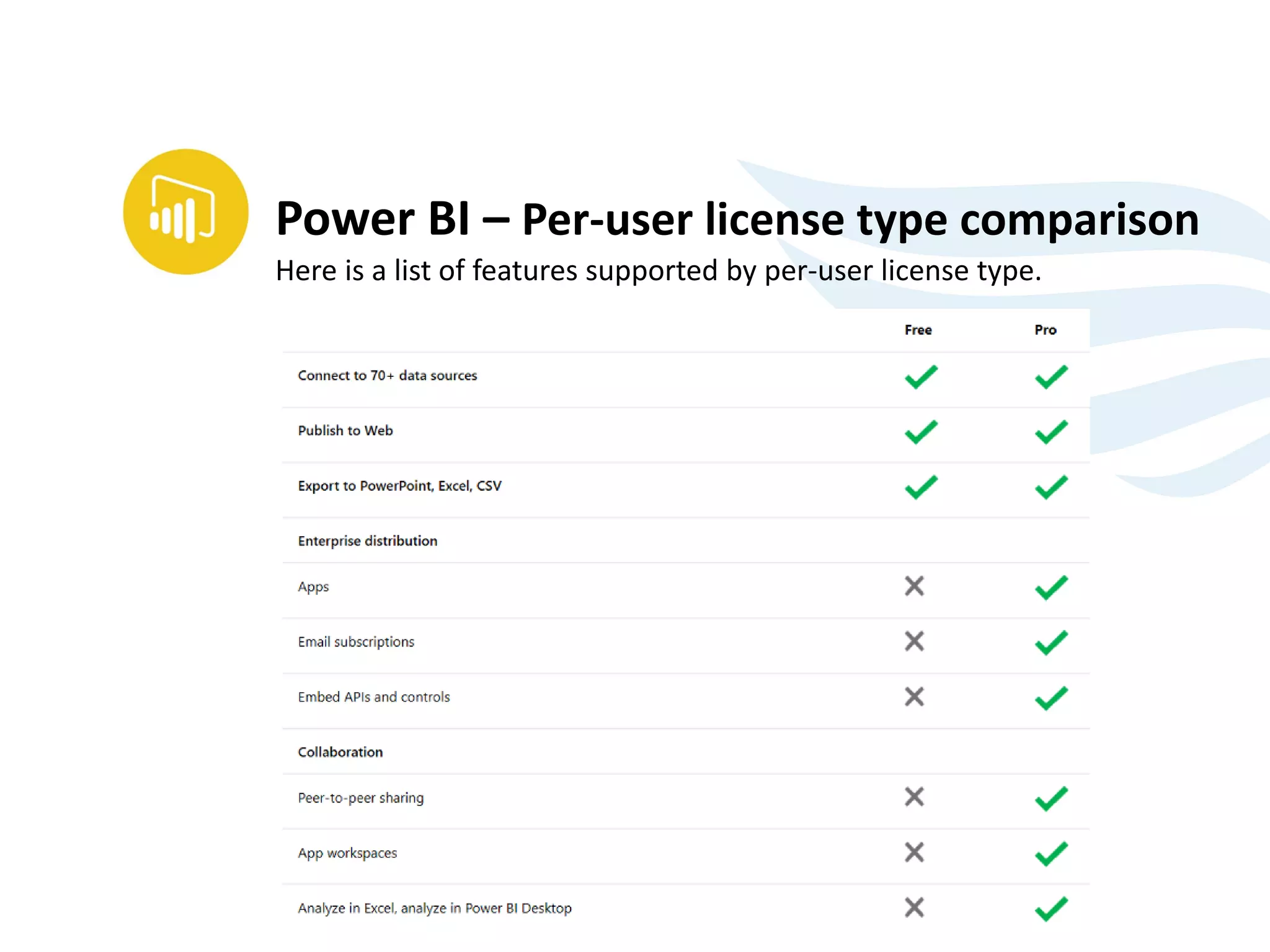
Power BI Free enables you to connect to 70+ data sources, publish to the web, and
export to excel. The same visualizations that are available in Power BI Pro are available
in Power BI Free.
There are some limitations to the free version: you can’t do peer-to-peer sharing and
you can’t create App workspaces.
Power BI - Pro
With Pro you can share your data, reports, and dashboards with users who also have a
Power BI Pro license. You can also create App workspaces. Both Power BI Free and Pro
have a 10 GB per Pro user data storage limit.
Power BI - Free
Power BI – Per-user license type comparison
Here is a list of features supported by per-user license type.
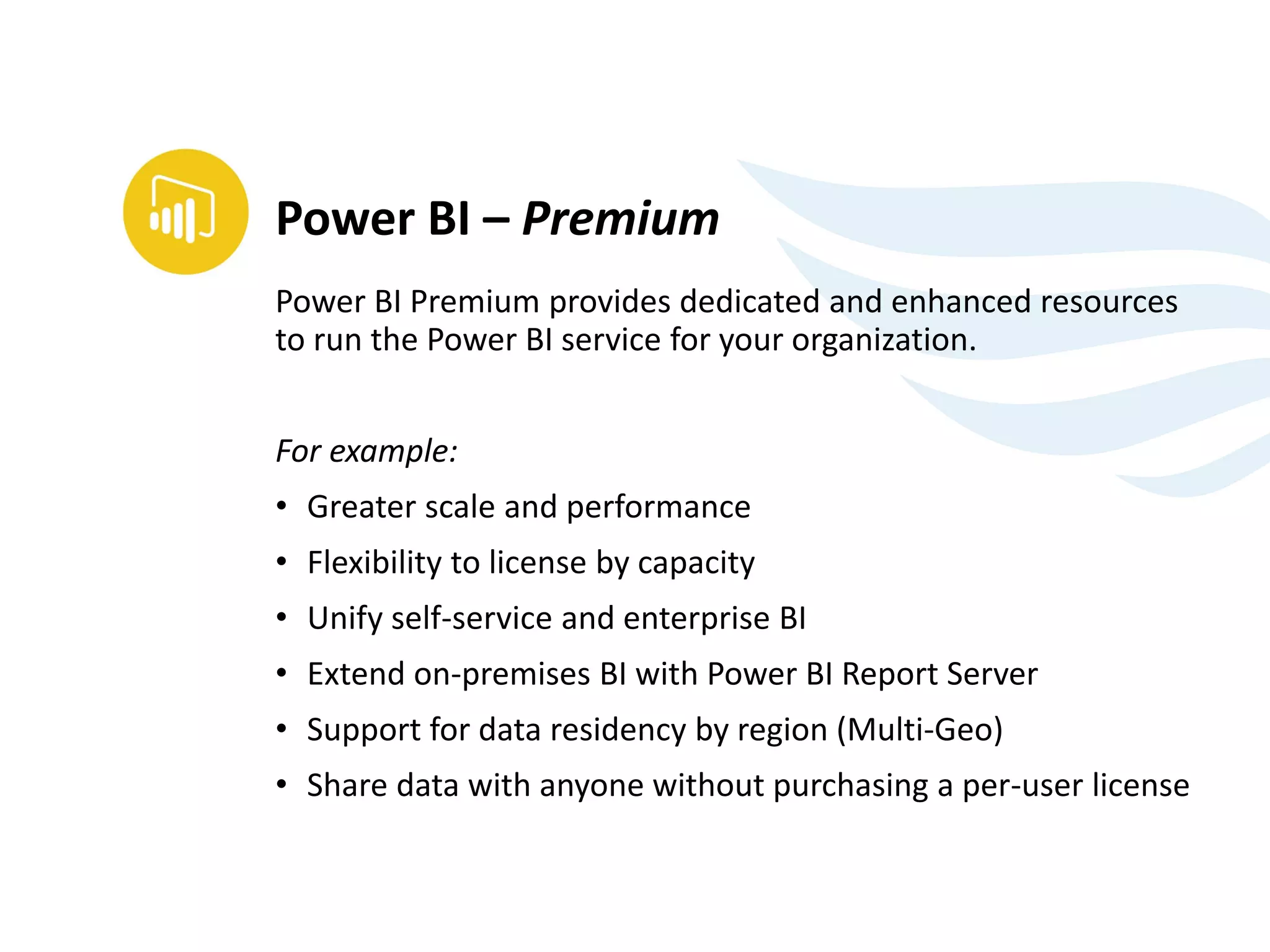
Power BI Premium provides dedicated and enhanced resources
to run the Power BI service for your organization.
For example:
• Greater scale and performance
• Flexibility to license by capacity
• Unify self-service and enterprise BI
• Extend on-premises BI with Power BI Report Server
• Support for data residency by region (Multi-Geo)
• Share data with anyone without purchasing a per-user license
Power BI – Premium
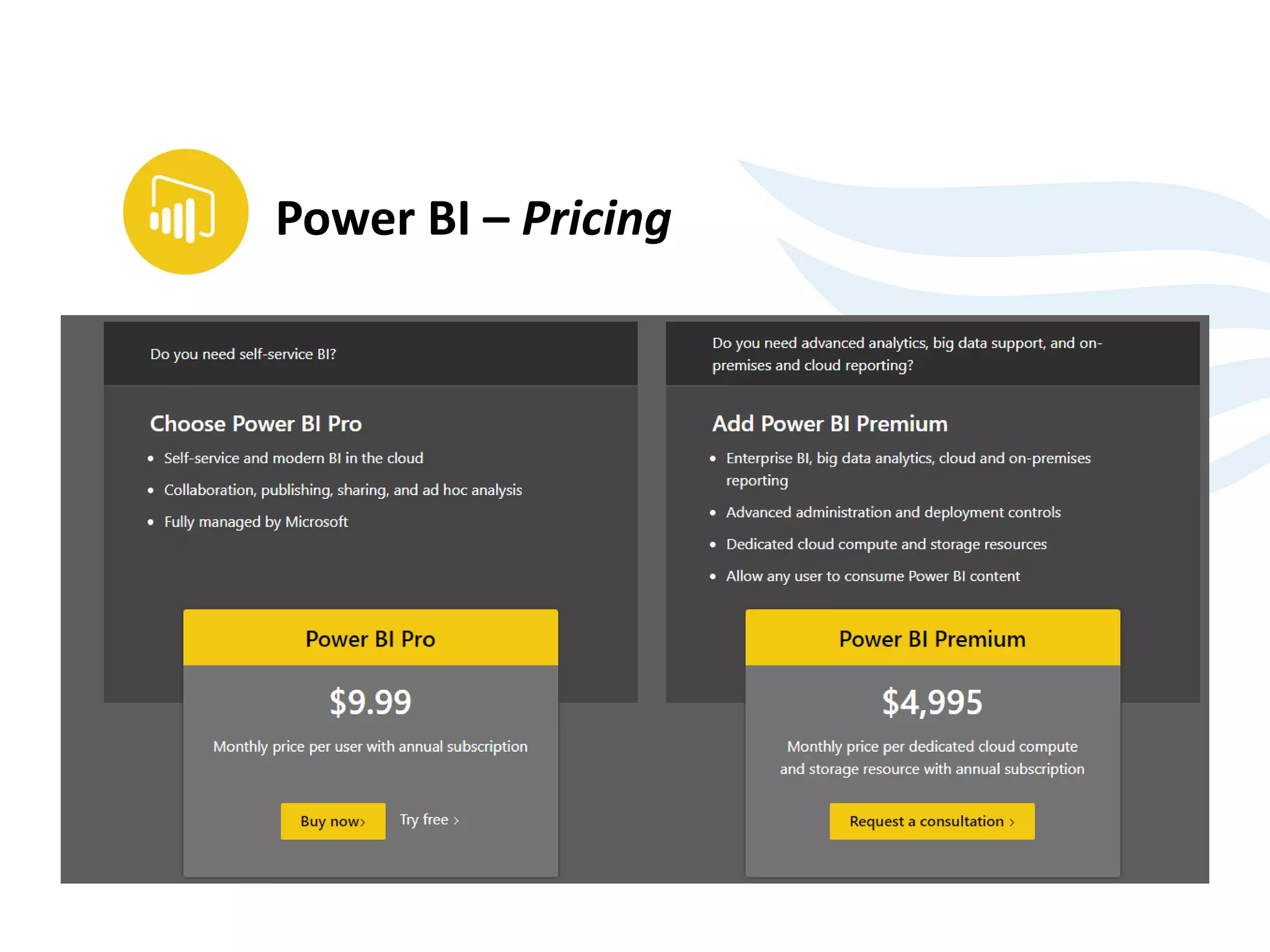
Power BI – Pricing
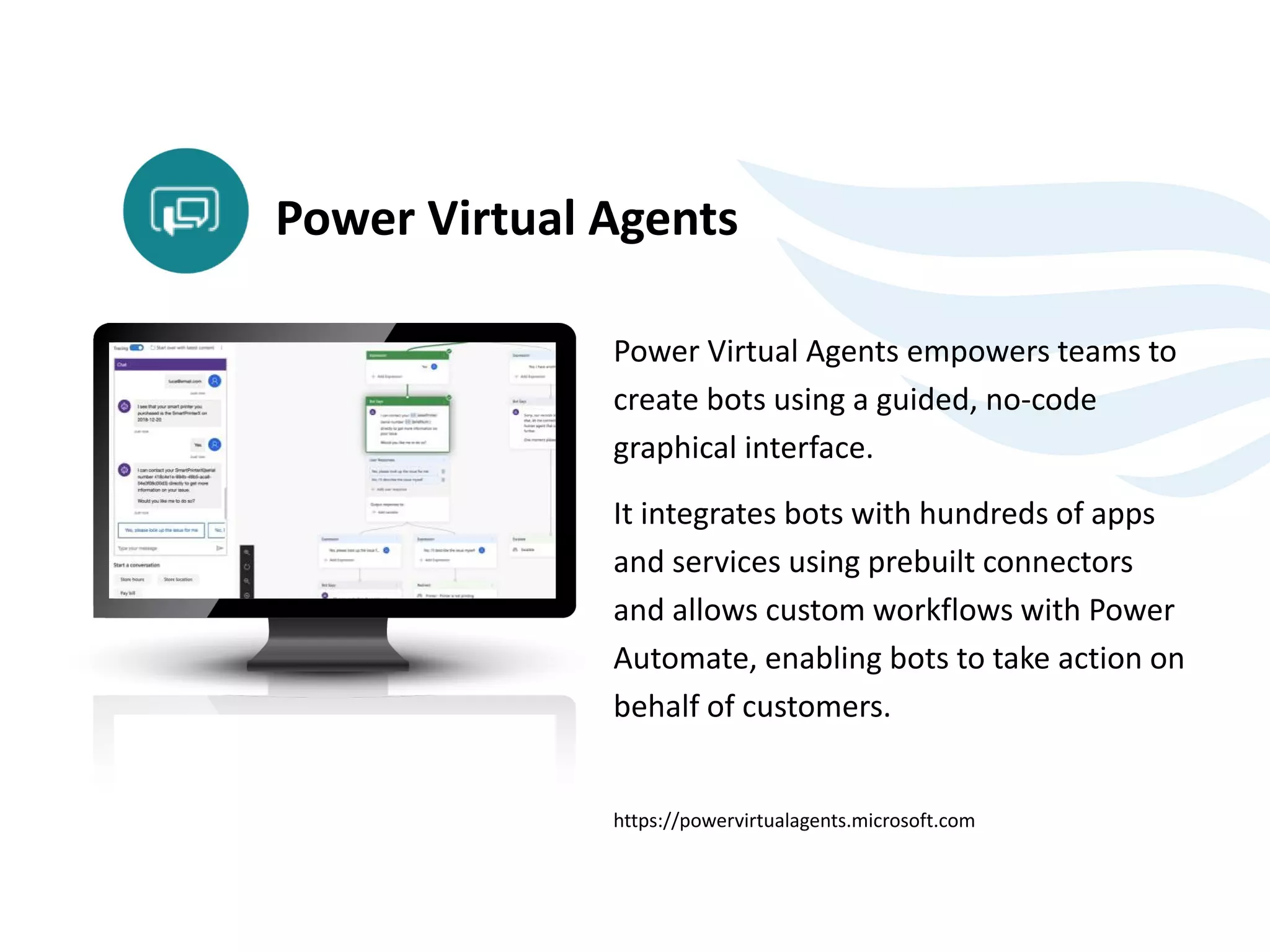
Power Virtual Agents empowers teams to
create bots using a guided, no-code
graphical interface.
It integrates bots with hundreds of apps
and services using prebuilt connectors
and allows custom workflows with Power
Automate, enabling bots to take action on
behalf of customers.
https://powervirtualagents.microsoft.com
Power Virtual Agents
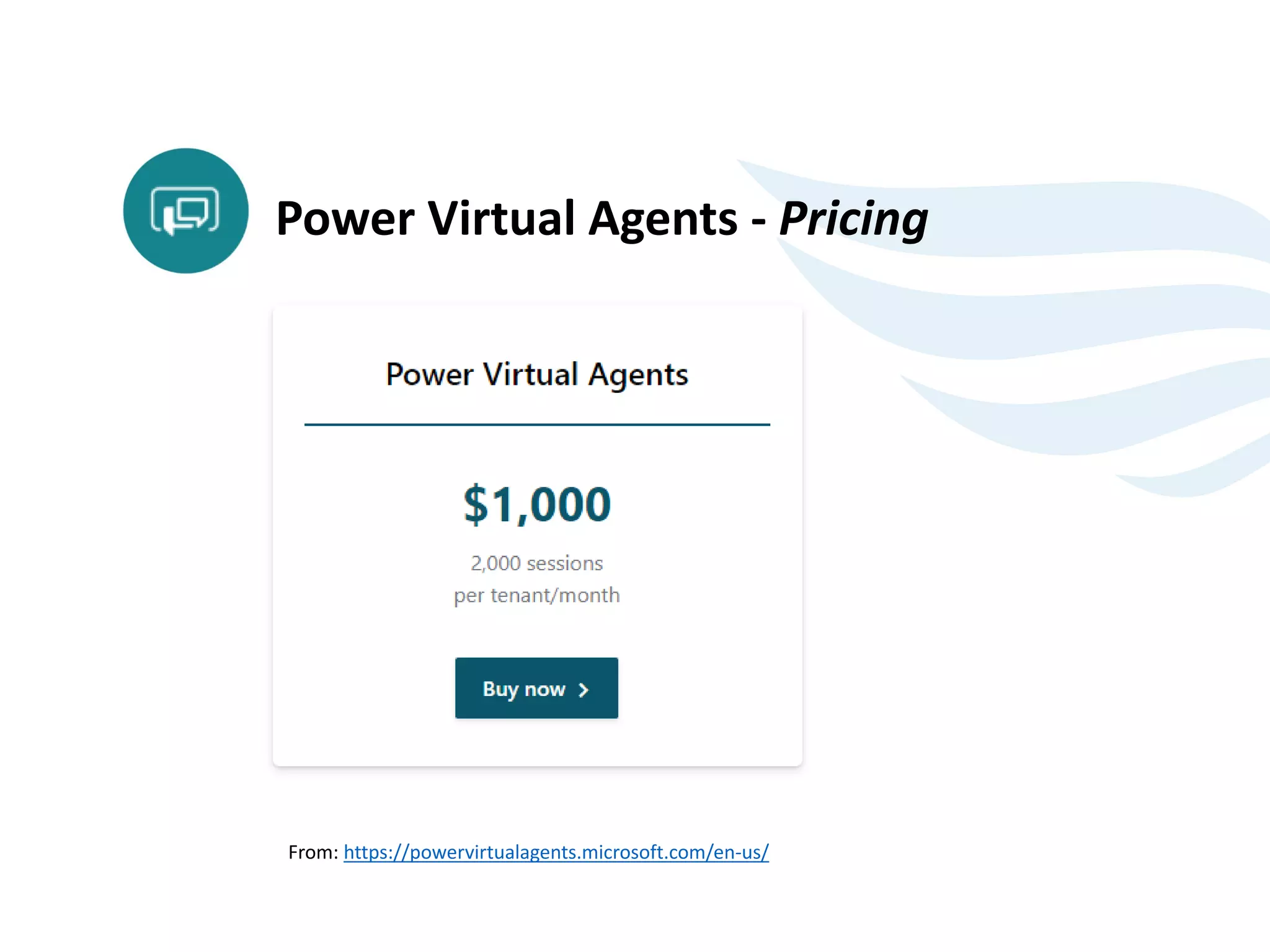
From: https://powervirtualagents.microsoft.com/en-us/
Power Virtual Agents - Pricing
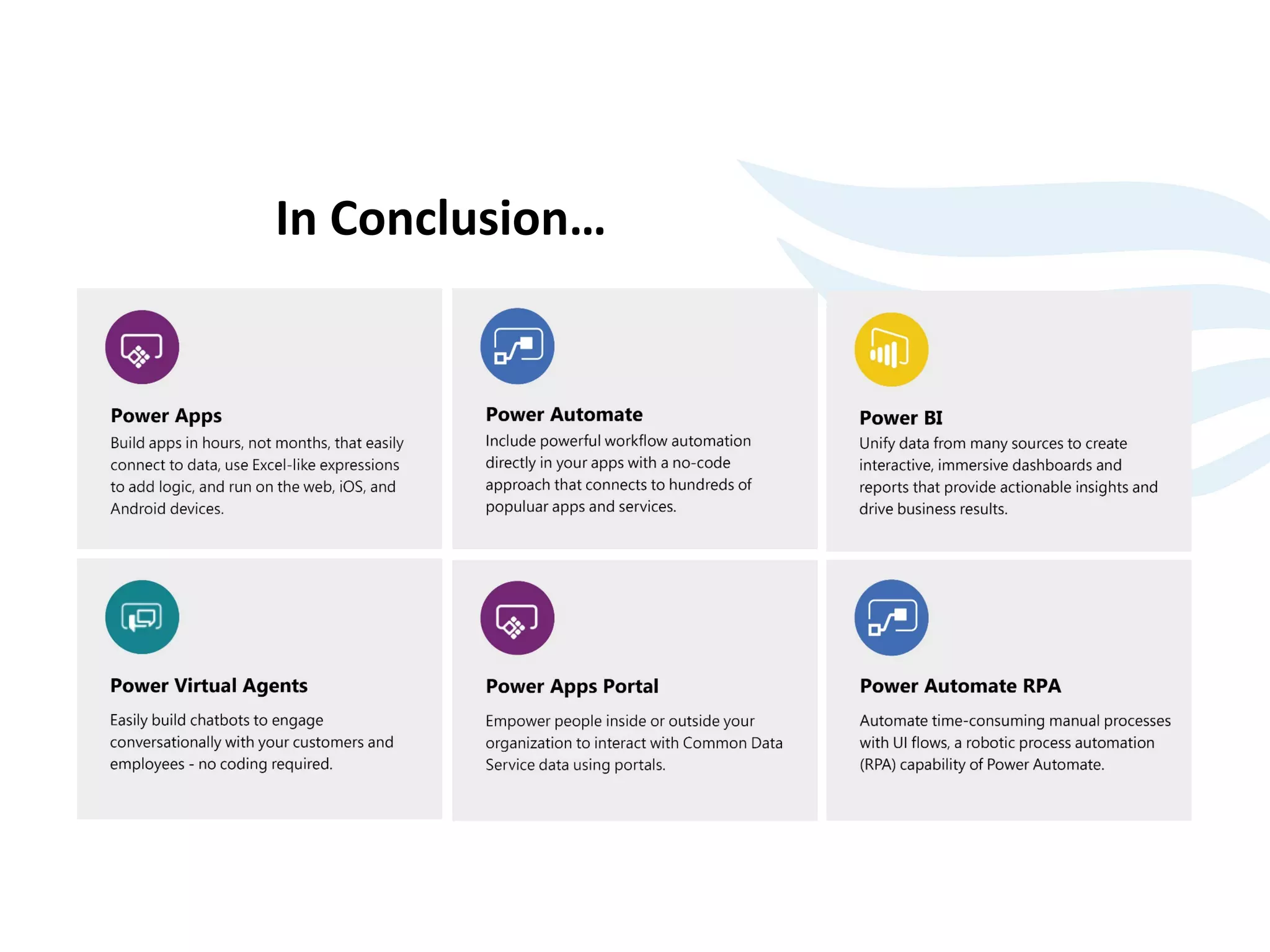
In Conclusion…
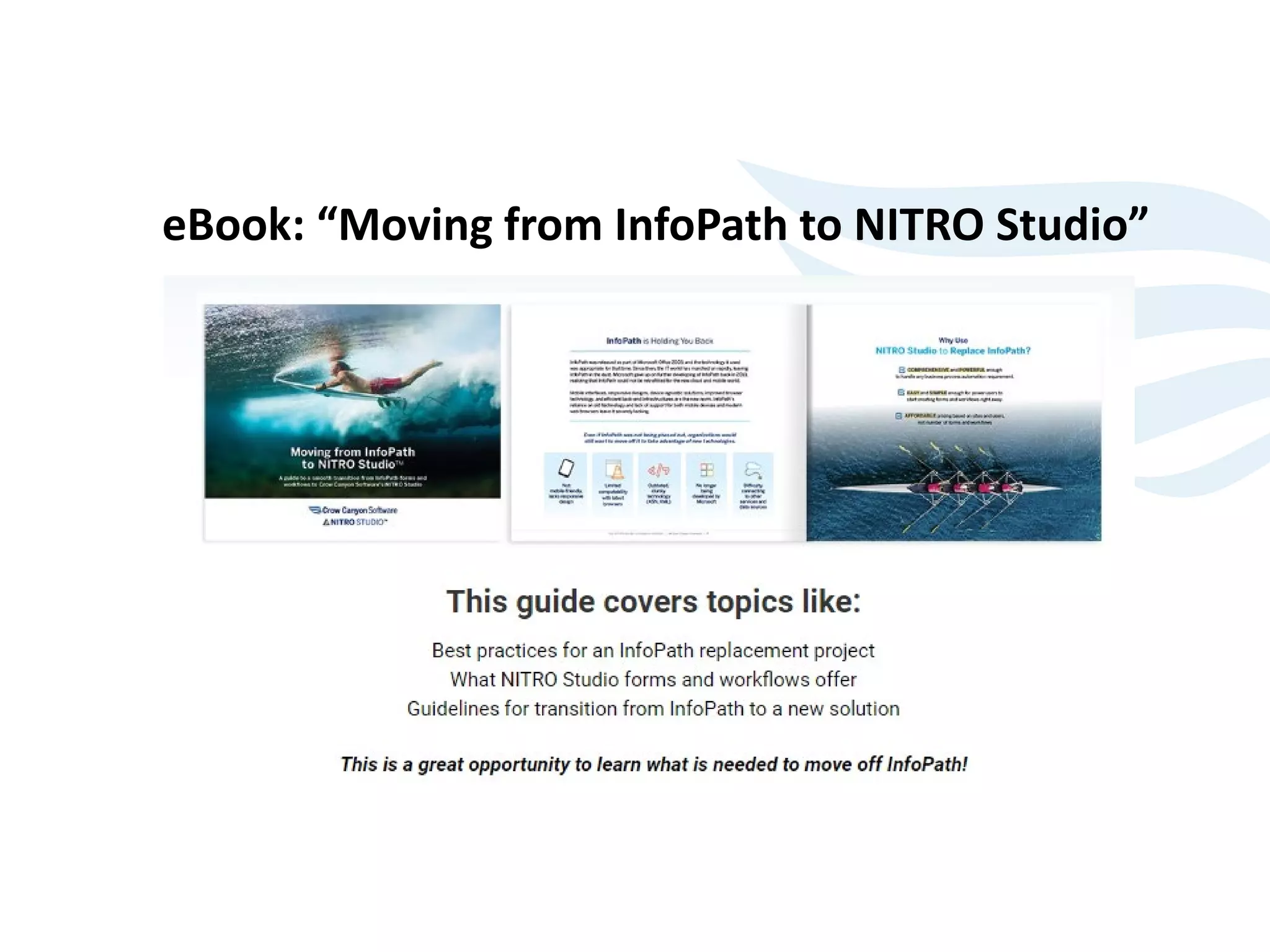
eBook: “Moving from InfoPath to NITRO Studio”
Limitations and Cost of Using Microsoft's Power Platform

Limitations and Cost of Using Microsoft's Power Platform

  • 3.
  • 4.
    |1| Are youon SharePoint 2010, 2013, 2016, or 2019 (that is, an on- premises version of SharePoint)? If you are using SharePoint on-premises, you cannot use the Power Platform without: • Subscribing to a Power Apps standalone plan • Setting up an On-premises Data Gateway High-level Overview
  • 5.
    If you needthe more comprehensive features the Power Platform offers, you need to get standalone plans that include: • Premium Connectors • Model-driven Apps • Use of the Common Data Service • Power Apps Portals • Power BI Pro or Premium • Power Virtual Agents • Power Automate with RPA (Robotics Process Automation) |2| If you stay within the limited set of features that are included in Office 365, the costs are mainly for development over and above the Office 365 subscription. High-level Overview
  • 6.
    Power Apps, PowerAutomate and Power Virtual Agents Licensing Guide, February 2020 • “Customers that need general purpose and full capabilities of the platform should license Power Apps on a standalone basis.” • “Customers that need full-fledged, general purpose workflow/business process automation capabilities, should consider purchasing standalone Power Automate licenses.”
  • 7.
    |3| Even withstandalone plans, there are factors to consider: • No built-in printing capabilities • No offline options • Limits to the number of API calls • Need multiple subscriptions, complex pricing • Uncertainties of cost as usage changes • Development environments can be difficult High-level Overview
  • 9.
    Power Apps Power Appsis a low code/no code application platform for building business applications and customizing existing Office 365 and Dynamics 365 applications. https://powerapps.microsoft.com
  • 10.
    How are PowerApps Licensed?
  • 11.
    “Seeded” – PowerApps in Office 365
  • 12.
    Power Apps userights included with O365 licenses
  • 13.
    COMES WITH OFFICE365 DOES NOT COME WITH OFFICE 365 Canvas Apps vs Model-driven Apps
  • 14.
  • 15.
    Appendix B: StandardConnectors moved to premium category
  • 16.
  • 17.
    If you areusing SharePoint on-premises (2013, 2016, 2019), you cannot use the Power Platform without: • Subscribing to a Power Apps standalone plan • Setting up an On-premises Data Gateway
  • 18.
    Power Apps –Pricing, standalone plans
  • 20.
    Power Apps- peruser plan, $40/user/month
  • 21.
    100 users, $40/user/month $4,000/month $48,000/year 500users, $40/user/month $20,000/month $240,000/year 1,000 users, $40/user/month $40,000/month $480,000/year Power Apps – Pricing, per user plans
  • 23.
    Power Apps Portalsdeliver the capability to build standalone, external-facing portals over the Common Data Service. The Portals allow anyone – whether inside or outside your organization – to interact with Common Data Service data. https://powerapps.microsoft.com/en-us/powerapps-portals/ Power Apps Portals
  • 24.
    Usage of aPower Apps Portals instance
  • 25.
    Power Apps Portals- UserRights for Internal Users
  • 26.
  • 27.
    Power Apps Portals- Pricing Enable external users to access custom portals
  • 28.
    1) Does notinclude Premium Connectors. 2) Does not include on-premises connectivity. 3) Does not include Power Apps Portal licenses. 4) Subscription only allows "canvas apps", not "model- driven apps". 5) There is a daily API request limit of 2,000. According to Microsoft: To use all the Power Apps capabilities, an organization would need to go with either the $10/user/month for 2 apps + 1 portal or the $40/user/month for unlimited apps and portals. Power Apps in Office 365
  • 29.
    No Printing Capabilities Nobuilt-in printing capabilities. See: https://www.crowcanyon.com/blogs/no-printing-in-power-apps-use-nitro-studios/ No Use of Rich XML Files If you have business processes built around the structured XML files generated by InfoPath, then PowerApps will not meet your needs. No Anonymous or External Users without Power Apps Portal If you need to share forms and data sources with customers, vendors, partners and other people outside your organization, you need to implement Power Apps Portals. No Offline Use PowerApps assumes a constant connection and provides no built-in ability to work offline. Mobile users cannot open a form while offline, nor submit data to be synced later when online. Data queried online is not cached for use offline. Not Always a No-Code Solution It can get very complicated for power users. Power Apps is oriented to writing code, using APIs, outputting JSON, and making REST calls. https://collabshow.com/2019/08/07/infopath-migration-has-changed-check-out-these-updates/ Limitations of Power Apps
  • 32.
    Power Automate allows enterprisesto implement automated workflows and business processes and achieve operational efficiencies. https://flow.microsoft.com Power Automate (formerly Flow)
  • 33.
    How is PowerAutomate licensed?
  • 34.
  • 35.
    Power Automate –use with Office 365 Power Automate use within Office 365 is limited to the context of the embedding Office 365 application. For both triggers and actions, flows included within the Office 365 application can connect to: • Any data source within the use rights of the Office 365 application • Directly with the Office 365 application (via built in trigger/action) If the embedded flow is not within the context of the Office 365 application or if the embedded flow needs to connect to a premium on- premises or custom data source, standalone Power Automate licenses will need to be purchased.
  • 36.
  • 37.
  • 38.
    Power Automate -Pricing Power Automate per user plan Power Automate per user plan equips individual users to create and run unlimited workflows and business processes based on their unique needs. The per user plan is intended to support the broad adoption of an automation culture in an organization. Should the entire organization be licensed with the Power Automate per user plan, admins will have minimal overhead with tracking how many flows are being activated/used within the organization.
  • 39.
    Power Automate -Pricing Power Automate per business process (per flow) plan Power Automate per business process plan is licensed by flow and allows customers to implement critical business processes with capacity that serves teams, departments, or the entire organization without individually licensing each end user that triggers the licensed flow. Power Automate per business process plan is great for departmental scenarios where typically, one power user sets up a flow and shares the same with the broader group. This plan alleviates the need to license each end user that knowingly/unknowingly triggers execution of the licensed flow. Minimum purchase: 5 flows
  • 41.
  • 42.
    Power Automate –use with Power Apps Power Apps licenses (both “Power Apps per app plan” and “Power Apps per user plan”) include Power Automate use rights for the purpose of automating workflows associated with the Power Apps application(s). Power Automate use within Power Apps is limited to the context of the Power Apps application. What this means is that for both triggers and actions, flows included within a Power Apps application can connect to: • Any data source within the use rights of the Power Apps application • Directly with the Power Apps application (via built in trigger/action) If the flow is isolated and has nothing to do with the Power Apps application, then standalone Power Automate licenses will need to be purchased.
  • 44.
    Power BI isa cloud-based suite of business analytics tools that lets anyone connect to, visualize, and analyze data with greater speed, efficiency, and understanding. https://powerbi.microsoft.com/en-us/ • Power BI Free version included with Office 365 E3 • Power BI Pro included with Office 365 E5 • Power BI Premium available for extra cost Power BI
  • 45.
    Power BI Freeenables you to connect to 70+ data sources, publish to the web, and export to excel. The same visualizations that are available in Power BI Pro are available in Power BI Free. There are some limitations to the free version: you can’t do peer-to-peer sharing and you can’t create App workspaces. Power BI - Pro With Pro you can share your data, reports, and dashboards with users who also have a Power BI Pro license. You can also create App workspaces. Both Power BI Free and Pro have a 10 GB per Pro user data storage limit. Power BI - Free
  • 46.
    Power BI –Per-user license type comparison Here is a list of features supported by per-user license type.
  • 47.
    Power BI Premiumprovides dedicated and enhanced resources to run the Power BI service for your organization. For example: • Greater scale and performance • Flexibility to license by capacity • Unify self-service and enterprise BI • Extend on-premises BI with Power BI Report Server • Support for data residency by region (Multi-Geo) • Share data with anyone without purchasing a per-user license Power BI – Premium
  • 48.
    Power BI –Pricing
  • 50.
    Power Virtual Agentsempowers teams to create bots using a guided, no-code graphical interface. It integrates bots with hundreds of apps and services using prebuilt connectors and allows custom workflows with Power Automate, enabling bots to take action on behalf of customers. https://powervirtualagents.microsoft.com Power Virtual Agents
  • 51.
  • 52.
  • 55.
    eBook: “Moving fromInfoPath to NITRO Studio”