Limaye A S.pptx, Herbal medicines appear relatively safe, but there is limited human research or prospective/retrospective data concerning adverse events and herbal-drug interactions.
Herbal medicines appear relatively safe, but there is limited human research or prospective/retrospective data concerning adverse events and herbal-drug interactions.
Similar to Limaye A S.pptx, Herbal medicines appear relatively safe, but there is limited human research or prospective/retrospective data concerning adverse events and herbal-drug interactions.
PPTX
Antioxidant activity of methanolic extract of emblica fruit (Phyllanthus embl...
Limaye A S.pptx, Herbal medicines appear relatively safe, but there is limited human research or prospective/retrospective data concerning adverse events and herbal-drug interactions.
1.
Dr. A. S.Limaye
Assistant Professor,
Department of Botany,
Nowrosjee Wadia College, Pune
ASCOP ROLL NO. 01
Conventional drugs,regulated by the Food and Drug Administration (FDA),
require quality assurance in manufacturing, labeling accuracy, demonstrated
safety and efficacy before marketing, and post-marketing surveillance for
adverse effects. They are available, only by prescription, from a trained,
licensed prescriber.
Herbal medicines appear relatively safe, but there is limited human research
or prospective/retrospective data concerning adverse events and herbal-drug
interactions.
They are generally less potent than their pure drug relatives because they
contain a mixture of many chemicals in small quantities.
Thus, they have a longer onset of action than conventional drugs. Although
they appear to have a lower risk of adverse effects, herbal products are not free
of risk.
Oxalis corniculata L.
Medicinal uses: It is edible and famous for its medicinal properties
as a good appetizer and as a remover of Vata, Kapha and piles.
The plant possessed astringent, anti-inflammatory, stomachic,
antipyretic properties. diarrhea, dysentery and skin diseases.
Oxalis corniculata L.among the smallest creation of God,
and commonly called as “Indian Sorrel”.
The herb is with procumbent branches and palmately 3
foliate leaves.
A CREEPER-
Oxalis corniculata L.
INTRODUCTION
11.
It isedible and famous for its medicinal properties as a good
appetizer and as a remover of Vata, Kapha and piles.
The plant possessed astringent, anti-inflammatory, stomachic,
antipyretic properties. It has been known to cure diarrhea,
dysentery and skin diseases (Raghavendra et al., 2005).
Oxalis corniculata has been reported to have antibacterial
activity (Unni, B. G; 2009).
Sushanta Borah (2009), reported Oxalis corniculata as a source
of many important minerals.
12.
Aqueous andethanolic extracts of Oxalis corniculata
possessed anti-ulcer activity (Piyusha Patil et. al.; 2011).
Recently, Badrul Alam et. al (2011) stated the anti-
inflammatory and antioxidant activities form various extracts
of Oxalis corniculata.
Somayeh et. al., 2011 have formulated antibacterial cream
prepared from Oxalis corniculata leaves (aqueous extract)
Thus, the detailed study was considered worthwhile
from both fundamental and applied angles.
13.
1. Estimation ofenzymatic and non-enzymatic antioxidants.
2. To determine antioxidant potential using In-vitro models.
3. Isolation of proteins as alpha amylase inhibitors.
OBJECTIVES
Oxalis corniculata L.
14.
Antioxidants
Since, ancienttimes many plants have provoked
interest as a sources of natural products.
They have been screened for their potential uses
against many infections and food preservation from
toxic effects of oxidants (Kumar et al. 2006).
Many plant species suggests the presence of
antioxidants and anti microbial constituents (K. P.
Tatjana et al. 2005)
15.
Phenolics andflavonoids are widely distributed in plants and
reported for their biological activities like antioxidants, free radical
scavengers etc.
16.
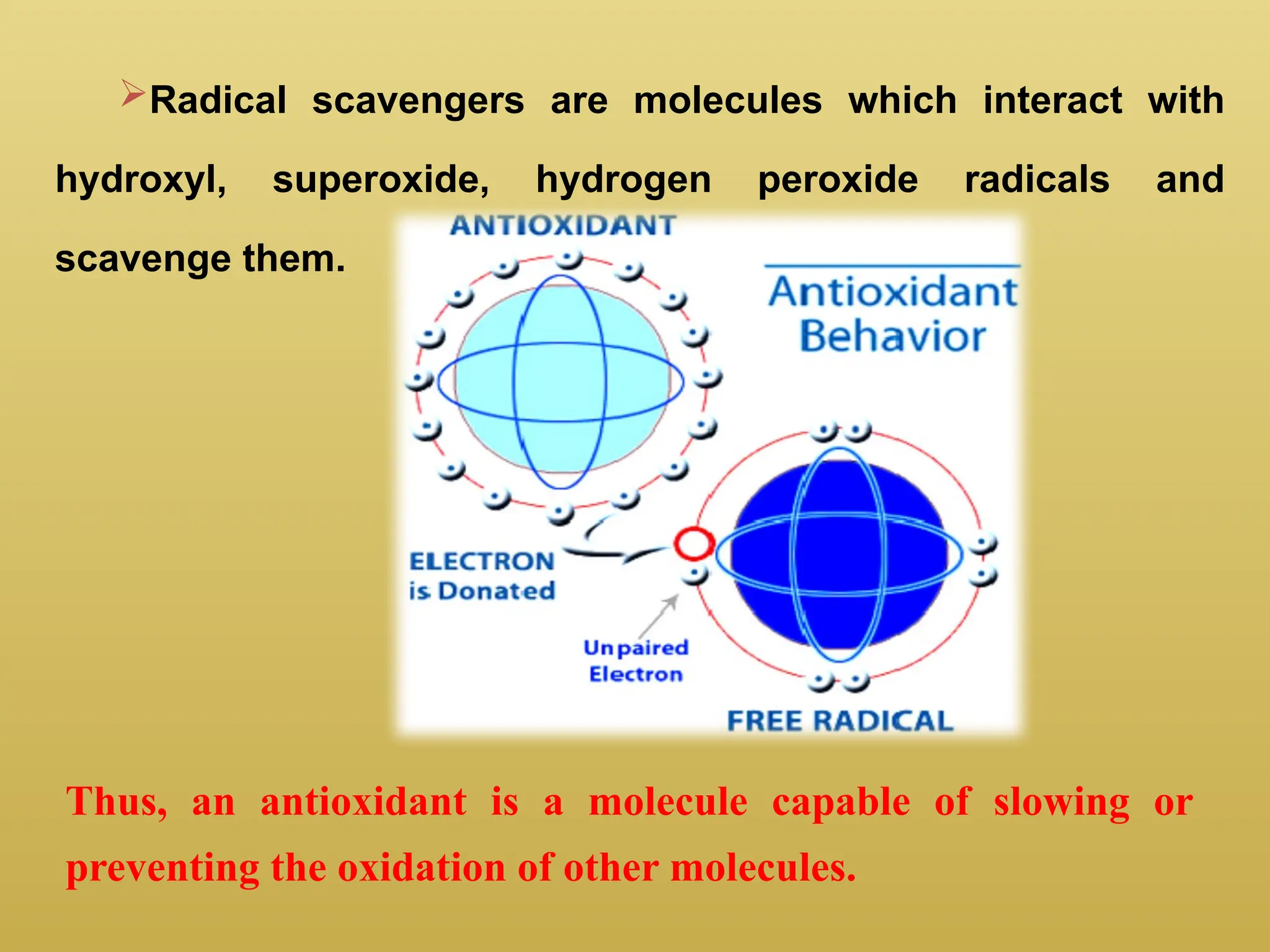
Radical scavengers aremolecules which interact with
hydroxyl, superoxide, hydrogen peroxide radicals and
scavenge them.
Thus, an antioxidant is a molecule capable of slowing or
preventing the oxidation of other molecules.
17.
MATERIALS AND METHODS
Quantitative analyses of secondary metabolites:
Phenols- Farkas and Kiraly (1962).
Flavonoids- Chang et al. (2002).
Tannins-Polshettiwar et al. (2007).
Ascorbic acid (Vitamin C)- Ghosh et al. (1966).
Reducing power assay: Oyaizu (1986)
DPPH assay: Motalleb et al. (2005)
Fresh leaves of oxalis corniculata L. were taken and they were extracted with different
solvents like ethanol, methanol, water, etc. The prepared product i. e. chutney was also
assessed by the same methods.
Qualitative analyses for the detection of secondary metabolites:
The different secondary metabolites were detected by the standard tests using
standard reagents like Hager’s, Wagner’s, Molisch’s, Mayer’s, etc.
18.
FORMULATION OF CHUTNEYFROM Oxalis corniculata leaves
Collect matured leaves of Oxalis corniculata L.
Grind it with fresh green chilies and sugar
Add preservative if required
19.
+ Antioxidant
DPPH Sol.DPPH + methanol After reaction with
Antioxidant
Reducing power assay
DPPH assay: (2, 2-Diphenyl-1-Picrylhydrazyl)
Higher absorbance of the
reaction mixture
indicated greater
reducing power.
Table 2: Importantenzymatic antioxidants of Oxalis corniculata L.
Plant species
Peroxidase
Units g -1
FW
Polyphenol
Oxidase
Units g -1
FW
Catalase
Units g -1
FW
Ascorbic
acid Oxidase
Units g -1
FW
Oxalis
corniculata L.
25.80±0.26 16.25±0.11 16.40±0.29 14.75±0.65
Table 3: Important non-enzymatic antioxidants of Oxalis corniculata L.
Values of mean of five samples and three determinations
Plant species
Ascorbic
acid
mg g -1
Total
Polyphenols
mg g -1
Tannins
mg g -1
Flavonoids
mg g -1
Oxalis corniculata L. 76.35± 0.05 15.76± 0.29 12.36±0.17 79.98± 0.32
Values of mean of five samples and three determinations
22.
Table 5: Reducingpower assay of leaf extract of Oxalis corniculata L.
Oxalis leaves OD at 700 nm
Volume taken
µg ml-1 Leaf extract Chutney
Table 4: Radical scavenging activity of Oxalis corniculata L. DPPH assay
Sr. No Plant part Radical scavenging
activity in (%)
(IC 50
) value in
µg ml-1
01 Leaf extract 50.36 ± 1.14 36.99 ± 0.21
02 Chutney 50.92 ± 0.68 32.47 ± 0.16
WHAT ARE STARCHBLOCKERS?
Many enzymes are present in the human
digestive system.
Alpha amylase enzyme is responsible for
breaking down starchy foods, such as breads,
potatoes, rice, and pasta into sugars.
ALPHA AMYLASE IHIBITORS
Alpha amylase inhibitorsare molecules which
interfere with the activity of alpha amylase enzyme.
i.e. The conversion of
starch --------- sugars
It is possible to control sugar level by using
AAI popularly known as “STARCH BLOCKERS”
Thus the use of starch blockers have
recently gained popularity with the success
and growth of carbohydrate restricted diet.
27.
METHODOLOGY
PREPARATION OF PLANTEXTRACT
FRACTIONAL PRECIPITATION OF PROTEINS
WITH AMMONIUM SULPHATE
DIALYSIS OF AMMONIUM SULPHATE
FRACTIONS
GEL FILTERATION BY SEPHADEX G-100
ASSAY OF ALPHA AMYLASE INHIBITORY ACTIVITY
Conforty, 2005
CONCLUSIONS
Leaves ofOxalis corniculata L. showed significant values for
various enzymatic and secondary metabolites.
Methanolic extract of fresh leaves of Oxalis corniculata L.
exhibited radical scavenging activity at 36.99 µgml-1
concentration.
It is evident from the comparison of DNA-electrophoresis, that
DNA with hydroxyl radicals showed degradation.
However, leaf extract of Oxalis corniculata L. gave protection to
calf thymus DNA from oxidative damage by scavenging free
hydroxyl radicals.
30.
The leaves containoxalic acid, which gives them their sharp
flavour. Perfectly all right in small quantities, the leaves should
not be eaten in large amounts since oxalic acid can bind up
the body's supply of calcium leading to nutritional deficiency.
The quantity of oxalic acid will be reduced if the leaves are
cooked. People with a tendency to rheumatism, arthritis, gout,
kidney stones or hyperacidity should take especial caution if
including this plant in their diet since it can aggravate their
condition
FUTURE ASPECTS
The studieson amylase produced by Xanthomonas
species is in progress.
INTERESTING FACTS
The amylase inhibitors can be used to avoid plaque formation
and tooth decay.
The fruit ripening can be controlled by using amylase
inhibitors.