LIFT
lift 
• For multi- storeyed buildings the installation of lifts is a 
must to avoid fatigue in climbing up the stairs and for 
quick vertical circulation between different floors. 
• The provision of lifts in a building is a highly specialised 
job. 
• A vertical hat with openings at the floor level is 
provided. 
• The shaft is located at a suitable place e.g. by the side 
of the stair or within the open well of a stiar. 
• The shaft extends below the ground floor to 
accomodate the spring buffers for low speed lifts and 
hydraulic buffers high speed lifts.
• Usually a machine room (control room) is located 
at the top of the left shaft for housing equipment 
and accessories. 
• It can be at the bottom by the side of the shaft. 
• The size of the machine room is normally 4 m x 3 
m x 2.5 m. 
• Floors or machine room should be designed to 
carry a load or not less than 500 Kg/m 
• Previously collapsible doors were provided both 
for the lift car (cage) and for the opening in the 
shaft at the floor level. 
• Now a days flush doors of sliding type are 
provided.
Types of lift 
1) Hydraulic lift 
2) Electric lift 
3) Passenger lift 
4) Goods lift
Components of lift 
1) Control room 
2) guides 
3) lift car 
4) counter weight 
5) control panel 
6) lift pit 
7) Buffer 
8) Hoist way 
9) hoist rope
Space Requirements
Passanger lift
DESIGN CONSIDERATIONS FOR LIFT 
• Two important aspects in lift design are 
a. Quantity of service 
b. Quality of service
a. Quantity of service 
• “Quantity of service” means passenger 
handling capacity of lift. 
• During peak hours, the number of 
passengers which a lift can handle in 5 
minutes time is taken as passenger handling 
capacity (H). 
• It is expressed as percentage of total number 
of persons living in the building.
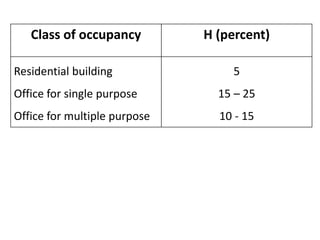
Class of occupancy H (percent) 
Residential building 
Office for single purpose 
Office for multiple purpose 
5 
15 – 25 
10 - 15
b. Quality of service 
• The waiting time for lift by passengers on 
different floors is expressed as quality of 
service. 
Quality of service 
(WAITING INTERVAL) 
RATING 
20-25 Seconds 
30-35 Seconds 
35-40 Seconds 
40-45 Seconds 
over 45 Seconds 
Excellent 
Good 
Fair 
Poor 
unsatisfactory
Handling capacity 
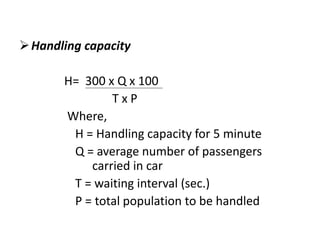
H= 300 x Q x 100 
T x P 
Where, 
H = Handling capacity for 5 minute 
Q = average number of passengers 
carried in car 
T = waiting interval (sec.) 
P = total population to be handled
Waiting interval 
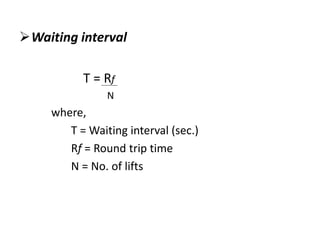
T = Rf 
N 
where, 
T = Waiting interval (sec.) 
Rf = Round trip time 
N = No. of lifts
Occupant load : 
Occupant load = gross area (m2) 
person
Sr. 
No. 
occupancy Occupant load gross 
area in m2 / person 
1. 
2. 
3. 
4. 
5. 
6. 
7. 
Residential 
Educational 
Institutional 
Assembly hall with seats 
Business and industrial 
Storage 
hazardous 
12.5 
4 
15 
0.6 
10 
30 
10
Lift
Lift

Lift

  • 1.
  • 2.
    lift • Formulti- storeyed buildings the installation of lifts is a must to avoid fatigue in climbing up the stairs and for quick vertical circulation between different floors. • The provision of lifts in a building is a highly specialised job. • A vertical hat with openings at the floor level is provided. • The shaft is located at a suitable place e.g. by the side of the stair or within the open well of a stiar. • The shaft extends below the ground floor to accomodate the spring buffers for low speed lifts and hydraulic buffers high speed lifts.
  • 3.
    • Usually amachine room (control room) is located at the top of the left shaft for housing equipment and accessories. • It can be at the bottom by the side of the shaft. • The size of the machine room is normally 4 m x 3 m x 2.5 m. • Floors or machine room should be designed to carry a load or not less than 500 Kg/m • Previously collapsible doors were provided both for the lift car (cage) and for the opening in the shaft at the floor level. • Now a days flush doors of sliding type are provided.
  • 4.
    Types of lift 1) Hydraulic lift 2) Electric lift 3) Passenger lift 4) Goods lift
  • 5.
    Components of lift 1) Control room 2) guides 3) lift car 4) counter weight 5) control panel 6) lift pit 7) Buffer 8) Hoist way 9) hoist rope
  • 6.
  • 7.
  • 8.
    DESIGN CONSIDERATIONS FORLIFT • Two important aspects in lift design are a. Quantity of service b. Quality of service
  • 9.
    a. Quantity ofservice • “Quantity of service” means passenger handling capacity of lift. • During peak hours, the number of passengers which a lift can handle in 5 minutes time is taken as passenger handling capacity (H). • It is expressed as percentage of total number of persons living in the building.
  • 10.
    Class of occupancyH (percent) Residential building Office for single purpose Office for multiple purpose 5 15 – 25 10 - 15
  • 11.
    b. Quality ofservice • The waiting time for lift by passengers on different floors is expressed as quality of service. Quality of service (WAITING INTERVAL) RATING 20-25 Seconds 30-35 Seconds 35-40 Seconds 40-45 Seconds over 45 Seconds Excellent Good Fair Poor unsatisfactory
  • 12.
    Handling capacity H=300 x Q x 100 T x P Where, H = Handling capacity for 5 minute Q = average number of passengers carried in car T = waiting interval (sec.) P = total population to be handled
  • 13.
    Waiting interval T= Rf N where, T = Waiting interval (sec.) Rf = Round trip time N = No. of lifts
  • 14.
    Occupant load : Occupant load = gross area (m2) person
  • 15.
    Sr. No. occupancyOccupant load gross area in m2 / person 1. 2. 3. 4. 5. 6. 7. Residential Educational Institutional Assembly hall with seats Business and industrial Storage hazardous 12.5 4 15 0.6 10 30 10