2009-2012 NCLB Title II Part D District 31 & 22 Competitive Grant LI ƒE Program-   The Leadership Innovation for Education     October 2009
Welcome and Introductions Celine Azoulay-  Technology Innovation Manager, Staten Island & South Brooklyn [email_address] Office of Educational Technology http://nycedtech.com Oitlive Website-     Title IID Information Portal  LI ƒE Program-  http://oitlive.com Please share your contact information   Link is found on OITLIVE website    Click on  LIƒE  tab and then click  Survey
2009-2012 NCLB Title II Part D Competitive Grants Purpose:  Improve students’ academic performance in the core subject areas of English language arts, mathematics, science, and technology literacy through effective use of technology in the process of teaching and learning.   Themes: Leadership and System Change through Technology Innovation System Change of Teaching and Learning through Technology
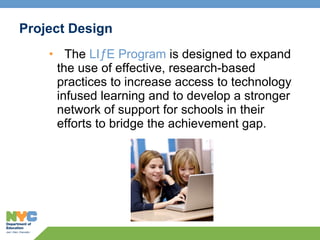
Project Design The  LIƒE Program  is designed to expand the use of effective, research-based practices to increase access to technology infused learning and to develop a stronger network of support for schools in their efforts to bridge the achievement gap.
Application context & process We will work to achieve the following goals: The  LIƒE Program  is aligned to Children First reforms and DOE educational technology strategy.  Aligned to SSO structures. Strengthen mechanisms for transferring promising practices or lessons learned beyond grant participants. Purchase technologies that can be supported by standard procurement and maintenance agreements.
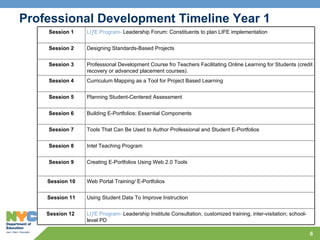
Professional Development Timeline Year 1 Session 1 LIƒE Program-  Leadership Forum: Constituents to plan LIFE implementation Session 2 Designing Standards-Based Projects Session 3 Professional Development Course fro Teachers Facilitating Online Learning for Students (credit recovery or advanced placement courses). Session 4 Curriculum Mapping as a Tool for Project Based Learning Session 5 Planning Student-Centered Assessment Session 6 Building E-Portfolios: Essential Components Session 7 Tools That Can Be Used to Author Professional and Student E-Portfolios Session 8 Intel Teaching Program Session 9 Creating E-Portfolios Using Web 2.0 Tools Session 10 Web Portal Training/ E-Portfolios Session 11 Using Student Data To Improve Instruction Session 12  LIƒE Program-  Leadership Institute Consultation, customized training, inter-visitation; school-level PD
Project Overview Leadership Innovation For Education ( LIƒE Program ) will Provide an extensive blended model of professional development for teachers and instructional school leaders to facilitate the infusion of technology enriched curriculum and assessment.  Educators will enhance curriculum with  authentic, project based learning (PBL) units that engage students in real work learning scenarios to improve student academic performance across all core content areas. Host digital PBL units and student work in electronic portfolios using a variety of digital media to demonstrate mastery of new knowledge and skills. Explore online learning for students in need of credit recovery, advanced studies, college and exam preparation, remediation and differentiation. Additionally, teachers will be equipped with the skills to facilitate online learning. Provide a comprehensive and customized program of professional development for teachers and supporting administrative staff including the SSO network teams and School Based Inquiry Teams.
Project Overview Leaders Intel Leadership Forum for Principals and Intel Teacher Forum for educators  Leadership Forums Across the Year Topics- low cost laptops, onsite tech support, 21 st  Century Curriculum, etc Teachers Professional Development for educators in shifting standard educational practices to innovative practices to enhance student achievement. Intel Teach Essentials program where teachers learn to infuse 21 st  Century skills into their curriculum in an effort to create project-based lessons that promote problem solving, critical thinking and collaboration skills among students. Professional Development Course for Teachers Facilitating Online Learning for Students (credit recovery or advanced placement courses). Students Development of ePortfolios for students to demonstrate personal learning goals and growth over time. Students will use digital media to incorporate 21 st  Century Literacy Skills  Participate  in “Digital Support and Empowerment Teams”
Need for Project Academic Need All participating schools have been identified as schools in need of improvement, schools under regents review, and/or schools requiring academic progress. Targeted schools in District 31 & 22 were cited for failure to meet AYP in ELA. In the majority of schools failure to meet AYP  was the result of poor performance among ELL and SWD student populations. Students 4 year graduation rate is below citywide average, illustrating the need for credit recovery. Professional Need A significant % of teachers in targeted schools are teaching out of certification The turn-over rate for targeted schools is higher than that of non-targeted schools.
Project Goals Goal 1 :   To provide a sustained, comprehensive program of professional development for administrators and school/ district leaders in order to expand the number of effective educators who will be able to demonstrate promising practices of instructional technology integration . Goal 2: To achieve measurable improvement in student academic performance on NYS assessments in the core curriculum areas of ELA, Mathematics, Science and Technology Literacy for all students, including English language Learners (ELL’s) and Students  with Disabilities (SWD ).
Strategies and Activities Students  will demonstrate increased  achievement in English Language Arts, Math and Science. At least 80% of students will create high quality student centered e-portfolios that meet standards as assessed by rubrics developed and administered by participating teachers.    Students will demonstrate increased technology literacy skills as assessed by student surveys, as well as a student technology literacy assessment of 8 th  grade students  By the end of year one 10% of teachers will receive a minimum of 50 hours training to enhance their instructional technology proficiency as part of a blended model of  professional development that includes face-to-face workshops, webinars, on-line courses towards IT certification, and on-site and in-class support including coaching and mentoring.  By the end of year two 25% of teachers in participating schools will receive the same as above.  By the end of year three 50% of teachers in participating schools will receive the same as above.   By the end of years 2 and 3  it is expected that each project school will develop approximately 10 online courses. By the end of year one, it is expected that each school will create at least 5 high quality, technology rich PBL units in the core subject areas of ELA, Math or Science.   Teachers will create professional e-portfolios to host their PBL units   School administrators will attend approximately 36 hours of customized training including face-to-face workshops, webinars, visits to model school sites, and on-site consultations.   T he training will enable school administrators to observe and model best practices of technology infusion into instruction and share PBL units
Hardware   Digi Tools – a package of all the digital tools to needed to implement a 21 st  century model of project based learning and e-portfolios that are rich with digital media. Service subscriptions
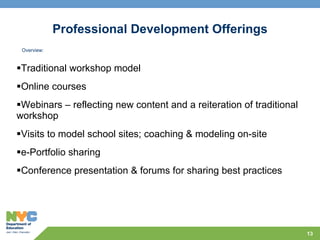
Professional Development Offerings Traditional workshop model Online courses Webinars – reflecting new content and a reiteration of traditional workshop  Visits to model school sites; coaching & modeling on-site e-Portfolio sharing Conference presentation & forums for sharing best practices Overview:
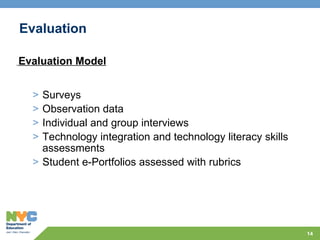
Evaluation Evaluation Model Surveys  Observation data  Individual and group interviews Technology integration and technology literacy skills assessments  Student e-Portfolios assessed with rubrics
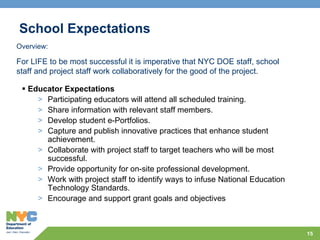
School Expectations Educator Expectations Participating educators will attend all scheduled training. Share information with relevant staff members. Develop student e-Portfolios. Capture and publish innovative practices that enhance student achievement. Collaborate with project staff to target teachers who will be most successful. Provide opportunity for on-site professional development. Work with project staff to identify ways to infuse National Education Technology Standards. Encourage and support grant goals and objectives Overview: For LIFE to be most successful it is imperative that NYC DOE staff, school staff and project staff work collaboratively for the good of the project.
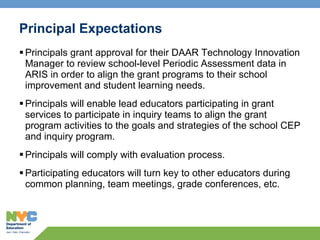
Principal Expectations Principals grant approval for their DAAR Technology Innovation Manager to review school-level Periodic Assessment data in ARIS in order to align the grant programs to their school improvement and student learning needs. Principals will enable lead educators participating in grant services to participate in inquiry teams to align the grant program activities to the goals and strategies of the school CEP and inquiry program. Principals will comply with evaluation process. Participating educators will turn key to other educators during common planning, team meetings, grade conferences, etc.

LIFE Session

  • 1.
    2009-2012 NCLB TitleII Part D District 31 & 22 Competitive Grant LI ƒE Program- The Leadership Innovation for Education October 2009
  • 2.
    Welcome and IntroductionsCeline Azoulay- Technology Innovation Manager, Staten Island & South Brooklyn [email_address] Office of Educational Technology http://nycedtech.com Oitlive Website- Title IID Information Portal LI ƒE Program- http://oitlive.com Please share your contact information Link is found on OITLIVE website Click on LIƒE tab and then click Survey
  • 3.
    2009-2012 NCLB TitleII Part D Competitive Grants Purpose: Improve students’ academic performance in the core subject areas of English language arts, mathematics, science, and technology literacy through effective use of technology in the process of teaching and learning.  Themes: Leadership and System Change through Technology Innovation System Change of Teaching and Learning through Technology
  • 4.
    Project Design The LIƒE Program is designed to expand the use of effective, research-based practices to increase access to technology infused learning and to develop a stronger network of support for schools in their efforts to bridge the achievement gap.
  • 5.
    Application context &process We will work to achieve the following goals: The LIƒE Program is aligned to Children First reforms and DOE educational technology strategy. Aligned to SSO structures. Strengthen mechanisms for transferring promising practices or lessons learned beyond grant participants. Purchase technologies that can be supported by standard procurement and maintenance agreements.
  • 6.
    Professional Development TimelineYear 1 Session 1 LIƒE Program- Leadership Forum: Constituents to plan LIFE implementation Session 2 Designing Standards-Based Projects Session 3 Professional Development Course fro Teachers Facilitating Online Learning for Students (credit recovery or advanced placement courses). Session 4 Curriculum Mapping as a Tool for Project Based Learning Session 5 Planning Student-Centered Assessment Session 6 Building E-Portfolios: Essential Components Session 7 Tools That Can Be Used to Author Professional and Student E-Portfolios Session 8 Intel Teaching Program Session 9 Creating E-Portfolios Using Web 2.0 Tools Session 10 Web Portal Training/ E-Portfolios Session 11 Using Student Data To Improve Instruction Session 12 LIƒE Program- Leadership Institute Consultation, customized training, inter-visitation; school-level PD
  • 7.
    Project Overview LeadershipInnovation For Education ( LIƒE Program ) will Provide an extensive blended model of professional development for teachers and instructional school leaders to facilitate the infusion of technology enriched curriculum and assessment. Educators will enhance curriculum with authentic, project based learning (PBL) units that engage students in real work learning scenarios to improve student academic performance across all core content areas. Host digital PBL units and student work in electronic portfolios using a variety of digital media to demonstrate mastery of new knowledge and skills. Explore online learning for students in need of credit recovery, advanced studies, college and exam preparation, remediation and differentiation. Additionally, teachers will be equipped with the skills to facilitate online learning. Provide a comprehensive and customized program of professional development for teachers and supporting administrative staff including the SSO network teams and School Based Inquiry Teams.
  • 8.
    Project Overview LeadersIntel Leadership Forum for Principals and Intel Teacher Forum for educators Leadership Forums Across the Year Topics- low cost laptops, onsite tech support, 21 st Century Curriculum, etc Teachers Professional Development for educators in shifting standard educational practices to innovative practices to enhance student achievement. Intel Teach Essentials program where teachers learn to infuse 21 st Century skills into their curriculum in an effort to create project-based lessons that promote problem solving, critical thinking and collaboration skills among students. Professional Development Course for Teachers Facilitating Online Learning for Students (credit recovery or advanced placement courses). Students Development of ePortfolios for students to demonstrate personal learning goals and growth over time. Students will use digital media to incorporate 21 st Century Literacy Skills Participate in “Digital Support and Empowerment Teams”
  • 9.
    Need for ProjectAcademic Need All participating schools have been identified as schools in need of improvement, schools under regents review, and/or schools requiring academic progress. Targeted schools in District 31 & 22 were cited for failure to meet AYP in ELA. In the majority of schools failure to meet AYP was the result of poor performance among ELL and SWD student populations. Students 4 year graduation rate is below citywide average, illustrating the need for credit recovery. Professional Need A significant % of teachers in targeted schools are teaching out of certification The turn-over rate for targeted schools is higher than that of non-targeted schools.
  • 10.
    Project Goals Goal1 : To provide a sustained, comprehensive program of professional development for administrators and school/ district leaders in order to expand the number of effective educators who will be able to demonstrate promising practices of instructional technology integration . Goal 2: To achieve measurable improvement in student academic performance on NYS assessments in the core curriculum areas of ELA, Mathematics, Science and Technology Literacy for all students, including English language Learners (ELL’s) and Students with Disabilities (SWD ).
  • 11.
    Strategies and ActivitiesStudents will demonstrate increased achievement in English Language Arts, Math and Science. At least 80% of students will create high quality student centered e-portfolios that meet standards as assessed by rubrics developed and administered by participating teachers.   Students will demonstrate increased technology literacy skills as assessed by student surveys, as well as a student technology literacy assessment of 8 th grade students By the end of year one 10% of teachers will receive a minimum of 50 hours training to enhance their instructional technology proficiency as part of a blended model of professional development that includes face-to-face workshops, webinars, on-line courses towards IT certification, and on-site and in-class support including coaching and mentoring. By the end of year two 25% of teachers in participating schools will receive the same as above. By the end of year three 50% of teachers in participating schools will receive the same as above.   By the end of years 2 and 3 it is expected that each project school will develop approximately 10 online courses. By the end of year one, it is expected that each school will create at least 5 high quality, technology rich PBL units in the core subject areas of ELA, Math or Science.   Teachers will create professional e-portfolios to host their PBL units   School administrators will attend approximately 36 hours of customized training including face-to-face workshops, webinars, visits to model school sites, and on-site consultations. T he training will enable school administrators to observe and model best practices of technology infusion into instruction and share PBL units
  • 12.
    Hardware   DigiTools – a package of all the digital tools to needed to implement a 21 st century model of project based learning and e-portfolios that are rich with digital media. Service subscriptions
  • 13.
    Professional Development OfferingsTraditional workshop model Online courses Webinars – reflecting new content and a reiteration of traditional workshop Visits to model school sites; coaching & modeling on-site e-Portfolio sharing Conference presentation & forums for sharing best practices Overview:
  • 14.
    Evaluation Evaluation ModelSurveys Observation data Individual and group interviews Technology integration and technology literacy skills assessments Student e-Portfolios assessed with rubrics
  • 15.
    School Expectations EducatorExpectations Participating educators will attend all scheduled training. Share information with relevant staff members. Develop student e-Portfolios. Capture and publish innovative practices that enhance student achievement. Collaborate with project staff to target teachers who will be most successful. Provide opportunity for on-site professional development. Work with project staff to identify ways to infuse National Education Technology Standards. Encourage and support grant goals and objectives Overview: For LIFE to be most successful it is imperative that NYC DOE staff, school staff and project staff work collaboratively for the good of the project.
  • 16.
    Principal Expectations Principalsgrant approval for their DAAR Technology Innovation Manager to review school-level Periodic Assessment data in ARIS in order to align the grant programs to their school improvement and student learning needs. Principals will enable lead educators participating in grant services to participate in inquiry teams to align the grant program activities to the goals and strategies of the school CEP and inquiry program. Principals will comply with evaluation process. Participating educators will turn key to other educators during common planning, team meetings, grade conferences, etc.