Life Cycle of an Employee:
Termination
October 8, 2015
Last but Not Least….
Today, we will discuss the conclusion of the
life cycle of an employee—termination.
Whether resignation, RIF, poor performance,
or other reason, employers MUST plan for
employment terminations.
Our employment professionals are here
today to offer practical, proactive advice.
Documentation
Previous webinars discussed (among many other
things):
Importance of documentation.
Significance of job descriptions.
Use of performance reviews.
Documentation is the link between all of the other
topics we have discussed in our past webinars and
the actual employee termination.
Reasons for Termination
Employees can be separated or terminated from
employment for many reasons:
• reduction in force;
• termination for poor performance;
• termination for misconduct;
• resignation.
In all of these situations, documentation is essential.
Reduction in Force
Reasons for RIFs:
– Lack of certain types of work or the elimination of a
product or service.
– General lack of work, new efficiencies, acquisitions
or sales.
Selection of employees:
– Criteria?
– What does documentation tell the employer?
– Who is performing consistently with the job
description?
– Who has the lowest job performance ratings?
Termination for Poor Performance
More than any other situation, terminations for
poor performance require thorough
documentation over a period of time.
• How does the employee’s performance match
his/her job description?
• Were there previous warnings?
• Were there previous suspensions?
• Was there progressive discipline and was the
employee notified of prior examples of poor
performance that were documented?
Termination for Poor Performance
(continued)
• Is the termination consistent with other situations?
• Were other employees terminated for similar poor
performance under similar circumstances?
• Were other employees allowed to continue to work
when their performance was poor?
Documentation on all of these points is crucial.
Termination for Misconduct
Some misconduct is so egregious that it may not
require much prior documentation.
Some types of misconduct may not appear to be
so egregious.
• However, in many situations it may be necessary to
have previous documentation regarding such
conduct.
Unemployment benefit implications.
Failure to Document
A terminated employee may argue that the stated reason
for termination was not genuine, but that the termination
was because of a protected classification or activity that
other speakers will review in more detail.
Only thorough documentation will allow an employer to
demonstrate that the motives were non-discriminatory.
Resignation
If the employer is pleased, should action have been
taken earlier?
• Supervisors taking easy way out?
• In process of documenting issues?
If the employer is displeased with the resignation,
why did employer lose a good employee?
• Did employee previously communicate
dissatisfaction?
• Beyond employer control?
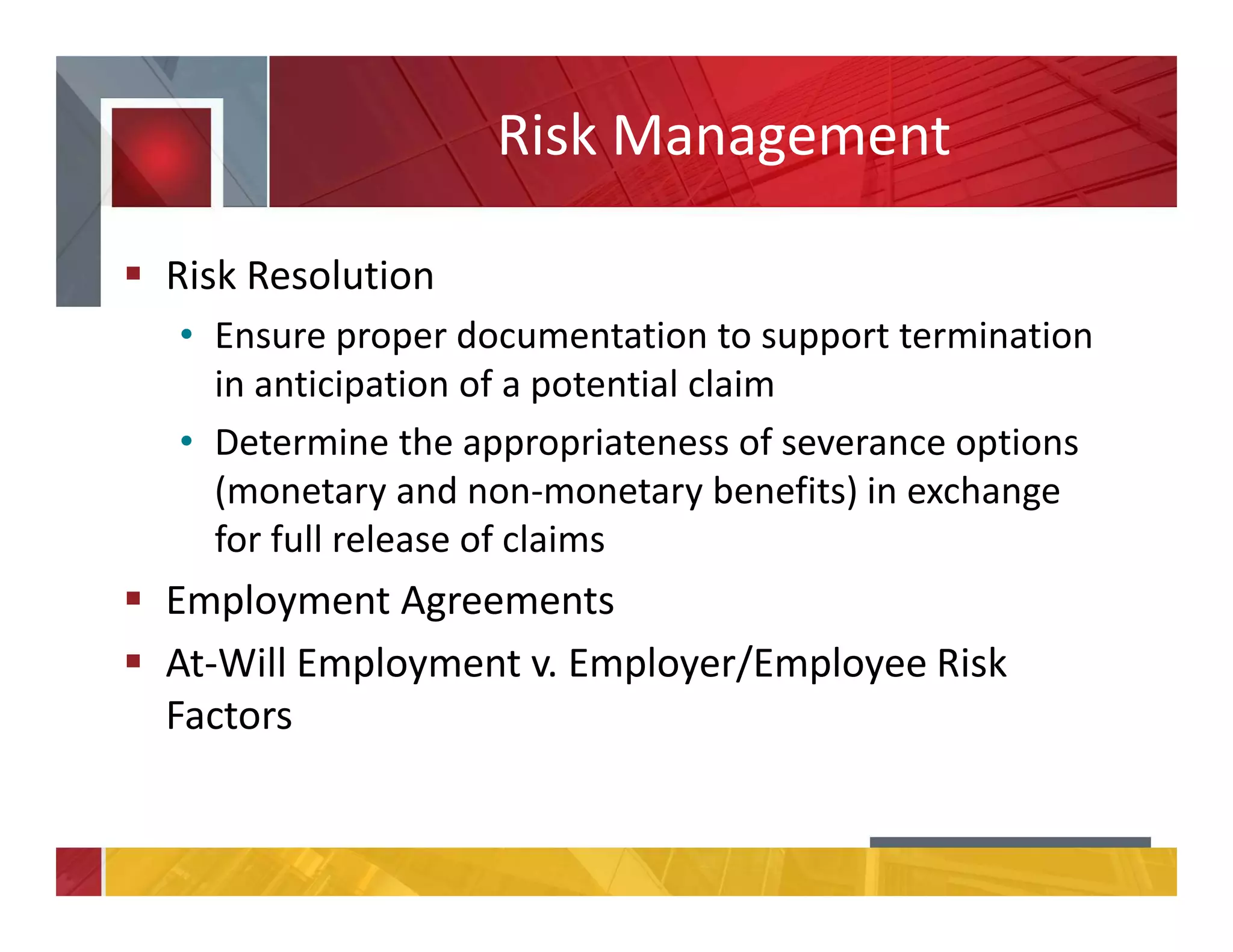
Risk Management
Risk Resolution
• Ensure proper documentation to support termination
in anticipation of a potential claim
• Determine the appropriateness of severance options
(monetary and non-monetary benefits) in exchange
for full release of claims
Employment Agreements
At-Will Employment v. Employer/Employee Risk
Factors
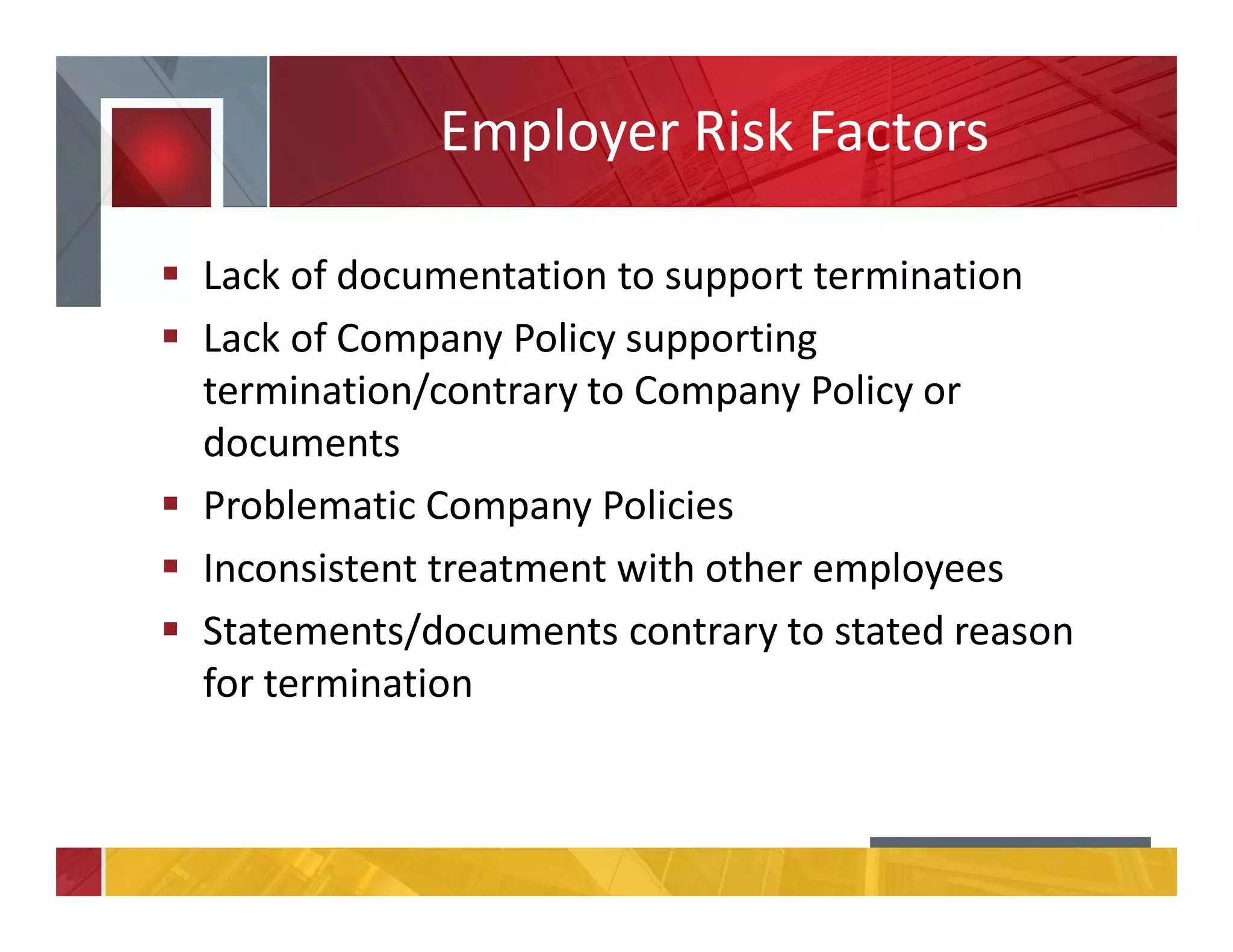
Employer Risk Factors
Lack of documentation to support termination
Lack of Company Policy supporting
termination/contrary to Company Policy or
documents
Problematic Company Policies
Inconsistent treatment with other employees
Statements/documents contrary to stated reason
for termination
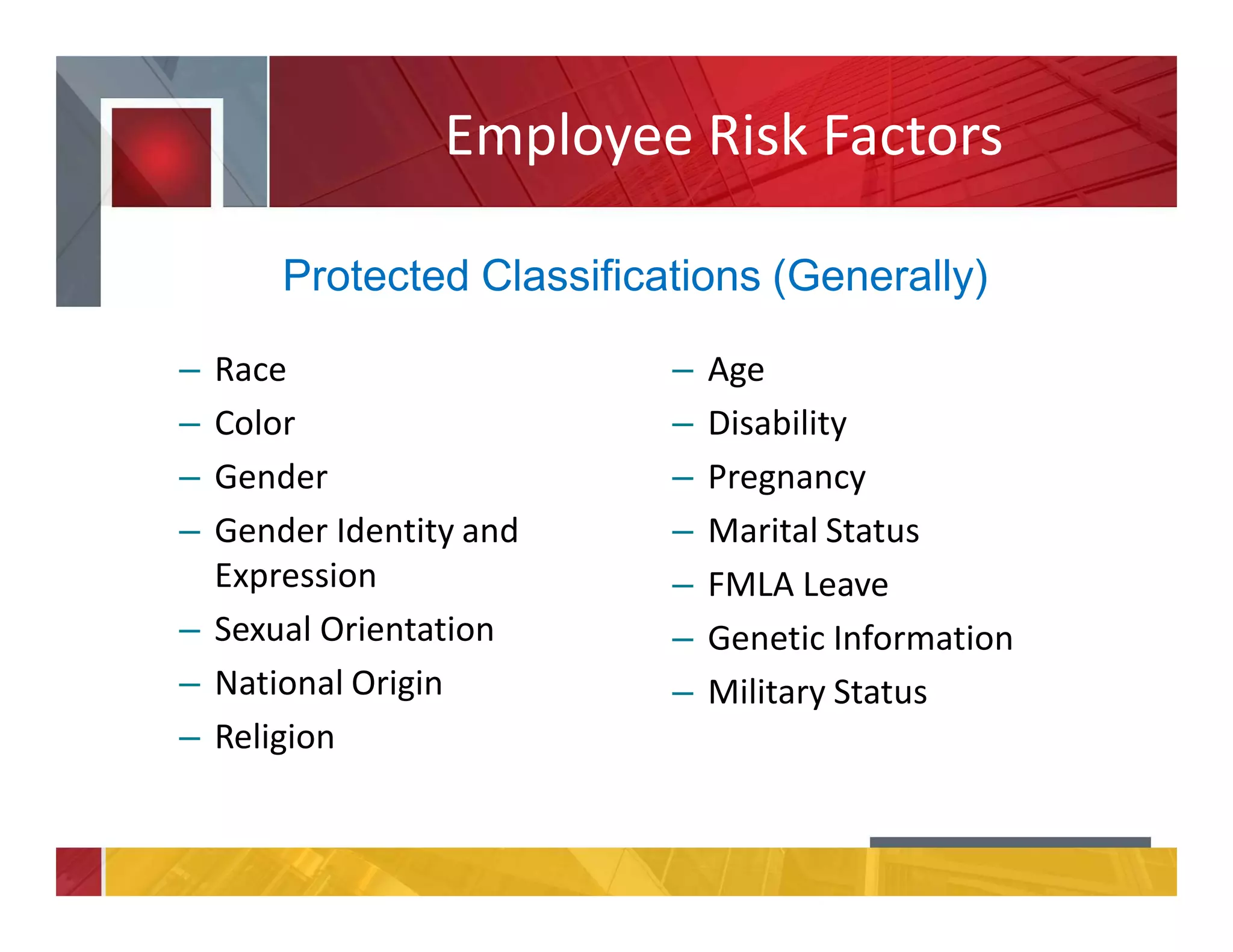
Employee Risk Factors
– Race
– Color
– Gender
– Gender Identity and
Expression
– Sexual Orientation
– National Origin
– Religion
– Age
– Disability
– Pregnancy
– Marital Status
– FMLA Leave
– Genetic Information
– Military Status
Protected Classifications (Generally)
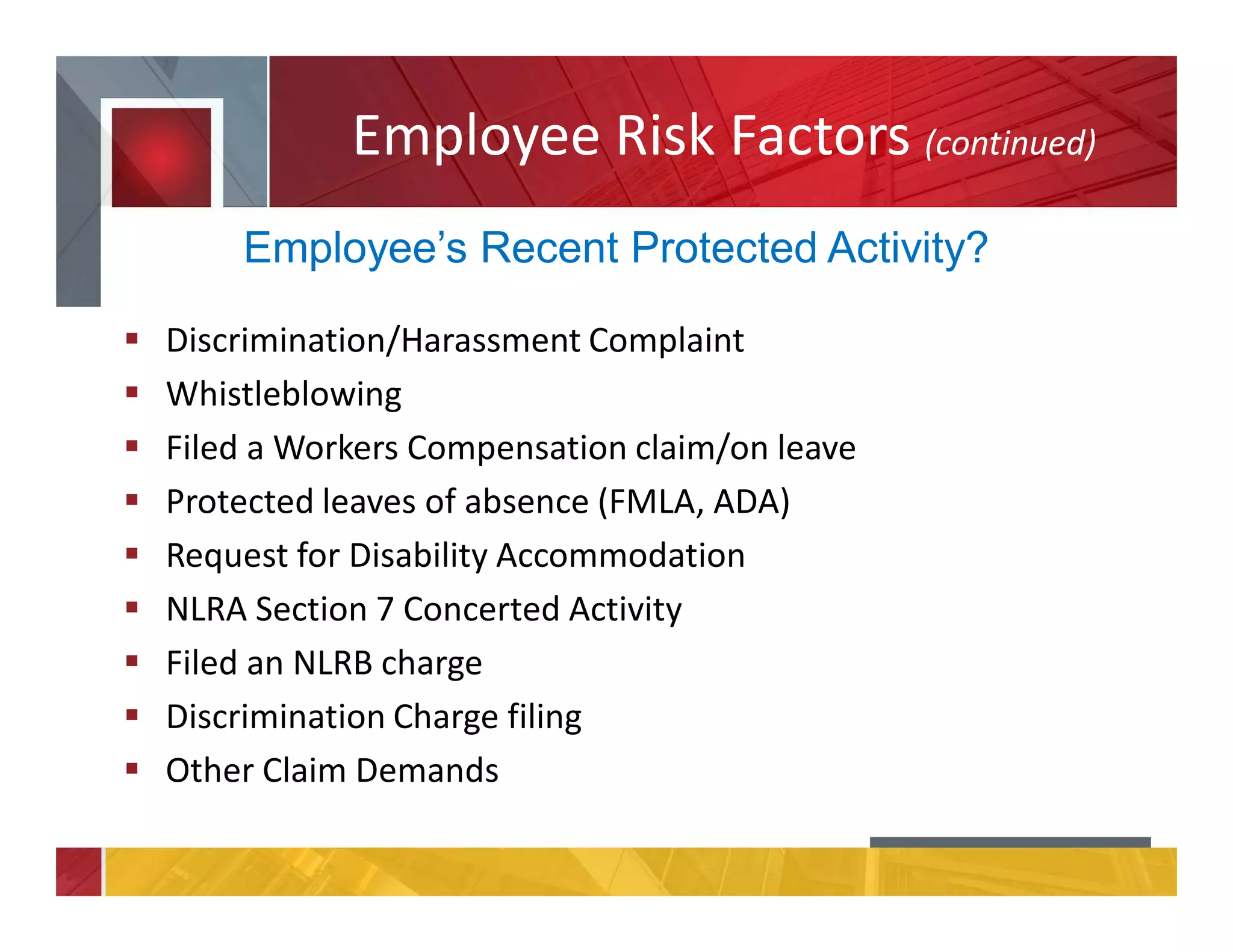
Employee Risk Factors (continued)
Discrimination/Harassment Complaint
Whistleblowing
Filed a Workers Compensation claim/on leave
Protected leaves of absence (FMLA, ADA)
Request for Disability Accommodation
NLRA Section 7 Concerted Activity
Filed an NLRB charge
Discrimination Charge filing
Other Claim Demands
Employee’s Recent Protected Activity?
Risk Management for Different
Types of Terminations
Reductions in Force (RIF) / Layoffs
• Review Employee Risk Factors for employees
selected for RIF/layoff to identify any unintended
trends
• Confer with managers to determine whether the
stated selection criteria is accurate and applied
even-handedly
• Severance agreement/release – OWBPA Exhibits
Risk Management for Different
Types of Terminations (continued)
WARN Act – Risk Management:
• Review Federal WARN Act requirements
• Review applicable State requirements (mini-WARN
Acts)
Employer Coverage thresholds vary
Exceptions vary (including sale of business)
Threshold for affected number of employees vary
Termination Meeting Considerations
Attendees on Behalf of Employer / Employee
Day and Time Issues
Location
Security Concerns
Disabling access to facility and information systems
Explanation to remaining employees
Termination Meeting Agenda
Who terminates?
Have talking points for employee conducting
termination
• Date of separation
• Reasons for separation [RIF / for cause]
• Importance of truthful reason
• If for performance or conduct, articulate disciplinary
record
• What not to say or do
• Transition to benefit discussion
Termination Meeting Agenda (continued)
Explanation of Benefits
• Availability of severance/pay in lieu of notice
• Availability of unemployment compensation
• COBRA and continuing medical coverage
• Other benefits, i.e. PTO payment, retirement, stock
options, expense reimbursement, bonuses, tuition
reimbursement, life insurance, outplacement
services
• Continuing obligations – Confidentiality/Non-
competes/ non-solicitation agreements
Termination Meeting Agenda (continued)
Employment references
Retrieval of company property
How and when will employee be allowed to
retrieve personal items?
How will employee exit the facility?
Severance and Release Considerations
Should company pay severance?
What is reasonable amount?
Is termination covered by company severance
policy?
Should a severance and release agreement be
entered?
Valid release must be in exchange for consideration
to which employee is not otherwise entitled.
Severance and Release Considerations
(continued)
What is employee’s age?
• If 40 or over, 21/45 day consideration period and 7 day
revocation period.
• If under 40, reasonable time to consider.
Is separation being offered to more than one
employee?
OWBPA
Will severance be paid in lump sum or over time?
Importance of IRS Code 409A provision.
Severance and Release Considerations
(continued)
Other provisions that must be included in
severance and release agreements
Provisions that should be included
Provisions that typically are included
Post-Termination Considerations
Let’s talk about how to protect company property
and manage post-termination claims for those
times when employees aren’t so happy.
• Protection of Intellectual Property
• Alternative Dispute Resolution
• Other Ways to Limit Claims
Protecting IP
Executed confidentiality/nondisclosure agreement.
Proactive measures at or before time of
termination to recover property and avoid
sabotage.
Enforcement of those clear, signed agreements.
• Post-termination reminder letter.
• Cease and desist.
• Litigation.
Alternative Dispute Resolution
Alternative Dispute Resolution (ADR) is an
alternative to litigation in state and federal courts.
• Mediation
• Arbitration
Benefits
• Parties control the process and select
mediator/arbitrator.
• Can be less expensive and less formal.
• Process can be quicker.
Alternative Dispute Resolution
(continued)
Benefits (continued)
• Employers have higher success rate.
• Confidentiality.
• No class actions.
Downsides
• Limited appeal rights.
• Can be as lengthy and expensive as court.
Alternative Dispute Resolution
(continued)
ADR policy or provision must be drafted correctly:
• Formation and consideration.
• Fairness.
• Mutuality.
• Class action waivers must be clear and conspicuous –
and watch out for the NLRB!
• Other statutory requirements.
• Other considerations.
• Consult with counsel.
Other Limitation of Claims
You have heard a number of ways to limit claims
today, all of which are very important to limiting
claims:
• Compliance with company policies.
• Documented reasons for termination.
• Careful evaluation of layoffs and WARN requirements.
• Severance agreements.
• Careful planning of termination meeting.
• Control of post-termination communications by other employees.
• Handling of unemployment claims.
The key—BE PREPARED!
Contact Information
Bradley G. Kafka
– bkafka@polsinelli.com
Elizabeth T. Gross
– egross@polsinelli.com
Lon R. Williams
– lonwilliams@polsinelli.com
Judy Yi
– jyi@polsinelli.com
Polsinelli PC
www.polsinelli.com
Follow us on:
– Twitter: @polsinelli and @polsinelli_LE
– LinkedIn: https://www.linkedin.com/company/polsinelli?trk=company_logo
– SlideShare: http://www.slideshare.net/Polsinelli_PC
– Blog: polsinelliatwork.com
Polsinelliprovides this material for informational purposes only. The material provided herein is general and is not intended to be legal
advice. Nothing herein should be relied upon or used withoutconsulting a lawyer to consider your specific circumstances, possible changes to
applicablelaws, rules and regulationsand other legal issues. Receipt of this material does not establish an attorney-client relationship.
Polsinelliis very proud of the results we obtain for our clients, but you should know that past results do not guaranteefuture results; that
every case is differentand must be judged on its own merits; and that the choice of a lawyer is an importantdecision and should not be
based solely upon advertisements.
© 2015 PolsinelliPC. In California, Polsinelli LLP.
Polsinelliis a registered mark of Polsinelli PC
Polsinelli is an Am Law 100 firm with more than 750 attorneys in 18 offices, serving corporations,
institutions, entrepreneurs and individuals nationally. Ranked in the top five percent of law firms for
client service and top five percent of firms for innovating new and valuable services*, the firm has risen
more than 100 spots in Am Law’s annual firm ranking over the past six years. Polsinelli attorneys
provide practical legal counsel infused with business insight, and focus on healthcare, financial services,
real estate, life sciences and technology, and business litigation. Polsinelli attorneys have depth of
experience in 100 service areas and 70 industries. The firm can be found online at www.polsinelli.com.
Polsinelli PC. In California, Polsinelli LLP.
*BTI Client Service A-Team 2015 and BTI Brand Elite 2015

Life Cycle of an Employee Termination

  • 1.
    Life Cycle ofan Employee: Termination October 8, 2015
  • 2.
    Last but NotLeast…. Today, we will discuss the conclusion of the life cycle of an employee—termination. Whether resignation, RIF, poor performance, or other reason, employers MUST plan for employment terminations. Our employment professionals are here today to offer practical, proactive advice.
  • 3.
    Documentation Previous webinars discussed(among many other things): Importance of documentation. Significance of job descriptions. Use of performance reviews. Documentation is the link between all of the other topics we have discussed in our past webinars and the actual employee termination.
  • 4.
    Reasons for Termination Employeescan be separated or terminated from employment for many reasons: • reduction in force; • termination for poor performance; • termination for misconduct; • resignation. In all of these situations, documentation is essential.
  • 5.
    Reduction in Force Reasonsfor RIFs: – Lack of certain types of work or the elimination of a product or service. – General lack of work, new efficiencies, acquisitions or sales. Selection of employees: – Criteria? – What does documentation tell the employer? – Who is performing consistently with the job description? – Who has the lowest job performance ratings?
  • 6.
    Termination for PoorPerformance More than any other situation, terminations for poor performance require thorough documentation over a period of time. • How does the employee’s performance match his/her job description? • Were there previous warnings? • Were there previous suspensions? • Was there progressive discipline and was the employee notified of prior examples of poor performance that were documented?
  • 7.
    Termination for PoorPerformance (continued) • Is the termination consistent with other situations? • Were other employees terminated for similar poor performance under similar circumstances? • Were other employees allowed to continue to work when their performance was poor? Documentation on all of these points is crucial.
  • 8.
    Termination for Misconduct Somemisconduct is so egregious that it may not require much prior documentation. Some types of misconduct may not appear to be so egregious. • However, in many situations it may be necessary to have previous documentation regarding such conduct. Unemployment benefit implications.
  • 9.
    Failure to Document Aterminated employee may argue that the stated reason for termination was not genuine, but that the termination was because of a protected classification or activity that other speakers will review in more detail. Only thorough documentation will allow an employer to demonstrate that the motives were non-discriminatory.
  • 10.
    Resignation If the employeris pleased, should action have been taken earlier? • Supervisors taking easy way out? • In process of documenting issues? If the employer is displeased with the resignation, why did employer lose a good employee? • Did employee previously communicate dissatisfaction? • Beyond employer control?
  • 11.
    Risk Management Risk Resolution •Ensure proper documentation to support termination in anticipation of a potential claim • Determine the appropriateness of severance options (monetary and non-monetary benefits) in exchange for full release of claims Employment Agreements At-Will Employment v. Employer/Employee Risk Factors
  • 12.
    Employer Risk Factors Lackof documentation to support termination Lack of Company Policy supporting termination/contrary to Company Policy or documents Problematic Company Policies Inconsistent treatment with other employees Statements/documents contrary to stated reason for termination
  • 13.
    Employee Risk Factors –Race – Color – Gender – Gender Identity and Expression – Sexual Orientation – National Origin – Religion – Age – Disability – Pregnancy – Marital Status – FMLA Leave – Genetic Information – Military Status Protected Classifications (Generally)
  • 14.
    Employee Risk Factors(continued) Discrimination/Harassment Complaint Whistleblowing Filed a Workers Compensation claim/on leave Protected leaves of absence (FMLA, ADA) Request for Disability Accommodation NLRA Section 7 Concerted Activity Filed an NLRB charge Discrimination Charge filing Other Claim Demands Employee’s Recent Protected Activity?
  • 15.
    Risk Management forDifferent Types of Terminations Reductions in Force (RIF) / Layoffs • Review Employee Risk Factors for employees selected for RIF/layoff to identify any unintended trends • Confer with managers to determine whether the stated selection criteria is accurate and applied even-handedly • Severance agreement/release – OWBPA Exhibits
  • 16.
    Risk Management forDifferent Types of Terminations (continued) WARN Act – Risk Management: • Review Federal WARN Act requirements • Review applicable State requirements (mini-WARN Acts) Employer Coverage thresholds vary Exceptions vary (including sale of business) Threshold for affected number of employees vary
  • 17.
    Termination Meeting Considerations Attendeeson Behalf of Employer / Employee Day and Time Issues Location Security Concerns Disabling access to facility and information systems Explanation to remaining employees
  • 18.
    Termination Meeting Agenda Whoterminates? Have talking points for employee conducting termination • Date of separation • Reasons for separation [RIF / for cause] • Importance of truthful reason • If for performance or conduct, articulate disciplinary record • What not to say or do • Transition to benefit discussion
  • 19.
    Termination Meeting Agenda(continued) Explanation of Benefits • Availability of severance/pay in lieu of notice • Availability of unemployment compensation • COBRA and continuing medical coverage • Other benefits, i.e. PTO payment, retirement, stock options, expense reimbursement, bonuses, tuition reimbursement, life insurance, outplacement services • Continuing obligations – Confidentiality/Non- competes/ non-solicitation agreements
  • 20.
    Termination Meeting Agenda(continued) Employment references Retrieval of company property How and when will employee be allowed to retrieve personal items? How will employee exit the facility?
  • 21.
    Severance and ReleaseConsiderations Should company pay severance? What is reasonable amount? Is termination covered by company severance policy? Should a severance and release agreement be entered? Valid release must be in exchange for consideration to which employee is not otherwise entitled.
  • 22.
    Severance and ReleaseConsiderations (continued) What is employee’s age? • If 40 or over, 21/45 day consideration period and 7 day revocation period. • If under 40, reasonable time to consider. Is separation being offered to more than one employee? OWBPA Will severance be paid in lump sum or over time? Importance of IRS Code 409A provision.
  • 23.
    Severance and ReleaseConsiderations (continued) Other provisions that must be included in severance and release agreements Provisions that should be included Provisions that typically are included
  • 24.
    Post-Termination Considerations Let’s talkabout how to protect company property and manage post-termination claims for those times when employees aren’t so happy. • Protection of Intellectual Property • Alternative Dispute Resolution • Other Ways to Limit Claims
  • 25.
    Protecting IP Executed confidentiality/nondisclosureagreement. Proactive measures at or before time of termination to recover property and avoid sabotage. Enforcement of those clear, signed agreements. • Post-termination reminder letter. • Cease and desist. • Litigation.
  • 26.
    Alternative Dispute Resolution AlternativeDispute Resolution (ADR) is an alternative to litigation in state and federal courts. • Mediation • Arbitration Benefits • Parties control the process and select mediator/arbitrator. • Can be less expensive and less formal. • Process can be quicker.
  • 27.
    Alternative Dispute Resolution (continued) Benefits(continued) • Employers have higher success rate. • Confidentiality. • No class actions. Downsides • Limited appeal rights. • Can be as lengthy and expensive as court.
  • 28.
    Alternative Dispute Resolution (continued) ADRpolicy or provision must be drafted correctly: • Formation and consideration. • Fairness. • Mutuality. • Class action waivers must be clear and conspicuous – and watch out for the NLRB! • Other statutory requirements. • Other considerations. • Consult with counsel.
  • 29.
    Other Limitation ofClaims You have heard a number of ways to limit claims today, all of which are very important to limiting claims: • Compliance with company policies. • Documented reasons for termination. • Careful evaluation of layoffs and WARN requirements. • Severance agreements. • Careful planning of termination meeting. • Control of post-termination communications by other employees. • Handling of unemployment claims. The key—BE PREPARED!
  • 30.
    Contact Information Bradley G.Kafka – bkafka@polsinelli.com Elizabeth T. Gross – egross@polsinelli.com Lon R. Williams – lonwilliams@polsinelli.com Judy Yi – jyi@polsinelli.com Polsinelli PC www.polsinelli.com Follow us on: – Twitter: @polsinelli and @polsinelli_LE – LinkedIn: https://www.linkedin.com/company/polsinelli?trk=company_logo – SlideShare: http://www.slideshare.net/Polsinelli_PC – Blog: polsinelliatwork.com
  • 31.
    Polsinelliprovides this materialfor informational purposes only. The material provided herein is general and is not intended to be legal advice. Nothing herein should be relied upon or used withoutconsulting a lawyer to consider your specific circumstances, possible changes to applicablelaws, rules and regulationsand other legal issues. Receipt of this material does not establish an attorney-client relationship. Polsinelliis very proud of the results we obtain for our clients, but you should know that past results do not guaranteefuture results; that every case is differentand must be judged on its own merits; and that the choice of a lawyer is an importantdecision and should not be based solely upon advertisements. © 2015 PolsinelliPC. In California, Polsinelli LLP. Polsinelliis a registered mark of Polsinelli PC Polsinelli is an Am Law 100 firm with more than 750 attorneys in 18 offices, serving corporations, institutions, entrepreneurs and individuals nationally. Ranked in the top five percent of law firms for client service and top five percent of firms for innovating new and valuable services*, the firm has risen more than 100 spots in Am Law’s annual firm ranking over the past six years. Polsinelli attorneys provide practical legal counsel infused with business insight, and focus on healthcare, financial services, real estate, life sciences and technology, and business litigation. Polsinelli attorneys have depth of experience in 100 service areas and 70 industries. The firm can be found online at www.polsinelli.com. Polsinelli PC. In California, Polsinelli LLP. *BTI Client Service A-Team 2015 and BTI Brand Elite 2015