Studying the Revolutionary War in Libya, it is 
one of the essential facts to an individual and 
to the society. It helps us understand the 
people/leaders behind this war, how it came 
to be a war. It contributes to the moral 
understanding of a person. This also helps us 
gain access and acquire some basic data that 
somehow affect our own lives.
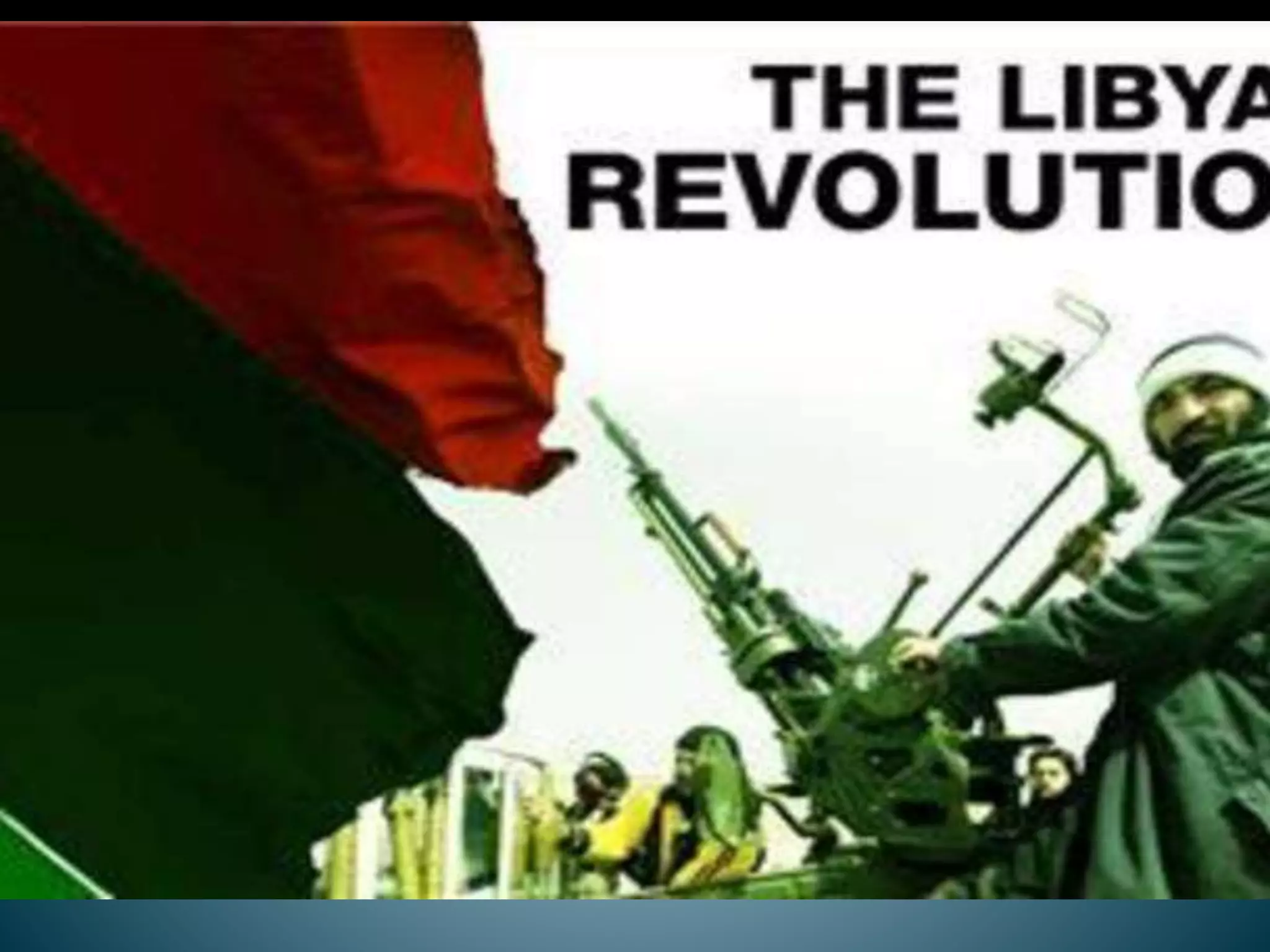
The Libyan civil war also referred as Libyan 
revolution was an armed conflict in the North 
Africa state of Libya, fought between forces loyal 
to Colonel Muammar Gaddafi and those seeking 
to oust his government. The war was preceded 
by protests in Benghazi which led to clashes 
with security forces that fired on the crowd. The 
protests escalated into a rebellion that spread 
across the country with the forces opposing 
Gaddafi establishing an interim governing body, 
the National Transnational Council.
Libya’s popular revolution has unleashed the potential 
for more diverse and inclusive growth. In the short 
term, the country faces the complex and costly tasks 
of rebuilding its economy, infrastructure, and 
institutions, and responding to the demands of its 
population, especially for improved governance. The 
conflict that accompanied the revolution had a severe 
impact on the economy, which is heavily dependent 
on hydrocarbons, but the contraction is expected to be 
temporary. The restoration of hydrocarbon 
production is already well advanced, and 
reconstruction efforts will boost non-hydrocarbon 
output growth in the coming years.
Libya’s wealth opens a choice of paths for the future: it can 
fall into the trap of many resource-rich countries that have 
become overly reliant on revenues from finite natural 
resources and failed to diversify their economies, or it can 
pursue a course of sustainable, inclusive development led by 
increased private-sector activity. In early June, the Council 
of Europe Commissioner for Human Rights, Thomas 
Hammarberg, denounced Europe’s response to such 
tragedies, noting its added responsibility to guarantee safety 
for those fleeing Libya given NATO’s military involvement in 
Libya. He urged European governments and institutions to 
accelerate their efforts and proactively seek to ensure 
successful search-and-rescue operations. He also called on 
them to put human rights considerations at the centre of 
their policy decisions.
International human rights law applies in time 
of armed conflict as well as peacetime; some (but 
not all) rights may be modified in their 
application, or “derogated from” or limited in 
situations of armed conflict, but only to the 
extent strictly required by the exigencies of the 
particular situation and without discrimination. 
At the start of the unrest in Libya, there was no 
armed conflict, and the lawfulness of conduct of 
Libyan security forces under Colonel al- Gaddafi 
was to be assessed against human rights 
standards alone.
As a consequence of the conflict, crude oil production fell to 22,000 
barrels per day in July 2011, although output was restored rapidly in 
the last quarter of 2011 to half the pre-conflict level. As a result of 
the conflict, the banking sector balance sheet is likely to have 
worsened. Economic disruption will delay some loan repayments, as 
asset quality has deteriorated (mostly through physical destruction). 
Looking ahead, Libya faces a number of challenges to establishing a 
robust, efficient, and transparent Public Financial Management 
system and to ensuring sustainable use of its hydrocarbon revenues. 
Prior to the conflict, Libya revamped its legal framework in an effort 
to improve conditions for private-sector activity. By early 2010, 22 
new laws were passed to make fundamental changes to a range of 
activities including commerce, customs, income tax, the stock market, 
labor, communication, and land registry. At the time, however, Libya 
ranked low on international measures of governance, business 
conditions, and competitiveness.
Opposition forces have detained hundreds of individuals, including civilians, in 
areas they control since the end of February. Many of those held are former ISA 
members, suspected members of the Revolutionary Committees or Revolutionary 
Guard, and people accused of “subverting the revolution”, commonly referred to 
as the “fifth column”. Foreign nationals, the overwhelming majority from Sub- 
Saharan African countries, suspected of being "mercenaries” were also held but 
have since been released. In addition, scores of soldiers from al Gaddafi forces 
captured at the front continue to be detained in Benghazi and Misratah. Amnesty 
International welcomes the access granted to the ICRC to facilities where such 
individuals are held. Several detainees, including Libyan and foreign civilians, as 
well as captured soldiers, told Amnesty International that they were tortured, in 
most cases immediately upon capture by those who seized them and in some 
cases during the first days of detention. Allegations of beatings and ill-treatment 
upon capture were frequent, and allegations of torture in detention were 
particularly common in the Zarouq detention centre in Misratah, as well as in a 
building separate from the detention facility in the 17 February military camp.
Opposition fighters have launched Grad rockets from their 
front-line positions in eastern Libya since at least March, 
more recently from the Misratah western front line around 
Dafniya and possibly from the eastern front line towards 
Tawargha. Such rockets, which are unguided and 
indiscriminate, have a range of up to 40km and pose a lethal 
danger to populated areas within that distance. They should 
never be used in areas where civilians might be located 
within the strike range. The majority of foreign nationals 
interviewed by Amnesty International who had crossed the 
border from Libya into Tunisia and Egypt said they had fled 
for several reasons, including to escape the fighting and the 
increasing attacks and harassment they were facing, and 
because they could not survive financially as the country had 
come to a virtual standstill.
Most had been allowed to flee westwards unimpeded 
by the authorities, although several said they had their 
money and phones taken by Libyan officials. When al- 
Bayda, Benghazi, Derna, Misratah and other cities first 
fell under the control of the opposition in the third 
week of February, house raids, killings, lynching and 
other violent attacks were perpetrated by supporters 
of the “17 February Revolution” against individuals 
believed to be foreign mercenaries on account of their 
skin color. Some victims were dark-skinned Libyan 
soldiers; others may well have been Sub-Saharan 
Africans.
Libya has an opportunity to break with the past, modernize the 
infrastructure of its economy, and create private-sector 
employment opportunities for its citizens. Bolstered by its sizeable 
natural resource wealth and the recovery of the hydrocarbon 
sector, a post-revolution revival in the country’s economic activity 
should be rapid once the security situation normalizes. But Libya 
will also need a sustained commitment to comprehensive reforms 
to achieve its potential. The exchange rate peg to the SDR, which 
must be accompanied by fiscal restraint to prevent inflation and a 
damaging appreciation of the real exchange rate, will continue to 
provide a policy anchor. It is crucial that Libya advance structural 
reforms to support private-sector growth, economic 
diversification, and the creation of employment for its young and 
growing labor force.
Enhancing access to finance for 
entrepreneurs by developing the nascent 
financial sector will go a long way to create 
new employment opportunities and foster the 
growth of the non-hydrocarbon economy. 
Such measures need to go hand in hand with 
strengthening the education system and 
increasing human capital. The transition to a 
new and inclusive Libya will undoubtedly be 
challenging.
To maintain the course and help mitigate the shift to 
private-sector-led growth, an efficient and 
comprehensive social safety net will be needed, as 
well as commitment by the authorities to policy 
predictability and consistency. Decision making 
should be supported by reliable data; it will be 
important to unify the compilation of national 
statistics under the umbrella of an independent 
agency, to improve the coverage, quality, and 
timeliness of statistics. Transparency will help reduce 
uncertainty, spur investor confidence, and attract the 
much-needed skilled diaspora, foreign expertise, and 
investment.
Such measures need to go hand in hand with strengthening 
the education system and increasing human capital. The 
transition to a new and inclusive Libya will undoubtedly be 
challenging. To maintain the course and help mitigate the 
shift to private-sector-led growth, an efficient and 
comprehensive social safety net will be needed, as well as 
commitment by the authorities to policy predictability and 
consistency. Decision making should be supported by 
reliable data; it will be important to unify the compilation of 
national statistics under the umbrella of an independent 
agency, to improve the coverage, quality, and timeliness of 
statistics. Transparency will help reduce uncertainty, spur 
investor confidence, and attract the much-needed skilled 
foreign expertise, and investments.
To the National Transnational Council 
Stop unlawful killings and other violent attacks 
Take measures to stop unlawful killings and other violent 
attacks against civilians and anyone who has been 
apprehended. Make clear to all fighters, including in 
public statements, that such abuses will not be tolerated 
and that perpetrators will be immediately removed from 
active duty and brought to justice. 
Stop arbitrary arrests and detentions 
Ensure that all those arbitrarily detained are released, that 
arbitrary arrests and detentions cease immediately, and 
that no one is deprived of their liberty except in 
accordance with proper criminal procedure.
Prevent torture and other ill-treatment 
Ensure that all detainees are treated humanely and held 
only in detention centres authorized by law, and that all 
detentions are promptly reviewed by a judge, in line with 
internationally-recognized standards. Detainees must 
either be charged with a recognizable criminal offence 
and promptly brought to trial in line with international 
standards for fair trial and without recourse to the death 
penalty, or released. In particular, ensure that no 
statements extracted under torture are used as a basis for 
convictions; 
Restore the rule of law 
Instruct the General Prosecutor, prosecutors, judges and 
police force to resume discharging their duties
Combat Racism 
Take steps to counter racism, xenophobia and 
discrimination against individuals with dark skin, 
including by celebrating the diverse ethnic make-up of the 
Libyan population and the positive contribution of 
migrants, including from Sub-Saharan Africa, to Libyan 
society. 
Adopt best practices identified by the UN Office of 
Disarmament Affairs to control weapons and munitions, 
and ratify the international conventions to prohibit the 
transfer and use of inhumane weapons including anti-personnel 
mines and cluster munitions.

LIBYA

  • 2.
    Studying the RevolutionaryWar in Libya, it is one of the essential facts to an individual and to the society. It helps us understand the people/leaders behind this war, how it came to be a war. It contributes to the moral understanding of a person. This also helps us gain access and acquire some basic data that somehow affect our own lives.
  • 4.
    The Libyan civilwar also referred as Libyan revolution was an armed conflict in the North Africa state of Libya, fought between forces loyal to Colonel Muammar Gaddafi and those seeking to oust his government. The war was preceded by protests in Benghazi which led to clashes with security forces that fired on the crowd. The protests escalated into a rebellion that spread across the country with the forces opposing Gaddafi establishing an interim governing body, the National Transnational Council.
  • 5.
    Libya’s popular revolutionhas unleashed the potential for more diverse and inclusive growth. In the short term, the country faces the complex and costly tasks of rebuilding its economy, infrastructure, and institutions, and responding to the demands of its population, especially for improved governance. The conflict that accompanied the revolution had a severe impact on the economy, which is heavily dependent on hydrocarbons, but the contraction is expected to be temporary. The restoration of hydrocarbon production is already well advanced, and reconstruction efforts will boost non-hydrocarbon output growth in the coming years.
  • 6.
    Libya’s wealth opensa choice of paths for the future: it can fall into the trap of many resource-rich countries that have become overly reliant on revenues from finite natural resources and failed to diversify their economies, or it can pursue a course of sustainable, inclusive development led by increased private-sector activity. In early June, the Council of Europe Commissioner for Human Rights, Thomas Hammarberg, denounced Europe’s response to such tragedies, noting its added responsibility to guarantee safety for those fleeing Libya given NATO’s military involvement in Libya. He urged European governments and institutions to accelerate their efforts and proactively seek to ensure successful search-and-rescue operations. He also called on them to put human rights considerations at the centre of their policy decisions.
  • 7.
    International human rightslaw applies in time of armed conflict as well as peacetime; some (but not all) rights may be modified in their application, or “derogated from” or limited in situations of armed conflict, but only to the extent strictly required by the exigencies of the particular situation and without discrimination. At the start of the unrest in Libya, there was no armed conflict, and the lawfulness of conduct of Libyan security forces under Colonel al- Gaddafi was to be assessed against human rights standards alone.
  • 8.
    As a consequenceof the conflict, crude oil production fell to 22,000 barrels per day in July 2011, although output was restored rapidly in the last quarter of 2011 to half the pre-conflict level. As a result of the conflict, the banking sector balance sheet is likely to have worsened. Economic disruption will delay some loan repayments, as asset quality has deteriorated (mostly through physical destruction). Looking ahead, Libya faces a number of challenges to establishing a robust, efficient, and transparent Public Financial Management system and to ensuring sustainable use of its hydrocarbon revenues. Prior to the conflict, Libya revamped its legal framework in an effort to improve conditions for private-sector activity. By early 2010, 22 new laws were passed to make fundamental changes to a range of activities including commerce, customs, income tax, the stock market, labor, communication, and land registry. At the time, however, Libya ranked low on international measures of governance, business conditions, and competitiveness.
  • 9.
    Opposition forces havedetained hundreds of individuals, including civilians, in areas they control since the end of February. Many of those held are former ISA members, suspected members of the Revolutionary Committees or Revolutionary Guard, and people accused of “subverting the revolution”, commonly referred to as the “fifth column”. Foreign nationals, the overwhelming majority from Sub- Saharan African countries, suspected of being "mercenaries” were also held but have since been released. In addition, scores of soldiers from al Gaddafi forces captured at the front continue to be detained in Benghazi and Misratah. Amnesty International welcomes the access granted to the ICRC to facilities where such individuals are held. Several detainees, including Libyan and foreign civilians, as well as captured soldiers, told Amnesty International that they were tortured, in most cases immediately upon capture by those who seized them and in some cases during the first days of detention. Allegations of beatings and ill-treatment upon capture were frequent, and allegations of torture in detention were particularly common in the Zarouq detention centre in Misratah, as well as in a building separate from the detention facility in the 17 February military camp.
  • 10.
    Opposition fighters havelaunched Grad rockets from their front-line positions in eastern Libya since at least March, more recently from the Misratah western front line around Dafniya and possibly from the eastern front line towards Tawargha. Such rockets, which are unguided and indiscriminate, have a range of up to 40km and pose a lethal danger to populated areas within that distance. They should never be used in areas where civilians might be located within the strike range. The majority of foreign nationals interviewed by Amnesty International who had crossed the border from Libya into Tunisia and Egypt said they had fled for several reasons, including to escape the fighting and the increasing attacks and harassment they were facing, and because they could not survive financially as the country had come to a virtual standstill.
  • 11.
    Most had beenallowed to flee westwards unimpeded by the authorities, although several said they had their money and phones taken by Libyan officials. When al- Bayda, Benghazi, Derna, Misratah and other cities first fell under the control of the opposition in the third week of February, house raids, killings, lynching and other violent attacks were perpetrated by supporters of the “17 February Revolution” against individuals believed to be foreign mercenaries on account of their skin color. Some victims were dark-skinned Libyan soldiers; others may well have been Sub-Saharan Africans.
  • 12.
    Libya has anopportunity to break with the past, modernize the infrastructure of its economy, and create private-sector employment opportunities for its citizens. Bolstered by its sizeable natural resource wealth and the recovery of the hydrocarbon sector, a post-revolution revival in the country’s economic activity should be rapid once the security situation normalizes. But Libya will also need a sustained commitment to comprehensive reforms to achieve its potential. The exchange rate peg to the SDR, which must be accompanied by fiscal restraint to prevent inflation and a damaging appreciation of the real exchange rate, will continue to provide a policy anchor. It is crucial that Libya advance structural reforms to support private-sector growth, economic diversification, and the creation of employment for its young and growing labor force.
  • 13.
    Enhancing access tofinance for entrepreneurs by developing the nascent financial sector will go a long way to create new employment opportunities and foster the growth of the non-hydrocarbon economy. Such measures need to go hand in hand with strengthening the education system and increasing human capital. The transition to a new and inclusive Libya will undoubtedly be challenging.
  • 14.
    To maintain thecourse and help mitigate the shift to private-sector-led growth, an efficient and comprehensive social safety net will be needed, as well as commitment by the authorities to policy predictability and consistency. Decision making should be supported by reliable data; it will be important to unify the compilation of national statistics under the umbrella of an independent agency, to improve the coverage, quality, and timeliness of statistics. Transparency will help reduce uncertainty, spur investor confidence, and attract the much-needed skilled diaspora, foreign expertise, and investment.
  • 15.
    Such measures needto go hand in hand with strengthening the education system and increasing human capital. The transition to a new and inclusive Libya will undoubtedly be challenging. To maintain the course and help mitigate the shift to private-sector-led growth, an efficient and comprehensive social safety net will be needed, as well as commitment by the authorities to policy predictability and consistency. Decision making should be supported by reliable data; it will be important to unify the compilation of national statistics under the umbrella of an independent agency, to improve the coverage, quality, and timeliness of statistics. Transparency will help reduce uncertainty, spur investor confidence, and attract the much-needed skilled foreign expertise, and investments.
  • 16.
    To the NationalTransnational Council Stop unlawful killings and other violent attacks Take measures to stop unlawful killings and other violent attacks against civilians and anyone who has been apprehended. Make clear to all fighters, including in public statements, that such abuses will not be tolerated and that perpetrators will be immediately removed from active duty and brought to justice. Stop arbitrary arrests and detentions Ensure that all those arbitrarily detained are released, that arbitrary arrests and detentions cease immediately, and that no one is deprived of their liberty except in accordance with proper criminal procedure.
  • 17.
    Prevent torture andother ill-treatment Ensure that all detainees are treated humanely and held only in detention centres authorized by law, and that all detentions are promptly reviewed by a judge, in line with internationally-recognized standards. Detainees must either be charged with a recognizable criminal offence and promptly brought to trial in line with international standards for fair trial and without recourse to the death penalty, or released. In particular, ensure that no statements extracted under torture are used as a basis for convictions; Restore the rule of law Instruct the General Prosecutor, prosecutors, judges and police force to resume discharging their duties
  • 18.
    Combat Racism Takesteps to counter racism, xenophobia and discrimination against individuals with dark skin, including by celebrating the diverse ethnic make-up of the Libyan population and the positive contribution of migrants, including from Sub-Saharan Africa, to Libyan society. Adopt best practices identified by the UN Office of Disarmament Affairs to control weapons and munitions, and ratify the international conventions to prohibit the transfer and use of inhumane weapons including anti-personnel mines and cluster munitions.