 It is a peninsula on the eastern coast of Asia, it is 
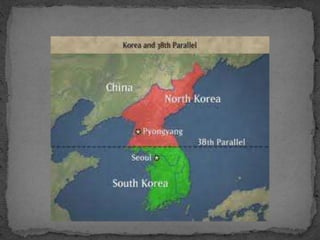
divided into North Korea and South Korea 
 It runs along 38°N parallel for 148 miles (238 km) 
between the Sea of Japan in the east and the Yellow 
sea in the west.
 North Korea is bounded in the North east by Russia 
and in the north by China, in the east by the Sea of 
Japan, in the south by South Korea, and in the west 
by the Yellow sea. 
 Capital: P’yongyang 
 A multiparty state 
 Has one of the world’s largest army
 South Korea is a peninsular country in eastern Asia 
 Its only land boundary is in the North with North 
Korea. 
 Capital: Seoul 
 More westernized
 Peninsula was divided into two nations; One supported by 
the United States and the other by the Soviet Union and 
China. 
 In June 1950, North Korea invaded South Korea 
 The invasion was the idea of North Korean premier Kim II 
Sung 
 the risk that China would enter the war was accepted 
willingly by General Douglas McArthur 
 38th parallel as a military division 
 Dwight Eisenhower 
 Tension with South Korea eased dramatically in June 
2000, when South Korea’s President met with North 
Korea’s President in Pyongyang and it marked the first 
ever meeting of the two countries’ leaders.
 The invasion was the idea of Kim II Sung, who 
managed to convince Stalin that the South Koreans 
would greet the Northerners as liberators, thus 
ensuring an easy, quick victory for the North. 
 The risk that China would enter the war was accepted 
willingly by General McArthur because they were so 
sure that the Chinese won’t intervene but the Chinese 
did intervene. 
 Expanding Communism in Korea 
 The rise of Cold War tensions between Communist 
and non-Communist nations. 
 The divided Korea using the 38th parallel
 High number of casualties in North Korea and South 
Korea 
 widened the gap between the United States and the 
Soviet Union on the issue of communism 
 South Korea is now an economic power while North 
Korea suffers deep poverty.
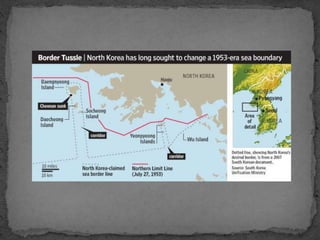
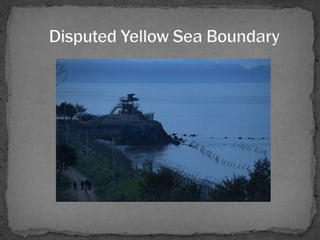
Border Dispute: The North Korea and South Korea

Border Dispute: The North Korea and South Korea

  • 2.
     It isa peninsula on the eastern coast of Asia, it is divided into North Korea and South Korea  It runs along 38°N parallel for 148 miles (238 km) between the Sea of Japan in the east and the Yellow sea in the west.
  • 3.
     North Koreais bounded in the North east by Russia and in the north by China, in the east by the Sea of Japan, in the south by South Korea, and in the west by the Yellow sea.  Capital: P’yongyang  A multiparty state  Has one of the world’s largest army
  • 4.
     South Koreais a peninsular country in eastern Asia  Its only land boundary is in the North with North Korea.  Capital: Seoul  More westernized
  • 5.
     Peninsula wasdivided into two nations; One supported by the United States and the other by the Soviet Union and China.  In June 1950, North Korea invaded South Korea  The invasion was the idea of North Korean premier Kim II Sung  the risk that China would enter the war was accepted willingly by General Douglas McArthur  38th parallel as a military division  Dwight Eisenhower  Tension with South Korea eased dramatically in June 2000, when South Korea’s President met with North Korea’s President in Pyongyang and it marked the first ever meeting of the two countries’ leaders.
  • 6.
     The invasionwas the idea of Kim II Sung, who managed to convince Stalin that the South Koreans would greet the Northerners as liberators, thus ensuring an easy, quick victory for the North.  The risk that China would enter the war was accepted willingly by General McArthur because they were so sure that the Chinese won’t intervene but the Chinese did intervene.  Expanding Communism in Korea  The rise of Cold War tensions between Communist and non-Communist nations.  The divided Korea using the 38th parallel
  • 7.
     High numberof casualties in North Korea and South Korea  widened the gap between the United States and the Soviet Union on the issue of communism  South Korea is now an economic power while North Korea suffers deep poverty.