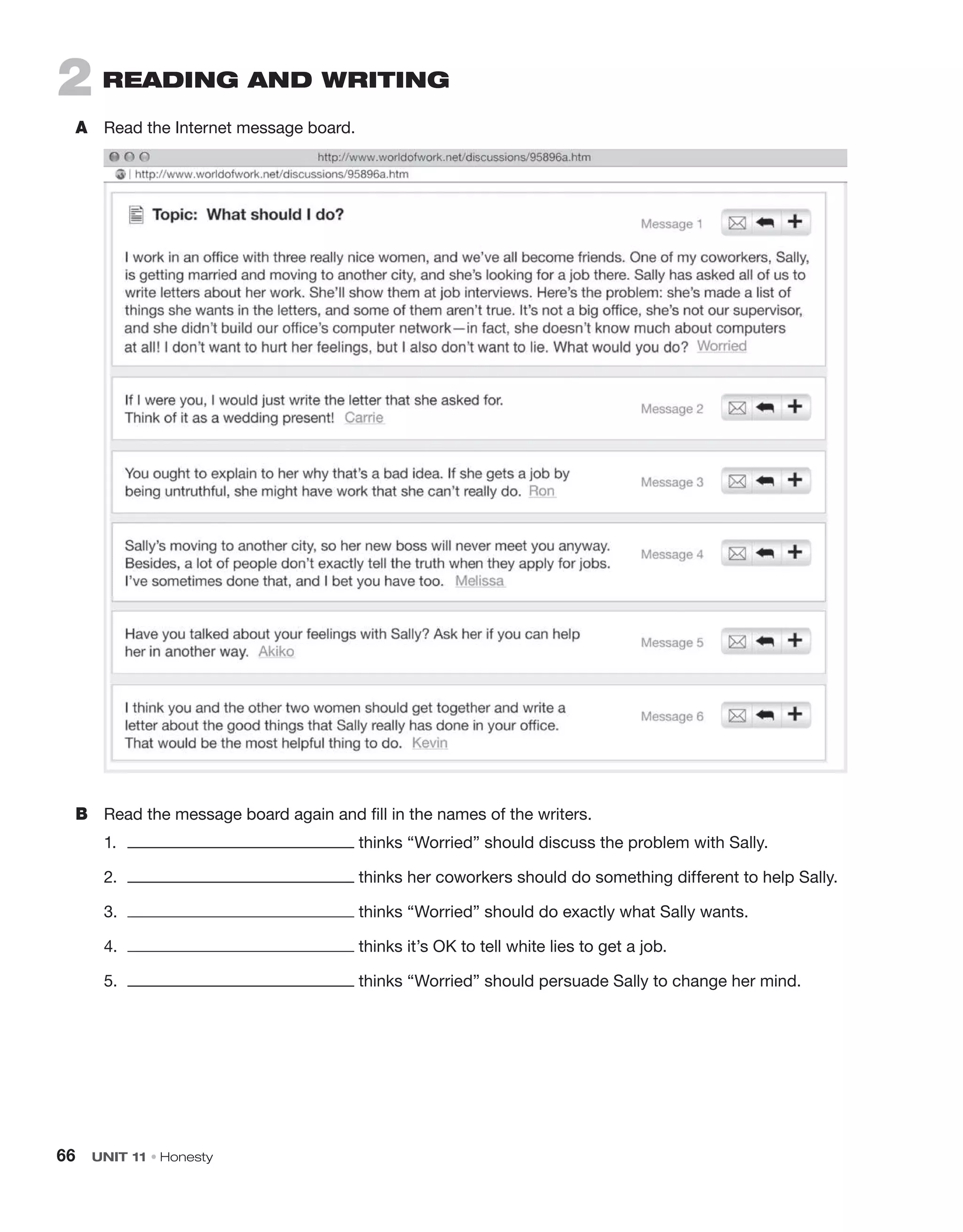
ICPNA offers more than English…
EducationUSA and International Exams Center
At ICPNA, you will find all the necessary information
on how to obtain a professional degree in the United
States. ICPNA also prepares students for different
international certification exams.
Library
ICPNA promotes and encourages positive reading
habits through books and cultural activities. All of our
libraries hold a large collection of periodicals, books,
dictionaries, encyclopedias and videos in both English
and Spanish.
Cultural Programs
The Cultural Area at ICPNA offers diverse programs
related to theater, music, dance and the visual arts
at our different galleries and auditoriums. These
programs are implemented with the most modern,
up-to-date technology.
For more information visit us at www.icpna.edu.pe
Nancy Douglas    James R. Morgan INTERMEDIATE 4
Developing
English Fluency
T HIR D EDIT ION
James R. Morgan Nancy Douglas
WORLDLINK Developing
English Fluency
THIRD ED ITION
INTRO Nancy Douglas James R. Morgan
1
WORLDLINK Developing
English Fluency
THIRD EDITION
James R. Morgan Nancy Douglas
2
WORLDLINK Developing
English Fluency
THIRD EDITION
Nancy Douglas James R. Morgan
3
WORLDLINK Developing
English Fluency
THIRD EDITION
WORLDLINK
INTERMEDIATE
4
WORLDLINK
Bringing the world to the classroom
and the classroom to life
NGL.Cengage.com/ELT
A Part of Cengage
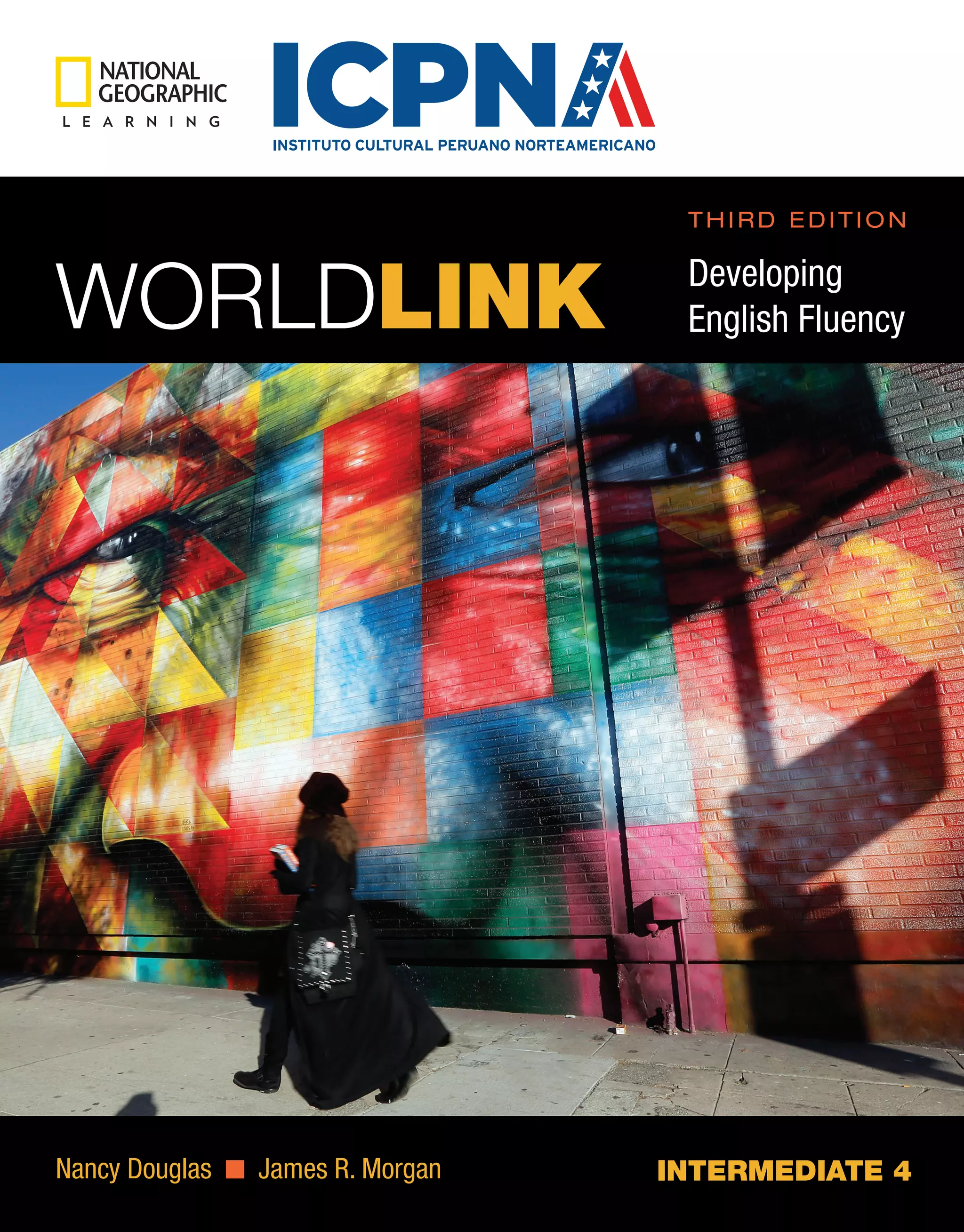
Front cover art by Eduardo Kobra in
Los Angeles, California.
©AP Images/Reed Saxon
ABOUT THE ARTIST
Brazilian muralist Eduardo Kobra creates
large-scale, colorful murals of notable
people in cities around the world.
WORLDLINK
Nancy Douglas
James R. Morgan
Intermediate 4
Developing
English Fluency
Australia • Brazil • Mexico • Singapore • United Kingdom • United States
ICPNA World Link Intermediate 4,
Third Edition
Nancy Douglas, Author
James R. Morgan, Author
Susan Stempleski, Series Editor
Publisher: Sherrise Roehr
Executive Editor: Sarah Kenney
Managing Development Editor: Claudi Mimo
Senior Development Editor: Margarita Matte
Senior Development Editor: Brenden Layte
Associate Development Editor: Alison Bruno
Assistant Editor: Becky Long
Media Researcher: Leila Hishmeh
Senior Technology Product Manager:
 Lauren Krolick
Director of Global Marketing: Ian Martin
Senior Product Marketing Manager:
 Caitlin Thomas
Sr. Director, ELT & World Languages:
 Michael Burggren
Production Manager: Daisy Sosa
Senior Print Buyer: Mary Beth Hennebury
Composition: Lumina Datamatics, Inc.
Cover/Text Design: Brenda Carmichael
Art Director: Brenda Carmichael
Cover Image: Reed Saxon/Associated Press
Inside Front Cover Image: AFP/Getty Images
Printed in Peru
Print Number: 01  Print Year: 2017
© 2017, 2013, 2007 National Geographic Learning, a Cengage Learning Company
ALL RIGHTS RESERVED. No part of this work covered by the copyright herein
may be reproduced or distributed in any form or by any means, except as
­
permitted by U.S. copyright law, without the prior written permission of the
copyright owner.
“National Geographic”, “National Geographic Society” and the Yellow Border
Design are registered trademarks of the National Geographic Society
® Marcas Registradas
ICPNA World Link Intermediate 4
ISBN: 978-1-337-29644-1
National Geographic Learning
20 Channel Center Street
Boston, MA 02210
USA
National Geographic Learning, a Cengage Learning Company, has a mission to
bring the world to the classroom and the classroom to life. With our English lan-
guage programs, students learn about their world by experiencing it. Through
our partnerships with National Geographic and TED Talks, they develop the
language and skills they need to be successful global citizens and leaders.
Locate your local office at international.cengage.com/region
Visit National Geographic Learning online at NGL.Cengage.com/ELT
Visit our corporate website at www.cengage.com
For product information and technology assistance, contact us at
Cengage Learning Customer & Sales Support, cengage.com/contact
For permission to use material from this text or product,
submit all requests online at cengage.com/permissions
Further permissions questions can be emailed to
permissionrequest@cengage.com
 iii
Acknowledgment
We would like to extend a very special thank you to the Instituto Cultural Peruano
Norteamericano (ICPNA) academic management staff in the central office, branches,
and teachers, for the helpful insights and suggestions that contributed toward the
development of this series.
GUIDE TO PRONUNCIATION SYMBOLS
Vowels Consonants
Symbol Key Word Pronunciation Symbol Key Word Pronunciation
/ɑ/ hot /hɑt/ /b/ boy /bɔɪ/
far /fɑr/ /d/ day /deɪ/
/æ/ cat /kæt/ /ʤ/ just /ʤʌst/
/aɪ/ fine /faɪn/ /f/ face /feɪs/
/aʊ/ house /haʊs/ /g/ get /gɛt/
/ɛ/ bed /bɛd/ /h/ hat /hæt/
/eɪ/ name /neɪm/ /k/ car /kɑr/
/i/ need /nid/ /l/ light /laɪt/
/ɪ/ sit /sɪt/ /m/ my /maɪ/
/oʊ/ go /goʊ/ /n/ nine /naɪn/
/ʊ/ book /bʊk/ /ŋ/ sing /sɪŋ/
/u/ boot /but/ /p/ pen /pɛn/
/ɔ/ dog /dɔg/ /r/ right /raɪt/
four /fɔr/ /s/ see /si/
/ɔɪ/ toy /tɔɪ/ /t/ tea /ti/
/ʌ/ cup /kʌp/ /ʧ/ cheap /ʧip/
/ɜr/ bird /bɜrd/ /v/ vote /voʊt/
/ɛr/ error /’ɛrər/ /w/ west /wɛst/
/ə/ about /ə’baʊt/ /y/ yes /yɛs/
after /’æftər/ /z/ zoo /zu/
/ð/ they /ðeɪ/
/θ/ think /θɪŋk/
/ʃ/ shoe /ʃu/
/ʒ/ vision /’vɪʒən/
Stress
/ˈ/ city /ˈsɪti/
used before a syllable to show primary (main) stress
/̩/ dictionary /ˈdɪkʃə ̩nɛri/
used before a syllable to show secondary stress
ICPNA
Track 2
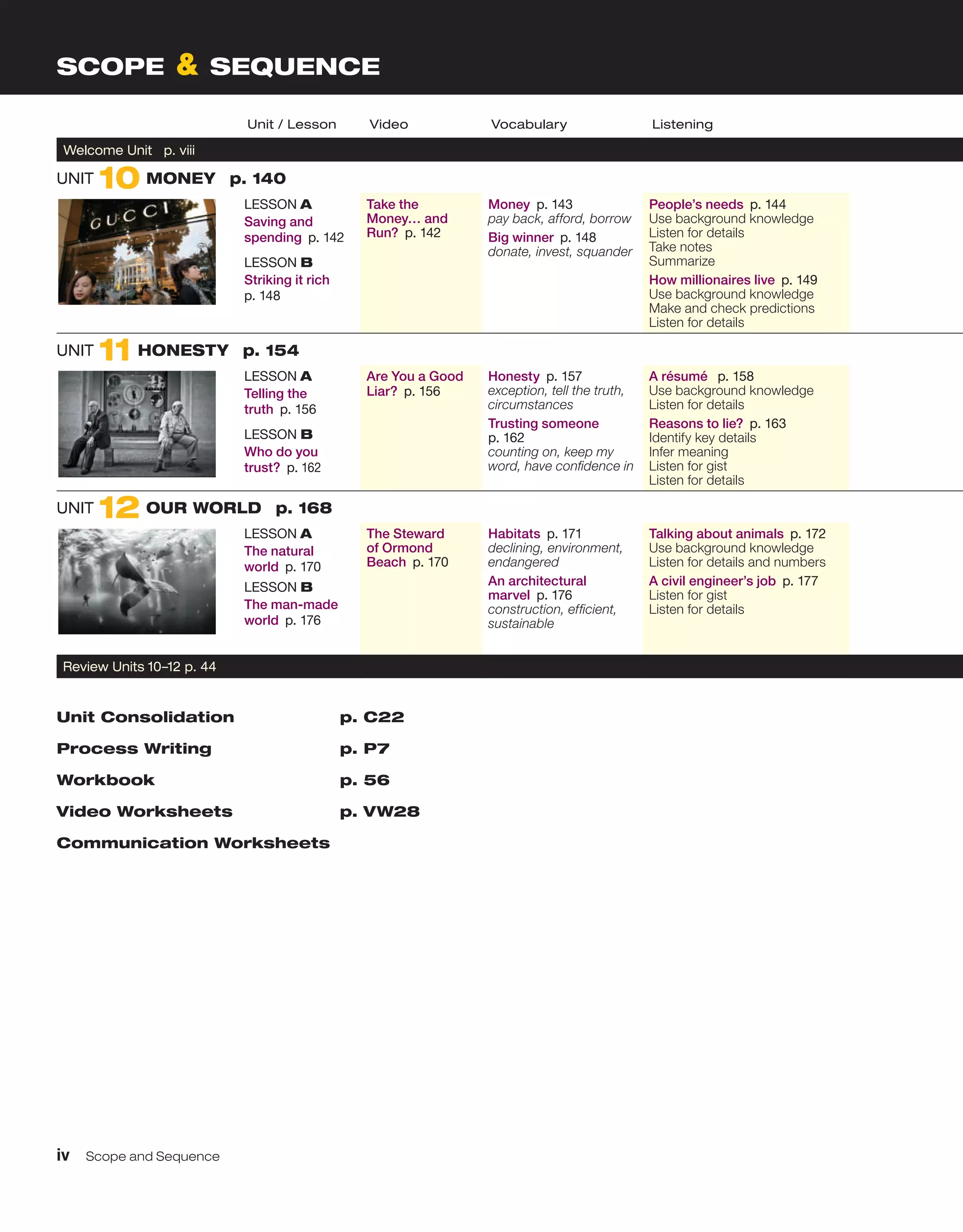
Unit / Lesson Video Vocabulary Listening
Welcome Unit  p. viii
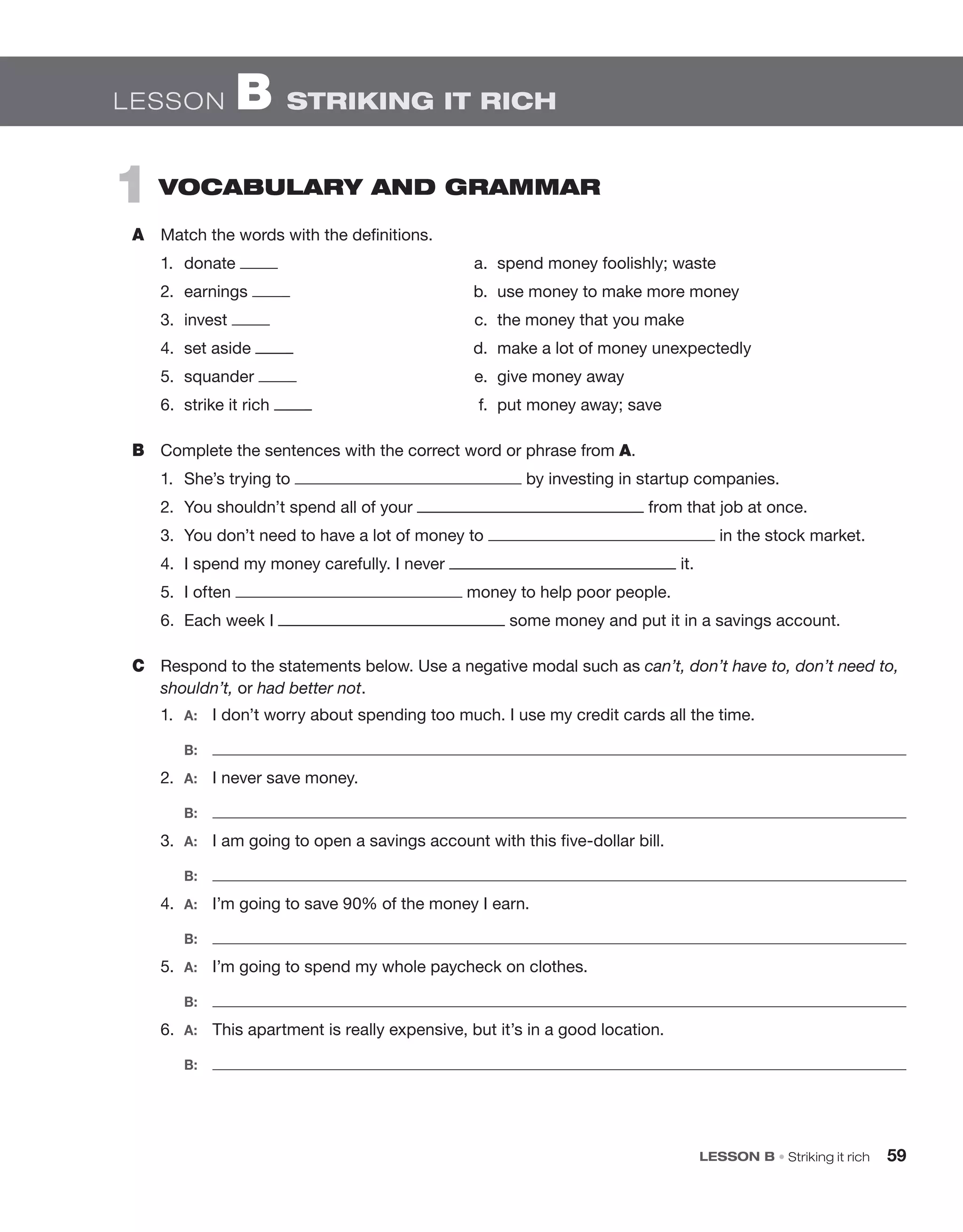
Unit 10 money  p. 140
Lesson A
Saving and
spending  p. 142
Lesson B
Striking it rich 
p. 148
Take the
Money… and
Run?  p. 142
Money  p. 143
pay back, afford, borrow
Big winner  p. 148
donate, invest, squander
People’s needs  p. 144
Use background knowledge
Listen for details
Take notes
Summarize
How millionaires live  p. 149
Use background knowledge
Make and check predictions
Listen for details
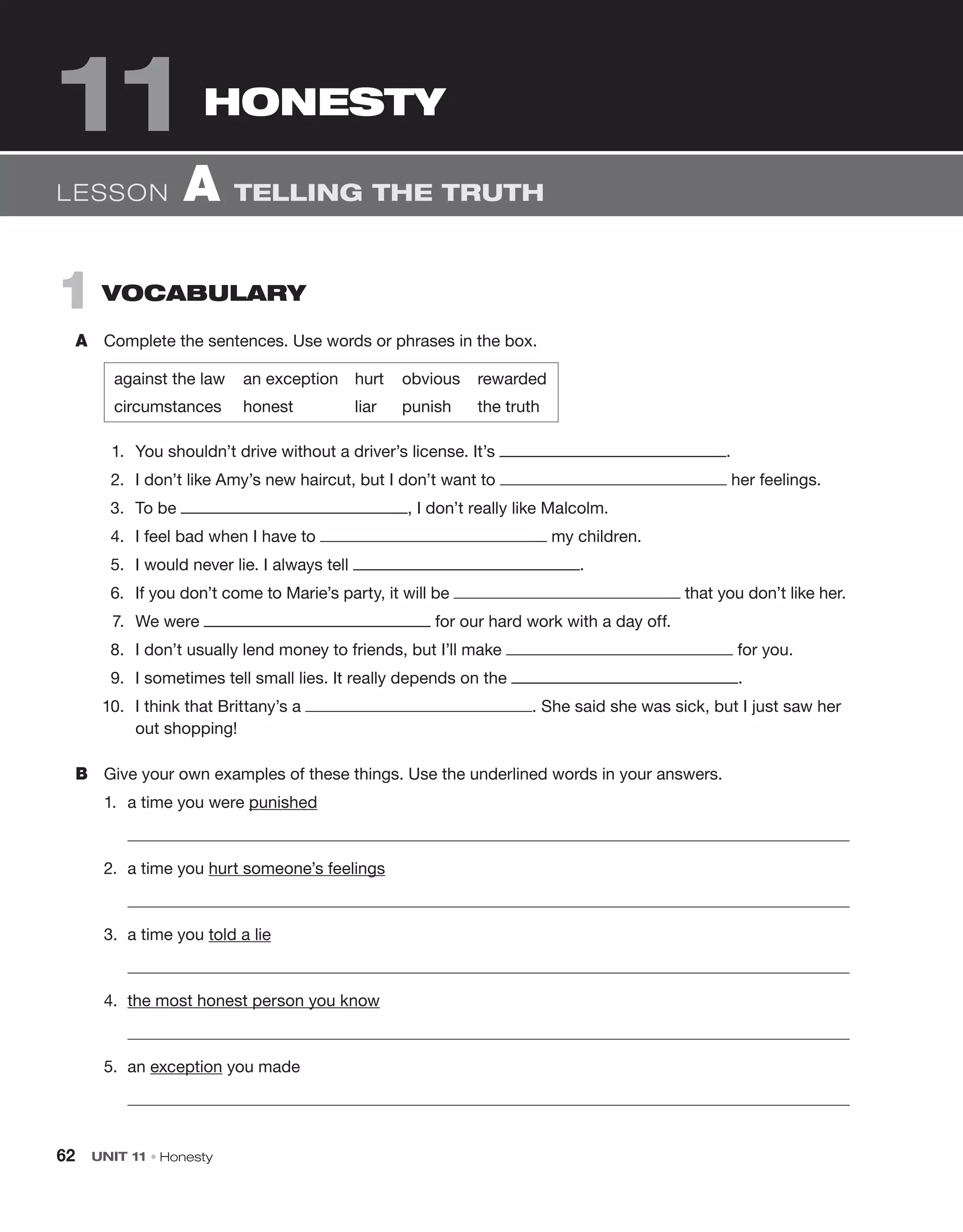
Unit 11 honesty  p. 154
Lesson A
Telling the
truth  p. 156
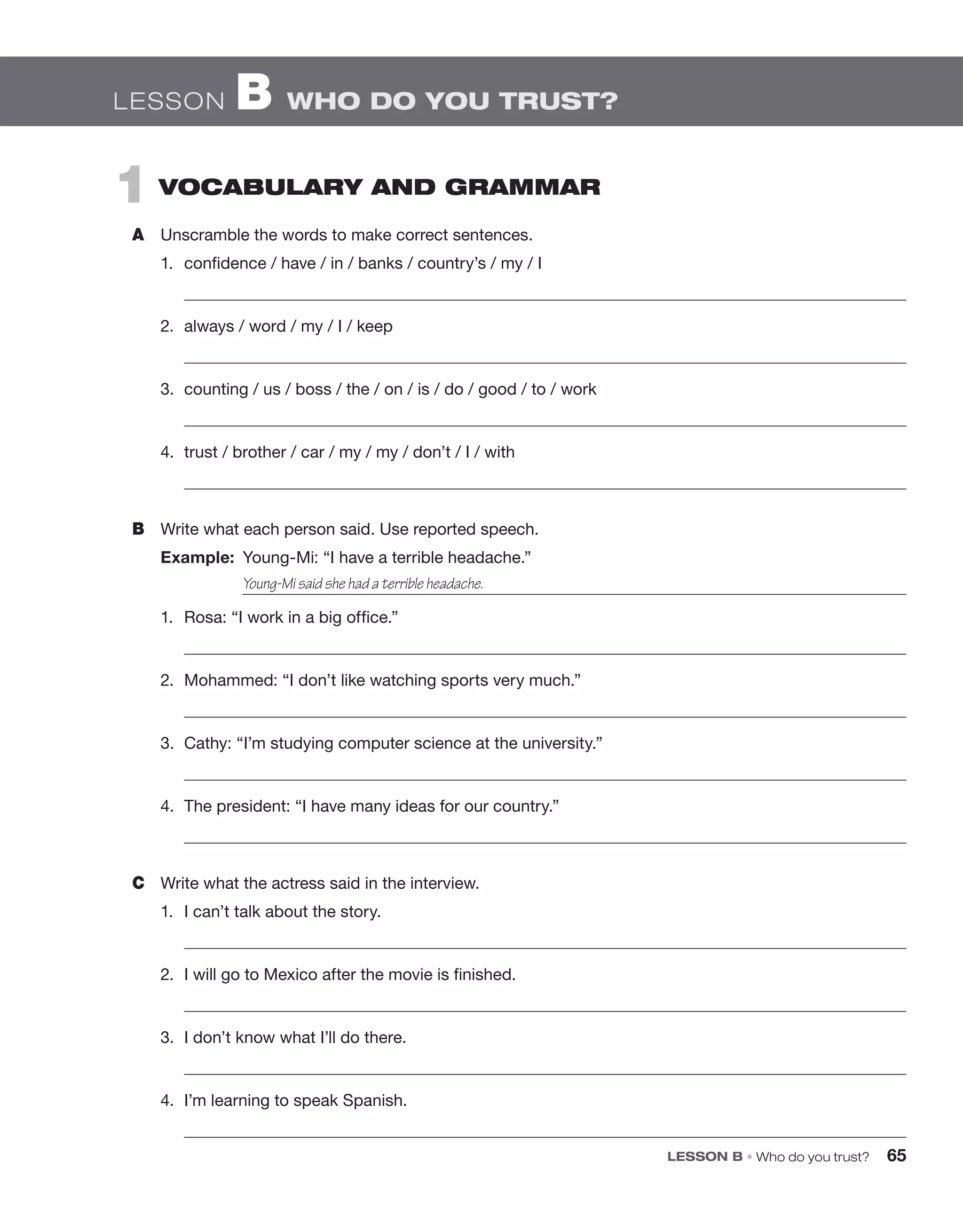
Lesson B
Who do you
trust?  p. 162
Are You a Good
Liar?  p. 156
Honesty  p. 157
exception, tell the truth,
circumstances
Trusting someone 
p. 162
counting on, keep my
word, have confidence in
A résumé   p. 158
Use background knowledge
Listen for details
Reasons to lie?  p. 163
Identify key details
Infer meaning
Listen for gist
Listen for details
Unit 12 our world  p. 168
Lesson A
The natural
world  p. 170
Lesson B
The man-made
world  p. 176
The Steward
of Ormond
Beach  p. 170
Habitats  p. 171
declining, environment,
endangered
An architectural
marvel  p. 176
construction, efficient,
sustainable
Talking about animals  p. 172
Use background knowledge
Listen for details and numbers
A civil engineer’s job  p. 177
Listen for gist
Listen for details
Review Units 10–12 p. 44
Unit Consolidation	 p. C22
Process Writing 	 p. P7
Workbook	 p. 56
Video Worksheets	 p. VW28
Communication Worksheets
SCOPE & SEQUENCE
iv  Scope and Sequence
Grammar Pronunciation Speaking Reading Writing Communication
Wish statements 
pp. 146, 212
Negative modals 
pp. 152, 213
Word final /t/
and /d/  p. 152
Apologizing
and accepting
an apology 
p. 145
Money from unusual
sources  p. 150
Make predictions
Read for details
Infer meaning
Compare and evaluate
Give an opinion
on the best
way to donate
money  p. 153
Renting an apartment 
p. 147
Persuading someone
to donate money 
p. 153
Present unreal
conditionals  pp. 160,
214
Reported statements
with say and tell  pp. 166,
215
Repeating
with rising
intonation
to show
surprise  p. 158
Giving strong
advice  p. 159
The kindness of
strangers  p. 164
Make connections
Make predictions
Sequence events
Infer meaning
Describe a lie 
p. 167
Talking about
dishonest actions 
p. 161
Explaining your
actions  p. 167
Embedded questions 
pp. 174, 216
The passive with various
tenses  pp. 180, 217
Negative
questions
to confirm
information 
p. 177
Offering
another
opinion  p. 173
When the seas rise  p. 178
Use background knowledge
Make predictions
Take notes on key details
Infer meaning
Summarize
Give opinions
Give an opinion
on new
construction 
p. 181
Taking a quiz about
the world  p. 175
Choosing a civic
project  p. 181
u n i t s   10–12
Language Summaries p. 191 Grammar Notes p. 212
	 Scope and Sequence v
Cover: AP Images/Reed Saxon, Back Cover: ICPNA Owned
ix (bl) OJO Images/Getty Images, 140–141 CATHERINE KARNOW/National Geographic Creative, 142 (t) PHB.cz
(Richard Semik)/Shutterstock.com, 143 (b) STACY GOLD/National Geographic Creative, 144 (tl) Fedor
Korolevskiy/Shutterstock.com, (tr) Africa Studio/ShutterStock.com, (cl) Monkey Business Images/Shutterstock.
com, (c) alexmisu/Shutterstock.com, (cr) Monkey Business Images/Shutterstock.com, 146 (br) JOEL SARTORE/
National Geographic Creative, 147 (br) Thor Engelstad/Getty Images, 148 (t) Cylonphoto/Shutterstock.com,
149 (tr) Sisoje/Getty Images, 150–151 Roger De La Harpe; Gallo Images/CORBIS, 151 (tl) ReligiousStock/Alamy
Stock Photo, 152 (br) Echo/Getty Images, 154–155 Emanuele Toscano/500px Prime, 156 (t) selimaksan/Getty
Images, 158 (tr) Alexander Raths/Shutterstock.com, 159 (tr) Pavlo_K/Getty Images, 160 (br) Pavlo_K/
Getty Images, 161 (tl) Cultura RM/Sian Kennedy/Getty Images, (tc) Grigory Shigrev/Shutterstock.com,
(tr) fiphoto/Shutterstock.com, (cl) Image Source/Getty Images, (c) wavebreakmedia/Shutterstock.com,
(cr) bikeriderlondon/Shutterstock.com, 162 (t) CATHERINE KARNOW/National Geographic Creative,
163 (b) digitalskillet/Getty Images, 164–165 Dave and Les Jacobs/Getty Images, 167 (br) Hero Images/Getty
Images, 168–169 © Anuar Patjane, 170 (t) Al Seib/Getty Images, 171 (tl) STEVE WINTER/National Geographic
Creative, (tr) Mike Price/Shutterstock.com, 172 (t) ROY TOFT/National Geographic Creative, 173 (tr) Raymond
Gehman/National Geographic Creative, 174 (br) KARINE AIGNER/National Geographic Creative, 175 (t) Gaspar
Janos/Shutterstock.com, 176 (t) Cultura RM/Henglein and Steets/Media Bakery, 177 (tl) JGI/Tom Grill/Getty
Images, (cl) Jetta Productions/Getty Images, (cr) Paul Clarke/Shutterstock.com, 178–179 Jonathan Andrew/
National Geographic Creative, 180 (br) GERD LUDWIG/National Geographic Creative, 185 (tr) Robert Nicholas/
Getty Images, C26 (cr) Bufflerump/Shutterstock.com, 216 (cr) Yuri Arcurs Media/Yuri Arcurs Media/Superstock,
57 (cr) igor.stevanovic/Shutterstock.com, (cr) Bob Mawby/Shutterstock.com, (br) mikeledray/Shutterstock.com,
60 (tr) ChameleonsEye/Shutterstock.com, 61 (cr) Dmitry Kalinovsky/Shutterstock.com, 63 (br) Lopolo/
Shutterstock.com, 70 (tr) Christian Colista/Shutterstock.com, 72 (cr) iStockphoto.com/CaronB, 73 (c) f11photo/
Shutterstock.com.
Photo Credits
vi  Photo Credits
Intermediate 4 (I04)
Learning Outcomes I saw it I understand it I use it
Unit
10
I can express and accept apologies. (p. 145)
~ I’m sorry. It was an accident. ~ No problem. It happens. / ~ Sorry. My mistake.
~ Apology accepted. / ~ I’m so sorry about damaging... ~ Don’t worry about it.
I can express wishes about present situations. (p. 146)
I wish (that) he would pay me back. / I wish (that) I could lend you some
money. / She wishes (that) she had a budget.
I can express different meanings using modals in negative form. (p. 152)
You can’t have the winning ticket. I have it! / You don’t have to be rich to
travel. / You shouldn’t waste money on expensive cars. / You’d better not
lose this ring. It’s very valuable.
I can take notes on a short talk. (p. 144)
I can infer meaning. (p. 150)
I can write about my opinion of how money should be spent. (p. 153)
Unit
11
I can give strong advice. (p. 159)
If you don’t leave a bigger tip, the waiter is going to be upset. / I don’t think
you should spend so much time playing games on your computer. /
You have to do your homework by yourself.
I can talk about unreal situations using present unreal conditionals. (p. 160)
If I didn’t have a lot of homework, (then) I’d go to the movies. / If I found a
wallet, (then) I’d return it.
I can report one person’s statement to somebody else using reported speech.
(p. 166)
“I am an honest person.” — He said (that) he was an honest person.
I can listen to infer meaning. (p. 163)
I can make predictions. (p. 164)
I can write an end of a story (about being caught in a lie). (p. 167)
Unit
12
I can offer another opinion. (p. 173)
That’s true, but... / Yes, but on the other hand,... / Even so,... /
But then again,...
I can ask embedded questions. (p. 174)
Do you know what a tapir is? / I’d like to know what a tapir is.
I can talk about facts using the passive voice in various tenses. (p. 180)
Most skyscrapers are built with a steel frame structure. / The world’s tallest
building has been built in Dubai. / Someday a skyscraper without concrete
will be built.
I can listen for details (descriptions of animals). (p. 172)
I can summarize and give opinions. (p. 178)
I can write about a landmark using the passive voice in various tenses. (p. 181)
The list below will help you focus your learning and follow up on your achievement.
Please put a check (✓) in the box that in your opinion shows your progress. Make
sure you demonstrate you can do the following when finishing the respective unit.
Learning OUTCOMES
	 Learning Outcomes vii
viii  Welcome unit 
A	 Choose the correct verb to complete the sentences.
1.	I have / can’t stop coughing—I’m exhausted!
2.	Sofia felt / had a high fever last night.
3.	 Guillermo’s throat hurts / feels a lot.
4.	I am / can’t stop very dizzy right now. I need to sit down.
5.	 The children feel / have a stomachache from eating too much candy.
6.	Andrew feels / has tired because he didn’t sleep well last night.
B	   Change the sentences from direct speech to reported speech. Then check your work with a
partner.
1.	 The nurse asked him, “Can you roll up your sleeve?”
	 The nurse asked him to roll up his sleeve.
2.	 Tere’s brother said, “Don’t smoke in the house.”
	
3.	 My doctor said, “Get some rest.”
	
4.	 The children asked, “Can we have some water, please?”
	
5.	 The woman said, “Don’t make so much noise!”
	
6.	 Jim asked, “Can you lend me your phone?”
	
C	 Complete the sentences with either the present perfect or the present perfect continuous form of the
verb in parentheses. In some sentences, both tenses are correct.
1.	 I (work) have been working hard lately—I need some time off!
2.	 They (play) tennis since they were ten years old.
3.	 Jorge (take) the driving test three times already.
4.	 You (study) every day this week—you’ll be fine!
5.	 Melanie (own) the same car for a long time.
6.	 The kids (watch) that movie three times this summer.
1  Grammar
WELCOME UNIT
D Correct the errors in the sentences relating to the use of the present perfect and the present
perfect continuous. One sentence is correct. Then check your answers with a partner.
1. Luke has been taking more than 5,000 pictures on this trip.
^
2. We have gone to Australia last year—it was amazing.
3. My uncle has taught me to ride a bike when I was a kid.
4. Nina has been belonging to the swim team for a few years.
5. They’ve played a lot of video games recently. They should play outside today.
6. Last week, our basketball team got first place in the state championship.
Learning Grammar Points
For some grammar points, such as irregular past verbs, you need to memorize in order to learn.
But for other grammar points, such as when to use verb tenses, you will learn more by using the
tense in real-life situations.
E Choose the correct expression to complete the sentences.
1. She started riding her bike everywhere because she was too young / young enough to drive.
2. I think people spend too much / many time watching TV.
3. The tennis club doesn’t have rich enough / enough money for new equipment.
4. Too much / many people drive their cars to work every day.
5. The history museum isn’t interesting enough / enough interesting to visit more than once.
6. In the summer, our city is too polluted / polluted enough to spend time outdoors.
F Match the if clauses and the result clauses to complete the sentences. Then check your answers
with a partner.
1. You’ll get sick e
2. Older people will stay healthier
3. If women are educated,
4. If people have smaller families,
5. Communities will be safer
6. If we continue polluting the ocean,
a. if they have a purpose in life.
b. they will earn a higher income.
c. if more people know their neighbors.
d. many plants and animals will become extinct.
e. if you don’t take it easy and relax.
f. there will be more resources for everyone.
taken
You’ll get sick if you don’t take
it easy and relax.
Welcome unit ix
x  Welcome unit 
2  Vocabulary
A	 Match the words and the definitions.
1.	 d weak
2.	 worried sick
3.	 call in sick
4.	 drowsy
5.	 exhausted
6.	 shiver
7.	 swallow
8.	 sick days
	
Word Associations
To learn new words, make as many associations and connections as you can between words
you know and the new word. For example, the word exhausted (very tired) has a similar
meaning to the words sleepy, tired, worn out, and so on.
B	   Choose the correct words or expressions to complete the conversation. Then practice the
conversation with a partner.
	 liz:	
Are you going to (1.) be into / take part in any clubs this year?
	david:	
I’m not sure yet. I have a lot of classes, so I probably won’t (2.) participate in / be into
too many extracurricular (3.) activities / active. What about you?
	 liz:	 
Well, you know I’m really (4.) into / fairly active music, so I want to be (5.) part / involved
in the marching band.
	david:	
That’s a big commitment, isn’t it?
	 liz:	
Yes, but it’s a lot of fun, too. It combines music and physical (6.) active / activity—we get as
much exercise as the athletes do!
C	 Complete the sentences with the correct form of the expressions in the chart.
	
ask for  believe in  head out  learn about  pay for  prepare for  stay in  warn about
1.	 How is Marjorie going to pay for her trip to Africa?
2.	 I need to some help with my plans.
3.	 What kind of hotel did you in India?
4.	 Greg doesn’t taking too many risks in life.
5.	We’re the rainforest in class this week.
6.	 They need to on their hike at 10:30 tomorrow.
7.	 I usually a marathon by running five days a week.
8.	 Were you the current at the beach?
a.	 completely tired, without mental or physical energy
b.	 call your work to say that you are ill
c.	 time you take off from work when you are ill
d.	 with little power or ability; not strong
e.	 take (something) into your stomach through your mouth and throat
f.	 shake slightly because you are cold or afraid
g.	 very concerned about something
h.	 tired and ready to fall asleep
Welcome unit   
xi
D	 Complete the paragraph with the words in the box.
	
open space development encourage force improve sprawl support waste
Mayor Jane Fernandez has just announced a plan to help fight (1.) sprawl outside
the city. In order to (2.) more responsible (3.) , the plan
offers tax reductions to companies that don’t build on (4.) . “There isn’t much
habitat left for wildlife, and it’s important not to (5.) any of it,” the mayor said.
The plan will also (6.) traffic because it will (7.) efforts
to create bike paths to the center of the city. “We won’t need to (8.) changes
on people if we offer them a better way to get around.”
3  Writing
A	 Write a paragraph (about ten sentences) answering the question, “What do you do to stay active?”
Be sure to include this information:
•	 How often you do the activity.
•	 When you started.
•	 Why you got interested in it.
•	 What you like about it.
4  Recognize Purpose
A	   Purpose is the reason or reasons why someone writes something. Look at the chart and check
the purpose for each kind of writing. Some can have more than one purpose. Then work with a
partner to compare and explain your answers.
Tell / explain Convince Entertain
A newspaper report
An article from a gossip magazine
A review of a restaurant
A letter from a politician
A humorous blog
A mystery novel
A nonfiction book about fishing
B	 group
  Write two paragraphs (8–10 sentences) that represent one of the types of writing in A. Remember
to think about these questions when you write:
1.	 What is the writer’s purpose for this type of text?
2.	 How can you accomplish this purpose?
3.	 How do you want the reader to feel? Do you want to persuade them? Do you want them to feel
happy, or sad? Do you want them to laugh?
Share your writing with the class.
10
10
Money
Look at the photo. Answer the questions.
1	 What store were the women shopping in?
2	 How much do you think it costs to shop there?
3	 Where do you like to spend money?
Unit Goals
1	 Describe your saving and spending habits
2	 Make and accept apologies
3	 Express hopes and regrets using wish
4	 Talk about things you do with money
Women in a shopping area in
Ho Chi Minh City, Vietnam
L E S S O N A SAVING AND SPENDING
1 ViDeo Take the Money... and Run?
A Watch the first 45 seconds of the video. Fill in the blanks. Explain the experiment to a partner.
1. They set up a .
2. They are offering free .
3. People can as much or as little as they want.
4. Hidden are everywhere.
5. What will people do? Will they take any ?
B What do you think the people in the experiment will do? Why do you think that? Tell a partner.
C Now watch the full video. Right before each person makes a decision, make your prediction.
Then watch and check your answer.
Will the person take the money? If your answer is yes, how much will he or she take (a little or a lot)?
1. first young woman no yes a little a lot
2. older man no yes a little a lot
3. young man no yes a little a lot
D group
Watch the end of the video. What do you think happens when they remove the man from the
booth? How will the results of the experiment change? Discuss in a small group.
if you saw someone in a city like this giving
away an item for free, what would you do?
Would you trust them?
I think the people will
take the money because...
142 Unit 10 • Money
Saving money is easy for
me because I have a goal
in mind.
Really? What goal is that?
2 VoCaBULary
A Read the money quiz and review the items in blue. Then take the quiz.
1. a. I make a budget and stick to it.
b. I don’t have a budget, but I want to try to make one.
c. Budget? What budget?
2. a. I should save more money, but I never seem to do it.
b. I sometimes save a little, but then I always spend it.
c. Saving money is easy for me because I have a goal in mind.
3. a. I try not to borrow money because it’s always hard to pay it back.
b. I sometimes borrow money even though I don’t like to go into debt.
c. I borrow money when I need to.
4. a. When I lend money, I don’t worry about people owing me.
b. People don’t usually ask me for money.
c. I can’t afford to lend anyone money. I’m too broke.
5. a. I can get by on very little money. I’m used to it.
b. When I’m short on cash, I don’t go shopping or out to eat.
c. I need a certain amount of money to live well.
B Share your answers with a partner. Ask and answer follow-up questions.
Word Bank
Things we do with money
stick to / make / have a budget
save ↔ spend money
borrow ↔ lend money
Many countries put images that are important
to them on their money. South africa’s money
has images of the country’s famous wildlife.
lEsson a • Saving and spending 143
3  LISTENING
A	   Use background knowledge. We all have basic needs in our lives. Look at the pictures below.
What basic needs are they? What other basic needs can you think of? Discuss with a partner.
B	   Listen for details. You are going to hear a short talk. First, listen to the introduction and fill in the
missing words. CD 2 Track 23
Let me ask you a question: Can buy ? That is, if you
have more , will you be ? What do you think?
C	   Take notes. Now listen to the full talk. Complete the outline with the missing words. CD 2 Track 24
1.	 The Smith family now
	a.  children
	 b. barely by
	 c.  worry about and
2.	 Basic needs—the things you need to survive
	 a. a place to live
	 b. enough to eat
	 c.  a way to make
3.	 The Smith family after receiving money
	 a.  they are worried
	 b.  they can pay their
	 c.  they have less
D	   Summarize. With a
partner, use the outline in C
to summarize the talk you
heard.
The speaker talks about
the Smith family. They
have four children…
One basic need is
water. Everyone needs
drinking water.
W
ORLD LIN
K
Where are the happiest people
in the world? Go online and find
out. Were you surprised by the
answer?
BASIC NEEDS OF LIFE
Listening Strategy
Take Notes
Take notes on a short talk.
144  UNIT 10 • Money
4  Speaking
A	   Listen to and read the conversation. Underline the two ­
apologies. How do Eva and Mike respond
to the apologies? Circle their responses. CD 2 Track 25
	Eva:	 Thanks for picking up lunch, Mike.
	
Mike:	 Sure.
	Eva:	 How much do I owe you?
	
Mike:	 
Your total comes to $10.20. You can
just give me ten dollars.
	Eva:	 
OK. Oh, wait.... Sorry, I’ve only got a
20-dollar bill. I wish I had something
smaller....
	
Mike:	 
Don’t worry about it. Why don’t we eat
first and then you can pay me later?
Useful Expressions: Apologizing
Small accident or mistake Serious accident or mistake
I’m sorry. It was an accident.
Sorry. My mistake.
I can’t believe I did that.
I’m really sorry that I forgot to...
I’m so sorry about damaging...
I want to apologize for what happened.
Useful Expressions:
Accepting an apology
Don’t worry about it.
Oh, that’s OK.
No problem. It happens.
Apology accepted.
	Eva:	 Oh, OK. Thanks.
	
Mike:	 
No problem. OK, here you go: A hamburger and
fries for me—and a turkey sandwich
for you.
	Eva:	 Um, where’s my soda?
	
Mike:	 
Oh, no! I forgot your soda. Sorry... my
mistake.
	Eva:	 
No problem. It happens. I’ll just have water
instead.
B	   Practice the conversation with a partner.
Speaking Strategy
C	 Look at each situation. What happened in each one?
You can borrow my car.
Here are the keys.
I'll call you
tonight at ten.
Thanks!
OK.
Bye!
D	   Imagine that you are one of the people in C. With a partner, use the Useful Expressions to
­
apologize and accept the apology. Then switch roles and repeat with the other situation.
LESSON A • Saving and spending  145
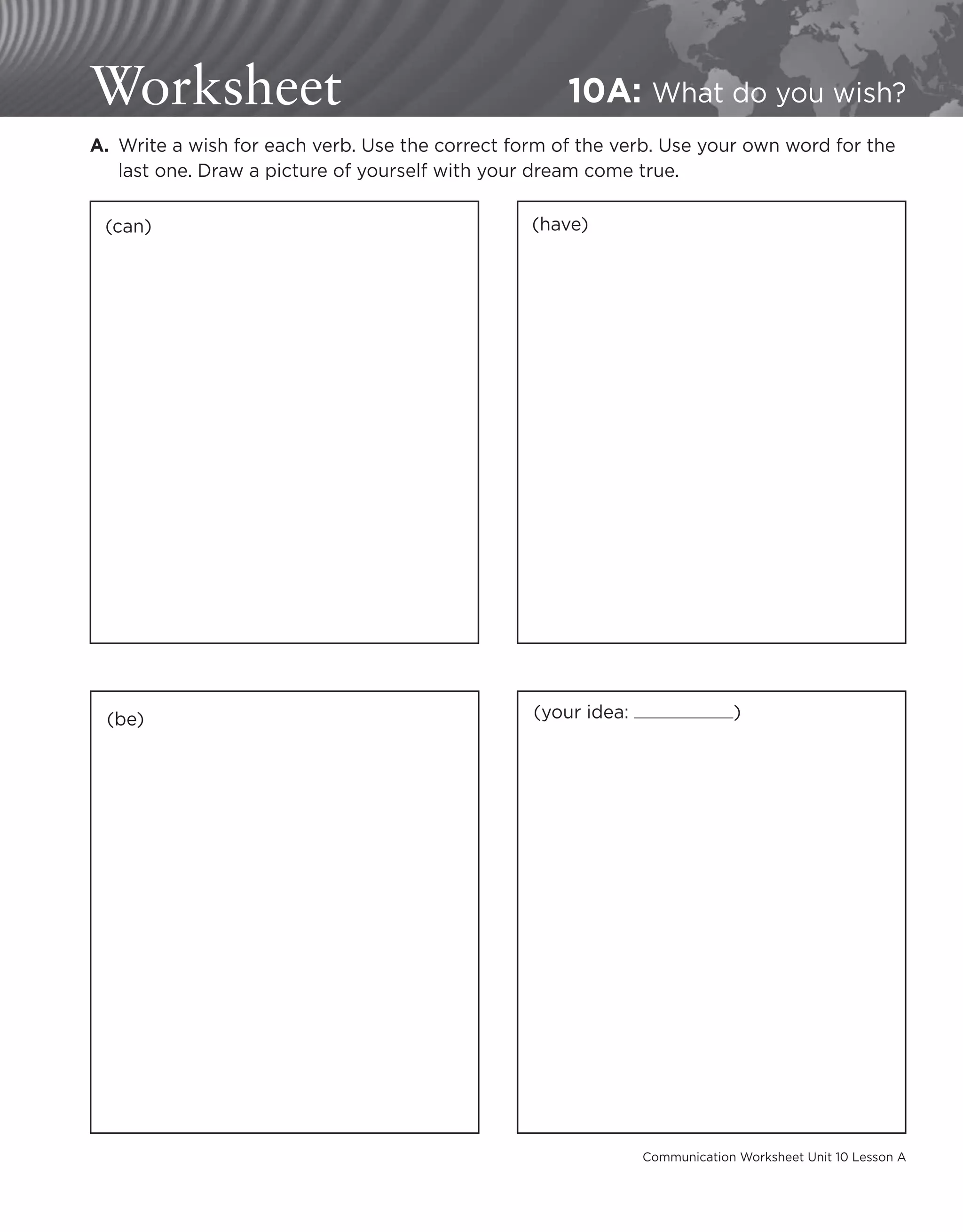
B	 Read each situation. Then write a wish statement for each one.
1.	 I’m not famous.
2.	 I’m broke.
3.	 I have to work on the weekend.
5  Grammar
A	 Study the chart. Turn to page 212. Complete the exercises. Then do B–E below.
Wish Statements
Present situation Wish statement
He won’t pay me back. will  →  would I wish (that) he would pay me back.
I can’t lend you any money. can  →  could I wish (that) I could lend you some money.
I am not good at saving money. am  →  were* I wish (that) I were good at saving money.
She doesn’t have a budget. have  →  had She wishes (that) she had a budget.
*Were is considered more correct than was in wish statements with be.
To express impossible or unlikely wishes about present situations, use a wish statement. The verb following
wish is in the past.
4.	 I can’t pay you back.
5.	 I can’t afford to pay my credit card bill.
6.	 I have gone into debt.
C	   Choose one of the situations in B and make a short conversation. Practice it with a partner.
Student A: You are upset about the situation.
Student B: Listen to Student A and try to help.
	
B:	 Hey, what’s wrong?
	A:	 I have to work this weekend.
	B:	 Really? That’s terrible.
	A:	 I know. I wish I didn’t have to.
	B:	 Why do you have to work?
	A:	 
I have to make some money. I’ve been
spending too much lately and…
D	   Pick another situation from B and
make another conversation. This time,
switch roles when you practice it.
E	 group
  Choose one of your conversations
and perform it for the class.
In many cultures, there are traditional ways to make
a wish, like throwing a coin in a wishing well.
146  Unit 10 • Money
B You and your partner are going to rent one of these
apartments. Which one will you choose? Discuss what you
like and don’t like about each one. Then choose one.
Things to consider:
• You are both students, so you are on a budget. You
don’t want to spend too much money.
• On the other hand, money isn’t everything! You also
want to have fun.
• Your vacation is going to be from three to seven
nights long.
I like the first one, but I wish it
were closer to the city center.
6 CoMMUniCaTion
A Work with a partner. Read the information below. Look up any words you don’t
know in a dictionary.
APARTMENTS FOR RENT!
Come and spend your summer by the beach
C group
Take a vote as a class. Which apartment was more
popular? Why?
room with a view! Fun in the sun!
About this apartment
Ten years old
2 bedrooms, 1 bath
Big balcony facing the beach
No noise allowed after 10 PM
2 nights minimum stay
7 nights maximum stay
$200 per night for first three nights; $150 for each
additional night
About this apartment
Brand-new apartment
Fold-out sofa bed sleeps two
Very close to the beach
No air conditioner
1 week minimum stay
3 weeks maximum stay
$150 per night
The local area
There are no restaurants, but there is a
convenience store nearby.
There is a washer and a dryer in the apartment.
The local area
There are two restaurants nearby that serve dinner.
There is a laundromat down the street.
Transportation
5-minute walk to the train station
1 hour to the city center by train
Transportation
20-minute bus ride to the train station
20 minutes to the city center by train
lEsson a • Saving and spending 147
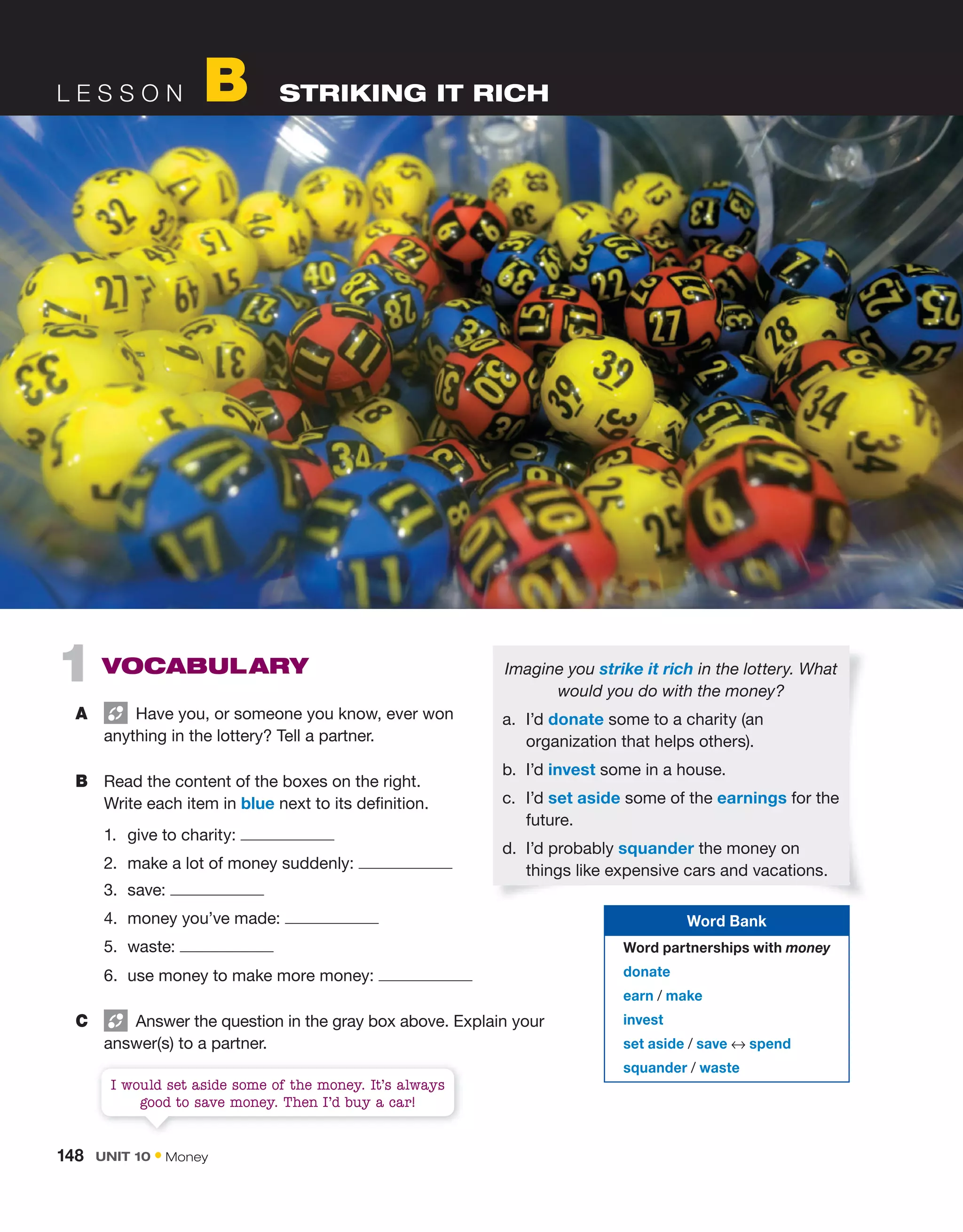
L E S S O N B STRIKING IT RICH
1 VoCaBULary
A Have you, or someone you know, ever won
anything in the lottery? Tell a partner.
B Read the content of the boxes on the right.
Write each item in blue next to its definition.
1. give to charity:
2. make a lot of money suddenly:
3. save:
4. money you’ve made:
5. waste:
6. use money to make more money:
C Answer the question in the gray box above. Explain your
answer(s) to a partner.
Imagine you strike it rich in the lottery. What
would you do with the money?
a. I’d donate some to a charity (an
organization that helps others).
b. I’d invest some in a house.
c. I’d set aside some of the earnings for the
future.
d. I’d probably squander the money on
things like expensive cars and vacations.
I would set aside some of the money. It’s always
good to save money. Then I’d buy a car!
Word Bank
Word partnerships with money
donate
earn / make
invest
set aside / save ↔ spend
squander / waste
148 Unit 10 • Money
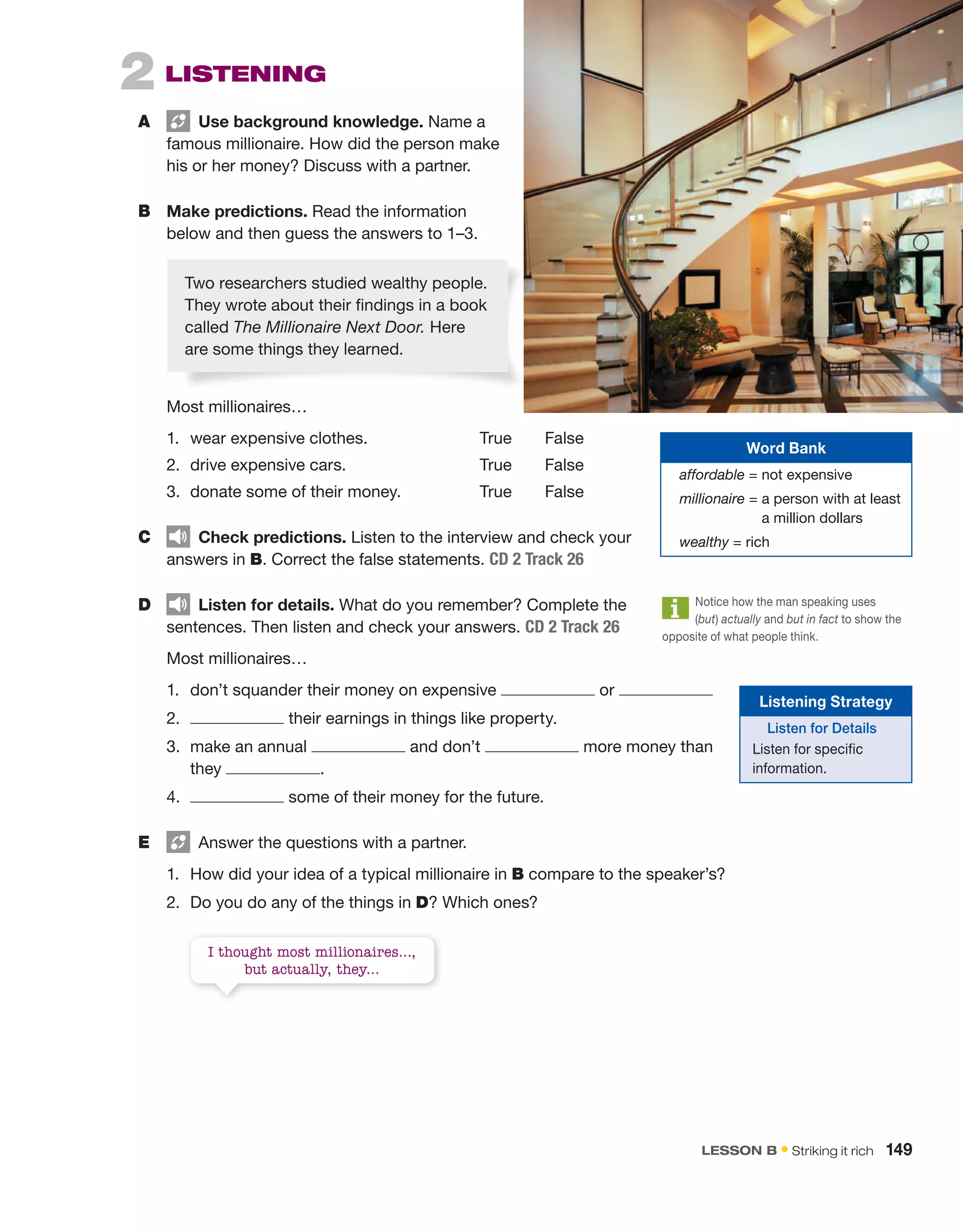
2  LISTENING
A	   Use background knowledge. Name a
famous millionaire. How did the person make
his or her money? Discuss with a partner.
B	 Make predictions. Read the ­
information
below and then guess the answers to 1–3.
	 Most millionaires…
1.	 wear expensive clothes.	 True   False
2.	 drive expensive cars.	 True   False
3.	 donate some of their money.	 True   False
C	   Check predictions. Listen to the interview and check your
answers in B. Correct the false statements. CD 2 Track 26
D	   Listen for details. What do you remember? Complete the
sentences. Then listen and check your answers. CD 2 Track 26
	 Most millionaires…
1.	 don’t squander their money on expensive or
2.	 their earnings in things like property.
3.	
make an annual and don’t more money than
they .
4.	 some of their money for the future.
E	   Answer the questions with a partner.
1.	 How did your idea of a typical millionaire in B compare to the speaker’s?
2.	 Do you do any of the things in D? Which ones?
I thought most millionaires…,
but actually, they…
Two ­
researchers studied wealthy people.
They wrote about their findings in a book
called The Millionaire Next Door. Here
are some things they learned.
Word Bank
affordable = not expensive
millionaire = 
a person with at least
a million dollars
wealthy = rich
Notice how the man speaking uses
(but) actually and but in fact to show the
opposite of what people think.
Listening Strategy
Listen for Details
Listen for specific
information.
LESSON B • Striking it rich  149
3 reaDing CD 2 Track 27
A Make predictions. Look at the
pictures and the title of the article.
How do you think these two groups
have made money? Tell a partner.
B read for details. Read, then
answer the questions on a piece
of paper.
Student A: Read about the San.
Student B: Read about the monks.
1. Where do they live?
2. How do they make their money
(or how will they in the future)?
3. How do they spend their money
(or how will they in the future)?
C Ask your partner the questions
in B about his or her people. Take
notes. Then read the other profile to
check your partner’s answers.
D infer meaning. Find the words in
bold in the reading. Complete each
sentence with the correct word(s).
1. If something is worth money, it
is / isn’t valuable.
2. You get easy money by working
hard / without working at all.
3. If money pours in, it comes to
you quickly / slowly.
4. If you accept something, you
take it from / give it to someone.
E Compare and evaluate. Answer
the questions with a partner. Use
your notes to help you.
1. Are the San and the monks
similar in any way?
2. Think about the ways the San
and the monks are making
money. Do you think it is good
for them to earn money this
way? Why or why not?
MONEY
FROM UNUSUAL
SOURCES
reading Strategy
Infer Meaning
Think about information
beyond what you read.
The San and the monks are
similar in that they both...
150 Unit 10 • Money
1If you hunt an animal, you follow and kill it for food.
The San people have lived
in Southern Africa for almost
40,000 years, hunting1 animals
and gathering plants. But
recently, many San people lost
their land. Some tried to move to
large cities, but it was hard to get
jobs. Broke, they returned home
and watched as their culture and
traditions began to die.
But all this may be changing.
The San have struck it rich. They
recently signed an agreement
with a large drug company. The
San have traditional knowledge
about plants that is worth a lot
of money. The drug company
is especially interested in a
particular plant and how the
San use it.
In the past, the San went on
long hunting trips. While away
from home, they ate a special
plant to slow their hunger. Using
the San’s knowledge, the drug
company wants to make a new
medicine from this plant. For
people around the world who
have weight problems, this drug
could really help.
The San are being careful with
this “easy money.” They plan
to use it to create jobs for their
people. They also want to
focus on education. Through
education, they hope to save
their culture and language for
future generations.
Southern africa’s San people
When you think
of a monk, you
might think of
a quiet man
living in a place
far away from
others. The
“free monks” of
Greece do live
far from others,
but they are anything but quiet.
In fact, they sing. They have
been recording songs and selling
many albums in Greece.
People of all ages love them.
Their songs are recorded in
different styles (digital keyboard
and rock, for example) and are
not only religious. The monks
also sing about problems like
drugs and globalization.
The cash from music sales isn’t
pouring in, but the monks are
earning some money. A few
people don’t like this; they think
monks shouldn’t sing for money.
But the monks happily accept
the money. They set it aside for
summer camps for teenagers.
The monks also donate some of
the money to social programs
that help many people.
Greek monks
lEsson B • Striking it rich 151
4 graMMar
A Study the chart. Turn to page 213 and complete the exercises. Then do B–D below.
negative Modals
impossibility You can’t have the winning lottery ticket. I have it!
Ability Sorry, but I can’t lend you any money. I’m broke.
necessity You don’t have to / don’t need to be rich to travel.
Advice You shouldn’t waste money on expensive cars.
Strong advice You’d better not lose this ring. It’s very valuable.
B pronunciation: Word final /t/ and /d/. Listen and repeat. Pay attention to the final
/t/ and /d/ sounds. CD 2 Track 28
1. can’t You can’t have the winning ticket.
2. don’t You don’t have to be rich.
3. shouldn’t You shouldn’t waste money.
4. You’d better not You’d better not lose this ring.
C Complete the sentences with the negative form of each modal.
1. Money (can) buy happiness.
2. You (should) borrow money from friends.
3. You (have to) go to college to get a good job.
4. You (had better) show your wallet on the subway. Someone might steal it.
5. You (need to) work for a large company to earn good money.
6. You (should) pay for most things with a credit card.
7. You (can) get married until you have a good job.
D Say each sentence in C aloud.
Pay attention to your pronunciation.
Do you agree or disagree with each
statement? Why? Tell a partner.
You shouldn’t pay for most
things with a credit card.
I agree. It’s easy to spend
too much money and go
broke.
152 Unit 10 • Money
5 WriTing
A Read the question below and the reply on the right.
What reason does the writer give for his opinion?
Can you think of one more reason? Tell a partner.
I work for the hospital. It does cancer
research. We should get the money
for two reasons. For one thing…
You said “teenagers don’t have to
go to college.” But a person has to
go to college to get a good job!
A millionaire in your community plans to donate
money to one group below. Which one should get
the money and why? Give two reasons.
• A charity: It helps poor teenagers go to college.
• A museum: It needs the money or it will close.
• A hospital: It helps people with cancer.
B What do you think? Outline your ideas and then write a paragraph. Think of two reasons one group
should get the money and the others shouldn’t. Explain each reason in a sentence or two as shown
in the example.
In my opinion, the millionaire should donate money to the
.
For one thing, .
In addition, .
For these reasons, I believe the millionaire should donate money to the
.
C Exchange your writing with a partner. Circle any mistakes. Then return the paper to your partner.
Make corrections to your own paragraph.
6 CoMMUniCaTion
A group
Work in a group of four. Students A, B, and C should think of two reasons he or she should get
the money. Student D should think of questions to ask the others.
Student A: You work for the charity. Student C: You work for the hospital.
Student B: You work for the museum. Student D: You’re the millionaire.
B group
Have a debate. Students A, B, and C speak for one minute each. Student D asks questions, then
decides who gets the money and explains why.
In my opinion, the millionaire
should donate money to the
hospital for two important reasons.
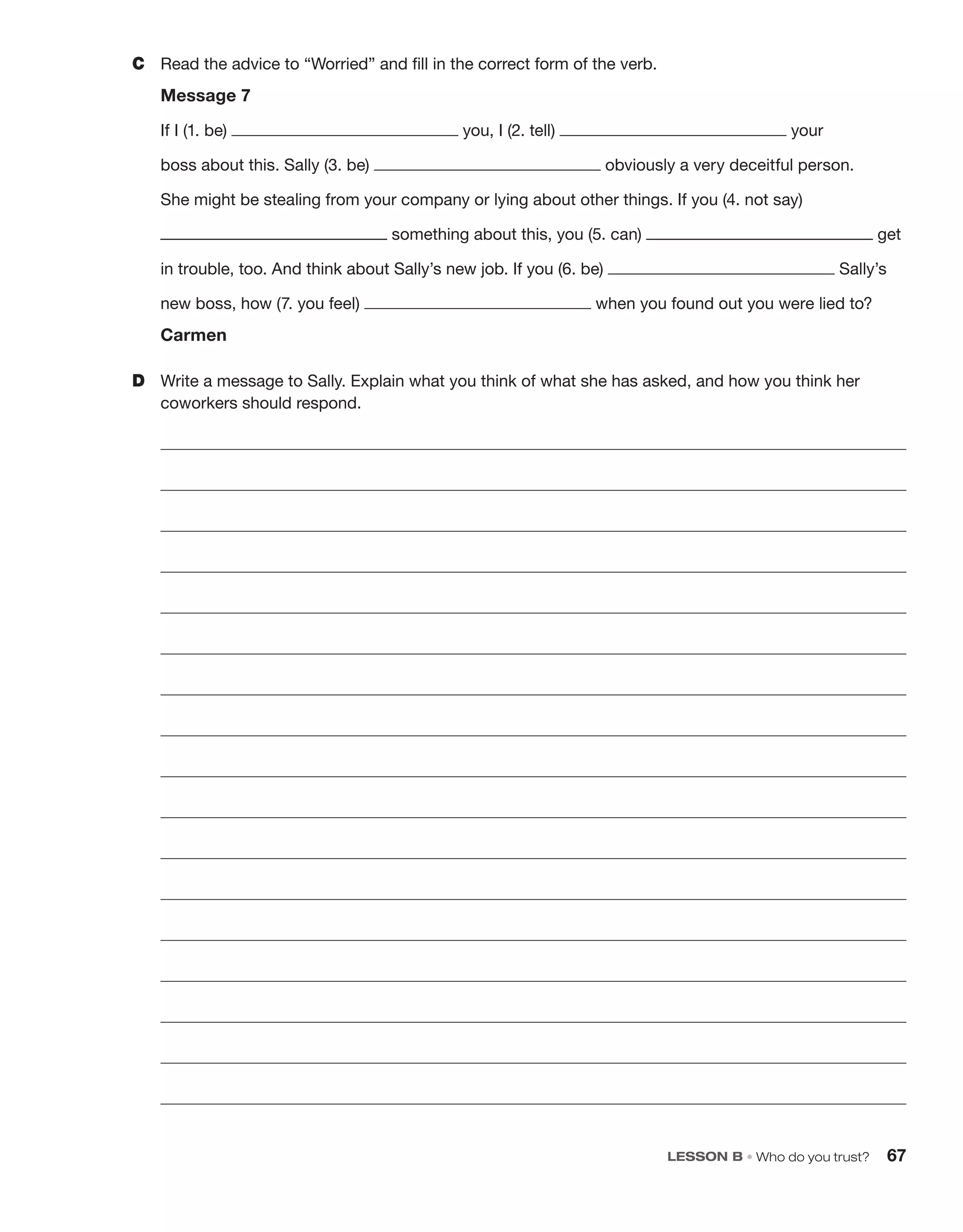
For one thing, everyone needs a
hospital. People don’t have to go
to museums, and they don’t need
to go to college. But a person with
cancer has to go to a hospital. With
the money, the hospital can help
more people. in addition…
lEsson B • Striking it rich 153
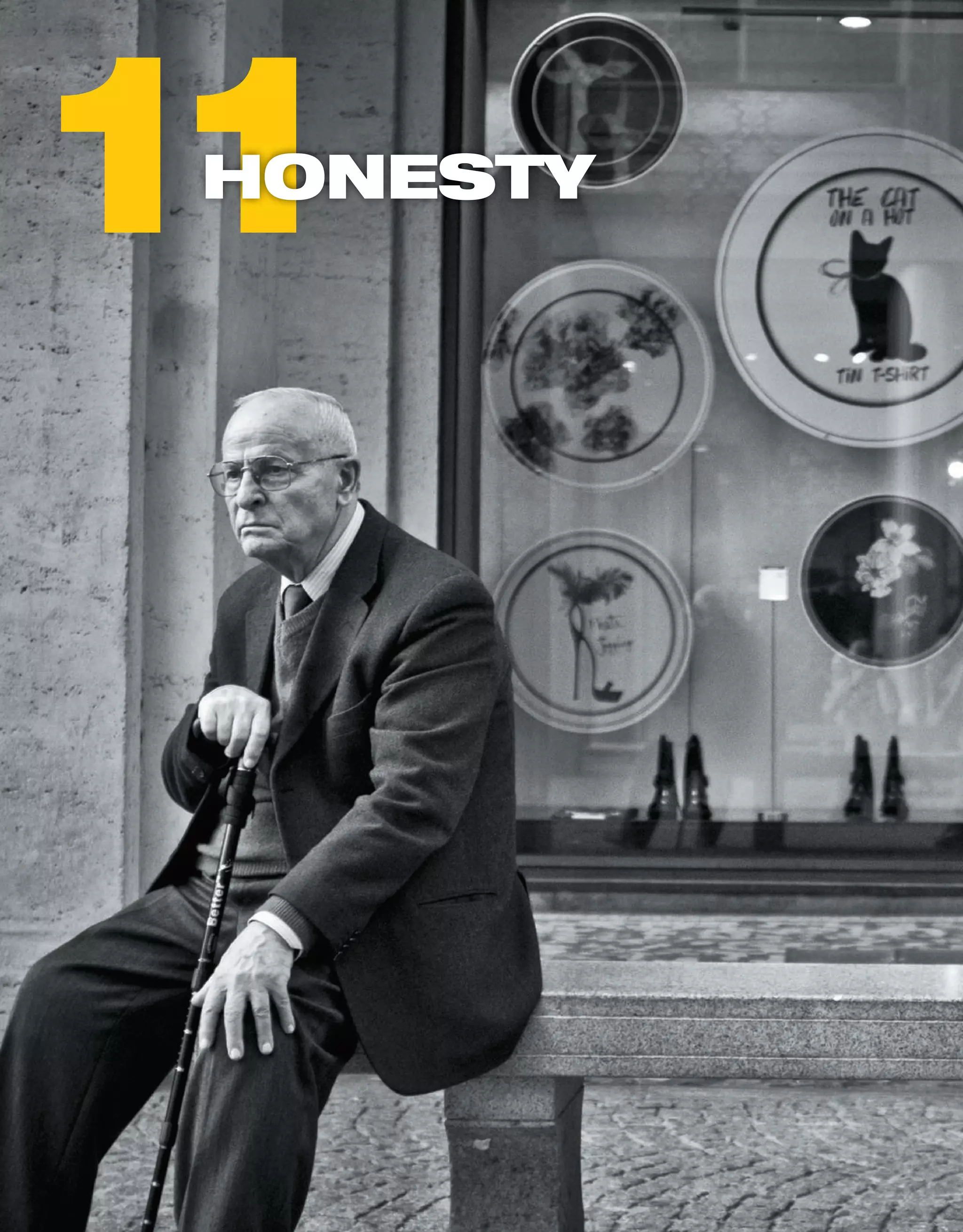
11
11
HonestY
Look at the photo. Answer the questions.
1	 How do these two people feel?
2	 What do you think happened before the photo
was taken?
3	 Have you ever been lied to? How did you feel?
Unit Goals
1	 Speculate about imagined events
2	 Give strong advice
3	 Introduce surprising or opposing information
4	 Report what someone else has said
Two men turn their backs to
each other in Lombardy, Italy.
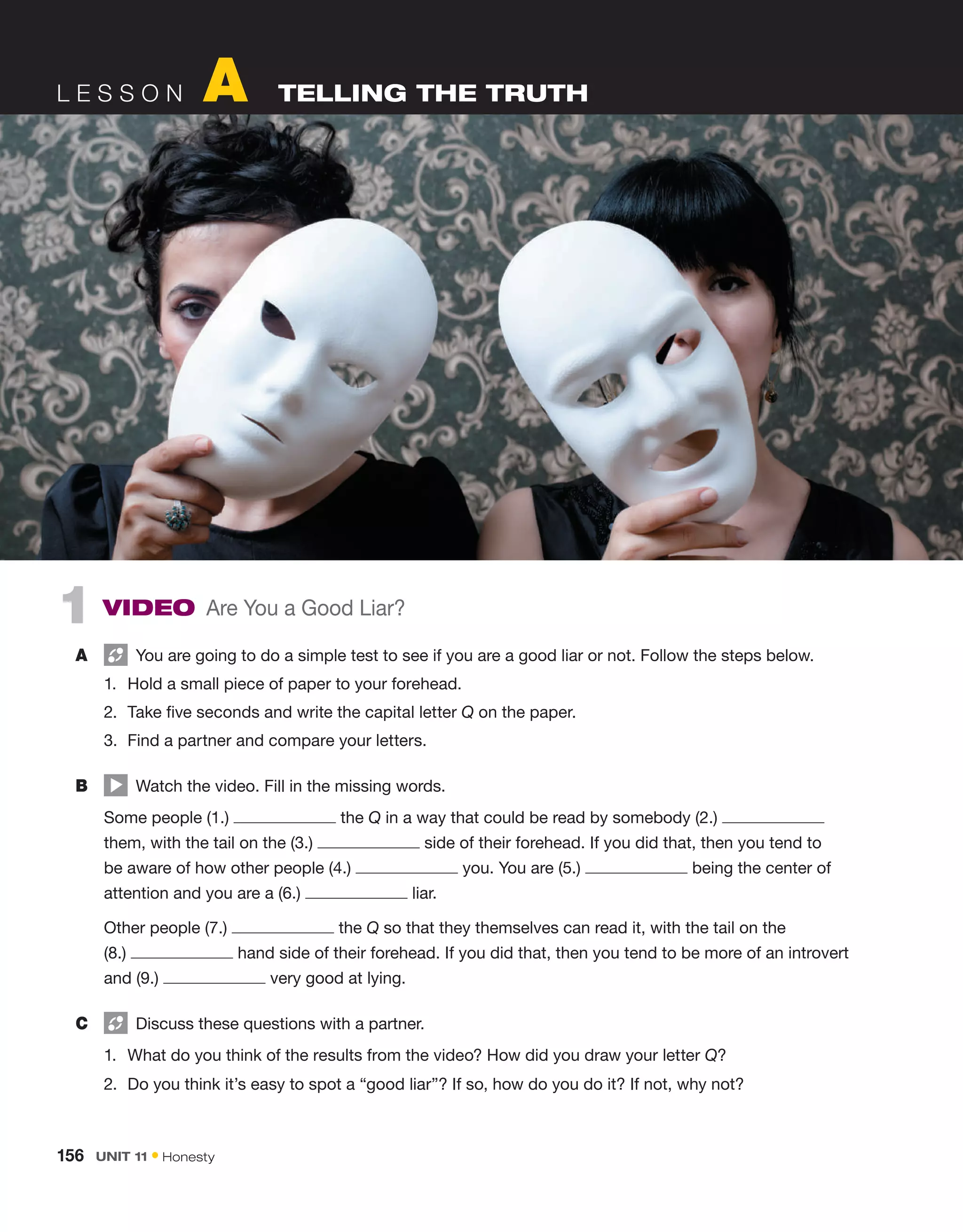
L e s s o n A  Telling the truth
1  Video Are You a Good Liar?
A	   You are going to do a simple test to see if you are a good liar or not. Follow the steps below.
1.	 Hold a small piece of paper to your forehead.
2.	 Take five seconds and write the capital letter Q on the paper.
3.	 Find a partner and compare your letters.
B	   Watch the video. Fill in the missing words.
	 Some people (1.) the Q in a way that could be read by somebody (2.) 
them, with the tail on the (3.) side of their forehead. If you did that, then you tend to
be aware of how other people (4.) you. You are (5.) being the center of
attention and you are a (6.)  liar.
	 Other people (7.) the Q so that they themselves can read it, with the tail on the
(8.) hand side of their forehead. If you did that, then you tend to be more of an introvert
and (9.) very good at lying.
C	   Discuss these questions with a partner.
1.	 What do you think of the results from the video? How did you draw your letter Q?
2.	 Do you think it’s easy to spot a “good liar”? If so, how do you do it? If not, why not?
156  Unit 11 • Honesty
2 VoCABULARY
A Look at the picture. Who are the people in it and what just happened? Do you
think the boy is telling the truth? Why or why not? Tell a partner.
B Read the statements below. Notice the words in blue. Look up any expressions you don’t know.
Then check (✓) the boxes that are true for you.
Strongly
agree
Agree Disagree
Strongly
disagree
1. Honesty is always best. There are no
exceptions to this rule.
2. You should never lie if it’s against
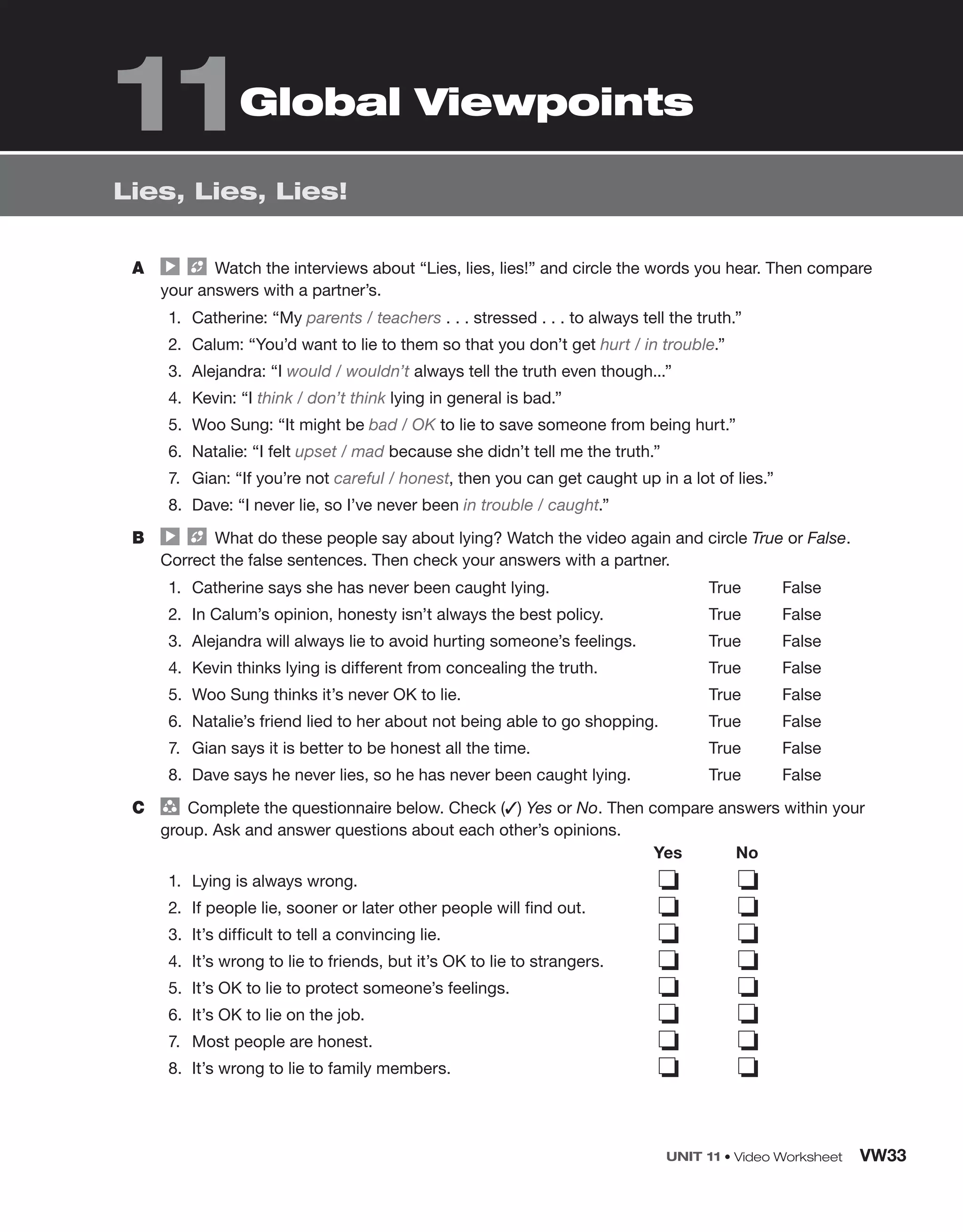
the law.
3. You shouldn’t tell the truth if it hurts
someone’s feelings.
4. The truth isn’t always so clear—it’s not
really obvious.
5. Sometimes I tell the truth, and sometimes
I don’t. It depends on the circumstances.
6. You shouldn’t punish small children too
severely if they tell a lie.
C Discuss your answers with a partner.
Word Bank
an honest person ↔ a liar
(depend on the)
circumstances
exception
hurt (someone’s feelings)
obvious
reward someone ↔ punish
someone (for their
behavior)
tell the truth ↔ tell a lie
I strongly agree that honesty is
always best. If you always tell the
truth, you won’t have any trouble.
I chose disagree for that one.
I don’t think you should always tell
the truth.
Who broke
the window?
I don't
know . . .
lEsson a • Telling the truth 157
E	   Pronunciation: Repeating with rising intonation to show surprise. Work with a partner. Use
the situations below to make short conversations about Cindy like the ones in D. Remember to
repeat with rising intonation to show surprise.
1.	 fail her exam / cheat on it
2.	 get a ticket / be caught speeding
3.	 move out / have an argument with her roommate
3  LISTENING
A	   Use background knowledge. You are going to hear
a conversation about a job résumé. When you prepare
a résumé, what kind of information should be included?
Make a list with a partner.
 
 
B	   Listen for details. Listen. Check (✓) True or False.
Correct the false ­
sentences to make them true. CD 2 Track 29
True False
1. Cindy quit her job.
2.  Denise was sick last week.
3.  There was a problem with Cindy’s résumé.
4.  She lied about her hours.
5.  Denise is worried about the amount of work.
6.  Interviewing is happening today.
C	   Listen. Complete the expressions with the missing words. CD 2 Track 30
1.	Well, , I don’t know the details.
2.	 Uh-huh. She her experience.
3.	 I agree. I don’t think her boss was very happy that she had him.
4.	 It’s too bad but, , I’m worried.
D	     Pronunciation: Repeating with rising intonation to show surprise. Listen. Speaker B
shows surprise by repeating what Speaker A says. Notice the rising intonation and stress. Then
practice the conversations with a partner. CD 2 Track 31
	 	 Conversation 2
	 A:	 Cindy got into trouble.
	 B:	 She got into trouble? How?
	 A:	 She dented her parents’ car.
	 B:	 You’re kidding!
	 	 Conversation 1
	 A:	 Cindy was fired.
	 B:	 She was fired? Why?
	 A:	 
Because she lied on her résumé.
	 B:	 I can’t believe it!
Listening Strategy
Listen for Details
Listen for detailed information.
/ˈsɪndi/
/dəˈnis/
158  UNIT 11 • Honesty
4 sPeAKing
A Listen to and read the conversation.
Where are Mr. and Mrs. Ward? What’s the
problem? CD 2 Track 32
MR. WARD: So, how’s the chicken?
MRS. WARD: Delicious. How about your
steak?
MR. WARD: It’s all right...
MRS. WARD: Are you being honest? You don’t
sound very happy with it.
MR. WARD: Well, it’s not cooked right. I
asked for medium rare. This is
well done.
MRS. WARD: Why don’t you send it back?
MR. WARD: Oh, I don’t want to bother anyone. I can eat it, I guess.
MRS. WARD: But it’s expensive. I don’t think you should eat it. Let’s call the waiter. You won’t hurt
his feelings!
MR. WARD: Yeah, but...
MRS. WARD: If you don’t say something, you’re not going to enjoy your meal. Excuse me, waiter!
B What would you say to the waiter? How would you complain? Write an ending to the
conversation and practice it with a partner.
SPEAKING STRATEGY
C Read about the three situations below. Choose one and write a role play with a partner.
Student A: Play the role of one of the friends or the coworker.
Student B: Warn Student A about his or her actions. Use the Useful Expressions to give
strong opinions.
Useful Expressions: Giving strong advice
If you don’t leave a bigger tip, the waiter is going to be upset.
I don’t think you should spend so much time playing games on your computer.
You have to do your homework by yourself.
Your friend, who is a student in
the US, often doesn’t leave a
big enough tip in restaurants.
Your coworker wastes
a lot of time playing
games on her computer.
Your friend, who doesn’t
like to study, often copies
another friend’s homework.
D group
Perform your dialog for the class.
/wɔrd/
lEsson a • Telling the truth 159
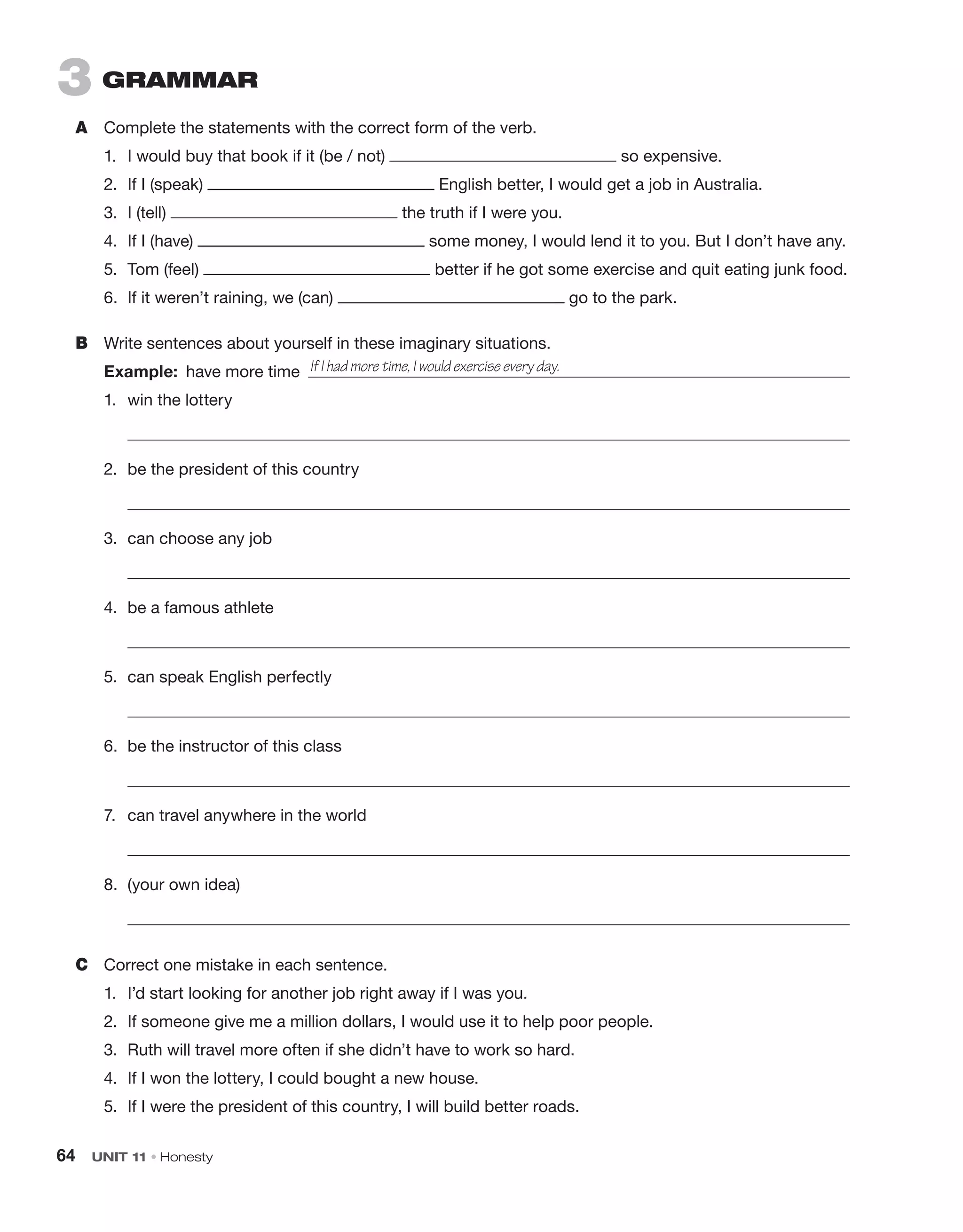
5 gRAMMAR
A Study the chart. Turn to page 214. Complete the exercises. Then do B–C below.
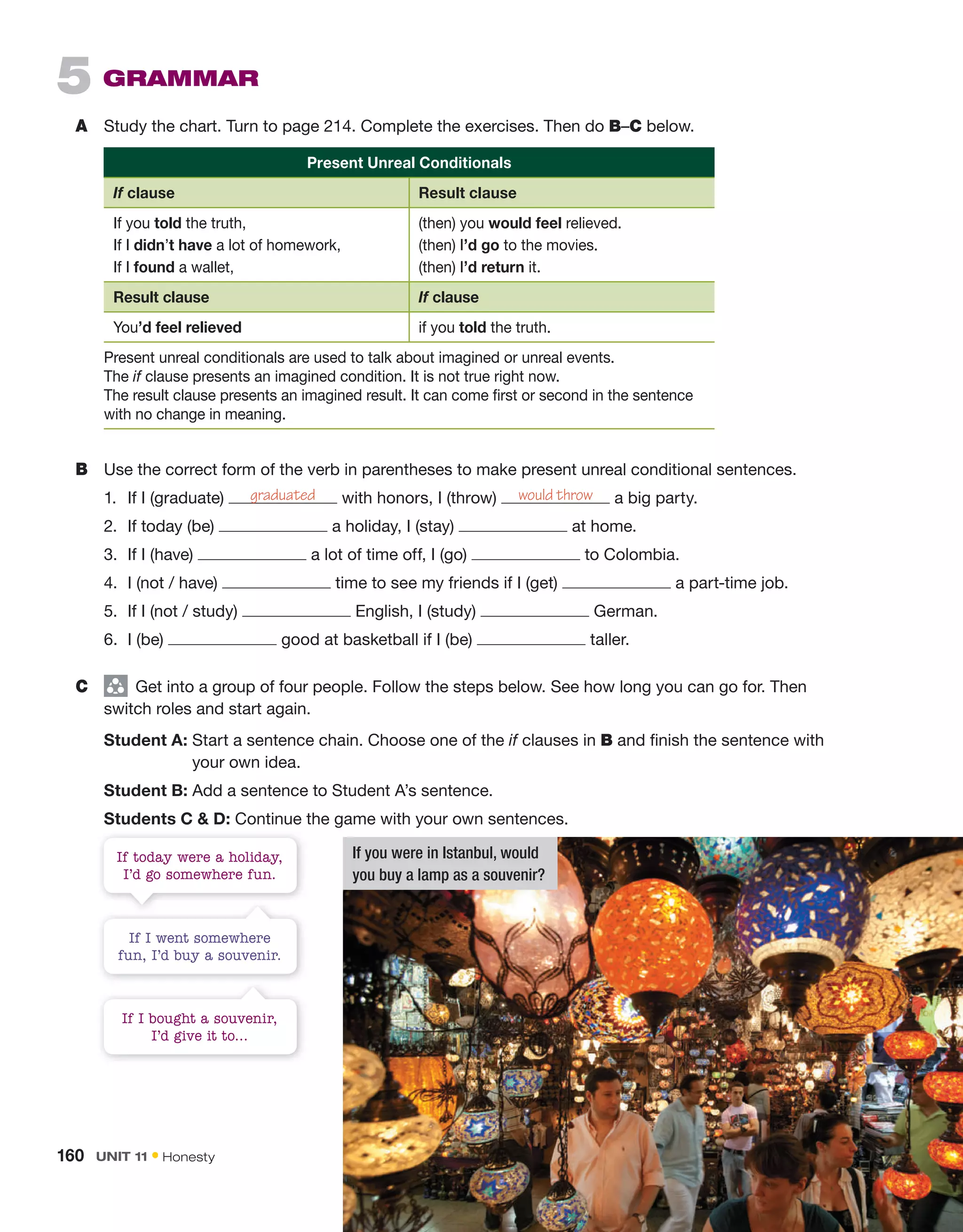
Present Unreal Conditionals
If clause Result clause
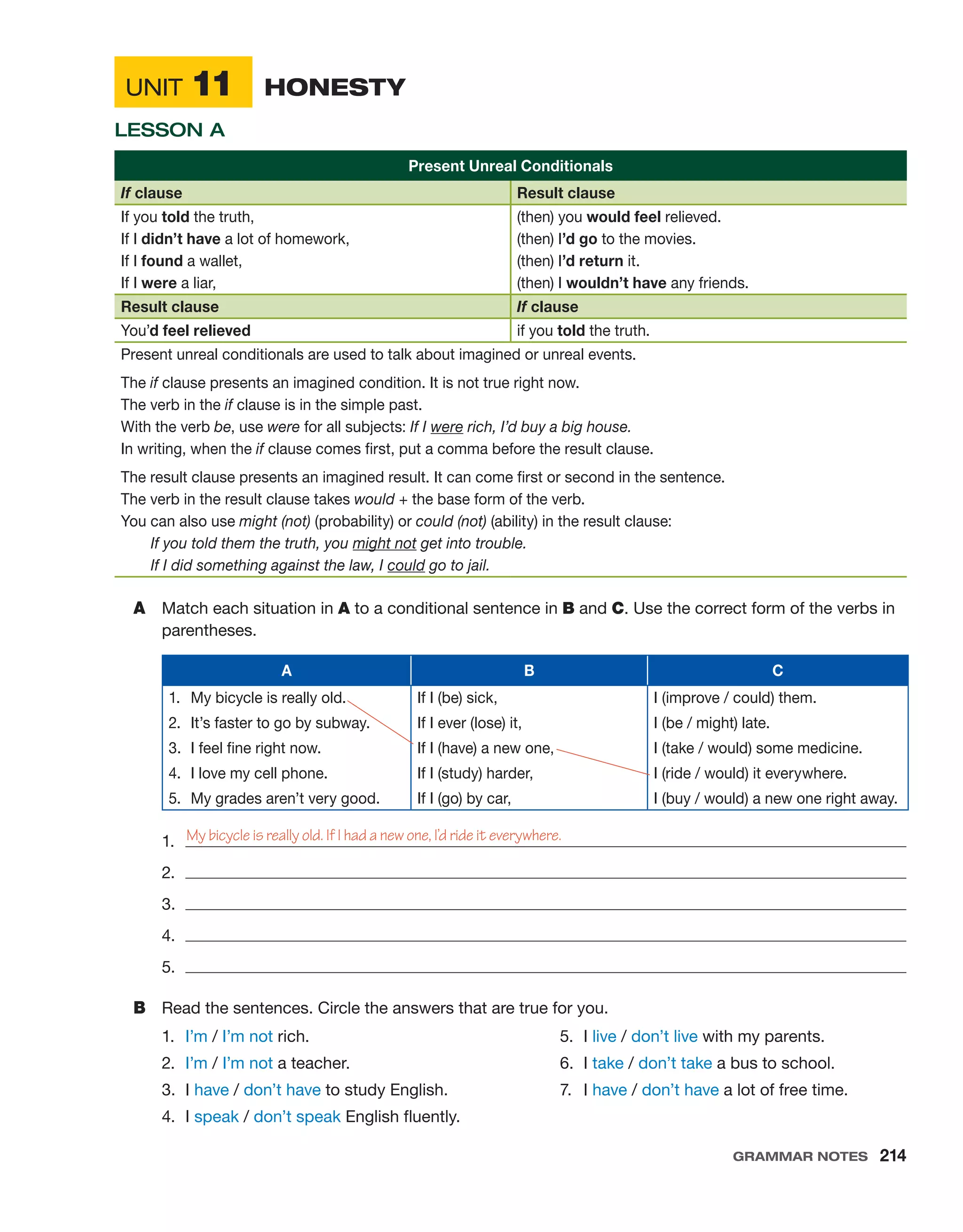
If you told the truth,
If I didn’t have a lot of homework,
If I found a wallet,
(then) you would feel relieved.
(then) I’d go to the movies.
(then) I’d return it.
Result clause If clause
You’d feel relieved if you told the truth.
Present unreal conditionals are used to talk about imagined or unreal events.
The if clause presents an imagined condition. It is not true right now.
The result clause presents an imagined result. It can come first or second in the sentence
with no change in meaning.
B Use the correct form of the verb in parentheses to make present unreal conditional sentences.
1. If I (graduate) graduated with honors, I (throw) would throw a big party.
2. If today (be) a holiday, I (stay) at home.
3. If I (have) a lot of time off, I (go) to Colombia.
4. I (not / have) time to see my friends if I (get) a part-time job.
5. If I (not / study) English, I (study) German.
6. I (be) good at basketball if I (be) taller.
C group
Get into a group of four people. Follow the steps below. See how long you can go for. Then
switch roles and start again.
Student A: Start a sentence chain. Choose one of the if clauses in B and finish the sentence with
your own idea.
Student B: Add a sentence to Student A’s sentence.
Students C  D: Continue the game with your own sentences.
If I went somewhere
fun, I’d buy a souvenir.
If I bought a souvenir,
I’d give it to…
If today were a holiday,
I’d go somewhere fun.
If you were in Istanbul, would
you buy a lamp as a souvenir?
160 Unit 11 • Honesty
6 CoMMUniCAtion
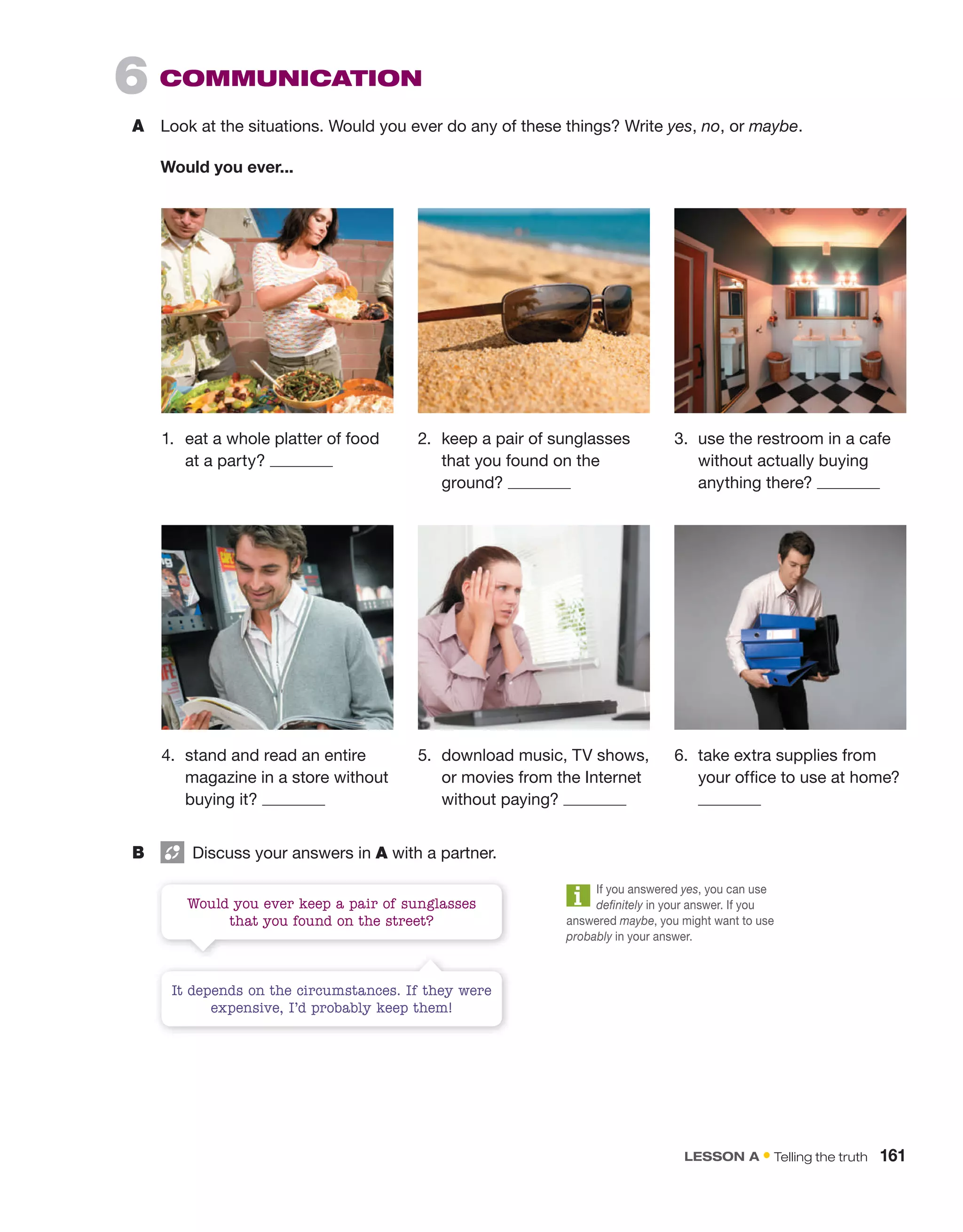
A Look at the situations. Would you ever do any of these things? Write yes, no, or maybe.
Would you ever...
B Discuss your answers in A with a partner.
1. eat a whole platter of food
at a party?
2. keep a pair of sunglasses
that you found on the
ground?
3. use the restroom in a cafe
without actually buying
anything there?
4. stand and read an entire
magazine in a store without
buying it?
5. download music, TV shows,
or movies from the Internet
without paying?
6. take extra supplies from
your office to use at home?
It depends on the circumstances. If they were
expensive, I’d probably keep them!
Would you ever keep a pair of sunglasses
that you found on the street?
If you answered yes, you can use
definitely in your answer. If you
answered maybe, you might want to use
probably in your answer.
lEsson a • Telling the truth 161
L e s s o n B WhO DO YOu TruST?
1 VoCABULARY
A Match items 1–6 with their definitions from the box. Two items
have the same definition.
1. I can’t do it myself. I’m counting on you to help.
2. He’s a trustworthy employee. He’s never been late
to work.
3. A truthful person doesn’t lie on a résumé.
4. I promised to help you, and I’m going to keep my word.
5. I’m sure she’ll get the job. I have confidence in her.
6. I trust you. I know that you are telling the truth.
B Take the quiz below.
1. Does a person have to be truthful to succeed?
yes no
2. Do you typically trust strangers?
yes no
3. Do you have confidence in yourself
and your abilities?
yes no
C Interview a partner using the questions
in B. Discuss your ideas.
When you need help, who do you count on?
a. dependable d. relying on
b. honest e. believe in
c. do what you
say you will do
4. Do you always keep your word?
yes no
5. Who do you usually count on to give good
personal advice?
6. Who would you trust with a secret?
I agree. You can lie sometimes,
but you shouldn’t all the time.
I think you have to be
truthful to be successful.
162 Unit 11 • Honesty
2  Listening
A	   What are some reasons that people lie? Make a list of ideas in your notebook with a partner.
B	   Identify key details. Listen to the first part of a lecture. What are reasons people lie? List the two
reasons you hear. Are either of these reasons on your list from A? CD 2 Track 33
Reasons people lie
1.	
2.	
C	   Infer meaning. Read sentences 1–4. The speakers use the expressions
in italics in the talk. ­
Listen to the full lecture and choose the best answer.
CD 2 Track 34
1.	 If someone tells you a white lie, they tell a lie to .
	 a.  hurt your feelings	 b.  be polite	 c.  make you laugh
2.	 If you catch someone in a lie, you .
	 a.  discover a person is lying	 b.  forgive a person for lying	 c.  tell someone a big lie
3.	 If you hesitate when you are talking, you speak in a way.
	 a.  clear, direct	 b.  careful, honest	 c.  nervous, uncertain
4.	A dishonest person truthful.
	 a. is	 b. might be	 c. is not
D	   Listen for gist. Read the sentences. Then listen again. Circle T for True or F for False.
CD 2 Track 34
1.	 Diego’s sister probably knew he was lying. T    F
2.	 For most people, it’s hard to lie well. T    F
3.	 If a person won’t make eye contact with you, he’s probably lying.  T    F
E	   Listen for details. Answer the questions with a partner. Use information from the lecture to explain.
1.	 What white lie did Diego tell his sister? Was his lie believable? Why or why not?
2.	 Can you tell if someone is lying by looking at their eyes? Why or why not?
Do you think the boy is telling the truth to his father?
Listening Strategy
Infer Meaning
Use context to figure
out what the words
and phrases mean.
/ˈdjeɪgoʊ/
LESSON B • Who do you trust?  163
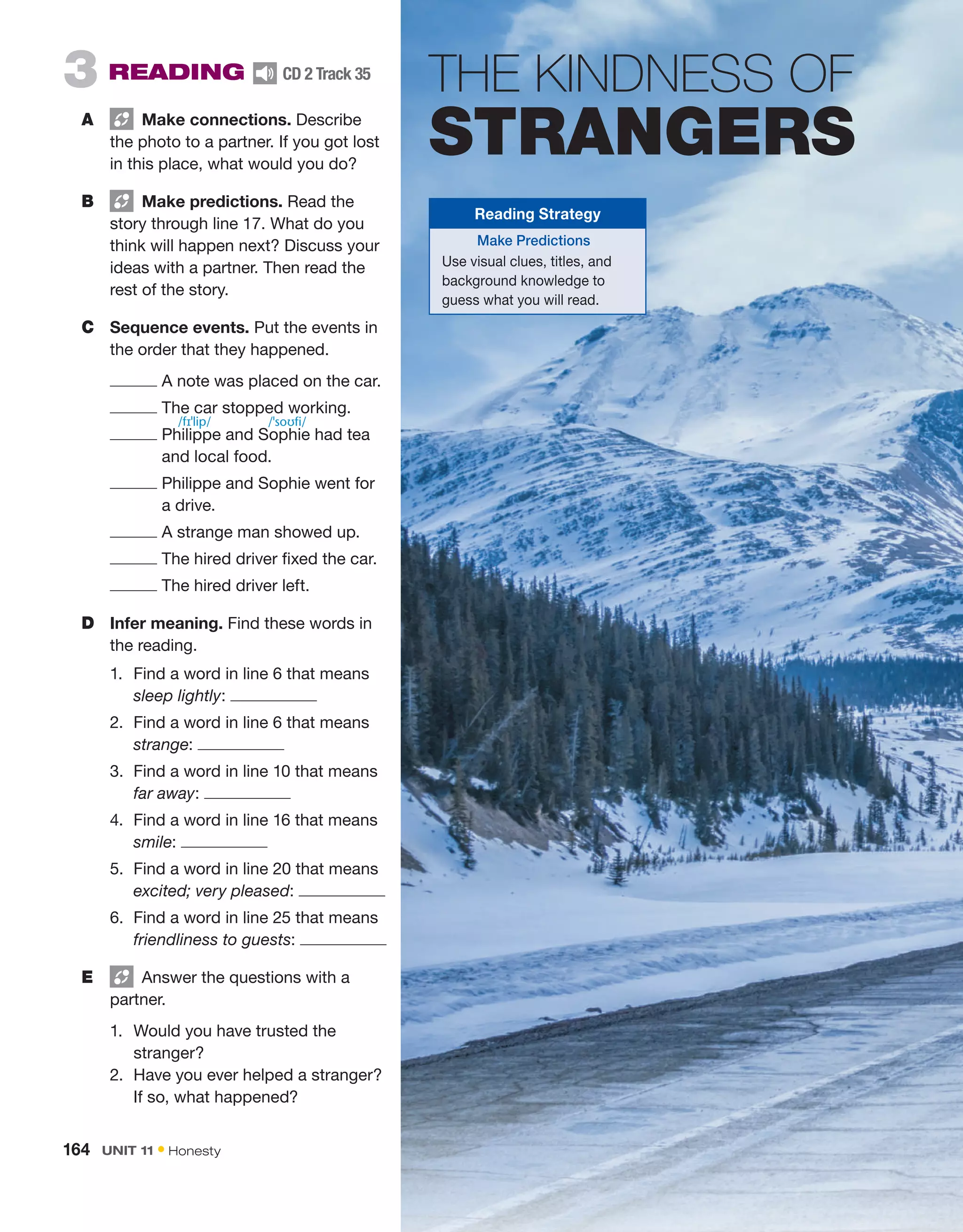
3  READING CD 2 Track 35
A	   Make connections. Describe
the photo to a partner. If you got lost
in this place, what would you do?
B	   Make predictions. Read the
story through line 17. What do you
think will happen next? Discuss your
ideas with a partner. Then read the
rest of the story.
C	 Sequence events. Put the events in
the order that they happened.
A note was placed on the car.
The car stopped working.

Philippe and Sophie had tea
and local food.

Philippe and Sophie went for
a drive.
A strange man showed up.
The hired driver fixed the car.
The hired driver left.
D	 Infer meaning. Find these words in
the reading.
1.	 Find a word in line 6 that means
sleep lightly:
2.	 Find a word in line 6 that means
strange:
3.	 Find a word in line 10 that means
far away:
4.	 Find a word in line 16 that means
smile:
5.	 Find a word in line 20 that means
excited; very pleased:
6.	 Find a word in line 25 that means
friendliness to guests:
E	   Answer the questions with a
partner.
1.	 Would you have trusted the
stranger?
2.	 Have you ever helped a stranger?
If so, what happened?
THE KINDNESS OF
STRANGERS
Reading Strategy
Make Predictions
Use visual clues, titles, and
background knowledge to
guess what you will read.
/fɪˈlip/ /ˈsoʊfi/
164  UNIT 11 • Honesty
You’re cold and alone. You’re afraid. You’re lost. You can’t speak the local language. You’ve lost
your money and passport. You could experience any of these situations in another country. Who
would you turn to1 for help?
My name is Philippe, and my wife’s name is Sophie. We’re from France. Recently we were faced
with a difficult situation while traveling by car in the Alps with our hired driver. It was going to be a
long ride, and we were tired. Just as we began to doze, the engine made an odd, loud noise and
then stopped working.
The sun was just setting, and the air was getting cooler. We tried communicating with the driver,
but with little success. He acted out the act of going to get help, and then he left.
We were in a remote location, with no houses in sight. We started to hear the cries of wild
animals. Sophie was scared. We didn’t have much food, and it was getting colder and darker.
I began to lose confidence. Should we leave the car and start walking? Would our driver ever
return? Was he a trustworthy man? We were very worried.
A couple of hours passed. Suddenly, the headlights from another car appeared in the dark. An
unfamiliar man got out of the car. He looked unfriendly at first, until his mouth opened with a big,
friendly grin. He told us that he would help us. He had such a kind face, and we knew we could
count on him. We got into his car.
Before we left, he put a note on the windshield of the car with his phone number on it. Then he
drove us to a nearby village, and we met his family. His cousin spoke basic French and offered us
tea and local foods. Everything was delicious. Everyone asked us questions and were thrilled to
have unexpected guests.
Later that evening, the phone rang. It was our driver. He had kept his word and fixed the car. We
prepared to leave and thanked our new friends. I couldn’t believe the response from the cousin:
“No, we thank you for coming into our home.”
I will never forget the warmth and hospitality we received on that day because we relied on a
complete stranger for help.
5
10
15
20
25
1If you turn to someone for help, you ask for the person’s help.
lEsson B • Who do you trust? 165
4 gRAMMAR
A Study the chart. Turn to page 215. Complete the exercises. Then do B and C below.
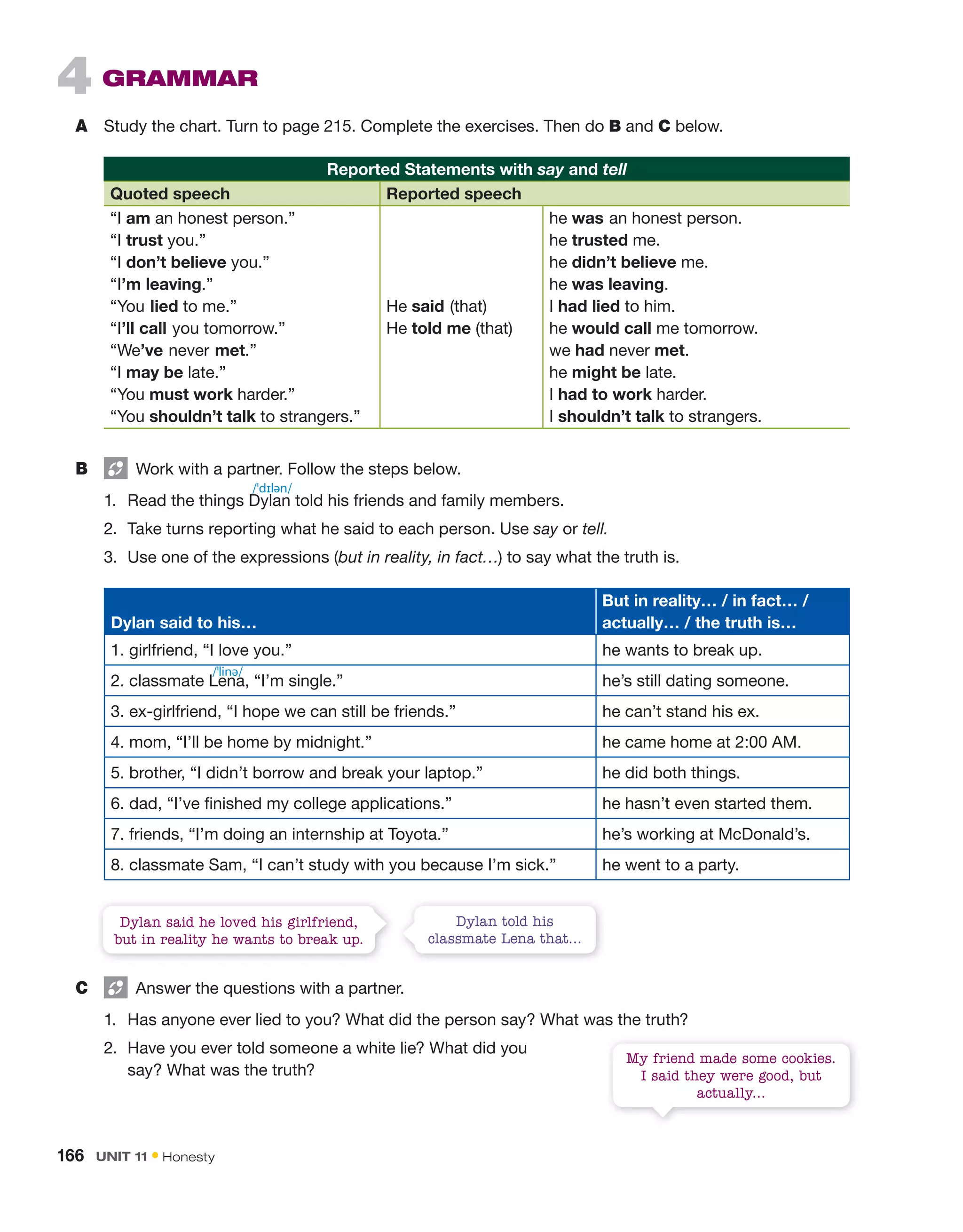
Reported Statements with say and tell
Quoted speech Reported speech
“I am an honest person.”
“I trust you.”
“I don’t believe you.”
“I’m leaving.”
“You lied to me.”
“I’ll call you tomorrow.”
“We’ve never met.”
“I may be late.”
“You must work harder.”
“You shouldn’t talk to strangers.”
He said (that)
He told me (that)
he was an honest person.
he trusted me.
he didn’t believe me.
he was leaving.
I had lied to him.
he would call me tomorrow.
we had never met.
he might be late.
I had to work harder.
I shouldn’t talk to strangers.
B Work with a partner. Follow the steps below.
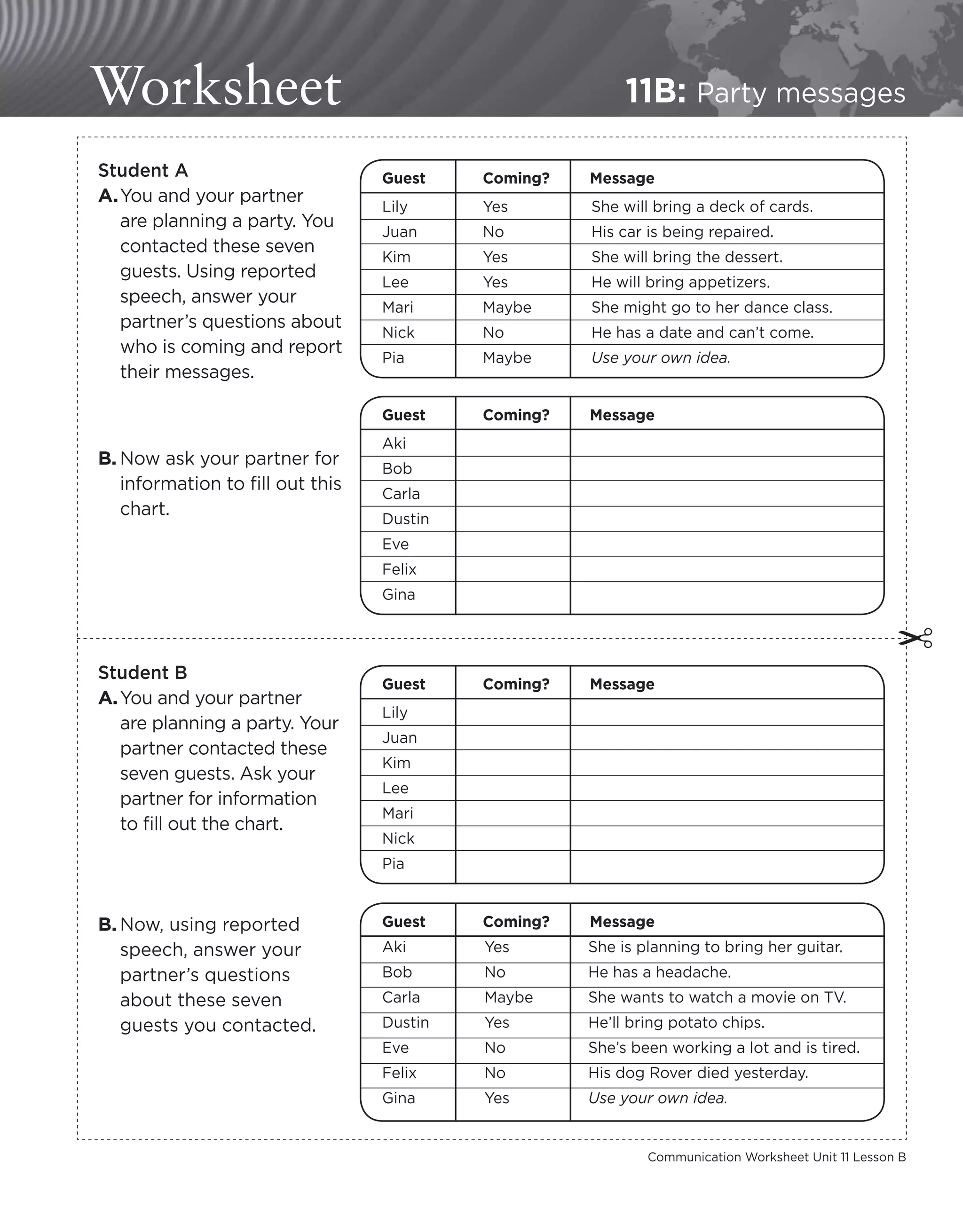
1. Read the things Dylan told his friends and family members.
2. Take turns reporting what he said to each person. Use say or tell.
3. Use one of the expressions (but in reality, in fact…) to say what the truth is.
Dylan said to his…
But in reality… / in fact… /
actually… / the truth is…
1. girlfriend, “I love you.” he wants to break up.
2. classmate Lena, “I’m single.” he’s still dating someone.
3. ex-girlfriend, “I hope we can still be friends.” he can’t stand his ex.
4. mom, “I’ll be home by midnight.” he came home at 2:00 AM.
5. brother, “I didn’t borrow and break your laptop.” he did both things.
6. dad, “I’ve finished my college applications.” he hasn’t even started them.
7. friends, “I’m doing an internship at Toyota.” he’s working at McDonald’s.
8. classmate Sam, “I can’t study with you because I’m sick.” he went to a party.
/ˈdɪlən/
Dylan told his
classmate Lena that…
Dylan said he loved his girlfriend,
but in reality he wants to break up.
C Answer the questions with a partner.
1. Has anyone ever lied to you? What did the person say? What was the truth?
2. Have you ever told someone a white lie? What did you
say? What was the truth?
My friend made some cookies.
I said they were good, but
actually…
/ˈlinə/
166 Unit 11 • Honesty
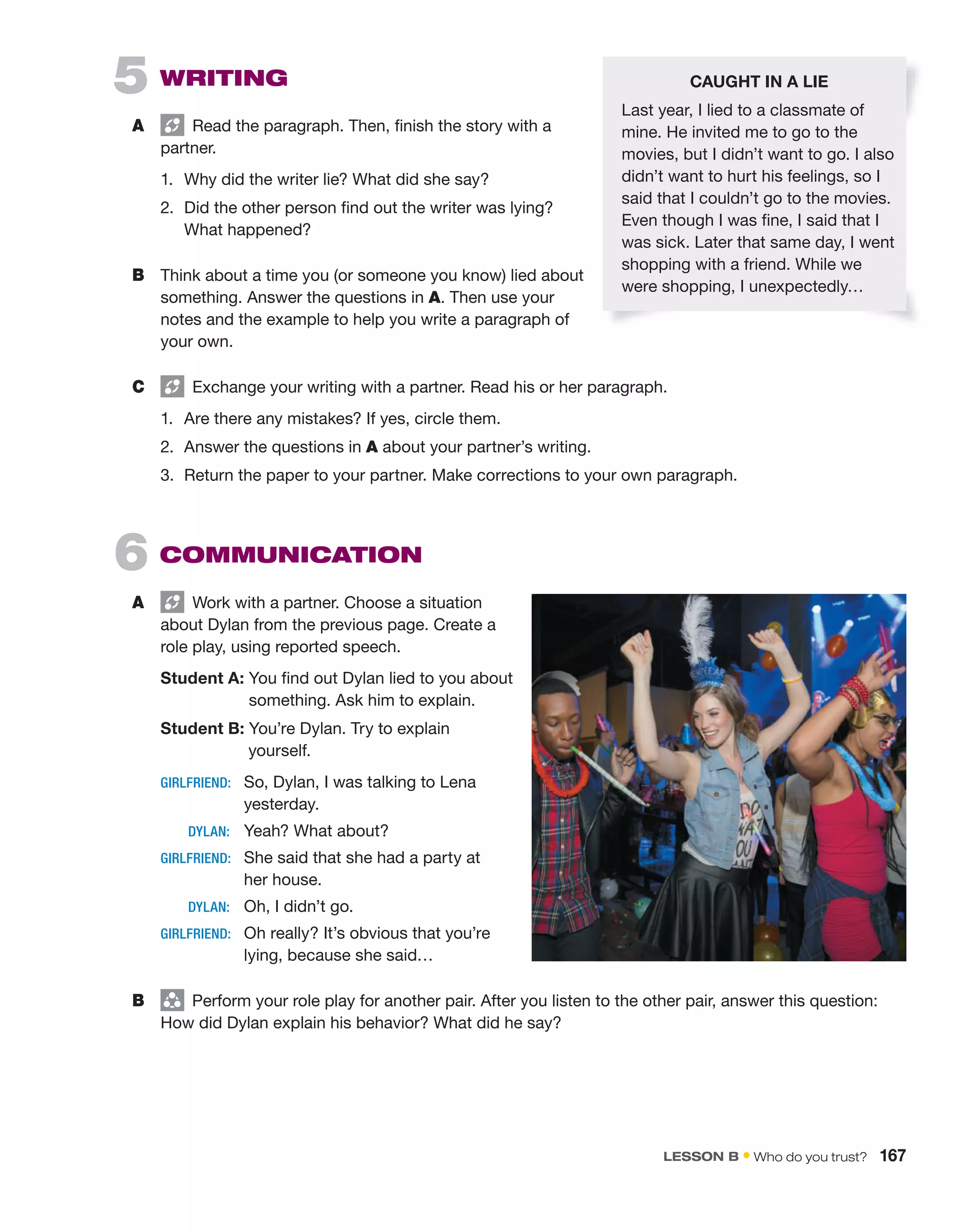
5 WRiting
A Read the paragraph. Then, finish the story with a
partner.
1. Why did the writer lie? What did she say?
2. Did the other person find out the writer was lying?
What happened?
B Think about a time you (or someone you know) lied about
something. Answer the questions in A. Then use your
notes and the example to help you write a paragraph of
your own.
C Exchange your writing with a partner. Read his or her paragraph.
1. Are there any mistakes? If yes, circle them.
2. Answer the questions in A about your partner’s writing.
3. Return the paper to your partner. Make corrections to your own paragraph.
6 CoMMUniCAtion
A Work with a partner. Choose a situation
about Dylan from the previous page. Create a
role play, using reported speech.
Student A: You find out Dylan lied to you about
something. Ask him to explain.
Student B: You’re Dylan. Try to explain
yourself.
GIRLFRIEND: So, Dylan, I was talking to Lena
yesterday.
DYLAN: Yeah? What about?
GIRLFRIEND: She said that she had a party at
her house.
DYLAN: Oh, I didn’t go.
GIRLFRIEND: Oh really? It’s obvious that you’re
lying, because she said…
B group
Perform your role play for another pair. After you listen to the other pair, answer this question:
How did Dylan explain his behavior? What did he say?
CAUGHT IN A LIE
Last year, I lied to a classmate of
mine. He invited me to go to the
movies, but I didn’t want to go. I also
didn’t want to hurt his feelings, so I
said that I couldn’t go to the movies.
Even though I was fine, I said that I
was sick. Later that same day, I went
shopping with a friend. While we
were shopping, I unexpectedly…
lEsson B • Who do you trust? 167
12
12
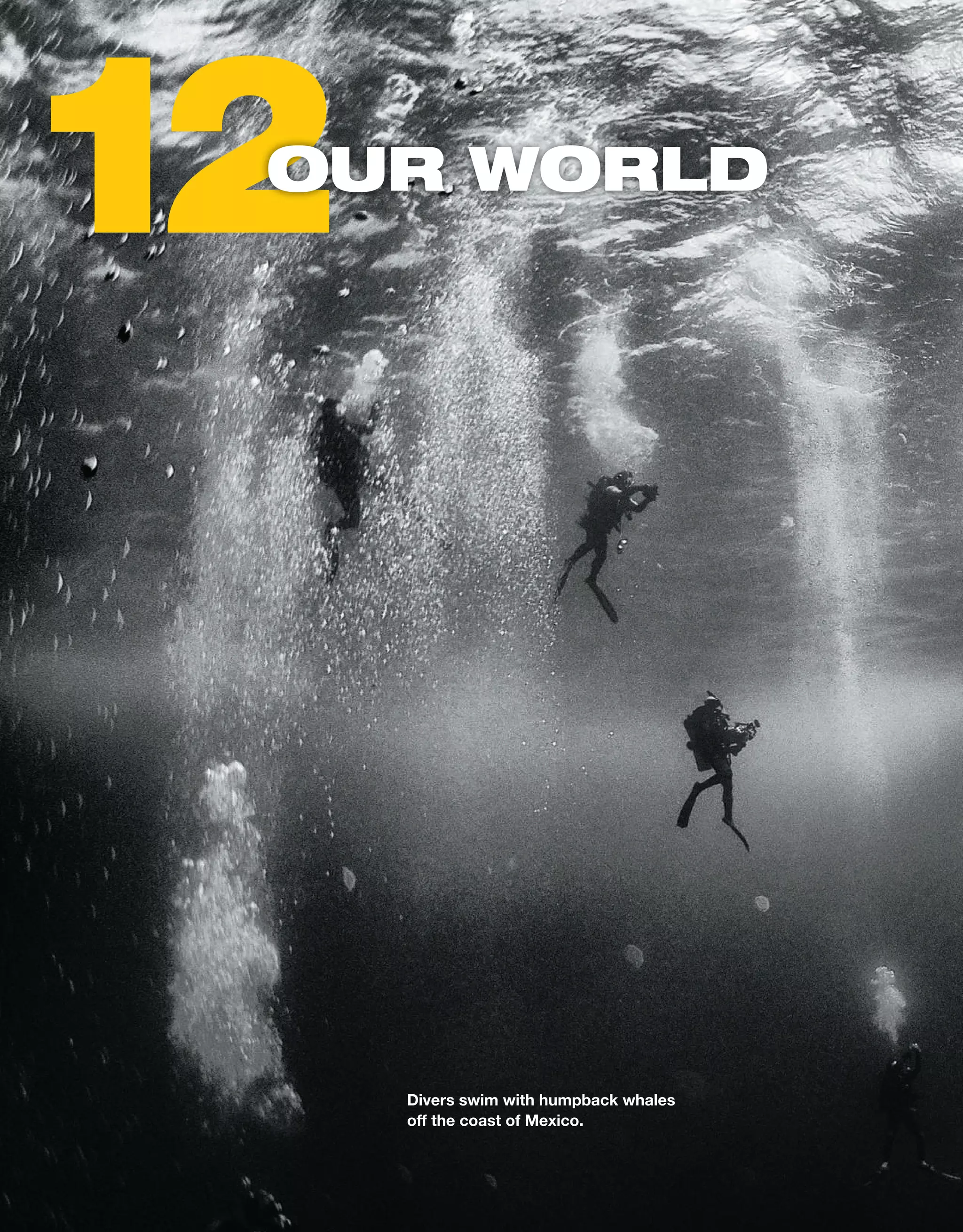
oUR WoRLd
Divers swim with humpback whales
off the coast of Mexico.
Look at the photo. Answer the questions.
1 What animals are in the photo? What do you
know about them?
2 What are the people doing? Why do you think
they are doing this?
3 What is one way that humans might be affecting
these animals and their natural habitat?
Unit GOALS
1 Describe rare animals and their habitats
2 Ask questions in an indirect way
3 Offer another opinion
4 Talk about man-made structures and their impact
on the environment
L e s s o n A The natural world
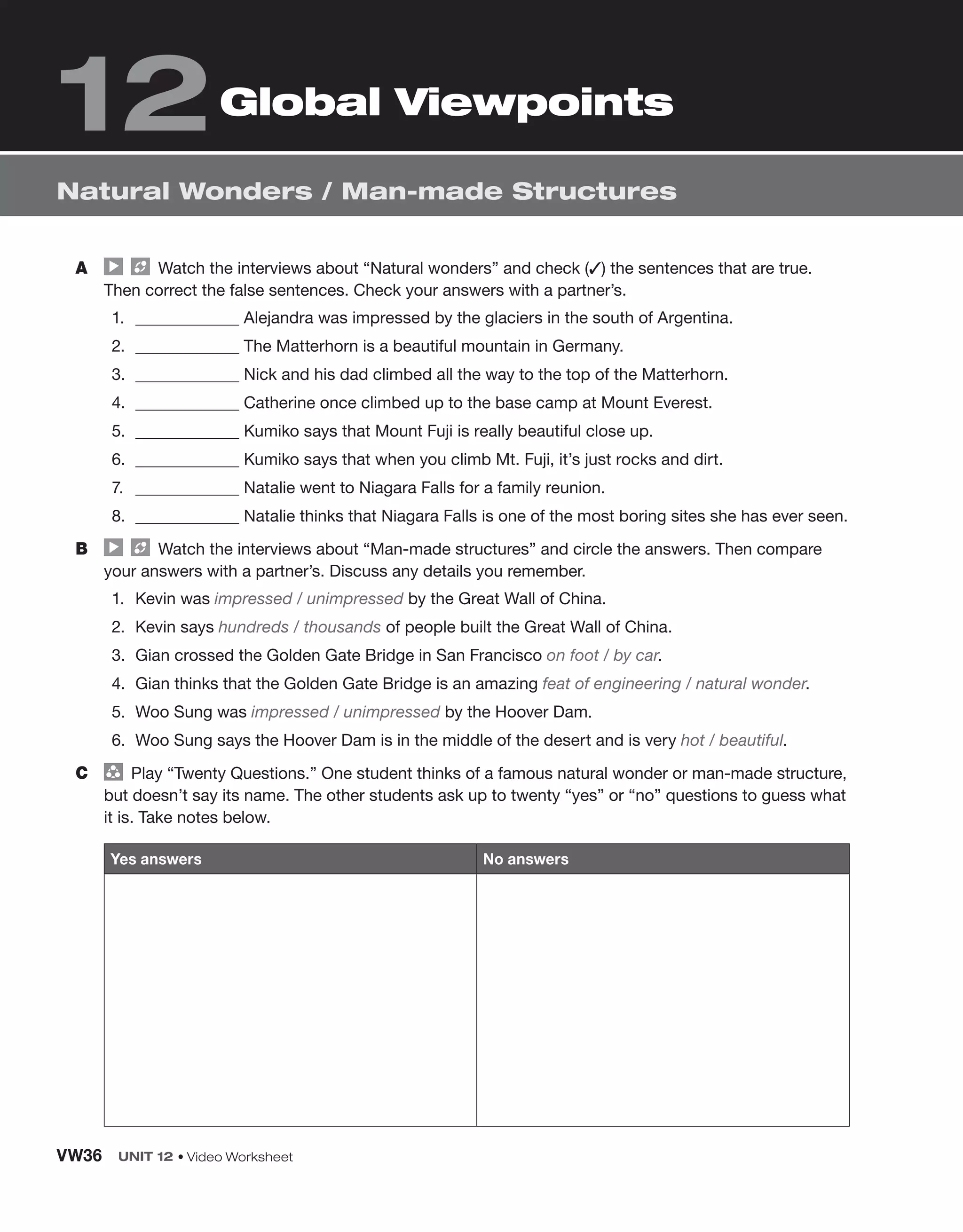
1  Video The Steward of Ormond Beach
A	 Read the title. What is a steward? What do you think a steward of a beach does?
B	   Watch the video. Circle True or False for each item.
1.	 Walter Fuller is the steward for Ormond Beach. True    False
2.	 His other title is “protector of sea life of Ormond.” True    False
3.	 For the past 15 years, Walter has been living at Ormond Beach. True    False
4.	 In the beginning, Walter visited the beach on his days off. True    False
5.	 There are many wetland areas on the Southern California coast. True    False
6.	 Walter used to be a volunteer. True    False
7.	 In high school, Walter studied the eagle family. True    False
8.	 The coastline is considered to be a beautiful part of the United States. True    False
9.	 Walter says that having a job motivates him. True    False
C	   Answer these questions. Share your answers with a partner.
1.	 What area do you know that needs a steward? 
2.	 Why did you choose that area? 
Walter Fuller walks down Ormond Beach, California.
170  Unit 12 • Our world
2 VoCABULARY
A Work with a partner. You are going to learn about two different animals. Follow the instructions
below. Look up any words you don’t know.
Student A: Read the information about snow leopards.
Student B: Read the information about mountain gorillas.
Snow leopards
We don’t know exactly how many snow
leopards there are, but we do know their
numbers are declining. Today, there may be
as few as 3,000 in the wild.
The secretive animals live in the countries of
Central Asia, but people rarely see them.
They have thick fur that helps them survive the
cold winters of their mountain environment.
The leopards like to eat sheep and goats,
and for this reason, many are killed by
sheepherders.
Mountain gorillas
Mountain gorillas live in dense forests. They
can climb trees, but spend most of their time
on the ground.
They are found in Africa—in Rwanda and
Congo.
The gorillas are endangered (currently only
900 remain) due to illegal hunting and loss of
their habitat.
Even so, their numbers are slowly increasing
because they are protected.
B Interview your partner about his or her animal. Ask questions to complete the information
in the chart.
C The snow leopard and the mountain gorilla are suffering. Both animals
are almost extinct. What would you do to raise awareness of their
situations? What would you tell people? Discuss with a partner.
Snow leopard Mountain gorilla
Population
Habitat
Location
Challenges
How many snow
leopards are there?
To raise awareness,
I would tell people...
LESSOn A • The natural world 171
3  LISTENING
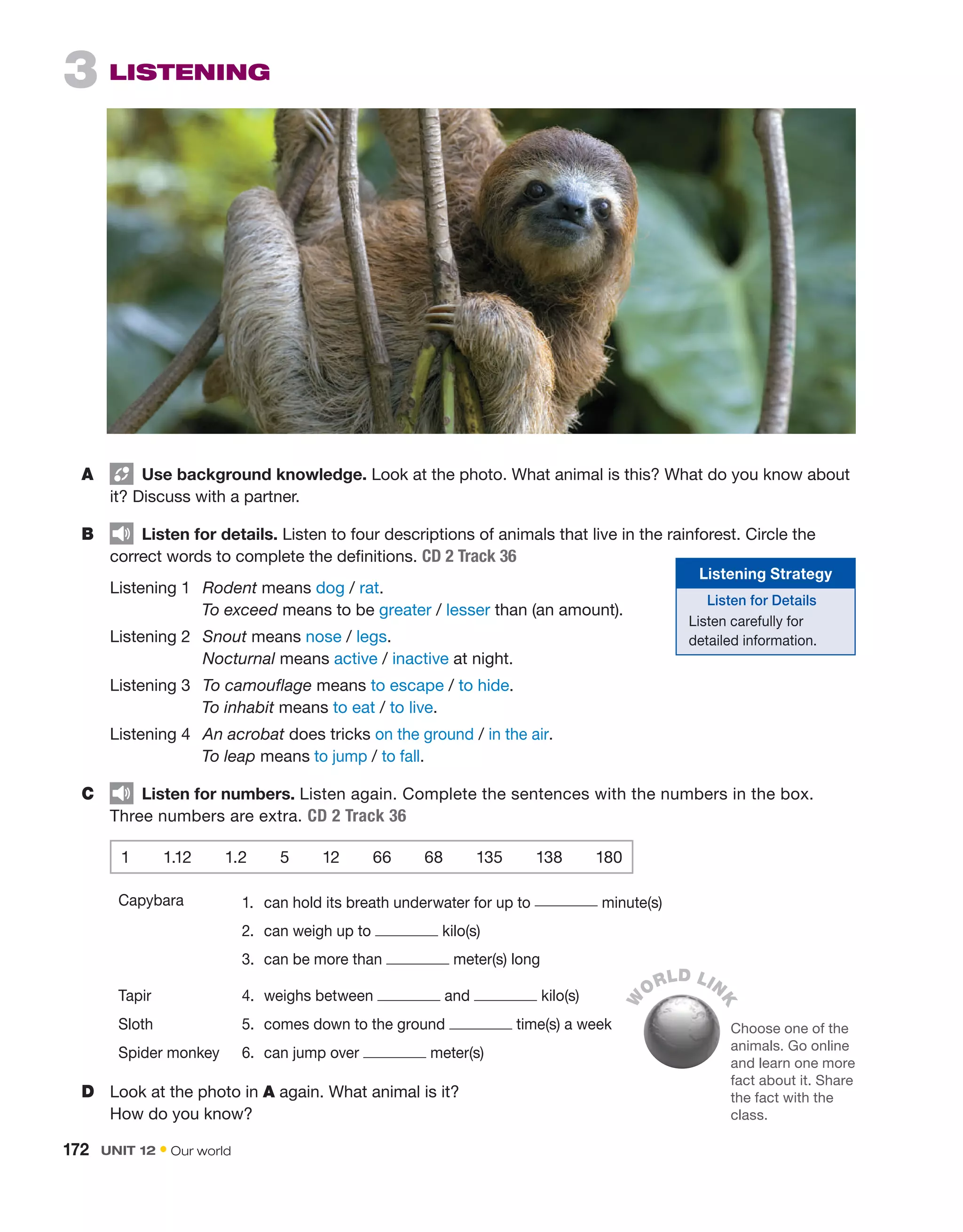
A	   Use background knowledge. Look at the photo. What animal is this? What do you know about
it? Discuss with a partner.
B	   Listen for details. Listen to four descriptions of animals that live in the rainforest. Circle the
correct words to complete the definitions. CD 2 Track 36
	
Listening 1	 Rodent means dog / rat.
		
To exceed means to be greater / lesser than (an amount).
	
Listening 2 	 Snout means nose / legs.
Nocturnal means active / inactive at night.
	
Listening 3	
To camouflage means to escape / to hide.
		
To inhabit means to eat / to live.
	
Listening 4	 An acrobat does tricks on the ground / in the air.
		
To leap means to jump / to fall.
C	   Listen for numbers. Listen again. Complete the sentences with the numbers in the box.
Three numbers are extra. CD 2 Track 36
1  1.12  1.2  5  12  66  68  135  138  180
Capybara 1.	 can hold its breath underwater for up to minute(s)
2.	 can weigh up to kilo(s)
3.	 can be more than meter(s) long
Tapir 4.	 weighs between and kilo(s)
Sloth 5.	 comes down to the ground time(s) a week
Spider monkey 6.	 can jump over meter(s)
D	 Look at the photo in A again. What animal is it?
How do you know?
W
ORLD LIN
K
Choose one of the
animals. Go online
and learn one more
fact about it. Share
the fact with the
class.
Listening Strategy
Listen for Details
Listen carefully for
detailed information.
172  UNIT 12 • Our world
4 sPeAKing
A Gustav and Carolina are telling Bart about
their summer job. Listen to and read their
conversation. Where did they work and what
did they do? Why can’t Bart apply for the job?
CD 2 Track 37
BART: So, what exactly did you do over
the summer?
GUSTAV: We worked as volunteers at Glacier National Park.
BART: I’ve never been there. What’s it like?
CAROLINA: It’s beautiful. There are mountains and lakes... and, of course, glaciers!
BART: How was the job?
GUSTAV: We had to do a lot of physical work. It was kind of hard.
CAROLINA: That’s true, but it was exciting, too! We actually saw bears!
BART: Wow! That does sound exciting. Maybe I should apply. I’ll need a job next summer.
CAROLINA: Sorry, Bart, but you can’t apply to that program. It’s a special program for
international students.
B group
Practice the conversation in groups of three.
SPEAKING STRATEGY
C You and your partner are looking for a place to live
together as roommates. Write down some of the important
things to consider.
D Read about these two possible places to live. Add three more ideas to each list. With a partner,
discuss the positive and negative aspects of each place. Use the Useful Expressions to help you.
City apartment Suburban home
expensive
near public transportation
small bedrooms
big balcony with a great view
big backyard
need a car
quiet neighborhood
nothing to do on weekends
E group
With your partner, have a discussion and then choose one of the places to live in D.
Tell the class which location you chose and why.
cost,
Useful Expressions
Offering another opinion
That’s true, but...
Yes, but on the other hand,...
Even so,...
But then again,...
An apartment in the
city would be expensive.
Yes, but on the other
hand, living in the city
is exciting. There’s so
much to do!
LESSOn A • The natural world 173
5 gRAMMAR
A Study the chart. Turn to page 216. Complete the exercises. Then do B–D below.
Embedded Questions
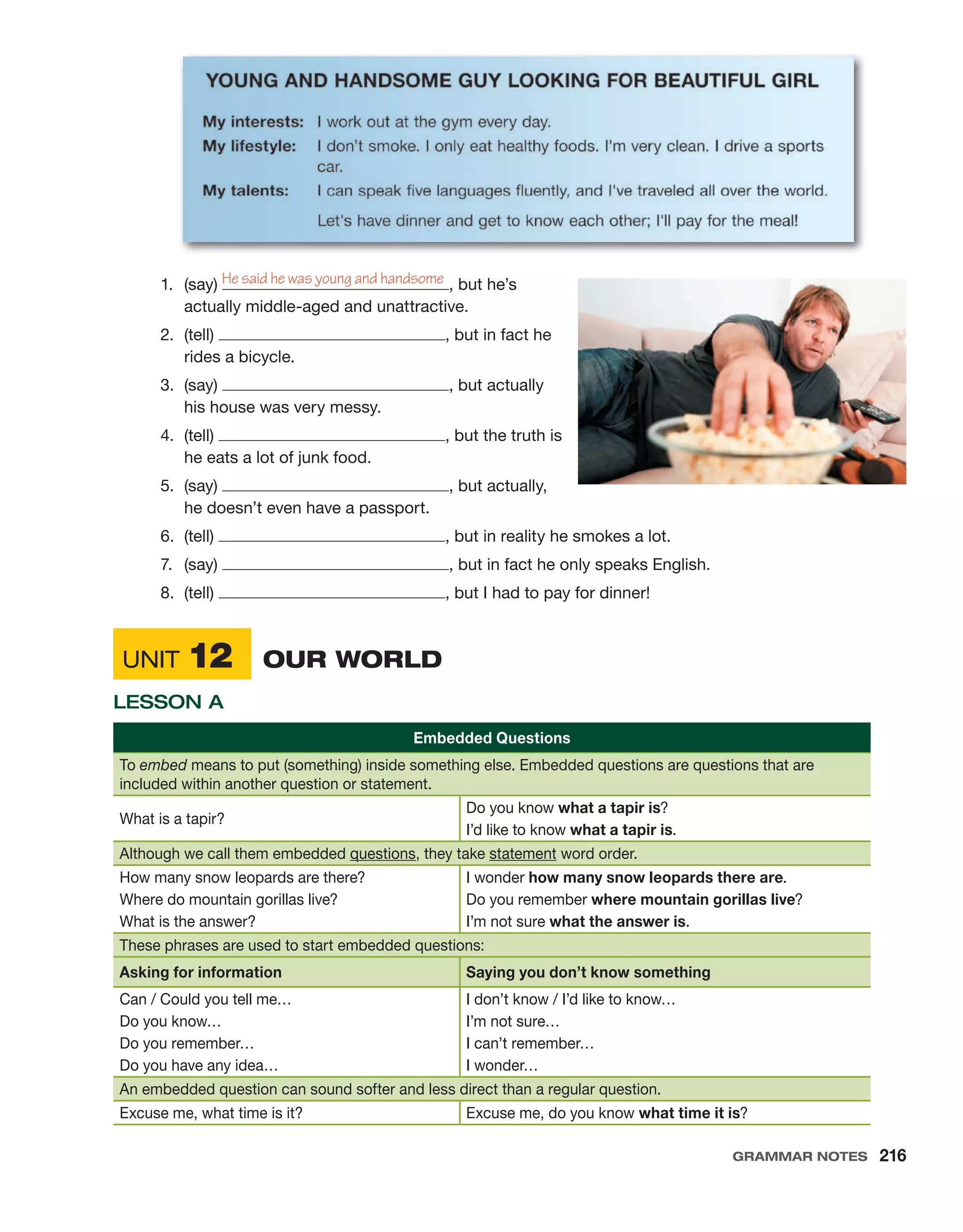
What is a tapir?
Do you know what a tapir is?
I’d like to know what a tapir is.
Asking for information Saying you don’t know something
Can / Could you tell me…
Do you know…
Do you remember…
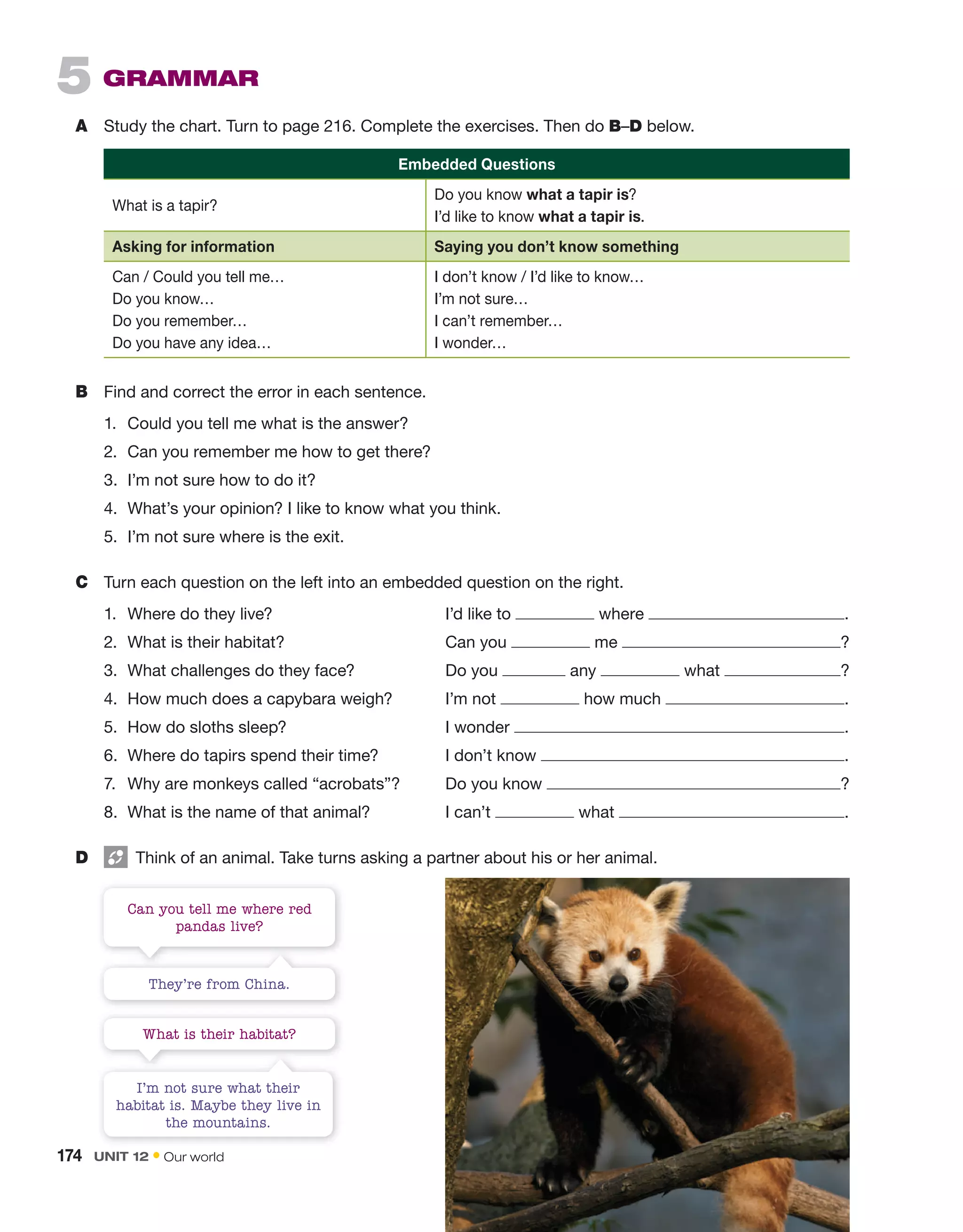
Do you have any idea…
I don’t know / I’d like to know…
I’m not sure…
I can’t remember…
I wonder…
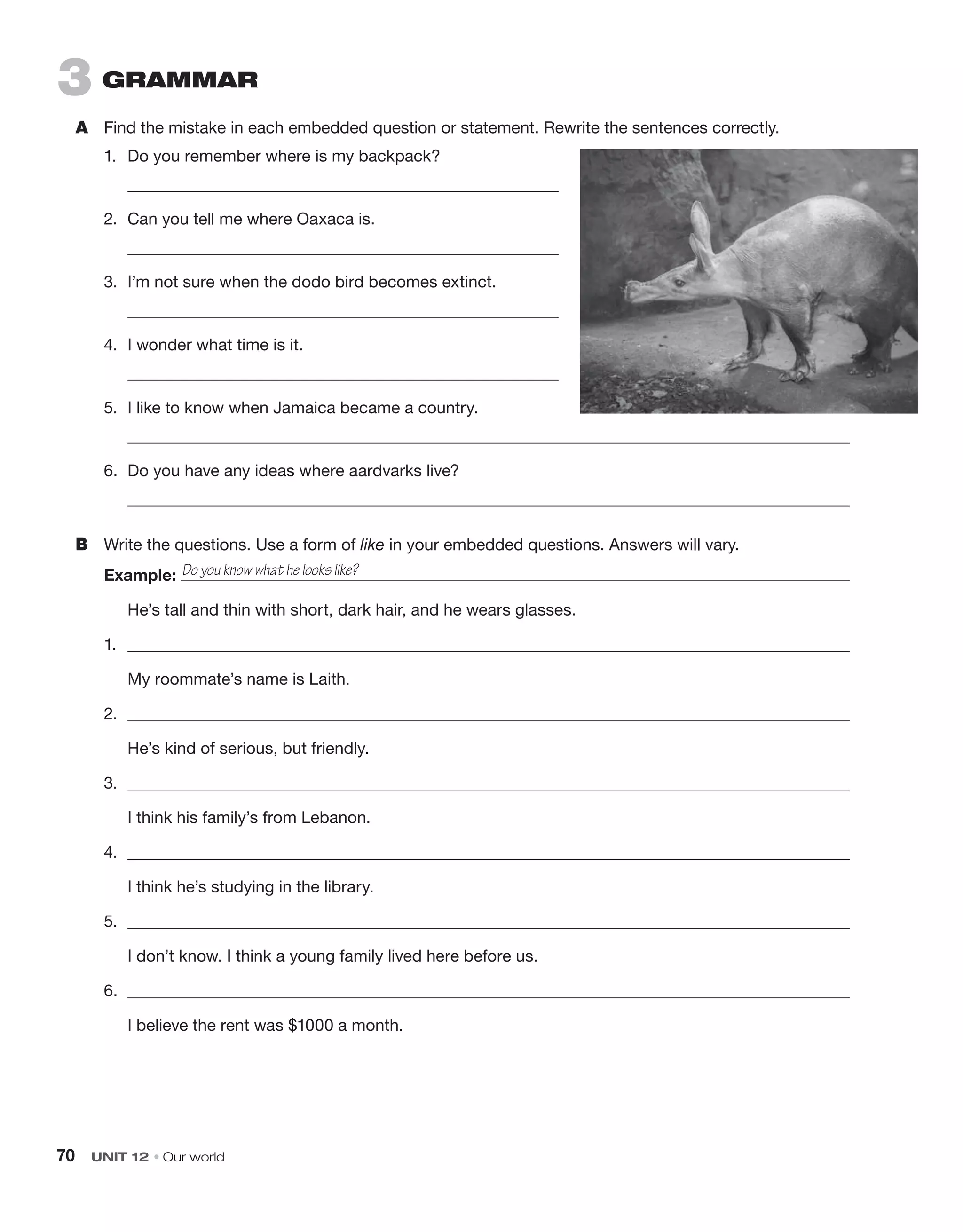
B Find and correct the error in each sentence.
1. Could you tell me what is the answer?
2. Can you remember me how to get there?
3. I’m not sure how to do it?
4. What’s your opinion? I like to know what you think.
5. I’m not sure where is the exit.
C Turn each question on the left into an embedded question on the right.
1. Where do they live? I’d like to where .
2. What is their habitat? Can you me ?
3. What challenges do they face? Do you any what ?
4. How much does a capybara weigh? I’m not how much .
5. How do sloths sleep? I wonder .
6. Where do tapirs spend their time? I don’t know .
7. Why are monkeys called “acrobats”? Do you know ?
8. What is the name of that animal? I can’t what .
D Think of an animal. Take turns asking a partner about his or her animal.
Can you tell me where red
pandas live?
What is their habitat?
They’re from China.
I’m not sure what their
habitat is. Maybe they live in
the mountains.
174 Unit 12 • Our world
6 CoMMUniCAtion
A Work alone. Take the quiz. Look up any words you don’t know.
B group
Get into a group of four people. Imagine that you are
on a quiz show. Follow the steps below.
Student A: quiz show announcer
Students B–D: quiz show contestants
1. Student A: Read a question from the quiz in A.
2. Students B–D: Write down your answer on a piece of paper.
3. Student A: Ask each contestant for his or her answer. Then check page 218 and give each
contestant one point for a correct answer. Continue asking questions.
4. Students B–D: The person with the most points at the end of the game wins.
Maria, do you know what the
largest island in the world is?
I’m not sure what the answer
is, but I chose Great Britain.
Is that correct?
What / Where is the world’s...
1. busiest harbor?
a. Singapore
b. Pusan (South Korea)
c. Hong Kong (China)
2. largest island?
a. Great Britain
b. Greenland
(Denmark)
c. Honshu (Japan)
3. highest waterfall?
a. Tugela Falls
(South Africa)
b. Angel Falls
(Venezuela)
c. Sutherland Falls
(New Zealand)
4. oldest active volcano?
a. Kilauea (US)
b. Yasur (Vanuatu)
c. Etna (Italy)
5. longest mountain range?
a. the Austrian Alps
(Europe)
b. the Andes
(South America)
c. the Urals (Europe)
6. longest cave?
a. Mammoth Cave (US)
b. Holloch Cave
(Switzerland)
c. Sistema Ox Bel Ha
(Mexico)
7. deepest lake?
a. Lake Superior
(US / Canada)
b. Lake Nyasa (Africa)
c. Lake Baikal (Russia)
8. largest desert?
a. the Sahara
(North Africa)
b. the Australian
(Australia)
c. the North American
(Mexico / US)
9. longest coastline?
a. Australia
b. Canada
c. Chile
A harbor is a sheltered area of water
where boats are protected from storms.
LESSOn A • The natural world 175
L e s s o n B The Man-Made world
1 VoCABULARY
A What do you know about the famous building in this photo? Tell a partner. Then take turns
reading about it aloud.
B Complete the sentences using the words in blue from above. Work with a partner.
1. Engineers need to make sure the skyscraper can earthquakes before they start
.
2. There are other to think about, too. For example, where will people park?
3. To answer this question, the architect an idea: build an underground parking lot.
It will be able to 1,500 cars.
4. From the parking lot, an elevator will people and goods to the top floor in
15 seconds.
5. The team the architect’s idea and agreed with his suggestion.
6. There should also be a(n) way of heating and cooling the building.
7. With solar panels, the building will have plenty of energy and also be .
C Discuss the questions with a partner.
1. Why is the Burj Khalifa special?
2. What were some of the obstacles that
architects faced when they designed it?
withstand
3. What’s special about the building’s elevators?
4. How is the building good for the environment?
The Burj Khalifa, Dubai, United Arab Emirates
• This skyscraper is the tallest building in the world at 829.8
meters (2,722 feet).
• Architects proposed ideas for the building in 2003 and
construction was finished in 2010.
• Architects faced many obstacles in building a skyscraper
this big. The building needed to be very strong to withstand
its own weight! The extreme heat of Dubai also had to be
considered.
• Another issue was how to safely and quickly transport
people and goods around the building. The builders found
an efficient solution to get around this problem. The
building has 57 high-speed elevators. Each can travel 600
meters a minute and accommodate 10–12 people.
• The building has many sustainable features as well. For
example, it collects and reuses water from the air conditioners,
saving 15 million gallons of water a year!
176 Unit 12 • Our world
2  Listening
A	   Which words in the box do you know? With
a partner, look up any unfamiliar words in your
dictionary.
B	   Listen for gist. Which photo shows what the woman does in her job? Listen and circle the
­correct one. CD 2 Track 38
architect	edge	 investigate
blueprint	 get access (to a place)	 leaky
C	   Listen for details. Listen. Complete the sentences about Jamie’s job. CD 2 Track 38
1.	 Jamie works with buildings.
2.	 She checks problems so that they don’t mistakes.
3.	 Rappelling is a way to get access to places.
4.	 After you hook up to the top of the building, you over the edge.
5	 Rappelling is scary, but you can get .
D	   Pronunciation: Negative questions to confirm information. Complete the negative questions.
Then listen and check your answers. CD 2 Track 39
1.	 (be / you / an engineer) 	 That’s correct. I’m a civil engineer.
2.	 (work / you / on the second floor ) 	 No, actually I work on the third floor.
3.	 (be / the Burj Khalifa / in the UAE) 	 Yes, it is, in Dubai.
4.	 (be / the Eiffel Tower / built in 1900) 	 No. It was finished in 1889.
E	   Practice asking and answering questions 1–4 in D with a partner. Pay attention to intonation.
Aren’t you an engineer?
Listening Strategy
Listen for Gist
Listen for the general idea.
LESSON B • The man-made world  177
WHEN
THE SEAS
RISE
3 ReAding CD 2 Track 40
A Use background knowledge; Make
predictions. Look at the title and the
names of the two countries in the
article. Do you know anything about
these countries? What do you think is
happening in these countries?
B Take notes on key details. Read the
article. As you read, think about
questions 1 and 2. Underline the
information in the passage that answers
the questions.
1. How are rising sea levels affecting
the Seychelles and the Netherlands
specifically?
2. What is each country doing about
these problems?
C Infer meaning. Match the words in bold
in the reading with their definitions.
a short description
planned pieces of work
to damage land or rock
so it disappears
close to the height of
the ocean
walls built across
bodies of water to hold
the water back
D Summarize; Give opinions. Answer
the questions with a partner.
1. Look again at the questions in B.
Explain your answers to a partner in
your own words.
2. Has global warming affected the
area where you live? What do you
think can be done to help?
A solar-powered floating house in
Rotterdam, the Netherlands.
Reading Strategy
Summarize
Explain what you have
read in your own words.
Reading Strategy
Give Opinions
Express what you think
about an issue based
on the reading.
Where I live, global
warming is...
178 Unit 12 • Our world
When most people think of global warming1, they think of something that will
happen in the future, something that doesn’t affect their daily life. But for many
people around the world, the future is now. Research shows that sea levels
worldwide have been rising at a rate of 0.14 inches (3.5 millimeters) per year
since the early 1990s. The trend, linked to global warming, is putting thousands
of coastal cities at risk of being destroyed over time. The two countries below
offer a snapshot of what climate change might look like for all of us.
Seychelles
This chain of islands in the Indian Ocean has been called one of the most
beautiful places on Earth. There is a problem, though. Many of the country’s most
populated regions were constructed in low-lying areas, near the water. As sea
levels rise, many people will lose their homes.
Already, the island’s tourism industry is being hurt. Seychelles’s famous
beaches are being eroded by the rising water, as well as by storms that grow
more powerful each year. In addition, the country’s coral reefs (a popular tourist
attraction) are suffering because of warmer water.
To fight these problems, the government of the Seychelles has been
trying to relocate people living in low-lying coastal areas to higher ground.
Unfortunately, there isn’t enough land to accommodate many of these people.
The country’s citizens are also trying to bring as much attention as possible
to global warming and the danger it poses. They point out that if these
things happen to the Seychelles, they can happen to big countries like the
United States, China, or Brazil next.
The Netherlands
For the people of the Netherlands, rising waters have been an obstacle for
years. The country is close to 30 percent under sea level! A series of dams
and dikes has protected the country from mass flooding for many years, but
as sea levels continue to rise, more extreme solutions are being considered.
One of them is a large increase in “floating houses.” These houses are built
on water or in areas that flood, and each structure is able to rise and fall with
the water. Sustainable and efficient apartment buildings that can float are also
being planned.
Engineers in the Netherlands are also continuing the country’s tradition of
doing large construction projects to help hold the water back. Larger dams
have been built in recent years, and rivers have been rerouted so they are not
as close to cities. Today, engineers from many countries visit the Netherlands
to learn more about these projects. They fear that in the future, as the Earth
warms and sea levels continue to rise, Dutch building techniques will have to
be used all over the world.
1Global warming is an increase in the Earth’s temperature, caused in part by humans’ use of fossil fuels
(oil, gas). As the Earth warms, ice melts, causing sea levels to rise.
LESSON B • The man-made world 179
4 gRAMMAR
A Study the chart. Turn to page 217. Complete the exercises. Then do B below.
The Passive with Various Tenses
Active Passive
Simple present Engineers build skyscrapers with a steel
frame structure.
Most skyscrapers are built with a steel
frame structure.
Simple past The Woolworth Company built a
skyscraper in 1913.
One of the first skyscrapers was built
in 1913.
Present perfect Engineers have built the world’s tallest
building in Dubai.
The world’s tallest building has been
built in Dubai.
Present
continuous
Engineers are building a lot of tall
buildings in Shanghai.
A lot of tall buildings are being built
in Shanghai.
Simple future Someday they will build a skyscraper
without concrete.
Someday a skyscraper without concrete
will be built.
B group
Work with a partner. Read the information below. Look up the underlined words. Choose a role
(Student A or B). Debate the issue with your partner. Try to agree about what to do. Share your plan
with another pair.
The old buildings should be
preserved. They connect us
with our past.
Yes, but on the other hand,
these old buildings may not
withstand…
A large construction company wants to tear down traditional buildings in a neighborhood in your
city. The buildings are beautiful, but they were built 100 years ago and aren’t in good condition.
Student A: You work for the construction company. Here is your plan:
• The old buildings will be torn down, and new office and apartment buildings will be built.
• The new buildings will be safer and will be able to accommodate more people.
• Former tenants will be allowed to move back into a new apartment, but it will take three years
for the project to be finished. For now, those people must find other housing.
Student B: You live in one of the old buildings now. You have this opinion:
• A lot of modern buildings have been built in our city. Older structures should be preserved.
• Many people in the buildings are elderly. They shouldn’t be forced to leave their homes.
180 Unit 12 • Our world
6 CoMMUniCAtion
A Read about Diamond City’s problems. What projects have been proposed to solve these
problems? Use your own words to explain each situation with a partner.
5 WRiting
A What do you think about the issue in Grammar B? In five minutes, outline your ideas below. Then, in
20 minutes, write a paragraph in your notebook. Explain each reason with an extra sentence or two.
In my opinion, the old buildings should / shouldn’t be torn down for two reasons.
For one thing, .
In addition, .
For these reasons, I believe the old buildings should / shouldn’t be torn down.
B Exchange your writing with a partner. Circle any mistakes in your partner’s writing. Do you agree
with your partner’s opinion? Why or why not? Return the paper to your partner. Make corrections to
your own paragraph.
We think that they should
start with the subway project,
because...
Really? We think that the
dam project should be done
first....
B With your partner, rank the projects in the order you would do them. Give reasons for your order.
Note: A new project can be started only after the previous one has been finished.
C group
Explain your plan from B to another pair. Are your ideas similar? If not, whose plan is better? Why?
Problem 1: The dam was built 30 years ago,
and it is weak.
Project: Repair the dam. This will take three
years.
Notes: The city has been hit by a huge flood
every 100 years. The last flood was 20 years
ago, and the downtown area was destroyed.
Problem 3: The traffic is terrible, and businesses
are leaving the city because of it.
Project: Build a new subway line to transport
people. It will take three years to finish.
Notes: Construction will be difficult and
expensive, but a new subway system is needed
to transport people.
Problem 2: The baseball stadium is old.
Project: Repair the stadium. It will take
two years.
Notes: The Diamond City Miners baseball team
is a big moneymaker for the city. But if the
stadium isn’t fixed soon, the team may move to
another city.
Problem 4: There isn’t enough office space in
Diamond City.
Project: Build a new skyscraper to keep
businesses in the city. It will take two years
to finish.
Notes: The land around the skyscraper is polluted
and must be cleaned up first. This will take a year
or more. Then construction can begin.
LESSOn B • The man-made world 181
REVIEW UNITS 10–12
1 STORYBOARD
A Lisa is asking Ana about her recent vacation. Look at the pictures and complete the conversation.
More than one answer may be possible for each blank.
/ˈlisə/
B Practice the conversation with a partner. Then change roles and repeat.
C What do you think of Ana’s idea? What would you do to raise awareness? Tell a partner.
1
2
3 4
5 6
Hi, Ana!
How was your
vacation?
amazing!
But I was also surprised
by something.
! We went
hiking in the forest.
What was the
rainforest ?
What was that? Really?
I’d to
awareness about this
.
There was
a lot of near the
rainforest.
How will you
do that?
I want to
a website where people
can
money to help.
Yeah. A lot of animals
are . They could
extinct in a
few years.
/ˈɑnɑ/
182 REVIEW • Units 10–12
2 SEE IT AND SAY IT
A Study the picture for ten seconds and then close your book. With a partner, take turns describing
the scene in as much detail as you can.
B Look at the picture again. Answer the questions with a partner.
1. Who are these people? Where are they?
2. Where are they going or what are they looking for? What time of day is it?
3. What do you think the leader is thinking?
It’s getting late. They should
stop. If I were the leader, I’d
suggest we sleep in the cave.
That’s one idea. But then
again, I think the cave would
be too cold. I’d suggest...
C What would you do if you were the leader of the group? Make suggestions and explain
your answers with a partner.
REVIEW • Units 10–12 183
3 SARA AND SANDRA
A Read the story about Sara and Sandra. Fill in the missing words.
/ˈsændrə/
Sara and Sandra are sisters. They both it rich by
the lottery.
Sara decided she could by on very little money. She made a very
tight budget for herself. She took 50 percent of the money and
it to charities. She also aside the amount in
a bank .
Sandra, on the other hand, did something different. She
her money on jewelry, vacations, and presents for herself. She spent way
much money and didn’t anything. In one
year, she had into debt and afford to pay
all the money she had borrowed.
B With a partner, compare your answers in A.
C Imagine your friend has won the lottery. Give him or her some financial advice. Use the negative
modals in the box.
don’t have to had better not shouldn’t
4 LISTENING
A Listen to each response. Then choose the question that came before the response. CD 2 Track 41
1. a. What does she look like?
b. What’s she like?
2. a. Why did you buy a new car?
b. Why do you want a new car?
3. a. What would you do if you won the contest?
b. What will you do when you win the contest?
4. a. Did you like the painting?
b. How long did it take you to paint it?
5. a. When did they complete the bridge?
b. When will they complete the bridge?
6. a. What do you usually do on Friday night?
b. What do you want to do on Friday night?
Well, for one thing, you don’t
have to tell everyone right away.
/ˈsɛərə/
184 REVIEW • Units 10–12
5 WHILE YOU WERE OUT
A Imagine that, while your boss was out, you took several
messages. Work with a partner. Using reported speech,
give the messages to your boss. Then switch roles and repeat.
Student A: Give these messages to your boss.
1. Mary: “The meeting is scheduled for 2:00.”
2. Tom: “I won’t be in the office next week. I’ll be in
China on business.”
3. Copy company: “We’re running behind schedule
on your job.”
Student B: Give these messages to your boss.
1. Celine: “I can’t make the deadline.”
2. Dry cleaners: “Your suits are ready.”
3. Mario: “I don’t understand your memo. I have
questions about it.”
6 MAKING PLANS
A With a partner, choose a situation and create a conversation of eight to ten sentences.
Situation 1
Student A: There’s a Broadway show in town,
and your partner wants to see it. You think the
show is too expensive.
Student B: There’s a Broadway show in town,
and you really want to see it. Persuade your
partner to go.
Situation 2
Student A: There’s a popular art exhibit at the
museum. Your partner wants to see it. You
think it will be very crowded and hard to see the
paintings.
Student B: There’s an exhibition at the museum
in town, and you really want to see it. Persuade
your partner to go.
B: I really want to see the Broadway show that’s in town.
A: Yes, but it’s too expensive.
B: That’s true, but...
B group
Practice your conversation. Then perform it for another pair.
Were there any messages while
I was out?
Yes. There were three. Mary
called. She said that…
/ˈmeəri/
/tɒm/
/səˈlin/
/ˈmærioʊ/
REVIEW • Units 10–12 185
2 QUEstion FormULation
A Make questions by unscrambling the words in the box. You may need to add a few words.
1. charity / donate / to / money
2. lend / ever / people / money
3. money / spend / vacation
4. happiness / money / buy
5. give / people / charity / money
6. most important / life / thing
1. Do you donate money to charity ?
2. Do ?
3. How much ?
4. Can ?
5. Why ?
6. What ?
B Work with a partner. Ask and answer the questions in A. Give answers that are true for you.
1 aCCUraCY PraCtiCE
A Write wishes for the statements below. Be sure to use the correct past tenses or past modals.
1. I don’t have enough money for those shoes. I wish (that) I had enough money for those shoes.
2. My sister won’t lend me any money.
3. We have to work tonight.
4. Henry can’t afford to go to the restaurant with us.
5. They have gone into debt to buy a new house.
4 Writing
A Write a paragraph (8–10 sentences) about your three biggest wishes. Use the correct past tenses
and modals. Answer these questions:
• What are you wishing for?
• Is it possible that one or all of your wishes will come true?
• What do you need to make your wishes reality?
3 sPEaKing
A Work with a partner. Imagine that you moved to a new country because your work relocated.
Unfortunately, your life is not the way it was in your old country. Take turns telling your partner how
you wish your life were different.
I live in a big house in the mountains.
It is very pretty, but I wish (that)
I lived closer to my work.
I wish I were rich.
C22 Unit 10 • Unit Consolidation
Unit 10 CONSOLIDATION
International Exam Preparation and Communication Practice
5  
EXAM PREPARATION: LISTENING
A	   Listen to the audio. You will hear a conversation and a question after it. Circle the appropriate
answer for each question. ICPNA Track 15
B	   Listen to the audio. You will hear a conversation and three questions after it. Circle the
appropriate answer for each question. ICPNA Track 16
1.	 Which statement is true?
	 a. 
The woman can afford one skirt.
	 b. 
The skirts cost way too much.
	c. 

The woman can afford two skirts.
	 d. 
The woman is broke.
2.	 Why doesn’t the woman want to go away?
	 a. 
Because she’s busy then.
	b. 
Because she doesn’t have money.
	 c.  Because she doesn’t feel well.
	 d.  Because the man isn’t her friend.
3.	 Who did the millionaire give his money to?
	 a.  His family.
	 b.  A business.
	c. 
Poor students.
	 d.  Sick people.
1.	 Which of the following things do savers do?
	a. 
Set aside money for the future.
	 b.  Buy things when they aren’t on sale.
	 c.  Take big money risks.
	 d.  Go to fancy dinners often.
2.	 What does the speaker think spenders
should do?
	 a.  Spend more money on food.
	b. 
Think more about the future.
	 c.  Enjoy life more.
	 d.  Buy trendy clothes.
3.	 Which of the following statements would
the speaker agree with?
	a. 
Savers are better than spenders.
	 b. 
Spenders spend more money because
they need to.
	 c.  Savers should not worry as much.
	 d. 
Spenders care too much about the future.
4.	 When does the man use his credit card?
	 a. 
When he wants to buy something.
	 b.  When he goes on a trip.
	 c.  To buy a bicycle.
	d. 
When he has a problem.
5.	 What does the woman ask her son?
	 a.  When he’s going to pay her back.
	 b.  Why he wants the money.
	c. 
When he’s getting his salary.
	 d.  If he’s going to have fun.
6.	 What does the woman want to do for dinner?
	a. 
Get takeout.
	 b.  Go to a Chinese restaurant.
	 c.  Cook something.
	 d.  Go to the grocery store.
4.	 What would the man like to be able to do?
	 a.  Go to the gym.
	 b.  Save money.
	 c.  Travel with the woman.
	d. 
Go on vacation.
5.	 How did the woman pay for her trip?
	a. 
She saved money for a year.
	 b.  She won a prize.
	 c.  She used her credit cards.
	 d.  She got money from her family.
6.	 What does she recommend to the man?
	 a.  He should buy more lottery tickets.
	 b.  He should get a credit card.
	c. 
He should save his money.
	 d. 
He should borrow money.
UNIT 10 • Unit Consolidation  C23
1  ACCURACY PRACTICE
A	 Write present unreal conditional sentences for the situations below. You can put the if clause at the
beginning or the end of the sentence. Use correct punctuation.
1.	 I don’t speak English fluently. (need / study) If I spoke English fluently, I wouldn’t need to study it.
2.	 Silvio has a lot of time to see his friends. (not / have / job)
3.	 Today isn’t a holiday. (go / someplace / fun)
4.	 Julia isn’t graduating with honors. (get / a scholarship)
5.	 He lives with his parents. (share / apartment / roommate)
6.	 I study hard. (get / good / grades)
2  QUESTION FORMULATION
A	 Unscramble the words to make questions.
1.	 would / you / found / wallet / what / do / if / a / you What would you do if you found a wallet?
2.	 tell / lie / friend / would / a / you / to / when / a
3.	 trust / who / with / secret / would / you / a
4.	 biggest / lie / what / the / is / told / you / have
5.	 feel / if / friend / how / would / lied / you / to / a / you
6.	 read / someone’s / would / private / you / emails
B	   Work with a partner. Ask and answer the questions in A. Give answers that are true for you.
C24  UNIT 11 • Unit Consolidation
What would you do if you
found a wallet?
I would bring it to
the police.
Your hair looks
great!
Where did you get
it done?
Thanks, I’m really
happy with it.
I did it myself.
3  SPEAKING
A	   Role-play one of these situations with your partner. Be sure not to hurt the other person’s feelings.
•	 Tell someone he or she looks great when
you don’t really think the person does.
•	 Tell someone the food he or she made is
delicious... when it’s not!
•	 Compliment someone on their English
when the person really doesn’t speak
English well.
•	 Tell someone you love a gift that person
has given you... when you hate it!
B	 group
  Act out your conversation for a small group or the class.
UNIT  11 CONSOLIDATION
International Exam Preparation and Communication Practice
5  EXAM PREPARATION: READING
A	 Read the article and answer the questions.

Honesty might be the best policy, but we often abandon it when no one is watching. A team of
researchers led by Dr. Melissa Bateson used an “honesty box” to collect payments for hot drinks, and found
that people are better at paying what they owe when a pair of eyes is watching them. The researchers
attached a poster to a cupboard of mugs above an honesty box alongside a kettle, with tea, coffee, and
milk. Over ten weeks, they alternated between a photograph of a pair of eyes and a picture of flowers.

At the end of each week, the researchers counted the money in the honesty box and measured the
amount of milk used—an indicator of the number of drinks consumed. The money went up every week
the poster showed a pair of eyes.

Researchers said that even though the eyes were not real they still seemed to make people behave
more honestly. The effect may arise from behavior that developed as early humans formed social groups
that increased their chances of survival. For social groups to work, individuals had to cooperate for the
good of the group, rather than act selfishly.

The scientists say companies and governments could use our evolved response to a person’s
gaze to improve honesty. “It raises interesting questions about how we might improve systems to
reduce antisocial behavior and things like making people pay for public transport. Signs that say ‘CCTV
cameras in operation’ should, perhaps, show a pair of eyes instead of a picture of a camera. We haven’t
evolved to pay much attention to cameras,” said Dr. Bateson.
4  WRITING
A	 Think of a white lie* you told. Write a short note (8–10 sentences) to the person you lied to and
apologize. Say why you thought you needed to lie, and include what you learned from the experience.
	 *white lie: a lie, usually about something unimportant, told to keep from hurting someone
1.	 What did the researchers want to find out?
	a. If people always behave honestly.
	 b. If people will pay for tea and coffee.
	 c. How people have evolved over time.
	 d. 
If people prefer pictures of eyes or flowers.
2.	 How did they know how many drinks
people consumed during the week?
	 a. They counted the dirty mugs.
	 b. They looked at the tea and coffee.
	c. They measured the milk.
	 d. They counted the money.
3.	 What phrase could replace cooperate
for the good of the group in the third
sentence of paragraph 3?
	 a. “Decide to live in the same place.”
	 b. “Work together so that everyone
lived well.”
	 c. “Share good things with each other.”
	 d. “Start families together.”
4.	 In the first sentence of paragraph 4, what
does gaze mean?
	 a. A way of thinking.
	 b. An opinion.
	c. A type of look.
	 d. An idea.
5.	 How can the results of this research be
used?
	 a. They can increase graffiti in public places.
	 b. 
They can encourage people to buy
CCTV cameras.
	 c. 
They can reduce dishonest behavior.
	 d. None of the above.
6.	 Who was this article written for?
	 a. Biology students.
	b. The general public.
	 c. High school teachers.
	 d. People who drink tea or coffee.
UNIT 11 • Unit Consolidation  C25
1 aCCUraCY PraCtiCE
A Turn the questions and cues into embedded questions.
1. Where do snow leopards live? Do you know where snow leopards live ?
2. How do you get a job at the nature reserve? Can you tell me ?
3. What do red pandas eat? I’d like to know .
4. How much do brown bears weigh? Do you have any idea ?
5. Which animals live in the rain forest? Do you know ?
2 QUEstion FormULation
A Read the list below of the New Seven Wonders of the World. Do you know anything about these
wonders? In your notebook, write at least one question about each. Use the passive voice.
C26 Unit 12 • Unit Consolidation
B group
Now walk around the class. Find students who know the answers to your questions. Write notes
so you will remember them and can share with the class.
3 sPEaKing
A With a partner, think of a place in your city that can be made more beautiful. Prepare a
presentation. Use the passive voice and opinion expressions learned in the unit.
Christ the Redeemer Statue, Brazil
The Great Wall of China
Taj Mahal, India
Roman Colosseum, Italy
Pyramid at Chichen Itza, Mexico
Petra, Jordan
Machu Picchu, Peru
Possible topics to ask about:
•  Location
•  Date built
•  Purpose
•   
Person or civilization responsible 
for building
•  Tourism status
Are people allowed to
visit the Taj Majal?
Of course! Do you know
when it was built?
design
plant
clean
paint
remove
build
rebuild
tear down
fix
repair
A new monument will
be built in the center
of the park.
Will more trees be
planted there?
B group
Present your city beautification project idea to the class. Whose idea do you like the best? Discuss.
Chichen Itza pyramid
Unit 12 CONSOLIDATION
International Exam Preparation and Communication Practice
5  EXAM PREPARATION: LISTENING
A	   Listen to the audio. You will hear a conversation and a question after it. Circle the appropriate
answer for each question. ICPNA Track 17
4  WRITING
A	 Write a letter to your mayor or another local politician about your beautification project. Include what
the project is, why you think it should be done, and how you think your city should raise money to
help pay for it. Use persuasive language.
1.	 What did the woman do on her
vacation?
	 a. Studied.	 c. Camped out.
	b. Volunteered.	 d. Worked.
2.	 How does the man feel about global
warming?
	 a. He is very concerned.
	 b. He doesn’t have an opinion about it.
	c. It doesn’t bother him very much.
	 d. He is a little worried.
3.	 What kind of meeting is the man probably
speaking at?
	 a. A meeting for a political candidate.
	 b. A sales meeting for apartments.
	 c. A scientific research conference.
	 d. A city planning meeting.
4.	 What does the woman want to know about?
	 a. Greenland’s climate.
	b. The origin of Greenland’s name.
	 c. The first humans to live in Greenland.
	 d. Ways of traveling to Greenland.
5.	 What is the woman probably going to do?
	 a. Get a job cleaning up the river.
	 b. Move to a city with a cleaner river.
	 c. 
Start an organization to take care of the
river.
	d. Go to the volunteer meeting.
6.	 What are the man and woman talking about?
	a. A TV program about animals.
	 b. A science exam.
	 c. A nature reserve.
	 d. An unusual place.
B	   Listen to the audio. You will hear a conversation and three questions after it. Circle the
appropriate answer for each question. ICPNA Track 18
1.	 Where would you probably hear this
description?
	a. In a biology class.
	 b. In an informal conversation.
	 c. In a project meeting.
	 d. In an advertisement.
2.	 What is a sloth’s environment?
	 a. Central and South American countries.
	 b. Rainforests.
	 c. Tree canopies.
	d. All of the above.
3.	 All of the following are true about sloths
EXCEPT which statement?
	 a. They live in trees and eat leaves.
	 b. They do not use much energy to move.
	 c. They can swim when necessary.
	d. They are never on the ground.
4.	 What is the woman’s role in the group?
	 a. She is a member.
	b. She is a leader.
	 c. She is an observer.
	 d. She is none of these.
5.	 How does the man feel about the project?
	 a. He is pessimistic.
	 b. He is neutral.
	c. He is optimistic.
	 d. He is frustrated.
6.	 What is the goal of project that the man
and woman are talking about?
	 a. Making streets safer for walkers.
	b. Cleaning up city parks.
	 c. Building play areas for kids.
	 d. Encouraging people to exercise more.
UNIT 12 • Unit Consolidation  C27
C28  Unit 12 • Unit Consolidation
6  Exam Preparation: Reading
A	 Read the article and answer the questions.

Yes, staying in a luxury hotel and relaxing on the beach is enjoyable, but what if you’re looking for
a trip that’s more meaningful? New companies are offering volunteer travel opportunities in a variety
of locations, which give travelers the chance to lend a hand on their next vacation.

An interest in volunteer travel has grown over the years: the idea was created in the 1990s, has
continued to evolve, and is now a top travel trend. Companies have made it easier for travelers
to find the right type of trip for them. Trips range from helping restore an ecosystem in a tropical
location to caring for endangered or orphaned animals.

If you want to work with ecosystems in different environments, you can do so in many ways. For
example, you could take a scuba diving research trip to the Seychelles, a group of small islands off
the eastern coast of Africa. Volunteers conduct coral reef research, count sea animals, and observe
animal behavior. Or you could go to the Arctic to study changes in the climate and ecosystem,
measure glacier melting, and help collect data on global warming.

One of the most popular volunteer travel activities is working with endangered animals like sea
turtles, lions, and monkeys. In South Africa, you could prepare meals for and feed lion cubs, take
them for walks, and help rehabilitate injured animals. You could also travel to Greece and help protect
and observe sea turtle nests from the time that eggs are laid until the young turtles hatch and emerge.

These volunteer activities are so life-changing that many travelers choose to return to the same
project year after year.
1.	 What is the purpose of this article?
	 a. To explain why people volunteer.
	b. 
To encourage taking a volunteer vacation.
	 c. 
To describe different kinds of research
projects.
	 d. To advertise travel companies.
2.	 In the second sentence of paragraph 1,
what could you replace lend a hand with?
	 a. Build.	 c. Help.
	 b. Handle.	 d. Hold.
3.	 How long have volunteer vacations existed?
	 a. A couple of years.
	 b. A couple of decades.
	 c. About 40 years.
	 d. Over 100 years.
4.	 What general category could you assign
the activities described in paragraph 3?
	 a. Ecological investigation.
	 b. Tropical climate research.
	 c. Geological studies.
	 d. Zoological observation.
5.	 In the second sentence of paragraph 4,
what does them refer to?
	 a. Volunteers.
	 b. Meals.
	 c. Animals.
	 d. Lion cubs.
6.	 What kind of person would probably be
interested in the trips described in the
article?
	 a. 
A person who wants to rest and relax
somewhere comfortable.
	 b. 
A person who is concerned about
contributing to the world.
	 c. 
A person who enjoys extreme,
dangerous activities.
	 d. 
A person who prefers routines and
predictable travel.
A	 You are going to write a narrative piece about honesty. Narrative writing tells a story.
	 Match the elements of a story with their meaning.
d 1.  theme	 a.  the people in the story
2.  setting	 b.  how the story ends
3.  characters	 c.  the action, or what happens in the story
4.  plot	 d.  the topic, or what the story is about
5.  conclusion	 e.  the location of the story, or where it takes place
B	   The theme of your narrative is honesty. Read the list of ideas. With a partner, brainstorm
three or four more ideas for your story, and write them in your notebook.
1.	 You discover that someone you love is behaving dishonestly.
2.	 A member of your family tells a lie they deeply regret.
3.	 Someone is telling the truth about something important,
but no one believes them.
4.	 You have to choose between telling the truth and hurting
someone’s feelings, or lying.
C	 Choose the best idea from your list. Then use the chart to brainstorm the details of your story
in your notebook.
CHARACTERS
Who is in the story?
SETTING
Where does the story happen?
PLOT
What happens in the story?
D	   Read the statements about how a narrative text is organized. Are they true or false?
Work with a partner.
1.	 Narrative texts can be true or made up.	 T    F
2.	 All narrative texts begin by describing the setting.	 T    F
3.	 Narrative texts can be structured in different ways.	 T    F
4.	 Good narrative texts use very descriptive language.	 T    F
5.	 Narrative texts are never written in the first person.	 T    F
6.	 Narrative texts can be written in the present or past tense.	 T    F
PROCESS WRITING
TIP
Try to come up with ideas that are as
interesting as possible. This will help to
make your story more exciting to read.
TIP
Don’t introduce too many
characters or make the
plot too complicated,
or the narrative will be
difficult for the reader to
follow.
Process Writing  •  P7
E	 Plan and organize your ideas. In your
notebook, use a mind map like this
one to decide how you will structure
your narrative. If you want to, change
the headings around.
F	 Read the sample narrative. Label the underlined text with the letter of the items in the box. You will
use some items more than once.
	
A. characters   B. conclusion   C. descriptive language   D. plot   E. setting   F. theme
	 I used to work in a beautiful (1.) bookstore called Kelly’s Books ( E ). The owner, (2.) Mrs. Kelly ( ),
was (3.) an old lady with kind eyes ( ). I got to know all the regular customers and the types of
books they enjoyed. My favorite customer was (4.) Mr. Jones ( ), a retired bus driver who liked
mysteries and crime fiction. He and I used to joke about the detectives in the novels he read. He
always made me laugh, but one day a terrible thing happened: (5.) I saw him stealing a book ( ).
I was horrified! At first, I wasn’t going to say anything, but I knew I had to act. I told Mr. Jones I’d
seen him putting a novel into his coat pocket. (6.) A dark look came over his face ( ) and suddenly
he became very angry. He said I was a liar. My voice was shaking, but I repeated what I’d seen. Just
then, Mrs. Kelly came over and asked what was happening. When I told her, she put her hand on my
arm and said that I must be mistaken. I began to protest but she just smiled and asked me to serve
the next customer. Later, Mrs. Kelly said she knew that I’d been (7.) telling the truth ( ). She said, “It
was only a book. Remember, life is hard sometimes.” (8.) I never met anyone else who believed that
kindness was more important than honesty, and I never forgot Mrs. Kelly ( ).
G	 Now that you have planned your story, organized your
ideas, and thought about the language you will use, it’s
time to write your first draft. Write at least 100 words in
your notebook. Remember to check your grammar
and spelling!
H	   Swap your narrative text with a partner’s. Read each other’s work. Use this checklist as you peer edit.
✓	 Is honesty the theme of the narrative?
✓	 Is it about 200 words long?
✓	 Does the narrative provide a setting?
✓	 Are the characters introduced?
✓	 Is the plot clear and easy to follow?
✓	 Does the writer use descriptive language?
✓	 Does the narrative end with a conclusion?
I	 Discuss your partner’s review of your work, and use his or her feedback to make any revisions.
Correct errors and rewrite any sentences or sections that will improve your narrative.
Tip
Try to give your partner some
additional feedback. For example,
say which parts of the story you
particularly liked, and why.
Tip
Don’t forget to think
about how your story
will end. Will it have a
happy ending? How
will the honesty issue
be resolved?
Tip
If you wish, you can break your narrative into
two or three paragraphs, or you can just use
one paragraph like the sample narrative.
What?
Who?
Why?
Where?
How?
P8  •  Process Writing
UNIT 10 MONEY
LESSON A
Vocabulary
afford
broke
(make a / have a) budget
borrow ↔ lend (money)
get by
go into debt
owe
pay back
save ↔ spend (money)
short on cash
stick to it
Speaking Strategy
Apologizing
Small accident or mistake
I’m sorry. It was an accident.
Sorry. My mistake.
I can’t believe I did that.
Serious accident or mistake
I’m really sorry that I forgot to...
I’m so sorry about damaging...
I want to apologize for what
happened.
Accepting an apology
Don’t worry about it.
Oh, that’s OK.
No problem. It happens.
Apology accepted.
LESSON B
Vocabulary
affordable
donate (money)
earn / make (money)
earnings
invest (money)
millionaire
set aside / save ↔ spend
(money)
squander / waste (money)
strike it rich
valuable
wealthy
LANGUAGE SUMMARIES
UNIT 11 HONESTY
LESSON A
Vocabulary
against the law
an honest person ↔ a liar
(depend on the) circumstances
exception
hurt (someone’s feelings)
obvious
reward someone ↔ punish
someone (for their behavior)
tell the truth ↔ tell a lie
Speaking Strategy
Giving strong advice
If you don’t leave a bigger tip,
the waiter is going to be upset.
I don’t think you should spend
so much time playing games
on your computer.
You have to do your homework
by yourself.
LESSON B
Vocabulary
actually
catch someone
counting on
but in fact
have confidence in
in reality
keep my word
make excuses
trick people
the truth is
trust
trustworthy
truthful
turn to
white lie
LANGUAGE SUMMARIES 191
UNIT 12 OUR WORLD
LESSON A
Vocabulary
dense
endangered
environment
extinct
habitat
illegal
increase ↔ decline
protected
raise awareness
rare / rarely
remain
suffer
(in the) wild
wilderness
Speaking Strategy
Offering another opinion
That’s true, but…
Yes, but on the other hand,…
Even so,…
But then again,…
LESSON B
Vocabulary
accommodate
considered
construction
dam
dike
efficient
erode
force (someone to do something)
get around
goods
low-lying
obstacle
project
proposed
snapshot
sustainable
tear down (a building)
tenant
transport
withstand
192 LANGUAGE SUMMARIES
Unit 10	 Money
Lesson A
Wish Statements
Currently I live in the suburbs. I wish I lived in the city. Use the past tense with wish to talk about situations that
are not true now.
I wish (that) I could lend you some money. Use could + base form of the verb with wish. That is
optional in these sentences.
I wish (that) I were richer. Use were for all forms of be (not was).
I can’t stick to a budget. I wish I could.
I don’t live in the city. I wish I did.
We often shorten wish statements in this way.
A	 Read this joke about Dumb Dave. Complete the sentences with wish... could and the verb in
parentheses. Why is the character called Dumb Dave?
One day, a genie appeared to Dumb Dave and his three friends. The genie said, “I will give each of
you one wish. Don’t waste it!”
The first friend said, “(1. fly) .” Her wish was granted, and she flew away. The
second friend said, “(2. live) in a big mansion.” He suddenly disappeared, too.
The third friend said, “(3. be) a famous actor starring in my own movie.” She,
too, disappeared.
Dumb Dave looked around and saw that he was alone. Then he said, “I’m lonely. Where have my
three friends gone? (4. have) them back here with me now...”
B	 Imagine that a genie has given you three wishes. What will you wish for? Write three wish statements.
1.	 
2.	 
3.	 
Grammar Notes
Grammar Notes  212
Lesson B
Negative Modals Meaning
Impossibility
You can’t have the winning lottery
ticket. I have it!
Use can’t to say that something is impossible. It shows
surprise or disbelief.
Ability
Sorry, but I can’t lend you any
money. I’m broke.
You can also use can’t to say you don’t have the ability to do
something.
Necessity
You don’t have to / don’t need to
be rich to travel.
Don’t have to and don’t need to mean something isn’t
necessary. You have a choice.
Advice
You shouldn’t waste money on
expensive cars.
Use shouldn’t to give advice. It means it’s not a good idea to
do something.
Strong advice
You’d better not lose this ring. It’s
very valuable.
Had better not gives strong advice. It means “I’m warning
you not to do something. If you do, there will be a problem.”
A	 Choose the best modal for each sentence.
1.	 A:	 Is that John over there driving a Porsche?
	 B:	It shouldn’t / can’t be. He doesn’t have a driver’s license.
2.	You’d better not / don’t have to lend money to Jack. He won’t pay you back.
3.	We can’t / don’t have to study for the test. The teacher canceled it.
4.	You shouldn’t / can’t play the lottery. It’s a waste of money.
5.	 If you’ve finished your exam, you’d better not / don’t need to stay. You can leave.
6.	 Maria and Kim can’t / shouldn’t go to the concert. It costs $20, and they only have $10.
B	 Use the negative form of the modal and the word(s) given to answer speaker A.
1.	 A:	 I’m going to spend all my money on a new car.
	 B:	 (had better / squander) . Save some!
2.	 A:	 My friend Mary wants to borrow some money.
	 B:	 (should / lend) . She never pays it back.
3.	 A:	 Jane really wants the job, but she doesn’t speak Japanese.
	 B:	 (need to / speak) Japanese to get the job.
4.	 A:	 We’re late for our business class.
	 B:	 (can / be) . Class doesn’t start until 9:30.
213  Grammar Notes
Unit 11	 Honesty
Lesson A
Present Unreal Conditionals
If clause Result clause
If you told the truth,
If I didn’t have a lot of homework,
If I found a wallet,
If I were a liar,
(then) you would feel relieved.
(then) I’d go to the movies.
(then) I’d return it.
(then) I wouldn’t have any friends.
Result clause If clause
You’d feel relieved if you told the truth.
Present unreal conditionals are used to talk about imagined or unreal events.
The if clause presents an imagined condition. It is not true right now.
The verb in the if clause is in the simple past.
With the verb be, use were for all subjects: If I were rich, I’d buy a big house.
In writing, when the if clause comes first, put a comma before the result clause.
The result clause presents an imagined result. It can come first or second in the sentence.
The verb in the result clause takes would + the base form of the verb.
You can also use might (not) (probability) or could (not) (ability) in the result clause:
  If you told them the truth, you might not get into trouble.
  If I did something against the law, I could go to jail.
A	 Match each situation in A to a conditional sentence in B and C. Use the correct form of the verbs in
parentheses.
A B C
1.	 My bicycle is really old.
2.	 It’s faster to go by subway.
3.	 I feel fine right now.
4.	 I love my cell phone.
5.	 My grades aren’t very good.
If I (be) sick,
If I ever (lose) it,
If I (have) a new one,
If I (study) harder,
If I (go) by car,
I (improve / could) them.
I (be / might) late.
I (take / would) some medicine.
I (ride / would) it everywhere.
I (buy / would) a new one right away.
1.	 
2.	 
3.	 
4.	 
5.	 
B	 Read the sentences. Circle the answers that are true for you.
1.	I’m / I’m not rich.	 5.	 I live / don’t live with my parents.
2.	 I’m / I’m not a teacher.	 6.	 I take / don’t take a bus to school.
3.	I have / don’t have to study English.	 7.	 I have / don’t have a lot of free time.
4.	I speak / don’t speak English fluently.
My bicycle is really old. If I had a new one, I’d ride it everywhere.
Grammar Notes  214
Lesson B
Reported Statements with say and tell
Quoted speech Reported speech
“I am an honest person.”
“I trust you.”
“I don’t believe you.”
“I’m leaving.”
“You lied to me.”
“I’ll call you tomorrow.”
“We’ve never met.”
“I may be late.”
“You must work harder.”
“You shouldn’t talk to strangers.”
He said (that)
He told me (that)
he was an honest person.
he trusted me.
he didn’t believe me.
he was leaving.
I had lied to him.
he would call me tomorrow.
we had never met.
he might be late.
I had to work harder.
I shouldn’t talk to strangers.
Quoted speech uses a person’s exact words: “I trust you,” said Phil.
You can report what another person has said using say or tell.
In reported speech:
The verb tense typically shifts to a past form. Note: should usually does not change.
Pronouns change: “I trust you.” → Phil said (that) he trusted me.
The word that is optional in the reported sentence.
A	 Find and correct the error in each sentence.
1.	 Linda said she will call today, but she didn’t keep her word.
2.	 Denis told to me that he was rich, but that was a lie.
3.	 Aya says that she had a degree in computer science.
4.	 Last night, Tim told me he can meet today.
5.	 Leo said me he spoke French, but he doesn’t.
B	 Gina read Harold’s profile on a dating site. She contacted him, and they went on a date.
Look at the “real” Harold. Complete what Gina said about him using say or tell.
C	 Now rewrite the sentences in B as present unreal conditionals.
1.	 
2.	 
3.	 
4.	 
5.	 
6.	 
7.	 
If I were rich,
215  Grammar Notes
1. (say) , but he’s
actually middle-aged and unattractive.
2. (tell) , but in fact he
rides a bicycle.
3. (say) , but actually
his house was very messy.
4. (tell) , but the truth is
he eats a lot of junk food.
5. (say) , but actually,
he doesn’t even have a passport.
6. (tell) , but in reality he smokes a lot.
7. (say) , but in fact he only speaks English.
8. (tell) , but I had to pay for dinner!
He said he was young and handsome
Unit 12 oUr WorLD
Lesson A
Embedded Questions
To embed means to put (something) inside something else. Embedded questions are questions that are
included within another question or statement.
What is a tapir?
Do you know what a tapir is?
I’d like to know what a tapir is.
Although we call them embedded questions, they take statement word order.
How many snow leopards are there?
Where do mountain gorillas live?
What is the answer?
I wonder how many snow leopards there are.
Do you remember where mountain gorillas live?
I’m not sure what the answer is.
These phrases are used to start embedded questions:
Asking for information Saying you don’t know something
Can / Could you tell me…
Do you know…
Do you remember…
Do you have any idea…
I don’t know / I’d like to know…
I’m not sure…
I can’t remember…
I wonder…
An embedded question can sound softer and less direct than a regular question.
Excuse me, what time is it? Excuse me, do you know what time it is?
Grammar Notes 216
A	 Unscramble the embedded questions.
1.	 what / wonder / time / I / opens / it
	 
2.	 are / zoo / animals / in / I / what / don’t / the / know
	 
3.	 I / remember / there / get / how / to / can’t / exactly
	 
4.	 any / animals / zoo / are / what / the / have / in / you / idea / do
	 
5.	 time / it / sure / I’m / opens / what / not
	 
6.	 to / do / zoo / you / get / know / to / the / how
	 
B	 Now use the sentences in A to complete the conversation.
	A:	 Excuse me,  ?
	B:	  , but I think you take the #2 train.
	A:	  .
	B:	  , but it’s probably open by now.
	A:	  ?
	B:	 I’m sorry, but  .
Lesson B
The Passive with Various Tenses
Active Passive
Simple present Engineers build skyscrapers with a steel
frame structure.
Most skyscrapers are built with a steel frame
structure.
Simple past The Woolworth Company built a skyscraper
in 1913.
One of the first skyscrapers was built in
1913.
Present perfect Engineers have built the world’s tallest building
in Dubai.
The world’s tallest building has been built
in Dubai.
Present
continuous
Engineers are building a lot of tall buildings in
Shanghai.
A lot of tall buildings are being built in
Shanghai.
Simple future Someday they will build a skyscraper without
concrete.
Someday a skyscraper without concrete will
be built.
217  Grammar Notes
A	 Here are some facts about three important structures. Complete the sentences with the verb and
tense in ­
parentheses. Use the passive form of the tense provided.
Itaipu Dam
1.	 The dam (complete / simple past) in 1991.
2.	 It (visit / present perfect) by more than nine million people.
Akashi Kaikyo Bridge
3.	
The record for the longest suspension bridge (hold / simple present) by the
Akashi Kaikyo Bridge.
4.	
The bridge (design / simple past) to be 12,825 feet, but it (make / simple past)
even longer after a big earthquake.
Chunnel
5.	
The first passengers on a Chunnel train were surprised when they (transport / simple past)
to the other side in only 20 minutes.
6.	
In the future, experts predict that even more passengers (carry / simple future)
through the Chunnel.
7.	 While repairs (do / present continuous) to the tunnels, they remain open.
B	 Think of a famous building, structure, or monument in your city. Answer the questions about it using
the passive.
1.	 Where is it located?
	 
2.	 When was it built?
	 
3.	 How many people have visited it?
	 
4.	 Are any repairs (fixes) being done to it now?
	 
5.	 What repairs will need to be done in the future?
	 
Answers
Communication page 175, A
1. Singapore 2. Greenland 3. Angel Falls 4. Etna 5. the Andes 6. Mammoth Cave 7. Lake Baikal
8. the Sahara 9. Canada
Grammar Notes  218
56 UNIT 10 • Money
1 VOCaBULarY
A Complete the sentences. Use words in the box.
afford borrow budget get by owe short stick
back broke debt lend save spend
1. They have two children in college. How can they to buy a new car?
2. If you’re on cash, I can loan you some.
3. You should some money for the future.
4. When are you going to return the book I let you ?
5. How does she on such a low salary?
6. I loaned you $10. When are you going to pay me ?
7. I have no money at all. I’m completely .
8. How much do I you?
9. Don’t go into to buy a computer! Just wait until you can save more money.
10. I have a monthly , and I have to to it!
11. Can you me money for the bus?
12. As soon as I get my paycheck, I it on bills and rent.
B Answer these questions about yourself. Use the underlined word or words in your answer.
1. What big purchase would you go into debt for?
2. What do you do when you’re short on cash?
3. Do you find it difficult to stick to a budget? Why or why not?
4. Have you ever borrowed money from a friend? Why?
LESSON A SAVING AND SPENDING
mONEY
10
2 CONVErSaTION
A Match the sentence parts to apologize or accept an apology.
1. I can’t believe a. about it.
2. Apology b. I did that.
3. I’m sorry about c. bring money.
4. I’m sorry that I forgot to d. that’s OK.
5. Don’t worry e. accepted.
6. Oh, f. losing your keys.
B Put the sentences in order to make a conversation.
It really hurts.
Ouch. You stepped on my foot.
I’m sorry. It was an accident.
Apology accepted.
I can’t believe I did that.
C Write conversations containing apologies. Use the situations
in the pictures, or make up your own.
1. A:
B:
A:
B:
2. A:
B:
A:
B:
3. A:
B:
A:
B:
LESSON A • Saving and spending 57
58  UNIT 10 • Money
3  grammar
A	 Write wishes relating to these situations.
	 1.	 I don’t have a lot of money. 
	 2.	 I can’t swim. 
	 3.	 I have a headache. 
	 4.	 I’m not good at math. 
	 5.	 Tom doesn’t have a girlfriend. 
	 6.	 I have homework every night. 
	 7.	 Elena can’t find a good job. 
	 8.	 Mrs. Kim isn’t organized. 
	 9.	 I’m not on vacation now. 
	 10.	 My children won’t clean their rooms. 
B	 Carla wants to change her life. Write sentences about her wishes. Follow the example.
Example:  
1.	 
2.	 
3.	 
4.	 
C	 Write your wishes about your city or about the world.
Example:  
1.	 
2.	 
3.	 
4.	 
She wishes she had a nice apartment.
I wish we had more parks in our city. I wish we could keep the oceans clean.
LESSON B • Striking it rich 59
1 VOCaBULarY aND grammar
A Match the words with the definitions.
1. donate a. spend money foolishly; waste
2. earnings b. use money to make more money
3. invest c. the money that you make
4. set aside d. make a lot of money unexpectedly
5. squander e. give money away
6. strike it rich f. put money away; save
B Complete the sentences with the correct word or phrase from A.
1. She’s trying to by investing in startup companies.
2. You shouldn’t spend all of your from that job at once.
3. You don’t need to have a lot of money to in the stock market.
4. I spend my money carefully. I never it.
5. I often money to help poor people.
6. Each week I some money and put it in a savings account.
C Respond to the statements below. Use a negative modal such as can’t, don’t have to, don’t need to,
shouldn’t, or had better not.
1. A: I don’t worry about spending too much. I use my credit cards all the time.
B:
2. A: I never save money.
B:
3. A: I am going to open a savings account with this five-dollar bill.
B:
4. A: I’m going to save 90% of the money I earn.
B:
5. A: I’m going to spend my whole paycheck on clothes.
B:
6. A: This apartment is really expensive, but it’s in a good location.
B:
LESSON B STRIKING IT RICH
60 UNIT 10 • Money
2 rEaDINg aND WrITINg
A Read the article.
Vacation Every Day
Mary Larson was 43 when she got
divorced. It was a new life for her, and
she started considering what was
really important to her. She was working
60 hours a week as a banker to pay for
a big house, expensive furniture, a new
car, and all the other “important” things
in life. But she had no time for what
she really enjoyed: going out on her
old houseboat.
One day, she realized she could live on
the boat, and forget about the mortgage
payments. She sold her house and all her
furniture. For the last six years, she and her
dog Buddy have lived on the boat, which is
only a fraction of the size of her old house.
Her “home” is a marina on the river, and
the rent costs only $400 a month, including
water and electricity.
Inside the boat is one room, about five
meters by four meters. It’s divided in two
parts by a curtain. One part is Mary’s
bedroom; the other is the living room and
kitchen.
There’s also a small bathroom with a shower.
“I used to spend every weekend cleaning and
maintaining my house. Now, it takes me two
or three hours a month,” Mary says.
“My friends think I’m crazy,” she says. “But
I wake up in the morning and hear ducks and
birds. I can go fishing from my living room.”
Now, she works only part time. She uses all
the extra hours for writing stories, bicycling,
volunteering, and visiting with friends. On
weekends, she goes along the river on her
boat, exploring new places.
“Would I go back to my old life? Never,”
she says. “It’s so peaceful here. It’s like being
on vacation every day.”
B Check (✓) the statements that Mary Larson would agree with. Then check (✓) the statements you
agree with.
Mary You
1. Work is the most important thing in life.
2. Having a lot of free time is better than having a lot of money.
3. City life is fun and exciting.
4. A simple life is a happy life.
5. I want to wear trendy clothes and drive an expensive car.
6. Money can’t buy happiness.
7. My friends’ opinions are very important to me.
8. Buying new things is a lot of fun.
C Find the bold word in the reading that fits each definition below.
1. working for no money to help people
2. a kind of parking lot for boats
3. a very small part
4. money you pay to buy a house
5. keeping something in good condition
6. thinking a lot about
D Add capital letters and punctuation to this paragraph.
When i was a university student i bought my
first car it wasn’t very expensive because it was
really old it was a little white car i worked in a
restaurant during summer vacation and in the fall
i finally had enough money i bought the car from
my friend’s father i took all my friends driving
around every weekend and we had so much fun
a year later i had an accident i wasn’t hurt but the
car was destroyed i still miss my first car.
E Write about something that you bought that was important to you.
LESSON B • Striking it rich 61
62 UNIT 11 • Honesty
1 vocabulary
A Complete the sentences. Use words or phrases in the box.
against the law an exception hurt obvious rewarded
circumstances honest liar punish the truth
1. You shouldn’t drive without a driver’s license. It’s .
2. I don’t like Amy’s new haircut, but I don’t want to her feelings.
3. To be , I don’t really like Malcolm.
4. I feel bad when I have to my children.
5. I would never lie. I always tell .
6. If you don’t come to Marie’s party, it will be that you don’t like her.
7. We were for our hard work with a day off.
8. I don’t usually lend money to friends, but I’ll make for you.
9. I sometimes tell small lies. It really depends on the .
10. I think that Brittany’s a . She said she was sick, but I just saw her
out shopping!
B Give your own examples of these things. Use the underlined words in your answers.
1. a time you were punished
2. a time you hurt someone’s feelings
3. a time you told a lie
4. the most honest person you know
5. an exception you made
Lesson A tELLING thE truth
HonESTy
11
2 convErSaTIon
A Match the sentence parts to make statements that give strong advice.
1. If you don’t leave now, a. you won’t have any for food.
2. I don’t think b. try to take the test without studying.
3. Don’t c. think before you open your mouth.
4. If you spend all your money on clothes, d. you will miss the last bus home.
5. You have to e. you should stay out all night.
B Number the sentences in order to make conversations.
Conversation 1
I’m getting a dress that is much too expensive for me.
I love shopping for clothes.
I know you do. What are you going to buy today?
Maybe you’re right.
I don’t think you should buy it unless you can afford it.
Conversation 2
I should buy a suit for this interview, but I don’t want to.
If you don’t buy a suit, you may not get the job.
I don’t want to spend the money.
That’s true. I guess I should just spend the money.
Why not?
C Respond to these statements. Use expressions that show you are insisting on something.
1. I’m not going to study for the final exam.
2. Only fools save their money.
3. I play computer games a lot when I’m
supposed to be working.
4. I never worry about being on time for class.
LESSON A • Telling the truth 63
64 UNIT 11 • Honesty
3 grammar
A Complete the statements with the correct form of the verb.
1. I would buy that book if it (be / not) so expensive.
2. If I (speak) English better, I would get a job in Australia.
3. I (tell) the truth if I were you.
4. If I (have) some money, I would lend it to you. But I don’t have any.
5. Tom (feel) better if he got some exercise and quit eating junk food.
6. If it weren’t raining, we (can) go to the park.
B Write sentences about yourself in these imaginary situations.
Example: have more time
1. win the lottery
2. be the president of this country
3. can choose any job
4. be a famous athlete
5. can speak English perfectly
6. be the instructor of this class
7. can travel anywhere in the world
8. (your own idea)
C Correct one mistake in each sentence.
1. I’d start looking for another job right away if I was you.
2. If someone give me a million dollars, I would use it to help poor people.
3. Ruth will travel more often if she didn’t have to work so hard.
4. If I won the lottery, I could bought a new house.
5. If I were the president of this country, I will build better roads.
If I had more time, I would exercise every day.
LESSON B • Who do you trust? 65
1  vocabulary and grammar
A	 Unscramble the words to make correct sentences.
1.	 confidence / have / in / banks / country’s / my / I
	 
2.	 always / word / my / I / keep
	 
3.	 counting / us / boss / the / on / is / do / good / to / work
	 
4.	 trust / brother / car / my / my / don’t / I / with
	 
B	 Write what each person said. Use reported speech.
Example:  Young-Mi: “I have a terrible headache.”
		 
1.	 Rosa: “I work in a big office.”
	 
2.	 Mohammed: “I don’t like watching sports very much.”
	 
3.	 Cathy: “I’m studying computer science at the university.”
	 
4.	 The president: “I have many ideas for our country.”
	 
C	 Write what the actress said in the interview.
1.	 I can’t talk about the story.
	 
2.	 I will go to Mexico after the movie is finished.
	 
3.	 I don’t know what I’ll do there.
	 
4.	 I’m learning to speak Spanish.
	 
Young-Mi said she had a terrible headache.
Lesson B  Who do you trust?
66 UNIT 11 • Honesty
2 rEadIng and WrITIng
A Read the Internet message board.
B Read the message board again and fill in the names of the writers.
1. thinks “Worried” should discuss the problem with Sally.
2. thinks her coworkers should do something different to help Sally.
3. thinks “Worried” should do exactly what Sally wants.
4. thinks it’s OK to tell white lies to get a job.
5. thinks “Worried” should persuade Sally to change her mind.
C Read the advice to “Worried” and fill in the correct form of the verb.
Message 7
If I (1. be) you, I (2. tell) your
boss about this. Sally (3. be) obviously a very deceitful person.
She might be stealing from your company or lying about other things. If you (4. not say)
something about this, you (5. can) get
in trouble, too. And think about Sally’s new job. If you (6. be) Sally’s
new boss, how (7. you feel)  when you found out you were lied to?
Carmen
D Write a message to Sally. Explain what you think of what she has asked, and how you think her
coworkers should respond.
LESSON B • Who do you trust? 67
68 UNIT 12 • Our world
1 voCaBULarY
A Solve the crossword puzzle.
1.
2.
3. 4.
5. 6.
7.
8.
9.
10.
11.
LESSON A THE NATURAL WORLD
oUr WorLD
12
Across
2. the place where animals live
3. at risk
5. the opposite of endangered
8. the natural world
9. not happening often
10. against the law
11. is / are left
Down
1. not tamed
4. become less
6. very thick
7. become more
2  Conversation
A	 Unscramble the opinions of people discussing vacation places. Add commas where necessary.
1.	 A:	 A beach vacation is really relaxing.
	 B:	 true / that’s / mountains / relaxing / also / are / but / the
		 
2.	 A:	 New York City is a great place for a vacation.
	 B:	 crowded / hand / other / but / yes / the / it’s / on
		 
3.	 A:	 Traveling makes me tired.
	 B:	 so / fun / it’s / of / even / a lot
		 
4.	 A:	 Switzerland is a beautiful country.
	 B:	 but / expensive / again / it’s / then / really
		 
B	 Complete the conversations. Use expressions from A for offering another opinion.
1.	 Erin:	
I think we should go to Hawaii for our vacation. The pictures are so beautiful!
	 Randy:	 	
	 Erin:	 In Hawaii, we could go to the beach and relax.
	 Randy:	 	
	 Erin:	 Honolulu sounds like a really interesting city.
	 Randy:	 	
	 Erin:	 Let’s get more information about both places, OK?
2.	 Jack:	 I think we should buy a bigger car. Big cars are safer.
	 Kayla:	 	
	 Jack:	 They also look really cool.
	 Kayla:	 	
	 Jack:	 And I think big cars are more fun to drive.
	 Kayla:	 	
	 Jack:	 Let’s get information about several different kinds of cars, OK?
3.	 Your friend:	
	 You:	 
	 Your friend:	
	 You:	 
	 Your friend:	
	 You:	 
	 Your friend:	
	 LESSON A • The natural world 69
70  UNIT 12 • Our world
3  grammar
A	 Find the mistake in each embedded question or statement. Rewrite the sentences correctly.
1.	 Do you remember where is my backpack?
	 
2.	 Can you tell me where Oaxaca is.
	 
3.	 I’m not sure when the dodo bird becomes extinct.
	 
4.	 I wonder what time is it.
	 
5.	 I like to know when Jamaica became a country.
	 
6.	 Do you have any ideas where aardvarks live?
	 
B	 Write the questions. Use a form of like in your embedded questions. Answers will vary.
Example: 
	 He’s tall and thin with short, dark hair, and he wears glasses.
1.	 
	 My roommate’s name is Laith.
2.	 
	 He’s kind of serious, but friendly.
3.	 
	 I think his family’s from Lebanon.
4.	 
	 I think he’s studying in the library.
5.	 
	 I don’t know. I think a young family lived here before us.
6.	 
	 I believe the rent was $1000 a month.
Do you know what he looks like?
LESSON B • The man-made world 71
1 voCaBULarY anD grammar
A Mark these words N for noun, V for verb, or A for adjective.
1. accommodate 4. efficient 7. obstacle 10. transport
2. consider 5. get around 8. proposed 11. withstand
3. construction 6. goods 9. sustainable
B Complete the sentences with a word from A.
1. The president has a new tax on cigarettes.
2. Do you think this little house can the storm?
3. They found an way to construct the skyscraper. It will be built
in less than a year!
4. The of the new library will take six months.
5. The new hotel will 500 people.
6. You should the cost when you are planning your vacation.
7. Trucks are used to deliver most of the to the supermarket.
8. I need a new way to — my bike is broken.
9. Our current use of fossil fuels is not . Some day they will run out.
10. They almost everything by truck these days, not train.
11. The snowstorm is an , but I still think we’ll get the project done
on time.
C Rewrite these sentences in passive form. Be sure to use the correct tense.
1. Two doctors wrote that health book.
2. The students have planned a class party.
3. The president didn’t answer the reporter’s questions.
4. The city police have arrested several dangerous criminals.
5. The school orchestra will play music.
6. The bad news didn’t surprise me.
LESSON B THE MAN-MADE WORLD
72 UNIT 12 • Our world
B Complete the chart with information from the article.
Place Kyoto Station Millennium Dome
City Paris
Date 1997
Architect(s) I. M. Pei
Purpose
to celebrate the new
millennium
Special element
of design
a glass pyramid
Positive
aspects
bring new life into
the city center
Negative
aspects
2 reaDing anD Writing
A Read the article on controversial buildings.
C Fill in the verb in active or passive form.
My country (1. have) two very famous buildings called the
Petronas Towers. The buildings (2. make) of glass, steel, and
concrete. They (3. design) by an American architect, but he (4. use)
a Malaysian style. They (5. finish)
in 1998 and until 2004 they (6. be) the tallest buildings
in the world. Each tower (7. have) 88 floors and (8. be)
452 meters high. I really (9. like) the
Petronas Towers. They (10. show) both the modern and the traditional
side of my country.
LESSON B • The man-made world 73
D Write about a modern building you love—or hate.
A What do they say? Watch the video and circle the words you hear. Then compare your
answers with a partner’s.
1. Kim: “I can / can’t wait to hear her advice.”
2. Darya: “It’s the little things that make us broke / rich.”
3. Jay: “You’d better / You’d better not lose this.”
4. Darya: “You want it, Kim, but you can’t afford it / pay it back.”
5. Kim: “And I am always owing / short on money.”
6. Darya: “You should / shouldn’t squander your earnings like that.”
7. Kim: “I wish I / you were more careful with money.”
8. Darya: “You need to set aside money every week in a savings / retirement account.”
9. Darya: “You have / don’t have to be richer.”
10. Jay: “I’d like to open / close my account.”
B What happens? Watch the video again and number the events in order from 1 to 8. Then retell
the story to a partner. Include any details you can remember.
Jay says he wants to close his account so Kim gives him his money back.
Kim gives Jay ten dollars.
1 Kim introduces Darya Petrova.
Darya says that Jay is a savings account and has to pay back interest.
Darya asks Jay to take off his watch.
Jay gives Kim her ten dollars plus five dollars.
Jay gives his watch to Darya and says, “It’s worth a lot of money.”
Kim gives Jay his watch back.
C In the video, Darya says, “You shouldn’t squander your earnings like that.” In pairs, write a list of
five things that you should and shouldn’t do in order to save money.
you should / shouldn’t . . .
you could / couldn’t . . .
you’d better (not) . . .
you (don’t) have to . . .
broke
go into debt
pay back
owe
put away
open an account
donate
squander
1.
2.
3.
4.
5.
Easy Money
10Good Morning World
VW28 UNIT 10 • Video Worksheet
UNIT 10 • Video Worksheet VW29
Mike’s Uncle Max
City Living
10
A What would you do if you suddenly became rich? Make a list. Then discuss your thoughts with a
partner.
If I became rich . . .
B What’s the story? Watch the video and check (✓) the sentences that are true. Then correct the
false sentences. Check your answers with a partner.
1. Mike has received a letter from his Uncle Max.
2. Uncle Max died and left some land to Mike.
3. Uncle Max was very rich, but Mike never knew it.
4. Uncle Max used to tell Mike, “All man needs is a lot of luck.”
5. Uncle Max always spent a lot of money.
6. Uncle Max’s “summer house” is on a farm in Minnesota.
7. Uncle Max used to bring home salt and pepper packets from restaurants.
8. Mike used to offer to give money to Uncle Max.
9. Mike wants to take his friends out to a nice dinner.
10. Mike is short of cash, so he has to borrow money from Tara.
C group
What is Mike going to do with the money his Uncle Max left him? Write a short story. Then share
it with the class. As a class, vote on whose story is the funniest and whose is the most interesting.
VW30 UNIT 10 • Video Worksheet
A Watch the interviews about “I wish . . .” Match the correct information to make true
sentences. Then check your answers with a partner.
1. Natalie wishes she could
2. Malinda wishes she had
3. Gian wishes she could have
4. Kevin wishes he were
5. Kumiko wishes she were
6. Calum wishes he could
7. Alyssa wishes
8. Alejandra wishes she had
a. a pop star.
b. a big house in a nice neighborhood.
c. funnier.
d. affect the world in a positive way.
e. enough money to end world hunger.
f. a horse.
g. all wars would end.
h. travel and meet people of different cultures.
B Now watch the interviews about “Striking it rich.” What would these people do if they struck it
rich? Check (✓) the things each person mentions.
1. Woo Sung 2. Calum 3. Natalie 4. Dave
buy a house
buy a car or cars
buy a university
spend it as fast as possible
invest money for the future
take a holiday
give money to charity
❏
❏
❏
❏
❏
❏
❏
❏
❏
❏
❏
❏
❏
❏
❏
❏
❏
❏
❏
❏
❏
❏
❏
❏
❏
❏
❏
❏
C group
Brainstorm the advantages and disadvantages of striking it rich. Make lists below. Then share
your group’s ideas with the class.
Advantages of striking it rich Disadvantages of striking it rich
I Wish... / Striking It Rich
10Global Viewpoints
UNIT 11 • Video Worksheet VW31
To Be Honest
Good Morning World
11
A What do they say? Watch the video and circle the words you hear. Then compare your
answers with a partner’s.
1. Kim: “No! I’m telling the truth / a lie.”
2. Kim: “You’re right. I was being honest / lying.”
3. Jay: “If I knew you were being honest / lying, I’d learn to trust you more.”
4. Jay: “You have to tell the truth / be honest all the time.”
5. Kim: “If you did something against the law and then told a half truth / lied about it . . .”
6. Jay: “If you were completely honest / truthful with me, I wouldn’t be upset.”
7. Kim: “You have to keep your trust / word.”
8. Rashid: “She said you should / shouldn’t give it to anyone.”
9. Jay: “I said / didn’t say she made it!”
10. Kim: “If I were you / Rashid, I’d stop talking.”
B Watch the video again and circle a or b. Then compare your answers with a partner’s.
1. Kim was lying about liking .
a. Jay’s mother’s baba ghanoush b. Jay’s mother
2. Kim didn’t want to hurt .
a. Jay’s feelings b. Rashid’s feelings
3. Kim thinks that it’s better to admit your mistake and tell .
a. a half truth b. the truth
4. Kim thought the baba ghanoush tasted and was not .
a. too spicy; salty enough b. too salty; spicy enough
5. Kim says that Jay lies about .
a. his age b. his job
6. Jay’s mother said the baba ghanoush that Jay made was .
a. wonderful b. terrible
7. Jay lied to Kim about .
a. making the baba ghanoush b. liking the baba ghanoush
C Summarize the video episode and tell it to a partner. Talk about what the people say, using words like
“said,” “told,” and “asked.” Write notes in the space below. Include as many details as you can remember.
VW32 UNIT 11 • Video Worksheet
A group
Have you ever told a white lie? Why? Who did you tell it to? What happened? Write some notes.
Tell the class.
B What’s the story? Watch the video and circle a or b. Then compare your answers with a
partner’s.
1. Under what circumstances does Sun-hee
think it’s OK to tell a white lie?
a. to protect someone’s feelings
b. to get something more quickly
c. to avoid getting into trouble
2. What white lie did Sun-hee tell when Tara
asked her to go shopping?
a. She said she had to teach her class.
b. She said she had to prepare for her class.
c. She said she had to meet with a student.
3. Why did Sun-hee lie to Tara?
a. to make a polite excuse
b. to finish shopping more quickly
c. because she wanted to go shopping
alone
4. Why doesn’t Sun-hee like shopping with Tara?
a. Tara spends too much money on clothes.
b. Tara and Sun-hee don’t like the same
stores.
c. Tara makes Sun-hee crazy because she
tries everything on.
5. In Claudia’s opinion, what should Sun-hee
have done?
a. told Tara a white lie
b. gone shopping with Tara
c. told Tara the truth
6. Why did Tara buy her new jacket?
a. It was on sale.
b. The saleslady said it looked great on her.
c. She loved the color.
C At the end of the video Claudia says, “I suppose there are always exceptions to every rule.” What
does she mean? Circle Yes or No. Then compare and discuss your answers with a partner’s.
1. Claudia is talking about lying to Tara.
2. Claudia understands why Sun-hee told a lie.
3. Claudia really thinks honesty is always the best policy.
4. Claudia has decided that little lies are OK sometimes.
5. Claudia will probably tell lies more often.
Yes No
Yes No
Yes No
Yes No
Yes No
Honesty is the Best Policy
11City Living
UNIT 11 • Video Worksheet VW33
Lies, Lies, Lies!
Global Viewpoints
A Watch the interviews about “Lies, lies, lies!” and circle the words you hear. Then compare
your answers with a partner’s.
1. Catherine: “My parents / teachers . . . stressed . . . to always tell the truth.”
2. Calum: “You’d want to lie to them so that you don’t get hurt / in trouble.”
3. Alejandra: “I would / wouldn’t always tell the truth even though...”
4. Kevin: “I think / don’t think lying in general is bad.”
5. Woo Sung: “It might be bad / OK to lie to save someone from being hurt.”
6. Natalie: “I felt upset / mad because she didn’t tell me the truth.”
7. Gian: “If you’re not careful / honest, then you can get caught up in a lot of lies.”
8. Dave: “I never lie, so I’ve never been in trouble / caught.”
B What do these people say about lying? Watch the video again and circle True or False.
Correct the false sentences. Then check your answers with a partner.
1. Catherine says she has never been caught lying.
2. In Calum’s opinion, honesty isn’t always the best policy.
3. Alejandra will always lie to avoid hurting someone’s feelings.
4. Kevin thinks lying is different from concealing the truth.
5. Woo Sung thinks it’s never OK to lie.
6. Natalie’s friend lied to her about not being able to go shopping.
7. Gian says it is better to be honest all the time.
8. Dave says he never lies, so he has never been caught lying.
True False
True False
True False
True False
True False
True False
True False
True False
C group
Complete the questionnaire below. Check (✓) Yes or No. Then compare answers within your
group. Ask and answer questions about each other’s opinions.
1. Lying is always wrong.
2. If people lie, sooner or later other people will find out.
3. It’s difficult to tell a convincing lie.
4. It’s wrong to lie to friends, but it’s OK to lie to strangers.
5. It’s OK to lie to protect someone’s feelings.
6. It’s OK to lie on the job.
7. Most people are honest.
8. It’s wrong to lie to family members.
Yes No
❏ ❏
❏ ❏
❏ ❏
❏ ❏
❏ ❏
❏ ❏
❏ ❏
❏ ❏
11
VW34 UNIT 12 • Video Worksheet
A Who is speaking? Watch the video and check (✓) if the opinion belongs to Madelyn or David.
Then compare your answers with a partner’s.
1. “Trees are destroyed. Water is polluted.”
2. “We need to raise awareness and stop the destruction of the earth.”
3. “I agree that we need to do more to protect the earth.”
4. “Are more businesses needed? We should construct buildings.”
5. “You propose more destruction!”
6. “I believe that we can accommodate development and protect the
earth, like using recycled goods in construction.”
7. “Even so, you are not considering the environment.”
8. “I care about the earth just like you do!”
9. “I would like to see that illegal construction is stopped.”
10. “But then again, you would like to make a gorilla your personal mascot.”
Madelyn David
❏ ❏
❏ ❏
❏ ❏
❏ ❏
❏ ❏
❏ ❏
❏ ❏
❏ ❏
❏ ❏
❏ ❏
B Watch the video again and circle True or False. Correct the false sentences. Then check your
answers with a partner.
1. Kim and Jay are inside the studio talking about the environment.
2. Madelyn and David are scientists.
3. Madelyn says that water is not polluted.
4. David thinks we should construct roads.
5. David says that Madelyn proposes obstacles to progress.
6. Madelyn would like to see all of the remaining trees on earth cut down.
7. Jay thinks that Madelyn and David argue like they are married.
8. Madelyn and David are not married.
True False
True False
True False
True False
True False
True False
True False
True False
C In the video episode, Madelyn and David express their opinions about the environment. Work
with a partner. Pick another topic and role-play a discussion about it. Use the phrases from the box.
I / You would like . . .
I believe that . . .
Is . . . needed? Are . . . needed?
We need to raise awareness about . . .
We need to . . .
But then again . . .
But we should / shouldn’t . . .
Even so, . . .
I / You believe that . . .
I agree that . . .
That’s very nice, but . . .
Yes, but on the other hand . . .
Down to Earth
12Good Morning World
UNIT 12 • Video Worksheet VW35
I Love Skyscrapers!
City Living
12
A group
Do you or a person you know like to take photos? What are some interesting things to take
photos of? Work with a partner to make a list. Share your list with the class.
B Watch the video and match the correct information to make true sentences. Then check your
answers with a partner’s.
1. Roberto says he wonders
about
2. Roberto thinks that
3. Takeshi loves skyscrapers
because
4. Takeshi wants to remember
5. Takeshi starts taking photos
because
6. Roberto asks the construction
worker
7. The construction worker tells Roberto
and Takeshi that
8. Takeshi suggests that
a. what the construction site looked like.
b. someone rich and famous may park there.
c. building underground is a good idea.
d. he thinks a famous building is being built there.
e. overcrowding in New York.
f. what is being built on the site.
g. it is going to be a parking garage.
h. they are incredible feats of engineering.
C group
What’s your opinion? For items 1–3, check (✓) I agree or I disagree. Compare and discuss your
answers with a partner. Then answer questions 4 and 5. Share your opinions with the class.
1. Big, crowded cities should start “building down” more.
2. I wouldn’t mind living or working underground.
3. I would enjoy living or working in a skyscraper.
I agree
❏
❏
❏
I disagree
❏
❏
❏
4. What is your favorite building? Why?
5. Where is it?
VW36 UNIT 12 • Video Worksheet
A Watch the interviews about “Natural wonders” and check (✓) the sentences that are true.
Then correct the false sentences. Check your answers with a partner’s.
1. Alejandra was impressed by the glaciers in the south of Argentina.
2. The Matterhorn is a beautiful mountain in Germany.
3. Nick and his dad climbed all the way to the top of the Matterhorn.
4. Catherine once climbed up to the base camp at Mount Everest.
5. Kumiko says that Mount Fuji is really beautiful close up.
6. Kumiko says that when you climb Mt. Fuji, it’s just rocks and dirt.
7. Natalie went to Niagara Falls for a family reunion.
8. Natalie thinks that Niagara Falls is one of the most boring sites she has ever seen.
B Watch the interviews about “Man-made structures” and circle the answers. Then compare
your answers with a partner’s. Discuss any details you remember.
1. Kevin was impressed / unimpressed by the Great Wall of China.
2. Kevin says hundreds / thousands of people built the Great Wall of China.
3. Gian crossed the Golden Gate Bridge in San Francisco on foot / by car.
4. Gian thinks that the Golden Gate Bridge is an amazing feat of engineering / natural wonder.
5. Woo Sung was impressed / unimpressed by the Hoover Dam.
6. Woo Sung says the Hoover Dam is in the middle of the desert and is very hot / beautiful.
C group
Play “Twenty Questions.” One student thinks of a famous natural wonder or man-made structure,
but doesn’t say its name. The other students ask up to twenty “yes” or “no” questions to guess what
it is. Take notes below.
Yes answers No answers
Natural Wonders / Man-made Structures
12Global Viewpoints
Communication Worksheet Unit 10 Lesson A
Worksheet 10A: What do you wish?
A. 
Write a wish for each verb. Use the correct form of the verb. Use your own word for the
last one. Draw a picture of yourself with your dream come true.
(can) (have)
(be) (your idea: )
Communication Worksheet Unit 10 Lesson B
Worksheet 10B: Good news, bad news
A. Complete the six sentences below with bad news or rules.
B. Exchange worksheets with a partner. Read your partner’s sentences. Change their bad
news into good news. Use the verbs in parentheses in your answer. You may or may not
use “not” in your good news answer.
couldn’t
.
have to
.
may not
.
shouldn’t
.
had better not
.
can’t
.
  1.
  2.
  3.
  4.
  5.
  6.
Bad News
(could)
.
(have to)
.
(may)
.
(should)
.
(had better/not)
.
(can/can’t)
.
  1.
  2.
  3.
  4.
  5.
  6.
Good News
Communication Worksheet Unit 11 Lesson A
Worksheet 11A: What would you do?
A. What would you do in the following situations? Write a short note under each situation
in the space provided to help you talk about your answer later.
1. You are walking along the street and you find a lot of money rolled up in a bundle.
2. You are looking for work and are offered two jobs: one is high-paying but boring; the other is
interesting, but the salary is low.
3. You are waiting for a bus at a crowded bus stop. Suddenly, the person next to you bursts out crying.
4. You are on vacation in Canada and have just bought some expensive jewelry as a present for your
mother. You notice that your credit card has been charged $50 instead of $500.
5. You are out on a first date at a very nice restaurant. You’ve just ordered coffee and dessert when you
realize you’ve left your wallet at home.
6. You find out that one of your friends cheated on an exam and got a really good grade. You studied
really hard and got a lower grade.
7. Your friend has invited you to his or her parents’ house for a special dinner. When the main course is
brought out, you ask what it is, and your friend’s mother says it’s cat!
8. You see an ad for a computer programming job. You really want the job because you have been
looking for work for several months. You are qualified, except that you only have one year of work
experience instead of three. You left your previous job to go traveling around the world for two years.
A friend suggests that you say you were working for a software company overseas for two years and
that the company unfortunately no longer exists.
B. Discuss your answers
with other members
of the group. Try
to use some of the
expressions in
the box to keep the
conversation going.
What would you do in the first situation? If it were me, I’d . . .
What would you do? What if . . . ?
I think I’d probably . . . Why would you do that?
I probably wouldn’t . . . If you did that, then . . .
It depends. If . . . , I’d . . . , but if . . . , I’d . . .
This page intentionally left blank
11B: Party messages
Worksheet
Communication Worksheet Unit 11 Lesson B
✂
Student A
A.	
You and your partner
are planning a party. You
contacted these seven
guests. Using reported
speech, answer your
partner’s questions about
who is coming and report
their messages.
B.	Now ask your partner for
information to fill out this
chart.
Guest	 Coming?	Message
Lily	 Yes	 She will bring a deck of cards.
Juan	 No	 His car is being repaired.
Kim	 Yes	 She will bring the dessert.
Lee	 Yes	 He will bring appetizers.
Mari	 Maybe	 She might go to her dance class.
Nick	 No	 He has a date and can’t come.
Pia	Maybe	
Use your own idea.
Guest	 Coming?	Message
Aki
Bob
Carla
Dustin
Eve
Felix
Gina
Student B
A.	You and your partner
are planning a party. Your
partner contacted these
seven guests. Ask your
partner for information
to fill out the chart.
B.	Now, using reported
speech, answer your
partner’s questions
about these seven
guests you contacted.
Guest	 Coming?	Message
Lily
Juan
Kim
Lee
Mari
Nick
Pia
Guest	 Coming?	Message
Aki	 Yes	 She is planning to bring her guitar.
Bob	 No	 He has a headache.
Carla	 Maybe	 She wants to watch a movie on TV.
Dustin	 Yes	 He’ll bring potato chips.
Eve	 No	 She’s been working a lot and is tired.
Felix	 No	 His dog Rover died yesterday.
Gina	Yes	 Use your own idea.
This page intentionally left blank
Communication Worksheet Unit 12 Lesson A
Worksheet 12A: Do you know?
A. Complete the questions with your own ideas. Then, rewrite the questions as embedded
questions. The first one has been done as an example.
B. Now ask someone in the class the embedded questions you wrote above.
Try to get answers to all of your questions.
What country is in?
Who sings the song ?
When is the next ?
Who wrote the book ?
Where do live?
When did occur?
When did the movie come out?
Who wont the award last year?
How many people live in ?
Where did originate (come from)?
What is a ?
Who invented the ?
1.
2.
3.
4.
5.
6.
7.
8.
9.
10.
11.
12.
What country is
1. What country is
1. What country is
Who sings the song
2. Who sings the song
When is the next
3. When is the next
3. When is the next
Who wrote the book
Where do
When did the movie
When did the movie
7. When did the movie
When did
6.
6.
How many people live in
10.
Vienna
Do you know what country Vienna is in?
This page intentionally left blank
12B: Passive match
Worksheet
Communication Worksheet Unit 12 Lesson B
✂
Listen to your partner ask some questions. Choose and say the best response from a-f below.
It’s being checked for cracks.
Oh, it was closed down a few months ago.
I think it should really be knocked down. It’s really ugly.
Haven’t you heard? It’s been canceled.
Yes, isn’t it great? Did you know it’s made entirely from recycled cans?
I think it’s going to be turned into a shopping mall.
Now ask your partner the questions 7–12. Your partner will listen and respond
appropriately.
Don’t you think the subway trains are really slow and noisy?
What’s going to happen to the old bridge?
Why is the library closed today?
Do you think we need a new soccer stadium?
Have you heard they’re going to turn that old building into a parking garage?
Wasn’t there a movie theater near here?
Look again at the questions in B. Make six new questions that begin with the words
in bold. Ask your partner the new questions, and answer your partner’s questions.
Ask your partner the questions 1–6. Your partner will listen and respond appropriately.
What do you think of the new modern building downtown?
Why is the bridge closed today?
Have you seen that new sculpture in the park?
What’s going to happen to that old factory?
Are you looking forward to the game tonight?
Whatever happened to that great night club near here?
Now listen to your partner ask some more questions. Choose and say the best response
from g–l below.
I think it’s being repainted.
Yes, but I think it should be built in the city, not in the suburbs.
I think it’s going to be taken apart, shipped to the United States, and rebuilt in the desert.
Yes, but that’s because most of them were built over 30 years ago.
You’re right. There was. But I think it was destroyed in a fire several years ago.
Yes, isn’t it terrible? I think it should be used for housing instead.
Look again at the questions in A. Make six new questions that begin with the words
in bold. Ask your partner the new questions, and answer your partner’s questions.
A.
1.
2.
3.
4.
5.
6.
B.
g.
h.
i.
j.
k.
l.
C.
Student A
A.
a.
b.
c.
d.
e.
f.
B.
7.
8.
9.
10.
11.
12.
C.
Student B
Libro Intermedio 4

Libro Intermedio 4

  • 1.
    ICPNA offers morethan English… EducationUSA and International Exams Center At ICPNA, you will find all the necessary information on how to obtain a professional degree in the United States. ICPNA also prepares students for different international certification exams. Library ICPNA promotes and encourages positive reading habits through books and cultural activities. All of our libraries hold a large collection of periodicals, books, dictionaries, encyclopedias and videos in both English and Spanish. Cultural Programs The Cultural Area at ICPNA offers diverse programs related to theater, music, dance and the visual arts at our different galleries and auditoriums. These programs are implemented with the most modern, up-to-date technology. For more information visit us at www.icpna.edu.pe Nancy Douglas    James R. Morgan INTERMEDIATE 4 Developing English Fluency T HIR D EDIT ION James R. Morgan Nancy Douglas WORLDLINK Developing English Fluency THIRD ED ITION INTRO Nancy Douglas James R. Morgan 1 WORLDLINK Developing English Fluency THIRD EDITION James R. Morgan Nancy Douglas 2 WORLDLINK Developing English Fluency THIRD EDITION Nancy Douglas James R. Morgan 3 WORLDLINK Developing English Fluency THIRD EDITION WORLDLINK INTERMEDIATE 4 WORLDLINK Bringing the world to the classroom and the classroom to life NGL.Cengage.com/ELT A Part of Cengage
  • 2.
    Front cover artby Eduardo Kobra in Los Angeles, California. ©AP Images/Reed Saxon ABOUT THE ARTIST Brazilian muralist Eduardo Kobra creates large-scale, colorful murals of notable people in cities around the world.
  • 3.
    WORLDLINK Nancy Douglas James R.Morgan Intermediate 4 Developing English Fluency Australia • Brazil • Mexico • Singapore • United Kingdom • United States
  • 4.
    ICPNA World LinkIntermediate 4, Third Edition Nancy Douglas, Author James R. Morgan, Author Susan Stempleski, Series Editor Publisher: Sherrise Roehr Executive Editor: Sarah Kenney Managing Development Editor: Claudi Mimo Senior Development Editor: Margarita Matte Senior Development Editor: Brenden Layte Associate Development Editor: Alison Bruno Assistant Editor: Becky Long Media Researcher: Leila Hishmeh Senior Technology Product Manager:  Lauren Krolick Director of Global Marketing: Ian Martin Senior Product Marketing Manager:  Caitlin Thomas Sr. Director, ELT & World Languages:  Michael Burggren Production Manager: Daisy Sosa Senior Print Buyer: Mary Beth Hennebury Composition: Lumina Datamatics, Inc. Cover/Text Design: Brenda Carmichael Art Director: Brenda Carmichael Cover Image: Reed Saxon/Associated Press Inside Front Cover Image: AFP/Getty Images Printed in Peru Print Number: 01  Print Year: 2017 © 2017, 2013, 2007 National Geographic Learning, a Cengage Learning Company ALL RIGHTS RESERVED. No part of this work covered by the copyright herein may be reproduced or distributed in any form or by any means, except as ­ permitted by U.S. copyright law, without the prior written permission of the copyright owner. “National Geographic”, “National Geographic Society” and the Yellow Border Design are registered trademarks of the National Geographic Society ® Marcas Registradas ICPNA World Link Intermediate 4 ISBN: 978-1-337-29644-1 National Geographic Learning 20 Channel Center Street Boston, MA 02210 USA National Geographic Learning, a Cengage Learning Company, has a mission to bring the world to the classroom and the classroom to life. With our English lan- guage programs, students learn about their world by experiencing it. Through our partnerships with National Geographic and TED Talks, they develop the language and skills they need to be successful global citizens and leaders. Locate your local office at international.cengage.com/region Visit National Geographic Learning online at NGL.Cengage.com/ELT Visit our corporate website at www.cengage.com For product information and technology assistance, contact us at Cengage Learning Customer & Sales Support, cengage.com/contact For permission to use material from this text or product, submit all requests online at cengage.com/permissions Further permissions questions can be emailed to permissionrequest@cengage.com
  • 5.
     iii Acknowledgment We would liketo extend a very special thank you to the Instituto Cultural Peruano Norteamericano (ICPNA) academic management staff in the central office, branches, and teachers, for the helpful insights and suggestions that contributed toward the development of this series. GUIDE TO PRONUNCIATION SYMBOLS Vowels Consonants Symbol Key Word Pronunciation Symbol Key Word Pronunciation /ɑ/ hot /hɑt/ /b/ boy /bɔɪ/ far /fɑr/ /d/ day /deɪ/ /æ/ cat /kæt/ /ʤ/ just /ʤʌst/ /aɪ/ fine /faɪn/ /f/ face /feɪs/ /aʊ/ house /haʊs/ /g/ get /gɛt/ /ɛ/ bed /bɛd/ /h/ hat /hæt/ /eɪ/ name /neɪm/ /k/ car /kɑr/ /i/ need /nid/ /l/ light /laɪt/ /ɪ/ sit /sɪt/ /m/ my /maɪ/ /oʊ/ go /goʊ/ /n/ nine /naɪn/ /ʊ/ book /bʊk/ /ŋ/ sing /sɪŋ/ /u/ boot /but/ /p/ pen /pɛn/ /ɔ/ dog /dɔg/ /r/ right /raɪt/ four /fɔr/ /s/ see /si/ /ɔɪ/ toy /tɔɪ/ /t/ tea /ti/ /ʌ/ cup /kʌp/ /ʧ/ cheap /ʧip/ /ɜr/ bird /bɜrd/ /v/ vote /voʊt/ /ɛr/ error /’ɛrər/ /w/ west /wɛst/ /ə/ about /ə’baʊt/ /y/ yes /yɛs/ after /’æftər/ /z/ zoo /zu/ /ð/ they /ðeɪ/ /θ/ think /θɪŋk/ /ʃ/ shoe /ʃu/ /ʒ/ vision /’vɪʒən/ Stress /ˈ/ city /ˈsɪti/ used before a syllable to show primary (main) stress /̩/ dictionary /ˈdɪkʃə ̩nɛri/ used before a syllable to show secondary stress ICPNA Track 2
  • 6.
    Unit / LessonVideo Vocabulary Listening Welcome Unit  p. viii Unit 10 money  p. 140 Lesson A Saving and spending  p. 142 Lesson B Striking it rich  p. 148 Take the Money… and Run?  p. 142 Money  p. 143 pay back, afford, borrow Big winner  p. 148 donate, invest, squander People’s needs  p. 144 Use background knowledge Listen for details Take notes Summarize How millionaires live  p. 149 Use background knowledge Make and check predictions Listen for details Unit 11 honesty  p. 154 Lesson A Telling the truth  p. 156 Lesson B Who do you trust?  p. 162 Are You a Good Liar?  p. 156 Honesty  p. 157 exception, tell the truth, circumstances Trusting someone  p. 162 counting on, keep my word, have confidence in A résumé   p. 158 Use background knowledge Listen for details Reasons to lie?  p. 163 Identify key details Infer meaning Listen for gist Listen for details Unit 12 our world  p. 168 Lesson A The natural world  p. 170 Lesson B The man-made world  p. 176 The Steward of Ormond Beach  p. 170 Habitats  p. 171 declining, environment, endangered An architectural marvel  p. 176 construction, efficient, sustainable Talking about animals  p. 172 Use background knowledge Listen for details and numbers A civil engineer’s job  p. 177 Listen for gist Listen for details Review Units 10–12 p. 44 Unit Consolidation p. C22 Process Writing p. P7 Workbook p. 56 Video Worksheets p. VW28 Communication Worksheets SCOPE & SEQUENCE iv  Scope and Sequence
  • 7.
    Grammar Pronunciation SpeakingReading Writing Communication Wish statements  pp. 146, 212 Negative modals  pp. 152, 213 Word final /t/ and /d/  p. 152 Apologizing and accepting an apology  p. 145 Money from unusual sources  p. 150 Make predictions Read for details Infer meaning Compare and evaluate Give an opinion on the best way to donate money  p. 153 Renting an apartment  p. 147 Persuading someone to donate money  p. 153 Present unreal conditionals  pp. 160, 214 Reported statements with say and tell  pp. 166, 215 Repeating with rising intonation to show surprise  p. 158 Giving strong advice  p. 159 The kindness of strangers  p. 164 Make connections Make predictions Sequence events Infer meaning Describe a lie  p. 167 Talking about dishonest actions  p. 161 Explaining your actions  p. 167 Embedded questions  pp. 174, 216 The passive with various tenses  pp. 180, 217 Negative questions to confirm information  p. 177 Offering another opinion  p. 173 When the seas rise  p. 178 Use background knowledge Make predictions Take notes on key details Infer meaning Summarize Give opinions Give an opinion on new construction  p. 181 Taking a quiz about the world  p. 175 Choosing a civic project  p. 181 u n i t s   10–12 Language Summaries p. 191 Grammar Notes p. 212 Scope and Sequence v
  • 8.
    Cover: AP Images/ReedSaxon, Back Cover: ICPNA Owned ix (bl) OJO Images/Getty Images, 140–141 CATHERINE KARNOW/National Geographic Creative, 142 (t) PHB.cz (Richard Semik)/Shutterstock.com, 143 (b) STACY GOLD/National Geographic Creative, 144 (tl) Fedor Korolevskiy/Shutterstock.com, (tr) Africa Studio/ShutterStock.com, (cl) Monkey Business Images/Shutterstock. com, (c) alexmisu/Shutterstock.com, (cr) Monkey Business Images/Shutterstock.com, 146 (br) JOEL SARTORE/ National Geographic Creative, 147 (br) Thor Engelstad/Getty Images, 148 (t) Cylonphoto/Shutterstock.com, 149 (tr) Sisoje/Getty Images, 150–151 Roger De La Harpe; Gallo Images/CORBIS, 151 (tl) ReligiousStock/Alamy Stock Photo, 152 (br) Echo/Getty Images, 154–155 Emanuele Toscano/500px Prime, 156 (t) selimaksan/Getty Images, 158 (tr) Alexander Raths/Shutterstock.com, 159 (tr) Pavlo_K/Getty Images, 160 (br) Pavlo_K/ Getty Images, 161 (tl) Cultura RM/Sian Kennedy/Getty Images, (tc) Grigory Shigrev/Shutterstock.com, (tr) fiphoto/Shutterstock.com, (cl) Image Source/Getty Images, (c) wavebreakmedia/Shutterstock.com, (cr) bikeriderlondon/Shutterstock.com, 162 (t) CATHERINE KARNOW/National Geographic Creative, 163 (b) digitalskillet/Getty Images, 164–165 Dave and Les Jacobs/Getty Images, 167 (br) Hero Images/Getty Images, 168–169 © Anuar Patjane, 170 (t) Al Seib/Getty Images, 171 (tl) STEVE WINTER/National Geographic Creative, (tr) Mike Price/Shutterstock.com, 172 (t) ROY TOFT/National Geographic Creative, 173 (tr) Raymond Gehman/National Geographic Creative, 174 (br) KARINE AIGNER/National Geographic Creative, 175 (t) Gaspar Janos/Shutterstock.com, 176 (t) Cultura RM/Henglein and Steets/Media Bakery, 177 (tl) JGI/Tom Grill/Getty Images, (cl) Jetta Productions/Getty Images, (cr) Paul Clarke/Shutterstock.com, 178–179 Jonathan Andrew/ National Geographic Creative, 180 (br) GERD LUDWIG/National Geographic Creative, 185 (tr) Robert Nicholas/ Getty Images, C26 (cr) Bufflerump/Shutterstock.com, 216 (cr) Yuri Arcurs Media/Yuri Arcurs Media/Superstock, 57 (cr) igor.stevanovic/Shutterstock.com, (cr) Bob Mawby/Shutterstock.com, (br) mikeledray/Shutterstock.com, 60 (tr) ChameleonsEye/Shutterstock.com, 61 (cr) Dmitry Kalinovsky/Shutterstock.com, 63 (br) Lopolo/ Shutterstock.com, 70 (tr) Christian Colista/Shutterstock.com, 72 (cr) iStockphoto.com/CaronB, 73 (c) f11photo/ Shutterstock.com. Photo Credits vi  Photo Credits
  • 9.
    Intermediate 4 (I04) LearningOutcomes I saw it I understand it I use it Unit 10 I can express and accept apologies. (p. 145) ~ I’m sorry. It was an accident. ~ No problem. It happens. / ~ Sorry. My mistake. ~ Apology accepted. / ~ I’m so sorry about damaging... ~ Don’t worry about it. I can express wishes about present situations. (p. 146) I wish (that) he would pay me back. / I wish (that) I could lend you some money. / She wishes (that) she had a budget. I can express different meanings using modals in negative form. (p. 152) You can’t have the winning ticket. I have it! / You don’t have to be rich to travel. / You shouldn’t waste money on expensive cars. / You’d better not lose this ring. It’s very valuable. I can take notes on a short talk. (p. 144) I can infer meaning. (p. 150) I can write about my opinion of how money should be spent. (p. 153) Unit 11 I can give strong advice. (p. 159) If you don’t leave a bigger tip, the waiter is going to be upset. / I don’t think you should spend so much time playing games on your computer. / You have to do your homework by yourself. I can talk about unreal situations using present unreal conditionals. (p. 160) If I didn’t have a lot of homework, (then) I’d go to the movies. / If I found a wallet, (then) I’d return it. I can report one person’s statement to somebody else using reported speech. (p. 166) “I am an honest person.” — He said (that) he was an honest person. I can listen to infer meaning. (p. 163) I can make predictions. (p. 164) I can write an end of a story (about being caught in a lie). (p. 167) Unit 12 I can offer another opinion. (p. 173) That’s true, but... / Yes, but on the other hand,... / Even so,... / But then again,... I can ask embedded questions. (p. 174) Do you know what a tapir is? / I’d like to know what a tapir is. I can talk about facts using the passive voice in various tenses. (p. 180) Most skyscrapers are built with a steel frame structure. / The world’s tallest building has been built in Dubai. / Someday a skyscraper without concrete will be built. I can listen for details (descriptions of animals). (p. 172) I can summarize and give opinions. (p. 178) I can write about a landmark using the passive voice in various tenses. (p. 181) The list below will help you focus your learning and follow up on your achievement. Please put a check (✓) in the box that in your opinion shows your progress. Make sure you demonstrate you can do the following when finishing the respective unit. Learning OUTCOMES Learning Outcomes vii
  • 10.
    viii  Welcome unit A Choose the correct verb to complete the sentences. 1. I have / can’t stop coughing—I’m exhausted! 2. Sofia felt / had a high fever last night. 3. Guillermo’s throat hurts / feels a lot. 4. I am / can’t stop very dizzy right now. I need to sit down. 5. The children feel / have a stomachache from eating too much candy. 6. Andrew feels / has tired because he didn’t sleep well last night. B   Change the sentences from direct speech to reported speech. Then check your work with a partner. 1. The nurse asked him, “Can you roll up your sleeve?” The nurse asked him to roll up his sleeve. 2. Tere’s brother said, “Don’t smoke in the house.” 3. My doctor said, “Get some rest.” 4. The children asked, “Can we have some water, please?” 5. The woman said, “Don’t make so much noise!” 6. Jim asked, “Can you lend me your phone?” C Complete the sentences with either the present perfect or the present perfect continuous form of the verb in parentheses. In some sentences, both tenses are correct. 1. I (work) have been working hard lately—I need some time off! 2. They (play) tennis since they were ten years old. 3. Jorge (take) the driving test three times already. 4. You (study) every day this week—you’ll be fine! 5. Melanie (own) the same car for a long time. 6. The kids (watch) that movie three times this summer. 1  Grammar WELCOME UNIT
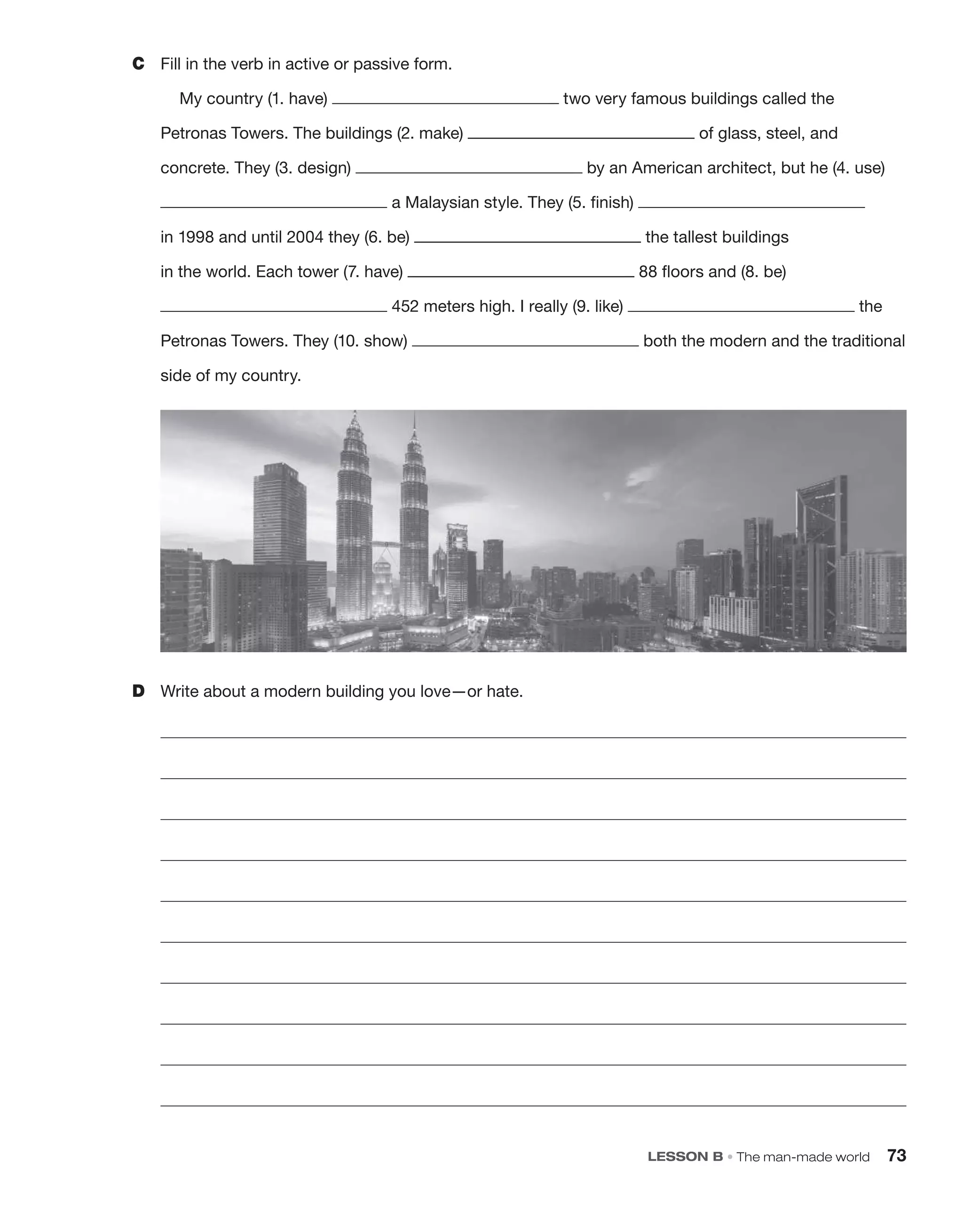
  • 11.
    D Correct theerrors in the sentences relating to the use of the present perfect and the present perfect continuous. One sentence is correct. Then check your answers with a partner. 1. Luke has been taking more than 5,000 pictures on this trip. ^ 2. We have gone to Australia last year—it was amazing. 3. My uncle has taught me to ride a bike when I was a kid. 4. Nina has been belonging to the swim team for a few years. 5. They’ve played a lot of video games recently. They should play outside today. 6. Last week, our basketball team got first place in the state championship. Learning Grammar Points For some grammar points, such as irregular past verbs, you need to memorize in order to learn. But for other grammar points, such as when to use verb tenses, you will learn more by using the tense in real-life situations. E Choose the correct expression to complete the sentences. 1. She started riding her bike everywhere because she was too young / young enough to drive. 2. I think people spend too much / many time watching TV. 3. The tennis club doesn’t have rich enough / enough money for new equipment. 4. Too much / many people drive their cars to work every day. 5. The history museum isn’t interesting enough / enough interesting to visit more than once. 6. In the summer, our city is too polluted / polluted enough to spend time outdoors. F Match the if clauses and the result clauses to complete the sentences. Then check your answers with a partner. 1. You’ll get sick e 2. Older people will stay healthier 3. If women are educated, 4. If people have smaller families, 5. Communities will be safer 6. If we continue polluting the ocean, a. if they have a purpose in life. b. they will earn a higher income. c. if more people know their neighbors. d. many plants and animals will become extinct. e. if you don’t take it easy and relax. f. there will be more resources for everyone. taken You’ll get sick if you don’t take it easy and relax. Welcome unit ix
  • 12.
    x  Welcome unit 2  Vocabulary A Match the words and the definitions. 1. d weak 2. worried sick 3. call in sick 4. drowsy 5. exhausted 6. shiver 7. swallow 8. sick days Word Associations To learn new words, make as many associations and connections as you can between words you know and the new word. For example, the word exhausted (very tired) has a similar meaning to the words sleepy, tired, worn out, and so on. B   Choose the correct words or expressions to complete the conversation. Then practice the conversation with a partner. liz: Are you going to (1.) be into / take part in any clubs this year? david: I’m not sure yet. I have a lot of classes, so I probably won’t (2.) participate in / be into too many extracurricular (3.) activities / active. What about you? liz: Well, you know I’m really (4.) into / fairly active music, so I want to be (5.) part / involved in the marching band. david: That’s a big commitment, isn’t it? liz: Yes, but it’s a lot of fun, too. It combines music and physical (6.) active / activity—we get as much exercise as the athletes do! C Complete the sentences with the correct form of the expressions in the chart. ask for  believe in  head out  learn about  pay for  prepare for  stay in  warn about 1. How is Marjorie going to pay for her trip to Africa? 2. I need to some help with my plans. 3. What kind of hotel did you in India? 4. Greg doesn’t taking too many risks in life. 5. We’re the rainforest in class this week. 6. They need to on their hike at 10:30 tomorrow. 7. I usually a marathon by running five days a week. 8. Were you the current at the beach? a. completely tired, without mental or physical energy b. call your work to say that you are ill c. time you take off from work when you are ill d. with little power or ability; not strong e. take (something) into your stomach through your mouth and throat f. shake slightly because you are cold or afraid g. very concerned about something h. tired and ready to fall asleep
  • 13.
    Welcome unit    xi D Complete the paragraph with the words in the box. open space development encourage force improve sprawl support waste Mayor Jane Fernandez has just announced a plan to help fight (1.) sprawl outside the city. In order to (2.) more responsible (3.) , the plan offers tax reductions to companies that don’t build on (4.) . “There isn’t much habitat left for wildlife, and it’s important not to (5.) any of it,” the mayor said. The plan will also (6.) traffic because it will (7.) efforts to create bike paths to the center of the city. “We won’t need to (8.) changes on people if we offer them a better way to get around.” 3  Writing A Write a paragraph (about ten sentences) answering the question, “What do you do to stay active?” Be sure to include this information: • How often you do the activity. • When you started. • Why you got interested in it. • What you like about it. 4  Recognize Purpose A   Purpose is the reason or reasons why someone writes something. Look at the chart and check the purpose for each kind of writing. Some can have more than one purpose. Then work with a partner to compare and explain your answers. Tell / explain Convince Entertain A newspaper report An article from a gossip magazine A review of a restaurant A letter from a politician A humorous blog A mystery novel A nonfiction book about fishing B group   Write two paragraphs (8–10 sentences) that represent one of the types of writing in A. Remember to think about these questions when you write: 1. What is the writer’s purpose for this type of text? 2. How can you accomplish this purpose? 3. How do you want the reader to feel? Do you want to persuade them? Do you want them to feel happy, or sad? Do you want them to laugh? Share your writing with the class.
  • 14.
  • 15.
    Look at thephoto. Answer the questions. 1 What store were the women shopping in? 2 How much do you think it costs to shop there? 3 Where do you like to spend money? Unit Goals 1 Describe your saving and spending habits 2 Make and accept apologies 3 Express hopes and regrets using wish 4 Talk about things you do with money Women in a shopping area in Ho Chi Minh City, Vietnam
  • 16.
    L E SS O N A SAVING AND SPENDING 1 ViDeo Take the Money... and Run? A Watch the first 45 seconds of the video. Fill in the blanks. Explain the experiment to a partner. 1. They set up a . 2. They are offering free . 3. People can as much or as little as they want. 4. Hidden are everywhere. 5. What will people do? Will they take any ? B What do you think the people in the experiment will do? Why do you think that? Tell a partner. C Now watch the full video. Right before each person makes a decision, make your prediction. Then watch and check your answer. Will the person take the money? If your answer is yes, how much will he or she take (a little or a lot)? 1. first young woman no yes a little a lot 2. older man no yes a little a lot 3. young man no yes a little a lot D group Watch the end of the video. What do you think happens when they remove the man from the booth? How will the results of the experiment change? Discuss in a small group. if you saw someone in a city like this giving away an item for free, what would you do? Would you trust them? I think the people will take the money because... 142 Unit 10 • Money
  • 17.
    Saving money iseasy for me because I have a goal in mind. Really? What goal is that? 2 VoCaBULary A Read the money quiz and review the items in blue. Then take the quiz. 1. a. I make a budget and stick to it. b. I don’t have a budget, but I want to try to make one. c. Budget? What budget? 2. a. I should save more money, but I never seem to do it. b. I sometimes save a little, but then I always spend it. c. Saving money is easy for me because I have a goal in mind. 3. a. I try not to borrow money because it’s always hard to pay it back. b. I sometimes borrow money even though I don’t like to go into debt. c. I borrow money when I need to. 4. a. When I lend money, I don’t worry about people owing me. b. People don’t usually ask me for money. c. I can’t afford to lend anyone money. I’m too broke. 5. a. I can get by on very little money. I’m used to it. b. When I’m short on cash, I don’t go shopping or out to eat. c. I need a certain amount of money to live well. B Share your answers with a partner. Ask and answer follow-up questions. Word Bank Things we do with money stick to / make / have a budget save ↔ spend money borrow ↔ lend money Many countries put images that are important to them on their money. South africa’s money has images of the country’s famous wildlife. lEsson a • Saving and spending 143
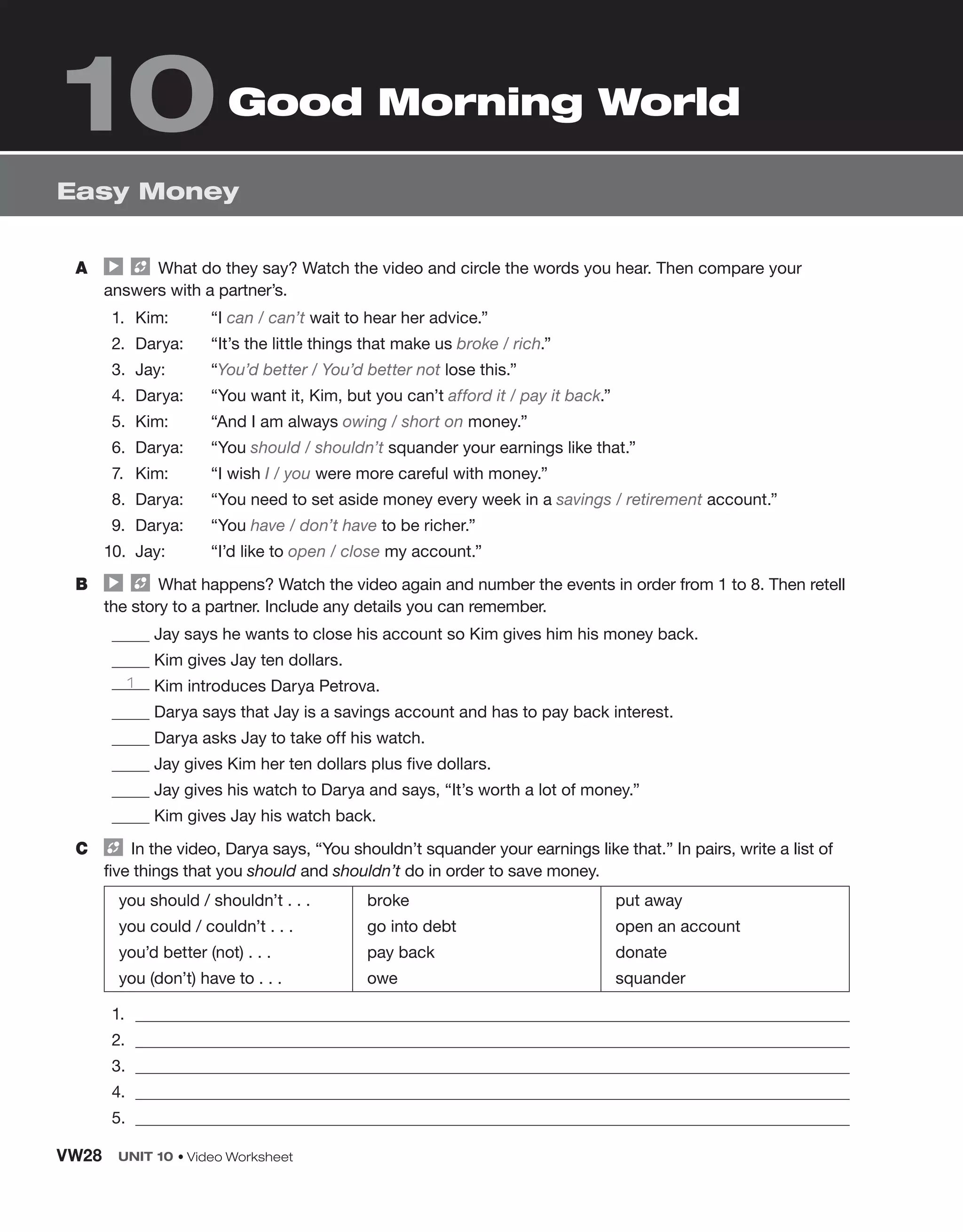
  • 18.
    3  LISTENING A  Use background knowledge. We all have basic needs in our lives. Look at the pictures below. What basic needs are they? What other basic needs can you think of? Discuss with a partner. B   Listen for details. You are going to hear a short talk. First, listen to the introduction and fill in the missing words. CD 2 Track 23 Let me ask you a question: Can buy ? That is, if you have more , will you be ? What do you think? C   Take notes. Now listen to the full talk. Complete the outline with the missing words. CD 2 Track 24 1. The Smith family now a.  children b. barely by c.  worry about and 2. Basic needs—the things you need to survive a. a place to live b. enough to eat c.  a way to make 3. The Smith family after receiving money a.  they are worried b.  they can pay their c.  they have less D   Summarize. With a partner, use the outline in C to summarize the talk you heard. The speaker talks about the Smith family. They have four children… One basic need is water. Everyone needs drinking water. W ORLD LIN K Where are the happiest people in the world? Go online and find out. Were you surprised by the answer? BASIC NEEDS OF LIFE Listening Strategy Take Notes Take notes on a short talk. 144  UNIT 10 • Money
  • 19.
    4  Speaking A  Listen to and read the conversation. Underline the two ­ apologies. How do Eva and Mike respond to the apologies? Circle their responses. CD 2 Track 25 Eva: Thanks for picking up lunch, Mike. Mike: Sure. Eva: How much do I owe you? Mike: Your total comes to $10.20. You can just give me ten dollars. Eva: OK. Oh, wait.... Sorry, I’ve only got a 20-dollar bill. I wish I had something smaller.... Mike: Don’t worry about it. Why don’t we eat first and then you can pay me later? Useful Expressions: Apologizing Small accident or mistake Serious accident or mistake I’m sorry. It was an accident. Sorry. My mistake. I can’t believe I did that. I’m really sorry that I forgot to... I’m so sorry about damaging... I want to apologize for what happened. Useful Expressions: Accepting an apology Don’t worry about it. Oh, that’s OK. No problem. It happens. Apology accepted. Eva: Oh, OK. Thanks. Mike: No problem. OK, here you go: A hamburger and fries for me—and a turkey sandwich for you. Eva: Um, where’s my soda? Mike: Oh, no! I forgot your soda. Sorry... my mistake. Eva: No problem. It happens. I’ll just have water instead. B   Practice the conversation with a partner. Speaking Strategy C Look at each situation. What happened in each one? You can borrow my car. Here are the keys. I'll call you tonight at ten. Thanks! OK. Bye! D   Imagine that you are one of the people in C. With a partner, use the Useful Expressions to ­ apologize and accept the apology. Then switch roles and repeat with the other situation. LESSON A • Saving and spending  145
  • 20.
    B Read eachsituation. Then write a wish statement for each one. 1. I’m not famous. 2. I’m broke. 3. I have to work on the weekend. 5  Grammar A Study the chart. Turn to page 212. Complete the exercises. Then do B–E below. Wish Statements Present situation Wish statement He won’t pay me back. will  →  would I wish (that) he would pay me back. I can’t lend you any money. can  →  could I wish (that) I could lend you some money. I am not good at saving money. am  →  were* I wish (that) I were good at saving money. She doesn’t have a budget. have  →  had She wishes (that) she had a budget. *Were is considered more correct than was in wish statements with be. To express impossible or unlikely wishes about present situations, use a wish statement. The verb following wish is in the past. 4. I can’t pay you back. 5. I can’t afford to pay my credit card bill. 6. I have gone into debt. C   Choose one of the situations in B and make a short conversation. Practice it with a partner. Student A: You are upset about the situation. Student B: Listen to Student A and try to help. B: Hey, what’s wrong? A: I have to work this weekend. B: Really? That’s terrible. A: I know. I wish I didn’t have to. B: Why do you have to work? A: I have to make some money. I’ve been spending too much lately and… D   Pick another situation from B and make another conversation. This time, switch roles when you practice it. E group   Choose one of your conversations and perform it for the class. In many cultures, there are traditional ways to make a wish, like throwing a coin in a wishing well. 146  Unit 10 • Money
  • 21.
    B You andyour partner are going to rent one of these apartments. Which one will you choose? Discuss what you like and don’t like about each one. Then choose one. Things to consider: • You are both students, so you are on a budget. You don’t want to spend too much money. • On the other hand, money isn’t everything! You also want to have fun. • Your vacation is going to be from three to seven nights long. I like the first one, but I wish it were closer to the city center. 6 CoMMUniCaTion A Work with a partner. Read the information below. Look up any words you don’t know in a dictionary. APARTMENTS FOR RENT! Come and spend your summer by the beach C group Take a vote as a class. Which apartment was more popular? Why? room with a view! Fun in the sun! About this apartment Ten years old 2 bedrooms, 1 bath Big balcony facing the beach No noise allowed after 10 PM 2 nights minimum stay 7 nights maximum stay $200 per night for first three nights; $150 for each additional night About this apartment Brand-new apartment Fold-out sofa bed sleeps two Very close to the beach No air conditioner 1 week minimum stay 3 weeks maximum stay $150 per night The local area There are no restaurants, but there is a convenience store nearby. There is a washer and a dryer in the apartment. The local area There are two restaurants nearby that serve dinner. There is a laundromat down the street. Transportation 5-minute walk to the train station 1 hour to the city center by train Transportation 20-minute bus ride to the train station 20 minutes to the city center by train lEsson a • Saving and spending 147
  • 22.
    L E SS O N B STRIKING IT RICH 1 VoCaBULary A Have you, or someone you know, ever won anything in the lottery? Tell a partner. B Read the content of the boxes on the right. Write each item in blue next to its definition. 1. give to charity: 2. make a lot of money suddenly: 3. save: 4. money you’ve made: 5. waste: 6. use money to make more money: C Answer the question in the gray box above. Explain your answer(s) to a partner. Imagine you strike it rich in the lottery. What would you do with the money? a. I’d donate some to a charity (an organization that helps others). b. I’d invest some in a house. c. I’d set aside some of the earnings for the future. d. I’d probably squander the money on things like expensive cars and vacations. I would set aside some of the money. It’s always good to save money. Then I’d buy a car! Word Bank Word partnerships with money donate earn / make invest set aside / save ↔ spend squander / waste 148 Unit 10 • Money
  • 23.
    2  LISTENING A  Use background knowledge. Name a famous millionaire. How did the person make his or her money? Discuss with a partner. B Make predictions. Read the ­ information below and then guess the answers to 1–3. Most millionaires… 1. wear expensive clothes. True   False 2. drive expensive cars. True   False 3. donate some of their money. True   False C   Check predictions. Listen to the interview and check your answers in B. Correct the false statements. CD 2 Track 26 D   Listen for details. What do you remember? Complete the sentences. Then listen and check your answers. CD 2 Track 26 Most millionaires… 1. don’t squander their money on expensive or 2. their earnings in things like property. 3. make an annual and don’t more money than they . 4. some of their money for the future. E   Answer the questions with a partner. 1. How did your idea of a typical millionaire in B compare to the speaker’s? 2. Do you do any of the things in D? Which ones? I thought most millionaires…, but actually, they… Two ­ researchers studied wealthy people. They wrote about their findings in a book called The Millionaire Next Door. Here are some things they learned. Word Bank affordable = not expensive millionaire = a person with at least a million dollars wealthy = rich Notice how the man speaking uses (but) actually and but in fact to show the opposite of what people think. Listening Strategy Listen for Details Listen for specific information. LESSON B • Striking it rich  149
  • 24.
    3 reaDing CD2 Track 27 A Make predictions. Look at the pictures and the title of the article. How do you think these two groups have made money? Tell a partner. B read for details. Read, then answer the questions on a piece of paper. Student A: Read about the San. Student B: Read about the monks. 1. Where do they live? 2. How do they make their money (or how will they in the future)? 3. How do they spend their money (or how will they in the future)? C Ask your partner the questions in B about his or her people. Take notes. Then read the other profile to check your partner’s answers. D infer meaning. Find the words in bold in the reading. Complete each sentence with the correct word(s). 1. If something is worth money, it is / isn’t valuable. 2. You get easy money by working hard / without working at all. 3. If money pours in, it comes to you quickly / slowly. 4. If you accept something, you take it from / give it to someone. E Compare and evaluate. Answer the questions with a partner. Use your notes to help you. 1. Are the San and the monks similar in any way? 2. Think about the ways the San and the monks are making money. Do you think it is good for them to earn money this way? Why or why not? MONEY FROM UNUSUAL SOURCES reading Strategy Infer Meaning Think about information beyond what you read. The San and the monks are similar in that they both... 150 Unit 10 • Money
  • 25.
    1If you huntan animal, you follow and kill it for food. The San people have lived in Southern Africa for almost 40,000 years, hunting1 animals and gathering plants. But recently, many San people lost their land. Some tried to move to large cities, but it was hard to get jobs. Broke, they returned home and watched as their culture and traditions began to die. But all this may be changing. The San have struck it rich. They recently signed an agreement with a large drug company. The San have traditional knowledge about plants that is worth a lot of money. The drug company is especially interested in a particular plant and how the San use it. In the past, the San went on long hunting trips. While away from home, they ate a special plant to slow their hunger. Using the San’s knowledge, the drug company wants to make a new medicine from this plant. For people around the world who have weight problems, this drug could really help. The San are being careful with this “easy money.” They plan to use it to create jobs for their people. They also want to focus on education. Through education, they hope to save their culture and language for future generations. Southern africa’s San people When you think of a monk, you might think of a quiet man living in a place far away from others. The “free monks” of Greece do live far from others, but they are anything but quiet. In fact, they sing. They have been recording songs and selling many albums in Greece. People of all ages love them. Their songs are recorded in different styles (digital keyboard and rock, for example) and are not only religious. The monks also sing about problems like drugs and globalization. The cash from music sales isn’t pouring in, but the monks are earning some money. A few people don’t like this; they think monks shouldn’t sing for money. But the monks happily accept the money. They set it aside for summer camps for teenagers. The monks also donate some of the money to social programs that help many people. Greek monks lEsson B • Striking it rich 151
  • 26.
    4 graMMar A Studythe chart. Turn to page 213 and complete the exercises. Then do B–D below. negative Modals impossibility You can’t have the winning lottery ticket. I have it! Ability Sorry, but I can’t lend you any money. I’m broke. necessity You don’t have to / don’t need to be rich to travel. Advice You shouldn’t waste money on expensive cars. Strong advice You’d better not lose this ring. It’s very valuable. B pronunciation: Word final /t/ and /d/. Listen and repeat. Pay attention to the final /t/ and /d/ sounds. CD 2 Track 28 1. can’t You can’t have the winning ticket. 2. don’t You don’t have to be rich. 3. shouldn’t You shouldn’t waste money. 4. You’d better not You’d better not lose this ring. C Complete the sentences with the negative form of each modal. 1. Money (can) buy happiness. 2. You (should) borrow money from friends. 3. You (have to) go to college to get a good job. 4. You (had better) show your wallet on the subway. Someone might steal it. 5. You (need to) work for a large company to earn good money. 6. You (should) pay for most things with a credit card. 7. You (can) get married until you have a good job. D Say each sentence in C aloud. Pay attention to your pronunciation. Do you agree or disagree with each statement? Why? Tell a partner. You shouldn’t pay for most things with a credit card. I agree. It’s easy to spend too much money and go broke. 152 Unit 10 • Money
  • 27.
    5 WriTing A Readthe question below and the reply on the right. What reason does the writer give for his opinion? Can you think of one more reason? Tell a partner. I work for the hospital. It does cancer research. We should get the money for two reasons. For one thing… You said “teenagers don’t have to go to college.” But a person has to go to college to get a good job! A millionaire in your community plans to donate money to one group below. Which one should get the money and why? Give two reasons. • A charity: It helps poor teenagers go to college. • A museum: It needs the money or it will close. • A hospital: It helps people with cancer. B What do you think? Outline your ideas and then write a paragraph. Think of two reasons one group should get the money and the others shouldn’t. Explain each reason in a sentence or two as shown in the example. In my opinion, the millionaire should donate money to the . For one thing, . In addition, . For these reasons, I believe the millionaire should donate money to the . C Exchange your writing with a partner. Circle any mistakes. Then return the paper to your partner. Make corrections to your own paragraph. 6 CoMMUniCaTion A group Work in a group of four. Students A, B, and C should think of two reasons he or she should get the money. Student D should think of questions to ask the others. Student A: You work for the charity. Student C: You work for the hospital. Student B: You work for the museum. Student D: You’re the millionaire. B group Have a debate. Students A, B, and C speak for one minute each. Student D asks questions, then decides who gets the money and explains why. In my opinion, the millionaire should donate money to the hospital for two important reasons. For one thing, everyone needs a hospital. People don’t have to go to museums, and they don’t need to go to college. But a person with cancer has to go to a hospital. With the money, the hospital can help more people. in addition… lEsson B • Striking it rich 153
  • 28.
  • 29.
    Look at thephoto. Answer the questions. 1 How do these two people feel? 2 What do you think happened before the photo was taken? 3 Have you ever been lied to? How did you feel? Unit Goals 1 Speculate about imagined events 2 Give strong advice 3 Introduce surprising or opposing information 4 Report what someone else has said Two men turn their backs to each other in Lombardy, Italy.
  • 30.
    L e ss o n A  Telling the truth 1  Video Are You a Good Liar? A   You are going to do a simple test to see if you are a good liar or not. Follow the steps below. 1. Hold a small piece of paper to your forehead. 2. Take five seconds and write the capital letter Q on the paper. 3. Find a partner and compare your letters. B   Watch the video. Fill in the missing words. Some people (1.) the Q in a way that could be read by somebody (2.)  them, with the tail on the (3.) side of their forehead. If you did that, then you tend to be aware of how other people (4.) you. You are (5.) being the center of attention and you are a (6.)  liar. Other people (7.) the Q so that they themselves can read it, with the tail on the (8.) hand side of their forehead. If you did that, then you tend to be more of an introvert and (9.) very good at lying. C   Discuss these questions with a partner. 1. What do you think of the results from the video? How did you draw your letter Q? 2. Do you think it’s easy to spot a “good liar”? If so, how do you do it? If not, why not? 156  Unit 11 • Honesty
  • 31.
    2 VoCABULARY A Lookat the picture. Who are the people in it and what just happened? Do you think the boy is telling the truth? Why or why not? Tell a partner. B Read the statements below. Notice the words in blue. Look up any expressions you don’t know. Then check (✓) the boxes that are true for you. Strongly agree Agree Disagree Strongly disagree 1. Honesty is always best. There are no exceptions to this rule. 2. You should never lie if it’s against the law. 3. You shouldn’t tell the truth if it hurts someone’s feelings. 4. The truth isn’t always so clear—it’s not really obvious. 5. Sometimes I tell the truth, and sometimes I don’t. It depends on the circumstances. 6. You shouldn’t punish small children too severely if they tell a lie. C Discuss your answers with a partner. Word Bank an honest person ↔ a liar (depend on the) circumstances exception hurt (someone’s feelings) obvious reward someone ↔ punish someone (for their behavior) tell the truth ↔ tell a lie I strongly agree that honesty is always best. If you always tell the truth, you won’t have any trouble. I chose disagree for that one. I don’t think you should always tell the truth. Who broke the window? I don't know . . . lEsson a • Telling the truth 157
  • 32.
    E   Pronunciation:Repeating with rising intonation to show surprise. Work with a partner. Use the situations below to make short conversations about Cindy like the ones in D. Remember to repeat with rising intonation to show surprise. 1. fail her exam / cheat on it 2. get a ticket / be caught speeding 3. move out / have an argument with her roommate 3  LISTENING A   Use background knowledge. You are going to hear a conversation about a job résumé. When you prepare a résumé, what kind of information should be included? Make a list with a partner.     B   Listen for details. Listen. Check (✓) True or False. Correct the false ­ sentences to make them true. CD 2 Track 29 True False 1. Cindy quit her job. 2.  Denise was sick last week. 3.  There was a problem with Cindy’s résumé. 4.  She lied about her hours. 5.  Denise is worried about the amount of work. 6.  Interviewing is happening today. C   Listen. Complete the expressions with the missing words. CD 2 Track 30 1. Well, , I don’t know the details. 2. Uh-huh. She her experience. 3. I agree. I don’t think her boss was very happy that she had him. 4. It’s too bad but, , I’m worried. D     Pronunciation: Repeating with rising intonation to show surprise. Listen. Speaker B shows surprise by repeating what Speaker A says. Notice the rising intonation and stress. Then practice the conversations with a partner. CD 2 Track 31 Conversation 2 A: Cindy got into trouble. B: She got into trouble? How? A: She dented her parents’ car. B: You’re kidding! Conversation 1 A: Cindy was fired. B: She was fired? Why? A: Because she lied on her résumé. B: I can’t believe it! Listening Strategy Listen for Details Listen for detailed information. /ˈsɪndi/ /dəˈnis/ 158  UNIT 11 • Honesty
  • 33.
    4 sPeAKing A Listento and read the conversation. Where are Mr. and Mrs. Ward? What’s the problem? CD 2 Track 32 MR. WARD: So, how’s the chicken? MRS. WARD: Delicious. How about your steak? MR. WARD: It’s all right... MRS. WARD: Are you being honest? You don’t sound very happy with it. MR. WARD: Well, it’s not cooked right. I asked for medium rare. This is well done. MRS. WARD: Why don’t you send it back? MR. WARD: Oh, I don’t want to bother anyone. I can eat it, I guess. MRS. WARD: But it’s expensive. I don’t think you should eat it. Let’s call the waiter. You won’t hurt his feelings! MR. WARD: Yeah, but... MRS. WARD: If you don’t say something, you’re not going to enjoy your meal. Excuse me, waiter! B What would you say to the waiter? How would you complain? Write an ending to the conversation and practice it with a partner. SPEAKING STRATEGY C Read about the three situations below. Choose one and write a role play with a partner. Student A: Play the role of one of the friends or the coworker. Student B: Warn Student A about his or her actions. Use the Useful Expressions to give strong opinions. Useful Expressions: Giving strong advice If you don’t leave a bigger tip, the waiter is going to be upset. I don’t think you should spend so much time playing games on your computer. You have to do your homework by yourself. Your friend, who is a student in the US, often doesn’t leave a big enough tip in restaurants. Your coworker wastes a lot of time playing games on her computer. Your friend, who doesn’t like to study, often copies another friend’s homework. D group Perform your dialog for the class. /wɔrd/ lEsson a • Telling the truth 159
  • 34.
    5 gRAMMAR A Studythe chart. Turn to page 214. Complete the exercises. Then do B–C below. Present Unreal Conditionals If clause Result clause If you told the truth, If I didn’t have a lot of homework, If I found a wallet, (then) you would feel relieved. (then) I’d go to the movies. (then) I’d return it. Result clause If clause You’d feel relieved if you told the truth. Present unreal conditionals are used to talk about imagined or unreal events. The if clause presents an imagined condition. It is not true right now. The result clause presents an imagined result. It can come first or second in the sentence with no change in meaning. B Use the correct form of the verb in parentheses to make present unreal conditional sentences. 1. If I (graduate) graduated with honors, I (throw) would throw a big party. 2. If today (be) a holiday, I (stay) at home. 3. If I (have) a lot of time off, I (go) to Colombia. 4. I (not / have) time to see my friends if I (get) a part-time job. 5. If I (not / study) English, I (study) German. 6. I (be) good at basketball if I (be) taller. C group Get into a group of four people. Follow the steps below. See how long you can go for. Then switch roles and start again. Student A: Start a sentence chain. Choose one of the if clauses in B and finish the sentence with your own idea. Student B: Add a sentence to Student A’s sentence. Students C D: Continue the game with your own sentences. If I went somewhere fun, I’d buy a souvenir. If I bought a souvenir, I’d give it to… If today were a holiday, I’d go somewhere fun. If you were in Istanbul, would you buy a lamp as a souvenir? 160 Unit 11 • Honesty
  • 35.
    6 CoMMUniCAtion A Lookat the situations. Would you ever do any of these things? Write yes, no, or maybe. Would you ever... B Discuss your answers in A with a partner. 1. eat a whole platter of food at a party? 2. keep a pair of sunglasses that you found on the ground? 3. use the restroom in a cafe without actually buying anything there? 4. stand and read an entire magazine in a store without buying it? 5. download music, TV shows, or movies from the Internet without paying? 6. take extra supplies from your office to use at home? It depends on the circumstances. If they were expensive, I’d probably keep them! Would you ever keep a pair of sunglasses that you found on the street? If you answered yes, you can use definitely in your answer. If you answered maybe, you might want to use probably in your answer. lEsson a • Telling the truth 161
  • 36.
    L e ss o n B WhO DO YOu TruST? 1 VoCABULARY A Match items 1–6 with their definitions from the box. Two items have the same definition. 1. I can’t do it myself. I’m counting on you to help. 2. He’s a trustworthy employee. He’s never been late to work. 3. A truthful person doesn’t lie on a résumé. 4. I promised to help you, and I’m going to keep my word. 5. I’m sure she’ll get the job. I have confidence in her. 6. I trust you. I know that you are telling the truth. B Take the quiz below. 1. Does a person have to be truthful to succeed? yes no 2. Do you typically trust strangers? yes no 3. Do you have confidence in yourself and your abilities? yes no C Interview a partner using the questions in B. Discuss your ideas. When you need help, who do you count on? a. dependable d. relying on b. honest e. believe in c. do what you say you will do 4. Do you always keep your word? yes no 5. Who do you usually count on to give good personal advice? 6. Who would you trust with a secret? I agree. You can lie sometimes, but you shouldn’t all the time. I think you have to be truthful to be successful. 162 Unit 11 • Honesty
  • 37.
    2  Listening A  What are some reasons that people lie? Make a list of ideas in your notebook with a partner. B   Identify key details. Listen to the first part of a lecture. What are reasons people lie? List the two reasons you hear. Are either of these reasons on your list from A? CD 2 Track 33 Reasons people lie 1. 2. C   Infer meaning. Read sentences 1–4. The speakers use the expressions in italics in the talk. ­ Listen to the full lecture and choose the best answer. CD 2 Track 34 1. If someone tells you a white lie, they tell a lie to . a.  hurt your feelings b.  be polite c.  make you laugh 2. If you catch someone in a lie, you . a.  discover a person is lying b.  forgive a person for lying c.  tell someone a big lie 3. If you hesitate when you are talking, you speak in a way. a.  clear, direct b.  careful, honest c.  nervous, uncertain 4. A dishonest person truthful. a. is b. might be c. is not D   Listen for gist. Read the sentences. Then listen again. Circle T for True or F for False. CD 2 Track 34 1. Diego’s sister probably knew he was lying. T    F 2. For most people, it’s hard to lie well. T    F 3. If a person won’t make eye contact with you, he’s probably lying. T    F E   Listen for details. Answer the questions with a partner. Use information from the lecture to explain. 1. What white lie did Diego tell his sister? Was his lie believable? Why or why not? 2. Can you tell if someone is lying by looking at their eyes? Why or why not? Do you think the boy is telling the truth to his father? Listening Strategy Infer Meaning Use context to figure out what the words and phrases mean. /ˈdjeɪgoʊ/ LESSON B • Who do you trust?  163
  • 38.
    3  READING CD2 Track 35 A   Make connections. Describe the photo to a partner. If you got lost in this place, what would you do? B   Make predictions. Read the story through line 17. What do you think will happen next? Discuss your ideas with a partner. Then read the rest of the story. C Sequence events. Put the events in the order that they happened. A note was placed on the car. The car stopped working. Philippe and Sophie had tea and local food. Philippe and Sophie went for a drive. A strange man showed up. The hired driver fixed the car. The hired driver left. D Infer meaning. Find these words in the reading. 1. Find a word in line 6 that means sleep lightly: 2. Find a word in line 6 that means strange: 3. Find a word in line 10 that means far away: 4. Find a word in line 16 that means smile: 5. Find a word in line 20 that means excited; very pleased: 6. Find a word in line 25 that means friendliness to guests: E   Answer the questions with a partner. 1. Would you have trusted the stranger? 2. Have you ever helped a stranger? If so, what happened? THE KINDNESS OF STRANGERS Reading Strategy Make Predictions Use visual clues, titles, and background knowledge to guess what you will read. /fɪˈlip/ /ˈsoʊfi/ 164  UNIT 11 • Honesty
  • 39.
    You’re cold andalone. You’re afraid. You’re lost. You can’t speak the local language. You’ve lost your money and passport. You could experience any of these situations in another country. Who would you turn to1 for help? My name is Philippe, and my wife’s name is Sophie. We’re from France. Recently we were faced with a difficult situation while traveling by car in the Alps with our hired driver. It was going to be a long ride, and we were tired. Just as we began to doze, the engine made an odd, loud noise and then stopped working. The sun was just setting, and the air was getting cooler. We tried communicating with the driver, but with little success. He acted out the act of going to get help, and then he left. We were in a remote location, with no houses in sight. We started to hear the cries of wild animals. Sophie was scared. We didn’t have much food, and it was getting colder and darker. I began to lose confidence. Should we leave the car and start walking? Would our driver ever return? Was he a trustworthy man? We were very worried. A couple of hours passed. Suddenly, the headlights from another car appeared in the dark. An unfamiliar man got out of the car. He looked unfriendly at first, until his mouth opened with a big, friendly grin. He told us that he would help us. He had such a kind face, and we knew we could count on him. We got into his car. Before we left, he put a note on the windshield of the car with his phone number on it. Then he drove us to a nearby village, and we met his family. His cousin spoke basic French and offered us tea and local foods. Everything was delicious. Everyone asked us questions and were thrilled to have unexpected guests. Later that evening, the phone rang. It was our driver. He had kept his word and fixed the car. We prepared to leave and thanked our new friends. I couldn’t believe the response from the cousin: “No, we thank you for coming into our home.” I will never forget the warmth and hospitality we received on that day because we relied on a complete stranger for help. 5 10 15 20 25 1If you turn to someone for help, you ask for the person’s help. lEsson B • Who do you trust? 165
  • 40.
    4 gRAMMAR A Studythe chart. Turn to page 215. Complete the exercises. Then do B and C below. Reported Statements with say and tell Quoted speech Reported speech “I am an honest person.” “I trust you.” “I don’t believe you.” “I’m leaving.” “You lied to me.” “I’ll call you tomorrow.” “We’ve never met.” “I may be late.” “You must work harder.” “You shouldn’t talk to strangers.” He said (that) He told me (that) he was an honest person. he trusted me. he didn’t believe me. he was leaving. I had lied to him. he would call me tomorrow. we had never met. he might be late. I had to work harder. I shouldn’t talk to strangers. B Work with a partner. Follow the steps below. 1. Read the things Dylan told his friends and family members. 2. Take turns reporting what he said to each person. Use say or tell. 3. Use one of the expressions (but in reality, in fact…) to say what the truth is. Dylan said to his… But in reality… / in fact… / actually… / the truth is… 1. girlfriend, “I love you.” he wants to break up. 2. classmate Lena, “I’m single.” he’s still dating someone. 3. ex-girlfriend, “I hope we can still be friends.” he can’t stand his ex. 4. mom, “I’ll be home by midnight.” he came home at 2:00 AM. 5. brother, “I didn’t borrow and break your laptop.” he did both things. 6. dad, “I’ve finished my college applications.” he hasn’t even started them. 7. friends, “I’m doing an internship at Toyota.” he’s working at McDonald’s. 8. classmate Sam, “I can’t study with you because I’m sick.” he went to a party. /ˈdɪlən/ Dylan told his classmate Lena that… Dylan said he loved his girlfriend, but in reality he wants to break up. C Answer the questions with a partner. 1. Has anyone ever lied to you? What did the person say? What was the truth? 2. Have you ever told someone a white lie? What did you say? What was the truth? My friend made some cookies. I said they were good, but actually… /ˈlinə/ 166 Unit 11 • Honesty
  • 41.
    5 WRiting A Readthe paragraph. Then, finish the story with a partner. 1. Why did the writer lie? What did she say? 2. Did the other person find out the writer was lying? What happened? B Think about a time you (or someone you know) lied about something. Answer the questions in A. Then use your notes and the example to help you write a paragraph of your own. C Exchange your writing with a partner. Read his or her paragraph. 1. Are there any mistakes? If yes, circle them. 2. Answer the questions in A about your partner’s writing. 3. Return the paper to your partner. Make corrections to your own paragraph. 6 CoMMUniCAtion A Work with a partner. Choose a situation about Dylan from the previous page. Create a role play, using reported speech. Student A: You find out Dylan lied to you about something. Ask him to explain. Student B: You’re Dylan. Try to explain yourself. GIRLFRIEND: So, Dylan, I was talking to Lena yesterday. DYLAN: Yeah? What about? GIRLFRIEND: She said that she had a party at her house. DYLAN: Oh, I didn’t go. GIRLFRIEND: Oh really? It’s obvious that you’re lying, because she said… B group Perform your role play for another pair. After you listen to the other pair, answer this question: How did Dylan explain his behavior? What did he say? CAUGHT IN A LIE Last year, I lied to a classmate of mine. He invited me to go to the movies, but I didn’t want to go. I also didn’t want to hurt his feelings, so I said that I couldn’t go to the movies. Even though I was fine, I said that I was sick. Later that same day, I went shopping with a friend. While we were shopping, I unexpectedly… lEsson B • Who do you trust? 167
  • 42.
    12 12 oUR WoRLd Divers swimwith humpback whales off the coast of Mexico.
  • 43.
    Look at thephoto. Answer the questions. 1 What animals are in the photo? What do you know about them? 2 What are the people doing? Why do you think they are doing this? 3 What is one way that humans might be affecting these animals and their natural habitat? Unit GOALS 1 Describe rare animals and their habitats 2 Ask questions in an indirect way 3 Offer another opinion 4 Talk about man-made structures and their impact on the environment
  • 44.
    L e ss o n A The natural world 1  Video The Steward of Ormond Beach A Read the title. What is a steward? What do you think a steward of a beach does? B   Watch the video. Circle True or False for each item. 1. Walter Fuller is the steward for Ormond Beach. True    False 2. His other title is “protector of sea life of Ormond.” True    False 3. For the past 15 years, Walter has been living at Ormond Beach. True    False 4. In the beginning, Walter visited the beach on his days off. True    False 5. There are many wetland areas on the Southern California coast. True    False 6. Walter used to be a volunteer. True    False 7. In high school, Walter studied the eagle family. True    False 8. The coastline is considered to be a beautiful part of the United States. True    False 9. Walter says that having a job motivates him. True    False C   Answer these questions. Share your answers with a partner. 1. What area do you know that needs a steward? 2. Why did you choose that area? Walter Fuller walks down Ormond Beach, California. 170  Unit 12 • Our world
  • 45.
    2 VoCABULARY A Workwith a partner. You are going to learn about two different animals. Follow the instructions below. Look up any words you don’t know. Student A: Read the information about snow leopards. Student B: Read the information about mountain gorillas. Snow leopards We don’t know exactly how many snow leopards there are, but we do know their numbers are declining. Today, there may be as few as 3,000 in the wild. The secretive animals live in the countries of Central Asia, but people rarely see them. They have thick fur that helps them survive the cold winters of their mountain environment. The leopards like to eat sheep and goats, and for this reason, many are killed by sheepherders. Mountain gorillas Mountain gorillas live in dense forests. They can climb trees, but spend most of their time on the ground. They are found in Africa—in Rwanda and Congo. The gorillas are endangered (currently only 900 remain) due to illegal hunting and loss of their habitat. Even so, their numbers are slowly increasing because they are protected. B Interview your partner about his or her animal. Ask questions to complete the information in the chart. C The snow leopard and the mountain gorilla are suffering. Both animals are almost extinct. What would you do to raise awareness of their situations? What would you tell people? Discuss with a partner. Snow leopard Mountain gorilla Population Habitat Location Challenges How many snow leopards are there? To raise awareness, I would tell people... LESSOn A • The natural world 171
  • 46.
    3  LISTENING A  Use background knowledge. Look at the photo. What animal is this? What do you know about it? Discuss with a partner. B   Listen for details. Listen to four descriptions of animals that live in the rainforest. Circle the correct words to complete the definitions. CD 2 Track 36 Listening 1 Rodent means dog / rat. To exceed means to be greater / lesser than (an amount). Listening 2 Snout means nose / legs. Nocturnal means active / inactive at night. Listening 3 To camouflage means to escape / to hide. To inhabit means to eat / to live. Listening 4 An acrobat does tricks on the ground / in the air. To leap means to jump / to fall. C   Listen for numbers. Listen again. Complete the sentences with the numbers in the box. Three numbers are extra. CD 2 Track 36 1  1.12  1.2  5  12  66  68  135  138  180 Capybara 1. can hold its breath underwater for up to minute(s) 2. can weigh up to kilo(s) 3. can be more than meter(s) long Tapir 4. weighs between and kilo(s) Sloth 5. comes down to the ground time(s) a week Spider monkey 6. can jump over meter(s) D Look at the photo in A again. What animal is it? How do you know? W ORLD LIN K Choose one of the animals. Go online and learn one more fact about it. Share the fact with the class. Listening Strategy Listen for Details Listen carefully for detailed information. 172  UNIT 12 • Our world
  • 47.
    4 sPeAKing A Gustavand Carolina are telling Bart about their summer job. Listen to and read their conversation. Where did they work and what did they do? Why can’t Bart apply for the job? CD 2 Track 37 BART: So, what exactly did you do over the summer? GUSTAV: We worked as volunteers at Glacier National Park. BART: I’ve never been there. What’s it like? CAROLINA: It’s beautiful. There are mountains and lakes... and, of course, glaciers! BART: How was the job? GUSTAV: We had to do a lot of physical work. It was kind of hard. CAROLINA: That’s true, but it was exciting, too! We actually saw bears! BART: Wow! That does sound exciting. Maybe I should apply. I’ll need a job next summer. CAROLINA: Sorry, Bart, but you can’t apply to that program. It’s a special program for international students. B group Practice the conversation in groups of three. SPEAKING STRATEGY C You and your partner are looking for a place to live together as roommates. Write down some of the important things to consider. D Read about these two possible places to live. Add three more ideas to each list. With a partner, discuss the positive and negative aspects of each place. Use the Useful Expressions to help you. City apartment Suburban home expensive near public transportation small bedrooms big balcony with a great view big backyard need a car quiet neighborhood nothing to do on weekends E group With your partner, have a discussion and then choose one of the places to live in D. Tell the class which location you chose and why. cost, Useful Expressions Offering another opinion That’s true, but... Yes, but on the other hand,... Even so,... But then again,... An apartment in the city would be expensive. Yes, but on the other hand, living in the city is exciting. There’s so much to do! LESSOn A • The natural world 173
  • 48.
    5 gRAMMAR A Studythe chart. Turn to page 216. Complete the exercises. Then do B–D below. Embedded Questions What is a tapir? Do you know what a tapir is? I’d like to know what a tapir is. Asking for information Saying you don’t know something Can / Could you tell me… Do you know… Do you remember… Do you have any idea… I don’t know / I’d like to know… I’m not sure… I can’t remember… I wonder… B Find and correct the error in each sentence. 1. Could you tell me what is the answer? 2. Can you remember me how to get there? 3. I’m not sure how to do it? 4. What’s your opinion? I like to know what you think. 5. I’m not sure where is the exit. C Turn each question on the left into an embedded question on the right. 1. Where do they live? I’d like to where . 2. What is their habitat? Can you me ? 3. What challenges do they face? Do you any what ? 4. How much does a capybara weigh? I’m not how much . 5. How do sloths sleep? I wonder . 6. Where do tapirs spend their time? I don’t know . 7. Why are monkeys called “acrobats”? Do you know ? 8. What is the name of that animal? I can’t what . D Think of an animal. Take turns asking a partner about his or her animal. Can you tell me where red pandas live? What is their habitat? They’re from China. I’m not sure what their habitat is. Maybe they live in the mountains. 174 Unit 12 • Our world
  • 49.
    6 CoMMUniCAtion A Workalone. Take the quiz. Look up any words you don’t know. B group Get into a group of four people. Imagine that you are on a quiz show. Follow the steps below. Student A: quiz show announcer Students B–D: quiz show contestants 1. Student A: Read a question from the quiz in A. 2. Students B–D: Write down your answer on a piece of paper. 3. Student A: Ask each contestant for his or her answer. Then check page 218 and give each contestant one point for a correct answer. Continue asking questions. 4. Students B–D: The person with the most points at the end of the game wins. Maria, do you know what the largest island in the world is? I’m not sure what the answer is, but I chose Great Britain. Is that correct? What / Where is the world’s... 1. busiest harbor? a. Singapore b. Pusan (South Korea) c. Hong Kong (China) 2. largest island? a. Great Britain b. Greenland (Denmark) c. Honshu (Japan) 3. highest waterfall? a. Tugela Falls (South Africa) b. Angel Falls (Venezuela) c. Sutherland Falls (New Zealand) 4. oldest active volcano? a. Kilauea (US) b. Yasur (Vanuatu) c. Etna (Italy) 5. longest mountain range? a. the Austrian Alps (Europe) b. the Andes (South America) c. the Urals (Europe) 6. longest cave? a. Mammoth Cave (US) b. Holloch Cave (Switzerland) c. Sistema Ox Bel Ha (Mexico) 7. deepest lake? a. Lake Superior (US / Canada) b. Lake Nyasa (Africa) c. Lake Baikal (Russia) 8. largest desert? a. the Sahara (North Africa) b. the Australian (Australia) c. the North American (Mexico / US) 9. longest coastline? a. Australia b. Canada c. Chile A harbor is a sheltered area of water where boats are protected from storms. LESSOn A • The natural world 175
  • 50.
    L e ss o n B The Man-Made world 1 VoCABULARY A What do you know about the famous building in this photo? Tell a partner. Then take turns reading about it aloud. B Complete the sentences using the words in blue from above. Work with a partner. 1. Engineers need to make sure the skyscraper can earthquakes before they start . 2. There are other to think about, too. For example, where will people park? 3. To answer this question, the architect an idea: build an underground parking lot. It will be able to 1,500 cars. 4. From the parking lot, an elevator will people and goods to the top floor in 15 seconds. 5. The team the architect’s idea and agreed with his suggestion. 6. There should also be a(n) way of heating and cooling the building. 7. With solar panels, the building will have plenty of energy and also be . C Discuss the questions with a partner. 1. Why is the Burj Khalifa special? 2. What were some of the obstacles that architects faced when they designed it? withstand 3. What’s special about the building’s elevators? 4. How is the building good for the environment? The Burj Khalifa, Dubai, United Arab Emirates • This skyscraper is the tallest building in the world at 829.8 meters (2,722 feet). • Architects proposed ideas for the building in 2003 and construction was finished in 2010. • Architects faced many obstacles in building a skyscraper this big. The building needed to be very strong to withstand its own weight! The extreme heat of Dubai also had to be considered. • Another issue was how to safely and quickly transport people and goods around the building. The builders found an efficient solution to get around this problem. The building has 57 high-speed elevators. Each can travel 600 meters a minute and accommodate 10–12 people. • The building has many sustainable features as well. For example, it collects and reuses water from the air conditioners, saving 15 million gallons of water a year! 176 Unit 12 • Our world
  • 51.
    2  Listening A  Which words in the box do you know? With a partner, look up any unfamiliar words in your dictionary. B   Listen for gist. Which photo shows what the woman does in her job? Listen and circle the ­correct one. CD 2 Track 38 architect edge investigate blueprint get access (to a place) leaky C   Listen for details. Listen. Complete the sentences about Jamie’s job. CD 2 Track 38 1. Jamie works with buildings. 2. She checks problems so that they don’t mistakes. 3. Rappelling is a way to get access to places. 4. After you hook up to the top of the building, you over the edge. 5 Rappelling is scary, but you can get . D   Pronunciation: Negative questions to confirm information. Complete the negative questions. Then listen and check your answers. CD 2 Track 39 1. (be / you / an engineer) That’s correct. I’m a civil engineer. 2. (work / you / on the second floor ) No, actually I work on the third floor. 3. (be / the Burj Khalifa / in the UAE) Yes, it is, in Dubai. 4. (be / the Eiffel Tower / built in 1900) No. It was finished in 1889. E   Practice asking and answering questions 1–4 in D with a partner. Pay attention to intonation. Aren’t you an engineer? Listening Strategy Listen for Gist Listen for the general idea. LESSON B • The man-made world  177
  • 52.
    WHEN THE SEAS RISE 3 ReAdingCD 2 Track 40 A Use background knowledge; Make predictions. Look at the title and the names of the two countries in the article. Do you know anything about these countries? What do you think is happening in these countries? B Take notes on key details. Read the article. As you read, think about questions 1 and 2. Underline the information in the passage that answers the questions. 1. How are rising sea levels affecting the Seychelles and the Netherlands specifically? 2. What is each country doing about these problems? C Infer meaning. Match the words in bold in the reading with their definitions. a short description planned pieces of work to damage land or rock so it disappears close to the height of the ocean walls built across bodies of water to hold the water back D Summarize; Give opinions. Answer the questions with a partner. 1. Look again at the questions in B. Explain your answers to a partner in your own words. 2. Has global warming affected the area where you live? What do you think can be done to help? A solar-powered floating house in Rotterdam, the Netherlands. Reading Strategy Summarize Explain what you have read in your own words. Reading Strategy Give Opinions Express what you think about an issue based on the reading. Where I live, global warming is... 178 Unit 12 • Our world
  • 53.
    When most peoplethink of global warming1, they think of something that will happen in the future, something that doesn’t affect their daily life. But for many people around the world, the future is now. Research shows that sea levels worldwide have been rising at a rate of 0.14 inches (3.5 millimeters) per year since the early 1990s. The trend, linked to global warming, is putting thousands of coastal cities at risk of being destroyed over time. The two countries below offer a snapshot of what climate change might look like for all of us. Seychelles This chain of islands in the Indian Ocean has been called one of the most beautiful places on Earth. There is a problem, though. Many of the country’s most populated regions were constructed in low-lying areas, near the water. As sea levels rise, many people will lose their homes. Already, the island’s tourism industry is being hurt. Seychelles’s famous beaches are being eroded by the rising water, as well as by storms that grow more powerful each year. In addition, the country’s coral reefs (a popular tourist attraction) are suffering because of warmer water. To fight these problems, the government of the Seychelles has been trying to relocate people living in low-lying coastal areas to higher ground. Unfortunately, there isn’t enough land to accommodate many of these people. The country’s citizens are also trying to bring as much attention as possible to global warming and the danger it poses. They point out that if these things happen to the Seychelles, they can happen to big countries like the United States, China, or Brazil next. The Netherlands For the people of the Netherlands, rising waters have been an obstacle for years. The country is close to 30 percent under sea level! A series of dams and dikes has protected the country from mass flooding for many years, but as sea levels continue to rise, more extreme solutions are being considered. One of them is a large increase in “floating houses.” These houses are built on water or in areas that flood, and each structure is able to rise and fall with the water. Sustainable and efficient apartment buildings that can float are also being planned. Engineers in the Netherlands are also continuing the country’s tradition of doing large construction projects to help hold the water back. Larger dams have been built in recent years, and rivers have been rerouted so they are not as close to cities. Today, engineers from many countries visit the Netherlands to learn more about these projects. They fear that in the future, as the Earth warms and sea levels continue to rise, Dutch building techniques will have to be used all over the world. 1Global warming is an increase in the Earth’s temperature, caused in part by humans’ use of fossil fuels (oil, gas). As the Earth warms, ice melts, causing sea levels to rise. LESSON B • The man-made world 179
  • 54.
    4 gRAMMAR A Studythe chart. Turn to page 217. Complete the exercises. Then do B below. The Passive with Various Tenses Active Passive Simple present Engineers build skyscrapers with a steel frame structure. Most skyscrapers are built with a steel frame structure. Simple past The Woolworth Company built a skyscraper in 1913. One of the first skyscrapers was built in 1913. Present perfect Engineers have built the world’s tallest building in Dubai. The world’s tallest building has been built in Dubai. Present continuous Engineers are building a lot of tall buildings in Shanghai. A lot of tall buildings are being built in Shanghai. Simple future Someday they will build a skyscraper without concrete. Someday a skyscraper without concrete will be built. B group Work with a partner. Read the information below. Look up the underlined words. Choose a role (Student A or B). Debate the issue with your partner. Try to agree about what to do. Share your plan with another pair. The old buildings should be preserved. They connect us with our past. Yes, but on the other hand, these old buildings may not withstand… A large construction company wants to tear down traditional buildings in a neighborhood in your city. The buildings are beautiful, but they were built 100 years ago and aren’t in good condition. Student A: You work for the construction company. Here is your plan: • The old buildings will be torn down, and new office and apartment buildings will be built. • The new buildings will be safer and will be able to accommodate more people. • Former tenants will be allowed to move back into a new apartment, but it will take three years for the project to be finished. For now, those people must find other housing. Student B: You live in one of the old buildings now. You have this opinion: • A lot of modern buildings have been built in our city. Older structures should be preserved. • Many people in the buildings are elderly. They shouldn’t be forced to leave their homes. 180 Unit 12 • Our world
  • 55.
    6 CoMMUniCAtion A Readabout Diamond City’s problems. What projects have been proposed to solve these problems? Use your own words to explain each situation with a partner. 5 WRiting A What do you think about the issue in Grammar B? In five minutes, outline your ideas below. Then, in 20 minutes, write a paragraph in your notebook. Explain each reason with an extra sentence or two. In my opinion, the old buildings should / shouldn’t be torn down for two reasons. For one thing, . In addition, . For these reasons, I believe the old buildings should / shouldn’t be torn down. B Exchange your writing with a partner. Circle any mistakes in your partner’s writing. Do you agree with your partner’s opinion? Why or why not? Return the paper to your partner. Make corrections to your own paragraph. We think that they should start with the subway project, because... Really? We think that the dam project should be done first.... B With your partner, rank the projects in the order you would do them. Give reasons for your order. Note: A new project can be started only after the previous one has been finished. C group Explain your plan from B to another pair. Are your ideas similar? If not, whose plan is better? Why? Problem 1: The dam was built 30 years ago, and it is weak. Project: Repair the dam. This will take three years. Notes: The city has been hit by a huge flood every 100 years. The last flood was 20 years ago, and the downtown area was destroyed. Problem 3: The traffic is terrible, and businesses are leaving the city because of it. Project: Build a new subway line to transport people. It will take three years to finish. Notes: Construction will be difficult and expensive, but a new subway system is needed to transport people. Problem 2: The baseball stadium is old. Project: Repair the stadium. It will take two years. Notes: The Diamond City Miners baseball team is a big moneymaker for the city. But if the stadium isn’t fixed soon, the team may move to another city. Problem 4: There isn’t enough office space in Diamond City. Project: Build a new skyscraper to keep businesses in the city. It will take two years to finish. Notes: The land around the skyscraper is polluted and must be cleaned up first. This will take a year or more. Then construction can begin. LESSOn B • The man-made world 181
  • 56.
    REVIEW UNITS 10–12 1STORYBOARD A Lisa is asking Ana about her recent vacation. Look at the pictures and complete the conversation. More than one answer may be possible for each blank. /ˈlisə/ B Practice the conversation with a partner. Then change roles and repeat. C What do you think of Ana’s idea? What would you do to raise awareness? Tell a partner. 1 2 3 4 5 6 Hi, Ana! How was your vacation? amazing! But I was also surprised by something. ! We went hiking in the forest. What was the rainforest ? What was that? Really? I’d to awareness about this . There was a lot of near the rainforest. How will you do that? I want to a website where people can money to help. Yeah. A lot of animals are . They could extinct in a few years. /ˈɑnɑ/ 182 REVIEW • Units 10–12
  • 57.
    2 SEE ITAND SAY IT A Study the picture for ten seconds and then close your book. With a partner, take turns describing the scene in as much detail as you can. B Look at the picture again. Answer the questions with a partner. 1. Who are these people? Where are they? 2. Where are they going or what are they looking for? What time of day is it? 3. What do you think the leader is thinking? It’s getting late. They should stop. If I were the leader, I’d suggest we sleep in the cave. That’s one idea. But then again, I think the cave would be too cold. I’d suggest... C What would you do if you were the leader of the group? Make suggestions and explain your answers with a partner. REVIEW • Units 10–12 183
  • 58.
    3 SARA ANDSANDRA A Read the story about Sara and Sandra. Fill in the missing words. /ˈsændrə/ Sara and Sandra are sisters. They both it rich by the lottery. Sara decided she could by on very little money. She made a very tight budget for herself. She took 50 percent of the money and it to charities. She also aside the amount in a bank . Sandra, on the other hand, did something different. She her money on jewelry, vacations, and presents for herself. She spent way much money and didn’t anything. In one year, she had into debt and afford to pay all the money she had borrowed. B With a partner, compare your answers in A. C Imagine your friend has won the lottery. Give him or her some financial advice. Use the negative modals in the box. don’t have to had better not shouldn’t 4 LISTENING A Listen to each response. Then choose the question that came before the response. CD 2 Track 41 1. a. What does she look like? b. What’s she like? 2. a. Why did you buy a new car? b. Why do you want a new car? 3. a. What would you do if you won the contest? b. What will you do when you win the contest? 4. a. Did you like the painting? b. How long did it take you to paint it? 5. a. When did they complete the bridge? b. When will they complete the bridge? 6. a. What do you usually do on Friday night? b. What do you want to do on Friday night? Well, for one thing, you don’t have to tell everyone right away. /ˈsɛərə/ 184 REVIEW • Units 10–12
  • 59.
    5 WHILE YOUWERE OUT A Imagine that, while your boss was out, you took several messages. Work with a partner. Using reported speech, give the messages to your boss. Then switch roles and repeat. Student A: Give these messages to your boss. 1. Mary: “The meeting is scheduled for 2:00.” 2. Tom: “I won’t be in the office next week. I’ll be in China on business.” 3. Copy company: “We’re running behind schedule on your job.” Student B: Give these messages to your boss. 1. Celine: “I can’t make the deadline.” 2. Dry cleaners: “Your suits are ready.” 3. Mario: “I don’t understand your memo. I have questions about it.” 6 MAKING PLANS A With a partner, choose a situation and create a conversation of eight to ten sentences. Situation 1 Student A: There’s a Broadway show in town, and your partner wants to see it. You think the show is too expensive. Student B: There’s a Broadway show in town, and you really want to see it. Persuade your partner to go. Situation 2 Student A: There’s a popular art exhibit at the museum. Your partner wants to see it. You think it will be very crowded and hard to see the paintings. Student B: There’s an exhibition at the museum in town, and you really want to see it. Persuade your partner to go. B: I really want to see the Broadway show that’s in town. A: Yes, but it’s too expensive. B: That’s true, but... B group Practice your conversation. Then perform it for another pair. Were there any messages while I was out? Yes. There were three. Mary called. She said that… /ˈmeəri/ /tɒm/ /səˈlin/ /ˈmærioʊ/ REVIEW • Units 10–12 185
  • 60.
    2 QUEstion FormULation AMake questions by unscrambling the words in the box. You may need to add a few words. 1. charity / donate / to / money 2. lend / ever / people / money 3. money / spend / vacation 4. happiness / money / buy 5. give / people / charity / money 6. most important / life / thing 1. Do you donate money to charity ? 2. Do ? 3. How much ? 4. Can ? 5. Why ? 6. What ? B Work with a partner. Ask and answer the questions in A. Give answers that are true for you. 1 aCCUraCY PraCtiCE A Write wishes for the statements below. Be sure to use the correct past tenses or past modals. 1. I don’t have enough money for those shoes. I wish (that) I had enough money for those shoes. 2. My sister won’t lend me any money. 3. We have to work tonight. 4. Henry can’t afford to go to the restaurant with us. 5. They have gone into debt to buy a new house. 4 Writing A Write a paragraph (8–10 sentences) about your three biggest wishes. Use the correct past tenses and modals. Answer these questions: • What are you wishing for? • Is it possible that one or all of your wishes will come true? • What do you need to make your wishes reality? 3 sPEaKing A Work with a partner. Imagine that you moved to a new country because your work relocated. Unfortunately, your life is not the way it was in your old country. Take turns telling your partner how you wish your life were different. I live in a big house in the mountains. It is very pretty, but I wish (that) I lived closer to my work. I wish I were rich. C22 Unit 10 • Unit Consolidation Unit 10 CONSOLIDATION International Exam Preparation and Communication Practice
  • 61.
    5  EXAM PREPARATION:LISTENING A   Listen to the audio. You will hear a conversation and a question after it. Circle the appropriate answer for each question. ICPNA Track 15 B   Listen to the audio. You will hear a conversation and three questions after it. Circle the appropriate answer for each question. ICPNA Track 16 1. Which statement is true? a.  The woman can afford one skirt. b.  The skirts cost way too much. c.  The woman can afford two skirts. d.  The woman is broke. 2. Why doesn’t the woman want to go away? a.  Because she’s busy then. b.  Because she doesn’t have money. c.  Because she doesn’t feel well. d.  Because the man isn’t her friend. 3. Who did the millionaire give his money to? a.  His family. b.  A business. c.  Poor students. d.  Sick people. 1. Which of the following things do savers do? a.  Set aside money for the future. b.  Buy things when they aren’t on sale. c.  Take big money risks. d.  Go to fancy dinners often. 2. What does the speaker think spenders should do? a.  Spend more money on food. b.  Think more about the future. c.  Enjoy life more. d.  Buy trendy clothes. 3. Which of the following statements would the speaker agree with? a.  Savers are better than spenders. b.  Spenders spend more money because they need to. c.  Savers should not worry as much. d.  Spenders care too much about the future. 4. When does the man use his credit card? a.  When he wants to buy something. b.  When he goes on a trip. c.  To buy a bicycle. d.  When he has a problem. 5. What does the woman ask her son? a.  When he’s going to pay her back. b.  Why he wants the money. c.  When he’s getting his salary. d.  If he’s going to have fun. 6. What does the woman want to do for dinner? a.  Get takeout. b.  Go to a Chinese restaurant. c.  Cook something. d.  Go to the grocery store. 4. What would the man like to be able to do? a.  Go to the gym. b.  Save money. c.  Travel with the woman. d.  Go on vacation. 5. How did the woman pay for her trip? a.  She saved money for a year. b.  She won a prize. c.  She used her credit cards. d.  She got money from her family. 6. What does she recommend to the man? a.  He should buy more lottery tickets. b.  He should get a credit card. c.  He should save his money. d.  He should borrow money. UNIT 10 • Unit Consolidation  C23
  • 62.
    1  ACCURACY PRACTICE A Write present unreal conditional sentences for the situations below. You can put the if clause at the beginning or the end of the sentence. Use correct punctuation. 1. I don’t speak English fluently. (need / study) If I spoke English fluently, I wouldn’t need to study it. 2. Silvio has a lot of time to see his friends. (not / have / job) 3. Today isn’t a holiday. (go / someplace / fun) 4. Julia isn’t graduating with honors. (get / a scholarship) 5. He lives with his parents. (share / apartment / roommate) 6. I study hard. (get / good / grades) 2  QUESTION FORMULATION A Unscramble the words to make questions. 1. would / you / found / wallet / what / do / if / a / you What would you do if you found a wallet? 2. tell / lie / friend / would / a / you / to / when / a 3. trust / who / with / secret / would / you / a 4. biggest / lie / what / the / is / told / you / have 5. feel / if / friend / how / would / lied / you / to / a / you 6. read / someone’s / would / private / you / emails B   Work with a partner. Ask and answer the questions in A. Give answers that are true for you. C24  UNIT 11 • Unit Consolidation What would you do if you found a wallet? I would bring it to the police. Your hair looks great! Where did you get it done? Thanks, I’m really happy with it. I did it myself. 3  SPEAKING A   Role-play one of these situations with your partner. Be sure not to hurt the other person’s feelings. • Tell someone he or she looks great when you don’t really think the person does. • Tell someone the food he or she made is delicious... when it’s not! • Compliment someone on their English when the person really doesn’t speak English well. • Tell someone you love a gift that person has given you... when you hate it! B group   Act out your conversation for a small group or the class. UNIT  11 CONSOLIDATION International Exam Preparation and Communication Practice
  • 63.
    5  EXAM PREPARATION:READING A Read the article and answer the questions. Honesty might be the best policy, but we often abandon it when no one is watching. A team of researchers led by Dr. Melissa Bateson used an “honesty box” to collect payments for hot drinks, and found that people are better at paying what they owe when a pair of eyes is watching them. The researchers attached a poster to a cupboard of mugs above an honesty box alongside a kettle, with tea, coffee, and milk. Over ten weeks, they alternated between a photograph of a pair of eyes and a picture of flowers. At the end of each week, the researchers counted the money in the honesty box and measured the amount of milk used—an indicator of the number of drinks consumed. The money went up every week the poster showed a pair of eyes. Researchers said that even though the eyes were not real they still seemed to make people behave more honestly. The effect may arise from behavior that developed as early humans formed social groups that increased their chances of survival. For social groups to work, individuals had to cooperate for the good of the group, rather than act selfishly. The scientists say companies and governments could use our evolved response to a person’s gaze to improve honesty. “It raises interesting questions about how we might improve systems to reduce antisocial behavior and things like making people pay for public transport. Signs that say ‘CCTV cameras in operation’ should, perhaps, show a pair of eyes instead of a picture of a camera. We haven’t evolved to pay much attention to cameras,” said Dr. Bateson. 4  WRITING A Think of a white lie* you told. Write a short note (8–10 sentences) to the person you lied to and apologize. Say why you thought you needed to lie, and include what you learned from the experience. *white lie: a lie, usually about something unimportant, told to keep from hurting someone 1. What did the researchers want to find out? a. If people always behave honestly. b. If people will pay for tea and coffee. c. How people have evolved over time. d. If people prefer pictures of eyes or flowers. 2. How did they know how many drinks people consumed during the week? a. They counted the dirty mugs. b. They looked at the tea and coffee. c. They measured the milk. d. They counted the money. 3. What phrase could replace cooperate for the good of the group in the third sentence of paragraph 3? a. “Decide to live in the same place.” b. “Work together so that everyone lived well.” c. “Share good things with each other.” d. “Start families together.” 4. In the first sentence of paragraph 4, what does gaze mean? a. A way of thinking. b. An opinion. c. A type of look. d. An idea. 5. How can the results of this research be used? a. They can increase graffiti in public places. b. They can encourage people to buy CCTV cameras. c. They can reduce dishonest behavior. d. None of the above. 6. Who was this article written for? a. Biology students. b. The general public. c. High school teachers. d. People who drink tea or coffee. UNIT 11 • Unit Consolidation  C25
  • 64.
    1 aCCUraCY PraCtiCE ATurn the questions and cues into embedded questions. 1. Where do snow leopards live? Do you know where snow leopards live ? 2. How do you get a job at the nature reserve? Can you tell me ? 3. What do red pandas eat? I’d like to know . 4. How much do brown bears weigh? Do you have any idea ? 5. Which animals live in the rain forest? Do you know ? 2 QUEstion FormULation A Read the list below of the New Seven Wonders of the World. Do you know anything about these wonders? In your notebook, write at least one question about each. Use the passive voice. C26 Unit 12 • Unit Consolidation B group Now walk around the class. Find students who know the answers to your questions. Write notes so you will remember them and can share with the class. 3 sPEaKing A With a partner, think of a place in your city that can be made more beautiful. Prepare a presentation. Use the passive voice and opinion expressions learned in the unit. Christ the Redeemer Statue, Brazil The Great Wall of China Taj Mahal, India Roman Colosseum, Italy Pyramid at Chichen Itza, Mexico Petra, Jordan Machu Picchu, Peru Possible topics to ask about: •  Location •  Date built •  Purpose •    Person or civilization responsible  for building •  Tourism status Are people allowed to visit the Taj Majal? Of course! Do you know when it was built? design plant clean paint remove build rebuild tear down fix repair A new monument will be built in the center of the park. Will more trees be planted there? B group Present your city beautification project idea to the class. Whose idea do you like the best? Discuss. Chichen Itza pyramid Unit 12 CONSOLIDATION International Exam Preparation and Communication Practice
  • 65.
    5  EXAM PREPARATION:LISTENING A   Listen to the audio. You will hear a conversation and a question after it. Circle the appropriate answer for each question. ICPNA Track 17 4  WRITING A Write a letter to your mayor or another local politician about your beautification project. Include what the project is, why you think it should be done, and how you think your city should raise money to help pay for it. Use persuasive language. 1. What did the woman do on her vacation? a. Studied. c. Camped out. b. Volunteered. d. Worked. 2. How does the man feel about global warming? a. He is very concerned. b. He doesn’t have an opinion about it. c. It doesn’t bother him very much. d. He is a little worried. 3. What kind of meeting is the man probably speaking at? a. A meeting for a political candidate. b. A sales meeting for apartments. c. A scientific research conference. d. A city planning meeting. 4. What does the woman want to know about? a. Greenland’s climate. b. The origin of Greenland’s name. c. The first humans to live in Greenland. d. Ways of traveling to Greenland. 5. What is the woman probably going to do? a. Get a job cleaning up the river. b. Move to a city with a cleaner river. c. Start an organization to take care of the river. d. Go to the volunteer meeting. 6. What are the man and woman talking about? a. A TV program about animals. b. A science exam. c. A nature reserve. d. An unusual place. B   Listen to the audio. You will hear a conversation and three questions after it. Circle the appropriate answer for each question. ICPNA Track 18 1. Where would you probably hear this description? a. In a biology class. b. In an informal conversation. c. In a project meeting. d. In an advertisement. 2. What is a sloth’s environment? a. Central and South American countries. b. Rainforests. c. Tree canopies. d. All of the above. 3. All of the following are true about sloths EXCEPT which statement? a. They live in trees and eat leaves. b. They do not use much energy to move. c. They can swim when necessary. d. They are never on the ground. 4. What is the woman’s role in the group? a. She is a member. b. She is a leader. c. She is an observer. d. She is none of these. 5. How does the man feel about the project? a. He is pessimistic. b. He is neutral. c. He is optimistic. d. He is frustrated. 6. What is the goal of project that the man and woman are talking about? a. Making streets safer for walkers. b. Cleaning up city parks. c. Building play areas for kids. d. Encouraging people to exercise more. UNIT 12 • Unit Consolidation  C27
  • 66.
    C28  Unit 12• Unit Consolidation 6  Exam Preparation: Reading A Read the article and answer the questions. Yes, staying in a luxury hotel and relaxing on the beach is enjoyable, but what if you’re looking for a trip that’s more meaningful? New companies are offering volunteer travel opportunities in a variety of locations, which give travelers the chance to lend a hand on their next vacation. An interest in volunteer travel has grown over the years: the idea was created in the 1990s, has continued to evolve, and is now a top travel trend. Companies have made it easier for travelers to find the right type of trip for them. Trips range from helping restore an ecosystem in a tropical location to caring for endangered or orphaned animals. If you want to work with ecosystems in different environments, you can do so in many ways. For example, you could take a scuba diving research trip to the Seychelles, a group of small islands off the eastern coast of Africa. Volunteers conduct coral reef research, count sea animals, and observe animal behavior. Or you could go to the Arctic to study changes in the climate and ecosystem, measure glacier melting, and help collect data on global warming. One of the most popular volunteer travel activities is working with endangered animals like sea turtles, lions, and monkeys. In South Africa, you could prepare meals for and feed lion cubs, take them for walks, and help rehabilitate injured animals. You could also travel to Greece and help protect and observe sea turtle nests from the time that eggs are laid until the young turtles hatch and emerge. These volunteer activities are so life-changing that many travelers choose to return to the same project year after year. 1. What is the purpose of this article? a. To explain why people volunteer. b. To encourage taking a volunteer vacation. c. To describe different kinds of research projects. d. To advertise travel companies. 2. In the second sentence of paragraph 1, what could you replace lend a hand with? a. Build. c. Help. b. Handle. d. Hold. 3. How long have volunteer vacations existed? a. A couple of years. b. A couple of decades. c. About 40 years. d. Over 100 years. 4. What general category could you assign the activities described in paragraph 3? a. Ecological investigation. b. Tropical climate research. c. Geological studies. d. Zoological observation. 5. In the second sentence of paragraph 4, what does them refer to? a. Volunteers. b. Meals. c. Animals. d. Lion cubs. 6. What kind of person would probably be interested in the trips described in the article? a. A person who wants to rest and relax somewhere comfortable. b. A person who is concerned about contributing to the world. c. A person who enjoys extreme, dangerous activities. d. A person who prefers routines and predictable travel.
  • 67.
    A You aregoing to write a narrative piece about honesty. Narrative writing tells a story. Match the elements of a story with their meaning. d 1.  theme a.  the people in the story 2.  setting b.  how the story ends 3.  characters c.  the action, or what happens in the story 4.  plot d.  the topic, or what the story is about 5.  conclusion e.  the location of the story, or where it takes place B   The theme of your narrative is honesty. Read the list of ideas. With a partner, brainstorm three or four more ideas for your story, and write them in your notebook. 1. You discover that someone you love is behaving dishonestly. 2. A member of your family tells a lie they deeply regret. 3. Someone is telling the truth about something important, but no one believes them. 4. You have to choose between telling the truth and hurting someone’s feelings, or lying. C Choose the best idea from your list. Then use the chart to brainstorm the details of your story in your notebook. CHARACTERS Who is in the story? SETTING Where does the story happen? PLOT What happens in the story? D   Read the statements about how a narrative text is organized. Are they true or false? Work with a partner. 1. Narrative texts can be true or made up. T    F 2. All narrative texts begin by describing the setting. T    F 3. Narrative texts can be structured in different ways. T    F 4. Good narrative texts use very descriptive language. T    F 5. Narrative texts are never written in the first person. T    F 6. Narrative texts can be written in the present or past tense. T    F PROCESS WRITING TIP Try to come up with ideas that are as interesting as possible. This will help to make your story more exciting to read. TIP Don’t introduce too many characters or make the plot too complicated, or the narrative will be difficult for the reader to follow. Process Writing  •  P7
  • 68.
    E Plan andorganize your ideas. In your notebook, use a mind map like this one to decide how you will structure your narrative. If you want to, change the headings around. F Read the sample narrative. Label the underlined text with the letter of the items in the box. You will use some items more than once. A. characters   B. conclusion   C. descriptive language   D. plot   E. setting   F. theme I used to work in a beautiful (1.) bookstore called Kelly’s Books ( E ). The owner, (2.) Mrs. Kelly ( ), was (3.) an old lady with kind eyes ( ). I got to know all the regular customers and the types of books they enjoyed. My favorite customer was (4.) Mr. Jones ( ), a retired bus driver who liked mysteries and crime fiction. He and I used to joke about the detectives in the novels he read. He always made me laugh, but one day a terrible thing happened: (5.) I saw him stealing a book ( ). I was horrified! At first, I wasn’t going to say anything, but I knew I had to act. I told Mr. Jones I’d seen him putting a novel into his coat pocket. (6.) A dark look came over his face ( ) and suddenly he became very angry. He said I was a liar. My voice was shaking, but I repeated what I’d seen. Just then, Mrs. Kelly came over and asked what was happening. When I told her, she put her hand on my arm and said that I must be mistaken. I began to protest but she just smiled and asked me to serve the next customer. Later, Mrs. Kelly said she knew that I’d been (7.) telling the truth ( ). She said, “It was only a book. Remember, life is hard sometimes.” (8.) I never met anyone else who believed that kindness was more important than honesty, and I never forgot Mrs. Kelly ( ). G Now that you have planned your story, organized your ideas, and thought about the language you will use, it’s time to write your first draft. Write at least 100 words in your notebook. Remember to check your grammar and spelling! H   Swap your narrative text with a partner’s. Read each other’s work. Use this checklist as you peer edit. ✓ Is honesty the theme of the narrative? ✓ Is it about 200 words long? ✓ Does the narrative provide a setting? ✓ Are the characters introduced? ✓ Is the plot clear and easy to follow? ✓ Does the writer use descriptive language? ✓ Does the narrative end with a conclusion? I Discuss your partner’s review of your work, and use his or her feedback to make any revisions. Correct errors and rewrite any sentences or sections that will improve your narrative. Tip Try to give your partner some additional feedback. For example, say which parts of the story you particularly liked, and why. Tip Don’t forget to think about how your story will end. Will it have a happy ending? How will the honesty issue be resolved? Tip If you wish, you can break your narrative into two or three paragraphs, or you can just use one paragraph like the sample narrative. What? Who? Why? Where? How? P8  •  Process Writing
  • 69.
    UNIT 10 MONEY LESSONA Vocabulary afford broke (make a / have a) budget borrow ↔ lend (money) get by go into debt owe pay back save ↔ spend (money) short on cash stick to it Speaking Strategy Apologizing Small accident or mistake I’m sorry. It was an accident. Sorry. My mistake. I can’t believe I did that. Serious accident or mistake I’m really sorry that I forgot to... I’m so sorry about damaging... I want to apologize for what happened. Accepting an apology Don’t worry about it. Oh, that’s OK. No problem. It happens. Apology accepted. LESSON B Vocabulary affordable donate (money) earn / make (money) earnings invest (money) millionaire set aside / save ↔ spend (money) squander / waste (money) strike it rich valuable wealthy LANGUAGE SUMMARIES UNIT 11 HONESTY LESSON A Vocabulary against the law an honest person ↔ a liar (depend on the) circumstances exception hurt (someone’s feelings) obvious reward someone ↔ punish someone (for their behavior) tell the truth ↔ tell a lie Speaking Strategy Giving strong advice If you don’t leave a bigger tip, the waiter is going to be upset. I don’t think you should spend so much time playing games on your computer. You have to do your homework by yourself. LESSON B Vocabulary actually catch someone counting on but in fact have confidence in in reality keep my word make excuses trick people the truth is trust trustworthy truthful turn to white lie LANGUAGE SUMMARIES 191
  • 70.
    UNIT 12 OURWORLD LESSON A Vocabulary dense endangered environment extinct habitat illegal increase ↔ decline protected raise awareness rare / rarely remain suffer (in the) wild wilderness Speaking Strategy Offering another opinion That’s true, but… Yes, but on the other hand,… Even so,… But then again,… LESSON B Vocabulary accommodate considered construction dam dike efficient erode force (someone to do something) get around goods low-lying obstacle project proposed snapshot sustainable tear down (a building) tenant transport withstand 192 LANGUAGE SUMMARIES
  • 71.
    Unit 10 Money LessonA Wish Statements Currently I live in the suburbs. I wish I lived in the city. Use the past tense with wish to talk about situations that are not true now. I wish (that) I could lend you some money. Use could + base form of the verb with wish. That is optional in these sentences. I wish (that) I were richer. Use were for all forms of be (not was). I can’t stick to a budget. I wish I could. I don’t live in the city. I wish I did. We often shorten wish statements in this way. A Read this joke about Dumb Dave. Complete the sentences with wish... could and the verb in parentheses. Why is the character called Dumb Dave? One day, a genie appeared to Dumb Dave and his three friends. The genie said, “I will give each of you one wish. Don’t waste it!” The first friend said, “(1. fly) .” Her wish was granted, and she flew away. The second friend said, “(2. live) in a big mansion.” He suddenly disappeared, too. The third friend said, “(3. be) a famous actor starring in my own movie.” She, too, disappeared. Dumb Dave looked around and saw that he was alone. Then he said, “I’m lonely. Where have my three friends gone? (4. have) them back here with me now...” B Imagine that a genie has given you three wishes. What will you wish for? Write three wish statements. 1. 2. 3. Grammar Notes Grammar Notes  212
  • 72.
    Lesson B Negative ModalsMeaning Impossibility You can’t have the winning lottery ticket. I have it! Use can’t to say that something is impossible. It shows surprise or disbelief. Ability Sorry, but I can’t lend you any money. I’m broke. You can also use can’t to say you don’t have the ability to do something. Necessity You don’t have to / don’t need to be rich to travel. Don’t have to and don’t need to mean something isn’t necessary. You have a choice. Advice You shouldn’t waste money on expensive cars. Use shouldn’t to give advice. It means it’s not a good idea to do something. Strong advice You’d better not lose this ring. It’s very valuable. Had better not gives strong advice. It means “I’m warning you not to do something. If you do, there will be a problem.” A Choose the best modal for each sentence. 1. A: Is that John over there driving a Porsche? B: It shouldn’t / can’t be. He doesn’t have a driver’s license. 2. You’d better not / don’t have to lend money to Jack. He won’t pay you back. 3. We can’t / don’t have to study for the test. The teacher canceled it. 4. You shouldn’t / can’t play the lottery. It’s a waste of money. 5. If you’ve finished your exam, you’d better not / don’t need to stay. You can leave. 6. Maria and Kim can’t / shouldn’t go to the concert. It costs $20, and they only have $10. B Use the negative form of the modal and the word(s) given to answer speaker A. 1. A: I’m going to spend all my money on a new car. B: (had better / squander) . Save some! 2. A: My friend Mary wants to borrow some money. B: (should / lend) . She never pays it back. 3. A: Jane really wants the job, but she doesn’t speak Japanese. B: (need to / speak) Japanese to get the job. 4. A: We’re late for our business class. B: (can / be) . Class doesn’t start until 9:30. 213  Grammar Notes
  • 73.
    Unit 11 Honesty LessonA Present Unreal Conditionals If clause Result clause If you told the truth, If I didn’t have a lot of homework, If I found a wallet, If I were a liar, (then) you would feel relieved. (then) I’d go to the movies. (then) I’d return it. (then) I wouldn’t have any friends. Result clause If clause You’d feel relieved if you told the truth. Present unreal conditionals are used to talk about imagined or unreal events. The if clause presents an imagined condition. It is not true right now. The verb in the if clause is in the simple past. With the verb be, use were for all subjects: If I were rich, I’d buy a big house. In writing, when the if clause comes first, put a comma before the result clause. The result clause presents an imagined result. It can come first or second in the sentence. The verb in the result clause takes would + the base form of the verb. You can also use might (not) (probability) or could (not) (ability) in the result clause:   If you told them the truth, you might not get into trouble.   If I did something against the law, I could go to jail. A Match each situation in A to a conditional sentence in B and C. Use the correct form of the verbs in parentheses. A B C 1. My bicycle is really old. 2. It’s faster to go by subway. 3. I feel fine right now. 4. I love my cell phone. 5. My grades aren’t very good. If I (be) sick, If I ever (lose) it, If I (have) a new one, If I (study) harder, If I (go) by car, I (improve / could) them. I (be / might) late. I (take / would) some medicine. I (ride / would) it everywhere. I (buy / would) a new one right away. 1. 2. 3. 4. 5. B Read the sentences. Circle the answers that are true for you. 1. I’m / I’m not rich. 5. I live / don’t live with my parents. 2. I’m / I’m not a teacher. 6. I take / don’t take a bus to school. 3. I have / don’t have to study English. 7. I have / don’t have a lot of free time. 4. I speak / don’t speak English fluently. My bicycle is really old. If I had a new one, I’d ride it everywhere. Grammar Notes  214
  • 74.
    Lesson B Reported Statementswith say and tell Quoted speech Reported speech “I am an honest person.” “I trust you.” “I don’t believe you.” “I’m leaving.” “You lied to me.” “I’ll call you tomorrow.” “We’ve never met.” “I may be late.” “You must work harder.” “You shouldn’t talk to strangers.” He said (that) He told me (that) he was an honest person. he trusted me. he didn’t believe me. he was leaving. I had lied to him. he would call me tomorrow. we had never met. he might be late. I had to work harder. I shouldn’t talk to strangers. Quoted speech uses a person’s exact words: “I trust you,” said Phil. You can report what another person has said using say or tell. In reported speech: The verb tense typically shifts to a past form. Note: should usually does not change. Pronouns change: “I trust you.” → Phil said (that) he trusted me. The word that is optional in the reported sentence. A Find and correct the error in each sentence. 1. Linda said she will call today, but she didn’t keep her word. 2. Denis told to me that he was rich, but that was a lie. 3. Aya says that she had a degree in computer science. 4. Last night, Tim told me he can meet today. 5. Leo said me he spoke French, but he doesn’t. B Gina read Harold’s profile on a dating site. She contacted him, and they went on a date. Look at the “real” Harold. Complete what Gina said about him using say or tell. C Now rewrite the sentences in B as present unreal conditionals. 1. 2. 3. 4. 5. 6. 7. If I were rich, 215  Grammar Notes
  • 75.
    1. (say) ,but he’s actually middle-aged and unattractive. 2. (tell) , but in fact he rides a bicycle. 3. (say) , but actually his house was very messy. 4. (tell) , but the truth is he eats a lot of junk food. 5. (say) , but actually, he doesn’t even have a passport. 6. (tell) , but in reality he smokes a lot. 7. (say) , but in fact he only speaks English. 8. (tell) , but I had to pay for dinner! He said he was young and handsome Unit 12 oUr WorLD Lesson A Embedded Questions To embed means to put (something) inside something else. Embedded questions are questions that are included within another question or statement. What is a tapir? Do you know what a tapir is? I’d like to know what a tapir is. Although we call them embedded questions, they take statement word order. How many snow leopards are there? Where do mountain gorillas live? What is the answer? I wonder how many snow leopards there are. Do you remember where mountain gorillas live? I’m not sure what the answer is. These phrases are used to start embedded questions: Asking for information Saying you don’t know something Can / Could you tell me… Do you know… Do you remember… Do you have any idea… I don’t know / I’d like to know… I’m not sure… I can’t remember… I wonder… An embedded question can sound softer and less direct than a regular question. Excuse me, what time is it? Excuse me, do you know what time it is? Grammar Notes 216
  • 76.
    A Unscramble theembedded questions. 1. what / wonder / time / I / opens / it 2. are / zoo / animals / in / I / what / don’t / the / know 3. I / remember / there / get / how / to / can’t / exactly 4. any / animals / zoo / are / what / the / have / in / you / idea / do 5. time / it / sure / I’m / opens / what / not 6. to / do / zoo / you / get / know / to / the / how B Now use the sentences in A to complete the conversation. A: Excuse me, ? B: , but I think you take the #2 train. A: . B: , but it’s probably open by now. A: ? B: I’m sorry, but . Lesson B The Passive with Various Tenses Active Passive Simple present Engineers build skyscrapers with a steel frame structure. Most skyscrapers are built with a steel frame structure. Simple past The Woolworth Company built a skyscraper in 1913. One of the first skyscrapers was built in 1913. Present perfect Engineers have built the world’s tallest building in Dubai. The world’s tallest building has been built in Dubai. Present continuous Engineers are building a lot of tall buildings in Shanghai. A lot of tall buildings are being built in Shanghai. Simple future Someday they will build a skyscraper without concrete. Someday a skyscraper without concrete will be built. 217  Grammar Notes
  • 77.
    A Here aresome facts about three important structures. Complete the sentences with the verb and tense in ­ parentheses. Use the passive form of the tense provided. Itaipu Dam 1. The dam (complete / simple past) in 1991. 2. It (visit / present perfect) by more than nine million people. Akashi Kaikyo Bridge 3. The record for the longest suspension bridge (hold / simple present) by the Akashi Kaikyo Bridge. 4. The bridge (design / simple past) to be 12,825 feet, but it (make / simple past) even longer after a big earthquake. Chunnel 5. The first passengers on a Chunnel train were surprised when they (transport / simple past) to the other side in only 20 minutes. 6. In the future, experts predict that even more passengers (carry / simple future) through the Chunnel. 7. While repairs (do / present continuous) to the tunnels, they remain open. B Think of a famous building, structure, or monument in your city. Answer the questions about it using the passive. 1. Where is it located? 2. When was it built? 3. How many people have visited it? 4. Are any repairs (fixes) being done to it now? 5. What repairs will need to be done in the future? Answers Communication page 175, A 1. Singapore 2. Greenland 3. Angel Falls 4. Etna 5. the Andes 6. Mammoth Cave 7. Lake Baikal 8. the Sahara 9. Canada Grammar Notes  218
  • 78.
    56 UNIT 10• Money 1 VOCaBULarY A Complete the sentences. Use words in the box. afford borrow budget get by owe short stick back broke debt lend save spend 1. They have two children in college. How can they to buy a new car? 2. If you’re on cash, I can loan you some. 3. You should some money for the future. 4. When are you going to return the book I let you ? 5. How does she on such a low salary? 6. I loaned you $10. When are you going to pay me ? 7. I have no money at all. I’m completely . 8. How much do I you? 9. Don’t go into to buy a computer! Just wait until you can save more money. 10. I have a monthly , and I have to to it! 11. Can you me money for the bus? 12. As soon as I get my paycheck, I it on bills and rent. B Answer these questions about yourself. Use the underlined word or words in your answer. 1. What big purchase would you go into debt for? 2. What do you do when you’re short on cash? 3. Do you find it difficult to stick to a budget? Why or why not? 4. Have you ever borrowed money from a friend? Why? LESSON A SAVING AND SPENDING mONEY 10
  • 79.
    2 CONVErSaTION A Matchthe sentence parts to apologize or accept an apology. 1. I can’t believe a. about it. 2. Apology b. I did that. 3. I’m sorry about c. bring money. 4. I’m sorry that I forgot to d. that’s OK. 5. Don’t worry e. accepted. 6. Oh, f. losing your keys. B Put the sentences in order to make a conversation. It really hurts. Ouch. You stepped on my foot. I’m sorry. It was an accident. Apology accepted. I can’t believe I did that. C Write conversations containing apologies. Use the situations in the pictures, or make up your own. 1. A: B: A: B: 2. A: B: A: B: 3. A: B: A: B: LESSON A • Saving and spending 57
  • 80.
    58  UNIT 10• Money 3  grammar A Write wishes relating to these situations. 1. I don’t have a lot of money. 2. I can’t swim. 3. I have a headache. 4. I’m not good at math. 5. Tom doesn’t have a girlfriend. 6. I have homework every night. 7. Elena can’t find a good job. 8. Mrs. Kim isn’t organized. 9. I’m not on vacation now. 10. My children won’t clean their rooms. B Carla wants to change her life. Write sentences about her wishes. Follow the example. Example:  1. 2. 3. 4. C Write your wishes about your city or about the world. Example:  1. 2. 3. 4. She wishes she had a nice apartment. I wish we had more parks in our city. I wish we could keep the oceans clean.
  • 81.
    LESSON B •Striking it rich 59 1 VOCaBULarY aND grammar A Match the words with the definitions. 1. donate a. spend money foolishly; waste 2. earnings b. use money to make more money 3. invest c. the money that you make 4. set aside d. make a lot of money unexpectedly 5. squander e. give money away 6. strike it rich f. put money away; save B Complete the sentences with the correct word or phrase from A. 1. She’s trying to by investing in startup companies. 2. You shouldn’t spend all of your from that job at once. 3. You don’t need to have a lot of money to in the stock market. 4. I spend my money carefully. I never it. 5. I often money to help poor people. 6. Each week I some money and put it in a savings account. C Respond to the statements below. Use a negative modal such as can’t, don’t have to, don’t need to, shouldn’t, or had better not. 1. A: I don’t worry about spending too much. I use my credit cards all the time. B: 2. A: I never save money. B: 3. A: I am going to open a savings account with this five-dollar bill. B: 4. A: I’m going to save 90% of the money I earn. B: 5. A: I’m going to spend my whole paycheck on clothes. B: 6. A: This apartment is really expensive, but it’s in a good location. B: LESSON B STRIKING IT RICH
  • 82.
    60 UNIT 10• Money 2 rEaDINg aND WrITINg A Read the article. Vacation Every Day Mary Larson was 43 when she got divorced. It was a new life for her, and she started considering what was really important to her. She was working 60 hours a week as a banker to pay for a big house, expensive furniture, a new car, and all the other “important” things in life. But she had no time for what she really enjoyed: going out on her old houseboat. One day, she realized she could live on the boat, and forget about the mortgage payments. She sold her house and all her furniture. For the last six years, she and her dog Buddy have lived on the boat, which is only a fraction of the size of her old house. Her “home” is a marina on the river, and the rent costs only $400 a month, including water and electricity. Inside the boat is one room, about five meters by four meters. It’s divided in two parts by a curtain. One part is Mary’s bedroom; the other is the living room and kitchen. There’s also a small bathroom with a shower. “I used to spend every weekend cleaning and maintaining my house. Now, it takes me two or three hours a month,” Mary says. “My friends think I’m crazy,” she says. “But I wake up in the morning and hear ducks and birds. I can go fishing from my living room.” Now, she works only part time. She uses all the extra hours for writing stories, bicycling, volunteering, and visiting with friends. On weekends, she goes along the river on her boat, exploring new places. “Would I go back to my old life? Never,” she says. “It’s so peaceful here. It’s like being on vacation every day.” B Check (✓) the statements that Mary Larson would agree with. Then check (✓) the statements you agree with. Mary You 1. Work is the most important thing in life. 2. Having a lot of free time is better than having a lot of money. 3. City life is fun and exciting. 4. A simple life is a happy life. 5. I want to wear trendy clothes and drive an expensive car. 6. Money can’t buy happiness. 7. My friends’ opinions are very important to me. 8. Buying new things is a lot of fun.
  • 83.
    C Find thebold word in the reading that fits each definition below. 1. working for no money to help people 2. a kind of parking lot for boats 3. a very small part 4. money you pay to buy a house 5. keeping something in good condition 6. thinking a lot about D Add capital letters and punctuation to this paragraph. When i was a university student i bought my first car it wasn’t very expensive because it was really old it was a little white car i worked in a restaurant during summer vacation and in the fall i finally had enough money i bought the car from my friend’s father i took all my friends driving around every weekend and we had so much fun a year later i had an accident i wasn’t hurt but the car was destroyed i still miss my first car. E Write about something that you bought that was important to you. LESSON B • Striking it rich 61
  • 84.
    62 UNIT 11• Honesty 1 vocabulary A Complete the sentences. Use words or phrases in the box. against the law an exception hurt obvious rewarded circumstances honest liar punish the truth 1. You shouldn’t drive without a driver’s license. It’s . 2. I don’t like Amy’s new haircut, but I don’t want to her feelings. 3. To be , I don’t really like Malcolm. 4. I feel bad when I have to my children. 5. I would never lie. I always tell . 6. If you don’t come to Marie’s party, it will be that you don’t like her. 7. We were for our hard work with a day off. 8. I don’t usually lend money to friends, but I’ll make for you. 9. I sometimes tell small lies. It really depends on the . 10. I think that Brittany’s a . She said she was sick, but I just saw her out shopping! B Give your own examples of these things. Use the underlined words in your answers. 1. a time you were punished 2. a time you hurt someone’s feelings 3. a time you told a lie 4. the most honest person you know 5. an exception you made Lesson A tELLING thE truth HonESTy 11
  • 85.
    2 convErSaTIon A Matchthe sentence parts to make statements that give strong advice. 1. If you don’t leave now, a. you won’t have any for food. 2. I don’t think b. try to take the test without studying. 3. Don’t c. think before you open your mouth. 4. If you spend all your money on clothes, d. you will miss the last bus home. 5. You have to e. you should stay out all night. B Number the sentences in order to make conversations. Conversation 1 I’m getting a dress that is much too expensive for me. I love shopping for clothes. I know you do. What are you going to buy today? Maybe you’re right. I don’t think you should buy it unless you can afford it. Conversation 2 I should buy a suit for this interview, but I don’t want to. If you don’t buy a suit, you may not get the job. I don’t want to spend the money. That’s true. I guess I should just spend the money. Why not? C Respond to these statements. Use expressions that show you are insisting on something. 1. I’m not going to study for the final exam. 2. Only fools save their money. 3. I play computer games a lot when I’m supposed to be working. 4. I never worry about being on time for class. LESSON A • Telling the truth 63
  • 86.
    64 UNIT 11• Honesty 3 grammar A Complete the statements with the correct form of the verb. 1. I would buy that book if it (be / not) so expensive. 2. If I (speak) English better, I would get a job in Australia. 3. I (tell) the truth if I were you. 4. If I (have) some money, I would lend it to you. But I don’t have any. 5. Tom (feel) better if he got some exercise and quit eating junk food. 6. If it weren’t raining, we (can) go to the park. B Write sentences about yourself in these imaginary situations. Example: have more time 1. win the lottery 2. be the president of this country 3. can choose any job 4. be a famous athlete 5. can speak English perfectly 6. be the instructor of this class 7. can travel anywhere in the world 8. (your own idea) C Correct one mistake in each sentence. 1. I’d start looking for another job right away if I was you. 2. If someone give me a million dollars, I would use it to help poor people. 3. Ruth will travel more often if she didn’t have to work so hard. 4. If I won the lottery, I could bought a new house. 5. If I were the president of this country, I will build better roads. If I had more time, I would exercise every day.
  • 87.
    LESSON B •Who do you trust? 65 1  vocabulary and grammar A Unscramble the words to make correct sentences. 1. confidence / have / in / banks / country’s / my / I 2. always / word / my / I / keep 3. counting / us / boss / the / on / is / do / good / to / work 4. trust / brother / car / my / my / don’t / I / with B Write what each person said. Use reported speech. Example:  Young-Mi: “I have a terrible headache.” 1. Rosa: “I work in a big office.” 2. Mohammed: “I don’t like watching sports very much.” 3. Cathy: “I’m studying computer science at the university.” 4. The president: “I have many ideas for our country.” C Write what the actress said in the interview. 1. I can’t talk about the story. 2. I will go to Mexico after the movie is finished. 3. I don’t know what I’ll do there. 4. I’m learning to speak Spanish. Young-Mi said she had a terrible headache. Lesson B  Who do you trust?
  • 88.
    66 UNIT 11• Honesty 2 rEadIng and WrITIng A Read the Internet message board. B Read the message board again and fill in the names of the writers. 1. thinks “Worried” should discuss the problem with Sally. 2. thinks her coworkers should do something different to help Sally. 3. thinks “Worried” should do exactly what Sally wants. 4. thinks it’s OK to tell white lies to get a job. 5. thinks “Worried” should persuade Sally to change her mind.
  • 89.
    C Read theadvice to “Worried” and fill in the correct form of the verb. Message 7 If I (1. be) you, I (2. tell) your boss about this. Sally (3. be) obviously a very deceitful person. She might be stealing from your company or lying about other things. If you (4. not say) something about this, you (5. can) get in trouble, too. And think about Sally’s new job. If you (6. be) Sally’s new boss, how (7. you feel)  when you found out you were lied to? Carmen D Write a message to Sally. Explain what you think of what she has asked, and how you think her coworkers should respond. LESSON B • Who do you trust? 67
  • 90.
    68 UNIT 12• Our world 1 voCaBULarY A Solve the crossword puzzle. 1. 2. 3. 4. 5. 6. 7. 8. 9. 10. 11. LESSON A THE NATURAL WORLD oUr WorLD 12 Across 2. the place where animals live 3. at risk 5. the opposite of endangered 8. the natural world 9. not happening often 10. against the law 11. is / are left Down 1. not tamed 4. become less 6. very thick 7. become more
  • 91.
    2  Conversation A Unscramblethe opinions of people discussing vacation places. Add commas where necessary. 1. A: A beach vacation is really relaxing. B: true / that’s / mountains / relaxing / also / are / but / the 2. A: New York City is a great place for a vacation. B: crowded / hand / other / but / yes / the / it’s / on 3. A: Traveling makes me tired. B: so / fun / it’s / of / even / a lot 4. A: Switzerland is a beautiful country. B: but / expensive / again / it’s / then / really B Complete the conversations. Use expressions from A for offering another opinion. 1. Erin: I think we should go to Hawaii for our vacation. The pictures are so beautiful! Randy: Erin: In Hawaii, we could go to the beach and relax. Randy: Erin: Honolulu sounds like a really interesting city. Randy: Erin: Let’s get more information about both places, OK? 2. Jack: I think we should buy a bigger car. Big cars are safer. Kayla: Jack: They also look really cool. Kayla: Jack: And I think big cars are more fun to drive. Kayla: Jack: Let’s get information about several different kinds of cars, OK? 3. Your friend: You: Your friend: You: Your friend: You: Your friend: LESSON A • The natural world 69
  • 92.
    70  UNIT 12• Our world 3  grammar A Find the mistake in each embedded question or statement. Rewrite the sentences correctly. 1. Do you remember where is my backpack? 2. Can you tell me where Oaxaca is. 3. I’m not sure when the dodo bird becomes extinct. 4. I wonder what time is it. 5. I like to know when Jamaica became a country. 6. Do you have any ideas where aardvarks live? B Write the questions. Use a form of like in your embedded questions. Answers will vary. Example: He’s tall and thin with short, dark hair, and he wears glasses. 1. My roommate’s name is Laith. 2. He’s kind of serious, but friendly. 3. I think his family’s from Lebanon. 4. I think he’s studying in the library. 5. I don’t know. I think a young family lived here before us. 6. I believe the rent was $1000 a month. Do you know what he looks like?
  • 93.
    LESSON B •The man-made world 71 1 voCaBULarY anD grammar A Mark these words N for noun, V for verb, or A for adjective. 1. accommodate 4. efficient 7. obstacle 10. transport 2. consider 5. get around 8. proposed 11. withstand 3. construction 6. goods 9. sustainable B Complete the sentences with a word from A. 1. The president has a new tax on cigarettes. 2. Do you think this little house can the storm? 3. They found an way to construct the skyscraper. It will be built in less than a year! 4. The of the new library will take six months. 5. The new hotel will 500 people. 6. You should the cost when you are planning your vacation. 7. Trucks are used to deliver most of the to the supermarket. 8. I need a new way to — my bike is broken. 9. Our current use of fossil fuels is not . Some day they will run out. 10. They almost everything by truck these days, not train. 11. The snowstorm is an , but I still think we’ll get the project done on time. C Rewrite these sentences in passive form. Be sure to use the correct tense. 1. Two doctors wrote that health book. 2. The students have planned a class party. 3. The president didn’t answer the reporter’s questions. 4. The city police have arrested several dangerous criminals. 5. The school orchestra will play music. 6. The bad news didn’t surprise me. LESSON B THE MAN-MADE WORLD
  • 94.
    72 UNIT 12• Our world B Complete the chart with information from the article. Place Kyoto Station Millennium Dome City Paris Date 1997 Architect(s) I. M. Pei Purpose to celebrate the new millennium Special element of design a glass pyramid Positive aspects bring new life into the city center Negative aspects 2 reaDing anD Writing A Read the article on controversial buildings.
  • 95.
    C Fill inthe verb in active or passive form. My country (1. have) two very famous buildings called the Petronas Towers. The buildings (2. make) of glass, steel, and concrete. They (3. design) by an American architect, but he (4. use) a Malaysian style. They (5. finish) in 1998 and until 2004 they (6. be) the tallest buildings in the world. Each tower (7. have) 88 floors and (8. be) 452 meters high. I really (9. like) the Petronas Towers. They (10. show) both the modern and the traditional side of my country. LESSON B • The man-made world 73 D Write about a modern building you love—or hate.
  • 96.
    A What dothey say? Watch the video and circle the words you hear. Then compare your answers with a partner’s. 1. Kim: “I can / can’t wait to hear her advice.” 2. Darya: “It’s the little things that make us broke / rich.” 3. Jay: “You’d better / You’d better not lose this.” 4. Darya: “You want it, Kim, but you can’t afford it / pay it back.” 5. Kim: “And I am always owing / short on money.” 6. Darya: “You should / shouldn’t squander your earnings like that.” 7. Kim: “I wish I / you were more careful with money.” 8. Darya: “You need to set aside money every week in a savings / retirement account.” 9. Darya: “You have / don’t have to be richer.” 10. Jay: “I’d like to open / close my account.” B What happens? Watch the video again and number the events in order from 1 to 8. Then retell the story to a partner. Include any details you can remember. Jay says he wants to close his account so Kim gives him his money back. Kim gives Jay ten dollars. 1 Kim introduces Darya Petrova. Darya says that Jay is a savings account and has to pay back interest. Darya asks Jay to take off his watch. Jay gives Kim her ten dollars plus five dollars. Jay gives his watch to Darya and says, “It’s worth a lot of money.” Kim gives Jay his watch back. C In the video, Darya says, “You shouldn’t squander your earnings like that.” In pairs, write a list of five things that you should and shouldn’t do in order to save money. you should / shouldn’t . . . you could / couldn’t . . . you’d better (not) . . . you (don’t) have to . . . broke go into debt pay back owe put away open an account donate squander 1. 2. 3. 4. 5. Easy Money 10Good Morning World VW28 UNIT 10 • Video Worksheet
  • 97.
    UNIT 10 •Video Worksheet VW29 Mike’s Uncle Max City Living 10 A What would you do if you suddenly became rich? Make a list. Then discuss your thoughts with a partner. If I became rich . . . B What’s the story? Watch the video and check (✓) the sentences that are true. Then correct the false sentences. Check your answers with a partner. 1. Mike has received a letter from his Uncle Max. 2. Uncle Max died and left some land to Mike. 3. Uncle Max was very rich, but Mike never knew it. 4. Uncle Max used to tell Mike, “All man needs is a lot of luck.” 5. Uncle Max always spent a lot of money. 6. Uncle Max’s “summer house” is on a farm in Minnesota. 7. Uncle Max used to bring home salt and pepper packets from restaurants. 8. Mike used to offer to give money to Uncle Max. 9. Mike wants to take his friends out to a nice dinner. 10. Mike is short of cash, so he has to borrow money from Tara. C group What is Mike going to do with the money his Uncle Max left him? Write a short story. Then share it with the class. As a class, vote on whose story is the funniest and whose is the most interesting.
  • 98.
    VW30 UNIT 10• Video Worksheet A Watch the interviews about “I wish . . .” Match the correct information to make true sentences. Then check your answers with a partner. 1. Natalie wishes she could 2. Malinda wishes she had 3. Gian wishes she could have 4. Kevin wishes he were 5. Kumiko wishes she were 6. Calum wishes he could 7. Alyssa wishes 8. Alejandra wishes she had a. a pop star. b. a big house in a nice neighborhood. c. funnier. d. affect the world in a positive way. e. enough money to end world hunger. f. a horse. g. all wars would end. h. travel and meet people of different cultures. B Now watch the interviews about “Striking it rich.” What would these people do if they struck it rich? Check (✓) the things each person mentions. 1. Woo Sung 2. Calum 3. Natalie 4. Dave buy a house buy a car or cars buy a university spend it as fast as possible invest money for the future take a holiday give money to charity ❏ ❏ ❏ ❏ ❏ ❏ ❏ ❏ ❏ ❏ ❏ ❏ ❏ ❏ ❏ ❏ ❏ ❏ ❏ ❏ ❏ ❏ ❏ ❏ ❏ ❏ ❏ ❏ C group Brainstorm the advantages and disadvantages of striking it rich. Make lists below. Then share your group’s ideas with the class. Advantages of striking it rich Disadvantages of striking it rich I Wish... / Striking It Rich 10Global Viewpoints
  • 99.
    UNIT 11 •Video Worksheet VW31 To Be Honest Good Morning World 11 A What do they say? Watch the video and circle the words you hear. Then compare your answers with a partner’s. 1. Kim: “No! I’m telling the truth / a lie.” 2. Kim: “You’re right. I was being honest / lying.” 3. Jay: “If I knew you were being honest / lying, I’d learn to trust you more.” 4. Jay: “You have to tell the truth / be honest all the time.” 5. Kim: “If you did something against the law and then told a half truth / lied about it . . .” 6. Jay: “If you were completely honest / truthful with me, I wouldn’t be upset.” 7. Kim: “You have to keep your trust / word.” 8. Rashid: “She said you should / shouldn’t give it to anyone.” 9. Jay: “I said / didn’t say she made it!” 10. Kim: “If I were you / Rashid, I’d stop talking.” B Watch the video again and circle a or b. Then compare your answers with a partner’s. 1. Kim was lying about liking . a. Jay’s mother’s baba ghanoush b. Jay’s mother 2. Kim didn’t want to hurt . a. Jay’s feelings b. Rashid’s feelings 3. Kim thinks that it’s better to admit your mistake and tell . a. a half truth b. the truth 4. Kim thought the baba ghanoush tasted and was not . a. too spicy; salty enough b. too salty; spicy enough 5. Kim says that Jay lies about . a. his age b. his job 6. Jay’s mother said the baba ghanoush that Jay made was . a. wonderful b. terrible 7. Jay lied to Kim about . a. making the baba ghanoush b. liking the baba ghanoush C Summarize the video episode and tell it to a partner. Talk about what the people say, using words like “said,” “told,” and “asked.” Write notes in the space below. Include as many details as you can remember.
  • 100.
    VW32 UNIT 11• Video Worksheet A group Have you ever told a white lie? Why? Who did you tell it to? What happened? Write some notes. Tell the class. B What’s the story? Watch the video and circle a or b. Then compare your answers with a partner’s. 1. Under what circumstances does Sun-hee think it’s OK to tell a white lie? a. to protect someone’s feelings b. to get something more quickly c. to avoid getting into trouble 2. What white lie did Sun-hee tell when Tara asked her to go shopping? a. She said she had to teach her class. b. She said she had to prepare for her class. c. She said she had to meet with a student. 3. Why did Sun-hee lie to Tara? a. to make a polite excuse b. to finish shopping more quickly c. because she wanted to go shopping alone 4. Why doesn’t Sun-hee like shopping with Tara? a. Tara spends too much money on clothes. b. Tara and Sun-hee don’t like the same stores. c. Tara makes Sun-hee crazy because she tries everything on. 5. In Claudia’s opinion, what should Sun-hee have done? a. told Tara a white lie b. gone shopping with Tara c. told Tara the truth 6. Why did Tara buy her new jacket? a. It was on sale. b. The saleslady said it looked great on her. c. She loved the color. C At the end of the video Claudia says, “I suppose there are always exceptions to every rule.” What does she mean? Circle Yes or No. Then compare and discuss your answers with a partner’s. 1. Claudia is talking about lying to Tara. 2. Claudia understands why Sun-hee told a lie. 3. Claudia really thinks honesty is always the best policy. 4. Claudia has decided that little lies are OK sometimes. 5. Claudia will probably tell lies more often. Yes No Yes No Yes No Yes No Yes No Honesty is the Best Policy 11City Living
  • 101.
    UNIT 11 •Video Worksheet VW33 Lies, Lies, Lies! Global Viewpoints A Watch the interviews about “Lies, lies, lies!” and circle the words you hear. Then compare your answers with a partner’s. 1. Catherine: “My parents / teachers . . . stressed . . . to always tell the truth.” 2. Calum: “You’d want to lie to them so that you don’t get hurt / in trouble.” 3. Alejandra: “I would / wouldn’t always tell the truth even though...” 4. Kevin: “I think / don’t think lying in general is bad.” 5. Woo Sung: “It might be bad / OK to lie to save someone from being hurt.” 6. Natalie: “I felt upset / mad because she didn’t tell me the truth.” 7. Gian: “If you’re not careful / honest, then you can get caught up in a lot of lies.” 8. Dave: “I never lie, so I’ve never been in trouble / caught.” B What do these people say about lying? Watch the video again and circle True or False. Correct the false sentences. Then check your answers with a partner. 1. Catherine says she has never been caught lying. 2. In Calum’s opinion, honesty isn’t always the best policy. 3. Alejandra will always lie to avoid hurting someone’s feelings. 4. Kevin thinks lying is different from concealing the truth. 5. Woo Sung thinks it’s never OK to lie. 6. Natalie’s friend lied to her about not being able to go shopping. 7. Gian says it is better to be honest all the time. 8. Dave says he never lies, so he has never been caught lying. True False True False True False True False True False True False True False True False C group Complete the questionnaire below. Check (✓) Yes or No. Then compare answers within your group. Ask and answer questions about each other’s opinions. 1. Lying is always wrong. 2. If people lie, sooner or later other people will find out. 3. It’s difficult to tell a convincing lie. 4. It’s wrong to lie to friends, but it’s OK to lie to strangers. 5. It’s OK to lie to protect someone’s feelings. 6. It’s OK to lie on the job. 7. Most people are honest. 8. It’s wrong to lie to family members. Yes No ❏ ❏ ❏ ❏ ❏ ❏ ❏ ❏ ❏ ❏ ❏ ❏ ❏ ❏ ❏ ❏ 11
  • 102.
    VW34 UNIT 12• Video Worksheet A Who is speaking? Watch the video and check (✓) if the opinion belongs to Madelyn or David. Then compare your answers with a partner’s. 1. “Trees are destroyed. Water is polluted.” 2. “We need to raise awareness and stop the destruction of the earth.” 3. “I agree that we need to do more to protect the earth.” 4. “Are more businesses needed? We should construct buildings.” 5. “You propose more destruction!” 6. “I believe that we can accommodate development and protect the earth, like using recycled goods in construction.” 7. “Even so, you are not considering the environment.” 8. “I care about the earth just like you do!” 9. “I would like to see that illegal construction is stopped.” 10. “But then again, you would like to make a gorilla your personal mascot.” Madelyn David ❏ ❏ ❏ ❏ ❏ ❏ ❏ ❏ ❏ ❏ ❏ ❏ ❏ ❏ ❏ ❏ ❏ ❏ ❏ ❏ B Watch the video again and circle True or False. Correct the false sentences. Then check your answers with a partner. 1. Kim and Jay are inside the studio talking about the environment. 2. Madelyn and David are scientists. 3. Madelyn says that water is not polluted. 4. David thinks we should construct roads. 5. David says that Madelyn proposes obstacles to progress. 6. Madelyn would like to see all of the remaining trees on earth cut down. 7. Jay thinks that Madelyn and David argue like they are married. 8. Madelyn and David are not married. True False True False True False True False True False True False True False True False C In the video episode, Madelyn and David express their opinions about the environment. Work with a partner. Pick another topic and role-play a discussion about it. Use the phrases from the box. I / You would like . . . I believe that . . . Is . . . needed? Are . . . needed? We need to raise awareness about . . . We need to . . . But then again . . . But we should / shouldn’t . . . Even so, . . . I / You believe that . . . I agree that . . . That’s very nice, but . . . Yes, but on the other hand . . . Down to Earth 12Good Morning World
  • 103.
    UNIT 12 •Video Worksheet VW35 I Love Skyscrapers! City Living 12 A group Do you or a person you know like to take photos? What are some interesting things to take photos of? Work with a partner to make a list. Share your list with the class. B Watch the video and match the correct information to make true sentences. Then check your answers with a partner’s. 1. Roberto says he wonders about 2. Roberto thinks that 3. Takeshi loves skyscrapers because 4. Takeshi wants to remember 5. Takeshi starts taking photos because 6. Roberto asks the construction worker 7. The construction worker tells Roberto and Takeshi that 8. Takeshi suggests that a. what the construction site looked like. b. someone rich and famous may park there. c. building underground is a good idea. d. he thinks a famous building is being built there. e. overcrowding in New York. f. what is being built on the site. g. it is going to be a parking garage. h. they are incredible feats of engineering. C group What’s your opinion? For items 1–3, check (✓) I agree or I disagree. Compare and discuss your answers with a partner. Then answer questions 4 and 5. Share your opinions with the class. 1. Big, crowded cities should start “building down” more. 2. I wouldn’t mind living or working underground. 3. I would enjoy living or working in a skyscraper. I agree ❏ ❏ ❏ I disagree ❏ ❏ ❏ 4. What is your favorite building? Why? 5. Where is it?
  • 104.
    VW36 UNIT 12• Video Worksheet A Watch the interviews about “Natural wonders” and check (✓) the sentences that are true. Then correct the false sentences. Check your answers with a partner’s. 1. Alejandra was impressed by the glaciers in the south of Argentina. 2. The Matterhorn is a beautiful mountain in Germany. 3. Nick and his dad climbed all the way to the top of the Matterhorn. 4. Catherine once climbed up to the base camp at Mount Everest. 5. Kumiko says that Mount Fuji is really beautiful close up. 6. Kumiko says that when you climb Mt. Fuji, it’s just rocks and dirt. 7. Natalie went to Niagara Falls for a family reunion. 8. Natalie thinks that Niagara Falls is one of the most boring sites she has ever seen. B Watch the interviews about “Man-made structures” and circle the answers. Then compare your answers with a partner’s. Discuss any details you remember. 1. Kevin was impressed / unimpressed by the Great Wall of China. 2. Kevin says hundreds / thousands of people built the Great Wall of China. 3. Gian crossed the Golden Gate Bridge in San Francisco on foot / by car. 4. Gian thinks that the Golden Gate Bridge is an amazing feat of engineering / natural wonder. 5. Woo Sung was impressed / unimpressed by the Hoover Dam. 6. Woo Sung says the Hoover Dam is in the middle of the desert and is very hot / beautiful. C group Play “Twenty Questions.” One student thinks of a famous natural wonder or man-made structure, but doesn’t say its name. The other students ask up to twenty “yes” or “no” questions to guess what it is. Take notes below. Yes answers No answers Natural Wonders / Man-made Structures 12Global Viewpoints
  • 105.
    Communication Worksheet Unit10 Lesson A Worksheet 10A: What do you wish? A.  Write a wish for each verb. Use the correct form of the verb. Use your own word for the last one. Draw a picture of yourself with your dream come true. (can) (have) (be) (your idea: )
  • 106.
    Communication Worksheet Unit10 Lesson B Worksheet 10B: Good news, bad news A. Complete the six sentences below with bad news or rules. B. Exchange worksheets with a partner. Read your partner’s sentences. Change their bad news into good news. Use the verbs in parentheses in your answer. You may or may not use “not” in your good news answer. couldn’t . have to . may not . shouldn’t . had better not . can’t .   1.   2.   3.   4.   5.   6. Bad News (could) . (have to) . (may) . (should) . (had better/not) . (can/can’t) .   1.   2.   3.   4.   5.   6. Good News
  • 107.
    Communication Worksheet Unit11 Lesson A Worksheet 11A: What would you do? A. What would you do in the following situations? Write a short note under each situation in the space provided to help you talk about your answer later. 1. You are walking along the street and you find a lot of money rolled up in a bundle. 2. You are looking for work and are offered two jobs: one is high-paying but boring; the other is interesting, but the salary is low. 3. You are waiting for a bus at a crowded bus stop. Suddenly, the person next to you bursts out crying. 4. You are on vacation in Canada and have just bought some expensive jewelry as a present for your mother. You notice that your credit card has been charged $50 instead of $500. 5. You are out on a first date at a very nice restaurant. You’ve just ordered coffee and dessert when you realize you’ve left your wallet at home. 6. You find out that one of your friends cheated on an exam and got a really good grade. You studied really hard and got a lower grade. 7. Your friend has invited you to his or her parents’ house for a special dinner. When the main course is brought out, you ask what it is, and your friend’s mother says it’s cat! 8. You see an ad for a computer programming job. You really want the job because you have been looking for work for several months. You are qualified, except that you only have one year of work experience instead of three. You left your previous job to go traveling around the world for two years. A friend suggests that you say you were working for a software company overseas for two years and that the company unfortunately no longer exists. B. Discuss your answers with other members of the group. Try to use some of the expressions in the box to keep the conversation going. What would you do in the first situation? If it were me, I’d . . . What would you do? What if . . . ? I think I’d probably . . . Why would you do that? I probably wouldn’t . . . If you did that, then . . . It depends. If . . . , I’d . . . , but if . . . , I’d . . .
  • 108.
  • 109.
    11B: Party messages Worksheet CommunicationWorksheet Unit 11 Lesson B ✂ Student A A. You and your partner are planning a party. You contacted these seven guests. Using reported speech, answer your partner’s questions about who is coming and report their messages. B. Now ask your partner for information to fill out this chart. Guest Coming? Message Lily Yes She will bring a deck of cards. Juan No His car is being repaired. Kim Yes She will bring the dessert. Lee Yes He will bring appetizers. Mari Maybe She might go to her dance class. Nick No He has a date and can’t come. Pia Maybe Use your own idea. Guest Coming? Message Aki Bob Carla Dustin Eve Felix Gina Student B A. You and your partner are planning a party. Your partner contacted these seven guests. Ask your partner for information to fill out the chart. B. Now, using reported speech, answer your partner’s questions about these seven guests you contacted. Guest Coming? Message Lily Juan Kim Lee Mari Nick Pia Guest Coming? Message Aki Yes She is planning to bring her guitar. Bob No He has a headache. Carla Maybe She wants to watch a movie on TV. Dustin Yes He’ll bring potato chips. Eve No She’s been working a lot and is tired. Felix No His dog Rover died yesterday. Gina Yes Use your own idea.
  • 110.
  • 111.
    Communication Worksheet Unit12 Lesson A Worksheet 12A: Do you know? A. Complete the questions with your own ideas. Then, rewrite the questions as embedded questions. The first one has been done as an example. B. Now ask someone in the class the embedded questions you wrote above. Try to get answers to all of your questions. What country is in? Who sings the song ? When is the next ? Who wrote the book ? Where do live? When did occur? When did the movie come out? Who wont the award last year? How many people live in ? Where did originate (come from)? What is a ? Who invented the ? 1. 2. 3. 4. 5. 6. 7. 8. 9. 10. 11. 12. What country is 1. What country is 1. What country is Who sings the song 2. Who sings the song 2. Who sings the song When is the next 3. When is the next 3. When is the next Who wrote the book Where do When did the movie When did the movie 7. When did the movie When did 6. 6. How many people live in 10. Vienna Do you know what country Vienna is in?
  • 112.
  • 113.
    12B: Passive match Worksheet CommunicationWorksheet Unit 12 Lesson B ✂ Listen to your partner ask some questions. Choose and say the best response from a-f below. It’s being checked for cracks. Oh, it was closed down a few months ago. I think it should really be knocked down. It’s really ugly. Haven’t you heard? It’s been canceled. Yes, isn’t it great? Did you know it’s made entirely from recycled cans? I think it’s going to be turned into a shopping mall. Now ask your partner the questions 7–12. Your partner will listen and respond appropriately. Don’t you think the subway trains are really slow and noisy? What’s going to happen to the old bridge? Why is the library closed today? Do you think we need a new soccer stadium? Have you heard they’re going to turn that old building into a parking garage? Wasn’t there a movie theater near here? Look again at the questions in B. Make six new questions that begin with the words in bold. Ask your partner the new questions, and answer your partner’s questions. Ask your partner the questions 1–6. Your partner will listen and respond appropriately. What do you think of the new modern building downtown? Why is the bridge closed today? Have you seen that new sculpture in the park? What’s going to happen to that old factory? Are you looking forward to the game tonight? Whatever happened to that great night club near here? Now listen to your partner ask some more questions. Choose and say the best response from g–l below. I think it’s being repainted. Yes, but I think it should be built in the city, not in the suburbs. I think it’s going to be taken apart, shipped to the United States, and rebuilt in the desert. Yes, but that’s because most of them were built over 30 years ago. You’re right. There was. But I think it was destroyed in a fire several years ago. Yes, isn’t it terrible? I think it should be used for housing instead. Look again at the questions in A. Make six new questions that begin with the words in bold. Ask your partner the new questions, and answer your partner’s questions. A. 1. 2. 3. 4. 5. 6. B. g. h. i. j. k. l. C. Student A A. a. b. c. d. e. f. B. 7. 8. 9. 10. 11. 12. C. Student B