Front cover art by Eduardo Kobra in Rome, Italy.
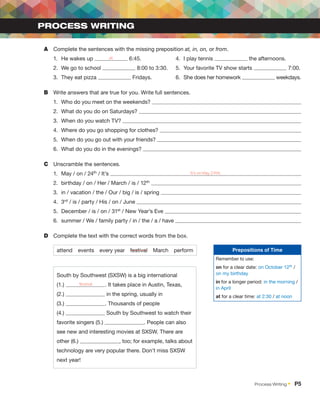
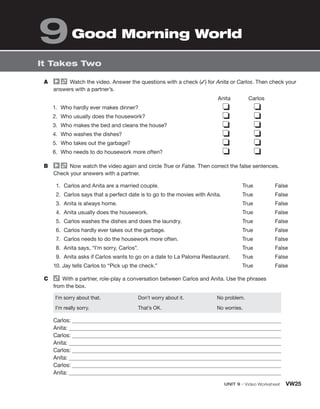
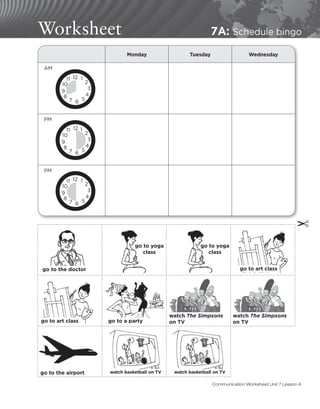
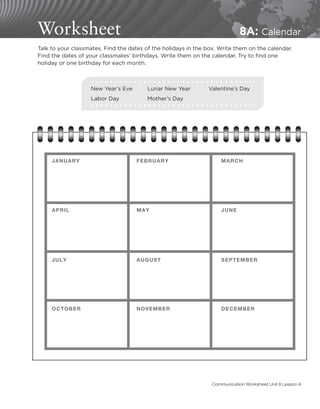
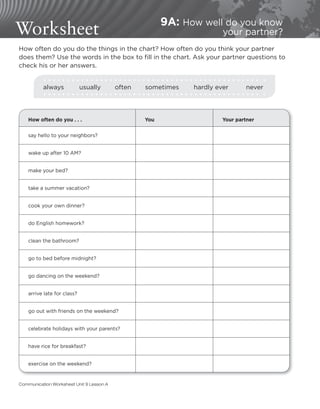
© Eduardo Kobra
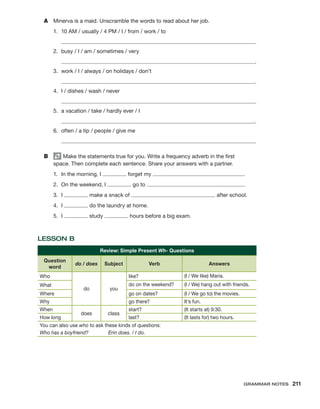
ABOUT THE ARTIST
Brazilian muralist Eduardo Kobra creates
large-scale, colorful murals of notable
people in cities around the world.
Australia • Brazil • Mexico • Singapore • United Kingdom • United States
WORLDLINK
James R. Morgan
Nancy Douglas
Basic 3
Developing
English Fluency
Printed in Perú
Print Number: 01 Print Year: 2016
© 2017, 2013, 2007 National Geographic Learning, a part of Cengage Learning
ALL RIGHTS RESERVED. No part of this work covered by the copyright herein
may be reproduced, transmitted, stored or used in any form or by any means
graphic, electronic, or mechanical, including but not limited to photocopying,
recording, scanning, digitizing, taping, Web distribution, information networks,
or information storage and retrieval systems, except as permitted under
Section 107 or 108 of the 1976 United States Copyright Act, without the prior
written permission of the publisher.
ICPNA World Link Basic 3 ISBN: 978-1-337-29903-9
National Geographic Learning
20 Channel Center Street
Boston, MA 02210
USA
Cengage Learning is a leading provider of customized learning solutions
with ­
employees residing in nearly 40 different countries and sales in more
than 125 countries around the world. Find your local representative at
www.cengage.com
Cengage Learning products are represented in Canada by Nelson Education, Ltd.
Visit National Geographic Learning online at ngl.cengage.com
Visit our corporate website at cengage.com
ICPNA World Link Basic 3, Third Edition
Nancy Douglas, Author
James R. Morgan, Author
Susan Stempleski, Series Editor
Publisher: Sherrise Roehr
Executive Editor: Sarah Kenney
Managing Development Editor: Claudi Mimo
Senior Development Editor: Margarita Matte
Senior Development Editor: Brenden Layte
Associate Development Editor: Alison Bruno
Media Researcher: Leila Hishmeh
Senior Technology Product Manager:
Lauren Krolick
Director of Global Marketing: Ian Martin
Senior Product Marketing Manager:
Caitlin Thomas
Sr. Director, ELT & World Languages:
Michael Burggren
Production Manager: Daisy Sosa
Senior Print Buyer: Mary Beth Hennebury
Composition: Lumina Datamatics Inc.,
Cover/Text Design: Brenda Carmichael
Art Director: Brenda Carmichael
Cover Image: Eduardo Kobra
Inside Front Cover Image: AFP/Getty Images
For product information and technology assistance, contact us at
Cengage Learning Customer & Sales Support, 1-800-354-9706
For permission to use material from this text or product,
submit all requests online at www.cengage.com/permissions
Further permissions questions can be emailed to
permissionrequest@cengage.com
 iii
ACKNOWLEDGMENT
We would like to extend a very special thank you to the Instituto Cultural Peruano
Norteamericano (ICPNA) academic management staff in the central office, branches,
and teachers, for the helpful insights and suggestions that contributed toward the
development of this series.
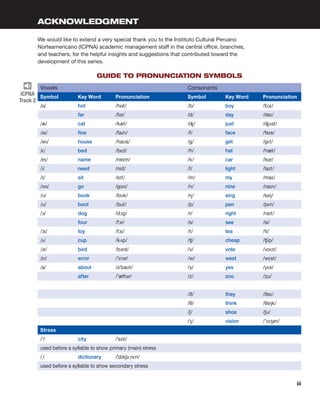
GUIDE TO PRONUNCIATION SYMBOLS
Vowels Consonants
Symbol Key Word Pronunciation Symbol Key Word Pronunciation
/ɑ/ hot /hɑt/ /b/ boy /bɔɪ/
far /fɑr/ /d/ day /deɪ/
/æ/ cat /kæt/ /ʤ/ just /ʤʌst/
/aɪ/ fine /faɪn/ /f/ face /feɪs/
/aʊ/ house /haʊs/ /g/ get /gɛt/
/ɛ/ bed /bɛd/ /h/ hat /hæt/
/eɪ/ name /neɪm/ /k/ car /kɑr/
/i/ need /nid/ /l/ light /laɪt/
/ɪ/ sit /sɪt/ /m/ my /maɪ/
/oʊ/ go /goʊ/ /n/ nine /naɪn/
/ʊ/ book /bʊk/ /ŋ/ sing /sɪŋ/
/u/ boot /but/ /p/ pen /pɛn/
/ɔ/ dog /dɔg/ /r/ right /raɪt/
four /fɔr/ /s/ see /si/
/ɔɪ/ toy /tɔɪ/ /t/ tea /ti/
/ʌ/ cup /kʌp/ /ʧ/ cheap /ʧip/
/ɜr/ bird /bɜrd/ /v/ vote /voʊt/
/ɛr/ error /’ɛrər/ /w/ west /wɛst/
/ə/ about /ə’baʊt/ /y/ yes /yɛs/
after /’æftər/ /z/ zoo /zu/
/ð/ they /ðeɪ/
/θ/ think /θɪŋk/
/ʃ/ shoe /ʃu/
/ʒ/ vision /’vɪʒən/
Stress
/ˈ/ city /ˈsɪti/
used before a syllable to show primary (main) stress
/̩/ dictionary /ˈdɪkʃə ̩nɛri/
used before a syllable to show secondary stress
ICPNA
Track 2
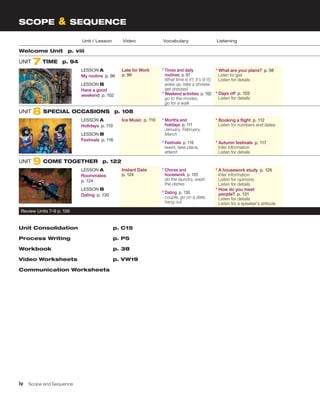
Unit / Lesson Video Vocabulary Listening
Welcome Unit  p. viii
UNIT 7 TIME  p. 94
LESSON A
My routine  p. 96
LESSON B
Have a good
weekend  p. 102
Late for Work  
p. 96
* 
Times and daily
routines  p. 97
What time is it?, It’s 9:15;
wake up, take a shower,
get dressed
* Weekend activities  p. 102
go to the movies,
go for a walk
* 
What are your plans?  p. 98
Listen for gist
Listen for details
* 
Days off  p. 103
Listen for details
UNIT 8 SPECIAL OCCASIONS  p. 108
LESSON A
Holidays  p. 110
LESSON B
Festivals  p. 116
Ice Music  p. 110 * 
Months and
holidays  p. 111
January, February,
March
* Festivals  p. 116
event, take place,
attend
* 
Booking a flight  p. 112
Listen for numbers and dates
* 
Autumn festivals  p. 117
Infer information
Listen for details
UNIT 9 COME TOGETHER  p. 122
LESSON A
Roommates 
p. 124
LESSON B
Dating  p. 130
Instant Date 
p. 124
* 
Chores and
housework  p. 125
do the laundry, wash
the dishes
* Dating  p. 130
couple, go on a date,
hang out
* 
A housework study  p. 126
Infer information
Listen for opinions
Listen for details
* 
How do you meet
people?  p. 131
Listen for details
Listen for a speaker’s attitude
Review Units 7–9 p. 136
Unit Consolidation	 p. C15
Process Writing 	 p. P5
Workbook 	 p. 38
Video Worksheets 	 p. VW19
Communication Worksheets
iv  Scope and Sequence
SCOPE  SEQUENCE
Scope and Sequence v
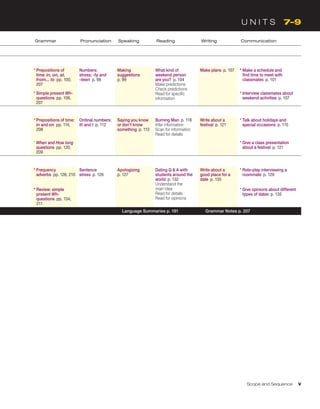
Grammar Pronunciation Speaking Reading Writing Communication
* 
Prepositions of
time: in, on, at,
from... to  pp. 100,
207
* 
Simple present Wh-
questions  pp. 106,
207
Numbers:
stress; -ty and
-teen  p. 98
Making
suggestions 
p. 99
What kind of
weekend person
are you?  p. 104
Make predictions
Check predictions
Read for specific
information
Make plans p. 107 * 
Make a schedule and
find time to meet with
classmates  p. 101
* 
Interview classmates about
weekend activities  p. 107
* 
Prepositions of time:
in and on  pp. 114,
208
* 
When and How long
questions  pp. 120,
209
Ordinal numbers:
th and t  p. 112
Saying you know
or don’t know
something  p. 113
Burning Man  p. 118
Infer information
Scan for information
Read for details
Write about a
festival  p. 121
* 
Talk about holidays and
special occasions  p. 115
* 
Give a class presentation
about a festival  p. 121
* Frequency
adverbs  pp. 128, 210
* Review: simple
present Wh-
questions  pp. 134,
211
Sentence
stress  p. 126
Apologizing 
p. 127
Dating Q  A with
students around the
world  p. 132
Understand the
main idea
Read for details
Read for opinions
Write about a
good place for a
date  p. 135
* 
Role-play interviewing a
roommate  p. 129
* 
Give opinions about different
types of dates  p. 135
U N I T S   7–9
Language Summaries p. 191 Grammar Notes p. 207
vi  Photo Credits
PHOTO CREDITS
Cover: © Eduardo Kobra, Back Cover: ICPNA Owned
iv (tl) Interpixels/Shutterstock.com, (cl) © Daniel Kudish, (bl) © Ankit Narang, x (tl) Chris Schmidt/E+/Getty
Images, (tc1) Mustafa Arican/iStock/Getty Images Plus/Getty Images, (tc2) Whitetag/iStock/Getty Images
Plus/Getty Images, (tr) Tara Moore/Stone/Getty Images, (cl) Images by Tang Ming Tung/Moment/Getty
Images, (c11) StockRocket/E+/Getty Images, (c2) Carlina Teteris/Moment/Getty Images, (cr1) Antoniodiaz/
Shutterstock.com, (cl2) Spaxiax/Shutterstock.com, (c) Sally Scott/iStock/Getty Images Plus/Getty Images,
(cr2) OlgaMiltsova/iStock/Getty Images Plus/Getty Images, (bl) Darryl Brooks/Shutterstock.com, (bc) Olga
Nayashkova/Shutterstock.com, (br) Brent Hofacker/Shutterstock.com, 41 Photos.com, 42 Mike Watson Images/
Moodboard/Thinkstock, 43 Caiaimage/Tom Merton/Getty Images, 45 Monkey Business Images/Shutterstock.
com, 46 Blend Images - Hill Street Studios/Brand X Pictures/Getty Images, 48 (tr) PhotoDisc/Getty Images, (cr1)
T photography/Shutterstock.com, (cr2) Steve Heap/Shutterstock.com, 49 Albert H. Teich/Shutterstock.com, 50
Elena Elisseeva/Shutterstock.com, 94–95 Interpixels/Shutterstock.com, 96 David Evans/National Geographic
Creative, 99 Peter Beavis/Stone/Getty Images, 100 Dave G. Houser/Alamy Stock Photo, 101 Jon Hicks/Latitude/
Corbis, 102 Paul Nicklen/National Geographic Creative, 103 Arena Creative/Shutterstock.com, 104–105 Kamil
Tamiola/Aurora Photos, 105 (bl) Jupiterimages/Stockbyte/Getty Images, (bc) B Busco/Photographer’s Choice/
Getty Images, (br) DreamPictures/Blend Images/Getty Images, 108–109 © Daniel Kudish, 110 © Iris Brooks, 111
Ralf Siemieniec/Shutterstock.com, 112 Dan Breckwoldt/Shutterstock.com, 113 Andersen Ross/Blend Images/
Getty Images, 114 Petr Baumann/Shutterstock.com, 115 (cl) Jake Naughton/The New York Times/Redux, (c)
Msheldrake/Shutterstock.com, (cr) JGI/Jamie Grill/Blend Images/Getty Images, (bl) Blend Images - Hill Street
Studios/Brand X Pictures/Getty Images, (bc) Pamela Moore/E+/Getty Images, 116 (bgd) Jim Richardson/
National Geographic Creative, (tc) Adina Tovy/Lonely Planet Images/Getty Images, 117 Michael Taylor/Lonely
Planet Images/Getty Images, 118–119 Moshe Shai/Flash90/Redux, 120 Chelsea Lauren/WireImage/Getty Images,
121 (tl) Andresr/Shutterstock.com, (tc1) Joana Lopes/Shutterstock.com, (tc2) Lleungchopan/Shutterstock.com,
122–123 © Ankit Narang, 124 Tony Shi Photography/Ocean/Corbis, 125 Image Source Plus/Alamy Stock Photo,
126 (br) JackF/iStock/Getty Images Plus/Getty Images, 127 Dennis Wise/DigitalVision/Getty Images, 128 Smith
Collection/Iconica/Getty Images, 129 Peterfz30/Shutterstock.com, 130 (t) Originalpunkt/Shutterstock.com, (cl)
Purestock/Getty Images, (c) John Foxx/Stockbyte/Getty Images, (cr) Morsa Images/DigitalVision/Getty Images,
131 Andrea Slatter/Shutterstock.com, 132–133 Michael Hanson/National Geographic Creative, 134 Takayuki/
Shutterstock.com, 135 Stefano Politi Markovina/Passage/Corbis, 137 RubberBall Productions/Brand X Pictures/
Getty Images, 09B (tl) Sam Edwards/OJO Images/Getty Images, (tr) John Foxx/Stockbyte/Getty Images,
(cl1) Nicholas Monu/iStock/Getty Images Plus/Getty Images, (cr1) Jade/Blend Images/Getty Images, (cl2)
Juanmonino/E+/Getty Images, (cr2) AntonioGuillem/iStock/Getty Images Plus/Getty Images, (bl) Purestock/
Getty Images, (br) blackdovfx/iStock/Getty Images Plus/Getty Images.
vii
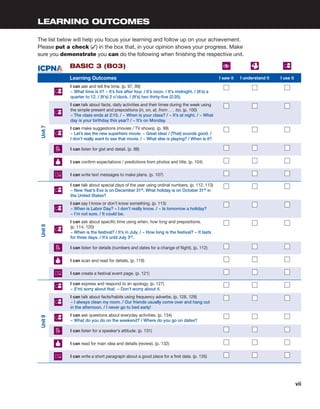
Basic 3 (B03)
Learning Outcomes I saw it I understand it I use it
Unit
7
I can ask and tell the time. (p. 97, 99)
~ What time is it? ~ It’s five after four. / It’s noon. / It’s midnight. / (It’s) a
quarter to 12. / (It’s) 2 o’clock. / (It’s) two thirty-five (2:35).
I can talk about facts, daily activities and their times during the week using
the simple present and prepositions (in, on, at, from . . . to). (p. 100)
~ The class ends at 2:15. / ~ When is your class? / ~ It’s at night. / ~ What
day is your birthday this year? / ~ It’s on Monday.
I can make suggestions (movies / TV shows). (p. 99)
~ Let’s see the new superhero movie. ~ Great idea! / (That) sounds good. /
I don’t really want to see that movie. / ~ What else is playing? / When is it?
I can listen for gist and detail. (p. 98)
I can confirm expectations / predictions from photos and title. (p. 104)
I can write text messages to make plans. (p. 107)
Unit
8
I can talk about special days of the year using ordinal numbers. (p. 112, 113)
~ New Year’s Eve is on December 31st. What holiday is on October 31st in
the United States?
I can say I know or don’t know something. (p. 113)
~ When is Labor Day? ~ I don’t really know. / ~ Is tomorrow a holiday?
~ I’m not sure. / It could be.
I can ask about specific time using when, how long and prepositions.
(p. 114, 120)
~ When is the festival? / It’s in July. / ~ How long is the festival? ~ It lasts
for three days. / It’s until July 3rd.
I can listen for details (numbers and dates for a change of flight). (p. 112)
I can scan and read for details. (p. 118)
I can create a festival event page. (p. 121)
Unit
9
I can express and respond to an apology. (p. 127)
~ (I’m) sorry about that. ~ Don’t worry about it.
I can talk about facts/habits using frequency adverbs. (p. 128, 129)
~ I always clean my room. / Our friends usually come over and hang out
in the afternoon. / I never go to bed early!
I can ask questions about everyday activities. (p. 134)
~ What do you do on the weekend? / Where do you go on dates?
I can listen for a speaker’s attitude. (p. 131)
I can read for main idea and details (review). (p. 132)
I can write a short paragraph about a good place for a first date. (p. 135)
Learning OUTCOMES
The list below will help you focus your learning and follow up on your achievement.
Please put a check (✓) in the box that, in your opinion shows your progress. Make
sure you demonstrate you can do the following when finishing the respective unit.
viii  WELCOME UNIT 
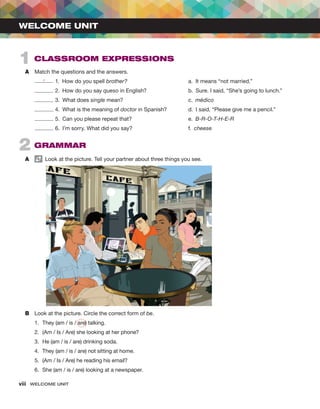
A	 Match the questions and the answers.
e 1.  How do you spell brother?				 a.  It means “not married.”
2.  How do you say queso in English?			 b.  Sure. I said, “She’s going to lunch.”
3.  What does single mean?				c. 
médico
4.  What is the meaning of doctor in Spanish?		 d.  I said, “Please give me a pencil.”
5.  Can you please repeat that?			 e.  B-R-O-T-H-E-R
6.  I’m sorry. What did you say?			 f.  cheese
2  GRAMMAR
A	   Look at the picture. Tell your partner about three things you see.
B	 Look at the picture. Circle the correct form of be.
1.	 They (am / is / are) talking.
2.	 (Am / Is / Are) she looking at her phone?
3.	 He (am / is / are) drinking soda.
4.	 They (am / is / are) not sitting at home.
5.	 (Am / Is / Are) he reading his email?
6.	 She (am / is / are) looking at a newspaper.
1  CLASSROOM EXPRESSIONS
WELCOME UNIT
WELCOME UNIT   
ix
C	   Unscramble the sentences. Then practice the conversation with a partner.
1.	 Hi, Leo. (doing / you / what / are) What are you doing ?
2.	 (basketball / a / I’m / game / watching) . What about you, Julia?
3.	 I’m with my family. (park / the / going / we’re / to) .
4.	 That’s nice. (there / Carmen / meeting / are / you) ?
5.	 Yes, I am. (she’s / at / coming / 2:30) . How’s the game?
6.	 It’s great! (is / team / well / my / doing / really) !
D	 Change the sentences to mean the opposite.
1.	 I don’t usually drink soda with meals. I usually drink soda with meals.
2.	 She does her homework after class.
3.	 We eat pizza on Friday nights.
4.	 He doesn’t like to drink milk.
5.	 They don’t know a good place to study.
6.	 You go to the library on the weekends.
E	   Make questions from the sentences. Then practice asking and answering the questions with
a partner.
1.	 Chris likes spicy food. Does Chris like spicy food?
2.	 We drink a lot of water.
3.	 They eat a healthy snack after class.
4.	 He takes vitamins in the mornings.
5.	 Maria has breakfast at home.
6.	 I have coffee after dinner.
F	 Correct the possessives in the sentences. Two of the sentences are correct.
1.	 Angela is the childrens’ aunt. Angela is the children’s aunt.
2.	 Miguel is my sister’s son.
3.	 Robert and Carlos are her parents’s friends.
4.	 Ines is Carmens’ sister.
5.	 Oscar is Mrs. Lopez’s nephew.
6.	 Emma and Tomas are my mothers’ parents.
G	 Write short answers for the questions. Use the information in parentheses.
1.	 Who has a cousin? (Kelly) Kelly does.
2.	 How many sisters does Steven have? (three)
3.	 Who has three children? (Marta and Jonathan)
4.	 How many people does your family have? (five)
5.	 Who has a brother and a sister? (Toni)
6.	 Who doesn’t have any cousins? (Javier)
Learning Strategy
Try checking your own
work before you give
it to your instructor or
share it with a partner.
Intenta revisar tu trabajo
antes de dárselo a tu
maestro o compartirlo
con un compañero.
x  WELCOME UNIT 
3  VOCABULARY
A	   Write the words under the photos. Some photos need two words. Then ask and answer
questions about the photos with your partner.
drinking eating exercising going listening shopping studying talking texting watching
1. 2. 3. 4.
5. 6. 7. 8.
B	   Look at the photos. Write the food words. Then tell your partner which items you like.
1. 2. 3.
4. 5. 6.
studying
spinach salad
WELCOME UNIT   
xi
C	 Complete the sentences with the words in the box. You won’t need all the words.
bad for you  energy  good for you  healthy junk food skip snack tastes good vitamins
1.	 Vegetable soup and bread are a healthy lunch.
2.	 I’m having some cheese and fruit as a .
3.	 Orange juice has many .
4.	 We think this fried chicken .
5.	 You shouldn’t breakfast—it’s really important.
6.	 Sometimes I eat , but I don’t like it.
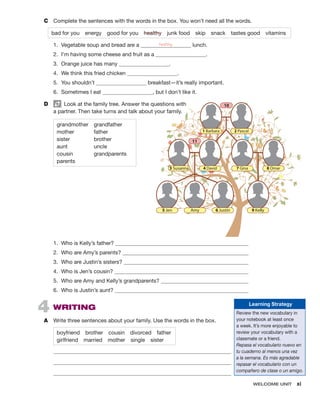
D	   Look at the family tree. Answer the questions with
a partner. Then take turns and talk about your family.
grandmother grandfather 
mother	father 
sister	brother 
aunt	uncle 
cousin	grandparents 
parents
1.	 Who is Kelly’s father?
2.	 Who are Amy’s parents?
3.	 Who are Justin’s sisters?
4.	 Who is Jen’s cousin?
5.	 Who are Amy and Kelly’s grandparents?
6.	 Who is Justin’s aunt?
4  WRITING
A	 Write three sentences about your family. Use the words in the box.
boyfriend brother cousin divorced father
girlfriend married mother single sister
11
10
1 Barbara 2 Pascal
3 Susanna 4 David 7 Gina 8 Omar
5 Jen Amy 6 Justin 9 Kelly
Learning Strategy
Review the new vocabulary in
your notebook at least once
a week. It’s more enjoyable to
review your vocabulary with a
classmate or a friend.
Repasa el vocabulario nuevo en
tu cuaderno al menos una vez
a la semana. Es más agradable
repasar el vocabulario con un
compañero de clase o un amigo.
7
7
TIME
The astronomical clock in
Prague, Czech Republic
Look at the photo. Answer the questions.
1	 Look at the clock in your classroom. How
do you say these times in English?
	12:00   12:30
2	Here are the days of the week:
	Sunday
	Monday
	Tuesday
	Wednesday
Thursday
Friday
Saturday
	Which one is your favorite?
3	 When is the weekend in your country? Say
the day(s).
UNIT GOALS
1	Describe your daily routine
2	Make suggestions about activities and plans
3	Identify the time of day or week
4	 Ask and answer questions about weekend
activities
96  UNIT 7 • Time
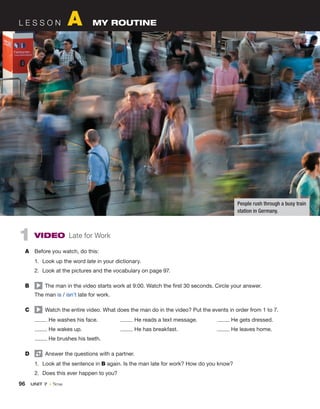
1 VIDEO Late for Work
A	 Before you watch, do this:
1.	 Look up the word late in your dictionary.
2.	 Look at the pictures and the vocabulary on page 97.
B	   The man in the video starts work at 9:00. Watch the first 30 seconds. Circle your answer.
	 The man is / isn’t late for work.
C	   Watch the entire video. What does the man do in the video? Put the events in order from 1 to 7.
He washes his face.	 He reads a text message.	 He gets dressed.
He wakes up.	 He has breakfast.	 He leaves home.
He brushes his teeth.
D	   Answer the questions with a partner.
1.	 Look at the sentence in B again. Is the man late for work? How do you know?
2.	 Does this ever happen to you?
L E S S O N A  MY ROUTINE
People rush through a busy train
station in Germany.
LESSON A • My routine 97
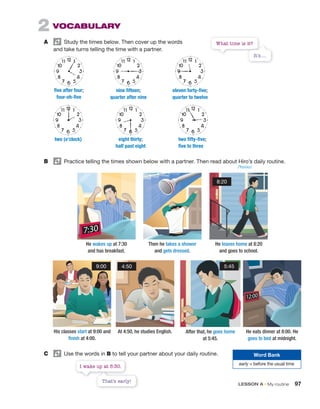
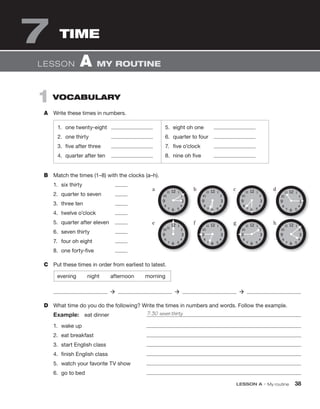
2 VOCABULARY
A Study the times below. Then cover up the words
and take turns telling the time with a partner.
five after four;
four-oh-five
nine fifteen;
quarter after nine
eleven forty-five;
quarter to twelve
two (o’clock) eight thirty;
half past eight
two fifty-five;
five to three
B Practice telling the times shown below with a partner. Then read about Hiro’s daily routine.
I wake up at 5:30.
C Use the words in B to tell your partner about your daily routine.
That’s early!
He wakes up at 7:30
and has breakfast.
Then he takes a shower
and gets dressed.
He leaves home at 8:20
and goes to school.
8:20
He eats dinner at 8:00. He
goes to bed at midnight.
12:00
9:00
His classes start at 9:00 and
finish at 4:00.
After that, he goes home
at 5:45.
5:45
4:50
At 4:50, he studies English.
Word Bank
early = before the usual time
What time is it?
What time is it?
It’s….
/ˈhɪroʊ/
98 UNIT 7 • Time
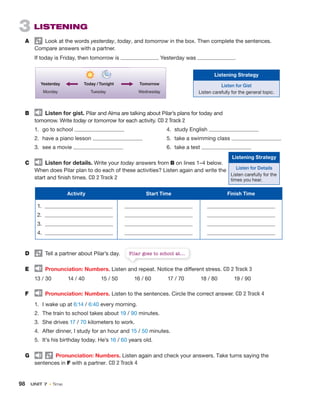
3 LISTENING
A Look at the words yesterday, today, and tomorrow in the box. Then complete the sentences.
Compare answers with a partner.
If today is Friday, then tomorrow is . Yesterday was .
Yesterday
Monday
Tomorrow
Wednesday
Today / Tonight
Tuesday
B Listen for gist. Pilar and Alma are talking about Pilar’s plans for today and
tomorrow. Write today or tomorrow for each activity. CD 2 Track 2
1. go to school
2. have a piano lesson
3. see a movie
C Listen for details. Write your today answers from B on lines 1–4 below.
When does Pilar plan to do each of these activities? Listen again and write the
start and finish times. CD 2 Track 2
Activity Start Time Finish Time
1.
2.
3.
4.
D Tell a partner about Pilar’s day.
E Pronunciation: Numbers. Listen and repeat. Notice the different stress. CD 2 Track 3
13 / 30 14 / 40 15 / 50 16 / 60 17 / 70 18 / 80 19 / 90
F Pronunciation: Numbers. Listen to the sentences. Circle the correct answer. CD 2 Track 4
1. I wake up at 6:14 / 6:40 every morning.
2. The train to school takes about 19 / 90 minutes.
3. She drives 17 / 70 kilometers to work.
4. After dinner, I study for an hour and 15 / 50 minutes.
5. It’s his birthday today. He’s 16 / 60 years old.
G Pronunciation: Numbers. Listen again and check your answers. Take turns saying the
sentences in F with a partner. CD 2 Track 4
4. study English
5. take a swimming class
6. take a test
Pilar goes to school at....
Listening Strategy
Listen for Gist
Listen carefully for the general topic.
Listening Strategy
Listen for Details
Listen carefully for the
times you hear.
LESSON A • My routine 99
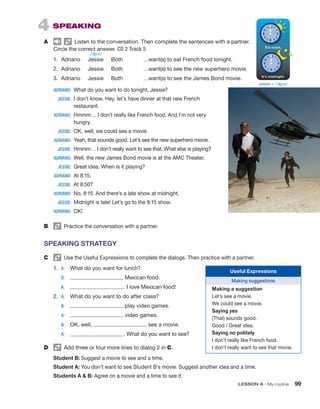
4 SPEAKING
A Listen to the conversation. Then complete the sentences with a partner.
Circle the correct answer. CD 2 Track 5
1. Adriano Jessie Both …want(s) to eat French food tonight.
2. Adriano Jessie Both …want(s) to see the new superhero movie.
3. Adriano Jessie Both …want(s) to see the James Bond movie.
ADRIANO: What do you want to do tonight, Jessie?
JESSIE: I don’t know. Hey, let’s have dinner at that new French
restaurant.
ADRIANO: Hmmm… I don’t really like French food. And I’m not very
hungry.
JESSIE: OK, well, we could see a movie.
ADRIANO: Yeah, that sounds good. Let’s see the new superhero movie.
JESSIE: Hmmm… I don’t really want to see that. What else is playing?
ADRIANO: Well, the new James Bond movie is at the AMC Theater.
JESSIE: Great idea. When is it playing?
ADRIANO: At 8:15.
JESSIE: At 8:50?
ADRIANO: No, 8:15. And there’s a late show at midnight.
JESSIE: Midnight is late! Let’s go to the 8:15 show.
ADRIANO: OK!
B Practice the conversation with a partner.
SPEAKING STRATEGY
C Use the Useful Expressions to complete the dialogs. Then practice with a partner.
1. A: What do you want for lunch?
B: Mexican food.
A: . I love Mexican food!
2. A: What do you want to do after class?
B: play video games.
A: video games.
B: OK, well, see a movie.
A: . What do you want to see?
D Add three or four more lines to dialog 2 in C.
Student B: Suggest a movie to see and a time.
Student A: You don’t want to see Student B’s movie. Suggest another idea and a time.
Students A  B: Agree on a movie and a time to see it.
Useful Expressions
Making suggestions
Making a suggestion
Let’s see a movie.
We could see a movie.
Saying yes
(That) sounds good.
Good / Great idea.
Saying no politely
I don’t really like French food.
I don’t really want to see that movie.
Jessie = /ˈʤɛsi/
/ˈʤɛsi/
100 UNIT 7 • Time
B Complete the answer choices with in, at, on, from,
or to. Then choose the answers that are true for you.
1. When do you like to study?
a. the morning
b. the afternoon
c. the evening
d. late night
2. When do you do most of your homework?
a. weekdays
b. Saturdays and Sundays
c. both
3. What day is your birthday this year?
a. It’s Monday.
b. It’s Tuesday.
c. It’s Wednesday.
d. other:
4. You can see a movie with your friends noon or midnight.
Which do you choose?
5. What is your favorite subject at school? What time does the class meet?
My favorite subject is .
The class is from .
(day(s) of the week) (start time) (end time)
C Now interview a partner. Use the questions in B. Take notes.
D What is one new thing you know
about your partner now? Tell him or her.
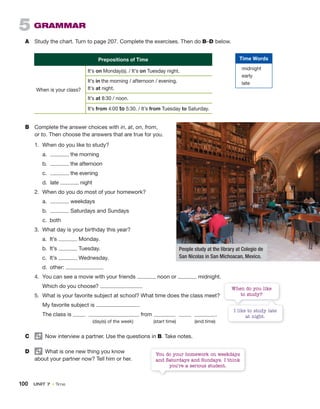
5 GRAMMAR
A Study the chart. Turn to page 207. Complete the exercises. Then do B–D below.
Prepositions of Time
When is your class?
It’s on Monday(s). / It’s on Tuesday night.
It’s in the morning / afternoon / evening.
It’s at night.
It’s at 8:30 / noon.
It’s from 4:00 to 5:30. / It’s from Tuesday to Saturday.
You do your homework on weekdays
and Saturdays and Sundays. I think
you’re a serious student.
People study at the library at Colegio de
San Nicolas in San Michoacan, Mexico.
Time Words
midnight
early
late
I like to study late
at night.
When do you like
to study?
LESSON A • My routine 101
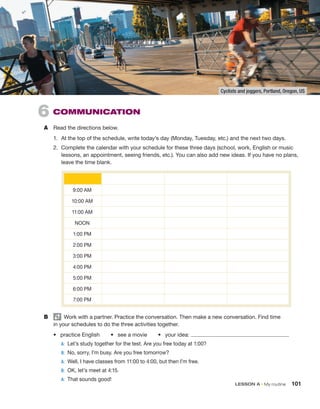
6  COMMUNICATION
A	 Read the directions below.
1.	 At the top of the schedule, write today’s day (Monday, Tuesday, etc.) and the next two days.
2.	 Complete the calendar with your schedule for these three days (school, work, English or music
lessons, an appointment, seeing friends, etc.). You can also add new ideas. If you have no plans,
leave the time blank.
B	   Work with a partner. Practice the conversation. Then make a new conversation. Find time
in your schedules to do the three ­
activities together.
•  practice English   •  see a movie   •  your idea:
	 A:	 Let’s study together for the test. Are you free today at 1:00?
	 B:	 
No, sorry, I’m busy. Are you free tomorrow?
	 A:	 Well, I have classes from 11:00 to 4:00, but then I’m free.
	 B:	 OK, let’s meet at 4:15.
	 A: 	That sounds good!
9:00 AM
10:00 AM
11:00 AM
NOON
1:00 PM
2:00 PM
3:00 PM
4:00 PM
5:00 PM
6:00 PM
7:00 PM
Cyclists and joggers, Portland, Oregon, US
102 UNIT 7 • Time
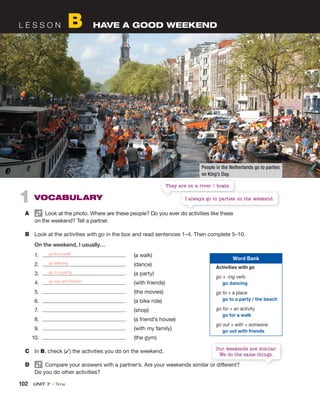
1 VOCABULARY
A Look at the photo. Where are these people? Do you ever do activities like these
on the weekend? Tell a partner.
B Look at the activities with go in the box and read sentences 1–4. Then complete 5–10.
On the weekend, I usually…
1. . (a walk)
2. . (dance)
3. . (a party)
4. . (with friends)
5. . (the movies)
6. . (a bike ride)
7. . (shop)
8. . (a friend’s house)
9. . (with my family)
10. . (the gym)
C In B, check (✓) the activities you do on the weekend.
D Compare your answers with a partner’s. Are your weekends similar or different?
Do you do other activities?
L E S S O N B HAVE A GOOD WEEKEND
go for a walk
go dancing
go to a party
go out with friends
Word Bank
Activities with go
go + -ing verb
go dancing
go to + a place
go to a party / the beach
go for + an activity
go for a walk
go out + with + someone
go out with friends
People in the Netherlands go to parties
on King’s Day.
They are on a river / boats.
Look at the photo. Where are these people? Do you ever do activities like these
I always go to parties on the weekend.
Compare your answers with a partner’s. Are your weekends similar or different?
Our weekends are similar.
We do the same things.
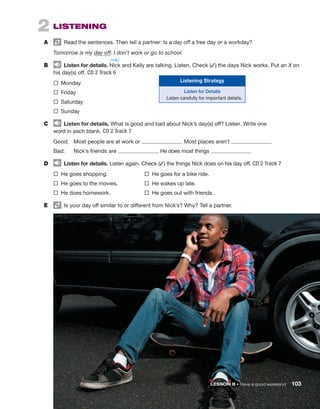
2  LISTENING
A	   Read the sentences. Then tell a partner: Is a day off a free day or a workday?
Tomorrow is my day off. I don’t work or go to school.
B	   Listen for details. Nick and Kelly are talking. Listen. Check (✓) the days Nick works. Put an X on
his day(s) off. CD 2 Track 6
®  Monday  
®  Friday  
®  Saturday  
®  Sunday
C	   Listen for details. What is good and bad about Nick’s day(s) off? Listen. Write one
word in each blank. CD 2 Track 7
Good:	 
Most people are at work or . Most places aren’t .
Bad:	 
Nick’s friends are . He does most things .
D	   Listen for details. Listen again. Check (✓) the things Nick does on his day off. CD 2 Track 7
®  He goes shopping. 	 ®  He goes for a bike ride.
®  He goes to the movies.	 ®  He wakes up late.
®  He does homework.	 ®  He goes out with friends.
E	   Is your day off ­
similar to or ­
different from Nick’s? Why? Tell a partner.
	 LESSON B • Have a good weekend 103
Listening Strategy
Listen for Details
Listen carefully for important details.
/nɪk/
104 UNIT 7 • Time
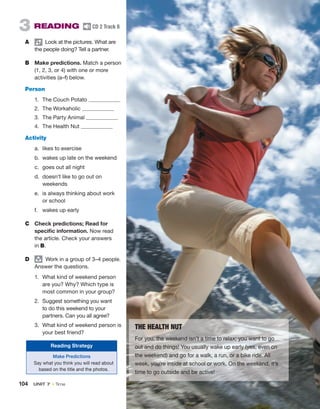
3 READING CD 2 Track 8
A Look at the pictures. What are
the people doing? Tell a partner.
B Make predictions. Match a person
(1, 2, 3, or 4) with one or more
activities (a–f) below.
Person
1. The Couch Potato
2. The Workaholic
3. The Party Animal
4. The Health Nut
Activity
a. likes to exercise
b. wakes up late on the weekend
c. goes out all night
d. doesn’t like to go out on
weekends
e. is always thinking about work
or school
f. wakes up early
C Check predictions; Read for
specific information. Now read
the article. Check your answers
in B.
D group
Work in a group of 3–4 people.
Answer the questions.
1. What kind of weekend person
are you? Why? Which type is
most common in your group?
2. Suggest something you want
to do this weekend to your
partners. Can you all agree?
3. What kind of weekend person is
your best friend?
THE HEALTH NUT
For you, the weekend isn’t a time to relax; you want to go
out and do things! You usually wake up early (yes, even on
the weekend) and go for a walk, a run, or a bike ride. All
week, you’re inside at school or work. On the weekend, it’s
time to go outside and be active!
Reading Strategy
Make Predictions
Say what you think you will read about
based on the title and the photos.
LESSON B • Have a good weekend 105
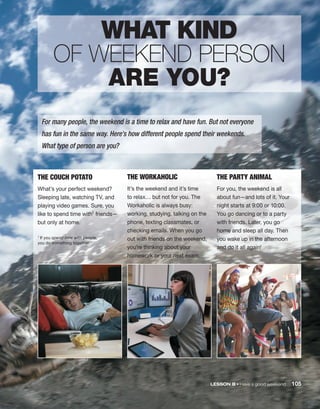
THE COUCH POTATO
What’s your perfect weekend?
Sleeping late, watching TV, and
playing video games. Sure, you
like to spend time with1 friends—
but only at home.
THE WORKAHOLIC
It’s the weekend and it’s time
to relax… but not for you. The
Workaholic is always busy:
working, studying, talking on the
phone, texting classmates, or
checking emails. When you go
out with friends on the weekend,
you’re thinking about your
homework or your next exam.
THE PARTY ANIMAL
For you, the weekend is all
about fun—and lots of it. Your
night starts at 9:00 or 10:00.
You go dancing or to a party
with friends. Later, you go
home and sleep all day. Then
you wake up in the afternoon
and do it all again!
1 If you spend time with people,
you do something together.
For many people, the weekend is a time to relax and have fun. But not everyone
has fun in the same way. Here’s how different people spend their weekends.
What type of person are you?
WHAT KIND
OF WEEKEND PERSON
ARE YOU?
106 UNIT 7 • Time
4 GRAMMAR
A Study the chart. Turn to page 208. Complete the exercises. Then do B and C below.
B Read about Zoe’s weekend. Unscramble questions 1–4. Start each sentence with a question
word. Then ask and answer the questions with a partner.
Simple Present Wh- Questions
Question word do / does Subject Verb Answers
Who do you study with? (I study with) Maria.
What does she do on Saturdays? (She) goes out with friends.
When do
they
have class?
(They have class) at 9:00.
we (We have class) on Mondays.
Where does he (He has class) in Room 3B.
On Saturday, Zoe… On Sunday, Zoe…
• works at a department store from 9:00 AM to 3:30 PM.
• goes to the gym in the afternoon.
• goes out with friends at night.
• wakes up at 11:00 AM.
• goes for a bike ride in the afternoon.
• studies in the evening.
She goes to the gym
1. Zoe / what / do / on Saturday afternoon / does
? .
2. she / work / does / when
? .
3. does / work / she / where
? .
4. who / on Saturday night / Zoe / does / go out with
? .
C Write four more questions about Zoe’s schedule. Use different question words. Then ask
and answer the questions with a partner.
1.
2.
3.
4.
What time does Zoe get up on Sunday?
/ˈzoʊi/
LESSON B • Have a good weekend 107
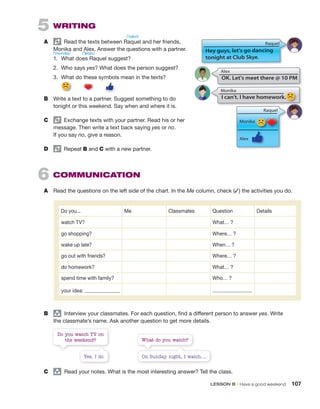
5 WRITING
A Read the texts between Raquel and her friends,
Monika and Alex. Answer the questions with a partner.
1. What does Raquel suggest?
2. Who says yes? What does the person suggest?
3. What do these symbols mean in the texts?
B Write a text to a partner. Suggest something to do
tonight or this weekend. Say when and where it is.
C Exchange texts with your partner. Read his or her
message. Then write a text back saying yes or no.
If you say no, give a reason.
D Repeat B and C with a new partner.
6 COMMUNICATION
A Read the questions on the left side of the chart. In the Me column, check (✓) the activities you do.
Do you... Me Classmates Question Details
watch TV? What… ?
go shopping? Where… ?
wake up late? When… ?
go out with friends? Where… ?
do homework? What… ?
spend time with family? Who… ?
your idea:
B group
Interview your classmates. For each question, find a different person to answer yes. Write
the classmate’s name. Ask another question to get more details.
C group
Read your notes. What is the most interesting answer? Tell the class.
Do you watch TV on
the weekend? What do you watch?
Yes, I do. On Sunday night, I watch....
Monika
Monika
Alex
Raquel
Raquel
Hey guys, let's go dancing
tonight at Club Skye.
Alex
OK. Let's meet there @ 10 PM
I can’t. I have homework.
/ˈrɑkɛl/
/ˈælɪks/
/ˈmɒnɪkə/
8
8SPECIAL
OCCASIONS
Three young women are dressed up
for Day of the Dead in Mexico.
Look at the photo. Answer the questions.
1	 Where is this festival and when does it happen?
2	 Special occasions happen in different ­
seasons.
The seasons are:
winter spring summer fall
Which season is your favorite?
3	 Here are some more seasons. Which ones
­
happen where you live?
	 rainy season  dry season
hurricane / typhoon season
UNIT GOALS
1	 Talk about important dates
2	 Express degrees of certainty
3	 Describe when special occasions happen and
how they are celebrated
4	 Describe what happens at a festival
L E S S O N A HOLIDAYS
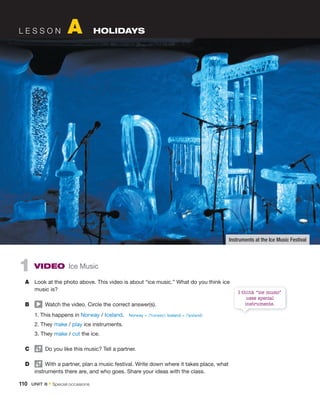
1 VIDEO Ice Music
A Look at the photo above. This video is about “ice music.” What do you think ice
music is?
B Watch the video. Circle the correct answer(s).
1. This happens in Norway / Iceland.
2. They make / play ice instruments.
3. They make / cut the ice.
C Do you like this music? Tell a partner.
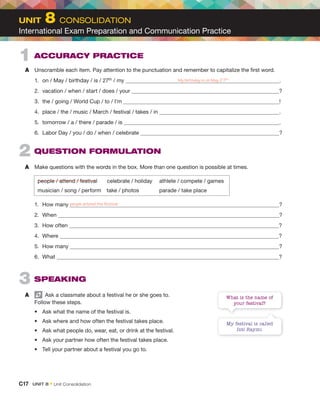
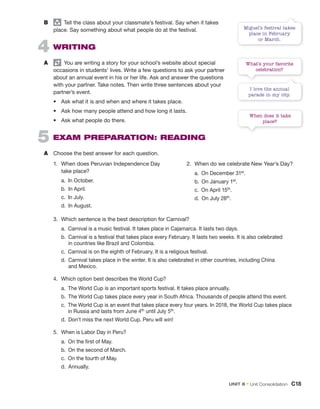
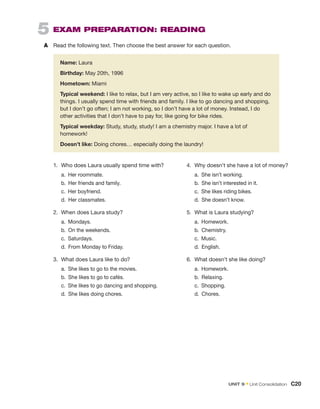
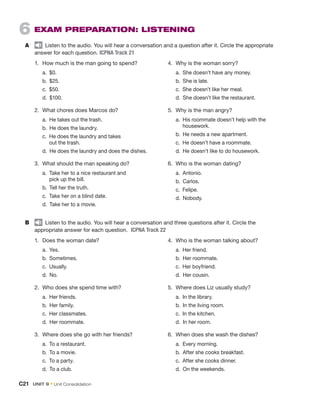
D With a partner, plan a music festival. Write down where it takes place, what
instruments there are, and who goes. Share your ideas with the class.
Instruments at the Ice Music Festival
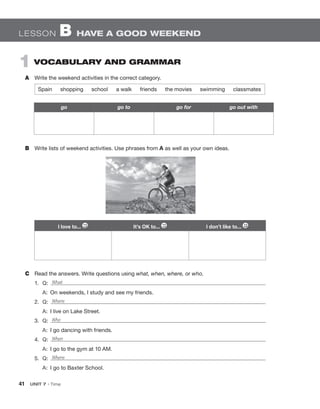
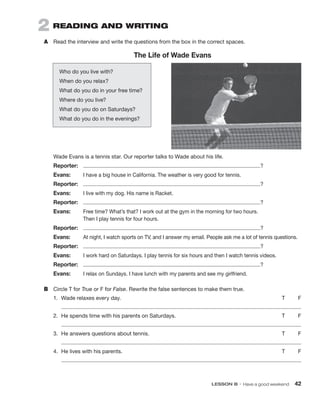
I think “ice music”
uses special
instruments.
Norway = /ˈnɔrweɪ/; Iceland = /ˈaɪslənd/
110 UNIT 8 • Special occasions
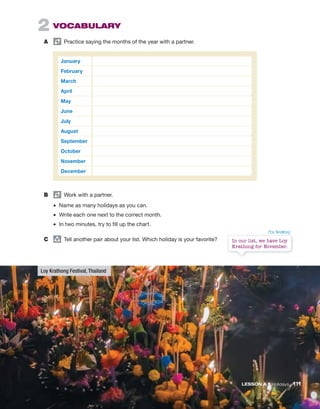
2 VOCABULARY
A Practice saying the months of the year with a partner.
January
February
March
April
May
June
July
August
September
October
November
December
B Work with a partner.
• Name as many holidays as you can.
• Write each one next to the correct month.
• In two minutes, try to fill up the chart.
C group
Tell another pair about your list. Which holiday is your favorite?
LESSON A • Holidays 111
In our list, we have Loy
Krathong for November.
Loy Krathong Festival, Thailand
/ˈlɔɪ ˈkrɑθɔŋ/
3 LISTENING
A Pronunciation: th and t. Practice saying these ordinal numbers with a partner. Then listen
and repeat. CD 2 Track 9
1st first
2nd second
3rd third
4th fourth
5th fifth
6th sixth
7th seventh
8th eighth
9th ninth
10th tenth
11th eleventh
12th twelfth
13th thirteenth
↓
20th twentieth
30th thirtieth
40th fortieth
50th fiftieth
↓
100th one hundredth
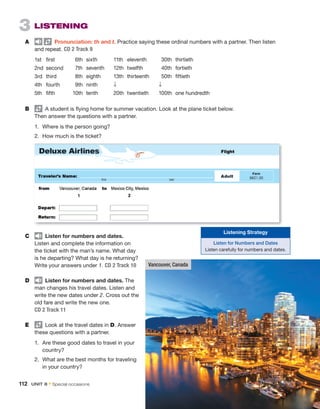
B A student is flying home for summer vacation. Look at the plane ticket below.
Then answer the questions with a partner.
1. Where is the person going?
2. How much is the ticket?
C Listen for numbers and dates.
Listen and complete the information on
the ticket with the man’s name. What day
is he departing? What day is he returning?
Write your answers under 1. CD 2 Track 10
D Listen for numbers and dates. The
man changes his travel dates. Listen and
write the new dates under 2. Cross out the
old fare and write the new one.
CD 2 Track 11
E Look at the travel dates in D. Answer
these questions with a partner.
1. Are these good dates to travel in your
country?
2. What are the best months for traveling
in your country?
Vancouver, Canada
Listening Strategy
Listen for Numbers and Dates
Listen carefully for numbers and dates.
112 UNIT 8 • Special occasions
4 SPEAKING
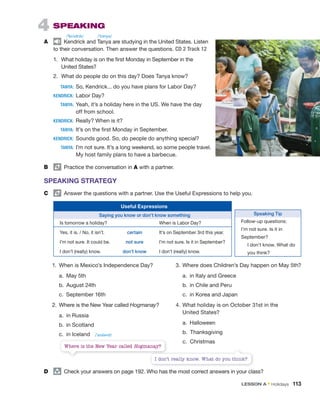
A Kendrick and Tanya are studying in the United States. Listen
to their conversation. Then answer the questions. CD 2 Track 12
1. What holiday is on the first Monday in September in the
United States?
2. What do people do on this day? Does Tanya know?
TANYA: So, Kendrick... do you have plans for Labor Day?
KENDRICK: Labor Day?
TANYA: Yeah, it’s a holiday here in the US. We have the day
off from school.
KENDRICK: Really? When is it?
TANYA: It’s on the first Monday in September.
KENDRICK: Sounds good. So, do people do anything special?
TANYA: I’m not sure. It’s a long weekend, so some people travel.
My host family plans to have a barbecue.
B Practice the conversation in A with a partner.
SPEAKING STRATEGY
C Answer the questions with a partner. Use the Useful Expressions to help you.
Useful Expressions
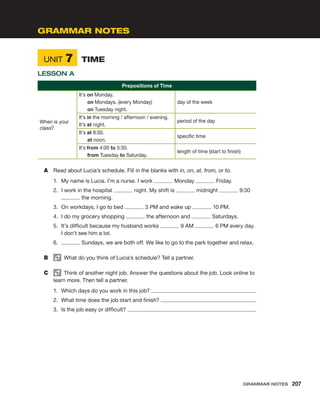
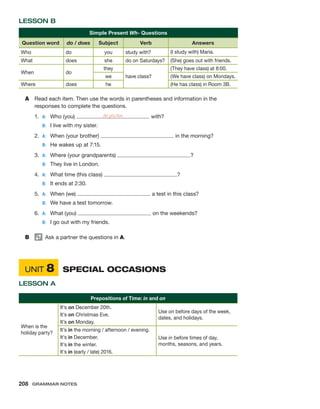
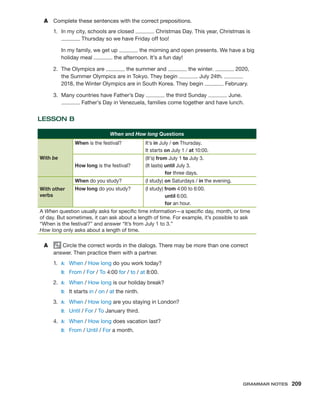
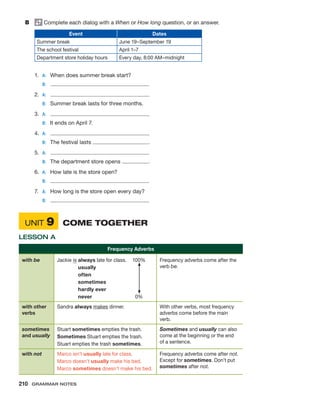
Saying you know or don’t know something
Is tomorrow a holiday? When is Labor Day?
Yes, it is. / No, it isn’t. certain It’s on September 3rd this year.
I’m not sure. It could be. not sure I’m not sure. Is it in September?
I don’t (really) know. don’t know I don’t (really) know.
1. When is Mexico’s Independence Day?
a. May 5th
b. August 24th
c. September 16th
2. Where is the New Year called Hogmanay?
a. in Russia
b. in Scotland
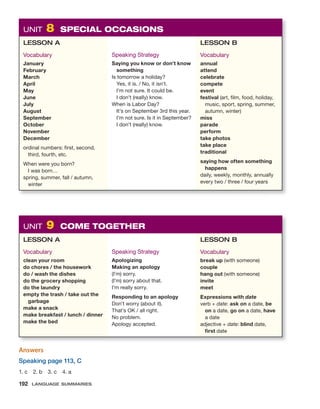
c. in Iceland
3. Where does Children’s Day happen on May 5th?
a. in Italy and Greece
b. in Chile and Peru
c. in Korea and Japan
4. What holiday is on October 31st in the
United States?
a. Halloween
b. Thanksgiving
c. Christmas
D group
Check your answers on page 192. Who has the most correct answers in your class?
Where is the New Year called Hogmanay?
Hogmanay
I don’t really know. What do you think?
Speaking Tip
Follow-up questions:
I’m not sure. Is it in
September?
I don’t know. What do
you think?
/ˈtɑnyə/
/ˈkɛndrɪk/
/ˈaɪslənd/
LESSON A • Holidays 113
OK, let’s start.
Number one.
2002.
In 2002!
C Complete as much information as you can about your own birthdate.
D Interview a partner about his or her
birthdate. Are you similar in any way?
What is the month of your
birth? I was born in November.
5 GRAMMAR
A Study the chart. Turn to page 208. Complete the exercise. Then do B–D below.
A decade
is a period
of ten years. For
the decade of the
1990s you can say
(in) the nineteen
nineties or just (in)
the nineties.
B Complete the columns with the correct
preposition of time. Follow the steps below.
1. Student A: Read the items in Group 1 aloud to
Student B. Write the answers Student B gives.
2. Student B: Close your book and listen to your
partner. Answer as quickly as you can.
3. Switch roles and repeat with the items in Group 2.
Group 1 Group 2
1. 2002
2. the third Tuesday of the month
3. March
4. New Year’s Day
5. the spring
6. January 1st
7. the eighties
1. May
2. December 31st
3. the first Saturday of the month
4. the nineties
5. 2004
6. the summer
7. Labor Day
Your special day
1. date (e.g., the 17th)
of your birth
1.
2. month 2.
3. year 3.
4. decade 4.
5. season 5.
6. day of the week 6.
7. time of day* 7.
*morning, afternoon, or evening
Prepositions of Time: in and on
When is the holiday party?
It’s on December 20th. / It’s on Christmas Eve. / It’s on Monday.
It’s in December. / It’s in the winter. / It’s in (early / late) 2016.
spring summer fall / autumn winter
114 UNIT 8 • Special occasions
On New Year’s Day, people in my country say....
6 COMMUNICATION
A On some holidays or special days, there are expressions
people say. Look at the examples in the box. Then do
the following:
• What holidays, or special days, are in the photos below?
Tell a partner.
• Match an expression in the box with a photo.
Write the letter of the expression on the photo.
• Take turns with a partner saying the expression
in English for each holiday or special day.
• In your country, what do people say on these days? Tell your partner.
a. Happy Birthday!
b. Congratulations!
c. Happy New Year!
d. Happy Mother’s Day.
e. I love you. / Happy Valentine’s Day.
B Answer the questions.
1. What is your favorite day of the year?
2. When is it?
3. What do you eat or drink on this day?
4. What do you do or where do you go?
C group
Get into a group of four. Share your answers from B. Which day of the year is
the most popular?
LESSON A • Holidays 115
L E S S O N B FESTIVALS
1 VOCABULARY
A Read about the Highland Games. Look up any words
you don’t know. Then ask and answer the questions
with a partner.
1. Where are the games?
2. How often do they take place?
3. When do they take place?
4. How many people attend?
5. What happens at the games?
6. Is this event interesting to you? Why?
B Think of another sporting event or sports festival. Answer questions 1–6 in A
about it. Tell a partner about the event or festival.
A man competes in the hammer throwing event.
The Highland Games take place
annually (every year) in the spring
and fall all over Scotland.
What happens at the festival:
• People wear traditional clothes
and play traditional sports. One
popular event is the hammer
throw.
• There are bagpipe parades.
• People from around the world
perform traditional Scottish
dances. They compete to be
the best.
• Thousands of people attend
the games. People also
celebrate the games in
countries like Brazil and New
Zealand.
• Don’t miss the festival, and
take lots of photos!
Women do a traditional Scottish dance.
Word Bank
Saying how often something happens
daily, weekly, monthly, annually, every
two / three / four years
The Lima marathon
takes place annually. The
participants run through
the five districts in Lima.
/ˈnu ˈzilənd/
116 UNIT 8 • Special occasions
2 LISTENING
A Infer information. Look at the photo. Then answer the
questions with a partner.
1. Do you know anything about this festival?
2. Guess: What kind of festival is it?
B Listen for details. Read the sentences. Then listen. Circle the correct words. CD 2 Track 13
1. Both festivals are spring / summer / winter / autumn festivals.
2. Oktoberfest is a(n) art / food / film / music festival.
3. The Moon Festival is an important art / family / film / sports event.
C Listen for details. Read the sentences. Then listen again. Write one word or number in each
blank. CD 2 Track 13
The Moon Festival
takes place in….
Oktoberfest The Moon Festival
Where does it take place? in Munich, in
When is it? for days in late
or early
in late or early
What do people do? eat German food spend time with ,
eat moon , and
with colorful
lanterns
What other countries have
this festival?
and Vietnam and Singapore
D Choose one festival. Tell your partner about it. Use your notes.
E Are there autumn festivals in your country? Are they similar to Oktoberfest or
the Moon Festival? Tell a partner.
People at Oktoberfest in Munich
Word Bank
Types of festivals
art, film, food, holiday, music, sports,
spring / summer / autumn / winter
Listening Strategy
Infer Information
Decide what something is about
using photos and captions.
LESSON B • Festivals 117
3  READING  CD 2 Track 14
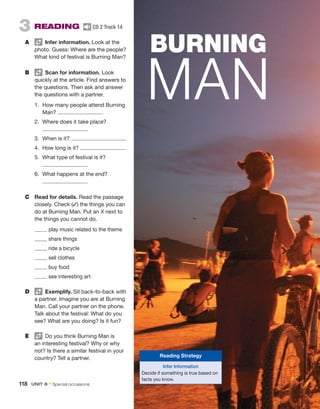
A	   Infer information. Look at the
photo. Guess: Where are the ­
people?
What kind of festival is Burning Man?
B	   Scan for information. Look
quickly at the article. Find ­
answers to
the questions. Then ask and answer
the questions with a partner.
1.	 How many people attend Burning
Man?
2.	 Where does it take place?
3.	 When is it?
4.	 How long is it?
5.	 What type of festival is it?
6.	 What happens at the end?
C	 Read for details. Read the passage
closely. Check (✓) the things you can
do at Burning Man. Put an X next to
the things you cannot do.
	 play music related to the theme
	 share things
	 ride a bicycle
	 sell clothes
	 buy food
	 see interesting art
D	   Exemplify. Sit back-to-back with
a partner. Imagine you are at Burning
Man. Call your partner on the phone.
Talk about the festival: What do you
see? What are you doing? Is it fun?
E	   Do you think Burning Man is
an interesting festival? Why or why
not? Is there a similar festival in your
country? Tell a partner.
BURNING
MAN
Reading Strategy
Infer Information
Decide if something is true based on
facts you know.
118  UNIT 8 • Special occasions
Every year, over 60,000 people from all over
the world attend the Burning Man festival in the
Black Rock Desert in the US. The eight-day
event starts on the last Monday in August and
ends on the first Monday in September, which is
Labor Day in the US.
Every year, Burning Man has a different theme.
Some past themes are Time, Good and Bad,
The Body, and Hope and Fear. People make
art, play music, and wear clothes related to the
theme. There are also many activities for people
to do—all related to the theme.
The Burning Man festival is very large—about
one-and-a-half miles (almost 2.5 km). Many
people use a bike to go from place to place.
Also, festival-goers cannot buy anything at
Burning Man, except some drinks (like water,
coffee, and tea) and ice. For this reason,
people bring their own food and drinks. They
also share things with others.
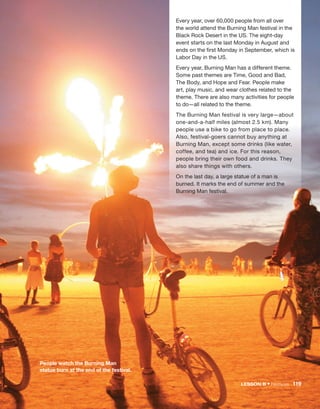
On the last day, a large statue of a man is
burned. It marks the end of summer and the
Burning Man festival.
People watch the Burning Man
statue burn at the end of the festival.
LESSON B • Festivals 119
4  GRAMMAR
A	 Study the chart. Turn to page 209. Complete the exercises. Then do B–D below.
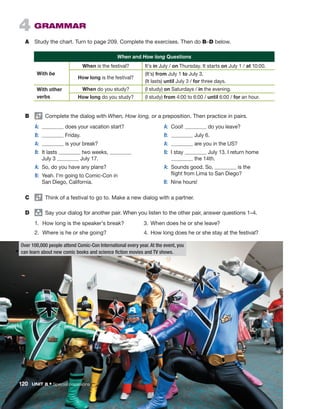
When and How long Questions
With be
When is the festival? It’s in July / on Thursday. It starts on July 1 / at 10:00.
How long is the festival?
(It’s) from July 1 to July 3.
(It lasts) until July 3 / for three days.
With other
verbs
When do you study? (I study) on Saturdays / in the evening.
How long do you study? (I study) from 4:00 to 6:00 / until 6:00 / for an hour.
C	   Think of a festival to go to. Make a new dialog with a partner.
D	 group
  Say your dialog for another pair. When you listen to the other pair, answer questions 1–4.
1.	 How long is the speaker’s break? 	 3.	When does he or she leave?
2.	 Where is he or she going?	 4.	
How long does he or she stay at the festival?
Over 100,000 people attend Comic-Con International every year. At the event, you
can learn about new comic books and science fiction movies and TV shows.
B	   Complete the dialog with When, How long, or a preposition. Then practice in pairs.
	A:	 does your vacation start?
	B:	 Friday.
	A:	 is your break?
	B:	
It lasts two weeks,
July 3 July 17.
	A:	So, do you have any plans?
	B:	
Yeah. I’m going to Comic-Con in
San Diego, California.
	A:	Cool! do you leave?
	B:	 July 6.
	A:	 are you in the US?
	 B:	I stay July 13. I return home
the 14th.
	A:	
Sounds good. So, is the
flight from Lima to San Diego?
	B:	 Nine hours!
120  UNIT 8 • Special occasions
5  WRITING
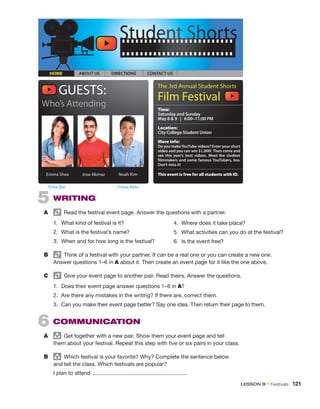
A	   Read the festival event page. Answer the questions with a partner.
1.	 What kind of festival is it?
2.	 What is the festival’s name?
3.	 When and for how long is the festival?
B	   Think of a festival with your partner. It can be a real one or you can create a new one.
Answer questions 1–6 in A about it. Then create an event page for it like the one above.
C	   Give your event page to another pair. Read theirs. Answer the questions.
1.	 Does their event page answer questions 1–6 in A?
2.	 Are there any mistakes in the writing? If there are, correct them.
3.	 Can you make their event page better? Say one idea. Then return their page to them.
6  COMMUNICATION
A	 group
  Get together with a new pair. Show them your event page and tell
them about your festival. Repeat this step with five or six pairs in your class.
B	 group
  Which festival is your favorite? Why? Complete the sentence below
and tell the class. Which festivals are popular?
	 I plan to attend .
GUESTS: The 3rd Annual Student Shorts
Film Festival
Who’s Attending Time:
Saturday and Sunday
May 8  9 | 6:00–11:00 PM
Location:
City College Student Union
More info:
Do you makeYouTube videos? Enter your short
video and you can win $1,000! Then come and
see this year's best videos. Meet the student
filmmakers and some famous YouTubers, too.
Don’t miss it!
This event is free for all students with ID.
HOME ABOUT US DIRECTIONS CONTACT US
Emma Shea Jose Alonso Noah Kim
4.	 Where does it take place?
5.	 What activities can you do at the festival?
6.	 Is the event free?
/ˈnoʊə ˈkɪm/
/ˈɛmə ˈʃeɪ/
LESSON B • Festivals  121
9
9
COME
TOGETHER
Look at the photo. Answer the questions.
1	 How do these people know each other?
2	 How do you think these people feel?
3	 How often do you think they spend time
together?
UNIT GOALS
1	 Identify everyday household chores
2	 Apologize and respond to an apology
3	 Explain how often you do things
4	 Ask and answer questions about dating
A couple lies down for a wedding
photograph outside of Delhi, India.
L E S S O N A ROOMMATES
1 VIDEO Instant Date
A A man and woman are sitting in the park. Watch the video with the sound off.
Then answer the questions with a partner.
1. How do the man and woman know each other?
2. There is a big surprise. What is it?
B Now watch the video with the sound on. Put the steps in order. Number them 1–5.
a man brings them a drink
people play music
a man takes their tickets
a man brings them food
a man gives them tickets
C Look at the events in B. Where do they usually take place? Tell a partner.
D Improv Everywhere is a group in New York City that specializes in pranks (jokes) to
bring people together. Do you see pranks in your city or town? Tell a partner.
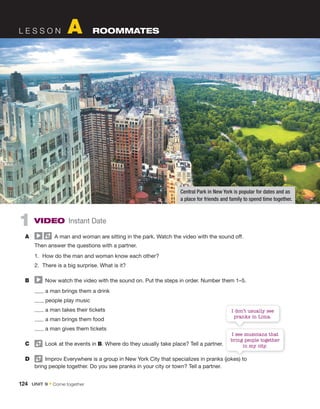
Central Park in New York is popular for dates and as
a place for friends and family to spend time together.
I don’t usually see
pranks in Lima.
Improv Everywhere is a group in New York City that specializes in pranks (jokes) to
I see musicians that
bring people together
in my city.
124 UNIT 9 • Come together
2 VOCABULARY
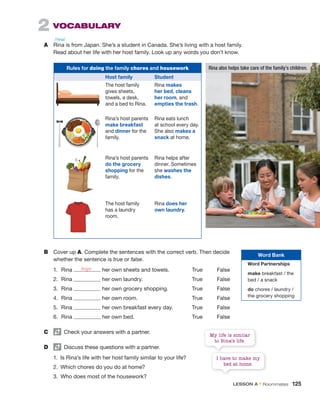
A Rina is from Japan. She’s a student in Canada. She’s living with a host family.
Read about her life with her host family. Look up any words you don’t know.
B Cover up A. Complete the sentences with the correct verb. Then decide
whether the sentence is true or false.
1. Rina her own sheets and towels. True False
2. Rina her own laundry. True False
3. Rina her own grocery shopping. True False
4. Rina her own room. True False
5. Rina her own breakfast every day. True False
6. Rina her own bed. True False
C Check your answers with a partner.
D Discuss these questions with a partner.
1. Is Rina’s life with her host family similar to your life?
2. Which chores do you do at home?
3. Who does most of the housework?
Rules for doing the family chores and housework
Host family Student
The host family
gives sheets,
towels, a desk,
and a bed to Rina.
Rina makes
her bed, cleans
her room, and
empties the trash.
Rina’s host parents
make breakfast
and dinner for the
family.
Rina eats lunch
at school every day.
She also makes a
snack at home.
Rina’s host parents
do the grocery
shopping for the
family.
Rina helps after
dinner. Sometimes
she washes the
dishes.
The host family
has a laundry
room.
Rina does her
own laundry.
Rina also helps take care of the family’s children.
buys
Word Bank
Word Partnerships
make breakfast / the
bed / a snack
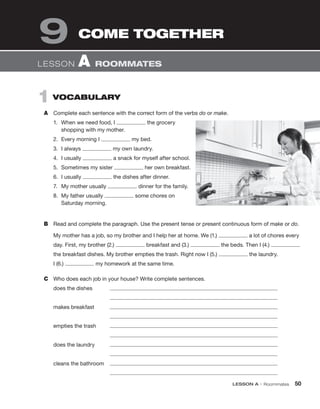
do chores / laundry /
the grocery shopping
I have to make my
bed at home.
My life is similar
to Rina’s life.
/ˈrinə/
LESSON A • Roommates 125
3 LISTENING
A Infer information. Read about a housework study.
Then answer the questions with a partner.
1. Who does more housework?
2. In some countries, men and women share the chores 50/50.
What does that mean?
3. Where do men and women share the chores 50/50?
B Listen for opinions. Match each opinion with a person:
Paul (P), Junko (J) or Mario (M). One opinion is extra. CD 2 Track 15
1. A husband and wife should share the housework.
2. Marriage changes people.
3. Women are good at housework. Men aren’t.
4. Women stay at home more. The housework is their job.
C Listen for details. Read the information in the chart. Then listen
and check (✓) the correct answer(s) for each person. CD 2 Track 15
is married has a job shares the housework 50/50
Paul
Junko
Mario
D Pronunciation: Sentence stress. Read the
sentences. Then listen and repeat. CD 2 Track 16
Married men do thirty percent of the housework.
Women do seventy percent.
E Pronunciation: Sentence stress. Listen
and underline the stressed word in each
sentence. CD 2 Track 17
1. A husband and wife should share the housework.
2. Marriage changes people.
3. I’m calling about the housework study.
4. It’s important to share the housework.
5. What do you think?
F Which of the opinions in E (1, 2, or 4) do you
agree with? Why? Discuss with a partner. Do you know
anyone like Paul, Junko, or Mario?
50/50 is pronounced
fifty-fifty.
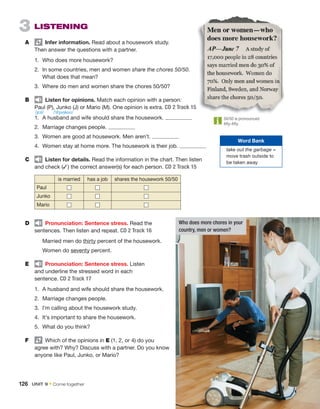
Who does more chores in your
country, men or women?
126 UNIT 9 • Come together
Word Bank
take out the garbage =
move trash outside to
be taken away
/ˈdʒʌŋkoʊ/
/pɔl/
4 SPEAKING
A Emilio and Adam are university students. They
share an apartment. Listen to their conversation and
answer the questions. CD 2 Track 18
• Adam apologizes (says he is sorry). Why?
Underline his apology.
• How does Emilio respond to the apology?
EMILIO: Hey, Adam. I’m home.
ADAM: Hey, Emilio. You’re back from your trip already?
EMILIO: Yeah. How are you doing, Adam?
ADAM: Um... fine. How about you?
EMILIO: Great! I... uh... Wow, this room is a mess!
ADAM: Well, I had a party yesterday. Sorry about that.
EMILIO: Don’t worry about it, Adam. You never have
parties. Come on, let’s clean up.
ADAM: No, I can do it.
EMILIO: Hey, I hope it was a fun party.
ADAM: It was!
B Practice the conversation with a partner.
SPEAKING STRATEGY
C Complete the dialogs. Then practice them with a partner.
1. A: Oh no! I forgot my book.
B: That’s . You can borrow mine.
2. A: I’m late for class. , Ms. Williams.
B: Don’t . We’re just starting.
3. A: I didn’t make dinner. .
B: No . Let’s make it together.
D group
Choose one of the ideas below. Make a short dialog
with your partner. Then say your dialog to another pair.
• You are eating lunch with a friend. The bill comes, but you don’t
have money to pay.
• Today is your mother’s or father’s birthday. You don’t have a gift.
Useful Expressions
Apologizing
Making an apology
(I’m) sorry.
(I’m) sorry about that.
I’m really sorry. [stronger]
Responding to an apology
Don’t worry (about it).
That’s OK / all right.
No problem.
Speaking Tip
You can also respond to an
apology by saying Apology
accepted.
If a room is
a mess, it is
very dirty.
That’s OK. You can borrow mine.
Oh no! I forgot my pen.
/ˈædəm/
/ˈmɪz ˈwɪljəmz/
LESSON A • Roommates 127
5  Grammar
A	 Study the chart. Turn to page 210. Complete the exercises.
Then do B–D below.
B	 Read about Jackie. Then circle the correct answer in sentences 1–3.
	 Jackie is sometimes messy.
	 Jackie always does her grocery shopping on the weekend.
	 Jackie doesn’t usually make her bed in the morning.
1.	 Frequency adverbs come before / after the verb be.
2.	 Frequency adverbs come before / after other verbs.
3.	 Most frequency adverbs come before / after not.
Linda says: Amy says:
1. 
Amy washes her dishes. (hardly ever) 1.  Linda watches TV. (always)
2. 
She empties the trash. (never) 2. 
She has loud parties. (sometimes)
3. 
She makes snacks late at night. (usually) 3. 
She does her own laundry. (hardly ever)
4. 
She doesn’t help around the apartment. (often) 4. 
She’s on the phone late at night. (often)
5. 
She eats my food. (sometimes) 5. 
She doesn’t clean her room. (sometimes)
C	 Linda and Amy are roommates. Sometimes they have ­
problems.
Write each sentence with the frequency adverb given.
D	   Work with a partner. Use
the sentences in C. One person
is Linda; the other is Amy. Talk
about your problems. Can you
make things better?
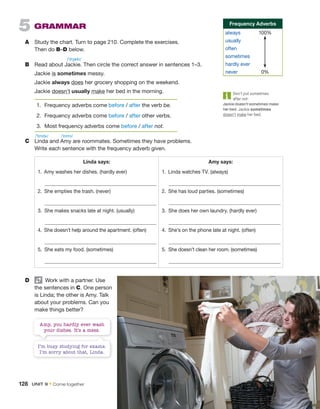
Amy, you hardly ever wash
your dishes. It’s a mess.
I’m busy studying for exams.
I’m sorry about that, Linda.
Don’t put sometimes
after not:
Jackie doesn’t sometimes make
her bed. Jackie sometimes
doesn’t make her bed.
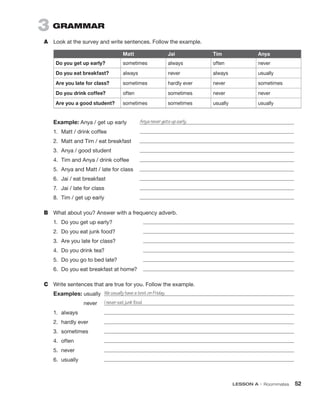
Frequency Adverbs
always	100%
usually
often
sometimes
hardly ever
never	0%
/ˈdʒæki/
/ˈlɪndə/ /ˈeɪmi/
128  Unit 9 • Come together
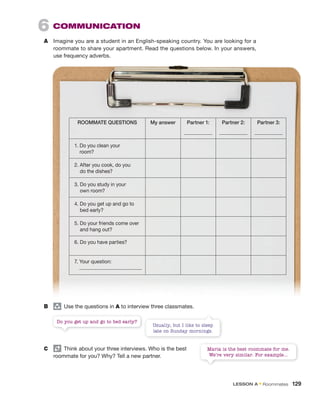
6 COMMUNICATION
A Imagine you are a student in an English-speaking country. You are looking for a
roommate to share your apartment. Read the questions below. In your answers,
use frequency adverbs.
ROOMMATE QUESTIONS My answer Partner 1: Partner 2: Partner 3:
1. Do you clean your
room?
2. After you cook, do you
do the dishes?
3. Do you study in your
own room?
4. Do you get up and go to
bed early?
5. Do your friends come over
and hang out?
6. Do you have parties?
7. Your question:
B group
Use the questions in A to interview three classmates.
Do you get up and go to bed early?
Maria is the best roommate for me.
We’re very similar. For example...
Usually, but I like to sleep
late on Sunday mornings.
C Think about your three interviews. Who is the best
roommate for you? Why? Tell a new partner.
LESSON A • Roommates 129
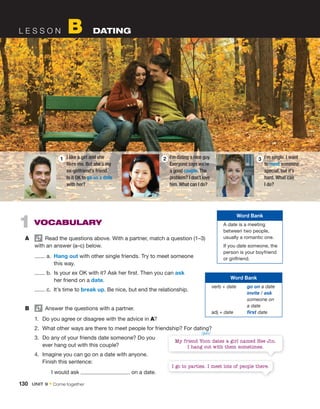
1 VOCABULARY
A Read the questions above. With a partner, match a question (1–3)
with an answer (a–c) below.
a. Hang out with other single friends. Try to meet someone
this way.
b. Is your ex OK with it? Ask her first. Then you can ask
her friend on a date.
c. It’s time to break up. Be nice, but end the relationship.
B Answer the questions with a partner.
1. Do you agree or disagree with the advice in A?
2. What other ways are there to meet people for friendship? For dating?
3. Do any of your friends date someone? Do you
ever hang out with this couple?
4. Imagine you can go on a date with anyone.
Finish this sentence:
I would ask on a date.
My friend Yoon dates a girl named Hee Jin.
I hang out with them sometimes.
I go to parties. I meet lots of people there.
L E S S O N B DATING
I like a girl and she
likes me. But she’s my
ex-girlfriend’s friend.
Is it OK to go on a date
with her?
1 I’m single. I want
to meet someone
special, but it’s
hard. What can
I do?
3
I’m dating a nice guy.
Everyone says we’re
a good couple. The
problem? I don’t love
him. What can I do?
2
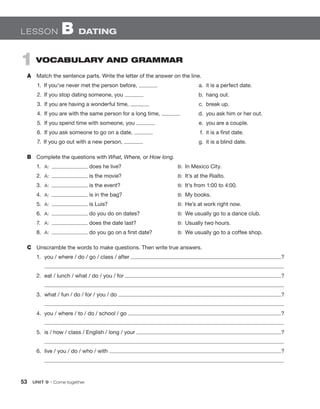
Word Bank
A date is a meeting
between two people,
usually a romantic one.
If you date someone, the
person is your boyfriend
or girlfriend.
Word Bank
verb + date go on a date
invite / ask
someone on
a date
adj + date first date
/jun/
130 UNIT 9 • Come together
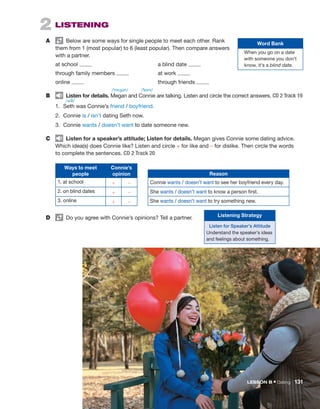
2  Listening
A	   Below are some ways for single people to meet each other. Rank
them from 1 (most popular) to 6 (least popular). Then compare answers
with a partner.
	 at school 	 a blind date
	 through family members 	 at work
	 online 	 	 through friends
B	   Listen for details. Megan and Connie are talking. Listen and circle the correct answers. CD 2 Track 19
1.	 Seth was Connie’s friend / boyfriend.
2.	 Connie is / isn’t dating Seth now.
3.	 Connie wants / doesn’t want to date someone new.
C	   Listen for a speaker’s attitude; Listen for details. Megan gives Connie some dating advice.
Which idea(s) does ­
Connie like? Listen and circle + for like and – for dislike. Then circle the words
to complete the ­
sentences. CD 2 Track 20
Ways to meet
people
Connie’s
opinion
1. at school + –
2. on blind dates + –
3. online + –
D	   Do you agree with Connie’s opinions? Tell a partner.
Word Bank
When you go on a date
with someone you don’t
know, it’s a blind date.
Reason
Connie wants / doesn’t want to see her boyfriend every day.
She wants / doesn’t want to know a person first.
She wants / doesn’t want to try something new.
Listening Strategy
Listen for Speaker’s Attitude
Understand the speaker’s ideas
and feelings about something.
/ˈkɒni/
/ˈmɛgən/
/sɛθ/
LESSON B • Dating  131
I agree with number 3. Most
teenage couples break up.
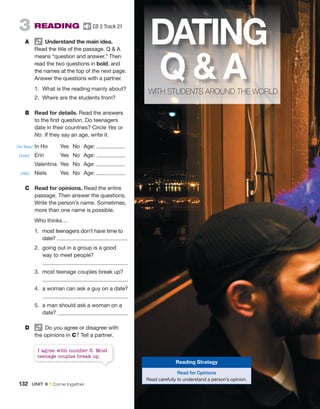
3 READING CD 2 Track 21
A Understand the main idea.
Read the title of the passage. Q  A
means “question and answer.” Then
read the two questions in bold, and
the names at the top of the next page.
Answer the questions with a partner.
1. What is the reading mainly about?
2. Where are the students from?
B Read for details. Read the answers
to the first question. Do teenagers
date in their countries? Circle Yes or
No. If they say an age, write it.
In Ho Yes No Age:
Erin Yes No Age:
Valentina Yes No Age:
Niels Yes No Age:
C Read for opinions. Read the entire
passage. Then answer the questions.
Write the person’s name. Sometimes,
more than one name is possible.
Who thinks…
1. most teenagers don’t have time to
date?
2. going out in a group is a good
way to meet people?
3. most teenage couples break up?
4. a woman can ask a guy on a date?
5. a man should ask a woman on a
date?
D Do you agree or disagree with
the opinions in C? Tell a partner.
DATING
Q  A
WITH STUDENTS AROUND THE WORLD
Reading Strategy
Read for Opinions
Read carefully to understand a person’s opinion.
/ˈɪn ˈhoʊ/
/ˈɛrɪn/
/nilz/
132 UNIT 9 • Come together
In Ho, 22, South Korea
Niels, 20, Holland
Valentina, 21, Colombia
Erin, 19, New Zealand
Imagine you like someone. Do you invite the
person to go on a date with you?
In Ho: Sure. I text the person. If she agrees,
we go to a movie or something.
Valentina: I never ask the guy. He should
invite me.
Erin: But sometimes a guy is shy.3
Niels: Or you like him, but he doesn’t know.
Erin: Exactly. So it’s OK for a girl to invite the
guy, I think.
Niels: I agree.
1 A strict person controls another person, usually with many rules.
2 Or so means about or around.
3 A shy person is quiet and uncomfortable with others.
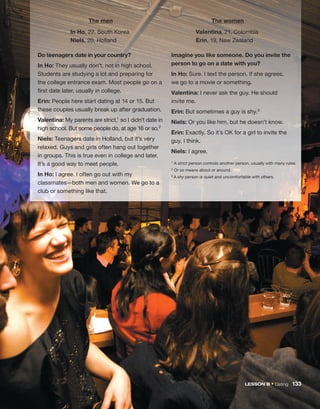
The men The women
Do teenagers date in your country?
In Ho: They usually don’t, not in high school.
Students are studying a lot and preparing for
the college entrance exam. Most people go on a
first date later, usually in college.
Erin: People here start dating at 14 or 15. But
these couples usually break up after graduation.
Valentina: My parents are strict,1 so I didn’t date in
high school. But some people do, at age 16 or so.2
Niels: Teenagers date in Holland, but it’s very
relaxed. Guys and girls often hang out together
in groups. This is true even in college and later.
It’s a good way to meet people.
In Ho: I agree. I often go out with my
classmates—both men and women. We go to a
club or something like that.
LESSON B • Dating 133
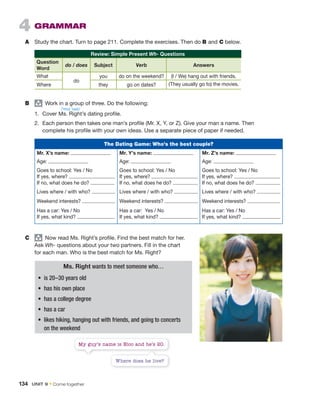
4 GRAMMAR
A Study the chart. Turn to page 211. Complete the exercises. Then do B and C below.
Review: Simple Present Wh- Questions
Question
Word
do / does Subject Verb Answers
What
do
you do on the weekend? (I / We) hang out with friends.
Where they go on dates? (They usually go to) the movies.
B group
Work in a group of three. Do the following:
1. Cover Ms. Right’s dating profile.
2. Each person then takes one man’s profile (Mr. X, Y, or Z). Give your man a name. Then
complete his profile with your own ideas. Use a separate piece of paper if needed.
My guy’s name is Nico and he’s 20.
Where does he live?
The Dating Game: Who’s the best couple?
Mr. X’s name:
Age:
Goes to school: Yes / No
If yes, where?
If no, what does he do?
Lives where / with who?
Weekend interests?
Has a car: Yes / No
If yes, what kind?
Mr. Y’s name:
Age:
Goes to school: Yes / No
If yes, where?
If no, what does he do?
Lives where / with who?
Weekend interests?
Has a car: Yes / No
If yes, what kind?
Mr. Z’s name:
Age:
Goes to school: Yes / No
If yes, where?
If no, what does he do?
Lives where / with who?
Weekend interests?
Has a car: Yes / No
If yes, what kind?
C group
Now read Ms. Right’s profile. Find the best match for her.
Ask Wh- questions about your two partners. Fill in the chart
for each man. Who is the best match for Ms. Right?
Ms. Right wants to meet someone who…
• is 20–30 years old
• has his own place
• has a college degree
• has a car
• likes hiking, hanging out with friends, and going to concerts
on the weekend
/ˈmɪz ˈraɪt/
134 UNIT 9 • Come together
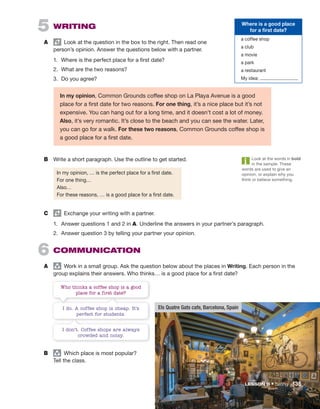
Look at the words in bold
in the sample. These
words are used to give an
opinion, or explain why you
think or believe something.
Els Quatre Gats cafe, Barcelona, Spain
C Exchange your writing with a partner.
1. Answer questions 1 and 2 in A. Underline the answers in your partner’s paragraph.
2. Answer question 3 by telling your partner your opinion.
6 COMMUNICATION
A group
Work in a small group. Ask the question below about the places in Writing. Each person in the
group explains their answers. Who thinks… is a good place for a first date?
5 WRITING
A Look at the question in the box to the right. Then read one
person’s opinion. Answer the questions below with a partner.
1. Where is the perfect place for a first date?
2. What are the two reasons?
3. Do you agree?
B group
Which place is most popular?
Tell the class.
Where is a good place
for a first date?
a coffee shop
a club
a movie
a park
a restaurant
My idea:
I do. A coffee shop is cheap. It’s
perfect for students.
Who thinks a coffee shop is a good
place for a first date?
I don’t. Coffee shops are always
crowded and noisy.
In my opinion, Common Grounds coffee shop on La Playa Avenue is a good
place for a first date for two reasons. For one thing, it’s a nice place but it’s not
expensive. You can hang out for a long time, and it doesn’t cost a lot of money.
Also, it’s very romantic. It’s close to the beach and you can see the water. Later,
you can go for a walk. For these two reasons, Common Grounds coffee shop is
a good place for a first date.
B Write a short paragraph. Use the outline to get started.
In my opinion, … is the perfect place for a first date.
For one thing…
Also…
For these reasons, … is a good place for a first date.
LESSON B • Dating 135
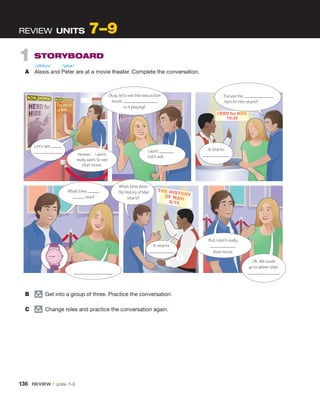
1  STORYBOARD
A	 Alexis and Peter are at a movie theater. Complete the conversation.
REVIEW  UNITS 7–9
Let’s see
 .
It starts
 .
OK. We could
gotodinnerthen.
 .
Okay, let’s see the new action
movie.
is it playing?
What time
now?
 .
What time does
The History of Man
start?
But I don’t ­really
that movie.
Excuse me,
Hero for Hire start?
It starts
.
I don’t .
Let’s ask.
Hmmm… I don’t
really want to see
that movie.
B	 group
  Get into a group of three. Practice the conversation.
C	 group
  Change roles and practice the conversation again.
/əˈlɛksɪs/ /ˈpitər/
136  REVIEW • Units  7–9
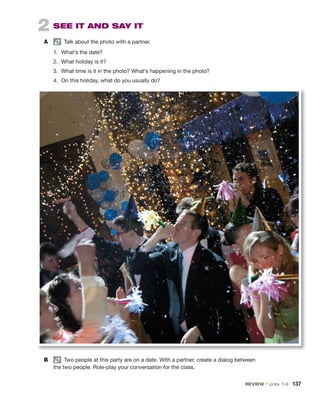
2 SEE IT AND SAY IT
A pair
Talk about the photo with a partner.
1. What’s the date?
2. What holiday is it?
3. What time is it in the photo? What’s happening in the photo?
4. On this holiday, what do you usually do?
B pair
Two people at this party are on a date. With a partner, create a dialog between
the two people. Role-play your conversation for the class.
REVIEW • Units 7–9 137
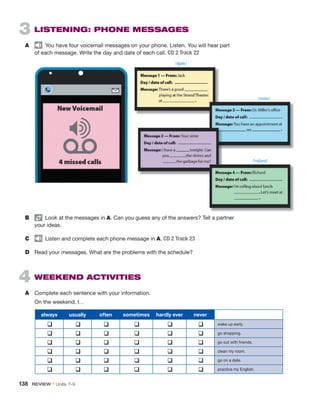
3  
LISTENING: PHONE MESSAGES
A	   You have four voicemail messages on your phone. Listen. You will hear part
of each message. Write the day and date of each call. CD 2 Track 22
B	 pair
  Look at the messages in A. Can you guess any of the answers? Tell a partner
your ideas.
C	   Listen and complete each phone message in A. CD 2 Track 23
D	 Read your messages. What are the problems with the schedule?
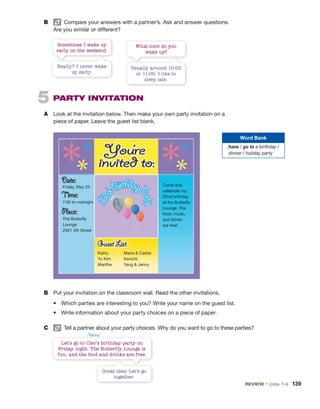
4  WEEKEND ACTIVITIES
A	 Complete each sentence with your information.
	 On the weekend, I…
always usually often sometimes hardly ever never
q q q q q q wake up early.
q q q q q q go shopping.
q q q q q q go out with friends.
q q q q q q clean my room.
q q q q q q go on a date.
q q q q q q practice my English.
/ʤæk/
/mɪlər/
/ˈrɪtʃərd/
138  REVIEW • Units  7–9
B pair
Compare your answers with a partner’s. Ask and answer questions.
Are you similar or different?
B Put your invitation on the classroom wall. Read the other invitations.
• Which parties are interesting to you? Write your name on the guest list.
• Write information about your party choices on a piece of paper.
C pair
Tell a partner about your party choices. Why do you want to go to these parties?
Let’s go to Cleo’s birthday party on
Friday night. The Butterfly Lounge is
fun, and the food and drinks are free.
Sometimes I wake up
early on the weekend.
What time do you
wake up?
Great idea! Let’s go
together.
Really? I never wake
up early.
Usually around 10:00
or 11:00. I like to
sleep late.
5 PARTY INVITATION
A Look at the invitation below. Then make your own party invitation on a
piece of paper. Leave the guest list blank.
Friday, May 25
7:00 to midnight
The Butterfly
Lounge
2501 4th Street
Come and
celebrate my
22nd birthday
at the Butterfly
Lounge. The
food, music,
and drinks
are free!
Kathy Maria  Carlos
Yu Kim Kenichi
Marithe Yang  Jenny
C
l
e
o
’
sBirthdayP
a
r
t
y
Word Bank
have / go to a birthday /
dinner / holiday party
/ˈklioʊ/
REVIEW • Units 7–9 139
2 QUESTION FORMULATION
A Complete the questions with the correct question word from the box. Then ask and answer the
questions with your partner.
who what when where
1. do you study with?
2. does your friend do on Monday mornings?
3. do we work online?
4. do you have English class?
5. does your friend go out with?
6. do your classmates study?
3 SPEAKING
A Circle two or three activities you want to do this weekend. Add your own ideas. Tell your partner
about the activities you picked.
go to a party go shopping go to the beach watch a movie in English
go out to eat go to the movies go dancing play video games
B In pairs, make plans for the weekend. Together,
decide on two or three things you both want to do.
Be prepared to share your plans with the class.
1 ACCURACY PRACTICE
A Complete the sentences with the correct form of the verb in parentheses.
1. I (study) with Maria.
2. She (go) out with her friends.
3. They (have) dinner at 7:00 PM.
4. We (wake up) at 10:00 AM on Sundays.
5. He (have) homework every day.
6. You (study) English in the afternoons.
Let’s play
volleyball.
I don’t want to do
that. Let’s play
soccer.
What do you want
to do this weekend?
C15 UNIT 7 • Unit Consolidation
UNIT 7 CONSOLIDATION
International Exam Preparation and Communication Practice
study
Who
5  Exam Preparation: listening
A	    Listen to the audio. You will hear a conversation and a question after it. Circle the appropriate
answer for each question. ICPNA Track 19
B	    Listen to the audio. You will hear a conversation and three questions after it. Circle the
appropriate answer for each question. ICPNA Track 20
1.	 What does the man want to do?
	 a. 
He wants to	 c. He wants to
see a movie. 	     go to a restaurant.
	 b. 
He wants to	 d. He wants to
go to the gym.	     go for a bike ride.
2.	 What kind of movie does the woman want
to see?
	 a. A romantic movie. 	 c. A spy movie.
	 b. A comedy.		 d. A superhero movie.
3.	 When does the woman work?
	 a. 
Friday, Saturday, 	 c. Saturday, Sunday,
and Sunday.	    and Monday.
	 b. 
Thursday, Friday, 	 d. Sunday, Monday,
and Saturday.	    and Tuesday.
4.	 When does the movie start?
	 a. At 9:15.		 c. At 9:50.
	 b. At 19:15.		 d. At 19:50.
5.	 What does the woman want to do?
	 a. To go for a walk.	 c. To study for a test.
	 b. To go to a movie.	 d. To go for a bike ride.
6.	 What does the man always do after class?
	 a. 
He does		 c. He goes out
homework.	    with friends.
	 b. 
He goes to		 d. He goes for
class.		    a walk.
1.	 When does Josh get up?
	 a. 
At 9:00.		 c. At 3:00.
	 b. 
At 7:30.		 d. At 8:15.
2.	 What days does he work?
	 a. 
Mondays and 	 c. Thursdays and
Wednesdays.	    Fridays.
	 b. 
Saturdays and 	 d. Tuesdays and
Sundays.		    Wednesdays.
3.	 Where does he work?
	 a. At a supermarket.	 c. At a department store.
	 b. 
At a gym.		 d. At a cinema.
4.	 Why does the woman like Mondays?
	 a. 
She doesn’t	 c. She goes to
work.		    classes.
	 b. 
She goes to 	 d. She has a
the movies.	    good job.
5.	 What does she usually do on her day off?
	 a. 
She wakes		 c. She goes out
up early.		    with friends.
	 b. 
She does 	 	 d. She sleeps late.
homework.	    
6.	 What does she do on nice days?
	 a. 
She goes to 	 c. She goes for
the movies.	    a bike ride.
	 b. 
She goes	 	 d. She goes out
shopping.	    with friends.
4  Writing
A	 Write four sentences in your notebook about the plans for the weekend.
Unit 7 • Unit Consolidation  C16
2 QUESTION FORMULATION
A Make questions with the words in the box. More than one question is possible at times.
people / attend / festival celebrate / holiday athlete / compete / games
musician / song / perform take / photos parade / take place
1. How many ?
2. When ?
3. How often ?
4. Where ?
5. How many ?
6. What ?
3 SPEAKING
A Ask a classmate about a festival he or she goes to.
Follow these steps.
• Ask what the name of the festival is.
• Ask where and how often the festival takes place.
• Ask what people do, wear, eat, or drink at the festival.
• Ask your partner how often the festival takes place.
• Tell your partner about a festival you go to.
1 ACCURACY PRACTICE
A Unscramble each item. Pay attention to the punctuation and remember to capitalize the first word.
1. on / May / birthday / is / 27th / my .
2. vacation / when / start / does / your ?
3. the / going / World Cup / to / I’m !
4. place / the / music / March / festival / takes / in .
5. tomorrow / a / there / parade / is .
6. Labor Day / you / do / when / celebrate ?
What is the name of
your festival?
My festival is called
Inti Raymi.
C17 UNIT 8 • Unit Consolidation
UNIT 8 CONSOLIDATION
International Exam Preparation and Communication Practice
My birthday is on May 27th
people attend the festival
B group
Tell the class about your classmate’s festival. Say when it takes
place. Say something about what people do at the festival.
4 WRITING
A You are writing a story for your school’s website about special
occasions in students’ lives. Write a few questions to ask your partner
about an annual event in his or her life. Ask and answer the questions
with your partner. Take notes. Then write three sentences about your
partner’s event.
• Ask what it is and when and where it takes place.
• Ask how many people attend and how long it lasts.
• Ask what people do there.
5 EXAM PREPARATION: READING
A Choose the best answer for each question.
1. When does Peruvian Independence Day
take place?
a. In October.
b. In April.
c. In July.
d. In August.
2. When do we celebrate New Year’s Day?
a. On December 31st.
b. On January 1st.
c. On April 15th.
d. On July 28th.
3. Which sentence is the best description for Carnival?
a. Carnival is a music festival. It takes place in Cajamarca. It lasts two days.
b. Carnival is a festival that takes place every February. It lasts two weeks. It is also celebrated
in countries like Brazil and Colombia.
c. Carnival is on the eighth of February. It is a religious festival.
d. Carnival takes place in the winter. It is also celebrated in other countries, including China
and Mexico.
4. Which option best describes the World Cup?
a. The World Cup is an important sports festival. It takes place annually.
b. The World Cup takes place every year in South Africa. Thousands of people attend this event.
c. The World Cup is an event that takes place every four years. In 2018, the World Cup takes place
in Russia and lasts from June 4th until July 5th.
d. Don’t miss the next World Cup. Peru will win!
5. When is Labor Day in Peru?
a. On the first of May.
b. On the second of March.
c. On the fourth of May.
d. Annually.
What’s your favorite
celebration?
I love the annual
parade in my city.
Miguel’s festival takes
place in February
or March.
When does it take
place?
UNIT 8 • Unit Consolidation C18
1  Accuracy Practice
A	 Rewrite the sentences with the frequency adverb in the correct position.
1.	 Linda helps around the apartment. (often)
2.	 Tom is messy. (never)
3.	 Linda doesn’t cook dinner. (usually)
4.	 Tom does the grocery shopping. (hardly ever)
5.	 Linda washes the dishes. (always)
2  Question Formulation
A	 Unscramble the questions.
1.	 What / chores / you / on the / do / weekend / do ?
2.	 When / your roommate / do / laundry / does ?
3.	 Do / you / every day / make / breakfast ?
4.	 When / dinner / cook / does / your family ?
5.	 Does / brother / your / his room / clean ?
6.	 What / you / do / for breakfast / make ?
3  Speaking
A	   Take turns with a partner apologizing for a problem and accepting an apology. Choose a
problem from the box. Then use the language in the chart.
loud party  messy kitchen  talking on phone
Making an Apology Responding to an Apology
(I’m) sorry.
(I’m) sorry about that.
I’m really sorry. [stronger]
Don’t worry (about it).
That’s OK / all right.
No problem.
B	 group
  Act out your conversation for the class.
4  WRITING
A	 In your notebook, write three or four sentences. Answer this question: Where is a good place to go
with friends? Give two reasons. Use the language in the box.
In my opinion,  For one thing,  Also,  For these reasons,
This kitchen is a mess!
I’m sorry.
C19  Unit 9 • Unit Consolidation
Unit  9 Consolidation
International Exam Preparation and Communication Practice
Linda often helps around the apartment.
What chores do you do on the weekend
5  Exam Preparation: READING
A	 
Read the following text. Then choose the best answer for each question.
	
Name: Laura
	
Birthday: May 20th, 1996
	
Hometown: Miami
	

Typical weekend: I like to relax, but I am very active, so I like to wake up early and do
things. I usually spend time with friends and family. I like to go dancing and shopping,
but I don’t go often; I am not working, so I don’t have a lot of money. Instead, I do
other activities that I don’t have to pay for, like going for bike rides.
	

Typical weekday: Study, study, study! I am a chemistry major. I have a lot of
homework!
	
Doesn’t like: Doing chores… especially doing the laundry!
1.	 Who does Laura usually spend time with?
	 a.  Her roommate.
	 b. 
Her friends and family.
	 c.  Her boyfriend.
	 d.  Her classmates.
2.	 When does Laura study?
	 a. Mondays.
	 b.  On the weekends.
	 c. Saturdays.
	 d.  From Monday to Friday.
3.	 What does Laura like to do?
	 a.  She likes to go to the movies.
	 b.  She likes to go to cafés.
	 c. 
She likes to go dancing and shopping.
	 d.  She likes doing chores.
4.	 Why doesn’t she have a lot of money?
	 a.  She isn’t working.
	 b.  She isn’t interested in it.
	 c.  She likes riding bikes.
	 d.  She doesn’t know.
5.	 What is Laura studying?
	 a. Homework.
	 b. Chemistry.
	 c. Music.
	 d. English.
6.	 What doesn’t she like doing?
	 a. Homework.
	 b. Relaxing.
	 c. Shopping.
	 d. Chores.
Unit 9 • Unit Consolidation  C20
6  EXAM PREPARATION: LISTENING
A	   Listen to the audio. You will hear a conversation and a question after it. Circle the appropriate
answer for each question. ICPNA Track 21
1.	 How much is the man going to spend?
	a. 
$0.
	 b. $25.
	 c. $50.
	 d. $100.
2.	 What chores does Marcos do?
	 a.  He takes out the trash.
	 b.  He does the laundry.
	 c. 
He does the laundry and takes
out the trash.
	 d. 
He does the laundry and does the dishes.
3.	 What should the man speaking do?
	 a. 
Take her to a nice restaurant and
pick up the bill.
	 b.  Tell her the truth.
	 c.  Take her on a blind date.
	 d.  Take her to a movie.
4.	 Why is the woman sorry?
	 a.  She doesn’t have any money.
	 b.  She is late.
	 c.  She doesn’t like her meal.
	 d.  She doesn’t like the restaurant.
5.	 Why is the man angry?
	 a. 
His roommate doesn’t help with the
housework.
	 b.  He needs a new apartment.
	 c.  He doesn’t have a roommate.
	 d.  He doesn’t like to do housework.
6.	 Who is the woman dating?
	 a. Antonio.
	 b. Carlos.
	 c. Felipe.
	 d. Nobody.
B	   Listen to the audio. You will hear a conversation and three questions after it. Circle the
appropriate answer for each question. ICPNA Track 22
1.	 Does the woman date?
	 a. Yes.
	 b. Sometimes.
	 c. Usually.
	 d. No.
2.	 Who does she spend time with?
	 a.  Her friends.
	 b.  Her family.
	 c.  Her classmates.
	 d.  Her roommate.
3.	 Where does she go with her friends?
	 a.  To a restaurant.
	 b.  To a movie.
	 c.  To a party.
	 d.  To a club.
4.	 Who is the woman talking about?
	 a.  Her friend.
	 b.  Her roommate.
	 c.  Her boyfriend.
	 d.  Her cousin.
5.	 Where does Liz usually study?
	 a.  In the library.
	 b.  In the living room.
	 c.  In the kitchen.
	 d.  In her room.
6.	 When does she wash the dishes?
	 a.  Every morning.
	 b.  After she cooks breakfast.
	 c.  After she cooks dinner.
	 d.  On the weekends.
C21  UNIT 9 • Unit Consolidation
A	 Complete the sentences with the missing preposition at, in, on, or from.
1.	 He wakes up at 6:45.	4.	
I play tennis the afternoons.
2.	 We go to school 8:00 to 3:30.	5.	
Your favorite TV show starts 7:00.
3.	 They eat pizza Fridays.	 6.	 She does her homework weekdays.
B	 Write answers that are true for you. Write full sentences.
1.	 Who do you meet on the weekends?
2.	 What do you do on Saturdays?
3.	 When do you watch TV?
4.	 Where do you go shopping for clothes?
5.	 When do you go out with your friends?
6.	 What do you do in the evenings?
C	 Unscramble the sentences.
1.	 May / on / 24th / It’s It’s on May 24th.
2.	 birthday / on / Her / March / is / 12th
3.	 in / vacation / the / Our / big / is / spring
4.	3rd / is / party / His / on / June
5.	 December / is / on / 31st / New Year’s Eve
6.	 summer / We / family party / in / the / a / have
D	 Complete the text with the correct words from the box.
attend events every year festival March perform
South by Southwest (SXSW) is a big international
(1.) festival . It takes place in Austin, Texas,
(2.) in the spring, usually in
(3.) . Thousands of people
(4.) South by Southwest to watch their
favorite singers (5.) . People can also
see new and interesting movies at SXSW. There are
other (6.) , too; for example, talks about
technology are very popular there. Don’t miss SXSW
next year!
PROCESS WRITING
Prepositions of Time
Remember to use:
on for a clear date: on October 12th /
on my birthday
in for a longer period: in the morning /
in April
at for a clear time: at 2:30 / at noon
Process Writing •  P5
E	 Write four or five sentences about your favorite festival, or a festival you want to attend.
Use the questions to help you.
•	 What’s the name of the festival?
•	 Where does it take place?
•	 How long does it last?
•	 What happens at the festival?
•	 Why do you like this festival?
F	 Use the cues to write complete sentences.
1.	 Oscar / always / make breakfast / the mornings Oscar always makes breakfast in the mornings.
2.	 Ana / never / do the laundry / weekends
3.	 Luis / not usually / eat lunch / home
4.	 Celina / hardly ever / go grocery shopping / the evenings
5.	 Mauricio / sometimes / wash the dishes / after dinner
6.	 Fabian / not always / make a snack / the afternoons
G	 Choose the correct word or phrase to complete the text.
(1.) Also, / In my opinion, a good place to (2.) meet / know someone special is at an evening class.
(3.) For one thing, / For these two reasons, you can take a class in something you already enjoy, like
web design or dancing. (4.) Also, / Always, you can find people with the same interests as you. You
can (5.) break up / hang out after class, and if there’s someone you like, you can (6.) ask / go him or
her on a date. It’s nice to be (7.) single / a couple!
H	 What is a good activity to do on a first date? Where is a good place to go? Write a short paragraph
with your own ideas. Use the words and phrases to help you.
Verbs Adjectives Useful Phrases
go on a date
ask / invite someone out
meet someone
hang out
good
nice
special
romantic
expensive
In my opinion, …
For one thing, …
Also, …
For these reasons, I think …
P6  • Process Writing
LANGUAGE SUMMARIES
UNIT 7 TIME
LESSON A
Vocabulary
wake up
take a shower
get dressed
leave home
start (class)
finish (class)
study
go home
do homework
go to bed
two (o’clock)
two-oh-five / five after two
two fifteen / quarter after two
two thirty / half past two
two forty-five / quarter to three
two fifty-five / five to three
in the morning / afternoon / evening
at noon / midnight
at night
yesterday / today / tonight /
tomorrow
early / late
Speaking Strategy
Making suggestions
Let’s see a movie.
We could see a movie.
Saying yes
(That) sounds good.
Good / Great idea.
Saying no politely
I don’t really like French food.
I don’t really want to see that
movie.
LESSON B
Vocabulary
(a) day off
go dancing, shopping
go for a walk, bike ride, run
go out with friends, family, your
boyfriend or girlfriend
go to the movies, gym, beach,
a club, concert, party, friend’s
house
(on) the weekend
spend time with (someone)
LANGUAGE SUMMARIES 191
UNIT 8 SPECIAL OCCASIONS
LESSON A
Vocabulary
January
February
March
April
May
June
July
August
September
October
November
December
ordinal numbers: first, second,
third, fourth, etc.
When were you born?
I was born…
spring, summer, fall / autumn,
winter
Speaking Strategy
Saying you know or don’t know
something
Is tomorrow a holiday?
Yes, it is. / No, it isn’t.
I’m not sure. It could be.
I don’t (really) know.
When is Labor Day?
It’s on September 3rd this year.
I’m not sure. Is it in September?
I don’t (really) know.
LESSON B
Vocabulary
annual
attend
celebrate
compete
event
festival (art, film, food, holiday,
music, sport, spring, summer,
autumn, winter)
miss
parade
perform
take photos
take place
traditional
saying how often something
happens
daily, weekly, monthly, annually
every two / three / four years
UNIT 9 COME TOGETHER
LESSON A
Vocabulary
clean your room
do chores / the housework
do / wash the dishes
do the grocery shopping
do the laundry
empty the trash / take out the
garbage
make a snack
make breakfast / lunch / dinner
make the bed
Speaking Strategy
Apologizing
Making an apology
(I’m) sorry.
(I’m) sorry about that.
I’m really sorry.
Responding to an apology
Don’t worry (about it).
That’s OK / all right.
No problem.
Apology accepted.
LESSON B
Vocabulary
break up (with someone)
couple
hang out (with someone)
invite
meet
Expressions with date
verb + date: ask on a date, be
on a date, go on a date, have
a date
adjective + date: blind date,
first date
Answers
Speaking page 113, C
1. c 2. b 3. c 4. a
192 LANGUAGE SUMMARIES
UNIT 7	 TIME
LESSON A
Prepositions of Time
When is your
class?
It’s on Monday.
on Mondays. (every Monday)
on Tuesday night.
day of the week
It’s in the morning / afternoon / evening.
It’s at night.
period of the day
It’s at 8:30.
at noon.
specific time
It’s from 4:00 to 5:30.
from Tuesday to Saturday.
length of time (start to finish)
A	 Read about Lucia’s schedule. Fill in the blanks with in, on, at, from, or to.
1.	 My name is Lucia. I’m a nurse. I work Monday Friday.
2.	 I work in the hospital night. My shift is midnight 9:30
the morning.
3.	 On workdays, I go to bed 3 PM and wake up 10 PM.
4.	 I do my grocery shopping the afternoon and Saturdays.
5.	 It’s difficult because my husband works 9 AM 6 PM every day.
I don’t see him a lot.
6.	 Sundays, we are both off. We like to go to the park together and relax.
B	   What do you think of Lucia’s schedule? Tell a partner.
C	   Think of another night job. Answer the questions about the job. Look online to
learn more. Then tell a partner.
1.	 Which days do you work in this job?
2.	 What time does the job start and finish?
3.	 Is the job easy or difficult?
GRAMMAR NOTES
Grammar Notes  207
LESSON B
Simple Present Wh- Questions
Question word do / does Subject Verb Answers
Who do you study with? (I study with) Maria.
What does she do on Saturdays? (She) goes out with friends.
When do
they
have class?
(They have class) at 8:00.
we (We have class) on Mondays.
Where does he (He has class) in Room 3B.
A	 Read each item. Then use the words in parentheses and information in the
­
responses to complete the questions.
1.	 A:	 Who (you) do you live with?
	 B:	 I live with my sister.
2.	 A:	 When (your brother) in the morning?
	 B:	 He wakes up at 7:15.
3.	 A:	 Where (your grandparents) ?
	 B:	 They live in London.
4.	 A:	 What time (this class) ?
	 B:	 It ends at 2:30.
5.	 A:	 When (we) a test in this class?
	 B:	 We have a test tomorrow.
6.	 A:	 What (you) on the weekends?
	 B:	 I go out with my friends.
B	   Ask a partner the questions in A.
	UNIT 8	 SPECIAL OCCASIONS
LESSON A
Prepositions of Time: in and on
When is the
holiday party?
It’s on December 20th.
It’s on Christmas Eve.
It’s on Monday.
Use on before days of the week,
dates, and holidays.
It’s in the morning / afternoon / evening.
It’s in December.
It’s in the winter.
It’s in (early / late) 2016.
Use in before times of day,
months, seasons, and years.
208  Grammar Notes
A	 Complete these sentences with the correct prepositions.
1.	 In my city, schools are closed Christmas Day. This year, Christmas is
Thursday so we have Friday off too!
	 In my family, we get up the morning and open presents. We have a big
holiday meal the afternoon. It’s a fun day!
2.	 The Olympics are the summer and the winter. 2020,
the Summer Olympics are in Tokyo. They begin July 24th.
2018, the Winter Olympics are in South Korea. They begin February.
3.	 Many countries have Father’s Day the third Sunday June.
Father’s Day in Venezuela, families come together and have lunch.
LESSON B
When and How long Questions
With be
When is the festival? It’s in July / on Thursday.
It starts on July 1 / at 10:00.
How long is the festival?
(It’s) from July 1 to July 3.
(It lasts) until July 3.
for three days.
With other
verbs
When do you study? (I study) on Saturdays / in the evening.
How long do you study? (I study) from 4:00 to 6:00.
until 6:00.
for an hour.
A When question usually asks for specific time information—a specific day, month, or time
of day. But sometimes, it can ask about a length of time. For example, it’s possible to ask
“When is the festival?” and answer “It’s from July 1 to 3.”
How long only asks about a length of time.
A	 Circle the correct words in the dialogs. There may be more than one correct
answer. Then practice them with a partner.
1.	 A:	 When / How long do you work today?
	 B:	 From / For / To 4:00 for / to / at 8:00.
2.	 A:	 When / How long is our holiday break?
	 B:	 It starts in / on / at the ninth.
3.	 A:	 When / How long are you staying in London?
	 B:	 Until / For / To January third.
4.	 A:	 When / How long does vacation last?
	 B:	 From / Until / For a month.
Grammar Notes  209
B	 Complete each dialog with a When or How long question, or an answer.
Event Dates
Summer break June 19–September 19
The school festival April 1–7
Department store holiday hours Every day, 8:00 AM–midnight
1.	 A:	 When does summer break start?
	 B:	
2.	 A:	
	 B:	 Summer break lasts for three months.
3.	 A:	
	 B:	 It ends on April 7.
4.	 A:	
	 B:	 The festival lasts  .
5.	 A:	
	 B:	 The department store opens  .
6.	 A:	 How late is the store open?
	 B:	
7.	 A:	 How long is the store open every day?
	 B:	
	UNIT 9	 COME TOGETHER
LESSON A
Frequency Adverbs
with be Jackie is always late for class.	 100%
	 usually
	 often
	 sometimes
	 hardly ever
	 never	0%
Frequency adverbs come after the
verb be.
with other
verbs
Sandra always makes dinner. With other verbs, most frequency
adverbs come before the main
verb.
sometimes
and usually
Stuart sometimes empties the trash.
Sometimes Stuart empties the trash.
Stuart empties the trash sometimes.
Sometimes and usually can also
come at the beginning or the end
of a sentence.
with not Marco isn’t usually late for class.
Marco doesn’t usually make his bed.
Marco sometimes doesn’t make his bed.
Frequency adverbs come after not.
Except for sometimes. Don’t put
sometimes after not.
210  Grammar Notes
A	 Minerva is a maid. Unscramble the words to read about her job.
1.	 10 AM / usually / 4 PM / I / from / work / to
	  .
2.	 busy / I / am / sometimes / very
	  .
3.	 work / I / always / on holidays / don’t
	  .
4.	 I / dishes / wash / never
	  .
5.	 a vacation / take / hardly ever / I
	  .
6.	 often / a tip / people / give me
	  .
B	 Make the statements true for you. Write a frequency adverb in the first
space. Then complete each sentence. Share your answers with a partner.
1.	 In the morning, I forget my .
2.	 On the weekend, I go to .
3.	I make a snack of after school.
4.	I do the laundry at home.
5.	I study hours before a big exam.
LESSON B
Review: Simple Present Wh- Questions
Question
word
do / does Subject Verb Answers
Who
do you
like? (I / We like) Maria.
What do on the weekend? (I / We) hang out with friends.
Where go on dates? (I / We go to) the movies.
Why go there? It’s fun.
When
does class
start? (It starts at) 9:30.
How long last? (It lasts for) two hours.
You can also use who to ask these kinds of questions:
Who has a boyfriend?     Erin does. / I do.
Grammar Notes  211
A	 Read the unfinished questions and the answers. Then complete each
Wh- question.
1.	 A:	Who ?
	 B:	 Yang likes Jenny.
2.	 A:	When in your country?
	 B:	 People go on a first date at age 18 or 19.
3.	 A:	Where on a first date?
	 B:	 Most college students go to a movie.
4.	 A:	 How long ?
	 B:	 Usually a first date lasts three or four hours.
5.	 A:	What on the weekend?
	 B:	 I hang out with my friends.
6.	 A:	Why ?
	 B:	 Some couples break up because they are unhappy.
B	 Ask a partner questions 2-6 in A. Give your own answers.
212  Grammar Notes
LESSON A • My routine 38
1 VOCABULARY
A Write these times in numbers.
LESSON A MY ROUTINE
B Match the times (1–8) with the clocks (a–h).
1. six thirty
2. quarter to seven
3. three ten
4. twelve o’clock
5. quarter after eleven
6. seven thirty
7. four oh eight
8. one forty-five
C Put these times in order from earliest to latest.
evening night afternoon morning
  
D What time do you do the following? Write the times in numbers and words. Follow the example.
Example: eat dinner
1. wake up
2. eat breakfast
3. start English class
4. finish English class
5. watch your favorite TV show
6. go to bed
7: 30 seven thirty
1. one twenty-eight
2. one thirty
3. five after three
4. quarter after ten
5. eight oh one
6. quarter to four
7. five o’clock
8. nine oh five
TIME
7
39  UNIT 7 • Time
2  CONVERSATION
A	 Make suggestions. Follow the example.
Example: the Pizza Palace	
1.	 that new horror movie	
2.	swimming	
3.	 Cafe Colombia	
4.	 The Evening News at 7:00	
B	 Answer with I don’t really. Follow the example.
Example: Let’s listen to some classical music.
I don’t really like classical music.  OR  I don’t really want to listen to music.
1.	 Let’s watch a basketball game on TV.
	
2.	 Let’s play tennis.
	
3.	 Let’s see the new Jennifer Lawrence movie.
	
4.	 Let’s eat at Joe’s Restaurant.
	
5.	 Let’s go shopping.
	
C	 Complete the conversations. There can be more than one right answer. Use page 99
of the student book to help you.
1.	Julia: (1.) go to the new Chinese restaurant.
	 Janice: I don’t (2.) .
	 Julia: (3.) Japanese food.
	 Janice: (4.) sounds (5.) !
2.	Ken: (1.) play (2.) .
	 Chris: Hmm. (3.) .
	 Ken: Then (4.) .
	 Chris: OK, (5.) !
D	 Write your own conversation.
A:	
B:	
A:	
B:	
Let’s have dinner at the Pizza Palace.
LESSON A • My routine  40
3  GRAMMAR
A	 Complete the sentences. Use in, on, or at.
1.	 Marco has English class Thursday 8:00 the morning.
2.	 I work in a department store every day the afternoon.
3.	 I always watch the news on TV 7:00 the evening.
4.	 Saturdays, I always get up 10:00.
5.	 Hassan visits his grandparents Friday evenings.
6.	 Our math exam is 4:30 Tuesday.
B	 This is a work schedule at a store. Write sentences about these people. Follow the example.
Example: David	
1.	Mimi	
2.	Ann	
3.	Jane	
4.	Sam	
5.	Fred	
6.	Jack	
C	 Write on, in, at, from, or to.
1.	 My English class is 10:00
noon on Tuesdays and Thursdays.
2.	 I usually study the afternoon.
3.	 I go home 4:00.
D	 Read the answers. Then write when questions. Follow the example.
Example:  Q:  When is your favorite show on TV?	 A:  My favorite show is on TV at 6:00 tonight.
1.	 Q:  	 A:  My piano lesson is at 3:00 on Tuesday.
2.	 Q:  	 A:  The test is at 2:00 on Friday.
3.	 Q:  	 A:  The party is on Saturday night.
4.	 Q:  	 A:  Jim’s dance class is at noon tomorrow.
He works in the afternoon on Mondays and Fridays.
4.	 I watch TV 11:00
midnight.
5.	 I don’t study at all Saturdays.
41 UNIT 7 • Time
1 VOCABULARY AND GRAMMAR
A Write the weekend activities in the correct category.
Spain shopping school a walk friends the movies swimming classmates
go go to go for go out with
B Write lists of weekend activities. Use phrases from A as well as your own ideas.
C Read the answers. Write questions using what, when, where, or who.
1. Q:
A: On weekends, I study and see my friends.
2. Q:
A: I live on Lake Street.
3. Q:
A: I go dancing with friends.
4. Q:
A: I go to the gym at 10 AM.
5. Q:
A: I go to Baxter School.
What
Where
Who
When
Where
I love to... It’s OK to... I don’t like to...
LESSON B HAVE A GOOD WEEKEND
LESSON B • Have a good weekend  42
2  READING AND WRITING
A	 Read the interview and write the questions from the box in the correct spaces.
The Life of Wade Evans
Who do you live with?
When do you relax?
What do you do in your free time?
Where do you live?
What do you do on Saturdays?
What do you do in the evenings?
Wade Evans is a tennis star. Our reporter talks to Wade about his life.
Reporter:	 ?
Evans:	 I have a big house in California. The weather is very good for tennis.
Reporter:	 ?
Evans:	 I live with my dog. His name is Racket.
Reporter:	 ?
Evans:	
Free time? What’s that? I work out at the gym in the morning for two hours.
Then I play tennis for four hours.
Reporter:	 ?
Evans:	 At night, I watch sports on TV, and I answer my email. People ask me a lot of tennis questions.
Reporter:	 ?
Evans:	 I work hard on Saturdays. I play tennis for six hours and then I watch tennis videos.
Reporter:	 ?
Evans:	 I relax on Sundays. I have lunch with my parents and see my girlfriend.
B	 Circle T for True or F for False. Rewrite the false sentences to make them true.
1.	 Wade relaxes every day.	 T	 F
2.	 He spends time with his parents on Saturdays.	 T	 F
3.	 He answers questions about tennis.	 T	 F
4.	 He lives with his parents.	 T	 F
43  UNIT 7 • Time
C	 Read this interview. Complete the sentences. Use in, on, or at.
D	 Imagine you are a famous person. Answer the reporter’s questions.
Name of famous person:
Reporter: What do you do in the evening?
Reporter: What do you do on weekends?
LESSON A • Holidays 44
1 VOCABULARY
A Complete the names of the months.
LESSON A HOLIDAYS
SPECIAL OCCASIONS
8
1. a 7. F u
2. h 8. A l
3. e 9. S r
4. y 10. u
5. A 11. O r
6. v e 12. D
B Write the ordinal numbers for the days of the months. Follow the example.
Example: 5/10 May tenth
1. 2/16
2. 8/23
3. 11/9
4. 10/1
5. 4/5
6. 7/4
7. 6/27
8. 3/10
C Write down five important holidays in your country. Use numbers and then words.
Follow the example.
Example: New Year’s Day 1/1 January first
Important holidays:
1.
2.
3.
4.
5.
45 UNIT 8 • Special occasions
2 CONVERSATION
A Number the sentences in order to make a
conversation.
It’s a holiday in the United States.
Sounds interesting. Do people do
anything special?
Really? When is it?
Do you have plans for Memorial Day?
Yes. They usually have barbecues.
Memorial Day?
It’s the last Monday in May.
B Unscramble the words to make statements and a question.
1. have / we / day / the / off
2. last / in / Friday / the / June / it’s
3. do / on / do / people / what / day / this
?
4. weekend / a / long / it’s
5. a / US / here / it’s / the / holiday / in
C Match the expressions with the percentages.
D Write a conversation about a holiday.
A:
B:
A:
B:
A:
B:
1. I don’t really know. a. 100% sure
2. It’s on May 20th. b. 50% sure
3. It could be. c. 0% sure
LESSON A • Holidays 46
3  GRAMMAR
A	 Complete the paragraph with in or on.
Five people in my family have birthdays
(1.) _________ the spring. Two birthdays are
(2.) _________ April. My birthday is (3.) _________
April 16th, and my mother’s birthday is (4.) _________
April 20th. There are three birthdays (5.) _________
May. My father’s birthday is (6.) _________ May 1st,
my grandfather’s birthday is (7.) _________ May 3rd,
and my sister’s birthday is on May 11th. We have one
big birthday party for all the birthdays (8.) _________
the spring. My brother is different. His birthday is
(9.) _________ the fall, (10.) _________ October 12th.
He’s lucky. We have a party just for him!
B	 Write sentences with in or on. Follow the example.
Example:  my birthday / July 10	 My birthday is on July tenth.
1.	 our vacation / summer	
2.	 our party / New Year’s Day	
3.	 Labor Day / September	
4.	 Valentine’s Day / winter	
5.	 Christmas / December 25	
C	 Check the usage of in and on. Write C if the sentence is correct. Write I if it is incorrect.
Correct the mistakes.
1.	 On Saturdays, I work in the morning.
2.	 My English class is in Wednesdays at 8:00 in the evening.
3.	 In the summer, I go swimming; on the winter, I go skiing.
4.	 In Japan, classes start in April.
5.	 My grandmother’s birthday is on July 12th. She was born on 1927.
6.	 The class party is at 2:00 in the afternoon on Friday.
47  UNIT 8 • Special occasions
LESSON B  FESTIVALS
1  VOCABULARY AND GRAMMAR
A	 Complete the paragraph. Use the words in the box.
attend  event  compete  traditional  place  annual  celebrate
Thousands of people (1.) the Sundance Film Festival every year.
It takes (2.) in Park City, Utah. This (3.) festival
happens every January, and it’s the biggest (4.) of the year in Park City.
Directors show their work and (5.) to have the best film. Big, expensive
parties are a (6.) part of the festival where actors and actresses
(7.)  the success of their films.
B	 Match the things that go together.
			 It’s a...
1.	 The Olympics is an example. 	 a.  film festival
2.	 It shows movies. 	 b.  food festival
3.	 It has singers. 	 c.  sports festival
4.	 There are traditional meals there. 	 d.  music festival
C	 Complete the questions with When or How long.
1. is your birthday? It’s on February 9th.
2. is your vacation? Two weeks.
3. do you go on vacation? I go at the end of August every year.
4. is the movie? It’s about two and a half hours.
5. do you work on Fridays? I work for six hours.
D	 Complete the sentences with in, on, at, from, to, until, or for.
1.	 They play soccer two hours every day.
2.	 The movie starts 8:00.
3.	 The party is 9:00 12:00.
4.	 I don’t have classes Sunday.
5.	 School closes the summer.
6.	 I stay with my grandparents two weeks every summer.
LESSON B • Festivals 48
2 READING AND WRITING
A Read the website and write the letter of the picture next to the holiday it shows.
B Fill in the chart.
1. I’m from Frankfurt, Germany, and Christmas is my
favorite holiday. I love our traditional Christmas tree.
It is so beautiful. We also give lots of gifts and sing
Christmas songs.
—Karin Schmidt
2. I live in Daegu, Korea, and my favorite holiday is
called Chuseok. On this holiday, it is traditional for
people to go to the city they came from. They visit
their families, eat special foods, and talk for hours.
I like Chuseok because I see all my cousins then.
I have more than 30 cousins!
—Park Kyoung-Mi
3. I’m from Rio de Janeiro in Brazil. My favorite holiday
is Carnival. It lasts for four days. People wear
beautiful clothes. They eat, drink, and dance in a
parade with their friends. It’s my favorite holiday
because I love the traditional clothes and I love the
music of Carnival.
—Paulo Amaral
a
b
Name Country Favorite Holiday Why?
1.
2. She sees all of her cousins.
3.
TODAY’S QUESTION:
What’s your favorite holiday? Why?
c
49  UNIT 8 • Special occasions
C	 Read about a favorite holiday. Cross out the eight spelling mistakes. Rewrite the
misspelled words correctly on the lines below. Use the example to help you.
I’m from Oslo, Norway. My favorite holliday takes palce anualy on May 17th. That’s our National Day
here in Norway. We sing special songs for this day. All the cities have big parades. The schoolchildren
preform songs, and their parents watch. The children also go to the houses of old people and sing for them.
The largest parade is in Oslo. About 100,000 people atend this parad. The people wear traditionel clothes.
For me, it’s the most interesting evint of the year.
1.  	3.  	5.  	7. 
2.  	4.  	6.  	8. 
D	 What’s your favorite holiday? Why? What special activities do you do on that day?
holiday
My favorite holiday is . . .
LESSON A • Roommates 50
1 VOCABULARY
A Complete each sentence with the correct form of the verbs do or make.
1. When we need food, I the grocery
shopping with my mother.
2. Every morning I my bed.
3. I always my own laundry.
4. I usually a snack for myself after school.
5. Sometimes my sister her own breakfast.
6. I usually the dishes after dinner.
7. My mother usually dinner for the family.
8. My father usually some chores on
Saturday morning.
B Read and complete the paragraph. Use the present tense or present continuous form of make or do.
My mother has a job, so my brother and I help her at home. We (1.) a lot of chores every
day. First, my brother (2.) breakfast and (3.) the beds. Then I (4.)
the breakfast dishes. My brother empties the trash. Right now I (5.) the laundry.
I (6.) my homework at the same time.
C Who does each job in your house? Write complete sentences.
does the dishes
makes breakfast
empties the trash
does the laundry
cleans the bathroom
LESSON A ROOMMATES
COME TOGETHER
9
51  UNIT 9 • Come together
2  CONVERSATION
A	 Unscramble the sentences.
1.	 sorry / about / I’m / that	
2.	 worry / it / don’t / about	
3.	 I’m / sorry / really	
4.	 OK / that’s	
5.	 all / right / that’s	
B	 Write each sentence from A in the correct row.
Apologizing
Responding to an
apology
C	 Write a conversation in which someone apologizes. You can use page 127 of your student book
to help you.
A:	
B:	
A:	
B:	
A:	
B:	
A:	
B:
LESSON A • Roommates  52
Example: Anya / get up early	 Anya never gets up early.
1.	 Matt / drink coffee	
2.	 Matt and Tim / eat breakfast	
3.	 Anya / good student	
4.	 Tim and Anya / drink coffee	
5.	 Anya and Matt / late for class	
6.	 Jai / eat breakfast	
7.	 Jai / late for class	
8.	 Tim / get up early	
B	 What about you? Answer with a frequency adverb.
1.	 Do you get up early?	
2.	 Do you eat junk food?	
3.	 Are you late for class?	
4.	 Do you drink tea?	
5.	 Do you go to bed late?	
6.	 Do you eat breakfast at home?	
C	 Write sentences that are true for you. Follow the example.
Examples: usually	 We usually have a test on Friday.
never	 I never eat junk food.
1.	 always	
2.	 hardly ever	
3.	 sometimes	
4.	 often	
5.	 never	
6.	usually	
3  GRAMMAR
A	 Look at the survey and write sentences. Follow the example.
Matt Jai Tim Anya
Do you get up early? sometimes always often never
Do you eat breakfast? always never always usually
Are you late for class? sometimes hardly ever never sometimes
Do you drink coffee? often sometimes never never
Are you a good student? sometimes sometimes usually usually
53  UNIT 9 • Come together
Lesson B Dating
1  Vocabulary and Grammar
A	 Match the sentence parts. Write the letter of the answer on the line.
1.  If you’ve never met the person before, 	 a.  it is a perfect date.
2.  If you stop dating someone, you 	b.  hang out.
3.  If you are having a wonderful time, 	 c.  break up.
4.  If you are with the same person for a long time, 	 d.  you ask him or her out.
5.  If you spend time with someone, you 	 e.  you are a couple.
6.  If you ask someone to go on a date, 	 f.  it is a first date.
7.  If you go out with a new person, 	 g.  it is a blind date.
B	 Complete the questions with What, Where, or How long.
1.	 A:  does he live? 	 B:  In Mexico City.
2.	 A:  is the movie? 	 B:  It’s at the Rialto.
3.	 A:  is the event? 	 B:  It’s from 1:00 to 4:00.
4.	 A:  is in the bag? 	 B:  My books.
5.	 A:  is Luis? 	 B:  He’s at work right now.
6.	 A:  do you do on dates? 	 B:  We usually go to a dance club.
7.	 A:  does the date last? 	 B:  Usually two hours.
8.	 A:  do you go on a first date? 	 B:  We usually go to a coffee shop.
C	 Unscramble the words to make questions. Then write true answers.
1.	 you / where / do / go / class / after ?
2.	 eat / lunch / what / do / you / for ?
3.	 what / fun / do / for / you / do ?
4.	 you / where / to / do / school / go ?
5.	 is / how / class / English / long / your ?
6.	 live / you / do / who / with ?
2 READING AND WRITING
Friend Up: a place to meet new people!
Name: Catherine Leclaire Age: 19
Email: caIec@*wow.net
Hometown: Montreal, Canada
Hobbies: I like movies, music, and reading books from many countries.
Daily life: I’m a college student. I’m studying history. On weekends, I work as a waitress
in a restaurant. It’s fun!
Name: Ayako Yamamoto Age: 18
Email: ayachan@*sugoi.com
Hometown: I live in Sapporo, Japan.
Hobbies: My hobbies are music, cartoons, and shopping.
Daily life: I go to school from 8:00 to 4:00. Then I go shopping and watch TV.
I sometimes study in the evening—sometimes!
Name: Becky Travis Age: 17
Email: becky@*floridateI.com
Hometown: My hometown is Miami, Florida, in the US.
Hobbies: I love tennis, basketball, and soccer.
Daily life: I’m a student at Miami High School. I play on my school basketball team in
winter, and I play on the soccer team in summer.
Name: Eliana Santos Age: 20
Email: e_santos@*sol.net
Hometown: I’m from São Paulo, Brazil.
Hobbies: Swimming, reading, music, watching movies
Daily life: I work in an office from Monday to Friday. On weekends, I usually take a trip
somewhere.
http://friendup*.net
A What questions does an online profile usually ask when you fill it out? Write four below.
Examples: What is your name? What bands do you like to listen to?
1. ?
2. ?
3. ?
4. ?
B Read this web page.
LESSON B • Dating 54
55 UNIT 9 • Come together
C Now answer these questions about the web page.
1. Who lives in Brazil?
2. What is Catherine’s job?
3. Where does Becky live?
4. Who works in an office?
5. What are Ayako’s hobbies?
6. Who likes sports?
7. Who is a good match for Catherine?
Why?
D Write the information in the form.
Seoul, Korea music basketball
Monday to Friday: study at Central University Min Song-Gyu drawing
Saturday and Sunday: work in a dance club songgyu@*han.com 20
E Now write your information on the Friend Up form.
http://friendup*.net
Name:
Email:
Hometown:
Hobbies:
Daily life:
Age:
Name:
Email:
Hometown:
Hobbies:
Daily life:
Age:
http://friendup*.net
A Watch the video. Check (✓) the sentences that are true. Correct the false sentences. Then
compare your answers with a partner’s.
1. Jay wonders what is happening around town this weekend.
2. Rashid works with Jay and Kim at Good Morning World.
3. Rashid goes to bed at 11:30.
4. Jay leaves home at 5:30 in the morning.
5. Jay goes for a walk from 11 to 12.
6. Rashid spends time with his brothers in the afternoons.
7. Kim says, “Let’s go for a bike ride tonight.”
B Now watch the video again and circle a or b. Then compare your answers with a partner’s.
1. What does Jay need to know from the
calendar?
a. He needs to know how late he can sleep
in on Saturday.
b. He needs to know what to do tomorrow.
2. Who is Rashid?
a. He is Kim’s older brother.
b. He is the person who makes Good
Morning World good.
3. What time does Rashid wake up in the
morning?
a. He wakes up at 4:00.
b. He wakes up at 12:30.
4. When does Jay leave home in the morning?
a. He leaves home one hour after he
wakes up.
b. He leaves home 30 minutes after he
wakes up.
5. Who is Precious?
a. She is Jay’s dog.
b. She is Kim’s cat.
6. What does Rashid do in the evenings?
a. He takes classes.
b. He spends time with his brothers.
7. When does Rashid finish class tonight?
a. He finishes class at 7:00.
b. He finishes class at 8:00.
8. Where does Kim want to go with Rashid
and Jay?
a. She wants to go dancing.
b. She wants to go to the movies.
C Is your routine like Jay’s or Rashid’s? Work with a partner. Talk about your daily routines. Ask and
answer the questions below.
1. When do you wake up in the morning?
2. What is your morning routine?
3. When do you eat breakfast, lunch, and dinner?
4. When do you go to bed?
5. What do you do in your free time?
A Busy Schedule
UNIT 7 • Video Worksheet VW19
7Good Morning World
VW20 UNIT 7 • Video Worksheet
Mike’s “Busy” Day
City Living
7
A group
What time do you do things every day? Make a schedule and tell the class.
Time Activity
Morning:
Afternoon:
Evening:
B What does Mike do each day? Watch the video and circle the answers. Then compare your
answers with a partner’s.
1. In the morning, Mike goes to school / works out at the gym.
2. In the afternoon, he relaxes / goes shopping.
3. On Wednesday mornings, he has a yoga class at nine / ten o’clock.
4. He has lunch at noon / 1:00.
5. On Wednesday afternoons, he has a film class / goes to the movies.
6. On Wednesday nights, he goes out with Maria / watches Maria on TV.
C What’s your opinion? Check (✓) I agree or I disagree. Then work with a partner. Compare and
explain your answers.
I agree I disagree
1. Takeshi is angry at Mike.
2. Mike needs to get a job.
3. Mike is too busy for a job.
4. Mike watches a lot of TV.
5. Mike and Maria are friends.
6. Takeshi likes Maria.
7. Mike needs to go out with his friends more.
8. Mike’s schedule is busy.
❏ ❏
❏ ❏
❏ ❏
❏ ❏
❏ ❏
❏ ❏
❏ ❏
❏ ❏
UNIT 7 • Video Worksheet VW21
A Watch the interviews about “Times and schedules.” What do these people say? Match the
names with the sentences. Compare your answers with a partner.
1. José Luis
2. Hana
3. Reda
4. Dave
5. Paula
6. Woo Sung
7. Catherine
a. “I go to sleep at two AM.”
b. “I wake up early . . .”
c. “Around 7:30, I leave for work . . .”
d. “I get up at 7:00 in the morning every day.”
e. “I go to class from about ten to about five.”
f. “I don’t get up early in the morning.”
g. “I like to wake up at 9:00 . . .”
B Now watch the interviews about “Weekend activities” and check (✓) Yes or No. Then check
your answers with a partner’s.
Yes No
1. Does José Luis like to stay home every weekend?
2. Does José Luis go to parties on weekends?
3. Do Kumiko and her husband often go to restaurants?
4. Does Brad like to get up early on weekends?
5. Do Brad and his girlfriend go to the movies on weekends?
6. Does Brad’s girlfriend go to the gym on weekends?
❏ ❏
❏ ❏
❏ ❏
❏ ❏
❏ ❏
❏ ❏
C group
What do people in your group do on weekends? List the most popular activities in order
(1 = most popular 5 = least popular). Compare your list to another group’s list. Tell the class.
My group’s activities Other group’s activities
1.
2.
3.
4.
5.
7Global Viewpoints
Times and Schedules / Weekend Activities
VW22 UNIT 8 • Video Worksheet
Join the Festivities
8Good Morning World
A What do the hosts say? Watch the video and circle the words you hear. Then compare your
answers with a partner’s.
1. Jay: “Yes it is. / No it isn’t. My birthday is next week.”
2. Kim: “I‘m also thinking about all of the festivals / events that are going on this month.”
3. Jay: “Food festivals, sports / music festivals, film festivals.”
4. Kim: “On the second / third there is the Cherry Blossom Music Festival in Penn Park.”
5. Jay: “When does the festival take place / happen this year?”
6. Kim: “It starts on the fourth / fifth and lasts for three days.”
7. Jay: “Oh no! I’m going to miss / attend it this year!”
8. Kim: “Maybe you can celebrate on the seventh / eighth.”
9. Jay: “It’s not a festival. It’s a cooking event / show.”
10. Kim: “Is tomorrow / today the seventeenth?”
B Watch the video again. Match the correct information to make true sentences. Then check
your answers with a partner.
1. Jay’s birthday is
2. The Cherry Blossom Music Festival is
3. Anyone who attends the music festival can
4. The annual Sunshine Film festival starts
5. In Armenia, Mother’s Day is
6. The Taste of the World is a
7. People from all over the world
8. The Taste of the World always takes place
a. on the fifth and lasts for three days.
b. cooking event.
c. next week.
d. on the seventeenth.
e. prepare traditional foods.
f. on the third in Penn Park.
g. on April seventh.
h. perform modern dances with
the music.
C In pairs, make a poster about a real or imaginary festival. Include a drawing or photo and the
answers to these questions. Share your poster with the class.
What kind of festival is it?
What happens at the festival?
When is the festival?
How long is the festival?
Where does the festival take place?
UNIT 8 • Video Worksheet VW23
I Love Parades!
City Living
8
A group
Do you like parades? Why or why not? What kinds of parades, festivals, or celebrations do you
go to? Make a list. Tell the class.
B Watch the video and circle True or False. Then correct the false sentences. Check your
answers with a partner.
1. The Puerto Rican Day Parade is Roberto’s favorite parade.
2. The date of Lunar New Year is always the same.
3. Sometimes Lunar New Year is in June.
4. People sing and dance at the Puerto Rican Day Parade.
5. There is no food at the parade.
6. The parade starts at 12:00.
7. The parade lasts for two hours.
8. The celebration lasts until seven or eight at night.
9. The parade is on the first Sunday in June.
10. Roberto had the wrong date for the parade.
True False
True False
True False
True False
True False
True False
True False
True False
True False
True False
C What’s your opinion? Check (✓) I agree or I disagree. Then work with a partner. Compare and
explain your answers.
I agree I disagree
1. Roberto and Claudia love parades.
2. Sun-hee is sad that there is no parade today.
3. The Puerto Rican Day Parade is too long.
4. It would be fun to go to the Puerto Rican Day Parade.
5. Parades are too loud.
6. I love parades and festivals.
7. The best part about parades and festivals is the food.
8. The worst part about parades is the music.
❏ ❏
❏ ❏
❏ ❏
❏ ❏
❏ ❏
❏ ❏
❏ ❏
❏ ❏
VW24 UNIT 8 • Video Worksheet
Special Occasions
Global Viewpoints
8
A What special occasions do these people talk about? Watch the video and match the names
with the occasions. Then compare your answers with a partner’s.
1. Brad
2. José Luis
3. Julianna
4. Alejandra
5. Catherine
6. Jackie
a. New Year’s Eve
b. Carnaval
c. a birthday
d. Mexican Independence Day
e. Chuseok
f. the Fourth of July
B Now watch the video again and circle the words you hear. Then compare your answers
with a partner’s.
1. Brad: “One of my favorite holidays / parades is the Fourth of July.”
2. Brad: “I like to go to the park and have a barbecue / watch the fireworks.”
3. José Luis: “My favorite / An important holiday is Mexican Independence Day.
4. Julianna: “It takes place in February, during the summertime / wintertime.”
5. Julianna: “I eat feijoada, which is a Mexican / Brazilian traditional dish.
6. Alejandra: “ . . . I usually go out with my friends / boyfriend to parties to dance.”
7. Catherine: “My birthday is September / December seventeenth.
8. Catherine: “Every year my friend throws me a surprise party, and I love / hate them.”
9. Jackie: “We celebrate Chuseok by visiting our family members / friends.”
10. Jackie: “ . . .we also visit our ancestors’ graves and ask for blessings / bring rice cakes.”
C Talk to a partner about his or her favorite holiday. Ask and answer the questions below. Then tell
the class about your partner.
1. What’s your favorite holiday?
2. What do you usually do on that day?
3. What do you usually eat?
4. What do you usually drink?
5. What do you usually wear?
6. What’s your partner’s favorite holiday?
7. What does your partner usually do on that day?
8. What does your partner usually eat?
9. What does your partner usually drink?
10. What does your partner usually wear?
UNIT 9 • Video Worksheet VW25
It Takes Two
Good Morning World
9
A Watch the video. Answer the questions with a check (✓) for Anita or Carlos. Then check your
answers with a partner’s.
Anita Carlos
1. Who hardly ever makes dinner?
2. Who usually does the housework?
3. Who makes the bed and cleans the house?
4. Who washes the dishes?
5. Who takes out the garbage?
6. Who needs to do housework more often?
❏ ❏
❏ ❏
❏ ❏
❏ ❏
❏ ❏
❏ ❏
B Now watch the video again and circle True or False. Then correct the false sentences.
Check your answers with a partner.
1. Carlos and Anita are a married couple.
2. Carlos says that a perfect date is to go to the movies with Anita.
3. Anita is always home.
4. Anita usually does the housework.
5. Carlos washes the dishes and does the laundry.
6. Carlos hardly ever takes out the garbage.
7. Carlos needs to do the housework more often.
8. Anita says, “I’m sorry, Carlos”.
9. Anita asks if Carlos wants to go on a date to La Paloma Restaurant.
10. Jay tells Carlos to “Pick up the check.”
True False
True False
True False
True False
True False
True False
True False
True False
True False
True False
C With a partner, role-play a conversation between Carlos and Anita. Use the phrases
from the box.
I’m sorry about that. Don’t worry about it. No problem.
I’m really sorry. That’s OK. No worries.
Carlos:
Anita:
Carlos:
Anita:
Carlos:
Anita:
Carlos:
Anita:
VW26 UNIT 9 • Video Worksheet
Dear Mum and Dad . . .
City Living
9
A Who do you usually write emails or letters to? How often? What do you write about? Fill in the
chart. Compare and explain your answers with a partner.
Who I write to When I write What I write about
B What do you learn about Tara? Check (✓) the sentences that are true. Then correct the false
sentences. Compare your answers with a partner’s.
1. ❏ Tara likes living in New York.
2. ❏ Her favorite class is American history.
3. ❏ Tara always gets up at seven o’clock.
4. ❏ She always checks her email after breakfast.
5. ❏ She often meets Sun-hee and Claudia for lunch.
6. ❏ She always studies after lunch.
7. ❏ Tara works nights from five to ten.
8. ❏ She is never late for work.
9. ❏ She gets home from work at about 11:30.
10. ❏ Sometimes she does homework at night, but not often.
C What’s your opinion? Circle I agree or I disagree. Then work with a partner. Compare and explain
your answers.
1. Tara is always very busy.
2. The food Tara eats is healthy.
3. Tara does the same things every day.
4. Tara studies too much.
5. Tara gets along well with her roommates.
6. Tara has a nice life in New York.
7. Tara is always late.
8. Tara stays up late every night.
I agree I disagree
I agree I disagree
I agree I disagree
I agree I disagree
I agree I disagree
I agree I disagree
I agree I disagree
I agree I disagree
UNIT 9 • Video Worksheet VW27
Daily Activities / Dating
A Watch the video about “Daily activities.” What do you learn about these people? Circle the
answers. Then compare your answers with a partner’s.
1. Julianna gets up at six / seven a.m. every day.
2. Julianna drives / takes the bus to work.
3. Woo Sung’s sister is a student at Boston University / New York University.
4. Woo Sung’s sister is studying biology / psychology.
5. Hana’s sister gets up at 8:00 / 9:00 in the morning.
6. Hana’s sister has basketball / volleyball practice after school.
7. Jonathan always / sometimes practices drums for two hours.
8. At the end of the day, Jonathan watches TV / checks email.
9. After work, Alejandra sometimes meets friends / goes to the gym.
10. Sometimes Alejandra goes shopping / out on dates after work.
B Now watch the interviews about “Dating.” Match the names with the sentences. Then
compare your answers with a partner’s.
1. Alejandra
2. Hana
3. José Luis
4. Nick
a. “I have never had a boyfriend.”
b. “On the weekends, I like to go on dates.”
c. “On a date, we both usually pay.”
d. “A woman almost never calls a man.”
C group
Work in a small group to discuss the questions below. Then share the opinions of your group
with the class.
1. What are two good ways to meet someone to date?
2. Is the Internet a good way to meet someone? Why or why not?
3. When is the best time for a date? On the weekend? After work?
4. Where is a good place to go on a first date?
5. Where are two good places to go on a third or fourth date?
6. Is it OK for a woman to ask a man on a date? Why or why not?
7. Who should pay on the fi rst date? Why?
8. Is it OK to split the bill on a date? Why or why not?
Global Viewpoints
9
This page intentionally left blank
Worksheet 7A: Schedule bingo
Monday Tuesday Wednesday
AM
PM
PM
12 1
2
3
4
5
6
7
8
9
10
11
12 1
2
3
4
5
6
7
8
9
10
11
12 1
2
3
4
5
6
7
8
9
10
11
go to yoga
class
go to yoga
class
go to art class
go to art class go to a party
watch The Simpsons
on TV
watch The Simpsons
on TV
go to the airport watch basketball on TV watch basketball on TV
go to the doctor
✂
Communication Worksheet Unit 7 Lesson A
This page intentionally left blank
Worksheet 7B: Find someone who . . .
Find a classmate for each description. Write their names and any extra information.
Find someone who . . .
gets up late in the morning.
(Find out when.)
has family in a different city.
(Find out where.) has a job they don’t like.
(Find out why.)
likes Chinese food.
(Find out what.) has an interesting friend.
(Find out who.)
exercises every day
(Find out why.)
goes dancing on
weekends.
(Find out where.)
travels a lot.
(Find out where.)
likes shopping.
(Find out where.)
plays a musical instrument.
(Find out what.)
wants to meet a movie star.
(Find out who.)
has two pets.
(Find out what.)
Communication Worksheet Unit 7 Lesson B
This page intentionally left blank
Worksheet 8A: Calendar
Talk to your classmates. Find the dates of the holidays in the box. Write them on the calendar.
Find the dates of your classmates’ birthdays. Write them on the calendar. Try to find one
holiday or one birthday for each month.
New Year’s Eve	 Lunar New Year	 Valentine’s Day
Labor Day	 Mother’s Day
JANUARY FEBRUARY MARCH
APRIL MAY JUNE
JULY AUGUST SEPTEMBER
OCTOBER NOVEMBER DECEMBER
Communication Worksheet Unit 8 Lesson A
This page intentionally left blank
Worksheet 8B: Holidays and festivals
Think of two famous holidays or festivals. Write information about them below. Then
work with a partner. Take turns asking questions. Try to guess the names of the holidays
or festivals.
Name:
When:
How long:
How old:
Who:
People wear:
People eat:
People do:
Name:
When:
How long:
How old:
Who:
People wear:
People eat:
People do:
Communication Worksheet Unit 8 Lesson B
Worksheet 9A: How well do you know
your partner?
How often do you . . . You Your partner
say hello to your neighbors?
wake up after 10 AM?
make your bed?
take a summer vacation?
cook your own dinner?
do English homework?
clean the bathroom?
go to bed before midnight?
go dancing on the weekend?
arrive late for class?
go out with friends on the weekend?
celebrate holidays with your parents?
have rice for breakfast?
exercise on the weekend?
How often do you do the things in the chart? How often do you think your partner
does them? Use the words in the box to fill in the chart. Ask your partner questions to
check his or her answers.
always usually often sometimes hardly ever never
Communication Worksheet Unit 9 Lesson A
Worksheet 9B: Dating agency
likes
usually
doesn’t
never
loves
sometimes
likes
usually
doesn’t like
never
loves
sometimes
likes
usually
doesn’t
never
loves
sometimes
likes
usually
doesn’t like
never
loves
sometimes
likes
usually
doesn’t
never
loves
sometimes
likes
usually
doesn’t
never
loves
sometimes
likes
usually
doesn’t like
never
loves
sometimes
likes
usually
doesn’t like
never
loves
sometimes
likes
usually
doesn’t like
never
loves
sometimes
likes
usually
doesn’t
never
loves
sometimes
likes
usually
doesn’t
never
loves
sometimes
likes
usually
doesn’t like
never
loves
sometimes
✂
Communication Worksheet Unit 9 Lesson B
This page intentionally left blank

Libro de básico 3 del ICPNA

  • 2.
    Front cover artby Eduardo Kobra in Rome, Italy. © Eduardo Kobra ABOUT THE ARTIST Brazilian muralist Eduardo Kobra creates large-scale, colorful murals of notable people in cities around the world.
  • 3.
    Australia • Brazil• Mexico • Singapore • United Kingdom • United States WORLDLINK James R. Morgan Nancy Douglas Basic 3 Developing English Fluency
  • 4.
    Printed in Perú PrintNumber: 01 Print Year: 2016 © 2017, 2013, 2007 National Geographic Learning, a part of Cengage Learning ALL RIGHTS RESERVED. No part of this work covered by the copyright herein may be reproduced, transmitted, stored or used in any form or by any means graphic, electronic, or mechanical, including but not limited to photocopying, recording, scanning, digitizing, taping, Web distribution, information networks, or information storage and retrieval systems, except as permitted under Section 107 or 108 of the 1976 United States Copyright Act, without the prior written permission of the publisher. ICPNA World Link Basic 3 ISBN: 978-1-337-29903-9 National Geographic Learning 20 Channel Center Street Boston, MA 02210 USA Cengage Learning is a leading provider of customized learning solutions with ­ employees residing in nearly 40 different countries and sales in more than 125 countries around the world. Find your local representative at www.cengage.com Cengage Learning products are represented in Canada by Nelson Education, Ltd. Visit National Geographic Learning online at ngl.cengage.com Visit our corporate website at cengage.com ICPNA World Link Basic 3, Third Edition Nancy Douglas, Author James R. Morgan, Author Susan Stempleski, Series Editor Publisher: Sherrise Roehr Executive Editor: Sarah Kenney Managing Development Editor: Claudi Mimo Senior Development Editor: Margarita Matte Senior Development Editor: Brenden Layte Associate Development Editor: Alison Bruno Media Researcher: Leila Hishmeh Senior Technology Product Manager: Lauren Krolick Director of Global Marketing: Ian Martin Senior Product Marketing Manager: Caitlin Thomas Sr. Director, ELT & World Languages: Michael Burggren Production Manager: Daisy Sosa Senior Print Buyer: Mary Beth Hennebury Composition: Lumina Datamatics Inc., Cover/Text Design: Brenda Carmichael Art Director: Brenda Carmichael Cover Image: Eduardo Kobra Inside Front Cover Image: AFP/Getty Images For product information and technology assistance, contact us at Cengage Learning Customer & Sales Support, 1-800-354-9706 For permission to use material from this text or product, submit all requests online at www.cengage.com/permissions Further permissions questions can be emailed to permissionrequest@cengage.com
  • 5.
     iii ACKNOWLEDGMENT We would liketo extend a very special thank you to the Instituto Cultural Peruano Norteamericano (ICPNA) academic management staff in the central office, branches, and teachers, for the helpful insights and suggestions that contributed toward the development of this series. GUIDE TO PRONUNCIATION SYMBOLS Vowels Consonants Symbol Key Word Pronunciation Symbol Key Word Pronunciation /ɑ/ hot /hɑt/ /b/ boy /bɔɪ/ far /fɑr/ /d/ day /deɪ/ /æ/ cat /kæt/ /ʤ/ just /ʤʌst/ /aɪ/ fine /faɪn/ /f/ face /feɪs/ /aʊ/ house /haʊs/ /g/ get /gɛt/ /ɛ/ bed /bɛd/ /h/ hat /hæt/ /eɪ/ name /neɪm/ /k/ car /kɑr/ /i/ need /nid/ /l/ light /laɪt/ /ɪ/ sit /sɪt/ /m/ my /maɪ/ /oʊ/ go /goʊ/ /n/ nine /naɪn/ /ʊ/ book /bʊk/ /ŋ/ sing /sɪŋ/ /u/ boot /but/ /p/ pen /pɛn/ /ɔ/ dog /dɔg/ /r/ right /raɪt/ four /fɔr/ /s/ see /si/ /ɔɪ/ toy /tɔɪ/ /t/ tea /ti/ /ʌ/ cup /kʌp/ /ʧ/ cheap /ʧip/ /ɜr/ bird /bɜrd/ /v/ vote /voʊt/ /ɛr/ error /’ɛrər/ /w/ west /wɛst/ /ə/ about /ə’baʊt/ /y/ yes /yɛs/ after /’æftər/ /z/ zoo /zu/ /ð/ they /ðeɪ/ /θ/ think /θɪŋk/ /ʃ/ shoe /ʃu/ /ʒ/ vision /’vɪʒən/ Stress /ˈ/ city /ˈsɪti/ used before a syllable to show primary (main) stress /̩/ dictionary /ˈdɪkʃə ̩nɛri/ used before a syllable to show secondary stress ICPNA Track 2
  • 6.
    Unit / LessonVideo Vocabulary Listening Welcome Unit  p. viii UNIT 7 TIME  p. 94 LESSON A My routine  p. 96 LESSON B Have a good weekend  p. 102 Late for Work   p. 96 * Times and daily routines  p. 97 What time is it?, It’s 9:15; wake up, take a shower, get dressed * Weekend activities  p. 102 go to the movies, go for a walk * What are your plans?  p. 98 Listen for gist Listen for details * Days off  p. 103 Listen for details UNIT 8 SPECIAL OCCASIONS  p. 108 LESSON A Holidays  p. 110 LESSON B Festivals  p. 116 Ice Music  p. 110 * Months and holidays  p. 111 January, February, March * Festivals  p. 116 event, take place, attend * Booking a flight  p. 112 Listen for numbers and dates * Autumn festivals  p. 117 Infer information Listen for details UNIT 9 COME TOGETHER  p. 122 LESSON A Roommates  p. 124 LESSON B Dating  p. 130 Instant Date  p. 124 * Chores and housework  p. 125 do the laundry, wash the dishes * Dating  p. 130 couple, go on a date, hang out * A housework study  p. 126 Infer information Listen for opinions Listen for details * How do you meet people?  p. 131 Listen for details Listen for a speaker’s attitude Review Units 7–9 p. 136 Unit Consolidation p. C15 Process Writing p. P5 Workbook p. 38 Video Worksheets p. VW19 Communication Worksheets iv  Scope and Sequence SCOPE  SEQUENCE
  • 7.
    Scope and Sequence v GrammarPronunciation Speaking Reading Writing Communication * Prepositions of time: in, on, at, from... to  pp. 100, 207 * Simple present Wh- questions  pp. 106, 207 Numbers: stress; -ty and -teen  p. 98 Making suggestions  p. 99 What kind of weekend person are you?  p. 104 Make predictions Check predictions Read for specific information Make plans p. 107 * Make a schedule and find time to meet with classmates  p. 101 * Interview classmates about weekend activities  p. 107 * Prepositions of time: in and on  pp. 114, 208 * When and How long questions  pp. 120, 209 Ordinal numbers: th and t  p. 112 Saying you know or don’t know something  p. 113 Burning Man  p. 118 Infer information Scan for information Read for details Write about a festival  p. 121 * Talk about holidays and special occasions  p. 115 * Give a class presentation about a festival  p. 121 * Frequency adverbs  pp. 128, 210 * Review: simple present Wh- questions  pp. 134, 211 Sentence stress  p. 126 Apologizing  p. 127 Dating Q A with students around the world  p. 132 Understand the main idea Read for details Read for opinions Write about a good place for a date  p. 135 * Role-play interviewing a roommate  p. 129 * Give opinions about different types of dates  p. 135 U N I T S   7–9 Language Summaries p. 191 Grammar Notes p. 207
  • 8.
    vi  Photo Credits PHOTOCREDITS Cover: © Eduardo Kobra, Back Cover: ICPNA Owned iv (tl) Interpixels/Shutterstock.com, (cl) © Daniel Kudish, (bl) © Ankit Narang, x (tl) Chris Schmidt/E+/Getty Images, (tc1) Mustafa Arican/iStock/Getty Images Plus/Getty Images, (tc2) Whitetag/iStock/Getty Images Plus/Getty Images, (tr) Tara Moore/Stone/Getty Images, (cl) Images by Tang Ming Tung/Moment/Getty Images, (c11) StockRocket/E+/Getty Images, (c2) Carlina Teteris/Moment/Getty Images, (cr1) Antoniodiaz/ Shutterstock.com, (cl2) Spaxiax/Shutterstock.com, (c) Sally Scott/iStock/Getty Images Plus/Getty Images, (cr2) OlgaMiltsova/iStock/Getty Images Plus/Getty Images, (bl) Darryl Brooks/Shutterstock.com, (bc) Olga Nayashkova/Shutterstock.com, (br) Brent Hofacker/Shutterstock.com, 41 Photos.com, 42 Mike Watson Images/ Moodboard/Thinkstock, 43 Caiaimage/Tom Merton/Getty Images, 45 Monkey Business Images/Shutterstock. com, 46 Blend Images - Hill Street Studios/Brand X Pictures/Getty Images, 48 (tr) PhotoDisc/Getty Images, (cr1) T photography/Shutterstock.com, (cr2) Steve Heap/Shutterstock.com, 49 Albert H. Teich/Shutterstock.com, 50 Elena Elisseeva/Shutterstock.com, 94–95 Interpixels/Shutterstock.com, 96 David Evans/National Geographic Creative, 99 Peter Beavis/Stone/Getty Images, 100 Dave G. Houser/Alamy Stock Photo, 101 Jon Hicks/Latitude/ Corbis, 102 Paul Nicklen/National Geographic Creative, 103 Arena Creative/Shutterstock.com, 104–105 Kamil Tamiola/Aurora Photos, 105 (bl) Jupiterimages/Stockbyte/Getty Images, (bc) B Busco/Photographer’s Choice/ Getty Images, (br) DreamPictures/Blend Images/Getty Images, 108–109 © Daniel Kudish, 110 © Iris Brooks, 111 Ralf Siemieniec/Shutterstock.com, 112 Dan Breckwoldt/Shutterstock.com, 113 Andersen Ross/Blend Images/ Getty Images, 114 Petr Baumann/Shutterstock.com, 115 (cl) Jake Naughton/The New York Times/Redux, (c) Msheldrake/Shutterstock.com, (cr) JGI/Jamie Grill/Blend Images/Getty Images, (bl) Blend Images - Hill Street Studios/Brand X Pictures/Getty Images, (bc) Pamela Moore/E+/Getty Images, 116 (bgd) Jim Richardson/ National Geographic Creative, (tc) Adina Tovy/Lonely Planet Images/Getty Images, 117 Michael Taylor/Lonely Planet Images/Getty Images, 118–119 Moshe Shai/Flash90/Redux, 120 Chelsea Lauren/WireImage/Getty Images, 121 (tl) Andresr/Shutterstock.com, (tc1) Joana Lopes/Shutterstock.com, (tc2) Lleungchopan/Shutterstock.com, 122–123 © Ankit Narang, 124 Tony Shi Photography/Ocean/Corbis, 125 Image Source Plus/Alamy Stock Photo, 126 (br) JackF/iStock/Getty Images Plus/Getty Images, 127 Dennis Wise/DigitalVision/Getty Images, 128 Smith Collection/Iconica/Getty Images, 129 Peterfz30/Shutterstock.com, 130 (t) Originalpunkt/Shutterstock.com, (cl) Purestock/Getty Images, (c) John Foxx/Stockbyte/Getty Images, (cr) Morsa Images/DigitalVision/Getty Images, 131 Andrea Slatter/Shutterstock.com, 132–133 Michael Hanson/National Geographic Creative, 134 Takayuki/ Shutterstock.com, 135 Stefano Politi Markovina/Passage/Corbis, 137 RubberBall Productions/Brand X Pictures/ Getty Images, 09B (tl) Sam Edwards/OJO Images/Getty Images, (tr) John Foxx/Stockbyte/Getty Images, (cl1) Nicholas Monu/iStock/Getty Images Plus/Getty Images, (cr1) Jade/Blend Images/Getty Images, (cl2) Juanmonino/E+/Getty Images, (cr2) AntonioGuillem/iStock/Getty Images Plus/Getty Images, (bl) Purestock/ Getty Images, (br) blackdovfx/iStock/Getty Images Plus/Getty Images.
  • 9.
    vii Basic 3 (B03) LearningOutcomes I saw it I understand it I use it Unit 7 I can ask and tell the time. (p. 97, 99) ~ What time is it? ~ It’s five after four. / It’s noon. / It’s midnight. / (It’s) a quarter to 12. / (It’s) 2 o’clock. / (It’s) two thirty-five (2:35). I can talk about facts, daily activities and their times during the week using the simple present and prepositions (in, on, at, from . . . to). (p. 100) ~ The class ends at 2:15. / ~ When is your class? / ~ It’s at night. / ~ What day is your birthday this year? / ~ It’s on Monday. I can make suggestions (movies / TV shows). (p. 99) ~ Let’s see the new superhero movie. ~ Great idea! / (That) sounds good. / I don’t really want to see that movie. / ~ What else is playing? / When is it? I can listen for gist and detail. (p. 98) I can confirm expectations / predictions from photos and title. (p. 104) I can write text messages to make plans. (p. 107) Unit 8 I can talk about special days of the year using ordinal numbers. (p. 112, 113) ~ New Year’s Eve is on December 31st. What holiday is on October 31st in the United States? I can say I know or don’t know something. (p. 113) ~ When is Labor Day? ~ I don’t really know. / ~ Is tomorrow a holiday? ~ I’m not sure. / It could be. I can ask about specific time using when, how long and prepositions. (p. 114, 120) ~ When is the festival? / It’s in July. / ~ How long is the festival? ~ It lasts for three days. / It’s until July 3rd. I can listen for details (numbers and dates for a change of flight). (p. 112) I can scan and read for details. (p. 118) I can create a festival event page. (p. 121) Unit 9 I can express and respond to an apology. (p. 127) ~ (I’m) sorry about that. ~ Don’t worry about it. I can talk about facts/habits using frequency adverbs. (p. 128, 129) ~ I always clean my room. / Our friends usually come over and hang out in the afternoon. / I never go to bed early! I can ask questions about everyday activities. (p. 134) ~ What do you do on the weekend? / Where do you go on dates? I can listen for a speaker’s attitude. (p. 131) I can read for main idea and details (review). (p. 132) I can write a short paragraph about a good place for a first date. (p. 135) Learning OUTCOMES The list below will help you focus your learning and follow up on your achievement. Please put a check (✓) in the box that, in your opinion shows your progress. Make sure you demonstrate you can do the following when finishing the respective unit.
  • 10.
    viii  WELCOME UNIT A Match the questions and the answers. e 1.  How do you spell brother? a.  It means “not married.” 2.  How do you say queso in English? b.  Sure. I said, “She’s going to lunch.” 3.  What does single mean? c.  médico 4.  What is the meaning of doctor in Spanish? d.  I said, “Please give me a pencil.” 5.  Can you please repeat that? e.  B-R-O-T-H-E-R 6.  I’m sorry. What did you say? f.  cheese 2  GRAMMAR A   Look at the picture. Tell your partner about three things you see. B Look at the picture. Circle the correct form of be. 1. They (am / is / are) talking. 2. (Am / Is / Are) she looking at her phone? 3. He (am / is / are) drinking soda. 4. They (am / is / are) not sitting at home. 5. (Am / Is / Are) he reading his email? 6. She (am / is / are) looking at a newspaper. 1  CLASSROOM EXPRESSIONS WELCOME UNIT
  • 11.
    WELCOME UNIT    ix C   Unscramble the sentences. Then practice the conversation with a partner. 1. Hi, Leo. (doing / you / what / are) What are you doing ? 2. (basketball / a / I’m / game / watching) . What about you, Julia? 3. I’m with my family. (park / the / going / we’re / to) . 4. That’s nice. (there / Carmen / meeting / are / you) ? 5. Yes, I am. (she’s / at / coming / 2:30) . How’s the game? 6. It’s great! (is / team / well / my / doing / really) ! D Change the sentences to mean the opposite. 1. I don’t usually drink soda with meals. I usually drink soda with meals. 2. She does her homework after class. 3. We eat pizza on Friday nights. 4. He doesn’t like to drink milk. 5. They don’t know a good place to study. 6. You go to the library on the weekends. E   Make questions from the sentences. Then practice asking and answering the questions with a partner. 1. Chris likes spicy food. Does Chris like spicy food? 2. We drink a lot of water. 3. They eat a healthy snack after class. 4. He takes vitamins in the mornings. 5. Maria has breakfast at home. 6. I have coffee after dinner. F Correct the possessives in the sentences. Two of the sentences are correct. 1. Angela is the childrens’ aunt. Angela is the children’s aunt. 2. Miguel is my sister’s son. 3. Robert and Carlos are her parents’s friends. 4. Ines is Carmens’ sister. 5. Oscar is Mrs. Lopez’s nephew. 6. Emma and Tomas are my mothers’ parents. G Write short answers for the questions. Use the information in parentheses. 1. Who has a cousin? (Kelly) Kelly does. 2. How many sisters does Steven have? (three) 3. Who has three children? (Marta and Jonathan) 4. How many people does your family have? (five) 5. Who has a brother and a sister? (Toni) 6. Who doesn’t have any cousins? (Javier) Learning Strategy Try checking your own work before you give it to your instructor or share it with a partner. Intenta revisar tu trabajo antes de dárselo a tu maestro o compartirlo con un compañero.
  • 12.
    x  WELCOME UNIT 3  VOCABULARY A   Write the words under the photos. Some photos need two words. Then ask and answer questions about the photos with your partner. drinking eating exercising going listening shopping studying talking texting watching 1. 2. 3. 4. 5. 6. 7. 8. B   Look at the photos. Write the food words. Then tell your partner which items you like. 1. 2. 3. 4. 5. 6. studying spinach salad
  • 13.
    WELCOME UNIT    xi C Complete the sentences with the words in the box. You won’t need all the words. bad for you  energy  good for you  healthy junk food skip snack tastes good vitamins 1. Vegetable soup and bread are a healthy lunch. 2. I’m having some cheese and fruit as a . 3. Orange juice has many . 4. We think this fried chicken . 5. You shouldn’t breakfast—it’s really important. 6. Sometimes I eat , but I don’t like it. D   Look at the family tree. Answer the questions with a partner. Then take turns and talk about your family. grandmother grandfather  mother father  sister brother  aunt uncle  cousin grandparents  parents 1. Who is Kelly’s father? 2. Who are Amy’s parents? 3. Who are Justin’s sisters? 4. Who is Jen’s cousin? 5. Who are Amy and Kelly’s grandparents? 6. Who is Justin’s aunt? 4  WRITING A Write three sentences about your family. Use the words in the box. boyfriend brother cousin divorced father girlfriend married mother single sister 11 10 1 Barbara 2 Pascal 3 Susanna 4 David 7 Gina 8 Omar 5 Jen Amy 6 Justin 9 Kelly Learning Strategy Review the new vocabulary in your notebook at least once a week. It’s more enjoyable to review your vocabulary with a classmate or a friend. Repasa el vocabulario nuevo en tu cuaderno al menos una vez a la semana. Es más agradable repasar el vocabulario con un compañero de clase o un amigo.
  • 14.
  • 15.
    The astronomical clockin Prague, Czech Republic Look at the photo. Answer the questions. 1 Look at the clock in your classroom. How do you say these times in English? 12:00   12:30 2 Here are the days of the week: Sunday Monday Tuesday Wednesday Thursday Friday Saturday Which one is your favorite? 3 When is the weekend in your country? Say the day(s). UNIT GOALS 1 Describe your daily routine 2 Make suggestions about activities and plans 3 Identify the time of day or week 4 Ask and answer questions about weekend activities
  • 16.
    96  UNIT 7 •Time 1 VIDEO Late for Work A Before you watch, do this: 1. Look up the word late in your dictionary. 2. Look at the pictures and the vocabulary on page 97. B   The man in the video starts work at 9:00. Watch the first 30 seconds. Circle your answer. The man is / isn’t late for work. C   Watch the entire video. What does the man do in the video? Put the events in order from 1 to 7. He washes his face. He reads a text message. He gets dressed. He wakes up. He has breakfast. He leaves home. He brushes his teeth. D   Answer the questions with a partner. 1. Look at the sentence in B again. Is the man late for work? How do you know? 2. Does this ever happen to you? L E S S O N A  MY ROUTINE People rush through a busy train station in Germany.
  • 17.
    LESSON A •My routine 97 2 VOCABULARY A Study the times below. Then cover up the words and take turns telling the time with a partner. five after four; four-oh-five nine fifteen; quarter after nine eleven forty-five; quarter to twelve two (o’clock) eight thirty; half past eight two fifty-five; five to three B Practice telling the times shown below with a partner. Then read about Hiro’s daily routine. I wake up at 5:30. C Use the words in B to tell your partner about your daily routine. That’s early! He wakes up at 7:30 and has breakfast. Then he takes a shower and gets dressed. He leaves home at 8:20 and goes to school. 8:20 He eats dinner at 8:00. He goes to bed at midnight. 12:00 9:00 His classes start at 9:00 and finish at 4:00. After that, he goes home at 5:45. 5:45 4:50 At 4:50, he studies English. Word Bank early = before the usual time What time is it? What time is it? It’s…. /ˈhɪroʊ/
  • 18.
    98 UNIT 7• Time 3 LISTENING A Look at the words yesterday, today, and tomorrow in the box. Then complete the sentences. Compare answers with a partner. If today is Friday, then tomorrow is . Yesterday was . Yesterday Monday Tomorrow Wednesday Today / Tonight Tuesday B Listen for gist. Pilar and Alma are talking about Pilar’s plans for today and tomorrow. Write today or tomorrow for each activity. CD 2 Track 2 1. go to school 2. have a piano lesson 3. see a movie C Listen for details. Write your today answers from B on lines 1–4 below. When does Pilar plan to do each of these activities? Listen again and write the start and finish times. CD 2 Track 2 Activity Start Time Finish Time 1. 2. 3. 4. D Tell a partner about Pilar’s day. E Pronunciation: Numbers. Listen and repeat. Notice the different stress. CD 2 Track 3 13 / 30 14 / 40 15 / 50 16 / 60 17 / 70 18 / 80 19 / 90 F Pronunciation: Numbers. Listen to the sentences. Circle the correct answer. CD 2 Track 4 1. I wake up at 6:14 / 6:40 every morning. 2. The train to school takes about 19 / 90 minutes. 3. She drives 17 / 70 kilometers to work. 4. After dinner, I study for an hour and 15 / 50 minutes. 5. It’s his birthday today. He’s 16 / 60 years old. G Pronunciation: Numbers. Listen again and check your answers. Take turns saying the sentences in F with a partner. CD 2 Track 4 4. study English 5. take a swimming class 6. take a test Pilar goes to school at.... Listening Strategy Listen for Gist Listen carefully for the general topic. Listening Strategy Listen for Details Listen carefully for the times you hear.
  • 19.
    LESSON A •My routine 99 4 SPEAKING A Listen to the conversation. Then complete the sentences with a partner. Circle the correct answer. CD 2 Track 5 1. Adriano Jessie Both …want(s) to eat French food tonight. 2. Adriano Jessie Both …want(s) to see the new superhero movie. 3. Adriano Jessie Both …want(s) to see the James Bond movie. ADRIANO: What do you want to do tonight, Jessie? JESSIE: I don’t know. Hey, let’s have dinner at that new French restaurant. ADRIANO: Hmmm… I don’t really like French food. And I’m not very hungry. JESSIE: OK, well, we could see a movie. ADRIANO: Yeah, that sounds good. Let’s see the new superhero movie. JESSIE: Hmmm… I don’t really want to see that. What else is playing? ADRIANO: Well, the new James Bond movie is at the AMC Theater. JESSIE: Great idea. When is it playing? ADRIANO: At 8:15. JESSIE: At 8:50? ADRIANO: No, 8:15. And there’s a late show at midnight. JESSIE: Midnight is late! Let’s go to the 8:15 show. ADRIANO: OK! B Practice the conversation with a partner. SPEAKING STRATEGY C Use the Useful Expressions to complete the dialogs. Then practice with a partner. 1. A: What do you want for lunch? B: Mexican food. A: . I love Mexican food! 2. A: What do you want to do after class? B: play video games. A: video games. B: OK, well, see a movie. A: . What do you want to see? D Add three or four more lines to dialog 2 in C. Student B: Suggest a movie to see and a time. Student A: You don’t want to see Student B’s movie. Suggest another idea and a time. Students A B: Agree on a movie and a time to see it. Useful Expressions Making suggestions Making a suggestion Let’s see a movie. We could see a movie. Saying yes (That) sounds good. Good / Great idea. Saying no politely I don’t really like French food. I don’t really want to see that movie. Jessie = /ˈʤɛsi/ /ˈʤɛsi/
  • 20.
    100 UNIT 7• Time B Complete the answer choices with in, at, on, from, or to. Then choose the answers that are true for you. 1. When do you like to study? a. the morning b. the afternoon c. the evening d. late night 2. When do you do most of your homework? a. weekdays b. Saturdays and Sundays c. both 3. What day is your birthday this year? a. It’s Monday. b. It’s Tuesday. c. It’s Wednesday. d. other: 4. You can see a movie with your friends noon or midnight. Which do you choose? 5. What is your favorite subject at school? What time does the class meet? My favorite subject is . The class is from . (day(s) of the week) (start time) (end time) C Now interview a partner. Use the questions in B. Take notes. D What is one new thing you know about your partner now? Tell him or her. 5 GRAMMAR A Study the chart. Turn to page 207. Complete the exercises. Then do B–D below. Prepositions of Time When is your class? It’s on Monday(s). / It’s on Tuesday night. It’s in the morning / afternoon / evening. It’s at night. It’s at 8:30 / noon. It’s from 4:00 to 5:30. / It’s from Tuesday to Saturday. You do your homework on weekdays and Saturdays and Sundays. I think you’re a serious student. People study at the library at Colegio de San Nicolas in San Michoacan, Mexico. Time Words midnight early late I like to study late at night. When do you like to study?
  • 21.
    LESSON A •My routine 101 6  COMMUNICATION A Read the directions below. 1. At the top of the schedule, write today’s day (Monday, Tuesday, etc.) and the next two days. 2. Complete the calendar with your schedule for these three days (school, work, English or music lessons, an appointment, seeing friends, etc.). You can also add new ideas. If you have no plans, leave the time blank. B   Work with a partner. Practice the conversation. Then make a new conversation. Find time in your schedules to do the three ­ activities together. •  practice English   •  see a movie   •  your idea: A: Let’s study together for the test. Are you free today at 1:00? B: No, sorry, I’m busy. Are you free tomorrow? A: Well, I have classes from 11:00 to 4:00, but then I’m free. B: OK, let’s meet at 4:15. A: That sounds good! 9:00 AM 10:00 AM 11:00 AM NOON 1:00 PM 2:00 PM 3:00 PM 4:00 PM 5:00 PM 6:00 PM 7:00 PM Cyclists and joggers, Portland, Oregon, US
  • 22.
    102 UNIT 7• Time 1 VOCABULARY A Look at the photo. Where are these people? Do you ever do activities like these on the weekend? Tell a partner. B Look at the activities with go in the box and read sentences 1–4. Then complete 5–10. On the weekend, I usually… 1. . (a walk) 2. . (dance) 3. . (a party) 4. . (with friends) 5. . (the movies) 6. . (a bike ride) 7. . (shop) 8. . (a friend’s house) 9. . (with my family) 10. . (the gym) C In B, check (✓) the activities you do on the weekend. D Compare your answers with a partner’s. Are your weekends similar or different? Do you do other activities? L E S S O N B HAVE A GOOD WEEKEND go for a walk go dancing go to a party go out with friends Word Bank Activities with go go + -ing verb go dancing go to + a place go to a party / the beach go for + an activity go for a walk go out + with + someone go out with friends People in the Netherlands go to parties on King’s Day. They are on a river / boats. Look at the photo. Where are these people? Do you ever do activities like these I always go to parties on the weekend. Compare your answers with a partner’s. Are your weekends similar or different? Our weekends are similar. We do the same things.
  • 23.
    2  LISTENING A  Read the sentences. Then tell a partner: Is a day off a free day or a workday? Tomorrow is my day off. I don’t work or go to school. B   Listen for details. Nick and Kelly are talking. Listen. Check (✓) the days Nick works. Put an X on his day(s) off. CD 2 Track 6 ®  Monday   ®  Friday   ®  Saturday   ®  Sunday C   Listen for details. What is good and bad about Nick’s day(s) off? Listen. Write one word in each blank. CD 2 Track 7 Good: Most people are at work or . Most places aren’t . Bad: Nick’s friends are . He does most things . D   Listen for details. Listen again. Check (✓) the things Nick does on his day off. CD 2 Track 7 ®  He goes shopping. ®  He goes for a bike ride. ®  He goes to the movies. ®  He wakes up late. ®  He does homework. ®  He goes out with friends. E   Is your day off ­ similar to or ­ different from Nick’s? Why? Tell a partner. LESSON B • Have a good weekend 103 Listening Strategy Listen for Details Listen carefully for important details. /nɪk/
  • 24.
    104 UNIT 7• Time 3 READING CD 2 Track 8 A Look at the pictures. What are the people doing? Tell a partner. B Make predictions. Match a person (1, 2, 3, or 4) with one or more activities (a–f) below. Person 1. The Couch Potato 2. The Workaholic 3. The Party Animal 4. The Health Nut Activity a. likes to exercise b. wakes up late on the weekend c. goes out all night d. doesn’t like to go out on weekends e. is always thinking about work or school f. wakes up early C Check predictions; Read for specific information. Now read the article. Check your answers in B. D group Work in a group of 3–4 people. Answer the questions. 1. What kind of weekend person are you? Why? Which type is most common in your group? 2. Suggest something you want to do this weekend to your partners. Can you all agree? 3. What kind of weekend person is your best friend? THE HEALTH NUT For you, the weekend isn’t a time to relax; you want to go out and do things! You usually wake up early (yes, even on the weekend) and go for a walk, a run, or a bike ride. All week, you’re inside at school or work. On the weekend, it’s time to go outside and be active! Reading Strategy Make Predictions Say what you think you will read about based on the title and the photos.
  • 25.
    LESSON B •Have a good weekend 105 THE COUCH POTATO What’s your perfect weekend? Sleeping late, watching TV, and playing video games. Sure, you like to spend time with1 friends— but only at home. THE WORKAHOLIC It’s the weekend and it’s time to relax… but not for you. The Workaholic is always busy: working, studying, talking on the phone, texting classmates, or checking emails. When you go out with friends on the weekend, you’re thinking about your homework or your next exam. THE PARTY ANIMAL For you, the weekend is all about fun—and lots of it. Your night starts at 9:00 or 10:00. You go dancing or to a party with friends. Later, you go home and sleep all day. Then you wake up in the afternoon and do it all again! 1 If you spend time with people, you do something together. For many people, the weekend is a time to relax and have fun. But not everyone has fun in the same way. Here’s how different people spend their weekends. What type of person are you? WHAT KIND OF WEEKEND PERSON ARE YOU?
  • 26.
    106 UNIT 7• Time 4 GRAMMAR A Study the chart. Turn to page 208. Complete the exercises. Then do B and C below. B Read about Zoe’s weekend. Unscramble questions 1–4. Start each sentence with a question word. Then ask and answer the questions with a partner. Simple Present Wh- Questions Question word do / does Subject Verb Answers Who do you study with? (I study with) Maria. What does she do on Saturdays? (She) goes out with friends. When do they have class? (They have class) at 9:00. we (We have class) on Mondays. Where does he (He has class) in Room 3B. On Saturday, Zoe… On Sunday, Zoe… • works at a department store from 9:00 AM to 3:30 PM. • goes to the gym in the afternoon. • goes out with friends at night. • wakes up at 11:00 AM. • goes for a bike ride in the afternoon. • studies in the evening. She goes to the gym 1. Zoe / what / do / on Saturday afternoon / does ? . 2. she / work / does / when ? . 3. does / work / she / where ? . 4. who / on Saturday night / Zoe / does / go out with ? . C Write four more questions about Zoe’s schedule. Use different question words. Then ask and answer the questions with a partner. 1. 2. 3. 4. What time does Zoe get up on Sunday? /ˈzoʊi/
  • 27.
    LESSON B •Have a good weekend 107 5 WRITING A Read the texts between Raquel and her friends, Monika and Alex. Answer the questions with a partner. 1. What does Raquel suggest? 2. Who says yes? What does the person suggest? 3. What do these symbols mean in the texts? B Write a text to a partner. Suggest something to do tonight or this weekend. Say when and where it is. C Exchange texts with your partner. Read his or her message. Then write a text back saying yes or no. If you say no, give a reason. D Repeat B and C with a new partner. 6 COMMUNICATION A Read the questions on the left side of the chart. In the Me column, check (✓) the activities you do. Do you... Me Classmates Question Details watch TV? What… ? go shopping? Where… ? wake up late? When… ? go out with friends? Where… ? do homework? What… ? spend time with family? Who… ? your idea: B group Interview your classmates. For each question, find a different person to answer yes. Write the classmate’s name. Ask another question to get more details. C group Read your notes. What is the most interesting answer? Tell the class. Do you watch TV on the weekend? What do you watch? Yes, I do. On Sunday night, I watch.... Monika Monika Alex Raquel Raquel Hey guys, let's go dancing tonight at Club Skye. Alex OK. Let's meet there @ 10 PM I can’t. I have homework. /ˈrɑkɛl/ /ˈælɪks/ /ˈmɒnɪkə/
  • 28.
    8 8SPECIAL OCCASIONS Three young womenare dressed up for Day of the Dead in Mexico.
  • 29.
    Look at thephoto. Answer the questions. 1 Where is this festival and when does it happen? 2 Special occasions happen in different ­ seasons. The seasons are: winter spring summer fall Which season is your favorite? 3 Here are some more seasons. Which ones ­ happen where you live? rainy season  dry season hurricane / typhoon season UNIT GOALS 1 Talk about important dates 2 Express degrees of certainty 3 Describe when special occasions happen and how they are celebrated 4 Describe what happens at a festival
  • 30.
    L E SS O N A HOLIDAYS 1 VIDEO Ice Music A Look at the photo above. This video is about “ice music.” What do you think ice music is? B Watch the video. Circle the correct answer(s). 1. This happens in Norway / Iceland. 2. They make / play ice instruments. 3. They make / cut the ice. C Do you like this music? Tell a partner. D With a partner, plan a music festival. Write down where it takes place, what instruments there are, and who goes. Share your ideas with the class. Instruments at the Ice Music Festival I think “ice music” uses special instruments. Norway = /ˈnɔrweɪ/; Iceland = /ˈaɪslənd/ 110 UNIT 8 • Special occasions
  • 31.
    2 VOCABULARY A Practicesaying the months of the year with a partner. January February March April May June July August September October November December B Work with a partner. • Name as many holidays as you can. • Write each one next to the correct month. • In two minutes, try to fill up the chart. C group Tell another pair about your list. Which holiday is your favorite? LESSON A • Holidays 111 In our list, we have Loy Krathong for November. Loy Krathong Festival, Thailand /ˈlɔɪ ˈkrɑθɔŋ/
  • 32.
    3 LISTENING A Pronunciation:th and t. Practice saying these ordinal numbers with a partner. Then listen and repeat. CD 2 Track 9 1st first 2nd second 3rd third 4th fourth 5th fifth 6th sixth 7th seventh 8th eighth 9th ninth 10th tenth 11th eleventh 12th twelfth 13th thirteenth ↓ 20th twentieth 30th thirtieth 40th fortieth 50th fiftieth ↓ 100th one hundredth B A student is flying home for summer vacation. Look at the plane ticket below. Then answer the questions with a partner. 1. Where is the person going? 2. How much is the ticket? C Listen for numbers and dates. Listen and complete the information on the ticket with the man’s name. What day is he departing? What day is he returning? Write your answers under 1. CD 2 Track 10 D Listen for numbers and dates. The man changes his travel dates. Listen and write the new dates under 2. Cross out the old fare and write the new one. CD 2 Track 11 E Look at the travel dates in D. Answer these questions with a partner. 1. Are these good dates to travel in your country? 2. What are the best months for traveling in your country? Vancouver, Canada Listening Strategy Listen for Numbers and Dates Listen carefully for numbers and dates. 112 UNIT 8 • Special occasions
  • 33.
    4 SPEAKING A Kendrickand Tanya are studying in the United States. Listen to their conversation. Then answer the questions. CD 2 Track 12 1. What holiday is on the first Monday in September in the United States? 2. What do people do on this day? Does Tanya know? TANYA: So, Kendrick... do you have plans for Labor Day? KENDRICK: Labor Day? TANYA: Yeah, it’s a holiday here in the US. We have the day off from school. KENDRICK: Really? When is it? TANYA: It’s on the first Monday in September. KENDRICK: Sounds good. So, do people do anything special? TANYA: I’m not sure. It’s a long weekend, so some people travel. My host family plans to have a barbecue. B Practice the conversation in A with a partner. SPEAKING STRATEGY C Answer the questions with a partner. Use the Useful Expressions to help you. Useful Expressions Saying you know or don’t know something Is tomorrow a holiday? When is Labor Day? Yes, it is. / No, it isn’t. certain It’s on September 3rd this year. I’m not sure. It could be. not sure I’m not sure. Is it in September? I don’t (really) know. don’t know I don’t (really) know. 1. When is Mexico’s Independence Day? a. May 5th b. August 24th c. September 16th 2. Where is the New Year called Hogmanay? a. in Russia b. in Scotland c. in Iceland 3. Where does Children’s Day happen on May 5th? a. in Italy and Greece b. in Chile and Peru c. in Korea and Japan 4. What holiday is on October 31st in the United States? a. Halloween b. Thanksgiving c. Christmas D group Check your answers on page 192. Who has the most correct answers in your class? Where is the New Year called Hogmanay? Hogmanay I don’t really know. What do you think? Speaking Tip Follow-up questions: I’m not sure. Is it in September? I don’t know. What do you think? /ˈtɑnyə/ /ˈkɛndrɪk/ /ˈaɪslənd/ LESSON A • Holidays 113
  • 34.
    OK, let’s start. Numberone. 2002. In 2002! C Complete as much information as you can about your own birthdate. D Interview a partner about his or her birthdate. Are you similar in any way? What is the month of your birth? I was born in November. 5 GRAMMAR A Study the chart. Turn to page 208. Complete the exercise. Then do B–D below. A decade is a period of ten years. For the decade of the 1990s you can say (in) the nineteen nineties or just (in) the nineties. B Complete the columns with the correct preposition of time. Follow the steps below. 1. Student A: Read the items in Group 1 aloud to Student B. Write the answers Student B gives. 2. Student B: Close your book and listen to your partner. Answer as quickly as you can. 3. Switch roles and repeat with the items in Group 2. Group 1 Group 2 1. 2002 2. the third Tuesday of the month 3. March 4. New Year’s Day 5. the spring 6. January 1st 7. the eighties 1. May 2. December 31st 3. the first Saturday of the month 4. the nineties 5. 2004 6. the summer 7. Labor Day Your special day 1. date (e.g., the 17th) of your birth 1. 2. month 2. 3. year 3. 4. decade 4. 5. season 5. 6. day of the week 6. 7. time of day* 7. *morning, afternoon, or evening Prepositions of Time: in and on When is the holiday party? It’s on December 20th. / It’s on Christmas Eve. / It’s on Monday. It’s in December. / It’s in the winter. / It’s in (early / late) 2016. spring summer fall / autumn winter 114 UNIT 8 • Special occasions
  • 35.
    On New Year’sDay, people in my country say.... 6 COMMUNICATION A On some holidays or special days, there are expressions people say. Look at the examples in the box. Then do the following: • What holidays, or special days, are in the photos below? Tell a partner. • Match an expression in the box with a photo. Write the letter of the expression on the photo. • Take turns with a partner saying the expression in English for each holiday or special day. • In your country, what do people say on these days? Tell your partner. a. Happy Birthday! b. Congratulations! c. Happy New Year! d. Happy Mother’s Day. e. I love you. / Happy Valentine’s Day. B Answer the questions. 1. What is your favorite day of the year? 2. When is it? 3. What do you eat or drink on this day? 4. What do you do or where do you go? C group Get into a group of four. Share your answers from B. Which day of the year is the most popular? LESSON A • Holidays 115
  • 36.
    L E SS O N B FESTIVALS 1 VOCABULARY A Read about the Highland Games. Look up any words you don’t know. Then ask and answer the questions with a partner. 1. Where are the games? 2. How often do they take place? 3. When do they take place? 4. How many people attend? 5. What happens at the games? 6. Is this event interesting to you? Why? B Think of another sporting event or sports festival. Answer questions 1–6 in A about it. Tell a partner about the event or festival. A man competes in the hammer throwing event. The Highland Games take place annually (every year) in the spring and fall all over Scotland. What happens at the festival: • People wear traditional clothes and play traditional sports. One popular event is the hammer throw. • There are bagpipe parades. • People from around the world perform traditional Scottish dances. They compete to be the best. • Thousands of people attend the games. People also celebrate the games in countries like Brazil and New Zealand. • Don’t miss the festival, and take lots of photos! Women do a traditional Scottish dance. Word Bank Saying how often something happens daily, weekly, monthly, annually, every two / three / four years The Lima marathon takes place annually. The participants run through the five districts in Lima. /ˈnu ˈzilənd/ 116 UNIT 8 • Special occasions
  • 37.
    2 LISTENING A Inferinformation. Look at the photo. Then answer the questions with a partner. 1. Do you know anything about this festival? 2. Guess: What kind of festival is it? B Listen for details. Read the sentences. Then listen. Circle the correct words. CD 2 Track 13 1. Both festivals are spring / summer / winter / autumn festivals. 2. Oktoberfest is a(n) art / food / film / music festival. 3. The Moon Festival is an important art / family / film / sports event. C Listen for details. Read the sentences. Then listen again. Write one word or number in each blank. CD 2 Track 13 The Moon Festival takes place in…. Oktoberfest The Moon Festival Where does it take place? in Munich, in When is it? for days in late or early in late or early What do people do? eat German food spend time with , eat moon , and with colorful lanterns What other countries have this festival? and Vietnam and Singapore D Choose one festival. Tell your partner about it. Use your notes. E Are there autumn festivals in your country? Are they similar to Oktoberfest or the Moon Festival? Tell a partner. People at Oktoberfest in Munich Word Bank Types of festivals art, film, food, holiday, music, sports, spring / summer / autumn / winter Listening Strategy Infer Information Decide what something is about using photos and captions. LESSON B • Festivals 117
  • 38.
    3  READING  CD2 Track 14 A   Infer information. Look at the photo. Guess: Where are the ­ people? What kind of festival is Burning Man? B   Scan for information. Look quickly at the article. Find ­ answers to the questions. Then ask and answer the questions with a partner. 1. How many people attend Burning Man? 2. Where does it take place? 3. When is it? 4. How long is it? 5. What type of festival is it? 6. What happens at the end? C Read for details. Read the passage closely. Check (✓) the things you can do at Burning Man. Put an X next to the things you cannot do. play music related to the theme share things ride a bicycle sell clothes buy food see interesting art D   Exemplify. Sit back-to-back with a partner. Imagine you are at Burning Man. Call your partner on the phone. Talk about the festival: What do you see? What are you doing? Is it fun? E   Do you think Burning Man is an interesting festival? Why or why not? Is there a similar festival in your country? Tell a partner. BURNING MAN Reading Strategy Infer Information Decide if something is true based on facts you know. 118  UNIT 8 • Special occasions
  • 39.
    Every year, over60,000 people from all over the world attend the Burning Man festival in the Black Rock Desert in the US. The eight-day event starts on the last Monday in August and ends on the first Monday in September, which is Labor Day in the US. Every year, Burning Man has a different theme. Some past themes are Time, Good and Bad, The Body, and Hope and Fear. People make art, play music, and wear clothes related to the theme. There are also many activities for people to do—all related to the theme. The Burning Man festival is very large—about one-and-a-half miles (almost 2.5 km). Many people use a bike to go from place to place. Also, festival-goers cannot buy anything at Burning Man, except some drinks (like water, coffee, and tea) and ice. For this reason, people bring their own food and drinks. They also share things with others. On the last day, a large statue of a man is burned. It marks the end of summer and the Burning Man festival. People watch the Burning Man statue burn at the end of the festival. LESSON B • Festivals 119
  • 40.
    4  GRAMMAR A Studythe chart. Turn to page 209. Complete the exercises. Then do B–D below. When and How long Questions With be When is the festival? It’s in July / on Thursday. It starts on July 1 / at 10:00. How long is the festival? (It’s) from July 1 to July 3. (It lasts) until July 3 / for three days. With other verbs When do you study? (I study) on Saturdays / in the evening. How long do you study? (I study) from 4:00 to 6:00 / until 6:00 / for an hour. C   Think of a festival to go to. Make a new dialog with a partner. D group   Say your dialog for another pair. When you listen to the other pair, answer questions 1–4. 1. How long is the speaker’s break? 3. When does he or she leave? 2. Where is he or she going? 4. How long does he or she stay at the festival? Over 100,000 people attend Comic-Con International every year. At the event, you can learn about new comic books and science fiction movies and TV shows. B   Complete the dialog with When, How long, or a preposition. Then practice in pairs. A: does your vacation start? B: Friday. A: is your break? B: It lasts two weeks, July 3 July 17. A: So, do you have any plans? B: Yeah. I’m going to Comic-Con in San Diego, California. A: Cool! do you leave? B: July 6. A: are you in the US? B: I stay July 13. I return home the 14th. A: Sounds good. So, is the flight from Lima to San Diego? B: Nine hours! 120  UNIT 8 • Special occasions
  • 41.
    5  WRITING A  Read the festival event page. Answer the questions with a partner. 1. What kind of festival is it? 2. What is the festival’s name? 3. When and for how long is the festival? B   Think of a festival with your partner. It can be a real one or you can create a new one. Answer questions 1–6 in A about it. Then create an event page for it like the one above. C   Give your event page to another pair. Read theirs. Answer the questions. 1. Does their event page answer questions 1–6 in A? 2. Are there any mistakes in the writing? If there are, correct them. 3. Can you make their event page better? Say one idea. Then return their page to them. 6  COMMUNICATION A group   Get together with a new pair. Show them your event page and tell them about your festival. Repeat this step with five or six pairs in your class. B group   Which festival is your favorite? Why? Complete the sentence below and tell the class. Which festivals are popular? I plan to attend . GUESTS: The 3rd Annual Student Shorts Film Festival Who’s Attending Time: Saturday and Sunday May 8 9 | 6:00–11:00 PM Location: City College Student Union More info: Do you makeYouTube videos? Enter your short video and you can win $1,000! Then come and see this year's best videos. Meet the student filmmakers and some famous YouTubers, too. Don’t miss it! This event is free for all students with ID. HOME ABOUT US DIRECTIONS CONTACT US Emma Shea Jose Alonso Noah Kim 4. Where does it take place? 5. What activities can you do at the festival? 6. Is the event free? /ˈnoʊə ˈkɪm/ /ˈɛmə ˈʃeɪ/ LESSON B • Festivals  121
  • 42.
  • 43.
    Look at thephoto. Answer the questions. 1 How do these people know each other? 2 How do you think these people feel? 3 How often do you think they spend time together? UNIT GOALS 1 Identify everyday household chores 2 Apologize and respond to an apology 3 Explain how often you do things 4 Ask and answer questions about dating A couple lies down for a wedding photograph outside of Delhi, India.
  • 44.
    L E SS O N A ROOMMATES 1 VIDEO Instant Date A A man and woman are sitting in the park. Watch the video with the sound off. Then answer the questions with a partner. 1. How do the man and woman know each other? 2. There is a big surprise. What is it? B Now watch the video with the sound on. Put the steps in order. Number them 1–5. a man brings them a drink people play music a man takes their tickets a man brings them food a man gives them tickets C Look at the events in B. Where do they usually take place? Tell a partner. D Improv Everywhere is a group in New York City that specializes in pranks (jokes) to bring people together. Do you see pranks in your city or town? Tell a partner. Central Park in New York is popular for dates and as a place for friends and family to spend time together. I don’t usually see pranks in Lima. Improv Everywhere is a group in New York City that specializes in pranks (jokes) to I see musicians that bring people together in my city. 124 UNIT 9 • Come together
  • 45.
    2 VOCABULARY A Rinais from Japan. She’s a student in Canada. She’s living with a host family. Read about her life with her host family. Look up any words you don’t know. B Cover up A. Complete the sentences with the correct verb. Then decide whether the sentence is true or false. 1. Rina her own sheets and towels. True False 2. Rina her own laundry. True False 3. Rina her own grocery shopping. True False 4. Rina her own room. True False 5. Rina her own breakfast every day. True False 6. Rina her own bed. True False C Check your answers with a partner. D Discuss these questions with a partner. 1. Is Rina’s life with her host family similar to your life? 2. Which chores do you do at home? 3. Who does most of the housework? Rules for doing the family chores and housework Host family Student The host family gives sheets, towels, a desk, and a bed to Rina. Rina makes her bed, cleans her room, and empties the trash. Rina’s host parents make breakfast and dinner for the family. Rina eats lunch at school every day. She also makes a snack at home. Rina’s host parents do the grocery shopping for the family. Rina helps after dinner. Sometimes she washes the dishes. The host family has a laundry room. Rina does her own laundry. Rina also helps take care of the family’s children. buys Word Bank Word Partnerships make breakfast / the bed / a snack do chores / laundry / the grocery shopping I have to make my bed at home. My life is similar to Rina’s life. /ˈrinə/ LESSON A • Roommates 125
  • 46.
    3 LISTENING A Inferinformation. Read about a housework study. Then answer the questions with a partner. 1. Who does more housework? 2. In some countries, men and women share the chores 50/50. What does that mean? 3. Where do men and women share the chores 50/50? B Listen for opinions. Match each opinion with a person: Paul (P), Junko (J) or Mario (M). One opinion is extra. CD 2 Track 15 1. A husband and wife should share the housework. 2. Marriage changes people. 3. Women are good at housework. Men aren’t. 4. Women stay at home more. The housework is their job. C Listen for details. Read the information in the chart. Then listen and check (✓) the correct answer(s) for each person. CD 2 Track 15 is married has a job shares the housework 50/50 Paul Junko Mario D Pronunciation: Sentence stress. Read the sentences. Then listen and repeat. CD 2 Track 16 Married men do thirty percent of the housework. Women do seventy percent. E Pronunciation: Sentence stress. Listen and underline the stressed word in each sentence. CD 2 Track 17 1. A husband and wife should share the housework. 2. Marriage changes people. 3. I’m calling about the housework study. 4. It’s important to share the housework. 5. What do you think? F Which of the opinions in E (1, 2, or 4) do you agree with? Why? Discuss with a partner. Do you know anyone like Paul, Junko, or Mario? 50/50 is pronounced fifty-fifty. Who does more chores in your country, men or women? 126 UNIT 9 • Come together Word Bank take out the garbage = move trash outside to be taken away /ˈdʒʌŋkoʊ/ /pɔl/
  • 47.
    4 SPEAKING A Emilioand Adam are university students. They share an apartment. Listen to their conversation and answer the questions. CD 2 Track 18 • Adam apologizes (says he is sorry). Why? Underline his apology. • How does Emilio respond to the apology? EMILIO: Hey, Adam. I’m home. ADAM: Hey, Emilio. You’re back from your trip already? EMILIO: Yeah. How are you doing, Adam? ADAM: Um... fine. How about you? EMILIO: Great! I... uh... Wow, this room is a mess! ADAM: Well, I had a party yesterday. Sorry about that. EMILIO: Don’t worry about it, Adam. You never have parties. Come on, let’s clean up. ADAM: No, I can do it. EMILIO: Hey, I hope it was a fun party. ADAM: It was! B Practice the conversation with a partner. SPEAKING STRATEGY C Complete the dialogs. Then practice them with a partner. 1. A: Oh no! I forgot my book. B: That’s . You can borrow mine. 2. A: I’m late for class. , Ms. Williams. B: Don’t . We’re just starting. 3. A: I didn’t make dinner. . B: No . Let’s make it together. D group Choose one of the ideas below. Make a short dialog with your partner. Then say your dialog to another pair. • You are eating lunch with a friend. The bill comes, but you don’t have money to pay. • Today is your mother’s or father’s birthday. You don’t have a gift. Useful Expressions Apologizing Making an apology (I’m) sorry. (I’m) sorry about that. I’m really sorry. [stronger] Responding to an apology Don’t worry (about it). That’s OK / all right. No problem. Speaking Tip You can also respond to an apology by saying Apology accepted. If a room is a mess, it is very dirty. That’s OK. You can borrow mine. Oh no! I forgot my pen. /ˈædəm/ /ˈmɪz ˈwɪljəmz/ LESSON A • Roommates 127
  • 48.
    5  Grammar A Studythe chart. Turn to page 210. Complete the exercises. Then do B–D below. B Read about Jackie. Then circle the correct answer in sentences 1–3. Jackie is sometimes messy. Jackie always does her grocery shopping on the weekend. Jackie doesn’t usually make her bed in the morning. 1. Frequency adverbs come before / after the verb be. 2. Frequency adverbs come before / after other verbs. 3. Most frequency adverbs come before / after not. Linda says: Amy says: 1.  Amy washes her dishes. (hardly ever) 1.  Linda watches TV. (always) 2.  She empties the trash. (never) 2.  She has loud parties. (sometimes) 3.  She makes snacks late at night. (usually) 3.  She does her own laundry. (hardly ever) 4.  She doesn’t help around the apartment. (often) 4.  She’s on the phone late at night. (often) 5.  She eats my food. (sometimes) 5.  She doesn’t clean her room. (sometimes) C Linda and Amy are roommates. Sometimes they have ­ problems. Write each sentence with the frequency adverb given. D   Work with a partner. Use the sentences in C. One person is Linda; the other is Amy. Talk about your problems. Can you make things better? Amy, you hardly ever wash your dishes. It’s a mess. I’m busy studying for exams. I’m sorry about that, Linda. Don’t put sometimes after not: Jackie doesn’t sometimes make her bed. Jackie sometimes doesn’t make her bed. Frequency Adverbs always 100% usually often sometimes hardly ever never 0% /ˈdʒæki/ /ˈlɪndə/ /ˈeɪmi/ 128  Unit 9 • Come together
  • 49.
    6 COMMUNICATION A Imagineyou are a student in an English-speaking country. You are looking for a roommate to share your apartment. Read the questions below. In your answers, use frequency adverbs. ROOMMATE QUESTIONS My answer Partner 1: Partner 2: Partner 3: 1. Do you clean your room? 2. After you cook, do you do the dishes? 3. Do you study in your own room? 4. Do you get up and go to bed early? 5. Do your friends come over and hang out? 6. Do you have parties? 7. Your question: B group Use the questions in A to interview three classmates. Do you get up and go to bed early? Maria is the best roommate for me. We’re very similar. For example... Usually, but I like to sleep late on Sunday mornings. C Think about your three interviews. Who is the best roommate for you? Why? Tell a new partner. LESSON A • Roommates 129
  • 50.
    1 VOCABULARY A Readthe questions above. With a partner, match a question (1–3) with an answer (a–c) below. a. Hang out with other single friends. Try to meet someone this way. b. Is your ex OK with it? Ask her first. Then you can ask her friend on a date. c. It’s time to break up. Be nice, but end the relationship. B Answer the questions with a partner. 1. Do you agree or disagree with the advice in A? 2. What other ways are there to meet people for friendship? For dating? 3. Do any of your friends date someone? Do you ever hang out with this couple? 4. Imagine you can go on a date with anyone. Finish this sentence: I would ask on a date. My friend Yoon dates a girl named Hee Jin. I hang out with them sometimes. I go to parties. I meet lots of people there. L E S S O N B DATING I like a girl and she likes me. But she’s my ex-girlfriend’s friend. Is it OK to go on a date with her? 1 I’m single. I want to meet someone special, but it’s hard. What can I do? 3 I’m dating a nice guy. Everyone says we’re a good couple. The problem? I don’t love him. What can I do? 2 Word Bank A date is a meeting between two people, usually a romantic one. If you date someone, the person is your boyfriend or girlfriend. Word Bank verb + date go on a date invite / ask someone on a date adj + date first date /jun/ 130 UNIT 9 • Come together
  • 51.
    2  Listening A  Below are some ways for single people to meet each other. Rank them from 1 (most popular) to 6 (least popular). Then compare answers with a partner. at school a blind date through family members at work online through friends B   Listen for details. Megan and Connie are talking. Listen and circle the correct answers. CD 2 Track 19 1. Seth was Connie’s friend / boyfriend. 2. Connie is / isn’t dating Seth now. 3. Connie wants / doesn’t want to date someone new. C   Listen for a speaker’s attitude; Listen for details. Megan gives Connie some dating advice. Which idea(s) does ­ Connie like? Listen and circle + for like and – for dislike. Then circle the words to complete the ­ sentences. CD 2 Track 20 Ways to meet people Connie’s opinion 1. at school + – 2. on blind dates + – 3. online + – D   Do you agree with Connie’s opinions? Tell a partner. Word Bank When you go on a date with someone you don’t know, it’s a blind date. Reason Connie wants / doesn’t want to see her boyfriend every day. She wants / doesn’t want to know a person first. She wants / doesn’t want to try something new. Listening Strategy Listen for Speaker’s Attitude Understand the speaker’s ideas and feelings about something. /ˈkɒni/ /ˈmɛgən/ /sɛθ/ LESSON B • Dating  131
  • 52.
    I agree withnumber 3. Most teenage couples break up. 3 READING CD 2 Track 21 A Understand the main idea. Read the title of the passage. Q A means “question and answer.” Then read the two questions in bold, and the names at the top of the next page. Answer the questions with a partner. 1. What is the reading mainly about? 2. Where are the students from? B Read for details. Read the answers to the first question. Do teenagers date in their countries? Circle Yes or No. If they say an age, write it. In Ho Yes No Age: Erin Yes No Age: Valentina Yes No Age: Niels Yes No Age: C Read for opinions. Read the entire passage. Then answer the questions. Write the person’s name. Sometimes, more than one name is possible. Who thinks… 1. most teenagers don’t have time to date? 2. going out in a group is a good way to meet people? 3. most teenage couples break up? 4. a woman can ask a guy on a date? 5. a man should ask a woman on a date? D Do you agree or disagree with the opinions in C? Tell a partner. DATING Q A WITH STUDENTS AROUND THE WORLD Reading Strategy Read for Opinions Read carefully to understand a person’s opinion. /ˈɪn ˈhoʊ/ /ˈɛrɪn/ /nilz/ 132 UNIT 9 • Come together
  • 53.
    In Ho, 22,South Korea Niels, 20, Holland Valentina, 21, Colombia Erin, 19, New Zealand Imagine you like someone. Do you invite the person to go on a date with you? In Ho: Sure. I text the person. If she agrees, we go to a movie or something. Valentina: I never ask the guy. He should invite me. Erin: But sometimes a guy is shy.3 Niels: Or you like him, but he doesn’t know. Erin: Exactly. So it’s OK for a girl to invite the guy, I think. Niels: I agree. 1 A strict person controls another person, usually with many rules. 2 Or so means about or around. 3 A shy person is quiet and uncomfortable with others. The men The women Do teenagers date in your country? In Ho: They usually don’t, not in high school. Students are studying a lot and preparing for the college entrance exam. Most people go on a first date later, usually in college. Erin: People here start dating at 14 or 15. But these couples usually break up after graduation. Valentina: My parents are strict,1 so I didn’t date in high school. But some people do, at age 16 or so.2 Niels: Teenagers date in Holland, but it’s very relaxed. Guys and girls often hang out together in groups. This is true even in college and later. It’s a good way to meet people. In Ho: I agree. I often go out with my classmates—both men and women. We go to a club or something like that. LESSON B • Dating 133
  • 54.
    4 GRAMMAR A Studythe chart. Turn to page 211. Complete the exercises. Then do B and C below. Review: Simple Present Wh- Questions Question Word do / does Subject Verb Answers What do you do on the weekend? (I / We) hang out with friends. Where they go on dates? (They usually go to) the movies. B group Work in a group of three. Do the following: 1. Cover Ms. Right’s dating profile. 2. Each person then takes one man’s profile (Mr. X, Y, or Z). Give your man a name. Then complete his profile with your own ideas. Use a separate piece of paper if needed. My guy’s name is Nico and he’s 20. Where does he live? The Dating Game: Who’s the best couple? Mr. X’s name: Age: Goes to school: Yes / No If yes, where? If no, what does he do? Lives where / with who? Weekend interests? Has a car: Yes / No If yes, what kind? Mr. Y’s name: Age: Goes to school: Yes / No If yes, where? If no, what does he do? Lives where / with who? Weekend interests? Has a car: Yes / No If yes, what kind? Mr. Z’s name: Age: Goes to school: Yes / No If yes, where? If no, what does he do? Lives where / with who? Weekend interests? Has a car: Yes / No If yes, what kind? C group Now read Ms. Right’s profile. Find the best match for her. Ask Wh- questions about your two partners. Fill in the chart for each man. Who is the best match for Ms. Right? Ms. Right wants to meet someone who… • is 20–30 years old • has his own place • has a college degree • has a car • likes hiking, hanging out with friends, and going to concerts on the weekend /ˈmɪz ˈraɪt/ 134 UNIT 9 • Come together
  • 55.
    Look at thewords in bold in the sample. These words are used to give an opinion, or explain why you think or believe something. Els Quatre Gats cafe, Barcelona, Spain C Exchange your writing with a partner. 1. Answer questions 1 and 2 in A. Underline the answers in your partner’s paragraph. 2. Answer question 3 by telling your partner your opinion. 6 COMMUNICATION A group Work in a small group. Ask the question below about the places in Writing. Each person in the group explains their answers. Who thinks… is a good place for a first date? 5 WRITING A Look at the question in the box to the right. Then read one person’s opinion. Answer the questions below with a partner. 1. Where is the perfect place for a first date? 2. What are the two reasons? 3. Do you agree? B group Which place is most popular? Tell the class. Where is a good place for a first date? a coffee shop a club a movie a park a restaurant My idea: I do. A coffee shop is cheap. It’s perfect for students. Who thinks a coffee shop is a good place for a first date? I don’t. Coffee shops are always crowded and noisy. In my opinion, Common Grounds coffee shop on La Playa Avenue is a good place for a first date for two reasons. For one thing, it’s a nice place but it’s not expensive. You can hang out for a long time, and it doesn’t cost a lot of money. Also, it’s very romantic. It’s close to the beach and you can see the water. Later, you can go for a walk. For these two reasons, Common Grounds coffee shop is a good place for a first date. B Write a short paragraph. Use the outline to get started. In my opinion, … is the perfect place for a first date. For one thing… Also… For these reasons, … is a good place for a first date. LESSON B • Dating 135
  • 56.
    1  STORYBOARD A Alexisand Peter are at a movie theater. Complete the conversation. REVIEW  UNITS 7–9 Let’s see  . It starts  . OK. We could gotodinnerthen.  . Okay, let’s see the new action movie. is it playing? What time now?  . What time does The History of Man start? But I don’t ­really that movie. Excuse me, Hero for Hire start? It starts . I don’t . Let’s ask. Hmmm… I don’t really want to see that movie. B group   Get into a group of three. Practice the conversation. C group   Change roles and practice the conversation again. /əˈlɛksɪs/ /ˈpitər/ 136  REVIEW • Units  7–9
  • 57.
    2 SEE ITAND SAY IT A pair Talk about the photo with a partner. 1. What’s the date? 2. What holiday is it? 3. What time is it in the photo? What’s happening in the photo? 4. On this holiday, what do you usually do? B pair Two people at this party are on a date. With a partner, create a dialog between the two people. Role-play your conversation for the class. REVIEW • Units 7–9 137
  • 58.
    3  LISTENING: PHONEMESSAGES A   You have four voicemail messages on your phone. Listen. You will hear part of each message. Write the day and date of each call. CD 2 Track 22 B pair   Look at the messages in A. Can you guess any of the answers? Tell a partner your ideas. C   Listen and complete each phone message in A. CD 2 Track 23 D Read your messages. What are the problems with the schedule? 4  WEEKEND ACTIVITIES A Complete each sentence with your information. On the weekend, I… always usually often sometimes hardly ever never q q q q q q wake up early. q q q q q q go shopping. q q q q q q go out with friends. q q q q q q clean my room. q q q q q q go on a date. q q q q q q practice my English. /ʤæk/ /mɪlər/ /ˈrɪtʃərd/ 138  REVIEW • Units  7–9
  • 59.
    B pair Compare youranswers with a partner’s. Ask and answer questions. Are you similar or different? B Put your invitation on the classroom wall. Read the other invitations. • Which parties are interesting to you? Write your name on the guest list. • Write information about your party choices on a piece of paper. C pair Tell a partner about your party choices. Why do you want to go to these parties? Let’s go to Cleo’s birthday party on Friday night. The Butterfly Lounge is fun, and the food and drinks are free. Sometimes I wake up early on the weekend. What time do you wake up? Great idea! Let’s go together. Really? I never wake up early. Usually around 10:00 or 11:00. I like to sleep late. 5 PARTY INVITATION A Look at the invitation below. Then make your own party invitation on a piece of paper. Leave the guest list blank. Friday, May 25 7:00 to midnight The Butterfly Lounge 2501 4th Street Come and celebrate my 22nd birthday at the Butterfly Lounge. The food, music, and drinks are free! Kathy Maria Carlos Yu Kim Kenichi Marithe Yang Jenny C l e o ’ sBirthdayP a r t y Word Bank have / go to a birthday / dinner / holiday party /ˈklioʊ/ REVIEW • Units 7–9 139
  • 60.
    2 QUESTION FORMULATION AComplete the questions with the correct question word from the box. Then ask and answer the questions with your partner. who what when where 1. do you study with? 2. does your friend do on Monday mornings? 3. do we work online? 4. do you have English class? 5. does your friend go out with? 6. do your classmates study? 3 SPEAKING A Circle two or three activities you want to do this weekend. Add your own ideas. Tell your partner about the activities you picked. go to a party go shopping go to the beach watch a movie in English go out to eat go to the movies go dancing play video games B In pairs, make plans for the weekend. Together, decide on two or three things you both want to do. Be prepared to share your plans with the class. 1 ACCURACY PRACTICE A Complete the sentences with the correct form of the verb in parentheses. 1. I (study) with Maria. 2. She (go) out with her friends. 3. They (have) dinner at 7:00 PM. 4. We (wake up) at 10:00 AM on Sundays. 5. He (have) homework every day. 6. You (study) English in the afternoons. Let’s play volleyball. I don’t want to do that. Let’s play soccer. What do you want to do this weekend? C15 UNIT 7 • Unit Consolidation UNIT 7 CONSOLIDATION International Exam Preparation and Communication Practice study Who
  • 61.
    5  Exam Preparation:listening A   Listen to the audio. You will hear a conversation and a question after it. Circle the appropriate answer for each question. ICPNA Track 19 B   Listen to the audio. You will hear a conversation and three questions after it. Circle the appropriate answer for each question. ICPNA Track 20 1. What does the man want to do? a. He wants to c. He wants to see a movie.      go to a restaurant. b. He wants to d. He wants to go to the gym.      go for a bike ride. 2. What kind of movie does the woman want to see? a. A romantic movie. c. A spy movie. b. A comedy. d. A superhero movie. 3. When does the woman work? a. Friday, Saturday, c. Saturday, Sunday, and Sunday.     and Monday. b. Thursday, Friday, d. Sunday, Monday, and Saturday.     and Tuesday. 4. When does the movie start? a. At 9:15. c. At 9:50. b. At 19:15. d. At 19:50. 5. What does the woman want to do? a. To go for a walk. c. To study for a test. b. To go to a movie. d. To go for a bike ride. 6. What does the man always do after class? a. He does c. He goes out homework.     with friends. b. He goes to d. He goes for class.     a walk. 1. When does Josh get up? a. At 9:00. c. At 3:00. b. At 7:30. d. At 8:15. 2. What days does he work? a. Mondays and c. Thursdays and Wednesdays.     Fridays. b. Saturdays and d. Tuesdays and Sundays.     Wednesdays. 3. Where does he work? a. At a supermarket. c. At a department store. b. At a gym. d. At a cinema. 4. Why does the woman like Mondays? a. She doesn’t c. She goes to work.     classes. b. She goes to d. She has a the movies.     good job. 5. What does she usually do on her day off? a. She wakes c. She goes out up early.     with friends. b. She does d. She sleeps late. homework.      6. What does she do on nice days? a. She goes to c. She goes for the movies.     a bike ride. b. She goes d. She goes out shopping.     with friends. 4  Writing A Write four sentences in your notebook about the plans for the weekend. Unit 7 • Unit Consolidation  C16
  • 62.
    2 QUESTION FORMULATION AMake questions with the words in the box. More than one question is possible at times. people / attend / festival celebrate / holiday athlete / compete / games musician / song / perform take / photos parade / take place 1. How many ? 2. When ? 3. How often ? 4. Where ? 5. How many ? 6. What ? 3 SPEAKING A Ask a classmate about a festival he or she goes to. Follow these steps. • Ask what the name of the festival is. • Ask where and how often the festival takes place. • Ask what people do, wear, eat, or drink at the festival. • Ask your partner how often the festival takes place. • Tell your partner about a festival you go to. 1 ACCURACY PRACTICE A Unscramble each item. Pay attention to the punctuation and remember to capitalize the first word. 1. on / May / birthday / is / 27th / my . 2. vacation / when / start / does / your ? 3. the / going / World Cup / to / I’m ! 4. place / the / music / March / festival / takes / in . 5. tomorrow / a / there / parade / is . 6. Labor Day / you / do / when / celebrate ? What is the name of your festival? My festival is called Inti Raymi. C17 UNIT 8 • Unit Consolidation UNIT 8 CONSOLIDATION International Exam Preparation and Communication Practice My birthday is on May 27th people attend the festival
  • 63.
    B group Tell theclass about your classmate’s festival. Say when it takes place. Say something about what people do at the festival. 4 WRITING A You are writing a story for your school’s website about special occasions in students’ lives. Write a few questions to ask your partner about an annual event in his or her life. Ask and answer the questions with your partner. Take notes. Then write three sentences about your partner’s event. • Ask what it is and when and where it takes place. • Ask how many people attend and how long it lasts. • Ask what people do there. 5 EXAM PREPARATION: READING A Choose the best answer for each question. 1. When does Peruvian Independence Day take place? a. In October. b. In April. c. In July. d. In August. 2. When do we celebrate New Year’s Day? a. On December 31st. b. On January 1st. c. On April 15th. d. On July 28th. 3. Which sentence is the best description for Carnival? a. Carnival is a music festival. It takes place in Cajamarca. It lasts two days. b. Carnival is a festival that takes place every February. It lasts two weeks. It is also celebrated in countries like Brazil and Colombia. c. Carnival is on the eighth of February. It is a religious festival. d. Carnival takes place in the winter. It is also celebrated in other countries, including China and Mexico. 4. Which option best describes the World Cup? a. The World Cup is an important sports festival. It takes place annually. b. The World Cup takes place every year in South Africa. Thousands of people attend this event. c. The World Cup is an event that takes place every four years. In 2018, the World Cup takes place in Russia and lasts from June 4th until July 5th. d. Don’t miss the next World Cup. Peru will win! 5. When is Labor Day in Peru? a. On the first of May. b. On the second of March. c. On the fourth of May. d. Annually. What’s your favorite celebration? I love the annual parade in my city. Miguel’s festival takes place in February or March. When does it take place? UNIT 8 • Unit Consolidation C18
  • 64.
    1  Accuracy Practice A Rewrite the sentences with the frequency adverb in the correct position. 1. Linda helps around the apartment. (often) 2. Tom is messy. (never) 3. Linda doesn’t cook dinner. (usually) 4. Tom does the grocery shopping. (hardly ever) 5. Linda washes the dishes. (always) 2  Question Formulation A Unscramble the questions. 1. What / chores / you / on the / do / weekend / do ? 2. When / your roommate / do / laundry / does ? 3. Do / you / every day / make / breakfast ? 4. When / dinner / cook / does / your family ? 5. Does / brother / your / his room / clean ? 6. What / you / do / for breakfast / make ? 3  Speaking A   Take turns with a partner apologizing for a problem and accepting an apology. Choose a problem from the box. Then use the language in the chart. loud party  messy kitchen  talking on phone Making an Apology Responding to an Apology (I’m) sorry. (I’m) sorry about that. I’m really sorry. [stronger] Don’t worry (about it). That’s OK / all right. No problem. B group   Act out your conversation for the class. 4  WRITING A In your notebook, write three or four sentences. Answer this question: Where is a good place to go with friends? Give two reasons. Use the language in the box. In my opinion,  For one thing,  Also,  For these reasons, This kitchen is a mess! I’m sorry. C19  Unit 9 • Unit Consolidation Unit  9 Consolidation International Exam Preparation and Communication Practice Linda often helps around the apartment. What chores do you do on the weekend
  • 65.
    5  Exam Preparation:READING A Read the following text. Then choose the best answer for each question. Name: Laura Birthday: May 20th, 1996 Hometown: Miami Typical weekend: I like to relax, but I am very active, so I like to wake up early and do things. I usually spend time with friends and family. I like to go dancing and shopping, but I don’t go often; I am not working, so I don’t have a lot of money. Instead, I do other activities that I don’t have to pay for, like going for bike rides. Typical weekday: Study, study, study! I am a chemistry major. I have a lot of homework! Doesn’t like: Doing chores… especially doing the laundry! 1. Who does Laura usually spend time with? a.  Her roommate. b.  Her friends and family. c.  Her boyfriend. d.  Her classmates. 2. When does Laura study? a. Mondays. b.  On the weekends. c. Saturdays. d.  From Monday to Friday. 3. What does Laura like to do? a.  She likes to go to the movies. b.  She likes to go to cafés. c.  She likes to go dancing and shopping. d.  She likes doing chores. 4. Why doesn’t she have a lot of money? a.  She isn’t working. b.  She isn’t interested in it. c.  She likes riding bikes. d.  She doesn’t know. 5. What is Laura studying? a. Homework. b. Chemistry. c. Music. d. English. 6. What doesn’t she like doing? a. Homework. b. Relaxing. c. Shopping. d. Chores. Unit 9 • Unit Consolidation  C20
  • 66.
    6  EXAM PREPARATION:LISTENING A   Listen to the audio. You will hear a conversation and a question after it. Circle the appropriate answer for each question. ICPNA Track 21 1. How much is the man going to spend? a.  $0. b. $25. c. $50. d. $100. 2. What chores does Marcos do? a.  He takes out the trash. b.  He does the laundry. c.  He does the laundry and takes out the trash. d.  He does the laundry and does the dishes. 3. What should the man speaking do? a.  Take her to a nice restaurant and pick up the bill. b.  Tell her the truth. c.  Take her on a blind date. d.  Take her to a movie. 4. Why is the woman sorry? a.  She doesn’t have any money. b.  She is late. c.  She doesn’t like her meal. d.  She doesn’t like the restaurant. 5. Why is the man angry? a.  His roommate doesn’t help with the housework. b.  He needs a new apartment. c.  He doesn’t have a roommate. d.  He doesn’t like to do housework. 6. Who is the woman dating? a. Antonio. b. Carlos. c. Felipe. d. Nobody. B   Listen to the audio. You will hear a conversation and three questions after it. Circle the appropriate answer for each question. ICPNA Track 22 1. Does the woman date? a. Yes. b. Sometimes. c. Usually. d. No. 2. Who does she spend time with? a.  Her friends. b.  Her family. c.  Her classmates. d.  Her roommate. 3. Where does she go with her friends? a.  To a restaurant. b.  To a movie. c.  To a party. d.  To a club. 4. Who is the woman talking about? a.  Her friend. b.  Her roommate. c.  Her boyfriend. d.  Her cousin. 5. Where does Liz usually study? a.  In the library. b.  In the living room. c.  In the kitchen. d.  In her room. 6. When does she wash the dishes? a.  Every morning. b.  After she cooks breakfast. c.  After she cooks dinner. d.  On the weekends. C21  UNIT 9 • Unit Consolidation
  • 67.
    A Complete thesentences with the missing preposition at, in, on, or from. 1. He wakes up at 6:45. 4. I play tennis the afternoons. 2. We go to school 8:00 to 3:30. 5. Your favorite TV show starts 7:00. 3. They eat pizza Fridays. 6. She does her homework weekdays. B Write answers that are true for you. Write full sentences. 1. Who do you meet on the weekends? 2. What do you do on Saturdays? 3. When do you watch TV? 4. Where do you go shopping for clothes? 5. When do you go out with your friends? 6. What do you do in the evenings? C Unscramble the sentences. 1. May / on / 24th / It’s It’s on May 24th. 2. birthday / on / Her / March / is / 12th 3. in / vacation / the / Our / big / is / spring 4. 3rd / is / party / His / on / June 5. December / is / on / 31st / New Year’s Eve 6. summer / We / family party / in / the / a / have D Complete the text with the correct words from the box. attend events every year festival March perform South by Southwest (SXSW) is a big international (1.) festival . It takes place in Austin, Texas, (2.) in the spring, usually in (3.) . Thousands of people (4.) South by Southwest to watch their favorite singers (5.) . People can also see new and interesting movies at SXSW. There are other (6.) , too; for example, talks about technology are very popular there. Don’t miss SXSW next year! PROCESS WRITING Prepositions of Time Remember to use: on for a clear date: on October 12th / on my birthday in for a longer period: in the morning / in April at for a clear time: at 2:30 / at noon Process Writing •  P5
  • 68.
    E Write fouror five sentences about your favorite festival, or a festival you want to attend. Use the questions to help you. • What’s the name of the festival? • Where does it take place? • How long does it last? • What happens at the festival? • Why do you like this festival? F Use the cues to write complete sentences. 1. Oscar / always / make breakfast / the mornings Oscar always makes breakfast in the mornings. 2. Ana / never / do the laundry / weekends 3. Luis / not usually / eat lunch / home 4. Celina / hardly ever / go grocery shopping / the evenings 5. Mauricio / sometimes / wash the dishes / after dinner 6. Fabian / not always / make a snack / the afternoons G Choose the correct word or phrase to complete the text. (1.) Also, / In my opinion, a good place to (2.) meet / know someone special is at an evening class. (3.) For one thing, / For these two reasons, you can take a class in something you already enjoy, like web design or dancing. (4.) Also, / Always, you can find people with the same interests as you. You can (5.) break up / hang out after class, and if there’s someone you like, you can (6.) ask / go him or her on a date. It’s nice to be (7.) single / a couple! H What is a good activity to do on a first date? Where is a good place to go? Write a short paragraph with your own ideas. Use the words and phrases to help you. Verbs Adjectives Useful Phrases go on a date ask / invite someone out meet someone hang out good nice special romantic expensive In my opinion, … For one thing, … Also, … For these reasons, I think … P6  • Process Writing
  • 69.
    LANGUAGE SUMMARIES UNIT 7TIME LESSON A Vocabulary wake up take a shower get dressed leave home start (class) finish (class) study go home do homework go to bed two (o’clock) two-oh-five / five after two two fifteen / quarter after two two thirty / half past two two forty-five / quarter to three two fifty-five / five to three in the morning / afternoon / evening at noon / midnight at night yesterday / today / tonight / tomorrow early / late Speaking Strategy Making suggestions Let’s see a movie. We could see a movie. Saying yes (That) sounds good. Good / Great idea. Saying no politely I don’t really like French food. I don’t really want to see that movie. LESSON B Vocabulary (a) day off go dancing, shopping go for a walk, bike ride, run go out with friends, family, your boyfriend or girlfriend go to the movies, gym, beach, a club, concert, party, friend’s house (on) the weekend spend time with (someone) LANGUAGE SUMMARIES 191
  • 70.
    UNIT 8 SPECIALOCCASIONS LESSON A Vocabulary January February March April May June July August September October November December ordinal numbers: first, second, third, fourth, etc. When were you born? I was born… spring, summer, fall / autumn, winter Speaking Strategy Saying you know or don’t know something Is tomorrow a holiday? Yes, it is. / No, it isn’t. I’m not sure. It could be. I don’t (really) know. When is Labor Day? It’s on September 3rd this year. I’m not sure. Is it in September? I don’t (really) know. LESSON B Vocabulary annual attend celebrate compete event festival (art, film, food, holiday, music, sport, spring, summer, autumn, winter) miss parade perform take photos take place traditional saying how often something happens daily, weekly, monthly, annually every two / three / four years UNIT 9 COME TOGETHER LESSON A Vocabulary clean your room do chores / the housework do / wash the dishes do the grocery shopping do the laundry empty the trash / take out the garbage make a snack make breakfast / lunch / dinner make the bed Speaking Strategy Apologizing Making an apology (I’m) sorry. (I’m) sorry about that. I’m really sorry. Responding to an apology Don’t worry (about it). That’s OK / all right. No problem. Apology accepted. LESSON B Vocabulary break up (with someone) couple hang out (with someone) invite meet Expressions with date verb + date: ask on a date, be on a date, go on a date, have a date adjective + date: blind date, first date Answers Speaking page 113, C 1. c 2. b 3. c 4. a 192 LANGUAGE SUMMARIES
  • 71.
    UNIT 7 TIME LESSONA Prepositions of Time When is your class? It’s on Monday. on Mondays. (every Monday) on Tuesday night. day of the week It’s in the morning / afternoon / evening. It’s at night. period of the day It’s at 8:30. at noon. specific time It’s from 4:00 to 5:30. from Tuesday to Saturday. length of time (start to finish) A Read about Lucia’s schedule. Fill in the blanks with in, on, at, from, or to. 1. My name is Lucia. I’m a nurse. I work Monday Friday. 2. I work in the hospital night. My shift is midnight 9:30 the morning. 3. On workdays, I go to bed 3 PM and wake up 10 PM. 4. I do my grocery shopping the afternoon and Saturdays. 5. It’s difficult because my husband works 9 AM 6 PM every day. I don’t see him a lot. 6. Sundays, we are both off. We like to go to the park together and relax. B   What do you think of Lucia’s schedule? Tell a partner. C   Think of another night job. Answer the questions about the job. Look online to learn more. Then tell a partner. 1. Which days do you work in this job? 2. What time does the job start and finish? 3. Is the job easy or difficult? GRAMMAR NOTES Grammar Notes  207
  • 72.
    LESSON B Simple PresentWh- Questions Question word do / does Subject Verb Answers Who do you study with? (I study with) Maria. What does she do on Saturdays? (She) goes out with friends. When do they have class? (They have class) at 8:00. we (We have class) on Mondays. Where does he (He has class) in Room 3B. A Read each item. Then use the words in parentheses and information in the ­ responses to complete the questions. 1. A: Who (you) do you live with? B: I live with my sister. 2. A: When (your brother) in the morning? B: He wakes up at 7:15. 3. A: Where (your grandparents) ? B: They live in London. 4. A: What time (this class) ? B: It ends at 2:30. 5. A: When (we) a test in this class? B: We have a test tomorrow. 6. A: What (you) on the weekends? B: I go out with my friends. B   Ask a partner the questions in A. UNIT 8 SPECIAL OCCASIONS LESSON A Prepositions of Time: in and on When is the holiday party? It’s on December 20th. It’s on Christmas Eve. It’s on Monday. Use on before days of the week, dates, and holidays. It’s in the morning / afternoon / evening. It’s in December. It’s in the winter. It’s in (early / late) 2016. Use in before times of day, months, seasons, and years. 208  Grammar Notes
  • 73.
    A Complete thesesentences with the correct prepositions. 1. In my city, schools are closed Christmas Day. This year, Christmas is Thursday so we have Friday off too! In my family, we get up the morning and open presents. We have a big holiday meal the afternoon. It’s a fun day! 2. The Olympics are the summer and the winter. 2020, the Summer Olympics are in Tokyo. They begin July 24th. 2018, the Winter Olympics are in South Korea. They begin February. 3. Many countries have Father’s Day the third Sunday June. Father’s Day in Venezuela, families come together and have lunch. LESSON B When and How long Questions With be When is the festival? It’s in July / on Thursday. It starts on July 1 / at 10:00. How long is the festival? (It’s) from July 1 to July 3. (It lasts) until July 3. for three days. With other verbs When do you study? (I study) on Saturdays / in the evening. How long do you study? (I study) from 4:00 to 6:00. until 6:00. for an hour. A When question usually asks for specific time information—a specific day, month, or time of day. But sometimes, it can ask about a length of time. For example, it’s possible to ask “When is the festival?” and answer “It’s from July 1 to 3.” How long only asks about a length of time. A Circle the correct words in the dialogs. There may be more than one correct answer. Then practice them with a partner. 1. A: When / How long do you work today? B: From / For / To 4:00 for / to / at 8:00. 2. A: When / How long is our holiday break? B: It starts in / on / at the ninth. 3. A: When / How long are you staying in London? B: Until / For / To January third. 4. A: When / How long does vacation last? B: From / Until / For a month. Grammar Notes  209
  • 74.
    B Complete eachdialog with a When or How long question, or an answer. Event Dates Summer break June 19–September 19 The school festival April 1–7 Department store holiday hours Every day, 8:00 AM–midnight 1. A: When does summer break start? B: 2. A: B: Summer break lasts for three months. 3. A: B: It ends on April 7. 4. A: B: The festival lasts  . 5. A: B: The department store opens  . 6. A: How late is the store open? B: 7. A: How long is the store open every day? B: UNIT 9 COME TOGETHER LESSON A Frequency Adverbs with be Jackie is always late for class. 100% usually often sometimes hardly ever never 0% Frequency adverbs come after the verb be. with other verbs Sandra always makes dinner. With other verbs, most frequency adverbs come before the main verb. sometimes and usually Stuart sometimes empties the trash. Sometimes Stuart empties the trash. Stuart empties the trash sometimes. Sometimes and usually can also come at the beginning or the end of a sentence. with not Marco isn’t usually late for class. Marco doesn’t usually make his bed. Marco sometimes doesn’t make his bed. Frequency adverbs come after not. Except for sometimes. Don’t put sometimes after not. 210  Grammar Notes
  • 75.
    A Minerva isa maid. Unscramble the words to read about her job. 1. 10 AM / usually / 4 PM / I / from / work / to . 2. busy / I / am / sometimes / very . 3. work / I / always / on holidays / don’t . 4. I / dishes / wash / never . 5. a vacation / take / hardly ever / I . 6. often / a tip / people / give me . B Make the statements true for you. Write a frequency adverb in the first space. Then complete each sentence. Share your answers with a partner. 1. In the morning, I forget my . 2. On the weekend, I go to . 3. I make a snack of after school. 4. I do the laundry at home. 5. I study hours before a big exam. LESSON B Review: Simple Present Wh- Questions Question word do / does Subject Verb Answers Who do you like? (I / We like) Maria. What do on the weekend? (I / We) hang out with friends. Where go on dates? (I / We go to) the movies. Why go there? It’s fun. When does class start? (It starts at) 9:30. How long last? (It lasts for) two hours. You can also use who to ask these kinds of questions: Who has a boyfriend?     Erin does. / I do. Grammar Notes  211
  • 76.
    A Read theunfinished questions and the answers. Then complete each Wh- question. 1. A: Who ? B: Yang likes Jenny. 2. A: When in your country? B: People go on a first date at age 18 or 19. 3. A: Where on a first date? B: Most college students go to a movie. 4. A: How long ? B: Usually a first date lasts three or four hours. 5. A: What on the weekend? B: I hang out with my friends. 6. A: Why ? B: Some couples break up because they are unhappy. B Ask a partner questions 2-6 in A. Give your own answers. 212  Grammar Notes
  • 77.
    LESSON A •My routine 38 1 VOCABULARY A Write these times in numbers. LESSON A MY ROUTINE B Match the times (1–8) with the clocks (a–h). 1. six thirty 2. quarter to seven 3. three ten 4. twelve o’clock 5. quarter after eleven 6. seven thirty 7. four oh eight 8. one forty-five C Put these times in order from earliest to latest. evening night afternoon morning D What time do you do the following? Write the times in numbers and words. Follow the example. Example: eat dinner 1. wake up 2. eat breakfast 3. start English class 4. finish English class 5. watch your favorite TV show 6. go to bed 7: 30 seven thirty 1. one twenty-eight 2. one thirty 3. five after three 4. quarter after ten 5. eight oh one 6. quarter to four 7. five o’clock 8. nine oh five TIME 7
  • 78.
    39  UNIT 7• Time 2  CONVERSATION A Make suggestions. Follow the example. Example: the Pizza Palace 1. that new horror movie 2. swimming 3. Cafe Colombia 4. The Evening News at 7:00 B Answer with I don’t really. Follow the example. Example: Let’s listen to some classical music. I don’t really like classical music.  OR  I don’t really want to listen to music. 1. Let’s watch a basketball game on TV. 2. Let’s play tennis. 3. Let’s see the new Jennifer Lawrence movie. 4. Let’s eat at Joe’s Restaurant. 5. Let’s go shopping. C Complete the conversations. There can be more than one right answer. Use page 99 of the student book to help you. 1. Julia: (1.) go to the new Chinese restaurant. Janice: I don’t (2.) . Julia: (3.) Japanese food. Janice: (4.) sounds (5.) ! 2. Ken: (1.) play (2.) . Chris: Hmm. (3.) . Ken: Then (4.) . Chris: OK, (5.) ! D Write your own conversation. A: B: A: B: Let’s have dinner at the Pizza Palace.
  • 79.
    LESSON A •My routine  40 3  GRAMMAR A Complete the sentences. Use in, on, or at. 1. Marco has English class Thursday 8:00 the morning. 2. I work in a department store every day the afternoon. 3. I always watch the news on TV 7:00 the evening. 4. Saturdays, I always get up 10:00. 5. Hassan visits his grandparents Friday evenings. 6. Our math exam is 4:30 Tuesday. B This is a work schedule at a store. Write sentences about these people. Follow the example. Example: David 1. Mimi 2. Ann 3. Jane 4. Sam 5. Fred 6. Jack C Write on, in, at, from, or to. 1. My English class is 10:00 noon on Tuesdays and Thursdays. 2. I usually study the afternoon. 3. I go home 4:00. D Read the answers. Then write when questions. Follow the example. Example:  Q:  When is your favorite show on TV? A:  My favorite show is on TV at 6:00 tonight. 1. Q:  A:  My piano lesson is at 3:00 on Tuesday. 2. Q:  A:  The test is at 2:00 on Friday. 3. Q:  A:  The party is on Saturday night. 4. Q:  A:  Jim’s dance class is at noon tomorrow. He works in the afternoon on Mondays and Fridays. 4. I watch TV 11:00 midnight. 5. I don’t study at all Saturdays.
  • 80.
    41 UNIT 7• Time 1 VOCABULARY AND GRAMMAR A Write the weekend activities in the correct category. Spain shopping school a walk friends the movies swimming classmates go go to go for go out with B Write lists of weekend activities. Use phrases from A as well as your own ideas. C Read the answers. Write questions using what, when, where, or who. 1. Q: A: On weekends, I study and see my friends. 2. Q: A: I live on Lake Street. 3. Q: A: I go dancing with friends. 4. Q: A: I go to the gym at 10 AM. 5. Q: A: I go to Baxter School. What Where Who When Where I love to... It’s OK to... I don’t like to... LESSON B HAVE A GOOD WEEKEND
  • 81.
    LESSON B •Have a good weekend  42 2  READING AND WRITING A Read the interview and write the questions from the box in the correct spaces. The Life of Wade Evans Who do you live with? When do you relax? What do you do in your free time? Where do you live? What do you do on Saturdays? What do you do in the evenings? Wade Evans is a tennis star. Our reporter talks to Wade about his life. Reporter: ? Evans: I have a big house in California. The weather is very good for tennis. Reporter: ? Evans: I live with my dog. His name is Racket. Reporter: ? Evans: Free time? What’s that? I work out at the gym in the morning for two hours. Then I play tennis for four hours. Reporter: ? Evans: At night, I watch sports on TV, and I answer my email. People ask me a lot of tennis questions. Reporter: ? Evans: I work hard on Saturdays. I play tennis for six hours and then I watch tennis videos. Reporter: ? Evans: I relax on Sundays. I have lunch with my parents and see my girlfriend. B Circle T for True or F for False. Rewrite the false sentences to make them true. 1. Wade relaxes every day. T F 2. He spends time with his parents on Saturdays. T F 3. He answers questions about tennis. T F 4. He lives with his parents. T F
  • 82.
    43  UNIT 7• Time C Read this interview. Complete the sentences. Use in, on, or at. D Imagine you are a famous person. Answer the reporter’s questions. Name of famous person: Reporter: What do you do in the evening? Reporter: What do you do on weekends?
  • 83.
    LESSON A •Holidays 44 1 VOCABULARY A Complete the names of the months. LESSON A HOLIDAYS SPECIAL OCCASIONS 8 1. a 7. F u 2. h 8. A l 3. e 9. S r 4. y 10. u 5. A 11. O r 6. v e 12. D B Write the ordinal numbers for the days of the months. Follow the example. Example: 5/10 May tenth 1. 2/16 2. 8/23 3. 11/9 4. 10/1 5. 4/5 6. 7/4 7. 6/27 8. 3/10 C Write down five important holidays in your country. Use numbers and then words. Follow the example. Example: New Year’s Day 1/1 January first Important holidays: 1. 2. 3. 4. 5.
  • 84.
    45 UNIT 8• Special occasions 2 CONVERSATION A Number the sentences in order to make a conversation. It’s a holiday in the United States. Sounds interesting. Do people do anything special? Really? When is it? Do you have plans for Memorial Day? Yes. They usually have barbecues. Memorial Day? It’s the last Monday in May. B Unscramble the words to make statements and a question. 1. have / we / day / the / off 2. last / in / Friday / the / June / it’s 3. do / on / do / people / what / day / this ? 4. weekend / a / long / it’s 5. a / US / here / it’s / the / holiday / in C Match the expressions with the percentages. D Write a conversation about a holiday. A: B: A: B: A: B: 1. I don’t really know. a. 100% sure 2. It’s on May 20th. b. 50% sure 3. It could be. c. 0% sure
  • 85.
    LESSON A •Holidays 46 3  GRAMMAR A Complete the paragraph with in or on. Five people in my family have birthdays (1.) _________ the spring. Two birthdays are (2.) _________ April. My birthday is (3.) _________ April 16th, and my mother’s birthday is (4.) _________ April 20th. There are three birthdays (5.) _________ May. My father’s birthday is (6.) _________ May 1st, my grandfather’s birthday is (7.) _________ May 3rd, and my sister’s birthday is on May 11th. We have one big birthday party for all the birthdays (8.) _________ the spring. My brother is different. His birthday is (9.) _________ the fall, (10.) _________ October 12th. He’s lucky. We have a party just for him! B Write sentences with in or on. Follow the example. Example:  my birthday / July 10 My birthday is on July tenth. 1. our vacation / summer 2. our party / New Year’s Day 3. Labor Day / September 4. Valentine’s Day / winter 5. Christmas / December 25 C Check the usage of in and on. Write C if the sentence is correct. Write I if it is incorrect. Correct the mistakes. 1. On Saturdays, I work in the morning. 2. My English class is in Wednesdays at 8:00 in the evening. 3. In the summer, I go swimming; on the winter, I go skiing. 4. In Japan, classes start in April. 5. My grandmother’s birthday is on July 12th. She was born on 1927. 6. The class party is at 2:00 in the afternoon on Friday.
  • 86.
    47  UNIT 8• Special occasions LESSON B  FESTIVALS 1  VOCABULARY AND GRAMMAR A Complete the paragraph. Use the words in the box. attend  event  compete  traditional  place  annual  celebrate Thousands of people (1.) the Sundance Film Festival every year. It takes (2.) in Park City, Utah. This (3.) festival happens every January, and it’s the biggest (4.) of the year in Park City. Directors show their work and (5.) to have the best film. Big, expensive parties are a (6.) part of the festival where actors and actresses (7.)  the success of their films. B Match the things that go together. It’s a... 1. The Olympics is an example. a.  film festival 2. It shows movies. b.  food festival 3. It has singers. c.  sports festival 4. There are traditional meals there. d.  music festival C Complete the questions with When or How long. 1. is your birthday? It’s on February 9th. 2. is your vacation? Two weeks. 3. do you go on vacation? I go at the end of August every year. 4. is the movie? It’s about two and a half hours. 5. do you work on Fridays? I work for six hours. D Complete the sentences with in, on, at, from, to, until, or for. 1. They play soccer two hours every day. 2. The movie starts 8:00. 3. The party is 9:00 12:00. 4. I don’t have classes Sunday. 5. School closes the summer. 6. I stay with my grandparents two weeks every summer.
  • 87.
    LESSON B •Festivals 48 2 READING AND WRITING A Read the website and write the letter of the picture next to the holiday it shows. B Fill in the chart. 1. I’m from Frankfurt, Germany, and Christmas is my favorite holiday. I love our traditional Christmas tree. It is so beautiful. We also give lots of gifts and sing Christmas songs. —Karin Schmidt 2. I live in Daegu, Korea, and my favorite holiday is called Chuseok. On this holiday, it is traditional for people to go to the city they came from. They visit their families, eat special foods, and talk for hours. I like Chuseok because I see all my cousins then. I have more than 30 cousins! —Park Kyoung-Mi 3. I’m from Rio de Janeiro in Brazil. My favorite holiday is Carnival. It lasts for four days. People wear beautiful clothes. They eat, drink, and dance in a parade with their friends. It’s my favorite holiday because I love the traditional clothes and I love the music of Carnival. —Paulo Amaral a b Name Country Favorite Holiday Why? 1. 2. She sees all of her cousins. 3. TODAY’S QUESTION: What’s your favorite holiday? Why? c
  • 88.
    49  UNIT 8• Special occasions C Read about a favorite holiday. Cross out the eight spelling mistakes. Rewrite the misspelled words correctly on the lines below. Use the example to help you. I’m from Oslo, Norway. My favorite holliday takes palce anualy on May 17th. That’s our National Day here in Norway. We sing special songs for this day. All the cities have big parades. The schoolchildren preform songs, and their parents watch. The children also go to the houses of old people and sing for them. The largest parade is in Oslo. About 100,000 people atend this parad. The people wear traditionel clothes. For me, it’s the most interesting evint of the year. 1.  3.  5.  7.  2.  4.  6.  8.  D What’s your favorite holiday? Why? What special activities do you do on that day? holiday My favorite holiday is . . .
  • 89.
    LESSON A •Roommates 50 1 VOCABULARY A Complete each sentence with the correct form of the verbs do or make. 1. When we need food, I the grocery shopping with my mother. 2. Every morning I my bed. 3. I always my own laundry. 4. I usually a snack for myself after school. 5. Sometimes my sister her own breakfast. 6. I usually the dishes after dinner. 7. My mother usually dinner for the family. 8. My father usually some chores on Saturday morning. B Read and complete the paragraph. Use the present tense or present continuous form of make or do. My mother has a job, so my brother and I help her at home. We (1.) a lot of chores every day. First, my brother (2.) breakfast and (3.) the beds. Then I (4.) the breakfast dishes. My brother empties the trash. Right now I (5.) the laundry. I (6.) my homework at the same time. C Who does each job in your house? Write complete sentences. does the dishes makes breakfast empties the trash does the laundry cleans the bathroom LESSON A ROOMMATES COME TOGETHER 9
  • 90.
    51  UNIT 9• Come together 2  CONVERSATION A Unscramble the sentences. 1. sorry / about / I’m / that 2. worry / it / don’t / about 3. I’m / sorry / really 4. OK / that’s 5. all / right / that’s B Write each sentence from A in the correct row. Apologizing Responding to an apology C Write a conversation in which someone apologizes. You can use page 127 of your student book to help you. A: B: A: B: A: B: A: B:
  • 91.
    LESSON A •Roommates  52 Example: Anya / get up early Anya never gets up early. 1. Matt / drink coffee 2. Matt and Tim / eat breakfast 3. Anya / good student 4. Tim and Anya / drink coffee 5. Anya and Matt / late for class 6. Jai / eat breakfast 7. Jai / late for class 8. Tim / get up early B What about you? Answer with a frequency adverb. 1. Do you get up early? 2. Do you eat junk food? 3. Are you late for class? 4. Do you drink tea? 5. Do you go to bed late? 6. Do you eat breakfast at home? C Write sentences that are true for you. Follow the example. Examples: usually We usually have a test on Friday. never I never eat junk food. 1. always 2. hardly ever 3. sometimes 4. often 5. never 6. usually 3  GRAMMAR A Look at the survey and write sentences. Follow the example. Matt Jai Tim Anya Do you get up early? sometimes always often never Do you eat breakfast? always never always usually Are you late for class? sometimes hardly ever never sometimes Do you drink coffee? often sometimes never never Are you a good student? sometimes sometimes usually usually
  • 92.
    53  UNIT 9• Come together Lesson B Dating 1  Vocabulary and Grammar A Match the sentence parts. Write the letter of the answer on the line. 1.  If you’ve never met the person before, a.  it is a perfect date. 2.  If you stop dating someone, you b.  hang out. 3.  If you are having a wonderful time, c.  break up. 4.  If you are with the same person for a long time, d.  you ask him or her out. 5.  If you spend time with someone, you e.  you are a couple. 6.  If you ask someone to go on a date, f.  it is a first date. 7.  If you go out with a new person, g.  it is a blind date. B Complete the questions with What, Where, or How long. 1. A:  does he live? B:  In Mexico City. 2. A:  is the movie? B:  It’s at the Rialto. 3. A:  is the event? B:  It’s from 1:00 to 4:00. 4. A:  is in the bag? B:  My books. 5. A:  is Luis? B:  He’s at work right now. 6. A:  do you do on dates? B:  We usually go to a dance club. 7. A:  does the date last? B:  Usually two hours. 8. A:  do you go on a first date? B:  We usually go to a coffee shop. C Unscramble the words to make questions. Then write true answers. 1. you / where / do / go / class / after ? 2. eat / lunch / what / do / you / for ? 3. what / fun / do / for / you / do ? 4. you / where / to / do / school / go ? 5. is / how / class / English / long / your ? 6. live / you / do / who / with ?
  • 93.
    2 READING ANDWRITING Friend Up: a place to meet new people! Name: Catherine Leclaire Age: 19 Email: caIec@*wow.net Hometown: Montreal, Canada Hobbies: I like movies, music, and reading books from many countries. Daily life: I’m a college student. I’m studying history. On weekends, I work as a waitress in a restaurant. It’s fun! Name: Ayako Yamamoto Age: 18 Email: ayachan@*sugoi.com Hometown: I live in Sapporo, Japan. Hobbies: My hobbies are music, cartoons, and shopping. Daily life: I go to school from 8:00 to 4:00. Then I go shopping and watch TV. I sometimes study in the evening—sometimes! Name: Becky Travis Age: 17 Email: becky@*floridateI.com Hometown: My hometown is Miami, Florida, in the US. Hobbies: I love tennis, basketball, and soccer. Daily life: I’m a student at Miami High School. I play on my school basketball team in winter, and I play on the soccer team in summer. Name: Eliana Santos Age: 20 Email: e_santos@*sol.net Hometown: I’m from São Paulo, Brazil. Hobbies: Swimming, reading, music, watching movies Daily life: I work in an office from Monday to Friday. On weekends, I usually take a trip somewhere. http://friendup*.net A What questions does an online profile usually ask when you fill it out? Write four below. Examples: What is your name? What bands do you like to listen to? 1. ? 2. ? 3. ? 4. ? B Read this web page. LESSON B • Dating 54
  • 94.
    55 UNIT 9• Come together C Now answer these questions about the web page. 1. Who lives in Brazil? 2. What is Catherine’s job? 3. Where does Becky live? 4. Who works in an office? 5. What are Ayako’s hobbies? 6. Who likes sports? 7. Who is a good match for Catherine? Why? D Write the information in the form. Seoul, Korea music basketball Monday to Friday: study at Central University Min Song-Gyu drawing Saturday and Sunday: work in a dance club songgyu@*han.com 20 E Now write your information on the Friend Up form. http://friendup*.net Name: Email: Hometown: Hobbies: Daily life: Age: Name: Email: Hometown: Hobbies: Daily life: Age: http://friendup*.net
  • 95.
    A Watch thevideo. Check (✓) the sentences that are true. Correct the false sentences. Then compare your answers with a partner’s. 1. Jay wonders what is happening around town this weekend. 2. Rashid works with Jay and Kim at Good Morning World. 3. Rashid goes to bed at 11:30. 4. Jay leaves home at 5:30 in the morning. 5. Jay goes for a walk from 11 to 12. 6. Rashid spends time with his brothers in the afternoons. 7. Kim says, “Let’s go for a bike ride tonight.” B Now watch the video again and circle a or b. Then compare your answers with a partner’s. 1. What does Jay need to know from the calendar? a. He needs to know how late he can sleep in on Saturday. b. He needs to know what to do tomorrow. 2. Who is Rashid? a. He is Kim’s older brother. b. He is the person who makes Good Morning World good. 3. What time does Rashid wake up in the morning? a. He wakes up at 4:00. b. He wakes up at 12:30. 4. When does Jay leave home in the morning? a. He leaves home one hour after he wakes up. b. He leaves home 30 minutes after he wakes up. 5. Who is Precious? a. She is Jay’s dog. b. She is Kim’s cat. 6. What does Rashid do in the evenings? a. He takes classes. b. He spends time with his brothers. 7. When does Rashid finish class tonight? a. He finishes class at 7:00. b. He finishes class at 8:00. 8. Where does Kim want to go with Rashid and Jay? a. She wants to go dancing. b. She wants to go to the movies. C Is your routine like Jay’s or Rashid’s? Work with a partner. Talk about your daily routines. Ask and answer the questions below. 1. When do you wake up in the morning? 2. What is your morning routine? 3. When do you eat breakfast, lunch, and dinner? 4. When do you go to bed? 5. What do you do in your free time? A Busy Schedule UNIT 7 • Video Worksheet VW19 7Good Morning World
  • 96.
    VW20 UNIT 7• Video Worksheet Mike’s “Busy” Day City Living 7 A group What time do you do things every day? Make a schedule and tell the class. Time Activity Morning: Afternoon: Evening: B What does Mike do each day? Watch the video and circle the answers. Then compare your answers with a partner’s. 1. In the morning, Mike goes to school / works out at the gym. 2. In the afternoon, he relaxes / goes shopping. 3. On Wednesday mornings, he has a yoga class at nine / ten o’clock. 4. He has lunch at noon / 1:00. 5. On Wednesday afternoons, he has a film class / goes to the movies. 6. On Wednesday nights, he goes out with Maria / watches Maria on TV. C What’s your opinion? Check (✓) I agree or I disagree. Then work with a partner. Compare and explain your answers. I agree I disagree 1. Takeshi is angry at Mike. 2. Mike needs to get a job. 3. Mike is too busy for a job. 4. Mike watches a lot of TV. 5. Mike and Maria are friends. 6. Takeshi likes Maria. 7. Mike needs to go out with his friends more. 8. Mike’s schedule is busy. ❏ ❏ ❏ ❏ ❏ ❏ ❏ ❏ ❏ ❏ ❏ ❏ ❏ ❏ ❏ ❏
  • 97.
    UNIT 7 •Video Worksheet VW21 A Watch the interviews about “Times and schedules.” What do these people say? Match the names with the sentences. Compare your answers with a partner. 1. José Luis 2. Hana 3. Reda 4. Dave 5. Paula 6. Woo Sung 7. Catherine a. “I go to sleep at two AM.” b. “I wake up early . . .” c. “Around 7:30, I leave for work . . .” d. “I get up at 7:00 in the morning every day.” e. “I go to class from about ten to about five.” f. “I don’t get up early in the morning.” g. “I like to wake up at 9:00 . . .” B Now watch the interviews about “Weekend activities” and check (✓) Yes or No. Then check your answers with a partner’s. Yes No 1. Does José Luis like to stay home every weekend? 2. Does José Luis go to parties on weekends? 3. Do Kumiko and her husband often go to restaurants? 4. Does Brad like to get up early on weekends? 5. Do Brad and his girlfriend go to the movies on weekends? 6. Does Brad’s girlfriend go to the gym on weekends? ❏ ❏ ❏ ❏ ❏ ❏ ❏ ❏ ❏ ❏ ❏ ❏ C group What do people in your group do on weekends? List the most popular activities in order (1 = most popular 5 = least popular). Compare your list to another group’s list. Tell the class. My group’s activities Other group’s activities 1. 2. 3. 4. 5. 7Global Viewpoints Times and Schedules / Weekend Activities
  • 98.
    VW22 UNIT 8• Video Worksheet Join the Festivities 8Good Morning World A What do the hosts say? Watch the video and circle the words you hear. Then compare your answers with a partner’s. 1. Jay: “Yes it is. / No it isn’t. My birthday is next week.” 2. Kim: “I‘m also thinking about all of the festivals / events that are going on this month.” 3. Jay: “Food festivals, sports / music festivals, film festivals.” 4. Kim: “On the second / third there is the Cherry Blossom Music Festival in Penn Park.” 5. Jay: “When does the festival take place / happen this year?” 6. Kim: “It starts on the fourth / fifth and lasts for three days.” 7. Jay: “Oh no! I’m going to miss / attend it this year!” 8. Kim: “Maybe you can celebrate on the seventh / eighth.” 9. Jay: “It’s not a festival. It’s a cooking event / show.” 10. Kim: “Is tomorrow / today the seventeenth?” B Watch the video again. Match the correct information to make true sentences. Then check your answers with a partner. 1. Jay’s birthday is 2. The Cherry Blossom Music Festival is 3. Anyone who attends the music festival can 4. The annual Sunshine Film festival starts 5. In Armenia, Mother’s Day is 6. The Taste of the World is a 7. People from all over the world 8. The Taste of the World always takes place a. on the fifth and lasts for three days. b. cooking event. c. next week. d. on the seventeenth. e. prepare traditional foods. f. on the third in Penn Park. g. on April seventh. h. perform modern dances with the music. C In pairs, make a poster about a real or imaginary festival. Include a drawing or photo and the answers to these questions. Share your poster with the class. What kind of festival is it? What happens at the festival? When is the festival? How long is the festival? Where does the festival take place?
  • 99.
    UNIT 8 •Video Worksheet VW23 I Love Parades! City Living 8 A group Do you like parades? Why or why not? What kinds of parades, festivals, or celebrations do you go to? Make a list. Tell the class. B Watch the video and circle True or False. Then correct the false sentences. Check your answers with a partner. 1. The Puerto Rican Day Parade is Roberto’s favorite parade. 2. The date of Lunar New Year is always the same. 3. Sometimes Lunar New Year is in June. 4. People sing and dance at the Puerto Rican Day Parade. 5. There is no food at the parade. 6. The parade starts at 12:00. 7. The parade lasts for two hours. 8. The celebration lasts until seven or eight at night. 9. The parade is on the first Sunday in June. 10. Roberto had the wrong date for the parade. True False True False True False True False True False True False True False True False True False True False C What’s your opinion? Check (✓) I agree or I disagree. Then work with a partner. Compare and explain your answers. I agree I disagree 1. Roberto and Claudia love parades. 2. Sun-hee is sad that there is no parade today. 3. The Puerto Rican Day Parade is too long. 4. It would be fun to go to the Puerto Rican Day Parade. 5. Parades are too loud. 6. I love parades and festivals. 7. The best part about parades and festivals is the food. 8. The worst part about parades is the music. ❏ ❏ ❏ ❏ ❏ ❏ ❏ ❏ ❏ ❏ ❏ ❏ ❏ ❏ ❏ ❏
  • 100.
    VW24 UNIT 8• Video Worksheet Special Occasions Global Viewpoints 8 A What special occasions do these people talk about? Watch the video and match the names with the occasions. Then compare your answers with a partner’s. 1. Brad 2. José Luis 3. Julianna 4. Alejandra 5. Catherine 6. Jackie a. New Year’s Eve b. Carnaval c. a birthday d. Mexican Independence Day e. Chuseok f. the Fourth of July B Now watch the video again and circle the words you hear. Then compare your answers with a partner’s. 1. Brad: “One of my favorite holidays / parades is the Fourth of July.” 2. Brad: “I like to go to the park and have a barbecue / watch the fireworks.” 3. José Luis: “My favorite / An important holiday is Mexican Independence Day. 4. Julianna: “It takes place in February, during the summertime / wintertime.” 5. Julianna: “I eat feijoada, which is a Mexican / Brazilian traditional dish. 6. Alejandra: “ . . . I usually go out with my friends / boyfriend to parties to dance.” 7. Catherine: “My birthday is September / December seventeenth. 8. Catherine: “Every year my friend throws me a surprise party, and I love / hate them.” 9. Jackie: “We celebrate Chuseok by visiting our family members / friends.” 10. Jackie: “ . . .we also visit our ancestors’ graves and ask for blessings / bring rice cakes.” C Talk to a partner about his or her favorite holiday. Ask and answer the questions below. Then tell the class about your partner. 1. What’s your favorite holiday? 2. What do you usually do on that day? 3. What do you usually eat? 4. What do you usually drink? 5. What do you usually wear? 6. What’s your partner’s favorite holiday? 7. What does your partner usually do on that day? 8. What does your partner usually eat? 9. What does your partner usually drink? 10. What does your partner usually wear?
  • 101.
    UNIT 9 •Video Worksheet VW25 It Takes Two Good Morning World 9 A Watch the video. Answer the questions with a check (✓) for Anita or Carlos. Then check your answers with a partner’s. Anita Carlos 1. Who hardly ever makes dinner? 2. Who usually does the housework? 3. Who makes the bed and cleans the house? 4. Who washes the dishes? 5. Who takes out the garbage? 6. Who needs to do housework more often? ❏ ❏ ❏ ❏ ❏ ❏ ❏ ❏ ❏ ❏ ❏ ❏ B Now watch the video again and circle True or False. Then correct the false sentences. Check your answers with a partner. 1. Carlos and Anita are a married couple. 2. Carlos says that a perfect date is to go to the movies with Anita. 3. Anita is always home. 4. Anita usually does the housework. 5. Carlos washes the dishes and does the laundry. 6. Carlos hardly ever takes out the garbage. 7. Carlos needs to do the housework more often. 8. Anita says, “I’m sorry, Carlos”. 9. Anita asks if Carlos wants to go on a date to La Paloma Restaurant. 10. Jay tells Carlos to “Pick up the check.” True False True False True False True False True False True False True False True False True False True False C With a partner, role-play a conversation between Carlos and Anita. Use the phrases from the box. I’m sorry about that. Don’t worry about it. No problem. I’m really sorry. That’s OK. No worries. Carlos: Anita: Carlos: Anita: Carlos: Anita: Carlos: Anita:
  • 102.
    VW26 UNIT 9• Video Worksheet Dear Mum and Dad . . . City Living 9 A Who do you usually write emails or letters to? How often? What do you write about? Fill in the chart. Compare and explain your answers with a partner. Who I write to When I write What I write about B What do you learn about Tara? Check (✓) the sentences that are true. Then correct the false sentences. Compare your answers with a partner’s. 1. ❏ Tara likes living in New York. 2. ❏ Her favorite class is American history. 3. ❏ Tara always gets up at seven o’clock. 4. ❏ She always checks her email after breakfast. 5. ❏ She often meets Sun-hee and Claudia for lunch. 6. ❏ She always studies after lunch. 7. ❏ Tara works nights from five to ten. 8. ❏ She is never late for work. 9. ❏ She gets home from work at about 11:30. 10. ❏ Sometimes she does homework at night, but not often. C What’s your opinion? Circle I agree or I disagree. Then work with a partner. Compare and explain your answers. 1. Tara is always very busy. 2. The food Tara eats is healthy. 3. Tara does the same things every day. 4. Tara studies too much. 5. Tara gets along well with her roommates. 6. Tara has a nice life in New York. 7. Tara is always late. 8. Tara stays up late every night. I agree I disagree I agree I disagree I agree I disagree I agree I disagree I agree I disagree I agree I disagree I agree I disagree I agree I disagree
  • 103.
    UNIT 9 •Video Worksheet VW27 Daily Activities / Dating A Watch the video about “Daily activities.” What do you learn about these people? Circle the answers. Then compare your answers with a partner’s. 1. Julianna gets up at six / seven a.m. every day. 2. Julianna drives / takes the bus to work. 3. Woo Sung’s sister is a student at Boston University / New York University. 4. Woo Sung’s sister is studying biology / psychology. 5. Hana’s sister gets up at 8:00 / 9:00 in the morning. 6. Hana’s sister has basketball / volleyball practice after school. 7. Jonathan always / sometimes practices drums for two hours. 8. At the end of the day, Jonathan watches TV / checks email. 9. After work, Alejandra sometimes meets friends / goes to the gym. 10. Sometimes Alejandra goes shopping / out on dates after work. B Now watch the interviews about “Dating.” Match the names with the sentences. Then compare your answers with a partner’s. 1. Alejandra 2. Hana 3. José Luis 4. Nick a. “I have never had a boyfriend.” b. “On the weekends, I like to go on dates.” c. “On a date, we both usually pay.” d. “A woman almost never calls a man.” C group Work in a small group to discuss the questions below. Then share the opinions of your group with the class. 1. What are two good ways to meet someone to date? 2. Is the Internet a good way to meet someone? Why or why not? 3. When is the best time for a date? On the weekend? After work? 4. Where is a good place to go on a first date? 5. Where are two good places to go on a third or fourth date? 6. Is it OK for a woman to ask a man on a date? Why or why not? 7. Who should pay on the fi rst date? Why? 8. Is it OK to split the bill on a date? Why or why not? Global Viewpoints 9
  • 104.
  • 105.
    Worksheet 7A: Schedulebingo Monday Tuesday Wednesday AM PM PM 12 1 2 3 4 5 6 7 8 9 10 11 12 1 2 3 4 5 6 7 8 9 10 11 12 1 2 3 4 5 6 7 8 9 10 11 go to yoga class go to yoga class go to art class go to art class go to a party watch The Simpsons on TV watch The Simpsons on TV go to the airport watch basketball on TV watch basketball on TV go to the doctor ✂ Communication Worksheet Unit 7 Lesson A
  • 106.
  • 107.
    Worksheet 7B: Findsomeone who . . . Find a classmate for each description. Write their names and any extra information. Find someone who . . . gets up late in the morning. (Find out when.) has family in a different city. (Find out where.) has a job they don’t like. (Find out why.) likes Chinese food. (Find out what.) has an interesting friend. (Find out who.) exercises every day (Find out why.) goes dancing on weekends. (Find out where.) travels a lot. (Find out where.) likes shopping. (Find out where.) plays a musical instrument. (Find out what.) wants to meet a movie star. (Find out who.) has two pets. (Find out what.) Communication Worksheet Unit 7 Lesson B
  • 108.
  • 109.
    Worksheet 8A: Calendar Talkto your classmates. Find the dates of the holidays in the box. Write them on the calendar. Find the dates of your classmates’ birthdays. Write them on the calendar. Try to find one holiday or one birthday for each month. New Year’s Eve Lunar New Year Valentine’s Day Labor Day Mother’s Day JANUARY FEBRUARY MARCH APRIL MAY JUNE JULY AUGUST SEPTEMBER OCTOBER NOVEMBER DECEMBER Communication Worksheet Unit 8 Lesson A
  • 110.
  • 111.
    Worksheet 8B: Holidaysand festivals Think of two famous holidays or festivals. Write information about them below. Then work with a partner. Take turns asking questions. Try to guess the names of the holidays or festivals. Name: When: How long: How old: Who: People wear: People eat: People do: Name: When: How long: How old: Who: People wear: People eat: People do: Communication Worksheet Unit 8 Lesson B
  • 112.
    Worksheet 9A: Howwell do you know your partner? How often do you . . . You Your partner say hello to your neighbors? wake up after 10 AM? make your bed? take a summer vacation? cook your own dinner? do English homework? clean the bathroom? go to bed before midnight? go dancing on the weekend? arrive late for class? go out with friends on the weekend? celebrate holidays with your parents? have rice for breakfast? exercise on the weekend? How often do you do the things in the chart? How often do you think your partner does them? Use the words in the box to fill in the chart. Ask your partner questions to check his or her answers. always usually often sometimes hardly ever never Communication Worksheet Unit 9 Lesson A
  • 113.
    Worksheet 9B: Datingagency likes usually doesn’t never loves sometimes likes usually doesn’t like never loves sometimes likes usually doesn’t never loves sometimes likes usually doesn’t like never loves sometimes likes usually doesn’t never loves sometimes likes usually doesn’t never loves sometimes likes usually doesn’t like never loves sometimes likes usually doesn’t like never loves sometimes likes usually doesn’t like never loves sometimes likes usually doesn’t never loves sometimes likes usually doesn’t never loves sometimes likes usually doesn’t like never loves sometimes ✂ Communication Worksheet Unit 9 Lesson B
  • 114.