Australia • Brazil • Mexico • Singapore • United Kingdom • United States
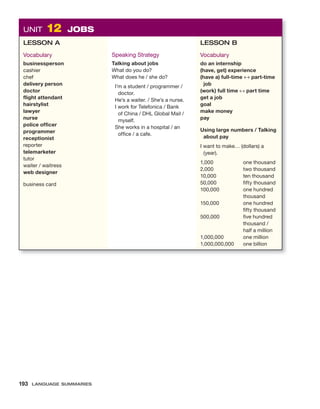
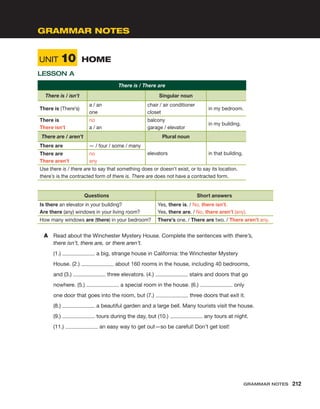
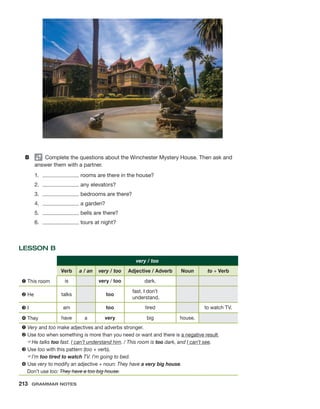
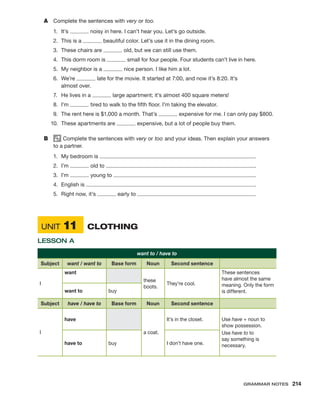
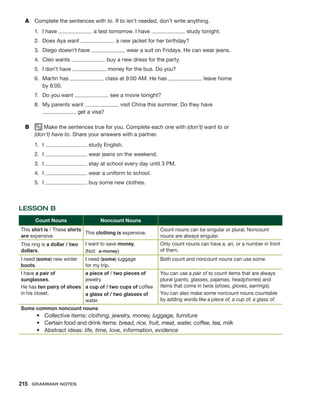
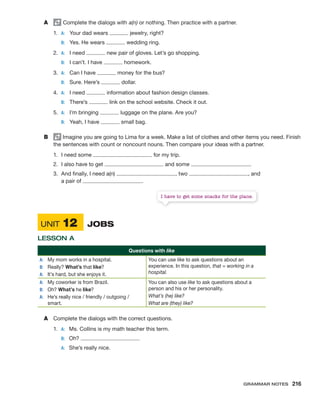
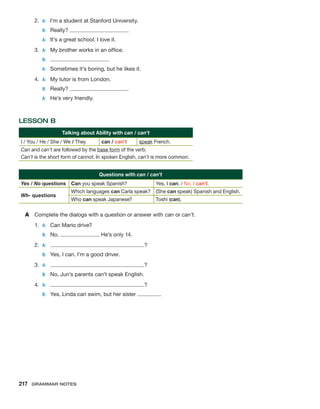
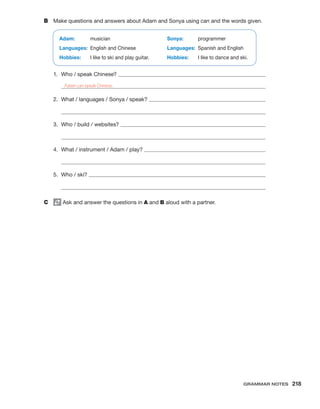
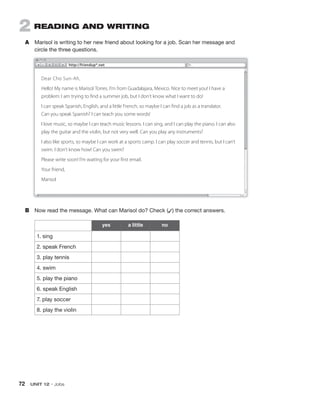
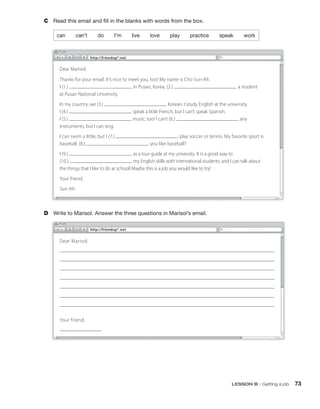
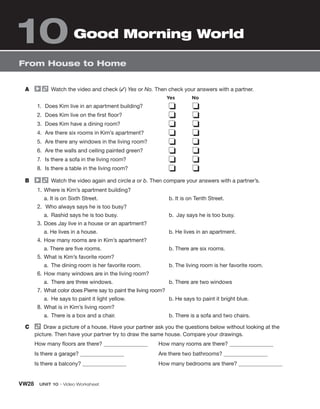
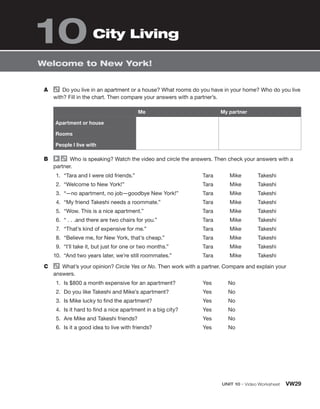
WORLDLINK
James R. Morgan
Nancy Douglas
Basic 4
Developing
English Fluency
ACKNOWLEDGMENT
We would like to extend a very special thank you to the Instituto Cultural Peruano
Norteamericano (ICPNA) academic management staff in the central office, branches,
and teachers, for the helpful insights and suggestions that contributed toward the
development of this series.
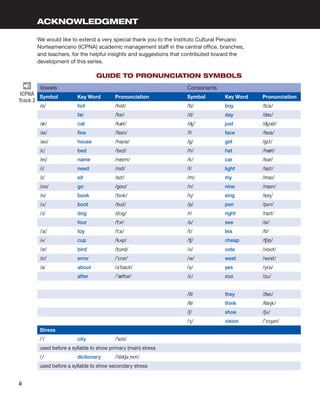
GUIDE TO PRONUNCIATION SYMBOLS
Vowels Consonants
Symbol Key Word Pronunciation Symbol Key Word Pronunciation
/ɑ/ hot /hɑt/ /b/ boy /bɔɪ/
far /fɑr/ /d/ day /deɪ/
/æ/ cat /kæt/ /ʤ/ just /ʤʌst/
/aɪ/ fine /faɪn/ /f/ face /feɪs/
/aʊ/ house /haʊs/ /g/ get /gɛt/
/ɛ/ bed /bɛd/ /h/ hat /hæt/
/eɪ/ name /neɪm/ /k/ car /kɑr/
/i/ need /nid/ /l/ light /laɪt/
/ɪ/ sit /sɪt/ /m/ my /maɪ/
/oʊ/ go /goʊ/ /n/ nine /naɪn/
/ʊ/ book /bʊk/ /ŋ/ sing /sɪŋ/
/u/ boot /but/ /p/ pen /pɛn/
/ɔ/ dog /dɔg/ /r/ right /raɪt/
four /fɔr/ /s/ see /si/
/ɔɪ/ toy /tɔɪ/ /t/ tea /ti/
/ʌ/ cup /kʌp/ /ʧ/ cheap /ʧip/
/ɜr/ bird /bɜrd/ /v/ vote /voʊt/
/ɛr/ error /’ɛrər/ /w/ west /wɛst/
/ə/ about /ə’baʊt/ /y/ yes /yɛs/
after /’æftər/ /z/ zoo /zu/
/ð/ they /ðeɪ/
/θ/ think /θɪŋk/
/ʃ/ shoe /ʃu/
/ʒ/ vision /’vɪʒən/
Stress
/ˈ/ city /ˈsɪti/
used before a syllable to show primary (main) stress
/̩/ dictionary /ˈdɪkʃə ̩nɛri/
used before a syllable to show secondary stress
ICPNA
Track 2
ii 
 iii
	  iii
iii
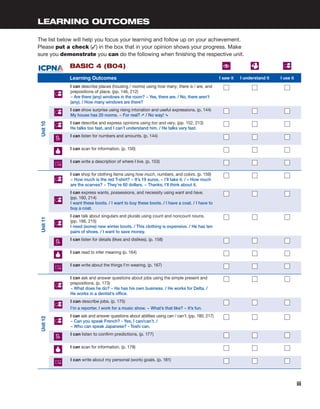
Basic 4 (B04)
Learning Outcomes I saw it I understand it I use it
Unit
10
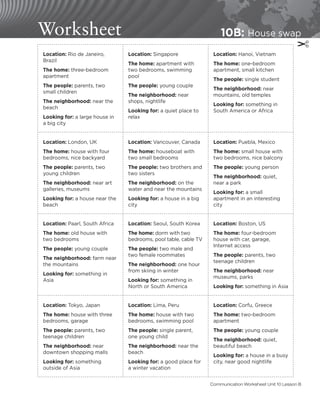
I can describe places (housing / rooms) using how many, there is / are, and
prepositions of place. (pp. 146, 212)
~ Are there (any) windows in the room? ~ Yes, there are. / No, there aren’t
(any). / How many windows are there?
I can show surprise using rising intonation and useful expressions. (p. 144)
My house has 20 rooms. ~ For real? ➚ / No way! ➘
I can describe and express opinions using too and very. (pp. 152, 213)
He talks too fast, and I can’t understand him. / He talks very fast.
I can listen for numbers and amounts. (p. 144)
I can scan for information. (p. 150)
I can write a description of where I live. (p. 153)
Unit
11
I can shop for clothing items using how much, numbers, and colors. (p. 159)
~ How much is the red T-shirt? ~ It’s 19 euros. ~ I’ll take it. / – How much
are the scarves? ~ They’re 60 dollars. ~ Thanks, I’ll think about it.
I can express wants, possessions, and necessity using want and have.
(pp. 160, 214)
I want these boots. / I want to buy these boots. / I have a coat. / I have to
buy a coat.
I can talk about singulars and plurals using count and noncount nouns.
(pp. 166, 215)
I need (some) new winter boots. / This clothing is expensive. / He has ten
pairs of shoes. / I want to save money.
I can listen for details (likes and dislikes). (p. 158)
I can read to infer meaning (p. 164)
I can write about the things I’m wearing. (p. 167)
Unit
12
I can ask and answer questions about jobs using the simple present and
prepositions. (p. 173)
~ What does he do? ~ He has his own business. / He works for Delta. /
He works in a dentist’s office.
I can describe jobs. (p. 175)
I’m a reporter. I work for a music show. ~ What’s that like? ~ It’s fun.
I can ask and answer questions about abilities using can / can’t. (pp. 180, 217)
~ Can you speak French? - Yes, I can/can’t. /
~ Who can speak Japanese? - Toshi can.
I can listen to confirm predictions. (p. 177)
I can scan for information. (p. 178)
I can write about my personal (work) goals. (p. 181)
Learning OUTCOMES
The list below will help you focus your learning and follow up on your achievement.
Please put a check (✓) in the box that in your opinion shows your progress. Make
sure you demonstrate you can do the following when finishing the respective unit.
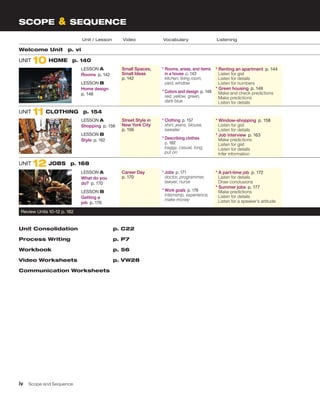
Unit / Lesson Video Vocabulary Listening
Welcome Unit  p. vi
UNIT 10 HOME  p. 140
LESSON A
Rooms  p. 142
LESSON B
Home design 
p. 148
Small Spaces,
Small Ideas 
p. 142
* 
Rooms, areas, and items
in a house  p. 143
kitchen, living room,
yard, window
* 
Colors and design  p. 148
red, yellow, green,
dark blue
* 
Renting an apartment  p. 144
Listen for gist
Listen for details
Listen for numbers
* 
Green housing  p. 149
Make and check predictions
Make predictions
Listen for details
UNIT 11 CLOTHING  p. 154
LESSON A
Shopping  p. 156
LESSON B
Style  p. 162
Street Style in
New York City 
p. 156
* Clothing  p. 157
shirt, jeans, blouse,
sweater
* 
Describing clothes
p. 162
baggy, casual, long,
put on
* Window-shopping  p. 158
Listen for gist
Listen for details
* 
Job interview  p. 163
Make predictions
Listen for gist
Listen for details
Infer information
UNIT 12 JOBS  p. 168
LESSON A
What do you
do?  p. 170
LESSON B
Getting a
job  p. 176
Career Day 
p. 170
* Jobs  p. 171
doctor, programmer,
lawyer, nurse
* 
Work goals  p. 176
internship, experience,
make money
* 
A part-time job  p. 172
Listen for details
Draw conclusions
* 
Summer jobs  p. 177
Make predictions
Listen for details
Listen for a speaker’s attitude
Review Units 10–12 p. 182
Unit Consolidation	 p. C22
Process Writing 	 p. P7
Workbook	 p. 56
Video Worksheets	 p. VW28
Communication Worksheets
iv  Scope and Sequence
SCOPE  SEQUENCE
Grammar Pronunciation Speaking Reading Writing Communication
* There is / There
are  pp. 146, 212
* 
Very / too  pp. 152,
213
Rising intonation
to show
surprise  p. 144
Showing
surprise  p. 145
The power of
color  p. 150
Make predictions
Check predictions
Scan for information
Describe where
you live  p. 153
* 
Describe the location of
objects in a room  p. 147
* 
Identify and fix problems with
a room  p. 153
* Want to / have
to  pp. 160, 214
* 
Count and noncount
nouns  pp. 166, 215
Want to and have
to  p. 160
Saying what you
want; asking
for and giving
prices  p. 159
What do I pack? 
p. 164
Make predictions
Read for details
Infer meaning
Describe
clothing  p. 167
* 
Ask and answer questions
about clothing p. 161
* 
Talk about and create fashion
inventions  p. 167
* 
Questions with
like  pp. 174, 216
* 
Talking about
ability with can /
can’t  pp. 180, 217
Reduced
words  p. 173
Talking about
jobs  p. 173
Internet entrepreneur
Michelle Phan  p. 178
Make predictions
Read for details
Skim for information
Write about
personal work
goals  p. 181
* 
Exchange business cards and
personal information  p. 175
* 
Interview a partner about his
or her job skills p. 181
	 Scope and Sequence v
U N I T S   10–12
Language Summaries p. 192 Grammar Notes p. 212
vi  WELCOME UNIT 
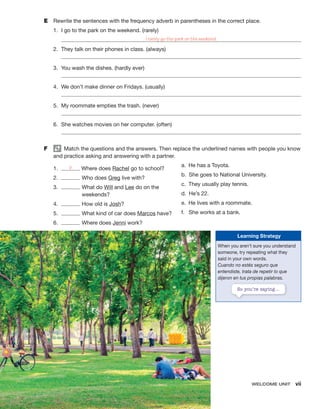
A	 Circle the correct word to complete the sentences.
1.	 My birthday is at / on / from Friday this year.
2.	 She does her homework in / at / on the afternoon.
3.	 Our class is from / at / on 10:00 in / on / to 11:30.
4.	 The basketball game is on / from / at 3:00 this afternoon.
5.	 I like to exercise to / in / from the morning.
6.	 Let’s go to the movies on / to / at 6:00.
B	   Read the sentences and look at the words in parentheses. Write questions. Then replace the
underlined words with people that you know and practice asking and answering with a partner.
1.	 I study in the morning. (when) When do you study?
2.	 Liz goes out with David on Saturdays. (who)
3.	 Pablo lives in Lima. (where)
4.	 We study in the afternoon. (what)
5.	 Mike works on Mondays, Wednesdays, and Fridays. (when)
6.	 They have class in the morning. (what)
C	 Write questions with the cues.
1.	 when / be / break When is your break?
2.	 when / you / study / English
3.	 how long / be / the movie
4.	 when / vacation / start
5.	 when / be / your birthday
6.	 how long / you / study
D	   Put the conversation in order. Then practice with your partner.
1.	 That sounds great. How long is the flight?
2.	 Twelve hours!
3.	 Wow… New York. That’s great! How long is your trip?
4.	 a Hi, Tony! When is your vacation?
5.	 It’s five days. New York is a big city!
6.	 Oh, hi, Hector. I’m leaving next week. I’m visiting New York.
WELCOME UNIT
1  GRAMMAR
WELCOME UNIT vii
E Rewrite the sentences with the frequency adverb in parentheses in the correct place.
1. I go to the park on the weekend. (rarely)
I rarely go the park on the weekend.
2. They talk on their phones in class. (always)
3. You wash the dishes. (hardly ever)
4. We don’t make dinner on Fridays. (usually)
5. My roommate empties the trash. (never)
6. She watches movies on her computer. (often)
F Match the questions and the answers. Then replace the underlined names with people you know
and practice asking and answering with a partner.
1. b Where does Rachel go to school?
2. Who does Greg live with?
3. What do Will and Lee do on the
weekends?
4. How old is Josh?
5. What kind of car does Marcos have?
6. Where does Jenni work?
a. He has a Toyota.
b. She goes to National University.
c. They usually play tennis.
d. He’s 22.
e. He lives with a roommate.
f. She works at a bank.
Learning Strategy
When you aren’t sure you understand
someone, try repeating what they
said in your own words.
Cuando no estés seguro que
entendiste, trata de repetir lo que
dijeron en tus propias palabras.
So you’re saying…
viii  WELCOME UNIT 
2  VOCABULARY
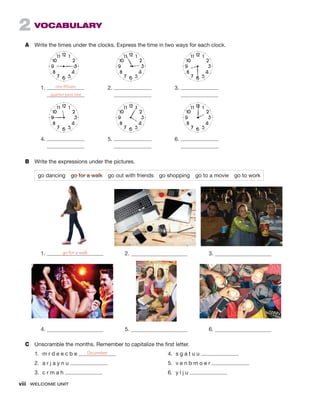
A	 Write the times under the clocks. Express the time in two ways for each clock.
1.  2.  3. 
4.  5.  6. 
B	 Write the expressions under the pictures.
go dancing  go for a walk  go out with friends  go shopping  go to a movie  go to work
1. go for a walk 2. 3.
4. 5. 6.
C	 Unscramble the months. Remember to capitalize the first letter.
1.	 m r d e e c b e December
2.	 a r j a y n u
3.	 c r m a h
4.	 s g a t u u
5.	 v e n b m o e r
6.	 y l j u
nine fifteen;
quarter past nine
WELCOME UNIT  ix
3  WRITING
A	 In your notebook, write a paragraph giving your opinion about a place. Use ideas from the box,
or write about your own idea.
cafe concert movie museum	 park restaurant
4  CLASSROOM EXPRESSIONS
A	   Put the conversation in the correct order. Then practice it with a partner.
1.	 How do you spell that?
2.	 How do you say tareas in English?
3.	 a Can I use your dictionary?
4.	 You’re welcome!
5.	 Sure. What’s the problem?
6.	 It’s homework.
7.	 H-O-M-E-W-O-R-K.
8.	 Thank you!
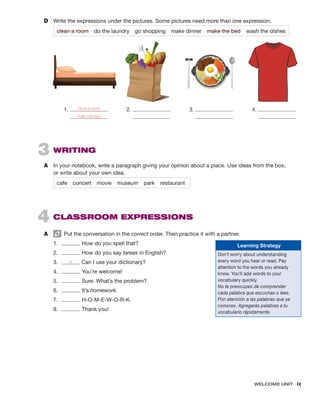
D	 Write the expressions under the pictures. Some pictures need more than one expression.
clean a room  do the laundry  go shopping  make dinner  make the bed  wash the dishes
1.  2.  3.  4. 
clean a room;
make the bed
Learning Strategy
Don’t worry about understanding
every word you hear or read. Pay
attention to the words you already
know. You’ll add words to your
vocabulary quickly.
No te preocupes de comprender
cada palabra que escuchas o lees.
Pon atención a las palabras que ya
conoces. Agregarás palabras a tu
vocabulario rápidamente.
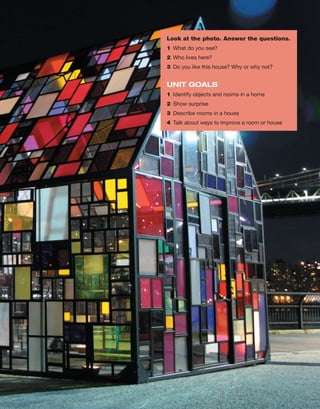
A stained glass house in Brooklyn, the United States
10
10
HOME
Look at the photo. Answer the questions.
1 What do you see?
2 Who lives here?
3 Do you like this house? Why or why not?
UNIT GOALS
1 Identify objects and rooms in a home
2 Show surprise
3 Describe rooms in a house
4 Talk about ways to improve a room or house
1 VIDEO Small Spaces, Small Ideas
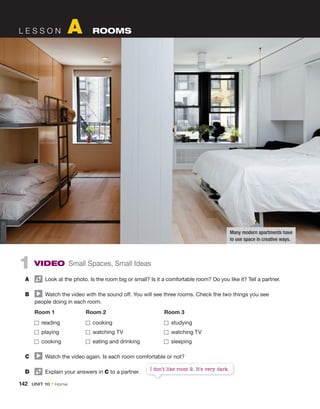
A Look at the photo. Is the room big or small? Is it a comfortable room? Do you like it? Tell a partner.
B Watch the video with the sound off. You will see three rooms. Check the two things you see
people doing in each room.
Room 1 Room 2 Room 3
reading cooking studying
playing watching TV watching TV
cooking eating and drinking sleeping
C Watch the video again. Is each room comfortable or not?
D Explain your answers in C to a partner.
L E S S O N A ROOMS
I don’t like room 2. It’s very dark.
Many modern apartments have
to use space in creative ways.
142 UNIT 10 • Home
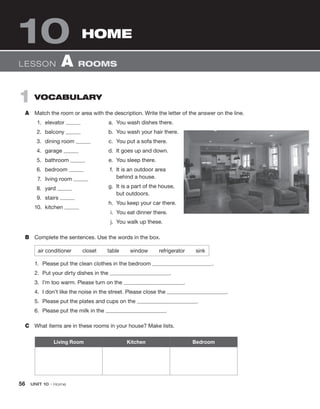
2 VOCABULARY
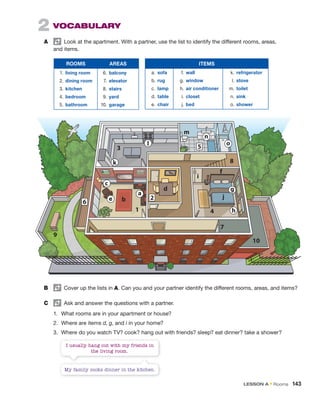
A Look at the apartment. With a partner, use the list to identify the different rooms, areas,
and items.
ROOMS AREAS
1. living room
2. dining room
3. kitchen
4. bedroom
5. bathroom
6. balcony
7. elevator
8. stairs
9. yard
10. garage
B Cover up the lists in A. Can you and your partner identify the different rooms, areas, and items?
C Ask and answer the questions with a partner.
1. What rooms are in your apartment or house?
2. Where are items d, g, and i in your home?
3. Where do you watch TV? cook? hang out with friends? sleep? eat dinner? take a shower?
I usually hang out with my friends in
the living room.
My family cooks dinner in the kitchen.
b
d
f
i
j
m
g
n
o
h
1
3
4
7
8
9
10
5
2
6
a
k
c
e
l
ITEMS
a. sofa
b. rug
c. lamp
d. table
e. chair
f. wall
g. window
h. air conditioner
i. closet
j. bed
k. refrigerator
l. stove
m. toilet
n. sink
o. shower
LESSON A • Rooms 143
3 LISTENING
A Pronunciation: Rising intonation to show surprise. You can
show surprise by repeating certain information with rising intonation (s).
Listen and repeat. Then practice the dialogs with a partner. CD 2 Track 24
1. A: The rent is 2,000 a month.
B: Two thousand? s That’s expensive!
2. A: There’s no elevator in the building.
B: No elevator? s But you live on the sixth floor!
3. A: I live on a houseboat.
B: A houseboat? s That’s cool!
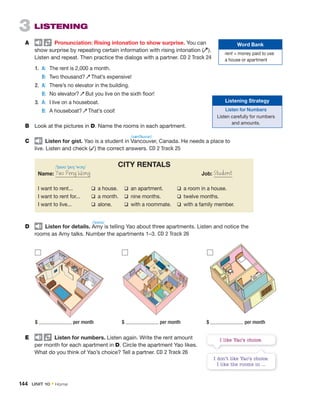
B Look at the pictures in D. Name the rooms in each apartment.
C Listen for gist. Yao is a student in Vancouver, Canada. He needs a place to
live. Listen and check (✓) the correct answers. CD 2 Track 25
CITY RENTALS
Name: Yao Peng Wong Job: Student
I want to rent...  a house.  an apartment.  a room in a house.
I want to rent for...  a month.  nine months.  twelve months.
I want to live...  alone.  with a roommate.  with a family member.
D Listen for details. Amy is telling Yao about three apartments. Listen and notice the
rooms as Amy talks. Number the apartments 1–3. CD 2 Track 26
$ per month $ per month $ per month
E Listen for numbers. Listen again. Write the rent amount
per month for each apartment in D. Circle the apartment Yao likes.
What do you think of Yao’s choice? Tell a partner. CD 2 Track 26
Word Bank
rent = money paid to use
a house or apartment
Listening Strategy
Listen for Numbers
Listen carefully for numbers
and amounts.
I don’t like Yao’s choice.
I like the rooms in ...
I like Yao’s choice.
/vænˈkuvər/
/ˈjɑoʊ ˈpɛŋ ˈwɔŋ/
/ˈeɪmi/
144 UNIT 10 • Home
4  SPEAKING
A	   Listen for a speaker’s attitude. In the
conversation, Tim uses two expressions
(underlined) to show surprise. Listen. Notice
how Tim says these expressions. CD 2 Track 27
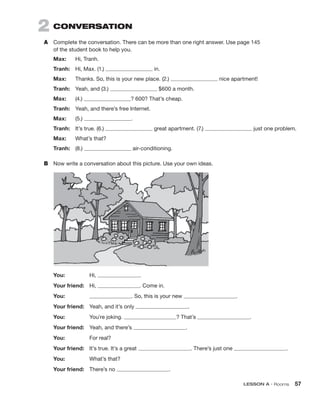
	TIM:	 Hey, Yao. How are you doing?
	YAO: 	Hi, Tim. Come in.
	TIM: 	
Thanks. So, this is your new place. It’s nice.
	YAO:	 Yeah, and it’s only $625 a month.
	TIM:	 Are you serious? 625? That’s cheap.
	YAO:	 Yeah, and I’ve got free WiFi.
	TIM:	 No way!
	YAO:	 
It’s true. I’ve got a great apartment.
There’s just one problem.
	TIM:	 What’s that?
	YAO:	 There’s no elevator, and I’m on the sixth floor!
B	   Practice the conversation with a partner.
SPEAKING STRATEGY
C	   Make two new conversations with a partner. Use the Useful Expressions
and the conversation above. Pay attention to your intonation (s or t).
Useful Expressions: Showing surprise
Said with rising intonation s Said with falling intonation t
My house has 20 rooms.
Really?
Are you serious?
For real? [informal]
Yeah.
My house has 20 rooms.
You’re kidding. / You’re joking.
No way. [informal]
(No,) it’s true.
D	 group
  Read the examples below. Then tell four people something they don’t know
about you. If you cannot think of anything, make something up.
A:	
I play the guitar.	 A:	 My sister lives near a famous soccer player.
B:	 For real? 	 B:	 You’re kidding.
A:	 Yeah. I play in a band. 	 A:	 No, it’s true.
B:	 Where do you practice?	 B:	 What’s his name?
E	 group
  Which answer from D is the most interesting or unusual? Tell the class.
Word Bank
I live in a house / an
apartment building.
I live on the first / second /
third / top floor.
/tɪm/
LESSON A • Rooms  145
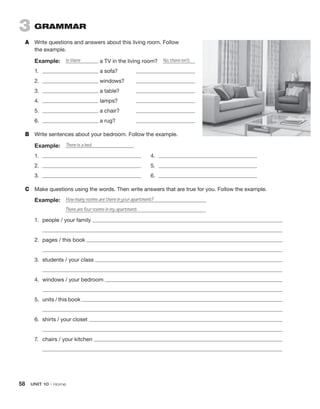
5 GRAMMAR
A Study the chart. Turn to page 212. Complete the exercises. Then do B–D below.
There is / There are
singular
There is (There’s)
There isn’t
a rug
in my bedroom.
plural
There are
There aren’t any
rugs
Questions Short answers
Is there an elevator in your building?
Are there (any) windows in your living room?
Yes, there is. / No, there isn’t.
Yes, there are. / No, there aren’t (any).
How many windows are (there) in your bedroom? There’s one. / There are two. / There aren’t any.
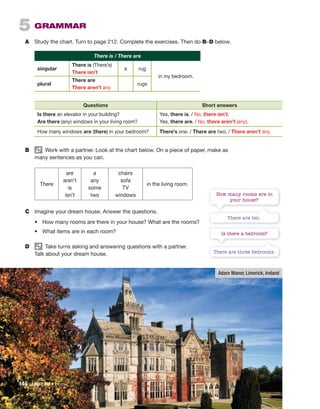
B Work with a partner. Look at the chart below. On a piece of paper, make as
many sentences as you can.
There
are
aren’t
is
isn’t
a
any
some
two
chairs
sofa
TV
windows
in the living room.
C Imagine your dream house. Answer the questions.
• How many rooms are there in your house? What are the rooms?
• What items are in each room?
D Take turns asking and answering questions with a partner.
Talk about your dream house.
There are ten.
How many rooms are in
your house?
There are three bedrooms.
Is there a bedroom?
Adare Manor, Limerick, Ireland
146 UNIT 10 • Home
6 COMMUNICATION
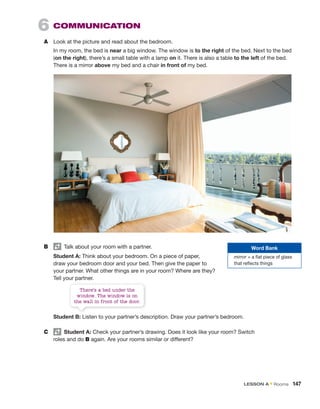
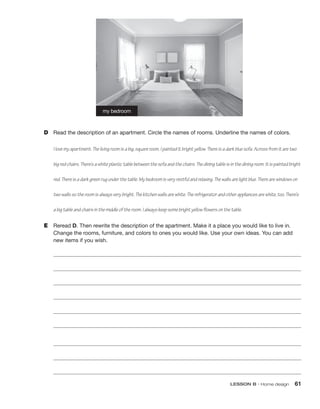
A Look at the picture and read about the bedroom.
In my room, the bed is near a big window. The window is to the right of the bed. Next to the bed
(on the right), there’s a small table with a lamp on it. There is also a table to the left of the bed.
There is a mirror above my bed and a chair in front of my bed.
B Talk about your room with a partner.
Student A: Think about your bedroom. On a piece of paper,
draw your bedroom door and your bed. Then give the paper to
your partner. What other things are in your room? Where are they?
Tell your partner.
Student B: Listen to your partner’s description. Draw your partner’s bedroom.
C Student A: Check your partner’s drawing. Does it look like your room? Switch
roles and do B again. Are your rooms similar or different?
Word Bank
mirror = a flat piece of glass
that reflects things
There’s a bed under the
window. The window is on
the wall in front of the door.
LESSON A • Rooms 147
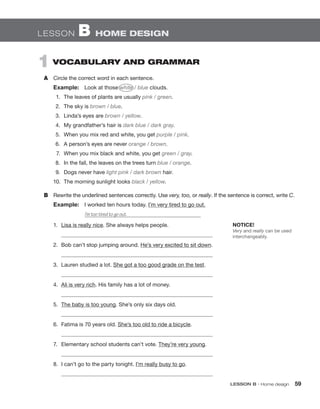
L E S S O N B HOME DESIGN
1 VOCABULARY
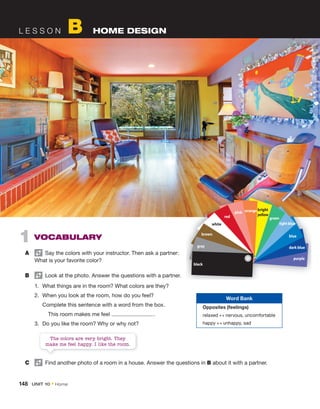
A Say the colors with your instructor. Then ask a partner:
What is your favorite color?
B Look at the photo. Answer the questions with a partner.
1. What things are in the room? What colors are they?
2. When you look at the room, how do you feel?
Complete this sentence with a word from the box.
This room makes me feel .
3. Do you like the room? Why or why not?
The colors are very bright. They
make me feel happy. I like the room.
C Find another photo of a room in a house. Answer the questions in B about it with a partner.
black
gray
brown
white
red
pink orange bright
yellow
green
light blue
blue
dark blue
purple
Word Bank
Opposites (feelings)
relaxed ↔ nervous, uncomfortable
happy ↔ unhappy, sad
148 UNIT 10 • Home
2  Listening
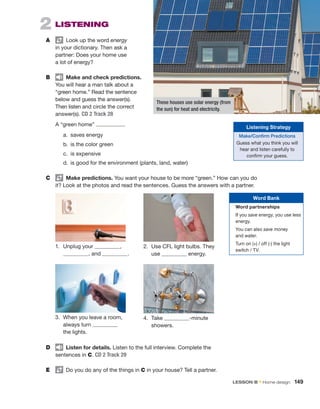
A	   Look up the word energy
in your dictionary. Then ask a
partner: Does your home use
a lot of energy?
B	   Make and check predictions.
You will hear a man talk about a
“green home.” Read the ­
sentence
below and guess the answer(s).
Then listen and circle the correct
answer(s). CD 2 Track 28
A “green home” .
	 a.	 saves energy
	 b.	 is the color green
	 c.	 is expensive
2.	
Use CFL light bulbs. They
use energy.
1.	 Unplug your  ,
 , and  .
3.	
When you leave a room,
always turn
the lights.
4.	Take -minute
showers.
D	   Listen for details. Listen to the full interview. Complete the
sentences in C. CD 2 Track 29
E	   Do you do any of the things in C in your house? Tell a partner.
	 d.	
is good for the environment (plants, land, water)
C	   Make predictions. You want your house to be more “green.” How can you do
it? Look at the ­
photos and read the sentences. Guess the answers with a partner.
These houses use solar energy (from
the sun) for heat and electricity.
Word Bank
Word partnerships
If you save energy, you use less
energy.
You can also save money
and water.
Turn on (+) / off (-) the light
switch / TV.
Listening Strategy
Make/Confirm Predictions
Guess what you think you will
hear and listen carefully to
confirm your guess.
LESSON B • Home design  149
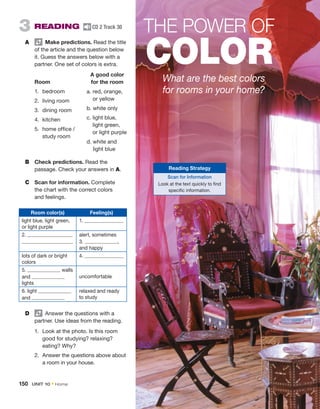
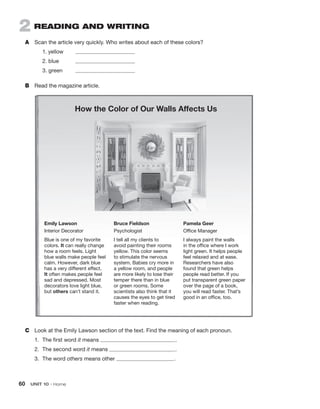
THE POWER OF
COLOR
What are the best colors
for rooms in your home?
Reading Strategy
Scan for Information
Look at the text quickly to find
specific information.
3  READING  CD 2 Track 30
A	   Make ­predictions. Read the title
of the article and the question below
it. Guess the answers ­
below with a
partner. One set of colors is extra.
	 	 A good color
Room	 for the room
1.	bedroom
2.	 living room
3.	 dining room
4.	kitchen
5.	
home office /
study room
B	 Check predictions. Read the
­
passage. Check your ­
answers in A.
C	 Scan for information. ­Complete
the chart with the correct colors
and feelings.
a. 
red, orange,
or yellow
b. white only
c. 
light blue,
light green,
or light purple
d. 
white and
light blue
Room color(s) Feeling(s)
light blue, light green,
or light purple
1.
2. alert, sometimes
3. ,
and happy
lots of dark or bright
colors
4.
5. walls
and
lights
uncomfortable
6. light
and
relaxed and ready
to study
D	   Answer the questions with a
­
partner. Use ideas from the reading.
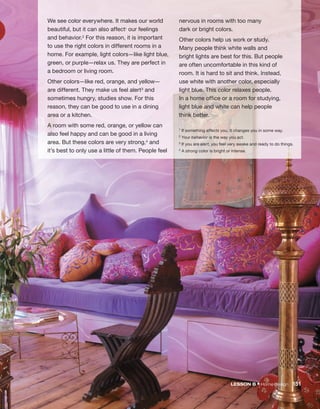
1.	 Look at the photo. Is this room
good for studying? relaxing?
eating? Why?
2.	 Answer the questions above about
a room in your house.
150  UNIT 10 • Home
We see color everywhere. It makes our world
beautiful, but it can also affect1 our feelings
and behavior.2 For this reason, it is important
to use the right colors in different rooms in a
home. For example, light colors—like light blue,
green, or purple—relax us. They are perfect in
a bedroom or living room.
Other colors—like red, orange, and yellow—
are different. They make us feel alert3 and
sometimes hungry, studies show. For this
reason, they can be good to use in a dining
area or a kitchen.
A room with some red, orange, or yellow can
also feel happy and can be good in a living
area. But these colors are very strong,4 and
it’s best to only use a little of them. People feel
nervous in rooms with too many
dark or bright colors.
Other colors help us work or study.
Many people think white walls and
bright lights are best for this. But people
are often uncomfortable in this kind of
room. It is hard to sit and think. Instead,
use white with another color, especially
light blue. This color relaxes people.
In a home office or a room for studying,
light blue and white can help people
think better.
1 If something affects you, it changes you in some way.
2 Your behavior is the way you act.
3 If you are alert, you feel very awake and ready to do things.
4 A strong color is bright or intense.
LESSON B • Home design 151
4 GRAMMAR
A Study the chart. Turn to page 213. Complete the exercises. Then do B and C below.
very / too
  Verb a / an very / too Adjective / Adverb Noun to + Verb
This room is very / too dark.
He talks too
fast. I don’t
understand.
I am too tired to watch TV.
They have a very big house.
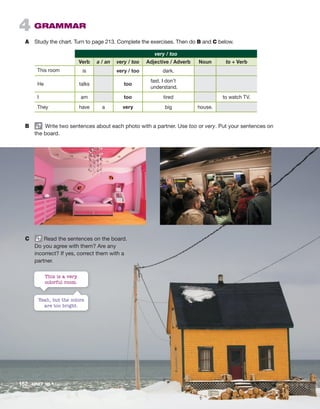
B Write two sentences about each photo with a partner. Use too or very. Put your sentences on
the board.
C Read the sentences on the board.
Do you agree with them? Are any
incorrect? If yes, correct them with a
partner.
Yeah, but the colors
are too bright.
This is a very
colorful room.
152 UNIT 10 • Home
5 WRITING
A Read about an apartment in Santiago. Then write about your house or apartment.
B Share your writing with a partner. Correct any mistakes in his or her writing.
C Return your partner’s paper. Then explain: Are your homes similar or different?
Give examples.
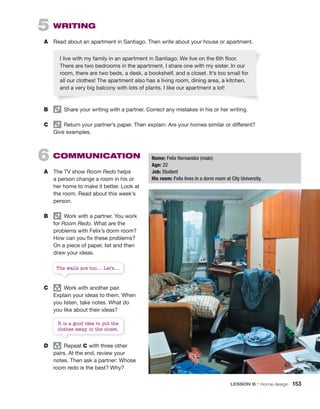
6 COMMUNICATION
A The TV show Room Redo helps
a person change a room in his or
her home to make it better. Look at
the room. Read about this week’s
person.
B Work with a partner. You work
for Room Redo. What are the
problems with Felix’s dorm room?
How can you fix these problems?
On a piece of paper, list and then
draw your ideas.
The walls are too.... Let’s....
It is a good idea to put the
clothes away in the closet.
C group
Work with another pair.
Explain your ideas to them. When
you listen, take notes. What do
you like about their ideas?
Name: Felix Hernandez (male)
Age: 22
Job: Student
His room: Felix lives in a dorm room at City University.
I live with my family in an apartment in Santiago. We live on the 6th floor.
There are two bedrooms in the apartment. I share one with my sister. In our
room, there are two beds, a desk, a bookshelf, and a closet. It’s too small for
all our clothes! The apartment also has a living room, dining area, a kitchen,
and a very big balcony with lots of plants. I like our apartment a lot!
D group
Repeat C with three other
pairs. At the end, review your
notes. Then ask a partner: Whose
room redo is the best? Why?
LESSON B • Home design 153
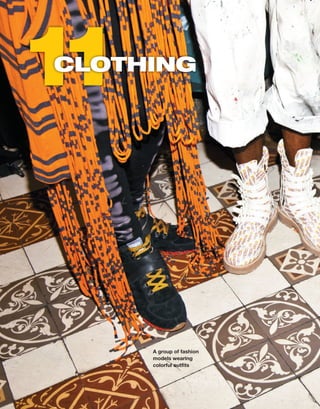
A group of fashion
models wearing
colorful outfits
1
1
1
1
CLOTHING
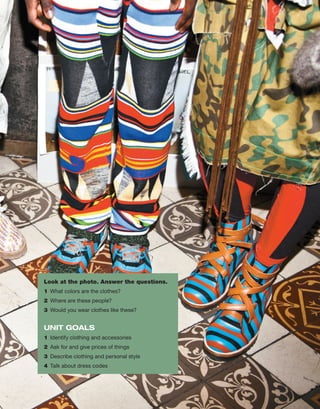
Look at the photo. Answer the questions.
1	 What colors are the clothes?
2	 Where are these people?
3	 Would you wear clothes like these?
UNIT GOALS
1	 Identify clothing and accessories
2	 Ask for and give prices of things
3	 Describe clothing and personal style
4	 Talk about dress codes
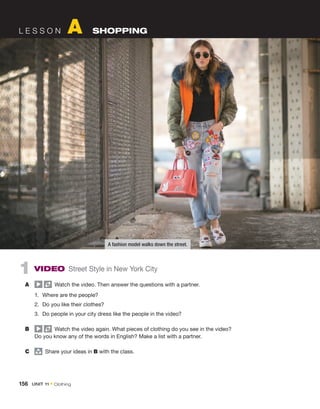
1  VIDEO Street Style in New York City
A	   Watch the video. Then answer the questions with a partner.
1.	 Where are the people?
2.	 Do you like their clothes?
3.	 Do people in your city dress like the people in the video?
B	   Watch the video again. What pieces of clothing do you see in the video?
Do you know any of the words in English? Make a list with a partner.
C	 group
  Share your ideas in B with the class.
L E S S O N A SHOPPING
A fashion model walks down the street.
156  UNIT 11 • Clothing
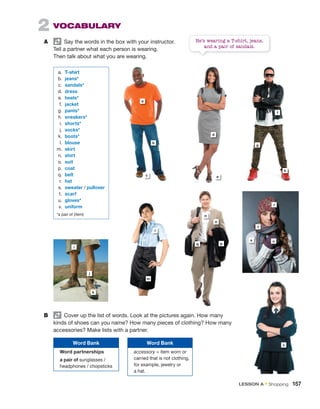
2 VOCABULARY
A Say the words in the box with your instructor.
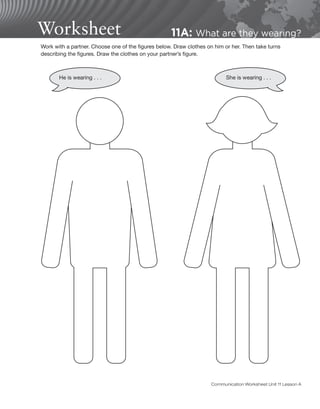
Tell a partner what each person is wearing.
Then talk about what you are wearing.
He’s wearing a T-shirt, jeans,
and a pair of sandals.
g
h
f
a
b
c
d
e
a. T-shirt
b. jeans*
c. sandals*
d. dress
e. heels*
f. jacket
g. pants*
h. sneakers*
i. shorts*
j. socks*
k. boots*
l. blouse
m. skirt
n. shirt
o. suit
p. coat
q. belt
r. hat
s. sweater / pullover
t. scarf
u. gloves*
v. uniform
*a pair of (item)
B Cover up the list of words. Look at the pictures again. How many
kinds of shoes can you name? How many pieces of clothing? How many
accessories? Make lists with a partner.
i
j
k
b
r
u
t
s
m
l
v
b
p
q
o
n
Word Bank
Word partnerships
a pair of sunglasses /
headphones / chopsticks
Word Bank
accessory = item worn or
carried that is not clothing,
for example, jewelry or
a hat.
LESSON A • Shopping 157
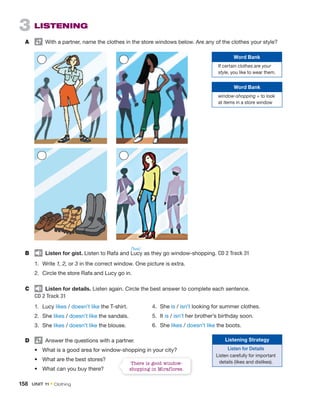
3 LISTENING
A With a partner, name the clothes in the store windows below. Are any of the clothes your style?
B Listen for gist. Listen to Rafa and Lucy as they go window-shopping. CD 2 Track 31
1. Write 1, 2, or 3 in the correct window. One picture is extra.
2. Circle the store Rafa and Lucy go in.
C Listen for details. Listen again. Circle the best answer to complete each sentence.
CD 2 Track 31
1. Lucy likes / doesn’t like the T-shirt.
2. She likes / doesn’t like the sandals.
3. She likes / doesn’t like the blouse.
D Answer the questions with a partner.
• What is a good area for window-shopping in your city?
• What are the best stores?
• What can you buy there?
4. She is / isn’t looking for summer clothes.
5. It is / isn’t her brother’s birthday soon.
6. She likes / doesn’t like the boots.
Word Bank
If certain clothes are your
style, you like to wear them.
Word Bank
window-shopping = to look
at items in a store window
Listening Strategy
Listen for Details
Listen carefully for important
details (likes and dislikes).
There is good window-
shopping in Miraflores.
/ˈlusi/
158 UNIT 11 • Clothing
Useful Expressions
Saying what you want
I’m looking for a gift for my sister.
Asking for and giving prices
How much are they?
 
They’re 60 euros.
Thanks, I’ll think about it.
How much is the T-shirt?
 
It’s 19 euros.
I’ll take it.
Speaking Tip
When you’re not looking for anything
in particular:
Can I help you?
  No thanks, I’m just looking.
4  SPEAKING
A	 Jin is from South Korea. He’s in Rome
now on ­
vacation. Listen. Then answer the
questions. CD 2 Track 32
1.	 What is Jin doing?
2.	 What doesn’t Jin want? How does he
say that? Underline the words.
3.	 What does Jin buy? How does he
say it? Circle the words.
	STORE CLERK:	Buon giorno.
	 JIN:	
Um, hello. Do you speak
English?
	STORE CLERK:	 
Yes, I do. Can I help you?
	JIN:	

Oh, yeah... thanks. I’m shopping
for a gift for my sister. I want to
get something Italian.
	STORE CLERK:	 
I see. Well, we have some
nice traditional scarves.
	JIN:	

Yeah, they are nice. How much
are they?
	STORE CLERK:	 Sixty euros.
	JIN:	
Sixty euros? Um... I’ll think about it.
	STORE CLERK:	
We also have T-shirts... like this Roma one.
	JIN:	
Oh, that’s cool. How much is it?
	STORE CLERK:	 Nineteen euros.
	JIN:	

That’s perfect. I’ll take it.
B	   Practice the conversation with a partner.
SPEAKING STRATEGY
C	   Imagine you’re on vacation in Italy. You want to buy
a gift for someone. With a partner, make a new conversation.
•  Shopper: Who are you shopping for? Tell the clerk.
• 
Store clerk: Show the shopper at least three
items. Use the prices below. Try to make a sale!
	 €300   €40   €35   €95   €235
D	   Switch roles and do C again.
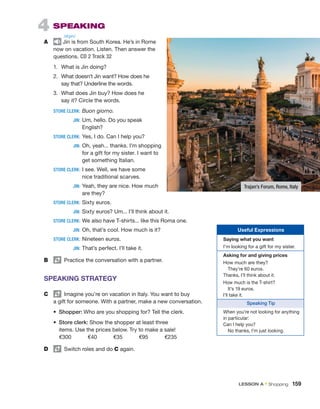
Trajan’s Forum, Rome, Italy
/dʒɪn/
LESSON A • Shopping  159
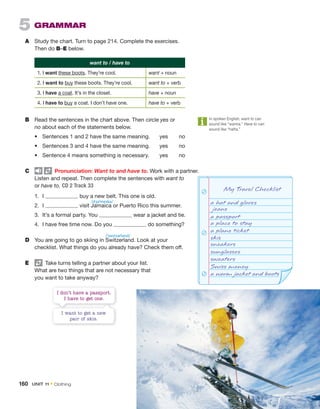
I don’t have a passport.
I have to get one.
I want to get a new
pair of skis.
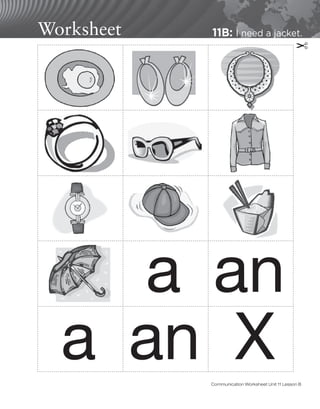
My Travel Checklist
a hat and gloves
jeans
a passport
a place to stay
a plane ticket
skis
sneakers
sunglasses
sweaters
Swiss money
a warm jacket and boots
5 GRAMMAR
A Study the chart. Turn to page 214. Complete the exercises.
Then do B–E below.
want to / have to
1. I want these boots. They’re cool. want + noun
2. I want to buy these boots. They’re cool. want to + verb
3. I have a coat. It’s in the closet. have + noun
4. I have to buy a coat. I don’t have one. have to + verb
B Read the sentences in the chart above. Then circle yes or
no about each of the statements below.
• Sentences 1 and 2 have the same meaning. yes no
• Sentences 3 and 4 have the same meaning. yes no
• Sentence 4 means something is necessary. yes no
C Pronunciation: Want to and have to. Work with a partner.
Listen and repeat. Then complete the sentences with want to
or have to. CD 2 Track 33
1. I buy a new belt. This one is old.
2. I visit Jamaica or Puerto Rico this summer.
3. It’s a formal party. You wear a jacket and tie.
4. I have free time now. Do you do something?
D You are going to go skiing in Switzerland. Look at your
checklist. What things do you already have? Check them off.
E Take turns telling a partner about your list.
What are two things that are not necessary that
you want to take anyway?
In spoken English, want to can
sound like “wanna.” Have to can
sound like “hafta.”
/dʒəˈmeɪkə/
/ˈswɪtsərlənd/
160 UNIT 11 • Clothing
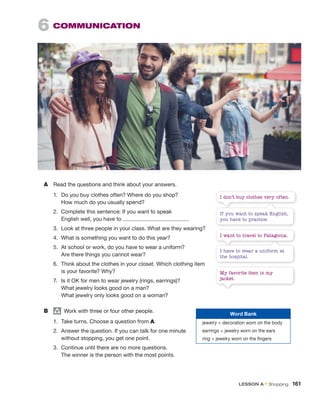
6  Communication
A	 Read the questions and think about your answers.
1.	 Do you buy clothes often? Where do you shop?
How much do you usually spend?
2.	 Complete this sentence: If you want to speak
English well, you have to .
3.	 Look at three people in your class. What are they wearing?
4.	 What is something you want to do this year?
5.	 At school or work, do you have to wear a uniform?
Are there things you cannot wear?
6.	 Think about the clothes in your closet. Which clothing item
is your favorite? Why?
7.	 Is it OK for men to wear jewelry (rings, earrings)?
What jewelry looks good on a man?
What jewelry only looks good on a woman?
B	 group
  Work with three or four other people.
1.	 Take turns. Choose a question from A.
2.	 Answer the question. If you can talk for one minute
without stopping, you get one point.
3.	 Continue until there are no more questions.
The winner is the person with the most points.
Word Bank
jewelry = decoration worn on the body
earrings = jewelry worn on the ears
ring = jewelry worn on the fingers
My favorite item is my
jacket.

If you want to speak English,
you have to practice.
I don’t buy clothes very often.
I have to wear a uniform at
the hospital.
I want to travel to Patagonia.
LESSON A • Shopping  161
L E S S O N B STYLE
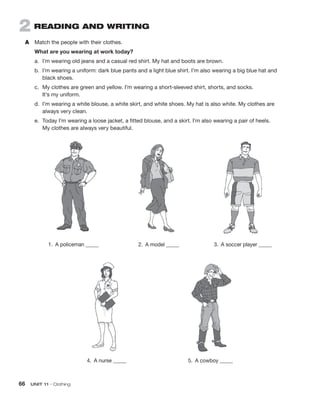
1 VOCABULARY
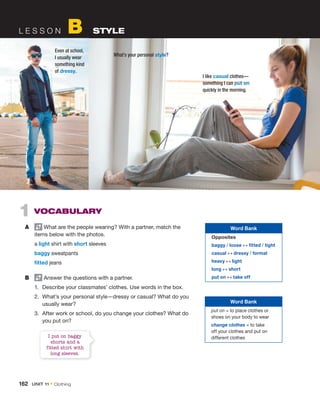
A What are the people wearing? With a partner, match the
items below with the photos.
a light shirt with short sleeves
baggy sweatpants
fitted jeans
B Answer the questions with a partner.
1. Describe your classmates’ clothes. Use words in the box.
2. What’s your personal style—dressy or casual? What do you
usually wear?
3. After work or school, do you change your clothes? What do
you put on?
I put on baggy
shorts and a
fitted shirt with
long sleeves.
I like casual clothes—
something I can put on
quickly in the morning.
Even at school,
I usually wear
something kind
of dressy.
What’s your personal style?
Word Bank
Opposites
baggy / loose ↔ fitted / tight
casual ↔ dressy / formal
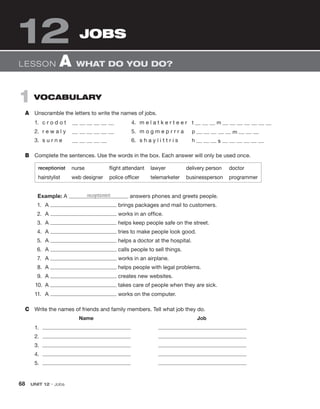
heavy ↔ light
long ↔ short
put on ↔ take off
Word Bank
put on = to place clothes or
shoes on your body to wear
change clothes = to take
off your clothes and put on
different clothes
162 UNIT 11 • Clothing
2 LISTENING
A Read the definitions. Then answer the questions with a partner.
If you change (your) clothes, you take off your
clothes and put on different clothes.
If your clothes match, they look good together.
1. Do you change your clothes during the day?
2. Do the clothes you’re wearing today match?
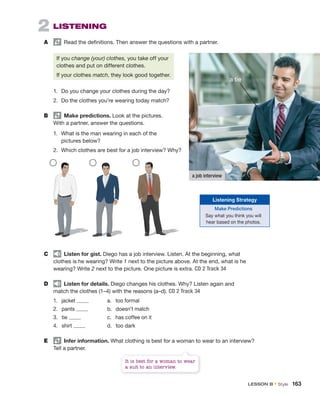
B Make predictions. Look at the pictures.
With a partner, answer the questions.
1. What is the man wearing in each of the
pictures below?
2. Which clothes are best for a job interview? Why?
C Listen for gist. Diego has a job interview. Listen. At the beginning, what
clothes is he wearing? Write 1 next to the picture above. At the end, what is he
wearing? Write 2 next to the picture. One picture is extra. CD 2 Track 34
D Listen for details. Diego changes his clothes. Why? Listen again and
match the clothes (1–4) with the reasons (a–d). CD 2 Track 34
1. jacket a. too formal
2. pants b. doesn’t match
3. tie c. has coffee on it
4. shirt d. too dark
E Infer information. What clothing is best for a woman to wear to an interview?
Tell a partner.
a job interview
a tie
It is best for a woman to wear
a suit to an interview.
Listening Strategy
Make Predictions
Say what you think you will
hear based on the photos.
LESSON B • Style 163
3 READING CD 2 Track 35
A Make predictions. Read only
Tomas’s post on the next page. Then
answer the questions with a partner.
1. Where is Tomas from? Where
does he want to go?
2. Guess the answer to Tomas’s
question. Make a list of ideas.
B Read for details. Read Rayyan’s
reply. Which items (1–6) are good
for Tomas to pack? Circle them.
Which aren’t? Put an X. Explain
your answers to a partner.
1. T-shirts
2. a short skirt
3. long, baggy pants
4. an umbrella
5. a shirt with long sleeves
6. shoes you can take off easily
C Infer meaning. Find the
underlined words in the reading.
Complete the “a” sentences with the
correct word. Then answer the “b”
questions with a partner.
1a. If you wear suitable clothes, they
are / aren’t right for a situation.
1b. What clothes are suitable for
school? Which aren’t?
2a. A shirt with short / long sleeves
covers your arms.
2b. What other clothing can cover
your arms?
3a. An umbrella / A bathing suit
protects you from the sun.
3b. What else can protect you from
the sun?
4a. If something fits, it is comfortable /
uncomfortable to wear.
4b. What makes a piece of clothing
fit well?
WHAT
DO I PACK?
Reading Strategy
Infer Meaning
Say what you think based on
the information.
/toʊˈmɑs/
/ˈreɪjæn/
164 UNIT 11 • Clothing
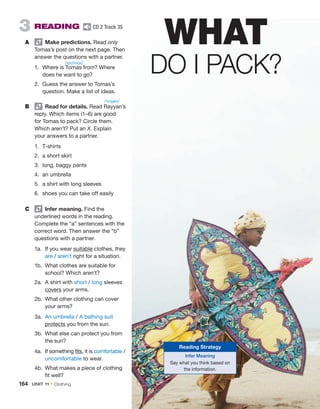
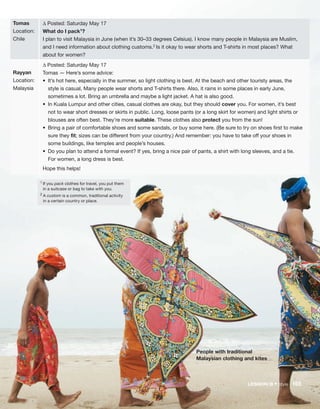
People with traditional
Malaysian clothing and kites
1
If you pack clothes for travel, you put them
in a suitcase or bag to take with you.
2 A custom is a common, traditional activity
in a certain country or place.
Tomas
Location:
Chile
Rayyan
Location:
Malaysia
Δ Posted: Saturday May 17
What do I pack1?
I plan to visit Malaysia in June (when it’s 30–33 degrees Celsius). I know many people in Malaysia are Muslim,
and I need information about clothing customs.2 Is it okay to wear shorts and T-shirts in most places? What
about for women?
Δ Posted: Saturday May 17
Tomas — Here’s some advice:
• It’s hot here, especially in the summer, so light clothing is best. At the beach and other touristy areas, the
style is casual, Many people wear shorts and T-shirts there. Also, it rains in some places in early June,
sometimes a lot. Bring an umbrella and maybe a light jacket. A hat is also good.
• In Kuala Lumpur and other cities, casual clothes are okay, but they should cover you. For women, it’s best
not to wear short dresses or skirts in public. Long, loose pants (or a long skirt for women) and light shirts or
blouses are often best. They’re more suitable. These clothes also protect you from the sun!
• Bring a pair of comfortable shoes and some sandals, or buy some here. (Be sure to try on shoes first to make
sure they fit; sizes can be different from your country.) And remember: you have to take off your shoes in
some buildings, like temples and people’s houses.
• Do you plan to attend a formal event? If yes, bring a nice pair of pants, a shirt with long sleeves, and a tie.
For women, a long dress is best.
Hope this helps!
LESSON B • Style 165
4 GRAMMAR
A Study the chart. Turn to page 215. Complete the exercises. Then do B and C below.
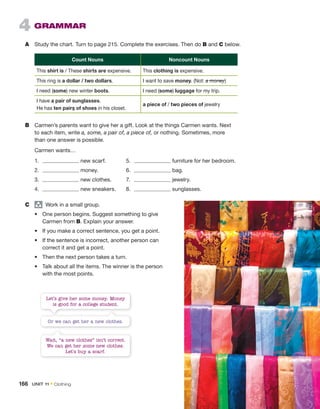
Count Nouns Noncount Nouns
This shirt is / These shirts are expensive. This clothing is expensive.
This ring is a dollar / two dollars. I want to save money. (Not: a money)
I need (some) new winter boots. I need (some) luggage for my trip.
I have a pair of sunglasses.
He has ten pairs of shoes in his closet.
a piece of / two pieces of jewelry
B Carmen’s parents want to give her a gift. Look at the things Carmen wants. Next
to each item, write a, some, a pair of, a piece of, or nothing. Sometimes, more
than one answer is possible.
Carmen wants…
1. new scarf. 5. furniture for her bedroom.
2. money. 6. bag.
3. new clothes. 7. jewelry.
4. new sneakers. 8. sunglasses.
C group
Work in a small group.
• One person begins. Suggest something to give
Carmen from B. Explain your answer.
• If you make a correct sentence, you get a point.
• If the sentence is incorrect, another person can
correct it and get a point.
• Then the next person takes a turn.
• Talk about all the items. The winner is the person
with the most points.
Let’s give her some money. Money
is good for a college student.
Wait, “a new clothes” isn’t correct.
We can get her some new clothes.
Let’s buy a scarf.
Or we can get her a new clothes.
166 UNIT 11 • Clothing
5 WRITING
A On a piece of paper, write about the things
you are wearing.
Describe...
• your clothes and their colors and style.
• other things you are wearing—jewelry,
glasses, a hat, etc.
B Give your paper to your instructor. Your
instructor gives you another student’s paper.
Read it. Correct any mistakes. Then guess
the writer. Give the paper to that person.
6 COMMUNICATION
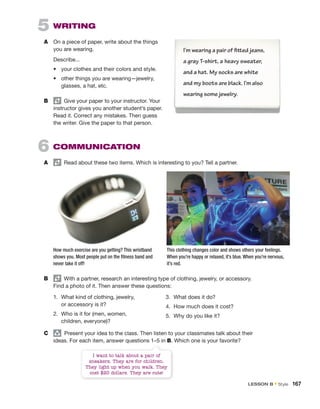
A Read about these two items. Which is interesting to you? Tell a partner.
I’m wearing a pair of fitted jeans,
a gray T-shirt, a heavy sweater,
and a hat. My socks are white
and my boots are black. I’m also
wearing some jewelry.
B With a partner, research an interesting type of clothing, jewelry, or accessory.
Find a photo of it. Then answer these questions:
This clothing changes color and shows others your feelings.
When you’re happy or relaxed, it’s blue. When you’re nervous,
it’s red.
How much exercise are you getting? This wristband
shows you. Most people put on the fitness band and
never take it off!
1. What kind of clothing, jewelry,
or accessory is it?
2. Who is it for (men, women,
children, everyone)?
3. What does it do?
4. How much does it cost?
5. Why do you like it?
C group
Present your idea to the class. Then listen to your classmates talk about their
ideas. For each item, answer questions 1–5 in B. Which one is your favorite?
I want to talk about a pair of
sneakers. They are for children.
They light up when you walk. They
cost $20 dollars. They are cute!
LESSON B • Style 167
12
12
JOBS
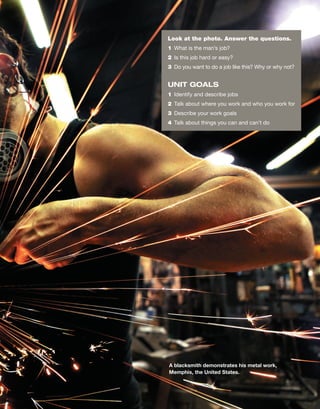
Look at the photo. Answer the questions.
1 What is the man’s job?
2 Is this job hard or easy?
3 Do you want to do a job like this? Why or why not?
UNIT GOALS
1 Identify and describe jobs
2 Talk about where you work and who you work for
3 Describe your work goals
4 Talk about things you can and can’t do
A blacksmith demonstrates his metal work,
Memphis, the United States.
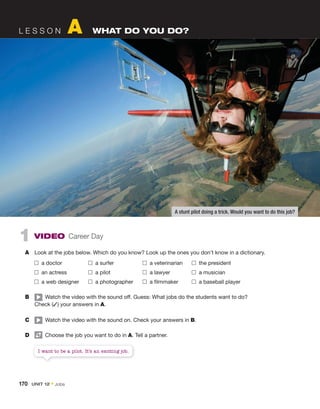
1 VIDEO Career Day
A Look at the jobs below. Which do you know? Look up the ones you don’t know in a dictionary.
a doctor a surfer a veterinarian the president
an actress a pilot a lawyer a musician
a web designer a photographer a filmmaker a baseball player
B Watch the video with the sound off. Guess: What jobs do the students want to do?
Check (✓) your answers in A.
C Watch the video with the sound on. Check your answers in B.
D Choose the job you want to do in A. Tell a partner.
L E S S O N A WHAT DO YOU DO?
I want to be a pilot. It’s an exciting job.
A stunt pilot doing a trick. Would you want to do this job?
170 UNIT 12 • Jobs
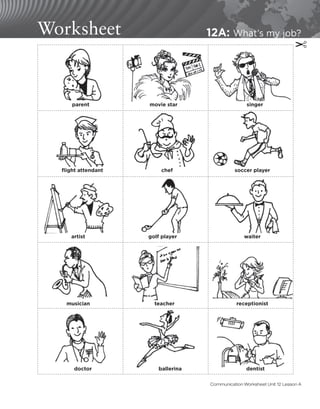
2 VOCABULARY
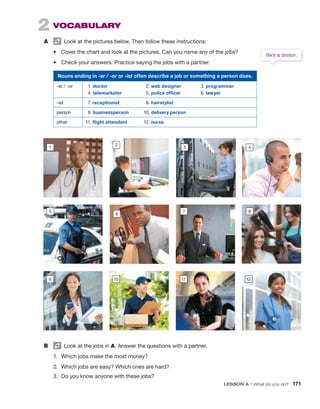
A Look at the pictures below. Then follow these instructions:
• Cover the chart and look at the pictures. Can you name any of the jobs?
• Check your answers. Practice saying the jobs with a partner.
He’s a doctor.
B Look at the jobs in A. Answer the questions with a partner.
1. Which jobs make the most money?
2. Which jobs are easy? Which ones are hard?
3. Do you know anyone with these jobs?
5
10 11
4
12
1
6
2
7 8
9
Nouns ending in -er / -or or -ist often describe a job or something a person does.
-er / -or 1. doctor
4. telemarketer
2. web designer
5. police officer
3. programmer
6. lawyer
-ist 7. receptionist 8. hairstylist
person 9. businessperson 10. delivery person
other 11. flight attendant 12. nurse
3
LESSON A • What do you do? 171
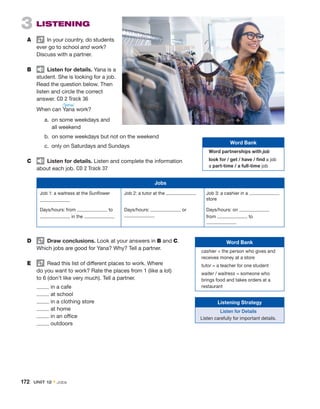
3  Listening
A	   In your country, do students
ever go to school and work?
­
Discuss with a partner.
B	   Listen for details. Yana is a
student. She is looking for a job.
Read the question ­
below. Then
listen and circle the correct
­answer. CD 2 Track 36
	 When can Yana work?
	 a. 
on some weekdays and
all weekend
	 b. 
on some weekdays but not on the weekend
	 c. 
only on Saturdays and Sundays
C	   Listen for details. Listen and complete the information
about each job. CD 2 Track 37
D	   Draw conclusions. Look at your answers in B and C.
Which jobs are good for Yana? Why? Tell a partner.
E	   Read this list of different places to work. Where
do you want to work? Rate the places from 1 (like a lot)
to 6 (don’t like very much). Tell a partner.
	 in a cafe
	 at school
	 in a clothing store
	 at home
	 in an office
	 outdoors
Jobs
Job 1: a waitress at the Sunflower Job 2: a tutor at the Job 3: a cashier in a
store
Days/hours: from to
in the
Days/hours: or Days/hours: on
from to
Word Bank
Word partnerships with job
look for / get / have / find a job
a part-time / a full-time job
Word Bank
cashier = the person who gives and
receives money at a store
tutor = a teacher for one student
waiter / waitress = someone who
brings food and takes orders at a
restaurant
/ˈjɑnə/
Listening Strategy
Listen for Details
Listen carefully for important details.
172  Unit 12 • Jobs
4  SPEAKING
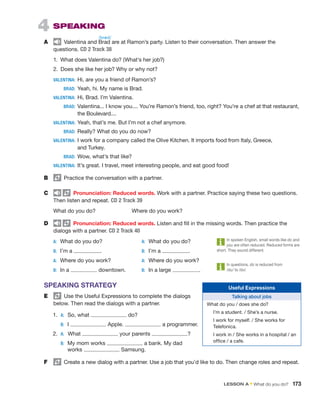
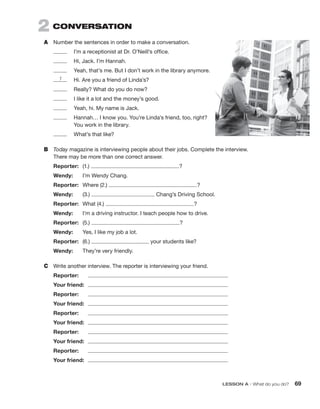
A	   Valentina and Brad are at Ramon’s party. Listen to their conversation. Then answer the
­questions. CD 2 Track 38
1.  What does Valentina do? (What’s her job?)
2.  Does she like her job? Why or why not?
VALENTINA:	 Hi, are you a friend of Ramon’s?
	BRAD:	
Yeah, hi. My name is Brad.
VALENTINA:	 Hi, Brad. I’m Valentina.
	BRAD:	

Valentina... I know you.... You’re Ramon’s friend, too, right? You’re a chef at that restaurant,
the Boulevard....
VALENTINA:	 
Yeah, that’s me. But I’m not a chef anymore.
	BRAD:	
Really? What do you do now?
VALENTINA:	 
I work for a company called the Olive Kitchen. It imports food from Italy, Greece,
and Turkey.
	BRAD:	
Wow, what’s that like?
VALENTINA:	 
It’s great. I travel, meet interesting people, and eat good food!
B	   Practice the conversation with a partner.
C	   Pronunciation: Reduced words. Work with a partner. Practice saying these two questions.
Then listen and ­
repeat. CD 2 Track 39
	 What do you do?		 Where do you work?
D	   Pronunciation: Reduced words. Listen and fill in the missing words. Then practice the
­
dialogs with a partner. CD 2 Track 40
A:	 What do you do?	 A:	 What do you do?
B:	 I’m a .	 B:	 I’m a .
A:	 Where do you work?	 A:	 Where do you work?
B:	 In a downtown.	 B:	 In a large .
SPEAKING STRATEGY
E	   Use the Useful Expressions to complete the dialogs
below. Then read the dialogs with a partner.
	1.	A:  So, what do?
		
B:  I Apple. a programmer.
	2.	A: What your parents ?
		
B: 
My mom works a bank. My dad
works Samsung.
F	   Create a new dialog with a partner. Use a job that you’d like to do. Then change roles and repeat.
Useful Expressions
Talking about jobs
What do you / does she do?
I’m a student. / She’s a nurse.
I work for myself. / She works for
Telefonica.
I work in / She works in a hospital / an
office / a cafe.
In spoken English, small words like do and
you are often reduced. Reduced forms are
short. They sound different.
In questions, do is reduced from
/du/ to /də/.
/bræd/
LESSON A • What do you do?  173
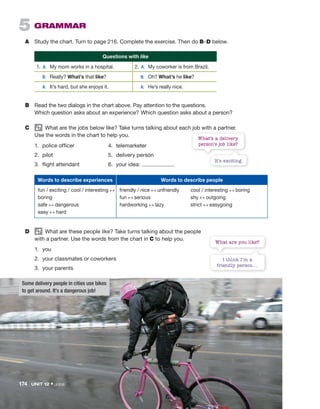
B Read the two dialogs in the chart above. Pay attention to the questions.
Which question asks about an experience? Which question asks about a person?
C What are the jobs below like? Take turns talking about each job with a partner.
Use the words in the chart to help you.
1. police officer
2. pilot
3. flight attendant
5 GRAMMAR
A Study the chart. Turn to page 216. Complete the exercise. Then do B–D below.
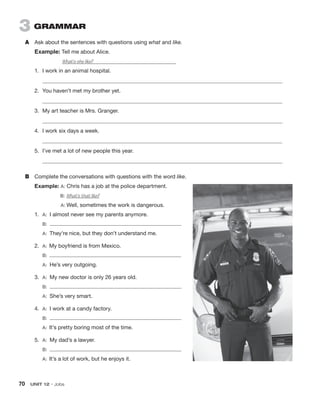
Questions with like
1. A: My mom works in a hospital. 2. A: My coworker is from Brazil.
B: Really? What’s that like? B: Oh? What’s he like?
A: It’s hard, but she enjoys it. A: He’s really nice.
I think I’m a
friendly person....
What are you like?
4. telemarketer
5. delivery person
6. your idea:
It’s exciting.
What’s a delivery
person’s job like?
Words to describe experiences Words to describe people
fun / exciting / cool / interesting ↔
boring
safe ↔ dangerous
easy ↔ hard
friendly / nice ↔ unfriendly
fun ↔ serious
hardworking ↔ lazy
cool / interesting ↔ boring
shy ↔ outgoing
strict ↔ easygoing
D What are these people like? Take turns talking about the people
with a partner. Use the words from the chart in C to help you.
1. you
2. your classmates or coworkers
3. your parents
Some delivery people in cities use bikes
to get around. It’s a dangerous job!
174 UNIT 12 • Jobs
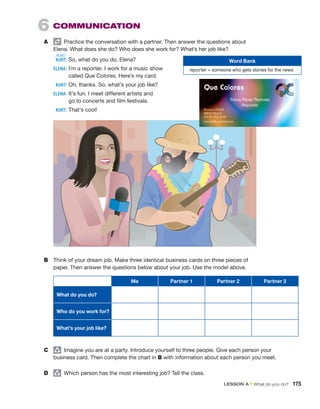
6  COMMUNICATION
A	   Practice the conversation with a partner. Then answer the questions about
Elena. What does she do? Who does she work for? What’s her job like?
	 KURT:	So, what do you do, Elena?
	 ELENA:	
I’m a reporter. I work for a music show
called Que Colores. Here’s my card.
	 KURT:	Oh, thanks. So, what’s your job like?
	 ELENA:	
It’s fun. I meet different artists and
go to concerts and film festivals.
	 KURT:	That’s cool!
B	 Think of your dream job. Make three identical business cards on three pieces of
paper. Then answer the questions below about your job. Use the model above.
Me Partner 1 Partner 2 Partner 3
What do you do?
Who do you work for?
What’s your job like?
C	 group
  Imagine you are at a party. Introduce yourself to three people. Give each person your
business card. Then complete the chart in B with information about each person you meet.
D	 group
  Which person has the most interesting job? Tell the class.
Word Bank
reporter = someone who gets stories for the news
/kɜrt/
LESSON A • What do you do?  175
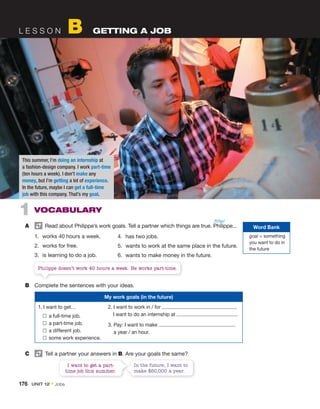
L E S S O N B GETTING A JOB
1 VOCABULARY
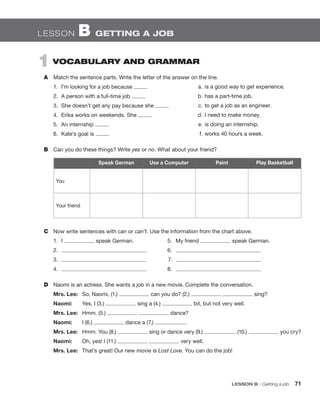
A Read about Philippe’s work goals. Tell a partner which things are true. Philippe...
1. works 40 hours a week.
2. works for free.
3. is learning to do a job.
4. has two jobs.
5. wants to work at the same place in the future.
6. wants to make money in the future.
My work goals (in the future)
1. I want to get…
a full-time job.
a part-time job.
a different job.
some work experience.
2. I want to work in / for .
I want to do an internship at .
3. Pay: I want to make
a year / an hour.
C Tell a partner your answers in B. Are your goals the same?
I want to get a part-
time job this summer.
In the future, I want to
make $60,000 a year.
Philippe doesn’t work 40 hours a week. He works part-time.
This summer, I’m doing an internship at
a fashion-design company. I work part-time
(ten hours a week). I don’t make any
money, but I’m getting a lot of experience.
In the future, maybe I can get a full-time
job with this company. That’s my goal.
B Complete the sentences with your ideas.
Word Bank
goal = something
you want to do in
the future
/fɪˈlip/
176 UNIT 12 • Jobs
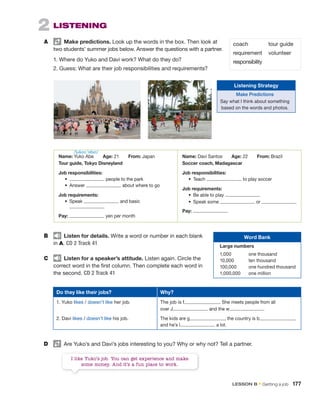
2 LISTENING
A Make predictions. Look up the words in the box. Then look at
two students’ summer jobs below. Answer the questions with a partner.
1. Where do Yuko and Davi work? What do they do?
2. Guess: What are their job responsibilities and requirements?
Name: Yuko Abe Age: 21 From: Japan
Tour guide, Tokyo Disneyland
Job responsibilities:
• people to the park
• Answer about where to go
Job requirements:
• Speak and basic
Pay: yen per month
Name: Davi Santos Age: 22 From: Brazil
Soccer coach, Madagascar
Job responsibilities:
• Teach to play soccer
Job requirements:
• Be able to play
• Speak some or
Pay:
B Listen for details. Write a word or number in each blank
in A. CD 2 Track 41
C Listen for a speaker’s attitude. Listen again. Circle the
correct word in the first column. Then complete each word in
the second. CD 2 Track 41
D Are Yuko’s and Davi’s jobs interesting to you? Why or why not? Tell a partner.
I like Yuko’s job. You can get experience and make
some money. And it’s a fun place to work.
coach
requirement
responsibility
tour guide
volunteer
Do they like their jobs? Why?
1. Yuko likes / doesn’t like her job.
2. Davi likes / doesn’t like his job.
The job is f . She meets people from all
over J and the w
The kids are g , the country is b ,
and he’s l a lot.
Word Bank
Large numbers
1,000 one thousand
10,000 ten thousand
100,000 one hundred thousand
1,000,000 one million
Listening Strategy
Make Predictions
Say what I think about something
based on the words and photos.
/ˈjukoʊ ˈɑbeɪ/
LESSON B • Getting a job 177
3  READING  CD 2 Track 42
A	   Make predictions. Look at the
title and photos on the next page.
Guess: What does Michelle Phan
do? Use ideas from the box.
B	 Read for details. Read the article.
Then complete the sentences with
the jobs (a–e) from A. Two answers
are extra.
1.	 In college, Michelle Phan was
a(n) .
2.	 Today, she’s a(n) .
C	   Scan for information. Ask
and answer the questions with a
partner. Find the answers quickly
in the reading.
1.	 What do Michelle Phan’s videos
teach people?
2. 	How many people watch her
videos?
3.	 Why is she popular?
4.	 How much money does she
make a year?
5.	 In the future, what is her goal?
D	   Answer the questions with a
partner.
1.	 Name another entrepreneur.
What does he or she do?
2.	 Do you have a hobby? Can you
make money doing it? How?
a. 
department store cashier
b. waitress
c. model
d. businessperson
e. makeup artist
INTERNET
ENTREPRENEUR
MICHELLE
PHAN
An entrepreneur is a businessperson. Usually, he or she
starts a new company.
Reading Strategy
Scan
Read quickly to find specific
information.
/mɪˈʃɛl ˈfæn/
178  UNIT 12 • Jobs
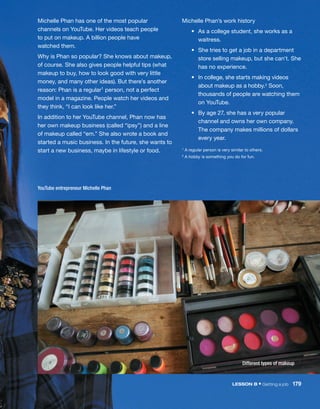
YouTube entrepreneur Michelle Phan
Michelle Phan’s work history
	 •	
As a college student, she works as a
waitress.
	 •	
She tries to get a job in a department
store selling makeup, but she can’t. She
has no experience.
	 •	
In college, she starts making videos
about makeup as a hobby.2 Soon,
thousands of people are watching them
on YouTube.
	 •	
By age 27, she has a very popular
channel and owns her own company.
The company makes millions of dollars
every year.
1 A regular person is very similar to others.
2 A hobby is something you do for fun.
Michelle Phan has one of the most popular
channels on YouTube. Her videos teach people
to put on makeup. A billion people have
watched them.
Why is Phan so popular? She knows about makeup,
of course. She also gives people helpful tips (what
makeup to buy, how to look good with very little
money, and many other ideas). But there’s another
reason: Phan is a regular1 person, not a perfect
model in a magazine. People watch her videos and
they think, “I can look like her.”
In addition to her YouTube channel, Phan now has
her own makeup business (called “ipsy”) and a line
of makeup called “em.” She also wrote a book and
started a music business. In the future, she wants to
start a new business, maybe in lifestyle or food.
Different types of makeup
LESSON B • Getting a job  179
4 GRAMMAR
A Study the chart. Turn to page 217. Complete the exercises. Then do B–E below.
Talking about Ability with can / can’t
Yes / No questions Can you speak French? Yes, I can. / No, I can’t.
Wh- questions
Which languages can Carla speak? (She can speak) Spanish and English.
Who can speak Japanese? Toshi (can).
Can you work in
Bali this summer?
Yes, I can.
When can you
start?
In June.
D Think of a job and make a new ad with your partner. Then write four
or five interview questions with can.
E group
Get together with another pair.
1. Show them your job ad and questions. Read theirs.
2. Use your questions and interview one person from the other pair for your job.
Your partner does the same. Take notes on the person’s answers.
3. Compare notes with your partner. Which person is best for your job? Why?
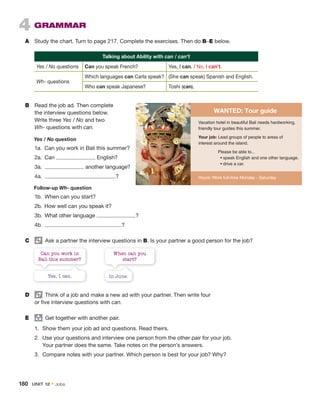
B Read the job ad. Then complete
the interview questions below.
Write three Yes / No and two
Wh- questions with can.
Hours: Work full-time Monday - Saturday
Vacation hotel in beautiful Bali needs hardworking,
friendly tour guides this summer.
Your job: Lead groups of people to areas of
interest around the island.
Please be able to...
• speak English and one other language.
• drive a car.
WANTED: Tour guide
Yes / No question
1a. Can you work in Bali this summer?
2a. Can English?
3a. another language?
4a. ?
Follow-up Wh- question
1b. When can you start?
2b. How well can you speak it?
3b. What other language ?
4b. ?
C Ask a partner the interview questions in B. Is your partner a good person for the job?
180 UNIT 12 • Jobs
5 WRITING
A Read the paragraph. Answer the questions with a partner.
1. What can he do well?
2. What are his goals? What does he want to be?
B Write about your work goals. Answer the questions
in A about yourself. Exchange papers with a partner.
Answer the questions in A about your partner. Correct
any mistakes.
6 COMMUNICATION
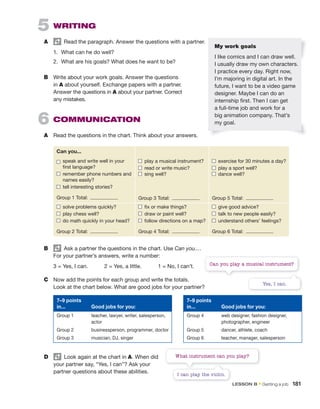
A Read the questions in the chart. Think about your answers.
Yes, I can.
I can play the violin.
C Now add the points for each group and write the totals.
Look at the chart below. What are good jobs for your partner?
7–9 points
in... Good jobs for you:
Group 1 teacher, lawyer, writer, salesperson,
actor
Group 2 businessperson, programmer, doctor
Group 3 musician, DJ, singer
7–9 points
in... Good jobs for you:
Group 4 web designer, fashion designer,
photographer, engineer
Group 5 dancer, athlete, coach
Group 6 teacher, manager, salesperson
D Look again at the chart in A. When did
your partner say, “Yes, I can”? Ask your
partner questions about these abilities.
Can you...
speak and write well in your
first language?
remember phone numbers and
names easily?
tell interesting stories?
Group 1 Total:
play a musical instrument?
read or write music?
sing well?
Group 3 Total:
exercise for 30 minutes a day?
play a sport well?
dance well?
Group 5 Total:
solve problems quickly?
play chess well?
do math quickly in your head?
Group 2 Total:
fix or make things?
draw or paint well?
follow directions on a map?
Group 4 Total:
give good advice?
talk to new people easily?
understand others’ feelings?
Group 6 Total:
B Ask a partner the questions in the chart. Use Can you....
For your partner’s answers, write a number:
3 = Yes, I can. 2 = Yes, a little. 1 = No, I can’t. Can you play a musical instrument?
What instrument can you play?
My work goals
I like comics and I can draw well.
I usually draw my own characters.
I practice every day. Right now,
I’m majoring in digital art. In the
future, I want to be a video game
designer. Maybe I can do an
internship first. Then I can get
a full-time job and work for a
big animation company. That’s
my goal.
LESSON B • Getting a job 181
1  STORYBOARD
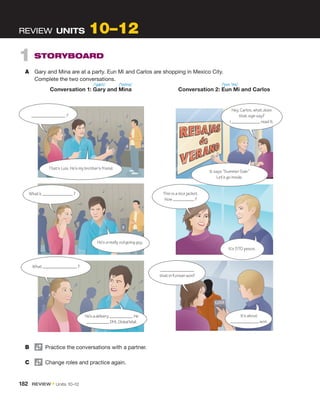
A	 Gary and Mina are at a party. Eun Mi and Carlos are shopping in Mexico City.
Complete the two conversations.
REVIEW  UNITS 10–12
B	   Practice the conversations with a partner.
C	   Change roles and practice again.
?
That’s Luis. He’s my brother’s friend.
What’s ?
He’s a really outgoing guy.
What ?
He’sadelivery .He
DHLGlobalMail.
Hey, Carlos, what does
that sign say?
I read it.
It says “Summer Sale.”
Let’s go inside.
This is a nice jacket.
How ?
It’s 570 pesos.
that in Korean won?
It’s about
won.
	 Conversation 1: Gary and Mina	 Conversation 2: Eun Mi and Carlos
/ˈjʊn ˈmi/
/ˈgæri/ /ˈminə/
182  REVIEW • Units  10–12
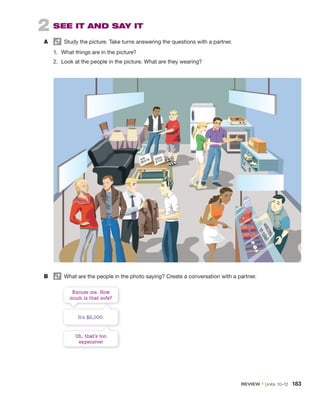
2 SEE IT AND SAY IT
A Study the picture. Take turns answering the questions with a partner.
1. What things are in the picture?
2. Look at the people in the picture. What are they wearing?
Oh, that’s too
expensive!
It’s $2,000.
Excuse me. How
much is that sofa?
B What are the people in the photo saying? Create a conversation with a partner.
REVIEW • Units 10–12 183
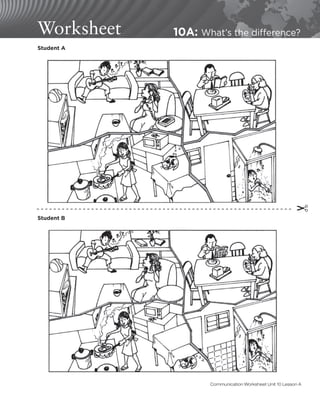
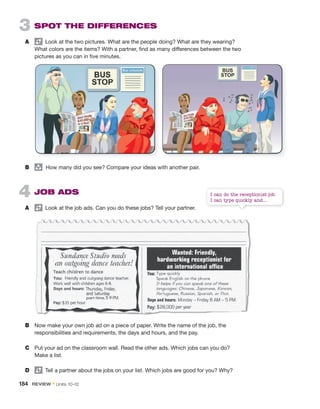
3 SPOT THE DIFFERENCES
A Look at the two pictures. What are the people doing? What are they wearing?
What colors are the items? With a partner, find as many differences between the two
pictures as you can in five minutes.
4 JOB ADS
A Look at the job ads. Can you do these jobs? Tell your partner.
I can do the receptionist job.
I can type quickly and...
B Now make your own job ad on a piece of paper. Write the name of the job, the
responsibilities and requirements, the days and hours, and the pay.
C Put your ad on the classroom wall. Read the other ads. Which jobs can you do?
Make a list.
D Tell a partner about the jobs on your list. Which jobs are good for you? Why?
B group
How many did you see? Compare your ideas with another pair.
184 REVIEW • Units 10–12
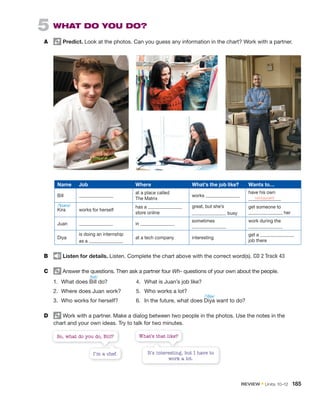
5 WHAT DO YOU DO?
A Predict. Look at the photos. Can you guess any information in the chart? Work with a partner.
Name Job Where What’s the job like? Wants to…
Bill
at a place called
The Matrix
works
have his own
restaurant
Kira works for herself
has a
store online
great, but she’s
busy
get someone to
her
Juan in
sometimes work during the
Diya
is doing an internship
as a
at a tech company interesting
get a
job there
B Listen for details. Listen. Complete the chart above with the correct word(s). CD 2 Track 43
C Answer the questions. Then ask a partner four Wh- questions of your own about the people.
1. What does Bill do? 4. What is Juan’s job like?
2. Where does Juan work? 5. Who works a lot?
3. Who works for herself? 6. In the future, what does Diya want to do?
D Work with a partner. Make a dialog between two people in the photos. Use the notes in the
chart and your own ideas. Try to talk for two minutes.
So, what do you do, Bill? What’s that like?
I’m a chef. It’s interesting, but I have to
work a lot.
/ˈkɪərə/
/bɪl/
/ˈdijə/
REVIEW • Units 10–12 185
2  QUESTION FORMULATION
A	   Make questions with the words in the box. Work with a partner. Ask and answer the questions.
Give answers that are true for you.
bedroom / apartment	 closets / house	 color / bedroom
favorite color / your	 furniture / living room	 TV / your
1.	 How many ?
2.	Where ?
3.	What ?
4.	 How many ?
5.	What ?
6.	What ?
3  SPEAKING 
A	   Mrs. Cruz wants to buy some things for her family’s new apartment. Her friend, Paula, is selling
some things. She is talking on the telephone with Paula. Practice the conversation with a partner.
Then switch roles.
	
MRS. CRUZ:	I need a microwave.
	 PAULA:	
My microwave is only $40. Do you need a refrigerator?
	
MRS. CRUZ:	
No, but I need things for the living room.
	 PAULA:	
I have some comfortable chairs.
	
MRS. CRUZ:	What color are they?
	 PAULA:	They’re red and blue.
B	   Now replace the items in the conversation with words from the box. Practice the new
conversation with a partner. Then switch roles.
air conditioner bed bookcase sofa table TV
4  WRITING
A	 Write a short paragraph in your notebook. Describe a room in your apartment. Use the words in the box.
above   in front of   near   next to   to the left / right
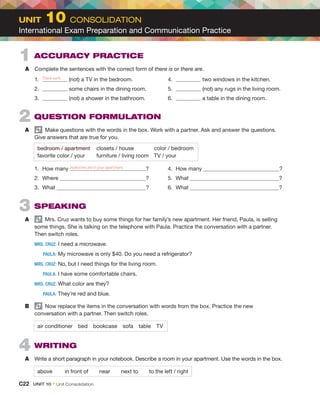
1  ACCURACY PRACTICE
A	 Complete the sentences with the correct form of there is or there are.
1.	 (not) a TV in the bedroom.
2.	 some chairs in the dining room.
3.	 (not) a shower in the bathroom.
4.	 two windows in the kitchen.
5.	 (not) any rugs in the living room.
6.	 a table in the dining room.
bedrooms are in your apartment
There isn’t
C22  UNIT 10 • Unit Consolidation
UNIT  10 CONSOLIDATION
International Exam Preparation and Communication Practice
5  EXAM PREPARATION: LISTENING
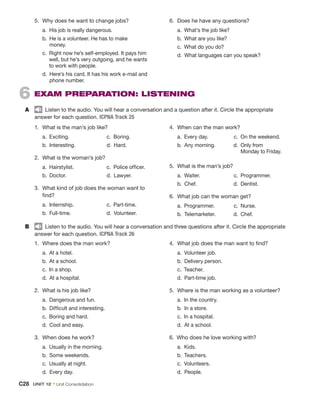
A	   Listen to the audio. You will hear a conversation and a question after it. Circle the appropriate
answer for each question. ICPNA Track 23
1.	 How big is Pablo’s apartment?
	a.  It has four rooms.
	b.  It has two rooms.
	c.  It has three rooms and a terrace.
	d.  It has six rooms.
2.	 Who is good for this apartment?
	a.  A family with a dog.
	b.  An older married couple (grandparents).
	c.  One young woman.
	d.  Two young men.
3.	 How does Lisa feel about her apartment?
	a.  She doesn’t like it.
	b.  She likes it.
	c. An air conditioner.
	d. A garage.
4.  Why doesn’t the man like the sofa?
	a. 
It’s too small.
	b. 
It’s ugly.
	c. 
It’s really big.
	d. 
It isn’t comfortable.
5.  Who has free wifi in their apartment?
	a. 
The woman
	b. 
The man.
	c. 
The man and the woman.
	d. 
Nobody.
6.  Why does the woman like her living room?
	a. 
It has a balcony.
	b. 
It has a lot of light.
	c. 
It has a big TV.
	d. 
It has two closets.
B	   Listen to the audio. You will hear a conversation and three questions after it. Circle the
appropriate answer for each question. ICPNA Track 24
1.	 What color is the living room now?
	a. 
Green.
	b. 
Orange.
	c. 
Blue.
	d. 
White.
2.	 Why does the woman want to paint the
living room?
	a. 
The color now is boring.
	b. 
The color now is relaxing.
	c. 
The color now is too strong.
	d. 
The color now is pretty.
3.	 What color are they going to try?
	a. 
Blue.
	b. 
Purple.
	c. 
Orange.
	d. 
Green.
4.	 What is the man looking for?
	a. 
A new house.
	b. 
A new sofa.
	c. 
A new apartment.
	d. 
A washing machine.
5.	 How big is the apartment in the woman’s
building?
	a. 
It has two bedrooms and one bathroom.
	b. 
It has one bedroom and one bathroom.
	c. 
It has two bedrooms and two bathrooms.
	 d. 
It has three bedrooms and two
bathrooms.
6.	 Does the man want to look at the
apartment?
	a. 
Yes, he does.
	b. 
No, he doesn’t.
	c. 
He doesn’t know.
	d. 
Maybe he does.
UNIT 10 • Unit Consolidation  C23
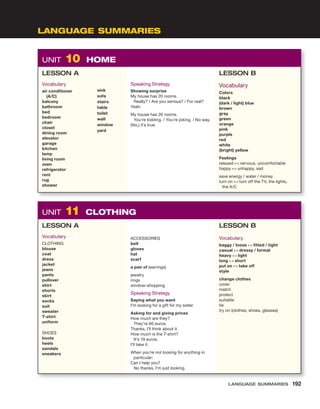
1  ACCURACY PRACTICE
A	 Circle the correct word or words to complete the sentences.
1.	I want / want to this sweater. It’s pretty.
2.	Berta has / has to buy some new shoes.
3.	We want / want to get those cool jeans.
4.	You don’t have / don’t have to buy a warm coat. You have one already.
5.	Santiago has / has to wear a uniform to work.
2  QUESTION FORMULATION
A	 Make questions with the words in the box.
are / those sneakers	   buy / cool clothes  have / in your closet
need / pairs of glasses   wear / work
1.	What do you wear to work ?
2.	 How many ?
3.	Where ?
4.	What ?
5.	 How much ?
B	   Work with a partner. Ask and answer the questions. Give answers that are true for you.
1.	 What do you wear on the weekend?
2.	 Where do you buy your clothes?
3.	 What kind of sneakers do you wear?
4.	 How many pairs of shoes do you have?
5.	 What do you wear to work?
3  SPEAKING
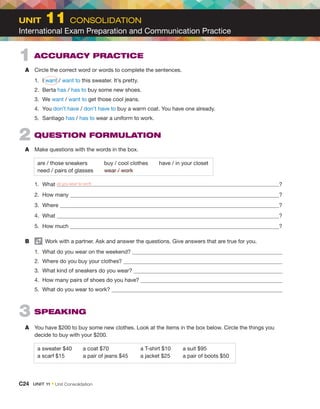
A	 You have $200 to buy some new clothes. Look at the items in the box below. Circle the things you
decide to buy with your $200.
a sweater $40   a coat $70	 a T-shirt $10	 a suit $95
a scarf $15	 a pair of jeans $45	 a jacket $25	 a pair of boots $50
UNIT  11 CONSOLIDATION
International Exam Preparation and Communication Practice
C24  UNIT 11 • Unit Consolidation
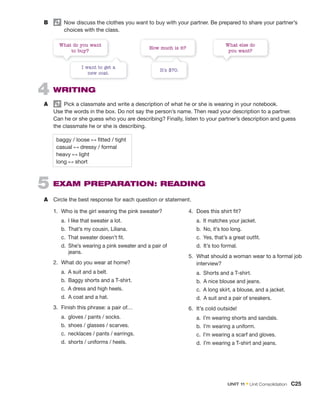
B Now discuss the clothes you want to buy with your partner. Be prepared to share your partner’s
choices with the class.
4 WRITING
A Pick a classmate and write a description of what he or she is wearing in your notebook.
Use the words in the box. Do not say the person’s name. Then read your description to a partner.
Can he or she guess who you are describing? Finally, listen to your partner’s description and guess
the classmate he or she is describing.
baggy / loose fitted / tight
casual dressy / formal
heavy light
long short
5 EXAM PREPARATION: READING
A Circle the best response for each question or statement.
I want to get a
new coat.
It’s $70.
What do you want
to buy?
How much is it?
What else do
you want?
1. Who is the girl wearing the pink sweater?
a. I like that sweater a lot.
b. That’s my cousin, Liliana.
c. That sweater doesn’t fit.
d. She’s wearing a pink sweater and a pair of
jeans.
2. What do you wear at home?
a. A suit and a belt.
b. Baggy shorts and a T-shirt.
c. A dress and high heels.
d. A coat and a hat.
3. Finish this phrase: a pair of…
a. gloves / pants / socks.
b. shoes / glasses / scarves.
c. necklaces / pants / earrings.
d. shorts / uniforms / heels.
4. Does this shirt fit?
a. It matches your jacket.
b. No, it’s too long.
c. Yes, that’s a great outfit.
d. It’s too formal.
5. What should a woman wear to a formal job
interview?
a. Shorts and a T-shirt.
b. A nice blouse and jeans.
c. A long skirt, a blouse, and a jacket.
d. A suit and a pair of sneakers.
6. It’s cold outside!
a. I’m wearing shorts and sandals.
b. I’m wearing a uniform.
c. I’m wearing a scarf and gloves.
d. I’m wearing a T-shirt and jeans.
UNIT 11 • Unit Consolidation C25
1 ACCURACY PRACTICE
A Unscramble the sentences. Remember to capitalize the first word.
1. can / work / week / begin / you / next .
2. remember / names / I / well / can’t .
3. to / talk / Juan / other / can / people / easily .
4. we / stories / can / interesting / tell .
5. can’t / Chinese / she / any / speak .
2 QUESTION FORMULATION
A Make questions with the words in the box. Work with a partner. Ask and answer the questions.
follow / directions play / instrument speak / language
start / job tell / interesting stories
1. When can you start the job ?
2. Which ?
3. How well ?
4. Who ?
5. What ?
3 SPEAKING
A Look at the job advertisement below. What do you think about this job? Do you meet the job
requirements? Discuss with a partner.
GENERAL HOSPITAL
Office Assistant needed
Responsibilities:
• Answer phones
• Greet people
Pay: $900 a month
Job Requirements:
• Must be organized
• High school graduate
• Know how to use computers
• Previous office experience
You can begin work next week
Good! I love to talk
on the phone!
You have to answer
the telephone.
UNIT 12 CONSOLIDATION
International Exam Preparation and Communication Practice
C26 UNIT 12 • Unit Consolidation
4  Writing
A	 Write a short paragraph about your work goals in your notebook. Answer these questions:
•	 What can you do? (Write two or three things.)
•	 What are your goals?
•	 What do you want to do?
Dear Ms. Jordan,
I would like to apply for a job as a tour guide at Inca Tours. I have a Bachelor’s Degree
in Spanish from the University of Miami and I am self-employed as a translator for travel
magazines. I am bilingual in Spanish and English. I also have three years of experience
as a flight attendant for United Airlines.
I am outgoing and hardworking, and I love meeting new people. I think I am the perfect
person for your company.
Sincerely,
Julio Varela
From: Julio Varela
To: Mary Jordan, Inca Tours
Subject: Job Application
5  
Exam Preparation: Reading
A	 Read the email. Circle the best answer for each question.
1.	 Does Julio meet the job requirements?
	 a.  Yes, he wants to live in Peru.
	 b.  Yes, he loves working with people.
	 c.  No.  He can’t speak Quechua.
	d. 

Yes—He’s bilingual, he has a college
degree, and he has experience in the
travel industry.
2.	 What is Julio’s job now?
	 a.  He’s a flight attendant.
	 b.  He’s a translator.
	 c.  He’s a tour guide.
	 d.  He’s a pilot.
3.	 What languages can Julio speak?
	 a.  English and Spanish.
	 b.  Spanish and Quechua.
	 c.  Spanish and Chinese.
	 d.  English and Portuguese.
4.	 What is Julio like as a person?
	 a.  He’s really cool and fun.
	 b.  He’s hard-working and outgoing.
	 c.  He’s very handsome. He’s 28 years old.
	 d.  He’s interesting.
Unit 12 • Unit Consolidation  C27
1.	 Where does the man work?
	 a.  At a hotel.
	 b.  At a school.
	 c.  In a shop.
	d. 
At a hospital.
2.	 What is his job like?
	 a.  Dangerous and fun.
	b. 

Difficult and interesting.
	 c.  Boring and hard.
	 d.  Cool and easy.
3.	 When does he work?
	 a.  Usually in the morning.
	 b.  Some weekends.
	 c.  Usually at night.
	 d.  Every day.
4.	 What job does the man want to find?
	 a.  Volunteer job.
	 b.  Delivery person.
	 c. Teacher.
	 d.  Part-time job.
5.	 Where is the man working as a volunteer?
	 a.  In the country.
	 b.  In a store.
	 c.  In a hospital.
	 d.  At a school.
6.  Who does he love working with?
	 a. Kids.
	 b. Teachers.
	 c. Volunteers.
	 d. People.
B	   Listen to the audio. You will hear a conversation and three questions after it. Circle the appropriate
answer for each question. ICPNA Track 26
6  
Exam Preparation: Listening
A	   Listen to the audio. You will hear a conversation and a question after it. Circle the appropriate
answer for each question. ICPNA Track 25
1.	 What is the man’s job like?
	a. 
Exciting.
	 b. Interesting.
	 c. Boring.
	 d. Hard.
2.	 What is the woman’s job?
	 a. Hairstylist.
	 b. Doctor.
	 c.  Police officer.
	 d. Lawyer.
3.	 What kind of job does the woman want to
find?
	 a. Internship.
	 b. Full-time.
	 c. Part-time.
	 d. Volunteer.
4.	 When can the man work?
	 a.  Every day.
	 b.  Any morning.
c. 
On the weekend.
	 d. Only from
Monday to Friday.
5.	 What is the man’s job?
	a. 
Waiter.
	 b. Chef.
c. Programmer.
	 d. Dentist.
6.	 What job can the woman get?
	 a. Programmer.
	 b. Telemarketer.
c. Nurse.
	 d. Chef.
5.	 Why does he want to change jobs?
	 a.  His job is really dangerous.
	 b. 
He is a volunteer. He has to make
money.
	 c. 
Right now he’s self-employed. It pays him
well, but he’s very outgoing, and he wants
to work with people.
	 d. 
Here’s his card. It has his work e-mail and
phone number.
6.	 Does he have any questions?
	 a.  What’s the job like?
	 b.  What are you like?
	 c.  What do you do?
	 d.  What languages can you speak?
C28  Unit 12 • Unit Consolidation
A	 Write answers using the information in parentheses. Write complete sentences.
1.	 Is there a yard at your house?
	 (no) No, there isn’t.
2.	 How many bathrooms are there in your
house?
	 (two)
3.	 Are there any lamps in the dining room?
	 (yes)
4.	 How many sofas are in the living room?
	 (one)
5.	 Is there a rug on the floor?
	 (yes)
6.	 Are there many bedrooms upstairs?
	 (no)
B	 Complete the sentences with too or very. Sometimes both options are possible.
1.	 We’re too tired to paint the
walls now.
2.	 The dark blue sofa is
uncomfortable.
3.	 I have a big home office.
4.	 I’m angry to call him!
5.	 There are many stairs to
climb.
6.	 It’s difficult to choose the
right color!
C	 Now write a short paragraph (4–5 sentences) about your home. Describe the rooms, the things in
them, and the colors using there is / are and too / very.
D	 Circle the correct word or words to complete the sentences.
1.	 I want / want to wear this blue sweater.
2.	 We have / have to the same brown belt!
3.	 I have / have to buy a new suit.
4.	 She wants / wants to change her dress.
5.	 Kelly has / has to a cool pair of sneakers.
6.	 Boris wants / wants to a scarf for
Christmas.
E	 Correct one error in each sentence. If there is no error, write correct.
1.	 I have a new luggage at home.	
I have new luggage at home.
2.	 She’s buying five jewelry.	
3.	 Your jeans are too baggy.	
4.	 He wants to put on a sandals.	
5.	 We can buy two more clothes. 	
6.	 These shoes are very dressy.	
PROCESS WRITING
Process Writing •  P7
Count and Noncount Nouns
Don’t place a number in front of noncount
nouns:
•	 a lot of clothing
•	 some furniture
•	 a little information
Place a number in front of count
nouns:
•	 two skirts
•	 four T-shirts
•	 nine belts
F	 Write three sentences that are true for you. Describe what you are wearing today. What do you wear
every day? What do you want to buy next?
G	 Match the answers to the interview questions.
a. I make $23 an hour.  b. I work 15 hours a week.  c. I’m doing an internship.
d. It’s hard sometimes, but it’s interesting.  e. I want to get work experience in marketing.
f. Yes, I can.  g. I work part time at a marketing company.
1.	 What are you doing right now? c
2.	 Where do you work?
3.	 What’s that like?
4.	 How many hours do you work?
5.	 How much do you make?
6.	 What’s your goal?
7.	 Can you drive a car?
H	 Answer the questions above with your own information.
I	 Write a short paragraph about what you are doing right now, and what you hope to do in the future.
Use the information in H.
P8  • Process Writing
UNIT 10 HOME
LESSON A
Vocabulary
air conditioner
(A/C)
balcony
bathroom
bed
bedroom
chair
closet
dining room
elevator
garage
kitchen
lamp
living room
oven
refrigerator
rent
rug
shower
Speaking Strategy
Showing surprise
My house has 20 rooms.
Really? / Are you serious? / For real?
Yeah.
My house has 20 rooms.
You’re kidding. / You’re joking. / No way.
(No,) it’s true.
LESSON B
Vocabulary
Colors
black
(dark / light) blue
brown
gray
green
orange
pink
purple
red
white
(bright) yellow
Feelings
relaxed ↔ nervous, uncomfortable
happy ↔ unhappy, sad
save energy / water / money
turn on ↔ turn off the TV, the lights,
the A/C
sink
sofa
stairs
table
toilet
wall
window
yard
LANGUAGE SUMMARIES
UNIT 11 CLOTHING
LESSON A
Vocabulary
CLOTHING
blouse
coat
dress
jacket
jeans
pants
pullover
shirt
shorts
skirt
socks
suit
sweater
T-shirt
uniform
SHOES
boots
heels
sandals
sneakers
ACCESSORIES
belt
gloves
hat
scarf
a pair of (earrings)
jewelry
rings
window-shopping
Speaking Strategy
Saying what you want
I’m looking for a gift for my sister.
Asking for and giving prices
How much are they?
They’re 60 euros.
Thanks, I’ll think about it.
How much is the T-shirt?
It’s 19 euros.
I’ll take it.
When you’re not looking for anything in
particular:
Can I help you?
No thanks, I’m just looking.
LESSON B
Vocabulary
baggy / loose ↔ fitted / tight
casual ↔ dressy / formal
heavy ↔ light
long ↔ short
put on ↔ take off
style
change clothes
cover
match
protect
suitable
tie
try on (clothes, shoes, glasses)
LANGUAGE SUMMARIES 192
UNIT 12 JOBS
LESSON A
Vocabulary
businessperson
cashier
chef
delivery person
doctor
flight attendant
hairstylist
lawyer
nurse
police officer
programmer
receptionist
reporter
telemarketer
tutor
waiter / waitress
web designer
business card
Speaking Strategy
Talking about jobs
What do you do?
What does he / she do?
I’m a student / programmer /
doctor.
He’s a waiter. / She’s a nurse.
I work for Telefonica / Bank
of China / DHL Global Mail /
myself.
She works in a hospital / an
office / a cafe.
LESSON B
Vocabulary
do an internship
(have, get) experience
(have a) full-time ↔ part-time
job
(work) full time ↔ part time
get a job
goal
make money
pay
Using large numbers / Talking
about pay
I want to make… (dollars) a
(year).
1,000 one thousand
2,000 two thousand
10,000 ten thousand
50,000 fifty thousand
100,000 one hundred
thousand
150,000 one hundred
fifty thousand
500,000 five hundred
thousand /
half a million
1,000,000 one million
1,000,000,000 one billion
193 LANGUAGE SUMMARIES
UNIT 10	HOME
LESSON A
There is / There are
There is / isn’t Singular noun
There is (There’s)
a / an
one
chair / air conditioner
closet
in my bedroom.
There is
There isn’t
no
a / an
balcony
garage / elevator
in my building.
There are / aren’t Plural noun
There are — / four / some / many
elevators in that building.
There are
There aren’t
no
any
Use there is / there are to say that something does or doesn’t exist, or to say its location.
there’s is the contracted form of there is. There are does not have a contracted form.
Questions Short answers
Is there an elevator in your building?
Are there (any) windows in your living room?
Yes, there is. / No, there isn’t.
Yes, there are. / No, there aren’t (any).
How many windows are (there) in your bedroom? There’s one. / There are two. / There aren’t any.
A	 Read about the Winchester Mystery House. Complete the ­
sentences with there’s,
there isn’t, there are, or there aren’t.
(1.) a big, strange house in California: the Winchester Mystery
House. (2.) about 160 rooms in the house, including 40 bedrooms,
and (3.) three elevators. (4.) stairs and doors that go
­nowhere. (5.) a ­
special room in the house. (6.) only
one door that goes into the room, but (7.) three doors that exit it.
(8.) a beautiful garden and a large bell. Many tourists visit the house.
(9.) tours during the day, but (10.) any tours at night.
(11.) an easy way to get out—so be careful! Don’t get lost!
GRAMMAR NOTES
Grammar Notes  212
B	   Complete the questions about the Winchester Mystery House. Then ask and
answer them with a partner.
1.	 rooms are there in the house?
2.	 any elevators?
3.	 bedrooms are there?
4.	 a garden?
5.	 bells are there?
6.	 tours at night?
LESSON B
very / too
  Verb a / an very / too Adjective / Adverb Noun to + Verb
å This room is   very / too dark.    
ç He talks too
fast. I don’t
understand.
   
é I am too tired   to watch TV.
è They have a very big house.  
å Very and too make adjectives and adverbs stronger.
ç Use too when something is more than you need or want and there is a negative result.
FHe talks too fast. I can’t understand him. / This room is too dark, and I can’t see.
é Use too with this pattern (too + verb).
FI’m too tired to watch TV. I’m going to bed.
è Use very to modify an adjective + noun: They have a very big house.
Don’t use too: They have a too big house.
213  Grammar Notes
A	 Complete the sentences with very or too.
1.	It’s noisy in here. I can’t hear you. Let’s go outside.
2.	 This is a beautiful color. Let’s use it in the dining room.
3.	 These chairs are old, but we can still use them.
4.	 This dorm room is small for four people. Four students can’t live in here.
5.	 My neighbor is a nice person. I like him a lot.
6.	We’re late for the movie. It started at 7:00, and now it’s 8:20. It’s
almost over.
7.	 He lives in a large apartment; it’s almost 400 square meters!
8.	I’m tired to walk to the fifth floor. I’m taking the elevator.
9.	 The rent here is $1,000 a month. That’s expensive for me. I can only pay $800.
10.	 These apartments are expensive, but a lot of people buy them.
B	 Complete the sentences with very or too and your ideas. Then explain your answers
to a partner.
1.	 My bedroom is .
2.	I’m old to .
3.	I’m young to .
4.	 English is .
5.	 Right now, it’s early to .
	Unit 11	 Clothing
Lesson A
want to / have to
Subject want / want to Base form Noun Second sentence
I
want
these
boots.
They’re cool.
These sentences
have almost the same
meaning. Only the form
is different.
want to buy
Subject have / have to Base form Noun Second sentence
I
have
a coat.
It’s in the closet. Use have + noun to
show possession.
Use have to to
say something is
necessary.
have to buy I don’t have one.
Grammar Notes  214
A	 Complete the sentences with to. If to isn’t needed, don’t write anything.
1.	 I have a test tomorrow. I have study tonight.
2.	 Does Aya want a new jacket for her birthday?
3.	 Diego doesn’t have wear a suit on Fridays. He can wear jeans.
4.	 Cleo wants buy a new dress for the party.
5.	 I don’t have money for the bus. Do you?
6.	 Martin has class at 9:00 AM. He has leave home
by 8:00.
7.	 Do you want see a movie tonight?
8.	 My parents want visit China this summer. Do they have
get a visa?
B	 Make the sentences true for you. Complete each one with (don’t) want to or
(don’t) have to. Share your answers with a partner.
1.	I study English.
2.	I wear jeans on the weekend.
3.	I stay at school every day until 3 PM.
4.	I wear a uniform to school.
5.	I buy some new clothes.
LESSON B
Count Nouns Noncount Nouns
This shirt is / These shirts
are expensive.
This clothing is expensive.
Count nouns can be singular or plural. Noncount
nouns are always singular.
This ring is a dollar / two
dollars.
I want to save money.
(Not: a money)
Only count nouns can have a, an, or a number in front
of them.
I need (some) new winter
boots.
I need (some) luggage
for my trip.
Both count and noncount nouns can use some.
I have a pair of
sunglasses.
He has ten pairs of shoes
in his closet.
a piece of / two pieces of
jewelry
a cup of / two cups of coffee
a glass of / two glasses of
water
You can use a pair of to count items that are always
plural (pants, glasses, pajamas, headphones) and
items that come in twos (shoes, gloves, earrings).
You can also make some noncount nouns countable
by adding words like a piece of, a cup of, a glass of.
Some common noncount nouns:
•	 Collective items: clothing, jewelry, money, luggage, furniture
•	 Certain food and drink items: bread, rice, fruit, meat, water, coffee, tea, milk
•	 Abstract ideas: life, time, love, information, evidence
215  Grammar Notes
I have to get some snacks for the plane.
A Complete the dialogs with a(n) or nothing. Then practice with a partner.
1. A: Your dad wears jewelry, right?
B: Yes. He wears wedding ring.
2. A: I need new pair of gloves. Let’s go shopping.
B: I can’t. I have homework.
3. A: Can I have money for the bus?
B: Sure. Here’s dollar.
4. A: I need information about fashion design classes.
B: There’s link on the school website. Check it out.
5. A: I’m bringing luggage on the plane. Are you?
B: Yeah, I have small bag.
B Imagine you are going to Lima for a week. Make a list of clothes and other items you need. Finish
the sentences with count or noncount nouns. Then compare your ideas with a partner.
1. I need some for my trip.
2. I also have to get and some .
3. And finally, I need a(n) , two , and
a pair of .
UNIT 12 JOBS
LESSON A
Questions with like
A: My mom works in a hospital.
B: Really? What’s that like?
A: It’s hard, but she enjoys it.
You can use like to ask questions about an
experience. In this question, that = working in a
hospital.
A: My coworker is from Brazil.
B: Oh? What’s he like?
A: He’s really nice / friendly / outgoing /
smart.
You can also use like to ask questions about a
person and his or her personality.
What’s (he) like?
What are (they) like?
A Complete the dialogs with the correct questions.
1. A: Ms. Collins is my math teacher this term.
B: Oh?
A: She’s really nice.
Grammar Notes 216
2.	 A:	 I’m a student at Stanford University.
	 B:	Really?
	 A:	 It’s a great school. I love it.
3.	 A:	 My brother works in an office.
	 B:	
	 A:	 Sometimes it’s boring, but he likes it.
4.	 A:	 My tutor is from London.
	 B:	Really?
	 A:	 He’s very friendly.
LESSON B
Talking about Ability with can / can’t
I / You / He / She / We / They can / can’t speak French.
Can and can’t are followed by the base form of the verb.
Can’t is the short form of cannot. In spoken English, can’t is more common.
Questions with can / can’t
Yes / No questions Can you speak Spanish? Yes, I can. / No, I can’t.
Wh- questions
Which languages can Carla speak? (She can speak) Spanish and English.
Who can speak Japanese? Toshi (can).
A	 Complete the dialogs with a question or answer with can or can’t.
1.	 A:	 Can Mario drive?
	 B:	No, . He’s only 14.
2.	 A:	 ?
	 B:	 Yes, I can. I’m a good driver.
3.	 A:	 ?
	 B:	 No, Jun’s parents can’t speak English.
4.	 A:	 ?
	 B:	 Yes, Linda can swim, but her sister .
217  Grammar Notes
B	 Make questions and answers about Adam and Sonya using can and the words given.
1.	 Who / speak Chinese? 
	 Adam can speak Chinese.
2.	 What / languages / Sonya / speak? 
	 
3.	 Who / build / websites? 
	 
4.	 What / instrument / Adam / play? 
	 
5.	 Who / ski? 
	 
C	 Ask and answer the questions in A and B aloud with a partner.
Adam:	 musician	 Sonya:	 programmer
Languages:	 English and Chinese	 Languages:	 Spanish and English
Hobbies:	 I like to ski and play guitar.	 Hobbies:	 I like to dance and ski.
Grammar Notes  218
56 UNIT 10 • Home
1 VOCABULARY
A Match the room or area with the description. Write the letter of the answer on the line.
1. elevator
2. balcony
3. dining room
4. garage
5. bathroom
6. bedroom
7. living room
8. yard
9. stairs
10. kitchen
LESSON A ROOMS
HOME
10
Living Room Kitchen Bedroom
a. You wash dishes there.
b. You wash your hair there.
c. You put a sofa there.
d. It goes up and down.
e. You sleep there.
f. It is an outdoor area
behind a house.
g. It is a part of the house,
but outdoors.
h. You keep your car there.
i. You eat dinner there.
j. You walk up these.
B Complete the sentences. Use the words in the box.
air conditioner closet table window refrigerator sink
1. Please put the clean clothes in the bedroom .
2. Put your dirty dishes in the .
3. I’m too warm. Please turn on the .
4. I don’t like the noise in the street. Please close the .
5. Please put the plates and cups on the .
6. Please put the milk in the .
C What items are in these rooms in your house? Make lists.
LESSON A • Rooms 57
2 CONVERSATION
A	 Complete the conversation. There can be more than one right answer. Use page 145
of the student book to help you.
Max:	 Hi, Tranh.
Tranh:	 Hi, Max. (1.) in.
Max:	 Thanks. So, this is your new place. (2.) nice apartment!
Tranh:	 Yeah, and (3.) $600 a month.
Max:	(4.) ? 600? That’s cheap.
Tranh:	 Yeah, and there’s free Internet.
Max:	(5.) .
Tranh:	 It’s true. (6.) great apartment. (7.) just one problem.
Max:	 What’s that?
Tranh:	(8.) air-conditioning.
B	 Now write a conversation about this picture. Use your own ideas.
You:	Hi, .
Your friend:	Hi, . Come in.
You:	 . So, this is your new .
Your friend:	 Yeah, and it’s only .
You:	 You’re joking. ? That’s .
Your friend:	 Yeah, and there’s .
You:	 For real?
Your friend:	 It’s true. It’s a great . There’s just one .
You:	 What’s that?
Your friend:	 There’s no .
58  UNIT 10 • Home
3 GRAMMAR
A	 Write questions and answers about this living room. Follow
the example.
Example:  Is there a TV in the living room?  No, there isn’t.
1.	 a sofa? 	
2.	 windows?	
3.	 a table?	
4.	 lamps?	
5.	 a chair?	
6.	 a rug?	
B	 Write sentences about your bedroom. Follow the example.
Example:  There is a bed.
1.	 	4.	
2.	 	5.	
3.	 	6.	
C	 Make questions using the words. Then write answers that are true for you. Follow the example.
Example:  How many rooms are there in your apartment?
	 There are four rooms in my apartment.
1.	 people / your family
	
2.	 pages / this book
	
3.	 students / your class
	
4.	 windows / your bedroom
	
5.	 units / this book
	
6.	 shirts / your closet
	
7.	 chairs / your kitchen
LESSON B • Home design 59
1  VOCABULARY AND GRAMMAR
A	 Circle the correct word in each sentence.
Example:  Look at those white / blue clouds.
	 1.	 The leaves of plants are usually pink / green.
	 2.	 The sky is brown / blue.
	 3.	 Linda’s eyes are brown / yellow.
	 4.	 My grandfather’s hair is dark blue / dark gray.
	 5.	 When you mix red and white, you get purple / pink.
	 6.	 A person’s eyes are never orange / brown.
	 7.	 When you mix black and white, you get green / gray.
	8.	 In the fall, the leaves on the trees turn blue / orange.
	 9.	 Dogs never have light pink / dark brown hair.
	
10.	 The morning sunlight looks black / yellow.
B	 Rewrite the underlined sentences correctly. Use very, too, or really. If the sentence is correct, write C.
Example:  I worked ten hours today. I’m very tired to go out.
	 I’m too tired to go out.
1.	 Lisa is really nice. She always helps people.
	
2.	 Bob can’t stop jumping around. He’s very excited to sit down.
	
3.	 Lauren studied a lot. She got a too good grade on the test.
	
4.	 Ali is very rich. His family has a lot of money.
	
5.	 The baby is too young. She’s only six days old.
	
6.	 Fatima is 70 years old. She’s too old to ride a bicycle.
	
7.	 Elementary school students can’t vote. They’re very young.
	
8.	 I can’t go to the party tonight. I’m really busy to go.
	
LESSON B  HOME DESIGN
NOTICE!
Very and really can be used
interchangeably.
60  UNIT 10 • Home
2  READING AND WRITING
A	 Scan the article very quickly. Who writes about each of these colors?
	 1. yellow	
	 2. blue	
	 3. green	
B	 Read the magazine article.
C	 Look at the Emily Lawson section of the text. Find the meaning of each pronoun.
1.	 The first word it means  
.
2.	 The second word it means  
.
3.	 The word others means other  
.
How the Color of Our Walls Affects Us
Emily Lawson
Interior Decorator
Blue is one of my favorite
colors. It can really change
how a room feels. Light
blue walls make people feel
calm. However, dark blue
has a very different effect.
It often makes people feel
sad and depressed. Most
decorators love light blue,
but others can’t stand it.
Bruce Fieldson
Psychologist
I tell all my clients to
avoid painting their rooms
yellow. This color seems
to stimulate the nervous
system. Babies cry more in
a yellow room, and people
are more likely to lose their
temper there than in blue
or green rooms. Some
scientists also think that it
causes the eyes to get tired
faster when reading.
Pamela Geer
Office Manager
I always paint the walls
in the office where I work
light green. It helps people
feel relaxed and at ease.
Researchers have also
found that green helps
people read better. If you
put transparent green paper
over the page of a book,
you will read faster. That’s
good in an office, too.
LESSON B • Home design 61
D	 Read the description of an apartment. Circle the names of rooms. Underline the names of colors.
I love my apartment. The living room is a big, square room. I painted it bright yellow. There is a dark blue sofa. Across from it are two
big red chairs. There’s a white plastic table between the sofa and the chairs. The dining table is in the dining room. It is painted bright
red. There is a dark green rug under the table. My bedroom is very restful and relaxing. The walls are light blue. There are windows on
two walls so the room is always very bright. The kitchen walls are white. The refrigerator and other appliances are white, too. There’s
a big table and chairs in the middle of the room. I always keep some bright yellow flowers on the table.
E	 Reread D. Then rewrite the description of the apartment. Make it a place you would like to live in.
Change the rooms, furniture, and colors to ones you would like. Use your own ideas. You can add
new items if you wish.
my bedroom
62 UNIT 11 • Clothing
1 VOCABULARY
A Unscramble the letters to write the names of clothing.
1. h i t s r 6. f r c s a
2. s e r s d 7. e l o b s u
3. o l l u p r e v 8. w a t s e e r
4. t a c k e j 9. f u r i n o m
5. t o a c 10. t u s i
B Write the clothing words in the correct column in the chart.
CLOTHING
11
boots hat jeans sandals skirt socks
gloves heels pants shorts sneakers
C Describe clothing that you own. Tell the color of each item.
Example: I have brown boots.
1.
2.
3.
4.
5.
6.
For Your Head For Your Feet For Your Legs For Your Hands
LESSON A SHOPPING
LESSON A • Shopping  63
2  CONVERSATION
A	 Name one object and one item of clothing for each color. Follow the example.
Example: red: tomatoes, my T-shirt
1.	blue:	
2.	green:	
3.	white:	
4.	yellow:	
B	 Ming and Brittany are shopping. Complete the conversations. There is more than
one correct answer.
1.	 Clerk:	(1.) you?
	 Ming:	Yes, (2.) . I’m (3.)
for a gift for a friend.
	 Clerk:	Well, (4.) these beautiful sweaters.
	 Ming:	 How much (5.) ?
	 Clerk:	 Fifty dollars.
	Ming:	 I’ll think (6.) .
	 Clerk:	
You can buy this scarf for fifteen dollars.
	 Ming:	 It’s great! I’ll (7.) .
2.	 Clerk:	 Can I (1.) ?
	Brittany:	
Oh, yeah, (2.) . I’m (3.)
a gift for my brother.
	 Clerk:	Well, (4.) these nice gloves. They’re from France.
	 Brittany:	 How much (5.) ?
	 Clerk:	 Forty dollars.
	 Brittany:	 I’ll think (6.) .
	 Clerk:	 You can buy these warm winter socks for five dollars.
	 Brittany:	 They’re nice. (7.) .
C	 Write a conversation between yourself and a clerk in a clothing store.
Clerk:	  ?
You: 	Yes, .  .
Clerk:	  .
You: 	  ?
Clerk:	  .
You:	  .
Clerk:	  .
You:	 It’s nice.  .
64  UNIT 11 • Clothing
3  GRAMMAR
A	 Unscramble the words to make sentences.
Example: scarf / want / you / buy / do / this / to
Do you want to buy this scarf?	
1.	 has / T-shirt / he / new / a
	 
2.	 go / they / mall / the / want / to / to
	 
3.	 shoes / want / he / new / doesn’t
	 
4.	 she / want / hat / for / pay / does / to / $20 / that
	  ?
B	 Circle the correct word or words.
Example: I don’t have boots. I have / have to buy some.
1.	 I don’t want / want to go shopping today.
2.	 My sister has / has to three pairs of heels.
3.	They want / want to some new clothes.
4.	We have / have to a lot of clothing stores in our town.
5.	 Do you want / want to get new shoes?
6.	Erica doesn’t want / doesn’t want to any new clothes.
7.	You don’t have / don’t have to buy that belt.
8.	 The clerk has / has to work all day.
9.	 My mother wants / wants to a new coat.
10.	Michael doesn’t want / doesn’t want to pay $15 for that hat.
C	 Complete the sentences. Use your own ideas.
1.	 I want  .
2.	 I want to  .
3.	 (My friend) wants to  .
4.	 (My friend) wants  .
5.	 I have  .
6.	 I have to  .
7.	 (My friend) has to  .
8.	 (My friend) has  .
LESSON B • Style  65
1  VOCABULARY AND GRAMMAR
A	 Match the sentence parts. Write the letter of the answer on the line.
1.	 T-shirts usually
2.	 If you are warm,
3.	 Around the house, I
4.	 If those pants are too loose, you should
5.	 Before you buy that jacket,
6.	 These gloves are too tight. They
7.	 If you are too cool,
8.	 Coats always
9.	 In winter, I always 	
10.	 You wear formal clothes
B	 Identify the underlined word. Write C for count noun and N for noncount noun.
  1.	 I need to buy some new clothes.
  2.	 Where did you buy those boots?
  3.	 What is the price of that shirt?
  4.	 That necklace is my favorite piece of jewelry.
  5.	 Wearing dressy clothes is a lot of fun.
 6.	That skirt is really cool.
 7.	 New clothing can be expensive.
  8.	 Do you own a pair of sandals?
C	 Complete the sentences. Write a, an, or — (if no article is needed).
Example: Did you study — history last night?
1.	 I like clothing from Italy.
2.	 He is trying on suit.
3.	 My mother lost earring.
4.	 I spend time at the mall every weekend.
5.	 I have to get new hat.
6.	 Do you want long-sleeved shirt?
LESSON B  STYLE
	 a.	 put on a sweater.
	 b.	 take off your sweater.
	 c.	 have long sleeves.
	 d.	 wear a heavy coat.
	 e.	 try it on.
	 f.	 have short sleeves.
	 g.	 don’t fit.
	 h.	 wear casual clothes.
	 i.	 buy a smaller size.
	 j.	 on special occasions.
66  UNIT 11 • Clothing
2  READING AND WRITING
A	 Match the people with their clothes.
What are you wearing at work today?
a.	 I’m wearing old jeans and a casual red shirt. My hat and boots are brown.
b.	 I’m wearing a uniform: dark blue pants and a light blue shirt. I’m also wearing a big blue hat and
black shoes.
c.	 My clothes are green and yellow. I’m wearing a short-sleeved shirt, shorts, and socks.
It’s my uniform.
d.	 I’m wearing a white blouse, a white skirt, and white shoes. My hat is also white. My clothes are
always very clean.
e.	 Today I’m wearing a loose jacket, a fitted blouse, and a skirt. I’m also wearing a pair of heels.
My clothes are always very beautiful.
1.  A policeman _____ 2.  A model _____ 3.  A soccer player _____
4.  A nurse _____ 5.  A cowboy _____
LESSON B • Style 67
B Jinny Kim is talking about her favorite party clothes. Complete the sentences with an article (a or an).
Write X if the sentences don’t need an article.
C What are your favorite party clothes? Write about them.
I usually wear (1.) casual
clothes to (2.) party. I wear
(3.) blouse and (4.)
jeans, or I sometimes wear (5.)
skirt. And I love (6.) jewelry and
(7.) shoes. I always wear
(8.) heels or (9.)
pair of boots.
1 VOCABULARY
A Unscramble the letters to write the names of jobs.
1. c r o d o t 4. m e l a t k e r t e e r t m
2. r e w a l y 5. m o g m e p r r r a p m
3. s u r n e 6. s h a y l i t t r i s h s
B Complete the sentences. Use the words in the box. Each answer will only be used once.
JOBS
12
LESSON A WHAT DO YOU DO?
receptionist nurse flight attendant lawyer delivery person doctor
hairstylist web designer police officer telemarketer businessperson programmer
Example: A receptionist answers phones and greets people.
1. A brings packages and mail to customers.
2. A works in an office.
3. A helps keep people safe on the street.
4. A tries to make people look good.
5. A helps a doctor at the hospital.
6. A calls people to sell things.
7. A works in an airplane.
8. A helps people with legal problems.
9. A creates new websites.
10. A takes care of people when they are sick.
11. A works on the computer.
C Write the names of friends and family members. Tell what job they do.
Name Job
1.
2.
3.
4.
5.
68 UNIT 12 • Jobs
LESSON A • What do you do? 69
2  CONVERSATION
A	 Number the sentences in order to make a conversation.
	 I’m a receptionist at Dr. O’Neill’s office.
	 Hi, Jack. I’m Hannah.
	 Yeah, that’s me. But I don’t work in the library anymore.
	 Hi. Are you a friend of Linda’s?
	 Really? What do you do now?
	 I like it a lot and the money’s good.
	 Yeah, hi. My name is Jack.
	
Hannah… I know you. You’re Linda’s friend, too, right?
You work in the library.
	 What’s that like?
B	 Today magazine is interviewing people about their jobs. Complete the interview.
There may be more than one correct answer.
Reporter:	(1.) ?
Wendy:	 I’m Wendy Chang.
Reporter:	 Where (2.) ?
Wendy:	(3.) Chang’s Driving School.
Reporter:	 What (4.) ?
Wendy:	 I’m a driving instructor. I teach people how to drive.
Reporter:	 (5.) ?
Wendy:	 Yes, I like my job a lot.
Reporter:	(6.) your students like?
Wendy:	 They’re very friendly.
C	 Write another interview. The reporter is interviewing your friend.
Reporter:	
Your friend:	
Reporter:	
Your friend:	
Reporter:	
Your friend:	
Reporter:	
Your friend:	
Reporter:	
Your friend:	
1
70  UNIT 12 • Jobs
3  GRAMMAR
A	 Ask about the sentences with questions using what and like.
Example: Tell me about Alice.
What’s she like?	
1.	 I work in an animal hospital.
	
2.	 You haven’t met my brother yet.
	
3.	 My art teacher is Mrs. Granger.
	
4.	 I work six days a week.
	
5.	 I’ve met a lot of new people this year.
	
B	 Complete the conversations with questions with the word like.
Example: A: Chris has a job at the police department.
	 B: What’s that like?
	 A: Well, sometimes the work is dangerous.
1.	 A:  I almost never see my parents anymore.
	 B: 
	 A:  They’re nice, but they don’t understand me.
2.	 A:  My boyfriend is from Mexico.
	 B: 
	 A:  He’s very outgoing.
3.	 A:  My new doctor is only 26 years old.
	 B: 
	 A:  She’s very smart.
4.	 A:  I work at a candy factory.
	 B: 
	 A:  It’s pretty boring most of the time.
5.	 A:  My dad’s a lawyer.
	 B: 
	 A:  It’s a lot of work, but he enjoys it.
LESSON B  GETTING A JOB
1  VOCABULARY AND GRAMMAR
A	 Match the sentence parts. Write the letter of the answer on the line.
1.	 I’m looking for a job because
2.	 A person with a full-time job
3.	 She doesn’t get any pay because she
4.	 Erika works on weekends. She
5.	 An internship
6.	 Kate’s goal is
B	 Can you do these things? Write yes or no. What about your friend?
	 a.	is a good way to get experience.
	 b.	has a part-time job.
	 c.	to get a job as an engineer.
	 d.	I need to make money.
	 e.	is doing an internship.
	 f.	works 40 hours a week.
Speak German Use a Computer Paint Play Basketball
You
Your friend
C	 Now write sentences with can or can’t. Use the information from the chart above.
1.	I speak German.	 5.	 My friend speak German.
2.	 	6.	
3.	 	7.	
4.	 	8.	
D	 Naomi is an actress. She wants a job in a new movie. Complete the conversation.
Mrs. Lee:	 So, Naomi, (1.) can you do? (2.) sing?
Naomi:	 Yes, I (3.) sing a (4.) bit, but not very well.
Mrs. Lee:	 Hmm. (5.) dance?
Naomi:	 I (6.) dance a (7.) .
Mrs. Lee:	 Hmm. You (8.) sing or dance very (9.) . (10.) you cry?
Naomi:	 Oh, yes! I (11.) very well.
Mrs. Lee:	 That’s great! Our new movie is Lost Love. You can do the job!
	 LESSON B • Getting a job 71
72 UNIT 12 • Jobs
2 READING AND WRITING
A Marisol is writing to her new friend about looking for a job. Scan her message and
circle the three questions.
yes a little no
1. sing
2. speak French
3. play tennis
4. swim
5. play the piano
6. speak English
7. play soccer
8. play the violin
B Now read the message. What can Marisol do? Check (✓) the correct answers.
Dear Cho Sun-Ah,
Hello! My name is Marisol Torres. I’m from Guadalajara, Mexico. Nice to meet you! I have a
problem: I am trying to find a summer job, but I don’t know what I want to do!
I can speak Spanish, English, and a little French, so maybe I can find a job as a translator.
Can you speak Spanish? I can teach you some words!
I love music, so maybe I can teach music lessons. I can sing, and I can play the piano. I can also
play the guitar and the violin, but not very well. Can you play any instruments?
I also like sports, so maybe I can work at a sports camp. I can play soccer and tennis, but I can’t
swim. I don’t know how! Can you swim?
Please write soon! I’m waiting for your first email.
Your friend,
Marisol
http://friendup*.net
Hello! My name is Marisol Torres. I’m from Guadalajara, Mexico. Nice to meet you! I have a
C Read this email and fill in the blanks with words from the box.
can can’t do I’m live love play practice speak work
D Write to Marisol. Answer the three questions in Marisol’s email.
Dear Marisol,
Thanks for your email. It’s nice to meet you, too! My name is Cho Sun-Ah.
I (1.) in Pusan, Korea. (2.) a student
at Pusan National University.
In my country, we (3.) Korean. I study English at the university.
I (4.) speak a little French, but I can’t speak Spanish.
I (5.) music, too! I can’t (6.) any
instruments, but I can sing.
I can swim a little, but I (7.) play soccer or tennis. My favorite sport is
baseball. (8.) you like baseball?
I (9.) as a tour guide at my university. It is a good way to
(10.) my English skills with international students, and I can talk about
the things that I like to do at school! Maybe this is a job you would like to try!
Your friend,
Sun-Ah
http://friendup*.net
Dear Marisol,
Your friend,
LESSON B • Getting a job 73
VW28 UNIT 10 • Video Worksheet
From House to Home
Good Morning World
10
A Watch the video and check (✓) Yes or No. Then check your answers with a partner.
1. Does Kim live in an apartment building?
2. Does Kim live on the first floor?
3. Does Kim have a dining room?
4. Are there six rooms in Kim’s apartment?
5. Are there any windows in the living room?
6. Are the walls and ceiling painted green?
7. Is there a sofa in the living room?
8. Is there a table in the living room?
❏ ❏
❏ ❏
❏ ❏
❏ ❏
❏ ❏
❏ ❏
❏ ❏
❏ ❏
B Watch the video again and circle a or b. Then compare your answers with a partner’s.
1. Where is Kim’s apartment building?
a. It is on Sixth Street. b. It is on Tenth Street.
2. Who always says he is too busy?
a. Rashid says he is too busy. b. Jay says he is too busy.
3. Does Jay live in a house or an apartment?
a. He lives in a house. b. He lives in an apartment.
4. How many rooms are in Kim’s apartment?
a. There are five rooms. b. There are six rooms.
5. What is Kim’s favorite room?
a. The dining room is her favorite room. b. The living room is her favorite room.
6. How many windows are in the living room?
a. There are three windows. b. There are two windows
7. What color does Pierre say to paint the living room?
a. He says to paint it light yellow. b. He says to paint it bright blue.
8. What is in Kim’s living room?
a. There is a box and a chair. b. There is a sofa and two chairs.
C Draw a picture of a house. Have your partner ask you the questions below without looking at the
picture. Then have your partner try to draw the same house. Compare your drawings.
How many floors are there?
Is there a garage?
Is there a balcony?
How many rooms are there?
Are there two bathrooms?
How many bedrooms are there?
Yes No
UNIT 10 • Video Worksheet VW29
Welcome to New York!
City Living
10
A Do you live in an apartment or a house? What rooms do you have in your home? Who do you live
with? Fill in the chart. Then compare your answers with a partner’s.
Me My partner
Apartment or house
Rooms
People I live with
B Who is speaking? Watch the video and circle the answers. Then check your answers with a
partner.
1. “Tara and I were old friends.”
2. “Welcome to New York!”
3. “—no apartment, no job—goodbye New York!”
4. “My friend Takeshi needs a roommate.”
5. “Wow. This is a nice apartment.”
6. “ . . .and there are two chairs for you.”
7. “That’s kind of expensive for me.”
8. “Believe me, for New York, that’s cheap.”
9. “I’ll take it, but just for one or two months.”
10. “And two years later, we’re still roommates.”
Tara Mike Takeshi
Tara Mike Takeshi
Tara Mike Takeshi
Tara Mike Takeshi
Tara Mike Takeshi
Tara Mike Takeshi
Tara Mike Takeshi
Tara Mike Takeshi
Tara Mike Takeshi
Tara Mike Takeshi
C What’s your opinion? Circle Yes or No. Then work with a partner. Compare and explain your
answers.
1. Is $800 a month expensive for an apartment?
2. Do you like Takeshi and Mike’s apartment?
3. Is Mike lucky to find the apartment?
4. Is it hard to find a nice apartment in a big city?
5. Are Mike and Takeshi friends?
6. Is it a good idea to live with friends?
Yes No
Yes No
Yes No
Yes No
Yes No
Yes No
VW30 UNIT 10 • Video Worksheet
Where I Live / Student housing
Global Viewpoints
10
A Watch the interviews about “Where I live.” Where do these people live? Match the names with
the correct information. Compare answers with a partner.
1. Alejandra
2. Jackie
3. José Luis
4. Jonathan
5. Catherine
a. lives in a small house.
b. lives with his parents.
c. lives with six other people.
d. lives in a one-bedroom apartment.
e. lives with two roommates.
B Now watch the interviews about “Student housing.” Circle the answers. Then compare your
answers with a partner’s.
1. Hana lives in an apartment / a dormitory.
2. Dave has one roommate / two roommates.
3. Dave’s room has two beds / chairs.
4. Vanessa has one TV / roommate.
5. Vanessa’s room has two beds, two dressers, and two closets / desks.
6. Calum’s dorm is big and new / old.
7. Calum’s dorm is very noisy / quiet at night.
8. Calum’s dorm room is very small / large.
C group
Go around the class. Ask questions and complete the chart. Then report your
information to the class.
Find someone who . . . Name
lives alone
has a roommate
lives on the 2nd floor
lives in a dorm
has a small bedroom
lives with a parent
lives in a small house
lives in a big apartment
has a big kitchen
lives with a child
A Watch the video. Check (✓) if the clothing listed is mentioned. Then compare your answers
with a partner’s.
1. a dress
2. a pair of heels
3. a ring
4. a necklace
5. a sweater
6. a skirt
7. a belt
8. a pair of jeans
9. a pair of boots
10. a scarf
11. a jacket
12. a suit
❏
❏
❏
❏
❏
❏
❏
❏
❏
❏
❏
❏
B What do they say? Watch the video and circle the words you hear. Then compare your
answers with a partner’s.
1. Jay: “If you are like me, you want to / have to look your best all the time.”
2. Isadora: “A woman wants to / has to own an outfit like this for parties . . .”
3. Jay: “First, Kim shows us formal/ casual clothes that you can wear at a special event.”
4. Isadora: “And for jewelry, Kim has a necklace and a pair of heels / earrings.”
5. Jay: “Can she have / wear a scarf?
6. Jay: “Next, Rashid shows us casual clothes that you can wear / try on at home or out
with friends.”
7. Isadora: “Yes, he looks very good, very dressy/ casual.”
8. Isadora: “We have a coat, a scarf, a hat, and a pair of gloves/ socks.”
9. Jay: “We have / need formal clothes, casual clothes.”
10. Isadora: “The shirt / suit you have on is perfect.”
C Role-play a conversation between someone shopping and someone who works at a store.
Use expressions like the ones below in your conversation.
Person shopping Person working
I want these boots / shoes / jeans.
How much are the shorts / sandals / sneakers?
How much is the T-shirt / jacket / dress?
I’ll take it.
Thanks, I’ll think about it.
Try them on.
They’re 19 dollars.
It’s 10 dollars.
I have a nice pair of sandals / socks / shorts.
You’re welcome.
UNIT 11 • Video Worksheet VW31
Dress the Part
Good Morning World
11
VW32 UNIT 11 • Video Worksheet
What Do I Wear to the Party?
City Living
A group
What kind of clothes do you usually wear for casual events? What do you wear for parties?
Use the chart to make a list for each. Then share with the class.
Casual / Informal clothes Party / Formal clothes
B What does Sun-hee say? Watch the video and circle the words you hear. Then compare your
answers with a partner’s.
1. “Oh yeah. What kind of restaurant / party is it?”
2. “But what do I bring / wear?”
3. “Roberto’s an important businessman / salesman.”
4. “That’s a beautiful dress / blouse outside.”
5. “The dark one. / That one. How much is it?”
6. “$285? That’s pretty expensive / cheap!”
7. “$245 / $225? That’s not a bad price . . .”
8. “$125 / $145? For shoes?”
9. “That’s $50 off ! I’ll take it / them.”
10. “So, this isn’t a formal / casual party?”
C group
What’s your opinion? Check (✓) Yes or No. Then work with a partner. Compare and explain
your answers.
1. Is it OK to wear formal clothes to a casual party?
2. Is it OK to wear casual clothes to a formal party?
3. Is it OK to wear jeans to a nice restaurant?
4. Is $75 a good price for shoes?
5. Is $225 expensive for formal clothes?
❏ ❏
❏ ❏
❏ ❏
❏ ❏
❏ ❏
Yes No
11
UNIT 11 • Video Worksheet VW33
Fashion and Colors / Shopping
A Watch the interviews about “Fashion and colors” and circle True or False. Then correct the
false sentences. Check your answers with a partner.
1. Paula doesn’t like to dress up.
2. Brad’s shirt cost $10.00.
3. Brad bought his shirt at a department store.
4. Dave’s shoes are about five years old.
5. Catherine wears casual clothes to work.
6. Catherine likes to wear bright colors.
7. Dennis likes to wear black.
8. Hana likes to wear black, purple, and green.
9. Julianna’s favorite colors are black and red.
10. Alejandra’s favorite piece of clothing is a scarf.
True False
True False
True False
True False
True False
True False
True False
True False
True False
True False
B Now watch the interviews about “Shopping.” Circle the answers. Then compare your answers
with a partner’s.
1. Catherine likes / doesn’t like to shop.
2. Brad shops / doesn’t shop on the Internet.
3. Brad usually buys clothes / video games.
4. Alejandra buys / doesn’t buy clothes on the Internet.
5. Hana shops / doesn’t shop on the Internet.
6. Hana’s mom / dad told her not to shop on the Internet.
C group
Class survey. Go around the class and ask the questions below. Write the names and answers in
the chart. Then report the information to the class.
Question Name Answer
What’s your favorite color?
What’s your favorite item of clothing?
Do you like to shop? Why or why not?
Where do you shop?
What’s your favorite store?
Do you shop online? Why or why not?
Do you wear formal or casual clothes more?
Do you like to dress up? Why or why not?
Global Viewpoints
11
VW34 UNIT 12 • Video Worksheet
Good jobs
A Watch the video. Circle True or False. Then correct the false sentences. Check your answers
with a partner.
1. Kim’s brother Dylan is a doctor.
2. Charles, Kim’s oldest brother, is a dentist.
3. Kendell can style hair.
4. Kim says her sister Sadie can cook anything.
5. Jay’s mother is a cook.
6. Kim’s father is a graphic designer.
7. Jay always wanted to be a police officer.
8. Kim says that the job of a police officer has certain requirements.
True False
True False
True False
True False
True False
True False
True False
True False
B Now watch the video again and circle a or b. Then compare your answers with a partner’s.
1. What does Kim’s brother Dylan do?
a. He is a doctor. b. He is a lawyer.
2. What does Kim’s brother Kendell do?
a. He is a reporter b. He is a hairstylist.
3. What do Kim’s younger sisters Tiana and Alisha do?
a. Tiana is studying to be a computer programmer b. Tiana is studying to be a dentist and
and Alisha wants to be a reporter. Alisha wants to be a nurse.
4. What does Kim say about the job of a housewife?
a. It’s a job with a lot of responsibility b. It is a job with no responsibility and
and no pay. a lot of pay.
5. What does Kim’s mother do?
a. She is a police officer. b. She is a nurse.
6. What does Kim say that the job of a police officer is like?
a. It’s not a dangerous or interesting job. b. It is a dangerous job, but always
interesting.
7. What is Jay’s mother like?
a. She is strict. b. She is really nice.
C group
Go around the class. Ask questions and complete the sentences below with your classmates’
names. For the last item, find someone with a different ability.
1. can speak two languages.
2. can cook.
3. can’t sing.
4. can’t dance.
5. can .
Good Morning World
12
UNIT 12 • Video Worksheet VW35
I Can Get this Job!
A Do you get nervous sometimes? What makes you nervous? Write down your thoughts and share
them with a partner.
B How does Mike answer Roberto’s questions? Watch the video and circle a or b.
Then compare answers with a partner.
1. Roberto: “What time is the interview?”
a. “It’s today at 3:00.” b. “Tomorrow at 3:00.”
2. Roberto: “So, are you looking for a full-time or a part-time job?”
a. “Full-time.” b. “Full-time or part-time.”
3. Roberto: “What do you do now?”
a. “I don’t have a job right now.” b. “I’m a businessman.”
4. Roberto: “What are you like?”
a. “I’m shy and intelligent.” b. “I’m smart and creative.”
5. Roberto: “What languages do you speak?”
a.“I speak Spanish . . .” b. “I can write Spanish very well.”
6. Roberto: “What else can you do?”
a. “I can use a Mac.” b. “I can use PCs and Macs.”
7. Roberto: “What kind of a job interview is this?”
a. “It’s a job for a receptionist.” b. “It’s a job for a lifeguard.”
8. Roberto: “Can you swim?”
a. “Yes, I can.” b. “No, I can’t.”
C group
What’s your opinion? Check (✓) the words that you think describe Mike and Roberto. Compare
and discuss your answers with a partner.
Mike Roberto Mike Roberto
hardworking
serious
funny
lazy
❏
❏
❏
❏
❏
❏
❏
❏
creative
smart
outgoing
shy
❏
❏
❏
❏
❏
❏
❏
❏
City Living
12
VW36 UNIT 12 • Video Worksheet
My Job / People at Work
A Watch the interviews about “My job.” What do these people do? Match the names with the
correct information. Then compare answers with a partner.
1. Brad
2. Vanessa
3. Kumiko
4. Julianna
5. Catherine
6. Alejandra
a. is a lawyer.
b. is an international student advisor.
c. works in a bank and at a mall.
d. is a teacher.
e. is a financial manager.
f. is a student and a computer technician.
B Now watch the interviews about “Student housing.” Circle the answers. Then compare your
answers with a partner’s.
1. Brad works in an office with four other people.
2. The people in Brad’s office are friendly.
3. Vanessa’s coworkers are outgoing.
4. Kumiko’s co-teachers are sometimes serious.
5. The people in Alejandra’s office are not hardworking.
6. The people in Alejandra’s office are serious.
Yes No
Yes No
Yes No
Yes No
Yes No
Yes No
C Role-play an employer and a person interviewing for a job. Ask and answer questions like the
ones below.
Employer What do you do now?
What languages can you speak?
What skills do you have?
What can you tell me about yourself?
What experience do you have?
Job Seeker What kind of job is it?
How many hours a week?
What’s the pay?
What are the other employees like?
What is it like to work here?
Global Viewpoints
12
Worksheet 10A: What’s the difference?
Student A
Student B
✂
Communication Worksheet Unit 10 Lesson A
This page intentionally left blank
Worksheet 10B: House swap
Location: Rio de Janeiro,
Brazil
The home: three-bedroom
apartment
The people: parents, two
small children
The neighborhood: near the
beach
Looking for: a large house in
a big city
Location: Singapore
The home: apartment with
two bedrooms, swimming
pool
The people: young couple
The neighborhood: near
shops, nightlife
Looking for: a quiet place to
relax
Location: Hanoi, Vietnam
The home: one-bedroom
apartment, small kitchen
The people: single student
The neighborhood: near
mountains, old temples
Looking for: something in
South America or Africa
Location: London, UK
The home: house with four
bedrooms, nice backyard
The people: parents, two
young children
The neighborhood: near art
galleries, museums
Looking for: a house near the
beach
Location: Vancouver, Canada
The home: houseboat with
two small bedrooms
The people: two brothers and
two sisters
The neighborhood: on the
water and near the mountains
Looking for: a house in a big
city
Location: Puebla, Mexico
The home: small house with
two bedrooms, nice balcony
The people: young person
The neighborhood: quiet,
near a park
Looking for: a small
apartment in an interesting
city
Location: Paarl, South Africa
The home: old house with
two bedrooms
The people: young couple
The neighborhood: farm near
the mountains
Looking for: something in
Asia
Location: Seoul, South Korea
The home: dorm with two
bedrooms, pool table, cable TV
The people: two male and
two female roommates
The neighborhood: one hour
from skiing in winter
Looking for: something in
North or South America
Location: Boston, US
The home: four-bedroom
house with car, garage,
Internet access
The people: parents, two
teenage children
The neighborhood: near
museums, parks
Looking for: something in Asia
Location: Tokyo, Japan
The home: house with three
bedrooms, garage
The people: parents, two
teenage children
The neighborhood: near
downtown shopping malls
Looking for: something
outside of Asia
Location: Lima, Peru
The home: house with two
bedrooms, swimming pool
The people: single parent,
one young child
The neighborhood: near the
beach
Looking for: a good place for
a winter vacation
Location: Corfu, Greece
The home: two-bedroom
apartment
The people: young couple
The neighborhood: quiet,
beautiful beach
Looking for: a house in a busy
city, near good nightlife
✂
Communication Worksheet Unit 10 Lesson B
This page intentionally left blank
Worksheet 11A: What are they wearing?
Work with a partner. Choose one of the figures below. Draw clothes on him or her. Then take turns
describing the figures. Draw the clothes on your partner’s figure.
He is wearing . . . She is wearing . . .
Communication Worksheet Unit 11 Lesson A
This page intentionally left blank
Worksheet 11B: I need a jacket.
a
X
a
an
an
✂
Communication Worksheet Unit 11 Lesson B
This page intentionally left blank
Worksheet 12A: What’s my job?
✂
parent
flight attendant chef soccer player
waiter
golf player
artist
musician teacher receptionist
dentist
ballerina
doctor
movie star singer
Communication Worksheet Unit 12 Lesson A
This page intentionally left blank
Worksheet 12B: Talent show
NAME ACT
Work in groups. Your class is planning a talent show. What can your group do? Talk to your group and write
what they can do on the chart.
Communication Worksheet Unit 12 Lesson B
PHOTO CREDITS
Cover: © Eduardo Kobra, Back Cover: ICPNA Owned
iv (tl) Helen Bohorquez/VWPics/Redux, (cl) The Licensing Project/Offset/Shutterstock.com, (bl) © Kyle Kurlick,
vii Werayuth Tes/Shutterstock.com, viii	 (cl) Elnur/Shutterstock.com, (c) Kostenko Maxim/Shutterstock.com,
(cr) Corbis/Jupiterimages, (bl) Pressmaster/Shutterstock.com, (bc) Monkey Business Images/Shutterstock.
com, (br) View Apart/Shutterstock.com, 56 John Wollwerth/Shutterstock.com, 58 iStockphoto.com/Stocknroll,
60 iStockphoto.com/Poligonchik, 61 Mr. Interior/Shutterstock.com, 140–141 Helen Bohorquez/VWPics/
Redux, 142 Trevor Tondro/The New York Times/Redux, 145 Dmitry Pistrov/Shutterstock.com, 146 Chris Hill/
National Geographic Creative, 147 Robert Nicholas/Ocean/Corbis, 148 Iriana Shiyan/Shutterstock.com, 149
(tr) CreativeNature R.Zwerver/Shutterstock.com, (cl) Wiktor Bubniak/Shutterstock.com, (c) Mark Herreid/
Shutterstock.com, (bl) Mariusz Szachowski/Shutterstock.com, (bc) Olinchuk/Shutterstock.com, 150–151 Andreas
von Einsiedel/Terra/Corbis, 152 (cl) Natalia Kashina/Shutterstock.com, (cr) David Grossman/Alamy Stock Photo,
(b) Design Pics inc./National Geographic Creative, 153 (br) Zoonar/Getty Images Plus/Getty Images, 154–155
The Licensing Project/Offset/Shutterstock.com, 156 Timur Emek/Getty Images Entertainment/Getty Images,
157 (tl) Ken Hurst/Shutterstock.com, (tc) Antonio Guillem/Shutterstock.com, (tr) Robert Sils/Shutterstock.
com, (cl) George Doyle/Stockbyte/Getty Images, (c1) BartlomiejMagierowski/Shutterstock.com, (c2) Yuri
Arcurs/Shutterstock.com, (cr) Alexander Sherstobitov/Shutterstock.com, (br) Stockyimages/Shutterstock.
com, 159 Kenneth GarrettNational Geograhic Creative, 160 Paul ChesleyNational Geographic Creative, 161
Svetikd/iStock/Getty Images Plus/Getty Images, 162 (tl) Ann Haritonenko/Shutterstock.com, (tr) Suedhang/
Cultura/Getty Images, 163 Jason Doiy/iStock/Getty Images Plus/Getty Images, 164–165 Hugh Sitton/Comet/
Corbis, 166 Natali Glado/Shutterstock.com, 167 (cl) iStockphoto.com/franckreporter, (cr) Sam Yeh/AFP/Getty
Images, 168–169 © Kyle Kurlick, 170 Skip Brown/National Geographic Creative, 171 (tl) Comstock Images/
Stockbyte/Getty Images, (tc1) Net Magazine/Future/Getty Images, (tc2) Wavebreakmedia/Shutterstock.com,
(tr) Monkey Business Images/Shutterstock.com, (cl) iStockphoto.com/Aleksey_Panov, (c1) Junial Enterprises,
2010/Shutterstock.com, (c2) Image Source/Image Source/Getty Images, (cr) Gpointstudio/iStock/ Getty Images
Plus/Getty Images, (bl) Paul Bradbury/Caiaimage/Getty Images, (bc1) Sean Locke Photography/Shutterstock.
com, (bc2) Chinaview/Shutterstock.com, (br) Minerva Studio/Shutterstock.com, 172 Hero Images Inc/Hero
Images/Corbis, 174 Douglas Graham/CQ–Roll Call Group/Getty Images, 176 Tasos Katopodis/Getty Images
Entertainment/Getty Images, 177 (tl) Yoshikazu Tsuno/AFP/Getty Images, (tc) Blackregis/Shutterstock.com,
178 Clodagh Kilcoyne/Getty Images News/Getty Images, 179 Kirsten Luce/The New York Times/Redux, 180 Jill
Gocher/Asia Images/Getty Images, 213 SiliconValleyStock/Alamy Stock Photo, 185 (tl) Monkey Business Images/
Shutterstock.com, (tc1) Olesya Feketa/Shutterstock.com, (tc2) Yuriy Rudyy/Shutterstock.com, (tr) Darrin Klimek/
DigitalVision/Getty Images.
Photo Credits

Libro de básico 4 del ICPNA

  • 2.
    Australia • Brazil• Mexico • Singapore • United Kingdom • United States WORLDLINK James R. Morgan Nancy Douglas Basic 4 Developing English Fluency
  • 3.
    ACKNOWLEDGMENT We would liketo extend a very special thank you to the Instituto Cultural Peruano Norteamericano (ICPNA) academic management staff in the central office, branches, and teachers, for the helpful insights and suggestions that contributed toward the development of this series. GUIDE TO PRONUNCIATION SYMBOLS Vowels Consonants Symbol Key Word Pronunciation Symbol Key Word Pronunciation /ɑ/ hot /hɑt/ /b/ boy /bɔɪ/ far /fɑr/ /d/ day /deɪ/ /æ/ cat /kæt/ /ʤ/ just /ʤʌst/ /aɪ/ fine /faɪn/ /f/ face /feɪs/ /aʊ/ house /haʊs/ /g/ get /gɛt/ /ɛ/ bed /bɛd/ /h/ hat /hæt/ /eɪ/ name /neɪm/ /k/ car /kɑr/ /i/ need /nid/ /l/ light /laɪt/ /ɪ/ sit /sɪt/ /m/ my /maɪ/ /oʊ/ go /goʊ/ /n/ nine /naɪn/ /ʊ/ book /bʊk/ /ŋ/ sing /sɪŋ/ /u/ boot /but/ /p/ pen /pɛn/ /ɔ/ dog /dɔg/ /r/ right /raɪt/ four /fɔr/ /s/ see /si/ /ɔɪ/ toy /tɔɪ/ /t/ tea /ti/ /ʌ/ cup /kʌp/ /ʧ/ cheap /ʧip/ /ɜr/ bird /bɜrd/ /v/ vote /voʊt/ /ɛr/ error /’ɛrər/ /w/ west /wɛst/ /ə/ about /ə’baʊt/ /y/ yes /yɛs/ after /’æftər/ /z/ zoo /zu/ /ð/ they /ðeɪ/ /θ/ think /θɪŋk/ /ʃ/ shoe /ʃu/ /ʒ/ vision /’vɪʒən/ Stress /ˈ/ city /ˈsɪti/ used before a syllable to show primary (main) stress /̩/ dictionary /ˈdɪkʃə ̩nɛri/ used before a syllable to show secondary stress ICPNA Track 2 ii 
  • 4.
     iii  iii iii Basic 4(B04) Learning Outcomes I saw it I understand it I use it Unit 10 I can describe places (housing / rooms) using how many, there is / are, and prepositions of place. (pp. 146, 212) ~ Are there (any) windows in the room? ~ Yes, there are. / No, there aren’t (any). / How many windows are there? I can show surprise using rising intonation and useful expressions. (p. 144) My house has 20 rooms. ~ For real? ➚ / No way! ➘ I can describe and express opinions using too and very. (pp. 152, 213) He talks too fast, and I can’t understand him. / He talks very fast. I can listen for numbers and amounts. (p. 144) I can scan for information. (p. 150) I can write a description of where I live. (p. 153) Unit 11 I can shop for clothing items using how much, numbers, and colors. (p. 159) ~ How much is the red T-shirt? ~ It’s 19 euros. ~ I’ll take it. / – How much are the scarves? ~ They’re 60 dollars. ~ Thanks, I’ll think about it. I can express wants, possessions, and necessity using want and have. (pp. 160, 214) I want these boots. / I want to buy these boots. / I have a coat. / I have to buy a coat. I can talk about singulars and plurals using count and noncount nouns. (pp. 166, 215) I need (some) new winter boots. / This clothing is expensive. / He has ten pairs of shoes. / I want to save money. I can listen for details (likes and dislikes). (p. 158) I can read to infer meaning (p. 164) I can write about the things I’m wearing. (p. 167) Unit 12 I can ask and answer questions about jobs using the simple present and prepositions. (p. 173) ~ What does he do? ~ He has his own business. / He works for Delta. / He works in a dentist’s office. I can describe jobs. (p. 175) I’m a reporter. I work for a music show. ~ What’s that like? ~ It’s fun. I can ask and answer questions about abilities using can / can’t. (pp. 180, 217) ~ Can you speak French? - Yes, I can/can’t. / ~ Who can speak Japanese? - Toshi can. I can listen to confirm predictions. (p. 177) I can scan for information. (p. 178) I can write about my personal (work) goals. (p. 181) Learning OUTCOMES The list below will help you focus your learning and follow up on your achievement. Please put a check (✓) in the box that in your opinion shows your progress. Make sure you demonstrate you can do the following when finishing the respective unit.
  • 5.
    Unit / LessonVideo Vocabulary Listening Welcome Unit  p. vi UNIT 10 HOME  p. 140 LESSON A Rooms  p. 142 LESSON B Home design  p. 148 Small Spaces, Small Ideas  p. 142 * Rooms, areas, and items in a house  p. 143 kitchen, living room, yard, window * Colors and design  p. 148 red, yellow, green, dark blue * Renting an apartment  p. 144 Listen for gist Listen for details Listen for numbers * Green housing  p. 149 Make and check predictions Make predictions Listen for details UNIT 11 CLOTHING  p. 154 LESSON A Shopping  p. 156 LESSON B Style  p. 162 Street Style in New York City  p. 156 * Clothing  p. 157 shirt, jeans, blouse, sweater * Describing clothes p. 162 baggy, casual, long, put on * Window-shopping  p. 158 Listen for gist Listen for details * Job interview  p. 163 Make predictions Listen for gist Listen for details Infer information UNIT 12 JOBS  p. 168 LESSON A What do you do?  p. 170 LESSON B Getting a job  p. 176 Career Day  p. 170 * Jobs  p. 171 doctor, programmer, lawyer, nurse * Work goals  p. 176 internship, experience, make money * A part-time job  p. 172 Listen for details Draw conclusions * Summer jobs  p. 177 Make predictions Listen for details Listen for a speaker’s attitude Review Units 10–12 p. 182 Unit Consolidation p. C22 Process Writing p. P7 Workbook p. 56 Video Worksheets p. VW28 Communication Worksheets iv  Scope and Sequence SCOPE  SEQUENCE
  • 6.
    Grammar Pronunciation SpeakingReading Writing Communication * There is / There are  pp. 146, 212 * Very / too  pp. 152, 213 Rising intonation to show surprise  p. 144 Showing surprise  p. 145 The power of color  p. 150 Make predictions Check predictions Scan for information Describe where you live  p. 153 * Describe the location of objects in a room  p. 147 * Identify and fix problems with a room  p. 153 * Want to / have to  pp. 160, 214 * Count and noncount nouns  pp. 166, 215 Want to and have to  p. 160 Saying what you want; asking for and giving prices  p. 159 What do I pack?  p. 164 Make predictions Read for details Infer meaning Describe clothing  p. 167 * Ask and answer questions about clothing p. 161 * Talk about and create fashion inventions  p. 167 * Questions with like  pp. 174, 216 * Talking about ability with can / can’t  pp. 180, 217 Reduced words  p. 173 Talking about jobs  p. 173 Internet entrepreneur Michelle Phan  p. 178 Make predictions Read for details Skim for information Write about personal work goals  p. 181 * Exchange business cards and personal information  p. 175 * Interview a partner about his or her job skills p. 181 Scope and Sequence v U N I T S   10–12 Language Summaries p. 192 Grammar Notes p. 212
  • 7.
    vi  WELCOME UNIT A Circle the correct word to complete the sentences. 1. My birthday is at / on / from Friday this year. 2. She does her homework in / at / on the afternoon. 3. Our class is from / at / on 10:00 in / on / to 11:30. 4. The basketball game is on / from / at 3:00 this afternoon. 5. I like to exercise to / in / from the morning. 6. Let’s go to the movies on / to / at 6:00. B   Read the sentences and look at the words in parentheses. Write questions. Then replace the underlined words with people that you know and practice asking and answering with a partner. 1. I study in the morning. (when) When do you study? 2. Liz goes out with David on Saturdays. (who) 3. Pablo lives in Lima. (where) 4. We study in the afternoon. (what) 5. Mike works on Mondays, Wednesdays, and Fridays. (when) 6. They have class in the morning. (what) C Write questions with the cues. 1. when / be / break When is your break? 2. when / you / study / English 3. how long / be / the movie 4. when / vacation / start 5. when / be / your birthday 6. how long / you / study D   Put the conversation in order. Then practice with your partner. 1. That sounds great. How long is the flight? 2. Twelve hours! 3. Wow… New York. That’s great! How long is your trip? 4. a Hi, Tony! When is your vacation? 5. It’s five days. New York is a big city! 6. Oh, hi, Hector. I’m leaving next week. I’m visiting New York. WELCOME UNIT 1  GRAMMAR
  • 8.
    WELCOME UNIT vii ERewrite the sentences with the frequency adverb in parentheses in the correct place. 1. I go to the park on the weekend. (rarely) I rarely go the park on the weekend. 2. They talk on their phones in class. (always) 3. You wash the dishes. (hardly ever) 4. We don’t make dinner on Fridays. (usually) 5. My roommate empties the trash. (never) 6. She watches movies on her computer. (often) F Match the questions and the answers. Then replace the underlined names with people you know and practice asking and answering with a partner. 1. b Where does Rachel go to school? 2. Who does Greg live with? 3. What do Will and Lee do on the weekends? 4. How old is Josh? 5. What kind of car does Marcos have? 6. Where does Jenni work? a. He has a Toyota. b. She goes to National University. c. They usually play tennis. d. He’s 22. e. He lives with a roommate. f. She works at a bank. Learning Strategy When you aren’t sure you understand someone, try repeating what they said in your own words. Cuando no estés seguro que entendiste, trata de repetir lo que dijeron en tus propias palabras. So you’re saying…
  • 9.
    viii  WELCOME UNIT 2  VOCABULARY A Write the times under the clocks. Express the time in two ways for each clock. 1. 2. 3. 4. 5. 6. B Write the expressions under the pictures. go dancing  go for a walk  go out with friends  go shopping  go to a movie  go to work 1. go for a walk 2. 3. 4. 5. 6. C Unscramble the months. Remember to capitalize the first letter. 1. m r d e e c b e December 2. a r j a y n u 3. c r m a h 4. s g a t u u 5. v e n b m o e r 6. y l j u nine fifteen; quarter past nine
  • 10.
    WELCOME UNIT  ix 3 WRITING A In your notebook, write a paragraph giving your opinion about a place. Use ideas from the box, or write about your own idea. cafe concert movie museum  park restaurant 4  CLASSROOM EXPRESSIONS A   Put the conversation in the correct order. Then practice it with a partner. 1. How do you spell that? 2. How do you say tareas in English? 3. a Can I use your dictionary? 4. You’re welcome! 5. Sure. What’s the problem? 6. It’s homework. 7. H-O-M-E-W-O-R-K. 8. Thank you! D Write the expressions under the pictures. Some pictures need more than one expression. clean a room  do the laundry  go shopping  make dinner  make the bed  wash the dishes 1. 2. 3. 4. clean a room; make the bed Learning Strategy Don’t worry about understanding every word you hear or read. Pay attention to the words you already know. You’ll add words to your vocabulary quickly. No te preocupes de comprender cada palabra que escuchas o lees. Pon atención a las palabras que ya conoces. Agregarás palabras a tu vocabulario rápidamente.
  • 11.
    A stained glasshouse in Brooklyn, the United States 10 10 HOME
  • 12.
    Look at thephoto. Answer the questions. 1 What do you see? 2 Who lives here? 3 Do you like this house? Why or why not? UNIT GOALS 1 Identify objects and rooms in a home 2 Show surprise 3 Describe rooms in a house 4 Talk about ways to improve a room or house
  • 13.
    1 VIDEO SmallSpaces, Small Ideas A Look at the photo. Is the room big or small? Is it a comfortable room? Do you like it? Tell a partner. B Watch the video with the sound off. You will see three rooms. Check the two things you see people doing in each room. Room 1 Room 2 Room 3 reading cooking studying playing watching TV watching TV cooking eating and drinking sleeping C Watch the video again. Is each room comfortable or not? D Explain your answers in C to a partner. L E S S O N A ROOMS I don’t like room 2. It’s very dark. Many modern apartments have to use space in creative ways. 142 UNIT 10 • Home
  • 14.
    2 VOCABULARY A Lookat the apartment. With a partner, use the list to identify the different rooms, areas, and items. ROOMS AREAS 1. living room 2. dining room 3. kitchen 4. bedroom 5. bathroom 6. balcony 7. elevator 8. stairs 9. yard 10. garage B Cover up the lists in A. Can you and your partner identify the different rooms, areas, and items? C Ask and answer the questions with a partner. 1. What rooms are in your apartment or house? 2. Where are items d, g, and i in your home? 3. Where do you watch TV? cook? hang out with friends? sleep? eat dinner? take a shower? I usually hang out with my friends in the living room. My family cooks dinner in the kitchen. b d f i j m g n o h 1 3 4 7 8 9 10 5 2 6 a k c e l ITEMS a. sofa b. rug c. lamp d. table e. chair f. wall g. window h. air conditioner i. closet j. bed k. refrigerator l. stove m. toilet n. sink o. shower LESSON A • Rooms 143
  • 15.
    3 LISTENING A Pronunciation:Rising intonation to show surprise. You can show surprise by repeating certain information with rising intonation (s). Listen and repeat. Then practice the dialogs with a partner. CD 2 Track 24 1. A: The rent is 2,000 a month. B: Two thousand? s That’s expensive! 2. A: There’s no elevator in the building. B: No elevator? s But you live on the sixth floor! 3. A: I live on a houseboat. B: A houseboat? s That’s cool! B Look at the pictures in D. Name the rooms in each apartment. C Listen for gist. Yao is a student in Vancouver, Canada. He needs a place to live. Listen and check (✓) the correct answers. CD 2 Track 25 CITY RENTALS Name: Yao Peng Wong Job: Student I want to rent... a house. an apartment. a room in a house. I want to rent for... a month. nine months. twelve months. I want to live... alone. with a roommate. with a family member. D Listen for details. Amy is telling Yao about three apartments. Listen and notice the rooms as Amy talks. Number the apartments 1–3. CD 2 Track 26 $ per month $ per month $ per month E Listen for numbers. Listen again. Write the rent amount per month for each apartment in D. Circle the apartment Yao likes. What do you think of Yao’s choice? Tell a partner. CD 2 Track 26 Word Bank rent = money paid to use a house or apartment Listening Strategy Listen for Numbers Listen carefully for numbers and amounts. I don’t like Yao’s choice. I like the rooms in ... I like Yao’s choice. /vænˈkuvər/ /ˈjɑoʊ ˈpɛŋ ˈwɔŋ/ /ˈeɪmi/ 144 UNIT 10 • Home
  • 16.
    4  SPEAKING A  Listen for a speaker’s attitude. In the conversation, Tim uses two expressions (underlined) to show surprise. Listen. Notice how Tim says these expressions. CD 2 Track 27 TIM: Hey, Yao. How are you doing? YAO: Hi, Tim. Come in. TIM: Thanks. So, this is your new place. It’s nice. YAO: Yeah, and it’s only $625 a month. TIM: Are you serious? 625? That’s cheap. YAO: Yeah, and I’ve got free WiFi. TIM: No way! YAO: It’s true. I’ve got a great apartment. There’s just one problem. TIM: What’s that? YAO: There’s no elevator, and I’m on the sixth floor! B   Practice the conversation with a partner. SPEAKING STRATEGY C   Make two new conversations with a partner. Use the Useful Expressions and the conversation above. Pay attention to your intonation (s or t). Useful Expressions: Showing surprise Said with rising intonation s Said with falling intonation t My house has 20 rooms. Really? Are you serious? For real? [informal] Yeah. My house has 20 rooms. You’re kidding. / You’re joking. No way. [informal] (No,) it’s true. D group   Read the examples below. Then tell four people something they don’t know about you. If you cannot think of anything, make something up. A: I play the guitar. A: My sister lives near a famous soccer player. B: For real? B: You’re kidding. A: Yeah. I play in a band. A: No, it’s true. B: Where do you practice? B: What’s his name? E group   Which answer from D is the most interesting or unusual? Tell the class. Word Bank I live in a house / an apartment building. I live on the first / second / third / top floor. /tɪm/ LESSON A • Rooms  145
  • 17.
    5 GRAMMAR A Studythe chart. Turn to page 212. Complete the exercises. Then do B–D below. There is / There are singular There is (There’s) There isn’t a rug in my bedroom. plural There are There aren’t any rugs Questions Short answers Is there an elevator in your building? Are there (any) windows in your living room? Yes, there is. / No, there isn’t. Yes, there are. / No, there aren’t (any). How many windows are (there) in your bedroom? There’s one. / There are two. / There aren’t any. B Work with a partner. Look at the chart below. On a piece of paper, make as many sentences as you can. There are aren’t is isn’t a any some two chairs sofa TV windows in the living room. C Imagine your dream house. Answer the questions. • How many rooms are there in your house? What are the rooms? • What items are in each room? D Take turns asking and answering questions with a partner. Talk about your dream house. There are ten. How many rooms are in your house? There are three bedrooms. Is there a bedroom? Adare Manor, Limerick, Ireland 146 UNIT 10 • Home
  • 18.
    6 COMMUNICATION A Lookat the picture and read about the bedroom. In my room, the bed is near a big window. The window is to the right of the bed. Next to the bed (on the right), there’s a small table with a lamp on it. There is also a table to the left of the bed. There is a mirror above my bed and a chair in front of my bed. B Talk about your room with a partner. Student A: Think about your bedroom. On a piece of paper, draw your bedroom door and your bed. Then give the paper to your partner. What other things are in your room? Where are they? Tell your partner. Student B: Listen to your partner’s description. Draw your partner’s bedroom. C Student A: Check your partner’s drawing. Does it look like your room? Switch roles and do B again. Are your rooms similar or different? Word Bank mirror = a flat piece of glass that reflects things There’s a bed under the window. The window is on the wall in front of the door. LESSON A • Rooms 147
  • 19.
    L E SS O N B HOME DESIGN 1 VOCABULARY A Say the colors with your instructor. Then ask a partner: What is your favorite color? B Look at the photo. Answer the questions with a partner. 1. What things are in the room? What colors are they? 2. When you look at the room, how do you feel? Complete this sentence with a word from the box. This room makes me feel . 3. Do you like the room? Why or why not? The colors are very bright. They make me feel happy. I like the room. C Find another photo of a room in a house. Answer the questions in B about it with a partner. black gray brown white red pink orange bright yellow green light blue blue dark blue purple Word Bank Opposites (feelings) relaxed ↔ nervous, uncomfortable happy ↔ unhappy, sad 148 UNIT 10 • Home
  • 20.
    2  Listening A  Look up the word energy in your dictionary. Then ask a partner: Does your home use a lot of energy? B   Make and check predictions. You will hear a man talk about a “green home.” Read the ­ sentence below and guess the answer(s). Then listen and circle the correct answer(s). CD 2 Track 28 A “green home” . a. saves energy b. is the color green c. is expensive 2. Use CFL light bulbs. They use energy. 1. Unplug your  ,  , and  . 3. When you leave a room, always turn the lights. 4. Take -minute showers. D   Listen for details. Listen to the full interview. Complete the sentences in C. CD 2 Track 29 E   Do you do any of the things in C in your house? Tell a partner. d. is good for the environment (plants, land, water) C   Make predictions. You want your house to be more “green.” How can you do it? Look at the ­ photos and read the sentences. Guess the answers with a partner. These houses use solar energy (from the sun) for heat and electricity. Word Bank Word partnerships If you save energy, you use less energy. You can also save money and water. Turn on (+) / off (-) the light switch / TV. Listening Strategy Make/Confirm Predictions Guess what you think you will hear and listen carefully to confirm your guess. LESSON B • Home design  149
  • 21.
    THE POWER OF COLOR Whatare the best colors for rooms in your home? Reading Strategy Scan for Information Look at the text quickly to find specific information. 3  READING  CD 2 Track 30 A   Make ­predictions. Read the title of the article and the question below it. Guess the answers ­ below with a partner. One set of colors is extra. A good color Room for the room 1. bedroom 2. living room 3. dining room 4. kitchen 5. home office / study room B Check predictions. Read the ­ passage. Check your ­ answers in A. C Scan for information. ­Complete the chart with the correct colors and feelings. a. red, orange, or yellow b. white only c. light blue, light green, or light purple d. white and light blue Room color(s) Feeling(s) light blue, light green, or light purple 1. 2. alert, sometimes 3. , and happy lots of dark or bright colors 4. 5. walls and lights uncomfortable 6. light and relaxed and ready to study D   Answer the questions with a ­ partner. Use ideas from the reading. 1. Look at the photo. Is this room good for studying? relaxing? eating? Why? 2. Answer the questions above about a room in your house. 150  UNIT 10 • Home
  • 22.
    We see coloreverywhere. It makes our world beautiful, but it can also affect1 our feelings and behavior.2 For this reason, it is important to use the right colors in different rooms in a home. For example, light colors—like light blue, green, or purple—relax us. They are perfect in a bedroom or living room. Other colors—like red, orange, and yellow— are different. They make us feel alert3 and sometimes hungry, studies show. For this reason, they can be good to use in a dining area or a kitchen. A room with some red, orange, or yellow can also feel happy and can be good in a living area. But these colors are very strong,4 and it’s best to only use a little of them. People feel nervous in rooms with too many dark or bright colors. Other colors help us work or study. Many people think white walls and bright lights are best for this. But people are often uncomfortable in this kind of room. It is hard to sit and think. Instead, use white with another color, especially light blue. This color relaxes people. In a home office or a room for studying, light blue and white can help people think better. 1 If something affects you, it changes you in some way. 2 Your behavior is the way you act. 3 If you are alert, you feel very awake and ready to do things. 4 A strong color is bright or intense. LESSON B • Home design 151
  • 23.
    4 GRAMMAR A Studythe chart. Turn to page 213. Complete the exercises. Then do B and C below. very / too   Verb a / an very / too Adjective / Adverb Noun to + Verb This room is very / too dark. He talks too fast. I don’t understand. I am too tired to watch TV. They have a very big house. B Write two sentences about each photo with a partner. Use too or very. Put your sentences on the board. C Read the sentences on the board. Do you agree with them? Are any incorrect? If yes, correct them with a partner. Yeah, but the colors are too bright. This is a very colorful room. 152 UNIT 10 • Home
  • 24.
    5 WRITING A Readabout an apartment in Santiago. Then write about your house or apartment. B Share your writing with a partner. Correct any mistakes in his or her writing. C Return your partner’s paper. Then explain: Are your homes similar or different? Give examples. 6 COMMUNICATION A The TV show Room Redo helps a person change a room in his or her home to make it better. Look at the room. Read about this week’s person. B Work with a partner. You work for Room Redo. What are the problems with Felix’s dorm room? How can you fix these problems? On a piece of paper, list and then draw your ideas. The walls are too.... Let’s.... It is a good idea to put the clothes away in the closet. C group Work with another pair. Explain your ideas to them. When you listen, take notes. What do you like about their ideas? Name: Felix Hernandez (male) Age: 22 Job: Student His room: Felix lives in a dorm room at City University. I live with my family in an apartment in Santiago. We live on the 6th floor. There are two bedrooms in the apartment. I share one with my sister. In our room, there are two beds, a desk, a bookshelf, and a closet. It’s too small for all our clothes! The apartment also has a living room, dining area, a kitchen, and a very big balcony with lots of plants. I like our apartment a lot! D group Repeat C with three other pairs. At the end, review your notes. Then ask a partner: Whose room redo is the best? Why? LESSON B • Home design 153
  • 25.
    A group offashion models wearing colorful outfits 1 1 1 1 CLOTHING
  • 26.
    Look at thephoto. Answer the questions. 1 What colors are the clothes? 2 Where are these people? 3 Would you wear clothes like these? UNIT GOALS 1 Identify clothing and accessories 2 Ask for and give prices of things 3 Describe clothing and personal style 4 Talk about dress codes
  • 27.
    1  VIDEO Street Stylein New York City A   Watch the video. Then answer the questions with a partner. 1. Where are the people? 2. Do you like their clothes? 3. Do people in your city dress like the people in the video? B   Watch the video again. What pieces of clothing do you see in the video? Do you know any of the words in English? Make a list with a partner. C group   Share your ideas in B with the class. L E S S O N A SHOPPING A fashion model walks down the street. 156  UNIT 11 • Clothing
  • 28.
    2 VOCABULARY A Saythe words in the box with your instructor. Tell a partner what each person is wearing. Then talk about what you are wearing. He’s wearing a T-shirt, jeans, and a pair of sandals. g h f a b c d e a. T-shirt b. jeans* c. sandals* d. dress e. heels* f. jacket g. pants* h. sneakers* i. shorts* j. socks* k. boots* l. blouse m. skirt n. shirt o. suit p. coat q. belt r. hat s. sweater / pullover t. scarf u. gloves* v. uniform *a pair of (item) B Cover up the list of words. Look at the pictures again. How many kinds of shoes can you name? How many pieces of clothing? How many accessories? Make lists with a partner. i j k b r u t s m l v b p q o n Word Bank Word partnerships a pair of sunglasses / headphones / chopsticks Word Bank accessory = item worn or carried that is not clothing, for example, jewelry or a hat. LESSON A • Shopping 157
  • 29.
    3 LISTENING A Witha partner, name the clothes in the store windows below. Are any of the clothes your style? B Listen for gist. Listen to Rafa and Lucy as they go window-shopping. CD 2 Track 31 1. Write 1, 2, or 3 in the correct window. One picture is extra. 2. Circle the store Rafa and Lucy go in. C Listen for details. Listen again. Circle the best answer to complete each sentence. CD 2 Track 31 1. Lucy likes / doesn’t like the T-shirt. 2. She likes / doesn’t like the sandals. 3. She likes / doesn’t like the blouse. D Answer the questions with a partner. • What is a good area for window-shopping in your city? • What are the best stores? • What can you buy there? 4. She is / isn’t looking for summer clothes. 5. It is / isn’t her brother’s birthday soon. 6. She likes / doesn’t like the boots. Word Bank If certain clothes are your style, you like to wear them. Word Bank window-shopping = to look at items in a store window Listening Strategy Listen for Details Listen carefully for important details (likes and dislikes). There is good window- shopping in Miraflores. /ˈlusi/ 158 UNIT 11 • Clothing
  • 30.
    Useful Expressions Saying whatyou want I’m looking for a gift for my sister. Asking for and giving prices How much are they?   They’re 60 euros. Thanks, I’ll think about it. How much is the T-shirt?   It’s 19 euros. I’ll take it. Speaking Tip When you’re not looking for anything in particular: Can I help you?   No thanks, I’m just looking. 4  SPEAKING A Jin is from South Korea. He’s in Rome now on ­ vacation. Listen. Then answer the questions. CD 2 Track 32 1. What is Jin doing? 2. What doesn’t Jin want? How does he say that? Underline the words. 3. What does Jin buy? How does he say it? Circle the words. STORE CLERK: Buon giorno. JIN: Um, hello. Do you speak English? STORE CLERK: Yes, I do. Can I help you? JIN: Oh, yeah... thanks. I’m shopping for a gift for my sister. I want to get something Italian. STORE CLERK: I see. Well, we have some nice traditional scarves. JIN: Yeah, they are nice. How much are they? STORE CLERK: Sixty euros. JIN: Sixty euros? Um... I’ll think about it. STORE CLERK: We also have T-shirts... like this Roma one. JIN: Oh, that’s cool. How much is it? STORE CLERK: Nineteen euros. JIN: That’s perfect. I’ll take it. B   Practice the conversation with a partner. SPEAKING STRATEGY C   Imagine you’re on vacation in Italy. You want to buy a gift for someone. With a partner, make a new conversation. •  Shopper: Who are you shopping for? Tell the clerk. •  Store clerk: Show the shopper at least three items. Use the prices below. Try to make a sale! €300   €40   €35   €95   €235 D   Switch roles and do C again. Trajan’s Forum, Rome, Italy /dʒɪn/ LESSON A • Shopping  159
  • 31.
    I don’t havea passport. I have to get one. I want to get a new pair of skis. My Travel Checklist a hat and gloves jeans a passport a place to stay a plane ticket skis sneakers sunglasses sweaters Swiss money a warm jacket and boots 5 GRAMMAR A Study the chart. Turn to page 214. Complete the exercises. Then do B–E below. want to / have to 1. I want these boots. They’re cool. want + noun 2. I want to buy these boots. They’re cool. want to + verb 3. I have a coat. It’s in the closet. have + noun 4. I have to buy a coat. I don’t have one. have to + verb B Read the sentences in the chart above. Then circle yes or no about each of the statements below. • Sentences 1 and 2 have the same meaning. yes no • Sentences 3 and 4 have the same meaning. yes no • Sentence 4 means something is necessary. yes no C Pronunciation: Want to and have to. Work with a partner. Listen and repeat. Then complete the sentences with want to or have to. CD 2 Track 33 1. I buy a new belt. This one is old. 2. I visit Jamaica or Puerto Rico this summer. 3. It’s a formal party. You wear a jacket and tie. 4. I have free time now. Do you do something? D You are going to go skiing in Switzerland. Look at your checklist. What things do you already have? Check them off. E Take turns telling a partner about your list. What are two things that are not necessary that you want to take anyway? In spoken English, want to can sound like “wanna.” Have to can sound like “hafta.” /dʒəˈmeɪkə/ /ˈswɪtsərlənd/ 160 UNIT 11 • Clothing
  • 32.
    6  Communication A Readthe questions and think about your answers. 1. Do you buy clothes often? Where do you shop? How much do you usually spend? 2. Complete this sentence: If you want to speak English well, you have to . 3. Look at three people in your class. What are they wearing? 4. What is something you want to do this year? 5. At school or work, do you have to wear a uniform? Are there things you cannot wear? 6. Think about the clothes in your closet. Which clothing item is your favorite? Why? 7. Is it OK for men to wear jewelry (rings, earrings)? What jewelry looks good on a man? What jewelry only looks good on a woman? B group   Work with three or four other people. 1. Take turns. Choose a question from A. 2. Answer the question. If you can talk for one minute without stopping, you get one point. 3. Continue until there are no more questions. The winner is the person with the most points. Word Bank jewelry = decoration worn on the body earrings = jewelry worn on the ears ring = jewelry worn on the fingers My favorite item is my jacket. If you want to speak English, you have to practice. I don’t buy clothes very often. I have to wear a uniform at the hospital. I want to travel to Patagonia. LESSON A • Shopping  161
  • 33.
    L E SS O N B STYLE 1 VOCABULARY A What are the people wearing? With a partner, match the items below with the photos. a light shirt with short sleeves baggy sweatpants fitted jeans B Answer the questions with a partner. 1. Describe your classmates’ clothes. Use words in the box. 2. What’s your personal style—dressy or casual? What do you usually wear? 3. After work or school, do you change your clothes? What do you put on? I put on baggy shorts and a fitted shirt with long sleeves. I like casual clothes— something I can put on quickly in the morning. Even at school, I usually wear something kind of dressy. What’s your personal style? Word Bank Opposites baggy / loose ↔ fitted / tight casual ↔ dressy / formal heavy ↔ light long ↔ short put on ↔ take off Word Bank put on = to place clothes or shoes on your body to wear change clothes = to take off your clothes and put on different clothes 162 UNIT 11 • Clothing
  • 34.
    2 LISTENING A Readthe definitions. Then answer the questions with a partner. If you change (your) clothes, you take off your clothes and put on different clothes. If your clothes match, they look good together. 1. Do you change your clothes during the day? 2. Do the clothes you’re wearing today match? B Make predictions. Look at the pictures. With a partner, answer the questions. 1. What is the man wearing in each of the pictures below? 2. Which clothes are best for a job interview? Why? C Listen for gist. Diego has a job interview. Listen. At the beginning, what clothes is he wearing? Write 1 next to the picture above. At the end, what is he wearing? Write 2 next to the picture. One picture is extra. CD 2 Track 34 D Listen for details. Diego changes his clothes. Why? Listen again and match the clothes (1–4) with the reasons (a–d). CD 2 Track 34 1. jacket a. too formal 2. pants b. doesn’t match 3. tie c. has coffee on it 4. shirt d. too dark E Infer information. What clothing is best for a woman to wear to an interview? Tell a partner. a job interview a tie It is best for a woman to wear a suit to an interview. Listening Strategy Make Predictions Say what you think you will hear based on the photos. LESSON B • Style 163
  • 35.
    3 READING CD2 Track 35 A Make predictions. Read only Tomas’s post on the next page. Then answer the questions with a partner. 1. Where is Tomas from? Where does he want to go? 2. Guess the answer to Tomas’s question. Make a list of ideas. B Read for details. Read Rayyan’s reply. Which items (1–6) are good for Tomas to pack? Circle them. Which aren’t? Put an X. Explain your answers to a partner. 1. T-shirts 2. a short skirt 3. long, baggy pants 4. an umbrella 5. a shirt with long sleeves 6. shoes you can take off easily C Infer meaning. Find the underlined words in the reading. Complete the “a” sentences with the correct word. Then answer the “b” questions with a partner. 1a. If you wear suitable clothes, they are / aren’t right for a situation. 1b. What clothes are suitable for school? Which aren’t? 2a. A shirt with short / long sleeves covers your arms. 2b. What other clothing can cover your arms? 3a. An umbrella / A bathing suit protects you from the sun. 3b. What else can protect you from the sun? 4a. If something fits, it is comfortable / uncomfortable to wear. 4b. What makes a piece of clothing fit well? WHAT DO I PACK? Reading Strategy Infer Meaning Say what you think based on the information. /toʊˈmɑs/ /ˈreɪjæn/ 164 UNIT 11 • Clothing
  • 36.
    People with traditional Malaysianclothing and kites 1 If you pack clothes for travel, you put them in a suitcase or bag to take with you. 2 A custom is a common, traditional activity in a certain country or place. Tomas Location: Chile Rayyan Location: Malaysia Δ Posted: Saturday May 17 What do I pack1? I plan to visit Malaysia in June (when it’s 30–33 degrees Celsius). I know many people in Malaysia are Muslim, and I need information about clothing customs.2 Is it okay to wear shorts and T-shirts in most places? What about for women? Δ Posted: Saturday May 17 Tomas — Here’s some advice: • It’s hot here, especially in the summer, so light clothing is best. At the beach and other touristy areas, the style is casual, Many people wear shorts and T-shirts there. Also, it rains in some places in early June, sometimes a lot. Bring an umbrella and maybe a light jacket. A hat is also good. • In Kuala Lumpur and other cities, casual clothes are okay, but they should cover you. For women, it’s best not to wear short dresses or skirts in public. Long, loose pants (or a long skirt for women) and light shirts or blouses are often best. They’re more suitable. These clothes also protect you from the sun! • Bring a pair of comfortable shoes and some sandals, or buy some here. (Be sure to try on shoes first to make sure they fit; sizes can be different from your country.) And remember: you have to take off your shoes in some buildings, like temples and people’s houses. • Do you plan to attend a formal event? If yes, bring a nice pair of pants, a shirt with long sleeves, and a tie. For women, a long dress is best. Hope this helps! LESSON B • Style 165
  • 37.
    4 GRAMMAR A Studythe chart. Turn to page 215. Complete the exercises. Then do B and C below. Count Nouns Noncount Nouns This shirt is / These shirts are expensive. This clothing is expensive. This ring is a dollar / two dollars. I want to save money. (Not: a money) I need (some) new winter boots. I need (some) luggage for my trip. I have a pair of sunglasses. He has ten pairs of shoes in his closet. a piece of / two pieces of jewelry B Carmen’s parents want to give her a gift. Look at the things Carmen wants. Next to each item, write a, some, a pair of, a piece of, or nothing. Sometimes, more than one answer is possible. Carmen wants… 1. new scarf. 5. furniture for her bedroom. 2. money. 6. bag. 3. new clothes. 7. jewelry. 4. new sneakers. 8. sunglasses. C group Work in a small group. • One person begins. Suggest something to give Carmen from B. Explain your answer. • If you make a correct sentence, you get a point. • If the sentence is incorrect, another person can correct it and get a point. • Then the next person takes a turn. • Talk about all the items. The winner is the person with the most points. Let’s give her some money. Money is good for a college student. Wait, “a new clothes” isn’t correct. We can get her some new clothes. Let’s buy a scarf. Or we can get her a new clothes. 166 UNIT 11 • Clothing
  • 38.
    5 WRITING A Ona piece of paper, write about the things you are wearing. Describe... • your clothes and their colors and style. • other things you are wearing—jewelry, glasses, a hat, etc. B Give your paper to your instructor. Your instructor gives you another student’s paper. Read it. Correct any mistakes. Then guess the writer. Give the paper to that person. 6 COMMUNICATION A Read about these two items. Which is interesting to you? Tell a partner. I’m wearing a pair of fitted jeans, a gray T-shirt, a heavy sweater, and a hat. My socks are white and my boots are black. I’m also wearing some jewelry. B With a partner, research an interesting type of clothing, jewelry, or accessory. Find a photo of it. Then answer these questions: This clothing changes color and shows others your feelings. When you’re happy or relaxed, it’s blue. When you’re nervous, it’s red. How much exercise are you getting? This wristband shows you. Most people put on the fitness band and never take it off! 1. What kind of clothing, jewelry, or accessory is it? 2. Who is it for (men, women, children, everyone)? 3. What does it do? 4. How much does it cost? 5. Why do you like it? C group Present your idea to the class. Then listen to your classmates talk about their ideas. For each item, answer questions 1–5 in B. Which one is your favorite? I want to talk about a pair of sneakers. They are for children. They light up when you walk. They cost $20 dollars. They are cute! LESSON B • Style 167
  • 39.
  • 40.
    Look at thephoto. Answer the questions. 1 What is the man’s job? 2 Is this job hard or easy? 3 Do you want to do a job like this? Why or why not? UNIT GOALS 1 Identify and describe jobs 2 Talk about where you work and who you work for 3 Describe your work goals 4 Talk about things you can and can’t do A blacksmith demonstrates his metal work, Memphis, the United States.
  • 41.
    1 VIDEO CareerDay A Look at the jobs below. Which do you know? Look up the ones you don’t know in a dictionary. a doctor a surfer a veterinarian the president an actress a pilot a lawyer a musician a web designer a photographer a filmmaker a baseball player B Watch the video with the sound off. Guess: What jobs do the students want to do? Check (✓) your answers in A. C Watch the video with the sound on. Check your answers in B. D Choose the job you want to do in A. Tell a partner. L E S S O N A WHAT DO YOU DO? I want to be a pilot. It’s an exciting job. A stunt pilot doing a trick. Would you want to do this job? 170 UNIT 12 • Jobs
  • 42.
    2 VOCABULARY A Lookat the pictures below. Then follow these instructions: • Cover the chart and look at the pictures. Can you name any of the jobs? • Check your answers. Practice saying the jobs with a partner. He’s a doctor. B Look at the jobs in A. Answer the questions with a partner. 1. Which jobs make the most money? 2. Which jobs are easy? Which ones are hard? 3. Do you know anyone with these jobs? 5 10 11 4 12 1 6 2 7 8 9 Nouns ending in -er / -or or -ist often describe a job or something a person does. -er / -or 1. doctor 4. telemarketer 2. web designer 5. police officer 3. programmer 6. lawyer -ist 7. receptionist 8. hairstylist person 9. businessperson 10. delivery person other 11. flight attendant 12. nurse 3 LESSON A • What do you do? 171
  • 43.
    3  Listening A  In your country, do students ever go to school and work? ­ Discuss with a partner. B   Listen for details. Yana is a student. She is looking for a job. Read the question ­ below. Then listen and circle the correct ­answer. CD 2 Track 36 When can Yana work? a.  on some weekdays and all weekend b.  on some weekdays but not on the weekend c.  only on Saturdays and Sundays C   Listen for details. Listen and complete the information about each job. CD 2 Track 37 D   Draw conclusions. Look at your answers in B and C. Which jobs are good for Yana? Why? Tell a partner. E   Read this list of different places to work. Where do you want to work? Rate the places from 1 (like a lot) to 6 (don’t like very much). Tell a partner. in a cafe at school in a clothing store at home in an office outdoors Jobs Job 1: a waitress at the Sunflower Job 2: a tutor at the Job 3: a cashier in a store Days/hours: from to in the Days/hours: or Days/hours: on from to Word Bank Word partnerships with job look for / get / have / find a job a part-time / a full-time job Word Bank cashier = the person who gives and receives money at a store tutor = a teacher for one student waiter / waitress = someone who brings food and takes orders at a restaurant /ˈjɑnə/ Listening Strategy Listen for Details Listen carefully for important details. 172  Unit 12 • Jobs
  • 44.
    4  SPEAKING A  Valentina and Brad are at Ramon’s party. Listen to their conversation. Then answer the ­questions. CD 2 Track 38 1.  What does Valentina do? (What’s her job?) 2.  Does she like her job? Why or why not? VALENTINA: Hi, are you a friend of Ramon’s? BRAD: Yeah, hi. My name is Brad. VALENTINA: Hi, Brad. I’m Valentina. BRAD: Valentina... I know you.... You’re Ramon’s friend, too, right? You’re a chef at that restaurant, the Boulevard.... VALENTINA: Yeah, that’s me. But I’m not a chef anymore. BRAD: Really? What do you do now? VALENTINA: I work for a company called the Olive Kitchen. It imports food from Italy, Greece, and Turkey. BRAD: Wow, what’s that like? VALENTINA: It’s great. I travel, meet interesting people, and eat good food! B   Practice the conversation with a partner. C   Pronunciation: Reduced words. Work with a partner. Practice saying these two questions. Then listen and ­ repeat. CD 2 Track 39 What do you do? Where do you work? D   Pronunciation: Reduced words. Listen and fill in the missing words. Then practice the ­ dialogs with a partner. CD 2 Track 40 A: What do you do? A: What do you do? B: I’m a . B: I’m a . A: Where do you work? A: Where do you work? B: In a downtown. B: In a large . SPEAKING STRATEGY E   Use the Useful Expressions to complete the dialogs below. Then read the dialogs with a partner. 1. A:  So, what do? B:  I Apple. a programmer. 2. A: What your parents ? B:  My mom works a bank. My dad works Samsung. F   Create a new dialog with a partner. Use a job that you’d like to do. Then change roles and repeat. Useful Expressions Talking about jobs What do you / does she do? I’m a student. / She’s a nurse. I work for myself. / She works for Telefonica. I work in / She works in a hospital / an office / a cafe. In spoken English, small words like do and you are often reduced. Reduced forms are short. They sound different. In questions, do is reduced from /du/ to /də/. /bræd/ LESSON A • What do you do?  173
  • 45.
    B Read thetwo dialogs in the chart above. Pay attention to the questions. Which question asks about an experience? Which question asks about a person? C What are the jobs below like? Take turns talking about each job with a partner. Use the words in the chart to help you. 1. police officer 2. pilot 3. flight attendant 5 GRAMMAR A Study the chart. Turn to page 216. Complete the exercise. Then do B–D below. Questions with like 1. A: My mom works in a hospital. 2. A: My coworker is from Brazil. B: Really? What’s that like? B: Oh? What’s he like? A: It’s hard, but she enjoys it. A: He’s really nice. I think I’m a friendly person.... What are you like? 4. telemarketer 5. delivery person 6. your idea: It’s exciting. What’s a delivery person’s job like? Words to describe experiences Words to describe people fun / exciting / cool / interesting ↔ boring safe ↔ dangerous easy ↔ hard friendly / nice ↔ unfriendly fun ↔ serious hardworking ↔ lazy cool / interesting ↔ boring shy ↔ outgoing strict ↔ easygoing D What are these people like? Take turns talking about the people with a partner. Use the words from the chart in C to help you. 1. you 2. your classmates or coworkers 3. your parents Some delivery people in cities use bikes to get around. It’s a dangerous job! 174 UNIT 12 • Jobs
  • 46.
    6  COMMUNICATION A  Practice the conversation with a partner. Then answer the questions about Elena. What does she do? Who does she work for? What’s her job like? KURT: So, what do you do, Elena? ELENA: I’m a reporter. I work for a music show called Que Colores. Here’s my card. KURT: Oh, thanks. So, what’s your job like? ELENA: It’s fun. I meet different artists and go to concerts and film festivals. KURT: That’s cool! B Think of your dream job. Make three identical business cards on three pieces of paper. Then answer the questions below about your job. Use the model above. Me Partner 1 Partner 2 Partner 3 What do you do? Who do you work for? What’s your job like? C group   Imagine you are at a party. Introduce yourself to three people. Give each person your business card. Then complete the chart in B with information about each person you meet. D group   Which person has the most interesting job? Tell the class. Word Bank reporter = someone who gets stories for the news /kɜrt/ LESSON A • What do you do?  175
  • 47.
    L E SS O N B GETTING A JOB 1 VOCABULARY A Read about Philippe’s work goals. Tell a partner which things are true. Philippe... 1. works 40 hours a week. 2. works for free. 3. is learning to do a job. 4. has two jobs. 5. wants to work at the same place in the future. 6. wants to make money in the future. My work goals (in the future) 1. I want to get… a full-time job. a part-time job. a different job. some work experience. 2. I want to work in / for . I want to do an internship at . 3. Pay: I want to make a year / an hour. C Tell a partner your answers in B. Are your goals the same? I want to get a part- time job this summer. In the future, I want to make $60,000 a year. Philippe doesn’t work 40 hours a week. He works part-time. This summer, I’m doing an internship at a fashion-design company. I work part-time (ten hours a week). I don’t make any money, but I’m getting a lot of experience. In the future, maybe I can get a full-time job with this company. That’s my goal. B Complete the sentences with your ideas. Word Bank goal = something you want to do in the future /fɪˈlip/ 176 UNIT 12 • Jobs
  • 48.
    2 LISTENING A Makepredictions. Look up the words in the box. Then look at two students’ summer jobs below. Answer the questions with a partner. 1. Where do Yuko and Davi work? What do they do? 2. Guess: What are their job responsibilities and requirements? Name: Yuko Abe Age: 21 From: Japan Tour guide, Tokyo Disneyland Job responsibilities: • people to the park • Answer about where to go Job requirements: • Speak and basic Pay: yen per month Name: Davi Santos Age: 22 From: Brazil Soccer coach, Madagascar Job responsibilities: • Teach to play soccer Job requirements: • Be able to play • Speak some or Pay: B Listen for details. Write a word or number in each blank in A. CD 2 Track 41 C Listen for a speaker’s attitude. Listen again. Circle the correct word in the first column. Then complete each word in the second. CD 2 Track 41 D Are Yuko’s and Davi’s jobs interesting to you? Why or why not? Tell a partner. I like Yuko’s job. You can get experience and make some money. And it’s a fun place to work. coach requirement responsibility tour guide volunteer Do they like their jobs? Why? 1. Yuko likes / doesn’t like her job. 2. Davi likes / doesn’t like his job. The job is f . She meets people from all over J and the w The kids are g , the country is b , and he’s l a lot. Word Bank Large numbers 1,000 one thousand 10,000 ten thousand 100,000 one hundred thousand 1,000,000 one million Listening Strategy Make Predictions Say what I think about something based on the words and photos. /ˈjukoʊ ˈɑbeɪ/ LESSON B • Getting a job 177
  • 49.
    3  READING  CD2 Track 42 A   Make predictions. Look at the title and photos on the next page. Guess: What does Michelle Phan do? Use ideas from the box. B Read for details. Read the article. Then complete the sentences with the jobs (a–e) from A. Two answers are extra. 1. In college, Michelle Phan was a(n) . 2. Today, she’s a(n) . C   Scan for information. Ask and answer the questions with a partner. Find the answers quickly in the reading. 1. What do Michelle Phan’s videos teach people? 2. How many people watch her videos? 3. Why is she popular? 4. How much money does she make a year? 5. In the future, what is her goal? D   Answer the questions with a partner. 1. Name another entrepreneur. What does he or she do? 2. Do you have a hobby? Can you make money doing it? How? a. department store cashier b. waitress c. model d. businessperson e. makeup artist INTERNET ENTREPRENEUR MICHELLE PHAN An entrepreneur is a businessperson. Usually, he or she starts a new company. Reading Strategy Scan Read quickly to find specific information. /mɪˈʃɛl ˈfæn/ 178  UNIT 12 • Jobs
  • 50.
    YouTube entrepreneur MichellePhan Michelle Phan’s work history • As a college student, she works as a waitress. • She tries to get a job in a department store selling makeup, but she can’t. She has no experience. • In college, she starts making videos about makeup as a hobby.2 Soon, thousands of people are watching them on YouTube. • By age 27, she has a very popular channel and owns her own company. The company makes millions of dollars every year. 1 A regular person is very similar to others. 2 A hobby is something you do for fun. Michelle Phan has one of the most popular channels on YouTube. Her videos teach people to put on makeup. A billion people have watched them. Why is Phan so popular? She knows about makeup, of course. She also gives people helpful tips (what makeup to buy, how to look good with very little money, and many other ideas). But there’s another reason: Phan is a regular1 person, not a perfect model in a magazine. People watch her videos and they think, “I can look like her.” In addition to her YouTube channel, Phan now has her own makeup business (called “ipsy”) and a line of makeup called “em.” She also wrote a book and started a music business. In the future, she wants to start a new business, maybe in lifestyle or food. Different types of makeup LESSON B • Getting a job  179
  • 51.
    4 GRAMMAR A Studythe chart. Turn to page 217. Complete the exercises. Then do B–E below. Talking about Ability with can / can’t Yes / No questions Can you speak French? Yes, I can. / No, I can’t. Wh- questions Which languages can Carla speak? (She can speak) Spanish and English. Who can speak Japanese? Toshi (can). Can you work in Bali this summer? Yes, I can. When can you start? In June. D Think of a job and make a new ad with your partner. Then write four or five interview questions with can. E group Get together with another pair. 1. Show them your job ad and questions. Read theirs. 2. Use your questions and interview one person from the other pair for your job. Your partner does the same. Take notes on the person’s answers. 3. Compare notes with your partner. Which person is best for your job? Why? B Read the job ad. Then complete the interview questions below. Write three Yes / No and two Wh- questions with can. Hours: Work full-time Monday - Saturday Vacation hotel in beautiful Bali needs hardworking, friendly tour guides this summer. Your job: Lead groups of people to areas of interest around the island. Please be able to... • speak English and one other language. • drive a car. WANTED: Tour guide Yes / No question 1a. Can you work in Bali this summer? 2a. Can English? 3a. another language? 4a. ? Follow-up Wh- question 1b. When can you start? 2b. How well can you speak it? 3b. What other language ? 4b. ? C Ask a partner the interview questions in B. Is your partner a good person for the job? 180 UNIT 12 • Jobs
  • 52.
    5 WRITING A Readthe paragraph. Answer the questions with a partner. 1. What can he do well? 2. What are his goals? What does he want to be? B Write about your work goals. Answer the questions in A about yourself. Exchange papers with a partner. Answer the questions in A about your partner. Correct any mistakes. 6 COMMUNICATION A Read the questions in the chart. Think about your answers. Yes, I can. I can play the violin. C Now add the points for each group and write the totals. Look at the chart below. What are good jobs for your partner? 7–9 points in... Good jobs for you: Group 1 teacher, lawyer, writer, salesperson, actor Group 2 businessperson, programmer, doctor Group 3 musician, DJ, singer 7–9 points in... Good jobs for you: Group 4 web designer, fashion designer, photographer, engineer Group 5 dancer, athlete, coach Group 6 teacher, manager, salesperson D Look again at the chart in A. When did your partner say, “Yes, I can”? Ask your partner questions about these abilities. Can you... speak and write well in your first language? remember phone numbers and names easily? tell interesting stories? Group 1 Total: play a musical instrument? read or write music? sing well? Group 3 Total: exercise for 30 minutes a day? play a sport well? dance well? Group 5 Total: solve problems quickly? play chess well? do math quickly in your head? Group 2 Total: fix or make things? draw or paint well? follow directions on a map? Group 4 Total: give good advice? talk to new people easily? understand others’ feelings? Group 6 Total: B Ask a partner the questions in the chart. Use Can you.... For your partner’s answers, write a number: 3 = Yes, I can. 2 = Yes, a little. 1 = No, I can’t. Can you play a musical instrument? What instrument can you play? My work goals I like comics and I can draw well. I usually draw my own characters. I practice every day. Right now, I’m majoring in digital art. In the future, I want to be a video game designer. Maybe I can do an internship first. Then I can get a full-time job and work for a big animation company. That’s my goal. LESSON B • Getting a job 181
  • 53.
    1  STORYBOARD A Garyand Mina are at a party. Eun Mi and Carlos are shopping in Mexico City. Complete the two conversations. REVIEW  UNITS 10–12 B   Practice the conversations with a partner. C   Change roles and practice again. ? That’s Luis. He’s my brother’s friend. What’s ? He’s a really outgoing guy. What ? He’sadelivery .He DHLGlobalMail. Hey, Carlos, what does that sign say? I read it. It says “Summer Sale.” Let’s go inside. This is a nice jacket. How ? It’s 570 pesos. that in Korean won? It’s about won. Conversation 1: Gary and Mina Conversation 2: Eun Mi and Carlos /ˈjʊn ˈmi/ /ˈgæri/ /ˈminə/ 182  REVIEW • Units  10–12
  • 54.
    2 SEE ITAND SAY IT A Study the picture. Take turns answering the questions with a partner. 1. What things are in the picture? 2. Look at the people in the picture. What are they wearing? Oh, that’s too expensive! It’s $2,000. Excuse me. How much is that sofa? B What are the people in the photo saying? Create a conversation with a partner. REVIEW • Units 10–12 183
  • 55.
    3 SPOT THEDIFFERENCES A Look at the two pictures. What are the people doing? What are they wearing? What colors are the items? With a partner, find as many differences between the two pictures as you can in five minutes. 4 JOB ADS A Look at the job ads. Can you do these jobs? Tell your partner. I can do the receptionist job. I can type quickly and... B Now make your own job ad on a piece of paper. Write the name of the job, the responsibilities and requirements, the days and hours, and the pay. C Put your ad on the classroom wall. Read the other ads. Which jobs can you do? Make a list. D Tell a partner about the jobs on your list. Which jobs are good for you? Why? B group How many did you see? Compare your ideas with another pair. 184 REVIEW • Units 10–12
  • 56.
    5 WHAT DOYOU DO? A Predict. Look at the photos. Can you guess any information in the chart? Work with a partner. Name Job Where What’s the job like? Wants to… Bill at a place called The Matrix works have his own restaurant Kira works for herself has a store online great, but she’s busy get someone to her Juan in sometimes work during the Diya is doing an internship as a at a tech company interesting get a job there B Listen for details. Listen. Complete the chart above with the correct word(s). CD 2 Track 43 C Answer the questions. Then ask a partner four Wh- questions of your own about the people. 1. What does Bill do? 4. What is Juan’s job like? 2. Where does Juan work? 5. Who works a lot? 3. Who works for herself? 6. In the future, what does Diya want to do? D Work with a partner. Make a dialog between two people in the photos. Use the notes in the chart and your own ideas. Try to talk for two minutes. So, what do you do, Bill? What’s that like? I’m a chef. It’s interesting, but I have to work a lot. /ˈkɪərə/ /bɪl/ /ˈdijə/ REVIEW • Units 10–12 185
  • 57.
    2  QUESTION FORMULATION A   Make questions with the words in the box. Work with a partner. Ask and answer the questions. Give answers that are true for you. bedroom / apartment closets / house color / bedroom favorite color / your furniture / living room TV / your 1. How many ? 2. Where ? 3. What ? 4. How many ? 5. What ? 6. What ? 3  SPEAKING  A   Mrs. Cruz wants to buy some things for her family’s new apartment. Her friend, Paula, is selling some things. She is talking on the telephone with Paula. Practice the conversation with a partner. Then switch roles. MRS. CRUZ: I need a microwave. PAULA: My microwave is only $40. Do you need a refrigerator? MRS. CRUZ: No, but I need things for the living room. PAULA: I have some comfortable chairs. MRS. CRUZ: What color are they? PAULA: They’re red and blue. B   Now replace the items in the conversation with words from the box. Practice the new conversation with a partner. Then switch roles. air conditioner bed bookcase sofa table TV 4  WRITING A Write a short paragraph in your notebook. Describe a room in your apartment. Use the words in the box. above   in front of   near   next to   to the left / right 1  ACCURACY PRACTICE A Complete the sentences with the correct form of there is or there are. 1. (not) a TV in the bedroom. 2. some chairs in the dining room. 3. (not) a shower in the bathroom. 4. two windows in the kitchen. 5. (not) any rugs in the living room. 6. a table in the dining room. bedrooms are in your apartment There isn’t C22  UNIT 10 • Unit Consolidation UNIT  10 CONSOLIDATION International Exam Preparation and Communication Practice
  • 58.
    5  EXAM PREPARATION:LISTENING A   Listen to the audio. You will hear a conversation and a question after it. Circle the appropriate answer for each question. ICPNA Track 23 1. How big is Pablo’s apartment? a.  It has four rooms. b.  It has two rooms. c.  It has three rooms and a terrace. d.  It has six rooms. 2. Who is good for this apartment? a.  A family with a dog. b.  An older married couple (grandparents). c.  One young woman. d.  Two young men. 3. How does Lisa feel about her apartment? a.  She doesn’t like it. b.  She likes it. c. An air conditioner. d. A garage. 4.  Why doesn’t the man like the sofa? a.  It’s too small. b.  It’s ugly. c.  It’s really big. d.  It isn’t comfortable. 5.  Who has free wifi in their apartment? a.  The woman b.  The man. c.  The man and the woman. d.  Nobody. 6.  Why does the woman like her living room? a.  It has a balcony. b.  It has a lot of light. c.  It has a big TV. d.  It has two closets. B   Listen to the audio. You will hear a conversation and three questions after it. Circle the appropriate answer for each question. ICPNA Track 24 1. What color is the living room now? a.  Green. b.  Orange. c.  Blue. d.  White. 2. Why does the woman want to paint the living room? a.  The color now is boring. b.  The color now is relaxing. c.  The color now is too strong. d.  The color now is pretty. 3. What color are they going to try? a.  Blue. b.  Purple. c.  Orange. d.  Green. 4. What is the man looking for? a.  A new house. b.  A new sofa. c.  A new apartment. d.  A washing machine. 5. How big is the apartment in the woman’s building? a.  It has two bedrooms and one bathroom. b.  It has one bedroom and one bathroom. c.  It has two bedrooms and two bathrooms. d.  It has three bedrooms and two bathrooms. 6. Does the man want to look at the apartment? a.  Yes, he does. b.  No, he doesn’t. c.  He doesn’t know. d.  Maybe he does. UNIT 10 • Unit Consolidation  C23
  • 59.
    1  ACCURACY PRACTICE A Circle the correct word or words to complete the sentences. 1. I want / want to this sweater. It’s pretty. 2. Berta has / has to buy some new shoes. 3. We want / want to get those cool jeans. 4. You don’t have / don’t have to buy a warm coat. You have one already. 5. Santiago has / has to wear a uniform to work. 2  QUESTION FORMULATION A Make questions with the words in the box. are / those sneakers   buy / cool clothes  have / in your closet need / pairs of glasses   wear / work 1. What do you wear to work ? 2. How many ? 3. Where ? 4. What ? 5. How much ? B   Work with a partner. Ask and answer the questions. Give answers that are true for you. 1. What do you wear on the weekend? 2. Where do you buy your clothes? 3. What kind of sneakers do you wear? 4. How many pairs of shoes do you have? 5. What do you wear to work? 3  SPEAKING A You have $200 to buy some new clothes. Look at the items in the box below. Circle the things you decide to buy with your $200. a sweater $40   a coat $70 a T-shirt $10 a suit $95 a scarf $15 a pair of jeans $45 a jacket $25 a pair of boots $50 UNIT  11 CONSOLIDATION International Exam Preparation and Communication Practice C24  UNIT 11 • Unit Consolidation
  • 60.
    B Now discussthe clothes you want to buy with your partner. Be prepared to share your partner’s choices with the class. 4 WRITING A Pick a classmate and write a description of what he or she is wearing in your notebook. Use the words in the box. Do not say the person’s name. Then read your description to a partner. Can he or she guess who you are describing? Finally, listen to your partner’s description and guess the classmate he or she is describing. baggy / loose fitted / tight casual dressy / formal heavy light long short 5 EXAM PREPARATION: READING A Circle the best response for each question or statement. I want to get a new coat. It’s $70. What do you want to buy? How much is it? What else do you want? 1. Who is the girl wearing the pink sweater? a. I like that sweater a lot. b. That’s my cousin, Liliana. c. That sweater doesn’t fit. d. She’s wearing a pink sweater and a pair of jeans. 2. What do you wear at home? a. A suit and a belt. b. Baggy shorts and a T-shirt. c. A dress and high heels. d. A coat and a hat. 3. Finish this phrase: a pair of… a. gloves / pants / socks. b. shoes / glasses / scarves. c. necklaces / pants / earrings. d. shorts / uniforms / heels. 4. Does this shirt fit? a. It matches your jacket. b. No, it’s too long. c. Yes, that’s a great outfit. d. It’s too formal. 5. What should a woman wear to a formal job interview? a. Shorts and a T-shirt. b. A nice blouse and jeans. c. A long skirt, a blouse, and a jacket. d. A suit and a pair of sneakers. 6. It’s cold outside! a. I’m wearing shorts and sandals. b. I’m wearing a uniform. c. I’m wearing a scarf and gloves. d. I’m wearing a T-shirt and jeans. UNIT 11 • Unit Consolidation C25
  • 61.
    1 ACCURACY PRACTICE AUnscramble the sentences. Remember to capitalize the first word. 1. can / work / week / begin / you / next . 2. remember / names / I / well / can’t . 3. to / talk / Juan / other / can / people / easily . 4. we / stories / can / interesting / tell . 5. can’t / Chinese / she / any / speak . 2 QUESTION FORMULATION A Make questions with the words in the box. Work with a partner. Ask and answer the questions. follow / directions play / instrument speak / language start / job tell / interesting stories 1. When can you start the job ? 2. Which ? 3. How well ? 4. Who ? 5. What ? 3 SPEAKING A Look at the job advertisement below. What do you think about this job? Do you meet the job requirements? Discuss with a partner. GENERAL HOSPITAL Office Assistant needed Responsibilities: • Answer phones • Greet people Pay: $900 a month Job Requirements: • Must be organized • High school graduate • Know how to use computers • Previous office experience You can begin work next week Good! I love to talk on the phone! You have to answer the telephone. UNIT 12 CONSOLIDATION International Exam Preparation and Communication Practice C26 UNIT 12 • Unit Consolidation
  • 62.
    4  Writing A Writea short paragraph about your work goals in your notebook. Answer these questions: • What can you do? (Write two or three things.) • What are your goals? • What do you want to do? Dear Ms. Jordan, I would like to apply for a job as a tour guide at Inca Tours. I have a Bachelor’s Degree in Spanish from the University of Miami and I am self-employed as a translator for travel magazines. I am bilingual in Spanish and English. I also have three years of experience as a flight attendant for United Airlines. I am outgoing and hardworking, and I love meeting new people. I think I am the perfect person for your company. Sincerely, Julio Varela From: Julio Varela To: Mary Jordan, Inca Tours Subject: Job Application 5  Exam Preparation: Reading A Read the email. Circle the best answer for each question. 1. Does Julio meet the job requirements? a.  Yes, he wants to live in Peru. b.  Yes, he loves working with people. c.  No.  He can’t speak Quechua. d.  Yes—He’s bilingual, he has a college degree, and he has experience in the travel industry. 2. What is Julio’s job now? a.  He’s a flight attendant. b.  He’s a translator. c.  He’s a tour guide. d.  He’s a pilot. 3. What languages can Julio speak? a.  English and Spanish. b.  Spanish and Quechua. c.  Spanish and Chinese. d.  English and Portuguese. 4. What is Julio like as a person? a.  He’s really cool and fun. b.  He’s hard-working and outgoing. c.  He’s very handsome. He’s 28 years old. d.  He’s interesting. Unit 12 • Unit Consolidation  C27
  • 63.
    1. Where doesthe man work? a.  At a hotel. b.  At a school. c.  In a shop. d.  At a hospital. 2. What is his job like? a.  Dangerous and fun. b.  Difficult and interesting. c.  Boring and hard. d.  Cool and easy. 3. When does he work? a.  Usually in the morning. b.  Some weekends. c.  Usually at night. d.  Every day. 4. What job does the man want to find? a.  Volunteer job. b.  Delivery person. c. Teacher. d.  Part-time job. 5. Where is the man working as a volunteer? a.  In the country. b.  In a store. c.  In a hospital. d.  At a school. 6.  Who does he love working with? a. Kids. b. Teachers. c. Volunteers. d. People. B   Listen to the audio. You will hear a conversation and three questions after it. Circle the appropriate answer for each question. ICPNA Track 26 6  Exam Preparation: Listening A   Listen to the audio. You will hear a conversation and a question after it. Circle the appropriate answer for each question. ICPNA Track 25 1. What is the man’s job like? a.  Exciting. b. Interesting. c. Boring. d. Hard. 2. What is the woman’s job? a. Hairstylist. b. Doctor. c.  Police officer. d. Lawyer. 3. What kind of job does the woman want to find? a. Internship. b. Full-time. c. Part-time. d. Volunteer. 4. When can the man work? a.  Every day. b.  Any morning. c.  On the weekend. d. Only from Monday to Friday. 5. What is the man’s job? a.  Waiter. b. Chef. c. Programmer. d. Dentist. 6. What job can the woman get? a. Programmer. b. Telemarketer. c. Nurse. d. Chef. 5. Why does he want to change jobs? a.  His job is really dangerous. b.  He is a volunteer. He has to make money. c.  Right now he’s self-employed. It pays him well, but he’s very outgoing, and he wants to work with people. d.  Here’s his card. It has his work e-mail and phone number. 6. Does he have any questions? a.  What’s the job like? b.  What are you like? c.  What do you do? d.  What languages can you speak? C28  Unit 12 • Unit Consolidation
  • 64.
    A Write answersusing the information in parentheses. Write complete sentences. 1. Is there a yard at your house? (no) No, there isn’t. 2. How many bathrooms are there in your house? (two) 3. Are there any lamps in the dining room? (yes) 4. How many sofas are in the living room? (one) 5. Is there a rug on the floor? (yes) 6. Are there many bedrooms upstairs? (no) B Complete the sentences with too or very. Sometimes both options are possible. 1. We’re too tired to paint the walls now. 2. The dark blue sofa is uncomfortable. 3. I have a big home office. 4. I’m angry to call him! 5. There are many stairs to climb. 6. It’s difficult to choose the right color! C Now write a short paragraph (4–5 sentences) about your home. Describe the rooms, the things in them, and the colors using there is / are and too / very. D Circle the correct word or words to complete the sentences. 1. I want / want to wear this blue sweater. 2. We have / have to the same brown belt! 3. I have / have to buy a new suit. 4. She wants / wants to change her dress. 5. Kelly has / has to a cool pair of sneakers. 6. Boris wants / wants to a scarf for Christmas. E Correct one error in each sentence. If there is no error, write correct. 1. I have a new luggage at home. I have new luggage at home. 2. She’s buying five jewelry. 3. Your jeans are too baggy. 4. He wants to put on a sandals. 5. We can buy two more clothes. 6. These shoes are very dressy. PROCESS WRITING Process Writing •  P7
  • 65.
    Count and NoncountNouns Don’t place a number in front of noncount nouns: • a lot of clothing • some furniture • a little information Place a number in front of count nouns: • two skirts • four T-shirts • nine belts F Write three sentences that are true for you. Describe what you are wearing today. What do you wear every day? What do you want to buy next? G Match the answers to the interview questions. a. I make $23 an hour.  b. I work 15 hours a week.  c. I’m doing an internship. d. It’s hard sometimes, but it’s interesting.  e. I want to get work experience in marketing. f. Yes, I can.  g. I work part time at a marketing company. 1. What are you doing right now? c 2. Where do you work? 3. What’s that like? 4. How many hours do you work? 5. How much do you make? 6. What’s your goal? 7. Can you drive a car? H Answer the questions above with your own information. I Write a short paragraph about what you are doing right now, and what you hope to do in the future. Use the information in H. P8  • Process Writing
  • 66.
    UNIT 10 HOME LESSONA Vocabulary air conditioner (A/C) balcony bathroom bed bedroom chair closet dining room elevator garage kitchen lamp living room oven refrigerator rent rug shower Speaking Strategy Showing surprise My house has 20 rooms. Really? / Are you serious? / For real? Yeah. My house has 20 rooms. You’re kidding. / You’re joking. / No way. (No,) it’s true. LESSON B Vocabulary Colors black (dark / light) blue brown gray green orange pink purple red white (bright) yellow Feelings relaxed ↔ nervous, uncomfortable happy ↔ unhappy, sad save energy / water / money turn on ↔ turn off the TV, the lights, the A/C sink sofa stairs table toilet wall window yard LANGUAGE SUMMARIES UNIT 11 CLOTHING LESSON A Vocabulary CLOTHING blouse coat dress jacket jeans pants pullover shirt shorts skirt socks suit sweater T-shirt uniform SHOES boots heels sandals sneakers ACCESSORIES belt gloves hat scarf a pair of (earrings) jewelry rings window-shopping Speaking Strategy Saying what you want I’m looking for a gift for my sister. Asking for and giving prices How much are they? They’re 60 euros. Thanks, I’ll think about it. How much is the T-shirt? It’s 19 euros. I’ll take it. When you’re not looking for anything in particular: Can I help you? No thanks, I’m just looking. LESSON B Vocabulary baggy / loose ↔ fitted / tight casual ↔ dressy / formal heavy ↔ light long ↔ short put on ↔ take off style change clothes cover match protect suitable tie try on (clothes, shoes, glasses) LANGUAGE SUMMARIES 192
  • 67.
    UNIT 12 JOBS LESSONA Vocabulary businessperson cashier chef delivery person doctor flight attendant hairstylist lawyer nurse police officer programmer receptionist reporter telemarketer tutor waiter / waitress web designer business card Speaking Strategy Talking about jobs What do you do? What does he / she do? I’m a student / programmer / doctor. He’s a waiter. / She’s a nurse. I work for Telefonica / Bank of China / DHL Global Mail / myself. She works in a hospital / an office / a cafe. LESSON B Vocabulary do an internship (have, get) experience (have a) full-time ↔ part-time job (work) full time ↔ part time get a job goal make money pay Using large numbers / Talking about pay I want to make… (dollars) a (year). 1,000 one thousand 2,000 two thousand 10,000 ten thousand 50,000 fifty thousand 100,000 one hundred thousand 150,000 one hundred fifty thousand 500,000 five hundred thousand / half a million 1,000,000 one million 1,000,000,000 one billion 193 LANGUAGE SUMMARIES
  • 68.
    UNIT 10 HOME LESSON A Thereis / There are There is / isn’t Singular noun There is (There’s) a / an one chair / air conditioner closet in my bedroom. There is There isn’t no a / an balcony garage / elevator in my building. There are / aren’t Plural noun There are — / four / some / many elevators in that building. There are There aren’t no any Use there is / there are to say that something does or doesn’t exist, or to say its location. there’s is the contracted form of there is. There are does not have a contracted form. Questions Short answers Is there an elevator in your building? Are there (any) windows in your living room? Yes, there is. / No, there isn’t. Yes, there are. / No, there aren’t (any). How many windows are (there) in your bedroom? There’s one. / There are two. / There aren’t any. A Read about the Winchester Mystery House. Complete the ­ sentences with there’s, there isn’t, there are, or there aren’t. (1.) a big, strange house in California: the Winchester Mystery House. (2.) about 160 rooms in the house, including 40 bedrooms, and (3.) three elevators. (4.) stairs and doors that go ­nowhere. (5.) a ­ special room in the house. (6.) only one door that goes into the room, but (7.) three doors that exit it. (8.) a beautiful garden and a large bell. Many tourists visit the house. (9.) tours during the day, but (10.) any tours at night. (11.) an easy way to get out—so be careful! Don’t get lost! GRAMMAR NOTES Grammar Notes  212
  • 69.
    B   Completethe questions about the Winchester Mystery House. Then ask and answer them with a partner. 1. rooms are there in the house? 2. any elevators? 3. bedrooms are there? 4. a garden? 5. bells are there? 6. tours at night? LESSON B very / too   Verb a / an very / too Adjective / Adverb Noun to + Verb å This room is   very / too dark.     ç He talks too fast. I don’t understand.     é I am too tired   to watch TV. è They have a very big house.   å Very and too make adjectives and adverbs stronger. ç Use too when something is more than you need or want and there is a negative result. FHe talks too fast. I can’t understand him. / This room is too dark, and I can’t see. é Use too with this pattern (too + verb). FI’m too tired to watch TV. I’m going to bed. è Use very to modify an adjective + noun: They have a very big house. Don’t use too: They have a too big house. 213  Grammar Notes
  • 70.
    A Complete thesentences with very or too. 1. It’s noisy in here. I can’t hear you. Let’s go outside. 2. This is a beautiful color. Let’s use it in the dining room. 3. These chairs are old, but we can still use them. 4. This dorm room is small for four people. Four students can’t live in here. 5. My neighbor is a nice person. I like him a lot. 6. We’re late for the movie. It started at 7:00, and now it’s 8:20. It’s almost over. 7. He lives in a large apartment; it’s almost 400 square meters! 8. I’m tired to walk to the fifth floor. I’m taking the elevator. 9. The rent here is $1,000 a month. That’s expensive for me. I can only pay $800. 10. These apartments are expensive, but a lot of people buy them. B Complete the sentences with very or too and your ideas. Then explain your answers to a partner. 1. My bedroom is . 2. I’m old to . 3. I’m young to . 4. English is . 5. Right now, it’s early to . Unit 11 Clothing Lesson A want to / have to Subject want / want to Base form Noun Second sentence I want these boots. They’re cool. These sentences have almost the same meaning. Only the form is different. want to buy Subject have / have to Base form Noun Second sentence I have a coat. It’s in the closet. Use have + noun to show possession. Use have to to say something is necessary. have to buy I don’t have one. Grammar Notes  214
  • 71.
    A Complete thesentences with to. If to isn’t needed, don’t write anything. 1. I have a test tomorrow. I have study tonight. 2. Does Aya want a new jacket for her birthday? 3. Diego doesn’t have wear a suit on Fridays. He can wear jeans. 4. Cleo wants buy a new dress for the party. 5. I don’t have money for the bus. Do you? 6. Martin has class at 9:00 AM. He has leave home by 8:00. 7. Do you want see a movie tonight? 8. My parents want visit China this summer. Do they have get a visa? B Make the sentences true for you. Complete each one with (don’t) want to or (don’t) have to. Share your answers with a partner. 1. I study English. 2. I wear jeans on the weekend. 3. I stay at school every day until 3 PM. 4. I wear a uniform to school. 5. I buy some new clothes. LESSON B Count Nouns Noncount Nouns This shirt is / These shirts are expensive. This clothing is expensive. Count nouns can be singular or plural. Noncount nouns are always singular. This ring is a dollar / two dollars. I want to save money. (Not: a money) Only count nouns can have a, an, or a number in front of them. I need (some) new winter boots. I need (some) luggage for my trip. Both count and noncount nouns can use some. I have a pair of sunglasses. He has ten pairs of shoes in his closet. a piece of / two pieces of jewelry a cup of / two cups of coffee a glass of / two glasses of water You can use a pair of to count items that are always plural (pants, glasses, pajamas, headphones) and items that come in twos (shoes, gloves, earrings). You can also make some noncount nouns countable by adding words like a piece of, a cup of, a glass of. Some common noncount nouns: • Collective items: clothing, jewelry, money, luggage, furniture • Certain food and drink items: bread, rice, fruit, meat, water, coffee, tea, milk • Abstract ideas: life, time, love, information, evidence 215  Grammar Notes
  • 72.
    I have toget some snacks for the plane. A Complete the dialogs with a(n) or nothing. Then practice with a partner. 1. A: Your dad wears jewelry, right? B: Yes. He wears wedding ring. 2. A: I need new pair of gloves. Let’s go shopping. B: I can’t. I have homework. 3. A: Can I have money for the bus? B: Sure. Here’s dollar. 4. A: I need information about fashion design classes. B: There’s link on the school website. Check it out. 5. A: I’m bringing luggage on the plane. Are you? B: Yeah, I have small bag. B Imagine you are going to Lima for a week. Make a list of clothes and other items you need. Finish the sentences with count or noncount nouns. Then compare your ideas with a partner. 1. I need some for my trip. 2. I also have to get and some . 3. And finally, I need a(n) , two , and a pair of . UNIT 12 JOBS LESSON A Questions with like A: My mom works in a hospital. B: Really? What’s that like? A: It’s hard, but she enjoys it. You can use like to ask questions about an experience. In this question, that = working in a hospital. A: My coworker is from Brazil. B: Oh? What’s he like? A: He’s really nice / friendly / outgoing / smart. You can also use like to ask questions about a person and his or her personality. What’s (he) like? What are (they) like? A Complete the dialogs with the correct questions. 1. A: Ms. Collins is my math teacher this term. B: Oh? A: She’s really nice. Grammar Notes 216
  • 73.
    2. A: I’ma student at Stanford University. B: Really? A: It’s a great school. I love it. 3. A: My brother works in an office. B: A: Sometimes it’s boring, but he likes it. 4. A: My tutor is from London. B: Really? A: He’s very friendly. LESSON B Talking about Ability with can / can’t I / You / He / She / We / They can / can’t speak French. Can and can’t are followed by the base form of the verb. Can’t is the short form of cannot. In spoken English, can’t is more common. Questions with can / can’t Yes / No questions Can you speak Spanish? Yes, I can. / No, I can’t. Wh- questions Which languages can Carla speak? (She can speak) Spanish and English. Who can speak Japanese? Toshi (can). A Complete the dialogs with a question or answer with can or can’t. 1. A: Can Mario drive? B: No, . He’s only 14. 2. A: ? B: Yes, I can. I’m a good driver. 3. A: ? B: No, Jun’s parents can’t speak English. 4. A: ? B: Yes, Linda can swim, but her sister . 217  Grammar Notes
  • 74.
    B Make questionsand answers about Adam and Sonya using can and the words given. 1. Who / speak Chinese? Adam can speak Chinese. 2. What / languages / Sonya / speak? 3. Who / build / websites? 4. What / instrument / Adam / play? 5. Who / ski? C Ask and answer the questions in A and B aloud with a partner. Adam: musician Sonya: programmer Languages: English and Chinese Languages: Spanish and English Hobbies: I like to ski and play guitar. Hobbies: I like to dance and ski. Grammar Notes  218
  • 75.
    56 UNIT 10• Home 1 VOCABULARY A Match the room or area with the description. Write the letter of the answer on the line. 1. elevator 2. balcony 3. dining room 4. garage 5. bathroom 6. bedroom 7. living room 8. yard 9. stairs 10. kitchen LESSON A ROOMS HOME 10 Living Room Kitchen Bedroom a. You wash dishes there. b. You wash your hair there. c. You put a sofa there. d. It goes up and down. e. You sleep there. f. It is an outdoor area behind a house. g. It is a part of the house, but outdoors. h. You keep your car there. i. You eat dinner there. j. You walk up these. B Complete the sentences. Use the words in the box. air conditioner closet table window refrigerator sink 1. Please put the clean clothes in the bedroom . 2. Put your dirty dishes in the . 3. I’m too warm. Please turn on the . 4. I don’t like the noise in the street. Please close the . 5. Please put the plates and cups on the . 6. Please put the milk in the . C What items are in these rooms in your house? Make lists.
  • 76.
    LESSON A •Rooms 57 2 CONVERSATION A Complete the conversation. There can be more than one right answer. Use page 145 of the student book to help you. Max: Hi, Tranh. Tranh: Hi, Max. (1.) in. Max: Thanks. So, this is your new place. (2.) nice apartment! Tranh: Yeah, and (3.) $600 a month. Max: (4.) ? 600? That’s cheap. Tranh: Yeah, and there’s free Internet. Max: (5.) . Tranh: It’s true. (6.) great apartment. (7.) just one problem. Max: What’s that? Tranh: (8.) air-conditioning. B Now write a conversation about this picture. Use your own ideas. You: Hi, . Your friend: Hi, . Come in. You: . So, this is your new . Your friend: Yeah, and it’s only . You: You’re joking. ? That’s . Your friend: Yeah, and there’s . You: For real? Your friend: It’s true. It’s a great . There’s just one . You: What’s that? Your friend: There’s no .
  • 77.
    58  UNIT 10• Home 3 GRAMMAR A Write questions and answers about this living room. Follow the example. Example:  Is there a TV in the living room?  No, there isn’t. 1. a sofa? 2. windows? 3. a table? 4. lamps? 5. a chair? 6. a rug? B Write sentences about your bedroom. Follow the example. Example:  There is a bed. 1. 4. 2. 5. 3. 6. C Make questions using the words. Then write answers that are true for you. Follow the example. Example:  How many rooms are there in your apartment? There are four rooms in my apartment. 1. people / your family 2. pages / this book 3. students / your class 4. windows / your bedroom 5. units / this book 6. shirts / your closet 7. chairs / your kitchen
  • 78.
    LESSON B •Home design 59 1  VOCABULARY AND GRAMMAR A Circle the correct word in each sentence. Example:  Look at those white / blue clouds. 1. The leaves of plants are usually pink / green. 2. The sky is brown / blue. 3. Linda’s eyes are brown / yellow. 4. My grandfather’s hair is dark blue / dark gray. 5. When you mix red and white, you get purple / pink. 6. A person’s eyes are never orange / brown. 7. When you mix black and white, you get green / gray. 8. In the fall, the leaves on the trees turn blue / orange. 9. Dogs never have light pink / dark brown hair. 10. The morning sunlight looks black / yellow. B Rewrite the underlined sentences correctly. Use very, too, or really. If the sentence is correct, write C. Example:  I worked ten hours today. I’m very tired to go out. I’m too tired to go out. 1. Lisa is really nice. She always helps people. 2. Bob can’t stop jumping around. He’s very excited to sit down. 3. Lauren studied a lot. She got a too good grade on the test. 4. Ali is very rich. His family has a lot of money. 5. The baby is too young. She’s only six days old. 6. Fatima is 70 years old. She’s too old to ride a bicycle. 7. Elementary school students can’t vote. They’re very young. 8. I can’t go to the party tonight. I’m really busy to go. LESSON B  HOME DESIGN NOTICE! Very and really can be used interchangeably.
  • 79.
    60  UNIT 10• Home 2  READING AND WRITING A Scan the article very quickly. Who writes about each of these colors? 1. yellow 2. blue 3. green B Read the magazine article. C Look at the Emily Lawson section of the text. Find the meaning of each pronoun. 1. The first word it means   . 2. The second word it means   . 3. The word others means other   . How the Color of Our Walls Affects Us Emily Lawson Interior Decorator Blue is one of my favorite colors. It can really change how a room feels. Light blue walls make people feel calm. However, dark blue has a very different effect. It often makes people feel sad and depressed. Most decorators love light blue, but others can’t stand it. Bruce Fieldson Psychologist I tell all my clients to avoid painting their rooms yellow. This color seems to stimulate the nervous system. Babies cry more in a yellow room, and people are more likely to lose their temper there than in blue or green rooms. Some scientists also think that it causes the eyes to get tired faster when reading. Pamela Geer Office Manager I always paint the walls in the office where I work light green. It helps people feel relaxed and at ease. Researchers have also found that green helps people read better. If you put transparent green paper over the page of a book, you will read faster. That’s good in an office, too.
  • 80.
    LESSON B •Home design 61 D Read the description of an apartment. Circle the names of rooms. Underline the names of colors. I love my apartment. The living room is a big, square room. I painted it bright yellow. There is a dark blue sofa. Across from it are two big red chairs. There’s a white plastic table between the sofa and the chairs. The dining table is in the dining room. It is painted bright red. There is a dark green rug under the table. My bedroom is very restful and relaxing. The walls are light blue. There are windows on two walls so the room is always very bright. The kitchen walls are white. The refrigerator and other appliances are white, too. There’s a big table and chairs in the middle of the room. I always keep some bright yellow flowers on the table. E Reread D. Then rewrite the description of the apartment. Make it a place you would like to live in. Change the rooms, furniture, and colors to ones you would like. Use your own ideas. You can add new items if you wish. my bedroom
  • 81.
    62 UNIT 11• Clothing 1 VOCABULARY A Unscramble the letters to write the names of clothing. 1. h i t s r 6. f r c s a 2. s e r s d 7. e l o b s u 3. o l l u p r e v 8. w a t s e e r 4. t a c k e j 9. f u r i n o m 5. t o a c 10. t u s i B Write the clothing words in the correct column in the chart. CLOTHING 11 boots hat jeans sandals skirt socks gloves heels pants shorts sneakers C Describe clothing that you own. Tell the color of each item. Example: I have brown boots. 1. 2. 3. 4. 5. 6. For Your Head For Your Feet For Your Legs For Your Hands LESSON A SHOPPING
  • 82.
    LESSON A •Shopping  63 2  CONVERSATION A Name one object and one item of clothing for each color. Follow the example. Example: red: tomatoes, my T-shirt 1. blue: 2. green: 3. white: 4. yellow: B Ming and Brittany are shopping. Complete the conversations. There is more than one correct answer. 1. Clerk: (1.) you? Ming: Yes, (2.) . I’m (3.) for a gift for a friend. Clerk: Well, (4.) these beautiful sweaters. Ming: How much (5.) ? Clerk: Fifty dollars. Ming: I’ll think (6.) . Clerk: You can buy this scarf for fifteen dollars. Ming: It’s great! I’ll (7.) . 2. Clerk: Can I (1.) ? Brittany: Oh, yeah, (2.) . I’m (3.) a gift for my brother. Clerk: Well, (4.) these nice gloves. They’re from France. Brittany: How much (5.) ? Clerk: Forty dollars. Brittany: I’ll think (6.) . Clerk: You can buy these warm winter socks for five dollars. Brittany: They’re nice. (7.) . C Write a conversation between yourself and a clerk in a clothing store. Clerk: ? You: Yes, . . Clerk: . You: ? Clerk: . You: . Clerk: . You: It’s nice. .
  • 83.
    64  UNIT 11• Clothing 3  GRAMMAR A Unscramble the words to make sentences. Example: scarf / want / you / buy / do / this / to Do you want to buy this scarf? 1. has / T-shirt / he / new / a 2. go / they / mall / the / want / to / to 3. shoes / want / he / new / doesn’t 4. she / want / hat / for / pay / does / to / $20 / that ? B Circle the correct word or words. Example: I don’t have boots. I have / have to buy some. 1. I don’t want / want to go shopping today. 2. My sister has / has to three pairs of heels. 3. They want / want to some new clothes. 4. We have / have to a lot of clothing stores in our town. 5. Do you want / want to get new shoes? 6. Erica doesn’t want / doesn’t want to any new clothes. 7. You don’t have / don’t have to buy that belt. 8. The clerk has / has to work all day. 9. My mother wants / wants to a new coat. 10. Michael doesn’t want / doesn’t want to pay $15 for that hat. C Complete the sentences. Use your own ideas. 1. I want . 2. I want to . 3. (My friend) wants to . 4. (My friend) wants . 5. I have . 6. I have to . 7. (My friend) has to . 8. (My friend) has .
  • 84.
    LESSON B •Style  65 1  VOCABULARY AND GRAMMAR A Match the sentence parts. Write the letter of the answer on the line. 1. T-shirts usually 2. If you are warm, 3. Around the house, I 4. If those pants are too loose, you should 5. Before you buy that jacket, 6. These gloves are too tight. They 7. If you are too cool, 8. Coats always 9. In winter, I always 10. You wear formal clothes B Identify the underlined word. Write C for count noun and N for noncount noun.   1. I need to buy some new clothes.   2. Where did you buy those boots?   3. What is the price of that shirt?   4. That necklace is my favorite piece of jewelry.   5. Wearing dressy clothes is a lot of fun.  6. That skirt is really cool.  7. New clothing can be expensive.   8. Do you own a pair of sandals? C Complete the sentences. Write a, an, or — (if no article is needed). Example: Did you study — history last night? 1. I like clothing from Italy. 2. He is trying on suit. 3. My mother lost earring. 4. I spend time at the mall every weekend. 5. I have to get new hat. 6. Do you want long-sleeved shirt? LESSON B  STYLE a. put on a sweater. b. take off your sweater. c. have long sleeves. d. wear a heavy coat. e. try it on. f. have short sleeves. g. don’t fit. h. wear casual clothes. i. buy a smaller size. j. on special occasions.
  • 85.
    66  UNIT 11• Clothing 2  READING AND WRITING A Match the people with their clothes. What are you wearing at work today? a. I’m wearing old jeans and a casual red shirt. My hat and boots are brown. b. I’m wearing a uniform: dark blue pants and a light blue shirt. I’m also wearing a big blue hat and black shoes. c. My clothes are green and yellow. I’m wearing a short-sleeved shirt, shorts, and socks. It’s my uniform. d. I’m wearing a white blouse, a white skirt, and white shoes. My hat is also white. My clothes are always very clean. e. Today I’m wearing a loose jacket, a fitted blouse, and a skirt. I’m also wearing a pair of heels. My clothes are always very beautiful. 1.  A policeman _____ 2.  A model _____ 3.  A soccer player _____ 4.  A nurse _____ 5.  A cowboy _____
  • 86.
    LESSON B •Style 67 B Jinny Kim is talking about her favorite party clothes. Complete the sentences with an article (a or an). Write X if the sentences don’t need an article. C What are your favorite party clothes? Write about them. I usually wear (1.) casual clothes to (2.) party. I wear (3.) blouse and (4.) jeans, or I sometimes wear (5.) skirt. And I love (6.) jewelry and (7.) shoes. I always wear (8.) heels or (9.) pair of boots.
  • 87.
    1 VOCABULARY A Unscramblethe letters to write the names of jobs. 1. c r o d o t 4. m e l a t k e r t e e r t m 2. r e w a l y 5. m o g m e p r r r a p m 3. s u r n e 6. s h a y l i t t r i s h s B Complete the sentences. Use the words in the box. Each answer will only be used once. JOBS 12 LESSON A WHAT DO YOU DO? receptionist nurse flight attendant lawyer delivery person doctor hairstylist web designer police officer telemarketer businessperson programmer Example: A receptionist answers phones and greets people. 1. A brings packages and mail to customers. 2. A works in an office. 3. A helps keep people safe on the street. 4. A tries to make people look good. 5. A helps a doctor at the hospital. 6. A calls people to sell things. 7. A works in an airplane. 8. A helps people with legal problems. 9. A creates new websites. 10. A takes care of people when they are sick. 11. A works on the computer. C Write the names of friends and family members. Tell what job they do. Name Job 1. 2. 3. 4. 5. 68 UNIT 12 • Jobs
  • 88.
    LESSON A •What do you do? 69 2  CONVERSATION A Number the sentences in order to make a conversation. I’m a receptionist at Dr. O’Neill’s office. Hi, Jack. I’m Hannah. Yeah, that’s me. But I don’t work in the library anymore. Hi. Are you a friend of Linda’s? Really? What do you do now? I like it a lot and the money’s good. Yeah, hi. My name is Jack. Hannah… I know you. You’re Linda’s friend, too, right? You work in the library. What’s that like? B Today magazine is interviewing people about their jobs. Complete the interview. There may be more than one correct answer. Reporter: (1.) ? Wendy: I’m Wendy Chang. Reporter: Where (2.) ? Wendy: (3.) Chang’s Driving School. Reporter: What (4.) ? Wendy: I’m a driving instructor. I teach people how to drive. Reporter: (5.) ? Wendy: Yes, I like my job a lot. Reporter: (6.) your students like? Wendy: They’re very friendly. C Write another interview. The reporter is interviewing your friend. Reporter: Your friend: Reporter: Your friend: Reporter: Your friend: Reporter: Your friend: Reporter: Your friend: 1
  • 89.
    70  UNIT 12• Jobs 3  GRAMMAR A Ask about the sentences with questions using what and like. Example: Tell me about Alice. What’s she like? 1. I work in an animal hospital. 2. You haven’t met my brother yet. 3. My art teacher is Mrs. Granger. 4. I work six days a week. 5. I’ve met a lot of new people this year. B Complete the conversations with questions with the word like. Example: A: Chris has a job at the police department. B: What’s that like? A: Well, sometimes the work is dangerous. 1. A:  I almost never see my parents anymore. B:  A:  They’re nice, but they don’t understand me. 2. A:  My boyfriend is from Mexico. B:  A:  He’s very outgoing. 3. A:  My new doctor is only 26 years old. B:  A:  She’s very smart. 4. A:  I work at a candy factory. B:  A:  It’s pretty boring most of the time. 5. A:  My dad’s a lawyer. B:  A:  It’s a lot of work, but he enjoys it.
  • 90.
    LESSON B  GETTINGA JOB 1  VOCABULARY AND GRAMMAR A Match the sentence parts. Write the letter of the answer on the line. 1. I’m looking for a job because 2. A person with a full-time job 3. She doesn’t get any pay because she 4. Erika works on weekends. She 5. An internship 6. Kate’s goal is B Can you do these things? Write yes or no. What about your friend? a. is a good way to get experience. b. has a part-time job. c. to get a job as an engineer. d. I need to make money. e. is doing an internship. f. works 40 hours a week. Speak German Use a Computer Paint Play Basketball You Your friend C Now write sentences with can or can’t. Use the information from the chart above. 1. I speak German. 5. My friend speak German. 2. 6. 3. 7. 4. 8. D Naomi is an actress. She wants a job in a new movie. Complete the conversation. Mrs. Lee: So, Naomi, (1.) can you do? (2.) sing? Naomi: Yes, I (3.) sing a (4.) bit, but not very well. Mrs. Lee: Hmm. (5.) dance? Naomi: I (6.) dance a (7.) . Mrs. Lee: Hmm. You (8.) sing or dance very (9.) . (10.) you cry? Naomi: Oh, yes! I (11.) very well. Mrs. Lee: That’s great! Our new movie is Lost Love. You can do the job! LESSON B • Getting a job 71
  • 91.
    72 UNIT 12• Jobs 2 READING AND WRITING A Marisol is writing to her new friend about looking for a job. Scan her message and circle the three questions. yes a little no 1. sing 2. speak French 3. play tennis 4. swim 5. play the piano 6. speak English 7. play soccer 8. play the violin B Now read the message. What can Marisol do? Check (✓) the correct answers. Dear Cho Sun-Ah, Hello! My name is Marisol Torres. I’m from Guadalajara, Mexico. Nice to meet you! I have a problem: I am trying to find a summer job, but I don’t know what I want to do! I can speak Spanish, English, and a little French, so maybe I can find a job as a translator. Can you speak Spanish? I can teach you some words! I love music, so maybe I can teach music lessons. I can sing, and I can play the piano. I can also play the guitar and the violin, but not very well. Can you play any instruments? I also like sports, so maybe I can work at a sports camp. I can play soccer and tennis, but I can’t swim. I don’t know how! Can you swim? Please write soon! I’m waiting for your first email. Your friend, Marisol http://friendup*.net Hello! My name is Marisol Torres. I’m from Guadalajara, Mexico. Nice to meet you! I have a Hello! My name is Marisol Torres. I’m from Guadalajara, Mexico. Nice to meet you! I have a Hello! My name is Marisol Torres. I’m from Guadalajara, Mexico. Nice to meet you! I have a Hello! My name is Marisol Torres. I’m from Guadalajara, Mexico. Nice to meet you! I have a Hello! My name is Marisol Torres. I’m from Guadalajara, Mexico. Nice to meet you! I have a
  • 92.
    C Read thisemail and fill in the blanks with words from the box. can can’t do I’m live love play practice speak work D Write to Marisol. Answer the three questions in Marisol’s email. Dear Marisol, Thanks for your email. It’s nice to meet you, too! My name is Cho Sun-Ah. I (1.) in Pusan, Korea. (2.) a student at Pusan National University. In my country, we (3.) Korean. I study English at the university. I (4.) speak a little French, but I can’t speak Spanish. I (5.) music, too! I can’t (6.) any instruments, but I can sing. I can swim a little, but I (7.) play soccer or tennis. My favorite sport is baseball. (8.) you like baseball? I (9.) as a tour guide at my university. It is a good way to (10.) my English skills with international students, and I can talk about the things that I like to do at school! Maybe this is a job you would like to try! Your friend, Sun-Ah http://friendup*.net http://friendup*.net Dear Marisol, Your friend, LESSON B • Getting a job 73
  • 93.
    VW28 UNIT 10• Video Worksheet From House to Home Good Morning World 10 A Watch the video and check (✓) Yes or No. Then check your answers with a partner. 1. Does Kim live in an apartment building? 2. Does Kim live on the first floor? 3. Does Kim have a dining room? 4. Are there six rooms in Kim’s apartment? 5. Are there any windows in the living room? 6. Are the walls and ceiling painted green? 7. Is there a sofa in the living room? 8. Is there a table in the living room? ❏ ❏ ❏ ❏ ❏ ❏ ❏ ❏ ❏ ❏ ❏ ❏ ❏ ❏ ❏ ❏ B Watch the video again and circle a or b. Then compare your answers with a partner’s. 1. Where is Kim’s apartment building? a. It is on Sixth Street. b. It is on Tenth Street. 2. Who always says he is too busy? a. Rashid says he is too busy. b. Jay says he is too busy. 3. Does Jay live in a house or an apartment? a. He lives in a house. b. He lives in an apartment. 4. How many rooms are in Kim’s apartment? a. There are five rooms. b. There are six rooms. 5. What is Kim’s favorite room? a. The dining room is her favorite room. b. The living room is her favorite room. 6. How many windows are in the living room? a. There are three windows. b. There are two windows 7. What color does Pierre say to paint the living room? a. He says to paint it light yellow. b. He says to paint it bright blue. 8. What is in Kim’s living room? a. There is a box and a chair. b. There is a sofa and two chairs. C Draw a picture of a house. Have your partner ask you the questions below without looking at the picture. Then have your partner try to draw the same house. Compare your drawings. How many floors are there? Is there a garage? Is there a balcony? How many rooms are there? Are there two bathrooms? How many bedrooms are there? Yes No
  • 94.
    UNIT 10 •Video Worksheet VW29 Welcome to New York! City Living 10 A Do you live in an apartment or a house? What rooms do you have in your home? Who do you live with? Fill in the chart. Then compare your answers with a partner’s. Me My partner Apartment or house Rooms People I live with B Who is speaking? Watch the video and circle the answers. Then check your answers with a partner. 1. “Tara and I were old friends.” 2. “Welcome to New York!” 3. “—no apartment, no job—goodbye New York!” 4. “My friend Takeshi needs a roommate.” 5. “Wow. This is a nice apartment.” 6. “ . . .and there are two chairs for you.” 7. “That’s kind of expensive for me.” 8. “Believe me, for New York, that’s cheap.” 9. “I’ll take it, but just for one or two months.” 10. “And two years later, we’re still roommates.” Tara Mike Takeshi Tara Mike Takeshi Tara Mike Takeshi Tara Mike Takeshi Tara Mike Takeshi Tara Mike Takeshi Tara Mike Takeshi Tara Mike Takeshi Tara Mike Takeshi Tara Mike Takeshi C What’s your opinion? Circle Yes or No. Then work with a partner. Compare and explain your answers. 1. Is $800 a month expensive for an apartment? 2. Do you like Takeshi and Mike’s apartment? 3. Is Mike lucky to find the apartment? 4. Is it hard to find a nice apartment in a big city? 5. Are Mike and Takeshi friends? 6. Is it a good idea to live with friends? Yes No Yes No Yes No Yes No Yes No Yes No
  • 95.
    VW30 UNIT 10• Video Worksheet Where I Live / Student housing Global Viewpoints 10 A Watch the interviews about “Where I live.” Where do these people live? Match the names with the correct information. Compare answers with a partner. 1. Alejandra 2. Jackie 3. José Luis 4. Jonathan 5. Catherine a. lives in a small house. b. lives with his parents. c. lives with six other people. d. lives in a one-bedroom apartment. e. lives with two roommates. B Now watch the interviews about “Student housing.” Circle the answers. Then compare your answers with a partner’s. 1. Hana lives in an apartment / a dormitory. 2. Dave has one roommate / two roommates. 3. Dave’s room has two beds / chairs. 4. Vanessa has one TV / roommate. 5. Vanessa’s room has two beds, two dressers, and two closets / desks. 6. Calum’s dorm is big and new / old. 7. Calum’s dorm is very noisy / quiet at night. 8. Calum’s dorm room is very small / large. C group Go around the class. Ask questions and complete the chart. Then report your information to the class. Find someone who . . . Name lives alone has a roommate lives on the 2nd floor lives in a dorm has a small bedroom lives with a parent lives in a small house lives in a big apartment has a big kitchen lives with a child
  • 96.
    A Watch thevideo. Check (✓) if the clothing listed is mentioned. Then compare your answers with a partner’s. 1. a dress 2. a pair of heels 3. a ring 4. a necklace 5. a sweater 6. a skirt 7. a belt 8. a pair of jeans 9. a pair of boots 10. a scarf 11. a jacket 12. a suit ❏ ❏ ❏ ❏ ❏ ❏ ❏ ❏ ❏ ❏ ❏ ❏ B What do they say? Watch the video and circle the words you hear. Then compare your answers with a partner’s. 1. Jay: “If you are like me, you want to / have to look your best all the time.” 2. Isadora: “A woman wants to / has to own an outfit like this for parties . . .” 3. Jay: “First, Kim shows us formal/ casual clothes that you can wear at a special event.” 4. Isadora: “And for jewelry, Kim has a necklace and a pair of heels / earrings.” 5. Jay: “Can she have / wear a scarf? 6. Jay: “Next, Rashid shows us casual clothes that you can wear / try on at home or out with friends.” 7. Isadora: “Yes, he looks very good, very dressy/ casual.” 8. Isadora: “We have a coat, a scarf, a hat, and a pair of gloves/ socks.” 9. Jay: “We have / need formal clothes, casual clothes.” 10. Isadora: “The shirt / suit you have on is perfect.” C Role-play a conversation between someone shopping and someone who works at a store. Use expressions like the ones below in your conversation. Person shopping Person working I want these boots / shoes / jeans. How much are the shorts / sandals / sneakers? How much is the T-shirt / jacket / dress? I’ll take it. Thanks, I’ll think about it. Try them on. They’re 19 dollars. It’s 10 dollars. I have a nice pair of sandals / socks / shorts. You’re welcome. UNIT 11 • Video Worksheet VW31 Dress the Part Good Morning World 11
  • 97.
    VW32 UNIT 11• Video Worksheet What Do I Wear to the Party? City Living A group What kind of clothes do you usually wear for casual events? What do you wear for parties? Use the chart to make a list for each. Then share with the class. Casual / Informal clothes Party / Formal clothes B What does Sun-hee say? Watch the video and circle the words you hear. Then compare your answers with a partner’s. 1. “Oh yeah. What kind of restaurant / party is it?” 2. “But what do I bring / wear?” 3. “Roberto’s an important businessman / salesman.” 4. “That’s a beautiful dress / blouse outside.” 5. “The dark one. / That one. How much is it?” 6. “$285? That’s pretty expensive / cheap!” 7. “$245 / $225? That’s not a bad price . . .” 8. “$125 / $145? For shoes?” 9. “That’s $50 off ! I’ll take it / them.” 10. “So, this isn’t a formal / casual party?” C group What’s your opinion? Check (✓) Yes or No. Then work with a partner. Compare and explain your answers. 1. Is it OK to wear formal clothes to a casual party? 2. Is it OK to wear casual clothes to a formal party? 3. Is it OK to wear jeans to a nice restaurant? 4. Is $75 a good price for shoes? 5. Is $225 expensive for formal clothes? ❏ ❏ ❏ ❏ ❏ ❏ ❏ ❏ ❏ ❏ Yes No 11
  • 98.
    UNIT 11 •Video Worksheet VW33 Fashion and Colors / Shopping A Watch the interviews about “Fashion and colors” and circle True or False. Then correct the false sentences. Check your answers with a partner. 1. Paula doesn’t like to dress up. 2. Brad’s shirt cost $10.00. 3. Brad bought his shirt at a department store. 4. Dave’s shoes are about five years old. 5. Catherine wears casual clothes to work. 6. Catherine likes to wear bright colors. 7. Dennis likes to wear black. 8. Hana likes to wear black, purple, and green. 9. Julianna’s favorite colors are black and red. 10. Alejandra’s favorite piece of clothing is a scarf. True False True False True False True False True False True False True False True False True False True False B Now watch the interviews about “Shopping.” Circle the answers. Then compare your answers with a partner’s. 1. Catherine likes / doesn’t like to shop. 2. Brad shops / doesn’t shop on the Internet. 3. Brad usually buys clothes / video games. 4. Alejandra buys / doesn’t buy clothes on the Internet. 5. Hana shops / doesn’t shop on the Internet. 6. Hana’s mom / dad told her not to shop on the Internet. C group Class survey. Go around the class and ask the questions below. Write the names and answers in the chart. Then report the information to the class. Question Name Answer What’s your favorite color? What’s your favorite item of clothing? Do you like to shop? Why or why not? Where do you shop? What’s your favorite store? Do you shop online? Why or why not? Do you wear formal or casual clothes more? Do you like to dress up? Why or why not? Global Viewpoints 11
  • 99.
    VW34 UNIT 12• Video Worksheet Good jobs A Watch the video. Circle True or False. Then correct the false sentences. Check your answers with a partner. 1. Kim’s brother Dylan is a doctor. 2. Charles, Kim’s oldest brother, is a dentist. 3. Kendell can style hair. 4. Kim says her sister Sadie can cook anything. 5. Jay’s mother is a cook. 6. Kim’s father is a graphic designer. 7. Jay always wanted to be a police officer. 8. Kim says that the job of a police officer has certain requirements. True False True False True False True False True False True False True False True False B Now watch the video again and circle a or b. Then compare your answers with a partner’s. 1. What does Kim’s brother Dylan do? a. He is a doctor. b. He is a lawyer. 2. What does Kim’s brother Kendell do? a. He is a reporter b. He is a hairstylist. 3. What do Kim’s younger sisters Tiana and Alisha do? a. Tiana is studying to be a computer programmer b. Tiana is studying to be a dentist and and Alisha wants to be a reporter. Alisha wants to be a nurse. 4. What does Kim say about the job of a housewife? a. It’s a job with a lot of responsibility b. It is a job with no responsibility and and no pay. a lot of pay. 5. What does Kim’s mother do? a. She is a police officer. b. She is a nurse. 6. What does Kim say that the job of a police officer is like? a. It’s not a dangerous or interesting job. b. It is a dangerous job, but always interesting. 7. What is Jay’s mother like? a. She is strict. b. She is really nice. C group Go around the class. Ask questions and complete the sentences below with your classmates’ names. For the last item, find someone with a different ability. 1. can speak two languages. 2. can cook. 3. can’t sing. 4. can’t dance. 5. can . Good Morning World 12
  • 100.
    UNIT 12 •Video Worksheet VW35 I Can Get this Job! A Do you get nervous sometimes? What makes you nervous? Write down your thoughts and share them with a partner. B How does Mike answer Roberto’s questions? Watch the video and circle a or b. Then compare answers with a partner. 1. Roberto: “What time is the interview?” a. “It’s today at 3:00.” b. “Tomorrow at 3:00.” 2. Roberto: “So, are you looking for a full-time or a part-time job?” a. “Full-time.” b. “Full-time or part-time.” 3. Roberto: “What do you do now?” a. “I don’t have a job right now.” b. “I’m a businessman.” 4. Roberto: “What are you like?” a. “I’m shy and intelligent.” b. “I’m smart and creative.” 5. Roberto: “What languages do you speak?” a.“I speak Spanish . . .” b. “I can write Spanish very well.” 6. Roberto: “What else can you do?” a. “I can use a Mac.” b. “I can use PCs and Macs.” 7. Roberto: “What kind of a job interview is this?” a. “It’s a job for a receptionist.” b. “It’s a job for a lifeguard.” 8. Roberto: “Can you swim?” a. “Yes, I can.” b. “No, I can’t.” C group What’s your opinion? Check (✓) the words that you think describe Mike and Roberto. Compare and discuss your answers with a partner. Mike Roberto Mike Roberto hardworking serious funny lazy ❏ ❏ ❏ ❏ ❏ ❏ ❏ ❏ creative smart outgoing shy ❏ ❏ ❏ ❏ ❏ ❏ ❏ ❏ City Living 12
  • 101.
    VW36 UNIT 12• Video Worksheet My Job / People at Work A Watch the interviews about “My job.” What do these people do? Match the names with the correct information. Then compare answers with a partner. 1. Brad 2. Vanessa 3. Kumiko 4. Julianna 5. Catherine 6. Alejandra a. is a lawyer. b. is an international student advisor. c. works in a bank and at a mall. d. is a teacher. e. is a financial manager. f. is a student and a computer technician. B Now watch the interviews about “Student housing.” Circle the answers. Then compare your answers with a partner’s. 1. Brad works in an office with four other people. 2. The people in Brad’s office are friendly. 3. Vanessa’s coworkers are outgoing. 4. Kumiko’s co-teachers are sometimes serious. 5. The people in Alejandra’s office are not hardworking. 6. The people in Alejandra’s office are serious. Yes No Yes No Yes No Yes No Yes No Yes No C Role-play an employer and a person interviewing for a job. Ask and answer questions like the ones below. Employer What do you do now? What languages can you speak? What skills do you have? What can you tell me about yourself? What experience do you have? Job Seeker What kind of job is it? How many hours a week? What’s the pay? What are the other employees like? What is it like to work here? Global Viewpoints 12
  • 102.
    Worksheet 10A: What’sthe difference? Student A Student B ✂ Communication Worksheet Unit 10 Lesson A
  • 103.
  • 104.
    Worksheet 10B: Houseswap Location: Rio de Janeiro, Brazil The home: three-bedroom apartment The people: parents, two small children The neighborhood: near the beach Looking for: a large house in a big city Location: Singapore The home: apartment with two bedrooms, swimming pool The people: young couple The neighborhood: near shops, nightlife Looking for: a quiet place to relax Location: Hanoi, Vietnam The home: one-bedroom apartment, small kitchen The people: single student The neighborhood: near mountains, old temples Looking for: something in South America or Africa Location: London, UK The home: house with four bedrooms, nice backyard The people: parents, two young children The neighborhood: near art galleries, museums Looking for: a house near the beach Location: Vancouver, Canada The home: houseboat with two small bedrooms The people: two brothers and two sisters The neighborhood: on the water and near the mountains Looking for: a house in a big city Location: Puebla, Mexico The home: small house with two bedrooms, nice balcony The people: young person The neighborhood: quiet, near a park Looking for: a small apartment in an interesting city Location: Paarl, South Africa The home: old house with two bedrooms The people: young couple The neighborhood: farm near the mountains Looking for: something in Asia Location: Seoul, South Korea The home: dorm with two bedrooms, pool table, cable TV The people: two male and two female roommates The neighborhood: one hour from skiing in winter Looking for: something in North or South America Location: Boston, US The home: four-bedroom house with car, garage, Internet access The people: parents, two teenage children The neighborhood: near museums, parks Looking for: something in Asia Location: Tokyo, Japan The home: house with three bedrooms, garage The people: parents, two teenage children The neighborhood: near downtown shopping malls Looking for: something outside of Asia Location: Lima, Peru The home: house with two bedrooms, swimming pool The people: single parent, one young child The neighborhood: near the beach Looking for: a good place for a winter vacation Location: Corfu, Greece The home: two-bedroom apartment The people: young couple The neighborhood: quiet, beautiful beach Looking for: a house in a busy city, near good nightlife ✂ Communication Worksheet Unit 10 Lesson B
  • 105.
  • 106.
    Worksheet 11A: Whatare they wearing? Work with a partner. Choose one of the figures below. Draw clothes on him or her. Then take turns describing the figures. Draw the clothes on your partner’s figure. He is wearing . . . She is wearing . . . Communication Worksheet Unit 11 Lesson A
  • 107.
  • 108.
    Worksheet 11B: Ineed a jacket. a X a an an ✂ Communication Worksheet Unit 11 Lesson B
  • 109.
  • 110.
    Worksheet 12A: What’smy job? ✂ parent flight attendant chef soccer player waiter golf player artist musician teacher receptionist dentist ballerina doctor movie star singer Communication Worksheet Unit 12 Lesson A
  • 111.
  • 112.
    Worksheet 12B: Talentshow NAME ACT Work in groups. Your class is planning a talent show. What can your group do? Talk to your group and write what they can do on the chart. Communication Worksheet Unit 12 Lesson B
  • 113.
    PHOTO CREDITS Cover: ©Eduardo Kobra, Back Cover: ICPNA Owned iv (tl) Helen Bohorquez/VWPics/Redux, (cl) The Licensing Project/Offset/Shutterstock.com, (bl) © Kyle Kurlick, vii Werayuth Tes/Shutterstock.com, viii (cl) Elnur/Shutterstock.com, (c) Kostenko Maxim/Shutterstock.com, (cr) Corbis/Jupiterimages, (bl) Pressmaster/Shutterstock.com, (bc) Monkey Business Images/Shutterstock. com, (br) View Apart/Shutterstock.com, 56 John Wollwerth/Shutterstock.com, 58 iStockphoto.com/Stocknroll, 60 iStockphoto.com/Poligonchik, 61 Mr. Interior/Shutterstock.com, 140–141 Helen Bohorquez/VWPics/ Redux, 142 Trevor Tondro/The New York Times/Redux, 145 Dmitry Pistrov/Shutterstock.com, 146 Chris Hill/ National Geographic Creative, 147 Robert Nicholas/Ocean/Corbis, 148 Iriana Shiyan/Shutterstock.com, 149 (tr) CreativeNature R.Zwerver/Shutterstock.com, (cl) Wiktor Bubniak/Shutterstock.com, (c) Mark Herreid/ Shutterstock.com, (bl) Mariusz Szachowski/Shutterstock.com, (bc) Olinchuk/Shutterstock.com, 150–151 Andreas von Einsiedel/Terra/Corbis, 152 (cl) Natalia Kashina/Shutterstock.com, (cr) David Grossman/Alamy Stock Photo, (b) Design Pics inc./National Geographic Creative, 153 (br) Zoonar/Getty Images Plus/Getty Images, 154–155 The Licensing Project/Offset/Shutterstock.com, 156 Timur Emek/Getty Images Entertainment/Getty Images, 157 (tl) Ken Hurst/Shutterstock.com, (tc) Antonio Guillem/Shutterstock.com, (tr) Robert Sils/Shutterstock. com, (cl) George Doyle/Stockbyte/Getty Images, (c1) BartlomiejMagierowski/Shutterstock.com, (c2) Yuri Arcurs/Shutterstock.com, (cr) Alexander Sherstobitov/Shutterstock.com, (br) Stockyimages/Shutterstock. com, 159 Kenneth GarrettNational Geograhic Creative, 160 Paul ChesleyNational Geographic Creative, 161 Svetikd/iStock/Getty Images Plus/Getty Images, 162 (tl) Ann Haritonenko/Shutterstock.com, (tr) Suedhang/ Cultura/Getty Images, 163 Jason Doiy/iStock/Getty Images Plus/Getty Images, 164–165 Hugh Sitton/Comet/ Corbis, 166 Natali Glado/Shutterstock.com, 167 (cl) iStockphoto.com/franckreporter, (cr) Sam Yeh/AFP/Getty Images, 168–169 © Kyle Kurlick, 170 Skip Brown/National Geographic Creative, 171 (tl) Comstock Images/ Stockbyte/Getty Images, (tc1) Net Magazine/Future/Getty Images, (tc2) Wavebreakmedia/Shutterstock.com, (tr) Monkey Business Images/Shutterstock.com, (cl) iStockphoto.com/Aleksey_Panov, (c1) Junial Enterprises, 2010/Shutterstock.com, (c2) Image Source/Image Source/Getty Images, (cr) Gpointstudio/iStock/ Getty Images Plus/Getty Images, (bl) Paul Bradbury/Caiaimage/Getty Images, (bc1) Sean Locke Photography/Shutterstock. com, (bc2) Chinaview/Shutterstock.com, (br) Minerva Studio/Shutterstock.com, 172 Hero Images Inc/Hero Images/Corbis, 174 Douglas Graham/CQ–Roll Call Group/Getty Images, 176 Tasos Katopodis/Getty Images Entertainment/Getty Images, 177 (tl) Yoshikazu Tsuno/AFP/Getty Images, (tc) Blackregis/Shutterstock.com, 178 Clodagh Kilcoyne/Getty Images News/Getty Images, 179 Kirsten Luce/The New York Times/Redux, 180 Jill Gocher/Asia Images/Getty Images, 213 SiliconValleyStock/Alamy Stock Photo, 185 (tl) Monkey Business Images/ Shutterstock.com, (tc1) Olesya Feketa/Shutterstock.com, (tc2) Yuriy Rudyy/Shutterstock.com, (tr) Darrin Klimek/ DigitalVision/Getty Images. Photo Credits