R e l e v a n t E n g a g i n g A c h i e v a b l e L e a r n i n g
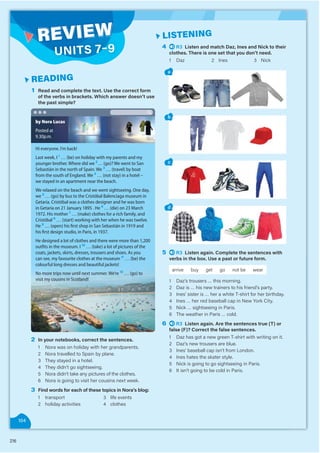
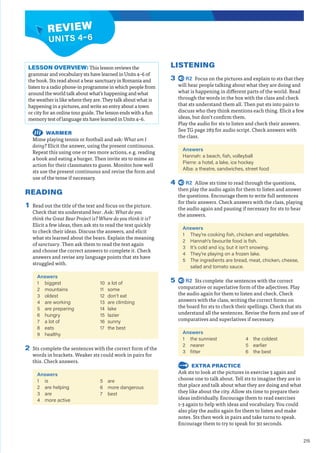
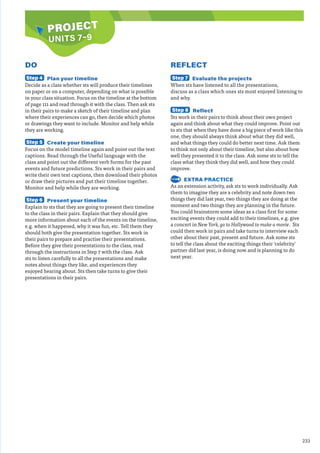
Teacher’s
Sheila Dignen
A1+
R e l e v a n t E n g a g i n g A c h i e v a b l e L e a r n i n g
Teacher’s
Sheila Dignen
A1+
Student COMPONENTS Teacher COMPONENTS
Student’s Book Teacher’s Guide
and
Student's Book
combined
Keep it REAL! Everything you need to 'Keep it real!' in the class and at home.
Workbook
and
e-Workbook
Audio
Video and animations
Keep moving! digital game
Extended practice
Tests
Worksheets
Scripts
Workbook answer key
Richmond
Learning
Platform
2
3
TEACHER'S GUIDE CONTENTS
COMPONENT PACKAGE p2
TEACHER'S GUIDE CONTENTS p3
STUDENT'S BOOK CONTENTS p4
INTRODUCTION
Welcome to Keep it real! p6
Unit overview p8
On-screen learning p12
Consolidation and extension p14
Extended practice and assessment p16
Teacher’s resources p18
MAIN UNITS
Starter p20
Unit 1 Home sweet home p30
Unit 2 School days p50
Unit 3 Crazy about sport p70
Unit 4 Out and about p90
Unit 5 Fantastic food! p110
Unit 6 Wonderful world p130
Unit 7 Then and now p150
Unit 8 Life stories p170
Unit 9 Getting around p190
REVIEWS Units 1-3, Units 4-6, Units 7-9 p210
PROJECTS Units 1-3, Units 4-6, Units 7-9 p222
LITERATURE Units 1-3, Units 4-6, Units 7-9 p234
EXAM PRACTICE Units 1-9 p246
LANGUAGE SUMMARIES Units 1-9 p264
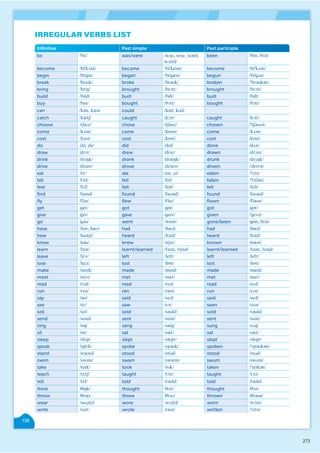
IRREGULAR VERBS p273
AUDIO SCRIPTS p274
VIDEO LESSON PLANS p286
VIDEO SCRIPTS p304
GRAMMAR ANIMATION SCRIPTS p308
WORKBOOK ANSWER KEY p312
3
4
STUDENT'S BOOK CONTENTS
LANGUAGE SKILLS
VOCABULARY GRAMMAR READING LISTENING
Starter
unit p4
❯ Days and dates ❯ Things for school ❯ Countries and nationalities ❯ Colours ❯ Possessive ’s ❯ Demonstrative pronouns
Unit 1
Home sweet
home
p9
❯ Furniture and rooms
❯ Vlog
❯ Family members
❯ There is/there are + a, an,
some, any
❯ Prepositions of place
❯ have got
❯ Grammar animations
❯ How tidy is your bedroom?
❯ Skill: Predicting what a
text is about
❯ Word Power: Opposite
adjectives
❯ Famous Families
❯ Skill: Preparing
before listening
❯ Pronunciation: /ə/
Unit 2
School days
p19
❯ Daily activities
❯ Vlog
❯ Technology
❯ Present simple: affirmative and
negative
❯ Pronunciation: /s/ /z/ /ɪz/
❯ Present simple: questions with
short answers; Wh- questions
❯ Grammar animations
❯ A school with a difference
❯ Skill: Scanning a text for
specific information
❯ Word Power: Listing
school subjects
❯ Do you play video
games?
❯ Skill: Understanding
yes/no questions
Unit 3
Crazy about
sport
p29
❯ Sport
❯ Vlog
❯ Action verbs
❯ Present simple and adverbs of
frequency
❯ like/don’t like + -ing
❯ can and can’t; must and mustn’t
❯ Pronunciation: /ə/, /æ/ and /aː/
❯ Grammar animations
❯ Secrets of success
❯ Skill: Working out the
meaning of new words
❯ Word Power: Olympic
sports words
❯ Can you run, jump
and climb?
❯ Skill: Listening for
specific information
REVIEW UNITS 1–3 pp100–101 PROJECT UNITS 1–3 pp106–107
Unit 4
Out and
about
p39
❯ Places in a city
❯ Vlog
❯ The weather
❯ Present continuous: affirmative
and negative; questions
❯ Pronunciation: /ŋ/
❯ Present continuous and present
simple
❯ Grammar animations
❯ A city tour
❯ Skill: Using existing
knowledge to understand
a text
❯ Word Power: Identifying
nationalities
❯ Is it snowing over
there?
❯ Skill: Listening for
time expressions
Unit 5
Fantastic
food!
p49
❯ Food and drink
❯ Vlog
❯ Adjectives: health
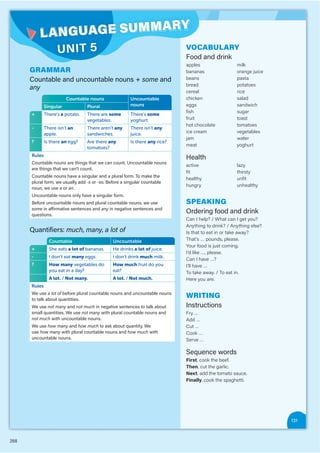
❯ Countable and uncountable nouns
+ some and any
❯ Quantifiers: much, many, a lot of
❯ Pronunciation: /h/
❯ Grammar animations
❯ Recipe for success
❯ Skill: Understanding an
author’s opinion
❯ Word Power: Matching
food words to pictures.
❯ How much exercise
do you do?
❯ Skill: Making notes
when listening
Unit 6
Wonderful
world
p59
❯ The natural world
❯ Vlog
❯ Wild animals
❯ Comparative and superlative
adjectives (not) as … as
❯ Pronunciation: /ɜː/
❯ Grammar animations
❯ Your new planet!
❯ Skill: Understanding the
main idea of a text
❯ Word Power: Matching
numbers with words
❯ The wonderful world
of animals
❯ Skill: Using my
existing knowledge
before listening
REVIEW UNITS 4–6 pp102–103 PROJECT UNITS 4–6 pp108–109
Unit 7
Then and
now
p69
❯ Clothes
❯ Vlog
❯ Regular verbs
❯ be: past simple; There was/There
were
❯ Past simple affirmative: regular
verbs; ago; object pronouns
❯ Pronunciation: /t/ /d/ /ɪd/
❯ Grammar animations
❯ Which decade was best?
❯ Skill: Understanding
what pronouns refer to in
a text
❯ Word Power: Ordering
units of time
❯ We loved it!
❯ Skill: Understanding
the main idea when
listening
Unit 8
Life stories
p79
❯ Life events
❯ Vlog
❯ Physical appearance
❯ Past simple: affirmative and
negative; questions
❯ Pronunciation: Intonation in
questions
❯ Grammar animations
❯ My Heart is in Havana
❯ Skill: Answering multiple
choice questions
❯ Word Power: Music
words
❯ How did they do
that?
❯ Skill: Listening for
key words
Unit 9
Getting
around
p89
❯ Transport
❯ Vlog
❯ Holiday activities
❯ will and won’t
❯ be going to: future plans
❯ Pronunciation: Sentence stress
❯ Grammar animations
❯ Welcome to the future!
❯ Skill: Understanding the
main topic of paragraphs
❯ Word Power: Transport
words
❯ What are you going
to do?
❯ Skill: Identifying the
type of information to
listen for
REVIEW UNITS 7–9 pp104–105 PROJECT UNITS 7–9 pp110–111
REFERENCE EXAM PRACTICE UNITS 1–9 pp118–126 LANGUAGE SUMMARY UNITS 1–9 pp127–135
5
STUDENT'S BOOK CONTENTS
SPEAKING WRITING CULTURE 21ST
CENTURY SKILLS
❯ Subject pronouns and possessive adjectives ❯ be: affirmative, negative and questions ❯ Question words
❯ Nice to meet you!
❯ Skill: Introducing people
❯ Useful language: Greetings;
Introductions; Saying goodbye
❯ Keep moving!
❯ A chat forum
❯ Skill: Writing about my dream
home
❯ Useful language: Describing
a home
❯ Look! and and but
❯ My home
❯ Word Power: Categorizing
adjectives
❯ Culture video
FIND OUT p10
THINK CRITICALLY p13
COMPARE CULTURES p17
GET CREATIVE p17
❯ Join the club!
❯ Skill: Asking for and giving
information about school clubs
❯ Useful language: Asking for and
giving information
❯ Keep moving!
❯ An email
❯ Skill: Writing about my school
day
❯ Useful language: Starting and
finishing an email
❯ Look! Prepositions of time:
in / on / at
❯ UK education
❯ Word Power: Finding
definitions in a text
❯ Culture video
FIND OUT p20
THINK CRITICALLY p20
COMPARE CULTURES p27
GET CREATIVE p27
❯ What shall we do?
❯ Skill: Making suggestions for
things to do
❯ Useful language: Asking, making
and responding to suggestions
❯ Keep moving!
❯ A blog post
❯ Skill: Writing about a typical
weekend
❯ Useful language: Expressions
of frequency
❯ Look! Punctuation
❯ Sport in the UK
❯ Word Power: Categorizing
words
❯ Culture video
FIND OUT p30
THINK CRITICALLY p30
COMPARE CULTURES p37
GET CREATIVE p33
LITERATURE UNITS 1–3 pp112–113
❯ Is it far?
❯ Skill: Asking for and
giving directions
❯ Useful language: Asking for
directions; Giving directions
❯ Keep moving!
❯ A text message
❯ Skill: Writing about what I’m
doing now
❯ Useful language: Writing a
message
❯ Look! Adverbs of degree
❯ New York, New York
❯ Word Power: British and
American English quiz
❯ Culture video
FIND OUT p40
THINK CRITICALLY p40
COMPARE CULTURES p44
GET CREATIVE p47
❯ What can I get you?
❯ Skill: Ordering food and drink
❯ Useful language: Ordering food
❯ Keep moving!
❯ A recipe
❯ Skill: Writing a simple recipe
❯ Useful language: Instructions
❯ Look! Sequence words
❯ International festivals
❯ Word Power: Matching verbs
with nouns
❯ Culture video
FIND OUT p50
THINK CRITICALLY p50
COMPARE CULTURES p57
GET CREATIVE p55
❯ How much is it?
❯ Skill: Buying a ticket
❯ Useful language: Buying a ticket
❯ Keep moving!
❯ A fact sheet
❯ Skill: Writing a description of
an animal
❯ Useful language: Animal facts
❯ Look! too and also
❯ Amazing America
❯ Word Power: Matching
opposite adjectives
❯ Culture video
FIND OUT p60
THINK CRITICALLY p60
COMPARE CULTURES p64
GET CREATIVE p67
LITERATURE UNITS 4–6 pp114–115
❯ Have you got this in black?
❯ Skill: Asking about things in
a shop
❯ Useful language: Shopping for
clothes
❯ Keep moving!
❯ A review of a year
❯ Skill: Writing about past events
❯ Useful language: Writing
about past events
❯ Look! Giving examples
❯ The history of film in the USA
❯ Word Power: Completing
sentences with words from a
text
❯ Culture video
FIND OUT p70
THINK CRITICALLY p70
COMPARE CULTURES p77
GET CREATIVE: p73
❯ Did you have a good weekend?
❯ Skill: Talking about past events
❯ Useful language: Asking about
the weekend; Responding
❯ Keep moving!
❯ A description of a person
❯ Skill: Writing about a family
member or friend
❯ Useful language: Describing
someone
❯ Look! Using paragraphs
❯ Great lives
❯ Word Power: Matching words
with pictures
❯ Culture video
FIND OUT p80
THINK CRITICALLY p80
COMPARE CULTURES p87
GET CREATIVE p83
❯ What are you doing at
the weekend?
❯ Skill: Arranging to meet a friend
❯ Useful language: Making
arrangements; Responding
❯ Keep moving!
❯ An email
❯ Skill: Writing about holiday
plans
❯ Useful language: Writing
about holiday plans
❯ Look! so and because
❯ Cool tours in London
❯ Word Power: Completing
sentences with prepositions
❯ Culture video
FIND OUT p90
THINK CRITICALLY p90
COMPARE CULTURES p97
GET CREATIVE p91
LITERATURE UNITS 7–9 pp116–117
IRREGULAR VERBS LIST pp136
6
Keep it real! is the ideal 6-level secondary course
for today’s mixed ability classes, with its flexible
blend of dynamic video and digital content, easy-to-
use classroom materials, and focus on developing
communicative competence and 21st century skills.
Keep it real! thoroughly develops students’
grammar, vocabulary and pronunciation and provides
manageable skills development opportunities,
including a focus on culture. Optional sections
contain project-based work, literature lessons based
on extracts from the Richmond Readers, and exams
lessons that practise common exam tasks.
Keep it real! has a full range of print and digital
components including:
KEY FEATURES
Each Keep it real! unit has a number of key features
which make the course engaging and unique:
Student’s Book
Workbook and
e-Workbook
Teacher’s Guide
with Student’s Book
interleaved pages Teacher’s
resources
including
worksheets
and tests
Teacher’s
iBook for
interactive
whiteboards
Teacher’s audio,
video and animated
material as MP3 and
MP4 download
Richmond
Learning
Platform
with extended practice
activities, assignable and
trackable tests and complete
teacher’s resources
Fun facts
Regular ‘fun fact’ feature offers fun, but interesting
information to arouse curiosity.
Accessible grammar with animated
presentations
Simple, effective grammar lessons with animated
grammar presentations.
Vocabulary opener pages with vlogs
A focus on vocabulary at the start of each unit with
an optional vlog where real vloggers are used in
authentic contexts.
INTRODUCTION
Welcome to KEEP IT REAL!
7
INTRODUCTION
Projects, Literature and Exams
Extra sections at the back of the Student’s Book for
extended learning.
Word Power
Regular word-building exercises through the
Word Power feature.
Keep talking! speaking lessons with
Keep moving! game
Each unit includes a functional speaking lesson
based on real-world themes and a dynamic board
game called Keep moving!.
Real Culture! with video
Each unit includes a reading lesson on cultural
topics from English-speaking countries and an
optional culture video which extends the theme.
21st century skills
Four 21st century skills exercises per unit:
Think critically, Get creative, Find out, and
Compare cultures.
Fast finisher
An optional Fast finisher extension activity at the
end of each lesson to keep students busy.
INTRODUCTION
p
p y
7
8
INTRODUCTION
Student’s Book
There is a 5-page Starter unit at the beginning of the Student’s Book. It
reviews basic grammar and vocabulary areas from earlier levels. There
is also a short reading and speaking section towards the end of the Starter
unit, providing students with a useful introduction to skills work.
The Starter unit is optional. It will depend on your timetable and
which areas you think your students would benefit from revising
before beginning work on the main units. It can also serve as a useful
introduction to the course methodology and features.
The units are 10 pages with 6 main sections:
1 Vocabulary (includes a vlog)
2 Grammar and Reading (includes a grammar animation)
3 Vocabulary, Listening and Grammar (includes a grammar
animation)
4 Reading, Listening and Speaking (includes a digital
speaking game)
5 Culture (includes a culture video)
6 Writing
VOCABULARY
There are two vocabulary lessons per unit. The first vocabulary lesson appears on the unit
opener page and usually presents the items with colourful visuals, especially at the lower levels.
These pages also feature a video in the form of an optional vlog, for use in digital classrooms.
UNIT OVERVIEW
Engaging visuals, a text
or a quiz to present the
vocabulary.
Substantial vocabulary sets
with around 10-15 items
taught per vocabulary
lesson.
Fast finisher caters
for mixed ability and
consolidates what
students have learned.
Lesson aims clearly stated
in ‘I can’ statement.
Typically 3 to 5 practice
exercises with a pairwork
or personalized activity
to finish.
Fun, optional vlog on
the unit theme including
some of the new
vocabulary from the
lesson.
9
INTRODUCTION
Fun facts provide fun but interesting
information related to the topic of the lesson.
4 exercises per unit focus on 21st century skills:
Find out, Get creative, Think critically and
Compare cultures.
Graded reading
texts contextualize
grammar and
practise relevant
reading skill.
Word Power
word-building
task.
READING and GRAMMAR
There are two grammar lessons per unit. The Reading and grammar spread features the first
grammar lesson of the unit and the grammar is presented via a reading text. This lesson also
features an optional grammar animation.
VOCABULARY, LISTENING and GRAMMAR
The second vocabulary lesson is combined with a listening activity. This spread also features
the second grammar lesson of the unit. There is an optional grammar animation.
Grammar
presented
inductively and
form and use
highlighted in
tables and rules.
Animated
grammar
presentations
of meaning and
form.
Lesson aims clearly stated in ‘I can’ statement.
Controlled and
freer practice
exercises
on form and
meaning.
Vocabulary is
presented via a
listening with the
opportunity to
practise a relevant
listening skill.
Controlled and
freer practice
exercises
on form and
meaning.
Pronunciation
feature allows
students to listen
and repeat.
Lesson aims
clearly stated in
‘I can’ statement.
Animated
grammar
presentations
of meaning and
form.
Fast finisher caters for mixed ability and
consolidates what students have learned.
Texts focus on
relevant and
engaging topics for
today's teenagers.
Grammar
presented
inductively and
form and use
highlighted in
tables and rules.
Fast finisher caters for mixed ability
and consolidates what students have
learned.
10
Keep talking!
READING, LISTENING and SPEAKING
The Keep talking! lesson starts with a focus on reading and listening before moving on to the functional
area of speaking. This spread also features a digital game called Keep moving! which encourages spoken
interaction. The lesson ends with a structured ‘Prepare, Speak, Reflect’ output task.
Reading text on
a related cultural
theme. Focus on
English speaking
culture around the
world.
Word Power
word-building
task.
4 exercises per
unit focus on
21st century
skills: Find out,
Get creative,
Think critically
and Compare
cultures.
Real culture!
The Real Culture! spread contains a text and exercises on a relevant cultural theme. It also
practises reading skills. It features an optional video on a related cultural theme.
UNIT OVERVIEW
Lesson aims
clearly stated in
‘I can’ statement.
Reading and
listening tasks
provide context for
speaking section.
Focus on real
world information
via blogs, leaflets,
signs, adverts and
maps.
Exercises for
relevant reading
and listening skills.
Useful language
box highlights
key expressions
with listen and
repeat facility.
Recorded
dialogues
model spoken
language.
Optional digital board game Keep moving! for class use.
A fun, dynamic way to revise language from the unit.
Fast finisher caters for mixed ability
and consolidates what has been learned.
Supported
3-stage
Speaking
plan for
end-of-lesson
speaking task.
Lesson aims
clearly stated in
‘I can’ statement.
Fun optional
culture video
recycles
grammar and
vocabulary from
the unit.
Fast finisher caters
for mixed ability
and consolidates
what students have
learned.
11
INTRODUCTION
WRITING
There is a one-page writing lesson at the end of each unit that focuses on a particular text type
and the language associated with it. The lesson ends with a structured ‘Prepare, Write, Reflect’
output task. There is a complete Writing summary section at the back of the Workbook with
additional model texts and Tips for writing.
Model texts such as emails,
blog posts, descriptions
and letters.
Useful language box
highlights key expressions
needed for the writing
task.
Look! box highlights
additional areas of
language or text structure
needed for the writing
task.
Exercises to focus on the
model text and support
the writing process.
Supported 3-stage Writing
plan for the end-of-lesson
writing task.
LANGUAGE SUMMARIES
There is a Language summary page at the end of the Student’s Book for each unit. It provides a
useful 'at a glance' visual summary of the grammar, vocabulary and functional language taught in
the course. This can be used in class or at home as a quick reference whenever needed.
A list of the vocabulary
taught in each unit.
A list of the key
expressions from the
Keep talking! speaking
lesson.
A list of the key
expressions and input
from the writing lesson
including the language
from the Look! boxes.
Complete grammar tables
for each grammar point
from the unit.
References to additional
sections at the end of the
Student’s Book and the
Workbook.
Comprehensive grammar
rules with explanations of
meaning.
Full summary of
grammatical forms with
clear highlighting.
Lesson aims clearly stated
in ‘I can’ statement.
12
Keep it real! offers dynamic on-screen learning for digital classrooms with optional vlogs (video
blogs) and culture videos, as well as animated content in the form of an optional alternative
grammar presentation. There is also an innovative digital board game called Keep moving! at the
end of the speaking lesson which can be enjoyed as a whole class activity.
VLOGS
CULTURE VIDEOS
ON-SCREEN LEARNING
Authentic, real life
vloggers in engaging,
contemporary contexts.
For further
teaching notes
for each vlog see
Teacher’s Guide
pages 286-294
and for vlog
scripts see pages
304-305.
Informal but graded
spoken English and
variety of accents
including British and
American English.
Use as consolidation and revision of
vocabulary from the lesson or to set
the scene for the unit.
Watch with the
teacher in class
or for revision at
home.
Available with or without subtitles. Useful for
mixed ability and supported learning.
Engaging, mini-
documentaries on
cultural themes from
across the English
speaking world such
as the UK, the USA,
Canada, Australia and
New Zealand.
For further
teaching notes for
each culture video
see Teacher’s
Guide pages 295-
303 and for culture
video scripts see
pages 306-307.
Documentaries provide
an opportunity for
recycling vocabulary
and grammar from the
unit.
Informal but graded English with a
variety of accents including British
and American English.
Watch with the teacher in class
or for revision at home.
Available with
or without
subtitles. Useful
for mixed ability
and supported
learning.
13
INTRODUCTION
GRAMMAR ANIMATIONS
Keep moving! DIGITAL BOARD GAME
Ready-made
optional grammar
presentations for
each grammar lesson.
For Grammar
animations scripts
see Teacher’s
Guide pages 308-
311.
A range of characters
in fun, bite-sized
scenarios and short
stories.
Use as a fun
revision tool or as
a recap at the end
of the lesson.
A visual focus on
form and meaning
supported by audio
models.
Uniquely developed
digital board game at
the end of each Keep
talking! lesson to revise
unit content.
Answer questions
and complete mini-tasks
to reach the finish point.
Play in
collaborate or
compete mode.
Practise mediation,
peer to peer
teamwork,
problem solving
and strategic
thinking.
Win badges
and collect treasure.
Available with or
without subtitles.
Useful for mixed
ability and supported
learning.
The game tests
language, skills
and general
knowledge.
Use animated
characters to
progress along the
board.
14
Model project
for reference
and support.
PROJECTS
There are 3 termly Projects that consolidate grammar and vocabulary in a fun, collaborative task.
There are 3 clear stages ‘Prepare, Do, Reflect’ which support students as they create projects in pairs
or small groups. A model of the project ‘output’ is provided for reference throughout the lesson.
There are optional lessons at the end of the Student’s Book for consolidation and extension. These include
termly Reviews, Projects and Literature sections as well as a short Exams practice section for each unit.
REVIEWS
There are 3 termly Reviews that revise grammar and vocabulary via the 4 skills. Each spread starts with a
reading, followed by a listening, speaking and writing activity. The aim of these spreads is to consolidate
the grammar and vocabulary from the previous 3 units through simple, guided skills activities.
consolidation and extension
Reading section
with a short
review text. Writing section
reviews key
language via
simple guided
writing tasks.
Test your
memory
section with
simple recall
prompts for
fun revision of
unit content.
Prepare stage
with photos and
tasks to help with
ideas and planning.
Do stage with
support for creating
the project.
21st century skills
included for
project planning
and research.
Look! box
encourages
ways of
working such
as mediation or
collaboration.
Useful
language box
with grammar
structures from
the unit.
Listening section
recycles and
reviews via
dialogues
and monologues.
Reflect stage with
tasks for improving
the projects.
Speaking section
revises key
language via a
short discussion
or pairwork tasks.
15
INTRODUCTION
Exam practice lesson
finishes with an
opportunity to complete
a simple Exam task
based on the skills and
strategies taught.
LITERATURE
There are 3 termly Literature lessons that each feature an extract from the Richmond Readers
series. These provide an opportunity for extensive reading practice in a fun and supported way.
There are 3 clear stages ‘Before you read, Read, Reflect’ which support students with their reading.
EXAMS
There are 9 Exams practice lessons that provide further practice of the grammar and vocabulary from
the unit, using common exam question types. These are taken from a wide range of exam boards
appropriate for the level and age group. Each section builds towards completing an exam style task.
Before you read
stage prepares
students to read
the text and
think about
the context.
Word Power
word-building
task.
Extract from the Richmond Readers series at the
appropriate level with visuals to support details of the story.
Key words from the text are
highlighted in the Glossary.
21st century
skills included
as part of
the literature
lesson.
Main points of
the story are
summarized
in the Outline box.
Each lesson focuses on
a skill such as reading,
listening, speaking and
writing, and a common
exam question type such as
multiple choice, gapfilling,
writing a message and
discussing a topic, etc.
Look! boxes provide general
information on the scope
of the exam task and what
students can expect.
Reflect stage
to think about
the story in a
more general
or personalized
way.
Read stage
helps students
to focus on the
main points of the
story extract.
Useful strategies box
gives guidance and tips
on how to approach the
exam task.
Exercises build towards
and support the Exam
task at the end of the
lesson.
Graded Exam task which
brings together the
themes of the unit.
16
Extended practice and assessment
Workbook
The Workbook provides thorough practice of the Student’s Book material, for students to do
in class or at home, with graded activities for mixed ability via the ‘star’ system. There is a
Progress check every 3 units and a writing summary at the back of the book. The Workbook
audio is available as an MP3 download on the Richmond Learning Platform.
Practice of vocabulary
and grammar from
the Student’s Book.
Graded with stars
to show 3 levels of
difficulty.
Practice of the
4 skills from the
Student’s Book:
reading, listening,
speaking and writing.
Word Power
word-building task.
Regular ‘listen and
check’ activities.
Available as MP3
downloads on the
Richmond Learning
Platform.
3 termly Progress
checks test
vocabulary and
grammar from the
previous 3 units.
Regular ‘listen and
check’ activities.
Available as MP3
downloads on the
Richmond Learning
Platform.
Use as end-of-term
revision in class or at
home.
A range of exercises
test knowledge
of vocabulary and
grammar across
different units.
Comprehensive
Writing summary
section at the back
of the Workbook.
Convenient
Vocabulary summary
section at the back
of the Workbook.
Unit-by-unit
reference for items
taught in the 2
vocabulary lessons
in the Student’s
Book.
Model texts for each
of the Student’s
Book writing lessons.
Text features and
key language
clearly highlighted.
Useful Tips for
writing in short
summary section.
Listed alphabetically
for easy use.
17
INTRODUCTION
Vlogs and culture videos from the Student’s Book
further exploited using new tasks.
EXTRA PRACTICE WORKSHEETS
There are 72 print-and-go worksheets that provide students with extra practice of grammar and
vocabulary in a variety of different ways, including via the 4 skills. The grammar and vocabulary
worksheets are offered at 2 levels of difficulty. All the worksheets can be found on the Richmond
Learning Platform and can be printed off for use in class or set as homework. Audio for the
listening worksheets is available as an MP3 download on the Richmond Learning Platform.
TESTS
There is a comprehensive test package offered on the Richmond
Learning Platform. Tests are offered at 2 levels of difficulty and
are presented in both PDF and digital format.
EXTRA PRACTICE ACTIVITIES
Extra practice activities for self study on the Richmond
Learning Platform in digital format.
2 vocabulary and 2 grammar worksheets for every unit.
The language worksheets are graded for two levels of difficulty
via consolidation and extension versions.
4 skills worksheets for every unit: reading,
listening, speaking and writing.
The skills worksheets revise grammar and vocabulary
via a skills activity at one level of difficulty and end with
a short 21st century skills task.
Consolidation and extension versions of each test (not speaking).
Tests are auto-marked (except for speaking and
writing tasks which require teacher grading).
Unit-by-unit tests, end-of-term tests, and end-of-year tests.
Tests for grammar, vocabulary, reading, listening,
speaking and writing. The 4 skills are tested separately.
Reading and listening activities use Student’s Book texts
and audio with new comprehension tasks.
Speaking and writing activities test Useful language from the
Student's Book. Listen, repeat and record facility for speaking
and pronunciation.
18
Teacher’s Guide
The Keep it real! Teacher’s Guide is a complete planning and teaching resource with Student’s Book
pages and teaching notes combined. Student’s Book audio scripts, Workbook answer keys and
additional teaching notes for the Student’s Book vlogs and culture videos are available at the back
of the Teacher's Guide.
31
UNIT 1 OVERVIEW: The topic of this unit is home. Sts read about the Big Teenage
Challenge to keep your bedroom tidy for a week, and listen to a description of someone's family.
They learn vocabulary for furniture and family, and watch a vlog about moving homes. They
read about teenage life in the UK and watch a culture video about an unusual type of home. Finally,
they read about a dream home and write about their own ideal home.
VOCABULARY Furniture
Sts learn nouns for the names of 15 kinds of furniture.
They categorise these nouns according to the rooms where
they are usually found, then personalise the vocabulary by
talking about the furniture in their own home.
Vocabulary Vlog
Furniture (bath, bed, bookcase,
chair, cooker, desk, fridge, lamp,
mirror, shower, sink, sofa, table, toilet,
wardrobe)
Iona: My new
home
WARMER
Ask: Where do you live? Do you live in a house or a flat? As
sts answer, ask questions, e.g. Is your flat big or small?
How many rooms are there? Revise vocabulary for rooms
and see what words for furniture sts already know.
1 1.1 Read through the words in the box and elicit
or teach the meanings. Sts match the words with the
pictures. Play the audio track. See TG page 274 for audio
script. Sts listen, check and repeat.
Answers
1 bed, chair, desk, wardrobe, mirror 2 cooker, fridge,
sink 3 chair, sofa, table 4 bookcase, chair, desk,
lamp, table 5 bath, mirror, shower, sink, toilet
2 Ask: What furniture goes in the bathroom? Elicit one or
two answers. Sts copy the table in their notebooks and
complete it with the words from Exercise 1. Point out
that some words can go in more than one room. Check
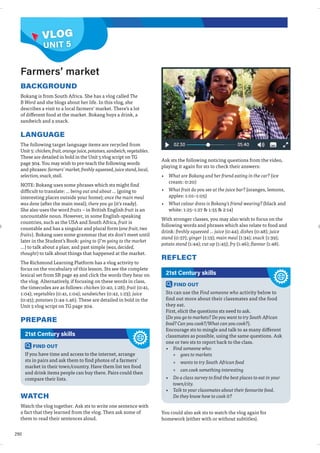
answers.
Answers
bathroom: bath, mirror, shower, sink, toilet
bedroom: bed, bookcase, chair, desk, lamp, mirror,
table, wardrobe
dining room: bookcase, chair, lamp, mirror, table
kitchen: cooker, fridge, sink, table
living room: bookcase, chair, lamp, mirror, sofa, table
3 Ask a few questions about a normal house first, e.g.
Where’s the bath? (in the bathroom). Then read out the
task and explain the meaning of strange. Read out the
example question and answer, then put sts into pairs to
ask and answer questions. Ask individual sts to ask and
answers questions for the class.
Vlog
This lesson features an optional vlog in which a vlogger
talks about moving home. You can watch this in class if
you have time and access to video, or you can ask sts to
download it from the Richmond Learning Platform to
watch at home. See TG pages 286 and 304.
FAST FINISHER
Sts who finish early can practise vocabulary for furniture
further. They list the furniture in each of the rooms in
their own house. They could use a dictionary to find
other nouns not seen in Exercise 1. Weaker sts could
work in pairs. They take turns to point to the furniture in
the pictures. Their partner says the correct word.
EXTRA PRACTICE
Put sts into pairs. They take turns to try to talk about
their own home for one minute, while their partner
films them using their phone. They can watch their
films back and discuss in their pairs how they could
improve, for example by hesitating less. If there is time,
they could repeat the activity and try to improve.
V Vocabulary practice: WB p.6
Sts will find more practice of vocabulary for
furniture here. Set these exercises for homework.
LS Language summary: Unit 1 SB p.127
Home sweet home
1
Vocabulary Grammar Pronunciation Reading Listening Speaking Writing
Furniture;
Family
there is / there are
+ a, an, some, any;
prepositions of
place; have got
/ə/ Using pictures to
predict things in a
reading text
Preparing
before you
listen
Introducing
people
A chat forum
TEACHER'S RESOURCES
Reproductions of every Student’s
Book page on the left-hand page.
Ideas for additional
activities, if time, or if
relevant for students.
Ideas for fun lesson
introductions to warm
students up to the topic
of the lesson.
A summary of the topics
covered in each unit with
the language aims clearly
stated.
Answer keys highlighted
in easy-to-find boxes.
Complete teacher’s notes with
answer keys on the right-hand page.
Detailed vlog and culture
video teaching notes at
the back of the Teacher's
Guide.
Signposting to
supplementary support
material.
308
GRAMMAR ANIMATION
SCRIPTS
UNIT 1
There’s a cake on this chair!
B = Ben, J = Jake, V = Vicky
B, J: Hi, Vicky!
V: Oh, hi, Ben! Hi, Jake! Thanks for
coming, guys! Ready to play?
J: Well, yes, but there aren’t any
empty chairs!
B: What a mess! There’s a cake on
this chair!
J: And there are books in front of
the TV.
B: There are some clothes on the
desk, and there’s an apple on the
carpet.
J: And there are some cups under
the table.
V: Sorry, guys!
J: Come on Ben, let’s help Vicky.
V: Thank you very much for helping
me!
J: You’re welcome! The room is tidy
now.
B: The books are in the bookcase!
J: And there aren’t any cups under
the table!
V: And the clothes are next to the
desk.
J: But, where’s the cake?
V: Ben, watch out! The cake is
behind you!
B: Oh! The cake is ... here!
V, J: Oh, Ben!
I’ve got funny hair!
B = Ben, V = Vicky, J = Jake
B: Your games room is amazing,
Vicky. You’ve got lots of cool
things!
V: I know! I’m very lucky! I’ve got
a computer and a video games
console, and I’ve got
lots of books.
B: I’ve got some e-books on my
tablet, but I haven’t got a games
console. Have you got any video
games, Jake?
J: Yes, I have. And I’ve got a guitar!
V: Wow! I haven’t. Are you good at
the guitar?
J: Well … not yet!
B: Look at this photo! Who are all
these people?
V: This is my family. This is my mum
and this is my Uncle David. He’s
got a dog, Bella. This
is my Aunt Liz. She’s got two
children – my cousins, Isaac and
Isabel. And this is my grandma,
Jill. She’s got a pet snake!
J: Wow! Who’s this?
V: That’s me! I’m a baby there!
B: Ah, you’re very cute!
V: I know! But, I’ve got funny hair!
UNIT 2
He cleans the robots!
AR = Aunt Rose, M = Mr Jones,
J = Jake, B = Ben, V = Vicky
AR: Welcome to the Science Fiction
Museum! This is my friend,
Mr Jones. Mr Jones works here.
He’s a museum guide.
J, B, V: Hello, Mr Jones. Nice to meet
you!
M: Nice to meet you, too!
B: I love science fiction films! I want
to be a film director one day!
M: That’s great!
V: Tell us about your day, Mr Jones.
M: Well, I get up at seven in the
morning. I get dressed and have
breakfast. Then, I ride my bike to
work. I don’t take the bus. I get to
my office and I check my emails.
Then the visitors arrive. I show
them all the amazing things in
the museum.
V: Ah, it sounds interesting!
M: Yes! The café opens at one o’clock.
I have lunch with my friend,
Steve. Steve doesn’t work in the
mornings. He starts work at two
o’clock. He cleans the robots!
B: Ah, I love this place! I watch
lots of science fiction films. My
favourite is Planet of the Robots!
M: We’ve got lots of robots from that
film here!
B: Really? Have you got Robodog?
Have you got CA-12? Come on,
let’s go and see them!
M: OK!
What does it do?
M = Mr Jones, B = Ben, J = Jake,
AR = Aunt Rose, V = Vicky
M: Do you like CA-12, Ben? It’s the
star of Planet of the Robots.
B: Yes, I do! It helps the astronauts
come back to Earth!
M: Correct. And this is Robodog.
B: I know! It’s CA-12’s pet!
M: That’s right! Do you know
everything about robot films,
Ben?
B: No, I don’t! I don’t know
everything. But I know a lot,
because I watch a lot of films!
M: Good for you! Where do you
watch them? At home or at the
cinema?
B: Both!
J: Oh, no! Drew, come back!
M: What’s this?
AR: It’s our robot friend. Jake!
What does Drew want?
J: I don’t know. Drew! Switch off!
M: That’s an amazing robot, Rose.
Where do they sell them?
R: They don’t. Drew’s my creation.
I’m an electrical engineer.
M: Wow! What does it do?
AR: It likes learning new things. But
I think Drew needs a software
update right now!
M: Good idea! Well, what do you
want to see now, guys? More cool
things?
B, J, V: Yes, please!
M: OK, let’s go!
UNIT 3
I love eating popcorn!
J = Jake, B = Ben, V = Vicky
J: Hi, Ben!
B: Oh, hey, Jake!
J: How are things?
B: Great! I’m on my bike today. I love
cycling! I always go cycling on
Saturdays.
J: That’s nice. I’ve got my guitar
lesson now.
B: Wow! Do you take guitar lessons?
That’s amazing!
J: Yes, I like learning the guitar!
I sometimes practise for three
hours or more.
B: Three hours? That’s a lot! Do you
want to be a musician?
J: Well, no, but I love making music!
I don’t mind practising at all. It’s
easy! My teacher is very kind.
She always helps me, and she
sometimes organizes concerts,
too.
V: Hi, guys!
J, B: Hi, Vicky!
V: What’s the plan for today?
J: I’ve got my guitar lesson this
afternoon, and Ben … well, Ben’s
SCR
N
N
NI
e
er
r
r
Be
: H
O
c
W
e
W
th
A
th
T
d
c
A
th
S
C
T
m
Y
n
T
A
th
A
d
B
B
b
O
: O
e
e g
g
Be
Y
V
th
I
a
c
lo
I’
ta
c
g
Y
W
th
W
L
th
T
a
g
306
CULTURE VIDEO
SCRIPTS
UNIT 1
Homes on wheels
T = Theo, B = Bee
When we think of a mobile home, it looks
something like this … Or does it?
This is the Tiny House Festival in
Colorado, in the USA. There are lots of
homes here in many different shapes and
sizes. But, they are all the same in one
way: they’ve all got wheels, so they can
visit different places.
T: What’s going on guys? So, we have just
arrived at the Colorado Tiny House Festival
and this place is massive.
Travel vloggers Bee and Theo are at
the Tiny House Festival. They show
us around. This motorhome is an
interesting shape, and it’s made of
beautiful wood. Inside, it’s got a sofa
and a bed. There’s a bookcase for your
books and all your things. There’s also a
window, so you’ve got a view of the places
you visit.
This one actually looks like a real house.
It’s got an air conditioner and lots of
windows. It’s also got tiles on the roof.
Inside, there’s even a staircase that takes
you up to a comfortable bedroom with a
big bed.
B: So, we’ve just stopped for lunch.
Now, it’s time for some food.
Small can also be beautiful. An unusual
look outside and a really special inside.
Great colours! And look at the bed by that
big window. There’s even a small stove.
Bee and Theo have now got a lot of cool
ideas for their own home on wheels.
B: So, thanks for watching guys and we’ll see
you on the next video.
UNIT 2
School in 1927
T = Teacher
These students go on a trip to the past ...
to 1927!
The children leave home at 6 a.m. This is
their school. All the children aged five to
thirteen are in the same class.
T: Now,mindyourfingers.I’llchopthemoff.
The teacher isn’t very nice.
T: For really bad things, I’ve got this.
He’s very strict.
T: It works.
He uses a blackboard.
There isn’t any technology in the
classroom. There aren’t any computers
and there aren’t any tablets. The
schoolchildren enjoy the art lessons –
they’re fun.
T: This is the day we’ve been waiting for, the
day of the standard exam. Your big day.
At the end of term, the students take an
exam.
But Steffan doesn’t go to school now. He
is thirteen and a half now, so he goes to
work. He works in the coal mine. This is
his first day. He goes to work at 5 a.m. It
takes an hour and a half.
It’s hard work in the coal mine. It’s also
very dangerous.
School in 1927 is hard, but life for
children in the coal mines is horrible.
UNIT 3
Soccer in Soweto
D = Dan
Welcome to Soccer City near Soweto
in South Africa. It’s the largest football
stadium in Africa. Spain were the World
Cup winners here in 2010. Today, 90,000
people are here for a big match called the
Soweto Derby. The match is between two
local teams: the Kaizer Chiefs and the
Orlando Pirates.
South Africa has a very special football
culture and South African fans always
make a lot of noise. The noise is very
loud because of the vuvuzelas. You find
these trumpets at all South African
football matches. Today, there are
thousands of them. With the sound of
the vuvuzelas it is like a big party. People
love dancing and singing at the match.
At half-time the fans get an extra show.
Dan Magness, a famous British football
freestyler, can do fantastic tricks with a
football. Freestyle is very popular with
young people in Soweto.
D: I’ve just performed a perfect show in front
of nearly 90,000 people. What a feeling!
Dan goes into Soweto. He sees that even
young children like doing freestyle.
Freestyle is everywhere in Soweto. Chris
is a South African champion freestyler.
There is something different about
freestyle in Soweto. It is almost like a
dance. Lots of people say that this is
because dancing is very popular in South
Africa. These freestylers mix dancing
and singing with football skills.
At this Soweto school the children do an
‘African warm-up’: singing and dancing
before the match. You can see how
football and dancing come together.
Football and freestyle are international
sports. People like playing them all over
the world. But here in Soweto, football
and freestyle are also a big part of South
African life.
UNIT 4
Holidays at home
E = Ellie
Ellie’s a student and she lives in
Brighton. Brighton is a famous British
seaside town.
E: I’m Ellie and I’m an art student in
Brighton.
Ellie has a busy student life, so she
doesn’t have much time for tourist
activities, like sightseeing. Today she’s
trying something new. She wants to be a
tourist in Brighton for one day.
E: I’ve made a list of all the tourist activities
I can do, and I’m gonna tick them off one by
one, in one day.
First, she prepares the things she’s
taking with her: a map, sun cream and
sunglasses, as it’s warm and sunny today.
Now she’s ready to go to the first place on
her map.
The Brighton Pavilion is a fairy-tale
palace built by a royal prince. It’s over
200 years old. The Pavilion gardens are
looking beautiful in the bright sunshine.
Next, she spends some time looking
around Brighton’s markets and interesting
shops. And of course, all tourists buy
postcards! It’s time for a quick break.
Ellie’s enjoying a nice cup of tea.
Now for something a bit different. She’s
going to the aquarium!
E: I’m so excited! I love sea life.
She gets really close to the sea life.
Next, she’s going to Brighton Pier, for
some fun! Piers are popular in British
seaside towns. Especially the fairground
rides. After all the excitement, Ellie goes
to the seafront. She’s really happy. She’s
seeing her hometown in a new way. To
end the day, she’s having a traditional
dinner of fish and chips on the beach.
But she isn’t a real tourist, so she doesn’t
have far to go home!
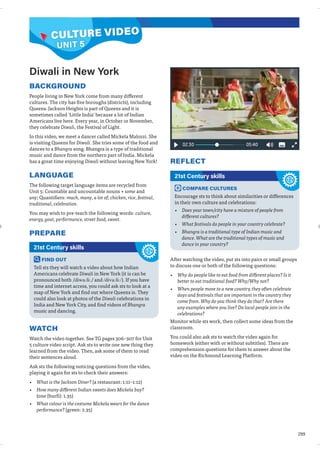
UNIT 5
Diwali in New York
M = Mickela, S = Subrato
Queens is an area of New York City.
Some people call parts of Queens ‘Little
India’, because there are a lot of Indian
Americans living there. Mickela Mallozzi
has a lot of friends! Today, she’s visiting
some of them in Queens. They’re
celebrating Diwali together.
M: Happy Diwali!
Diwali is the Hindu Festival of Light.
Hindus celebrate it every year, in India
and all over the world. An important part
of any festival is the food. Mickela meets
TS
SCRI
SC PT
N
NI
I
m
m
me
Th
en w
meth
s is
orad
mes
s. B
: th
t di
Wha
ved
this
vel v
Tin
rou
res
utif
a b
ks a
dow
vis
s on
got
dow
de,
up
bed
o, w
w, it
all c
k ou
at c
win
an
s fo
o, th
on t
N
NI
I
ho
o
o
o
Tea
se s
927
ch
r sc
tee
ow,
tea
or re
ve
wo
use
re i
sro
the
oolc
y’re
304
UNIT 1
Homes on wheels
Ioan
I: Hello, my name’s Ioan, and it’s time for
me to move out of my parents’ house.
I have a lot of stuff. I need to decide what
to take to my new place, so maybe you
can help me. Let’s take a look.
The study. This is where I do most of my
work and spend most of my day. First, my
desk. It’s just an old table, and I’m not
taking it with me. But, I am taking some
of the things that live there. This is my
sister’s old chair, my mum’s old lamp,
and a mirror I got from my art class. I am
taking all of them with me. But most of
all, my desk is home to drawings that I
don’t want to throw away, but don’t know
where to keep. I liked my workspace, but
it’s time to find a new one.
The bedroom. My bookcase is very
full. I buy a lot of books and I am slowly
reading them, but I haven’t finished
them all yet. My wardrobe has a lot of
clothes in it. How do I decide which
outfits I need? Why not take all of them?
The kitchen. Obviously, there are some
things I can’t take with me. My happiest
memories are in the kitchen, but they’re
staying here with the cooker, the sink,
and the fridge. But that’s okay. It’s good
to let things go.
Thank you for helping me pack. Bye!
UNIT 2
Morning routine
Tati
T: Hi everyone, my name is Tati and
today I’m going to show you my typical
morning routine as a student. So let's get
right into it!
First, my alarm goes off at seven a.m.
and it’s time to get up. Usually, I am very
tired so this can take a while. After I get
out of bed, it’s time to have a shower.
I prefer to shower in the mornings, as
it definitely helps me wake up and feel
refreshed for the day. After I have a
shower, next it is time to get dressed.
These are my clothes for today.
At eight o’clock, I go downstairs and
have breakfast. Breakfast is the most
important meal of the day, so I always
make time to have breakfast. Today, I’m
having tea and toast.
After breakfast, I go back upstairs to tidy
my room. I like to tidy my room in the
mornings, because I like coming home to
a clean room.
At 8.30, I'm all ready for the day ahead of
me and it’s time to leave the house and
have a good day.
So that’s it! I hope you enjoyed watching
my morning routine as a student. Bye!
UNIT 3
Life as an athlete
Nina
N: Hello everybody, and welcome to this
video. My name is Nina. I am from the
United States and I am a ballet dancer.
Today, I want to talk about life as an
athlete and the work it takes. But what
does it mean to be an athlete? Well, let’s
take a look. Anyone who is serious about
the sport they practise is an athlete.
I started doing ballet at three years old.
But as a young girl, I tried other sports,
too. When I was eight years old, I went
swimming twice a week. I liked it a
lot, but dancing was already hard work,
so two sports was difficult. I also tried
gymnastics ’cos my friends at school
did it. But I always preferred ballet. It
is difficult, but powerful and beautiful.
And now, I’m training to become a
professional, so I dance six days a week.
Each sport is different, but they all have
a few things in common. How could
surfing, for example, possibly be like
ballet? Well, each person works hard to
improve their skills for their sport. We
spend hour after hour practising. We
want to get that movement, that jump,
that twist, that turn just right.
For me, the other very important thing
that we all have in common is that we
don’t do it alone. Dance teachers, surf
instructors, and coaches for sports like
football and volleyball, they are the
ones who teach us and help us get better
at our sport. If you are thinking about
joining a sport, go for it! It’s so much fun.
And having fun is a really important part
of being an athlete.
Thank you for joining me, and I’ll see you
next time!
UNIT 4
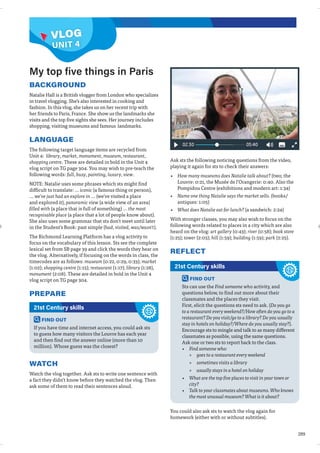
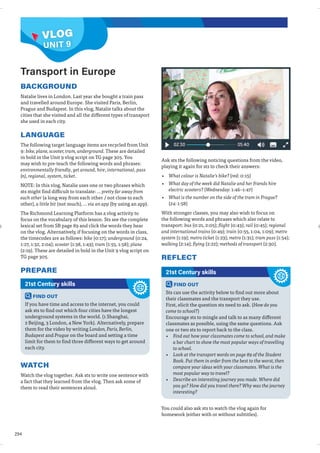
My top five things in Paris
Natalie
N: Hello, and welcome to this video. My
name is Natalie and I recently visited
Paris. Here are the top five things I did
with my friends.
Number one: we visited the Louvre
Museum. Well, we didn’t actually go
inside. It’s a really popular museum, so
it was full. The museum has the world-
famous Mona Lisa painting, so I wasn’t
really surprised by how busy it was.
Number two: I visited Musée de
l’Orangerie, which is an art gallery filled
with twentieth-century paintings. It’s a lot
more peaceful and quiet than the Louvre.
Number three: the River Seine. There
is a big market along the river. They
sell books and antiques here. It’s very
different to the Champs-Élysées, which
is an avenue filled with luxury shopping
centres and restaurants.
We’ve just had an explore in Shakespeare
and Company.
This is a famous bookstore. It was like
the library from Harry Potter.
Number four is Le Centre Pompidou.
So we’ve come to the Centre Pompidou. It’s
a lot of exhibitions, modern art. There’s also
an amazing panoramic view of all around
Paris. It’s amazing to see the city from a
height where you can see all the hills and
buildings. It’s amazing.
Number five: the Eiffel Tower, which is a
very famous monument.
So I’ve come to visit the iconic Eiffel Tower,
which is probably the most recognisable
place in Paris.
My friends and I ate our lunch in the
park and admired the views of the
famous monument.
I had a wonderful time in Paris. It’s such
a beautiful city and I want to go back one
day.
UNIT 5
Farmers’ market
Bokang
B: Hi everyone, my name is Bokang and
I am a vlogger from South Africa. My
channel is called The B Word and I share
parts of my life and vlog being out and
about, just like I am doing today.
Today, I’m going to the Fourways
Farmers’ Market in Santon, South
Africa. The market has a big selection
of food ranging from chicken, fruit,
vegetables, sandwiches, freshly
squeezed orange and apple juice, and so
many more delicious dishes.
I was thirsty, so my first stop was a juice
stand called ‘Impressed’. Here they use
fruits and vegetables to make their
delicious juices. My favourite is the
orange, apple and ginger mix.
After that, I decided to find something
to eat. There’s a stall that sells delicious
sandwiches. I decided to go for the
chicken option, and mmm, it was good.
Then, once the main meal was done, I
thought it was time for a little snack. At
VLOG SCRIPTS
Guidance on vocabulary
teaching, noticing tasks
and extra ideas.
s an art gallery filled
y
ury paintings. It’s a lot
quie
Riv
ng t
que
mp
with
ran
plor
oks
arry
Cen
Cen
ode
mic v
see
see
ng.
ffel
me
he i
mo
ou
he v
t.
me
I w
et
t
nam
So
e B
vlo
do
the
San
has
m c
ich
d a
us d
firs
sse
les
y fa
ing
d to
l th
ded
d m
n m
for
312
WORKBOOK
ANSWER KEY
2 1 –
2 9
3 –
4 9
5 9
6 –
7 9
8 9
9 –
3 1 e
2 f
3 a
4 b
5 d
6 c
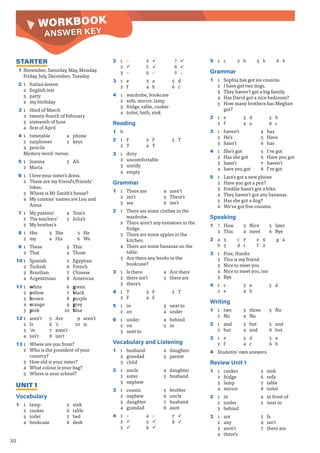
4 1 wardrobe, bookcase
2 sofa, mirror, lamp
3 fridge, table, cooker
4 toilet, bath, sink
Reading
1 b
2 1 F
2 T
3 F
4 T
5 T
3 1 dirty
2 uncomfortable
3 untidy
4 empty
Grammar
1 1 There are
2 isn’t
3 are
4 aren’t
5 There’s
6 isn’t
2 1 There are some clothes in the
wardrobe.
2 There aren’t any tomatoes in the
fridge.
3 There are some apples in the
kitchen.
4 There are some bananas on the
table.
5 Are there any books in the
bookcase?
3 1 Is there
2 there isn’t
3 there’s
4 Are there
5 there are
4 1 T
2 F
3 F
4 F
5 T
5 1 in
2 on
3 next to
4 under
6 1 under
2 on
3 next to
4 behind
5 in
Vocabulary and Listening
1 1 husband
2 grandad
3 child
4 daughter
5 parent
2 1 uncle
2 sister
3 nephew
4 daughter
5 husband
3 1 cousin
2 nephew
3 daughter
4 grandad
5 brother
6 uncle
7 husband
8 aunt
4 1 –
2 9
3 9
4 –
5 9
6 9
7 9
8 9
5 1 c 2 b 3 b 4 a
Grammar
1 1 Sophia has got six cousins.
2 I have got two dogs.
3 They haven’t got a big family.
4 Has David got a nice bedroom?
5 How many brothers has Meghan
got?
2 1 e
2 f
3 d
4 a
5 b
6 c
3 1 haven’t
2 He’s
3 hasn’t
4 has
5 Have
6 has
4 1 She’s got
2 Has she got
3 hasn’t
4 have you got
5 I’ve got
6 Have you got
7 haven’t
8 I’ve got
5 1 Lara’s got a new phone
2 Have you got a pen?
3 Freddie hasn’t got a bike.
4 They haven’t got any bananas.
5 Has she got a dog?
6 We’ve got five cousins.
Speaking
1 1 How
2 This
3 Nice
4 meet
5 later
6 Bye
2 a 3
b 5
c 7
d 1
e 6
f 2
g 4
3 1 Fine, thanks
2 This is my friend
3 Nice to meet you
4 Nice to meet you, too
5 Bye
4 1 c
2 e
3 a
4 b
5 d
Writing
1 1 two
2 No
3 three
4 No
5 No
2 1 and
2 but
3 but
4 and
5 and
6 but
3 1 e
2 f
3 d
4 c
5 a
6 b
4 Students’ own answers.
Review
1 1 cooker
2 fridge
3 lamp
4 mirror
5 sink
6 sofa
7 table
8 toilet
2 1 in
2 under
3 behind
4 in front of
5 next to
3 1 are
2 any
3 aren’t
4 there’s
5 Is
6 isn’t
7 there are
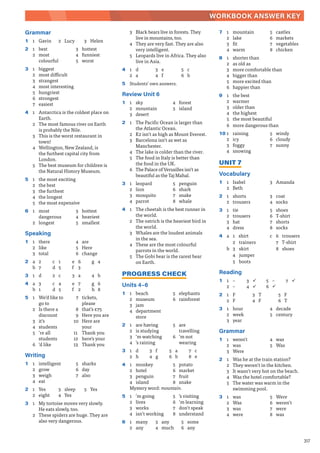
STARTER
1 November, Saturday, May, Monday,
Friday, July, December, Tuesday
2 1 Italian lesson
2 English test
3 party
4 my birthday
3 1 third of March
2 twenty-fourth of February
3 sixteenth of June
4 first of April
4 1 timetable
2 earphones
3 pencils
4 phone
5 keys
Mystery word: money.
5 1 Joanna
2 Marta
3 Ali
6 1 I love your sister’s dress.
2 These are my friend’s/friends’
bikes.
3 Where is Mr Smith’s house?
4 My cousins’ names are Lou and
Anna.
7 1 My parents’
2 The teachers’
3 My brother’s
4 Tom’s
5 Julia’s
8 1 Her
2 my
3 She
4 His
5 He
6 We
9 1 These
2 That
3 This
4 Those
10 1 Spanish
2 Turkish
3 Brazilian
4 Argentinian
5 Egyptian
6 French
7 Chinese
8 American
11 1 white
2 yellow
3 brown
4 orange
5 pink
6 green
7 black
8 purple
9 grey
10 blue
12 1 aren’t
2 Is
3 ’m
4 isn’t
5 Are
6 ’s
7 aren’t
8 isn’t
9 aren’t
10 is
13 1 Where are you from?
2 Who is the president of your
country?
3 How old is your sister?
4 What colour is your bag?
5 Where is your school?
UNIT 1
Vocabulary
1 1 lamp
2 cooker
3 toilet
4 bookcase
5 sink
6 table
7 bed
8 desk
Workbook answer key
for easy reference.
Scripts for all vlogs,
culture videos and
animations.
19
INTRODUCTION
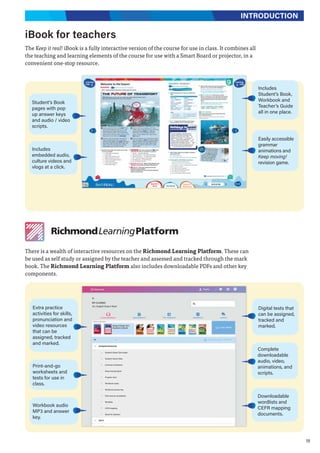
iBook for teachers
The Keep it real! iBook is a fully interactive version of the course for use in class. It combines all
the teaching and learning elements of the course for use with a Smart Board or projector, in a
convenient one-stop resource.
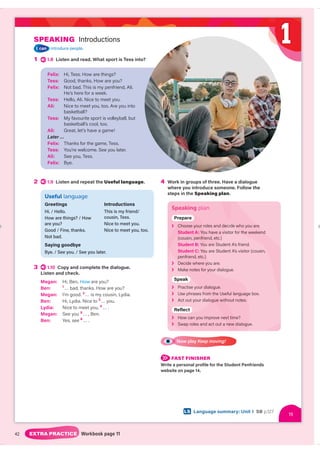
There is a wealth of interactive resources on the Richmond Learning Platform. These can
be used as self study or assigned by the teacher and assessed and tracked through the mark
book. The Richmond Learning Platform also includes downloadable PDFs and other key
components.
Includes
embedded audio,
culture videos and
vlogs at a click.
Includes
Student’s Book,
Workbook and
Teacher’s Guide
all in one place.
Extra practice
activities for skills,
pronunciation and
video resources
that can be
assigned, tracked
and marked.
Digital tests that
can be assigned,
tracked and
marked.
Complete
downloadable
audio, video,
animations, and
scripts.
Print-and-go
worksheets and
tests for use in
class.
Easily accessible
grammar
animations and
Keep moving!
revision game.
Student's Book
pages with pop
up answer keys
and audio / video
scripts.
Workbook audio
MP3 and answer
key.
Downloadable
wordlists and
CEFR mapping
documents.
20
September
ptember
Sept
4 S0.3 Match the numbers and words. Listen, check
and repeat.
1st 2nd 3rd 4th 5th 12th 20th 29th
30th 31st
fifth twentieth first third thirty-first fourth
twenty-ninth thirtieth second twelfth
5 Work in pairs. Ask and answer.
What’s your favourite
month/day of the week?
April/Monday.
What about you?
When’s your birthday? It’s on the fourteenth of May.
f
Things for school
I can talk about things for school.
6 S0.4 What’s in Jessie’s school bag? Match the
words with the picture. Listen, check and repeat.
earphones folder keys money notebook
k
pen pencil pencil case phone snack
k
timetable water bottle
VOCABULARY Days and dates
I can talk about days and dates.
1 S0.1 Look at Jessie’s calendar. Listen and
repeat the days of the week.
2 Write the correct day of the week.
What day is volleyball? Friday
1 What day is Jessie’s birthday?
2 What day is her music lesson?
3 What day is her friends’ party?
4 What day is the English test?
3 S0.2 Write the months of the year in
order. Listen, check and repeat.
April August December February
January July June March May
November October September
January, February, …
7 What’s in your school bag? Write a list.
1 2
3
4 5 7
6
8
9
10
11
12
Hi, my name’s Jessie. Today
is my first day back at school
after the holidays.
Monday 4
Tuesday 5
Wednesday 6
Thursday 7
Friday 8
Saturday 9
Sunday 10
9.00 a.m.
Back to school
7.00 p.m.
Piano class
all day
My birthday!
11.00 a.m.
English test
4.30 p.m.
Volleyball
5.00 p.m.
Ted and Liam’s party!
all day
Relax!
4
S
Starter
EXTRA PRACTICE Workbook page 4
20
21
STARTER UNIT OVERVIEW: The aim of this unit is to review language that students
already know, to remind them of some familiar vocabulary and grammar before they start the
main units of the book. They learn days and dates, and things for school, then revise countries
and nationalities and colours. They study the possessive ’s , subject pronouns, possessive adjectives and
demonstrative pronouns. They also revise the present forms of be and question words. They read a message board
about going back to school and practise transferring information to a table. They also learn how to tell the time.
VOCABULARY Days and dates
Sts revise days and dates and vocabulary to talk about
things at school. They study possessive ’s, subject
pronouns, possessive adjectives and demonstrative
pronouns.
Vocabulary
Days and dates (January, February, etc., first, second,
etc.); Things for school (earphones, folder, keys, money,
notebook, pen, pencil, pencil case, phone, snack, timetable,
water bottle)
WARMER
Play a game to revise numbers. Ask sts to stand up. Say the
number one and elicit the next number (two) from a student
at the front of the class. Continue around the class, with
students saying a number in turn. If they make a mistake or
cannot think of the next number, they sit down. You could
repeat the game with students counting in twos or threes.
1 S0.1 Read out Jessie’s introduction, then ask sts to
read the calendar. Play the audio once for students to
listen to the days of the week. Play the audio again for
sts to listen and repeat.
2 Read out the example question and answer, and point
out that the answer is in the calendar. Sts then write the
answers to the remaining questions. Check answers.
Answers
1 Wednesday
2 Tuesday
3 Saturday
4 Thursday
3 S0.2 Sts could work in pairs to write the months
in order. Play the audio once for sts to listen, check
and repeat.
Answers
January, February, March, April, May, June, July,
August, September, October, November, December
4 S0.3 Write the first two numbers on the board. Point
to each one and ask: Which words does it match? Elicit the
answers. Sts then match the remaining numbers and
words. Play the audio for sts to listen, check and repeat.
Answers
1st first, 2nd second, 3rd third, 4th fourth, 5th fifth,
12th twelfth, 20th twentieth, 29th twenty-ninth,
30th thirtieth, 31st thirty-first
5 Read out the questions and point out the use of on to
talk about birthdays, e.g. my birthday is on the tenth of
June. Put sts into pairs to ask and answer questions.
Things for school
6 S0.4 Sts match the words with the items in the
picture. Play the audio for students to listen, check
and repeat.
Answers
1 snack 2 pencil 3 pen 4 money
5 water bottle 6 phone 7 folder
8 pencil case 9 notebook 10 keys
11 timetable 12 earphones
7 Sts write a list of what is in their school bag. Ask some
sts to tell the class what is in their school bag, holding
up each thing in turn and saying the words.
V Vocabulary practice: WB p.4
Sts will find more practice of vocabulary for days
and dates, and things for school here. Set these
exercises for homework.
Starter
d
S
Vocabulary Grammar Pronunciation Reading Speaking
Days and dates; Things
for school; Countries
and nationalities;
Colours
Possessive ’s; subject pronouns and
possessive adjectives; demonstrative
pronouns; be: affirmative, negative and
questions; question words
Question words Transferring
information to a
table
Telling the
time
22
5 Copy and complete the sentences with a
possessive adjective.
She’s American, but her mum is from Mexico.
r
1 I’m from Brazil. … name is Mauro.
2 A: When’s … birthday, Anna?
B: … birthday is on 26th November.
3 That’s our neighbour’s cat. … name is Tiger and it’s
really friendly.
4 A: What’s the name of the new boy in our class?
B: … name is Tomasz. He’s from Poland.
5 Haruto and Sakura are from Japan. … home is in
Tokyo.
6 I’m in a class with Josie and Leo. We all like … new
teacher.
Demonstrative pronouns
I can use demonstrative pronouns.
6 S0.5 Read the grammar box. Listen and repeat
the dialogue.
Here There
Singular this that
Plural these those
Student: Excuse me, what’s this in English?
Teacher: It’s a ruler.
Student: And what are those?
Teacher: They’re earphones.
Student: Thanks.
Teacher: You’re welcome!
7 Work in pairs. Ask and answer about other things
in the classroom.
What’s this? What are these?
What’s that? What are those?
FAST FINISHER
Write about your friends’ and family’s birthdays.
George’s birthday is on 22nd October. My mum’s birthday
is on …
GRAMMAR Possessive ’s
I can talk about possession.
1 Copy and complete the rule. Write singular
or plural.
Singular Plural
Jessie’s birthday is on
Wednesday.
Her friends’ party is on
Saturday.
Rules
We use ’s after a 1
… noun or name.
We use ’ after a 2
… noun.
2 Copy and complete the sentences. Use ’s or ’.
This is the boys’ bathroom.
’
1 That is Mark … bag.
2 Emma … birthday is in September.
3 My parents … names are Sue and Pete.
4 Are these your best friend … keys?
5 This is Maria … notebook.
6 Two of my friends … birthdays are on the
same day!
Subject pronouns and possessive
adjectives
I can use subject pronouns and possessive adjectives.
3 Copy and complete the grammar box with the
words in the box.
he her it my our their your
Subject pronoun Possessive adjective
I my
you 1
2 his
she 3
4 its
we 5
they 6
4 Change the words in blue to a subject pronoun.
Maria is thirteen years old.
She is thirteen years old.
1 Daniel is in Year 7.
2 The water bottle is on my desk.
3 Lucas and I are in the same class.
4 The earphones are in my bag.
5 Are you and your sister at the same school?
5
S
EXTRA PRACTICE Workbook pages 4 and 5
22
23
STARTER
GRAMMAR Possessive ’s
1 Read the grammar box about the possessive ’s with sts.
Make sure they understand the meaning of singular
and plural. Sts could work in pairs to complete the rules.
Check answers.
Answers
1 singular 2 plural
Ask questions to check concept.
Concept check questions: Write on the board: the
student’s book. Ask: One student? (yes). One book? (yes).
Write: the student’s books. Ask: One book? (no – more
than one). One student? (yes). Write: the students’ books.
Ask: One book? (no – more than one). One student?
(no – more than one).
2 Read the example with the class and elicit that it refers
to more than one boy. Sts then copy and complete
the sentences. Allow sts to compare their answers in
pairs, then check answers with the class.
Answers
1 That is Mark’s bag.
2 Emma’s birthday is in September.
3 My parents’ names are Sue and Pete.
4 Are these your best friend’s keys?
5 This is Maria’s notebook.
6 Two of my friends’ birthdays are on the same day!
Subject pronouns and possessive
adjectives
3 Demonstrate the grammar by picking up a book
and saying: I am a teacher. It’s my book. Then say to a
student: You are a student. It’s … Elicit the response your
book. Sts could work in pairs to copy the grammar box
into their notebooks and complete it. Check answers
with the class. Point out that English has only one
form of you for both singular and plural, e.g. You are my
friend. You are all my friends.
Answers
1 your
2 he
3 her
4 it
5 our
6 their
Ask questions to check concept.
Concept check questions: Use classroom objects
such as books or pens to elicit simple sentences to
demonstrate the grammar, e.g. She’s Lisa. It’s … pen.
(her). He’s Matteo. It’s … bag. (his). Dan and Paul are
students. These are … books. (their). Is this his bag?
(no – it’s my bag).
4 Read out the example answer, then read through the
remaining sentences and check that sts understand
water bottle and earphones. Ask sts to rewrite the
sentences using subject pronouns. Allow sts to
compare their answers in pairs, then check answers
with the class.
Answers
1 He 2 It 3 We 4 They 5 you
5 Read out the example answer, then ask sts to copy
the sentences and complete them with the correct
possessive adjectives. Allow sts to compare their
answers in pairs, then check answers with the class.
Answers
1 My
2 your, My
3 Its
4 His
5 Their
6 our
Demonstrative pronouns
6 S0.5 Read through the grammar box with the class.
Demonstrate the idea of here and there in the classroom,
by pointing to things close to you and saying: This is my
book. These are my pens, then pointing to things further
away in the classroom and saying: That is Ana’s bag.
Those are Ana’s pens. Play the audio for sts to listen to the
dialogue. Play it again, pausing for sts to repeat.
Ask questions to check concept.
Concept check questions: Say: That is my pen – here
or there? (there). This is my book – here or there? (here).
Point to the far side of the classroom and say: my books.
Elicit the sentence Those are my books. Point to some
pens close to you and say: This is my pens – correct? (no
– these are my pens).
7 Demonstrate the task by picking some things up and
asking: What’s this? What are these? Then point to some
objects further away from you and ask: What’s that?
What are those? Elicit some example answers. Sts then
work in pairs to ask and answer questions. Monitor and
help as necessary.
FAST FINISHER
Sts who finish early can practise the grammar further.
Sts write sentences about their friends’ and family’s
birthdays. Weaker sts could write a sentence about their
own birthday, then compare with a partner.
G Grammar practice: WB pp.4 and 5
Sts will find more practice for possessive ’s, subject
pronouns, possessive adjectives and demonstrative
pronouns here. Set these exercises for homework.
24
2 S0.7 Match the countries in Exercise 1 with the
nationalities below. Listen, check and repeat.
Argentina – Argentinian
-an / -ian -ese -ish Other
American
Mexican
Egyptian
Brazilian
Argentinian
Chinese
Japanese
Turkish
British
Spanish
Irish
French
3 S0.8 Work in pairs. Do the quiz. Listen
and check.
Colours
4 S0.9 Listen and repeat the colours.
black yellow purple
red blue brown
white orange grey
green pink
5 Work in pairs. Describe a flag. Can your partner
guess it?
A: It’s red and white.
B: Is it Turkey?
A: Yes, it is. / No, it isn’t.
3
Wh
Wh
Wh
Wh t
at
at i
i
i
is
s
s
s
s th
th
th
the
e
e
e ca
ca
ca
ca
ca i
pi
p
pi
pita
ta
t
tal
l
l
f
of
of
of B
B
Bra
ra
ra
az
zi
zil?
l?
a
a It
It’s
s R
Rio
io d
de
e
Ja
Jane
neir
ir
ro
o.
o.
b
b
b
b
b
b
b
b
b
b
b
b
b
b
b
b
b
b
b
b
b
b
b
b
b
b
b
b
b
b
b
b
b
b
b
b
b
b
b
b
b
b
b It
It
It
It
It
It
It
t
It
I
It
t
t’
’s B
B
Bra
ra i
si
sili
li
lia.
a.
Who is Daisy Ridley?
a She’s a British actress.
b She’s an American singer.
2
How old are the pyramids
in Egypt?
a They’re 4,500 years old.
b They’re 450 years old.
4
5
6
a They’re from Mexico.
b They’re from Turkey.
Where are
tacos from?
a He’s Argentinian.
b He’s Spanish.
What nationality
is the footballer
Marcos
Asensio?
VOCABULARY Countries and nationalities
I can talk about countries and nationalities.
1 S0.6 Match the countries with the flags in
the World Quiz. Listen, check and repeat.
Argentina Brazil China Egypt France Ireland
Japan Mexico Spain Turkey the UK
K the USA
WORLD
Where is this animal from?
a It’s from China.
b It’s from Japan.
1
1
7
10 11 12
8 9
2 3 4 5 6
6
EXTRA PRACTICE Workbook page 5
25
STARTER
VOCABULARY Countries and
nationalities
Sts study vocabulary for countries and nationalities.
They read and answer quiz questions, revise colours
and work in pairs to describe national flags.
Vocabulary
Countries and nationalities (Argentina/Argentinian,
Brazil/Brazilian, China/Chinese, Egypt/Egyptian, France/
French, Ireland/Irish, Japan/Japanese, Mexico/Mexican,
Spain/Spanish, Turkey/Turkish, the UK/British, the USA/
American); Colours (black, blue, brown, green, grey,
orange, pink, purple, red, white, yellow)
WARMER
Write the word country on the board. Elicit the meaning,
then ask: What’s your country? Elicit the answer, then
put sts into pairs and ask them to write five more
country names in English. Bring their ideas together
on the board and check they understand. Point to one
or two of the countries on the board and say: I’m from
(Brazil). I’m (Brazilian). Try to elicit more nationality
words in this way.
1 S0.6 Sts could work in pairs to match the
countries with the flags. Play the audio once for sts
to listen and check their answers, then play it again,
pausing for them to repeat. Ask which sts guessed all
the flags correctly.
Answers
1 Egypt
2 Mexico
3 the USA
4 Japan
5 France
6 Turkey
7 Brazil
8 Spain
9 Ireland
10 Argentina
11 the UK
12 China
2 S0.7 Sts could work in pairs to match the countries
with the nationalities. Play the audio once for sts to
listen and check their answers, then play it again,
pausing for them to repeat.
Answers
Brazil – Brazilian
China – Chinese
Egypt – Egyptian
France – French
Ireland – Irish
Japan – Japanese
Mexico – Mexican
Spain – Spanish
Turkey – Turkish
the UK – British
the USA – American
3 S0.8 Read through the quiz with the class and
check that sts understand actress, singer, pyramid,
animal and capital. Sts then do the quiz in pairs. Play the
audio for sts to listen and check their answers. Ask who
got all the answers right.
Answers
1 a
2 a
3 b
4 a
5 a
6 b
Colours
4 S0.9 Play the audio once for sts to listen to
the words. Play the audio again, pausing for sts to
repeat. For extra practice, point to some things in the
classroom, e.g. sts’ clothes or bags and ask: What colour
is this? Elicit answers.
EXTRA PRACTICE
Ask sts to close their books. Arrange them in small
teams and give them a minute to write down the
colours they remember from Exercise 4. Elicit all
eleven colours and ask teams to spell each one. Write
them on the board so teams can check their spelling.
They win a point for each correctly spelled colour.
When you have all eleven colours on the board, call
them out at random, e.g. blue. The first team to find
something blue on their desk or in their bag, and hold
it up in the air, wins another point.
5 Demonstrate the task by describing one or two flags and
asking sts to guess them. Sts then work in pairs and take
turns to describe and guess the flags. Monitor while
they are working, and help if necessary.
V Vocabulary practice: WB p.5
Sts will find more practice of countries, nationalities
and colours here. Set these exercises for
homework.
26
Question words
I can ask Wh- questions with the verb be.
6 Read the example sentences. Complete the
dialogue with a question word.
Where are tacos from?
What is the capital of Brazil?
Who is Daisy Ridley?
How old are the pyramids?
A: 1
… ’s your name?
B: My name is James.
A: 2
… are you from?
B: I’m from Ireland.
A: 3
… are you?
B: I’m fourteen years old.
A: 4
… ’s your teacher?
B: My teacher is Mrs Kelly.
7 PRONUNCIATION Question words
S0.10 Listen and repeat the questions from
the dialogue in Exercise 6.
/w/ /h/
What’s your name?
Where are you from?
How old are you?
Who is your teacher?
8 Work in pairs. Ask and answer the questions in
Exercise 6. Give true answers for you.
9 Work in pairs. Write more quiz questions like those
on page 6. Ask and answer with another pair.
What’s the capital of …?
What colour is the … flag?
Where is … from?
Where is …?
Who is the President of …?
How old is …?
FAST FINISHER
Make a list of more countries and nationalities.
Germany – German, …
GRAMMAR
be: affirmative, negative and questions
I can use the verb be.
1 Read and match the long forms with the short
forms in the grammar box.
’m = am
is am are not (x2) is not are (x2)
am not
Affirmative Negative
I’m from the UK. I’m not from Ireland.
You’re Spanish. You aren’t from Colombia.
He/She/It’s Brazilian. He/She/It isn’t Egyptian.
We/They’re German. We/They aren’t American.
2 Choose the correct answers.
1 My new pencil case am / is / are blue. is
2 We ’m / ’s / ’re from Spain.
3 Her keys am not /
t isn’t /
t aren’t in her bag.
t
4 She ’m not /
t isn’t /
t aren’t fourteen.
t
5 You ’m not /
t isn’t /
t aren’t in this class.
3 Copy and complete the sentences so that they are
true for you.
1 I … from Spain.
2 My teacher … American.
3 My parents … from Mexico.
4 I … twelve.
5 My friends and I … interested in sport.
6 My school … big.
4 Read the grammar box. Copy and complete the
questions and short answers.
Questions Short answers
Am I in this class? Yes, I 1
… . / No, I’m not.
Are you Sarah? Yes, you 2
…. / No, you aren’t.
3
… he/she/it in this
class?
Yes, he/she/it is. /
No, he/she/it isn’t.
Are we/they from
London?
Yes, we/they are. /
No, we/they 4
… .
5 wer
Copy and complete the questions. Ask and answe
in pairs.
1 … you from Italy?
2 … Lionel Messi from Argentina?
3
3 New York the capital of the USA?
… New York the capital of the USA?
4 … your parents from Spain?
5 … kangaroos from Australia?
7
S
EXTRA PRACTICE Workbook page 5
26
27
STARTER
GRAMMAR be: affirmative, negative
and questions
1 Read the grammar box with sts about be. Draw attention
to the different forms, and explain that be is an irregular
verb, so sts have to learn all the different forms. Point out
that it has long forms, but usually when we speak and
write we use the short forms. Point out that we use be to
talk about where someone is from and their nationality,
but also their age (he’s fifteen), their birthday (my birthday is
on …) and to talk about things (this is my bag).
Ask sts to match the long forms with the short forms in
the grammar box. Check answers.
Answers
’m not – am not
’re – are
aren’t – are not
’s – is
isn’t – is not
’re – are
aren’t – are not
Ask questions to check concept.
Concept check questions: I’m a teacher – long form
or short form? (short). What’s the long form? (I am a
teacher). She are fourteen – correct? (no – she is/she’s
fourteen). My book is in my bag – correct? (yes). Can you
make it negative? (my book isn’t in my bag).
2 Sts read the sentences and choose the correct answers.
Allow sts to compare their answers in pairs, then check
answers with the class.
Answers
2 ’re 3 aren’t 4 isn’t 5 aren’t
3 Read out the first gapped sentence and elicit a personal
answer to complete it. Sts then write the sentences in
their notebooks. Check answers by asking individual sts
to read out some of their sentences.
4 Read the grammar box with sts. To demonstrate the
word order in questions, write a simple affirmative
sentence on the board, e.g. Hugo is from Spain.
Demonstrate with arrows how the word order changes
to make a question: Is Hugo from Spain? Point out that
we use short forms in negative answers, but we always
use long forms in affirmative answers. Sts to copy the
questions and short answers, and complete them.
Check answers.
Answers
1 am 2 are 3 Is 4 aren’t
Ask questions to check concept.
Concept check questions: He’s from the USA – can you
make that a question? (Is he from the USA?). Yes, he’s –
correct? (no – Yes, he is). Is they from Brazil – correct?
(no – Are they from Brazil). Yes, they …… (are), No,
they …… (aren’t).
5 Sts work individually to copy the questions into their
notebooks and complete them. Allow them to compare
their questions in pairs, then check them with the class.
Then put sts into pairs to ask and answer the questions.
Go through the answers with the class and check the
ones that have a correct answer.
Answers
1 Are 2 Is 3 Is 4 Are 5 Are
2 Is Lionel Messi from Argentina? Yes, he is.
3 Is New York the capital of the USA? No, it isn’t.
5 Are kangaroos from Australia? Yes, they are.
Question words
6 Read the example sentences with the class. Point out
the word order of Question word + be + subject: What +
is + the capital of Brazil? Elicit how to say the question
words in the sts’ own language. Ask sts to complete
the dialogue with the correct words. Sts compare
answers in pairs then check with the class.
Answers
1 What 2 Where 3 How old 4 Who
Ask questions to check concept.
Concept check questions: Which question word asks
about someone’s age? (How old …). Which one asks
about a place? (Where). Which one asks about a person?
(Who). Which one asks about a thing? (What).
7 PRONUNCIATION S0.10
Model pronunciation of the /w/ and /h/ sounds in
isolation. Play the audio once for sts to listen to the
questions, then play it again for them to repeat
the words.
8 Demonstrate the task by asking one or two sts the
questions in Exercise 6 and eliciting true answers. Sts
then work in pairs to ask and answer the questions.
9 Read through the question stems with the class and
elicit one or two questions with each one. Put sts into
pairs to write their quiz questions. Put pairs together
into groups of four to ask and answer their questions.
FAST FINISHER
Fast finishers can make a list of more countries and
nationalities. They could use a dictionary to help them.
Weaker sts could work in pairs.
G Grammar practice: WB p.5
Sts will find more practice for the affirmative,
negative and question forms of be and question
words here. Set these exercises for homework.
28
SPEAKING Telling the time
I can ask for and tell the time.
3 S0.12 Listen and read. Match the clocks with
the times in blue. There is one extra clock.
READING
I can transfer information to a table.
1 S0.11 Read and listen to the message board.
Copy and complete the information for Sam
and Jessie.
Name:
Age:
City:
School:
School subjects :
School subjects : Sam: What’s the time, Jessie?
Jessie: It’s ten o’clock.
Sam: What time is our next lesson?
Jessie: It’s at quarter past ten.
Sam: And what time is lunch?
Jessie: It’s at half past twelve.
Sam: Oh no, two and a half hours! I’m really hungry!
4 S0.13 Listen and repeat the Useful language.
Useful language
Telling the time
What’s the time?
It’s (ten o’clock / half past ten).
What time is (our next lesson / lunch)?
It’s at (quarter past ten / quarter to ten).
5 S0.14 Listen and choose the correct time.
2 Read the message board again and write true (T)
or false (F). Correct the false sentences.
Sam is twelve.
F. Sam is thirteen.
1 Brandon Park is a small school.
2 Sam thinks that Maths is easy.
3 Jessie’s birthday is at the weekend.
4 Jessie’s French teacher is nice.
5
5 Jessie is in the school football team.
Jessie is in the school football team.
Home . Board . Contact
reply
message board
Today’s
Back to school
Is it your first day back at school this week? Write and
tell us about you and your school.
Hi, my name’s Sam. I’m thirteen
years old, and I’m from Bristol in
the UK. I’m at Brandon Park School.
It’s a big secondary school. My best
friends are Jessie, Ted and Liam.
We’re always together – at break
time, lunch and after school! My
favourite subjects are Science and
English. I’m not very good at Maths
– it’s difficult!
Hi, I’m Jessie. I’m twelve years
old, but I’m nearly thirteen – my
birthday’s on Wednesday! I’m
so excited! I’m also from Bristol,
and I’m at the same school as
Sam. I like French because I’m
quite good at languages, and
our teacher’s really nice. I like
Sport, too, and I’m in the school
volleyball team. I don’t like History.
12.30
10.00
9.45
10.15
a b
c
d
a
d
b
e
c
f
6 Work in pairs. Ask about the time now. Ask and
answer about two of the things below. Swap roles.
• our English lesson
• our Maths lesson
• our sports class
• break
FAST FINISHER
Write about you and your school for the message board in
Exercise 1.
8
29
STARTER
READING
WARMER
Ask: What days are you at school? Elicit answers and take
the opportunity to revise the days of the week. Ask: Is
school fun? Elicit a few answers. Teach the word subject
and ask: What are your favourite subjects? Elicit a few
answers, and revise or teach the school subjects: Science,
Maths, English, French, History, Geography, Sport.
1 S0.11 Look at the message board with the class and
read out the title Back to school. Teach the meaning
(at school after the summer holidays). Ask: When are
students back to school in your country? Read through the
table with the class and make sure sts understand how
they should complete it. Ask sts to copy the table into
their notebooks, then play the audio for them to read
and listen to the message board. They then complete
the information for Sam and Jessie. Check answers.
Answers
Name: Sam Jessie
Age: 13 12
City: Bristol Bristol
School: Brandon Park
School
Brandon Park
School
School
subject (-):
Science,
English
French, Sport
School
subject (/):
Maths History
2 Sts read the message board again and decide if the
sentences are true or false. Ask them to correct the false
sentences. Check answers, eliciting the part of the text
which confirms each answer.
Answers
1 F Brandon Park School is a big school.
2 F Sam thinks that Maths is difficult.
3 F Jessie’s birthday is on Wednesday.
4 T
5 F Jessie is in the school volleyball team.
EXTRA PRACTICE
Ask sts to copy the table in Exercise 1 and complete
it with information about themselves. Tell sts to
imagine this is their first day at school and they don’t
know each other. Arrange sts in small groups and ask
them to use the information that they wrote in their
table to tell the rest of the group about themselves. At
the end, ask sts from different groups to tell the class
about the group members.
SPEAKING Telling the time
3 S0.12 Focus on the images of the clocks and teach
the words time and tell the time. Explain the task to sts
and point out the times in blue. Then play the audio for
sts to listen and read. Sts then match the times with the
clocks. Check answers with the class and elicit how to
say the time on the remaining clock (quarter to ten).
Answers
a half past twelve
c ten o’clock
d quarter past ten
EXTRA PRACTICE
If your sts need more practice of telling the time,
draw three or four more clocks on the board, like the
ones in Exercise 3. Put sts into teams and ask them to
decide how to say the times. Check answers with the
class, and see which teams got all the answers right.
4 S0.13 Play the audio once for sts to listen to the
Useful language. Read through all the phrases with
the class and check that sts understand everything.
You could elicit how to say the phrases in the sts’ own
language. Play the audio again for sts to repeat.
5 S0.14 Play the first time and elicit which clock it
matches (c). See TB pages 274–285 for audio script.
Play the rest of the audio for sts to listen and note
down the correct times. Allow sts to compare
their answers in pairs, then play the audio again
if necessary for them to check and complete their
answers. Check answers with the class.
Answers
1 6.30 – c
2 1.15 – d
3 3.00 – a
4 9.45 – f
5 11.45 – b
6 8.30 – e
6 Elicit the questions that sts will need to ask, using What
time is …? Sts then work in pairs to ask and answer
questions, then swap roles and repeat the activity.
Monitor and help while sts are working, then ask the
questions to one or two individual sts and elicit answers.
FAST FINISHER
Fast finishers can write about themselves and their school
for a message board, using the texts in Exercise 1 as a
model. For weaker sts, write some sentence beginnings on
the board for them to complete about themselves:
My name’s …
I’m from …
I’m … years old.
I like …
I don’t like …
30
VOCABULARY Furniture I can talk about furniture and rooms in a house.
1 1.1 Match the words in the box with the pictures. Listen, check and repeat.
Picture 1: bed, chair, …
bath bed bookcase chair cooker desk
k fridge lamp
mirror shower sink
k sofa table toilet wardrobe
Vocabulary:
Furniture; Family
Grammar: there is / there are + a, an, some,
any; prepositions of place; have got
Speaking:
Introductions
Writing:
My dream home
2 Copy and complete the table with the furniture from Exercise 1.
Some words can go with more than one room.
bathroom bedroom dining room kitchen living room
3 Work in pairs. Imagine a strange house where everything
is in the wrong place! Ask and answer questions about it.
A: Where’s the bath?
B: It’s in the living room!
Now watch the vlog.
FAST FINISHER
Think about your home. How many furniture items listed in
Exercise 1 have you got?
1
3
2
4 5
KEYH LE
THROUGH
9
LS Language summary: Unit 1 SB p.127
Home sweet home
1
EXTRA PRACTICE Workbook page 6
31
UNIT 1 OVERVIEW: The topic of this unit is home. Sts read about the Big Teenage
Challenge to keep your bedroom tidy for a week, and listen to a description of someone's family.
They read some penfriend profiles and learn how to introduce people. They read about teenage
life in the UK and finally, they read about a dream home and write about their own ideal home. They
also watch a vlog about moving homes and a culture video about an unusual type of home.
VOCABULARY Furniture
Sts learn nouns for the names of 15 kinds of furniture.
They categorise these nouns according to the rooms where
they are usually found, then personalise the vocabulary by
talking about the furniture in their own home.
Vocabulary
Furniture (bath, bed, bookcase, chair, cooker, desk, fridge,
lamp, mirror, shower, sink, sofa, table, toilet, wardrobe)
Vlog
Ioan: My new home
WARMER
Ask: Where do you live? Do you live in a house or a flat? As
sts answer, ask questions, e.g. Is your flat big or small?
How many rooms are there? Revise vocabulary for rooms
and see what words for furniture sts already know.
1 1.1 Read through the words in the box and elicit
or teach the meanings. Sts match the words with the
pictures. Play the audio track. See TG page 274 for audio
script. Sts listen, check and repeat.
Answers
1 bed, chair, desk, wardrobe, mirror 2 cooker, fridge
3 chair, sofa, table 4 bookcase, chair, desk, lamp,
table 5 bath, mirror, shower, sink, toilet
2 Ask: Whatfurnituregoesinthebathroom? Elicit one or
two answers. Sts copy the table in their notebooks and
complete it with the words from Exercise 1. Point out that
some words can go in more than one room. Check answers.
Answers
bathroom: bath, mirror, shower, sink, toilet
bedroom: bed, bookcase, chair, desk, lamp, mirror,
table, wardrobe
dining room: bookcase, chair, lamp, mirror, table
kitchen: cooker, fridge, sink, table
living room: bookcase, chair, lamp, mirror, sofa, table
3 Ask a few questions about a normal house first, e.g.
Where’s the bath? (in the bathroom). Then read out the
task and explain the meaning of strange. Read out the
example question and answer, then put sts into pairs to
ask and answer questions. Ask individual sts to ask and
answers questions for the class.
Vlog
This lesson features an optional vlog in which a
vlogger talks about moving home. You can watch
this in class if you have time and access to video, or
you can ask sts to download it from the Richmond
Learning Platform to watch at home. See TG pages 286
and 304.
FAST FINISHER
Sts who finish early can practise vocabulary for furniture
further. They list the furniture in each of the rooms in
their own house. They could use a dictionary to find
other nouns not seen in Exercise 1. Weaker sts could
work in pairs. They take turns to point to the furniture in
the pictures. Their partner says the correct word.
EXTRA PRACTICE
Put sts into pairs. They take turns to try to talk about
their own home for one minute, while their partner
films them using their phone. They can watch their
films back and discuss in their pairs how they could
improve, for example by hesitating less. If there is time,
they could repeat the activity and try to improve.
V Vocabulary practice: WB p.6
Sts will find more practice of vocabulary for
furniture here. Set these exercises for homework.
LS Language summary: Unit 1 SB p.127
Home sweet home
1
Vocabulary Grammar Pronunciation Reading Listening Speaking Writing
Furniture;
Family
there is / there are
+ a, an, some, any;
prepositions of
place; have got
/ə/ Using pictures to
predict things in a
reading text
Preparing
before you
listen
Introducing
people
A chat forum
32
How tidy is your bedroom?
READING I can use pictures to predict what a reading text is about.
1 1.2 Look at the pictures. What do you think the
article is about? Read, listen and check.
2 Read again. Change the underlined word(s)
( ) so that
the sentences are correct.
Harry is fourteen years old. thirteen
1 On Day 1, Harry’s clothes are on his chair.
2 On Day 1, the sandwich is on his bed.
3 On Day 2, the clothes are on the floor.
4 On Day 2, the comics are on the desk.
3 Word Power Make pairs of opposite adjectives.
big clean comfortable empty tidy
dirty full small untidy uncomfortable
big – small
‘I’m very untidy,’ says Harry. He’s right!
There’s a big wardrobe in his room, but th
aren’t any clothes in it – they’re all on the
or on the floor. There are some dirty plates
under his bed, and there’s an empty pizza
box behind his chair! On Harry’s desk, nex
to his games console, there are hundreds
comics and … an old sandwich. Ugh!
4 Work in pairs. How tidy is your bedroom? Tell your
partner about the things below.
your bed your desk
k your floor your wardrobe
My bed is tidy, but my
desk is very untidy.
My wardrobe is empty.
5 FIND OUT The Bedroom in Arles is a famous
painting by Vincent Van Gogh of his bedroom. Find
out the answers to these questions.
1 What colour are the walls?
2 How many chairs are there?
3 What is there above the table?
THE
Can you keep your bedroom tidy for a week? That’s this week’s Big Teenage Challenge!
Our teenager is thirteen-year-old Harry from Manchester.
BIG TEENAGE CHALLENGE
DAY 1 DAY 2
w! What a difference! Harry’s room is
n and tidy. Are there any clothes on
floor? No, there aren’t! They’re in the
drobe. There isn’t a sandwich on his desk
w, and his comics are all in the bookcase
t to his bed. Everything is in the right
e, but can Harry keep his bedroom tidy
a whole week? Find out on Day 7…
ere
bed
s
a
xt
of
DA
Wow
clea
the fl
ward
now
next
plac
for a
Name: Harry
Age: thirteen
Hobbies: video games, comics,
eating pizza!
10
EXTRA PRACTICE Workbook page 7
33
UNIT 1
How tidy is your bedroom?
READING
Sts read about Harry, a teenager from Manchester, who
takes part in a challenge to keep his bedroom tidy for a
week. They focus on using pictures to predict things in a
reading text. They learn to use there is / there are with a,
an, some and any to talk about what is in a place, and how
to use prepositions of place to say where things are.
Reading text
An article about Harry, a boy from Manchester, who takes
part in a challenge to keep his bedroom tidy for a week
Reading skill
Using pictures to predict things in a reading text
WARMER
Ask: What’s in your bedroom? Is there a bed/table/desk,
etc.? Elicit answers from individual sts and use the
questions to recycle some of the furniture vocabulary
from page 9. Write on the board the words tidy and
untidy and teach the meanings. Ask: Is your bedroom tidy
or untidy? Elicit a few answers from individual sts, then
ask for a show of hands to see how many sts have tidy
and untidy bedrooms.
1 1.2 Using pictures to predict things in a
reading text Ask sts to look at the pictures and elicit
what they show (a teenage boy, a tidy bedroom and an
untidy bedroom). Ask: What do you think the article is
about? Explain to sts that predicting what a reading text
is about before they read it will help them understand it
better, and they can use the pictures to help them predict.
Put sts into pairs to look at the pictures again and discuss
what they think the article is about. Elicit some of their
ideas, but don’t confirm them. Check that sts understand
floor. Play the audio for sts to read, listen and check. Elicit
what the article is about and ask who predicted correctly.
2 Ask sts to copy the sentences into their notebooks. They
read the text again and change the underlined words
in the sentences to make them correct. Check answers
with the class.
Answers
1 on the bed or on the floor
2 on his desk
3 in the wardrobe
4 in the bookcase
3 Word Power Elicit or remind sts that we use
adjectives to describe things. Point out the example
answers and demonstrate the opposite meanings of
big and small by using classroom objects, e.g. books.
Sts could work in pairs for this task, and could use a
dictionary to help them. Tell them they can find some
of the adjectives in the article, and can use these to help
them understand the meanings. Check answers with the
class, and check that sts understand all the adjectives.
Answers
clean, dirty
comfortable, uncomfortable
empty, full
tidy, untidy
4 Read out the question, then read out the example
answers. Say some sentences about your own bedroom,
as further examples, e.g. My bedroom is tidy. My bed is
tidy and my clothes are in the wardrobe. Allow sts time to
prepare their ideas individually. Weaker sts might like
to write some sentences, but encourage stronger sts to
just think of ideas and make notes, but not write full
sentences. They then work in pairs to tell their partner
about their bedroom. Ask some sts to tell the class
about their partner’s bedroom.
21st Century skills
5 FIND OUT
Set this exercise for homework if you prefer. Sts can
find this information out by looking online or in
other media, or by asking other people. The answers
to the questions are: 1 the walls are blue, 2 there are
two chairs, 3 there is a mirror above the table.
You could also ask sts to find out some information
about Vincent Van Gogh.
EXTRA PRACTICE
Play a game to revise adjectives from Exercise 3.
Arrange sts in small teams. Write these nouns on the
board: bag, bed, bookcase, chair, classroom, clothes,
desk, mirror, sandwich, table. Teams have two minutes
to match an adjective from Exercise 3 to each noun.
They can use each adjective once. Point out that not
all the adjectives match all the nouns. For example,
big sandwich is correct but uncomfortable sandwich is
incorrect. Award a point for a correct match.
Possible answers
an empty bag, a comfortable bed, an untidy
bookcase, clean clothes, an uncomfortable chair, a full
classroom, a tidy desk, a dirty mirror, a big sandwich,
a small table
R Reading practice: WB p.7
You will find more practice for reading here. Set
these exercises for homework.
34
GRAMMAR
There is / There are + a, an, some, any
I can use There is / There are to describe a room.
Now watch the grammar animation.
1 In your notebook, complete the grammar box with
a, an, some or any.
y
y
Affirmative Negative
Singular There’s 1
… empty
box behind his
chair.
There isn’t 2
… pen
on his desk.
Plural There are 3
… plates
under his bed.
There aren’t 4
…
clothes in the
wardrobe.
Questions Short answers
Singular Is there a comic on
his bed?
Yes, there is. /
No, there isn’t.
Plural Are there 5
…
clothes on the floor?
Yes, there are. /
No, there aren’t.
2 Copy and complete the sentences about Harry’s
house. Use the correct affirmative or negative form
of There is / There are.
… three bedrooms. ✓
There are three bedrooms.
1 … a desk in his sister’s room. ✗
2 … an orange chair in his parents’ room. ✓
3 … any lamps in the dining room. ✗
4 … two bathrooms. ✓
5 … some books in the living room. ✓
3 Complete the text about Day 7 of the challenge.
Use a, an, some or any.
y
y
Prepositions of place
I can talk about the position of objects.
5 Where is the mobile phone? Match the
prepositions with the pictures.
behind in in front of next to on under
1
4
2
5
3
6
6 There is /
There are and the correct preposition.
chair / desk There’s a chair next to the desk.
1 games console / desk
2 trainers / bed
3 books / bookcase
4 bookcase / desk
5 guitar / chair
6 table / bed
4 Work in pairs. Ask and answer about your
bedrooms. Use the table below to help you.
Is there a
chair wardrobe
bookcase desk
in your room?
Are there
any
mirrors lamps
posters books
It’s Day 7, and we’re back in Harry’s
bedroom. There aren’t 1
… clothes on the floor,
and there aren’t 2
… dirty plates. Harry’s desk is
clean and tidy. There are 3
… books on it now, but
that’s OK – they’re for Harry’s homework – and
there’s 4
… new lamp. Well done, Harry! But wait
a minute. What’s that? There’s 5
… old pizza box
under the bed, and there’s half a pizza in it! Oh
Harry! You lose!
Harry’s
DAY 7
7 Work in pairs. Student B: Close your book.
Student A: Ask questions about the picture.
Swap.
A: Is there a cat under the desk?
B: No, there isn’t.
FAST FINISHER
Write sentences about your classroom.
There’s a bag under Nacho’s chair. There are some …
11
LS Language summary: Unit 1 SB p.127
1
EXTRA PRACTICE Workbook page 8
35
UNIT 1
GRAMMAR There is / There are + a,
an, some, any
Grammar animation
This lesson features an optional animated presentation
of the grammar in context called There's a cake on
this chair! including the form and use of there is / there
are; a, an, some and any and prepositions of place. You
can watch this in class if you have time and access to
a computer or tablet, or you can ask sts to download
it from the Richmond Learning Platform to watch at
home. See TG page 308 for animation script.
1 Read the grammar box about there is / there are with a,
an, some and any with sts. Point out that the examples in
the grammar box are from the article on page 10. They
could look back at the article to find the missing words
to complete the grammar box.
Answers
1 an 2 a 3 some 4 any 5 any
Write a singular example on the board, e.g. There’s a book
on the floor. Change book to books and elicit the other
changes that are necessary: There are some books on the
floor. Then change there are to there aren’t and elicit the
necessary changes: There aren’t any books on the floor.
Repeat this with one or two more simple sentences.
Ask questions to check concept.
Concept check questions: There’s a lamp in the living
room – one or more than one? (one). There are some
chairs in the dining room – one or more than one? (more
than one). There aren’t some comics – correct? (no –
there are some comics / there aren’t any comics). Are
there some chairs – correct? (no – Are there any chairs?).
2 Read the example with sts and check that they
understand the use of the tick and cross icons. Ask sts
to copy the sentences in their notebooks and complete
them. Check answers with the class.
Answers
1 There isn’t
2 There is
3 There aren’t
4 There are
5 There are
3 Read out the first gapped sentence and elicit the answer
as an example. Students then read the rest of the text
and write the correct missing words. Check answers.
Answers
1 any 2 any 3 some 4 a 5 an
4 Focus attention on the table and ask one or two
questions to individual sts. Refer them back to the short
answers in the grammar box to help them answer. Put
sts into pairs and ask them to take turns to ask and
answer questions. When sts have finished, ask some sts
to tell the class about their partner’s bedroom.
Prepositions of place
5 Explain that the words in the box are prepositions,
and we use them to say where something is. You could
demonstrate the concept using a book or pen, putting
it on a desk, under a desk, next to a book, etc. Sts could
work in pairs to match the prepositions with the
pictures. Check the answers with the class.
Answers
1 in
2 on
3 under
4 next to
5 behind
6 in front of
Ask questions to check concept.
Concept check questions: Use a classroom object
such as a book or pen to ask questions to check that sts
understand the prepositions. Hold the object in different
positions and give sts a choice of prepositions, e.g. Is it
on the desk or under the desk? Is it next to the chair or
behind the chair? As sts become more confident, hold it
in different positions and ask: Where is it?
6 Focus on the picture of the bedroom and read the
example with sts, then ask sts to write the sentences in
their notebooks. Check answers.
Answers
1 There is a games console on the desk.
2 There are some trainers under the bed.
3 There are some books in the bookcase.
4 There is a bookcase behind the desk.
5 There is a guitar in front of the chair.
6 There is a table next to the bed.
7 Allow sts time to look at the picture again and prepare
some questions individually. They then work in pairs
and take turns to close their books and try to answer
the questions from memory. Monitor and help
as necessary.
FAST FINISHER
Sts who finish early can practise the grammar further.
Sts write sentences about objects in the classroom.
Weaker sts could write one or two more sentences about
the picture in Exercise 6, using the ideas in Exercise 5 to
help them.
G Grammar practice: WB p.8
Sts will find more practice for there is / there are +
a, an, some, any and prepositions of place here. Set
these exercises for homework.
LS Language summary: Unit 1 SB p.127
36
Famous families
VOCABULARY and LISTENING Family members
I can prepare before I listen.
2 PRONUNCIATION /ə/
1.4 Listen and repeat.
mother father sister brother daughter
husband cousin parent
3 Work in pairs. Write the names of some members
of your family on a piece of paper. Swap with your
partner and ask and answer about the names.
A: Who’s Susana?
B: She’s my dad’s sister.
5 1.5 Look at the family tree and read the names.
Listen and complete Chris’ family tree with the
names.
Craig Elsa India Rose
Leonie Sasha Tristan
6 1.5 Read the questions carefully. Listen again
and answer the questions.
1 Where is Chris from?
2 Where is his wife from?
3 What is his wife’s job?
4 How many brothers has Chris got?
5 How many sisters has he got?
1 1.3 Copy and complete the table with the words from the word cloud. Listen, check and repeat.
Male Female Male and female
brother sister child
daughter
aunt
brother
cousindad
grandad
grandma
mum
sister
uncle
child
husband
nephew
niece
parent
son
wife
4 Read the description of the radio programme.
What do you know about Chris Hemsworth? What
films is he in?
s show is
show is
ow is
Today’s sho
Toda
To ay’s s
oday’s sho
actor
or
bout the acto
out the ac
the
abou
ab acto
bou
rth
h
msworth
wort
s Hemsw
Hems
Chris He
Chris H
Chr msw
s He orth
family.
amily.
ily.
d his fam
his fa
and his
and h
and his
an s fam
Radio 9:
FAMOUS
FAMILIES
1 Craig 2 …
3 …
6 …
Chris
5 …
4 …
12
LS Language summary: Unit 1 SB p.127
EXTRA PRACTICE Workbook page 9
37
UNIT 1
Famous families
VOCABULARY and LISTENING
Family members
Sts listen to a radio show about famous families and
focus on preparing before they listen. They learn to use
have got to talk about possessions.
Vocabulary
Family members (aunt, brother, child, cousin, dad,
daughter, grandad, grandma, husband, mum, nephew,
niece, parent, sister, son, uncle, wife)
Listening text
A radio show about famous families
Listening skill
Preparing before you listen
WARMER
With books closed, put sts into groups. Ask them to
write three sentences about things there are in their
living room, and three sentences about things there are
in their kitchen, as quickly as they can. Tell them to put
up their hands when they have finished. When a group
has finished, check their sentences for accuracy. If the
sentences are correct, they are the winners. If there
are mistakes, ask them to correct them. Elicit a few
examples of correct sentences and take the opportunity
to revise furniture words and the use of there is / there
are. Ask: Who lives in your house? Elicit a few answers
and see what family words sts already know.
1 1.3 Ask sts to look at the family word tree. Read
through the words and elicit or teach the meanings. Ask
sts to copy the table and complete it with the correct
words. Play the audio track for sts to listen and check
the answers. See TG page 274 for audio script. Make
sure sts understand all the words. Play the audio track
again for sts to repeat the words. Point out that child has
an irregular plural (children).
Answers
Male: brother, dad, grandad, nephew, son, uncle
Female: sister, mum, grandma, wife, niece, daughter,
aunt
Male and female: cousin, child (children), parent
2 PRONUNCIATION 1.4
Model and drill pronunciation of the /ə/ sound in
isolation. Point out that in British English, we don’t
usually pronounce the sound /r/ at the end of a
word, but instead use the sound /ə/. Play the audio
for sts to repeat. If sts have difficulty producing the
/ə/ sound, point out that it is a very short sound and
also quite a ‘lazy’ sound, which you produce simply
by opening your mouth a little bit.
3 To demonstrate, write a few names of your family
members on the board. Encourage sts to ask you
questions, and answer them. Read out the example
question and answer and point out the possessive ’s in
my dad’s sister. Sts then work in pairs to write the names
of some family members, then swap and ask and answer
questions. Ask some sts to tell the class about someone
in their partner’s family.
4 Preparing before you listen Explain to sts that they
are going to hear a radio programme about a famous
family. Ask: Do you find listening difficult? Elicit a few
answers, and tell sts that if they prepare before they
listen and think about what they will hear, it will help
them understand better. Ask sts to read the description
of the radio programme and answer the questions. They
could work in pairs for this. Discuss their ideas as a
class. Ask: What words do you think you might hear? Elicit
a few ideas, e.g. actor, acting, mum, dad, son, daughter,
wife, brother, sister.
5 1.5 Allow sts time to study the family tree,
then read through the names in the box and model
pronunciation. Ask sts to copy the family tree into their
notebooks, then play the audio once for sts to listen and
complete the family tree with the names. See TG pages
274 for audio script. Allow sts to compare their answers
in pairs, then play the audio again for them to check
and complete the family tree. Check answers, then ask:
Is it a good idea to prepare before you listen? Do you think it
helps you understand?
Answers
2 Leonie
3 Elsa
5 Tristan / Sasha
6 India Rose
6 1.5 Read through the questions with the class and
check that sts understand them all. Play the audio again
for sts to answer the questions. Check answers with the
class.
Answers
1 Chris is from Australia.
2 Chris’s wife is from Spain.
3 She is an actress.
4 Chris has got two brothers.
5 Chris hasn’t got any sisters.
V L Vocabulary and Listening practice: WB p.9
Sts will find more practice for listening, and practice
of vocabulary for family here. Set these exercises for
homework.
LS Language summary: Unit 1 SB p.127
38
GRAMMAR have got
I can use have got to talk about possessions.
Now watch the Grammar animation.
1 Copy and complete the grammar box with the
words in the box.
got hasn’t got haven’t Have ’ve got
Affirmative Negative
I’ve got a cat.
She’s got two brothers.
They 2
… three
children.
You haven’t got a dog.
He 1
… any sisters.
We haven’t got any
grandchildren.
Questions Short answers
3
… you got a niece?
Has he 4
… any aunts?
Have they got a pet?
Yes, I have. / No, I haven’t.
Yes, he has. / No, he hasn’t.
Yes, they have. / No, they
5
… .
2 Put the words in order to make sentences or
questions about Chris and his family.
house. / have / Chris and Elsa / a big / got
Chris and Elsa have got a big house.
1 a dog. / has / got / the family
2 haven’t / they / got / a cat.
3 has / pet snake! / Elsa / got / a
4 any cousins? / have / the children / got
5 Chris / a sister. / got / hasn’t
6 Liam / has / any children? / got
3 Write true sentences about you. Use the
affirmative or negative forms of have got.
My mum / a brother
My mum has/hasn’t got a brother.
1 My dad / a sister
2 I / a lot of cousins
3 My parents / a bike
4 We / a tidy classroom
5 My home / a garden
6 I / a pet
4 THINK CRITICALLY Have you got a big
family or a small family? What are the advantages
and disadvantages of big families and small
fa
fa
fami
mi
mili
li
lies
es
es?
?
?
5 1.6 Copy and complete the questions and
answers. Listen and check.
6 Work in pairs. Ask and answer questions. Use the
ideas in the box.
a baby in your family a brother or sister at university
any cousins a family photo on your phone
a favourite aunt or uncle
A: Have you got a …?
B: Yes, I have. What about you?
Has Stephen got a sister?
t
Yes, he has. Her name’s Syde
and she’s good at volleyball.
1 … he … a brother?
Yes, he … . His
brother, Seth, is also
a basketball player.
2 … he … a wife?
Yes, he … . His wife, Aye
is a TV presenter.
3 … they … any children?
Yes, they … .
4 … they … a cat?
No, they … , but they’ve
two dogs!
Stephen Curry
Famous Families:
This week’s Famous Families is about the
famous basketball player, Stephen Curry.
FAST FINISHER
Choose a famous person and write about their family.
Beyoncé has got two daughters and a son. She’s got a sister,
Solange.
4
46
46
4 %
%
%
% of
of h
h
h
hom
om
o
om
mes
es
es i
i
i
i
in
n
n
n
n th
th
th
th
h
h
he
e
e
e
e UK
UK
UK
U
h
h
ha
ha
h ve
e g
g
g
g
g
got
ot
ot
ot
ot
ot a p
pet
et.
.
. Do
Do
Do
Dogs
gs
gs
gs
gs
gs
g
a
ar
a
ar
ar
ar
a
ar
a
ar
a
a
ar
a e
e
e
e
e
e th
th
h
th
h
th
th
th
h
h
he
e
e
e
e
e
e
e
e
e
e
e UK
UK
UK
UK
K
UK
UK
K
K
UK
UK
U
UK
K
K’
’
’
’s
’s
’s
’s
’s
s
’s
s
s f
f
f
f
f
fav
av
av
av
avou
ou
ou
ou
ou
u
o ri
i
i
ri
r
ri
rite
te
te
te
t
te
pe
pe
pe
p
p
pe
e
e
pet,
t,
t
t,
t,
t
t,
, a
a
a
a
a
a
a
a
a
a
and
nd
nd
nd
nd
d
nd
nd
n
nd
d c
c
c
c
c
c
cat
at
at
at
at
at
at
t
ats
s
s
s
s
s
s
s
s ar
ar
ar
ar
are
e
e
e
e
e
e
e th
th
th
th
th
th
th
th
t
t
the
e
e
se
se
se
se
se
se
se
sec
co
co
co
co
co
ond
nd
d
nd
d
n
n
nd f
f
f
f
f
fav
a
av
av
av
av
av
v
vou
ou
ou
ou
ou
o
o
ou
o
ou
u
o i
ri
ri
ri
ri
ri
r te
te
te
te
te
e
te
t .
.
. Ab
Ab
A ou
ou
ut
t
t
t
t
40
40
40
40
40
4
40
4
4
4 0,
0
0
0
0
0
0
0
0
0
0
0,00
00
00
0
00
00
00
0
0
00
0 ho
ho
o
ome
me
me
mes
s
s
s
s ha
ha
ha
have
ve
ve
ve
e
go
go
go
go
go
go
o
go
o
got
t
t
t
t
t
t
t a
a
a
a
a
a
a
a pe
pe
pe
e
pe
p
pe
p
p t
t
t
t
t
t
t s
sn
sn
sn
sn
sn k
ak
ak
ak
a
ake!
e!
e!
e
FUN
F
FU
FU
FUN
el,
esha,
?
got
es is about the
Stephen Curry.
13
LS Language summary: Unit 1 SB p.127
1
EXTRA PRACTICE Workbook page 10
39
UNIT 1
GRAMMAR have got
Grammar animation
This lesson features an optional animated presentation
of the grammar in context called I've got funny hair!
including the form and use of have got. You can watch
this in class if you have time and access to a computer
or tablet, or you can ask sts to download it from the
Richmond Learning Platform to watch at home. See TG
page 308 for animation script.
1 Read the grammar box with sts about have got. Draw
attention to the different forms, have got and has got.
Point out that we use have got for I, we, you and they, and
we use has got for he, she, you and it. Explain that we
use have got to talk about possessions (things that are
ours) and also about family members, e.g. I’ve got a bike,
I’ve got a sister. Sts complete the grammar box. Check
answers, then ask questions to check concept.
Answers
1 hasn’t got
2 have got
3 Have
4 got
5 haven’t
Concept check questions: I’ve got a big bedroom – is it
my bedroom? (yes). Jack’s got a bike – is it his bike? (yes).
My cousin have got a cat – correct? (no – My cousin has
got a cat). You have got a brother? – correct? (no – Have
you got a brother?). I’ve got a sister – can you make that
negative? (I haven’t got a sister). My sister has got a bike –
can you make that negative? (My sister hasn’t got a bike).
2 Remind sts of the audio they listened to about Chris.
Elicit what they can remember about his family. Ask sts
to write the sentences in their notebooks. Check answers.
Answers
1 The family has got a dog.
2 They haven’t got a cat.
3 Elsa has got a pet snake!
4 Have the children got any cousins?
5 Chris hasn’t got a sister.
6 Has Liam got any children?
3 Read the example answer with the class and ask one or
two sts to say the sentence that is true for their family.
Sts write their sentences individually. Monitor and help
as necessary. Check answers by asking individual sts to
read some of their sentences to the class.
4 THINK CRITICALLY
Read out the questions and make sure sts understand
advantages and disadvantages. Put sts into pairs or
small groups and encourage them to talk about
their own families and brainstorm advantages and
disadvantages of big and small families. Help with
vocabulary as necessary and encourage them to
focus on listing ideas and not to worry too much
about writing completely accurate sentences. They
might include things such as:
advantages of a big family: you’re never lonely, getting
help with homework, lots of fun; disadvantages: not
much money, parents are very busy, disagreements.
advantages of a small family: close to parents, lots
of help and attention from parents, own bedroom;
disadvantages: can be lonely, boring in the holidays.
21st Century skills
5 1.6 Focus on the photo and ask sts if they recognise
Stephen Curry. Explain if necessary that he is an
American basketball player, who plays for the Golden
State Warriors. Sts copy and complete the questions and
answers. Play the audio for sts to listen and check their
answers.
Answers
1 Has, got, has
2 Has, got, has
3 Have, got, have
4 Have, got, haven’t
6 Read through the ideas in the box and check that sts
understand them all. Ask one or two questions to
individual sts to demonstrate the task. Read out the
example question and answer and point out the phrase
What about you? to ask your partner the same question.
Sts work in pairs to ask and answer questions. Monitor
and help, then ask some sts to tell the class something
about their partner.
FUN Encourage sts to read this fun fact for pleasure.
They might also be interested to know that the
most popular kinds of snake for pets are corn
snakes and ball pythons, which are both non-
poisonous. They eat small mice.
FAST FINISHER
Sts write sentences about a famous person’s family. Tell
them the famous person can be a music star, a sports
star, a film star, etc. Weaker sts could write one or two
sentences about their own family.
G Grammar practice: WB p.10
Sts will find more practice for have got here. Set
these exercises for homework.
LS Language summary: Unit 1 SB p.127
40
3 Read the profiles again. Copy and complete
the table.
Ali Julia
Age 13 3
… 14
Country 1
… Turkey Brazil
Brothers 1 0 6
…
Sisters 0 4
… 7
…
Interests 2
… 5
… 8
…
4 Imagine that you want a penfriend. Who do you
choose? Why?
Nice to meet you!
READING and LISTENING
I can understand a personal profile.
1 Look at the Student Penfriends website.
What is a penfriend? Have you got one?
5 1.7 Listen to the voice messages from two
students, Carla and Felix. Choose a penfriend for
each of them: Sara, Ali or Julia.
6 Work in pairs. Talk about your interests.
I’m into …
I’m crazy about …
I like …
My favourite … is …
2 Read the website and complete the profiles with emojis a–i.
1 i
Student
Home | Log in | Find a penfriend | Schools | Parents
Sara
Gonzalez
Hi. I’m Sara!
I’m Spanish
1 and I’m
from Valencia.
I’m thirteen years old and my
birthday is on 2 May.
My mum’s Spanish, but my dad’s
from England. I’ve got a brother,
Santi – he’s fifteen.
I’m into music 2 and video
games 3 . My favourite type of
music is rock and my favourite
video game is Minecraft.
Profile
Send an email
Send a voice message
Ali
Yazgan
name’s Ali.
I’m from
Ankara in
Turkey 4 . I’m twelve years old. My
birthday 5 is on 23 November.
I’ve got two sisters. They’re
twins! Their names are Melek and
Zeynep, and they’re nine years old.
I love sport, especially basketball 6 .
My favourite team are the Houston
Rockets. I’ve got lots of posters of
them in my bedroom!
Profile
Send an email
Send a voice message
Julia
Santos
name’s Julia
and I’m from
Curitiba in
Brazil 7 . I’m fourteen years old. My
birthday is on 7 July.
I haven’t got any brothers or
sisters, but I’ve got a dog and two
cats 8 , and I’ve got a lot of friends!
I’m not into sport, but I’m crazy
about films 9 . My favourite actress
is Emma Watson. She’s amazing!
Profile
Send an email
Send a voice message
Penfriends
a
b
c
d
e
f
g
h
i
14
KEEP
TALKING!
41
KEEP
TALKING!
UNIT 1
Nice to meet you!
4 Ask sts to read the profiles again and decide who they
would choose. Remind them they must have reasons
for their choice. Allow sts time to think about their
answers, then put them into pairs to say who they chose
and why. Ask some sts to tell the class.
5 1.7 Tell sts they will hear two voice messages. Tell
them they should listen carefully to hear what the
people like, then decide who is the best penfriend
for each one. Play the audio once for sts to listen and
choose the best penfriend for each one. See TG pages
274 for audio script. Check answers with the class,
encouraging sts to give reasons for their answers.
Answers
1 Julia (they are both into films)
2 Ali (they’re both into basketball)
6 Read out the sentence beginnings and elicit some
possible endings, e.g. I like video games, I’m crazy about
music, My favourite sport is tennis. Sts work in pairs and
talk about their interests. Monitor and help while they
are working. For feedback, teach the word both then
ask some sts to tell the class about an interest that they
share, e.g. We’re both into music. We both like football.
EXTRA PRACTICE
Elicit the types of information that Carla and Felix
included in their voice messages in Exercise 5 and write
these on the board: name, nationality/country, hometown,
age, brothers and sisters, pets, interests. If necessary, play
the audio again to refresh sts’ memories. Tell sts that
they are going to make voice messages for the Student
Penfriends website. Ask them to make some notes
about themselves for their voice message, using the
words on the board. Give sts time to practise with their
notes, then put them in pairs to record each other's
mesage using their phones. They can listen to their
messages afterwards and decide if there are any ways
they could improve.
READING and LISTENING
Sts read a website with profiles of possible penfriends and
complete them by adding suitable emojis. They listen to
some voice messages and match the students to suitable
penfriends. They then learn how to introduce people. They
read and hear a model dialogue and personalise the useful
language by following the steps in the Speaking plan.
WARMER
Ask: What do you say when you meet someone for the
first time? Elicit a few ideas, e.g. Hello. Nice to meet you.
Ask: What questions do you ask someone when you meet
them for the first time? Elicit a few ideas, e.g. What’s
your name? How old are you? Have you got any brothers or
sisters? Are you into music? Who’s your favourite singer?
Prompt students with question beginnings if necessary,
to give them ideas, e.g. Are you into …? Who’s your
favourite …? What’s your favourite (film/video game)? As
you elicit each question, ask it to one or two sts and
elicit their answers. Tell sts they are going to practise
meeting new people in English.
1 Look at the Student Penfriends website with the class.
Ask them what a penfriend is and if they have got one.
2 Focus on the emojis and ask sts if they use emojis
when they message their friends. Ask them to read
the profiles and choose the correct emojis to complete
them. Check answers.
Answers
1 i
2 f
3 c
4 h
5 e
6 a
7 b
8 g
9 d
3 Ask sts to copy the table into their notebooks, then
read the profiles again and complete the table.
Check answers.
Answers
1 Spain
2 music and video games
3 12
4 2
5 basketball
6 0
7 0
8 films
42 EXTRA PRACTICE Workbook page 11
SPEAKING Introductions
I can introduce people.
1 1.8 Listen and read. What sport is Tess into?
4 Work in groups of three. Have a dialogue
where you introduce someone. Follow the
steps in the Speaking plan.
Speaking plan
Prepar
r
Prepare
❯ cide re.
de who you are.
Choose your roles and dec
Choose your r
Student A: visitor for t nd
or the weekend
ou have a vis
Yo
c.)
(cousin, pen end, etc.)
penfrie
Student B: u are Student A’s friend.
You
u are S
ou
Student C: u are Student A’s visitor (cousin,
You
penfriend, etc.)
❯ ou are.
D
Decide where yo
❯ our dialogue.
Mak
ake notes for you
Spea
a
Speak
❯ Practise your
our dialogue.
❯ ge box.
Use phrases from
rom the Useful languag
❯ Act out your dialog
ogue without notes.
ogu
gue wit
eflec
c
Reflect
❯ me?
How can you improve ne
ext tim
❯ ue.
dialogu
Swap roles and act out a n
new d
Now play Keep moving!
FAST FINISHER
Write a personal profile for the Student Penfriends
website on page 14.
2 1.9 Listen and repeat the Useful language.
Useful language
Greetings
Hi. / Hello.
How are things? / How
are you?
Good / Fine, thanks.
Not bad.
Saying goodbye
Bye. / See you. / See you later.
Introductions
This is my friend/
cousin, Tess.
Nice to meet you.
Nice to meet you, too.
3 1.10 Copy and complete the dialogue.
Listen and check.
Megan: Hi, Ben. How are you?
w
Ben: 1
… bad, thanks. How are you?
Megan: I’m good. 2
… is my cousin, Lydia.
Ben: Hi, Lydia. Nice to 3
… you.
Lydia: Nice to meet you, 4
… .
Megan: See you 5
… , Ben.
Ben: Yes, see 6
… .
Felix: Hi, Tess. How are things?
Tess: Good, thanks. How are you?
Felix: Not bad. This is my penfriend, Ali.
He’s here for a week.
Tess: Hello, Ali. Nice to meet you.
Ali: Nice to meet you, too. Are you into
basketball?
Tess: My favourite sport is volleyball, but
basketball’s cool, too.
Ali: Great, let’s have a game!
Later …
Felix: Thanks for the game, Tess.
Tess: You’re welcome. See you later.
Ali: See you, Tess.
Felix: Bye.
15
15
LS Language summary: Unit 1 SB p.127
1
43
UNIT 1
SPEAKING Introductions
1 1.8 Ask sts questions about things they like, e.g. Are
you into music? Who’s your favourite singer? Do you like
sport? What’s your favourite sport? Encourage them to use
full sentences when they answer, and encourage them
to use the phrases from page 14
(I like …, I’m into …, My favourite … is …). With stronger
classes, you could play the dialogue with books closed
and ask: Who is Ali? What’s he into? What sport is Tess
into? With weaker classes, you could play the dialogue
for sts to listen and read. See SB page 15 for audio script.
Check the answer.
Answers
Tess is into volleyball.
2 1.9 Tell sts there are different ways they can
greet people in English. Ask them if they remember
or can see any in the dialogue in Exercise 1. Read
through the Useful language box with the class and
check sts understand all the phrases. Ask questions to
check concept.
Concept check questions: Say: Hi! Then ask: What
do you say to me now? (Hi, Hello). Say: How are you?
What do you say now? (Good, thanks, Fine, thanks, Not
bad). How are you? / How are things? – same meaning?
(yes). Good, thanks, Fine, thanks, Not bad – same
meaning? (yes). See you – am I saying hello or goodbye?
(goodbye). This is my friend, Jack – what do you say?
(nice to meet you).
3 1.10 Ask sts to copy the dialogue in their notebooks
and complete it using the Useful language from
Exercise 2. Check answers.
Answers
1 Not
4 too
2 This
5 later
3 meet
6 you
4 Sts follow the steps in the Speaking Plan to practise
introducing people.
Speaking plan
Prepare
Sts work in groups of three. They decide on which
role each of them will play, and decide where they
are. They make notes using the Useful language in
Exercise 2 to help them. Point out that they should
also ask the person they meet some questions
about what they like and what they are into.
Speak
Sts decide who will speak first and then practise
their dialogue in their groups. They can practise
with and then without notes. Monitor and help
as necessary. If your sts use smartphones in class,
they could record their conversations.
Reflect
Discuss as a class how sts could improve next time.
Encourage them to be honest and open about the
things they did well and the things they can do
better. If you noticed any typical errors, correct
them with the class. Sts swap roles and follow
the steps again with a different visitor and place.
If they record their conversations, ask them to
use this to help them think of how they could
improve next time. Ask some sts to perform their
conversations for the class if they feel confident.
Keep moving!
This lesson features an optional language revision
and consolidation game for use in digital classrooms.
Players control different characters, each with their own
personalities and special abilities.
FAST FINISHER
Sts write their own personal profile for the Student
Penfriends website on page 14. Encourage them to use
the profiles on page 14 as a model and talk about where
they are from, their family and their interests. Weaker
sts could write one or two full sentences about things
they like and are into.
S Speaking practice: WB p.11
Sts will find more practice for introducing people
here. Set these exercises for homework.
LS Language summary: Unit 1 SB p.127
44
My home
My home
I can compare homes in the UK with homes in my country.
in the
Where are you from?
I’m from Brixton, in south London.
What’s your house like?
It’s got four bedrooms, a big kitchen and a living
room. In the living room, there’s a sofa, two chairs
and a TV, and there’s a red carpet on the floor. Most
homes in Britain have got carpets. There’s a big garden at the
back of the house and a small garden at the front. It’s an old
house, but it’s really comfortable.
What is there for young people in your area?
There’s a cinema and a sports centre and there are some great
parks. There are always things to do!
What are the negative things?
There’s a lot of traffic and it’s sometimes y
noisy.
Josh, 13
Where are you from?
’m from a small, quiet village in Wales.
What’s your house like?
My house is called ‘Rose Cottage’. A lot of houses
n the UK have got names. It’s a beautiful house
and there are only two bedrooms. I haven’t got
my own room – I’m in a room with my sister. It’s
OK, but I’m very tidy and my sister isn’t! We’ve
got a nice garden and there’s a trampoline for my sister and me.
What is there for young people in your area?
The people are y
friendly, but there isn’t a lot for teenagers.
Every summer, there’s a village festival.
What are the negative things?
It’s sometimes boring at the weekend. My friends are in other
villages and the buses aren’t very good.
Poppy, 14
W
I’
W
M
i
a
m
What is life like for
teenagers in the
UK? We talk to Josh,
13 and Poppy, 14.
Teenage life
Teenage life
16
REAL
CULTURE!
45
REAL
CULTURE!
UNIT 1
My home
3 Focus on the table and explain the meaning of positive
and negative. Ask sts if they can remember any positive
or negative things about the two homes. Ask sts to copy
the table into their notebooks. They can then read the
text again in their own time, or you could play the audio
again for them to read and listen. They then complete
the table with the correct information. Allow sts to
compare their answers in pairs, then check answers
with the class.
Answers
Positive things Negative things
Josh’s
home
Lots of bedrooms,
big garden at the
back, it’s really
comfortable, there’s
a cinema and sports
centre, lots to do,
there are some great
parks
Lots of traffic,
sometimes noisy
Poppy’s
home
There’s a nice
garden with a
trampoline, people
are friendly, in
summer there is a
village festival
It’s a small
house, has to
share a room
with sister, her
sister isn’t very
tidy, there isn’t a
lot for teenagers,
friends aren’t
nearby, it’s
sometimes
boring, the buses
aren’t good.
EXTRA PRACTICE
Ask sts to think of a house or flat that they know (not
their own) and like, e.g. the home of a relative. Give
them time to work individually and make notes about
the following: who lives there, where it is, how many
rooms there are, which room is their favourite room
and why. Arrange sts in pairs and ask them to describe
the house/flat to their partner. Their partner should
think of one or two general questions to ask at the end,
e.g. Is there a garden? Has it got a garage?
Sts learn about a variety of different typical homes
in the UK. They practise categorizing adjectives and
compare homes in the UK with homes in their country.
Sts then make a video about their own home.
This lesson features an optional culture video about an
unusual type of home: see SB page 17.
WARMER
Ask: Where do you live? Do you like your town or city?
Do you like your area? Why? Elicit what sts like about
the place where they live. Prompt them with more
questions if necessary, e.g. What is there in your area? A
cinema? A sports centre? A park? Is it a good area for young
people? Why? Encourage sts to give their opinions about
the place where they live, and give reasons to support
their opinions.
BACKGROUND
Brixton is an area of South London. The people who
live there come from a range of different ethnic and
cultural backgrounds and the area is known for its
lively street markets selling foods and other things
from all over the world.
Wales is one of the four countries that make up the
United Kingdom. The other countries are England,
Scotland and Northern Ireland. The four countries
are all ruled by the government in London, but Wales,
Scotland and Northern Ireland also have their own
parliaments which make decisions relating just to their
own country. Wales has some industrial towns and
cities, but it is also known for its beautiful countryside
and mountains.
A lot of people in the UK now live in flats in cities, and
more people now rent their home, but home ownership
is more popular in the UK than in many other countries,
and most people in the UK would still like to own their
own home, preferably a house, with its own garden.
1 Read out the five kinds of home and explain the
meanings. Put sts into pairs to look at the pictures and
decide which home is their favourite and why. Ask pairs
in turn to tell the class their ideas and reasons. You
could have a class vote to decide on the class’s favourite.
2 1.11 Focus on the text about Josh and Poppy and
explain that they each live in one of these homes. Tell
sts they are going to read and listen to the text, and they
should ignore any words they don’t understand for now.
Play the audio for sts to read and listen and match the
people to the homes. See SB page 16–17 for audio script.
Check the answers.
Answers
Josh 3 Poppy 2
46
1 Look at the pictures of typical homes in the UK.
Which home is your favourite? Why?
2 1.11 Read and listen to the text on page 16.
Match Josh and Poppy with two of the houses
from Exercise 1.
3 Read the text again. Copy and complete the table
about each home and area. Compare your answers
with a partner.
Positive things Negative things
Josh
Poppy
4 Word Power Look at the adjectives in blue in
the text. Which can describe people? Which can
describe things? Find more adjectives in the text.
People: young Things: comfortable Both: quiet
5 COMPARE CULTURES Work in pairs. Ask and
answer the questions.
1 How are homes in the UK similar to homes
in your country?
2 How are they different?
6 Work in pairs. Think about the area where you live
and make notes.
1 Are there any …?
parks shops sports centres cinemas
2 Is there a problem with …?
traffic noise graffiti pollution
3 Have you got …?
your own bedroom a garden a balcony
friends in your road
4 Is your road …?
quiet noisy friendly unfriendly
7 GET CREATIVE Work in small groups. Make a
video about your home. Follow steps 1–3.
1 Use the questions from the text on page 16 and
your notes from Exercise 6.
2 Take it in turns to interview each other. Film the
interviews.
3 Share your video with your class.
Now watch the culture video.
FAST FINISHER
Choose Josh or Poppy. Write three or four sentences
comparing their life with your life.
Poppy’s got a sister. I’ve got two brothers.
A block of flats
1
A
A
A
A semi
mi
mi
mi-d
-d
-d
det
e ached house in a city
3
A
A mo
mo
mode
d rn d
det
et
etac
ac
ache
hed
d ho
ho
hous
us
us
se
e
e
e
4
A
A
A te
te
te
terr
rr
rrac
ac
ced
ed
ed
e
ed h
h
hou
ou
use
se
e
e
5
A sm
m
smal
al
al
ll
l
l co
c
c
c ttage in
in
n
n
n
n
n
n
in
n
n
n
n
n
n
n
n
n
n
n
n
n
n
n
n
n
n
n
n
n
n
n
n
n
n
n
n
n
n the
e
e
e
e
e
e
e
e
e
e
e
e
e
e
e
e
e
e
e
e
e
e
e
e
e
e
e
e
e
e
e
e
e c
c
c
c
c
c
c
c
c
c
c
c
c
c
c
c
c
c
c
c
c
c
c
c
c
c
c
c
c
c
c
c
c
cou
ou
ou
ou
ou
ou
ou
ou
ou
ou
ou
ou
ou
ou
ou
ou
ou
u
ou
ou
ou
ou
ou
ou
ou
ou
ou
ou
ou
u
o
ou
o
ou
ou
o
o
ou
ou
o
o
ou
untry
ry
ry
ry
ry
ry
ry
ry
y
y
y
ry
ry
y
y
y
ry
y
y
ry
y
y
y
y
y
y
y
y
y
y
y
y
2
17
17
1
47
REAL
CULTURE!
UNIT 1
4 Word Power Focus on one or two of the adjectives in
blue in the text, e.g. young, noisy. Say some sentences
about people and things using the adjectives, to elicit
what each one can describe, e.g. a young person? (yes)
a young cinema? (no) a noisy person? (yes) a noisy cinema?
(yes). Sts look at the remaining adjectives in blue and
decide what they describe. They could work in pairs for
this, and they can use their dictionaries if necessary.
Check answers, and check that sts understand all the
adjectives. Ask sts to find more adjectives in the text.
Discuss the meanings of these adjectives with the class,
and discuss whether they describe people, things or both.
Answers
People: young
Things: comfortable
Both: noisy, quiet, tidy, boring, friendly
Other adjectives: big (things), red (things), small
(both), old (both), great (both), nice (both), good
(both), beautiful (both)
21st Century skills
5 COMPARE CULTURES
Put sts into pairs or small groups. Encourage each
group to brainstorm information about how homes
in their own country are similar and different to
homes in the UK. Ask some of the more confident
groups to present their ideas to the rest of the class.
6 Read through the questions with the class and make
sure sts understand all the vocabulary. Put them into
pairs to think about their area and make notes on the
topics on the page. Monitor and help while they are
working. Ask some pairs to tell the class their ideas. Ask
other sts if they agree or disagree, and why.
21st Century skills
7 GET CREATIVE
Put sts into pairs or small groups and explain that
they are going to make a video by interviewing each
other. Read through the three steps with the class
and make sure sts understand everything. Allow sts
time to prepare their own answers to the questions
in the text on page 16 first. Weaker sts might like
to write their answers, but stronger sts should be
able to answer without writing their ideas first.
Demonstrate the task by asking a confident student
the questions. Sts then work in their groups and
make their video by taking turns to film each other
using their phones. Monitor and help as necessary
while they are working. If you are able to show the
videos to the class on a big screen, you can do this.
Alternatively, put groups together for them to share
their videos with each other.
Culture video
You can watch this in class if you have time and
access to video, or you can ask sts to download it
from the Richmond Learning Platform to watch at
home. See Homes on wheels on TG pages 295 and 306.
FAST FINISHER
Sts write sentences comparing Josh or Poppy’s life with
their own life. Weaker sts could work in pairs and write
two or three sentences about either Josh or Poppy.
48 EXTRA PRACTICE Workbook page 12; photocopiable activities for Unit 1: vocabulary, grammar and skills
LS Language summary: Unit 1 SB p.127
W Writing summary: WB p.84 E Exams: Unit 1 SB p.118
My dream home
WRITING A chat forum
I can write about my dream home.
1 Read the chat forum. What is your favourite thing
about Becca’s dream home? Discuss your answer
in pairs.
3 Look at the Useful language. How do you say
these expressions in your own language?
Useful language
Describing a home
My dream home is a house / an apartment in the
country / in the city / near the beach.
Upstairs / Downstairs, there’s a … / there are …
Outside, there’s a …
In my bedroom, there’s a … I’ve got a …
4 Read the Look! box. Choose the correct word to
complete the rules.
and and but
It’s got four bedrooms and four bathrooms.
There isn’t a desk, but there’s a sofa.
Rules
We use 1
and / but to connect similar ideas.
We use 2
and / but to contrast ideas.
Look!
5 Copy and complete the sentences with and or
d but.
In our bathroom, there’s a shower, but there isn’t
a bath.
1 There’s a table tennis table … a basketball court.
2 My grandma’s got a dog …, she hasn’t got a cat.
3 I’ve got a desk for my computer … there’s a
bookcase for my books.
4 There’s a table …, there aren’t any chairs.
6 Write about your ideal home. Follow the steps in
the Writing plan.
Writing plan
Prepar
r
Prepare
❯ deal h k about:
al home. Think a
about your ide
Make notes a
es
room other places
• rooms and o
things
• furniture a d other th
re and
m
• your bedroom
m
Writ
t
Write
❯ deas into paragraphs.
O
Organize your id
Paragraph 1: here is it? What rooms and places
Whe s
has it
it got?
Paragraph 2: W re in your bedroom?
hat is there in yo
ome got?
What other
er cool things has your ho
❯ l language box.
Use the expres
essions from the Useful
eflec
c
Reflect
❯ Check your gr
Check your grammar:
: e are
e is / There
There , have got
❯ Check and and
d but.
❯ Check your spelling.
2 Read the chat forum again and answer the
questions.
1 How many people are there in Becca’s family?
2 What is outside Becca’s house?
3 What haven’t they got in their house?
4 What’s in Becca’s fridge?
What’s your dream home?
Post from Marius_123
Reply from Becca_99
on 5 Oct at 11.30 a.m.
On 5 Oct at 2.15 p.m.
What’s your dream home? Big or small?
Old or modern? In the country or in the city?
My dream home is a big house in the
country. Upstairs, there are four bedrooms
and four bathrooms – one each for my two
brothers, my parents and me! Downstairs, there’s a
big living room, a modern kitchen and a gym. Outside,
there’s a swimming pool and a tennis court.
In my bedroom, there’s a double bed and a wardrobe
for all my clothes. There’s a really comfortable sofa and
I’ve got a games console and lots of cool games. There
aren’t any TVs in the house but we’ve got a private
cinema. In the kitchen, there’s a fridge full of ice cream!
REPLY
18
49
UNIT 1
My dream home
WRITING A chat forum
Sts read a chat forum post about a dream home. They
learn useful language for describing a home and study
the use of and and but. They then follow the steps in the
Writing plan to write a chat forum post about their own
dream home.
Writing
A chat forum
Useful language
Describing a home (My dream home is …, Upstairs /
Downstairs, there’s a … / there are …, Outside, there’s a …,
In my bedroom, there’s a …, I’ve got a …)
Look!
and and but
WARMER
Say: Imagine your dream home – Is it big or small? How
many rooms are there? What is there outside? What is there
inside? What is there in your bedroom? Elicit ideas from
individual sts and encourage everyone to contribute
their ideas.
1 Focus on the chat forum and teach the word chat forum.
Ask sts to read the forum and decide on their favourite
thing about Becca’s dream home. Put them into pairs to
discuss their answers.
2 Sts read the chat forum again and answer the questions.
Check answers.
Answers
1 There are five people in Becca’s family.
2 a swimming pool and a tennis court
3 They haven’t got any TVs.
4 ice cream
3 Read the Useful language box with sts about language
for describing a home. Ask them how they say these
expressions in their first language. Remind sts of the
difference between there is and there are. Elicit or give
some examples of each, e.g. There’s a swimming pool.
There are some trees. Remind sts also of the negative
forms, there isn’t a …, there aren’t any … .
4 Read the Look! box with sts about and and but. Sts
choose the correct words to complete the rules. Refer sts
back to the chat forum post in Exercise 1 to find more
examples of each word.
Answers
1 and 2 but
5 Ask sts to copy the sentences in their notebooks and
complete them with the correct words. Check answers.
Answers
1 and 2 but 3 and 4 but
6 Ask sts to write a chat forum post about their ideal
home following the steps in the Writing plan.
Writing plan
Prepare
Sts work as individuals and make notes about their
ideal home. Monitor and help with vocabulary if
necessary. Remind them to write about the inside
and outside of their home.
Write
Read through the paragraph plan with the class,
then refer back to Becca’s forum post and show
how it follows the paragraph plan. Sts then write
their forum post using Becca’s post in Exercise 1 as
a model. Refer them back to the Useful language
box and encourage them to use these phrases.
Refer them back to the Look! box and encourage
them to use and and but to connect ideas. They can
also use prepositions of place from page 11 and the
adjectives from page 17.
Reflect
Ask sts to check their grammar, spelling and
punctuation and make any necessary changes.
Reassure them that it is normal to make changes
to a first draft of written work. Sts then work in
pairs. They swap their forum posts with a partner
and give feedback on the use of there is / there
are and have got, and also the use of and and but.
Remind sts that they should always be positive and
encouraging when they give feedback to a partner.
W Writing practice: WB p.12
Sts will find more practice for writing here. Set
these exercises for homework.
W Writing summary: WB p.84
E Exams: Unit 1 SB p.118
LS Language summary: Unit 1 SB p.127
50
Vocabulary: Daily
activities; Technology
Grammar: Present simple;
Wh- questions
Speaking: Asking for and
giving information
Writing: An email
message
VOCABULARY Daily activities I can use vocabulary for daily activities.
1 2.1 Match the activities with the pictures. Listen, check and repeat.
chat with my friends do my homework get dressed get up go to bed have a shower
have breakfast have dinner have lunch leave home tidy my room watch TV
I get up at 7.00 in the morning. I 1
… – usually
cereal with milk – and then I 2
… in my school
uniform. I 3
… at quarter to eight and I walk to the
bus stop. On the bus, I 4
…, Lucas and Emma.
After school, I go home. I 5
… (it’s always untidy!),
and then I open my schoolbag and I 6
… . We
7
… at about half past six. After dinner, I 8
… with
my family in the living room. I’m always tired at
10 p.m. so I 9
…!
1
5
9
2
6
10
3
7
11
4
8
12
My day by Charlie
2 2.2 Listen to the sounds and write the daily
activities in your notebook.
1 have a shower
3 Complete the blog post with the correct activities.
4 When do you do the activities in Exercise 1? Write
sentences.
I get up at half past seven.
I do my homework after dinner.
I have a shower before breakfast.
5 Work in pairs. Compare your sentences.
A: I get up at half past seven. What about you?
B: I get up at ten past seven.
Now watch the vlog.
FAST FINISHER
Imagine your perfect day. Write sentences.
I get up at ten o’clock. Then I have breakfast. I have hot
chocolate and croissants …
19
LS Language summary: Unit 2 SB p.128
School days
2
EXTRA PRACTICE Workbook page 14
51
UNIT 2 OVERVIEW: The topic of this unit is school life and free time. Sts read about an
unusual school on a ship, and listen to a podcast about another unusual school. They read
some adverts for school clubs and learn how to ask for and give information. They read about
schools in the UK and finally, they read an email from the future about daily life and write an email
about their own typical school day. They also watch a vlog about morning routines and a culture video about
school life in 1927.
VOCABULARY Daily activities
Sts learn 12 phrases for daily activities. They complete
a blog post with the phrases, then personalise the
vocabulary by talking about their own daily activities.
Vocabulary
Daily activities (chat with my friends, do my homework,
get dressed, get up, go to bed, have a shower, have
breakfast, have dinner, have lunch, leave home, tidy my
room, watch TV)
Vlog
Tati: Morning routine
WARMER
Ask questions about the students’ school, e.g. What time
does school start in the morning? What are your favourite
subjects? Elicit answers from different sts.
1 2.1 Read through the phrases in the box and elicit
or teach the meanings. Sts match the phrases
with the pictures. Play the audio track. See TG page
275 for audio script. Sts listen, check and repeat.
Answers
1 get up
2 leave home
3 chat with my friends
4 have lunch
5 have a shower
6 tidy my room
7 watch TV
8 have dinner
9 go to bed
10 get dressed
11 have breakfast
12 do my homework
2 2.2 Play the sounds for sts to write the activities.
Check answers.
Answers
1 have a shower
2 have breakfast
3 get dressed
4 get up
5 leave home
6 chat with my friends
7 go to bed
8 tidy my room
3 Sts read the blog post and complete it with the correct
activities. Sts check answers in pairs.
Answers
1 have breakfast
2 get dressed
3 leave home
4 chat with my friends
5 tidy my room
6 do my homework
7 have dinner
8 watch TV
9 go to bed
4 If necessary, revise how to tell the time in English. Read
out the example answers, then ask sts to write sentences
about what time they do the activities.
5 Put sts into pairs to compare sentences. Point out the
question What about you? to ask your partner for their
answer. Ask some pairs to tell the class which things they
do at the same time and which things at different times.
Vlog
This lesson features an optional vlog in which a
vlogger talks about her morning routine. You can
watch this in class if you have time and access to
video, or you can ask sts to download it from the
Richmond Learning Platform to watch at home. See
TG pages 287 and 304.
FAST FINISHER
Sts who finish early can practise vocabulary for daily
activities further. They write sentences about their
perfect day. Weaker sts could work in pairs.
EXTRA PRACTICE
Put sts into pairs. They take turns to talk about a typical
school day or their perfect day. They should try to talk
for one minute, while their partner films them using
their phone.
V Vocabulary practice: WB p.14
Sts will find more practice of vocabulary for daily
activities here. Set these exercises for homework.
LS Language summary: Unit 2 SB p.128
School days
il
2
Vocabulary Grammar Pronunciation Reading Listening Speaking Writing
Daily activities;
Technology
Present simple:
affirmative and
negative; present
simple: questions;
Wh- questions
/s/, /z/ and /ɪz/ Scanning a
text for specific
information
Understanding
yes/no
questions in a
podcast
Asking for
and giving
information
An email
52
A school with a difference
READING I can scan a text for specific information.
2 2.3 Read and listen. Are the sentences true (T)
or false (F)? Correct the false sentences.
There are 50 students on the ship.
F. There are 60 students on the ship.
1 Sophie has a shower after breakfast.
2 The teachers tidy the bedrooms.
3 They help to sail the ship for six hours.
4 The work on the ship isn’t easy.
5 After school, there are clubs and exercise classes.
3 Word Power Work in pairs. Find five school
subjects in the article. Make a list of more subjects.
4 THINK CRITICALLY Is a school on a ship a
good idea? Why/Why not? Discuss as a class and
have a class vote.
I think it’s a good idea because …
I think it’s a bad idea because …
5 FIND OUT Find six countries that the A+ World
Academy ship visits.
1 Scan the article and complete the information
about Sophie. Don’t read every word – just look for
the information you need.
Age: 1
… years old
Gets up: At 2
… a.m.
Has breakfast: At 3
… a.m.
Hours of lessons per day: 4
…
Goes to bed: At 5
… p.m.
SOPHIE ROBERTS
Sophie studies Maths, Science, History, English
and Spanish. Students have four to six hours
of lessons a day and for two hours they help to
sail the ship.‘It’s hard work,’ Sophie says,‘but it
k and responsibility.’
er homework and
doesn’t watch TV
n the ship, but there
nd film nights. At
– tired but happy
A+ World Academy is the world’s only school on
a ship! Sixty students from all over the world
live and study on the ship as it sails around the
ld Fift ld S hi t ll b t it
The School on a Ship!
sail the ship. It s hard work,
teaches us about teamwork
Af
Afte
ter
r sc
scho
hool, Sophie does he
ch
ch
h
hat
ats
s wi
wi
w
w th
th her friends. She d
an
and
d th
they
ey d
don’t have Wi-Fi on
are exercise classes, clubs an
ten o’clock, she goes to bed
after another day at sea!
world. Fifteen-year-old Sophie tells us about it.
Sophie gets up at seven o’clock every day and has a
show
w
w
wer
er
er
er
r.
. Th
Th
Th
Th
T e
e
e
e gi
gi
gi
girl
rl
r
r
r s
s
s sl
sl
sl
slee
ee
ee
ee
ep
p
p
p
p in
in
in
in o
o
o
o
one
ne
ne
ne r
r
roo
oo
oo
oom
m
m
m an
an
an
a
and
d
d
d th
th
th
t e
e
e
e bo
bo
bo
boys
y
ys s
s
sle
le
leep
ep
in ano
noth
th
t
t er
er r
roo
oom.
m.‘I
I ha
ha
have
ve
e b
b
bre
re
e
eak
ak
a
a fa
fa
fast
st
t
st a
at
t
7.30, th
then
en w
we
e ti
tidy
dy t
the
he b
bed
edro
room
oms
s
and clean the ship,’
Sophie says.
20
EXTRA PRACTICE Workbook page 15
53
UNIT 2
A school with a difference
READING
Sts read about the A+ World Academy, a school on a ship
that sails around the world, and focus on scanning the
text for specific information. They learn the affirmative
and negative forms of the present simple to talk about
routines, and practise pronunciation of the third person
-s ending. They use the present simple to talk about their
own daily routine.
Reading text
An article about the A+ World Academy, a school on a ship
Reading skill
Scanning a text for specific information
WARMER
Focus on the pictures with the article. Ask: What can
you see? Elicit or teach the words ship and sail, and elicit
or explain that it is a school on a ship. Ask: What time
do you think the students get up? What do they do in the
evening? Elicit a few ideas. Ask: Do you think a school
on a ship is fun? Why/Why not? Elicit a range of ideas.
Remind sts that it is a good idea to look at the pictures
and think about what they are going to read before they
read a text.
BACKGROUND
The A+ World Academy is an international boarding
school for teenagers. The students sail to different
countries and experience different ways of life and
different cultures while studying for exams. Students
usually stay on the ship for a whole school year. As well
as studying, students help to sail the ship and prepare
meals on board. More details can be found at https://
www.aplusworldacademy.org/.
1 Scanning a text for specific information Read
out the task and explain to sts that when they scan a
text, they don’t have to read every single word. Ask
them to imagine they are looking for their name in a list
of names, and point out that this is scanning. Focus on
the table and elicit the words that sts can scan for to find
each answer, e.g. years old, gets up, breakfast, lessons, bed.
Sts then scan the text to find the information. You could
do this as a race, to encourage sts to scan rather than
reading the whole text. Check answers with the class.
Answers
1 15 2 7 3 7.30 4 4 to 6 5 10
2 2.3 Ask sts to copy the sentences into their
notebooks. They read and listen to the article, then
decide if the sentences are true or false and correct the
false sentences. Check answers with the class.
Answers
1 F She has a shower before breakfast.
2 F The students tidy the bedrooms.
3 F They help to sail the ship for two hours.
4 T
5 T
3 Word Power Sts work in pairs to find five school
subjects in the article and then make a list of more.
Challenge them to write as many more subjects as they
can. They can use a dictionary to help if necessary.
Check answers with the class, and check that sts
understand all the school subjects. If sts have written
some school subjects that are new to other sts, ask them
to come and write the words on the board and teach the
meaning to their classmates.
21st Century skills
4 THINK CRITICALLY
Read out the question, then write on the board the
two headings: Good idea and Bad idea. As a class,
brainstorm some reasons why a school on a ship is a
good idea, and why it is a bad idea, e.g.
Good idea: students can travel and see the world,
they learn the skill of sailing, they learn teamwork,
life is more interesting.
Bad idea: they are away from their families, there’s
no Wi-Fi so no internet, there might be bad weather,
it̓s not fun if you are sick.
With each idea, encourage sts to express their own
opinions and give reasons. Have a class vote to see
what sts think of the idea overall.
EXTRA PRACTICE
You could have a class discussion on the following
question: What other activities outside school can you
learn a lot from? Elicit a few ideas, e.g. you can learn
teamwork from sports, creativity from doing drama
or music, responsibility from looking after a pet, etc.
Encourage sts to talk about the activities they do outside
school and what they learn from them.
21st Century skills
5 FIND OUT
Set this exercise for homework if you prefer. Sts
can find this information out by looking online or
in other media. The ship goes to: the Netherlands,
Norway, Ireland, Spain, Italy, Morocco, Senegal,
Brazil, Barbados, Jamaica, the USA and Portugal.
R Reading practice: WB p.15
You will find more practice for reading here. Set
these exercises for homework.
54
GRAMMAR
Present simple: affirmative and negative
I can use the present simple to talk about routines.
Now watch the grammar animation.
6 Complete the text with the correct form of the
verbs in brackets.
7 Write three true and three false sentences using
the ideas in the box.
I
My mum
My dad
My brother
My sister
do (my) homework
have breakfast
study English/Maths
play football/
basketball
chat with (my)
friends
at school
before/after dinner
in the morning/
afternoon/evening
at lunchtime
8 Work in pairs. Read your sentences from Exercise 7.
Can your partner guess the false information?
A: My mum studies English in the morning.
B: I think it’s false.
A: You’re wrong! It’s true.
FAST FINISHER
Think of a good friend and compare your daily routines.
I watch TV in the evening. Susana doesn’t watch TV.
Students at A+ World Academy travel all over
the world. When the ship 1
… (arrive) in a
new country, the students 2
… (not stay) on
board. They 3
… (visit) local schools and they
4
… (learn) about the culture of that country.
Sophie’s favourite country is Mexico because
she 5
… (love) the food! When the ship is
at sea, Sophie 6
… (not see) or speak to her
family, but she always 7
… (phone) them
when the ship is in port.
ce Camp in the
S
S
Spac
is a summer
U
USA
ool for teenagers.
s
scho
ents build rockets,
Stude
n about space and
learn
ike astronauts!
live li
FUN
1 Study the grammar box. How does the verb change
in the affirmative after he, she and it? How do we
form the negative?
Affirmative
I/You have breakfast at 7.30.
He/She/It gets up at 7.00.
We/You/They clean the ship after breakfast.
Negative
I/You don’t study French.
He/She/It doesn’t watch TV on the ship.
We/You/They don’t have Wi-Fi on the ship.
2 Copy and complete the sentences with the correct
form of the verb.
Sophie gets up early. (get up)
1 The boys and girls … in different rooms. (sleep)
2 Sophie … breakfast at 7.30. (have)
3 After breakfast, she … her room. (tidy)
4 Students … their homework in the evening. (do)
5 The ship … to a lot of countries. (go)
6 Sophie: ‘I … film nights!’ (love)
3 PRONUNCIATION /s/,
/
/ /z/ and /ɪz/
2.4 Listen and repeat.
/s/ /z/ /ɪz/
sleeps goes watches
4 2.5 Copy the table in Exercise 3. Listen to six
more verbs and write them in the correct column.
5 Correct the sentences so that they are true for you.
I live on a ship.
I don’t live on a ship. I live in a house.
1 I get up at 11.00.
2 I have pizza for breakfast.
3 My school day starts at 12.00.
4 My teacher comes from China.
5 We have two hours of lessons a day.
6 My friends study Russian and Japanese.
21
LS Language summary: Unit 2 SB p.128
2
EXTRA PRACTICE Workbook page 16
55
UNIT 2
GRAMMAR Present simple: affirmative
and negative
Grammar animation
This lesson features an optional animated presentation
of the grammar in context called He cleans the robots!
including the use of the present simple. You can watch
this in class if you have time and access to a computer
or tablet, or you can ask sts to download it from the
Richmond Learning Platform to watch at home. See TG
page 308 for animation script.
1 Read the grammar box about the present simple. Point
out that the examples in the grammar box are from the
article on page 20. Elicit the answers to the questions.
Answers
In the affirmative after he, she and it, the verb adds -s.
We form the negative with don’t and doesn’t.
Write an affirmative example on the board, e.g. I get up
at 7.30. Change I to Ana and elicit the other changes that
are necessary: Ana gets up at 7.30. Then write X next to
the sentence and elicit the negative form: Ana doesn’t
get up at 7.30. Change Ana to we and elicit the correct
negative form: We don’t get up at 7.30. Repeat this with
one or two more simple sentences. Teach the third
person forms has and goes.
Ask questions to check concept.
Concept check questions: I have breakfast at eight
o’clock – Is this my routine? Is it every day? (yes). I don’t
live on a ship. I live in a flat – Where is my home – a
ship or a flat? (a flat). I study Maths – can you make
this negative? (I don’t study Maths). Sam go to bed at
10 p.m. – correct? (no – Sam goes to bed …). Sam don’t
get up at 7 o’clock – correct? (no – Sam doesn’t get up …).
2 Read the example with sts, then ask them to copy the
sentences in their notebooks and complete them. Check
answers with the class.
Answers
1 sleep
4 do
2 has
5 goes
3 tidies
6 love
3 PRONUNCIATION 2.4
Play the audio once for sts to listen and notice the
three different sounds. Then play the audio again
for sts to repeat. Point out that the /ız/ sound adds
an extra syllable to the verb, whereas the other two
sounds don’t.
4 2.5 Ask sts to copy the table from Exercise 3 into
their notebooks. Play the audio once for sts to listen and
add the verbs to the table. Allow sts to compare their
answers in pairs, then play the audio again for them to
listen and check their answer. Check answers.
Answers
/s/ talks, chats
/z/ loves, has
/ɪz/ teaches, finishes
5 Read out the example sentence, then ask sts to correct
the sentences so they are true for them, and write them
in their notebooks. Check answers.
6 Pre-teach the words on board and on dry land. Then ask
sts to read the text and write the correct verb forms in
their notebooks. Check answers.
Answers
1 arrives
4 learn
7 phones
2 don’t stay
5 loves
3 visit
6 doesn’t see
7 Elicit one or two sentences using the ideas in the box,
then ask sts to write three true and three false sentences
about themselves. Monitor and help as necessary.
8 Read out the example answers, and teach the meaning of
You’re wrong and also You’re right. Sts then work in pairs
and take turns to read their sentences to each other and
guess if they are true or false. Ask one or two sts to read
some of their sentences to the class.
FUN Encourage sts to read this fun fact for pleasure.
They might also be interested to know that
young people travel from over 100 different
countries to take part in the space camp
each summer.
FAST FINISHER
Sts who finish early can practise the grammar further.
Sts write sentences about their own routines and a good
friend’s routines. Weaker sts could write two or three
sentences about their own routines.
G Grammar practice: WB p.16
Sts will find more practice for the present simple
(affirmative and negative) here. Set these exercises
for homework.
LS Language summary: Unit 2 SB p.128
56
Do you play video games?
VOCABULARY and LISTENING Technology
I can understand yes/no questions in a podcast.
1 2.6 Match the items of technology with the pictures. Listen, check and repeat.
computer digital camera drone interactive whiteboard laptop projector
tablet Virtual Reality headset wireless headphones 3D printer
2 Work in pairs. What items of technology
do you use at school? What don’t you use?
Discuss your ideas.
Our English teacher uses a projector.
We don’t use Virtual Reality headsets.
3 2.7 Read about the podcast. How do you think
the school in the podcast is different from other
schools? Listen and check.
4 2.7 Read the questions. Listen again and
answer Yes or No.
1 Does Alfie’s teacher use an interactive whiteboard?
2 Do the students study with books?
3 Does Alfie do sport at school?
4 Does he watch TV at home?
5 Does he like his school? Why/Why not?
5 Think and write sentences. What technology do
you have at home? What do you use it for? Use the
ideas in the box and your own ideas.
I do my homework on my mum’s laptop.
chat with my friends do my homework
k
listen to music play games read books
take photos watch videos
(digital) camera computer games console
(wireless) headphones laptop phone tablet
Most teenagers use
computers, laptops
or tablets at school,
or they use them
at home to do their
homework. But at
this school, things are
different …
?
1
4
5
7
6
9 10
8
2 3
TODAY’S PODCAST
Listen Download
22
LS Language summary: Unit 2 SB p.128
EXTRA PRACTICE Workbook page 17
57
UNIT 2
Do you play video games?
VOCABULARY and LISTENING
Technology
Sts listen to a podcast about a ‘no technology’ school in
London and practise understanding yes/no questions
in a podcast. They learn vocabulary for technology and
learn present simple questions and Wh- questions.
Vocabulary
Technology (computer, digital camera, drone, interactive
whiteboard, laptop, projector, tablet, Virtual Reality
headset, wireless headphones, 3D printer)
Listening text
A podcast about a ‘no technology’ school in London
Listening skill
Understanding yes/no questions in a podcast
WARMER
Ask: Who has a phone? How often do you look at it? Once
a day? Ten times a day? Fifty times a day? Elicit a range
of answers. Ask: What do you use your phone for? Elicit a
few ideas, e.g. to chat to friends, to buy things, to look
for information. Teach the meaning of technology.
Ask: What other kinds of technology are there? Elicit a
few ideas, e.g. computer, TV. Ask: Can you live with no
technology? Why/Why not? Elicit a few ideas.
1 2.6 Read through the words in the box and elicit or
teach the meanings. Ask sts to match the words with
the pictures. Play the audio track for sts to listen and
check the answers. See TG page 275 for audio script.
Make sure sts understand all the words. Play the audio
track again for sts to repeat the words.
Answers
1 tablet
2 interactive whiteboard
3 Virtual Reality
headset
4 3D printer
5 drone
6 computer
7 projector
8 wireless headphones
9 digital camera
10 laptop
2 Read out the example answers. If necessary, focus on
the present simple affirmative and negative forms and
revise the grammar rules. Put sts into pairs to look at
the pictures again and decide which they use and don’t
use at school. Elicit answers from the class.
3 2.7 Ask sts to read the information about the
podcast, then ask sts how they think this school is
different. Elicit a range of ideas, but don’t confirm them.
Play the audio for sts to listen and check the answer.
See TG page 275 for audio script. Check the answer with
the class.
Answer
The school doesn’t use any technology.
4 2.7 Understanding yes/no questions in a
podcast Allow sts time to read through the questions.
Point out that the answer to all the questions is yes or no.
Read out the first question, then play the first part of the
audio, as far as Does she use a computer or an interactive
whiteboard? No, she doesn’t. Stop the audio and elicit the
answer to the first question (no). Point out to sts that to
hear the answers to these kinds of questions, they should
listen for affirmative or negative verbs. Play the rest
of the audio for sts to listen and answer the questions.
Check answers with the class, playing the audio again
and pausing it for sts to hear the answers.
Answer
1 No
2 Yes
3 Yes
4 No
5 Yes
5 Read through the activities in the box with the class
and make sure sts understand them all. Read out the
example sentence and elicit one or two more examples.
Point out the use of the preposition on (on my laptop/
computer/tablet). Sts then write their sentences
individually. Ask one or two sts to read some of their
sentences to the class.
EXTRA PRACTICE
Arrange sts in small groups and ask them to look at
the technology words in Exercise 1 and Exercise 5. Tell
them to imagine that they are on a deserted island and
they can have three pieces of technology. Groups have
to decide which three things they want and why. For
example, a digital camera to take photos of wildlife.
Monitor while sts work, then nominate one person
from each group to tell the rest of the class which three
things they want to have.
V L Vocabulary and Listening practice: WB p.17
Sts will find more practice for listening, and practice
of vocabulary for technology here. Set these
exercises for homework.
LS Language summary: Unit 2 SB p.128
58
GRAMMAR
Present simple: questions
I can ask yes/no questions with the present simple.
Now watch the grammar animation.
1 Copy and complete the grammar box.
Questions and short answers
Do you like your school?
2
… Sophie live on a boat?
4
… students use books?
Yes, I do. / No, I 1
… .
Yes, she does. /
No, she 3
… .
Yes, they do. /
No, they don’t.
2 Complete the questions with Do or Does and write
short answers.
Does your dad play games on his phone?
s
No, he doesn’t.
1 … your parents listen to music in the car?
2 … your phone take good photos?
3 … you read a lot of books?
4 … you and your friends use VR headsets?
5 … your Science teacher use a whiteboard?
3 Do the questionnaire in pairs. Check your score.
Wh- questions
I can ask Wh- questions with the present simple.
4 Study the grammar table. What other question
words can you think of?
Question word do/does subject verb
Where do you go to school?
What does he do at home?
When do they watch TV?
5 Tanmay is a schoolboy with an interesting hobby.
Put the words in order to make questions. Match
the questions and answers.
1 he / does / do / What What does he do? d
2 to school / go / does / Where / he
3 does / When / he / his videos / make
4 like / What subjects / he / does
5 relax / he / does / How
a He likes Maths, Science and
Computer Studies!
b He plays table tennis and he rides
his bike.
c He doesn’t go to school. His
parents teach him at home.
d He makes videos about computer programming.
He’s got 300,000 fans!
e He makes them in the evening and at the weekend.
6 Write questions for your partner. Ask and answer.
A: How do you relax at the weekend?
B: I listen to music and do sport.
FAST FINISHER
Write questions for an interview with a celebrity.
Imagine the answers.
1
3
5
2
4
6
How / relax at the weekend?
What time / get up?
What / eat for breakfast?
What TV programmes / watch?
Where / go shopping?
When / go to bed?
1 … (you use) a phone or watch TV in bed
at night?
A Yes, I do. B No, I don’t.
2 … (you do) your homework in front of
the TV?
A Yes, I do. B No, I don’t.
3 … (you look) at your phone at dinner time?
A Yes, I do. B No, I don’t.
4 … (you wear) headphones in the street?
A Yes, I do. B No, I don’t.
5 … (you play) a lot of video games?
A Yes, I do. B No, I don’t.
Mostly As: You think technology is great, but it’s
important to do other things. Do exercise, read
books and chat with your family and friends!
Mostly Bs: Does technology control your life?
No, it doesn’t. That’s good! You know that it’s
important to do other things.
WEEKEND SURVEY
DOES TECHNOLOGY
CONTROL YOUR LIFE?
23
LS Language summary: Unit 2 SB p.128
2
EXTRA PRACTICE Workbook page 18
59
UNIT 2
GRAMMAR Present simple: questions
Grammar animation
This lesson features an optional animated presentation
of the grammar in context called What does it do?
including the use of questions in the present simple and
the use of Wh- questions. You can watch this in class
if you have time and access to a computer or tablet,
or you can ask sts to download it from the Richmond
Learning Platform to watch at home. See TG page 308
for animation script.
1 Read the grammar box with sts about present simple
questions. Elicit the correct words to complete it. Draw
attention to the word order, with do or does before the
subject: Do you like …? NOT You like …? Point out also that
we use does for the he, she and it forms, and do for all the
other forms. Point out that we don’t repeat the main verb
in short answers: Yes, I do. NOT Yes, I do like or Yes, I like.
Write a simple affirmative sentence on the board, e.g.
Sophie likes Maths. Elicit the changes we need to make
to form a question: Does Sophie like Maths? Repeat
this with one or two more sentences. Elicit the short
answers to the questions on the board.
Answers
1 don’t 2 Does 3 doesn’t 4 Do
Ask questions to check concept.
Concept check questions: What words do we add to
make present simple questions? (do, does). You live in a
flat? – correct? (no – Do you live in a flat?). Yes, I am –
correct? (no – Yes, I do). Do he watch TV? – correct?
(no – Does he watch TV?) Yes, he watches. – correct?
(no – Yes, he does.). Does she likes music? – correct? (no –
Does she like music?). No, she doesn’t. – correct? (yes).
2 Ask sts to write the questions and short answers in their
notebooks. Point out that that they should write short
answers that are true for them. Check answers.
Answers
1 Do, Yes, they do. / No, they don’t.
2 Does, Yes, it does. / No, it doesn’t.
3 Do, Yes, I do. / No, I don’t.
4 Do, Yes, we do. / No, we don’t.
5 Does, Yes, he/she does. / No, he/she doesn’t.
3 Read out the title of the questionnaire and explain the
meaning if necessary. Focus on each question in turn
and elicit the correct question form. Check that sts
understand all the questions. They then work in pairs
to ask and answer the questions and check their scores.
Get feedback on whose life is controlled by technology.
Answers
1 Do you use
2 Do you do
3 Do you look
4 Do you wear
5 Do you play
Wh- questions
4 Read the grammar box with sts about Wh- questions.
Check that sts understand the questions in the table.
Point out that where asks about places and when asks
about a time. Elicit other question words that sts know,
e.g. Why? Who? How many? Point out the word order in
the questions.
Ask questions to check concept.
Concept check questions: What word asks about a
place? (where). What word asks about a time? (when).
What word asks about a thing? (what). Where you live? –
correct? (no – Where do you live?). When he does have
breakfast – correct? (no – When does he have breakfast?).
5 Read out the example question, and point out that it
matches answer d. Sts then write the questions in their
notebooks and match them with the answers. Check
answers. Ask: Do you think this is an interesting hobby?
What hobbies do you have? Elicit a few answers.
Answers
2 Where does he go to school? c
3 When does he make his videos? e
4 What subjects does he like? a
5 How does he relax? b
6 Check that sts understand the meaning of relax. Ask sts
to write the questions first. Check these, and check that
sts understand them all. Allow sts time to prepare their
answers to the questions individually, then put them
into pairs to ask and answer them. Tell them to listen
carefully to their partner’s answers, so they can tell the
class. Ask some sts to tell the class something about
their partner, e.g. Ali gets up at 7.30.
Answers
1 How do you relax at the weekend?
2 What time do you get up?
3 What do you eat for breakfast?
4 What TV programmes do you watch?
5 Where do you go shopping?
6 When do you go to bed?
FAST FINISHER
Sts write questions to ask a celebrity, then imagine the
answers. Tell them the celebrity can be a music star,
a sports star, a film star, etc. Weaker sts could work in
pairs and write one or two more questions to ask each
other, then ask and answer them.
G Grammar practice: WB p.18
Sts will find more practice for present simple
questions and Wh- questions here. Set these
exercises for homework.
LS Language summary: Unit 2 SB p.128
60
1 Work in pairs. What clubs are there at your
school? Which clubs do you go to? What
clubs would you like to have?
2 Look at the school website and answer the
questions.
1 What day does the Art Club meet?
2 Which clubs meet at lunchtime?
3 What time does the Dance Club start and
finish?
4 Who do you speak to about the Computer
Club?
5 How do students go to the Sailing Club?
6 Where does the Basketball Club meet?
3 2.8 Megan wants to join one of the clubs.
Listen to Megan and her sister, Flora. What
days is Megan free?
Join the club!
READING and LISTENING
I can ask for information about school clubs.
4 2.8 Listen again and complete the sentences in your
notebook. Compare your answers in pairs. Look at the
school website and find a club for Megan.
Megan isn’t interested in 1
…
… or 2
…
…
She’s busy after school on 3
…
… and 4
…
…
She doesn’t want to go to a club at 5
…
…
The club for Megan is the 6
…
…
Home | Our School School Clubs News | Contact
Do you want to have fun and meet new friends? Then join one of our clubs.
Parkside School
DaNcE ClUb
Salsa, jazz, street dance
and more!
Thursday, 3.30–4.30
In the gym
COMPUTER CLUB
Do you want to learn to code?
Join the Computer Club!
Have fun and learn to sail!
Monday lunchtime (12.30–1.30)
Do you play an instrument?
Come to our music club!
School Hall
Tuesday, 4.00–6.00
Bluewater Lake (bus from school)
Contact Mr Green for more information.
SAILING CLUB
We play every Friday from 3.45–4.45,
in the gym.
Are you the next Anthony Davis
or Maya Moore? We want you
in our club!
Sign in
Music Club
Music Club
Do you love art?
Learn to draw, paint and more …
When: Thursday, 12.30–1.30
Where: In the Art Room
T
T
T
T
T
T
T
T
T
T
T
T
T
T
T
T
T
T
T
T
T
T
T
T
T
T
T
T
T
T
T
T
T
T
T
T
T
T
T
T
T
T
T
T
T
T
T
T
T
T
T
T
T
T
T
T
T
T
TB
B
B
B
B
B
B
BA
BAS
S
S
S
S
S
S
S
S
S
S
S
S
S
S
S
S
S
S
S
SK
K
K
K
K
K
K
K
K
K
K
K
K
K
K
K
K
K
K
K
K
K
K
K
K
K
K
K
K
K
K
K
K
K
K
K
K
K
K
K
K
K
K
K
K
K
K
K
K
K
K
K
K
K
K
K
K
K
K
K
K
K
K
K
K
K
K
K
K
K
K
K
K
K
KE
E
E
E
E
E
E
E
E
E
E
E
E
E
E
E
E
E
E
E
E
E
E
E
E
E
E
E
E
E
E
E
E
E
E
E
E
E
E
E
E
E
E
E
E
E
E
E
E
ET
T
T
T
T
T
T
T
T
T
T
T
T
T
T
T
T
T
T
T
T
T
T
T
T
T
T
T
T
T
T
T
T
T
T
T
T
T
T
T
T
T
T
T
T
T
T
T
B
BA
BAS
ASK
KE A
T
T
T
T
T
T
T
T
T
T
T
T
T
T
T
T
T
T
T
T
T
T
T
T
T
T
T
T
T
T
T
T
T
T
T
T
T
T
T
T
T
T
T
T
T
T
T
T
T
T
T
T
T
T
T
T
T
T
T
T
T
T
T
T
T
T
T
TB
B
B
B
B
B
B
B
B
B
B
B
B
B
B
B
B
B
B
B
B
B
B
B
B
B
B
B
B
B
B
B
B
B
B
B
B
B
B
B
B
B
B
B
B
B
B
B
B
B
B
B
B
B
B
B
B
B
B
B
B
B
BA
A
A
A
A
A
A
A
A
A
A
A
A
A
A
B
B
B
B
B
B
B
B
B
B
B
B
B
B
B
BA
A
A
A
A
A
A
A
A
A
A
A
A
A
A
A
A
A
A
A
A
A
TBA
BALL
ALL
C
C
C
C
C
C
C
C
C
C
C
C
C
C
C
C
C
C
C
C
C
C
C
C
C
C
C
C
C
C
C
C
C
C
C
C
C
C
C
C
C
C
C
C
C
C
C
C
C
C
C
C
C
C
C
C
C
C
C
C
C
C
C
C
CL
LU
U
U
U
U
U
U
U
U
U
U
U
U
U
U
U
U
U
U
U
U
U
U
U
U
U
U
U
U
U
U
U
U
U
UB
B
B
B
B
B
B
B
CL
L
L
L
L
L
L
L
L
L
L
L
L
L
L
L
L
L
L
L
L
L
L
L
L
L
L
L
L
L
L
L
L
L
L
L
L
L
L
L
L
L
L
L
L
L
L
L
L
L
L
L
L
L
L
L
L
L
L
L
L
L
L
L
L
L
L
L
L
L
L
L
L
L
L
L
L
L
L
L
L
L
L
L
L
L
LU
U
U
U
U
U
U
U
U
U
U
U
U
U
U
U
U
U
U
U
U
U
U
U
U
U
U
U
U
U
U
U
U
U
U
U
U
U
U
U
U
U
U
U
U
U
U
U
U
U
U
U
UB
B
B
B
B
B
B
B
B
B
B
B
B
B
B
B
B
B
B
B
B
B
B
B
B
B
B
B
B
B
B
B
B
B
B
B
B
B
B
B
B
B
B
CLU
LUB
KEEP
TALKING!
24
61
KEEP
TALKING!
UNIT 2
Join the club!
3 2.8 Tell sts they will hear Megan and her sister,
Flora, talking about the clubs. Point to the picture of the
two girls and explain that they are looking at the school
website on their computer. Read out the question, then
play the audio for sts to listen and answer the question.
See TG page 275 for audio script. Check the answer.
Answer
She’s free on Monday, Wednesday and Thursday.
4 2.8 Allow sts time to read through the gapped
sentences and copy them into their notebooks. Make
sure they understand them all. Explain to sts that
they must listen carefully to hear the details they
need to complete gaps 1–6. They will then look at the
information and choose the club for Megan. Play the
audio again for sts to listen and complete the sentences.
Allow sts to compare their answers in pairs, then check
with the class, playing the audio again if necessary
and pausing for sts to hear the answers. Sts then work
in their pairs to choose a club for Megan. Discuss the
answer with the class and the reasons why this is the
club for Megan.
Answers
1 computers
2 art
3 Tuesday
4 Friday
5 lunch time
6 Dance Club
EXTRA PRACTICE
Explain that the purpose of the adverts on the Parkside
School webpage is to encourage people to join the clubs.
Elicit or point out that they do this with big headings,
bright colours, nice photos, questions (e.g. Do you play
an instrument?). Ask: What information do the adverts
include? (name of the club, time, location, contact
details).
In pairs or small groups, sts then think of a new club for
their school and design a poster. Display the posters for
everyone to see and ask sts to choose one or two clubs
to join.
NOTE: If you have the facilities in your classroom, you
could get sts to produce a webpage instead of a poster.
READING and LISTENING
Sts read a school website with information about school
clubs. They answer questions about the website, then
listen to a conversation between two sisters about
joining one of the clubs and choose a suitable club
for them. They then learn how to ask for and give
information. They read and hear a model dialogue and
personalise the useful language by following the steps in
the Speaking plan.
WARMER
Write these gapped words on the board: d _ nce,
f _ _ tb _ ll , a _ t, d _ _ ma, m _ s _ c, t _ nn _ s.
Tell sts they are all fun activities that young people
enjoy. Put them into pairs and ask them to complete
the words as quickly as they can. When the first pair
finishes, invite them to come to the front of the class
and complete the words on the board. Check their
answers, and check that sts understand all the words.
Ask: Which of these activities do you enjoy? Elicit a range
of answers.
Answers
dance, football, art, drama, music, tennis
1 Look at the school website with the class. Ask: Does
your school have a website? What information is on it?
Teach the meaning of club if necessary, then put sts into
pairs to answer the questions. Discuss answers.
2 Read out the questions and check that sts understand
them all. If necessary, briefly revise the days of the
week. Ask sts to look at the website and answer the
questions. Check answers, eliciting the part of the
website which confirms each answer.
Answers
1 Thursday
2 Music Club, Art Club
3 3.30, 4.30
4 Mr Green
5 by bus from school
6 in the gym
62
SPEAKING
Asking for and giving information
I can ask for and give information about school clubs.
4 Work in pairs. Ask for information about a school
club. Follow the steps in the Speaking plan.
Speaking plan
Prepar
r
Prepare
❯ our roles.
Decide on you
❯ school web
Choos age 24
website on page
b from the s
Choose a club
s.
or use your wn ideas.
your ow
❯ r your dialogue.
Make notes for
r your
or
Spea
a
Speak
❯ alogue.
P
Practise your dia
❯ m the Useful language box.
Use
se phrases from
❯ ue without notes.
Act ou
out your dialogue wi
eflec
c
Reflect
❯ How can you im
improve next time?
❯ Swap roles and ch
choose a new club.
cho
hoose a
Now play Keep moving!
FAST FINISHER
Imagine your ideal school club and write an advertisement
for it, like the ones on page 24.
Mr Green: Hello, Liam. Can I help you?
Liam: Yes, I’m interested in the Computer Club.
Mr Green: OK. What would you like to know?
Liam: What day is it on?
Mr Green: It’s on Wednesday.
Liam: Cool. And what time does it start?
Mr Green: It starts at quarter to four and it finishes
at five o’clock.
Liam: Where do they meet?
Mr Green: Let me see. They meet in Room C3.
Liam: Great. I’d like to join, please.
Mr Green: No problem. Have fun!
1 2.9 Listen and read. Copy and complete the
information.
Student: Liam Baker
Club: 1
…
Day
y: 2
…
Time: 3
… to 4
…
Where: 5
…
2 2.10 Listen and repeat the Useful language.
Useful language
Asking for and giving information
Can I help you?
I’m interested in …
What would you like to know?
What day is it on?
What time does it start/finish?
Where do they meet?
3 2.11 Put the dialogue in order. Listen and check.
1 c
a What time does it start?
b Cool. I’d like to join, please.
c Hello. Can I help you?
d They meet on Monday.
e Yes, I’m interested in the Drama Club. When do
they meet?
f It finishes at 4.30.
g Of course. Have fun!
h It starts at 3.30.
i And what time does it finish?
25
25
LS Language summary: Unit 2 SB p.128
2
EXTRA PRACTICE Workbook page 19
63
UNIT 2
SPEAKING Asking for and giving
information
1 2.9 Explain to sts that they will hear a dialogue
between Liam and Mr Green. Ask them to copy the
information into their notebooks. With stronger
classes, you could play the dialogue with books
closed and ask: Which club does Liam ask about? What
information does he want? They can then complete the
information. With weaker classes, you could play the
dialogue for sts to listen and read, then complete the
information. See SB page 25 for audio script. Check the
answers.
Answers
1 Computer Club
2 Wednesday
3 3.45
4 5.00
5 Room C3
2 2.10 Read through the Useful language box with
the class and check sts understand all the phrases. Elicit
which phrases Mr Green says, and which ones Liam
says.
Ask questions to check concept.
Concept check questions: Ask: Which questions does
Liam use to ask for information? (I’m interested in …
What day is it on? What time does it start/finish? Where
do they meet?). Which phrase does Mr Green use to start
the conversation? (How can I help you?). Which phrase
does he use to ask Liam what information he wants?
(What would you like to know?).
3 2.11 Ask sts to read the sentences in the dialogue,
then write the dialogue in the correct order in their
notebooks. Play the audio for sts to listen and check
their answers. Sts could then practise the dialogue
in pairs.
Answers
1 c
4 a
7 f
2 e
5 h
8 b
3 d
6 i
9 g
4 Sts follow the steps in the Speaking plan to practise
asking for and giving information.
Speaking plan
Prepare
Sts work in pairs. They decide on a club to ask
about, either from the website on page 24 or using
their own ideas. You could brainstorm some more
ideas for clubs with the class first. They then make
notes using the Useful language in Exercise 2 to
help them.
Speak
Sts decide who will speak first and then practise
their dialogue in their pairs. They can practise
with and then without notes. Monitor and help
as necessary. If your sts use smartphones in class,
they could record their conversations.
Reflect
Discuss as a class how sts could improve next
time. Encourage them to be honest about things
they did well and things they can do better. If
you noticed any typical errors, correct them with
the class. Sts swap roles and follow the steps
again with a different club. If they record their
conversations, ask them to listen to their recording
and use it to help them think of how they could
improve next time. Ask some sts to perform their
conversations for the class if they feel confident.
Keep moving!
This lesson features an optional language revision
and consolidation game for use in digital classrooms.
Players control different characters, each with their own
personalities and special abilities.
FAST FINISHER
Sts think of their own idea for their ideal school club
and write an advertisement for it, like the ones on
page 24. Weaker sts could write one or two questions
asking for information about different clubs on
page 24. They could then ask and answer their
questions with a partner.
S Speaking practice: WB p.19
Sts will find more practice for asking for and giving
information here. Set these exercises for homework.
LS Language summary: Unit 2 SB p.128
64
UK education
I can compare schools in my country with schools in the UK.
SCHOOLS IN THE UK
SCHOOLS IN THE UK
Everything you need to know about schools in the UK …
and some surprises!
SCHOOL LUNCHES
Students have lunch at sc
bring sandwiches from ho
A typical school lunch is
pasta with tomato sauce
and vegetables, as well
as fruit.
SCHOOL DAY
Students have five and a half
hours of lessons a day. School
usually starts at about 8.30
and finishes at about 3.00,
with an hour for lunch.
JOURNEY TO SCHOOL
How do secondary
students go to scho
38% go on foot, 2
go by bus and 23%
by car. Only 3% g
by bike.
SCHOOL UNIFORM
Most schools have a school uniform. It’s often a shirt
with trousers or a skirt. 63% of students wear a tie.
HOMEWORK
How many hours of homework do students have
a week in the UK compared to other countries?
LANGUAGES
What languages do students learn at secondary school?
hool or
ome.
Hours of homework per week
0 2 4 6 8 10
Russia
USA
UK
Japan
Finland
Foreign languages in UK schools
16%
30%
47%
7%
French
Spanish
German
Other
SCHOOL PETS
At some schools in the
dogs help in the classro
The dogs don’t teach,
but they help students t
relax and that helps
students to read.
UK,
oom.
o
y school
ool?
9%
% go
o
9.7
6.1
4.9
3.8
2.8
REAL
CULTURE!
26
65
REAL
CULTURE!
UNIT 2
Schools in the UK
3 Ask sts to read through the questions. Check they
understand them all. Sts could read the text again
in their own time, or you could play the audio again
for them to read and listen. They then answer the
questions. Encourage stronger sts to write full
sentences for their answers. Weaker sts can write short
answers. Allow sts to compare their answers in pairs,
then check answers with the class.
Answers
1 It’s a shirt with trousers or a skirt, and usually a tie.
2 They have lunch at school.
3 Most students walk to school.
4 An American student has more homework.
5 They help students to relax, and that helps them
to read.
6 The most popular language is French.
4 2.13 Explain to sts that they will hear five young
people talking about different topics to do with school.
Play the first speaker and point out the example
answer. Play the rest of the audio for sts to listen and
write down the topics. See TG page 275 for audio script.
Allow sts to compare their answers in pairs, then play
the audio again if necessary for them to check and
complete their answers. Check answers with the class.
Answers
2 uniform
3 languages
4 journey to school
5 school lunches
EXTRA PRACTICE
Arrange sts in pairs and ask them to draw a plan
of their school and label all of the different places.
You could elicit some ideas before they begin. For
example, classroom, teachers’ room, headteacher’s
office, toilets/bathroom, art room, library, computer
room, music room, playground, classroom, corridor).
Sts can use their dictionaries to look up new words or
check spellings. At the end, rearrange sts into groups
of four to compare their plans and check they have
included everything. Remind sts to make a note of new
vocabulary in their notebooks.
Sts read an infographic text and learn about some
different aspects of school life in the UK. They compare
this to school life in their own country. Sts then make,
and present, a digital presentation about schools and
school life.
This lesson features an optional culture video about
school life in 1927: see SB page 27.
WARMER
Put sts into groups. Ask them to imagine someone from
another country is coming to their school. Ask them to
think of three important things about their school to
tell the person. Elicit a few ideas first, e.g. It’s a very big
school. The teachers are friendly. We have Maths every day.
Monitor and help while sts are working, then ask groups
in turn to read their sentences to the class.
BACKGROUND
Schools in the UK are divided into Primary Schools
(5–11 years) and Secondary Schools (11–18 years). There
are also some schools, called Sixth form colleges, for
students between the ages of 16 and 18. Some students
choose to leave school at 16, but they must continue
some kind of training, either as an apprentice or at a
specialist college such as an art college.
Around 7% of children in the UK go to private schools.
These are usually stricter than state schools, and often
focus more on academic subjects. They are also often
boarding schools, where students stay during term time
and only return home during the school holidays.
In the UK, parents can also choose to educate their
children at home, and a small number of students are
home-educated in this way.
1 Put sts into pairs to discuss the question. Tell them they
can look at the infographic to give them ideas. Ask
pairs in turn to tell the class their ideas, and share the
Background information with them.
2 2.12 Tell sts they are going to read and listen to the
infographic, and they should ignore any words they
don’t understand for now. Read through the gapped
sentences with the class and check that sts understand
them all. Ask sts to copy the sentences into their
notebooks. Play the audio for sts to read, listen and
complete the sentences. See SB page 26–27 for audio
script. Check the answers.
Answers
1 8.30 2 4.9 3 23 4 30
66
1 Work in pairs. What do you know about schools in
the UK?
2 2.12 Read and listen to the infographic.
Complete the sentences.
1 Schools start at … a.m.
2 UK students have … hours of homework.
3 … per cent of students go to school by car.
4 … per cent of students study Spanish.
3 Read the infographic again. Answer the questions
in your notebook.
1 What is a typical school uniform?
2 Do students have lunch at home or at school?
3 How do most students go to school?
4 Who has more homework: a British student or an
American student?
5 How do dogs help in some classrooms?
6 What is the most popular foreign language in UK
schools?
4 2.13 Look at the seven topics in the infographic
(School uniform, School lunches, etc.) Listen. What
topic does each speaker talk about?
1 Homework
5 COMPARE CULTURES How is your school
similar or different to typical schools in the UK?
Make a list.
Similar: We wear a uniform.
Different: We don’t learn German.
6 Work in pairs. What is a boarding school?
What famous boarding schools in books or
films do you know? Complete the text below
with the words in the box.
do does doesn’t gets
goes has start study
7 Word Power Read the text in Exercise 6
again. Find four places for the definitions
in the text.
1 You have lunch here.
2 There are a lot of books here. You can read or
study.
3 You do Science classes here.
4 You do exercise here.
8 GET CREATIVE Create a digital presentation
about your school or schools in your country.
Include text, pictures and charts to make it
attractive. Present your work to the class.
Lessons start at … and finish at …
Students wear / don’t wear a uniform.
Most students go to school by …
Now watch the culture video.
FAST FINISHER
Imagine a funny school. Write sentences.
School starts at 10.00 p.m. We play football in the Science lab …
Life at a Fourteen-year-old Tom 2
…
up at 7.00 and 3
… breakfast
in the canteen. Lessons 4
…
at 8.45 and finish at 4.30,
with an hour for lunch. His
favourite subject is Chemistry
– he loves the Science lab!
In the evening, he 5
… to
Drama Club or he plays
sport in the gym. Dinner is at
6.00. Then from 7.00 to 9.00,
students 6
… their homework
in their rooms or in the library.
7
… he see his family at
the weekend? No, he
8
… . He only sees them in
the holidays.
In the UK, a small number of students
go to boarding schools – they eat,
sleep and 1
… there. What’s life like at
a boarding school?
BOARDING
SCHOOL
BOARDING
SCHOOL
27
2
67
REAL
CULTURE!
UNIT 2
21st Century skills
5 COMPARE CULTURES
Put sts into pairs or small groups. Encourage each
group to brainstorm information about how schools
in their own country are similar and different to
schools in the UK and make a list. Ask some of the
more confident groups to present their ideas to the
rest of the class.
6 Read out the questions with the class, then put sts into
pairs to discuss what they know about boarding schools.
Elicit their ideas, and elicit the names of any boarding
schools they know in books or films. They then work
in their pairs to read the text and complete it with the
correct words. Check answers. Ask: What do you learn
from the text about boarding schools? Elicit what sts have
learned from the text about boarding schools.
Answers
1 study
2 gets
3 has
4 start
5 goes
6 do
7 Does
8 doesn’t
7 Word Power Ask sts to read the definitions and
find the words in the text to match them. They could
work in pairs for this. Check answers and model
pronunciation of the words. Ask sts which of the
places their school has.
Answers
1 canteen
2 library
3 Science lab
4 gym
21st Century skills
8 GET CREATIVE
Put sts into pairs or small groups and explain that
they are going to create a digital presentation to
present to the class. Read through the task with
the class and discuss as a class what kinds of
pictures and charts they could include to make
their presentations attractive, e.g. pictures of the
different activities in their school, charts about how
most sts travel to school, etc.
Tell sts they should divide the work between them,
so each person contributes to the presentation.
Sts then work in their pairs or groups to prepare
their presentations. Monitor and help while they
are working.
Allow sts time to practise presenting their work in
their pairs or groups. They could film each other to
help them see things they can improve. Then start
with a confident pair or group and ask them in turn
to present their work to the class. Alternatively, put
pairs or groups together for them to share their
work with each other.
Culture video
You can watch this in class if you have time and
access to video, or you can ask sts to download it
from the Richmond Learning Platform to watch at
home. See School in 1927 on TG pages 296 and 306.
FAST FINISHER
Sts imagine a funny school and write sentences
describing it. Weaker sts could work in pairs and write
sentences about a typical day at their school.
68
E Exams: Unit 2 SB p.119
W Writing summary: WB p.85 LS Language summary: Unit 2 SB p.128
MESSAGE FROM THE FUTURE
From: Alex Cole
Date: 14 October 2056
Hi there!
I’m Alex. I’m fourteen years old and I go to school in
Sky City.
I want to tell you about my day. I get up at 9.30 and
have breakfast. I go to school by drone. I meet my
friends and we chat about our pet robots.
School starts at 11.00. My favourite day is Wednesday.
We have Computer Science in the morning, and Space
Studies in the afternoon.
After school, I play virtual reality sport or I go to a club.
I go to Robotics Club on Monday and Time Travel Club on
Thursday. In the evening, I do my homework. I go to bed
at 10.30.
That’s my day! Write soon and tell me about your day.
Bye for now,
Alex
My school day
WRITING An email
I can write an email about my school day.
1 Look at the message. Who is it from? What’s
unusual about it?
2 Read the message and find three differences
between Alex’s day and your day. Tell your partner.
I don’t get up at 9.30 on a school day. I get up at 7.00.
3 Look at the Useful language. How do you say
these expressions in your language?
Useful language
Starting and finishing an email
Hi there / Hi … / Dear … Bye for now
I want to tell you about … Best wishes
Write soon
4 Study the Look! box. Find an example of each
preposition in Alex’s email.
Prepositions of time
We use prepositions of time to help us talk about
when something happens.
at 9.30,
t at 11.00
t
in the morning, in the afternoon, in the evening
on Friday, on Saturday
BUT: at night,
t at the weekend
t
Look!
5 Complete the sentences with the correct
preposition.
1 Alex has lunch … one o’clock.
2 … Tuesday, he has History and Art.
3 Alex tidies his room … the weekend.
4 He doesn’t listen to music … the evening.
5 Alex’s pet robot sleeps in Alex’s bedroom … night.
6 Write an email to Alex about your school day.
Follow the steps in the Writing plan.
Writing plan
Prepar
r
Prepare
❯ choo
ool day.
about your sch
Make notes a
up / start s
Wha rt school?
o you get up
• What time do
chool?
• How do yo go to sch
o you g
favourite school day / lesson? W
• What is your f ? Why?
favou
❯ o after school?
What do you do
Writ
t
Write
❯ eas into three paragraphs:
Org
rganize your idea
• Befor
fore school During school
• During • After school
❯ seful language box.
Use the ex
expressions from the Usef
eflec
c
Reflect
❯ e
Check your gramm
mmar: Present simple
mm
mar: Pre
❯ Check prepositio e.
itions of
of time.
❯ Check your
Check your spelling.
28
EXTRA PRACTICE Workbook page 20; photocopiable activities for Unit 2: vocabulary, grammar and skills
69
UNIT 2
My school day
WRITING An email
Sts read a message from the future, describing a typical
school day in the future. They learn useful language for
starting and finishing an email and study prepositions
of time. They then follow the steps in the Writing plan to
write an email to a friend about their school day.
Writing
An email
Useful language
Starting and finishing an email (Hi there / Hi …, Dear …,
I want to tell you about …, Write soon. Bye for now / Best
wishes)
Look!
Prepositions of time
WARMER
Say two sentences about a typical school day, one true
and one false, e.g. I get up at 7.30. I go to school by ship.
Invite students in turn to say a sentence about their
school day, either true or false. Their classmates listen
and decide if the sentence is true or false.
1 Ask sts to look at the message without reading it. Ask:
Who is it from? What is unusual about it? Elicit the answers.
Answers
It is from Alex.
It is unusual because it is from the future. The date
is 2056.
2 Sts read the message and find three differences between
Alex’s day and theirs. Elicit a range of answers from
individual sts.
Example answers
I don’t go to school by drone. I go by bus.
We don’t chat about our pet robots. We chat about
computer games.
School doesn’t start at 11.00. It starts at 8.30.
3 Read the Useful language box with sts about language
for starting and finishing an email. Sts look at the email
again to see which expressions it uses. Ask sts how they
say these expressions in their first language.
4 Read the Look! box with sts about prepositions of time.
Ask sts to find an example of each preposition in Alex’s
email. Point out that we use at for times of day. Point
out that we use in with morning, afternoon and evening,
and we use the: In the morning/afternoon/evening, but at
the night. Explain that we use on with days of the week,
but at with the weekend.
Answers
at 9.30, at 11.00, in the morning, in the afternoon, on
Monday, on Thursday, in the evening, at 10.30
Ask questions to check concept.
Concept check questions: Which prepositions do
we use with times of day? (at). Do we use the same
preposition with morning, afternoon, evening, night?
(no – in the morning/afternoon/evening; at night). I have
Maths Friday – correct? (no – on Friday). I see my friends
on weekend – correct? (no – at the weekend).
5 Ask sts to copy the sentences in their notebooks and
complete them with the correct prepositions. Check
answers with the class.
Answers
1 at 2 On 3 at 4 in 5 at
6 Ask sts to write an email to Alex about their school day
using the Writing plan.
Writing plan
Prepare
Sts work as individuals or in pairs and make notes
about their school day, including things they do
before school. Monitor while they are working,
and help with vocabulary if necessary.
Write
Read through the paragraph plan with the class,
then refer back to Alex’s email and show how
it follows the plan. Sts then write their email
using their notes, and Alex’s email in Exercise 1
as a model. They should write three paragraphs.
Refer them back to the Useful language box and
encourage them to use these phrases to start and
finish their email. Refer them back to the Look!
box and encourage them to use prepositions of
time correctly.
Reflect
Ask sts to check their grammar, spelling and
punctuation and make any necessary changes.
Reassure them that it is normal to make changes
to a first draft of written work. Sts then work in
pairs. They swap their emails with a partner and
give feedback on the use of the present simple and
prepositions of time. Remind sts that they should
always be positive and encouraging.
W Writing practice: WB p.20
Sts will find more practice for writing here. Set
these exercises for homework.
W Writing summary: WB p.85
E Exams: Unit 2 SB p.119
LS Language summary: Unit 2 SB p.128
70 EXTRA PRACTICE Workbook page 22
Vocabulary: XX Grammar: XX Speaking: XX Writing: XX
VOCABULARY Sport I can talk about sport.
Vocabulary: Sport;
Action verbs
Grammar: Adverbs of frequency;
like/don’t like + -ing; can and must
Speaking: Making
suggestions
Writing: A blog post
Spot the Sport!
1 2 3 4
5 6 7 8
9 10 11 12
1 3.1 Match the words in the box with the pictures.
Listen, check and repeat.
athletics ballet gymnastics ice hockey
mountain biking rugby skateboarding surfing
swimming table tennis taekwondo volleyball
1 rugby
2 Read the Look! box. Copy and complete the table
with the sports from Exercise 1.
play, go and do
We use play,
y
y go and do to talk about actions with sports
activities.
Ball and team sports: I play football on Mondays.
Activities with -ing: I go running on Tuesdays.
Other sports and activities: I do ballet on Wednesdays.
Look!
play go do
ice hockey mountain biking athletics
3 Work in pairs. Can you add more sports to
the table?
4 With your partner, ask and answer about the
sports.
A: Do you play volleyball?
B: No, I don’t, but I play table tennis. What about
you?
Now watch the vlog.
FAST FINISHER
Write sentences about people in your class.
My sister goes surfing. My friend Viktor plays basketball.
29
LS Language summary: Unit 3 SB p.129
Crazy about sport
3
ba
71
baseline
UNIT 3 OVERVIEW: The topic of this unit is sport. Sts read about a young skateboarding
superstar, and listen to a radio advertisement for an urban sports week. They read some public
signs and notices and learn how to make suggestions. They read about sport in the UK and do a
sports quiz and finally, they read a blog post about someone’s typical weekend and write a blog post
about their own typical weekend. They also watch a vlog about someone's life as an athlete and a culture video about
an unusual kind of football.
VOCABULARY Sport
Sts learn nouns for the names of 12 different sports. They
categorise these nouns according to the verb they are
typically used with (play, go, do), then personalise the
vocabulary by asking and answering questions about
different sports.
Vocabulary
Sport (athletics, ballet, gymnastics, ice hockey, mountain
biking, rugby, skateboarding, surfing, swimming, table
tennis, taekwondo, volleyball)
Look!
play, go and do
Vlog
Nina: Life as an athlete
WARMER
Mime playing tennis and ask: What sport is this? Elicit
the answer, then invite sts in turn to mime a sport. If
sts don’t know the word in English, you can teach the
words as they mime.
1 3.1 Read through the words in the box and elicit
or teach the meanings. Sts match the words to the
pictures. Play audio track. See TG page 275 for audio
script. Sts listen, check and repeat.
Answers
1 rugby
2 taekwondo
3 volleyball
4 skateboarding
5 ice hockey
6 table tennis
7 swimming
8 ballet
9 gymnastics
10 mountain biking
11 athletics
12 surfing
2 Read the Look! box with sts about play, go and do.
Ask: What other sports are ball sports? Elicit one or two
answers, e.g. volleyball. Ask sts to copy the table in their
notebooks and complete it with the rest of the sports
words from Exercise 1. Check answers with the class.
Answers
play: ice hockey, rugby, table tennis, volleyball
go: mountain biking, skateboarding, surfing, swimming
do: athletics, taekwondo, gymnastics, ballet
3 Put sts into pairs to add more sports to the table. Draw
the table on the board and elicit sports words to add to
each column.
Possible answers
play: tennis, football
go: running, cycling
do: judo, karate
4 Demonstrate the task with a confident student. Sts then
work in pairs to ask and answer questions about the
sports in Exercise 1.
Vlog
This lesson features an optional vlog in which vlogger
Nina talks about life as an athlete. You can watch this
in class if you have time and access to video, or you can
ask sts to download it from the Richmond Learning
Platform to watch at home. See TG pages 288 and 304.
FAST FINISHER
Sts who finish early write sentences about people in
their class or their family members. Weaker sts could
work in pairs.
EXTRA PRACTICE
Put sts into pairs. They take turns to talk about the sports
they do and like for one minute, while their partner films
them using their phone. They can watch their films back
and discuss in their pairs how they could improve.
V Vocabulary practice: WB p.22
Sts will find more practice for vocabulary for sport
here. Set these exercises for homework.
LS Language summary: Unit 3 SB p.129
Crazy about sport
st
3
Vocabulary Grammar Pronunciation Reading Listening Speaking Writing
Sport; Action
verbs
Adverbs of
frequency; like /
don’t like + -ing;
can/can’t and
must/mustn’t
/ə/, /æ/ and /ɑ;/ Working out the
meaning of new
words
Listening
for specific
information
in an
advertisement
Making
suggestions
A blog post
72
Secrets of success
READING I can work out the meaning of new words.
1 3.2 Read and listen to the web page. How is Brighton different from other teenagers?
4 Look at the blue words in the text. What do they
mean? Ask yourself these questions to help you.
1 Are there similar words in your language?
2 Does the rest of the sentence help you with the
meaning?
5 THINK CRITICALLY In pairs or groups, make
a list of your ‘secrets of success’ at school or in
sport. As a class, agree on the Top Five.
6 FIND OUT When and where are the next
Summer and Winter Olympic and Paralympic
Games?
2 3.2 Read and listen to the web page again.
Copy and complete the sentences with words from
the text.
Brighton goes running with her father.
g
1 Brighton goes skateboarding every day before … .
2 Brighton practises in the morning and in the … .
3 Brighton skates with her friends at the … .
4 Brighton thinks that skateboarding isn’t just for … .
5 In the future, Brighton wants to ride her skateboard
at the … .
3 Word Power Skateboarding is a new Olympic
sport. Work in pairs. Think of other Olympic sports.
Which pair can make the longest list?
HOME | TRICKS | PEOPLE | SKATEBOARDS | ABOUT US
SKATE SECRETS
SKATEBOARDING
CITY
TS
TE
OFA
SUPERSTAR
is a typical teenager. She likes wat
tching
g to music, and she sometimes goe
es
But there’s one way that she’s diff
ferent:
Brighton is a world champion skateboarder – the younge
est
winner of an X Games gold medal at the age of thirteen! What
are the secrets of her success?
Secret #1: Practise hard!
Br
Br
Br
rig
ig
ig
ght
ht
ht
hton
on
on
on n
nev
ev
ev
ever
er
er
er l
l
lea
ea
ea
eave
ve
ve
ves
s
s
s ho
ho
ho
home
me
m
me
without he
her skat
a eb
e oard
rd and
d
n
helmet.
. Sh
She
e al
alwa
ays
ys g
get
ets
s
up
up e
ear
arly
ly a
and
nd s
ska
kat
tes
s be
befo
fore
r
school. She usually practises
for six hours or more a day.
Secret #2: Have fun!
Brighton loves skateboarding,
especially with her friends.
In the afternoon, she often
meets them at the skatepark
to learn new tricks and
have fun.
Secret #3: Fight stereotypes!
Pe
Pe
Peop
op
ople
le
le s
s
s
so
omet
etimes
es thi
hink
nk
that s
ska
ka
ka
kat
tebo
boar
ardi
ding
ng is
s a
a
bo
boys’ sp
sp
s
s ort
t, b
but Brighto
ton
n
n
n
wa
wants to
to c
change
e that.
. A
At
t h
her
e
skat
atep
epa
ark, there are u
usu
su
ual
ally
ly
more
e girls than boys now
w.
Secret #4: Dream big!
Brighton’s ambition is to
o
study Maths or writing
at university … and to
skateboard at the Olymp
pic
Games. Good luck, Brighton!
SEC
S
S
S
S
S
S
S
S
S
S
S
S
S
S
S
S
S
S
S
S
S
S
S
S
S
S
S
S
S
S
S
S
S
S
SK
Brig
ight
hton Zeuner i
videos and listening
running with her dad.
BRIGHTON
ZEUNER
30
EXTRA PRACTICE Workbook page 23
73
UNIT 3
Secrets of success
READING
Sts read about Brighton Zeuner, an American teenager
who is a skateboarding star. They focus on working out
the meaning of new words from their context. They learn
to use the present simple with adverbs of frequency to
talk about their daily routines and like / don’t like + -ing to
talk about their likes and dislikes.
Reading text
A web page about Brighton Zeuner, an American
teenager who is a skateboarding star
Reading skill
Working out the meaning of new words
WARMER
Ask: Do you go skateboarding? Is it easy or difficult?
If there are sts in the class who go skateboarding,
encourage them to talk about their experiences.
Ask them more questions, e.g. Where do you go
skateboarding? When? Teach the word trick and ask: Can
you do tricks? If no sts in the class go skateboarding, ask:
Do you think it’s a fun / difficult sport? Why?
1 3.2 Focus on the text and elicit or point out that it
is a web page. Ask sts to look at the picture and explain
that it shows Brighton, an American teenager. Read
out the question, then play the audio for sts to read and
listen to the web page. Elicit the answer to the question.
Teach the meaning of winner and gold medal, but don’t
teach the meaning of champion.
Answers
She is a world champion skateboarder; she is the
youngest winner of an X Games gold medal at the
age of 13.
2 3.2 Ask sts to copy the sentences into their
notebooks. They read the text again and complete
the sentences with the correct words. Check answers
with the class.
Answers
1 school 2 afternoon 3 skatepark
4 boys 5 Olympic Games
3 Word Power Put sts into pairs and set a time limit of
two or three minutes for sts to write as many Olympic
sports as they can. When time is up, ask sts how many
sports they have on their list. Invite the pair with the
largest number to write their words on the board. Check
sts understand all the words, and, if they are all correct,
declare the pair the winner.
4 Working out the meaning of new words Focus
attention on the blue words and read out the task.
Explain to sts that when they read, there will often be
words that they don’t understand, but they can learn to
guess the meaning of a word by thinking about similar
words in their language and looking at the sentence
around the word. Read out the sentence with the word
champion in. Ask: Is there a similar word in your language?
What do you think the word means? Elicit answers, and
point out that the sentence also says she is a winner
and has a gold medal, so this can help us work out the
meaning. Put sts into pairs to look at the remaining blue
words. Check answers with the class, eliciting similar
words in the sts’ own language and eliciting what in
each sentence helped them understand the meaning.
Answers
champion: someone who has beaten all competitors
in a competition
success: achieving results hoped for or wanted
helmet: a strong, hard hat that protects the head
tricks: clever moves or interesting routines
ambition: desire and determination to achieve success
21st Century skills
5 THINK CRITICALLY
Put sts into pairs or small groups and ask them to
think of five secrets for success, either at school
or in a sport. You could elicit one or two from the
class first, e.g. Do your homework, Get lots of sleep,
Eat healthy food. Monitor and help while sts are
working. Elicit ideas from the class and write them
on the board. Discuss all the ideas with the class
and see if the class can agree on the top 5 overall.
EXTRA PRACTICE
Write on the board: Talent and Hard work. Ask:
Which is more important for success? Have a brief class
discussion. Encourage as many sts as possible to join
in and express their opinions. Ask more questions if
necessary to help sts think of ideas, e.g. How many hours
a day do professional sports people practise? Can you be a
professional sports person just with talent, but no practice?
Can anyone become a professional if they practise enough?
21st Century skills
6 FIND OUT
Set this exercise for homework if you prefer. Sts can
find this information out by looking online or in
other media, or by asking other people. The answers
to the questions are: Summer : Tokyo 2020 or 2024
Paris; Winter : Beijing 2022
You could also ask sts to find out what new Olympic
sports there will be at the next Olympic Games.
R Reading practice: WB p.23
You will find more practice for reading here. Set
these exercises for homework.
74
GRAMMAR
Present simple and adverbs of
frequency
I can use adverbs of frequency with the present simple.
Now watch the grammar animation.
1 Read the grammar box and the examples. Copy and
complete the rule with before and after.
r
r
We use adverbs of frequency with the present
simple to talk about how often we do things.
100%
0%
never sometimes often usually always
She never leaves home without her skateboard.
She sometimes goes running with her dad.
She often practises for six hours or more.
There are usually more girls than boys.
She always gets up early.
Rule
Adverbs of frequency go 1
… the verb be, but
2
… other verbs.
2 In your notebook, write the
adverbs of frequency in the
correct place.
Brighton skates without a
helmet. (never)
Brighton never skates without
a helmet.
1 Brighton has breakfast at home. (usually)
2 She takes her skateboard with her. (always)
3 She is late for school. (never)
4 Her brother makes videos of Brighton. (often)
5 She goes swimming with her friends. (sometimes)
3 Write true sentences about you. Use adverbs of
frequency.
I do karate after school.
I often do karate after school.
1 I play basketball with my friends.
2 I listen to music in my bedroom.
3 I am tired in the morning.
4 I go swimming after school.
5 I go shopping at the weekend.
4 Work in pairs. Compare your answers.
A: I often do karate after school.
B: Really? I never do karate.
like / don’t like + -ing
I can talk about likes and dislikes.
5 Read the grammar box. Match the emojis with the
phrases in blue. What happens to the verb after
each of these phrases?
a b c d e
1 She loves skateboarding.
2 We like watching videos.
3 He doesn’t mind doing homework.
4 They don’t like going shopping.
5 I hate getting up early.
6 Write sentences.
I (go) to the sports centre. It’s expensive.
I hate going to the sports centre. It’s expensive.
1 They (play) basketball at the park. It’s great.
2 We (do) gymnastics. It’s hard.
3 She (meet) her friends at the park. It’s fun.
4 I (wear) a school uniform. It’s OK.
5 He (tidy) his room. It’s boring.
7 Work in groups. Ask and answer questions.
Use the ideas in the box.
do exams eat ice cream get up early
go to the sports centre read comics
speak in English your own ideas!
A: Do you like doing exams, Paula?
B: No, I hate doing exams. What about you, Luis?
C: I don’t mind doing exams.
FAST FINISHER
Write about your family’s routines.
My dad hates cleaning. He never cleans. My sister …
Th
Th
Th
Th
This
is
is
s
s i
i
i
i
is
s
s
s
s
s
s
s
s Ot
Ot
Ot
Ot
Ot
Ot
tto
to
to
to
to
to
o
o.
He
He
He
He
H
He
H
H
H ’s
’s
’s
’s
’s f
f
f
f
f
f
fro
ro
ro
o
o
om
m
m
m
m Pe
Pe
Pe
P
P
Pe
Pe
Pe
P
Peru
ru
ru
ru
ru
ru
ru,
,
,
,
an
an
an
an
and
d
d
d
d
d
d he
he
he
he
he
he
e
e l
l
l
l
l
l
lov
ov
ov
ov
v
ov
v
ov
oves
es
es
es
es
es
pl
pl
pl
pl
pl
p
p
p
pl
pl
p
p
p
p
p
p ay
ay
ay
ay
ay
ay
ay
y
y
ayin
in
i
in
in
in
ng
g
g
g
g
g fo
fo
fo
fo
fo
fo
fo
f ot
ot
ot
ot
ot
ot
t
t
ot
tba
ba
ba
ba
ba
ba
ba
ba
ba
ball
ll
ll
ll
ll
ll
ll
l ,
,
,
,
,
,
,
s
su
su
su
su
u
su
urfi
rfi
rfi
rfi
rfi
rfi
rfi
rfi
rfi
rfi
rfi
fi
fing
ng
ng
ng
ng
ng
ng
ng
ng
ng
n a
a
a
a
a
a
a
and
nd
nd
d
nd
nd
nd
nd
s
s
sk
sk
k
k
k
sk
k
sk
sk
k
kat
at
at
at
at
at
at
at
at
a
ateb
eb
eb
eb
eb
eb
e
eb
eb
b
e
e
e oa
oa
oa
oa
oa
oa
oa
oa
a
oard
rd
rd
rd
rd
rd
rd
r
rd
rd
d
r in
in
in
in
in
in
n
in
ng!
g!
g!
g!
g!
g!
g
g!
g!
g
g
s
s
s
FUN
3
31
LS Language summary: Unit 3 SB p.129
3
EXTRA PRACTICE Workbook page 24
75
UNIT 3
GRAMMAR Present simple and
adverbs of frequency
Grammar animation
This lesson features an optional animated presentation
of the grammar in context called I love eating popcorn!
including the form and use of the present simple with
adverbs of frequency and the use of like / don't like + -ing.
You can watch this in class if you have time and access to
a computer and tablet, or you can ask sts to download it
from the Richmond Learning Platform to watch at home.
See TG page 308–309 for animation script.
1 Read the grammar box and examples. Point out the
meanings from never (0%) to always (100%). Ask sts
to copy the rule into their notebooks, then look at the
examples and complete the rule with the correct words.
Check answers.
Answers
1 after
2 before
Write a present simple sentence on the board, with
an adverb of frequency, e.g. I sometimes play tennis at
school. Elicit the same sentence with different adverbs
of frequency. Repeat this with a sentence with be, e.g.
Gymnastics is always fun.
Ask questions to check concept.
Concept check questions: What do adverbs of
frequency tell us? (how often we do something). Tom
sometimes goes swimming, Ana often goes swimming –
who goes swimming more? (Ana). Lucia practises on
Monday, Wednesday and Saturday – does she always
practise? (no – she sometimes practises). Sam wins
usually – correct? (no – Sam usually wins). Jack is always
happy – correct? (yes).
2 Ask sts to copy the sentences in their notebooks and
add the adverbs of frequency. Check answers.
Answers
1 Brighton usually has breakfast at home.
2 She always takes her skateboard with her.
3 She is never late for school.
4 Her brother often makes videos of Brighton.
5 She sometimes goes swimming with her friends.
3 Read out the first sentence and ask two or three sts to
repeat it with an adverb of frequency, so it is true for
them. Sts then write true sentences about themselves.
4 Put sts into pairs to compare their answers. Monitor
and help as necessary. Ask some sts to tell the class
something that their partner often or usually does.
like / don’t like + -ing
5 Sts match the sentences with the emojis. Check
answers, then ask: What happens to the verb after each of
these phrases? Elicit that it adds -ing on the end.
Answers
1 b 2 c 3 a 4 e 5 d
Ask questions to check concept.
Concept check questions: I like swimming and my
brother loves swimming – who likes it more? (my brother).
Paul doesn’t mind doing taekwondo and Max doesn’t
like it – who likes it more? (Paul). I love do ballet – correct?
(no – I love doing ballet).
6 Focus on the example sentence and point out how the
emoji becomes I hate … in the sentence. Ask sts to write
the sentences in their notebooks. Check answers.
Answers
1 They love playing basketball at the park. It’s great.
2 We don’t like doing gymnastics. It’s hard.
3 She likes meeting her friends at the park. It’s fun.
4 I don’t mind wearing a school uniform. It’s OK.
5 He hates tidying his room. It’s boring.
7 Read out the task and the example answers. Put sts into
groups to ask and answer questions. Ask some sts to tell
the class something their classmates love.
FUN Encourage sts to read this fun fact for pleasure.
Ask: Do you sometimes watch animals like this
online? Elicit other sporty dogs or cats that sts
sometimes watch online. You could suggest that
they search online for Benny the ice-skating dog, to
see pictures of a dog who loves playing on the ice and
has his own ice skates.
FAST FINISHER
Fast finishers can write sentences about things that
members of their family do or don’t do, and things
they like and dislike. Weaker sts could write one or two
sentences about Brighton, looking back at the web page
on page 30 to help them.
G Grammar practice: WB p.24
Sts will find more practice for Present simple and
adverbs of frequency and like / don’t like + -ing
here. Set these exercises for homework.
LS Language summary: Unit 3 SB p.129
76
6 3.5 Listen to the sentences. In your
notebooks, complete the sentences with
the words from the box.
can (x2) can’t must mustn’t
1 … you run, jump and climb?
2 You … be thirteen or over.
3 You … use one of our BMX bikes, but
you … ride them without a helmet.
4 You … run with the ball.
Can you run, jump and climb?
VOCABULARY and LISTENING Action verbs
I can listen for specific information in an advertisement.
Watch the experts!
Try something new!
A different sport every day!
1 Read the poster for Urban Sports Week.
Which sport would you like to try? Why?
I’d like to try …
It looks fun / exciting.
I wouldn’t like to try …
It looks hard / dangerous / boring.
2 3.3 Listen and repeat the verbs. Which
verbs can you see in the pictures?
catch climb jump kick
k ride
run skate ski swim throw
3 Copy and complete the phrases with the
correct verbs from Exercise 2.
ride
a bike
a horse
1 …
a mountain
a tree
2 …
in the sea
in a pool
3 …
100 metres
a marathon
4 …
5 …
6 …
a ball
4 3.4 Listen to the radio advert for Urban
Sports Week. Which three sports does the
advert mention?
5 3.4 Listen again. Copy and complete the
information about each sport.
Sport Day Time Place
Free running Tuesday 1
… 2
…
BMX biking 3
… 4
… 5
…
3-on-3
basketball
6
… 7
… 8
…
BMX biking Free running
3-on-3 basketball
5-a-side football Inline skating
Climbing
Urban Sports Week
Mo
Mond
nday
ay 13
3 Ju
July
ly – S
Sat
tur
rda
day
y 18
18 J
July
y
32
LS Language summary: Unit 3 SB p.129
EXTRA PRACTICE Workbook page 24
77
UNIT 3
Can you run, jump and
climb?
VOCABULARY and LISTENING
Action verbs
Sts listen to a radio advert for an Urban Sports Week and
focus on listening for specific information. They learn
action verbs, and learn how to use can/can’t to talk about
ability and permission, and must/mustn’t to talk about
obligation
Vocabulary
Action verbs (catch, climb, jump, kick, ride, run, skate, ski,
swim, throw)
Listening text
A radio advert for an Urban Sports Week
Listening skill
Listening for specific information in an advertisement
WARMER
Tell sts they are going to test each other on the language
they learned in the last lesson. On the board, draw a
picture representing a sport, e.g. a bicycle and draw an
emoji showing how you feel about it. Elicit the correct
sentence, e.g. I love mountain biking. Ask sts to draw three
similar ‘picture sentences’. Sts swap their sentences in
pairs and try to guess their partner’s sentences. Ask who
guessed all three sentences correctly.
1 Focus on the poster and explain the meaning of urban
(in a city, not the countryside). Read the names of
the sports and elicit or explain the meaning of 3-on-3
basketball (basketball with only 3 people in each team)
and 5-a-side football (football with 5 people in each
team). Read out the question and the example answers.
Check that sts understand all the adjectives in the
example answers. Sts could work in pairs to say which
sports they would and wouldn’t like to try, or you could
ask individual sts and elicit a range of answers.
2 3.3 Read through the verbs in the box and elicit or
teach the meanings. Play the audio once for sts to listen
to the verbs. Play the audio again for sts to repeat the
words. Sts then look at the pictures and say which verbs
they can see. Check answers.
Answers
BMX biking: ride, jump
Free running: run, jump
Climbing: climb
3-on-3 basketball: throw, catch
5-a-side football: kick, run
Inline skating: skate
3 Focus on the example answer and point out that we
ride a bike and ride a horse. Focus on the next two nouns
and elicit the correct verb (climb). Sts then copy all the
phrases into their notebooks and complete them with
the correct verbs. Allow sts to compare their answers in
pairs, then check with the class.
Answers
1 climb
2 swim
3 run
4–6 throw, catch, kick
4 3.4 Read out the question, then play the audio
for sts to listen and identify the sports that the advert
mentions. TG page 276 for audio script. Tell sts not to
worry at this stage if they don’t understand everything
in the audio. Check answers with the class.
Answers
Free running, BMX biking, 3-on-3 basketball,
5 3.4 Listening for specific information in an
advertisement Ask sts to copy the table into their
notebooks. Read through the table with the class and
elicit the kind of information that is missing in each
gap, e.g. a day, a time, a place. Elicit a few possible
answers sts might hear, e.g. on Saturday, at two o’clock,
in the park. Ask: Do you think you need to listen very
carefully to hear this information? (yes). Elicit that when
you are listening for general meaning, as in Exercise 4,
you don’t need to listen to every single word, but when
you are listening for specific information, you need to
listen very carefully to hear the answers. Play the audio
again for sts to listen and complete the information
in their notebooks. See TG page 276 for audio script.
Check answers with the class, playing the audio again if
necessary and pausing for sts to hear the answers.
Answers
1 11 o’clock
2 park
3 Thursday
4 10 o’clock
5 skate park
6 Saturday
7 9.30
8 sports centre
6 3.5 Ask sts to write the gapped sentences in their
notebooks. Model pronunciation of the words in the
box, then play the audio again for sts to listen and
complete the sentences with the correct words. Check
answers, and check that sts understand the meaning of
all the sentences.
Answers
1 Can 2 must 3 can, can’t 4 mustn’t
V L Vocabulary and Listening practice: WB p.25
Sts will find more practice for listening, and practice
of vocabulary for action verbs here. Set these
exercises for homework.
LS Language summary: Unit 3 SB p.129
78 EXTRA PRACTICE Workbook page 26
GRAMMAR
can and can’t
I can use can to talk about ability and permission.
Now watch the grammar animation.
1 Read the grammar box. Answer the questions.
Affirmative
I/You/He/She/It can skate.
We/You/They can use our bikes.
Negative
I/You/He/She/It can’t do tricks.
We/You/They can’t ride without a helmet.
Questions Short answers
Can she swim?
Can you ski?
Yes, she can. / No, she can’t.
Yes, I can. / No, I can’t.
Does the verb can change in the third person singular?
2 After can, do we use a verb with to or without to?
2 Copy and complete the sentences. Use can and can’t.
Most animals can swim. (
n ✓)
1 My dog … skate! (✗)
2 My mum … ride a horse. (✓)
3 We … go on the climbing wall without an adult. (✗)
4 My brother … throw a ball 25 metres. (✓)
5 A: … you wear jeans at your school?
B: No, we … . (✗)
3 PRONUNCIATION /ə/, /æ/ and /ɑː/
3.6 Listen and repeat.
/ə/ /æ/ /ɑː/
Can you skate? Yes, I can. No, I can’t.
4 3.7 Listen and repeat.
Can you swim? Yes, I can.
Can you ski? No, I can’t.
5 Work in pairs. Ask and answer questions. Use the
ideas below.
Can
you
your parents
your brother
your sister
your friend
ski?
cook?
ride a horse?
ice-skate?
speak another language?
A: Can your brother ski?
B: No, he can’t.
must and mustn’t
I can use must to talk about obligation.
6 3.8 Read the grammar box. Complete the club
rules with must or
t mustn’t. Listen and check.
We use must to say that something is necessary.
Your team must throw the ball after twelve seconds.
You mustn’t run with the ball.
Red Dragon
on
Red
Rules: Under 18s
1 You must speak to your teacher with respect.
t
2 You … use mobile phones in class.
3 All students … wear the correct uniform.
4 Your uniform … be clean.
5 You … chat or play in class.
6 Parents … pay for all classes on time.
7 GET CREATIVE Invent a sports club, like
the one in Exercise 6. Give your club a name and
design a logo. Write the rules. Use must or
t mustn’t.
You must wear shorts and T-shirts.
✔
You mustn’t wear jewellery.
✘
Th
T
T e Kangaroos
Volleyball Cl
C
C u
l
l b
u
u
FAST FINISHER
Write sentences about what you and your family can and
can’t do.
My brother can drive a car. I can …
B: No, he can’t.
3
33
LS Language summary: Unit 3 SB p.129
3
79
UNIT 3
GRAMMAR can and can’t
Grammar animation
This lesson features an optional animated presentation
of the grammar in context called You mustn't give up!
including the form and use of can / can't and must /
mustn't. You can watch this in class if you have time
and access to a computer or tablet, or you can ask sts to
download it from the Richmond Learning Platform to
watch at home. See TG page 309 for animation script.
1 Read the grammar box with sts about can and can’t. Ask
sts to look at the example sentences carefully and answer
the questions. Check the answers, then draw attention to
the word order in questions: Can she swim? NOT She can
swim? Check answers.
Answers
1 No, it doesn’t. 2 a verb without to
Ask questions to check concept.
Concept check questions: Joey can swim, Laura can’t
swim – who is safe in the water? (Joey). You can play
football in the park – is it OK to play football in the park?
(yes). You can’t skate here – are you allowed to skate
here? (no). Sam can’t to ride a bike – correct? (no – Sam
can’t ride a bike). You can ski – how do you make that
into a question? (Can you ski?).
2 Point out the example answer and the tick prompt.
Ask sts to write the sentences in their notebooks.
Check answers.
Answers
1 can’t
4 can
2 can 3 can’t
5 A: Can, B: can’t
3 PRONUNCIATION 3.6
Model and drill pronunciation of the three sounds
in isolation. Point out that in English, vowels are
often pronounced as /ə/ when they are not stressed,
but they are pronounced in their full form when
they are stressed. Play the audio for sts to repeat.
4 3.7 Play the audio once for sts to listen to the
questions and answers. Play the audio again for
them to listen and repeat.
5 Read out the example question and answer, then ask the
question to one or two sts and elicit their answers. Then
put sts into pairs to ask and answer questions. Monitor
and help while sts are working, and remind them to
think about how they pronounce can and can’t. Check
answers by inviting one or two sts to ask one of their
classmates a question.
must and mustn’t
6 3.8 Read through the grammar box with the class.
Point out that must is similar to can in that it doesn’t
change in the 3rd person singular and we use it with a
verb without to. Explain that we use must and mustn’t
to talk about rules. Ask sts to read the club rules and
complete them with must or mustn’t. Play the audio for
them to listen and check. Check answers with the class.
Answers
2 mustn’t
5 mustn’t
3 must
6 must
4 must
Ask questions to check concept.
Concept check questions: You must wear a white
T shirt – is that a rule? (yes). Can I wear a blue T shirt? (no).
You mustn’t play on your phone in class – is that a rule?
(yes). Is it OK to play with your phone? (no – you mustn’t).
21st Century skills
7 GET CREATIVE
Read out the task, then put sts into pairs to invent a
club and write the rules. Encourage them to use their
imagination, and tell them they can invent crazy rules
if they want. You could elicit a few rules with the class
first, e.g. You must bring your own ball. You mustn’t chat
during games. Monitor and help while sts are working,
then ask some pairs to read their rules to the class.
EXTRA PRACTICE
Sts could make a poster advertising their club. You
could use these as a display on the classroom walls.
Alternatively, remind them of the radio advert they
listened to for the Urban Sports Week. Ask them
to write a radio advert for their new club. They
could record it on their phones and share with their
classmates in groups.
FAST FINISHER
Sts write sentences about what they and their family
can and can’t do. Weaker sts could work in pairs.
They each say three sentences about things they can
and can’t do, e.g. I can swim. They then write three
sentences about what their partner can and can’t do,
e.g. Maria can swim.
G Grammar practice: WB p.26
Sts will find more practice for can and can’t,
and must and mustn’t here. Set these exercises
for homework.
LS Language summary: Unit 3 SB p.129
80
Welcome to the
BodyFit Centre
★ gym
★ tennis
★ swimming
★ volleyball
★ sports hall
No children under thirteen in the gym.
3 How often do you go to the places in Exercise 1?
Compare your answers in pairs.
A: I sometimes go to the beach with my friends.
B: Me, too. We often go in summer.
4 3.9 Listen to the dialogues. Where are the people?
5 3.9 Listen again and answer the questions.
Dialogue 1: How much are the tickets?
Dialogue 2: What does the boy want to buy?
Dialogue 3: What’s the problem?
2 Read the notices in Exercise 1. Match six of them
to sentences 1–6.
1 People can ride their bikes here.
2 You mustn’t eat here.
3 This place isn’t open at the moment.
4 You mustn’t chat to your friends.
5 You can’t sleep here.
6 You must be thirteen or older to go here.
What shall we do?
READING and LISTENING
I can understand signs and notices.
1 Look at the notices. Where can you find them? Choose from the
places in the box.
beach café cinema climbing wall park
skatepark sports centre swimming pool
a at a sports centre
b
a
f
Sorry! We are closed today
for a holiday.
We are open tomorrow for drinks,
cakes and lunches.
c
B
B
B
B
B
B
B
B
B
B
B
B
B
B
B
B
B
B
B
B
B
B
B
B
B
B
B
B
B
B
B
B
BE
E
E
E
E
E
E
E
E
E
E
E
E
E
E
E
E
E
E
E
E
E
E
E
E
E
E
E
E
E
E
E
E
E
E
E
E
E
E
E
E
E
E
E
E
E
E
E
E
E
E
E
E
E
E
E
E
E
E
E
E
E
E
E
E
E
EA
A
A
A
A
A
A
A
A
A
A
A
A
A
A
A
A
A
A
A
A
A
A
A
A
A
A
A
A
A
A
A
A
A
A
A
A
A
A
A
A
A
A
A
A
A
A
A
A
A
AC
C
C
C
C
C
C
C
C
C
C
C
C
C
C
C
C
C
C
C
C
C
C
C
C
C
C
C
C
C
C
C
C
C
C
CH
H
H
H
H
H
H
H
H
H
H
H
H
H
H
H
H
H
H
H
H
H
H
H
H
H
H
H
H
H
H
H
H
H
H
H
H
H
H
H
H
H
H R
R
R
R
R
R
R
R
R
R
R
R
R
R
R
R
R
R
R
R
R
R
R
R
R
R
R
R
R
R
R
R
R
R
RU
U
U
U
U
U
U
U
U
U
U
U
U
U
U
U
U
U
U
U
U
U
U
U
U
U
U
U
U
U
U
U
U
U
U
U
U
U
U
U
U
U
U
U
U
U
U
U
U
U
U
U
UL
L
L
L
L
L
L
L
L
L
L
L
L
L
L
L
L
L
L
L
L
L
L
L
L
L
L
L
L
L
L
L
L
L
L
L
LE
E
E
E
E
E
E
E
E
E
E
E
E
E
E
E
E
E
E
E
E
E
E
E
E
E
E
E
E
E
E
E
E
E
E
E
E
E
E
E
E
E
E
E
E
E
E
E
E
E
E
E
E
E
E
E
E
ES
S
S
S
S
S
S
S
S
S
S
S
S
S
S
S
S
S
S
S
S
S
S
S
S
S
S
S
S
S
S
S
S
S
S
S
S
S
S
S
S
S
S
S
S
S
S
S
S
S
S
S
S
S
S
S
S
S
S
S
S
S
S
N
N
N
N
N
N
N
N
N
N
N
N
N
N
N
N
N
N
N
N
N
N
N
N
N
N
N
N
N
N
N
N
N
N
N
N
N
N
N
N
N
N
N
N
N
N
N
N
N
N
N
N
N
N
N
N
N
N
N
N
N
N
N
N
N
N
N
N
No
o
o
o
o
o
o
o
o
o
o
o
o
o
o
o
o
o
o
o
o
o
o
o
o
o
o
o
o
o
o
o
o
o
o
o
o
o
o
o
o
o
o
o
o
o
o c
c
c
c
c
c
c
c
c
c
c
c
c
c
c
c
c
c
c
c
c
c
c
c
c
c
c
c
c
c
c
c
c
c
c
c
c
c
c
c
c
c
c
c
c
c
c
c
c
c
c
c
c
c
c
c
c
c
c
c
c
c
c
c
c
c
c
c
c
c
c
c
c
c
c
c
c
c
c
c
c
ca
a
a
a
a
a
a
a
a
a
a
a
a
a
a
a
a
a
a
a
a
a
a
a
a
a
a
a
a
a
a
a
a
a
a
a
a
a
a
a
a
a
a
a
a
a
a
a
a
a
a
a
a
a
a
a
a
a
am
m
m
m
m
m
m
m
m
m
m
m
m
m
m
m
m
m
m
m
m
m
m
m
m
m
m
m
m
m
m
m
m
m
m
m
m
m
m
m
m
m
m
m
m
m
m
m
m
m
m
m
m
m
m
m
m
m
m
m
m
m
m
m
m
mp
p
p
p
p
p
p
p
p
p
p
p
p
p
p
p
p
p
p
p
p
p
p
p
p
p
p
p
p
p
p
p
p
p
p
p
p
p
p
p
p
p
p
p
p
p
p
p
p
p
p
p
p
p
p
p
p
p
p
p
p
p
p
p
p
p
p
p
p
p
p
p
p
p
p
p
p
p
p
p
p
p
p
p
p
p
p
p
p
p
p
p
p
p
p
p
p
p
piiiiiiiiiiiiiiiiiiiiiiiiiiiiiiiiiiiiiiiiin
n
n
n
n
n
n
n
n
n
n
n
n
n
n
n
n
n
n
n
n
n
n
n
n
n
n
n
n
n
n
n
n
n
n
n
n
n
n
n
n
n
n
n
n
n
n
n
n
n
n
n
n
n
n
n
n
n
n
n
n
n
ng
g
g
g
g
g
g
g
g
g
g
g
g
g
g
g
g
g
g
g
g
g
g
g
g
g
g
g
g
g
g
g
g
g
g
g
g
g
g
g
g
g
g
g
g
g
g
g
g
g
g
g
g
g
g
g
g
g
g
g
g
g a
a
a
a
a
a
a
a
a
a
a
a
a
a
a
a
a
a
a
a
a
a
a
a
a
a
a
a
a
a
a
a
a
a
a
a
a
a
a
a
a
a
a
a
a
a
a
a
a
a
a
a
a
a
a
a
a
a
a
a
a
a
a
at
t
t
t
t
t
t
t
t
t
t
t
t
t
t
t
t
t
t
t
t
t
t
t
t
t
t
t
t
t
t
t
t
t
t
t
t
t
t
t
t
t
t
t
t
t
t
t
t
t
t
t
t
t
t
t
t
t
t
t
t
t
t
t
t n
n
n
n
n
n
n
n
n
n
n
n
n
n
n
n
n
n
n
n
n
n
n
n
n
n
n
n
n
n
n
n
n
n
n
n
n
n
n
niiiiiiiiiiiiiiiiiiiiiiiiiiiiiiiiiiiiig
g
g
g
g
g
g
g
g
g
g
g
g
g
g
g
g
g
g
g
g
g
g
g
g
g
g
g
g
g
g
g
g
g
g
g
g
g
g
g
g
g
g
g
g
g
g
g
g
gh
h
h
h
h
h
h
h
h
h
h
h
h
h
h
h
h
h
h
h
h
h
h
h
h
h
h
h
h
h
h
h
h
h
h
h
h
h
h
h
h
h
h
h
h
h
h
ht
t
t
t
t
t
t
t
t
t
t
t
t
t
t
t
t
t
t
t
t
t
t
t
t
t
t
t
t
t
t
t
t
t
t
t
t
t
t
t
t
t
t
t
t
t
t
t
t
t
t
t
t
t
t
t
t
t
t
t
t
N
N
N
N
N
N
N
N
N
N
N
N
N
N
N
N
N
N
N
N
N
N
N
N
N
N
N
N
N
N
N
N
N
N
N
N
N
N
N
N
N
N
N
N
N
N
N
N
N
N
N
N
N
N
N
N
N
N
N
N
N
N
No
o
o
o
o
o
o
o
o
o
o
o
o
o
o
o
o
o
o
o
o
o
o
o
o
o
o
o
o
o
o
o
o
o
o
o
o
o
o
o
o
o
o
o
o
o
o
o
o
o
o
o
o
o
o
o
o
o
o
o
o
o s
s
s
s
s
s
s
s
s
s
s
s
s
s
s
s
s
s
s
s
s
s
s
s
s
s
s
s
s
s
s
s
s
s
s
su
u
u
u
u
u
u
u
u
u
u
u
u
u
u
u
u
u
u
u
u
u
u
u
u
u
u
u
u
u
u
u
u
u
u
u
u
u
u
u
u
u
u
u
u
u
u
u
u
ur
r
r
r
r
r
r
r
r
r
r
r
r
r
r
r
r
r
r
r
r
r
r
r
r
r
r
r
r
r
r
r
r
r
r
r
r
r
r
r
r
r
r
r
r
rfi
fi
fi
fi
fi
fi
fi
fi
fi
fi
fi
fi
fi
fi
fi
fi
fi
fi
fi
fi
fi
fi
fi
fi
fi
fi
fi
fi
fi
fi
fi
fi
fi
fi
fi
fi
fi
fi
fi
fi
fi
fi
fi
fi
fi
fi
fi
fi
fi
fi
fi
fi
fi
fi
fi
fi
fi
fi
fi
fi
fi
fi
fi
fi
fi
fi
fi
fi
fi
fin
n
n
n
n
n
n
n
n
n
n
n
n
n
n
n
n
n
n
n
n
n
n
n
n
n
n
n
n
n
n
n
n
n
n
n
n
n
n
n
n
n
n
n
n
n
n
n
n
n
n
n
n
n
n
n
n
ng
g
g
g
g
g
g
g
g
g
g
g
g
g
g
g
g
g
g
g
g
g
g
g
g
g
g
g
g
g
g
g
g
g
g
g
g
g
g
g
g
g
g
g
g
g
g
g
g
g
g
g
g
g
g
g
g
g
g
g
g
g
g
g
g
g f
f
f
f
f
f
f
f
f
f
f
f
f
f
f
f
f
f
f
f
f
f
f
f
f
f
f
f
f
f
f
f
f
f
f
f
f
f
f
f
f
f
f
f
f
f
f
f
f
f
f
f
f
f
f
f
f
f
f
f
f
f
f
f
f
f
f
f
f
f
f
f
f
f
fr
r
r
r
r
r
r
r
r
r
r
r
r
r
r
r
r
r
r
r
r
r
r
r
r
r
r
r
r
r
r
r
r
r
r
r
r
r
r
r
r
r
r
r
r
r
r
r
r
r
r
r
r
r
r
r
ro
o
o
o
o
o
o
o
o
o
o
o
o
o
o
o
o
o
o
o
o
o
o
o
o
o
o
o
o
o
o
o
o
o
o
o
o
o
o
o
o
o
o
o
o
o
o
o
om
m
m
m
m
m
m
m
m
m
m
m
m
m
m
m
m
m
m
m
m
m
m
m
m
m
m
m
m
m
m
m
m
m
m
m
m
m
m
m
m
m
1
1
1
1
1
1
1
1
1
1
1
1
1
1
1
1
1
1
1
1
1
1
1
1
1
1
1
1
1
1
1
1
1
1
1
1
1
1
1
1
1
1
1
1
1
1
1
1
1
1
1
1
1
14
4
4
4
4
4
4
4
4
4
4
4
4
4
4
4
4
4
4
4
4
4
4
4
4
4
4
4
4
4
4
4
4
4
4
4
4
4
4
4
4
4
4
4
4
4
4
4
4
4
4
4
4
4
4
4
4
4
4
4
4
4
4
4
4
4
4
4
4
4
4
4
4
4
4
4
4
4
4
4
4
4
4
4
4
4
4
4
4
4
4
4
4
4
4
4
4
4
4
4
4
4
4
4
4
4
4
4
4
4
4 J
J
J
J
J
J
J
J
J
J
J
J
J
J
J
J
J
J
J
J
J
J
J
J
J
J
J
J
J
J
J
J
J
J
J
J
J
J
J
J
J
J
J
J
J
J
J
J
J
J
J
J
J
J
J
J
J
J
J
J
J
J
J
J
J
J
J
J
J
J
J
J
J
J
J
J
J
J
J
Ju
u
u
u
u
u
u
u
u
u
u
u
u
u
u
u
u
u
u
u
u
u
u
u
u
u
u
u
u
u
u
u
u
u
u
u
u
u
u
u
u
u
u
u
u
u
u
un
n
n
n
n
n
n
n
n
n
n
n
n
n
n
n
n
n
n
n
n
n
n
n
n
n
n
n
n
n
n
n
n
n
n
n
n
n
n
n
n
n
n
n
n
n
ne
e
e
e
e
e
e
e
e
e
e
e
e
e
e
e
e
e
e
e
e
e
e
e
e
e
e
e
e
e
e
e
e
e
e
e
e
e
e
e
e
e
e
e
e
e
e
e
e
e
e t
t
t
t
t
t
t
t
t
t
t
t
t
t
t
t
t
t
t
t
t
t
t
t
t
t
t
t
t
t
t
t
t
t
t
t
t
t
t
t
t
t
t
t
t
t
t
t
t
t
t
t
t
t
t
t
t
t
t
to
o
o
o
o
o
o
o
o
o
o
o
o
o
o
o
o
o
o
o
o
o
o
o
o
o
o
o
o
o
o
o
o
o
o
o
o
o
o
o
o
o
o
o
o
o
o
o 1
1
1
1
1
1
1
1
1
1
1
1
1
1
1
1
1
1
1
1
1
1
1
1
1
1
1
1
1
1
1
1
1
1
1
1
1
1
1
1
1
1
1
1
1
1
1
1
1
1
14
4
4
4
4
4
4
4
4
4
4
4
4
4
4
4
4
4
4
4
4
4
4
4
4
4
4
4
4
4
4
4
4
4
4
4
4
4
4
4
4
4
4
4
4
4
4
4
4
4
4
4
4
4
4
4
4
4
4
4
4
4
4
4
4
4
4
4
4
4
4
4 S
S
S
S
S
S
S
S
S
S
S
S
S
S
S
S
S
S
S
S
S
S
S
S
S
S
S
S
S
S
S
S
S
S
S
S
S
S
S
S
S
S
S
S
S
S
S
S
Se
e
e
e
e
e
e
e
e
e
e
e
e
e
e
e
e
e
e
e
e
e
e
e
e
e
e
e
e
e
e
e
e
e
e
ep
p
p
p
p
p
p
p
p
p
p
p
p
p
p
p
p
p
p
p
p
p
p
p
p
p
p
p
p
p
p
p
p
p
p
p
p
p
p
p
p
p
p
p
p
p
pt
t
t
t
t
t
t
t
t
t
t
t
t
t
t
t
t
t
t
t
t
t
t
t
t
t
t
t
t
t
t
t
t
t
t
t
t
t
t
t
t
t
t
t
t
t
t
t
t
t
t
t
t
t
t
t
t
t
t
t
t
t
t
t
t
e
g
R
R
R
R
R
R
R
R
R
R
R
R
R
RE
E
E
E
E
E
ED
D
D
D
D
D
D
DW
W
W
W
W
WO
O
O
O
O
OO
O
O
O
O
OD
D
D
D
D P
P
P
P
PA
A
A
A
A
A
AR
R
R
R
R
RK
K
K
K
K
K
K
K
K
K
K
K
K
K
K
No
No
No
N
N
No
N
No
N d
d
d
d
d
dog
og
og
og
og
o s
s
s
s
s
s No
No
No
No
No
o
No b
b
b
b
bik
ik
ik
ik
ikes
es
es
es
es
No
No
No
No
No
No l
l
l
l
l
lou
ou
ou
oud
d
d
d
d
d
d mu
mu
mu
mu
m
mu
u
m si
si
si
si
si
s c
c
c
c
c
c
Pa
Pa
Pa
Pa
P
Park
rk
rk
rk
rk c
c
c
c
clo
lo
lo
lo
lose
se
se
se
se
es
s
s
s
s at
at
at
at
at 9
9
9
9
9 p
p
p
p
p.m
.m
.m
.m
.m.
.
.
.
h
! No climbing
without a helmet.
! Always listen to
your instructor.
! Climb down the
wall. Don’t jump.
Skat
ater
a
Z
Z
Z
Z
Z
Z
Z
Z
Z
Z
Z
Z
Z
Z
Z
Z
Z
Z
Z
Z
Z
Z
Z
Z
Z
Z
Z
Z
Zo
o
o
o
o
o
o
o
o
o
o
o
o
o
o
o
o
o
o
o
o
o
o
o
o
o
o
o
o
o
on
n
n
n
n
n
n
n
n
n
n
n
n
n
n
n
n
n
n
n
n
n
n
n
n
n
ne
e
e
e
e
e
e
e
e
e
e
e
e
e
e
e
e
e
e
e
e
e
e
e
e
d
Enjoy the Pool
No food
No running
No diving
Skateboards and BMX bikes
only.
Open from 7 a.m. to 11 p.m.
KEEP
TALKING!
34
81
KEEP
TALKING!
UNIT 3
What shall we do?
3 Read out the example answers and remind sts about
the adverbs of frequency they studied on page 31. You
could elicit the adverbs and write them on the board to
help sts. Point out the use of Me, too to agree with your
partner. Ask: Can you remember what you say if you are
surprised by your partner’s sentence? (Really?). Sts then
work in pairs to say how often they go to each place. Ask
some sts to tell the class which places they often go to.
4 3.9 Tell sts they will hear three dialogues in some of
the places in Exercise 1. Tell them they should listen for
clues to guess where the people are. Play the audio for
sts to listen and identify the places. See TG page 276 for
audio script. Check answers with the class, encouraging
sts to give reasons for their answers.
Answers
1 cinema 2 beach 3 sports centre
5 3.9 Read out the questions and point out that to
answer these questions they must listen very carefully
for the specific information. Play the audio again for
sts to listen and answer the questions. Check answers
with the class, playing the audio again if necessary and
pausing for sts to hear the answers.
Answers
1 £14 (£7 each)
2 an ice cream
3 The girl’s sister is too young to use the gym.
EXTRA PRACTICE
Arrange sts in pairs or small groups and focus on the
list of places in the box in Exercise 1. Ask sts to write
one more piece of advice or information for each place.
Monitor while sts work, then elicit ideas from around
the classroom.
Example answers
beach: No dogs
café: Opening times 10 a.m. to 4 p.m.
cinema: No hot food
climbing wall: No phones
park: No camping, No barbecues
skatepark: No skating or cycling without a helmet
sports centre: No food or drink
swimming pool: No shoes
READING and LISTENING
Sts read some notices with rules and match them with
the places they might see them. They listen to some
conversations and identify where each conversation
takes place. They then learn how to make suggestions.
They read and hear a model dialogue and personalise
the useful language by following the steps in the
Speaking plan.
WARMER
Ask: Do you ever feel bored at the weekend or in the school
holidays? What do you do when you’re bored? Elicit a few
ideas and suggest some ideas if necessary to prompt sts,
e.g. Do you go to the cinema? Do you go shopping? Do you
watch a film at home? Encourage sts to talk about things
they do with their friends when they are bored. Tell
sts they are going to practise making suggestions and
deciding what to do.
1 Look at the notices with the class. Explain that they
all have rules about things you must and mustn’t do in
different places. Ask: Where do you see signs with rules?
Elicit a few ideas, e.g. at the swimming pool, at the
cinema. Read through the places in the box with the
class and check they understand them all. Then ask sts
to look at the notices and decide where you can find
each one. Check answers.
Answers
a sports centre
b skatepark
c café
d swimming pool
e beach
f cinema
g park
h climbing wall
2 Read out the first sentence and elicit which sign it
matches (b). Ask: Does it match sign g? (no – that says
no bikes). Sts read the remaining sentences and match
each one to a notice. Point out that one sentence
matches two notices. Allow sts to compare their
answers in pairs then check with the class, eliciting the
part of each sign which confirms the answer.
Answers
1 b 2 d 3 c 4 f 5 e, g 6 a
82 EXTRA PRACTICE Workbook page 27
SPEAKING Making
I can make suggestions for things to do.
1 3.10 Listen and read. Wh
Jack decide to do at the we
4 Work in pairs. Make a suggestion for the weekend.
Use the activities below or your ideas. Follow the
steps in the Speaking plan.
go climbing go for a picnic go shopping
go skateboarding go swimming play tennis
watch a film
Speaking plan
Prepar
r
Prepare
❯ ecide e to meet.
de on a place to
Choose an activity and dec
Choose an ac
❯ logue.
Make or your dialo
Make notes fo
Spea
a
Speak
❯ dialogue.
Practise your d
❯ om the Useful language box.
Use phrases fro
❯ logue without notes.
A
Act out your dial
eflec
c
Reflect
❯ time?
How can
an you improve next time?
❯ vity.
Swap roles a
s and choose a new activi
Now play Keep moving!
FAST FINISHER
Write suggestions for things to do with your family or
friends on your birthday.
Why don’t we go to the cinema? Let’s have a party.
2 3.11 Listen and repeat the Useful language.
Useful language
Asking for suggestions
What shall we do?
Making suggestions
Let’s do something.
Why don’t we play table tennis?
How about going mountain biking?
What about taking a picnic?
Responding to suggestions
That doesn’t sound very exciting.
That sounds like fun.
Great idea!
3 3.12 Copy and complete the dialogue. Listen
and check.
Boy: I’m bored. 1
… do something.
Girl: OK. What 2
… we do?
Boy: Why 3
… we go shopping?
Girl: Mmm, that doesn’t 4
… very interesting. How
about 5
… basketball?
Boy: That sounds like 6
… . Let’s call Dan and
Lottie, too.
Girl: Great idea!
Alice: I’m bored. Let’s do
Jack: OK. What shall we
Alice: Why don’t we play
Jack: Mmm, that doesn’
How about going
Alice: That sounds like fu
Jack: What about taking
Alice: Great idea! Shall w
Jack: Let’s finish this ga
Alice: Jack!
g suggestio
o
o
on
n
ns
s
gs to do.
hat do Alice a
and
nd
d
ekend?
o something.
e do?
y table tennis?
’t sound very exciting.
mountain biking?
un.
g a picnic?
we go now?
ame first.
3
35
35
LS Language summary: Unit 3 SB p.129
3
83
UNIT 3
SPEAKING Making suggestions
1 3.10 Focus on the picture and explain that it shows
Jack and Alice. Ask: How does Alice feel? Is she happy?
Elicit that she is bored. Read out the question, then
play the audio of the dialogue. With stronger classes,
you could play the dialogue with books closed and ask:
What do they decide to do? With weaker classes, you
could play the dialogue for sts to listen and read. See SB
page 35 for audio script. Check the answer.
Answer
They decide to go mountain biking and take a picnic.
2 3.11 Ask sts if they can remember any of the phrases
Alice and Jack used to make suggestions. Read through
the Useful language box with the class and check sts
understand all the phrases. Play the audio for sts to
listen and repeat.
3 3.12 Ask sts to copy the dialogue in their notebooks
and complete it using the Useful language from
Exercise 2. Play the audio for sts to listen and check
their answers. Check answers with the class.
Answers
1 Let’s
4 sound
2 shall
5 playing
3 don’t
6 fun
4 Sts follow the steps in the Speaking plan to practise
making suggestions.
Speaking plan
Prepare
Sts work in pairs. They choose an activity and
decide on a place to meet, then make notes for
their dialogue using the Useful language in
Exercise 2 to help them. You could brainstorm
some ideas for a dialogue with the class first and
make notes on the board as a model.
Speak
Sts practise their dialogue in their pairs. They can
practise with and then without notes. Monitor and
help as necessary. If your sts use smartphones in
class, they could record their conversations.
Reflect
Discuss as a class how sts could improve next time.
Encourage them to be honest and open about the
things they did well and the things they can do
better. If you noticed any typical errors, correct
them with the class. Sts swap roles and follow the
steps again with a different activity and a different
place. If they record their conversations, ask them
to use this to help them think of how they could
improve next time. Ask some sts to perform their
dialogues for the class if they feel confident.
Keep moving!
This lesson features an optional language revision
and consolidation game for use in digital classrooms.
Players control different characters, each with their own
personalities and special abilities.
FAST FINISHER
Sts write suggestions for things to do with their family
or friends on their birthday. Weaker sts could find the
suggestions that Alice and Jack use in the dialogue in
Exercise 1 and rewrite them, changing the details.
S Speaking practice: WB p.27
Sts will find more practice for making suggestions
here. Set these exercises for homework.
LS Language summary: Unit 3 SB p.129
84
TENNIS
Wimbledon is a famous
tennis competition in
London. Fans come from
all over the world to watch
the matches and to eat
the traditional snack –
strawberries. During the
competition, fans eat more
than 4
… strawberries!
SURFING Can
you surf? The town of
Newquay has got 6
…
beaches and is a great
place to learn. Surfing
competitions often take
place here.
RUGBY Rugby is popular in
Wales. Welsh rugby fans love
singing. When the Principality
Stadium in Cardiff is full of 7
…
fans, it’s very noisy!
CRICKET Cricket is popular
in summer. At Edgbaston
Stadium in Birmingham, some
matches start at 11 a.m. and
finish at 8 p.m. But players don’t
play for 3
… hours. They stop for
lunch and also for sandwiches in
the afternoon!
GAELIC FOOTBALL
Gaelic football is
popular in Northern
Ireland. It’s a mixture
of football and rugby.
There are two teams of
1
fifteen players. Players
n
can kick the ball or run
with it in their hands.
FOOTBALL There are
8
… famous football teams in
Manchester. Manchester United
play in red shirts, and Manchester
City play in blue shirts. Are you a
fan of the ‘reds’ or the ‘blues’?
GOLF Scotland is the home of
golf. There are over 550 golf courses
in Scotland. The Old Course in St
Andrews is the oldest golf course in
the world. It’s 2
… years old.
Sport in the UK
I can compare sport in the UK with sport in my country.
RUNNING The London
Marathon is a famous
running race. It’s 5
… km long.
40,000 runners take part, and
there’s also a wheelchair race.
Some people run in crazy
costumes!
S
y
N
b
p
c
p
REAL
CULTURE!
36
85
REAL
CULTURE!
UNIT 3
Sport in the UK
Answers
2 600
3 nine
4 1.6 million
5 42
6 eleven
7 74,500
8 two
3 Word Power Read out the question, then ask sts
to find the words in the sports map and decide which
category they belong to. Allow sts to compare their
answers in pairs, then check with the class. Ask
questions to check that sts understand the meaning
of all the words, e.g. What do you call people who play
football together? (a team). What do you call someone who
plays tennis? (a tennis player). Where do you play golf?
(on a golf course), etc.
Answers
1 people
2 person/people
3 place
4 place
5 event
6 event
7 event
8 person/people
4 3.13 Sts read and listen to the sports map again and
answer the questions. Allow sts to check their answers
in pairs. Check answers with the class, eliciting the part
of the text which confirms each answer.
Answers
1 In Gaelic football, players can kick the ball or run
with it in their hands; there are fifteen players per
team
2 The Old Course is the oldest golf course in
the world.
3 Wimbledon
4 summer
5 singing; there are lots of fans in the stadium
6 north
Sts read a sports map and learn about a variety of
different sports that are popular in the UK. They
compare sports in the UK with sport in their own
country. Sts then work in groups to make a sports map
about their country.
This lesson features an optional culture video about an
unusual kind of football: see SB page 37.
WARMER
Ask: Which sports are popular in your country? Elicit a few
ideas and ask more questions if necessary to help sts,
e.g. What sports can you watch on TV? What sports can
people do at school? Who are the big sports stars in your
country? What big sporting events take place each year?
Elicit a range of answers, then ask: What’s your favourite
sport? Why?
BACKGROUND
Gaelic football is popular in Northern Ireland and also
the Republic of Ireland. It is an amateur sport,
and players are not allowed to receive any money
for playing.
Cricket is popular especially in England. Traditional
cricket games can go on for many hours, but recently,
shorter versions of the game have been introduced
which only last for two or three hours.
Surfing is popular in Devon and Cornwall, in the south
west of England, where there are large waves suitable
for the sport.
Golf originated in Scotland and remains extremely
popular there. Many of the golf courses are close to the
coast and set in stunning countryside, which makes
them popular with players from all over the world.
1 Read out the questions and put sts into groups to
brainstorm ideas about sports, teams and sportspeople
in the UK. Ask groups in turn to report back to the class.
2 3.13 Focus on the sports map and explain to sts that
they are going to learn about some popular sports in the
UK. Explain that they should read the information on
the sports map and try to complete it with the correct
numbers. Tell them to guess the numbers if they aren’t
sure. Allow sts to compare their answers in pairs, then
play the audio for sts to listen and check. See TG page
276 for audio script. Ask sts which facts they find the
most surprising and why.
86
1 What do you know about sports in the UK?
Answer the questions.
1 Which sports are popular?
2 Do you know the names of any teams or
sportspeople?
2 3.13 Read the sports map. Try to complete it
with the numbers in the box. Listen and check.
two nine eleven fifteen
42 600 74,500 1.6 million
1 fifteen
3 Word Power Find these words in the sports
map. Are they people, places or events?
1 team
2 player
3 golf course
4 stadium
5 match
6 race
7 competition
8 fan
4 3.13 Read and listen to the sports map again
and answer the questions.
1 What is one difference between Gaelic football
and football?
2 Why is St Andrews famous?
3 What is the name of the famous tennis
competition?
4 In what season do people usually play cricket?
5 Why are Welsh rugby matches often noisy?
6 Is Manchester to the north or south of
Birmingham?
5 3.14 Copy and complete the Sports Quiz
questions with some of the words from
Exercise 3. Do the quiz in pairs. Listen and
check your answers.
6 COMPARE CULTURES Work in pairs
or small groups. Make a sports map for your
country. Write information about the topics
below or use your own ideas. Present your
work to your class.
popular sports competitions (when, where)
teams sportspeople stadiums your ideas!
Now watch the culture video.
FAST FINISHER
Which sports from the sports map do you play or watch?
Write sentences about you and your classmates.
I love playing football, but I never watch rugby.
Ana likes cycling and Mauro sometimes plays tennis.
How often is the FIFA
World Cup competition?
1
What nationality
is the tennis …
Naomi Osaka?
2
Where is this cricket
… from?
3 W
Which … includes
swimming, cycling
and running?
4
In which Brazilian city
is this Olympic …?
5
Which basket
… has got a b
as its mascot
6
SportsQuiz
tball
bull
?
3
37
3
87
REAL
CULTURE!
UNIT 3
5 3.14 Focus sts’ attention on the sports quiz. Explain
that they are now going to test their knowledge of
sport. Ask sts to copy the quiz questions into their
notebooks and complete them with some of the words
from Exercise 3. Check these answers, then put sts into
pairs to read the questions and answer them. Play the
audio for sts to listen and check their answers. See TG
page 276 for audio script. Ask how many questions sts
answered correctly, and see which pair got the most
answers right.
Answers
1 every four years
2 player; Japanese
3 fan; Australia
4 race; triathlon
5 stadium; Rio de Janeiro
6 team; Chicago Bulls
6 COMPARE CULTURES
Put sts into pairs or small groups. Encourage each
group to brainstorm information about sports
and sports events in their country first. Bring this
information together into a class discussion and
make notes on useful information and vocabulary
on the board. Sts then work in pairs or groups to
produce their map. Ask some of the more confident
sts to present their maps to the rest of the class.
21st Century skills
Culture video
You can watch this in class if you have time and access
to video, or you can ask sts to download it from the
Richmond Learning Platform to watch at home. See
Soccer in Soweto on TG pages 297 and 306.
FAST FINISHER
Sts write sentences about sports from the sports map
that they or their classmates play or watch. Weaker sts
could work in pairs and look at the sports map again,
then write two or three sentences about some of the
sports and events.
EXTRA PRACTICE
Put sts into small teams and explain that they are going
to do a quiz. They will need a piece of paper to write
their answers on and a team name. Ask them to write
the name of their team at the top of the piece of paper.
Explain that all of the questions are about the sports in
the text on page 36 and allow one minute for teams to
quickly ready the text, then tell them to close their books.
Read out the questions and allow time for teams to
record their answers. Read out the correct answers (these
are given in brackets).
1 What do people like to eat when they watch tennis?
(strawberries)
2 How many people are in a Gaelic football team? (15)
3 What colour shirts do Manchester United and
Manchester City wear? (red and blue)
4 Which country is the home of golf? (Scotland)
5 Why do cricket players stop their game in the middle
of the day? (to eat)
6 Where is rugby popular? (Wales)
7 How long in kilometres is the London Marathon?
(42 km)
8 What water sport is popular in Newquay? (surfing)
88
W Writing summary: WB p.86 L Literature: Units 1–3 SB pp.112–113
R Review: Units 1–3 SB pp.100–101 E Exams: Unit 3 SB p.120
P Project: Units 1–3 SB pp.106–107 LS Language summary: Unit 3 SB p.129
A typical weekend
WRITING A blog post
I can write a blog post about a typical weekend.
1 Read Molly’s blog post. Copy and complete the
mind map: one for Saturday and one for Sunday.
2 Work in pairs. Ask and answer the questions.
1 What do you usually do at the weekend?
2 Where do you do it?
3 Who do you do it with?
Molly’s blog
Why don’t you write and tell me
about your typical weekend?
About . Blog . Forum
Where?
1
…
What?
play volleyball
meet my friends Who with?
2
…
SATURDAY
reply
My Weekend
Today’s blog post is all about my typical
weekend. It’s my favourite part of the
week – I can finally relax!
Saturdays
On Saturdays, I usually get up at 8.00 and
go to volleyball practice. I’m in an under-14s
team and we practise every Saturday at the
sports centre. After lunch, I sometimes meet
my friends. We usually go to the park, to the
cinema or to a café.
Sundays
Once a month, my grandparents come to our
house for Sunday lunch. My grandad loves
taking photos – he always takes a lot of photos
of me and my brother! What do I do in the
evening? I usually do my homework in my
room and write my blog.
15 likes 3 comments
3 Look at the Useful language box. How do you say
these expressions in your language?
Useful language
Expressions of frequency
Every Saturday/Sunday/weekend, I …
Once a month / Twice a week, I …
I always/usually/often/sometimes/never …
4 Study the Look! box. Find an example of each type
of punctuation in the blog post.
Punctuation
We use:
• a full stop (.) at the end of a sentence.
• a question mark (?) at the end of a question.
• a comma (,) to separate parts of a sentence
and between words in a list.
• an exclamation mark (!) to show emotion.
Look!
5 In your notebook, write the sentences with the
correct punctuation.
I have toast orange juice and fruit for breakfast
I have toast, orange juice and fruit for breakfast.
1 Where do you do gymnastics
2 That’s amazing
3 I sometimes play tennis with my mum dad and brother
4 Where does your best friend live
6 Write a blog post about your typical weekend.
Follow the steps in the Writing plan.
Writing plan
Prepar
r
Prepare
❯ your
ur weekend.
map about yo
Make a mind
Wha u do?
• What do you
• Where do u do it?
e do you
• Who do with?
do you do it wit
Writ
t
Write
❯ deas into two paragraphs.
Organize your id
S
Saturday
y n Saturday, I sometimes
On /usually …
Sun
unday
y Sunday, I sometimes
On S /usually …
❯ s from the Useful language box.
Use th
the expressions from
eflec
c
Reflect
❯ le, adverbs of
Check your gra
grammar: present simple
frequency, like + -
-ing
ing.
❯ Check your punc
nctuati
ation.
❯ Check your s
Check your spelling.
38
EXTRA PRACTICE Workbook page 28; photocopiable activities for Unit 3: vocabulary, grammar and skills
89
UNIT 3
A typical weekend
WRITING A blog post
Sts read a blog post about a typical weekend. They learn
expressions of frequency and study the use of punctuation
in English. They then follow the steps in the Writing plan
to write a blog post about their typical weekend.
Writing
A blog post
Useful language
Expressions of frequency (Every Saturday/Sunday/
weekend, I …; Once a month, Twice a week, I …;I always/
usually/often/sometimes/never …)
Look!
Punctuation
WARMER
Say: What do you usually do at the weekend? Do you
play sports? Do you meet your friends? Elicit ideas and
encourage sts to use some of the adverbs of frequency
they learned on page 31, e.g. I sometimes go shopping. I
usually play tennis.
1 Focus on the blog post and teach the meaning of typical.
Look at the mind map and explain that it shows Molly’s
notes before she wrote her blog post. Ask sts to read the
blog post, then copy the mind map into their notebooks
and complete it with the correct information, then do
Molly’s mind map for Sunday. Check answers.
Answers
1 park, cinema, café 2 friends
Sunday
What: Sunday lunch, homework, writes a blog
Who with: Molly’s grandparents
Where: Molly’s house
2 Put sts into pairs to ask and answer the questions.
Ask some sts to tell the class what their partner
usually does.
3 Read the Useful language box with sts. Ask how they say
these expressions in their first language. Refer sts back to
the blog post and ask them to find some of the expressions.
Elicit or point out that expressions of frequency such as
everySaturday,onceamonth, etc. go at the beginning of
a sentence or after the verb, but adverbs of frequency go
before the main verb or after the verb be. Write one or two
simple sentences on the board to demonstrate, e.g. Iplay
tenniseverySaturday.EverySaturday,Iplaytennis.Ialways
playtennis.Tennisisalwaysfun.
4 Read the Look! box with sts about punctuation. Sts find
an example of each type of punctuation in the blog post.
Elicit these from the class and make sure sts can all see
the punctuation marks in context. Point out that we use
a comma after expressions of frequency when they are
at the beginning of a sentences, e.g. Once a month, my
grandparents come … .
5 Ask sts to copy the sentences in their notebooks and
complete them with the correct punctuation. Invite
individual sts to come and write the sentences on
the board.
Answers
1 Where do you do gymnastics?
2 That’s amazing!
3 I sometimes play tennis with my mum, dad
and brother.
4 Where does your best friend live?
6 Ask sts to write a blog post about their typical weekend
following the steps in the Writing plan.
Writing plan
Prepare
Sts work as individuals and make a mind map
about their weekend. Monitor while they are
working, and help with vocabulary if necessary.
Write
Sts write their blog post using Molly’s post in
Exercise 1 as a model. They should write two short
paragraphs: one about what they usually do on
Saturday and one about what they usually do on
Sunday. Refer them back to the Useful language box
and encourage them to use expressions of frequency
in their forum post. Refer them back to the Look!
box and encourage them to check their punctuation.
Encourage them also to use some of the sports
vocabulary from page 29 and like / don’t like.
Reflect
Ask sts to check their grammar, spelling and
punctuation and make any necessary changes.
Then, in pairs, sts could swap their blog posts
with a partner and give feedback on the use
of expressions of frequency and punctuation.
Remind sts that they should always be positive and
encouraging when they give feedback to a partner.
W Writing practice: WB p.28. There is more practice
for writing in the Workbook. Set these exercises for
homework.
W Writing summary: WB p.86
R Review: Units 1–3 SB pp.100–101
P Project: Units 1–3 SB pp.106–107
L Literature: Units 1–3 SB pp.112–113
E Exams: Unit 3 SB p.120
LS Language summary: SB p.129
90 EXTRA PRACTICE Workbook page 32
Vocabulary: XX Grammar: XX Speaking: XX Writing: XX
2 4.2 Listen to eight dialogues. Where are the people?
Choose words from Exercise 1.
3 In pairs, think of more places in a town or city.
café, stadium, …
4 Discuss your town or city. What is there to do?
There are some cafés
and restaurants in
the main square.
There isn’t a shopping
centre, but there’s a
department store.
VOCABULARY Places in a city I can describe my town or city.
1 4.1 Complete the website with eight of the words in the box. Listen and check.
castle department store hotel library market monument museum
restaurant shopping centre square theatre train station
Vocabulary: Places in
a city; The weather
Grammar: Present continuous;
Present continuous and present simple
Speaking: Asking for
and giving directions
Writing: A text
message
Are you planning a visit to Dublin?
Click on the pictures for more information.
Now watch the vlog.
FAST FINISHER
Imagine you are the mayor of your town or city.
Write three things you want to do.
I want to build an IMAX cinema with a big screen
and comfortable sofas.
Explore a 1
… Stay in a 2
… Watch a play at the 3
… Walk round a 4
…
Eat in a 5
… Spend a day at a 6
… Go shopping at a 7
… Visit a famous 8
…
Th ngs to do
in Dublin
What’s On Inside Tips Things to do Maps
39
LS Language summary: Unit 4 SB p.130
Out and about
4
91
UNIT 4 OVERVIEW: This unit focuses on the topic of travel and tourism. Sts read about
a jetpack tour of Paris, and listen to a conversation about the weather in different parts of the
world. They read a tourist map and learn how to ask for and give directions. They read about
the seasons in New York and finally, they read a text message by someone who is visiting a place, then
imagine they are visiting a different city and write their own text message from there. They also watch a vlog
about someone's recent trip to Paris and a culture video about visiting tourist attractions in the UK.
VOCABULARY Places in a city
Sts learn nouns for the names of 12 places in a city. They
listen to dialogues and guess where the people are, then
personalise the vocabulary by talking about things there
are to do in their own city.
Vocabulary
Places in a city (castle, department store, hotel, library,
market, monument, museum, restaurant, shopping centre,
square, theatre, train station)
Vlog
Natalie: My top five things in Paris
WARMER
Ask: Do you live in a city, a town or a village? Encourage
sts to use full sentences when they answer. As they
answer, ask additional questions, e.g. Is your city big or
small? What things can you do there? Use these questions
and sts’ answers to revise can and can’t and assess what
vocabulary for places in a city sts already know.
1 4.1 Read through the words in the box and elicit or
teach the meanings. Sts match eight of the words to the
pictures. Play the audio for sts to listen and check.
Answers
1 museum
2 hotel
3 theatre
4 market
5 restaurant
6 castle
7 shopping centre
8 monument
2 4.2 Explain to sts that they will hear eight short
dialogues in different places in a city, and they need to
say where the people are. Play the audio. See TG pages
276–277 for audio script. Allow sts to compare their
answers in pairs, then check answers.
Answers
1 a restaurant
2 a train station
3 a library
4 a market
5 a theatre
6 a department store
7 a hotel
8 a square
3 Put sts into pairs to think of more places in a city. Elicit
sts’ ideas and write them on the board. Check that sts
understand them all.
Possible answers
swimming pool, sports centre, park, cinema, university,
bus station, airport
4 Read out the example answers and briefly revise the use
of there is / there are if necessary. Elicit one or two more
examples of things that there are and aren’t in the sts’
own city. Then put sts into pairs to discuss. Ask some sts
to tell the class some of the things they discussed.
Vlog
This lesson features a vlog in which vlogger Natalie
talks about her recent trip to Paris. You can watch
this in class if you have time and access to video, or
you can ask sts to download it from the Richmond
Learning Platform to watch at home. See TG pages
289 and 304.
FAST FINISHER
Sts imagine they are mayor of their town or city and
write three things they want to do. Weaker sts could
work in pairs.
EXTRA PRACTICE
In pairs, sts imagine they are a city guide, talking about
their city and explaining all the things visitors can do.
Elicit some examples first, e.g. There’s a big shopping mall.
You can go shopping there. You can eat in lots of restaurants.
Sts take turns to talk while their partner films them using
their phone. They can watch their films back and discuss
in their pairs how they could improve.
V Vocabulary practice: WB p.32
Sts will find more practice for vocabulary for places
in a city here. Set these exercises for homework.
LS Language summary: Unit 4 SB p.130
Out and about
4
Vocabulary Grammar Pronunciation Reading Listening Speaking Writing
Places in
a city; The
weather
Present
continuous;
Present continuous
and present simple
/ŋ/ Using existing
knowledge to help
understand a text
Listening
for time
expressions
Asking for
and giving
directions
A text
message
92 EXTRA PRACTICE Workbook page 33
A city tour
READING I can use existing knowledge to help me understand a text.
4 Word Power Copy and complete the
nationalities. Put the missing letters in the correct
order to spell another European capital city. What
country is it in?
1 Work in pairs. Before you read, discuss the
questions about the blog.
1 What do you know about Paris? What country is it
in? What are some of its famous monuments?
2 Look at the jetpack in the picture. What can you do
with a jetpack?
2 4.3 Read and listen to the blog. What is special
about Leo’s tour of Paris?
3 Read the blog again and answer the questions.
1 Why is Leo in Paris?
2 How long is the jetpack tour?
3 Leo sees lots of people on the ground.
a What is the old man reading?
b What is the girl buying?
c What are people climbing?
4 What is Leo’s opinion of the tour?
5 THINK CRITICALLY In your opinion, what is
the best way to explore a city and why? By bus, on
foot or another way?
6 FIND OUT How tall is the Eiffel Tower? How
many people visit it a year?
Leo’s Blog
Leo’s Blog
Fre ch
1
Russ an
5
panish
6
P lish
2
razilian
3
Ita ian
4
Paris by jetpack!
I’m in France on a school trip. Today we’re in the French
capital, Paris. But we aren’t walking or taking a bus tour.
Instead, we’re exploring the city by jetpack!
12.15 p.m. We’re putting on our seatbelts and getting ready for our flight. ‘5-4-3-2-1 … lift off!’
12.17 p.m. This is amazing – I’m flying over Paris! Below us, people are walking in the streets
and sitting outside restaurants. There’s an old man reading a newspaper in the park.
12.20 p.m. We’re now flying over the Louvre, the world’s biggest art museum. The views are
incredible. Look, there’s the Arc de Triomphe! Some tourists are taking photos and
a girl is buying an ice cream.
12.25 p.m. We’re travelling really fast now,
and in front of us is the Eiffel
Tower. There’s a lift that goes
to the top, but a few people
are climbing the 1,665 stairs!
12.30 p.m. Our tour is over. And it’s time
to tell you the truth. We aren’t
really flying jetpacks – we’re
at Flyview®, a virtual reality
attraction in the centre of
Paris, and we’re wearing virtual
reality headsets. It’s a great
way to see the city.
HOME ABOUT ME LATEST POSTS
40
93
UNIT 4
A city tour
READING
Sts read a blog by Leo about a jetpack tour of Paris
and focus on using existing knowledge to help them
understand a text. They learn to use affirmative and
negative forms of the present continuous and practise
the /ŋ/ sound. They then practise using the present
continuous to talk about things that are happening now
by saying what they and their family are doing now.
Reading text
A blog by Leo, a teenage boy, about a jetpack tour of Paris
Reading skill
Using existing knowledge to help me understand
a text
Pronunciation
the /ŋ/ sound
WARMER
Ask: How can people travel around your city? Elicit a range
of answers and revise words for forms of transport if
necessary, e.g. by bus, by metro, on foot, by bike. Ask: How
do you usually travel around your city? Which forms of
transport do you enjoy? Which don’t you like? Why? Elicit
answers from individual sts and encourage them to give
reasons for their answers.
1 Using existing knowledge to help understand
a text Ask sts to look at the pictures. Elicit or explain
that the city in the picture is Paris, and the other picture
shows a person wearing a jetpack. Point out the jetpack,
but don’t explain what it is for. Explain to sts that before
they read a text, it is a good idea to think about what
they already know about the topic of the text. Read out
the title of the blog, then read out the two questions.
Put sts into pairs to discuss the questions. Get feedback
on their discussions, and bring sts’ knowledge together
collectively into a class discussion.
Possible answers
1 France; Eiffel Tower, Arc de Triomphe, The
Louvre, etc.
2 (especially in science fiction) You can fly.
2 4.3 Read out the question, then play the audio for
sts to read and listen to the blog. Check the answer to
the question, then ask: Do you think it helps to think
about what you know before you read? Why?
Answers
It is a virtual reality tour at a virtual reality attraction in
the centre of Paris called Flyview®.
3 Ask sts to read through the questions. Check they
understand everything. Sts read the blog again and
answer the questions. Check answers.
Answers
1 He’s on a school trip.
2 15 minutes.
3 a A newspaper
b An ice cream
c The Eiffel Tower
4 It is a great way to see the city.
4 Word Power Ask sts to copy the nationalities into
their notebooks and complete them with the correct
letters, then use the letters to make another European
city. You could do this activity as a race, to make it more
motivating. Check answers with the class.
Answers
1 French
2 Polish
3 Brazilian
Lisbon–Portugal
4 Italian
5 Russian
6 Spanish
21st Century skills
5 THINK CRITICALLY
Read out the questions, then put sts into pairs or
small groups to discuss them. You could teach or
revise a few phrases for giving opinions first, e.g.
I think … , For me, … , In my opinion, … Ask sts to note
down opinions they agree about and their reasons.
Ask groups in turn to tell the class their opinions
and reasons.
EXTRA PRACTICE
You could ask sts to imagine a jetpack tour of their city.
Discuss as a class what they would see and what things
would be fun to fly over.
21st Century skills
6 FIND OUT
Set this exercise for homework if you prefer. Sts
can find this information out by looking online
or in other media, or by asking other people. The
answers to the questions are: 324m; about 6.9
million people.
You could also ask sts to find out about another of
the places in Leo’s blog, e.g. the Louvre or the Arc
de Triomphe.
R Reading practice: WB p.33
You will find more practice for reading here. Set
these exercises for homework.
94 EXTRA PRACTICE Workbook page 34
GRAMMAR Present continuous:
affirmative and negative
I can use the present continuous to talk about things that
are happening now.
Now watch the grammar animation.
1 Read the grammar box. Write the -ing form of the
verbs in the box.
have leave read sit swim watch
Affirmative
I’m flying over Paris.
He/She/It’s buying an ice cream.
You/We/They’re putting on our seatbelts.
Negative
I’m not taking a bus tour.
He/She/It isn’t taking a photo.
We/You/They aren’t walking.
2 PRONUNCIATION /ŋ/
4.4 Listen and repeat.
reading walking taking climbing putting
3 4.5 Listen and repeat.
1 I’m not walking, I’m flying!
2 We’re having a fantastic time!
4 4.6 Leo can see these people from his ‘jetpack’.
Write sentences and match them with the pictures.
Listen and check.
1 She’s walking to work. Picture c.
1 She / walk to work
2 They / play a game
3 He / run
4 She / go to a party
5 She / ride a bike
6 We / have fun on the
river
7 He / play the trumpet
8 I / read a book
5 Write an affirmative and negative sentence about
each picture in Exercise 4.
Picture a: read a comic / a book
He isn’t reading a comic. He’s reading a book.
1 Picture b: play the guitar / the trumpet
2 Picture c: look at her phone / her watch
3 Picture d: walk / run
4 Picture e: play tennis / table tennis
5 Picture f: carry a cake / balloons
6 Picture g: travel by jetpack / by canoe
7 Picture h: wear a hat / a helmet
6 Imagine you and your family are at the places on
page 39. Write sentences about what you’re doing.
My sister is watching a concert at the theatre.
My dad is having a pizza in a restaurant.
7 Work in pairs. Say what you and your family are
doing, but don’t say the place. Can your partner
guess?
A: My sister is watching a concert.
B: Is she at the theatre?
FAST FINISHER
Choose a town or city and imagine you’re spending a
day there. Write sentences about what you’re doing
at different times.
10.00 I’m visiting the Picasso Museum in Málaga.
a c
b
d
g
f
h
The Mona Lisa is the
a
most famous painting in
the Louvre Museum. But
look carefully! She hasn’t
got any eyebrows. And is she
smiling or is she sad? Art experts
can’t agree. What do you think?
FUN
e
4
41
LS Language summary: Unit 4 SB p.130
4
95
UNIT 4
GRAMMAR Present continuous:
affirmative and negative
Grammar animation
This lesson features an optional animated presentation
of the grammar in context called Drew is playing the
guitar! including the use of the present continuous. You
can watch this in class if you have time and access to a
computer or tablet, or you can ask sts to download it from
the Richmond Learning Platform to watch at home. See
TG page 309 for animation script.
1 Read the grammar box about the present continuous
with sts. Point out that there are two parts to the present
continuous form: the correct part of the verb be and the
verb with an -ing ending. Ask sts to check the spelling
rules on page 130, then write the -ing forms of the verbs.
Check answers by writing the -ing forms on the board.
Answers
having, leaving, reading, sitting, swimming, watching
To check the form, write a simple gapped sentence on the
board, e.g. I … (walk) around Paris. With the class, elicit
the correct present continuous form: I am walking around
Paris. Change the subject of the sentence to he/she and
then to we and elicit the necessary changes to the verb
form. Then write X next to the sentence and elicit the
negative forms. Each time, focus on which parts change
and which parts stay the same.
Ask questions to check concept.
Concept check questions: We’re studying English –
does that mean we study English often, or does it mean
we’re doing it right now? (right now). My dad sitting at
home – correct? (no – My dad is sitting at home).
2 PRONUNCIATION 4.4
Model and drill pronunciation of the /ŋ/ sound
in isolation. Point out that this sound is used in
the -ing form of verbs in the present continuous,
and point out that it is also used in the names of
some of the sports they learned in the last unit, e.g.
skateboarding. Play the audio for sts to repeat.
3 4.5
Play the audio once for sts to listen and read the
sentences, and notice the pronunciation. Play the
audio again for them to repeat.
4 4.6 Read the example with the class and show how
it matches picture c. Ask sts to write the remaining
sentences in their notebooks and match them with the
pictures. Sts compare their answers in pairs, then play
the audio for them to listen and check. See TG page 277
for audio script. Check answers.
Answers
2 They’re playing a game. – e
3 He’s running. – d
4 She’s going to a party. – f
5 She’s riding a bike. – h
6 We’re having fun on the river. – g
7 He’s playing the trumpet. – b
8 I’m reading a book. – a
5 Read out the example sentences and point out how they
refer to picture a. Ask sts to write the affirmative and
negative sentences in their notebooks. Check answers.
Answers
1 He isn’t playing the guitar. He’s playing
the trumpet.
2 She isn’t looking at her phone. She’s looking at
her watch.
3 He isn’t walking. He’s running.
4 They aren’t playing tennis. They’re playing
table tennis.
5 She isn’t carrying a cake. She’s carrying balloons.
6 They aren’t travelling by jetpack. They’re travelling
by canoe.
7 She isn’t wearing a hat. She’s wearing a helmet.
6 Focus on one or two more places of the places on
page 39 and ask: Who is at (the shopping centre / a famous
monument)? Elicit sentences about these places. Sts then
write sentences about themselves and members of their
own family.
7 Demonstrate the task by reading out the example, then
saying a sentence using a different place, e.g. My brother
is having lunch. Elicit the answer (Is he in a restaurant?).
Sts work in pairs and take turns to say what they and
their family are doing. Their partner guesses the places.
At the end, ask who guessed all their partner’s places
correctly.
FUN Encourage sts to read this fun fact for pleasure.
They might also be interested to know that
experts disagree about the Mona Lisa’s
eyebrows. Some think that she hasn't got any
because they weren’t fashionable at that time, so
women removed them. Others think that she did
originally have eyebrows, but they have gradually
faded over time.
FAST FINISHER
Sts imagine they are spending a day in another city and
write sentences about what they are doing. Weaker
sts can work in pairs.
G Grammar practice: WB p.34
Sts will find more practice for the present continuous
here. Set these exercises for homework.
LS Language summary Unit 4 SB p.130
96 EXTRA PRACTICE Workbook page 35
Is it snowing over there?
VOCABULARY and LISTENING The weather
I can listen for time expressions.
2 Work in pairs. What’s the weather like today where
you are?
It’s cold and cloudy this morning.
3 Read the Look! box. In pairs, ask and answer the
questions.
rain and snow
Rain and
n snow are verbs. We use
w It’s raining and
g
It’s snowing to talk about the weather now.
g
We use It rains or
s It snows to talk about the
s
weather in general: It often snows in winter.
r
r
Look!
1 Does it rain a lot in your town? In which months
does it rain the most?
2 Does it sometimes snow in your country in winter?
In which regions does it snow a lot?
4 4.8 Liv is calling her Australian cousin, Josh.
Listen and answer the questions.
1 Why is Liv calling Josh?
2 What time is it in Glasgow?
3 What time is it in Perth?
4 Where is Josh?
5 What is Liv doing at the moment?
Liv (Glasgow, UK) Jo
Jo
Jo
Jo
Jo
Jo
o
Jo
o
o
Jo
Jo
Jo
Jo
Jo
o
Jo
Josh
sh
sh
sh
sh
sh
sh
sh
s
s
s
s
s
s
s
sh
s
s (
(
(
(
(
(
(
(
(Pe
Pe
Pe
Pe
Pe
Pe
Pe
Pe
Pe
Pe
Pe
P
Pe
Pe
e
e
e
e
e
Pe
Pe
Pert
rt
r
rt
rt
rt
rt
rt
t
t
t
t
t
t
rt
rt
t
r
rt
t
t
rt
rt
t
rt
rt
rt
r h
h,
h,
h,
h,
h,
h,
h
h
h
h
h
h
h
h, A
A
A
A
A
A
A
A
A
A
A
A
A
A
A
A
A
A
A
Aus
us
us
us
us
us
s
s
us
s
s
us
us
s
u
u
us
s
u
us
s
s
str
tr
tr
tr
t
tr
tr
t
tr
tr
t
t
t
t
t
tr
tr
tr
tr
t
t
t
t
tr
tr
tr
tr
tr
r
t
tr
t
tr
t
t
tr
r
t
t
tr
r
r
r
r
r
r
r
r
r
r
r
r
r
r
r
r
t
tr
r
r
r
r
r
r
r
r
r
r
r
r
r
r
r
r
r
r
r
r
r
r
r
r
r
r
r
r
r
r
r
r
r
r
r
r
r
r
r
r
tr
r
tr
tr
r
ra
al
al
al
al
l
al
l
l
al
al
l
al
al
al
al
a
a
a
a
a
a
a
a
a
a
a
a
a
a
a
a
a
a
a
a
a
a
a
a
a
a
a
a
a
a
a
a
a
a
a
a
a
a
a
a
a
a
a
a
a
a
a
a
al
l
al
a
a
a
a
a
al
l
l
l
al
a
al
a
a
al
l
l
a
al
al
l
l
l
l
lia
a
i
ia
i
ia
ia
ia
i
ia
ia
ia
ia
ia
a
i
ia
ia
ia
ia
a
a
a
a
a
a
a
a
a
a
a
a
a
a
a
ia
ia
ia
ia
ia
ia
i
i
i
ia
a
a
i
i
i
i
i
ia
a
a
a
a
a
a
i
ia
i
i
ia
a
a
a
a
a
a
a
ia
ia
i
ia
ia
ia
a
a
a
a
a
a
a
a
a
a
a
ia
i
ia
a
a
a
a
a
a
a
a
a
a
a
a
ia
i
ia
a
a
a
a
a
a
ia
ia
ia
ia
a
a
ia
a
a
a
a
a
ia
i
ia
a
a
a
a
a
a
a
a
a
a
a
a
a
a
a)
)
)
)
)
)
)
)
)
)
)
)
)
)
)
)
)
)
)
)
)
)
)
)
)
)
)
)
)
)
)
)
)
)
)
)
)
)
)
)
)
)
)
)
)
)
)
)
)
)
)
)
)
)
)
)
)
)
)
)
)
)
)
)
)
)
)
)
)
)
)
)
)
)
)
)
)
)
)
)
)
)
)
)
)
)
)
)
)
)
)
)
)
)
)
)
)
1 4.7 Match the phrases in the box with the
pictures. Listen, check and repeat.
It’s cloudy. It’s cold. It’s foggy. It’s hot.
It’s icy. It’s raining. It’s snowing. It’s stormy.
It’s sunny. It’s warm. It’s windy.
5 4.8 Listen again. Are the sentences true (T) or
false (F)? Correct the false sentences.
It’s windy in Perth.
F. It’s hot and sunny.
1 It’s snowing in Glasgow.
2 Josh is surfing and playing volleyball.
3 At Christmas, Josh usually has a picnic or a
barbecue on the beach.
4 Josh’s mum and dad are good at surfing.
5 Liv’s dad is cleaning the kitchen.
6 4.8 Listen again and complete the sentences
with time expressions.
1 Is it snowing …?
2 It … snows in Perth!
3 What are you doing …, Josh?
4 Do you … go to the beach on Christmas Day?
5 What are you doing …, Liv?
1
3
5
7
2
4
6
8
9
10
11
42
LS Language summary: Unit 4 SB p.130
97
UNIT 4
Is it snowing over there?
VOCABULARY and LISTENING
The weather
Sts listen to a phone conversation between cousins in
different parts of the world, and focus on listening for
time expressions. They learn vocabulary for weather
and learn the question forms of the present continuous,
then focus on the difference between the present simple
and present continuous.
Vocabulary
The weather (it’s cloudy, it’s cold, It’s foggy, It’s hot, It’s
icy, It’s raining, It’s snowing, It’s stormy, It’s sunny, It’s
warm, It’s windy)
Listening text
A phone conversation between people in different parts
of the world
Listening skill
Listening for time expressions
Look!
rain and snow
WARMER
With books closed, put sts into teams. Tell them you
are going to say the name of a person and a place and
they must race to make a correct sentence about what
the person is doing there. Do an example first, e.g. My
brother / the theatre – He’s watching a play. Call out names
or words for family members and some of the places on
page 39. Sts race to say a correct sentence about what the
person is doing. Use the game as a way of checking how
able sts are to use the present continuous correctly.
1 4.7 Read through the phrases in the box and elicit
or teach the meanings. Sts match the phrases with
the pictures. Play the audio. See TG page 277 for audio
script. Sts listen and check their answers. Play the audio
again for sts to repeat the words.
Answers
1 It’s sunny.
2 It’s cloudy.
3 It’s windy.
4 It’s raining.
5 It’s snowing.
6 It’s foggy.
7 It’s icy.
8 It’s stormy.
9 It's hot.
10 It's warm.
11 It's cold.
2 Sts work in pairs to say what the weather is like where
they are today. Elicit the answer.
3 Read through the Look! box with the class. Then put sts
into pairs to ask and answer the questions. Encourage
them to answer using full sentences. Elicit answers
from the class.
4 4.8 Explain to sts that they are going to hear a
phone dialogue between two cousins who live in
different parts of the world. Focus attention on the
pictures and model pronunciation of the people’s names
and the city names. Allow sts time to read through
the questions, then play the audio for sts to listen and
answer the questions. See TG pages 277 for audio script.
Check answers with the class.
Answers
1 Liv is calling because it’s Christmas.
2 It’s 8 a.m.
3 It’s 4 p.m.
4 He’s at the beach.
5 Helping her dad in the kitchen.
5 4.8 Allow sts time to read through the sentences,
then play the audio again for them to listen and decide
if the sentences are true or false, and correct the false
sentences. Allow sts to compare their answers in pairs,
then check answers with the class, playing the audio
again and pausing to confirm the answers.
Answers
1 T
2 F (Josh is surfing and swimming)
3 T
4 F (They aren’t very good at surfing)
5 F (Liv’s dad is cooking lunch)
6 4.8 Listening for time expressions Ask sts
to read through the gapped sentences and copy them
into their notebooks. Ask: What kind of information
is missing? Elicit that the missing words are all time
expressions. Remind sts that for this kind of task
they need to listen very carefully to hear the specific
information they need. Play the audio again for sts
to listen and complete the time expressions. Check
answers with the class, and check that sts understand
all the time expressions.
Answers
1 Is it snowing at the moment?
2 It never snows in Perth!
3 What are you doing today, Josh?
4 Do you always go to the beach on Christmas Day?
5 What are you doing right now, Liv?
V L Vocabulary and Listening practice: WB p.35
Sts will find more practice for listening, and practice
of vocabulary for the weather here. Set these
exercises for homework.
LS Language summary: Unit 4 SB p.130
98
GRAMMAR
Present continuous: questions
I can ask questions using the present continuous.
Now watch the grammar animation.
1 Copy and complete the grammar box with are,
aren’t, is, isn’t and
t am.
Questions Short answers
Are you having a nice day?
2
… your dad cooking?
Is it snowing?
4
… they surfing?
Yes, I 1
… . / No, I’m not.
Yes, he is. /No, he isn’t.
Yes, it is. / No, it 3
… .
Yes, they are. /No, they
5
… .
2 In your notebook, complete the questions and
short answers.
Is it snowing in Glasgow? (snow)
g
Yes, it is.
1 …. it … in Perth? (rain)
No, … .
2 … Josh’s parents …? (surf)
Yes, … .
3 Josh: … you … lunch at the moment? (have)
Liv: No, I … .
4 … Liv’s dad … lunch? (cook)
Yes, … .
3 Write questions and answers about what is
happening now at school.
you / write in your notebook?
Are you writing in your notebook? Yes, I am.
1 you / wear trainers?
2 it / rain?
3 What / your teacher / wear?
4 Who / you and your friends / talk to?
5 Who / you / sit next to?
4 Work in pairs. Choose an activity from the box
below and mime it. Can your partner guess the
activity?
climb a mountain cook dinner do yoga
do your homework
k get dressed go to bed
have lunch listen to music play a video game
play ice hockey ride a horse swim
take a photo tidy your room use a computer
A: Are you swimming?
B: No, I’m not.
A: Are you riding a horse?
B: Yes, I am!
Present continuous and
present simple
I can use the present continuous and present simple.
5 Read the grammar box. Complete the rules with
present simple or present continuous.
Present continuous Present simple
We’re having a picnic on
the beach today.
It’s snowing now.
What are you doing at
the moment?
We usually have a picnic
on the beach.
It never snows in Perth.
What do you usually do
at the weekend?
Rules
We use the 1
… for things that we are doing now.
We use the 2
… for things that we do regularly.
6 Choose the correct answers.
1 My dad is having / has a shower at the moment.
2 I am often going / often go to the beach.
3 Oh no, it’s raining! / it rains! Quick, let’s go home.
!
4 It isn’t usually snowing / doesn’t usually snow in
w
summer.
5 They are playing / play tennis in the park right now.
y
7 Complete the blog. Use the present simple or
present continuous.
FAST FINISHER
Imagine you’re enjoying your dream weekend. What are
you doing? What do you usually do?
On Saturday, I usually go shopping. But today I’m playing the
guitar in a rock band!
The Ross Family are spending the weekend
at a holiday park.There’s lots to do.
Lottie usually plays (play) volleyball
on Saturday, but at the moment she
1
… (learn) to climb. It’s difficult, but she
2
… (have) fun!
Dylan usually 3
… (get up) late and then
he sometimes 4
… (meet) his friends.
Today he 5
… (paddleboard). The water’s
warm, so he 6
… (not wear) a wetsuit.
At the weekend, Mr and Mrs Ross usually
7
… (go) shopping. Right now, they
8
… (relax) outside.
A WEEKEND AWAY!
4
43
LS Language summary: Unit 4 SB p.130
4
EXTRA PRACTICE Workbook page 36
99
UNIT 4
GRAMMAR Present continuous:
questions
Grammar animation
This lesson features an optional animated presentation
of the grammar in context called Is it snowing now?
including the form and use of questions in the present
continuous, and present continuous and present simple.
You can watch these in class if you have time and access to
a computer or tablet, or you can ask sts to download them
from the Richmond Learning Platform to watch at home.
See TG page 309 for animation script.
1 Read the grammar box with sts about questions in the
present continuous. Draw attention to the word order in
questions, with the subject coming before the verb, e.g. Is
it raining? NOT It is raining? Point out that we don’t usually
repeat the main verb in short answers, e.g. Yes, it is. NOT
Yes, it is raining. Sts complete the grammar box. Check
answers, then ask questions to check concept.
Concept check questions: Are you watching TV? – am
I asking about your usual habits, or something that is
happening now? (something that is happening now).
What you are doing? – correct? (no – What are you
doing?) It snowing now? – correct? (no – Is it snowing
now?)
Answers
1 am 2 Is 3 isn’t 4 Are 5 aren’t
2 Remind sts of the dialogue they listened to between Liv
and Josh, and explain that these questions and answers
come from that dialogue. Ask sts to write the questions
and answers. Check answers.
Answers
1 Is it raining in Perth? No, it isn’t.
2 Are Josh’s parents surfing? Yes, they are.
3 Josh: Are you having lunch at the moment?
Liv: No, I’m not.
4 Is Liv’s dad cooking lunch? Yes, he is.
3 Read the example with the class, then ask sts to write
the questions and answers in their notebooks. Allow
sts to check in pairs, then check with the class.
Answers
1 Are you wearing trainers?
2 Is it raining?
3 What is your teacher wearing?
4 Who are you and your friends talking to?
5 Who are you sitting next to?
4 Demonstrate the activity by miming swimming and
riding a horse, then reading out the example question
and answer. Put sts into pairs to take turns to mime and
guess the activity. Monitor while sts are working. End
by correcting any mistakes you noticed while sts were
working.
Present continuous and present simple
5 Read the grammar box with sts about the present
continuous and present simple. Point out that
the different tenses are used with different time
expressions. Elicit which time expressions are used
with each (present continuous: today, at the moment,
now; present simple: usually, never). Then ask sts to copy
the rules into their notebooks and complete them with
the correct tense names. Check answers.
Answers
1 present continuous
2 present simple
Concept check questions: What do you do on
Saturdays? – present continuous or present simple?
(present simple). What are you doing now? – present
continuous or present simple? (present continuous).
Which tense do we use for things that are happening right
now? (present continuous). Which tense do we use for
things we often or usually do? (present simple).
6 Ask sts to read the sentences and choose the correct
verb forms. Tell them they can use the time expressions
to help them choose the correct verb form. Check
answers with the class.
Answers
1 is having
2 often go
3 it’s raining!
4 doesn’t usually snow
5 are playing
7 Check sts understand paddleboard. Ask sts to read the
blog and complete it with the correct verb forms.
Check answers.
Answers
1 ’s/is learning
2 ’s/is having
3 gets up
4 meets
5 ‘s/is paddleboarding
6 isn’t wearing
7 go
8 ‘re/are relaxing
FAST FINISHER
Sts imagine their dream weekend and write sentences
about things they usually do and things they are doing
this weekend. Weaker sts could work in pairs. They
refer back to the blog in Exercise 7. They imagine they
are Lottie or Dylan and write two sentences about
things they usually do, and two sentences about things
they are doing this weekend.
G Grammar practice: WB p.36
Sts will find more practice for present continuous
questions and the present continuous and present
simple here. Set these exercises for homework.
LS Language summary: Unit 4 SB p.130
100
1 Look at the map of Oxford. Where can you go to …
change some money? the bank
1 have a picnic?
2 learn about animals and plants?
3 travel to another city?
4 buy a book?
5 ask about places to visit in Oxford?
2 Read the Look! box. Use the words in bold to
complete sentences 1–4 about the map.
Prepositions
We use prepositions to talk about where something is.
The art museum is opposite the hotel.
The hotel is next to the bus station.
The bank is near the department store.
r
The market is between the bank and the library.
Look!
1 The Natural History Museum is … the park.
2 The market is … the hotel.
3 The shopping centre is … the department store.
4 The university library is … the market and a café.
3 4.9 Listen to a tour guide in Oxford. Where
does the tour start? Which places does it visit?
4 4.9 Listen again and choose the correct
answer.
1 The theatre is more than … years old.
a 250 b 350
2 The seats in the theatre are … .
a comfortable b uncomfortable
3 The bookshop sells … .
a all types of books b only children’s books
4 Inside the bookshop, there is a … .
a cake shop b café
5 The tour guide’s favourite things at the museum
are … .
a the insects b the dinosaurs
5 COMPARE CULTURES What are the main
tourist attractions in your town or city? What can
tourists see or do there?
Is it far?
READING and LISTENING A tourist map
I can understand information on a tourist map.
KEEP
TALKING!
44
101
KEEP
TALKING!
UNIT 4
Is it far?
3 4.9 Explain to sts that they are going to hear a tour
guide taking a group of tourists around the city. Read
out the questions, then play the audio. See TG pages 277
for audio script. Sts listen and note down the answers.
Check answers.
Answers
It starts at the Tourist Information office. It visits
the theatre, the bookshop and the Natural History
Museum.
4 4.9 Allow sts time to read the sentences and
possible answers. Elicit how to say the two numbers
in sentence 1. Play the audio again for sts to listen and
choose the correct answers. Check answers, playing
the audio again and pausing if necessary to confirm
the answers.
Answers
1 b 2 b 3 a 4 b 5 b
21st Century skills
5 COMPARE CULTURES
Put sts into pairs or small groups and ask them
to brainstorm a list of tourist attractions in their
town or city and discuss what tourists can do there.
You could brainstorm some categories for them to
think about as a class first, e.g. museums, theatres,
cinemas, natural places to visit, historical places,
places where there are sports events, theme parks,
places where there are music events, etc. Ask pairs
or groups in turn to tell the class their ideas. As a
class, discuss all the tourist attractions and try to
agree on the top five.
EXTRA PRACTICE
Sts work individually and draw a map showing their
house / flat and the area around it. They make a note of
any places (buildings, parks, etc.) that they visit, why they
go there and who they go with. Arrange sts in pairs or
small groups to take turns describing the area where they
live. Sts could take turns to film each other using their
phones and watch the films back, then discuss how they
could improve their descriptions.
READING and LISTENING
A tourist map
Sts study a tourist map of Oxford and listen to a tour
guide taking tourists around the city, then talk about
tourist attractions in their own town or city. They then
learn how to ask for and give directions. They read
and hear a model dialogue and personalise the useful
language by following the steps in the Speaking plan.
WARMER
Ask: What do you enjoy doing when you visit a city?
Shopping? Visiting museums? Eating in restaurants? Elicit
a few ideas, then ask: How do you find your way to places
in a new city? Do you use a map? Your phone? What do you
do if you get lost? Elicit a range of answers, and introduce
the idea of asking for directions. Tell sts they are going
to practise asking for and giving directions in English.
1 Focus on the tourist map with the class. Put sts into
pairs to look at the map and answer the questions.
Check answers and check that sts understand all the
places on the map.
Answers
1 the park
2 the Natural History Museum
3 the bus station
4 the bookshop
5 the Tourist Information Office
2 Read the Look! box with sts about prepositions. Use the
map to teach the meaning of each preposition. Sts then
look at the map and complete the sentences with the
correct prepositions. Check answers. To check that sts
have understood the meanings, take a classroom object,
e.g. a bag or a book. Place it in different positions and
say two statements about each position, one true and
one false. Sts can race to choose the correct sentence.
For example, place it between two sts and say: The bag is
opposite Tomas and Andrea. The bag is between Tomas and
Andrea. Sts choose the correct sentences. Alternatively,
you could ask individual sts to stand up and to go and
stand in particular positions, e.g. Go and stand next to
Ana. Go and stand between George and Hana.
Answers
1 next to
2 near
3 opposite
4 between
102 EXTRA PRACTICE Workbook page 37
2 4.11 Listen and repeat the Useful language.
Useful language
Asking for directions
Excuse me, I’m looking
for …
Is it far?
Giving directions
It’s a five-minute walk.
Go straight on.
Turn right/left.
Go past the bank.
It’s on the left/right.
3 Match the directions in bold from the Useful
language box with the pictures.
SPEAKING Asking for and giving directions
I can ask for and give directions.
1 4.10 Listen and read. A visitor to Oxford
bus station. Where does she want to go?
4 4.12 Listen to three more dialogues at the bus
station. Look at the map on page 44. Follow the
directions and find the places.
5 Work in pairs. Ask and answer about places near
your school, and how you get there. Follow the
steps in the Speaking plan.
Speaking plan
Prepar
r
Prepare
❯ scho
chool.
Choose a place near your s
Choose a plac
❯ here from y
Write d ol
m your school.
ns to get the
Write direction
❯ dialogue.
Make notes r your dia
otes for
Spea
a
Speak
❯ ialogue.
Practise your dia
❯ m the Useful language box.
U
Use phrases from
❯ ogue without notes.
Act
ct out your dialog
❯ Be poli
olite! Use se me
Excuse m and Thank you.
eflec
c
Reflect
❯ How can you im
improve next time?
❯ a different
Swap roles and as
ask for directions to a
ask
sk for di
place.
Now play Keep moving!
FAST FINISHER
Draw a map of part of your town or city. Describe where
the buildings are.
The sports centre is opposite the park. There’s a small museum
in the park.
Visitor: Excuse me. I’m looking for the
Rose Café.
Sam: Hmm, let me think. Oh yes, it’s on
Street.
Visitor: Is it far?
Sam: No, it’s a ten-minute walk. Go stra
on, then turn right.
Visitor: Straight on, then right?
Sam: Yes. Then go past the shopping ce
and the bank and turn left. The ca
the left near the university library.
Visitor: Great! Thanks very much.
Sam: You’re welcome. Bye!
1 2
3 4
5 6
ving directions
d is at the
High
aight
entre
afé is on
4
45
45
LS Language summary: Unit 4 SB p.130
4
103
UNIT 4
SPEAKING Asking for and giving
directions
1 4.10 Focus on the picture and ask: What do you
think the people are saying? Elicit a few ideas for what
each person is saying. Read out the situation and the
question, then play the dialogue. With stronger classes,
you could play the dialogue with books closed, then
elicit the answers to the questions. With weaker classes,
you could play the dialogue for sts to listen and read.
See SB page 45 for audio script. Check the answer.
Answers
She wants to go to the Rose Café.
2 4.11 Ask sts if they can remember the phrases
the visitor uses to ask for directions and the phrases
Sam uses to give directions. Read through the Useful
language box with the class and check sts understand
all the phrases. Play the audio once for sts to listen to
the phrases, then play it again for them to repeat.
Ask questions to check concept.
Concept check questions: I want to find the Science
Museum – What can I say? (Excuse me, I’m looking for
the Science Museum). I want to know if it will take me
10 minutes or 30 minutes – What can I ask? (Is it far?).
I want to tell you that you stay on this road – What can I
say? (Go straight on). I want to say that if you walk, you
will be there in 10 minutes – What can I say? (It’s a ten-
minute walk). I want to say it’s on this side (indicate your
right hand) – What can I say? (It’s on the right). I want to
say go this way (indicate turning left) – What can I say?
(Turn left).
3 Ask sts to match the directions in bold with the
pictures. Check answers.
Answers
Go straight on. – 3
Turn right. – 1
Turn left. – 2
Go past the bank. – 4
It’s on the left. – 6
It’s on the right. – 5
4 4.12 Read out the task, then refer sts back to the
map on page 44. Play the audio. See TG pages 277 for
audio script. Sts listen and follow the directions to find
the places. They could work in pairs for this, and use
their finger to trace the route that each person follows.
Check answers, playing the audio again if necessary and
pausing to show the route each person takes.
Answers
1 (art) museum
2 park
3 market
5 Sts follow the steps in the Speaking plan to practise
asking for and giving directions.
Speaking plan
Prepare
Sts work in pairs and decide on a place near their
school. You could brainstorm a few ideas as a
class for places sts could choose. Sts then write
directions on how to get to the place, and plan
their dialogue, using the Useful language in
Exercise 2 to help them.
Speak
Sts practise their dialogue in their pairs. They can
practise with and then without notes. Monitor and
help as necessary. If your sts use smartphones in
class, they could record their conversations.
Reflect
Discuss as a class how sts could improve next time.
Encourage them to be honest and open about the
things they did well and the things they can do
better. If you noticed any typical errors, correct
them with the class. Sts swap roles and follow the
steps again with a different place. If they record
their conversations, ask them to use this to help
them think of how they could improve next time.
Ask some sts to perform their dialogues for the
class if they feel confident.
Keep moving!
This lesson features an optional language revision
and consolidation game for use in digital classrooms.
Players control different characters, each with their own
personalities and special abilities.
FAST FINISHER
Sts draw a map of part of their town or city, then write
sentences about where the buildings are. Encourage
them to use the prepositions on page 44. Weaker sts
could work in pairs. They look at the map of Oxford
again and write sentences about where some of the
buildings are.
S Speaking practice: WB p.37
Sts will find more practice for asking for and giving
directions here.
Set these exercises for homework.
LS Language summary: Unit 4 SB p.130
104
New York, New York
I can compare the seasons in my country with another country.
The Seasons in New York
Home Posts About Search
I’m Alisha and I’m from New York. I love the different seasons here! Here’s my guide:
Weather:
W at The days are warm. It doesn’t
e ar
often rain.
What to do:
hat The trees change color and it’s
an i
a beautiful time to explore Central Park.
ar
On 31 October, two million people walk
ober
around the streets in crazy costumes to
celebrate Halloween!
c
Food and drink:
Fo
Food and drink: Fall is the season of a
Fall is the season of apples.
F h
Why not try an apple donut?
u
Weather: The days are long, hot and sunny.
Leave your coat at home!
What to do:
to do: mmer is an exciting time in
Summe
the city. There are lots of free concerts and
ity There are lot
outdoor movies in the parks. You can also
visit the beach at Coney Island or take a ride
on the funfair.
Food and drink: Try one of New Yor
ew York’s
famous bagels – they’re delicious!
ious!
* fall (American English) = autumn
Weathe
the
er: ew York are cold, and
Winters in New
Winters in Ne are cold
ld
are cold
rs
it usually s
s
snows.
ally sno
su
What to d
do: u can go ice skating at the
u can go ice skatin
ou
You ating at the
g at t
e ska in
Rockefeller Center in f
in front of the fa
ockefeller
ck nter
ler Cente he famous
mous
of the
Christmas tree. Or visit a museum! At the
a museum! At the
Chri
is e. Or At the
t
seu he
eum of Modern Art, you can
can see
Museum Modern
Moder
Mode ou
paintings by Picasso and Warhol.
paintings by
Food and drink:
nd drink: Are you feeling cold?
A old?
Then have a hot chocolate – yum!
a hot chocol
Weather: It’s usually warm, but be prepared –
it can rain!
What to do: Spring is the start of the
he
ba
baseba
ball
ll s
sea
easo
son.
n. Y
You
ou c
can
an w
wa
a ch
ch a
a g
gam
ame
e at
at
ase t
atc a game at
the Yankee Stadium. Or, if you prefer music,
h
he Y
Y ee St um. , you pre r mu c,
dium. Or,
you can go and see a musical in Broadway,
New York’s theater district.
Ne
Ne
New
w
w Yo
Yo
York
rk
rk’s
s
s t
t
the
he
he t
t
ater
er
er d
d
d s
is
istr
tr
tric
ic
ict
t
t
ew Y
w
w
N
N
F
Fo d
od a d
nd d
d i
ri k
nk:
Food an
n
n
and
Fo a
d nd r day with a
St
Start
t your d
day wit
ith
h a t
ty i
pical
l
day with a
a
a
d
r d y
y
d
r it a cal
American breakfast of pancakes and fruit!
ncakes and fr
ca
an ak
ke
k fru
nd
an
nd
ke
nc n fr
Ame
A
A a
eri
A n
merican breakfast
erican breakfas
Am
Fall*
3 SPRING 4 SUMMER
2 WINTER
REAL
CULTURE!
46
105
REAL
CULTURE!
UNIT 4
New York, New York
4 Word Power Read through the Look! box with the
class. Elicit any other words sts know that are different
in British and American English. Then put sts into
pairs to do the quiz. Explain that the quiz is meant to be
fun, so they shouldn’t worry if they don’t know all the
answers, but should try to guess. Check answers with
the class, and see who got the most answers right.
Answers
1 movie theater
2 soccer
3 mall
4 sneakers
5 vacation
6 cookie
7 apartment
8 elevator
EXTRA PRACTICE
Arrange sts in pairs to test each other on American and
English words. One student says an American word,
the other says the English word without looking at the
book. The first student can give clues. For example, You
wear them on your feet. When they have finished, they
swap roles.
Alternatively, prepare a list of British words from
Units 1–4 and their American equivalents. Draw a large
circle on the board and write these British words inside:
bath, cooker, film, garden, mum, sink, sofa, taxi, toilet,
wardrobe. Draw another circle and write these American
words inside: back yard, bath tub, cab, closet, couch, mom,
movie, restroom, stove, washbasin.
Arrange sts in pairs and have a race to see who can
match all the words correctly. Tell sts they can use their
dictionaries to check their ideas.
Answers (US words in brackets)
bath (bath tub); cooker (stove); film (movie); garden
(back yard); mum (mom); sink (washbasin); sofa
(couch); taxi (cab); toilet (restroom); wardrobe (closet)
Sts read and learn about the different seasons in
New York and do a quiz about the differences between
British and American English. Sts then work in groups
to write a guide to the seasons in their town or city.
This lesson features an optional culture video about a
student visiting tourist attractions in Brighton, UK: see
SB page 47.
WARMER
Ask: What’s the weather like today? Elicit the answer,
then ask: What’s the weather like here in the summer?
Elicit a range of answers and take the opportunity to
revise the weather vocabulary from page 42. Ask: What
are the summer months here? Elicit answers, then ask:
What comes next? How does the weather change? Elicit
the names of the four seasons, the months for each one,
and the weather for each one. Teach the word season
and ask: What’s your favourite season? Why?
BACKGROUND
New York City is the largest city in the United States. It
is known for many famous landmarks, including the
Statue of Liberty, the Empire State Building, Central
Park, Times Square, Wall Street, the beach at Coney
Island and the Broadway theatre district. It has featured
in many Hollywood films, so many parts of the city look
familiar to people, even if they have never been there.
1 Ask sts to look at the pictures and read out the
questions. Elicit what sts know about New York
and what places they recognise from the pictures.
Encourage as many sts as possible to join in and share
any information they have. If any sts have been to New
York, encourage them to share their experiences with
the class. If no sts have been to New York, discuss with
the class why they recognise some of the places, e.g. if
they have appeared in films or TV series.
2 4.13 Read out the question, then play the audio for sts
to listen. Put sts into pairs to discuss which season sounds
the most fun and why, then discuss their ideas as a class.
3 Ask sts to read the guide again and answer the
questions. Allow sts to compare their answers in pairs,
then check answers with the class.
Answers
1 The trees change color (colour British English).
2 Two million people walk around the streets in
crazy costumes.
3 It is cold and it usually snows.
4 the Museum of Modern Art
5 spring
6 You can see a musical.
7 hot and sunny
8 the beach at Coney Island
106
1 Look at the pictures. What do you know about
New York? What places can you see?
2 4.13 Read and listen to Alisha’s guide to the
seasons. Which season sounds most fun to you?
Why?
3 Read the guide again and answer the questions.
1 Why is autumn (or fall) a beautiful time in New York?
2 How do people celebrate Halloween?
3 What is the weather like in winter?
4 Where can you go if you’re interested in art?
5 In which season do you probably need an
umbrella?
6 What can you do in Broadway?
7 What is the weather like in summer?
8 Where can you go if you want to see the sea?
4 Word Power Read the Look! box. Work in pairs
and do the quiz.
British and American English
Some words in British English are different (or
spelled differently) in American English, for example:
British English American English
autumn fall
colour color
Look!
5 4.14 Listen to the interviews with
three people in New York. Which American
English words do you hear?
6 4.14 Listen again. Copy and complete the table
in your notebook.
Favourite season? Why?
Speaker 1
Speaker 2
Speaker 3
7 GET CREATIVE Write a guide to the seasons
in your town or city. Follow the steps:
1 Work in groups of four and choose a season each.
2 Discuss each season: What is the weather like?
What can you do? What typical food and drink
is there?
3 Use the ideas to write about your season. Add
photos and display your guide in the classroom.
Now watch the culture video.
FAST FINISHER
Write down the four seasons. Make a list of words that
each season makes you think of.
Summer: sun, camping, ice cream, August, holidays, …
How much do you know about British and American English? Do our quiz to find out.
Choose from the answers in the box.
apartment cookie elevator mall movie theater sneakers soccer vacation
In the UK, people go to
a cinema to watch a film.
Where do people in the
USA go?
1
In the UK, you go
shopping at a shopping
centre. In the USA, you
go to a … .
3
If an American likes your
trainers, they say ‘I like
your … .’
4
A British speaker
calls this a biscuit.
An American speaker
calls it a … .
6
In British English, this is
called a block of flats.
In American English, it’s
called an … block.
7
In the UK, you take a lift
to travel to the top of a
tall building. In the USA,
you take an … .
8
What do people in the
USA call the sport:
football?
2
In the UK, people go
on y
holiday, but in the
USA, people take a … .
5
British and American English
THE BIG QUIZ:
4
47
4
107
REAL
CULTURE!
UNIT 4
5 4.14 Read out the question, then play the audio. See
TG pages 278 for audio script. Sts listen and note down
the American English words they hear. Check answers
with the class, playing the audio again and pausing
if necessary to confirm the answers. Check that sts
understand all the words and elicit the British English
words for the same meanings (football, autumn, ice
hockey, trainers, holiday).
Answers
soccer, fall, hockey, sneakers, vacation
6 4.14 Ask sts to copy the table into their notebooks
and complete any information they can remember
from the first listening. Play the audio again for them
to listen and complete the table. Check answers,
playing the audio again if necessary and pausing to
confirm the answers.
Answers
Favourite
season?
Why?
Speaker 1 winter He plays
hockey in the
winter and he
loves it.
Speaker 2 fall The weather
is perfect for
running outside
and there is
the New York
Marathon.
Speaker 3 spring The weather is
usually good so
you can picnic
in the park and
sit outside at
restaurants.
21st Century skills
7 GET CREATIVE
Read out the task, then put sts into groups of four.
Read through the three steps with the class and
make sure sts understand everything. Tell them that
although they should each write about one season,
they can help each other with ideas and with the
writing if necessary. Sts then work in their groups
and make their guide to the seasons in their town
or city. Monitor and help as necessary while they
are working. If they have online access in class,
they can download and print out photos to add,
otherwise they can bring these to the next lesson
and add them to their guide. Collect in the guides
and make a display on the classroom wall. Allow sts
time to look at all the guides and discuss as a class
which they like best and why.
Culture video
You can watch this in class if you have time and
access to video, or you can ask sts to download it
from the Richmond Learning Platform to watch at
home. See Holidays at home on TG pages 298 and 306.
FAST FINISHER
Sts write words they associate with the four seasons.
Weaker sts could work in pairs and decide on their
favourite season. They then write a list of words and
activities they associate with that season.
108 EXTRA PRACTICE Workbook page 38; photocopiable activities for Unit 4 vocabulary, grammar and skills
E Exams: Unit 4 SB p.121
W Writing summary: WB p.87 LS Language summary: Unit 4 SB p.130
A message to a friend
WRITING A text message
I can write a message about what I’m doing now.
1 Work in pairs. Describe the photo. Use the words
in the box.
aquarium fish shark
k swimming
2 Read the messages. Where is Emma? What is
she doing?
3 Read the Useful language box. How do you say
these expressions in your language?
Useful language
Writing a message
I’m spending the weekend in …
I’m staying with my …
At the moment / Now, we’re …-ing …
I’m having a really good time!
See you at/on …! / See you soon!
4 Read the Look! box. Find an example of each
adverb of degree in Emma’s texts.
Adverbs of degree
We use:
It’s quite hot.
e
It’s very hot.
y
It’s really hot.
y
Look!
5 In your notebooks, rewrite the sentences with
quite (*), very (**) or
y really (***).
y
The park is beautiful.
The park is really beautiful
1 The people are friendly.
2 It’s cold at the moment.
3 The shops are expensive. £ £ £
4 The museum is interesting.
5 It’s cloudy today.
6 Imagine you are spending the weekend in
a different city. Reply to Tom’s messages in
Exercise 2. Follow the steps in the Writing plan.
Writing plan
Prepar
r
Prepare
❯ ay.
about your day
Make notes a
orning)
First m e (in the mor
First message g)
(
g
siting? Where are you
Which city a ng?
re you staying
e you visit
ity are
doing there?
What are you d
doing t
d
ge (in the afternoon)
Second messag
g ( )
g
oing now? What is the weather lik
What are you do ke?
a good time?
A
Are you having a
Writ
t
Write
❯ Write you
our messages.
❯ ul language box.
Use the expr
xpressions from the Useful
eflec
c
Reflect
❯ uous.
Check your gram esent continu
ammar
ar: prese
❯ Check adverb
Check adverbs of degre
ree. ❯ k your spelling.
Check
Hey there, how are things? What
are you doing today? Tom 11.00
Hi Tom! I’m spending the weekend in
Brighton . I’m staying with my friend,
Sara. At the moment, we’re exploring
the aquarium – it’s very interesting.
We’re watching the sharks. They’re all
swimming round in circles. I think it’s their
lunchtime! Emma 11.05
Great, thanks! We’re at the beach now
. It’s a bit cloudy, but it’s quite hot.
We’re with some of Sara’s friends,
and we’re having a picnic and playing
volleyball. Brighton’s a cool place, and
I’m having a really good time. See you
at school on Monday! x 15.58
Sounds cool! Have fun and speak later! 11.08
Hi again! How’s your afternoon going? 15.50
48
109
UNIT 4
A message to a friend
WRITING A text message
Sts read a text message from a friend about what they are
doing now. They study adverbs of degree and learn useful
language for writing a message. They then follow the
steps in the Writing plan to imagine they are spending a
weekend in a different city and write a text message about
what they are doing.
Writing
A text message
Useful language
Writing a message (I’m spending the weekend in …, I’m
staying with my …, At the moment / Now, we’re … -ing …,
I’m having a really good time! See you at/on …! / See you
soon!
Look!
Adverbs of degree
WARMER
Say: What city would you like to visit for a weekend? Elicit
a few ideas, and suggest a few cities if necessary to help
sts, e.g. New York, London, Paris. Ask: Do your friends
sometimes send you messages if they are doing something
exciting? Do they send photos? Elicit a range of ideas.
1 Focus on the messages and the picture. Read through
the words in the box with the class and elicit or teach
the meanings. Put sts into pairs to describe the picture.
Elicit a description from the class.
2 Sts read the messages and answer the questions.
Check answers.
Answers
She’s spending the weekend in Brighton. She’s
watching the sharks at the aquarium; She’s at the
beach, having a picnic and playing volleyball.
3 Read the Useful language box with sts about language
for writing a message. Ask them how they say these
expressions in their first language. Elicit which tense the
verbs are in (present continuous) and remind sts that we
use the present continuous for things we are doing now,
so we often use it in text messages or to describe photos.
4 Read the Look! box with sts about adverbs of degree. Sts
find examples of the adverbs in the text messages.
Ask questions to check concept.
Concept check questions: It’s 45 degrees today – is it
quite hot or really hot? (really hot). It’s 10 degrees today – is
it very cold or quite cold? (quite cold).
Answers
quite: it’s quite hot
very: it’s very interesting
really: I’m having a really good time
5 Ask sts to write the sentences in their notebooks, using
quite, very or really. Check answers with the class.
Answers
1 The people are very friendly.
2 It’s quite cold at the moment.
3 The shops are really expensive.
4 The museum is quite interesting.
5 It’s very cloudy today.
6 Ask sts to imagine they are spending the weekend in
a different city and write a text message to reply to
Tom’s questions in Exercise 2, following the steps in the
Writing plan.
Writing plan
Prepare
Sts work as individuals and make notes about
their day in another city. Monitor while they are
working, and help with vocabulary if necessary.
Write
Sts write their messages using Emma’s replies
in Exercise 1 as a model. They should write two
short messages: the things they are doing in
the morning, the things they are doing in the
afternoon. Refer them back to the Useful language
box and encourage them to use these expressions
in their messages. Refer them back to the Look!
box and encourage them to use adverbs of degree.
Encourage them also to use some of the weather
vocabulary from page 42, and remind them to use
verbs in the present continuous.
Reflect
Ask sts to check their grammar, spelling and
punctuation and make any necessary changes. Sts
could then swap their messages with a partner and
give feedback on the use of the Useful language,
adverbs of degree and the present continuous.
Remind sts that they should always be positive and
encouraging when they give feedback to a partner.
W Writing practice: WB p.38
Sts will find more practice for writing here. Set
these exercises for homework.
W Writing summary: WB p.87
E Exams: Unit 4 SB p.121
LS Language summary: Unit 4 SB p.130
110
6.00 a.m.
Breakfast
9.30 a.m.
Second Breakfast
12.30 p.m.
Lunch
4.00 p.m.
Snack
7.00 p.m.
Dinner
1 5.1 Look at the food diary. Match the words in the
box with the pictures. Listen, check and repeat.
Breakfast: cereal, milk, … 2nd Breakfast: …
beans cereal chicken eggs fish fruit
hot chocolate jam milk orange juice pasta
potatoes rice salad sandwich toast
vegetables yoghurt
2 Work in pairs. How many more food words can you
think of? Make a list and compare with the rest of
the class.
3 5.2 Listen to a gymnast talking about her food
diary. In your notebook, write what she has for
breakfast, lunch and dinner.
Breakfast:
Lunch:
Dinner:
VOCABULARY Food and drink I can talk about food and drink.
Vocabulary: Food and
drink; Adjectives: health
Grammar: Countable and uncountable nouns +
some and any; Quantifiers: much, many, a lot of
Speaking:
Ordering food
Writing:
A recipe
4
diary. Is it similar to the athletes’ diaries?
A: What do you have for breakfast?
B: I usually have toast and coffee.
What does an Olympic swimmer eat?
We look at a typical day’s food.
A swimmer’s diet
or
Now watch the vlog.
FAST FINISHER
What’s your idea of a perfect breakfast, lunch
or dinner?
Breakfast: toast, coffee
,
Lunch:
Dinner:
Ruth’s Food Diary
Breakfast
49
LS Language summary: Unit 5 SB p.131
Fantastic food!
5
EXTRA PRACTICE Workbook page 40
111
UNIT 5 OVERVIEW: The focus for this unit is food. Sts read about two young people who
make and sell food and drink, and listen to someone talking about their healthy and unhealthy
food and exercise habits. They read a restaurant menu and learn how to order food and drink.
They read about festivals in different parts of the world and finally, they read a recipe for spaghetti
Bolognese and write a recipe for a dish they know. They also watch a vlog about a visit to a local farmer's market
and a culture video about celebrating Diwali in New York.
VOCABULARY Food and drink
Sts learn words for food and drink. They listen to people
talking about the food they eat, then personalise the
vocabulary by talking about their own food diary. This
lesson also features an optional vlog in which people talk
about a visit to a local farmers’ market.
Vocabulary
Food and drink (beans, cereal, chicken, eggs, fish, fruit,
hot chocolate, jam, milk, orange juice, pasta, potatoes,
rice, salad, sandwich, toast, vegetables, yoghurt)
Vlog
Bokang: Farmer’s market
WARMER
Write on the board: breakfast, lunch, dinner. Elicit or
teach the meanings. Ask: What do you usually eat for
breakfast/lunch/dinner? Elicit a few ideas, then ask: What
kinds of food do you like? What kinds don’t you like? Teach
the word snack, and ask: What’s your favourite snack?
1 5.1 Read through the words in the box and elicit
or teach the meanings. Sts look at the food diary and
match the words to the pictures. Play the audio for sts
to listen, check and repeat.
Answers
Breakfast: cereal, milk, yoghurt, orange juice
2nd breakfast: eggs, beans, toast, jam
Lunch: fish, pasta, salad, fruit
Snack: sandwich, hot chocolate
Dinner: chicken, rice, potatoes, vegetables
2 Put sts into pairs to think of more food words they
know. Bring their ideas together on the board and ask:
Which of these foods do you love / hate?
3 5.2 Explain to sts that they will hear a gymnast
talking about her food diary. Ask: What do you think she
has for breakfast/lunch/dinner? Elicit a few ideas. Play
the audio for sts to listen and note down her meals. See
TG page 278 for audio script. Allow sts to compare their
answers in pairs, then check answers.
Answers
Breakfast: cereal and fruit
Lunch: chicken, vegetables, glass of orange juice
Dinner: fish, pasta, salad
4 Focus on the food diary and read out the example
question. Sts work in pairs to ask questions and
complete their partner’s food diary. Ask some sts to tell
the class what their partner eats, and discuss how it is
similar or different to the athletes’ diaries.
Vlog
This lesson features a vlog in which vlogger Bokang
talks about her trip to a local farmers' market. You
can watch this in class if you have time and access
to video, or you can ask sts to download it from the
Richmond Learning Platform to watch at home. See
TG pages 290 and 304.
FAST FINISHER
Sts who finish early can write their perfect breakfast,
lunch or dinner. Weaker sts could work in pairs. They
cover the words in Exercise 1, then look at the pictures
again and try to remember the words.
EXTRA PRACTICE
Put sts into pairs. They take turns to imagine they are a
famous sports star and talk about the food they eat each
day, while their partner films them using their phone.
They can watch their films back and discuss in their
pairs how they could improve.
V Vocabulary practice: WB p.40
Sts will find more practice of vocabulary for food
and drink here. Set these exercises for homework.
LS Language summary: Unit 5 SB p.131
Fantastic food!
i
5
Vocabulary Grammar Pronunciation Reading Listening Speaking Writing
Food and
drink;
Adjectives:
health
Countable and
uncountable
nouns + some and
any; Quantifiers:
much, many,
a lot of
/h/ Understanding an
author’s opinion
Making notes
when I’m
listening
Ordering food
and drink in
a restaurant
or café
A recipe
112
Mikailamakes
onade. She
sugar – instead
y
ey. She’s now
sful business
her lemonade
oss the USA.
Mikaila
‘healthy’ lem
doesn’t use s
she uses hon
got a success
and she sells
in shops acro
Recipe for success
READING I can understand an author’s opinion.
3 Read the article again. What is the author’s
opinion? Choose a, b, c or d.
a It’s impossible for teenagers to earn a lot of money.
b Mikaila and Cory are too young to start a business.
c Young people can be successful in business.
d It’s a good idea for students to have a job when
they’re at university.
4 THINK CRITICALLY Do you think it’s a
good idea for young people to have a job?
Why/Why not?
5 FIND OUT It’s true – there is a National
Cookie Day in the USA! When is it?
It’s the summer holidays and you want to earn some money. What can
you do? You look in the kitchen. There’s some butter in the fridge and
some flour and sugar in the cupboard. There aren’t any eggs, so you
can’t make a cake, but there’s some chocolate. You decide to make some
cookies. You can sell them to your neighbours. Perhaps you can make
some lemonade, too. Are there any lemons? Yes, there are. Perfect!
A few hours later, you start selling your cookies and
lemonade. Your neighbours love them. The next day, you
make some more. People tell their friends and soon you
are earning hundreds of euros a day. Impossible? Not at
all! Meet teenagers Mikaila Ulmer and Cory Nieves.
1 Word Power Before you read, match the blue
words in the article with the pictures. Think of
three more things from a kitchen cupboard and
three more things from a fridge.
butter f
2 5.3 Read and listen to the article. What do the
two young people in the pictures have in common?
So if you want to start your own business, remember:
A sweet idea
Corymakes delicious
cookies with natural
y
ingredients and sells them
online. In the future, he
plans to use the money
from his business to pay
for his university studies.
You’re never too young!
d
h
f
g
e
a
b
c
50
EXTRA PRACTICE Workbook page 41
113
UNIT 5
Recipe for success
READING
Sts read an article about two young people who
have started their own food businesses and focus
on understanding an author’s opinion. They match
food words to pictures and learn to use countable and
uncountable nouns correctly with some and any. They
then practise using countable and uncountable nouns to
talk about food.
Reading text
An article about two young people who have started their
own businesses, making and selling cookies and healthy
lemonade
Reading skill
Understanding an author’s opinion
WARMER
Ask: Do you like cooking? Teach the meaning of cook
if necessary. Ask: What kinds of food can you make?
Who eats your food? Elicit a few answers and help with
vocabulary where necessary. Teach the word cookie and
ask: Can you make cookies? Who eats them? Are they nice?
1 Word Power Focus on the blue words in the text and
elicit or teach the meanings. Sts then match the words
with the pictures. Alternatively, sts could work in pairs
and use a dictionary to find the meaning of the words
and match them with the pictures. Check answers,
and model pronunciation of the words. Then put sts
into pairs to think of three more things from a kitchen
cupboard and a fridge. Bring their ideas together on the
board and teach the meaning of all the words.
Answers
a lemonade
b lemons
c honey
d cookies
e sugar
f butter
g chocolate
h flour
(Possible answers: Kitchen cupboard: pasta, rice, jam;
Fridge: milk, yoghurt, orange juice)
2 5.3 Read out the question and encourage sts to
guess the answer. Elicit a few ideas. Teach the words
delicious, healthy and business, then play the audio for
sts to read and listen to the article. Check the answer.
Answer
They are both teenagers who own their own businesses.
3 Understanding an author’s opinion Ask: Does
the author think that what Mikaila and Cory are doing is
good or bad? How do you know? Elicit a few ideas, e.g.
the author says that Mikaila’s lemonade is healthy and
Cory’s cookies are delicious. Ask: Does the author think
it is easy or difficult to start your own business? Elicit that
the author suggests it is easy because all the things you
need are in the fridge and the cupboard, you can sell to
your neighbours, etc. Ask sts to read the final sentence
of the article again, then ask them to read the four
possible opinions and choose the best one. Check the
answer with the class, discussing why the other answers
are not correct.
Answer
c
4 THINK CRITICALLY
Read out the question, then write on the board: Yes,
because … and No, because … . Put sts into pairs or
small groups. Ask them to discuss the question and
think of two reasons for yes, and two reasons for no.
You could revise a few phrases for giving opinions
first, e.g. I think …, For me, …, In my opinion, … and
you could teach some phrases for agreeing and
disagreeing, e.g. I agree, Yes, you’re right. No, I don’t
agree because … . Ask pairs or groups in turn to tell
the class their opinions and reasons.
21st Century skills
EXTRA PRACTICE
You could ask sts in pairs or groups to plan their own
business. Ask them to think about what they can make
and who they can sell it to. Ask pairs or groups to
present their ideas to the class. The class could vote for
their favourite.
21st Century skills
5 FIND OUT
Set this exercise for homework if you prefer. Sts can
find this information out by looking online or in
other media, or by asking other people. The answer
to the question is: 4 December.
EXTRA PRACTICE
Focus on Exercise 5. Ask sts to work individually and
make up a new national day for their favourite food.
Tell them to decide on the name of the national day,
the date, and what people do on this day. Then arrange
sts in small groups to tell each other about their new
favourite food day. If you have time, sts could make
posters to advertise their food day and display them
around the classroom. Sts could walk around and
choose their top three food days.
R Reading practice: WB p.41
You will find more practice for reading here. Set
these exercises for homework.
114
Every year, there
e
e
e i
is
is
s
is
s
s
s
s
s
is
s
a Pancake Day in
n
n
n
n
n
n
n
the UK on a Tues
s
s
sd
da
da
da
da
da
a
a
a
a
a
a
a
a
a
a
a
a
a
a
a
a
ay
y
y
y
y
y
y
y
y
y
y
y
y
y
y
y
y
y
y
y
y
y
y
in February or Mar
r
r
rc
c
ch
h
c .
.
People cook and eat panca
a
a
ak
k
k
k
k
k
k
k
k
kes
e
es
es
s
s
e
e
e
e
e
e
e ,
,
,
and there are also pancake
e
e
e
races. People run and thro
o
ow
w
w
w
w
w
pancakes in the air!
FUN
GRAMMAR Countable and
uncountable nouns + some and any
I can identify countable and uncountable nouns and use
some and any.
Now watch the grammar animation.
1 Read the grammar box. Complete the rules with
countable, uncountable, some, any, a and an.
Affirmative Negative and
questions
Countable
singular
There’s a
lemon.
There isn’t an orange.
Is there a banana?
Countable
plural
There
are some
cookies.
There aren’t any eggs.
Are there any lemons?
Uncountable There’s
some butter.
There isn’t any flour.
Is there any sugar?
Rules
1 1
… nouns only have a singular form. 2
… nouns have
a singular and a plural form.
2 With singular countable nouns, we use 3
… or 4
… .
3 With uncountable nouns and plural countable
nouns, we use 5
… in affirmative sentences and 6
… in
negative sentences and questions.
2 Copy and complete the table with the words in the
box. For countable nouns, write the singular and
plural form.
apple banana bread egg fruit
ice cream meat milk pasta potato
sugar tomato vegetable water
Countable nouns Uncountable nouns
an apple (plural: apples) bread
3 Choose the correct answer.
1 There’s a / some pasta in the cupboard.
2 I don’t want some / any meat, thanks. I’m a
y
vegetarian.
3 Do you want a drink? We’ve got some / any
orange juice.
4 I always have a / an apple at break time.
5 There are some / any eggs in the fridge.
y
6 Let’s make a salad. Have you got some / any
tomatoes?
7 I usually have a / an banana for lunch.
8 There’s some / any pasta in the bowl.
y
4 Complete the dialogue
with a, an, some or any.
y
y
Leo: It’s Milly’s
birthday today.
Let’s make her
1
… birthday
cake.
Theo: Great idea. Are there 2
… eggs in the fridge?
Leo: Yes, there are. And there’s 3
… butter and 4
…
milk, too.
Theo: Is there 5
… flour in the cupboard?
Leo: Yes, there is. Oh, but there isn’t 6
… sugar.
We can’t make a cake without sugar. What
can we do?
Theo: I know – we can make 7
… pancakes!
Leo: Good idea. Milly loves pancakes. What can
we put on them? Have we got 8
… chocolate
sauce?
Theo: No, we haven’t, but there are 9
… bananas and
there’s 10
… honey.
Leo: Pancakes with bananas and honey. Mmm,
delicious!
5 Copy the picture of a shopping basket and draw
five items of food or drink in it. In pairs, ask
questions to find out about your partner’s basket.
A: Are there any apples in your basket?
B: Yes, there are.
A: Is there any meat?
B: No, there isn’t.
FAST FINISHER
What’s in your fridge at home? Can you remember?
There’s some milk. There aren’t any eggs.
51
LS Language summary: Unit 5 SB p.131
5
EXTRA PRACTICE Workbook page 42
115
UNIT 5
GRAMMAR Countable and
uncountable nouns + some and any
Grammar animation
This lesson features an optional animated presentation
of the grammar in context called Is there any cheese?
including the form and use of some and any with
countable and uncountable nouns. You can watch this in
class if you have time and access to a computer or tablet,
or you can ask sts to download it from the Richmond
Learning Platform to watch at home. See TB pages 309
for animation script.
1 Read the grammar box about countable and uncountable
nouns with sts. Sts could look back at the article on
page 50 to find more examples of countable and
uncountable nouns and notice how they are used with
some, any, a, and an. Put sts into pairs to complete the
rules. Check answers.
Answers
1 Uncountable
2 Countable
3 a
4 an
5 some
6 any
Ask questions to check concept.
Concept check questions: I’d like a banana – countable
or uncountable? (countable). Can I say two bananas /
three bananas? (yes – countable / plural). I’d like some
cereal – countable or uncountable? (uncountable). Can
I say two cereals / three cereals? (no – uncountable). A
apple or an apple? (an apple). In the fridge there is some
butter or any butter? (some butter). There isn’t some milk
– correct? (no – There isn’t any milk).
2 Put sts into pairs. Ask them to copy the table into their
notebooks and complete it with the nouns. Tell them
to think about whether they can count each thing, and
suggest that they use a learner’s dictionary to help them
too. Point out that learners’ dictionaries say whether
nouns are countable [C] or uncountable [U] and that
sometimes it depends on context, e.g. I love ice cream.
I'm eating an ice cream right now. Check answers with the
class, and for each word elicit a simple sentence, e.g.
There isn’t any bread, There is some fruit.
Answers
Countable nouns: a banana (plural: bananas); an egg
(plural: eggs); an ice cream (plural: ice creams); a
potato (plural: potatoes); a tomato (plural: tomatoes);
a vegetable (plural: vegetables)
Uncountable nouns: fruit, ice cream, meat, milk, pasta,
sugar, water
3 Sts choose the correct words to complete the sentences.
Sts compare their answers in pairs. Check answers.
Answers
1 some
2 any
3 some
4 an
5 some
6 any
7 a
8 some
4 Ask sts to read the dialogue quickly, ignoring the gaps.
Ask: What do Leo and Theo want to make? Elicit the words
cake and pancakes and teach the meaning. Sts then read
the dialogue again and complete it with the correct
words. Allow sts to compare their answers in pairs, then
check answers with the class.
Answers
1 a
2 any
3 some
4 some
5 any
6 any
7 some
8 any
9 some
10 some
5 Ask sts individually to copy the picture of a shopping
basket and add five items of food or drink. Tell them not
to show anyone their basket. Demonstrate the activity
by asking individual sts some questions, e.g. Is there any
meat in your basket? Is there a banana? Sts then work in
pairs and take turns to guess what is in their partner’s
basket. You could do this activity as a game, telling sts
they should try to guess what is in their partner’s basket
as quickly as possible. Monitor while they are working
and note down mistakes in the use of countable and
uncountable nouns and some and any. Correct the
mistakes in a feedback session at the end.
FUN Encourage sts to read this fun fact for pleasure.
Ask if there are similar food days in their
country, and ask what people do on these days.
They might be interested to know that in the
USA, 9 February is National Pizza Day, when people
celebrate by making and eating pizzas.
FAST FINISHER
Sts who finish early can think about their fridge at
home and write sentences about what things there are
and aren’t in it. Weaker sts can work in pairs. They write
sentences about their baskets from Exercise 5, saying
what things there are and aren’t in it.
G Grammar practice: WB p.42
Sts will find more practice for countable and
uncountable nouns with some and any here. Set
these exercises for homework.
LS Language summary: Unit 5 SB p.131
116
How much exercise do you do?
VOCABULARY and LISTENING Adjectives: health
I can make notes when I’m listening.
1 Match the adjectives in the box with the
pictures a–e below. Some pictures have
more than one adjective.
active fit healthy hungry
lazy thirsty unfit unhealthy
2 5.4 Make pairs of adjectives from the
words in Exercise 1. Listen, check and
repeat. Which pairs aren’t opposites?
active – lazy
3 Complete the sentences with an adjective
from Exercise 1.
Olympic athletes need to be very fit.
1 I’m … . Can I have some water, please?
2 Sam eats a lot of … food like burgers.
3 What time is dinner? I’m really … .
4 Igor, it’s 11.30. Get out of bed, and don’t be …!
5 Saskia has a very … diet. She eats fish
and vegetables every day.
6 It’s important to be … . I hate staying at
home all day.
4 5.5 Read the questionnaire. Listen to
an interview with Jamie and make notes for
his answers. Only write important words or
information.
Question 1: a lot – 5 or more
Question 2: …
Notes
5 5.5 Work in pairs and compare your
notes. Listen again and check.
6 What are Jamie’s healthy habits? What
are his unhealthy habits? Make a list.
7 Work in pairs. Do the questionnaire.
HEALTHY
are you?
How
1
How much fruit
and how many
vegetables do you
eat in a day?
4
How much time
do you spend
watching TV,
playing video
games or using
your phone?
6
It’s two hours
before dinner
and you’re
hungry.What
do you do?
2
How much
exercise do
you do in
a day?
5
How much
water do you
drink in a day?
3 ZZZ
How many hours
do you sleep at
night?
a b
d
e
c
52
LS Language summary: Unit 5 SB p.131
EXTRA PRACTICE Workbook page 43
117
UNIT 5
How much exercise do
you do?
VOCABULARY and LISTENING
Adjectives: health
Sts listen to an interview with Jamie, a teenage boy,
about his food and exercise habits, and focus on making
notes when they are listening. They learn adjectives
to talk about health and learn the quantifiers much,
many and a lot of. They then ask and answer personal
questions using how much and how many.
Vocabulary
Adjectives: health (active, fit, healthy, hungry, lazy, thirsty,
unfit, unhealthy)
Listening text
An interview about healthy and unhealthy food and
exercise habits
Listening skill
Making notes when listening
Pronunciation
/h/
WARMER
With books closed, mime one or two forms of exercise,
e.g. running, playing football. Ask: What am I doing?
Elicit the answers, then teach the word exercise. Ask:
What kinds of exercise do you do? Elicit answers, revise
the words for sports that sts learned in Unit 3.
1 Read through the adjectives in the box and elicit or
teach the meanings. Sts then match the words with the
pictures. Explain that some pictures can match more
than one adjective. Check answers.
Answers
a thirsty, healthy
b lazy, unfit
c healthy, hungry
d hungry, unhealthy
e unfit, unhealthy, fit,
active, healthy
2 5.4 Read out the example and point out that the
two adjectives have opposite meanings. Sts put the
remaining adjectives into pairs of opposites. Play the
audio for sts to listen, check and repeat the words.
Answers
active – lazy healthy – unhealthy
fit – unfit hungry/thirsty are not opposites.
3 Sts read the sentences and complete them with the correct
adjectives. Allow sts to compare their answers in pairs,
then check with the class.
Answers
1 thirsty
2 unhealthy
3 hungry
4 lazy
5 healthy
6 active
4 5.5 Making notes when listening Explain to
sts that they are going to hear an interview in which
Jamie answers a questionnaire about health. Explain
that they must make notes when they listen. Focus on
the example answers, and point out that the answer
for question 1 only includes important words, because
there is not time to write a lot while you listen. Read
through the questionnaire with the class and elicit the
kinds of answers sts might need to write, e.g. questions
2 and 3 will be a number of hours. Play the audio for
sts to listen and make notes. See TG page 278 for audio
script.
5 5.5 Put sts into pairs to compare their answers,
then play the audio again for them to listen and check
their answers. Check answers with the class, playing the
audio again and pausing to confirm the answers. Ask
sts what they found difficult about making notes when
they listened, and discuss what things they could do to
help next time.
Answers
Question 2: not much; sometimes plays football
after school
Question 3: about 9 hours; goes to bed at 10 p.m. and
gets up at 7 a.m.
Question 4: about 3 hours a day; doesn’t watch much
TV but uses phone a lot and plays a lot of games
Question 5: a litre and a half a day; glass of orange
juice at breakfast
Question 6: has toast with jam or honey
6 Put sts into pairs to make a list of Jamie’s healthy
and unhealthy habits. Discuss the answers with the
class and elicit some more examples of healthy and
unhealthy habits.
Answers
Healthy: eats a lot of fruit; plays football after school;
gets nine hours of sleep; doesn’t watch much TV;
drinks a lot of water; drinks fruit juice
Unhealthy: doesn’t eat many vegetables; not very
active; uses phone a lot; eats toast with jam
7 Sts work in pairs to do the questionnaire. Ask: Who
has healthy habits? What habits do you need to change?
Encourage sts to join in and talk about themselves, but
don’t force sts to talk about their own habits if they are
uncomfortable with this.
V L Vocabulary and Listening practice: WB p.43
Sts will find more practice for listening, and practice
of vocabulary for health here. Set these exercises
for homework.
LS Language summary: Unit 5 SB p.131
118
GRAMMAR
Quantifiers: much, many, a lot of
I can talk about quantity.
Now watch the grammar animation.
1 Read the grammar box. Choose the correct answer
in the rules.
Countable Uncountable
+ I play a lot of games. I eat a lot of fruit.
– I don’t eat many
vegetables.
I don’t do much
exercise.
? How many hours do
you sleep at night?
How much water do
you drink?
A lot. / Not many. A lot. / Not much.
Rules
1 We use How much and not much with countable /
uncountable nouns.
2 We use How many and
y not many with
y countable /
uncountable nouns.
3 We use a lot of in affirmative sentences with
only countable / all nouns.
l
2 Complete the sentences with the words below.
a lot of
f many much
1 There are a lot of
bananas.
3 There aren’t … fans.
2 There’s … snow.
Hurry up! We haven’t
got … time.
3 PRONUNCIATION /h/
5.6 Listen and repeat. Focus on the /h/
sound.
How much? How many? healthy hungry
happy his her
4 5.7 Listen and repeat.
1 Harry’s happy. He’s having a hot dog!
2 How much honey have you got at home?
3 Here – have a hot chocolate!
4 … honey does a bee make in its life?
5 … eggs does a chicken produce in a week?
5 5.8 Complete the Fun Food Quiz with
How much or How many. Match the questions
y
y
with the answers. Listen and check.
a A lot – nearly fifty billion!
b Not much – only 1/12
(one twelfth) of a
teaspoon.
c A lot – about fifty different
types.
d Not many – about five.
e A lot – about nine
teaspoons.
6 Work in pairs. Ask and answer the questions.
A: How many sports do you play?
B: Not many. I only play tennis and basketball.
What about you?
A: A lot! I play six different sports.
1 How much chocolate do you eat in a week?
2 How many languages can you speak?
3 How many people are there in your family?
4 How much homework do you get in a week?
5 How many films do you watch in a month?
FAST FINISHER
Imagine an interview with your favourite sports person.
Use how much and how many.
y
y
Interviewer: How much coffee do you drink?
Paul Pogba: Not much. I prefer tea.
FUN FOOD QUIZ
1 … sugar is there in a can of cola?
2 … fruit does a monkey eat in a day?
3 … burgers do people in the USA eat in a year?
ANSWERS
53
LS Language summary: Unit 5 SB p.131
5
EXTRA PRACTICE Workbook page 44
119
UNIT 5
GRAMMAR
Quantifiers: much, many, a lot of
Grammar animation
This lesson features an optional animated presentation
of the grammar in context called How many questions
are there? including the form and use of the quantifiers
much, many and a lot of. You can watch this in class
if you have time and access to a computer or tablet,
or you can ask sts to download it from the Richmond
Learning Platform to watch at home. See TG page 309
for animation script.
1 Read the grammar box with sts about quantifiers.
Point out that the example sentences are all things
that Jamie said in his interview. Draw attention to the
headings Countable and Uncountable and point out that
it is important to know whether nouns are countable or
uncountable because we use different quantifiers with
the two kinds of nouns, e.g. I don’t eat many vegetables,
NOT I don’t eat much vegetables. Point out that we use a
lot of in affirmative sentences, e.g. I play a lot of games,
NOT I play many games. Sts complete the rules. Check
answers, then ask questions to check concept.
Answers
1 uncountable 2 countable 3 all
Concept check questions: Do we use ‘a lot of’ with
countable or uncountable nouns, or both? (both).
Many – countable or uncountable nouns? (countable).
Much – countable or uncountable nouns? (uncountable).
How do I ask questions about quantity? (how much and
how many). How much fruit do you eat? – correct? (yes).
What are the answers? (a lot or not much).
2 Sts look at the pictures and complete the sentences with
the correct words. Check answers, referring back to the
grammar box to explain them if necessary.
Answers
2 a lot of 3 many 4 much
3 PRONUNCIATION 5.6
Model and drill pronunciation of the /h/sound in
isolation. Point out that this sound is often used at
the beginning of a word. Play the audio once for sts to
listen, then play it again for them to repeat the words.
4 5.7
Put sts into pairs and ask them to practise saying
the sentences. Play the audio for them to listen
and compare, then play the audio again. Ask
individual sts to repeat, or get the whole class to
repeat together. You could ask sts in pairs to write
their own sentence using words with the /h/ sound.
They could swap sentences with another pair and
practise saying the sentence they are given.
5 5.8 Ask sts to complete the quiz with the correct
words. Check these answers, then put sts into pairs
to match the questions with the answers. Play the
audio for them to listen and check. See who guessed
all the answers correctly. Ask: Which facts do you find
surprising? Why?
Answers
1 How much; e
2 How much; c
3 How many; a
4 How much; b
5 How many; d
6 Read through the questions with the class and check
that sts understand them all. Put sts into pairs to ask
and answer the questions. Point out they should use
quantifiers in their answers. Ask some sts to tell the
class something about their partner, using quantifiers,
e.g. Ana doesn’t each much chocolate.
FAST FINISHER
Sts imagine they are interviewing their favourite
sports person and write questions with how much /
how many, then write the answers. You could ask sts in
pairs to perform some of their interviews for the class.
Weaker sts could work in pairs. They think of one more
question to ask their partner, using how much / how
many. They then work with a different partner to ask
and answer their questions, using quantifiers.
EXTRA PRACTICE
Play a game of noughts and crosses / tic tac toe. Draw
a 3 x 3 grid on the board and fill the nine squares
randomly with quantifiers from the lesson: a lot of,
much, many, a lot of, how much, how many, many, much
a lot of. Some quantifiers will be repeated. Arrange sts
into two teams: 0 and X. Teams take turns to choose a
square and make a sentence with the quantifier. If the
sentence is correct, put an 0 or an X in the square. To
win the game, teams have to make a line of three 0s or
three Xs. Play once or twice as a class, then put sts into
pairs to play against each other.
G Grammar practice: WB p.44
Sts will find more practice for quantifiers here. Set
these exercises for homework.
LS Language summary: Unit 5 SB p.131
120
2 Read the menu for The Natural Kitchen and answer
the questions.
1 Which salad has got fruit in it?
2 What type of meat is in the meatballs?
3 What meals can vegetarians eat?
4 You’ve only got £1.00. What can you buy?
5 You don’t like fruit juice. What can you order?
3 Work in pairs and discuss the questions.
1 Do you think The Natural Kitchen is a healthy or
unhealthy place to eat? Why?
2 What is your favourite thing on the menu?
4 5.9 Listen to two friends at The Natural
Kitchen. What do they decide to order?
5 5.9 Listen again. Which ingredients do
they mention?
What can I get you?
READING and LISTENING
I can understand a menu.
1 Work in pairs. Do you have a favourite restaurant or café? What do
you usually order there?
Mexican Meatballs
Chicken meatballs,
tomato sauce, rice £5.25
Korean Curry
Vegetable curry,
rice £5.25
Super Salmon
Salmon, green
vegetables, pasta £5.50
FA S T F R I E N D LY H E A LT H Y D E L I C I O U S
Fries £1.50
Bread £0.50
Small salad £1.50
Fruit salad £2.50
Chocolate cookie £1.00
Slice of cake £2.00
T
T
T
T
T
T
T
T
T
T
Th
h
h
h
h
h
h
h
h
h
h
h
h
h
h
h
h
h
h
he
e
e
e
e
e
T
T
T
T
T
T
T
T
T
Th
h
h
h
h
h
h
h
h
he
e
e
e
e
e
e
e
e
e
Extras
Hot Food
Desserts
Taste of Thailand
Seafood, mango,
vegetables, nuts £5.50
Caribbean Chicken
Chicken, peppers,
tomatoes £5.25
Plant Power
Roast vegetables,
nuts £5.00
Salads
Orange juice £2.00
Tropical fruit juice £2.25
Mineral water £1.50
Drinks
KEEP
TALKING!
54
121
KEEP
TALKING!
UNIT 5
What can I get you?
5 5.9 Read out the question and teach the meaning
of ingredients. Ask: Can you remember any ingredients
they mention? Play the audio again for sts to listen
and note down the ingredients the people mention.
Check answers, playing the audio again and pausing if
necessary to confirm the answers.
Answers
mango, seafood, vegetables, nuts, chicken,
meatballs, salmon, fish
EXTRA PRACTICE
Write these gapped sentences on the board:
1 It’s … seafood in it.
2 I … Mexican food.
3 I don’t … chicken.
4 I’m … about the Mexican Meatballs.
5 Why … have the Super Salmon?
6 Yes, … idea.
7 … we order?
Put sts into pairs to try to remember the missing words.
Play the audio again for them to check, and check that
sts understand all the sentences.
Answers
1 got
2 love
3 really like
4 not sure
5 don’t you
6 good
7 Shall
EXTRA PRACTICE
Sts could work in pairs. They imagine they are in the
Natural Kitchen and they are deciding what to order.
Ask them to prepare and practise a conversation. You
could write some useful phrases from the audio on
the board to help them. Monitor and help while they
are working, then invite one or two confident pairs to
perform their conversations for the class.
READING and LISTENING
Sts study a café menu and discuss what things on the
menu they like. They listen to two friends who are
deciding what to order. They then learn how to order
food and drink in a restaurant or café. They read and
hear a model dialogue and personalise the Useful
language by following the steps in the Speaking plan.
WARMER
Play a game to revise food vocabulary. Say: In my
shopping basket, I have … . Elicit an answer from a
student sitting near the front of the class, e.g. some
apples. Ask the next student to repeat this and add
another item, e.g. In my shopping basket, I have some
apples and some cereal. Continue around the class,
with each student repeating all the previous items and
adding one more. Continue until the list becomes too
long to remember!
1 Put sts into pairs to discuss the question. Ask some sts
to tell the class about their favourite café or restaurant
and what they order there.
2 Read through the menu with the class. Teach the
meaning of words that are new to sts. Check they
understand vegetarian, then ask them to read the
questions and answer them. They could work in pairs
for this. Check answer with the class.
Answers
1 Taste of Thailand
2 chicken
3 Plant Power; Korean Curry
4 bread; chocolate cookie
5 mineral water
3 Sts discuss the questions in pairs. Discuss the answers
with the class, encouraging sts to give reasons for
their answers.
4 5.9 Explain to sts that they will hear two friends
who are in the café, looking at the menu. Read out the
question, and remind sts that when they listen and
make notes they should write only the important words.
Play the audio for sts to listen and note down what the
people order. See TG page 278 for audio script. Allow sts
to compare their answers in pairs, then play the audio
again for them to listen and check their answers. Check
answers with the class, playing the audio again and
pausing if necessary to confirm the answers.
Answers
1 Plant Power, bottle of mineral water
2 Super Salmon; bread
122
SPEAKING Ordering food and drink
I can order food and drink in a restaurant or café.
1 Read the dialogue and look at the menu on page 54.
How much does Alina’s order cost?
2 5.10 Listen and read. Check your answer.
5 GET CREATIVE Work in pairs. Invent your
own restaurant or café and create a menu. Choose
a name for your restaurant and illustrate the menu
with pictures.
6 Work in pairs. Choose what you want to eat
and drink, and order it. Follow the steps in the
Speaking plan.
Speaking plan
Prepar
r
Prepare
❯ our roles.
Decide on you
❯ ercise 5 or t
Use yo on
or the menu on
nu from Exer
Use your men
page 54.
❯ r your dialogue.
Make notes for
r your
or
Spea
a
Speak
❯ alogue.
P
Practise your dia
❯ m the Useful language box.
Use
se phrases from
❯ Be pol
polite: use e
please and
an thank you.
❯ notes.
Act out yo
your dialogue without note
eflec
c
Reflect
❯ How can you impr
prove next time?
pro
rove ne
❯ ue.
Swap roles and new dialogu
d act ou
out a ne
Now play Keep moving!
FAST FINISHER
Write a review of your favourite restaurant.
My favourite restaurant is Café Rio. It’s a Brazilian restaurant.
My favourite thing on the menu is … .
3 5.11 Listen and repeat the Useful language.
Useful language
Ordering food
Server
Can I help? / What can
I get you?
Anything to drink? /
Anything else?
Is that to eat in or take
away?
That’s … pounds, please.
Your food is just coming.
Customer
I’d like …, please.
Can I have …?
I’ll have …
To take away. / To eat in.
Here you are.
4 5.12 Read the Look! Box. Put the dialogue in
order. Listen and check.
water vs a water
Food and drink words like juice, water and
r salad
are usually uncountable. But when you order food,
you can say: a salad, a water or
r an orange juice.
Look!
a Server: Hello, what can I get you?
b Boy: Here you are.
c Server: OK, that’s £7.75, please.
d Boy: To eat in.
e Server: One Korean Curry. Anything else?
f Boy: I’d like the Korean Curry, please.
g Server: Sure. Is that to eat in or take away?
h Boy: Yes, can I have a fruit salad?
i Server: Thank you.
Server: Can I help?
Alina: Hi, I’d like the Plant Power salad, please.
Server: Anything to drink?
Alina: Can I have an orange juice?
Server: OK. Anything else? Any dessert?
Alina: Yes please, I’ll have a chocolate cookie.
Server: Is that to eat in or take away?
Alina: To take away.
Server: OK, that’s £ …, please.
Alina: Here you are.
Server: Thank you. Your food is just coming.
55
55
LS Language summary: Unit 5 SB p.131
5
EXTRA PRACTICE Workbook page 45
123
UNIT 5
SPEAKING Ordering food and drink
1 Focus on the picture and explain that it shows two
friends at the Natural Kitchen. Use the picture to teach
the words server and customer. Read out the question,
then ask sts to read the dialogue and work out how
much Alina’s order costs. You could do this as a race, to
make it more challenging. Don’t check the answer yet.
Answer
£8
2 5.10 Play the audio for sts to listen and check the
answer to Exercise 1. See TG page 278 for audio script.
Check the answer with the class.
3 5.11 Ask sts if they can remember some of the
phrases the server and customers use. Read through
the Useful language box with the class and check sts
understand all the phrases. Play the audio once for sts
to listen to the phrases, then play it again for them to
repeat.
Ask questions to check concept.
Concept check questions: What does the server say to
ask me what I want? (Can I help? / What can I get you?).
How do I order Super Salmon? (I’d like Super Salmon,
please. / Can I have …? / I’ll have …). If I want to take the
food home with me, what do I say? (to take away). My
meal is £6. What does the server say? (That’s six pounds,
please). When I give the server the money, what do I say?
(Here you are).
4 5.12 Read the Look! box with the class. Give one or
two examples to illustrate the different uses of salad,
e.g. I love salad! (uncountable) I’d like a salad, please.
(countable). Elicit similar examples using water and
orange juice. Ask sts to read the dialogue and put it in
the correct order. Allow sts to compare their answers
in pairs, then play the audio for them to listen and
check. See TG pages 278–279 for audio script. If your sts
would benefit from some controlled practice before the
personalised practice, they could practise this dialogue
in pairs.
Answers
a, f, e, h, g, d, c, b, i
21st Century skills
5 GET CREATIVE
Read out the task, then put sts into pairs to invent
their own restaurant or café. Encourage them to
look back through the unit for ideas of food and
drinks they can include on their menu. You could
also brainstorm some ideas with the class first.
Teach any vocabulary that sts might need, e.g. pizza,
burger, ice cream. Ask some pairs to present their
restaurant or café and menu to the class.
6 Sts follow the steps in the Speaking plan to practise
ordering food and drink in a restaurant or café.
Speaking plan
Prepare
Sts work in their pairs and decide who is the
customer and the server. They use their own menu
or the menu on page 54 to make notes for their
dialogue. Remind sts to use the Useful language in
Exercise 3 to help them.
Speak
Sts practise their dialogue in their pairs. They can
practise with and then without notes. Monitor and
help as necessary. If your sts use smartphones in
class, they could record their conversations.
Reflect
Discuss as a class how sts could improve next time.
Encourage them to be honest and open about the
things they did well and the things they can do
better. If you noticed any typical errors, correct them
with the class. If sts record their conversations, ask
them to use this to help them think of how they
could improve next time. Sts could swap menus
and practise again. Ask some sts to perform their
dialogues for the class if they feel confident.
Keep moving!
This lesson features an optional language revision
and consolidation game for use in digital classrooms.
Players control different characters, each with their
own personalities and special abilities.
FAST FINISHER
Sts write a review of their favourite restaurant, saying
why they like it and what food they like there. Weaker sts
could work in pairs. They could talk about restaurants
they know and say which ones they like and what food
they enjoy eating there.
S Speaking practice: WB p.45
Sts will find more practice for ordering food
and drink in a restaurant or café here. Set these
exercises for homework.
LS Language summary: Unit 5 SB p.131
124
1 Ethan,
Washington DC, USA
My favourite celebration is
Independence Day on the fourth
of July. What happens? We
decorate the house, and we
invite family and friends to a
barbecue. Dad makes a lot of
food – burgers, sweetcorn, fried
chicken and salads. For dessert,
my grandma always makes a fruit
pie in the colours of the American
flag – red, white and blue! In the
evening, we watch the fireworks
over the city. It’s beautiful!
2 Yanlin,
London, UK
I’m from London, but my parents
are Chinese. I love Chinese New
Year! It happens in January or
February. We clean our homes
and we put up red decorations for
good luck. On the evening before
New Year, we have a family dinner.
We eat fish and chicken with
vegetables and rice. At midnight,
there are fireworks – it’s very noisy!
The next day, there’s a parade in
the street, with lion dances and
traditional Chinese music.
3 Meera,
Mumbai, India
My favourite festival is Diwali,
or ‘the festival of lights’. It
takes place in October or early
November, and it lasts for five
days. We clean the house and
decorate it with lights, and we
wear new clothes. We have a
big family meal with vegetarian
curries, rice, samosas (Indian
snacks with potatoes and
vegetables) and special cakes.
In the evening, there’s music,
dancing and fireworks.
International festivals
I can compare festivals and celebrations in other countries with my country.
What’s your favourite festival or celebration? Write and tell us.
a
b c
d e f
Festivals
REAL
CULTURE!
56
125
REAL
CULTURE!
UNIT 5
International festivals
Answers
1 American Independence Day, Chinese New
Year, Diwali
2 Diwali
3 Chinese New Year
4 Chinese New Year, Diwali
5 American Independence Day, Chinese New
Year, Diwali
6 American Independence Day
7 Chinese New Year, Diwali
8 Chinese New Year, Diwali
4 Word Power Read out the task and explain to sts that
some verbs and nouns go together to make phrases, and
it is useful to learn these phrases. Ask sts to look at the
article on page 56 again and match the verbs and nouns.
Check answers, and check that sts understand all the
phrases. Then focus on each phrase in turn and elicit
other nouns that go with each verb.
Answers
2 d 3 c 4 b 5 e 6 a
Other nouns (example answers):
1 clean: your bedroom, a car, windows
2 wear: jeans, a coat, new shoes
3 decorate: your bedroom, the school, the classroom
4 invite: friends, your classmates, your cousins
5 make: a salad, pizzas, cookies, a cake
6 watch: TV, a film, a band
EXTRA PRACTICE
Before sts move on to the listening task, put them into
pairs and ask them to find as many words for food and
drink as they can in the article on page 56. Write all the
words on the board and check that sts understand them
all. Ask: Which of these foods do you like? Which don’t
you like?
Answers
barbecue, burgers, sweetcorn, fried chicken, salad,
dessert, fruit pie, fish, chicken, vegetables, rice,
curries, samosas, potatoes
Sts learn about three different festivals in different
countries, focusing on how people celebrate and
what kinds of food they eat. They study verb-noun
collocations then discuss celebrations and festivals in
their own country.
This lesson features an optional culture video about how
people celebrate Diwali in New York: see SB page 57.
WARMER
Ask: What special days do people celebrate in your country?
Elicit a few ideas, e.g. Christmas, Easter. Ask: Do you
have a special meal? Who with? In a restaurant or at home?
What special food do you eat? Elicit a range of answers
and teach any food vocabulary that sts need. Teach
the words festival and celebrations Ask: What festivals
and celebrations do you know about in other countries or
cultures? When are they? What do people do to celebrate?
Elicit what sts know about other festivals.
BACKGROUND
American Independence Day celebrates the date when
the United States became an independent country. Until
1776, America was ruled by Britain.
Diwali is celebrated by Hindus, Jains, Sikhs and
Buddhists. It symbolises the victory of light (good) over
dark (evil).
Chinese New Year is celebrated by Chinese communities
all over the world. The Chinese calendar is not the same
as the standard Western calendar, so the date of Chinese
New Year varies slightly each year.
1 Read out the names of the three festivals and elicit what
sts know about them. Ask more questions if necessary
to help them, e.g. Which countries do people celebrate
them in? When do they celebrate them? When are they? Put
sts into pairs to look at the pictures and try to match
them to the celebrations. Elicit a few ideas, but don’t
confirm them.
2 5.13 Play the audio for sts to read and listen to
the article to check their answers to exercise 1. Check
answers with the class, and ask: What else did you learn
about each festival? Elicit what sts can remember about
the festivals.
Answers
1 c, d 2 e, f 3 a, b
3 Ask sts to read the article again and decide which
celebration each sentence describes. Point out that
some sentences describe more than one celebration.
Allow sts to compare their answers in pairs, then check
answers with the class, eliciting the part of the article
which confirms each answer.
126
1 What do you know about celebrations 1–3?
Match them with pictures a–f.
1 American Independence Day
2 Chinese New Year
3 Diwali
2 5.13 Read and listen to the magazine article
and check your answers.
3 Read the article again. Say which celebration or
celebrations the sentences describe.
People clean their homes.
Diwali and Chinese New Year.
1 People decorate their houses.
2 People don’t usually eat meat.
3 Red is a lucky colour.
4 People eat rice.
5 People watch fireworks.
6 It takes place in the middle of the year.
7 The festival is on more than one day.
8 People dance.
4 Word Power Match the verbs with the nouns to
make phrases. Can you think of other nouns that
go with these verbs?
1 c clean the house clean your room, clean the car
1 clean a fireworks
2 wear b family and friends to a barbecue
3 decorate c the house
4 invite d new clothes
5 make e a fruit pie
6 watch f the house with lights
5 5.14 Listen to three dialogues. Match each
conversation with a festival.
6 5.14 Listen again and answer true (T) or
false (F).
1 In dialogue 1, the boy’s father is decorating
the house.
2 The weather isn’t very good.
3 In dialogue 2, the girl is talking to her aunt
and uncle.
4 Her grandmother is wearing a new dress.
5 In dialogue 3, the boy and girl are watching
fireworks.
6 The girl’s friend is a dancer.
7 5.15 Complete the text below about American
Independence Day with the numbers in the box.
Listen and check.
4 43 65 1776 16,000 7 billion
8 COMPARE CULTURES Think about a festival
or celebration in your country. Work in pairs and
ask and answer the questions. Can you guess your
partner’s festival or celebration?
1 Do people decorate their houses?
2 Do people wear special clothes?
3 Do people invite friends to their homes?
4 What food do people make or eat?
5 Do people watch fireworks?
6 What special things do people do?
Now watch the culture video.
FAST FINISHER
Imagine you are making the food for a celebration at your
house. Write a shopping list.
Every year on 1
… July,
millions of Americans
celebrate Independence Day.
It’s a celebration of
America’s independence
from Great Britain in 2
… .
Offices and schools close
for the day, and friends
and families get together.
3
… % of Americans have a barbecue
or picnic. Altogether, people spend
more than 4
… dollars on food.
Americans love fireworks on
Independence Day! There
are more than 5
… firework
displays in the country, and
6
… % of people go to one.
in numbers
INDEPENDENCE DAY
57
5
127
REAL
CULTURE!
UNIT 5
5 5.14 Explain to sts that they will hear three dialogues
with people who are celebrating one of the festivals
on page 56. See TG page 279 for audio script. Play the
audio. Sts listen and match each dialogue with a festival.
Check answers with the class.
Answers
1 American Independence Day
2 Diwali
3 Chinese New Year
6 5.14 Allow sts time to read through the sentences.
Play the audio again for them to listen and decide if the
sentences are true or false. Check answers.
Answers
1 F 2 F 3 F 4 T 5 T 6 T
7 5.15 Read through the numbers in the box with
the class and elicit how to say them. Allow sts time to
read through the information about Independence Day.
Puts sts into pairs to complete the information with the
correct numbers. Play the audio for them to listen and
check their answers. Check answers.
Answers
1 4
2 1776
3 43
4 7 billion
5 16,000
6 65
21st Century skills
8 COMPARE CULTURES
As a class, brainstorm some ideas for festivals and
celebrations in the students’ own country. Ask sts
individually to think of one of the festivals you have
brainstormed, or an idea of their own. Ask them to
read the questions and think about the answers for
their festival. When sts have finished, explain that
they will now ask and answer the questions in pairs
and try to guess their partner’s festival. Put sts into
pairs to ask and answer the questions. Ask some sts
to tell the class which festival their partner chose,
and whether they guessed it easily.
Culture video
You can watch this in class if you have time and access
to video, or you can ask sts to download it from the
Richmond Learning Platform to watch at home. See
Diwali in New York on TG pages 299 and 306–307.
EXTRA PRACTICE
Arrange sts in small groups and ask each group to
research a different festival that people in English-
speaking countries celebrate. For example: Bonfire
Night (England), Hogmanay (Scotland), Halloween
(the USA), Thanksgiving (the USA and Canada), St
Patrick’s Day (Ireland), Christmas / Easter / Eid (various
countries). They should prepare a short presentation
using the questions in Exercise 8 to help them. Allow
time for sts to practise their presentation in their group.
They could use phones to film each other and then
discuss what they need to improve. Then, ask sts to
present their work to the class.
FAST FINISHER
Sts think of the food they need to make for a festival
and write a shopping list. You could ask some sts to read
their shopping list to the class, and see if other sts can
guess the festival. Weaker sts could work in pairs. They
could choose a festival they both like and write two or
three sentences about the food they eat for this festival.
128
E Exams: Unit 5 SB p.122
W Writing summary: WB p.88 LS Language summary: Unit 5 SB p.131
Enjoy!
WRITING A recipe
I can write a simple recipe.
1 Ask and answer in pairs. Do you like cooking? Do
you sometimes cook for your family? What is your
favourite recipe?
2 Read the recipe for Spaghetti Bolognese. How long
does it take to make the Bolognese sauce?
3 Look at the Useful language. Notice how we give
instructions using the imperative. How do you say
these instructions in your language?
Useful language
Instructions
Fry some onions.
y
Add some cheese.
d
Cut up some fruit.
t
Cook in an oven.
k
Serve in a bowl.
4 Study the Look! box. We use sequence words to
show the order of instructions. What punctuation
do we use after a sequence word?
Sequence words
We use sequencing words to help us order events
in our writing.
First, cook the beef.
Then, cut the garlic.
Next, add the tomato sauce.
Finally, cook the spaghetti.
Look!
5 Put the instructions for making fries in order.
Include sequence words and write the instructions
in your notebook.
a cut the potatoes into long, thin pieces
b serve the potatoes with ketchup. Enjoy!
c wash the potatoes 1
d fry the potatoes
6 Write a recipe for a dish that you know. Follow the
steps in the Writing plan.
Writing plan
Prepar
r
Prepare
❯ Choose a simple dish.
Choose a sim
❯ ts and instru
Resea nstructions.
ingredients
Research the i
Writ
t
Write
❯ e. Add a short introduction and
Write the recipe
a picture.
❯ sions from the Useful language box
U
Use the expressi ox.
❯ ords to show the order.
Use
se sequence wor
eflec
c
Reflect
❯ Check your
ur grammar: some, any,
y
y a, an, imperatives.
❯ Check sequenc
nce words.
❯ Check your spellin
ing
ing
ng.
SPAGHETTI
BOLOGNESE
This is a popular pasta dish. It’s delicious and
very easy to make. I often make it for my friends!
TIME
70 mins
DIFFICULTY
4/10
SERVES
4
1 First, fry the beef in some oil for about ten
minutes until it is brown.
2 Then, cut the onion and garlic into small pieces
and add them to the meat. Cook for another five
minutes.
3 Next, add the tomato sauce and mix everything
together.
4 Cook for about 45 minutes. Add some salt and
pepper.
5 Finally, cook the spaghetti in water for about ten
minutes.
6 Put the spaghetti on the plate and add the sauce.
Serve with some cheese. Enjoy!
• 400 g beef
• Olive oil
• Onion
• Garlic
• 800 g tomato sauce
• 400 g spaghetti
• Salt and pepper
• Cheese
INGREDIENTS
INSTRUCTIONS
Great for
families!
58
EXTRA PRACTICE Workbook page 46; photocopiable activities for Unit 5: vocabulary, grammar and skills
129
UNIT 5
Enjoy!
WRITING A recipe
Sts read a recipe for Spaghetti Bolognese. They study
sequence words and learn useful language for writing
instructions. They then follow the steps in the Writing
plan to write a recipe for a dish that they know.
Writing
A recipe
Useful language
Instructions Fry ..., Cut ..., Cook ..., Add ..., Serve ...
Look!
Sequence words
WARMER
Remind sts about the two teenagers they read about
earlier in the unit, Cory and Mikaila. Ask: Can you
remember the ingredients that Cory uses for his cookies?
Elicit the ingredients he uses (flour, butter, sugar,
chocolate). Ask: What do you think he does with the
ingredients? Does he put the flour with the chocolate first?
Does he mix the butter with the sugar? Elicit a few ideas,
then teach the word recipe. Explain to sts that they are
going to read a recipe and then write their own recipe.
Teach the word dish.
1 Put sts into pairs to discuss the questions. Elicit who
in the class likes cooking and what their favourite
recipes are.
2 Focus on the picture and ask: Do you recognise this dish?
Do you like it? What ingredients does it have? Do you know
how to make it? Elicit a range of answers. Then read out
the question and explain the meaning of sauce. Ask
sts to read the recipe and answer the question. Check
the answer.
Answer
60 minutes in total
3 Read the Useful language box with sts about instructions.
Check they understand all the verbs and ask them how
they say these instructions in their first language. Point
out that when we give instructions in English, we use the
imperative form of the verb (the same as the base form)
and we don’t use the pronoun you, e.g. Fry the onions,
NOT You fry the onions. Elicit or teach the negative form:
Don’t …, e.g. Don’t cook it for very long.
4 Read the Look! box with sts about sequence words.
Check they understand them all, and explain that when
we give instructions, sequence words are important to
make it clear what order we should do things in. Ask sts
to find examples of the sequence words in the recipe and
elicit that we use a comma after them.
Answer
A comma
5 Ask sts to write the instructions in the correct order,
using sequence words. Allow sts to compare their
answers in pairs, then check answers with the class.
Answers
c, a, d, b
First, wash the potatoes. Then, cut the potatoes into
long, thin pieces. Next, fry the potatoes. Finally, serve
the potatoes with ketchup. Enjoy!
6 Explain to sts that they will now write a recipe for a dish
that they know, following the steps in the Writing plan.
Writing plan
Prepare
Sts work as individuals to choose a simple dish
and research the ingredients and instructions. You
could brainstorm a few ideas for dishes with the
class. If you are short of time, you could choose
one or two dishes as a class and elicit or teach the
ingredients for them. Make notes on the board for
sts to use to write their recipe.
Write
Sts then write their recipes using the recipe in
Exercise 2 as a model. Refer them back to the
Useful language box for instructions and remind
them to use sequence words.
Reflect
Ask sts to check their grammar, spelling and
punctuation and make any necessary changes. Sts
could then swap their recipes with a partner and
give feedback on the use of the Useful language,
sequence words and quantifiers.
W Writing practice: WB p.46
Sts will find more practice for writing here. Set
these exercises for homework.
W Writing summary: WB p.88
E Exams: Unit 5 SB p.122
LS Language summary: Unit 5 SB p.131
130
2 6.2 Work in pairs. Do the Geography quiz.
Listen and check your answers.
1 K2 is a very high mountain / forest between China
t
and Pakistan.
2 The Amazon is a river / an island in South America.
d
It’s home to piranhas and caimans.
3 Half of the Earth’s animal species live in
rainforests / deserts.
4 Vesuvius is a volcano / a beach in Italy near the old
city of Pompeii.
5 Angel Falls is a waterfall / a lake in Venezuela.
It’s 979 metres high.
6 Bali is a beautiful island / sea in Indonesia. It’s very
popular with tourists.
3 Work in pairs. Write three true or false sentences
about other places in the world. Read your
sentences to another pair.
A: Kilimanjaro is a mountain. True or false?
B: We think it’s true.
A: You’re right.
Now watch the vlog.
FAST FINISHER
Write sentences about the geography of your country.
There are mountains, rivers and forests in La Rioja.
VOCABULARY The natural world
I can talk about the natural world.
1 6.1 Match the words in the box with the picture. Listen, check and repeat.
beach desert forest island lake mountain
rainforest river sea sky volcano waterfall
Vocabulary: The natural
world; Wild animals
Grammar: Comparative adjectives;
(not) as … as …; Superlative adjectives
Speaking: Buying a
ticket
Writing: A fact
sheet
1
2
3
4
5
6
7
8
9
10
11
12
59
LS Language summary: Unit 6 SB p.132
Wonderful world
6
EXTRA PRACTICE Workbook page 48
131
UNIT 6 OVERVIEW: The topic for this unit is the natural world. Sts read an article about a
distant planet, Trappist-1e and listen to two people doing a quiz about wild animals. They read
online adverts for activities and learn how to buy a ticket. They read about the natural wonders
of the USA and finally, they read a fact sheet about orangutans and write a fact sheet about another
animal. They also watch a vlog about travelling in East Java and a culture video about taking part in an extreme
cycle race.
VOCABULARY The natural world
Sts learn words for the natural world. They identify
these from picture clues, then listen and check their
answers. They do a geography quiz, then personalise
the vocabulary by writing some true and false sentences
about places around the world.
Vocabulary
The natural world (beach, desert, forest, island, lake,
mountain, rainforest, river, sea, sky, volcano, waterfall)
Vlog
Steve: Exploring the island of East Java
WARMER
Tell sts you are going to describe some places and they
must say the words. Say: This is a lot of water. When you go
on holiday, it’s nice to swim in it. Boats go on it, to go to another
country. Elicit the word (sea). Repeat this with mountain
(This is a very high place. You can go up to the top, and then
you can see all around). Write the words on the board as sts
guess them, then teach the expression natural world. Ask:
Do you know any more words for things in the natural world?
1 6.1 Read through the words in the box and elicit or
teach the meanings. Sts look at the picture and match
the words with the places in the picture. Play the audio
for sts to listen, check and repeat.
Answers
1 sky
2 volcano
3 mountain
4 desert
5 forest
6 rainforest
7 lake
8 river
9 waterfall
10 island
11 sea
12 beach
2 6.2 Put sts into pairs to do the Geography quiz. You
could pre-teach piranhas (= a kind of fierce fish), caiman
(= a kind of crocodile) and species. Play the audio for sts
to check their answers. Check answers.
Answers
1 mountain
2 a river
3 rainforests
4 a volcano
5 a waterfall
6 island
3 Explain the task to sts and read out the example
answers. Sts then work in pairs and write three true or
false sentences. Put pairs together into groups of four to
read their sentences to each other and guess if they are
true or false. When they have finished, ask who guessed
all the sentences correctly.
Vlog
This lesson contains an optional vlog in which travel
vlogger Steve talks about his visit to the island of
East Java. You can watch this in class if you have time
and access to video, or you can ask sts to download
it from the Richmond Learning Platform to watch at
home. See TG pages 291 and 305.
FAST FINISHER
Sts who finish early can write sentences about the
geography of their country. Weaker sts could work in
pairs. They each write three of the words from Exercise 1
with the letters in a jumbled order. They then swap with
their partner and try to guess their partner’s words.
EXTRA PRACTICE
Put sts into pairs. They take turns to talk about the
geography of their own country, saying what interesting
places there are to visit. Their partner films them using
their phone. Ask them to try to speak for one minute.
They can watch their films back and discuss in their
pairs how they could improve. If there is time, they
could repeat the activity and try to improve.
V Vocabulary practice: WB p.48
Sts will find more practice of vocabulary for the
natural world here. Set these exercises for homework.
LS Language summary: Unit 6 SB p.132
Wonderful world
6
Vocabulary Grammar Pronunciation Reading Listening Speaking Writing
The natural
world; Wild
animals
Comparative
adjectives; (not)
as … as;
Superlative
adjectives
/ɜ;/ Understanding
the main idea of
a text
Using existing
knowledge to
help before
listening
Buying a
ticket
A fact sheet
132
Your new planet!
READING I can understand the main idea of a text.
3 Word Power Match the numbers with the words.
100 1,000 100,000 1,000,000
1,000,000,000 1,000,000,000,000
a billion a hundred a hundred thousand
a million a thousand a trillion
4 Choose three of the numbers in Exercise 3 and
write sentences with them.
The population of my country is about 50 million.
The Earth is billions of years old.
5 THINK CRITICALLY Imagine you are going to
another planet. There is food and water, and you
can also take three more things. What do you take?
Make a list and discuss your ideas in groups.
6 FIND OUT What is the name of the large
volcano on Mars? How tall is it? Is it active?
1 6.3 Read and listen to the article. Which is
correct, a, b or c?
a It’s about a real planet. A spaceship is planning to
go there.
b It’s a science fiction story. The planet isn’t real.
c It’s about a real planet – possibly with water
and life.
2 Read the article again and answer the questions.
1 What can the person in the spaceship see on
Trappist-1e?
2 Why is he/she travelling there?
3 Is he/she travelling alone? How do you know?
4 Why are scientists excited about Trappist-1e?
5 What are scientists using to explore the planet?
6 Is it possible for people to fly there? Why/Why not?
‘Ladies and gentleme
m
m
m
m n, we ar
are
e a
arriving at ou
u
ur
r
r
destination.
n. P
Ple
lease re
r
r
r tu
t
tu
t rn
rn t
to your seats.’ W
Whi
hile
le
the pilot make
e
es
s his fina
al
a
a announcements,
, I
I
I look
k
k
through the w
wi
wi
w nd
ndow
ow o
of
f
f
f th
t
t
t e spaceship. O
On
n th
he
e
planet b
bel
e ow
w
w, I
I
I ca
can
n see oc
oc
o
o ea
ea
ea
eans
n
n , rivers
rs
s a
and
d
ic
cy
y la
ake
kes.
s. T
Th
he mountains a
a
are h
h
h
hig
i her
r
r
r th
th
t
t an
an on
Ea
Earth,
h a
and
nd t
the oceans are more
e
re
re b
b
bea
ea
e
e u
utiful
l.
. The
e
spaceship lands on a large i
i
i
isla
an
a d in
in
in t
the
he m
middle
e
of
o
o a lake. ‘Welcome to Trapp
p
p
p
pis
is
ist-1e,’
’ say
ays
s th
the
pilot. We step out on to the
he
he planet. It isn
n’t as
a
warm as Earth, but the air
r
r
r is cleaner. It’s t
th
he
e
start of a better life for m
me
e
e and my famil
ly
y …
The story is science fict
t
ti
io
i n,
, b
b
b
but
ut
ut
ut
ut T
T
T
Tra
ra
ra
app
pp
ppis
is
ist
t-
t-1e
1e
1e
e
e i
i
i
i
is
s
s
a real planet. It’s about 40
40
40
40
0 l
l
li
ig
ig
igh
ht
ht years from
m th
th
h
he
Sun, and scientists ar
ar
re
e
e
e v
ve
ve
very excited abo
bo
bo
bo
bout
ut
ut
ut
ut i
it.
t.
Why? Because it’s
s
s
s ve
v
ve
very
ry
ry
r similar to Ea
Ea
Ea
Eart
rth
h, and
d i
it’
t’s
s
possible that ther
er
er
re
e
e i
is w
wat
a er – and
d
d
d
d l
lif
ife
e – on t
the
he
planet. Scientis
s
s
st
t
ts
s are
e
e u
using spe
e
e
ec
c
ci
cial
al t
teles
escopes
to take a clos
ser
e
e
er loo
o
ok
k
k an
a d to find
d
d
d
d out
u m
more.
.
So is Trappis
st
st
t-1
-1e a
a
a po
possible de
e
es
es
e tina
n ti
tion for
or
humans? No
o
o
ot at t
t
the
e m
moment. It
t’
t’
t
t s
s fu
furt
the
h r th
han
an
300 trillion* k
k
kilo
lom
me
m tr
tres
es from Eart
rt
t
t
th
h – a
a jo
jour
u ney
y
of 800,000 y
y
yea
ea
a
ears
rs
rs
rs!
!
! Bu
Bu
Bu
But
t
t
t in
in
n
in t
t
t
the
he
he
he f
f
f
fut
ut
ut
utur
ur
u
ure,
e
e,
e, w
w
w
wit
it
it
ith
h
h
h fa
fa
fa
fast
st
st
ster
er
er
an
an
an
and
d
d
d mo
mo
mo
more
re
re
re p
p
p
po
ower
erfu
ful sp
spaceships, who knows?
(*1 trillion = 1 million million)
Welcome to your new planet!
60
EXTRA PRACTICE Workbook page 49
133
UNIT 6
Your new planet!
READING
Sts read an article about a distant planet, Trappist-1e. The
article contains part of a science fiction story about the
planet, and some factual information about the planet.
While they are reading, they focus on understanding
the main idea of a text. They learn to use comparative
adjectives and (not) as … as to compare things. They then
practise using comparative adjectives and (not) as … as by
comparing people and things that they know.
Reading text
An article about the planet Trappist-1e
Reading skill
Understanding the main idea of a text
WARMER
Write the word planet on the board and elicit or teach
the meaning. Ask: What planets are close to the Earth?
How many can you name? Elicit the names of any that sts
know, e.g. Mars, Jupiter, Saturn, Mercury, Venus, Uranus,
Neptune. Ask: Do you know the names of any planets
that are a long way away? Do you like reading stories or
watching films about space travel? Which ones have you
read or seen? Elicit a few ideas.
1 6.3 Understanding the main idea of a text
Read out the question and the three possible answers.
Point out to sts that to choose the correct answer, they
don’t need to understand every detail in the text, but they
need to understand the main idea. Explain that when
they read a new text for the first time, it is a good idea to
read it to understand the main idea, and not worry if they
don’t understand all the details. Play the audio for sts to
read and listen to the article. Check the answer, and elicit
why the other two answers are not correct.
Answer
c
2 Ask sts to read the article again and answer the
questions. Check answers with the class, eliciting the
part of the text which confirms each answer.
Answers
1 oceans, rivers, icy lakes, mountains
2 to start a new life with his/her family
3 No, the person is travelling with his / her
family (and others). The pilot says, ‘Ladies and
gentlemen’ and the person mentions his / her
family.
4 it’s very similar to Earth; it’s possible that water
and life are on the planet
5 special telescopes
6 not at the moment; it would take 800,000 years to
get there.
3 Word Power Sts could work in pairs to match the
numbers with the words. Check answers with the class,
and elicit how to say all the numbers. For extra practice,
you could invite two or three sts to come and write a
different big number on the board. Other sts can work
out how to say it.
Answers
100 – a hundred
1,000 – a thousand
100,000 – a hundred thousand
1,000,000 – a million
1,000,000,000 – a billion
1,000,000,000,000 – a trillion
4 Sts could work individually or in pairs to write their
sentences. Ask some sts to read their sentences to the class.
EXTRA PRACTICE
Arrange sts in pairs. Write three headings on the board:
People, The natural world, Parts of a space ship. Ask sts
to copy them, then read the text Welcome to your new
planet! again and find words for each category. Tell them
to look up any new words to check the meaning. Put sts
in pairs to compare their ideas at the end.
Possible answers
People: ladies, gentlemen, pilot, scientists, humans
The natural world: planet, oceans, rivers, lakes, Earth,
island, the Sun
Parts of a spaceship: seat, window
5 THINK CRITICALLY
Read out the task and elicit a few examples of things
sts might decide to take, e.g. a telescope, a tablet
for playing games, etc. Ask sts individually to think
about three things they would like to take, then
put them into groups. Tell them they should each
explain their choices, then discuss which are the best
ideas and why. Ask them to see if they can agree on
three things they would all like to take. Ask groups in
turn to tell the class what they decided on and why.
21st Century skills
21st Century skills
6 FIND OUT
Set this exercise for homework if you prefer. Sts can
find this information out by looking online or in
other media, or by asking other people. The answer
to the question is Olympus Mons.
You could also ask sts to find out if there are any
other planets that could possibly support life.
R Reading practice: WB p.49
You will find more practice for reading here. Set
these exercises for homework.
134
GRAMMAR Comparative adjectives
I can use comparative adjectives to compare things.
Now watch the grammar animation.
1 Copy and complete the grammar box with words
from the article on page 60.
Adjective Comparative adjective
Short
adjectives
high
close
easy
big
higher
1
…
easier
bigger
Long
adjectives
beautiful
exciting
2
…
more exciting
Irregular
adjectives
good
bad
far
3
…
worse
further
2 Write sentences with a comparative adjective and
than. Use your notebook.
Everest is higher than Kilimanjaro. (high)
n
1 The Sahara Desert is … the Atacama desert. (hot)
2 Some volcanoes are … others. (dangerous)
3 The Indian Ocean is … the Pacific Ocean. (warm)
4 The Amazon rainforest is … France, Spain and
Germany together. (large)
5 Camping on a beach is … camping in the desert.
(easy)
6 Food on Earth is … food in space! (good)
3 6.4 Complete the text. Use the comparative
form of the adjectives in the box. Listen and check.
active clean happy healthy
long old sunny
4 Read the Look! box. Complete each
second sentence so that it means the same
as the first sentence. Use the adjective in brackets.
(not) as ... as
Trappist-1e is as big as Earth. (= it’s the same size)
Earth isn’t as big as the Sun. (= the Sun is bigger
than Earth)
Look!
a Spain is warmer than the UK. (warm)
b The UK isn’t as warm as Spain.
1 a An ocean is bigger than a lake. (big)
b A lake isn’t … .
2 a Cities are noisier than villages. (noisy)
b Villages aren’t … .
3 a My grandfather is the same age as my
grandmother. (old)
b My grandfather is … .
4 a The traffic in Los Angeles is worse than the
traffic in London. (bad)
b The traffic in London is not … .
5 a The Burj Khalifa tower in Dubai is the same
height as some mountains. (high)
b The Burj Khalifa tower in Dubai is … .
5 In pairs, discuss your opinions about these things.
A: I think that basketball is more exciting than football.
B: I don’t agree. I think that football is more exciting.
1 basketball or football? (exciting)
2 Mexican food or Chinese food? (good)
3 money or friends? (important)
4 classical music or jazz? (bad)
5 Science or History? (interesting)
6 a day at the beach or a day at the shops? (relaxing)
On
n a
an isla
and
n in th
the
e
Ph
Ph
Ph
Ph
P ilip
ppi
pine
nes,
s, t
the
here
re’s
s a
a b
b
big
ig
g
g
ig
g
g
g
g
g
g
g
g
g
g
g
g
g
g
g
g
g
g
g
g
g
g
g
g
g
g
g
g
g
g
g
g
g
la
la
la
la
la
la
la
la
la
la
la
a
a
a
ake
ke
ke
ke
ke
e
e
e
e
e
e
e.
. In
In
In
In
n
n t
t
the
h
he
he
e
e
e
e l
l
l
l
l
lak
ak
ak
ak
ak
ak
k
k
ak
ak
ak
k
ak
ak
ak
ak
k
k
ke
e
e
e
e
e
e
e
e
e
e,
e,
e
e,
e,
e,
e,
e t
t
t
t
t
t
t
t
t
t
t
t
t
t
t
t
t
t
t
t
th
h
he
h
he
he
he
he
he
he
he
he
he
he
he
here
re
re
re
re
e
e
re
r
re
re
e
e
e
e
e
re
e
e
e’s
’s
’s
’s
’s
’s
’s
s
’s
’s
’s
s
s
s
’s
s
s
s
s
s
s
s
s
s
a
a
a
a
a
a sm
sm
sm
s
sm
sm
mal
al
al
al
al
al
lle
le
le
le
le
ler
r
r
r is
is
is
is
is
is
sla
la
la
l
l
la
l
la
and
nd
nd
nd
nd
nd
d c
c
c
c
c
cal
al
al
al
al
l
al
a
a
a le
le
le
le
le
le
l
l
led
d
d
d
d
d
d
d
d
d
d
d
d
d
d
Vo
Vo
Vo
Vo
Vo
Vo
Vo
V lc
lc
lc
lc
lc
lc
lc
c
lcan
an
an
an
an
an
a
ano
o
o
o
o
o Is
Is
Is
Is
sla
la
la
la
la
a
and
nd
nd
nd
nd
nd
nd
n .
.
.
. On
On
On
On
On
O
On t
t
t
t
t
th
h
hi
h
h
hi
h
h
h s
s is
sla
la
a
a
a
a
a
lan
nd
d
d
d
d
d
nd,
th
th
th
th
th
h
th
h
h
t
ther
er
er
er
er
er
er
e e’
e’
e’
e’
e’
e’
e s
s
s
s
s
s
s an
an
an
an
an
anot
ot
ot
ot
o
othe
he
he
he
e
he
he
he
her
r
r
r sm
s
sm
sm
sm
s al
al
alle
le
e
er
r
r
r l
la
la
lake
ke
ke,
, an
an
an
n
n
nd
d
d
d
d
d
d
d
d
d
d i
i
in
n
in
in
n
n
n
in
th
th
th
th
th
th
t
th
h
his
is
is
is
is
is
is
is
is
i
is l
l
l
l
l
l
l
l
lak
a
ak
ak
ak
ak
ak
ak
a
ak
ak
k
a
a
a
a
a
a
a e
e th
th
her
er
ere’
e’
e s
s
s a
a
a ti
tiny island c
ca
a
a
c ll
ll
l e
ed
ed
d
d
d
e
e
Vu
Vu
Vu
V
Vu
Vu
Vu
Vu
V
Vu
Vu
Vu
Vu
Vu
Vu
V
Vu
ulc
lc
l
lc
lc
lc
lc
lc
lc
c
lc
lc
lcan
an
an
an
n
n
an
an
n
an
n
a
an
an
an
a P
P
P
P
P
P
P
P
P
P
P
Poi
o
o
o
o nt
t. So … Vulcan Po
o
o
oi
in
n
nt
t is
s
s
s
s
s
an
an
an
an
an
an
an
n i
i
i
i
i
i
i
i
i
isl
l
l
sl
sl
sl
sl
sl
sl
l
sl
sl
sl
slan
an
a
an
an
an
an
an
n
an
an
an
a
a d
d
d
d in
n
n a
a
a
a
a l
l
l
lak
ak
ak
ake
e
e
e on
o a
an islan
nd
d
d
d i
in
n
n
n a
a
a
a
a
a
a
a
a
a
a
a
a
la
la
la
la
la
la
ake
ke
ke
ke
ke
ke o
o
o
o
o
o
o
o
on
n
n
n
n
n
n
n
n
n
n
n
n
n
n
n an
an
an
an
an
an
an
an
an
an
an
an
a
an
a
an
a
a i
i
i
i
i
isl
sl
sl
sl
sl
l
l
s an
an
an
n
an
n
an
n
n
and.
d.
d.
d.
d
d
d
d
d
d C
C
C
C
Con
on
on
on
o fu
fu
f
fu
fuse
s
s
s d?
d !
!
FUN
FU
FU
FUN
Vulcan Point
FAST FINISHER
Write sentences comparing people and things at home.
Use these adjectives:
comfortable modern noisy old tall tidy
My mum is older than my dad. My bed is more comfortable
han my sister’s bed.
Okinawa is a beautiful island in Japan, with
mountains, forests and beaches. The people
there enjoy a longer life than people in other
parts of the world. A lot of them are 1
… than
100! What’s their secret?
The secrets of
The weather in Okinawa is 2
…
than in other parts of Japan.
People eat 3
…food, with lots of
vegetables.
People are 4
… in their free time
example, they walk, work in thei
or do taichi.
The air is 5
… than in a big mode
People are 6
… because they sp
lot of time with family and friend
a longer life
W
U
c
M
th
es. The people
eople in other
m are 1
… than
f
e. For
ir gardens
ern city.
end a
ds.
61
LS Language summary: Unit 6 SB p.132
6
EXTRA PRACTICE Workbook page 50
135
UNIT 6
GRAMMAR Comparative adjectives
Grammar animation
This lesson features an optional animated presentation
of the grammar in context called Which place is more
interesting? including the form and use of comparative
adjectives and (not) as … as. You can watch this in class
if you have time and access to a computer and tablet,
or you can ask sts to download it from the Richmond
Learning Platform to watch at home. See TG page
309–310 for animation script.
1 Read the grammar box about comparative adjectives
with sts. Put sts into pairs to complete the box with more
comparative adjectives from the article on page 60.
Check answers. Point out that short adjectives ending
in -y change to -ier, e.g. easy, easier and some adjectives
which end in a consonant double the consonant, e.g.
big, bigger. Point out that we use than after comparative
adjectives, e.g. She is taller than me.
Answers
1 closer 2 more beautiful 3 better
Ask questions to check concept.
Concept check questions: Why do we use comparative
adjectives? (to compare two things). How do we make
short comparative adjectives? (we add -er). What about
long comparative adjectives? (with more). What word
comes after the comparative adjective? (than). Tom is
fourteen years old and Jack is fifteen – make a sentence
comparing them (Jack is older than Tom). Maths is quite
interesting, but Science is really interesting – make a
sentence comparing them (Science is more interesting
than Maths). This film is more good than the other one –
correct? (no – better than).
2 Ask sts to write sentences with comparative adjectives
in their notebooks. Allow sts to compare their answers
in pairs, then check answers with the class. Write the
correct comparative adjectives on the board for sts to
check their spellings.
Answers
1 hotter than
2 more dangerous than
3 warmer than
4 larger than
5 easier than
6 better than
3 6.4 Ask sts to read the text first for general
meaning, ignoring the gaps. Ask: What is different
about Okinawa? (people there live a long time). Ask sts
to read the text again and complete it with the correct
comparative adjectives. Allow sts to compare their
answers in pairs, then play the audio for sts to listen
and check. Point out that healthy can behave either as a
short or a long adjective, so both forms are possible.
Answers
1 older
2 sunnier
3 healthier / more
healthy
4 more active
5 cleaner
6 happier
4 Read through the Look! box with the class. Point out
that we say as big as, NOT as big than. Ask one or two
concept questions to check understanding: Ana is as tall
as Amy – are they the same size? (yes). Paul isn’t as tall as
Mark – are they the same size? (no). Who is taller? (Mark).
Read out the example answer, then ask sts to write the
sentences in their notebooks. Allow sts to compare their
answers in pairs, then check answers with the class.
Answers
1 A lake isn’t as big as an ocean.
2 Villages aren’t as noisy as cities.
3 My grandfather is as old as my grandmother.
4 The traffic in London is not as bad as the traffic in
Los Angeles.
5 The Burj Khalifa tower in Dubai is as high as
some mountains.
5 Ask sts individually to look at the prompts and decide on
their opinions. Point out that they can use a comparative
adjective or as … as to express their opinion. Sts then
work in pairs to discuss their opinions. Monitor while
they are working, and note down any typical mistakes to
correct in a feedback session at the end. Ask some pairs
to tell the class which things they agreed about, and
which they disagreed about.
FUN Encourage sts to read this fun fact for pleasure.
Ask if they know any similar fun facts about the
natural world. They might be interested to know
that Lake Hillier in Western Australia is unusual
because the water is pink. Scientists believe the pink
colour comes from microorganisms that live in the water.
FAST FINISHER
Sts who finish early can practise the grammar further.
They write sentences comparing people and things at
home. Weaker sts write some sentences based on their
opinions in Exercise 5.
G Grammar practice: WB p.50
Sts will find more practice of comparative
adjectives here. Set these exercises for homework.
LS Language summary: Unit 6 SB p.132
136
2 Work in pairs. Copy and complete the table with
the words from Exercise 1. Can you add more
animals to the table?
Birds
Fish
Insects and other
invertebrates
Mammals bear
Reptiles and
amphibians
3 Complete the animal quiz in pairs. Use the animal
words in Exercise 1.
4 6.6 Listen to two friends doing the quiz and
check your answers.
5 6.6 Listen again and complete the sentences
with the numbers. Try to guess the answers first.
15 200 1,000 4,000 800,000
1 The strongest animal can carry an object that is …
times heavier than it is.
2 The oldest animal alive today is about … years old.
3 The hungriest animal eats … kg of food a day.
4 The most dangerous animal kills … people a year.
5 The furthest that an animal can jump is … metres.
6 Work in pairs. Choose an animal and describe it to
your partner. Can he/she guess your animal?
A: It’s a mammal. It lives in forests. It can climb.
B: Is it a monkey?
AMAZING
ANIMALS
Quiz:
1 What is the strongest animal in the world?
2 What is the oldest animal alive today?
3 What is the hungriest animal – the animal that
eats the most food?
4 What is the most dangerous animal to humans?
5 What animal can jump the furthest?
The wonderful world of animals
VOCABULARY and LISTENING Wild animals
I can use my existing knowledge to help me before I listen.
1 6.5 Match the animals with the photos. Listen, check and repeat.
bat bear beetle elephant frog leopard lion monkey
mosquito parrot penguin shark
k snake spider tortoise whale
b
e f
g
k
n
p
o
h
l
j
i
c d
m
a
62
LS Language summary: Unit 6 SB p.132
EXTRA PRACTICE Workbook page 51
137
UNIT 6
The wonderful world
of animals
VOCABULARY and LISTENING
Wild animals
Sts learn vocabulary for wild animals and complete an
animal quiz. They then listen to two people doing the
quiz to check their answers, and practise using their
existing knowledge to help before they listen. They
learn superlative adjectives and practise pronouncing
the /ɜ;/ sound. They then give their opinions on the best,
funniest, etc. things they know.
Vocabulary
Wild animals (bat, bear, beetle, elephant, frog, leopard,
lion, monkey, mosquito, parrot, penguin, shark, snake,
spider, tortoise, whale)
Listening text
Two friends doing a quiz about wild animals
Listening skill
Using existing knowledge to help before listening
Pronunciation
/ɜ;/
WARMER
With books closed, ask: What’s your favourite animal?
Why? Elicit a few ideas, then ask sts to look at the
pictures on page 62. Ask: Which of these animals do you
like? Why? Which don’t you like? Why? If sts don’t know
the words in English, they can point to the pictures, or
say the letters. Encourage them to join in and express
their opinions about animals that they like and dislike.
1 6.5 Read through the words in the box and elicit
or teach the meanings. Sts then match the words with
the pictures. Play the audio once for sts to listen, check
and repeat.
Answers
a elephant
b bear
c frog
d lion
e beetle
f parrot
g monkey
h penguin
i mosquito
j shark
k whale
l bat
m tortoise
n snake
o spider
p leopard
2 Read through the table with the class and check that
sts understand all the headings. Ask them to copy the
table into their notebooks. Read out the example and
elicit one or two more examples. Sts then work in pairs
to complete the table and add more animals. Check
answers by drawing the table on the board and inviting
sts in turn to come and add animals to it. If sts add
animals that their classmates don’t know, encourage
them to try to explain what they are in English, before
they give the word in their own language.
Answers
Birds: parrot, penguin
Fish: shark
Insects and other invertebrates: beetle, mosquito, spider
Mammals: elephant, bear, lion, monkey, bat,
leopard, whale
Reptiles and amphibians: frog, snake, tortoise
3 Focus on the Amazing Animals quiz. Read out the
questions and check that sts understand everything. Sts
work in pairs to complete the quiz with the animals in
Exercise 1. Don’t check answers yet.
4 6.6 Play the audio for sts to listen and check their
answers. See TG page 279 for audio script. Check
answers with the class, and see which pair got the most
answers right. Ask: Which amazing animal facts do you
find the most surprising? Why? Do you know any more
amazing facts about animals?
Answers
1 beetle
2 tortoise
3 whale
4 mosquito
5 leopard
5 6.6 Using existing knowledge to help
before listening Focus on the task and explain to
sts that they are going to listen to the friends doing the
animal quiz again and complete the sentences with
the correct numbers. Elicit how to say the numbers
in the box, then explain that thinking and using your
existing knowledge before you listen can make it easier
to hear the correct answers when you do the listening
task. Put sts into pairs to read the sentences and try to
guess the answers. Elicit one or two possible answers,
but don’t confirm them. Play the audio for sts to listen
and complete the sentences. Check answers with the
class and ask: Do you think it helps to think and use your
knowledge before you listen?
Answers
1 1,000
2 200
3 4,000
4 800,000
5 15
6 Explain the task and read out the example answer.
Demonstrate further if necessary by describing another
of the animals in Exercise 1, e.g. It’s a fish. It’s very big.
It’s dangerous (shark). Put sts into pairs to take turns to
describe and guess animals. For feedback, ask: Which
animals are difficult to describe? Which are difficult to
guess? Why?
V L Vocabulary and Listening practice: WB p.51
Sts will find more practice for listening, and practice
of vocabulary for wild animals here. Set these
exercises for homework.
LS Language summary: Unit 6 SB p.132
138
GRAMMAR Superlative adjectives
I can use superlative adjectives to compare things.
Now watch the grammar animation.
1 Read the grammar box. Write the superlative form
of these adjectives.
colourful heavy lazy loud
slow strange thin wet
Adjective Comparative Superlative
Short adjectives
strong
large
hungry
hot
stronger
larger
hungrier
hotter
the strongest
the largest
the hungriest
the hottest
Long adjectives
dangerous more
dangerous
the most dangerous
Irregular adjectives
good
bad
far
better
worse
further
the best
the worst
the furthest
2 PRONUNCIATION /ɜː/
6.7 Listen and repeat.
person Earth f
furthest bird worst
journey
3 6.8 Listen and repeat the sentences.
Focus on the /ɜː/ sound.
1 This is the worst journey in the world!
2 Perfect! It’s my birthday on Thursday.
4 Complete the sentences with the superlative form
of the adjectives in the box.
big dangerous far
r fast heavy
y lazy
y slow
The heaviest reptile is the crocodile. Some
t
crocodiles can weigh 1,000 kg.
1 The koala bear is … animal. It sleeps for twenty
hours a day.
2 The … snake is the black mamba. It can kill a
person in 30 minutes.
3 … spider is a type of tarantula. It’s bigger than a
person’s hand!
4 The … bird in water is the Gentoo penguin. It can
swim at 36 kilometres per hour.
5 The … reptile is the Galapagos tortoise. It walks at
0.3 kilometres per hour.
6 Neptune is … planet from the Sun.
Great white
shark
African
lion
Polar
bear
Heavy? 1100 kg 190 kg 680 kg
Fast? 60 kph 80 kph 40 kph
Long? 6 m 2.5 m 3 m
Dangerous?
30 attacks
per year
100 attacks
per year
1–3 attacks
per year
Rare?
8,000 in
wild
20,000 in
wild
26,000 in
wild
6 Work in pairs. One student closes his/her book, and
the other student asks questions. Use comparative
and superlative adjectives. Swap.
A: Which are heavier – polar bears or African lions?
B: I think African lions are heavier.
A: Wrong! Polar bears are heavier.
7 Work in pairs. Discuss the topics below. Give your
opinions.
A: Who’s the best singer, in your opinion?
B: In my opinion, Adele is the best singer. What do
you think?
the best singer
the most exciting film
the most boring game
the funniest animal
the worst food
FAST FINISHER
Write sentences about people in your class. Use these
adjectives.
old short tall young friendly
Jorge is the oldest.
5 Look at the information. Write sentences about the
animals. Use comparative and superlative adjectives.
Polar bears are heavier than lions.
Great white sharks are the heaviest.
63
LS Language summary: Unit 6 SB p.132
6
EXTRA PRACTICE Workbook page 52
139
UNIT 6
GRAMMAR Superlative adjectives
Grammar animation
This lesson features an optional animated presentation
of the grammar in context called The most intelligent
animal! including the form and use of superlative
adjectives. You can watch this in class if you have time
and access to a computer or tablet, or you can ask sts to
download it from the Richmond Learning Platform to
watch at home. See TG page 310 for animation script.
1 Read the grammar box with sts about superlative
adjectives. Elicit or explain that we use superlative
adjectives to compare more than two things. Point out
that the spelling rules and rules on irregular adjectives
are the same for comparative and superlative adjectives.
Point out that we use the before superlative adjectives,
e.g. What is the fastest animal? NOT What is fastest
animal? Read through the adjectives in the box with the
class and check that sts understand them all. Ask sts to
write the superlative form of the adjectives in the box.
Allow sts to compare their answers in pairs, then check
with the class, writing the superlative adjectives on the
board for sts to check their spellings.
Answers
colourful – the most
colourful
heavy – the heaviest
lazy – the laziest
loud – the loudest
slow – the slowest
strange – the strangest
thin – the thinnest
wet – the wettest
Ask questions to check concept.
Concept check questions: How do we make short
superlative adjectives? (we add -est). What about long
superlative adjectives? (with most). What word comes
before the superlative adjective? (the). A beetle – not
very big, a frog – not very big, an elephant – very big;
Make a sentence with a superlative adjective (An
elephant is the biggest). A tortoise – not dangerous;
a parrot – not dangerous, a shark – very dangerous –
Make a sentence with a superlative adjective (A shark
is the most dangerous).
2 PRONUNCIATION 6.7
Model and drill pronunciation of the /ɜ;/sound in
isolation. Play the audio once for sts to listen, then
play it again for them to repeat the words.
3 6.8
Play the audio once for sts to listen to the sentences.
Play the audio again and ask individual sts to
repeat, or get the whole class to repeat together. Sts
can then practise saying the sentences in pairs. You
could ask sts in pairs to write their own sentence
using words with the /ɜ;/ sound. They could swap
sentences with another pair and practise saying the
sentence they are given.
4 Read through the animals in the sentences and check
that sts understand them all. You may need to explain
crocodile, koala bear, and tarantula. Ask sts to complete
the sentences with the correct superlative adjectives.
Allow sts to compare their answers in pairs, then check
with the class. Write the superlative adjectives on the
board, for sts to check their spellings.
Answers
1 the laziest
2 most dangerous
3 The biggest
4 fastest
5 slowest
6 the furthest
5 Read out the example answer and point out how it
relates to the information in the chart. Ask sts to write
the sentences individually. Check answers with the
class. Ask: Which facts do you find the most surprising?
Sample answers
African lions are the fastest.
Great white sharks are the longest.
African lions are the most dangerous.
Great white sharks are the rarest.
Polar bears are the slowest.
6 Focus on the chart again. Point out that we can use
superlative adjectives for the heaviest, fastest, etc. but
we can also use the information to compare pairs of
animals, using comparative adjectives. Give one or two
examples, e.g. Polar bears are heavier than African lions.
Read out the example question and elicit a question
using a superlative, e.g. Which are the heaviest – great
white sharks, African lions or polar bears? With weaker
classes, allow sts time to prepare four or five questions
before they work in pairs. Stronger classes can go
straight into the pairwork. They take turns to close
their books and try to answer their partner’s questions
from memory. Ask who answered all their partner’s
questions correctly.
7 Read out the topics and check sts understand them all.
Sts work in pairs to discuss the topics. Ask some sts
which topics they agree on.
FAST FINISHER
Sts who finish early can practise the grammar further.
They write sentences about their classmates using
comparative and superlative adjectives. Weaker sts
could work in pairs. They write four sentences about
the animals in Exercise 5, using comparative and
superlative adjectives.
G Grammar practice: WB p.52
Sts will find more practice of superlative adjectives
here. Set these exercises for homework.
LS Language summary: Unit 6 SB p.132
140
2 Read the web page. Are the sentences true (T) or
false (F)?
1 Walton Forest is only open at the weekend.
2 You can cycle in the forest.
3 If you’re younger than 15, you can’t go kayaking.
4 You must be taller than 1.2 metres to do the
Treetop Challenge.
5 You must take your own food to Forest Survival.
6 Forest Survival is more popular than Treetop
Challenge.
7 If you haven’t got much time, Kayak Adventure is
the shortest activity.
8 Treetop Challenge is the most expensive activity.
3 6.9 Lisa phones Anneka to invite her to Walton
Forest. Choose the correct answers.
1 They decide to go on Saturday /
y Sunday.
y
y
2 They decide to go by bus / train.
3 They decide to meet at 9.15 /
5 9.30.
4 6.9 Listen again and complete the sentences.
1 Sunday is … for me than Saturday.
2 The bus is … than the train.
3 The train is … than the bus.
4 The bus station is … to the forest than the train
station.
5 The forest isn’t as … in the morning.
5 COMPARE CULTURES Can you do activities
in the forest in your country? Where? What
activities can you do?
How much is it?
READING and LISTENING
I can understand information on a web page.
1 Look at the web page. What activity would you like to try?
COME TO WALTON FOREST FOR A FUN DAY OUT!
Come to Walton Forest for a fun day out! Go for a walk or a bike ride, or enjoy a picnic with your
family or friends. If you love nature, the forest is home to lots of mammals, birds and insects.
Or for a different kind of adventure, why not try one of our special activities?
Home Activities Contact us
WALTON FOREST
A C T I V I T I E S
Opening times: Open every day, 10.00–18.00
Transport:
TREETOP CHALLENGE FOREST SURVIVAL KAYAK ADVENTURE
❯ Climb, swing, jump and fly
through the forest!
❯ Three hours of fun and
adventure – this is our most
popular activity!
❯ Age: 12+
❯ Minimum height: 1.2 metres
COST: £15
❯ Spend a day in the forest.
❯ Learn how to build a fire, and
then cook lunch! (We give you
the ingredients.)
❯ Look for insects with our
expert!
❯ Great for all the family!
COST: £10
❯ If you love the water, then try
our Kayak Adventure!
❯ After a quick lesson, go on a
two-hour trip down the river
with one of our guides.
❯ Bring a snack!
❯ Age: 15+. All levels welcome.
COST: £20
By bus to: Greenwood Bus Station
By train to: Walton Station
Discounts for
children and
teenagers!
KEEP
TALKING!
64
141
KEEP
TALKING!
UNIT 6
How much is it?
Answers
1 better
2 cheaper
3 faster
4 nearer
5 busy
EXTRA PRACTICE
Write these gapped sentences on the board:
1 … you like to go to Walton Forest?
2 Are you … on Saturday?
3 OK, … go on Sunday then.
4 What time … meet?
5 … we get the 9.30 train?
6 Great. … you then.
Put sts into pairs to try to remember the missing words.
Play the audio again for them to check, and check
that sts understand all the sentences. Elicit that the
sentences are all used for making arrangements to do
something together.
Answers
1 Would
2 free
3 let’s
5 shall we
5 Shall
6 see
21st Century skills
5 COMPARE CULTURES
As a class, brainstorm a few places where sts can
visit forests in their country. Sts then work in pairs
and discuss what activities they can do there.
Discuss their ideas as a class.
EXTRA PRACTICE
Arrange sts in small teams for a reading race. Explain
that you will read a definition and sts have to find the
word somewhere on the web page. Read the definitions
below (all or as many as you want). Award a point to the
first team to find and call out the answer.
Definitions
A meal you eat outside – on the beach or in the
countryside (picnic)
An animal that flies (bird)
Go up a tree (climb)
An animal such as a dog, a cat or a human (mammal)
Someone who shows you around a new place (guide)
Someone who knows a lot about something (expert)
A place that has a lot of trees (forest)
You can travel on water in one of these (kayak)
Money that you take off the usual price of something
(discount)
A small animal with 6 legs and three body parts, such
as a bee (insect)
READING and LISTENING
Sts study a web page about adventure days out in a forest
and discuss what fun activities they can do in forests in
their own country. They listen to two friends who are
buying tickets for a Treetop Challenge and learn how to
buy tickets. They read and hear a model dialogue and
personalise the useful language by following the steps in
the Speaking plan.
WARMER
Play a game to revise the vocabulary for the natural
world. With books closed, write the words from page 59
on the board, with some gapped letters, e.g. b _ _ c h,
f _ r _ _ t, etc. Sts work in pairs and race to complete the
words. Complete the words on the board and ask who
wrote them all correctly. Ask: Which places do you enjoy
visiting? Why?
1 Put sts into pairs to discuss the question. Ask some sts
to tell the class which activity they would like to try
and why.
2 Sts read the web page and decide if the sentences are
true or false. Check answers with the class, eliciting
the part of the text which confirms each answer. Read
through the web page with the class and explain any
vocabulary that sts don’t understand or cannot guess.
Answers
1 F
2 T
3 T
4 T
5 F
6 F
7 T
8 F
3 6.9 Explain to sts that they will hear two friends
talking about Walton Forest. Read out the situation,
then allow sts time to read through the sentences and
possible answers. Play the audio for sts to listen and
choose the correct answers. See TG pages 279–280 for
audio script. Allow sts to compare their answers in
pairs, then check answers with the class, playing the
audio again and pausing if necessary to confirm the
answers.
Answers
1 Sunday 2 bus 3 9.15
4 6.9 Allow sts time to read through the gapped
sentences. Elicit the kinds of words that might be
missing, and elicit that they are all adjectives or
comparative adjectives. Play the audio again for sts
to listen and complete the sentences. Check answers,
playing the audio again and pausing if necessary to
confirm the answers.
142
SPEAKING Buying a ticket
I can buy a ticket.
1 6.10 Lisa and Anneka are at Walton Forest.
Listen and read. Are the tickets cheaper for
young people?
4 Work in pairs. Buy tickets for an activity
or place in the box, or use your own idea.
Follow the steps in the Speaking plan.
an activity at Walton Forest on page 64
a concert a film a museum a theme park
Speaking plan
Prepar
r
Prepare
❯ our roles.
Decide on you
❯ Decid ket prices
Decide on: tick and
a disco
scounts.
❯ dialogue.
Make notes r your dia
otes for
Spea
a
Speak
❯ ialogue.
Practise your dia
❯ m the Useful language box.
U
Use phrases from
❯ ogue without notes.
Act
ct out your dialog
eflec
c
Reflect
❯ How can you
you improve next time?
❯ ce to buy
Swap roles, and
nd choose another plac
a ticket.
Now play Keep moving!
FAST FINISHER
Invent your own activity for a fun day out. Write a short
advert for it like the web page for Walton Forest.
Assistant: Good morning. Can I help
you?
Lisa: Hello. We’d like to do the
Treetop Challenge. Is there a
discount for young people?
Assistant: Yes, it’s £12 if you’re under 16.
Lisa: Oh good, we’re 13. We’d like
two tickets please.
Assistant: OK, that’s £24 in total.
Lisa: Here you are.
Assistant: Thank you. Here are your
tickets.
Lisa: Great.
Assistant: And here’s your change.
Have fun!
Lisa: Thanks.
2 6.11 Listen and repeat the Useful language.
Useful language
Buying a ticket
Can I help you?
I’d like a ticket / two tickets, please.
Is there a discount for children / young people /
students?
That’s … in total.
Here you are.
Here are your tickets.
Here’s your change.
3 6.12 Copy and complete the dialogue. Listen
and check.
Assistant: Hello, can I 1
… you?
Boy: Yes, we’d like to visit the museum. Is there
a 2
… for students?
Assistant: Yes, it’s half price if you have a student
card.
Boy: Great! We‘d like four 3
…, please.
Assistant: OK, that’s £16 in total.
Boy: Here you 4
… .
Assistant: Here are your tickets and your 5
… .
Boy: Thanks.
Assistant: Enjoy your visit!
65
65
LS Language summary: Unit 6 SB p.132
6
EXTRA PRACTICE Workbook page 53
143
UNIT 6
SPEAKING Buying a ticket
1 6.10 Focus on the picture and explain that it shows
two friends at Walton Forest. Read out the question,
then play the audio of the dialogue. With stronger
classes, you could play the dialogue with books closed
and ask: Are tickets cheaper for young people? With
weaker classes, you could play the dialogue for sts to
listen and read. See SB page 65 for audio script.
Answer
Yes, they are cheaper (£12 for under 16s)
2 6.11 Ask sts if they can remember some of the
phrases Lisa and the assistant used. Read through
the Useful language box with the class and check sts
understand all the phrases. Play the audio once for sts
to listen to the phrases, then play it again for them
to listen and repeat.
3 6.12 Ask sts to copy the dialogue into their
notebooks and complete it with the correct words. Allow
sts to compare their answers in pairs, then play the audio
for them to listen and check. If your sts would benefit
from some controlled practice before the personalised
practice, they could practise this dialogue in pairs.
Answers
1 help
2 discount
3 tickets
4 are
5 change
4 Sts follow the steps in the Speaking plan to practise
buying a ticket for an activity or a place.
Speaking plan
Prepare
Sts work in their pairs and decide who is the
assistant and the customer. They decide on the
ticket prices and discounts. Weaker sts can write
their dialogue out in full, but encourage stronger
sts to just make notes, to make their dialogue more
spontaneous and natural. Remind sts to use the
Useful language in Exercise 2 to help them.
Speak
Sts practise their dialogue in their pairs. They can
practise with and then without notes. Monitor and
help as necessary. If your sts use smartphones in
class, they could record their conversations.
Reflect
Discuss as a class how sts could improve next time.
Encourage them to be honest and open about the
things they did well and the things they can do
better. If you noticed any typical errors, correct them
with the class. Sts swap roles and follow the steps
again. If they recorded their conversations, ask them
to use this to help them timprove next time.
Keep moving!
This lesson features an optional language revision
and consolidation game for use in digital classrooms.
Players control different characters, each with their own
personalities and special abilities.
FAST FINISHER
Sts invent their own activity for a fun day out, and write
an advert for it. You could ask some sts to read their
advert to the class. Ask sts which activity they would like
to try. Weaker sts could work in pairs. They look at the
dialogue in Exercise 3 again and write prompts to help
them remember it, writing no more than two words for
each line. They then close their books and try to practise
the dialogue from memory.
S Speaking practice: WB p.53
Sts will find more practice of buying a ticket here. Set
these exercises for homework.
L Language summary: Unit 6 p.132
144
Amazing America
I can compare natural places in the USA with natural places in my country.
1 THE GRAND CANYON
Th
T
Th
Th
Th
T
T
T
Th
T
T
T
T e
e
e
e
e Gr
G
Gr
G
Gr
G
Gr
ran
an
an
an
an
an
an
an
a d
d
d
d
d
d
d Ca
Ca
Ca
Ca
C
Ca
Ca
Ca
Ca
C
Ca
a
any
ny
ny
ny
ny
ny
y
ny
ny
ny
ny
n
n on
on
on
on
on i
i
i
in
n
n
n
n Ar
Ar
Ar
Ar
Ar
Ariz
iz
iz
i on
on
o
o
on
o a
a
a
a
a is
is
is
is
is
s o
o
o
one
ne
ne
ne
ne
ne
of
of
of
of
of
of
of
of
f
of
of t
t
t
the
he
he
he
he
he
h
he
he
h deepes
es
es
es
es
es
es
es
st
t
t
t
t
t
t
t
t ca
ca
ca
ca
ca
ca
ca
ca
ca
a
c
ca
c ny
ny
nyon
on
on
n
n
ns
s
s
s
s
s in
in
in
in
in
in t
t
t
t
the
he
he
he
he
h
he
e w
w
w
w
wor
or
or
or
r
o ld
ld
ld
d.
.
If
If
If
If
If
f
f
f y
y
y
y
y
y
y
you
ou
ou
o
ou
ou
o ’r
’
’r
re
e
e
e
e f
fe
fe
fe
fe
e
e
fe
fe
feel
el
el
el
el
l
el
l
el
el
el
el
elin
in
i
in
in
in
in
in
in
n
n
n
ng
g
g
g
g
g
g
g
g br
br
br
b
br
br
br
br
br
br
br
b av
av
av
av
a
av
av
av
v
av
a e,
e,
e,
e,
e, y
y
y
y
you
ou
ou
ou
u c
c
c
c
can
an
an
an
an
n w
w
w
wal
al
al
a
a
a k
k
k
k
k
k
ab
ab
ab
ab
ab
ab
ab
abov
ov
ov
ov
ov
ov
o
o e
e
e
e
e it
it
it
t o
o
o
o
o
on
n
n a
a
a
a
a
a gl
gl
gl
gl
l
gl
gl
gl
gl
glas
as
s
s
s
s
s
a
a
a s
s
s
s
s br
br
b
b
b
br
b
b
b
br
b id
id
id
d
d
dge
ge
ge
ge
e
e o
o
o
o
o
or
r
r
r
r go
go
go
go
go
go w
w
w
whi
hi
hi
hite
te
te
te-
-
-
wa
wa
w
w
w
w
wa
wa
wa
wa
w
w
wate
te
te
te
te
te
ter
r
r
r
r ra
ra
ra
ra
ra
aft
ft
ft
ft
ftin
i
in
i g
g
g on
on t
the
he C
C
C
C
C
C
C
C
C
C
C
Col
ol
o
ol
o
o
o
o
o
o or
or
or
or
o ad
ad
ad
a o
o
o
o
o ri
r
ri
rive
ve
ve
ve
er!
r!
r!
r
r
r
3 MAMMOTH CAVE
Ma
Ma
Ma
Ma
Ma
M
Ma
M mm
mm
mm
mm
mm
mm
mm
mm
m
m ot
ot
ot
ot
ot
ot
oth
h
h
h
h
h
h Ca
Ca
Ca
Ca
Ca
Ca
C
Cave
ve
e
ve
ve
e i
i
in
n
n
n
n Ke
Ke
Ke
Ke
Ke t
nt
nt
nt
nt
t
tuc
uc
u
u
u
uc
cky
ky
ky
ky
ky
y is
s
s
s
s
s
s
s
s th
th
th
th
th
h
h
he
e
e
e
longes
es
es
es
es
es
es
es
e t
t
t
t
t
t
t
t ca
ca
ca
ca
ca
ca
c
c ve
ve
ve
ve
ve
v
ve i
i
i
i
i
i
i
in
n
n
n
n
n
n th
th
th
th
th
th
he
e
e
e
e
e wo
wo
wo
wo
wo
wo
worl
rl
rl
r
rld.
d.
d.
d.
d.
d
d I
I
I
I
I
It’
t’
t’
t’
t’
t’s
s
s
s
s fu
fu
fu
fu
fu
fu
u
ull
ll
ll
l
ll o
o
o
of
f
f
f
f
am
am
am
m
am
am
a az
az
az
z
z
az
az
z
azin
in
i
i
in
in
in
ng
g
g
g
g
g
g st
st
st
st
st
st
t
s al
al
al
al
a
a ag
ag
ag
ag
ag
ag
ag
agmi
mi
mi
mi
mi
mi
mi
m te
te
te
te
te
e
te
tes
s
s
s
s
s
s an
an
an
an
n
a d
d
d
d
d
d
d st
st
st
st
st
stal
al
a
alac
ac
ac
ac
ac
acti
ti
ti
ti
ti
ti
ite
te
te
te
te
te
tes.
s.
s.
s.
s.
s.
s.
s.
t
It
It
It
t
It
t’s
’s
’s
’s
’s
’s
’s a
a
a
als
ls
ls
ls
s
ls
lso
o
o
o ho
ho
ho
ho
ho
ho
ome
m
me
me
me
me
me
me t
t
t
t
to
o
o
o
o
o
o lo
lo
lo
l
lo
lo
lo
lots
ts
ts
ts
ts
s o
o
o
o
of
f
f
f
f ba
ba
ba
ba
bats
ts
ts
ts
ts
s!
!
!
!
2 NIAGARA FALLS
Ni
N
N
N agara Falls is a famous group of
wa
wate
te
terf
rf
r al
al
alls
ls
ls
s b
b
b
bet
et
e we
ween
en C
C
Can
an
anad
ad
ada
a
a an
and
d
d th
th
the
e
e
US
US
US
US
US
US
US
SA
A.
A.
A
A
A T
T
The
he
e b
b
bes
es
e t
t wa
way to
to see the Falls i
is
by
by
by
by
by
by
by
by b
b
b
b
b
boa
oa
oa
oa
oa
at.
t.
t.
t.
t.
t. I
I
I
I
I
It’
t’
t’
t’
t’
t’
t s
s
s
s
s
s
s ve
ve
ve
ve
ve
ve
ve
v ry
ry
ry
ry
ry
ry wet,
, bu
bu
bu
bu
but
t
t
t
t it
it
it
it
it’s
’s
’s
’s
’s
s
s
s
s
s g
g
g
g
g
g
g
g
g
gre
re
re
re
re
reat
at
at
at
at
at
at
a f
f
f
f
f
fun
un
un
un
n
un
un!
!
!
!
!
5 THE EVERGLADES
Th
Th
Th
Th
Th
Th
h
h
h
The
e
e
e
e
e
e
e Ev
E
Ev
Ev
Ev
Ev
Ev
v
E
E
E
E
E er
er
er
er
e
er
ergl
gl
gl
l
gl
gl
g
g
gl
glad
a
ad
ad
ad
ad
ad
ad
a
a
a
ade
e
es
e
e
es
e
es
e is
s
s
s
s
s a beautiful a
a
are
re
re
ea
a
a
a
a
of
of
o
o
o r
riv
iver
ers
s an
an
an
an
n
an
nd
d
d
d la
lake
ke
ke
e
e
e
e
es
s
s
s
s
s in
in F
F
Flo
lo
ori
ri
rida
da
a.
. It
It’s
’s
s
po
po
po
po
po
po
o
po
p pu
p
pu
pu
p
p la
l r fo
fo
for
r
r wa
walk
lk
kin
in
ng
g
g an
an
an
and
d
d ka
ka
ay
ya
ya
aki
king
ng
ng
ng
ng
g.
.
.
.
.
Bu
Bu
u
u
ut
t
t
t
t
t wa
wa
wa
w
wa
w
wa
a
w
watc
tc
t h
h ou
ou
u
u
u
ut
t
t
t
t
t – th
th
th
th
t er
er
e
e e
e ar
ar
a
a
a
a e
e
e
e mo
m re
re
e
e
e
e t
t
t
t
t
t
tha
ha
ha
ha
ha
ha
ha
ha
han
n
n
n
n
n
n
n
n
20
20
20
20
20
20
200
0,
0
0
0,
0,
0 00
00
00
00
00
00
0
00
000
0
0
0
0
0
0
0 l
l
l
al
alli
li
li
i
liga
gato
to
ors
s
rs a
a
and
nd
d c
c
cro
ro
o
oco
c
co
co
co
codi
di
di
di
di
di
di
dile
le
le
le
e
le
le
l s!
s
s!
s!
s!
s!
s!
s!
s!
6 REDWOOD NATIONAL PARK
Re
R
Re
R
Re
Re
Re
Re
e
Re
edw
dw
dw
d
dw
dw
dw
dw
dw
dw
dw
dw
dw
dw
d
dw
dw
d oo
oo
oo
oo
oo
oo
o
o
oo
o
o
o ds
d
ds
ds
ds
ds
ds
d
ds
ds a
a
a
a
a
a
a
a
are
re
re
re
re
re
e
e
e
e
e
e
e
e
e t
t
t
t
t
t
t
t
t
the
he
he
e
e
he
e
he
he w
w
w
w
w
w
w
w
w
w
w
w
w
w
wor
or
r
r
or
o
o
o
o
or
or
rld
ld
ld
ld
ld
d
d
d
ld’s
’s
s
’s
s
s
’s
’s
s
’s
s
’s
s
s
s
s talles
es
es
s
st
t
t
t
t
t
tr
tr
tr
tr
r
tr
tr
tr
r
ree
ee
ee
ee
ee
e
ee
ee
ee
ee
ee
ee
ee
ee
e
ees
s.
s.
s
s
s
s.
s
s. In
n
n
n
n
n
n th
th
t
th
th
th
th
th
h
th
he
e
e
e
e
e
e
e
e
e fo
fo
fo
fo
fo
fo
fo
o
fo
o
o
fo
ore
re
re
re
re
re
re
re
re
re
re
re
e
re
re
re
est
s
s
st
s
s
st
s
s
s
s
s s
s
s
s
s
s
s of
of
o
o
o
of
of
of
f
f
o
of
of C
C
C
C
C
C
C
Cal
al
al
al
al
a
al
al
l
al
lif
i
if
if
if
if
if
if
if
f
f
if
f
f
f
fo
o
o
or
or
or
or
or
or
o
o
o
or
or
o
o ni
ni
ni
n
n
n
n a,
a,
a
a
a
s
s
so
so
so
so
s
s
so
so
s
s
s
s me
me
me
m
me
m
m
m a
a
a
a
a
a
a
a
a
a
are
r
re
re
re
re
re
re
r
r
r
r
re
e m
m
m
m
m
m
m
m
m
mor
or
or
or
r
or
or
or
re
e
e
e
e
e
e
e
e
e
e
e
e
e
e
e th
th
th
th
t
th
th
th
t
t
t
t
th
th
t
t an
an
n
n
n
n
a
an
an
an
an
a 1
1
1
1
100
00
00
00
0
0
0 m
m
m
m
m
m
m
m
m
m
m
m
m
m
m
m
met
et
et
et
et
et
et
e
et
e
et
t
etre
re
re
re
re
re
re
r s
s
s ta
tall
l
l
l
l
ll
ll
ll
ll
l
ll
l
l
ll
l.
So
So
So
So
So
So
S
S me
me
m
m
me
m
m h
h
h
h
hav
av
av
av
v
av
av
av
ave
e
e
e
e
e
e
e
e
e
e tu
tu
tu
tu
tu
tu
tu
u
tunn
nn
nn
nn
nn
nn
nn
n
nn
n
n
n
n
n
n
nn
nel
el
el
el
el
el
ls
s
s
s
s in
in
in
i
i
i
in
in
i
in
n
i t
t
t
t
t
t
t
the
he
he
he
he
hem
m
m
m
m
m
m
m
m
m
m
m
m –
–
–
–
–
–
–
–
–
–
–
– yo
yo
yo
yo
yo
yo
y
y
y
y u
u
u
u
ca
ca
ca
ca
ca
ca
ca
a
ca
c
c
ca
c n
n
n
n
n
n
n
n
n
n dr
dr
dr
dr
d
dr
riv
iv
iv
iv
iv
v
ive
e
e th
th
th
th
h
th
h
th
h
t
th
hro
ro
ro
ro
ro
ro
ro
r
r ug
ug
ug
ug
ug
ug
ug
ug
ug
ug
ug
ug
g
ugh
h
h
h
h
h
h
h
h th
th
h
h
th
th
th
h
hem
em
em
e
em
em
m
e
e
em
m
em
e i
i
i
i
i
i
i
i
in
n
n
n
n
n
n
n
n a
a
a
a
a
a
a
a
a
a
a
a
a
a ca
ca
ca
ca
ca
c
ca
a
c
car!
r!
r!
r!
r!
r!
r
r
r
4 DEATH VALLEY
Death
h Vall
lley on the border of
California
a
a
a
a a
a
a
and
nd
d N
N
N
N
N
N
Nev
ev
ev
ev
ev
ev
e ad
ad
ad
ad
ad
ad
ada
a
a
a
a
a
a is
is
is
is
is t
t
t
t
t
the
he
he
he
h
he
he
he lowes
es
es
es
e
es
es
est
t,
t,
t,
t,
t,
t,
ho
ho
ho
ho
ho
hott
tt
tt
tt
tt
ttes
es
es
es
e t,
t
t
t, d
d
d
dri
ri
ri
ies
es
es
es
s
est
t
t pl
pl
pl
p ac
ac
ac
a
a e
e
e in
in
in
in
in N
N
N
N
N
Nor
or
or
or
o
or
o th
th
th
th
th
th
h A
A
A
A
A
A
Ame
m
me
me
me
meri
ri
ri
ri
ri
r ca
ca
ca
ca
ca
ca
ca
ca.
.
.
.
If
If
If
If y
y
y
you
ou
ou
ou
u v
v
v
vis
is
is
sit
it
it
t,
,
,
, ta
ta
ta
t
t ke
ke
ke
e l
l
l
lot
ot
ot
o s
s
s of
of
of w
w
w
w
wat
at
at
a
a er
r
er
er
er w
w
w
w
wit
i
ith
h
h yo
yo
yo
yo
y
y u
u
u
u
–
–
–
–
–
– th
th
th
th
th
th
th
the
e
e
e
e
e
e
e te
te
te
te
te
te
te
temp
mp
mp
mp
mp
mp
mp
mper
er
er
er
er
er
er
e at
at
at
at
at
at
atur
ur
ur
ur
ur
ur
ure
e
e
e
e
e
e ca
ca
ca
ca
ca
ca
ca
c n
n
n
n
n
n
n
n re
re
re
re
re
re
re
r ac
ac
ac
ac
ac
a
ac
ach
h
h
h
h
h
h 56
56
56
56
56
6
56
6°C
°C
°C
°C
°C
°C
°C.
.
.
.
.
What do you imagine when
you think of the USA? Big
cities? Burgers? American
football? It’s much more
than that. Here are six
natural wonders.
NATURAL WONDERS
ONDERS
REAL
CULTURE!
66
145
REAL
CULTURE!
UNIT 6
Amazing America
Answers
a forest: 5,6
a desert: 4
a river: 1,2,5
a waterfall: 2
mountains: 1
2 Focus on the map and point out the letters a–f. Use the
map to teach the meaning of border. Ask sts to read the
guide and match the places with a–f on the map. Check
answers with the class.
Answers
1 c
2 e
3 d
4 b
5 f
6 a
3 Ask sts to read the guide again and answer the
questions. Allow sts to compare their answers in pairs,
then check answers with the class, eliciting the part of
the guide which confirms each answer.
Answers
1 It’s the hottest place in North America; it can
reach 56°C.
2 bats
3 It’s very wet.
4 redwoods
5 Mammoth Cave and The Everglades
6 You can walk above it on a glass bridge or go
white-water rafting.
4 Word Power Read out the task and elicit or
explain the meaning of opposite. Ask sts to look at
the guide again and match the adjectives in blue with
their opposites. Check answers, and check that sts
understand all the adjectives. Model pronunciation of
words that sts might find difficult, e.g. beautiful.
Answers
1 wet
2 beautiful
3 low
4 tall, long
5 deep
Sts learn about some exciting natural places in the
USA, including the Grand Canyon and Niagara Falls,
and compare these places to natural places in their
own country. This lesson features an optional culture
video about a man taking part in an extreme cycle
race. See SB page 67.
WARMER
Ask: What natural places do tourists visit in your country?
Do you sometimes go to these places? Elicit a few ideas.
If sts have visited some of the places, encourage them
to describe the places for the class and talk about what
they did there. Ask: What do you know about the USA?
What natural places can you visit there? Elicit a few ideas,
and ask more questions if necessary to prompt sts, e.g.
What about waterfalls? What about deserts? Encourage
sts to share their knowledge about places in the USA.
BACKGROUND
The Grand Canyon is over 400 km long and up to 29 km
wide. Some parts are over 1,800 metres deep.
Niagara Falls is on the border between the USA and
Canada. It is made up of 3 separate waterfalls, and is
over 50 metres deep.
Mammoth Cave is the longest cave system in the world.
It has over 600 km of underground passages.
Death Valley is part of the Mojave Desert, and is one
of the hottest places in the world. It is surrounded by
mountains, so most of the rain falls on the mountains
before it reaches Death Valley.
The Everglades is an area of tropical wetlands. Because
it is wet, it is impossible to walk around the area, so
people visit in boats or kayaks.
Redwood National Park is an area of national park
along the coast of northern California. As well as being
a tourist site, it has also been used as the location for
many films, including the Star Wars films.
1 Sts can work in pairs to look at the photos and identify
the things they can see. Check answers. Use the
picture of the Grand Canyon to teach the meaning of
canyon, and use the picture of Mammoth Cave to teach
the meaning of stalagmites (= pointed pieces of rock
sticking up from the floor of a cave) and stalactites
(= pointed pieces of rock hanging down from the roof of
a cave). Also teach the words kayaking and tunnel.
146
1 Look at the photos on page 66. In which photo(s)
can you see …?
a forest a desert a river
a waterfall mountains
2 Read the guide and match places 1–6 to a–f on
the map.
1 c
3 Read the guide again and answer the questions.
1 How hot is it in Death Valley?
2 What animals can you find in Mammoth Cave?
3 Why is it a good idea to wear a coat at
Niagara Falls?
4 What are the tallest trees in the world called?
5 In which two places in the guide can you see
animals?
6 What can you do at the Grand Canyon if you
like adventure?
4 Word Power Match the blue adjectives in the
guide with their opposites 1–5.
1 dry
2 ugly
3 high
4 short
5 shallow
5 6.13 Listen. Where are the people?
Choose from the places in the text.
1 Mammoth Cave
6 GET CREATIVE Work in pairs or small groups.
Think of one or two natural wonders in your
country. Research information, and prepare a
short presentation to give to your class. Use the
questions below to help you.
• What is it? (a mountain / a forest / river, etc.)
• Where is it?
• What is special about it?
• What can you do there?
Our presentation is about El Teide. It’s a
volcano on Tenerife in the Canary Islands.
It’s the highest volcano in Spain
and one of the biggest in the world.
Now watch the culture video.
FAST FINISHER
Which natural wonder in the world would you like to visit,
and why? Describe the place and explain your reasons.
I’d like to visit …
67
6
147
REAL
CULTURE!
UNIT 6
5 6.13 Explain to sts that they will hear six short
monologues or dialogues, and they must guess where
the people are in each one. Play the first person and
point out the example answer. Play the rest of the audio.
See TG page 280 for audio script. Sts listen and decide
where the people are in each one. Check answers with
the class and ask sts what clues helped them choose the
place each time.
Answers
2 Redwood National
Park
3 Death Valley
4 The Grand Canyon
5 The Everglades
6 Niagara Falls
EXTRA PRACTICE
Put sts into pairs and ask them to prepare their own
dialogue in one of the places in the guide. Tell them
to include some clues, but not to say where they are.
Monitor and help while they are working. Ask pairs in
turn to perform their dialogue for the class. Other sts
can listen and guess where they are.
21st Century skills
6 GET CREATIVE
Read out the task, then put sts into pairs or groups
to choose a natural wonder in their country and
prepare a presentation on it. Read out the questions
and example sentences to give them ideas for what
information they should find and include. Sts
can do the research in class if they have access to
the internet, or they can do it for homework and
prepare their presentation in the next lesson. When
sts are preparing their presentations, encourage
as many of them as possible to take part in the
presentation. Ask pairs or groups in turn to give
their presentations to the class. Then discuss as a
class which places sts would like to visit and why.
Culture video
You can watch this in class if you have time and
access to video, or you can ask sts to download it
from the Richmond Learning Platform to watch at
home. See Marvellous mountain biking on TG pages
300 and 307.
EXTRA PRACTICE
Put sts in pairs or small groups. Explain that there are
seven natural wonders of the world. Write them on the
board: the Grand Canyon, Parícutin, the Northern Lights,
Victoria Falls, the Harbour of Rio de Janeiro, the Great
Barrier Reef, Mount Everest.
Ask sts to find out what they are and where they are.
If they have internet access in class, they can search
online. If not, write the places and type of natural
wonder on the board and ask sts to match them.
Answers
the Grand Canyon – a canyon / USA
Parícutin – a volcano / Mexico
the Northern (or Southern) Lights – a feature of the
night sky / many places in the Northern/Southern
polar areas
Victoria Falls – waterfall / Zimbabwe and Zambia
the Harbour of Rio De Janeiro – a big harbour / Brazil
the Great Barrier Reef – an area of ocean / near
Australia
Mount Everest – a mountain / Tibet
FAST FINISHER
Sts think of a natural wonder in the world that they
would like to visit, then write a description and explain
why they would like to go there. You could ask some sts
to read their descriptions to the class and ask who else
would like to visit this place and why. Weaker sts could
work in pairs. They could imagine they are at one of the
places on page 66 and write a text message to a friend
saying where they are and describing the place.
148
W Writing summary: WB p.89 L Literature: Units 4–6 SB pp.114–115
R Review: Units 4–6 SB pp.102–103 E Exams: Unit 6 SB p.123
P Project: Units 4–6 SB pp.108–109 LS Language summary: Unit 6 SB p.132
Awesome animals
WRITING A fact sheet
I can write a description of an animal.
1 Work in pairs. Look at the photo and discuss the
questions.
1 What are these animals called?
2 Where do they live?
3 What do they eat?
4 Do you know any more facts about them?
2 Read the fact sheet and check your answers.
4 Look at the Useful language. How do you say these
expressions in your language?
Useful language
Animal facts
… are one of the most dangerous animals on Earth.
They live in the forests/mountains/ocean in …
They can grow to … m long. / They can weigh … kg.
They can live for … They usually eat …
During the day, they … At night, they …
5 Study the Look! box. Complete the rules with too
and also.
too and also
We use too and
o also to introduce a similar idea.
o
Lions usually hunt at night. Leopards also hunt at night.
Lions usually hunt at night. Leopards hunt at night, too.
Rules
1 … usually goes at the end of a sentence.
2 … goes before most verbs, but after the verb be.
Look!
6 Rewrite the sentences with too or also.
Rhinos live in Africa. They live in Asia. (too)
Rhinos live in Africa. They live in Asia, too.
1 Sharks eat fish. Some sharks eat seals. (too)
2 During the day, elephants look for food. They swim
and play. (also)
3 Snakes live in forests. They live in deserts. (too)
4 Polar bears are beautiful. They are dangerous. (also)
7 Write a fact sheet about an animal. Follow the steps
in the Writing plan.
Writing plan
Prepar
r
Prepare
❯ rese facts about it.
esearch some fa
Choose a wild animal and r
Choose a wild
:
ngs below:
Use the headin
• Habitat
at • Lifestyle d
• Food
earance
• Size and appe
earanc
pe • Fun Facts
Writ
t
Write
❯ s to organize your ideas into paragr
U
Use the headings graphs.
❯ ons from the Useful language box
Use
se the expression x.
eflec
c
Reflect
❯ e and superlative
Check your
ur grammar: comparative a
adjectives.
❯ Check too
k and als
lso.
so.
❯ Check your spell
elling.
g
3 Read the fact sheet again and match the
headings to the paragraphs.
a Food
b Size and appearance
c Lifestyle
d Habitat
FACT SHEET
Orangutans
Orangutans
2
…
3
…
4
…
They can grow to about 1.4 m long, and they can
weigh 100 kg. They have red fur and long strong
arms. They can live for 40 years or longer.
Orangutans love fruit. They
often eat leaves and insects, too.
Mothers teach their babies what
food to eat and where to find it.
During the day, orangutans
spend a lot of time in trees.
They also sleep in trees at
night because they are safer
there from leopards and
other animals.
1
…
Orangutans live in the forests in Sumatra and
Borneo, two islands in Indonesia. They are some of
the most intelligent animals on Earth. They are also
very rare.
FUN FACTS!
* The name
orangutan means
‘person of the
forest’.
* Orangutans
use leaves as
umbrellas when
it rains!
68
EXTRA PRACTICE Workbook page 54; photocopiable activities for Unit 6: vocabulary, grammar and skills
149
UNIT 6
Awesome animals
WRITING A fact sheet
Sts read a fact sheet about orangutans. They study too
and also and learn useful language for writing animal
facts. They then follow the steps in the Writing plan to
write a fact sheet about another animal.
Writing
A text fact sheet
Useful language
Animal facts (… are one of the most dangerous animals on
Earth, They live in the forests/mountains/ocean in …, They
can grow to … m long, They can weigh … kg, They can live
for …, They usually eat …, During the day, they …, At night,
they …)
Look!
too and also
WARMER
Ask: What animals have you learned about in this unit?
Put sts into pairs and give them two minutes to write
as many of the animal words they have learned as they
can. Bring their ideas together on the board, and ask:
What have you learned about these animals?
1 Put sts into pairs to look at the photo and discuss the
questions. Elicit one or two possible answers, but don’t
confirm them yet.
2 Ask sts to read the fact sheet to check their answers to
Exercise 1. Check the answers with the class.
Answers
1 orangutans
2 in the forests in Sumatra and Borneo
3 fruit, leaves and insects
4 They are very intelligent and very rare; they can
weigh 100 kg and can live for 40 years; they spend
a lot of time in trees.
3 Sts read the fact sheet again and match the headings with
the paragraphs. Check answers.
Answers
1 Habitat
2 Size and appearance
3 Food
4 Lifestyle
4 Read the Useful language box with sts about animal facts.
Check they understand all the expressions and ask them
how they say these expressions in their first language.
Point out that we often use can when describing animals,
e.g. They can grow to … . Point out also the use of usually in
the expression They usually eat … . Point out that we can
also use other adverbs of frequency in some of the other
expressions, e.g. During the day, they often …, At night,
they always ... .
5 Read the Look! box with sts about too and also. Check
they understand the meaning of the words and the
difference in their use. Ask sts to complete the rules, and
check the answers.
Answers
1 too 2 also
6 Ask sts to rewrite the sentences using too or also. Point
out that they only need to rewrite the second sentence
in each pair. Allow sts to compare their answers in pairs,
then check answers with the class.
Answers
1 Some sharks eat seals, too.
2 They also swim and play.
3 They live in deserts, too.
4 They are also dangerous.
7 Explain to sts that they will now write a fact sheet about
another animal, following the steps in the Writing plan.
Writing plan
Prepare
Sts choose an animal and research some facts.
Weaker sts could work in pairs for this. You
could brainstorm a few ideas for animals they
could choose.
Write
Sts then write their fact sheets using the fact sheet
in Exercise 2 as a model. Refer them back to the
Useful language box for expressions to talk about
animal facts, and remind them to use too and also.
Reflect
Ask sts to check their grammar, spelling and
punctuation and make any necessary changes. Sts
could then swap their fact sheets with each other
in pairs and give feedback on the use of the Useful
language, comparative and superlative adjectives
and too and also.
W Writing practice: WB p.54. There is more practice
for writing in the Workbook. Set these exercises for
homework.
W Writing summary: WB p.89
R Review: Units 4–6 SB pp.102–103
P Project Units 4–6 SB pp.108–109
L Literature: Units 4–6 SB pp.114–115
E Exams: Unit 6 SB p.123
LS Language summary: SB p.132
150
Plural nouns
Trousers, jeans and
s shorts are always plural.
s
She’s wearing red trousers. NOT a red trousers
a red trousers
I need some new jeans. NOT a new jeans
a new jeans
Look!
3 Read the Look! box. Work in pairs. Student A:
choose a person from a unit in this book, and
describe them. Student B: try to find the person.
A: Unit 1. This person is wearing a blue T-shirt and
black jeans.
B: Is it the boy on page 10?
Now watch the vlog.
FAST FINISHER
Imagine it’s your birthday. What clothes would you like as
a birthday present?
I’d like some new jeans, a red jacket, …
VOCABULARY Clothes I can talk about clothes.
1 7.1 Match the words in the box with the pictures. Listen, check and repeat.
boots coat dress hat jacket jeans jumper shirt
shoes shorts skirt socks T-shirt tie trainers trousers
Vocabulary: Clothes;
Regular verbs
Grammar: be: past simple; Past simple:
regular verbs; Object pronouns
Speaking: Shopping
for clothes
Writing: A
review of a year
2 Work in pairs. Ask and answer the questions in the
questionnaire.
1 What clothes do you usually wear in summer?
2 What clothes do you usually wear in winter?
3 What clothes do you wear to a party?
4 What clothes do you never wear?
5 What do you usually wear to school?
STYLE?
WHAT’S YOUR
1
2 3
4
5
6 7
8
9
10
11
12 13
14
15
16
69
LS Language summary: Unit 7 SB p.133
Then and now
7
EXTRA PRACTICE Workbook page 58
151
UNIT 7 OVERVIEW: The topic for this unit is life and fashions in the past. Sts read about
a TV show in which families experience life in different decades, and listen to a radio show
about past crazes. They read a shopping website and learn about shopping for clothes. They
read about the history of film in the USA and finally, they read a review of a year and write their own
review of a year. They also watch a vlog about someone's fashion sense and a culture video about a family who
take part in a TV programme.
VOCABULARY Clothes
Sts learn words for clothes. They identify these from
picture clues, then listen and check their answers.
They answer questions in a clothes questionnaire, then
personalise the vocabulary by describing what people in
the pictures in this unit are wearing.
Vocabulary
Clothes (boots, coat, dress, hat, jacket, jeans, jumper, shirt,
shoes, shorts, skirt, socks, T-shirt, tie, trainers, trousers)
Vlog
Ben: I know nothing about fashion.
WARMER
Point to some of the clothes you are wearing and ask:
What’s this? Elicit the word. Elicit or teach the word
clothes and write it on the board. Put sts into pairs and
give them two minutes to write as many words for
clothes as they can. Bring all the words together on the
board and briefly revise colour words.
1 7.1 Read through the words in the box and elicit
or teach the meanings. Sts then match the words to
the pictures. Play the audio for sts to listen, check
and repeat.
Answers
1 jeans
2 coat
3 boots
4 shirt
5 shoes
6 hat
7 dress
8 trainers
9 shorts
10 skirt
11 T-shirt
12 jumper
13 tie
14 trousers
15 jacket
16 socks
2 Put sts into pairs to do the questionnaire. When sts have
finished, ask some sts to tell the class what their partner
usually wears and never wears.
3 Read through the Look! box with the class. Explain
that these words are always plural and can never be
singular. Point out that some other clothes words are
often plural, e.g. shoes, boots, socks, but these can also
be singular, e.g. I can only find one sock. Demonstrate the
task by describing one of the people in the pictures in
Unit 7. Get sts to look through Unit 7 and guess who you
are describing. Read out the example answer and elicit
or point out that we use the present continuous to say
what someone is wearing now. Then put sts into pairs to
continue the activity.
Vlog
This lesson features an optional vlog in which vlogger
Ben talks about clothes. You can watch this in class if
you have time and access to video, or you can ask sts
to download it from the Richmond Learning Platform
to watch at home. See TG pages 292 and 305.
FAST FINISHER
Sts who finish early can practise clothes vocabulary
further. They write sentences about what clothes they
would like for their birthday. Weaker sts could write
some sentences about what they are wearing today.
EXTRA PRACTICE
Put sts into pairs. They take turns to talk about the
clothes they are wearing today and the clothes they like.
Their partner films them using their phone. Ask them to
try to speak for one minute. They can watch their films
back and discuss in their pairs how they could improve.
V Vocabulary practice: WB p.58
Sts will find more practice of clothes vocabulary here.
Set these exercises for homework.
LS Language summary: Unit 7 SB p.133
Then and now
7
Vocabulary Grammar Pronunciation Reading Listening Speaking Writing
Clothes;
Regular verbs
be: past simple;
There was / There
were; Past simple
affirmative: regular
verbs; Object
pronouns
-ed endings Understanding
what pronouns
refer to in a text
Understanding
the main idea
when I listen
Shopping for
clothes
A review of
a year
152
Which decade was best?
READING I can understand what pronouns refer to in a text.
1 7.2 Read and listen to the article. Match the pictures with the decades.
2 Read the article again. Complete the sentences
with the words in the box. There are two extra
words.
best better colourful comfortable easy
heavy uncomfortable worse worst
1 Clothes in the 1900s were … and … .
2 Food in the 1900s wasn’t … to make.
3 For Susie, the 1960s were … than the 1900s.
4 For Ted, the … decade was the 1970s.
5 In the 1960s and 1970s, clothes were more …
and more … .
3 Find four blue pronouns in the text. Match them
with the nouns that each refers to.
1 they = a the family members b typical clothes
2 they = a boys b shirts and ties
3 it = a pasta b cooking
4 it = a your favourite decade b the show
4 Word Power Find a word in the article which
means ‘ten years’. Add it to the following units of
time and put them in order, from the shortest to
the longest.
second, minute, …
century day hour minute
month second week
k year
5 THINK CRITICALLY Imagine you can go back
in time. What year, decade or century do you want
to go back to? Why?
I want to go back to the 1980s because I love the
music and fashion.
I want to go back to 3000 BC because I’m interested
in Ancient Egypt.
6 FIND OUT In what decade was the first …?
a FIFA World Cup c photograph
b phone with a camera
1
2
Back in Time for Dinner is a British living history TV show.
r
Every week, a family experiences life in a different decade,
from the 1900s to the present day. The family members live
in a house from that time and wear typical clothes. 1
They
also eat typical food. We talk to two fans of the programme.
In your opinion, what was the worst decade to live in?
Susie: The 1900s. Girls’dresses were long and heavy, and the
colours were boring. The hairstyles were horrible, too.
Ted: I agree. There were shirts and ties for boys, and 2
they
were really uncomfortable. Also, the food wasn’t very
exciting – there weren’t any fridges or easy meals like
pizza or pasta! Cooking was hard work.
Susie: Yes, 3
it was – for the women in the house, Ted!
What was your favourite decade in the show?
Susie: 4
It was probably the 1960s. There were shorter skirts
and more colourful dresses. The food was more
interesting, too. There was cereal for breakfast, and
there were supermarkets and Chinese restaurants.
Ted: My favourite decade was the 1970s. The clothes were
more comfortable. Jeans and T-shirts were in fashion,
and there were games consoles and cool cars!
Back in Time
Back in Time
3
70
EXTRA PRACTICE Workbook page 59
153
UNIT 7
Which decade was best?
READING
Sts read an article about a TV show that takes families
back in time to experience life in different decades, and
practise the skill of understanding what pronouns refer to
in a text. They learn the past simple form of be, and there
was / there were to talk about the past. They then read
about life in the 1950s, and practise understanding and
using the past simple form of be and there was / there were
in context.
Reading text
An article about a TV show
Reading skill
Understanding what pronouns refer to in a text
WARMER
Ask: What year is it now? Elicit the answer, then say:
Imagine it’s 1975 and you’re at school – what do you think is
different? Elicit a few answers, and ask more questions
to prompt sts, e.g. What about your clothes? What about
your hair? What about computers and phones? What about
music? What about food? Elicit a few ideas.
1 7.2 Focus on the pictures and teach the word decade.
Elicit or model how to say different decades, e.g. the
nineteen fifties, the nineteen sixties, etc. Ask: Which decade
do you think each picture shows? Elicit a few ideas, but
don’t confirm them. Play the audio for sts to read and
listen to the article and match the pictures with the
decades. Check the answers with the class.
Answers
1 the 1900s 2 the 1960s 3 the 1970s
2 Ask sts to read the article again and complete the
sentences with the correct words. Check answers with
the class, eliciting the part of the text which confirms
each answer.
Answers
1 heavy, uncomfortable
2 easy
3 better
4 best
5 colourful, comfortable
3 Understanding what pronouns refer to in a text
Read out the task and elicit or explain that pronouns
are words like he, she, it, they, etc., which can replace
nouns. Explain that writers often use pronouns to avoid
repeating nouns, so understanding what pronouns
refer to in a text can help you to understand the
meaning better. Ask sts to find the first pronoun in
the text. Read out the two possible answers and elicit
the correct one. Ask a student to read out the sentence
from the text, replacing the pronoun with the correct
noun (the family members). Ask: Does it make sense?
Elicit that the sentence makes sense, so it is the correct
answer. Sts then complete the task. Check answers.
Answers
1 a 2 b 3 b 4 a
4 Word Power Elicit the word that means ‘ten years’.
Sts then put all the units of time in order. Check
answers, and check that sts understand all the words.
Answers
second, minute, hour, day, week, month, year,
decade, century
5 THINK CRITICALLY
Read out the task and elicit a few examples of times
that sts might choose. Ask sts to think about their
ideas individually. Point out they should think of
reasons why they have chosen this time. Put sts into
groups to compare their ideas, then ask some sts to
tell the class their ideas.
21st Century skills
21st Century skills
6 FIND OUT
Set this exercise for homework if you prefer. Sts
can find this information out by looking online
or in other media, or by asking other people. You
could ask sts to choose one of the three things and
find out a few facts about it. When you check the
answers, elicit what sts found out about each of
the things.
Answers
a 1930s b 2000s c 1820s
R Reading practice: WB p.59
You will find more practice for reading here. Set
these exercises for homework.
154
GRAMMAR be: past simple
I can use was and were to talk about the past.
Now watch the grammar animation.
1 Copy and complete the grammar box with was,
were, wasn’t or
t weren’t.
Affirmative
I was at home yesterday.
He/She/It 1
… a fan of the show.
You/We/They were babies in 2012.
Negative
I wasn’t happy.
He/She/It wasn’t at school.
You/We/They 2
… comfortable.
Questions Short answers
Were you at home?
Was the food nice?
4
… the cars cool?
Yes, I was. / No, I 3
….
Yes, it was. / No, it wasn’t.
Yes, they were. / No, they
weren’t.
2 Complete the text.
Use was, were, wasn’t
or weren’t.
In the 1960s, the mini skirt
1
✓ was in fashion. Trousers
for women 2
✓ … also popular. Clothes 3
✗ … as
expensive as in earlier decades. Fashion 4
✓ … for
everybody!
In the 1970s, platform shoes and boots 5
✓ …
cool. It 6
✗ … easy to walk in them! They 7
✗ … very
comfortable and they 8
✗ … good for your feet!
3 Read the Look! box. How do you say the
expressions in your language?
Past time expressions
We use:
yesterday last night/week/month/year
in 2016/the 1960s (in the nineteen sixties)
Look!
4 Copy and complete the dialogues. Use Where and
short answers.
A: Where / Mia yesterday? / at school?
B: ✗ / at home
A: Where was Mia yesterday? Was she at school?
B: No, she wasn’t. She was at home.
1 A: Where / Oliver last Tuesday? / at the library?
B: ✓
2 A: Where / Sam and Eli last Friday? / at a café?
B: ✗ / at the sports centre
3 A: Where / Isabella yesterday? / at drama club?
B: ✗ / at basketball practice
There was / There were
5 Read the grammar box. Copy and complete the
rules with there was and there were.
Affirmative Negative
Singular There was a
phone.
There wasn’t a TV.
Plural There were
cool cars.
There weren’t
any fridges.
Questions Short answers
Singular Was there cereal
for breakfast?
Yes, there was.
No, there wasn’t.
Plural Were there any
games consoles?
Yes, there were.
No, there weren’t.
Rules
We use 1
… … with singular nouns.
We use 2
… … with plural nouns.
6 7.3 Complete the text about life in the USA in
the 1950s. Use affirmative and negative forms of
there was and there were. Listen and check.
In the fifteenth century, long shoes
like this were popular with men.
Some were 60 cm long. It was
difficult to walk in them and i
was impossible to run!
FUN
FAST FINISHER
Write sentences about your favourite music, film, toy or
hobby when you were younger.
When I was younger, my favourite toy was a Star Wars lightsaber.
The 1950s
There was often a phone in people’s
homes, but 1
… any mobile phones.
Fridges were very popular in the
1950s. 2
… often a fridge in the kitchen,
but 3
… always a washing machine
because they were expensive.
For children, 4
… books and toys, but
5
… any computers or games consoles.
Clothes for adults were a bit boring.
6
… dresses and skirts for women and suits for men.
But for teenagers, 7
… colourful skirts, jeans and leather
jackets. And 8
… rock ‘n’ roll music!
m and it
rite
71
LS Language summary: Unit 7 SB p.133
7
EXTRA PRACTICE Workbook page 60
155
UNIT 7
GRAMMAR be: past simple
Grammar animation
This lesson features an optional animated presentation
of the grammar in context called There weren't any
laptops! including the form and use of the past simple of
be and there was / there were. You can watch this in class
if you have time and access to a computer and tablet,
or you can ask sts to download it from the Richmond
Learning Platform to watch at home. See TG page 310 for
animation script.
1 Read the grammar box about the past simple of be with
sts. Put sts into pairs to complete the box with the correct
forms. Check answers. Point out that the full negative
forms are was not and were not, but we usually use the
contracted forms wasn’t and weren’t. Point out the word
order in questions: Was he happy? NOT He was happy?
Answers
1 was 2 weren’t 3 wasn’t 4 Were
Ask questions to check concept.
Concept check questions: I’m happy – is this now or
yesterday? (now). She was happy – now or yesterday?
(yesterday). The 1970s are fun or were fun? (were fun).
Ted was bored or were bored? (was bored). Can you make
that negative? (Ted wasn’t bored). Can you make it a
question? (Was Ted bored?).
2 Focus on the picture of the shoes and ask: When were
these shoes fashionable? Elicit the answer (1970s). Point
out the example and point out that the affirmative form
is used because there is a tick. Point out the cross with
some answers. Sts read the text again and complete
it with the correct words. Allow sts to compare their
answers in pairs, then check answers with the class.
Answers
2 were
3 weren’t
4 was
5 were
6 wasn’t
7 weren’t
8 weren’t
3 Read through the Look! box with the class. Elicit how
sts say the expressions in their language.
4 Read out the example answers and point out the use
of where and the short answers. Sts then copy the
dialogues into their notebooks and complete them with
the correct words. To check answers, invite pairs of sts
to read out the completed dialogues.
Answers
1 A: Where was Oliver last Tuesday? Was he at
the library?
B: Yes, he was.
2 A: Where were Sam and Eli last Friday? Were
they at a café?
B: No, they weren’t. They were at the sports centre
3 A: Where was Isabella yesterday? Was she at
drama club?
B: No, she wasn’t. She was at basketball practice.
There was / There were
5 Read the grammar box about There was / There were
with sts. Put sts into pairs to copy the rules into their
notebooks and complete them. Check answers.
Answers
1 there was 2 there were
Ask questions to check concept.
Concept check questions: There was a phone in the
house – now or in the past? (in the past). There wasn’t
many cars – correct? (no – there weren’t many cars).
There was a TV – can you make this a question?
(Was there a TV?).
6 7.3 Focus on the picture and ask: What do you know
about the 1950s? What kind of music was popular? (rock
‘n’ roll music). Play the audio.Sts read the text again and
complete it with the correct words. Check answers.
Answers
1 there weren’t
2 There was
3 there wasn’t
4 there were
5 there weren’t
6 There were
7 there were
8 there was
FUN Encourage sts to read this fun fact for pleasure.
They may also be interested to know that high
heels first became popular in Europe in the 1700s,
but were only worn by men. It was a hundred years
later that women started to wear them.
FAST FINISHER
Sts who finish early can write sentences about their
favourite music, film, toy or hobby when they were
younger. Weaker sts can look back at the text on page
70, and write sentences about different decades in the
past.
G Grammar practice: WB p.60
Sts will find more practice of the past simple of be
and there was / there were here. Set these exercises
for homework.
LS Language summary: Unit 7 SB p.133
156
craze noun
Something that is suddenly very
popular, usually for a short time.
Minecraft was a craze when I was
younger.
We loved it!
VOCABULARY and LISTENING Regular verbs
I can understand the main idea when I listen.
1 Read the dictionary definition of the word craze. What are some recent
crazes in your country?
2 Read and match the paragraphs with the photos. Were you, or are you,
crazy about any of these things? There is one extra photo – do you know
what it is?
3 7.4 Copy the table in your notebook. Complete
it with the blue verbs in the text. Listen, check and
repeat.
Infinitive Past simple
want wanted
4 7.5 Listen to a radio show about crazes. Try
to understand the main idea. Answer these
questions.
1 What does Amy talk about – a game, a dance
or a sport?
2 True or false? Amy hated the craze.
3 What does Zac talk about – a game, a dance
or a sport?
4 True or false? The craze was only popular with
famous people.
5 7.5 Listen again and answer the questions.
1 Where were the monsters in Pokémon Go? Name
two places.
2 Why does Amy think the game was popular? Name
one reason.
3 Who danced the Floss? Name two groups of
people.
4 Why does Zac think the dance was popular? Name
one reason.
a b c d
e
1 Rubik’s Cube
In the 1980s, everybody wanted a
Rubik’s Cube. Children, teenagers
and adults loved them! It is still the
best-selling toy of all time.
2 Pokémon cards
In 1999, Pokémon cards arrived
from Japan. Millions of children
around the world collected the
cards and played games with them.
Four Crazy Crazes Posted 20th April
3 Mini scooters
In the 2000s, children everywhere used these
small scooters to go school. Parents borrowed
the scooters for short journeys, and some
journeys, and some
jou eys, a d so e
people even travelled to work by scooter!
4 Fidget Spinners
Fidget spinners were a
a more recent craze.
Kids enjoyed playing with them in class, but
they weren’t popular w
with a lot of teachers,
and some schools tried to ban them.
Home Trending Crazes Quizzes
c
a
72
LS Language summary: Unit 7 SB p.133
EXTRA PRACTICE Workbook page 61
157
UNIT 7
We loved it!
VOCABULARY and LISTENING
Regular verbs
Sts read about four gadgets that have been crazes.
They listen to a radio show about crazes and focus on
understanding the main idea when they listen. They
study the past simple affirmative form of regular verbs
and learn some common regular verbs, then practise
pronouncing -ed endings on past simple verbs. They
learn object pronouns and practise these in context.
Vocabulary
Regular verbs (arrived, borrowed, collected, enjoyed,
loved, played, travelled, tried, used, wanted)
Listening text
A radio show about crazes
Listening skill
Understanding the main idea when listening
Pronunciation
-ed endings
WARMER
With books closed, teach the word gadget and ask:
Are there any toys or gadgets that are very popular at the
moment? Elicit a few ideas and ask more questions to
prompt sts if necessary, e.g. What about computer games?
What about popular movies or TV shows? Ask: Can you
remember any things that were very popular when you were
younger? Elicit a few ideas.
1 Read through the dictionary definition with the class,
then elicit some recent crazes in the sts’ country. If they
want to mention ideas from the warmer, encourage
them to repeat their ideas using the word craze, e.g.
There was a craze for … .
2 Focus on the pictures and ask sts if they recognise
any of the things. Sts read the text and match the
paragraphs with the pictures. Check answers with the
class, and elicit or explain that the remaining picture
(d) shows a Tamagotchi, a kind of virtual pet that was
popular in the 1990s. Find out who in the class was
crazy about each thing.
Answers
1 c
2 b
3 e
4 a
3 7.4 Focus on the verbs in blue in the text. Ask: Do
they refer to the past or the present? (the past). Explain
that the verbs are in the past simple form, and they are
all regular verbs. Elicit the regular ending (-ed). Ask sts
to copy the table into their notebooks and complete it.
Play the audio for sts to listen, check and repeat. Check
answers with the class.
Answers
Infinitive: love, arrive, collect, play, use, borrow, travel,
enjoy, try
Past simple: loved, arrived, collected, played, used,
borrowed, travelled, enjoyed, tried
4 7.5 Understanding the main idea when
listening Read out the task and allow sts time to read
through the questions. Ask: To do this task, do you need
to understand every word when you listen, or just the main
idea? (just the main idea). Explain to sts that when
they listen for the first time, it is a good idea to focus
on understanding the main idea, and not worry about
understanding all the details. Play the audio for sts to
listen and answer the questions. See TG page 280 for
audio script. Check answers with the class.
Answers
1 a game
2 F – She loved it.
3 a dance
4 F – Everybody wanted to do it.
5 7.5 Allow sts time to read through the questions.
Check they understand monsters. Play the audio again
for sts to listen and answer the questions. Point out
that it is easier to understand the details if they have
understood the main idea first. Allow sts to compare
their answers in pairs, then check answers with
the class.
Answers
1 parks, restaurants, museums, cinemas, in front of
famous buildings
2 It started in summer, so it was hot and people
wanted to be outside. It was easy to play, new
and exciting.
3 school students, teachers, famous people,
footballers
4 People wanted to learn it to be able to do it faster
than their friends because it was difficult.
V L Vocabulary and Listening practice: WB p.61
Sts will find more practice for listening, and practice
of vocabulary for regular verbs here. Set these
exercises for homework.
LS Language summary: Unit 7 SB p.133
158
GRAMMAR
Past simple affirmative: regular verbs
I can use the past simple to talk about the past.
Now watch the grammar animation.
1 Look at the grammar box and answer the questions.
1 How do we form the past simple affirmative of
regular verbs?
2 Is the past simple form different for different
subjects in a sentence?
I loved Pokémon Go!
Everybody wanted a Rubik’s Cube.
Some schools tried to ban fidget spinners.
People travelled to work by scooter.
2 7.6 Complete the text. Use the past simple form
of the verbs in brackets. Listen and check.
A few years ago, a fifteen-year-old
schoolboy, Russell Horning, invented (invent)
d
a funny new dance called ‘the Floss’. He 1
…
(upload) a video of the dance to YouTube.
The singer Katy Perry 2
… (watch) the video
and she liked it. She 3
… (invite) Russell to
dance with her on a TV show. Russell 4
…
(travel) to New York to be on the show.
He 5
… (dance) the Floss on national TV!
Children and adults 6
… (try) to copy him.
Later, Epic Games 7
… (use) the dance in
their video game, Fortnite. Suddenly the
Floss was a global craze!
3 PRONUNCIATION -ed endings
d
7.7 Listen and repeat.
/t/ /d/ /ɪd/
watched
danced
loved
travelled
wanted
invited
4 7.8 Add these verbs to the table in
Exercise 3. Listen, check and repeat.
collected finished liked
started arrived tried
The Story of the Floss
5 Read the Look! box. How do you say ago in
your language?
ago
We use ago to talk about something that happened
o
at some point in the past up to now.
Russell Horning invented the Floss a few years ago.
I played ‘Fortnite’ two days ago.
Look!
6 Write sentences that are true for you. Use the
expressions in the box or your own ideas.
an hour ago a week ago a month ago
a year ago (two/three) minutes/days ago
1 I / watch a film at the cinema …
2 This English lesson / start …
3 I / visit (my cousins/grandparents/a museum) …
7 GET CREATIVE Work in pairs. Think about
a craze that was popular when you were younger.
Write a description and present it to the class.
Object pronouns
I can use object pronouns.
8 Read the sentences and complete the grammar box.
Fidget spinners weren’t popular. Schools tried to ban them.
Katy Perry watched the video and she liked it.
Russell danced on TV. Children tried to copy him.
Singular Plural
Subject
pronoun
Object
Pronoun
Subject
pronoun
Object
Pronoun
I me we us
you you you you
he
she
it
1
…
her
2
…
they 3
…
9 Complete the sentences with an object pronoun.
1 Katy Perry is great. I really like …!
2 I’ve got a new guitar. I practise … every day.
3 It’s Dan’s birthday. I’ve got a present for … .
4 Excuse … . Is this the train to London?
5 Daisy and I are at the shops. Dad is with …, too.
FAST FINISHER
Imagine all your friends are famous people. Write sentences
about last week. Use these verbs.
cook
k dance listen phone play visit watch
Last Monday, I cooked pizza for LeBron James. On Tuesday, …
73
LS Language summary: Unit 7 SB p.133
7
EXTRA PRACTICE Workbook page 62
159
UNIT 7
GRAMMAR Past simple affirmative:
regular verbs
Grammar animation
This lesson features an optional animated presentation
of the grammar in context called Ben needed some new
clothes! including the form and use of the past simple
affirmative of regular verbs, and object pronouns. You
can watch this in class if you have time and access to
a computer or tablet, or you can ask sts to download
it from the Richmond Learning Platform to watch at
home. See TG page 310 for animation script.
1 Read the examples of past simple forms in the grammar
box with sts. Elicit that we add -ed to verbs, but point
out the spelling changes in try – tried and travel –
travelled. Elicit that the form stays the same for all
subjects in a sentence, e.g. I wanted a fidget spinner, my
brother wanted a fidget spinner, we wanted a fidget spinner.
Answers
1 We add -ed 2 No, it stays the same.
Ask questions to check concept.
Concept check questions: I want a Rubik’s cube – now
or in the past? (now). I wanted a Mini scooter – now or in
the past? (in the past).
2 7.6 Focus on the picture and ask: What is this? Do
you know this dance? Elicit answers, and explain that the
English name is the Floss. Ask sts to read the text and
complete it with the correct past simple forms. Allow
sts to compare their answers in pairs, then play the
audio for them to listen and check.
Answers
1 uploaded
2 watched
3 invited
4 travelled
5 danced
6 tried
7 used
3 PRONUNCIATION 7.7
Model and drill pronunciation of the three endings
in isolation. Play the audio once for sts to listen, then
play it again for them to repeat the words.
4 7.8
Put sts into pairs to copy the table and complete it
with the verbs. Play the audio for sts to listen, check
and repeat.
5 Read through the Look! box with the class. Elicit how sts
express the word in their own language, and point out
that we say a few days ago, NOT ago a few days.
6 Read out the prompts and an example sentence for the
first prompt. Sts then write their sentences individually.
Ask some sts to read their sentences to the class.
21st Century skills
7 GET CREATIVE
Read out the task, then put sts into pairs to choose
a craze that was popular in their country and write
a description of it. Monitor and help while sts
are working, then ask pairs in turn to read their
descriptions to the class, without saying the name
of the craze. Other sts can listen and guess the
craze.
Object pronouns
8 Read the grammar box with sts about object pronouns
and elicit the missing pronouns. If necessary, use a
simple pair of sentences to demonstrate the idea of
subject and object pronouns, e.g. I like him. / He likes
me. Point out that the pronoun before the verb is the
subject pronoun, and the one after the verb is the object
pronoun. Point out that you and it are the same as subject
and object pronouns, but all the others are different.
Answers
1 him 2 it 3 them
Ask questions to check concept.
Concept check questions: Mini scooters – they are
fun – subject or object pronoun? (subject). Mini scooters –
I love them – subject or object pronoun? (object). This
scooter is for you – subject or object pronoun? (object).
9 Sts read the sentences and complete them with the
correct object pronouns. Check answers.
Answers
1 her 2 it 3 him 4 me 5 us
FAST FINISHER
Sts who finish early can write sentences about last
week, imagining their friends are all famous people.
Weaker sts could write two true sentences about things
they did last week.
G Grammar practice: WB p.62
Sts will find more practice of the past simple
affirmative form of regular verbs and object
pronouns here. Set these exercises for homework.
LS Language summary: Unit 7 SB p.133
160
3 Scan the website quickly and find the answers to
these questions.
1 What is the cheapest thing on the website?
2 What is the most expensive thing?
3 How many sizes are there of the baseball cap?
4 How much was the scarf last week?
5 You want to buy a Rubik’s Cube. What page do you
click on?
6 Your dad is 45 next week. What page do you
click on?
4 7.9 Listen. Eva is shopping on coolpresents.
com. Who is she buying a present for? What does
she decide to buy?
5 7.9 Listen again and answer the questions.
1 Why doesn’t she buy the sports bag?
2 Why doesn’t she buy the watch?
3 When is Eva’s brother’s birthday?
6 Work in pairs. What is your favourite thing on the
coolpresents.com website? Why?
Have you got this in black?
READING and LISTENING
I can understand a shopping website.
1 Work in pairs. Do you or your family shop online? What type of
things do you buy?
2 Look at the website for an online shop. What type of things can you
buy on the website?
100% Woollen scarf
This week only: half price!
Now £4.25
Sports watch
Blue / Orange / Black
£39.99
Fun sunglasses
One size only
£2.75
Animal purse
Cat / Dog / Rabbit
£3.60
Sign in
Christmas Birthday Popular Clothes Games and Toys New!
Find the perfect present!
presents
Baseball cap
Small / Medium / Large
£5.00
Earrings
Variety of designs
£8.99
Sports bag
Also in blue or red
£10.75
Unicorn necklace
Gold chain
£17.50
Search
Basket
KEEP
TALKING!
74
161
KEEP
TALKING!
UNIT 7
Have you got this in black?
5 7.9 Allow sts time to read through the questions,
then play the audio again for sts to listen and answer the
questions. Check answers, playing the audio again and
pausing if necessary to confirm the answers.
Answers
1 Her brother has already got a new sports bag.
2 It’s too expensive.
3 It was yesterday.
EXTRA PRACTICE
Write these gapped sentences on the board:
1 I’m … a present for my brother.
2 I don’t know … to get him.
3 What … this bag?
4 This cap’s really ….
5 … idea!
6 I’m a bit … with the present.
Put sts into pairs to try to remember the missing words.
Play the audio again for them to check, and check
that sts understand all the sentences. Elicit that the
sentences are all used for talking about presents.
Answers
1 looking for
2 what
3 about
4 cool
5 Great
6 late
6 Put sts into pairs to discuss which are their favourite
things on the website and why. Discuss their ideas as
a class. Ask: What other good ideas for presents can you
find online?
EXTRA PRACTICE
Ask: When do you give or receive presents? Elicit some
ideas from the class, e.g. birthdays, Christmas, because
you pass an exam. Arrange sts in small groups and
ask them to think of the best and worst presents they
received, and tell their group members what the present
was, who it was from, and what it was for. At the end,
groups decide what was the best and worst present and
tell the rest of the class.
READING and LISTENING
Sts study a website for an online shop and listen to a
dialogue about online shopping. They then discuss
their favourite thing on the website. They listen to
someone who is shopping for clothes and learn how to
shop for clothes and say prices. They read and hear a
model dialogue and personalise the useful language by
following the steps in the Speaking plan.
WARMER
Play a game to revise the clothes vocabulary from
page 69. Ask sts individually to look back at the
pictures on page 69, then draw four things to test their
classmates. Put sts into groups. They take turns to show
their pictures to each other and guess the words. The
first person to say each word correctly gets a point (they
cannot get points when they are showing their own
pictures). Ask who in each group got the most points.
1 Put sts into pairs to discuss the questions. Ask some sts
to tell the class what things they buy online.
2 Sts look at the website and notice the types of things
you can buy on it. Read through the things with the
class and check that sts understand all the words.
Answer
You can buy presents.
3 Sts read the website again and answer the questions.
You could do this as a race to motivate sts. Check
answers with the class.
Answers
1 Fun sunglasses
2 Sports watch
3 3: small, medium, large
4 £8.50
5 Games and Toys
6 Birthday
4 7.9 Read out the situation and explain to sts that
they will hear Eva talking to a friend. Read out the
questions, and remind sts that for this task they are
listening for the main meaning, not for details. Play the
audio for sts to listen and answer the questions. See TG
pages 280–281 for audio script. Allow sts to compare
their answers in pairs, then check answers with the
class, playing the audio again and pausing if necessary
to confirm the answers.
Answers
Her brother; cap and sunglasses
162
4 7.13 Read the Look! box. Listen and repeat the
prices on the website on page 74.
Saying prices
We use:
£5 Five pounds
£8.99 Eight pounds ninety-nine or Eight ninety-nine
75p 75 p or
p 75 pence
Look!
5 7.14 Listen and write the prices.
1 £24.99
6 Work in pairs and prepare a new dialogue. Follow
the steps in the Speaking plan.
Speaking plan
Prepar
r
Prepare
❯ our roles.
Decide on you
❯ ing from th
Choos ng list or
m the shopping
em of clothin
Choose an item
use your ow ideas.
r own i
Spea
a
Speak
❯ ialogue.
Practise your di
❯ m the Useful language box.
U
Use phrases from
❯ gue without notes.
Act
ct out the dialogu
eflec
c
Reflect
❯ How can yo
you improve next time?
❯ swap roles.
Choose a new i
w item of clothing and s
Now play Keep moving!
FAST FINISHER
Think of your own cool presents for the website on
page 74. Write a short description for each present.
Trousers: blue – medium
ouse s b ue ed u
Jacket: red – small
J
T-shirt: orange – extra small
g
Jeans: white – large
J g
Shopping list
2 7.11 Listen and repeat the Useful language.
Useful language
Shopping for clothes
Assistant
Can I help you?
What size do you need?
The changing rooms
are over there.
Any good?
You can pay over there.
Customer
Have you got this shirt /
these shorts in (red/
green)?
Small/Medium/Large
Can I try it/them on,
please?
How much is it / are they?
I’ll take it/them.
3 7.12 Copy and complete the dialogue. Listen
and check.
Assistant: Hello. Can I 1
… you?
Girl: Have you got this sweatshirt in red?
Assistant: Yes, we have.
Girl: Can I 2
… it on, please?
Assistant: Of course. What 3
… do you need?
Girl: Small.
Assistant: Here’s a small in red. The changing rooms
are 4
… there.
Later …
Assistant: Any good?
Girl: Yes, thanks. I’ll 5
… it.
Assistant: OK. You can 6
… over there.
Assistant: Hello. Can I help you?
Frank: Have you got these shorts in white?
Assistant: I’m afraid not, but we’ve got them
in black.
Frank: OK, can I try them on, please?
Assistant: Of course. What size do you need?
Frank: Medium.
Assistant: Here’s a medium in black. The
changing rooms are over there.
Later …
Assistant: Any good?
Frank: They’re perfect, thanks. How much
are they?
Assistant: £15.99.
Frank: Great! I’ll take them.
Assistant: OK. You can pay over there.
Frank: Thanks very much.
SPEAKING Shopping for cloth
hes
I can ask about things in a shop.
1 7.10 Frank is looking for some new shor
rts.
Listen and read. What colour and size does
s
he buy?
75
75
LS Language summary: Unit 7 SB p.133
7
EXTRA PRACTICE Workbook page 63
163
UNIT 7
SPEAKING Shopping for clothes
1 7.10 Focus on the picture and explain that it
shows Frank looking for some new shorts. Read out
the question and elicit some words for sizes (small,
medium, large), then play the audio of the dialogue.
With stronger classes, you could play the dialogue with
books closed and ask: What colour and size does he buy?
With weaker classes, you could play the dialogue for sts
to listen and read. See SB page 75 for audio script.
Answers
He buys medium in black.
2 7.11 Ask sts if they can remember some of the
phrases Frank and the assistant used. Read through
the Useful language box with the class and check sts
understand all the phrases. Play the audio once for
sts to listen to the phrases, then play it again for them to
repeat.
3 7.12 Ask sts to copy the dialogue into their
notebooks and complete it with the correct words.
Allow sts to compare their answers in pairs, then play
the audio for them to listen and check. If your sts
would benefit from some controlled practice before the
personalised practice, they could practise this dialogue
in pairs.
Answers
1 help
2 try
3 size
4 over
5 take
6 pay
4 7.13 Read through the Look! box with the class.
Model pronunciation of the prices. Refer sts back to the
prices on page 74. Play the audio once for them to listen,
then play it again for them to listen and repeat. For
extra practice, you could write some more prices on the
board. As you write each one, sts race to say it correctly.
5 7.14 Play the first price as an example, then play the
rest of the prices, pausing if necessary to allow sts time
to write. Check answers by playing the audio again and
writing the prices on the board.
Answers
2 £12.35
3 £17.70
4 65p
5 £3.49
6 80p
6 Sts follow the steps in the Speaking plan to practise
buying clothes.
Speaking plan
Prepare
Sts work in their pairs and decide who will be
the customer and who will be the assistant. The
customer chooses what they are going to buy.
Remind them to think about the colour and size.
The assistant can look back at the Useful language
in Exercise 2 and think about what they need to say.
Speak
Sts practise their dialogue in their pairs. They can
practise with and then without notes. Monitor and
help as necessary. If your sts use smartphones in
class, they could record their conversations.
Reflect
Discuss as a class how sts could improve next time.
If you noticed any typical errors, correct them with
the class. Sts swap roles and follow the steps again. If
they record their conversations, ask them to use this
to help them think of how they could improve next
time. Ask some sts to perform their dialogues for the
class if they feel confident.
Keep moving!
This lesson features an optional language revision
and consolidation game for use in digital classrooms.
Players control different characters, each with their own
personalities and special abilities.
FAST FINISHER
Sts think of their own cool presents for a website and
write a short description of each one. Remind them to
add a price, too. You could ask some sts to read their
descriptions to the class. Ask who would buy each
present, and who for. Weaker sts could work in pairs.
They look at the website on page 74 again, choose two
presents and change some of the details then write a
description of each one.
S Speaking practice: WB p.63
Sts will find more practice for shopping for clothes
here. Set these exercises for homework.
LS Language summary: Unit 7 SB p.133
164
The history of film in the USA
I can compare the American film industry to the film industry in my country.
a b c
4 In 1927, an actor talked for the first time in a film.
The Jazz Singer was a big success. Soon there weren’t
r
any silent films. They were all ‘talkies’.
5 Walt Disney was an American film-maker. In 1928, he
created the cartoon character Mickey Mouse. People
loved Mickey and that was the start of Disney films.
6 The first colour films arrived in the 1930s. The Wizard
of Oz was an early colour film. Some people still think
z
it is one of the best films in cinema history.
7 In the 1970s and 1980s, popular films included Jaws
and Star Wars. Film studios used computers to create
special effects. These were more and more amazing
during the 1990s and into the twenty-first century.
1 Cinema started in the USA in the 1890s.
Thomas Edison, an inventor, showed some
films to an audience in New York. They were
less than a minute long and there was no
sound, but people loved them!
2 In 1911, a film studio opened in a village in
California. What was the name of the village?
Hollywood! Today, Hollywood is full of big
hotels, restaurants and theatres, and is part of
the city of Los Angeles.
3 In 1925, a Hollywood studio used special
effects to make the first dinosaur movie,
The Lost World. When a Tyrannosaurus Rex
walked on screen, audiences were amazed and
frightened!
d
e f
g
The History of American Cinema
REAL
CULTURE!
76
165
REAL
CULTURE!
UNIT 7
The history of film in the USA
2 7.15 Focus on the pictures and ask sts if they
recognise any of the films or characters. Read out the
task, then play the audio. Sts read and listen to the
article and match the paragraphs with the pictures.
Check answers.
Answers
1 f
2 b
3 e
4 g
5 c
6 d
7 a
3 Ask sts to read the article again and choose the correct
answers. Allow sts to compare their answers in pairs,
then check answers with the class, eliciting the part of
the article which confirms each answer.
Answers
1 b
2 a
3 b
4 a
5 b
6 c
4 Word Power Read out the task and point out the
paragraph numbers in brackets after each sentence.
Explain that sts will find the correct word in this
paragraph. Sts copy the sentences into their notebooks
and complete them with the correct words. Check
answers, and check that sts understand all the words.
Model pronunciation of words that sts might find
difficult, e.g. frightened.
Answers
2 audience
3 sound
4 frightened
5 cartoon
6 special effects
EXTRA PRACTICE
NOTE: You will need to find out the name of the films
used here before doing this activity. Explain that many
Hollywood films have one English title and one title in
the language of the country where people will watch
them. Write the titles of some popular films on the
board. For example, Home Alone, Toy Story, Harry Potter
and the Philosopher’s Stone, Jungle Book, The Lion King,
Cats, Star Wars, Pirates of the Caribbean, Men in Black, Ice
Age. Ask sts to work in pairs or small groups and try to
guess the title in their own language.
Sts learn about the history of film making in the USA,
including early silent films, the first ‘talking’ films, the
first cartoons and the first special effects. They then
discuss the film industry in their own country.
This lesson also features an optional culture video
about a family who take part in a TV programme: see
SB page 77.
WARMER
Explain to sts that they are going to learn about the film
industry in the USA. Put them into groups. Ask them to
try and think of a film title beginning with every letter
of the alphabet. Tell them the titles can be in English or
in their own language. Give them two or three minutes,
then elicit a film title beginning with each letter of the
alphabet in turn. See if, as a class, they can come up
with a film for every letter!
BACKGROUND
Students might enjoy some of this movie trivia.
• Hollywood is the biggest film industry in the world,
followed by China, Japan, India and the UK.
• So far, five Hollywood films have earned over
$2 billion: Avengers: Endgame, Avatar, Titanic,
Star Wars: The Force Awakens and Avengers: Infinity
War.
• The famous Hollywood sign was first installed in
1923. The sign originally said Hollywoodland, and
was an advertisement for a housing development. In
1949, it was agreed that the ‘land’ should be removed
and a new sign put up saying simply Hollywood.
• The name Hollywood has been adapted into names
for other film industries around the world. The Indian
film industry is known as Bollywood (Bombay +
Hollywood) and the Nigerian film industry is known
as Nollywood (Nigeria + Hollywood)
1 Put sts into pairs to discuss the questions. Discuss as a
class who likes going to the cinema and why, and elicit
some of the favourite films that sts have, encouraging
them to give reasons for their choices. You could use the
discussion to introduce some extra film vocabulary by
asking questions like: Who is your favourite character?
What’s your favourite scene in the film? Does it have a
happy ending?
166
1 Work in pairs. Do you like going to the cinema? Have you got a favourite film?
2 7.15 Read and listen to the article about the history of cinema.
Match the paragraphs with the pictures.
3 Read the article again and choose the correct option.
1 The first films were …
a long
b short
c loud
2 100 years ago, Hollywood
was …
a a small village
b a film studio in California
c part of Los Angeles
3 The Lost World was the first
d
movie …
a about dinosaurs
b with special effects
c for an American audience
4 The Jazz Singer was the first
r
film that …
a wasn’t silent
b was popular
c used actors
5 The Wizard of Oz was …
z
a the best film of all time
b in colour
c the first film of the 1930s
6 In the 1970s and 80s, films …
a were more amazing than
in the 1990s
b weren’t very popular
c started to use computers
to create special effects
4 Word Power Copy and complete the sentences with words from the text.
1 Our English teacher showed us a video about London. (Paragraph 1)
d
2 The film was very popular – there was a large … in the cinema. (Paragraph 1)
3 I always turn off the … on my phone when I’m at the cinema. (Paragraph 1)
4 I can’t watch horror films. I get really … . (Paragraph 3)
5 My favourite … is The Simpsons. (Paragraph 5)
6 I love this film because of its amazing … . (Paragraph 7)
5 7.16 Do the quiz in pairs. Listen and check your answers.
6 COMPARE CULTURES Discuss the
questions.
1 Is there a big film industry in your country?
2 What are some famous films, or some recent films,
from your country?
3 Who are your country’s most famous actors and
directors?
4 Do you prefer films from your country or films from
other countries? Why?
Now watch the culture video.
FAST FINISHER
Write about a recent film that you watched.
Two weeks ago, I watched Coco. It’s about a twelve-year-old
boy. He wants to be a musician, but …
How much do you know about the most famous films of our times?
Try our quiz to find out!
She played Hermione
Granger in the Harry
Potter films.Who
is she?
a Emma Stone
b EmmaWatson
c Kristen Stewart
1 He directed
the first two
Jurassic Park films.
Who is he?
a Steven Spielberg
b Peter Jackson
c George Lucas
2 How old was
Macauley Culkin
when he acted in the
film Home Alone?
a Seven years old
b Nine years old
c Twelve years old
3 In the Toy Story
films,Woody and
Buzz Lightyear
lived with a boy
called …
a Andy
b Kenny
c Bobby
4
In the movie E.T.,
the alien wanted
to phone …
a a doctor
b the police
c home
5 At the end of Titanic,
Rose dropped
something into the sea.
What was it?
a some earrings
b a letter
c a necklace
6
Are you a
film expert?
film expert?
77
7
167
REAL
CULTURE!
UNIT 7
5 7.16 Puts sts into pairs to do the quiz. Play the audio
for them to check their answers, and find out who got
all the answers right. Ask: Have you seen any of these
films? Do you like them?
Answers
1 b
2 a
3 b
4 a
5 c
6 c
EXTRA PRACTICE
Put sts into pairs and ask them to prepare one more quiz
question about films. Tell them to give three possible
answers, as in the quiz. When they are ready, ask pairs
in turn to read their question and possible answers to
the class. Other sts can race to give the correct answers.
21st Century skills
6 COMPARE CULTURES
Put sts into pairs or small groups to discuss the
questions. Have a brief class discussion on the film
industry in the sts’ own country, and films they like.
Culture video
You can watch this in class if you have time and
access to video, or you can ask sts to download it
from the Richmond Learning Platform to watch at
home. See TV time travellers on TG pages 301 and
307.
EXTRA PRACTICE
Put sts in pairs and ask them to look at pages 76 and 77
and find as many film-related words as possible. Elicit
the following words: acted, actor, audience, cartoon,
character, cinema, colour film, directed, director, film, film
industry, Hollywood, horror film, movie, silent film, special
effects, studio, talkie. Check that sts understand them
and ask them if they know any more film words. Elicit
these so that everyone can add them to their list.
FAST FINISHER
Sts write a paragraph about a recent film they watched.
You could ask some sts to read their paragraphs to the
class, leaving out the name of the film. Other sts can
listen and guess the film. Weaker sts could write two or
three sentences about their favourite film, saying what
it is, who is in it and why they like it.
168
E Exams: Unit 7 SB p.124
W Writing summary: WB p.90 LS Language summary: Unit 7 SB p.133
A great year!
WRITING A review of a year
I can write a review about past events.
2 Look at the Useful language. How do you say
these expressions in your language?
Useful language
Writing about past events
For me, … was a fantastic / an interesting year.
There were some great films.
There was some great music.
We listened to … / We watched …
We loved/liked …
It was exciting/funny/cool/great.
3 Study the Look! box. Find another sentence with
for example in the review.
Giving examples
We add examples in an essay to make it more
interesting.
There were some great films, for example
Incredibles 2 and Black Panther.
Look!
4 In your notebooks, rewrite sentences 1–4 with
examples. Use your own ideas.
1 At the weekend, I wear comfortable clothes, …
2 I eat a lot of healthy food, …
3 I love all types of sport, …
4 There were some great video games when I was
younger, …
5 Work in pairs. Think of one or two recent years.
What films, games, music and events can you
remember in each year?
6 Write a review of a year. Follow the steps in the
Writing plan.
Writing plan
Prepar
r
Prepare
❯ mem
ember well.
Choose a year that you rem
Choose a yea
❯ he one in E
Make n Exercise 1.
map like the
Make a mind m
Writ
t
Write
❯ paragraph for each category of y
Use a different f your
mind map.
❯ sions from the Useful language box
U
Use the expressi ox.
❯ Give
ive examples.
eflec
c
Reflect
❯ Check your
ur grammar: be ple, past simple
: past simp
regular verbs.
s
❯ g.
Check examples. C
s. Check your spelling
C
Check
1 Read Zoe’s review of the year 2018. Copy and
complete the mind map.
A great ye
For me, 2018 was a fantastic year. There were
some great films, for example Incredibles 2
and Black Panther. I loved Incredibles 2. It was
really exciting and also very funny.
There were some great singers and groups in
2018, for example Shawn Mendes and Bruno
Mars. My friends and I also loved listening to
Taylor Swift.
What video games were popular? My brother
and his friends played Fortnite, but I was too
young. I liked Just Dance 2018. My friends and
I learned some great new dances!
Were there any big events in 2018? Yes,
there were, for example the FIFA World Cup.
We watched the final on TV. France were
the winners and Kylian Mbappé scored an
amazing goal – he was only nineteen!
I loved 2018. It was one of my favourite
years ever!
Latest posts Archives
Zo Blog
Posted 12 April
2018
Films
Incredibles 2
1
…
Music
2
…
3
…
Video games
Fortnite
4
…
Events
5
…
78
EXTRA PRACTICE Workbook page 64; photocopiable activities for Unit 7: vocabulary, grammar and skills
169
UNIT 7
A great year!
WRITING A review of a year
Sts read a review of the year 2018. They study a mind
map and learn useful language for writing about past
events. They look at how examples make a text more
interesting. They then follow the steps in the Writing
plan to write a review of a year, using a mind map to
plan their ideas before they write.
Writing
A review of a year
Useful language
Writing about past events (For me, … was a fantastic / an
interesting year, There were some great films, There was
some great music, We listened to … / We watched …, We
loved/liked …, It was exciting/funny/cool/great.)
Look!
Giving examples
WARMER
Ask: What can you remember about last year? What
things happened in your country? What music was
popular? What films were there? Were there any big sports
events? Elicit a range of ideas and make notes on the
board under headings such as Music, Films, Sport,
Events, etc. Point to the notes and ask: Was it a good
year? Explain to sts that you can write about all the
ideas on the board to make a review of a year. Tell sts
they are going to read a review of a year, then write
their own.
1 Focus on the mind map and point out that this is what
they have done together on the board. Ask sts to copy
the mind map into their notebooks, then read Zoe’s
review and complete the mind map. Check answers
with the class.
Answers
1 Black Panther
2 Shawn Mendes , Bruno Mars
3 Taylor Swift
4 Just Dance 2018
5 FIFA World Cup
2 Read the Useful language box with sts about writing
about past events. Check they understand all the
expressions and ask them how they say these
expressions in their first language. Point out that
For me, … is a way of expressing your own opinion. You
could elicit one or two more expressions for expressing
your opinion, e.g. I think …, In my opinion … .
3 Read the Look! box with sts about for example. Check
they understand the meaning and point out the use of a
comma before the expression.
4 Ask sts to rewrite the sentences adding their own
examples. Allow sts to compare their answers in pairs,
then ask some sts to read some of their sentences to
the class.
5 Put sts into pairs to think of one or two recent years and
make notes on the films, games, music and events they
can remember. Alternatively, sts could use the notes
on the board from the warmer activity, or you could
brainstorm ideas about another year with the class.
6 Explain to sts that they will now write a review of a year,
following the steps in the Writing plan.
Writing plan
Prepare
Sts work as individuals and prepare a mind map of
the year they have chosen. Weaker sts could work
in pairs for this.
Write
Focus on the review in Exercise 1 and elicit or point
out that each category (films, music, video games,
events) has its own paragraph. Point out to sts that
they should do this in their own review. Sts then
write their review, using the review in Exercise 1 as
a model. Refer them back to the Useful language
box for expressions to write about the past, and
remind them to include examples.
Reflect
Ask sts to check their grammar, spelling and
punctuation and make any necessary changes. Sts
could then swap their reviews with each other in
pairs and give feedback on the use of the Useful
language, the past simple of be and past simple
regular verbs. Alternatively, they could share their
reviews with each other in small groups and discuss
which years were the most amazing and why.
W Writing practice: WB p.64
Sts will find more practice of writing here. Set these
exercises for homework.
W Writing summary: WB p.90
E Exams: Unit 7 SB p.124
LS Language summary: Unit 7 SB p.133
170
VOCABULARY Life events I can talk about life events.
1 8.1 Match the life events in the box with the pictures. Listen, check and repeat.
be born buy a house die get a job get married go to university grow up
have a baby learn to drive leave school make friends start school
Vocabulary: Life events;
Physical appearance
Grammar: Past simple: affirmative
and negative; Past simple: questions
Speaking: Talking
about past events
Writing:
A personal description
2 Copy and complete the table. Use the verbs from
Exercise 1 and the past tense forms in the box. Are
the verbs regular or irregular?
Verb Past tense Regular or Irregular?
be
buy
was/were
bought
Irregular
Irregular
bought got made left died was/were
grew up started learned had went
3 8.2 Do the quiz in pairs. Listen and check.
1993 84 a clown eighteen
Hawaii Spain thirteen
4 Work in pairs. In which order do people usually do
the life events from Exercise 1?
1 be born
Now watch the vlog.
FAST FINISHER
Write sentences about famous people.
Novak Djokovic grew up in Belgrade.
1 The footballer Lionel Messi left Argentina to play
for Barcelona when he was …
2 The actor Daniel Radcliffe bought his
first house when he was …
3 The singer Ariana Grande was born in …
4 The singer Bruno Mars went to school in …
5 The actress Penélope Cruz grew up in …
6 Before he was famous, the actor
Hugh Jackman got a job as …!
7 Kimani Maruge from Kenya started primary
school when he was … – the oldest person ever!
1 2 3 4
5 6 7 8
9 10 11 12
QUIZ:
FAMOUS LIVES
79
LS Language summary: Unit 8 SB p.134
Life stories
8
EXTRA PRACTICE Workbook page 66
171
UNIT 8 OVERVIEW: This unit focuses on life stories. Sts read about the singer Camila
Cabello, and listen to a podcast about make-up and special effects in films. They read some
adverts for events and learn how to talk about their weekend. They read about the life and
achievements of Nelson Mandela and finally, they write a description of someone in their family.
They also watch a vlog about someone's family history and a culture video about a popular British actor and his
life story.
VOCABULARY Life events
Sts learn words for life events. They do a quiz about
the lives of some famous people, then personalise the
vocabulary by talking about the order in which people
usually do different life events.
Vocabulary
Life events (be born, buy a house, die, get a job, get
married, go to university, grow up, have a baby, learn to
drive, leave school, make friends, start school)
Vlog
Rebecca: My grandpa and his life story
WARMER
Ask: What do you want to do when you’re 18? What about
when you’re 30? Elicit a few ideas and teach English
words and phrases for things that sts want to talk about,
e.g. get a job, go travelling, get married.
1 8.1 Read through the phrases in the box and
elicit or teach the meanings. Sts match the phrases
to the pictures. Play the audio for sts to listen, check
and repeat.
Answers
1 leave school
2 learn to drive
3 start school
4 get a job
5 get married
6 be born
7 buy a house
8 have a baby
9 die
10 make friends
11 grow up
12 go to
university
2 Sts copy the table into their notebooks and complete it
with the correct verb forms. Remind them that regular
verbs add -ed in the past simple. Check answers.
Answers
Regular verbs: die/died, start/started, learn/learned
or learnt
Irregular verbs: get/got, make/made, leave/left, grow
up/grew up, have/had, go/went
3 8.2 Sts work in pairs to do the quiz. Play the audio for
them to listen and check.
Answers
1 thirteen
2 eighteen
3 1993
4 Hawaii
5 Spain
6 a clown
7 84
4 Put sts into pairs and ask them to write the order in
which people usually do the things in Exercise 1. Explain
that there is no single right answer. Discuss the answers.
Possible answers
be born, start school, make friends, grow up, leave
school, go to university, get a job, learn to drive, buy
a house, get married, have a baby, die
Vlog
This lesson features a vlog in which vlogger Rebecca
talks about her family history. You can watch this in
class if you have time and access to video, or you can
ask sts to download it from the Richmond Learning
Platform to watch at home. See TG pages 293 and 305.
FAST FINISHER
Sts who finish early can write sentences about famous
people. Weaker sts could work in pairs. They cover the
vocabulary in Exercise 1, then take turns to point at a
picture and try to remember the correct phrase.
EXTRA PRACTICE
Put sts into pairs. They take turns to talk about life
events that they want to do, and when they want to do
them, e.g. I want to leave school when I’m eighteen and ....
Their partner can film them using their phone. They
can watch their films back and discuss in their pairs
how they could improve.
V Vocabulary practice: WB p.66
Sts will find more practice of life events vocabulary
here. Set these exercises for homework.
LS Language summary: Unit 8 SB p.134
Life stories
l
8
Vocabulary Grammar Pronunciation Reading Listening Speaking Writing
Life events;
Physical
appearance
Past simple:
affirmative and
negative; Past
simple: questions
Intonation in
questions
Answering
multiple choice
questions
Listening for
key words in a
podcast
Talking about
past events
A description
of a person
172
My heart is in Havana
READING I can answer multiple choice questions.
1 Look at the picture. Who is the singer? What do you know about her?
2 8.3 Read and listen to the article. Match the headings
with the paragraphs A–C. There is one extra heading.
1 A new life in a new country
2 Early life in Cuba
3 The journey to Cuba
4 You can do it!
3 8.3 Read the article again. Choose the correct
answers. Listen and check.
1 Sinuhe travelled to the USA because …
a she grew up there.
b she wanted a better life for her daughter.
c her husband, Alejandro, was there.
2 Life in America was difficult for Camila because …
a she worked in a shoe shop.
b they didn’t speak English at her school.
c she was sad that her dad wasn’t there.
3 Camila liked singing …
a with her family.
b to a lot of people.
c alone.
4 On The X Factor, Camila …
r
r
a was a little frightened.
b was the winner.
c sang with her mother.
4 Word Power Look at the words in the box.
Which word is not connected with music? Write
sentences with the other words.
My favourite group is … Their best album is …
album audience competition concert
group singer song village
5 THINK CRITICALLY Imagine your family goes
to live in another country. What things do you miss
about home and why?
6 FIND OUT Find the flags for Cuba, Mexico
and the USA. What colour(s) do the flags have in
common?
A
Camila Cabello was born in Cuba and grew up in a small fishing village near the
capital, Havana. Her mother, Sinuhe, dreamed of a better future for Camila, so when
Camila was nearly seven, they left Cuba. They travelled to Mexico, and then by bus to
the USA. Camila’s Mexican dad, Alejandro, planned to join them later.
B
After a long journey, Camila and her mum arrived in Florida and started their new life.
They only had a small backpack and $200. Sinuhe got a job in a shoe shop, and
Camila went to school. Things were difficult at first. Camila didn’t speak English, and
she missed her dad.
C
Camila worked hard at school and learned English, and finally Alejandro joined the
family. Camila loved singing, but she was shy and didn’t like singing in front of other
people. When she was fifteen, she decided to enter The X Factor on TV. When she
r
saw the audience, she was really nervous, but it didn’t stop her. She learned from her
family that if you really want something and you work hard, you can do the impossible.
Camila didn’t win the competition, but it was the start of her next journey … in music.
JOURNEY TO SUCCESS:
Cama Cab o
Cama Cab o
Cuba
USA
Florida
Mexico
80
EXTRA PRACTICE Workbook page 67
173
UNIT 8
My heart is in Havana
READING
Sts read an article about the singer Camila Cabello, and
practise answering multiple choice questions. They learn
affirmative and negative forms of regular and irregular
past simple verbs. They then read about the Egyptian
footballer Mo Salah, and practise using the past simple by
talking about things they did and didn’t do in the recent
past.
Reading text
An article about Camila Cabello
Reading skill
Answering multiple choice questions
WARMER
Ask: Who is your favourite singer? Elicit a few answers,
then put sts into pairs to try to agree on three singers
they both like and say why they like them. Elicit some
ideas from the class.
1 Ask sts to look at the picture. Elicit that it shows Camila
Caballo, and elicit what sts know about her. Some sts
may know quite a lot about the singer and her songs, so
encourage them to share what they know with the class.
2 8.3 Use the map to elicit or show sts where Cuba is.
Ask sts to read the four headings, then play the audio
for sts to read and listen to the article and match the
headings with the paragraphs. Check the answers with
the class.
Answers
A 2 B 1 C 4
3 8.3 Answering multiple choice questions
Read out the task and point out the multiple choice
questions. Explain to sts that when they answer
multiple choice questions they need to read the
relevant parts of the text very carefully. Point out that
ideas from all the options may be mentioned in the
text, but only one answer matches the meaning in the
text exactly. Play the audio. Ask sts to read the article
again and choose the correct answers. Check answers
with the class, eliciting the part of the text which
confirms each answer.
Answers
1 b 2 c 3 c 4 a
EXTRA PRACTICE
Ask sts to close their books. Write these gapped
sentences on the board:
1 Camila was born in … .
2 She grew up in a … .
3 Camila and her … travelled from Mexico to … by bus.
4 They only had $... .
5 Camila’s mum worked in a … .
6 Camila entered a singing … when she was … .
Put sts in pairs to complete the information about
Camila Cabello, without looking at the text. Go through
the answers to find out who remembers the most about
her story.
Answers
1 Cuba
2 small fishing village
3 mum, the USA
4 200
5 shoe shop
6 competition, 15
4 Word Power Sts could work in pairs to look at the
words and decide which one is not connected with
music. Elicit the answer (village), then read through
the other words in the box with the class and elicit or
explain the meanings. Sts then work individually or in
pairs to write a sentence with each of the words. Ask
some sts to read their sentences to the class.
Answer
village
5 THINK CRITICALLY
Read out the task and elicit a few examples of
things that sts might miss about home. Ask sts to
think about their ideas individually. Point out they
should think of reasons for each thing they choose.
Put sts into groups to compare their ideas, then ask
some sts to tell the class what things they all miss
about home.
21st Century skills
21st Century skills
6 FIND OUT
Set this exercise for homework if you prefer. Sts can
find this information out by looking online or in
other media, or by asking other people. When you
check the answers, see if sts can describe each of
the flags.
Answer
blue, white, red
R Reading practice: WB p.67
You will find more practice for reading here. Set
these exercises for homework.
174
GRAMMAR
Past simple: affirmative and negative
I can talk about the past.
Now watch the grammar animation.
1 Read the grammar box and answer the questions.
1 Which of the verbs in the table are regular?
How do you know?
2 Which of the verbs are irregular?
3 How do we form the past simple negative? Is it
different for regular and irregular verbs?
Affirmative Negative
Camila worked hard at
school.
They only had a small
backpack and $200.
Alejandro joined the family.
She saw the audience.
It didn’t stop her.
Camila didn’t win
the competition.
2 Match these irregular verbs with their past simple
forms.
verbs
give know meet
see sing speak
k
win write
past simple
sang won gave
spoke knew
wrote met saw
3 Complete the text about the next part of Camila
Cabello’s life. Use the past simple affirmative.
5 Complete the text. Use the correct form of the
verbs in the box.
6 Write true affirmative or negative sentences
about you.
I (grow up) in another country.
I didn’t grow up in another country.
1 I (have) toast for breakfast this morning.
2 I (go) to the beach last month.
3 I (make) a drink for my parents last night.
4 I (meet) my friends last weekend.
5 I (win) a competition last year.
7 Work in pairs. How many things from Exercise 6 do
you have in common?
A: I had toast for breakfast this morning.
B: Me, too! / Really? I didn’t. I had cereal.
When Mo Salah
got married, he
invited his whole
village to the
wedding!
FUN
FAST FINISHER
Write sentences about your life. Use the verbs from
Exercise 2 and from page 79.
I grew up in Granada. I spoke my first words when I was one.
4 Write true negative and affirmative sentences.
Camila / grow up in Costa Rica / Cuba
Camila didn’t grow up in Costa Rica. She grew up
in Cuba.
1 Camila / speak English in Cuba / Spanish
2 Camila and her mum / go to Canada / the USA
3 Sinuhe / get a job in a bookshop / shoe shop
4 Camila / sing with Ed Sheeran / Shawn Mendes
5 Camila / write a song about Barcelona / Havana
During The X Factor, Camila joined (join) a
d
girl group, Fifth Harmony. They 1
… (make)
two albums, and they 2
… (give) concerts in
a lot of different countries.
Then Camila 3
… (meet) the singer, Shawn
Mendes, and they 4
… (sing) a song
together. A year later, Camila 5
… (leave)
Fifth Harmony. She 6
… (want) to be a
solo singer. Camila 7
… (write) some new
songs. One of them was about her home
city in Cuba. Havana was Number 1 all over
the world!
THE MO SALAH STORY
be born join love not like
Mo Salah was born in a small village in
Egypt. As a child, he 1
… school, but he
2
… football. When he was fourteen, he
3
… a club in Cairo, the Egyptian capital.
leave make not get
he club was four hours from his village
y bus. Every day, Mo 4
… school early
to go to training. After training, he 5
…
the same four-hour journey back to his
village. He 6
… home until very late.
get have not stay
Mo 7
… with the club. In 2012, he moved
to Europe. He played for some big clubs
there, and he also played for the Egypt
national team. He joined Liverpool’s team
in 2017. In 2013, Mo 8
… married to Magi.
They 9
… their first child in 2014.
2
3
T
by
81
LS Language summary: Unit 8 SB p.134
8
EXTRA PRACTICE Workbook page 68
175
UNIT 8
GRAMMAR Past simple: affirmative
and negative
Grammar animation
This lesson features an optional animated presentation
of the grammar in context called He became famous!
including the form and use of past simple affirmative
and negative verbs. You can watch this in class if you
have time and access to a computer or tablet, or you
can ask sts to download it from the Richmond Learning
Platform to watch at home. See TG page 310–311 for
animation script.
1 Read the grammar box. Put sts into pairs to answer the
questions. Check answers with the class. Point out that
irregular verbs do not follow any patterns, so sts need to
learn them all individually.
Answers
1 work, join, stop – we add -ed if it is regular
2 have, see, win
3 didn’t + infinitive; no, it isn’t different for
irregular verbs.
Ask questions to check concept.
Concept check questions: How do we form the past
simple with regular verbs? (we add -ed). Do we add
-ed for irregular verbs? (no). Are there rules for irregular
verbs? (no – they are all different). How do we form the
negative of regular past simple verbs? (didn’t + base
form). Is it the same for irregular verbs? (yes).
2 Students match the irregular verbs with their past simple
forms. Check answers, and model pronunciation.
Answers
give/gave, know/knew, meet/met, see/saw, sing/sang,
speak/spoke, win/won, write/wrote
3 Ask sts to read the text about Camila Cabello’s life and
write the correct past simple forms to complete it.
Check answers.
Answers
1 made
2 gave
3 met
4 sang
5 left
6 wanted
7 wrote
4 Read out the example answer and point out that the
information is true, based on the article on page 80. Sts
then write the sentences in their notebooks. Allow sts to
compare their answers in pairs, then check with the class.
Answers
1 Camila didn’t speak English in Cuba. She
spoke Spanish.
2 Camila and her mum didn’t go to Canada. They
went to the USA.
3 Sinuhe didn’t get a job in a bookshop. She got a
job in a shoe shop.
4 Camila didn’t sing with Ed Sheeran. She sang with
Shawn Mendes.
5 Camila didn’t write a song about Barcelona. She
wrote a song about Havana.
5 Focus on the picture of Mo Salah and ask: Who is this?
What do you know about him? Ask sts to read the text
and write the correct verb forms in their notebooks.
Allow sts to compare their answers in pairs, then check
answers with the class.
Answers
1 didn’t like
2 loved
3 joined
4 left
5 made
6 didn’t get
7 didn’t stay
8 got
9 had
6 Read out the example, then ask sts to write true
affirmative and negative sentences about themselves.
Ask some sts to read their sentences to the class.
7 Read out the example conversation. Point out that we
use Me too! to agree with an affirmative sentence. Write
on the board: I didn’t, either and explain that we use
this to agree with a negative sentence, e.g. I didn’t have
toast this morning – I didn’t, either. Put sts into pairs to
compare their sentences from Exercise 6 and see how
many things they have in common. Ask some pairs to
tell the class which things they have in common.
FUN Encourage sts to read this fun fact for pleasure.
They might be interested to know that, according
to the Guinness World Records, the biggest ever
wedding took place in India in 1995. There was a
meal for over 150,000 people, who watched the wedding
on big screens in the grounds of the bride’s family home.
FAST FINISHER
Sts who finish early can write sentences about their
life, using verbs from the page. Weaker sts can work in
pairs. They cover the past simple forms in Exercise 2,
then take turns to say one of the verbs and try to
remember the past simple form.
G Grammar practice: WB p.68
Sts will find more practice of the affirmative and
negative forms of the past simple here. Set these
exercises for homework.
LS Language summary: Unit 8 SB p.134
176
How did they do that?
VOCABULARY and LISTENING Physical appearance
I can listen for key words in a podcast.
1 Look at the photos. What films are these characters from?
5 8.5 Listen to a podcast, Film Magic, about
make-up and special effects in films. Which of
these words do you hear?
camera cinema computer digital
make-up skin special effects
6 8.5 Listen again and answer the questions. Use
the words in Exercise 5 to help you.
1 How did they create Neytiri’s appearance?
2 How did they create Gamora’s appearance?
3 How long did the make-up take?
2 8.4 Copy and complete the table with the blue
words from the text. Listen, check and repeat.
Height
and build
Hair
colour
Hair
type
Eyes Other
short grey curly blue beard
3 Add these words to the table. Can you add any
more words?
blond light brown slim green
4 Work in pairs. Think of a famous person and
describe him/her. Can your partner guess the
person?
He’s a footballer. He’s quite short.
He’s got dark brown hair and a beard.
In The Lord of the Rings
f the Rings
The Lord , he played Gollum, a short,
thin, bald creature with big ears. But in real life, the
creature w
actor Andy Serkis has got
y Serkis ha
actor And y
curly,
y
y grey hair and blue
eyes. He’s often got a
en got a
yes. He’s of beard and a moustache.
Dave Bautista is
s
ve Bautista tall d
and well-built, and he
sometimes we
wears
sometime glasses. He played the
cter D
Drax in
charact Guardians of the Galaxy
G .
Drax is also tall and well-built, but he’s got
tall and we
Drax is also
grey skin and red tattoos!
ed tattoos!
y skin and
The actor Zoe Saldana has got
r Zoe Sald na has go
dark brown, wavy hair an
ha and brown
eyes. In Avatar, she played Neytiri,
, she play d Neytiri,
an alien with blue skin, yellow
e skin, yel w eyes
and long, straight r. As Gamora
hair. A Gamora
in Guardians of the Galax
ns of the Galaxy e had
, she h
y
y
green skin and
n and red hair!
air!
82
LS Language summary: Unit 8 SB p.134
EXTRA PRACTICE Workbook page 69
177
UNIT 8
How did they do that?
VOCABULARY and LISTENING
Physical appearance
Sts read about some actors who changed their
appearance with make-up and special effects to play
well-known film characters. They learn vocabulary for
describing physical appearance, then listen to a podcast
about make-up and special effects in films and focus on
listening for key words. They study questions in the past
simple and practise intonation in questions. They end by
asking and answering questions using the past simple.
Vocabulary
Physical appearance (bald, beard, blue, brown, curly, dark
brown, glasses, grey, long, moustache, red, short, straight,
tall, thin, wavy, well-built)
Listening text
A podcast about make-up and special effects in films
Listening skill
Listening for key words in a podcast
Pronunciation
Intonation in questions
WARMER
With books closed, ask: What are your favourite films?
Why? Elicit a few answers, encouraging sts to say why they
like them. Teach the word character, then ask: Who are the
actors in your favourite film? What characters do they play?
Teach the meaning of special effects, then ask: Do you know
any films that used good special effects? Elicit a few ideas.
1 Sts look at the photos and try to identify the films. They
could work in pairs for this. Check answers and ask: Do
you know these films? Do you like them?
Answers
1 Gollum – The Lord of the Rings
2 Neytiri – Avatar
3 Gamora – Guardians of the Galaxy
4 Drax – Guardians of the Galaxy
2 8.4 Read through the table with the class and check
that sts understand all the headings. Put sts into pairs
to copy the table into their notebooks and complete it
with the correct words. Play the audio for them to listen
and check their answers. Check answers with the class
and check that sts understand all the words. Then play
the audio again for sts to repeat.
Answers
Height and build: short, thin, tall, well-built
Hair colour: grey, dark brown, red
Hair type: curly, bald, wavy, long, straight
Eyes: blue, brown
Other: beard, moustache, glasses
3 Sts work in their pairs and add the words to the table then
they try to think of more words they could add. Check
answers and check that sts understand all the words.
Elicit other words that sts have added and write them on
the board. Explain the meanings to the class if necessary.
Answers
Hair colour: blond, light brown
Height and build: slim
Eyes: green
4 Read out the example description and elicit who
the person is (Mo Salah). Point out that we use be to
describe someone’s height and build, e.g. He’s tall /
short. We use has got to describe someone’s hair, eyes,
and other features, e.g. She’s got brown hair / blue eyes /
glasses. Allow sts time to prepare their descriptions
individually, then put them into pairs to read out their
descriptions and guess the people. Ask which famous
people were easy to guess, and which were difficult to
guess.
5 8.5 Listening for key words in a podcast
Read out the task and allow sts time to read through the
words in the box. Model pronunciation of the words.
Ask: How carefully do you think you need to listen if you
want to hear these words? Elicit that you need to listen
very carefully, to every word. Play the audio for sts to
listen and make a note of the words they hear. See TG
page 281 for audio script. Check answers with the class.
Answers
make-up, special effects, skin, camera, computer,
digital
6 8.5 Allow sts time to read through the questions.
Check they understand create. Play the audio again for
sts to listen and answer the questions. Remind them to
use words from Exercise 5 in their answers. Allow sts to
compare their answers in pairs, then check answers.
Answers
1 They used a special camera to film Zoe’s face and
they used a computer to change the colour of her
skin and make her eyes bigger, etc.
2 They used lots of make-up.
3 It took five hours in the first film and four hours in
the later films.
V L Vocabulary and Listening practice: WB p.69
Sts will find more practice for listening, and practice
of vocabulary for physical appearance here. Set
these exercises for homework.
LS Language summary: Unit 8 SB p.134
178
Questions and Answers:
Q Where 1
…?
A He grew up in Washington DC.
Q Did 2
…?
A No, he didn’t act at school.
Q When 3
…?
A He became an actor in 2010 when he was
41 years old.
Q Wow, that’s old! What did 4
… before that?
A Before that he was a wrestler. He was a
world champion!
Q When 5
… for the first time?
A He played Drax for the first time in 2014.
Q 6
… Guardians of the Galaxy … any awards?
A Yes, it did. It won a lot of awards.
GRAMMAR Past simple: questions
I can ask questions about events in the past.
Now watch the grammar animation.
1 Read the grammar box. Put the words in the
correct order to show how we make questions.
What type of words can go before did?
main verb did ? subject
Questions Short answers
Did you watch Avatar?
Did Zoe wear make-up?
Did they use computers?
Yes, I did. /
No, I didn’t.
Yes, she did. /
No, she didn’t.
Yes, they did. /
No, they didn’t.
Wh- questions
What did they do?
How long did the make-up take?
2 Put the words in 1–5 in the correct order to make
questions. Match the questions with answers a–f.
you / did / in Barcelona / grow up / ?
Did you grow up in Barcelona? c
1 English / Eva / at university / study / did / ?
2 go / the same school / they / did / to / ?
3 George / a job / last summer / did / get / ?
4 enjoy / you / did / the film / ?
5 last night / TV / did / watch / Lucy / ?
a No, she didn’t. She went to bed early.
b Yes, I did. The actors were really good.
c No, I didn’t. I grew up in Madrid.
d Yes, he did. He got a job in a café.
e No, she didn’t. She studied law.
f No, they didn’t. They went to different schools.
3 PRONUNCIATION Intonation in questions
8.6 Listen and repeat.
1 Did you watch a film?
2 What film did you watch?
4 8.7 Practise saying these sentences. Listen
and check.
1 What did you wear yesterday?
2 Did you wear a jacket?
3 How much homework did you have?
4 Did you have a lot of homework?
5 Read the answers. Complete the questions
about Dave Bautista.
6 GET CREATIVE In pairs, choose a famous
person and write six questions for an interview.
Invent the answers. Practise the interview and act
it out.
7 Work in pairs. Ask and answer questions.
A: What did you do after school yesterday?
B: I went swimming.
1 What / do after school yesterday?
2 What time / go to bed last night?
3 How / get to school this morning?
4 When / last go to the cinema?
5 Who / go with?
6 What film / see?
FAST FINISHER
Write your partner’s answers to Exercise 7.
Enrique went shopping after school yesterday.
q
Interview with …
Where did you go to school?
y g
Did you work hard at school?
y
When did you become a …?
y
DAVE BAUTISTA
83
LS Language summary: Unit 8 SB p.134
8
EXTRA PRACTICE Workbook page 70
179
UNIT 8
GRAMMAR Past simple: questions
Grammar animation
This lesson features an optional animated presentation
of the grammar in context called Did they like your
photo? including the form and use of past simple
questions. You can watch this in class if you have time
and access to a computer or tablet, or you can ask sts to
download it from the Richmond Learning Platform to
watch at home. See TG page 311 for animation script.
1 Read through the examples in the grammar box with
the class. Ask sts to use the examples to help them put
the words in the correct order to show how we make
questions. Check answers. Point out that we use the
base form of the verb, not the past simple form of the
verb, in questions: Did you wear make-up? NOT Did you
wore make-up?. In short answers, we just use did or
didn’t, but not the main verb: Yes, I did. NOT Yes, I did
wear.
Answers
did – subject – main verb – ?
question words
Ask questions to check concept.
Concept check questions: Do you like this film? –
present or past? (present) Did you like this film? –
present or past? (past) What are the short answers?
(Yes, I did. / No, I didn't.).
2 Ask sts to write the questions in their notebooks, and
match them with the answers. Allow sts to compare
their answers in pairs, then check answers.
Answers
1 Did Eva study English at university? – e
2 Did they go to the same school? – f
3 Did George get a job last summer? – d
4 Did you enjoy the film? – b
5 Did Lucy watch TV last night? – a
3 PRONUNCIATION 8.6
Play the audio and ask sts to listen and notice the
intonation in the two different kinds of questions.
Play the audio again for sts to repeat the questions.
Encourage them to copy the intonation on the audio.
4 8.7
Put sts into pairs to practise saying the sentences.
Play the audio. Ask individual sts to repeat, or get the
whole class to repeat together. Sts can then practise
saying the questions again in pairs. This time, they
could give true answers about themselves.
5 Read out the first answer and elicit the correct question.
Sts then read the remaining answers and write the
questions in their notebooks. Allow sts to compare their
answers in pairs, then check with the class.
Answers
1 Where did he grow up?
2 Did he act at school?
3 When did he become an actor?
4 What did he do before that?
5 When did he play Drax for the first time?
6 Did Guardians of the Galaxy win any awards?
21st Century skills
6 GET CREATIVE
Read out the task, then put sts into pairs to choose a
famous person and write six questions to interview
them. Monitor and help while they are working,
then ask some sts to read their questions to the
class. Correct any mistakes. Sts then work in
their pairs to prepare answers and practise their
interview. Ask some pairs to act out their interview
for the class, without saying the name of the
famous person. See if other sts can guess who the
interview is with.
7 Weaker sts will probably need to prepare the questions
first. Check these, then put them into pairs to ask
and answer them. Stronger sts should be able to go
straight into the pairwork. Ask some sts to tell the class
something they learned about their partner.
Answers
2 What time did you go to bed last night?
3 How did you get to school this morning?
4 When did you last go to the cinema?
5 Who did you go with?
6 What film did you see?
FAST FINISHER
Sts who finish early can practise the grammar further.
They write their partner’s answers to the questions in
Exercise 7. Weaker sts could choose two of the questions
in Exercise 7 and write their own answers to them.
G Grammar reference: WB p.70
Sts will find more practice of past simple questions
here. Set these exercises for homework.
LS Language summary: Unit 8 SB p.134
180
3 Find the answers to these questions.
1 Where is the birthday party?
2 What time is the concert?
3 How many nights is the dance show on for?
4 How much was the ticket to the basketball match?
5 Who is having a barbecue?
6 What is there to eat at the barbecue?
Did you have a good weekend?
READING and LISTENING
I can find out information about events.
1 Work in pairs. Look at these words. Which is your favourite type
of event?
barbecue basketball match birthday party concert dance show
2 Match the events in Exercise 1 with a–e below.
4 8.8 Three people are talking about last
weekend. Listen. Which event did each person go
to? Did he/she have a good time?
5 8.8 Listen again and answer the questions for
each speaker.
1 Who did he/she go to the event with?
2 What did he/she do before or after the event?
Bridgestone Arena
Sunday 12 May 3.00 p.m.
Come and celebrate!
22 June at 7.00 p.m.
At Josie’s house
Come as your favourite
film character!
Please reply: 432 6795
Saturday THE COOL PENGUINS
June
8 ROCK CITY
Stadium
Seat: Price: Doors Open:
K137 £20.00 18.00
It’s Josie’s
STREET
DANCE!
Action Dance Club presents
Friday 31 May to Sunday 2 June
From 6.30–8.30 p.m.
At the Riverside Centre
Book your tickets now!
TICKETS:
£5.50
ALL-STARS
CUP
AL
AL
AL
AL
AL
AL
ALL
L
L
L-
L-
L
L ST
ST
ST
ST
ST
ST
STAR
AR
AR
AR
AR
AR
ARS
S
S
S
S
S
S
C
C
C
C
C
C
CU
U
U
U
U
UP
P
P
P
P
P
REDLAND ROCKETS
vs
GLASGOW GIANTS
£15 Junior
Block: 4 Seat: 25
Row: S
To: Alice
When: Sunday 23 June at 12.30 p.m.
Where: 12 West Avenue
Food: Burgers, chicken, vegetarian sausages!
From: Mark
s!
Summer Party!
KEEP
TALKING!
84
a
b
c
d e
181
KEEP
TALKING!
UNIT 8
Did you have a good weekend?
Answers
1 concert, one of the best evenings ever
2 basketball match, yes and no: great day and
exciting game, but their team didn’t win
3 performed in a dance show, great fun,
audience loved it
5 8.8 Allow sts time to read through the questions,
then play the audio again for sts to listen and answer the
questions. Check answers, playing the audio again and
pausing if necessary to confirm the answers.
Answers
1 1 his family
2 her dad
3 his dance club
2 1 bought a T-shirt at the stadium shop
2 had lunch next to the arena
3 went to a party after
EXTRA PRACTICE
Write these gapped sentences on the board:
1 It was one of the … evenings ever!
2 The band was …!
3 It was … good fun.
Put sts into pairs to try to remember the missing words.
Play the audio again for them to check, and check
that sts understand all the sentences. Elicit that the
sentences are all used for talking about fun things you
did last weekend.
Answers
1 best 2 fantastic 3 really
EXTRA PRACTICE
Focus on the events in Exercise 1. Ask sts to think of a
similar event that they went to recently and enjoyed.
Ask them to make notes about when / where it was,
who they were with, how much it cost, what they did.
Arrange sts in pairs. They take turns to use their phones
to film their classmates describing their weekend.
Allow sts time to watch their films to see if they could
improve – for example, by speaking more fluently or
including more details. Sts could film themselves again
to see if they can improve their descriptions.
READING and LISTENING
Sts study some notices about events and invitations to
events and practise finding out information from them.
They then listen to three people talking about what they
did last weekend. They read and hear a model dialogue
and personalise the useful language by following the
steps in the Speaking plan.
WARMER
Play a game to revise the irregular past simple forms
that students learned on pages 79 and 81. Put students
into pairs, then write a selection of base forms on the
board, e.g. get, buy, make, leave, have, go, give, know, meet,
see, sing, speak, win, write. Teams take turns to choose
a verb and say a correct sentence using the verb in the
past simple. If their sentence is correct, award a point
and cross the verb off the board. If their sentence is
not correct, don’t correct it but move to the next team.
Continue the game until all the verbs are crossed off.
See which team has the most points.
1 Put sts into pairs to discuss the events. Ask some sts to
tell the class which events they like and why.
2 Sts match the events with the notices and invitations.
Check answers, and elicit which are notices and which
are invitations.
Answers
a birthday party
b concert
c barbecue
d basketball match
e dance show
3 Sts read the notices and invitations again and answer
the questions. You could do this as a race to motivate sts
to find out the information quickly. Check answers with
the class.
Answers
1 Josie’s house
2 18.00
3 3 nights
4 £15
5 Mark
6 burgers, chicken,
vegetarian sausages
4 8.8 Read out the questions, then play the audio.
See TB pages 281–282 for audio script. Pause after each
speaker to give sts time to write the answers. Allow sts
to compare their answers in pairs, then check answers
with the class, playing the audio again and pausing if
necessary to confirm the answers.
182
SPEAKING Talking about your weekend
I can talk about past events.
1 8.9 Listen and read. Which events
s did Oli and M
4 Work in pairs. Ask and answer about your
weekends. Follow the steps in the Speaking plan.
Speaking plan
Prepar
r
Prepare
❯ eeke e one of
kend. Choose o
about your we
Make notes a
4, or use yo eas.
e your own idea
m page 84,
the events from
• Where did ou go?
e did yo
u do?
• What did you
u do?
ou
a good time?
• Did you have
Spea
a
Speak
❯ logue.
Prac
ractise your dialo
❯ he Useful language box.
Use ph
phrases from the Us
❯ notes.
Act out yo
your dialogue without note
eflec
c
Reflect
❯ How can you impr
prove next time?
pro
rove ne
❯ o talk about.
Swap roles and c ew events to
d choos
ose new
Now play Keep moving!
FAST FINISHER
Imagine that you had the best weekend ever! Write about
what you did.
2 8.10 Listen and repeat the Useful language.
Useful language
Asking about the weekend
Did you have a good weekend?
What did you do?
How was it?
What was the food/music/weather like?
How about you?
Responding
It was great / amazing / really good / OK.
I went to …
That sounds like fun! / That sounds good!
3 8.11 Put the words of the dialogue
in order. Listen and check.
Boy: weekend? / you / Did / a nice / have
Girl: thanks. / was / it / really / Yes, / good,
Boy: do? / What / you / did
Girl: the cinema / I / to / went / with Harry. We saw
the new Star Wars film.
Boy: it / was / like? / What
Girl: It / fantastic. / was / The special effects were
amazing!
Boy: good! / sounds / That
Mia: Hi Oli. Did you have a good weekend?
Oli: Yes, it was great, thanks. I went to Josie’s pa
Mia: Cool. How was it?
Oli: It was really good fun. There was music and
dancing, and everyone dressed as a film
character.
Mia: Really? Who were you?
Oli: Well, I wore a long white beard, long white
hair and glasses.
Mia: Don’t tell me – Professor Dumbledore,
right?
Oli: That’s right! How about you? What
did you do?
Mia: I went to a barbecue at Mark’s house.
Oli: That sounds like fun! What was the
food like?
Mia: It was delicious. We had burgers,
chicken and salad.
Oli: Mmm, that sounds good!
Mia go to?
arty.
d
85
85
LS Language summary: Unit 8 SB p.134
8
EXTRA PRACTICE Workbook page 71
183
UNIT 8
SPEAKING Talking about your weekend
1 8.9 Focus on the picture and elicit that it shows two
friends chatting. Explain that they are chatting about
their weekend. Read out the question, then play the
audio of the dialogue. With stronger classes, you could
play the dialogue with books closed and ask: Which
events did Oli and Mia go to? With weaker classes, you
could play the dialogue for sts to listen and read. See SB
page 85 for audio script.
Answers
Oli went to Josie’s party. Mia went to a barbecue at
Mark’s house.
2 8.10 Ask sts if they can remember some of the
phrases Oli and Mia used. Read through the Useful
language box with the class and check sts understand
all the phrases. Play the audio once for sts to listen to
the phrases, then play it again for them to repeat.
3 8.11 Ask sts to put the words in the correct order
and write the dialogue in their notebooks. Allow sts
to compare their answers in pairs, then play the audio
for them to listen and check. If your sts would benefit
from some controlled practice before the personalised
practice, they could practise this dialogue in pairs, or
they could change some of the details and practise.
Answers
Boy: Did you have a nice weekend?
Girl: Yes, it was really good, thanks.
Boy: What did you do?
Girl: I went to the cinema with Harry. We saw the new
Star Wars film.
Boy: What was it like?
Girl: It was fantastic. The special effects were amazing!
Boy: That sounds good!
4 Sts follow the steps in the Speaking plan to practise
talking about their weekend.
Speaking plan
Prepare
Sts work individually to make notes about their
weekend. Tell them they don’t need to talk about
what they really did, but can invent something,
using one of the ideas from page 84 or their own
ideas.
Speak
Sts practise their dialogue in their pairs. Remind
them to use the Useful language in Exercise 2. They
can practise with and then without notes. If your sts
use smartphones in class, they could record their
conversations.
Reflect
Discuss as a class how sts could improve next time.
If you noticed any typical errors, correct them with
the class. Sts swap roles and choose a new event,
then follow the steps again. If they record their
conversations, ask them to use this to help them
think of how they could improve next time. Ask
some sts to perform their dialogues for the class if
they feel confident.
Keep moving!
This lesson features an optional language revision
and consolidation game for use in digital classrooms.
Players control different characters, each with their own
personalities and special abilities.
FAST FINISHER
Sts imagine their best weekend ever and write about
what they did. Weaker sts could work in pairs. They look
at the model dialogue again and write some sentences
about what Mia or Oli did at the weekend.
S Speaking practice: WB p. 71
Sts will find more practice for talking about your
weekend here. Set these exercises for homework.
LS Language summary: Unit 8 SB p.134
184
NELSON MANDELA
A
I can compare a historical figure from another
country with someone from my country.
1 When Nelson Mandela was
young, white people and black
people in South Africa lived very
different lives.White people had
better jobs and nicer homes.
Most black people were poor.
They didn’t go to the same
schools or hospitals as white
people, and they couldn’t vote
in elections. Nelson helped to
change that …
1918–2013
3 He was the first person in his family to go to school. He worked
hard, and he went to university to study law.
5 Nelson got a job in a lawyer’s office. He often met his friends
to talk about politics.
7 All around the world, people protested against the South
African government.
9 In 1994, there were new elections. Millions of black South
Africans voted for the first time. Nelson became South Africa’s first
black president.
2 Nelson Mandela was born on 18 July 1918, and grew up in a
small village.
4 At university, Nelson was the only black person in his class.
He couldn’t use the swimming pool, gym or restaurant.They were
for white students only.
6 Nelson started to organize protests. He was unpopular with the
white government. In 1962, the police arrested him, and he went
to prison.
8 In 1989, South Africa had a new president. He wanted to change
things. After 27 years in prison, Nelson was finally free!
10 Nelson Mandela died in 2013.There are still a lot of problems
in South Africa, but Nelson helped to make it a fairer country for
everyone.
REAL
CULTURE!
86
185
REAL
CULTURE!
UNIT 8
Great lives
3 8.12 Read through the events with the class and
check that sts understand everything. Play the audio.
Sts read and listen to the biography and order the
events. Check answers.
Answers
1 d
2 c
3 f
4 b
5 e
6 g
7 j
8 a
9 h
10 i
4 Ask sts to read the biography again and answer the
questions. Allow sts to compare their answers in pairs,
then check answers with the class, eliciting the part of
the biography which confirms each answer.
Answers
1 18 July 1918
2 No, they didn’t.
3 He studied law.
4 He got a job in a lawyer’s office.
5 He was protesting and was unpopular with the
white government.
6 27 years
7 He became president in 1994.
EXTRA PRACTICE
Arrange sts in pairs. Read out true and false statements
about Nelson Mandela, e.g. Nelson Mandela grew up in a
city. (FALSE) He was the first person in his family to go to
university. (TRUE) All the students at Nelson’s university
were black. (FALSE) Nelson went to prison in 1962. (TRUE)
He was in prison for 30 years. (FALSE) He won the Nobel
Peace Prize. (TRUE). Sts work in pairs and decide if the
sentences are true or false. Go through the answers at
the end.
Sts learn about the life and achievements of Nelson
Mandela in helping to bring about democratic reform
in South Africa. They then talk about a famous person
from their own country that they admire.
This lesson also features an optional culture video
about popular British actor, Danny Dyer and his family
history: see SB page 87.
WARMER
Ask: Do you know about any famous people from the past?
What did they achieve? Elicit a few ideas, e.g. Albert
Einstein, Martin Luther King. Put sts into pairs to think
of two famous people from the past that they know
about and note down everything they know about
them. Ask pairs in turn to tell the class their ideas.
Teach the word biography and tell sts they are going to
read the biography of a famous person.
1 Put sts into pairs to discuss what they know about
Nelson Mandela. Discuss as a class what sts know.
Encourage sts who know more to share their knowledge
with the class.
Answers
South Africa; he was South Africa’s first black head of
state; he was an anti-apartheid revolutionary; he was
a political leader and philanthropist
2 Word Power Read through the words in the box with
the class and elicit or explain the meanings. Sts then
match the words with the pictures. Check answers with
the class.
Answers
lawyer: 5; protest: 7; arrest: 6; prison: 6; free: 8;
election: 9; vote: 9
186
1 What do you know about Nelson Mandela? Where
was he from? Why is he famous?
2 Word Power Before you read the biography,
match these words with the pictures.
lawyer (n) protest (v) arrest (v) prison (n)
free (adj) election (n) vote (v)
3 8.12 Read and listen to the biography. In your
notebook, put the events in order.
1 d
a Nelson left prison.
b He got a job.
c He went to school.
d Nelson was born in South Africa.
e He protested against the government.
f He studied at university.
g He went to prison.
h He became president of South Africa.
i Nelson Mandela died.
j People organized protests in other countries.
4 Read the biography again and answer the
questions.
1 When was Nelson born?
2 Did his parents go to school?
3 What did Nelson study at university?
4 What did he do after university?
5 Why did the police arrest him?
6 How long did he spend in prison?
7 When did he become president?
5 8.13 Work in pairs. Do the quiz. Listen
and check.
6 COMPARE CULTURES Work in
pairs or small groups. Choose a famous
person from your country that you admire.
Research information about their life and
prepare a presentation. Use the ideas
below. Find photos to illustrate your
presentation.
Now watch the culture video.
MANDELA:
NELSON
MANDELA:
Did you know?
4 In 1993, he won … .
a an Olympic
gold medal
b an Oscar c th
P
1 Nelson’s real name was Rolihlahla. He started
using the name Nelson on his first day at …!
a school b university c work
2 For eighteen years, Nelson was in prison on an
His room was … metres. There was no bed –
Nelson slept on the floor.
a 4 x 4 b 3 x 3 c 2 x 2
3 As a young man, Nelson loved sport, especially
He exercised regularly in his room in prison.
a boxing b table tennis c swimm
5 Nelson always made his own …, even when he
a food b bed c clothes
Why is he/she famous?
When and where was he/she born?
Where did he/she go to school?
Did he/she go to university?
What is/was his/her job?
What are some interesting facts
about him/her?
Why do you admire him/her?
he Nobel
Peace Prize
n island.
y … .
ing
e was president.
87
8
187
REAL
CULTURE!
UNIT 8
5 8.13 Puts sts into pairs to do the quiz. Play the audio
for them to check their answers, and find out who got
all the answers right. Ask: Which fact about Nelson
Mandela do you find the most surprising? Why?
Answers
1 school
2 2 x 2
3 boxing
4 the Nobel Peace Prize
5 bed
EXTRA PRACTICE
Put sts into pairs. Give them two minutes to find as
many irregular past simple verbs in the biography as
they can, and write the base forms. Elicit answers.
Answers
was – be
had – have
were – be
went – go
grew up – grow up
got – get
met – meet
became – become
EXTRA PRACTICE
Ask sts to close their books. Put them in groups and
make a list of important events in Nelson Mandela’s life
– without looking at the text. Sts use their list of events
to retell Mandela’s biography. Give them time to practise
and to add details that they remember. Then ask sts to
open their books and look at the text on page 86 again
to see what they included / left out.
21st Century skills
6 COMPARE CULTURES
Put sts into pairs or small groups to think of a
famous person from their own country, research
information about them and answer the questions.
You could brainstorm a few names with the class
first, to give sts ideas. Ask pairs or groups to report
back to the class when they have finished the
research, or in the next lesson. Discuss as a class
which person sts admire the most and why.
Culture video
This lesson features an optional culture video about
popular British actor, Danny Dyer. You can watch
this in class if you have time and access to video, or
you can ask sts to download it from the Richmond
Learning Platform to watch at home. See A family
history on TG pages 302 and 307.
EXTRA PRACTICE
Arrange sts in small teams. Say two interesting facts
about your life, one true and one false. For example, I
won a singing competition. I was in a film last year. Explain
that sts have two minutes to ask as many questions as
possible, then teams have to decide which is the true
sentence and which is the false, e.g. Where was the
competition? What was the film? How old were you? What
did you sing? Teams that get the answer correct score a
point.
188
My favourite uncle
WRITING A description of a person
I can write about a family member or friend.
1 Work in pairs. Have you got a favourite relative or
person? What makes them special?
2 Read Lottie’s description of her uncle. Which
tenses does she use in each paragraph: present
simple, past simple or both?
4 Read the Look! box. Match paragraphs 1–3 of
Lottie’s description with these topics.
His life story His hobbies His appearance
Using paragraphs
When you write an essay, organize your ideas
into paragraphs.
Each paragraph contains a sentence about one
topic.
When you change topic, start a new paragraph.
Look!
5 Put the sentences about Lottie’s grandmother in
order. In your notebook, copy the sentences into
three paragraphs.
a After she finished her studies, she got a job in a
hospital and met another doctor.
b Grandma grew up in Scotland and she studied
Medicine at university.
c Grandma’s hobbies are reading and playing card
games.
d My grandmother has got short, wavy hair and blue
eyes. 1
e When we play together, she always wins!
f She’s got a kind face and a nice smile.
g Two years later, they got married!
6 Write a description of a special person you know.
Follow the steps in the Writing plan.
Writing plan
Prepar
r
Prepare
❯ of yo
f your family.
Choose an adult member o
Choose an ad
eir life, for e
q for example:
s about their
Ask questions
ere they born?
• When and here were
and wh
ey grow up?
• Where did the
ey gro
he
eir first job?
• What was the
do now?
• What do they d
ed?
• A
• Are they marrie
eet their husband/wife?
• Ho
How did they mee
bies?
• What
at are their hobbies?
Writ
t
Write
❯ Organize your id
ideas into paragraphs.
❯ anguage box.
Use the expressio
ons from the Useful la
ions
ns from
eflec
c
Reflect
❯ or description;
t tense fo
Check your grammar: pre
resent
ast.
past simple for events in th
the pa
❯ Chec
Check your use of paragrap
phs a pelling.
nd sp
My Uncle Chris
y
by Lottie
My uncle Chris is tall and
quite slim. He’s got dark
brown hair, a beard and a
moustache, and he wears
glasses. He’s got a friendly
face, and he’s really funny.
Chris is my mum’s brother. He was born in
Manchester, but my grandparents moved to
London when he was a baby, so he grew up
there. After he finished school, he got a job in
a restaurant and learned to be a chef. He got
married to Laura when he was 29. They’ve got two
children, my cousins, Susie and Ted.
Uncle Chris’ hobbies are music – and cooking, of
course! He plays the guitar in a band and sings.
For his birthday last year, he had a big party in his
garden. It was a sunny day, and Chris cooked an
amazing lunch. After that, he and his band played
some songs. It was really good fun!
1
2
3
3 Look at the Useful language. How do you say
these expressions in your language?
Useful language
Describing someone
He’s/She’s tall/slim/well-built.
He’s/She’s got blond/dark hair and blue/brown eyes.
He’s/She’s got a kind/friendly/serious face.
He/She was born in … / He/She grew up in …
After he/she (finished school), he/she …
After that, …
His/Her hobbies are …
88
LS Language summary: Unit 8 SB p.134
W Writing summary: WB p.91 E Exams: Unit 8 SB p.125
EXTRA PRACTICE Workbook page 72; photocopiable activities for Unit 8: vocabulary, grammar and skills
189
UNIT 8
My favourite uncle
WRITING A description of a person
Sts read a description of a favourite relative. They learn
about using paragraphs and learn useful language for
describing someone. They then follow the steps in the
Writing plan to write a description of a member of their
own family, organizing their ideas into paragraphs.
Writing
A description of a person
Useful language
Describing someone (He’s/She’s tall/slim/well-built, He’s/
She’s got blond/dark hair and blue/brown eyes, He’s/She’s
got a kind/friendly/serious face, He/She was born in …, He/
She grew up in …, After he/she (finished school), he/she …,
After that …, His/Her hobbies are …)
Look!
Using paragraphs
WARMER
Ask:Whatdoyouknowaboutyourparentsandgrandparents?
What about uncles and aunts? Where were they born?Put sts
into pairs to talk about members of their family and what
they know about them. Ask: Do your family members enjoy
talking about their lives?
1 Read out the question and point out to sts that they
can talk about a family member or another person that
they know. Ask some sts to tell the class what makes the
person they talked about special.
2 Ask sts to read the description and answer the questions.
They could work in pairs for this. Check answers.
Answers
1 present simple
2 both
3 both
3 Read the Useful language box with sts. Check they
understand all the expressions and ask them how they
say these expressions in their first language. Point out
that we say someone was born, NOT is born.
4 Read the Look! box with sts about paragraphs. Explain
that we organize a text into paragraphs to give it a logical
structure, so each paragraph is about a different topic.
Ask sts to match the paragraphs in the description with
the topics. Check answers.
Answers
1 His appearance
2 His life story
3 His hobbies
5 Ask sts to read the sentences and put them in order first.
Check these answers, then ask sts to copy the sentences
into their notebooks, putting them into 3 paragraphs.
Check answers.
Answers
1 d
2 f
3 b
4 a
5 g
6 c
7 e
My grandmother has got short, wavy hair and blue
eyes. She’s got a kind face and a nice smile.
Grandma grew up in Scotland and she studied
Medicine at university. After she finished her studies,
she got a job in a hospital and met another doctor.
Two years later, they got married!
Grandma’s hobbies are reading and playing card
games. When we play together, she always wins!
6 Explain to sts that they will now write a description of a
special person, following the steps in the Writing plan.
Writing plan
Prepare
Read through the questions with the class and
check that sts understand them all. For homework,
ask them to interview the family member they
have chosen and note down their answers.
Write
Sts then organize the information they have into
paragraphs, using the description in Exercise 2 as
a model. Refer them back to the Useful language
box for expressions to use in their descriptions.
Reflect
Ask sts to check their grammar, spelling and
punctuation and make any necessary changes.
Sts could then swap their descriptions with each
other in pairs and give feedback on the use of the
Useful language, and the present and past simple.
Alternatively, they could share their descriptions
with each other in small groups and discuss which
people they enjoyed learning about and why.
W Writing practice: WB p.72
Sts will find more practice of writing here. Set these
exercises for homework.
W Writing summary: WB p.91
E Exams: Unit 8 SB p.125
LS Language summary: Unit 8 SB p.134
190
VOCABULARY Transport
I can talk about different types of transport.
Vocabulary: Transport;
Holiday activities
Grammar: will and won’t;
be going to
Speaking: Making
arrangements
Writing: An email
about holiday plans
1 9.1 Do the quiz. Match the transport and the
countries in the boxes with the pictures. Listen
and check.
1 a ship in Australia
bike boat coach helicopter
on foot lorry motorbike plane
scooter ship tram underground
Australia Eygpt Canada France India
Italy Japan Portugal Switzerland
the Netherlands the UK
K the USA
2 Copy and complete the table with the types of
transport from Exercise 1.
air sea land
plane boat bike
3 Work in pairs. Ask and answer the questions.
1 How do you usually get to school?
2 What’s your favourite way to travel on holiday?
3 When did you learn to ride a bike?
4 In your opinion, what is the best way to travel long
distances in your country?
5 What are the advantages and disadvantages of the
different types of transport?
Now watch the vlog.
FAST FINISHER
Describe three amazing journeys you’d like to take.
I’d like to fly in a helicopter over the Great Wall of China …
Can you name the type of transport and the country?
WHERE IN THE WORLD?
WHERE IN THE WORLD?
1
5
2
7
8
3
6
11
9
10
4
12
89
LS Language summary: Unit 9 SB p.135
Getting around
9
EXTRA PRACTICE Workbook page 74
191
UNIT 9 OVERVIEW: The topic for this unit is travel and holidays. Sts read about the future
of transport, and listen to a radio show about holiday plans. They read an online chat forum and
learn how to make arrangements. They read about some cool tours in London and finally, they
read an email about holiday plans and write an email to a friend about their own holiday plans. They
also watch a vlog about a someone using different types of transport in Europe and a culture video about a celebrity chef
travelling around Bangladesh.
VOCABULARY Life events
Sts learn vocabulary for different types of transport.
They do a quiz about transport around the world, then
personalise the vocabulary by talking about the ways
they travel and like to travel.
Vocabulary
Transport (bike, boat, coach, helicopter, on foot, lorry,
motorbike, plane, scooter, ship, tram, underground)
Vlog
Natalie: Transport in Europe
WARMER
Ask: How do people travel around your town or city? Elicit
a few answers, e.g. by bus, by train, etc. Ask: Which are
fast ways to travel? Which are slow? Discuss the best way
to travel around the sts’ own town or city.
1 9.1 Read through the words in the box and elicit
or teach the meanings. Sts then match the words to
the pictures. Play the audio for sts to listen and check
their answers. See TG page 282 for audio script.
Answers
1 a ship in Australia
2 a scooter in Italy
3 a lorry in India
4 a motorbike in the USA
5 a coach in Switzerland
6 a bike in the Netherlands
7 an underground train in Japan
8 a helicopter in Canada
9 a tram in Portugal
10 a boat in France
11 on foot in the UK
12 a plane in Egypt
2 Put sts into pairs to copy the table into their notebooks
and complete it with the correct words. Check answers.
Answers
air: plane, helicopter
sea: boat, ship
land: bike, scooter, lorry, motorbike, coach,
underground, tram, on foot
3 Allow sts time to prepare their answers individually, then
put them into pairs to ask and answer the questions.
Discuss the questions with the class.
Vlog
This lesson also features an optional vlog in which
vlogger Natalie talks about visiting cities in Europe,
using different types of transport. You can watch
this in class if you have time and access to video, or
you can ask sts to download it from the Richmond
Learning Platform to watch at home. See TG pages
294 and 305.
FAST FINISHER
Sts who finish early can practise the vocabulary further.
They write descriptions of three amazing journeys they
would like to take. Weaker sts could work in pairs. They
take turns to say a form of transport from the box in
Exercise 1. Their partner points to the correct picture.
EXTRA PRACTICE
Put sts into new pairs. They choose two questions from
Exercise 3 and ask and answer them again, while their
partner films them using their phone. Tell them to
focus on speaking fluently, without hesitating. They
can watch their films back and discuss how fluently
they spoke, and how they could improve.
V Vocabulary practice: WB p.74
Sts will find more practice of transport vocabulary
here. Set these exercises for homework.
LS Language summary: Unit 9 SB p.135
Getting around
h
9
Vocabulary Grammar Pronunciation Reading Listening Speaking Writing
Transport;
Holiday
activities
will and won’t;
be going to
Sentence stress Understanding
the main topic
of paragraphs
Identifying
the type of
information to
listen for
Making
arrangements
An email
about holiday
plans
192
Welcome to the future!
READING I can understand the main topic of paragraphs.
1 9.2 Read and listen to the article. Find five types of transport.
2 Read the article again. Choose the correct topic
for each paragraph.
1 a Planes will use motorways.
b Cars will fly.
2 a Bikes will be faster than cars.
b Bikes will travel above cities.
3 a Trains will have bigger windows.
b Trains will be faster.
4 a Planes won’t have pilots.
b Planes will be bigger.
Late for class? Problems with t
traffic? Don’t
worry! With a flying car, your mum or dad
will simply push a button and the car will
take off. Science fiction? Not at all! Experts
predict that in the future there will be a lot of
flying cars on our roads and motorways.
Cycling is often the quickest and cleanest
way to travel around a city. In the future,
cities will build special cycle paths high above
the streets. Bike journeys will be faster and
safer. A roof over the cycle path will also
keep cyclists warm and dry in winter.
Trains of the future probably won’t have
wheels. Instead, they will use new technology
to travel through t
tunnels at 1,000 kph.
There won’t be any windows, but there
will be “virtual windows” with videos of the
v
view outside!
There are already some underground trains
and cars without a r
driver. But planes without
pilots? It sounds crazy, but experts predict
that this will become reality. Flights will be
cheaper, but will you want to fly in a plane
with no pilot?
1
2
3
4
What
at w
wil
ill
l tr
tran
n
ansp
sport
t be
be l
lik
ike in the yea
ea
ea
ear
r
r 20
2
20
2050
50
50?
?
? Ho
Ho
How will we travel to school or work
rk?
?
How will we go
o o
on
n ho
ho
holi
li
li
lida
da
day?
y?
y H
H
Her
ere
e
e ar
are
e our to
top
p
p pr
pred
edic
icti
tion
ons.
s.
3 Word Power Check the meaning of the blue words
in the text. Use them to complete the sentences.
1 Our bus … was really unfriendly.
2 There was a lot of … on the roads this morning.
3 The train went into a … through the mountains.
4 The … from the helicopter was amazing.
5 We followed the … through the forest.
6 It’s much faster to drive on … .
4 THINK CRITICALLY Which of the predictions in the
reading text do you think will happen? Why/Why not?
5 FIND OUT What type of flying machine did
Leonardo da Vinci predict?
He drew a design for it in 1493, more than 400 years
before it was invented.
T
T
T
T
T
T
TH
H
H
HE
E
E
E F
F
FU
UT
TU
U
UR
R
R
RE
E
E O
O
O
OF
F
F
F T
T
T
T
TR
R
RA
AN
NS
SP
PORT
FUTURE
90
EXTRA PRACTICE Workbook page 75
193
UNIT 9
Welcome to the future!
READING
Sts read an article about the future of transport, and
practise understanding the main topic of paragraphs.
They learn will and won’t for future predictions. They
then read some predictions about holidays in space,
and practise using will and won’t to make their own
predictions about the future.
Reading text
An article about the future of transport
Reading skill
Understanding the main topic of paragraphs
WARMER
Ask: Where do you usually go on holiday? How do you
usually travel there? Elicit a few answers, then ask: What
about in the future? How do you think people will travel in
the future? Elicit a few ideas, and prompt sts with a few
ideas if necessary, e.g. What about cars that can drive
themselves? What about small planes for everyone? What
about holidays to the Moon? Discuss a range of different
possibilities with the class.
1 9.2 Ask sts to look at the picture. Elicit that it
shows a city in the future, with a future form of
transport. Read out the task, then play the audio for sts
to read and listen to the article and find five types of
transport. Check the answers with the class.
Answers
plane, car, bike, train, underground (trains)
2 Understanding the main topic of paragraphs
Point out the four paragraphs in the article. Explain
that writers organize texts into different paragraphs,
and each paragraph focuses on a different topic. Point
out that when we read a text, we can use this structure
to help us understand the text better. Ask sts to read
the article again and choose the best topic for each
paragraph. Check answers with the class.
Answers
1 b 2 b 3 b 4 a
3 Word Power Sts could work in pairs to look at
the blue words in the text and check their meanings.
Encourage them to use the context to guess the
meanings, and then check in a dictionary. Sts then read
the sentences and complete them with the blue words.
Tell sts they may need to change some plural forms to
singular forms. Check answers with the class, and check
that sts understand all the words.
Answers
1 driver
2 traffic
3 tunnel
4 view
5 paths
6 motorways
4 THINK CRITICALLY
Read out the questions and point out that sts should
think of reasons why they think the predictions in
the text will or won’t come true. Allow sts to think
about their ideas individually, then put them into
pairs or small groups to discuss the predictions.
Discuss each of the predictions with the class,
encouraging as many sts as possible to join in and
express their opinions.
21st Century skills
EXTRA PRACTICE
Put sts into new pairs. They talk about the predictions
they think will/won’t happen while their partner
records them using their phone. Tell them to focus on
speaking fluently and giving clear reasons for their
opinions. They can watch or listen to their recordings
and discuss how they could improve.
21st Century skills
5 FIND OUT
Set this exercise for homework if you prefer. Sts can
find this information out by looking online or in
other media, or by asking other people. Encourage
them to find pictures of Leonardo da Vinci’s designs
if possible. When you check the answers, ask what
else sts found out about the design, and what they
find surprising about it.
Answer
Leonardo da Vinci predicted the invention of
the helicopter.
EXTRA PRACTICE
Arrange sts into teams of two, then put two teams
together to compete against each other in a game of
‘word tennis’. Teams take turns to find and say a travel-
related word from the text. If a team repeats a word,
or they can’t find a word, they lose the game and start
again. At the end, elicit a list of travel-related words
from the text.
Possible words
bike, car, cycle path, cycling, cyclist, driver, flight,
flying, journey, motorway, pilot, plane, road, traffic,
train, transport, travel, tunnel, underground train,
wheel.
R Reading practice: WB p.75
You will find more practice for reading here. Set
these exercises for homework.
194
GRAMMAR will and won’t
I can make predictions about the future.
Now watch the grammar animation.
1 Read the grammar box. Copy and complete the
rules.
Affirmative Negative
The car will take off
and fly.
Bike journeys will be
faster and safer.
Trains won’t have
wheels.
There won’t be any
windows.
Questions Short answers
Will you want to fly in a
plane with no pilot?
Yes, we will. /
No, we won’t.
Rules
1 We use subject + 1
… + verb in affirmative sentences.
2 We use subject + 2
… + verb in negative sentences.
3 We use will + subject + verb in 3
… .
2 9.3 Complete the predictions about space
tourism with will or
l won’t. Listen and check.
5 Work in pairs. Ask and answer the questions in
Exercise 4. Say what you think will happen.
A: Will you pass all your exams next year?
B: No, I don’t think so. I think I’ll pass English and
Science, but I won’t pass History or Maths.
6 GET CREATIVE Work in pairs or small
groups. Choose one or two topics from the list and
write your predictions about the future. Use will or
l
won’t. Present your ideas to the class. Do others
agree?
Homes: People won’t live on land – they’ll live under
the sea. Robots will do all the housework.
clothes entertainment food holidays
homes school transport
FAST FINISHER
What do you think your friends or family will do in the
future? Make predictions.
I think my friend Eva will write a book. I think my dad will
change his job soon.
For very rich people, a trip into space is
already possible. But in the future, more
people will travel into space. There
l 1
… be
space hotels, but they 2
… be very big, so
there 3
… only be about eight beds. It 4
… be
a different type of holiday. People 5
… have
amazing views of the Earth, but they 6
… leave
the hotel at all. And without gravity, it 7
… be
easy to have a shower, so people probably
8
… want to spend a long time in space!
3 Work in pairs. What do you imagine a holiday in
space will be like?
A: I think it will be fun.
B: I don’t agree. The food won’t be very interesting.
4 Write questions with will about your future.
you / pass all your exams next year?
Will you pass all your exams next year?
1 your parents / move to a different city in the future?
2 you / go to university?
3 you / leave home at eighteen?
4 you / get married before you’re 30?
5 you / have a lot of children?
6 you or your friends / become famous?
Holidays in space
FUN Scientists predict that in
the future there will be
an elevator from Earth
into space. The elevator
will be 100,000 kilometres
high and will carry satellites,
spaceships and people into
space. It will be easier and
cheaper than a rocket.
91
LS Language summary: Unit 9 SB p.135
9
EXTRA PRACTICE Workbook page 76
195
UNIT 9
GRAMMAR will and won’t
Grammar animation
This lesson features an optional animated presentation
of the grammar in context called When will it be ready?
including the form and use of will and won’t. You can
watch this in class if you have time and access to a
computer or tablet, or you can ask sts to download
it from the Richmond Learning Platform to watch at
home. See TG page 311 for animation script.
1 Read the grammar box about will and won’t. Put sts into
pairs to copy the rules into their notebooks and complete
them with the correct words. Check answers. Point out
that the form of will and won’t is the same for all persons,
and they are followed by the base form of the verb, NOT
the infinitive with to: We will have flying cars. NOT We will
to have flying cars.
Answers
1 will 2 won’t 3 questions
Ask questions to check concept.
Concept check questions: People drive to work – past,
present or future? (present). Cars will fly above cities –
past, present or future? (future). How do we make the
prediction negative? (Cars won’t fly above cities). I will to
travel to the Moon one day – correct? (no – I will travel to
the Moon). Will fly cars one day? – correct? (no – Will cars
fly one day?).
2 9.3 Sts read the predictions about space tourism and
complete them with will or won’t. Allow sts to compare
their answers in pairs, then play the audio for them to
listen and check. Ask: Do you agree that people will take
trips into space in the future? Why/Why not? Discuss the
question as a class.
Answers
1 will
2 won’t
3 will
4 will
5 will
6 won’t
7 won’t
8 won’t
3 Read out the task and the example answers. You could
brainstorm a few more ideas for describing holidays in
space, e.g. boring, scary, exciting, amazing. Put sts into
pairs to discuss what they think a holiday in space will
be like and why. Ask some pairs to tell the class their
ideas. Ask other sts if they agree or disagree, and why.
4 Read out the example question and point out the word
order. Ask sts to write the questions. Allow sts to compare
their answers in pairs, then check with the class. Make
sure sts understand all the questions.
Answers
1 Will your parents move to a different city in
the future?
2 Will you go to university?
3 Will you leave home at eighteen?
4 Will you get married before you’re 30?
5 Will you have a lot of children?
6 Will you or your friends become famous?
5 Read out the example question and answer. Point out
that we often use I (don’t) think when talking about
the future, because we don’t know for certain what
will happen. Allow sts time to prepare their answers
individually, then put them into pairs to ask and answer
the questions. Ask some sts to tell the class something
they learned about their partner.
21st Century skills
6 GET CREATIVE
Read out the task and the example answer. Put sts
into pairs or small groups to discuss the topics and
write their predictions. With weaker classes, you
could work as a class and brainstorm a few ideas for
each topic first, to help sts with ideas. Encourage
sts to use their imagination and think about all the
things that might be possible in the future. Monitor
and help while sts are working. Ask pairs or groups
in turn to tell the class their ideas. Discuss as a class
which ideas are the most likely, and which are the
most exciting.
FUN Encourage sts to read this fun fact for pleasure.
Ask if they know any similar fun facts about
space travel. They might be interested to know
that the idea of an elevator going up into space
was first proposed in 1895 by Konstantin Tsiolkovsky,
a Russian scientist.
FAST FINISHER
Sts who finish early can practise the grammar further.
They write sentences with predictions about what
their family or friends will do in the future. Weaker sts
can work in pairs. They try to remember some of the
predictions from the texts on pages 90 and 91 and write
sentences. They can check their ideas in the texts.
G Grammar practice: WB p.76
Sts will find more practice of will and won’t. Set
these exercises for homework.
LS Language summary: Unit 9 p.135
196
What are you going to do?
VOCABULARY and LISTENING Holiday activities
I can identify the type of information I need to listen for.
1 9.4 Check the meaning of the blue phrases in the questionnaire.
Listen and repeat. Do the questionnaire.
2 Complete the phrases with the words in the box.
Use the questionnaire to help you.
a bus tour a city a guide book
k a museum
hiking in a hotel in a campsite surfing
1 stay: in an apartment, in a campsite, …
2 go: sightseeing, …, …
3 take: pictures, …, …
4 visit: a castle, …, …
3 Work in pairs. Talk about your last holiday. Where
did you go? What did you do?
We went to …
We stayed in a …
We went … -ing
4 You’re going to hear three callers to a radio show.
Before you listen, read the interviewer’s questions
and think of possible answers.
HOLIDAYS!
1 Where are you going to go in the summer?
2 How are you going to travel?
3 Where are you going to stay?
4 What are you going to do there?
SUMMER
5 9.5 Now listen to the radio show. Answer
Questions 1–4 for the three callers, Conor, Jaz and
Luke. Listen again and check.
What’s your
ideal holiday?
Where do you like to stay on holiday?
a I like to stay in an t
apartment next to the beach.
t
b I prefer to stay in a hotel in a city.
c I prefer to stay in a campsite.
It’s time to pack your bag.What do you take?
a My swimming things and some sun cream.
b My phone (to take pictures) and a
guide book.
c A tennis racket and a surfboard.
What’s your favourite thing to do on holiday?
a relax on a beach or by a pool.
b go sightseeing, for example visit a castle
or museum.
c go hiking in the mountains or surfing in the sea.
g
g
1
2
3
You’re visiting a city.Which option sounds best to you?
a I relax in a café and share photos from my phone.
b I take a bus tour and
r y
explore the city.
y
y
c I rent a bike and ride around the city’s parks.
What’s the first thing you do when you arrive
on holiday?
a I g
unpack my bag and jump in the pool!
g
g
b I put on my trainers and explore the area.
c I get on my mountain bike.Time for an adventure!
4
5
Mostly a: You’re a Beach Boy/Girl! You just want to lie
in the sun and relax!
Mostly b: You’re a City Boy/Girl! You love visiting cities
and learning about new places!
Mostly c: You’re an Action Boy/Girl! You prefer activity
holidays and being busy!
RESULTS
92
LS Language summary: Unit 9 SB p.135
EXTRA PRACTICE Workbook page 77
197
UNIT 9
What are you going to do?
VOCABULARY and LISTENING
Holiday activities
Sts do a quiz about their ideal holiday. They learn
vocabulary for holiday activities, then listen to a radio
show and practise identifying the type of information
they need to listen for. They study be going to for future
plans and practise pronunciation of sentence stress.
They end by planning their ideal holiday.
Vocabulary
Holiday activities (explore the city, go hiking, go
sightseeing, pack your bag, relax on a beach, rent a
bike, stay in an apartment, take a bus tour, take pictures,
unpack your bag, visit a castle)
Listening text
A radio show about holiday plans
Listening skill
Identifying the type of information you need to listen for
Pronunciation
Sentence stress
WARMER
Write on the board: I love holidays because … . Ask sts to
complete the sentence with their own ideas. Tell them
not to think too much about it, but just put down the
first idea that comes into their mind. Put sts into groups
to compare their ideas and make a list of reasons why
they love holidays. Ask groups in turn to tell the class
their ideas.
1 9.4 Puts sts into pairs to look at the blue phrases
and check the meanings. Encourage them to read
the phrases in context first and try to work out the
meanings, then check in a dictionary. Check the
answers, and make sure sts understand all the phrases.
Then play the audio for them to listen and repeat.
Finally, ask sts to do the questionnaire.
2 Read out the example, then ask sts to complete the
phrases with the words in the box. Check answers.
Answers
1 stay: in a hotel
2 go: hiking, surfing
3 take: a bus tour, a guide book
4 visit: a city, a museum
3 Demonstrate the task by talking about a holiday that
you had recently, e.g. We went to Paris. We stayed in
a hotel. We went sightseeing and I took lots of pictures.
Allow sts time to prepare their ideas individually, then
put them into pairs to talk about their last holiday.
Encourage them to ask each other questions, to find out
more information. Ask some sts to tell the class what
they learned from their partner.
4 Identifying the type of information you need to
listen for Explain to sts that they are going to hear a
radio show in which people call the show to talk about
their holiday plans. Ask: Do you find listening tasks
difficult? Why? Elicit that sometimes it is difficult to hear
the correct answer. Point out to sts that it is easier to
hear the correct answers if you can identify the type of
information you need to listen for before you listen. Ask
sts to read the interviewer’s questions and think of some
possible answers. They could work in pairs for this.
Discuss the answers as a class, and discuss what type of
information sts must listen for to answer each question.
Answers
1 a place, e.g. a city name
2 a form of transport, e.g. train, plane, car
3 a place to stay, e.g. a hotel, an apartment
4 holiday activities, e.g. go sightseeing, relax on
a beach
5 9.5 Write the names of the three callers on the
board for sts to refer to (Conor, Jaz, Luke). Play the
audio once for sts to listen and note down the answers
to the four questions for each speaker. See TG page 282
for audio script. Allow sts to compare their answers
in pairs, then play the audio again for sts to listen and
check their answers. Check answers with the class.
Answers
1
Conor: I’m going to go to Wales with my family.
Jaz: I’m going to France with my sister and my mum
and dad.
Luke: We’re going to stay at home in London.
2
Conor: We’re going to travel by train.
Jaz: We’re going to go by coach and by boat.
Luke: [no answer]
3
Conor: We’re going to stay with my cousins, near
the beach.
Jaz: We’re going to stay in a campsite.
Luke: A Spanish friend is going to stay with us.
4
Conor: I’m going to go surfing.
Jaz: We’re going to rent bikes and visit some castles.
Luke: We’re going to go sightseeing in London.
V L Vocabulary and Listening practice: WB p.77
Sts will find more practice for listening, and practice
of vocabulary for holiday activities here. Set these
exercises for homework.
LS Language summary: Unit 9 SB p.135
198
GRAMMAR be going to: future plans
I can talk about future plans.
Now watch the grammar animation.
1 Copy and complete the grammar box.
Affirmative
I’m going to stay with my cousins.
He/She/It’s going to travel by train.
We/You/They 1
… going to go sightseeing.
Negative
I’m not going to have a holiday.
He/She/It 2
… going to stay at home.
We/You/They aren’t going to go surfing.
Questions Short answers
Are you going to stay
at home?
4
… she going to visit
friends?
Are they going to
rent bikes?
Yes, I am. / No, I 3
… .
Yes, she is. / No, she isn’t.
Yes, they are. / No, they 5
… .
2 Write sentences with the correct form of be going to.
We (stay) in our aunt’s apartment.
We’re going to stay in our aunt’s apartment.
1 I (pack) my bag tomorrow.
2 James (not go) on holiday this year.
3 My sister and I (rent) mountain bikes.
4 I (not take) my phone to the beach.
5 Elena (fly) to Istanbul.
3 Write questions and answers about Jamal, Laura
and Henry’s holiday plans.
Jamal Laura and Henry
Go … to Liverpool to Ireland
Travel … by train by boat
Stay … with uncle in a campsite
Do … see a football match go hiking
Pack … scarf, hat
walking boots,
raincoats
Is Jamal going to go to London?
No, he isn’t. He’s going to go to Liverpool.
1 Jamal / stay with his uncle?
2 Laura and Henry / go surfing?
3 Jamal / pack his raincoat?
4 How / Laura and Henry / travel?
5 What / Jamal / do there?
6 Where / Laura and Henry / stay?
4 Complete the interview with be going to
and the verbs in the box.
go (x3) not miss relax see take (x2)
5 PRONUNCIATION Sentence stress
9.6 Listen and repeat.
1 A: Where are you g
going to go
go?
B: I’m g
going to g
go to France.
2 A: How are you g
going to travel?
B: We’re g
going to travel by r
car.
6 9.7 Practise these sentences. Listen,
check and repeat.
1 A: Where are you going to stay?
B: I’m going to stay in a hotel.
2 A: What are you going to do?
B: I’m going to relax by the pool.
7 Plan your ideal holiday. Copy the table from
Exercise 3 and make notes. Ask and answer.
A: Where are you going to go?
B: I’m going to go to Croatia.
FAST FINISHER
Imagine you’re planning a party for a friend or relative.
Write about your plans.
We’re going to have a barbecue. I’m going to make a cake.
I’m going to buy …
Thirteen-year-old Ben won
a photography competition
with this photo of a zebra
at his local zoo. His prize
is a free family holiday!
Our reporter, Tanya, asked
him about his plans.
Young g p
Young Photographer of the year
Tanya: Congratulations, Ben! So where 1
… you
… on holiday?
Ben: We 2
… to Kenya.
Tanya: Wow! 3
… you … on a beach?
Ben: No, we’re 4
… on safari! We 5
… elephants
and lions, and zebras, of course!
Tanya: 6
… you … your camera?
Ben: Yes, of course. I 7
… lots of pictures! I 8
…
an opportunity like this!
Tanya: Thanks, Ben. Have a great time.
93
LS Language summary: Unit 9 SB p.135
9
EXTRA PRACTICE Workbook page 78
199
UNIT 9
GRAMMAR be going to: future plans
Grammar animation
This lesson features an optional animated presentation
of the grammar in context called We're going to go on
holiday! including the form and use of be going to. You
can watch this in class if you have time and access to
a computer and tablet, or you can ask sts to download
it from the Richmond Learning Platform to watch at
home. See TG page 311 for animation script.
1 Read through the examples in the grammar box with
the class, then ask sts to copy the grammar box into
their notebooks and complete it with the correct words.
Check answers. Point out that going to remains the same
for all persons, and only the form of be changes: I’m
going to, she’s going to, we’re going to. Point out the word
order in questions: Are you going to go surfing? NOT You
are going to go surfing?
Answers
1 are 2 isn’t 3 ‘m not 4 Is 5 aren’t
Ask questions to check concept.
Concept check questions: I’m going to travel by train –
past, present or future? (future). Is it a prediction or
a plan? (a plan). We don’t going to stay in a hotel –
correct? (no – We aren’t going to stay in a hotel). You
going to go sightseeing? – correct? (no – Are you going
to go sightseeing?).
2 Sts write the sentences in their notebooks. Allow sts to
compare their answers in pairs, then check answers.
Answers
1 I’m going to pack my bag tomorrow.
2 James isn’t going to go on holiday this year.
3 My sister and I are going to rent mountain bikes.
4 I’m not going to take my phone to the beach.
5 Elena is going to fly to Istanbul.
3 Focus on the table and ask sts to read through the
people’s holiday plans. Read out the example question
and answer. Allow sts time to write their questions.
Check the questions, but not the answers, with the
class. Then put sts into pairs to ask and answer the
questions. To make the activity into a game, ask sts to
close their books before they ask and answer, and tell
them they should answer the questions from memory.
Answers
1 Is Jamal going to stay with his uncle? Yes, he is.
2 Are Laura and Henry going to go surfing? No,
they aren’t. They are going to go hiking.
3 Is Jamal going to pack his raincoat? No, he isn’t.
He is going to pack his scarf and hat.
4 How are Laura and Henry going to travel? They
are going to travel by boat.
5 What is Jamal going to do there? He is going to see
a football match.
6 Where are Laura and Henry going to stay? They
are going to stay in a campsite.
4 Ask sts to read the interview and complete it with the
correct forms of be going to and the verbs. To check
answers, invite two sts to read out the interview.
Answers
1 are, going to go
2 are going to go
3 Are, going to relax
4 going to go
5 are going to see
6 Are, going to take
7 ’m going to take
8 ’m not going to miss
5 PRONUNCIATION 9.6
Play the audio and ask sts to listen and notice how the
highlighted words are stressed. Play the audio again
for sts to repeat the sentences. Encourage them to
copy the intonation on the audio.
6 9.7
Put sts into pairs to practise saying the sentences,
focusing on using the correct sentence stress. Play the
audio once for sts to listen and check their answers.
Play the audio again. Ask individual sts to repeat, or
get the whole class to repeat together.
7 Ask sts to copy the table from Exercise 3 and complete
it with their own ideal holiday plans. Explain to sts that
they are now going to ask each other questions about
their ideal holiday. Weaker sts will probably need to
prepare some questions first. Stronger sts should be able
to go straight into the pairwork. Ask some sts to tell the
class something about their partner’s ideal holiday.
FAST FINISHER
Sts who finish early can practise the grammar further.
They imagine they are planning a party for a friend and
write about their plans. Weaker sts could write some
sentences about their ideal holiday, using their ideas
from Exercise 7.
G Grammar practice: WB p.78
Sts will find more practice of be going to for future
plans here. Set these exercises for homework.
LS Language summary: Unit 9 SB p.135
200
2 Read the dialogue again and answer the questions.
1 Who is going to the festival? Write the names.
2 Who can’t go? Why not?
3 What time is George’s band playing?
4 What is Jordan doing before the concert?
5 What time does Daisy arrange to meet Jordan?
3 Read the Look! box. Read the dialogue again and
find more examples of the present continuous for
future arrangements.
Present continuous for future
arrangements
We use the present continuous to talk about
arrangements in the near future. We often use time
expressions: tonight, tomorrow, on Saturday, at the
weekend.
Who’s going to the Festival in the Park on Sunday?
I’m playing some songs with my band.
Look!
4 Look at George’s diary for the weekend. Write
sentences about his arrangements. Use the
present continuous.
1 He’s having a haircut at 10.00 on Saturday.
What are you doing
at the weekend?
READING and LISTENING
I can understand a group chat.
George
12:15
Who’s going to the Festival in the Park on Sunday?
I’m playing some songs with my band. Come and
watch us!
LIVE MUSIC! FOOD!
FIREWORKS!
Festival in the Park
Sunday 16 June
Preston Park
11 a.m. to 8 p.m.
Daisy
12:16
Adam and I are going! We can’t wait!
Lola
12:16
I can’t make it, I’m afraid. We’re going to
Edinburgh on Saturday.
George
12:18
That’s a shame. Have a great time!
Jordan
12:19
What time are you playing? I’m seeing my
cousins in the morning, but I’m free later.
George
12:20
No problem – we aren’t playing until 4.00,
so come along in the afternoon!
Daisy
12:20
Adam and I are meeting at the park at 2.00.
We’re taking a picnic. Why don’t you join
us, Jordan?
Jordan
12:21
Thanks, Daisy. I’d love to. See you then.
George
12:22
See you all on Sunday!
1 Read the group chat between a group of friends.
What is happening on Sunday?
5 9.8 Daisy is phoning Jordan. Listen. Why is she
phoning him?
6 9.8 Listen again and answer the questions.
1 When is George’s band playing?
2 Why is Jordan late?
3 Where is he now?
4 What are Daisy and Adam doing later?
5 Who is meeting them at 8.00?
6 What does Daisy suggest?
Saturday
10.00 a.m. Have a haircut
11.30 a.m. Practise with the band at Joe’s house
3.00 p.m. Buy some new T-shirts for the band
Sunday
10.30 a.m. Meet the band at the bus station
10.45 a.m. Take the bus to Preston Park
4.00 p.m. Play with the band at the festival!
KEEP
TALKING!
94
201
KEEP
TALKING!
UNIT 9
What are you doing at
the weekend?
4 Focus on George’s diary and point out that all the
activities are arrangements, because George knows he
is definitely doing all the things at the times in his diary.
Sts write the sentences. Allow sts to compare their
answers in pairs, then check with the class.
Answers
2 He’s practising with the band at Joe’s house
at 11.30 on Saturday.
3 He’s buying some new T-shirts for the band
at 3.00 on Saturday.
4 He’s meeting the band at the bus station at
10.30 on Sunday.
5 He’s taking the bus to Preston Park at 10.45
on Sunday.
6 He’s playing with the band at the festival at
4.00 on Sunday.
5 9.8 Read out the question, then play the audio.
See TG page 282 for audio script. Elicit the answer to
the question.
Answer
Jordan is late and he’s going to miss George’s band.
6 9.8 Play the audio again for sts to listen and answer
the questions. Check answers.
Answers
1 George’s band is playing in 10 minutes.
2 Jordan/He had some homework.
3 He is on the bus.
4 Daisy and Adam are staying to watch the fireworks.
5 Daisy’s mum is meeting them at 8.00.
6 Daisy suggests that her mum take Jordan home, too.
EXTRA PRACTICE
Write these phrases on the board:
Don’t worry. That sounds cool. Brilliant, thanks.
Just in time! See you!
Ask sts in pairs to try to remember who said each
phrase and why. Discuss the answers as a class, playing
the audio again and pausing for sts to hear the phrases.
Answers
1 Jordan: Don’t worry = It isn’t a problem.
2 Jordan: That sounds cool = That’s a fun idea.
3 Jordan: Brilliant, thanks = that’s great, thank you.
4 Daisy: Just in time = you are almost late, but
not quite.
5 Daisy: See you = I will see you soon/later.
READING and LISTENING
Sts read a group chat about an event that is happening
at the weekend. They learn the present continuous
for future arrangements, then listen to a conversation
about arrangements for the weekend. They personalise
the useful language by following the steps in the
Speaking plan.
WARMER
Ask: Do you have any plans for the weekend? You could
give an example of your plans, e.g. I’m going shopping on
Saturday, and I’m just relaxing at home on Sunday. Put sts
into pairs to talk about their plans for the weekend.
1 Focus on the group chat and ask: Do you have group
chats like this with your friends? Ask sts to read the chat
quickly and answer the question. Check the answer.
Answer
There is a festival in the park.
2 Sts read the group chat again and answer the questions.
Check answers.
Answers
1 George, Adam, Daisy, Jordan
2 Lola. She’s going to Edinburgh on that day.
3 at 4.00
4 He’s seeing his cousins.
5 at 2.00
3 Read the Look! box with sts about the present
continuous for future arrangements. Explain that we
use be going to for plans, e.g. I’m going to invite Sam to the
festival, and we use the present continuous for things
that are already agreed and arranged, e.g. We’re meeting
at 2 p.m. Ask sts to read the group chat again and find
more examples of the present continuous for future
arrangements. Check answers.
Answers
Adam and I are going!; We’re going to Edinburgh on
Saturday; What time are you playing?; I’m seeing my
cousins in the morning; we aren’t playing until 4.00;
Adam and I are meeting at the park at 2.00; We’re
taking a picnic.
Ask questions to check concept.
Concept check questions: I’m reading my book at the
moment – present or future? (present). I’m going to a
festival on Saturday – present or future? (future). Do
I know for certain that I’m going, or is it just a plan?
(I know for certain – it’s an arrangement).
202
SPEAKING Making arrangements
I can arrange to meet a friend.
1 9.9 Listen and read. Where and when do
Ethan and Vicky arrange to meet
t?
4 Work in pairs. Arrange to meet a friend.
Follow the steps in the Speaking plan.
Speaking plan
Prepar
r
Prepare
❯ Student A: tivity ith Student
vity to go to with
Choose an act
C
or use you as.
your own ideas.
m the box o
B. Choose from
go to a festival go swimming
go for a picnic go to a football match
❯ Student B: nk of three plans for this weekend.
Thin d.
ou’re doing them. Choose from the
D
Decide when you e
box
ox or use wn ideas.
your ow
go to the doctor visit (family)
play (a sport) paint my bedroom
Spea
a
Speak
❯ Practise your di
r dialogue
ue.
❯ e box.
h language
Use phrases from the Us
Useful l
❯ notes.
Act out your dialogue with
thout n
eflec
c
Reflect
❯ ?
How can
can yo
n you improve next t
n you imp time?
❯ tivity.
Swa hoose a new
Swap roles and cho w act
h
d ch
Now play Keep moving!
FAST FINISHER
Imagine it’s your birthday next weekend. Write sentences
to describe your plans.
On Saturday, I’m having lunch in a new restaurant with my family.
2 9.10 Listen and repeat the Useful language.
Useful language
Making arrangements
What are you doing on Saturday / at the weekend?
Are you doing anything in the afternoon/evening?
Would you like to …?
We’re meeting at … .
Responding
Nothing special.
Sorry, I’m busy.
That sounds great.
Where are you meeting?
I’ll see you then.
3 9.11 Copy and complete the dialogue. Use one
or two words for each space. Listen and check.
Jess: Hi Greg. Are you doing 1
… on Saturday
afternoon?
Greg: 2
… special. Why’s that?
Jess: I’m going to a football match. 3
… like to come?
Greg: Sure! That 4
… great. What time are you going?
Jess: We’re leaving my house at 2.00.
Greg: OK, 5
… you then.
Ethan: What are you doing on
n Saturd
rday
ay
ay, V
V
V
V
Vi
i
ick
c
ck
ck
ck
ck
cky?
y?
Vicky: I’m having lunch at my
y
y gran
ndma
ma
ma’s
s
s
s..
Ethan: Oh really? What about
t in th
he e
e
e
e
e
eve
v nin
ng
g?
?
Are you doing anything the
en
n
n?
n
n
Vicky: No, nothing special. W
Why’s
s t
t
t
t
tha
a
a
a
at
t
t?
t?
t?
?
?
t
t?
Ethan: I’m going to the cinem
ma wi
ith
th
h
h
h a
a
a
a f
f
f
f
few
ew
ew
ew
people. Would you like
e
e t
to
o co
o
co
c
com
me
me
e
e
e
e
e
e
e
e
e?
?
?
?
?
?
?
Vicky: That sounds great. Wh
ho a
are you
o
ou
u
u
u
u
ou
u
going with?
Ethan: Oh, just some people f
from
m m
m
my
y
m
m
m c
c
c
c
c
c
c
c
c
c
clas
ss
s.
Vicky: Cool. What time are yo
ou mee
e
et
e
e i
i
in
n
n
n
n
n
n
n
ing
g?
?
Ethan: We’re meeting outside
e th
he ci
ine
e
e
e
e
e
nem
m
m
m
ma
ma
ma
a
m
ma
m
m
ma
ma
m
m
m
at half past seven.
Vicky: Great. I’ll see you then
n
n.
Ethan: Yes, see you on Saturd
day.
95
95
LS Language summary: Unit 9 SB p.135
9
EXTRA PRACTICE Workbook page 79
203
UNIT 9
SPEAKING Making arrangements
1 9.9 Focus on the picture and elicit that it shows
two friends chatting. Explain that they are making
arrangements for next weekend. Read out the question,
then play the audio of the dialogue. With stronger
classes, you could play the dialogue with books closed
and ask: When do Ethan and Vicky arrange to meet? With
weaker classes, you could play the dialogue for sts to
listen and read. See SB page 95 for audio script.
Answer
On Saturday at half past seven.
2 9.10 Ask sts if they can remember some of the
phrases Ethan and Vicky used. Read through the Useful
language box with the class and check sts understand
all the phrases. Play the audio once for sts to listen, then
again for them to repeat.
EXTRA PRACTICE
Give sts time to read through the phrases in the Useful
language box again, then ask them to close their books.
Write the following phrases on the board and put sts in
pairs to rewrite them correctly. Go through the answers
at the end and elicit the correct phrases. (See Useful
language box for the correct phrases).
1 Are you doing nothing tomorrow?
2 Nothing especially.
3 You would like to go swimming?
4 That is sounding great.
5 What you do tomorrow?
6 Sorry, I busy.
3 9.11 Ask sts to copy the dialogue into their
notebooks and complete it with one or two words in
each gap. Allow sts to compare their answers in pairs,
then play the audio for them to listen and check. If your
sts would benefit from some controlled practice before
the personalised practice, they could practise this
dialogue in pairs.
Answers
1 anything
2 Nothing
3 Would you
4 sounds
5 I’ll see
4 Sts follow the steps in the Speaking plan to practise
making arrangements.
Speaking plan
Prepare
Put sts into pairs and ask them to decide which of
them is Student A and which is Student B. They
then work individually and follow the instructions
to prepare their ideas. Tell them they can use the
ideas in the box or their own ideas.
Speak
Sts practise their dialogue in their pairs. Remind
them to look at the Useful language box in
Exercise 2 to help them. They can practise with and
then without notes. If your sts use smartphones in
class, they could record their conversations.
Reflect
Discuss as a class how sts could improve next time.
If you noticed any typical errors, correct them with
the class. Sts swap roles and choose a new activity,
then follow the steps again. If they record their
conversations, ask them to use this to help them
think of how they could improve next time. Ask
some sts to perform their dialogues for the class if
they feel confident.
Keep moving!
This lesson features an optional language revision
and consolidation game for use in digital classrooms.
Players control different characters, each with their
own personalities and special abilities.
FAST FINISHER
Sts imagine it is their birthday weekend and write
sentences to describe their plans. Weaker sts could work
in pairs. They look at the model dialogue again and write
some sentences about what Ethan and Vicky are doing at
the weekend.
S Speaking practice: WB p.79
Sts will find more practice for making arrangements
here. Set these exercises for homework.
LS Language summary: Unit 9 SB: p.135
204
1 GHOST BUS TOUR
Cool tours in London
I can compare transport in London with transport in my city.
TEEN EXPLORERS
Our two reporters, Hayley and Josh, try some
unusual ways to explore London.
MUSIC TRAVEL VIDEOS BOOKS TECHNOLOGY CONTACT
HAYLEY JOSH
HAYLEY JOSH
2 STREET ART TOUR BY BIKE
3 SPEEDBOAT TOUR
This is a bus tour with a difference: it’s at night, and the bus
isn’t red – it’s black! The bus drives past some of London’s
famous buildings, and actors tell you scary stories about
things that happened there many years ago! The tour is
75 minutes long and costs £15 if you’re fifteen or under.
Hayley ★★★
It was fun to go sightseeing in the dark, but the stories weren’t
very scary!
Josh ★★★★★
Our guide was called Mr Bones. His stories made us all laugh …
and scream!
Are you interested in street art? Then you’ll love this bike tour!
You’ll visit some of London’s amazing street art, including
paintings by the artist Banksy! The tour is two hours long
and costs £16 (including bike and helmet). Don’t forget
your camera!
Hayley ★★★★★
My favourite artist was called ROA. His huge paintings of
animals are amazing. I took some great pictures.
Josh ★★★
Most of the tour was on quiet streets, but there were some busy
roads with lots of traffic.
Would you like to be a secret agent for the day? You can
with this exciting tour! The speedboat travels along the
River Thames and under Tower Bridge at 60 kph, and plays
songs from James Bond movies! The price is £29.50 if you’re
under fifteen, and it lasts 50 minutes.
Hayley ★★★★★
It was a warm sunny day, and this tour was an amazing way to
see London!
Josh ★★★★
The tickets were expensive, but it was great fun, especially when
the boat went fast!
REAL
CULTURE!
96
205
REAL
CULTURE!
UNIT 9
Cool tours in London
4 Word Power Ask sts to read the blog again and find
three of the prepositions in the box. Check answers, and
elicit the meanings of all the prepositions. Sts then look
at the pictures and complete the sentences with the
correct prepositions. Check answers with the class.
Answers
In the blog: The bus drives past some of London’s
famous buildings. The speedboat travels along the
River Thames and under Tower Bridge.
1 along
2 past
3 under
4 between
5 around
EXTRA PRACTICE
Write these numbers on the board: 2, 15, 16, 29.50, 50,
60, 75. Put sts in pairs to read the text quickly and find
out what the numbers refer to.
Answers
2 – the Street Art Tour lasts 2 hours.
15 – the Ghost Bus Tour costs £15 for people 15 or
under.
16 – the Street Art Tour costs £16.
29.50 – the Speedboat Tour costs £29.50 if you’re
under 15.
50 – the Speedboat Tour lasts 50 minutes.
60 – the speedboat travels at 60 kph.
75 – the Ghost Bus Tour is 75 minutes long.
EXTRA PRACTICE
Write the following prepositions on the board: along,
past, under, between, around. Arrange sts in pairs. They
take turns to describe their journey to school today
using as many of the prepositions as possible. Ask one
or two sts to tell the rest of the class about their journey.
Check they use the prepositions correctly.
Sts learn about three fun tours that you can do in
London. They then think about unusual tours in their
town or city, or invent one that they think would be fun.
This lesson also features an optional culture video
about a celebrity chef travelling around Bangladesh:
see SB page 97.
WARMER
Ask: What cities have you visited? What did you do when
you were there? What did you enjoy most? Elicit a few
ideas. Then ask: What do you know about London? If
any sts have been to London, encourage them to tell
the class about their visit, which parts of London they
explored and what they did. If sts have not visited
London, encourage them to talk about pictures or films
they have seen, or things they have read about London.
1 Read out the question and elicit what sts know about
transport in London. Prompt them with more questions
if necessary, e.g. What colour are the buses? (red). What
is a double decker bus? (a bus with two levels). What are
taxis like in London? Are they yellow? (no, black). Is there
a river in London? (yes). Do you think you can travel by
boat sometimes?
BACKGROUND
London is known for its red double-decker buses and
its iconic black taxi cabs. There is also an extensive
network of underground trains, as well as overground
trains which travel out to the parts of London further
from the centre. Boats travel up and down the River
Thames. There are bikes available for people to use,
and also cars and vans, which people can use for a short
time and pay for using their phone.
2 9.12 Focus on the pictures of the three tours. Check
that sts understand the meaning of ghost. Use the
pictures to teach street art and speedboat. Read out the
task and the four facts sts must find. Play the audio. Sts
read and listen to the blog and write the answers. Check
answers, then ask: Which tour would you like to go on?
Why? Elicit a range of answers.
Answers
1 the ghost bus tour
2 the speedboat tour
3 the street art tour
4 the speedboat tour
3 Ask sts to read the blog again and decide if the
sentences are true or false, or doesn't say. Allow sts to
compare their answers in pairs, then check answers
with the class, eliciting the part of the blog which
confirms each answer.
Answers
1 F
2 F
3 DS
4 F
5 T
6 F
206
1 What do you know about transport in London?
How can you travel around the city?
2 9.12 Read and listen to the blog about three
unusual tours of London. Find:
1 the cheapest tour
2 the most expensive tour
3 the longest tour
4 the shortest tour
3 Read the blog again and write True (T), False (F) or
Doesn’t Say (DS).
The bus tour visits Buckingham Palace. DS
1 Hayley thought the bus tour was frightening.
2 You mustn’t take photos of the street art.
3 You can learn how to make your own street art.
4 The weather was bad when Josh and Hayley took
the speedboat tour.
5 There was music on the speedboat tour.
6 Josh didn’t like it when the boat went fast.
4 Word Power Find three of the prepositions below
in the blog. Look at the pictures. Complete the
sentences with the correct preposition.
along around between past under
1 The speedboat went along the river.
2 It went … Big Ben.
3 It went … a bridge.
4 It went … two other boats.
5 It went … a police boat.
5 Work in pairs. Discuss what you think
the pictures and numbers in 5 Facts
about the London Underground mean.
Maybe a baby was born
on the Underground!
Or maybe babies travel
free on the Underground?
6 9.13 Listen and check. What do the pictures
mean? Were you right?
7 9.13 Listen again and answer the questions.
1 How many Underground stations are there today?
2 How many people use the London Underground
every day?
3 What is the distance between Leicester Square
station and Covent Garden?
4 What is the name of the station where a baby
was born?
5 How many musicians play in the London
Underground every day?
Now watch the culture video.
8 COMPARE CULTURES Work in pairs or
small groups. Think of an unusual tour for your
town or city like on page 96, or invent one. Write
a description of the tour.
Ed Sheeran
97
9
207
REAL
CULTURE!
UNIT 9
5 Put sts into pairs and ask them to look at the pictures.
Point out that the pictures refer to five facts about the
London Underground, numbered 1–5. Sts work in their
pairs and try to guess what facts the pictures refer to.
Elicit a few possible ideas for each picture, but don’t
confirm them at this stage.
6 9.13 Play the audio for sts to listen and check
their answers. TG pages 282–283 for audio script. Elicit
what each picture refers to, and elicit which ones sts
guessed correctly.
Answers
1 1863 – the year the Underground first opened,
with seven stations.
2 mice – there are half a million mice in the
underground tunnels.
3 20 seconds – the shortest journey, between
Leicester Square and Covent Garden.
4 a baby – a baby was born on the Underground.
5 musicians – Ed Sheeran often played in the
Underground before he was famous.
7 9.13 Allow sts time to read the questions, then
play the audio again for them to listen and answer the
questions. Allow sts to compare their answers in pairs,
then check with the class, playing the audio again and
pausing if necessary for sts to hear the answers.
Answers
1 270
2 five million
3 260 metres
4 Elephant and Castle
5 hundreds of musicians
Culture video
This lesson features an optional culture video about
Nadiya, a celebrity chef in the UK, travelling around
Bangladesh. You can watch this in class if you
have time and access to video, or you can ask sts to
download it from the Richmond Learning Platform
to watch at home. See Tasty travels on TG pages 303
and 307.
21st Century skills
8 COMPARE CULTURES
Put sts into pairs or small groups to think of an
unusual tour for their town or city. You could
brainstorm a few ideas with the class first, to give
sts ideas. Ask pairs or groups to tell the class about
their tour when they have finished. Discuss as a
class which tour sounds the most interesting or
fun and why.
EXTRA PRACTICE
When sts have completed Exercise 8, ask them to work
in their pairs/groups and produce a blog for their tour.
Explain that this is for a travel web page. The blog
should include the following details: what you can see
on the tour, the length of the tour, how much it costs.
Ask each member of the group to imagine they have
been on the tour and write a comment about it with a
star rating. Refer sts to Hayley and Josh’s blog for ideas.
If you have time and you have access to computers in
your classroom, sts could add some pictures to their
blog and make it into a digital presentation.
208
My holiday plans
WRITING An email
I can write an email about my holiday plans.
1 Work in pairs. Ask and answer about your plans for
the summer. Tell the class about your partner.
Lucia is going to go to
Mallorca with her family.
2 Read the email. In your notebook, copy and
complete two mind maps about Callum’s
holidays plans.
3 Look at the Useful language. How do you say
these expressions in your language?
Useful language
Writing about holiday plans
In July/August, I’m going to go to …
We’re going to stay in a campsite/hotel.
I’m going to spend a week / a few days in …
I can’t wait.
I’m excited/nervous because …
Write and tell me about your plans.
4 Study the Look! box. Find more examples of so
and because in Callum’s email.
so and because
We use so to introduce a consequence:
o
I want to improve my Spanish, so I’m going to do
a language course.
We use because to introduce a reason:
e
I’m really excited because it’s the last week of school!
Look!
5 Copy and complete these sentences with your
own ideas.
1 I love the summer because …
2 I don’t like flying, so …
3 We aren’t going to stay in a hotel because …
4 My dad wants to go hiking, so …
5 We’re going to rent bikes because …
6 Write an email to a friend about your holiday plans.
Follow the steps in the Writing plan.
Writing plan
Prepar
r
Prepare
❯ your ns.
ur holiday plans
map about yo
Make a mind
you going to
Whe ng to go?
when are yo
• Where and w
to go with?
• Who are yo going to
re you
u going to do on holiday?
• What are you
u going
going to travel?
• How are you g
Writ
t
Write
❯ Loo
ook at and finishing an email
Starting an on page 28.
8.
l
❯ s from the Useful language box.
Use the
the expressions from
Chec
c
Check
❯ Check your gram
rammar: going to ture plans
for fut
❯ Check because an
nd
nd
nd so.
❯ Check your spel
pelling.
When?
What?
Where?
Cornwall
Who with?
HOLIDAY 1/2
Hi Bruno,
How are you? I’m really excited because it’s the
last week of school! Just four more days and then
it’s the holidays. I can’t wait!
In July, we’re going to go to Cornwall, in
south-west England. We’re going to stay in a
campsite for a week. It’s next to a really nice beach,
so I’m going to go swimming every day! We’re
going to rent a sailing boat because Mum and Dad
love sailing. I want to learn, too, so Mum’s going to
give me some lessons.
Then in August, I’m going to spend a week in
Spain. I want to improve my Spanish, so I’m going
to do a language course in San Sebastián. I’m a
bit nervous because I’m not going to be with my
friends. I hope I’ll meet some nice people there.
Write and tell me about your plans for the summer.
Bye for now!
Callum
98
W Writing summary: WB p.92 L Literature: Units 7–9 SB pp.116–117
R Review: Units 7–9 SB pp.104–105 E Exams: Unit 9 SB p.126
P Project: Units 7–9 SB pp.110–111 LS Language summary: Unit 9 SB p.135
EXTRA PRACTICE Workbook page 80; photocopiable activities for Unit 9: vocabulary, grammar and skills
209
UNIT 9
My holiday plans
WRITING An email
Sts read an email about holiday plans and complete a
mind map. They learn how to use so and because to talk
about reasons and consequences. They follow the steps
in the Writing plan to write an email about their holiday
plans, using a mind map to plan their ideas.
Writing
An email about holiday plans
Useful language
Writing about holiday plans (In July/August, I’m going to
go to …, We’re going to stay in a campsite/hotel, I’m going
to spend a week/a few days in …, I can’t wait, I’m excited/
nervous because …, Write and tell me about your plans.)
Look!
so and because
WARMER
Revise the vocabulary for holiday activities from page 92.
Write the verbs from the phrases on the board: stay, pack,
take, relax, go, visit, take, explore, rent, unpack. Put sts into
pairs and give them two minutes to try to remember all
the phrases they learned. Check answers.
1 Read out the task and elicit some possible questions
that sts can ask, e.g. Where are you going? Who are you
going with? What are you going to do? Put sts into pairs to
ask and answer questions. Ask some sts to tell the class
about their partner’s plans.
2 Read out the task and explain that Callum is planning
two holidays. Ask sts to draw two mind maps in their
notebooks, like the one in Exercise 2. They then read the
email and complete the mind maps. Check answers.
Answers
1 Where? Cornwall, in a campsite; When? July; Who
with? Mum and Dad; What? swimming, sailing
2 Where? Spain, San Sebastián; When? August; Who
with? alone; What? language course
3 Read the Useful language box with sts about writing
about holiday plans. Check they understand all
the expressions and ask them how they say these
expressions in their first language.
4 Read the Look! box with sts about so and because. To
demonstrate the meanings, you could write a pair of
similar sentences on the board, to show the difference
between the two words: I’m excited because it’s the last
week of school. (reason) It’s the last week of school, so I’m
excited. (consequence). Sts find more examples of so and
because in Callum’s email. Check answers.
Answers
It’s next to a really nice beach, so I’m going to go
swimming every day.
We’re going to rent a sailing boat because Mum and
Dad love sailing.
I want to learn, too, so Mum’s going to give me
some lessons.
I want to improve my Spanish, so I’m going to do a
language course in San Sebastián.
I’m a bit nervous because I’m not going to be with
my friends.
Ask questions to check concept.
Concept check questions: We like Greece because it’s
hot – reason or consequence? (reason). We like Greece,
so we go there every year – reason or consequence?
(consequence).
5 Ask sts to copy the sentence beginnings into their
notebooks and complete them with their own ideas. Ask
some sts to read their sentences to the class.
6 Sts now write an email about their holiday plans,
following the steps in the Writing plan.
Writing plan
Prepare
Sts make a mind map about their holiday plans.
Write
Refer sts back to the information on starting
and finishing an email on page 28. They then
write their emails. Refer them back to the
Useful language box for expressions to use in
their emails.
Reflect
Ask sts to check their grammar, spelling and
punctuation and make any necessary changes. Sts
could then swap their emails with each other in
pairs and give feedback on the use of the Useful
language, be going to and so and because. Discuss
which holidays sound the most fun and why.
W Writing practice: WB p.80 There is more practice
for writing in the Workbook. Set these exercises for
homework.
W Writing summary: WB p.92
R Review: Units 7–9 SB pp.104–105
P Project: Units 4–6 SB pp.110–111
L Literature: Units 7–9 SB pp.116–117
E Exams: Unit 9 SB SB p.126
LS Language summary: SB p.135
210
Test your memory!
xx
flow in
Test your memory!
Describe three
pieces of furniture
in your home.
Make three
sentences about
your classroom.
Use there is /
are.
Name five
adverbs of
frequency.
Describe four
school rules. Use
must/mustn’t.
Name a
member of your
family. Give
three pieces of
information about
them.
Say as many
sports as you can
in thirty seconds.
Make two
sentences about
your school. Use
has / hasn’t got.
Make two
sentences
about your daily
activities. Use the
present simple.
Name six
prepositions of
place.
Say two things
you like / don’t
like doing in the
evenings.
Name three items
of technology you
have at home.
Make three
questions with
Can you …
6 Work in pairs. Ask and answer questions about
the topics below with can, have got, there is/are
and the present simple.
A: Do you usually watch TV before school?
B: No, I don’t. I usually watch TV in the evening.
What about you?
SPEAKING
7 Think about your perfect day. Copy and
complete the sentences with your own ideas.
Use the pictures to help you.
WRITING
My perfect day
I get up at … I drink … I eat …
I play … Then I watch … I go to bed at …
• watch TV • listen to music
• play video games • do your homework
• chat with your friends • get up early/late
THINGS YOU CAN DO
SPORTS ACTIVITIES
• go swimming
• do taekwondo
• play table tennis
• ski
• skate
• surf
• a bookcase
• a laptop
• a desk
• wireless
headphones
• a lamp
• a chair
YOUR BEDROOM
2
1
3 4
5 6
101
REVIEW
Units
1–3
211
REVIEW
UNITS 1–3
Possible answers
Jordan can kick a ball 50 metres.
Jordan lives with a host family during the week.
He gets up at 6.30 a.m. every day.
He always listens to his coach.
Jordan has got a laptop.
There isn’t a big wardrobe in his bedroom. There’s
a small wardrobe.
He always has a video call with his parents after
dinner.
He goes to bed at 9.30 p.m.
LISTENING
3 R1 Focus on the pictures and elicit what they show.
Focus on the photos of Charlie, Sara and Jack and
explain to sts that they will hear them talking about
their weekend activities. Play the audio for sts
to listen and match the people to the activities. See
TG page 283 for audio script. Check answers.
Answers
Charlie b
Sara a
Jack c
4 R1 Allow sts time to read through the questions,
then play the audio again for them to listen and answer
the questions. Check answers with the class, playing the
audio again and pausing if necessary for sts to hear the
answers.
Answers
1 Sara
2 Charlie
3 Jack
4 Sara
5 Sara
6 Charlie
5 R1 Sts read the sentences and choose the correct
answers. Play the audio again for them to listen and
check. Check answers with the class and check that sts
understand all the sentences.
Answers
1 has
2 untidy
3 never
4 leaving home
5 can
6 hates
EXTRA PRACTICE
Say one or two sentences about yourself using phrases
from exercises 4 and 5, e.g. I’m a very tidy person. I always
get up late at the weekend. Ask: True or False? Get sts to
guess. Ask sts individually to write four sentences, three
true and one false, about themselves, using phrases
from exercises 4 and 5. They then work in pairs to read
their sentences to each other and guess which are false.
LESSON OVERVIEW: This lesson reviews the
grammar and vocabulary sts have learned in Units 1–3
of the book. Sts read about the life and daily routine of
a young football star and listen to three people talking
about what they do at the weekend. They talk about
things they typically do at the weekend, and write
sentences about things they like and don’t like doing
at the weekend, and their perfect day. The lesson ends
with a fun memory test of language sts have learned in
Units 1–3.
WARMER
Say: At the weekend, I … Invite a student at the front of
the class to complete the sentence, e.g. go shopping.
Invite the next student to repeat this and add their
own idea, e,g, At the weekend, Ana goes shopping and
I watch TV. Continue around the class, with each
student repeating what their classmates do and adding
their own idea. Help out with ideas and vocabulary if
necessary. Continue until the list of things to remember
becomes too long!
READING
1 Read out the title of the text and focus on the picture.
Ask: What do you think Jordan does each day? What kind
of school does he go to? Does he play football every day?
Elicit a few ideas, then ask sts to read the text quickly,
ignoring the gaps, to check their ideas. Discuss the
answers, and elicit what sts learned about Jordan. Then
ask them to read the text again and complete it with the
correct words. Check answers.
Answers
1 kick
2 doesn’t live
3 gets up
4 have breakfast
5 plays
6 listen
7 next to
8 There are
9 there isn’t
10 homework
11 always
12 goes to bed
13 playing
2 Read through the words in the box with the class and
check that sts understand them all. Sts write sentences
about Jordan from memory, using the words. Weaker
sts could work in pairs for this. Ask some sts to read
some of their sentences to the class and ask other sts if
they think they are correct. Sts then read the text again
to check.
212
1 Read and choose the correct words to complete
the text.
READING
3 R2 Read the words in the box. Who do you
think mentions these things: Hannah, Pierre or
Alba? Listen and check your answers.
a beach a hotel a lake a theatre fish
ice hockey sandwiches street food volleyball
LISTENING
2 Complete the sentences. Use the correct form of
the word in brackets. Read and check.
1 The bear sanctuary … in Romania. (be)
2 Today, four volunteers … . (help)
3 There … some vegetables for the bears today. (be)
4 Some of the bears are … than the others. (active)
5 There … some bears in the lake. (be)
6 Bears are … than smaller animals like foxes, but
they don’t eat people. (dangerous)
7 It’s one of the … wildlife attractions in the world!
(good)
4 R2 Listen again and answer the questions.
1 What are Hannah’s friends cooking on the
barbecue?
2 What is Hannah’s favourite food?
3 What is the weather like in Quebec City at the
moment?
4 Where are Pierre and his friends playing ice hockey?
5 What ingredients are in Alba’s favourite street food?
5 R2 Listen again. Complete the sentences with
the correct comparative or superlative form of the
adjectives in the box.
cold early fit good near sunny
1 In Hannah’s opinon, Perth is … city in Australia.
2 Perth is … to Indonesia than another Australian city.
3 Pierre is … in winter than he is in summer.
4 The Ice Hotel in Quebec is … hotel in North America.
5 It’s an hour … in Mexico City than it is in Quebec.
6 In Alba’s opinion, … street food is a chicken torta.
a
b
c
Pierre
Quebec City,
Canada
Alba
Mexico City,
Mexico
Hannah
Perth, Australia
The Great Bear Project
Home · Board · Contact
Come and see us at Eastern Europe’s 1
bigger /
biggest bear sanctuary, near the city of Brasov in the
2
monuments / mountains of Romania. More than
70 bears live here and the 3
older / oldest bear, Betsy,
is 40 years old!
At the moment, four volunteers 4
work / are working
here to help the staff. Right now, it’s early in the
morning and the volunteers 5
prepare / are preparing
the bears’ food. Bears are very 6
thirsty / hungry
animals and eat 7
a lot of / many food. Every day,
each bear 8
eats / is eating more than 10 kg of food
to stay 9
hungry / healthy – that’s 10
much / a lot of
food! There are 11
some / any vegetables and fruit
for them today. Don’t worry, they 12
don’t eat /
aren’t eating people!
Right now, some of the bears 13
climb / are climbing
trees and others are swimming in the 14
beach / lake.
Some of the bears are 15
the laziest / lazier than the
others and they’re sleeping! It’s summer here, so it’s
warm and 16
foggy / sunny.
We think this is one of17
better / the best wildlife
attractions in the world! Why not
come and see for yourself?
We think this is one of17
f better /
r
attractions in the wor
come and see fo
102
REVIEW
UNITS 4–6
213
REVIEW
UNITS 1–3
SPEAKING
6 Read out the task and explain to sts that they are going to
ask and answer questions in pairs. Ask sts to read through
all the topics and check they understand everything. Read
out the example question and answer, then elicit one or
two more example questions about the different topics.
With weaker classes, sts could write five or six questions
individually about the different topics. Check these before
sts work in pairs. Monitor while sts are working in pairs
and note down any typical errors to correct in a feedback
session at the end. When sts have finished asking and
answering questions, ask some sts to tell the class
something they learned about their partner. For extra
practice, sts could repeat the activity with a new partner.
Sample answers
Sports activities
Do you go swimming after school? Yes, I go every
Friday evening.
Can you play table tennis? No, I can’t but I can play
volleyball.
Do you skate in winter? Yes, if it’s very cold.
Do you do Taekwondo? No, I don’t.
Can you ski? No, but I’d like to learn.
Do you surf in the summer? Yes, with my friends.
Things you can do
Can you watch TV late at night? No, I can’t.
Can you play video games on your mobile? Yes, of
course.
Can you chat with your friends online? Yes, I can.
Can you listen to music at school? No, I can’t.
Can you do your homework on the bus? No, it’s very
busy.
Can you get up late / early on Saturday mornings? Yes,
I can. No I can’t.
Your bedroom
Is there a bookcase in your bedroom? Yes, a small one.
Can you use a laptop in your bedroom? No, the Wi-Fi is
not good.
Have you got a desk in your bed? No, I haven’t.
Do wireless headphones work in your bedroom? Yes,
they do.
Is there a lamp near your bed? Yes, there is.
Have you got a chair in your bedroom? No, I haven’t.
EXTRA PRACTICE
Play a game to practise more vocabulary from Units 1-3.
Put sts into teams, and write these words on the board:
mother, brother, cousin, fridge, wardrobe, sofa, mirror, dinner,
lunch, laptop, tablet, drone, athletics, volleyball, catch, climb,
run, ride, throw. Teams take turns to choose a word and
say it in a sentence. If their sentence is correct, they get
a point and the word or phrase is crossed off the board.
If their sentence is not correct, don’t correct it but move
on to the next team. Continue until all the vocabulary
has been practised. See which team has the most points.
WRITING
7 Focus on the pictures and elicit what they show.
Read out one or two sentence beginnings and elicit
some possible endings. Sts then work individually to
complete the sentences with their own ideas. Ask some
sts to read their sentences to the class.
Sample answers
Your perfect day
I get up at 11 o clock.
I drink 2 glasses of fresh orange juice.
I eat a very big sandwich for lunch.
I play basketball with my friends in the afternoon.
In the evening, I watch my favourite TV series.
I go to bed very late.
TEST YOUR MEMORY
This is a fun way for sts to review the vocabulary
and grammar from the unit. They could do the task
individually or in pairs, and you could do the activity
as a race to provide extra motivation. Alternatively,
sts could work in pairs and take turns to choose one
of the tasks for their partner. With weaker classes,
you could challenge sts to choose 6 tasks to complete
from memory, then refer back to the units to help them
complete the remaining tasks. Elicit a range of example
answers for each task.
214
Test your memory!
Name three
countable and
three uncountable
food nouns.
Make two
sentences
starting with
The best …
Describe the
weather today.
Use two or more
weather words.
Say one thing you
do every day and
one thing you’re
doing now.
Make two
sentences
starting with
The worst …
Describe three
places in your
town/city.
Make a sentence
with I’m not as …
as …
Name three
natural world
features for
water and three
for land.
Say as many
animals as
you can in
thirty seconds.
Name four
adjectives to
describe your
health.
Give the
comparative and
superlative forms of
these adjectives:
bad, big, good, hot,
hungry, lazy
Make two
questions. One with
How much …?
and one with
How many …?
6 Work in pairs. Look at the picture and write as many
sentences as you can. Use much, many, a lot of and
the present continuous. Use positives and negatives.
Two people are playing volleyball.
There aren’t many clouds.
SPEAKING
7 Choose a town/city in your country or around
the world. Write an entry for an online tour guide.
Use the ideas below to help you.
Milan is in the north of Italy. The weather is warm
and sunny in the summer, but it often rains. In
winter, it’s cold and cloudy. It’s a big city, with a
population of …
Think about …
• where it is.
• the weather at different times of the year.
• the best time of year to visit.
• the most interesting things to see and do there.
• food you can eat in the local restaurants.
• the best nature reserves to visit near the town/city.
• animals you can see near the city.
WRITING
103
REVIEW
Units
4–6
215
REVIEW
UNITS 4–6
LISTENING
3 R2 Focus on the pictures and explain to sts that they
will hear people talking about what they are doing and
what is happening in different parts of the world. Read
through the words in the box with the class and check
that sts understand them all. Then put sts into pairs to
discuss who they think mentions each thing. Elicit a few
ideas, but don’t confirm them.
Play the audio for sts to listen and check their answers.
See TG page 283 for audio script. Check answers with
the class.
Answers
Hannah: a beach, fish, volleyball
Pierre: a hotel, a lake, ice hockey
Alba: a theatre, sandwiches, street food
4 R2 Allow sts time to read through the questions,
then play the audio again for them to listen and answer
the questions. Encourage them to write full sentences
for their answers. Check answers with the class, playing
the audio again and pausing if necessary for sts to hear
the answers.
Answers
1 They’re cooking fish, chicken and vegetables.
2 Hannah's favourite food is fish.
3 It’s cold and icy, but it isn’t snowing.
4 They’re playing on a frozen lake.
5 The ingredients are bread, meat, chicken, cheese,
salad and tomato sauce.
5 R2 Sts complete the sentences with the correct
comparative or superlative form of the adjectives. Play
the audio again for them to listen and check. Check
answers with the class, writing the correct forms on
the board for sts to check their spellings. Check that sts
understand all the sentences. Revise the form and use of
comparatives and superlatives if necessary.
Answers
1 the sunniest
2 nearer
3 fitter
4 the coldest
5 earlier
6 the best
EXTRA PRACTICE
Ask sts to look at the pictures in exercise 3 again and
choose one to talk about. Tell sts to imagine they are in
that place and talk about what they are doing and what
they like about the city. Allow sts time to prepare their
ideas individually. Encourage them to read exercises
1-3 again to help with ideas and vocabulary. You could
also play the audio again for them to listen and make
notes. Sts then work in pairs and take turns to speak.
Encourage them to try to speak for 30 seconds.
LESSON OVERVIEW: This lesson reviews the
grammar and vocabulary sts have learned in Units 4–6 of
the book. Sts read about a bear sanctuary in Romania and
listen to a radio phone-in programme in which people from
around the world talk about what’s happening and what
the weather is like where they are. They talk about what is
happening in a pictures, and write an entry about a town
or city for an online tour guide. The lesson ends with a fun
memory test of language sts have learned in Units 4–6.
WARMER
Mime playing tennis or football and ask: What am I
doing? Elicit the answer, using the present continuous.
Repeat this using one or two more actions, e.g. reading
a book and eating a burger. Then invite sts to mime an
action for their classmates to guess. Monitor how well
sts use the present continuous and revise the form and
use of the tense if necessary.
READING
1 Read out the title of the text and focus on the picture.
Check that sts understand bear. Ask: What do you
think the Great Bear Project is? Where do you think it is?
Elicit a few ideas, then ask sts to read the text quickly
to check their ideas. Discuss the answers, and elicit
what sts learned about the bears. Explain the meaning
of sanctuary. Then ask them to read the text again
and choose the correct answers to complete it. Check
answers and revise any language points that sts have
struggled with.
Answers
1 biggest
2 mountains
3 oldest
4 are working
5 are preparing
6 hungry
7 a lot of
8 eats
9 healthy
10 a lot of
11 some
12 don’t eat
13 are climbing
14 lake
15 lazier
16 sunny
17 the best
2 Sts complete the sentences with the correct form of the
words in brackets. Weaker sts could work in pairs for
this. Check answers.
Answers
1 is
2 are helping
3 are
4 more active
5 are
6 more dangerous
7 best
216
1 Read and complete the text. Use the correct form
of the verbs in brackets. Which answer doesn’t use
the past simple?
READING
4 R3 Listen and match Daz, Ines and Nick to their
clothes. There is one set that you don’t need.
1 Daz 2 Ines 3 Nick
a
b
c
d
5 R3 Listen again. Complete the sentences with
verbs in the box. Use a past or future form.
arrive buy get go not be wear
1 Daz’s trousers … this morning.
2 Daz is … his new trainers to his friend’s party.
3 Ines’ sister is … her a white T-shirt for her birthday.
4 Ines … her red baseball cap in New York City.
5 Nick … sightseeing in Paris.
6 The weather in Paris … cold.
6 R3 Listen again. Are the sentences true (T) or
false (F)? Correct the false sentences.
1 Daz has got a new green T-shirt with writing on it.
2 Daz’s new trousers are blue.
3 Ines’ baseball cap isn’t from London.
4 Ines hates the skater style.
5 Nick is going to go sightseeing in Paris.
6 It isn’t going to be cold in Paris.
LISTENING
2 In your notebooks, correct the sentences.
1 Nora was on holiday with her grandparents.
2 Nora travelled to Spain by plane.
3 They stayed in a hotel.
4 They didn’t go sightseeing.
5 Nora didn’t take any pictures of the clothes.
6 Nora is going to visit her cousins next week.
3 Find words for each of these topics in Nora’s blog:
1 transport
2 holiday activities
3 life events
4 clothes
Hi everyone. I’m back!
Last week, I 1
… (be) on holiday with my parents and my
younger brother. Where did we 2
… (go)? We went to San
Sebastián in the north of Spain. We 3
… (travel) by boat
from the south of England. We 4
… (not stay) in a hotel –
we stayed in an apartment near the beach.
We relaxed on the beach and we went sightseeing. One day,
we 5
… (go) by bus to the Cristóbal Balenciaga museum in
Getaria. Cristóbal was a clothes designer and he was born
in Getaria on 21 January 1895 . He 6
… (die) on 23 March
1972. His mother 7
… (make) clothes for a rich family, and
Cristóbal 8
… (start) working with her when he was twelve.
He 9
… (open) his first shop in San Sebastián in 1919 and
his first design studio, in Paris, in 1937.
He designed a lot of clothes and there were more than 1,200
outfits in the museum. I 10
… (take) a lot of pictures of the
coats, jackets, skirts, dresses, trousers and shoes. As you
can see, my favourite clothes at the museum 11
… (be) the
colourful long dresses and beautiful jackets!
No more trips now until next summer. We’re 12
… (go) to
visit my cousins in Scotland!
by Nora Lucas
Posted at
9.30p.m.
104
REVIEW
UNITS 7–9
217
REVIEW
UNITS 4–6
SPEAKING
6 Focus on the picture and elicit what it shows. Elicit any
vocabulary that sts might need, e.g. mountains, volleyball,
barbecue, dog, salad, orange juice, frog. Read out the task
and the example sentences. Ask: Are some people playing
football? Elicit a negative sentence as the answer: People
aren’t playing football. Elicit some more examples of
quantifiers, e.g. some, any, not much, not many, a lot of.
You could write these on the board for sts to refer to. Sts
then work in pairs to write sentences. Monitor while sts
are working in pairs and note down any typical errors
to correct in a feedback session at the end. Ask pairs in
turn to read some of their sentences to the class.
Sample answer
There’s a lot of orange juice on the table.
One person is cooking / barbecuing chicken.
There’s a lot of meat on the barbecue.
A dog is looking at the chicken on the barbecue.
A frog is sitting on some tomatoes.
There are a lot of tomatoes.
A boy and a girl are looking at each other.
There’s a lot of salad on the table.
There are a lot of mountains in the background.
There aren’t many trees.
There isn’t much rice.
EXTRA PRACTICE
Ask sts to close their books. Say some sentences about
the picture in exercise 6, some true and some false,
e.g. A woman is cooking food. (true) Two boys are playing
volleyball. (false – a boy and a girl are playing). Put sts
into pairs. Ask them to look at the picture again and
write four true or false sentences about it. Monitor and
help while they are working. Ask sts to close their books
again, then put pairs together into groups of four to
read their sentences to each other, guess if they are true
or false and correct the false sentences.
WRITING
7 Focus on the picture and elicit or explain that it shows
Milan, in Italy. Read out the task, then read through
the ideas with the class and make sure sts understand
everything. Read out the example answer, then elicit
a few towns or cities that sts could write about. With
weaker classes, you could choose a city and brainstorm
ideas as a class before sts do the writing task. Sts could
work individually or in pairs to write their own entry
for an online tour guide. Ask some sts to read their tour
guides to the class.
Sample answer
Milan is in the north of Italy. The weather is warm and
sunny in the summer but it often rains. In winter it’s
cold and cloudy and often foggy. It’s a big city with a
population of over 3 million people. The best time of
year to go is spring or early autumn. There are a lot
of museums and galleries in Milan and it’s got two
famous football clubs - Inter Milan and AC Milan.
You can get tickets and watch a live match. You can
also visit some historic buildings. There is a famous
cathedral and castle. The food in Milan is fantastic
and there are many great restaurants. You can visit
the lakes near Milan such as Lake Como. There aren’t
many wild animals to see in Italy but if you go to
the mountains, you may see marmots, ibex goats or
possibly a lynx at night.
TEST YOUR MEMORY
This is a fun way for sts to review the vocabulary
and grammar from the unit. They could do the task
individually or in pairs, and you could do the activity
as a race to provide extra motivation. Alternatively,
sts could work in pairs and take turns to choose one
of the tasks for their partner. With weaker classes,
you could challenge sts to choose 6 tasks to complete
from memory, then refer back to the units to help them
complete the remaining tasks. Elicit a range of example
answers for each task.
218
Test your memory!
xx
flow in
Make three
questions starting
with Did you …
Say where you
were yesterday
at 9.00 a.m.,
5.00 p.m. and
10.00 p.m.
Name six different
types of transport.
Make sentences
with the past simple.
Use these verbs:
be born, grow up,
start school, learn
to drive
Name five object
pronouns.
Give two
predictions about
your life in
the future. Use
will/won’t.
Make two
sentences about
last week: one
positive, one
negative.
Make sentences with
time expressions.
Use the past simple:
yesterday,
last month,
ago, in 2012
Say as many
items of clothing
as you can in
30 seconds.
Describe a
famous person.
Use adjectives of
appearance.
Say five things
you’re going to
do on your next
holiday.
Give the
past simple of these
verbs: be, go, have,
make, play, see,
travel, watch
7 Work in pairs. Ask and answer questions about
your holiday. Use the prompts in the box or your
own ideas.
Where / go? When / go? Who / go with?
How / travel? Where / stay? What / do?
What / see? How long / stay there?
8 Look at the photos below. In pairs, describe the
people in the past and now.
Her jumper was pink. Her dress is black.
His hair was curly. Now, his hair is straight.
SPEAKING
9 Write six sentences to describe a famous
person: a fashion designer, a musician, an actor,
a sportsperson, a YouTuber. Use the ideas below
or use your own.
Luka Sabbat is an American YouTuber. He’s tall and
thin …
Think about …
• his/her appearance.
• his/her style.
• his/her clothes.
• his/her life story.
• what his/her life story is.
• why you like him/her.
• something cool that he/she did.
• what he/she will do next.
WRITING
a
c
b
d
105
REVIEW
Units
7–9
219
REVIEW
UNITS 7–9
3 Sts find the words in the blog. Check answers, and check
that sts understand the words. You could brainstorm
more words for each category with the class.
Answers
1 boat, bus
2 relax on the beach, go sightseeing
3 be born, die
4 coat, jacket, skirt, dress, trousers, shoes
LISTENING
4 R3 Focus on the pictures and elicit what they show.
Explain to sts that they will hear Daz, Ines and Nick
talking about their favourite clothes. Play the audio for
sts to listen and match the people to the clothes. See TG
page 283 for audio script. Check answers.
Answers
1 Daz c 2 Ines b 3 Nick d
5 R3 Allow sts time to read through the sentences,
then play the audio again for them to listen and
complete them with the correct form of the verbs in
the box. Check answers with the class, playing the
audio again and pausing if necessary for sts to hear the
answers.
Answers
1 arrived
2 going to wear
3 going to buy
4 got / bought
5 is going to go
6 won’t be
6 R3 Sts read the sentences and decide if they are true
or false. Allow sts to compare their answers in pairs,
then play the audio again for them to listen and check.
Check answers with the class, playing the audio again
and pausing if necessary to confirm the answers.
Answers
1 F He’s got a new red T-shirt with writing on it.
2 T
3 T
4 F She loves the skater style.
5 T
6 T
EXTRA PRACTICE
Play a game to practise irregular past simple verbs. Put
sts into teams and write some verbs on the board, e.g.
buy, get, give, go, see, know, make, meet, sing, speak, take,
wear, win, write. Point to individual verbs in turn. Teams
race to say a correct sentence using the verb in the past
simple. Continue until all the verbs have been practised.
See which team has the most points.
LESSON OVERVIEW: This lesson reviews the
grammar and vocabulary sts have learned in Units 7–9 of
the book. Sts read a blog post about a recent trip to Spain
and listen to about the life and daily routine of a young
football star and listen to three people talking about the
kinds of clothes they like to wear. They talk about a holiday
they had in the past, and write six sentences about a
famous person. The lesson ends with a fun memory test of
language sts have learned in Units 7–9.
WARMER
Ask: Where do you usually go on holiday? Where would
you like to go? Why? Elicit a few answers, then ask: What
do you enjoy doing on holiday? Elicit a few answers and
review some of the vocabulary for holiday activities that
sts have learned. Then ask: What do you usually wear on
holiday? Elicit a few answers, and review some of the
clothes vocabulary that sts have learned. Ask: Where did
you go on holiday last year? What did you do? Elicit a few
answers and review the form and use of the past simple
if necessary.
READING
1 Focus on the text and explain that it is a blog post by
someone about their holiday. Ask sts to look at the
pictures, then ask: Where do you think Nora went? What
do you think she did on holiday? Elicit a few ideas, then
ask sts to read the text quickly, ignoring the gaps, to
check their ideas. Discuss the answers, and elicit what
sts learned about Nora’s holiday. Then ask them to read
the text again and complete it with the correct past
simple verb forms. Check answers, and elicit which
verbs are regular and which are irregular.
Answers
1 was
2 go
3 travelled
4 didn’t stay
5 went
6 died
7 made
8 started
9 opened
10 took
11 were
12 going / going to go
2 Sts write the sentences in their notebooks and correct
them. Weaker sts could work in pairs for this. Check
answers.
Answers
1 Nora was on holiday with her parents.
2 Nora travelled to Spain by boat.
3 They stayed in an apartment.
4 They went sightseeing.
5 Nora took a lot of pictures of the clothes.
6 Nora is going to visit her cousins next summer.
220
1 Read about Jordan. Complete the text with the
words from the box.
always doesn’t live gets up goes to bed
have breakfast homework kick listen
next to playing plays there are there isn’t
READING
3 R1 Listen and match the people to the weekend
activities. There is one extra activity.
LISTENING
2 What do you remember? Write sentences about
Jordan using the words below. Read and check.
lamps kick a ball a host family
6.30 a.m. his coach laptop
big wardrobe his parents 9.30 p.m.
There are two lamps in his room.
4 R1 Listen again. Who …
1 likes chatting with friends on the phone?
2 loves relaxing at the weekend?
3 has a class on Saturday morning?
4 has a big family lunch?
5 is a very tidy person?
6 sometimes plays computer games with friends?
5 R1 Choose the correct answers. Listen
and check.
1 Charlie has / hasn’t got a big TV.
2 Charlie is very tidy / untidy.
3 Sara usually / never gets up late at the weekend.
4 Sara doesn’t like tidying her room / leaving home at
the weekends.
5 Jack can / can’t jump and kick very high.
6 Jack loves / hates tidying his room.
Charlie Sara Jack
1 2 3
a
c
b
d
Jordan is sixteen years old – he can 1
… a ball
50 metres and do some cool tricks. He goes to a
football academy, but he 2
… with his own family.
He lives with a host family during the week.
Jordan 3
… at 6.30 a.m. every day. First, Jordan
and the other players go running and swimming,
and then they 4
… . After breakfast, Jordan
studies until 2 p.m. Then he 5
… football until
5.30 p.m. He must 6
… to his coach all the time.
Jordan has his own bedroom in his host family’s
house. There’s a desk 7
… his bed. 8
… two
lamps: one is on the table and one is on his desk.
There’s a small wardrobe, but 9
… a TV. He’s
got a laptop and some wireless headphones on
his desk.
In the evenings, Jordan does his 10
… before he
has dinner. After dinner, he 11
… has a video call
with his parents and his brother. Then he plays
computer games. He always 12
… at 9.30 p.m. It’s
a long day, but Jordan loves 13
… football!
100
REVIEW
UNITS 1–3
221
REVIEW
UNITS 7–9
SPEAKING
7 Read out the task and explain to sts that they are going
to ask and answer questions in pairs about their last
holiday. Focus on the prompts in the box and elicit one
or two questions, then ask individual sts the questions
and elicit their answers. With weaker classes, sts could
write the questions first. Check these before sts work
in pairs. Monitor while sts are working in pairs and
note down any typical errors to correct in a feedback
session at the end. When sts have finished asking and
answering questions, ask some sts to tell the class
something about their partner’s holiday.
Sample answer
Where did you go on your holiday? We went to India.
When did you go? We went last summer/in August.
Who did you go with? I went with my parents and my
sister.
How did you travel there? We went by car.
Where did you stay? We stayed in a lovely hotel.
What did you do there? We spent a lot of time at the
beach.
What did you see? We saw lots of interesting places
and lots of fish.
How long did you stay there? We stayed for two weeks.
8 Focus on the pictures and ask sts if they recognise
the people. Focus on the first pair and elicit some
sentences describing the person in the past and the
present. Point out that we need to use the past simple
to talk about the person in the past and the present
simple to describe them in the present. Put sts into
pairs to continue describing the people. Elicit some
descriptions from the class.
Sample answer
Photo A and B is the actress Emma Watson.
Photo C and D is the actor Chris Pratt.
Emma Watson
Her hair was long. Now it’s shorter.
Her hair was blonde. Now it’s brown.
Chris Pratt
His hair was blond. Now it’s darker.
He didn’t have a beard and a moustache. Now he
does.
WRITING
9 Focus on the picture and elicit who it shows. Ask: Do
you watch him on YouTube? Do you like his videos? Why/
Why not? Read out the task and elicit some other
famous people that sts could write about. Choose
someone as a class and brainstorm a sentence for
each of the ideas in the list. Sts then work individually
to write their sentences. Ask some sts to read their
sentences to the class. You could ask them to read their
sentences without saying the name of the person, and
the class could guess who the person is.
Sample answer
Luka Sabbat is an American YouTuber. He’s tall and
thin and he’s got great hair and a thin moustache. He
looks cool and he’s wearing a T-shirt and jeans. He’s
a young model, actor and social media personality on
YouTube. He lived in Paris as a young child and went
to Arts school in New York. He joined Instagram when
he was 14. He is also a good skier. In the future I think
he will be a famous actor and win an Oscar!
EXTRA PRACTICE
Ask sts individually to write six sentences describing
themselves, using the ideas in exercise 9. Ask them to
write their sentences on a piece of paper. Collect all the
descriptions then read them out to the class in turn. See
if the class can guess which of their classmates wrote
each description.
TEST YOUR MEMORY
This is a fun way for sts to review the vocabulary
and grammar from the unit. They could do the task
individually or in pairs, and you could do the activity as a
race to provide extra motivation. Alternatively, sts could
work in pairs and take turns to choose one of the tasks for
their partner. With weaker classes, you could challenge
sts to choose 6 tasks to complete from memory, then refer
back to the units to help them complete the remaining
tasks. Elicit a range of example answers for each task.
210
1 Read about Jordan. Complete the text with the
words from the box.
always doesn’t live gets up goes to bed
have breakfast homework
k kick
k listen
next to playing plays there are there isn’t
READING
3 R1 Listen and match the people to the weekend
activities. There is one extra activity.
LISTENING
2 What do you remember? Write sentences about
Jordan using the words below. Read and check.
lamps kick a ball a host family
6.30 a.m. his coach laptop
big wardrobe his parents 9.30 p.m.
There are two lamps in his room.
4 R1 Listen again. Who …
1 likes chatting with friends on the phone?
2 loves relaxing at the weekend?
3 has a class on Saturday morning?
4 has a big family lunch?
5 is a very tidy person?
6 sometimes plays computer games with friends?
5 R1 Choose the correct answers. Listen
and check.
1 Charlie has / hasn’t got a big TV.
t
2 Charlie is very tidy /
y untidy.
y
y
3 Sara usually /
y never gets up late at the weekend.
r
4 Sara doesn’t like tidying her room / leaving home at
the weekends.
5 Jack can / can’t jump and kick very high.
t
6 Jack loves / hates tidying his room.
Charlie Sara Jack
1 2 3
a
c
b
d
Jordan is sixteen years old – he can 1
… a ball
50 metres and do some cool tricks. He goes to a
football academy, but he 2
… with his own family.
He lives with a host family during the week.
Jordan 3
… at 6.30 a.m. every day. First, Jordan
and the other players go running and swimming,
and then they 4
… . After breakfast, Jordan
studies until 2 p.m. Then he 5
… football until
5.30 p.m. He must 6
… to his coach all the time.
Jordan has his own bedroom in his host family’s
house. There’s a desk 7
… his bed. 8
… two
lamps: one is on the table and one is on his desk.
There’s a small wardrobe, but 9
… a TV. He’s
got a laptop and some wireless headphones on
his desk.
In the evenings, Jordan does his 10
… before he
has dinner. After dinner, he 11
… has a video call
with his parents and his brother. Then he plays
computer games. He always 12
… at 9.30 p.m. It’s
a long day, but Jordan loves 13
… football!
100
REVIEW
UNITS 1–3
211
REVIEW
UNITS 1–3
Possible answers
Jordan can kick a ball 50 metres.
Jordan lives with a host family during the week.
He gets up at 6.30 a.m. every day.
He always listens to his coach.
Jordan has got a laptop.
There isn’t a big wardrobe in his bedroom. There’s
a small wardrobe.
He always has a video call with his parents after
dinner.
He goes to bed at 9.30 p.m.
LISTENING
3 R1 Focus on the pictures and elicit what they show.
Focus on the photos of Charlie, Sara and Jack and
explain to sts that they will hear them talking about
their weekend activities. Play the audio for sts
to listen and match the people to the activities. See
TG page 283 for audio script. Check answers.
Answers
Charlie b
Sara a
Jack c
4 R1 Allow sts time to read through the questions,
then play the audio again for them to listen and answer
the questions. Check answers with the class, playing the
audio again and pausing if necessary for sts to hear the
answers.
Answers
1 Sara
2 Charlie
3 Jack
4 Sara
5 Sara
6 Charlie
5 R1 Sts read the sentences and choose the correct
answers. Play the audio again for them to listen and
check. Check answers with the class and check that sts
understand all the sentences.
Answers
1 has
2 untidy
3 never
4 leaving home
5 can
6 hates
EXTRA PRACTICE
Say one or two sentences about yourself using phrases
from exercises 4 and 5, e.g. I’m a very tidy person. I always
get up late at the weekend. Ask: True or False? Get sts to
guess. Ask sts individually to write four sentences, three
true and one false, about themselves, using phrases
from exercises 4 and 5. They then work in pairs to read
their sentences to each other and guess which are false.
LESSON OVERVIEW: This lesson reviews the
grammar and vocabulary sts have learned in Units 1–3
of the book. Sts read about the life and daily routine of
a young football star and listen to three people talking
about what they do at the weekend. They talk about
things they typically do at the weekend, and write
sentences about things they like and don’t like doing
at the weekend, and their perfect day. The lesson ends
with a fun memory test of language sts have learned in
Units 1–3.
WARMER
Say: At the weekend, I … Invite a student at the front of
the class to complete the sentence, e.g. go shopping.
Invite the next student to repeat this and add their
own idea, e,g, At the weekend, Ana goes shopping and
I watch TV. Continue around the class, with each
student repeating what their classmates do and adding
their own idea. Help out with ideas and vocabulary if
necessary. Continue until the list of things to remember
becomes too long!
READING
1 Read out the title of the text and focus on the picture.
Ask: What do you think Jordan does each day? What kind
of school does he go to? Does he play football every day?
Elicit a few ideas, then ask sts to read the text quickly,
ignoring the gaps, to check their ideas. Discuss the
answers, and elicit what sts learned about Jordan. Then
ask them to read the text again and complete it with the
correct words. Check answers.
Answers
1 kick
2 doesn’t live
3 gets up
4 have breakfast
5 plays
6 listen
7 next to
8 There are
9 there isn’t
10 homework
11 always
12 goes to bed
13 playing
2 Read through the words in the box with the class and
check that sts understand them all. Sts write sentences
about Jordan from memory, using the words. Weaker
sts could work in pairs for this. Ask some sts to read
some of their sentences to the class and ask other sts if
they think they are correct. Sts then read the text again
to check.
212
Test your memory!
Test your memory!
Describe three
pieces of furniture
in your home.
Make three
sentences about
your classroom.
Use there is /
are.
Name five
adverbs of
frequency.
Describe four
school rules. Use
must/
t
t mustn’t.
Name a
member of your
family. Give
three pieces of
information about
them.
Say as many
sports as you can
in thirty seconds.
Make two
sentences about
your school. Use
has / hasn’t got.
Make two
sentences
about your daily
activities. Use the
present simple.
Name six
prepositions of
place.
Say two things
you like / don’t
like doing in the
evenings.
Name three items
of technology you
have at home.
Make three
questions with
Can you …
6 Work in pairs. Ask and answer questions about
the topics below with can, have got, there is/are
and the present simple.
A: Do you usually watch TV before school?
B: No, I don’t. I usually watch TV in the evening.
What about you?
SPEAKING
7 Think about your perfect day. Copy and
complete the sentences with your own ideas.
Use the pictures to help you.
WRITING
My perfect day
I get up at … I drink … I eat …
I play … Then I watch … I go to bed at …
• watch TV • listen to music
• play video games • do your homework
• chat with your friends • get up early/late
THINGS YOU CAN DO
SPORTS ACTIVITIES
• go swimming
• do taekwondo
• play table tennis
• ski
• skate
• surf
• a bookcase
• a laptop
• a desk
• wireless
headphones
• a lamp
• a chair
YOUR BEDROOM
2
1
3 4
5 6
101
REVIEW
Units
1–3
213
REVIEW
UNITS 1–3
SPEAKING
6 Read out the task and explain to sts that they are going to
ask and answer questions in pairs. Ask sts to read through
all the topics and check they understand everything. Read
out the example question and answer, then elicit one or
two more example questions about the different topics.
With weaker classes, sts could write five or six questions
individually about the different topics. Check these before
sts work in pairs. Monitor while sts are working in pairs
and note down any typical errors to correct in a feedback
session at the end. When sts have finished asking and
answering questions, ask some sts to tell the class
something they learned about their partner. For extra
practice, sts could repeat the activity with a new partner.
Sample answers
Sports activities
Do you go swimming after school? Yes, I go every
Friday evening.
Can you play table tennis? No, I can’t but I can play
volleyball.
Do you skate in winter? Yes, if it’s very cold.
Do you do Taekwondo? No, I don’t.
Can you ski? No, but I’d like to learn.
Do you surf in the summer? Yes, with my friends.
Things you can do
Can you watch TV late at night? No, I can’t.
Can you play video games on your mobile? Yes, of
course.
Can you chat with your friends online? Yes, I can.
Can you listen to music at school? No, I can’t.
Can you do your homework on the bus? No, it’s very
busy.
Can you get up late / early on Saturday mornings? Yes,
I can. No I can’t.
Your bedroom
Is there a bookcase in your bedroom? Yes, a small one.
Can you use a laptop in your bedroom? No, the Wi-Fi is
not good.
Have you got a desk in your bed? No, I haven’t.
Do wireless headphones work in your bedroom? Yes,
they do.
Is there a lamp near your bed? Yes, there is.
Have you got a chair in your bedroom? No, I haven’t.
EXTRA PRACTICE
Play a game to practise more vocabulary from Units 1-3.
Put sts into teams, and write these words on the board:
mother, brother, cousin, fridge, wardrobe, sofa, mirror, dinner,
lunch, laptop, tablet, drone, athletics, volleyball, catch, climb,
run, ride, throw. Teams take turns to choose a word and
say it in a sentence. If their sentence is correct, they get
a point and the word or phrase is crossed off the board.
If their sentence is not correct, don’t correct it but move
on to the next team. Continue until all the vocabulary
has been practised. See which team has the most points.
WRITING
7 Focus on the pictures and elicit what they show.
Read out one or two sentence beginnings and elicit
some possible endings. Sts then work individually to
complete the sentences with their own ideas. Ask some
sts to read their sentences to the class.
Sample answers
Your perfect day
I get up at 11 o clock.
I drink 2 glasses of fresh orange juice.
I eat a very big sandwich for lunch.
I play basketball with my friends in the afternoon.
In the evening, I watch my favourite TV series.
I go to bed very late.
TEST YOUR MEMORY
This is a fun way for sts to review the vocabulary
and grammar from the unit. They could do the task
individually or in pairs, and you could do the activity
as a race to provide extra motivation. Alternatively,
sts could work in pairs and take turns to choose one
of the tasks for their partner. With weaker classes,
you could challenge sts to choose 6 tasks to complete
from memory, then refer back to the units to help them
complete the remaining tasks. Elicit a range of example
answers for each task.
214
1 Read and choose the correct words to complete
the text.
READING
3 R2 Read the words in the box. Who do you
think mentions these things: Hannah, Pierre or
Alba? Listen and check your answers.
a beach a hotel a lake a theatre fish
ice hockey sandwiches street food volleyball
LISTENING
2 Complete the sentences. Use the correct form of
the word in brackets. Read and check.
1 The bear sanctuary … in Romania. (be)
2 Today, four volunteers … . (help)
3 There … some vegetables for the bears today. (be)
4 Some of the bears are … than the others. (active)
5 There … some bears in the lake. (be)
6 Bears are … than smaller animals like foxes, but
they don’t eat people. (dangerous)
7 It’s one of the … wildlife attractions in the world!
(good)
4 R2 Listen again and answer the questions.
1 What are Hannah’s friends cooking on the
barbecue?
2 What is Hannah’s favourite food?
3 What is the weather like in Quebec City at the
moment?
4 Where are Pierre and his friends playing ice hockey?
5 What ingredients are in Alba’s favourite street food?
5 R2 Listen again. Complete the sentences with
the correct comparative or superlative form of the
adjectives in the box.
cold early fit good near sunny
1 In Hannah’s opinon, Perth is … city in Australia.
2 Perth is … to Indonesia than another Australian city.
3 Pierre is … in winter than he is in summer.
4 The Ice Hotel in Quebec is … hotel in North America.
5 It’s an hour … in Mexico City than it is in Quebec.
6 In Alba’s opinion, … street food is a chicken torta.
a
b
c
Pierre
Quebec City,
Canada
Alba
Mexico City,
Mexico
Hannah
Perth, Australia
The Great Bear Project
Home · Board · Contact
Come and see us at Eastern Europe’s 1
bigger /
r
biggest bear sanctuary, near the city of Brasov in the
t
2
monuments / mountains of Romania. More than
70 bears live here and the 3
older /
r oldest bear, Betsy,
t
is 40 years old!
At the moment, four volunteers 4
work /
k are working
here to help the staff. Right now, it’s early in the
morning and the volunteers 5
prepare / are preparing
the bears’ food. Bears are very 6
thirsty /
y hungry
animals and eat 7
a lot of /
f many food. Every day,
y
each bear 8
eats / is eating more than 10 kg of food
to stay 9
hungry /
y healthy – that’s
y 10
much / a lot of
food! There are 11
some / any vegetables and fruit
y
for them today. Don’t worry, they 12
don’t eat /
t
aren’t eating people!
Right now, some of the bears 13
climb / are climbing
trees and others are swimming in the 14
beach / lake.
Some of the bears are 15
the laziest /
t lazier than the
r
others and they’re sleeping! It’s summer here, so it’s
warm and 16
foggy /
y sunny.
17
the best wildlife
t
ld! Why not
or yourself?
We think this is one of17
f better /
r
attractions in the wor
come and see fo
102
REVIEW
UNITS 4–6
215
REVIEW
UNITS 4–6
LISTENING
3 R2 Focus on the pictures and explain to sts that they
will hear people talking about what they are doing and
what is happening in different parts of the world. Read
through the words in the box with the class and check
that sts understand them all. Then put sts into pairs to
discuss who they think mentions each thing. Elicit a few
ideas, but don’t confirm them.
Play the audio for sts to listen and check their answers.
See TG page 283 for audio script. Check answers with
the class.
Answers
Hannah: a beach, fish, volleyball
Pierre: a hotel, a lake, ice hockey
Alba: a theatre, sandwiches, street food
4 R2 Allow sts time to read through the questions,
then play the audio again for them to listen and answer
the questions. Encourage them to write full sentences
for their answers. Check answers with the class, playing
the audio again and pausing if necessary for sts to hear
the answers.
Answers
1 They’re cooking fish, chicken and vegetables.
2 Hannah's favourite food is fish.
3 It’s cold and icy, but it isn’t snowing.
4 They’re playing on a frozen lake.
5 The ingredients are bread, meat, chicken, cheese,
salad and tomato sauce.
5 R2 Sts complete the sentences with the correct
comparative or superlative form of the adjectives. Play
the audio again for them to listen and check. Check
answers with the class, writing the correct forms on
the board for sts to check their spellings. Check that sts
understand all the sentences. Revise the form and use of
comparatives and superlatives if necessary.
Answers
1 the sunniest
2 nearer
3 fitter
4 the coldest
5 earlier
6 the best
EXTRA PRACTICE
Ask sts to look at the pictures in exercise 3 again and
choose one to talk about. Tell sts to imagine they are in
that place and talk about what they are doing and what
they like about the city. Allow sts time to prepare their
ideas individually. Encourage them to read exercises
1-3 again to help with ideas and vocabulary. You could
also play the audio again for them to listen and make
notes. Sts then work in pairs and take turns to speak.
Encourage them to try to speak for 30 seconds.
LESSON OVERVIEW: This lesson reviews the
grammar and vocabulary sts have learned in Units 4–6 of
the book. Sts read about a bear sanctuary in Romania and
listen to a radio phone-in programme in which people from
around the world talk about what’s happening and what
the weather is like where they are. They talk about what is
happening in a pictures, and write an entry about a town
or city for an online tour guide. The lesson ends with a fun
memory test of language sts have learned in Units 4–6.
WARMER
Mime playing tennis or football and ask: What am I
doing? Elicit the answer, using the present continuous.
Repeat this using one or two more actions, e.g. reading
a book and eating a burger. Then invite sts to mime an
action for their classmates to guess. Monitor how well
sts use the present continuous and revise the form and
use of the tense if necessary.
READING
1 Read out the title of the text and focus on the picture.
Check that sts understand bear. Ask: What do you
think the Great Bear Project is? Where do you think it is?
Elicit a few ideas, then ask sts to read the text quickly
to check their ideas. Discuss the answers, and elicit
what sts learned about the bears. Explain the meaning
of sanctuary. Then ask them to read the text again
and choose the correct answers to complete it. Check
answers and revise any language points that sts have
struggled with.
Answers
1 biggest
2 mountains
3 oldest
4 are working
5 are preparing
6 hungry
7 a lot of
8 eats
9 healthy
10 a lot of
11 some
12 don’t eat
13 are climbing
14 lake
15 lazier
16 sunny
17 the best
2 Sts complete the sentences with the correct form of the
words in brackets. Weaker sts could work in pairs for
this. Check answers.
Answers
1 is
2 are helping
3 are
4 more active
5 are
6 more dangerous
7 best
216
Test your memory!
Name three
countable and
three uncountable
food nouns.
Make two
sentences
starting with
The best …
Describe the
weather today.
Use two or more
weather words.
Say one thing you
do every day and
one thing you’re
doing now.
Make two
sentences
starting with
The worst …
Describe three
places in your
town/city.
Make a sentence
with I’m not as …
as …
Name three
natural world
features for
water and three
r
for land.
Say as many
animals as
you can in
thirty seconds.
Name four
adjectives to
describe your
health.
Give the
comparative and
superlative forms of
these adjectives:
bad,
d
d big, good,
d
d hot,
t
t
hungry,
y
y lazy
Make two
questions. One with
How much …?
and one with
How many …?
6 Work in pairs. Look at the picture and write as many
sentences as you can. Use much, many,
y
y a lot of and
f
the present continuous. Use positives and negatives.
Two people are playing volleyball.
There aren’t many clouds.
SPEAKING
7 Choose a town/city in your country or around
the world. Write an entry for an online tour guide.
Use the ideas below to help you.
Milan is in the north of Italy. The weather is warm
and sunny in the summer, but it often rains. In
winter, it’s cold and cloudy. It’s a big city, with a
population of …
Think about …
• where it is.
• the weather at different times of the year.
• the best time of year to visit.
• the most interesting things to see and do there.
• food you can eat in the local restaurants.
• the best nature reserves to visit near the town/city.
• animals you can see near the city.
WRITING
103
REVIEW
Units
4–6
217
REVIEW
UNITS 4–6
SPEAKING
6 Focus on the picture and elicit what it shows. Elicit any
vocabulary that sts might need, e.g. mountains, volleyball,
barbecue, dog, salad, orange juice, frog. Read out the task
and the example sentences. Ask: Are some people playing
football? Elicit a negative sentence as the answer: People
aren’t playing football. Elicit some more examples of
quantifiers, e.g. some, any, not much, not many, a lot of.
You could write these on the board for sts to refer to. Sts
then work in pairs to write sentences. Monitor while sts
are working in pairs and note down any typical errors
to correct in a feedback session at the end. Ask pairs in
turn to read some of their sentences to the class.
Sample answer
There’s a lot of orange juice on the table.
One person is cooking / barbecuing chicken.
There’s a lot of meat on the barbecue.
A dog is looking at the chicken on the barbecue.
A frog is sitting on some tomatoes.
There are a lot of tomatoes.
A boy and a girl are looking at each other.
There’s a lot of salad on the table.
There are a lot of mountains in the background.
There aren’t many trees.
There isn’t much rice.
EXTRA PRACTICE
Ask sts to close their books. Say some sentences about
the picture in exercise 6, some true and some false,
e.g. A woman is cooking food. (true) Two boys are playing
volleyball. (false – a boy and a girl are playing). Put sts
into pairs. Ask them to look at the picture again and
write four true or false sentences about it. Monitor and
help while they are working. Ask sts to close their books
again, then put pairs together into groups of four to
read their sentences to each other, guess if they are true
or false and correct the false sentences.
WRITING
7 Focus on the picture and elicit or explain that it shows
Milan, in Italy. Read out the task, then read through
the ideas with the class and make sure sts understand
everything. Read out the example answer, then elicit
a few towns or cities that sts could write about. With
weaker classes, you could choose a city and brainstorm
ideas as a class before sts do the writing task. Sts could
work individually or in pairs to write their own entry
for an online tour guide. Ask some sts to read their tour
guides to the class.
Sample answer
Milan is in the north of Italy. The weather is warm and
sunny in the summer but it often rains. In winter it’s
cold and cloudy and often foggy. It’s a big city with a
population of over 3 million people. The best time of
year to go is spring or early autumn. There are a lot
of museums and galleries in Milan and it’s got two
famous football clubs - Inter Milan and AC Milan.
You can get tickets and watch a live match. You can
also visit some historic buildings. There is a famous
cathedral and castle. The food in Milan is fantastic
and there are many great restaurants. You can visit
the lakes near Milan such as Lake Como. There aren’t
many wild animals to see in Italy but if you go to
the mountains, you may see marmots, ibex goats or
possibly a lynx at night.
TEST YOUR MEMORY
This is a fun way for sts to review the vocabulary
and grammar from the unit. They could do the task
individually or in pairs, and you could do the activity
as a race to provide extra motivation. Alternatively,
sts could work in pairs and take turns to choose one
of the tasks for their partner. With weaker classes,
you could challenge sts to choose 6 tasks to complete
from memory, then refer back to the units to help them
complete the remaining tasks. Elicit a range of example
answers for each task.
218
1 Read and complete the text. Use the correct form
of the verbs in brackets. Which answer doesn’t use
the past simple?
READING
4 R3 Listen and match Daz, Ines and Nick to their
clothes. There is one set that you don’t need.
1 Daz 2 Ines 3 Nick
a
b
c
d
5 R3 Listen again. Complete the sentences with
verbs in the box. Use a past or future form.
arrive buy get go not be wear
1 Daz’s trousers … this morning.
2 Daz is … his new trainers to his friend’s party.
3 Ines’ sister is … her a white T-shirt for her birthday.
4 Ines … her red baseball cap in New York City.
5 Nick … sightseeing in Paris.
6 The weather in Paris … cold.
6 R3 Listen again. Are the sentences true (T) or
false (F)? Correct the false sentences.
1 Daz has got a new green T-shirt with writing on it.
2 Daz’s new trousers are blue.
3 Ines’ baseball cap isn’t from London.
4 Ines hates the skater style.
5 Nick is going to go sightseeing in Paris.
6 It isn’t going to be cold in Paris.
LISTENING
2 In your notebooks, correct the sentences.
1 Nora was on holiday with her grandparents.
2 Nora travelled to Spain by plane.
3 They stayed in a hotel.
4 They didn’t go sightseeing.
5 Nora didn’t take any pictures of the clothes.
6 Nora is going to visit her cousins next week.
3 Find words for each of these topics in Nora’s blog:
1 transport
2 holiday activities
3 life events
4 clothes
Hi everyone. I’m back!
Last week, I 1
… (be) on holiday with my parents and my
younger brother. Where did we 2
… (go)? We went to San
Sebastián in the north of Spain. We 3
… (travel) by boat
from the south of England. We 4
… (not stay) in a hotel –
we stayed in an apartment near the beach.
We relaxed on the beach and we went sightseeing. One day,
we 5
… (go) by bus to the Cristóbal Balenciaga museum in
Getaria. Cristóbal was a clothes designer and he was born
in Getaria on 21 January 1895 . He 6
… (die) on 23 March
1972. His mother 7
… (make) clothes for a rich family, and
Cristóbal 8
… (start) working with her when he was twelve.
He 9
… (open) his first shop in San Sebastián in 1919 and
his first design studio, in Paris, in 1937.
He designed a lot of clothes and there were more than 1,200
outfits in the museum. I 10
… (take) a lot of pictures of the
coats, jackets, skirts, dresses, trousers and shoes. As you
ca
can
n se
see,
e, m
my
y fa
favo
vour
urit
ite
e cl
clot
othe
hes
s at
at t
the museum 11
… (b
(be)
e) t
the
h
colourful long dresses and beautiful jacke
k ts
ts!
!
No more tr
trip
ips
s no
now
w un
unti
til
l ne
next summe
er.
r W
We’
e’re
re 12
…
… (g
(go)
o) t
to
o
vi
vi
isi
sit
t my
my
my c
cou
ou
u i
si
si
s
s ns
s
ns
s i
i
i
in
n
n S
S
Sc
Sc
Sc
Scot
ot
ot
ot
tla
a
la
la
la
land
nd
nd
nd
nd
nd!
!
!
!
!
!
by Nora Lucas
Posted at
9.30p.m.
104
REVIEW
UNITS 7–9
219
REVIEW
UNITS 7–9
3 Sts find the words in the blog. Check answers, and check
that sts understand the words. You could brainstorm
more words for each category with the class.
Answers
1 boat, bus
2 relax on the beach, go sightseeing
3 be born, die
4 coat, jacket, skirt, dress, trousers, shoes
LISTENING
4 R3 Focus on the pictures and elicit what they show.
Explain to sts that they will hear Daz, Ines and Nick
talking about their favourite clothes. Play the audio for
sts to listen and match the people to the clothes. See TG
page 283 for audio script. Check answers.
Answers
1 Daz c 2 Ines b 3 Nick d
5 R3 Allow sts time to read through the sentences,
then play the audio again for them to listen and
complete them with the correct form of the verbs in
the box. Check answers with the class, playing the
audio again and pausing if necessary for sts to hear the
answers.
Answers
1 arrived
2 going to wear
3 going to buy
4 got / bought
5 is going to go
6 won’t be
6 R3 Sts read the sentences and decide if they are true
or false. Allow sts to compare their answers in pairs,
then play the audio again for them to listen and check.
Check answers with the class, playing the audio again
and pausing if necessary to confirm the answers.
Answers
1 F He’s got a new red T-shirt with writing on it.
2 T
3 T
4 F She loves the skater style.
5 T
6 T
EXTRA PRACTICE
Play a game to practise irregular past simple verbs. Put
sts into teams and write some verbs on the board, e.g.
buy, get, give, go, see, know, make, meet, sing, speak, take,
wear, win, write. Point to individual verbs in turn. Teams
race to say a correct sentence using the verb in the past
simple. Continue until all the verbs have been practised.
See which team has the most points.
LESSON OVERVIEW: This lesson reviews the
grammar and vocabulary sts have learned in Units 7–9 of
the book. Sts read a blog post about a recent trip to Spain
and listen to about the life and daily routine of a young
football star and listen to three people talking about the
kinds of clothes they like to wear. They talk about a holiday
they had in the past, and write six sentences about a
famous person. The lesson ends with a fun memory test of
language sts have learned in Units 7–9.
WARMER
Ask: Where do you usually go on holiday? Where would
you like to go? Why? Elicit a few answers, then ask: What
do you enjoy doing on holiday? Elicit a few answers and
review some of the vocabulary for holiday activities that
sts have learned. Then ask: What do you usually wear on
holiday? Elicit a few answers, and review some of the
clothes vocabulary that sts have learned. Ask: Where did
you go on holiday last year? What did you do? Elicit a few
answers and review the form and use of the past simple
if necessary.
READING
1 Focus on the text and explain that it is a blog post by
someone about their holiday. Ask sts to look at the
pictures, then ask: Where do you think Nora went? What
do you think she did on holiday? Elicit a few ideas, then
ask sts to read the text quickly, ignoring the gaps, to
check their ideas. Discuss the answers, and elicit what
sts learned about Nora’s holiday. Then ask them to read
the text again and complete it with the correct past
simple verb forms. Check answers, and elicit which
verbs are regular and which are irregular.
Answers
1 was
2 go
3 travelled
4 didn’t stay
5 went
6 died
7 made
8 started
9 opened
10 took
11 were
12 going / going to go
2 Sts write the sentences in their notebooks and correct
them. Weaker sts could work in pairs for this. Check
answers.
Answers
1 Nora was on holiday with her parents.
2 Nora travelled to Spain by boat.
3 They stayed in an apartment.
4 They went sightseeing.
5 Nora took a lot of pictures of the clothes.
6 Nora is going to visit her cousins next summer.
220
Test your memory!
Make three
questions starting
with Did you …
Say where you
were yesterday
at 9.00 a.m.,
5.00 p.m. and
10.00 p.m.
Name six different
types of transport.
Make sentences
with the past simple.
Use these verbs:
be born, grow up,
start school,
l
l learn
to drive
Name five object
pronouns.
Give two
predictions about
your life in
the future. Use
will/
l
l won’t.
Make two
sentences about
last week: one
positive, one
negative.
Make sentences with
time expressions.
Use the past simple:
yesterday,
y
y
last month,
ago, in 2012
Say as many
items of clothing
as you can in
30 seconds.
Describe a
famous person.
Use adjectives of
appearance.
Say five things
you’re going to
do on your next
holiday.
Give the
past simple of these
verbs: be, go, have,
make, play,
y
y see,
travel,
l
l watch
7 Work in pairs. Ask and answer questions about
your holiday. Use the prompts in the box or your
own ideas.
Where / go? When / go? Who / go with?
How / travel? Where / stay? What / do?
What / see? How long / stay there?
8 Look at the photos below. In pairs, describe the
people in the past and now.
Her jumper was pink. Her dress is black.
His hair was curly. Now, his hair is straight.
SPEAKING
9 Write six sentences to describe a famous
person: a fashion designer, a musician, an actor,
a sportsperson, a YouTuber. Use the ideas below
or use your own.
Luka Sabbat is an American YouTuber. He’s tall and
thin …
Think about …
• his/her appearance.
• his/her style.
• his/her clothes.
• his/her life story.
• what his/her life story is.
• why you like him/her.
• something cool that he/she did.
• what he/she will do next.
WRITING
a
c
b
d
105
REVIEW
Units
7–9
221
REVIEW
UNITS 7–9
SPEAKING
7 Read out the task and explain to sts that they are going
to ask and answer questions in pairs about their last
holiday. Focus on the prompts in the box and elicit one
or two questions, then ask individual sts the questions
and elicit their answers. With weaker classes, sts could
write the questions first. Check these before sts work
in pairs. Monitor while sts are working in pairs and
note down any typical errors to correct in a feedback
session at the end. When sts have finished asking and
answering questions, ask some sts to tell the class
something about their partner’s holiday.
Sample answer
Where did you go on your holiday? We went to India.
When did you go? We went last summer/in August.
Who did you go with? I went with my parents and my
sister.
How did you travel there? We went by car.
Where did you stay? We stayed in a lovely hotel.
What did you do there? We spent a lot of time at the
beach.
What did you see? We saw lots of interesting places
and lots of fish.
How long did you stay there? We stayed for two weeks.
8 Focus on the pictures and ask sts if they recognise
the people. Focus on the first pair and elicit some
sentences describing the person in the past and the
present. Point out that we need to use the past simple
to talk about the person in the past and the present
simple to describe them in the present. Put sts into
pairs to continue describing the people. Elicit some
descriptions from the class.
Sample answer
Photo A and B is the actress Emma Watson.
Photo C and D is the actor Chris Pratt.
Emma Watson
Her hair was long. Now it’s shorter.
Her hair was blonde. Now it’s brown.
Chris Pratt
His hair was blond. Now it’s darker.
He didn’t have a beard and a moustache. Now he
does.
WRITING
9 Focus on the picture and elicit who it shows. Ask: Do
you watch him on YouTube? Do you like his videos? Why/
Why not? Read out the task and elicit some other
famous people that sts could write about. Choose
someone as a class and brainstorm a sentence for
each of the ideas in the list. Sts then work individually
to write their sentences. Ask some sts to read their
sentences to the class. You could ask them to read their
sentences without saying the name of the person, and
the class could guess who the person is.
Sample answer
Luka Sabbat is an American YouTuber. He’s tall and
thin and he’s got great hair and a thin moustache. He
looks cool and he’s wearing a T-shirt and jeans. He’s
a young model, actor and social media personality on
YouTube. He lived in Paris as a young child and went
to Arts school in New York. He joined Instagram when
he was 14. He is also a good skier. In the future I think
he will be a famous actor and win an Oscar!
EXTRA PRACTICE
Ask sts individually to write six sentences describing
themselves, using the ideas in exercise 9. Ask them to
write their sentences on a piece of paper. Collect all the
descriptions then read them out to the class in turn. See
if the class can guess which of their classmates wrote
each description.
TEST YOUR MEMORY
This is a fun way for sts to review the vocabulary
and grammar from the unit. They could do the task
individually or in pairs, and you could do the activity as a
race to provide extra motivation. Alternatively, sts could
work in pairs and take turns to choose one of the tasks for
their partner. With weaker classes, you could challenge
sts to choose 6 tasks to complete from memory, then refer
back to the units to help them complete the remaining
tasks. Elicit a range of example answers for each task.
222
PREPARE
TASK
Create a leaflet for a summer
activity camp
I can work in a pair and make a leaflet.
Step 1 Get ideas
❯ Look at the photos. What do you think looks fun?
❯ Match the photos with each category in the mind map.
Think critically
Do you have experience of a summer camp or
activity weekend?
Tell your classmates about the best activities.
21st Century Skills
Step 2 Choose your activities
❯ Copy the mind map above. Think of activity ideas for
each category.
❯ Work in pairs. Compare your ideas and choose three
things for each category.
Cooperation
Give reasons for your choices and listen to your
partner’s reasons for his/her choices.
Look!
Step 3 Choose your activities
❯ Ask other students in your class if they’d like to do
your chosen activities.
Would you like to surf at a summer camp?
Do you like art and craft activities?
❯ Look at some activity leaflets or summer camp
websites on the internet.
Sports
Evening
activities
Daily
routines
Other daytime
activities
Summer
camp
a
b c
d
e
f
g
h
106
PROJECT
UNITS 1–3
223
PROJECT
PROJECT
UNITS 1–3
21st Century skills
THINK CRITICALLY
Read out the information in the 21st Century Skills
box on thinking critically. Explain that using your
own experience can be a good way of helping you to
make decisions.
Step 2 Choose your activities
Explain to sts that they are now going to choose activities for
their summer camp. Ask sts to copy the mind map into their
notebooks, then work individually to think of ideas for each
category. Explain to sts that they are now going to compare
their ideas and choose the best ones for their own summer
camp. Read through the Look! box with the class and point
out to sts that it is important to listen to other people when
you are working with them, and respect their ideas and
opinions. Sts then work in pairs to compare their ideas and
choose their activities. Ask some pairs to tell the class what
they chose and why.
Step 3 Choose your activities
Explain that when you have to plan something, it can be
useful to ask other people for their opinions, or look online
for ideas. Put pairs of sts together into groups of four to
ask each other if they would like to do the activities at their
summer camps. Encourage sts to give reasons for their
answers, and try to give helpful feedback to their classmates.
Sts can then look at some activity leaflets or summer camp
websites online for ideas. Ask some pairs to tell the class
which feedback they found useful and what ideas they
found online.
LESSON OVERVIEW: In this project, sts work in
pairs to create a leaflet for a summer activity camp. They
work through different stages of planning and writing to
create their leaflet, then evaluate their work and reflect
on what they could improve. They also focus on the skill
of cooperating and working together.
Task Skill
Create a leaflet for a
summer activity camp
Cooperation
WARMER
Ask: What do you know about summer camps? Do you
sometimes go to summer camps? What activities can you
do there? Do you think they are fun? Why? Elicit a range
of answers and encourage sts to share with the class their
experiences of summer camps or what they know about
them. Explain to sts that they are going to create
a leaflet for a summer camp.
PREPARE
Step 1 Get ideas
Focus on the pictures and elicit the activities that they
show. Ask sts to look at the pictures and discuss in pairs
which activities look fun and why. You could ask them to
choose the top three fun activities. Elicit a few answers,
then focus on the mind map. Elicit or explain that mind
maps are a good way of brainstorming ideas and noting
them down. Ask sts to match the pictures with the
categories in the mind map. Check answers.
Answers
sports: a, e
other daytime activities: b, c
evening activities: d, e
daily routines: g, h
224
REAL!
SUMMER
CAMP
Step 4 Plan your timetables
❯ Decide if your leaflet is on a computer or on paper.
❯ Plan an activity timetable for the inside of your leaflet.
Step 5 Write your text
❯ Write the text for the back page of your leaflet. Use
the Useful language box to help you.
❯ Give your text to another student to check your
spelling and punctuation.
Step 6 Create your front cover
❯ Choose a name for your summer camp. Create a logo.
❯ Create the front page of your leaflet. Draw your
pictures and print or download your photos.
❯ Display your leaflet for the class to see.
DO
Step 7 Evaluate the projects
❯ Look at all the leaflets. Which looks the best?
Which leaflet has the best activities?
❯ Say which summer camps you’d like to go to
and why.
Step 8 Reflect
❯ Think about your own project. Is there anything
you can improve?
Useful language
The camp has got …
There’s a / There are some …
In the morning/afternoon/evening, you can …
… starts at … o’clock and finishes at half past …
Are you into …? This camp is for you!
REFLECT
Friday, 23 August Saturday, 24 August Sunday, 25 August
8.30 a.m. to 9.30 a.m. Breakfast Breakfast Breakfast
10.00 a.m. to 12.30 p.m. Swimming Trampolining Zip wire experience
1.00 p.m. to 2.00 p.m. Picnic lunch Make your own pizza lunch Barbecue lunch
2.30 p.m. to 5.30 p.m. Beach volleyball Music workshop Sailing
6.30 p.m. to 7.30 p.m. Dinner Dinner Dinner
8.00 p.m. to 10.00 p.m. Campfire party Street dance class Film night
10.30 p.m. Lights out Lights out Lights out
At a Real! Summer Camp, you sleep in a cabin in the
woods. Breakfast starts at half past eight and finishes
at half past nine. Then you swim, trampoline or try the
camp zip wire until lunch time.
After lunch, there are more activities. You can enjoy
a music workshop, sail or play volleyball on the beach.
There are always things to do in the evening, too. Every
weekend, there’s a campfire party and an outdoor film
night. You can even learn street dance!
Are you into outdoor activities? Real! Summer Camp
is for you!
REAL!
SUMMER
CAMP
A typical day at
23–25 August
Greenham Forest, Glendleton
1
2
107
PROJECT
Units
1–3
225
PROJECT
PROJECT
UNITS 1–3
DO
Step 4 Plan your timetables
Decide as a class whether sts will produce their leaflets
on paper or on a computer, depending on what is possible
in your class situation. Focus on the activity timetable at
the bottom of page 107 and read through it with the class.
Then ask sts in their pairs to plan a timetable for their
summer camp and write it on the inside of their leaflet.
Monitor and help while they are working.
Step 5 Write your text
Focus on the text ‘A typical day at Real! Summer Camp’. Ask
sts to read the text, and elicit that it describes what happens
on a typical day at the camp. Read through the Useful
language with the class, then ask sts to read the text about
Real! Summer Camp and make a note of any other useful
words and phrases that they could use, e.g. After lunch, there
are more activities. You can enjoy …, There are always things
to do. …You can even … . Sts work in their pairs and write
their own text about their summer camp, on the back page
of their leaflet. Monitor and help while they are working.
Ask pairs to swap texts and check each other’s spelling and
punctuation. Ask some pairs to read their text to the class.
Step 6 Create your front cover
Focus on the front cover of the Real! Summer Camp leaflet.
Elicit that it has an exciting picture and details of when the
camp takes place. Sts then work in their pairs to think of a
name for their camp and create their own front cover for
their leaflet. They could download a photo from the internet
or draw a picture. When they have finished, put all the
leaflets around the class for sts to see.
REFLECT
Step 7 Evaluate the projects
Explain to sts that they are now going to evaluate the
leaflets. Remind them that they should always be respectful
when they are commenting on each other’s work, and they
should focus on saying positive things and making helpful
suggestions. Allow sts to walk around the class and look
at all the leaflets. Ask them to note down which ones they
think look the best, and which have the best activities.
Discuss their ideas and reasons as a class, and discuss which
summer camps they would most like to go to and why.
Step 8 Reflect
Sts work in their pairs to think about their own project
again and think about what they could improve. Point out
to sts that when they have done a big piece of work like this
one, they should always think about what they did well,
and what things they could do better next time. Ask some
sts to tell the class what they think they did well, and how
they could improve.
EXTRA PRACTICE
As an extension activity, sts could imagine that they are at
one of the summer camps in the leaflets. Tell them they are
going to record a short video diary for their family. Discuss
as a class what topics they can talk about in their video
diary. Make notes on the board, e.g. the weather, daytime
activities, evening activities, the food, the bedrooms, the activity
leaders, new friends. Sts can work in pairs to prepare their
ideas, then use their phones to record each other’s video
diaries. Encourage them to speak for a minute if they can,
and try to make their diary sound exciting. Monitor and
help while they are working. Sts can show their video
diaries to each other in groups.
226
PREPARE
Step 3 Do your research
❯ Ask other students in your class what they think about
your shop’s products.
Would you like to buy a skateboard
in a sports shop?
Do you like cookies?
❯ Look at the prices of similar products online or in
shops in your town.
Mediation
If you don’t understand your partner’s ideas, ask
him/her to explain in a different way.
Look!
TASK
Create a poster advertising a new shop
for your town
I can work in a pair and make a poster.
Step 1 Get ideas
❯ Look at the photos. Which of the shops in the
mind map sell these products?
❯ Work in pairs. Talk about which of these shops your
town already has.
Step 2 Choose a shop for your town
❯ With your partner, choose one of the shops from the
mind map for your advert.
❯ Think about how your shop can be different.
❯ Copy the mind map above and write notes in each
section. Decide on your products and prices.
❯ Think of a name for your shop.
Find out
Compare prices of the same item in different online
shops. What do you notice?
21st Century Skills
A NEW SHOP
Kinds of shop:
sports shop
sandwich shop
cake shop
tech store
Products
and prices
cupcake £2.20
What’s special?
This sports shop is
more modern than
other sports shops.
b c
d
e
g
f
h
a
108
PROJECT
UNITS 4–6
227
PROJECT
PROJECT
UNITS 4–6
LESSON OVERVIEW: In this project, sts work in
pairs to create a poster advertising a new shop for their
town. They work through different stages of planning
and writing to create their poster, then evaluate their
work and reflect on what they could improve. They also
focus on the skill of mediation when working together.
Task Skill
Create a poster advertising
a new shop for your town
Mediation
WARMER
Ask: What kinds of shops are there in your town? Elicit a few
ideas, e.g. sports shop, shoe shop, then put sts into pairs and
give them two minutes to think of as many different kinds
of shops in their town as they can. Elicit their ideas, then
ask: What new shops would you like to see in your town? Elicit
a few ideas. Explain to sts that they are going to create a
poster advertising a new shop in their town.
PREPARE
Step 1 Get ideas
Focus on the pictures and elicit the things that they show.
Then focus on the mind map. Ask sts to match the pictures
with the shops in the mind map. Check answers. Sts then
work in pairs and talk about which of the shops their town
already has. Discuss their ideas as a class.
Answers
Sports shop: a, g
sandwich shop: b, d
cake shop: c, e
tech store: f, h
Step 2 Choose a shop for your town
Explain to sts that they are now going to choose a new shop
for their town. Ask them to copy the mind map into their
notebooks and complete it with information about their new
shop. Tell them to think of a good name for their shop.
21st Century skills
FIND OUT
Read out the information in the 21st Century Skills
box on finding out. Explain that it is important to
find out some facts before you make decisions about
prices and products. Sts can look online to find
information, then complete their mind map with
their own ideas.
Step 3 Do your research
Explain to sts that they are now going to do some research.
Explain that when you are planning something new, it is
important to ask other people for their opinions, or look
online for ideas. Read out the information on mediation in
the Look! box and encourage sts to try hard to understand
each other’s ideas, so they benefit from feedback. Put pairs
of sts together into groups of four to ask each other what
they think about their shop’s products and prices. Encourage
sts to give reasons for their answers, and try to give helpful
feedback to their classmates.
228
Step 4 Plan your poster
❯ Decide if your advert is on a computer or on paper.
❯ Make a sketch of your advert. Plan where each section
can go on your poster.
❯ Decide which photos or drawings you want.
Step 5 Write the text for your poster
❯ Write the text for each section of your advert. Use the
Useful language box to help you.
❯ Give your text to another student to check your
spelling and punctuation.
Step 6 Create your poster
❯ Draw your pictures and print or download your photos
and text.
❯ Make your poster.
❯ Display your poster for your class to see.
DO
Step 7 Evaluate the projects
❯ Look at all the posters. Which looks the best?
Which has the best information?
❯ Say which shops you’d like to go to and what
you’d like to buy there.
Step 8 Reflect
❯ Think about your own project. Is there anything
you can improve?
Useful language
We make/sell …
It’s next to / near …
It’s between the … and the …
There’s a discount for … / There are some …
There aren’t any …
Our shop is bigger / better / closer than …
REFLECT
Praise for Santi and
Sofia’s Sandwich Shop
Cream cheese £2.30
Cheese and salad £2.80
Jam or honey £2.00
Chocolate and banana £2.30
Wraps:
Duck £3.00
Barbecue chicken £2.50
Santi and Sofia’s Sandwich Shop is opposite
the theatre, between the hotel and the library.
‘I go to this sandwich
shop every day. I’m eating
a duck wrap right now!’
John Turner
‘When it’s cold
in winter, the
hot chocolate
is perfect!’
Holly Thomas
‘The sandwiches are
cheaper and more delicious
than in all the other shops!’
Katy Williams
‘All the straws and
packaging are
biodegradable.
Fantastic!’
Josh White
ite
Our sandwiches
White or brown bread:
Chicken and salad £2.50
Cheese and tomato £1.90
Tuna and sweetcorn £1.90
Egg mayonnaise £1.90
Bagels:
Santi and Sofia’s Sandwich Shop Open every day,
10.00 a.m. – 5.00 p.m.
Where to find us
We’re only a
five-minute walk
from the market
square!
1
2
3
109
PROJECT
Units
4–6
229
PROJECT
PROJECT
DO
Step 4 Plan your poster
Decide as a class whether sts will produce their posters on
paper or on a computer, depending on what is possible in
your class situation. Focus on the poster for Santi and Sofia’s
Sandwich Shop and ask sts to read through it. Point out the
different sections (Where to find us, Our sandwiches, Praise …).
Then ask sts in their pairs to make a sketch of their poster
and decide where each section will go, and what pictures
or drawings they want. Monitor and help while they are
working.
Step 5 Write the text for your poster
Read through the Useful language with the class, then ask
sts to read the text about Santi and Sofia’s Sandwich Shop
again and make a note of any other useful words and phrases
that they could use, e.g. We’re only a five-minute walk from … ,
The … is perfect!, The … are cheaper and more delicious than … .
Sts work in their pairs and write the text for their own poster.
Monitor and help while they are working. Ask pairs to swap
texts and check each other’s spelling and punctuation. Ask
some pairs to read their text to the class.
Step 6 Create your poster
Focus on the pictures on the poster for the sandwich shop.
Elicit that they look attractive and exciting. Sts then work in
their pairs to create their own poster. They could download
photos from the internet or draw pictures. When they have
finished, put all the posters around the class for sts to see.
REFLECT
Step 7 Evaluate the projects
Explain to sts that they are now going to evaluate the
posters. Remind them that they should always be respectful
when they are commenting on each other’s work, and they
should focus on saying positive things and making helpful
suggestions. Allow sts to walk around the class and look
at all the posters. Ask them to note down which ones they
think look the best, and which ones they would like to go to.
Discuss their ideas and reasons as a class, and discuss which
shops sts would like to go to, and what they would buy there.
Step 8 Reflect
Sts work in their pairs to think about their own project
again and think about what they could improve. Point out
to sts that when they have done a big piece of work like this
one, they should always think about what they did well,
and what things they could do better next time. Ask some
sts to tell the class what they think they did well, and how
they could improve.
EXTRA PRACTICE
As an extension activity, sts could work in groups of three
or four. They choose one of the new shops in the posters
they and their classmates have produced and plan a TV
advert for it. Explain that one person will film the advert
on their phone, and the others will do the acting. Ask them
to think about what they should show, e.g. a customer
using the shop, customers talking about why they like the
shop, etc. Remind sts that in an advert they should try to
persuade people that the shop is the best! Monitor and help
while sts are working. They can then watch their advert
in their groups and discuss how they could improve it. Sts
could share their advert with another group.
UNITS 4–6
230
PREPARE
Step 3 Choose ideas for your timeline
❯ Make a list of your best moments last year.
❯ Make other lists of your predictions and plans for
next year.
❯ Work in pairs. Share your lists. Decide which of your
ideas to use in your timeline.
Collaboration
If your partner has difficulty thinking of ideas, make
suggestions or ask questions to help him/her.
Look!
TASK
Create a past and future timeline
of your life
I can work in a pair and make a timeline.
Step 1 Get ideas
❯ Look at the photos. What’s happening? Which do
you think are the most interesting, most exciting and
funniest experiences?
Step 2 Do your research
❯ Look at photos to remember what you did last year.
❯ Ask your family about plans or events next year.
Get creative
Think of different, original ways to create your timeline.
Look at images of timelines on the internet for ideas.
21st Century Skills
Last year Next year
Best moments Plans / Arrangements Predictions
• I won a singing
competition.
• I went kayaking.
•
•
• I’m going to visit my
brother in the USA.
• I’m going to start a
new school.
•
•
• I’ll score ten goals!
•
•
•
•
b c
d
e
g
f h
a
110
PROJECT
UNITS 7–9
231
PROJECT
PROJECT
Step 2 Do your research
Explain to sts that they are now going to work individually to
think of ideas for their own timeline. Tell them they can look
at old photos to remind themselves of things they did in the
past, and they can ask their family about plans and events
that are happening next year. They could do this research for
homework, if they need to ask their family for information.
21st Century skills
GET CREATIVE
Read out the information in the 21st century skills box
on getting creative. Explain that the internet can be
a useful source for creative design ideas and how to
make things look good visually. Ask them to research
different kinds of timelines online and compare
ideas.
Step 3 Choose ideas for your timeline
Sts work individually to make a list of their best moments
last year and their predictions and plans for next year.
Read the information in the Look! box with the class
encourage sts to help each other think of ideas. They then
discuss their ideas in their pairs and decide which ideas
to use in their timeline. Tell them they should include a
mixture of ideas from each of their lists. Read through
the information in the 21st Century Skills box on getting
creative, and encourage sts to look online for ways of
creating a timeline and try to think of an attractive and
original way to present their own timeline.
LESSON OVERVIEW: In this project, sts work in
pairs to create a past and future timeline of their life.
They work through different stages of planning and
writing to create their timeline, then evaluate their work
and reflect on what they could improve. They also focus
on the skill of collaboration and helping each other.
Task Skill
Create a past and future
timeline of your life
Collaboration
WARMER
Ask: What are the best things in your life so far? Elicit or
suggest a few ideas, e.g. winning a race or competition,
doing well in exams, visiting an exciting place. Ask sts
individually to write down three exciting things they have
done or experienced. Put them into groups to talk about
their experiences. Ask some sts to tell the class about their
experiences. Explain to sts that they are going to create a
timeline of their life, showing exciting experiences in the
past and predictions for the future.
PREPARE
Step 1 Get ideas
Focus on the pictures and elicit what they show. Ask sts in
pairs to discuss which pictures show the most interesting,
most exciting and funniest experiences. You could ask
them to choose the top three experiences. Elicit a few ideas.
UNITS 7–9
232
Step 4 Plan your timeline
❯ Decide if your timeline is on a computer or on paper.
❯ Make a sketch of your timeline. Plan where each past
and future experience can go.
❯ Decide which photos or drawings and text captions
you want.
Step 5 Create your timeline
❯ Write your text captions. Use the Useful language
box to help you.
❯ Draw your pictures and print or download your photos.
❯ Put your timeline together.
Step 6 Present your timeline
❯ Decide what you will say about your timeline. Use the
Useful language box to help you.
❯ Practise your presentation with your partner.
❯ Present your timeline to your class.
DO
Step 7 Evaluate the projects
❯ Listen to the other presentations. What did you
like about them? Which was the best timeline?
❯ Say which past experiences and future plans are
the most interesting and exciting.
Step 8 Reflect
❯ Think about your own project. Is there anything
you can improve?
Useful language
Last year / Six months ago / In February 2018 …
I watched/visited/loved …
I saw/met/won/made …
My … was born.
I’ll pass my exams.
I’m going to fly to …
My … is getting married.
REFLECT
Daniel will finally
learn to dance The
Floss!
Ana watched
The Lion King.
Ana designed a
T-shirt.
Ana’s going to
travel by ship for
the first time.
Jan Feb Mar Apr May June July Aug Sept Oct Nov Dec Jan Feb Mar Apr May June July Aug Sept Oct Nov Dec
Daniel’s baby brother
was born.
Daniel’s going to
see his favourite
band in concert.
Daniel held a snake!
Ana will pass all
her exams.
A
D
M
IT
O
N
E
MUSICCONCERT
@ the arena
doors open at 7pm
zone 2 seat 8f
AD
MIT
ON
E
MUSICCONCERT
@ the arena
doors open at 7pm
zone 2 seat 8f
1 2
3
5
6 7
8
4
111
PROJECT
Units
7–9
233
PROJECT
PROJECT
DO
Step 4 Plan your timeline
Decide as a class whether sts will produce their timelines
on paper or on a computer, depending on what is possible
in your class situation. Focus on the timeline at the bottom
of page 111 and read through it with the class. Then ask sts
in their pairs to make a sketch of their timeline and plan
where their experiences can go, then decide which photos
or drawings they want to include. Monitor and help while
they are working.
Step 5 Create your timeline
Focus on the model timeline again and point out the text
captions. Read through the Useful language with the
class and point out the different verb forms for the past
events and future predictions. Sts work in their pairs and
write their own text captions, then download their photos
or draw their pictures and put their timeline together.
Monitor and help while they are working.
Step 6 Present your timeline
Explain to sts that they are going to present their timeline
to the class in their pairs. Explain that they should give
more information about each of the events on the timeline,
e.g. when it happened, why it was fun, etc. Tell them they
should both give the presentation together. Sts work in
their pairs to prepare and practise their presentations.
Before they give their presentations to the class, read
through the instructions in Step 7 with the class. Ask
sts to listen carefully to all the presentations and make
notes about things they like, and experiences they
enjoyed hearing about. Sts then take turns to give their
presentations in their pairs.
REFLECT
Step 7 Evaluate the projects
When sts have listened to all the presentations,
discuss as a class which ones sts most enjoyed listening to
and why.
Step 8 Reflect
Sts work in their pairs to think about their own project
again and think about what they could improve. Point out
to sts that when they have done a big piece of work like this
one, they should always think about what they did well,
and what things they could do better next time. Ask them
to think not only about their timeline, but also about how
well they presented it to the class. Ask some sts to tell the
class what they think they did well, and how they could
improve.
EXTRA PRACTICE
As an extension activity, ask sts to work individually. Ask
them to imagine they are a celebrity and note down two
things they did last year, two things they are doing at the
moment and two things they are planning in the future.
You could brainstorm some ideas as a class first for some
exciting events they could add to their timelines, e.g. give
a concert in New York, go to Hollywood to make a movie. Sts
could then work in pairs and take turns to interview each
other about their past, present and future. Ask some sts
to tell the class about the exciting things their ‘celebrity’
partner did last year, is doing now and is planning to do
next year.
UNITS 7–9
234
Where is Jack?
I turn. A man is standing by the door. Is it a security
guard? I don’t know. It is dark and I can’t see very
well. But the man sees me. He comes into the room.
I think he is going to hit me. But I am not afraid – I
am a big girl.
I move quickly to the left. Then I take the man’s arm
and turn it behind his back, hard.
‘Stop – please. Friend,’ he cries.
I see it is not a man, but a boy. He is about
seventeen years old. I take my hand away from his
arm. ‘Who are you? And what are you doing here?’
I ask.
The boy waits for a moment. Then he speaks. ‘My
name is Jim,’ he says, ‘Jim Sawchuk. I am from the
reservation. I work here in the evenings. I clean the
offices.’
‘So why are you moving around in the dark?’
‘Because no one must see me.’
‘Why not?’ I am angry.
‘Wait. I can explain,’ says Jim. ‘Yesterday evening,
when I came to work, something strange happened.
Your boss, Mr Strode, was at the main gate. All
the office buildings behind him were very dark.
He explained why. “All the lights are off,” he said.
“There’s a problem with the electricity. You can go
home. Don’t come back before you hear from me.”’
A problem with the electricity? Strode didn’t say
anything about that to me. And I know why. It wasn’t
true. He said it to stop Jim coming to work.
1 Work in pairs and answer the questions.
1 What do you know about Canada?
2 Europeans arrived in Canada around the
fifteenth century. Who do you think lived in
the area before this?
3 What changes do you think happened after
Europeans arrived in Canada?
2 Read the outline to Jack’s Game. Complete the
sentences with the correct words.
1 Laura works for a company that makes chemicals
in western … .
2 She thinks that two people she works with are … .
3 Laura’s manager says she must go … .
4 The next evening Laura goes to … .
5 She understands the … from yesterday.
Jack’s Game
Laura deLuce works at the Butramex
chemical company in western Canada, in
an area where lots of indigenous Canadians
have lived for thousands of years. Jack Kincaid and
Mike Fallon, who work for Butramex, look ill. A local
environmental group says the company is doing
some bad things to the environment. Then one day,
Laura finds a message in a secret code. She can’t
understand it. Next, her manager, Oscar Strode, tells
her to go home. But first, she must go with Fallon to
a field where the company is doing an experiment. It
is near to an indigenous reservation. While they are
there, the indigenous people hit Fallon with a stone.
The next evening, Laura drives to work. She reads the
message again and works out it says, ‘TOXIC WATER’.
OUTLINE
3 L1 Look at the picture. Read and listen to
the extract from Jack’s Game and answer the
questions. Laura tells the story.
1 Who is the man in the picture?
2 What is his job?
3 What is he doing in the office?
BEFORE YOU READ
READ
112
LITERATURE
UNITS 1–3
235
LITERATURE
BEFORE YOU READ
1 Put sts into pairs to discuss the questions. Ask them
to note down all their ideas. Ask pairs in turn to share
their ideas with the class, and encourage sts to share
any information they have about Canada and its history.
Share the Background information on this page with
the class and teach the meaning of indigenous.
2 Ask sts to read the outline to the story, then complete
the sentences with the correct words. Allow sts to
compare their answers in pairs, then check with the
class. Ask which of their ideas from the Warmer
were correct.
Answers
1 Canada
2 ill
3 home
4 work
5 message
READ
3 L1 Read out the questions, then play the audio.
Sts read and listen to the extract and answer the
questions. Check answers.
Answers
1 The man is Jim Sawchuk.
2 He is the office cleaner.
3 He is looking for a message from Jack.
LESSON OVERVIEW: In this lesson, sts read an
extract of the novel Jack’s Game. They read an outline of
the novel, then read an extract and listen to the next part
of the story. They end by discussing some of the issues
that the extract raises, and predicting what happens next
in the story.
WARMER
Read out the title of the book and focus on the picture.
Explain to sts that they are going to read an extract from
a book called Jack’s Game. Write these words on the
board: chemical company, toxic water, environmental group,
information, message, computer file. Teach the meaning
of the words, then put sts into pairs to discuss what the
book might be about, using the title, the picture and the
words on the board to help them. Elicit a few ideas but
don’t confirm them.
BACKGROUND INFORMATION
A range of different people lived in Canada before
the arrival of the Europeans, including the Inuit,
who lived in the far north of Canada. Many of the
native Canadians were removed from their lands by
the European settlers and moved onto reservations,
areas of land that were reserved for the indigenous
people. Many still complain of unfair treatment by the
Canadian government. The book Jack’s Game is by the
writer Rod Smith.
LITERATURE
UNITS 1–3
236
‘This morning, Strode sent me home, too,’ I say. ‘I’m
here to find out why.’
‘Now I know who you are,’ Jim says. ‘You’re Laura –
Jack’s friend. He talked about you.’
‘Jack? Where is he? Do you know?’
‘No. The last time I saw him was the day before
yesterday. But none of us knows where he is now.’
‘Us? Who’s “us”?’
‘The people in the environmental group. Jack is in
the group, too. He gives us information about what
the company is doing. But, of course, no one in the
company knows about this. Except you …’
‘Don’t worry,’ I say. ‘I’m not going to tell anyone.
But you must tell me what you’re doing here.’
Jim looks at the printer. ‘I came to look for a
message. From Jack.’
‘This message?’ I move to the computer.
Jim looks at the characters, then he looks at
me. ‘Maybe,’ he says. ‘I don’t understand Jack’s
messages. They are always in code. For security.
One of the others in the group reads them. The only
thing I understand is the JG.’
‘What does that mean?’
‘Jack’s Game – it’s the name of a file. We keep
the information that he sends us in it. It was
Jack’s idea. He loves playing games.’
4 Read the extract again. Correct the words in
bold in each sentence.
1 Jim is quite old.
2 Jim works in the office in the mornings.
3 Strode sends Jim home because there is a
problem with the water.
4 Jim knows where Jack is.
5 Jim and Jack are in a music group together.
6 Jim always understands Jack’s messages.
7 Jack’s Game is a computer game.
5 Word Power Some verbs often go with
certain prepositions. Find the verbs in bold in
the extract. Choose the correct prepositions
in the sentences.
1 I usually wait for /
r to / on my friends outside
the school.
2 What do you know for /
r with / about London?
t
3 I need to look for /
r to / over my English
r
dictionary because I don’t know where it is.
4 Who is that man standing in / by /
y on the car?
5 You can look for /
r to / at their website for more
t
information.
6 L2 Listen to the next part of the story. Put
the sentences in the correct order they happen
in the story from 1–6.
… Strode turns off the electricity.
… The electricity comes on again.
… Strode and Fallon arrive at the office in a car.
… Jack types the message on his computer.
… Laura and Jim hear a noise outside.
… The message comes out of the printer.
7 THINK CRITICALLY Work in groups.
Discuss the questions about the story.
1 What information do you think Jack gives to the
environmental group?
2 What does the message ‘TOXIC WATER’ mean?
3 Why do you think Strode tells Laura and Jim not
to go into the office?
4 Where do you think Jack is?
5 What do you think happens next?
REFLECT
security guard person who guards money, buildings and things
a moment a short period of time
reservation area of land belonging to a group of people
environmental group people who care about the environment
Glossary
Extract from Richmond Readers:
Jack’s Game by Rod Smith
113
LITERATURE
Units
1–3
237
LITERATURE
6 L2 Explain to sts that they will now hear the next
part of the story. Read out the task, then allow sts time
to read through the sentences. Play the audio. See TB
TG page 283 for audio script. Sts listen and put the
sentences in order. Check answers, playing the audio
again and pausing if necessary to confirm the answers.
Answers
1 Jack types the message on his computer.
2 Strode turns off the electricity.
3 The electricity comes on again.
4 The message comes out of the printer.
5 Laura and Jim hear a noise outside.
6 Strode and Fallon arrive at the office in a car.
REFLECT
21st Century skills
7 THINK CRITICALLY
Ask sts to read through the questions. Check they
understand everything. Put them into groups to
discuss the questions. Explain that there are no
correct answers to the questions, so they must
think for themselves and express their own ideas
and opinions. Elicit some possible answers to each
question and discuss as a class what sts think might
happen next. Ask: Who wants to read this story
now? Explain to sts where they can buy the book if
they want to read it.
4 Explain that the words in bold in each sentence are
incorrect. Read out the first sentence and elicit the
correct information. Sts then read the extract again and
write the correct sentences in their notebooks. Check
answers, eliciting the part of the extract which confirms
each answer.
Answers
1 Jim is quite young.
2 Jim works in the office in the evenings.
3 Strode sends Jim home because there is a
problem with the electricity.
4 Jim doesn’t know where Jack is.
5 Jim and Jack are in an environmental group
together.
6 Jim doesn’t understand Jack’s messages.
7 Jack’s Game is a computer file.
5 Word Power Explain to sts that it is important to
learn which prepositions go with different verbs. Ask sts
to find the verbs in the extract, then choose the correct
prepositions to complete the sentences. Check answers.
Answers
1 for
2 about
3 for
4 by
5 at
EXTRA PRACTICE
To help sts engage more with the story, divide the class
into three groups: Jim, Laura and Mr Strode. Explain to
the class that they are going to do a class reading of the
text. Explain that you will be the narrator, and they will
speak for Jim, Laura and Mr Strode. Start by reading
aloud the first two paragraphs, then indicate to the ‘Jim’
group when it is time for them to speak (‘Stop – please.
Friend.’ Encourage them to speak with feeling, all at
the same time. Continue with the narration and bring
the groups in where appropriate to say the words that
the characters say. As you narrate, omit the words such
as ‘Jim says’, so the dialogue flows freely between the
different characters. Encourage sts to play their parts
with feeling. When you have finished, ask sts if the
activity helped them understand the text better.
LITERATURE
UNITS 1–3
238
1 Work in pairs and answer the questions.
1 What type of places do people like going to on
their summer holidays?
2 Where can you stay when you go on holiday?
2 Read the outline to the story. Are the sentences
true (T) or false (F)? Correct the false sentences.
1 The Dale family live in Sea Bird Cottage.
2 Smuggling means taking things out from people’s
houses and out of the country without permission.
3 Mrs Dale doesn’t take the children to the hospital.
The Boy from Yesterday
Pattie and Will Dale are two teenagers
on holiday with their mother, Mrs Dale.
They are staying in an old house called Sea Bird
Cottage, in a village by the sea. Many years ago, men
in the village used boats to bring things like tobacco
and alcohol into the country from other countries
without permission. This crime is called smuggling.
Sea Bird Cottage belongs to Mr Webb. He lives nearby
in a large house with his grandson, Roger. Mrs Dale
learns of a secret from Mrs Burns, a woman who lives
in the village. She doesn’t tell Pattie and Will.
The next day, Mrs Dale gets a telephone call. Her
mother is in hospital. Mrs Dale leaves the children
alone in the cottage and drives to the hospital for a
few days.
OUTLINE
BEFORE YOU READ
The Boy in the Garden
A
At six o’clock, Pattie got out of bed and went
across to her bedroom window.
‘It’s raining again!’ she thought. She looked
across the garden. ‘We need to buy food from
the village this morning. We’re going to get
wet!’
Then she saw someone. A figure moved
between the trees.
The boy wore black trousers, a grey shirt and
some heavy shoes. But he had no coat. He
moved slowly, very slowly, through the trees.
Pattie could not see his face.
‘Who is it?’ Pattie thought. ‘Of course, it’s
Roger! Mr Webb’s grandson.’
She watched him for another minute or two.
Then, suddenly, he wasn’t there!
■ ■■
‘I think it was Roger,’ Pattie said.
It was breakfast time.
‘Did he see you?’ Will asked.
‘No, he didn’t look at the cottage,’ Pattie said.
‘But there was something…’
‘What?’ Will said.
‘His clothes,’ Pattie said. ‘They were … strange.
They were clothes that people wore a long time
ago.’
‘Maybe Roger likes old clothes,’ Will said.
He finished his breakfast and got up. Suddenly,
he heard the noise again. The noise under the
cottage.
‘What’s that?’ Pattie said.
‘I don’t know,’ Will said. ‘I heard it earlier.
I think it’s something in the cellar.’
‘What cellar?’ Pattie said.
The Boy
from
Yesterday
114
LITERATURE
UNITS 4–6
114
239
LITERATURE
BEFORE YOU READ
1 Put sts into pairs to discuss the questions. Elicit answers
from the class.
2 Ask sts to read the outline to the story, then decide if the
sentences are true or false. Allow sts to compare their
answers in pairs, then check with the class. Ask which
of their ideas from the Warmer were correct.
Answers
1 F They are on holiday in Seabird Cottage.
2 F Smuggling means bringing things into the
country without permission.
3 T
LESSON OVERVIEW: In this lesson, sts read an
extract of the novel The Boy from Yesterday. They read an
outline of the novel, then read an extract and listen to the
next part of the story. They end by discussing some of the
issues that the extract raises.
WARMER
Read out the title of the book and focus on the picture.
Explain to sts that they are going to read an extract
from a book called The Boy from Yesterday. Write these
words on the board: Pattie and Will, holiday cottage,
sea, smugglers in the past, boy in the wood, old-fashioned
clothes, noise in the cellar. Teach the meaning of the
words, then put sts into pairs to discuss what the book
might be about, using the title, the picture and the
words on the board to help them. Elicit a few ideas but
don’t confirm them.
BACKGROUND INFORMATION
Smuggling was quite common around the coast of
Britain in the past. People smuggled tobacco and
alcohol into the country, so they didn’t have to pay
tax on it. Boats arrived at quiet places on the coast in
the middle of the night, and the goods were unloaded
secretly and carried ashore. Smuggling was a dangerous
business, because soldiers guarded the coast and
smugglers were often arrested or killed. The book The
Boy from Yesterday is by the writer John Davage.
LITERATURE
UNITS 4–6
240
3 L3 Read and listen to the extract from
The Boy from Yesterday. Who did Will see in
y
y
the trees?
4 Read the extract again and choose the
correct answers.
1 Pattie first sees a boy in the garden in the
morning / at night.
2 The unusual thing about the boy in the
garden is his face / clothes.
3 Pattie / Will hears the strange noise in the
l
cottage first.
4 Mrs Dale was at the cottage / hospital all day.
l
5 Pattie and Will go outside after /
r before the rain
stops.
6 While they are out, Will sees a boy in the trees /
on the road.
5 Word Power When you learn an adjective, it’s
a good idea to also learn its opposite. Find these
adjectives 1–5 in the text. Match them to their
opposites a–e.
1 wet a low
2 strange b new
3 old c light
4 heavy d normal
5 high e dry
6 L4 Listen to the next part of the story.
Complete the sentences with the correct words.
1 By the time the teenagers arrive at the village
shop, they are … and … .
2 In the shop, they buy some … and a … of cola.
3 They see old … and pictures of the … in a shop
window.
4 Pattie sees a photo of … … house.
5 It says that in the past, smugglers … in the
house.
7 THINK CRITICALLY Work in groups.
Discuss the questions about the story.
1 Who is the strange boy in the old clothes Will
and Pattie see?
2 What is the noise Will and Pattie hear under the
cottage?
3 What is the secret that Mrs Burns tells Mrs
Dale?
4 Why is the story called The Boy from Yesterday?
5 Do you know any other ghost stories? Do you
think ghosts are real?
READ
REFLECT
They looked for a cellar door for the next ten
minutes. But they did not find one.
Their mother phoned again, an hour later. ‘Gran
is a little better,’ Mrs Dale said to Pattie. ‘But I’m
going to stay here today. Are you all right?’
‘We’re OK, don’t worry, Mum,’ Pattie said.
‘You need some food,’ Mrs Dale began to say.
‘We’re going to the village shop later,’ Pattie said.
‘Is everything all right?’ Mrs Dale asked.
‘What do you mean?’ Pattie said.
‘At the cottage,’ Mrs Dale said. ‘Is everything all
right at the cottage?’
Pattie thought about the strange noises, but she
said, ‘Yes, everything is all right. Give our love
to Gran and Grandad.’
Twenty minutes later, she and Will went out.
The rain was still very heavy and they walked
through big pools of water to get across the
garden. There was a stream next to the road,
about twenty metres from the cottage. The water
in the stream was very high.
‘The water’s nearly on the road,’ Pattie said.
Will stopped and looked round.
‘What’s the matter?’ Pattie asked.
‘I saw somebody … yes, look! In the trees!’ he
said.
Pattie looked. ‘I don’t see anybody,’ she said.
‘He’s not there now,’ Will said.
‘He?’ she said.
‘A boy.’ Will looked at Pattie, then said,
‘Roger? Maybe he’s watching us.’
‘But … why?’ Pattie said.
‘I don’t know,’ Will said.
cottage a small house in the country
cellar underground room in a house
all right when something is OK
stream a small, narrow river
Glossary
Extract from Richmond Readers:
The Boy from Yesterday by John Davage
y
115
LITERATURE
Units
4–6
241
LITERATURE
6 L4 Explain to sts that they will now hear the next
part of the story. Read out the task, then allow sts time
to read through the gapped sentences. Play the audio.
See TG page 284 for audio script. Sts listen and complete
the sentences. Check answers, playing the audio again
and pausing if necessary to confirm the answers.
Answers
1 wet, cold
2 vegetables, bottle
3 postcards, village
4 Sea Bird
5 lived
REFLECT
21st Century skills
7 THINK CRITICALLY
Ask sts to read through the questions. Check they
understand everything. Put them into groups to
discuss the questions. Explain that there are no
correct answers to the questions, so they must
think for themselves and express their own ideas
and opinions. Elicit some possible answers to each
question and discuss as a class what sts think might
happen next. Ask: Who wants to read this story now?
Explain to sts where they can buy the book if they
want to read it.
EXTRA PRACTICE
Put sts into groups of three. Explain that they are going
to imagine that Pattie and Will see the boy again and
manage to speak to him. Ask: What questions do you
think Pattie and Will might ask him? Elicit a few example
questions, e.g. Who are you? What’s your name? Why are
you here? What do you know about the smugglers? Write
the questions on the board and elicit a few possible
answers that the boy might give. Put sts into groups of
three to role play a conversation between Pattie, Will
and the boy. Monitor and help while they are working.
Encourage them to use their imagination and think
about what the boy’s story might be. Ask some groups
to perform their role play for the class.
3 L3 Read out the question, then play the audio. Sts
read and listen to the extract and answer the question.
Check the answer.
Answer
He saw a boy.
4 Read out the first sentence and elicit the correct
answer. Sts then read the extract again and choose
the correct words to complete the sentences. Check
answers, eliciting the part of the extract which
confirms each answer.
Answers
1 in the morning
2 clothes
3 Will
4 hospital
5 before
6 in the trees
5 Word Power Explain to sts that learning pairs
of opposite adjectives is a good way to learn the
meanings and increase your vocabulary. Ask sts to
find the adjectives in the extract, then match them
with their opposites. Check answers, and check that
sts understand all the adjectives.
Answers
1 e
2 d
3 b
4 c
5 a
UNITS 4–6
LITERATURE
242
A Visit from the Police
A tall, dark man and a shorter, dark woman were at
the door.
‘Maria Adami?’ the man asked.
‘Yes.’
‘We are police detectives,’ the woman said. ‘I am
Maggie and this is Bill. Can we come in?’
‘Yes,’ Maria said. They came in. Bill saw the
newspaper.
‘You’re famous,’ he said.
Maria couldn’t speak. Her face was white.
‘Sit down, Maria,’ Maggie said. ‘I must ask you
some questions.’ They all sat down. ‘Now. What
time did you find Mrs Beecham?’ she asked.
‘About seven thirty in the morning,’ Maria answered.
‘Did you see what clothes she had on?’
Maria knew what to say. ‘I saw a shoe – only one
shoe. And a green dress. I saw white arms – and a
lot of long, dark hair.’
‘Did you see a necklace, an emerald necklace?’
‘I didn’t see anything more. I was afraid. I ran away.’
‘Yes, of course.’
‘Harriet Beecham’s husband wants to know
about the necklace,’ Bill explained. ‘He thinks it is
important. It was very expensive. Maybe someone
killed Mrs Beecham because they wanted it.’
1 What is a dilemma? Choose the correct definition
a–c.
a an angry conversation between two people
b when two people have a different opinion about
something
c when someone has to make a difficult choice
between two different options
2 How do you feel when you have a dilemma? What
do you do?
3 Read the outline to Maria’s Dilemma and correct
the sentences.
1 Maria’s father is ill and can’t pay for her to go on
holiday.
2 Maria finds a dead woman next to the river.
3 Maria keeps the watch the woman was wearing.
4 The dead woman got married last Saturday.
Maria’s Dilemma
Maria is a foreign student at a university in
England. One morning, she receives a letter
from her father. He is unwell and can’t work, and
has no more money to pay for her studies. She goes
for a walk by the river and finds the body of a woman
in the water. The woman has an expensive necklace.
Maria takes the necklace and runs off. She meets a
friend and then calls the police.
The next morning, Maria reads about herself and
the dead woman in the newspaper. Her name was
Harriet Beecham. She was rich. She was at her sister’s
wedding when she
ran to the river. The
police think she was
afraid of something.
Her husband, Melvin,
wants to know what
happened.
Maria wants to sell the
necklace. Then the
police arrive.
OUTLINE
4 L5 Read and listen to the extract from Maria’s
Dilemma. What is the dilemma that Maria has?
BEFORE YOU READ
READ
Maria’s
Dilemma
116
LITERATURE
UNITS 7–9
243
LITERATURE
2 Read out the question and elicit or suggest some
possible answers, e.g. talk to a friend, ask for advice
online, talk to parents, etc. Put sts into pairs to discuss
the question. Discuss their answers as a class.
3 Ask sts to read the outline of the story, then correct the
false sentences. Check answers. Ask sts which of their
ideas from the Warmer were correct.
Answers
1 Maria’s father is ill and can’t pay for her studies.
2 Maria finds a dead woman in the river.
3 Maria keeps the necklace the woman was wearing.
4 The dead woman’s sister got married last Saturday.
READ
4 L5 Read out the question, then play the audio.
Sts read and listen to the extract and answer the
question. Check the answer.
Answer
Her dilemma is that she took the dead woman’s
necklace, and now she doesn’t know what to do.
LESSON OVERVIEW: In this lesson, sts read an
extract of the novel Maria’s Dilemma. They read an
outline of the novel, then read an extract and listen to
the next part of the story. They end by discussing some
of the issues that the extract raises, and predicting what
happens next in the story.
WARMER
Read out the title of the book and focus on the picture.
Explain to sts that they are going to read an extract
from a book called Maria’s Dilemma. Write these words
on the board: Maria, university, money, walk by the river,
dead body, expensive necklace, police. Teach the meaning
of the words, then put sts into pairs to discuss what the
book might be about, using the title, the picture and the
words on the board to help them. Elicit a few ideas but
don’t confirm them.
BACKGROUND INFORMATION
A lot of foreign students study at universities in England
and the fees are very high. British students pay around
£9,000 a year for their studies, but foreign students
pay two or three times this amount. The book Maria’s
Dilemma is a crime novel by the writer Julia Newsome.
BEFORE YOU READ
1 Put sts into pairs to discuss the question. Check the
answer with the class, and check that sts understand
the meaning of dilemma.
Answer
c
LITERATURE
UNITS 7–9
244
‘I – I don’t know. I didn’t see it.’ Maria waited. She
felt ill.
‘OK, Maria, thank you,’ Maggie said. She stood up.
‘So we can tell Mr Beecham there was no necklace
when you found her.’ She looked at Maria for some
moments.
Maria looked at Maggie.
‘That’s right,’ she said.
‘If you remember anything more, please telephone
us.’ Bill gave Maria the number.
‘Yes, of course,’ she said quietly.
‘Goodbye, Maria.’
They left. Maria closed the door.
‘What am I doing?’ she thought, ‘I take a necklace
from a dead person. I tell a lie to the police. What
am I going to do …?
‘I’m going to take this very expensive necklace to
London. I’m going to find someone to buy it. I’m
going to put the money in the bank. I’m going to
finish my studies. I’m going to go home to my family
and get a very good job. That’s what I’m going to
do. It isn’t going to be easy, but I must do it.’
It was eleven o’clock. Maria had a class.
She took her books and went out.
A man got out of a car and walked behind her.
5 Read the extract again and complete the
sentences with the correct words.
1 One of the police officers says Maria is famous
after he sees the … .
2 The dead woman was wearing a green … and
one … when Maria found her.
3 The police detectives ask Maria about the … .
4 One of the detectives gives Maria a … number.
5 Maria decides to sell the … in London.
6 When she goes to class, a … follows her.
6 Word Power In the story, Maria found the
woman wearing a green dress. How many other
items of clothes can you think of? Add them to
the correct category.
Clothes for
men
Clothes for
women
Clothes for
men or women
dress shoes
7 L6 Listen to the next part of the story.
Discuss the questions with your partner.
1 How does Maria feel first of all?
a happy
b scared
c surprised
2 Where is Maria going?
a to university
b home
c to the police
3 How does the man feel when she talks to him?
a angry
b happy
c surprised
4 Who is the man?
a a police officer
b Harriet’s husband
c the husband of Harriet’s sister
5 What does he ask Maria?
a Does she know Harriet?
b What was Harriet wearing when she
found her?
c Where is Harriet now?
6 Where does the man want to go with Maria?
a to university
b to the place she found Harriet
c to the police station
8 THINK CRITICALLY Work in groups.
Discuss the questions about the story.
1 What do you think Barry Lyle wants from Maria?
2 Why do you think the necklace is so important?
3 What do you think Maria should do with the necklace?
4 What do you think happens next?
REFLECT
detective a person who catches criminals
emerald bright green colour
run away to escape from a person or a place
some moments a long period of time
Glossary
Extract from Richmond Readers:
Maria’s Dilemma by Julia Newsome
117
LITERATURE
Units
7–9
245
LITERATURE
7 L6 Explain to sts that they will now hear the next
part of the story. Read out the task, then allow sts time
to read through the questions and possible answers.
Play the audio. See TG page 284 for audio script. Sts
listen and choose the correct answers. Check answers,
playing the audio again and pausing if necessary to
confirm the answers.
Answer
1 b
2 a
3 c
4 c
5 a
6 b
REFLECT
21st Century skills
8 THINK CRITICALLY
Ask sts to read through the questions. Check they
understand everything. Put them into groups to
discuss the questions. Explain that there are no
correct answers to the questions, so they must
think for themselves and express their own ideas
and opinions. Elicit some possible answers to each
question and discuss as a class what sts think might
happen next. Ask: Who wants to read this story now?
Explain to sts where they can buy the book if they
want to read it.
EXTRA PRACTICE
Ask: Is Maria a criminal? Should she go to prison for what
she did? Elicit a few answers from individual sts, then
divide the class in half. Ask sts in one half of the class
to work in pairs and prepare reasons why Maria is a
criminal and should go to prison. Ask sts in the other
half of the class to work in pairs and prepare reasons
why she is not a criminal and should not go to prison.
Monitor and help while sts are working. Tell sts they are
now going to debate the question. Elicit all the reasons
why Maria is a criminal and should go to prison. Make
notes on the board. Then do the same with all the
reasons why she is not a criminal and should not go
to prison. Ask: Which reasons do you think are the
strongest? Why? Elicit answers from individual sts, and
encourage sts to agree and disagree with each other.
End with a class vote to decide the final ‘verdict’.
5 Read out the first sentence and elicit the missing
word. Sts then read the extract again and complete
the sentences with the correct words. Check
answers, eliciting the part of the extract which
confirms each answer.
Answer
1 newspaper
2 dress, shoe
3 necklace
4 phone
5 necklace
6 man
6 Word Power Explain to sts that it is useful to learn
vocabulary in sets. Put sts into pairs to copy the table
into their notebooks and add as many more items of
clothing as they can. Draw the table on the board and
elicit words to complete it. Check that sts understand
all the words.
Possible answers
Clothes for men: tie
Clothes for women: dress, skirt, tights, blouse, top
Clothes for men or women: trousers, shorts, jacket,
shirt, coat, T-shirt, jumper, boots
LITERATURE
UNITS 7–9
246
EXAM PRACTICE
UNIT 1
118
LISTENING
Multiple choice
About the task
In this listening task, you will hear
five short dialogues relating to five
questions.
You must read each question, listen
to the dialogue and choose from
pictures A–C. Each dialogue is
played twice.
Look!
Useful strategies
■ Before you listen, read the question
and look at the three pictures
underneath it. Think about the types
of words you are going to hear.
■ You’ll hear something about all the
pictures for each question. Listen
for the whole meaning, not just
individual words.
1 E1.1 Read and listen to EXAM
TASK question 1 below. Underline
all the different times in the text.
Dad: Molly, it’s already eight o’clock!
It’s nearly time to leave
the house.
Molly: It’s OK, Dad. I’ve got
lots of time. My bus is at
half past eight.
Dad: But it takes twenty-five minutes
to walk to the bus stop.
Molly: I can walk really fast, Dad!
I leave at quarter past eight
every day. Don’t worry!
2 E1.1 Now listen to the dialogue for
question 1 again. Which is the correct
time? Discuss with a partner and
write the answer in your notebook.
3 Now look at the pictures in the
EXAM TASK for questions 2–5. For
each question, write down the types
of words you think you will hear in
your notebook.
4 E1.2 Listen and write the
answers to questions 2–5 in your
notebook. Compare your answers
with a partner.
EXAM TASK
For each question, listen and choose the correct picture.
1 What time is Molly’s bus?
A B C
2 Where is Tom’s phone?
A B C
3 Which photo are they looking at?
A B C
4 Which is Jake’s house?
A B C
5 When is David’s party?
A B C
247
EXAM PRACTICE
UNIT 1
2 E1.1 Play the audio for sts to listen to the dialogue
again. Sts discuss with a partner and note down the
correct time. Elicit which is the correct answer and why.
Answer
The correct picture is C, half past eight.
A is wrong because 8 o’clock is the time now.
B is wrong because Molly leaves the house at
quarter past eight.
C is right because Molly says ‘My bus is at half
past eight.’
3 Remind sts of the information in the Useful strategies
box to think about some of the words you might
hear. Put them into pairs to look at the pictures for
Questions 2–5 and write down some words they might
hear in their notebooks. Discuss their ideas as a class.
Sample answers
2 phone, bookshelf, bag, desk
3 parents, grandparents, mother, father, aunt, uncle,
brother, man, woman
4 garden, house, park, road, cars
5 12 March, 16 March, 17 March, party day, weekend
4 E1.2 Play the audio for sts to listen and complete
Questions 2–5. See TG page 284 for audioscript. Play
the audio again for them to check and complete their
answers. Put sts into pairs to compare their answers and
say and write why they chose each answer. To check
answers, focus on each question in turn. Ask sts which
answer they chose and why, then play the audio for that
question, pausing to confirm the correct answer.
Answers
2 B 3 C 4 A 5 C
LESSON OVERVIEW: This lesson provides practice
of a Listening multiple choice exam task. It also reviews
some of the language sts have learned in Unit 1.
Skill Exam task
Listening Multiple choice
WARMER
Play a game to revise numbers, times and dates. Put
sts into teams. Write a selection of six numbers on the
board first, e.g. 7, 11, 14, 23, 30. Teams race to decide how
to say the numbers. Once a team is confident, they put
up their hands. If they can say all the numbers correctly,
they get a point. If not, don’t correct them but wait until
a team can say all the numbers correctly. Repeat this
with six times of day, e.g. 7.00, 8.15, 9.30, 11.45, 12.00,
then repeat it with six dates, e.g. 13/03, 12/05, 22/06,
27/08, 30/09.
BACKGROUND INFORMATION
In this exam task, sts hear five short dialogues. For each
dialogue, there is a question and three pictures. Sts
listen to each dialogue and choose the picture which
gives the correct answer to the question. They will have
enough time before they listen to look at all the pictures
and read the questions. They hear the recording twice.
1 E1.1 Explain to sts that they are going to practise
a listening exam task. Read the information in the
Look! box with the class. Point out that the answers to
the multiple choice questions are pictures rather than
words.
Read through the Useful strategies with the class. Point
out to sts that it is really important to listen carefully
and not choose an answer just because they hear a
word related to that answer. Tell them they will hear
words related to all the answers, so they need to listen
carefully to hear which one is correct.
Play the audio. See TG page 284 for audioscript. Sts read
and listen to Exam task question 1 and underline all the
different times in the text. Check answers.
Answer
The times are eight o’clock, half past eight, quarter
past eight
EXAM PRACTICE
248
EXAM PRACTICE
UNIT 2
READING
Open cloze
EXAM TASK
This is a blog about Rosa’s life, school and favourite sport. Read
the text and complete the sentences by writing one word for each
gap in your notebook.
Example 0 you
Home · Board · Reply
Hi everyone!
ne!
Hi everyon
ne!
Thank 0
… for visiting my blog. It’s full of articles about my
life, my school and my favourite sport – football!
So, 1
… am I? Well, my name is Rosa, and I’m
fourteen years old. I come from Manchester, 2
… England,
and I go to a secondary school 3
… to my house. There 4
…
1,500 students at my school! My P.E. teacher 5
… really nice,
and we’ve got a lot of clubs to go to. I’m in the football club,
of course! It’s on Wednesdays after school and it’s 6
… the
gym. It’s really good fun. 7
… about your school? Which is
your favourite 8
…? Is it football, too?
I hope you enjoy my blog. If you do, please leave me
a comment and tell me about your life.
About the task
In this reading task, you will complete
a short text with some words missing.
You will need to write one word for
each gap. Your spelling must be correct.
Look!
Useful strategies
■ Read through the text once to get
an idea of the topic.
■ Think about the type of word you
need for each gap. Does it fit with
the meaning of the whole sentence?
■ Read the whole text again. This
time, check your spelling and make
sure it all makes sense.
1 Read sentences 1–8 below. What
type of word is missing in each
sentence? Choose the correct
answer.
1 … does she live?
a a question word
b a preposition
2 I come from … in Colombia.
a a verb
b a noun
3 There aren’t many people … my
class, it’s very small.
a a preposition
b a pronoun
4 I … to the cinema every Saturday.
a a verb
b a preposition
5 The English test is … Monday
morning.
a a question word
b a preposition
6 It’s really cold. … is the temperature
today?
a a noun
b a question word
7 Lucy isn’t Spanish, …’s English.
a a pronoun
b a question word
8 We play … after school.
a a noun
b a preposition
2 Look at gap 1 in the EXAM TASK and answer questions 1–3 below.
Use example answer 0 to help you.
1 What type of word do you need here?
2 How do you know? Discuss with a partner.
3 What do you think the correct word is here? Why?
3 Now complete the gaps for 2–8 of the EXAM TASK. Compare your
answers with a partner. What type of words did you use?
119
249
EXAM PRACTICE
UNIT 2
LESSON OVERVIEW: This lesson provides practice
of a Reading open cloze exam task. It also reviews some of
the language sts have learned in Unit 2.
Skill Exam task
Reading Open cloze
WARMER
Put sts into teams. Tell them you are going to read out
some sentences with a missing word, and they must
guess the missing word. Read out these sentences in
turn, pausing or coughing to indicate the gap. Teams race
to say the missing word in each sentence. Repeat each
correct sentence once sts have guessed the answers.
1 Have you … any brothers or sisters?
2 There’s … pen on the table.
3 There aren’t … clothes in the wardrobe.
4 Where … you live?
5 What time … Sam get up?
6 I go … bed at nine o’clock.
Answers
1 got
2 a
3 any
4 do
5 does
6 to
BACKGROUND INFORMATION
In this exam task, sts read a short text. There are eight
missing words, and sts must complete the gaps with
one word in each. The words are usually grammatical
words, e.g. articles, auxiliary verbs, prepositions,
pronouns, etc. Students must spell the words correctly
in order to get the marks.
1 Explain to sts that they are going to practise a reading
exam task. Read the information in the Look! box with
the class. Point out that they must only write one word in
each gap, and they must spell the word correctly. Explain
that the words are usually grammatical words such as
articles, auxiliary verbs, prepositions or pronouns.
Read through the Useful strategies with the class. Point
out to sts that it is really important to read the text around
each gap carefully and think about what type of word
is missing, rather than just guessing. Tell them it is also
important to read the whole text when they have finished,
to make sure it makes sense with the words added.
Put sts into pairs to look at the sentences and decide
what type of word is missing in each sentence. Check
the answers. You could then ask them in their pairs to
think about what word is missing in each sentence.
Check answers.
Answers
1 a
2 b
3 a
4 a
5 b
6 b
7 a
8 a
2 Ask sts to read the text quickly, ignoring the gaps. Ask
some questions to check comprehension, e.g. What
kind of text is it? (a blog). How old is Rosa? (14). What
sports does she do? (football). Point out the example and
answer. Ask sts to look at the first gap carefully and
answer the questions. Check the answers.
Answers
1 You need a question word.
2 You know because there is a question mark (?).
3 The correct answer is ‘who’. You know because
she tells you her name.
3 Remind sts of the information in the Useful strategies
box, and remind them to read the text through when
they have finished, to check that it makes sense. Sts then
complete the exam task. Allow them to compare their
answers in pairs, then check answers with the class.
Answers
1 who
2 in
3 next
4 are
5 is
6 in
7 What
8 sport
EXAM PRACTICE
250
EXAM PRACTICE
UNIT 3
120
EXAM TASK
Work in pairs. Student A and Student B take turns to ask and
answer the questions.
Student A
1 What’s your name?
2 How old are you?
3 Where do you live?
4 Who do you live with?
5 What do you usually do in the evening?
6 Tell me something about your home.
Student B
1 What’s your name?
2 How old are you?
3 Where do you come from?
4 What clothes do you wear to school?
5 What do you never do at the weekend?
6 Tell me something about your favourite teacher.
SPEAKING
Introductions
About the task
In this speaking task, the examiner
will ask you for some simple personal
information. They will also ask about
your daily life and your interests.
Practise asking and answering these
types of questions with a partner to
help you with the EXAM TASK.
Look!
Useful strategies
■ Try to relax before you answer each
question.
■ If you don’t understand the
question, ask the examiner to
repeat it.
■ When the examiner says, ‘Tell me
about …’, try to give a long answer
using two or three sentences.
1 E3.1 Maria and her teacher
are practising for the speaking
test. Match questions 1–6 with
answers a–f. Listen and check.
1 What’s your name?
2 How old are you?
3 Where do you live?
4 What’s your favourite subject at
school?
5 What do you usually do at the
weekend?
6 Tell me something about your
bedroom.
a I watch TV.
b Madrid.
c It’s small.
d Maria.
e History.
f 13.
2 Read the statements below. Are
they true (T) or false (F)? Correct
the false sentences.
1 Maria doesn’t answer all the
questions.
2 Maria gives a lot of information.
3 Maria gives short answers.
4 Maria asks the teacher to repeat
a question.
3 E3.2 Now listen to Maria in her speaking test. Copy and
complete the sentences below, in your notebook. Why are Maria’s
answers better this time? Discuss with a partner.
1 I’m Maria. … 13. I … … Madrid.
2 Well, I’m … at Maths, but I … History.
3 Lots of things! I usually … TV and … computer games. I also like …
my bike and I sometimes visit my grandma, too.
4 Well, I share it with my … . It isn’t … big, but we like it. We’ve got
a … for our books and … … of pictures on the walls.
4 Now complete the EXAM TASK.
251
EXAM PRACTICE
UNIT 3
LESSON OVERVIEW: This lesson provides practice
of a Speaking exam task. It also reviews some of the
language sts have learned in Unit 3.
Skill Exam task
Speaking Introductions
WARMER
Put sts into teams. Tell them you are going to give some
answers to some questions, and they must guess the
questions. Read out these answers. Award a point to the
first team that gives a correct possible question.
1 My name’s Sam.
2 I’m fourteen years old.
3 I live in London.
4 My favourite sport is tennis.
5 I’ve got one brother and one sister.
6 I like to go swimming.
Sample answers
1 What’s your name?
2 How old are you?
3 Where do you live?
4 What’s your favourite sport?
5 Have you got any brothers and sisters?
6 What do you like to do (at the weekend)?
BACKGROUND INFORMATION
In this exam task, sts talk to an examiner. They go into
the exam in pairs, but for this part of the exam they only
talk to the examiner, not their partner. They answer six
questions about themselves, their daily life and their
interests. They can give short, factual answers to the
first few questions, but they should try to give slightly
longer answers to the last few questions.
1 E3.1 Explain to sts that they are going to practise a
speaking exam task. Read the information in the Look!
box with the class. Explain to sts that there is no need to
be nervous about this part of the exam because they just
need to relax and talk about themselves. Tell them that
the examiner will be friendly and encouraging.
Read through the Useful strategies with the class. Elicit
some ways of asking the examiner to repeat a question,
e.g. Can you repeat the question, please? Can you say that
again, please? Tell sts they don’t have to give longer
answers to all the questions, just the ones that begin Tell
me about … . Sts match the questions with the answers.
Play the audio for sts to listen and check their answers.
See TG page 284 for audio script. Check answers with
the class.
Answers
1 d
2 f
3 b
4 e
5 a
6 c
2 Sts could work in pairs to read the statements and decide
if they are true or false, then correct the false statements.
Check answers.
Answers
1 F. Maria answers all the questions.
2 F. Maria doesn’t give a lot of information.
3 T
4 T
3 E3.2 Allow sts time to copy Maria’s answers, then
play the audio for them to listen and complete the
answers into their notebooks. See TG page 285 for audio
script. Allow sts to compare their answers in pairs and
discuss why Maria's answers are better this time. Check
answers.
Answers
1 I'm, live in
2 good, love
3 watch, play, riding
4 sister, very, bookcase, a lot
4 Ask sts to look at the exam task and read the
instructions. Put them into pairs and ask them to
decide who is Student A and who is Student B. Read
through all the questions with the class and check sts
understand them all. Sts then work in pairs to ask and
answer the questions. When they have finished, ask
which questions they found difficult to answer and why,
and ask who managed to give longer answers to the
last two questions. If sts need more practice, they could
work with a new partner and repeat the task. Point out
to them that the more they practise, the more their
speaking will improve.
EXAM PRACTICE
252
EXAM PRACTICE
UNIT 4
READING
Multiple matching
EXAM TASK
Read the text about Cancun. Choose the best title for each
paragraph.
27oC
Humidity
90%
Paragraph 1
Mo
Mor
re than two
o mi
mill
llio
ion
n to
tour
uris
ists
ts t
tra
rave
vel
l
l to
to
to t
t
the
he
he M
M
Mex
ex
exic
ic
ican
an
an c
c
cit
it
ity
y
y of
of
of
Cancun each year. They go there for its beautiful, white, sandy
beaches, and because there is a lot to do. Most visitors come
from the USA, but people from all over Mexico, and other parts
f th USA b t l f ll M i d th t
of the world, also come to stay in this amazing city.
Paragraph 2
Cancun has a tropical climate so the weather is hot all year
round. There are just two seasons – a rainy season from May
to October and a dry season from November to April. It’s a
good idea to book your holiday in the dry season if you can.
It’s a bit cooler then, and of course you won’t get wet!
Paragraph 3
There are lots of fantastic activities to choose from in Cancun.
You can lie on the beach, swim with dolphins, go surfing or
go for a boat trip to a beautiful island. There are also several
museums to visit or you can go to the Mayan ruins near the city.
Paragraph 4
The Zona Hotelera, or Hotel Zone in Cancun, is 27 km long. It
has accommodation, restaurants, beaches, shops and even
an underwater museum of art, called MUSA! There are many
different kinds of hotels for families and young people.
Paragraph 5
People with a driver’s licence, who are over 25, can rent a
car. If that is not possible, you can take a taxi or a bus. Buses
in Cancun go between the Hotel Zone and popular tourist
attractions from 6.00 a.m. until midnight every day. There are
also many ferries to take you to the islands near Cancun.
1 Paragraph 1 …
2 Paragraph 2 …
3 Paragraph 3 …
4 Paragraph 4 …
5 Paragraph 5 …
a The best time of year to visit Cancun
b Where to stay in Cancun
c How to travel around Cancun
d Things to do in Cancun
e Interesting buildings in Cancun
f Why Cancun is so popular
About the task
In this reading task, you will read a
long text with five paragraphs. You
will match each paragraph to a list of
six titles. There is one title that isn’t
needed.
Look!
Useful strategies
■ Read the text through once to help
you understand the topic. Underline
the important words in each
paragraph.
■ Now read all the paragraph titles
and underline the important words
in each title.
■ Carefully read through each
paragraph. Remember to choose
the title because it matches the
main idea of each paragraph, not
just because it matches a word in
the paragraph.
1 Read the EXAM TASK instructions
and look at the pictures. Why do you
think people go to Cancun? Discuss
with a partner.
2 Next, read the text from start to
finish. Write down any important
words you find in each paragraph,
in your notebook.
3 Now read paragraph titles a–f
and choose the best title for
paragraph 1. The title must match
the main idea in the paragraph.
4 Now work with a partner to match
the other titles to Paragraphs 2–5,
using the same strategy. Which title
was not needed?
121
253
EXAM PRACTICE
UNIT 4
LESSON OVERVIEW: This lesson provides practice
of a Reading multiple matching exam task. It also reviews
some of the language sts have learned in Unit 4.
Skill Exam task
Reading Multiple matching
WARMER
Ask: What do you know about Cancun? Which country is
it in? Is it a small town or a big city? What’s the weather
like there? Elicit what sts know about Cancun. If they
don’t know much about the city, ask them to look at the
pictures and guess the answers.
BACKGROUND INFORMATION
In this exam task, sts read a longer text, with five
paragraphs. They have to choose a title for each
paragraph, from a list of six titles. There is one title they
don’t need to use. In order to do the task, they have to
read each paragraph to understand the general meaning,
and match this to the correct title. They do not need to
understand all the details of the text, so they should not
be put off if there are words they don’t understand.
1 Explain to sts that they are going to practise a reading
multiple matching exam task. Read the information in the
Look! box with the class. Point out the paragraph headings
in the text, and the list of titles at the bottom of the text.
Read through the Useful strategies with the class. Point
out to sts that it is important to read the text right through
first, to get a general idea of what it is about. Tell them they
shouldn’t worry if they don’t understand every word, but
should keep reading to the end, to get an idea of what the
whole text is about before they do the matching task. Read
out the Exam task instructions, then ask: Why do you think
people go to Cancun?Ask sts to discuss their ideas with a
partner. Elicit a few ideas, but don’t confirm them.
2 Ask sts to read the whole text through. They write down
any important words in their notebooks. Allow sts to
compare their answers in pairs, then check with the class.
to see if their ideas from Exercise 1 were correct.
Sample answer
To have a holiday, to relax, to swim, to see wildlife, to
visit museums, to go to restaurants, etc.
3 Ask sts to read paragraph titles a–f and choose the best
title for paragraph 1. Tell them to note down the words
and phrases in the paragraph that match the idea in the
title. Check the answer with the class, eliciting which
words and phrases in the paragraph match the title.
Answer
f
More than two million tourists travel to the Mexican
city of Cancun each year. They go there for its
beautiful white sandy beaches, its crystal-clear water,
and because there is so much to do there. Most
visitors come from the USA but people from all over
Mexico, and other parts of the world too, come to stay
in this wonderful city.
4 Sts work with a partner to match the other titles to
paragraphs 2–5. Check answers with the class, eliciting
the words and phrases from each paragraph which
match the idea in the correct title. Ask sts which title
was not needed.
Answers
2 a (hot all year round, two seasons, good idea to
book your holiday in the dry season)
3 d (lots of fantastic activities, lie on the beach, swim
with dolphins, go surfing, boat trip, museums,
Mayan ruins)
4 b (accommodation, many different kinds of hotels)
5 c (rent a car, take a taxi, go by bus, ferries)
Title e was not needed.
EXAM PRACTICE
254
EXAM PRACTICE
UNIT 5
122
LISTENING
A set of notes
EXAM TASK
You will hear a teacher talking about a school cooking club.
Complete the missing information in the leaflet for items 1–5.
Remember to write one word, a number, a date or a time.
SCHOOL COOKING CLUB
Day: Wednesday
Start date: (1) …
Time: (2) … p.m. to … p.m.
m
Name of teacher:
acher: (3) Mr …
Cost per week:
e (4) £…
What to take next week:
e (5) …
About the task
In this listening task, you will hear a
short monologue and complete a set
of notes. You will fill each gap with a
word, number, time, date or price. You
will hear the monologue twice.
Look!
Useful strategies
■ Before listening, read the set of notes
from start to finish. What kind of
information is missing?
■ The first time you listen, try to write
down all the answers in one go.
Listen again and check your answers.
■ Remember to write prices and
times in numbers, not words.
■ Remember to also check your
spelling.
1 E5.1 Look at the pairs of dates,
times, prices and numbers below.
Listen, choose and write the correct
answers in your notebook.
1 17 October / 7 October
2 £6.00 / £9.00
3 1.15 / 1.30
4 07386 446 281 / 07376 885 291
5 Jones / James
2 Now look at the EXAM TASK. Match
each question to the type of answer
it is.
Question 1 a price
Question 2 a date
Question 3 an item
Question 4 a time
Question 5 a person
3 E5.2 Read and listen to the first
part of the teacher’s talk. Which
days of the week do you hear?
Discuss with a partner.
4 Why is the new school cooking club on Wednesday? Discuss with
a partner.
5 E5.3 Now read the EXAM TASK instructions and copy the set
of notes into your notebook. Finally, listen and complete the notes
with your answers.
OK, everyone. Listen, please.
I want to give you some information
about the new school cooking club.
Some of you have activities every
Thursday and Friday, so this club
is on Wednesday.
6 Which parts of the EXAM task did you find easy and which parts
did you find difficult? Discuss your answers with a partner.
255
EXAM PRACTICE
UNIT 5
2 Ask sts to read through the exam task. Ask: Who will you
hear speaking? (a teacher) What are they giving information
about? (the school cooking club). Sts then focus on the
notes and match each question to the kind of information
they need to write in the gap. Check answers.
Answers
1 a date
2 a time
3 a person
4 a price
5 an item
3 E5.2 Focus on the example answer in the notes.
Point out that in the recording, more than one day, price,
time, etc. will be mentioned for each answer, so it is
important to listen carefully to hear the correct one. Play
the audio. See SB page p122 for audio script. Sts read and
listen to the recording and answer the question. Check
the answer.
Answer
The teacher mentions three days (Thursday, Friday,
Wednesday).
4 Ask sts to discuss the question with a partner. Check the
answer.
Answer
Some of the students have activities every Thursday
and Friday.
5 E5.3 Read the exam task instructions with the class
and give them time to copy the set of notes into their
notebooks. Play the audio for sts to listen and complete
the exam task. See TG page 285 for audio script. Play
the audio again for them to check and complete their
answers. Put sts into pairs to compare their answers and
discuss why they wrote each answer. Check answers,
playing the audio again and pausing to confirm the
answers.
Answers
1 9 January
2 3.30 / 4.30
3 Gastrell
4 2
5 chicken and
vegetables
6 Give sts time to discuss the questions. Ask some pairs
to tell the class their answers. Discuss with the whole
class.
LESSON OVERVIEW: This lesson provides practice
of a Listening note completion exam task. It also reviews
some of the language sts have learned in Unit 5.
Skill Exam task
Listening Note completion
WARMER
Put sts into teams. Tell them you are going to test them
on numbers, dates, prices and spellings. Read out the
following sentences and ask teams to write down the
number or name in each one. Check answers by inviting
sts to come to the board to write the correct numbers or
words on the board.
1 My phone number is 07978 462 015.
2 These shoes cost £49.80.
3 My birthday is on 23 July.
4 The train leaves at 10.15.
5 My family name is Hardwick – that’s H – A – R – D – W –
I – C- K.
See which team got the most answers right and discuss
with sts which ones they found difficult and why.
BACKGROUND INFORMATION
In this exam task, sts hear an announcement or message.
They have a set of notes which they must complete
with the details that they hear. The details can be an
individual word, or they can be a number, date or price.
They can also be a name, which will be spelled for sts to
listen and write.
1 E5.1 Explain to sts that they are going to practise
a listening note completion exam task. Read the
information in the Look! box with the class. Point out
to sts that they will hear the recording twice, so they
shouldn’t worry if they don’t manage to complete all the
notes the first time they listen.
Read through the Useful strategies with the class.
Remind sts that with all listening tasks, it is helpful to
read through all the information before you listen, to try
to predict the kind of information you are listening for.
Point out to sts that it is better to write times and prices
in numbers (e.g. 4.30 rather than half past four), as there
is less chance they will make a mistake.
Allow sts time to read through the pairs of numbers
and words. Elicit which one is a date, a time, a price and
a phone number. Play the audio for sts to listen and
choose the ones they hear. See TG page 285 for audio
script. Check answers, playing the audio again and
pausing to confirm the answers.
Answers
1 17 October
2 £9.00
3 1.30
4 07386 446 281
5 Jones
EXAM PRACTICE
256
EXAM PRACTICE
UNIT 6
123
WRITING
A short message
EXAM TASK
You are going to the wildlife park with your English friend Jo,
tomorrow. Write a note to Jo using 25 words or more.
Say:
• Where you want to meet
• What time you want to meet
• What animals you want to see
About the task
In this writing task, you will write
a short note or message, such as
an email. You must answer all the
questions or prompts and use the
correct number of words written in the
EXAM TASK instructions.
Look!
Useful strategies
■ When writing an email, think about
the type of information you need
to include: Who are you writing to?
Why are you writing to them?
■ Make sure you have included all the
information you need for the EXAM
TASK and have used the correct
number of words.
■ Remember to check your writing for
spelling and punctuation errors.
1 Read the email below and answer
questions 1–2.
1 What is Alex’s email about?
Discuss with a partner.
2 What four pieces of information
does Alex ask for in his email?
Write them down in your notebook.
2 Read the Useful Strategies and Alex’s email again. Read and
compare Sofia’s and Devrim’s responses. Remember to check that
they include all the information needed. Which response is better?
Why? Discuss with a partner.
Hi Alex,
I think it’s a great idea you come to
Slovakia! Come in autumn becaus
se
the weather is warm and dry.
You can go at capital city, Bratisla
ava
and visit the castle. It’s very
interesting!
Bye!
Sofia
Hello Alex,
Turkey is great for a holiday. Y
You
can, go to beautiful beeches t
the
best time to come is spring o
or
autumn. In summer is too hot
t
and there is too much tourists
s.
Devrim
3 Read and complete the example email response to Alex’s email
below, using the words and phrases from the box. Is this email
response better than Sofia’s and Devrim’s email responses? Why?
Discuss with a partner.
football stadium spring warm and sunny match Madrid
Spain is great! You must visit 1
… in 2
… because it’s 3
… .
You can visit the 4
… and watch a 5
… .
Have fun!
4 Now complete the EXAM TASK. Check it carefully. Answer all the
questions and correct any mistakes.
How are you? Guess what? My
parents and I are visiting your
country for a holiday next year!
I’m so excited – I can’t wait! What’s
the best time of year to visit and
why? Where should we go? What
activities can we do there? Which
are the best attractions to visit?
Write soon,
Alex
From: Alex
257
EXAM PRACTICE
UNIT 6
LESSON OVERVIEW: This lesson provides practice
of a short message writing exam task. It also reviews some
of the language sts have learned in Unit 6.
Skill Exam task
Writing A short message
WARMER
Ask: What kinds of messages can you write to people? Elicit
a few ideas, e.g. emails, notes, text messages. Ask: Who
do you write messages to? Who writes messages to you?
What do you write messages about? Elicit a few answers
from individual sts.
BACKGROUND INFORMATION
In this exam task, sts write a short message to a friend.
The instructions for the message include three questions
or prompts, and sts must answer all of these in their
message. They should write a minimum of 25 words.
They can write more words than this, but they should
aim not to write too many more.
1 Explain to sts that they are going to practise a writing
exam task in which they have to write a short message to
a friend. Read the information in the Look! box with the
class. Point out that in order to get a good mark, they must
answer all the questions or prompts in the task, and they
must write at least 25 words.
Read through the Useful strategies with the class.
Reinforce the point that it is really important to answer all
the questions and write at least 25 words. Remind them
that with any writing task, they should always check their
grammar and spelling carefully when they have finished.
Sts read the email and answer the questions. They
could work in pairs for this. Check the answers with
the class.
Answers
1 asking for information/advice about visiting Ana's
country
2 the best time to come / why; where they should
go; what activities they can do / which attractions
to visit
2 Ask sts to read the Useful strategies again, then read the
two answers. Tell them they should check each answer
against the instructions in the Useful language, to decide
which one is better and why. Allow sts to compare their
answers in pairs, then check with the class. As an extra
activity, sts could work in pairs and correct the mistakes in
the two answers.
Answers
Sofia’s answer is better. Devrim’s answer has enough
words, but there are spelling and punctuation
mistakes and he hasn’t answered the question What
activities can we do there?
3 Sts read the email and complete it with the correct
words and phrases. Check answers and point out
that although this email is quite short, it is still over
25 words and answers all the questions in the task, so it
is a good answer.
Answers
1 Madrid
2 spring
3 warm and sunny
4 football stadium
5 match
4 Ask sts to read the exam task. Ask a few questions to
check comprehension: What do you need to write? (a
note). Who do you write to? (your friend Jo). Where are
you going? (to the wildlife park). What three things should
you include? (where to meet, what time to meet, what
animals you want to see). Sts then complete the exam
task. Refer them back to the Useful strategies to help
them check their answer. Sts could check each other’s
messages in pairs. Elicit a model answer and write it on
the board.
Sample answer
Hi Jo,
I’m excited about our visit to the wildlife park
tomorrow. Let’s meet at the bus stop at 9.30 in the
morning. I really want to see the monkeys!
See you tomorrow!
EXAM PRACTICE
258
EXAM PRACTICE
UNIT 7
124
LISTENING
Multiple choice
About the task
In this listening task, you will hear
a conversation and answer five
multiple-choice questions about it.
Some questions include facts and
details, others talk about feelings
or opinions. You will hear the
conversation twice.
Look!
Useful strategies
■ Before listening, read all the
instructions and questions.
■ You will hear some information
about all three answers, but only
one answer is correct. Listen for the
whole meaning.
■ The first time you listen, choose an
answer. Listen again and check your
answer.
1 Look at the instructions and
questions 1–5 in the EXAM TASK.
Work with a partner and answer
questions 1–4 below.
1 Who is speaking?
2 What are they talking about?
3 Which questions in this task are
about facts?
4 Which questions in this task are
about opinions or feelings?
2 E7.1 Look at EXAM TASK
question 1. Now read and listen to the
first part of the conversation below.
Which is the correct answer: a, b or c?
Why? Discuss with a partner.
EXAM TASK
You will hear Toby talking to his mum about a shopping trip. For
each question, choose the correct answer.
1 Toby thinks the shopping centre was …
a small.
b busy.
c expensive.
2 Toby travelled to the shopping centre …
a on foot.
b by train.
c by bus.
3 The shopping centre does not have a …
a sandwich shop.
b cinema.
c restaurant.
4 How much were Toby’s new jeans?
a £20
b £30
c £50
5 Toby’s mum isn’t happy about …
a the price of Toby’s jeans.
b the colour of Toby’s jeans.
c the size of Toby’s jeans.
4 Compare your answers with a partner. Which questions were
difficult to answer? Why? Discuss your answers.
3 E7.2 Now complete the rest of the EXAM TASK. Listen to the
full conversation and answer questions 2–5.
Mum: How was your shopping
trip, Toby? Was the new
shopping centre nice?
Toby: Yes, I liked it Mum.
It’s really big, and I
found some amazing
trainers … and they
were cheap, too! But
there were a lot of
people at the shopping
centre. It was very busy!
y!
259
EXAM PRACTICE
UNIT 7
Ask sts to read the exam task and all the questions.
They then work in pairs to answer the questions.
Check answers.
Answers
1 A boy (called Toby) and his mum.
2 They’re talking about the boy’s trip to a new
shopping centre.
3 Questions 2,3 and 4 are about facts.
4 Questions 1 and 5 are about opinions and feelings.
2 E7.1 Ask sts to read the first question and possible
answers again, then play the audio. See TG page 285 for
audio script. Sts read and listen to the first part of the
dialogue and choose the correct answer. Elicit which is the
correct answer and why.
Answer
The answer is B – busy. This is because Toby says
‘But there were a lot of people there. It was very busy!’
3 E7.2 Play the audio for sts to listen and complete
the exam task. See TG page 285 for audio script. Play
the audio again for them to check and complete their
answers.
4 Put sts into pairs to compare their answers and discuss
which were difficult and which were easy. Check the
answers with the class, playing the audio again and
pausing for sts to hear the correct answers.
Answer
1 b 2 c 3 b 4 a 5 b
LESSON OVERVIEW: This lesson provides practice
of a Listening multiple choice exam task. It also reviews
some of the language sts have learned in Unit 7.
Skill Exam task
Listening Multiple choice
WARMER
Ask: Do you like shopping or hate it? Why? Where do you
usually go shopping for clothes? Elicit a few ideas, and
elicit or teach the word shopping centre. Ask: Is there a
big shopping centre in your town? Where is it? How can
you get there? Are there cafés and restaurants there? Is
there a cinema? Which are your favourite shops there? Are
the clothes cheap or expensive? Elicit a few answers from
individual sts.
BACKGROUND INFORMATION
In this exam task, sts hear a longer dialogue. They
answer five multiple-choice questions, with three choices
for each question. Some questions are about specific
information in the recording, and others are about the
feelings or opinions of the speakers.
1 Explain to sts that they are going to practise a listening
multiple choice exam task. Read the information in the
Look! box with the class. Remind sts that they have already
practised one multiple choice listening task, where the
answers were pictures rather than words. Point out that
in this task the answers are written. Remind them that for
all listening exam tasks, they hear the recording twice, so
they shouldn’t worry if they can’t answer all the questions
the first time they listen.
Read through the Useful strategies with the class.
Emphasise the point that the recording will mention
all the options in the answers, so they shouldn’t choose
an answer just because they hear it. They must listen
carefully to hear which one is the correct answer.
EXAM PRACTICE
260
EXAM PRACTICE
UNIT 8
125
READING
Multiple choice
About the task
In this reading task, you will read a long
text and answer five multiple-choice
questions. There is roughly one
question for each paragraph.
Look!
Useful strategies
■ Read through the whole text once
to get an idea of the topic.
■ Look at each question and underline
any important words.
■ Read and underline any words in
the text that match the words you
underlined in the questions. This
will help you to choose the correct
answer for each question.
1 Read the title of the text and look
at the picture. What would you
like to know about Leo? Write
three questions in your notebook.
2 Read the whole text in the EXAM
XA
XA
TASK. Can you find the answers to
your three questions? Write them in
your notebook.
3 Next, read question 1 in the EXAM
TASK. Find the words ‘became
interested in dance’. Which
sentences in Paragraph 1 give
you more information about this?
Discuss with a partner.
4 Read answers a, b and c under
question 1. Which answer matches
the information presented
in Paragraph 1?
5 Now complete the rest of the
EXAM TASK. Work with a partner
and answer questions 2–5. Write
your answers in your notebook.
EXAM TASK
Read the text below. For each question, choose the correct
answer.
I was seven years old when I first learned about ballet. A dancer
visited our school to teach us for an afternoon. She spoke to the
class about her job and showed us a video of her dancing in a
beautiful theatre. It looked amazing! That afternoon, I went home
and asked my parents for dance lessons.
My parents were very surprised. They’re both scientists, and
they aren’t interested in dance. It’s funny how different we are!
However, they found me a teacher and I started lessons.
I worked hard and I improved quickly. Then, when I was twelve,
I got a place at a top ballet school. I was very happy, as it’s a
good school. It was a boarding school, so I lived at the school,
and went home to my parents for the holidays.
I entered lots of dance competitions when I was at school.
I didn’t do them for the prizes – I did them to help me to get
work as a dancer. They were a great way to
meet famous dancers and directors, and to
practise in front of people.
I left school last year, and got my first job wit
a dance company. We have a new show, and
we’re performing it all over the world. I was in
France last week and I’m in Spain next week
I get tired, but I’m enjoying it a lot. I made my
dreams come true, and that’s a fantastic feel
A young dancer:
eighteen-year-old Leo Hunter
talks about his life
1 Leo became interested in dance after …
a a trip to the theatre.
b a special lesson at school.
c a chat with his parents.
2 What does Leo say about his parents?
a They wanted him to study science.
b They know a lot about dance.
c They are not the same as him.
3 What do we learn about Leo’s boarding school?
a It was close to Leo’s home.
b It was only for the best young dancers.
c It wasn’t as good as everyone thought.
4 Why did Leo enter dance competitions?
a They were fun to do.
b He wanted to win prizes.
c They were important for his future.
5 Leo says that at the moment he is …
a travelling a lot.
b learning dances for a show.
c trying to get a new job.
th
d
n
k.
y
ing.
261
EXAM PRACTICE
UNIT 8
LESSON OVERVIEW: This lesson provides practice
of a Reading multiple choice exam task. It also reviews
some of the language sts have learned in Unit 8.
Skill Exam task
Reading Multiple choice
WARMER
Ask: Do you like dancing? Do you have dance lessons?
Find out if anyone in the class has dance lessons, and
encourage them to tell the class what kinds of dance they
do and where they have lessons. If no sts do dance, ask:
What different kinds of dance are there? How can you learn
them? Use the discussion to teach the word ballet. Ask:
Do you think it’s easy to become a famous dancer? Why/Why
not?
BACKGROUND INFORMATION
In this exam task, sts read a longer text and answer five
multiple choice questions. There is usually one question
for each paragraph of the text, and the questions come
in the same order as the information in the text. There
are three options for each question. The questions ask
about detailed information in the text. The ideas in the
incorrect options are often mentioned in the text, so sts
need to read the relevant parts of the text very carefully
to choose the correct answers.
1 Explain to sts that they are going to practise a multiple
choice reading exam task. Read the information in the
Look! box with the class. Point out the five paragraphs in
the text and the five questions, and point out that there are
three possible answers for each question.
Read through the Useful strategies with the class.
Remind sts that with any reading task, it is important
to read the whole text before you start, to get a general
idea of the topic. Explain that ideas from all the options
may be mentioned in the text, but only one answer
matches the meaning in the text exactly.
Ask sts to read the title of the text and look at the picture,
and write three questions about Leo in their notebooks.
They could work in pairs for this. Elicit a few example
questions.
Sample answers
When did Leo start dancing?
Where did he learn to dance?
Does he like being a dancer?
2 Ask sts to read the text quickly to see if it answers any
of their questions. Get feedback on which questions it
answers, and elicit what else sts learned about Leo from
the text.
3 Read through the first question with the class and focus
on the words ‘became interested in dance’. Ask sts to
read paragraph 1 and find the words that are about Leo
becoming interested in dance. Check the answer with
the class.
Answer
I was seven years old when I first learned about
ballet. A dancer visited our school to teach us for
an afternoon. She spoke to the class about her job
and showed us a video of her dancing in a beautiful
theatre. It looked amazing! That afternoon I went
home and asked my parents for dance lessons.
4 Sts look at the three options for question 1 and choose
the one that matches the meaning in the text. Allow
them to compare their answers in pairs, then check with
the class.
Answer
b
5 Refer sts back to the Useful strategies. Ask them to
look at questions 2–5 and underline the important
words. With weaker classes, you could check these
answers before they complete the task. Sts then read
the text carefully and write the correct answers in their
notebooks. Check answers, eliciting the part of the text
which confirms each answer.
Answer
2 c – They’re both scientists, and they aren’t
interested in dance. It’s funny how different we
are!
3 b – I got a place at a top ballet school.
4 c – I didn’t do them for the prizes – I did them
to help me to get work as a dancer. They were a
great way to meet famous dancers and directors,
and to practise in front of people.
5 a – we’re performing it all over the world. I was in
France last week and I’m in Spain next week.
EXAM PRACTICE
262
126
EXAM PRACTICE
UNIT 9
EXAM TASK
Work in pairs. Student A: ask Student B questions about their
topic form. Student B: ask Student A questions about their topic
form. Swap forms and repeat the same task. Remember to include
the question words below.
1 What …
2 Why …
3 Who …
4 Which …
SPEAKING
A personal topic
About the task
In this speaking task, you will choose
a topic to talk about and make notes
in the topic form before the exam. The
examiner will take your form and will
ask you questions about the topic. You
must also ask the examiner a question.
Look!
Useful strategies
■ Choose a topic that you like or one
that you enjoy talking about.
■ Plan your topic well. Include different
tenses, different structures and give
some opinions in your answers.
■ Remember to always answer the
examiner’s questions. Don’t just
read your plan.
■ If you didn’t understand the question,
ask the examiner to repeat it.
1 Read and match the examiner’s
questions 1–4 below with items a–d
in the example topic form.
1 How old were you when you
started skiing?
2 Why do you like skiing so much?
3 Can you snowboard as well?
4 Are you going skiing again soon?
3 E9.1 Listen to Tomas practising talking about skiing with his
teacher. Copy and complete the table below in your notebook,
with true (T) or false (F).
The student … T F
1 gives full answers.
2 answers all the questions.
3 uses a good range of grammar and vocabulary.
4 asks for help.
5 asks the examiner a question about the topic.
4 E9.2 Now listen to Tomas completing the speaking test with
the examiner. Why are Tomas’ answers better this time? Discuss
with a partner.
5 Now choose your own topic to talk about. Copy the topic form
below and complete it with your own ideas.
6 Now read the instructions below and complete the EXAM TASK.
Remember to use question words 1–4 in your responses.
2 Look at the example topic questions
below, and imagine that you love
skiing. Ask and answer with a
partner.
When did you learn …?
Why do you like …?
Who do you … with?
Which … do you prefer?
How often do you …?
Topic form
Title of topic: My favourite sport —
skiing
a Why I love skiing
b When I learned to ski
c My next skiing holiday
d Differences between skiing and
other winter sports
Topic form
Title of topic:
1 … 2 … 3 … 4 …
263
EXAM PRACTICE
UNIT 9
LESSON OVERVIEW: This lesson provides practice
of a Speaking exam task. It also reviews some of the
language sts have learned in Unit 9.
Skill Exam task
Speaking A personal topic
WARMER
Ask: What topics can you talk about in English? What
activities do you enjoy? What things are you interested
in? Elicit a few possible ideas, e.g. a favourite sport, a
favourite kind of music, a hobby. Put sts into pairs to
discuss what things they are interested in, and what
topics they can talk about in English. Elicit a few ideas
from sts.
BACKGROUND INFORMATION
In this exam task, sts choose a topic to talk about. They
make notes on a topic form before the exam, and the
examiner asks them questions about their topic. This
task is an opportunity for sts to show the range of
language they can use. They should aim to talk about
the past, present and future to use different tenses. They
should also express their opinions and they must ask the
examiner a question about the topic.
1 Explain to sts that they are going to practise a speaking
exam task. Read the information in the Look! box with
the class and tell sts this is an opportunity for them to
talk about something they are interested in, and show the
range of English they can use.
Read through the Useful strategies with the class. Point
out to sts that it is useful to plan their ideas, so they can
try to include information about the past, present and
future to use different tenses, but they should listen
carefully to the examiner’s questions and answer these.
Refer sts to the topic form and point out headings a–d.
Ask sts to read the questions and match each one with a
heading on the topic form. Check answers.
Answers
1 b 2 a 3 d 4 c
2 Ask sts to look at the example topic questions and imagine
that they love skiing. Put sts into pairs and ask them to ask
and answer the example topic questions.
3 E9.1 Tell sts they're going to listen to Tomas
answering the questions with his teacher. Allow sts
time to read through the sentences, then play the audio.
See TG page 285 for audio script. Sts listen and decide if
the sentences are true or false. Check answers.
Answers
1 F 2 T 3 F 4 T 5 F
4 E9.2 Read out the questions, then play the audio.
See TG page 285 for audio script. Put sts into pairs to
discuss what is different and how Tomas' answers are
better. Discuss the answer with the class.
Answer
This time Tomas gives full answers to all the
questions, gives extra information, uses a good range
of grammar and vocabulary. He also asks for help
when he needs it, and asks the examiner a question.
5 Sts work individually to choose a topic. They copy the
topic form and complete it with their own ideas. With
weaker classes, you could check some of these with the
class and encourage sts to look back at the sentences
and descriptions in Exercise 3, to make sure they cover a
range of topics and tenses.
6 Put sts into pairs then read through the instructions
with the class. Sts take turns asking each other
questions about their topic forms.When all sts have
finished, put them into groups to discuss what they
found easy and difficult about the task. Discuss their
ideas as a class, and discuss what they could do to
improve next time.
EXAM PRACTICE
264
UNIT 1
LANGUAGE SUMMARY
127
GRAMMAR
There is / There are + a, an, some, any
Singular Plural
+ There’s a folder in the
cupboard.
There’s a bag on the desk.
There’s an apple in my bag.
There are some keys in the
kitchen.
There are two lamps in the
living room.
– There isn’t a table. There aren’t any pencils.
? Is there a wardrobe? Are there any chairs?
Y/N Yes, there is.
No, there isn’t.
Yes, there are.
No, there aren’t.
Rules
We use there is + a/an with singular nouns.
We use there are + some or any with plural nouns. We use
y some in
affirmative sentences and any in negative sentences and questions.
y
Prepositions of place
The bookcase is
behind the chair.
The pens are in
the pencil case.
The table is
in front of the sofa.
The lamp is next
to the chair.
The keys are on
the table.
The earphones are
under the sofa.
have got
Affirmative Negative
I’ve got a computer. I haven’t got a laptop.
You’ve got a new bike. You haven’t got a brother.
He/She/It’s got green eyes. He/She/It hasn’t got any cousins.
We’ve got two cats. We haven’t got a cat.
They’ve got black hair. They haven’t got any red pens.
Questions Short answers
Have I got your address? Yes, you have. / No, you haven’t.
Have you got a phone? Yes, I have. / No, I haven’t.
Has he/she/it got any pets? Yes, he/she/it has. / No, he/she/it
hasn’t.
Have we got any tacos? Yes, we have. / No, we haven’t.
Have they got a dog? Yes, they have. / No, they haven’t.
Rules
We use have got to talk about possessions, and to describe people
t
and their appearance.
VOCABULARY
Furniture
bath
bed
bookcase
chair
cooker
desk
fridge
lamp
mirror
shower
sink
sofa
table
toilet
wardrobe
Family members
aunt
brother
child
cousin
dad
daughter
family
father
grandad
grandma
husband
mother
mum
nephew
niece
parent
sister
son
uncle
wife
SPEAKING
Introductions
Hi. / Hello.
How are things? / How are you?
Good/Fine, thanks.
Not bad.
This is my friend/cousin, …
Nice to meet you.
Nice to meet you, too.
Bye. / See you. / See you later.
WRITING
Describing a home
My dream home is a house / an apartment
in the country / in the city / near the beach.
Upstairs/Downstairs, there is … / there are …
Outside, there’s a …
In my bedroom, there’s …
I’ve got a …
and and
d but
It’s got four bedrooms and four bathrooms.
There isn’t a desk, but there’s a sofa.
265
LANGUAGE SUMMARY
128
UNIT 2
GRAMMAR
Present simple: affirmative and negative
Affirmative Negative
I leave home at 7.30. I don’t have lunch at school.
You paint beautiful pictures. You don’t get up early.
He/She/It likes pizzas. He/She/It doesn’t like chocolate.
We walk to school. We don’t play tennis.
They study in the evening. They don’t like Maths.
Rules
We use the present simple to talk about routines and facts.
For the third person singular (he/she/it), we add -s to the infinitive to
form the affirmative.
When a verb ends in -ch, -sh, -ss, -x and -
x o, we add -es, e.g. goes
When a verb ends in consonant + -y, we change the
y
y -y to
y -ies.
The third person singular of have is has.
We form the negative with don’t (
t do not) or doesn’t (
t does not) + the
infinitive of the verb.
Present simple: questions
Questions Short answers
Do I take good photos? Yes, you do. / No, you don’t.
Do you play basketball? Yes, I do. / No, I don’t.
Does he/she/it like bagels? Yes, he/she/it does. / No,
he/she/it doesn’t.
Do we drink a lot of coffee? Yes, you do. / No, you don’t.
Do you watch TV after school? Yes, we do. / No, we don’t.
Do they play video games? Yes, they do. / No, they don’t.
Rules
do + subject + the infinitive of the verb.
For the third person singular (he/she/it) we form questions with does
+ subject + the infinitive of the verb.
Present simple: Wh- questions
Question word do/does subject verb
Where do you live?
What does he do at the weekend?
When does she leave home?
Who do you chat with online?
How do they go to school?
Why does Daniel get up early?
What time does it start?
Which subjects do you like?
Rules
We make questions with question words to ask for specific information.
VOCABULARY
Daily activities
chat with my friends
do my homework
get dressed
get up
go to bed
have a shower
have breakfast
have dinner
have lunch
leave home
tidy my room
watch TV
Technology
computer
digital camera
drone
interactive whiteboard
laptop
projector
tablet
Virtual Reality headset
wireless headphones
3D printer
SPEAKING
Asking for and giving
information
Can I help you?
I’m interested in …
What would you like to know?
What day is it on?
What time does it start/finish?
Where do they meet?
WRITING
Starting and finishing an email
Hi there / Hi … / Dear …
I want to tell you about …
Write soon.
Bye for now / Best wishes
Prepositions of time
at 9.30, at 11.00
in the morning, in the afternoon,
in the evening
on Friday, on Saturday
BUT: at night, at the weekend
266
129
LANGUAGE SUMMARY
UNIT 3
GRAMMAR
Present simple and adverbs of frequency
100%
0%
never sometimes often usually always
They are never late for school. She is always friendly.
We never play football. He always gets up early.
We sometimes go swimming in the sea.
I often play volleyball in the summer.
Lucy usually goes mountain biking at the weekend.
Rules
We use adverbs of frequency to talk about how often we do things.
Adverbs of frequency go after the verb be, but before other verbs.
like / don’t like + -ing
love I love playing table tennis.
like I like chatting with my friends.
don’t/doesn’t mind I don’t mind getting up early. It’s OK.
don’t/doesn’t like Rosie doesn’t like tidying her room.
hate My mum hates cooking.
Rules
We use like, love, hate and don’t mind +
d -ing to talk about likes/dislikes.
can and can’t
Affirmative
I/You/He/She/It can swim.
We/You/They can use Jack’s car.
Negative
I/You/He/She/It can’t play volleyball.
We/You/They can’t chat in the library.
Questions Short answers
Can you speak French?
Can she ride a horse?
Yes, I can. / No, I can’t.
Yes, she can. / No, she can’t.
Rules
We use can and can’t (
t cannot) to talk about ability and permission.
After can, we don’t use to before the verb.
must and
t mustn’t
✓ All students must wear the correct uniform.
✗ Students mustn’t talk during the exam.
Rules
We use must to talk about obligations and rules.
t
We use mustn’t to talk about things that are not permitted.
t
VOCABULARY
Sport
athletics
ballet
gymnastics
ice hockey
mountain biking
rugby
skateboarding
surfing
swimming
table tennis
taekwondo
volleyball
Action verbs
catch
climb
jump
kick
ride
run
skate
ski
swim
throw
SPEAKING
Asking for suggestions
What shall we do?
Making suggestions
Let’s do something.
Why don’t we play table tennis?
How about going mountain biking?
What about taking a picnic?
Responding to suggestions
That doesn’t sound very exciting.
That sounds like fun.
Great idea!
WRITING
Expressions of frequency
Every Saturday/Sunday/weekend, I …
Once a month / Twice a week, I …
I always/usually/often/sometimes/never …
Punctuation
We use:
■ a full stop (.) at the end of a sentence.
■ a question mark (?) at the end of a
question.
■ a comma (,) to separate parts of a
sentence, and between words in a list.
■ an exclamation mark (!) to show emotion.
267
LANGUAGE SUMMARY
130
UNIT 4
GRAMMAR
Present continuous: affirmative, negative
and questions
Affirmative Negative
I’m cooking dinner. I’m not doing my homework.
He/She/It’s having lunch. He/She/It isn’t watching TV.
We/You/They’re playing a
video game.
We/You/They aren’t studying.
Questions Short answers
Are you listening to music? Yes, I am. / No, I’m not.
Is Ben reading a book? Yes, he is. / No, he isn’t.
Is it raining? Yes, it is. / No, it isn’t.
Are they wearing trainers? Yes, they are. / No, they aren’t.
Rules
We use the present continuous to talk about things that are
happening now.
We form the present continuous with the verb be + the -ing form of
the main verb.
We put the verb be before the subject to form questions.
Present continuous and present simple
Present continuous Present simple
I’m drinking a cup of tea
right now.
I sometimes drink coffee.
It isn’t raining at the
moment.
It often rains in London.
Tom’s doing his homework
now.
Sam always does his homework
after dinner.
What are you doing today? What do you usually do on
Saturday?
Rules
We use the present continuous to talk about things that are
happening now. We often use time expressions like (right) now and
w at
the moment with the present continuous.
t
We use the present simple to talk about regular routines, habits
and facts.
VOCABULARY
Places in a city
castle
department store
hotel
library
market
monument
museum
restaurant
shopping centre
square
theatre
train station
The weather
It’s cloudy.
It’s cold.
It’s foggy.
It’s hot.
It’s icy.
It’s raining.
It’s snowing.
It’s stormy.
It’s sunny.
It’s warm.
It’s windy.
SPEAKING
Asking for and giving directions
Excuse me, I’m looking for …
Is it far?
It’s a five-minute walk.
Go straight on.
Turn right/left.
Go past the bank.
It’s on the left/right.
WRITING
Writing a message
I’m spending the weekend in …
I’m staying with my …
At the moment / Now, we’re …-ing …
I’m having a really good time!
See you at/on …! / See you soon!
Adverbs of degree
It’s quite hot.
It’s very hot.
It’s really hot.
268
131
LANGUAGE SUMMARY
UNIT 5
GRAMMAR
Countable and uncountable nouns + some and
any
Countable nouns Uncountable
nouns
Singular Plural
+ There’s a potato. There are some
vegetables.
There’s some
yoghurt.
- There isn’t an
apple.
There aren’t any
sandwiches.
There isn’t any
juice.
? Is there an egg? Are there any
tomatoes?
Is there any rice?
Rules
Countable nouns are things that we can count. Uncountable nouns
are things that we can’t count.
Countable nouns have a singular and a plural form. To make the
plural form, we usually add -s or -es. Before a singular countable
noun, we use a or an.
Uncountable nouns only have a singular form.
Before uncountable nouns and plural countable nouns, we use
some in affirmative sentences and any in negative sentences and
y
questions.
Quantifiers: much, many,
y
y a lot of
Countable Uncountable
+ She eats a lot of bananas. He drinks a lot of juice.
- I don’t eat many eggs. I don’t drink much milk.
? How many vegetables do
you eat in a day?
How much fruit do you
eat?
A lot. / Not many. A lot. / Not much.
Rules
We use a lot of before plural countable nouns and uncountable nouns
f
to talk about quantities.
We use not many and
y not much in negative sentences to talk about
small quantities. We use not many with plural countable nouns and
y
not much with uncountable nouns.
We use how many and
y how much to ask about quantity. We
use how many with plural countable nouns and
y how much with
uncountable nouns.
VOCABULARY
Food and drink
apples
bananas
beans
bread
cereal
chicken
eggs
fish
fruit
hot chocolate
ice cream
jam
meat
milk
orange juice
pasta
potatoes
rice
salad
sandwich
sugar
toast
tomatoes
vegetables
water
yoghurt
Health
active
fit
healthy
hungry
lazy
thirsty
unfit
unhealthy
SPEAKING
Ordering food and drink
Can I help? / What can I get you?
Anything to drink? / Anything else?
Is that to eat in or take away?
That’s … pounds, please.
Your food is just coming.
I’d like …, please.
Can I have …?
I’ll have …
To take away. / To eat in.
Here you are.
WRITING
Instructions
Fry …
Add …
Cut …
Cook …
Serve …
Sequence words
First, cook the beef.
Then, cut the garlic.
Next, add the tomato sauce.
Finally, cook the spaghetti.
y
y
269
LANGUAGE SUMMARY
132
UNIT 6
GRAMMAR
Comparative and superlative adjectives
Short adjectives
Adjective Comparative Superlative
small
nice
fit
healthy
smaller
nicer
fitter
healthier
the smallest
the nicest
the fittest
the healthiest
Long adjectives
Adjective Comparative Superlative
modern
difficult
more modern
more difficult
the most modern
the most difficult
Irregular adjectives
Adjective Comparative Superlative
good
bad
far
better
worse
further
the best
the worst
the furthest
Rules
We use a comparative adjective + than to compare two things/people.
When an adjective is one syllable, we usually add -er.
When a one-syllable adjective ends in -e, we add -r.
When a one-syllable adjective ends in consonant + vowel +
consonant, we double the final consonant and add -er.
When an adjective ends in -y, we change the
y
y y to
y i and add
i -er.
When an adjective is two or more syllables, we usually use more
+ adjective.
We use a superlative adjective to say that something is more than all
the others in a group. We use the before the adjective.
When an adjective is one syllable, we usually add -est.
When a one-syllable adjective ends in -e, we add -st.
When a one-syllable adjective ends in consonant + vowel +
consonant, we double the final consonant and add -est.
When an adjective ends in -y, we change the
y
y y to
y i and add
i -est.
When an adjective is two or more syllables, we usually use most
+ adjective.
(not)
t as … as
(not) as … as
+ It’s as fast as a leopard.
I’m as tall as my brother.
- It isn’t as big as an elephant.
Sam isn’t as fast as David.
Rules
We can use as + adjective + as to say that two things are the same.
We can use not as + adjective + as to say that two things are different.
VOCABULARY
The natural world
beach
desert
forest
island
lake
mountain
rainforest
river
sea
sky
volcano
waterfall
Wild animals
bat
bear
beetle
elephant
frog
leopard
lion
monkey
mosquito
parrot
penguin
shark
snake
spider
tortoise
whale
SPEAKING
Buying a ticket
Can I help you?
I’d like a ticket / two tickets, please.
Is there a discount for children /
young people / students?
That’s … in total.
Here you are.
Here are your tickets.
Here’s your change.
WRITING
Animal facts
… are one of the most dangerous animals on
Earth.
They live in the forests/mountains/ocean in …
They can grow to … m long.
They can weigh … kg.
They can live for … years.
They usually eat …
During the day, they …
At night, they …
too and also
Lions usually hunt at night. Leopards also
hunt at night.
Lions usually hunt at night. Leopards hunt at
night, too.
270
133
LANGUAGE SUMMARY
UNIT 7
GRAMMAR
be: past simple
Affirmative Negative
I/He/She/It was in the park.
We/You/They were at school.
I/He/She/It wasn’t tired.
We/You/They weren’t hungry.
Questions Short answers
Was the weather nice?
Were the beds comfortable?
Yes, it was. / No, it wasn’t.
Yes, they were. / No, they weren’t.
Rules
We use the past simple form of be (was and were) to talk about situations and
states in the past. The past simple forms of be are was and were.
There was / There were
Affirmative Negative
Singular There was a laptop. There wasn’t a TV.
Plural There were two cars. There weren’t any dogs.
Questions Short answers
Singular Was there an orange? Yes, there was. / No, there wasn’t.
Plural Were there any eggs left? Yes, there were. / No, there weren’t.
Rules
We use there was (singular nouns) / there were (plural nouns) to say that
something existed in the past.
Past simple affirmative: regular verbs
I wanted a new bike. They travelled to Paris.
Spelling Rules
Most verbs: want  wanted, enjoy  enjoyed
Verbs that end -e: dance  danced, love  loved
Verbs that end -y: study  studied, try  tried
Verbs that end consonant + vowel + consonant: travel  travelled, stop 
stopped
Object pronouns
Subject Object
I me I went to the party. Maria invited me.
you you You’ve got a heavy bag. I can carry it for you.
he him He doesn’t understand. Can you help him?
she her She’s late. Can you drive her to the station?
it it It’s very cheap. Shall we buy it?
we us We were late. Sophie arrived before us.
they them They were at the park. Dan was with them.
Rules
After verbs or prepositions, we use object pronouns.
VOCABULARY
Clothes
boots
coat
dress
hat
jacket
jeans
jumper
shirt
shoes
shorts
skirt
socks
T-shirt
tie
trainers
trousers
Regular verbs
arrive
borrow
collect
enjoy
love
play
travel
try
use
want
SPEAKING
Shopping for clothes
Can I help you?
What size do you need?
The changing rooms are over
there.
Any good?
You can pay over there.
Have you got this shirt / these
shorts in (red/green)?
Small/Medium/Large
Can I try it/them on, please?
How much is it / are they?
I’ll take it/them.
WRITING
Writing about past
events
For me, … was a fantastic / an
interesting year.
There were some great films.
There was some great music.
We listened to … / We watched …
We loved/liked …
It was exciting/funny/cool/great.
Giving examples
There were some great films, for
example Incredibles 2 and Black
Panther.
r
r
271
LANGUAGE SUMMARY
134
UNIT 8
GRAMMAR
Past simple: affirmative, negative and questions
Affirmative Negative
My grandma enjoyed the film.
She studied Spanish at
university.
They didn’t enjoy the concert.
They didn’t see Jack at the party.
I saw The X Factor on TV
last night.
My dad didn’t study English
at school.
They gave him a camera for
his birthday.
My parents didn’t give me any
money today.
Questions Short answers
Did you like the restaurant?
Did Claire grow up in the USA?
Did they go to the beach
this morning?
Yes, I did. / No, I didn’t.
Yes, she did. / No, she didn’t.
Yes, they did. / No, they didn’t.
Rules
We use the past simple to talk about completed actions in the past.
For regular verbs, we usually add -ed to the infinitive of the verb to
d
form the affirmative.
When a verb ends in -e, we add -d.
When a verb ends in consonant + y, we change the
y
y y to
y i and then we
i
add -ed.
When a verb ends in vowel + consonant, we usually double the
consonant and add -ed.
We form the negative of regular and irregular verbs with didn’t (
t did
not) + infinitive.
We form questions with did + subject + infinitive.
d
Past simple: Wh- questions
Wh- questions
What did you do in Paris?
Where did you go on Sunday?
Why did you leave the party early?
When did you learn to drive?
Who did you see at the party?
Which jacket did you buy?
How did you get home last night?
What film did you watch on TV?
What time did his plane arrive?
Rules
We make questions with question words to ask for specific
information about actions and situations in the past.
VOCABULARY
Life events
be born
buy a house
die
get a job
get married
go to university
grow up
have a baby
learn to drive
leave school
make friends
start school
Physical appearance
bald
beard
blond
blue
brown
curly
dark brown
glasses
green
grey
light brown
long
moustache
red
short
slim
straight
tall
thin
wavy
well-built
SPEAKING
Talking about your weekend
Did you have a good weekend?
What did you do?
How was it?
What was the food/music/weather like?
How about you?
It was great / amazing / really good / OK.
I went to …
That sounds like fun! / That sounds good!
WRITING
Describing someone
He’s/She’s tall/slim/well-built.
He’s/She’s got blond/dark hair and blue/
brown eyes.
He’s/She’s got a kind/friendly/serious face.
He/She was born in … / He/She grew up in …
After he/she (finished school), he/she …
After that, …
His/Her hobbies are …
Using paragraphs
When you write an essay, organize your ideas
into paragraphs.
Each paragraph contains a sentence about
one topic.
When you change topic, start a new
paragraph.
272
135
LANGUAGE SUMMARY
UNIT 9
GRAMMAR
will and
l won’t
Affirmative Negative
Trains will be faster.
More people will cycle
to work.
Planes won’t have pilots.
Our exams won’t be easy.
Questions Short answers
Will you have a big family? Yes, I will. / No, I won’t.
Will we be happier in the
future?
Yes, we will. / No, we won’t.
Will there be more cars on
our roads?
Yes, there will. / No, there won’t.
Rules
will and
l won’t (
t will not) to make predictions about the future.
We form the affirmative with will + the infinitive of the main verb.
l
We usually use the short form ‘ll (
l will) after personal pronouns.
We form the negative with won’t + the infinitive of the main verb.
t
We form questions with will + subject + the infinitive of the main verb.
l
be going to: future plans
Affirmative Negative
I’m going to stay with my
uncle in New York.
I’m not going to stay in a hotel.
He/She/It’s going to travel
by train.
He/She/It isn’t going to rent
a car.
We/You/They’re going to
relax on a beach.
We/You/They aren’t going to
visit the castle.
Questions Short answers
Are you going to go
sightseeing?
Yes, I am. / No, I’m not.
Is she going to go hiking? Yes, she is. / No, she isn’t.
Are they going to stay in
a campsite?
Yes, they are. / No, they aren’t.
Rules
We use be going to to talk about future plans.
We use be going to + the infinitive of the main verb.
When we use be going to in spoken English, we usually use the short
forms I’m, you’re, he’s, etc.
VOCABULARY
Transport
bike
boat
coach
helicopter
on foot
lorry
motorbike
plane
scooter
ship
tram
underground
Holiday activities
explore the city
go hiking
go sightseeing
pack your bag
relax on a beach
rent a bike
stay in an apartment
take a bus tour
take pictures
unpack your bag
visit a castle
SPEAKING
Making arrangements
What are you doing on Saturday / at the
weekend?
Are you doing anything in the afternoon/
evening?
Would you like to …?
We’re meeting at …
Nothing special.
Sorry, I’m busy.
That sounds great.
Where are you meeting?
I’ll see you then.
WRITING
Writing about holiday plans
In July/August, I’m going to go to …
We’re going to stay in a campsite/hotel.
I’m going to spend a week / a few days in …
I can’t wait.
I’m excited/nervous because …
Write and tell me about your plans.
so and because
I want to improve my Spanish, so I’m going to
do a language course.
I’m really excited because it’s the last week
of school!
273
136
Infinitive Past simple Past participle
be /biː/ was/were /wəz, wɒz, wə(r),
wɜː(r)/
been /bɪn, biːn/
become /bɪˈkʌm/ became /bɪˈkeɪm/ become /bɪˈkʌm/
begin /bɪˈɡɪn/ began /bɪˈɡæn/ begun /bɪˈɡʌn/
break /breɪk/ broke /brəʊk/ broken /ˈbrəʊkən/
bring /brɪŋ/ brought /brɔːt/ brought /brɔːt/
build /bɪld/ built /bɪlt/ built /bɪlt/
buy /baɪ/ bought /bɔːt/ bought /bɔːt/
can /kən, kæn/ could /kəd, kʊd/
catch /kætʃ/ caught /kɔːt/ caught /kɔːt/
choose /tʃuːz/ chose /tʃəʊz/ chosen /ˈtʃəʊzn/
come /kʌm/ came /keɪm/ come /kʌm/
cost /kɒst/ cost /kɒst/ cost /kɒst/
do /də, du/ did /dɪd/ done /dʌn/
draw /drɔː/ drew /druː/ drawn /drɔːn/
drink /drɪŋk/ drank /dræŋk/ drunk /drʌŋk/
drive /draɪv/ drove /drəʊv/ driven /ˈdrɪvn/
eat /iːt/ ate /eɪt, et/ eaten /ˈiːtn/
fall /fɔːl/ fell /fel/ fallen /ˈfɔːlən/
feel /fiːl/ felt /felt/ felt /felt/
find /faɪnd/ found /faʊnd/ found /faʊnd/
fly /flaɪ/ flew /fluː/ flown /fləʊn/
get /ɡet/ got /ɡɒt/ got /ɡɒt/
give /ɡɪv/ gave /ɡeɪv/ given /ˈɡɪvn/
go /ɡəʊ/ went /went/ gone/been /ɡɒn, biːn/
have /həv, hæv/ had /hæd/ had /hæd/
hear /hɪə(r)/ heard /hɜːd/ heard /hɜːd/
know /nəʊ/ knew /njuː/ known /nəʊn/
learn /lɜːn/ learnt/learned /lɜːnt, lɜːnd/ learnt/learned /lɜːnt, lɜːnd/
leave /liːv/ left /left/ left /left/
lose /luːz/ lost /lɒst/ lost /lɒst/
make /meɪk/ made /meɪd/ made /meɪd/
meet /miːt/ met /met/ met /met/
read /riːd/ read /red/ read /red/
run /rʌn/ ran /ræn/ run /rʌn/
say /seɪ/ said /sed/ said /sed/
see /siː/ saw /sɔː/ seen /siːn/
sell /sel/ sold /səʊld/ sold /səʊld/
send /send/ sent /sent/ sent /sent/
sing /sɪŋ/ sang /sæŋ/ sung /sʌŋ/
sit /sɪt/ sat /sæt/ sat /sæt/
sleep /sliːp/ slept /slept/ slept /slept/
speak /spiːk/ spoke /spəʊk/ spoken /ˈspəʊkən/
stand /stænd/ stood /stʊd/ stood /stʊd/
swim /swɪm/ swam /swæm/ swum /swʌm/
take /teɪk/ took /tʊk/ taken /ˈteɪkən/
teach /tiːtʃ/ taught /tɔːt/ taught /tɔːt/
tell /tel/ told /təʊld/ told /təʊld/
think /θɪŋk/ thought /θɔːt/ thought /θɔːt/
throw /θrəʊ/ threw /θruː/ thrown /θrəʊn/
wear /weə(r)/ wore /wɔː(r)/ worn /wɔːn/
write /raɪt/ wrote /rəʊt/ written /ˈrɪtn/
IRREGULAR VERBS LIST
274
AUDIO SCRIPTS
STARTER
S0.1 Page 4, Exercise 1
Monday Tuesday Wednesday Thursday
Friday Saturday Sunday
S0.2 Page 4, Exercise 3
January February March April May
June July August September October
November December
S0.3 Page 4, Exercise 4
first second third fourth fifth
twelfth twentieth twenty-ninth
thirtieth thirty-first
S0.4 Page 4, Exercise 6
1 snack
2 pencil
3 pen
4 money
5 water bottle
6 phone
7 folder
8 pencil case
9 notebook
10 keys
11 timetable
12 earphones
S0.5 See SB Page 5, Exercise 6
S0.6 Page 6, Exercise 1
1 Egypt
2 Mexico
3 the USA
4 Japan
5 France
6 Turkey
7 Brazil
8 Spain
9 Ireland
10 Argentina
11 the UK
12 China
S0.7 Page 6, Exercise 2
Argentina – Argentinian
Brazil – Brazilian
China – Chinese
Egypt – Egyptian
France – French
Ireland – Irish
Japan – Japanese
Mexico – Mexican
Spain – Spanish
Turkey – Turkish
the UK – British
the USA – American
S0.8 Page 6, Exercise 3
1 Where is this animal from?
It’s from China.
2 Who is Daisy Ridley?
She’s a British actress.
3 What is the capital of Brazil?
It’s Brasilia.
4 How old are the pyramids in
Egypt?
They’re 4,500 years old.
5 Where are tacos from?
They’re from Mexico.
6 What nationality is the footballer
Marcos Asensio?
He’s Spanish.
S0.9 See SB Page 6, Exercise 4
S0.10 See SB Page 7, Exercise 7
S0.11 See SB Page 8, Exercise 1
S0.12 See SB Page 8, Exercise 3
S0.13 See SB Page 8, Exercise 4
S0.14 Page 8, Exercise 5
1 It’s half past six.
2 It’s quarter past one.
3 It’s three o’clock.
4 It’s quarter to ten.
5 It’s quarter to twelve.
6 It’s half past eight.
UNIT 1
1.1 Page 9, Exercise 1
Picture 1: bed, chair, desk, wardrobe,
mirror
Picture 2: cooker, fridge
Picture 3: chair, sofa, table
Picture 4: bookcase, chair, desk, lamp,
table
Picture 5: bath, mirror, shower, sink,
toilet
1.2 See SB Page 10, Exercise 1
1.3 Page 12, Exercise 1
Male
brother
dad
grandad
husband
nephew
son
uncle
Female
sister
mum
grandma
wife
niece
daughter
aunt
Male and female
child cousin parent
1.4 See SB Page 12, Exercise 2
1.5 Page 12, Exercises 5 and 6
P = Presenter, E = Emma
P: Hello and welcome to Famous
Families. Today’s show is about the
actor Chris Hemsworth and his
family, and with me in the studio
is our reporter, Emma. So, Emma,
where is Chris from?
E: He’s from Australia. His parents are
both Australian – his dad, Craig,
and his mum, Leonie.
P: I see. And is Chris married?
E: Yes, he is. His wife is Elsa Pataky.
She’s an actress from Spain.
P: An actress – that’s interesting.
So, have Chris and Elsa got any
children?
E: Yes, they have. They’ve got three
children: two sons and a daughter.
P: What are their children’s names?
E: Their sons are called Sasha and
Tristan.
P: Sasha and Tristan – unusual names.
E: Yes, and their daughter’s name is
India Rose.
P: India Rose, that’s a lovely name.
And has Chris got any brothers or
sisters?
E: He hasn’t got any sisters, but he’s
got two brothers, Liam and Luke.
They’re also actors.
P: Wow, acting is in the family.
E: Yes – so perhaps Sasha, Tristan and
India Rose are stars of the future!
P: Yes, who knows?! Thanks Emma.
And now it’s time for some music.
Don’t go away!
1.6 Page 13, Exercise 5
P = Presenter, E = Emma
Famous Families: Stephen Curry
This week’s Famous Families is about the
famous basketball player, Stephen Curry.
P: Has Stephen got a sister?
E: Yes, he has. Her name’s Sydel, and
she’s good at volleyball.
1
P: Has he got a brother?
E: Yes, he has. His brother, Seth, is
also a basketball player.
2
P: Has he got a wife?
E: Yes, he has. His wife, Ayesha, is a
TV presenter.
3
P: Have they got any children?
E: Yes, they have.
4
P: Have they got a cat?
E: No, they haven’t, but they’ve got
two dogs!
1.7 Page 14, Exercise 5
C = Carla, F = Felix
C: Hi, my name’s Carla and I’m from
Edinburgh in Scotland. I’m thirteen
years old and I’ve got two sisters.
I love animals – I’ve got lots of
pictures of animals on my bedroom
walls – and I’ve got a lot of pets. I’ve
got two rabbits, a cat and three fish.
I also like going to the cinema. My
favourite film is Harry Potter.
F: Hi, my name’s Felix. I’m English,
and I’m from Manchester. I’m
twelve years old. My birthday is
next month. I’ve got a brother and
a sister. They’re really into music,
but I prefer sport. I like football and
basketball, and I’m in a basketball
team at school. We’re really good!
1.8 See SB Page 15, Exercise 1
275
AUDIO SCRIPTS
1.9 See SB Page 15, Exercise 2
1.10 Page 15, Exercise 3
M = Megan, B = Ben, L = Lydia
M: Hi Ben. How are you?
B: Not bad, thanks. How are you?
M: I’m good. This is my cousin, Lydia.
B: Hi, Lydia. Nice to meet you.
L: Nice to meet you, too.
M: See you later, Ben.
B: Yes, see you.
1.11 See SB Page 16–17, Exercise 2
UNIT 2
2.1 Page 19, Exercise 1
1 get up
2 leave home
3 chat with my friends
4 have lunch
5 have a shower
6 tidy my room
7 watch TV
8 have dinner
9 go to bed
10 get dressed
11 have breakfast
12 do my homework
2.2 Page 19, Exercise 2
1 [sound of shower running]
2 [sound of eating and crunching cereal]
3 [sound of jeans being pulled on and
zip being pulled up, followed by sound
of drawers opening and closing, then
boy calling out ‘Mum, where’s my new
T-shirt?’]
4 [sound of phone alarm clock going off,
and person yawning and getting out of
bed]
5 [sound of boy calling out: ‘Bye’ and
parents replying: ‘Bye. Have a nice
day.’ Door closing.]
6 [sound of teenagers chatting and
laughing]
7 [sound of girl saying goodnight to
parents: ‘Night mum, night dad.’
‘Night Lucy, sleep well.’]
8 [sound of bed being made, followed by
sound of vacuum cleaner]
2.3 See SB Page 20, Exercise 2
2.4 See SB Page 21, Exercise 3
2.5 Page 21, Exercise 4
1 talks
2 loves
3 teaches
4 has
5 finishes
6 chats
2.6 Page 22, Exercise 1
1 tablet
2 interactive whiteboard
3 Virtual Reality headset
4 3D printer
5 drone
6 computer
7 projector
8 wireless headphones
9 digital camera
10 laptop
2.7 Page 22, Exercises 3 and 4
C = Claire, A = Alfie
C: Today’s podcast is all about a
school with a difference. With me
is thirteen-year-old Alfie. So, Alfie,
where do you go to school?
A: I go to school in North London.
C: And what’s different about your
school?
A: It’s a ‘no technology’ school. We
don’t use anything electronic or
digital, like computers or laptops.
C: Really? What about your teacher?
Does she use a computer or an
interactive whiteboard?
A: No, she doesn’t. The school doesn’t
use any technology and we don’t
have the internet.
C: So, how do you study?
A: Well, we have books of course!
But we also have a lot of fun. We
play games in our French classes,
we paint and draw in our History
classes and we go outside for
Science lessons. In the afternoon,
we do sport or we work in the
vegetable garden.
C: What about at home? Do you watch
TV? Do you play video games?
A: No, we don’t. It’s a school rule –
no technology at school and no
technology at home. We don’t
watch TV, we don’t play video
games, and we don’t use mobile
phones.
C: Wow, that’s very different! So, do
you like your school?
A: Yes, I do! I have more time to read
books, to chat with friends and to
do sport. I think my school is great!
C: Thank you Alfie.
So, what do you think?
Send me your comments and thank
you for listening.
2.8 Page 24, Exercises 3 and 4
F = Flora, M = Megan
F: Do you want to join a club this year,
Megan? I’m on the school website
now.
M: Yes, I do. What clubs are there?
F: Well, there’s a Sailing Club, a
Basketball Club, …
M: They sound interesting.
F: … a Music Club, a Dance Club, …
M: Cool.
F: And there’s also a Computer Club,
and an Art Club.
M: Er, no thank you! I’m not interested
in computers or art.
F: OK … What days are you free?
M: Well, I play football after school
on Tuesday and Friday, so I’m busy
on those days. I’m free on Monday,
Wednesday and Thursday.
F: Do you want to go to a club at
lunchtime, or after school?
M: Oh, after school! I don’t want to go
to a club at lunchtime because I do
my homework and chat with my
friends then.
F: Right, there’s only one club for you
then. It’s the …
2.9 See SB Page 25, Exercise 1
2.10 See SB Page 25, Exercise 2
2.11 Page 25, Exercise 3
A: Hello. Can I help you?
B: Yes, I’m interested in the
Drama Club.
A: When do they meet?
B: They meet on Monday.
A: What time does it start?
B: It starts at 3.30.
A: And what time does it finish?
B: It finishes at 4.30.
A: Cool. I’d like to join, please.
B: Of course. Have fun!
2.12 See SB Page 26–27, Exercise 2
2.13 Page 26–27, Exercise 4
1 Tonight I’ve got Science, Maths and
English to do. Do we get a lot of
homework? Yes, we do!
2 At my school, we wear black
trousers and a white shirt. I don’t
like my uniform – it’s boring!
3 We sometimes watch Spanish
videos on the whiteboard or listen
to Spanish songs. I like Spanish, but
it’s quite difficult.
4 My brother goes to school by bike,
but I walk. It takes fifteen minutes. I
meet my friends and we chat about
sport or music.
5 I take sandwiches to school and
I eat them with my friends.
Today, I’ve got cheese and salad
sandwiches, and an apple.
UNIT 3
3.1 Page 29, Exercise 1
1 rugby
2 taekwondo
3 volleyball
4 skateboarding
5 ice hockey
6 table tennis
7 swimming
8 ballet
9 gymnastics
10 mountain
biking
11 athletics
12 surfing
3.2 See SB Page 30, Exercises 1
and 2
3.3 See SB Page 32, Exercise 2
276
AUDIO SCRIPTS
3.4 Page 32, Exercises 4 and 5
Can you run, jump and climb? Then
freerunning is for you! It’s an amazing
sport and it’s easy to learn. There are
lessons on Tuesday, 14 July. Are you
interested? Then meet us at eleven
o'clock at the park. That’s eleven o'clock
on Tuesday, 14 July, at the park. You must
be thirteen or over.
Can you ride a bike? Do you like going
fast? Then why not try BMX biking?
It’s very fast and a lot of fun, and you
can also do tricks! The BMX Day is on
Thursday, 16 July, at ten o'clock, at the
Skate Park. You can use one of our BMX
bikes, but you can’t ride them without a
helmet, and you must follow our rules.
See you at the Skate Park, on Thursday,
16 July, at ten o'clock.
Do you like playing basketball? Then
why not try 3-on-3 basketball? The
rules are similar to regular basketball,
but there are only three players in each
team and only one basket. You mustn’t
run with the ball, and your team must
throw the ball at the basket after twelve
seconds. Want to try? Then come to the
Sports Centre on Saturday, 18 July, at half
past nine. That’s Saturday, 18 July, at half
past nine, at the Sports Centre.
3.5 Page 32, Exercise 6
1 Can you run, jump and climb?
2 You must be thirteen or over.
3 You can use one of our BMX bikes,
but you can’t ride them without a
helmet.
4 You mustn’t run with the ball.
3.6 See SB Page 33, Exercise 3
3.7 See SB Page 33, Exercise 4
3.8 Page 33, Exercise 6
Red Dragon Kung Fu Club
Rules: Under 18s
1 You must speak to your teacher
with respect.
2 You mustn’t use mobile phones in
class.
3 All students must wear the correct
uniform.
4 Your uniform must be clean.
5 You mustn’t chat or play in class.
6 Parents must pay for all classes on
time.
3.9 Page 34, Exercises 4 and 5
1
R = Receptionist, B = Boy
R: Hello, can I help you?
B: Can I have two tickets for The
Avengers, please?
R: Yes, of course. That’s £14.
B: Here you are. What time does the
film start?
R: It starts at quarter past three.
B: Great, thanks.
2
B = Boy, G = Girl
B: Can we buy an ice cream? I’m really
hot.
G: OK, but let’s go swimming first.
B: Good idea. Then after lunch, let’s go
surfing.
G: Cool. What a great day!
3
R = Receptionist, G = Girl
R: Good morning.
G: Hello. We’d like to use the gym,
please.
R: OK. How old are you?
G: I’m fourteen and my sister is twelve.
R: I’m sorry, but you must be thirteen
to use the gym.
G: Oh, that’s a pity. Can we play tennis?
R: Yes, you can. It’s £6 to play.
G: Cool. Here you are – £6.
3.10 See SB Page 35, Exercise 1
3.11 See SB Page 35, Exercise 2
3.12 Page 35, Exercise 3
B = Boy, G = Girl
B: I’m bored. Let’s do something.
G: OK. What shall we do?
B: Why don’t we go shopping?
G: Mmm, that doesn’t sound very
interesting. How about playing
basketball?
B: That sounds like fun. Let’s call Dan
and Lottie, too.
G: Great idea!
3.13, Page 36–37, Exercise 3
Sport in the UK
Gaelic football
Gaelic football is popular in Northern
Ireland. It’s a mixture of football and
rugby. There are two teams of fifteen
players. Players can kick the ball or run
with it in their hands.
Golf
Scotland is the home of golf. There are
over 550 golf courses in Scotland. The
Old Course in St Andrews is the oldest
golf course in the world. It’s 600 years
old.
Cricket
Cricket is popular in summer. At
Edgbaston Stadium in Birmingham,
some matches start at 11 a.m. and finish
at 8 p.m. But players don’t play for nine
hours. They stop for lunch, and also for
sandwiches in the afternoon!
Tennis
Wimbledon is a famous tennis
competition in London. Fans come
from all over the world to watch the
matches and to eat the traditional snack:
strawberries. During the competition, fans
eat more than 1.6 million strawberries!
Running
The London Marathon is a famous
running race. It’s 42 kilometres long.
40,000 runners take part, and there’s
also a wheelchair race. Some people run
in crazy costumes!
Surfing
Can you surf? The town of Newquay has
got eleven beaches and is a great place
to learn. Surfing competitions often take
place here.
Rugby
Rugby is popular in Wales. Welsh rugby
fans love singing. When the Principality
Stadium in Cardiff is full of 74,500 fans,
it’s very noisy!
Football
There are two famous football teams in
Manchester. Manchester United play in
red shirts, and Manchester City play in
blue shirts. Are you a fan of the ‘reds’ or
the ‘blues’?
3.14 Page 36–37, Exercise 5
1 How often is the FIFA World Cup
competition?
It’s every four years.
2 What nationality is tennis player
Naomi Osaka?
She’s Japanese.
3 Where is this cricket fan from?
He’s from Australia.
4 Which race includes swimming,
cycling and running?
The triathlon.
5 In which Brazilian city is this
Olympic stadium?
It’s in Rio de Janeiro.
6 Which basketball team has got a
bull as its mascot?
The Chicago Bulls.
UNIT 4
4.1 Page 39, Exercise 1
1 Explore a museum
2 Stay in a hotel
3 Watch a play at the theatre
4 Walk round a market
5 Eat in a restaurant
6 Spend a day at a castle
7 Go shopping at a shopping centre
8 Visit a famous monument
4.2 Page 39, Exercise 2
1
W = Waiter, B = Boy
W: Are you ready to order?
B: Yes, please. I’d like a Margarita
pizza, please.
W: And I’d like Spaghetti Carbonara.
B: And to drink? …
277
AUDIO SCRIPTS
2
F = female tannoy voice
F: The next train to leave platform
1 is the eleven o'clock train to
Liverpool. Platform 1 for the eleven
o'clock service to Liverpool.
3
G = Greg, A = Anna, L = Librarian
G: Hi, Anna.
A: Hi, Greg. How are …
L: Shh, quiet please! People are
studying.
4
M = Market stall owner
M: Melons, lovely melons, two for the
price of one! Bananas, get your
bananas, five for a pound.
5
A= Audience
A: Bravo!
6
M = Male voice in lift
M: First floor. Men’s fashion. Children’s
shoes.
Going up. Doors closing.
Second floor. TVs and Computers.
Bedroom furniture.
7
R = Receptionist, M = Man
R: Good afternoon, can I help you?
M: Yes, have you got any rooms for
tonight?
R: Just one moment ... yes, we do.
M: Great.
R: A single or double room?
M: A double room, please.
8
B = Boy, G = Girl
B: Hello? Where are you?
G: I’m in Trafalgar Square, where are
you?
B: Trafalgar Square … really, you’re in
Trafalgar Square? Me too, I’m near
the fountain in the middle.
G: I don’t see you ... ah, there you are!
Hey!
4.3 See SB Page 40, Exercise 2
4.4 See SB Page 41, Exercise 2
4.5 See SB Page 41, Exercise 3
4.6 Page 41, Exercise 4
1 She’s walking to work. Picture c
2 They’re playing a game. Picture e
3 He’s running. Picture d
4 She’s going to a party. Picture f
5 She’s riding a bike. Picture h
6 We’re having fun on the river.
Picture g
7 He’s playing the trumpet. Picture b
8 I’m reading a book. Picture a
4.7 Page 42, Exercise 1
1 It’s sunny.
2 It’s cloudy.
3 It’s windy.
4 It’s raining.
5 It’s snowing.
6 It’s foggy.
7 It’s icy.
8 It’s stormy.
9 It’s hot.
10 It’s warm.
11 It’s cold.
4.8 Page 42, Exercises 4, 5 and 6
L = Liv, J = Josh
L: Hi, Josh, Happy Christmas!
J: Hi, Liv! Happy Christmas to you,
too! Are you having a nice day?
L: Well yes, but it’s only eight o'clock
in the morning here in Glasgow.
What time is it in Perth?
J: It’s eight o'clock in the afternoon.
L: Really? What’s the weather like?
J: It’s beautiful. It’s hot and sunny.
What’s it like in Glasgow? Is it
snowing at the moment?
L: Yes, it is. It’s snowing and it’s really
cold.
J: You’re so lucky! I love snow, but it
never snows in Perth!
L: So, what are you doing today, Josh?
J: I’m at the beach with Mum and
Dad. I’m surfing and swimming.
L: Wow! Do you always go to the
beach on Christmas Day?
J: Yes, we do. We usually have a picnic
or a barbecue on the beach, and
then we stay here until the evening.
L: Are your mum and dad surfing,
too?
J: Yes, they are, but they aren’t very
good! So, what about you? What are
you doing right now, Liv?
L: I’m helping Dad in the kitchen.
J: Is your dad cooking lunch?
L: Yes, and there’s a lot to do, so I’m
going now.
J: OK, thanks for phoning. Say hello
to your family.
L: Yes, and happy Christmas to all of
your family.
J: Thanks. Have a great day.
L: You too. Enjoy your evening. Bye!
4.9 Page 44, Exercises 3 and 4
Hello, and welcome to Oxford.
We’re standing next to the Tourist
Information, in the centre of this
beautiful city. If everyone is ready, let’s
start our tour – follow me please ...
… So, at the moment we’re walking
along Broad Street. This beautiful
theatre on the right is more than 350
years old. It’s called the Sheldonian
Theatre, and you can come here to see a
music concert, or to listen to a talk. The
sound inside the theatre is very good,
but I must tell you, the seats are very
hard and uncomfortable!
… Opposite the theatre there is a very
famous bookshop. It’s got more than
200,000 books: children’s books, travel
books, music books, every type of book
you can think of! It’s a great place to
spend an hour or two, and it’s also got a
great café. You can have a coffee and a
cake, and look at a book – all at the same
time!
We’re now turning into Parks Road, and
this big building here is the Natural
History Museum. If you’re interested
in insects, they’ve got lots of colourful
and unusual insects here. There are also
lots of birds and other animals. But,
when I come here, I like looking at the
dinosaurs, especially the Tyrannosaurus
rex. It’s really scary!
… There’s a fantastic park next to the
museum, but we haven’t got time to go
there now, so let’s walk back to Broad
Street and continue our tour from there …
4.10 See SB Page 45, Exercise 1
4.11 See SB Page 45, Exercise 2
4.12 Page 45, Exercise 4
1
A: Excuse me, is there an […] near
here?
B: Yes, there is. It’s called the
Ashmolean. Go straight on and
turn left into Saint Giles Street.
A: Sorry. Can you say that again,
please?
B: Sure. Go straight on and turn left
into Saint Giles Street. Turn left
again into Beaumont Street, and it’s
on the right opposite the hotel.
A: Thank you.
B: No problem.
2
A: Excuse me. I’m looking for the […].
B: OK, let me think. Go straight on
and cross the road into Broad
Street. Go past the bookshop and
turn left. Then go straight on. It’s
on the right after the museum.
A: OK, so go straight on, cross the
road, turn left after the bookshop
and it’s on the right after the
museum.
B: Yes, that’s it.
A: Thanks very much.
B: You’re welcome.
3
A: Excuse me, I’m looking for the […].
Is it near here?
B: It’s not far. Go straight on and turn
right. Go past the shopping centre
and the bank and turn left. It’s on
your left, before the University
Library. It’s a five-minute walk.
A: OK, thanks for your help.
B: You’re welcome.
4.13 See SB Page 46–47,
278
AUDIO SCRIPTS
Exercise 2
4.14 Page 46–47, Exercises 5 and 6
I = Interviewer, M = Man,
W = Woman, E = Elderly woman
I: Excuse me, can I ask you some
questions, please?
M: Sure.
I: OK, what is your favourite season?
M: My favourite season is um … winter.
I: Why?
M: Well, I play soccer in the summer
and in the fall, and hockey in
winter. I think you call it ice hockey
in Britain, but here we just say
hockey. I love hockey! That’s why
winter is my favourite season.
I: Thank you.
M: You’re welcome.
I: Hello, can I stop you for a minute?
W: OK.
I: Today I’m asking people ‘What’s
your favourite season?’
W: My favourite season? I think it’s fall.
I: Why’s that?
W: Because it’s a good time to go
running. I can put on my sneakers
and go running in the park. The
weather is perfect – like today. Then
in November, it’s the New York
Marathon.
I: So you like running?
W: I love it! Bye now.
I: Bye.
I: Excuse me, what’s your favourite
season?
E: Well, it’s not summer.
I: Really? Why’s that?
E: New York in summer is hot. I
always take my vacation in summer
because I can’t stay in the city – it’s
so hot. No, my favourite season
is spring. The weather is usually
good. You can go to the park to
have a picnic. You can sit outside at
restaurants. Yeah, spring.
I: Thanks very much. Have a nice day.
E: You, too.
UNIT 5
5.1 Page 49, Exercise 1
Breakfast: cereal, milk, yoghurt, orange
juice
Second Breakfast: eggs, beans, toast, jam
Lunch: fish, pasta, salad, fruit
Snack: sandwich, hot chocolate
Dinner: chicken, rice, potatoes,
vegetables
5.2 Page 49, Exercise 3
I get up every morning at half past
six, and have breakfast at seven. For
breakfast, I usually have cereal and fruit.
At eight o'clock, I go to the gym, and I
train until lunchtime. For lunch, I have
chicken and vegetables, and I usually
have a glass of orange juice.
After lunch, I have a rest, and then I
do more training in the afternoon. I go
home at about half past four, and I see
my family before dinner. For dinner, I
usually have fish with pasta and salad.
5.3 See SB Page 50, Exercise 2
5.4 Page 52, Exercise 2
active— lazy
fit— unfit
healthy— unhealthy
Pairs that aren't opposite: hungry,
thirsty
5.5 Page 52, Exercises 4 and 5
I = Interviewer, B = Boy
I: Excuse me. I’m doing a questionnaire
about health. It’s very short. Can I ask
you some questions, please?
B: Yes, no problem.
I: Great. Question one: How much
fruit, and how many vegetables, do
you eat in a day?
B: Oh, I probably eat five or more
different types. I eat a lot of fruit –
I love apples – but I don’t eat many
vegetables.
I: Thanks. Question two: How much
exercise do you do in a day?
B: Er, I don’t do much exercise. I
sometimes play football after
school, but not every day. I’m not
very active.
I: OK. Question three: How many
hours do you sleep at night?
B: Quite a lot! I sleep for about nine
hours. I go to bed at about ten
o'clock and I get up at seven o'clock.
I: Cool. Question four: How much
time do you spend watching TV,
playing video games or using your
phone?
B: Mmm, probably about three hours
a day. I don’t watch much TV, but I
spend a lot of time on my phone – I
play a lot of games. Three hours,
that’s not very healthy, is it!
I: OK, Question five: How much water
do you drink in a day?
B: That’s a difficult question. Probably
about a litre and a half a day. And I
always have a glass of orange juice
at breakfast.
I: Thanks. Last question. It’s two
hours before dinner and you’re
hungry. What do you do?
B: If I’m hungry, I have some toast
with jam or honey.
I: OK, that’s great. That’s the end of
the questionnaire. Thanks very
much for your time!
5.6 See SB Page 53, Exercise 3
5.7 See SB Page 53, Exercise 4
5.8 Page 53, Exercise 5
1 How much sugar is there in a can of
cola?
e A lot – about nine teaspoons.
2 How much fruit does a monkey eat
in a day?
c A lot – about fifty different types.
3 How many burgers do people in the
USA eat in a year?
a A lot – nearly fifty billion!
4 How much honey does a bee make
in its life?
b Not much – only 1/12 (one
twelfth) of a teaspoon.
5 How many eggs does a chicken
produce in a week?
d Not many – about five.
5.9 Page 54, Exercises 4 and 5
G = Girl, B = Boy
G: Wow, these salads look amazing.
I love mango! I want the Taste of
Thailand salad.
B: Yes, but you’re vegetarian and it’s
got seafood in it!
G: Ah yes, you’re right. Hmm. Plant
Power then, that’s only got vegetables
and nuts. What about you?
B: Not sure. I love Mexican food, but I
don’t really like chicken, so I’m not
sure about the Mexican meatballs.
G: Why don’t you have the Super
Salmon? You like fish, don’t you?
B: Ah yes, good idea. With some
bread, too – I’m really hungry.
G: I’m not that very hungry, but I’m
really thirsty. I want a nice big
bottle of mineral water!
B: So, we know what we want? Shall
we order?
G: Yes!
5.10 Page 55, Exercise 2
S = Server, A = Alina
S: Can I help?
A: Hi, I’d like the Plant Power salad,
please.
S: Anything to drink?
A: Can I have an orange juice?
S: OK. Anything else? Any dessert?
A: Yes please, I’ll have a chocolate
cookie.
S: Is that to eat in or take away?
A: To take away.
S: OK, that’s £8, please.
A: Here you are.
S: Thank you. Your food is just coming.
5.11 See SB Page 55, Exercise 3
5.12 Page 55, Exercise 4
W = Waitress, B = Boy
W: Hello, what can I get you?
B: I’d like the Korean Curry, please.
W: One Korean Curry. Anything else?
279
AUDIO SCRIPTS
B: Yes, can I have a fruit salad?
W: Sure. Is that to eat in or take away?
B: To eat in.
W: OK, that’s £7.75, please.
B: Here you are.
W: Thank you.
5.13 See SB Page 56–57,
Exercise 2
5.14 Page 56–57, Exercises 5 and 6
S = Aunt Sheila, A = Alex
1
S: Hi Alex. How are you?
A: Hi Aunt Sheila. I’m fine, thanks.
I’m decorating the house with flags.
Everywhere is red, white and blue!
S: Wow, I can’t wait to see it. What’s
your dad doing?
A: He’s in the kitchen. He’s making the
food for the barbecue.
S: And what’s the weather like there?
A: It’s beautiful – hot and sunny.
S: Great. See you later.
2
A = Anita, Gm = Grandma,
Gp = Grandpa
A: Hi Grandma. Are you wearing
your new dress? It’s beautiful.
Gm: Yes, I am. Thank you, Anita.
Gp: I’m also wearing new clothes, you
know.
A: Sorry, Grandpa. You look nice, too!
Gp: Thank you! Now where’s the rest of
the family?
3
G = Girl, B = Boy
G: Oooh! I love watching fireworks.
B: Yes, they’re really beautiful. Wow!
G: And I can’t wait for tomorrow. My
friend Cheng is in the parade. He’s
one of the lion dancers.
B: Cool! Can I be in the parade, too?
G: Sorry, it’s all organized for this
year. But maybe you can be in it
next year.
5.15 Page 56–57, Exercise 7
Independence day in numbers
Every year, on 4 July, millions of
Americans celebrate Independence
Day. It’s a celebration of America’s
independence from Great Britain in 1776.
Offices and schools close for the day, and
friends and families get together. 43%
of Americans have a barbecue or picnic.
Altogether, people spend more than
$7 billion on food.
Americans love fireworks on
Independence Day! There are more than
16,000 firework displays in the country,
and 65% of people go to one.
UNIT 6
6.1 Page 59, Exercise 1
1 sky
2 volcano
3 mountain
4 desert
5 forest
6 rainforest
7 lake
8 river
9 waterfall
10 island
11 sea
12 beach
6.2 Page 59, Exercise 2
1 K2 is a very high mountain between
China and Pakistan.
2 The Amazon is a river in South
America. It’s home to piranhas and
caimans.
3 Half of the Earth’s animal species
live in rainforests.
4 Vesuvius is a volcano in Italy near
the old city of Pompeii.
5 Angel Falls is a waterfall in
Venezuela. It’s 979 metres high.
6 Bali is a beautiful island in
Indonesia. It’s very popular with
tourists.
6.3 See SB Page 60, Exercise 1
6.4 Page 61, Exercise 3
The Secrets of a Longer Life
Okinawa is a beautiful island in Japan,
with mountains, forests and beaches.
The people there enjoy a longer life than
people in other parts of the world. A lot
of them are older than 100! What’s their
secret?
• The weather in Okinawa is sunnier
than in other parts of Japan.
• People eat healthier food, with lots of
vegetables.
• People are more active in their free
time. For example, they walk, work in
their gardens or do tai chi.
• The air is cleaner than in a big modern
city.
• People are happier because they spend
a lot of time with family and friends.
6.5 Page 62, Exercise 1
A elephant
B bear
C frog
D lion
E beetle
F parrot
G monkey
H penguin
I mosquito
J shark
K whale
L bat
M tortoise
N snake
O spider
P leopard
6.6 Page 62, Exercises 4 and 5
G = Girl, B = Boy
G: Do you want to do a quiz about
animals, Matt? There’s one on this
website.
B: Sure. I love quizzes.
G: OK, ready? Question 1: What is the
strongest animal in the world?
B: Mmm, is it a bear? They’re very
strong.
G: Let’s see. No, it’s a beetle.
B: A beetle? But they’re really small!
G: Yes, it says that some beetles can
carry an object that is 1,000 times
heavier than they are. So that’s
why they’re the world’s strongest
animal.
B: I see. What’s Question 2?
G: What is the oldest animal alive
today?
B: Oh, I think I know this one. Is it a
tortoise?
G: Let’s see. Yes, that’s right. The
tortoise’s name is Jonathan and it’s
about 200 years old! Question 3:
What’s the hungriest animal – the
animal that eats the most food?
B: Mmm, is it an elephant?
G: Sorry, Matt. It’s a whale. Blue
whales eat about 4,000 kilograms
of food a day.
B: Woah – that’s about … 12,000
pizzas! Amazing!
G: Not everything is about pizzas,
Matt! So, Question 4: What’s the
most dangerous animal to humans?
B: Mmm, a shark?
G: I’m afraid not, Matt. It’s a mosquito.
Sharks kill six or seven people
a year, but mosquitos kill more
than 800,000 people, through
malaria and other diseases. Last
question. What animal can jump
the furthest?
B: Mmm, is it a frog? They’re good at
jumping.
G: Wrong again Matt! It’s a leopard. It
says that some leopards can jump
15 metres.
B: Wow, 15 metres, that’s incredible!
G: So Matt, your score is 1 out of 5. The
animal world is more surprising
than you think, isn’t it?
B: Yes, it is. It’s amazing!
6.7 See SB Page 63, Exercise 2
6.8 See SB Page 63, Exercise 3
6.9 Page 64, Exercises 3 and 4
A = Anneka, L = Lisa
A: Hi, Lisa!
L: Hi, Anneka. Listen, would you
like to go to Walton Forest at the
weekend?
A: Ooh, yes, I really want to go there! It
sounds amazing!
L: Cool. Are you free on Saturday?
A: Mmm, Saturday’s a bit difficult.
My grandparents are here for the
day. Sunday is better for me than
Saturday.
L: OK, let’s go on Sunday then.
A: Great. How do we get there?
L: We can go by bus or train.
A: Which is cheaper?
280
AUDIO SCRIPTS
L: Just a minute. I’m looking at the
website now. So, the bus is cheaper
than the train.
A: OK.
L: But the train is faster than the bus.
A: Hmmm.
L: But wait a minute. It says here that
the bus station is nearer to the
forest than the train station.
A: OK, let’s go by bus then. What time
shall we meet?
L: The Treetop Challenge opens at ten
o’clock, so shall we get the 9.30 bus.
We can meet at my house at 9.15?
A: 9.15 in the morning? That’s so early!
L: Yes,butit’sgoodtogoearlybecause
theforestisn’tasbusyinthemorning.
A: OK. Sunday, 9.15 at your house. See
you then!
L: Great. See you then.
6.10 See SB Page 65, Exercise 1
6.11 See SB Page 65, Exercise 2
6.12 Page 65, Exercise 3
A = Assistant, B = Boy
A: Hello, can I help you?
B: Yes, we’d like to visit the museum.
Is there a discount for students?
A: Yes, it’s half price if you have a
student card.
B: Great! We‘d like four tickets, please.
A: OK, that’s £16 in total.
B: Here you are.
A: Here are your tickets, and your
change.
B: Thanks.
A: Enjoy your visit!
6.13 Page 66–67, Exercise 5
T = Tour guide, Gr: Group, B = Boy,
G = Girl
1
B: It’s dark in here, and there’s an echo.
2
T: These are also some of the world’s
oldest trees. Some are more than
2,000 years old.
Gr: Wow … Amazing! … 2,000 years.
3
B: Phew, it’s hot. Pass the water,
please. I’m really thirsty.
G: Oh no, the bottle’s empty.
B: What?
G: I’m only joking! Here you are.
4
B: I can’t look down! We’re so high.
G: It’s OK. Don’t be afraid. The bridge
is safe.
5
T: Good morning and welcome to our
tour. Now, this is very important:
you mustn’t feed the animals and
you mustn’t put your hands near
the water. These reptiles are very
dangerous.
6
G: Wow, the water is so loud!
B: Look at my clothes! I’m really wet!
G: Yes, it’s lucky we’ve got some dry
clothes in our bags!
UNIT 7
7.1 Page 69, Exercise 1
1 jeans
2 coat
3 boots
4 shirt
5 shoes
6 hat
7 dress
8 trainers
9 shorts
10 skirt
11 T-shirt
12 jumper
13 tie
14 trousers
15 jacket
16 socks
7.2 See SB Page 70, Exercise 1
7.3 Page 71, Exercise 6
The 1950s
There was often a phone in people’s
homes, but there weren’t any mobile
phones.
Fridges were very popular in the 1950s.
There was often a fridge in the kitchen,
but there wasn’t always a washing
machine because they were expensive.
For children, there were books and toys,
but there weren’t any computers or
games consoles.
Clothes for adults were a bit boring.
There were dresses and skirts for women
and suits for men.
But for teenagers, there were colourful
skirts, jeans and leather jackets. And
there was rock ‘n’ roll music!
7.4 Page 72, Exercise 3
want, wanted
love, loved
arrive, arrived
collect, collected
play, played
use, used
borrow, borrowed
travel, travelled
enjoy, enjoyed
try, tried
7.5 Page 72, Exercises 4 and 5
P = Presenter, A = Amy, Z = Zac
P: Hello. Today’s show is all about
crazes. What crazes were popular
when you were younger, and why
were they popular? Let’s speak
to Amy. So Amy, tell us about a
popular craze.
A: When I was about 9, Pokémon Go
was really popular. It was a really
fun game! People played it on
their mobile phones. They walked
around town and they tried to
collect virtual Pokémon monsters
on their phones. The monsters were
in lots of different places – in parks
and restaurants, in museums and
cinemas, and in front of famous
buildings. I loved it, and all my
friends loved it, too!
P: And why was it popular?
A: It started in summer, so it was hot,
and people wanted to be outside.
Also, it was easy to play, and it was
new and exciting.
P: Great, thanks Amy. Now, let’s speak
to Zac. Zac, have you got a crazy
craze for us?
Z: Yes, I have. A few years ago, there
was a dance that was really popular.
It was called the Floss or Swish
Swish. We all danced it at school,
and then some of our teachers
learned it, too! Famous people
danced it on TV, footballers danced
it in stadiums … everybody wanted
to do it!
P: Why was it so popular?
Z: Well, it was a difficult dance, but it
was a lot of fun. And we all wanted
to learn it because we wanted to be
better and faster than our friends.
P: Cool. Thanks Zac. If you know any
more crazy crazes, then call us on
0787654 …
7.6 Page 73, Exercise 2
The Story of the Floss
A few years ago, a fifteen-year-old
schoolboy, Russell Horning, invented
a funny new dance called ‘the Floss’.
He uploaded a video of the dance to
YouTube. The singer Katy Perry watched
the video and she liked it. She invited
Russell to dance with her on a TV show.
Russell travelled to New York to be
on the show. He danced the Floss on
national TV! Children and adults tried
to copy him. Later, Epic Games used
the dance in their video game, Fortnite.
Suddenly the Floss was a global craze!
7.7 See SB Page 73, Exercise 3
7.8 Page 73, Exercise 4
/t/
finished
liked
/d/
arrived
tried
/id/
collected
started
7.9 Page 74, Exercises 4 and 5
E = Eva, F = Frank
E: Hey, Frank, can you help me?
F: Sure, Eva. What is it?
E: I’m looking for a present for my
brother. It’s his birthday and I don’t
know what to get him. There are
some nice things on this website.
F: Oh yes, coolpresents.com … well,
what does your brother like? Is he
sporty?
E: Yes, he is.
F: OK. What about this bag for his
sports things?
E: Mmm, he’s already got a new sports
bag.
F: Right, what about this watch then?
It’s really nice.
281
AUDIO SCRIPTS
E: Frank, it’s £39.99! It’s really
expensive! I love my brother, but …
not that much!
F: Yeah, OK! So, this cap’s really cool
and it’s only £5. Does your brother
like caps?
E: Yes, he does. Great idea! I can get
him these sunglasses, too – they’re
really funny!
F: Yes, that sounds good – a cap and
some sunglasses. When’s your
brother’s birthday?
E: Err ... it was yesterday. I’m a bit late
with the present.
F: Oh, Eva!
7.10 See SB Page 75, Exercise 1
7.11 See SB Page 75, Exercise 2
7.12 Page 75, Exercise 3
A = Assistant, G = Girl
A: Hello. Can I help you?
G: Have you got this sweatshirt in red?
A: Yes, we have.
G: Can I try it on, please?
A: Of course. What size do you need?
G: Small.
A: Here’s a small in red. The changing
rooms are over there.
A: Later … Any good?
G: Yes, thanks. I’ll take it.
A: OK. You can pay over there.
7.13, Page 75, Exercise 4
1 Five pounds
2 Eight pounds ninety-nine or
Eight ninety-nine
3 Ten pounds seventy-five or
Ten seventy-five
4 Seventeen pounds fifty or
Seventeen fifty
5 Four pounds twenty-five or
Four twenty-five
6 Thirty-nine pounds ninety-nine or
Thirty-nine ninety-nine
7 Two pounds seventy-five or
Two seventy-five
8 Three pounds sixty or Three sixty
7.14 Page 75, Exercise 5
1 £24.99
2 £12.35
3 £17.70
4 65p
5 £3.49
6 80p
7.15 See SB Page 76–77, Exercise 2
7.16 Page 76–77, Exercise 5
1 She played Hermione Granger in
the Harry Potter films. Who is she?
b Emma Watson.
2 He directed the first two Jurassic
Park films. Who is he?
a Steven Spielberg.
3 How old was Macauley Culkin
when he acted in the film
Home Alone?
b nine years old.
4 In the Toy Story films, Woody
and Buzz Lightyear lived with a
boy called … ?
a Andy
5 In the movie E.T., the alien
wanted to phone … .
c home
6 At the end of Titanic, Rose
dropped something into the sea.
What was it?
c a necklace.
UNIT 8
8.1 Page 79, Exercise 1
1 leave school
2 learn to drive
3 start school
4 get a job
5 get married
6 be born
7 buy a house
8 have a baby
9 die
10 make friends
11 grow up
12 go to
university
8.2 Page 79, Exercise 3
1 The footballer, Lionel Messi, left
Argentina to play for Barcelona
when he was thirteen.
2 The actor Daniel Radcliffe bought
his first house when he was
eighteen.
3 The singer Ariana Grande was born
in 1993.
4 The singer Bruno Mars went to
school in Hawaii.
5 The actress Penélope Cruz grew up
in Spain.
6 Before he was famous, the actor
Hugh Jackman got a job as a clown!
7 Kimani Maruge from Kenya started
primary school when he was 84 –
the oldest person ever!
8.3 See SB Page 80, Exercises 2
and 3
8.4 Page 82, Exercise 2
Height and build: short, thin, tall, well-
built
Hair colour: grey, dark brown, red
Hair type: curly, bald, wavy, long,
straight
Eyes: blue, brown
Other: beard, moustache, glasses
8.5 Page 82, Exercises 5 and 6
I = Isabel, L = Lewis
I: Hello and welcome to Film Magic.
I’m Isabel.
L: And I’m Lewis.
I: This week, we’re looking at make-
up and special effects in films.
L: And we’re talking about the films of
Zoe Saldana.
I: Let’s start with Avatar. As Neytiri,
Zoe had blue skin, big yellow eyes
and long straight hair. She looked
completely different.
L: So how did they create the
character? Did they use make-up?
I: No, they didn’t. They used a special
camera to film Zoe’s face. The
small camera was on a helmet
on Zoe’s head. It filmed all of the
movements in her face.
L: So, they used a small camera to film
her face. Then what did they do?
I: Then they used a computer to
change the colour of her skin, to
make her eyes bigger and to add
other things, for example her ears
and hair.
L: Wow, so there wasn’t any make-up?
They just used a special camera and
a computer?
I: Yes, that’s right. Neytiri was
completely digital.
L: Then, in Guardians of the Galaxy,
Zoe played Gamora. She had green
skin and red hair. Did they use
computers for that, too?
I: No, they didn’t. To create Gamora,
they just used make-up – lots of
green make-up! There weren’t any
computers.
L: Amazing! How long did the make-
up take?
I: It took five hours in the first film
and four hours in the later films!
L: Wow, five hours. That’s a long time!
I: Yes, it isn’t easy to be green!
L: You’re right! Well, that’s all we’ve
got time for this week. Join us again
next week for more Film magic.
8.6 See SB Page 83, Exercise 3
8.7 See SB Page 83, Exercise 4
8.8 Page 84, Exercises 4 and 5
1
Last Saturday, I went to a concert at Rock
City Stadium with my family. First, we
went to the shop in the stadium, and I
bought a Cool Penguins T-shirt. Then
we watched the concert. It was one of
the best evenings ever! The band was
fantastic, and we all sang along with
their songs.
2
Last Sunday, I went to a basketball match
with my dad. It was Redland Rockets
against Glasgow Giants in the final of
the All-Stars Cup. We arrived early and
had lunch next to the arena, before the
match. Did I have a good time? Yes and
no! It was a great day and an exciting
game, but our team didn’t win. It was
111–110 to Glasgow Giants.
3
Last weekend, I was in a dance show with
my dance club. My friends and I danced
to two songs by Bruno Mars. It was really
good fun, and the audience loved it,
282
AUDIO SCRIPTS
too! But I was really tired at school on
Monday, because after the show we had a
party with all of the other dancers!
8.9 See SB Page 85, Exercise 1
8.10 See SB Page 85, Exercise 2
8.11 Page 85, Exercise 3
B = Boy, G = Girl
B: Did you have a nice weekend?
G: Yes, it was really good, thanks.
B: What did you do?
G: I went to the cinema with Harry. We
saw the new Star Wars film.
B: What was it like?
G: It was fantastic. The special effects
were amazing!
B: That sounds good!
8.12 See SB Page 86–87,
Exercise 3
8.13 Page 86–87, Exercise 5
1 Nelson’s real name was Rolihlahla.
He started using the name Nelson
on his first day at school!
2 For eighteen years, Nelson was in
prison on an island. His room was
2x2 metres. There was no bed –
Nelson slept on the floor.
3 As a young man, Nelson loved
sport, especially boxing. He
exercised regularly in his room in
prison.
4 In 1993, he won the Nobel Peace
Prize.
5 Nelson always made his own bed,
even when he was president.
UNIT 9
9.1 Page 89, Exercise 1
1 a ship in Australia
2 a scooter in Italy
3 a lorry in India
4 a motorbike in the USA
5 a coach in Switzerland
6 a bike in the Netherlands
7 an underground train in Japan
8 a helicopter in Canada
9 a tram in Portugal
10 a boat in France
11 on foot in the UK
12 a plane in Egypt
9.2 See SB Page 90, Exercise 1
9.3 Page 91, Exercise 2
Holidays in Space
For very rich people, a trip into space
is already possible. But in the future,
more people will travel into space. There
will be space hotels, but they won’t be
very big, so there will only be about
eight beds. It will be a different type of
holiday. People will have amazing views
of the Earth, but they won’t leave the
hotel at all. And without gravity, it won’t
be easy to have a shower, so people
probably won’t want to spend a long
time in space!
9.4 See SB Page 92, Exercise 1
9.5 Page 92, Exercise 5
P = Presenter, C = Conor, L = Luke,
J = Jaz
P: Hello, and welcome to Here comes
the summer! Let’s have our first
caller, please.
C: Hello, it’s Conor.
P: Hi, Conor. What are your plans for
the summer?
C: I’m going to go to Wales with my
family.
P: Nice! How are you going to travel?
C: Well, we usually travel by car, but
this year we’re going to travel by
train.
P: And where are you going to stay?
C: We’re going to stay with my cousins
– they live near the beach.
P: That’s great. What are you going to
do there?
C: I’m going to go surfing. We all love
surfing in my family.
P: Thanks Conor! Who’s our next
caller?
J: It’s Jaz here.
P: Hello, Jaz. So where are you going
to go?
J: I’m going to go to France with my
sister and my mum and dad.
P: How are you going to get there?
J: We’re going to go by coach and by
boat.
P: By coach and by boat – that’s cool.
Where are you going to stay?
J: We’re going to stay in a campsite.
I’m really excited. We’re going to
rent bikes and visit some castles.
P: Sounds good. Thanks, Jaz. Who’s
next?
L: It’s Luke.
P: Hi, Luke. So where are you going to
go this summer?
L: We aren’t going to have a holiday
this year. We’re going to stay at
home in London.
P: OK. So what are you going to do?
L: Well, a Spanish friend is going to
stay with us. We’re going to go
sightseeing in London.
P: Sounds amazing. Have a great time,
Luke. Now let’s …
9.6 See SB Page 93, Exercise 5
9.7 See SB Page 93, Exercise 6
9.8 Page 94, Exercises 5 and 6
D = Daisy, J = Jordan
D: Hi, Jordan. Where are you? Adam
and I are already here. George’s
band is playing in ten minutes!
J: Sorry, I had some homework. My
dad said I needed to do it before I
went to the festival.
D: OK, so where are you now?
J: I’m on the bus. I’ll be there really
soon. Did you have your picnic?
D: Yes, we did. Sorry, we didn’t save
you any food.
J: Don’t worry! I had lunch at home.
D: So, what are you doing later, after
George’s band finishes?
J: I haven’t got any plans. Why’s that?
D: Adam and I are staying to watch the
fireworks. Do you want to watch
them with us?
J: Yeah sure, that sounds cool.
D: My mum’s meeting us at eight
o'clock and driving us home. We
can take you home, too.
J: Brilliant, thanks. I’ll let my dad
know. Right, the bus is at the park
now. I’ll see you in two minutes.
D: Just in time! See you!
9.9 See SB Page 95, Exercise 1
9.10 See SB Page 95, Exercise 2
9.11 Page 95, Exercise 3
J = Jess, G = Greg
J: Hi, Greg. Are you doing anything
on Saturday afternoon?
G: Nothing special. Why’s that?
J: I’m going to a football match.
Would you like to come?
G: Sure! That sounds great. What time
are you going?
J: We’re leaving my house at two
o'clock.
G: OK, I’ll see you then.
9.12 See SB Page 96–97,
Exercise 2
9.13 Page 96-97, Exercises 6 and 7
Five facts about the London
Underground
Fact 1:
The London Underground was the
world’s first underground train system.
It opened in 1863 and there were only
seven stations. Today, there are more
than 270 stations.
Fact 2:
Five million passengers use the
Underground every day. But it’s not only
people that use the Underground. The
tunnels are also home to half a million
mice. If you visit London, look carefully
– perhaps you’ll see one!
Fact 3:
The shortest journey on the
Underground is twenty seconds long.
It’s between Leicester Square station
and Covent Garden station. It’s only 260
metres. But it’s one of the most popular
journeys with tourists!
283
AUDIO SCRIPTS
Fact 4:
In 1924, a baby was born on the London
Underground. It was a little girl called
Marie. She was born at a station called
Elephant and Castle.
Fact 5:
Hundreds of musicians sing and play
in the stations and tunnels every day.
Before he was famous, the singer and
guitarist Ed Sheeran often played in the
London Underground!
REVIEWS
R1 Listening, Page 100,
Exercises 3, 4 and 5:
C = Charlie, S = Sara, J = Jack
1
C: I love relaxing at the weekend after
a busy week at school. I usually get
up late on Saturdays and Sundays!
I don’t like getting up early at
the weekend. I like watching TV,
especially box sets. I’ve got a big
TV. I also sometimes play computer
games with my friends. I never tidy
my room during the week or at the
weekend. I’m very untidy. My mum
isn’t happy about that!
2
S: I usually get up early and tidy my
room on a Saturday morning. I’m
a tidy person, so it isn’t a big job. I
always have a big family lunch at
the weekend. After lunch, I love
chatting with friends on my phone.
I don’t like leaving home at the
weekend! I like staying at home!
3
J: I do taekwondo on a Saturday
morning. I don’t get up early
and I don’t tidy my room. I hate
tidying my room – it’s boring! My
taekwondo class starts at 11 a.m.
and I train for an hour and a half.
Taekwondo looks easy, but it isn’t!
I like learning new moves – and
now I can jump and kick very high.
I’ve also got a lot of friends at the
Taekwondo class. I like chatting
with them before the club starts,
and we usually have lunch
together, too. On Sundays, I do my
homework.
R2 Listening, Page 102,
Exercises 4, 5 and 6
R = Radio presenter, H = Hannah,
P = Pierre, A = Alba
R: Good afternoon everyone. It’s two
o’clock on Saturday, 3 December.
We are in the UK. It’s raining and
it’s cold! Brr! What’s the weather
in your country today? Hannah is
waiting on line 1. Hello, Hannah!
H: Hi! I’m in Perth, in Western
Australia. Perth is the biggest city
in Western Australia and it’s also
the sunniest city, in my opinion!
The nearest Australian city is
Adelaide, and it’s more than 2,000
kilometres away! In fact, Perth is
nearer Indonesia than another
Australian city!
R: Wow! That’s amazing, Hannah! …
and what are you doing right now?
H: Right now, I’m on the beach
with my friends and I’m talking
to you! Some of my friends are
playing volleyball, two of my
friends are cooking on a barbecue.
They’re cooking fish, chicken and
vegetables. I’m very hungry. My
favourite food is fish … so I’m very
happy!
R: And … which season is it?
H: It’s summer here. The weather is
usually hot and dry at this time of
year. February is the hottest month.
December and January are the best
months to visit my hometown.
There are four rivers, nice beaches
and a lot of museums near here.
R: Thanks, Hannah. Now it’s over to
Pierre on line 2. Where are you
calling from?
P: Hi! I’m calling from Quebec City
in Canada. It’s early here – eight
o’clock in the morning, but I’m
outside and I’m playing ice hockey
with my friends. We’re all very
fit and active and we love playing
winter sports, especially at this
time of year. In fact, I’m fitter
in winter than I am in summer.
It isn’t snowing at the moment,
but it’s very cold and icy. We’re
playing on a frozen lake, but it isn’t
dangerous. You can go ice skating
here, too! Quebec City is a great
city, especially for winter sports.
There’s an ice hotel here – it’s the
only one in North America, and it’s
the coldest! There are also a lot of
markets here in December. I love it
here!
R: That’s great Pierre! And finally on
line 3 it’s Alba.
A: Hi! I’m in Mexico City. It’s earlier
than it is in Quebec. It’s seven
o’clock in the morning here. It’s
warm and sunny. I’m walking to
the market to buy some bread and
cakes for breakfast. I’m standing
in front of a beautiful building. It’s
called Bellas Artes and it’s a theatre,
museum and music venue. There
aren’t many people on the streets
at this time in the morning. There
are a lot of food stalls in this part of
the city and the people are cooking
food to sell. In my opinion, the
best street food is a chicken torta:
it’s like a very big sandwich with
bread, meat, chicken, cheese, salad
and tomato sauce. Mmm … my
favourite! I’m very hungry!
R3 Listening, Page 104,
Exercises 4, 5 and 6
D = Daz, I = Ines, N = Nick
1
D: I really like athleisure – clothes that
combine sport and fashion. These
are my new blue trousers. What
do you think? I love them! They
arrived this morning.
I also love sports T-shirts with
writing on them. I’ve got a new red
T-shirt with writing on it. But my
favourite clothes are my black and
white trainers. They’re so cool! I
bought these trainers last week
with my pocket money. I’m going to
wear them to my friend’s party next
weekend.
2
I: I have a lot of clothes and I love the
skater style! It’s my birthday next
week. I’m going to buy some jeans
with my birthday money, and my
sister is going to buy me a white
T-shirt. But one of my favourite
clothes is my baseball cap … it’s red
and very cool! I got it a few years
ago at a baseball game when I was
on holiday in New York City! I spent
all of my holiday money on it – it
was very expensive!
3
N: I’m excited because tomorrow is the
first day of the summer holidays!
I’m going to go to sightseeing
in Paris with my family for ten
days. We’re going to do a lot of
sightseeing! My weather app says
it won’t be cold, but it will rain.
I’m going to pack my bag tonight.
I’m taking all my summer clothes:
my favourite red shorts, my green
shoes, my black and white shirt …
and a raincoat for the rain. Paris
here I come!
LITERATURE
L1 See SB Page 112, Exercise 3
L2 Page 112, Exercise 6
I know. I remember my first day at work.
Jim looks at me. There is a question in
his eyes. ‘You want to know how I got
the message. Right?’
‘That’s right,’ says Jim.
284
AUDIO SCRIPTS
‘The message came out of the printer
at seven o’clock this morning. Now I
think I know why.’ More answers come
into my head. ‘Last night, Jack began
to type the message into his computer.
Someone – maybe Strode or Fallon –
went into the laboratory and saw him.
Jack quickly sent the message. He typed
22.00 hours next to ‘print’, the time
when you are usually here.
But Strode turned off the electricity to
stop you working. The electricity came
on again early this morning. And at
seven o’clock this morning the message
came out of the printer. It was nine
hours late – because of the problem with
the electricity.’
We are quiet for a moment. Jim looks
very serious.
‘Is anything wrong?’ I ask.
‘Yes,’ Jim says. ‘Where is Jack now?’
‘I don’t …’ I hear a noise and stop
speaking. The noise is coming from
outside. We go to the window.
The guard is not sleeping any more. He
is standing in front of his office. A big,
black car is driving through the main
gate. It is Strode’s car. Strode is driving.
Fallon is sitting next to him. There is a
gun in Fallon’s hand.
L3 See SB Page 115, Exercise 3
L4 Page 115, Exercise 6
The Picture
By the time they got to the village shop,
they were both wet and cold.
‘Let’s get the things we need, then go
back to the cottage,’ Pattie said.
‘OK,’ Will said. ‘I want to get out of these
wet clothes.’
They got some vegetables, a big bottle of
Coca Cola, and some other things.
They were not in the shop for long.
When they came out again, the road was
like a river of rainwater and Pattie got
water in her shoes.
They stopped in the doorway of another
shop. There were a lot of old books, and
old postcards and pictures of the village
in the window. Pattie took off her shoes
to get the water out of them.
Suddenly, Will said, ‘Look, Pattie! Look
at that picture!’
It was a small picture near the front of
the window.
‘It’s a picture of Sea Bird House!’ Pattie
said.
There were some words under it: ‘Sea
Bird House, 1884. Some people call it
‘the smuggler’s house’ because George
Fenton, the smuggler, lived there.’
‘Smugglers!’ Will said. ‘Do you think
that smugglers lived in Sea Bird
Cottage? Maybe they put the contraband
there.’
‘Yes!’ Pattie said. ‘Maybe they put it in
the cellar.’
‘But there isn’t a cellar,’ said Will. And
then he remembered the strange noises.
‘Or is there?’
L5 See SB Page 116–117, Exercise 4
L6 Page 116–117, Exercise 7
Partners
Maria heard someone behind her. She
walked along near some big windows.
In the windows she saw a man following
her. She stopped. He stopped and
looked at a newspaper. She went on. He
followed her again. She felt afraid, but
she wanted to laugh, too. She moved, he
moved. She stopped, he stopped.
Maria looked at the man. She said, ‘Are
you following me? I’m going to class. Do
you want to come too?’
He was very surprised and he laughed.
‘Who are you?’ Maria asked.
‘Er ... I ...’ He did not want to tell her.
Maria began to walk away. She was late
for class. He ran in front of her.
‘I’m Barry Lyle. Harriet Beecham is –
was – my wife’s sister.’
Maria went cold. What did he want from
her? She looked at his face. ‘I’m sorry
about Harriet,’ she said.
‘Oh. Harriet ... Yes. Thank you,’ he said.
‘You didn’t know Harriet?’
‘No, I didn’t know her,’ Maria said.
‘Ah ... What happened after you found
her?’ Barry asked.
‘The police took her away. I didn’t watch.’
‘I see. Did they look for her ... er ... shoe
there, where you found her?’
‘I don’t know. I didn’t stay.’
‘Are the police there now? Can we go
and see?’
EXAM PRACTICE
E 1.1 See SB Page 118, Exercises
1 and 2
E 1.2 Page 118, Exercise 4
2 Where is Tom’s phone?
T = Tom, M = Mum
T: Mum! I can’t find my phone? Do
you know where it is?
M: Is it in your bookcase?
T: No, and it isn’t on my desk.
M: Is it in your schoolbag?
T: Oh yes, it is! Thanks, Mum!
3 Which photo are they looking at?
A = Anna, G = Gabby
A: Is this a photo of your family,
Gabby?
G: Yes, it is. Look! You can see my
parents and my brother. And me, of
course!
A: And are these two people your
grandparents?
G: Yes – my mother’s parents. My
father’s parents live in Canada, so
we don’t see them often.
4 Which is Jake’s house?
G = Grandma, J = Jake
G: So, Jake. Tell me about your new
house. Do you like it?
J: It’s great, Grandma. It’s got a big
garden at the back, and it’s near the
park.
G: Oh – so you can play football with
your friends after school.
J: Yes. The only problem is the traffic.
It’s quite noisy at night.
G: Oh, that’s a pity!
5 When is David’s party?
D = David, Z = Zara
D: Hi, Zara. It’s my birthday on
12 March. It’s a school day, but
Mum says I can have a party next
weekend. Can you come?
Z: Next weekend? … hmm … the 16th
and 17th of March? I’m busy on the
16th, but I’m free on the 17th.
D: That’s lucky – my party is on the
17th.
Z: Great, see you then!
E 3.1 Page 120, Exercise 1
T = Teacher, M = Maria
T: So, are you ready to start?
M: Err … OK …
T: What’s your name?
M: Maria.
T: And how old are you?
M: Thirteen.
T: Where do you live?
M: Madrid.
T: What’s your favourite subject at
school, Maria?
M: Um … History.
T: And what do you usually do at the
weekend?
M: I watch TV.
M: Sorry – can you repeat the
question?
T: What do you usually do at the
weekend?
M: I watch TV.
T: Please tell me something about
your bedroom.
M: It’s small.
285
AUDIO SCRIPTS
E 3.2 Page 120, Exercise 3
E = Examiner, M = Maria
E: Good morning. What’s your name?
M: Maria.
E: And how old are you?
M: I’m thirteen.
E: Where do you live?
M: I live in Madrid.
E: What’s your favourite subject at
school?
M: Well, I’m good at Maths, but I love
History. It’s my favourite subject.
E: And what do you usually do at the
weekend, Maria?
M: Lots of things! I usually watch TV
and play computer games. I also
like riding my bike and I sometimes
visit my grandma, too.
E: Please tell me something about
your bedroom.
M: Well, I share it with my sister. It
isn’t very big, but we like it. We’ve
got a bookcase for our books and a
lot of pictures on the walls.
E: Thank you, Maria.
E 5.1 Page 122, Exercise 1
1 There’s a music festival in the park
on 17 October.
2 The tickets are £9.00 each.
3 The music begins at 1.30.
4 For more information, call 07386
446 281.
5 My name is Mrs Jones … spelled J-o-
n-e-s.
E 5.2 See SB Page 122, Exercise 3
E 5.3 Page 122, Exercise 5
T = Teacher
T: OK everyone. Listen please. I want
to give you some information
about the new school cooking club.
Some of you have activities every
Thursday and Friday, so this club is
on Wednesday between 3.30 and
4.30 in the afternoon. It starts next
week on 9 January, and finishes on
6 March.
The club is with a new teacher,
called Mr Gastrell. That’s spelled
G-A-S-T-R-E double L. He’s got lots
of amazing meals for you to cook at
the club. They are very healthy, too!
The club costs £2 a week.
So … what are you going to
cook in the first lesson? You are
going to cook chicken and rice
with vegetables – very healthy!
Remember to bring the chicken and
vegetables with you.
E 7.1 See SB Page 124, Exercise 2
E 7.2 Page 124, Exercise 3
M = Mum, T = Toby
M: How was your shopping trip Toby?
Was the new shopping centre nice?
T: Yes, I liked it, Mum. It’s really big,
and I found some amazing trainers
… and they were cheap, too! But
there were a lot of people there. It
was very busy!
M: Oh no! How did you travel to the
shopping centre?
Is it far?
T: It was very far – so I didn’t go on
foot. But there’s a bus stop opposite
the train station so I went by bus.
M: Were there many places to eat? And
was there a cinema?
T: No, there wasn’t a cinema, but there
were some really nice restaurants
and a sandwich shop.
M: That sounds great. What did you
buy?
T: I bought jeans. What do you think?
Last month they were £50, but
today they are only £20! Do you like
them?
M: Well, the size is fine. And they’re
cheap, too! But … they’re purple! I
don’t like the colour!
T: Well, I love purple, Mum. It’s my
favourite colour. I think they’re
perfect!
E 9.1 Page 126, Exercise 3
T = Teacher, To = Tomas
T: Hi Tomas! Can I have your topic
form, please? OK, let’s start. What
are we going to talk about today?
To: Skiing.
T: OK. And … can you ski?
To: Yes.
T: Great! When did you learn to ski?
To: Sorry? Can you repeat the question?
T: When did you learn to ski? How old
were you when you started skiing?
To: Four years old.
T: … and where did you learn to ski?
To: In Krahule. In Slovakia.
T: And … why do you like skiing?
To: Can you repeat the question?
T: Yes, of course! Why do you love
skiing?
To: Oh, I love snow! And going fast!
T: Can you snowboard as well?
To: No.
T: Have you tried snowboarding?
To: Yes. Once.
T: Is skiing better than snowboarding?
To: Yes.
T: Why? Why is it better?
To: Snowboarding is … is … I don’t like
it.
T: OK … So, are you going skiing again
soon?
To: Yes, in December. We are going to
Jasna.
T: Thank you, Tomas. That was a good
start! Now, let’s think about how we
can make this better for your exam
…
E 9.2 Page 126, Exercise 4
E = Examiner, To = Tomas
E: Hi Tomas! Can I have your topic
form, please? OK let’s start. What
are we going to talk about today?
To: My favourite sport, skiing.
E: OK, great. Can you ski?
To: Yes. I go skiing with my family
every year.
E: So, when did you learn to ski?
To: When I was four years old. My
father was my teacher! He’s very
good at skiing.
E: Where did you learn?
To: In Krahule. It’s a very small village.
There aren’t many ski lifts, but it
was perfect for learning to ski.
E: Why do you love skiing so much?
To: I’m sorry, can you repeat the
question?
E: Yes, why do you love skiing?
To: Oh, I love the mountains, the fresh
air … and I love going really fast. It’s
very exciting!
E: Can you snowboard as well?
To: No, I can’t. I tried snowboarding,
but I didn’t like it. In my opinion,
it’s more difficult than skiing.
Can you ski or snowboard?
E: No, I can’t, unfortunately! So, are
you going skiing again soon?
To: Yes, I’m going skiing next month
with my family. We’re going to
Jasna. We will stay in our favourite
hotel there and we will go skiing
every day.
E: Thank you Tomas!
286
VLOG
Ask sts the following true/false noticing questions from the
video, playing it again for sts to check their answers:
• There is a laptop computer on Ioan’s desk. (true: 0:28–0:43)
• Ioan’s bed is on the right side of the bedroom. (false (it’s on
the left): 1:59–1:11)
• The door to Ioan’s house is blue. (false (it’s red): 1:59–2:10)
With stronger classes, you may also wish to focus on the
following words and phrases which also relate to the home:
my parents’ house (0:09); my new place (0:17); study (0.30);
the things that live there (0:42); (my desk) is home to (sth)
(1:01); workspace (1:05); bedroom (1:10); kitchen (1:40).
REFLECT
My new home
BACKGROUND
Ioan is from the UK. At the moment, he lives with his parents
but now it's time for him to move out. In this vlog, Ioan talks
about moving to his new home. He talks about the different
rooms in his parents' house and describes the things he wants
to take with him to his new place.
LANGUAGE
The following target language items are recycled from
Unit 1: bookcase, chair, cooker, desk, fridge, lamp, mirror,
sink, table, wardrobe. These are detailed in bold in the
Unit 1 vlog script on TG page 304. You may wish to pre-
teach the following words and phrases: drawings, keep,
memories, move out, outfits, stay, stuff, throw away.
NOTE: Ioan uses some phrases which sts might find
difficult to translate: … It’s time to (move out/find) … (It
is a good idea to do something now); Why not (take all
of them)? (There’s no reason why I can’t take all of the
outfits); … let things go … (throw away things you don’t
need). Ioan also uses some grammar that sts don’t meet
until later in the SB: present simple (I have, I do, I spend,
etc.) to talk about possessions and routines; present
continuous (I am taking / I’m not taking, They’re staying …)
to talk about things happening at this moment in time;
can (… you can help …, … I can’t take …).
The Richmond Learning Platform has a vlog activity
to focus on the vocabulary of this lesson. Sts see the
complete lexical set from SB page 9 and click the words
they hear on the vlog. Alternatively, if focusing on the
words in class, the timecodes are as follows: desk (0:36,
1:00); table (0:38); chair (0:46); lamp (0:48); mirror (0:49);
bookcase (1:12); wardrobe (1:21); cooker (1:49); sink (1:34);
fridge (1:50). These are detailed in bold in the Unit 1 vlog
script on TG page 304.
PREPARE
FIND OUT
In the past, young people in the UK left their family home
in their late teens or early twenties. Now, over 25% of 20-
34-year olds still live at home with their parents. Some of
them leave home (for example, to go to university) and
then return later. They’re called ‘boomerang kids’.
21st Century skills
WATCH
Watch the vlog together. At the end, ask sts to write one
sentence with a fact that they learned from Ioan’s vlog.
Then ask some of them to read their sentences aloud.
FIND OUT
Sts can use the activity below to find out more about
their classmates and their homes. First, elicit the
question sts need to ask. (Do you live in a … / Where do
you live?).
Encourage sts to mingle and talk to as many different
classmates as possible, using the same questions. Ask
one or two sts to report back to the class.
• Find out how many of your classmates live in:
» a house
» an apartment
» somewhere different, for example a boat or a caravan
• Talk to your classmates about their favourite room at
home. What is your favourite room? What are your
classmates’ favourite rooms?
• Think about the place where you do your homework and
revision. Describe your workspace to your classmates. Is
it similar to theirs?
21st Century skills
You could also ask sts to watch the vlog again for
homework (either with or without subtitles).
UNIT 1
VLOG
VLOG
287
VLOG
Ask sts the following noticing questions from the video,
playing it again if necessary for sts to check their answers:
• What day is it? (Monday: 0:27)
• Does Tati drink green tea or white tea for breakfast?
(green tea: 1.14)
• What colour is Tati’s bedroom door? (white: 1:54)
With stronger classes, you may also wish to focus on the
following words and phrases relating to daily routines: my
alarm goes off (0:16); get out of bed (0:27); wake up (0.36);
coming home (1:31); leave the house (1:48); have a good day
(1:48).
REFLECT
Morning routine
BACKGROUND
Tati is a student from London who vlogs about her daily
activities. In this vlog, Tati is at home. She talks about her
typical morning routine, from the time she gets up in the
morning to the time she leaves the house to study.
LANGUAGE
The following target language items are recycled from
Unit 2: get dressed, get up, have a shower, have breakfast, tidy
my room. These are detailed in bold in the Unit 2 vlog script
on TG page 304. You may wish to pre-teach the following
words and phrases: go downstairs/upstairs, my alarm goes off,
take a while, feel refreshed, make time to do something, wake up.
NOTE: Tati uses two phrases which sts might find difficult
to translate: So, let’s get right into it (Let’s start), and I’m all
ready for the day … (I’m ready for the day …). She also uses
some grammar that sts don’t meet until later in the Student’s
Book: can (… this can take a while) to talk about possibility;
present continuous (… I’m having tea and toast) to talk about
something happening now.
The Richmond Learning Platform has a vlog activity to focus
on the vocabulary of this lesson. Sts see the complete lexical
set from SB page 19 and click the words they hear on the
vlog. Alternatively, if focusing on these words in class, the
timecodes are as follows: get up (0:19); have a shower (0:29,
0:34); get dressed (0:43); have breakfast (1:04, 1:15); tidy my room
(1:23, 1:29). These are detailed in bold in the Unit 2 vlog script
on TG page 304.
PREPARE
FIND OUT
Tati describes her morning routine in the vlog, and
talks about what she has for breakfast. Write this
sentence on the board and ask sts to guess or research
the correct answer a, b or c.
In Britain, people drink … million cups of tea a day.
a 65 million b 115 million c 165 million
(correct answer: c)
21st Century skills
WATCH
Watch the vlog together. At the end, ask sts to write one
sentence with a fact about Tati’s day. Then ask some of
them to read their sentences aloud.
FIND OUT
Sts can use the Find someone who activity below
to find out more about their classmates and their
morning routines.
First, elicit the questions sts need to ask (What time do
you get up? What do you have for breakfast? Do you tidy
your room every day/How often
do you tidy your room?)
Encourage sts to mingle and talk to as many different
classmates as possible, using the same questions. Ask
one or two sts to report back to the class.
• Find someone who:
» gets up at seven o’clock
» has the same breakfast as Tati
» tidies their room every day
• Talk to your classmates and find out what they have
for breakfast. Use the information to draw a bar chart
showing the number of sts who have cereal, toast,
coffee, etc.
21st Century skills
You could also ask sts to watch the vlog again for
homework (either with or without subtitles).
UNIT 2
VLOG
288
VLOG
BACKGROUND
Nina is a ballet dancer from the United States. Her
ambition is to be a professional dancer, so she practises
six days a week. In this vlog, Nina talks about life as an
athlete. and the things that athletes have in common such
as hard work, practising every day and having instructors
or coaches to help them improve.
LANGUAGE
The following target language items are recycled from
Unit 3: ballet, gymnastics, surfing, swimming, volleyball. These
are detailed in bold in the Unit 3 vlog script on TG page
304. You may wish to pre-teach the following words and
phrases: be serious about something, get better, jump, movement,
powerful, train, turn, twist.
NOTE: Nina uses some phrases which sts might find
difficult to translate: … the work it takes … (the work you
must do to be successful),’cos (because), … get something
just right (do something correctly). She also uses some
grammar that sts don’t meet until later in the Student’s
Book: past simple (started, tried, was, went swimming, liked,
preferred) to talk about things she did or liked in the past;
present continuous (… I’m training …) to talk about what
she is doing now; could (How could surfing … be like ballet?)
for possibility; and zero conditional (If you’re thinking about
joining a sport, go for it!) to give advice.
The Richmond Learning Platform has a vlog activity to focus
on the vocabulary of this lesson. Sts see the complete lexical
set from SB page 29 and click the words they hear on the vlog.
Alternatively, if focusing on the words in class, the timecodes
are as follows: ballet (0:14, 0:44, 1:07); swimming (0:49);
gymnastics (1:00); surfing (1:34); volleyball (2.04). These are
detailed in bold in the Unit 3 vlog script on TG page 304.
PREPARE
Ask sts the following noticing questions from the video,
playing it again for sts to check their answers:
• How many football players are there? (four: 0:23–0:25)
• Is the athlete in the park a man or a woman?
(a woman: 0.41)
• What colour are the children’s surfboards?
(red and blue: 2:02–2:05)
With stronger classes, you may also wish to focus on the
following words and phrases which also relate to sport:
athlete (0:21, 0:33, 0:40); the sport they practise (0:39); dancing
(0:55); training to be/become a professional (1:22); skills (1:41);
dance teachers (2:01); surf instructors (2.02); coaches for sports
… (2.03–2.04).
REFLECT
Life as an athlete
FIND OUT
The colours of the five circles on the Olympic flag
represent the five continents of the world that take part
in the Games: Africa (black), The Americas (red), Asia
(yellow), Australia (green) and Europe (blue). If you have
time and internet access, put sts into pairs and ask the to
find out what the circles represent.
21st Century skills
FIND OUT
Sts can use the Find someone who activity below to find
out more about their classmates and the sports they do.
First, elicit the questions sts need to ask. (Do you do ballet?
Are you in a sports team? Do you want to be a professional
athlete?). Encourage them to mingle and talk to as
many different classmates as possible, using the same
questions. Ask one or two sts to report back to the class.
• Find someone who:
» does ballet
» is in a sports team
» wants to be a professional athlete
• Talk to your classmates and make a list of all the
different sports that they do.
• Find out how many hours a week your classmates
spend doing sports.
21st Century skills
WATCH
Watch the vlog together. Ask sts to write one sentence with
a fact from the vlog. Then ask some of them to read their
sentences aloud.
You could also ask sts to watch the vlog again for
homework (either with or without subtitles).
UNIT 3
VLOG
289
VLOG
BACKGROUND
Natalie Hall is a British vlogger from London who specializes
in travel vlogging. She’s also interested in cooking and
fashion. In this vlog, she takes us on her recent trip with
her friends to Paris, France. She show us the landmarks she
visits and the top five sights she sees. Her journey includes
shopping, visiting museums and famous landmarks.
LANGUAGE
The following target language items are recycled from
Unit 4: library, market, monument, museum, restaurant,
shopping centre. These are detailed in bold in the Unit 4
vlog script on TG page 304. You may wish to pre-teach the
following words: full, busy, painting, luxury, view.
NOTE: Natalie uses some phrases which sts might find
difficult to translate: … iconic (a famous thing or person),
... we've just had an explore in ... (we've visited a place
and explored it), panoramic view (a wide view of an area)
filled with (a place that is full of something) ... the most
recognisable place (a place that a lot of people know about).
She also uses some grammar that sts don't meet until later
in the Student's Book: past simple (had, visited, was/wasn't).
The Richmond Learning Platform has a vlog activity to
focus on the vocabulary of this lesson. Sts see the complete
lexical set from SB page 39 and click the words they hear on
the vlog. Alternatively, if focusing on the words in class, the
timecodes are as follows: museum (0:22, 0:29, 0:33); market
(1:02); shopping centre (1:15); restaurant (1:17); library (1:28),
monument (2:08). These are detailed in bold in the Unit 4
vlog script on TG page 304.
PREPARE
Ask sts the following noticing questions from the video,
playing it again for sts to check their answers:
• How many museums does Natalie talk about? (two; the
Louvre: 0:21, the Musée de l’Orangerie: 0:40. Also the
Pompidou Centre (exhibitions and modern art: 1:34)
• Name one thing Natalie says the market sells. (books/
antiques: 1:05)
• What does Natalie eat for lunch? (a sandwich: 2:24)
With stronger classes, you may also wish to focus on the
following words related to places in a city which are also
heard on the vlog: art gallery (0:43); river (0:58); book store
(1:25); tower (2:05); hill (1:59); building (1:59); park (2:25).
REFLECT
My top five things in Paris
FIND OUT
If you have time and internet access, you could ask sts
to guess how many visitors the Louvre has each year
and then find out the answer online (more than 10
million). Whose guess was the closest?
21st Century skills
WATCH
Watch the vlog together. Ask sts to write one sentence with
a fact they didn’t know before they watched the vlog. Then
ask some of them to read their sentences aloud.
FIND OUT
Sts can use the Find someone who activity, and
questions below, to find out more about their
classmates and the places they visit.
First, elicit the questions sts need to ask. (Do you go
to a restaurant every weekend?/How often do you go to a
restaurant? Do you visit/go to a library? Do you usually
stay in hotels on holiday?/Where do you usually stay?).
Encourage sts to mingle and talk to as many different
classmates as possible, using the same questions.
Ask one or two sts to report back to the class.
• Find someone who:
» goes to a restaurant every weekend
» sometimes visits a library
» usually stays in a hotel on holiday
• What are the top five places to visit in your town or
city?
• Talk to your classmates about museums. Who knows
the most unusual museum? What is it about?
21st Century skills
You could also ask sts to watch the vlog again for
homework (either with or without subtitles).
UNIT 4
VLOG
290
VLOG
BACKGROUND
Bokang is from South Africa. She has a vlog called The
B Word and she blogs about her life. In this vlog, she
describes a visit to a local farmers’ market. There’s a lot
of different food at the market. Bokang buys a drink, a
sandwich and a snack.
LANGUAGE
The following target language items are recycled from
Unit 5: chicken, fruit, orange juice, potatoes, sandwich, vegetables.
These are detailed in bold in the Unit 5 vlog script on TG
page 304. You may wish to pre-teach the following words
and phrases: farmers’ market, freshly squeezed, juice stand, local,
selection, snack, stall.
NOTE: Bokang uses some phrases which sts might find
difficult to translate: … being out and about … (going to
interesting places outside your home); once the main meal
was done (after the main meal); there you go (it’s ready).
She also uses the word fruits – in British English fruit is an
uncountable noun. However, in some English-speaking
countries, such as the USA and South Africa, fruit is
countable and has a singular and plural form (one fruit, two
fruits). Bokang uses some grammar that sts don’t meet until
later in the Student’s Book: going to (I’m going to the market
…) to talk about a plan; and past simple (was, decided,
thought) to talk about things that happened at the market.
The Richmond Learning Platform has a vlog activity to
focus on the vocabulary of this lesson. Sts see the complete
lexical set from SB page 49 and click the words they hear on
the vlog. Alternatively, if focusing on these words in class,
the timecodes are as follows: chicken (0:40, 1:28); fruit (0:41,
1:04); vegetables (0:41, 1:04); sandwiches (0:42, 1:23); juice
(0:45); potatoes (1:44-1.46). These are detailed in bold in the
Unit 5 vlog script on TG page 304.
PREPARE
Ask sts the following noticing questions from the video,
playing it again for sts to check their answers:
• What are Bokang and her friend eating in the car? (ice
cream: 0:20)
• What fruit do you see at the juice bar? (oranges, lemons,
apples: 1:01–1:05)
• What colour dress is Bokang’s friend wearing? (black and
white: 1:25–1:27  1:55  2:14)
With stronger classes, you may also wish to focus on the
following words and phrases which also relate to food and
drink: freshly squeezed … juice (0:44); dishes (0:48); juice
stand (0:57); ginger (1:13); main meal (1:34); snack (1:39);
potato stand (1:44); cut up (1:45); fry (1:46); flavour (1:48).
REFLECT
Farmers’ market
FIND OUT
If you have time and access to the internet, arrange
sts in pairs and ask them to find photos of a farmers’
market in their town/country. Have them list ten food
and drink items people can buy there. Pairs could then
compare their lists.
21st Century skills
WATCH
Watch the vlog together. Ask sts to write one sentence with
a fact that they learned from the vlog. Then ask some of
them to read their sentences aloud.
FIND OUT
Sts can use the Find someone who activity below to
find out more about their classmates and the food
they eat.
First, elicit the questions sts need to ask.
(Do you go to markets? Do you want to try South African
food? Can you cook?/What can you cook?).
Encourage sts to mingle and talk to as many different
classmates as possible, using the same questions. Ask
one or two sts to report back to the class.
• Find someone who:
» goes to markets
» wants to try South African food
» can cook something interesting
• Do a class survey to find the best places to eat in your
town/city.
• Talk to your classmates about their favourite food.
Do they know how to cook it?
21st Century skills
You could also ask sts to watch the vlog again for
homework (either with or without subtitles).
UNIT 5
VLOG
291
VLOG
BACKGROUND
Steve is from the United States. He is a travel vlogger and
he makes videos about the different places that he visits. In
this vlog, Steve describes a trip to Indonesia and talks about
the amazing places he went to while he was on the island of
East Java.
LANGUAGE
The following target language items are recycled from
Unit 6: desert, forest, island, lake, mountain, river, volcano,
waterfall. These are detailed in bold in the Unit 6 vlog script
on TG page 305. You may wish to pre-teach the following
words and phrases: bottom, explore, hike, in the dark, mile,
raft, top, travel around, view.
NOTE: Steve uses some phrases which sts might find
difficult to translate: … It makes sense … (It is easy to
understand); all the way (from the beginning to the end);
there you go (it’s ready). Steve also uses some grammar that
sts don’t meet until later in the Student’s Book: going to
(We’re going to explore …) to talk about a plan; can (You can
see …, you can ride …) to talk about things that are possible;
and past simple (hiked, made, saw, spent, visited, went, woke)
to talk about things that happened on his trip.
The Richmond Learning Platform has a vlog activity to
focus on the vocabulary of this lesson. Sts see the complete
lexical set from SB page 59 and click the words they hear on
the vlog. Alternatively, if focusing on these words in class,
the timecodes are as follows: island (0:13); waterfall (0:37,
0:45, 2:29. 2:40); river (1:02); volcano (1:14, 1:36, 1:40, 1:49);
mountain (1:20, 1:31); desert (1:42); lake (2:08); forest (2:36).
These are detailed in bold in the Unit 6 vlog script on TG
page 305.
PREPARE
Ask sts the following true/false noticing questions from the
video, playing it again for sts to check their answers:
• There are four plants in Steve’s room. (false (there are two):
0:05–0:18)
• Steve rides an orange raft down the river. (true: 1:05–1:12)
• There are a lot of people at the top of Mount Ijen. (false
(there is one person): 2:13–2:21)
With stronger classes, you may also wish to focus on the
following words and phrases which also relate to the
natural world: view (0:58, 1:24); active volcano (1:14); Mount
(1:52); sunrise (2:03); crater (2:09); wall of water (2:35).
REFLECT
Exploring the island of
East Java
FIND OUT
Indonesia is an archipelago – a country made up of
islands. Write this sentence on the board. Indonesia has
… islands, then ask sts in pairs to guess how many islands
make up the country of Indonesia. (answer: over 16,000).
21st Century skills
WATCH
Watch the vlog together. Ask sts to write one sentence with
a fact that they learned from the vlog. Then ask some of
them to read their sentences aloud.
FIND OUT
Sts can use the Find someone who activity, and questions
below, to find out more about their classmates.
First, elicit the questions sts need to ask. (Do you like
adventure holidays? Do you want to visit Indonesia?)
Encourage sts to mingle and talk to as many different
classmates as possible, using the same questions. Ask
one or two sts to report back to the class.
• Find someone who:
» likes adventure holidays
» doesn’t like adventure holidays
» wants to visit Indonesia after watching the video
» doesn’t want to visit Indonesia after watching
the video
• Think about the natural world. What places do you like
to visit in your country? Do your classmates like to visit
the same places?
• Talk to your classmates about the natural world. What
natural wonder would you like to see? What natural
wonder is the most popular?
21st Century skills
You could also ask sts to watch the vlog again for
homework (either with or without subtitles).
UNIT 6
VLOG
292
VLOG
I know nothing about
fashion
BACKGROUND
Ben is from Canada but he lives in London. He makes
videos about his life. In this vlog he talks about the clothes
he likes to wear and why he feels good wearing them.
LANGUAGE
The following target language items are recycled from Unit
7: coat, hat, jeans, jumper, shirt, shoes, skirt, socks, tie, trainers.
These are highlighted in the Unit 7 vlog script on page
305. You may wish to pre-teach the following words and
phrases: charity shop, fall apart, feel good, hoody, long/short
sleeves, pound (currency), tie (v).
NOTE: Ben uses one or two phrases which sts might find
difficult to translate: it keeps me warm (I feel warm when I wear
it); wear something out (wear something outside the house);
brand new (completely new); … with my hair down (used to
describe long hair that is free and not tied). Ben also uses
some grammar that sts don’t meet until later in their course:
will (… it will be fun / inspire me …) to predict the future.
The Richmond Learning Platform has a vlog activity to
focus on the vocabulary of this lesson. Sts see the complete
lexical set from SB page 69 and click the words they hear
on the vlog. Alternatively, if focusing on the words in class,
the timecodes are as follows: skirt (0:33, 0:35); jumper
(0:44); shirt (0:53); tie (1:10); socks (1:16, 1:24) trainers (1:34);
shoes (1:36); jeans (1:43, 1:46); coat (2:01); hat (2:06). These
are detailed in bold in the Unit 7 vlog script on TG page 305.
PREPARE
Ask sts the following true/false noticing questions from the
video, playing it again for sts to check their answers:
• Ben’s skirt is red. (false (it’s black): 0:30–0:42)
• Ben has got four pairs of jeans. (false (he has got three pairs):
1:43–1:59)
• Ben buys some trainers at the charity shop. (false (he buys
a jumper): 2:31–2:44)
With stronger classes, you may also wish to focus on the
following words and phrases which also relate to clothes:
fashion (0:19); made for men (0:35); hoodies (0:45); long-sleeve
shirt (0:53); long sleeves (0:54); short sleeves (0:57); blazer
(1:07); patterns (1:20); pair of sneakers/shoes (1:33, 1:37); tight-
fitting (1:46); comfy (1:51, 2:30); brand new (2:01).
REFLECT
WATCH
Watch the vlog together. At the end, ask sts to write one
sentence with a fact that they learned from the vlog. Then
ask some of them to read their sentences aloud.
FIND OUT
There are a few clothing words that are not the same
in American and British English. Write the following
British words on one side of the board: jumper, trousers,
trainers, jacket, dressing gown and check that sts know
them. Then write the following American words on
the other side of the board: bathrobe, sneakers, sweater,
blazer, pants and ask sts to match pairs of words.
(answers: jumper/sweater, trousers/pants, trainers/
sneakers, jacket/blazer, dressing gown/bathrobe)
21st Century skills
FIND OUT
Sts can use the Find someone who activity below to find
out more about their classmates and their clothes.
First, elicit the questions sts need to ask. (Do you like
Ben’s clothes? Why do you/don’t you like them?)
Encourage sts to mingle and talk to as many different
classmates as possible, using the same questions. Ask
one or two sts to report back to the class.
• Find someone who:
» likes Ben’s clothes – why?
» doesn't like Ben’s clothes – why not?
• Talk to your classmates about your favourite item of
clothing. What colour is it? Where did you buy it? Why
do you like it? When do you wear it?
• Think about the shops in your town/city where young
people like to buy clothes. Talk to your classmates and
find out what are the most popular shops. Why are they
popular?
21st Century skills
You could also ask sts to watch the vlog again for
homework (either with or without subtitles).
UNIT 7
VLOG
VLOG
293
VLOG
BACKGROUND
Rebecca is a student from the United States. At the
moment, she is living and studying in the United Kingdom.
In this vlog, Rebecca talks about her family history. She tells
us about how her grandparents met, she describes their
life in East Africa, and she explains why her dad decided to
move to the USA.
LANGUAGE
The following target language items are recycled from
Unit 8: be born, get a job, go to university, grow up, have
(children), get married. These are detailed in bold in the Unit
8 vlog script on TG page 305. You may wish to pre-teach the
following words and phrases: fix, grandpa, make memories,
multicultural family, Navy, proud, road trip.
NOTE: Rebecca uses some phrases which sts might find
difficult to translate: … you guys … (an informal way to
talk to everyone watching the vlog); His family didn’t have
a lot of money growing up (a shortened way of saying ‘His
family didn’t have a lot of money when he was growing
up’). Rebecca uses some grammar that sts don’t meet at
this level: have to do something (… he had to get a job) to talk
about past obligation; should (… you should be proud …) to
give advice; and will (I’ll see you …) to refer to a future time.
The Richmond Learning Platform has a vlog activity to
focus on the vocabulary of this lesson. Sts see the complete
lexical set from SB page 79 and click the words they hear on
the vlog. Alternatively, if focusing on these words in class,
the timecodes are as follows: was born (0:20, 0:30); growing
up (0:32); get a job (0:36, 1:09); got married (1:00; 1:09); drive
(1.16), go to university (1.56). These are detailed in bold in the
Unit 8 vlog script on TG page 305.
PREPARE
Ask sts the following true/false noticing questions from the
video, playing it again for sts to check their answers:
• There are four colours on the Italian flag? (false (there are
three): 0:29–0:33)
• Rebecca’s aunt is standing with a lion? (false (her uncle is
standing with a lion): 1:04–1:07)
• VEXEDBECCA is the name of Rebecca’s Twitter account?
(True: 2:13–2:18)
With stronger classes, you may also wish to focus on the
following words and phrases which also relate to life
events: life story (0:18); be in (the Navy) for … years (0:48–
0:51); meet someone (0:54–0:57); make memories (1:26–1:27);
move (to another place) (1:46, 1:52); live (in a place) (1:58);
family history (2:05).
REFLECT
My grandpa and his
life story
FUN FACT
The USA is one of the most multicultural countries in
the world. New York is an example of a multicultural
American city. It has a population of eight and a half
million people and over three million of them were
not born in the USA. Half of all New Yorkers speak a
language that isn’t English, at home.
21st Century skills
WATCH
Watch the vlog together. Ask sts to write one sentence
with a fact from the vlog. Then ask some sts to read their
sentences aloud.
FIND OUT
Sts can use the Find someone who activity, and
the questions below, to find out more about their
classmates and their families. First, elicit the questions
sts need to ask. (Do you anything about ...? / What do you
know about ...? ).
Encourage sts to mingle and talk to as many different
classmates as possible, using the same questions. Ask
one or two sts to report back to the class.
• Find someone who knows an interesting fact about:
» Italy
» Ethiopia
» the USA
• Find out how many of your classmates would like to
study in another country. Which country?
• Talk about your parents and grandparents. Is your
family multicultural? Have you got any relatives living
in other countries?
21st Century skills
You could also ask sts to watch the vlog again for
homework (either with or without subtitles).
UNIT 8
VLOG
294
VLOG
BACKGROUND
Natalie lives in London. Last year she bought a train pass
and travelled around Europe. She visited Paris, Berlin,
Prague and Budapest. In this vlog, Natalie talks about the
cities that she visited and all the different types of transport
she used in each city.
LANGUAGE
The following target language items are recycled from Unit
9: bike, plane, scooter, tram, underground. These are detailed
in bold in the Unit 9 vlog script on TG page 305. You
may wish to pre-teach the following words and phrases:
environmentally friendly, get around, hire, international, pass
(n), regional, system, ticket.
NOTE: In this vlog, Natalie uses one or two phrases which
sts might find difficult to translate: … pretty far away from
each other (a long way from each other / not close to each
other), a little bit (not much), … via an app (by using an app).
The Richmond Learning Platform has a vlog activity to
focus on the vocabulary of this lesson. Sts see the complete
lexical set from SB page 89 and click the words they hear
on the vlog. Alternatively, if focusing on the words in class,
the timecodes are as follows: bike (0:17); underground (0:24,
1:27, 1:32, 2:04); scooter (1:38, 1:43); tram (1:55, 1:58); plane
(2:19). These are detailed in bold in the Unit 9 vlog script on
TG page 305.
PREPARE
Ask sts the following noticing questions from the video,
playing it again for sts to check their answers:
• What colour is Natalie’s bike? (red: 0:15)
• What day of the week did Natalie and her friends hire
electric scooters? (Wednesday: 1:46–1:47)
• What is the number on the side of the tram in Prague?
(24: 1:58)
With stronger classes, you may also wish to focus on
the following words and phrases which also relate to
transport: bus (0:21, 2:05); flight (0:43); rail (0:45); regional
and international trains (0:49); train (0:55, 1:04, 1:09); metro
system (1:19); metro ticket (1:23); metro (1:31); tram pass (1:54);
walking (2:14); flying (2:22); methods of transport (2:30).
REFLECT
Transport in Europe
FIND OUT
If you have time and access to the internet, you could
ask sts to find out which four cities have the longest
underground systems in the world. (1 Shanghai,
2 Beijing, 3 London, 4 New York). Alternatively, prepare
them for the video by writing London, Paris, Berlin,
Budapest and Prague on the board and setting a time
limit for them to find three different ways to get around
each city.
21st Century skills
WATCH
Watch the vlog together. Ask sts to write one sentence with
a fact that they learned from the vlog. Then ask some of
them to read their sentences aloud.
FIND OUT
Sts can use the activity below to find out more about
their classmates and the transport they use.
First, elicit the question sts need to ask. (How do you
come to school?)
Encourage sts to mingle and talk to as many different
classmates as possible, using the same questions. Ask
one or two sts to report back to the class.
• Find out how your classmates come to school, and make
a bar chart to show the most popular ways of travelling
to school.
• Look at the transport words on page 89 of the Student
Book. Put them in order from the best to the worst, then
compare your ideas with your classmates. What is the
most popular way to travel?
• Describe an interesting journey you made. Where did
you go? How did you travel there? Why was the journey
interesting?
21st Century skills
You could also ask sts to watch the vlog again for
homework (either with or without subtitles).
UNIT 9
VLOG
295
REFLECT
Homes on wheels
BACKGROUND
The Tiny House Festival is taking place in Colorado, USA.
Visitors come to these festivals to see the unusual homes
that people create in very small spaces. British travel
vloggers and mobile homeowners Bee and Theo are at
the festival and they show us some of their favourite tiny
houses. These include a motorhome made from wood,
a complete house on wheels, and a tiny, very colourful
mobile home. Each home is different, and there are a lot of
ideas for Bee and Theo’s own mobile home.
LANGUAGE
The following target language items are recycled from
Unit 1: there is / there are + a, an, some, any; prepositions
of place; have got; bed, bedroom, big, bookcase, comfortable,
small, sofa.
You may wish to pre-teach the following words: air
conditioner, mobile home, roof, staircase, stove, tiles, wheels.
Point out that a cooker is called a stove in some English-
speaking countries, including the USA.
PREPARE
FIND OUT
Tell sts they will watch a video about an unusual type of
home. If you have time and internet access, you could
ask sts to find out about the Tiny House Movement
and look at the inside of some tiny houses. They could
work individually and find a tiny house they like, then
compare their ideas in pairs or groups.
21st Century skills
COMPARE CULTURES
Ask questions to encourage sts to think about
similarities or differences with homes in their own
country, e.g.:
• What is a typical home like where you live?
• Are houses on wheels popular in your country? Why/
Why not?
• Is it easy to live in a house on wheels in your country?
Why/Why not?
21st Century skills
WATCH
Watch the video together. See TG page 306 for Unit 1
culture video script. Ask sts to write one sentence about the
tiny house they liked best. Then, ask some of them to read
their sentences aloud.
Ask sts the following noticing questions from the video,
playing it again for sts to check their answers:
• What colour is the first mobile home? (grey/silver: 0:06)
• What piece of furniture has a FOR SALE sign on it?
(a table: 1:06)
• What are Theo and Bee holding at the end of the video?
(American flags: 2.37)
After watching the video, put sts into pairs or small groups
to discuss one or more of the following questions:
• Think about the advantages and disadvantages of living in a
mobile home. Would you like to live in a mobile home? Why/
Why not?
• Why do you think Bee and Theo visit the Tiny House
Festival? What can they learn there?
• 'Visiting very tiny houses can help us organize our own bigger
space.' Is this true? Why/Why not?
Monitor while sts work, then collect some ideas from the
class.
You could also ask sts to watch the video again for
homework (either with or without subtitles). There are
comprehension questions for them to answer about the
video on the Richmond Learning Platform.
CULTURE VIDEO
UNIT 1
296
REFLECT
School in 1927
BACKGROUND
In this video, three real families leave their twenty-first
century lives behind and spend a month in a Welsh coal
mining town. TV cameras film them as they try to live the
same way as families in 1927.
In the video, we see the children at school as if it is 1927.
There are no computers or tablets in the classroom. The
teacher writes everything on a blackboard for the children
to see. He is very strict. His job is to prepare children for the
school exam. In 1927, Children usually go to school until
they are fourteen, but they can leave school six months
early if they have a job. Steffan is thirteen and a half, and
today is his first day of work at the local coal mine.
LANGUAGE
The following target language items are recycled from
Unit 2: Present simple; computer, leave home, lesson, tablet,
technology.
You may wish to pre-teach the following words and phrases:
blackboard, coal mine, schoolchildren, standard, strict, ‘the day
we’ve been waiting for’.
PREPARE
FIND OUT
Tell sts they will watch a video about school life in
a Welsh coal mining town in 1927. If you have time
and internet access, you could ask sts to find photos
of schools in the 1920s. Ask them to describe the
buildings as well as the classrooms, and the teachers
and children.
21st Century skills
COMPARE CULTURES
You could ask questions to encourage sts to think about
similarities or differences between Wales and their
own country, e.g.:
• Think about the children in the video. Do you think life
for children was similar in your country in the 1920s?
Why/Why not?
• How is the 1927 classroom similar or different to your
classroom today?
• Today, children in Wales leave school when they are
sixteen or eighteen. What is the school-leaving age in
your country?
21st Century skills
WATCH
Watch the video together. See TG page 306 for Unit 2
culture video script. Ask sts to write one interesting fact
about school life in 1927. Then, ask some of them to read
their sentences aloud.
Ask sts the following noticing questions from the video,
playing it again for sts to check their answers:
• What musical instrument is in the classroom?
(a piano: 0:28)
• How many children take the exam? (six: 1:23)
• What colour is Steffan’s house? (white with red doors and
windows: 1:44)
After watching the video, put sts into pairs or small groups
to discuss one or both of the following questions:
• School in the 1920s is not the same as school today. Do you
think it’s better now? Why/Why not?
• In the programme, Steffan leaves school and starts work in
the coal mines because he is thirteen and a half. Today, there
are countries where children and young teenagers leave
school in order to work. What jobs do they do? Why do they
do them?
Monitor while sts work, then collect some ideas from the
class.
You could also ask sts to watch the video again for
homework (either with or without subtitles). There are
comprehension questions for them to answer about the
video on the Richmond Learning Platform.
CULTURE VIDEO
UNIT 2
297
Soccer in Soweto
REFLECT
BACKGROUND
Soccer City near Soweto is the largest football stadium
in Africa and was home to the 2010 World Cup. In this
video we take a look at the Soweto Derby: the Kaizer
Chiefs against the Orlando Pirates. Football may be an
international sport, but in Soweto the distinct combination
of freestyle, music and dance gives football a very South
African feeling and style. From the loud music of the
vuvuzelas to the ‘African warm-ups’, where typical
exercises are combined with song and dance, we see how
Soweto has taken football and made it its own.
LANGUAGE
The following target language items are recycled from
Unit 3: Adverbs of frequency; like + -ing; can; fan, match,
stadium, team.
You may wish to pre-teach the following words: fan, show,
skills, trumpet, vuvuzelas. Point out that football is called
soccer in some English-speaking countries, including the
USA, New Zealand and Australia.
PREPARE
FIND OUT
Tell sts they will watch a video about an unusual kind
of football. If you have time and internet access, you
could ask sts to find out how many different countries
have hosted the FIFA World Cup (seventeen up to and
including Russia 2018) and which is the only African
country to host it (South Africa).
21st Century skills
WATCH
Watch the video together. See TG page 306 for Unit 3
culture video script. Ask sts to write one sentence with a
fact they didn’t know before they watched the video, then,
ask some of them to read their sentences aloud.
Ask sts the following noticing questions from the video,
playing it again for sts to check their answers:
• What colour are the chairs in Soccer City? (orange: 0:16)
• What is the name of the country on Dan’s T-shirt?
(South Africa: 1:30)
• What colour is the children’s school uniform?
(blue, black and white: 2:25)
COMPARE CULTURES
Ask questions to encourage sts to think about
similarities or differences with their own country, e.g.:
• How are football matches in South Africa similar
to football matches in your country? How are they
different?
• Which sports are popular in your country? Why are
they popular?
21st Century skills
After watching the video, put sts into pairs or small groups
to discuss one or both of the following questions:
• Are there any musical instruments played at sports games
in your country?
• Can you think of any other types of sports from around the
world that have music and dancing? What are they?
Monitor while sts work, then collect some ideas from the
class.
You could also ask sts to watch the video again for
homework (either with or without subtitles). There are
comprehension questions for them to answer about the
video on the Richmond Learning Platform.
CULTURE VIDEO
UNIT 3
298
REFLECT
Holidays at home
BACKGROUND
Ellie lives and studies in Brighton, UK. It’s a popular seaside
town and a lot of of people visit it each year. Brighton is
Ellie’s hometown, so she doesn’t often do the same things
as tourists who visit her town. This video follows Ellie when
she decides to be a tourist for the day. She visits the popular
tourist sights, buys postcards, visits the fairground and eats
traditional fish and chips on the beach.
LANGUAGE
The following target language items are recycled from
Unit 4: Present continuous; present continuous and
present simple; market, sunny, theatre, warm.
You may wish to pre-teach the following words and
phrases: fairground ride, fairy-tale (adj), go sightseeing, palace,
pier, postcard, sea life, sun cream.
PREPARE
FIND OUT
Tell sts they will watch a video about a student doing
tourist activities in Brighton, a famous British seaside
town. If you have time and internet access, you could
ask sts to find out where Brighton is in the UK, and
what tourists can see and do there.
If not, put sts into pairs or small groups and ask them
to think about a well-known seaside town in their own
country. Ask them to make a list of things to see and do
there, then elicit ideas from the class.
21st Century skills
WATCH
Watch the video together. See TG page 306 for Unit 4
culture video script. Ask sts to write a sentence about one
thing they would like to see or do in Brighton. Then, ask
some of them to read their sentences aloud.
Ask sts the following noticing questions from the video,
playing it again for sts to check their answers:
• What colour are Ellie’s sunglasses? (brown: 0:57)
• How much is the dress that Ellie wants to buy? (£10: 1:30)
• How does Ellie travel home? (by bike: 3:16)
COMPARE CULTURES
You could ask questions to encourage sts to think about
similarities or differences between their town and
Brighton, e.g.:
• Brighton is on the south coast of England. How close to
the sea is your town/city?
• A lot of British tourists and tourists from other countries
visit Brighton. Does your town/city have a lot of tourists?
Why do they want to come to your town/city?
• Would you prefer to live in Brighton or your own town/
city? Why?
21st Century skills
After watching the video, put sts into pairs or small groups
to discuss one or both of the following questions:
• Do you think Ellie’s idea to be a tourist for a day is a good
idea? Do you think you can learn anything about your own
town by doing this?
• How can tourists find out more about the places they visit?
What are the best places for tourists to visit in your town?
Why?
Monitor while sts work, then collect some ideas from the class.
You could also ask sts to watch the video again for homework
(either with or without subtitles). There are comprehension
questions for them to answer about the video on the
Richmond Learning Platform.
CULTURE VIDEO
UNIT 4
299
REFLECT
Diwali in New York
BACKGROUND
People living in New York come from many different
cultures. The city has five boroughs (districts), including
Queens. Jackson Heights is part of Queens and it is
sometimes called ‘Little India’ because a lot of Indian
Americans live here. Every year, in October or November,
they celebrate Diwali, the Festival of Light.
In this video, we meet a dancer called Mickela Malozzi. She
is visiting Queens for Diwali. She tries some of the food and
dances to a Bhangra song. Bhangra is a type of traditional
music and dance from the northern part of India. Mickela
has a great time enjoying Diwali without leaving New York!
LANGUAGE
The following target language items are recycled from
Unit 5: Countable and uncountable nouns + some and
any; Quantifiers: much, many, a lot of; chicken, rice, festival,
traditional, celebration.
You may wish to pre-teach the following words: culture,
energy, goat, performance, street food, sweet.
PREPARE
FIND OUT
Tell sts they will watch a video about how Indian
Americans celebrate Diwali in New York (it is can be
pronounced both /diwa:li:/ and /diva:li:/). If you have
time and internet access, you could ask sts to look at a
map of New York and find out where Queens is. They
could also look at photos of the Diwali celebrations in
India and New York City, and find videos of Bhangra
music and dancing.
21st Century skills
WATCH
Watch the video together. See TG pages 306–307 for Unit
5 culture video script. Ask sts to write one new thing they
learned from the video. Then, ask some of them to read
their sentences aloud.
Ask sts the following noticing questions from the video,
playing it again for sts to check their answers:
• What is the Jackson Diner? (a restaurant: 1:11–1:12)
• How many different Indian sweets does Mickela buy?
(one (burfi): 1.35)
• What colour is the costume Mickela wears for the dance
performance? (green: 2.35)
COMPARE CULTURES
Encourage sts to think about similarities or differences
in their own culture and celebrations:
• Does your town/city have a mixture of people from
different cultures?
• What festivals do people in your country celebrate?
• Bhangra is a traditional type of Indian music and
dance. What are the traditional types of music and
dance in your country?
21st Century skills
After watching the video, put sts into pairs or small groups
to discuss one or both of the following questions:
• Why do people like to eat food from different places? Is it
better to eat traditional food? Why/Why not?
• When people move to a new country, they often celebrate
days and festivals that are important in the country they
come from. Why do you think they do that? Are there
any examples where you live? Do local people join in the
celebrations?
Monitor while sts work, then collect some ideas from the
classroom.
You could also ask sts to watch the video again for
homework (either with or without subtitles). There are
comprehension questions for them to answer about the
video on the Richmond Learning Platform.
CULTURE VIDEO
UNIT 5
300
REFLECT
Marvellous mountain biking
BACKGROUND
Richard Parks is an extreme athlete. He is cycling in the Yak
Attack mountain bike race in the Himalayas. It’s the most
difficult bike race in the world. The race is ten days long
and Richard and the other riders have problems from Day 1.
At the start, they find it difficult to ride in the heat. Higher
up in the mountains, it is freezing cold which is as bad as
the heat. The way down is easier, but near the end of the
race a truck hits one of the cyclists. Thankfully, it is nothing
serious. Richard and the other competitors finish the race
together. They are all winners in this race.
LANGUAGE
The following target language items are recycled from
Unit 6: Comparative adjectives; (not) as … as …; Superlative
adjectives; highest, hundred, mountain, thousand.
You may wish to pre-teach the following words and
phrases: cramp, cyclist, degrees, exhausted, extreme athlete,
freezing, minus (for temperature), rider, truck. Point out that a
lorry is called a truck in some English-speaking countries.
PREPARE
FIND OUT
Tell sts they will watch a video about Richard Parks, who
is taking part in an extreme cycle race called Yak Attack.
If you have time and internet access, you could ask sts to
find out one or two facts about Yak Attack online.
21st Century skills
COMPARE CULTURES
You could use questions to encourage sts to think about
similarities or differences between sports that people
do around the world, e.g.:
• What extreme sports can people do in your region/
country?
• Britain’s national sport is football. What is your
country’s national sport? What national sports have
other countries got?
• Does your country have any national sports teams?
What international competitions do they compete in?
21st Century skills
WATCH
Watch the video together. TG page 307 for Unit 6 culture
video script. Ask sts to write one interesting fact about the
Yak Attack cycle race. Then, ask some of them to read their
sentences aloud.
Ask sts the following noticing questions from the video,
playing it again for sts to check their answers:
• What is on top of Richard’s cycle helmet? (a camera: 0:23)
• What number is on the front of Richard’s bike?
(nineteen: 0:42)
• What is the height on the sign at Thorong-La Pass?
(5,416 metres: 2:28)
After watching the video, put sts into pairs or small groups
to discuss the following questions:
• Do you do any extreme sports? Why do you think people
enjoy extreme sports?
• Would you like to enter a competition like Yak Attack?
Why/Why not?
• Is it a good or bad idea to have competitions? Why?
Monitor while sts work, then collect some ideas from the class.
You could also ask sts to watch the video again for
homework (either with or without subtitles). There are
comprehension questions for them to answer about the
video on the Richmond Learning Platform.
CULTURE VIDEO
UNIT 6
301
REFLECT
TV time travellers
BACKGROUND
This video comes from a TV programme called Back in Time
for Brixton. The Irwin family are from London. They leave
their modern lives and spend one summer finding out what
life was like for a Caribbean family living in London, in
different decades of the twentieth century. In this video, we
watch the family travel back to the 1970s and 1980s.
The 1970s are very colourful. People wear colourful clothes
and use bright colours in their homes. For entertainment,
the children play games and listen to cassettes, but the
1980s bring new forms of entertainment, including a
colour TV. In the 1980s, the Irwin’s get their first car and try
American takeaway food.
LANGUAGE
The following target language items are recycled from Unit 7:
be: past simple; past simple: regular verbs; object pronouns;
clothes, coat, in 1970, in the 1970s, shirt, shorts, used, week.
You may wish to pre-teach the following words and
phrases: bright, DIY (do-it-yourself), hi-fi system, radio cassette
player, remind someone of something, time traveller, travel back,
VCR (video cassette recorder).
PREPARE
FIND OUT
Tell sts they will watch a video about life in Brixton
in London in the 1970s and 1980s. If you have time
and internet access, you could ask sts to find Brixton
on a map of London and find photos of Brixton in the
1970s and 1980s.
21st Century skills
WATCH
Watch the video together. See TG page 307 for Unit 7
culture video script. Ask sts to write one interesting fact
that they learned from the video. Then, ask some of them
to read their sentences aloud.
Ask sts the following noticing questions from the video,
playing it again for sts to check their answers:
• How many people are there in the Irwin family?
(six: 0:18)
• The Irwins put some paper on the walls. What is the picture
on the paper? (palm trees: 0:57)
• What American takeaway food do they buy?
(Kentucky Fried Chicken: 1:46)
• What colour is Mr Irwin’s football shirt?
(red and white: 2:19)
COMPARE CULTURES
Ask questions to encourage sts to think about
similarities or differences between life in Britain and
within their own country in the 1970s/1980s. You could
set this task as homework. Give sts a list of questions
and get them to interview older relatives about life in
the 1970s/1980s. Example questions include:
• What sort of clothes did your parents and grandparents
wear in the 1970s and 1980s?
• What did your parents and grandparents do for
entertainment in the 1970s/1980s?
• What sort of technology did they have?
• Where there any American takeaway restaurants in
your city or country at that time?
21st Century skills
After watching the video, put sts into pairs or small groups
to discuss one or both of the following questions:
• Which decade would you like to travel to? Why?
• Some people collect old technology. Can you think of any
examples of things people collect? Why do you think people
like to collect old technology?
Monitor while sts work, then collect some ideas from the
class.
You could also ask sts to watch the video again for
homework (either with or without subtitles). There are
comprehension questions for them to answer about the
video on the Richmond Learning Platform.
CULTURE VIDEO
UNIT 7
302
REFLECT
A family history
BACKGROUND
Danny Dyer is a popular British actor. He wants to find out
more about his family history. In this video, Danny discovers
that a hundred years ago his ancestors were poor. Then he
visits a family history expert. She shows him a family tree
and tells him that many years ago, his family were rich. He
visits the stately home that they lived in. Later, Danny finds
out that one of his relatives was a king of England.
LANGUAGE
The following target language items are recycled from
Unit 8: Past simple; be born, have (children).
You may wish to pre-teach the following words and
phrases: ancestors, expert, family history, family tree, lord,
Royal family, stately home.
PREPARE
FIND OUT
Tell sts they will watch a video about a popular British
actor named Danny Dyer. If you have time and internet
access, you could ask sts to find out one or two facts
about Danny Dyer, for example, his age, where he’s from,
his family, his films.
21st Century skills
COMPARE CULTURES
You could ask questions to encourage sts to think about
similarities or differences between families in Britain
and their own country, e.g.:
• Families in Britain are getting smaller. Today, most
families in Britain have only two children. Is this the
same in your country?
• The TV programme with Danny is about famous people
who find out about their family history. Do you have
programmes like this in your country? Do you watch
them? Why/Why not?
• Are people in your country interested in their family
history? How do they find out about their family?
21st Century skills
WATCH
Watch the video together. See TG page 307 for Unit 8
culture video script. Ask sts to write one interesting fact
about Danny Dyer. Then ask some of them to read their
sentences aloud.
Ask the following noticing questions from the video,
playing it again for sts to check their answers:
• How many of Danny’s children are in the garden with him?
(one: 0:23)
• What colour is Danny’s car? (grey: 1:39)
• What time is it when Danny visits the Royal family expert?
(10.35 a.m.: 2:10)
After watching the video, put sts into pairs or small groups
to discuss one or both of the following questions:
• Who would you be happy to have as your ancestor? A king?
An actor, like Danny? Or maybe a scientist or a great athlete?
• Is it important to know about family history? Can this
information help in your life today?
Monitor while sts work, then collect some ideas from
the class.
You could also ask sts to watch the video again for
homework (either with or without subtitles). There are
comprehension questions for them to answer about the
video on the Richmond Learning Platform.
CULTURE VIDEO
UNIT 8
303
Ask the following noticing questions from the video,
playing it again for sts to check their answers:
• What is Nadiya making at the beginning of the video?
(a cake: 0:10–0:13)
• What colour is Nadiya’s backpack? (grey: 1:08)
• What type of fruit does Nadiya use to make her special
grilled chicken? (lemons: 1:52)
REFLECT
Tasty travels
BACKGROUND
Celebrity chef Nadiya Hussain lives in the UK. She’s
British, but her parents are from Bangladesh. She became
famous after winning The Great British Bake Off – a TV
baking (cooking) competition. In this video, she travels to
Bangladesh to visit her relatives and explore the country.
She starts in Dhaka, the capital of the country, then travels
south on the river. While she is travelling, she cooks for
some of the people that she meets.
LANGUAGE
The following target language items are recycled from
Unit 9: will and be going to; boat, car, explore, motorbike,
take (a boat), train, visit.
You may wish to pre-teach the following words and
phrases: captain and crew, celebrity chef, ferry, grilled chicken,
overnight, rickshaw.
PREPARE
FIND OUT
Tell sts they are going to watch a video about a celebrity
chef who is travelling around Bangladesh. If you have
time and internet access, you could ask sts to find out
some information about the country. For example,
where it is, what countries it is next to, the capital city,
and the popular foods.
If not, arrange sts into small teams and write some facts,
words and numbers about Bangladesh on the board.
Teams compete to guess what they refer to. For example:
Asia (the continent), India and Myanmar (its neighbours)
Dhaka (the capital), Taka (the money), 1947 (when it
became a country), the tiger (the national animal), cricket
(the national sport), 20,000,000 (the population), Bangla/
Bengali (the language).
21st Century skills
WATCH
Watch the video together. See TG page 307 for Unit 9
culture video script. Ask sts to write a sentence about
something they liked in the video (e.g. the rickshaws, the
food, the clothes). Then, ask some of them to read their
sentences aloud.
COMPARE CULTURES
You could ask questions to encourage sts to think about
similarities or differences between Bangladesh and
their own country, e.g.:
• How is your capital city similar to Dhaka? How is
it different?
• Nadiya cooks outdoors in the village. How often do
people in your country cook outdoors?
• Would you like to visit Bangladesh? Why/Why not?
21st Century skills
After watching the video, put sts into pairs or small groups
to discuss one or both of the following questions:
• What forms of transport are popular in your country? Why
are they popular?
• What do you like to see and do when you travel to a
new place?
Monitor while sts work, then collect some ideas from
the class.
You could also ask sts to watch the video again for
homework (either with or without subtitles). There are
comprehension questions for them to answer about the
video on the Richmond Learning Platform.
CULTURE VIDEO
UNIT 9
304
UNIT 1
My new home
I = Ioan
I: Hello, my name’s Ioan, and it’s time for
me to move out of my parents’ house.
I have a lot of stuff. I need to decide what
to take to my new place, so maybe you
can help me. Let’s take a look.
The study. This is where I do most of my
work and spend most of my day. First, my
desk. It’s just an old table, and I’m not
taking it with me. But, I am taking some
of the things that live there. This is my
sister’s old chair, my mum’s old lamp,
and a mirror I got from my art class. I am
taking all of them with me. But most of
all, my desk is home to drawings that I
don’t want to throw away, but don’t know
where to keep. I liked my workspace, but
it’s time to find a new one.
The bedroom. My bookcase is very
full. I buy a lot of books and I am slowly
reading them, but I haven’t finished
them all yet. My wardrobe has a lot of
clothes in it. How do I decide which
outfits I need? Why not take all of them?
The kitchen. Obviously, there are some
things I can’t take with me. My happiest
memories are in the kitchen, but they’re
staying here with the cooker, the sink,
and the fridge. But that’s OK. It’s good to
let things go.
Thank you for helping me pack. Bye!
UNIT 2
Morning routine
T = Tati
T: Hi everyone, my name is Tati and
today I’m going to show you my typical
morning routine as a student. So let's get
right into it!
First, my alarm goes off at 7 a.m. and
it’s time to get up. Usually, I am very
tired so this can take a while. After I get
out of bed, it’s time to have a shower.
I prefer to shower in the mornings, as
it definitely helps me wake up and feel
refreshed for the day. After I have a
shower, next it is time to get dressed.
These are my clothes for today.
At eight o’clock, I go downstairs and
have breakfast. Breakfast is the most
important meal of the day, so I always
make time to have breakfast. Today, I’m
having tea and toast.
After breakfast, I go back upstairs to tidy
my room. I like to tidy my room in the
mornings, because I like coming home to
a clean room.
At 8.30, I'm all ready for the day ahead of
me and it’s time to leave the house and
have a good day.
So that’s it! I hope you enjoyed watching
my morning routine as a student. Bye!
UNIT 3
Life as an athlete
N = Nina
N: Hello everybody, and welcome to this
video. My name is Nina. I am from the
United States and I am a ballet dancer.
Today, I want to talk about life as an
athlete and the work it takes. But what
does it mean to be an athlete? Well, let’s
take a look. Anyone who is serious about
the sport they practise is an athlete.
I started doing ballet at three years old.
But as a young girl, I tried other sports,
too. When I was eight years old, I went
swimming twice a week. I liked it a
lot, but dancing was already hard work,
so two sports was difficult. I also tried
gymnastics ’cause my friends at school
did it. But I always preferred ballet. It
is difficult, but powerful and beautiful.
And now, I’m training to become a
professional, so I dance six days a week.
Each sport is different, but they all have
a few things in common. How could
surfing, for example, possibly be like
ballet? Well, each person works hard to
improve their skills for their sport. We
spend hour after hour practising. We
want to get that movement, that jump,
that twist, that turn just right.
For me, the other very important thing
that we all have in common is that we
don’t do it alone. Dance teachers, surf
instructors, and coaches for sports like
football and volleyball, they are the
ones who teach us and help us get better
at our sport. If you are thinking about
joining a sport, go for it! It’s so much fun.
And having fun is a really important part
of being an athlete.
Thank you for joining me, and I’ll see you
next time!
UNIT 4
My top five things in Paris
N = Natalie
N: Hello, and welcome to this video. My
name is Natalie and I recently visited
Paris. Here are the top five things I did
with my friends.
Number one: we visited the Louvre
Museum. Well, we didn’t actually go
inside. It’s a really popular museum, so
it was full. The museum has the world-
famous Mona Lisa painting, so I wasn’t
really surprised by how busy it was.
Number two: I visited Musée de
l’Orangerie, which is an art gallery filled
with twentieth-century paintings. It’s a lot
more peaceful and quiet than the Louvre.
Number three: the River Seine. There
is a big market along the river. They
sell books and antiques here. It’s very
different to the Champs-Élysées, which
is an avenue filled with luxury shopping
centres and restaurants.
We’ve just had an explore in Shakespeare
and Company.
This is a famous bookstore. It was like
the library from Harry Potter.
Number four is Le Centre Pompidou.
So we’ve come to the Centre Pompidou. It’s
a lot of exhibitions, modern art. There’s also
an amazing panoramic view of all around
Paris. It’s amazing to see the city from a
height where you can see all the hills and
buildings. It’s amazing.
Number five: the Eiffel Tower, which is a
very famous monument.
So I’ve come to visit the iconic Eiffel Tower,
which is probably the most recognizable
place in Paris.
My friends and I ate our lunch in the
park and admired the views of the
famous monument.
I had a wonderful time in Paris. It’s such
a beautiful city and I want to go back one
day.
UNIT 5
Farmers’ market
B = Bokang
B: Hi everyone, my name is Bokang and
I am a vlogger from South Africa. My
channel is called The B Word and I share
parts of my life and vlog being out and
about, just like I am doing today.
Today, I’m going to the Fourways
Farmers’ Market in Santon, South
Africa. The market has a big selection
of food ranging from chicken, fruit,
vegetables, sandwiches, freshly
squeezed orange and apple juice and so
many more delicious dishes.
I was thirsty, so my first stop was a juice
stand called ‘Impressed’. Here they use
fruits and vegetables to make their
delicious juices. My favourite is the
orange, apple and ginger mix.
After that, I decided to find something
to eat. There’s a stall that sells delicious
sandwiches. I decided to go for the
chicken option, and mmm, it was good.
Then, once the main meal was done, I
thought it was time for a little snack. At
VLOG SCRIPTS
305
VLOG SCRIPTS
this potato stand, they cut up potatoes,
fry them, add some flavour and there
you go! This one is definitely one of my
favourites.
I really like the Fourways Farmers’
Market. It’s a great place to try some
fantastic food. And now it’s your turn to
go to your local market and try some.
UNIT 6
Exploring the island of East Java
S = Steve
S: Hello! My name is Steve and I’m a travel
vlogger from the United States. In this
video, we are going to explore the island
of East Java, in the country of Indonesia.
I spent some time travelling around
this beautiful place, and I want to share
with you some amazing places that I
visited. The first place that I visited was
this waterfall called Tumpak Sewu.
Translated into English, this means ‘one
thousand waterfalls’. It makes sense,
doesn’t it? You can see it from the top,
but you can also hike all the way down
to the bottom for a very close view. The
river from this waterfall is very strong,
and a few miles away you can ride a raft
for a crazy adventure.
Very near, there is an active volcano
called Bromo. As a visitor, you can ride
up the mountain next to it, to get a
beautiful view of Bromo from the top.
I went all the way up to the top of this
mountain. From the top, I saw Bromo
and three more volcanoes. At the bottom
of the volcanoes, there is a large desert.
A few days later, I went to visit another
volcano called Mount Ijen. I woke up
very early and hiked in the dark. It was
hard, but I saw a beautiful sunrise from
the top! There’s a bright blue lake in the
middle of the crater, and you can walk all
around it. It made me feel really small.
Last of all, I went to another waterfall
called Madakaripura. This a huge wall of
water in the forest. You can walk right
under the waterfall.
Ahhhhh it’s cold!
I had such an amazing time visiting
these places. I love to travel!
UNIT 7
I know nothing about fashion
B = Ben
B: Hello, my name is Ben. I live in
London, and I make videos all about life.
I am from Canada, as you can see here.
I have something to tell you. I know
nothing about clothes and fashion. I
think it will be fun to show you some of
my clothes. Maybe it will inspire me to
buy better clothes.
OK, so here are some of my clothes. I
own a skirt. This is a skirt made for
men. I really like it. I love jumpers and
hoodies, this is my favourite. I wear a lot
of long-sleeve shirts, long sleeves. I like
how they feel more than short sleeves.
It keeps me warm when it’s cold. It’s
cold a lot in the UK.
This is the only blazer that I own. I like
it very much. I do know how to tie a tie,
but I only have one.
Look at these cool socks! I like them
so much. I really like when they have
funny patterns. This one is chicken. I
really love having funny socks – they’re
my favourite Christmas present.
This is my only pair of sneakers. People
in the UK call them trainers. I only buy
one pair of shoes at a time, until they
fall apart.
Here are all of my jeans. I like tight-
fitting jeans. These big grey ones are
comfy, but I don’t like wearing them out
very much. When I have a day at home,
I usually put these on.
Here is my brand new coat, which I love
very much. It was a Christmas present.
This is the only hat I own. I like to wear
it with my hair down like this, because I
have very long hair.
So, this is all the clothes that I have that
I like. I really want to find some more
clothes. Let’s go to the charity shop and
find some.
So, I’m back from the charity shop, and
I found this! It’s so comfy! I love it! This
was only £3!
What you wear says something about
you. I feel good when I wear clothes
like this. My clothes aren’t really pretty,
but I feel good when I wear them. Wear
clothes that make you feel good, no
matter what. That’s my advice.
Bye!
UNIT 8
My grandpa and his life story
R = Rebecca
R: Hey guys, welcome back to
Beccavision. My name is Rebecca. And
today, I want to tell you guys a little bit
about my grandpa, and his life story.
I was born in the United States to a
multicultural family. This is my grandpa.
He was born in Italy. His family didn’t
have a lot of money growing up, so at
the young age of eighteen, he had to get
a job in the Italian Navy. He travelled to
East Africa and he was in the Navy for
many, many years. But, when he was in
East Africa, he actually met my grandma.
They got married and they had three
children: my aunt, my uncle and my
dad. After my grandpa got married,
he got a job fixing cars in Ethiopia. His
favourite thing to do was to drive his
white car and take his family on road
trips. My dad, my aunt, my uncle, my
grandpa and my grandma made amazing
memories in this time.
My dad loved travelling so much, he
decided to move to the United States.
This is where I was born. And then, I
moved to the United Kingdom. This is
where I go to university, and this is
where I live now.
So, thank you guys for watching. I hope
you guys liked learning a little bit about
me. Everybody has a family history and
you should be proud of it. But for now,
thanks for watching, and I’ll see you
later. Bye!
UNIT 9
Transport in Europe
N = Natalie
N: Hello, and welcome to this video
which is all about transport.
My name is Natalie, and I live in London
in the United Kingdom. Usually, I ride a
bike around the city. Sometimes, I take
a bus. Or sometimes, I use the famous
London Underground. Recently, I went
to Paris, Berlin, Prague and Budapest. I
tried different ways of getting around in
each city.
So these cities are all pretty far away
from each other. But instead of taking
flights between each one, I got an
Interrail Pass – a type of ticket for
regional and international trains across
Europe. Why take a train? Reason
number one: it’s a little bit cheaper. And
reason number two: it’s much healthier
for the environment to take trains. The
views from the train are incredible. You
can see more of the country by travelling
on the train.
When I arrived in Paris, I used their
Metro system to get around the city.
Just bought my first Metro ticket.
Their system was very similar to the
London Underground. Berlin has
a similar system to the Metro and
Underground. But my favourite transport
in Berlin was an electric scooter. My
friends and I hired electric scooters via an
app, and it was so much fun.
On to the third city, which was Prague.
I bought a 24-hour tram pass. We have
trams in London, too, but I never use
them. I only use the Underground or
buses.
In Budapest, I chose to walk everywhere.
Walking is my favourite way to see more
of a city.
On the way back to London, I took a
plane. Flying takes two hours, but the
train takes 24 hours.
And those were all of the methods
of transport I took during my trip to
Europe. I hope you enjoyed this video
and you learned a little bit about how to
travel in Europe. Bye.
306
UNIT 1
Homes on wheels
T = Theo, B = Bee
When we think of a mobile home, it looks
something like this … Or does it?
This is the Tiny House Festival in
Colorado, in the USA. There are lots of
homes here in many different shapes and
sizes. But, they are all the same in one
way: they’ve all got wheels, so they can
visit different places.
T: What’s going on guys? So, we have just
arrived at the Colorado Tiny House Festival
and this place is massive.
Travel vloggers Bee and Theo are at
the Tiny House Festival. They show
us around. This motorhome is an
interesting shape, and it’s made of
beautiful wood. Inside, it’s got a sofa
and a bed. There’s a bookcase for your
books and all your things. There’s also a
window, so you’ve got a view of the places
you visit.
This one actually looks like a real house.
It’s got an air conditioner and lots of
windows. It’s also got tiles on the roof.
Inside, there’s even a staircase that takes
you up to a comfortable bedroom with a
big bed.
B: So, we’ve just stopped for lunch.
Now, it’s time for some food.
Small can also be beautiful. An unusual
look outside and a really special inside.
Great colours! And look at the bed by that
big window. There’s even a small stove.
Bee and Theo have now got a lot of cool
ideas for their own home on wheels.
B: So, thanks for watching guys and we’ll see
you on the next video.
UNIT 2
School in 1927
T = Teacher
These students go on a trip to the past ...
to 1927!
The children leave home at 6 a.m. This is
their school. All the children aged five to
thirteen are in the same class.
T: Now,mindyourfingers.I’llchopthemoff.
The teacher isn’t very nice.
T: For really bad things, I’ve got this.
He’s very strict.
T: It works.
He uses a blackboard.
There isn’t any technology in the
classroom. There aren’t any computers
and there aren’t any tablets. The
schoolchildren enjoy the art lessons –
they’re fun.
T: This is the day we’ve been waiting for, the
day of the standard exam. Your big day.
At the end of term, the students take an
exam.
But Steffan doesn’t go to school now. He
is thirteen and a half now, so he goes to
work. He works in the coal mine. This is
his first day. He goes to work at 5 a.m. It
takes an hour and a half.
It’s hard work in the coal mine. It’s also
very dangerous.
School in 1927 is hard, but life for
children in the coal mines is horrible.
UNIT 3
Soccer in Soweto
D = Dan
Welcome to Soccer City near Soweto
in South Africa. It’s the largest football
stadium in Africa. Spain were the World
Cup winners here in 2010. Today, 90,000
people are here for a big match called the
Soweto Derby. The match is between two
local teams: the Kaizer Chiefs and the
Orlando Pirates.
South Africa has a very special football
culture and South African fans always
make a lot of noise. The noise is very
loud because of the vuvuzelas. You find
these trumpets at all South African
football matches. Today, there are
thousands of them. With the sound of
the vuvuzelas it is like a big party. People
love dancing and singing at the match.
At half-time the fans get an extra show.
Dan Magness, a famous British football
freestyler, can do fantastic tricks with a
football. Freestyle is very popular with
young people in Soweto.
D: I’ve just performed a perfect show in front
of nearly 90,000 people. What a feeling!
Dan goes into Soweto. He sees that even
young children like doing freestyle.
Freestyle is everywhere in Soweto. Chris
is a South African champion freestyler.
There is something different about
freestyle in Soweto. It is almost like a
dance. Lots of people say that this is
because dancing is very popular in South
Africa. These freestylers mix dancing
and singing with football skills.
At this Soweto school the children do an
‘African warm-up’: singing and dancing
before the match. You can see how
football and dancing come together.
Football and freestyle are international
sports. People like playing them all over
the world. But here in Soweto, football
and freestyle are also a big part of South
African life.
UNIT 4
Holidays at home
E = Ellie
Ellie’s a student and she lives in
Brighton. Brighton is a famous British
seaside town.
E: I’m Ellie and I’m an art student in
Brighton.
Ellie has a busy student life, so she
doesn’t have much time for tourist
activities, like sightseeing. Today she’s
trying something new. She wants to be a
tourist in Brighton for one day.
E: I’ve made a list of all the tourist activities
I can do, and I’m gonna tick them off one by
one, in one day.
First, she prepares the things she’s
taking with her: a map, sun cream and
sunglasses, as it’s warm and sunny today.
Now she’s ready to go to the first place on
her map.
The Brighton Pavilion is a fairy-tale
palace built by a royal prince. It’s over
200 years old. The Pavilion gardens are
looking beautiful in the bright sunshine.
Next, she spends some time looking
around Brighton’s markets and interesting
shops. And of course, all tourists buy
postcards! It’s time for a quick break.
Ellie’s enjoying a nice cup of tea.
Now for something a bit different. She’s
going to the aquarium!
E: I’m so excited! I love sea life.
She gets really close to the sea life.
Next, she’s going to Brighton Pier, for
some fun! Piers are popular in British
seaside towns. Especially the fairground
rides. After all the excitement, Ellie goes
to the seafront. She’s really happy. She’s
seeing her hometown in a new way. To
end the day, she’s having a traditional
dinner of fish and chips on the beach.
But she isn’t a real tourist, so she doesn’t
have far to go home!
UNIT 5
Diwali in New York
M = Mickela, S = Subrato
Queens is an area of New York City.
Some people call parts of Queens ‘Little
India’, because there are a lot of Indian
Americans living there. Mickela Mallozzi
has a lot of friends! Today, she’s visiting
some of them in Queens. They’re
celebrating Diwali together.
M: Happy Diwali!
Diwali is the Hindu Festival of Light.
Hindus celebrate it every year, in India
and all over the world. An important part
of any festival is the food. Mickela meets
CULTURE VIDEO
SCRIPTS
307
CULTURE VIDEO SCRIPTS
her friend Subrato for a special Diwali
meal. They have some tandoori chicken,
goat curry and rice.
M: Mmmm, oh, it’s delicious.
For dessert, they go to an Indian sweet
shop. There’s a lot of choice. Mickela gets
some burfi, a traditional Indian sweet.
S: Very sweet.
M: Very sweet.
Every year, there’s a big Diwali street
festival in New York. It’s a chance for Indian
Americans to share their culture with
the whole city. Of course, food is a very
important part of that celebration as well.
Everyone gets to try Indian street food.
M: I’ve got chickpeas, chicken and rice.
M: Ding da ding da ding. Almost, almost …
close!
There isn’t much time left before the
dance performance.
M: We’re about to go on stage to perform our
Bhangra song!
Mickela loves Indian dancing ... and
all that delicious Diwali food gives her
plenty of energy.
M: Happy Diwali … Happy Diwali!
UNIT 6
Marvellous mountain biking
O = Race official, R = Richard,
C1 = Cyclist 1, C2 = Cyclist 2
Richard Parks is an extreme athlete.
He travels all over the world for sports
competitions.
Richard is ready for the most difficult
bike race in the world. He flies to
Kathmandu: the capital city of Nepal.
This race is in the Himalayas – the
highest mountains in the world. The race
is more than four hundred kilometres
long and takes ten days.
O: Be safe and best of luck for everybody ...
so, three, two, one … go!
The race starts. There are many dangers
for the cyclists.
The temperature is 35 degrees. It’s very
hot. Richard is exhausted.
R: I’m cramping.
C1: Awesome work.
C2: Well done, dude.
R: Alright guys! Awesome!
C2: Well done.
Now, they’re higher than before and there
are new dangers. There’s lots of snow
at 4,500 metres and the temperature is
freezing at minus ten degrees.
R: Today was a tough day.
This is the highest point in the race. It’s
five and a half thousand metres high.
R: I can say that’s a first for me, climbing
five and a half thousand metres.
Going down looks easier … but
sometimes it’s more dangerous than
going up. The race is almost over when
a truck hits another rider. But, it isn’t as
bad as it looks. After the accident, the
riders want to finish the race together.
They’re all winners.
UNIT 7
TV time travellers
MsI = Mrs Irwin, MrI = Mr Irwin,
S = Sister, B = Brothers
This is the Irwin family from London.
They are time travellers for a week, trying
life from 1940 to 1980. Today, they’re
travelling back to 1970. Their clothes are
very colourful. Mrs Irwin is wearing an
amazing yellow coat.
Msl: Oh wow!
This is their house in 1970.
MsI: Nice dining area.
In the 1970s, the colours were also very
bright in homes. In the 1970s, people
liked doing DIY in their free time, putting
paint or paper on the walls. The Irwins
decide to add more colour to their house.
MsI: How’s it going boys?
MrI: Nearly there.
MsI: It’s looking good. It reminds me of the
West Indies.
There was no internet in the 1970s, so
the children play games. But what’s this?
They have a new radio cassette player.
People used them to record music.
Now, it’s 1980. The Irwins have lots of
new things: a hi-fi system and a colour
TV. They also have a car. They go to buy
American takeaway food.
S: Hi guys!
B: Hey.
S: Dinner!Lookwhatwegot…boyswakeup!
This was new, and very popular in the
1980s. There were lots of new things in
the 1980s. This is a VCR, a video cassette
recorder. People recorded television
programmes on them. Now it’s time for
some exercise, in 1980s football shirts
and shorts. In the 1980s, things were
different. Football wasn’t a popular sport
for women. The Irwins say goodbye to
the past with a small party. They enjoyed
living in the past and learned a lot, but
they were all happy to go back to their
normal lives.
MrI: Number 1, ya know. Yeah, yeah, yeah,
yeah, yeah …
UNIT 8
A family history
D = Danny Dyer, LT = Lord Tollemache,
P = Peter
Danny Dyer is a British actor. He was born
in London and still lives there today. He’s
very famous.
Danny has children, but he doesn’t know
anything about his ancestors. He wants to
tell his children about their family history.
So, he decides to find out more.
First, he goes to a library in London.
He finds lots of information. He learns
about his great-great-grandmother.
She was poor and she had a hard life. A
hundred years ago, all of Danny’s family
were poor. This makes Danny feel sad.
But what about further back in history?
Danny sees a family history expert. She
shows Danny his family tree. It’s a map
of all of his relatives. She tells Danny
that four hundred years ago some of his
relatives were rich and powerful.
Danny’s family lived in this stately home.
Lord Tollemache lives here now.
LT: Hello, Danny.
D: Hello, young man!
LT: Very nice to meet you.
D: Absolute pleasure, yeah, pleasure.
LT: Welcome to Hellmingham.
He’s Danny’s distant cousin. Danny learns
more about his ancestors and their lives.
He has one more visit to make in London.
He meets an expert on the history of the
Royal family.
P: Hi, Danny.
D: Hi, Peter. Alright?
P: Nice to meet you.
There’s some exciting news. Danny’s
twenty-two times great-grandfather was
King Edward III! Danny is amazed! His
relative was the King of England! But will
this change his life? For now, Danny says
no.
UNIT 9
Tasty travels
SP = Sue Perkins
Nadiya is a famous British cook. She
won The Great British Bake Off, a TV
competition.
SP: The winner is Nadiya.
She became a celebrity chef in the UK.
Now she’s in Bangladesh. She’s visiting
some of her family there, and then she’s
going to travel around the country.
Dhaka is the capital city of Bangladesh.
It is a huge city, with a population of 20
million. People travel around the city on
trains, on motorbikes and bikes and in
cars. Rickshaws are also popular.
Bangladesh has a lot of rivers, so boats are
a great way of getting around. Nadiya’s
going to explore Bangladesh. She’s going
to leave Dhaka by boat. This type of boat
is called a ferry. The ferry will travel
overnight. Nadiya cooks dinner for the
captain and crew.
The ferry arrives early in the morning.
Now Nadiya’s going to take a much smaller
boat. They travel up the river slowly,
enjoying the countryside. She arrives at
a little village by the river. Nadiya cooks
lunch for some of the people there. Her
special grilled chicken. They’ll love it!
Everyone will enjoy Nadiya’s cooking. And
everyone has just one question: Will she
cook dinner, too?
Subtitles: ‘Is it tasty?’ ‘Very good’.
308
UNIT 1
There’s a cake on this chair!
B = Ben, J = Jake, V = Vicky
B, J: Hi, Vicky!
V: Oh, hi, Ben! Hi, Jake! Thanks for
coming, guys! Ready to play?
J: Well, yes, but there aren’t any
empty chairs!
B: What a mess! There’s a cake on
this chair!
J: And there are books in front of
the TV.
B: There are some clothes on the
desk, and there’s an apple on the
carpet.
J: And there are some cups under
the table.
V: Sorry, guys!
J: Come on Ben, let’s help Vicky.
V: Thank you very much for helping
me!
J: You’re welcome! The room is tidy
now.
B: The books are in the bookcase!
J: And there aren’t any cups under
the table!
V: And the clothes are next to the
desk.
J: But, where’s the cake?
V: Ben, watch out! The cake is
behind you!
B: Oh! The cake is ... here!
V, J: Oh, Ben!
I’ve got funny hair!
B = Ben, V = Vicky, J = Jake
B: Your games room is amazing,
Vicky. You’ve got lots of cool
things!
V: I know! I’m very lucky! I’ve got
a computer and a video games
console, and I’ve got
lots of books.
B: I’ve got some e-books on my
tablet, but I haven’t got a games
console. Have you got any video
games, Jake?
J: Yes, I have. And I’ve got a guitar!
V: Wow! I haven’t. Are you good at
the guitar?
J: Well … not yet!
B: Look at this photo! Who are all
these people?
V: This is my family. This is my mum
and this is my Uncle David. He’s
got a dog, Bella. This
is my Aunt Liz. She’s got two
children – my cousins, Isaac and
Isabel. And this is my grandma,
Jill. She’s got a pet snake!
J: Wow! Who’s this?
V: That’s me! I’m a baby there!
B: Ah, you’re very cute!
V: I know! But, I’ve got funny hair!
UNIT 2
He cleans the robots!
AR = Aunt Rose, M = Mr Jones,
J = Jake, B = Ben, V = Vicky
AR: Welcome to the Science Fiction
Museum! This is my friend,
Mr Jones. Mr Jones works here.
He’s a museum guide.
J, B, V: Hello, Mr Jones. Nice to meet
you!
M: Nice to meet you, too!
B: I love science fiction films! I want
to be a film director one day!
M: That’s great!
V: Tell us about your day, Mr Jones.
M: Well, I get up at seven in the
morning. I get dressed and have
breakfast. Then, I ride my bike to
work. I don’t take the bus. I get to
my office and I check my emails.
Then the visitors arrive. I show
them all the amazing things in
the museum.
V: Ah, it sounds interesting!
M: Yes! The café opens at one o’clock.
I have lunch with my friend,
Steve. Steve doesn’t work in the
mornings. He starts work at two
o’clock. He cleans the robots!
B: Ah, I love this place! I watch
lots of science fiction films. My
favourite is Planet of the Robots!
M: We’ve got lots of robots from that
film here!
B: Really? Have you got Robodog?
Have you got CA-12? Come on,
let’s go and see them!
M: OK!
What does it do?
M = Mr Jones, B = Ben, J = Jake,
AR = Aunt Rose, V = Vicky
M: Do you like CA-12, Ben? It’s the
star of Planet of the Robots.
B: Yes, I do! It helps the astronauts
come back to Earth!
M: Correct. And this is Robodog.
B: I know! It’s CA-12’s pet!
M: That’s right! Do you know
everything about robot films,
Ben?
B: No, I don’t! I don’t know
everything. But I know a lot,
because I watch a lot of films!
M: Good for you! Where do you
watch them? At home or at the
cinema?
B: Both!
J: Oh, no! Drew, come back!
M: What’s this?
AR: It’s our robot friend. Jake!
What does Drew want?
J: I don’t know. Drew! Switch off!
M: That’s an amazing robot, Rose.
Where do they sell them?
R: They don’t. Drew’s my creation.
I’m an electrical engineer.
M: Wow! What does it do?
AR: It likes learning new things. But
I think Drew needs a software
update right now!
M: Good idea! Well, what do you
want to see now, guys? More cool
things?
B, J, V: Yes, please!
M: OK, let’s go!
UNIT 3
I love eating popcorn!
J = Jake, B = Ben, V = Vicky
J: Hi, Ben!
B: Oh, hey, Jake!
J: How are things?
B: Great! I’m on my bike today. I love
cycling! I always go cycling on
Saturdays.
J: That’s nice. I’ve got my guitar
lesson now.
B: Wow! Do you take guitar lessons?
That’s amazing!
J: Yes, I like learning the guitar!
I sometimes practise for three
hours or more.
B: Three hours? That’s a lot! Do you
want to be a musician?
J: Well, no, but I love making music!
I don’t mind practising at all. It’s
easy! My teacher is very kind.
She always helps me, and she
sometimes organizes concerts,
too.
V: Hi, guys!
J, B: Hi, Vicky!
V: What’s the plan for today?
J: I’ve got my guitar lesson this
afternoon, and Ben … well, Ben’s
GRAMMAR ANIMATION
SCRIPTS
309
GRAMMAR ANIMATION SCRIPTS
on his bike this morning! What
about you?
V: It’s my video game club today. We
learn how to make video games
and apps, too!
B: Wow! That sounds difficult!
V: Yes, but I usually enjoy it. And I
love making video games! I never
get bored when I’m there.
J: Good for you, Vicky!
V: What about this evening? Let’s
watch a film!
B: Great idea! I like going to the
cinema! And I love eating
popcorn!
J: Me too! See you later!
B, V:See you later, Jake.
You mustn’t give up!
M = Mark, V = Vicky, G = Girl,
B1 = Boy 1; B2 = Boy 2
V: Club rules. You must turn off your
mobile phone. You must bring
your own laptop. You can’t use
headphones. You can’t eat or drink
near the computers. You must
complete the challenge.’ Mmm. I
hope the challenge isn’t boring!
M: Hello, everybody. Welcome to
our club for computer game
programmers. As you know, to be
a computer game programmer,
you must be good at Maths. You
can use your imagination, too,
but you must always concentrate.
Computer game programming
is sometimes difficult, but you
mustn’t give up!
B1: Uh, I can’t do this challenge! It’s
really difficult!
B2, G: Yes, it is!
M: OK. You’ve got one more minute!
Do you need any help?
V: Yes! I’ve got it!
M: Congratulations, Vicky! Well
done!
UNIT 4
Drew is playing the guitar!
J = Jake, B = Ben, V = Vicky
J: This is a great game, Ben! We
need to guess what Vicky is doing
now.
B: Mmm … I think she’s running.
J: No, she isn’t running. She’s riding
a bike!
V: Correct!
J: My turn!
V: Mmm … He’s climbing!
B: No, he isn’t! He’s playing
basketball.
V: Mmm … He isn’t playing
basketball! He’s cooking!
J: Good guess!
B: OK, now it’s my turn.
J: Mmm … I think Ben is running …
V: And he’s jumping!
J: And he’s kicking …
V: He’s playing football!
B: Well done, guys!
V: Look! Drew is playing, too!
J: You’re right! Drew is playing the
guitar, I think!
B: Yes! Just like you, Jake!
Is it snowing now?
J = Jake, B = Ben, V = Vicky,
AR = Aunt Rose
J: Look, guys. This website gives
information about the weather in
different cities.
B: Uh, that’s useful for our
homework. What’s the weather
like in Rome?
J: It’s raining now in Rome!
V: Let’s check out some more cities.
How about … New York? It
sometimes snows in New York. Is
it snowing at the moment?
J: Uh, yes it is! Look, people are
wearing warm clothes.
V: What about Sydney? Is it snowing
there right now?
J: Mmm … No, it isn’t. It’s summer
there! The sun is shining today.
Look, people are wearing T-shirts.
B: It isn’t always sunny in Sydney. It
sometimes rains.
J: I know. But it isn’t raining there
now.
AR: Hello, everyone. What are you
doing?
J: We’re looking at the weather all
over the world!
AR: Great! Are you working on a
school project?
J: Yes, we are!
AR: Drew can help. Drew always
knows about the weather!
V: Wow! That’s amazing.
V, B, J: Thank you, Drew!
UNIT 5
Is there any cheese?
V = Vicky, J = Jake, B = Ben
V: What are you doing, Jake?
J: Well, it’s a special day today. It’s
National Pizza Day!
V: So, you’re making a pizza!
J: Yes! Hey … you can help me!
V: Sure! OK, so there’s some flour
… some salt … some oil … and
there’s some tomato sauce.
J: Perfect! Now for my favourite
part, the toppings! First, the
cheese. Is there any cheese?
V: Mmm … no, there isn’t any
cheese.
J: Oh. Are there any vegetables?
V: No, there aren’t any vegetables,
but there’s some fruit! There’s an
orange, there are some grapes,
and there’s a banana. Great! Let’s
make a fruit pizza!
J: A fruit pizza? Yuk! No, thanks.
Let’s have a takeaway!
B: Wait! We can make our own
pizza! I’ve got some mushrooms
… I’ve got some olives … and, of
course, I’ve got some cheese!
V, B, J: Mmm!
J: This is a great pizza! Happy
National Pizza Day, everyone!
V, B: Happy National Pizza Day!
B: Yummy!
How many questions are
there?
V = Vicky, J = Jake, B = Ben
V: Hey, look at this. It’s got a lot of
information about food.
J: Mmm … Interesting!
V: Oh, there’s a quiz here! Let’s do it.
B: Sure! How many questions are
there?
V: There are only four. OK. Question
one. How much sugar is there in a
chocolate bar?
B: Mmm … not much. About one
teaspoon?
V: Wrong! There’s a lot of sugar
in a chocolate bar! About eight
teaspoons!
J, B: Eight teaspoons?!
V: Yes! Question two. How much
fruit do you need in a day?
J: Mmm … a lot! Maybe three or
four pieces?
V: Correct! You need a lot of fruit
and vegetables! Question three.
How much salt is there in a packet
of crisps?
B: Oh, I like crisps. But I know
there’s a lot of salt in them!
V: That’s right! You mustn’t eat
many crisps.
V: Last question. How much water
do you need every day?
J: You need a lot of water! At least
seven glasses a day!
V: Correct!
B: Let’s have some water now!
J, V: Good idea! I’m thirsty!
310
GRAMMAR ANIMATION SCRIPTS
UNIT 6
Which place is more
interesting?
B = Ben , J = Jake
B: Hey, Jake, I like this map. But
what are those things on it?
J: Those pins? They’re all the places
I want to visit one day!
Drew! Show us!
This is New York, in the USA. It’s
bigger than our town. Millions
of people live there. It’s more
exciting, too. There are lots of jazz
clubs! I love jazz!
This is Barcelona, in Spain. It isn’t
as big as New York, but I think
it’s more beautiful. There are lots
of things to see. It’s also warmer
than New York, so I can spend lots
of time outside!
Ah, this is Vesuvius, in Italy.
Vesuvius is a volcano, so it can
be more dangerous than other
places!
B: Vesuvius looks really cool! I’d like
to take pictures there! From a safe
place …
J: And this is the Sahara Desert, in
Africa! It’s great … and it’s hotter
than most places in the world!
B: New York and Barcelona are good,
but I think Vesuvius is better! It’s
more interesting!
J: Mmm. And finally ... the North
Pole! It’s further than Spain and
Italy, but it’s really cool! Ha! Ha!
Ha! You can do more fun things
there, Drew. For example, you can
see a polar bear!
B: Ha! Ha! Ha! Wow, Jake! These are
amazing places. Can I go with
you?
J: Sure! What about you, Drew? Do
you want to go with us?
The most intelligent animal!
J = Jake, V = Vicky
J: Hey, Vicky! How is the game
project going?
V: Hi, Jake! Really well, thanks.
Almost ready! Look. It’s a quiz
game about animals. There are
eight different animals here and
you compare them.
J: Mmm ... I think the frog is
stronger than the mosquito.
And the penguin is bigger and
stronger than the frog. But the
bear is the strongest!
V: Well done!
J: Mmm ... the spider is faster than
the tortoise.
V: Good.
J: And the monkey is faster than the
spider. But the lion is the fastest!
V: You’re good at this!
J: Oh! What’s this? Challenge
round?
V: Ah, it gets more difficult now! So
… different animals, but this time,
you choose one animal.
J: Mmm ... Well, I know the polar
bear lives at the North Pole ... and
the elephant lives in Africa and
Asia ... so that means the right
answer is the kangaroo! It lives
the furthest away from Europe, in
Australia!
V: That’s brilliant, Jake!
J: ‘Final question’!
V: Yes. This is the most difficult
question in the quiz!
J: Mmm... ‘Which is the most
intelligent animal?’ Oh, I’m not
sure! Maybe it’s the parrot ... or
the elephant ... but what about a
dolphin?
V: Oh, what? No Drew, you aren’t an
animal!
J: Do you think it’s the dolphin,
Drew? Let’s see!
V: Correct!
J: Thank you, Drew! That’s a great
quiz, Vicky! I hope you get an ‘A’
for this project! It’s the best!
V: Thanks, Jake!
UNIT 7
There weren’t any laptops
J = Jake, AR = Aunt Rose, V = Vicky
J: What’s this, Aunt Rose?
AR: It’s a computer from the 1980s! It
was my first computer.
V: Wow! It’s very big!
AR: Yes, computers were big back
then! There weren’t any laptops.
J: Were there any tablets?
AR: No, there weren’t.
V: Is this ... a mobile phone?
AR: Yes!
J: Mobile phones were very big, too!
AR: Yes, they were. And they were
also very expensive.
V: Does the computer work?
AR: Mmm. Let’s see ...
V: What’s this? Where’s the touch
screen?
R: Oh, there wasn’t a touch screen
in the 1980s! Wait ... there was a
book with the computer ...
J: A book?
AR: Yes. Here it is! It’s got
instructions!
V: But, why was there a book? Why
can’t you find all this information
on the internet?
AR: Well, there was internet back
then, but not usually in people’s
houses. It wasn’t very common.
V: What are you doing, Drew?
AR: I think Drew is writing a little
program!
J: That’s really cool, Drew!
Ben needed some new
clothes!
B = Ben, V = Vicky, J = Jake
B: Hi, guys! Oh! I’m really tired!
V: Here … have some lemonade!
Why are you tired? Tell us about
your day!
B: Well, it’s Saturday and I wanted
to go shopping for some clothes.
I walked to the department store.
There were lots of people there! I
was there for two hours!
J: Two hours? Why?
B: Well, I arrived at the store, and I
tried on some jeans ... I looked at
a shirt, too. I really liked it! Then I
tried on some shorts, a jacket and
some trainers.
V: Wow, that’s a lot of clothes!
B: I know! The shops opened at ten,
and I only finished shopping one
hour ago!
J: That’s OK. You’ve got lots of new
clothes now!
B: No, I haven’t.
J: What do you mean?
B: I tried on lots of clothes, but then
... I walked to the bookshop.
There were some great books
about photography there. Look!
This one is about African jungles!
Do you like it? This one is about
South America! This one is about
penguins! And this one is about
the world’s biggest cities!
J: Oh ...
V: So ... you haven’t got any new
clothes?
B: No, but I’ve got four fantastic
books! I love them!
UNIT 8
He became famous!
B = Ben, J = Jake
B: Hey, Jake. What are you doing?
J: Oh, hey, Ben! I’m working on my
school project. It’s a presentation
about my favourite singer and
guitarist.
B: Sounds interesting!
311
GRAMMAR ANIMATION SCRIPTS
J: Can I show you? You can tell me
what you think.
B: Sure!
J: OK, here it goes. This is Ed
Sheeran. He was born in England
in 1991 and grew up in a small
town. Ed learned to play the
guitar before he left school, and
he also wrote songs. He didn’t
like school, but his school friends
thought he was very talented!
He started recording his own
music when he was a teenager.
He played the guitar and sang his
own songs on YouTube. People
loved them! After that, he didn’t
stay in his hometown. He left
home and moved to London. He
won lots of prizes and worked on
songs with other artists. Now he’s
famous all over the world!
B: Ah … So, you do want to be a
musician!
J: Well ... not really, but ... well,
maybe! But don’t tell anybody!
B: Ha! Ha! Ha! It’s OK, you can tell
me! Well done, Jake. That was a
great presentation!
J: Thank you!
Did they like your photo?
J1 = Judge 1, B = Ben, J2 = Judge 2,
V = Vicky, J = Jake
J1: Thank you for entering the
competition, Ben. We really liked
your photograph.
B: Thank you.
J1: We’ve got some questions for
you. Where did you learn to take
photographs? Did you go on a
photography course?
B: No, I didn’t. My dad showed me.
J2: When did you start taking
photographs, Ben?
B: Oh, I was very young. I think I was
seven years old!
J2: Wow! Did you get your first
camera when you were seven?
B: No, I didn’t. I used my mum’s
camera. But she gave me my own
camera for my twelfth birthday.
J1: Did you take photographs of
things and people in your house?
B: Yes, I did. I also photographed
things outside, in the garden and
all over our town.
J1: Great. Well Ben, thank you very
much for coming in. We received
lots of photographs, so we’ve got a
big decision to make!
B: That’s OK. I can wait! Thank you
very much. Bye!
B: Hi, guys!
V, J: Hey, Ben!
V: How did the interview go?
B: They asked me to wait for an
email.
V: I see. Well, can we see the
competition photograph now?
B: Oh … OK, here it is.
V: Oh, Ben! That’s beautiful!
UNIT 9
When will it be ready?
AR = Aunt Rose, J = Jake
J: Hi, Aunt Rose.
AR: Oh, hi, Jake.
J: What’s this?
AR: I’m designing a new machine. It’s
a flying bike!
J: A flying bike? Wow! That’s
amazing! Will it have wings?
AR: No, it won’t. It will look like a
normal bike!
J: Well, how will it fly?
AR: It will have four engines. They
will use power from the sun!
J: That’s amazing! Will it go fast?
AR: Yes, it will! It will fly at 70 kph! To
go faster, you will need to cycle a
little quicker. To go slower, you
will need to use the brakes.
J: Just like a normal bike!
AR: Yes, but you will be in the air!
To land, you will press a special
button. The bike will stop and
slowly go back down.
J: Ah … Aunt Rose, that’s incredible!
When will it be ready?
AR: Oh, I really don’t know.
J: Well, my birthday is in three
months!
AR: Oh, it won’t be ready on your
birthday, Jake! Maybe next year!
We’re going to go on holiday!
AR = Aunt Rose, J = Jake, V = Vicky,
B = Ben
AR: Lemonade for everyone!
J: Thanks, Aunt Rose!
AR: You’re welcome! So, Vicky, what
are you going to do this summer?
V: I’m going to go to Spain with
my family. We’re going to stay
in a hotel and we’re going to go
sightseeing!
AR: Sounds exciting! What about you,
Jake?
J: Well, I’m going to visit Scotland
with my mum! We’re going to
stay in Edinburgh. The Edinburgh
Festival will be on.
AR: Great! And what about you, Ben?
Are you going to go on holiday?
B: Well, no, I’m not. My mum and
dad are busy this summer, so
we’re going to stay here. Are you
going to be here, Rose?
AR: Yes, I am!
V: Hey, what’s Drew doing with Ben’s
tablet?
AR: I don’t know. Drew! Come back!
B: What’s this, Drew? An email for
me?
B: Huh? Photography competition …
What? Wow!
V: What?
B: Dear Ben, Congratulations! You
won first prize in the competition!
The prize is a weekend for three
on a summer surfing school.
You’re going to go to the best
beach in the country and you can
take two friends! Enjoy the sun,
the sea and the surf!
Ha! Brilliant! We’re going to learn
to surf!
R: Wow! I’m really pleased for you!
312
WORKBOOK
ANSWER KEY
2 1 –
2 9
3 –
4 9
5 9
6 –
7 9
8 9
9 –
3 1 e
2 f
3 a
4 b
5 d
6 c
4 1 wardrobe, bookcase
2 sofa, mirror, lamp
3 fridge, table, cooker
4 toilet, bath, sink
Reading
1 b
2 1 F
2 T
3 F
4 T
5 T
3 1 dirty
2 uncomfortable
3 untidy
4 empty
Grammar
1 1 There are
2 isn’t
3 are
4 aren’t
5 There’s
6 isn’t
2 1 There are some clothes in the
wardrobe.
2 There aren’t any tomatoes in the
fridge.
3 There are some apples in the
kitchen.
4 There are some bananas on the
table.
5 Are there any books in the
bookcase?
3 1 Is there
2 there isn’t
3 there’s
4 Are there
5 there are
4 1 T
2 F
3 F
4 F
5 T
5 1 in
2 on
3 next to
4 under
6 1 under
2 on
3 next to
4 behind
5 in
Vocabulary and Listening
1 1 husband
2 grandad
3 child
4 daughter
5 parent
2 1 uncle
2 sister
3 nephew
4 daughter
5 husband
3 1 cousin
2 nephew
3 daughter
4 grandad
5 brother
6 uncle
7 husband
8 aunt
4 1 –
2 9
3 9
4 –
5 9
6 9
7 9
8 9
5 1 c 2 b 3 b 4 a
Grammar
1 1 Sophia has got six cousins.
2 I have got two dogs.
3 They haven’t got a big family.
4 Has David got a nice bedroom?
5 How many brothers has Meghan
got?
2 1 e
2 f
3 d
4 a
5 b
6 c
3 1 haven’t
2 He’s
3 hasn’t
4 has
5 Have
6 has
4 1 She’s got
2 Has she got
3 hasn’t
4 have you got
5 I’ve got
6 Have you got
7 haven’t
8 I’ve got
5 1 Lara’s got a new phone
2 Have you got a pen?
3 Freddie hasn’t got a bike.
4 They haven’t got any bananas.
5 Has she got a dog?
6 We’ve got five cousins.
Speaking
1 1 How
2 This
3 Nice
4 meet
5 later
6 Bye
2 a 3
b 5
c 7
d 1
e 6
f 2
g 4
3 1 Fine, thanks
2 This is my friend
3 Nice to meet you
4 Nice to meet you, too
5 Bye
4 1 c
2 e
3 a
4 b
5 d
Writing
1 1 two
2 No
3 three
4 No
5 No
2 1 and
2 but
3 but
4 and
5 and
6 but
3 1 e
2 f
3 d
4 c
5 a
6 b
4 Students’ own answers.
Review Unit 1
1 1 cooker
2 fridge
3 lamp
4 mirror
5 sink
6 sofa
7 table
8 toilet
2 1 in
2 under
3 behind
4 in front of
5 next to
3 1 are
2 any
3 aren’t
4 there’s
5 Is
6 isn’t
7 there are
STARTER
1 November, Saturday, May, Monday,
Friday, July, December, Tuesday
2 1 Italian lesson
2 English test
3 party
4 my birthday
3 1 third of March
2 twenty-fourth of February
3 sixteenth of June
4 first of April
4 1 timetable
2 earphones
3 pencils
4 phone
5 keys
Mystery word: money.
5 1 Joanna
2 Marta
3 Ali
6 1 I love your sister’s dress.
2 These are my friend’s/friends’
bikes.
3 Where is Mr Smith’s house?
4 My cousins’ names are Lou and
Anna.
7 1 My parents’
2 The teachers’
3 My brother’s
4 Tom’s
5 Julia’s
8 1 Her
2 my
3 She
4 His
5 He
6 We
9 1 These
2 That
3 This
4 Those
10 1 Spanish
2 Turkish
3 Brazilian
4 Argentinian
5 Egyptian
6 French
7 Chinese
8 American
11 1 white
2 yellow
3 brown
4 orange
5 pink
6 green
7 black
8 purple
9 grey
10 blue
12 1 aren’t
2 Is
3 ’m
4 isn’t
5 Are
6 ’s
7 aren’t
8 isn’t
9 aren’t
10 is
13 1 Where are you from?
2 Who is the president of your
country?
3 How old is your sister?
4 What colour is your bag?
5 Where is your school?
UNIT 1
Vocabulary
1 1 lamp
2 cooker
3 toilet
4 bookcase
5 sink
6 table
7 bed
8 desk
313
WORKBOOK ANSWER KEY
4 1 uncle
2 parents
3 husband
4 grandma
5 sister
5 1 have
2 has got
3 has it got
4 ʼs got
5 has got
6 have they
got
7 have
8 haven’t got
UNIT 2
Vocabulary
1 1 We have lunch at 1.00.
2 On Sunday I tidy my room.
3 After breakfast we get dressed.
4 I have a shower at 7.00.
5 We leave home at 8.00.
6 After dinner I do my homework.
7 In the evening we watch TV.
2 1 leave
2 tidy
3 watch
4 have
5 do
6 get
3 1 f
2 c
3 a
4 b
5 e
6 d
4 1 have
2 get
3 have
4 leave
5 have
6 tidy
7 do
8 have
9 watch
10 go
Reading
1 1 9
2 –
3 9
4 –
5 9
2 1 T
2 F
3 F
4 F
5 T
6 F
7 T
8 T
3 1 Geography
2 Maths
3 Music
4 Science
5 English
Grammar
1 1 gets up
2 doesn’t go
3 eat
4 walks
5 don’t sleep
2 1 Mr Ellis teaches Maths at my
school.
2 Max sleeps in a very big bed.
3 My brothers don’t have breakfast
with me.
4 Charlie tidies his room on
Saturday.
5 Jana and Lena don’t like their
cousins.
6 Yoko doesn’t speak English.
3 1 Freddie and Max don’t play
football after school.
2 I don’t live in France.
3 Mum doesn’t leave home at
seven o’clock.
4 My sister doesn’t go to school in
the village.
5 Lucas doesn’t study History.
4 1 does
2 don’t
3 has
4 do
5 doesn’t
5 1 My English lesson starts at ten
o’clock.
2 Mustafa comes from Turkey.
3 Paul and Dom don’t go to bed at
8.00 p.m.
4 Susie doesn’t play the guitar.
5 My mum speaks French.
Vocabulary and Listening
1 1 d
2 e
3 a
4 b
5 c
2 1 computer
2 camera
3 whiteboard
4 laptop
5 drone
6 projector
3 1 interactive whiteboards
2 projectors
3 Virtual Reality headsets
4 digital cameras
5 computers
6 wireless headphones
4 1 Layla 2 Seb 3 Seb
5 1 a 2 b 3 c 4 c
Grammar
1 1 Do, don’t
2 Does, does
3 Do, do
4 Does, doesn’t
5 Does, does
2 1 don’t
2 Does
3 does
4 Does
5 doesn’t
6 Do
7 do
3 1 No, they don’t.
2 Yes, it does.
3 Yes, they do.
4 No, she doesn’t.
5 No, I don’t.
4 1 How do you make this cake?
2 When does the lesson start?
3 What do you eat for lunch?
4 How many apples do you have?
5 Where do you play tennis?
6 What time does Paul have lunch?
5 1 How many, do
2 Where do
3 When do
4 When does
5 How does
6 What time
does
Speaking
1 1 in
2 know
3 on
4 start
5 when
6 meet
2 1 Sunday
2 10.15
3 12.30
4 school
3 1 9
2 –
3 9
4 9
5 –
6 9
4 1 I’m interested in
2 What would you like to know?
3 Where do they meet?
4 What day is it on?
5 What time does it start?
6 What time does it finish?
5 1 c
2 e
3 a
4 b
5 d
Writing
1 1 at
2 at
3 In
4 In
5 On
6 In
7 on
8 at
2 1 10.00
2 3D printer
3 No
4 Tuesday
5 11.00
3 1 tell you about
2 at 7.30
3 My favourite
4 On Friday
5 Write soon
6 Best wishes
4 1 We meet at 5.30 on Tuesday.
2 My dad works at night.
3 What do you do at the weekend?
4 I get up early in the morning.
5 My music lesson finishes at 4.30.
5 Students’ own answers.
Review Unit 2
1 1 have
2 get
3 have
4 leave
5 watch
6 have
7 do
8 go
2 1 plays
2 gets up
3 don’t live
4 studies
5 wants
6 don’t watch
3 b tablet
c wireless headphones
d digital camera
e projector
f drone
4 1 do
2 Do
3 don’t
4 Does
5 doesn’t
6 does
7 Do
8 don’t
5 1 What time does Katie get up?
2 When do you do your
homework?
3 How many brothers does she
have?
4 What time does the lesson start?
5 Do your parents like pizza?
6 Do your teachers use interactive
whiteboards?
UNIT 3
Vocabulary
1 ballet, gymnastics, volleyball,
taekwondo, athletics, rugby, surfing,
swimming
2 1 rugby
2 surfing
3 ice hockey
4 skateboarding
5 tabletennis
3 1 ice hockey
2 ballet
3 mountain biking
4 surfing
5 taekwondo
6 rugby
4 1 play
2 do
3 play
4 does
5 go
314
WORKBOOK ANSWER KEY
3 1 Lee can stay at my house.
2 I can’t play the guitar.
3 My friends can’t climb that tree.
4 You can take photos here.
5 David can ride a horse.
4 1 You must take a bottle of water.
2 Students mustn’t chat in class.
3 Your dog mustn’t sleep on the sofa.
4 Students must wear their school
uniforms.
5 You mustn’t jump on the bed.
5 1 must
2 mustn’t
3 must
4 must
5 mustn’t
6 1 Your shoes must be clean.
2 You mustn’t talk to your friends
in class.
3 Dad mustn’t be late for work.
4 Parents must wait for their
children outside the school.
5 They mustn’t use their phones.
Speaking
1 1 shall
2 about
3 sound
4 fun
5 Why
6 idea
2 1 9
2 9
3 –
4 –
5 9
6 9
7 9
3 1 What shall we do
2 What about
3 That doesn’t sound very exciting
4 Why don’t we
5 Where shall we meet
6 Great idea
4 1 a 2 f 3 b 4 e 5 c
5 1 go
2 listening
3 meeting
4 ask
5 play
6 making
Writing
1 1 Saturday
2 Saturday
3 Sunday
4 Sunday
5 Saturday
6 Sunday
7 Saturday
2 1 On Monday, I go to Art Club.
2 This pizza is great!
3 Once a month, my mum goes to
the theatre.
4 Can you ski?
5 Do you like going mountain
biking?
6 My dad has got eight brothers
and sisters!
3 1 every weekend
2 every Wednesday
3 sometimes
4 never
4 Students’ own answers.
Review Unit 3
1 1 mountain biking
2 swimming
3 gymnastics
4 athletics
5 ice hockey
2 1 plays
2 do
3 does
4 go
5 plays
3 1 I sometimes play tennis on
Thursday.
2 Pam never goes shopping with
her mum.
3 He usually does his homework
after dinner.
4 Jessie is often late for school.
5 I sometimes meet my friend Lulu
after school.
4 1 like playing
2 doesn’t mind helping
3 love watching
4 hates being
5 Does, like wearing
5 1 throw
2 swim
3 rides
4 kick
5 runs
6 1 must wear
2 mustn’t swim
3 mustn’t run
4 must bring
5 must pay
6 mustn’t use
PROGRESS CHECK
Starter and Units 1–3
1 1 Mexico
2 British
3 Turkey
4 French
5 Japan
6 American
2 1 My parents’ car is red.
2 This is my sister’s bedroom.
3 Is that your grandparents’ house?
4 These are Julia’s pens.
5 Are you Emily’s mother?
6 Alejandro’s friends are French.
3 1 I
2 Our
3 her
4 He
5 It
6 Their
7 They
8 your
4 1 any
2 a
3 an
4 any
5 some
6 a
5 1 There are, next to
2 There aren’t, on
3 There’s, behind
4 There are, in front of
5 There isn’t, under
6 1 tidies
2 don’t use
3 get
4 watches
5 doesn’t like
6 goes
7 1 Are his keys
2 Does Maria live
3 Do Clara and Alex go to school
4 Are Adam and Chris
5 Have Laura and Joe got
6 Is Susan
7 Do Alan and Tom play football
8 Has Paul got
8 1 she isn’t
2 he has
3 she does
4 they haven’t
5 they don’t
6 they aren’t
7 they are
8 I don’t
5 1 does gymnastics
2 goes skateboarding
3 plays ice hockey
4 play volleyball
5 goes mountain biking
Reading
1 1 –
2 9
3 9
4 –
5 9
2 1 F
2 T
3 F
4 F
5 T
6 F
7 F
3 1 champion
2 success
3 helmet
4 ambition
Grammar
1 1 always, d
2 sometimes, c
3 often, e
4 never, b
5 usually, a
2 1 wearing
2 visiting
3 practising
4 walking
5 meeting
6 reading
3 1 Oscar never phones his friends.
2 I sometimes go to school by train.
3 Leah’s bedroom is always tidy.
4 I often go running with my sister.
5 The bus usually arrives at 7.30.
4 1 I don’t mind getting up early.
2 Do you like playing table tennis?
3 Emma doesn’t like reading.
4 My dad hates doing exercise.
5 Umberto loves going to the gym.
5 1 usually visits
2 sometimes
plays
3 is often
4 always go
5 is often
6 1 loves playing
2 hate going
3 doesn’t mind tidying
4 like visiting
5 doesn’t like watching
Vocabulary and Listening
1 1 e
2 b
3 a
4 f
5 c
6 d
2 1 skates
2 climbs
3 throws
4 rides
5 ski
3 Across
4 skate
5 climbs
7 swimming
Down
1 ride
2 throwing
3 catches
4 ski
6 kick
4 1 9
2 –
3 –
4 9
5 9
6 9
5 1 No
2 Yes
3 Yes
4 Yes
5 No
6 Yes
Grammar
1 1 can
2 can’t
3 can
4 can
5 can’t
2 1 can
2 can’t
3 can
4 can’t
5 can
315
WORKBOOK ANSWER KEY
9 1 daughter
2 skateboarding
3 folder
4 athletics
5 interactive
whiteboard
6 snack
7 games
console
8 grandma
10 1 Grandma is often tired in the
evening.
2 My sister always goes to bed at
nine o’clock.
3 Ollie never tidies his room.
4 Mia’s house is usually tidy.
5 I sometimes go mountain biking
with my friends.
6 Lily often does her homework in
the living room.
11 1 Can
2 can’t
3 must
4 can’t
5 mustn’t
6 must
12 1 use
2 be
3 playing
4 have
5 taking
6 going
UNIT 4
Vocabulary
1 a 1
b 4
c 5
d 3
e 6
f 2
2 castle, hotel, train station,
monument, shopping centre,
square, theatre, market
3 1 e
2 d
3 a
4 b
5 f
6 c
4 1 library
2 market
3 restaurant
4 hotel
5 department
store
5 1 monument
2 castle
3 market
4 restaurant
5 theatre
Reading
1 1 –
2 9
3 9
4 9
5 –
6 –
7 9
2 1 a member of
her family
2 good
3 the streets
4 market
5 park
3 1 Polish
2 Brazilian
3 Chinese
4 Russian
5 Spanish
6 Japanese
Grammar
1 1 9
2 9
3 –
4 9
5 –
6 9
2 1 am
2 is
3 are
4 having
5 are
6 climbing
3 1 ʼre having
2 is looking
3 are talking
4 ʼm cleaning
5 is watching
6 are playing
4 1 He’s looking at the paintings.
2 She’s reading a book.
3 We’re buying some food.
4 We aren’t going to school.
5 I’m not having lunch.
5 1 is eating
2 isn’t skating
3 ʼs climbing
4 isn’t swimming
5 ʼs riding
6 aren’t skiing
Vocabulary and Listening
1 stormy, cloudy, sunny, foggy, cold,
windy, icy
2 1 b
2 c
3 b
4 a
5 c
6 b
7 c
3 1 foggy
2 stormy
3 snowing
4 raining
5 windy
4 1 Dad
2 Lucy
3 Lucy
4 Dad
5 1 F 2 T 3 F 4 F
6 1 b 2 c 3 b 4 b
Grammar
1 1 am
2 Is
3 isn’t
4 doing
5 is
6 is
7 swimming
8 aren’t
2 1 c
2 a
3 d
4 e
5 f
6 b
3 1 Are there people in the sea?
Yes, there are.
2 Is the woman listening to music?
Yes, she is.
3 Is the woman riding a horse?
Yes, she is.
4 Is the man running fast?
No, he isn’t.
5 Are the women playing volleyball?
Yes, they are.
4 1 Do they go
2 leaves
3 we’re having
4 It never rains
5 He’s chatting
6 are you doing
5 1 ʼs snowing
2 eat
3 ʼs having
4 goes
5 ʼs climbing
6 ʼs getting
6 1 George goes swimming every
Saturday.
2 I’m tidying my bedroom at the
moment.
3 Abbie usually gets up at seven
o’clock.
4 Grace runs 15 kilometres three
times a week.
5 Mum’s having a shower right now.
Speaking
1 1 far
2 walk
3 straight
4 past
5 turn
6 on
2 1 9
2 –
3 9
4 9
5 9
6 –
3 C
4 a 4
b 7
c 2
d 1
e 3
f 6
g 8
h 5
Writing
1 1 Uncle Jack
2 a painting
3 a pizza
4 hot and
sunny
2 1 c
2 e
3 a
4 b
5 d
3 a 2 b 3 c 1
4 Students’ own answers.
Review Unit 4
1 1 castle
2 train station
3 monument
4 restaurant
5 market
6 hotel
7 library
8 theatre
2 1 ʼm not watching
2 isn’t snowing
3 ʼs listening
4 ʼs raining
5 isn’t having
3 1 e, g
2 b, c
3 f, h
4 a, d
4 1 Is, isn’t
2 Are, are
3 Are, am
4 Are, aren’t
5 Are, ʼm not
5 1 ʼm visiting
2 ʼre looking
3 love
4 have
5 studying
UNIT 5
Vocabulary
1 1 sandwich
2 potatoes
3 salad
4 orange juice
5 eggs
6 pasta
7 beans
8 fish
2 1 eggs
2 fish
3 fruit
4 milk
5 potatoes
3 1 b
2 e
3 a
4 f
5 c
6 d
4 1 sandwich
2 fruit
3 yoghurt
4 pasta
5 rice
5 1 toast, cereal, milk, egg,
orange juice, yoghurt
2 chicken, rice, salad
3 fish, potatoes, beans
Reading
1 1 pizza
2 chips
3 cheese
4 burgers
2 b
3 1 T
2 F
3 F
4 F
5 T
Grammar
1 1 9
2 –
3 9
4 –
5 9
6 9
2 1 any
2 some
3 any
4 some
5 some
6 some
316
WORKBOOK ANSWER KEY
3 1 sky
2 beach
3 forest
4 desert
5 river
4 1 island
2 sky
3 sea
4 volcano
5 lake
5 1 F
2 T
3 F
4 T
5 T
Reading
1 b
2 a 6
b 2
c 5
d 4
e 1
f 3
3 1 two
2 see
3 volcano
4 year
4 1 a thousand
2 a hundred
thousand
3 a million
4 a billion
5 a trillion
Grammar
1 1 F
2 T
3 T
4 T
5 T
2 1 than
2 younger
3 more difficult
4 as
5 easier
3 1 as
2 than
3 than
4 as
5 than
4 1 more
exciting
2 better
3 easier
4 cheaper
5 funnier
6 more
expensive
7 worse
8 further
5 1 fitter
2 hotter
3 longer
4 windier
5 bigger
6 hungrier
6 1 older
2 faster
3 cloudier
4 happier
5 more
interesting
6 more
beautiful
Vocabulary and Listening
1 1 leopard
2 mosquito
3 penguin
4 snake
5 whale
6 shark
7 lion
8 donkey
2 1 tortoise
2 whale
3 penguin
4 snake
5 leopard
3 Across
2 shark
3 bear
5 bat
6 monkey
7 lion
8 snake
Down
1 parrot
4 frog
5 beetle
4 1 –
2 9
3 9
4 9
5 –
6 9
7 –
5 1 cold / icy
2 fast
3 60
4 intelligent
6 1 a 2 b 3 a 4 c
Speaking
1 1 like
2 Anything
3 have
4 else
5 have
6 take away
7 Here
8 coming
2 a 5
b 2
c 4
d 7
e 3
f 1
g 6
3 1 d 2 c 3 a 4 b
4 1 c
2 a
3 e
4 b
5 d
5 1 Anything to drink
2 Can I have
3 Anything else
4 Any dessert
5 I’ll have
6 Is that to eat in or take away
7 That’ll be
8 Here you are
9 Your food is just coming
Writing
1 1 four people
2 onion and garlic
3 red pepper
4 about ten minutes
5 rice and a green salad
2 1 b
2 e
3 a
4 d
5 c
3 1 First
2 Then
3 Next
4 Finally
4 Students’ own answers.
Review Unit 5
1 Across
4 cereal
5 eggs
7 toast
8 rice
Down
1 fruit
2 sandwich
3 pasta
6 salad
2 1 some
2 any
3 any
4 a, an
5 any,
some
3 1 e
2 a
3 f
4 c
5 b
6 d
4 1 eggs, pasta, rice
2 potatoes, cookies
3 jam, bread
5 1 My dad drinks a lot of coffee.
2 There’s a lot of butter in this cake.
3 There aren’t many chairs in this
room.
4 How many people can you see?
5 You’ve got a lot of video games!
UNIT 6
Vocabulary
1 1 island
2 mountain
3 waterfall
4 beach
5 desert
6 rainforest
7 forest
2 1 beach
2 forest
3 rainforest
4 mountain
5 waterfall
3 1 c
2 e
3 a
4 f
5 b
6 d
4 1 There’s some pasta in the
cupboard.
2 Let’s have some ice cream!
3 I don’t want any milk, thanks. I
don’t drink milk.
4 Do you want a drink? We’ve got
some apple juice.
5 I’ve got an apple in my bag.
6 There are some lemons in the
kitchen.
7 There isn’t any milk in the fridge.
8 Is there any bread in the
cupboard?
5 1 any
2 some
3 any
4 some
5 any
6 some
7 any
8 any
Vocabulary and Listening
Positive
adjectives (+)
Negative
adjectives (-)
active
fit
healthy
lazy
unfit
unhealthy
2 1 unhealthy
2 hungry
3 fit
4 lazy
5 healthy
6 active
3 1 thirsty
2 hungry
3 unhealthy
4 lazy
5 unfit
4 1 lazy
2 unfit
3 healthy
4 active
5 unhealthy
5 1 Oscar 2 Oscar 3 Beth
6 1 T
2 T
3 F
4 F
5 F
6 T
7 F
8 F
Grammar
1 1 UC
2 C
3 C
4 UC
5 UC
6 C
7 UC
8 C
9 C
10 UC
2 1 My dad doesn’t drink much coffee.
2 Tom plays a lot of basketball.
3 How many apples do you eat in a
day?
4 I don’t eat a lot of potatoes.
5 How much orange juice do you
drink?
3 1 a lot of
2 many
3 many
4 much
5 many
6 much
7 a lot
8 a lot
4 1 How much
2 How many
3 How many
4 How much
5 How many
6 How many
5 1 c
2 f
3 e
4 a
5 b
6 d
6 1 How many
2 a lot of
3 How much
4 a lot of
5 a lot of
6 How many
317
WORKBOOK ANSWER KEY
Grammar
1 1 Gavin 2 Lucy 3 Helen
2 1 best
2 most
colourful
3 hottest
4 funniest
5 worst
3 1 biggest
2 most difficult
3 strangest
4 most interesting
5 hungriest
6 strongest
7 easiest
4 1 Antarctica is the coldest place on
Earth.
2 The most famous river on Earth
is probably the Nile.
3 This is the worst restaurant in
town!
4 Wellington, New Zealand, is
the furthest capital city from
London.
5 The best museum for children is
the Natural History Museum.
5 1 the most exciting
2 the best
3 the furthest
4 the longest
5 the most expensive
6 1 most
dangerous
2 longest
3 hottest
4 heaviest
5 smallest
Speaking
1 1 there
2 like
3 total
4 are
5 Here
6 change
2 a 2
b 7
c 1
d 5
e 6
f 3
g 4
3 1 d 2 c 3 a 4 b
4 a 3
b 1
c 4
d 5
e 7
f 2
g 6
h 8
5 1 We’d like to
go to
2 Is there a
discount
3 it’s
4 students
5 ʼre all
students
6 ʼd like
7 tickets,
please
8 that’s £75
9 Here you are
10 Here are
your
11 Thank you
12 here’s your
13 Thank you
Writing
1 1 intelligent
2 grow
3 weigh
4 eat
5 sharks
6 day
7 also
2 1 Yes
2 eight
3 sleep
4 Yes
5 Yes
3 1 My tortoise moves very slowly.
He eats slowly, too.
2 These spiders are huge. They are
also very dangerous.
3 Black bears live in forests. They
live in mountains, too.
4 They are very fast. They are also
very intelligent.
5 Leopards live in Africa. They also
live in Asia.
4 1 d
2 a
3 e
4 f
5 c
6 b
5 Students’ own answers.
Review Unit 6
1 1 sky
2 mountain
3 desert
4 forest
5 island
2 1 The Pacific Ocean is larger than
the Atlantic Ocean.
2 K2 isn’t as high as Mount Everest.
3 Barcelona isn’t as wet as
Manchester.
4 The lake is colder than the river.
5 The food in Italy is better than
the food in the UK.
6 The Palace of Versailles isn’t as
beautiful as the Taj Mahal.
3 1 leopard
2 lion
3 mosquito
4 parrot
5 penguin
6 shark
7 snake
8 whale
4 1 The cheetah is the best runner in
the world.
2 The ostrich is the heaviest bird in
the world.
3 Whales are the loudest animals
in the sea.
4 These are the most colourful
parrots in the world.
5 The Gobi bear is the rarest bear
on Earth.
PROGRESS CHECK
Units 4–6
1 1 beach
2 museum
3 jam
4 department
store
5 elephants
6 rainforest
2 1 are having
2 is studying
3 ʼm watching
4 ʼs raining
5 are
travelling
6 ʼm not
wearing
3 1 d
2 h
3 f
4 g
5 a
6 b
7 c
8 e
4 1 monkey
2 hotel
3 penguin
4 island
5 potato
6 market
7 fruit
8 snake
Mystery word: mountain.
5 1 ʼm going
2 lives
3 works
4 isn’t working
5 ʼs visiting
6 ʼm learning
7 don’t speak
8 understand
6 1 many
2 any
3 any
4 much
5 some
6 any
7 1 mountain
2 lake
3 fit
4 warm
5 castles
6 markets
7 vegetables
8 chicken
8 1 shorter than
2 as old as
3 more comfortable than
4 bigger than
5 more excited than
6 happier than
9 1 the best
2 warmer
3 older than
4 the highest
5 the most beautiful
6 more dangerous than
10 1 raining
2 icy
3 foggy
4 snowing
5 windy
6 cloudy
7 sunny
UNIT 7
Vocabulary
1 1 Isabel
2 Beth
3 Amanda
2 1 shorts
2 trousers
3 coat
4 socks
3 1 tie
2 trousers
3 hat
4 dress
5 shoes
6 T-shirt
7 shorts
8 socks
4 a 1 shirt
2 trainers
b 3 skirt
4 jumper
5 boots
c 6 trousers
7 T-shirt
8 shoes
Reading
1 1 –
2 –
3 9
4 9
5 –
6 9
7 9
2 1 F
2 F
3 T
4 F
5 F
6 T
3 1 hour
2 week
3 year
4 decade
5 century
Grammar
1 1 weren’t
2 was
3 Were
4 was
5 Was
2 1 Was he at the train station?
2 They weren’t in the kitchen.
3 It wasn’t very hot on the beach.
4 Was the hotel comfortable?
5 The water was warm in the
swimming pool.
3 1 was
2 Was
3 was
4 were
5 Were
6 weren’t
7 were
8 was
318
WORKBOOK ANSWER KEY
Reading
1 a 5
b 2
c 7
d 8
e 1
f 4
g 6
h 3
2 1 c 2 a 3 c 4 b
3 1 audience
2 group
3 concert
4 album
5 village
6 singer
7 competition
Grammar
1 1 c
2 f
3 b
4 a
5 d
6 e
2 1 left
2 want
3 went
4 travelled
5 loved
6 got
7 have
8 had
3
Infinitive Past simple
affirmative
Past simple
negative
meet met didn’t meet
know knew didn’t know
live lived didn’t live
have had didn’t have
join joined didn’t join
make made didn’t make
write wrote didn’t write
4 1 I didn’t see Marc this morning.
2 He didn’t grow up in America.
3 She didn’t win the competition.
4 I didn’t tidy my room.
5 We didn’t leave at ten o’clock.
5 1 She didn’t want the book.
2 I met Karl in Venezuela.
3 He didn’t know my name.
4 They didn’t travel with us.
5 He wrote his phone number on
the paper.
6 Andrew spoke Spanish very well.
7 Freddie didn’t study Latin at
school.
8 Emma left school when she was
sixteen.
6 1 I spoke to Jamie yesterday.
2 My brother went to university.
3 Pia didn’t listen to the song.
4 I didn’t learn French at school.
5 We saw the movie last night.
6 Jack didn’t walk to school this
morning.
7 I didn’t travel to Edinburgh by
train.
8 She met her mum at the station.
Vocabulary and Listening
1 1 glasses
2 green
3 bald
4 slim
5 straight
6 thin
2 1 e
2 a
3 f
4 b
5 c
6 d
3 1 brown
2 dark
3 curly
4 moustache
5 tall
6 blond
7 long
8 glasses
4 1 c
2 f
3 a
4 e
5 b
6 d
Writing
1 1 really
2 it
3 loved
4 popular
5 events
6 scored
2 1 three
2 amazing
3 Rime
4 the Netherlands
3 1 c
2 f
3 a
4 e
5 b
6 d
4 1 pencils and folders
2 beds and bookcases
3 monkeys and lions
4 jumpers and a coat
Review Unit 7
1 1 jacket
2 trainers
3 hat
4 T-shirt
5 shorts
6 boots
7 jeans
8 socks
2 1 weren’t
2 was
3 were
4 was
5 wasn’t
3 1 there weren’t
2 there were
3 There was
4 Were there
5 Was there
6 there wasn’t
4 1 f
2 e
3 a
4 c
5 b
6 d
5 1 I watched television on Saturday
evening.
2 We studied in the evenings.
3 The train sometimes stopped at
that station.
4 I loved the clothes in that shop.
5 My children collected World Cup
cards.
6 1 b 2 b 3 b 4 a 5 a
UNIT 8
Vocabulary
1 1 have
2 learn
3 buy
4 go
5 leave
6 make
7 get
2 1 b
2 f
3 e
4 a
5 c
6 d
3 1 bought
2 was
3 had
4 learned
5 went
6 grew
4 a 5
b 3
c 1
d 8
e 2
f 7
g 4
h 6
5 1 started school
2 had, baby
3 got married
4 went, university
5 bought, house
4 1 c
2 a
3 f
4 b
5 d
6 e
5 1 Were there
2 There were
3 There wasn’t
4 Was there
5 There was
6 There weren’t
6 1 were
2 Was
3 was
4 was
5 Were
6 were
7 wasn’t
8 weren’t
9 were
Vocabulary and Listening
1 a 3 b 1 c 4 d 2
2 1 We enjoyed riding our bikes in
the park.
2 My brother and I collected
Pokémon cards.
3 We loved our little dog.
4 My brother wanted a new bike.
5 I borrowed my friend’s
skateboard.
3 1 wanted
2 tried
3 used
4 enjoyed
5 travelled
4 1 Uncle David
2 Uncle David
3 Lucy
4 Uncle David
5 1 F 2 T 3 T 4 F
6 1 c 2 a 3 b 4 c
Grammar
1 1 played
2 loved
3 painted
4 watched
5 enjoyed
6 rained
2 1 She stopped running because she
was tired.
2 I tidied my bedroom at the
weekend.
3 At the party I danced with my
friend Sarah.
4 Two years ago, we travelled to
China.
5 She studied Maths and Science
this morning.
6 George loves playing the guitar.
He practised all weekend.
3 1 invited
2 used
3 listened
4 talked
5 visited
6 opened
4 1 them
2 us
3 her
4 it
5 me
6 him
7 them
8 him
5 1 him
2 it
3 them
4 her
5 us
6 it
7 her
8 him
Speaking
1 1 got
2 try
3 size
4 rooms
5 good
6 much
7 them
8 pay
2 1 –
2 9
3 9
4 –
5 –
6 9
3 2
319
WORKBOOK ANSWER KEY
Review Unit 8
1 1 bought
2 learned
3 left
4 went
5 got
6 made
2 1 were
2 got
3 started
4 had
5 grew
6 made
3 1 I didn’t see my friend Lola at the
weekend.
2 Kris wrote to me every day.
3 I didn’t want to get a job in
London.
4 Jamie bought flowers for his
mother every Sunday.
5 Helen didn’t work in a hotel.
4 1 they didn’t
2 he didn’t
3 I did
4 she didn’t
5 they did
6 he didn’t
5 1 Did your dad start his new job
last week?
2 When did you meet your wife?
3 How long did you stay at your
cousin’s house?
4 Did your parents enjoy the film?
5 How did you make this cake?
6 Did they go to the beach
yesterday?
UNIT 9
Vocabulary
1 1 underground
2 scooter
3 coach
4 helicopter
5 motorbike
2 1 helicopter
2 on foot
3 coach
4 bike
5 motorbike
6 underground
7 plane
3 1 scooter
2 ship
3 plane
4 tram
5 on foot
4 1 lorry
2 motorbike
3 tram
4 plane
5 helicopter
6 bike
5 1 coach
2 boat
3 bike
4 scooter
5 ship
6 on foot
Reading
1 1 9
2 –
3 –
4 9
5 9
6 9
7 –
2 1 F
2 T
3 T
4 F
5 F
3 1 traffic
2 transport
3 healthier
4 expensive
5 travel
4 1 motorway
2 path
3 view
4 traffic
5 driver
Grammar
1 1 won’t
2 will
3 will
4 won’t
5 will
4 1 9
2 9
3 –
4 9
5 9
6 –
7 9
5 1 F
2 T
3 F
4 F
5 T
6 T
Grammar
1 1 c
2 e
3 a
4 f
5 b
6 d
2 1 Did, come
No, she didn’t.
2 Did, wear
No, he didn’t.
3 Did, enjoy
Yes, they did.
4 Did, tidy
No, she didn’t.
5 Did, buy
Yes, she did.
3 1 Did you finish
2 did you invite
3 did Martha spend
4 Did Matt tell
5 did Leah join
6 did you eat
4 1 Why did you go
2 Where did you see
3 How much did, cost
4 What time did, arrive
5 Who did you meet
6 What did you wear
Speaking
1 1 weekend
2 amazing
3 do
4 went
5 like
6 sounds
2 a 2
b 4
c 1
d 6
e 3
f 5
3 1 have
2 it was
3 you do
4 about you
5 went to
6 fun
7 was
8 like
4 1 e
2 a
3 f
4 b
5 h
6 c
7 g
8 d
Writing
1 1 straight
2 brown
3 face
4 born
5 grew up
6 that
7 got married
8 hobbies
2 1 Yes
2 Yes
3 No
4 Yes
5 No
3 1 e
2 c
3 a
4 f
5 b
6 d
4 My art teacher, Mr Flood, is great.
He’s tall and slim and he has got
a friendly face. He wears glasses
because he can’t see very well. / He
was born in Canada and grew up
there. He got married when he was
30. His wife is English, and they
moved to London in 1995. After
that, he got a job at my school. / His
hobbies are walking and reading.
He also likes listening to music in
the evenings.
1 b 2 c 3 a
5 Students’ own answers.
2 1 I think it will be hot tomorrow.
2 I think John will become a
teacher after university.
3 Maria won’t pass her English
exam in June.
4 Will the party be fun on
Saturday?
5 Most people won’t drive cars in
2050.
3 1 No, we won’t.
2 Yes, it will.
3 Yes, we will.
4 No, they won’t.
5 Yes, they will.
6 No, they won’t.
4 1 Megan will live in New York one
day.
2 Ryan will make friends at his new
school.
3 Lucy won’t have any children
before she’s 35.
4 People won’t have flying cars in
2050.
5 Astronauts will travel to Mars
before 2100.
Vocabulary and Listening
1 1 g
2 c
3 a
4 f
5 d
6 h
7 e
8 b
2 1 d
2 b
3 e
4 a
5 c
3 1 packed
2 relaxed
3 took
4 stayed
5 visited
6 took
4 1 Sara
2 Dylan
3 Sara
4 Dylan
5 1 F 2 F 3 T 4 T 5 T
Grammar
1 1 ’m
2 Are
3 is
4 Are
5 ’s
6 ’m
2 1 Are
2 to have
3 aren’t
4 going
5 get
6 isn’t
3 1 going
2 fly
3 are
4 to
5 aren’t
6 stay
4 1 Are you going to go sightseeing?
2 I’m going to go to university.
3 Is Sophie going to learn to drive?
4 They’re going to buy a house.
5 Dan isn’t going to go skiing with us.
6 I’m not going to tell Maria.
5 1 ’s going to take
2 ’m not going to go
3 ’re going to explore
4 ’re going to unpack
5 isn’t going to visit
6 ’m going to take
Speaking
1 1 going
2 anything
3 special
4 Would
5 going
6 are
7 see
320
WORKBOOK ANSWER KEY
2 1 9
2 9
3 –
4 9
5 –
6 –
7 9
8 –
3 1 c 2 a 3 d 4 b
4 a 2
b 8
c 3
d 1
e 4
f 6
g 7
h 5
Writing
1 1 Wales
2 bikes and walking boots
3 her aunt and uncle
4 surf
2 1 so
2 because
3 because
4 so
3 1 e
2 a
3 b
4 d
5 c
4 Students’ own answers.
Review Unit 9
1 Across
4 boat
5 plane
7 scooter
Down
1 ship
2 underground
3 coach
6 lorry
8 tram
2 1 will
2 won’t
3 will
4 will
5 won’t
6 won’t
3 go hiking
rent a bike
take a bus tour
unpack your bag
visit a castle
4 1 c
2 e
3 a
4 b
5 f
6 d
5 1 ʼre going to buy
2 ’m going to get
3 isn’t going to have
4 ʼre going to travel
5 aren’t going to visit
6 ’m not going to learn
PROGRESS CHECK
Units 7–9
1 1 Were
2 wasn’t
3 weren’t
4 was
5 Was
6 were/weren’t
2 1 straight
2 tie
3 blond
4 trainers
5 socks
6 well-built
7 moustache
8 hat
3 1 decided
2 went
3 bought
4 made
5 took
6 win
7 had
8 were
4 1 coach
2 bike
3 scooter
4 boat
5 ship
6 plane
7 lorry
5 1 get married
2 start school
3 pack, bag
4 go sightseeing
5 relax, beach
6 get, job
6 1 Alex sang some songs.
2 I often spoke to Mrs Brown.
3 My parents didn’t know Gary.
4 Did your dad finish work at six
o’clock?
5 The train stopped at Cambridge
Station.
7 1 People won’t live on other
planets.
2 Are you going to meet Suzie
later?
3 I’m not going to visit Harry.
4 Laura isn’t going to go to
university.
5 I think Jana will get a job.
8 1 Were
2 were
3 Did
4 didn’t
5 was
6 going to
7 Will
8 won’t
9 1 d
2 f
3 a
4 b
5 c
6 e
10 1 it wasn’t
2 I am/we are
3 we did
4 she won’t
5 there were
6 I’m not/we aren’t
11 1 When did you meet Chloe?
2 How old will Grace be in 2050?
3 Is Tom going to university next
year?
4 Did your parents give you that
phone?
5 Why did you go to bed late last
night?
6 Will people go on holiday in
space?
58 St Aldates
Oxford
OX1 1ST
United Kingdom
Publishing Director: Deborah Tricker
Publishers: Sue Ashcroft, Simone Foster
Content Developer: Glenys Davis
Editor: Helen Brock
Proofreaders: Jennifer Cotterill, Kathleen Falconer
Design Manager: Lorna Heaslip
Cover Design: Big Pink Fish
Design  Layout: Lorna Heaslip, Global Blended Learning Ltd
Photo Researcher: Magdalena Mayo
Culture videos and vlogs: Digital Learning Associates
Vloggers: Ben Chinapen, Nina-Nicole Cockrell, Rebecca
Gutierrez, Natalie Hall, Tati Kapaya, Bokang Lehlokoe, Steve Yalo
Audio Production: Tom Dick And Debbie Educational Media
Productions
Grammar presentations and story animations, and Keep
moving! digital board game: CCS Digital Education
We would like to thank Yolanda Muñoz Vivas for her valuable
contribution to developing the material.
We would also like to thank the following authors for their
valuable contributions to this book: Jeremy Bowell (Literature),
Claire Thacker (Reviews), Joanna Kosta (Exams), Cheryl
Palin (Projects), Carol Tabor (Video lessons), Kate Woodford
(Language Summaries)
We would like to thank all those who have given their kind
permission to reproduce material for this book:
Illustrators: Emmanuel Cerisier, Andrew Gibbs, Jocelyn Kao,
Dusan Lakicevic, Carl Morris, Berat Pekmezci, Martin Sanders,
Szilvia Szakall, Anastasia Williams, Lazlo Veres
Photos:
M. Mayo; Tracy Staffieri / www.jerseygirlinthesouth.com; 123RF/
Sutichak Yachiangkham, Anton Starikov, lopolo, Mark Bowden,
Kanstantsin Prymachuk, scanrail, ljupco, ferli, Joshua Resnick,
kurhan, mezzotint123rf, serezniy, belchonock, Sasin Tipchai,
monticello, tarzhanova, Baiba Opule, Maria Dryfhout, anolis01,
dolgachov, margouillat; A. G. E. FOTOSTOCK/Tom Brakefield;
A+ WORLD ACADEMY; ALAMY/ Rich Gold, All Canada Photos,
Michael Doolittle, Cronos, Clive Sawyer, age fotostock,
Andrea Obzerova, Ian Lamond, KBImages, Trinity Mirror/Mirrorpix,
AF archive, blickwinkel, Aitormmfoto, Vadym Drobot, TCD/Prod.
DB, Everett Collection Inc, travelpixs, Pavlo Baishev,
Andrew Woodley, Chris Willson, Entertainment Pictures,
Gari Wyn Williams, Heritage Image Partnership Ltd, faithie,
LH Images, David Ball, geogphotos, Archive PL, Tony Smith,
David Levenson; GETTY IMAGES SALES SPAIN/Holgs, HRAUN,
ANTONIN THUILLIER, Skynesher, Ly86, imtmphoto, Kali9, Fuse,
Mike Kemp, Echo, Dcdr, Michael Burrell, MediaProduction,
Gldburger, E+, FatCamera, Steven A Henry, Basilios1, 1001slide,
Michael Hanson, LauriPatterson, Xia Yuan, Stockcam,
Tony Anderson, Shestock, Popartic, Mike Marsland, LSOphoto,
Kate_sept2004, Jupiterimages, Jax10289, Gerville, Fstop123,
Alistair Berg, Zstockphotos, Doctor_J, Yobro10, Frank Trapper,
Gkrphoto, Melissa Ross, Pete Salotous, Richard Baker,
ROMAOSLO, View Pictures, SolStock, Carolyn Barber, Wei Fang,
YinYang, bhofack2, Powerofforever, 956667120, Steven Puetzer,
Dragonian, George Pimentel, Fongfong2, Themacx, Kenmind77,
LJM Photo, MarioGuti, Christian Vierig, NAKphotos, Pmcdonald,
Shank_ali, Annabelle Breakey, Tim Platt, Tirachard, Westend61,
Julie Moquet/EyeEm, Cody Glenn, Dan Mullan, DonNichols,
Franco Banfi, Fabianaponzi, Tempura, Tab1962, R A Kearton,
Olga355, NoDerog, MilaDrumeva, MOHD RASFAN, Jmsilva,
Ianwool, JohnnyGrieg, Gurzzza, Jacek Kadaj, Casarsa, Hola
Images, Hero Images, Anatols, Sturti, Robtek, Etiennevoss,
Posnov, Chris Cross, D Dipasupil, DieterMeryl, NYS444,
Carlofranco, Ben Gingell, sorincolac, FRANCK FIFE,
FotoVoyager, Gorodenkoff, Eli_asenova, Daisy-Daisy, Ljupco,
John Harper, VikiVector, Kevin Dodge, Liz McAulay, Luxy Images,
Nitrub, Maskot, Peter Dench, Philipimage, Visuals Unlimited, Inc./
Thomas Marent, VelhoJunior, Amstockphoto, Boarding1Now,
Cultura RM Exclusive/Chad Springer, Thinkstock, Hamish Blair,
Jean Catuffe, skodonnell, PeopleImages, Phil Boorman, Tetra
Images, Tara Moore, Sorincolac, ConstantinosZ, David P. Hall,
D-BASE, Gabe Ginsberg, JGI/Tom Grill, Jun Takahashi,
SensorSpot, Universal History Archive, Peter_Nile, Chaoss,
PAUL CROCK, Robert Shafer, Rolleiflextlr, Ross Kinnaird,
OLI SCARFF, AzmanL, amazingmikael, AntonioGuillem,
Muralinath, Dmytro Aksonov, Duncan_Andison, Fcafotodigital,
Creativ Studio Heinemann, Vudhikul Ocharoen/EyeEm,
Olena_Rublenko, Piotr Polaczyk, Mawielobob, Ronnie Kaufman,
S.J. Krasemann, Sean M. Haffey, Avesun, Master1305,
Wavebreakmedia, GANNAMARTYSHEVA, KenCanning, Hindustan
Times, JGI/Jamie Grill, Jonathan Daniel, Avalon, Juanmonino,
Mike Harrington, Photos.com Plus, Steve Debenport,
Thomas Northcut, Tony Beck/500px, Vladimir Godnik,
HighImpactPhotography, Gary John Norman, Jun Pinzon/
EyeEm, Marco Bottigelli, Oleh_Slobodeniuk, Stuart C. Wilson,
Table mesa Prod., Werner Dieterich, Imgorthand, Pgiam,
Elisabeth Schmitt, Ng Sok Lian/EyeEm, Tambako de Jaguar,
TanyaRozhnovskaya, VikramRaghuvanshi, Arnau Ramos Oviedo,
GomezDavid, Lachlan Cunningham, Matthew Ashton-AMA,
Patthana Nirangkul, Camila Garcia/EyeEm, Fabian Krause/EyeEm,
Federico Robertazzi, Goddard_Photography, Quality Sport
Images, Monkeybusinessimages, Gofotograf, PYMCA,
Jose Luis Pelaez Inc, Classen Rafael/EyeEm, Andreas Von Einsiedel,
Caiaimage/Robert Daly, FangXiaNuo, Jane Barlow-PA Images,
Jean Baptiste Lacroix, Alex Livesey-Danehouse, David Bailey/
Nashville, José María Monge Galán, EMS-FORSTER-PRODUCTIONS,
Ittipol Nampochai/EyeEm, Caiaimage/Tom Merton, Ben Pipe
Photography, Kevin Barnes-CameraSport, Suriyapong Koktong/
EyeEm, Vicky Kasala Productions, Chalermpon Poungeth/
EyeEm, Christian Science Monitor, Stefan Rousseau-PA Images,
Dreamnikon, Julian Elliott Photography, CEZARY ZAREBSKI
PHOTOGRAPHY, Lane Oatey/Blue Jean Images, Fernando
Trabanco Fotografía, Alanna Dumonceaux/Design Pics,
Irene Caterina Sicurella/EyeEm, Colin Anderson Productions
Pty Ltd, Nelik, Gbh007, Tom Merton; ISTOCKPHOTO/Getty
Images Sales Spain, deniztuyel; JOHN FOXX IMAGES; MUSEUM
ICONOGRAFÍA/J. Martin; PIXABABY; SCIENCE PHOTO
LIBRARY/ MARTYN F. CHILLMAID; SHUTTERSTOCK/Chromatika
Multimedia snc, Red Umbrella and Donkey, Monkey Business
Images, Moviestore Collection, enchanted_fairy, Patrick Rideaux,
zhengzaishuru, Skreidzeleu, mooremedia, MvanCaspel, padu_foto,
exopixel, Bonsales, Snap; VISHOPPERaatomik; WALL TO WALL
MEDIA LIMITED; EPSON IBÉRICA, S.A.; SERIDEC PHOTOIMAGENES
CD; Sony Computer Entertainment Inc.; ARCHIVO SANTILLANA
The Publisher has made every effort to trace the owner of
copyrighted material; however, the Publisher will correct any
involuntary omission at the earliest opportunity.
© Richmond / Santillana Global S.L. 2021
All rights reserved. No part of this book may be reproduced, stored
in a retrieval system or transmitted in any form by any means,
electronic, mechanical, photocopying, recording or otherwise,
without the prior permission in writing of the Publisher.
www.richmondelt.com
Keep it real! is the ideal 6-level secondary course for today’s
mixed-ability classes, with its flexible blend of dynamic video
and digital content, easy-to-use classroom materials, and
focus on developing communicative competence and 21st
century skills.
Relevant, engaging, achievable learning
for today’s teenagers
A1 A1+ A2 B1 B1+ B2 C1
Common European Framework
A1+
Your Keep it real! Teacher’s Guide offers teaching notes
and Student’s Book pages combined in one easy-to-use
resource. It also provides access to the teacher’s area of
the Richmond Learning Platform for a wealth of extra
resources.
Full-sized, colour Student’s Book pages with
accompanying lesson notes for ease of reference in class
and when planning your lessons.
Comprehensive teaching notes with answer keys and
complete audio and animation scripts.
Ideas for warmers, extra practice and guidance with
concept questions to extend and support students.
Detailed teaching notes and complete scripts for the
vlogs and culture videos.
References to related Workbook and online materials
throughout.
Complete Workbook answer key.
Access to the for
additional resources and tests. Includes mixed-ability
worksheets for every unit, diagnostic, unit and termly
tests in both PDF and digital formats and digital extra
practice activities.
Richmond Learning Platform
FOR STUDENTS
Student’s Book
Workbook
Richmond Learning Platform access
FOR TEACHERS
Interleaved Teacher’s Guide with
Student’s Book
Richmond Learning Platform access
Digital Book for classroom
interactive whiteboard use
Mixed-ability worksheets for
every unit
Complete assessment package
Audio, video, animated content
and games
Extra practice activities for
language and skills
Homework assignment feature
Detailed reports on learners’
performance and progress
Richmond Learning Platform

KIR_A1_TB_WEB.pdf

  • 1.
    R e le v a n t E n g a g i n g A c h i e v a b l e L e a r n i n g Teacher’s Sheila Dignen A1+
  • 2.
    R e le v a n t E n g a g i n g A c h i e v a b l e L e a r n i n g Teacher’s Sheila Dignen A1+
  • 3.
    Student COMPONENTS TeacherCOMPONENTS Student’s Book Teacher’s Guide and Student's Book combined Keep it REAL! Everything you need to 'Keep it real!' in the class and at home. Workbook and e-Workbook Audio Video and animations Keep moving! digital game Extended practice Tests Worksheets Scripts Workbook answer key Richmond Learning Platform 2
  • 4.
    3 TEACHER'S GUIDE CONTENTS COMPONENTPACKAGE p2 TEACHER'S GUIDE CONTENTS p3 STUDENT'S BOOK CONTENTS p4 INTRODUCTION Welcome to Keep it real! p6 Unit overview p8 On-screen learning p12 Consolidation and extension p14 Extended practice and assessment p16 Teacher’s resources p18 MAIN UNITS Starter p20 Unit 1 Home sweet home p30 Unit 2 School days p50 Unit 3 Crazy about sport p70 Unit 4 Out and about p90 Unit 5 Fantastic food! p110 Unit 6 Wonderful world p130 Unit 7 Then and now p150 Unit 8 Life stories p170 Unit 9 Getting around p190 REVIEWS Units 1-3, Units 4-6, Units 7-9 p210 PROJECTS Units 1-3, Units 4-6, Units 7-9 p222 LITERATURE Units 1-3, Units 4-6, Units 7-9 p234 EXAM PRACTICE Units 1-9 p246 LANGUAGE SUMMARIES Units 1-9 p264 IRREGULAR VERBS p273 AUDIO SCRIPTS p274 VIDEO LESSON PLANS p286 VIDEO SCRIPTS p304 GRAMMAR ANIMATION SCRIPTS p308 WORKBOOK ANSWER KEY p312 3
  • 5.
    4 STUDENT'S BOOK CONTENTS LANGUAGESKILLS VOCABULARY GRAMMAR READING LISTENING Starter unit p4 ❯ Days and dates ❯ Things for school ❯ Countries and nationalities ❯ Colours ❯ Possessive ’s ❯ Demonstrative pronouns Unit 1 Home sweet home p9 ❯ Furniture and rooms ❯ Vlog ❯ Family members ❯ There is/there are + a, an, some, any ❯ Prepositions of place ❯ have got ❯ Grammar animations ❯ How tidy is your bedroom? ❯ Skill: Predicting what a text is about ❯ Word Power: Opposite adjectives ❯ Famous Families ❯ Skill: Preparing before listening ❯ Pronunciation: /ə/ Unit 2 School days p19 ❯ Daily activities ❯ Vlog ❯ Technology ❯ Present simple: affirmative and negative ❯ Pronunciation: /s/ /z/ /ɪz/ ❯ Present simple: questions with short answers; Wh- questions ❯ Grammar animations ❯ A school with a difference ❯ Skill: Scanning a text for specific information ❯ Word Power: Listing school subjects ❯ Do you play video games? ❯ Skill: Understanding yes/no questions Unit 3 Crazy about sport p29 ❯ Sport ❯ Vlog ❯ Action verbs ❯ Present simple and adverbs of frequency ❯ like/don’t like + -ing ❯ can and can’t; must and mustn’t ❯ Pronunciation: /ə/, /æ/ and /aː/ ❯ Grammar animations ❯ Secrets of success ❯ Skill: Working out the meaning of new words ❯ Word Power: Olympic sports words ❯ Can you run, jump and climb? ❯ Skill: Listening for specific information REVIEW UNITS 1–3 pp100–101 PROJECT UNITS 1–3 pp106–107 Unit 4 Out and about p39 ❯ Places in a city ❯ Vlog ❯ The weather ❯ Present continuous: affirmative and negative; questions ❯ Pronunciation: /ŋ/ ❯ Present continuous and present simple ❯ Grammar animations ❯ A city tour ❯ Skill: Using existing knowledge to understand a text ❯ Word Power: Identifying nationalities ❯ Is it snowing over there? ❯ Skill: Listening for time expressions Unit 5 Fantastic food! p49 ❯ Food and drink ❯ Vlog ❯ Adjectives: health ❯ Countable and uncountable nouns + some and any ❯ Quantifiers: much, many, a lot of ❯ Pronunciation: /h/ ❯ Grammar animations ❯ Recipe for success ❯ Skill: Understanding an author’s opinion ❯ Word Power: Matching food words to pictures. ❯ How much exercise do you do? ❯ Skill: Making notes when listening Unit 6 Wonderful world p59 ❯ The natural world ❯ Vlog ❯ Wild animals ❯ Comparative and superlative adjectives (not) as … as ❯ Pronunciation: /ɜː/ ❯ Grammar animations ❯ Your new planet! ❯ Skill: Understanding the main idea of a text ❯ Word Power: Matching numbers with words ❯ The wonderful world of animals ❯ Skill: Using my existing knowledge before listening REVIEW UNITS 4–6 pp102–103 PROJECT UNITS 4–6 pp108–109 Unit 7 Then and now p69 ❯ Clothes ❯ Vlog ❯ Regular verbs ❯ be: past simple; There was/There were ❯ Past simple affirmative: regular verbs; ago; object pronouns ❯ Pronunciation: /t/ /d/ /ɪd/ ❯ Grammar animations ❯ Which decade was best? ❯ Skill: Understanding what pronouns refer to in a text ❯ Word Power: Ordering units of time ❯ We loved it! ❯ Skill: Understanding the main idea when listening Unit 8 Life stories p79 ❯ Life events ❯ Vlog ❯ Physical appearance ❯ Past simple: affirmative and negative; questions ❯ Pronunciation: Intonation in questions ❯ Grammar animations ❯ My Heart is in Havana ❯ Skill: Answering multiple choice questions ❯ Word Power: Music words ❯ How did they do that? ❯ Skill: Listening for key words Unit 9 Getting around p89 ❯ Transport ❯ Vlog ❯ Holiday activities ❯ will and won’t ❯ be going to: future plans ❯ Pronunciation: Sentence stress ❯ Grammar animations ❯ Welcome to the future! ❯ Skill: Understanding the main topic of paragraphs ❯ Word Power: Transport words ❯ What are you going to do? ❯ Skill: Identifying the type of information to listen for REVIEW UNITS 7–9 pp104–105 PROJECT UNITS 7–9 pp110–111 REFERENCE EXAM PRACTICE UNITS 1–9 pp118–126 LANGUAGE SUMMARY UNITS 1–9 pp127–135
  • 6.
    5 STUDENT'S BOOK CONTENTS SPEAKINGWRITING CULTURE 21ST CENTURY SKILLS ❯ Subject pronouns and possessive adjectives ❯ be: affirmative, negative and questions ❯ Question words ❯ Nice to meet you! ❯ Skill: Introducing people ❯ Useful language: Greetings; Introductions; Saying goodbye ❯ Keep moving! ❯ A chat forum ❯ Skill: Writing about my dream home ❯ Useful language: Describing a home ❯ Look! and and but ❯ My home ❯ Word Power: Categorizing adjectives ❯ Culture video FIND OUT p10 THINK CRITICALLY p13 COMPARE CULTURES p17 GET CREATIVE p17 ❯ Join the club! ❯ Skill: Asking for and giving information about school clubs ❯ Useful language: Asking for and giving information ❯ Keep moving! ❯ An email ❯ Skill: Writing about my school day ❯ Useful language: Starting and finishing an email ❯ Look! Prepositions of time: in / on / at ❯ UK education ❯ Word Power: Finding definitions in a text ❯ Culture video FIND OUT p20 THINK CRITICALLY p20 COMPARE CULTURES p27 GET CREATIVE p27 ❯ What shall we do? ❯ Skill: Making suggestions for things to do ❯ Useful language: Asking, making and responding to suggestions ❯ Keep moving! ❯ A blog post ❯ Skill: Writing about a typical weekend ❯ Useful language: Expressions of frequency ❯ Look! Punctuation ❯ Sport in the UK ❯ Word Power: Categorizing words ❯ Culture video FIND OUT p30 THINK CRITICALLY p30 COMPARE CULTURES p37 GET CREATIVE p33 LITERATURE UNITS 1–3 pp112–113 ❯ Is it far? ❯ Skill: Asking for and giving directions ❯ Useful language: Asking for directions; Giving directions ❯ Keep moving! ❯ A text message ❯ Skill: Writing about what I’m doing now ❯ Useful language: Writing a message ❯ Look! Adverbs of degree ❯ New York, New York ❯ Word Power: British and American English quiz ❯ Culture video FIND OUT p40 THINK CRITICALLY p40 COMPARE CULTURES p44 GET CREATIVE p47 ❯ What can I get you? ❯ Skill: Ordering food and drink ❯ Useful language: Ordering food ❯ Keep moving! ❯ A recipe ❯ Skill: Writing a simple recipe ❯ Useful language: Instructions ❯ Look! Sequence words ❯ International festivals ❯ Word Power: Matching verbs with nouns ❯ Culture video FIND OUT p50 THINK CRITICALLY p50 COMPARE CULTURES p57 GET CREATIVE p55 ❯ How much is it? ❯ Skill: Buying a ticket ❯ Useful language: Buying a ticket ❯ Keep moving! ❯ A fact sheet ❯ Skill: Writing a description of an animal ❯ Useful language: Animal facts ❯ Look! too and also ❯ Amazing America ❯ Word Power: Matching opposite adjectives ❯ Culture video FIND OUT p60 THINK CRITICALLY p60 COMPARE CULTURES p64 GET CREATIVE p67 LITERATURE UNITS 4–6 pp114–115 ❯ Have you got this in black? ❯ Skill: Asking about things in a shop ❯ Useful language: Shopping for clothes ❯ Keep moving! ❯ A review of a year ❯ Skill: Writing about past events ❯ Useful language: Writing about past events ❯ Look! Giving examples ❯ The history of film in the USA ❯ Word Power: Completing sentences with words from a text ❯ Culture video FIND OUT p70 THINK CRITICALLY p70 COMPARE CULTURES p77 GET CREATIVE: p73 ❯ Did you have a good weekend? ❯ Skill: Talking about past events ❯ Useful language: Asking about the weekend; Responding ❯ Keep moving! ❯ A description of a person ❯ Skill: Writing about a family member or friend ❯ Useful language: Describing someone ❯ Look! Using paragraphs ❯ Great lives ❯ Word Power: Matching words with pictures ❯ Culture video FIND OUT p80 THINK CRITICALLY p80 COMPARE CULTURES p87 GET CREATIVE p83 ❯ What are you doing at the weekend? ❯ Skill: Arranging to meet a friend ❯ Useful language: Making arrangements; Responding ❯ Keep moving! ❯ An email ❯ Skill: Writing about holiday plans ❯ Useful language: Writing about holiday plans ❯ Look! so and because ❯ Cool tours in London ❯ Word Power: Completing sentences with prepositions ❯ Culture video FIND OUT p90 THINK CRITICALLY p90 COMPARE CULTURES p97 GET CREATIVE p91 LITERATURE UNITS 7–9 pp116–117 IRREGULAR VERBS LIST pp136
  • 7.
    6 Keep it real!is the ideal 6-level secondary course for today’s mixed ability classes, with its flexible blend of dynamic video and digital content, easy-to- use classroom materials, and focus on developing communicative competence and 21st century skills. Keep it real! thoroughly develops students’ grammar, vocabulary and pronunciation and provides manageable skills development opportunities, including a focus on culture. Optional sections contain project-based work, literature lessons based on extracts from the Richmond Readers, and exams lessons that practise common exam tasks. Keep it real! has a full range of print and digital components including: KEY FEATURES Each Keep it real! unit has a number of key features which make the course engaging and unique: Student’s Book Workbook and e-Workbook Teacher’s Guide with Student’s Book interleaved pages Teacher’s resources including worksheets and tests Teacher’s iBook for interactive whiteboards Teacher’s audio, video and animated material as MP3 and MP4 download Richmond Learning Platform with extended practice activities, assignable and trackable tests and complete teacher’s resources Fun facts Regular ‘fun fact’ feature offers fun, but interesting information to arouse curiosity. Accessible grammar with animated presentations Simple, effective grammar lessons with animated grammar presentations. Vocabulary opener pages with vlogs A focus on vocabulary at the start of each unit with an optional vlog where real vloggers are used in authentic contexts. INTRODUCTION Welcome to KEEP IT REAL!
  • 8.
    7 INTRODUCTION Projects, Literature andExams Extra sections at the back of the Student’s Book for extended learning. Word Power Regular word-building exercises through the Word Power feature. Keep talking! speaking lessons with Keep moving! game Each unit includes a functional speaking lesson based on real-world themes and a dynamic board game called Keep moving!. Real Culture! with video Each unit includes a reading lesson on cultural topics from English-speaking countries and an optional culture video which extends the theme. 21st century skills Four 21st century skills exercises per unit: Think critically, Get creative, Find out, and Compare cultures. Fast finisher An optional Fast finisher extension activity at the end of each lesson to keep students busy. INTRODUCTION p p y 7
  • 9.
    8 INTRODUCTION Student’s Book There isa 5-page Starter unit at the beginning of the Student’s Book. It reviews basic grammar and vocabulary areas from earlier levels. There is also a short reading and speaking section towards the end of the Starter unit, providing students with a useful introduction to skills work. The Starter unit is optional. It will depend on your timetable and which areas you think your students would benefit from revising before beginning work on the main units. It can also serve as a useful introduction to the course methodology and features. The units are 10 pages with 6 main sections: 1 Vocabulary (includes a vlog) 2 Grammar and Reading (includes a grammar animation) 3 Vocabulary, Listening and Grammar (includes a grammar animation) 4 Reading, Listening and Speaking (includes a digital speaking game) 5 Culture (includes a culture video) 6 Writing VOCABULARY There are two vocabulary lessons per unit. The first vocabulary lesson appears on the unit opener page and usually presents the items with colourful visuals, especially at the lower levels. These pages also feature a video in the form of an optional vlog, for use in digital classrooms. UNIT OVERVIEW Engaging visuals, a text or a quiz to present the vocabulary. Substantial vocabulary sets with around 10-15 items taught per vocabulary lesson. Fast finisher caters for mixed ability and consolidates what students have learned. Lesson aims clearly stated in ‘I can’ statement. Typically 3 to 5 practice exercises with a pairwork or personalized activity to finish. Fun, optional vlog on the unit theme including some of the new vocabulary from the lesson.
  • 10.
    9 INTRODUCTION Fun facts providefun but interesting information related to the topic of the lesson. 4 exercises per unit focus on 21st century skills: Find out, Get creative, Think critically and Compare cultures. Graded reading texts contextualize grammar and practise relevant reading skill. Word Power word-building task. READING and GRAMMAR There are two grammar lessons per unit. The Reading and grammar spread features the first grammar lesson of the unit and the grammar is presented via a reading text. This lesson also features an optional grammar animation. VOCABULARY, LISTENING and GRAMMAR The second vocabulary lesson is combined with a listening activity. This spread also features the second grammar lesson of the unit. There is an optional grammar animation. Grammar presented inductively and form and use highlighted in tables and rules. Animated grammar presentations of meaning and form. Lesson aims clearly stated in ‘I can’ statement. Controlled and freer practice exercises on form and meaning. Vocabulary is presented via a listening with the opportunity to practise a relevant listening skill. Controlled and freer practice exercises on form and meaning. Pronunciation feature allows students to listen and repeat. Lesson aims clearly stated in ‘I can’ statement. Animated grammar presentations of meaning and form. Fast finisher caters for mixed ability and consolidates what students have learned. Texts focus on relevant and engaging topics for today's teenagers. Grammar presented inductively and form and use highlighted in tables and rules. Fast finisher caters for mixed ability and consolidates what students have learned.
  • 11.
    10 Keep talking! READING, LISTENINGand SPEAKING The Keep talking! lesson starts with a focus on reading and listening before moving on to the functional area of speaking. This spread also features a digital game called Keep moving! which encourages spoken interaction. The lesson ends with a structured ‘Prepare, Speak, Reflect’ output task. Reading text on a related cultural theme. Focus on English speaking culture around the world. Word Power word-building task. 4 exercises per unit focus on 21st century skills: Find out, Get creative, Think critically and Compare cultures. Real culture! The Real Culture! spread contains a text and exercises on a relevant cultural theme. It also practises reading skills. It features an optional video on a related cultural theme. UNIT OVERVIEW Lesson aims clearly stated in ‘I can’ statement. Reading and listening tasks provide context for speaking section. Focus on real world information via blogs, leaflets, signs, adverts and maps. Exercises for relevant reading and listening skills. Useful language box highlights key expressions with listen and repeat facility. Recorded dialogues model spoken language. Optional digital board game Keep moving! for class use. A fun, dynamic way to revise language from the unit. Fast finisher caters for mixed ability and consolidates what has been learned. Supported 3-stage Speaking plan for end-of-lesson speaking task. Lesson aims clearly stated in ‘I can’ statement. Fun optional culture video recycles grammar and vocabulary from the unit. Fast finisher caters for mixed ability and consolidates what students have learned.
  • 12.
    11 INTRODUCTION WRITING There is aone-page writing lesson at the end of each unit that focuses on a particular text type and the language associated with it. The lesson ends with a structured ‘Prepare, Write, Reflect’ output task. There is a complete Writing summary section at the back of the Workbook with additional model texts and Tips for writing. Model texts such as emails, blog posts, descriptions and letters. Useful language box highlights key expressions needed for the writing task. Look! box highlights additional areas of language or text structure needed for the writing task. Exercises to focus on the model text and support the writing process. Supported 3-stage Writing plan for the end-of-lesson writing task. LANGUAGE SUMMARIES There is a Language summary page at the end of the Student’s Book for each unit. It provides a useful 'at a glance' visual summary of the grammar, vocabulary and functional language taught in the course. This can be used in class or at home as a quick reference whenever needed. A list of the vocabulary taught in each unit. A list of the key expressions from the Keep talking! speaking lesson. A list of the key expressions and input from the writing lesson including the language from the Look! boxes. Complete grammar tables for each grammar point from the unit. References to additional sections at the end of the Student’s Book and the Workbook. Comprehensive grammar rules with explanations of meaning. Full summary of grammatical forms with clear highlighting. Lesson aims clearly stated in ‘I can’ statement.
  • 13.
    12 Keep it real!offers dynamic on-screen learning for digital classrooms with optional vlogs (video blogs) and culture videos, as well as animated content in the form of an optional alternative grammar presentation. There is also an innovative digital board game called Keep moving! at the end of the speaking lesson which can be enjoyed as a whole class activity. VLOGS CULTURE VIDEOS ON-SCREEN LEARNING Authentic, real life vloggers in engaging, contemporary contexts. For further teaching notes for each vlog see Teacher’s Guide pages 286-294 and for vlog scripts see pages 304-305. Informal but graded spoken English and variety of accents including British and American English. Use as consolidation and revision of vocabulary from the lesson or to set the scene for the unit. Watch with the teacher in class or for revision at home. Available with or without subtitles. Useful for mixed ability and supported learning. Engaging, mini- documentaries on cultural themes from across the English speaking world such as the UK, the USA, Canada, Australia and New Zealand. For further teaching notes for each culture video see Teacher’s Guide pages 295- 303 and for culture video scripts see pages 306-307. Documentaries provide an opportunity for recycling vocabulary and grammar from the unit. Informal but graded English with a variety of accents including British and American English. Watch with the teacher in class or for revision at home. Available with or without subtitles. Useful for mixed ability and supported learning.
  • 14.
    13 INTRODUCTION GRAMMAR ANIMATIONS Keep moving!DIGITAL BOARD GAME Ready-made optional grammar presentations for each grammar lesson. For Grammar animations scripts see Teacher’s Guide pages 308- 311. A range of characters in fun, bite-sized scenarios and short stories. Use as a fun revision tool or as a recap at the end of the lesson. A visual focus on form and meaning supported by audio models. Uniquely developed digital board game at the end of each Keep talking! lesson to revise unit content. Answer questions and complete mini-tasks to reach the finish point. Play in collaborate or compete mode. Practise mediation, peer to peer teamwork, problem solving and strategic thinking. Win badges and collect treasure. Available with or without subtitles. Useful for mixed ability and supported learning. The game tests language, skills and general knowledge. Use animated characters to progress along the board.
  • 15.
    14 Model project for reference andsupport. PROJECTS There are 3 termly Projects that consolidate grammar and vocabulary in a fun, collaborative task. There are 3 clear stages ‘Prepare, Do, Reflect’ which support students as they create projects in pairs or small groups. A model of the project ‘output’ is provided for reference throughout the lesson. There are optional lessons at the end of the Student’s Book for consolidation and extension. These include termly Reviews, Projects and Literature sections as well as a short Exams practice section for each unit. REVIEWS There are 3 termly Reviews that revise grammar and vocabulary via the 4 skills. Each spread starts with a reading, followed by a listening, speaking and writing activity. The aim of these spreads is to consolidate the grammar and vocabulary from the previous 3 units through simple, guided skills activities. consolidation and extension Reading section with a short review text. Writing section reviews key language via simple guided writing tasks. Test your memory section with simple recall prompts for fun revision of unit content. Prepare stage with photos and tasks to help with ideas and planning. Do stage with support for creating the project. 21st century skills included for project planning and research. Look! box encourages ways of working such as mediation or collaboration. Useful language box with grammar structures from the unit. Listening section recycles and reviews via dialogues and monologues. Reflect stage with tasks for improving the projects. Speaking section revises key language via a short discussion or pairwork tasks.
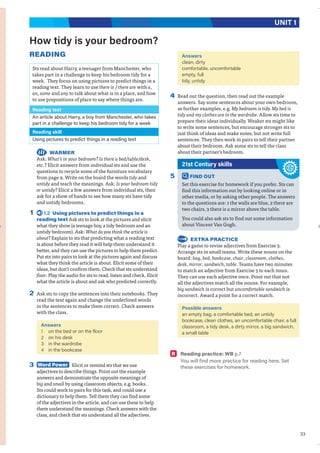
  • 16.
    15 INTRODUCTION Exam practice lesson finisheswith an opportunity to complete a simple Exam task based on the skills and strategies taught. LITERATURE There are 3 termly Literature lessons that each feature an extract from the Richmond Readers series. These provide an opportunity for extensive reading practice in a fun and supported way. There are 3 clear stages ‘Before you read, Read, Reflect’ which support students with their reading. EXAMS There are 9 Exams practice lessons that provide further practice of the grammar and vocabulary from the unit, using common exam question types. These are taken from a wide range of exam boards appropriate for the level and age group. Each section builds towards completing an exam style task. Before you read stage prepares students to read the text and think about the context. Word Power word-building task. Extract from the Richmond Readers series at the appropriate level with visuals to support details of the story. Key words from the text are highlighted in the Glossary. 21st century skills included as part of the literature lesson. Main points of the story are summarized in the Outline box. Each lesson focuses on a skill such as reading, listening, speaking and writing, and a common exam question type such as multiple choice, gapfilling, writing a message and discussing a topic, etc. Look! boxes provide general information on the scope of the exam task and what students can expect. Reflect stage to think about the story in a more general or personalized way. Read stage helps students to focus on the main points of the story extract. Useful strategies box gives guidance and tips on how to approach the exam task. Exercises build towards and support the Exam task at the end of the lesson. Graded Exam task which brings together the themes of the unit.
  • 17.
    16 Extended practice andassessment Workbook The Workbook provides thorough practice of the Student’s Book material, for students to do in class or at home, with graded activities for mixed ability via the ‘star’ system. There is a Progress check every 3 units and a writing summary at the back of the book. The Workbook audio is available as an MP3 download on the Richmond Learning Platform. Practice of vocabulary and grammar from the Student’s Book. Graded with stars to show 3 levels of difficulty. Practice of the 4 skills from the Student’s Book: reading, listening, speaking and writing. Word Power word-building task. Regular ‘listen and check’ activities. Available as MP3 downloads on the Richmond Learning Platform. 3 termly Progress checks test vocabulary and grammar from the previous 3 units. Regular ‘listen and check’ activities. Available as MP3 downloads on the Richmond Learning Platform. Use as end-of-term revision in class or at home. A range of exercises test knowledge of vocabulary and grammar across different units. Comprehensive Writing summary section at the back of the Workbook. Convenient Vocabulary summary section at the back of the Workbook. Unit-by-unit reference for items taught in the 2 vocabulary lessons in the Student’s Book. Model texts for each of the Student’s Book writing lessons. Text features and key language clearly highlighted. Useful Tips for writing in short summary section. Listed alphabetically for easy use.
  • 18.
    17 INTRODUCTION Vlogs and culturevideos from the Student’s Book further exploited using new tasks. EXTRA PRACTICE WORKSHEETS There are 72 print-and-go worksheets that provide students with extra practice of grammar and vocabulary in a variety of different ways, including via the 4 skills. The grammar and vocabulary worksheets are offered at 2 levels of difficulty. All the worksheets can be found on the Richmond Learning Platform and can be printed off for use in class or set as homework. Audio for the listening worksheets is available as an MP3 download on the Richmond Learning Platform. TESTS There is a comprehensive test package offered on the Richmond Learning Platform. Tests are offered at 2 levels of difficulty and are presented in both PDF and digital format. EXTRA PRACTICE ACTIVITIES Extra practice activities for self study on the Richmond Learning Platform in digital format. 2 vocabulary and 2 grammar worksheets for every unit. The language worksheets are graded for two levels of difficulty via consolidation and extension versions. 4 skills worksheets for every unit: reading, listening, speaking and writing. The skills worksheets revise grammar and vocabulary via a skills activity at one level of difficulty and end with a short 21st century skills task. Consolidation and extension versions of each test (not speaking). Tests are auto-marked (except for speaking and writing tasks which require teacher grading). Unit-by-unit tests, end-of-term tests, and end-of-year tests. Tests for grammar, vocabulary, reading, listening, speaking and writing. The 4 skills are tested separately. Reading and listening activities use Student’s Book texts and audio with new comprehension tasks. Speaking and writing activities test Useful language from the Student's Book. Listen, repeat and record facility for speaking and pronunciation.
  • 19.
    18 Teacher’s Guide The Keepit real! Teacher’s Guide is a complete planning and teaching resource with Student’s Book pages and teaching notes combined. Student’s Book audio scripts, Workbook answer keys and additional teaching notes for the Student’s Book vlogs and culture videos are available at the back of the Teacher's Guide. 31 UNIT 1 OVERVIEW: The topic of this unit is home. Sts read about the Big Teenage Challenge to keep your bedroom tidy for a week, and listen to a description of someone's family. They learn vocabulary for furniture and family, and watch a vlog about moving homes. They read about teenage life in the UK and watch a culture video about an unusual type of home. Finally, they read about a dream home and write about their own ideal home. VOCABULARY Furniture Sts learn nouns for the names of 15 kinds of furniture. They categorise these nouns according to the rooms where they are usually found, then personalise the vocabulary by talking about the furniture in their own home. Vocabulary Vlog Furniture (bath, bed, bookcase, chair, cooker, desk, fridge, lamp, mirror, shower, sink, sofa, table, toilet, wardrobe) Iona: My new home WARMER Ask: Where do you live? Do you live in a house or a flat? As sts answer, ask questions, e.g. Is your flat big or small? How many rooms are there? Revise vocabulary for rooms and see what words for furniture sts already know. 1 1.1 Read through the words in the box and elicit or teach the meanings. Sts match the words with the pictures. Play the audio track. See TG page 274 for audio script. Sts listen, check and repeat. Answers 1 bed, chair, desk, wardrobe, mirror 2 cooker, fridge, sink 3 chair, sofa, table 4 bookcase, chair, desk, lamp, table 5 bath, mirror, shower, sink, toilet 2 Ask: What furniture goes in the bathroom? Elicit one or two answers. Sts copy the table in their notebooks and complete it with the words from Exercise 1. Point out that some words can go in more than one room. Check answers. Answers bathroom: bath, mirror, shower, sink, toilet bedroom: bed, bookcase, chair, desk, lamp, mirror, table, wardrobe dining room: bookcase, chair, lamp, mirror, table kitchen: cooker, fridge, sink, table living room: bookcase, chair, lamp, mirror, sofa, table 3 Ask a few questions about a normal house first, e.g. Where’s the bath? (in the bathroom). Then read out the task and explain the meaning of strange. Read out the example question and answer, then put sts into pairs to ask and answer questions. Ask individual sts to ask and answers questions for the class. Vlog This lesson features an optional vlog in which a vlogger talks about moving home. You can watch this in class if you have time and access to video, or you can ask sts to download it from the Richmond Learning Platform to watch at home. See TG pages 286 and 304. FAST FINISHER Sts who finish early can practise vocabulary for furniture further. They list the furniture in each of the rooms in their own house. They could use a dictionary to find other nouns not seen in Exercise 1. Weaker sts could work in pairs. They take turns to point to the furniture in the pictures. Their partner says the correct word. EXTRA PRACTICE Put sts into pairs. They take turns to try to talk about their own home for one minute, while their partner films them using their phone. They can watch their films back and discuss in their pairs how they could improve, for example by hesitating less. If there is time, they could repeat the activity and try to improve. V Vocabulary practice: WB p.6 Sts will find more practice of vocabulary for furniture here. Set these exercises for homework. LS Language summary: Unit 1 SB p.127 Home sweet home 1 Vocabulary Grammar Pronunciation Reading Listening Speaking Writing Furniture; Family there is / there are + a, an, some, any; prepositions of place; have got /ə/ Using pictures to predict things in a reading text Preparing before you listen Introducing people A chat forum TEACHER'S RESOURCES Reproductions of every Student’s Book page on the left-hand page. Ideas for additional activities, if time, or if relevant for students. Ideas for fun lesson introductions to warm students up to the topic of the lesson. A summary of the topics covered in each unit with the language aims clearly stated. Answer keys highlighted in easy-to-find boxes. Complete teacher’s notes with answer keys on the right-hand page. Detailed vlog and culture video teaching notes at the back of the Teacher's Guide. Signposting to supplementary support material. 308 GRAMMAR ANIMATION SCRIPTS UNIT 1 There’s a cake on this chair! B = Ben, J = Jake, V = Vicky B, J: Hi, Vicky! V: Oh, hi, Ben! Hi, Jake! Thanks for coming, guys! Ready to play? J: Well, yes, but there aren’t any empty chairs! B: What a mess! There’s a cake on this chair! J: And there are books in front of the TV. B: There are some clothes on the desk, and there’s an apple on the carpet. J: And there are some cups under the table. V: Sorry, guys! J: Come on Ben, let’s help Vicky. V: Thank you very much for helping me! J: You’re welcome! The room is tidy now. B: The books are in the bookcase! J: And there aren’t any cups under the table! V: And the clothes are next to the desk. J: But, where’s the cake? V: Ben, watch out! The cake is behind you! B: Oh! The cake is ... here! V, J: Oh, Ben! I’ve got funny hair! B = Ben, V = Vicky, J = Jake B: Your games room is amazing, Vicky. You’ve got lots of cool things! V: I know! I’m very lucky! I’ve got a computer and a video games console, and I’ve got lots of books. B: I’ve got some e-books on my tablet, but I haven’t got a games console. Have you got any video games, Jake? J: Yes, I have. And I’ve got a guitar! V: Wow! I haven’t. Are you good at the guitar? J: Well … not yet! B: Look at this photo! Who are all these people? V: This is my family. This is my mum and this is my Uncle David. He’s got a dog, Bella. This is my Aunt Liz. She’s got two children – my cousins, Isaac and Isabel. And this is my grandma, Jill. She’s got a pet snake! J: Wow! Who’s this? V: That’s me! I’m a baby there! B: Ah, you’re very cute! V: I know! But, I’ve got funny hair! UNIT 2 He cleans the robots! AR = Aunt Rose, M = Mr Jones, J = Jake, B = Ben, V = Vicky AR: Welcome to the Science Fiction Museum! This is my friend, Mr Jones. Mr Jones works here. He’s a museum guide. J, B, V: Hello, Mr Jones. Nice to meet you! M: Nice to meet you, too! B: I love science fiction films! I want to be a film director one day! M: That’s great! V: Tell us about your day, Mr Jones. M: Well, I get up at seven in the morning. I get dressed and have breakfast. Then, I ride my bike to work. I don’t take the bus. I get to my office and I check my emails. Then the visitors arrive. I show them all the amazing things in the museum. V: Ah, it sounds interesting! M: Yes! The café opens at one o’clock. I have lunch with my friend, Steve. Steve doesn’t work in the mornings. He starts work at two o’clock. He cleans the robots! B: Ah, I love this place! I watch lots of science fiction films. My favourite is Planet of the Robots! M: We’ve got lots of robots from that film here! B: Really? Have you got Robodog? Have you got CA-12? Come on, let’s go and see them! M: OK! What does it do? M = Mr Jones, B = Ben, J = Jake, AR = Aunt Rose, V = Vicky M: Do you like CA-12, Ben? It’s the star of Planet of the Robots. B: Yes, I do! It helps the astronauts come back to Earth! M: Correct. And this is Robodog. B: I know! It’s CA-12’s pet! M: That’s right! Do you know everything about robot films, Ben? B: No, I don’t! I don’t know everything. But I know a lot, because I watch a lot of films! M: Good for you! Where do you watch them? At home or at the cinema? B: Both! J: Oh, no! Drew, come back! M: What’s this? AR: It’s our robot friend. Jake! What does Drew want? J: I don’t know. Drew! Switch off! M: That’s an amazing robot, Rose. Where do they sell them? R: They don’t. Drew’s my creation. I’m an electrical engineer. M: Wow! What does it do? AR: It likes learning new things. But I think Drew needs a software update right now! M: Good idea! Well, what do you want to see now, guys? More cool things? B, J, V: Yes, please! M: OK, let’s go! UNIT 3 I love eating popcorn! J = Jake, B = Ben, V = Vicky J: Hi, Ben! B: Oh, hey, Jake! J: How are things? B: Great! I’m on my bike today. I love cycling! I always go cycling on Saturdays. J: That’s nice. I’ve got my guitar lesson now. B: Wow! Do you take guitar lessons? That’s amazing! J: Yes, I like learning the guitar! I sometimes practise for three hours or more. B: Three hours? That’s a lot! Do you want to be a musician? J: Well, no, but I love making music! I don’t mind practising at all. It’s easy! My teacher is very kind. She always helps me, and she sometimes organizes concerts, too. V: Hi, guys! J, B: Hi, Vicky! V: What’s the plan for today? J: I’ve got my guitar lesson this afternoon, and Ben … well, Ben’s SCR N N NI e er r r Be : H O c W e W th A th T d c A th S C T m Y n T A th A d B B b O : O e e g g Be Y V th I a c lo I’ ta c g Y W th W L th T a g 306 CULTURE VIDEO SCRIPTS UNIT 1 Homes on wheels T = Theo, B = Bee When we think of a mobile home, it looks something like this … Or does it? This is the Tiny House Festival in Colorado, in the USA. There are lots of homes here in many different shapes and sizes. But, they are all the same in one way: they’ve all got wheels, so they can visit different places. T: What’s going on guys? So, we have just arrived at the Colorado Tiny House Festival and this place is massive. Travel vloggers Bee and Theo are at the Tiny House Festival. They show us around. This motorhome is an interesting shape, and it’s made of beautiful wood. Inside, it’s got a sofa and a bed. There’s a bookcase for your books and all your things. There’s also a window, so you’ve got a view of the places you visit. This one actually looks like a real house. It’s got an air conditioner and lots of windows. It’s also got tiles on the roof. Inside, there’s even a staircase that takes you up to a comfortable bedroom with a big bed. B: So, we’ve just stopped for lunch. Now, it’s time for some food. Small can also be beautiful. An unusual look outside and a really special inside. Great colours! And look at the bed by that big window. There’s even a small stove. Bee and Theo have now got a lot of cool ideas for their own home on wheels. B: So, thanks for watching guys and we’ll see you on the next video. UNIT 2 School in 1927 T = Teacher These students go on a trip to the past ... to 1927! The children leave home at 6 a.m. This is their school. All the children aged five to thirteen are in the same class. T: Now,mindyourfingers.I’llchopthemoff. The teacher isn’t very nice. T: For really bad things, I’ve got this. He’s very strict. T: It works. He uses a blackboard. There isn’t any technology in the classroom. There aren’t any computers and there aren’t any tablets. The schoolchildren enjoy the art lessons – they’re fun. T: This is the day we’ve been waiting for, the day of the standard exam. Your big day. At the end of term, the students take an exam. But Steffan doesn’t go to school now. He is thirteen and a half now, so he goes to work. He works in the coal mine. This is his first day. He goes to work at 5 a.m. It takes an hour and a half. It’s hard work in the coal mine. It’s also very dangerous. School in 1927 is hard, but life for children in the coal mines is horrible. UNIT 3 Soccer in Soweto D = Dan Welcome to Soccer City near Soweto in South Africa. It’s the largest football stadium in Africa. Spain were the World Cup winners here in 2010. Today, 90,000 people are here for a big match called the Soweto Derby. The match is between two local teams: the Kaizer Chiefs and the Orlando Pirates. South Africa has a very special football culture and South African fans always make a lot of noise. The noise is very loud because of the vuvuzelas. You find these trumpets at all South African football matches. Today, there are thousands of them. With the sound of the vuvuzelas it is like a big party. People love dancing and singing at the match. At half-time the fans get an extra show. Dan Magness, a famous British football freestyler, can do fantastic tricks with a football. Freestyle is very popular with young people in Soweto. D: I’ve just performed a perfect show in front of nearly 90,000 people. What a feeling! Dan goes into Soweto. He sees that even young children like doing freestyle. Freestyle is everywhere in Soweto. Chris is a South African champion freestyler. There is something different about freestyle in Soweto. It is almost like a dance. Lots of people say that this is because dancing is very popular in South Africa. These freestylers mix dancing and singing with football skills. At this Soweto school the children do an ‘African warm-up’: singing and dancing before the match. You can see how football and dancing come together. Football and freestyle are international sports. People like playing them all over the world. But here in Soweto, football and freestyle are also a big part of South African life. UNIT 4 Holidays at home E = Ellie Ellie’s a student and she lives in Brighton. Brighton is a famous British seaside town. E: I’m Ellie and I’m an art student in Brighton. Ellie has a busy student life, so she doesn’t have much time for tourist activities, like sightseeing. Today she’s trying something new. She wants to be a tourist in Brighton for one day. E: I’ve made a list of all the tourist activities I can do, and I’m gonna tick them off one by one, in one day. First, she prepares the things she’s taking with her: a map, sun cream and sunglasses, as it’s warm and sunny today. Now she’s ready to go to the first place on her map. The Brighton Pavilion is a fairy-tale palace built by a royal prince. It’s over 200 years old. The Pavilion gardens are looking beautiful in the bright sunshine. Next, she spends some time looking around Brighton’s markets and interesting shops. And of course, all tourists buy postcards! It’s time for a quick break. Ellie’s enjoying a nice cup of tea. Now for something a bit different. She’s going to the aquarium! E: I’m so excited! I love sea life. She gets really close to the sea life. Next, she’s going to Brighton Pier, for some fun! Piers are popular in British seaside towns. Especially the fairground rides. After all the excitement, Ellie goes to the seafront. She’s really happy. She’s seeing her hometown in a new way. To end the day, she’s having a traditional dinner of fish and chips on the beach. But she isn’t a real tourist, so she doesn’t have far to go home! UNIT 5 Diwali in New York M = Mickela, S = Subrato Queens is an area of New York City. Some people call parts of Queens ‘Little India’, because there are a lot of Indian Americans living there. Mickela Mallozzi has a lot of friends! Today, she’s visiting some of them in Queens. They’re celebrating Diwali together. M: Happy Diwali! Diwali is the Hindu Festival of Light. Hindus celebrate it every year, in India and all over the world. An important part of any festival is the food. Mickela meets TS SCRI SC PT N NI I m m me Th en w meth s is orad mes s. B : th t di Wha ved this vel v Tin rou res utif a b ks a dow vis s on got dow de, up bed o, w w, it all c k ou at c win an s fo o, th on t N NI I ho o o o Tea se s 927 ch r sc tee ow, tea or re ve wo use re i sro the oolc y’re 304 UNIT 1 Homes on wheels Ioan I: Hello, my name’s Ioan, and it’s time for me to move out of my parents’ house. I have a lot of stuff. I need to decide what to take to my new place, so maybe you can help me. Let’s take a look. The study. This is where I do most of my work and spend most of my day. First, my desk. It’s just an old table, and I’m not taking it with me. But, I am taking some of the things that live there. This is my sister’s old chair, my mum’s old lamp, and a mirror I got from my art class. I am taking all of them with me. But most of all, my desk is home to drawings that I don’t want to throw away, but don’t know where to keep. I liked my workspace, but it’s time to find a new one. The bedroom. My bookcase is very full. I buy a lot of books and I am slowly reading them, but I haven’t finished them all yet. My wardrobe has a lot of clothes in it. How do I decide which outfits I need? Why not take all of them? The kitchen. Obviously, there are some things I can’t take with me. My happiest memories are in the kitchen, but they’re staying here with the cooker, the sink, and the fridge. But that’s okay. It’s good to let things go. Thank you for helping me pack. Bye! UNIT 2 Morning routine Tati T: Hi everyone, my name is Tati and today I’m going to show you my typical morning routine as a student. So let's get right into it! First, my alarm goes off at seven a.m. and it’s time to get up. Usually, I am very tired so this can take a while. After I get out of bed, it’s time to have a shower. I prefer to shower in the mornings, as it definitely helps me wake up and feel refreshed for the day. After I have a shower, next it is time to get dressed. These are my clothes for today. At eight o’clock, I go downstairs and have breakfast. Breakfast is the most important meal of the day, so I always make time to have breakfast. Today, I’m having tea and toast. After breakfast, I go back upstairs to tidy my room. I like to tidy my room in the mornings, because I like coming home to a clean room. At 8.30, I'm all ready for the day ahead of me and it’s time to leave the house and have a good day. So that’s it! I hope you enjoyed watching my morning routine as a student. Bye! UNIT 3 Life as an athlete Nina N: Hello everybody, and welcome to this video. My name is Nina. I am from the United States and I am a ballet dancer. Today, I want to talk about life as an athlete and the work it takes. But what does it mean to be an athlete? Well, let’s take a look. Anyone who is serious about the sport they practise is an athlete. I started doing ballet at three years old. But as a young girl, I tried other sports, too. When I was eight years old, I went swimming twice a week. I liked it a lot, but dancing was already hard work, so two sports was difficult. I also tried gymnastics ’cos my friends at school did it. But I always preferred ballet. It is difficult, but powerful and beautiful. And now, I’m training to become a professional, so I dance six days a week. Each sport is different, but they all have a few things in common. How could surfing, for example, possibly be like ballet? Well, each person works hard to improve their skills for their sport. We spend hour after hour practising. We want to get that movement, that jump, that twist, that turn just right. For me, the other very important thing that we all have in common is that we don’t do it alone. Dance teachers, surf instructors, and coaches for sports like football and volleyball, they are the ones who teach us and help us get better at our sport. If you are thinking about joining a sport, go for it! It’s so much fun. And having fun is a really important part of being an athlete. Thank you for joining me, and I’ll see you next time! UNIT 4 My top five things in Paris Natalie N: Hello, and welcome to this video. My name is Natalie and I recently visited Paris. Here are the top five things I did with my friends. Number one: we visited the Louvre Museum. Well, we didn’t actually go inside. It’s a really popular museum, so it was full. The museum has the world- famous Mona Lisa painting, so I wasn’t really surprised by how busy it was. Number two: I visited Musée de l’Orangerie, which is an art gallery filled with twentieth-century paintings. It’s a lot more peaceful and quiet than the Louvre. Number three: the River Seine. There is a big market along the river. They sell books and antiques here. It’s very different to the Champs-Élysées, which is an avenue filled with luxury shopping centres and restaurants. We’ve just had an explore in Shakespeare and Company. This is a famous bookstore. It was like the library from Harry Potter. Number four is Le Centre Pompidou. So we’ve come to the Centre Pompidou. It’s a lot of exhibitions, modern art. There’s also an amazing panoramic view of all around Paris. It’s amazing to see the city from a height where you can see all the hills and buildings. It’s amazing. Number five: the Eiffel Tower, which is a very famous monument. So I’ve come to visit the iconic Eiffel Tower, which is probably the most recognisable place in Paris. My friends and I ate our lunch in the park and admired the views of the famous monument. I had a wonderful time in Paris. It’s such a beautiful city and I want to go back one day. UNIT 5 Farmers’ market Bokang B: Hi everyone, my name is Bokang and I am a vlogger from South Africa. My channel is called The B Word and I share parts of my life and vlog being out and about, just like I am doing today. Today, I’m going to the Fourways Farmers’ Market in Santon, South Africa. The market has a big selection of food ranging from chicken, fruit, vegetables, sandwiches, freshly squeezed orange and apple juice, and so many more delicious dishes. I was thirsty, so my first stop was a juice stand called ‘Impressed’. Here they use fruits and vegetables to make their delicious juices. My favourite is the orange, apple and ginger mix. After that, I decided to find something to eat. There’s a stall that sells delicious sandwiches. I decided to go for the chicken option, and mmm, it was good. Then, once the main meal was done, I thought it was time for a little snack. At VLOG SCRIPTS Guidance on vocabulary teaching, noticing tasks and extra ideas. s an art gallery filled y ury paintings. It’s a lot quie Riv ng t que mp with ran plor oks arry Cen Cen ode mic v see see ng. ffel me he i mo ou he v t. me I w et t nam So e B vlo do the San has m c ich d a us d firs sse les y fa ing d to l th ded d m n m for 312 WORKBOOK ANSWER KEY 2 1 – 2 9 3 – 4 9 5 9 6 – 7 9 8 9 9 – 3 1 e 2 f 3 a 4 b 5 d 6 c 4 1 wardrobe, bookcase 2 sofa, mirror, lamp 3 fridge, table, cooker 4 toilet, bath, sink Reading 1 b 2 1 F 2 T 3 F 4 T 5 T 3 1 dirty 2 uncomfortable 3 untidy 4 empty Grammar 1 1 There are 2 isn’t 3 are 4 aren’t 5 There’s 6 isn’t 2 1 There are some clothes in the wardrobe. 2 There aren’t any tomatoes in the fridge. 3 There are some apples in the kitchen. 4 There are some bananas on the table. 5 Are there any books in the bookcase? 3 1 Is there 2 there isn’t 3 there’s 4 Are there 5 there are 4 1 T 2 F 3 F 4 F 5 T 5 1 in 2 on 3 next to 4 under 6 1 under 2 on 3 next to 4 behind 5 in Vocabulary and Listening 1 1 husband 2 grandad 3 child 4 daughter 5 parent 2 1 uncle 2 sister 3 nephew 4 daughter 5 husband 3 1 cousin 2 nephew 3 daughter 4 grandad 5 brother 6 uncle 7 husband 8 aunt 4 1 – 2 9 3 9 4 – 5 9 6 9 7 9 8 9 5 1 c 2 b 3 b 4 a Grammar 1 1 Sophia has got six cousins. 2 I have got two dogs. 3 They haven’t got a big family. 4 Has David got a nice bedroom? 5 How many brothers has Meghan got? 2 1 e 2 f 3 d 4 a 5 b 6 c 3 1 haven’t 2 He’s 3 hasn’t 4 has 5 Have 6 has 4 1 She’s got 2 Has she got 3 hasn’t 4 have you got 5 I’ve got 6 Have you got 7 haven’t 8 I’ve got 5 1 Lara’s got a new phone 2 Have you got a pen? 3 Freddie hasn’t got a bike. 4 They haven’t got any bananas. 5 Has she got a dog? 6 We’ve got five cousins. Speaking 1 1 How 2 This 3 Nice 4 meet 5 later 6 Bye 2 a 3 b 5 c 7 d 1 e 6 f 2 g 4 3 1 Fine, thanks 2 This is my friend 3 Nice to meet you 4 Nice to meet you, too 5 Bye 4 1 c 2 e 3 a 4 b 5 d Writing 1 1 two 2 No 3 three 4 No 5 No 2 1 and 2 but 3 but 4 and 5 and 6 but 3 1 e 2 f 3 d 4 c 5 a 6 b 4 Students’ own answers. Review 1 1 cooker 2 fridge 3 lamp 4 mirror 5 sink 6 sofa 7 table 8 toilet 2 1 in 2 under 3 behind 4 in front of 5 next to 3 1 are 2 any 3 aren’t 4 there’s 5 Is 6 isn’t 7 there are STARTER 1 November, Saturday, May, Monday, Friday, July, December, Tuesday 2 1 Italian lesson 2 English test 3 party 4 my birthday 3 1 third of March 2 twenty-fourth of February 3 sixteenth of June 4 first of April 4 1 timetable 2 earphones 3 pencils 4 phone 5 keys Mystery word: money. 5 1 Joanna 2 Marta 3 Ali 6 1 I love your sister’s dress. 2 These are my friend’s/friends’ bikes. 3 Where is Mr Smith’s house? 4 My cousins’ names are Lou and Anna. 7 1 My parents’ 2 The teachers’ 3 My brother’s 4 Tom’s 5 Julia’s 8 1 Her 2 my 3 She 4 His 5 He 6 We 9 1 These 2 That 3 This 4 Those 10 1 Spanish 2 Turkish 3 Brazilian 4 Argentinian 5 Egyptian 6 French 7 Chinese 8 American 11 1 white 2 yellow 3 brown 4 orange 5 pink 6 green 7 black 8 purple 9 grey 10 blue 12 1 aren’t 2 Is 3 ’m 4 isn’t 5 Are 6 ’s 7 aren’t 8 isn’t 9 aren’t 10 is 13 1 Where are you from? 2 Who is the president of your country? 3 How old is your sister? 4 What colour is your bag? 5 Where is your school? UNIT 1 Vocabulary 1 1 lamp 2 cooker 3 toilet 4 bookcase 5 sink 6 table 7 bed 8 desk Workbook answer key for easy reference. Scripts for all vlogs, culture videos and animations.
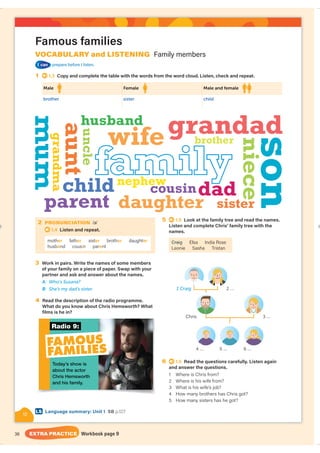
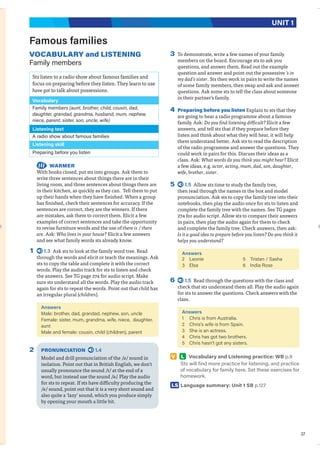
  • 20.
    19 INTRODUCTION iBook for teachers TheKeep it real! iBook is a fully interactive version of the course for use in class. It combines all the teaching and learning elements of the course for use with a Smart Board or projector, in a convenient one-stop resource. There is a wealth of interactive resources on the Richmond Learning Platform. These can be used as self study or assigned by the teacher and assessed and tracked through the mark book. The Richmond Learning Platform also includes downloadable PDFs and other key components. Includes embedded audio, culture videos and vlogs at a click. Includes Student’s Book, Workbook and Teacher’s Guide all in one place. Extra practice activities for skills, pronunciation and video resources that can be assigned, tracked and marked. Digital tests that can be assigned, tracked and marked. Complete downloadable audio, video, animations, and scripts. Print-and-go worksheets and tests for use in class. Easily accessible grammar animations and Keep moving! revision game. Student's Book pages with pop up answer keys and audio / video scripts. Workbook audio MP3 and answer key. Downloadable wordlists and CEFR mapping documents.
  • 21.
    20 September ptember Sept 4 S0.3 Matchthe numbers and words. Listen, check and repeat. 1st 2nd 3rd 4th 5th 12th 20th 29th 30th 31st fifth twentieth first third thirty-first fourth twenty-ninth thirtieth second twelfth 5 Work in pairs. Ask and answer. What’s your favourite month/day of the week? April/Monday. What about you? When’s your birthday? It’s on the fourteenth of May. f Things for school I can talk about things for school. 6 S0.4 What’s in Jessie’s school bag? Match the words with the picture. Listen, check and repeat. earphones folder keys money notebook k pen pencil pencil case phone snack k timetable water bottle VOCABULARY Days and dates I can talk about days and dates. 1 S0.1 Look at Jessie’s calendar. Listen and repeat the days of the week. 2 Write the correct day of the week. What day is volleyball? Friday 1 What day is Jessie’s birthday? 2 What day is her music lesson? 3 What day is her friends’ party? 4 What day is the English test? 3 S0.2 Write the months of the year in order. Listen, check and repeat. April August December February January July June March May November October September January, February, … 7 What’s in your school bag? Write a list. 1 2 3 4 5 7 6 8 9 10 11 12 Hi, my name’s Jessie. Today is my first day back at school after the holidays. Monday 4 Tuesday 5 Wednesday 6 Thursday 7 Friday 8 Saturday 9 Sunday 10 9.00 a.m. Back to school 7.00 p.m. Piano class all day My birthday! 11.00 a.m. English test 4.30 p.m. Volleyball 5.00 p.m. Ted and Liam’s party! all day Relax! 4 S Starter EXTRA PRACTICE Workbook page 4 20
  • 22.
    21 STARTER UNIT OVERVIEW:The aim of this unit is to review language that students already know, to remind them of some familiar vocabulary and grammar before they start the main units of the book. They learn days and dates, and things for school, then revise countries and nationalities and colours. They study the possessive ’s , subject pronouns, possessive adjectives and demonstrative pronouns. They also revise the present forms of be and question words. They read a message board about going back to school and practise transferring information to a table. They also learn how to tell the time. VOCABULARY Days and dates Sts revise days and dates and vocabulary to talk about things at school. They study possessive ’s, subject pronouns, possessive adjectives and demonstrative pronouns. Vocabulary Days and dates (January, February, etc., first, second, etc.); Things for school (earphones, folder, keys, money, notebook, pen, pencil, pencil case, phone, snack, timetable, water bottle) WARMER Play a game to revise numbers. Ask sts to stand up. Say the number one and elicit the next number (two) from a student at the front of the class. Continue around the class, with students saying a number in turn. If they make a mistake or cannot think of the next number, they sit down. You could repeat the game with students counting in twos or threes. 1 S0.1 Read out Jessie’s introduction, then ask sts to read the calendar. Play the audio once for students to listen to the days of the week. Play the audio again for sts to listen and repeat. 2 Read out the example question and answer, and point out that the answer is in the calendar. Sts then write the answers to the remaining questions. Check answers. Answers 1 Wednesday 2 Tuesday 3 Saturday 4 Thursday 3 S0.2 Sts could work in pairs to write the months in order. Play the audio once for sts to listen, check and repeat. Answers January, February, March, April, May, June, July, August, September, October, November, December 4 S0.3 Write the first two numbers on the board. Point to each one and ask: Which words does it match? Elicit the answers. Sts then match the remaining numbers and words. Play the audio for sts to listen, check and repeat. Answers 1st first, 2nd second, 3rd third, 4th fourth, 5th fifth, 12th twelfth, 20th twentieth, 29th twenty-ninth, 30th thirtieth, 31st thirty-first 5 Read out the questions and point out the use of on to talk about birthdays, e.g. my birthday is on the tenth of June. Put sts into pairs to ask and answer questions. Things for school 6 S0.4 Sts match the words with the items in the picture. Play the audio for students to listen, check and repeat. Answers 1 snack 2 pencil 3 pen 4 money 5 water bottle 6 phone 7 folder 8 pencil case 9 notebook 10 keys 11 timetable 12 earphones 7 Sts write a list of what is in their school bag. Ask some sts to tell the class what is in their school bag, holding up each thing in turn and saying the words. V Vocabulary practice: WB p.4 Sts will find more practice of vocabulary for days and dates, and things for school here. Set these exercises for homework. Starter d S Vocabulary Grammar Pronunciation Reading Speaking Days and dates; Things for school; Countries and nationalities; Colours Possessive ’s; subject pronouns and possessive adjectives; demonstrative pronouns; be: affirmative, negative and questions; question words Question words Transferring information to a table Telling the time
  • 23.
    22 5 Copy andcomplete the sentences with a possessive adjective. She’s American, but her mum is from Mexico. r 1 I’m from Brazil. … name is Mauro. 2 A: When’s … birthday, Anna? B: … birthday is on 26th November. 3 That’s our neighbour’s cat. … name is Tiger and it’s really friendly. 4 A: What’s the name of the new boy in our class? B: … name is Tomasz. He’s from Poland. 5 Haruto and Sakura are from Japan. … home is in Tokyo. 6 I’m in a class with Josie and Leo. We all like … new teacher. Demonstrative pronouns I can use demonstrative pronouns. 6 S0.5 Read the grammar box. Listen and repeat the dialogue. Here There Singular this that Plural these those Student: Excuse me, what’s this in English? Teacher: It’s a ruler. Student: And what are those? Teacher: They’re earphones. Student: Thanks. Teacher: You’re welcome! 7 Work in pairs. Ask and answer about other things in the classroom. What’s this? What are these? What’s that? What are those? FAST FINISHER Write about your friends’ and family’s birthdays. George’s birthday is on 22nd October. My mum’s birthday is on … GRAMMAR Possessive ’s I can talk about possession. 1 Copy and complete the rule. Write singular or plural. Singular Plural Jessie’s birthday is on Wednesday. Her friends’ party is on Saturday. Rules We use ’s after a 1 … noun or name. We use ’ after a 2 … noun. 2 Copy and complete the sentences. Use ’s or ’. This is the boys’ bathroom. ’ 1 That is Mark … bag. 2 Emma … birthday is in September. 3 My parents … names are Sue and Pete. 4 Are these your best friend … keys? 5 This is Maria … notebook. 6 Two of my friends … birthdays are on the same day! Subject pronouns and possessive adjectives I can use subject pronouns and possessive adjectives. 3 Copy and complete the grammar box with the words in the box. he her it my our their your Subject pronoun Possessive adjective I my you 1 2 his she 3 4 its we 5 they 6 4 Change the words in blue to a subject pronoun. Maria is thirteen years old. She is thirteen years old. 1 Daniel is in Year 7. 2 The water bottle is on my desk. 3 Lucas and I are in the same class. 4 The earphones are in my bag. 5 Are you and your sister at the same school? 5 S EXTRA PRACTICE Workbook pages 4 and 5 22
  • 24.
    23 STARTER GRAMMAR Possessive ’s 1Read the grammar box about the possessive ’s with sts. Make sure they understand the meaning of singular and plural. Sts could work in pairs to complete the rules. Check answers. Answers 1 singular 2 plural Ask questions to check concept. Concept check questions: Write on the board: the student’s book. Ask: One student? (yes). One book? (yes). Write: the student’s books. Ask: One book? (no – more than one). One student? (yes). Write: the students’ books. Ask: One book? (no – more than one). One student? (no – more than one). 2 Read the example with the class and elicit that it refers to more than one boy. Sts then copy and complete the sentences. Allow sts to compare their answers in pairs, then check answers with the class. Answers 1 That is Mark’s bag. 2 Emma’s birthday is in September. 3 My parents’ names are Sue and Pete. 4 Are these your best friend’s keys? 5 This is Maria’s notebook. 6 Two of my friends’ birthdays are on the same day! Subject pronouns and possessive adjectives 3 Demonstrate the grammar by picking up a book and saying: I am a teacher. It’s my book. Then say to a student: You are a student. It’s … Elicit the response your book. Sts could work in pairs to copy the grammar box into their notebooks and complete it. Check answers with the class. Point out that English has only one form of you for both singular and plural, e.g. You are my friend. You are all my friends. Answers 1 your 2 he 3 her 4 it 5 our 6 their Ask questions to check concept. Concept check questions: Use classroom objects such as books or pens to elicit simple sentences to demonstrate the grammar, e.g. She’s Lisa. It’s … pen. (her). He’s Matteo. It’s … bag. (his). Dan and Paul are students. These are … books. (their). Is this his bag? (no – it’s my bag). 4 Read out the example answer, then read through the remaining sentences and check that sts understand water bottle and earphones. Ask sts to rewrite the sentences using subject pronouns. Allow sts to compare their answers in pairs, then check answers with the class. Answers 1 He 2 It 3 We 4 They 5 you 5 Read out the example answer, then ask sts to copy the sentences and complete them with the correct possessive adjectives. Allow sts to compare their answers in pairs, then check answers with the class. Answers 1 My 2 your, My 3 Its 4 His 5 Their 6 our Demonstrative pronouns 6 S0.5 Read through the grammar box with the class. Demonstrate the idea of here and there in the classroom, by pointing to things close to you and saying: This is my book. These are my pens, then pointing to things further away in the classroom and saying: That is Ana’s bag. Those are Ana’s pens. Play the audio for sts to listen to the dialogue. Play it again, pausing for sts to repeat. Ask questions to check concept. Concept check questions: Say: That is my pen – here or there? (there). This is my book – here or there? (here). Point to the far side of the classroom and say: my books. Elicit the sentence Those are my books. Point to some pens close to you and say: This is my pens – correct? (no – these are my pens). 7 Demonstrate the task by picking some things up and asking: What’s this? What are these? Then point to some objects further away from you and ask: What’s that? What are those? Elicit some example answers. Sts then work in pairs to ask and answer questions. Monitor and help as necessary. FAST FINISHER Sts who finish early can practise the grammar further. Sts write sentences about their friends’ and family’s birthdays. Weaker sts could write a sentence about their own birthday, then compare with a partner. G Grammar practice: WB pp.4 and 5 Sts will find more practice for possessive ’s, subject pronouns, possessive adjectives and demonstrative pronouns here. Set these exercises for homework.
  • 25.
    24 2 S0.7 Matchthe countries in Exercise 1 with the nationalities below. Listen, check and repeat. Argentina – Argentinian -an / -ian -ese -ish Other American Mexican Egyptian Brazilian Argentinian Chinese Japanese Turkish British Spanish Irish French 3 S0.8 Work in pairs. Do the quiz. Listen and check. Colours 4 S0.9 Listen and repeat the colours. black yellow purple red blue brown white orange grey green pink 5 Work in pairs. Describe a flag. Can your partner guess it? A: It’s red and white. B: Is it Turkey? A: Yes, it is. / No, it isn’t. 3 Wh Wh Wh Wh t at at i i i is s s s s th th th the e e e ca ca ca ca ca i pi p pi pita ta t tal l l f of of of B B Bra ra ra az zi zil? l? a a It It’s s R Rio io d de e Ja Jane neir ir ro o. o. b b b b b b b b b b b b b b b b b b b b b b b b b b b b b b b b b b b b b b b b b b b It It It It It It It t It I It t t’ ’s B B Bra ra i si sili li lia. a. Who is Daisy Ridley? a She’s a British actress. b She’s an American singer. 2 How old are the pyramids in Egypt? a They’re 4,500 years old. b They’re 450 years old. 4 5 6 a They’re from Mexico. b They’re from Turkey. Where are tacos from? a He’s Argentinian. b He’s Spanish. What nationality is the footballer Marcos Asensio? VOCABULARY Countries and nationalities I can talk about countries and nationalities. 1 S0.6 Match the countries with the flags in the World Quiz. Listen, check and repeat. Argentina Brazil China Egypt France Ireland Japan Mexico Spain Turkey the UK K the USA WORLD Where is this animal from? a It’s from China. b It’s from Japan. 1 1 7 10 11 12 8 9 2 3 4 5 6 6 EXTRA PRACTICE Workbook page 5
  • 26.
    25 STARTER VOCABULARY Countries and nationalities Stsstudy vocabulary for countries and nationalities. They read and answer quiz questions, revise colours and work in pairs to describe national flags. Vocabulary Countries and nationalities (Argentina/Argentinian, Brazil/Brazilian, China/Chinese, Egypt/Egyptian, France/ French, Ireland/Irish, Japan/Japanese, Mexico/Mexican, Spain/Spanish, Turkey/Turkish, the UK/British, the USA/ American); Colours (black, blue, brown, green, grey, orange, pink, purple, red, white, yellow) WARMER Write the word country on the board. Elicit the meaning, then ask: What’s your country? Elicit the answer, then put sts into pairs and ask them to write five more country names in English. Bring their ideas together on the board and check they understand. Point to one or two of the countries on the board and say: I’m from (Brazil). I’m (Brazilian). Try to elicit more nationality words in this way. 1 S0.6 Sts could work in pairs to match the countries with the flags. Play the audio once for sts to listen and check their answers, then play it again, pausing for them to repeat. Ask which sts guessed all the flags correctly. Answers 1 Egypt 2 Mexico 3 the USA 4 Japan 5 France 6 Turkey 7 Brazil 8 Spain 9 Ireland 10 Argentina 11 the UK 12 China 2 S0.7 Sts could work in pairs to match the countries with the nationalities. Play the audio once for sts to listen and check their answers, then play it again, pausing for them to repeat. Answers Brazil – Brazilian China – Chinese Egypt – Egyptian France – French Ireland – Irish Japan – Japanese Mexico – Mexican Spain – Spanish Turkey – Turkish the UK – British the USA – American 3 S0.8 Read through the quiz with the class and check that sts understand actress, singer, pyramid, animal and capital. Sts then do the quiz in pairs. Play the audio for sts to listen and check their answers. Ask who got all the answers right. Answers 1 a 2 a 3 b 4 a 5 a 6 b Colours 4 S0.9 Play the audio once for sts to listen to the words. Play the audio again, pausing for sts to repeat. For extra practice, point to some things in the classroom, e.g. sts’ clothes or bags and ask: What colour is this? Elicit answers. EXTRA PRACTICE Ask sts to close their books. Arrange them in small teams and give them a minute to write down the colours they remember from Exercise 4. Elicit all eleven colours and ask teams to spell each one. Write them on the board so teams can check their spelling. They win a point for each correctly spelled colour. When you have all eleven colours on the board, call them out at random, e.g. blue. The first team to find something blue on their desk or in their bag, and hold it up in the air, wins another point. 5 Demonstrate the task by describing one or two flags and asking sts to guess them. Sts then work in pairs and take turns to describe and guess the flags. Monitor while they are working, and help if necessary. V Vocabulary practice: WB p.5 Sts will find more practice of countries, nationalities and colours here. Set these exercises for homework.
  • 27.
    26 Question words I canask Wh- questions with the verb be. 6 Read the example sentences. Complete the dialogue with a question word. Where are tacos from? What is the capital of Brazil? Who is Daisy Ridley? How old are the pyramids? A: 1 … ’s your name? B: My name is James. A: 2 … are you from? B: I’m from Ireland. A: 3 … are you? B: I’m fourteen years old. A: 4 … ’s your teacher? B: My teacher is Mrs Kelly. 7 PRONUNCIATION Question words S0.10 Listen and repeat the questions from the dialogue in Exercise 6. /w/ /h/ What’s your name? Where are you from? How old are you? Who is your teacher? 8 Work in pairs. Ask and answer the questions in Exercise 6. Give true answers for you. 9 Work in pairs. Write more quiz questions like those on page 6. Ask and answer with another pair. What’s the capital of …? What colour is the … flag? Where is … from? Where is …? Who is the President of …? How old is …? FAST FINISHER Make a list of more countries and nationalities. Germany – German, … GRAMMAR be: affirmative, negative and questions I can use the verb be. 1 Read and match the long forms with the short forms in the grammar box. ’m = am is am are not (x2) is not are (x2) am not Affirmative Negative I’m from the UK. I’m not from Ireland. You’re Spanish. You aren’t from Colombia. He/She/It’s Brazilian. He/She/It isn’t Egyptian. We/They’re German. We/They aren’t American. 2 Choose the correct answers. 1 My new pencil case am / is / are blue. is 2 We ’m / ’s / ’re from Spain. 3 Her keys am not / t isn’t / t aren’t in her bag. t 4 She ’m not / t isn’t / t aren’t fourteen. t 5 You ’m not / t isn’t / t aren’t in this class. 3 Copy and complete the sentences so that they are true for you. 1 I … from Spain. 2 My teacher … American. 3 My parents … from Mexico. 4 I … twelve. 5 My friends and I … interested in sport. 6 My school … big. 4 Read the grammar box. Copy and complete the questions and short answers. Questions Short answers Am I in this class? Yes, I 1 … . / No, I’m not. Are you Sarah? Yes, you 2 …. / No, you aren’t. 3 … he/she/it in this class? Yes, he/she/it is. / No, he/she/it isn’t. Are we/they from London? Yes, we/they are. / No, we/they 4 … . 5 wer Copy and complete the questions. Ask and answe in pairs. 1 … you from Italy? 2 … Lionel Messi from Argentina? 3 3 New York the capital of the USA? … New York the capital of the USA? 4 … your parents from Spain? 5 … kangaroos from Australia? 7 S EXTRA PRACTICE Workbook page 5 26
  • 28.
    27 STARTER GRAMMAR be: affirmative,negative and questions 1 Read the grammar box with sts about be. Draw attention to the different forms, and explain that be is an irregular verb, so sts have to learn all the different forms. Point out that it has long forms, but usually when we speak and write we use the short forms. Point out that we use be to talk about where someone is from and their nationality, but also their age (he’s fifteen), their birthday (my birthday is on …) and to talk about things (this is my bag). Ask sts to match the long forms with the short forms in the grammar box. Check answers. Answers ’m not – am not ’re – are aren’t – are not ’s – is isn’t – is not ’re – are aren’t – are not Ask questions to check concept. Concept check questions: I’m a teacher – long form or short form? (short). What’s the long form? (I am a teacher). She are fourteen – correct? (no – she is/she’s fourteen). My book is in my bag – correct? (yes). Can you make it negative? (my book isn’t in my bag). 2 Sts read the sentences and choose the correct answers. Allow sts to compare their answers in pairs, then check answers with the class. Answers 2 ’re 3 aren’t 4 isn’t 5 aren’t 3 Read out the first gapped sentence and elicit a personal answer to complete it. Sts then write the sentences in their notebooks. Check answers by asking individual sts to read out some of their sentences. 4 Read the grammar box with sts. To demonstrate the word order in questions, write a simple affirmative sentence on the board, e.g. Hugo is from Spain. Demonstrate with arrows how the word order changes to make a question: Is Hugo from Spain? Point out that we use short forms in negative answers, but we always use long forms in affirmative answers. Sts to copy the questions and short answers, and complete them. Check answers. Answers 1 am 2 are 3 Is 4 aren’t Ask questions to check concept. Concept check questions: He’s from the USA – can you make that a question? (Is he from the USA?). Yes, he’s – correct? (no – Yes, he is). Is they from Brazil – correct? (no – Are they from Brazil). Yes, they …… (are), No, they …… (aren’t). 5 Sts work individually to copy the questions into their notebooks and complete them. Allow them to compare their questions in pairs, then check them with the class. Then put sts into pairs to ask and answer the questions. Go through the answers with the class and check the ones that have a correct answer. Answers 1 Are 2 Is 3 Is 4 Are 5 Are 2 Is Lionel Messi from Argentina? Yes, he is. 3 Is New York the capital of the USA? No, it isn’t. 5 Are kangaroos from Australia? Yes, they are. Question words 6 Read the example sentences with the class. Point out the word order of Question word + be + subject: What + is + the capital of Brazil? Elicit how to say the question words in the sts’ own language. Ask sts to complete the dialogue with the correct words. Sts compare answers in pairs then check with the class. Answers 1 What 2 Where 3 How old 4 Who Ask questions to check concept. Concept check questions: Which question word asks about someone’s age? (How old …). Which one asks about a place? (Where). Which one asks about a person? (Who). Which one asks about a thing? (What). 7 PRONUNCIATION S0.10 Model pronunciation of the /w/ and /h/ sounds in isolation. Play the audio once for sts to listen to the questions, then play it again for them to repeat the words. 8 Demonstrate the task by asking one or two sts the questions in Exercise 6 and eliciting true answers. Sts then work in pairs to ask and answer the questions. 9 Read through the question stems with the class and elicit one or two questions with each one. Put sts into pairs to write their quiz questions. Put pairs together into groups of four to ask and answer their questions. FAST FINISHER Fast finishers can make a list of more countries and nationalities. They could use a dictionary to help them. Weaker sts could work in pairs. G Grammar practice: WB p.5 Sts will find more practice for the affirmative, negative and question forms of be and question words here. Set these exercises for homework.
  • 29.
    28 SPEAKING Telling thetime I can ask for and tell the time. 3 S0.12 Listen and read. Match the clocks with the times in blue. There is one extra clock. READING I can transfer information to a table. 1 S0.11 Read and listen to the message board. Copy and complete the information for Sam and Jessie. Name: Age: City: School: School subjects : School subjects : Sam: What’s the time, Jessie? Jessie: It’s ten o’clock. Sam: What time is our next lesson? Jessie: It’s at quarter past ten. Sam: And what time is lunch? Jessie: It’s at half past twelve. Sam: Oh no, two and a half hours! I’m really hungry! 4 S0.13 Listen and repeat the Useful language. Useful language Telling the time What’s the time? It’s (ten o’clock / half past ten). What time is (our next lesson / lunch)? It’s at (quarter past ten / quarter to ten). 5 S0.14 Listen and choose the correct time. 2 Read the message board again and write true (T) or false (F). Correct the false sentences. Sam is twelve. F. Sam is thirteen. 1 Brandon Park is a small school. 2 Sam thinks that Maths is easy. 3 Jessie’s birthday is at the weekend. 4 Jessie’s French teacher is nice. 5 5 Jessie is in the school football team. Jessie is in the school football team. Home . Board . Contact reply message board Today’s Back to school Is it your first day back at school this week? Write and tell us about you and your school. Hi, my name’s Sam. I’m thirteen years old, and I’m from Bristol in the UK. I’m at Brandon Park School. It’s a big secondary school. My best friends are Jessie, Ted and Liam. We’re always together – at break time, lunch and after school! My favourite subjects are Science and English. I’m not very good at Maths – it’s difficult! Hi, I’m Jessie. I’m twelve years old, but I’m nearly thirteen – my birthday’s on Wednesday! I’m so excited! I’m also from Bristol, and I’m at the same school as Sam. I like French because I’m quite good at languages, and our teacher’s really nice. I like Sport, too, and I’m in the school volleyball team. I don’t like History. 12.30 10.00 9.45 10.15 a b c d a d b e c f 6 Work in pairs. Ask about the time now. Ask and answer about two of the things below. Swap roles. • our English lesson • our Maths lesson • our sports class • break FAST FINISHER Write about you and your school for the message board in Exercise 1. 8
  • 30.
    29 STARTER READING WARMER Ask: What daysare you at school? Elicit answers and take the opportunity to revise the days of the week. Ask: Is school fun? Elicit a few answers. Teach the word subject and ask: What are your favourite subjects? Elicit a few answers, and revise or teach the school subjects: Science, Maths, English, French, History, Geography, Sport. 1 S0.11 Look at the message board with the class and read out the title Back to school. Teach the meaning (at school after the summer holidays). Ask: When are students back to school in your country? Read through the table with the class and make sure sts understand how they should complete it. Ask sts to copy the table into their notebooks, then play the audio for them to read and listen to the message board. They then complete the information for Sam and Jessie. Check answers. Answers Name: Sam Jessie Age: 13 12 City: Bristol Bristol School: Brandon Park School Brandon Park School School subject (-): Science, English French, Sport School subject (/): Maths History 2 Sts read the message board again and decide if the sentences are true or false. Ask them to correct the false sentences. Check answers, eliciting the part of the text which confirms each answer. Answers 1 F Brandon Park School is a big school. 2 F Sam thinks that Maths is difficult. 3 F Jessie’s birthday is on Wednesday. 4 T 5 F Jessie is in the school volleyball team. EXTRA PRACTICE Ask sts to copy the table in Exercise 1 and complete it with information about themselves. Tell sts to imagine this is their first day at school and they don’t know each other. Arrange sts in small groups and ask them to use the information that they wrote in their table to tell the rest of the group about themselves. At the end, ask sts from different groups to tell the class about the group members. SPEAKING Telling the time 3 S0.12 Focus on the images of the clocks and teach the words time and tell the time. Explain the task to sts and point out the times in blue. Then play the audio for sts to listen and read. Sts then match the times with the clocks. Check answers with the class and elicit how to say the time on the remaining clock (quarter to ten). Answers a half past twelve c ten o’clock d quarter past ten EXTRA PRACTICE If your sts need more practice of telling the time, draw three or four more clocks on the board, like the ones in Exercise 3. Put sts into teams and ask them to decide how to say the times. Check answers with the class, and see which teams got all the answers right. 4 S0.13 Play the audio once for sts to listen to the Useful language. Read through all the phrases with the class and check that sts understand everything. You could elicit how to say the phrases in the sts’ own language. Play the audio again for sts to repeat. 5 S0.14 Play the first time and elicit which clock it matches (c). See TB pages 274–285 for audio script. Play the rest of the audio for sts to listen and note down the correct times. Allow sts to compare their answers in pairs, then play the audio again if necessary for them to check and complete their answers. Check answers with the class. Answers 1 6.30 – c 2 1.15 – d 3 3.00 – a 4 9.45 – f 5 11.45 – b 6 8.30 – e 6 Elicit the questions that sts will need to ask, using What time is …? Sts then work in pairs to ask and answer questions, then swap roles and repeat the activity. Monitor and help while sts are working, then ask the questions to one or two individual sts and elicit answers. FAST FINISHER Fast finishers can write about themselves and their school for a message board, using the texts in Exercise 1 as a model. For weaker sts, write some sentence beginnings on the board for them to complete about themselves: My name’s … I’m from … I’m … years old. I like … I don’t like …
  • 31.
    30 VOCABULARY Furniture Ican talk about furniture and rooms in a house. 1 1.1 Match the words in the box with the pictures. Listen, check and repeat. Picture 1: bed, chair, … bath bed bookcase chair cooker desk k fridge lamp mirror shower sink k sofa table toilet wardrobe Vocabulary: Furniture; Family Grammar: there is / there are + a, an, some, any; prepositions of place; have got Speaking: Introductions Writing: My dream home 2 Copy and complete the table with the furniture from Exercise 1. Some words can go with more than one room. bathroom bedroom dining room kitchen living room 3 Work in pairs. Imagine a strange house where everything is in the wrong place! Ask and answer questions about it. A: Where’s the bath? B: It’s in the living room! Now watch the vlog. FAST FINISHER Think about your home. How many furniture items listed in Exercise 1 have you got? 1 3 2 4 5 KEYH LE THROUGH 9 LS Language summary: Unit 1 SB p.127 Home sweet home 1 EXTRA PRACTICE Workbook page 6
  • 32.
    31 UNIT 1 OVERVIEW:The topic of this unit is home. Sts read about the Big Teenage Challenge to keep your bedroom tidy for a week, and listen to a description of someone's family. They read some penfriend profiles and learn how to introduce people. They read about teenage life in the UK and finally, they read about a dream home and write about their own ideal home. They also watch a vlog about moving homes and a culture video about an unusual type of home. VOCABULARY Furniture Sts learn nouns for the names of 15 kinds of furniture. They categorise these nouns according to the rooms where they are usually found, then personalise the vocabulary by talking about the furniture in their own home. Vocabulary Furniture (bath, bed, bookcase, chair, cooker, desk, fridge, lamp, mirror, shower, sink, sofa, table, toilet, wardrobe) Vlog Ioan: My new home WARMER Ask: Where do you live? Do you live in a house or a flat? As sts answer, ask questions, e.g. Is your flat big or small? How many rooms are there? Revise vocabulary for rooms and see what words for furniture sts already know. 1 1.1 Read through the words in the box and elicit or teach the meanings. Sts match the words with the pictures. Play the audio track. See TG page 274 for audio script. Sts listen, check and repeat. Answers 1 bed, chair, desk, wardrobe, mirror 2 cooker, fridge 3 chair, sofa, table 4 bookcase, chair, desk, lamp, table 5 bath, mirror, shower, sink, toilet 2 Ask: Whatfurnituregoesinthebathroom? Elicit one or two answers. Sts copy the table in their notebooks and complete it with the words from Exercise 1. Point out that some words can go in more than one room. Check answers. Answers bathroom: bath, mirror, shower, sink, toilet bedroom: bed, bookcase, chair, desk, lamp, mirror, table, wardrobe dining room: bookcase, chair, lamp, mirror, table kitchen: cooker, fridge, sink, table living room: bookcase, chair, lamp, mirror, sofa, table 3 Ask a few questions about a normal house first, e.g. Where’s the bath? (in the bathroom). Then read out the task and explain the meaning of strange. Read out the example question and answer, then put sts into pairs to ask and answer questions. Ask individual sts to ask and answers questions for the class. Vlog This lesson features an optional vlog in which a vlogger talks about moving home. You can watch this in class if you have time and access to video, or you can ask sts to download it from the Richmond Learning Platform to watch at home. See TG pages 286 and 304. FAST FINISHER Sts who finish early can practise vocabulary for furniture further. They list the furniture in each of the rooms in their own house. They could use a dictionary to find other nouns not seen in Exercise 1. Weaker sts could work in pairs. They take turns to point to the furniture in the pictures. Their partner says the correct word. EXTRA PRACTICE Put sts into pairs. They take turns to try to talk about their own home for one minute, while their partner films them using their phone. They can watch their films back and discuss in their pairs how they could improve, for example by hesitating less. If there is time, they could repeat the activity and try to improve. V Vocabulary practice: WB p.6 Sts will find more practice of vocabulary for furniture here. Set these exercises for homework. LS Language summary: Unit 1 SB p.127 Home sweet home 1 Vocabulary Grammar Pronunciation Reading Listening Speaking Writing Furniture; Family there is / there are + a, an, some, any; prepositions of place; have got /ə/ Using pictures to predict things in a reading text Preparing before you listen Introducing people A chat forum
  • 33.
    32 How tidy isyour bedroom? READING I can use pictures to predict what a reading text is about. 1 1.2 Look at the pictures. What do you think the article is about? Read, listen and check. 2 Read again. Change the underlined word(s) ( ) so that the sentences are correct. Harry is fourteen years old. thirteen 1 On Day 1, Harry’s clothes are on his chair. 2 On Day 1, the sandwich is on his bed. 3 On Day 2, the clothes are on the floor. 4 On Day 2, the comics are on the desk. 3 Word Power Make pairs of opposite adjectives. big clean comfortable empty tidy dirty full small untidy uncomfortable big – small ‘I’m very untidy,’ says Harry. He’s right! There’s a big wardrobe in his room, but th aren’t any clothes in it – they’re all on the or on the floor. There are some dirty plates under his bed, and there’s an empty pizza box behind his chair! On Harry’s desk, nex to his games console, there are hundreds comics and … an old sandwich. Ugh! 4 Work in pairs. How tidy is your bedroom? Tell your partner about the things below. your bed your desk k your floor your wardrobe My bed is tidy, but my desk is very untidy. My wardrobe is empty. 5 FIND OUT The Bedroom in Arles is a famous painting by Vincent Van Gogh of his bedroom. Find out the answers to these questions. 1 What colour are the walls? 2 How many chairs are there? 3 What is there above the table? THE Can you keep your bedroom tidy for a week? That’s this week’s Big Teenage Challenge! Our teenager is thirteen-year-old Harry from Manchester. BIG TEENAGE CHALLENGE DAY 1 DAY 2 w! What a difference! Harry’s room is n and tidy. Are there any clothes on floor? No, there aren’t! They’re in the drobe. There isn’t a sandwich on his desk w, and his comics are all in the bookcase t to his bed. Everything is in the right e, but can Harry keep his bedroom tidy a whole week? Find out on Day 7… ere bed s a xt of DA Wow clea the fl ward now next plac for a Name: Harry Age: thirteen Hobbies: video games, comics, eating pizza! 10 EXTRA PRACTICE Workbook page 7
  • 34.
    33 UNIT 1 How tidyis your bedroom? READING Sts read about Harry, a teenager from Manchester, who takes part in a challenge to keep his bedroom tidy for a week. They focus on using pictures to predict things in a reading text. They learn to use there is / there are with a, an, some and any to talk about what is in a place, and how to use prepositions of place to say where things are. Reading text An article about Harry, a boy from Manchester, who takes part in a challenge to keep his bedroom tidy for a week Reading skill Using pictures to predict things in a reading text WARMER Ask: What’s in your bedroom? Is there a bed/table/desk, etc.? Elicit answers from individual sts and use the questions to recycle some of the furniture vocabulary from page 9. Write on the board the words tidy and untidy and teach the meanings. Ask: Is your bedroom tidy or untidy? Elicit a few answers from individual sts, then ask for a show of hands to see how many sts have tidy and untidy bedrooms. 1 1.2 Using pictures to predict things in a reading text Ask sts to look at the pictures and elicit what they show (a teenage boy, a tidy bedroom and an untidy bedroom). Ask: What do you think the article is about? Explain to sts that predicting what a reading text is about before they read it will help them understand it better, and they can use the pictures to help them predict. Put sts into pairs to look at the pictures again and discuss what they think the article is about. Elicit some of their ideas, but don’t confirm them. Check that sts understand floor. Play the audio for sts to read, listen and check. Elicit what the article is about and ask who predicted correctly. 2 Ask sts to copy the sentences into their notebooks. They read the text again and change the underlined words in the sentences to make them correct. Check answers with the class. Answers 1 on the bed or on the floor 2 on his desk 3 in the wardrobe 4 in the bookcase 3 Word Power Elicit or remind sts that we use adjectives to describe things. Point out the example answers and demonstrate the opposite meanings of big and small by using classroom objects, e.g. books. Sts could work in pairs for this task, and could use a dictionary to help them. Tell them they can find some of the adjectives in the article, and can use these to help them understand the meanings. Check answers with the class, and check that sts understand all the adjectives. Answers clean, dirty comfortable, uncomfortable empty, full tidy, untidy 4 Read out the question, then read out the example answers. Say some sentences about your own bedroom, as further examples, e.g. My bedroom is tidy. My bed is tidy and my clothes are in the wardrobe. Allow sts time to prepare their ideas individually. Weaker sts might like to write some sentences, but encourage stronger sts to just think of ideas and make notes, but not write full sentences. They then work in pairs to tell their partner about their bedroom. Ask some sts to tell the class about their partner’s bedroom. 21st Century skills 5 FIND OUT Set this exercise for homework if you prefer. Sts can find this information out by looking online or in other media, or by asking other people. The answers to the questions are: 1 the walls are blue, 2 there are two chairs, 3 there is a mirror above the table. You could also ask sts to find out some information about Vincent Van Gogh. EXTRA PRACTICE Play a game to revise adjectives from Exercise 3. Arrange sts in small teams. Write these nouns on the board: bag, bed, bookcase, chair, classroom, clothes, desk, mirror, sandwich, table. Teams have two minutes to match an adjective from Exercise 3 to each noun. They can use each adjective once. Point out that not all the adjectives match all the nouns. For example, big sandwich is correct but uncomfortable sandwich is incorrect. Award a point for a correct match. Possible answers an empty bag, a comfortable bed, an untidy bookcase, clean clothes, an uncomfortable chair, a full classroom, a tidy desk, a dirty mirror, a big sandwich, a small table R Reading practice: WB p.7 You will find more practice for reading here. Set these exercises for homework.
  • 35.
    34 GRAMMAR There is /There are + a, an, some, any I can use There is / There are to describe a room. Now watch the grammar animation. 1 In your notebook, complete the grammar box with a, an, some or any. y y Affirmative Negative Singular There’s 1 … empty box behind his chair. There isn’t 2 … pen on his desk. Plural There are 3 … plates under his bed. There aren’t 4 … clothes in the wardrobe. Questions Short answers Singular Is there a comic on his bed? Yes, there is. / No, there isn’t. Plural Are there 5 … clothes on the floor? Yes, there are. / No, there aren’t. 2 Copy and complete the sentences about Harry’s house. Use the correct affirmative or negative form of There is / There are. … three bedrooms. ✓ There are three bedrooms. 1 … a desk in his sister’s room. ✗ 2 … an orange chair in his parents’ room. ✓ 3 … any lamps in the dining room. ✗ 4 … two bathrooms. ✓ 5 … some books in the living room. ✓ 3 Complete the text about Day 7 of the challenge. Use a, an, some or any. y y Prepositions of place I can talk about the position of objects. 5 Where is the mobile phone? Match the prepositions with the pictures. behind in in front of next to on under 1 4 2 5 3 6 6 There is / There are and the correct preposition. chair / desk There’s a chair next to the desk. 1 games console / desk 2 trainers / bed 3 books / bookcase 4 bookcase / desk 5 guitar / chair 6 table / bed 4 Work in pairs. Ask and answer about your bedrooms. Use the table below to help you. Is there a chair wardrobe bookcase desk in your room? Are there any mirrors lamps posters books It’s Day 7, and we’re back in Harry’s bedroom. There aren’t 1 … clothes on the floor, and there aren’t 2 … dirty plates. Harry’s desk is clean and tidy. There are 3 … books on it now, but that’s OK – they’re for Harry’s homework – and there’s 4 … new lamp. Well done, Harry! But wait a minute. What’s that? There’s 5 … old pizza box under the bed, and there’s half a pizza in it! Oh Harry! You lose! Harry’s DAY 7 7 Work in pairs. Student B: Close your book. Student A: Ask questions about the picture. Swap. A: Is there a cat under the desk? B: No, there isn’t. FAST FINISHER Write sentences about your classroom. There’s a bag under Nacho’s chair. There are some … 11 LS Language summary: Unit 1 SB p.127 1 EXTRA PRACTICE Workbook page 8
  • 36.
    35 UNIT 1 GRAMMAR Thereis / There are + a, an, some, any Grammar animation This lesson features an optional animated presentation of the grammar in context called There's a cake on this chair! including the form and use of there is / there are; a, an, some and any and prepositions of place. You can watch this in class if you have time and access to a computer or tablet, or you can ask sts to download it from the Richmond Learning Platform to watch at home. See TG page 308 for animation script. 1 Read the grammar box about there is / there are with a, an, some and any with sts. Point out that the examples in the grammar box are from the article on page 10. They could look back at the article to find the missing words to complete the grammar box. Answers 1 an 2 a 3 some 4 any 5 any Write a singular example on the board, e.g. There’s a book on the floor. Change book to books and elicit the other changes that are necessary: There are some books on the floor. Then change there are to there aren’t and elicit the necessary changes: There aren’t any books on the floor. Repeat this with one or two more simple sentences. Ask questions to check concept. Concept check questions: There’s a lamp in the living room – one or more than one? (one). There are some chairs in the dining room – one or more than one? (more than one). There aren’t some comics – correct? (no – there are some comics / there aren’t any comics). Are there some chairs – correct? (no – Are there any chairs?). 2 Read the example with sts and check that they understand the use of the tick and cross icons. Ask sts to copy the sentences in their notebooks and complete them. Check answers with the class. Answers 1 There isn’t 2 There is 3 There aren’t 4 There are 5 There are 3 Read out the first gapped sentence and elicit the answer as an example. Students then read the rest of the text and write the correct missing words. Check answers. Answers 1 any 2 any 3 some 4 a 5 an 4 Focus attention on the table and ask one or two questions to individual sts. Refer them back to the short answers in the grammar box to help them answer. Put sts into pairs and ask them to take turns to ask and answer questions. When sts have finished, ask some sts to tell the class about their partner’s bedroom. Prepositions of place 5 Explain that the words in the box are prepositions, and we use them to say where something is. You could demonstrate the concept using a book or pen, putting it on a desk, under a desk, next to a book, etc. Sts could work in pairs to match the prepositions with the pictures. Check the answers with the class. Answers 1 in 2 on 3 under 4 next to 5 behind 6 in front of Ask questions to check concept. Concept check questions: Use a classroom object such as a book or pen to ask questions to check that sts understand the prepositions. Hold the object in different positions and give sts a choice of prepositions, e.g. Is it on the desk or under the desk? Is it next to the chair or behind the chair? As sts become more confident, hold it in different positions and ask: Where is it? 6 Focus on the picture of the bedroom and read the example with sts, then ask sts to write the sentences in their notebooks. Check answers. Answers 1 There is a games console on the desk. 2 There are some trainers under the bed. 3 There are some books in the bookcase. 4 There is a bookcase behind the desk. 5 There is a guitar in front of the chair. 6 There is a table next to the bed. 7 Allow sts time to look at the picture again and prepare some questions individually. They then work in pairs and take turns to close their books and try to answer the questions from memory. Monitor and help as necessary. FAST FINISHER Sts who finish early can practise the grammar further. Sts write sentences about objects in the classroom. Weaker sts could write one or two more sentences about the picture in Exercise 6, using the ideas in Exercise 5 to help them. G Grammar practice: WB p.8 Sts will find more practice for there is / there are + a, an, some, any and prepositions of place here. Set these exercises for homework. LS Language summary: Unit 1 SB p.127
  • 37.
    36 Famous families VOCABULARY andLISTENING Family members I can prepare before I listen. 2 PRONUNCIATION /ə/ 1.4 Listen and repeat. mother father sister brother daughter husband cousin parent 3 Work in pairs. Write the names of some members of your family on a piece of paper. Swap with your partner and ask and answer about the names. A: Who’s Susana? B: She’s my dad’s sister. 5 1.5 Look at the family tree and read the names. Listen and complete Chris’ family tree with the names. Craig Elsa India Rose Leonie Sasha Tristan 6 1.5 Read the questions carefully. Listen again and answer the questions. 1 Where is Chris from? 2 Where is his wife from? 3 What is his wife’s job? 4 How many brothers has Chris got? 5 How many sisters has he got? 1 1.3 Copy and complete the table with the words from the word cloud. Listen, check and repeat. Male Female Male and female brother sister child daughter aunt brother cousindad grandad grandma mum sister uncle child husband nephew niece parent son wife 4 Read the description of the radio programme. What do you know about Chris Hemsworth? What films is he in? s show is show is ow is Today’s sho Toda To ay’s s oday’s sho actor or bout the acto out the ac the abou ab acto bou rth h msworth wort s Hemsw Hems Chris He Chris H Chr msw s He orth family. amily. ily. d his fam his fa and his and h and his an s fam Radio 9: FAMOUS FAMILIES 1 Craig 2 … 3 … 6 … Chris 5 … 4 … 12 LS Language summary: Unit 1 SB p.127 EXTRA PRACTICE Workbook page 9
  • 38.
    37 UNIT 1 Famous families VOCABULARYand LISTENING Family members Sts listen to a radio show about famous families and focus on preparing before they listen. They learn to use have got to talk about possessions. Vocabulary Family members (aunt, brother, child, cousin, dad, daughter, grandad, grandma, husband, mum, nephew, niece, parent, sister, son, uncle, wife) Listening text A radio show about famous families Listening skill Preparing before you listen WARMER With books closed, put sts into groups. Ask them to write three sentences about things there are in their living room, and three sentences about things there are in their kitchen, as quickly as they can. Tell them to put up their hands when they have finished. When a group has finished, check their sentences for accuracy. If the sentences are correct, they are the winners. If there are mistakes, ask them to correct them. Elicit a few examples of correct sentences and take the opportunity to revise furniture words and the use of there is / there are. Ask: Who lives in your house? Elicit a few answers and see what family words sts already know. 1 1.3 Ask sts to look at the family word tree. Read through the words and elicit or teach the meanings. Ask sts to copy the table and complete it with the correct words. Play the audio track for sts to listen and check the answers. See TG page 274 for audio script. Make sure sts understand all the words. Play the audio track again for sts to repeat the words. Point out that child has an irregular plural (children). Answers Male: brother, dad, grandad, nephew, son, uncle Female: sister, mum, grandma, wife, niece, daughter, aunt Male and female: cousin, child (children), parent 2 PRONUNCIATION 1.4 Model and drill pronunciation of the /ə/ sound in isolation. Point out that in British English, we don’t usually pronounce the sound /r/ at the end of a word, but instead use the sound /ə/. Play the audio for sts to repeat. If sts have difficulty producing the /ə/ sound, point out that it is a very short sound and also quite a ‘lazy’ sound, which you produce simply by opening your mouth a little bit. 3 To demonstrate, write a few names of your family members on the board. Encourage sts to ask you questions, and answer them. Read out the example question and answer and point out the possessive ’s in my dad’s sister. Sts then work in pairs to write the names of some family members, then swap and ask and answer questions. Ask some sts to tell the class about someone in their partner’s family. 4 Preparing before you listen Explain to sts that they are going to hear a radio programme about a famous family. Ask: Do you find listening difficult? Elicit a few answers, and tell sts that if they prepare before they listen and think about what they will hear, it will help them understand better. Ask sts to read the description of the radio programme and answer the questions. They could work in pairs for this. Discuss their ideas as a class. Ask: What words do you think you might hear? Elicit a few ideas, e.g. actor, acting, mum, dad, son, daughter, wife, brother, sister. 5 1.5 Allow sts time to study the family tree, then read through the names in the box and model pronunciation. Ask sts to copy the family tree into their notebooks, then play the audio once for sts to listen and complete the family tree with the names. See TG pages 274 for audio script. Allow sts to compare their answers in pairs, then play the audio again for them to check and complete the family tree. Check answers, then ask: Is it a good idea to prepare before you listen? Do you think it helps you understand? Answers 2 Leonie 3 Elsa 5 Tristan / Sasha 6 India Rose 6 1.5 Read through the questions with the class and check that sts understand them all. Play the audio again for sts to answer the questions. Check answers with the class. Answers 1 Chris is from Australia. 2 Chris’s wife is from Spain. 3 She is an actress. 4 Chris has got two brothers. 5 Chris hasn’t got any sisters. V L Vocabulary and Listening practice: WB p.9 Sts will find more practice for listening, and practice of vocabulary for family here. Set these exercises for homework. LS Language summary: Unit 1 SB p.127
  • 39.
    38 GRAMMAR have got Ican use have got to talk about possessions. Now watch the Grammar animation. 1 Copy and complete the grammar box with the words in the box. got hasn’t got haven’t Have ’ve got Affirmative Negative I’ve got a cat. She’s got two brothers. They 2 … three children. You haven’t got a dog. He 1 … any sisters. We haven’t got any grandchildren. Questions Short answers 3 … you got a niece? Has he 4 … any aunts? Have they got a pet? Yes, I have. / No, I haven’t. Yes, he has. / No, he hasn’t. Yes, they have. / No, they 5 … . 2 Put the words in order to make sentences or questions about Chris and his family. house. / have / Chris and Elsa / a big / got Chris and Elsa have got a big house. 1 a dog. / has / got / the family 2 haven’t / they / got / a cat. 3 has / pet snake! / Elsa / got / a 4 any cousins? / have / the children / got 5 Chris / a sister. / got / hasn’t 6 Liam / has / any children? / got 3 Write true sentences about you. Use the affirmative or negative forms of have got. My mum / a brother My mum has/hasn’t got a brother. 1 My dad / a sister 2 I / a lot of cousins 3 My parents / a bike 4 We / a tidy classroom 5 My home / a garden 6 I / a pet 4 THINK CRITICALLY Have you got a big family or a small family? What are the advantages and disadvantages of big families and small fa fa fami mi mili li lies es es? ? ? 5 1.6 Copy and complete the questions and answers. Listen and check. 6 Work in pairs. Ask and answer questions. Use the ideas in the box. a baby in your family a brother or sister at university any cousins a family photo on your phone a favourite aunt or uncle A: Have you got a …? B: Yes, I have. What about you? Has Stephen got a sister? t Yes, he has. Her name’s Syde and she’s good at volleyball. 1 … he … a brother? Yes, he … . His brother, Seth, is also a basketball player. 2 … he … a wife? Yes, he … . His wife, Aye is a TV presenter. 3 … they … any children? Yes, they … . 4 … they … a cat? No, they … , but they’ve two dogs! Stephen Curry Famous Families: This week’s Famous Families is about the famous basketball player, Stephen Curry. FAST FINISHER Choose a famous person and write about their family. Beyoncé has got two daughters and a son. She’s got a sister, Solange. 4 46 46 4 % % % % of of h h h hom om o om mes es es i i i i in n n n n th th th th h h he e e e e UK UK UK U h h ha ha h ve e g g g g g got ot ot ot ot ot a p pet et. . . Do Do Do Dogs gs gs gs gs gs g a ar a ar ar ar a ar a ar a a ar a e e e e e e th th h th h th th th h h he e e e e e e e e e e e UK UK UK UK K UK UK K K UK UK U UK K K’ ’ ’ ’s ’s ’s ’s ’s s ’s s s f f f f f fav av av av avou ou ou ou ou u o ri i i ri r ri rite te te te t te pe pe pe p p pe e e pet, t, t t, t, t t, , a a a a a a a a a a and nd nd nd nd d nd nd n nd d c c c c c c cat at at at at at at t ats s s s s s s s s ar ar ar ar are e e e e e e e th th th th th th th th t t the e e se se se se se se se sec co co co co co ond nd d nd d n n nd f f f f f fav a av av av av av v vou ou ou ou ou o o ou o ou u o i ri ri ri ri ri r te te te te te e te t . . . Ab Ab A ou ou ut t t t t 40 40 40 40 40 4 40 4 4 4 0, 0 0 0 0 0 0 0 0 0 0 0,00 00 00 0 00 00 00 0 0 00 0 ho ho o ome me me mes s s s s ha ha ha have ve ve ve e go go go go go go o go o got t t t t t t t a a a a a a a a pe pe pe e pe p pe p p t t t t t t t s sn sn sn sn sn k ak ak ak a ake! e! e! e FUN F FU FU FUN el, esha, ? got es is about the Stephen Curry. 13 LS Language summary: Unit 1 SB p.127 1 EXTRA PRACTICE Workbook page 10
  • 40.
    39 UNIT 1 GRAMMAR havegot Grammar animation This lesson features an optional animated presentation of the grammar in context called I've got funny hair! including the form and use of have got. You can watch this in class if you have time and access to a computer or tablet, or you can ask sts to download it from the Richmond Learning Platform to watch at home. See TG page 308 for animation script. 1 Read the grammar box with sts about have got. Draw attention to the different forms, have got and has got. Point out that we use have got for I, we, you and they, and we use has got for he, she, you and it. Explain that we use have got to talk about possessions (things that are ours) and also about family members, e.g. I’ve got a bike, I’ve got a sister. Sts complete the grammar box. Check answers, then ask questions to check concept. Answers 1 hasn’t got 2 have got 3 Have 4 got 5 haven’t Concept check questions: I’ve got a big bedroom – is it my bedroom? (yes). Jack’s got a bike – is it his bike? (yes). My cousin have got a cat – correct? (no – My cousin has got a cat). You have got a brother? – correct? (no – Have you got a brother?). I’ve got a sister – can you make that negative? (I haven’t got a sister). My sister has got a bike – can you make that negative? (My sister hasn’t got a bike). 2 Remind sts of the audio they listened to about Chris. Elicit what they can remember about his family. Ask sts to write the sentences in their notebooks. Check answers. Answers 1 The family has got a dog. 2 They haven’t got a cat. 3 Elsa has got a pet snake! 4 Have the children got any cousins? 5 Chris hasn’t got a sister. 6 Has Liam got any children? 3 Read the example answer with the class and ask one or two sts to say the sentence that is true for their family. Sts write their sentences individually. Monitor and help as necessary. Check answers by asking individual sts to read some of their sentences to the class. 4 THINK CRITICALLY Read out the questions and make sure sts understand advantages and disadvantages. Put sts into pairs or small groups and encourage them to talk about their own families and brainstorm advantages and disadvantages of big and small families. Help with vocabulary as necessary and encourage them to focus on listing ideas and not to worry too much about writing completely accurate sentences. They might include things such as: advantages of a big family: you’re never lonely, getting help with homework, lots of fun; disadvantages: not much money, parents are very busy, disagreements. advantages of a small family: close to parents, lots of help and attention from parents, own bedroom; disadvantages: can be lonely, boring in the holidays. 21st Century skills 5 1.6 Focus on the photo and ask sts if they recognise Stephen Curry. Explain if necessary that he is an American basketball player, who plays for the Golden State Warriors. Sts copy and complete the questions and answers. Play the audio for sts to listen and check their answers. Answers 1 Has, got, has 2 Has, got, has 3 Have, got, have 4 Have, got, haven’t 6 Read through the ideas in the box and check that sts understand them all. Ask one or two questions to individual sts to demonstrate the task. Read out the example question and answer and point out the phrase What about you? to ask your partner the same question. Sts work in pairs to ask and answer questions. Monitor and help, then ask some sts to tell the class something about their partner. FUN Encourage sts to read this fun fact for pleasure. They might also be interested to know that the most popular kinds of snake for pets are corn snakes and ball pythons, which are both non- poisonous. They eat small mice. FAST FINISHER Sts write sentences about a famous person’s family. Tell them the famous person can be a music star, a sports star, a film star, etc. Weaker sts could write one or two sentences about their own family. G Grammar practice: WB p.10 Sts will find more practice for have got here. Set these exercises for homework. LS Language summary: Unit 1 SB p.127
  • 41.
    40 3 Read theprofiles again. Copy and complete the table. Ali Julia Age 13 3 … 14 Country 1 … Turkey Brazil Brothers 1 0 6 … Sisters 0 4 … 7 … Interests 2 … 5 … 8 … 4 Imagine that you want a penfriend. Who do you choose? Why? Nice to meet you! READING and LISTENING I can understand a personal profile. 1 Look at the Student Penfriends website. What is a penfriend? Have you got one? 5 1.7 Listen to the voice messages from two students, Carla and Felix. Choose a penfriend for each of them: Sara, Ali or Julia. 6 Work in pairs. Talk about your interests. I’m into … I’m crazy about … I like … My favourite … is … 2 Read the website and complete the profiles with emojis a–i. 1 i Student Home | Log in | Find a penfriend | Schools | Parents Sara Gonzalez Hi. I’m Sara! I’m Spanish 1 and I’m from Valencia. I’m thirteen years old and my birthday is on 2 May. My mum’s Spanish, but my dad’s from England. I’ve got a brother, Santi – he’s fifteen. I’m into music 2 and video games 3 . My favourite type of music is rock and my favourite video game is Minecraft. Profile Send an email Send a voice message Ali Yazgan name’s Ali. I’m from Ankara in Turkey 4 . I’m twelve years old. My birthday 5 is on 23 November. I’ve got two sisters. They’re twins! Their names are Melek and Zeynep, and they’re nine years old. I love sport, especially basketball 6 . My favourite team are the Houston Rockets. I’ve got lots of posters of them in my bedroom! Profile Send an email Send a voice message Julia Santos name’s Julia and I’m from Curitiba in Brazil 7 . I’m fourteen years old. My birthday is on 7 July. I haven’t got any brothers or sisters, but I’ve got a dog and two cats 8 , and I’ve got a lot of friends! I’m not into sport, but I’m crazy about films 9 . My favourite actress is Emma Watson. She’s amazing! Profile Send an email Send a voice message Penfriends a b c d e f g h i 14 KEEP TALKING!
  • 42.
    41 KEEP TALKING! UNIT 1 Nice tomeet you! 4 Ask sts to read the profiles again and decide who they would choose. Remind them they must have reasons for their choice. Allow sts time to think about their answers, then put them into pairs to say who they chose and why. Ask some sts to tell the class. 5 1.7 Tell sts they will hear two voice messages. Tell them they should listen carefully to hear what the people like, then decide who is the best penfriend for each one. Play the audio once for sts to listen and choose the best penfriend for each one. See TG pages 274 for audio script. Check answers with the class, encouraging sts to give reasons for their answers. Answers 1 Julia (they are both into films) 2 Ali (they’re both into basketball) 6 Read out the sentence beginnings and elicit some possible endings, e.g. I like video games, I’m crazy about music, My favourite sport is tennis. Sts work in pairs and talk about their interests. Monitor and help while they are working. For feedback, teach the word both then ask some sts to tell the class about an interest that they share, e.g. We’re both into music. We both like football. EXTRA PRACTICE Elicit the types of information that Carla and Felix included in their voice messages in Exercise 5 and write these on the board: name, nationality/country, hometown, age, brothers and sisters, pets, interests. If necessary, play the audio again to refresh sts’ memories. Tell sts that they are going to make voice messages for the Student Penfriends website. Ask them to make some notes about themselves for their voice message, using the words on the board. Give sts time to practise with their notes, then put them in pairs to record each other's mesage using their phones. They can listen to their messages afterwards and decide if there are any ways they could improve. READING and LISTENING Sts read a website with profiles of possible penfriends and complete them by adding suitable emojis. They listen to some voice messages and match the students to suitable penfriends. They then learn how to introduce people. They read and hear a model dialogue and personalise the useful language by following the steps in the Speaking plan. WARMER Ask: What do you say when you meet someone for the first time? Elicit a few ideas, e.g. Hello. Nice to meet you. Ask: What questions do you ask someone when you meet them for the first time? Elicit a few ideas, e.g. What’s your name? How old are you? Have you got any brothers or sisters? Are you into music? Who’s your favourite singer? Prompt students with question beginnings if necessary, to give them ideas, e.g. Are you into …? Who’s your favourite …? What’s your favourite (film/video game)? As you elicit each question, ask it to one or two sts and elicit their answers. Tell sts they are going to practise meeting new people in English. 1 Look at the Student Penfriends website with the class. Ask them what a penfriend is and if they have got one. 2 Focus on the emojis and ask sts if they use emojis when they message their friends. Ask them to read the profiles and choose the correct emojis to complete them. Check answers. Answers 1 i 2 f 3 c 4 h 5 e 6 a 7 b 8 g 9 d 3 Ask sts to copy the table into their notebooks, then read the profiles again and complete the table. Check answers. Answers 1 Spain 2 music and video games 3 12 4 2 5 basketball 6 0 7 0 8 films
  • 43.
    42 EXTRA PRACTICEWorkbook page 11 SPEAKING Introductions I can introduce people. 1 1.8 Listen and read. What sport is Tess into? 4 Work in groups of three. Have a dialogue where you introduce someone. Follow the steps in the Speaking plan. Speaking plan Prepar r Prepare ❯ cide re. de who you are. Choose your roles and dec Choose your r Student A: visitor for t nd or the weekend ou have a vis Yo c.) (cousin, pen end, etc.) penfrie Student B: u are Student A’s friend. You u are S ou Student C: u are Student A’s visitor (cousin, You penfriend, etc.) ❯ ou are. D Decide where yo ❯ our dialogue. Mak ake notes for you Spea a Speak ❯ Practise your our dialogue. ❯ ge box. Use phrases from rom the Useful languag ❯ Act out your dialog ogue without notes. ogu gue wit eflec c Reflect ❯ me? How can you improve ne ext tim ❯ ue. dialogu Swap roles and act out a n new d Now play Keep moving! FAST FINISHER Write a personal profile for the Student Penfriends website on page 14. 2 1.9 Listen and repeat the Useful language. Useful language Greetings Hi. / Hello. How are things? / How are you? Good / Fine, thanks. Not bad. Saying goodbye Bye. / See you. / See you later. Introductions This is my friend/ cousin, Tess. Nice to meet you. Nice to meet you, too. 3 1.10 Copy and complete the dialogue. Listen and check. Megan: Hi, Ben. How are you? w Ben: 1 … bad, thanks. How are you? Megan: I’m good. 2 … is my cousin, Lydia. Ben: Hi, Lydia. Nice to 3 … you. Lydia: Nice to meet you, 4 … . Megan: See you 5 … , Ben. Ben: Yes, see 6 … . Felix: Hi, Tess. How are things? Tess: Good, thanks. How are you? Felix: Not bad. This is my penfriend, Ali. He’s here for a week. Tess: Hello, Ali. Nice to meet you. Ali: Nice to meet you, too. Are you into basketball? Tess: My favourite sport is volleyball, but basketball’s cool, too. Ali: Great, let’s have a game! Later … Felix: Thanks for the game, Tess. Tess: You’re welcome. See you later. Ali: See you, Tess. Felix: Bye. 15 15 LS Language summary: Unit 1 SB p.127 1
  • 44.
    43 UNIT 1 SPEAKING Introductions 11.8 Ask sts questions about things they like, e.g. Are you into music? Who’s your favourite singer? Do you like sport? What’s your favourite sport? Encourage them to use full sentences when they answer, and encourage them to use the phrases from page 14 (I like …, I’m into …, My favourite … is …). With stronger classes, you could play the dialogue with books closed and ask: Who is Ali? What’s he into? What sport is Tess into? With weaker classes, you could play the dialogue for sts to listen and read. See SB page 15 for audio script. Check the answer. Answers Tess is into volleyball. 2 1.9 Tell sts there are different ways they can greet people in English. Ask them if they remember or can see any in the dialogue in Exercise 1. Read through the Useful language box with the class and check sts understand all the phrases. Ask questions to check concept. Concept check questions: Say: Hi! Then ask: What do you say to me now? (Hi, Hello). Say: How are you? What do you say now? (Good, thanks, Fine, thanks, Not bad). How are you? / How are things? – same meaning? (yes). Good, thanks, Fine, thanks, Not bad – same meaning? (yes). See you – am I saying hello or goodbye? (goodbye). This is my friend, Jack – what do you say? (nice to meet you). 3 1.10 Ask sts to copy the dialogue in their notebooks and complete it using the Useful language from Exercise 2. Check answers. Answers 1 Not 4 too 2 This 5 later 3 meet 6 you 4 Sts follow the steps in the Speaking Plan to practise introducing people. Speaking plan Prepare Sts work in groups of three. They decide on which role each of them will play, and decide where they are. They make notes using the Useful language in Exercise 2 to help them. Point out that they should also ask the person they meet some questions about what they like and what they are into. Speak Sts decide who will speak first and then practise their dialogue in their groups. They can practise with and then without notes. Monitor and help as necessary. If your sts use smartphones in class, they could record their conversations. Reflect Discuss as a class how sts could improve next time. Encourage them to be honest and open about the things they did well and the things they can do better. If you noticed any typical errors, correct them with the class. Sts swap roles and follow the steps again with a different visitor and place. If they record their conversations, ask them to use this to help them think of how they could improve next time. Ask some sts to perform their conversations for the class if they feel confident. Keep moving! This lesson features an optional language revision and consolidation game for use in digital classrooms. Players control different characters, each with their own personalities and special abilities. FAST FINISHER Sts write their own personal profile for the Student Penfriends website on page 14. Encourage them to use the profiles on page 14 as a model and talk about where they are from, their family and their interests. Weaker sts could write one or two full sentences about things they like and are into. S Speaking practice: WB p.11 Sts will find more practice for introducing people here. Set these exercises for homework. LS Language summary: Unit 1 SB p.127
  • 45.
    44 My home My home Ican compare homes in the UK with homes in my country. in the Where are you from? I’m from Brixton, in south London. What’s your house like? It’s got four bedrooms, a big kitchen and a living room. In the living room, there’s a sofa, two chairs and a TV, and there’s a red carpet on the floor. Most homes in Britain have got carpets. There’s a big garden at the back of the house and a small garden at the front. It’s an old house, but it’s really comfortable. What is there for young people in your area? There’s a cinema and a sports centre and there are some great parks. There are always things to do! What are the negative things? There’s a lot of traffic and it’s sometimes y noisy. Josh, 13 Where are you from? ’m from a small, quiet village in Wales. What’s your house like? My house is called ‘Rose Cottage’. A lot of houses n the UK have got names. It’s a beautiful house and there are only two bedrooms. I haven’t got my own room – I’m in a room with my sister. It’s OK, but I’m very tidy and my sister isn’t! We’ve got a nice garden and there’s a trampoline for my sister and me. What is there for young people in your area? The people are y friendly, but there isn’t a lot for teenagers. Every summer, there’s a village festival. What are the negative things? It’s sometimes boring at the weekend. My friends are in other villages and the buses aren’t very good. Poppy, 14 W I’ W M i a m What is life like for teenagers in the UK? We talk to Josh, 13 and Poppy, 14. Teenage life Teenage life 16 REAL CULTURE!
  • 46.
    45 REAL CULTURE! UNIT 1 My home 3Focus on the table and explain the meaning of positive and negative. Ask sts if they can remember any positive or negative things about the two homes. Ask sts to copy the table into their notebooks. They can then read the text again in their own time, or you could play the audio again for them to read and listen. They then complete the table with the correct information. Allow sts to compare their answers in pairs, then check answers with the class. Answers Positive things Negative things Josh’s home Lots of bedrooms, big garden at the back, it’s really comfortable, there’s a cinema and sports centre, lots to do, there are some great parks Lots of traffic, sometimes noisy Poppy’s home There’s a nice garden with a trampoline, people are friendly, in summer there is a village festival It’s a small house, has to share a room with sister, her sister isn’t very tidy, there isn’t a lot for teenagers, friends aren’t nearby, it’s sometimes boring, the buses aren’t good. EXTRA PRACTICE Ask sts to think of a house or flat that they know (not their own) and like, e.g. the home of a relative. Give them time to work individually and make notes about the following: who lives there, where it is, how many rooms there are, which room is their favourite room and why. Arrange sts in pairs and ask them to describe the house/flat to their partner. Their partner should think of one or two general questions to ask at the end, e.g. Is there a garden? Has it got a garage? Sts learn about a variety of different typical homes in the UK. They practise categorizing adjectives and compare homes in the UK with homes in their country. Sts then make a video about their own home. This lesson features an optional culture video about an unusual type of home: see SB page 17. WARMER Ask: Where do you live? Do you like your town or city? Do you like your area? Why? Elicit what sts like about the place where they live. Prompt them with more questions if necessary, e.g. What is there in your area? A cinema? A sports centre? A park? Is it a good area for young people? Why? Encourage sts to give their opinions about the place where they live, and give reasons to support their opinions. BACKGROUND Brixton is an area of South London. The people who live there come from a range of different ethnic and cultural backgrounds and the area is known for its lively street markets selling foods and other things from all over the world. Wales is one of the four countries that make up the United Kingdom. The other countries are England, Scotland and Northern Ireland. The four countries are all ruled by the government in London, but Wales, Scotland and Northern Ireland also have their own parliaments which make decisions relating just to their own country. Wales has some industrial towns and cities, but it is also known for its beautiful countryside and mountains. A lot of people in the UK now live in flats in cities, and more people now rent their home, but home ownership is more popular in the UK than in many other countries, and most people in the UK would still like to own their own home, preferably a house, with its own garden. 1 Read out the five kinds of home and explain the meanings. Put sts into pairs to look at the pictures and decide which home is their favourite and why. Ask pairs in turn to tell the class their ideas and reasons. You could have a class vote to decide on the class’s favourite. 2 1.11 Focus on the text about Josh and Poppy and explain that they each live in one of these homes. Tell sts they are going to read and listen to the text, and they should ignore any words they don’t understand for now. Play the audio for sts to read and listen and match the people to the homes. See SB page 16–17 for audio script. Check the answers. Answers Josh 3 Poppy 2
  • 47.
    46 1 Look atthe pictures of typical homes in the UK. Which home is your favourite? Why? 2 1.11 Read and listen to the text on page 16. Match Josh and Poppy with two of the houses from Exercise 1. 3 Read the text again. Copy and complete the table about each home and area. Compare your answers with a partner. Positive things Negative things Josh Poppy 4 Word Power Look at the adjectives in blue in the text. Which can describe people? Which can describe things? Find more adjectives in the text. People: young Things: comfortable Both: quiet 5 COMPARE CULTURES Work in pairs. Ask and answer the questions. 1 How are homes in the UK similar to homes in your country? 2 How are they different? 6 Work in pairs. Think about the area where you live and make notes. 1 Are there any …? parks shops sports centres cinemas 2 Is there a problem with …? traffic noise graffiti pollution 3 Have you got …? your own bedroom a garden a balcony friends in your road 4 Is your road …? quiet noisy friendly unfriendly 7 GET CREATIVE Work in small groups. Make a video about your home. Follow steps 1–3. 1 Use the questions from the text on page 16 and your notes from Exercise 6. 2 Take it in turns to interview each other. Film the interviews. 3 Share your video with your class. Now watch the culture video. FAST FINISHER Choose Josh or Poppy. Write three or four sentences comparing their life with your life. Poppy’s got a sister. I’ve got two brothers. A block of flats 1 A A A A semi mi mi mi-d -d -d det e ached house in a city 3 A A mo mo mode d rn d det et etac ac ache hed d ho ho hous us us se e e e 4 A A A te te te terr rr rrac ac ced ed ed e ed h h hou ou use se e e 5 A sm m smal al al ll l l co c c c ttage in in n n n n n n in n n n n n n n n n n n n n n n n n n n n n n n n n n n n n n the e e e e e e e e e e e e e e e e e e e e e e e e e e e e e e e e e c c c c c c c c c c c c c c c c c c c c c c c c c c c c c c c c c cou ou ou ou ou ou ou ou ou ou ou ou ou ou ou ou ou u ou ou ou ou ou ou ou ou ou ou ou u o ou o ou ou o o ou ou o o ou untry ry ry ry ry ry ry ry y y y ry ry y y y ry y y ry y y y y y y y y y y y y 2 17 17 1
  • 48.
    47 REAL CULTURE! UNIT 1 4 WordPower Focus on one or two of the adjectives in blue in the text, e.g. young, noisy. Say some sentences about people and things using the adjectives, to elicit what each one can describe, e.g. a young person? (yes) a young cinema? (no) a noisy person? (yes) a noisy cinema? (yes). Sts look at the remaining adjectives in blue and decide what they describe. They could work in pairs for this, and they can use their dictionaries if necessary. Check answers, and check that sts understand all the adjectives. Ask sts to find more adjectives in the text. Discuss the meanings of these adjectives with the class, and discuss whether they describe people, things or both. Answers People: young Things: comfortable Both: noisy, quiet, tidy, boring, friendly Other adjectives: big (things), red (things), small (both), old (both), great (both), nice (both), good (both), beautiful (both) 21st Century skills 5 COMPARE CULTURES Put sts into pairs or small groups. Encourage each group to brainstorm information about how homes in their own country are similar and different to homes in the UK. Ask some of the more confident groups to present their ideas to the rest of the class. 6 Read through the questions with the class and make sure sts understand all the vocabulary. Put them into pairs to think about their area and make notes on the topics on the page. Monitor and help while they are working. Ask some pairs to tell the class their ideas. Ask other sts if they agree or disagree, and why. 21st Century skills 7 GET CREATIVE Put sts into pairs or small groups and explain that they are going to make a video by interviewing each other. Read through the three steps with the class and make sure sts understand everything. Allow sts time to prepare their own answers to the questions in the text on page 16 first. Weaker sts might like to write their answers, but stronger sts should be able to answer without writing their ideas first. Demonstrate the task by asking a confident student the questions. Sts then work in their groups and make their video by taking turns to film each other using their phones. Monitor and help as necessary while they are working. If you are able to show the videos to the class on a big screen, you can do this. Alternatively, put groups together for them to share their videos with each other. Culture video You can watch this in class if you have time and access to video, or you can ask sts to download it from the Richmond Learning Platform to watch at home. See Homes on wheels on TG pages 295 and 306. FAST FINISHER Sts write sentences comparing Josh or Poppy’s life with their own life. Weaker sts could work in pairs and write two or three sentences about either Josh or Poppy.
  • 49.
    48 EXTRA PRACTICEWorkbook page 12; photocopiable activities for Unit 1: vocabulary, grammar and skills LS Language summary: Unit 1 SB p.127 W Writing summary: WB p.84 E Exams: Unit 1 SB p.118 My dream home WRITING A chat forum I can write about my dream home. 1 Read the chat forum. What is your favourite thing about Becca’s dream home? Discuss your answer in pairs. 3 Look at the Useful language. How do you say these expressions in your own language? Useful language Describing a home My dream home is a house / an apartment in the country / in the city / near the beach. Upstairs / Downstairs, there’s a … / there are … Outside, there’s a … In my bedroom, there’s a … I’ve got a … 4 Read the Look! box. Choose the correct word to complete the rules. and and but It’s got four bedrooms and four bathrooms. There isn’t a desk, but there’s a sofa. Rules We use 1 and / but to connect similar ideas. We use 2 and / but to contrast ideas. Look! 5 Copy and complete the sentences with and or d but. In our bathroom, there’s a shower, but there isn’t a bath. 1 There’s a table tennis table … a basketball court. 2 My grandma’s got a dog …, she hasn’t got a cat. 3 I’ve got a desk for my computer … there’s a bookcase for my books. 4 There’s a table …, there aren’t any chairs. 6 Write about your ideal home. Follow the steps in the Writing plan. Writing plan Prepar r Prepare ❯ deal h k about: al home. Think a about your ide Make notes a es room other places • rooms and o things • furniture a d other th re and m • your bedroom m Writ t Write ❯ deas into paragraphs. O Organize your id Paragraph 1: here is it? What rooms and places Whe s has it it got? Paragraph 2: W re in your bedroom? hat is there in yo ome got? What other er cool things has your ho ❯ l language box. Use the expres essions from the Useful eflec c Reflect ❯ Check your gr Check your grammar: : e are e is / There There , have got ❯ Check and and d but. ❯ Check your spelling. 2 Read the chat forum again and answer the questions. 1 How many people are there in Becca’s family? 2 What is outside Becca’s house? 3 What haven’t they got in their house? 4 What’s in Becca’s fridge? What’s your dream home? Post from Marius_123 Reply from Becca_99 on 5 Oct at 11.30 a.m. On 5 Oct at 2.15 p.m. What’s your dream home? Big or small? Old or modern? In the country or in the city? My dream home is a big house in the country. Upstairs, there are four bedrooms and four bathrooms – one each for my two brothers, my parents and me! Downstairs, there’s a big living room, a modern kitchen and a gym. Outside, there’s a swimming pool and a tennis court. In my bedroom, there’s a double bed and a wardrobe for all my clothes. There’s a really comfortable sofa and I’ve got a games console and lots of cool games. There aren’t any TVs in the house but we’ve got a private cinema. In the kitchen, there’s a fridge full of ice cream! REPLY 18
  • 50.
    49 UNIT 1 My dreamhome WRITING A chat forum Sts read a chat forum post about a dream home. They learn useful language for describing a home and study the use of and and but. They then follow the steps in the Writing plan to write a chat forum post about their own dream home. Writing A chat forum Useful language Describing a home (My dream home is …, Upstairs / Downstairs, there’s a … / there are …, Outside, there’s a …, In my bedroom, there’s a …, I’ve got a …) Look! and and but WARMER Say: Imagine your dream home – Is it big or small? How many rooms are there? What is there outside? What is there inside? What is there in your bedroom? Elicit ideas from individual sts and encourage everyone to contribute their ideas. 1 Focus on the chat forum and teach the word chat forum. Ask sts to read the forum and decide on their favourite thing about Becca’s dream home. Put them into pairs to discuss their answers. 2 Sts read the chat forum again and answer the questions. Check answers. Answers 1 There are five people in Becca’s family. 2 a swimming pool and a tennis court 3 They haven’t got any TVs. 4 ice cream 3 Read the Useful language box with sts about language for describing a home. Ask them how they say these expressions in their first language. Remind sts of the difference between there is and there are. Elicit or give some examples of each, e.g. There’s a swimming pool. There are some trees. Remind sts also of the negative forms, there isn’t a …, there aren’t any … . 4 Read the Look! box with sts about and and but. Sts choose the correct words to complete the rules. Refer sts back to the chat forum post in Exercise 1 to find more examples of each word. Answers 1 and 2 but 5 Ask sts to copy the sentences in their notebooks and complete them with the correct words. Check answers. Answers 1 and 2 but 3 and 4 but 6 Ask sts to write a chat forum post about their ideal home following the steps in the Writing plan. Writing plan Prepare Sts work as individuals and make notes about their ideal home. Monitor and help with vocabulary if necessary. Remind them to write about the inside and outside of their home. Write Read through the paragraph plan with the class, then refer back to Becca’s forum post and show how it follows the paragraph plan. Sts then write their forum post using Becca’s post in Exercise 1 as a model. Refer them back to the Useful language box and encourage them to use these phrases. Refer them back to the Look! box and encourage them to use and and but to connect ideas. They can also use prepositions of place from page 11 and the adjectives from page 17. Reflect Ask sts to check their grammar, spelling and punctuation and make any necessary changes. Reassure them that it is normal to make changes to a first draft of written work. Sts then work in pairs. They swap their forum posts with a partner and give feedback on the use of there is / there are and have got, and also the use of and and but. Remind sts that they should always be positive and encouraging when they give feedback to a partner. W Writing practice: WB p.12 Sts will find more practice for writing here. Set these exercises for homework. W Writing summary: WB p.84 E Exams: Unit 1 SB p.118 LS Language summary: Unit 1 SB p.127
  • 51.
    50 Vocabulary: Daily activities; Technology Grammar:Present simple; Wh- questions Speaking: Asking for and giving information Writing: An email message VOCABULARY Daily activities I can use vocabulary for daily activities. 1 2.1 Match the activities with the pictures. Listen, check and repeat. chat with my friends do my homework get dressed get up go to bed have a shower have breakfast have dinner have lunch leave home tidy my room watch TV I get up at 7.00 in the morning. I 1 … – usually cereal with milk – and then I 2 … in my school uniform. I 3 … at quarter to eight and I walk to the bus stop. On the bus, I 4 …, Lucas and Emma. After school, I go home. I 5 … (it’s always untidy!), and then I open my schoolbag and I 6 … . We 7 … at about half past six. After dinner, I 8 … with my family in the living room. I’m always tired at 10 p.m. so I 9 …! 1 5 9 2 6 10 3 7 11 4 8 12 My day by Charlie 2 2.2 Listen to the sounds and write the daily activities in your notebook. 1 have a shower 3 Complete the blog post with the correct activities. 4 When do you do the activities in Exercise 1? Write sentences. I get up at half past seven. I do my homework after dinner. I have a shower before breakfast. 5 Work in pairs. Compare your sentences. A: I get up at half past seven. What about you? B: I get up at ten past seven. Now watch the vlog. FAST FINISHER Imagine your perfect day. Write sentences. I get up at ten o’clock. Then I have breakfast. I have hot chocolate and croissants … 19 LS Language summary: Unit 2 SB p.128 School days 2 EXTRA PRACTICE Workbook page 14
  • 52.
    51 UNIT 2 OVERVIEW:The topic of this unit is school life and free time. Sts read about an unusual school on a ship, and listen to a podcast about another unusual school. They read some adverts for school clubs and learn how to ask for and give information. They read about schools in the UK and finally, they read an email from the future about daily life and write an email about their own typical school day. They also watch a vlog about morning routines and a culture video about school life in 1927. VOCABULARY Daily activities Sts learn 12 phrases for daily activities. They complete a blog post with the phrases, then personalise the vocabulary by talking about their own daily activities. Vocabulary Daily activities (chat with my friends, do my homework, get dressed, get up, go to bed, have a shower, have breakfast, have dinner, have lunch, leave home, tidy my room, watch TV) Vlog Tati: Morning routine WARMER Ask questions about the students’ school, e.g. What time does school start in the morning? What are your favourite subjects? Elicit answers from different sts. 1 2.1 Read through the phrases in the box and elicit or teach the meanings. Sts match the phrases with the pictures. Play the audio track. See TG page 275 for audio script. Sts listen, check and repeat. Answers 1 get up 2 leave home 3 chat with my friends 4 have lunch 5 have a shower 6 tidy my room 7 watch TV 8 have dinner 9 go to bed 10 get dressed 11 have breakfast 12 do my homework 2 2.2 Play the sounds for sts to write the activities. Check answers. Answers 1 have a shower 2 have breakfast 3 get dressed 4 get up 5 leave home 6 chat with my friends 7 go to bed 8 tidy my room 3 Sts read the blog post and complete it with the correct activities. Sts check answers in pairs. Answers 1 have breakfast 2 get dressed 3 leave home 4 chat with my friends 5 tidy my room 6 do my homework 7 have dinner 8 watch TV 9 go to bed 4 If necessary, revise how to tell the time in English. Read out the example answers, then ask sts to write sentences about what time they do the activities. 5 Put sts into pairs to compare sentences. Point out the question What about you? to ask your partner for their answer. Ask some pairs to tell the class which things they do at the same time and which things at different times. Vlog This lesson features an optional vlog in which a vlogger talks about her morning routine. You can watch this in class if you have time and access to video, or you can ask sts to download it from the Richmond Learning Platform to watch at home. See TG pages 287 and 304. FAST FINISHER Sts who finish early can practise vocabulary for daily activities further. They write sentences about their perfect day. Weaker sts could work in pairs. EXTRA PRACTICE Put sts into pairs. They take turns to talk about a typical school day or their perfect day. They should try to talk for one minute, while their partner films them using their phone. V Vocabulary practice: WB p.14 Sts will find more practice of vocabulary for daily activities here. Set these exercises for homework. LS Language summary: Unit 2 SB p.128 School days il 2 Vocabulary Grammar Pronunciation Reading Listening Speaking Writing Daily activities; Technology Present simple: affirmative and negative; present simple: questions; Wh- questions /s/, /z/ and /ɪz/ Scanning a text for specific information Understanding yes/no questions in a podcast Asking for and giving information An email
  • 53.
    52 A school witha difference READING I can scan a text for specific information. 2 2.3 Read and listen. Are the sentences true (T) or false (F)? Correct the false sentences. There are 50 students on the ship. F. There are 60 students on the ship. 1 Sophie has a shower after breakfast. 2 The teachers tidy the bedrooms. 3 They help to sail the ship for six hours. 4 The work on the ship isn’t easy. 5 After school, there are clubs and exercise classes. 3 Word Power Work in pairs. Find five school subjects in the article. Make a list of more subjects. 4 THINK CRITICALLY Is a school on a ship a good idea? Why/Why not? Discuss as a class and have a class vote. I think it’s a good idea because … I think it’s a bad idea because … 5 FIND OUT Find six countries that the A+ World Academy ship visits. 1 Scan the article and complete the information about Sophie. Don’t read every word – just look for the information you need. Age: 1 … years old Gets up: At 2 … a.m. Has breakfast: At 3 … a.m. Hours of lessons per day: 4 … Goes to bed: At 5 … p.m. SOPHIE ROBERTS Sophie studies Maths, Science, History, English and Spanish. Students have four to six hours of lessons a day and for two hours they help to sail the ship.‘It’s hard work,’ Sophie says,‘but it k and responsibility.’ er homework and doesn’t watch TV n the ship, but there nd film nights. At – tired but happy A+ World Academy is the world’s only school on a ship! Sixty students from all over the world live and study on the ship as it sails around the ld Fift ld S hi t ll b t it The School on a Ship! sail the ship. It s hard work, teaches us about teamwork Af Afte ter r sc scho hool, Sophie does he ch ch h hat ats s wi wi w w th th her friends. She d an and d th they ey d don’t have Wi-Fi on are exercise classes, clubs an ten o’clock, she goes to bed after another day at sea! world. Fifteen-year-old Sophie tells us about it. Sophie gets up at seven o’clock every day and has a show w w wer er er er r. . Th Th Th Th T e e e e gi gi gi girl rl r r r s s s sl sl sl slee ee ee ee ep p p p p in in in in o o o o one ne ne ne r r roo oo oo oom m m m an an an a and d d d th th th t e e e e bo bo bo boys y ys s s sle le leep ep in ano noth th t t er er r roo oom. m.‘I I ha ha have ve e b b bre re e eak ak a a fa fa fast st t st a at t 7.30, th then en w we e ti tidy dy t the he b bed edro room oms s and clean the ship,’ Sophie says. 20 EXTRA PRACTICE Workbook page 15
  • 54.
    53 UNIT 2 A schoolwith a difference READING Sts read about the A+ World Academy, a school on a ship that sails around the world, and focus on scanning the text for specific information. They learn the affirmative and negative forms of the present simple to talk about routines, and practise pronunciation of the third person -s ending. They use the present simple to talk about their own daily routine. Reading text An article about the A+ World Academy, a school on a ship Reading skill Scanning a text for specific information WARMER Focus on the pictures with the article. Ask: What can you see? Elicit or teach the words ship and sail, and elicit or explain that it is a school on a ship. Ask: What time do you think the students get up? What do they do in the evening? Elicit a few ideas. Ask: Do you think a school on a ship is fun? Why/Why not? Elicit a range of ideas. Remind sts that it is a good idea to look at the pictures and think about what they are going to read before they read a text. BACKGROUND The A+ World Academy is an international boarding school for teenagers. The students sail to different countries and experience different ways of life and different cultures while studying for exams. Students usually stay on the ship for a whole school year. As well as studying, students help to sail the ship and prepare meals on board. More details can be found at https:// www.aplusworldacademy.org/. 1 Scanning a text for specific information Read out the task and explain to sts that when they scan a text, they don’t have to read every single word. Ask them to imagine they are looking for their name in a list of names, and point out that this is scanning. Focus on the table and elicit the words that sts can scan for to find each answer, e.g. years old, gets up, breakfast, lessons, bed. Sts then scan the text to find the information. You could do this as a race, to encourage sts to scan rather than reading the whole text. Check answers with the class. Answers 1 15 2 7 3 7.30 4 4 to 6 5 10 2 2.3 Ask sts to copy the sentences into their notebooks. They read and listen to the article, then decide if the sentences are true or false and correct the false sentences. Check answers with the class. Answers 1 F She has a shower before breakfast. 2 F The students tidy the bedrooms. 3 F They help to sail the ship for two hours. 4 T 5 T 3 Word Power Sts work in pairs to find five school subjects in the article and then make a list of more. Challenge them to write as many more subjects as they can. They can use a dictionary to help if necessary. Check answers with the class, and check that sts understand all the school subjects. If sts have written some school subjects that are new to other sts, ask them to come and write the words on the board and teach the meaning to their classmates. 21st Century skills 4 THINK CRITICALLY Read out the question, then write on the board the two headings: Good idea and Bad idea. As a class, brainstorm some reasons why a school on a ship is a good idea, and why it is a bad idea, e.g. Good idea: students can travel and see the world, they learn the skill of sailing, they learn teamwork, life is more interesting. Bad idea: they are away from their families, there’s no Wi-Fi so no internet, there might be bad weather, it̓s not fun if you are sick. With each idea, encourage sts to express their own opinions and give reasons. Have a class vote to see what sts think of the idea overall. EXTRA PRACTICE You could have a class discussion on the following question: What other activities outside school can you learn a lot from? Elicit a few ideas, e.g. you can learn teamwork from sports, creativity from doing drama or music, responsibility from looking after a pet, etc. Encourage sts to talk about the activities they do outside school and what they learn from them. 21st Century skills 5 FIND OUT Set this exercise for homework if you prefer. Sts can find this information out by looking online or in other media. The ship goes to: the Netherlands, Norway, Ireland, Spain, Italy, Morocco, Senegal, Brazil, Barbados, Jamaica, the USA and Portugal. R Reading practice: WB p.15 You will find more practice for reading here. Set these exercises for homework.
  • 55.
    54 GRAMMAR Present simple: affirmativeand negative I can use the present simple to talk about routines. Now watch the grammar animation. 6 Complete the text with the correct form of the verbs in brackets. 7 Write three true and three false sentences using the ideas in the box. I My mum My dad My brother My sister do (my) homework have breakfast study English/Maths play football/ basketball chat with (my) friends at school before/after dinner in the morning/ afternoon/evening at lunchtime 8 Work in pairs. Read your sentences from Exercise 7. Can your partner guess the false information? A: My mum studies English in the morning. B: I think it’s false. A: You’re wrong! It’s true. FAST FINISHER Think of a good friend and compare your daily routines. I watch TV in the evening. Susana doesn’t watch TV. Students at A+ World Academy travel all over the world. When the ship 1 … (arrive) in a new country, the students 2 … (not stay) on board. They 3 … (visit) local schools and they 4 … (learn) about the culture of that country. Sophie’s favourite country is Mexico because she 5 … (love) the food! When the ship is at sea, Sophie 6 … (not see) or speak to her family, but she always 7 … (phone) them when the ship is in port. ce Camp in the S S Spac is a summer U USA ool for teenagers. s scho ents build rockets, Stude n about space and learn ike astronauts! live li FUN 1 Study the grammar box. How does the verb change in the affirmative after he, she and it? How do we form the negative? Affirmative I/You have breakfast at 7.30. He/She/It gets up at 7.00. We/You/They clean the ship after breakfast. Negative I/You don’t study French. He/She/It doesn’t watch TV on the ship. We/You/They don’t have Wi-Fi on the ship. 2 Copy and complete the sentences with the correct form of the verb. Sophie gets up early. (get up) 1 The boys and girls … in different rooms. (sleep) 2 Sophie … breakfast at 7.30. (have) 3 After breakfast, she … her room. (tidy) 4 Students … their homework in the evening. (do) 5 The ship … to a lot of countries. (go) 6 Sophie: ‘I … film nights!’ (love) 3 PRONUNCIATION /s/, / / /z/ and /ɪz/ 2.4 Listen and repeat. /s/ /z/ /ɪz/ sleeps goes watches 4 2.5 Copy the table in Exercise 3. Listen to six more verbs and write them in the correct column. 5 Correct the sentences so that they are true for you. I live on a ship. I don’t live on a ship. I live in a house. 1 I get up at 11.00. 2 I have pizza for breakfast. 3 My school day starts at 12.00. 4 My teacher comes from China. 5 We have two hours of lessons a day. 6 My friends study Russian and Japanese. 21 LS Language summary: Unit 2 SB p.128 2 EXTRA PRACTICE Workbook page 16
  • 56.
    55 UNIT 2 GRAMMAR Presentsimple: affirmative and negative Grammar animation This lesson features an optional animated presentation of the grammar in context called He cleans the robots! including the use of the present simple. You can watch this in class if you have time and access to a computer or tablet, or you can ask sts to download it from the Richmond Learning Platform to watch at home. See TG page 308 for animation script. 1 Read the grammar box about the present simple. Point out that the examples in the grammar box are from the article on page 20. Elicit the answers to the questions. Answers In the affirmative after he, she and it, the verb adds -s. We form the negative with don’t and doesn’t. Write an affirmative example on the board, e.g. I get up at 7.30. Change I to Ana and elicit the other changes that are necessary: Ana gets up at 7.30. Then write X next to the sentence and elicit the negative form: Ana doesn’t get up at 7.30. Change Ana to we and elicit the correct negative form: We don’t get up at 7.30. Repeat this with one or two more simple sentences. Teach the third person forms has and goes. Ask questions to check concept. Concept check questions: I have breakfast at eight o’clock – Is this my routine? Is it every day? (yes). I don’t live on a ship. I live in a flat – Where is my home – a ship or a flat? (a flat). I study Maths – can you make this negative? (I don’t study Maths). Sam go to bed at 10 p.m. – correct? (no – Sam goes to bed …). Sam don’t get up at 7 o’clock – correct? (no – Sam doesn’t get up …). 2 Read the example with sts, then ask them to copy the sentences in their notebooks and complete them. Check answers with the class. Answers 1 sleep 4 do 2 has 5 goes 3 tidies 6 love 3 PRONUNCIATION 2.4 Play the audio once for sts to listen and notice the three different sounds. Then play the audio again for sts to repeat. Point out that the /ız/ sound adds an extra syllable to the verb, whereas the other two sounds don’t. 4 2.5 Ask sts to copy the table from Exercise 3 into their notebooks. Play the audio once for sts to listen and add the verbs to the table. Allow sts to compare their answers in pairs, then play the audio again for them to listen and check their answer. Check answers. Answers /s/ talks, chats /z/ loves, has /ɪz/ teaches, finishes 5 Read out the example sentence, then ask sts to correct the sentences so they are true for them, and write them in their notebooks. Check answers. 6 Pre-teach the words on board and on dry land. Then ask sts to read the text and write the correct verb forms in their notebooks. Check answers. Answers 1 arrives 4 learn 7 phones 2 don’t stay 5 loves 3 visit 6 doesn’t see 7 Elicit one or two sentences using the ideas in the box, then ask sts to write three true and three false sentences about themselves. Monitor and help as necessary. 8 Read out the example answers, and teach the meaning of You’re wrong and also You’re right. Sts then work in pairs and take turns to read their sentences to each other and guess if they are true or false. Ask one or two sts to read some of their sentences to the class. FUN Encourage sts to read this fun fact for pleasure. They might also be interested to know that young people travel from over 100 different countries to take part in the space camp each summer. FAST FINISHER Sts who finish early can practise the grammar further. Sts write sentences about their own routines and a good friend’s routines. Weaker sts could write two or three sentences about their own routines. G Grammar practice: WB p.16 Sts will find more practice for the present simple (affirmative and negative) here. Set these exercises for homework. LS Language summary: Unit 2 SB p.128
  • 57.
    56 Do you playvideo games? VOCABULARY and LISTENING Technology I can understand yes/no questions in a podcast. 1 2.6 Match the items of technology with the pictures. Listen, check and repeat. computer digital camera drone interactive whiteboard laptop projector tablet Virtual Reality headset wireless headphones 3D printer 2 Work in pairs. What items of technology do you use at school? What don’t you use? Discuss your ideas. Our English teacher uses a projector. We don’t use Virtual Reality headsets. 3 2.7 Read about the podcast. How do you think the school in the podcast is different from other schools? Listen and check. 4 2.7 Read the questions. Listen again and answer Yes or No. 1 Does Alfie’s teacher use an interactive whiteboard? 2 Do the students study with books? 3 Does Alfie do sport at school? 4 Does he watch TV at home? 5 Does he like his school? Why/Why not? 5 Think and write sentences. What technology do you have at home? What do you use it for? Use the ideas in the box and your own ideas. I do my homework on my mum’s laptop. chat with my friends do my homework k listen to music play games read books take photos watch videos (digital) camera computer games console (wireless) headphones laptop phone tablet Most teenagers use computers, laptops or tablets at school, or they use them at home to do their homework. But at this school, things are different … ? 1 4 5 7 6 9 10 8 2 3 TODAY’S PODCAST Listen Download 22 LS Language summary: Unit 2 SB p.128 EXTRA PRACTICE Workbook page 17
  • 58.
    57 UNIT 2 Do youplay video games? VOCABULARY and LISTENING Technology Sts listen to a podcast about a ‘no technology’ school in London and practise understanding yes/no questions in a podcast. They learn vocabulary for technology and learn present simple questions and Wh- questions. Vocabulary Technology (computer, digital camera, drone, interactive whiteboard, laptop, projector, tablet, Virtual Reality headset, wireless headphones, 3D printer) Listening text A podcast about a ‘no technology’ school in London Listening skill Understanding yes/no questions in a podcast WARMER Ask: Who has a phone? How often do you look at it? Once a day? Ten times a day? Fifty times a day? Elicit a range of answers. Ask: What do you use your phone for? Elicit a few ideas, e.g. to chat to friends, to buy things, to look for information. Teach the meaning of technology. Ask: What other kinds of technology are there? Elicit a few ideas, e.g. computer, TV. Ask: Can you live with no technology? Why/Why not? Elicit a few ideas. 1 2.6 Read through the words in the box and elicit or teach the meanings. Ask sts to match the words with the pictures. Play the audio track for sts to listen and check the answers. See TG page 275 for audio script. Make sure sts understand all the words. Play the audio track again for sts to repeat the words. Answers 1 tablet 2 interactive whiteboard 3 Virtual Reality headset 4 3D printer 5 drone 6 computer 7 projector 8 wireless headphones 9 digital camera 10 laptop 2 Read out the example answers. If necessary, focus on the present simple affirmative and negative forms and revise the grammar rules. Put sts into pairs to look at the pictures again and decide which they use and don’t use at school. Elicit answers from the class. 3 2.7 Ask sts to read the information about the podcast, then ask sts how they think this school is different. Elicit a range of ideas, but don’t confirm them. Play the audio for sts to listen and check the answer. See TG page 275 for audio script. Check the answer with the class. Answer The school doesn’t use any technology. 4 2.7 Understanding yes/no questions in a podcast Allow sts time to read through the questions. Point out that the answer to all the questions is yes or no. Read out the first question, then play the first part of the audio, as far as Does she use a computer or an interactive whiteboard? No, she doesn’t. Stop the audio and elicit the answer to the first question (no). Point out to sts that to hear the answers to these kinds of questions, they should listen for affirmative or negative verbs. Play the rest of the audio for sts to listen and answer the questions. Check answers with the class, playing the audio again and pausing it for sts to hear the answers. Answer 1 No 2 Yes 3 Yes 4 No 5 Yes 5 Read through the activities in the box with the class and make sure sts understand them all. Read out the example sentence and elicit one or two more examples. Point out the use of the preposition on (on my laptop/ computer/tablet). Sts then write their sentences individually. Ask one or two sts to read some of their sentences to the class. EXTRA PRACTICE Arrange sts in small groups and ask them to look at the technology words in Exercise 1 and Exercise 5. Tell them to imagine that they are on a deserted island and they can have three pieces of technology. Groups have to decide which three things they want and why. For example, a digital camera to take photos of wildlife. Monitor while sts work, then nominate one person from each group to tell the rest of the class which three things they want to have. V L Vocabulary and Listening practice: WB p.17 Sts will find more practice for listening, and practice of vocabulary for technology here. Set these exercises for homework. LS Language summary: Unit 2 SB p.128
  • 59.
    58 GRAMMAR Present simple: questions Ican ask yes/no questions with the present simple. Now watch the grammar animation. 1 Copy and complete the grammar box. Questions and short answers Do you like your school? 2 … Sophie live on a boat? 4 … students use books? Yes, I do. / No, I 1 … . Yes, she does. / No, she 3 … . Yes, they do. / No, they don’t. 2 Complete the questions with Do or Does and write short answers. Does your dad play games on his phone? s No, he doesn’t. 1 … your parents listen to music in the car? 2 … your phone take good photos? 3 … you read a lot of books? 4 … you and your friends use VR headsets? 5 … your Science teacher use a whiteboard? 3 Do the questionnaire in pairs. Check your score. Wh- questions I can ask Wh- questions with the present simple. 4 Study the grammar table. What other question words can you think of? Question word do/does subject verb Where do you go to school? What does he do at home? When do they watch TV? 5 Tanmay is a schoolboy with an interesting hobby. Put the words in order to make questions. Match the questions and answers. 1 he / does / do / What What does he do? d 2 to school / go / does / Where / he 3 does / When / he / his videos / make 4 like / What subjects / he / does 5 relax / he / does / How a He likes Maths, Science and Computer Studies! b He plays table tennis and he rides his bike. c He doesn’t go to school. His parents teach him at home. d He makes videos about computer programming. He’s got 300,000 fans! e He makes them in the evening and at the weekend. 6 Write questions for your partner. Ask and answer. A: How do you relax at the weekend? B: I listen to music and do sport. FAST FINISHER Write questions for an interview with a celebrity. Imagine the answers. 1 3 5 2 4 6 How / relax at the weekend? What time / get up? What / eat for breakfast? What TV programmes / watch? Where / go shopping? When / go to bed? 1 … (you use) a phone or watch TV in bed at night? A Yes, I do. B No, I don’t. 2 … (you do) your homework in front of the TV? A Yes, I do. B No, I don’t. 3 … (you look) at your phone at dinner time? A Yes, I do. B No, I don’t. 4 … (you wear) headphones in the street? A Yes, I do. B No, I don’t. 5 … (you play) a lot of video games? A Yes, I do. B No, I don’t. Mostly As: You think technology is great, but it’s important to do other things. Do exercise, read books and chat with your family and friends! Mostly Bs: Does technology control your life? No, it doesn’t. That’s good! You know that it’s important to do other things. WEEKEND SURVEY DOES TECHNOLOGY CONTROL YOUR LIFE? 23 LS Language summary: Unit 2 SB p.128 2 EXTRA PRACTICE Workbook page 18
  • 60.
    59 UNIT 2 GRAMMAR Presentsimple: questions Grammar animation This lesson features an optional animated presentation of the grammar in context called What does it do? including the use of questions in the present simple and the use of Wh- questions. You can watch this in class if you have time and access to a computer or tablet, or you can ask sts to download it from the Richmond Learning Platform to watch at home. See TG page 308 for animation script. 1 Read the grammar box with sts about present simple questions. Elicit the correct words to complete it. Draw attention to the word order, with do or does before the subject: Do you like …? NOT You like …? Point out also that we use does for the he, she and it forms, and do for all the other forms. Point out that we don’t repeat the main verb in short answers: Yes, I do. NOT Yes, I do like or Yes, I like. Write a simple affirmative sentence on the board, e.g. Sophie likes Maths. Elicit the changes we need to make to form a question: Does Sophie like Maths? Repeat this with one or two more sentences. Elicit the short answers to the questions on the board. Answers 1 don’t 2 Does 3 doesn’t 4 Do Ask questions to check concept. Concept check questions: What words do we add to make present simple questions? (do, does). You live in a flat? – correct? (no – Do you live in a flat?). Yes, I am – correct? (no – Yes, I do). Do he watch TV? – correct? (no – Does he watch TV?) Yes, he watches. – correct? (no – Yes, he does.). Does she likes music? – correct? (no – Does she like music?). No, she doesn’t. – correct? (yes). 2 Ask sts to write the questions and short answers in their notebooks. Point out that that they should write short answers that are true for them. Check answers. Answers 1 Do, Yes, they do. / No, they don’t. 2 Does, Yes, it does. / No, it doesn’t. 3 Do, Yes, I do. / No, I don’t. 4 Do, Yes, we do. / No, we don’t. 5 Does, Yes, he/she does. / No, he/she doesn’t. 3 Read out the title of the questionnaire and explain the meaning if necessary. Focus on each question in turn and elicit the correct question form. Check that sts understand all the questions. They then work in pairs to ask and answer the questions and check their scores. Get feedback on whose life is controlled by technology. Answers 1 Do you use 2 Do you do 3 Do you look 4 Do you wear 5 Do you play Wh- questions 4 Read the grammar box with sts about Wh- questions. Check that sts understand the questions in the table. Point out that where asks about places and when asks about a time. Elicit other question words that sts know, e.g. Why? Who? How many? Point out the word order in the questions. Ask questions to check concept. Concept check questions: What word asks about a place? (where). What word asks about a time? (when). What word asks about a thing? (what). Where you live? – correct? (no – Where do you live?). When he does have breakfast – correct? (no – When does he have breakfast?). 5 Read out the example question, and point out that it matches answer d. Sts then write the questions in their notebooks and match them with the answers. Check answers. Ask: Do you think this is an interesting hobby? What hobbies do you have? Elicit a few answers. Answers 2 Where does he go to school? c 3 When does he make his videos? e 4 What subjects does he like? a 5 How does he relax? b 6 Check that sts understand the meaning of relax. Ask sts to write the questions first. Check these, and check that sts understand them all. Allow sts time to prepare their answers to the questions individually, then put them into pairs to ask and answer them. Tell them to listen carefully to their partner’s answers, so they can tell the class. Ask some sts to tell the class something about their partner, e.g. Ali gets up at 7.30. Answers 1 How do you relax at the weekend? 2 What time do you get up? 3 What do you eat for breakfast? 4 What TV programmes do you watch? 5 Where do you go shopping? 6 When do you go to bed? FAST FINISHER Sts write questions to ask a celebrity, then imagine the answers. Tell them the celebrity can be a music star, a sports star, a film star, etc. Weaker sts could work in pairs and write one or two more questions to ask each other, then ask and answer them. G Grammar practice: WB p.18 Sts will find more practice for present simple questions and Wh- questions here. Set these exercises for homework. LS Language summary: Unit 2 SB p.128
  • 61.
    60 1 Work inpairs. What clubs are there at your school? Which clubs do you go to? What clubs would you like to have? 2 Look at the school website and answer the questions. 1 What day does the Art Club meet? 2 Which clubs meet at lunchtime? 3 What time does the Dance Club start and finish? 4 Who do you speak to about the Computer Club? 5 How do students go to the Sailing Club? 6 Where does the Basketball Club meet? 3 2.8 Megan wants to join one of the clubs. Listen to Megan and her sister, Flora. What days is Megan free? Join the club! READING and LISTENING I can ask for information about school clubs. 4 2.8 Listen again and complete the sentences in your notebook. Compare your answers in pairs. Look at the school website and find a club for Megan. Megan isn’t interested in 1 … … or 2 … … She’s busy after school on 3 … … and 4 … … She doesn’t want to go to a club at 5 … … The club for Megan is the 6 … … Home | Our School School Clubs News | Contact Do you want to have fun and meet new friends? Then join one of our clubs. Parkside School DaNcE ClUb Salsa, jazz, street dance and more! Thursday, 3.30–4.30 In the gym COMPUTER CLUB Do you want to learn to code? Join the Computer Club! Have fun and learn to sail! Monday lunchtime (12.30–1.30) Do you play an instrument? Come to our music club! School Hall Tuesday, 4.00–6.00 Bluewater Lake (bus from school) Contact Mr Green for more information. SAILING CLUB We play every Friday from 3.45–4.45, in the gym. Are you the next Anthony Davis or Maya Moore? We want you in our club! Sign in Music Club Music Club Do you love art? Learn to draw, paint and more … When: Thursday, 12.30–1.30 Where: In the Art Room T T T T T T T T T T T T T T T T T T T T T T T T T T T T T T T T T T T T T T T T T T T T T T T T T T T T T T T T T T TB B B B B B B BA BAS S S S S S S S S S S S S S S S S S S S SK K K K K K K K K K K K K K K K K K K K K K K K K K K K K K K K K K K K K K K K K K K K K K K K K K K K K K K K K K K K K K K K K K K K K K K K K K KE E E E E E E E E E E E E E E E E E E E E E E E E E E E E E E E E E E E E E E E E E E E E E E E E ET T T T T T T T T T T T T T T T T T T T T T T T T T T T T T T T T T T T T T T T T T T T T T T T B BA BAS ASK KE A T T T T T T T T T T T T T T T T T T T T T T T T T T T T T T T T T T T T T T T T T T T T T T T T T T T T T T T T T T T T T T T T T T T TB B B B B B B B B B B B B B B B B B B B B B B B B B B B B B B B B B B B B B B B B B B B B B B B B B B B B B B B B B B B B B BA A A A A A A A A A A A A A A B B B B B B B B B B B B B B B BA A A A A A A A A A A A A A A A A A A A A A TBA BALL ALL C C C C C C C C C C C C C C C C C C C C C C C C C C C C C C C C C C C C C C C C C C C C C C C C C C C C C C C C C C C C C C C C CL LU U U U U U U U U U U U U U U U U U U U U U U U U U U U U U U U U U UB B B B B B B B CL L L L L L L L L L L L L L L L L L L L L L L L L L L L L L L L L L L L L L L L L L L L L L L L L L L L L L L L L L L L L L L L L L L L L L L L L L L L L L L L L L L L L L LU U U U U U U U U U U U U U U U U U U U U U U U U U U U U U U U U U U U U U U U U U U U U U U U U U U U UB B B B B B B B B B B B B B B B B B B B B B B B B B B B B B B B B B B B B B B B B B B CLU LUB KEEP TALKING! 24
  • 62.
    61 KEEP TALKING! UNIT 2 Join theclub! 3 2.8 Tell sts they will hear Megan and her sister, Flora, talking about the clubs. Point to the picture of the two girls and explain that they are looking at the school website on their computer. Read out the question, then play the audio for sts to listen and answer the question. See TG page 275 for audio script. Check the answer. Answer She’s free on Monday, Wednesday and Thursday. 4 2.8 Allow sts time to read through the gapped sentences and copy them into their notebooks. Make sure they understand them all. Explain to sts that they must listen carefully to hear the details they need to complete gaps 1–6. They will then look at the information and choose the club for Megan. Play the audio again for sts to listen and complete the sentences. Allow sts to compare their answers in pairs, then check with the class, playing the audio again if necessary and pausing for sts to hear the answers. Sts then work in their pairs to choose a club for Megan. Discuss the answer with the class and the reasons why this is the club for Megan. Answers 1 computers 2 art 3 Tuesday 4 Friday 5 lunch time 6 Dance Club EXTRA PRACTICE Explain that the purpose of the adverts on the Parkside School webpage is to encourage people to join the clubs. Elicit or point out that they do this with big headings, bright colours, nice photos, questions (e.g. Do you play an instrument?). Ask: What information do the adverts include? (name of the club, time, location, contact details). In pairs or small groups, sts then think of a new club for their school and design a poster. Display the posters for everyone to see and ask sts to choose one or two clubs to join. NOTE: If you have the facilities in your classroom, you could get sts to produce a webpage instead of a poster. READING and LISTENING Sts read a school website with information about school clubs. They answer questions about the website, then listen to a conversation between two sisters about joining one of the clubs and choose a suitable club for them. They then learn how to ask for and give information. They read and hear a model dialogue and personalise the useful language by following the steps in the Speaking plan. WARMER Write these gapped words on the board: d _ nce, f _ _ tb _ ll , a _ t, d _ _ ma, m _ s _ c, t _ nn _ s. Tell sts they are all fun activities that young people enjoy. Put them into pairs and ask them to complete the words as quickly as they can. When the first pair finishes, invite them to come to the front of the class and complete the words on the board. Check their answers, and check that sts understand all the words. Ask: Which of these activities do you enjoy? Elicit a range of answers. Answers dance, football, art, drama, music, tennis 1 Look at the school website with the class. Ask: Does your school have a website? What information is on it? Teach the meaning of club if necessary, then put sts into pairs to answer the questions. Discuss answers. 2 Read out the questions and check that sts understand them all. If necessary, briefly revise the days of the week. Ask sts to look at the website and answer the questions. Check answers, eliciting the part of the website which confirms each answer. Answers 1 Thursday 2 Music Club, Art Club 3 3.30, 4.30 4 Mr Green 5 by bus from school 6 in the gym
  • 63.
    62 SPEAKING Asking for andgiving information I can ask for and give information about school clubs. 4 Work in pairs. Ask for information about a school club. Follow the steps in the Speaking plan. Speaking plan Prepar r Prepare ❯ our roles. Decide on you ❯ school web Choos age 24 website on page b from the s Choose a club s. or use your wn ideas. your ow ❯ r your dialogue. Make notes for r your or Spea a Speak ❯ alogue. P Practise your dia ❯ m the Useful language box. Use se phrases from ❯ ue without notes. Act ou out your dialogue wi eflec c Reflect ❯ How can you im improve next time? ❯ Swap roles and ch choose a new club. cho hoose a Now play Keep moving! FAST FINISHER Imagine your ideal school club and write an advertisement for it, like the ones on page 24. Mr Green: Hello, Liam. Can I help you? Liam: Yes, I’m interested in the Computer Club. Mr Green: OK. What would you like to know? Liam: What day is it on? Mr Green: It’s on Wednesday. Liam: Cool. And what time does it start? Mr Green: It starts at quarter to four and it finishes at five o’clock. Liam: Where do they meet? Mr Green: Let me see. They meet in Room C3. Liam: Great. I’d like to join, please. Mr Green: No problem. Have fun! 1 2.9 Listen and read. Copy and complete the information. Student: Liam Baker Club: 1 … Day y: 2 … Time: 3 … to 4 … Where: 5 … 2 2.10 Listen and repeat the Useful language. Useful language Asking for and giving information Can I help you? I’m interested in … What would you like to know? What day is it on? What time does it start/finish? Where do they meet? 3 2.11 Put the dialogue in order. Listen and check. 1 c a What time does it start? b Cool. I’d like to join, please. c Hello. Can I help you? d They meet on Monday. e Yes, I’m interested in the Drama Club. When do they meet? f It finishes at 4.30. g Of course. Have fun! h It starts at 3.30. i And what time does it finish? 25 25 LS Language summary: Unit 2 SB p.128 2 EXTRA PRACTICE Workbook page 19
  • 64.
    63 UNIT 2 SPEAKING Askingfor and giving information 1 2.9 Explain to sts that they will hear a dialogue between Liam and Mr Green. Ask them to copy the information into their notebooks. With stronger classes, you could play the dialogue with books closed and ask: Which club does Liam ask about? What information does he want? They can then complete the information. With weaker classes, you could play the dialogue for sts to listen and read, then complete the information. See SB page 25 for audio script. Check the answers. Answers 1 Computer Club 2 Wednesday 3 3.45 4 5.00 5 Room C3 2 2.10 Read through the Useful language box with the class and check sts understand all the phrases. Elicit which phrases Mr Green says, and which ones Liam says. Ask questions to check concept. Concept check questions: Ask: Which questions does Liam use to ask for information? (I’m interested in … What day is it on? What time does it start/finish? Where do they meet?). Which phrase does Mr Green use to start the conversation? (How can I help you?). Which phrase does he use to ask Liam what information he wants? (What would you like to know?). 3 2.11 Ask sts to read the sentences in the dialogue, then write the dialogue in the correct order in their notebooks. Play the audio for sts to listen and check their answers. Sts could then practise the dialogue in pairs. Answers 1 c 4 a 7 f 2 e 5 h 8 b 3 d 6 i 9 g 4 Sts follow the steps in the Speaking plan to practise asking for and giving information. Speaking plan Prepare Sts work in pairs. They decide on a club to ask about, either from the website on page 24 or using their own ideas. You could brainstorm some more ideas for clubs with the class first. They then make notes using the Useful language in Exercise 2 to help them. Speak Sts decide who will speak first and then practise their dialogue in their pairs. They can practise with and then without notes. Monitor and help as necessary. If your sts use smartphones in class, they could record their conversations. Reflect Discuss as a class how sts could improve next time. Encourage them to be honest about things they did well and things they can do better. If you noticed any typical errors, correct them with the class. Sts swap roles and follow the steps again with a different club. If they record their conversations, ask them to listen to their recording and use it to help them think of how they could improve next time. Ask some sts to perform their conversations for the class if they feel confident. Keep moving! This lesson features an optional language revision and consolidation game for use in digital classrooms. Players control different characters, each with their own personalities and special abilities. FAST FINISHER Sts think of their own idea for their ideal school club and write an advertisement for it, like the ones on page 24. Weaker sts could write one or two questions asking for information about different clubs on page 24. They could then ask and answer their questions with a partner. S Speaking practice: WB p.19 Sts will find more practice for asking for and giving information here. Set these exercises for homework. LS Language summary: Unit 2 SB p.128
  • 65.
    64 UK education I cancompare schools in my country with schools in the UK. SCHOOLS IN THE UK SCHOOLS IN THE UK Everything you need to know about schools in the UK … and some surprises! SCHOOL LUNCHES Students have lunch at sc bring sandwiches from ho A typical school lunch is pasta with tomato sauce and vegetables, as well as fruit. SCHOOL DAY Students have five and a half hours of lessons a day. School usually starts at about 8.30 and finishes at about 3.00, with an hour for lunch. JOURNEY TO SCHOOL How do secondary students go to scho 38% go on foot, 2 go by bus and 23% by car. Only 3% g by bike. SCHOOL UNIFORM Most schools have a school uniform. It’s often a shirt with trousers or a skirt. 63% of students wear a tie. HOMEWORK How many hours of homework do students have a week in the UK compared to other countries? LANGUAGES What languages do students learn at secondary school? hool or ome. Hours of homework per week 0 2 4 6 8 10 Russia USA UK Japan Finland Foreign languages in UK schools 16% 30% 47% 7% French Spanish German Other SCHOOL PETS At some schools in the dogs help in the classro The dogs don’t teach, but they help students t relax and that helps students to read. UK, oom. o y school ool? 9% % go o 9.7 6.1 4.9 3.8 2.8 REAL CULTURE! 26
  • 66.
    65 REAL CULTURE! UNIT 2 Schools inthe UK 3 Ask sts to read through the questions. Check they understand them all. Sts could read the text again in their own time, or you could play the audio again for them to read and listen. They then answer the questions. Encourage stronger sts to write full sentences for their answers. Weaker sts can write short answers. Allow sts to compare their answers in pairs, then check answers with the class. Answers 1 It’s a shirt with trousers or a skirt, and usually a tie. 2 They have lunch at school. 3 Most students walk to school. 4 An American student has more homework. 5 They help students to relax, and that helps them to read. 6 The most popular language is French. 4 2.13 Explain to sts that they will hear five young people talking about different topics to do with school. Play the first speaker and point out the example answer. Play the rest of the audio for sts to listen and write down the topics. See TG page 275 for audio script. Allow sts to compare their answers in pairs, then play the audio again if necessary for them to check and complete their answers. Check answers with the class. Answers 2 uniform 3 languages 4 journey to school 5 school lunches EXTRA PRACTICE Arrange sts in pairs and ask them to draw a plan of their school and label all of the different places. You could elicit some ideas before they begin. For example, classroom, teachers’ room, headteacher’s office, toilets/bathroom, art room, library, computer room, music room, playground, classroom, corridor). Sts can use their dictionaries to look up new words or check spellings. At the end, rearrange sts into groups of four to compare their plans and check they have included everything. Remind sts to make a note of new vocabulary in their notebooks. Sts read an infographic text and learn about some different aspects of school life in the UK. They compare this to school life in their own country. Sts then make, and present, a digital presentation about schools and school life. This lesson features an optional culture video about school life in 1927: see SB page 27. WARMER Put sts into groups. Ask them to imagine someone from another country is coming to their school. Ask them to think of three important things about their school to tell the person. Elicit a few ideas first, e.g. It’s a very big school. The teachers are friendly. We have Maths every day. Monitor and help while sts are working, then ask groups in turn to read their sentences to the class. BACKGROUND Schools in the UK are divided into Primary Schools (5–11 years) and Secondary Schools (11–18 years). There are also some schools, called Sixth form colleges, for students between the ages of 16 and 18. Some students choose to leave school at 16, but they must continue some kind of training, either as an apprentice or at a specialist college such as an art college. Around 7% of children in the UK go to private schools. These are usually stricter than state schools, and often focus more on academic subjects. They are also often boarding schools, where students stay during term time and only return home during the school holidays. In the UK, parents can also choose to educate their children at home, and a small number of students are home-educated in this way. 1 Put sts into pairs to discuss the question. Tell them they can look at the infographic to give them ideas. Ask pairs in turn to tell the class their ideas, and share the Background information with them. 2 2.12 Tell sts they are going to read and listen to the infographic, and they should ignore any words they don’t understand for now. Read through the gapped sentences with the class and check that sts understand them all. Ask sts to copy the sentences into their notebooks. Play the audio for sts to read, listen and complete the sentences. See SB page 26–27 for audio script. Check the answers. Answers 1 8.30 2 4.9 3 23 4 30
  • 67.
    66 1 Work inpairs. What do you know about schools in the UK? 2 2.12 Read and listen to the infographic. Complete the sentences. 1 Schools start at … a.m. 2 UK students have … hours of homework. 3 … per cent of students go to school by car. 4 … per cent of students study Spanish. 3 Read the infographic again. Answer the questions in your notebook. 1 What is a typical school uniform? 2 Do students have lunch at home or at school? 3 How do most students go to school? 4 Who has more homework: a British student or an American student? 5 How do dogs help in some classrooms? 6 What is the most popular foreign language in UK schools? 4 2.13 Look at the seven topics in the infographic (School uniform, School lunches, etc.) Listen. What topic does each speaker talk about? 1 Homework 5 COMPARE CULTURES How is your school similar or different to typical schools in the UK? Make a list. Similar: We wear a uniform. Different: We don’t learn German. 6 Work in pairs. What is a boarding school? What famous boarding schools in books or films do you know? Complete the text below with the words in the box. do does doesn’t gets goes has start study 7 Word Power Read the text in Exercise 6 again. Find four places for the definitions in the text. 1 You have lunch here. 2 There are a lot of books here. You can read or study. 3 You do Science classes here. 4 You do exercise here. 8 GET CREATIVE Create a digital presentation about your school or schools in your country. Include text, pictures and charts to make it attractive. Present your work to the class. Lessons start at … and finish at … Students wear / don’t wear a uniform. Most students go to school by … Now watch the culture video. FAST FINISHER Imagine a funny school. Write sentences. School starts at 10.00 p.m. We play football in the Science lab … Life at a Fourteen-year-old Tom 2 … up at 7.00 and 3 … breakfast in the canteen. Lessons 4 … at 8.45 and finish at 4.30, with an hour for lunch. His favourite subject is Chemistry – he loves the Science lab! In the evening, he 5 … to Drama Club or he plays sport in the gym. Dinner is at 6.00. Then from 7.00 to 9.00, students 6 … their homework in their rooms or in the library. 7 … he see his family at the weekend? No, he 8 … . He only sees them in the holidays. In the UK, a small number of students go to boarding schools – they eat, sleep and 1 … there. What’s life like at a boarding school? BOARDING SCHOOL BOARDING SCHOOL 27 2
  • 68.
    67 REAL CULTURE! UNIT 2 21st Centuryskills 5 COMPARE CULTURES Put sts into pairs or small groups. Encourage each group to brainstorm information about how schools in their own country are similar and different to schools in the UK and make a list. Ask some of the more confident groups to present their ideas to the rest of the class. 6 Read out the questions with the class, then put sts into pairs to discuss what they know about boarding schools. Elicit their ideas, and elicit the names of any boarding schools they know in books or films. They then work in their pairs to read the text and complete it with the correct words. Check answers. Ask: What do you learn from the text about boarding schools? Elicit what sts have learned from the text about boarding schools. Answers 1 study 2 gets 3 has 4 start 5 goes 6 do 7 Does 8 doesn’t 7 Word Power Ask sts to read the definitions and find the words in the text to match them. They could work in pairs for this. Check answers and model pronunciation of the words. Ask sts which of the places their school has. Answers 1 canteen 2 library 3 Science lab 4 gym 21st Century skills 8 GET CREATIVE Put sts into pairs or small groups and explain that they are going to create a digital presentation to present to the class. Read through the task with the class and discuss as a class what kinds of pictures and charts they could include to make their presentations attractive, e.g. pictures of the different activities in their school, charts about how most sts travel to school, etc. Tell sts they should divide the work between them, so each person contributes to the presentation. Sts then work in their pairs or groups to prepare their presentations. Monitor and help while they are working. Allow sts time to practise presenting their work in their pairs or groups. They could film each other to help them see things they can improve. Then start with a confident pair or group and ask them in turn to present their work to the class. Alternatively, put pairs or groups together for them to share their work with each other. Culture video You can watch this in class if you have time and access to video, or you can ask sts to download it from the Richmond Learning Platform to watch at home. See School in 1927 on TG pages 296 and 306. FAST FINISHER Sts imagine a funny school and write sentences describing it. Weaker sts could work in pairs and write sentences about a typical day at their school.
  • 69.
    68 E Exams: Unit2 SB p.119 W Writing summary: WB p.85 LS Language summary: Unit 2 SB p.128 MESSAGE FROM THE FUTURE From: Alex Cole Date: 14 October 2056 Hi there! I’m Alex. I’m fourteen years old and I go to school in Sky City. I want to tell you about my day. I get up at 9.30 and have breakfast. I go to school by drone. I meet my friends and we chat about our pet robots. School starts at 11.00. My favourite day is Wednesday. We have Computer Science in the morning, and Space Studies in the afternoon. After school, I play virtual reality sport or I go to a club. I go to Robotics Club on Monday and Time Travel Club on Thursday. In the evening, I do my homework. I go to bed at 10.30. That’s my day! Write soon and tell me about your day. Bye for now, Alex My school day WRITING An email I can write an email about my school day. 1 Look at the message. Who is it from? What’s unusual about it? 2 Read the message and find three differences between Alex’s day and your day. Tell your partner. I don’t get up at 9.30 on a school day. I get up at 7.00. 3 Look at the Useful language. How do you say these expressions in your language? Useful language Starting and finishing an email Hi there / Hi … / Dear … Bye for now I want to tell you about … Best wishes Write soon 4 Study the Look! box. Find an example of each preposition in Alex’s email. Prepositions of time We use prepositions of time to help us talk about when something happens. at 9.30, t at 11.00 t in the morning, in the afternoon, in the evening on Friday, on Saturday BUT: at night, t at the weekend t Look! 5 Complete the sentences with the correct preposition. 1 Alex has lunch … one o’clock. 2 … Tuesday, he has History and Art. 3 Alex tidies his room … the weekend. 4 He doesn’t listen to music … the evening. 5 Alex’s pet robot sleeps in Alex’s bedroom … night. 6 Write an email to Alex about your school day. Follow the steps in the Writing plan. Writing plan Prepar r Prepare ❯ choo ool day. about your sch Make notes a up / start s Wha rt school? o you get up • What time do chool? • How do yo go to sch o you g favourite school day / lesson? W • What is your f ? Why? favou ❯ o after school? What do you do Writ t Write ❯ eas into three paragraphs: Org rganize your idea • Befor fore school During school • During • After school ❯ seful language box. Use the ex expressions from the Usef eflec c Reflect ❯ e Check your gramm mmar: Present simple mm mar: Pre ❯ Check prepositio e. itions of of time. ❯ Check your Check your spelling. 28 EXTRA PRACTICE Workbook page 20; photocopiable activities for Unit 2: vocabulary, grammar and skills
  • 70.
    69 UNIT 2 My schoolday WRITING An email Sts read a message from the future, describing a typical school day in the future. They learn useful language for starting and finishing an email and study prepositions of time. They then follow the steps in the Writing plan to write an email to a friend about their school day. Writing An email Useful language Starting and finishing an email (Hi there / Hi …, Dear …, I want to tell you about …, Write soon. Bye for now / Best wishes) Look! Prepositions of time WARMER Say two sentences about a typical school day, one true and one false, e.g. I get up at 7.30. I go to school by ship. Invite students in turn to say a sentence about their school day, either true or false. Their classmates listen and decide if the sentence is true or false. 1 Ask sts to look at the message without reading it. Ask: Who is it from? What is unusual about it? Elicit the answers. Answers It is from Alex. It is unusual because it is from the future. The date is 2056. 2 Sts read the message and find three differences between Alex’s day and theirs. Elicit a range of answers from individual sts. Example answers I don’t go to school by drone. I go by bus. We don’t chat about our pet robots. We chat about computer games. School doesn’t start at 11.00. It starts at 8.30. 3 Read the Useful language box with sts about language for starting and finishing an email. Sts look at the email again to see which expressions it uses. Ask sts how they say these expressions in their first language. 4 Read the Look! box with sts about prepositions of time. Ask sts to find an example of each preposition in Alex’s email. Point out that we use at for times of day. Point out that we use in with morning, afternoon and evening, and we use the: In the morning/afternoon/evening, but at the night. Explain that we use on with days of the week, but at with the weekend. Answers at 9.30, at 11.00, in the morning, in the afternoon, on Monday, on Thursday, in the evening, at 10.30 Ask questions to check concept. Concept check questions: Which prepositions do we use with times of day? (at). Do we use the same preposition with morning, afternoon, evening, night? (no – in the morning/afternoon/evening; at night). I have Maths Friday – correct? (no – on Friday). I see my friends on weekend – correct? (no – at the weekend). 5 Ask sts to copy the sentences in their notebooks and complete them with the correct prepositions. Check answers with the class. Answers 1 at 2 On 3 at 4 in 5 at 6 Ask sts to write an email to Alex about their school day using the Writing plan. Writing plan Prepare Sts work as individuals or in pairs and make notes about their school day, including things they do before school. Monitor while they are working, and help with vocabulary if necessary. Write Read through the paragraph plan with the class, then refer back to Alex’s email and show how it follows the plan. Sts then write their email using their notes, and Alex’s email in Exercise 1 as a model. They should write three paragraphs. Refer them back to the Useful language box and encourage them to use these phrases to start and finish their email. Refer them back to the Look! box and encourage them to use prepositions of time correctly. Reflect Ask sts to check their grammar, spelling and punctuation and make any necessary changes. Reassure them that it is normal to make changes to a first draft of written work. Sts then work in pairs. They swap their emails with a partner and give feedback on the use of the present simple and prepositions of time. Remind sts that they should always be positive and encouraging. W Writing practice: WB p.20 Sts will find more practice for writing here. Set these exercises for homework. W Writing summary: WB p.85 E Exams: Unit 2 SB p.119 LS Language summary: Unit 2 SB p.128
  • 71.
    70 EXTRA PRACTICEWorkbook page 22 Vocabulary: XX Grammar: XX Speaking: XX Writing: XX VOCABULARY Sport I can talk about sport. Vocabulary: Sport; Action verbs Grammar: Adverbs of frequency; like/don’t like + -ing; can and must Speaking: Making suggestions Writing: A blog post Spot the Sport! 1 2 3 4 5 6 7 8 9 10 11 12 1 3.1 Match the words in the box with the pictures. Listen, check and repeat. athletics ballet gymnastics ice hockey mountain biking rugby skateboarding surfing swimming table tennis taekwondo volleyball 1 rugby 2 Read the Look! box. Copy and complete the table with the sports from Exercise 1. play, go and do We use play, y y go and do to talk about actions with sports activities. Ball and team sports: I play football on Mondays. Activities with -ing: I go running on Tuesdays. Other sports and activities: I do ballet on Wednesdays. Look! play go do ice hockey mountain biking athletics 3 Work in pairs. Can you add more sports to the table? 4 With your partner, ask and answer about the sports. A: Do you play volleyball? B: No, I don’t, but I play table tennis. What about you? Now watch the vlog. FAST FINISHER Write sentences about people in your class. My sister goes surfing. My friend Viktor plays basketball. 29 LS Language summary: Unit 3 SB p.129 Crazy about sport 3 ba
  • 72.
    71 baseline UNIT 3 OVERVIEW:The topic of this unit is sport. Sts read about a young skateboarding superstar, and listen to a radio advertisement for an urban sports week. They read some public signs and notices and learn how to make suggestions. They read about sport in the UK and do a sports quiz and finally, they read a blog post about someone’s typical weekend and write a blog post about their own typical weekend. They also watch a vlog about someone's life as an athlete and a culture video about an unusual kind of football. VOCABULARY Sport Sts learn nouns for the names of 12 different sports. They categorise these nouns according to the verb they are typically used with (play, go, do), then personalise the vocabulary by asking and answering questions about different sports. Vocabulary Sport (athletics, ballet, gymnastics, ice hockey, mountain biking, rugby, skateboarding, surfing, swimming, table tennis, taekwondo, volleyball) Look! play, go and do Vlog Nina: Life as an athlete WARMER Mime playing tennis and ask: What sport is this? Elicit the answer, then invite sts in turn to mime a sport. If sts don’t know the word in English, you can teach the words as they mime. 1 3.1 Read through the words in the box and elicit or teach the meanings. Sts match the words to the pictures. Play audio track. See TG page 275 for audio script. Sts listen, check and repeat. Answers 1 rugby 2 taekwondo 3 volleyball 4 skateboarding 5 ice hockey 6 table tennis 7 swimming 8 ballet 9 gymnastics 10 mountain biking 11 athletics 12 surfing 2 Read the Look! box with sts about play, go and do. Ask: What other sports are ball sports? Elicit one or two answers, e.g. volleyball. Ask sts to copy the table in their notebooks and complete it with the rest of the sports words from Exercise 1. Check answers with the class. Answers play: ice hockey, rugby, table tennis, volleyball go: mountain biking, skateboarding, surfing, swimming do: athletics, taekwondo, gymnastics, ballet 3 Put sts into pairs to add more sports to the table. Draw the table on the board and elicit sports words to add to each column. Possible answers play: tennis, football go: running, cycling do: judo, karate 4 Demonstrate the task with a confident student. Sts then work in pairs to ask and answer questions about the sports in Exercise 1. Vlog This lesson features an optional vlog in which vlogger Nina talks about life as an athlete. You can watch this in class if you have time and access to video, or you can ask sts to download it from the Richmond Learning Platform to watch at home. See TG pages 288 and 304. FAST FINISHER Sts who finish early write sentences about people in their class or their family members. Weaker sts could work in pairs. EXTRA PRACTICE Put sts into pairs. They take turns to talk about the sports they do and like for one minute, while their partner films them using their phone. They can watch their films back and discuss in their pairs how they could improve. V Vocabulary practice: WB p.22 Sts will find more practice for vocabulary for sport here. Set these exercises for homework. LS Language summary: Unit 3 SB p.129 Crazy about sport st 3 Vocabulary Grammar Pronunciation Reading Listening Speaking Writing Sport; Action verbs Adverbs of frequency; like / don’t like + -ing; can/can’t and must/mustn’t /ə/, /æ/ and /ɑ;/ Working out the meaning of new words Listening for specific information in an advertisement Making suggestions A blog post
  • 73.
    72 Secrets of success READINGI can work out the meaning of new words. 1 3.2 Read and listen to the web page. How is Brighton different from other teenagers? 4 Look at the blue words in the text. What do they mean? Ask yourself these questions to help you. 1 Are there similar words in your language? 2 Does the rest of the sentence help you with the meaning? 5 THINK CRITICALLY In pairs or groups, make a list of your ‘secrets of success’ at school or in sport. As a class, agree on the Top Five. 6 FIND OUT When and where are the next Summer and Winter Olympic and Paralympic Games? 2 3.2 Read and listen to the web page again. Copy and complete the sentences with words from the text. Brighton goes running with her father. g 1 Brighton goes skateboarding every day before … . 2 Brighton practises in the morning and in the … . 3 Brighton skates with her friends at the … . 4 Brighton thinks that skateboarding isn’t just for … . 5 In the future, Brighton wants to ride her skateboard at the … . 3 Word Power Skateboarding is a new Olympic sport. Work in pairs. Think of other Olympic sports. Which pair can make the longest list? HOME | TRICKS | PEOPLE | SKATEBOARDS | ABOUT US SKATE SECRETS SKATEBOARDING CITY TS TE OFA SUPERSTAR is a typical teenager. She likes wat tching g to music, and she sometimes goe es But there’s one way that she’s diff ferent: Brighton is a world champion skateboarder – the younge est winner of an X Games gold medal at the age of thirteen! What are the secrets of her success? Secret #1: Practise hard! Br Br Br rig ig ig ght ht ht hton on on on n nev ev ev ever er er er l l lea ea ea eave ve ve ves s s s ho ho ho home me m me without he her skat a eb e oard rd and d n helmet. . Sh She e al alwa ays ys g get ets s up up e ear arly ly a and nd s ska kat tes s be befo fore r school. She usually practises for six hours or more a day. Secret #2: Have fun! Brighton loves skateboarding, especially with her friends. In the afternoon, she often meets them at the skatepark to learn new tricks and have fun. Secret #3: Fight stereotypes! Pe Pe Peop op ople le le s s s so omet etimes es thi hink nk that s ska ka ka kat tebo boar ardi ding ng is s a a bo boys’ sp sp s s ort t, b but Brighto ton n n n wa wants to to c change e that. . A At t h her e skat atep epa ark, there are u usu su ual ally ly more e girls than boys now w. Secret #4: Dream big! Brighton’s ambition is to o study Maths or writing at university … and to skateboard at the Olymp pic Games. Good luck, Brighton! SEC S S S S S S S S S S S S S S S S S S S S S S S S S S S S S S S S S S SK Brig ight hton Zeuner i videos and listening running with her dad. BRIGHTON ZEUNER 30 EXTRA PRACTICE Workbook page 23
  • 74.
    73 UNIT 3 Secrets ofsuccess READING Sts read about Brighton Zeuner, an American teenager who is a skateboarding star. They focus on working out the meaning of new words from their context. They learn to use the present simple with adverbs of frequency to talk about their daily routines and like / don’t like + -ing to talk about their likes and dislikes. Reading text A web page about Brighton Zeuner, an American teenager who is a skateboarding star Reading skill Working out the meaning of new words WARMER Ask: Do you go skateboarding? Is it easy or difficult? If there are sts in the class who go skateboarding, encourage them to talk about their experiences. Ask them more questions, e.g. Where do you go skateboarding? When? Teach the word trick and ask: Can you do tricks? If no sts in the class go skateboarding, ask: Do you think it’s a fun / difficult sport? Why? 1 3.2 Focus on the text and elicit or point out that it is a web page. Ask sts to look at the picture and explain that it shows Brighton, an American teenager. Read out the question, then play the audio for sts to read and listen to the web page. Elicit the answer to the question. Teach the meaning of winner and gold medal, but don’t teach the meaning of champion. Answers She is a world champion skateboarder; she is the youngest winner of an X Games gold medal at the age of 13. 2 3.2 Ask sts to copy the sentences into their notebooks. They read the text again and complete the sentences with the correct words. Check answers with the class. Answers 1 school 2 afternoon 3 skatepark 4 boys 5 Olympic Games 3 Word Power Put sts into pairs and set a time limit of two or three minutes for sts to write as many Olympic sports as they can. When time is up, ask sts how many sports they have on their list. Invite the pair with the largest number to write their words on the board. Check sts understand all the words, and, if they are all correct, declare the pair the winner. 4 Working out the meaning of new words Focus attention on the blue words and read out the task. Explain to sts that when they read, there will often be words that they don’t understand, but they can learn to guess the meaning of a word by thinking about similar words in their language and looking at the sentence around the word. Read out the sentence with the word champion in. Ask: Is there a similar word in your language? What do you think the word means? Elicit answers, and point out that the sentence also says she is a winner and has a gold medal, so this can help us work out the meaning. Put sts into pairs to look at the remaining blue words. Check answers with the class, eliciting similar words in the sts’ own language and eliciting what in each sentence helped them understand the meaning. Answers champion: someone who has beaten all competitors in a competition success: achieving results hoped for or wanted helmet: a strong, hard hat that protects the head tricks: clever moves or interesting routines ambition: desire and determination to achieve success 21st Century skills 5 THINK CRITICALLY Put sts into pairs or small groups and ask them to think of five secrets for success, either at school or in a sport. You could elicit one or two from the class first, e.g. Do your homework, Get lots of sleep, Eat healthy food. Monitor and help while sts are working. Elicit ideas from the class and write them on the board. Discuss all the ideas with the class and see if the class can agree on the top 5 overall. EXTRA PRACTICE Write on the board: Talent and Hard work. Ask: Which is more important for success? Have a brief class discussion. Encourage as many sts as possible to join in and express their opinions. Ask more questions if necessary to help sts think of ideas, e.g. How many hours a day do professional sports people practise? Can you be a professional sports person just with talent, but no practice? Can anyone become a professional if they practise enough? 21st Century skills 6 FIND OUT Set this exercise for homework if you prefer. Sts can find this information out by looking online or in other media, or by asking other people. The answers to the questions are: Summer : Tokyo 2020 or 2024 Paris; Winter : Beijing 2022 You could also ask sts to find out what new Olympic sports there will be at the next Olympic Games. R Reading practice: WB p.23 You will find more practice for reading here. Set these exercises for homework.
  • 75.
    74 GRAMMAR Present simple andadverbs of frequency I can use adverbs of frequency with the present simple. Now watch the grammar animation. 1 Read the grammar box and the examples. Copy and complete the rule with before and after. r r We use adverbs of frequency with the present simple to talk about how often we do things. 100% 0% never sometimes often usually always She never leaves home without her skateboard. She sometimes goes running with her dad. She often practises for six hours or more. There are usually more girls than boys. She always gets up early. Rule Adverbs of frequency go 1 … the verb be, but 2 … other verbs. 2 In your notebook, write the adverbs of frequency in the correct place. Brighton skates without a helmet. (never) Brighton never skates without a helmet. 1 Brighton has breakfast at home. (usually) 2 She takes her skateboard with her. (always) 3 She is late for school. (never) 4 Her brother makes videos of Brighton. (often) 5 She goes swimming with her friends. (sometimes) 3 Write true sentences about you. Use adverbs of frequency. I do karate after school. I often do karate after school. 1 I play basketball with my friends. 2 I listen to music in my bedroom. 3 I am tired in the morning. 4 I go swimming after school. 5 I go shopping at the weekend. 4 Work in pairs. Compare your answers. A: I often do karate after school. B: Really? I never do karate. like / don’t like + -ing I can talk about likes and dislikes. 5 Read the grammar box. Match the emojis with the phrases in blue. What happens to the verb after each of these phrases? a b c d e 1 She loves skateboarding. 2 We like watching videos. 3 He doesn’t mind doing homework. 4 They don’t like going shopping. 5 I hate getting up early. 6 Write sentences. I (go) to the sports centre. It’s expensive. I hate going to the sports centre. It’s expensive. 1 They (play) basketball at the park. It’s great. 2 We (do) gymnastics. It’s hard. 3 She (meet) her friends at the park. It’s fun. 4 I (wear) a school uniform. It’s OK. 5 He (tidy) his room. It’s boring. 7 Work in groups. Ask and answer questions. Use the ideas in the box. do exams eat ice cream get up early go to the sports centre read comics speak in English your own ideas! A: Do you like doing exams, Paula? B: No, I hate doing exams. What about you, Luis? C: I don’t mind doing exams. FAST FINISHER Write about your family’s routines. My dad hates cleaning. He never cleans. My sister … Th Th Th Th This is is s s i i i i is s s s s s s s s Ot Ot Ot Ot Ot Ot tto to to to to to o o. He He He He H He H H H ’s ’s ’s ’s ’s f f f f f f fro ro ro o o om m m m m Pe Pe Pe P P Pe Pe Pe P Peru ru ru ru ru ru ru, , , , an an an an and d d d d d d he he he he he he e e l l l l l l lov ov ov ov v ov v ov oves es es es es es pl pl pl pl pl p p p pl pl p p p p p p ay ay ay ay ay ay ay y y ayin in i in in in ng g g g g g fo fo fo fo fo fo fo f ot ot ot ot ot ot t t ot tba ba ba ba ba ba ba ba ba ball ll ll ll ll ll ll l , , , , , , , s su su su su u su urfi rfi rfi rfi rfi rfi rfi rfi rfi rfi rfi fi fing ng ng ng ng ng ng ng ng ng n a a a a a a a and nd nd d nd nd nd nd s s sk sk k k k sk k sk sk k kat at at at at at at at at a ateb eb eb eb eb eb e eb eb b e e e oa oa oa oa oa oa oa oa a oard rd rd rd rd rd rd r rd rd d r in in in in in in n in ng! g! g! g! g! g! g g! g! g g s s s FUN 3 31 LS Language summary: Unit 3 SB p.129 3 EXTRA PRACTICE Workbook page 24
  • 76.
    75 UNIT 3 GRAMMAR Presentsimple and adverbs of frequency Grammar animation This lesson features an optional animated presentation of the grammar in context called I love eating popcorn! including the form and use of the present simple with adverbs of frequency and the use of like / don't like + -ing. You can watch this in class if you have time and access to a computer and tablet, or you can ask sts to download it from the Richmond Learning Platform to watch at home. See TG page 308–309 for animation script. 1 Read the grammar box and examples. Point out the meanings from never (0%) to always (100%). Ask sts to copy the rule into their notebooks, then look at the examples and complete the rule with the correct words. Check answers. Answers 1 after 2 before Write a present simple sentence on the board, with an adverb of frequency, e.g. I sometimes play tennis at school. Elicit the same sentence with different adverbs of frequency. Repeat this with a sentence with be, e.g. Gymnastics is always fun. Ask questions to check concept. Concept check questions: What do adverbs of frequency tell us? (how often we do something). Tom sometimes goes swimming, Ana often goes swimming – who goes swimming more? (Ana). Lucia practises on Monday, Wednesday and Saturday – does she always practise? (no – she sometimes practises). Sam wins usually – correct? (no – Sam usually wins). Jack is always happy – correct? (yes). 2 Ask sts to copy the sentences in their notebooks and add the adverbs of frequency. Check answers. Answers 1 Brighton usually has breakfast at home. 2 She always takes her skateboard with her. 3 She is never late for school. 4 Her brother often makes videos of Brighton. 5 She sometimes goes swimming with her friends. 3 Read out the first sentence and ask two or three sts to repeat it with an adverb of frequency, so it is true for them. Sts then write true sentences about themselves. 4 Put sts into pairs to compare their answers. Monitor and help as necessary. Ask some sts to tell the class something that their partner often or usually does. like / don’t like + -ing 5 Sts match the sentences with the emojis. Check answers, then ask: What happens to the verb after each of these phrases? Elicit that it adds -ing on the end. Answers 1 b 2 c 3 a 4 e 5 d Ask questions to check concept. Concept check questions: I like swimming and my brother loves swimming – who likes it more? (my brother). Paul doesn’t mind doing taekwondo and Max doesn’t like it – who likes it more? (Paul). I love do ballet – correct? (no – I love doing ballet). 6 Focus on the example sentence and point out how the emoji becomes I hate … in the sentence. Ask sts to write the sentences in their notebooks. Check answers. Answers 1 They love playing basketball at the park. It’s great. 2 We don’t like doing gymnastics. It’s hard. 3 She likes meeting her friends at the park. It’s fun. 4 I don’t mind wearing a school uniform. It’s OK. 5 He hates tidying his room. It’s boring. 7 Read out the task and the example answers. Put sts into groups to ask and answer questions. Ask some sts to tell the class something their classmates love. FUN Encourage sts to read this fun fact for pleasure. Ask: Do you sometimes watch animals like this online? Elicit other sporty dogs or cats that sts sometimes watch online. You could suggest that they search online for Benny the ice-skating dog, to see pictures of a dog who loves playing on the ice and has his own ice skates. FAST FINISHER Fast finishers can write sentences about things that members of their family do or don’t do, and things they like and dislike. Weaker sts could write one or two sentences about Brighton, looking back at the web page on page 30 to help them. G Grammar practice: WB p.24 Sts will find more practice for Present simple and adverbs of frequency and like / don’t like + -ing here. Set these exercises for homework. LS Language summary: Unit 3 SB p.129
  • 77.
    76 6 3.5 Listento the sentences. In your notebooks, complete the sentences with the words from the box. can (x2) can’t must mustn’t 1 … you run, jump and climb? 2 You … be thirteen or over. 3 You … use one of our BMX bikes, but you … ride them without a helmet. 4 You … run with the ball. Can you run, jump and climb? VOCABULARY and LISTENING Action verbs I can listen for specific information in an advertisement. Watch the experts! Try something new! A different sport every day! 1 Read the poster for Urban Sports Week. Which sport would you like to try? Why? I’d like to try … It looks fun / exciting. I wouldn’t like to try … It looks hard / dangerous / boring. 2 3.3 Listen and repeat the verbs. Which verbs can you see in the pictures? catch climb jump kick k ride run skate ski swim throw 3 Copy and complete the phrases with the correct verbs from Exercise 2. ride a bike a horse 1 … a mountain a tree 2 … in the sea in a pool 3 … 100 metres a marathon 4 … 5 … 6 … a ball 4 3.4 Listen to the radio advert for Urban Sports Week. Which three sports does the advert mention? 5 3.4 Listen again. Copy and complete the information about each sport. Sport Day Time Place Free running Tuesday 1 … 2 … BMX biking 3 … 4 … 5 … 3-on-3 basketball 6 … 7 … 8 … BMX biking Free running 3-on-3 basketball 5-a-side football Inline skating Climbing Urban Sports Week Mo Mond nday ay 13 3 Ju July ly – S Sat tur rda day y 18 18 J July y 32 LS Language summary: Unit 3 SB p.129 EXTRA PRACTICE Workbook page 24
  • 78.
    77 UNIT 3 Can yourun, jump and climb? VOCABULARY and LISTENING Action verbs Sts listen to a radio advert for an Urban Sports Week and focus on listening for specific information. They learn action verbs, and learn how to use can/can’t to talk about ability and permission, and must/mustn’t to talk about obligation Vocabulary Action verbs (catch, climb, jump, kick, ride, run, skate, ski, swim, throw) Listening text A radio advert for an Urban Sports Week Listening skill Listening for specific information in an advertisement WARMER Tell sts they are going to test each other on the language they learned in the last lesson. On the board, draw a picture representing a sport, e.g. a bicycle and draw an emoji showing how you feel about it. Elicit the correct sentence, e.g. I love mountain biking. Ask sts to draw three similar ‘picture sentences’. Sts swap their sentences in pairs and try to guess their partner’s sentences. Ask who guessed all three sentences correctly. 1 Focus on the poster and explain the meaning of urban (in a city, not the countryside). Read the names of the sports and elicit or explain the meaning of 3-on-3 basketball (basketball with only 3 people in each team) and 5-a-side football (football with 5 people in each team). Read out the question and the example answers. Check that sts understand all the adjectives in the example answers. Sts could work in pairs to say which sports they would and wouldn’t like to try, or you could ask individual sts and elicit a range of answers. 2 3.3 Read through the verbs in the box and elicit or teach the meanings. Play the audio once for sts to listen to the verbs. Play the audio again for sts to repeat the words. Sts then look at the pictures and say which verbs they can see. Check answers. Answers BMX biking: ride, jump Free running: run, jump Climbing: climb 3-on-3 basketball: throw, catch 5-a-side football: kick, run Inline skating: skate 3 Focus on the example answer and point out that we ride a bike and ride a horse. Focus on the next two nouns and elicit the correct verb (climb). Sts then copy all the phrases into their notebooks and complete them with the correct verbs. Allow sts to compare their answers in pairs, then check with the class. Answers 1 climb 2 swim 3 run 4–6 throw, catch, kick 4 3.4 Read out the question, then play the audio for sts to listen and identify the sports that the advert mentions. TG page 276 for audio script. Tell sts not to worry at this stage if they don’t understand everything in the audio. Check answers with the class. Answers Free running, BMX biking, 3-on-3 basketball, 5 3.4 Listening for specific information in an advertisement Ask sts to copy the table into their notebooks. Read through the table with the class and elicit the kind of information that is missing in each gap, e.g. a day, a time, a place. Elicit a few possible answers sts might hear, e.g. on Saturday, at two o’clock, in the park. Ask: Do you think you need to listen very carefully to hear this information? (yes). Elicit that when you are listening for general meaning, as in Exercise 4, you don’t need to listen to every single word, but when you are listening for specific information, you need to listen very carefully to hear the answers. Play the audio again for sts to listen and complete the information in their notebooks. See TG page 276 for audio script. Check answers with the class, playing the audio again if necessary and pausing for sts to hear the answers. Answers 1 11 o’clock 2 park 3 Thursday 4 10 o’clock 5 skate park 6 Saturday 7 9.30 8 sports centre 6 3.5 Ask sts to write the gapped sentences in their notebooks. Model pronunciation of the words in the box, then play the audio again for sts to listen and complete the sentences with the correct words. Check answers, and check that sts understand the meaning of all the sentences. Answers 1 Can 2 must 3 can, can’t 4 mustn’t V L Vocabulary and Listening practice: WB p.25 Sts will find more practice for listening, and practice of vocabulary for action verbs here. Set these exercises for homework. LS Language summary: Unit 3 SB p.129
  • 79.
    78 EXTRA PRACTICEWorkbook page 26 GRAMMAR can and can’t I can use can to talk about ability and permission. Now watch the grammar animation. 1 Read the grammar box. Answer the questions. Affirmative I/You/He/She/It can skate. We/You/They can use our bikes. Negative I/You/He/She/It can’t do tricks. We/You/They can’t ride without a helmet. Questions Short answers Can she swim? Can you ski? Yes, she can. / No, she can’t. Yes, I can. / No, I can’t. Does the verb can change in the third person singular? 2 After can, do we use a verb with to or without to? 2 Copy and complete the sentences. Use can and can’t. Most animals can swim. ( n ✓) 1 My dog … skate! (✗) 2 My mum … ride a horse. (✓) 3 We … go on the climbing wall without an adult. (✗) 4 My brother … throw a ball 25 metres. (✓) 5 A: … you wear jeans at your school? B: No, we … . (✗) 3 PRONUNCIATION /ə/, /æ/ and /ɑː/ 3.6 Listen and repeat. /ə/ /æ/ /ɑː/ Can you skate? Yes, I can. No, I can’t. 4 3.7 Listen and repeat. Can you swim? Yes, I can. Can you ski? No, I can’t. 5 Work in pairs. Ask and answer questions. Use the ideas below. Can you your parents your brother your sister your friend ski? cook? ride a horse? ice-skate? speak another language? A: Can your brother ski? B: No, he can’t. must and mustn’t I can use must to talk about obligation. 6 3.8 Read the grammar box. Complete the club rules with must or t mustn’t. Listen and check. We use must to say that something is necessary. Your team must throw the ball after twelve seconds. You mustn’t run with the ball. Red Dragon on Red Rules: Under 18s 1 You must speak to your teacher with respect. t 2 You … use mobile phones in class. 3 All students … wear the correct uniform. 4 Your uniform … be clean. 5 You … chat or play in class. 6 Parents … pay for all classes on time. 7 GET CREATIVE Invent a sports club, like the one in Exercise 6. Give your club a name and design a logo. Write the rules. Use must or t mustn’t. You must wear shorts and T-shirts. ✔ You mustn’t wear jewellery. ✘ Th T T e Kangaroos Volleyball Cl C C u l l b u u FAST FINISHER Write sentences about what you and your family can and can’t do. My brother can drive a car. I can … B: No, he can’t. 3 33 LS Language summary: Unit 3 SB p.129 3
  • 80.
    79 UNIT 3 GRAMMAR canand can’t Grammar animation This lesson features an optional animated presentation of the grammar in context called You mustn't give up! including the form and use of can / can't and must / mustn't. You can watch this in class if you have time and access to a computer or tablet, or you can ask sts to download it from the Richmond Learning Platform to watch at home. See TG page 309 for animation script. 1 Read the grammar box with sts about can and can’t. Ask sts to look at the example sentences carefully and answer the questions. Check the answers, then draw attention to the word order in questions: Can she swim? NOT She can swim? Check answers. Answers 1 No, it doesn’t. 2 a verb without to Ask questions to check concept. Concept check questions: Joey can swim, Laura can’t swim – who is safe in the water? (Joey). You can play football in the park – is it OK to play football in the park? (yes). You can’t skate here – are you allowed to skate here? (no). Sam can’t to ride a bike – correct? (no – Sam can’t ride a bike). You can ski – how do you make that into a question? (Can you ski?). 2 Point out the example answer and the tick prompt. Ask sts to write the sentences in their notebooks. Check answers. Answers 1 can’t 4 can 2 can 3 can’t 5 A: Can, B: can’t 3 PRONUNCIATION 3.6 Model and drill pronunciation of the three sounds in isolation. Point out that in English, vowels are often pronounced as /ə/ when they are not stressed, but they are pronounced in their full form when they are stressed. Play the audio for sts to repeat. 4 3.7 Play the audio once for sts to listen to the questions and answers. Play the audio again for them to listen and repeat. 5 Read out the example question and answer, then ask the question to one or two sts and elicit their answers. Then put sts into pairs to ask and answer questions. Monitor and help while sts are working, and remind them to think about how they pronounce can and can’t. Check answers by inviting one or two sts to ask one of their classmates a question. must and mustn’t 6 3.8 Read through the grammar box with the class. Point out that must is similar to can in that it doesn’t change in the 3rd person singular and we use it with a verb without to. Explain that we use must and mustn’t to talk about rules. Ask sts to read the club rules and complete them with must or mustn’t. Play the audio for them to listen and check. Check answers with the class. Answers 2 mustn’t 5 mustn’t 3 must 6 must 4 must Ask questions to check concept. Concept check questions: You must wear a white T shirt – is that a rule? (yes). Can I wear a blue T shirt? (no). You mustn’t play on your phone in class – is that a rule? (yes). Is it OK to play with your phone? (no – you mustn’t). 21st Century skills 7 GET CREATIVE Read out the task, then put sts into pairs to invent a club and write the rules. Encourage them to use their imagination, and tell them they can invent crazy rules if they want. You could elicit a few rules with the class first, e.g. You must bring your own ball. You mustn’t chat during games. Monitor and help while sts are working, then ask some pairs to read their rules to the class. EXTRA PRACTICE Sts could make a poster advertising their club. You could use these as a display on the classroom walls. Alternatively, remind them of the radio advert they listened to for the Urban Sports Week. Ask them to write a radio advert for their new club. They could record it on their phones and share with their classmates in groups. FAST FINISHER Sts write sentences about what they and their family can and can’t do. Weaker sts could work in pairs. They each say three sentences about things they can and can’t do, e.g. I can swim. They then write three sentences about what their partner can and can’t do, e.g. Maria can swim. G Grammar practice: WB p.26 Sts will find more practice for can and can’t, and must and mustn’t here. Set these exercises for homework. LS Language summary: Unit 3 SB p.129
  • 81.
    80 Welcome to the BodyFitCentre ★ gym ★ tennis ★ swimming ★ volleyball ★ sports hall No children under thirteen in the gym. 3 How often do you go to the places in Exercise 1? Compare your answers in pairs. A: I sometimes go to the beach with my friends. B: Me, too. We often go in summer. 4 3.9 Listen to the dialogues. Where are the people? 5 3.9 Listen again and answer the questions. Dialogue 1: How much are the tickets? Dialogue 2: What does the boy want to buy? Dialogue 3: What’s the problem? 2 Read the notices in Exercise 1. Match six of them to sentences 1–6. 1 People can ride their bikes here. 2 You mustn’t eat here. 3 This place isn’t open at the moment. 4 You mustn’t chat to your friends. 5 You can’t sleep here. 6 You must be thirteen or older to go here. What shall we do? READING and LISTENING I can understand signs and notices. 1 Look at the notices. Where can you find them? Choose from the places in the box. beach café cinema climbing wall park skatepark sports centre swimming pool a at a sports centre b a f Sorry! We are closed today for a holiday. We are open tomorrow for drinks, cakes and lunches. c B B B B B B B B B B B B B B B B B B B B B B B B B B B B B B B B BE E E E E E E E E E E E E E E E E E E E E E E E E E E E E E E E E E E E E E E E E E E E E E E E E E E E E E E E E E E E E E E E E E EA A A A A A A A A A A A A A A A A A A A A A A A A A A A A A A A A A A A A A A A A A A A A A A A A A AC C C C C C C C C C C C C C C C C C C C C C C C C C C C C C C C C C C CH H H H H H H H H H H H H H H H H H H H H H H H H H H H H H H H H H H H H H H H H H H R R R R R R R R R R R R R R R R R R R R R R R R R R R R R R R R R R RU U U U U U U U U U U U U U U U U U U U U U U U U U U U U U U U U U U U U U U U U U U U U U U U U U U U UL L L L L L L L L L L L L L L L L L L L L L L L L L L L L L L L L L L L LE E E E E E E E E E E E E E E E E E E E E E E E E E E E E E E E E E E E E E E E E E E E E E E E E E E E E E E E E ES S S S S S S S S S S S S S S S S S S S S S S S S S S S S S S S S S S S S S S S S S S S S S S S S S S S S S S S S S S S S S S N N N N N N N N N N N N N N N N N N N N N N N N N N N N N N N N N N N N N N N N N N N N N N N N N N N N N N N N N N N N N N N N N N N N No o o o o o o o o o o o o o o o o o o o o o o o o o o o o o o o o o o o o o o o o o o o o o o c c c c c c c c c c c c c c c c c c c c c c c c c c c c c c c c c c c c c c c c c c c c c c c c c c c c c c c c c c c c c c c c c c c c c c c c c c c c c c c c c ca a a a a a a a a a a a a a a a a a a a a a a a a a a a a a a a a a a a a a a a a a a a a a a a a a a a a a a a a a am m m m m m m m m m m m m m m m m m m m m m m m m m m m m m m m m m m m m m m m m m m m m m m m m m m m m m m m m m m m m m m m m mp p p p p p p p p p p p p p p p p p p p p p p p p p p p p p p p p p p p p p p p p p p p p p p p p p p p p p p p p p p p p p p p p p p p p p p p p p p p p p p p p p p p p p p p p p p p p p p p p p piiiiiiiiiiiiiiiiiiiiiiiiiiiiiiiiiiiiiiiiin n n n n n n n n n n n n n n n n n n n n n n n n n n n n n n n n n n n n n n n n n n n n n n n n n n n n n n n n n n n n n ng g g g g g g g g g g g g g g g g g g g g g g g g g g g g g g g g g g g g g g g g g g g g g g g g g g g g g g g g g g g g g a a a a a a a a a a a a a a a a a a a a a a a a a a a a a a a a a a a a a a a a a a a a a a a a a a a a a a a a a a a a a a a at t t t t t t t t t t t t t t t t t t t t t t t t t t t t t t t t t t t t t t t t t t t t t t t t t t t t t t t t t t t t t t t t n n n n n n n n n n n n n n n n n n n n n n n n n n n n n n n n n n n n n n n niiiiiiiiiiiiiiiiiiiiiiiiiiiiiiiiiiiiig g g g g g g g g g g g g g g g g g g g g g g g g g g g g g g g g g g g g g g g g g g g g g g g g gh h h h h h h h h h h h h h h h h h h h h h h h h h h h h h h h h h h h h h h h h h h h h h h ht t t t t t t t t t t t t t t t t t t t t t t t t t t t t t t t t t t t t t t t t t t t t t t t t t t t t t t t t t t t t N N N N N N N N N N N N N N N N N N N N N N N N N N N N N N N N N N N N N N N N N N N N N N N N N N N N N N N N N N N N N N No o o o o o o o o o o o o o o o o o o o o o o o o o o o o o o o o o o o o o o o o o o o o o o o o o o o o o o o o o o o o o s s s s s s s s s s s s s s s s s s s s s s s s s s s s s s s s s s s su u u u u u u u u u u u u u u u u u u u u u u u u u u u u u u u u u u u u u u u u u u u u u u u u ur r r r r r r r r r r r r r r r r r r r r r r r r r r r r r r r r r r r r r r r r r r r r rfi fi fi fi fi fi fi fi fi fi fi fi fi fi fi fi fi fi fi fi fi fi fi fi fi fi fi fi fi fi fi fi fi fi fi fi fi fi fi fi fi fi fi fi fi fi fi fi fi fi fi fi fi fi fi fi fi fi fi fi fi fi fi fi fi fi fi fi fi fin n n n n n n n n n n n n n n n n n n n n n n n n n n n n n n n n n n n n n n n n n n n n n n n n n n n n n n n n ng g g g g g g g g g g g g g g g g g g g g g g g g g g g g g g g g g g g g g g g g g g g g g g g g g g g g g g g g g g g g g g g g g f f f f f f f f f f f f f f f f f f f f f f f f f f f f f f f f f f f f f f f f f f f f f f f f f f f f f f f f f f f f f f f f f f f f f f f f f f fr r r r r r r r r r r r r r r r r r r r r r r r r r r r r r r r r r r r r r r r r r r r r r r r r r r r r r r r ro o o o o o o o o o o o o o o o o o o o o o o o o o o o o o o o o o o o o o o o o o o o o o o o om m m m m m m m m m m m m m m m m m m m m m m m m m m m m m m m m m m m m m m m m m 1 1 1 1 1 1 1 1 1 1 1 1 1 1 1 1 1 1 1 1 1 1 1 1 1 1 1 1 1 1 1 1 1 1 1 1 1 1 1 1 1 1 1 1 1 1 1 1 1 1 1 1 1 14 4 4 4 4 4 4 4 4 4 4 4 4 4 4 4 4 4 4 4 4 4 4 4 4 4 4 4 4 4 4 4 4 4 4 4 4 4 4 4 4 4 4 4 4 4 4 4 4 4 4 4 4 4 4 4 4 4 4 4 4 4 4 4 4 4 4 4 4 4 4 4 4 4 4 4 4 4 4 4 4 4 4 4 4 4 4 4 4 4 4 4 4 4 4 4 4 4 4 4 4 4 4 4 4 4 4 4 4 4 4 J J J J J J J J J J J J J J J J J J J J J J J J J J J J J J J J J J J J J J J J J J J J J J J J J J J J J J J J J J J J J J J J J J J J J J J J J J J J J J J Ju u u u u u u u u u u u u u u u u u u u u u u u u u u u u u u u u u u u u u u u u u u u u u u un n n n n n n n n n n n n n n n n n n n n n n n n n n n n n n n n n n n n n n n n n n n n n ne e e e e e e e e e e e e e e e e e e e e e e e e e e e e e e e e e e e e e e e e e e e e e e e e e e t t t t t t t t t t t t t t t t t t t t t t t t t t t t t t t t t t t t t t t t t t t t t t t t t t t t t t t t t t t to o o o o o o o o o o o o o o o o o o o o o o o o o o o o o o o o o o o o o o o o o o o o o o o 1 1 1 1 1 1 1 1 1 1 1 1 1 1 1 1 1 1 1 1 1 1 1 1 1 1 1 1 1 1 1 1 1 1 1 1 1 1 1 1 1 1 1 1 1 1 1 1 1 1 14 4 4 4 4 4 4 4 4 4 4 4 4 4 4 4 4 4 4 4 4 4 4 4 4 4 4 4 4 4 4 4 4 4 4 4 4 4 4 4 4 4 4 4 4 4 4 4 4 4 4 4 4 4 4 4 4 4 4 4 4 4 4 4 4 4 4 4 4 4 4 4 S S S S S S S S S S S S S S S S S S S S S S S S S S S S S S S S S S S S S S S S S S S S S S S S Se e e e e e e e e e e e e e e e e e e e e e e e e e e e e e e e e e e ep p p p p p p p p p p p p p p p p p p p p p p p p p p p p p p p p p p p p p p p p p p p p p pt t t t t t t t t t t t t t t t t t t t t t t t t t t t t t t t t t t t t t t t t t t t t t t t t t t t t t t t t t t t t t t t t e g R R R R R R R R R R R R R RE E E E E E ED D D D D D D DW W W W W WO O O O O OO O O O O OD D D D D P P P P PA A A A A A AR R R R R RK K K K K K K K K K K K K K K No No No N N No N No N d d d d d dog og og og og o s s s s s s No No No No No o No b b b b bik ik ik ik ikes es es es es No No No No No No l l l l l lou ou ou oud d d d d d d mu mu mu mu m mu u m si si si si si s c c c c c c Pa Pa Pa Pa P Park rk rk rk rk c c c c clo lo lo lo lose se se se se es s s s s at at at at at 9 9 9 9 9 p p p p p.m .m .m .m .m. . . . h ! No climbing without a helmet. ! Always listen to your instructor. ! Climb down the wall. Don’t jump. Skat ater a Z Z Z Z Z Z Z Z Z Z Z Z Z Z Z Z Z Z Z Z Z Z Z Z Z Z Z Z Zo o o o o o o o o o o o o o o o o o o o o o o o o o o o o o on n n n n n n n n n n n n n n n n n n n n n n n n n ne e e e e e e e e e e e e e e e e e e e e e e e e d Enjoy the Pool No food No running No diving Skateboards and BMX bikes only. Open from 7 a.m. to 11 p.m. KEEP TALKING! 34
  • 82.
    81 KEEP TALKING! UNIT 3 What shallwe do? 3 Read out the example answers and remind sts about the adverbs of frequency they studied on page 31. You could elicit the adverbs and write them on the board to help sts. Point out the use of Me, too to agree with your partner. Ask: Can you remember what you say if you are surprised by your partner’s sentence? (Really?). Sts then work in pairs to say how often they go to each place. Ask some sts to tell the class which places they often go to. 4 3.9 Tell sts they will hear three dialogues in some of the places in Exercise 1. Tell them they should listen for clues to guess where the people are. Play the audio for sts to listen and identify the places. See TG page 276 for audio script. Check answers with the class, encouraging sts to give reasons for their answers. Answers 1 cinema 2 beach 3 sports centre 5 3.9 Read out the questions and point out that to answer these questions they must listen very carefully for the specific information. Play the audio again for sts to listen and answer the questions. Check answers with the class, playing the audio again if necessary and pausing for sts to hear the answers. Answers 1 £14 (£7 each) 2 an ice cream 3 The girl’s sister is too young to use the gym. EXTRA PRACTICE Arrange sts in pairs or small groups and focus on the list of places in the box in Exercise 1. Ask sts to write one more piece of advice or information for each place. Monitor while sts work, then elicit ideas from around the classroom. Example answers beach: No dogs café: Opening times 10 a.m. to 4 p.m. cinema: No hot food climbing wall: No phones park: No camping, No barbecues skatepark: No skating or cycling without a helmet sports centre: No food or drink swimming pool: No shoes READING and LISTENING Sts read some notices with rules and match them with the places they might see them. They listen to some conversations and identify where each conversation takes place. They then learn how to make suggestions. They read and hear a model dialogue and personalise the useful language by following the steps in the Speaking plan. WARMER Ask: Do you ever feel bored at the weekend or in the school holidays? What do you do when you’re bored? Elicit a few ideas and suggest some ideas if necessary to prompt sts, e.g. Do you go to the cinema? Do you go shopping? Do you watch a film at home? Encourage sts to talk about things they do with their friends when they are bored. Tell sts they are going to practise making suggestions and deciding what to do. 1 Look at the notices with the class. Explain that they all have rules about things you must and mustn’t do in different places. Ask: Where do you see signs with rules? Elicit a few ideas, e.g. at the swimming pool, at the cinema. Read through the places in the box with the class and check they understand them all. Then ask sts to look at the notices and decide where you can find each one. Check answers. Answers a sports centre b skatepark c café d swimming pool e beach f cinema g park h climbing wall 2 Read out the first sentence and elicit which sign it matches (b). Ask: Does it match sign g? (no – that says no bikes). Sts read the remaining sentences and match each one to a notice. Point out that one sentence matches two notices. Allow sts to compare their answers in pairs then check with the class, eliciting the part of each sign which confirms the answer. Answers 1 b 2 d 3 c 4 f 5 e, g 6 a
  • 83.
    82 EXTRA PRACTICEWorkbook page 27 SPEAKING Making I can make suggestions for things to do. 1 3.10 Listen and read. Wh Jack decide to do at the we 4 Work in pairs. Make a suggestion for the weekend. Use the activities below or your ideas. Follow the steps in the Speaking plan. go climbing go for a picnic go shopping go skateboarding go swimming play tennis watch a film Speaking plan Prepar r Prepare ❯ ecide e to meet. de on a place to Choose an activity and dec Choose an ac ❯ logue. Make or your dialo Make notes fo Spea a Speak ❯ dialogue. Practise your d ❯ om the Useful language box. Use phrases fro ❯ logue without notes. A Act out your dial eflec c Reflect ❯ time? How can an you improve next time? ❯ vity. Swap roles a s and choose a new activi Now play Keep moving! FAST FINISHER Write suggestions for things to do with your family or friends on your birthday. Why don’t we go to the cinema? Let’s have a party. 2 3.11 Listen and repeat the Useful language. Useful language Asking for suggestions What shall we do? Making suggestions Let’s do something. Why don’t we play table tennis? How about going mountain biking? What about taking a picnic? Responding to suggestions That doesn’t sound very exciting. That sounds like fun. Great idea! 3 3.12 Copy and complete the dialogue. Listen and check. Boy: I’m bored. 1 … do something. Girl: OK. What 2 … we do? Boy: Why 3 … we go shopping? Girl: Mmm, that doesn’t 4 … very interesting. How about 5 … basketball? Boy: That sounds like 6 … . Let’s call Dan and Lottie, too. Girl: Great idea! Alice: I’m bored. Let’s do Jack: OK. What shall we Alice: Why don’t we play Jack: Mmm, that doesn’ How about going Alice: That sounds like fu Jack: What about taking Alice: Great idea! Shall w Jack: Let’s finish this ga Alice: Jack! g suggestio o o on n ns s gs to do. hat do Alice a and nd d ekend? o something. e do? y table tennis? ’t sound very exciting. mountain biking? un. g a picnic? we go now? ame first. 3 35 35 LS Language summary: Unit 3 SB p.129 3
  • 84.
    83 UNIT 3 SPEAKING Makingsuggestions 1 3.10 Focus on the picture and explain that it shows Jack and Alice. Ask: How does Alice feel? Is she happy? Elicit that she is bored. Read out the question, then play the audio of the dialogue. With stronger classes, you could play the dialogue with books closed and ask: What do they decide to do? With weaker classes, you could play the dialogue for sts to listen and read. See SB page 35 for audio script. Check the answer. Answer They decide to go mountain biking and take a picnic. 2 3.11 Ask sts if they can remember any of the phrases Alice and Jack used to make suggestions. Read through the Useful language box with the class and check sts understand all the phrases. Play the audio for sts to listen and repeat. 3 3.12 Ask sts to copy the dialogue in their notebooks and complete it using the Useful language from Exercise 2. Play the audio for sts to listen and check their answers. Check answers with the class. Answers 1 Let’s 4 sound 2 shall 5 playing 3 don’t 6 fun 4 Sts follow the steps in the Speaking plan to practise making suggestions. Speaking plan Prepare Sts work in pairs. They choose an activity and decide on a place to meet, then make notes for their dialogue using the Useful language in Exercise 2 to help them. You could brainstorm some ideas for a dialogue with the class first and make notes on the board as a model. Speak Sts practise their dialogue in their pairs. They can practise with and then without notes. Monitor and help as necessary. If your sts use smartphones in class, they could record their conversations. Reflect Discuss as a class how sts could improve next time. Encourage them to be honest and open about the things they did well and the things they can do better. If you noticed any typical errors, correct them with the class. Sts swap roles and follow the steps again with a different activity and a different place. If they record their conversations, ask them to use this to help them think of how they could improve next time. Ask some sts to perform their dialogues for the class if they feel confident. Keep moving! This lesson features an optional language revision and consolidation game for use in digital classrooms. Players control different characters, each with their own personalities and special abilities. FAST FINISHER Sts write suggestions for things to do with their family or friends on their birthday. Weaker sts could find the suggestions that Alice and Jack use in the dialogue in Exercise 1 and rewrite them, changing the details. S Speaking practice: WB p.27 Sts will find more practice for making suggestions here. Set these exercises for homework. LS Language summary: Unit 3 SB p.129
  • 85.
    84 TENNIS Wimbledon is afamous tennis competition in London. Fans come from all over the world to watch the matches and to eat the traditional snack – strawberries. During the competition, fans eat more than 4 … strawberries! SURFING Can you surf? The town of Newquay has got 6 … beaches and is a great place to learn. Surfing competitions often take place here. RUGBY Rugby is popular in Wales. Welsh rugby fans love singing. When the Principality Stadium in Cardiff is full of 7 … fans, it’s very noisy! CRICKET Cricket is popular in summer. At Edgbaston Stadium in Birmingham, some matches start at 11 a.m. and finish at 8 p.m. But players don’t play for 3 … hours. They stop for lunch and also for sandwiches in the afternoon! GAELIC FOOTBALL Gaelic football is popular in Northern Ireland. It’s a mixture of football and rugby. There are two teams of 1 fifteen players. Players n can kick the ball or run with it in their hands. FOOTBALL There are 8 … famous football teams in Manchester. Manchester United play in red shirts, and Manchester City play in blue shirts. Are you a fan of the ‘reds’ or the ‘blues’? GOLF Scotland is the home of golf. There are over 550 golf courses in Scotland. The Old Course in St Andrews is the oldest golf course in the world. It’s 2 … years old. Sport in the UK I can compare sport in the UK with sport in my country. RUNNING The London Marathon is a famous running race. It’s 5 … km long. 40,000 runners take part, and there’s also a wheelchair race. Some people run in crazy costumes! S y N b p c p REAL CULTURE! 36
  • 86.
    85 REAL CULTURE! UNIT 3 Sport inthe UK Answers 2 600 3 nine 4 1.6 million 5 42 6 eleven 7 74,500 8 two 3 Word Power Read out the question, then ask sts to find the words in the sports map and decide which category they belong to. Allow sts to compare their answers in pairs, then check with the class. Ask questions to check that sts understand the meaning of all the words, e.g. What do you call people who play football together? (a team). What do you call someone who plays tennis? (a tennis player). Where do you play golf? (on a golf course), etc. Answers 1 people 2 person/people 3 place 4 place 5 event 6 event 7 event 8 person/people 4 3.13 Sts read and listen to the sports map again and answer the questions. Allow sts to check their answers in pairs. Check answers with the class, eliciting the part of the text which confirms each answer. Answers 1 In Gaelic football, players can kick the ball or run with it in their hands; there are fifteen players per team 2 The Old Course is the oldest golf course in the world. 3 Wimbledon 4 summer 5 singing; there are lots of fans in the stadium 6 north Sts read a sports map and learn about a variety of different sports that are popular in the UK. They compare sports in the UK with sport in their own country. Sts then work in groups to make a sports map about their country. This lesson features an optional culture video about an unusual kind of football: see SB page 37. WARMER Ask: Which sports are popular in your country? Elicit a few ideas and ask more questions if necessary to help sts, e.g. What sports can you watch on TV? What sports can people do at school? Who are the big sports stars in your country? What big sporting events take place each year? Elicit a range of answers, then ask: What’s your favourite sport? Why? BACKGROUND Gaelic football is popular in Northern Ireland and also the Republic of Ireland. It is an amateur sport, and players are not allowed to receive any money for playing. Cricket is popular especially in England. Traditional cricket games can go on for many hours, but recently, shorter versions of the game have been introduced which only last for two or three hours. Surfing is popular in Devon and Cornwall, in the south west of England, where there are large waves suitable for the sport. Golf originated in Scotland and remains extremely popular there. Many of the golf courses are close to the coast and set in stunning countryside, which makes them popular with players from all over the world. 1 Read out the questions and put sts into groups to brainstorm ideas about sports, teams and sportspeople in the UK. Ask groups in turn to report back to the class. 2 3.13 Focus on the sports map and explain to sts that they are going to learn about some popular sports in the UK. Explain that they should read the information on the sports map and try to complete it with the correct numbers. Tell them to guess the numbers if they aren’t sure. Allow sts to compare their answers in pairs, then play the audio for sts to listen and check. See TG page 276 for audio script. Ask sts which facts they find the most surprising and why.
  • 87.
    86 1 What doyou know about sports in the UK? Answer the questions. 1 Which sports are popular? 2 Do you know the names of any teams or sportspeople? 2 3.13 Read the sports map. Try to complete it with the numbers in the box. Listen and check. two nine eleven fifteen 42 600 74,500 1.6 million 1 fifteen 3 Word Power Find these words in the sports map. Are they people, places or events? 1 team 2 player 3 golf course 4 stadium 5 match 6 race 7 competition 8 fan 4 3.13 Read and listen to the sports map again and answer the questions. 1 What is one difference between Gaelic football and football? 2 Why is St Andrews famous? 3 What is the name of the famous tennis competition? 4 In what season do people usually play cricket? 5 Why are Welsh rugby matches often noisy? 6 Is Manchester to the north or south of Birmingham? 5 3.14 Copy and complete the Sports Quiz questions with some of the words from Exercise 3. Do the quiz in pairs. Listen and check your answers. 6 COMPARE CULTURES Work in pairs or small groups. Make a sports map for your country. Write information about the topics below or use your own ideas. Present your work to your class. popular sports competitions (when, where) teams sportspeople stadiums your ideas! Now watch the culture video. FAST FINISHER Which sports from the sports map do you play or watch? Write sentences about you and your classmates. I love playing football, but I never watch rugby. Ana likes cycling and Mauro sometimes plays tennis. How often is the FIFA World Cup competition? 1 What nationality is the tennis … Naomi Osaka? 2 Where is this cricket … from? 3 W Which … includes swimming, cycling and running? 4 In which Brazilian city is this Olympic …? 5 Which basket … has got a b as its mascot 6 SportsQuiz tball bull ? 3 37 3
  • 88.
    87 REAL CULTURE! UNIT 3 5 3.14Focus sts’ attention on the sports quiz. Explain that they are now going to test their knowledge of sport. Ask sts to copy the quiz questions into their notebooks and complete them with some of the words from Exercise 3. Check these answers, then put sts into pairs to read the questions and answer them. Play the audio for sts to listen and check their answers. See TG page 276 for audio script. Ask how many questions sts answered correctly, and see which pair got the most answers right. Answers 1 every four years 2 player; Japanese 3 fan; Australia 4 race; triathlon 5 stadium; Rio de Janeiro 6 team; Chicago Bulls 6 COMPARE CULTURES Put sts into pairs or small groups. Encourage each group to brainstorm information about sports and sports events in their country first. Bring this information together into a class discussion and make notes on useful information and vocabulary on the board. Sts then work in pairs or groups to produce their map. Ask some of the more confident sts to present their maps to the rest of the class. 21st Century skills Culture video You can watch this in class if you have time and access to video, or you can ask sts to download it from the Richmond Learning Platform to watch at home. See Soccer in Soweto on TG pages 297 and 306. FAST FINISHER Sts write sentences about sports from the sports map that they or their classmates play or watch. Weaker sts could work in pairs and look at the sports map again, then write two or three sentences about some of the sports and events. EXTRA PRACTICE Put sts into small teams and explain that they are going to do a quiz. They will need a piece of paper to write their answers on and a team name. Ask them to write the name of their team at the top of the piece of paper. Explain that all of the questions are about the sports in the text on page 36 and allow one minute for teams to quickly ready the text, then tell them to close their books. Read out the questions and allow time for teams to record their answers. Read out the correct answers (these are given in brackets). 1 What do people like to eat when they watch tennis? (strawberries) 2 How many people are in a Gaelic football team? (15) 3 What colour shirts do Manchester United and Manchester City wear? (red and blue) 4 Which country is the home of golf? (Scotland) 5 Why do cricket players stop their game in the middle of the day? (to eat) 6 Where is rugby popular? (Wales) 7 How long in kilometres is the London Marathon? (42 km) 8 What water sport is popular in Newquay? (surfing)
  • 89.
    88 W Writing summary:WB p.86 L Literature: Units 1–3 SB pp.112–113 R Review: Units 1–3 SB pp.100–101 E Exams: Unit 3 SB p.120 P Project: Units 1–3 SB pp.106–107 LS Language summary: Unit 3 SB p.129 A typical weekend WRITING A blog post I can write a blog post about a typical weekend. 1 Read Molly’s blog post. Copy and complete the mind map: one for Saturday and one for Sunday. 2 Work in pairs. Ask and answer the questions. 1 What do you usually do at the weekend? 2 Where do you do it? 3 Who do you do it with? Molly’s blog Why don’t you write and tell me about your typical weekend? About . Blog . Forum Where? 1 … What? play volleyball meet my friends Who with? 2 … SATURDAY reply My Weekend Today’s blog post is all about my typical weekend. It’s my favourite part of the week – I can finally relax! Saturdays On Saturdays, I usually get up at 8.00 and go to volleyball practice. I’m in an under-14s team and we practise every Saturday at the sports centre. After lunch, I sometimes meet my friends. We usually go to the park, to the cinema or to a café. Sundays Once a month, my grandparents come to our house for Sunday lunch. My grandad loves taking photos – he always takes a lot of photos of me and my brother! What do I do in the evening? I usually do my homework in my room and write my blog. 15 likes 3 comments 3 Look at the Useful language box. How do you say these expressions in your language? Useful language Expressions of frequency Every Saturday/Sunday/weekend, I … Once a month / Twice a week, I … I always/usually/often/sometimes/never … 4 Study the Look! box. Find an example of each type of punctuation in the blog post. Punctuation We use: • a full stop (.) at the end of a sentence. • a question mark (?) at the end of a question. • a comma (,) to separate parts of a sentence and between words in a list. • an exclamation mark (!) to show emotion. Look! 5 In your notebook, write the sentences with the correct punctuation. I have toast orange juice and fruit for breakfast I have toast, orange juice and fruit for breakfast. 1 Where do you do gymnastics 2 That’s amazing 3 I sometimes play tennis with my mum dad and brother 4 Where does your best friend live 6 Write a blog post about your typical weekend. Follow the steps in the Writing plan. Writing plan Prepar r Prepare ❯ your ur weekend. map about yo Make a mind Wha u do? • What do you • Where do u do it? e do you • Who do with? do you do it wit Writ t Write ❯ deas into two paragraphs. Organize your id S Saturday y n Saturday, I sometimes On /usually … Sun unday y Sunday, I sometimes On S /usually … ❯ s from the Useful language box. Use th the expressions from eflec c Reflect ❯ le, adverbs of Check your gra grammar: present simple frequency, like + - -ing ing. ❯ Check your punc nctuati ation. ❯ Check your s Check your spelling. 38 EXTRA PRACTICE Workbook page 28; photocopiable activities for Unit 3: vocabulary, grammar and skills
  • 90.
    89 UNIT 3 A typicalweekend WRITING A blog post Sts read a blog post about a typical weekend. They learn expressions of frequency and study the use of punctuation in English. They then follow the steps in the Writing plan to write a blog post about their typical weekend. Writing A blog post Useful language Expressions of frequency (Every Saturday/Sunday/ weekend, I …; Once a month, Twice a week, I …;I always/ usually/often/sometimes/never …) Look! Punctuation WARMER Say: What do you usually do at the weekend? Do you play sports? Do you meet your friends? Elicit ideas and encourage sts to use some of the adverbs of frequency they learned on page 31, e.g. I sometimes go shopping. I usually play tennis. 1 Focus on the blog post and teach the meaning of typical. Look at the mind map and explain that it shows Molly’s notes before she wrote her blog post. Ask sts to read the blog post, then copy the mind map into their notebooks and complete it with the correct information, then do Molly’s mind map for Sunday. Check answers. Answers 1 park, cinema, café 2 friends Sunday What: Sunday lunch, homework, writes a blog Who with: Molly’s grandparents Where: Molly’s house 2 Put sts into pairs to ask and answer the questions. Ask some sts to tell the class what their partner usually does. 3 Read the Useful language box with sts. Ask how they say these expressions in their first language. Refer sts back to the blog post and ask them to find some of the expressions. Elicit or point out that expressions of frequency such as everySaturday,onceamonth, etc. go at the beginning of a sentence or after the verb, but adverbs of frequency go before the main verb or after the verb be. Write one or two simple sentences on the board to demonstrate, e.g. Iplay tenniseverySaturday.EverySaturday,Iplaytennis.Ialways playtennis.Tennisisalwaysfun. 4 Read the Look! box with sts about punctuation. Sts find an example of each type of punctuation in the blog post. Elicit these from the class and make sure sts can all see the punctuation marks in context. Point out that we use a comma after expressions of frequency when they are at the beginning of a sentences, e.g. Once a month, my grandparents come … . 5 Ask sts to copy the sentences in their notebooks and complete them with the correct punctuation. Invite individual sts to come and write the sentences on the board. Answers 1 Where do you do gymnastics? 2 That’s amazing! 3 I sometimes play tennis with my mum, dad and brother. 4 Where does your best friend live? 6 Ask sts to write a blog post about their typical weekend following the steps in the Writing plan. Writing plan Prepare Sts work as individuals and make a mind map about their weekend. Monitor while they are working, and help with vocabulary if necessary. Write Sts write their blog post using Molly’s post in Exercise 1 as a model. They should write two short paragraphs: one about what they usually do on Saturday and one about what they usually do on Sunday. Refer them back to the Useful language box and encourage them to use expressions of frequency in their forum post. Refer them back to the Look! box and encourage them to check their punctuation. Encourage them also to use some of the sports vocabulary from page 29 and like / don’t like. Reflect Ask sts to check their grammar, spelling and punctuation and make any necessary changes. Then, in pairs, sts could swap their blog posts with a partner and give feedback on the use of expressions of frequency and punctuation. Remind sts that they should always be positive and encouraging when they give feedback to a partner. W Writing practice: WB p.28. There is more practice for writing in the Workbook. Set these exercises for homework. W Writing summary: WB p.86 R Review: Units 1–3 SB pp.100–101 P Project: Units 1–3 SB pp.106–107 L Literature: Units 1–3 SB pp.112–113 E Exams: Unit 3 SB p.120 LS Language summary: SB p.129
  • 91.
    90 EXTRA PRACTICEWorkbook page 32 Vocabulary: XX Grammar: XX Speaking: XX Writing: XX 2 4.2 Listen to eight dialogues. Where are the people? Choose words from Exercise 1. 3 In pairs, think of more places in a town or city. café, stadium, … 4 Discuss your town or city. What is there to do? There are some cafés and restaurants in the main square. There isn’t a shopping centre, but there’s a department store. VOCABULARY Places in a city I can describe my town or city. 1 4.1 Complete the website with eight of the words in the box. Listen and check. castle department store hotel library market monument museum restaurant shopping centre square theatre train station Vocabulary: Places in a city; The weather Grammar: Present continuous; Present continuous and present simple Speaking: Asking for and giving directions Writing: A text message Are you planning a visit to Dublin? Click on the pictures for more information. Now watch the vlog. FAST FINISHER Imagine you are the mayor of your town or city. Write three things you want to do. I want to build an IMAX cinema with a big screen and comfortable sofas. Explore a 1 … Stay in a 2 … Watch a play at the 3 … Walk round a 4 … Eat in a 5 … Spend a day at a 6 … Go shopping at a 7 … Visit a famous 8 … Th ngs to do in Dublin What’s On Inside Tips Things to do Maps 39 LS Language summary: Unit 4 SB p.130 Out and about 4
  • 92.
    91 UNIT 4 OVERVIEW:This unit focuses on the topic of travel and tourism. Sts read about a jetpack tour of Paris, and listen to a conversation about the weather in different parts of the world. They read a tourist map and learn how to ask for and give directions. They read about the seasons in New York and finally, they read a text message by someone who is visiting a place, then imagine they are visiting a different city and write their own text message from there. They also watch a vlog about someone's recent trip to Paris and a culture video about visiting tourist attractions in the UK. VOCABULARY Places in a city Sts learn nouns for the names of 12 places in a city. They listen to dialogues and guess where the people are, then personalise the vocabulary by talking about things there are to do in their own city. Vocabulary Places in a city (castle, department store, hotel, library, market, monument, museum, restaurant, shopping centre, square, theatre, train station) Vlog Natalie: My top five things in Paris WARMER Ask: Do you live in a city, a town or a village? Encourage sts to use full sentences when they answer. As they answer, ask additional questions, e.g. Is your city big or small? What things can you do there? Use these questions and sts’ answers to revise can and can’t and assess what vocabulary for places in a city sts already know. 1 4.1 Read through the words in the box and elicit or teach the meanings. Sts match eight of the words to the pictures. Play the audio for sts to listen and check. Answers 1 museum 2 hotel 3 theatre 4 market 5 restaurant 6 castle 7 shopping centre 8 monument 2 4.2 Explain to sts that they will hear eight short dialogues in different places in a city, and they need to say where the people are. Play the audio. See TG pages 276–277 for audio script. Allow sts to compare their answers in pairs, then check answers. Answers 1 a restaurant 2 a train station 3 a library 4 a market 5 a theatre 6 a department store 7 a hotel 8 a square 3 Put sts into pairs to think of more places in a city. Elicit sts’ ideas and write them on the board. Check that sts understand them all. Possible answers swimming pool, sports centre, park, cinema, university, bus station, airport 4 Read out the example answers and briefly revise the use of there is / there are if necessary. Elicit one or two more examples of things that there are and aren’t in the sts’ own city. Then put sts into pairs to discuss. Ask some sts to tell the class some of the things they discussed. Vlog This lesson features a vlog in which vlogger Natalie talks about her recent trip to Paris. You can watch this in class if you have time and access to video, or you can ask sts to download it from the Richmond Learning Platform to watch at home. See TG pages 289 and 304. FAST FINISHER Sts imagine they are mayor of their town or city and write three things they want to do. Weaker sts could work in pairs. EXTRA PRACTICE In pairs, sts imagine they are a city guide, talking about their city and explaining all the things visitors can do. Elicit some examples first, e.g. There’s a big shopping mall. You can go shopping there. You can eat in lots of restaurants. Sts take turns to talk while their partner films them using their phone. They can watch their films back and discuss in their pairs how they could improve. V Vocabulary practice: WB p.32 Sts will find more practice for vocabulary for places in a city here. Set these exercises for homework. LS Language summary: Unit 4 SB p.130 Out and about 4 Vocabulary Grammar Pronunciation Reading Listening Speaking Writing Places in a city; The weather Present continuous; Present continuous and present simple /ŋ/ Using existing knowledge to help understand a text Listening for time expressions Asking for and giving directions A text message
  • 93.
    92 EXTRA PRACTICEWorkbook page 33 A city tour READING I can use existing knowledge to help me understand a text. 4 Word Power Copy and complete the nationalities. Put the missing letters in the correct order to spell another European capital city. What country is it in? 1 Work in pairs. Before you read, discuss the questions about the blog. 1 What do you know about Paris? What country is it in? What are some of its famous monuments? 2 Look at the jetpack in the picture. What can you do with a jetpack? 2 4.3 Read and listen to the blog. What is special about Leo’s tour of Paris? 3 Read the blog again and answer the questions. 1 Why is Leo in Paris? 2 How long is the jetpack tour? 3 Leo sees lots of people on the ground. a What is the old man reading? b What is the girl buying? c What are people climbing? 4 What is Leo’s opinion of the tour? 5 THINK CRITICALLY In your opinion, what is the best way to explore a city and why? By bus, on foot or another way? 6 FIND OUT How tall is the Eiffel Tower? How many people visit it a year? Leo’s Blog Leo’s Blog Fre ch 1 Russ an 5 panish 6 P lish 2 razilian 3 Ita ian 4 Paris by jetpack! I’m in France on a school trip. Today we’re in the French capital, Paris. But we aren’t walking or taking a bus tour. Instead, we’re exploring the city by jetpack! 12.15 p.m. We’re putting on our seatbelts and getting ready for our flight. ‘5-4-3-2-1 … lift off!’ 12.17 p.m. This is amazing – I’m flying over Paris! Below us, people are walking in the streets and sitting outside restaurants. There’s an old man reading a newspaper in the park. 12.20 p.m. We’re now flying over the Louvre, the world’s biggest art museum. The views are incredible. Look, there’s the Arc de Triomphe! Some tourists are taking photos and a girl is buying an ice cream. 12.25 p.m. We’re travelling really fast now, and in front of us is the Eiffel Tower. There’s a lift that goes to the top, but a few people are climbing the 1,665 stairs! 12.30 p.m. Our tour is over. And it’s time to tell you the truth. We aren’t really flying jetpacks – we’re at Flyview®, a virtual reality attraction in the centre of Paris, and we’re wearing virtual reality headsets. It’s a great way to see the city. HOME ABOUT ME LATEST POSTS 40
  • 94.
    93 UNIT 4 A citytour READING Sts read a blog by Leo about a jetpack tour of Paris and focus on using existing knowledge to help them understand a text. They learn to use affirmative and negative forms of the present continuous and practise the /ŋ/ sound. They then practise using the present continuous to talk about things that are happening now by saying what they and their family are doing now. Reading text A blog by Leo, a teenage boy, about a jetpack tour of Paris Reading skill Using existing knowledge to help me understand a text Pronunciation the /ŋ/ sound WARMER Ask: How can people travel around your city? Elicit a range of answers and revise words for forms of transport if necessary, e.g. by bus, by metro, on foot, by bike. Ask: How do you usually travel around your city? Which forms of transport do you enjoy? Which don’t you like? Why? Elicit answers from individual sts and encourage them to give reasons for their answers. 1 Using existing knowledge to help understand a text Ask sts to look at the pictures. Elicit or explain that the city in the picture is Paris, and the other picture shows a person wearing a jetpack. Point out the jetpack, but don’t explain what it is for. Explain to sts that before they read a text, it is a good idea to think about what they already know about the topic of the text. Read out the title of the blog, then read out the two questions. Put sts into pairs to discuss the questions. Get feedback on their discussions, and bring sts’ knowledge together collectively into a class discussion. Possible answers 1 France; Eiffel Tower, Arc de Triomphe, The Louvre, etc. 2 (especially in science fiction) You can fly. 2 4.3 Read out the question, then play the audio for sts to read and listen to the blog. Check the answer to the question, then ask: Do you think it helps to think about what you know before you read? Why? Answers It is a virtual reality tour at a virtual reality attraction in the centre of Paris called Flyview®. 3 Ask sts to read through the questions. Check they understand everything. Sts read the blog again and answer the questions. Check answers. Answers 1 He’s on a school trip. 2 15 minutes. 3 a A newspaper b An ice cream c The Eiffel Tower 4 It is a great way to see the city. 4 Word Power Ask sts to copy the nationalities into their notebooks and complete them with the correct letters, then use the letters to make another European city. You could do this activity as a race, to make it more motivating. Check answers with the class. Answers 1 French 2 Polish 3 Brazilian Lisbon–Portugal 4 Italian 5 Russian 6 Spanish 21st Century skills 5 THINK CRITICALLY Read out the questions, then put sts into pairs or small groups to discuss them. You could teach or revise a few phrases for giving opinions first, e.g. I think … , For me, … , In my opinion, … Ask sts to note down opinions they agree about and their reasons. Ask groups in turn to tell the class their opinions and reasons. EXTRA PRACTICE You could ask sts to imagine a jetpack tour of their city. Discuss as a class what they would see and what things would be fun to fly over. 21st Century skills 6 FIND OUT Set this exercise for homework if you prefer. Sts can find this information out by looking online or in other media, or by asking other people. The answers to the questions are: 324m; about 6.9 million people. You could also ask sts to find out about another of the places in Leo’s blog, e.g. the Louvre or the Arc de Triomphe. R Reading practice: WB p.33 You will find more practice for reading here. Set these exercises for homework.
  • 95.
    94 EXTRA PRACTICEWorkbook page 34 GRAMMAR Present continuous: affirmative and negative I can use the present continuous to talk about things that are happening now. Now watch the grammar animation. 1 Read the grammar box. Write the -ing form of the verbs in the box. have leave read sit swim watch Affirmative I’m flying over Paris. He/She/It’s buying an ice cream. You/We/They’re putting on our seatbelts. Negative I’m not taking a bus tour. He/She/It isn’t taking a photo. We/You/They aren’t walking. 2 PRONUNCIATION /ŋ/ 4.4 Listen and repeat. reading walking taking climbing putting 3 4.5 Listen and repeat. 1 I’m not walking, I’m flying! 2 We’re having a fantastic time! 4 4.6 Leo can see these people from his ‘jetpack’. Write sentences and match them with the pictures. Listen and check. 1 She’s walking to work. Picture c. 1 She / walk to work 2 They / play a game 3 He / run 4 She / go to a party 5 She / ride a bike 6 We / have fun on the river 7 He / play the trumpet 8 I / read a book 5 Write an affirmative and negative sentence about each picture in Exercise 4. Picture a: read a comic / a book He isn’t reading a comic. He’s reading a book. 1 Picture b: play the guitar / the trumpet 2 Picture c: look at her phone / her watch 3 Picture d: walk / run 4 Picture e: play tennis / table tennis 5 Picture f: carry a cake / balloons 6 Picture g: travel by jetpack / by canoe 7 Picture h: wear a hat / a helmet 6 Imagine you and your family are at the places on page 39. Write sentences about what you’re doing. My sister is watching a concert at the theatre. My dad is having a pizza in a restaurant. 7 Work in pairs. Say what you and your family are doing, but don’t say the place. Can your partner guess? A: My sister is watching a concert. B: Is she at the theatre? FAST FINISHER Choose a town or city and imagine you’re spending a day there. Write sentences about what you’re doing at different times. 10.00 I’m visiting the Picasso Museum in Málaga. a c b d g f h The Mona Lisa is the a most famous painting in the Louvre Museum. But look carefully! She hasn’t got any eyebrows. And is she smiling or is she sad? Art experts can’t agree. What do you think? FUN e 4 41 LS Language summary: Unit 4 SB p.130 4
  • 96.
    95 UNIT 4 GRAMMAR Presentcontinuous: affirmative and negative Grammar animation This lesson features an optional animated presentation of the grammar in context called Drew is playing the guitar! including the use of the present continuous. You can watch this in class if you have time and access to a computer or tablet, or you can ask sts to download it from the Richmond Learning Platform to watch at home. See TG page 309 for animation script. 1 Read the grammar box about the present continuous with sts. Point out that there are two parts to the present continuous form: the correct part of the verb be and the verb with an -ing ending. Ask sts to check the spelling rules on page 130, then write the -ing forms of the verbs. Check answers by writing the -ing forms on the board. Answers having, leaving, reading, sitting, swimming, watching To check the form, write a simple gapped sentence on the board, e.g. I … (walk) around Paris. With the class, elicit the correct present continuous form: I am walking around Paris. Change the subject of the sentence to he/she and then to we and elicit the necessary changes to the verb form. Then write X next to the sentence and elicit the negative forms. Each time, focus on which parts change and which parts stay the same. Ask questions to check concept. Concept check questions: We’re studying English – does that mean we study English often, or does it mean we’re doing it right now? (right now). My dad sitting at home – correct? (no – My dad is sitting at home). 2 PRONUNCIATION 4.4 Model and drill pronunciation of the /ŋ/ sound in isolation. Point out that this sound is used in the -ing form of verbs in the present continuous, and point out that it is also used in the names of some of the sports they learned in the last unit, e.g. skateboarding. Play the audio for sts to repeat. 3 4.5 Play the audio once for sts to listen and read the sentences, and notice the pronunciation. Play the audio again for them to repeat. 4 4.6 Read the example with the class and show how it matches picture c. Ask sts to write the remaining sentences in their notebooks and match them with the pictures. Sts compare their answers in pairs, then play the audio for them to listen and check. See TG page 277 for audio script. Check answers. Answers 2 They’re playing a game. – e 3 He’s running. – d 4 She’s going to a party. – f 5 She’s riding a bike. – h 6 We’re having fun on the river. – g 7 He’s playing the trumpet. – b 8 I’m reading a book. – a 5 Read out the example sentences and point out how they refer to picture a. Ask sts to write the affirmative and negative sentences in their notebooks. Check answers. Answers 1 He isn’t playing the guitar. He’s playing the trumpet. 2 She isn’t looking at her phone. She’s looking at her watch. 3 He isn’t walking. He’s running. 4 They aren’t playing tennis. They’re playing table tennis. 5 She isn’t carrying a cake. She’s carrying balloons. 6 They aren’t travelling by jetpack. They’re travelling by canoe. 7 She isn’t wearing a hat. She’s wearing a helmet. 6 Focus on one or two more places of the places on page 39 and ask: Who is at (the shopping centre / a famous monument)? Elicit sentences about these places. Sts then write sentences about themselves and members of their own family. 7 Demonstrate the task by reading out the example, then saying a sentence using a different place, e.g. My brother is having lunch. Elicit the answer (Is he in a restaurant?). Sts work in pairs and take turns to say what they and their family are doing. Their partner guesses the places. At the end, ask who guessed all their partner’s places correctly. FUN Encourage sts to read this fun fact for pleasure. They might also be interested to know that experts disagree about the Mona Lisa’s eyebrows. Some think that she hasn't got any because they weren’t fashionable at that time, so women removed them. Others think that she did originally have eyebrows, but they have gradually faded over time. FAST FINISHER Sts imagine they are spending a day in another city and write sentences about what they are doing. Weaker sts can work in pairs. G Grammar practice: WB p.34 Sts will find more practice for the present continuous here. Set these exercises for homework. LS Language summary Unit 4 SB p.130
  • 97.
    96 EXTRA PRACTICEWorkbook page 35 Is it snowing over there? VOCABULARY and LISTENING The weather I can listen for time expressions. 2 Work in pairs. What’s the weather like today where you are? It’s cold and cloudy this morning. 3 Read the Look! box. In pairs, ask and answer the questions. rain and snow Rain and n snow are verbs. We use w It’s raining and g It’s snowing to talk about the weather now. g We use It rains or s It snows to talk about the s weather in general: It often snows in winter. r r Look! 1 Does it rain a lot in your town? In which months does it rain the most? 2 Does it sometimes snow in your country in winter? In which regions does it snow a lot? 4 4.8 Liv is calling her Australian cousin, Josh. Listen and answer the questions. 1 Why is Liv calling Josh? 2 What time is it in Glasgow? 3 What time is it in Perth? 4 Where is Josh? 5 What is Liv doing at the moment? Liv (Glasgow, UK) Jo Jo Jo Jo Jo Jo o Jo o o Jo Jo Jo Jo Jo o Jo Josh sh sh sh sh sh sh sh s s s s s s s sh s s ( ( ( ( ( ( ( ( (Pe Pe Pe Pe Pe Pe Pe Pe Pe Pe Pe P Pe Pe e e e e e Pe Pe Pert rt r rt rt rt rt rt t t t t t t rt rt t r rt t t rt rt t rt rt rt r h h, h, h, h, h, h, h h h h h h h h, A A A A A A A A A A A A A A A A A A A Aus us us us us us s s us s s us us s u u us s u us s s str tr tr tr t tr tr t tr tr t t t t t tr tr tr tr t t t t tr tr tr tr tr r t tr t tr t t tr r t t tr r r r r r r r r r r r r r r r r t tr r r r r r r r r r r r r r r r r r r r r r r r r r r r r r r r r r r r r r r r r tr r tr tr r ra al al al al l al l l al al l al al al al a a a a a a a a a a a a a a a a a a a a a a a a a a a a a a a a a a a a a a a a a a a a a a a a al l al a a a a a al l l l al a al a a al l l a al al l l l l lia a i ia i ia ia ia i ia ia ia ia ia a i ia ia ia ia a a a a a a a a a a a a a a a ia ia ia ia ia ia i i i ia a a i i i i i ia a a a a a a i ia i i ia a a a a a a a ia ia i ia ia ia a a a a a a a a a a a ia i ia a a a a a a a a a a a a ia i ia a a a a a a ia ia ia ia a a ia a a a a a ia i ia a a a a a a a a a a a a a a a) ) ) ) ) ) ) ) ) ) ) ) ) ) ) ) ) ) ) ) ) ) ) ) ) ) ) ) ) ) ) ) ) ) ) ) ) ) ) ) ) ) ) ) ) ) ) ) ) ) ) ) ) ) ) ) ) ) ) ) ) ) ) ) ) ) ) ) ) ) ) ) ) ) ) ) ) ) ) ) ) ) ) ) ) ) ) ) ) ) ) ) ) ) ) ) ) 1 4.7 Match the phrases in the box with the pictures. Listen, check and repeat. It’s cloudy. It’s cold. It’s foggy. It’s hot. It’s icy. It’s raining. It’s snowing. It’s stormy. It’s sunny. It’s warm. It’s windy. 5 4.8 Listen again. Are the sentences true (T) or false (F)? Correct the false sentences. It’s windy in Perth. F. It’s hot and sunny. 1 It’s snowing in Glasgow. 2 Josh is surfing and playing volleyball. 3 At Christmas, Josh usually has a picnic or a barbecue on the beach. 4 Josh’s mum and dad are good at surfing. 5 Liv’s dad is cleaning the kitchen. 6 4.8 Listen again and complete the sentences with time expressions. 1 Is it snowing …? 2 It … snows in Perth! 3 What are you doing …, Josh? 4 Do you … go to the beach on Christmas Day? 5 What are you doing …, Liv? 1 3 5 7 2 4 6 8 9 10 11 42 LS Language summary: Unit 4 SB p.130
  • 98.
    97 UNIT 4 Is itsnowing over there? VOCABULARY and LISTENING The weather Sts listen to a phone conversation between cousins in different parts of the world, and focus on listening for time expressions. They learn vocabulary for weather and learn the question forms of the present continuous, then focus on the difference between the present simple and present continuous. Vocabulary The weather (it’s cloudy, it’s cold, It’s foggy, It’s hot, It’s icy, It’s raining, It’s snowing, It’s stormy, It’s sunny, It’s warm, It’s windy) Listening text A phone conversation between people in different parts of the world Listening skill Listening for time expressions Look! rain and snow WARMER With books closed, put sts into teams. Tell them you are going to say the name of a person and a place and they must race to make a correct sentence about what the person is doing there. Do an example first, e.g. My brother / the theatre – He’s watching a play. Call out names or words for family members and some of the places on page 39. Sts race to say a correct sentence about what the person is doing. Use the game as a way of checking how able sts are to use the present continuous correctly. 1 4.7 Read through the phrases in the box and elicit or teach the meanings. Sts match the phrases with the pictures. Play the audio. See TG page 277 for audio script. Sts listen and check their answers. Play the audio again for sts to repeat the words. Answers 1 It’s sunny. 2 It’s cloudy. 3 It’s windy. 4 It’s raining. 5 It’s snowing. 6 It’s foggy. 7 It’s icy. 8 It’s stormy. 9 It's hot. 10 It's warm. 11 It's cold. 2 Sts work in pairs to say what the weather is like where they are today. Elicit the answer. 3 Read through the Look! box with the class. Then put sts into pairs to ask and answer the questions. Encourage them to answer using full sentences. Elicit answers from the class. 4 4.8 Explain to sts that they are going to hear a phone dialogue between two cousins who live in different parts of the world. Focus attention on the pictures and model pronunciation of the people’s names and the city names. Allow sts time to read through the questions, then play the audio for sts to listen and answer the questions. See TG pages 277 for audio script. Check answers with the class. Answers 1 Liv is calling because it’s Christmas. 2 It’s 8 a.m. 3 It’s 4 p.m. 4 He’s at the beach. 5 Helping her dad in the kitchen. 5 4.8 Allow sts time to read through the sentences, then play the audio again for them to listen and decide if the sentences are true or false, and correct the false sentences. Allow sts to compare their answers in pairs, then check answers with the class, playing the audio again and pausing to confirm the answers. Answers 1 T 2 F (Josh is surfing and swimming) 3 T 4 F (They aren’t very good at surfing) 5 F (Liv’s dad is cooking lunch) 6 4.8 Listening for time expressions Ask sts to read through the gapped sentences and copy them into their notebooks. Ask: What kind of information is missing? Elicit that the missing words are all time expressions. Remind sts that for this kind of task they need to listen very carefully to hear the specific information they need. Play the audio again for sts to listen and complete the time expressions. Check answers with the class, and check that sts understand all the time expressions. Answers 1 Is it snowing at the moment? 2 It never snows in Perth! 3 What are you doing today, Josh? 4 Do you always go to the beach on Christmas Day? 5 What are you doing right now, Liv? V L Vocabulary and Listening practice: WB p.35 Sts will find more practice for listening, and practice of vocabulary for the weather here. Set these exercises for homework. LS Language summary: Unit 4 SB p.130
  • 99.
    98 GRAMMAR Present continuous: questions Ican ask questions using the present continuous. Now watch the grammar animation. 1 Copy and complete the grammar box with are, aren’t, is, isn’t and t am. Questions Short answers Are you having a nice day? 2 … your dad cooking? Is it snowing? 4 … they surfing? Yes, I 1 … . / No, I’m not. Yes, he is. /No, he isn’t. Yes, it is. / No, it 3 … . Yes, they are. /No, they 5 … . 2 In your notebook, complete the questions and short answers. Is it snowing in Glasgow? (snow) g Yes, it is. 1 …. it … in Perth? (rain) No, … . 2 … Josh’s parents …? (surf) Yes, … . 3 Josh: … you … lunch at the moment? (have) Liv: No, I … . 4 … Liv’s dad … lunch? (cook) Yes, … . 3 Write questions and answers about what is happening now at school. you / write in your notebook? Are you writing in your notebook? Yes, I am. 1 you / wear trainers? 2 it / rain? 3 What / your teacher / wear? 4 Who / you and your friends / talk to? 5 Who / you / sit next to? 4 Work in pairs. Choose an activity from the box below and mime it. Can your partner guess the activity? climb a mountain cook dinner do yoga do your homework k get dressed go to bed have lunch listen to music play a video game play ice hockey ride a horse swim take a photo tidy your room use a computer A: Are you swimming? B: No, I’m not. A: Are you riding a horse? B: Yes, I am! Present continuous and present simple I can use the present continuous and present simple. 5 Read the grammar box. Complete the rules with present simple or present continuous. Present continuous Present simple We’re having a picnic on the beach today. It’s snowing now. What are you doing at the moment? We usually have a picnic on the beach. It never snows in Perth. What do you usually do at the weekend? Rules We use the 1 … for things that we are doing now. We use the 2 … for things that we do regularly. 6 Choose the correct answers. 1 My dad is having / has a shower at the moment. 2 I am often going / often go to the beach. 3 Oh no, it’s raining! / it rains! Quick, let’s go home. ! 4 It isn’t usually snowing / doesn’t usually snow in w summer. 5 They are playing / play tennis in the park right now. y 7 Complete the blog. Use the present simple or present continuous. FAST FINISHER Imagine you’re enjoying your dream weekend. What are you doing? What do you usually do? On Saturday, I usually go shopping. But today I’m playing the guitar in a rock band! The Ross Family are spending the weekend at a holiday park.There’s lots to do. Lottie usually plays (play) volleyball on Saturday, but at the moment she 1 … (learn) to climb. It’s difficult, but she 2 … (have) fun! Dylan usually 3 … (get up) late and then he sometimes 4 … (meet) his friends. Today he 5 … (paddleboard). The water’s warm, so he 6 … (not wear) a wetsuit. At the weekend, Mr and Mrs Ross usually 7 … (go) shopping. Right now, they 8 … (relax) outside. A WEEKEND AWAY! 4 43 LS Language summary: Unit 4 SB p.130 4 EXTRA PRACTICE Workbook page 36
  • 100.
    99 UNIT 4 GRAMMAR Presentcontinuous: questions Grammar animation This lesson features an optional animated presentation of the grammar in context called Is it snowing now? including the form and use of questions in the present continuous, and present continuous and present simple. You can watch these in class if you have time and access to a computer or tablet, or you can ask sts to download them from the Richmond Learning Platform to watch at home. See TG page 309 for animation script. 1 Read the grammar box with sts about questions in the present continuous. Draw attention to the word order in questions, with the subject coming before the verb, e.g. Is it raining? NOT It is raining? Point out that we don’t usually repeat the main verb in short answers, e.g. Yes, it is. NOT Yes, it is raining. Sts complete the grammar box. Check answers, then ask questions to check concept. Concept check questions: Are you watching TV? – am I asking about your usual habits, or something that is happening now? (something that is happening now). What you are doing? – correct? (no – What are you doing?) It snowing now? – correct? (no – Is it snowing now?) Answers 1 am 2 Is 3 isn’t 4 Are 5 aren’t 2 Remind sts of the dialogue they listened to between Liv and Josh, and explain that these questions and answers come from that dialogue. Ask sts to write the questions and answers. Check answers. Answers 1 Is it raining in Perth? No, it isn’t. 2 Are Josh’s parents surfing? Yes, they are. 3 Josh: Are you having lunch at the moment? Liv: No, I’m not. 4 Is Liv’s dad cooking lunch? Yes, he is. 3 Read the example with the class, then ask sts to write the questions and answers in their notebooks. Allow sts to check in pairs, then check with the class. Answers 1 Are you wearing trainers? 2 Is it raining? 3 What is your teacher wearing? 4 Who are you and your friends talking to? 5 Who are you sitting next to? 4 Demonstrate the activity by miming swimming and riding a horse, then reading out the example question and answer. Put sts into pairs to take turns to mime and guess the activity. Monitor while sts are working. End by correcting any mistakes you noticed while sts were working. Present continuous and present simple 5 Read the grammar box with sts about the present continuous and present simple. Point out that the different tenses are used with different time expressions. Elicit which time expressions are used with each (present continuous: today, at the moment, now; present simple: usually, never). Then ask sts to copy the rules into their notebooks and complete them with the correct tense names. Check answers. Answers 1 present continuous 2 present simple Concept check questions: What do you do on Saturdays? – present continuous or present simple? (present simple). What are you doing now? – present continuous or present simple? (present continuous). Which tense do we use for things that are happening right now? (present continuous). Which tense do we use for things we often or usually do? (present simple). 6 Ask sts to read the sentences and choose the correct verb forms. Tell them they can use the time expressions to help them choose the correct verb form. Check answers with the class. Answers 1 is having 2 often go 3 it’s raining! 4 doesn’t usually snow 5 are playing 7 Check sts understand paddleboard. Ask sts to read the blog and complete it with the correct verb forms. Check answers. Answers 1 ’s/is learning 2 ’s/is having 3 gets up 4 meets 5 ‘s/is paddleboarding 6 isn’t wearing 7 go 8 ‘re/are relaxing FAST FINISHER Sts imagine their dream weekend and write sentences about things they usually do and things they are doing this weekend. Weaker sts could work in pairs. They refer back to the blog in Exercise 7. They imagine they are Lottie or Dylan and write two sentences about things they usually do, and two sentences about things they are doing this weekend. G Grammar practice: WB p.36 Sts will find more practice for present continuous questions and the present continuous and present simple here. Set these exercises for homework. LS Language summary: Unit 4 SB p.130
  • 101.
    100 1 Look atthe map of Oxford. Where can you go to … change some money? the bank 1 have a picnic? 2 learn about animals and plants? 3 travel to another city? 4 buy a book? 5 ask about places to visit in Oxford? 2 Read the Look! box. Use the words in bold to complete sentences 1–4 about the map. Prepositions We use prepositions to talk about where something is. The art museum is opposite the hotel. The hotel is next to the bus station. The bank is near the department store. r The market is between the bank and the library. Look! 1 The Natural History Museum is … the park. 2 The market is … the hotel. 3 The shopping centre is … the department store. 4 The university library is … the market and a café. 3 4.9 Listen to a tour guide in Oxford. Where does the tour start? Which places does it visit? 4 4.9 Listen again and choose the correct answer. 1 The theatre is more than … years old. a 250 b 350 2 The seats in the theatre are … . a comfortable b uncomfortable 3 The bookshop sells … . a all types of books b only children’s books 4 Inside the bookshop, there is a … . a cake shop b café 5 The tour guide’s favourite things at the museum are … . a the insects b the dinosaurs 5 COMPARE CULTURES What are the main tourist attractions in your town or city? What can tourists see or do there? Is it far? READING and LISTENING A tourist map I can understand information on a tourist map. KEEP TALKING! 44
  • 102.
    101 KEEP TALKING! UNIT 4 Is itfar? 3 4.9 Explain to sts that they are going to hear a tour guide taking a group of tourists around the city. Read out the questions, then play the audio. See TG pages 277 for audio script. Sts listen and note down the answers. Check answers. Answers It starts at the Tourist Information office. It visits the theatre, the bookshop and the Natural History Museum. 4 4.9 Allow sts time to read the sentences and possible answers. Elicit how to say the two numbers in sentence 1. Play the audio again for sts to listen and choose the correct answers. Check answers, playing the audio again and pausing if necessary to confirm the answers. Answers 1 b 2 b 3 a 4 b 5 b 21st Century skills 5 COMPARE CULTURES Put sts into pairs or small groups and ask them to brainstorm a list of tourist attractions in their town or city and discuss what tourists can do there. You could brainstorm some categories for them to think about as a class first, e.g. museums, theatres, cinemas, natural places to visit, historical places, places where there are sports events, theme parks, places where there are music events, etc. Ask pairs or groups in turn to tell the class their ideas. As a class, discuss all the tourist attractions and try to agree on the top five. EXTRA PRACTICE Sts work individually and draw a map showing their house / flat and the area around it. They make a note of any places (buildings, parks, etc.) that they visit, why they go there and who they go with. Arrange sts in pairs or small groups to take turns describing the area where they live. Sts could take turns to film each other using their phones and watch the films back, then discuss how they could improve their descriptions. READING and LISTENING A tourist map Sts study a tourist map of Oxford and listen to a tour guide taking tourists around the city, then talk about tourist attractions in their own town or city. They then learn how to ask for and give directions. They read and hear a model dialogue and personalise the useful language by following the steps in the Speaking plan. WARMER Ask: What do you enjoy doing when you visit a city? Shopping? Visiting museums? Eating in restaurants? Elicit a few ideas, then ask: How do you find your way to places in a new city? Do you use a map? Your phone? What do you do if you get lost? Elicit a range of answers, and introduce the idea of asking for directions. Tell sts they are going to practise asking for and giving directions in English. 1 Focus on the tourist map with the class. Put sts into pairs to look at the map and answer the questions. Check answers and check that sts understand all the places on the map. Answers 1 the park 2 the Natural History Museum 3 the bus station 4 the bookshop 5 the Tourist Information Office 2 Read the Look! box with sts about prepositions. Use the map to teach the meaning of each preposition. Sts then look at the map and complete the sentences with the correct prepositions. Check answers. To check that sts have understood the meanings, take a classroom object, e.g. a bag or a book. Place it in different positions and say two statements about each position, one true and one false. Sts can race to choose the correct sentence. For example, place it between two sts and say: The bag is opposite Tomas and Andrea. The bag is between Tomas and Andrea. Sts choose the correct sentences. Alternatively, you could ask individual sts to stand up and to go and stand in particular positions, e.g. Go and stand next to Ana. Go and stand between George and Hana. Answers 1 next to 2 near 3 opposite 4 between
  • 103.
    102 EXTRA PRACTICEWorkbook page 37 2 4.11 Listen and repeat the Useful language. Useful language Asking for directions Excuse me, I’m looking for … Is it far? Giving directions It’s a five-minute walk. Go straight on. Turn right/left. Go past the bank. It’s on the left/right. 3 Match the directions in bold from the Useful language box with the pictures. SPEAKING Asking for and giving directions I can ask for and give directions. 1 4.10 Listen and read. A visitor to Oxford bus station. Where does she want to go? 4 4.12 Listen to three more dialogues at the bus station. Look at the map on page 44. Follow the directions and find the places. 5 Work in pairs. Ask and answer about places near your school, and how you get there. Follow the steps in the Speaking plan. Speaking plan Prepar r Prepare ❯ scho chool. Choose a place near your s Choose a plac ❯ here from y Write d ol m your school. ns to get the Write direction ❯ dialogue. Make notes r your dia otes for Spea a Speak ❯ ialogue. Practise your dia ❯ m the Useful language box. U Use phrases from ❯ ogue without notes. Act ct out your dialog ❯ Be poli olite! Use se me Excuse m and Thank you. eflec c Reflect ❯ How can you im improve next time? ❯ a different Swap roles and as ask for directions to a ask sk for di place. Now play Keep moving! FAST FINISHER Draw a map of part of your town or city. Describe where the buildings are. The sports centre is opposite the park. There’s a small museum in the park. Visitor: Excuse me. I’m looking for the Rose Café. Sam: Hmm, let me think. Oh yes, it’s on Street. Visitor: Is it far? Sam: No, it’s a ten-minute walk. Go stra on, then turn right. Visitor: Straight on, then right? Sam: Yes. Then go past the shopping ce and the bank and turn left. The ca the left near the university library. Visitor: Great! Thanks very much. Sam: You’re welcome. Bye! 1 2 3 4 5 6 ving directions d is at the High aight entre afé is on 4 45 45 LS Language summary: Unit 4 SB p.130 4
  • 104.
    103 UNIT 4 SPEAKING Askingfor and giving directions 1 4.10 Focus on the picture and ask: What do you think the people are saying? Elicit a few ideas for what each person is saying. Read out the situation and the question, then play the dialogue. With stronger classes, you could play the dialogue with books closed, then elicit the answers to the questions. With weaker classes, you could play the dialogue for sts to listen and read. See SB page 45 for audio script. Check the answer. Answers She wants to go to the Rose Café. 2 4.11 Ask sts if they can remember the phrases the visitor uses to ask for directions and the phrases Sam uses to give directions. Read through the Useful language box with the class and check sts understand all the phrases. Play the audio once for sts to listen to the phrases, then play it again for them to repeat. Ask questions to check concept. Concept check questions: I want to find the Science Museum – What can I say? (Excuse me, I’m looking for the Science Museum). I want to know if it will take me 10 minutes or 30 minutes – What can I ask? (Is it far?). I want to tell you that you stay on this road – What can I say? (Go straight on). I want to say that if you walk, you will be there in 10 minutes – What can I say? (It’s a ten- minute walk). I want to say it’s on this side (indicate your right hand) – What can I say? (It’s on the right). I want to say go this way (indicate turning left) – What can I say? (Turn left). 3 Ask sts to match the directions in bold with the pictures. Check answers. Answers Go straight on. – 3 Turn right. – 1 Turn left. – 2 Go past the bank. – 4 It’s on the left. – 6 It’s on the right. – 5 4 4.12 Read out the task, then refer sts back to the map on page 44. Play the audio. See TG pages 277 for audio script. Sts listen and follow the directions to find the places. They could work in pairs for this, and use their finger to trace the route that each person follows. Check answers, playing the audio again if necessary and pausing to show the route each person takes. Answers 1 (art) museum 2 park 3 market 5 Sts follow the steps in the Speaking plan to practise asking for and giving directions. Speaking plan Prepare Sts work in pairs and decide on a place near their school. You could brainstorm a few ideas as a class for places sts could choose. Sts then write directions on how to get to the place, and plan their dialogue, using the Useful language in Exercise 2 to help them. Speak Sts practise their dialogue in their pairs. They can practise with and then without notes. Monitor and help as necessary. If your sts use smartphones in class, they could record their conversations. Reflect Discuss as a class how sts could improve next time. Encourage them to be honest and open about the things they did well and the things they can do better. If you noticed any typical errors, correct them with the class. Sts swap roles and follow the steps again with a different place. If they record their conversations, ask them to use this to help them think of how they could improve next time. Ask some sts to perform their dialogues for the class if they feel confident. Keep moving! This lesson features an optional language revision and consolidation game for use in digital classrooms. Players control different characters, each with their own personalities and special abilities. FAST FINISHER Sts draw a map of part of their town or city, then write sentences about where the buildings are. Encourage them to use the prepositions on page 44. Weaker sts could work in pairs. They look at the map of Oxford again and write sentences about where some of the buildings are. S Speaking practice: WB p.37 Sts will find more practice for asking for and giving directions here. Set these exercises for homework. LS Language summary: Unit 4 SB p.130
  • 105.
    104 New York, NewYork I can compare the seasons in my country with another country. The Seasons in New York Home Posts About Search I’m Alisha and I’m from New York. I love the different seasons here! Here’s my guide: Weather: W at The days are warm. It doesn’t e ar often rain. What to do: hat The trees change color and it’s an i a beautiful time to explore Central Park. ar On 31 October, two million people walk ober around the streets in crazy costumes to celebrate Halloween! c Food and drink: Fo Food and drink: Fall is the season of a Fall is the season of apples. F h Why not try an apple donut? u Weather: The days are long, hot and sunny. Leave your coat at home! What to do: to do: mmer is an exciting time in Summe the city. There are lots of free concerts and ity There are lot outdoor movies in the parks. You can also visit the beach at Coney Island or take a ride on the funfair. Food and drink: Try one of New Yor ew York’s famous bagels – they’re delicious! ious! * fall (American English) = autumn Weathe the er: ew York are cold, and Winters in New Winters in Ne are cold ld are cold rs it usually s s snows. ally sno su What to d do: u can go ice skating at the u can go ice skatin ou You ating at the g at t e ska in Rockefeller Center in f in front of the fa ockefeller ck nter ler Cente he famous mous of the Christmas tree. Or visit a museum! At the a museum! At the Chri is e. Or At the t seu he eum of Modern Art, you can can see Museum Modern Moder Mode ou paintings by Picasso and Warhol. paintings by Food and drink: nd drink: Are you feeling cold? A old? Then have a hot chocolate – yum! a hot chocol Weather: It’s usually warm, but be prepared – it can rain! What to do: Spring is the start of the he ba baseba ball ll s sea easo son. n. Y You ou c can an w wa a ch ch a a g gam ame e at at ase t atc a game at the Yankee Stadium. Or, if you prefer music, h he Y Y ee St um. , you pre r mu c, dium. Or, you can go and see a musical in Broadway, you can go and see a musical in Broadway, New York’s theater district. Ne Ne New w w Yo Yo York rk rk’s s s t t the he he t t ater er er d d d s is istr tr tric ic ict t t ew Y w w N N F Fo d od a d nd d d i ri k nk: Food an n n and Fo a d nd r day with a St Start t your d day wit ith h a t ty i pical l day with a a a d r d y y d r it a cal American breakfast of pancakes and fruit! ncakes and fr ca an ak ke k fru nd an nd ke nc n fr Ame A A a eri A n merican breakfast erican breakfas Am Fall* 3 SPRING 4 SUMMER 2 WINTER REAL CULTURE! 46
  • 106.
    105 REAL CULTURE! UNIT 4 New York,New York 4 Word Power Read through the Look! box with the class. Elicit any other words sts know that are different in British and American English. Then put sts into pairs to do the quiz. Explain that the quiz is meant to be fun, so they shouldn’t worry if they don’t know all the answers, but should try to guess. Check answers with the class, and see who got the most answers right. Answers 1 movie theater 2 soccer 3 mall 4 sneakers 5 vacation 6 cookie 7 apartment 8 elevator EXTRA PRACTICE Arrange sts in pairs to test each other on American and English words. One student says an American word, the other says the English word without looking at the book. The first student can give clues. For example, You wear them on your feet. When they have finished, they swap roles. Alternatively, prepare a list of British words from Units 1–4 and their American equivalents. Draw a large circle on the board and write these British words inside: bath, cooker, film, garden, mum, sink, sofa, taxi, toilet, wardrobe. Draw another circle and write these American words inside: back yard, bath tub, cab, closet, couch, mom, movie, restroom, stove, washbasin. Arrange sts in pairs and have a race to see who can match all the words correctly. Tell sts they can use their dictionaries to check their ideas. Answers (US words in brackets) bath (bath tub); cooker (stove); film (movie); garden (back yard); mum (mom); sink (washbasin); sofa (couch); taxi (cab); toilet (restroom); wardrobe (closet) Sts read and learn about the different seasons in New York and do a quiz about the differences between British and American English. Sts then work in groups to write a guide to the seasons in their town or city. This lesson features an optional culture video about a student visiting tourist attractions in Brighton, UK: see SB page 47. WARMER Ask: What’s the weather like today? Elicit the answer, then ask: What’s the weather like here in the summer? Elicit a range of answers and take the opportunity to revise the weather vocabulary from page 42. Ask: What are the summer months here? Elicit answers, then ask: What comes next? How does the weather change? Elicit the names of the four seasons, the months for each one, and the weather for each one. Teach the word season and ask: What’s your favourite season? Why? BACKGROUND New York City is the largest city in the United States. It is known for many famous landmarks, including the Statue of Liberty, the Empire State Building, Central Park, Times Square, Wall Street, the beach at Coney Island and the Broadway theatre district. It has featured in many Hollywood films, so many parts of the city look familiar to people, even if they have never been there. 1 Ask sts to look at the pictures and read out the questions. Elicit what sts know about New York and what places they recognise from the pictures. Encourage as many sts as possible to join in and share any information they have. If any sts have been to New York, encourage them to share their experiences with the class. If no sts have been to New York, discuss with the class why they recognise some of the places, e.g. if they have appeared in films or TV series. 2 4.13 Read out the question, then play the audio for sts to listen. Put sts into pairs to discuss which season sounds the most fun and why, then discuss their ideas as a class. 3 Ask sts to read the guide again and answer the questions. Allow sts to compare their answers in pairs, then check answers with the class. Answers 1 The trees change color (colour British English). 2 Two million people walk around the streets in crazy costumes. 3 It is cold and it usually snows. 4 the Museum of Modern Art 5 spring 6 You can see a musical. 7 hot and sunny 8 the beach at Coney Island
  • 107.
    106 1 Look atthe pictures. What do you know about New York? What places can you see? 2 4.13 Read and listen to Alisha’s guide to the seasons. Which season sounds most fun to you? Why? 3 Read the guide again and answer the questions. 1 Why is autumn (or fall) a beautiful time in New York? 2 How do people celebrate Halloween? 3 What is the weather like in winter? 4 Where can you go if you’re interested in art? 5 In which season do you probably need an umbrella? 6 What can you do in Broadway? 7 What is the weather like in summer? 8 Where can you go if you want to see the sea? 4 Word Power Read the Look! box. Work in pairs and do the quiz. British and American English Some words in British English are different (or spelled differently) in American English, for example: British English American English autumn fall colour color Look! 5 4.14 Listen to the interviews with three people in New York. Which American English words do you hear? 6 4.14 Listen again. Copy and complete the table in your notebook. Favourite season? Why? Speaker 1 Speaker 2 Speaker 3 7 GET CREATIVE Write a guide to the seasons in your town or city. Follow the steps: 1 Work in groups of four and choose a season each. 2 Discuss each season: What is the weather like? What can you do? What typical food and drink is there? 3 Use the ideas to write about your season. Add photos and display your guide in the classroom. Now watch the culture video. FAST FINISHER Write down the four seasons. Make a list of words that each season makes you think of. Summer: sun, camping, ice cream, August, holidays, … How much do you know about British and American English? Do our quiz to find out. Choose from the answers in the box. apartment cookie elevator mall movie theater sneakers soccer vacation In the UK, people go to a cinema to watch a film. Where do people in the USA go? 1 In the UK, you go shopping at a shopping centre. In the USA, you go to a … . 3 If an American likes your trainers, they say ‘I like your … .’ 4 A British speaker calls this a biscuit. An American speaker calls it a … . 6 In British English, this is called a block of flats. In American English, it’s called an … block. 7 In the UK, you take a lift to travel to the top of a tall building. In the USA, you take an … . 8 What do people in the USA call the sport: football? 2 In the UK, people go on y holiday, but in the USA, people take a … . 5 British and American English THE BIG QUIZ: 4 47 4
  • 108.
    107 REAL CULTURE! UNIT 4 5 4.14Read out the question, then play the audio. See TG pages 278 for audio script. Sts listen and note down the American English words they hear. Check answers with the class, playing the audio again and pausing if necessary to confirm the answers. Check that sts understand all the words and elicit the British English words for the same meanings (football, autumn, ice hockey, trainers, holiday). Answers soccer, fall, hockey, sneakers, vacation 6 4.14 Ask sts to copy the table into their notebooks and complete any information they can remember from the first listening. Play the audio again for them to listen and complete the table. Check answers, playing the audio again if necessary and pausing to confirm the answers. Answers Favourite season? Why? Speaker 1 winter He plays hockey in the winter and he loves it. Speaker 2 fall The weather is perfect for running outside and there is the New York Marathon. Speaker 3 spring The weather is usually good so you can picnic in the park and sit outside at restaurants. 21st Century skills 7 GET CREATIVE Read out the task, then put sts into groups of four. Read through the three steps with the class and make sure sts understand everything. Tell them that although they should each write about one season, they can help each other with ideas and with the writing if necessary. Sts then work in their groups and make their guide to the seasons in their town or city. Monitor and help as necessary while they are working. If they have online access in class, they can download and print out photos to add, otherwise they can bring these to the next lesson and add them to their guide. Collect in the guides and make a display on the classroom wall. Allow sts time to look at all the guides and discuss as a class which they like best and why. Culture video You can watch this in class if you have time and access to video, or you can ask sts to download it from the Richmond Learning Platform to watch at home. See Holidays at home on TG pages 298 and 306. FAST FINISHER Sts write words they associate with the four seasons. Weaker sts could work in pairs and decide on their favourite season. They then write a list of words and activities they associate with that season.
  • 109.
    108 EXTRA PRACTICEWorkbook page 38; photocopiable activities for Unit 4 vocabulary, grammar and skills E Exams: Unit 4 SB p.121 W Writing summary: WB p.87 LS Language summary: Unit 4 SB p.130 A message to a friend WRITING A text message I can write a message about what I’m doing now. 1 Work in pairs. Describe the photo. Use the words in the box. aquarium fish shark k swimming 2 Read the messages. Where is Emma? What is she doing? 3 Read the Useful language box. How do you say these expressions in your language? Useful language Writing a message I’m spending the weekend in … I’m staying with my … At the moment / Now, we’re …-ing … I’m having a really good time! See you at/on …! / See you soon! 4 Read the Look! box. Find an example of each adverb of degree in Emma’s texts. Adverbs of degree We use: It’s quite hot. e It’s very hot. y It’s really hot. y Look! 5 In your notebooks, rewrite the sentences with quite (*), very (**) or y really (***). y The park is beautiful. The park is really beautiful 1 The people are friendly. 2 It’s cold at the moment. 3 The shops are expensive. £ £ £ 4 The museum is interesting. 5 It’s cloudy today. 6 Imagine you are spending the weekend in a different city. Reply to Tom’s messages in Exercise 2. Follow the steps in the Writing plan. Writing plan Prepar r Prepare ❯ ay. about your day Make notes a orning) First m e (in the mor First message g) ( g siting? Where are you Which city a ng? re you staying e you visit ity are doing there? What are you d doing t d ge (in the afternoon) Second messag g ( ) g oing now? What is the weather lik What are you do ke? a good time? A Are you having a Writ t Write ❯ Write you our messages. ❯ ul language box. Use the expr xpressions from the Useful eflec c Reflect ❯ uous. Check your gram esent continu ammar ar: prese ❯ Check adverb Check adverbs of degre ree. ❯ k your spelling. Check Hey there, how are things? What are you doing today? Tom 11.00 Hi Tom! I’m spending the weekend in Brighton . I’m staying with my friend, Sara. At the moment, we’re exploring the aquarium – it’s very interesting. We’re watching the sharks. They’re all swimming round in circles. I think it’s their lunchtime! Emma 11.05 Great, thanks! We’re at the beach now . It’s a bit cloudy, but it’s quite hot. We’re with some of Sara’s friends, and we’re having a picnic and playing volleyball. Brighton’s a cool place, and I’m having a really good time. See you at school on Monday! x 15.58 Sounds cool! Have fun and speak later! 11.08 Hi again! How’s your afternoon going? 15.50 48
  • 110.
    109 UNIT 4 A messageto a friend WRITING A text message Sts read a text message from a friend about what they are doing now. They study adverbs of degree and learn useful language for writing a message. They then follow the steps in the Writing plan to imagine they are spending a weekend in a different city and write a text message about what they are doing. Writing A text message Useful language Writing a message (I’m spending the weekend in …, I’m staying with my …, At the moment / Now, we’re … -ing …, I’m having a really good time! See you at/on …! / See you soon! Look! Adverbs of degree WARMER Say: What city would you like to visit for a weekend? Elicit a few ideas, and suggest a few cities if necessary to help sts, e.g. New York, London, Paris. Ask: Do your friends sometimes send you messages if they are doing something exciting? Do they send photos? Elicit a range of ideas. 1 Focus on the messages and the picture. Read through the words in the box with the class and elicit or teach the meanings. Put sts into pairs to describe the picture. Elicit a description from the class. 2 Sts read the messages and answer the questions. Check answers. Answers She’s spending the weekend in Brighton. She’s watching the sharks at the aquarium; She’s at the beach, having a picnic and playing volleyball. 3 Read the Useful language box with sts about language for writing a message. Ask them how they say these expressions in their first language. Elicit which tense the verbs are in (present continuous) and remind sts that we use the present continuous for things we are doing now, so we often use it in text messages or to describe photos. 4 Read the Look! box with sts about adverbs of degree. Sts find examples of the adverbs in the text messages. Ask questions to check concept. Concept check questions: It’s 45 degrees today – is it quite hot or really hot? (really hot). It’s 10 degrees today – is it very cold or quite cold? (quite cold). Answers quite: it’s quite hot very: it’s very interesting really: I’m having a really good time 5 Ask sts to write the sentences in their notebooks, using quite, very or really. Check answers with the class. Answers 1 The people are very friendly. 2 It’s quite cold at the moment. 3 The shops are really expensive. 4 The museum is quite interesting. 5 It’s very cloudy today. 6 Ask sts to imagine they are spending the weekend in a different city and write a text message to reply to Tom’s questions in Exercise 2, following the steps in the Writing plan. Writing plan Prepare Sts work as individuals and make notes about their day in another city. Monitor while they are working, and help with vocabulary if necessary. Write Sts write their messages using Emma’s replies in Exercise 1 as a model. They should write two short messages: the things they are doing in the morning, the things they are doing in the afternoon. Refer them back to the Useful language box and encourage them to use these expressions in their messages. Refer them back to the Look! box and encourage them to use adverbs of degree. Encourage them also to use some of the weather vocabulary from page 42, and remind them to use verbs in the present continuous. Reflect Ask sts to check their grammar, spelling and punctuation and make any necessary changes. Sts could then swap their messages with a partner and give feedback on the use of the Useful language, adverbs of degree and the present continuous. Remind sts that they should always be positive and encouraging when they give feedback to a partner. W Writing practice: WB p.38 Sts will find more practice for writing here. Set these exercises for homework. W Writing summary: WB p.87 E Exams: Unit 4 SB p.121 LS Language summary: Unit 4 SB p.130
  • 111.
    110 6.00 a.m. Breakfast 9.30 a.m. SecondBreakfast 12.30 p.m. Lunch 4.00 p.m. Snack 7.00 p.m. Dinner 1 5.1 Look at the food diary. Match the words in the box with the pictures. Listen, check and repeat. Breakfast: cereal, milk, … 2nd Breakfast: … beans cereal chicken eggs fish fruit hot chocolate jam milk orange juice pasta potatoes rice salad sandwich toast vegetables yoghurt 2 Work in pairs. How many more food words can you think of? Make a list and compare with the rest of the class. 3 5.2 Listen to a gymnast talking about her food diary. In your notebook, write what she has for breakfast, lunch and dinner. Breakfast: Lunch: Dinner: VOCABULARY Food and drink I can talk about food and drink. Vocabulary: Food and drink; Adjectives: health Grammar: Countable and uncountable nouns + some and any; Quantifiers: much, many, a lot of Speaking: Ordering food Writing: A recipe 4 diary. Is it similar to the athletes’ diaries? A: What do you have for breakfast? B: I usually have toast and coffee. What does an Olympic swimmer eat? We look at a typical day’s food. A swimmer’s diet or Now watch the vlog. FAST FINISHER What’s your idea of a perfect breakfast, lunch or dinner? Breakfast: toast, coffee , Lunch: Dinner: Ruth’s Food Diary Breakfast 49 LS Language summary: Unit 5 SB p.131 Fantastic food! 5 EXTRA PRACTICE Workbook page 40
  • 112.
    111 UNIT 5 OVERVIEW:The focus for this unit is food. Sts read about two young people who make and sell food and drink, and listen to someone talking about their healthy and unhealthy food and exercise habits. They read a restaurant menu and learn how to order food and drink. They read about festivals in different parts of the world and finally, they read a recipe for spaghetti Bolognese and write a recipe for a dish they know. They also watch a vlog about a visit to a local farmer's market and a culture video about celebrating Diwali in New York. VOCABULARY Food and drink Sts learn words for food and drink. They listen to people talking about the food they eat, then personalise the vocabulary by talking about their own food diary. This lesson also features an optional vlog in which people talk about a visit to a local farmers’ market. Vocabulary Food and drink (beans, cereal, chicken, eggs, fish, fruit, hot chocolate, jam, milk, orange juice, pasta, potatoes, rice, salad, sandwich, toast, vegetables, yoghurt) Vlog Bokang: Farmer’s market WARMER Write on the board: breakfast, lunch, dinner. Elicit or teach the meanings. Ask: What do you usually eat for breakfast/lunch/dinner? Elicit a few ideas, then ask: What kinds of food do you like? What kinds don’t you like? Teach the word snack, and ask: What’s your favourite snack? 1 5.1 Read through the words in the box and elicit or teach the meanings. Sts look at the food diary and match the words to the pictures. Play the audio for sts to listen, check and repeat. Answers Breakfast: cereal, milk, yoghurt, orange juice 2nd breakfast: eggs, beans, toast, jam Lunch: fish, pasta, salad, fruit Snack: sandwich, hot chocolate Dinner: chicken, rice, potatoes, vegetables 2 Put sts into pairs to think of more food words they know. Bring their ideas together on the board and ask: Which of these foods do you love / hate? 3 5.2 Explain to sts that they will hear a gymnast talking about her food diary. Ask: What do you think she has for breakfast/lunch/dinner? Elicit a few ideas. Play the audio for sts to listen and note down her meals. See TG page 278 for audio script. Allow sts to compare their answers in pairs, then check answers. Answers Breakfast: cereal and fruit Lunch: chicken, vegetables, glass of orange juice Dinner: fish, pasta, salad 4 Focus on the food diary and read out the example question. Sts work in pairs to ask questions and complete their partner’s food diary. Ask some sts to tell the class what their partner eats, and discuss how it is similar or different to the athletes’ diaries. Vlog This lesson features a vlog in which vlogger Bokang talks about her trip to a local farmers' market. You can watch this in class if you have time and access to video, or you can ask sts to download it from the Richmond Learning Platform to watch at home. See TG pages 290 and 304. FAST FINISHER Sts who finish early can write their perfect breakfast, lunch or dinner. Weaker sts could work in pairs. They cover the words in Exercise 1, then look at the pictures again and try to remember the words. EXTRA PRACTICE Put sts into pairs. They take turns to imagine they are a famous sports star and talk about the food they eat each day, while their partner films them using their phone. They can watch their films back and discuss in their pairs how they could improve. V Vocabulary practice: WB p.40 Sts will find more practice of vocabulary for food and drink here. Set these exercises for homework. LS Language summary: Unit 5 SB p.131 Fantastic food! i 5 Vocabulary Grammar Pronunciation Reading Listening Speaking Writing Food and drink; Adjectives: health Countable and uncountable nouns + some and any; Quantifiers: much, many, a lot of /h/ Understanding an author’s opinion Making notes when I’m listening Ordering food and drink in a restaurant or café A recipe
  • 113.
    112 Mikailamakes onade. She sugar –instead y ey. She’s now sful business her lemonade oss the USA. Mikaila ‘healthy’ lem doesn’t use s she uses hon got a success and she sells in shops acro Recipe for success READING I can understand an author’s opinion. 3 Read the article again. What is the author’s opinion? Choose a, b, c or d. a It’s impossible for teenagers to earn a lot of money. b Mikaila and Cory are too young to start a business. c Young people can be successful in business. d It’s a good idea for students to have a job when they’re at university. 4 THINK CRITICALLY Do you think it’s a good idea for young people to have a job? Why/Why not? 5 FIND OUT It’s true – there is a National Cookie Day in the USA! When is it? It’s the summer holidays and you want to earn some money. What can you do? You look in the kitchen. There’s some butter in the fridge and some flour and sugar in the cupboard. There aren’t any eggs, so you can’t make a cake, but there’s some chocolate. You decide to make some cookies. You can sell them to your neighbours. Perhaps you can make some lemonade, too. Are there any lemons? Yes, there are. Perfect! A few hours later, you start selling your cookies and lemonade. Your neighbours love them. The next day, you make some more. People tell their friends and soon you are earning hundreds of euros a day. Impossible? Not at all! Meet teenagers Mikaila Ulmer and Cory Nieves. 1 Word Power Before you read, match the blue words in the article with the pictures. Think of three more things from a kitchen cupboard and three more things from a fridge. butter f 2 5.3 Read and listen to the article. What do the two young people in the pictures have in common? So if you want to start your own business, remember: A sweet idea Corymakes delicious cookies with natural y ingredients and sells them online. In the future, he plans to use the money from his business to pay for his university studies. You’re never too young! d h f g e a b c 50 EXTRA PRACTICE Workbook page 41
  • 114.
    113 UNIT 5 Recipe forsuccess READING Sts read an article about two young people who have started their own food businesses and focus on understanding an author’s opinion. They match food words to pictures and learn to use countable and uncountable nouns correctly with some and any. They then practise using countable and uncountable nouns to talk about food. Reading text An article about two young people who have started their own businesses, making and selling cookies and healthy lemonade Reading skill Understanding an author’s opinion WARMER Ask: Do you like cooking? Teach the meaning of cook if necessary. Ask: What kinds of food can you make? Who eats your food? Elicit a few answers and help with vocabulary where necessary. Teach the word cookie and ask: Can you make cookies? Who eats them? Are they nice? 1 Word Power Focus on the blue words in the text and elicit or teach the meanings. Sts then match the words with the pictures. Alternatively, sts could work in pairs and use a dictionary to find the meaning of the words and match them with the pictures. Check answers, and model pronunciation of the words. Then put sts into pairs to think of three more things from a kitchen cupboard and a fridge. Bring their ideas together on the board and teach the meaning of all the words. Answers a lemonade b lemons c honey d cookies e sugar f butter g chocolate h flour (Possible answers: Kitchen cupboard: pasta, rice, jam; Fridge: milk, yoghurt, orange juice) 2 5.3 Read out the question and encourage sts to guess the answer. Elicit a few ideas. Teach the words delicious, healthy and business, then play the audio for sts to read and listen to the article. Check the answer. Answer They are both teenagers who own their own businesses. 3 Understanding an author’s opinion Ask: Does the author think that what Mikaila and Cory are doing is good or bad? How do you know? Elicit a few ideas, e.g. the author says that Mikaila’s lemonade is healthy and Cory’s cookies are delicious. Ask: Does the author think it is easy or difficult to start your own business? Elicit that the author suggests it is easy because all the things you need are in the fridge and the cupboard, you can sell to your neighbours, etc. Ask sts to read the final sentence of the article again, then ask them to read the four possible opinions and choose the best one. Check the answer with the class, discussing why the other answers are not correct. Answer c 4 THINK CRITICALLY Read out the question, then write on the board: Yes, because … and No, because … . Put sts into pairs or small groups. Ask them to discuss the question and think of two reasons for yes, and two reasons for no. You could revise a few phrases for giving opinions first, e.g. I think …, For me, …, In my opinion, … and you could teach some phrases for agreeing and disagreeing, e.g. I agree, Yes, you’re right. No, I don’t agree because … . Ask pairs or groups in turn to tell the class their opinions and reasons. 21st Century skills EXTRA PRACTICE You could ask sts in pairs or groups to plan their own business. Ask them to think about what they can make and who they can sell it to. Ask pairs or groups to present their ideas to the class. The class could vote for their favourite. 21st Century skills 5 FIND OUT Set this exercise for homework if you prefer. Sts can find this information out by looking online or in other media, or by asking other people. The answer to the question is: 4 December. EXTRA PRACTICE Focus on Exercise 5. Ask sts to work individually and make up a new national day for their favourite food. Tell them to decide on the name of the national day, the date, and what people do on this day. Then arrange sts in small groups to tell each other about their new favourite food day. If you have time, sts could make posters to advertise their food day and display them around the classroom. Sts could walk around and choose their top three food days. R Reading practice: WB p.41 You will find more practice for reading here. Set these exercises for homework.
  • 115.
    114 Every year, there e e ei is is s is s s s s s is s a Pancake Day in n n n n n n n the UK on a Tues s s sd da da da da da a a a a a a a a a a a a a a a a ay y y y y y y y y y y y y y y y y y y y y y y in February or Mar r r rc c ch h c . . People cook and eat panca a a ak k k k k k k k k kes e es es s s e e e e e e e , , , and there are also pancake e e e races. People run and thro o ow w w w w w pancakes in the air! FUN GRAMMAR Countable and uncountable nouns + some and any I can identify countable and uncountable nouns and use some and any. Now watch the grammar animation. 1 Read the grammar box. Complete the rules with countable, uncountable, some, any, a and an. Affirmative Negative and questions Countable singular There’s a lemon. There isn’t an orange. Is there a banana? Countable plural There are some cookies. There aren’t any eggs. Are there any lemons? Uncountable There’s some butter. There isn’t any flour. Is there any sugar? Rules 1 1 … nouns only have a singular form. 2 … nouns have a singular and a plural form. 2 With singular countable nouns, we use 3 … or 4 … . 3 With uncountable nouns and plural countable nouns, we use 5 … in affirmative sentences and 6 … in negative sentences and questions. 2 Copy and complete the table with the words in the box. For countable nouns, write the singular and plural form. apple banana bread egg fruit ice cream meat milk pasta potato sugar tomato vegetable water Countable nouns Uncountable nouns an apple (plural: apples) bread 3 Choose the correct answer. 1 There’s a / some pasta in the cupboard. 2 I don’t want some / any meat, thanks. I’m a y vegetarian. 3 Do you want a drink? We’ve got some / any orange juice. 4 I always have a / an apple at break time. 5 There are some / any eggs in the fridge. y 6 Let’s make a salad. Have you got some / any tomatoes? 7 I usually have a / an banana for lunch. 8 There’s some / any pasta in the bowl. y 4 Complete the dialogue with a, an, some or any. y y Leo: It’s Milly’s birthday today. Let’s make her 1 … birthday cake. Theo: Great idea. Are there 2 … eggs in the fridge? Leo: Yes, there are. And there’s 3 … butter and 4 … milk, too. Theo: Is there 5 … flour in the cupboard? Leo: Yes, there is. Oh, but there isn’t 6 … sugar. We can’t make a cake without sugar. What can we do? Theo: I know – we can make 7 … pancakes! Leo: Good idea. Milly loves pancakes. What can we put on them? Have we got 8 … chocolate sauce? Theo: No, we haven’t, but there are 9 … bananas and there’s 10 … honey. Leo: Pancakes with bananas and honey. Mmm, delicious! 5 Copy the picture of a shopping basket and draw five items of food or drink in it. In pairs, ask questions to find out about your partner’s basket. A: Are there any apples in your basket? B: Yes, there are. A: Is there any meat? B: No, there isn’t. FAST FINISHER What’s in your fridge at home? Can you remember? There’s some milk. There aren’t any eggs. 51 LS Language summary: Unit 5 SB p.131 5 EXTRA PRACTICE Workbook page 42
  • 116.
    115 UNIT 5 GRAMMAR Countableand uncountable nouns + some and any Grammar animation This lesson features an optional animated presentation of the grammar in context called Is there any cheese? including the form and use of some and any with countable and uncountable nouns. You can watch this in class if you have time and access to a computer or tablet, or you can ask sts to download it from the Richmond Learning Platform to watch at home. See TB pages 309 for animation script. 1 Read the grammar box about countable and uncountable nouns with sts. Sts could look back at the article on page 50 to find more examples of countable and uncountable nouns and notice how they are used with some, any, a, and an. Put sts into pairs to complete the rules. Check answers. Answers 1 Uncountable 2 Countable 3 a 4 an 5 some 6 any Ask questions to check concept. Concept check questions: I’d like a banana – countable or uncountable? (countable). Can I say two bananas / three bananas? (yes – countable / plural). I’d like some cereal – countable or uncountable? (uncountable). Can I say two cereals / three cereals? (no – uncountable). A apple or an apple? (an apple). In the fridge there is some butter or any butter? (some butter). There isn’t some milk – correct? (no – There isn’t any milk). 2 Put sts into pairs. Ask them to copy the table into their notebooks and complete it with the nouns. Tell them to think about whether they can count each thing, and suggest that they use a learner’s dictionary to help them too. Point out that learners’ dictionaries say whether nouns are countable [C] or uncountable [U] and that sometimes it depends on context, e.g. I love ice cream. I'm eating an ice cream right now. Check answers with the class, and for each word elicit a simple sentence, e.g. There isn’t any bread, There is some fruit. Answers Countable nouns: a banana (plural: bananas); an egg (plural: eggs); an ice cream (plural: ice creams); a potato (plural: potatoes); a tomato (plural: tomatoes); a vegetable (plural: vegetables) Uncountable nouns: fruit, ice cream, meat, milk, pasta, sugar, water 3 Sts choose the correct words to complete the sentences. Sts compare their answers in pairs. Check answers. Answers 1 some 2 any 3 some 4 an 5 some 6 any 7 a 8 some 4 Ask sts to read the dialogue quickly, ignoring the gaps. Ask: What do Leo and Theo want to make? Elicit the words cake and pancakes and teach the meaning. Sts then read the dialogue again and complete it with the correct words. Allow sts to compare their answers in pairs, then check answers with the class. Answers 1 a 2 any 3 some 4 some 5 any 6 any 7 some 8 any 9 some 10 some 5 Ask sts individually to copy the picture of a shopping basket and add five items of food or drink. Tell them not to show anyone their basket. Demonstrate the activity by asking individual sts some questions, e.g. Is there any meat in your basket? Is there a banana? Sts then work in pairs and take turns to guess what is in their partner’s basket. You could do this activity as a game, telling sts they should try to guess what is in their partner’s basket as quickly as possible. Monitor while they are working and note down mistakes in the use of countable and uncountable nouns and some and any. Correct the mistakes in a feedback session at the end. FUN Encourage sts to read this fun fact for pleasure. Ask if there are similar food days in their country, and ask what people do on these days. They might be interested to know that in the USA, 9 February is National Pizza Day, when people celebrate by making and eating pizzas. FAST FINISHER Sts who finish early can think about their fridge at home and write sentences about what things there are and aren’t in it. Weaker sts can work in pairs. They write sentences about their baskets from Exercise 5, saying what things there are and aren’t in it. G Grammar practice: WB p.42 Sts will find more practice for countable and uncountable nouns with some and any here. Set these exercises for homework. LS Language summary: Unit 5 SB p.131
  • 117.
    116 How much exercisedo you do? VOCABULARY and LISTENING Adjectives: health I can make notes when I’m listening. 1 Match the adjectives in the box with the pictures a–e below. Some pictures have more than one adjective. active fit healthy hungry lazy thirsty unfit unhealthy 2 5.4 Make pairs of adjectives from the words in Exercise 1. Listen, check and repeat. Which pairs aren’t opposites? active – lazy 3 Complete the sentences with an adjective from Exercise 1. Olympic athletes need to be very fit. 1 I’m … . Can I have some water, please? 2 Sam eats a lot of … food like burgers. 3 What time is dinner? I’m really … . 4 Igor, it’s 11.30. Get out of bed, and don’t be …! 5 Saskia has a very … diet. She eats fish and vegetables every day. 6 It’s important to be … . I hate staying at home all day. 4 5.5 Read the questionnaire. Listen to an interview with Jamie and make notes for his answers. Only write important words or information. Question 1: a lot – 5 or more Question 2: … Notes 5 5.5 Work in pairs and compare your notes. Listen again and check. 6 What are Jamie’s healthy habits? What are his unhealthy habits? Make a list. 7 Work in pairs. Do the questionnaire. HEALTHY are you? How 1 How much fruit and how many vegetables do you eat in a day? 4 How much time do you spend watching TV, playing video games or using your phone? 6 It’s two hours before dinner and you’re hungry.What do you do? 2 How much exercise do you do in a day? 5 How much water do you drink in a day? 3 ZZZ How many hours do you sleep at night? a b d e c 52 LS Language summary: Unit 5 SB p.131 EXTRA PRACTICE Workbook page 43
  • 118.
    117 UNIT 5 How muchexercise do you do? VOCABULARY and LISTENING Adjectives: health Sts listen to an interview with Jamie, a teenage boy, about his food and exercise habits, and focus on making notes when they are listening. They learn adjectives to talk about health and learn the quantifiers much, many and a lot of. They then ask and answer personal questions using how much and how many. Vocabulary Adjectives: health (active, fit, healthy, hungry, lazy, thirsty, unfit, unhealthy) Listening text An interview about healthy and unhealthy food and exercise habits Listening skill Making notes when listening Pronunciation /h/ WARMER With books closed, mime one or two forms of exercise, e.g. running, playing football. Ask: What am I doing? Elicit the answers, then teach the word exercise. Ask: What kinds of exercise do you do? Elicit answers, revise the words for sports that sts learned in Unit 3. 1 Read through the adjectives in the box and elicit or teach the meanings. Sts then match the words with the pictures. Explain that some pictures can match more than one adjective. Check answers. Answers a thirsty, healthy b lazy, unfit c healthy, hungry d hungry, unhealthy e unfit, unhealthy, fit, active, healthy 2 5.4 Read out the example and point out that the two adjectives have opposite meanings. Sts put the remaining adjectives into pairs of opposites. Play the audio for sts to listen, check and repeat the words. Answers active – lazy healthy – unhealthy fit – unfit hungry/thirsty are not opposites. 3 Sts read the sentences and complete them with the correct adjectives. Allow sts to compare their answers in pairs, then check with the class. Answers 1 thirsty 2 unhealthy 3 hungry 4 lazy 5 healthy 6 active 4 5.5 Making notes when listening Explain to sts that they are going to hear an interview in which Jamie answers a questionnaire about health. Explain that they must make notes when they listen. Focus on the example answers, and point out that the answer for question 1 only includes important words, because there is not time to write a lot while you listen. Read through the questionnaire with the class and elicit the kinds of answers sts might need to write, e.g. questions 2 and 3 will be a number of hours. Play the audio for sts to listen and make notes. See TG page 278 for audio script. 5 5.5 Put sts into pairs to compare their answers, then play the audio again for them to listen and check their answers. Check answers with the class, playing the audio again and pausing to confirm the answers. Ask sts what they found difficult about making notes when they listened, and discuss what things they could do to help next time. Answers Question 2: not much; sometimes plays football after school Question 3: about 9 hours; goes to bed at 10 p.m. and gets up at 7 a.m. Question 4: about 3 hours a day; doesn’t watch much TV but uses phone a lot and plays a lot of games Question 5: a litre and a half a day; glass of orange juice at breakfast Question 6: has toast with jam or honey 6 Put sts into pairs to make a list of Jamie’s healthy and unhealthy habits. Discuss the answers with the class and elicit some more examples of healthy and unhealthy habits. Answers Healthy: eats a lot of fruit; plays football after school; gets nine hours of sleep; doesn’t watch much TV; drinks a lot of water; drinks fruit juice Unhealthy: doesn’t eat many vegetables; not very active; uses phone a lot; eats toast with jam 7 Sts work in pairs to do the questionnaire. Ask: Who has healthy habits? What habits do you need to change? Encourage sts to join in and talk about themselves, but don’t force sts to talk about their own habits if they are uncomfortable with this. V L Vocabulary and Listening practice: WB p.43 Sts will find more practice for listening, and practice of vocabulary for health here. Set these exercises for homework. LS Language summary: Unit 5 SB p.131
  • 119.
    118 GRAMMAR Quantifiers: much, many,a lot of I can talk about quantity. Now watch the grammar animation. 1 Read the grammar box. Choose the correct answer in the rules. Countable Uncountable + I play a lot of games. I eat a lot of fruit. – I don’t eat many vegetables. I don’t do much exercise. ? How many hours do you sleep at night? How much water do you drink? A lot. / Not many. A lot. / Not much. Rules 1 We use How much and not much with countable / uncountable nouns. 2 We use How many and y not many with y countable / uncountable nouns. 3 We use a lot of in affirmative sentences with only countable / all nouns. l 2 Complete the sentences with the words below. a lot of f many much 1 There are a lot of bananas. 3 There aren’t … fans. 2 There’s … snow. Hurry up! We haven’t got … time. 3 PRONUNCIATION /h/ 5.6 Listen and repeat. Focus on the /h/ sound. How much? How many? healthy hungry happy his her 4 5.7 Listen and repeat. 1 Harry’s happy. He’s having a hot dog! 2 How much honey have you got at home? 3 Here – have a hot chocolate! 4 … honey does a bee make in its life? 5 … eggs does a chicken produce in a week? 5 5.8 Complete the Fun Food Quiz with How much or How many. Match the questions y y with the answers. Listen and check. a A lot – nearly fifty billion! b Not much – only 1/12 (one twelfth) of a teaspoon. c A lot – about fifty different types. d Not many – about five. e A lot – about nine teaspoons. 6 Work in pairs. Ask and answer the questions. A: How many sports do you play? B: Not many. I only play tennis and basketball. What about you? A: A lot! I play six different sports. 1 How much chocolate do you eat in a week? 2 How many languages can you speak? 3 How many people are there in your family? 4 How much homework do you get in a week? 5 How many films do you watch in a month? FAST FINISHER Imagine an interview with your favourite sports person. Use how much and how many. y y Interviewer: How much coffee do you drink? Paul Pogba: Not much. I prefer tea. FUN FOOD QUIZ 1 … sugar is there in a can of cola? 2 … fruit does a monkey eat in a day? 3 … burgers do people in the USA eat in a year? ANSWERS 53 LS Language summary: Unit 5 SB p.131 5 EXTRA PRACTICE Workbook page 44
  • 120.
    119 UNIT 5 GRAMMAR Quantifiers: much,many, a lot of Grammar animation This lesson features an optional animated presentation of the grammar in context called How many questions are there? including the form and use of the quantifiers much, many and a lot of. You can watch this in class if you have time and access to a computer or tablet, or you can ask sts to download it from the Richmond Learning Platform to watch at home. See TG page 309 for animation script. 1 Read the grammar box with sts about quantifiers. Point out that the example sentences are all things that Jamie said in his interview. Draw attention to the headings Countable and Uncountable and point out that it is important to know whether nouns are countable or uncountable because we use different quantifiers with the two kinds of nouns, e.g. I don’t eat many vegetables, NOT I don’t eat much vegetables. Point out that we use a lot of in affirmative sentences, e.g. I play a lot of games, NOT I play many games. Sts complete the rules. Check answers, then ask questions to check concept. Answers 1 uncountable 2 countable 3 all Concept check questions: Do we use ‘a lot of’ with countable or uncountable nouns, or both? (both). Many – countable or uncountable nouns? (countable). Much – countable or uncountable nouns? (uncountable). How do I ask questions about quantity? (how much and how many). How much fruit do you eat? – correct? (yes). What are the answers? (a lot or not much). 2 Sts look at the pictures and complete the sentences with the correct words. Check answers, referring back to the grammar box to explain them if necessary. Answers 2 a lot of 3 many 4 much 3 PRONUNCIATION 5.6 Model and drill pronunciation of the /h/sound in isolation. Point out that this sound is often used at the beginning of a word. Play the audio once for sts to listen, then play it again for them to repeat the words. 4 5.7 Put sts into pairs and ask them to practise saying the sentences. Play the audio for them to listen and compare, then play the audio again. Ask individual sts to repeat, or get the whole class to repeat together. You could ask sts in pairs to write their own sentence using words with the /h/ sound. They could swap sentences with another pair and practise saying the sentence they are given. 5 5.8 Ask sts to complete the quiz with the correct words. Check these answers, then put sts into pairs to match the questions with the answers. Play the audio for them to listen and check. See who guessed all the answers correctly. Ask: Which facts do you find surprising? Why? Answers 1 How much; e 2 How much; c 3 How many; a 4 How much; b 5 How many; d 6 Read through the questions with the class and check that sts understand them all. Put sts into pairs to ask and answer the questions. Point out they should use quantifiers in their answers. Ask some sts to tell the class something about their partner, using quantifiers, e.g. Ana doesn’t each much chocolate. FAST FINISHER Sts imagine they are interviewing their favourite sports person and write questions with how much / how many, then write the answers. You could ask sts in pairs to perform some of their interviews for the class. Weaker sts could work in pairs. They think of one more question to ask their partner, using how much / how many. They then work with a different partner to ask and answer their questions, using quantifiers. EXTRA PRACTICE Play a game of noughts and crosses / tic tac toe. Draw a 3 x 3 grid on the board and fill the nine squares randomly with quantifiers from the lesson: a lot of, much, many, a lot of, how much, how many, many, much a lot of. Some quantifiers will be repeated. Arrange sts into two teams: 0 and X. Teams take turns to choose a square and make a sentence with the quantifier. If the sentence is correct, put an 0 or an X in the square. To win the game, teams have to make a line of three 0s or three Xs. Play once or twice as a class, then put sts into pairs to play against each other. G Grammar practice: WB p.44 Sts will find more practice for quantifiers here. Set these exercises for homework. LS Language summary: Unit 5 SB p.131
  • 121.
    120 2 Read themenu for The Natural Kitchen and answer the questions. 1 Which salad has got fruit in it? 2 What type of meat is in the meatballs? 3 What meals can vegetarians eat? 4 You’ve only got £1.00. What can you buy? 5 You don’t like fruit juice. What can you order? 3 Work in pairs and discuss the questions. 1 Do you think The Natural Kitchen is a healthy or unhealthy place to eat? Why? 2 What is your favourite thing on the menu? 4 5.9 Listen to two friends at The Natural Kitchen. What do they decide to order? 5 5.9 Listen again. Which ingredients do they mention? What can I get you? READING and LISTENING I can understand a menu. 1 Work in pairs. Do you have a favourite restaurant or café? What do you usually order there? Mexican Meatballs Chicken meatballs, tomato sauce, rice £5.25 Korean Curry Vegetable curry, rice £5.25 Super Salmon Salmon, green vegetables, pasta £5.50 FA S T F R I E N D LY H E A LT H Y D E L I C I O U S Fries £1.50 Bread £0.50 Small salad £1.50 Fruit salad £2.50 Chocolate cookie £1.00 Slice of cake £2.00 T T T T T T T T T T Th h h h h h h h h h h h h h h h h h h he e e e e e T T T T T T T T T Th h h h h h h h h he e e e e e e e e e Extras Hot Food Desserts Taste of Thailand Seafood, mango, vegetables, nuts £5.50 Caribbean Chicken Chicken, peppers, tomatoes £5.25 Plant Power Roast vegetables, nuts £5.00 Salads Orange juice £2.00 Tropical fruit juice £2.25 Mineral water £1.50 Drinks KEEP TALKING! 54
  • 122.
    121 KEEP TALKING! UNIT 5 What canI get you? 5 5.9 Read out the question and teach the meaning of ingredients. Ask: Can you remember any ingredients they mention? Play the audio again for sts to listen and note down the ingredients the people mention. Check answers, playing the audio again and pausing if necessary to confirm the answers. Answers mango, seafood, vegetables, nuts, chicken, meatballs, salmon, fish EXTRA PRACTICE Write these gapped sentences on the board: 1 It’s … seafood in it. 2 I … Mexican food. 3 I don’t … chicken. 4 I’m … about the Mexican Meatballs. 5 Why … have the Super Salmon? 6 Yes, … idea. 7 … we order? Put sts into pairs to try to remember the missing words. Play the audio again for them to check, and check that sts understand all the sentences. Answers 1 got 2 love 3 really like 4 not sure 5 don’t you 6 good 7 Shall EXTRA PRACTICE Sts could work in pairs. They imagine they are in the Natural Kitchen and they are deciding what to order. Ask them to prepare and practise a conversation. You could write some useful phrases from the audio on the board to help them. Monitor and help while they are working, then invite one or two confident pairs to perform their conversations for the class. READING and LISTENING Sts study a café menu and discuss what things on the menu they like. They listen to two friends who are deciding what to order. They then learn how to order food and drink in a restaurant or café. They read and hear a model dialogue and personalise the Useful language by following the steps in the Speaking plan. WARMER Play a game to revise food vocabulary. Say: In my shopping basket, I have … . Elicit an answer from a student sitting near the front of the class, e.g. some apples. Ask the next student to repeat this and add another item, e.g. In my shopping basket, I have some apples and some cereal. Continue around the class, with each student repeating all the previous items and adding one more. Continue until the list becomes too long to remember! 1 Put sts into pairs to discuss the question. Ask some sts to tell the class about their favourite café or restaurant and what they order there. 2 Read through the menu with the class. Teach the meaning of words that are new to sts. Check they understand vegetarian, then ask them to read the questions and answer them. They could work in pairs for this. Check answer with the class. Answers 1 Taste of Thailand 2 chicken 3 Plant Power; Korean Curry 4 bread; chocolate cookie 5 mineral water 3 Sts discuss the questions in pairs. Discuss the answers with the class, encouraging sts to give reasons for their answers. 4 5.9 Explain to sts that they will hear two friends who are in the café, looking at the menu. Read out the question, and remind sts that when they listen and make notes they should write only the important words. Play the audio for sts to listen and note down what the people order. See TG page 278 for audio script. Allow sts to compare their answers in pairs, then play the audio again for them to listen and check their answers. Check answers with the class, playing the audio again and pausing if necessary to confirm the answers. Answers 1 Plant Power, bottle of mineral water 2 Super Salmon; bread
  • 123.
    122 SPEAKING Ordering foodand drink I can order food and drink in a restaurant or café. 1 Read the dialogue and look at the menu on page 54. How much does Alina’s order cost? 2 5.10 Listen and read. Check your answer. 5 GET CREATIVE Work in pairs. Invent your own restaurant or café and create a menu. Choose a name for your restaurant and illustrate the menu with pictures. 6 Work in pairs. Choose what you want to eat and drink, and order it. Follow the steps in the Speaking plan. Speaking plan Prepar r Prepare ❯ our roles. Decide on you ❯ ercise 5 or t Use yo on or the menu on nu from Exer Use your men page 54. ❯ r your dialogue. Make notes for r your or Spea a Speak ❯ alogue. P Practise your dia ❯ m the Useful language box. Use se phrases from ❯ Be pol polite: use e please and an thank you. ❯ notes. Act out yo your dialogue without note eflec c Reflect ❯ How can you impr prove next time? pro rove ne ❯ ue. Swap roles and new dialogu d act ou out a ne Now play Keep moving! FAST FINISHER Write a review of your favourite restaurant. My favourite restaurant is Café Rio. It’s a Brazilian restaurant. My favourite thing on the menu is … . 3 5.11 Listen and repeat the Useful language. Useful language Ordering food Server Can I help? / What can I get you? Anything to drink? / Anything else? Is that to eat in or take away? That’s … pounds, please. Your food is just coming. Customer I’d like …, please. Can I have …? I’ll have … To take away. / To eat in. Here you are. 4 5.12 Read the Look! Box. Put the dialogue in order. Listen and check. water vs a water Food and drink words like juice, water and r salad are usually uncountable. But when you order food, you can say: a salad, a water or r an orange juice. Look! a Server: Hello, what can I get you? b Boy: Here you are. c Server: OK, that’s £7.75, please. d Boy: To eat in. e Server: One Korean Curry. Anything else? f Boy: I’d like the Korean Curry, please. g Server: Sure. Is that to eat in or take away? h Boy: Yes, can I have a fruit salad? i Server: Thank you. Server: Can I help? Alina: Hi, I’d like the Plant Power salad, please. Server: Anything to drink? Alina: Can I have an orange juice? Server: OK. Anything else? Any dessert? Alina: Yes please, I’ll have a chocolate cookie. Server: Is that to eat in or take away? Alina: To take away. Server: OK, that’s £ …, please. Alina: Here you are. Server: Thank you. Your food is just coming. 55 55 LS Language summary: Unit 5 SB p.131 5 EXTRA PRACTICE Workbook page 45
  • 124.
    123 UNIT 5 SPEAKING Orderingfood and drink 1 Focus on the picture and explain that it shows two friends at the Natural Kitchen. Use the picture to teach the words server and customer. Read out the question, then ask sts to read the dialogue and work out how much Alina’s order costs. You could do this as a race, to make it more challenging. Don’t check the answer yet. Answer £8 2 5.10 Play the audio for sts to listen and check the answer to Exercise 1. See TG page 278 for audio script. Check the answer with the class. 3 5.11 Ask sts if they can remember some of the phrases the server and customers use. Read through the Useful language box with the class and check sts understand all the phrases. Play the audio once for sts to listen to the phrases, then play it again for them to repeat. Ask questions to check concept. Concept check questions: What does the server say to ask me what I want? (Can I help? / What can I get you?). How do I order Super Salmon? (I’d like Super Salmon, please. / Can I have …? / I’ll have …). If I want to take the food home with me, what do I say? (to take away). My meal is £6. What does the server say? (That’s six pounds, please). When I give the server the money, what do I say? (Here you are). 4 5.12 Read the Look! box with the class. Give one or two examples to illustrate the different uses of salad, e.g. I love salad! (uncountable) I’d like a salad, please. (countable). Elicit similar examples using water and orange juice. Ask sts to read the dialogue and put it in the correct order. Allow sts to compare their answers in pairs, then play the audio for them to listen and check. See TG pages 278–279 for audio script. If your sts would benefit from some controlled practice before the personalised practice, they could practise this dialogue in pairs. Answers a, f, e, h, g, d, c, b, i 21st Century skills 5 GET CREATIVE Read out the task, then put sts into pairs to invent their own restaurant or café. Encourage them to look back through the unit for ideas of food and drinks they can include on their menu. You could also brainstorm some ideas with the class first. Teach any vocabulary that sts might need, e.g. pizza, burger, ice cream. Ask some pairs to present their restaurant or café and menu to the class. 6 Sts follow the steps in the Speaking plan to practise ordering food and drink in a restaurant or café. Speaking plan Prepare Sts work in their pairs and decide who is the customer and the server. They use their own menu or the menu on page 54 to make notes for their dialogue. Remind sts to use the Useful language in Exercise 3 to help them. Speak Sts practise their dialogue in their pairs. They can practise with and then without notes. Monitor and help as necessary. If your sts use smartphones in class, they could record their conversations. Reflect Discuss as a class how sts could improve next time. Encourage them to be honest and open about the things they did well and the things they can do better. If you noticed any typical errors, correct them with the class. If sts record their conversations, ask them to use this to help them think of how they could improve next time. Sts could swap menus and practise again. Ask some sts to perform their dialogues for the class if they feel confident. Keep moving! This lesson features an optional language revision and consolidation game for use in digital classrooms. Players control different characters, each with their own personalities and special abilities. FAST FINISHER Sts write a review of their favourite restaurant, saying why they like it and what food they like there. Weaker sts could work in pairs. They could talk about restaurants they know and say which ones they like and what food they enjoy eating there. S Speaking practice: WB p.45 Sts will find more practice for ordering food and drink in a restaurant or café here. Set these exercises for homework. LS Language summary: Unit 5 SB p.131
  • 125.
    124 1 Ethan, Washington DC,USA My favourite celebration is Independence Day on the fourth of July. What happens? We decorate the house, and we invite family and friends to a barbecue. Dad makes a lot of food – burgers, sweetcorn, fried chicken and salads. For dessert, my grandma always makes a fruit pie in the colours of the American flag – red, white and blue! In the evening, we watch the fireworks over the city. It’s beautiful! 2 Yanlin, London, UK I’m from London, but my parents are Chinese. I love Chinese New Year! It happens in January or February. We clean our homes and we put up red decorations for good luck. On the evening before New Year, we have a family dinner. We eat fish and chicken with vegetables and rice. At midnight, there are fireworks – it’s very noisy! The next day, there’s a parade in the street, with lion dances and traditional Chinese music. 3 Meera, Mumbai, India My favourite festival is Diwali, or ‘the festival of lights’. It takes place in October or early November, and it lasts for five days. We clean the house and decorate it with lights, and we wear new clothes. We have a big family meal with vegetarian curries, rice, samosas (Indian snacks with potatoes and vegetables) and special cakes. In the evening, there’s music, dancing and fireworks. International festivals I can compare festivals and celebrations in other countries with my country. What’s your favourite festival or celebration? Write and tell us. a b c d e f Festivals REAL CULTURE! 56
  • 126.
    125 REAL CULTURE! UNIT 5 International festivals Answers 1American Independence Day, Chinese New Year, Diwali 2 Diwali 3 Chinese New Year 4 Chinese New Year, Diwali 5 American Independence Day, Chinese New Year, Diwali 6 American Independence Day 7 Chinese New Year, Diwali 8 Chinese New Year, Diwali 4 Word Power Read out the task and explain to sts that some verbs and nouns go together to make phrases, and it is useful to learn these phrases. Ask sts to look at the article on page 56 again and match the verbs and nouns. Check answers, and check that sts understand all the phrases. Then focus on each phrase in turn and elicit other nouns that go with each verb. Answers 2 d 3 c 4 b 5 e 6 a Other nouns (example answers): 1 clean: your bedroom, a car, windows 2 wear: jeans, a coat, new shoes 3 decorate: your bedroom, the school, the classroom 4 invite: friends, your classmates, your cousins 5 make: a salad, pizzas, cookies, a cake 6 watch: TV, a film, a band EXTRA PRACTICE Before sts move on to the listening task, put them into pairs and ask them to find as many words for food and drink as they can in the article on page 56. Write all the words on the board and check that sts understand them all. Ask: Which of these foods do you like? Which don’t you like? Answers barbecue, burgers, sweetcorn, fried chicken, salad, dessert, fruit pie, fish, chicken, vegetables, rice, curries, samosas, potatoes Sts learn about three different festivals in different countries, focusing on how people celebrate and what kinds of food they eat. They study verb-noun collocations then discuss celebrations and festivals in their own country. This lesson features an optional culture video about how people celebrate Diwali in New York: see SB page 57. WARMER Ask: What special days do people celebrate in your country? Elicit a few ideas, e.g. Christmas, Easter. Ask: Do you have a special meal? Who with? In a restaurant or at home? What special food do you eat? Elicit a range of answers and teach any food vocabulary that sts need. Teach the words festival and celebrations Ask: What festivals and celebrations do you know about in other countries or cultures? When are they? What do people do to celebrate? Elicit what sts know about other festivals. BACKGROUND American Independence Day celebrates the date when the United States became an independent country. Until 1776, America was ruled by Britain. Diwali is celebrated by Hindus, Jains, Sikhs and Buddhists. It symbolises the victory of light (good) over dark (evil). Chinese New Year is celebrated by Chinese communities all over the world. The Chinese calendar is not the same as the standard Western calendar, so the date of Chinese New Year varies slightly each year. 1 Read out the names of the three festivals and elicit what sts know about them. Ask more questions if necessary to help them, e.g. Which countries do people celebrate them in? When do they celebrate them? When are they? Put sts into pairs to look at the pictures and try to match them to the celebrations. Elicit a few ideas, but don’t confirm them. 2 5.13 Play the audio for sts to read and listen to the article to check their answers to exercise 1. Check answers with the class, and ask: What else did you learn about each festival? Elicit what sts can remember about the festivals. Answers 1 c, d 2 e, f 3 a, b 3 Ask sts to read the article again and decide which celebration each sentence describes. Point out that some sentences describe more than one celebration. Allow sts to compare their answers in pairs, then check answers with the class, eliciting the part of the article which confirms each answer.
  • 127.
    126 1 What doyou know about celebrations 1–3? Match them with pictures a–f. 1 American Independence Day 2 Chinese New Year 3 Diwali 2 5.13 Read and listen to the magazine article and check your answers. 3 Read the article again. Say which celebration or celebrations the sentences describe. People clean their homes. Diwali and Chinese New Year. 1 People decorate their houses. 2 People don’t usually eat meat. 3 Red is a lucky colour. 4 People eat rice. 5 People watch fireworks. 6 It takes place in the middle of the year. 7 The festival is on more than one day. 8 People dance. 4 Word Power Match the verbs with the nouns to make phrases. Can you think of other nouns that go with these verbs? 1 c clean the house clean your room, clean the car 1 clean a fireworks 2 wear b family and friends to a barbecue 3 decorate c the house 4 invite d new clothes 5 make e a fruit pie 6 watch f the house with lights 5 5.14 Listen to three dialogues. Match each conversation with a festival. 6 5.14 Listen again and answer true (T) or false (F). 1 In dialogue 1, the boy’s father is decorating the house. 2 The weather isn’t very good. 3 In dialogue 2, the girl is talking to her aunt and uncle. 4 Her grandmother is wearing a new dress. 5 In dialogue 3, the boy and girl are watching fireworks. 6 The girl’s friend is a dancer. 7 5.15 Complete the text below about American Independence Day with the numbers in the box. Listen and check. 4 43 65 1776 16,000 7 billion 8 COMPARE CULTURES Think about a festival or celebration in your country. Work in pairs and ask and answer the questions. Can you guess your partner’s festival or celebration? 1 Do people decorate their houses? 2 Do people wear special clothes? 3 Do people invite friends to their homes? 4 What food do people make or eat? 5 Do people watch fireworks? 6 What special things do people do? Now watch the culture video. FAST FINISHER Imagine you are making the food for a celebration at your house. Write a shopping list. Every year on 1 … July, millions of Americans celebrate Independence Day. It’s a celebration of America’s independence from Great Britain in 2 … . Offices and schools close for the day, and friends and families get together. 3 … % of Americans have a barbecue or picnic. Altogether, people spend more than 4 … dollars on food. Americans love fireworks on Independence Day! There are more than 5 … firework displays in the country, and 6 … % of people go to one. in numbers INDEPENDENCE DAY 57 5
  • 128.
    127 REAL CULTURE! UNIT 5 5 5.14Explain to sts that they will hear three dialogues with people who are celebrating one of the festivals on page 56. See TG page 279 for audio script. Play the audio. Sts listen and match each dialogue with a festival. Check answers with the class. Answers 1 American Independence Day 2 Diwali 3 Chinese New Year 6 5.14 Allow sts time to read through the sentences. Play the audio again for them to listen and decide if the sentences are true or false. Check answers. Answers 1 F 2 F 3 F 4 T 5 T 6 T 7 5.15 Read through the numbers in the box with the class and elicit how to say them. Allow sts time to read through the information about Independence Day. Puts sts into pairs to complete the information with the correct numbers. Play the audio for them to listen and check their answers. Check answers. Answers 1 4 2 1776 3 43 4 7 billion 5 16,000 6 65 21st Century skills 8 COMPARE CULTURES As a class, brainstorm some ideas for festivals and celebrations in the students’ own country. Ask sts individually to think of one of the festivals you have brainstormed, or an idea of their own. Ask them to read the questions and think about the answers for their festival. When sts have finished, explain that they will now ask and answer the questions in pairs and try to guess their partner’s festival. Put sts into pairs to ask and answer the questions. Ask some sts to tell the class which festival their partner chose, and whether they guessed it easily. Culture video You can watch this in class if you have time and access to video, or you can ask sts to download it from the Richmond Learning Platform to watch at home. See Diwali in New York on TG pages 299 and 306–307. EXTRA PRACTICE Arrange sts in small groups and ask each group to research a different festival that people in English- speaking countries celebrate. For example: Bonfire Night (England), Hogmanay (Scotland), Halloween (the USA), Thanksgiving (the USA and Canada), St Patrick’s Day (Ireland), Christmas / Easter / Eid (various countries). They should prepare a short presentation using the questions in Exercise 8 to help them. Allow time for sts to practise their presentation in their group. They could use phones to film each other and then discuss what they need to improve. Then, ask sts to present their work to the class. FAST FINISHER Sts think of the food they need to make for a festival and write a shopping list. You could ask some sts to read their shopping list to the class, and see if other sts can guess the festival. Weaker sts could work in pairs. They could choose a festival they both like and write two or three sentences about the food they eat for this festival.
  • 129.
    128 E Exams: Unit5 SB p.122 W Writing summary: WB p.88 LS Language summary: Unit 5 SB p.131 Enjoy! WRITING A recipe I can write a simple recipe. 1 Ask and answer in pairs. Do you like cooking? Do you sometimes cook for your family? What is your favourite recipe? 2 Read the recipe for Spaghetti Bolognese. How long does it take to make the Bolognese sauce? 3 Look at the Useful language. Notice how we give instructions using the imperative. How do you say these instructions in your language? Useful language Instructions Fry some onions. y Add some cheese. d Cut up some fruit. t Cook in an oven. k Serve in a bowl. 4 Study the Look! box. We use sequence words to show the order of instructions. What punctuation do we use after a sequence word? Sequence words We use sequencing words to help us order events in our writing. First, cook the beef. Then, cut the garlic. Next, add the tomato sauce. Finally, cook the spaghetti. Look! 5 Put the instructions for making fries in order. Include sequence words and write the instructions in your notebook. a cut the potatoes into long, thin pieces b serve the potatoes with ketchup. Enjoy! c wash the potatoes 1 d fry the potatoes 6 Write a recipe for a dish that you know. Follow the steps in the Writing plan. Writing plan Prepar r Prepare ❯ Choose a simple dish. Choose a sim ❯ ts and instru Resea nstructions. ingredients Research the i Writ t Write ❯ e. Add a short introduction and Write the recipe a picture. ❯ sions from the Useful language box U Use the expressi ox. ❯ ords to show the order. Use se sequence wor eflec c Reflect ❯ Check your ur grammar: some, any, y y a, an, imperatives. ❯ Check sequenc nce words. ❯ Check your spellin ing ing ng. SPAGHETTI BOLOGNESE This is a popular pasta dish. It’s delicious and very easy to make. I often make it for my friends! TIME 70 mins DIFFICULTY 4/10 SERVES 4 1 First, fry the beef in some oil for about ten minutes until it is brown. 2 Then, cut the onion and garlic into small pieces and add them to the meat. Cook for another five minutes. 3 Next, add the tomato sauce and mix everything together. 4 Cook for about 45 minutes. Add some salt and pepper. 5 Finally, cook the spaghetti in water for about ten minutes. 6 Put the spaghetti on the plate and add the sauce. Serve with some cheese. Enjoy! • 400 g beef • Olive oil • Onion • Garlic • 800 g tomato sauce • 400 g spaghetti • Salt and pepper • Cheese INGREDIENTS INSTRUCTIONS Great for families! 58 EXTRA PRACTICE Workbook page 46; photocopiable activities for Unit 5: vocabulary, grammar and skills
  • 130.
    129 UNIT 5 Enjoy! WRITING Arecipe Sts read a recipe for Spaghetti Bolognese. They study sequence words and learn useful language for writing instructions. They then follow the steps in the Writing plan to write a recipe for a dish that they know. Writing A recipe Useful language Instructions Fry ..., Cut ..., Cook ..., Add ..., Serve ... Look! Sequence words WARMER Remind sts about the two teenagers they read about earlier in the unit, Cory and Mikaila. Ask: Can you remember the ingredients that Cory uses for his cookies? Elicit the ingredients he uses (flour, butter, sugar, chocolate). Ask: What do you think he does with the ingredients? Does he put the flour with the chocolate first? Does he mix the butter with the sugar? Elicit a few ideas, then teach the word recipe. Explain to sts that they are going to read a recipe and then write their own recipe. Teach the word dish. 1 Put sts into pairs to discuss the questions. Elicit who in the class likes cooking and what their favourite recipes are. 2 Focus on the picture and ask: Do you recognise this dish? Do you like it? What ingredients does it have? Do you know how to make it? Elicit a range of answers. Then read out the question and explain the meaning of sauce. Ask sts to read the recipe and answer the question. Check the answer. Answer 60 minutes in total 3 Read the Useful language box with sts about instructions. Check they understand all the verbs and ask them how they say these instructions in their first language. Point out that when we give instructions in English, we use the imperative form of the verb (the same as the base form) and we don’t use the pronoun you, e.g. Fry the onions, NOT You fry the onions. Elicit or teach the negative form: Don’t …, e.g. Don’t cook it for very long. 4 Read the Look! box with sts about sequence words. Check they understand them all, and explain that when we give instructions, sequence words are important to make it clear what order we should do things in. Ask sts to find examples of the sequence words in the recipe and elicit that we use a comma after them. Answer A comma 5 Ask sts to write the instructions in the correct order, using sequence words. Allow sts to compare their answers in pairs, then check answers with the class. Answers c, a, d, b First, wash the potatoes. Then, cut the potatoes into long, thin pieces. Next, fry the potatoes. Finally, serve the potatoes with ketchup. Enjoy! 6 Explain to sts that they will now write a recipe for a dish that they know, following the steps in the Writing plan. Writing plan Prepare Sts work as individuals to choose a simple dish and research the ingredients and instructions. You could brainstorm a few ideas for dishes with the class. If you are short of time, you could choose one or two dishes as a class and elicit or teach the ingredients for them. Make notes on the board for sts to use to write their recipe. Write Sts then write their recipes using the recipe in Exercise 2 as a model. Refer them back to the Useful language box for instructions and remind them to use sequence words. Reflect Ask sts to check their grammar, spelling and punctuation and make any necessary changes. Sts could then swap their recipes with a partner and give feedback on the use of the Useful language, sequence words and quantifiers. W Writing practice: WB p.46 Sts will find more practice for writing here. Set these exercises for homework. W Writing summary: WB p.88 E Exams: Unit 5 SB p.122 LS Language summary: Unit 5 SB p.131
  • 131.
    130 2 6.2 Workin pairs. Do the Geography quiz. Listen and check your answers. 1 K2 is a very high mountain / forest between China t and Pakistan. 2 The Amazon is a river / an island in South America. d It’s home to piranhas and caimans. 3 Half of the Earth’s animal species live in rainforests / deserts. 4 Vesuvius is a volcano / a beach in Italy near the old city of Pompeii. 5 Angel Falls is a waterfall / a lake in Venezuela. It’s 979 metres high. 6 Bali is a beautiful island / sea in Indonesia. It’s very popular with tourists. 3 Work in pairs. Write three true or false sentences about other places in the world. Read your sentences to another pair. A: Kilimanjaro is a mountain. True or false? B: We think it’s true. A: You’re right. Now watch the vlog. FAST FINISHER Write sentences about the geography of your country. There are mountains, rivers and forests in La Rioja. VOCABULARY The natural world I can talk about the natural world. 1 6.1 Match the words in the box with the picture. Listen, check and repeat. beach desert forest island lake mountain rainforest river sea sky volcano waterfall Vocabulary: The natural world; Wild animals Grammar: Comparative adjectives; (not) as … as …; Superlative adjectives Speaking: Buying a ticket Writing: A fact sheet 1 2 3 4 5 6 7 8 9 10 11 12 59 LS Language summary: Unit 6 SB p.132 Wonderful world 6 EXTRA PRACTICE Workbook page 48
  • 132.
    131 UNIT 6 OVERVIEW:The topic for this unit is the natural world. Sts read an article about a distant planet, Trappist-1e and listen to two people doing a quiz about wild animals. They read online adverts for activities and learn how to buy a ticket. They read about the natural wonders of the USA and finally, they read a fact sheet about orangutans and write a fact sheet about another animal. They also watch a vlog about travelling in East Java and a culture video about taking part in an extreme cycle race. VOCABULARY The natural world Sts learn words for the natural world. They identify these from picture clues, then listen and check their answers. They do a geography quiz, then personalise the vocabulary by writing some true and false sentences about places around the world. Vocabulary The natural world (beach, desert, forest, island, lake, mountain, rainforest, river, sea, sky, volcano, waterfall) Vlog Steve: Exploring the island of East Java WARMER Tell sts you are going to describe some places and they must say the words. Say: This is a lot of water. When you go on holiday, it’s nice to swim in it. Boats go on it, to go to another country. Elicit the word (sea). Repeat this with mountain (This is a very high place. You can go up to the top, and then you can see all around). Write the words on the board as sts guess them, then teach the expression natural world. Ask: Do you know any more words for things in the natural world? 1 6.1 Read through the words in the box and elicit or teach the meanings. Sts look at the picture and match the words with the places in the picture. Play the audio for sts to listen, check and repeat. Answers 1 sky 2 volcano 3 mountain 4 desert 5 forest 6 rainforest 7 lake 8 river 9 waterfall 10 island 11 sea 12 beach 2 6.2 Put sts into pairs to do the Geography quiz. You could pre-teach piranhas (= a kind of fierce fish), caiman (= a kind of crocodile) and species. Play the audio for sts to check their answers. Check answers. Answers 1 mountain 2 a river 3 rainforests 4 a volcano 5 a waterfall 6 island 3 Explain the task to sts and read out the example answers. Sts then work in pairs and write three true or false sentences. Put pairs together into groups of four to read their sentences to each other and guess if they are true or false. When they have finished, ask who guessed all the sentences correctly. Vlog This lesson contains an optional vlog in which travel vlogger Steve talks about his visit to the island of East Java. You can watch this in class if you have time and access to video, or you can ask sts to download it from the Richmond Learning Platform to watch at home. See TG pages 291 and 305. FAST FINISHER Sts who finish early can write sentences about the geography of their country. Weaker sts could work in pairs. They each write three of the words from Exercise 1 with the letters in a jumbled order. They then swap with their partner and try to guess their partner’s words. EXTRA PRACTICE Put sts into pairs. They take turns to talk about the geography of their own country, saying what interesting places there are to visit. Their partner films them using their phone. Ask them to try to speak for one minute. They can watch their films back and discuss in their pairs how they could improve. If there is time, they could repeat the activity and try to improve. V Vocabulary practice: WB p.48 Sts will find more practice of vocabulary for the natural world here. Set these exercises for homework. LS Language summary: Unit 6 SB p.132 Wonderful world 6 Vocabulary Grammar Pronunciation Reading Listening Speaking Writing The natural world; Wild animals Comparative adjectives; (not) as … as; Superlative adjectives /ɜ;/ Understanding the main idea of a text Using existing knowledge to help before listening Buying a ticket A fact sheet
  • 133.
    132 Your new planet! READINGI can understand the main idea of a text. 3 Word Power Match the numbers with the words. 100 1,000 100,000 1,000,000 1,000,000,000 1,000,000,000,000 a billion a hundred a hundred thousand a million a thousand a trillion 4 Choose three of the numbers in Exercise 3 and write sentences with them. The population of my country is about 50 million. The Earth is billions of years old. 5 THINK CRITICALLY Imagine you are going to another planet. There is food and water, and you can also take three more things. What do you take? Make a list and discuss your ideas in groups. 6 FIND OUT What is the name of the large volcano on Mars? How tall is it? Is it active? 1 6.3 Read and listen to the article. Which is correct, a, b or c? a It’s about a real planet. A spaceship is planning to go there. b It’s a science fiction story. The planet isn’t real. c It’s about a real planet – possibly with water and life. 2 Read the article again and answer the questions. 1 What can the person in the spaceship see on Trappist-1e? 2 Why is he/she travelling there? 3 Is he/she travelling alone? How do you know? 4 Why are scientists excited about Trappist-1e? 5 What are scientists using to explore the planet? 6 Is it possible for people to fly there? Why/Why not? ‘Ladies and gentleme m m m m n, we ar are e a arriving at ou u ur r r destination. n. P Ple lease re r r r tu t tu t rn rn t to your seats.’ W Whi hile le the pilot make e es s his fina al a a announcements, , I I I look k k through the w wi wi w nd ndow ow o of f f f th t t t e spaceship. O On n th he e planet b bel e ow w w, I I I ca can n see oc oc o o ea ea ea eans n n , rivers rs s a and d ic cy y la ake kes. s. T Th he mountains a a are h h h hig i her r r r th th t t an an on Ea Earth, h a and nd t the oceans are more e re re b b bea ea e e u utiful l. . The e spaceship lands on a large i i i isla an a d in in in t the he m middle e of o o a lake. ‘Welcome to Trapp p p p pis is ist-1e,’ ’ say ays s th the pilot. We step out on to the he he planet. It isn n’t as a warm as Earth, but the air r r r is cleaner. It’s t th he e start of a better life for m me e e and my famil ly y … The story is science fict t ti io i n, , b b b but ut ut ut ut T T T Tra ra ra app pp ppis is ist t- t-1e 1e 1e e e i i i i is s s a real planet. It’s about 40 40 40 40 0 l l li ig ig igh ht ht years from m th th h he Sun, and scientists ar ar re e e e v ve ve very excited abo bo bo bo bout ut ut ut ut i it. t. Why? Because it’s s s s ve v ve very ry ry r similar to Ea Ea Ea Eart rth h, and d i it’ t’s s possible that ther er er re e e i is w wat a er – and d d d d l lif ife e – on t the he planet. Scientis s s st t ts s are e e u using spe e e ec c ci cial al t teles escopes to take a clos ser e e er loo o ok k k an a d to find d d d d out u m more. . So is Trappis st st t-1 -1e a a a po possible de e es es e tina n ti tion for or humans? No o o ot at t t the e m moment. It t’ t’ t t s s fu furt the h r th han an 300 trillion* k k kilo lom me m tr tres es from Eart rt t t th h – a a jo jour u ney y of 800,000 y y yea ea a ears rs rs rs! ! ! Bu Bu Bu But t t t in in n in t t t the he he he f f f fut ut ut utur ur u ure, e e, e, w w w wit it it ith h h h fa fa fa fast st st ster er er an an an and d d d mo mo mo more re re re p p p po ower erfu ful sp spaceships, who knows? (*1 trillion = 1 million million) Welcome to your new planet! 60 EXTRA PRACTICE Workbook page 49
  • 134.
    133 UNIT 6 Your newplanet! READING Sts read an article about a distant planet, Trappist-1e. The article contains part of a science fiction story about the planet, and some factual information about the planet. While they are reading, they focus on understanding the main idea of a text. They learn to use comparative adjectives and (not) as … as to compare things. They then practise using comparative adjectives and (not) as … as by comparing people and things that they know. Reading text An article about the planet Trappist-1e Reading skill Understanding the main idea of a text WARMER Write the word planet on the board and elicit or teach the meaning. Ask: What planets are close to the Earth? How many can you name? Elicit the names of any that sts know, e.g. Mars, Jupiter, Saturn, Mercury, Venus, Uranus, Neptune. Ask: Do you know the names of any planets that are a long way away? Do you like reading stories or watching films about space travel? Which ones have you read or seen? Elicit a few ideas. 1 6.3 Understanding the main idea of a text Read out the question and the three possible answers. Point out to sts that to choose the correct answer, they don’t need to understand every detail in the text, but they need to understand the main idea. Explain that when they read a new text for the first time, it is a good idea to read it to understand the main idea, and not worry if they don’t understand all the details. Play the audio for sts to read and listen to the article. Check the answer, and elicit why the other two answers are not correct. Answer c 2 Ask sts to read the article again and answer the questions. Check answers with the class, eliciting the part of the text which confirms each answer. Answers 1 oceans, rivers, icy lakes, mountains 2 to start a new life with his/her family 3 No, the person is travelling with his / her family (and others). The pilot says, ‘Ladies and gentlemen’ and the person mentions his / her family. 4 it’s very similar to Earth; it’s possible that water and life are on the planet 5 special telescopes 6 not at the moment; it would take 800,000 years to get there. 3 Word Power Sts could work in pairs to match the numbers with the words. Check answers with the class, and elicit how to say all the numbers. For extra practice, you could invite two or three sts to come and write a different big number on the board. Other sts can work out how to say it. Answers 100 – a hundred 1,000 – a thousand 100,000 – a hundred thousand 1,000,000 – a million 1,000,000,000 – a billion 1,000,000,000,000 – a trillion 4 Sts could work individually or in pairs to write their sentences. Ask some sts to read their sentences to the class. EXTRA PRACTICE Arrange sts in pairs. Write three headings on the board: People, The natural world, Parts of a space ship. Ask sts to copy them, then read the text Welcome to your new planet! again and find words for each category. Tell them to look up any new words to check the meaning. Put sts in pairs to compare their ideas at the end. Possible answers People: ladies, gentlemen, pilot, scientists, humans The natural world: planet, oceans, rivers, lakes, Earth, island, the Sun Parts of a spaceship: seat, window 5 THINK CRITICALLY Read out the task and elicit a few examples of things sts might decide to take, e.g. a telescope, a tablet for playing games, etc. Ask sts individually to think about three things they would like to take, then put them into groups. Tell them they should each explain their choices, then discuss which are the best ideas and why. Ask them to see if they can agree on three things they would all like to take. Ask groups in turn to tell the class what they decided on and why. 21st Century skills 21st Century skills 6 FIND OUT Set this exercise for homework if you prefer. Sts can find this information out by looking online or in other media, or by asking other people. The answer to the question is Olympus Mons. You could also ask sts to find out if there are any other planets that could possibly support life. R Reading practice: WB p.49 You will find more practice for reading here. Set these exercises for homework.
  • 135.
    134 GRAMMAR Comparative adjectives Ican use comparative adjectives to compare things. Now watch the grammar animation. 1 Copy and complete the grammar box with words from the article on page 60. Adjective Comparative adjective Short adjectives high close easy big higher 1 … easier bigger Long adjectives beautiful exciting 2 … more exciting Irregular adjectives good bad far 3 … worse further 2 Write sentences with a comparative adjective and than. Use your notebook. Everest is higher than Kilimanjaro. (high) n 1 The Sahara Desert is … the Atacama desert. (hot) 2 Some volcanoes are … others. (dangerous) 3 The Indian Ocean is … the Pacific Ocean. (warm) 4 The Amazon rainforest is … France, Spain and Germany together. (large) 5 Camping on a beach is … camping in the desert. (easy) 6 Food on Earth is … food in space! (good) 3 6.4 Complete the text. Use the comparative form of the adjectives in the box. Listen and check. active clean happy healthy long old sunny 4 Read the Look! box. Complete each second sentence so that it means the same as the first sentence. Use the adjective in brackets. (not) as ... as Trappist-1e is as big as Earth. (= it’s the same size) Earth isn’t as big as the Sun. (= the Sun is bigger than Earth) Look! a Spain is warmer than the UK. (warm) b The UK isn’t as warm as Spain. 1 a An ocean is bigger than a lake. (big) b A lake isn’t … . 2 a Cities are noisier than villages. (noisy) b Villages aren’t … . 3 a My grandfather is the same age as my grandmother. (old) b My grandfather is … . 4 a The traffic in Los Angeles is worse than the traffic in London. (bad) b The traffic in London is not … . 5 a The Burj Khalifa tower in Dubai is the same height as some mountains. (high) b The Burj Khalifa tower in Dubai is … . 5 In pairs, discuss your opinions about these things. A: I think that basketball is more exciting than football. B: I don’t agree. I think that football is more exciting. 1 basketball or football? (exciting) 2 Mexican food or Chinese food? (good) 3 money or friends? (important) 4 classical music or jazz? (bad) 5 Science or History? (interesting) 6 a day at the beach or a day at the shops? (relaxing) On n a an isla and n in th the e Ph Ph Ph Ph P ilip ppi pine nes, s, t the here re’s s a a b b big ig g g ig g g g g g g g g g g g g g g g g g g g g g g g g g g g g g g g g g la la la la la la la la la la la a a a ake ke ke ke ke e e e e e e e. . In In In In n n t t the h he he e e e e l l l l l lak ak ak ak ak ak k k ak ak ak k ak ak ak ak k k ke e e e e e e e e e e, e, e e, e, e, e, e t t t t t t t t t t t t t t t t t t t t th h he h he he he he he he he he he he he here re re re re e e re r re re e e e e e re e e e’s ’s ’s ’s ’s ’s ’s s ’s ’s ’s s s s ’s s s s s s s s s s a a a a a a sm sm sm s sm sm mal al al al al al lle le le le le ler r r r is is is is is is sla la la l l la l la and nd nd nd nd nd d c c c c c cal al al al al l al a a a le le le le le le l l led d d d d d d d d d d d d d d Vo Vo Vo Vo Vo Vo Vo V lc lc lc lc lc lc lc c lcan an an an an an a ano o o o o o Is Is Is Is sla la la la la a and nd nd nd nd nd nd n . . . . On On On On On O On t t t t t th h hi h h hi h h h s s is sla la a a a a a lan nd d d d d d nd, th th th th th h th h h t ther er er er er er er e e’ e’ e’ e’ e’ e’ e s s s s s s s an an an an an anot ot ot ot o othe he he he e he he he her r r r sm s sm sm sm s al al alle le e er r r r l la la lake ke ke, , an an an n n nd d d d d d d d d d d i i in n in in n n n in th th th th th th t th h his is is is is is is is is i is l l l l l l l l lak a ak ak ak ak ak ak a ak ak k a a a a a a a e e th th her er ere’ e’ e s s s a a a ti tiny island c ca a a c ll ll l e ed ed d d d e e Vu Vu Vu V Vu Vu Vu Vu V Vu Vu Vu Vu Vu Vu V Vu ulc lc l lc lc lc lc lc lc c lc lc lcan an an an n n an an n an n a an an an a P P P P P P P P P P P Poi o o o o nt t. So … Vulcan Po o o oi in n nt t is s s s s s an an an an an an an n i i i i i i i i i isl l l sl sl sl sl sl sl l sl sl sl slan an a an an an an an n an an an a a d d d d in n n a a a a a l l l lak ak ak ake e e e on o a an islan nd d d d i in n n n a a a a a a a a a a a a a la la la la la la ake ke ke ke ke ke o o o o o o o o on n n n n n n n n n n n n n n n an an an an an an an an an an an an a an a an a a i i i i i isl sl sl sl sl l l s an an an n an n an n n and. d. d. d. d d d d d d C C C C Con on on on o fu fu f fu fuse s s s d? d ! ! FUN FU FU FUN Vulcan Point FAST FINISHER Write sentences comparing people and things at home. Use these adjectives: comfortable modern noisy old tall tidy My mum is older than my dad. My bed is more comfortable han my sister’s bed. Okinawa is a beautiful island in Japan, with mountains, forests and beaches. The people there enjoy a longer life than people in other parts of the world. A lot of them are 1 … than 100! What’s their secret? The secrets of The weather in Okinawa is 2 … than in other parts of Japan. People eat 3 …food, with lots of vegetables. People are 4 … in their free time example, they walk, work in thei or do taichi. The air is 5 … than in a big mode People are 6 … because they sp lot of time with family and friend a longer life W U c M th es. The people eople in other m are 1 … than f e. For ir gardens ern city. end a ds. 61 LS Language summary: Unit 6 SB p.132 6 EXTRA PRACTICE Workbook page 50
  • 136.
    135 UNIT 6 GRAMMAR Comparativeadjectives Grammar animation This lesson features an optional animated presentation of the grammar in context called Which place is more interesting? including the form and use of comparative adjectives and (not) as … as. You can watch this in class if you have time and access to a computer and tablet, or you can ask sts to download it from the Richmond Learning Platform to watch at home. See TG page 309–310 for animation script. 1 Read the grammar box about comparative adjectives with sts. Put sts into pairs to complete the box with more comparative adjectives from the article on page 60. Check answers. Point out that short adjectives ending in -y change to -ier, e.g. easy, easier and some adjectives which end in a consonant double the consonant, e.g. big, bigger. Point out that we use than after comparative adjectives, e.g. She is taller than me. Answers 1 closer 2 more beautiful 3 better Ask questions to check concept. Concept check questions: Why do we use comparative adjectives? (to compare two things). How do we make short comparative adjectives? (we add -er). What about long comparative adjectives? (with more). What word comes after the comparative adjective? (than). Tom is fourteen years old and Jack is fifteen – make a sentence comparing them (Jack is older than Tom). Maths is quite interesting, but Science is really interesting – make a sentence comparing them (Science is more interesting than Maths). This film is more good than the other one – correct? (no – better than). 2 Ask sts to write sentences with comparative adjectives in their notebooks. Allow sts to compare their answers in pairs, then check answers with the class. Write the correct comparative adjectives on the board for sts to check their spellings. Answers 1 hotter than 2 more dangerous than 3 warmer than 4 larger than 5 easier than 6 better than 3 6.4 Ask sts to read the text first for general meaning, ignoring the gaps. Ask: What is different about Okinawa? (people there live a long time). Ask sts to read the text again and complete it with the correct comparative adjectives. Allow sts to compare their answers in pairs, then play the audio for sts to listen and check. Point out that healthy can behave either as a short or a long adjective, so both forms are possible. Answers 1 older 2 sunnier 3 healthier / more healthy 4 more active 5 cleaner 6 happier 4 Read through the Look! box with the class. Point out that we say as big as, NOT as big than. Ask one or two concept questions to check understanding: Ana is as tall as Amy – are they the same size? (yes). Paul isn’t as tall as Mark – are they the same size? (no). Who is taller? (Mark). Read out the example answer, then ask sts to write the sentences in their notebooks. Allow sts to compare their answers in pairs, then check answers with the class. Answers 1 A lake isn’t as big as an ocean. 2 Villages aren’t as noisy as cities. 3 My grandfather is as old as my grandmother. 4 The traffic in London is not as bad as the traffic in Los Angeles. 5 The Burj Khalifa tower in Dubai is as high as some mountains. 5 Ask sts individually to look at the prompts and decide on their opinions. Point out that they can use a comparative adjective or as … as to express their opinion. Sts then work in pairs to discuss their opinions. Monitor while they are working, and note down any typical mistakes to correct in a feedback session at the end. Ask some pairs to tell the class which things they agreed about, and which they disagreed about. FUN Encourage sts to read this fun fact for pleasure. Ask if they know any similar fun facts about the natural world. They might be interested to know that Lake Hillier in Western Australia is unusual because the water is pink. Scientists believe the pink colour comes from microorganisms that live in the water. FAST FINISHER Sts who finish early can practise the grammar further. They write sentences comparing people and things at home. Weaker sts write some sentences based on their opinions in Exercise 5. G Grammar practice: WB p.50 Sts will find more practice of comparative adjectives here. Set these exercises for homework. LS Language summary: Unit 6 SB p.132
  • 137.
    136 2 Work inpairs. Copy and complete the table with the words from Exercise 1. Can you add more animals to the table? Birds Fish Insects and other invertebrates Mammals bear Reptiles and amphibians 3 Complete the animal quiz in pairs. Use the animal words in Exercise 1. 4 6.6 Listen to two friends doing the quiz and check your answers. 5 6.6 Listen again and complete the sentences with the numbers. Try to guess the answers first. 15 200 1,000 4,000 800,000 1 The strongest animal can carry an object that is … times heavier than it is. 2 The oldest animal alive today is about … years old. 3 The hungriest animal eats … kg of food a day. 4 The most dangerous animal kills … people a year. 5 The furthest that an animal can jump is … metres. 6 Work in pairs. Choose an animal and describe it to your partner. Can he/she guess your animal? A: It’s a mammal. It lives in forests. It can climb. B: Is it a monkey? AMAZING ANIMALS Quiz: 1 What is the strongest animal in the world? 2 What is the oldest animal alive today? 3 What is the hungriest animal – the animal that eats the most food? 4 What is the most dangerous animal to humans? 5 What animal can jump the furthest? The wonderful world of animals VOCABULARY and LISTENING Wild animals I can use my existing knowledge to help me before I listen. 1 6.5 Match the animals with the photos. Listen, check and repeat. bat bear beetle elephant frog leopard lion monkey mosquito parrot penguin shark k snake spider tortoise whale b e f g k n p o h l j i c d m a 62 LS Language summary: Unit 6 SB p.132 EXTRA PRACTICE Workbook page 51
  • 138.
    137 UNIT 6 The wonderfulworld of animals VOCABULARY and LISTENING Wild animals Sts learn vocabulary for wild animals and complete an animal quiz. They then listen to two people doing the quiz to check their answers, and practise using their existing knowledge to help before they listen. They learn superlative adjectives and practise pronouncing the /ɜ;/ sound. They then give their opinions on the best, funniest, etc. things they know. Vocabulary Wild animals (bat, bear, beetle, elephant, frog, leopard, lion, monkey, mosquito, parrot, penguin, shark, snake, spider, tortoise, whale) Listening text Two friends doing a quiz about wild animals Listening skill Using existing knowledge to help before listening Pronunciation /ɜ;/ WARMER With books closed, ask: What’s your favourite animal? Why? Elicit a few ideas, then ask sts to look at the pictures on page 62. Ask: Which of these animals do you like? Why? Which don’t you like? Why? If sts don’t know the words in English, they can point to the pictures, or say the letters. Encourage them to join in and express their opinions about animals that they like and dislike. 1 6.5 Read through the words in the box and elicit or teach the meanings. Sts then match the words with the pictures. Play the audio once for sts to listen, check and repeat. Answers a elephant b bear c frog d lion e beetle f parrot g monkey h penguin i mosquito j shark k whale l bat m tortoise n snake o spider p leopard 2 Read through the table with the class and check that sts understand all the headings. Ask them to copy the table into their notebooks. Read out the example and elicit one or two more examples. Sts then work in pairs to complete the table and add more animals. Check answers by drawing the table on the board and inviting sts in turn to come and add animals to it. If sts add animals that their classmates don’t know, encourage them to try to explain what they are in English, before they give the word in their own language. Answers Birds: parrot, penguin Fish: shark Insects and other invertebrates: beetle, mosquito, spider Mammals: elephant, bear, lion, monkey, bat, leopard, whale Reptiles and amphibians: frog, snake, tortoise 3 Focus on the Amazing Animals quiz. Read out the questions and check that sts understand everything. Sts work in pairs to complete the quiz with the animals in Exercise 1. Don’t check answers yet. 4 6.6 Play the audio for sts to listen and check their answers. See TG page 279 for audio script. Check answers with the class, and see which pair got the most answers right. Ask: Which amazing animal facts do you find the most surprising? Why? Do you know any more amazing facts about animals? Answers 1 beetle 2 tortoise 3 whale 4 mosquito 5 leopard 5 6.6 Using existing knowledge to help before listening Focus on the task and explain to sts that they are going to listen to the friends doing the animal quiz again and complete the sentences with the correct numbers. Elicit how to say the numbers in the box, then explain that thinking and using your existing knowledge before you listen can make it easier to hear the correct answers when you do the listening task. Put sts into pairs to read the sentences and try to guess the answers. Elicit one or two possible answers, but don’t confirm them. Play the audio for sts to listen and complete the sentences. Check answers with the class and ask: Do you think it helps to think and use your knowledge before you listen? Answers 1 1,000 2 200 3 4,000 4 800,000 5 15 6 Explain the task and read out the example answer. Demonstrate further if necessary by describing another of the animals in Exercise 1, e.g. It’s a fish. It’s very big. It’s dangerous (shark). Put sts into pairs to take turns to describe and guess animals. For feedback, ask: Which animals are difficult to describe? Which are difficult to guess? Why? V L Vocabulary and Listening practice: WB p.51 Sts will find more practice for listening, and practice of vocabulary for wild animals here. Set these exercises for homework. LS Language summary: Unit 6 SB p.132
  • 139.
    138 GRAMMAR Superlative adjectives Ican use superlative adjectives to compare things. Now watch the grammar animation. 1 Read the grammar box. Write the superlative form of these adjectives. colourful heavy lazy loud slow strange thin wet Adjective Comparative Superlative Short adjectives strong large hungry hot stronger larger hungrier hotter the strongest the largest the hungriest the hottest Long adjectives dangerous more dangerous the most dangerous Irregular adjectives good bad far better worse further the best the worst the furthest 2 PRONUNCIATION /ɜː/ 6.7 Listen and repeat. person Earth f furthest bird worst journey 3 6.8 Listen and repeat the sentences. Focus on the /ɜː/ sound. 1 This is the worst journey in the world! 2 Perfect! It’s my birthday on Thursday. 4 Complete the sentences with the superlative form of the adjectives in the box. big dangerous far r fast heavy y lazy y slow The heaviest reptile is the crocodile. Some t crocodiles can weigh 1,000 kg. 1 The koala bear is … animal. It sleeps for twenty hours a day. 2 The … snake is the black mamba. It can kill a person in 30 minutes. 3 … spider is a type of tarantula. It’s bigger than a person’s hand! 4 The … bird in water is the Gentoo penguin. It can swim at 36 kilometres per hour. 5 The … reptile is the Galapagos tortoise. It walks at 0.3 kilometres per hour. 6 Neptune is … planet from the Sun. Great white shark African lion Polar bear Heavy? 1100 kg 190 kg 680 kg Fast? 60 kph 80 kph 40 kph Long? 6 m 2.5 m 3 m Dangerous? 30 attacks per year 100 attacks per year 1–3 attacks per year Rare? 8,000 in wild 20,000 in wild 26,000 in wild 6 Work in pairs. One student closes his/her book, and the other student asks questions. Use comparative and superlative adjectives. Swap. A: Which are heavier – polar bears or African lions? B: I think African lions are heavier. A: Wrong! Polar bears are heavier. 7 Work in pairs. Discuss the topics below. Give your opinions. A: Who’s the best singer, in your opinion? B: In my opinion, Adele is the best singer. What do you think? the best singer the most exciting film the most boring game the funniest animal the worst food FAST FINISHER Write sentences about people in your class. Use these adjectives. old short tall young friendly Jorge is the oldest. 5 Look at the information. Write sentences about the animals. Use comparative and superlative adjectives. Polar bears are heavier than lions. Great white sharks are the heaviest. 63 LS Language summary: Unit 6 SB p.132 6 EXTRA PRACTICE Workbook page 52
  • 140.
    139 UNIT 6 GRAMMAR Superlativeadjectives Grammar animation This lesson features an optional animated presentation of the grammar in context called The most intelligent animal! including the form and use of superlative adjectives. You can watch this in class if you have time and access to a computer or tablet, or you can ask sts to download it from the Richmond Learning Platform to watch at home. See TG page 310 for animation script. 1 Read the grammar box with sts about superlative adjectives. Elicit or explain that we use superlative adjectives to compare more than two things. Point out that the spelling rules and rules on irregular adjectives are the same for comparative and superlative adjectives. Point out that we use the before superlative adjectives, e.g. What is the fastest animal? NOT What is fastest animal? Read through the adjectives in the box with the class and check that sts understand them all. Ask sts to write the superlative form of the adjectives in the box. Allow sts to compare their answers in pairs, then check with the class, writing the superlative adjectives on the board for sts to check their spellings. Answers colourful – the most colourful heavy – the heaviest lazy – the laziest loud – the loudest slow – the slowest strange – the strangest thin – the thinnest wet – the wettest Ask questions to check concept. Concept check questions: How do we make short superlative adjectives? (we add -est). What about long superlative adjectives? (with most). What word comes before the superlative adjective? (the). A beetle – not very big, a frog – not very big, an elephant – very big; Make a sentence with a superlative adjective (An elephant is the biggest). A tortoise – not dangerous; a parrot – not dangerous, a shark – very dangerous – Make a sentence with a superlative adjective (A shark is the most dangerous). 2 PRONUNCIATION 6.7 Model and drill pronunciation of the /ɜ;/sound in isolation. Play the audio once for sts to listen, then play it again for them to repeat the words. 3 6.8 Play the audio once for sts to listen to the sentences. Play the audio again and ask individual sts to repeat, or get the whole class to repeat together. Sts can then practise saying the sentences in pairs. You could ask sts in pairs to write their own sentence using words with the /ɜ;/ sound. They could swap sentences with another pair and practise saying the sentence they are given. 4 Read through the animals in the sentences and check that sts understand them all. You may need to explain crocodile, koala bear, and tarantula. Ask sts to complete the sentences with the correct superlative adjectives. Allow sts to compare their answers in pairs, then check with the class. Write the superlative adjectives on the board, for sts to check their spellings. Answers 1 the laziest 2 most dangerous 3 The biggest 4 fastest 5 slowest 6 the furthest 5 Read out the example answer and point out how it relates to the information in the chart. Ask sts to write the sentences individually. Check answers with the class. Ask: Which facts do you find the most surprising? Sample answers African lions are the fastest. Great white sharks are the longest. African lions are the most dangerous. Great white sharks are the rarest. Polar bears are the slowest. 6 Focus on the chart again. Point out that we can use superlative adjectives for the heaviest, fastest, etc. but we can also use the information to compare pairs of animals, using comparative adjectives. Give one or two examples, e.g. Polar bears are heavier than African lions. Read out the example question and elicit a question using a superlative, e.g. Which are the heaviest – great white sharks, African lions or polar bears? With weaker classes, allow sts time to prepare four or five questions before they work in pairs. Stronger classes can go straight into the pairwork. They take turns to close their books and try to answer their partner’s questions from memory. Ask who answered all their partner’s questions correctly. 7 Read out the topics and check sts understand them all. Sts work in pairs to discuss the topics. Ask some sts which topics they agree on. FAST FINISHER Sts who finish early can practise the grammar further. They write sentences about their classmates using comparative and superlative adjectives. Weaker sts could work in pairs. They write four sentences about the animals in Exercise 5, using comparative and superlative adjectives. G Grammar practice: WB p.52 Sts will find more practice of superlative adjectives here. Set these exercises for homework. LS Language summary: Unit 6 SB p.132
  • 141.
    140 2 Read theweb page. Are the sentences true (T) or false (F)? 1 Walton Forest is only open at the weekend. 2 You can cycle in the forest. 3 If you’re younger than 15, you can’t go kayaking. 4 You must be taller than 1.2 metres to do the Treetop Challenge. 5 You must take your own food to Forest Survival. 6 Forest Survival is more popular than Treetop Challenge. 7 If you haven’t got much time, Kayak Adventure is the shortest activity. 8 Treetop Challenge is the most expensive activity. 3 6.9 Lisa phones Anneka to invite her to Walton Forest. Choose the correct answers. 1 They decide to go on Saturday / y Sunday. y y 2 They decide to go by bus / train. 3 They decide to meet at 9.15 / 5 9.30. 4 6.9 Listen again and complete the sentences. 1 Sunday is … for me than Saturday. 2 The bus is … than the train. 3 The train is … than the bus. 4 The bus station is … to the forest than the train station. 5 The forest isn’t as … in the morning. 5 COMPARE CULTURES Can you do activities in the forest in your country? Where? What activities can you do? How much is it? READING and LISTENING I can understand information on a web page. 1 Look at the web page. What activity would you like to try? COME TO WALTON FOREST FOR A FUN DAY OUT! Come to Walton Forest for a fun day out! Go for a walk or a bike ride, or enjoy a picnic with your family or friends. If you love nature, the forest is home to lots of mammals, birds and insects. Or for a different kind of adventure, why not try one of our special activities? Home Activities Contact us WALTON FOREST A C T I V I T I E S Opening times: Open every day, 10.00–18.00 Transport: TREETOP CHALLENGE FOREST SURVIVAL KAYAK ADVENTURE ❯ Climb, swing, jump and fly through the forest! ❯ Three hours of fun and adventure – this is our most popular activity! ❯ Age: 12+ ❯ Minimum height: 1.2 metres COST: £15 ❯ Spend a day in the forest. ❯ Learn how to build a fire, and then cook lunch! (We give you the ingredients.) ❯ Look for insects with our expert! ❯ Great for all the family! COST: £10 ❯ If you love the water, then try our Kayak Adventure! ❯ After a quick lesson, go on a two-hour trip down the river with one of our guides. ❯ Bring a snack! ❯ Age: 15+. All levels welcome. COST: £20 By bus to: Greenwood Bus Station By train to: Walton Station Discounts for children and teenagers! KEEP TALKING! 64
  • 142.
    141 KEEP TALKING! UNIT 6 How muchis it? Answers 1 better 2 cheaper 3 faster 4 nearer 5 busy EXTRA PRACTICE Write these gapped sentences on the board: 1 … you like to go to Walton Forest? 2 Are you … on Saturday? 3 OK, … go on Sunday then. 4 What time … meet? 5 … we get the 9.30 train? 6 Great. … you then. Put sts into pairs to try to remember the missing words. Play the audio again for them to check, and check that sts understand all the sentences. Elicit that the sentences are all used for making arrangements to do something together. Answers 1 Would 2 free 3 let’s 5 shall we 5 Shall 6 see 21st Century skills 5 COMPARE CULTURES As a class, brainstorm a few places where sts can visit forests in their country. Sts then work in pairs and discuss what activities they can do there. Discuss their ideas as a class. EXTRA PRACTICE Arrange sts in small teams for a reading race. Explain that you will read a definition and sts have to find the word somewhere on the web page. Read the definitions below (all or as many as you want). Award a point to the first team to find and call out the answer. Definitions A meal you eat outside – on the beach or in the countryside (picnic) An animal that flies (bird) Go up a tree (climb) An animal such as a dog, a cat or a human (mammal) Someone who shows you around a new place (guide) Someone who knows a lot about something (expert) A place that has a lot of trees (forest) You can travel on water in one of these (kayak) Money that you take off the usual price of something (discount) A small animal with 6 legs and three body parts, such as a bee (insect) READING and LISTENING Sts study a web page about adventure days out in a forest and discuss what fun activities they can do in forests in their own country. They listen to two friends who are buying tickets for a Treetop Challenge and learn how to buy tickets. They read and hear a model dialogue and personalise the useful language by following the steps in the Speaking plan. WARMER Play a game to revise the vocabulary for the natural world. With books closed, write the words from page 59 on the board, with some gapped letters, e.g. b _ _ c h, f _ r _ _ t, etc. Sts work in pairs and race to complete the words. Complete the words on the board and ask who wrote them all correctly. Ask: Which places do you enjoy visiting? Why? 1 Put sts into pairs to discuss the question. Ask some sts to tell the class which activity they would like to try and why. 2 Sts read the web page and decide if the sentences are true or false. Check answers with the class, eliciting the part of the text which confirms each answer. Read through the web page with the class and explain any vocabulary that sts don’t understand or cannot guess. Answers 1 F 2 T 3 T 4 T 5 F 6 F 7 T 8 F 3 6.9 Explain to sts that they will hear two friends talking about Walton Forest. Read out the situation, then allow sts time to read through the sentences and possible answers. Play the audio for sts to listen and choose the correct answers. See TG pages 279–280 for audio script. Allow sts to compare their answers in pairs, then check answers with the class, playing the audio again and pausing if necessary to confirm the answers. Answers 1 Sunday 2 bus 3 9.15 4 6.9 Allow sts time to read through the gapped sentences. Elicit the kinds of words that might be missing, and elicit that they are all adjectives or comparative adjectives. Play the audio again for sts to listen and complete the sentences. Check answers, playing the audio again and pausing if necessary to confirm the answers.
  • 143.
    142 SPEAKING Buying aticket I can buy a ticket. 1 6.10 Lisa and Anneka are at Walton Forest. Listen and read. Are the tickets cheaper for young people? 4 Work in pairs. Buy tickets for an activity or place in the box, or use your own idea. Follow the steps in the Speaking plan. an activity at Walton Forest on page 64 a concert a film a museum a theme park Speaking plan Prepar r Prepare ❯ our roles. Decide on you ❯ Decid ket prices Decide on: tick and a disco scounts. ❯ dialogue. Make notes r your dia otes for Spea a Speak ❯ ialogue. Practise your dia ❯ m the Useful language box. U Use phrases from ❯ ogue without notes. Act ct out your dialog eflec c Reflect ❯ How can you you improve next time? ❯ ce to buy Swap roles, and nd choose another plac a ticket. Now play Keep moving! FAST FINISHER Invent your own activity for a fun day out. Write a short advert for it like the web page for Walton Forest. Assistant: Good morning. Can I help you? Lisa: Hello. We’d like to do the Treetop Challenge. Is there a discount for young people? Assistant: Yes, it’s £12 if you’re under 16. Lisa: Oh good, we’re 13. We’d like two tickets please. Assistant: OK, that’s £24 in total. Lisa: Here you are. Assistant: Thank you. Here are your tickets. Lisa: Great. Assistant: And here’s your change. Have fun! Lisa: Thanks. 2 6.11 Listen and repeat the Useful language. Useful language Buying a ticket Can I help you? I’d like a ticket / two tickets, please. Is there a discount for children / young people / students? That’s … in total. Here you are. Here are your tickets. Here’s your change. 3 6.12 Copy and complete the dialogue. Listen and check. Assistant: Hello, can I 1 … you? Boy: Yes, we’d like to visit the museum. Is there a 2 … for students? Assistant: Yes, it’s half price if you have a student card. Boy: Great! We‘d like four 3 …, please. Assistant: OK, that’s £16 in total. Boy: Here you 4 … . Assistant: Here are your tickets and your 5 … . Boy: Thanks. Assistant: Enjoy your visit! 65 65 LS Language summary: Unit 6 SB p.132 6 EXTRA PRACTICE Workbook page 53
  • 144.
    143 UNIT 6 SPEAKING Buyinga ticket 1 6.10 Focus on the picture and explain that it shows two friends at Walton Forest. Read out the question, then play the audio of the dialogue. With stronger classes, you could play the dialogue with books closed and ask: Are tickets cheaper for young people? With weaker classes, you could play the dialogue for sts to listen and read. See SB page 65 for audio script. Answer Yes, they are cheaper (£12 for under 16s) 2 6.11 Ask sts if they can remember some of the phrases Lisa and the assistant used. Read through the Useful language box with the class and check sts understand all the phrases. Play the audio once for sts to listen to the phrases, then play it again for them to listen and repeat. 3 6.12 Ask sts to copy the dialogue into their notebooks and complete it with the correct words. Allow sts to compare their answers in pairs, then play the audio for them to listen and check. If your sts would benefit from some controlled practice before the personalised practice, they could practise this dialogue in pairs. Answers 1 help 2 discount 3 tickets 4 are 5 change 4 Sts follow the steps in the Speaking plan to practise buying a ticket for an activity or a place. Speaking plan Prepare Sts work in their pairs and decide who is the assistant and the customer. They decide on the ticket prices and discounts. Weaker sts can write their dialogue out in full, but encourage stronger sts to just make notes, to make their dialogue more spontaneous and natural. Remind sts to use the Useful language in Exercise 2 to help them. Speak Sts practise their dialogue in their pairs. They can practise with and then without notes. Monitor and help as necessary. If your sts use smartphones in class, they could record their conversations. Reflect Discuss as a class how sts could improve next time. Encourage them to be honest and open about the things they did well and the things they can do better. If you noticed any typical errors, correct them with the class. Sts swap roles and follow the steps again. If they recorded their conversations, ask them to use this to help them timprove next time. Keep moving! This lesson features an optional language revision and consolidation game for use in digital classrooms. Players control different characters, each with their own personalities and special abilities. FAST FINISHER Sts invent their own activity for a fun day out, and write an advert for it. You could ask some sts to read their advert to the class. Ask sts which activity they would like to try. Weaker sts could work in pairs. They look at the dialogue in Exercise 3 again and write prompts to help them remember it, writing no more than two words for each line. They then close their books and try to practise the dialogue from memory. S Speaking practice: WB p.53 Sts will find more practice of buying a ticket here. Set these exercises for homework. L Language summary: Unit 6 p.132
  • 145.
    144 Amazing America I cancompare natural places in the USA with natural places in my country. 1 THE GRAND CANYON Th T Th Th Th T T T Th T T T T e e e e e Gr G Gr G Gr G Gr ran an an an an an an an a d d d d d d d Ca Ca Ca Ca C Ca Ca Ca Ca C Ca a any ny ny ny ny ny y ny ny ny ny n n on on on on on i i i in n n n n Ar Ar Ar Ar Ar Ariz iz iz i on on o o on o a a a a a is is is is is s o o o one ne ne ne ne ne of of of of of of of of f of of t t t the he he he he he h he he h deepes es es es es es es es st t t t t t t t t ca ca ca ca ca ca ca ca ca a c ca c ny ny nyon on on n n ns s s s s s in in in in in in t t t t the he he he he h he e w w w w wor or or or r o ld ld ld d. . If If If If If f f f y y y y y y y you ou ou o ou ou o ’r ’ ’r re e e e e f fe fe fe fe e e fe fe feel el el el el l el l el el el el elin in i in in in in in in n n n ng g g g g g g g g br br br b br br br br br br br b av av av av a av av av v av a e, e, e, e, e, y y y y you ou ou ou u c c c c can an an an an n w w w wal al al a a a k k k k k k ab ab ab ab ab ab ab abov ov ov ov ov ov o o e e e e e it it it t o o o o o on n n a a a a a a gl gl gl gl l gl gl gl gl glas as s s s s s a a a s s s s s br br b b b br b b b br b id id id d d dge ge ge ge e e o o o o o or r r r r go go go go go go w w w whi hi hi hite te te te- - - wa wa w w w w wa wa wa wa w w wate te te te te te ter r r r r ra ra ra ra ra aft ft ft ft ftin i in i g g g on on t the he C C C C C C C C C C C Col ol o ol o o o o o o or or or or o ad ad ad a o o o o o ri r ri rive ve ve ve er! r! r! r r r 3 MAMMOTH CAVE Ma Ma Ma Ma Ma M Ma M mm mm mm mm mm mm mm mm m m ot ot ot ot ot ot oth h h h h h h Ca Ca Ca Ca Ca Ca C Cave ve e ve ve e i i in n n n n Ke Ke Ke Ke Ke t nt nt nt nt t tuc uc u u u uc cky ky ky ky ky y is s s s s s s s s th th th th th h h he e e e longes es es es es es es es e t t t t t t t t ca ca ca ca ca ca c c ve ve ve ve ve v ve i i i i i i i in n n n n n n th th th th th th he e e e e e wo wo wo wo wo wo worl rl rl r rld. d. d. d. d. d d I I I I I It’ t’ t’ t’ t’ t’s s s s s fu fu fu fu fu fu u ull ll ll l ll o o o of f f f f am am am m am am a az az az z z az az z azin in i i in in in ng g g g g g g st st st st st st t s al al al al a a ag ag ag ag ag ag ag agmi mi mi mi mi mi mi m te te te te te e te tes s s s s s s an an an an n a d d d d d d d st st st st st stal al a alac ac ac ac ac acti ti ti ti ti ti ite te te te te te tes. s. s. s. s. s. s. s. t It It It t It t’s ’s ’s ’s ’s ’s ’s a a a als ls ls ls s ls lso o o o ho ho ho ho ho ho ome m me me me me me me t t t t to o o o o o o lo lo lo l lo lo lo lots ts ts ts ts s o o o o of f f f f ba ba ba ba bats ts ts ts ts s! ! ! ! 2 NIAGARA FALLS Ni N N N agara Falls is a famous group of wa wate te terf rf r al al alls ls ls s b b b bet et e we ween en C C Can an anad ad ada a a an and d d th th the e e US US US US US US US SA A. A. A A A T T The he e b b bes es e t t wa way to to see the Falls i is by by by by by by by by b b b b b boa oa oa oa oa at. t. t. t. t. t. I I I I I It’ t’ t’ t’ t’ t’ t s s s s s s s ve ve ve ve ve ve ve v ry ry ry ry ry ry wet, , bu bu bu bu but t t t t it it it it it’s ’s ’s ’s ’s s s s s s g g g g g g g g g gre re re re re reat at at at at at at a f f f f f fun un un un n un un! ! ! ! ! 5 THE EVERGLADES Th Th Th Th Th Th h h h The e e e e e e e Ev E Ev Ev Ev Ev Ev v E E E E E er er er er e er ergl gl gl l gl gl g g gl glad a ad ad ad ad ad ad a a a ade e es e e es e es e is s s s s s a beautiful a a are re re ea a a a a of of o o o r riv iver ers s an an an an n an nd d d d la lake ke ke e e e e es s s s s s in in F F Flo lo ori ri rida da a. . It It’s ’s s po po po po po po o po p pu p pu pu p p la l r fo fo for r r wa walk lk kin in ng g g an an an and d d ka ka ay ya ya aki king ng ng ng ng g. . . . . Bu Bu u u ut t t t t t wa wa wa w wa w wa a w watc tc t h h ou ou u u u ut t t t t t – th th th th t er er e e e e ar ar a a a a e e e e mo m re re e e e e t t t t t t tha ha ha ha ha ha ha ha han n n n n n n n n 20 20 20 20 20 20 200 0, 0 0 0, 0, 0 00 00 00 00 00 00 0 00 000 0 0 0 0 0 0 0 l l l al alli li li i liga gato to ors s rs a a and nd d c c cro ro o oco c co co co codi di di di di di di dile le le le e le le l s! s s! s! s! s! s! s! s! 6 REDWOOD NATIONAL PARK Re R Re R Re Re Re Re e Re edw dw dw d dw dw dw dw dw dw dw dw dw dw d dw dw d oo oo oo oo oo oo o o oo o o o ds d ds ds ds ds ds d ds ds a a a a a a a a are re re re re re e e e e e e e e e t t t t t t t t t the he he e e he e he he w w w w w w w w w w w w w w wor or r r or o o o o or or rld ld ld ld ld d d d ld’s ’s s ’s s s ’s ’s s ’s s ’s s s s s talles es es s st t t t t t tr tr tr tr r tr tr tr r ree ee ee ee ee e ee ee ee ee ee ee ee ee e ees s. s. s s s s. s s. In n n n n n n th th t th th th th th h th he e e e e e e e e e fo fo fo fo fo fo fo o fo o o fo ore re re re re re re re re re re re e re re re est s s st s s st s s s s s s s s s s s s of of o o o of of of f f o of of C C C C C C C Cal al al al al a al al l al lif i if if if if if if if f f if f f f fo o o or or or or or or o o o or or o o ni ni ni n n n n a, a, a a a s s so so so so s s so so s s s s me me me m me m m m a a a a a a a a a a are r re re re re re re r r r r re e m m m m m m m m m mor or or or r or or or re e e e e e e e e e e e e e e e th th th th t th th th t t t t th th t t an an n n n n a an an an an a 1 1 1 1 100 00 00 00 0 0 0 m m m m m m m m m m m m m m m m met et et et et et et e et e et t etre re re re re re re r s s s ta tall l l l l ll ll ll ll l ll l l ll l. So So So So So So S S me me m m me m m h h h h hav av av av v av av av ave e e e e e e e e e e tu tu tu tu tu tu tu u tunn nn nn nn nn nn nn n nn n n n n n n nn nel el el el el el ls s s s s in in in i i i in in i in n i t t t t t t t the he he he he hem m m m m m m m m m m m m – – – – – – – – – – – – yo yo yo yo yo yo y y y y u u u u ca ca ca ca ca ca ca a ca c c ca c n n n n n n n n n n dr dr dr dr d dr riv iv iv iv iv v ive e e th th th th h th h th h t th hro ro ro ro ro ro ro r r ug ug ug ug ug ug ug ug ug ug ug ug g ugh h h h h h h h h th th h h th th th h hem em em e em em m e e em m em e i i i i i i i i in n n n n n n n n a a a a a a a a a a a a a a ca ca ca ca ca c ca a c car! r! r! r! r! r! r r r 4 DEATH VALLEY Death h Vall lley on the border of California a a a a a a a and nd d N N N N N N Nev ev ev ev ev ev e ad ad ad ad ad ad ada a a a a a a is is is is is t t t t t the he he he h he he he lowes es es es e es es est t, t, t, t, t, t, ho ho ho ho ho hott tt tt tt tt ttes es es es e t, t t t, d d d dri ri ri ies es es es s est t t pl pl pl p ac ac ac a a e e e in in in in in N N N N N Nor or or or o or o th th th th th th h A A A A A A Ame m me me me meri ri ri ri ri r ca ca ca ca ca ca ca ca. . . . If If If If y y y you ou ou ou u v v v vis is is sit it it t, , , , ta ta ta t t ke ke ke e l l l lot ot ot o s s s of of of w w w w wat at at a a er r er er er w w w w wit i ith h h yo yo yo yo y y u u u u – – – – – – th th th th th th th the e e e e e e e te te te te te te te temp mp mp mp mp mp mp mper er er er er er er e at at at at at at atur ur ur ur ur ur ure e e e e e e ca ca ca ca ca ca ca c n n n n n n n n re re re re re re re r ac ac ac ac ac a ac ach h h h h h h 56 56 56 56 56 6 56 6°C °C °C °C °C °C °C. . . . . What do you imagine when you think of the USA? Big cities? Burgers? American football? It’s much more than that. Here are six natural wonders. NATURAL WONDERS ONDERS REAL CULTURE! 66
  • 146.
    145 REAL CULTURE! UNIT 6 Amazing America Answers aforest: 5,6 a desert: 4 a river: 1,2,5 a waterfall: 2 mountains: 1 2 Focus on the map and point out the letters a–f. Use the map to teach the meaning of border. Ask sts to read the guide and match the places with a–f on the map. Check answers with the class. Answers 1 c 2 e 3 d 4 b 5 f 6 a 3 Ask sts to read the guide again and answer the questions. Allow sts to compare their answers in pairs, then check answers with the class, eliciting the part of the guide which confirms each answer. Answers 1 It’s the hottest place in North America; it can reach 56°C. 2 bats 3 It’s very wet. 4 redwoods 5 Mammoth Cave and The Everglades 6 You can walk above it on a glass bridge or go white-water rafting. 4 Word Power Read out the task and elicit or explain the meaning of opposite. Ask sts to look at the guide again and match the adjectives in blue with their opposites. Check answers, and check that sts understand all the adjectives. Model pronunciation of words that sts might find difficult, e.g. beautiful. Answers 1 wet 2 beautiful 3 low 4 tall, long 5 deep Sts learn about some exciting natural places in the USA, including the Grand Canyon and Niagara Falls, and compare these places to natural places in their own country. This lesson features an optional culture video about a man taking part in an extreme cycle race. See SB page 67. WARMER Ask: What natural places do tourists visit in your country? Do you sometimes go to these places? Elicit a few ideas. If sts have visited some of the places, encourage them to describe the places for the class and talk about what they did there. Ask: What do you know about the USA? What natural places can you visit there? Elicit a few ideas, and ask more questions if necessary to prompt sts, e.g. What about waterfalls? What about deserts? Encourage sts to share their knowledge about places in the USA. BACKGROUND The Grand Canyon is over 400 km long and up to 29 km wide. Some parts are over 1,800 metres deep. Niagara Falls is on the border between the USA and Canada. It is made up of 3 separate waterfalls, and is over 50 metres deep. Mammoth Cave is the longest cave system in the world. It has over 600 km of underground passages. Death Valley is part of the Mojave Desert, and is one of the hottest places in the world. It is surrounded by mountains, so most of the rain falls on the mountains before it reaches Death Valley. The Everglades is an area of tropical wetlands. Because it is wet, it is impossible to walk around the area, so people visit in boats or kayaks. Redwood National Park is an area of national park along the coast of northern California. As well as being a tourist site, it has also been used as the location for many films, including the Star Wars films. 1 Sts can work in pairs to look at the photos and identify the things they can see. Check answers. Use the picture of the Grand Canyon to teach the meaning of canyon, and use the picture of Mammoth Cave to teach the meaning of stalagmites (= pointed pieces of rock sticking up from the floor of a cave) and stalactites (= pointed pieces of rock hanging down from the roof of a cave). Also teach the words kayaking and tunnel.
  • 147.
    146 1 Look atthe photos on page 66. In which photo(s) can you see …? a forest a desert a river a waterfall mountains 2 Read the guide and match places 1–6 to a–f on the map. 1 c 3 Read the guide again and answer the questions. 1 How hot is it in Death Valley? 2 What animals can you find in Mammoth Cave? 3 Why is it a good idea to wear a coat at Niagara Falls? 4 What are the tallest trees in the world called? 5 In which two places in the guide can you see animals? 6 What can you do at the Grand Canyon if you like adventure? 4 Word Power Match the blue adjectives in the guide with their opposites 1–5. 1 dry 2 ugly 3 high 4 short 5 shallow 5 6.13 Listen. Where are the people? Choose from the places in the text. 1 Mammoth Cave 6 GET CREATIVE Work in pairs or small groups. Think of one or two natural wonders in your country. Research information, and prepare a short presentation to give to your class. Use the questions below to help you. • What is it? (a mountain / a forest / river, etc.) • Where is it? • What is special about it? • What can you do there? Our presentation is about El Teide. It’s a volcano on Tenerife in the Canary Islands. It’s the highest volcano in Spain and one of the biggest in the world. Now watch the culture video. FAST FINISHER Which natural wonder in the world would you like to visit, and why? Describe the place and explain your reasons. I’d like to visit … 67 6
  • 148.
    147 REAL CULTURE! UNIT 6 5 6.13Explain to sts that they will hear six short monologues or dialogues, and they must guess where the people are in each one. Play the first person and point out the example answer. Play the rest of the audio. See TG page 280 for audio script. Sts listen and decide where the people are in each one. Check answers with the class and ask sts what clues helped them choose the place each time. Answers 2 Redwood National Park 3 Death Valley 4 The Grand Canyon 5 The Everglades 6 Niagara Falls EXTRA PRACTICE Put sts into pairs and ask them to prepare their own dialogue in one of the places in the guide. Tell them to include some clues, but not to say where they are. Monitor and help while they are working. Ask pairs in turn to perform their dialogue for the class. Other sts can listen and guess where they are. 21st Century skills 6 GET CREATIVE Read out the task, then put sts into pairs or groups to choose a natural wonder in their country and prepare a presentation on it. Read out the questions and example sentences to give them ideas for what information they should find and include. Sts can do the research in class if they have access to the internet, or they can do it for homework and prepare their presentation in the next lesson. When sts are preparing their presentations, encourage as many of them as possible to take part in the presentation. Ask pairs or groups in turn to give their presentations to the class. Then discuss as a class which places sts would like to visit and why. Culture video You can watch this in class if you have time and access to video, or you can ask sts to download it from the Richmond Learning Platform to watch at home. See Marvellous mountain biking on TG pages 300 and 307. EXTRA PRACTICE Put sts in pairs or small groups. Explain that there are seven natural wonders of the world. Write them on the board: the Grand Canyon, Parícutin, the Northern Lights, Victoria Falls, the Harbour of Rio de Janeiro, the Great Barrier Reef, Mount Everest. Ask sts to find out what they are and where they are. If they have internet access in class, they can search online. If not, write the places and type of natural wonder on the board and ask sts to match them. Answers the Grand Canyon – a canyon / USA Parícutin – a volcano / Mexico the Northern (or Southern) Lights – a feature of the night sky / many places in the Northern/Southern polar areas Victoria Falls – waterfall / Zimbabwe and Zambia the Harbour of Rio De Janeiro – a big harbour / Brazil the Great Barrier Reef – an area of ocean / near Australia Mount Everest – a mountain / Tibet FAST FINISHER Sts think of a natural wonder in the world that they would like to visit, then write a description and explain why they would like to go there. You could ask some sts to read their descriptions to the class and ask who else would like to visit this place and why. Weaker sts could work in pairs. They could imagine they are at one of the places on page 66 and write a text message to a friend saying where they are and describing the place.
  • 149.
    148 W Writing summary:WB p.89 L Literature: Units 4–6 SB pp.114–115 R Review: Units 4–6 SB pp.102–103 E Exams: Unit 6 SB p.123 P Project: Units 4–6 SB pp.108–109 LS Language summary: Unit 6 SB p.132 Awesome animals WRITING A fact sheet I can write a description of an animal. 1 Work in pairs. Look at the photo and discuss the questions. 1 What are these animals called? 2 Where do they live? 3 What do they eat? 4 Do you know any more facts about them? 2 Read the fact sheet and check your answers. 4 Look at the Useful language. How do you say these expressions in your language? Useful language Animal facts … are one of the most dangerous animals on Earth. They live in the forests/mountains/ocean in … They can grow to … m long. / They can weigh … kg. They can live for … They usually eat … During the day, they … At night, they … 5 Study the Look! box. Complete the rules with too and also. too and also We use too and o also to introduce a similar idea. o Lions usually hunt at night. Leopards also hunt at night. Lions usually hunt at night. Leopards hunt at night, too. Rules 1 … usually goes at the end of a sentence. 2 … goes before most verbs, but after the verb be. Look! 6 Rewrite the sentences with too or also. Rhinos live in Africa. They live in Asia. (too) Rhinos live in Africa. They live in Asia, too. 1 Sharks eat fish. Some sharks eat seals. (too) 2 During the day, elephants look for food. They swim and play. (also) 3 Snakes live in forests. They live in deserts. (too) 4 Polar bears are beautiful. They are dangerous. (also) 7 Write a fact sheet about an animal. Follow the steps in the Writing plan. Writing plan Prepar r Prepare ❯ rese facts about it. esearch some fa Choose a wild animal and r Choose a wild : ngs below: Use the headin • Habitat at • Lifestyle d • Food earance • Size and appe earanc pe • Fun Facts Writ t Write ❯ s to organize your ideas into paragr U Use the headings graphs. ❯ ons from the Useful language box Use se the expression x. eflec c Reflect ❯ e and superlative Check your ur grammar: comparative a adjectives. ❯ Check too k and als lso. so. ❯ Check your spell elling. g 3 Read the fact sheet again and match the headings to the paragraphs. a Food b Size and appearance c Lifestyle d Habitat FACT SHEET Orangutans Orangutans 2 … 3 … 4 … They can grow to about 1.4 m long, and they can weigh 100 kg. They have red fur and long strong arms. They can live for 40 years or longer. Orangutans love fruit. They often eat leaves and insects, too. Mothers teach their babies what food to eat and where to find it. During the day, orangutans spend a lot of time in trees. They also sleep in trees at night because they are safer there from leopards and other animals. 1 … Orangutans live in the forests in Sumatra and Borneo, two islands in Indonesia. They are some of the most intelligent animals on Earth. They are also very rare. FUN FACTS! * The name orangutan means ‘person of the forest’. * Orangutans use leaves as umbrellas when it rains! 68 EXTRA PRACTICE Workbook page 54; photocopiable activities for Unit 6: vocabulary, grammar and skills
  • 150.
    149 UNIT 6 Awesome animals WRITINGA fact sheet Sts read a fact sheet about orangutans. They study too and also and learn useful language for writing animal facts. They then follow the steps in the Writing plan to write a fact sheet about another animal. Writing A text fact sheet Useful language Animal facts (… are one of the most dangerous animals on Earth, They live in the forests/mountains/ocean in …, They can grow to … m long, They can weigh … kg, They can live for …, They usually eat …, During the day, they …, At night, they …) Look! too and also WARMER Ask: What animals have you learned about in this unit? Put sts into pairs and give them two minutes to write as many of the animal words they have learned as they can. Bring their ideas together on the board, and ask: What have you learned about these animals? 1 Put sts into pairs to look at the photo and discuss the questions. Elicit one or two possible answers, but don’t confirm them yet. 2 Ask sts to read the fact sheet to check their answers to Exercise 1. Check the answers with the class. Answers 1 orangutans 2 in the forests in Sumatra and Borneo 3 fruit, leaves and insects 4 They are very intelligent and very rare; they can weigh 100 kg and can live for 40 years; they spend a lot of time in trees. 3 Sts read the fact sheet again and match the headings with the paragraphs. Check answers. Answers 1 Habitat 2 Size and appearance 3 Food 4 Lifestyle 4 Read the Useful language box with sts about animal facts. Check they understand all the expressions and ask them how they say these expressions in their first language. Point out that we often use can when describing animals, e.g. They can grow to … . Point out also the use of usually in the expression They usually eat … . Point out that we can also use other adverbs of frequency in some of the other expressions, e.g. During the day, they often …, At night, they always ... . 5 Read the Look! box with sts about too and also. Check they understand the meaning of the words and the difference in their use. Ask sts to complete the rules, and check the answers. Answers 1 too 2 also 6 Ask sts to rewrite the sentences using too or also. Point out that they only need to rewrite the second sentence in each pair. Allow sts to compare their answers in pairs, then check answers with the class. Answers 1 Some sharks eat seals, too. 2 They also swim and play. 3 They live in deserts, too. 4 They are also dangerous. 7 Explain to sts that they will now write a fact sheet about another animal, following the steps in the Writing plan. Writing plan Prepare Sts choose an animal and research some facts. Weaker sts could work in pairs for this. You could brainstorm a few ideas for animals they could choose. Write Sts then write their fact sheets using the fact sheet in Exercise 2 as a model. Refer them back to the Useful language box for expressions to talk about animal facts, and remind them to use too and also. Reflect Ask sts to check their grammar, spelling and punctuation and make any necessary changes. Sts could then swap their fact sheets with each other in pairs and give feedback on the use of the Useful language, comparative and superlative adjectives and too and also. W Writing practice: WB p.54. There is more practice for writing in the Workbook. Set these exercises for homework. W Writing summary: WB p.89 R Review: Units 4–6 SB pp.102–103 P Project Units 4–6 SB pp.108–109 L Literature: Units 4–6 SB pp.114–115 E Exams: Unit 6 SB p.123 LS Language summary: SB p.132
  • 151.
    150 Plural nouns Trousers, jeansand s shorts are always plural. s She’s wearing red trousers. NOT a red trousers a red trousers I need some new jeans. NOT a new jeans a new jeans Look! 3 Read the Look! box. Work in pairs. Student A: choose a person from a unit in this book, and describe them. Student B: try to find the person. A: Unit 1. This person is wearing a blue T-shirt and black jeans. B: Is it the boy on page 10? Now watch the vlog. FAST FINISHER Imagine it’s your birthday. What clothes would you like as a birthday present? I’d like some new jeans, a red jacket, … VOCABULARY Clothes I can talk about clothes. 1 7.1 Match the words in the box with the pictures. Listen, check and repeat. boots coat dress hat jacket jeans jumper shirt shoes shorts skirt socks T-shirt tie trainers trousers Vocabulary: Clothes; Regular verbs Grammar: be: past simple; Past simple: regular verbs; Object pronouns Speaking: Shopping for clothes Writing: A review of a year 2 Work in pairs. Ask and answer the questions in the questionnaire. 1 What clothes do you usually wear in summer? 2 What clothes do you usually wear in winter? 3 What clothes do you wear to a party? 4 What clothes do you never wear? 5 What do you usually wear to school? STYLE? WHAT’S YOUR 1 2 3 4 5 6 7 8 9 10 11 12 13 14 15 16 69 LS Language summary: Unit 7 SB p.133 Then and now 7 EXTRA PRACTICE Workbook page 58
  • 152.
    151 UNIT 7 OVERVIEW:The topic for this unit is life and fashions in the past. Sts read about a TV show in which families experience life in different decades, and listen to a radio show about past crazes. They read a shopping website and learn about shopping for clothes. They read about the history of film in the USA and finally, they read a review of a year and write their own review of a year. They also watch a vlog about someone's fashion sense and a culture video about a family who take part in a TV programme. VOCABULARY Clothes Sts learn words for clothes. They identify these from picture clues, then listen and check their answers. They answer questions in a clothes questionnaire, then personalise the vocabulary by describing what people in the pictures in this unit are wearing. Vocabulary Clothes (boots, coat, dress, hat, jacket, jeans, jumper, shirt, shoes, shorts, skirt, socks, T-shirt, tie, trainers, trousers) Vlog Ben: I know nothing about fashion. WARMER Point to some of the clothes you are wearing and ask: What’s this? Elicit the word. Elicit or teach the word clothes and write it on the board. Put sts into pairs and give them two minutes to write as many words for clothes as they can. Bring all the words together on the board and briefly revise colour words. 1 7.1 Read through the words in the box and elicit or teach the meanings. Sts then match the words to the pictures. Play the audio for sts to listen, check and repeat. Answers 1 jeans 2 coat 3 boots 4 shirt 5 shoes 6 hat 7 dress 8 trainers 9 shorts 10 skirt 11 T-shirt 12 jumper 13 tie 14 trousers 15 jacket 16 socks 2 Put sts into pairs to do the questionnaire. When sts have finished, ask some sts to tell the class what their partner usually wears and never wears. 3 Read through the Look! box with the class. Explain that these words are always plural and can never be singular. Point out that some other clothes words are often plural, e.g. shoes, boots, socks, but these can also be singular, e.g. I can only find one sock. Demonstrate the task by describing one of the people in the pictures in Unit 7. Get sts to look through Unit 7 and guess who you are describing. Read out the example answer and elicit or point out that we use the present continuous to say what someone is wearing now. Then put sts into pairs to continue the activity. Vlog This lesson features an optional vlog in which vlogger Ben talks about clothes. You can watch this in class if you have time and access to video, or you can ask sts to download it from the Richmond Learning Platform to watch at home. See TG pages 292 and 305. FAST FINISHER Sts who finish early can practise clothes vocabulary further. They write sentences about what clothes they would like for their birthday. Weaker sts could write some sentences about what they are wearing today. EXTRA PRACTICE Put sts into pairs. They take turns to talk about the clothes they are wearing today and the clothes they like. Their partner films them using their phone. Ask them to try to speak for one minute. They can watch their films back and discuss in their pairs how they could improve. V Vocabulary practice: WB p.58 Sts will find more practice of clothes vocabulary here. Set these exercises for homework. LS Language summary: Unit 7 SB p.133 Then and now 7 Vocabulary Grammar Pronunciation Reading Listening Speaking Writing Clothes; Regular verbs be: past simple; There was / There were; Past simple affirmative: regular verbs; Object pronouns -ed endings Understanding what pronouns refer to in a text Understanding the main idea when I listen Shopping for clothes A review of a year
  • 153.
    152 Which decade wasbest? READING I can understand what pronouns refer to in a text. 1 7.2 Read and listen to the article. Match the pictures with the decades. 2 Read the article again. Complete the sentences with the words in the box. There are two extra words. best better colourful comfortable easy heavy uncomfortable worse worst 1 Clothes in the 1900s were … and … . 2 Food in the 1900s wasn’t … to make. 3 For Susie, the 1960s were … than the 1900s. 4 For Ted, the … decade was the 1970s. 5 In the 1960s and 1970s, clothes were more … and more … . 3 Find four blue pronouns in the text. Match them with the nouns that each refers to. 1 they = a the family members b typical clothes 2 they = a boys b shirts and ties 3 it = a pasta b cooking 4 it = a your favourite decade b the show 4 Word Power Find a word in the article which means ‘ten years’. Add it to the following units of time and put them in order, from the shortest to the longest. second, minute, … century day hour minute month second week k year 5 THINK CRITICALLY Imagine you can go back in time. What year, decade or century do you want to go back to? Why? I want to go back to the 1980s because I love the music and fashion. I want to go back to 3000 BC because I’m interested in Ancient Egypt. 6 FIND OUT In what decade was the first …? a FIFA World Cup c photograph b phone with a camera 1 2 Back in Time for Dinner is a British living history TV show. r Every week, a family experiences life in a different decade, from the 1900s to the present day. The family members live in a house from that time and wear typical clothes. 1 They also eat typical food. We talk to two fans of the programme. In your opinion, what was the worst decade to live in? Susie: The 1900s. Girls’dresses were long and heavy, and the colours were boring. The hairstyles were horrible, too. Ted: I agree. There were shirts and ties for boys, and 2 they were really uncomfortable. Also, the food wasn’t very exciting – there weren’t any fridges or easy meals like pizza or pasta! Cooking was hard work. Susie: Yes, 3 it was – for the women in the house, Ted! What was your favourite decade in the show? Susie: 4 It was probably the 1960s. There were shorter skirts and more colourful dresses. The food was more interesting, too. There was cereal for breakfast, and there were supermarkets and Chinese restaurants. Ted: My favourite decade was the 1970s. The clothes were more comfortable. Jeans and T-shirts were in fashion, and there were games consoles and cool cars! Back in Time Back in Time 3 70 EXTRA PRACTICE Workbook page 59
  • 154.
    153 UNIT 7 Which decadewas best? READING Sts read an article about a TV show that takes families back in time to experience life in different decades, and practise the skill of understanding what pronouns refer to in a text. They learn the past simple form of be, and there was / there were to talk about the past. They then read about life in the 1950s, and practise understanding and using the past simple form of be and there was / there were in context. Reading text An article about a TV show Reading skill Understanding what pronouns refer to in a text WARMER Ask: What year is it now? Elicit the answer, then say: Imagine it’s 1975 and you’re at school – what do you think is different? Elicit a few answers, and ask more questions to prompt sts, e.g. What about your clothes? What about your hair? What about computers and phones? What about music? What about food? Elicit a few ideas. 1 7.2 Focus on the pictures and teach the word decade. Elicit or model how to say different decades, e.g. the nineteen fifties, the nineteen sixties, etc. Ask: Which decade do you think each picture shows? Elicit a few ideas, but don’t confirm them. Play the audio for sts to read and listen to the article and match the pictures with the decades. Check the answers with the class. Answers 1 the 1900s 2 the 1960s 3 the 1970s 2 Ask sts to read the article again and complete the sentences with the correct words. Check answers with the class, eliciting the part of the text which confirms each answer. Answers 1 heavy, uncomfortable 2 easy 3 better 4 best 5 colourful, comfortable 3 Understanding what pronouns refer to in a text Read out the task and elicit or explain that pronouns are words like he, she, it, they, etc., which can replace nouns. Explain that writers often use pronouns to avoid repeating nouns, so understanding what pronouns refer to in a text can help you to understand the meaning better. Ask sts to find the first pronoun in the text. Read out the two possible answers and elicit the correct one. Ask a student to read out the sentence from the text, replacing the pronoun with the correct noun (the family members). Ask: Does it make sense? Elicit that the sentence makes sense, so it is the correct answer. Sts then complete the task. Check answers. Answers 1 a 2 b 3 b 4 a 4 Word Power Elicit the word that means ‘ten years’. Sts then put all the units of time in order. Check answers, and check that sts understand all the words. Answers second, minute, hour, day, week, month, year, decade, century 5 THINK CRITICALLY Read out the task and elicit a few examples of times that sts might choose. Ask sts to think about their ideas individually. Point out they should think of reasons why they have chosen this time. Put sts into groups to compare their ideas, then ask some sts to tell the class their ideas. 21st Century skills 21st Century skills 6 FIND OUT Set this exercise for homework if you prefer. Sts can find this information out by looking online or in other media, or by asking other people. You could ask sts to choose one of the three things and find out a few facts about it. When you check the answers, elicit what sts found out about each of the things. Answers a 1930s b 2000s c 1820s R Reading practice: WB p.59 You will find more practice for reading here. Set these exercises for homework.
  • 155.
    154 GRAMMAR be: pastsimple I can use was and were to talk about the past. Now watch the grammar animation. 1 Copy and complete the grammar box with was, were, wasn’t or t weren’t. Affirmative I was at home yesterday. He/She/It 1 … a fan of the show. You/We/They were babies in 2012. Negative I wasn’t happy. He/She/It wasn’t at school. You/We/They 2 … comfortable. Questions Short answers Were you at home? Was the food nice? 4 … the cars cool? Yes, I was. / No, I 3 …. Yes, it was. / No, it wasn’t. Yes, they were. / No, they weren’t. 2 Complete the text. Use was, were, wasn’t or weren’t. In the 1960s, the mini skirt 1 ✓ was in fashion. Trousers for women 2 ✓ … also popular. Clothes 3 ✗ … as expensive as in earlier decades. Fashion 4 ✓ … for everybody! In the 1970s, platform shoes and boots 5 ✓ … cool. It 6 ✗ … easy to walk in them! They 7 ✗ … very comfortable and they 8 ✗ … good for your feet! 3 Read the Look! box. How do you say the expressions in your language? Past time expressions We use: yesterday last night/week/month/year in 2016/the 1960s (in the nineteen sixties) Look! 4 Copy and complete the dialogues. Use Where and short answers. A: Where / Mia yesterday? / at school? B: ✗ / at home A: Where was Mia yesterday? Was she at school? B: No, she wasn’t. She was at home. 1 A: Where / Oliver last Tuesday? / at the library? B: ✓ 2 A: Where / Sam and Eli last Friday? / at a café? B: ✗ / at the sports centre 3 A: Where / Isabella yesterday? / at drama club? B: ✗ / at basketball practice There was / There were 5 Read the grammar box. Copy and complete the rules with there was and there were. Affirmative Negative Singular There was a phone. There wasn’t a TV. Plural There were cool cars. There weren’t any fridges. Questions Short answers Singular Was there cereal for breakfast? Yes, there was. No, there wasn’t. Plural Were there any games consoles? Yes, there were. No, there weren’t. Rules We use 1 … … with singular nouns. We use 2 … … with plural nouns. 6 7.3 Complete the text about life in the USA in the 1950s. Use affirmative and negative forms of there was and there were. Listen and check. In the fifteenth century, long shoes like this were popular with men. Some were 60 cm long. It was difficult to walk in them and i was impossible to run! FUN FAST FINISHER Write sentences about your favourite music, film, toy or hobby when you were younger. When I was younger, my favourite toy was a Star Wars lightsaber. The 1950s There was often a phone in people’s homes, but 1 … any mobile phones. Fridges were very popular in the 1950s. 2 … often a fridge in the kitchen, but 3 … always a washing machine because they were expensive. For children, 4 … books and toys, but 5 … any computers or games consoles. Clothes for adults were a bit boring. 6 … dresses and skirts for women and suits for men. But for teenagers, 7 … colourful skirts, jeans and leather jackets. And 8 … rock ‘n’ roll music! m and it rite 71 LS Language summary: Unit 7 SB p.133 7 EXTRA PRACTICE Workbook page 60
  • 156.
    155 UNIT 7 GRAMMAR be:past simple Grammar animation This lesson features an optional animated presentation of the grammar in context called There weren't any laptops! including the form and use of the past simple of be and there was / there were. You can watch this in class if you have time and access to a computer and tablet, or you can ask sts to download it from the Richmond Learning Platform to watch at home. See TG page 310 for animation script. 1 Read the grammar box about the past simple of be with sts. Put sts into pairs to complete the box with the correct forms. Check answers. Point out that the full negative forms are was not and were not, but we usually use the contracted forms wasn’t and weren’t. Point out the word order in questions: Was he happy? NOT He was happy? Answers 1 was 2 weren’t 3 wasn’t 4 Were Ask questions to check concept. Concept check questions: I’m happy – is this now or yesterday? (now). She was happy – now or yesterday? (yesterday). The 1970s are fun or were fun? (were fun). Ted was bored or were bored? (was bored). Can you make that negative? (Ted wasn’t bored). Can you make it a question? (Was Ted bored?). 2 Focus on the picture of the shoes and ask: When were these shoes fashionable? Elicit the answer (1970s). Point out the example and point out that the affirmative form is used because there is a tick. Point out the cross with some answers. Sts read the text again and complete it with the correct words. Allow sts to compare their answers in pairs, then check answers with the class. Answers 2 were 3 weren’t 4 was 5 were 6 wasn’t 7 weren’t 8 weren’t 3 Read through the Look! box with the class. Elicit how sts say the expressions in their language. 4 Read out the example answers and point out the use of where and the short answers. Sts then copy the dialogues into their notebooks and complete them with the correct words. To check answers, invite pairs of sts to read out the completed dialogues. Answers 1 A: Where was Oliver last Tuesday? Was he at the library? B: Yes, he was. 2 A: Where were Sam and Eli last Friday? Were they at a café? B: No, they weren’t. They were at the sports centre 3 A: Where was Isabella yesterday? Was she at drama club? B: No, she wasn’t. She was at basketball practice. There was / There were 5 Read the grammar box about There was / There were with sts. Put sts into pairs to copy the rules into their notebooks and complete them. Check answers. Answers 1 there was 2 there were Ask questions to check concept. Concept check questions: There was a phone in the house – now or in the past? (in the past). There wasn’t many cars – correct? (no – there weren’t many cars). There was a TV – can you make this a question? (Was there a TV?). 6 7.3 Focus on the picture and ask: What do you know about the 1950s? What kind of music was popular? (rock ‘n’ roll music). Play the audio.Sts read the text again and complete it with the correct words. Check answers. Answers 1 there weren’t 2 There was 3 there wasn’t 4 there were 5 there weren’t 6 There were 7 there were 8 there was FUN Encourage sts to read this fun fact for pleasure. They may also be interested to know that high heels first became popular in Europe in the 1700s, but were only worn by men. It was a hundred years later that women started to wear them. FAST FINISHER Sts who finish early can write sentences about their favourite music, film, toy or hobby when they were younger. Weaker sts can look back at the text on page 70, and write sentences about different decades in the past. G Grammar practice: WB p.60 Sts will find more practice of the past simple of be and there was / there were here. Set these exercises for homework. LS Language summary: Unit 7 SB p.133
  • 157.
    156 craze noun Something thatis suddenly very popular, usually for a short time. Minecraft was a craze when I was younger. We loved it! VOCABULARY and LISTENING Regular verbs I can understand the main idea when I listen. 1 Read the dictionary definition of the word craze. What are some recent crazes in your country? 2 Read and match the paragraphs with the photos. Were you, or are you, crazy about any of these things? There is one extra photo – do you know what it is? 3 7.4 Copy the table in your notebook. Complete it with the blue verbs in the text. Listen, check and repeat. Infinitive Past simple want wanted 4 7.5 Listen to a radio show about crazes. Try to understand the main idea. Answer these questions. 1 What does Amy talk about – a game, a dance or a sport? 2 True or false? Amy hated the craze. 3 What does Zac talk about – a game, a dance or a sport? 4 True or false? The craze was only popular with famous people. 5 7.5 Listen again and answer the questions. 1 Where were the monsters in Pokémon Go? Name two places. 2 Why does Amy think the game was popular? Name one reason. 3 Who danced the Floss? Name two groups of people. 4 Why does Zac think the dance was popular? Name one reason. a b c d e 1 Rubik’s Cube In the 1980s, everybody wanted a Rubik’s Cube. Children, teenagers and adults loved them! It is still the best-selling toy of all time. 2 Pokémon cards In 1999, Pokémon cards arrived from Japan. Millions of children around the world collected the cards and played games with them. Four Crazy Crazes Posted 20th April 3 Mini scooters In the 2000s, children everywhere used these small scooters to go school. Parents borrowed the scooters for short journeys, and some journeys, and some jou eys, a d so e people even travelled to work by scooter! 4 Fidget Spinners Fidget spinners were a a more recent craze. Kids enjoyed playing with them in class, but they weren’t popular w with a lot of teachers, and some schools tried to ban them. Home Trending Crazes Quizzes c a 72 LS Language summary: Unit 7 SB p.133 EXTRA PRACTICE Workbook page 61
  • 158.
    157 UNIT 7 We lovedit! VOCABULARY and LISTENING Regular verbs Sts read about four gadgets that have been crazes. They listen to a radio show about crazes and focus on understanding the main idea when they listen. They study the past simple affirmative form of regular verbs and learn some common regular verbs, then practise pronouncing -ed endings on past simple verbs. They learn object pronouns and practise these in context. Vocabulary Regular verbs (arrived, borrowed, collected, enjoyed, loved, played, travelled, tried, used, wanted) Listening text A radio show about crazes Listening skill Understanding the main idea when listening Pronunciation -ed endings WARMER With books closed, teach the word gadget and ask: Are there any toys or gadgets that are very popular at the moment? Elicit a few ideas and ask more questions to prompt sts if necessary, e.g. What about computer games? What about popular movies or TV shows? Ask: Can you remember any things that were very popular when you were younger? Elicit a few ideas. 1 Read through the dictionary definition with the class, then elicit some recent crazes in the sts’ country. If they want to mention ideas from the warmer, encourage them to repeat their ideas using the word craze, e.g. There was a craze for … . 2 Focus on the pictures and ask sts if they recognise any of the things. Sts read the text and match the paragraphs with the pictures. Check answers with the class, and elicit or explain that the remaining picture (d) shows a Tamagotchi, a kind of virtual pet that was popular in the 1990s. Find out who in the class was crazy about each thing. Answers 1 c 2 b 3 e 4 a 3 7.4 Focus on the verbs in blue in the text. Ask: Do they refer to the past or the present? (the past). Explain that the verbs are in the past simple form, and they are all regular verbs. Elicit the regular ending (-ed). Ask sts to copy the table into their notebooks and complete it. Play the audio for sts to listen, check and repeat. Check answers with the class. Answers Infinitive: love, arrive, collect, play, use, borrow, travel, enjoy, try Past simple: loved, arrived, collected, played, used, borrowed, travelled, enjoyed, tried 4 7.5 Understanding the main idea when listening Read out the task and allow sts time to read through the questions. Ask: To do this task, do you need to understand every word when you listen, or just the main idea? (just the main idea). Explain to sts that when they listen for the first time, it is a good idea to focus on understanding the main idea, and not worry about understanding all the details. Play the audio for sts to listen and answer the questions. See TG page 280 for audio script. Check answers with the class. Answers 1 a game 2 F – She loved it. 3 a dance 4 F – Everybody wanted to do it. 5 7.5 Allow sts time to read through the questions. Check they understand monsters. Play the audio again for sts to listen and answer the questions. Point out that it is easier to understand the details if they have understood the main idea first. Allow sts to compare their answers in pairs, then check answers with the class. Answers 1 parks, restaurants, museums, cinemas, in front of famous buildings 2 It started in summer, so it was hot and people wanted to be outside. It was easy to play, new and exciting. 3 school students, teachers, famous people, footballers 4 People wanted to learn it to be able to do it faster than their friends because it was difficult. V L Vocabulary and Listening practice: WB p.61 Sts will find more practice for listening, and practice of vocabulary for regular verbs here. Set these exercises for homework. LS Language summary: Unit 7 SB p.133
  • 159.
    158 GRAMMAR Past simple affirmative:regular verbs I can use the past simple to talk about the past. Now watch the grammar animation. 1 Look at the grammar box and answer the questions. 1 How do we form the past simple affirmative of regular verbs? 2 Is the past simple form different for different subjects in a sentence? I loved Pokémon Go! Everybody wanted a Rubik’s Cube. Some schools tried to ban fidget spinners. People travelled to work by scooter. 2 7.6 Complete the text. Use the past simple form of the verbs in brackets. Listen and check. A few years ago, a fifteen-year-old schoolboy, Russell Horning, invented (invent) d a funny new dance called ‘the Floss’. He 1 … (upload) a video of the dance to YouTube. The singer Katy Perry 2 … (watch) the video and she liked it. She 3 … (invite) Russell to dance with her on a TV show. Russell 4 … (travel) to New York to be on the show. He 5 … (dance) the Floss on national TV! Children and adults 6 … (try) to copy him. Later, Epic Games 7 … (use) the dance in their video game, Fortnite. Suddenly the Floss was a global craze! 3 PRONUNCIATION -ed endings d 7.7 Listen and repeat. /t/ /d/ /ɪd/ watched danced loved travelled wanted invited 4 7.8 Add these verbs to the table in Exercise 3. Listen, check and repeat. collected finished liked started arrived tried The Story of the Floss 5 Read the Look! box. How do you say ago in your language? ago We use ago to talk about something that happened o at some point in the past up to now. Russell Horning invented the Floss a few years ago. I played ‘Fortnite’ two days ago. Look! 6 Write sentences that are true for you. Use the expressions in the box or your own ideas. an hour ago a week ago a month ago a year ago (two/three) minutes/days ago 1 I / watch a film at the cinema … 2 This English lesson / start … 3 I / visit (my cousins/grandparents/a museum) … 7 GET CREATIVE Work in pairs. Think about a craze that was popular when you were younger. Write a description and present it to the class. Object pronouns I can use object pronouns. 8 Read the sentences and complete the grammar box. Fidget spinners weren’t popular. Schools tried to ban them. Katy Perry watched the video and she liked it. Russell danced on TV. Children tried to copy him. Singular Plural Subject pronoun Object Pronoun Subject pronoun Object Pronoun I me we us you you you you he she it 1 … her 2 … they 3 … 9 Complete the sentences with an object pronoun. 1 Katy Perry is great. I really like …! 2 I’ve got a new guitar. I practise … every day. 3 It’s Dan’s birthday. I’ve got a present for … . 4 Excuse … . Is this the train to London? 5 Daisy and I are at the shops. Dad is with …, too. FAST FINISHER Imagine all your friends are famous people. Write sentences about last week. Use these verbs. cook k dance listen phone play visit watch Last Monday, I cooked pizza for LeBron James. On Tuesday, … 73 LS Language summary: Unit 7 SB p.133 7 EXTRA PRACTICE Workbook page 62
  • 160.
    159 UNIT 7 GRAMMAR Pastsimple affirmative: regular verbs Grammar animation This lesson features an optional animated presentation of the grammar in context called Ben needed some new clothes! including the form and use of the past simple affirmative of regular verbs, and object pronouns. You can watch this in class if you have time and access to a computer or tablet, or you can ask sts to download it from the Richmond Learning Platform to watch at home. See TG page 310 for animation script. 1 Read the examples of past simple forms in the grammar box with sts. Elicit that we add -ed to verbs, but point out the spelling changes in try – tried and travel – travelled. Elicit that the form stays the same for all subjects in a sentence, e.g. I wanted a fidget spinner, my brother wanted a fidget spinner, we wanted a fidget spinner. Answers 1 We add -ed 2 No, it stays the same. Ask questions to check concept. Concept check questions: I want a Rubik’s cube – now or in the past? (now). I wanted a Mini scooter – now or in the past? (in the past). 2 7.6 Focus on the picture and ask: What is this? Do you know this dance? Elicit answers, and explain that the English name is the Floss. Ask sts to read the text and complete it with the correct past simple forms. Allow sts to compare their answers in pairs, then play the audio for them to listen and check. Answers 1 uploaded 2 watched 3 invited 4 travelled 5 danced 6 tried 7 used 3 PRONUNCIATION 7.7 Model and drill pronunciation of the three endings in isolation. Play the audio once for sts to listen, then play it again for them to repeat the words. 4 7.8 Put sts into pairs to copy the table and complete it with the verbs. Play the audio for sts to listen, check and repeat. 5 Read through the Look! box with the class. Elicit how sts express the word in their own language, and point out that we say a few days ago, NOT ago a few days. 6 Read out the prompts and an example sentence for the first prompt. Sts then write their sentences individually. Ask some sts to read their sentences to the class. 21st Century skills 7 GET CREATIVE Read out the task, then put sts into pairs to choose a craze that was popular in their country and write a description of it. Monitor and help while sts are working, then ask pairs in turn to read their descriptions to the class, without saying the name of the craze. Other sts can listen and guess the craze. Object pronouns 8 Read the grammar box with sts about object pronouns and elicit the missing pronouns. If necessary, use a simple pair of sentences to demonstrate the idea of subject and object pronouns, e.g. I like him. / He likes me. Point out that the pronoun before the verb is the subject pronoun, and the one after the verb is the object pronoun. Point out that you and it are the same as subject and object pronouns, but all the others are different. Answers 1 him 2 it 3 them Ask questions to check concept. Concept check questions: Mini scooters – they are fun – subject or object pronoun? (subject). Mini scooters – I love them – subject or object pronoun? (object). This scooter is for you – subject or object pronoun? (object). 9 Sts read the sentences and complete them with the correct object pronouns. Check answers. Answers 1 her 2 it 3 him 4 me 5 us FAST FINISHER Sts who finish early can write sentences about last week, imagining their friends are all famous people. Weaker sts could write two true sentences about things they did last week. G Grammar practice: WB p.62 Sts will find more practice of the past simple affirmative form of regular verbs and object pronouns here. Set these exercises for homework. LS Language summary: Unit 7 SB p.133
  • 161.
    160 3 Scan thewebsite quickly and find the answers to these questions. 1 What is the cheapest thing on the website? 2 What is the most expensive thing? 3 How many sizes are there of the baseball cap? 4 How much was the scarf last week? 5 You want to buy a Rubik’s Cube. What page do you click on? 6 Your dad is 45 next week. What page do you click on? 4 7.9 Listen. Eva is shopping on coolpresents. com. Who is she buying a present for? What does she decide to buy? 5 7.9 Listen again and answer the questions. 1 Why doesn’t she buy the sports bag? 2 Why doesn’t she buy the watch? 3 When is Eva’s brother’s birthday? 6 Work in pairs. What is your favourite thing on the coolpresents.com website? Why? Have you got this in black? READING and LISTENING I can understand a shopping website. 1 Work in pairs. Do you or your family shop online? What type of things do you buy? 2 Look at the website for an online shop. What type of things can you buy on the website? 100% Woollen scarf This week only: half price! Now £4.25 Sports watch Blue / Orange / Black £39.99 Fun sunglasses One size only £2.75 Animal purse Cat / Dog / Rabbit £3.60 Sign in Christmas Birthday Popular Clothes Games and Toys New! Find the perfect present! presents Baseball cap Small / Medium / Large £5.00 Earrings Variety of designs £8.99 Sports bag Also in blue or red £10.75 Unicorn necklace Gold chain £17.50 Search Basket KEEP TALKING! 74
  • 162.
    161 KEEP TALKING! UNIT 7 Have yougot this in black? 5 7.9 Allow sts time to read through the questions, then play the audio again for sts to listen and answer the questions. Check answers, playing the audio again and pausing if necessary to confirm the answers. Answers 1 Her brother has already got a new sports bag. 2 It’s too expensive. 3 It was yesterday. EXTRA PRACTICE Write these gapped sentences on the board: 1 I’m … a present for my brother. 2 I don’t know … to get him. 3 What … this bag? 4 This cap’s really …. 5 … idea! 6 I’m a bit … with the present. Put sts into pairs to try to remember the missing words. Play the audio again for them to check, and check that sts understand all the sentences. Elicit that the sentences are all used for talking about presents. Answers 1 looking for 2 what 3 about 4 cool 5 Great 6 late 6 Put sts into pairs to discuss which are their favourite things on the website and why. Discuss their ideas as a class. Ask: What other good ideas for presents can you find online? EXTRA PRACTICE Ask: When do you give or receive presents? Elicit some ideas from the class, e.g. birthdays, Christmas, because you pass an exam. Arrange sts in small groups and ask them to think of the best and worst presents they received, and tell their group members what the present was, who it was from, and what it was for. At the end, groups decide what was the best and worst present and tell the rest of the class. READING and LISTENING Sts study a website for an online shop and listen to a dialogue about online shopping. They then discuss their favourite thing on the website. They listen to someone who is shopping for clothes and learn how to shop for clothes and say prices. They read and hear a model dialogue and personalise the useful language by following the steps in the Speaking plan. WARMER Play a game to revise the clothes vocabulary from page 69. Ask sts individually to look back at the pictures on page 69, then draw four things to test their classmates. Put sts into groups. They take turns to show their pictures to each other and guess the words. The first person to say each word correctly gets a point (they cannot get points when they are showing their own pictures). Ask who in each group got the most points. 1 Put sts into pairs to discuss the questions. Ask some sts to tell the class what things they buy online. 2 Sts look at the website and notice the types of things you can buy on it. Read through the things with the class and check that sts understand all the words. Answer You can buy presents. 3 Sts read the website again and answer the questions. You could do this as a race to motivate sts. Check answers with the class. Answers 1 Fun sunglasses 2 Sports watch 3 3: small, medium, large 4 £8.50 5 Games and Toys 6 Birthday 4 7.9 Read out the situation and explain to sts that they will hear Eva talking to a friend. Read out the questions, and remind sts that for this task they are listening for the main meaning, not for details. Play the audio for sts to listen and answer the questions. See TG pages 280–281 for audio script. Allow sts to compare their answers in pairs, then check answers with the class, playing the audio again and pausing if necessary to confirm the answers. Answers Her brother; cap and sunglasses
  • 163.
    162 4 7.13 Readthe Look! box. Listen and repeat the prices on the website on page 74. Saying prices We use: £5 Five pounds £8.99 Eight pounds ninety-nine or Eight ninety-nine 75p 75 p or p 75 pence Look! 5 7.14 Listen and write the prices. 1 £24.99 6 Work in pairs and prepare a new dialogue. Follow the steps in the Speaking plan. Speaking plan Prepar r Prepare ❯ our roles. Decide on you ❯ ing from th Choos ng list or m the shopping em of clothin Choose an item use your ow ideas. r own i Spea a Speak ❯ ialogue. Practise your di ❯ m the Useful language box. U Use phrases from ❯ gue without notes. Act ct out the dialogu eflec c Reflect ❯ How can yo you improve next time? ❯ swap roles. Choose a new i w item of clothing and s Now play Keep moving! FAST FINISHER Think of your own cool presents for the website on page 74. Write a short description for each present. Trousers: blue – medium ouse s b ue ed u Jacket: red – small J T-shirt: orange – extra small g Jeans: white – large J g Shopping list 2 7.11 Listen and repeat the Useful language. Useful language Shopping for clothes Assistant Can I help you? What size do you need? The changing rooms are over there. Any good? You can pay over there. Customer Have you got this shirt / these shorts in (red/ green)? Small/Medium/Large Can I try it/them on, please? How much is it / are they? I’ll take it/them. 3 7.12 Copy and complete the dialogue. Listen and check. Assistant: Hello. Can I 1 … you? Girl: Have you got this sweatshirt in red? Assistant: Yes, we have. Girl: Can I 2 … it on, please? Assistant: Of course. What 3 … do you need? Girl: Small. Assistant: Here’s a small in red. The changing rooms are 4 … there. Later … Assistant: Any good? Girl: Yes, thanks. I’ll 5 … it. Assistant: OK. You can 6 … over there. Assistant: Hello. Can I help you? Frank: Have you got these shorts in white? Assistant: I’m afraid not, but we’ve got them in black. Frank: OK, can I try them on, please? Assistant: Of course. What size do you need? Frank: Medium. Assistant: Here’s a medium in black. The changing rooms are over there. Later … Assistant: Any good? Frank: They’re perfect, thanks. How much are they? Assistant: £15.99. Frank: Great! I’ll take them. Assistant: OK. You can pay over there. Frank: Thanks very much. SPEAKING Shopping for cloth hes I can ask about things in a shop. 1 7.10 Frank is looking for some new shor rts. Listen and read. What colour and size does s he buy? 75 75 LS Language summary: Unit 7 SB p.133 7 EXTRA PRACTICE Workbook page 63
  • 164.
    163 UNIT 7 SPEAKING Shoppingfor clothes 1 7.10 Focus on the picture and explain that it shows Frank looking for some new shorts. Read out the question and elicit some words for sizes (small, medium, large), then play the audio of the dialogue. With stronger classes, you could play the dialogue with books closed and ask: What colour and size does he buy? With weaker classes, you could play the dialogue for sts to listen and read. See SB page 75 for audio script. Answers He buys medium in black. 2 7.11 Ask sts if they can remember some of the phrases Frank and the assistant used. Read through the Useful language box with the class and check sts understand all the phrases. Play the audio once for sts to listen to the phrases, then play it again for them to repeat. 3 7.12 Ask sts to copy the dialogue into their notebooks and complete it with the correct words. Allow sts to compare their answers in pairs, then play the audio for them to listen and check. If your sts would benefit from some controlled practice before the personalised practice, they could practise this dialogue in pairs. Answers 1 help 2 try 3 size 4 over 5 take 6 pay 4 7.13 Read through the Look! box with the class. Model pronunciation of the prices. Refer sts back to the prices on page 74. Play the audio once for them to listen, then play it again for them to listen and repeat. For extra practice, you could write some more prices on the board. As you write each one, sts race to say it correctly. 5 7.14 Play the first price as an example, then play the rest of the prices, pausing if necessary to allow sts time to write. Check answers by playing the audio again and writing the prices on the board. Answers 2 £12.35 3 £17.70 4 65p 5 £3.49 6 80p 6 Sts follow the steps in the Speaking plan to practise buying clothes. Speaking plan Prepare Sts work in their pairs and decide who will be the customer and who will be the assistant. The customer chooses what they are going to buy. Remind them to think about the colour and size. The assistant can look back at the Useful language in Exercise 2 and think about what they need to say. Speak Sts practise their dialogue in their pairs. They can practise with and then without notes. Monitor and help as necessary. If your sts use smartphones in class, they could record their conversations. Reflect Discuss as a class how sts could improve next time. If you noticed any typical errors, correct them with the class. Sts swap roles and follow the steps again. If they record their conversations, ask them to use this to help them think of how they could improve next time. Ask some sts to perform their dialogues for the class if they feel confident. Keep moving! This lesson features an optional language revision and consolidation game for use in digital classrooms. Players control different characters, each with their own personalities and special abilities. FAST FINISHER Sts think of their own cool presents for a website and write a short description of each one. Remind them to add a price, too. You could ask some sts to read their descriptions to the class. Ask who would buy each present, and who for. Weaker sts could work in pairs. They look at the website on page 74 again, choose two presents and change some of the details then write a description of each one. S Speaking practice: WB p.63 Sts will find more practice for shopping for clothes here. Set these exercises for homework. LS Language summary: Unit 7 SB p.133
  • 165.
    164 The history offilm in the USA I can compare the American film industry to the film industry in my country. a b c 4 In 1927, an actor talked for the first time in a film. The Jazz Singer was a big success. Soon there weren’t r any silent films. They were all ‘talkies’. 5 Walt Disney was an American film-maker. In 1928, he created the cartoon character Mickey Mouse. People loved Mickey and that was the start of Disney films. 6 The first colour films arrived in the 1930s. The Wizard of Oz was an early colour film. Some people still think z it is one of the best films in cinema history. 7 In the 1970s and 1980s, popular films included Jaws and Star Wars. Film studios used computers to create special effects. These were more and more amazing during the 1990s and into the twenty-first century. 1 Cinema started in the USA in the 1890s. Thomas Edison, an inventor, showed some films to an audience in New York. They were less than a minute long and there was no sound, but people loved them! 2 In 1911, a film studio opened in a village in California. What was the name of the village? Hollywood! Today, Hollywood is full of big hotels, restaurants and theatres, and is part of the city of Los Angeles. 3 In 1925, a Hollywood studio used special effects to make the first dinosaur movie, The Lost World. When a Tyrannosaurus Rex walked on screen, audiences were amazed and frightened! d e f g The History of American Cinema REAL CULTURE! 76
  • 166.
    165 REAL CULTURE! UNIT 7 The historyof film in the USA 2 7.15 Focus on the pictures and ask sts if they recognise any of the films or characters. Read out the task, then play the audio. Sts read and listen to the article and match the paragraphs with the pictures. Check answers. Answers 1 f 2 b 3 e 4 g 5 c 6 d 7 a 3 Ask sts to read the article again and choose the correct answers. Allow sts to compare their answers in pairs, then check answers with the class, eliciting the part of the article which confirms each answer. Answers 1 b 2 a 3 b 4 a 5 b 6 c 4 Word Power Read out the task and point out the paragraph numbers in brackets after each sentence. Explain that sts will find the correct word in this paragraph. Sts copy the sentences into their notebooks and complete them with the correct words. Check answers, and check that sts understand all the words. Model pronunciation of words that sts might find difficult, e.g. frightened. Answers 2 audience 3 sound 4 frightened 5 cartoon 6 special effects EXTRA PRACTICE NOTE: You will need to find out the name of the films used here before doing this activity. Explain that many Hollywood films have one English title and one title in the language of the country where people will watch them. Write the titles of some popular films on the board. For example, Home Alone, Toy Story, Harry Potter and the Philosopher’s Stone, Jungle Book, The Lion King, Cats, Star Wars, Pirates of the Caribbean, Men in Black, Ice Age. Ask sts to work in pairs or small groups and try to guess the title in their own language. Sts learn about the history of film making in the USA, including early silent films, the first ‘talking’ films, the first cartoons and the first special effects. They then discuss the film industry in their own country. This lesson also features an optional culture video about a family who take part in a TV programme: see SB page 77. WARMER Explain to sts that they are going to learn about the film industry in the USA. Put them into groups. Ask them to try and think of a film title beginning with every letter of the alphabet. Tell them the titles can be in English or in their own language. Give them two or three minutes, then elicit a film title beginning with each letter of the alphabet in turn. See if, as a class, they can come up with a film for every letter! BACKGROUND Students might enjoy some of this movie trivia. • Hollywood is the biggest film industry in the world, followed by China, Japan, India and the UK. • So far, five Hollywood films have earned over $2 billion: Avengers: Endgame, Avatar, Titanic, Star Wars: The Force Awakens and Avengers: Infinity War. • The famous Hollywood sign was first installed in 1923. The sign originally said Hollywoodland, and was an advertisement for a housing development. In 1949, it was agreed that the ‘land’ should be removed and a new sign put up saying simply Hollywood. • The name Hollywood has been adapted into names for other film industries around the world. The Indian film industry is known as Bollywood (Bombay + Hollywood) and the Nigerian film industry is known as Nollywood (Nigeria + Hollywood) 1 Put sts into pairs to discuss the questions. Discuss as a class who likes going to the cinema and why, and elicit some of the favourite films that sts have, encouraging them to give reasons for their choices. You could use the discussion to introduce some extra film vocabulary by asking questions like: Who is your favourite character? What’s your favourite scene in the film? Does it have a happy ending?
  • 167.
    166 1 Work inpairs. Do you like going to the cinema? Have you got a favourite film? 2 7.15 Read and listen to the article about the history of cinema. Match the paragraphs with the pictures. 3 Read the article again and choose the correct option. 1 The first films were … a long b short c loud 2 100 years ago, Hollywood was … a a small village b a film studio in California c part of Los Angeles 3 The Lost World was the first d movie … a about dinosaurs b with special effects c for an American audience 4 The Jazz Singer was the first r film that … a wasn’t silent b was popular c used actors 5 The Wizard of Oz was … z a the best film of all time b in colour c the first film of the 1930s 6 In the 1970s and 80s, films … a were more amazing than in the 1990s b weren’t very popular c started to use computers to create special effects 4 Word Power Copy and complete the sentences with words from the text. 1 Our English teacher showed us a video about London. (Paragraph 1) d 2 The film was very popular – there was a large … in the cinema. (Paragraph 1) 3 I always turn off the … on my phone when I’m at the cinema. (Paragraph 1) 4 I can’t watch horror films. I get really … . (Paragraph 3) 5 My favourite … is The Simpsons. (Paragraph 5) 6 I love this film because of its amazing … . (Paragraph 7) 5 7.16 Do the quiz in pairs. Listen and check your answers. 6 COMPARE CULTURES Discuss the questions. 1 Is there a big film industry in your country? 2 What are some famous films, or some recent films, from your country? 3 Who are your country’s most famous actors and directors? 4 Do you prefer films from your country or films from other countries? Why? Now watch the culture video. FAST FINISHER Write about a recent film that you watched. Two weeks ago, I watched Coco. It’s about a twelve-year-old boy. He wants to be a musician, but … How much do you know about the most famous films of our times? Try our quiz to find out! She played Hermione Granger in the Harry Potter films.Who is she? a Emma Stone b EmmaWatson c Kristen Stewart 1 He directed the first two Jurassic Park films. Who is he? a Steven Spielberg b Peter Jackson c George Lucas 2 How old was Macauley Culkin when he acted in the film Home Alone? a Seven years old b Nine years old c Twelve years old 3 In the Toy Story films,Woody and Buzz Lightyear lived with a boy called … a Andy b Kenny c Bobby 4 In the movie E.T., the alien wanted to phone … a a doctor b the police c home 5 At the end of Titanic, Rose dropped something into the sea. What was it? a some earrings b a letter c a necklace 6 Are you a film expert? film expert? 77 7
  • 168.
    167 REAL CULTURE! UNIT 7 5 7.16Puts sts into pairs to do the quiz. Play the audio for them to check their answers, and find out who got all the answers right. Ask: Have you seen any of these films? Do you like them? Answers 1 b 2 a 3 b 4 a 5 c 6 c EXTRA PRACTICE Put sts into pairs and ask them to prepare one more quiz question about films. Tell them to give three possible answers, as in the quiz. When they are ready, ask pairs in turn to read their question and possible answers to the class. Other sts can race to give the correct answers. 21st Century skills 6 COMPARE CULTURES Put sts into pairs or small groups to discuss the questions. Have a brief class discussion on the film industry in the sts’ own country, and films they like. Culture video You can watch this in class if you have time and access to video, or you can ask sts to download it from the Richmond Learning Platform to watch at home. See TV time travellers on TG pages 301 and 307. EXTRA PRACTICE Put sts in pairs and ask them to look at pages 76 and 77 and find as many film-related words as possible. Elicit the following words: acted, actor, audience, cartoon, character, cinema, colour film, directed, director, film, film industry, Hollywood, horror film, movie, silent film, special effects, studio, talkie. Check that sts understand them and ask them if they know any more film words. Elicit these so that everyone can add them to their list. FAST FINISHER Sts write a paragraph about a recent film they watched. You could ask some sts to read their paragraphs to the class, leaving out the name of the film. Other sts can listen and guess the film. Weaker sts could write two or three sentences about their favourite film, saying what it is, who is in it and why they like it.
  • 169.
    168 E Exams: Unit7 SB p.124 W Writing summary: WB p.90 LS Language summary: Unit 7 SB p.133 A great year! WRITING A review of a year I can write a review about past events. 2 Look at the Useful language. How do you say these expressions in your language? Useful language Writing about past events For me, … was a fantastic / an interesting year. There were some great films. There was some great music. We listened to … / We watched … We loved/liked … It was exciting/funny/cool/great. 3 Study the Look! box. Find another sentence with for example in the review. Giving examples We add examples in an essay to make it more interesting. There were some great films, for example Incredibles 2 and Black Panther. Look! 4 In your notebooks, rewrite sentences 1–4 with examples. Use your own ideas. 1 At the weekend, I wear comfortable clothes, … 2 I eat a lot of healthy food, … 3 I love all types of sport, … 4 There were some great video games when I was younger, … 5 Work in pairs. Think of one or two recent years. What films, games, music and events can you remember in each year? 6 Write a review of a year. Follow the steps in the Writing plan. Writing plan Prepar r Prepare ❯ mem ember well. Choose a year that you rem Choose a yea ❯ he one in E Make n Exercise 1. map like the Make a mind m Writ t Write ❯ paragraph for each category of y Use a different f your mind map. ❯ sions from the Useful language box U Use the expressi ox. ❯ Give ive examples. eflec c Reflect ❯ Check your ur grammar: be ple, past simple : past simp regular verbs. s ❯ g. Check examples. C s. Check your spelling C Check 1 Read Zoe’s review of the year 2018. Copy and complete the mind map. A great ye For me, 2018 was a fantastic year. There were some great films, for example Incredibles 2 and Black Panther. I loved Incredibles 2. It was really exciting and also very funny. There were some great singers and groups in 2018, for example Shawn Mendes and Bruno Mars. My friends and I also loved listening to Taylor Swift. What video games were popular? My brother and his friends played Fortnite, but I was too young. I liked Just Dance 2018. My friends and I learned some great new dances! Were there any big events in 2018? Yes, there were, for example the FIFA World Cup. We watched the final on TV. France were the winners and Kylian Mbappé scored an amazing goal – he was only nineteen! I loved 2018. It was one of my favourite years ever! Latest posts Archives Zo Blog Posted 12 April 2018 Films Incredibles 2 1 … Music 2 … 3 … Video games Fortnite 4 … Events 5 … 78 EXTRA PRACTICE Workbook page 64; photocopiable activities for Unit 7: vocabulary, grammar and skills
  • 170.
    169 UNIT 7 A greatyear! WRITING A review of a year Sts read a review of the year 2018. They study a mind map and learn useful language for writing about past events. They look at how examples make a text more interesting. They then follow the steps in the Writing plan to write a review of a year, using a mind map to plan their ideas before they write. Writing A review of a year Useful language Writing about past events (For me, … was a fantastic / an interesting year, There were some great films, There was some great music, We listened to … / We watched …, We loved/liked …, It was exciting/funny/cool/great.) Look! Giving examples WARMER Ask: What can you remember about last year? What things happened in your country? What music was popular? What films were there? Were there any big sports events? Elicit a range of ideas and make notes on the board under headings such as Music, Films, Sport, Events, etc. Point to the notes and ask: Was it a good year? Explain to sts that you can write about all the ideas on the board to make a review of a year. Tell sts they are going to read a review of a year, then write their own. 1 Focus on the mind map and point out that this is what they have done together on the board. Ask sts to copy the mind map into their notebooks, then read Zoe’s review and complete the mind map. Check answers with the class. Answers 1 Black Panther 2 Shawn Mendes , Bruno Mars 3 Taylor Swift 4 Just Dance 2018 5 FIFA World Cup 2 Read the Useful language box with sts about writing about past events. Check they understand all the expressions and ask them how they say these expressions in their first language. Point out that For me, … is a way of expressing your own opinion. You could elicit one or two more expressions for expressing your opinion, e.g. I think …, In my opinion … . 3 Read the Look! box with sts about for example. Check they understand the meaning and point out the use of a comma before the expression. 4 Ask sts to rewrite the sentences adding their own examples. Allow sts to compare their answers in pairs, then ask some sts to read some of their sentences to the class. 5 Put sts into pairs to think of one or two recent years and make notes on the films, games, music and events they can remember. Alternatively, sts could use the notes on the board from the warmer activity, or you could brainstorm ideas about another year with the class. 6 Explain to sts that they will now write a review of a year, following the steps in the Writing plan. Writing plan Prepare Sts work as individuals and prepare a mind map of the year they have chosen. Weaker sts could work in pairs for this. Write Focus on the review in Exercise 1 and elicit or point out that each category (films, music, video games, events) has its own paragraph. Point out to sts that they should do this in their own review. Sts then write their review, using the review in Exercise 1 as a model. Refer them back to the Useful language box for expressions to write about the past, and remind them to include examples. Reflect Ask sts to check their grammar, spelling and punctuation and make any necessary changes. Sts could then swap their reviews with each other in pairs and give feedback on the use of the Useful language, the past simple of be and past simple regular verbs. Alternatively, they could share their reviews with each other in small groups and discuss which years were the most amazing and why. W Writing practice: WB p.64 Sts will find more practice of writing here. Set these exercises for homework. W Writing summary: WB p.90 E Exams: Unit 7 SB p.124 LS Language summary: Unit 7 SB p.133
  • 171.
    170 VOCABULARY Life eventsI can talk about life events. 1 8.1 Match the life events in the box with the pictures. Listen, check and repeat. be born buy a house die get a job get married go to university grow up have a baby learn to drive leave school make friends start school Vocabulary: Life events; Physical appearance Grammar: Past simple: affirmative and negative; Past simple: questions Speaking: Talking about past events Writing: A personal description 2 Copy and complete the table. Use the verbs from Exercise 1 and the past tense forms in the box. Are the verbs regular or irregular? Verb Past tense Regular or Irregular? be buy was/were bought Irregular Irregular bought got made left died was/were grew up started learned had went 3 8.2 Do the quiz in pairs. Listen and check. 1993 84 a clown eighteen Hawaii Spain thirteen 4 Work in pairs. In which order do people usually do the life events from Exercise 1? 1 be born Now watch the vlog. FAST FINISHER Write sentences about famous people. Novak Djokovic grew up in Belgrade. 1 The footballer Lionel Messi left Argentina to play for Barcelona when he was … 2 The actor Daniel Radcliffe bought his first house when he was … 3 The singer Ariana Grande was born in … 4 The singer Bruno Mars went to school in … 5 The actress Penélope Cruz grew up in … 6 Before he was famous, the actor Hugh Jackman got a job as …! 7 Kimani Maruge from Kenya started primary school when he was … – the oldest person ever! 1 2 3 4 5 6 7 8 9 10 11 12 QUIZ: FAMOUS LIVES 79 LS Language summary: Unit 8 SB p.134 Life stories 8 EXTRA PRACTICE Workbook page 66
  • 172.
    171 UNIT 8 OVERVIEW:This unit focuses on life stories. Sts read about the singer Camila Cabello, and listen to a podcast about make-up and special effects in films. They read some adverts for events and learn how to talk about their weekend. They read about the life and achievements of Nelson Mandela and finally, they write a description of someone in their family. They also watch a vlog about someone's family history and a culture video about a popular British actor and his life story. VOCABULARY Life events Sts learn words for life events. They do a quiz about the lives of some famous people, then personalise the vocabulary by talking about the order in which people usually do different life events. Vocabulary Life events (be born, buy a house, die, get a job, get married, go to university, grow up, have a baby, learn to drive, leave school, make friends, start school) Vlog Rebecca: My grandpa and his life story WARMER Ask: What do you want to do when you’re 18? What about when you’re 30? Elicit a few ideas and teach English words and phrases for things that sts want to talk about, e.g. get a job, go travelling, get married. 1 8.1 Read through the phrases in the box and elicit or teach the meanings. Sts match the phrases to the pictures. Play the audio for sts to listen, check and repeat. Answers 1 leave school 2 learn to drive 3 start school 4 get a job 5 get married 6 be born 7 buy a house 8 have a baby 9 die 10 make friends 11 grow up 12 go to university 2 Sts copy the table into their notebooks and complete it with the correct verb forms. Remind them that regular verbs add -ed in the past simple. Check answers. Answers Regular verbs: die/died, start/started, learn/learned or learnt Irregular verbs: get/got, make/made, leave/left, grow up/grew up, have/had, go/went 3 8.2 Sts work in pairs to do the quiz. Play the audio for them to listen and check. Answers 1 thirteen 2 eighteen 3 1993 4 Hawaii 5 Spain 6 a clown 7 84 4 Put sts into pairs and ask them to write the order in which people usually do the things in Exercise 1. Explain that there is no single right answer. Discuss the answers. Possible answers be born, start school, make friends, grow up, leave school, go to university, get a job, learn to drive, buy a house, get married, have a baby, die Vlog This lesson features a vlog in which vlogger Rebecca talks about her family history. You can watch this in class if you have time and access to video, or you can ask sts to download it from the Richmond Learning Platform to watch at home. See TG pages 293 and 305. FAST FINISHER Sts who finish early can write sentences about famous people. Weaker sts could work in pairs. They cover the vocabulary in Exercise 1, then take turns to point at a picture and try to remember the correct phrase. EXTRA PRACTICE Put sts into pairs. They take turns to talk about life events that they want to do, and when they want to do them, e.g. I want to leave school when I’m eighteen and .... Their partner can film them using their phone. They can watch their films back and discuss in their pairs how they could improve. V Vocabulary practice: WB p.66 Sts will find more practice of life events vocabulary here. Set these exercises for homework. LS Language summary: Unit 8 SB p.134 Life stories l 8 Vocabulary Grammar Pronunciation Reading Listening Speaking Writing Life events; Physical appearance Past simple: affirmative and negative; Past simple: questions Intonation in questions Answering multiple choice questions Listening for key words in a podcast Talking about past events A description of a person
  • 173.
    172 My heart isin Havana READING I can answer multiple choice questions. 1 Look at the picture. Who is the singer? What do you know about her? 2 8.3 Read and listen to the article. Match the headings with the paragraphs A–C. There is one extra heading. 1 A new life in a new country 2 Early life in Cuba 3 The journey to Cuba 4 You can do it! 3 8.3 Read the article again. Choose the correct answers. Listen and check. 1 Sinuhe travelled to the USA because … a she grew up there. b she wanted a better life for her daughter. c her husband, Alejandro, was there. 2 Life in America was difficult for Camila because … a she worked in a shoe shop. b they didn’t speak English at her school. c she was sad that her dad wasn’t there. 3 Camila liked singing … a with her family. b to a lot of people. c alone. 4 On The X Factor, Camila … r r a was a little frightened. b was the winner. c sang with her mother. 4 Word Power Look at the words in the box. Which word is not connected with music? Write sentences with the other words. My favourite group is … Their best album is … album audience competition concert group singer song village 5 THINK CRITICALLY Imagine your family goes to live in another country. What things do you miss about home and why? 6 FIND OUT Find the flags for Cuba, Mexico and the USA. What colour(s) do the flags have in common? A Camila Cabello was born in Cuba and grew up in a small fishing village near the capital, Havana. Her mother, Sinuhe, dreamed of a better future for Camila, so when Camila was nearly seven, they left Cuba. They travelled to Mexico, and then by bus to the USA. Camila’s Mexican dad, Alejandro, planned to join them later. B After a long journey, Camila and her mum arrived in Florida and started their new life. They only had a small backpack and $200. Sinuhe got a job in a shoe shop, and Camila went to school. Things were difficult at first. Camila didn’t speak English, and she missed her dad. C Camila worked hard at school and learned English, and finally Alejandro joined the family. Camila loved singing, but she was shy and didn’t like singing in front of other people. When she was fifteen, she decided to enter The X Factor on TV. When she r saw the audience, she was really nervous, but it didn’t stop her. She learned from her family that if you really want something and you work hard, you can do the impossible. Camila didn’t win the competition, but it was the start of her next journey … in music. JOURNEY TO SUCCESS: Cama Cab o Cama Cab o Cuba USA Florida Mexico 80 EXTRA PRACTICE Workbook page 67
  • 174.
    173 UNIT 8 My heartis in Havana READING Sts read an article about the singer Camila Cabello, and practise answering multiple choice questions. They learn affirmative and negative forms of regular and irregular past simple verbs. They then read about the Egyptian footballer Mo Salah, and practise using the past simple by talking about things they did and didn’t do in the recent past. Reading text An article about Camila Cabello Reading skill Answering multiple choice questions WARMER Ask: Who is your favourite singer? Elicit a few answers, then put sts into pairs to try to agree on three singers they both like and say why they like them. Elicit some ideas from the class. 1 Ask sts to look at the picture. Elicit that it shows Camila Caballo, and elicit what sts know about her. Some sts may know quite a lot about the singer and her songs, so encourage them to share what they know with the class. 2 8.3 Use the map to elicit or show sts where Cuba is. Ask sts to read the four headings, then play the audio for sts to read and listen to the article and match the headings with the paragraphs. Check the answers with the class. Answers A 2 B 1 C 4 3 8.3 Answering multiple choice questions Read out the task and point out the multiple choice questions. Explain to sts that when they answer multiple choice questions they need to read the relevant parts of the text very carefully. Point out that ideas from all the options may be mentioned in the text, but only one answer matches the meaning in the text exactly. Play the audio. Ask sts to read the article again and choose the correct answers. Check answers with the class, eliciting the part of the text which confirms each answer. Answers 1 b 2 c 3 c 4 a EXTRA PRACTICE Ask sts to close their books. Write these gapped sentences on the board: 1 Camila was born in … . 2 She grew up in a … . 3 Camila and her … travelled from Mexico to … by bus. 4 They only had $... . 5 Camila’s mum worked in a … . 6 Camila entered a singing … when she was … . Put sts in pairs to complete the information about Camila Cabello, without looking at the text. Go through the answers to find out who remembers the most about her story. Answers 1 Cuba 2 small fishing village 3 mum, the USA 4 200 5 shoe shop 6 competition, 15 4 Word Power Sts could work in pairs to look at the words and decide which one is not connected with music. Elicit the answer (village), then read through the other words in the box with the class and elicit or explain the meanings. Sts then work individually or in pairs to write a sentence with each of the words. Ask some sts to read their sentences to the class. Answer village 5 THINK CRITICALLY Read out the task and elicit a few examples of things that sts might miss about home. Ask sts to think about their ideas individually. Point out they should think of reasons for each thing they choose. Put sts into groups to compare their ideas, then ask some sts to tell the class what things they all miss about home. 21st Century skills 21st Century skills 6 FIND OUT Set this exercise for homework if you prefer. Sts can find this information out by looking online or in other media, or by asking other people. When you check the answers, see if sts can describe each of the flags. Answer blue, white, red R Reading practice: WB p.67 You will find more practice for reading here. Set these exercises for homework.
  • 175.
    174 GRAMMAR Past simple: affirmativeand negative I can talk about the past. Now watch the grammar animation. 1 Read the grammar box and answer the questions. 1 Which of the verbs in the table are regular? How do you know? 2 Which of the verbs are irregular? 3 How do we form the past simple negative? Is it different for regular and irregular verbs? Affirmative Negative Camila worked hard at school. They only had a small backpack and $200. Alejandro joined the family. She saw the audience. It didn’t stop her. Camila didn’t win the competition. 2 Match these irregular verbs with their past simple forms. verbs give know meet see sing speak k win write past simple sang won gave spoke knew wrote met saw 3 Complete the text about the next part of Camila Cabello’s life. Use the past simple affirmative. 5 Complete the text. Use the correct form of the verbs in the box. 6 Write true affirmative or negative sentences about you. I (grow up) in another country. I didn’t grow up in another country. 1 I (have) toast for breakfast this morning. 2 I (go) to the beach last month. 3 I (make) a drink for my parents last night. 4 I (meet) my friends last weekend. 5 I (win) a competition last year. 7 Work in pairs. How many things from Exercise 6 do you have in common? A: I had toast for breakfast this morning. B: Me, too! / Really? I didn’t. I had cereal. When Mo Salah got married, he invited his whole village to the wedding! FUN FAST FINISHER Write sentences about your life. Use the verbs from Exercise 2 and from page 79. I grew up in Granada. I spoke my first words when I was one. 4 Write true negative and affirmative sentences. Camila / grow up in Costa Rica / Cuba Camila didn’t grow up in Costa Rica. She grew up in Cuba. 1 Camila / speak English in Cuba / Spanish 2 Camila and her mum / go to Canada / the USA 3 Sinuhe / get a job in a bookshop / shoe shop 4 Camila / sing with Ed Sheeran / Shawn Mendes 5 Camila / write a song about Barcelona / Havana During The X Factor, Camila joined (join) a d girl group, Fifth Harmony. They 1 … (make) two albums, and they 2 … (give) concerts in a lot of different countries. Then Camila 3 … (meet) the singer, Shawn Mendes, and they 4 … (sing) a song together. A year later, Camila 5 … (leave) Fifth Harmony. She 6 … (want) to be a solo singer. Camila 7 … (write) some new songs. One of them was about her home city in Cuba. Havana was Number 1 all over the world! THE MO SALAH STORY be born join love not like Mo Salah was born in a small village in Egypt. As a child, he 1 … school, but he 2 … football. When he was fourteen, he 3 … a club in Cairo, the Egyptian capital. leave make not get he club was four hours from his village y bus. Every day, Mo 4 … school early to go to training. After training, he 5 … the same four-hour journey back to his village. He 6 … home until very late. get have not stay Mo 7 … with the club. In 2012, he moved to Europe. He played for some big clubs there, and he also played for the Egypt national team. He joined Liverpool’s team in 2017. In 2013, Mo 8 … married to Magi. They 9 … their first child in 2014. 2 3 T by 81 LS Language summary: Unit 8 SB p.134 8 EXTRA PRACTICE Workbook page 68
  • 176.
    175 UNIT 8 GRAMMAR Pastsimple: affirmative and negative Grammar animation This lesson features an optional animated presentation of the grammar in context called He became famous! including the form and use of past simple affirmative and negative verbs. You can watch this in class if you have time and access to a computer or tablet, or you can ask sts to download it from the Richmond Learning Platform to watch at home. See TG page 310–311 for animation script. 1 Read the grammar box. Put sts into pairs to answer the questions. Check answers with the class. Point out that irregular verbs do not follow any patterns, so sts need to learn them all individually. Answers 1 work, join, stop – we add -ed if it is regular 2 have, see, win 3 didn’t + infinitive; no, it isn’t different for irregular verbs. Ask questions to check concept. Concept check questions: How do we form the past simple with regular verbs? (we add -ed). Do we add -ed for irregular verbs? (no). Are there rules for irregular verbs? (no – they are all different). How do we form the negative of regular past simple verbs? (didn’t + base form). Is it the same for irregular verbs? (yes). 2 Students match the irregular verbs with their past simple forms. Check answers, and model pronunciation. Answers give/gave, know/knew, meet/met, see/saw, sing/sang, speak/spoke, win/won, write/wrote 3 Ask sts to read the text about Camila Cabello’s life and write the correct past simple forms to complete it. Check answers. Answers 1 made 2 gave 3 met 4 sang 5 left 6 wanted 7 wrote 4 Read out the example answer and point out that the information is true, based on the article on page 80. Sts then write the sentences in their notebooks. Allow sts to compare their answers in pairs, then check with the class. Answers 1 Camila didn’t speak English in Cuba. She spoke Spanish. 2 Camila and her mum didn’t go to Canada. They went to the USA. 3 Sinuhe didn’t get a job in a bookshop. She got a job in a shoe shop. 4 Camila didn’t sing with Ed Sheeran. She sang with Shawn Mendes. 5 Camila didn’t write a song about Barcelona. She wrote a song about Havana. 5 Focus on the picture of Mo Salah and ask: Who is this? What do you know about him? Ask sts to read the text and write the correct verb forms in their notebooks. Allow sts to compare their answers in pairs, then check answers with the class. Answers 1 didn’t like 2 loved 3 joined 4 left 5 made 6 didn’t get 7 didn’t stay 8 got 9 had 6 Read out the example, then ask sts to write true affirmative and negative sentences about themselves. Ask some sts to read their sentences to the class. 7 Read out the example conversation. Point out that we use Me too! to agree with an affirmative sentence. Write on the board: I didn’t, either and explain that we use this to agree with a negative sentence, e.g. I didn’t have toast this morning – I didn’t, either. Put sts into pairs to compare their sentences from Exercise 6 and see how many things they have in common. Ask some pairs to tell the class which things they have in common. FUN Encourage sts to read this fun fact for pleasure. They might be interested to know that, according to the Guinness World Records, the biggest ever wedding took place in India in 1995. There was a meal for over 150,000 people, who watched the wedding on big screens in the grounds of the bride’s family home. FAST FINISHER Sts who finish early can write sentences about their life, using verbs from the page. Weaker sts can work in pairs. They cover the past simple forms in Exercise 2, then take turns to say one of the verbs and try to remember the past simple form. G Grammar practice: WB p.68 Sts will find more practice of the affirmative and negative forms of the past simple here. Set these exercises for homework. LS Language summary: Unit 8 SB p.134
  • 177.
    176 How did theydo that? VOCABULARY and LISTENING Physical appearance I can listen for key words in a podcast. 1 Look at the photos. What films are these characters from? 5 8.5 Listen to a podcast, Film Magic, about make-up and special effects in films. Which of these words do you hear? camera cinema computer digital make-up skin special effects 6 8.5 Listen again and answer the questions. Use the words in Exercise 5 to help you. 1 How did they create Neytiri’s appearance? 2 How did they create Gamora’s appearance? 3 How long did the make-up take? 2 8.4 Copy and complete the table with the blue words from the text. Listen, check and repeat. Height and build Hair colour Hair type Eyes Other short grey curly blue beard 3 Add these words to the table. Can you add any more words? blond light brown slim green 4 Work in pairs. Think of a famous person and describe him/her. Can your partner guess the person? He’s a footballer. He’s quite short. He’s got dark brown hair and a beard. In The Lord of the Rings f the Rings The Lord , he played Gollum, a short, thin, bald creature with big ears. But in real life, the creature w actor Andy Serkis has got y Serkis ha actor And y curly, y y grey hair and blue eyes. He’s often got a en got a yes. He’s of beard and a moustache. Dave Bautista is s ve Bautista tall d and well-built, and he sometimes we wears sometime glasses. He played the cter D Drax in charact Guardians of the Galaxy G . Drax is also tall and well-built, but he’s got tall and we Drax is also grey skin and red tattoos! ed tattoos! y skin and The actor Zoe Saldana has got r Zoe Sald na has go dark brown, wavy hair an ha and brown eyes. In Avatar, she played Neytiri, , she play d Neytiri, an alien with blue skin, yellow e skin, yel w eyes and long, straight r. As Gamora hair. A Gamora in Guardians of the Galax ns of the Galaxy e had , she h y y green skin and n and red hair! air! 82 LS Language summary: Unit 8 SB p.134 EXTRA PRACTICE Workbook page 69
  • 178.
    177 UNIT 8 How didthey do that? VOCABULARY and LISTENING Physical appearance Sts read about some actors who changed their appearance with make-up and special effects to play well-known film characters. They learn vocabulary for describing physical appearance, then listen to a podcast about make-up and special effects in films and focus on listening for key words. They study questions in the past simple and practise intonation in questions. They end by asking and answering questions using the past simple. Vocabulary Physical appearance (bald, beard, blue, brown, curly, dark brown, glasses, grey, long, moustache, red, short, straight, tall, thin, wavy, well-built) Listening text A podcast about make-up and special effects in films Listening skill Listening for key words in a podcast Pronunciation Intonation in questions WARMER With books closed, ask: What are your favourite films? Why? Elicit a few answers, encouraging sts to say why they like them. Teach the word character, then ask: Who are the actors in your favourite film? What characters do they play? Teach the meaning of special effects, then ask: Do you know any films that used good special effects? Elicit a few ideas. 1 Sts look at the photos and try to identify the films. They could work in pairs for this. Check answers and ask: Do you know these films? Do you like them? Answers 1 Gollum – The Lord of the Rings 2 Neytiri – Avatar 3 Gamora – Guardians of the Galaxy 4 Drax – Guardians of the Galaxy 2 8.4 Read through the table with the class and check that sts understand all the headings. Put sts into pairs to copy the table into their notebooks and complete it with the correct words. Play the audio for them to listen and check their answers. Check answers with the class and check that sts understand all the words. Then play the audio again for sts to repeat. Answers Height and build: short, thin, tall, well-built Hair colour: grey, dark brown, red Hair type: curly, bald, wavy, long, straight Eyes: blue, brown Other: beard, moustache, glasses 3 Sts work in their pairs and add the words to the table then they try to think of more words they could add. Check answers and check that sts understand all the words. Elicit other words that sts have added and write them on the board. Explain the meanings to the class if necessary. Answers Hair colour: blond, light brown Height and build: slim Eyes: green 4 Read out the example description and elicit who the person is (Mo Salah). Point out that we use be to describe someone’s height and build, e.g. He’s tall / short. We use has got to describe someone’s hair, eyes, and other features, e.g. She’s got brown hair / blue eyes / glasses. Allow sts time to prepare their descriptions individually, then put them into pairs to read out their descriptions and guess the people. Ask which famous people were easy to guess, and which were difficult to guess. 5 8.5 Listening for key words in a podcast Read out the task and allow sts time to read through the words in the box. Model pronunciation of the words. Ask: How carefully do you think you need to listen if you want to hear these words? Elicit that you need to listen very carefully, to every word. Play the audio for sts to listen and make a note of the words they hear. See TG page 281 for audio script. Check answers with the class. Answers make-up, special effects, skin, camera, computer, digital 6 8.5 Allow sts time to read through the questions. Check they understand create. Play the audio again for sts to listen and answer the questions. Remind them to use words from Exercise 5 in their answers. Allow sts to compare their answers in pairs, then check answers. Answers 1 They used a special camera to film Zoe’s face and they used a computer to change the colour of her skin and make her eyes bigger, etc. 2 They used lots of make-up. 3 It took five hours in the first film and four hours in the later films. V L Vocabulary and Listening practice: WB p.69 Sts will find more practice for listening, and practice of vocabulary for physical appearance here. Set these exercises for homework. LS Language summary: Unit 8 SB p.134
  • 179.
    178 Questions and Answers: QWhere 1 …? A He grew up in Washington DC. Q Did 2 …? A No, he didn’t act at school. Q When 3 …? A He became an actor in 2010 when he was 41 years old. Q Wow, that’s old! What did 4 … before that? A Before that he was a wrestler. He was a world champion! Q When 5 … for the first time? A He played Drax for the first time in 2014. Q 6 … Guardians of the Galaxy … any awards? A Yes, it did. It won a lot of awards. GRAMMAR Past simple: questions I can ask questions about events in the past. Now watch the grammar animation. 1 Read the grammar box. Put the words in the correct order to show how we make questions. What type of words can go before did? main verb did ? subject Questions Short answers Did you watch Avatar? Did Zoe wear make-up? Did they use computers? Yes, I did. / No, I didn’t. Yes, she did. / No, she didn’t. Yes, they did. / No, they didn’t. Wh- questions What did they do? How long did the make-up take? 2 Put the words in 1–5 in the correct order to make questions. Match the questions with answers a–f. you / did / in Barcelona / grow up / ? Did you grow up in Barcelona? c 1 English / Eva / at university / study / did / ? 2 go / the same school / they / did / to / ? 3 George / a job / last summer / did / get / ? 4 enjoy / you / did / the film / ? 5 last night / TV / did / watch / Lucy / ? a No, she didn’t. She went to bed early. b Yes, I did. The actors were really good. c No, I didn’t. I grew up in Madrid. d Yes, he did. He got a job in a café. e No, she didn’t. She studied law. f No, they didn’t. They went to different schools. 3 PRONUNCIATION Intonation in questions 8.6 Listen and repeat. 1 Did you watch a film? 2 What film did you watch? 4 8.7 Practise saying these sentences. Listen and check. 1 What did you wear yesterday? 2 Did you wear a jacket? 3 How much homework did you have? 4 Did you have a lot of homework? 5 Read the answers. Complete the questions about Dave Bautista. 6 GET CREATIVE In pairs, choose a famous person and write six questions for an interview. Invent the answers. Practise the interview and act it out. 7 Work in pairs. Ask and answer questions. A: What did you do after school yesterday? B: I went swimming. 1 What / do after school yesterday? 2 What time / go to bed last night? 3 How / get to school this morning? 4 When / last go to the cinema? 5 Who / go with? 6 What film / see? FAST FINISHER Write your partner’s answers to Exercise 7. Enrique went shopping after school yesterday. q Interview with … Where did you go to school? y g Did you work hard at school? y When did you become a …? y DAVE BAUTISTA 83 LS Language summary: Unit 8 SB p.134 8 EXTRA PRACTICE Workbook page 70
  • 180.
    179 UNIT 8 GRAMMAR Pastsimple: questions Grammar animation This lesson features an optional animated presentation of the grammar in context called Did they like your photo? including the form and use of past simple questions. You can watch this in class if you have time and access to a computer or tablet, or you can ask sts to download it from the Richmond Learning Platform to watch at home. See TG page 311 for animation script. 1 Read through the examples in the grammar box with the class. Ask sts to use the examples to help them put the words in the correct order to show how we make questions. Check answers. Point out that we use the base form of the verb, not the past simple form of the verb, in questions: Did you wear make-up? NOT Did you wore make-up?. In short answers, we just use did or didn’t, but not the main verb: Yes, I did. NOT Yes, I did wear. Answers did – subject – main verb – ? question words Ask questions to check concept. Concept check questions: Do you like this film? – present or past? (present) Did you like this film? – present or past? (past) What are the short answers? (Yes, I did. / No, I didn't.). 2 Ask sts to write the questions in their notebooks, and match them with the answers. Allow sts to compare their answers in pairs, then check answers. Answers 1 Did Eva study English at university? – e 2 Did they go to the same school? – f 3 Did George get a job last summer? – d 4 Did you enjoy the film? – b 5 Did Lucy watch TV last night? – a 3 PRONUNCIATION 8.6 Play the audio and ask sts to listen and notice the intonation in the two different kinds of questions. Play the audio again for sts to repeat the questions. Encourage them to copy the intonation on the audio. 4 8.7 Put sts into pairs to practise saying the sentences. Play the audio. Ask individual sts to repeat, or get the whole class to repeat together. Sts can then practise saying the questions again in pairs. This time, they could give true answers about themselves. 5 Read out the first answer and elicit the correct question. Sts then read the remaining answers and write the questions in their notebooks. Allow sts to compare their answers in pairs, then check with the class. Answers 1 Where did he grow up? 2 Did he act at school? 3 When did he become an actor? 4 What did he do before that? 5 When did he play Drax for the first time? 6 Did Guardians of the Galaxy win any awards? 21st Century skills 6 GET CREATIVE Read out the task, then put sts into pairs to choose a famous person and write six questions to interview them. Monitor and help while they are working, then ask some sts to read their questions to the class. Correct any mistakes. Sts then work in their pairs to prepare answers and practise their interview. Ask some pairs to act out their interview for the class, without saying the name of the famous person. See if other sts can guess who the interview is with. 7 Weaker sts will probably need to prepare the questions first. Check these, then put them into pairs to ask and answer them. Stronger sts should be able to go straight into the pairwork. Ask some sts to tell the class something they learned about their partner. Answers 2 What time did you go to bed last night? 3 How did you get to school this morning? 4 When did you last go to the cinema? 5 Who did you go with? 6 What film did you see? FAST FINISHER Sts who finish early can practise the grammar further. They write their partner’s answers to the questions in Exercise 7. Weaker sts could choose two of the questions in Exercise 7 and write their own answers to them. G Grammar reference: WB p.70 Sts will find more practice of past simple questions here. Set these exercises for homework. LS Language summary: Unit 8 SB p.134
  • 181.
    180 3 Find theanswers to these questions. 1 Where is the birthday party? 2 What time is the concert? 3 How many nights is the dance show on for? 4 How much was the ticket to the basketball match? 5 Who is having a barbecue? 6 What is there to eat at the barbecue? Did you have a good weekend? READING and LISTENING I can find out information about events. 1 Work in pairs. Look at these words. Which is your favourite type of event? barbecue basketball match birthday party concert dance show 2 Match the events in Exercise 1 with a–e below. 4 8.8 Three people are talking about last weekend. Listen. Which event did each person go to? Did he/she have a good time? 5 8.8 Listen again and answer the questions for each speaker. 1 Who did he/she go to the event with? 2 What did he/she do before or after the event? Bridgestone Arena Sunday 12 May 3.00 p.m. Come and celebrate! 22 June at 7.00 p.m. At Josie’s house Come as your favourite film character! Please reply: 432 6795 Saturday THE COOL PENGUINS June 8 ROCK CITY Stadium Seat: Price: Doors Open: K137 £20.00 18.00 It’s Josie’s STREET DANCE! Action Dance Club presents Friday 31 May to Sunday 2 June From 6.30–8.30 p.m. At the Riverside Centre Book your tickets now! TICKETS: £5.50 ALL-STARS CUP AL AL AL AL AL AL ALL L L L- L- L L ST ST ST ST ST ST STAR AR AR AR AR AR ARS S S S S S S C C C C C C CU U U U U UP P P P P P REDLAND ROCKETS vs GLASGOW GIANTS £15 Junior Block: 4 Seat: 25 Row: S To: Alice When: Sunday 23 June at 12.30 p.m. Where: 12 West Avenue Food: Burgers, chicken, vegetarian sausages! From: Mark s! Summer Party! KEEP TALKING! 84 a b c d e
  • 182.
    181 KEEP TALKING! UNIT 8 Did youhave a good weekend? Answers 1 concert, one of the best evenings ever 2 basketball match, yes and no: great day and exciting game, but their team didn’t win 3 performed in a dance show, great fun, audience loved it 5 8.8 Allow sts time to read through the questions, then play the audio again for sts to listen and answer the questions. Check answers, playing the audio again and pausing if necessary to confirm the answers. Answers 1 1 his family 2 her dad 3 his dance club 2 1 bought a T-shirt at the stadium shop 2 had lunch next to the arena 3 went to a party after EXTRA PRACTICE Write these gapped sentences on the board: 1 It was one of the … evenings ever! 2 The band was …! 3 It was … good fun. Put sts into pairs to try to remember the missing words. Play the audio again for them to check, and check that sts understand all the sentences. Elicit that the sentences are all used for talking about fun things you did last weekend. Answers 1 best 2 fantastic 3 really EXTRA PRACTICE Focus on the events in Exercise 1. Ask sts to think of a similar event that they went to recently and enjoyed. Ask them to make notes about when / where it was, who they were with, how much it cost, what they did. Arrange sts in pairs. They take turns to use their phones to film their classmates describing their weekend. Allow sts time to watch their films to see if they could improve – for example, by speaking more fluently or including more details. Sts could film themselves again to see if they can improve their descriptions. READING and LISTENING Sts study some notices about events and invitations to events and practise finding out information from them. They then listen to three people talking about what they did last weekend. They read and hear a model dialogue and personalise the useful language by following the steps in the Speaking plan. WARMER Play a game to revise the irregular past simple forms that students learned on pages 79 and 81. Put students into pairs, then write a selection of base forms on the board, e.g. get, buy, make, leave, have, go, give, know, meet, see, sing, speak, win, write. Teams take turns to choose a verb and say a correct sentence using the verb in the past simple. If their sentence is correct, award a point and cross the verb off the board. If their sentence is not correct, don’t correct it but move to the next team. Continue the game until all the verbs are crossed off. See which team has the most points. 1 Put sts into pairs to discuss the events. Ask some sts to tell the class which events they like and why. 2 Sts match the events with the notices and invitations. Check answers, and elicit which are notices and which are invitations. Answers a birthday party b concert c barbecue d basketball match e dance show 3 Sts read the notices and invitations again and answer the questions. You could do this as a race to motivate sts to find out the information quickly. Check answers with the class. Answers 1 Josie’s house 2 18.00 3 3 nights 4 £15 5 Mark 6 burgers, chicken, vegetarian sausages 4 8.8 Read out the questions, then play the audio. See TB pages 281–282 for audio script. Pause after each speaker to give sts time to write the answers. Allow sts to compare their answers in pairs, then check answers with the class, playing the audio again and pausing if necessary to confirm the answers.
  • 183.
    182 SPEAKING Talking aboutyour weekend I can talk about past events. 1 8.9 Listen and read. Which events s did Oli and M 4 Work in pairs. Ask and answer about your weekends. Follow the steps in the Speaking plan. Speaking plan Prepar r Prepare ❯ eeke e one of kend. Choose o about your we Make notes a 4, or use yo eas. e your own idea m page 84, the events from • Where did ou go? e did yo u do? • What did you u do? ou a good time? • Did you have Spea a Speak ❯ logue. Prac ractise your dialo ❯ he Useful language box. Use ph phrases from the Us ❯ notes. Act out yo your dialogue without note eflec c Reflect ❯ How can you impr prove next time? pro rove ne ❯ o talk about. Swap roles and c ew events to d choos ose new Now play Keep moving! FAST FINISHER Imagine that you had the best weekend ever! Write about what you did. 2 8.10 Listen and repeat the Useful language. Useful language Asking about the weekend Did you have a good weekend? What did you do? How was it? What was the food/music/weather like? How about you? Responding It was great / amazing / really good / OK. I went to … That sounds like fun! / That sounds good! 3 8.11 Put the words of the dialogue in order. Listen and check. Boy: weekend? / you / Did / a nice / have Girl: thanks. / was / it / really / Yes, / good, Boy: do? / What / you / did Girl: the cinema / I / to / went / with Harry. We saw the new Star Wars film. Boy: it / was / like? / What Girl: It / fantastic. / was / The special effects were amazing! Boy: good! / sounds / That Mia: Hi Oli. Did you have a good weekend? Oli: Yes, it was great, thanks. I went to Josie’s pa Mia: Cool. How was it? Oli: It was really good fun. There was music and dancing, and everyone dressed as a film character. Mia: Really? Who were you? Oli: Well, I wore a long white beard, long white hair and glasses. Mia: Don’t tell me – Professor Dumbledore, right? Oli: That’s right! How about you? What did you do? Mia: I went to a barbecue at Mark’s house. Oli: That sounds like fun! What was the food like? Mia: It was delicious. We had burgers, chicken and salad. Oli: Mmm, that sounds good! Mia go to? arty. d 85 85 LS Language summary: Unit 8 SB p.134 8 EXTRA PRACTICE Workbook page 71
  • 184.
    183 UNIT 8 SPEAKING Talkingabout your weekend 1 8.9 Focus on the picture and elicit that it shows two friends chatting. Explain that they are chatting about their weekend. Read out the question, then play the audio of the dialogue. With stronger classes, you could play the dialogue with books closed and ask: Which events did Oli and Mia go to? With weaker classes, you could play the dialogue for sts to listen and read. See SB page 85 for audio script. Answers Oli went to Josie’s party. Mia went to a barbecue at Mark’s house. 2 8.10 Ask sts if they can remember some of the phrases Oli and Mia used. Read through the Useful language box with the class and check sts understand all the phrases. Play the audio once for sts to listen to the phrases, then play it again for them to repeat. 3 8.11 Ask sts to put the words in the correct order and write the dialogue in their notebooks. Allow sts to compare their answers in pairs, then play the audio for them to listen and check. If your sts would benefit from some controlled practice before the personalised practice, they could practise this dialogue in pairs, or they could change some of the details and practise. Answers Boy: Did you have a nice weekend? Girl: Yes, it was really good, thanks. Boy: What did you do? Girl: I went to the cinema with Harry. We saw the new Star Wars film. Boy: What was it like? Girl: It was fantastic. The special effects were amazing! Boy: That sounds good! 4 Sts follow the steps in the Speaking plan to practise talking about their weekend. Speaking plan Prepare Sts work individually to make notes about their weekend. Tell them they don’t need to talk about what they really did, but can invent something, using one of the ideas from page 84 or their own ideas. Speak Sts practise their dialogue in their pairs. Remind them to use the Useful language in Exercise 2. They can practise with and then without notes. If your sts use smartphones in class, they could record their conversations. Reflect Discuss as a class how sts could improve next time. If you noticed any typical errors, correct them with the class. Sts swap roles and choose a new event, then follow the steps again. If they record their conversations, ask them to use this to help them think of how they could improve next time. Ask some sts to perform their dialogues for the class if they feel confident. Keep moving! This lesson features an optional language revision and consolidation game for use in digital classrooms. Players control different characters, each with their own personalities and special abilities. FAST FINISHER Sts imagine their best weekend ever and write about what they did. Weaker sts could work in pairs. They look at the model dialogue again and write some sentences about what Mia or Oli did at the weekend. S Speaking practice: WB p. 71 Sts will find more practice for talking about your weekend here. Set these exercises for homework. LS Language summary: Unit 8 SB p.134
  • 185.
    184 NELSON MANDELA A I cancompare a historical figure from another country with someone from my country. 1 When Nelson Mandela was young, white people and black people in South Africa lived very different lives.White people had better jobs and nicer homes. Most black people were poor. They didn’t go to the same schools or hospitals as white people, and they couldn’t vote in elections. Nelson helped to change that … 1918–2013 3 He was the first person in his family to go to school. He worked hard, and he went to university to study law. 5 Nelson got a job in a lawyer’s office. He often met his friends to talk about politics. 7 All around the world, people protested against the South African government. 9 In 1994, there were new elections. Millions of black South Africans voted for the first time. Nelson became South Africa’s first black president. 2 Nelson Mandela was born on 18 July 1918, and grew up in a small village. 4 At university, Nelson was the only black person in his class. He couldn’t use the swimming pool, gym or restaurant.They were for white students only. 6 Nelson started to organize protests. He was unpopular with the white government. In 1962, the police arrested him, and he went to prison. 8 In 1989, South Africa had a new president. He wanted to change things. After 27 years in prison, Nelson was finally free! 10 Nelson Mandela died in 2013.There are still a lot of problems in South Africa, but Nelson helped to make it a fairer country for everyone. REAL CULTURE! 86
  • 186.
    185 REAL CULTURE! UNIT 8 Great lives 38.12 Read through the events with the class and check that sts understand everything. Play the audio. Sts read and listen to the biography and order the events. Check answers. Answers 1 d 2 c 3 f 4 b 5 e 6 g 7 j 8 a 9 h 10 i 4 Ask sts to read the biography again and answer the questions. Allow sts to compare their answers in pairs, then check answers with the class, eliciting the part of the biography which confirms each answer. Answers 1 18 July 1918 2 No, they didn’t. 3 He studied law. 4 He got a job in a lawyer’s office. 5 He was protesting and was unpopular with the white government. 6 27 years 7 He became president in 1994. EXTRA PRACTICE Arrange sts in pairs. Read out true and false statements about Nelson Mandela, e.g. Nelson Mandela grew up in a city. (FALSE) He was the first person in his family to go to university. (TRUE) All the students at Nelson’s university were black. (FALSE) Nelson went to prison in 1962. (TRUE) He was in prison for 30 years. (FALSE) He won the Nobel Peace Prize. (TRUE). Sts work in pairs and decide if the sentences are true or false. Go through the answers at the end. Sts learn about the life and achievements of Nelson Mandela in helping to bring about democratic reform in South Africa. They then talk about a famous person from their own country that they admire. This lesson also features an optional culture video about popular British actor, Danny Dyer and his family history: see SB page 87. WARMER Ask: Do you know about any famous people from the past? What did they achieve? Elicit a few ideas, e.g. Albert Einstein, Martin Luther King. Put sts into pairs to think of two famous people from the past that they know about and note down everything they know about them. Ask pairs in turn to tell the class their ideas. Teach the word biography and tell sts they are going to read the biography of a famous person. 1 Put sts into pairs to discuss what they know about Nelson Mandela. Discuss as a class what sts know. Encourage sts who know more to share their knowledge with the class. Answers South Africa; he was South Africa’s first black head of state; he was an anti-apartheid revolutionary; he was a political leader and philanthropist 2 Word Power Read through the words in the box with the class and elicit or explain the meanings. Sts then match the words with the pictures. Check answers with the class. Answers lawyer: 5; protest: 7; arrest: 6; prison: 6; free: 8; election: 9; vote: 9
  • 187.
    186 1 What doyou know about Nelson Mandela? Where was he from? Why is he famous? 2 Word Power Before you read the biography, match these words with the pictures. lawyer (n) protest (v) arrest (v) prison (n) free (adj) election (n) vote (v) 3 8.12 Read and listen to the biography. In your notebook, put the events in order. 1 d a Nelson left prison. b He got a job. c He went to school. d Nelson was born in South Africa. e He protested against the government. f He studied at university. g He went to prison. h He became president of South Africa. i Nelson Mandela died. j People organized protests in other countries. 4 Read the biography again and answer the questions. 1 When was Nelson born? 2 Did his parents go to school? 3 What did Nelson study at university? 4 What did he do after university? 5 Why did the police arrest him? 6 How long did he spend in prison? 7 When did he become president? 5 8.13 Work in pairs. Do the quiz. Listen and check. 6 COMPARE CULTURES Work in pairs or small groups. Choose a famous person from your country that you admire. Research information about their life and prepare a presentation. Use the ideas below. Find photos to illustrate your presentation. Now watch the culture video. MANDELA: NELSON MANDELA: Did you know? 4 In 1993, he won … . a an Olympic gold medal b an Oscar c th P 1 Nelson’s real name was Rolihlahla. He started using the name Nelson on his first day at …! a school b university c work 2 For eighteen years, Nelson was in prison on an His room was … metres. There was no bed – Nelson slept on the floor. a 4 x 4 b 3 x 3 c 2 x 2 3 As a young man, Nelson loved sport, especially He exercised regularly in his room in prison. a boxing b table tennis c swimm 5 Nelson always made his own …, even when he a food b bed c clothes Why is he/she famous? When and where was he/she born? Where did he/she go to school? Did he/she go to university? What is/was his/her job? What are some interesting facts about him/her? Why do you admire him/her? he Nobel Peace Prize n island. y … . ing e was president. 87 8
  • 188.
    187 REAL CULTURE! UNIT 8 5 8.13Puts sts into pairs to do the quiz. Play the audio for them to check their answers, and find out who got all the answers right. Ask: Which fact about Nelson Mandela do you find the most surprising? Why? Answers 1 school 2 2 x 2 3 boxing 4 the Nobel Peace Prize 5 bed EXTRA PRACTICE Put sts into pairs. Give them two minutes to find as many irregular past simple verbs in the biography as they can, and write the base forms. Elicit answers. Answers was – be had – have were – be went – go grew up – grow up got – get met – meet became – become EXTRA PRACTICE Ask sts to close their books. Put them in groups and make a list of important events in Nelson Mandela’s life – without looking at the text. Sts use their list of events to retell Mandela’s biography. Give them time to practise and to add details that they remember. Then ask sts to open their books and look at the text on page 86 again to see what they included / left out. 21st Century skills 6 COMPARE CULTURES Put sts into pairs or small groups to think of a famous person from their own country, research information about them and answer the questions. You could brainstorm a few names with the class first, to give sts ideas. Ask pairs or groups to report back to the class when they have finished the research, or in the next lesson. Discuss as a class which person sts admire the most and why. Culture video This lesson features an optional culture video about popular British actor, Danny Dyer. You can watch this in class if you have time and access to video, or you can ask sts to download it from the Richmond Learning Platform to watch at home. See A family history on TG pages 302 and 307. EXTRA PRACTICE Arrange sts in small teams. Say two interesting facts about your life, one true and one false. For example, I won a singing competition. I was in a film last year. Explain that sts have two minutes to ask as many questions as possible, then teams have to decide which is the true sentence and which is the false, e.g. Where was the competition? What was the film? How old were you? What did you sing? Teams that get the answer correct score a point.
  • 189.
    188 My favourite uncle WRITINGA description of a person I can write about a family member or friend. 1 Work in pairs. Have you got a favourite relative or person? What makes them special? 2 Read Lottie’s description of her uncle. Which tenses does she use in each paragraph: present simple, past simple or both? 4 Read the Look! box. Match paragraphs 1–3 of Lottie’s description with these topics. His life story His hobbies His appearance Using paragraphs When you write an essay, organize your ideas into paragraphs. Each paragraph contains a sentence about one topic. When you change topic, start a new paragraph. Look! 5 Put the sentences about Lottie’s grandmother in order. In your notebook, copy the sentences into three paragraphs. a After she finished her studies, she got a job in a hospital and met another doctor. b Grandma grew up in Scotland and she studied Medicine at university. c Grandma’s hobbies are reading and playing card games. d My grandmother has got short, wavy hair and blue eyes. 1 e When we play together, she always wins! f She’s got a kind face and a nice smile. g Two years later, they got married! 6 Write a description of a special person you know. Follow the steps in the Writing plan. Writing plan Prepar r Prepare ❯ of yo f your family. Choose an adult member o Choose an ad eir life, for e q for example: s about their Ask questions ere they born? • When and here were and wh ey grow up? • Where did the ey gro he eir first job? • What was the do now? • What do they d ed? • A • Are they marrie eet their husband/wife? • Ho How did they mee bies? • What at are their hobbies? Writ t Write ❯ Organize your id ideas into paragraphs. ❯ anguage box. Use the expressio ons from the Useful la ions ns from eflec c Reflect ❯ or description; t tense fo Check your grammar: pre resent ast. past simple for events in th the pa ❯ Chec Check your use of paragrap phs a pelling. nd sp My Uncle Chris y by Lottie My uncle Chris is tall and quite slim. He’s got dark brown hair, a beard and a moustache, and he wears glasses. He’s got a friendly face, and he’s really funny. Chris is my mum’s brother. He was born in Manchester, but my grandparents moved to London when he was a baby, so he grew up there. After he finished school, he got a job in a restaurant and learned to be a chef. He got married to Laura when he was 29. They’ve got two children, my cousins, Susie and Ted. Uncle Chris’ hobbies are music – and cooking, of course! He plays the guitar in a band and sings. For his birthday last year, he had a big party in his garden. It was a sunny day, and Chris cooked an amazing lunch. After that, he and his band played some songs. It was really good fun! 1 2 3 3 Look at the Useful language. How do you say these expressions in your language? Useful language Describing someone He’s/She’s tall/slim/well-built. He’s/She’s got blond/dark hair and blue/brown eyes. He’s/She’s got a kind/friendly/serious face. He/She was born in … / He/She grew up in … After he/she (finished school), he/she … After that, … His/Her hobbies are … 88 LS Language summary: Unit 8 SB p.134 W Writing summary: WB p.91 E Exams: Unit 8 SB p.125 EXTRA PRACTICE Workbook page 72; photocopiable activities for Unit 8: vocabulary, grammar and skills
  • 190.
    189 UNIT 8 My favouriteuncle WRITING A description of a person Sts read a description of a favourite relative. They learn about using paragraphs and learn useful language for describing someone. They then follow the steps in the Writing plan to write a description of a member of their own family, organizing their ideas into paragraphs. Writing A description of a person Useful language Describing someone (He’s/She’s tall/slim/well-built, He’s/ She’s got blond/dark hair and blue/brown eyes, He’s/She’s got a kind/friendly/serious face, He/She was born in …, He/ She grew up in …, After he/she (finished school), he/she …, After that …, His/Her hobbies are …) Look! Using paragraphs WARMER Ask:Whatdoyouknowaboutyourparentsandgrandparents? What about uncles and aunts? Where were they born?Put sts into pairs to talk about members of their family and what they know about them. Ask: Do your family members enjoy talking about their lives? 1 Read out the question and point out to sts that they can talk about a family member or another person that they know. Ask some sts to tell the class what makes the person they talked about special. 2 Ask sts to read the description and answer the questions. They could work in pairs for this. Check answers. Answers 1 present simple 2 both 3 both 3 Read the Useful language box with sts. Check they understand all the expressions and ask them how they say these expressions in their first language. Point out that we say someone was born, NOT is born. 4 Read the Look! box with sts about paragraphs. Explain that we organize a text into paragraphs to give it a logical structure, so each paragraph is about a different topic. Ask sts to match the paragraphs in the description with the topics. Check answers. Answers 1 His appearance 2 His life story 3 His hobbies 5 Ask sts to read the sentences and put them in order first. Check these answers, then ask sts to copy the sentences into their notebooks, putting them into 3 paragraphs. Check answers. Answers 1 d 2 f 3 b 4 a 5 g 6 c 7 e My grandmother has got short, wavy hair and blue eyes. She’s got a kind face and a nice smile. Grandma grew up in Scotland and she studied Medicine at university. After she finished her studies, she got a job in a hospital and met another doctor. Two years later, they got married! Grandma’s hobbies are reading and playing card games. When we play together, she always wins! 6 Explain to sts that they will now write a description of a special person, following the steps in the Writing plan. Writing plan Prepare Read through the questions with the class and check that sts understand them all. For homework, ask them to interview the family member they have chosen and note down their answers. Write Sts then organize the information they have into paragraphs, using the description in Exercise 2 as a model. Refer them back to the Useful language box for expressions to use in their descriptions. Reflect Ask sts to check their grammar, spelling and punctuation and make any necessary changes. Sts could then swap their descriptions with each other in pairs and give feedback on the use of the Useful language, and the present and past simple. Alternatively, they could share their descriptions with each other in small groups and discuss which people they enjoyed learning about and why. W Writing practice: WB p.72 Sts will find more practice of writing here. Set these exercises for homework. W Writing summary: WB p.91 E Exams: Unit 8 SB p.125 LS Language summary: Unit 8 SB p.134
  • 191.
    190 VOCABULARY Transport I cantalk about different types of transport. Vocabulary: Transport; Holiday activities Grammar: will and won’t; be going to Speaking: Making arrangements Writing: An email about holiday plans 1 9.1 Do the quiz. Match the transport and the countries in the boxes with the pictures. Listen and check. 1 a ship in Australia bike boat coach helicopter on foot lorry motorbike plane scooter ship tram underground Australia Eygpt Canada France India Italy Japan Portugal Switzerland the Netherlands the UK K the USA 2 Copy and complete the table with the types of transport from Exercise 1. air sea land plane boat bike 3 Work in pairs. Ask and answer the questions. 1 How do you usually get to school? 2 What’s your favourite way to travel on holiday? 3 When did you learn to ride a bike? 4 In your opinion, what is the best way to travel long distances in your country? 5 What are the advantages and disadvantages of the different types of transport? Now watch the vlog. FAST FINISHER Describe three amazing journeys you’d like to take. I’d like to fly in a helicopter over the Great Wall of China … Can you name the type of transport and the country? WHERE IN THE WORLD? WHERE IN THE WORLD? 1 5 2 7 8 3 6 11 9 10 4 12 89 LS Language summary: Unit 9 SB p.135 Getting around 9 EXTRA PRACTICE Workbook page 74
  • 192.
    191 UNIT 9 OVERVIEW:The topic for this unit is travel and holidays. Sts read about the future of transport, and listen to a radio show about holiday plans. They read an online chat forum and learn how to make arrangements. They read about some cool tours in London and finally, they read an email about holiday plans and write an email to a friend about their own holiday plans. They also watch a vlog about a someone using different types of transport in Europe and a culture video about a celebrity chef travelling around Bangladesh. VOCABULARY Life events Sts learn vocabulary for different types of transport. They do a quiz about transport around the world, then personalise the vocabulary by talking about the ways they travel and like to travel. Vocabulary Transport (bike, boat, coach, helicopter, on foot, lorry, motorbike, plane, scooter, ship, tram, underground) Vlog Natalie: Transport in Europe WARMER Ask: How do people travel around your town or city? Elicit a few answers, e.g. by bus, by train, etc. Ask: Which are fast ways to travel? Which are slow? Discuss the best way to travel around the sts’ own town or city. 1 9.1 Read through the words in the box and elicit or teach the meanings. Sts then match the words to the pictures. Play the audio for sts to listen and check their answers. See TG page 282 for audio script. Answers 1 a ship in Australia 2 a scooter in Italy 3 a lorry in India 4 a motorbike in the USA 5 a coach in Switzerland 6 a bike in the Netherlands 7 an underground train in Japan 8 a helicopter in Canada 9 a tram in Portugal 10 a boat in France 11 on foot in the UK 12 a plane in Egypt 2 Put sts into pairs to copy the table into their notebooks and complete it with the correct words. Check answers. Answers air: plane, helicopter sea: boat, ship land: bike, scooter, lorry, motorbike, coach, underground, tram, on foot 3 Allow sts time to prepare their answers individually, then put them into pairs to ask and answer the questions. Discuss the questions with the class. Vlog This lesson also features an optional vlog in which vlogger Natalie talks about visiting cities in Europe, using different types of transport. You can watch this in class if you have time and access to video, or you can ask sts to download it from the Richmond Learning Platform to watch at home. See TG pages 294 and 305. FAST FINISHER Sts who finish early can practise the vocabulary further. They write descriptions of three amazing journeys they would like to take. Weaker sts could work in pairs. They take turns to say a form of transport from the box in Exercise 1. Their partner points to the correct picture. EXTRA PRACTICE Put sts into new pairs. They choose two questions from Exercise 3 and ask and answer them again, while their partner films them using their phone. Tell them to focus on speaking fluently, without hesitating. They can watch their films back and discuss how fluently they spoke, and how they could improve. V Vocabulary practice: WB p.74 Sts will find more practice of transport vocabulary here. Set these exercises for homework. LS Language summary: Unit 9 SB p.135 Getting around h 9 Vocabulary Grammar Pronunciation Reading Listening Speaking Writing Transport; Holiday activities will and won’t; be going to Sentence stress Understanding the main topic of paragraphs Identifying the type of information to listen for Making arrangements An email about holiday plans
  • 193.
    192 Welcome to thefuture! READING I can understand the main topic of paragraphs. 1 9.2 Read and listen to the article. Find five types of transport. 2 Read the article again. Choose the correct topic for each paragraph. 1 a Planes will use motorways. b Cars will fly. 2 a Bikes will be faster than cars. b Bikes will travel above cities. 3 a Trains will have bigger windows. b Trains will be faster. 4 a Planes won’t have pilots. b Planes will be bigger. Late for class? Problems with t traffic? Don’t worry! With a flying car, your mum or dad will simply push a button and the car will take off. Science fiction? Not at all! Experts predict that in the future there will be a lot of flying cars on our roads and motorways. Cycling is often the quickest and cleanest way to travel around a city. In the future, cities will build special cycle paths high above the streets. Bike journeys will be faster and safer. A roof over the cycle path will also keep cyclists warm and dry in winter. Trains of the future probably won’t have wheels. Instead, they will use new technology to travel through t tunnels at 1,000 kph. There won’t be any windows, but there will be “virtual windows” with videos of the v view outside! There are already some underground trains and cars without a r driver. But planes without pilots? It sounds crazy, but experts predict that this will become reality. Flights will be cheaper, but will you want to fly in a plane with no pilot? 1 2 3 4 What at w wil ill l tr tran n ansp sport t be be l lik ike in the yea ea ea ear r r 20 2 20 2050 50 50? ? ? Ho Ho How will we travel to school or work rk? ? How will we go o o on n ho ho holi li li lida da day? y? y H H Her ere e e ar are e our to top p p pr pred edic icti tion ons. s. 3 Word Power Check the meaning of the blue words in the text. Use them to complete the sentences. 1 Our bus … was really unfriendly. 2 There was a lot of … on the roads this morning. 3 The train went into a … through the mountains. 4 The … from the helicopter was amazing. 5 We followed the … through the forest. 6 It’s much faster to drive on … . 4 THINK CRITICALLY Which of the predictions in the reading text do you think will happen? Why/Why not? 5 FIND OUT What type of flying machine did Leonardo da Vinci predict? He drew a design for it in 1493, more than 400 years before it was invented. T T T T T T TH H H HE E E E F F FU UT TU U UR R R RE E E O O O OF F F F T T T T TR R RA AN NS SP PORT FUTURE 90 EXTRA PRACTICE Workbook page 75
  • 194.
    193 UNIT 9 Welcome tothe future! READING Sts read an article about the future of transport, and practise understanding the main topic of paragraphs. They learn will and won’t for future predictions. They then read some predictions about holidays in space, and practise using will and won’t to make their own predictions about the future. Reading text An article about the future of transport Reading skill Understanding the main topic of paragraphs WARMER Ask: Where do you usually go on holiday? How do you usually travel there? Elicit a few answers, then ask: What about in the future? How do you think people will travel in the future? Elicit a few ideas, and prompt sts with a few ideas if necessary, e.g. What about cars that can drive themselves? What about small planes for everyone? What about holidays to the Moon? Discuss a range of different possibilities with the class. 1 9.2 Ask sts to look at the picture. Elicit that it shows a city in the future, with a future form of transport. Read out the task, then play the audio for sts to read and listen to the article and find five types of transport. Check the answers with the class. Answers plane, car, bike, train, underground (trains) 2 Understanding the main topic of paragraphs Point out the four paragraphs in the article. Explain that writers organize texts into different paragraphs, and each paragraph focuses on a different topic. Point out that when we read a text, we can use this structure to help us understand the text better. Ask sts to read the article again and choose the best topic for each paragraph. Check answers with the class. Answers 1 b 2 b 3 b 4 a 3 Word Power Sts could work in pairs to look at the blue words in the text and check their meanings. Encourage them to use the context to guess the meanings, and then check in a dictionary. Sts then read the sentences and complete them with the blue words. Tell sts they may need to change some plural forms to singular forms. Check answers with the class, and check that sts understand all the words. Answers 1 driver 2 traffic 3 tunnel 4 view 5 paths 6 motorways 4 THINK CRITICALLY Read out the questions and point out that sts should think of reasons why they think the predictions in the text will or won’t come true. Allow sts to think about their ideas individually, then put them into pairs or small groups to discuss the predictions. Discuss each of the predictions with the class, encouraging as many sts as possible to join in and express their opinions. 21st Century skills EXTRA PRACTICE Put sts into new pairs. They talk about the predictions they think will/won’t happen while their partner records them using their phone. Tell them to focus on speaking fluently and giving clear reasons for their opinions. They can watch or listen to their recordings and discuss how they could improve. 21st Century skills 5 FIND OUT Set this exercise for homework if you prefer. Sts can find this information out by looking online or in other media, or by asking other people. Encourage them to find pictures of Leonardo da Vinci’s designs if possible. When you check the answers, ask what else sts found out about the design, and what they find surprising about it. Answer Leonardo da Vinci predicted the invention of the helicopter. EXTRA PRACTICE Arrange sts into teams of two, then put two teams together to compete against each other in a game of ‘word tennis’. Teams take turns to find and say a travel- related word from the text. If a team repeats a word, or they can’t find a word, they lose the game and start again. At the end, elicit a list of travel-related words from the text. Possible words bike, car, cycle path, cycling, cyclist, driver, flight, flying, journey, motorway, pilot, plane, road, traffic, train, transport, travel, tunnel, underground train, wheel. R Reading practice: WB p.75 You will find more practice for reading here. Set these exercises for homework.
  • 195.
    194 GRAMMAR will andwon’t I can make predictions about the future. Now watch the grammar animation. 1 Read the grammar box. Copy and complete the rules. Affirmative Negative The car will take off and fly. Bike journeys will be faster and safer. Trains won’t have wheels. There won’t be any windows. Questions Short answers Will you want to fly in a plane with no pilot? Yes, we will. / No, we won’t. Rules 1 We use subject + 1 … + verb in affirmative sentences. 2 We use subject + 2 … + verb in negative sentences. 3 We use will + subject + verb in 3 … . 2 9.3 Complete the predictions about space tourism with will or l won’t. Listen and check. 5 Work in pairs. Ask and answer the questions in Exercise 4. Say what you think will happen. A: Will you pass all your exams next year? B: No, I don’t think so. I think I’ll pass English and Science, but I won’t pass History or Maths. 6 GET CREATIVE Work in pairs or small groups. Choose one or two topics from the list and write your predictions about the future. Use will or l won’t. Present your ideas to the class. Do others agree? Homes: People won’t live on land – they’ll live under the sea. Robots will do all the housework. clothes entertainment food holidays homes school transport FAST FINISHER What do you think your friends or family will do in the future? Make predictions. I think my friend Eva will write a book. I think my dad will change his job soon. For very rich people, a trip into space is already possible. But in the future, more people will travel into space. There l 1 … be space hotels, but they 2 … be very big, so there 3 … only be about eight beds. It 4 … be a different type of holiday. People 5 … have amazing views of the Earth, but they 6 … leave the hotel at all. And without gravity, it 7 … be easy to have a shower, so people probably 8 … want to spend a long time in space! 3 Work in pairs. What do you imagine a holiday in space will be like? A: I think it will be fun. B: I don’t agree. The food won’t be very interesting. 4 Write questions with will about your future. you / pass all your exams next year? Will you pass all your exams next year? 1 your parents / move to a different city in the future? 2 you / go to university? 3 you / leave home at eighteen? 4 you / get married before you’re 30? 5 you / have a lot of children? 6 you or your friends / become famous? Holidays in space FUN Scientists predict that in the future there will be an elevator from Earth into space. The elevator will be 100,000 kilometres high and will carry satellites, spaceships and people into space. It will be easier and cheaper than a rocket. 91 LS Language summary: Unit 9 SB p.135 9 EXTRA PRACTICE Workbook page 76
  • 196.
    195 UNIT 9 GRAMMAR willand won’t Grammar animation This lesson features an optional animated presentation of the grammar in context called When will it be ready? including the form and use of will and won’t. You can watch this in class if you have time and access to a computer or tablet, or you can ask sts to download it from the Richmond Learning Platform to watch at home. See TG page 311 for animation script. 1 Read the grammar box about will and won’t. Put sts into pairs to copy the rules into their notebooks and complete them with the correct words. Check answers. Point out that the form of will and won’t is the same for all persons, and they are followed by the base form of the verb, NOT the infinitive with to: We will have flying cars. NOT We will to have flying cars. Answers 1 will 2 won’t 3 questions Ask questions to check concept. Concept check questions: People drive to work – past, present or future? (present). Cars will fly above cities – past, present or future? (future). How do we make the prediction negative? (Cars won’t fly above cities). I will to travel to the Moon one day – correct? (no – I will travel to the Moon). Will fly cars one day? – correct? (no – Will cars fly one day?). 2 9.3 Sts read the predictions about space tourism and complete them with will or won’t. Allow sts to compare their answers in pairs, then play the audio for them to listen and check. Ask: Do you agree that people will take trips into space in the future? Why/Why not? Discuss the question as a class. Answers 1 will 2 won’t 3 will 4 will 5 will 6 won’t 7 won’t 8 won’t 3 Read out the task and the example answers. You could brainstorm a few more ideas for describing holidays in space, e.g. boring, scary, exciting, amazing. Put sts into pairs to discuss what they think a holiday in space will be like and why. Ask some pairs to tell the class their ideas. Ask other sts if they agree or disagree, and why. 4 Read out the example question and point out the word order. Ask sts to write the questions. Allow sts to compare their answers in pairs, then check with the class. Make sure sts understand all the questions. Answers 1 Will your parents move to a different city in the future? 2 Will you go to university? 3 Will you leave home at eighteen? 4 Will you get married before you’re 30? 5 Will you have a lot of children? 6 Will you or your friends become famous? 5 Read out the example question and answer. Point out that we often use I (don’t) think when talking about the future, because we don’t know for certain what will happen. Allow sts time to prepare their answers individually, then put them into pairs to ask and answer the questions. Ask some sts to tell the class something they learned about their partner. 21st Century skills 6 GET CREATIVE Read out the task and the example answer. Put sts into pairs or small groups to discuss the topics and write their predictions. With weaker classes, you could work as a class and brainstorm a few ideas for each topic first, to help sts with ideas. Encourage sts to use their imagination and think about all the things that might be possible in the future. Monitor and help while sts are working. Ask pairs or groups in turn to tell the class their ideas. Discuss as a class which ideas are the most likely, and which are the most exciting. FUN Encourage sts to read this fun fact for pleasure. Ask if they know any similar fun facts about space travel. They might be interested to know that the idea of an elevator going up into space was first proposed in 1895 by Konstantin Tsiolkovsky, a Russian scientist. FAST FINISHER Sts who finish early can practise the grammar further. They write sentences with predictions about what their family or friends will do in the future. Weaker sts can work in pairs. They try to remember some of the predictions from the texts on pages 90 and 91 and write sentences. They can check their ideas in the texts. G Grammar practice: WB p.76 Sts will find more practice of will and won’t. Set these exercises for homework. LS Language summary: Unit 9 p.135
  • 197.
    196 What are yougoing to do? VOCABULARY and LISTENING Holiday activities I can identify the type of information I need to listen for. 1 9.4 Check the meaning of the blue phrases in the questionnaire. Listen and repeat. Do the questionnaire. 2 Complete the phrases with the words in the box. Use the questionnaire to help you. a bus tour a city a guide book k a museum hiking in a hotel in a campsite surfing 1 stay: in an apartment, in a campsite, … 2 go: sightseeing, …, … 3 take: pictures, …, … 4 visit: a castle, …, … 3 Work in pairs. Talk about your last holiday. Where did you go? What did you do? We went to … We stayed in a … We went … -ing 4 You’re going to hear three callers to a radio show. Before you listen, read the interviewer’s questions and think of possible answers. HOLIDAYS! 1 Where are you going to go in the summer? 2 How are you going to travel? 3 Where are you going to stay? 4 What are you going to do there? SUMMER 5 9.5 Now listen to the radio show. Answer Questions 1–4 for the three callers, Conor, Jaz and Luke. Listen again and check. What’s your ideal holiday? Where do you like to stay on holiday? a I like to stay in an t apartment next to the beach. t b I prefer to stay in a hotel in a city. c I prefer to stay in a campsite. It’s time to pack your bag.What do you take? a My swimming things and some sun cream. b My phone (to take pictures) and a guide book. c A tennis racket and a surfboard. What’s your favourite thing to do on holiday? a relax on a beach or by a pool. b go sightseeing, for example visit a castle or museum. c go hiking in the mountains or surfing in the sea. g g 1 2 3 You’re visiting a city.Which option sounds best to you? a I relax in a café and share photos from my phone. b I take a bus tour and r y explore the city. y y c I rent a bike and ride around the city’s parks. What’s the first thing you do when you arrive on holiday? a I g unpack my bag and jump in the pool! g g b I put on my trainers and explore the area. c I get on my mountain bike.Time for an adventure! 4 5 Mostly a: You’re a Beach Boy/Girl! You just want to lie in the sun and relax! Mostly b: You’re a City Boy/Girl! You love visiting cities and learning about new places! Mostly c: You’re an Action Boy/Girl! You prefer activity holidays and being busy! RESULTS 92 LS Language summary: Unit 9 SB p.135 EXTRA PRACTICE Workbook page 77
  • 198.
    197 UNIT 9 What areyou going to do? VOCABULARY and LISTENING Holiday activities Sts do a quiz about their ideal holiday. They learn vocabulary for holiday activities, then listen to a radio show and practise identifying the type of information they need to listen for. They study be going to for future plans and practise pronunciation of sentence stress. They end by planning their ideal holiday. Vocabulary Holiday activities (explore the city, go hiking, go sightseeing, pack your bag, relax on a beach, rent a bike, stay in an apartment, take a bus tour, take pictures, unpack your bag, visit a castle) Listening text A radio show about holiday plans Listening skill Identifying the type of information you need to listen for Pronunciation Sentence stress WARMER Write on the board: I love holidays because … . Ask sts to complete the sentence with their own ideas. Tell them not to think too much about it, but just put down the first idea that comes into their mind. Put sts into groups to compare their ideas and make a list of reasons why they love holidays. Ask groups in turn to tell the class their ideas. 1 9.4 Puts sts into pairs to look at the blue phrases and check the meanings. Encourage them to read the phrases in context first and try to work out the meanings, then check in a dictionary. Check the answers, and make sure sts understand all the phrases. Then play the audio for them to listen and repeat. Finally, ask sts to do the questionnaire. 2 Read out the example, then ask sts to complete the phrases with the words in the box. Check answers. Answers 1 stay: in a hotel 2 go: hiking, surfing 3 take: a bus tour, a guide book 4 visit: a city, a museum 3 Demonstrate the task by talking about a holiday that you had recently, e.g. We went to Paris. We stayed in a hotel. We went sightseeing and I took lots of pictures. Allow sts time to prepare their ideas individually, then put them into pairs to talk about their last holiday. Encourage them to ask each other questions, to find out more information. Ask some sts to tell the class what they learned from their partner. 4 Identifying the type of information you need to listen for Explain to sts that they are going to hear a radio show in which people call the show to talk about their holiday plans. Ask: Do you find listening tasks difficult? Why? Elicit that sometimes it is difficult to hear the correct answer. Point out to sts that it is easier to hear the correct answers if you can identify the type of information you need to listen for before you listen. Ask sts to read the interviewer’s questions and think of some possible answers. They could work in pairs for this. Discuss the answers as a class, and discuss what type of information sts must listen for to answer each question. Answers 1 a place, e.g. a city name 2 a form of transport, e.g. train, plane, car 3 a place to stay, e.g. a hotel, an apartment 4 holiday activities, e.g. go sightseeing, relax on a beach 5 9.5 Write the names of the three callers on the board for sts to refer to (Conor, Jaz, Luke). Play the audio once for sts to listen and note down the answers to the four questions for each speaker. See TG page 282 for audio script. Allow sts to compare their answers in pairs, then play the audio again for sts to listen and check their answers. Check answers with the class. Answers 1 Conor: I’m going to go to Wales with my family. Jaz: I’m going to France with my sister and my mum and dad. Luke: We’re going to stay at home in London. 2 Conor: We’re going to travel by train. Jaz: We’re going to go by coach and by boat. Luke: [no answer] 3 Conor: We’re going to stay with my cousins, near the beach. Jaz: We’re going to stay in a campsite. Luke: A Spanish friend is going to stay with us. 4 Conor: I’m going to go surfing. Jaz: We’re going to rent bikes and visit some castles. Luke: We’re going to go sightseeing in London. V L Vocabulary and Listening practice: WB p.77 Sts will find more practice for listening, and practice of vocabulary for holiday activities here. Set these exercises for homework. LS Language summary: Unit 9 SB p.135
  • 199.
    198 GRAMMAR be goingto: future plans I can talk about future plans. Now watch the grammar animation. 1 Copy and complete the grammar box. Affirmative I’m going to stay with my cousins. He/She/It’s going to travel by train. We/You/They 1 … going to go sightseeing. Negative I’m not going to have a holiday. He/She/It 2 … going to stay at home. We/You/They aren’t going to go surfing. Questions Short answers Are you going to stay at home? 4 … she going to visit friends? Are they going to rent bikes? Yes, I am. / No, I 3 … . Yes, she is. / No, she isn’t. Yes, they are. / No, they 5 … . 2 Write sentences with the correct form of be going to. We (stay) in our aunt’s apartment. We’re going to stay in our aunt’s apartment. 1 I (pack) my bag tomorrow. 2 James (not go) on holiday this year. 3 My sister and I (rent) mountain bikes. 4 I (not take) my phone to the beach. 5 Elena (fly) to Istanbul. 3 Write questions and answers about Jamal, Laura and Henry’s holiday plans. Jamal Laura and Henry Go … to Liverpool to Ireland Travel … by train by boat Stay … with uncle in a campsite Do … see a football match go hiking Pack … scarf, hat walking boots, raincoats Is Jamal going to go to London? No, he isn’t. He’s going to go to Liverpool. 1 Jamal / stay with his uncle? 2 Laura and Henry / go surfing? 3 Jamal / pack his raincoat? 4 How / Laura and Henry / travel? 5 What / Jamal / do there? 6 Where / Laura and Henry / stay? 4 Complete the interview with be going to and the verbs in the box. go (x3) not miss relax see take (x2) 5 PRONUNCIATION Sentence stress 9.6 Listen and repeat. 1 A: Where are you g going to go go? B: I’m g going to g go to France. 2 A: How are you g going to travel? B: We’re g going to travel by r car. 6 9.7 Practise these sentences. Listen, check and repeat. 1 A: Where are you going to stay? B: I’m going to stay in a hotel. 2 A: What are you going to do? B: I’m going to relax by the pool. 7 Plan your ideal holiday. Copy the table from Exercise 3 and make notes. Ask and answer. A: Where are you going to go? B: I’m going to go to Croatia. FAST FINISHER Imagine you’re planning a party for a friend or relative. Write about your plans. We’re going to have a barbecue. I’m going to make a cake. I’m going to buy … Thirteen-year-old Ben won a photography competition with this photo of a zebra at his local zoo. His prize is a free family holiday! Our reporter, Tanya, asked him about his plans. Young g p Young Photographer of the year Tanya: Congratulations, Ben! So where 1 … you … on holiday? Ben: We 2 … to Kenya. Tanya: Wow! 3 … you … on a beach? Ben: No, we’re 4 … on safari! We 5 … elephants and lions, and zebras, of course! Tanya: 6 … you … your camera? Ben: Yes, of course. I 7 … lots of pictures! I 8 … an opportunity like this! Tanya: Thanks, Ben. Have a great time. 93 LS Language summary: Unit 9 SB p.135 9 EXTRA PRACTICE Workbook page 78
  • 200.
    199 UNIT 9 GRAMMAR begoing to: future plans Grammar animation This lesson features an optional animated presentation of the grammar in context called We're going to go on holiday! including the form and use of be going to. You can watch this in class if you have time and access to a computer and tablet, or you can ask sts to download it from the Richmond Learning Platform to watch at home. See TG page 311 for animation script. 1 Read through the examples in the grammar box with the class, then ask sts to copy the grammar box into their notebooks and complete it with the correct words. Check answers. Point out that going to remains the same for all persons, and only the form of be changes: I’m going to, she’s going to, we’re going to. Point out the word order in questions: Are you going to go surfing? NOT You are going to go surfing? Answers 1 are 2 isn’t 3 ‘m not 4 Is 5 aren’t Ask questions to check concept. Concept check questions: I’m going to travel by train – past, present or future? (future). Is it a prediction or a plan? (a plan). We don’t going to stay in a hotel – correct? (no – We aren’t going to stay in a hotel). You going to go sightseeing? – correct? (no – Are you going to go sightseeing?). 2 Sts write the sentences in their notebooks. Allow sts to compare their answers in pairs, then check answers. Answers 1 I’m going to pack my bag tomorrow. 2 James isn’t going to go on holiday this year. 3 My sister and I are going to rent mountain bikes. 4 I’m not going to take my phone to the beach. 5 Elena is going to fly to Istanbul. 3 Focus on the table and ask sts to read through the people’s holiday plans. Read out the example question and answer. Allow sts time to write their questions. Check the questions, but not the answers, with the class. Then put sts into pairs to ask and answer the questions. To make the activity into a game, ask sts to close their books before they ask and answer, and tell them they should answer the questions from memory. Answers 1 Is Jamal going to stay with his uncle? Yes, he is. 2 Are Laura and Henry going to go surfing? No, they aren’t. They are going to go hiking. 3 Is Jamal going to pack his raincoat? No, he isn’t. He is going to pack his scarf and hat. 4 How are Laura and Henry going to travel? They are going to travel by boat. 5 What is Jamal going to do there? He is going to see a football match. 6 Where are Laura and Henry going to stay? They are going to stay in a campsite. 4 Ask sts to read the interview and complete it with the correct forms of be going to and the verbs. To check answers, invite two sts to read out the interview. Answers 1 are, going to go 2 are going to go 3 Are, going to relax 4 going to go 5 are going to see 6 Are, going to take 7 ’m going to take 8 ’m not going to miss 5 PRONUNCIATION 9.6 Play the audio and ask sts to listen and notice how the highlighted words are stressed. Play the audio again for sts to repeat the sentences. Encourage them to copy the intonation on the audio. 6 9.7 Put sts into pairs to practise saying the sentences, focusing on using the correct sentence stress. Play the audio once for sts to listen and check their answers. Play the audio again. Ask individual sts to repeat, or get the whole class to repeat together. 7 Ask sts to copy the table from Exercise 3 and complete it with their own ideal holiday plans. Explain to sts that they are now going to ask each other questions about their ideal holiday. Weaker sts will probably need to prepare some questions first. Stronger sts should be able to go straight into the pairwork. Ask some sts to tell the class something about their partner’s ideal holiday. FAST FINISHER Sts who finish early can practise the grammar further. They imagine they are planning a party for a friend and write about their plans. Weaker sts could write some sentences about their ideal holiday, using their ideas from Exercise 7. G Grammar practice: WB p.78 Sts will find more practice of be going to for future plans here. Set these exercises for homework. LS Language summary: Unit 9 SB p.135
  • 201.
    200 2 Read thedialogue again and answer the questions. 1 Who is going to the festival? Write the names. 2 Who can’t go? Why not? 3 What time is George’s band playing? 4 What is Jordan doing before the concert? 5 What time does Daisy arrange to meet Jordan? 3 Read the Look! box. Read the dialogue again and find more examples of the present continuous for future arrangements. Present continuous for future arrangements We use the present continuous to talk about arrangements in the near future. We often use time expressions: tonight, tomorrow, on Saturday, at the weekend. Who’s going to the Festival in the Park on Sunday? I’m playing some songs with my band. Look! 4 Look at George’s diary for the weekend. Write sentences about his arrangements. Use the present continuous. 1 He’s having a haircut at 10.00 on Saturday. What are you doing at the weekend? READING and LISTENING I can understand a group chat. George 12:15 Who’s going to the Festival in the Park on Sunday? I’m playing some songs with my band. Come and watch us! LIVE MUSIC! FOOD! FIREWORKS! Festival in the Park Sunday 16 June Preston Park 11 a.m. to 8 p.m. Daisy 12:16 Adam and I are going! We can’t wait! Lola 12:16 I can’t make it, I’m afraid. We’re going to Edinburgh on Saturday. George 12:18 That’s a shame. Have a great time! Jordan 12:19 What time are you playing? I’m seeing my cousins in the morning, but I’m free later. George 12:20 No problem – we aren’t playing until 4.00, so come along in the afternoon! Daisy 12:20 Adam and I are meeting at the park at 2.00. We’re taking a picnic. Why don’t you join us, Jordan? Jordan 12:21 Thanks, Daisy. I’d love to. See you then. George 12:22 See you all on Sunday! 1 Read the group chat between a group of friends. What is happening on Sunday? 5 9.8 Daisy is phoning Jordan. Listen. Why is she phoning him? 6 9.8 Listen again and answer the questions. 1 When is George’s band playing? 2 Why is Jordan late? 3 Where is he now? 4 What are Daisy and Adam doing later? 5 Who is meeting them at 8.00? 6 What does Daisy suggest? Saturday 10.00 a.m. Have a haircut 11.30 a.m. Practise with the band at Joe’s house 3.00 p.m. Buy some new T-shirts for the band Sunday 10.30 a.m. Meet the band at the bus station 10.45 a.m. Take the bus to Preston Park 4.00 p.m. Play with the band at the festival! KEEP TALKING! 94
  • 202.
    201 KEEP TALKING! UNIT 9 What areyou doing at the weekend? 4 Focus on George’s diary and point out that all the activities are arrangements, because George knows he is definitely doing all the things at the times in his diary. Sts write the sentences. Allow sts to compare their answers in pairs, then check with the class. Answers 2 He’s practising with the band at Joe’s house at 11.30 on Saturday. 3 He’s buying some new T-shirts for the band at 3.00 on Saturday. 4 He’s meeting the band at the bus station at 10.30 on Sunday. 5 He’s taking the bus to Preston Park at 10.45 on Sunday. 6 He’s playing with the band at the festival at 4.00 on Sunday. 5 9.8 Read out the question, then play the audio. See TG page 282 for audio script. Elicit the answer to the question. Answer Jordan is late and he’s going to miss George’s band. 6 9.8 Play the audio again for sts to listen and answer the questions. Check answers. Answers 1 George’s band is playing in 10 minutes. 2 Jordan/He had some homework. 3 He is on the bus. 4 Daisy and Adam are staying to watch the fireworks. 5 Daisy’s mum is meeting them at 8.00. 6 Daisy suggests that her mum take Jordan home, too. EXTRA PRACTICE Write these phrases on the board: Don’t worry. That sounds cool. Brilliant, thanks. Just in time! See you! Ask sts in pairs to try to remember who said each phrase and why. Discuss the answers as a class, playing the audio again and pausing for sts to hear the phrases. Answers 1 Jordan: Don’t worry = It isn’t a problem. 2 Jordan: That sounds cool = That’s a fun idea. 3 Jordan: Brilliant, thanks = that’s great, thank you. 4 Daisy: Just in time = you are almost late, but not quite. 5 Daisy: See you = I will see you soon/later. READING and LISTENING Sts read a group chat about an event that is happening at the weekend. They learn the present continuous for future arrangements, then listen to a conversation about arrangements for the weekend. They personalise the useful language by following the steps in the Speaking plan. WARMER Ask: Do you have any plans for the weekend? You could give an example of your plans, e.g. I’m going shopping on Saturday, and I’m just relaxing at home on Sunday. Put sts into pairs to talk about their plans for the weekend. 1 Focus on the group chat and ask: Do you have group chats like this with your friends? Ask sts to read the chat quickly and answer the question. Check the answer. Answer There is a festival in the park. 2 Sts read the group chat again and answer the questions. Check answers. Answers 1 George, Adam, Daisy, Jordan 2 Lola. She’s going to Edinburgh on that day. 3 at 4.00 4 He’s seeing his cousins. 5 at 2.00 3 Read the Look! box with sts about the present continuous for future arrangements. Explain that we use be going to for plans, e.g. I’m going to invite Sam to the festival, and we use the present continuous for things that are already agreed and arranged, e.g. We’re meeting at 2 p.m. Ask sts to read the group chat again and find more examples of the present continuous for future arrangements. Check answers. Answers Adam and I are going!; We’re going to Edinburgh on Saturday; What time are you playing?; I’m seeing my cousins in the morning; we aren’t playing until 4.00; Adam and I are meeting at the park at 2.00; We’re taking a picnic. Ask questions to check concept. Concept check questions: I’m reading my book at the moment – present or future? (present). I’m going to a festival on Saturday – present or future? (future). Do I know for certain that I’m going, or is it just a plan? (I know for certain – it’s an arrangement).
  • 203.
    202 SPEAKING Making arrangements Ican arrange to meet a friend. 1 9.9 Listen and read. Where and when do Ethan and Vicky arrange to meet t? 4 Work in pairs. Arrange to meet a friend. Follow the steps in the Speaking plan. Speaking plan Prepar r Prepare ❯ Student A: tivity ith Student vity to go to with Choose an act C or use you as. your own ideas. m the box o B. Choose from go to a festival go swimming go for a picnic go to a football match ❯ Student B: nk of three plans for this weekend. Thin d. ou’re doing them. Choose from the D Decide when you e box ox or use wn ideas. your ow go to the doctor visit (family) play (a sport) paint my bedroom Spea a Speak ❯ Practise your di r dialogue ue. ❯ e box. h language Use phrases from the Us Useful l ❯ notes. Act out your dialogue with thout n eflec c Reflect ❯ ? How can can yo n you improve next t n you imp time? ❯ tivity. Swa hoose a new Swap roles and cho w act h d ch Now play Keep moving! FAST FINISHER Imagine it’s your birthday next weekend. Write sentences to describe your plans. On Saturday, I’m having lunch in a new restaurant with my family. 2 9.10 Listen and repeat the Useful language. Useful language Making arrangements What are you doing on Saturday / at the weekend? Are you doing anything in the afternoon/evening? Would you like to …? We’re meeting at … . Responding Nothing special. Sorry, I’m busy. That sounds great. Where are you meeting? I’ll see you then. 3 9.11 Copy and complete the dialogue. Use one or two words for each space. Listen and check. Jess: Hi Greg. Are you doing 1 … on Saturday afternoon? Greg: 2 … special. Why’s that? Jess: I’m going to a football match. 3 … like to come? Greg: Sure! That 4 … great. What time are you going? Jess: We’re leaving my house at 2.00. Greg: OK, 5 … you then. Ethan: What are you doing on n Saturd rday ay ay, V V V V Vi i ick c ck ck ck ck cky? y? Vicky: I’m having lunch at my y y gran ndma ma ma’s s s s.. Ethan: Oh really? What about t in th he e e e e e eve v nin ng g? ? Are you doing anything the en n n? n n Vicky: No, nothing special. W Why’s s t t t t tha a a a at t t? t? t? ? ? t t? Ethan: I’m going to the cinem ma wi ith th h h h a a a a f f f f few ew ew ew people. Would you like e e t to o co o co c com me me e e e e e e e e e? ? ? ? ? ? ? Vicky: That sounds great. Wh ho a are you o ou u u u u ou u going with? Ethan: Oh, just some people f from m m m my y m m m c c c c c c c c c c clas ss s. Vicky: Cool. What time are yo ou mee e et e e i i in n n n n n n n ing g? ? Ethan: We’re meeting outside e th he ci ine e e e e e nem m m m ma ma ma a m ma m m ma ma m m m at half past seven. Vicky: Great. I’ll see you then n n. Ethan: Yes, see you on Saturd day. 95 95 LS Language summary: Unit 9 SB p.135 9 EXTRA PRACTICE Workbook page 79
  • 204.
    203 UNIT 9 SPEAKING Makingarrangements 1 9.9 Focus on the picture and elicit that it shows two friends chatting. Explain that they are making arrangements for next weekend. Read out the question, then play the audio of the dialogue. With stronger classes, you could play the dialogue with books closed and ask: When do Ethan and Vicky arrange to meet? With weaker classes, you could play the dialogue for sts to listen and read. See SB page 95 for audio script. Answer On Saturday at half past seven. 2 9.10 Ask sts if they can remember some of the phrases Ethan and Vicky used. Read through the Useful language box with the class and check sts understand all the phrases. Play the audio once for sts to listen, then again for them to repeat. EXTRA PRACTICE Give sts time to read through the phrases in the Useful language box again, then ask them to close their books. Write the following phrases on the board and put sts in pairs to rewrite them correctly. Go through the answers at the end and elicit the correct phrases. (See Useful language box for the correct phrases). 1 Are you doing nothing tomorrow? 2 Nothing especially. 3 You would like to go swimming? 4 That is sounding great. 5 What you do tomorrow? 6 Sorry, I busy. 3 9.11 Ask sts to copy the dialogue into their notebooks and complete it with one or two words in each gap. Allow sts to compare their answers in pairs, then play the audio for them to listen and check. If your sts would benefit from some controlled practice before the personalised practice, they could practise this dialogue in pairs. Answers 1 anything 2 Nothing 3 Would you 4 sounds 5 I’ll see 4 Sts follow the steps in the Speaking plan to practise making arrangements. Speaking plan Prepare Put sts into pairs and ask them to decide which of them is Student A and which is Student B. They then work individually and follow the instructions to prepare their ideas. Tell them they can use the ideas in the box or their own ideas. Speak Sts practise their dialogue in their pairs. Remind them to look at the Useful language box in Exercise 2 to help them. They can practise with and then without notes. If your sts use smartphones in class, they could record their conversations. Reflect Discuss as a class how sts could improve next time. If you noticed any typical errors, correct them with the class. Sts swap roles and choose a new activity, then follow the steps again. If they record their conversations, ask them to use this to help them think of how they could improve next time. Ask some sts to perform their dialogues for the class if they feel confident. Keep moving! This lesson features an optional language revision and consolidation game for use in digital classrooms. Players control different characters, each with their own personalities and special abilities. FAST FINISHER Sts imagine it is their birthday weekend and write sentences to describe their plans. Weaker sts could work in pairs. They look at the model dialogue again and write some sentences about what Ethan and Vicky are doing at the weekend. S Speaking practice: WB p.79 Sts will find more practice for making arrangements here. Set these exercises for homework. LS Language summary: Unit 9 SB: p.135
  • 205.
    204 1 GHOST BUSTOUR Cool tours in London I can compare transport in London with transport in my city. TEEN EXPLORERS Our two reporters, Hayley and Josh, try some unusual ways to explore London. MUSIC TRAVEL VIDEOS BOOKS TECHNOLOGY CONTACT HAYLEY JOSH HAYLEY JOSH 2 STREET ART TOUR BY BIKE 3 SPEEDBOAT TOUR This is a bus tour with a difference: it’s at night, and the bus isn’t red – it’s black! The bus drives past some of London’s famous buildings, and actors tell you scary stories about things that happened there many years ago! The tour is 75 minutes long and costs £15 if you’re fifteen or under. Hayley ★★★ It was fun to go sightseeing in the dark, but the stories weren’t very scary! Josh ★★★★★ Our guide was called Mr Bones. His stories made us all laugh … and scream! Are you interested in street art? Then you’ll love this bike tour! You’ll visit some of London’s amazing street art, including paintings by the artist Banksy! The tour is two hours long and costs £16 (including bike and helmet). Don’t forget your camera! Hayley ★★★★★ My favourite artist was called ROA. His huge paintings of animals are amazing. I took some great pictures. Josh ★★★ Most of the tour was on quiet streets, but there were some busy roads with lots of traffic. Would you like to be a secret agent for the day? You can with this exciting tour! The speedboat travels along the River Thames and under Tower Bridge at 60 kph, and plays songs from James Bond movies! The price is £29.50 if you’re under fifteen, and it lasts 50 minutes. Hayley ★★★★★ It was a warm sunny day, and this tour was an amazing way to see London! Josh ★★★★ The tickets were expensive, but it was great fun, especially when the boat went fast! REAL CULTURE! 96
  • 206.
    205 REAL CULTURE! UNIT 9 Cool toursin London 4 Word Power Ask sts to read the blog again and find three of the prepositions in the box. Check answers, and elicit the meanings of all the prepositions. Sts then look at the pictures and complete the sentences with the correct prepositions. Check answers with the class. Answers In the blog: The bus drives past some of London’s famous buildings. The speedboat travels along the River Thames and under Tower Bridge. 1 along 2 past 3 under 4 between 5 around EXTRA PRACTICE Write these numbers on the board: 2, 15, 16, 29.50, 50, 60, 75. Put sts in pairs to read the text quickly and find out what the numbers refer to. Answers 2 – the Street Art Tour lasts 2 hours. 15 – the Ghost Bus Tour costs £15 for people 15 or under. 16 – the Street Art Tour costs £16. 29.50 – the Speedboat Tour costs £29.50 if you’re under 15. 50 – the Speedboat Tour lasts 50 minutes. 60 – the speedboat travels at 60 kph. 75 – the Ghost Bus Tour is 75 minutes long. EXTRA PRACTICE Write the following prepositions on the board: along, past, under, between, around. Arrange sts in pairs. They take turns to describe their journey to school today using as many of the prepositions as possible. Ask one or two sts to tell the rest of the class about their journey. Check they use the prepositions correctly. Sts learn about three fun tours that you can do in London. They then think about unusual tours in their town or city, or invent one that they think would be fun. This lesson also features an optional culture video about a celebrity chef travelling around Bangladesh: see SB page 97. WARMER Ask: What cities have you visited? What did you do when you were there? What did you enjoy most? Elicit a few ideas. Then ask: What do you know about London? If any sts have been to London, encourage them to tell the class about their visit, which parts of London they explored and what they did. If sts have not visited London, encourage them to talk about pictures or films they have seen, or things they have read about London. 1 Read out the question and elicit what sts know about transport in London. Prompt them with more questions if necessary, e.g. What colour are the buses? (red). What is a double decker bus? (a bus with two levels). What are taxis like in London? Are they yellow? (no, black). Is there a river in London? (yes). Do you think you can travel by boat sometimes? BACKGROUND London is known for its red double-decker buses and its iconic black taxi cabs. There is also an extensive network of underground trains, as well as overground trains which travel out to the parts of London further from the centre. Boats travel up and down the River Thames. There are bikes available for people to use, and also cars and vans, which people can use for a short time and pay for using their phone. 2 9.12 Focus on the pictures of the three tours. Check that sts understand the meaning of ghost. Use the pictures to teach street art and speedboat. Read out the task and the four facts sts must find. Play the audio. Sts read and listen to the blog and write the answers. Check answers, then ask: Which tour would you like to go on? Why? Elicit a range of answers. Answers 1 the ghost bus tour 2 the speedboat tour 3 the street art tour 4 the speedboat tour 3 Ask sts to read the blog again and decide if the sentences are true or false, or doesn't say. Allow sts to compare their answers in pairs, then check answers with the class, eliciting the part of the blog which confirms each answer. Answers 1 F 2 F 3 DS 4 F 5 T 6 F
  • 207.
    206 1 What doyou know about transport in London? How can you travel around the city? 2 9.12 Read and listen to the blog about three unusual tours of London. Find: 1 the cheapest tour 2 the most expensive tour 3 the longest tour 4 the shortest tour 3 Read the blog again and write True (T), False (F) or Doesn’t Say (DS). The bus tour visits Buckingham Palace. DS 1 Hayley thought the bus tour was frightening. 2 You mustn’t take photos of the street art. 3 You can learn how to make your own street art. 4 The weather was bad when Josh and Hayley took the speedboat tour. 5 There was music on the speedboat tour. 6 Josh didn’t like it when the boat went fast. 4 Word Power Find three of the prepositions below in the blog. Look at the pictures. Complete the sentences with the correct preposition. along around between past under 1 The speedboat went along the river. 2 It went … Big Ben. 3 It went … a bridge. 4 It went … two other boats. 5 It went … a police boat. 5 Work in pairs. Discuss what you think the pictures and numbers in 5 Facts about the London Underground mean. Maybe a baby was born on the Underground! Or maybe babies travel free on the Underground? 6 9.13 Listen and check. What do the pictures mean? Were you right? 7 9.13 Listen again and answer the questions. 1 How many Underground stations are there today? 2 How many people use the London Underground every day? 3 What is the distance between Leicester Square station and Covent Garden? 4 What is the name of the station where a baby was born? 5 How many musicians play in the London Underground every day? Now watch the culture video. 8 COMPARE CULTURES Work in pairs or small groups. Think of an unusual tour for your town or city like on page 96, or invent one. Write a description of the tour. Ed Sheeran 97 9
  • 208.
    207 REAL CULTURE! UNIT 9 5 Putsts into pairs and ask them to look at the pictures. Point out that the pictures refer to five facts about the London Underground, numbered 1–5. Sts work in their pairs and try to guess what facts the pictures refer to. Elicit a few possible ideas for each picture, but don’t confirm them at this stage. 6 9.13 Play the audio for sts to listen and check their answers. TG pages 282–283 for audio script. Elicit what each picture refers to, and elicit which ones sts guessed correctly. Answers 1 1863 – the year the Underground first opened, with seven stations. 2 mice – there are half a million mice in the underground tunnels. 3 20 seconds – the shortest journey, between Leicester Square and Covent Garden. 4 a baby – a baby was born on the Underground. 5 musicians – Ed Sheeran often played in the Underground before he was famous. 7 9.13 Allow sts time to read the questions, then play the audio again for them to listen and answer the questions. Allow sts to compare their answers in pairs, then check with the class, playing the audio again and pausing if necessary for sts to hear the answers. Answers 1 270 2 five million 3 260 metres 4 Elephant and Castle 5 hundreds of musicians Culture video This lesson features an optional culture video about Nadiya, a celebrity chef in the UK, travelling around Bangladesh. You can watch this in class if you have time and access to video, or you can ask sts to download it from the Richmond Learning Platform to watch at home. See Tasty travels on TG pages 303 and 307. 21st Century skills 8 COMPARE CULTURES Put sts into pairs or small groups to think of an unusual tour for their town or city. You could brainstorm a few ideas with the class first, to give sts ideas. Ask pairs or groups to tell the class about their tour when they have finished. Discuss as a class which tour sounds the most interesting or fun and why. EXTRA PRACTICE When sts have completed Exercise 8, ask them to work in their pairs/groups and produce a blog for their tour. Explain that this is for a travel web page. The blog should include the following details: what you can see on the tour, the length of the tour, how much it costs. Ask each member of the group to imagine they have been on the tour and write a comment about it with a star rating. Refer sts to Hayley and Josh’s blog for ideas. If you have time and you have access to computers in your classroom, sts could add some pictures to their blog and make it into a digital presentation.
  • 209.
    208 My holiday plans WRITINGAn email I can write an email about my holiday plans. 1 Work in pairs. Ask and answer about your plans for the summer. Tell the class about your partner. Lucia is going to go to Mallorca with her family. 2 Read the email. In your notebook, copy and complete two mind maps about Callum’s holidays plans. 3 Look at the Useful language. How do you say these expressions in your language? Useful language Writing about holiday plans In July/August, I’m going to go to … We’re going to stay in a campsite/hotel. I’m going to spend a week / a few days in … I can’t wait. I’m excited/nervous because … Write and tell me about your plans. 4 Study the Look! box. Find more examples of so and because in Callum’s email. so and because We use so to introduce a consequence: o I want to improve my Spanish, so I’m going to do a language course. We use because to introduce a reason: e I’m really excited because it’s the last week of school! Look! 5 Copy and complete these sentences with your own ideas. 1 I love the summer because … 2 I don’t like flying, so … 3 We aren’t going to stay in a hotel because … 4 My dad wants to go hiking, so … 5 We’re going to rent bikes because … 6 Write an email to a friend about your holiday plans. Follow the steps in the Writing plan. Writing plan Prepar r Prepare ❯ your ns. ur holiday plans map about yo Make a mind you going to Whe ng to go? when are yo • Where and w to go with? • Who are yo going to re you u going to do on holiday? • What are you u going going to travel? • How are you g Writ t Write ❯ Loo ook at and finishing an email Starting an on page 28. 8. l ❯ s from the Useful language box. Use the the expressions from Chec c Check ❯ Check your gram rammar: going to ture plans for fut ❯ Check because an nd nd nd so. ❯ Check your spel pelling. When? What? Where? Cornwall Who with? HOLIDAY 1/2 Hi Bruno, How are you? I’m really excited because it’s the last week of school! Just four more days and then it’s the holidays. I can’t wait! In July, we’re going to go to Cornwall, in south-west England. We’re going to stay in a campsite for a week. It’s next to a really nice beach, so I’m going to go swimming every day! We’re going to rent a sailing boat because Mum and Dad love sailing. I want to learn, too, so Mum’s going to give me some lessons. Then in August, I’m going to spend a week in Spain. I want to improve my Spanish, so I’m going to do a language course in San Sebastián. I’m a bit nervous because I’m not going to be with my friends. I hope I’ll meet some nice people there. Write and tell me about your plans for the summer. Bye for now! Callum 98 W Writing summary: WB p.92 L Literature: Units 7–9 SB pp.116–117 R Review: Units 7–9 SB pp.104–105 E Exams: Unit 9 SB p.126 P Project: Units 7–9 SB pp.110–111 LS Language summary: Unit 9 SB p.135 EXTRA PRACTICE Workbook page 80; photocopiable activities for Unit 9: vocabulary, grammar and skills
  • 210.
    209 UNIT 9 My holidayplans WRITING An email Sts read an email about holiday plans and complete a mind map. They learn how to use so and because to talk about reasons and consequences. They follow the steps in the Writing plan to write an email about their holiday plans, using a mind map to plan their ideas. Writing An email about holiday plans Useful language Writing about holiday plans (In July/August, I’m going to go to …, We’re going to stay in a campsite/hotel, I’m going to spend a week/a few days in …, I can’t wait, I’m excited/ nervous because …, Write and tell me about your plans.) Look! so and because WARMER Revise the vocabulary for holiday activities from page 92. Write the verbs from the phrases on the board: stay, pack, take, relax, go, visit, take, explore, rent, unpack. Put sts into pairs and give them two minutes to try to remember all the phrases they learned. Check answers. 1 Read out the task and elicit some possible questions that sts can ask, e.g. Where are you going? Who are you going with? What are you going to do? Put sts into pairs to ask and answer questions. Ask some sts to tell the class about their partner’s plans. 2 Read out the task and explain that Callum is planning two holidays. Ask sts to draw two mind maps in their notebooks, like the one in Exercise 2. They then read the email and complete the mind maps. Check answers. Answers 1 Where? Cornwall, in a campsite; When? July; Who with? Mum and Dad; What? swimming, sailing 2 Where? Spain, San Sebastián; When? August; Who with? alone; What? language course 3 Read the Useful language box with sts about writing about holiday plans. Check they understand all the expressions and ask them how they say these expressions in their first language. 4 Read the Look! box with sts about so and because. To demonstrate the meanings, you could write a pair of similar sentences on the board, to show the difference between the two words: I’m excited because it’s the last week of school. (reason) It’s the last week of school, so I’m excited. (consequence). Sts find more examples of so and because in Callum’s email. Check answers. Answers It’s next to a really nice beach, so I’m going to go swimming every day. We’re going to rent a sailing boat because Mum and Dad love sailing. I want to learn, too, so Mum’s going to give me some lessons. I want to improve my Spanish, so I’m going to do a language course in San Sebastián. I’m a bit nervous because I’m not going to be with my friends. Ask questions to check concept. Concept check questions: We like Greece because it’s hot – reason or consequence? (reason). We like Greece, so we go there every year – reason or consequence? (consequence). 5 Ask sts to copy the sentence beginnings into their notebooks and complete them with their own ideas. Ask some sts to read their sentences to the class. 6 Sts now write an email about their holiday plans, following the steps in the Writing plan. Writing plan Prepare Sts make a mind map about their holiday plans. Write Refer sts back to the information on starting and finishing an email on page 28. They then write their emails. Refer them back to the Useful language box for expressions to use in their emails. Reflect Ask sts to check their grammar, spelling and punctuation and make any necessary changes. Sts could then swap their emails with each other in pairs and give feedback on the use of the Useful language, be going to and so and because. Discuss which holidays sound the most fun and why. W Writing practice: WB p.80 There is more practice for writing in the Workbook. Set these exercises for homework. W Writing summary: WB p.92 R Review: Units 7–9 SB pp.104–105 P Project: Units 4–6 SB pp.110–111 L Literature: Units 7–9 SB pp.116–117 E Exams: Unit 9 SB SB p.126 LS Language summary: SB p.135
  • 211.
    210 Test your memory! xx flowin Test your memory! Describe three pieces of furniture in your home. Make three sentences about your classroom. Use there is / are. Name five adverbs of frequency. Describe four school rules. Use must/mustn’t. Name a member of your family. Give three pieces of information about them. Say as many sports as you can in thirty seconds. Make two sentences about your school. Use has / hasn’t got. Make two sentences about your daily activities. Use the present simple. Name six prepositions of place. Say two things you like / don’t like doing in the evenings. Name three items of technology you have at home. Make three questions with Can you … 6 Work in pairs. Ask and answer questions about the topics below with can, have got, there is/are and the present simple. A: Do you usually watch TV before school? B: No, I don’t. I usually watch TV in the evening. What about you? SPEAKING 7 Think about your perfect day. Copy and complete the sentences with your own ideas. Use the pictures to help you. WRITING My perfect day I get up at … I drink … I eat … I play … Then I watch … I go to bed at … • watch TV • listen to music • play video games • do your homework • chat with your friends • get up early/late THINGS YOU CAN DO SPORTS ACTIVITIES • go swimming • do taekwondo • play table tennis • ski • skate • surf • a bookcase • a laptop • a desk • wireless headphones • a lamp • a chair YOUR BEDROOM 2 1 3 4 5 6 101 REVIEW Units 1–3
  • 212.
    211 REVIEW UNITS 1–3 Possible answers Jordancan kick a ball 50 metres. Jordan lives with a host family during the week. He gets up at 6.30 a.m. every day. He always listens to his coach. Jordan has got a laptop. There isn’t a big wardrobe in his bedroom. There’s a small wardrobe. He always has a video call with his parents after dinner. He goes to bed at 9.30 p.m. LISTENING 3 R1 Focus on the pictures and elicit what they show. Focus on the photos of Charlie, Sara and Jack and explain to sts that they will hear them talking about their weekend activities. Play the audio for sts to listen and match the people to the activities. See TG page 283 for audio script. Check answers. Answers Charlie b Sara a Jack c 4 R1 Allow sts time to read through the questions, then play the audio again for them to listen and answer the questions. Check answers with the class, playing the audio again and pausing if necessary for sts to hear the answers. Answers 1 Sara 2 Charlie 3 Jack 4 Sara 5 Sara 6 Charlie 5 R1 Sts read the sentences and choose the correct answers. Play the audio again for them to listen and check. Check answers with the class and check that sts understand all the sentences. Answers 1 has 2 untidy 3 never 4 leaving home 5 can 6 hates EXTRA PRACTICE Say one or two sentences about yourself using phrases from exercises 4 and 5, e.g. I’m a very tidy person. I always get up late at the weekend. Ask: True or False? Get sts to guess. Ask sts individually to write four sentences, three true and one false, about themselves, using phrases from exercises 4 and 5. They then work in pairs to read their sentences to each other and guess which are false. LESSON OVERVIEW: This lesson reviews the grammar and vocabulary sts have learned in Units 1–3 of the book. Sts read about the life and daily routine of a young football star and listen to three people talking about what they do at the weekend. They talk about things they typically do at the weekend, and write sentences about things they like and don’t like doing at the weekend, and their perfect day. The lesson ends with a fun memory test of language sts have learned in Units 1–3. WARMER Say: At the weekend, I … Invite a student at the front of the class to complete the sentence, e.g. go shopping. Invite the next student to repeat this and add their own idea, e,g, At the weekend, Ana goes shopping and I watch TV. Continue around the class, with each student repeating what their classmates do and adding their own idea. Help out with ideas and vocabulary if necessary. Continue until the list of things to remember becomes too long! READING 1 Read out the title of the text and focus on the picture. Ask: What do you think Jordan does each day? What kind of school does he go to? Does he play football every day? Elicit a few ideas, then ask sts to read the text quickly, ignoring the gaps, to check their ideas. Discuss the answers, and elicit what sts learned about Jordan. Then ask them to read the text again and complete it with the correct words. Check answers. Answers 1 kick 2 doesn’t live 3 gets up 4 have breakfast 5 plays 6 listen 7 next to 8 There are 9 there isn’t 10 homework 11 always 12 goes to bed 13 playing 2 Read through the words in the box with the class and check that sts understand them all. Sts write sentences about Jordan from memory, using the words. Weaker sts could work in pairs for this. Ask some sts to read some of their sentences to the class and ask other sts if they think they are correct. Sts then read the text again to check.
  • 213.
    212 1 Read andchoose the correct words to complete the text. READING 3 R2 Read the words in the box. Who do you think mentions these things: Hannah, Pierre or Alba? Listen and check your answers. a beach a hotel a lake a theatre fish ice hockey sandwiches street food volleyball LISTENING 2 Complete the sentences. Use the correct form of the word in brackets. Read and check. 1 The bear sanctuary … in Romania. (be) 2 Today, four volunteers … . (help) 3 There … some vegetables for the bears today. (be) 4 Some of the bears are … than the others. (active) 5 There … some bears in the lake. (be) 6 Bears are … than smaller animals like foxes, but they don’t eat people. (dangerous) 7 It’s one of the … wildlife attractions in the world! (good) 4 R2 Listen again and answer the questions. 1 What are Hannah’s friends cooking on the barbecue? 2 What is Hannah’s favourite food? 3 What is the weather like in Quebec City at the moment? 4 Where are Pierre and his friends playing ice hockey? 5 What ingredients are in Alba’s favourite street food? 5 R2 Listen again. Complete the sentences with the correct comparative or superlative form of the adjectives in the box. cold early fit good near sunny 1 In Hannah’s opinon, Perth is … city in Australia. 2 Perth is … to Indonesia than another Australian city. 3 Pierre is … in winter than he is in summer. 4 The Ice Hotel in Quebec is … hotel in North America. 5 It’s an hour … in Mexico City than it is in Quebec. 6 In Alba’s opinion, … street food is a chicken torta. a b c Pierre Quebec City, Canada Alba Mexico City, Mexico Hannah Perth, Australia The Great Bear Project Home · Board · Contact Come and see us at Eastern Europe’s 1 bigger / biggest bear sanctuary, near the city of Brasov in the 2 monuments / mountains of Romania. More than 70 bears live here and the 3 older / oldest bear, Betsy, is 40 years old! At the moment, four volunteers 4 work / are working here to help the staff. Right now, it’s early in the morning and the volunteers 5 prepare / are preparing the bears’ food. Bears are very 6 thirsty / hungry animals and eat 7 a lot of / many food. Every day, each bear 8 eats / is eating more than 10 kg of food to stay 9 hungry / healthy – that’s 10 much / a lot of food! There are 11 some / any vegetables and fruit for them today. Don’t worry, they 12 don’t eat / aren’t eating people! Right now, some of the bears 13 climb / are climbing trees and others are swimming in the 14 beach / lake. Some of the bears are 15 the laziest / lazier than the others and they’re sleeping! It’s summer here, so it’s warm and 16 foggy / sunny. We think this is one of17 better / the best wildlife attractions in the world! Why not come and see for yourself? We think this is one of17 f better / r attractions in the wor come and see fo 102 REVIEW UNITS 4–6
  • 214.
    213 REVIEW UNITS 1–3 SPEAKING 6 Readout the task and explain to sts that they are going to ask and answer questions in pairs. Ask sts to read through all the topics and check they understand everything. Read out the example question and answer, then elicit one or two more example questions about the different topics. With weaker classes, sts could write five or six questions individually about the different topics. Check these before sts work in pairs. Monitor while sts are working in pairs and note down any typical errors to correct in a feedback session at the end. When sts have finished asking and answering questions, ask some sts to tell the class something they learned about their partner. For extra practice, sts could repeat the activity with a new partner. Sample answers Sports activities Do you go swimming after school? Yes, I go every Friday evening. Can you play table tennis? No, I can’t but I can play volleyball. Do you skate in winter? Yes, if it’s very cold. Do you do Taekwondo? No, I don’t. Can you ski? No, but I’d like to learn. Do you surf in the summer? Yes, with my friends. Things you can do Can you watch TV late at night? No, I can’t. Can you play video games on your mobile? Yes, of course. Can you chat with your friends online? Yes, I can. Can you listen to music at school? No, I can’t. Can you do your homework on the bus? No, it’s very busy. Can you get up late / early on Saturday mornings? Yes, I can. No I can’t. Your bedroom Is there a bookcase in your bedroom? Yes, a small one. Can you use a laptop in your bedroom? No, the Wi-Fi is not good. Have you got a desk in your bed? No, I haven’t. Do wireless headphones work in your bedroom? Yes, they do. Is there a lamp near your bed? Yes, there is. Have you got a chair in your bedroom? No, I haven’t. EXTRA PRACTICE Play a game to practise more vocabulary from Units 1-3. Put sts into teams, and write these words on the board: mother, brother, cousin, fridge, wardrobe, sofa, mirror, dinner, lunch, laptop, tablet, drone, athletics, volleyball, catch, climb, run, ride, throw. Teams take turns to choose a word and say it in a sentence. If their sentence is correct, they get a point and the word or phrase is crossed off the board. If their sentence is not correct, don’t correct it but move on to the next team. Continue until all the vocabulary has been practised. See which team has the most points. WRITING 7 Focus on the pictures and elicit what they show. Read out one or two sentence beginnings and elicit some possible endings. Sts then work individually to complete the sentences with their own ideas. Ask some sts to read their sentences to the class. Sample answers Your perfect day I get up at 11 o clock. I drink 2 glasses of fresh orange juice. I eat a very big sandwich for lunch. I play basketball with my friends in the afternoon. In the evening, I watch my favourite TV series. I go to bed very late. TEST YOUR MEMORY This is a fun way for sts to review the vocabulary and grammar from the unit. They could do the task individually or in pairs, and you could do the activity as a race to provide extra motivation. Alternatively, sts could work in pairs and take turns to choose one of the tasks for their partner. With weaker classes, you could challenge sts to choose 6 tasks to complete from memory, then refer back to the units to help them complete the remaining tasks. Elicit a range of example answers for each task.
  • 215.
    214 Test your memory! Namethree countable and three uncountable food nouns. Make two sentences starting with The best … Describe the weather today. Use two or more weather words. Say one thing you do every day and one thing you’re doing now. Make two sentences starting with The worst … Describe three places in your town/city. Make a sentence with I’m not as … as … Name three natural world features for water and three for land. Say as many animals as you can in thirty seconds. Name four adjectives to describe your health. Give the comparative and superlative forms of these adjectives: bad, big, good, hot, hungry, lazy Make two questions. One with How much …? and one with How many …? 6 Work in pairs. Look at the picture and write as many sentences as you can. Use much, many, a lot of and the present continuous. Use positives and negatives. Two people are playing volleyball. There aren’t many clouds. SPEAKING 7 Choose a town/city in your country or around the world. Write an entry for an online tour guide. Use the ideas below to help you. Milan is in the north of Italy. The weather is warm and sunny in the summer, but it often rains. In winter, it’s cold and cloudy. It’s a big city, with a population of … Think about … • where it is. • the weather at different times of the year. • the best time of year to visit. • the most interesting things to see and do there. • food you can eat in the local restaurants. • the best nature reserves to visit near the town/city. • animals you can see near the city. WRITING 103 REVIEW Units 4–6
  • 216.
    215 REVIEW UNITS 4–6 LISTENING 3 R2Focus on the pictures and explain to sts that they will hear people talking about what they are doing and what is happening in different parts of the world. Read through the words in the box with the class and check that sts understand them all. Then put sts into pairs to discuss who they think mentions each thing. Elicit a few ideas, but don’t confirm them. Play the audio for sts to listen and check their answers. See TG page 283 for audio script. Check answers with the class. Answers Hannah: a beach, fish, volleyball Pierre: a hotel, a lake, ice hockey Alba: a theatre, sandwiches, street food 4 R2 Allow sts time to read through the questions, then play the audio again for them to listen and answer the questions. Encourage them to write full sentences for their answers. Check answers with the class, playing the audio again and pausing if necessary for sts to hear the answers. Answers 1 They’re cooking fish, chicken and vegetables. 2 Hannah's favourite food is fish. 3 It’s cold and icy, but it isn’t snowing. 4 They’re playing on a frozen lake. 5 The ingredients are bread, meat, chicken, cheese, salad and tomato sauce. 5 R2 Sts complete the sentences with the correct comparative or superlative form of the adjectives. Play the audio again for them to listen and check. Check answers with the class, writing the correct forms on the board for sts to check their spellings. Check that sts understand all the sentences. Revise the form and use of comparatives and superlatives if necessary. Answers 1 the sunniest 2 nearer 3 fitter 4 the coldest 5 earlier 6 the best EXTRA PRACTICE Ask sts to look at the pictures in exercise 3 again and choose one to talk about. Tell sts to imagine they are in that place and talk about what they are doing and what they like about the city. Allow sts time to prepare their ideas individually. Encourage them to read exercises 1-3 again to help with ideas and vocabulary. You could also play the audio again for them to listen and make notes. Sts then work in pairs and take turns to speak. Encourage them to try to speak for 30 seconds. LESSON OVERVIEW: This lesson reviews the grammar and vocabulary sts have learned in Units 4–6 of the book. Sts read about a bear sanctuary in Romania and listen to a radio phone-in programme in which people from around the world talk about what’s happening and what the weather is like where they are. They talk about what is happening in a pictures, and write an entry about a town or city for an online tour guide. The lesson ends with a fun memory test of language sts have learned in Units 4–6. WARMER Mime playing tennis or football and ask: What am I doing? Elicit the answer, using the present continuous. Repeat this using one or two more actions, e.g. reading a book and eating a burger. Then invite sts to mime an action for their classmates to guess. Monitor how well sts use the present continuous and revise the form and use of the tense if necessary. READING 1 Read out the title of the text and focus on the picture. Check that sts understand bear. Ask: What do you think the Great Bear Project is? Where do you think it is? Elicit a few ideas, then ask sts to read the text quickly to check their ideas. Discuss the answers, and elicit what sts learned about the bears. Explain the meaning of sanctuary. Then ask them to read the text again and choose the correct answers to complete it. Check answers and revise any language points that sts have struggled with. Answers 1 biggest 2 mountains 3 oldest 4 are working 5 are preparing 6 hungry 7 a lot of 8 eats 9 healthy 10 a lot of 11 some 12 don’t eat 13 are climbing 14 lake 15 lazier 16 sunny 17 the best 2 Sts complete the sentences with the correct form of the words in brackets. Weaker sts could work in pairs for this. Check answers. Answers 1 is 2 are helping 3 are 4 more active 5 are 6 more dangerous 7 best
  • 217.
    216 1 Read andcomplete the text. Use the correct form of the verbs in brackets. Which answer doesn’t use the past simple? READING 4 R3 Listen and match Daz, Ines and Nick to their clothes. There is one set that you don’t need. 1 Daz 2 Ines 3 Nick a b c d 5 R3 Listen again. Complete the sentences with verbs in the box. Use a past or future form. arrive buy get go not be wear 1 Daz’s trousers … this morning. 2 Daz is … his new trainers to his friend’s party. 3 Ines’ sister is … her a white T-shirt for her birthday. 4 Ines … her red baseball cap in New York City. 5 Nick … sightseeing in Paris. 6 The weather in Paris … cold. 6 R3 Listen again. Are the sentences true (T) or false (F)? Correct the false sentences. 1 Daz has got a new green T-shirt with writing on it. 2 Daz’s new trousers are blue. 3 Ines’ baseball cap isn’t from London. 4 Ines hates the skater style. 5 Nick is going to go sightseeing in Paris. 6 It isn’t going to be cold in Paris. LISTENING 2 In your notebooks, correct the sentences. 1 Nora was on holiday with her grandparents. 2 Nora travelled to Spain by plane. 3 They stayed in a hotel. 4 They didn’t go sightseeing. 5 Nora didn’t take any pictures of the clothes. 6 Nora is going to visit her cousins next week. 3 Find words for each of these topics in Nora’s blog: 1 transport 2 holiday activities 3 life events 4 clothes Hi everyone. I’m back! Last week, I 1 … (be) on holiday with my parents and my younger brother. Where did we 2 … (go)? We went to San Sebastián in the north of Spain. We 3 … (travel) by boat from the south of England. We 4 … (not stay) in a hotel – we stayed in an apartment near the beach. We relaxed on the beach and we went sightseeing. One day, we 5 … (go) by bus to the Cristóbal Balenciaga museum in Getaria. Cristóbal was a clothes designer and he was born in Getaria on 21 January 1895 . He 6 … (die) on 23 March 1972. His mother 7 … (make) clothes for a rich family, and Cristóbal 8 … (start) working with her when he was twelve. He 9 … (open) his first shop in San Sebastián in 1919 and his first design studio, in Paris, in 1937. He designed a lot of clothes and there were more than 1,200 outfits in the museum. I 10 … (take) a lot of pictures of the coats, jackets, skirts, dresses, trousers and shoes. As you can see, my favourite clothes at the museum 11 … (be) the colourful long dresses and beautiful jackets! No more trips now until next summer. We’re 12 … (go) to visit my cousins in Scotland! by Nora Lucas Posted at 9.30p.m. 104 REVIEW UNITS 7–9
  • 218.
    217 REVIEW UNITS 4–6 SPEAKING 6 Focuson the picture and elicit what it shows. Elicit any vocabulary that sts might need, e.g. mountains, volleyball, barbecue, dog, salad, orange juice, frog. Read out the task and the example sentences. Ask: Are some people playing football? Elicit a negative sentence as the answer: People aren’t playing football. Elicit some more examples of quantifiers, e.g. some, any, not much, not many, a lot of. You could write these on the board for sts to refer to. Sts then work in pairs to write sentences. Monitor while sts are working in pairs and note down any typical errors to correct in a feedback session at the end. Ask pairs in turn to read some of their sentences to the class. Sample answer There’s a lot of orange juice on the table. One person is cooking / barbecuing chicken. There’s a lot of meat on the barbecue. A dog is looking at the chicken on the barbecue. A frog is sitting on some tomatoes. There are a lot of tomatoes. A boy and a girl are looking at each other. There’s a lot of salad on the table. There are a lot of mountains in the background. There aren’t many trees. There isn’t much rice. EXTRA PRACTICE Ask sts to close their books. Say some sentences about the picture in exercise 6, some true and some false, e.g. A woman is cooking food. (true) Two boys are playing volleyball. (false – a boy and a girl are playing). Put sts into pairs. Ask them to look at the picture again and write four true or false sentences about it. Monitor and help while they are working. Ask sts to close their books again, then put pairs together into groups of four to read their sentences to each other, guess if they are true or false and correct the false sentences. WRITING 7 Focus on the picture and elicit or explain that it shows Milan, in Italy. Read out the task, then read through the ideas with the class and make sure sts understand everything. Read out the example answer, then elicit a few towns or cities that sts could write about. With weaker classes, you could choose a city and brainstorm ideas as a class before sts do the writing task. Sts could work individually or in pairs to write their own entry for an online tour guide. Ask some sts to read their tour guides to the class. Sample answer Milan is in the north of Italy. The weather is warm and sunny in the summer but it often rains. In winter it’s cold and cloudy and often foggy. It’s a big city with a population of over 3 million people. The best time of year to go is spring or early autumn. There are a lot of museums and galleries in Milan and it’s got two famous football clubs - Inter Milan and AC Milan. You can get tickets and watch a live match. You can also visit some historic buildings. There is a famous cathedral and castle. The food in Milan is fantastic and there are many great restaurants. You can visit the lakes near Milan such as Lake Como. There aren’t many wild animals to see in Italy but if you go to the mountains, you may see marmots, ibex goats or possibly a lynx at night. TEST YOUR MEMORY This is a fun way for sts to review the vocabulary and grammar from the unit. They could do the task individually or in pairs, and you could do the activity as a race to provide extra motivation. Alternatively, sts could work in pairs and take turns to choose one of the tasks for their partner. With weaker classes, you could challenge sts to choose 6 tasks to complete from memory, then refer back to the units to help them complete the remaining tasks. Elicit a range of example answers for each task.
  • 219.
    218 Test your memory! xx flowin Make three questions starting with Did you … Say where you were yesterday at 9.00 a.m., 5.00 p.m. and 10.00 p.m. Name six different types of transport. Make sentences with the past simple. Use these verbs: be born, grow up, start school, learn to drive Name five object pronouns. Give two predictions about your life in the future. Use will/won’t. Make two sentences about last week: one positive, one negative. Make sentences with time expressions. Use the past simple: yesterday, last month, ago, in 2012 Say as many items of clothing as you can in 30 seconds. Describe a famous person. Use adjectives of appearance. Say five things you’re going to do on your next holiday. Give the past simple of these verbs: be, go, have, make, play, see, travel, watch 7 Work in pairs. Ask and answer questions about your holiday. Use the prompts in the box or your own ideas. Where / go? When / go? Who / go with? How / travel? Where / stay? What / do? What / see? How long / stay there? 8 Look at the photos below. In pairs, describe the people in the past and now. Her jumper was pink. Her dress is black. His hair was curly. Now, his hair is straight. SPEAKING 9 Write six sentences to describe a famous person: a fashion designer, a musician, an actor, a sportsperson, a YouTuber. Use the ideas below or use your own. Luka Sabbat is an American YouTuber. He’s tall and thin … Think about … • his/her appearance. • his/her style. • his/her clothes. • his/her life story. • what his/her life story is. • why you like him/her. • something cool that he/she did. • what he/she will do next. WRITING a c b d 105 REVIEW Units 7–9
  • 220.
    219 REVIEW UNITS 7–9 3 Stsfind the words in the blog. Check answers, and check that sts understand the words. You could brainstorm more words for each category with the class. Answers 1 boat, bus 2 relax on the beach, go sightseeing 3 be born, die 4 coat, jacket, skirt, dress, trousers, shoes LISTENING 4 R3 Focus on the pictures and elicit what they show. Explain to sts that they will hear Daz, Ines and Nick talking about their favourite clothes. Play the audio for sts to listen and match the people to the clothes. See TG page 283 for audio script. Check answers. Answers 1 Daz c 2 Ines b 3 Nick d 5 R3 Allow sts time to read through the sentences, then play the audio again for them to listen and complete them with the correct form of the verbs in the box. Check answers with the class, playing the audio again and pausing if necessary for sts to hear the answers. Answers 1 arrived 2 going to wear 3 going to buy 4 got / bought 5 is going to go 6 won’t be 6 R3 Sts read the sentences and decide if they are true or false. Allow sts to compare their answers in pairs, then play the audio again for them to listen and check. Check answers with the class, playing the audio again and pausing if necessary to confirm the answers. Answers 1 F He’s got a new red T-shirt with writing on it. 2 T 3 T 4 F She loves the skater style. 5 T 6 T EXTRA PRACTICE Play a game to practise irregular past simple verbs. Put sts into teams and write some verbs on the board, e.g. buy, get, give, go, see, know, make, meet, sing, speak, take, wear, win, write. Point to individual verbs in turn. Teams race to say a correct sentence using the verb in the past simple. Continue until all the verbs have been practised. See which team has the most points. LESSON OVERVIEW: This lesson reviews the grammar and vocabulary sts have learned in Units 7–9 of the book. Sts read a blog post about a recent trip to Spain and listen to about the life and daily routine of a young football star and listen to three people talking about the kinds of clothes they like to wear. They talk about a holiday they had in the past, and write six sentences about a famous person. The lesson ends with a fun memory test of language sts have learned in Units 7–9. WARMER Ask: Where do you usually go on holiday? Where would you like to go? Why? Elicit a few answers, then ask: What do you enjoy doing on holiday? Elicit a few answers and review some of the vocabulary for holiday activities that sts have learned. Then ask: What do you usually wear on holiday? Elicit a few answers, and review some of the clothes vocabulary that sts have learned. Ask: Where did you go on holiday last year? What did you do? Elicit a few answers and review the form and use of the past simple if necessary. READING 1 Focus on the text and explain that it is a blog post by someone about their holiday. Ask sts to look at the pictures, then ask: Where do you think Nora went? What do you think she did on holiday? Elicit a few ideas, then ask sts to read the text quickly, ignoring the gaps, to check their ideas. Discuss the answers, and elicit what sts learned about Nora’s holiday. Then ask them to read the text again and complete it with the correct past simple verb forms. Check answers, and elicit which verbs are regular and which are irregular. Answers 1 was 2 go 3 travelled 4 didn’t stay 5 went 6 died 7 made 8 started 9 opened 10 took 11 were 12 going / going to go 2 Sts write the sentences in their notebooks and correct them. Weaker sts could work in pairs for this. Check answers. Answers 1 Nora was on holiday with her parents. 2 Nora travelled to Spain by boat. 3 They stayed in an apartment. 4 They went sightseeing. 5 Nora took a lot of pictures of the clothes. 6 Nora is going to visit her cousins next summer.
  • 221.
    220 1 Read aboutJordan. Complete the text with the words from the box. always doesn’t live gets up goes to bed have breakfast homework kick listen next to playing plays there are there isn’t READING 3 R1 Listen and match the people to the weekend activities. There is one extra activity. LISTENING 2 What do you remember? Write sentences about Jordan using the words below. Read and check. lamps kick a ball a host family 6.30 a.m. his coach laptop big wardrobe his parents 9.30 p.m. There are two lamps in his room. 4 R1 Listen again. Who … 1 likes chatting with friends on the phone? 2 loves relaxing at the weekend? 3 has a class on Saturday morning? 4 has a big family lunch? 5 is a very tidy person? 6 sometimes plays computer games with friends? 5 R1 Choose the correct answers. Listen and check. 1 Charlie has / hasn’t got a big TV. 2 Charlie is very tidy / untidy. 3 Sara usually / never gets up late at the weekend. 4 Sara doesn’t like tidying her room / leaving home at the weekends. 5 Jack can / can’t jump and kick very high. 6 Jack loves / hates tidying his room. Charlie Sara Jack 1 2 3 a c b d Jordan is sixteen years old – he can 1 … a ball 50 metres and do some cool tricks. He goes to a football academy, but he 2 … with his own family. He lives with a host family during the week. Jordan 3 … at 6.30 a.m. every day. First, Jordan and the other players go running and swimming, and then they 4 … . After breakfast, Jordan studies until 2 p.m. Then he 5 … football until 5.30 p.m. He must 6 … to his coach all the time. Jordan has his own bedroom in his host family’s house. There’s a desk 7 … his bed. 8 … two lamps: one is on the table and one is on his desk. There’s a small wardrobe, but 9 … a TV. He’s got a laptop and some wireless headphones on his desk. In the evenings, Jordan does his 10 … before he has dinner. After dinner, he 11 … has a video call with his parents and his brother. Then he plays computer games. He always 12 … at 9.30 p.m. It’s a long day, but Jordan loves 13 … football! 100 REVIEW UNITS 1–3
  • 222.
    221 REVIEW UNITS 7–9 SPEAKING 7 Readout the task and explain to sts that they are going to ask and answer questions in pairs about their last holiday. Focus on the prompts in the box and elicit one or two questions, then ask individual sts the questions and elicit their answers. With weaker classes, sts could write the questions first. Check these before sts work in pairs. Monitor while sts are working in pairs and note down any typical errors to correct in a feedback session at the end. When sts have finished asking and answering questions, ask some sts to tell the class something about their partner’s holiday. Sample answer Where did you go on your holiday? We went to India. When did you go? We went last summer/in August. Who did you go with? I went with my parents and my sister. How did you travel there? We went by car. Where did you stay? We stayed in a lovely hotel. What did you do there? We spent a lot of time at the beach. What did you see? We saw lots of interesting places and lots of fish. How long did you stay there? We stayed for two weeks. 8 Focus on the pictures and ask sts if they recognise the people. Focus on the first pair and elicit some sentences describing the person in the past and the present. Point out that we need to use the past simple to talk about the person in the past and the present simple to describe them in the present. Put sts into pairs to continue describing the people. Elicit some descriptions from the class. Sample answer Photo A and B is the actress Emma Watson. Photo C and D is the actor Chris Pratt. Emma Watson Her hair was long. Now it’s shorter. Her hair was blonde. Now it’s brown. Chris Pratt His hair was blond. Now it’s darker. He didn’t have a beard and a moustache. Now he does. WRITING 9 Focus on the picture and elicit who it shows. Ask: Do you watch him on YouTube? Do you like his videos? Why/ Why not? Read out the task and elicit some other famous people that sts could write about. Choose someone as a class and brainstorm a sentence for each of the ideas in the list. Sts then work individually to write their sentences. Ask some sts to read their sentences to the class. You could ask them to read their sentences without saying the name of the person, and the class could guess who the person is. Sample answer Luka Sabbat is an American YouTuber. He’s tall and thin and he’s got great hair and a thin moustache. He looks cool and he’s wearing a T-shirt and jeans. He’s a young model, actor and social media personality on YouTube. He lived in Paris as a young child and went to Arts school in New York. He joined Instagram when he was 14. He is also a good skier. In the future I think he will be a famous actor and win an Oscar! EXTRA PRACTICE Ask sts individually to write six sentences describing themselves, using the ideas in exercise 9. Ask them to write their sentences on a piece of paper. Collect all the descriptions then read them out to the class in turn. See if the class can guess which of their classmates wrote each description. TEST YOUR MEMORY This is a fun way for sts to review the vocabulary and grammar from the unit. They could do the task individually or in pairs, and you could do the activity as a race to provide extra motivation. Alternatively, sts could work in pairs and take turns to choose one of the tasks for their partner. With weaker classes, you could challenge sts to choose 6 tasks to complete from memory, then refer back to the units to help them complete the remaining tasks. Elicit a range of example answers for each task.
  • 223.
    210 1 Read aboutJordan. Complete the text with the words from the box. always doesn’t live gets up goes to bed have breakfast homework k kick k listen next to playing plays there are there isn’t READING 3 R1 Listen and match the people to the weekend activities. There is one extra activity. LISTENING 2 What do you remember? Write sentences about Jordan using the words below. Read and check. lamps kick a ball a host family 6.30 a.m. his coach laptop big wardrobe his parents 9.30 p.m. There are two lamps in his room. 4 R1 Listen again. Who … 1 likes chatting with friends on the phone? 2 loves relaxing at the weekend? 3 has a class on Saturday morning? 4 has a big family lunch? 5 is a very tidy person? 6 sometimes plays computer games with friends? 5 R1 Choose the correct answers. Listen and check. 1 Charlie has / hasn’t got a big TV. t 2 Charlie is very tidy / y untidy. y y 3 Sara usually / y never gets up late at the weekend. r 4 Sara doesn’t like tidying her room / leaving home at the weekends. 5 Jack can / can’t jump and kick very high. t 6 Jack loves / hates tidying his room. Charlie Sara Jack 1 2 3 a c b d Jordan is sixteen years old – he can 1 … a ball 50 metres and do some cool tricks. He goes to a football academy, but he 2 … with his own family. He lives with a host family during the week. Jordan 3 … at 6.30 a.m. every day. First, Jordan and the other players go running and swimming, and then they 4 … . After breakfast, Jordan studies until 2 p.m. Then he 5 … football until 5.30 p.m. He must 6 … to his coach all the time. Jordan has his own bedroom in his host family’s house. There’s a desk 7 … his bed. 8 … two lamps: one is on the table and one is on his desk. There’s a small wardrobe, but 9 … a TV. He’s got a laptop and some wireless headphones on his desk. In the evenings, Jordan does his 10 … before he has dinner. After dinner, he 11 … has a video call with his parents and his brother. Then he plays computer games. He always 12 … at 9.30 p.m. It’s a long day, but Jordan loves 13 … football! 100 REVIEW UNITS 1–3
  • 224.
    211 REVIEW UNITS 1–3 Possible answers Jordancan kick a ball 50 metres. Jordan lives with a host family during the week. He gets up at 6.30 a.m. every day. He always listens to his coach. Jordan has got a laptop. There isn’t a big wardrobe in his bedroom. There’s a small wardrobe. He always has a video call with his parents after dinner. He goes to bed at 9.30 p.m. LISTENING 3 R1 Focus on the pictures and elicit what they show. Focus on the photos of Charlie, Sara and Jack and explain to sts that they will hear them talking about their weekend activities. Play the audio for sts to listen and match the people to the activities. See TG page 283 for audio script. Check answers. Answers Charlie b Sara a Jack c 4 R1 Allow sts time to read through the questions, then play the audio again for them to listen and answer the questions. Check answers with the class, playing the audio again and pausing if necessary for sts to hear the answers. Answers 1 Sara 2 Charlie 3 Jack 4 Sara 5 Sara 6 Charlie 5 R1 Sts read the sentences and choose the correct answers. Play the audio again for them to listen and check. Check answers with the class and check that sts understand all the sentences. Answers 1 has 2 untidy 3 never 4 leaving home 5 can 6 hates EXTRA PRACTICE Say one or two sentences about yourself using phrases from exercises 4 and 5, e.g. I’m a very tidy person. I always get up late at the weekend. Ask: True or False? Get sts to guess. Ask sts individually to write four sentences, three true and one false, about themselves, using phrases from exercises 4 and 5. They then work in pairs to read their sentences to each other and guess which are false. LESSON OVERVIEW: This lesson reviews the grammar and vocabulary sts have learned in Units 1–3 of the book. Sts read about the life and daily routine of a young football star and listen to three people talking about what they do at the weekend. They talk about things they typically do at the weekend, and write sentences about things they like and don’t like doing at the weekend, and their perfect day. The lesson ends with a fun memory test of language sts have learned in Units 1–3. WARMER Say: At the weekend, I … Invite a student at the front of the class to complete the sentence, e.g. go shopping. Invite the next student to repeat this and add their own idea, e,g, At the weekend, Ana goes shopping and I watch TV. Continue around the class, with each student repeating what their classmates do and adding their own idea. Help out with ideas and vocabulary if necessary. Continue until the list of things to remember becomes too long! READING 1 Read out the title of the text and focus on the picture. Ask: What do you think Jordan does each day? What kind of school does he go to? Does he play football every day? Elicit a few ideas, then ask sts to read the text quickly, ignoring the gaps, to check their ideas. Discuss the answers, and elicit what sts learned about Jordan. Then ask them to read the text again and complete it with the correct words. Check answers. Answers 1 kick 2 doesn’t live 3 gets up 4 have breakfast 5 plays 6 listen 7 next to 8 There are 9 there isn’t 10 homework 11 always 12 goes to bed 13 playing 2 Read through the words in the box with the class and check that sts understand them all. Sts write sentences about Jordan from memory, using the words. Weaker sts could work in pairs for this. Ask some sts to read some of their sentences to the class and ask other sts if they think they are correct. Sts then read the text again to check.
  • 225.
    212 Test your memory! Testyour memory! Describe three pieces of furniture in your home. Make three sentences about your classroom. Use there is / are. Name five adverbs of frequency. Describe four school rules. Use must/ t t mustn’t. Name a member of your family. Give three pieces of information about them. Say as many sports as you can in thirty seconds. Make two sentences about your school. Use has / hasn’t got. Make two sentences about your daily activities. Use the present simple. Name six prepositions of place. Say two things you like / don’t like doing in the evenings. Name three items of technology you have at home. Make three questions with Can you … 6 Work in pairs. Ask and answer questions about the topics below with can, have got, there is/are and the present simple. A: Do you usually watch TV before school? B: No, I don’t. I usually watch TV in the evening. What about you? SPEAKING 7 Think about your perfect day. Copy and complete the sentences with your own ideas. Use the pictures to help you. WRITING My perfect day I get up at … I drink … I eat … I play … Then I watch … I go to bed at … • watch TV • listen to music • play video games • do your homework • chat with your friends • get up early/late THINGS YOU CAN DO SPORTS ACTIVITIES • go swimming • do taekwondo • play table tennis • ski • skate • surf • a bookcase • a laptop • a desk • wireless headphones • a lamp • a chair YOUR BEDROOM 2 1 3 4 5 6 101 REVIEW Units 1–3
  • 226.
    213 REVIEW UNITS 1–3 SPEAKING 6 Readout the task and explain to sts that they are going to ask and answer questions in pairs. Ask sts to read through all the topics and check they understand everything. Read out the example question and answer, then elicit one or two more example questions about the different topics. With weaker classes, sts could write five or six questions individually about the different topics. Check these before sts work in pairs. Monitor while sts are working in pairs and note down any typical errors to correct in a feedback session at the end. When sts have finished asking and answering questions, ask some sts to tell the class something they learned about their partner. For extra practice, sts could repeat the activity with a new partner. Sample answers Sports activities Do you go swimming after school? Yes, I go every Friday evening. Can you play table tennis? No, I can’t but I can play volleyball. Do you skate in winter? Yes, if it’s very cold. Do you do Taekwondo? No, I don’t. Can you ski? No, but I’d like to learn. Do you surf in the summer? Yes, with my friends. Things you can do Can you watch TV late at night? No, I can’t. Can you play video games on your mobile? Yes, of course. Can you chat with your friends online? Yes, I can. Can you listen to music at school? No, I can’t. Can you do your homework on the bus? No, it’s very busy. Can you get up late / early on Saturday mornings? Yes, I can. No I can’t. Your bedroom Is there a bookcase in your bedroom? Yes, a small one. Can you use a laptop in your bedroom? No, the Wi-Fi is not good. Have you got a desk in your bed? No, I haven’t. Do wireless headphones work in your bedroom? Yes, they do. Is there a lamp near your bed? Yes, there is. Have you got a chair in your bedroom? No, I haven’t. EXTRA PRACTICE Play a game to practise more vocabulary from Units 1-3. Put sts into teams, and write these words on the board: mother, brother, cousin, fridge, wardrobe, sofa, mirror, dinner, lunch, laptop, tablet, drone, athletics, volleyball, catch, climb, run, ride, throw. Teams take turns to choose a word and say it in a sentence. If their sentence is correct, they get a point and the word or phrase is crossed off the board. If their sentence is not correct, don’t correct it but move on to the next team. Continue until all the vocabulary has been practised. See which team has the most points. WRITING 7 Focus on the pictures and elicit what they show. Read out one or two sentence beginnings and elicit some possible endings. Sts then work individually to complete the sentences with their own ideas. Ask some sts to read their sentences to the class. Sample answers Your perfect day I get up at 11 o clock. I drink 2 glasses of fresh orange juice. I eat a very big sandwich for lunch. I play basketball with my friends in the afternoon. In the evening, I watch my favourite TV series. I go to bed very late. TEST YOUR MEMORY This is a fun way for sts to review the vocabulary and grammar from the unit. They could do the task individually or in pairs, and you could do the activity as a race to provide extra motivation. Alternatively, sts could work in pairs and take turns to choose one of the tasks for their partner. With weaker classes, you could challenge sts to choose 6 tasks to complete from memory, then refer back to the units to help them complete the remaining tasks. Elicit a range of example answers for each task.
  • 227.
    214 1 Read andchoose the correct words to complete the text. READING 3 R2 Read the words in the box. Who do you think mentions these things: Hannah, Pierre or Alba? Listen and check your answers. a beach a hotel a lake a theatre fish ice hockey sandwiches street food volleyball LISTENING 2 Complete the sentences. Use the correct form of the word in brackets. Read and check. 1 The bear sanctuary … in Romania. (be) 2 Today, four volunteers … . (help) 3 There … some vegetables for the bears today. (be) 4 Some of the bears are … than the others. (active) 5 There … some bears in the lake. (be) 6 Bears are … than smaller animals like foxes, but they don’t eat people. (dangerous) 7 It’s one of the … wildlife attractions in the world! (good) 4 R2 Listen again and answer the questions. 1 What are Hannah’s friends cooking on the barbecue? 2 What is Hannah’s favourite food? 3 What is the weather like in Quebec City at the moment? 4 Where are Pierre and his friends playing ice hockey? 5 What ingredients are in Alba’s favourite street food? 5 R2 Listen again. Complete the sentences with the correct comparative or superlative form of the adjectives in the box. cold early fit good near sunny 1 In Hannah’s opinon, Perth is … city in Australia. 2 Perth is … to Indonesia than another Australian city. 3 Pierre is … in winter than he is in summer. 4 The Ice Hotel in Quebec is … hotel in North America. 5 It’s an hour … in Mexico City than it is in Quebec. 6 In Alba’s opinion, … street food is a chicken torta. a b c Pierre Quebec City, Canada Alba Mexico City, Mexico Hannah Perth, Australia The Great Bear Project The Great Bear Project Home · Board · Contact Come and see us at Eastern Europe’s 1 bigger / r biggest bear sanctuary, near the city of Brasov in the t 2 monuments / mountains of Romania. More than 70 bears live here and the 3 older / r oldest bear, Betsy, t is 40 years old! At the moment, four volunteers 4 work / k are working here to help the staff. Right now, it’s early in the morning and the volunteers 5 prepare / are preparing the bears’ food. Bears are very 6 thirsty / y hungry animals and eat 7 a lot of / f many food. Every day, y each bear 8 eats / is eating more than 10 kg of food to stay 9 hungry / y healthy – that’s y 10 much / a lot of food! There are 11 some / any vegetables and fruit y for them today. Don’t worry, they 12 don’t eat / t aren’t eating people! Right now, some of the bears 13 climb / are climbing trees and others are swimming in the 14 beach / lake. Some of the bears are 15 the laziest / t lazier than the r others and they’re sleeping! It’s summer here, so it’s warm and 16 foggy / y sunny. 17 the best wildlife t ld! Why not or yourself? We think this is one of17 f better / r attractions in the wor come and see fo 102 REVIEW UNITS 4–6
  • 228.
    215 REVIEW UNITS 4–6 LISTENING 3 R2Focus on the pictures and explain to sts that they will hear people talking about what they are doing and what is happening in different parts of the world. Read through the words in the box with the class and check that sts understand them all. Then put sts into pairs to discuss who they think mentions each thing. Elicit a few ideas, but don’t confirm them. Play the audio for sts to listen and check their answers. See TG page 283 for audio script. Check answers with the class. Answers Hannah: a beach, fish, volleyball Pierre: a hotel, a lake, ice hockey Alba: a theatre, sandwiches, street food 4 R2 Allow sts time to read through the questions, then play the audio again for them to listen and answer the questions. Encourage them to write full sentences for their answers. Check answers with the class, playing the audio again and pausing if necessary for sts to hear the answers. Answers 1 They’re cooking fish, chicken and vegetables. 2 Hannah's favourite food is fish. 3 It’s cold and icy, but it isn’t snowing. 4 They’re playing on a frozen lake. 5 The ingredients are bread, meat, chicken, cheese, salad and tomato sauce. 5 R2 Sts complete the sentences with the correct comparative or superlative form of the adjectives. Play the audio again for them to listen and check. Check answers with the class, writing the correct forms on the board for sts to check their spellings. Check that sts understand all the sentences. Revise the form and use of comparatives and superlatives if necessary. Answers 1 the sunniest 2 nearer 3 fitter 4 the coldest 5 earlier 6 the best EXTRA PRACTICE Ask sts to look at the pictures in exercise 3 again and choose one to talk about. Tell sts to imagine they are in that place and talk about what they are doing and what they like about the city. Allow sts time to prepare their ideas individually. Encourage them to read exercises 1-3 again to help with ideas and vocabulary. You could also play the audio again for them to listen and make notes. Sts then work in pairs and take turns to speak. Encourage them to try to speak for 30 seconds. LESSON OVERVIEW: This lesson reviews the grammar and vocabulary sts have learned in Units 4–6 of the book. Sts read about a bear sanctuary in Romania and listen to a radio phone-in programme in which people from around the world talk about what’s happening and what the weather is like where they are. They talk about what is happening in a pictures, and write an entry about a town or city for an online tour guide. The lesson ends with a fun memory test of language sts have learned in Units 4–6. WARMER Mime playing tennis or football and ask: What am I doing? Elicit the answer, using the present continuous. Repeat this using one or two more actions, e.g. reading a book and eating a burger. Then invite sts to mime an action for their classmates to guess. Monitor how well sts use the present continuous and revise the form and use of the tense if necessary. READING 1 Read out the title of the text and focus on the picture. Check that sts understand bear. Ask: What do you think the Great Bear Project is? Where do you think it is? Elicit a few ideas, then ask sts to read the text quickly to check their ideas. Discuss the answers, and elicit what sts learned about the bears. Explain the meaning of sanctuary. Then ask them to read the text again and choose the correct answers to complete it. Check answers and revise any language points that sts have struggled with. Answers 1 biggest 2 mountains 3 oldest 4 are working 5 are preparing 6 hungry 7 a lot of 8 eats 9 healthy 10 a lot of 11 some 12 don’t eat 13 are climbing 14 lake 15 lazier 16 sunny 17 the best 2 Sts complete the sentences with the correct form of the words in brackets. Weaker sts could work in pairs for this. Check answers. Answers 1 is 2 are helping 3 are 4 more active 5 are 6 more dangerous 7 best
  • 229.
    216 Test your memory! Namethree countable and three uncountable food nouns. Make two sentences starting with The best … Describe the weather today. Use two or more weather words. Say one thing you do every day and one thing you’re doing now. Make two sentences starting with The worst … Describe three places in your town/city. Make a sentence with I’m not as … as … Name three natural world features for water and three r for land. Say as many animals as you can in thirty seconds. Name four adjectives to describe your health. Give the comparative and superlative forms of these adjectives: bad, d d big, good, d d hot, t t hungry, y y lazy Make two questions. One with How much …? and one with How many …? 6 Work in pairs. Look at the picture and write as many sentences as you can. Use much, many, y y a lot of and f the present continuous. Use positives and negatives. Two people are playing volleyball. There aren’t many clouds. SPEAKING 7 Choose a town/city in your country or around the world. Write an entry for an online tour guide. Use the ideas below to help you. Milan is in the north of Italy. The weather is warm and sunny in the summer, but it often rains. In winter, it’s cold and cloudy. It’s a big city, with a population of … Think about … • where it is. • the weather at different times of the year. • the best time of year to visit. • the most interesting things to see and do there. • food you can eat in the local restaurants. • the best nature reserves to visit near the town/city. • animals you can see near the city. WRITING 103 REVIEW Units 4–6
  • 230.
    217 REVIEW UNITS 4–6 SPEAKING 6 Focuson the picture and elicit what it shows. Elicit any vocabulary that sts might need, e.g. mountains, volleyball, barbecue, dog, salad, orange juice, frog. Read out the task and the example sentences. Ask: Are some people playing football? Elicit a negative sentence as the answer: People aren’t playing football. Elicit some more examples of quantifiers, e.g. some, any, not much, not many, a lot of. You could write these on the board for sts to refer to. Sts then work in pairs to write sentences. Monitor while sts are working in pairs and note down any typical errors to correct in a feedback session at the end. Ask pairs in turn to read some of their sentences to the class. Sample answer There’s a lot of orange juice on the table. One person is cooking / barbecuing chicken. There’s a lot of meat on the barbecue. A dog is looking at the chicken on the barbecue. A frog is sitting on some tomatoes. There are a lot of tomatoes. A boy and a girl are looking at each other. There’s a lot of salad on the table. There are a lot of mountains in the background. There aren’t many trees. There isn’t much rice. EXTRA PRACTICE Ask sts to close their books. Say some sentences about the picture in exercise 6, some true and some false, e.g. A woman is cooking food. (true) Two boys are playing volleyball. (false – a boy and a girl are playing). Put sts into pairs. Ask them to look at the picture again and write four true or false sentences about it. Monitor and help while they are working. Ask sts to close their books again, then put pairs together into groups of four to read their sentences to each other, guess if they are true or false and correct the false sentences. WRITING 7 Focus on the picture and elicit or explain that it shows Milan, in Italy. Read out the task, then read through the ideas with the class and make sure sts understand everything. Read out the example answer, then elicit a few towns or cities that sts could write about. With weaker classes, you could choose a city and brainstorm ideas as a class before sts do the writing task. Sts could work individually or in pairs to write their own entry for an online tour guide. Ask some sts to read their tour guides to the class. Sample answer Milan is in the north of Italy. The weather is warm and sunny in the summer but it often rains. In winter it’s cold and cloudy and often foggy. It’s a big city with a population of over 3 million people. The best time of year to go is spring or early autumn. There are a lot of museums and galleries in Milan and it’s got two famous football clubs - Inter Milan and AC Milan. You can get tickets and watch a live match. You can also visit some historic buildings. There is a famous cathedral and castle. The food in Milan is fantastic and there are many great restaurants. You can visit the lakes near Milan such as Lake Como. There aren’t many wild animals to see in Italy but if you go to the mountains, you may see marmots, ibex goats or possibly a lynx at night. TEST YOUR MEMORY This is a fun way for sts to review the vocabulary and grammar from the unit. They could do the task individually or in pairs, and you could do the activity as a race to provide extra motivation. Alternatively, sts could work in pairs and take turns to choose one of the tasks for their partner. With weaker classes, you could challenge sts to choose 6 tasks to complete from memory, then refer back to the units to help them complete the remaining tasks. Elicit a range of example answers for each task.
  • 231.
    218 1 Read andcomplete the text. Use the correct form of the verbs in brackets. Which answer doesn’t use the past simple? READING 4 R3 Listen and match Daz, Ines and Nick to their clothes. There is one set that you don’t need. 1 Daz 2 Ines 3 Nick a b c d 5 R3 Listen again. Complete the sentences with verbs in the box. Use a past or future form. arrive buy get go not be wear 1 Daz’s trousers … this morning. 2 Daz is … his new trainers to his friend’s party. 3 Ines’ sister is … her a white T-shirt for her birthday. 4 Ines … her red baseball cap in New York City. 5 Nick … sightseeing in Paris. 6 The weather in Paris … cold. 6 R3 Listen again. Are the sentences true (T) or false (F)? Correct the false sentences. 1 Daz has got a new green T-shirt with writing on it. 2 Daz’s new trousers are blue. 3 Ines’ baseball cap isn’t from London. 4 Ines hates the skater style. 5 Nick is going to go sightseeing in Paris. 6 It isn’t going to be cold in Paris. LISTENING 2 In your notebooks, correct the sentences. 1 Nora was on holiday with her grandparents. 2 Nora travelled to Spain by plane. 3 They stayed in a hotel. 4 They didn’t go sightseeing. 5 Nora didn’t take any pictures of the clothes. 6 Nora is going to visit her cousins next week. 3 Find words for each of these topics in Nora’s blog: 1 transport 2 holiday activities 3 life events 4 clothes Hi everyone. I’m back! Last week, I 1 … (be) on holiday with my parents and my younger brother. Where did we 2 … (go)? We went to San Sebastián in the north of Spain. We 3 … (travel) by boat from the south of England. We 4 … (not stay) in a hotel – we stayed in an apartment near the beach. We relaxed on the beach and we went sightseeing. One day, we 5 … (go) by bus to the Cristóbal Balenciaga museum in Getaria. Cristóbal was a clothes designer and he was born in Getaria on 21 January 1895 . He 6 … (die) on 23 March 1972. His mother 7 … (make) clothes for a rich family, and Cristóbal 8 … (start) working with her when he was twelve. He 9 … (open) his first shop in San Sebastián in 1919 and his first design studio, in Paris, in 1937. He designed a lot of clothes and there were more than 1,200 outfits in the museum. I 10 … (take) a lot of pictures of the coats, jackets, skirts, dresses, trousers and shoes. As you ca can n se see, e, m my y fa favo vour urit ite e cl clot othe hes s at at t the museum 11 … (b (be) e) t the h colourful long dresses and beautiful jacke k ts ts! ! No more tr trip ips s no now w un unti til l ne next summe er. r W We’ e’re re 12 … … (g (go) o) t to o vi vi isi sit t my my my c cou ou u i si si s s ns s ns s i i i in n n S S Sc Sc Sc Scot ot ot ot tla a la la la land nd nd nd nd nd! ! ! ! ! ! by Nora Lucas Posted at 9.30p.m. 104 REVIEW UNITS 7–9
  • 232.
    219 REVIEW UNITS 7–9 3 Stsfind the words in the blog. Check answers, and check that sts understand the words. You could brainstorm more words for each category with the class. Answers 1 boat, bus 2 relax on the beach, go sightseeing 3 be born, die 4 coat, jacket, skirt, dress, trousers, shoes LISTENING 4 R3 Focus on the pictures and elicit what they show. Explain to sts that they will hear Daz, Ines and Nick talking about their favourite clothes. Play the audio for sts to listen and match the people to the clothes. See TG page 283 for audio script. Check answers. Answers 1 Daz c 2 Ines b 3 Nick d 5 R3 Allow sts time to read through the sentences, then play the audio again for them to listen and complete them with the correct form of the verbs in the box. Check answers with the class, playing the audio again and pausing if necessary for sts to hear the answers. Answers 1 arrived 2 going to wear 3 going to buy 4 got / bought 5 is going to go 6 won’t be 6 R3 Sts read the sentences and decide if they are true or false. Allow sts to compare their answers in pairs, then play the audio again for them to listen and check. Check answers with the class, playing the audio again and pausing if necessary to confirm the answers. Answers 1 F He’s got a new red T-shirt with writing on it. 2 T 3 T 4 F She loves the skater style. 5 T 6 T EXTRA PRACTICE Play a game to practise irregular past simple verbs. Put sts into teams and write some verbs on the board, e.g. buy, get, give, go, see, know, make, meet, sing, speak, take, wear, win, write. Point to individual verbs in turn. Teams race to say a correct sentence using the verb in the past simple. Continue until all the verbs have been practised. See which team has the most points. LESSON OVERVIEW: This lesson reviews the grammar and vocabulary sts have learned in Units 7–9 of the book. Sts read a blog post about a recent trip to Spain and listen to about the life and daily routine of a young football star and listen to three people talking about the kinds of clothes they like to wear. They talk about a holiday they had in the past, and write six sentences about a famous person. The lesson ends with a fun memory test of language sts have learned in Units 7–9. WARMER Ask: Where do you usually go on holiday? Where would you like to go? Why? Elicit a few answers, then ask: What do you enjoy doing on holiday? Elicit a few answers and review some of the vocabulary for holiday activities that sts have learned. Then ask: What do you usually wear on holiday? Elicit a few answers, and review some of the clothes vocabulary that sts have learned. Ask: Where did you go on holiday last year? What did you do? Elicit a few answers and review the form and use of the past simple if necessary. READING 1 Focus on the text and explain that it is a blog post by someone about their holiday. Ask sts to look at the pictures, then ask: Where do you think Nora went? What do you think she did on holiday? Elicit a few ideas, then ask sts to read the text quickly, ignoring the gaps, to check their ideas. Discuss the answers, and elicit what sts learned about Nora’s holiday. Then ask them to read the text again and complete it with the correct past simple verb forms. Check answers, and elicit which verbs are regular and which are irregular. Answers 1 was 2 go 3 travelled 4 didn’t stay 5 went 6 died 7 made 8 started 9 opened 10 took 11 were 12 going / going to go 2 Sts write the sentences in their notebooks and correct them. Weaker sts could work in pairs for this. Check answers. Answers 1 Nora was on holiday with her parents. 2 Nora travelled to Spain by boat. 3 They stayed in an apartment. 4 They went sightseeing. 5 Nora took a lot of pictures of the clothes. 6 Nora is going to visit her cousins next summer.
  • 233.
    220 Test your memory! Makethree questions starting with Did you … Say where you were yesterday at 9.00 a.m., 5.00 p.m. and 10.00 p.m. Name six different types of transport. Make sentences with the past simple. Use these verbs: be born, grow up, start school, l l learn to drive Name five object pronouns. Give two predictions about your life in the future. Use will/ l l won’t. Make two sentences about last week: one positive, one negative. Make sentences with time expressions. Use the past simple: yesterday, y y last month, ago, in 2012 Say as many items of clothing as you can in 30 seconds. Describe a famous person. Use adjectives of appearance. Say five things you’re going to do on your next holiday. Give the past simple of these verbs: be, go, have, make, play, y y see, travel, l l watch 7 Work in pairs. Ask and answer questions about your holiday. Use the prompts in the box or your own ideas. Where / go? When / go? Who / go with? How / travel? Where / stay? What / do? What / see? How long / stay there? 8 Look at the photos below. In pairs, describe the people in the past and now. Her jumper was pink. Her dress is black. His hair was curly. Now, his hair is straight. SPEAKING 9 Write six sentences to describe a famous person: a fashion designer, a musician, an actor, a sportsperson, a YouTuber. Use the ideas below or use your own. Luka Sabbat is an American YouTuber. He’s tall and thin … Think about … • his/her appearance. • his/her style. • his/her clothes. • his/her life story. • what his/her life story is. • why you like him/her. • something cool that he/she did. • what he/she will do next. WRITING a c b d 105 REVIEW Units 7–9
  • 234.
    221 REVIEW UNITS 7–9 SPEAKING 7 Readout the task and explain to sts that they are going to ask and answer questions in pairs about their last holiday. Focus on the prompts in the box and elicit one or two questions, then ask individual sts the questions and elicit their answers. With weaker classes, sts could write the questions first. Check these before sts work in pairs. Monitor while sts are working in pairs and note down any typical errors to correct in a feedback session at the end. When sts have finished asking and answering questions, ask some sts to tell the class something about their partner’s holiday. Sample answer Where did you go on your holiday? We went to India. When did you go? We went last summer/in August. Who did you go with? I went with my parents and my sister. How did you travel there? We went by car. Where did you stay? We stayed in a lovely hotel. What did you do there? We spent a lot of time at the beach. What did you see? We saw lots of interesting places and lots of fish. How long did you stay there? We stayed for two weeks. 8 Focus on the pictures and ask sts if they recognise the people. Focus on the first pair and elicit some sentences describing the person in the past and the present. Point out that we need to use the past simple to talk about the person in the past and the present simple to describe them in the present. Put sts into pairs to continue describing the people. Elicit some descriptions from the class. Sample answer Photo A and B is the actress Emma Watson. Photo C and D is the actor Chris Pratt. Emma Watson Her hair was long. Now it’s shorter. Her hair was blonde. Now it’s brown. Chris Pratt His hair was blond. Now it’s darker. He didn’t have a beard and a moustache. Now he does. WRITING 9 Focus on the picture and elicit who it shows. Ask: Do you watch him on YouTube? Do you like his videos? Why/ Why not? Read out the task and elicit some other famous people that sts could write about. Choose someone as a class and brainstorm a sentence for each of the ideas in the list. Sts then work individually to write their sentences. Ask some sts to read their sentences to the class. You could ask them to read their sentences without saying the name of the person, and the class could guess who the person is. Sample answer Luka Sabbat is an American YouTuber. He’s tall and thin and he’s got great hair and a thin moustache. He looks cool and he’s wearing a T-shirt and jeans. He’s a young model, actor and social media personality on YouTube. He lived in Paris as a young child and went to Arts school in New York. He joined Instagram when he was 14. He is also a good skier. In the future I think he will be a famous actor and win an Oscar! EXTRA PRACTICE Ask sts individually to write six sentences describing themselves, using the ideas in exercise 9. Ask them to write their sentences on a piece of paper. Collect all the descriptions then read them out to the class in turn. See if the class can guess which of their classmates wrote each description. TEST YOUR MEMORY This is a fun way for sts to review the vocabulary and grammar from the unit. They could do the task individually or in pairs, and you could do the activity as a race to provide extra motivation. Alternatively, sts could work in pairs and take turns to choose one of the tasks for their partner. With weaker classes, you could challenge sts to choose 6 tasks to complete from memory, then refer back to the units to help them complete the remaining tasks. Elicit a range of example answers for each task.
  • 235.
    222 PREPARE TASK Create a leafletfor a summer activity camp I can work in a pair and make a leaflet. Step 1 Get ideas ❯ Look at the photos. What do you think looks fun? ❯ Match the photos with each category in the mind map. Think critically Do you have experience of a summer camp or activity weekend? Tell your classmates about the best activities. 21st Century Skills Step 2 Choose your activities ❯ Copy the mind map above. Think of activity ideas for each category. ❯ Work in pairs. Compare your ideas and choose three things for each category. Cooperation Give reasons for your choices and listen to your partner’s reasons for his/her choices. Look! Step 3 Choose your activities ❯ Ask other students in your class if they’d like to do your chosen activities. Would you like to surf at a summer camp? Do you like art and craft activities? ❯ Look at some activity leaflets or summer camp websites on the internet. Sports Evening activities Daily routines Other daytime activities Summer camp a b c d e f g h 106 PROJECT UNITS 1–3
  • 236.
    223 PROJECT PROJECT UNITS 1–3 21st Centuryskills THINK CRITICALLY Read out the information in the 21st Century Skills box on thinking critically. Explain that using your own experience can be a good way of helping you to make decisions. Step 2 Choose your activities Explain to sts that they are now going to choose activities for their summer camp. Ask sts to copy the mind map into their notebooks, then work individually to think of ideas for each category. Explain to sts that they are now going to compare their ideas and choose the best ones for their own summer camp. Read through the Look! box with the class and point out to sts that it is important to listen to other people when you are working with them, and respect their ideas and opinions. Sts then work in pairs to compare their ideas and choose their activities. Ask some pairs to tell the class what they chose and why. Step 3 Choose your activities Explain that when you have to plan something, it can be useful to ask other people for their opinions, or look online for ideas. Put pairs of sts together into groups of four to ask each other if they would like to do the activities at their summer camps. Encourage sts to give reasons for their answers, and try to give helpful feedback to their classmates. Sts can then look at some activity leaflets or summer camp websites online for ideas. Ask some pairs to tell the class which feedback they found useful and what ideas they found online. LESSON OVERVIEW: In this project, sts work in pairs to create a leaflet for a summer activity camp. They work through different stages of planning and writing to create their leaflet, then evaluate their work and reflect on what they could improve. They also focus on the skill of cooperating and working together. Task Skill Create a leaflet for a summer activity camp Cooperation WARMER Ask: What do you know about summer camps? Do you sometimes go to summer camps? What activities can you do there? Do you think they are fun? Why? Elicit a range of answers and encourage sts to share with the class their experiences of summer camps or what they know about them. Explain to sts that they are going to create a leaflet for a summer camp. PREPARE Step 1 Get ideas Focus on the pictures and elicit the activities that they show. Ask sts to look at the pictures and discuss in pairs which activities look fun and why. You could ask them to choose the top three fun activities. Elicit a few answers, then focus on the mind map. Elicit or explain that mind maps are a good way of brainstorming ideas and noting them down. Ask sts to match the pictures with the categories in the mind map. Check answers. Answers sports: a, e other daytime activities: b, c evening activities: d, e daily routines: g, h
  • 237.
    224 REAL! SUMMER CAMP Step 4 Planyour timetables ❯ Decide if your leaflet is on a computer or on paper. ❯ Plan an activity timetable for the inside of your leaflet. Step 5 Write your text ❯ Write the text for the back page of your leaflet. Use the Useful language box to help you. ❯ Give your text to another student to check your spelling and punctuation. Step 6 Create your front cover ❯ Choose a name for your summer camp. Create a logo. ❯ Create the front page of your leaflet. Draw your pictures and print or download your photos. ❯ Display your leaflet for the class to see. DO Step 7 Evaluate the projects ❯ Look at all the leaflets. Which looks the best? Which leaflet has the best activities? ❯ Say which summer camps you’d like to go to and why. Step 8 Reflect ❯ Think about your own project. Is there anything you can improve? Useful language The camp has got … There’s a / There are some … In the morning/afternoon/evening, you can … … starts at … o’clock and finishes at half past … Are you into …? This camp is for you! REFLECT Friday, 23 August Saturday, 24 August Sunday, 25 August 8.30 a.m. to 9.30 a.m. Breakfast Breakfast Breakfast 10.00 a.m. to 12.30 p.m. Swimming Trampolining Zip wire experience 1.00 p.m. to 2.00 p.m. Picnic lunch Make your own pizza lunch Barbecue lunch 2.30 p.m. to 5.30 p.m. Beach volleyball Music workshop Sailing 6.30 p.m. to 7.30 p.m. Dinner Dinner Dinner 8.00 p.m. to 10.00 p.m. Campfire party Street dance class Film night 10.30 p.m. Lights out Lights out Lights out At a Real! Summer Camp, you sleep in a cabin in the woods. Breakfast starts at half past eight and finishes at half past nine. Then you swim, trampoline or try the camp zip wire until lunch time. After lunch, there are more activities. You can enjoy a music workshop, sail or play volleyball on the beach. There are always things to do in the evening, too. Every weekend, there’s a campfire party and an outdoor film night. You can even learn street dance! Are you into outdoor activities? Real! Summer Camp is for you! REAL! SUMMER CAMP A typical day at 23–25 August Greenham Forest, Glendleton 1 2 107 PROJECT Units 1–3
  • 238.
    225 PROJECT PROJECT UNITS 1–3 DO Step 4Plan your timetables Decide as a class whether sts will produce their leaflets on paper or on a computer, depending on what is possible in your class situation. Focus on the activity timetable at the bottom of page 107 and read through it with the class. Then ask sts in their pairs to plan a timetable for their summer camp and write it on the inside of their leaflet. Monitor and help while they are working. Step 5 Write your text Focus on the text ‘A typical day at Real! Summer Camp’. Ask sts to read the text, and elicit that it describes what happens on a typical day at the camp. Read through the Useful language with the class, then ask sts to read the text about Real! Summer Camp and make a note of any other useful words and phrases that they could use, e.g. After lunch, there are more activities. You can enjoy …, There are always things to do. …You can even … . Sts work in their pairs and write their own text about their summer camp, on the back page of their leaflet. Monitor and help while they are working. Ask pairs to swap texts and check each other’s spelling and punctuation. Ask some pairs to read their text to the class. Step 6 Create your front cover Focus on the front cover of the Real! Summer Camp leaflet. Elicit that it has an exciting picture and details of when the camp takes place. Sts then work in their pairs to think of a name for their camp and create their own front cover for their leaflet. They could download a photo from the internet or draw a picture. When they have finished, put all the leaflets around the class for sts to see. REFLECT Step 7 Evaluate the projects Explain to sts that they are now going to evaluate the leaflets. Remind them that they should always be respectful when they are commenting on each other’s work, and they should focus on saying positive things and making helpful suggestions. Allow sts to walk around the class and look at all the leaflets. Ask them to note down which ones they think look the best, and which have the best activities. Discuss their ideas and reasons as a class, and discuss which summer camps they would most like to go to and why. Step 8 Reflect Sts work in their pairs to think about their own project again and think about what they could improve. Point out to sts that when they have done a big piece of work like this one, they should always think about what they did well, and what things they could do better next time. Ask some sts to tell the class what they think they did well, and how they could improve. EXTRA PRACTICE As an extension activity, sts could imagine that they are at one of the summer camps in the leaflets. Tell them they are going to record a short video diary for their family. Discuss as a class what topics they can talk about in their video diary. Make notes on the board, e.g. the weather, daytime activities, evening activities, the food, the bedrooms, the activity leaders, new friends. Sts can work in pairs to prepare their ideas, then use their phones to record each other’s video diaries. Encourage them to speak for a minute if they can, and try to make their diary sound exciting. Monitor and help while they are working. Sts can show their video diaries to each other in groups.
  • 239.
    226 PREPARE Step 3 Doyour research ❯ Ask other students in your class what they think about your shop’s products. Would you like to buy a skateboard in a sports shop? Do you like cookies? ❯ Look at the prices of similar products online or in shops in your town. Mediation If you don’t understand your partner’s ideas, ask him/her to explain in a different way. Look! TASK Create a poster advertising a new shop for your town I can work in a pair and make a poster. Step 1 Get ideas ❯ Look at the photos. Which of the shops in the mind map sell these products? ❯ Work in pairs. Talk about which of these shops your town already has. Step 2 Choose a shop for your town ❯ With your partner, choose one of the shops from the mind map for your advert. ❯ Think about how your shop can be different. ❯ Copy the mind map above and write notes in each section. Decide on your products and prices. ❯ Think of a name for your shop. Find out Compare prices of the same item in different online shops. What do you notice? 21st Century Skills A NEW SHOP Kinds of shop: sports shop sandwich shop cake shop tech store Products and prices cupcake £2.20 What’s special? This sports shop is more modern than other sports shops. b c d e g f h a 108 PROJECT UNITS 4–6
  • 240.
    227 PROJECT PROJECT UNITS 4–6 LESSON OVERVIEW:In this project, sts work in pairs to create a poster advertising a new shop for their town. They work through different stages of planning and writing to create their poster, then evaluate their work and reflect on what they could improve. They also focus on the skill of mediation when working together. Task Skill Create a poster advertising a new shop for your town Mediation WARMER Ask: What kinds of shops are there in your town? Elicit a few ideas, e.g. sports shop, shoe shop, then put sts into pairs and give them two minutes to think of as many different kinds of shops in their town as they can. Elicit their ideas, then ask: What new shops would you like to see in your town? Elicit a few ideas. Explain to sts that they are going to create a poster advertising a new shop in their town. PREPARE Step 1 Get ideas Focus on the pictures and elicit the things that they show. Then focus on the mind map. Ask sts to match the pictures with the shops in the mind map. Check answers. Sts then work in pairs and talk about which of the shops their town already has. Discuss their ideas as a class. Answers Sports shop: a, g sandwich shop: b, d cake shop: c, e tech store: f, h Step 2 Choose a shop for your town Explain to sts that they are now going to choose a new shop for their town. Ask them to copy the mind map into their notebooks and complete it with information about their new shop. Tell them to think of a good name for their shop. 21st Century skills FIND OUT Read out the information in the 21st Century Skills box on finding out. Explain that it is important to find out some facts before you make decisions about prices and products. Sts can look online to find information, then complete their mind map with their own ideas. Step 3 Do your research Explain to sts that they are now going to do some research. Explain that when you are planning something new, it is important to ask other people for their opinions, or look online for ideas. Read out the information on mediation in the Look! box and encourage sts to try hard to understand each other’s ideas, so they benefit from feedback. Put pairs of sts together into groups of four to ask each other what they think about their shop’s products and prices. Encourage sts to give reasons for their answers, and try to give helpful feedback to their classmates.
  • 241.
    228 Step 4 Planyour poster ❯ Decide if your advert is on a computer or on paper. ❯ Make a sketch of your advert. Plan where each section can go on your poster. ❯ Decide which photos or drawings you want. Step 5 Write the text for your poster ❯ Write the text for each section of your advert. Use the Useful language box to help you. ❯ Give your text to another student to check your spelling and punctuation. Step 6 Create your poster ❯ Draw your pictures and print or download your photos and text. ❯ Make your poster. ❯ Display your poster for your class to see. DO Step 7 Evaluate the projects ❯ Look at all the posters. Which looks the best? Which has the best information? ❯ Say which shops you’d like to go to and what you’d like to buy there. Step 8 Reflect ❯ Think about your own project. Is there anything you can improve? Useful language We make/sell … It’s next to / near … It’s between the … and the … There’s a discount for … / There are some … There aren’t any … Our shop is bigger / better / closer than … REFLECT Praise for Santi and Sofia’s Sandwich Shop Cream cheese £2.30 Cheese and salad £2.80 Jam or honey £2.00 Chocolate and banana £2.30 Wraps: Duck £3.00 Barbecue chicken £2.50 Santi and Sofia’s Sandwich Shop is opposite the theatre, between the hotel and the library. ‘I go to this sandwich shop every day. I’m eating a duck wrap right now!’ John Turner ‘When it’s cold in winter, the hot chocolate is perfect!’ Holly Thomas ‘The sandwiches are cheaper and more delicious than in all the other shops!’ Katy Williams ‘All the straws and packaging are biodegradable. Fantastic!’ Josh White ite Our sandwiches White or brown bread: Chicken and salad £2.50 Cheese and tomato £1.90 Tuna and sweetcorn £1.90 Egg mayonnaise £1.90 Bagels: Santi and Sofia’s Sandwich Shop Open every day, 10.00 a.m. – 5.00 p.m. Where to find us We’re only a five-minute walk from the market square! 1 2 3 109 PROJECT Units 4–6
  • 242.
    229 PROJECT PROJECT DO Step 4 Planyour poster Decide as a class whether sts will produce their posters on paper or on a computer, depending on what is possible in your class situation. Focus on the poster for Santi and Sofia’s Sandwich Shop and ask sts to read through it. Point out the different sections (Where to find us, Our sandwiches, Praise …). Then ask sts in their pairs to make a sketch of their poster and decide where each section will go, and what pictures or drawings they want. Monitor and help while they are working. Step 5 Write the text for your poster Read through the Useful language with the class, then ask sts to read the text about Santi and Sofia’s Sandwich Shop again and make a note of any other useful words and phrases that they could use, e.g. We’re only a five-minute walk from … , The … is perfect!, The … are cheaper and more delicious than … . Sts work in their pairs and write the text for their own poster. Monitor and help while they are working. Ask pairs to swap texts and check each other’s spelling and punctuation. Ask some pairs to read their text to the class. Step 6 Create your poster Focus on the pictures on the poster for the sandwich shop. Elicit that they look attractive and exciting. Sts then work in their pairs to create their own poster. They could download photos from the internet or draw pictures. When they have finished, put all the posters around the class for sts to see. REFLECT Step 7 Evaluate the projects Explain to sts that they are now going to evaluate the posters. Remind them that they should always be respectful when they are commenting on each other’s work, and they should focus on saying positive things and making helpful suggestions. Allow sts to walk around the class and look at all the posters. Ask them to note down which ones they think look the best, and which ones they would like to go to. Discuss their ideas and reasons as a class, and discuss which shops sts would like to go to, and what they would buy there. Step 8 Reflect Sts work in their pairs to think about their own project again and think about what they could improve. Point out to sts that when they have done a big piece of work like this one, they should always think about what they did well, and what things they could do better next time. Ask some sts to tell the class what they think they did well, and how they could improve. EXTRA PRACTICE As an extension activity, sts could work in groups of three or four. They choose one of the new shops in the posters they and their classmates have produced and plan a TV advert for it. Explain that one person will film the advert on their phone, and the others will do the acting. Ask them to think about what they should show, e.g. a customer using the shop, customers talking about why they like the shop, etc. Remind sts that in an advert they should try to persuade people that the shop is the best! Monitor and help while sts are working. They can then watch their advert in their groups and discuss how they could improve it. Sts could share their advert with another group. UNITS 4–6
  • 243.
    230 PREPARE Step 3 Chooseideas for your timeline ❯ Make a list of your best moments last year. ❯ Make other lists of your predictions and plans for next year. ❯ Work in pairs. Share your lists. Decide which of your ideas to use in your timeline. Collaboration If your partner has difficulty thinking of ideas, make suggestions or ask questions to help him/her. Look! TASK Create a past and future timeline of your life I can work in a pair and make a timeline. Step 1 Get ideas ❯ Look at the photos. What’s happening? Which do you think are the most interesting, most exciting and funniest experiences? Step 2 Do your research ❯ Look at photos to remember what you did last year. ❯ Ask your family about plans or events next year. Get creative Think of different, original ways to create your timeline. Look at images of timelines on the internet for ideas. 21st Century Skills Last year Next year Best moments Plans / Arrangements Predictions • I won a singing competition. • I went kayaking. • • • I’m going to visit my brother in the USA. • I’m going to start a new school. • • • I’ll score ten goals! • • • • b c d e g f h a 110 PROJECT UNITS 7–9
  • 244.
    231 PROJECT PROJECT Step 2 Doyour research Explain to sts that they are now going to work individually to think of ideas for their own timeline. Tell them they can look at old photos to remind themselves of things they did in the past, and they can ask their family about plans and events that are happening next year. They could do this research for homework, if they need to ask their family for information. 21st Century skills GET CREATIVE Read out the information in the 21st century skills box on getting creative. Explain that the internet can be a useful source for creative design ideas and how to make things look good visually. Ask them to research different kinds of timelines online and compare ideas. Step 3 Choose ideas for your timeline Sts work individually to make a list of their best moments last year and their predictions and plans for next year. Read the information in the Look! box with the class encourage sts to help each other think of ideas. They then discuss their ideas in their pairs and decide which ideas to use in their timeline. Tell them they should include a mixture of ideas from each of their lists. Read through the information in the 21st Century Skills box on getting creative, and encourage sts to look online for ways of creating a timeline and try to think of an attractive and original way to present their own timeline. LESSON OVERVIEW: In this project, sts work in pairs to create a past and future timeline of their life. They work through different stages of planning and writing to create their timeline, then evaluate their work and reflect on what they could improve. They also focus on the skill of collaboration and helping each other. Task Skill Create a past and future timeline of your life Collaboration WARMER Ask: What are the best things in your life so far? Elicit or suggest a few ideas, e.g. winning a race or competition, doing well in exams, visiting an exciting place. Ask sts individually to write down three exciting things they have done or experienced. Put them into groups to talk about their experiences. Ask some sts to tell the class about their experiences. Explain to sts that they are going to create a timeline of their life, showing exciting experiences in the past and predictions for the future. PREPARE Step 1 Get ideas Focus on the pictures and elicit what they show. Ask sts in pairs to discuss which pictures show the most interesting, most exciting and funniest experiences. You could ask them to choose the top three experiences. Elicit a few ideas. UNITS 7–9
  • 245.
    232 Step 4 Planyour timeline ❯ Decide if your timeline is on a computer or on paper. ❯ Make a sketch of your timeline. Plan where each past and future experience can go. ❯ Decide which photos or drawings and text captions you want. Step 5 Create your timeline ❯ Write your text captions. Use the Useful language box to help you. ❯ Draw your pictures and print or download your photos. ❯ Put your timeline together. Step 6 Present your timeline ❯ Decide what you will say about your timeline. Use the Useful language box to help you. ❯ Practise your presentation with your partner. ❯ Present your timeline to your class. DO Step 7 Evaluate the projects ❯ Listen to the other presentations. What did you like about them? Which was the best timeline? ❯ Say which past experiences and future plans are the most interesting and exciting. Step 8 Reflect ❯ Think about your own project. Is there anything you can improve? Useful language Last year / Six months ago / In February 2018 … I watched/visited/loved … I saw/met/won/made … My … was born. I’ll pass my exams. I’m going to fly to … My … is getting married. REFLECT Daniel will finally learn to dance The Floss! Ana watched The Lion King. Ana designed a T-shirt. Ana’s going to travel by ship for the first time. Jan Feb Mar Apr May June July Aug Sept Oct Nov Dec Jan Feb Mar Apr May June July Aug Sept Oct Nov Dec Daniel’s baby brother was born. Daniel’s going to see his favourite band in concert. Daniel held a snake! Ana will pass all her exams. A D M IT O N E MUSICCONCERT @ the arena doors open at 7pm zone 2 seat 8f AD MIT ON E MUSICCONCERT @ the arena doors open at 7pm zone 2 seat 8f 1 2 3 5 6 7 8 4 111 PROJECT Units 7–9
  • 246.
    233 PROJECT PROJECT DO Step 4 Planyour timeline Decide as a class whether sts will produce their timelines on paper or on a computer, depending on what is possible in your class situation. Focus on the timeline at the bottom of page 111 and read through it with the class. Then ask sts in their pairs to make a sketch of their timeline and plan where their experiences can go, then decide which photos or drawings they want to include. Monitor and help while they are working. Step 5 Create your timeline Focus on the model timeline again and point out the text captions. Read through the Useful language with the class and point out the different verb forms for the past events and future predictions. Sts work in their pairs and write their own text captions, then download their photos or draw their pictures and put their timeline together. Monitor and help while they are working. Step 6 Present your timeline Explain to sts that they are going to present their timeline to the class in their pairs. Explain that they should give more information about each of the events on the timeline, e.g. when it happened, why it was fun, etc. Tell them they should both give the presentation together. Sts work in their pairs to prepare and practise their presentations. Before they give their presentations to the class, read through the instructions in Step 7 with the class. Ask sts to listen carefully to all the presentations and make notes about things they like, and experiences they enjoyed hearing about. Sts then take turns to give their presentations in their pairs. REFLECT Step 7 Evaluate the projects When sts have listened to all the presentations, discuss as a class which ones sts most enjoyed listening to and why. Step 8 Reflect Sts work in their pairs to think about their own project again and think about what they could improve. Point out to sts that when they have done a big piece of work like this one, they should always think about what they did well, and what things they could do better next time. Ask them to think not only about their timeline, but also about how well they presented it to the class. Ask some sts to tell the class what they think they did well, and how they could improve. EXTRA PRACTICE As an extension activity, ask sts to work individually. Ask them to imagine they are a celebrity and note down two things they did last year, two things they are doing at the moment and two things they are planning in the future. You could brainstorm some ideas as a class first for some exciting events they could add to their timelines, e.g. give a concert in New York, go to Hollywood to make a movie. Sts could then work in pairs and take turns to interview each other about their past, present and future. Ask some sts to tell the class about the exciting things their ‘celebrity’ partner did last year, is doing now and is planning to do next year. UNITS 7–9
  • 247.
    234 Where is Jack? Iturn. A man is standing by the door. Is it a security guard? I don’t know. It is dark and I can’t see very well. But the man sees me. He comes into the room. I think he is going to hit me. But I am not afraid – I am a big girl. I move quickly to the left. Then I take the man’s arm and turn it behind his back, hard. ‘Stop – please. Friend,’ he cries. I see it is not a man, but a boy. He is about seventeen years old. I take my hand away from his arm. ‘Who are you? And what are you doing here?’ I ask. The boy waits for a moment. Then he speaks. ‘My name is Jim,’ he says, ‘Jim Sawchuk. I am from the reservation. I work here in the evenings. I clean the offices.’ ‘So why are you moving around in the dark?’ ‘Because no one must see me.’ ‘Why not?’ I am angry. ‘Wait. I can explain,’ says Jim. ‘Yesterday evening, when I came to work, something strange happened. Your boss, Mr Strode, was at the main gate. All the office buildings behind him were very dark. He explained why. “All the lights are off,” he said. “There’s a problem with the electricity. You can go home. Don’t come back before you hear from me.”’ A problem with the electricity? Strode didn’t say anything about that to me. And I know why. It wasn’t true. He said it to stop Jim coming to work. 1 Work in pairs and answer the questions. 1 What do you know about Canada? 2 Europeans arrived in Canada around the fifteenth century. Who do you think lived in the area before this? 3 What changes do you think happened after Europeans arrived in Canada? 2 Read the outline to Jack’s Game. Complete the sentences with the correct words. 1 Laura works for a company that makes chemicals in western … . 2 She thinks that two people she works with are … . 3 Laura’s manager says she must go … . 4 The next evening Laura goes to … . 5 She understands the … from yesterday. Jack’s Game Laura deLuce works at the Butramex chemical company in western Canada, in an area where lots of indigenous Canadians have lived for thousands of years. Jack Kincaid and Mike Fallon, who work for Butramex, look ill. A local environmental group says the company is doing some bad things to the environment. Then one day, Laura finds a message in a secret code. She can’t understand it. Next, her manager, Oscar Strode, tells her to go home. But first, she must go with Fallon to a field where the company is doing an experiment. It is near to an indigenous reservation. While they are there, the indigenous people hit Fallon with a stone. The next evening, Laura drives to work. She reads the message again and works out it says, ‘TOXIC WATER’. OUTLINE 3 L1 Look at the picture. Read and listen to the extract from Jack’s Game and answer the questions. Laura tells the story. 1 Who is the man in the picture? 2 What is his job? 3 What is he doing in the office? BEFORE YOU READ READ 112 LITERATURE UNITS 1–3
  • 248.
    235 LITERATURE BEFORE YOU READ 1Put sts into pairs to discuss the questions. Ask them to note down all their ideas. Ask pairs in turn to share their ideas with the class, and encourage sts to share any information they have about Canada and its history. Share the Background information on this page with the class and teach the meaning of indigenous. 2 Ask sts to read the outline to the story, then complete the sentences with the correct words. Allow sts to compare their answers in pairs, then check with the class. Ask which of their ideas from the Warmer were correct. Answers 1 Canada 2 ill 3 home 4 work 5 message READ 3 L1 Read out the questions, then play the audio. Sts read and listen to the extract and answer the questions. Check answers. Answers 1 The man is Jim Sawchuk. 2 He is the office cleaner. 3 He is looking for a message from Jack. LESSON OVERVIEW: In this lesson, sts read an extract of the novel Jack’s Game. They read an outline of the novel, then read an extract and listen to the next part of the story. They end by discussing some of the issues that the extract raises, and predicting what happens next in the story. WARMER Read out the title of the book and focus on the picture. Explain to sts that they are going to read an extract from a book called Jack’s Game. Write these words on the board: chemical company, toxic water, environmental group, information, message, computer file. Teach the meaning of the words, then put sts into pairs to discuss what the book might be about, using the title, the picture and the words on the board to help them. Elicit a few ideas but don’t confirm them. BACKGROUND INFORMATION A range of different people lived in Canada before the arrival of the Europeans, including the Inuit, who lived in the far north of Canada. Many of the native Canadians were removed from their lands by the European settlers and moved onto reservations, areas of land that were reserved for the indigenous people. Many still complain of unfair treatment by the Canadian government. The book Jack’s Game is by the writer Rod Smith. LITERATURE UNITS 1–3
  • 249.
    236 ‘This morning, Strodesent me home, too,’ I say. ‘I’m here to find out why.’ ‘Now I know who you are,’ Jim says. ‘You’re Laura – Jack’s friend. He talked about you.’ ‘Jack? Where is he? Do you know?’ ‘No. The last time I saw him was the day before yesterday. But none of us knows where he is now.’ ‘Us? Who’s “us”?’ ‘The people in the environmental group. Jack is in the group, too. He gives us information about what the company is doing. But, of course, no one in the company knows about this. Except you …’ ‘Don’t worry,’ I say. ‘I’m not going to tell anyone. But you must tell me what you’re doing here.’ Jim looks at the printer. ‘I came to look for a message. From Jack.’ ‘This message?’ I move to the computer. Jim looks at the characters, then he looks at me. ‘Maybe,’ he says. ‘I don’t understand Jack’s messages. They are always in code. For security. One of the others in the group reads them. The only thing I understand is the JG.’ ‘What does that mean?’ ‘Jack’s Game – it’s the name of a file. We keep the information that he sends us in it. It was Jack’s idea. He loves playing games.’ 4 Read the extract again. Correct the words in bold in each sentence. 1 Jim is quite old. 2 Jim works in the office in the mornings. 3 Strode sends Jim home because there is a problem with the water. 4 Jim knows where Jack is. 5 Jim and Jack are in a music group together. 6 Jim always understands Jack’s messages. 7 Jack’s Game is a computer game. 5 Word Power Some verbs often go with certain prepositions. Find the verbs in bold in the extract. Choose the correct prepositions in the sentences. 1 I usually wait for / r to / on my friends outside the school. 2 What do you know for / r with / about London? t 3 I need to look for / r to / over my English r dictionary because I don’t know where it is. 4 Who is that man standing in / by / y on the car? 5 You can look for / r to / at their website for more t information. 6 L2 Listen to the next part of the story. Put the sentences in the correct order they happen in the story from 1–6. … Strode turns off the electricity. … The electricity comes on again. … Strode and Fallon arrive at the office in a car. … Jack types the message on his computer. … Laura and Jim hear a noise outside. … The message comes out of the printer. 7 THINK CRITICALLY Work in groups. Discuss the questions about the story. 1 What information do you think Jack gives to the environmental group? 2 What does the message ‘TOXIC WATER’ mean? 3 Why do you think Strode tells Laura and Jim not to go into the office? 4 Where do you think Jack is? 5 What do you think happens next? REFLECT security guard person who guards money, buildings and things a moment a short period of time reservation area of land belonging to a group of people environmental group people who care about the environment Glossary Extract from Richmond Readers: Jack’s Game by Rod Smith 113 LITERATURE Units 1–3
  • 250.
    237 LITERATURE 6 L2 Explainto sts that they will now hear the next part of the story. Read out the task, then allow sts time to read through the sentences. Play the audio. See TB TG page 283 for audio script. Sts listen and put the sentences in order. Check answers, playing the audio again and pausing if necessary to confirm the answers. Answers 1 Jack types the message on his computer. 2 Strode turns off the electricity. 3 The electricity comes on again. 4 The message comes out of the printer. 5 Laura and Jim hear a noise outside. 6 Strode and Fallon arrive at the office in a car. REFLECT 21st Century skills 7 THINK CRITICALLY Ask sts to read through the questions. Check they understand everything. Put them into groups to discuss the questions. Explain that there are no correct answers to the questions, so they must think for themselves and express their own ideas and opinions. Elicit some possible answers to each question and discuss as a class what sts think might happen next. Ask: Who wants to read this story now? Explain to sts where they can buy the book if they want to read it. 4 Explain that the words in bold in each sentence are incorrect. Read out the first sentence and elicit the correct information. Sts then read the extract again and write the correct sentences in their notebooks. Check answers, eliciting the part of the extract which confirms each answer. Answers 1 Jim is quite young. 2 Jim works in the office in the evenings. 3 Strode sends Jim home because there is a problem with the electricity. 4 Jim doesn’t know where Jack is. 5 Jim and Jack are in an environmental group together. 6 Jim doesn’t understand Jack’s messages. 7 Jack’s Game is a computer file. 5 Word Power Explain to sts that it is important to learn which prepositions go with different verbs. Ask sts to find the verbs in the extract, then choose the correct prepositions to complete the sentences. Check answers. Answers 1 for 2 about 3 for 4 by 5 at EXTRA PRACTICE To help sts engage more with the story, divide the class into three groups: Jim, Laura and Mr Strode. Explain to the class that they are going to do a class reading of the text. Explain that you will be the narrator, and they will speak for Jim, Laura and Mr Strode. Start by reading aloud the first two paragraphs, then indicate to the ‘Jim’ group when it is time for them to speak (‘Stop – please. Friend.’ Encourage them to speak with feeling, all at the same time. Continue with the narration and bring the groups in where appropriate to say the words that the characters say. As you narrate, omit the words such as ‘Jim says’, so the dialogue flows freely between the different characters. Encourage sts to play their parts with feeling. When you have finished, ask sts if the activity helped them understand the text better. LITERATURE UNITS 1–3
  • 251.
    238 1 Work inpairs and answer the questions. 1 What type of places do people like going to on their summer holidays? 2 Where can you stay when you go on holiday? 2 Read the outline to the story. Are the sentences true (T) or false (F)? Correct the false sentences. 1 The Dale family live in Sea Bird Cottage. 2 Smuggling means taking things out from people’s houses and out of the country without permission. 3 Mrs Dale doesn’t take the children to the hospital. The Boy from Yesterday Pattie and Will Dale are two teenagers on holiday with their mother, Mrs Dale. They are staying in an old house called Sea Bird Cottage, in a village by the sea. Many years ago, men in the village used boats to bring things like tobacco and alcohol into the country from other countries without permission. This crime is called smuggling. Sea Bird Cottage belongs to Mr Webb. He lives nearby in a large house with his grandson, Roger. Mrs Dale learns of a secret from Mrs Burns, a woman who lives in the village. She doesn’t tell Pattie and Will. The next day, Mrs Dale gets a telephone call. Her mother is in hospital. Mrs Dale leaves the children alone in the cottage and drives to the hospital for a few days. OUTLINE BEFORE YOU READ The Boy in the Garden A At six o’clock, Pattie got out of bed and went across to her bedroom window. ‘It’s raining again!’ she thought. She looked across the garden. ‘We need to buy food from the village this morning. We’re going to get wet!’ Then she saw someone. A figure moved between the trees. The boy wore black trousers, a grey shirt and some heavy shoes. But he had no coat. He moved slowly, very slowly, through the trees. Pattie could not see his face. ‘Who is it?’ Pattie thought. ‘Of course, it’s Roger! Mr Webb’s grandson.’ She watched him for another minute or two. Then, suddenly, he wasn’t there! ■ ■■ ‘I think it was Roger,’ Pattie said. It was breakfast time. ‘Did he see you?’ Will asked. ‘No, he didn’t look at the cottage,’ Pattie said. ‘But there was something…’ ‘What?’ Will said. ‘His clothes,’ Pattie said. ‘They were … strange. They were clothes that people wore a long time ago.’ ‘Maybe Roger likes old clothes,’ Will said. He finished his breakfast and got up. Suddenly, he heard the noise again. The noise under the cottage. ‘What’s that?’ Pattie said. ‘I don’t know,’ Will said. ‘I heard it earlier. I think it’s something in the cellar.’ ‘What cellar?’ Pattie said. The Boy from Yesterday 114 LITERATURE UNITS 4–6 114
  • 252.
    239 LITERATURE BEFORE YOU READ 1Put sts into pairs to discuss the questions. Elicit answers from the class. 2 Ask sts to read the outline to the story, then decide if the sentences are true or false. Allow sts to compare their answers in pairs, then check with the class. Ask which of their ideas from the Warmer were correct. Answers 1 F They are on holiday in Seabird Cottage. 2 F Smuggling means bringing things into the country without permission. 3 T LESSON OVERVIEW: In this lesson, sts read an extract of the novel The Boy from Yesterday. They read an outline of the novel, then read an extract and listen to the next part of the story. They end by discussing some of the issues that the extract raises. WARMER Read out the title of the book and focus on the picture. Explain to sts that they are going to read an extract from a book called The Boy from Yesterday. Write these words on the board: Pattie and Will, holiday cottage, sea, smugglers in the past, boy in the wood, old-fashioned clothes, noise in the cellar. Teach the meaning of the words, then put sts into pairs to discuss what the book might be about, using the title, the picture and the words on the board to help them. Elicit a few ideas but don’t confirm them. BACKGROUND INFORMATION Smuggling was quite common around the coast of Britain in the past. People smuggled tobacco and alcohol into the country, so they didn’t have to pay tax on it. Boats arrived at quiet places on the coast in the middle of the night, and the goods were unloaded secretly and carried ashore. Smuggling was a dangerous business, because soldiers guarded the coast and smugglers were often arrested or killed. The book The Boy from Yesterday is by the writer John Davage. LITERATURE UNITS 4–6
  • 253.
    240 3 L3 Readand listen to the extract from The Boy from Yesterday. Who did Will see in y y the trees? 4 Read the extract again and choose the correct answers. 1 Pattie first sees a boy in the garden in the morning / at night. 2 The unusual thing about the boy in the garden is his face / clothes. 3 Pattie / Will hears the strange noise in the l cottage first. 4 Mrs Dale was at the cottage / hospital all day. l 5 Pattie and Will go outside after / r before the rain stops. 6 While they are out, Will sees a boy in the trees / on the road. 5 Word Power When you learn an adjective, it’s a good idea to also learn its opposite. Find these adjectives 1–5 in the text. Match them to their opposites a–e. 1 wet a low 2 strange b new 3 old c light 4 heavy d normal 5 high e dry 6 L4 Listen to the next part of the story. Complete the sentences with the correct words. 1 By the time the teenagers arrive at the village shop, they are … and … . 2 In the shop, they buy some … and a … of cola. 3 They see old … and pictures of the … in a shop window. 4 Pattie sees a photo of … … house. 5 It says that in the past, smugglers … in the house. 7 THINK CRITICALLY Work in groups. Discuss the questions about the story. 1 Who is the strange boy in the old clothes Will and Pattie see? 2 What is the noise Will and Pattie hear under the cottage? 3 What is the secret that Mrs Burns tells Mrs Dale? 4 Why is the story called The Boy from Yesterday? 5 Do you know any other ghost stories? Do you think ghosts are real? READ REFLECT They looked for a cellar door for the next ten minutes. But they did not find one. Their mother phoned again, an hour later. ‘Gran is a little better,’ Mrs Dale said to Pattie. ‘But I’m going to stay here today. Are you all right?’ ‘We’re OK, don’t worry, Mum,’ Pattie said. ‘You need some food,’ Mrs Dale began to say. ‘We’re going to the village shop later,’ Pattie said. ‘Is everything all right?’ Mrs Dale asked. ‘What do you mean?’ Pattie said. ‘At the cottage,’ Mrs Dale said. ‘Is everything all right at the cottage?’ Pattie thought about the strange noises, but she said, ‘Yes, everything is all right. Give our love to Gran and Grandad.’ Twenty minutes later, she and Will went out. The rain was still very heavy and they walked through big pools of water to get across the garden. There was a stream next to the road, about twenty metres from the cottage. The water in the stream was very high. ‘The water’s nearly on the road,’ Pattie said. Will stopped and looked round. ‘What’s the matter?’ Pattie asked. ‘I saw somebody … yes, look! In the trees!’ he said. Pattie looked. ‘I don’t see anybody,’ she said. ‘He’s not there now,’ Will said. ‘He?’ she said. ‘A boy.’ Will looked at Pattie, then said, ‘Roger? Maybe he’s watching us.’ ‘But … why?’ Pattie said. ‘I don’t know,’ Will said. cottage a small house in the country cellar underground room in a house all right when something is OK stream a small, narrow river Glossary Extract from Richmond Readers: The Boy from Yesterday by John Davage y 115 LITERATURE Units 4–6
  • 254.
    241 LITERATURE 6 L4 Explainto sts that they will now hear the next part of the story. Read out the task, then allow sts time to read through the gapped sentences. Play the audio. See TG page 284 for audio script. Sts listen and complete the sentences. Check answers, playing the audio again and pausing if necessary to confirm the answers. Answers 1 wet, cold 2 vegetables, bottle 3 postcards, village 4 Sea Bird 5 lived REFLECT 21st Century skills 7 THINK CRITICALLY Ask sts to read through the questions. Check they understand everything. Put them into groups to discuss the questions. Explain that there are no correct answers to the questions, so they must think for themselves and express their own ideas and opinions. Elicit some possible answers to each question and discuss as a class what sts think might happen next. Ask: Who wants to read this story now? Explain to sts where they can buy the book if they want to read it. EXTRA PRACTICE Put sts into groups of three. Explain that they are going to imagine that Pattie and Will see the boy again and manage to speak to him. Ask: What questions do you think Pattie and Will might ask him? Elicit a few example questions, e.g. Who are you? What’s your name? Why are you here? What do you know about the smugglers? Write the questions on the board and elicit a few possible answers that the boy might give. Put sts into groups of three to role play a conversation between Pattie, Will and the boy. Monitor and help while they are working. Encourage them to use their imagination and think about what the boy’s story might be. Ask some groups to perform their role play for the class. 3 L3 Read out the question, then play the audio. Sts read and listen to the extract and answer the question. Check the answer. Answer He saw a boy. 4 Read out the first sentence and elicit the correct answer. Sts then read the extract again and choose the correct words to complete the sentences. Check answers, eliciting the part of the extract which confirms each answer. Answers 1 in the morning 2 clothes 3 Will 4 hospital 5 before 6 in the trees 5 Word Power Explain to sts that learning pairs of opposite adjectives is a good way to learn the meanings and increase your vocabulary. Ask sts to find the adjectives in the extract, then match them with their opposites. Check answers, and check that sts understand all the adjectives. Answers 1 e 2 d 3 b 4 c 5 a UNITS 4–6 LITERATURE
  • 255.
    242 A Visit fromthe Police A tall, dark man and a shorter, dark woman were at the door. ‘Maria Adami?’ the man asked. ‘Yes.’ ‘We are police detectives,’ the woman said. ‘I am Maggie and this is Bill. Can we come in?’ ‘Yes,’ Maria said. They came in. Bill saw the newspaper. ‘You’re famous,’ he said. Maria couldn’t speak. Her face was white. ‘Sit down, Maria,’ Maggie said. ‘I must ask you some questions.’ They all sat down. ‘Now. What time did you find Mrs Beecham?’ she asked. ‘About seven thirty in the morning,’ Maria answered. ‘Did you see what clothes she had on?’ Maria knew what to say. ‘I saw a shoe – only one shoe. And a green dress. I saw white arms – and a lot of long, dark hair.’ ‘Did you see a necklace, an emerald necklace?’ ‘I didn’t see anything more. I was afraid. I ran away.’ ‘Yes, of course.’ ‘Harriet Beecham’s husband wants to know about the necklace,’ Bill explained. ‘He thinks it is important. It was very expensive. Maybe someone killed Mrs Beecham because they wanted it.’ 1 What is a dilemma? Choose the correct definition a–c. a an angry conversation between two people b when two people have a different opinion about something c when someone has to make a difficult choice between two different options 2 How do you feel when you have a dilemma? What do you do? 3 Read the outline to Maria’s Dilemma and correct the sentences. 1 Maria’s father is ill and can’t pay for her to go on holiday. 2 Maria finds a dead woman next to the river. 3 Maria keeps the watch the woman was wearing. 4 The dead woman got married last Saturday. Maria’s Dilemma Maria is a foreign student at a university in England. One morning, she receives a letter from her father. He is unwell and can’t work, and has no more money to pay for her studies. She goes for a walk by the river and finds the body of a woman in the water. The woman has an expensive necklace. Maria takes the necklace and runs off. She meets a friend and then calls the police. The next morning, Maria reads about herself and the dead woman in the newspaper. Her name was Harriet Beecham. She was rich. She was at her sister’s wedding when she ran to the river. The police think she was afraid of something. Her husband, Melvin, wants to know what happened. Maria wants to sell the necklace. Then the police arrive. OUTLINE 4 L5 Read and listen to the extract from Maria’s Dilemma. What is the dilemma that Maria has? BEFORE YOU READ READ Maria’s Dilemma 116 LITERATURE UNITS 7–9
  • 256.
    243 LITERATURE 2 Read outthe question and elicit or suggest some possible answers, e.g. talk to a friend, ask for advice online, talk to parents, etc. Put sts into pairs to discuss the question. Discuss their answers as a class. 3 Ask sts to read the outline of the story, then correct the false sentences. Check answers. Ask sts which of their ideas from the Warmer were correct. Answers 1 Maria’s father is ill and can’t pay for her studies. 2 Maria finds a dead woman in the river. 3 Maria keeps the necklace the woman was wearing. 4 The dead woman’s sister got married last Saturday. READ 4 L5 Read out the question, then play the audio. Sts read and listen to the extract and answer the question. Check the answer. Answer Her dilemma is that she took the dead woman’s necklace, and now she doesn’t know what to do. LESSON OVERVIEW: In this lesson, sts read an extract of the novel Maria’s Dilemma. They read an outline of the novel, then read an extract and listen to the next part of the story. They end by discussing some of the issues that the extract raises, and predicting what happens next in the story. WARMER Read out the title of the book and focus on the picture. Explain to sts that they are going to read an extract from a book called Maria’s Dilemma. Write these words on the board: Maria, university, money, walk by the river, dead body, expensive necklace, police. Teach the meaning of the words, then put sts into pairs to discuss what the book might be about, using the title, the picture and the words on the board to help them. Elicit a few ideas but don’t confirm them. BACKGROUND INFORMATION A lot of foreign students study at universities in England and the fees are very high. British students pay around £9,000 a year for their studies, but foreign students pay two or three times this amount. The book Maria’s Dilemma is a crime novel by the writer Julia Newsome. BEFORE YOU READ 1 Put sts into pairs to discuss the question. Check the answer with the class, and check that sts understand the meaning of dilemma. Answer c LITERATURE UNITS 7–9
  • 257.
    244 ‘I – Idon’t know. I didn’t see it.’ Maria waited. She felt ill. ‘OK, Maria, thank you,’ Maggie said. She stood up. ‘So we can tell Mr Beecham there was no necklace when you found her.’ She looked at Maria for some moments. Maria looked at Maggie. ‘That’s right,’ she said. ‘If you remember anything more, please telephone us.’ Bill gave Maria the number. ‘Yes, of course,’ she said quietly. ‘Goodbye, Maria.’ They left. Maria closed the door. ‘What am I doing?’ she thought, ‘I take a necklace from a dead person. I tell a lie to the police. What am I going to do …? ‘I’m going to take this very expensive necklace to London. I’m going to find someone to buy it. I’m going to put the money in the bank. I’m going to finish my studies. I’m going to go home to my family and get a very good job. That’s what I’m going to do. It isn’t going to be easy, but I must do it.’ It was eleven o’clock. Maria had a class. She took her books and went out. A man got out of a car and walked behind her. 5 Read the extract again and complete the sentences with the correct words. 1 One of the police officers says Maria is famous after he sees the … . 2 The dead woman was wearing a green … and one … when Maria found her. 3 The police detectives ask Maria about the … . 4 One of the detectives gives Maria a … number. 5 Maria decides to sell the … in London. 6 When she goes to class, a … follows her. 6 Word Power In the story, Maria found the woman wearing a green dress. How many other items of clothes can you think of? Add them to the correct category. Clothes for men Clothes for women Clothes for men or women dress shoes 7 L6 Listen to the next part of the story. Discuss the questions with your partner. 1 How does Maria feel first of all? a happy b scared c surprised 2 Where is Maria going? a to university b home c to the police 3 How does the man feel when she talks to him? a angry b happy c surprised 4 Who is the man? a a police officer b Harriet’s husband c the husband of Harriet’s sister 5 What does he ask Maria? a Does she know Harriet? b What was Harriet wearing when she found her? c Where is Harriet now? 6 Where does the man want to go with Maria? a to university b to the place she found Harriet c to the police station 8 THINK CRITICALLY Work in groups. Discuss the questions about the story. 1 What do you think Barry Lyle wants from Maria? 2 Why do you think the necklace is so important? 3 What do you think Maria should do with the necklace? 4 What do you think happens next? REFLECT detective a person who catches criminals emerald bright green colour run away to escape from a person or a place some moments a long period of time Glossary Extract from Richmond Readers: Maria’s Dilemma by Julia Newsome 117 LITERATURE Units 7–9
  • 258.
    245 LITERATURE 7 L6 Explainto sts that they will now hear the next part of the story. Read out the task, then allow sts time to read through the questions and possible answers. Play the audio. See TG page 284 for audio script. Sts listen and choose the correct answers. Check answers, playing the audio again and pausing if necessary to confirm the answers. Answer 1 b 2 a 3 c 4 c 5 a 6 b REFLECT 21st Century skills 8 THINK CRITICALLY Ask sts to read through the questions. Check they understand everything. Put them into groups to discuss the questions. Explain that there are no correct answers to the questions, so they must think for themselves and express their own ideas and opinions. Elicit some possible answers to each question and discuss as a class what sts think might happen next. Ask: Who wants to read this story now? Explain to sts where they can buy the book if they want to read it. EXTRA PRACTICE Ask: Is Maria a criminal? Should she go to prison for what she did? Elicit a few answers from individual sts, then divide the class in half. Ask sts in one half of the class to work in pairs and prepare reasons why Maria is a criminal and should go to prison. Ask sts in the other half of the class to work in pairs and prepare reasons why she is not a criminal and should not go to prison. Monitor and help while sts are working. Tell sts they are now going to debate the question. Elicit all the reasons why Maria is a criminal and should go to prison. Make notes on the board. Then do the same with all the reasons why she is not a criminal and should not go to prison. Ask: Which reasons do you think are the strongest? Why? Elicit answers from individual sts, and encourage sts to agree and disagree with each other. End with a class vote to decide the final ‘verdict’. 5 Read out the first sentence and elicit the missing word. Sts then read the extract again and complete the sentences with the correct words. Check answers, eliciting the part of the extract which confirms each answer. Answer 1 newspaper 2 dress, shoe 3 necklace 4 phone 5 necklace 6 man 6 Word Power Explain to sts that it is useful to learn vocabulary in sets. Put sts into pairs to copy the table into their notebooks and add as many more items of clothing as they can. Draw the table on the board and elicit words to complete it. Check that sts understand all the words. Possible answers Clothes for men: tie Clothes for women: dress, skirt, tights, blouse, top Clothes for men or women: trousers, shorts, jacket, shirt, coat, T-shirt, jumper, boots LITERATURE UNITS 7–9
  • 259.
    246 EXAM PRACTICE UNIT 1 118 LISTENING Multiplechoice About the task In this listening task, you will hear five short dialogues relating to five questions. You must read each question, listen to the dialogue and choose from pictures A–C. Each dialogue is played twice. Look! Useful strategies ■ Before you listen, read the question and look at the three pictures underneath it. Think about the types of words you are going to hear. ■ You’ll hear something about all the pictures for each question. Listen for the whole meaning, not just individual words. 1 E1.1 Read and listen to EXAM TASK question 1 below. Underline all the different times in the text. Dad: Molly, it’s already eight o’clock! It’s nearly time to leave the house. Molly: It’s OK, Dad. I’ve got lots of time. My bus is at half past eight. Dad: But it takes twenty-five minutes to walk to the bus stop. Molly: I can walk really fast, Dad! I leave at quarter past eight every day. Don’t worry! 2 E1.1 Now listen to the dialogue for question 1 again. Which is the correct time? Discuss with a partner and write the answer in your notebook. 3 Now look at the pictures in the EXAM TASK for questions 2–5. For each question, write down the types of words you think you will hear in your notebook. 4 E1.2 Listen and write the answers to questions 2–5 in your notebook. Compare your answers with a partner. EXAM TASK For each question, listen and choose the correct picture. 1 What time is Molly’s bus? A B C 2 Where is Tom’s phone? A B C 3 Which photo are they looking at? A B C 4 Which is Jake’s house? A B C 5 When is David’s party? A B C
  • 260.
    247 EXAM PRACTICE UNIT 1 2E1.1 Play the audio for sts to listen to the dialogue again. Sts discuss with a partner and note down the correct time. Elicit which is the correct answer and why. Answer The correct picture is C, half past eight. A is wrong because 8 o’clock is the time now. B is wrong because Molly leaves the house at quarter past eight. C is right because Molly says ‘My bus is at half past eight.’ 3 Remind sts of the information in the Useful strategies box to think about some of the words you might hear. Put them into pairs to look at the pictures for Questions 2–5 and write down some words they might hear in their notebooks. Discuss their ideas as a class. Sample answers 2 phone, bookshelf, bag, desk 3 parents, grandparents, mother, father, aunt, uncle, brother, man, woman 4 garden, house, park, road, cars 5 12 March, 16 March, 17 March, party day, weekend 4 E1.2 Play the audio for sts to listen and complete Questions 2–5. See TG page 284 for audioscript. Play the audio again for them to check and complete their answers. Put sts into pairs to compare their answers and say and write why they chose each answer. To check answers, focus on each question in turn. Ask sts which answer they chose and why, then play the audio for that question, pausing to confirm the correct answer. Answers 2 B 3 C 4 A 5 C LESSON OVERVIEW: This lesson provides practice of a Listening multiple choice exam task. It also reviews some of the language sts have learned in Unit 1. Skill Exam task Listening Multiple choice WARMER Play a game to revise numbers, times and dates. Put sts into teams. Write a selection of six numbers on the board first, e.g. 7, 11, 14, 23, 30. Teams race to decide how to say the numbers. Once a team is confident, they put up their hands. If they can say all the numbers correctly, they get a point. If not, don’t correct them but wait until a team can say all the numbers correctly. Repeat this with six times of day, e.g. 7.00, 8.15, 9.30, 11.45, 12.00, then repeat it with six dates, e.g. 13/03, 12/05, 22/06, 27/08, 30/09. BACKGROUND INFORMATION In this exam task, sts hear five short dialogues. For each dialogue, there is a question and three pictures. Sts listen to each dialogue and choose the picture which gives the correct answer to the question. They will have enough time before they listen to look at all the pictures and read the questions. They hear the recording twice. 1 E1.1 Explain to sts that they are going to practise a listening exam task. Read the information in the Look! box with the class. Point out that the answers to the multiple choice questions are pictures rather than words. Read through the Useful strategies with the class. Point out to sts that it is really important to listen carefully and not choose an answer just because they hear a word related to that answer. Tell them they will hear words related to all the answers, so they need to listen carefully to hear which one is correct. Play the audio. See TG page 284 for audioscript. Sts read and listen to Exam task question 1 and underline all the different times in the text. Check answers. Answer The times are eight o’clock, half past eight, quarter past eight EXAM PRACTICE
  • 261.
    248 EXAM PRACTICE UNIT 2 READING Opencloze EXAM TASK This is a blog about Rosa’s life, school and favourite sport. Read the text and complete the sentences by writing one word for each gap in your notebook. Example 0 you Home · Board · Reply Hi everyone! ne! Hi everyon ne! Thank 0 … for visiting my blog. It’s full of articles about my life, my school and my favourite sport – football! So, 1 … am I? Well, my name is Rosa, and I’m fourteen years old. I come from Manchester, 2 … England, and I go to a secondary school 3 … to my house. There 4 … 1,500 students at my school! My P.E. teacher 5 … really nice, and we’ve got a lot of clubs to go to. I’m in the football club, of course! It’s on Wednesdays after school and it’s 6 … the gym. It’s really good fun. 7 … about your school? Which is your favourite 8 …? Is it football, too? I hope you enjoy my blog. If you do, please leave me a comment and tell me about your life. About the task In this reading task, you will complete a short text with some words missing. You will need to write one word for each gap. Your spelling must be correct. Look! Useful strategies ■ Read through the text once to get an idea of the topic. ■ Think about the type of word you need for each gap. Does it fit with the meaning of the whole sentence? ■ Read the whole text again. This time, check your spelling and make sure it all makes sense. 1 Read sentences 1–8 below. What type of word is missing in each sentence? Choose the correct answer. 1 … does she live? a a question word b a preposition 2 I come from … in Colombia. a a verb b a noun 3 There aren’t many people … my class, it’s very small. a a preposition b a pronoun 4 I … to the cinema every Saturday. a a verb b a preposition 5 The English test is … Monday morning. a a question word b a preposition 6 It’s really cold. … is the temperature today? a a noun b a question word 7 Lucy isn’t Spanish, …’s English. a a pronoun b a question word 8 We play … after school. a a noun b a preposition 2 Look at gap 1 in the EXAM TASK and answer questions 1–3 below. Use example answer 0 to help you. 1 What type of word do you need here? 2 How do you know? Discuss with a partner. 3 What do you think the correct word is here? Why? 3 Now complete the gaps for 2–8 of the EXAM TASK. Compare your answers with a partner. What type of words did you use? 119
  • 262.
    249 EXAM PRACTICE UNIT 2 LESSONOVERVIEW: This lesson provides practice of a Reading open cloze exam task. It also reviews some of the language sts have learned in Unit 2. Skill Exam task Reading Open cloze WARMER Put sts into teams. Tell them you are going to read out some sentences with a missing word, and they must guess the missing word. Read out these sentences in turn, pausing or coughing to indicate the gap. Teams race to say the missing word in each sentence. Repeat each correct sentence once sts have guessed the answers. 1 Have you … any brothers or sisters? 2 There’s … pen on the table. 3 There aren’t … clothes in the wardrobe. 4 Where … you live? 5 What time … Sam get up? 6 I go … bed at nine o’clock. Answers 1 got 2 a 3 any 4 do 5 does 6 to BACKGROUND INFORMATION In this exam task, sts read a short text. There are eight missing words, and sts must complete the gaps with one word in each. The words are usually grammatical words, e.g. articles, auxiliary verbs, prepositions, pronouns, etc. Students must spell the words correctly in order to get the marks. 1 Explain to sts that they are going to practise a reading exam task. Read the information in the Look! box with the class. Point out that they must only write one word in each gap, and they must spell the word correctly. Explain that the words are usually grammatical words such as articles, auxiliary verbs, prepositions or pronouns. Read through the Useful strategies with the class. Point out to sts that it is really important to read the text around each gap carefully and think about what type of word is missing, rather than just guessing. Tell them it is also important to read the whole text when they have finished, to make sure it makes sense with the words added. Put sts into pairs to look at the sentences and decide what type of word is missing in each sentence. Check the answers. You could then ask them in their pairs to think about what word is missing in each sentence. Check answers. Answers 1 a 2 b 3 a 4 a 5 b 6 b 7 a 8 a 2 Ask sts to read the text quickly, ignoring the gaps. Ask some questions to check comprehension, e.g. What kind of text is it? (a blog). How old is Rosa? (14). What sports does she do? (football). Point out the example and answer. Ask sts to look at the first gap carefully and answer the questions. Check the answers. Answers 1 You need a question word. 2 You know because there is a question mark (?). 3 The correct answer is ‘who’. You know because she tells you her name. 3 Remind sts of the information in the Useful strategies box, and remind them to read the text through when they have finished, to check that it makes sense. Sts then complete the exam task. Allow them to compare their answers in pairs, then check answers with the class. Answers 1 who 2 in 3 next 4 are 5 is 6 in 7 What 8 sport EXAM PRACTICE
  • 263.
    250 EXAM PRACTICE UNIT 3 120 EXAMTASK Work in pairs. Student A and Student B take turns to ask and answer the questions. Student A 1 What’s your name? 2 How old are you? 3 Where do you live? 4 Who do you live with? 5 What do you usually do in the evening? 6 Tell me something about your home. Student B 1 What’s your name? 2 How old are you? 3 Where do you come from? 4 What clothes do you wear to school? 5 What do you never do at the weekend? 6 Tell me something about your favourite teacher. SPEAKING Introductions About the task In this speaking task, the examiner will ask you for some simple personal information. They will also ask about your daily life and your interests. Practise asking and answering these types of questions with a partner to help you with the EXAM TASK. Look! Useful strategies ■ Try to relax before you answer each question. ■ If you don’t understand the question, ask the examiner to repeat it. ■ When the examiner says, ‘Tell me about …’, try to give a long answer using two or three sentences. 1 E3.1 Maria and her teacher are practising for the speaking test. Match questions 1–6 with answers a–f. Listen and check. 1 What’s your name? 2 How old are you? 3 Where do you live? 4 What’s your favourite subject at school? 5 What do you usually do at the weekend? 6 Tell me something about your bedroom. a I watch TV. b Madrid. c It’s small. d Maria. e History. f 13. 2 Read the statements below. Are they true (T) or false (F)? Correct the false sentences. 1 Maria doesn’t answer all the questions. 2 Maria gives a lot of information. 3 Maria gives short answers. 4 Maria asks the teacher to repeat a question. 3 E3.2 Now listen to Maria in her speaking test. Copy and complete the sentences below, in your notebook. Why are Maria’s answers better this time? Discuss with a partner. 1 I’m Maria. … 13. I … … Madrid. 2 Well, I’m … at Maths, but I … History. 3 Lots of things! I usually … TV and … computer games. I also like … my bike and I sometimes visit my grandma, too. 4 Well, I share it with my … . It isn’t … big, but we like it. We’ve got a … for our books and … … of pictures on the walls. 4 Now complete the EXAM TASK.
  • 264.
    251 EXAM PRACTICE UNIT 3 LESSONOVERVIEW: This lesson provides practice of a Speaking exam task. It also reviews some of the language sts have learned in Unit 3. Skill Exam task Speaking Introductions WARMER Put sts into teams. Tell them you are going to give some answers to some questions, and they must guess the questions. Read out these answers. Award a point to the first team that gives a correct possible question. 1 My name’s Sam. 2 I’m fourteen years old. 3 I live in London. 4 My favourite sport is tennis. 5 I’ve got one brother and one sister. 6 I like to go swimming. Sample answers 1 What’s your name? 2 How old are you? 3 Where do you live? 4 What’s your favourite sport? 5 Have you got any brothers and sisters? 6 What do you like to do (at the weekend)? BACKGROUND INFORMATION In this exam task, sts talk to an examiner. They go into the exam in pairs, but for this part of the exam they only talk to the examiner, not their partner. They answer six questions about themselves, their daily life and their interests. They can give short, factual answers to the first few questions, but they should try to give slightly longer answers to the last few questions. 1 E3.1 Explain to sts that they are going to practise a speaking exam task. Read the information in the Look! box with the class. Explain to sts that there is no need to be nervous about this part of the exam because they just need to relax and talk about themselves. Tell them that the examiner will be friendly and encouraging. Read through the Useful strategies with the class. Elicit some ways of asking the examiner to repeat a question, e.g. Can you repeat the question, please? Can you say that again, please? Tell sts they don’t have to give longer answers to all the questions, just the ones that begin Tell me about … . Sts match the questions with the answers. Play the audio for sts to listen and check their answers. See TG page 284 for audio script. Check answers with the class. Answers 1 d 2 f 3 b 4 e 5 a 6 c 2 Sts could work in pairs to read the statements and decide if they are true or false, then correct the false statements. Check answers. Answers 1 F. Maria answers all the questions. 2 F. Maria doesn’t give a lot of information. 3 T 4 T 3 E3.2 Allow sts time to copy Maria’s answers, then play the audio for them to listen and complete the answers into their notebooks. See TG page 285 for audio script. Allow sts to compare their answers in pairs and discuss why Maria's answers are better this time. Check answers. Answers 1 I'm, live in 2 good, love 3 watch, play, riding 4 sister, very, bookcase, a lot 4 Ask sts to look at the exam task and read the instructions. Put them into pairs and ask them to decide who is Student A and who is Student B. Read through all the questions with the class and check sts understand them all. Sts then work in pairs to ask and answer the questions. When they have finished, ask which questions they found difficult to answer and why, and ask who managed to give longer answers to the last two questions. If sts need more practice, they could work with a new partner and repeat the task. Point out to them that the more they practise, the more their speaking will improve. EXAM PRACTICE
  • 265.
    252 EXAM PRACTICE UNIT 4 READING Multiplematching EXAM TASK Read the text about Cancun. Choose the best title for each paragraph. 27oC Humidity 90% Paragraph 1 Mo Mor re than two o mi mill llio ion n to tour uris ists ts t tra rave vel l l to to to t t the he he M M Mex ex exic ic ican an an c c cit it ity y y of of of Cancun each year. They go there for its beautiful, white, sandy beaches, and because there is a lot to do. Most visitors come from the USA, but people from all over Mexico, and other parts f th USA b t l f ll M i d th t of the world, also come to stay in this amazing city. Paragraph 2 Cancun has a tropical climate so the weather is hot all year round. There are just two seasons – a rainy season from May to October and a dry season from November to April. It’s a good idea to book your holiday in the dry season if you can. It’s a bit cooler then, and of course you won’t get wet! Paragraph 3 There are lots of fantastic activities to choose from in Cancun. You can lie on the beach, swim with dolphins, go surfing or go for a boat trip to a beautiful island. There are also several museums to visit or you can go to the Mayan ruins near the city. Paragraph 4 The Zona Hotelera, or Hotel Zone in Cancun, is 27 km long. It has accommodation, restaurants, beaches, shops and even an underwater museum of art, called MUSA! There are many different kinds of hotels for families and young people. Paragraph 5 People with a driver’s licence, who are over 25, can rent a car. If that is not possible, you can take a taxi or a bus. Buses in Cancun go between the Hotel Zone and popular tourist attractions from 6.00 a.m. until midnight every day. There are also many ferries to take you to the islands near Cancun. 1 Paragraph 1 … 2 Paragraph 2 … 3 Paragraph 3 … 4 Paragraph 4 … 5 Paragraph 5 … a The best time of year to visit Cancun b Where to stay in Cancun c How to travel around Cancun d Things to do in Cancun e Interesting buildings in Cancun f Why Cancun is so popular About the task In this reading task, you will read a long text with five paragraphs. You will match each paragraph to a list of six titles. There is one title that isn’t needed. Look! Useful strategies ■ Read the text through once to help you understand the topic. Underline the important words in each paragraph. ■ Now read all the paragraph titles and underline the important words in each title. ■ Carefully read through each paragraph. Remember to choose the title because it matches the main idea of each paragraph, not just because it matches a word in the paragraph. 1 Read the EXAM TASK instructions and look at the pictures. Why do you think people go to Cancun? Discuss with a partner. 2 Next, read the text from start to finish. Write down any important words you find in each paragraph, in your notebook. 3 Now read paragraph titles a–f and choose the best title for paragraph 1. The title must match the main idea in the paragraph. 4 Now work with a partner to match the other titles to Paragraphs 2–5, using the same strategy. Which title was not needed? 121
  • 266.
    253 EXAM PRACTICE UNIT 4 LESSONOVERVIEW: This lesson provides practice of a Reading multiple matching exam task. It also reviews some of the language sts have learned in Unit 4. Skill Exam task Reading Multiple matching WARMER Ask: What do you know about Cancun? Which country is it in? Is it a small town or a big city? What’s the weather like there? Elicit what sts know about Cancun. If they don’t know much about the city, ask them to look at the pictures and guess the answers. BACKGROUND INFORMATION In this exam task, sts read a longer text, with five paragraphs. They have to choose a title for each paragraph, from a list of six titles. There is one title they don’t need to use. In order to do the task, they have to read each paragraph to understand the general meaning, and match this to the correct title. They do not need to understand all the details of the text, so they should not be put off if there are words they don’t understand. 1 Explain to sts that they are going to practise a reading multiple matching exam task. Read the information in the Look! box with the class. Point out the paragraph headings in the text, and the list of titles at the bottom of the text. Read through the Useful strategies with the class. Point out to sts that it is important to read the text right through first, to get a general idea of what it is about. Tell them they shouldn’t worry if they don’t understand every word, but should keep reading to the end, to get an idea of what the whole text is about before they do the matching task. Read out the Exam task instructions, then ask: Why do you think people go to Cancun?Ask sts to discuss their ideas with a partner. Elicit a few ideas, but don’t confirm them. 2 Ask sts to read the whole text through. They write down any important words in their notebooks. Allow sts to compare their answers in pairs, then check with the class. to see if their ideas from Exercise 1 were correct. Sample answer To have a holiday, to relax, to swim, to see wildlife, to visit museums, to go to restaurants, etc. 3 Ask sts to read paragraph titles a–f and choose the best title for paragraph 1. Tell them to note down the words and phrases in the paragraph that match the idea in the title. Check the answer with the class, eliciting which words and phrases in the paragraph match the title. Answer f More than two million tourists travel to the Mexican city of Cancun each year. They go there for its beautiful white sandy beaches, its crystal-clear water, and because there is so much to do there. Most visitors come from the USA but people from all over Mexico, and other parts of the world too, come to stay in this wonderful city. 4 Sts work with a partner to match the other titles to paragraphs 2–5. Check answers with the class, eliciting the words and phrases from each paragraph which match the idea in the correct title. Ask sts which title was not needed. Answers 2 a (hot all year round, two seasons, good idea to book your holiday in the dry season) 3 d (lots of fantastic activities, lie on the beach, swim with dolphins, go surfing, boat trip, museums, Mayan ruins) 4 b (accommodation, many different kinds of hotels) 5 c (rent a car, take a taxi, go by bus, ferries) Title e was not needed. EXAM PRACTICE
  • 267.
    254 EXAM PRACTICE UNIT 5 122 LISTENING Aset of notes EXAM TASK You will hear a teacher talking about a school cooking club. Complete the missing information in the leaflet for items 1–5. Remember to write one word, a number, a date or a time. SCHOOL COOKING CLUB Day: Wednesday Start date: (1) … Time: (2) … p.m. to … p.m. m Name of teacher: acher: (3) Mr … Cost per week: e (4) £… What to take next week: e (5) … About the task In this listening task, you will hear a short monologue and complete a set of notes. You will fill each gap with a word, number, time, date or price. You will hear the monologue twice. Look! Useful strategies ■ Before listening, read the set of notes from start to finish. What kind of information is missing? ■ The first time you listen, try to write down all the answers in one go. Listen again and check your answers. ■ Remember to write prices and times in numbers, not words. ■ Remember to also check your spelling. 1 E5.1 Look at the pairs of dates, times, prices and numbers below. Listen, choose and write the correct answers in your notebook. 1 17 October / 7 October 2 £6.00 / £9.00 3 1.15 / 1.30 4 07386 446 281 / 07376 885 291 5 Jones / James 2 Now look at the EXAM TASK. Match each question to the type of answer it is. Question 1 a price Question 2 a date Question 3 an item Question 4 a time Question 5 a person 3 E5.2 Read and listen to the first part of the teacher’s talk. Which days of the week do you hear? Discuss with a partner. 4 Why is the new school cooking club on Wednesday? Discuss with a partner. 5 E5.3 Now read the EXAM TASK instructions and copy the set of notes into your notebook. Finally, listen and complete the notes with your answers. OK, everyone. Listen, please. I want to give you some information about the new school cooking club. Some of you have activities every Thursday and Friday, so this club is on Wednesday. 6 Which parts of the EXAM task did you find easy and which parts did you find difficult? Discuss your answers with a partner.
  • 268.
    255 EXAM PRACTICE UNIT 5 2Ask sts to read through the exam task. Ask: Who will you hear speaking? (a teacher) What are they giving information about? (the school cooking club). Sts then focus on the notes and match each question to the kind of information they need to write in the gap. Check answers. Answers 1 a date 2 a time 3 a person 4 a price 5 an item 3 E5.2 Focus on the example answer in the notes. Point out that in the recording, more than one day, price, time, etc. will be mentioned for each answer, so it is important to listen carefully to hear the correct one. Play the audio. See SB page p122 for audio script. Sts read and listen to the recording and answer the question. Check the answer. Answer The teacher mentions three days (Thursday, Friday, Wednesday). 4 Ask sts to discuss the question with a partner. Check the answer. Answer Some of the students have activities every Thursday and Friday. 5 E5.3 Read the exam task instructions with the class and give them time to copy the set of notes into their notebooks. Play the audio for sts to listen and complete the exam task. See TG page 285 for audio script. Play the audio again for them to check and complete their answers. Put sts into pairs to compare their answers and discuss why they wrote each answer. Check answers, playing the audio again and pausing to confirm the answers. Answers 1 9 January 2 3.30 / 4.30 3 Gastrell 4 2 5 chicken and vegetables 6 Give sts time to discuss the questions. Ask some pairs to tell the class their answers. Discuss with the whole class. LESSON OVERVIEW: This lesson provides practice of a Listening note completion exam task. It also reviews some of the language sts have learned in Unit 5. Skill Exam task Listening Note completion WARMER Put sts into teams. Tell them you are going to test them on numbers, dates, prices and spellings. Read out the following sentences and ask teams to write down the number or name in each one. Check answers by inviting sts to come to the board to write the correct numbers or words on the board. 1 My phone number is 07978 462 015. 2 These shoes cost £49.80. 3 My birthday is on 23 July. 4 The train leaves at 10.15. 5 My family name is Hardwick – that’s H – A – R – D – W – I – C- K. See which team got the most answers right and discuss with sts which ones they found difficult and why. BACKGROUND INFORMATION In this exam task, sts hear an announcement or message. They have a set of notes which they must complete with the details that they hear. The details can be an individual word, or they can be a number, date or price. They can also be a name, which will be spelled for sts to listen and write. 1 E5.1 Explain to sts that they are going to practise a listening note completion exam task. Read the information in the Look! box with the class. Point out to sts that they will hear the recording twice, so they shouldn’t worry if they don’t manage to complete all the notes the first time they listen. Read through the Useful strategies with the class. Remind sts that with all listening tasks, it is helpful to read through all the information before you listen, to try to predict the kind of information you are listening for. Point out to sts that it is better to write times and prices in numbers (e.g. 4.30 rather than half past four), as there is less chance they will make a mistake. Allow sts time to read through the pairs of numbers and words. Elicit which one is a date, a time, a price and a phone number. Play the audio for sts to listen and choose the ones they hear. See TG page 285 for audio script. Check answers, playing the audio again and pausing to confirm the answers. Answers 1 17 October 2 £9.00 3 1.30 4 07386 446 281 5 Jones EXAM PRACTICE
  • 269.
    256 EXAM PRACTICE UNIT 6 123 WRITING Ashort message EXAM TASK You are going to the wildlife park with your English friend Jo, tomorrow. Write a note to Jo using 25 words or more. Say: • Where you want to meet • What time you want to meet • What animals you want to see About the task In this writing task, you will write a short note or message, such as an email. You must answer all the questions or prompts and use the correct number of words written in the EXAM TASK instructions. Look! Useful strategies ■ When writing an email, think about the type of information you need to include: Who are you writing to? Why are you writing to them? ■ Make sure you have included all the information you need for the EXAM TASK and have used the correct number of words. ■ Remember to check your writing for spelling and punctuation errors. 1 Read the email below and answer questions 1–2. 1 What is Alex’s email about? Discuss with a partner. 2 What four pieces of information does Alex ask for in his email? Write them down in your notebook. 2 Read the Useful Strategies and Alex’s email again. Read and compare Sofia’s and Devrim’s responses. Remember to check that they include all the information needed. Which response is better? Why? Discuss with a partner. Hi Alex, I think it’s a great idea you come to Slovakia! Come in autumn becaus se the weather is warm and dry. You can go at capital city, Bratisla ava and visit the castle. It’s very interesting! Bye! Sofia Hello Alex, Turkey is great for a holiday. Y You can, go to beautiful beeches t the best time to come is spring o or autumn. In summer is too hot t and there is too much tourists s. Devrim 3 Read and complete the example email response to Alex’s email below, using the words and phrases from the box. Is this email response better than Sofia’s and Devrim’s email responses? Why? Discuss with a partner. football stadium spring warm and sunny match Madrid Spain is great! You must visit 1 … in 2 … because it’s 3 … . You can visit the 4 … and watch a 5 … . Have fun! 4 Now complete the EXAM TASK. Check it carefully. Answer all the questions and correct any mistakes. How are you? Guess what? My parents and I are visiting your country for a holiday next year! I’m so excited – I can’t wait! What’s the best time of year to visit and why? Where should we go? What activities can we do there? Which are the best attractions to visit? Write soon, Alex From: Alex
  • 270.
    257 EXAM PRACTICE UNIT 6 LESSONOVERVIEW: This lesson provides practice of a short message writing exam task. It also reviews some of the language sts have learned in Unit 6. Skill Exam task Writing A short message WARMER Ask: What kinds of messages can you write to people? Elicit a few ideas, e.g. emails, notes, text messages. Ask: Who do you write messages to? Who writes messages to you? What do you write messages about? Elicit a few answers from individual sts. BACKGROUND INFORMATION In this exam task, sts write a short message to a friend. The instructions for the message include three questions or prompts, and sts must answer all of these in their message. They should write a minimum of 25 words. They can write more words than this, but they should aim not to write too many more. 1 Explain to sts that they are going to practise a writing exam task in which they have to write a short message to a friend. Read the information in the Look! box with the class. Point out that in order to get a good mark, they must answer all the questions or prompts in the task, and they must write at least 25 words. Read through the Useful strategies with the class. Reinforce the point that it is really important to answer all the questions and write at least 25 words. Remind them that with any writing task, they should always check their grammar and spelling carefully when they have finished. Sts read the email and answer the questions. They could work in pairs for this. Check the answers with the class. Answers 1 asking for information/advice about visiting Ana's country 2 the best time to come / why; where they should go; what activities they can do / which attractions to visit 2 Ask sts to read the Useful strategies again, then read the two answers. Tell them they should check each answer against the instructions in the Useful language, to decide which one is better and why. Allow sts to compare their answers in pairs, then check with the class. As an extra activity, sts could work in pairs and correct the mistakes in the two answers. Answers Sofia’s answer is better. Devrim’s answer has enough words, but there are spelling and punctuation mistakes and he hasn’t answered the question What activities can we do there? 3 Sts read the email and complete it with the correct words and phrases. Check answers and point out that although this email is quite short, it is still over 25 words and answers all the questions in the task, so it is a good answer. Answers 1 Madrid 2 spring 3 warm and sunny 4 football stadium 5 match 4 Ask sts to read the exam task. Ask a few questions to check comprehension: What do you need to write? (a note). Who do you write to? (your friend Jo). Where are you going? (to the wildlife park). What three things should you include? (where to meet, what time to meet, what animals you want to see). Sts then complete the exam task. Refer them back to the Useful strategies to help them check their answer. Sts could check each other’s messages in pairs. Elicit a model answer and write it on the board. Sample answer Hi Jo, I’m excited about our visit to the wildlife park tomorrow. Let’s meet at the bus stop at 9.30 in the morning. I really want to see the monkeys! See you tomorrow! EXAM PRACTICE
  • 271.
    258 EXAM PRACTICE UNIT 7 124 LISTENING Multiplechoice About the task In this listening task, you will hear a conversation and answer five multiple-choice questions about it. Some questions include facts and details, others talk about feelings or opinions. You will hear the conversation twice. Look! Useful strategies ■ Before listening, read all the instructions and questions. ■ You will hear some information about all three answers, but only one answer is correct. Listen for the whole meaning. ■ The first time you listen, choose an answer. Listen again and check your answer. 1 Look at the instructions and questions 1–5 in the EXAM TASK. Work with a partner and answer questions 1–4 below. 1 Who is speaking? 2 What are they talking about? 3 Which questions in this task are about facts? 4 Which questions in this task are about opinions or feelings? 2 E7.1 Look at EXAM TASK question 1. Now read and listen to the first part of the conversation below. Which is the correct answer: a, b or c? Why? Discuss with a partner. EXAM TASK You will hear Toby talking to his mum about a shopping trip. For each question, choose the correct answer. 1 Toby thinks the shopping centre was … a small. b busy. c expensive. 2 Toby travelled to the shopping centre … a on foot. b by train. c by bus. 3 The shopping centre does not have a … a sandwich shop. b cinema. c restaurant. 4 How much were Toby’s new jeans? a £20 b £30 c £50 5 Toby’s mum isn’t happy about … a the price of Toby’s jeans. b the colour of Toby’s jeans. c the size of Toby’s jeans. 4 Compare your answers with a partner. Which questions were difficult to answer? Why? Discuss your answers. 3 E7.2 Now complete the rest of the EXAM TASK. Listen to the full conversation and answer questions 2–5. Mum: How was your shopping trip, Toby? Was the new shopping centre nice? Toby: Yes, I liked it Mum. It’s really big, and I found some amazing trainers … and they were cheap, too! But there were a lot of people at the shopping centre. It was very busy! y!
  • 272.
    259 EXAM PRACTICE UNIT 7 Asksts to read the exam task and all the questions. They then work in pairs to answer the questions. Check answers. Answers 1 A boy (called Toby) and his mum. 2 They’re talking about the boy’s trip to a new shopping centre. 3 Questions 2,3 and 4 are about facts. 4 Questions 1 and 5 are about opinions and feelings. 2 E7.1 Ask sts to read the first question and possible answers again, then play the audio. See TG page 285 for audio script. Sts read and listen to the first part of the dialogue and choose the correct answer. Elicit which is the correct answer and why. Answer The answer is B – busy. This is because Toby says ‘But there were a lot of people there. It was very busy!’ 3 E7.2 Play the audio for sts to listen and complete the exam task. See TG page 285 for audio script. Play the audio again for them to check and complete their answers. 4 Put sts into pairs to compare their answers and discuss which were difficult and which were easy. Check the answers with the class, playing the audio again and pausing for sts to hear the correct answers. Answer 1 b 2 c 3 b 4 a 5 b LESSON OVERVIEW: This lesson provides practice of a Listening multiple choice exam task. It also reviews some of the language sts have learned in Unit 7. Skill Exam task Listening Multiple choice WARMER Ask: Do you like shopping or hate it? Why? Where do you usually go shopping for clothes? Elicit a few ideas, and elicit or teach the word shopping centre. Ask: Is there a big shopping centre in your town? Where is it? How can you get there? Are there cafés and restaurants there? Is there a cinema? Which are your favourite shops there? Are the clothes cheap or expensive? Elicit a few answers from individual sts. BACKGROUND INFORMATION In this exam task, sts hear a longer dialogue. They answer five multiple-choice questions, with three choices for each question. Some questions are about specific information in the recording, and others are about the feelings or opinions of the speakers. 1 Explain to sts that they are going to practise a listening multiple choice exam task. Read the information in the Look! box with the class. Remind sts that they have already practised one multiple choice listening task, where the answers were pictures rather than words. Point out that in this task the answers are written. Remind them that for all listening exam tasks, they hear the recording twice, so they shouldn’t worry if they can’t answer all the questions the first time they listen. Read through the Useful strategies with the class. Emphasise the point that the recording will mention all the options in the answers, so they shouldn’t choose an answer just because they hear it. They must listen carefully to hear which one is the correct answer. EXAM PRACTICE
  • 273.
    260 EXAM PRACTICE UNIT 8 125 READING Multiplechoice About the task In this reading task, you will read a long text and answer five multiple-choice questions. There is roughly one question for each paragraph. Look! Useful strategies ■ Read through the whole text once to get an idea of the topic. ■ Look at each question and underline any important words. ■ Read and underline any words in the text that match the words you underlined in the questions. This will help you to choose the correct answer for each question. 1 Read the title of the text and look at the picture. What would you like to know about Leo? Write three questions in your notebook. 2 Read the whole text in the EXAM XA XA TASK. Can you find the answers to your three questions? Write them in your notebook. 3 Next, read question 1 in the EXAM TASK. Find the words ‘became interested in dance’. Which sentences in Paragraph 1 give you more information about this? Discuss with a partner. 4 Read answers a, b and c under question 1. Which answer matches the information presented in Paragraph 1? 5 Now complete the rest of the EXAM TASK. Work with a partner and answer questions 2–5. Write your answers in your notebook. EXAM TASK Read the text below. For each question, choose the correct answer. I was seven years old when I first learned about ballet. A dancer visited our school to teach us for an afternoon. She spoke to the class about her job and showed us a video of her dancing in a beautiful theatre. It looked amazing! That afternoon, I went home and asked my parents for dance lessons. My parents were very surprised. They’re both scientists, and they aren’t interested in dance. It’s funny how different we are! However, they found me a teacher and I started lessons. I worked hard and I improved quickly. Then, when I was twelve, I got a place at a top ballet school. I was very happy, as it’s a good school. It was a boarding school, so I lived at the school, and went home to my parents for the holidays. I entered lots of dance competitions when I was at school. I didn’t do them for the prizes – I did them to help me to get work as a dancer. They were a great way to meet famous dancers and directors, and to practise in front of people. I left school last year, and got my first job wit a dance company. We have a new show, and we’re performing it all over the world. I was in France last week and I’m in Spain next week I get tired, but I’m enjoying it a lot. I made my dreams come true, and that’s a fantastic feel A young dancer: eighteen-year-old Leo Hunter talks about his life 1 Leo became interested in dance after … a a trip to the theatre. b a special lesson at school. c a chat with his parents. 2 What does Leo say about his parents? a They wanted him to study science. b They know a lot about dance. c They are not the same as him. 3 What do we learn about Leo’s boarding school? a It was close to Leo’s home. b It was only for the best young dancers. c It wasn’t as good as everyone thought. 4 Why did Leo enter dance competitions? a They were fun to do. b He wanted to win prizes. c They were important for his future. 5 Leo says that at the moment he is … a travelling a lot. b learning dances for a show. c trying to get a new job. th d n k. y ing.
  • 274.
    261 EXAM PRACTICE UNIT 8 LESSONOVERVIEW: This lesson provides practice of a Reading multiple choice exam task. It also reviews some of the language sts have learned in Unit 8. Skill Exam task Reading Multiple choice WARMER Ask: Do you like dancing? Do you have dance lessons? Find out if anyone in the class has dance lessons, and encourage them to tell the class what kinds of dance they do and where they have lessons. If no sts do dance, ask: What different kinds of dance are there? How can you learn them? Use the discussion to teach the word ballet. Ask: Do you think it’s easy to become a famous dancer? Why/Why not? BACKGROUND INFORMATION In this exam task, sts read a longer text and answer five multiple choice questions. There is usually one question for each paragraph of the text, and the questions come in the same order as the information in the text. There are three options for each question. The questions ask about detailed information in the text. The ideas in the incorrect options are often mentioned in the text, so sts need to read the relevant parts of the text very carefully to choose the correct answers. 1 Explain to sts that they are going to practise a multiple choice reading exam task. Read the information in the Look! box with the class. Point out the five paragraphs in the text and the five questions, and point out that there are three possible answers for each question. Read through the Useful strategies with the class. Remind sts that with any reading task, it is important to read the whole text before you start, to get a general idea of the topic. Explain that ideas from all the options may be mentioned in the text, but only one answer matches the meaning in the text exactly. Ask sts to read the title of the text and look at the picture, and write three questions about Leo in their notebooks. They could work in pairs for this. Elicit a few example questions. Sample answers When did Leo start dancing? Where did he learn to dance? Does he like being a dancer? 2 Ask sts to read the text quickly to see if it answers any of their questions. Get feedback on which questions it answers, and elicit what else sts learned about Leo from the text. 3 Read through the first question with the class and focus on the words ‘became interested in dance’. Ask sts to read paragraph 1 and find the words that are about Leo becoming interested in dance. Check the answer with the class. Answer I was seven years old when I first learned about ballet. A dancer visited our school to teach us for an afternoon. She spoke to the class about her job and showed us a video of her dancing in a beautiful theatre. It looked amazing! That afternoon I went home and asked my parents for dance lessons. 4 Sts look at the three options for question 1 and choose the one that matches the meaning in the text. Allow them to compare their answers in pairs, then check with the class. Answer b 5 Refer sts back to the Useful strategies. Ask them to look at questions 2–5 and underline the important words. With weaker classes, you could check these answers before they complete the task. Sts then read the text carefully and write the correct answers in their notebooks. Check answers, eliciting the part of the text which confirms each answer. Answer 2 c – They’re both scientists, and they aren’t interested in dance. It’s funny how different we are! 3 b – I got a place at a top ballet school. 4 c – I didn’t do them for the prizes – I did them to help me to get work as a dancer. They were a great way to meet famous dancers and directors, and to practise in front of people. 5 a – we’re performing it all over the world. I was in France last week and I’m in Spain next week. EXAM PRACTICE
  • 275.
    262 126 EXAM PRACTICE UNIT 9 EXAMTASK Work in pairs. Student A: ask Student B questions about their topic form. Student B: ask Student A questions about their topic form. Swap forms and repeat the same task. Remember to include the question words below. 1 What … 2 Why … 3 Who … 4 Which … SPEAKING A personal topic About the task In this speaking task, you will choose a topic to talk about and make notes in the topic form before the exam. The examiner will take your form and will ask you questions about the topic. You must also ask the examiner a question. Look! Useful strategies ■ Choose a topic that you like or one that you enjoy talking about. ■ Plan your topic well. Include different tenses, different structures and give some opinions in your answers. ■ Remember to always answer the examiner’s questions. Don’t just read your plan. ■ If you didn’t understand the question, ask the examiner to repeat it. 1 Read and match the examiner’s questions 1–4 below with items a–d in the example topic form. 1 How old were you when you started skiing? 2 Why do you like skiing so much? 3 Can you snowboard as well? 4 Are you going skiing again soon? 3 E9.1 Listen to Tomas practising talking about skiing with his teacher. Copy and complete the table below in your notebook, with true (T) or false (F). The student … T F 1 gives full answers. 2 answers all the questions. 3 uses a good range of grammar and vocabulary. 4 asks for help. 5 asks the examiner a question about the topic. 4 E9.2 Now listen to Tomas completing the speaking test with the examiner. Why are Tomas’ answers better this time? Discuss with a partner. 5 Now choose your own topic to talk about. Copy the topic form below and complete it with your own ideas. 6 Now read the instructions below and complete the EXAM TASK. Remember to use question words 1–4 in your responses. 2 Look at the example topic questions below, and imagine that you love skiing. Ask and answer with a partner. When did you learn …? Why do you like …? Who do you … with? Which … do you prefer? How often do you …? Topic form Title of topic: My favourite sport — skiing a Why I love skiing b When I learned to ski c My next skiing holiday d Differences between skiing and other winter sports Topic form Title of topic: 1 … 2 … 3 … 4 …
  • 276.
    263 EXAM PRACTICE UNIT 9 LESSONOVERVIEW: This lesson provides practice of a Speaking exam task. It also reviews some of the language sts have learned in Unit 9. Skill Exam task Speaking A personal topic WARMER Ask: What topics can you talk about in English? What activities do you enjoy? What things are you interested in? Elicit a few possible ideas, e.g. a favourite sport, a favourite kind of music, a hobby. Put sts into pairs to discuss what things they are interested in, and what topics they can talk about in English. Elicit a few ideas from sts. BACKGROUND INFORMATION In this exam task, sts choose a topic to talk about. They make notes on a topic form before the exam, and the examiner asks them questions about their topic. This task is an opportunity for sts to show the range of language they can use. They should aim to talk about the past, present and future to use different tenses. They should also express their opinions and they must ask the examiner a question about the topic. 1 Explain to sts that they are going to practise a speaking exam task. Read the information in the Look! box with the class and tell sts this is an opportunity for them to talk about something they are interested in, and show the range of English they can use. Read through the Useful strategies with the class. Point out to sts that it is useful to plan their ideas, so they can try to include information about the past, present and future to use different tenses, but they should listen carefully to the examiner’s questions and answer these. Refer sts to the topic form and point out headings a–d. Ask sts to read the questions and match each one with a heading on the topic form. Check answers. Answers 1 b 2 a 3 d 4 c 2 Ask sts to look at the example topic questions and imagine that they love skiing. Put sts into pairs and ask them to ask and answer the example topic questions. 3 E9.1 Tell sts they're going to listen to Tomas answering the questions with his teacher. Allow sts time to read through the sentences, then play the audio. See TG page 285 for audio script. Sts listen and decide if the sentences are true or false. Check answers. Answers 1 F 2 T 3 F 4 T 5 F 4 E9.2 Read out the questions, then play the audio. See TG page 285 for audio script. Put sts into pairs to discuss what is different and how Tomas' answers are better. Discuss the answer with the class. Answer This time Tomas gives full answers to all the questions, gives extra information, uses a good range of grammar and vocabulary. He also asks for help when he needs it, and asks the examiner a question. 5 Sts work individually to choose a topic. They copy the topic form and complete it with their own ideas. With weaker classes, you could check some of these with the class and encourage sts to look back at the sentences and descriptions in Exercise 3, to make sure they cover a range of topics and tenses. 6 Put sts into pairs then read through the instructions with the class. Sts take turns asking each other questions about their topic forms.When all sts have finished, put them into groups to discuss what they found easy and difficult about the task. Discuss their ideas as a class, and discuss what they could do to improve next time. EXAM PRACTICE
  • 277.
    264 UNIT 1 LANGUAGE SUMMARY 127 GRAMMAR Thereis / There are + a, an, some, any Singular Plural + There’s a folder in the cupboard. There’s a bag on the desk. There’s an apple in my bag. There are some keys in the kitchen. There are two lamps in the living room. – There isn’t a table. There aren’t any pencils. ? Is there a wardrobe? Are there any chairs? Y/N Yes, there is. No, there isn’t. Yes, there are. No, there aren’t. Rules We use there is + a/an with singular nouns. We use there are + some or any with plural nouns. We use y some in affirmative sentences and any in negative sentences and questions. y Prepositions of place The bookcase is behind the chair. The pens are in the pencil case. The table is in front of the sofa. The lamp is next to the chair. The keys are on the table. The earphones are under the sofa. have got Affirmative Negative I’ve got a computer. I haven’t got a laptop. You’ve got a new bike. You haven’t got a brother. He/She/It’s got green eyes. He/She/It hasn’t got any cousins. We’ve got two cats. We haven’t got a cat. They’ve got black hair. They haven’t got any red pens. Questions Short answers Have I got your address? Yes, you have. / No, you haven’t. Have you got a phone? Yes, I have. / No, I haven’t. Has he/she/it got any pets? Yes, he/she/it has. / No, he/she/it hasn’t. Have we got any tacos? Yes, we have. / No, we haven’t. Have they got a dog? Yes, they have. / No, they haven’t. Rules We use have got to talk about possessions, and to describe people t and their appearance. VOCABULARY Furniture bath bed bookcase chair cooker desk fridge lamp mirror shower sink sofa table toilet wardrobe Family members aunt brother child cousin dad daughter family father grandad grandma husband mother mum nephew niece parent sister son uncle wife SPEAKING Introductions Hi. / Hello. How are things? / How are you? Good/Fine, thanks. Not bad. This is my friend/cousin, … Nice to meet you. Nice to meet you, too. Bye. / See you. / See you later. WRITING Describing a home My dream home is a house / an apartment in the country / in the city / near the beach. Upstairs/Downstairs, there is … / there are … Outside, there’s a … In my bedroom, there’s … I’ve got a … and and d but It’s got four bedrooms and four bathrooms. There isn’t a desk, but there’s a sofa.
  • 278.
    265 LANGUAGE SUMMARY 128 UNIT 2 GRAMMAR Presentsimple: affirmative and negative Affirmative Negative I leave home at 7.30. I don’t have lunch at school. You paint beautiful pictures. You don’t get up early. He/She/It likes pizzas. He/She/It doesn’t like chocolate. We walk to school. We don’t play tennis. They study in the evening. They don’t like Maths. Rules We use the present simple to talk about routines and facts. For the third person singular (he/she/it), we add -s to the infinitive to form the affirmative. When a verb ends in -ch, -sh, -ss, -x and - x o, we add -es, e.g. goes When a verb ends in consonant + -y, we change the y y -y to y -ies. The third person singular of have is has. We form the negative with don’t ( t do not) or doesn’t ( t does not) + the infinitive of the verb. Present simple: questions Questions Short answers Do I take good photos? Yes, you do. / No, you don’t. Do you play basketball? Yes, I do. / No, I don’t. Does he/she/it like bagels? Yes, he/she/it does. / No, he/she/it doesn’t. Do we drink a lot of coffee? Yes, you do. / No, you don’t. Do you watch TV after school? Yes, we do. / No, we don’t. Do they play video games? Yes, they do. / No, they don’t. Rules do + subject + the infinitive of the verb. For the third person singular (he/she/it) we form questions with does + subject + the infinitive of the verb. Present simple: Wh- questions Question word do/does subject verb Where do you live? What does he do at the weekend? When does she leave home? Who do you chat with online? How do they go to school? Why does Daniel get up early? What time does it start? Which subjects do you like? Rules We make questions with question words to ask for specific information. VOCABULARY Daily activities chat with my friends do my homework get dressed get up go to bed have a shower have breakfast have dinner have lunch leave home tidy my room watch TV Technology computer digital camera drone interactive whiteboard laptop projector tablet Virtual Reality headset wireless headphones 3D printer SPEAKING Asking for and giving information Can I help you? I’m interested in … What would you like to know? What day is it on? What time does it start/finish? Where do they meet? WRITING Starting and finishing an email Hi there / Hi … / Dear … I want to tell you about … Write soon. Bye for now / Best wishes Prepositions of time at 9.30, at 11.00 in the morning, in the afternoon, in the evening on Friday, on Saturday BUT: at night, at the weekend
  • 279.
    266 129 LANGUAGE SUMMARY UNIT 3 GRAMMAR Presentsimple and adverbs of frequency 100% 0% never sometimes often usually always They are never late for school. She is always friendly. We never play football. He always gets up early. We sometimes go swimming in the sea. I often play volleyball in the summer. Lucy usually goes mountain biking at the weekend. Rules We use adverbs of frequency to talk about how often we do things. Adverbs of frequency go after the verb be, but before other verbs. like / don’t like + -ing love I love playing table tennis. like I like chatting with my friends. don’t/doesn’t mind I don’t mind getting up early. It’s OK. don’t/doesn’t like Rosie doesn’t like tidying her room. hate My mum hates cooking. Rules We use like, love, hate and don’t mind + d -ing to talk about likes/dislikes. can and can’t Affirmative I/You/He/She/It can swim. We/You/They can use Jack’s car. Negative I/You/He/She/It can’t play volleyball. We/You/They can’t chat in the library. Questions Short answers Can you speak French? Can she ride a horse? Yes, I can. / No, I can’t. Yes, she can. / No, she can’t. Rules We use can and can’t ( t cannot) to talk about ability and permission. After can, we don’t use to before the verb. must and t mustn’t ✓ All students must wear the correct uniform. ✗ Students mustn’t talk during the exam. Rules We use must to talk about obligations and rules. t We use mustn’t to talk about things that are not permitted. t VOCABULARY Sport athletics ballet gymnastics ice hockey mountain biking rugby skateboarding surfing swimming table tennis taekwondo volleyball Action verbs catch climb jump kick ride run skate ski swim throw SPEAKING Asking for suggestions What shall we do? Making suggestions Let’s do something. Why don’t we play table tennis? How about going mountain biking? What about taking a picnic? Responding to suggestions That doesn’t sound very exciting. That sounds like fun. Great idea! WRITING Expressions of frequency Every Saturday/Sunday/weekend, I … Once a month / Twice a week, I … I always/usually/often/sometimes/never … Punctuation We use: ■ a full stop (.) at the end of a sentence. ■ a question mark (?) at the end of a question. ■ a comma (,) to separate parts of a sentence, and between words in a list. ■ an exclamation mark (!) to show emotion.
  • 280.
    267 LANGUAGE SUMMARY 130 UNIT 4 GRAMMAR Presentcontinuous: affirmative, negative and questions Affirmative Negative I’m cooking dinner. I’m not doing my homework. He/She/It’s having lunch. He/She/It isn’t watching TV. We/You/They’re playing a video game. We/You/They aren’t studying. Questions Short answers Are you listening to music? Yes, I am. / No, I’m not. Is Ben reading a book? Yes, he is. / No, he isn’t. Is it raining? Yes, it is. / No, it isn’t. Are they wearing trainers? Yes, they are. / No, they aren’t. Rules We use the present continuous to talk about things that are happening now. We form the present continuous with the verb be + the -ing form of the main verb. We put the verb be before the subject to form questions. Present continuous and present simple Present continuous Present simple I’m drinking a cup of tea right now. I sometimes drink coffee. It isn’t raining at the moment. It often rains in London. Tom’s doing his homework now. Sam always does his homework after dinner. What are you doing today? What do you usually do on Saturday? Rules We use the present continuous to talk about things that are happening now. We often use time expressions like (right) now and w at the moment with the present continuous. t We use the present simple to talk about regular routines, habits and facts. VOCABULARY Places in a city castle department store hotel library market monument museum restaurant shopping centre square theatre train station The weather It’s cloudy. It’s cold. It’s foggy. It’s hot. It’s icy. It’s raining. It’s snowing. It’s stormy. It’s sunny. It’s warm. It’s windy. SPEAKING Asking for and giving directions Excuse me, I’m looking for … Is it far? It’s a five-minute walk. Go straight on. Turn right/left. Go past the bank. It’s on the left/right. WRITING Writing a message I’m spending the weekend in … I’m staying with my … At the moment / Now, we’re …-ing … I’m having a really good time! See you at/on …! / See you soon! Adverbs of degree It’s quite hot. It’s very hot. It’s really hot.
  • 281.
    268 131 LANGUAGE SUMMARY UNIT 5 GRAMMAR Countableand uncountable nouns + some and any Countable nouns Uncountable nouns Singular Plural + There’s a potato. There are some vegetables. There’s some yoghurt. - There isn’t an apple. There aren’t any sandwiches. There isn’t any juice. ? Is there an egg? Are there any tomatoes? Is there any rice? Rules Countable nouns are things that we can count. Uncountable nouns are things that we can’t count. Countable nouns have a singular and a plural form. To make the plural form, we usually add -s or -es. Before a singular countable noun, we use a or an. Uncountable nouns only have a singular form. Before uncountable nouns and plural countable nouns, we use some in affirmative sentences and any in negative sentences and y questions. Quantifiers: much, many, y y a lot of Countable Uncountable + She eats a lot of bananas. He drinks a lot of juice. - I don’t eat many eggs. I don’t drink much milk. ? How many vegetables do you eat in a day? How much fruit do you eat? A lot. / Not many. A lot. / Not much. Rules We use a lot of before plural countable nouns and uncountable nouns f to talk about quantities. We use not many and y not much in negative sentences to talk about small quantities. We use not many with plural countable nouns and y not much with uncountable nouns. We use how many and y how much to ask about quantity. We use how many with plural countable nouns and y how much with uncountable nouns. VOCABULARY Food and drink apples bananas beans bread cereal chicken eggs fish fruit hot chocolate ice cream jam meat milk orange juice pasta potatoes rice salad sandwich sugar toast tomatoes vegetables water yoghurt Health active fit healthy hungry lazy thirsty unfit unhealthy SPEAKING Ordering food and drink Can I help? / What can I get you? Anything to drink? / Anything else? Is that to eat in or take away? That’s … pounds, please. Your food is just coming. I’d like …, please. Can I have …? I’ll have … To take away. / To eat in. Here you are. WRITING Instructions Fry … Add … Cut … Cook … Serve … Sequence words First, cook the beef. Then, cut the garlic. Next, add the tomato sauce. Finally, cook the spaghetti. y y
  • 282.
    269 LANGUAGE SUMMARY 132 UNIT 6 GRAMMAR Comparativeand superlative adjectives Short adjectives Adjective Comparative Superlative small nice fit healthy smaller nicer fitter healthier the smallest the nicest the fittest the healthiest Long adjectives Adjective Comparative Superlative modern difficult more modern more difficult the most modern the most difficult Irregular adjectives Adjective Comparative Superlative good bad far better worse further the best the worst the furthest Rules We use a comparative adjective + than to compare two things/people. When an adjective is one syllable, we usually add -er. When a one-syllable adjective ends in -e, we add -r. When a one-syllable adjective ends in consonant + vowel + consonant, we double the final consonant and add -er. When an adjective ends in -y, we change the y y y to y i and add i -er. When an adjective is two or more syllables, we usually use more + adjective. We use a superlative adjective to say that something is more than all the others in a group. We use the before the adjective. When an adjective is one syllable, we usually add -est. When a one-syllable adjective ends in -e, we add -st. When a one-syllable adjective ends in consonant + vowel + consonant, we double the final consonant and add -est. When an adjective ends in -y, we change the y y y to y i and add i -est. When an adjective is two or more syllables, we usually use most + adjective. (not) t as … as (not) as … as + It’s as fast as a leopard. I’m as tall as my brother. - It isn’t as big as an elephant. Sam isn’t as fast as David. Rules We can use as + adjective + as to say that two things are the same. We can use not as + adjective + as to say that two things are different. VOCABULARY The natural world beach desert forest island lake mountain rainforest river sea sky volcano waterfall Wild animals bat bear beetle elephant frog leopard lion monkey mosquito parrot penguin shark snake spider tortoise whale SPEAKING Buying a ticket Can I help you? I’d like a ticket / two tickets, please. Is there a discount for children / young people / students? That’s … in total. Here you are. Here are your tickets. Here’s your change. WRITING Animal facts … are one of the most dangerous animals on Earth. They live in the forests/mountains/ocean in … They can grow to … m long. They can weigh … kg. They can live for … years. They usually eat … During the day, they … At night, they … too and also Lions usually hunt at night. Leopards also hunt at night. Lions usually hunt at night. Leopards hunt at night, too.
  • 283.
    270 133 LANGUAGE SUMMARY UNIT 7 GRAMMAR be:past simple Affirmative Negative I/He/She/It was in the park. We/You/They were at school. I/He/She/It wasn’t tired. We/You/They weren’t hungry. Questions Short answers Was the weather nice? Were the beds comfortable? Yes, it was. / No, it wasn’t. Yes, they were. / No, they weren’t. Rules We use the past simple form of be (was and were) to talk about situations and states in the past. The past simple forms of be are was and were. There was / There were Affirmative Negative Singular There was a laptop. There wasn’t a TV. Plural There were two cars. There weren’t any dogs. Questions Short answers Singular Was there an orange? Yes, there was. / No, there wasn’t. Plural Were there any eggs left? Yes, there were. / No, there weren’t. Rules We use there was (singular nouns) / there were (plural nouns) to say that something existed in the past. Past simple affirmative: regular verbs I wanted a new bike. They travelled to Paris. Spelling Rules Most verbs: want wanted, enjoy enjoyed Verbs that end -e: dance danced, love loved Verbs that end -y: study studied, try tried Verbs that end consonant + vowel + consonant: travel travelled, stop stopped Object pronouns Subject Object I me I went to the party. Maria invited me. you you You’ve got a heavy bag. I can carry it for you. he him He doesn’t understand. Can you help him? she her She’s late. Can you drive her to the station? it it It’s very cheap. Shall we buy it? we us We were late. Sophie arrived before us. they them They were at the park. Dan was with them. Rules After verbs or prepositions, we use object pronouns. VOCABULARY Clothes boots coat dress hat jacket jeans jumper shirt shoes shorts skirt socks T-shirt tie trainers trousers Regular verbs arrive borrow collect enjoy love play travel try use want SPEAKING Shopping for clothes Can I help you? What size do you need? The changing rooms are over there. Any good? You can pay over there. Have you got this shirt / these shorts in (red/green)? Small/Medium/Large Can I try it/them on, please? How much is it / are they? I’ll take it/them. WRITING Writing about past events For me, … was a fantastic / an interesting year. There were some great films. There was some great music. We listened to … / We watched … We loved/liked … It was exciting/funny/cool/great. Giving examples There were some great films, for example Incredibles 2 and Black Panther. r r
  • 284.
    271 LANGUAGE SUMMARY 134 UNIT 8 GRAMMAR Pastsimple: affirmative, negative and questions Affirmative Negative My grandma enjoyed the film. She studied Spanish at university. They didn’t enjoy the concert. They didn’t see Jack at the party. I saw The X Factor on TV last night. My dad didn’t study English at school. They gave him a camera for his birthday. My parents didn’t give me any money today. Questions Short answers Did you like the restaurant? Did Claire grow up in the USA? Did they go to the beach this morning? Yes, I did. / No, I didn’t. Yes, she did. / No, she didn’t. Yes, they did. / No, they didn’t. Rules We use the past simple to talk about completed actions in the past. For regular verbs, we usually add -ed to the infinitive of the verb to d form the affirmative. When a verb ends in -e, we add -d. When a verb ends in consonant + y, we change the y y y to y i and then we i add -ed. When a verb ends in vowel + consonant, we usually double the consonant and add -ed. We form the negative of regular and irregular verbs with didn’t ( t did not) + infinitive. We form questions with did + subject + infinitive. d Past simple: Wh- questions Wh- questions What did you do in Paris? Where did you go on Sunday? Why did you leave the party early? When did you learn to drive? Who did you see at the party? Which jacket did you buy? How did you get home last night? What film did you watch on TV? What time did his plane arrive? Rules We make questions with question words to ask for specific information about actions and situations in the past. VOCABULARY Life events be born buy a house die get a job get married go to university grow up have a baby learn to drive leave school make friends start school Physical appearance bald beard blond blue brown curly dark brown glasses green grey light brown long moustache red short slim straight tall thin wavy well-built SPEAKING Talking about your weekend Did you have a good weekend? What did you do? How was it? What was the food/music/weather like? How about you? It was great / amazing / really good / OK. I went to … That sounds like fun! / That sounds good! WRITING Describing someone He’s/She’s tall/slim/well-built. He’s/She’s got blond/dark hair and blue/ brown eyes. He’s/She’s got a kind/friendly/serious face. He/She was born in … / He/She grew up in … After he/she (finished school), he/she … After that, … His/Her hobbies are … Using paragraphs When you write an essay, organize your ideas into paragraphs. Each paragraph contains a sentence about one topic. When you change topic, start a new paragraph.
  • 285.
    272 135 LANGUAGE SUMMARY UNIT 9 GRAMMAR willand l won’t Affirmative Negative Trains will be faster. More people will cycle to work. Planes won’t have pilots. Our exams won’t be easy. Questions Short answers Will you have a big family? Yes, I will. / No, I won’t. Will we be happier in the future? Yes, we will. / No, we won’t. Will there be more cars on our roads? Yes, there will. / No, there won’t. Rules will and l won’t ( t will not) to make predictions about the future. We form the affirmative with will + the infinitive of the main verb. l We usually use the short form ‘ll ( l will) after personal pronouns. We form the negative with won’t + the infinitive of the main verb. t We form questions with will + subject + the infinitive of the main verb. l be going to: future plans Affirmative Negative I’m going to stay with my uncle in New York. I’m not going to stay in a hotel. He/She/It’s going to travel by train. He/She/It isn’t going to rent a car. We/You/They’re going to relax on a beach. We/You/They aren’t going to visit the castle. Questions Short answers Are you going to go sightseeing? Yes, I am. / No, I’m not. Is she going to go hiking? Yes, she is. / No, she isn’t. Are they going to stay in a campsite? Yes, they are. / No, they aren’t. Rules We use be going to to talk about future plans. We use be going to + the infinitive of the main verb. When we use be going to in spoken English, we usually use the short forms I’m, you’re, he’s, etc. VOCABULARY Transport bike boat coach helicopter on foot lorry motorbike plane scooter ship tram underground Holiday activities explore the city go hiking go sightseeing pack your bag relax on a beach rent a bike stay in an apartment take a bus tour take pictures unpack your bag visit a castle SPEAKING Making arrangements What are you doing on Saturday / at the weekend? Are you doing anything in the afternoon/ evening? Would you like to …? We’re meeting at … Nothing special. Sorry, I’m busy. That sounds great. Where are you meeting? I’ll see you then. WRITING Writing about holiday plans In July/August, I’m going to go to … We’re going to stay in a campsite/hotel. I’m going to spend a week / a few days in … I can’t wait. I’m excited/nervous because … Write and tell me about your plans. so and because I want to improve my Spanish, so I’m going to do a language course. I’m really excited because it’s the last week of school!
  • 286.
    273 136 Infinitive Past simplePast participle be /biː/ was/were /wəz, wɒz, wə(r), wɜː(r)/ been /bɪn, biːn/ become /bɪˈkʌm/ became /bɪˈkeɪm/ become /bɪˈkʌm/ begin /bɪˈɡɪn/ began /bɪˈɡæn/ begun /bɪˈɡʌn/ break /breɪk/ broke /brəʊk/ broken /ˈbrəʊkən/ bring /brɪŋ/ brought /brɔːt/ brought /brɔːt/ build /bɪld/ built /bɪlt/ built /bɪlt/ buy /baɪ/ bought /bɔːt/ bought /bɔːt/ can /kən, kæn/ could /kəd, kʊd/ catch /kætʃ/ caught /kɔːt/ caught /kɔːt/ choose /tʃuːz/ chose /tʃəʊz/ chosen /ˈtʃəʊzn/ come /kʌm/ came /keɪm/ come /kʌm/ cost /kɒst/ cost /kɒst/ cost /kɒst/ do /də, du/ did /dɪd/ done /dʌn/ draw /drɔː/ drew /druː/ drawn /drɔːn/ drink /drɪŋk/ drank /dræŋk/ drunk /drʌŋk/ drive /draɪv/ drove /drəʊv/ driven /ˈdrɪvn/ eat /iːt/ ate /eɪt, et/ eaten /ˈiːtn/ fall /fɔːl/ fell /fel/ fallen /ˈfɔːlən/ feel /fiːl/ felt /felt/ felt /felt/ find /faɪnd/ found /faʊnd/ found /faʊnd/ fly /flaɪ/ flew /fluː/ flown /fləʊn/ get /ɡet/ got /ɡɒt/ got /ɡɒt/ give /ɡɪv/ gave /ɡeɪv/ given /ˈɡɪvn/ go /ɡəʊ/ went /went/ gone/been /ɡɒn, biːn/ have /həv, hæv/ had /hæd/ had /hæd/ hear /hɪə(r)/ heard /hɜːd/ heard /hɜːd/ know /nəʊ/ knew /njuː/ known /nəʊn/ learn /lɜːn/ learnt/learned /lɜːnt, lɜːnd/ learnt/learned /lɜːnt, lɜːnd/ leave /liːv/ left /left/ left /left/ lose /luːz/ lost /lɒst/ lost /lɒst/ make /meɪk/ made /meɪd/ made /meɪd/ meet /miːt/ met /met/ met /met/ read /riːd/ read /red/ read /red/ run /rʌn/ ran /ræn/ run /rʌn/ say /seɪ/ said /sed/ said /sed/ see /siː/ saw /sɔː/ seen /siːn/ sell /sel/ sold /səʊld/ sold /səʊld/ send /send/ sent /sent/ sent /sent/ sing /sɪŋ/ sang /sæŋ/ sung /sʌŋ/ sit /sɪt/ sat /sæt/ sat /sæt/ sleep /sliːp/ slept /slept/ slept /slept/ speak /spiːk/ spoke /spəʊk/ spoken /ˈspəʊkən/ stand /stænd/ stood /stʊd/ stood /stʊd/ swim /swɪm/ swam /swæm/ swum /swʌm/ take /teɪk/ took /tʊk/ taken /ˈteɪkən/ teach /tiːtʃ/ taught /tɔːt/ taught /tɔːt/ tell /tel/ told /təʊld/ told /təʊld/ think /θɪŋk/ thought /θɔːt/ thought /θɔːt/ throw /θrəʊ/ threw /θruː/ thrown /θrəʊn/ wear /weə(r)/ wore /wɔː(r)/ worn /wɔːn/ write /raɪt/ wrote /rəʊt/ written /ˈrɪtn/ IRREGULAR VERBS LIST
  • 287.
    274 AUDIO SCRIPTS STARTER S0.1 Page4, Exercise 1 Monday Tuesday Wednesday Thursday Friday Saturday Sunday S0.2 Page 4, Exercise 3 January February March April May June July August September October November December S0.3 Page 4, Exercise 4 first second third fourth fifth twelfth twentieth twenty-ninth thirtieth thirty-first S0.4 Page 4, Exercise 6 1 snack 2 pencil 3 pen 4 money 5 water bottle 6 phone 7 folder 8 pencil case 9 notebook 10 keys 11 timetable 12 earphones S0.5 See SB Page 5, Exercise 6 S0.6 Page 6, Exercise 1 1 Egypt 2 Mexico 3 the USA 4 Japan 5 France 6 Turkey 7 Brazil 8 Spain 9 Ireland 10 Argentina 11 the UK 12 China S0.7 Page 6, Exercise 2 Argentina – Argentinian Brazil – Brazilian China – Chinese Egypt – Egyptian France – French Ireland – Irish Japan – Japanese Mexico – Mexican Spain – Spanish Turkey – Turkish the UK – British the USA – American S0.8 Page 6, Exercise 3 1 Where is this animal from? It’s from China. 2 Who is Daisy Ridley? She’s a British actress. 3 What is the capital of Brazil? It’s Brasilia. 4 How old are the pyramids in Egypt? They’re 4,500 years old. 5 Where are tacos from? They’re from Mexico. 6 What nationality is the footballer Marcos Asensio? He’s Spanish. S0.9 See SB Page 6, Exercise 4 S0.10 See SB Page 7, Exercise 7 S0.11 See SB Page 8, Exercise 1 S0.12 See SB Page 8, Exercise 3 S0.13 See SB Page 8, Exercise 4 S0.14 Page 8, Exercise 5 1 It’s half past six. 2 It’s quarter past one. 3 It’s three o’clock. 4 It’s quarter to ten. 5 It’s quarter to twelve. 6 It’s half past eight. UNIT 1 1.1 Page 9, Exercise 1 Picture 1: bed, chair, desk, wardrobe, mirror Picture 2: cooker, fridge Picture 3: chair, sofa, table Picture 4: bookcase, chair, desk, lamp, table Picture 5: bath, mirror, shower, sink, toilet 1.2 See SB Page 10, Exercise 1 1.3 Page 12, Exercise 1 Male brother dad grandad husband nephew son uncle Female sister mum grandma wife niece daughter aunt Male and female child cousin parent 1.4 See SB Page 12, Exercise 2 1.5 Page 12, Exercises 5 and 6 P = Presenter, E = Emma P: Hello and welcome to Famous Families. Today’s show is about the actor Chris Hemsworth and his family, and with me in the studio is our reporter, Emma. So, Emma, where is Chris from? E: He’s from Australia. His parents are both Australian – his dad, Craig, and his mum, Leonie. P: I see. And is Chris married? E: Yes, he is. His wife is Elsa Pataky. She’s an actress from Spain. P: An actress – that’s interesting. So, have Chris and Elsa got any children? E: Yes, they have. They’ve got three children: two sons and a daughter. P: What are their children’s names? E: Their sons are called Sasha and Tristan. P: Sasha and Tristan – unusual names. E: Yes, and their daughter’s name is India Rose. P: India Rose, that’s a lovely name. And has Chris got any brothers or sisters? E: He hasn’t got any sisters, but he’s got two brothers, Liam and Luke. They’re also actors. P: Wow, acting is in the family. E: Yes – so perhaps Sasha, Tristan and India Rose are stars of the future! P: Yes, who knows?! Thanks Emma. And now it’s time for some music. Don’t go away! 1.6 Page 13, Exercise 5 P = Presenter, E = Emma Famous Families: Stephen Curry This week’s Famous Families is about the famous basketball player, Stephen Curry. P: Has Stephen got a sister? E: Yes, he has. Her name’s Sydel, and she’s good at volleyball. 1 P: Has he got a brother? E: Yes, he has. His brother, Seth, is also a basketball player. 2 P: Has he got a wife? E: Yes, he has. His wife, Ayesha, is a TV presenter. 3 P: Have they got any children? E: Yes, they have. 4 P: Have they got a cat? E: No, they haven’t, but they’ve got two dogs! 1.7 Page 14, Exercise 5 C = Carla, F = Felix C: Hi, my name’s Carla and I’m from Edinburgh in Scotland. I’m thirteen years old and I’ve got two sisters. I love animals – I’ve got lots of pictures of animals on my bedroom walls – and I’ve got a lot of pets. I’ve got two rabbits, a cat and three fish. I also like going to the cinema. My favourite film is Harry Potter. F: Hi, my name’s Felix. I’m English, and I’m from Manchester. I’m twelve years old. My birthday is next month. I’ve got a brother and a sister. They’re really into music, but I prefer sport. I like football and basketball, and I’m in a basketball team at school. We’re really good! 1.8 See SB Page 15, Exercise 1
  • 288.
    275 AUDIO SCRIPTS 1.9 SeeSB Page 15, Exercise 2 1.10 Page 15, Exercise 3 M = Megan, B = Ben, L = Lydia M: Hi Ben. How are you? B: Not bad, thanks. How are you? M: I’m good. This is my cousin, Lydia. B: Hi, Lydia. Nice to meet you. L: Nice to meet you, too. M: See you later, Ben. B: Yes, see you. 1.11 See SB Page 16–17, Exercise 2 UNIT 2 2.1 Page 19, Exercise 1 1 get up 2 leave home 3 chat with my friends 4 have lunch 5 have a shower 6 tidy my room 7 watch TV 8 have dinner 9 go to bed 10 get dressed 11 have breakfast 12 do my homework 2.2 Page 19, Exercise 2 1 [sound of shower running] 2 [sound of eating and crunching cereal] 3 [sound of jeans being pulled on and zip being pulled up, followed by sound of drawers opening and closing, then boy calling out ‘Mum, where’s my new T-shirt?’] 4 [sound of phone alarm clock going off, and person yawning and getting out of bed] 5 [sound of boy calling out: ‘Bye’ and parents replying: ‘Bye. Have a nice day.’ Door closing.] 6 [sound of teenagers chatting and laughing] 7 [sound of girl saying goodnight to parents: ‘Night mum, night dad.’ ‘Night Lucy, sleep well.’] 8 [sound of bed being made, followed by sound of vacuum cleaner] 2.3 See SB Page 20, Exercise 2 2.4 See SB Page 21, Exercise 3 2.5 Page 21, Exercise 4 1 talks 2 loves 3 teaches 4 has 5 finishes 6 chats 2.6 Page 22, Exercise 1 1 tablet 2 interactive whiteboard 3 Virtual Reality headset 4 3D printer 5 drone 6 computer 7 projector 8 wireless headphones 9 digital camera 10 laptop 2.7 Page 22, Exercises 3 and 4 C = Claire, A = Alfie C: Today’s podcast is all about a school with a difference. With me is thirteen-year-old Alfie. So, Alfie, where do you go to school? A: I go to school in North London. C: And what’s different about your school? A: It’s a ‘no technology’ school. We don’t use anything electronic or digital, like computers or laptops. C: Really? What about your teacher? Does she use a computer or an interactive whiteboard? A: No, she doesn’t. The school doesn’t use any technology and we don’t have the internet. C: So, how do you study? A: Well, we have books of course! But we also have a lot of fun. We play games in our French classes, we paint and draw in our History classes and we go outside for Science lessons. In the afternoon, we do sport or we work in the vegetable garden. C: What about at home? Do you watch TV? Do you play video games? A: No, we don’t. It’s a school rule – no technology at school and no technology at home. We don’t watch TV, we don’t play video games, and we don’t use mobile phones. C: Wow, that’s very different! So, do you like your school? A: Yes, I do! I have more time to read books, to chat with friends and to do sport. I think my school is great! C: Thank you Alfie. So, what do you think? Send me your comments and thank you for listening. 2.8 Page 24, Exercises 3 and 4 F = Flora, M = Megan F: Do you want to join a club this year, Megan? I’m on the school website now. M: Yes, I do. What clubs are there? F: Well, there’s a Sailing Club, a Basketball Club, … M: They sound interesting. F: … a Music Club, a Dance Club, … M: Cool. F: And there’s also a Computer Club, and an Art Club. M: Er, no thank you! I’m not interested in computers or art. F: OK … What days are you free? M: Well, I play football after school on Tuesday and Friday, so I’m busy on those days. I’m free on Monday, Wednesday and Thursday. F: Do you want to go to a club at lunchtime, or after school? M: Oh, after school! I don’t want to go to a club at lunchtime because I do my homework and chat with my friends then. F: Right, there’s only one club for you then. It’s the … 2.9 See SB Page 25, Exercise 1 2.10 See SB Page 25, Exercise 2 2.11 Page 25, Exercise 3 A: Hello. Can I help you? B: Yes, I’m interested in the Drama Club. A: When do they meet? B: They meet on Monday. A: What time does it start? B: It starts at 3.30. A: And what time does it finish? B: It finishes at 4.30. A: Cool. I’d like to join, please. B: Of course. Have fun! 2.12 See SB Page 26–27, Exercise 2 2.13 Page 26–27, Exercise 4 1 Tonight I’ve got Science, Maths and English to do. Do we get a lot of homework? Yes, we do! 2 At my school, we wear black trousers and a white shirt. I don’t like my uniform – it’s boring! 3 We sometimes watch Spanish videos on the whiteboard or listen to Spanish songs. I like Spanish, but it’s quite difficult. 4 My brother goes to school by bike, but I walk. It takes fifteen minutes. I meet my friends and we chat about sport or music. 5 I take sandwiches to school and I eat them with my friends. Today, I’ve got cheese and salad sandwiches, and an apple. UNIT 3 3.1 Page 29, Exercise 1 1 rugby 2 taekwondo 3 volleyball 4 skateboarding 5 ice hockey 6 table tennis 7 swimming 8 ballet 9 gymnastics 10 mountain biking 11 athletics 12 surfing 3.2 See SB Page 30, Exercises 1 and 2 3.3 See SB Page 32, Exercise 2
  • 289.
    276 AUDIO SCRIPTS 3.4 Page32, Exercises 4 and 5 Can you run, jump and climb? Then freerunning is for you! It’s an amazing sport and it’s easy to learn. There are lessons on Tuesday, 14 July. Are you interested? Then meet us at eleven o'clock at the park. That’s eleven o'clock on Tuesday, 14 July, at the park. You must be thirteen or over. Can you ride a bike? Do you like going fast? Then why not try BMX biking? It’s very fast and a lot of fun, and you can also do tricks! The BMX Day is on Thursday, 16 July, at ten o'clock, at the Skate Park. You can use one of our BMX bikes, but you can’t ride them without a helmet, and you must follow our rules. See you at the Skate Park, on Thursday, 16 July, at ten o'clock. Do you like playing basketball? Then why not try 3-on-3 basketball? The rules are similar to regular basketball, but there are only three players in each team and only one basket. You mustn’t run with the ball, and your team must throw the ball at the basket after twelve seconds. Want to try? Then come to the Sports Centre on Saturday, 18 July, at half past nine. That’s Saturday, 18 July, at half past nine, at the Sports Centre. 3.5 Page 32, Exercise 6 1 Can you run, jump and climb? 2 You must be thirteen or over. 3 You can use one of our BMX bikes, but you can’t ride them without a helmet. 4 You mustn’t run with the ball. 3.6 See SB Page 33, Exercise 3 3.7 See SB Page 33, Exercise 4 3.8 Page 33, Exercise 6 Red Dragon Kung Fu Club Rules: Under 18s 1 You must speak to your teacher with respect. 2 You mustn’t use mobile phones in class. 3 All students must wear the correct uniform. 4 Your uniform must be clean. 5 You mustn’t chat or play in class. 6 Parents must pay for all classes on time. 3.9 Page 34, Exercises 4 and 5 1 R = Receptionist, B = Boy R: Hello, can I help you? B: Can I have two tickets for The Avengers, please? R: Yes, of course. That’s £14. B: Here you are. What time does the film start? R: It starts at quarter past three. B: Great, thanks. 2 B = Boy, G = Girl B: Can we buy an ice cream? I’m really hot. G: OK, but let’s go swimming first. B: Good idea. Then after lunch, let’s go surfing. G: Cool. What a great day! 3 R = Receptionist, G = Girl R: Good morning. G: Hello. We’d like to use the gym, please. R: OK. How old are you? G: I’m fourteen and my sister is twelve. R: I’m sorry, but you must be thirteen to use the gym. G: Oh, that’s a pity. Can we play tennis? R: Yes, you can. It’s £6 to play. G: Cool. Here you are – £6. 3.10 See SB Page 35, Exercise 1 3.11 See SB Page 35, Exercise 2 3.12 Page 35, Exercise 3 B = Boy, G = Girl B: I’m bored. Let’s do something. G: OK. What shall we do? B: Why don’t we go shopping? G: Mmm, that doesn’t sound very interesting. How about playing basketball? B: That sounds like fun. Let’s call Dan and Lottie, too. G: Great idea! 3.13, Page 36–37, Exercise 3 Sport in the UK Gaelic football Gaelic football is popular in Northern Ireland. It’s a mixture of football and rugby. There are two teams of fifteen players. Players can kick the ball or run with it in their hands. Golf Scotland is the home of golf. There are over 550 golf courses in Scotland. The Old Course in St Andrews is the oldest golf course in the world. It’s 600 years old. Cricket Cricket is popular in summer. At Edgbaston Stadium in Birmingham, some matches start at 11 a.m. and finish at 8 p.m. But players don’t play for nine hours. They stop for lunch, and also for sandwiches in the afternoon! Tennis Wimbledon is a famous tennis competition in London. Fans come from all over the world to watch the matches and to eat the traditional snack: strawberries. During the competition, fans eat more than 1.6 million strawberries! Running The London Marathon is a famous running race. It’s 42 kilometres long. 40,000 runners take part, and there’s also a wheelchair race. Some people run in crazy costumes! Surfing Can you surf? The town of Newquay has got eleven beaches and is a great place to learn. Surfing competitions often take place here. Rugby Rugby is popular in Wales. Welsh rugby fans love singing. When the Principality Stadium in Cardiff is full of 74,500 fans, it’s very noisy! Football There are two famous football teams in Manchester. Manchester United play in red shirts, and Manchester City play in blue shirts. Are you a fan of the ‘reds’ or the ‘blues’? 3.14 Page 36–37, Exercise 5 1 How often is the FIFA World Cup competition? It’s every four years. 2 What nationality is tennis player Naomi Osaka? She’s Japanese. 3 Where is this cricket fan from? He’s from Australia. 4 Which race includes swimming, cycling and running? The triathlon. 5 In which Brazilian city is this Olympic stadium? It’s in Rio de Janeiro. 6 Which basketball team has got a bull as its mascot? The Chicago Bulls. UNIT 4 4.1 Page 39, Exercise 1 1 Explore a museum 2 Stay in a hotel 3 Watch a play at the theatre 4 Walk round a market 5 Eat in a restaurant 6 Spend a day at a castle 7 Go shopping at a shopping centre 8 Visit a famous monument 4.2 Page 39, Exercise 2 1 W = Waiter, B = Boy W: Are you ready to order? B: Yes, please. I’d like a Margarita pizza, please. W: And I’d like Spaghetti Carbonara. B: And to drink? …
  • 290.
    277 AUDIO SCRIPTS 2 F =female tannoy voice F: The next train to leave platform 1 is the eleven o'clock train to Liverpool. Platform 1 for the eleven o'clock service to Liverpool. 3 G = Greg, A = Anna, L = Librarian G: Hi, Anna. A: Hi, Greg. How are … L: Shh, quiet please! People are studying. 4 M = Market stall owner M: Melons, lovely melons, two for the price of one! Bananas, get your bananas, five for a pound. 5 A= Audience A: Bravo! 6 M = Male voice in lift M: First floor. Men’s fashion. Children’s shoes. Going up. Doors closing. Second floor. TVs and Computers. Bedroom furniture. 7 R = Receptionist, M = Man R: Good afternoon, can I help you? M: Yes, have you got any rooms for tonight? R: Just one moment ... yes, we do. M: Great. R: A single or double room? M: A double room, please. 8 B = Boy, G = Girl B: Hello? Where are you? G: I’m in Trafalgar Square, where are you? B: Trafalgar Square … really, you’re in Trafalgar Square? Me too, I’m near the fountain in the middle. G: I don’t see you ... ah, there you are! Hey! 4.3 See SB Page 40, Exercise 2 4.4 See SB Page 41, Exercise 2 4.5 See SB Page 41, Exercise 3 4.6 Page 41, Exercise 4 1 She’s walking to work. Picture c 2 They’re playing a game. Picture e 3 He’s running. Picture d 4 She’s going to a party. Picture f 5 She’s riding a bike. Picture h 6 We’re having fun on the river. Picture g 7 He’s playing the trumpet. Picture b 8 I’m reading a book. Picture a 4.7 Page 42, Exercise 1 1 It’s sunny. 2 It’s cloudy. 3 It’s windy. 4 It’s raining. 5 It’s snowing. 6 It’s foggy. 7 It’s icy. 8 It’s stormy. 9 It’s hot. 10 It’s warm. 11 It’s cold. 4.8 Page 42, Exercises 4, 5 and 6 L = Liv, J = Josh L: Hi, Josh, Happy Christmas! J: Hi, Liv! Happy Christmas to you, too! Are you having a nice day? L: Well yes, but it’s only eight o'clock in the morning here in Glasgow. What time is it in Perth? J: It’s eight o'clock in the afternoon. L: Really? What’s the weather like? J: It’s beautiful. It’s hot and sunny. What’s it like in Glasgow? Is it snowing at the moment? L: Yes, it is. It’s snowing and it’s really cold. J: You’re so lucky! I love snow, but it never snows in Perth! L: So, what are you doing today, Josh? J: I’m at the beach with Mum and Dad. I’m surfing and swimming. L: Wow! Do you always go to the beach on Christmas Day? J: Yes, we do. We usually have a picnic or a barbecue on the beach, and then we stay here until the evening. L: Are your mum and dad surfing, too? J: Yes, they are, but they aren’t very good! So, what about you? What are you doing right now, Liv? L: I’m helping Dad in the kitchen. J: Is your dad cooking lunch? L: Yes, and there’s a lot to do, so I’m going now. J: OK, thanks for phoning. Say hello to your family. L: Yes, and happy Christmas to all of your family. J: Thanks. Have a great day. L: You too. Enjoy your evening. Bye! 4.9 Page 44, Exercises 3 and 4 Hello, and welcome to Oxford. We’re standing next to the Tourist Information, in the centre of this beautiful city. If everyone is ready, let’s start our tour – follow me please ... … So, at the moment we’re walking along Broad Street. This beautiful theatre on the right is more than 350 years old. It’s called the Sheldonian Theatre, and you can come here to see a music concert, or to listen to a talk. The sound inside the theatre is very good, but I must tell you, the seats are very hard and uncomfortable! … Opposite the theatre there is a very famous bookshop. It’s got more than 200,000 books: children’s books, travel books, music books, every type of book you can think of! It’s a great place to spend an hour or two, and it’s also got a great café. You can have a coffee and a cake, and look at a book – all at the same time! We’re now turning into Parks Road, and this big building here is the Natural History Museum. If you’re interested in insects, they’ve got lots of colourful and unusual insects here. There are also lots of birds and other animals. But, when I come here, I like looking at the dinosaurs, especially the Tyrannosaurus rex. It’s really scary! … There’s a fantastic park next to the museum, but we haven’t got time to go there now, so let’s walk back to Broad Street and continue our tour from there … 4.10 See SB Page 45, Exercise 1 4.11 See SB Page 45, Exercise 2 4.12 Page 45, Exercise 4 1 A: Excuse me, is there an […] near here? B: Yes, there is. It’s called the Ashmolean. Go straight on and turn left into Saint Giles Street. A: Sorry. Can you say that again, please? B: Sure. Go straight on and turn left into Saint Giles Street. Turn left again into Beaumont Street, and it’s on the right opposite the hotel. A: Thank you. B: No problem. 2 A: Excuse me. I’m looking for the […]. B: OK, let me think. Go straight on and cross the road into Broad Street. Go past the bookshop and turn left. Then go straight on. It’s on the right after the museum. A: OK, so go straight on, cross the road, turn left after the bookshop and it’s on the right after the museum. B: Yes, that’s it. A: Thanks very much. B: You’re welcome. 3 A: Excuse me, I’m looking for the […]. Is it near here? B: It’s not far. Go straight on and turn right. Go past the shopping centre and the bank and turn left. It’s on your left, before the University Library. It’s a five-minute walk. A: OK, thanks for your help. B: You’re welcome. 4.13 See SB Page 46–47,
  • 291.
    278 AUDIO SCRIPTS Exercise 2 4.14Page 46–47, Exercises 5 and 6 I = Interviewer, M = Man, W = Woman, E = Elderly woman I: Excuse me, can I ask you some questions, please? M: Sure. I: OK, what is your favourite season? M: My favourite season is um … winter. I: Why? M: Well, I play soccer in the summer and in the fall, and hockey in winter. I think you call it ice hockey in Britain, but here we just say hockey. I love hockey! That’s why winter is my favourite season. I: Thank you. M: You’re welcome. I: Hello, can I stop you for a minute? W: OK. I: Today I’m asking people ‘What’s your favourite season?’ W: My favourite season? I think it’s fall. I: Why’s that? W: Because it’s a good time to go running. I can put on my sneakers and go running in the park. The weather is perfect – like today. Then in November, it’s the New York Marathon. I: So you like running? W: I love it! Bye now. I: Bye. I: Excuse me, what’s your favourite season? E: Well, it’s not summer. I: Really? Why’s that? E: New York in summer is hot. I always take my vacation in summer because I can’t stay in the city – it’s so hot. No, my favourite season is spring. The weather is usually good. You can go to the park to have a picnic. You can sit outside at restaurants. Yeah, spring. I: Thanks very much. Have a nice day. E: You, too. UNIT 5 5.1 Page 49, Exercise 1 Breakfast: cereal, milk, yoghurt, orange juice Second Breakfast: eggs, beans, toast, jam Lunch: fish, pasta, salad, fruit Snack: sandwich, hot chocolate Dinner: chicken, rice, potatoes, vegetables 5.2 Page 49, Exercise 3 I get up every morning at half past six, and have breakfast at seven. For breakfast, I usually have cereal and fruit. At eight o'clock, I go to the gym, and I train until lunchtime. For lunch, I have chicken and vegetables, and I usually have a glass of orange juice. After lunch, I have a rest, and then I do more training in the afternoon. I go home at about half past four, and I see my family before dinner. For dinner, I usually have fish with pasta and salad. 5.3 See SB Page 50, Exercise 2 5.4 Page 52, Exercise 2 active— lazy fit— unfit healthy— unhealthy Pairs that aren't opposite: hungry, thirsty 5.5 Page 52, Exercises 4 and 5 I = Interviewer, B = Boy I: Excuse me. I’m doing a questionnaire about health. It’s very short. Can I ask you some questions, please? B: Yes, no problem. I: Great. Question one: How much fruit, and how many vegetables, do you eat in a day? B: Oh, I probably eat five or more different types. I eat a lot of fruit – I love apples – but I don’t eat many vegetables. I: Thanks. Question two: How much exercise do you do in a day? B: Er, I don’t do much exercise. I sometimes play football after school, but not every day. I’m not very active. I: OK. Question three: How many hours do you sleep at night? B: Quite a lot! I sleep for about nine hours. I go to bed at about ten o'clock and I get up at seven o'clock. I: Cool. Question four: How much time do you spend watching TV, playing video games or using your phone? B: Mmm, probably about three hours a day. I don’t watch much TV, but I spend a lot of time on my phone – I play a lot of games. Three hours, that’s not very healthy, is it! I: OK, Question five: How much water do you drink in a day? B: That’s a difficult question. Probably about a litre and a half a day. And I always have a glass of orange juice at breakfast. I: Thanks. Last question. It’s two hours before dinner and you’re hungry. What do you do? B: If I’m hungry, I have some toast with jam or honey. I: OK, that’s great. That’s the end of the questionnaire. Thanks very much for your time! 5.6 See SB Page 53, Exercise 3 5.7 See SB Page 53, Exercise 4 5.8 Page 53, Exercise 5 1 How much sugar is there in a can of cola? e A lot – about nine teaspoons. 2 How much fruit does a monkey eat in a day? c A lot – about fifty different types. 3 How many burgers do people in the USA eat in a year? a A lot – nearly fifty billion! 4 How much honey does a bee make in its life? b Not much – only 1/12 (one twelfth) of a teaspoon. 5 How many eggs does a chicken produce in a week? d Not many – about five. 5.9 Page 54, Exercises 4 and 5 G = Girl, B = Boy G: Wow, these salads look amazing. I love mango! I want the Taste of Thailand salad. B: Yes, but you’re vegetarian and it’s got seafood in it! G: Ah yes, you’re right. Hmm. Plant Power then, that’s only got vegetables and nuts. What about you? B: Not sure. I love Mexican food, but I don’t really like chicken, so I’m not sure about the Mexican meatballs. G: Why don’t you have the Super Salmon? You like fish, don’t you? B: Ah yes, good idea. With some bread, too – I’m really hungry. G: I’m not that very hungry, but I’m really thirsty. I want a nice big bottle of mineral water! B: So, we know what we want? Shall we order? G: Yes! 5.10 Page 55, Exercise 2 S = Server, A = Alina S: Can I help? A: Hi, I’d like the Plant Power salad, please. S: Anything to drink? A: Can I have an orange juice? S: OK. Anything else? Any dessert? A: Yes please, I’ll have a chocolate cookie. S: Is that to eat in or take away? A: To take away. S: OK, that’s £8, please. A: Here you are. S: Thank you. Your food is just coming. 5.11 See SB Page 55, Exercise 3 5.12 Page 55, Exercise 4 W = Waitress, B = Boy W: Hello, what can I get you? B: I’d like the Korean Curry, please. W: One Korean Curry. Anything else?
  • 292.
    279 AUDIO SCRIPTS B: Yes,can I have a fruit salad? W: Sure. Is that to eat in or take away? B: To eat in. W: OK, that’s £7.75, please. B: Here you are. W: Thank you. 5.13 See SB Page 56–57, Exercise 2 5.14 Page 56–57, Exercises 5 and 6 S = Aunt Sheila, A = Alex 1 S: Hi Alex. How are you? A: Hi Aunt Sheila. I’m fine, thanks. I’m decorating the house with flags. Everywhere is red, white and blue! S: Wow, I can’t wait to see it. What’s your dad doing? A: He’s in the kitchen. He’s making the food for the barbecue. S: And what’s the weather like there? A: It’s beautiful – hot and sunny. S: Great. See you later. 2 A = Anita, Gm = Grandma, Gp = Grandpa A: Hi Grandma. Are you wearing your new dress? It’s beautiful. Gm: Yes, I am. Thank you, Anita. Gp: I’m also wearing new clothes, you know. A: Sorry, Grandpa. You look nice, too! Gp: Thank you! Now where’s the rest of the family? 3 G = Girl, B = Boy G: Oooh! I love watching fireworks. B: Yes, they’re really beautiful. Wow! G: And I can’t wait for tomorrow. My friend Cheng is in the parade. He’s one of the lion dancers. B: Cool! Can I be in the parade, too? G: Sorry, it’s all organized for this year. But maybe you can be in it next year. 5.15 Page 56–57, Exercise 7 Independence day in numbers Every year, on 4 July, millions of Americans celebrate Independence Day. It’s a celebration of America’s independence from Great Britain in 1776. Offices and schools close for the day, and friends and families get together. 43% of Americans have a barbecue or picnic. Altogether, people spend more than $7 billion on food. Americans love fireworks on Independence Day! There are more than 16,000 firework displays in the country, and 65% of people go to one. UNIT 6 6.1 Page 59, Exercise 1 1 sky 2 volcano 3 mountain 4 desert 5 forest 6 rainforest 7 lake 8 river 9 waterfall 10 island 11 sea 12 beach 6.2 Page 59, Exercise 2 1 K2 is a very high mountain between China and Pakistan. 2 The Amazon is a river in South America. It’s home to piranhas and caimans. 3 Half of the Earth’s animal species live in rainforests. 4 Vesuvius is a volcano in Italy near the old city of Pompeii. 5 Angel Falls is a waterfall in Venezuela. It’s 979 metres high. 6 Bali is a beautiful island in Indonesia. It’s very popular with tourists. 6.3 See SB Page 60, Exercise 1 6.4 Page 61, Exercise 3 The Secrets of a Longer Life Okinawa is a beautiful island in Japan, with mountains, forests and beaches. The people there enjoy a longer life than people in other parts of the world. A lot of them are older than 100! What’s their secret? • The weather in Okinawa is sunnier than in other parts of Japan. • People eat healthier food, with lots of vegetables. • People are more active in their free time. For example, they walk, work in their gardens or do tai chi. • The air is cleaner than in a big modern city. • People are happier because they spend a lot of time with family and friends. 6.5 Page 62, Exercise 1 A elephant B bear C frog D lion E beetle F parrot G monkey H penguin I mosquito J shark K whale L bat M tortoise N snake O spider P leopard 6.6 Page 62, Exercises 4 and 5 G = Girl, B = Boy G: Do you want to do a quiz about animals, Matt? There’s one on this website. B: Sure. I love quizzes. G: OK, ready? Question 1: What is the strongest animal in the world? B: Mmm, is it a bear? They’re very strong. G: Let’s see. No, it’s a beetle. B: A beetle? But they’re really small! G: Yes, it says that some beetles can carry an object that is 1,000 times heavier than they are. So that’s why they’re the world’s strongest animal. B: I see. What’s Question 2? G: What is the oldest animal alive today? B: Oh, I think I know this one. Is it a tortoise? G: Let’s see. Yes, that’s right. The tortoise’s name is Jonathan and it’s about 200 years old! Question 3: What’s the hungriest animal – the animal that eats the most food? B: Mmm, is it an elephant? G: Sorry, Matt. It’s a whale. Blue whales eat about 4,000 kilograms of food a day. B: Woah – that’s about … 12,000 pizzas! Amazing! G: Not everything is about pizzas, Matt! So, Question 4: What’s the most dangerous animal to humans? B: Mmm, a shark? G: I’m afraid not, Matt. It’s a mosquito. Sharks kill six or seven people a year, but mosquitos kill more than 800,000 people, through malaria and other diseases. Last question. What animal can jump the furthest? B: Mmm, is it a frog? They’re good at jumping. G: Wrong again Matt! It’s a leopard. It says that some leopards can jump 15 metres. B: Wow, 15 metres, that’s incredible! G: So Matt, your score is 1 out of 5. The animal world is more surprising than you think, isn’t it? B: Yes, it is. It’s amazing! 6.7 See SB Page 63, Exercise 2 6.8 See SB Page 63, Exercise 3 6.9 Page 64, Exercises 3 and 4 A = Anneka, L = Lisa A: Hi, Lisa! L: Hi, Anneka. Listen, would you like to go to Walton Forest at the weekend? A: Ooh, yes, I really want to go there! It sounds amazing! L: Cool. Are you free on Saturday? A: Mmm, Saturday’s a bit difficult. My grandparents are here for the day. Sunday is better for me than Saturday. L: OK, let’s go on Sunday then. A: Great. How do we get there? L: We can go by bus or train. A: Which is cheaper?
  • 293.
    280 AUDIO SCRIPTS L: Justa minute. I’m looking at the website now. So, the bus is cheaper than the train. A: OK. L: But the train is faster than the bus. A: Hmmm. L: But wait a minute. It says here that the bus station is nearer to the forest than the train station. A: OK, let’s go by bus then. What time shall we meet? L: The Treetop Challenge opens at ten o’clock, so shall we get the 9.30 bus. We can meet at my house at 9.15? A: 9.15 in the morning? That’s so early! L: Yes,butit’sgoodtogoearlybecause theforestisn’tasbusyinthemorning. A: OK. Sunday, 9.15 at your house. See you then! L: Great. See you then. 6.10 See SB Page 65, Exercise 1 6.11 See SB Page 65, Exercise 2 6.12 Page 65, Exercise 3 A = Assistant, B = Boy A: Hello, can I help you? B: Yes, we’d like to visit the museum. Is there a discount for students? A: Yes, it’s half price if you have a student card. B: Great! We‘d like four tickets, please. A: OK, that’s £16 in total. B: Here you are. A: Here are your tickets, and your change. B: Thanks. A: Enjoy your visit! 6.13 Page 66–67, Exercise 5 T = Tour guide, Gr: Group, B = Boy, G = Girl 1 B: It’s dark in here, and there’s an echo. 2 T: These are also some of the world’s oldest trees. Some are more than 2,000 years old. Gr: Wow … Amazing! … 2,000 years. 3 B: Phew, it’s hot. Pass the water, please. I’m really thirsty. G: Oh no, the bottle’s empty. B: What? G: I’m only joking! Here you are. 4 B: I can’t look down! We’re so high. G: It’s OK. Don’t be afraid. The bridge is safe. 5 T: Good morning and welcome to our tour. Now, this is very important: you mustn’t feed the animals and you mustn’t put your hands near the water. These reptiles are very dangerous. 6 G: Wow, the water is so loud! B: Look at my clothes! I’m really wet! G: Yes, it’s lucky we’ve got some dry clothes in our bags! UNIT 7 7.1 Page 69, Exercise 1 1 jeans 2 coat 3 boots 4 shirt 5 shoes 6 hat 7 dress 8 trainers 9 shorts 10 skirt 11 T-shirt 12 jumper 13 tie 14 trousers 15 jacket 16 socks 7.2 See SB Page 70, Exercise 1 7.3 Page 71, Exercise 6 The 1950s There was often a phone in people’s homes, but there weren’t any mobile phones. Fridges were very popular in the 1950s. There was often a fridge in the kitchen, but there wasn’t always a washing machine because they were expensive. For children, there were books and toys, but there weren’t any computers or games consoles. Clothes for adults were a bit boring. There were dresses and skirts for women and suits for men. But for teenagers, there were colourful skirts, jeans and leather jackets. And there was rock ‘n’ roll music! 7.4 Page 72, Exercise 3 want, wanted love, loved arrive, arrived collect, collected play, played use, used borrow, borrowed travel, travelled enjoy, enjoyed try, tried 7.5 Page 72, Exercises 4 and 5 P = Presenter, A = Amy, Z = Zac P: Hello. Today’s show is all about crazes. What crazes were popular when you were younger, and why were they popular? Let’s speak to Amy. So Amy, tell us about a popular craze. A: When I was about 9, Pokémon Go was really popular. It was a really fun game! People played it on their mobile phones. They walked around town and they tried to collect virtual Pokémon monsters on their phones. The monsters were in lots of different places – in parks and restaurants, in museums and cinemas, and in front of famous buildings. I loved it, and all my friends loved it, too! P: And why was it popular? A: It started in summer, so it was hot, and people wanted to be outside. Also, it was easy to play, and it was new and exciting. P: Great, thanks Amy. Now, let’s speak to Zac. Zac, have you got a crazy craze for us? Z: Yes, I have. A few years ago, there was a dance that was really popular. It was called the Floss or Swish Swish. We all danced it at school, and then some of our teachers learned it, too! Famous people danced it on TV, footballers danced it in stadiums … everybody wanted to do it! P: Why was it so popular? Z: Well, it was a difficult dance, but it was a lot of fun. And we all wanted to learn it because we wanted to be better and faster than our friends. P: Cool. Thanks Zac. If you know any more crazy crazes, then call us on 0787654 … 7.6 Page 73, Exercise 2 The Story of the Floss A few years ago, a fifteen-year-old schoolboy, Russell Horning, invented a funny new dance called ‘the Floss’. He uploaded a video of the dance to YouTube. The singer Katy Perry watched the video and she liked it. She invited Russell to dance with her on a TV show. Russell travelled to New York to be on the show. He danced the Floss on national TV! Children and adults tried to copy him. Later, Epic Games used the dance in their video game, Fortnite. Suddenly the Floss was a global craze! 7.7 See SB Page 73, Exercise 3 7.8 Page 73, Exercise 4 /t/ finished liked /d/ arrived tried /id/ collected started 7.9 Page 74, Exercises 4 and 5 E = Eva, F = Frank E: Hey, Frank, can you help me? F: Sure, Eva. What is it? E: I’m looking for a present for my brother. It’s his birthday and I don’t know what to get him. There are some nice things on this website. F: Oh yes, coolpresents.com … well, what does your brother like? Is he sporty? E: Yes, he is. F: OK. What about this bag for his sports things? E: Mmm, he’s already got a new sports bag. F: Right, what about this watch then? It’s really nice.
  • 294.
    281 AUDIO SCRIPTS E: Frank,it’s £39.99! It’s really expensive! I love my brother, but … not that much! F: Yeah, OK! So, this cap’s really cool and it’s only £5. Does your brother like caps? E: Yes, he does. Great idea! I can get him these sunglasses, too – they’re really funny! F: Yes, that sounds good – a cap and some sunglasses. When’s your brother’s birthday? E: Err ... it was yesterday. I’m a bit late with the present. F: Oh, Eva! 7.10 See SB Page 75, Exercise 1 7.11 See SB Page 75, Exercise 2 7.12 Page 75, Exercise 3 A = Assistant, G = Girl A: Hello. Can I help you? G: Have you got this sweatshirt in red? A: Yes, we have. G: Can I try it on, please? A: Of course. What size do you need? G: Small. A: Here’s a small in red. The changing rooms are over there. A: Later … Any good? G: Yes, thanks. I’ll take it. A: OK. You can pay over there. 7.13, Page 75, Exercise 4 1 Five pounds 2 Eight pounds ninety-nine or Eight ninety-nine 3 Ten pounds seventy-five or Ten seventy-five 4 Seventeen pounds fifty or Seventeen fifty 5 Four pounds twenty-five or Four twenty-five 6 Thirty-nine pounds ninety-nine or Thirty-nine ninety-nine 7 Two pounds seventy-five or Two seventy-five 8 Three pounds sixty or Three sixty 7.14 Page 75, Exercise 5 1 £24.99 2 £12.35 3 £17.70 4 65p 5 £3.49 6 80p 7.15 See SB Page 76–77, Exercise 2 7.16 Page 76–77, Exercise 5 1 She played Hermione Granger in the Harry Potter films. Who is she? b Emma Watson. 2 He directed the first two Jurassic Park films. Who is he? a Steven Spielberg. 3 How old was Macauley Culkin when he acted in the film Home Alone? b nine years old. 4 In the Toy Story films, Woody and Buzz Lightyear lived with a boy called … ? a Andy 5 In the movie E.T., the alien wanted to phone … . c home 6 At the end of Titanic, Rose dropped something into the sea. What was it? c a necklace. UNIT 8 8.1 Page 79, Exercise 1 1 leave school 2 learn to drive 3 start school 4 get a job 5 get married 6 be born 7 buy a house 8 have a baby 9 die 10 make friends 11 grow up 12 go to university 8.2 Page 79, Exercise 3 1 The footballer, Lionel Messi, left Argentina to play for Barcelona when he was thirteen. 2 The actor Daniel Radcliffe bought his first house when he was eighteen. 3 The singer Ariana Grande was born in 1993. 4 The singer Bruno Mars went to school in Hawaii. 5 The actress Penélope Cruz grew up in Spain. 6 Before he was famous, the actor Hugh Jackman got a job as a clown! 7 Kimani Maruge from Kenya started primary school when he was 84 – the oldest person ever! 8.3 See SB Page 80, Exercises 2 and 3 8.4 Page 82, Exercise 2 Height and build: short, thin, tall, well- built Hair colour: grey, dark brown, red Hair type: curly, bald, wavy, long, straight Eyes: blue, brown Other: beard, moustache, glasses 8.5 Page 82, Exercises 5 and 6 I = Isabel, L = Lewis I: Hello and welcome to Film Magic. I’m Isabel. L: And I’m Lewis. I: This week, we’re looking at make- up and special effects in films. L: And we’re talking about the films of Zoe Saldana. I: Let’s start with Avatar. As Neytiri, Zoe had blue skin, big yellow eyes and long straight hair. She looked completely different. L: So how did they create the character? Did they use make-up? I: No, they didn’t. They used a special camera to film Zoe’s face. The small camera was on a helmet on Zoe’s head. It filmed all of the movements in her face. L: So, they used a small camera to film her face. Then what did they do? I: Then they used a computer to change the colour of her skin, to make her eyes bigger and to add other things, for example her ears and hair. L: Wow, so there wasn’t any make-up? They just used a special camera and a computer? I: Yes, that’s right. Neytiri was completely digital. L: Then, in Guardians of the Galaxy, Zoe played Gamora. She had green skin and red hair. Did they use computers for that, too? I: No, they didn’t. To create Gamora, they just used make-up – lots of green make-up! There weren’t any computers. L: Amazing! How long did the make- up take? I: It took five hours in the first film and four hours in the later films! L: Wow, five hours. That’s a long time! I: Yes, it isn’t easy to be green! L: You’re right! Well, that’s all we’ve got time for this week. Join us again next week for more Film magic. 8.6 See SB Page 83, Exercise 3 8.7 See SB Page 83, Exercise 4 8.8 Page 84, Exercises 4 and 5 1 Last Saturday, I went to a concert at Rock City Stadium with my family. First, we went to the shop in the stadium, and I bought a Cool Penguins T-shirt. Then we watched the concert. It was one of the best evenings ever! The band was fantastic, and we all sang along with their songs. 2 Last Sunday, I went to a basketball match with my dad. It was Redland Rockets against Glasgow Giants in the final of the All-Stars Cup. We arrived early and had lunch next to the arena, before the match. Did I have a good time? Yes and no! It was a great day and an exciting game, but our team didn’t win. It was 111–110 to Glasgow Giants. 3 Last weekend, I was in a dance show with my dance club. My friends and I danced to two songs by Bruno Mars. It was really good fun, and the audience loved it,
  • 295.
    282 AUDIO SCRIPTS too! ButI was really tired at school on Monday, because after the show we had a party with all of the other dancers! 8.9 See SB Page 85, Exercise 1 8.10 See SB Page 85, Exercise 2 8.11 Page 85, Exercise 3 B = Boy, G = Girl B: Did you have a nice weekend? G: Yes, it was really good, thanks. B: What did you do? G: I went to the cinema with Harry. We saw the new Star Wars film. B: What was it like? G: It was fantastic. The special effects were amazing! B: That sounds good! 8.12 See SB Page 86–87, Exercise 3 8.13 Page 86–87, Exercise 5 1 Nelson’s real name was Rolihlahla. He started using the name Nelson on his first day at school! 2 For eighteen years, Nelson was in prison on an island. His room was 2x2 metres. There was no bed – Nelson slept on the floor. 3 As a young man, Nelson loved sport, especially boxing. He exercised regularly in his room in prison. 4 In 1993, he won the Nobel Peace Prize. 5 Nelson always made his own bed, even when he was president. UNIT 9 9.1 Page 89, Exercise 1 1 a ship in Australia 2 a scooter in Italy 3 a lorry in India 4 a motorbike in the USA 5 a coach in Switzerland 6 a bike in the Netherlands 7 an underground train in Japan 8 a helicopter in Canada 9 a tram in Portugal 10 a boat in France 11 on foot in the UK 12 a plane in Egypt 9.2 See SB Page 90, Exercise 1 9.3 Page 91, Exercise 2 Holidays in Space For very rich people, a trip into space is already possible. But in the future, more people will travel into space. There will be space hotels, but they won’t be very big, so there will only be about eight beds. It will be a different type of holiday. People will have amazing views of the Earth, but they won’t leave the hotel at all. And without gravity, it won’t be easy to have a shower, so people probably won’t want to spend a long time in space! 9.4 See SB Page 92, Exercise 1 9.5 Page 92, Exercise 5 P = Presenter, C = Conor, L = Luke, J = Jaz P: Hello, and welcome to Here comes the summer! Let’s have our first caller, please. C: Hello, it’s Conor. P: Hi, Conor. What are your plans for the summer? C: I’m going to go to Wales with my family. P: Nice! How are you going to travel? C: Well, we usually travel by car, but this year we’re going to travel by train. P: And where are you going to stay? C: We’re going to stay with my cousins – they live near the beach. P: That’s great. What are you going to do there? C: I’m going to go surfing. We all love surfing in my family. P: Thanks Conor! Who’s our next caller? J: It’s Jaz here. P: Hello, Jaz. So where are you going to go? J: I’m going to go to France with my sister and my mum and dad. P: How are you going to get there? J: We’re going to go by coach and by boat. P: By coach and by boat – that’s cool. Where are you going to stay? J: We’re going to stay in a campsite. I’m really excited. We’re going to rent bikes and visit some castles. P: Sounds good. Thanks, Jaz. Who’s next? L: It’s Luke. P: Hi, Luke. So where are you going to go this summer? L: We aren’t going to have a holiday this year. We’re going to stay at home in London. P: OK. So what are you going to do? L: Well, a Spanish friend is going to stay with us. We’re going to go sightseeing in London. P: Sounds amazing. Have a great time, Luke. Now let’s … 9.6 See SB Page 93, Exercise 5 9.7 See SB Page 93, Exercise 6 9.8 Page 94, Exercises 5 and 6 D = Daisy, J = Jordan D: Hi, Jordan. Where are you? Adam and I are already here. George’s band is playing in ten minutes! J: Sorry, I had some homework. My dad said I needed to do it before I went to the festival. D: OK, so where are you now? J: I’m on the bus. I’ll be there really soon. Did you have your picnic? D: Yes, we did. Sorry, we didn’t save you any food. J: Don’t worry! I had lunch at home. D: So, what are you doing later, after George’s band finishes? J: I haven’t got any plans. Why’s that? D: Adam and I are staying to watch the fireworks. Do you want to watch them with us? J: Yeah sure, that sounds cool. D: My mum’s meeting us at eight o'clock and driving us home. We can take you home, too. J: Brilliant, thanks. I’ll let my dad know. Right, the bus is at the park now. I’ll see you in two minutes. D: Just in time! See you! 9.9 See SB Page 95, Exercise 1 9.10 See SB Page 95, Exercise 2 9.11 Page 95, Exercise 3 J = Jess, G = Greg J: Hi, Greg. Are you doing anything on Saturday afternoon? G: Nothing special. Why’s that? J: I’m going to a football match. Would you like to come? G: Sure! That sounds great. What time are you going? J: We’re leaving my house at two o'clock. G: OK, I’ll see you then. 9.12 See SB Page 96–97, Exercise 2 9.13 Page 96-97, Exercises 6 and 7 Five facts about the London Underground Fact 1: The London Underground was the world’s first underground train system. It opened in 1863 and there were only seven stations. Today, there are more than 270 stations. Fact 2: Five million passengers use the Underground every day. But it’s not only people that use the Underground. The tunnels are also home to half a million mice. If you visit London, look carefully – perhaps you’ll see one! Fact 3: The shortest journey on the Underground is twenty seconds long. It’s between Leicester Square station and Covent Garden station. It’s only 260 metres. But it’s one of the most popular journeys with tourists!
  • 296.
    283 AUDIO SCRIPTS Fact 4: In1924, a baby was born on the London Underground. It was a little girl called Marie. She was born at a station called Elephant and Castle. Fact 5: Hundreds of musicians sing and play in the stations and tunnels every day. Before he was famous, the singer and guitarist Ed Sheeran often played in the London Underground! REVIEWS R1 Listening, Page 100, Exercises 3, 4 and 5: C = Charlie, S = Sara, J = Jack 1 C: I love relaxing at the weekend after a busy week at school. I usually get up late on Saturdays and Sundays! I don’t like getting up early at the weekend. I like watching TV, especially box sets. I’ve got a big TV. I also sometimes play computer games with my friends. I never tidy my room during the week or at the weekend. I’m very untidy. My mum isn’t happy about that! 2 S: I usually get up early and tidy my room on a Saturday morning. I’m a tidy person, so it isn’t a big job. I always have a big family lunch at the weekend. After lunch, I love chatting with friends on my phone. I don’t like leaving home at the weekend! I like staying at home! 3 J: I do taekwondo on a Saturday morning. I don’t get up early and I don’t tidy my room. I hate tidying my room – it’s boring! My taekwondo class starts at 11 a.m. and I train for an hour and a half. Taekwondo looks easy, but it isn’t! I like learning new moves – and now I can jump and kick very high. I’ve also got a lot of friends at the Taekwondo class. I like chatting with them before the club starts, and we usually have lunch together, too. On Sundays, I do my homework. R2 Listening, Page 102, Exercises 4, 5 and 6 R = Radio presenter, H = Hannah, P = Pierre, A = Alba R: Good afternoon everyone. It’s two o’clock on Saturday, 3 December. We are in the UK. It’s raining and it’s cold! Brr! What’s the weather in your country today? Hannah is waiting on line 1. Hello, Hannah! H: Hi! I’m in Perth, in Western Australia. Perth is the biggest city in Western Australia and it’s also the sunniest city, in my opinion! The nearest Australian city is Adelaide, and it’s more than 2,000 kilometres away! In fact, Perth is nearer Indonesia than another Australian city! R: Wow! That’s amazing, Hannah! … and what are you doing right now? H: Right now, I’m on the beach with my friends and I’m talking to you! Some of my friends are playing volleyball, two of my friends are cooking on a barbecue. They’re cooking fish, chicken and vegetables. I’m very hungry. My favourite food is fish … so I’m very happy! R: And … which season is it? H: It’s summer here. The weather is usually hot and dry at this time of year. February is the hottest month. December and January are the best months to visit my hometown. There are four rivers, nice beaches and a lot of museums near here. R: Thanks, Hannah. Now it’s over to Pierre on line 2. Where are you calling from? P: Hi! I’m calling from Quebec City in Canada. It’s early here – eight o’clock in the morning, but I’m outside and I’m playing ice hockey with my friends. We’re all very fit and active and we love playing winter sports, especially at this time of year. In fact, I’m fitter in winter than I am in summer. It isn’t snowing at the moment, but it’s very cold and icy. We’re playing on a frozen lake, but it isn’t dangerous. You can go ice skating here, too! Quebec City is a great city, especially for winter sports. There’s an ice hotel here – it’s the only one in North America, and it’s the coldest! There are also a lot of markets here in December. I love it here! R: That’s great Pierre! And finally on line 3 it’s Alba. A: Hi! I’m in Mexico City. It’s earlier than it is in Quebec. It’s seven o’clock in the morning here. It’s warm and sunny. I’m walking to the market to buy some bread and cakes for breakfast. I’m standing in front of a beautiful building. It’s called Bellas Artes and it’s a theatre, museum and music venue. There aren’t many people on the streets at this time in the morning. There are a lot of food stalls in this part of the city and the people are cooking food to sell. In my opinion, the best street food is a chicken torta: it’s like a very big sandwich with bread, meat, chicken, cheese, salad and tomato sauce. Mmm … my favourite! I’m very hungry! R3 Listening, Page 104, Exercises 4, 5 and 6 D = Daz, I = Ines, N = Nick 1 D: I really like athleisure – clothes that combine sport and fashion. These are my new blue trousers. What do you think? I love them! They arrived this morning. I also love sports T-shirts with writing on them. I’ve got a new red T-shirt with writing on it. But my favourite clothes are my black and white trainers. They’re so cool! I bought these trainers last week with my pocket money. I’m going to wear them to my friend’s party next weekend. 2 I: I have a lot of clothes and I love the skater style! It’s my birthday next week. I’m going to buy some jeans with my birthday money, and my sister is going to buy me a white T-shirt. But one of my favourite clothes is my baseball cap … it’s red and very cool! I got it a few years ago at a baseball game when I was on holiday in New York City! I spent all of my holiday money on it – it was very expensive! 3 N: I’m excited because tomorrow is the first day of the summer holidays! I’m going to go to sightseeing in Paris with my family for ten days. We’re going to do a lot of sightseeing! My weather app says it won’t be cold, but it will rain. I’m going to pack my bag tonight. I’m taking all my summer clothes: my favourite red shorts, my green shoes, my black and white shirt … and a raincoat for the rain. Paris here I come! LITERATURE L1 See SB Page 112, Exercise 3 L2 Page 112, Exercise 6 I know. I remember my first day at work. Jim looks at me. There is a question in his eyes. ‘You want to know how I got the message. Right?’ ‘That’s right,’ says Jim.
  • 297.
    284 AUDIO SCRIPTS ‘The messagecame out of the printer at seven o’clock this morning. Now I think I know why.’ More answers come into my head. ‘Last night, Jack began to type the message into his computer. Someone – maybe Strode or Fallon – went into the laboratory and saw him. Jack quickly sent the message. He typed 22.00 hours next to ‘print’, the time when you are usually here. But Strode turned off the electricity to stop you working. The electricity came on again early this morning. And at seven o’clock this morning the message came out of the printer. It was nine hours late – because of the problem with the electricity.’ We are quiet for a moment. Jim looks very serious. ‘Is anything wrong?’ I ask. ‘Yes,’ Jim says. ‘Where is Jack now?’ ‘I don’t …’ I hear a noise and stop speaking. The noise is coming from outside. We go to the window. The guard is not sleeping any more. He is standing in front of his office. A big, black car is driving through the main gate. It is Strode’s car. Strode is driving. Fallon is sitting next to him. There is a gun in Fallon’s hand. L3 See SB Page 115, Exercise 3 L4 Page 115, Exercise 6 The Picture By the time they got to the village shop, they were both wet and cold. ‘Let’s get the things we need, then go back to the cottage,’ Pattie said. ‘OK,’ Will said. ‘I want to get out of these wet clothes.’ They got some vegetables, a big bottle of Coca Cola, and some other things. They were not in the shop for long. When they came out again, the road was like a river of rainwater and Pattie got water in her shoes. They stopped in the doorway of another shop. There were a lot of old books, and old postcards and pictures of the village in the window. Pattie took off her shoes to get the water out of them. Suddenly, Will said, ‘Look, Pattie! Look at that picture!’ It was a small picture near the front of the window. ‘It’s a picture of Sea Bird House!’ Pattie said. There were some words under it: ‘Sea Bird House, 1884. Some people call it ‘the smuggler’s house’ because George Fenton, the smuggler, lived there.’ ‘Smugglers!’ Will said. ‘Do you think that smugglers lived in Sea Bird Cottage? Maybe they put the contraband there.’ ‘Yes!’ Pattie said. ‘Maybe they put it in the cellar.’ ‘But there isn’t a cellar,’ said Will. And then he remembered the strange noises. ‘Or is there?’ L5 See SB Page 116–117, Exercise 4 L6 Page 116–117, Exercise 7 Partners Maria heard someone behind her. She walked along near some big windows. In the windows she saw a man following her. She stopped. He stopped and looked at a newspaper. She went on. He followed her again. She felt afraid, but she wanted to laugh, too. She moved, he moved. She stopped, he stopped. Maria looked at the man. She said, ‘Are you following me? I’m going to class. Do you want to come too?’ He was very surprised and he laughed. ‘Who are you?’ Maria asked. ‘Er ... I ...’ He did not want to tell her. Maria began to walk away. She was late for class. He ran in front of her. ‘I’m Barry Lyle. Harriet Beecham is – was – my wife’s sister.’ Maria went cold. What did he want from her? She looked at his face. ‘I’m sorry about Harriet,’ she said. ‘Oh. Harriet ... Yes. Thank you,’ he said. ‘You didn’t know Harriet?’ ‘No, I didn’t know her,’ Maria said. ‘Ah ... What happened after you found her?’ Barry asked. ‘The police took her away. I didn’t watch.’ ‘I see. Did they look for her ... er ... shoe there, where you found her?’ ‘I don’t know. I didn’t stay.’ ‘Are the police there now? Can we go and see?’ EXAM PRACTICE E 1.1 See SB Page 118, Exercises 1 and 2 E 1.2 Page 118, Exercise 4 2 Where is Tom’s phone? T = Tom, M = Mum T: Mum! I can’t find my phone? Do you know where it is? M: Is it in your bookcase? T: No, and it isn’t on my desk. M: Is it in your schoolbag? T: Oh yes, it is! Thanks, Mum! 3 Which photo are they looking at? A = Anna, G = Gabby A: Is this a photo of your family, Gabby? G: Yes, it is. Look! You can see my parents and my brother. And me, of course! A: And are these two people your grandparents? G: Yes – my mother’s parents. My father’s parents live in Canada, so we don’t see them often. 4 Which is Jake’s house? G = Grandma, J = Jake G: So, Jake. Tell me about your new house. Do you like it? J: It’s great, Grandma. It’s got a big garden at the back, and it’s near the park. G: Oh – so you can play football with your friends after school. J: Yes. The only problem is the traffic. It’s quite noisy at night. G: Oh, that’s a pity! 5 When is David’s party? D = David, Z = Zara D: Hi, Zara. It’s my birthday on 12 March. It’s a school day, but Mum says I can have a party next weekend. Can you come? Z: Next weekend? … hmm … the 16th and 17th of March? I’m busy on the 16th, but I’m free on the 17th. D: That’s lucky – my party is on the 17th. Z: Great, see you then! E 3.1 Page 120, Exercise 1 T = Teacher, M = Maria T: So, are you ready to start? M: Err … OK … T: What’s your name? M: Maria. T: And how old are you? M: Thirteen. T: Where do you live? M: Madrid. T: What’s your favourite subject at school, Maria? M: Um … History. T: And what do you usually do at the weekend? M: I watch TV. M: Sorry – can you repeat the question? T: What do you usually do at the weekend? M: I watch TV. T: Please tell me something about your bedroom. M: It’s small.
  • 298.
    285 AUDIO SCRIPTS E 3.2Page 120, Exercise 3 E = Examiner, M = Maria E: Good morning. What’s your name? M: Maria. E: And how old are you? M: I’m thirteen. E: Where do you live? M: I live in Madrid. E: What’s your favourite subject at school? M: Well, I’m good at Maths, but I love History. It’s my favourite subject. E: And what do you usually do at the weekend, Maria? M: Lots of things! I usually watch TV and play computer games. I also like riding my bike and I sometimes visit my grandma, too. E: Please tell me something about your bedroom. M: Well, I share it with my sister. It isn’t very big, but we like it. We’ve got a bookcase for our books and a lot of pictures on the walls. E: Thank you, Maria. E 5.1 Page 122, Exercise 1 1 There’s a music festival in the park on 17 October. 2 The tickets are £9.00 each. 3 The music begins at 1.30. 4 For more information, call 07386 446 281. 5 My name is Mrs Jones … spelled J-o- n-e-s. E 5.2 See SB Page 122, Exercise 3 E 5.3 Page 122, Exercise 5 T = Teacher T: OK everyone. Listen please. I want to give you some information about the new school cooking club. Some of you have activities every Thursday and Friday, so this club is on Wednesday between 3.30 and 4.30 in the afternoon. It starts next week on 9 January, and finishes on 6 March. The club is with a new teacher, called Mr Gastrell. That’s spelled G-A-S-T-R-E double L. He’s got lots of amazing meals for you to cook at the club. They are very healthy, too! The club costs £2 a week. So … what are you going to cook in the first lesson? You are going to cook chicken and rice with vegetables – very healthy! Remember to bring the chicken and vegetables with you. E 7.1 See SB Page 124, Exercise 2 E 7.2 Page 124, Exercise 3 M = Mum, T = Toby M: How was your shopping trip Toby? Was the new shopping centre nice? T: Yes, I liked it, Mum. It’s really big, and I found some amazing trainers … and they were cheap, too! But there were a lot of people there. It was very busy! M: Oh no! How did you travel to the shopping centre? Is it far? T: It was very far – so I didn’t go on foot. But there’s a bus stop opposite the train station so I went by bus. M: Were there many places to eat? And was there a cinema? T: No, there wasn’t a cinema, but there were some really nice restaurants and a sandwich shop. M: That sounds great. What did you buy? T: I bought jeans. What do you think? Last month they were £50, but today they are only £20! Do you like them? M: Well, the size is fine. And they’re cheap, too! But … they’re purple! I don’t like the colour! T: Well, I love purple, Mum. It’s my favourite colour. I think they’re perfect! E 9.1 Page 126, Exercise 3 T = Teacher, To = Tomas T: Hi Tomas! Can I have your topic form, please? OK, let’s start. What are we going to talk about today? To: Skiing. T: OK. And … can you ski? To: Yes. T: Great! When did you learn to ski? To: Sorry? Can you repeat the question? T: When did you learn to ski? How old were you when you started skiing? To: Four years old. T: … and where did you learn to ski? To: In Krahule. In Slovakia. T: And … why do you like skiing? To: Can you repeat the question? T: Yes, of course! Why do you love skiing? To: Oh, I love snow! And going fast! T: Can you snowboard as well? To: No. T: Have you tried snowboarding? To: Yes. Once. T: Is skiing better than snowboarding? To: Yes. T: Why? Why is it better? To: Snowboarding is … is … I don’t like it. T: OK … So, are you going skiing again soon? To: Yes, in December. We are going to Jasna. T: Thank you, Tomas. That was a good start! Now, let’s think about how we can make this better for your exam … E 9.2 Page 126, Exercise 4 E = Examiner, To = Tomas E: Hi Tomas! Can I have your topic form, please? OK let’s start. What are we going to talk about today? To: My favourite sport, skiing. E: OK, great. Can you ski? To: Yes. I go skiing with my family every year. E: So, when did you learn to ski? To: When I was four years old. My father was my teacher! He’s very good at skiing. E: Where did you learn? To: In Krahule. It’s a very small village. There aren’t many ski lifts, but it was perfect for learning to ski. E: Why do you love skiing so much? To: I’m sorry, can you repeat the question? E: Yes, why do you love skiing? To: Oh, I love the mountains, the fresh air … and I love going really fast. It’s very exciting! E: Can you snowboard as well? To: No, I can’t. I tried snowboarding, but I didn’t like it. In my opinion, it’s more difficult than skiing. Can you ski or snowboard? E: No, I can’t, unfortunately! So, are you going skiing again soon? To: Yes, I’m going skiing next month with my family. We’re going to Jasna. We will stay in our favourite hotel there and we will go skiing every day. E: Thank you Tomas!
  • 299.
    286 VLOG Ask sts thefollowing true/false noticing questions from the video, playing it again for sts to check their answers: • There is a laptop computer on Ioan’s desk. (true: 0:28–0:43) • Ioan’s bed is on the right side of the bedroom. (false (it’s on the left): 1:59–1:11) • The door to Ioan’s house is blue. (false (it’s red): 1:59–2:10) With stronger classes, you may also wish to focus on the following words and phrases which also relate to the home: my parents’ house (0:09); my new place (0:17); study (0.30); the things that live there (0:42); (my desk) is home to (sth) (1:01); workspace (1:05); bedroom (1:10); kitchen (1:40). REFLECT My new home BACKGROUND Ioan is from the UK. At the moment, he lives with his parents but now it's time for him to move out. In this vlog, Ioan talks about moving to his new home. He talks about the different rooms in his parents' house and describes the things he wants to take with him to his new place. LANGUAGE The following target language items are recycled from Unit 1: bookcase, chair, cooker, desk, fridge, lamp, mirror, sink, table, wardrobe. These are detailed in bold in the Unit 1 vlog script on TG page 304. You may wish to pre- teach the following words and phrases: drawings, keep, memories, move out, outfits, stay, stuff, throw away. NOTE: Ioan uses some phrases which sts might find difficult to translate: … It’s time to (move out/find) … (It is a good idea to do something now); Why not (take all of them)? (There’s no reason why I can’t take all of the outfits); … let things go … (throw away things you don’t need). Ioan also uses some grammar that sts don’t meet until later in the SB: present simple (I have, I do, I spend, etc.) to talk about possessions and routines; present continuous (I am taking / I’m not taking, They’re staying …) to talk about things happening at this moment in time; can (… you can help …, … I can’t take …). The Richmond Learning Platform has a vlog activity to focus on the vocabulary of this lesson. Sts see the complete lexical set from SB page 9 and click the words they hear on the vlog. Alternatively, if focusing on the words in class, the timecodes are as follows: desk (0:36, 1:00); table (0:38); chair (0:46); lamp (0:48); mirror (0:49); bookcase (1:12); wardrobe (1:21); cooker (1:49); sink (1:34); fridge (1:50). These are detailed in bold in the Unit 1 vlog script on TG page 304. PREPARE FIND OUT In the past, young people in the UK left their family home in their late teens or early twenties. Now, over 25% of 20- 34-year olds still live at home with their parents. Some of them leave home (for example, to go to university) and then return later. They’re called ‘boomerang kids’. 21st Century skills WATCH Watch the vlog together. At the end, ask sts to write one sentence with a fact that they learned from Ioan’s vlog. Then ask some of them to read their sentences aloud. FIND OUT Sts can use the activity below to find out more about their classmates and their homes. First, elicit the question sts need to ask. (Do you live in a … / Where do you live?). Encourage sts to mingle and talk to as many different classmates as possible, using the same questions. Ask one or two sts to report back to the class. • Find out how many of your classmates live in: » a house » an apartment » somewhere different, for example a boat or a caravan • Talk to your classmates about their favourite room at home. What is your favourite room? What are your classmates’ favourite rooms? • Think about the place where you do your homework and revision. Describe your workspace to your classmates. Is it similar to theirs? 21st Century skills You could also ask sts to watch the vlog again for homework (either with or without subtitles). UNIT 1 VLOG VLOG
  • 300.
    287 VLOG Ask sts thefollowing noticing questions from the video, playing it again if necessary for sts to check their answers: • What day is it? (Monday: 0:27) • Does Tati drink green tea or white tea for breakfast? (green tea: 1.14) • What colour is Tati’s bedroom door? (white: 1:54) With stronger classes, you may also wish to focus on the following words and phrases relating to daily routines: my alarm goes off (0:16); get out of bed (0:27); wake up (0.36); coming home (1:31); leave the house (1:48); have a good day (1:48). REFLECT Morning routine BACKGROUND Tati is a student from London who vlogs about her daily activities. In this vlog, Tati is at home. She talks about her typical morning routine, from the time she gets up in the morning to the time she leaves the house to study. LANGUAGE The following target language items are recycled from Unit 2: get dressed, get up, have a shower, have breakfast, tidy my room. These are detailed in bold in the Unit 2 vlog script on TG page 304. You may wish to pre-teach the following words and phrases: go downstairs/upstairs, my alarm goes off, take a while, feel refreshed, make time to do something, wake up. NOTE: Tati uses two phrases which sts might find difficult to translate: So, let’s get right into it (Let’s start), and I’m all ready for the day … (I’m ready for the day …). She also uses some grammar that sts don’t meet until later in the Student’s Book: can (… this can take a while) to talk about possibility; present continuous (… I’m having tea and toast) to talk about something happening now. The Richmond Learning Platform has a vlog activity to focus on the vocabulary of this lesson. Sts see the complete lexical set from SB page 19 and click the words they hear on the vlog. Alternatively, if focusing on these words in class, the timecodes are as follows: get up (0:19); have a shower (0:29, 0:34); get dressed (0:43); have breakfast (1:04, 1:15); tidy my room (1:23, 1:29). These are detailed in bold in the Unit 2 vlog script on TG page 304. PREPARE FIND OUT Tati describes her morning routine in the vlog, and talks about what she has for breakfast. Write this sentence on the board and ask sts to guess or research the correct answer a, b or c. In Britain, people drink … million cups of tea a day. a 65 million b 115 million c 165 million (correct answer: c) 21st Century skills WATCH Watch the vlog together. At the end, ask sts to write one sentence with a fact about Tati’s day. Then ask some of them to read their sentences aloud. FIND OUT Sts can use the Find someone who activity below to find out more about their classmates and their morning routines. First, elicit the questions sts need to ask (What time do you get up? What do you have for breakfast? Do you tidy your room every day/How often do you tidy your room?) Encourage sts to mingle and talk to as many different classmates as possible, using the same questions. Ask one or two sts to report back to the class. • Find someone who: » gets up at seven o’clock » has the same breakfast as Tati » tidies their room every day • Talk to your classmates and find out what they have for breakfast. Use the information to draw a bar chart showing the number of sts who have cereal, toast, coffee, etc. 21st Century skills You could also ask sts to watch the vlog again for homework (either with or without subtitles). UNIT 2 VLOG
  • 301.
    288 VLOG BACKGROUND Nina is aballet dancer from the United States. Her ambition is to be a professional dancer, so she practises six days a week. In this vlog, Nina talks about life as an athlete. and the things that athletes have in common such as hard work, practising every day and having instructors or coaches to help them improve. LANGUAGE The following target language items are recycled from Unit 3: ballet, gymnastics, surfing, swimming, volleyball. These are detailed in bold in the Unit 3 vlog script on TG page 304. You may wish to pre-teach the following words and phrases: be serious about something, get better, jump, movement, powerful, train, turn, twist. NOTE: Nina uses some phrases which sts might find difficult to translate: … the work it takes … (the work you must do to be successful),’cos (because), … get something just right (do something correctly). She also uses some grammar that sts don’t meet until later in the Student’s Book: past simple (started, tried, was, went swimming, liked, preferred) to talk about things she did or liked in the past; present continuous (… I’m training …) to talk about what she is doing now; could (How could surfing … be like ballet?) for possibility; and zero conditional (If you’re thinking about joining a sport, go for it!) to give advice. The Richmond Learning Platform has a vlog activity to focus on the vocabulary of this lesson. Sts see the complete lexical set from SB page 29 and click the words they hear on the vlog. Alternatively, if focusing on the words in class, the timecodes are as follows: ballet (0:14, 0:44, 1:07); swimming (0:49); gymnastics (1:00); surfing (1:34); volleyball (2.04). These are detailed in bold in the Unit 3 vlog script on TG page 304. PREPARE Ask sts the following noticing questions from the video, playing it again for sts to check their answers: • How many football players are there? (four: 0:23–0:25) • Is the athlete in the park a man or a woman? (a woman: 0.41) • What colour are the children’s surfboards? (red and blue: 2:02–2:05) With stronger classes, you may also wish to focus on the following words and phrases which also relate to sport: athlete (0:21, 0:33, 0:40); the sport they practise (0:39); dancing (0:55); training to be/become a professional (1:22); skills (1:41); dance teachers (2:01); surf instructors (2.02); coaches for sports … (2.03–2.04). REFLECT Life as an athlete FIND OUT The colours of the five circles on the Olympic flag represent the five continents of the world that take part in the Games: Africa (black), The Americas (red), Asia (yellow), Australia (green) and Europe (blue). If you have time and internet access, put sts into pairs and ask the to find out what the circles represent. 21st Century skills FIND OUT Sts can use the Find someone who activity below to find out more about their classmates and the sports they do. First, elicit the questions sts need to ask. (Do you do ballet? Are you in a sports team? Do you want to be a professional athlete?). Encourage them to mingle and talk to as many different classmates as possible, using the same questions. Ask one or two sts to report back to the class. • Find someone who: » does ballet » is in a sports team » wants to be a professional athlete • Talk to your classmates and make a list of all the different sports that they do. • Find out how many hours a week your classmates spend doing sports. 21st Century skills WATCH Watch the vlog together. Ask sts to write one sentence with a fact from the vlog. Then ask some of them to read their sentences aloud. You could also ask sts to watch the vlog again for homework (either with or without subtitles). UNIT 3 VLOG
  • 302.
    289 VLOG BACKGROUND Natalie Hall isa British vlogger from London who specializes in travel vlogging. She’s also interested in cooking and fashion. In this vlog, she takes us on her recent trip with her friends to Paris, France. She show us the landmarks she visits and the top five sights she sees. Her journey includes shopping, visiting museums and famous landmarks. LANGUAGE The following target language items are recycled from Unit 4: library, market, monument, museum, restaurant, shopping centre. These are detailed in bold in the Unit 4 vlog script on TG page 304. You may wish to pre-teach the following words: full, busy, painting, luxury, view. NOTE: Natalie uses some phrases which sts might find difficult to translate: … iconic (a famous thing or person), ... we've just had an explore in ... (we've visited a place and explored it), panoramic view (a wide view of an area) filled with (a place that is full of something) ... the most recognisable place (a place that a lot of people know about). She also uses some grammar that sts don't meet until later in the Student's Book: past simple (had, visited, was/wasn't). The Richmond Learning Platform has a vlog activity to focus on the vocabulary of this lesson. Sts see the complete lexical set from SB page 39 and click the words they hear on the vlog. Alternatively, if focusing on the words in class, the timecodes are as follows: museum (0:22, 0:29, 0:33); market (1:02); shopping centre (1:15); restaurant (1:17); library (1:28), monument (2:08). These are detailed in bold in the Unit 4 vlog script on TG page 304. PREPARE Ask sts the following noticing questions from the video, playing it again for sts to check their answers: • How many museums does Natalie talk about? (two; the Louvre: 0:21, the Musée de l’Orangerie: 0:40. Also the Pompidou Centre (exhibitions and modern art: 1:34) • Name one thing Natalie says the market sells. (books/ antiques: 1:05) • What does Natalie eat for lunch? (a sandwich: 2:24) With stronger classes, you may also wish to focus on the following words related to places in a city which are also heard on the vlog: art gallery (0:43); river (0:58); book store (1:25); tower (2:05); hill (1:59); building (1:59); park (2:25). REFLECT My top five things in Paris FIND OUT If you have time and internet access, you could ask sts to guess how many visitors the Louvre has each year and then find out the answer online (more than 10 million). Whose guess was the closest? 21st Century skills WATCH Watch the vlog together. Ask sts to write one sentence with a fact they didn’t know before they watched the vlog. Then ask some of them to read their sentences aloud. FIND OUT Sts can use the Find someone who activity, and questions below, to find out more about their classmates and the places they visit. First, elicit the questions sts need to ask. (Do you go to a restaurant every weekend?/How often do you go to a restaurant? Do you visit/go to a library? Do you usually stay in hotels on holiday?/Where do you usually stay?). Encourage sts to mingle and talk to as many different classmates as possible, using the same questions. Ask one or two sts to report back to the class. • Find someone who: » goes to a restaurant every weekend » sometimes visits a library » usually stays in a hotel on holiday • What are the top five places to visit in your town or city? • Talk to your classmates about museums. Who knows the most unusual museum? What is it about? 21st Century skills You could also ask sts to watch the vlog again for homework (either with or without subtitles). UNIT 4 VLOG
  • 303.
    290 VLOG BACKGROUND Bokang is fromSouth Africa. She has a vlog called The B Word and she blogs about her life. In this vlog, she describes a visit to a local farmers’ market. There’s a lot of different food at the market. Bokang buys a drink, a sandwich and a snack. LANGUAGE The following target language items are recycled from Unit 5: chicken, fruit, orange juice, potatoes, sandwich, vegetables. These are detailed in bold in the Unit 5 vlog script on TG page 304. You may wish to pre-teach the following words and phrases: farmers’ market, freshly squeezed, juice stand, local, selection, snack, stall. NOTE: Bokang uses some phrases which sts might find difficult to translate: … being out and about … (going to interesting places outside your home); once the main meal was done (after the main meal); there you go (it’s ready). She also uses the word fruits – in British English fruit is an uncountable noun. However, in some English-speaking countries, such as the USA and South Africa, fruit is countable and has a singular and plural form (one fruit, two fruits). Bokang uses some grammar that sts don’t meet until later in the Student’s Book: going to (I’m going to the market …) to talk about a plan; and past simple (was, decided, thought) to talk about things that happened at the market. The Richmond Learning Platform has a vlog activity to focus on the vocabulary of this lesson. Sts see the complete lexical set from SB page 49 and click the words they hear on the vlog. Alternatively, if focusing on these words in class, the timecodes are as follows: chicken (0:40, 1:28); fruit (0:41, 1:04); vegetables (0:41, 1:04); sandwiches (0:42, 1:23); juice (0:45); potatoes (1:44-1.46). These are detailed in bold in the Unit 5 vlog script on TG page 304. PREPARE Ask sts the following noticing questions from the video, playing it again for sts to check their answers: • What are Bokang and her friend eating in the car? (ice cream: 0:20) • What fruit do you see at the juice bar? (oranges, lemons, apples: 1:01–1:05) • What colour dress is Bokang’s friend wearing? (black and white: 1:25–1:27 1:55 2:14) With stronger classes, you may also wish to focus on the following words and phrases which also relate to food and drink: freshly squeezed … juice (0:44); dishes (0:48); juice stand (0:57); ginger (1:13); main meal (1:34); snack (1:39); potato stand (1:44); cut up (1:45); fry (1:46); flavour (1:48). REFLECT Farmers’ market FIND OUT If you have time and access to the internet, arrange sts in pairs and ask them to find photos of a farmers’ market in their town/country. Have them list ten food and drink items people can buy there. Pairs could then compare their lists. 21st Century skills WATCH Watch the vlog together. Ask sts to write one sentence with a fact that they learned from the vlog. Then ask some of them to read their sentences aloud. FIND OUT Sts can use the Find someone who activity below to find out more about their classmates and the food they eat. First, elicit the questions sts need to ask. (Do you go to markets? Do you want to try South African food? Can you cook?/What can you cook?). Encourage sts to mingle and talk to as many different classmates as possible, using the same questions. Ask one or two sts to report back to the class. • Find someone who: » goes to markets » wants to try South African food » can cook something interesting • Do a class survey to find the best places to eat in your town/city. • Talk to your classmates about their favourite food. Do they know how to cook it? 21st Century skills You could also ask sts to watch the vlog again for homework (either with or without subtitles). UNIT 5 VLOG
  • 304.
    291 VLOG BACKGROUND Steve is fromthe United States. He is a travel vlogger and he makes videos about the different places that he visits. In this vlog, Steve describes a trip to Indonesia and talks about the amazing places he went to while he was on the island of East Java. LANGUAGE The following target language items are recycled from Unit 6: desert, forest, island, lake, mountain, river, volcano, waterfall. These are detailed in bold in the Unit 6 vlog script on TG page 305. You may wish to pre-teach the following words and phrases: bottom, explore, hike, in the dark, mile, raft, top, travel around, view. NOTE: Steve uses some phrases which sts might find difficult to translate: … It makes sense … (It is easy to understand); all the way (from the beginning to the end); there you go (it’s ready). Steve also uses some grammar that sts don’t meet until later in the Student’s Book: going to (We’re going to explore …) to talk about a plan; can (You can see …, you can ride …) to talk about things that are possible; and past simple (hiked, made, saw, spent, visited, went, woke) to talk about things that happened on his trip. The Richmond Learning Platform has a vlog activity to focus on the vocabulary of this lesson. Sts see the complete lexical set from SB page 59 and click the words they hear on the vlog. Alternatively, if focusing on these words in class, the timecodes are as follows: island (0:13); waterfall (0:37, 0:45, 2:29. 2:40); river (1:02); volcano (1:14, 1:36, 1:40, 1:49); mountain (1:20, 1:31); desert (1:42); lake (2:08); forest (2:36). These are detailed in bold in the Unit 6 vlog script on TG page 305. PREPARE Ask sts the following true/false noticing questions from the video, playing it again for sts to check their answers: • There are four plants in Steve’s room. (false (there are two): 0:05–0:18) • Steve rides an orange raft down the river. (true: 1:05–1:12) • There are a lot of people at the top of Mount Ijen. (false (there is one person): 2:13–2:21) With stronger classes, you may also wish to focus on the following words and phrases which also relate to the natural world: view (0:58, 1:24); active volcano (1:14); Mount (1:52); sunrise (2:03); crater (2:09); wall of water (2:35). REFLECT Exploring the island of East Java FIND OUT Indonesia is an archipelago – a country made up of islands. Write this sentence on the board. Indonesia has … islands, then ask sts in pairs to guess how many islands make up the country of Indonesia. (answer: over 16,000). 21st Century skills WATCH Watch the vlog together. Ask sts to write one sentence with a fact that they learned from the vlog. Then ask some of them to read their sentences aloud. FIND OUT Sts can use the Find someone who activity, and questions below, to find out more about their classmates. First, elicit the questions sts need to ask. (Do you like adventure holidays? Do you want to visit Indonesia?) Encourage sts to mingle and talk to as many different classmates as possible, using the same questions. Ask one or two sts to report back to the class. • Find someone who: » likes adventure holidays » doesn’t like adventure holidays » wants to visit Indonesia after watching the video » doesn’t want to visit Indonesia after watching the video • Think about the natural world. What places do you like to visit in your country? Do your classmates like to visit the same places? • Talk to your classmates about the natural world. What natural wonder would you like to see? What natural wonder is the most popular? 21st Century skills You could also ask sts to watch the vlog again for homework (either with or without subtitles). UNIT 6 VLOG
  • 305.
    292 VLOG I know nothingabout fashion BACKGROUND Ben is from Canada but he lives in London. He makes videos about his life. In this vlog he talks about the clothes he likes to wear and why he feels good wearing them. LANGUAGE The following target language items are recycled from Unit 7: coat, hat, jeans, jumper, shirt, shoes, skirt, socks, tie, trainers. These are highlighted in the Unit 7 vlog script on page 305. You may wish to pre-teach the following words and phrases: charity shop, fall apart, feel good, hoody, long/short sleeves, pound (currency), tie (v). NOTE: Ben uses one or two phrases which sts might find difficult to translate: it keeps me warm (I feel warm when I wear it); wear something out (wear something outside the house); brand new (completely new); … with my hair down (used to describe long hair that is free and not tied). Ben also uses some grammar that sts don’t meet until later in their course: will (… it will be fun / inspire me …) to predict the future. The Richmond Learning Platform has a vlog activity to focus on the vocabulary of this lesson. Sts see the complete lexical set from SB page 69 and click the words they hear on the vlog. Alternatively, if focusing on the words in class, the timecodes are as follows: skirt (0:33, 0:35); jumper (0:44); shirt (0:53); tie (1:10); socks (1:16, 1:24) trainers (1:34); shoes (1:36); jeans (1:43, 1:46); coat (2:01); hat (2:06). These are detailed in bold in the Unit 7 vlog script on TG page 305. PREPARE Ask sts the following true/false noticing questions from the video, playing it again for sts to check their answers: • Ben’s skirt is red. (false (it’s black): 0:30–0:42) • Ben has got four pairs of jeans. (false (he has got three pairs): 1:43–1:59) • Ben buys some trainers at the charity shop. (false (he buys a jumper): 2:31–2:44) With stronger classes, you may also wish to focus on the following words and phrases which also relate to clothes: fashion (0:19); made for men (0:35); hoodies (0:45); long-sleeve shirt (0:53); long sleeves (0:54); short sleeves (0:57); blazer (1:07); patterns (1:20); pair of sneakers/shoes (1:33, 1:37); tight- fitting (1:46); comfy (1:51, 2:30); brand new (2:01). REFLECT WATCH Watch the vlog together. At the end, ask sts to write one sentence with a fact that they learned from the vlog. Then ask some of them to read their sentences aloud. FIND OUT There are a few clothing words that are not the same in American and British English. Write the following British words on one side of the board: jumper, trousers, trainers, jacket, dressing gown and check that sts know them. Then write the following American words on the other side of the board: bathrobe, sneakers, sweater, blazer, pants and ask sts to match pairs of words. (answers: jumper/sweater, trousers/pants, trainers/ sneakers, jacket/blazer, dressing gown/bathrobe) 21st Century skills FIND OUT Sts can use the Find someone who activity below to find out more about their classmates and their clothes. First, elicit the questions sts need to ask. (Do you like Ben’s clothes? Why do you/don’t you like them?) Encourage sts to mingle and talk to as many different classmates as possible, using the same questions. Ask one or two sts to report back to the class. • Find someone who: » likes Ben’s clothes – why? » doesn't like Ben’s clothes – why not? • Talk to your classmates about your favourite item of clothing. What colour is it? Where did you buy it? Why do you like it? When do you wear it? • Think about the shops in your town/city where young people like to buy clothes. Talk to your classmates and find out what are the most popular shops. Why are they popular? 21st Century skills You could also ask sts to watch the vlog again for homework (either with or without subtitles). UNIT 7 VLOG VLOG
  • 306.
    293 VLOG BACKGROUND Rebecca is astudent from the United States. At the moment, she is living and studying in the United Kingdom. In this vlog, Rebecca talks about her family history. She tells us about how her grandparents met, she describes their life in East Africa, and she explains why her dad decided to move to the USA. LANGUAGE The following target language items are recycled from Unit 8: be born, get a job, go to university, grow up, have (children), get married. These are detailed in bold in the Unit 8 vlog script on TG page 305. You may wish to pre-teach the following words and phrases: fix, grandpa, make memories, multicultural family, Navy, proud, road trip. NOTE: Rebecca uses some phrases which sts might find difficult to translate: … you guys … (an informal way to talk to everyone watching the vlog); His family didn’t have a lot of money growing up (a shortened way of saying ‘His family didn’t have a lot of money when he was growing up’). Rebecca uses some grammar that sts don’t meet at this level: have to do something (… he had to get a job) to talk about past obligation; should (… you should be proud …) to give advice; and will (I’ll see you …) to refer to a future time. The Richmond Learning Platform has a vlog activity to focus on the vocabulary of this lesson. Sts see the complete lexical set from SB page 79 and click the words they hear on the vlog. Alternatively, if focusing on these words in class, the timecodes are as follows: was born (0:20, 0:30); growing up (0:32); get a job (0:36, 1:09); got married (1:00; 1:09); drive (1.16), go to university (1.56). These are detailed in bold in the Unit 8 vlog script on TG page 305. PREPARE Ask sts the following true/false noticing questions from the video, playing it again for sts to check their answers: • There are four colours on the Italian flag? (false (there are three): 0:29–0:33) • Rebecca’s aunt is standing with a lion? (false (her uncle is standing with a lion): 1:04–1:07) • VEXEDBECCA is the name of Rebecca’s Twitter account? (True: 2:13–2:18) With stronger classes, you may also wish to focus on the following words and phrases which also relate to life events: life story (0:18); be in (the Navy) for … years (0:48– 0:51); meet someone (0:54–0:57); make memories (1:26–1:27); move (to another place) (1:46, 1:52); live (in a place) (1:58); family history (2:05). REFLECT My grandpa and his life story FUN FACT The USA is one of the most multicultural countries in the world. New York is an example of a multicultural American city. It has a population of eight and a half million people and over three million of them were not born in the USA. Half of all New Yorkers speak a language that isn’t English, at home. 21st Century skills WATCH Watch the vlog together. Ask sts to write one sentence with a fact from the vlog. Then ask some sts to read their sentences aloud. FIND OUT Sts can use the Find someone who activity, and the questions below, to find out more about their classmates and their families. First, elicit the questions sts need to ask. (Do you anything about ...? / What do you know about ...? ). Encourage sts to mingle and talk to as many different classmates as possible, using the same questions. Ask one or two sts to report back to the class. • Find someone who knows an interesting fact about: » Italy » Ethiopia » the USA • Find out how many of your classmates would like to study in another country. Which country? • Talk about your parents and grandparents. Is your family multicultural? Have you got any relatives living in other countries? 21st Century skills You could also ask sts to watch the vlog again for homework (either with or without subtitles). UNIT 8 VLOG
  • 307.
    294 VLOG BACKGROUND Natalie lives inLondon. Last year she bought a train pass and travelled around Europe. She visited Paris, Berlin, Prague and Budapest. In this vlog, Natalie talks about the cities that she visited and all the different types of transport she used in each city. LANGUAGE The following target language items are recycled from Unit 9: bike, plane, scooter, tram, underground. These are detailed in bold in the Unit 9 vlog script on TG page 305. You may wish to pre-teach the following words and phrases: environmentally friendly, get around, hire, international, pass (n), regional, system, ticket. NOTE: In this vlog, Natalie uses one or two phrases which sts might find difficult to translate: … pretty far away from each other (a long way from each other / not close to each other), a little bit (not much), … via an app (by using an app). The Richmond Learning Platform has a vlog activity to focus on the vocabulary of this lesson. Sts see the complete lexical set from SB page 89 and click the words they hear on the vlog. Alternatively, if focusing on the words in class, the timecodes are as follows: bike (0:17); underground (0:24, 1:27, 1:32, 2:04); scooter (1:38, 1:43); tram (1:55, 1:58); plane (2:19). These are detailed in bold in the Unit 9 vlog script on TG page 305. PREPARE Ask sts the following noticing questions from the video, playing it again for sts to check their answers: • What colour is Natalie’s bike? (red: 0:15) • What day of the week did Natalie and her friends hire electric scooters? (Wednesday: 1:46–1:47) • What is the number on the side of the tram in Prague? (24: 1:58) With stronger classes, you may also wish to focus on the following words and phrases which also relate to transport: bus (0:21, 2:05); flight (0:43); rail (0:45); regional and international trains (0:49); train (0:55, 1:04, 1:09); metro system (1:19); metro ticket (1:23); metro (1:31); tram pass (1:54); walking (2:14); flying (2:22); methods of transport (2:30). REFLECT Transport in Europe FIND OUT If you have time and access to the internet, you could ask sts to find out which four cities have the longest underground systems in the world. (1 Shanghai, 2 Beijing, 3 London, 4 New York). Alternatively, prepare them for the video by writing London, Paris, Berlin, Budapest and Prague on the board and setting a time limit for them to find three different ways to get around each city. 21st Century skills WATCH Watch the vlog together. Ask sts to write one sentence with a fact that they learned from the vlog. Then ask some of them to read their sentences aloud. FIND OUT Sts can use the activity below to find out more about their classmates and the transport they use. First, elicit the question sts need to ask. (How do you come to school?) Encourage sts to mingle and talk to as many different classmates as possible, using the same questions. Ask one or two sts to report back to the class. • Find out how your classmates come to school, and make a bar chart to show the most popular ways of travelling to school. • Look at the transport words on page 89 of the Student Book. Put them in order from the best to the worst, then compare your ideas with your classmates. What is the most popular way to travel? • Describe an interesting journey you made. Where did you go? How did you travel there? Why was the journey interesting? 21st Century skills You could also ask sts to watch the vlog again for homework (either with or without subtitles). UNIT 9 VLOG
  • 308.
    295 REFLECT Homes on wheels BACKGROUND TheTiny House Festival is taking place in Colorado, USA. Visitors come to these festivals to see the unusual homes that people create in very small spaces. British travel vloggers and mobile homeowners Bee and Theo are at the festival and they show us some of their favourite tiny houses. These include a motorhome made from wood, a complete house on wheels, and a tiny, very colourful mobile home. Each home is different, and there are a lot of ideas for Bee and Theo’s own mobile home. LANGUAGE The following target language items are recycled from Unit 1: there is / there are + a, an, some, any; prepositions of place; have got; bed, bedroom, big, bookcase, comfortable, small, sofa. You may wish to pre-teach the following words: air conditioner, mobile home, roof, staircase, stove, tiles, wheels. Point out that a cooker is called a stove in some English- speaking countries, including the USA. PREPARE FIND OUT Tell sts they will watch a video about an unusual type of home. If you have time and internet access, you could ask sts to find out about the Tiny House Movement and look at the inside of some tiny houses. They could work individually and find a tiny house they like, then compare their ideas in pairs or groups. 21st Century skills COMPARE CULTURES Ask questions to encourage sts to think about similarities or differences with homes in their own country, e.g.: • What is a typical home like where you live? • Are houses on wheels popular in your country? Why/ Why not? • Is it easy to live in a house on wheels in your country? Why/Why not? 21st Century skills WATCH Watch the video together. See TG page 306 for Unit 1 culture video script. Ask sts to write one sentence about the tiny house they liked best. Then, ask some of them to read their sentences aloud. Ask sts the following noticing questions from the video, playing it again for sts to check their answers: • What colour is the first mobile home? (grey/silver: 0:06) • What piece of furniture has a FOR SALE sign on it? (a table: 1:06) • What are Theo and Bee holding at the end of the video? (American flags: 2.37) After watching the video, put sts into pairs or small groups to discuss one or more of the following questions: • Think about the advantages and disadvantages of living in a mobile home. Would you like to live in a mobile home? Why/ Why not? • Why do you think Bee and Theo visit the Tiny House Festival? What can they learn there? • 'Visiting very tiny houses can help us organize our own bigger space.' Is this true? Why/Why not? Monitor while sts work, then collect some ideas from the class. You could also ask sts to watch the video again for homework (either with or without subtitles). There are comprehension questions for them to answer about the video on the Richmond Learning Platform. CULTURE VIDEO UNIT 1
  • 309.
    296 REFLECT School in 1927 BACKGROUND Inthis video, three real families leave their twenty-first century lives behind and spend a month in a Welsh coal mining town. TV cameras film them as they try to live the same way as families in 1927. In the video, we see the children at school as if it is 1927. There are no computers or tablets in the classroom. The teacher writes everything on a blackboard for the children to see. He is very strict. His job is to prepare children for the school exam. In 1927, Children usually go to school until they are fourteen, but they can leave school six months early if they have a job. Steffan is thirteen and a half, and today is his first day of work at the local coal mine. LANGUAGE The following target language items are recycled from Unit 2: Present simple; computer, leave home, lesson, tablet, technology. You may wish to pre-teach the following words and phrases: blackboard, coal mine, schoolchildren, standard, strict, ‘the day we’ve been waiting for’. PREPARE FIND OUT Tell sts they will watch a video about school life in a Welsh coal mining town in 1927. If you have time and internet access, you could ask sts to find photos of schools in the 1920s. Ask them to describe the buildings as well as the classrooms, and the teachers and children. 21st Century skills COMPARE CULTURES You could ask questions to encourage sts to think about similarities or differences between Wales and their own country, e.g.: • Think about the children in the video. Do you think life for children was similar in your country in the 1920s? Why/Why not? • How is the 1927 classroom similar or different to your classroom today? • Today, children in Wales leave school when they are sixteen or eighteen. What is the school-leaving age in your country? 21st Century skills WATCH Watch the video together. See TG page 306 for Unit 2 culture video script. Ask sts to write one interesting fact about school life in 1927. Then, ask some of them to read their sentences aloud. Ask sts the following noticing questions from the video, playing it again for sts to check their answers: • What musical instrument is in the classroom? (a piano: 0:28) • How many children take the exam? (six: 1:23) • What colour is Steffan’s house? (white with red doors and windows: 1:44) After watching the video, put sts into pairs or small groups to discuss one or both of the following questions: • School in the 1920s is not the same as school today. Do you think it’s better now? Why/Why not? • In the programme, Steffan leaves school and starts work in the coal mines because he is thirteen and a half. Today, there are countries where children and young teenagers leave school in order to work. What jobs do they do? Why do they do them? Monitor while sts work, then collect some ideas from the class. You could also ask sts to watch the video again for homework (either with or without subtitles). There are comprehension questions for them to answer about the video on the Richmond Learning Platform. CULTURE VIDEO UNIT 2
  • 310.
    297 Soccer in Soweto REFLECT BACKGROUND SoccerCity near Soweto is the largest football stadium in Africa and was home to the 2010 World Cup. In this video we take a look at the Soweto Derby: the Kaizer Chiefs against the Orlando Pirates. Football may be an international sport, but in Soweto the distinct combination of freestyle, music and dance gives football a very South African feeling and style. From the loud music of the vuvuzelas to the ‘African warm-ups’, where typical exercises are combined with song and dance, we see how Soweto has taken football and made it its own. LANGUAGE The following target language items are recycled from Unit 3: Adverbs of frequency; like + -ing; can; fan, match, stadium, team. You may wish to pre-teach the following words: fan, show, skills, trumpet, vuvuzelas. Point out that football is called soccer in some English-speaking countries, including the USA, New Zealand and Australia. PREPARE FIND OUT Tell sts they will watch a video about an unusual kind of football. If you have time and internet access, you could ask sts to find out how many different countries have hosted the FIFA World Cup (seventeen up to and including Russia 2018) and which is the only African country to host it (South Africa). 21st Century skills WATCH Watch the video together. See TG page 306 for Unit 3 culture video script. Ask sts to write one sentence with a fact they didn’t know before they watched the video, then, ask some of them to read their sentences aloud. Ask sts the following noticing questions from the video, playing it again for sts to check their answers: • What colour are the chairs in Soccer City? (orange: 0:16) • What is the name of the country on Dan’s T-shirt? (South Africa: 1:30) • What colour is the children’s school uniform? (blue, black and white: 2:25) COMPARE CULTURES Ask questions to encourage sts to think about similarities or differences with their own country, e.g.: • How are football matches in South Africa similar to football matches in your country? How are they different? • Which sports are popular in your country? Why are they popular? 21st Century skills After watching the video, put sts into pairs or small groups to discuss one or both of the following questions: • Are there any musical instruments played at sports games in your country? • Can you think of any other types of sports from around the world that have music and dancing? What are they? Monitor while sts work, then collect some ideas from the class. You could also ask sts to watch the video again for homework (either with or without subtitles). There are comprehension questions for them to answer about the video on the Richmond Learning Platform. CULTURE VIDEO UNIT 3
  • 311.
    298 REFLECT Holidays at home BACKGROUND Ellielives and studies in Brighton, UK. It’s a popular seaside town and a lot of of people visit it each year. Brighton is Ellie’s hometown, so she doesn’t often do the same things as tourists who visit her town. This video follows Ellie when she decides to be a tourist for the day. She visits the popular tourist sights, buys postcards, visits the fairground and eats traditional fish and chips on the beach. LANGUAGE The following target language items are recycled from Unit 4: Present continuous; present continuous and present simple; market, sunny, theatre, warm. You may wish to pre-teach the following words and phrases: fairground ride, fairy-tale (adj), go sightseeing, palace, pier, postcard, sea life, sun cream. PREPARE FIND OUT Tell sts they will watch a video about a student doing tourist activities in Brighton, a famous British seaside town. If you have time and internet access, you could ask sts to find out where Brighton is in the UK, and what tourists can see and do there. If not, put sts into pairs or small groups and ask them to think about a well-known seaside town in their own country. Ask them to make a list of things to see and do there, then elicit ideas from the class. 21st Century skills WATCH Watch the video together. See TG page 306 for Unit 4 culture video script. Ask sts to write a sentence about one thing they would like to see or do in Brighton. Then, ask some of them to read their sentences aloud. Ask sts the following noticing questions from the video, playing it again for sts to check their answers: • What colour are Ellie’s sunglasses? (brown: 0:57) • How much is the dress that Ellie wants to buy? (£10: 1:30) • How does Ellie travel home? (by bike: 3:16) COMPARE CULTURES You could ask questions to encourage sts to think about similarities or differences between their town and Brighton, e.g.: • Brighton is on the south coast of England. How close to the sea is your town/city? • A lot of British tourists and tourists from other countries visit Brighton. Does your town/city have a lot of tourists? Why do they want to come to your town/city? • Would you prefer to live in Brighton or your own town/ city? Why? 21st Century skills After watching the video, put sts into pairs or small groups to discuss one or both of the following questions: • Do you think Ellie’s idea to be a tourist for a day is a good idea? Do you think you can learn anything about your own town by doing this? • How can tourists find out more about the places they visit? What are the best places for tourists to visit in your town? Why? Monitor while sts work, then collect some ideas from the class. You could also ask sts to watch the video again for homework (either with or without subtitles). There are comprehension questions for them to answer about the video on the Richmond Learning Platform. CULTURE VIDEO UNIT 4
  • 312.
    299 REFLECT Diwali in NewYork BACKGROUND People living in New York come from many different cultures. The city has five boroughs (districts), including Queens. Jackson Heights is part of Queens and it is sometimes called ‘Little India’ because a lot of Indian Americans live here. Every year, in October or November, they celebrate Diwali, the Festival of Light. In this video, we meet a dancer called Mickela Malozzi. She is visiting Queens for Diwali. She tries some of the food and dances to a Bhangra song. Bhangra is a type of traditional music and dance from the northern part of India. Mickela has a great time enjoying Diwali without leaving New York! LANGUAGE The following target language items are recycled from Unit 5: Countable and uncountable nouns + some and any; Quantifiers: much, many, a lot of; chicken, rice, festival, traditional, celebration. You may wish to pre-teach the following words: culture, energy, goat, performance, street food, sweet. PREPARE FIND OUT Tell sts they will watch a video about how Indian Americans celebrate Diwali in New York (it is can be pronounced both /diwa:li:/ and /diva:li:/). If you have time and internet access, you could ask sts to look at a map of New York and find out where Queens is. They could also look at photos of the Diwali celebrations in India and New York City, and find videos of Bhangra music and dancing. 21st Century skills WATCH Watch the video together. See TG pages 306–307 for Unit 5 culture video script. Ask sts to write one new thing they learned from the video. Then, ask some of them to read their sentences aloud. Ask sts the following noticing questions from the video, playing it again for sts to check their answers: • What is the Jackson Diner? (a restaurant: 1:11–1:12) • How many different Indian sweets does Mickela buy? (one (burfi): 1.35) • What colour is the costume Mickela wears for the dance performance? (green: 2.35) COMPARE CULTURES Encourage sts to think about similarities or differences in their own culture and celebrations: • Does your town/city have a mixture of people from different cultures? • What festivals do people in your country celebrate? • Bhangra is a traditional type of Indian music and dance. What are the traditional types of music and dance in your country? 21st Century skills After watching the video, put sts into pairs or small groups to discuss one or both of the following questions: • Why do people like to eat food from different places? Is it better to eat traditional food? Why/Why not? • When people move to a new country, they often celebrate days and festivals that are important in the country they come from. Why do you think they do that? Are there any examples where you live? Do local people join in the celebrations? Monitor while sts work, then collect some ideas from the classroom. You could also ask sts to watch the video again for homework (either with or without subtitles). There are comprehension questions for them to answer about the video on the Richmond Learning Platform. CULTURE VIDEO UNIT 5
  • 313.
    300 REFLECT Marvellous mountain biking BACKGROUND RichardParks is an extreme athlete. He is cycling in the Yak Attack mountain bike race in the Himalayas. It’s the most difficult bike race in the world. The race is ten days long and Richard and the other riders have problems from Day 1. At the start, they find it difficult to ride in the heat. Higher up in the mountains, it is freezing cold which is as bad as the heat. The way down is easier, but near the end of the race a truck hits one of the cyclists. Thankfully, it is nothing serious. Richard and the other competitors finish the race together. They are all winners in this race. LANGUAGE The following target language items are recycled from Unit 6: Comparative adjectives; (not) as … as …; Superlative adjectives; highest, hundred, mountain, thousand. You may wish to pre-teach the following words and phrases: cramp, cyclist, degrees, exhausted, extreme athlete, freezing, minus (for temperature), rider, truck. Point out that a lorry is called a truck in some English-speaking countries. PREPARE FIND OUT Tell sts they will watch a video about Richard Parks, who is taking part in an extreme cycle race called Yak Attack. If you have time and internet access, you could ask sts to find out one or two facts about Yak Attack online. 21st Century skills COMPARE CULTURES You could use questions to encourage sts to think about similarities or differences between sports that people do around the world, e.g.: • What extreme sports can people do in your region/ country? • Britain’s national sport is football. What is your country’s national sport? What national sports have other countries got? • Does your country have any national sports teams? What international competitions do they compete in? 21st Century skills WATCH Watch the video together. TG page 307 for Unit 6 culture video script. Ask sts to write one interesting fact about the Yak Attack cycle race. Then, ask some of them to read their sentences aloud. Ask sts the following noticing questions from the video, playing it again for sts to check their answers: • What is on top of Richard’s cycle helmet? (a camera: 0:23) • What number is on the front of Richard’s bike? (nineteen: 0:42) • What is the height on the sign at Thorong-La Pass? (5,416 metres: 2:28) After watching the video, put sts into pairs or small groups to discuss the following questions: • Do you do any extreme sports? Why do you think people enjoy extreme sports? • Would you like to enter a competition like Yak Attack? Why/Why not? • Is it a good or bad idea to have competitions? Why? Monitor while sts work, then collect some ideas from the class. You could also ask sts to watch the video again for homework (either with or without subtitles). There are comprehension questions for them to answer about the video on the Richmond Learning Platform. CULTURE VIDEO UNIT 6
  • 314.
    301 REFLECT TV time travellers BACKGROUND Thisvideo comes from a TV programme called Back in Time for Brixton. The Irwin family are from London. They leave their modern lives and spend one summer finding out what life was like for a Caribbean family living in London, in different decades of the twentieth century. In this video, we watch the family travel back to the 1970s and 1980s. The 1970s are very colourful. People wear colourful clothes and use bright colours in their homes. For entertainment, the children play games and listen to cassettes, but the 1980s bring new forms of entertainment, including a colour TV. In the 1980s, the Irwin’s get their first car and try American takeaway food. LANGUAGE The following target language items are recycled from Unit 7: be: past simple; past simple: regular verbs; object pronouns; clothes, coat, in 1970, in the 1970s, shirt, shorts, used, week. You may wish to pre-teach the following words and phrases: bright, DIY (do-it-yourself), hi-fi system, radio cassette player, remind someone of something, time traveller, travel back, VCR (video cassette recorder). PREPARE FIND OUT Tell sts they will watch a video about life in Brixton in London in the 1970s and 1980s. If you have time and internet access, you could ask sts to find Brixton on a map of London and find photos of Brixton in the 1970s and 1980s. 21st Century skills WATCH Watch the video together. See TG page 307 for Unit 7 culture video script. Ask sts to write one interesting fact that they learned from the video. Then, ask some of them to read their sentences aloud. Ask sts the following noticing questions from the video, playing it again for sts to check their answers: • How many people are there in the Irwin family? (six: 0:18) • The Irwins put some paper on the walls. What is the picture on the paper? (palm trees: 0:57) • What American takeaway food do they buy? (Kentucky Fried Chicken: 1:46) • What colour is Mr Irwin’s football shirt? (red and white: 2:19) COMPARE CULTURES Ask questions to encourage sts to think about similarities or differences between life in Britain and within their own country in the 1970s/1980s. You could set this task as homework. Give sts a list of questions and get them to interview older relatives about life in the 1970s/1980s. Example questions include: • What sort of clothes did your parents and grandparents wear in the 1970s and 1980s? • What did your parents and grandparents do for entertainment in the 1970s/1980s? • What sort of technology did they have? • Where there any American takeaway restaurants in your city or country at that time? 21st Century skills After watching the video, put sts into pairs or small groups to discuss one or both of the following questions: • Which decade would you like to travel to? Why? • Some people collect old technology. Can you think of any examples of things people collect? Why do you think people like to collect old technology? Monitor while sts work, then collect some ideas from the class. You could also ask sts to watch the video again for homework (either with or without subtitles). There are comprehension questions for them to answer about the video on the Richmond Learning Platform. CULTURE VIDEO UNIT 7
  • 315.
    302 REFLECT A family history BACKGROUND DannyDyer is a popular British actor. He wants to find out more about his family history. In this video, Danny discovers that a hundred years ago his ancestors were poor. Then he visits a family history expert. She shows him a family tree and tells him that many years ago, his family were rich. He visits the stately home that they lived in. Later, Danny finds out that one of his relatives was a king of England. LANGUAGE The following target language items are recycled from Unit 8: Past simple; be born, have (children). You may wish to pre-teach the following words and phrases: ancestors, expert, family history, family tree, lord, Royal family, stately home. PREPARE FIND OUT Tell sts they will watch a video about a popular British actor named Danny Dyer. If you have time and internet access, you could ask sts to find out one or two facts about Danny Dyer, for example, his age, where he’s from, his family, his films. 21st Century skills COMPARE CULTURES You could ask questions to encourage sts to think about similarities or differences between families in Britain and their own country, e.g.: • Families in Britain are getting smaller. Today, most families in Britain have only two children. Is this the same in your country? • The TV programme with Danny is about famous people who find out about their family history. Do you have programmes like this in your country? Do you watch them? Why/Why not? • Are people in your country interested in their family history? How do they find out about their family? 21st Century skills WATCH Watch the video together. See TG page 307 for Unit 8 culture video script. Ask sts to write one interesting fact about Danny Dyer. Then ask some of them to read their sentences aloud. Ask the following noticing questions from the video, playing it again for sts to check their answers: • How many of Danny’s children are in the garden with him? (one: 0:23) • What colour is Danny’s car? (grey: 1:39) • What time is it when Danny visits the Royal family expert? (10.35 a.m.: 2:10) After watching the video, put sts into pairs or small groups to discuss one or both of the following questions: • Who would you be happy to have as your ancestor? A king? An actor, like Danny? Or maybe a scientist or a great athlete? • Is it important to know about family history? Can this information help in your life today? Monitor while sts work, then collect some ideas from the class. You could also ask sts to watch the video again for homework (either with or without subtitles). There are comprehension questions for them to answer about the video on the Richmond Learning Platform. CULTURE VIDEO UNIT 8
  • 316.
    303 Ask the followingnoticing questions from the video, playing it again for sts to check their answers: • What is Nadiya making at the beginning of the video? (a cake: 0:10–0:13) • What colour is Nadiya’s backpack? (grey: 1:08) • What type of fruit does Nadiya use to make her special grilled chicken? (lemons: 1:52) REFLECT Tasty travels BACKGROUND Celebrity chef Nadiya Hussain lives in the UK. She’s British, but her parents are from Bangladesh. She became famous after winning The Great British Bake Off – a TV baking (cooking) competition. In this video, she travels to Bangladesh to visit her relatives and explore the country. She starts in Dhaka, the capital of the country, then travels south on the river. While she is travelling, she cooks for some of the people that she meets. LANGUAGE The following target language items are recycled from Unit 9: will and be going to; boat, car, explore, motorbike, take (a boat), train, visit. You may wish to pre-teach the following words and phrases: captain and crew, celebrity chef, ferry, grilled chicken, overnight, rickshaw. PREPARE FIND OUT Tell sts they are going to watch a video about a celebrity chef who is travelling around Bangladesh. If you have time and internet access, you could ask sts to find out some information about the country. For example, where it is, what countries it is next to, the capital city, and the popular foods. If not, arrange sts into small teams and write some facts, words and numbers about Bangladesh on the board. Teams compete to guess what they refer to. For example: Asia (the continent), India and Myanmar (its neighbours) Dhaka (the capital), Taka (the money), 1947 (when it became a country), the tiger (the national animal), cricket (the national sport), 20,000,000 (the population), Bangla/ Bengali (the language). 21st Century skills WATCH Watch the video together. See TG page 307 for Unit 9 culture video script. Ask sts to write a sentence about something they liked in the video (e.g. the rickshaws, the food, the clothes). Then, ask some of them to read their sentences aloud. COMPARE CULTURES You could ask questions to encourage sts to think about similarities or differences between Bangladesh and their own country, e.g.: • How is your capital city similar to Dhaka? How is it different? • Nadiya cooks outdoors in the village. How often do people in your country cook outdoors? • Would you like to visit Bangladesh? Why/Why not? 21st Century skills After watching the video, put sts into pairs or small groups to discuss one or both of the following questions: • What forms of transport are popular in your country? Why are they popular? • What do you like to see and do when you travel to a new place? Monitor while sts work, then collect some ideas from the class. You could also ask sts to watch the video again for homework (either with or without subtitles). There are comprehension questions for them to answer about the video on the Richmond Learning Platform. CULTURE VIDEO UNIT 9
  • 317.
    304 UNIT 1 My newhome I = Ioan I: Hello, my name’s Ioan, and it’s time for me to move out of my parents’ house. I have a lot of stuff. I need to decide what to take to my new place, so maybe you can help me. Let’s take a look. The study. This is where I do most of my work and spend most of my day. First, my desk. It’s just an old table, and I’m not taking it with me. But, I am taking some of the things that live there. This is my sister’s old chair, my mum’s old lamp, and a mirror I got from my art class. I am taking all of them with me. But most of all, my desk is home to drawings that I don’t want to throw away, but don’t know where to keep. I liked my workspace, but it’s time to find a new one. The bedroom. My bookcase is very full. I buy a lot of books and I am slowly reading them, but I haven’t finished them all yet. My wardrobe has a lot of clothes in it. How do I decide which outfits I need? Why not take all of them? The kitchen. Obviously, there are some things I can’t take with me. My happiest memories are in the kitchen, but they’re staying here with the cooker, the sink, and the fridge. But that’s OK. It’s good to let things go. Thank you for helping me pack. Bye! UNIT 2 Morning routine T = Tati T: Hi everyone, my name is Tati and today I’m going to show you my typical morning routine as a student. So let's get right into it! First, my alarm goes off at 7 a.m. and it’s time to get up. Usually, I am very tired so this can take a while. After I get out of bed, it’s time to have a shower. I prefer to shower in the mornings, as it definitely helps me wake up and feel refreshed for the day. After I have a shower, next it is time to get dressed. These are my clothes for today. At eight o’clock, I go downstairs and have breakfast. Breakfast is the most important meal of the day, so I always make time to have breakfast. Today, I’m having tea and toast. After breakfast, I go back upstairs to tidy my room. I like to tidy my room in the mornings, because I like coming home to a clean room. At 8.30, I'm all ready for the day ahead of me and it’s time to leave the house and have a good day. So that’s it! I hope you enjoyed watching my morning routine as a student. Bye! UNIT 3 Life as an athlete N = Nina N: Hello everybody, and welcome to this video. My name is Nina. I am from the United States and I am a ballet dancer. Today, I want to talk about life as an athlete and the work it takes. But what does it mean to be an athlete? Well, let’s take a look. Anyone who is serious about the sport they practise is an athlete. I started doing ballet at three years old. But as a young girl, I tried other sports, too. When I was eight years old, I went swimming twice a week. I liked it a lot, but dancing was already hard work, so two sports was difficult. I also tried gymnastics ’cause my friends at school did it. But I always preferred ballet. It is difficult, but powerful and beautiful. And now, I’m training to become a professional, so I dance six days a week. Each sport is different, but they all have a few things in common. How could surfing, for example, possibly be like ballet? Well, each person works hard to improve their skills for their sport. We spend hour after hour practising. We want to get that movement, that jump, that twist, that turn just right. For me, the other very important thing that we all have in common is that we don’t do it alone. Dance teachers, surf instructors, and coaches for sports like football and volleyball, they are the ones who teach us and help us get better at our sport. If you are thinking about joining a sport, go for it! It’s so much fun. And having fun is a really important part of being an athlete. Thank you for joining me, and I’ll see you next time! UNIT 4 My top five things in Paris N = Natalie N: Hello, and welcome to this video. My name is Natalie and I recently visited Paris. Here are the top five things I did with my friends. Number one: we visited the Louvre Museum. Well, we didn’t actually go inside. It’s a really popular museum, so it was full. The museum has the world- famous Mona Lisa painting, so I wasn’t really surprised by how busy it was. Number two: I visited Musée de l’Orangerie, which is an art gallery filled with twentieth-century paintings. It’s a lot more peaceful and quiet than the Louvre. Number three: the River Seine. There is a big market along the river. They sell books and antiques here. It’s very different to the Champs-Élysées, which is an avenue filled with luxury shopping centres and restaurants. We’ve just had an explore in Shakespeare and Company. This is a famous bookstore. It was like the library from Harry Potter. Number four is Le Centre Pompidou. So we’ve come to the Centre Pompidou. It’s a lot of exhibitions, modern art. There’s also an amazing panoramic view of all around Paris. It’s amazing to see the city from a height where you can see all the hills and buildings. It’s amazing. Number five: the Eiffel Tower, which is a very famous monument. So I’ve come to visit the iconic Eiffel Tower, which is probably the most recognizable place in Paris. My friends and I ate our lunch in the park and admired the views of the famous monument. I had a wonderful time in Paris. It’s such a beautiful city and I want to go back one day. UNIT 5 Farmers’ market B = Bokang B: Hi everyone, my name is Bokang and I am a vlogger from South Africa. My channel is called The B Word and I share parts of my life and vlog being out and about, just like I am doing today. Today, I’m going to the Fourways Farmers’ Market in Santon, South Africa. The market has a big selection of food ranging from chicken, fruit, vegetables, sandwiches, freshly squeezed orange and apple juice and so many more delicious dishes. I was thirsty, so my first stop was a juice stand called ‘Impressed’. Here they use fruits and vegetables to make their delicious juices. My favourite is the orange, apple and ginger mix. After that, I decided to find something to eat. There’s a stall that sells delicious sandwiches. I decided to go for the chicken option, and mmm, it was good. Then, once the main meal was done, I thought it was time for a little snack. At VLOG SCRIPTS
  • 318.
    305 VLOG SCRIPTS this potatostand, they cut up potatoes, fry them, add some flavour and there you go! This one is definitely one of my favourites. I really like the Fourways Farmers’ Market. It’s a great place to try some fantastic food. And now it’s your turn to go to your local market and try some. UNIT 6 Exploring the island of East Java S = Steve S: Hello! My name is Steve and I’m a travel vlogger from the United States. In this video, we are going to explore the island of East Java, in the country of Indonesia. I spent some time travelling around this beautiful place, and I want to share with you some amazing places that I visited. The first place that I visited was this waterfall called Tumpak Sewu. Translated into English, this means ‘one thousand waterfalls’. It makes sense, doesn’t it? You can see it from the top, but you can also hike all the way down to the bottom for a very close view. The river from this waterfall is very strong, and a few miles away you can ride a raft for a crazy adventure. Very near, there is an active volcano called Bromo. As a visitor, you can ride up the mountain next to it, to get a beautiful view of Bromo from the top. I went all the way up to the top of this mountain. From the top, I saw Bromo and three more volcanoes. At the bottom of the volcanoes, there is a large desert. A few days later, I went to visit another volcano called Mount Ijen. I woke up very early and hiked in the dark. It was hard, but I saw a beautiful sunrise from the top! There’s a bright blue lake in the middle of the crater, and you can walk all around it. It made me feel really small. Last of all, I went to another waterfall called Madakaripura. This a huge wall of water in the forest. You can walk right under the waterfall. Ahhhhh it’s cold! I had such an amazing time visiting these places. I love to travel! UNIT 7 I know nothing about fashion B = Ben B: Hello, my name is Ben. I live in London, and I make videos all about life. I am from Canada, as you can see here. I have something to tell you. I know nothing about clothes and fashion. I think it will be fun to show you some of my clothes. Maybe it will inspire me to buy better clothes. OK, so here are some of my clothes. I own a skirt. This is a skirt made for men. I really like it. I love jumpers and hoodies, this is my favourite. I wear a lot of long-sleeve shirts, long sleeves. I like how they feel more than short sleeves. It keeps me warm when it’s cold. It’s cold a lot in the UK. This is the only blazer that I own. I like it very much. I do know how to tie a tie, but I only have one. Look at these cool socks! I like them so much. I really like when they have funny patterns. This one is chicken. I really love having funny socks – they’re my favourite Christmas present. This is my only pair of sneakers. People in the UK call them trainers. I only buy one pair of shoes at a time, until they fall apart. Here are all of my jeans. I like tight- fitting jeans. These big grey ones are comfy, but I don’t like wearing them out very much. When I have a day at home, I usually put these on. Here is my brand new coat, which I love very much. It was a Christmas present. This is the only hat I own. I like to wear it with my hair down like this, because I have very long hair. So, this is all the clothes that I have that I like. I really want to find some more clothes. Let’s go to the charity shop and find some. So, I’m back from the charity shop, and I found this! It’s so comfy! I love it! This was only £3! What you wear says something about you. I feel good when I wear clothes like this. My clothes aren’t really pretty, but I feel good when I wear them. Wear clothes that make you feel good, no matter what. That’s my advice. Bye! UNIT 8 My grandpa and his life story R = Rebecca R: Hey guys, welcome back to Beccavision. My name is Rebecca. And today, I want to tell you guys a little bit about my grandpa, and his life story. I was born in the United States to a multicultural family. This is my grandpa. He was born in Italy. His family didn’t have a lot of money growing up, so at the young age of eighteen, he had to get a job in the Italian Navy. He travelled to East Africa and he was in the Navy for many, many years. But, when he was in East Africa, he actually met my grandma. They got married and they had three children: my aunt, my uncle and my dad. After my grandpa got married, he got a job fixing cars in Ethiopia. His favourite thing to do was to drive his white car and take his family on road trips. My dad, my aunt, my uncle, my grandpa and my grandma made amazing memories in this time. My dad loved travelling so much, he decided to move to the United States. This is where I was born. And then, I moved to the United Kingdom. This is where I go to university, and this is where I live now. So, thank you guys for watching. I hope you guys liked learning a little bit about me. Everybody has a family history and you should be proud of it. But for now, thanks for watching, and I’ll see you later. Bye! UNIT 9 Transport in Europe N = Natalie N: Hello, and welcome to this video which is all about transport. My name is Natalie, and I live in London in the United Kingdom. Usually, I ride a bike around the city. Sometimes, I take a bus. Or sometimes, I use the famous London Underground. Recently, I went to Paris, Berlin, Prague and Budapest. I tried different ways of getting around in each city. So these cities are all pretty far away from each other. But instead of taking flights between each one, I got an Interrail Pass – a type of ticket for regional and international trains across Europe. Why take a train? Reason number one: it’s a little bit cheaper. And reason number two: it’s much healthier for the environment to take trains. The views from the train are incredible. You can see more of the country by travelling on the train. When I arrived in Paris, I used their Metro system to get around the city. Just bought my first Metro ticket. Their system was very similar to the London Underground. Berlin has a similar system to the Metro and Underground. But my favourite transport in Berlin was an electric scooter. My friends and I hired electric scooters via an app, and it was so much fun. On to the third city, which was Prague. I bought a 24-hour tram pass. We have trams in London, too, but I never use them. I only use the Underground or buses. In Budapest, I chose to walk everywhere. Walking is my favourite way to see more of a city. On the way back to London, I took a plane. Flying takes two hours, but the train takes 24 hours. And those were all of the methods of transport I took during my trip to Europe. I hope you enjoyed this video and you learned a little bit about how to travel in Europe. Bye.
  • 319.
    306 UNIT 1 Homes onwheels T = Theo, B = Bee When we think of a mobile home, it looks something like this … Or does it? This is the Tiny House Festival in Colorado, in the USA. There are lots of homes here in many different shapes and sizes. But, they are all the same in one way: they’ve all got wheels, so they can visit different places. T: What’s going on guys? So, we have just arrived at the Colorado Tiny House Festival and this place is massive. Travel vloggers Bee and Theo are at the Tiny House Festival. They show us around. This motorhome is an interesting shape, and it’s made of beautiful wood. Inside, it’s got a sofa and a bed. There’s a bookcase for your books and all your things. There’s also a window, so you’ve got a view of the places you visit. This one actually looks like a real house. It’s got an air conditioner and lots of windows. It’s also got tiles on the roof. Inside, there’s even a staircase that takes you up to a comfortable bedroom with a big bed. B: So, we’ve just stopped for lunch. Now, it’s time for some food. Small can also be beautiful. An unusual look outside and a really special inside. Great colours! And look at the bed by that big window. There’s even a small stove. Bee and Theo have now got a lot of cool ideas for their own home on wheels. B: So, thanks for watching guys and we’ll see you on the next video. UNIT 2 School in 1927 T = Teacher These students go on a trip to the past ... to 1927! The children leave home at 6 a.m. This is their school. All the children aged five to thirteen are in the same class. T: Now,mindyourfingers.I’llchopthemoff. The teacher isn’t very nice. T: For really bad things, I’ve got this. He’s very strict. T: It works. He uses a blackboard. There isn’t any technology in the classroom. There aren’t any computers and there aren’t any tablets. The schoolchildren enjoy the art lessons – they’re fun. T: This is the day we’ve been waiting for, the day of the standard exam. Your big day. At the end of term, the students take an exam. But Steffan doesn’t go to school now. He is thirteen and a half now, so he goes to work. He works in the coal mine. This is his first day. He goes to work at 5 a.m. It takes an hour and a half. It’s hard work in the coal mine. It’s also very dangerous. School in 1927 is hard, but life for children in the coal mines is horrible. UNIT 3 Soccer in Soweto D = Dan Welcome to Soccer City near Soweto in South Africa. It’s the largest football stadium in Africa. Spain were the World Cup winners here in 2010. Today, 90,000 people are here for a big match called the Soweto Derby. The match is between two local teams: the Kaizer Chiefs and the Orlando Pirates. South Africa has a very special football culture and South African fans always make a lot of noise. The noise is very loud because of the vuvuzelas. You find these trumpets at all South African football matches. Today, there are thousands of them. With the sound of the vuvuzelas it is like a big party. People love dancing and singing at the match. At half-time the fans get an extra show. Dan Magness, a famous British football freestyler, can do fantastic tricks with a football. Freestyle is very popular with young people in Soweto. D: I’ve just performed a perfect show in front of nearly 90,000 people. What a feeling! Dan goes into Soweto. He sees that even young children like doing freestyle. Freestyle is everywhere in Soweto. Chris is a South African champion freestyler. There is something different about freestyle in Soweto. It is almost like a dance. Lots of people say that this is because dancing is very popular in South Africa. These freestylers mix dancing and singing with football skills. At this Soweto school the children do an ‘African warm-up’: singing and dancing before the match. You can see how football and dancing come together. Football and freestyle are international sports. People like playing them all over the world. But here in Soweto, football and freestyle are also a big part of South African life. UNIT 4 Holidays at home E = Ellie Ellie’s a student and she lives in Brighton. Brighton is a famous British seaside town. E: I’m Ellie and I’m an art student in Brighton. Ellie has a busy student life, so she doesn’t have much time for tourist activities, like sightseeing. Today she’s trying something new. She wants to be a tourist in Brighton for one day. E: I’ve made a list of all the tourist activities I can do, and I’m gonna tick them off one by one, in one day. First, she prepares the things she’s taking with her: a map, sun cream and sunglasses, as it’s warm and sunny today. Now she’s ready to go to the first place on her map. The Brighton Pavilion is a fairy-tale palace built by a royal prince. It’s over 200 years old. The Pavilion gardens are looking beautiful in the bright sunshine. Next, she spends some time looking around Brighton’s markets and interesting shops. And of course, all tourists buy postcards! It’s time for a quick break. Ellie’s enjoying a nice cup of tea. Now for something a bit different. She’s going to the aquarium! E: I’m so excited! I love sea life. She gets really close to the sea life. Next, she’s going to Brighton Pier, for some fun! Piers are popular in British seaside towns. Especially the fairground rides. After all the excitement, Ellie goes to the seafront. She’s really happy. She’s seeing her hometown in a new way. To end the day, she’s having a traditional dinner of fish and chips on the beach. But she isn’t a real tourist, so she doesn’t have far to go home! UNIT 5 Diwali in New York M = Mickela, S = Subrato Queens is an area of New York City. Some people call parts of Queens ‘Little India’, because there are a lot of Indian Americans living there. Mickela Mallozzi has a lot of friends! Today, she’s visiting some of them in Queens. They’re celebrating Diwali together. M: Happy Diwali! Diwali is the Hindu Festival of Light. Hindus celebrate it every year, in India and all over the world. An important part of any festival is the food. Mickela meets CULTURE VIDEO SCRIPTS
  • 320.
    307 CULTURE VIDEO SCRIPTS herfriend Subrato for a special Diwali meal. They have some tandoori chicken, goat curry and rice. M: Mmmm, oh, it’s delicious. For dessert, they go to an Indian sweet shop. There’s a lot of choice. Mickela gets some burfi, a traditional Indian sweet. S: Very sweet. M: Very sweet. Every year, there’s a big Diwali street festival in New York. It’s a chance for Indian Americans to share their culture with the whole city. Of course, food is a very important part of that celebration as well. Everyone gets to try Indian street food. M: I’ve got chickpeas, chicken and rice. M: Ding da ding da ding. Almost, almost … close! There isn’t much time left before the dance performance. M: We’re about to go on stage to perform our Bhangra song! Mickela loves Indian dancing ... and all that delicious Diwali food gives her plenty of energy. M: Happy Diwali … Happy Diwali! UNIT 6 Marvellous mountain biking O = Race official, R = Richard, C1 = Cyclist 1, C2 = Cyclist 2 Richard Parks is an extreme athlete. He travels all over the world for sports competitions. Richard is ready for the most difficult bike race in the world. He flies to Kathmandu: the capital city of Nepal. This race is in the Himalayas – the highest mountains in the world. The race is more than four hundred kilometres long and takes ten days. O: Be safe and best of luck for everybody ... so, three, two, one … go! The race starts. There are many dangers for the cyclists. The temperature is 35 degrees. It’s very hot. Richard is exhausted. R: I’m cramping. C1: Awesome work. C2: Well done, dude. R: Alright guys! Awesome! C2: Well done. Now, they’re higher than before and there are new dangers. There’s lots of snow at 4,500 metres and the temperature is freezing at minus ten degrees. R: Today was a tough day. This is the highest point in the race. It’s five and a half thousand metres high. R: I can say that’s a first for me, climbing five and a half thousand metres. Going down looks easier … but sometimes it’s more dangerous than going up. The race is almost over when a truck hits another rider. But, it isn’t as bad as it looks. After the accident, the riders want to finish the race together. They’re all winners. UNIT 7 TV time travellers MsI = Mrs Irwin, MrI = Mr Irwin, S = Sister, B = Brothers This is the Irwin family from London. They are time travellers for a week, trying life from 1940 to 1980. Today, they’re travelling back to 1970. Their clothes are very colourful. Mrs Irwin is wearing an amazing yellow coat. Msl: Oh wow! This is their house in 1970. MsI: Nice dining area. In the 1970s, the colours were also very bright in homes. In the 1970s, people liked doing DIY in their free time, putting paint or paper on the walls. The Irwins decide to add more colour to their house. MsI: How’s it going boys? MrI: Nearly there. MsI: It’s looking good. It reminds me of the West Indies. There was no internet in the 1970s, so the children play games. But what’s this? They have a new radio cassette player. People used them to record music. Now, it’s 1980. The Irwins have lots of new things: a hi-fi system and a colour TV. They also have a car. They go to buy American takeaway food. S: Hi guys! B: Hey. S: Dinner!Lookwhatwegot…boyswakeup! This was new, and very popular in the 1980s. There were lots of new things in the 1980s. This is a VCR, a video cassette recorder. People recorded television programmes on them. Now it’s time for some exercise, in 1980s football shirts and shorts. In the 1980s, things were different. Football wasn’t a popular sport for women. The Irwins say goodbye to the past with a small party. They enjoyed living in the past and learned a lot, but they were all happy to go back to their normal lives. MrI: Number 1, ya know. Yeah, yeah, yeah, yeah, yeah … UNIT 8 A family history D = Danny Dyer, LT = Lord Tollemache, P = Peter Danny Dyer is a British actor. He was born in London and still lives there today. He’s very famous. Danny has children, but he doesn’t know anything about his ancestors. He wants to tell his children about their family history. So, he decides to find out more. First, he goes to a library in London. He finds lots of information. He learns about his great-great-grandmother. She was poor and she had a hard life. A hundred years ago, all of Danny’s family were poor. This makes Danny feel sad. But what about further back in history? Danny sees a family history expert. She shows Danny his family tree. It’s a map of all of his relatives. She tells Danny that four hundred years ago some of his relatives were rich and powerful. Danny’s family lived in this stately home. Lord Tollemache lives here now. LT: Hello, Danny. D: Hello, young man! LT: Very nice to meet you. D: Absolute pleasure, yeah, pleasure. LT: Welcome to Hellmingham. He’s Danny’s distant cousin. Danny learns more about his ancestors and their lives. He has one more visit to make in London. He meets an expert on the history of the Royal family. P: Hi, Danny. D: Hi, Peter. Alright? P: Nice to meet you. There’s some exciting news. Danny’s twenty-two times great-grandfather was King Edward III! Danny is amazed! His relative was the King of England! But will this change his life? For now, Danny says no. UNIT 9 Tasty travels SP = Sue Perkins Nadiya is a famous British cook. She won The Great British Bake Off, a TV competition. SP: The winner is Nadiya. She became a celebrity chef in the UK. Now she’s in Bangladesh. She’s visiting some of her family there, and then she’s going to travel around the country. Dhaka is the capital city of Bangladesh. It is a huge city, with a population of 20 million. People travel around the city on trains, on motorbikes and bikes and in cars. Rickshaws are also popular. Bangladesh has a lot of rivers, so boats are a great way of getting around. Nadiya’s going to explore Bangladesh. She’s going to leave Dhaka by boat. This type of boat is called a ferry. The ferry will travel overnight. Nadiya cooks dinner for the captain and crew. The ferry arrives early in the morning. Now Nadiya’s going to take a much smaller boat. They travel up the river slowly, enjoying the countryside. She arrives at a little village by the river. Nadiya cooks lunch for some of the people there. Her special grilled chicken. They’ll love it! Everyone will enjoy Nadiya’s cooking. And everyone has just one question: Will she cook dinner, too? Subtitles: ‘Is it tasty?’ ‘Very good’.
  • 321.
    308 UNIT 1 There’s acake on this chair! B = Ben, J = Jake, V = Vicky B, J: Hi, Vicky! V: Oh, hi, Ben! Hi, Jake! Thanks for coming, guys! Ready to play? J: Well, yes, but there aren’t any empty chairs! B: What a mess! There’s a cake on this chair! J: And there are books in front of the TV. B: There are some clothes on the desk, and there’s an apple on the carpet. J: And there are some cups under the table. V: Sorry, guys! J: Come on Ben, let’s help Vicky. V: Thank you very much for helping me! J: You’re welcome! The room is tidy now. B: The books are in the bookcase! J: And there aren’t any cups under the table! V: And the clothes are next to the desk. J: But, where’s the cake? V: Ben, watch out! The cake is behind you! B: Oh! The cake is ... here! V, J: Oh, Ben! I’ve got funny hair! B = Ben, V = Vicky, J = Jake B: Your games room is amazing, Vicky. You’ve got lots of cool things! V: I know! I’m very lucky! I’ve got a computer and a video games console, and I’ve got lots of books. B: I’ve got some e-books on my tablet, but I haven’t got a games console. Have you got any video games, Jake? J: Yes, I have. And I’ve got a guitar! V: Wow! I haven’t. Are you good at the guitar? J: Well … not yet! B: Look at this photo! Who are all these people? V: This is my family. This is my mum and this is my Uncle David. He’s got a dog, Bella. This is my Aunt Liz. She’s got two children – my cousins, Isaac and Isabel. And this is my grandma, Jill. She’s got a pet snake! J: Wow! Who’s this? V: That’s me! I’m a baby there! B: Ah, you’re very cute! V: I know! But, I’ve got funny hair! UNIT 2 He cleans the robots! AR = Aunt Rose, M = Mr Jones, J = Jake, B = Ben, V = Vicky AR: Welcome to the Science Fiction Museum! This is my friend, Mr Jones. Mr Jones works here. He’s a museum guide. J, B, V: Hello, Mr Jones. Nice to meet you! M: Nice to meet you, too! B: I love science fiction films! I want to be a film director one day! M: That’s great! V: Tell us about your day, Mr Jones. M: Well, I get up at seven in the morning. I get dressed and have breakfast. Then, I ride my bike to work. I don’t take the bus. I get to my office and I check my emails. Then the visitors arrive. I show them all the amazing things in the museum. V: Ah, it sounds interesting! M: Yes! The café opens at one o’clock. I have lunch with my friend, Steve. Steve doesn’t work in the mornings. He starts work at two o’clock. He cleans the robots! B: Ah, I love this place! I watch lots of science fiction films. My favourite is Planet of the Robots! M: We’ve got lots of robots from that film here! B: Really? Have you got Robodog? Have you got CA-12? Come on, let’s go and see them! M: OK! What does it do? M = Mr Jones, B = Ben, J = Jake, AR = Aunt Rose, V = Vicky M: Do you like CA-12, Ben? It’s the star of Planet of the Robots. B: Yes, I do! It helps the astronauts come back to Earth! M: Correct. And this is Robodog. B: I know! It’s CA-12’s pet! M: That’s right! Do you know everything about robot films, Ben? B: No, I don’t! I don’t know everything. But I know a lot, because I watch a lot of films! M: Good for you! Where do you watch them? At home or at the cinema? B: Both! J: Oh, no! Drew, come back! M: What’s this? AR: It’s our robot friend. Jake! What does Drew want? J: I don’t know. Drew! Switch off! M: That’s an amazing robot, Rose. Where do they sell them? R: They don’t. Drew’s my creation. I’m an electrical engineer. M: Wow! What does it do? AR: It likes learning new things. But I think Drew needs a software update right now! M: Good idea! Well, what do you want to see now, guys? More cool things? B, J, V: Yes, please! M: OK, let’s go! UNIT 3 I love eating popcorn! J = Jake, B = Ben, V = Vicky J: Hi, Ben! B: Oh, hey, Jake! J: How are things? B: Great! I’m on my bike today. I love cycling! I always go cycling on Saturdays. J: That’s nice. I’ve got my guitar lesson now. B: Wow! Do you take guitar lessons? That’s amazing! J: Yes, I like learning the guitar! I sometimes practise for three hours or more. B: Three hours? That’s a lot! Do you want to be a musician? J: Well, no, but I love making music! I don’t mind practising at all. It’s easy! My teacher is very kind. She always helps me, and she sometimes organizes concerts, too. V: Hi, guys! J, B: Hi, Vicky! V: What’s the plan for today? J: I’ve got my guitar lesson this afternoon, and Ben … well, Ben’s GRAMMAR ANIMATION SCRIPTS
  • 322.
    309 GRAMMAR ANIMATION SCRIPTS onhis bike this morning! What about you? V: It’s my video game club today. We learn how to make video games and apps, too! B: Wow! That sounds difficult! V: Yes, but I usually enjoy it. And I love making video games! I never get bored when I’m there. J: Good for you, Vicky! V: What about this evening? Let’s watch a film! B: Great idea! I like going to the cinema! And I love eating popcorn! J: Me too! See you later! B, V:See you later, Jake. You mustn’t give up! M = Mark, V = Vicky, G = Girl, B1 = Boy 1; B2 = Boy 2 V: Club rules. You must turn off your mobile phone. You must bring your own laptop. You can’t use headphones. You can’t eat or drink near the computers. You must complete the challenge.’ Mmm. I hope the challenge isn’t boring! M: Hello, everybody. Welcome to our club for computer game programmers. As you know, to be a computer game programmer, you must be good at Maths. You can use your imagination, too, but you must always concentrate. Computer game programming is sometimes difficult, but you mustn’t give up! B1: Uh, I can’t do this challenge! It’s really difficult! B2, G: Yes, it is! M: OK. You’ve got one more minute! Do you need any help? V: Yes! I’ve got it! M: Congratulations, Vicky! Well done! UNIT 4 Drew is playing the guitar! J = Jake, B = Ben, V = Vicky J: This is a great game, Ben! We need to guess what Vicky is doing now. B: Mmm … I think she’s running. J: No, she isn’t running. She’s riding a bike! V: Correct! J: My turn! V: Mmm … He’s climbing! B: No, he isn’t! He’s playing basketball. V: Mmm … He isn’t playing basketball! He’s cooking! J: Good guess! B: OK, now it’s my turn. J: Mmm … I think Ben is running … V: And he’s jumping! J: And he’s kicking … V: He’s playing football! B: Well done, guys! V: Look! Drew is playing, too! J: You’re right! Drew is playing the guitar, I think! B: Yes! Just like you, Jake! Is it snowing now? J = Jake, B = Ben, V = Vicky, AR = Aunt Rose J: Look, guys. This website gives information about the weather in different cities. B: Uh, that’s useful for our homework. What’s the weather like in Rome? J: It’s raining now in Rome! V: Let’s check out some more cities. How about … New York? It sometimes snows in New York. Is it snowing at the moment? J: Uh, yes it is! Look, people are wearing warm clothes. V: What about Sydney? Is it snowing there right now? J: Mmm … No, it isn’t. It’s summer there! The sun is shining today. Look, people are wearing T-shirts. B: It isn’t always sunny in Sydney. It sometimes rains. J: I know. But it isn’t raining there now. AR: Hello, everyone. What are you doing? J: We’re looking at the weather all over the world! AR: Great! Are you working on a school project? J: Yes, we are! AR: Drew can help. Drew always knows about the weather! V: Wow! That’s amazing. V, B, J: Thank you, Drew! UNIT 5 Is there any cheese? V = Vicky, J = Jake, B = Ben V: What are you doing, Jake? J: Well, it’s a special day today. It’s National Pizza Day! V: So, you’re making a pizza! J: Yes! Hey … you can help me! V: Sure! OK, so there’s some flour … some salt … some oil … and there’s some tomato sauce. J: Perfect! Now for my favourite part, the toppings! First, the cheese. Is there any cheese? V: Mmm … no, there isn’t any cheese. J: Oh. Are there any vegetables? V: No, there aren’t any vegetables, but there’s some fruit! There’s an orange, there are some grapes, and there’s a banana. Great! Let’s make a fruit pizza! J: A fruit pizza? Yuk! No, thanks. Let’s have a takeaway! B: Wait! We can make our own pizza! I’ve got some mushrooms … I’ve got some olives … and, of course, I’ve got some cheese! V, B, J: Mmm! J: This is a great pizza! Happy National Pizza Day, everyone! V, B: Happy National Pizza Day! B: Yummy! How many questions are there? V = Vicky, J = Jake, B = Ben V: Hey, look at this. It’s got a lot of information about food. J: Mmm … Interesting! V: Oh, there’s a quiz here! Let’s do it. B: Sure! How many questions are there? V: There are only four. OK. Question one. How much sugar is there in a chocolate bar? B: Mmm … not much. About one teaspoon? V: Wrong! There’s a lot of sugar in a chocolate bar! About eight teaspoons! J, B: Eight teaspoons?! V: Yes! Question two. How much fruit do you need in a day? J: Mmm … a lot! Maybe three or four pieces? V: Correct! You need a lot of fruit and vegetables! Question three. How much salt is there in a packet of crisps? B: Oh, I like crisps. But I know there’s a lot of salt in them! V: That’s right! You mustn’t eat many crisps. V: Last question. How much water do you need every day? J: You need a lot of water! At least seven glasses a day! V: Correct! B: Let’s have some water now! J, V: Good idea! I’m thirsty!
  • 323.
    310 GRAMMAR ANIMATION SCRIPTS UNIT6 Which place is more interesting? B = Ben , J = Jake B: Hey, Jake, I like this map. But what are those things on it? J: Those pins? They’re all the places I want to visit one day! Drew! Show us! This is New York, in the USA. It’s bigger than our town. Millions of people live there. It’s more exciting, too. There are lots of jazz clubs! I love jazz! This is Barcelona, in Spain. It isn’t as big as New York, but I think it’s more beautiful. There are lots of things to see. It’s also warmer than New York, so I can spend lots of time outside! Ah, this is Vesuvius, in Italy. Vesuvius is a volcano, so it can be more dangerous than other places! B: Vesuvius looks really cool! I’d like to take pictures there! From a safe place … J: And this is the Sahara Desert, in Africa! It’s great … and it’s hotter than most places in the world! B: New York and Barcelona are good, but I think Vesuvius is better! It’s more interesting! J: Mmm. And finally ... the North Pole! It’s further than Spain and Italy, but it’s really cool! Ha! Ha! Ha! You can do more fun things there, Drew. For example, you can see a polar bear! B: Ha! Ha! Ha! Wow, Jake! These are amazing places. Can I go with you? J: Sure! What about you, Drew? Do you want to go with us? The most intelligent animal! J = Jake, V = Vicky J: Hey, Vicky! How is the game project going? V: Hi, Jake! Really well, thanks. Almost ready! Look. It’s a quiz game about animals. There are eight different animals here and you compare them. J: Mmm ... I think the frog is stronger than the mosquito. And the penguin is bigger and stronger than the frog. But the bear is the strongest! V: Well done! J: Mmm ... the spider is faster than the tortoise. V: Good. J: And the monkey is faster than the spider. But the lion is the fastest! V: You’re good at this! J: Oh! What’s this? Challenge round? V: Ah, it gets more difficult now! So … different animals, but this time, you choose one animal. J: Mmm ... Well, I know the polar bear lives at the North Pole ... and the elephant lives in Africa and Asia ... so that means the right answer is the kangaroo! It lives the furthest away from Europe, in Australia! V: That’s brilliant, Jake! J: ‘Final question’! V: Yes. This is the most difficult question in the quiz! J: Mmm... ‘Which is the most intelligent animal?’ Oh, I’m not sure! Maybe it’s the parrot ... or the elephant ... but what about a dolphin? V: Oh, what? No Drew, you aren’t an animal! J: Do you think it’s the dolphin, Drew? Let’s see! V: Correct! J: Thank you, Drew! That’s a great quiz, Vicky! I hope you get an ‘A’ for this project! It’s the best! V: Thanks, Jake! UNIT 7 There weren’t any laptops J = Jake, AR = Aunt Rose, V = Vicky J: What’s this, Aunt Rose? AR: It’s a computer from the 1980s! It was my first computer. V: Wow! It’s very big! AR: Yes, computers were big back then! There weren’t any laptops. J: Were there any tablets? AR: No, there weren’t. V: Is this ... a mobile phone? AR: Yes! J: Mobile phones were very big, too! AR: Yes, they were. And they were also very expensive. V: Does the computer work? AR: Mmm. Let’s see ... V: What’s this? Where’s the touch screen? R: Oh, there wasn’t a touch screen in the 1980s! Wait ... there was a book with the computer ... J: A book? AR: Yes. Here it is! It’s got instructions! V: But, why was there a book? Why can’t you find all this information on the internet? AR: Well, there was internet back then, but not usually in people’s houses. It wasn’t very common. V: What are you doing, Drew? AR: I think Drew is writing a little program! J: That’s really cool, Drew! Ben needed some new clothes! B = Ben, V = Vicky, J = Jake B: Hi, guys! Oh! I’m really tired! V: Here … have some lemonade! Why are you tired? Tell us about your day! B: Well, it’s Saturday and I wanted to go shopping for some clothes. I walked to the department store. There were lots of people there! I was there for two hours! J: Two hours? Why? B: Well, I arrived at the store, and I tried on some jeans ... I looked at a shirt, too. I really liked it! Then I tried on some shorts, a jacket and some trainers. V: Wow, that’s a lot of clothes! B: I know! The shops opened at ten, and I only finished shopping one hour ago! J: That’s OK. You’ve got lots of new clothes now! B: No, I haven’t. J: What do you mean? B: I tried on lots of clothes, but then ... I walked to the bookshop. There were some great books about photography there. Look! This one is about African jungles! Do you like it? This one is about South America! This one is about penguins! And this one is about the world’s biggest cities! J: Oh ... V: So ... you haven’t got any new clothes? B: No, but I’ve got four fantastic books! I love them! UNIT 8 He became famous! B = Ben, J = Jake B: Hey, Jake. What are you doing? J: Oh, hey, Ben! I’m working on my school project. It’s a presentation about my favourite singer and guitarist. B: Sounds interesting!
  • 324.
    311 GRAMMAR ANIMATION SCRIPTS J:Can I show you? You can tell me what you think. B: Sure! J: OK, here it goes. This is Ed Sheeran. He was born in England in 1991 and grew up in a small town. Ed learned to play the guitar before he left school, and he also wrote songs. He didn’t like school, but his school friends thought he was very talented! He started recording his own music when he was a teenager. He played the guitar and sang his own songs on YouTube. People loved them! After that, he didn’t stay in his hometown. He left home and moved to London. He won lots of prizes and worked on songs with other artists. Now he’s famous all over the world! B: Ah … So, you do want to be a musician! J: Well ... not really, but ... well, maybe! But don’t tell anybody! B: Ha! Ha! Ha! It’s OK, you can tell me! Well done, Jake. That was a great presentation! J: Thank you! Did they like your photo? J1 = Judge 1, B = Ben, J2 = Judge 2, V = Vicky, J = Jake J1: Thank you for entering the competition, Ben. We really liked your photograph. B: Thank you. J1: We’ve got some questions for you. Where did you learn to take photographs? Did you go on a photography course? B: No, I didn’t. My dad showed me. J2: When did you start taking photographs, Ben? B: Oh, I was very young. I think I was seven years old! J2: Wow! Did you get your first camera when you were seven? B: No, I didn’t. I used my mum’s camera. But she gave me my own camera for my twelfth birthday. J1: Did you take photographs of things and people in your house? B: Yes, I did. I also photographed things outside, in the garden and all over our town. J1: Great. Well Ben, thank you very much for coming in. We received lots of photographs, so we’ve got a big decision to make! B: That’s OK. I can wait! Thank you very much. Bye! B: Hi, guys! V, J: Hey, Ben! V: How did the interview go? B: They asked me to wait for an email. V: I see. Well, can we see the competition photograph now? B: Oh … OK, here it is. V: Oh, Ben! That’s beautiful! UNIT 9 When will it be ready? AR = Aunt Rose, J = Jake J: Hi, Aunt Rose. AR: Oh, hi, Jake. J: What’s this? AR: I’m designing a new machine. It’s a flying bike! J: A flying bike? Wow! That’s amazing! Will it have wings? AR: No, it won’t. It will look like a normal bike! J: Well, how will it fly? AR: It will have four engines. They will use power from the sun! J: That’s amazing! Will it go fast? AR: Yes, it will! It will fly at 70 kph! To go faster, you will need to cycle a little quicker. To go slower, you will need to use the brakes. J: Just like a normal bike! AR: Yes, but you will be in the air! To land, you will press a special button. The bike will stop and slowly go back down. J: Ah … Aunt Rose, that’s incredible! When will it be ready? AR: Oh, I really don’t know. J: Well, my birthday is in three months! AR: Oh, it won’t be ready on your birthday, Jake! Maybe next year! We’re going to go on holiday! AR = Aunt Rose, J = Jake, V = Vicky, B = Ben AR: Lemonade for everyone! J: Thanks, Aunt Rose! AR: You’re welcome! So, Vicky, what are you going to do this summer? V: I’m going to go to Spain with my family. We’re going to stay in a hotel and we’re going to go sightseeing! AR: Sounds exciting! What about you, Jake? J: Well, I’m going to visit Scotland with my mum! We’re going to stay in Edinburgh. The Edinburgh Festival will be on. AR: Great! And what about you, Ben? Are you going to go on holiday? B: Well, no, I’m not. My mum and dad are busy this summer, so we’re going to stay here. Are you going to be here, Rose? AR: Yes, I am! V: Hey, what’s Drew doing with Ben’s tablet? AR: I don’t know. Drew! Come back! B: What’s this, Drew? An email for me? B: Huh? Photography competition … What? Wow! V: What? B: Dear Ben, Congratulations! You won first prize in the competition! The prize is a weekend for three on a summer surfing school. You’re going to go to the best beach in the country and you can take two friends! Enjoy the sun, the sea and the surf! Ha! Brilliant! We’re going to learn to surf! R: Wow! I’m really pleased for you!
  • 325.
    312 WORKBOOK ANSWER KEY 2 1– 2 9 3 – 4 9 5 9 6 – 7 9 8 9 9 – 3 1 e 2 f 3 a 4 b 5 d 6 c 4 1 wardrobe, bookcase 2 sofa, mirror, lamp 3 fridge, table, cooker 4 toilet, bath, sink Reading 1 b 2 1 F 2 T 3 F 4 T 5 T 3 1 dirty 2 uncomfortable 3 untidy 4 empty Grammar 1 1 There are 2 isn’t 3 are 4 aren’t 5 There’s 6 isn’t 2 1 There are some clothes in the wardrobe. 2 There aren’t any tomatoes in the fridge. 3 There are some apples in the kitchen. 4 There are some bananas on the table. 5 Are there any books in the bookcase? 3 1 Is there 2 there isn’t 3 there’s 4 Are there 5 there are 4 1 T 2 F 3 F 4 F 5 T 5 1 in 2 on 3 next to 4 under 6 1 under 2 on 3 next to 4 behind 5 in Vocabulary and Listening 1 1 husband 2 grandad 3 child 4 daughter 5 parent 2 1 uncle 2 sister 3 nephew 4 daughter 5 husband 3 1 cousin 2 nephew 3 daughter 4 grandad 5 brother 6 uncle 7 husband 8 aunt 4 1 – 2 9 3 9 4 – 5 9 6 9 7 9 8 9 5 1 c 2 b 3 b 4 a Grammar 1 1 Sophia has got six cousins. 2 I have got two dogs. 3 They haven’t got a big family. 4 Has David got a nice bedroom? 5 How many brothers has Meghan got? 2 1 e 2 f 3 d 4 a 5 b 6 c 3 1 haven’t 2 He’s 3 hasn’t 4 has 5 Have 6 has 4 1 She’s got 2 Has she got 3 hasn’t 4 have you got 5 I’ve got 6 Have you got 7 haven’t 8 I’ve got 5 1 Lara’s got a new phone 2 Have you got a pen? 3 Freddie hasn’t got a bike. 4 They haven’t got any bananas. 5 Has she got a dog? 6 We’ve got five cousins. Speaking 1 1 How 2 This 3 Nice 4 meet 5 later 6 Bye 2 a 3 b 5 c 7 d 1 e 6 f 2 g 4 3 1 Fine, thanks 2 This is my friend 3 Nice to meet you 4 Nice to meet you, too 5 Bye 4 1 c 2 e 3 a 4 b 5 d Writing 1 1 two 2 No 3 three 4 No 5 No 2 1 and 2 but 3 but 4 and 5 and 6 but 3 1 e 2 f 3 d 4 c 5 a 6 b 4 Students’ own answers. Review Unit 1 1 1 cooker 2 fridge 3 lamp 4 mirror 5 sink 6 sofa 7 table 8 toilet 2 1 in 2 under 3 behind 4 in front of 5 next to 3 1 are 2 any 3 aren’t 4 there’s 5 Is 6 isn’t 7 there are STARTER 1 November, Saturday, May, Monday, Friday, July, December, Tuesday 2 1 Italian lesson 2 English test 3 party 4 my birthday 3 1 third of March 2 twenty-fourth of February 3 sixteenth of June 4 first of April 4 1 timetable 2 earphones 3 pencils 4 phone 5 keys Mystery word: money. 5 1 Joanna 2 Marta 3 Ali 6 1 I love your sister’s dress. 2 These are my friend’s/friends’ bikes. 3 Where is Mr Smith’s house? 4 My cousins’ names are Lou and Anna. 7 1 My parents’ 2 The teachers’ 3 My brother’s 4 Tom’s 5 Julia’s 8 1 Her 2 my 3 She 4 His 5 He 6 We 9 1 These 2 That 3 This 4 Those 10 1 Spanish 2 Turkish 3 Brazilian 4 Argentinian 5 Egyptian 6 French 7 Chinese 8 American 11 1 white 2 yellow 3 brown 4 orange 5 pink 6 green 7 black 8 purple 9 grey 10 blue 12 1 aren’t 2 Is 3 ’m 4 isn’t 5 Are 6 ’s 7 aren’t 8 isn’t 9 aren’t 10 is 13 1 Where are you from? 2 Who is the president of your country? 3 How old is your sister? 4 What colour is your bag? 5 Where is your school? UNIT 1 Vocabulary 1 1 lamp 2 cooker 3 toilet 4 bookcase 5 sink 6 table 7 bed 8 desk
  • 326.
    313 WORKBOOK ANSWER KEY 41 uncle 2 parents 3 husband 4 grandma 5 sister 5 1 have 2 has got 3 has it got 4 ʼs got 5 has got 6 have they got 7 have 8 haven’t got UNIT 2 Vocabulary 1 1 We have lunch at 1.00. 2 On Sunday I tidy my room. 3 After breakfast we get dressed. 4 I have a shower at 7.00. 5 We leave home at 8.00. 6 After dinner I do my homework. 7 In the evening we watch TV. 2 1 leave 2 tidy 3 watch 4 have 5 do 6 get 3 1 f 2 c 3 a 4 b 5 e 6 d 4 1 have 2 get 3 have 4 leave 5 have 6 tidy 7 do 8 have 9 watch 10 go Reading 1 1 9 2 – 3 9 4 – 5 9 2 1 T 2 F 3 F 4 F 5 T 6 F 7 T 8 T 3 1 Geography 2 Maths 3 Music 4 Science 5 English Grammar 1 1 gets up 2 doesn’t go 3 eat 4 walks 5 don’t sleep 2 1 Mr Ellis teaches Maths at my school. 2 Max sleeps in a very big bed. 3 My brothers don’t have breakfast with me. 4 Charlie tidies his room on Saturday. 5 Jana and Lena don’t like their cousins. 6 Yoko doesn’t speak English. 3 1 Freddie and Max don’t play football after school. 2 I don’t live in France. 3 Mum doesn’t leave home at seven o’clock. 4 My sister doesn’t go to school in the village. 5 Lucas doesn’t study History. 4 1 does 2 don’t 3 has 4 do 5 doesn’t 5 1 My English lesson starts at ten o’clock. 2 Mustafa comes from Turkey. 3 Paul and Dom don’t go to bed at 8.00 p.m. 4 Susie doesn’t play the guitar. 5 My mum speaks French. Vocabulary and Listening 1 1 d 2 e 3 a 4 b 5 c 2 1 computer 2 camera 3 whiteboard 4 laptop 5 drone 6 projector 3 1 interactive whiteboards 2 projectors 3 Virtual Reality headsets 4 digital cameras 5 computers 6 wireless headphones 4 1 Layla 2 Seb 3 Seb 5 1 a 2 b 3 c 4 c Grammar 1 1 Do, don’t 2 Does, does 3 Do, do 4 Does, doesn’t 5 Does, does 2 1 don’t 2 Does 3 does 4 Does 5 doesn’t 6 Do 7 do 3 1 No, they don’t. 2 Yes, it does. 3 Yes, they do. 4 No, she doesn’t. 5 No, I don’t. 4 1 How do you make this cake? 2 When does the lesson start? 3 What do you eat for lunch? 4 How many apples do you have? 5 Where do you play tennis? 6 What time does Paul have lunch? 5 1 How many, do 2 Where do 3 When do 4 When does 5 How does 6 What time does Speaking 1 1 in 2 know 3 on 4 start 5 when 6 meet 2 1 Sunday 2 10.15 3 12.30 4 school 3 1 9 2 – 3 9 4 9 5 – 6 9 4 1 I’m interested in 2 What would you like to know? 3 Where do they meet? 4 What day is it on? 5 What time does it start? 6 What time does it finish? 5 1 c 2 e 3 a 4 b 5 d Writing 1 1 at 2 at 3 In 4 In 5 On 6 In 7 on 8 at 2 1 10.00 2 3D printer 3 No 4 Tuesday 5 11.00 3 1 tell you about 2 at 7.30 3 My favourite 4 On Friday 5 Write soon 6 Best wishes 4 1 We meet at 5.30 on Tuesday. 2 My dad works at night. 3 What do you do at the weekend? 4 I get up early in the morning. 5 My music lesson finishes at 4.30. 5 Students’ own answers. Review Unit 2 1 1 have 2 get 3 have 4 leave 5 watch 6 have 7 do 8 go 2 1 plays 2 gets up 3 don’t live 4 studies 5 wants 6 don’t watch 3 b tablet c wireless headphones d digital camera e projector f drone 4 1 do 2 Do 3 don’t 4 Does 5 doesn’t 6 does 7 Do 8 don’t 5 1 What time does Katie get up? 2 When do you do your homework? 3 How many brothers does she have? 4 What time does the lesson start? 5 Do your parents like pizza? 6 Do your teachers use interactive whiteboards? UNIT 3 Vocabulary 1 ballet, gymnastics, volleyball, taekwondo, athletics, rugby, surfing, swimming 2 1 rugby 2 surfing 3 ice hockey 4 skateboarding 5 tabletennis 3 1 ice hockey 2 ballet 3 mountain biking 4 surfing 5 taekwondo 6 rugby 4 1 play 2 do 3 play 4 does 5 go
  • 327.
    314 WORKBOOK ANSWER KEY 31 Lee can stay at my house. 2 I can’t play the guitar. 3 My friends can’t climb that tree. 4 You can take photos here. 5 David can ride a horse. 4 1 You must take a bottle of water. 2 Students mustn’t chat in class. 3 Your dog mustn’t sleep on the sofa. 4 Students must wear their school uniforms. 5 You mustn’t jump on the bed. 5 1 must 2 mustn’t 3 must 4 must 5 mustn’t 6 1 Your shoes must be clean. 2 You mustn’t talk to your friends in class. 3 Dad mustn’t be late for work. 4 Parents must wait for their children outside the school. 5 They mustn’t use their phones. Speaking 1 1 shall 2 about 3 sound 4 fun 5 Why 6 idea 2 1 9 2 9 3 – 4 – 5 9 6 9 7 9 3 1 What shall we do 2 What about 3 That doesn’t sound very exciting 4 Why don’t we 5 Where shall we meet 6 Great idea 4 1 a 2 f 3 b 4 e 5 c 5 1 go 2 listening 3 meeting 4 ask 5 play 6 making Writing 1 1 Saturday 2 Saturday 3 Sunday 4 Sunday 5 Saturday 6 Sunday 7 Saturday 2 1 On Monday, I go to Art Club. 2 This pizza is great! 3 Once a month, my mum goes to the theatre. 4 Can you ski? 5 Do you like going mountain biking? 6 My dad has got eight brothers and sisters! 3 1 every weekend 2 every Wednesday 3 sometimes 4 never 4 Students’ own answers. Review Unit 3 1 1 mountain biking 2 swimming 3 gymnastics 4 athletics 5 ice hockey 2 1 plays 2 do 3 does 4 go 5 plays 3 1 I sometimes play tennis on Thursday. 2 Pam never goes shopping with her mum. 3 He usually does his homework after dinner. 4 Jessie is often late for school. 5 I sometimes meet my friend Lulu after school. 4 1 like playing 2 doesn’t mind helping 3 love watching 4 hates being 5 Does, like wearing 5 1 throw 2 swim 3 rides 4 kick 5 runs 6 1 must wear 2 mustn’t swim 3 mustn’t run 4 must bring 5 must pay 6 mustn’t use PROGRESS CHECK Starter and Units 1–3 1 1 Mexico 2 British 3 Turkey 4 French 5 Japan 6 American 2 1 My parents’ car is red. 2 This is my sister’s bedroom. 3 Is that your grandparents’ house? 4 These are Julia’s pens. 5 Are you Emily’s mother? 6 Alejandro’s friends are French. 3 1 I 2 Our 3 her 4 He 5 It 6 Their 7 They 8 your 4 1 any 2 a 3 an 4 any 5 some 6 a 5 1 There are, next to 2 There aren’t, on 3 There’s, behind 4 There are, in front of 5 There isn’t, under 6 1 tidies 2 don’t use 3 get 4 watches 5 doesn’t like 6 goes 7 1 Are his keys 2 Does Maria live 3 Do Clara and Alex go to school 4 Are Adam and Chris 5 Have Laura and Joe got 6 Is Susan 7 Do Alan and Tom play football 8 Has Paul got 8 1 she isn’t 2 he has 3 she does 4 they haven’t 5 they don’t 6 they aren’t 7 they are 8 I don’t 5 1 does gymnastics 2 goes skateboarding 3 plays ice hockey 4 play volleyball 5 goes mountain biking Reading 1 1 – 2 9 3 9 4 – 5 9 2 1 F 2 T 3 F 4 F 5 T 6 F 7 F 3 1 champion 2 success 3 helmet 4 ambition Grammar 1 1 always, d 2 sometimes, c 3 often, e 4 never, b 5 usually, a 2 1 wearing 2 visiting 3 practising 4 walking 5 meeting 6 reading 3 1 Oscar never phones his friends. 2 I sometimes go to school by train. 3 Leah’s bedroom is always tidy. 4 I often go running with my sister. 5 The bus usually arrives at 7.30. 4 1 I don’t mind getting up early. 2 Do you like playing table tennis? 3 Emma doesn’t like reading. 4 My dad hates doing exercise. 5 Umberto loves going to the gym. 5 1 usually visits 2 sometimes plays 3 is often 4 always go 5 is often 6 1 loves playing 2 hate going 3 doesn’t mind tidying 4 like visiting 5 doesn’t like watching Vocabulary and Listening 1 1 e 2 b 3 a 4 f 5 c 6 d 2 1 skates 2 climbs 3 throws 4 rides 5 ski 3 Across 4 skate 5 climbs 7 swimming Down 1 ride 2 throwing 3 catches 4 ski 6 kick 4 1 9 2 – 3 – 4 9 5 9 6 9 5 1 No 2 Yes 3 Yes 4 Yes 5 No 6 Yes Grammar 1 1 can 2 can’t 3 can 4 can 5 can’t 2 1 can 2 can’t 3 can 4 can’t 5 can
  • 328.
    315 WORKBOOK ANSWER KEY 91 daughter 2 skateboarding 3 folder 4 athletics 5 interactive whiteboard 6 snack 7 games console 8 grandma 10 1 Grandma is often tired in the evening. 2 My sister always goes to bed at nine o’clock. 3 Ollie never tidies his room. 4 Mia’s house is usually tidy. 5 I sometimes go mountain biking with my friends. 6 Lily often does her homework in the living room. 11 1 Can 2 can’t 3 must 4 can’t 5 mustn’t 6 must 12 1 use 2 be 3 playing 4 have 5 taking 6 going UNIT 4 Vocabulary 1 a 1 b 4 c 5 d 3 e 6 f 2 2 castle, hotel, train station, monument, shopping centre, square, theatre, market 3 1 e 2 d 3 a 4 b 5 f 6 c 4 1 library 2 market 3 restaurant 4 hotel 5 department store 5 1 monument 2 castle 3 market 4 restaurant 5 theatre Reading 1 1 – 2 9 3 9 4 9 5 – 6 – 7 9 2 1 a member of her family 2 good 3 the streets 4 market 5 park 3 1 Polish 2 Brazilian 3 Chinese 4 Russian 5 Spanish 6 Japanese Grammar 1 1 9 2 9 3 – 4 9 5 – 6 9 2 1 am 2 is 3 are 4 having 5 are 6 climbing 3 1 ʼre having 2 is looking 3 are talking 4 ʼm cleaning 5 is watching 6 are playing 4 1 He’s looking at the paintings. 2 She’s reading a book. 3 We’re buying some food. 4 We aren’t going to school. 5 I’m not having lunch. 5 1 is eating 2 isn’t skating 3 ʼs climbing 4 isn’t swimming 5 ʼs riding 6 aren’t skiing Vocabulary and Listening 1 stormy, cloudy, sunny, foggy, cold, windy, icy 2 1 b 2 c 3 b 4 a 5 c 6 b 7 c 3 1 foggy 2 stormy 3 snowing 4 raining 5 windy 4 1 Dad 2 Lucy 3 Lucy 4 Dad 5 1 F 2 T 3 F 4 F 6 1 b 2 c 3 b 4 b Grammar 1 1 am 2 Is 3 isn’t 4 doing 5 is 6 is 7 swimming 8 aren’t 2 1 c 2 a 3 d 4 e 5 f 6 b 3 1 Are there people in the sea? Yes, there are. 2 Is the woman listening to music? Yes, she is. 3 Is the woman riding a horse? Yes, she is. 4 Is the man running fast? No, he isn’t. 5 Are the women playing volleyball? Yes, they are. 4 1 Do they go 2 leaves 3 we’re having 4 It never rains 5 He’s chatting 6 are you doing 5 1 ʼs snowing 2 eat 3 ʼs having 4 goes 5 ʼs climbing 6 ʼs getting 6 1 George goes swimming every Saturday. 2 I’m tidying my bedroom at the moment. 3 Abbie usually gets up at seven o’clock. 4 Grace runs 15 kilometres three times a week. 5 Mum’s having a shower right now. Speaking 1 1 far 2 walk 3 straight 4 past 5 turn 6 on 2 1 9 2 – 3 9 4 9 5 9 6 – 3 C 4 a 4 b 7 c 2 d 1 e 3 f 6 g 8 h 5 Writing 1 1 Uncle Jack 2 a painting 3 a pizza 4 hot and sunny 2 1 c 2 e 3 a 4 b 5 d 3 a 2 b 3 c 1 4 Students’ own answers. Review Unit 4 1 1 castle 2 train station 3 monument 4 restaurant 5 market 6 hotel 7 library 8 theatre 2 1 ʼm not watching 2 isn’t snowing 3 ʼs listening 4 ʼs raining 5 isn’t having 3 1 e, g 2 b, c 3 f, h 4 a, d 4 1 Is, isn’t 2 Are, are 3 Are, am 4 Are, aren’t 5 Are, ʼm not 5 1 ʼm visiting 2 ʼre looking 3 love 4 have 5 studying UNIT 5 Vocabulary 1 1 sandwich 2 potatoes 3 salad 4 orange juice 5 eggs 6 pasta 7 beans 8 fish 2 1 eggs 2 fish 3 fruit 4 milk 5 potatoes 3 1 b 2 e 3 a 4 f 5 c 6 d 4 1 sandwich 2 fruit 3 yoghurt 4 pasta 5 rice 5 1 toast, cereal, milk, egg, orange juice, yoghurt 2 chicken, rice, salad 3 fish, potatoes, beans Reading 1 1 pizza 2 chips 3 cheese 4 burgers 2 b 3 1 T 2 F 3 F 4 F 5 T Grammar 1 1 9 2 – 3 9 4 – 5 9 6 9 2 1 any 2 some 3 any 4 some 5 some 6 some
  • 329.
    316 WORKBOOK ANSWER KEY 31 sky 2 beach 3 forest 4 desert 5 river 4 1 island 2 sky 3 sea 4 volcano 5 lake 5 1 F 2 T 3 F 4 T 5 T Reading 1 b 2 a 6 b 2 c 5 d 4 e 1 f 3 3 1 two 2 see 3 volcano 4 year 4 1 a thousand 2 a hundred thousand 3 a million 4 a billion 5 a trillion Grammar 1 1 F 2 T 3 T 4 T 5 T 2 1 than 2 younger 3 more difficult 4 as 5 easier 3 1 as 2 than 3 than 4 as 5 than 4 1 more exciting 2 better 3 easier 4 cheaper 5 funnier 6 more expensive 7 worse 8 further 5 1 fitter 2 hotter 3 longer 4 windier 5 bigger 6 hungrier 6 1 older 2 faster 3 cloudier 4 happier 5 more interesting 6 more beautiful Vocabulary and Listening 1 1 leopard 2 mosquito 3 penguin 4 snake 5 whale 6 shark 7 lion 8 donkey 2 1 tortoise 2 whale 3 penguin 4 snake 5 leopard 3 Across 2 shark 3 bear 5 bat 6 monkey 7 lion 8 snake Down 1 parrot 4 frog 5 beetle 4 1 – 2 9 3 9 4 9 5 – 6 9 7 – 5 1 cold / icy 2 fast 3 60 4 intelligent 6 1 a 2 b 3 a 4 c Speaking 1 1 like 2 Anything 3 have 4 else 5 have 6 take away 7 Here 8 coming 2 a 5 b 2 c 4 d 7 e 3 f 1 g 6 3 1 d 2 c 3 a 4 b 4 1 c 2 a 3 e 4 b 5 d 5 1 Anything to drink 2 Can I have 3 Anything else 4 Any dessert 5 I’ll have 6 Is that to eat in or take away 7 That’ll be 8 Here you are 9 Your food is just coming Writing 1 1 four people 2 onion and garlic 3 red pepper 4 about ten minutes 5 rice and a green salad 2 1 b 2 e 3 a 4 d 5 c 3 1 First 2 Then 3 Next 4 Finally 4 Students’ own answers. Review Unit 5 1 Across 4 cereal 5 eggs 7 toast 8 rice Down 1 fruit 2 sandwich 3 pasta 6 salad 2 1 some 2 any 3 any 4 a, an 5 any, some 3 1 e 2 a 3 f 4 c 5 b 6 d 4 1 eggs, pasta, rice 2 potatoes, cookies 3 jam, bread 5 1 My dad drinks a lot of coffee. 2 There’s a lot of butter in this cake. 3 There aren’t many chairs in this room. 4 How many people can you see? 5 You’ve got a lot of video games! UNIT 6 Vocabulary 1 1 island 2 mountain 3 waterfall 4 beach 5 desert 6 rainforest 7 forest 2 1 beach 2 forest 3 rainforest 4 mountain 5 waterfall 3 1 c 2 e 3 a 4 f 5 b 6 d 4 1 There’s some pasta in the cupboard. 2 Let’s have some ice cream! 3 I don’t want any milk, thanks. I don’t drink milk. 4 Do you want a drink? We’ve got some apple juice. 5 I’ve got an apple in my bag. 6 There are some lemons in the kitchen. 7 There isn’t any milk in the fridge. 8 Is there any bread in the cupboard? 5 1 any 2 some 3 any 4 some 5 any 6 some 7 any 8 any Vocabulary and Listening Positive adjectives (+) Negative adjectives (-) active fit healthy lazy unfit unhealthy 2 1 unhealthy 2 hungry 3 fit 4 lazy 5 healthy 6 active 3 1 thirsty 2 hungry 3 unhealthy 4 lazy 5 unfit 4 1 lazy 2 unfit 3 healthy 4 active 5 unhealthy 5 1 Oscar 2 Oscar 3 Beth 6 1 T 2 T 3 F 4 F 5 F 6 T 7 F 8 F Grammar 1 1 UC 2 C 3 C 4 UC 5 UC 6 C 7 UC 8 C 9 C 10 UC 2 1 My dad doesn’t drink much coffee. 2 Tom plays a lot of basketball. 3 How many apples do you eat in a day? 4 I don’t eat a lot of potatoes. 5 How much orange juice do you drink? 3 1 a lot of 2 many 3 many 4 much 5 many 6 much 7 a lot 8 a lot 4 1 How much 2 How many 3 How many 4 How much 5 How many 6 How many 5 1 c 2 f 3 e 4 a 5 b 6 d 6 1 How many 2 a lot of 3 How much 4 a lot of 5 a lot of 6 How many
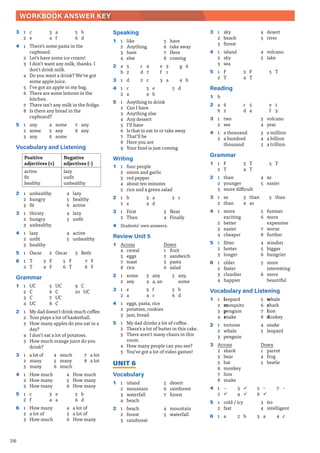
  • 330.
    317 WORKBOOK ANSWER KEY Grammar 11 Gavin 2 Lucy 3 Helen 2 1 best 2 most colourful 3 hottest 4 funniest 5 worst 3 1 biggest 2 most difficult 3 strangest 4 most interesting 5 hungriest 6 strongest 7 easiest 4 1 Antarctica is the coldest place on Earth. 2 The most famous river on Earth is probably the Nile. 3 This is the worst restaurant in town! 4 Wellington, New Zealand, is the furthest capital city from London. 5 The best museum for children is the Natural History Museum. 5 1 the most exciting 2 the best 3 the furthest 4 the longest 5 the most expensive 6 1 most dangerous 2 longest 3 hottest 4 heaviest 5 smallest Speaking 1 1 there 2 like 3 total 4 are 5 Here 6 change 2 a 2 b 7 c 1 d 5 e 6 f 3 g 4 3 1 d 2 c 3 a 4 b 4 a 3 b 1 c 4 d 5 e 7 f 2 g 6 h 8 5 1 We’d like to go to 2 Is there a discount 3 it’s 4 students 5 ʼre all students 6 ʼd like 7 tickets, please 8 that’s £75 9 Here you are 10 Here are your 11 Thank you 12 here’s your 13 Thank you Writing 1 1 intelligent 2 grow 3 weigh 4 eat 5 sharks 6 day 7 also 2 1 Yes 2 eight 3 sleep 4 Yes 5 Yes 3 1 My tortoise moves very slowly. He eats slowly, too. 2 These spiders are huge. They are also very dangerous. 3 Black bears live in forests. They live in mountains, too. 4 They are very fast. They are also very intelligent. 5 Leopards live in Africa. They also live in Asia. 4 1 d 2 a 3 e 4 f 5 c 6 b 5 Students’ own answers. Review Unit 6 1 1 sky 2 mountain 3 desert 4 forest 5 island 2 1 The Pacific Ocean is larger than the Atlantic Ocean. 2 K2 isn’t as high as Mount Everest. 3 Barcelona isn’t as wet as Manchester. 4 The lake is colder than the river. 5 The food in Italy is better than the food in the UK. 6 The Palace of Versailles isn’t as beautiful as the Taj Mahal. 3 1 leopard 2 lion 3 mosquito 4 parrot 5 penguin 6 shark 7 snake 8 whale 4 1 The cheetah is the best runner in the world. 2 The ostrich is the heaviest bird in the world. 3 Whales are the loudest animals in the sea. 4 These are the most colourful parrots in the world. 5 The Gobi bear is the rarest bear on Earth. PROGRESS CHECK Units 4–6 1 1 beach 2 museum 3 jam 4 department store 5 elephants 6 rainforest 2 1 are having 2 is studying 3 ʼm watching 4 ʼs raining 5 are travelling 6 ʼm not wearing 3 1 d 2 h 3 f 4 g 5 a 6 b 7 c 8 e 4 1 monkey 2 hotel 3 penguin 4 island 5 potato 6 market 7 fruit 8 snake Mystery word: mountain. 5 1 ʼm going 2 lives 3 works 4 isn’t working 5 ʼs visiting 6 ʼm learning 7 don’t speak 8 understand 6 1 many 2 any 3 any 4 much 5 some 6 any 7 1 mountain 2 lake 3 fit 4 warm 5 castles 6 markets 7 vegetables 8 chicken 8 1 shorter than 2 as old as 3 more comfortable than 4 bigger than 5 more excited than 6 happier than 9 1 the best 2 warmer 3 older than 4 the highest 5 the most beautiful 6 more dangerous than 10 1 raining 2 icy 3 foggy 4 snowing 5 windy 6 cloudy 7 sunny UNIT 7 Vocabulary 1 1 Isabel 2 Beth 3 Amanda 2 1 shorts 2 trousers 3 coat 4 socks 3 1 tie 2 trousers 3 hat 4 dress 5 shoes 6 T-shirt 7 shorts 8 socks 4 a 1 shirt 2 trainers b 3 skirt 4 jumper 5 boots c 6 trousers 7 T-shirt 8 shoes Reading 1 1 – 2 – 3 9 4 9 5 – 6 9 7 9 2 1 F 2 F 3 T 4 F 5 F 6 T 3 1 hour 2 week 3 year 4 decade 5 century Grammar 1 1 weren’t 2 was 3 Were 4 was 5 Was 2 1 Was he at the train station? 2 They weren’t in the kitchen. 3 It wasn’t very hot on the beach. 4 Was the hotel comfortable? 5 The water was warm in the swimming pool. 3 1 was 2 Was 3 was 4 were 5 Were 6 weren’t 7 were 8 was
  • 331.
    318 WORKBOOK ANSWER KEY Reading 1a 5 b 2 c 7 d 8 e 1 f 4 g 6 h 3 2 1 c 2 a 3 c 4 b 3 1 audience 2 group 3 concert 4 album 5 village 6 singer 7 competition Grammar 1 1 c 2 f 3 b 4 a 5 d 6 e 2 1 left 2 want 3 went 4 travelled 5 loved 6 got 7 have 8 had 3 Infinitive Past simple affirmative Past simple negative meet met didn’t meet know knew didn’t know live lived didn’t live have had didn’t have join joined didn’t join make made didn’t make write wrote didn’t write 4 1 I didn’t see Marc this morning. 2 He didn’t grow up in America. 3 She didn’t win the competition. 4 I didn’t tidy my room. 5 We didn’t leave at ten o’clock. 5 1 She didn’t want the book. 2 I met Karl in Venezuela. 3 He didn’t know my name. 4 They didn’t travel with us. 5 He wrote his phone number on the paper. 6 Andrew spoke Spanish very well. 7 Freddie didn’t study Latin at school. 8 Emma left school when she was sixteen. 6 1 I spoke to Jamie yesterday. 2 My brother went to university. 3 Pia didn’t listen to the song. 4 I didn’t learn French at school. 5 We saw the movie last night. 6 Jack didn’t walk to school this morning. 7 I didn’t travel to Edinburgh by train. 8 She met her mum at the station. Vocabulary and Listening 1 1 glasses 2 green 3 bald 4 slim 5 straight 6 thin 2 1 e 2 a 3 f 4 b 5 c 6 d 3 1 brown 2 dark 3 curly 4 moustache 5 tall 6 blond 7 long 8 glasses 4 1 c 2 f 3 a 4 e 5 b 6 d Writing 1 1 really 2 it 3 loved 4 popular 5 events 6 scored 2 1 three 2 amazing 3 Rime 4 the Netherlands 3 1 c 2 f 3 a 4 e 5 b 6 d 4 1 pencils and folders 2 beds and bookcases 3 monkeys and lions 4 jumpers and a coat Review Unit 7 1 1 jacket 2 trainers 3 hat 4 T-shirt 5 shorts 6 boots 7 jeans 8 socks 2 1 weren’t 2 was 3 were 4 was 5 wasn’t 3 1 there weren’t 2 there were 3 There was 4 Were there 5 Was there 6 there wasn’t 4 1 f 2 e 3 a 4 c 5 b 6 d 5 1 I watched television on Saturday evening. 2 We studied in the evenings. 3 The train sometimes stopped at that station. 4 I loved the clothes in that shop. 5 My children collected World Cup cards. 6 1 b 2 b 3 b 4 a 5 a UNIT 8 Vocabulary 1 1 have 2 learn 3 buy 4 go 5 leave 6 make 7 get 2 1 b 2 f 3 e 4 a 5 c 6 d 3 1 bought 2 was 3 had 4 learned 5 went 6 grew 4 a 5 b 3 c 1 d 8 e 2 f 7 g 4 h 6 5 1 started school 2 had, baby 3 got married 4 went, university 5 bought, house 4 1 c 2 a 3 f 4 b 5 d 6 e 5 1 Were there 2 There were 3 There wasn’t 4 Was there 5 There was 6 There weren’t 6 1 were 2 Was 3 was 4 was 5 Were 6 were 7 wasn’t 8 weren’t 9 were Vocabulary and Listening 1 a 3 b 1 c 4 d 2 2 1 We enjoyed riding our bikes in the park. 2 My brother and I collected Pokémon cards. 3 We loved our little dog. 4 My brother wanted a new bike. 5 I borrowed my friend’s skateboard. 3 1 wanted 2 tried 3 used 4 enjoyed 5 travelled 4 1 Uncle David 2 Uncle David 3 Lucy 4 Uncle David 5 1 F 2 T 3 T 4 F 6 1 c 2 a 3 b 4 c Grammar 1 1 played 2 loved 3 painted 4 watched 5 enjoyed 6 rained 2 1 She stopped running because she was tired. 2 I tidied my bedroom at the weekend. 3 At the party I danced with my friend Sarah. 4 Two years ago, we travelled to China. 5 She studied Maths and Science this morning. 6 George loves playing the guitar. He practised all weekend. 3 1 invited 2 used 3 listened 4 talked 5 visited 6 opened 4 1 them 2 us 3 her 4 it 5 me 6 him 7 them 8 him 5 1 him 2 it 3 them 4 her 5 us 6 it 7 her 8 him Speaking 1 1 got 2 try 3 size 4 rooms 5 good 6 much 7 them 8 pay 2 1 – 2 9 3 9 4 – 5 – 6 9 3 2
  • 332.
    319 WORKBOOK ANSWER KEY ReviewUnit 8 1 1 bought 2 learned 3 left 4 went 5 got 6 made 2 1 were 2 got 3 started 4 had 5 grew 6 made 3 1 I didn’t see my friend Lola at the weekend. 2 Kris wrote to me every day. 3 I didn’t want to get a job in London. 4 Jamie bought flowers for his mother every Sunday. 5 Helen didn’t work in a hotel. 4 1 they didn’t 2 he didn’t 3 I did 4 she didn’t 5 they did 6 he didn’t 5 1 Did your dad start his new job last week? 2 When did you meet your wife? 3 How long did you stay at your cousin’s house? 4 Did your parents enjoy the film? 5 How did you make this cake? 6 Did they go to the beach yesterday? UNIT 9 Vocabulary 1 1 underground 2 scooter 3 coach 4 helicopter 5 motorbike 2 1 helicopter 2 on foot 3 coach 4 bike 5 motorbike 6 underground 7 plane 3 1 scooter 2 ship 3 plane 4 tram 5 on foot 4 1 lorry 2 motorbike 3 tram 4 plane 5 helicopter 6 bike 5 1 coach 2 boat 3 bike 4 scooter 5 ship 6 on foot Reading 1 1 9 2 – 3 – 4 9 5 9 6 9 7 – 2 1 F 2 T 3 T 4 F 5 F 3 1 traffic 2 transport 3 healthier 4 expensive 5 travel 4 1 motorway 2 path 3 view 4 traffic 5 driver Grammar 1 1 won’t 2 will 3 will 4 won’t 5 will 4 1 9 2 9 3 – 4 9 5 9 6 – 7 9 5 1 F 2 T 3 F 4 F 5 T 6 T Grammar 1 1 c 2 e 3 a 4 f 5 b 6 d 2 1 Did, come No, she didn’t. 2 Did, wear No, he didn’t. 3 Did, enjoy Yes, they did. 4 Did, tidy No, she didn’t. 5 Did, buy Yes, she did. 3 1 Did you finish 2 did you invite 3 did Martha spend 4 Did Matt tell 5 did Leah join 6 did you eat 4 1 Why did you go 2 Where did you see 3 How much did, cost 4 What time did, arrive 5 Who did you meet 6 What did you wear Speaking 1 1 weekend 2 amazing 3 do 4 went 5 like 6 sounds 2 a 2 b 4 c 1 d 6 e 3 f 5 3 1 have 2 it was 3 you do 4 about you 5 went to 6 fun 7 was 8 like 4 1 e 2 a 3 f 4 b 5 h 6 c 7 g 8 d Writing 1 1 straight 2 brown 3 face 4 born 5 grew up 6 that 7 got married 8 hobbies 2 1 Yes 2 Yes 3 No 4 Yes 5 No 3 1 e 2 c 3 a 4 f 5 b 6 d 4 My art teacher, Mr Flood, is great. He’s tall and slim and he has got a friendly face. He wears glasses because he can’t see very well. / He was born in Canada and grew up there. He got married when he was 30. His wife is English, and they moved to London in 1995. After that, he got a job at my school. / His hobbies are walking and reading. He also likes listening to music in the evenings. 1 b 2 c 3 a 5 Students’ own answers. 2 1 I think it will be hot tomorrow. 2 I think John will become a teacher after university. 3 Maria won’t pass her English exam in June. 4 Will the party be fun on Saturday? 5 Most people won’t drive cars in 2050. 3 1 No, we won’t. 2 Yes, it will. 3 Yes, we will. 4 No, they won’t. 5 Yes, they will. 6 No, they won’t. 4 1 Megan will live in New York one day. 2 Ryan will make friends at his new school. 3 Lucy won’t have any children before she’s 35. 4 People won’t have flying cars in 2050. 5 Astronauts will travel to Mars before 2100. Vocabulary and Listening 1 1 g 2 c 3 a 4 f 5 d 6 h 7 e 8 b 2 1 d 2 b 3 e 4 a 5 c 3 1 packed 2 relaxed 3 took 4 stayed 5 visited 6 took 4 1 Sara 2 Dylan 3 Sara 4 Dylan 5 1 F 2 F 3 T 4 T 5 T Grammar 1 1 ’m 2 Are 3 is 4 Are 5 ’s 6 ’m 2 1 Are 2 to have 3 aren’t 4 going 5 get 6 isn’t 3 1 going 2 fly 3 are 4 to 5 aren’t 6 stay 4 1 Are you going to go sightseeing? 2 I’m going to go to university. 3 Is Sophie going to learn to drive? 4 They’re going to buy a house. 5 Dan isn’t going to go skiing with us. 6 I’m not going to tell Maria. 5 1 ’s going to take 2 ’m not going to go 3 ’re going to explore 4 ’re going to unpack 5 isn’t going to visit 6 ’m going to take Speaking 1 1 going 2 anything 3 special 4 Would 5 going 6 are 7 see
  • 333.
    320 WORKBOOK ANSWER KEY 21 9 2 9 3 – 4 9 5 – 6 – 7 9 8 – 3 1 c 2 a 3 d 4 b 4 a 2 b 8 c 3 d 1 e 4 f 6 g 7 h 5 Writing 1 1 Wales 2 bikes and walking boots 3 her aunt and uncle 4 surf 2 1 so 2 because 3 because 4 so 3 1 e 2 a 3 b 4 d 5 c 4 Students’ own answers. Review Unit 9 1 Across 4 boat 5 plane 7 scooter Down 1 ship 2 underground 3 coach 6 lorry 8 tram 2 1 will 2 won’t 3 will 4 will 5 won’t 6 won’t 3 go hiking rent a bike take a bus tour unpack your bag visit a castle 4 1 c 2 e 3 a 4 b 5 f 6 d 5 1 ʼre going to buy 2 ’m going to get 3 isn’t going to have 4 ʼre going to travel 5 aren’t going to visit 6 ’m not going to learn PROGRESS CHECK Units 7–9 1 1 Were 2 wasn’t 3 weren’t 4 was 5 Was 6 were/weren’t 2 1 straight 2 tie 3 blond 4 trainers 5 socks 6 well-built 7 moustache 8 hat 3 1 decided 2 went 3 bought 4 made 5 took 6 win 7 had 8 were 4 1 coach 2 bike 3 scooter 4 boat 5 ship 6 plane 7 lorry 5 1 get married 2 start school 3 pack, bag 4 go sightseeing 5 relax, beach 6 get, job 6 1 Alex sang some songs. 2 I often spoke to Mrs Brown. 3 My parents didn’t know Gary. 4 Did your dad finish work at six o’clock? 5 The train stopped at Cambridge Station. 7 1 People won’t live on other planets. 2 Are you going to meet Suzie later? 3 I’m not going to visit Harry. 4 Laura isn’t going to go to university. 5 I think Jana will get a job. 8 1 Were 2 were 3 Did 4 didn’t 5 was 6 going to 7 Will 8 won’t 9 1 d 2 f 3 a 4 b 5 c 6 e 10 1 it wasn’t 2 I am/we are 3 we did 4 she won’t 5 there were 6 I’m not/we aren’t 11 1 When did you meet Chloe? 2 How old will Grace be in 2050? 3 Is Tom going to university next year? 4 Did your parents give you that phone? 5 Why did you go to bed late last night? 6 Will people go on holiday in space?
  • 334.
    58 St Aldates Oxford OX11ST United Kingdom Publishing Director: Deborah Tricker Publishers: Sue Ashcroft, Simone Foster Content Developer: Glenys Davis Editor: Helen Brock Proofreaders: Jennifer Cotterill, Kathleen Falconer Design Manager: Lorna Heaslip Cover Design: Big Pink Fish Design Layout: Lorna Heaslip, Global Blended Learning Ltd Photo Researcher: Magdalena Mayo Culture videos and vlogs: Digital Learning Associates Vloggers: Ben Chinapen, Nina-Nicole Cockrell, Rebecca Gutierrez, Natalie Hall, Tati Kapaya, Bokang Lehlokoe, Steve Yalo Audio Production: Tom Dick And Debbie Educational Media Productions Grammar presentations and story animations, and Keep moving! digital board game: CCS Digital Education We would like to thank Yolanda Muñoz Vivas for her valuable contribution to developing the material. We would also like to thank the following authors for their valuable contributions to this book: Jeremy Bowell (Literature), Claire Thacker (Reviews), Joanna Kosta (Exams), Cheryl Palin (Projects), Carol Tabor (Video lessons), Kate Woodford (Language Summaries) We would like to thank all those who have given their kind permission to reproduce material for this book: Illustrators: Emmanuel Cerisier, Andrew Gibbs, Jocelyn Kao, Dusan Lakicevic, Carl Morris, Berat Pekmezci, Martin Sanders, Szilvia Szakall, Anastasia Williams, Lazlo Veres Photos: M. Mayo; Tracy Staffieri / www.jerseygirlinthesouth.com; 123RF/ Sutichak Yachiangkham, Anton Starikov, lopolo, Mark Bowden, Kanstantsin Prymachuk, scanrail, ljupco, ferli, Joshua Resnick, kurhan, mezzotint123rf, serezniy, belchonock, Sasin Tipchai, monticello, tarzhanova, Baiba Opule, Maria Dryfhout, anolis01, dolgachov, margouillat; A. G. E. FOTOSTOCK/Tom Brakefield; A+ WORLD ACADEMY; ALAMY/ Rich Gold, All Canada Photos, Michael Doolittle, Cronos, Clive Sawyer, age fotostock, Andrea Obzerova, Ian Lamond, KBImages, Trinity Mirror/Mirrorpix, AF archive, blickwinkel, Aitormmfoto, Vadym Drobot, TCD/Prod. DB, Everett Collection Inc, travelpixs, Pavlo Baishev, Andrew Woodley, Chris Willson, Entertainment Pictures, Gari Wyn Williams, Heritage Image Partnership Ltd, faithie, LH Images, David Ball, geogphotos, Archive PL, Tony Smith, David Levenson; GETTY IMAGES SALES SPAIN/Holgs, HRAUN, ANTONIN THUILLIER, Skynesher, Ly86, imtmphoto, Kali9, Fuse, Mike Kemp, Echo, Dcdr, Michael Burrell, MediaProduction, Gldburger, E+, FatCamera, Steven A Henry, Basilios1, 1001slide, Michael Hanson, LauriPatterson, Xia Yuan, Stockcam, Tony Anderson, Shestock, Popartic, Mike Marsland, LSOphoto, Kate_sept2004, Jupiterimages, Jax10289, Gerville, Fstop123, Alistair Berg, Zstockphotos, Doctor_J, Yobro10, Frank Trapper, Gkrphoto, Melissa Ross, Pete Salotous, Richard Baker, ROMAOSLO, View Pictures, SolStock, Carolyn Barber, Wei Fang, YinYang, bhofack2, Powerofforever, 956667120, Steven Puetzer, Dragonian, George Pimentel, Fongfong2, Themacx, Kenmind77, LJM Photo, MarioGuti, Christian Vierig, NAKphotos, Pmcdonald, Shank_ali, Annabelle Breakey, Tim Platt, Tirachard, Westend61, Julie Moquet/EyeEm, Cody Glenn, Dan Mullan, DonNichols, Franco Banfi, Fabianaponzi, Tempura, Tab1962, R A Kearton, Olga355, NoDerog, MilaDrumeva, MOHD RASFAN, Jmsilva, Ianwool, JohnnyGrieg, Gurzzza, Jacek Kadaj, Casarsa, Hola Images, Hero Images, Anatols, Sturti, Robtek, Etiennevoss, Posnov, Chris Cross, D Dipasupil, DieterMeryl, NYS444, Carlofranco, Ben Gingell, sorincolac, FRANCK FIFE, FotoVoyager, Gorodenkoff, Eli_asenova, Daisy-Daisy, Ljupco, John Harper, VikiVector, Kevin Dodge, Liz McAulay, Luxy Images, Nitrub, Maskot, Peter Dench, Philipimage, Visuals Unlimited, Inc./ Thomas Marent, VelhoJunior, Amstockphoto, Boarding1Now, Cultura RM Exclusive/Chad Springer, Thinkstock, Hamish Blair, Jean Catuffe, skodonnell, PeopleImages, Phil Boorman, Tetra Images, Tara Moore, Sorincolac, ConstantinosZ, David P. Hall, D-BASE, Gabe Ginsberg, JGI/Tom Grill, Jun Takahashi, SensorSpot, Universal History Archive, Peter_Nile, Chaoss, PAUL CROCK, Robert Shafer, Rolleiflextlr, Ross Kinnaird, OLI SCARFF, AzmanL, amazingmikael, AntonioGuillem, Muralinath, Dmytro Aksonov, Duncan_Andison, Fcafotodigital, Creativ Studio Heinemann, Vudhikul Ocharoen/EyeEm, Olena_Rublenko, Piotr Polaczyk, Mawielobob, Ronnie Kaufman, S.J. Krasemann, Sean M. Haffey, Avesun, Master1305, Wavebreakmedia, GANNAMARTYSHEVA, KenCanning, Hindustan Times, JGI/Jamie Grill, Jonathan Daniel, Avalon, Juanmonino, Mike Harrington, Photos.com Plus, Steve Debenport, Thomas Northcut, Tony Beck/500px, Vladimir Godnik, HighImpactPhotography, Gary John Norman, Jun Pinzon/ EyeEm, Marco Bottigelli, Oleh_Slobodeniuk, Stuart C. Wilson, Table mesa Prod., Werner Dieterich, Imgorthand, Pgiam, Elisabeth Schmitt, Ng Sok Lian/EyeEm, Tambako de Jaguar, TanyaRozhnovskaya, VikramRaghuvanshi, Arnau Ramos Oviedo, GomezDavid, Lachlan Cunningham, Matthew Ashton-AMA, Patthana Nirangkul, Camila Garcia/EyeEm, Fabian Krause/EyeEm, Federico Robertazzi, Goddard_Photography, Quality Sport Images, Monkeybusinessimages, Gofotograf, PYMCA, Jose Luis Pelaez Inc, Classen Rafael/EyeEm, Andreas Von Einsiedel, Caiaimage/Robert Daly, FangXiaNuo, Jane Barlow-PA Images, Jean Baptiste Lacroix, Alex Livesey-Danehouse, David Bailey/ Nashville, José María Monge Galán, EMS-FORSTER-PRODUCTIONS, Ittipol Nampochai/EyeEm, Caiaimage/Tom Merton, Ben Pipe Photography, Kevin Barnes-CameraSport, Suriyapong Koktong/ EyeEm, Vicky Kasala Productions, Chalermpon Poungeth/ EyeEm, Christian Science Monitor, Stefan Rousseau-PA Images, Dreamnikon, Julian Elliott Photography, CEZARY ZAREBSKI PHOTOGRAPHY, Lane Oatey/Blue Jean Images, Fernando Trabanco Fotografía, Alanna Dumonceaux/Design Pics, Irene Caterina Sicurella/EyeEm, Colin Anderson Productions Pty Ltd, Nelik, Gbh007, Tom Merton; ISTOCKPHOTO/Getty Images Sales Spain, deniztuyel; JOHN FOXX IMAGES; MUSEUM ICONOGRAFÍA/J. Martin; PIXABABY; SCIENCE PHOTO LIBRARY/ MARTYN F. CHILLMAID; SHUTTERSTOCK/Chromatika Multimedia snc, Red Umbrella and Donkey, Monkey Business Images, Moviestore Collection, enchanted_fairy, Patrick Rideaux, zhengzaishuru, Skreidzeleu, mooremedia, MvanCaspel, padu_foto, exopixel, Bonsales, Snap; VISHOPPERaatomik; WALL TO WALL MEDIA LIMITED; EPSON IBÉRICA, S.A.; SERIDEC PHOTOIMAGENES CD; Sony Computer Entertainment Inc.; ARCHIVO SANTILLANA The Publisher has made every effort to trace the owner of copyrighted material; however, the Publisher will correct any involuntary omission at the earliest opportunity. © Richmond / Santillana Global S.L. 2021 All rights reserved. No part of this book may be reproduced, stored in a retrieval system or transmitted in any form by any means, electronic, mechanical, photocopying, recording or otherwise, without the prior permission in writing of the Publisher.
  • 335.
    www.richmondelt.com Keep it real!is the ideal 6-level secondary course for today’s mixed-ability classes, with its flexible blend of dynamic video and digital content, easy-to-use classroom materials, and focus on developing communicative competence and 21st century skills. Relevant, engaging, achievable learning for today’s teenagers A1 A1+ A2 B1 B1+ B2 C1 Common European Framework A1+ Your Keep it real! Teacher’s Guide offers teaching notes and Student’s Book pages combined in one easy-to-use resource. It also provides access to the teacher’s area of the Richmond Learning Platform for a wealth of extra resources. Full-sized, colour Student’s Book pages with accompanying lesson notes for ease of reference in class and when planning your lessons. Comprehensive teaching notes with answer keys and complete audio and animation scripts. Ideas for warmers, extra practice and guidance with concept questions to extend and support students. Detailed teaching notes and complete scripts for the vlogs and culture videos. References to related Workbook and online materials throughout. Complete Workbook answer key. Access to the for additional resources and tests. Includes mixed-ability worksheets for every unit, diagnostic, unit and termly tests in both PDF and digital formats and digital extra practice activities. Richmond Learning Platform FOR STUDENTS Student’s Book Workbook Richmond Learning Platform access FOR TEACHERS Interleaved Teacher’s Guide with Student’s Book Richmond Learning Platform access Digital Book for classroom interactive whiteboard use Mixed-ability worksheets for every unit Complete assessment package Audio, video, animated content and games Extra practice activities for language and skills Homework assignment feature Detailed reports on learners’ performance and progress Richmond Learning Platform