USAID PROGATI Project
M&E Working group Meeting
PROGATI Office
on
July 23 & August 06, 2008
Prepared and Presented by Development Alternatives, Inc (DAI)
The views expressed in this presentation do not necessarily reflect the views of the
United States Agency for International Development or the United States Government
Promoting
Governance,
Accountability,Transparency
and
Integrity
Welcome
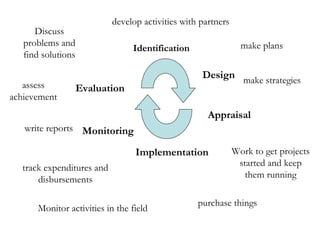
purchase things
write reports
make strategies
track expenditures and
disbursements
Monitor activities in the field
assess
achievement
Work to get projects
started and keep
them running
make plans
develop activities with partners
Discuss
problems and
find solutions
Identification
Appraisal
Implementation
Evaluation
Monitoring
Design
Program Cycle
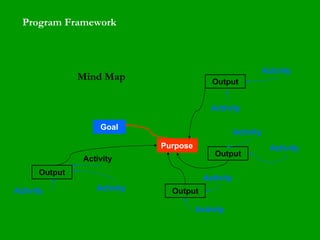
Program Framework
Mind Map
Goal
Activity
Purpose
Output
Activity
Activity Activity
Activity
Activity
Activity
Activity
Activity
Output
Output
Output
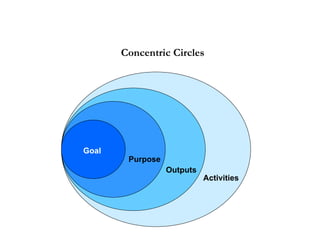
Program Framework
Concentric Circles
Goal
Purpose
Outputs
Activities
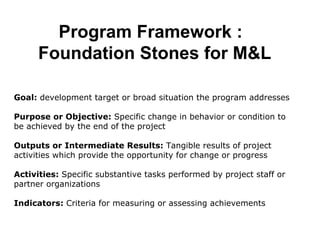
Program Framework :
Foundation Stones for M&L
Goal: development target or broad situation the program addresses
Purpose or Objective: Specific change in behavior or condition to
be achieved by the end of the project
Outputs or Intermediate Results: Tangible results of project
activities which provide the opportunity for change or progress
Activities: Specific substantive tasks performed by project staff or
partner organizations
Indicators: Criteria for measuring or assessing achievements
Program Framework
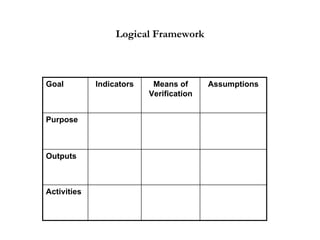
Logical Framework
Goal Indicators Means of
Verification
Assumptions
Purpose
Outputs
Activities
What is indicators:
• Indicators comprise of a critical component
of a M&E frame work
• Indicators are the signs that shows
changes inc certain conditions or results
from specific interventions.
• Indicators provide evidence of the
progress of program or project activities in
the attainment of development objectives.
Why indicators in Monitoring and
evaluation :
• Enable organization to monitor progress in
achieving results-systematically
• Support a strong and coherent system of
learning and performance measurement
• Facilitate reporting results
• Integrate lessons learned into management
decisions and future programming
Selection of indicators :
• What are the objective of the program or project
• Who are the target groups and what are their needs and
expectations?
• What changes are anticipated as a result of the program or
project
• To what extent and how efficiently is the program or project
achieving its objectives?
Other consideration:
• Ownership by beneficiaries and other stakeholders
• Cost effectiveness of data collection?
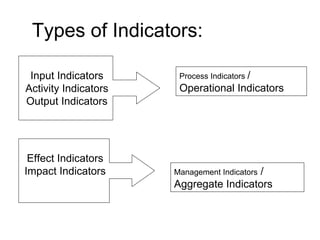
Types of Indicators:
Input Indicators
Activity Indicators
Output Indicators
Effect Indicators
Impact Indicators
Process Indicators /
Operational Indicators
Management Indicators /
Aggregate Indicators
Types of Indicators:
Input Indicators:
Describes what goes into the project,
the amount of money spent, the
amount of staff time devoted to the
project, infrastructure made available
• # of training center
• # of the office
• # Total budget
Activity Indicators:
Describe the number of activities
conducted or their percent completion
• # of staff hired
• # of staff trained
• # of divisional consultation
• # of training conducted
• # of laws need to be reviewed
Types of Indicators:
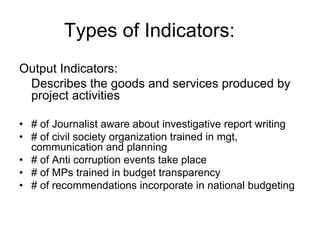
Output Indicators:
Describes the goods and services produced by
project activities
• # of Journalist aware about investigative report writing
• # of civil society organization trained in mgt,
communication and planning
• # of Anti corruption events take place
• # of MPs trained in budget transparency
• # of recommendations incorporate in national budgeting
Types of Indicators:
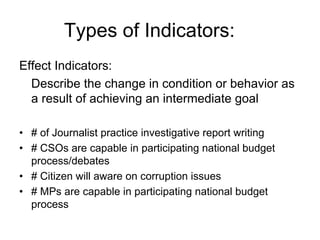
Effect Indicators:
Describe the change in condition or behavior as
a result of achieving an intermediate goal
• # of Journalist practice investigative report writing
• # CSOs are capable in participating national budget
process/debates
• # Citizen will aware on corruption issues
• # MPs are capable in participating national budget
process
Types of Indicators:
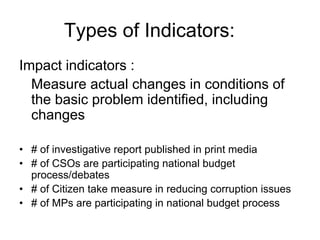
Impact indicators :
Measure actual changes in conditions of
the basic problem identified, including
changes
• # of investigative report published in print media
• # of CSOs are participating national budget
process/debates
• # of Citizen take measure in reducing corruption issues
• # of MPs are participating in national budget process
Types of Indicators:
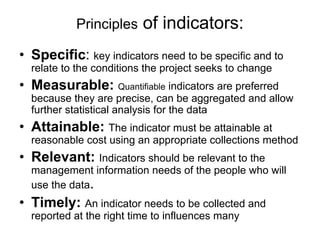
Principles of indicators:
• Specific: key indicators need to be specific and to
relate to the conditions the project seeks to change
• Measurable: Quantifiable indicators are preferred
because they are precise, can be aggregated and allow
further statistical analysis for the data
• Attainable: The indicator must be attainable at
reasonable cost using an appropriate collections method
• Relevant: Indicators should be relevant to the
management information needs of the people who will
use the data.
• Timely: An indicator needs to be collected and
reported at the right time to influences many
Thank you

LFA & Indicator.pdf

  • 1.
    USAID PROGATI Project M&EWorking group Meeting PROGATI Office on July 23 & August 06, 2008 Prepared and Presented by Development Alternatives, Inc (DAI) The views expressed in this presentation do not necessarily reflect the views of the United States Agency for International Development or the United States Government Promoting Governance, Accountability,Transparency and Integrity
  • 2.
  • 3.
    purchase things write reports makestrategies track expenditures and disbursements Monitor activities in the field assess achievement Work to get projects started and keep them running make plans develop activities with partners Discuss problems and find solutions Identification Appraisal Implementation Evaluation Monitoring Design Program Cycle
  • 4.
    Program Framework Mind Map Goal Activity Purpose Output Activity ActivityActivity Activity Activity Activity Activity Activity Output Output Output
  • 5.
  • 6.
    Program Framework : FoundationStones for M&L Goal: development target or broad situation the program addresses Purpose or Objective: Specific change in behavior or condition to be achieved by the end of the project Outputs or Intermediate Results: Tangible results of project activities which provide the opportunity for change or progress Activities: Specific substantive tasks performed by project staff or partner organizations Indicators: Criteria for measuring or assessing achievements
  • 7.
    Program Framework Logical Framework GoalIndicators Means of Verification Assumptions Purpose Outputs Activities
  • 8.
    What is indicators: •Indicators comprise of a critical component of a M&E frame work • Indicators are the signs that shows changes inc certain conditions or results from specific interventions. • Indicators provide evidence of the progress of program or project activities in the attainment of development objectives.
  • 9.
    Why indicators inMonitoring and evaluation : • Enable organization to monitor progress in achieving results-systematically • Support a strong and coherent system of learning and performance measurement • Facilitate reporting results • Integrate lessons learned into management decisions and future programming
  • 10.
    Selection of indicators: • What are the objective of the program or project • Who are the target groups and what are their needs and expectations? • What changes are anticipated as a result of the program or project • To what extent and how efficiently is the program or project achieving its objectives? Other consideration: • Ownership by beneficiaries and other stakeholders • Cost effectiveness of data collection?
  • 11.
    Types of Indicators: InputIndicators Activity Indicators Output Indicators Effect Indicators Impact Indicators Process Indicators / Operational Indicators Management Indicators / Aggregate Indicators
  • 12.
    Types of Indicators: InputIndicators: Describes what goes into the project, the amount of money spent, the amount of staff time devoted to the project, infrastructure made available • # of training center • # of the office • # Total budget
  • 13.
    Activity Indicators: Describe thenumber of activities conducted or their percent completion • # of staff hired • # of staff trained • # of divisional consultation • # of training conducted • # of laws need to be reviewed Types of Indicators:
  • 14.
    Output Indicators: Describes thegoods and services produced by project activities • # of Journalist aware about investigative report writing • # of civil society organization trained in mgt, communication and planning • # of Anti corruption events take place • # of MPs trained in budget transparency • # of recommendations incorporate in national budgeting Types of Indicators:
  • 15.
    Effect Indicators: Describe thechange in condition or behavior as a result of achieving an intermediate goal • # of Journalist practice investigative report writing • # CSOs are capable in participating national budget process/debates • # Citizen will aware on corruption issues • # MPs are capable in participating national budget process Types of Indicators:
  • 16.
    Impact indicators : Measureactual changes in conditions of the basic problem identified, including changes • # of investigative report published in print media • # of CSOs are participating national budget process/debates • # of Citizen take measure in reducing corruption issues • # of MPs are participating in national budget process Types of Indicators:
  • 17.
    Principles of indicators: •Specific: key indicators need to be specific and to relate to the conditions the project seeks to change • Measurable: Quantifiable indicators are preferred because they are precise, can be aggregated and allow further statistical analysis for the data • Attainable: The indicator must be attainable at reasonable cost using an appropriate collections method • Relevant: Indicators should be relevant to the management information needs of the people who will use the data. • Timely: An indicator needs to be collected and reported at the right time to influences many
  • 18.