12/06/2024 Chalie T. 1
Controlling
Session Objectives
• Define controlling, monitoring & evaluation
• Determine the purpose of M&E
• Understand different steps of monitoring &
evaluation practices
• Describe the r/n ship b/n M&E
• Evaluate the characteristics of indicators
Chalie T. 2
12/06/2024
12/06/2024 Chalie T. 3
Control
 Is the process of ensuring whether actual activities are
done according to the plan or not .
 helps managers monitor the effectiveness of
 their planning,
 their organizing ability
 their leading techniques.
 To take corrective actions.
12/06/2024 Chalie T. 4
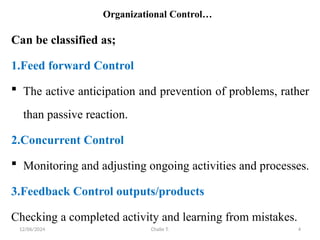
Organizational Control…
Can be classified as;
1.Feed forward Control
 The active anticipation and prevention of problems, rather
than passive reaction.
2.Concurrent Control
 Monitoring and adjusting ongoing activities and processes.
3.Feedback Control outputs/products
Checking a completed activity and learning from mistakes.
12/06/2024 Chalie T. 5
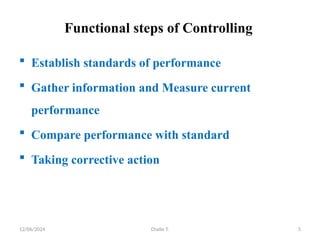
Functional steps of Controlling
 Establish standards of performance
 Gather information and Measure current
performance
 Compare performance with standard
 Taking corrective action
12/06/2024 Chalie T. 6
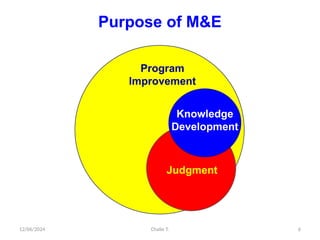
Purpose of M&E
Program
Improvement
Judgment
Knowledge
Development
12/06/2024 Chalie T. 7
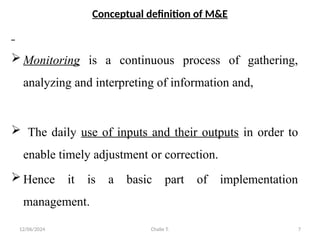
Conceptual definition of M&E
 Monitoring is a continuous process of gathering,
analyzing and interpreting of information and,
 The daily use of inputs and their outputs in order to
enable timely adjustment or correction.
 Hence it is a basic part of implementation
management.
12/06/2024 Chalie T. 8
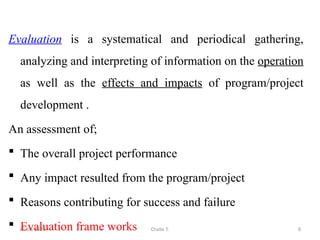
Evaluation is a systematical and periodical gathering,
analyzing and interpreting of information on the operation
as well as the effects and impacts of program/project
development .
An assessment of;
 The overall project performance
 Any impact resulted from the program/project
 Reasons contributing for success and failure
 Evaluation frame works
12/06/2024 Chalie T. 9
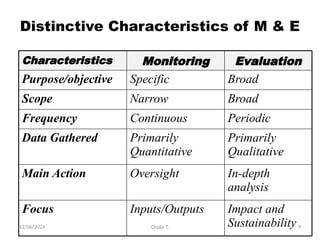
Distinctive Characteristics of M & E
Characteristics Monitoring Evaluation
Purpose/objective Specific Broad
Scope Narrow Broad
Frequency Continuous Periodic
Data Gathered Primarily
Quantitative
Primarily
Qualitative
Main Action Oversight In-depth
analysis
Focus Inputs/Outputs Impact and
Sustainability
12/06/2024 Chalie T. 10
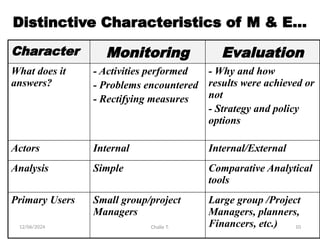
Distinctive Characteristics of M & E…
Character Monitoring Evaluation
What does it
answers?
- Activities performed
- Problems encountered
- Rectifying measures
- Why and how
results were achieved or
not
- Strategy and policy
options
Actors Internal Internal/External
Analysis Simple Comparative Analytical
tools
Primary Users Small group/project
Managers
Large group /Project
Managers, planners,
Financers, etc.)
12/06/2024 Chalie T. 11
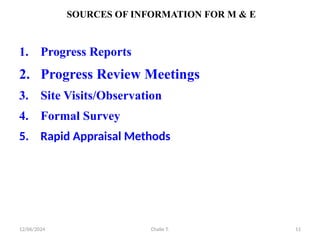
SOURCES OF INFORMATION FOR M & E
1. Progress Reports
2. Progress Review Meetings
3. Site Visits/Observation
4. Formal Survey
5. Rapid Appraisal Methods
12/06/2024 Chalie T. 12
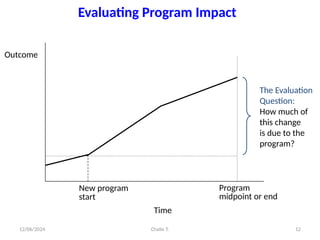
New program
start
Program
midpoint or end
Time
Outcome
The Evaluation
Question:
How much of
this change
is due to the
program?
Evaluating Program Impact
12/06/2024 Chalie T. 13
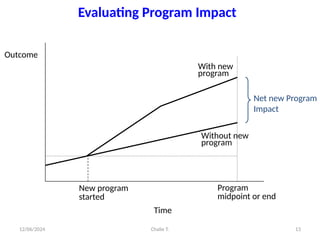
With new
program
Without new
program
New program
started
Program
midpoint or end
Time
Outcome
Evaluating Program Impact
Net new Program
Impact
12/06/2024 Chalie T. 14
Program Components
• Inputs
– Resources used in a program, such as money, staff,
curricula, and materials
• Activities
– Services that the program provides to accomplish its
objectives, such as outreach, materials distribution,
counseling sessions, workshops, and training
12/06/2024 Chalie T. 15
Program Components (cont.)
• Outputs
– Direct products or deliverables of the program/project, such
as intervention sessions completed and materials distributed
• Outcomes
– Program results that occur both immediately and some time
after the activities are completed,
– Changes in knowledge, attitudes, beliefs, skills, behaviors,
access, policies, and environmental conditions
12/06/2024 Chalie T. 16
Program Components (cont.)
Impacts
–Long-term results of one or more
programs over time, such as changes in
HIV infection, morbidity, and mortality
12/06/2024 Chalie T. 17
INDICATORS
Development & selection for M&E
“If you cannot measure results,
you can not tell success from failure!”
12/06/2024 Chalie T. 18
What is an indicator ?
• A measure, typically numeric, that provides key
information about a system’s condition.
• Indicators are an objective measure of change or results
brought about by an activity or an output from an activity.
• Indicators are designed to provide a standard against
which to measure, or assess the progress of an activity
against stated targets/objectives
12/06/2024 Chalie T. 19
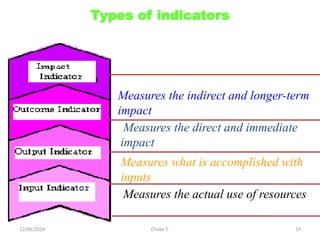
Types of indicators
Measures the direct and immediate
impact
Measures the indirect and longer-term
impact
Measures what is accomplished with
inputs
Measures the actual use of resources
12/06/2024 Chalie T. 20
 Indicators are signals which show;
 Whether we are on the right track & direction,
 How far we have progressed
 How far we still have to go to reach our
destination/objectives.
 Indicators can be :
 Quantitative, measuring tangible effects, or
 Qualitative, dealing with judgments
Chalie T.
12/06/2024 21
Direct and Proxy Indicators
 Some times it is not possible to observe and measure project
results directly
 In such situations indirect or proxy indicators have to be used
 Example: effectiveness of ‘behavioral change communication
(BCC) in HIV/AIDS prevention’
 projects may be measured directly by reduced death rates related
to the virus.
 But these are difficult to determine over short period of the
project life.
Chalie T.
12/06/2024 22
 What indicators do you suggest to be used in such
situation?
Proxy indicators, such as;
 Sales of condom per month,
 Number of new anti-aids clubs established and
 Increase in number of people practicing voluntary
counseling and testing (VCT) may be used as indicators.
Direct and Proxy Indicators . . .
Chalie T.
12/06/2024 23
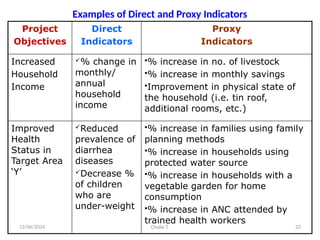
Examples of Direct and Proxy Indicators
Project
Objectives
Direct
Indicators
Proxy
Indicators
Increased
Household
Income
% change in
monthly/
annual
household
income
% increase in no. of livestock
% increase in monthly savings
Improvement in physical state of
the household (i.e. tin roof,
additional rooms, etc.)
Improved
Health
Status in
Target Area
‘Y’
Reduced
prevalence of
diarrhea
diseases
Decrease %
of children
who are
under-weight
% increase in families using family
planning methods
% increase in households using
protected water source
% increase in households with a
vegetable garden for home
consumption
% increase in ANC attended by
trained health workers
12/06/2024 Chalie T. 24
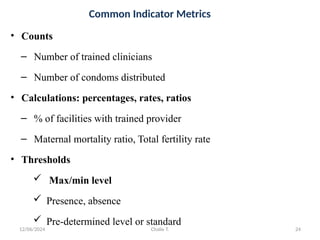
Common Indicator Metrics
• Counts
– Number of trained clinicians
– Number of condoms distributed
• Calculations: percentages, rates, ratios
– % of facilities with trained provider
– Maternal mortality ratio, Total fertility rate
• Thresholds
 Max/min level
 Presence, absence
 Pre-determined level or standard
12/06/2024 Chalie T. 25
Characteristics of Good Indicators
• Valid: accurate measure of a behavior, practice
or task
• Reliable: consistently measurable in the same
way by different observers
• Precise: operationally defined in clear terms
• Measurable: quantifiable using available tools
and methods
• Timely: provides a measurement at time
intervals in terms of program goals and
activities
Chalie T.
Thank you very much!
.
12/06/2024 26

Controlling 4 th.pptx for health students

  • 1.
    12/06/2024 Chalie T.1 Controlling
  • 2.
    Session Objectives • Definecontrolling, monitoring & evaluation • Determine the purpose of M&E • Understand different steps of monitoring & evaluation practices • Describe the r/n ship b/n M&E • Evaluate the characteristics of indicators Chalie T. 2 12/06/2024
  • 3.
    12/06/2024 Chalie T.3 Control  Is the process of ensuring whether actual activities are done according to the plan or not .  helps managers monitor the effectiveness of  their planning,  their organizing ability  their leading techniques.  To take corrective actions.
  • 4.
    12/06/2024 Chalie T.4 Organizational Control… Can be classified as; 1.Feed forward Control  The active anticipation and prevention of problems, rather than passive reaction. 2.Concurrent Control  Monitoring and adjusting ongoing activities and processes. 3.Feedback Control outputs/products Checking a completed activity and learning from mistakes.
  • 5.
    12/06/2024 Chalie T.5 Functional steps of Controlling  Establish standards of performance  Gather information and Measure current performance  Compare performance with standard  Taking corrective action
  • 6.
    12/06/2024 Chalie T.6 Purpose of M&E Program Improvement Judgment Knowledge Development
  • 7.
    12/06/2024 Chalie T.7 Conceptual definition of M&E  Monitoring is a continuous process of gathering, analyzing and interpreting of information and,  The daily use of inputs and their outputs in order to enable timely adjustment or correction.  Hence it is a basic part of implementation management.
  • 8.
    12/06/2024 Chalie T.8 Evaluation is a systematical and periodical gathering, analyzing and interpreting of information on the operation as well as the effects and impacts of program/project development . An assessment of;  The overall project performance  Any impact resulted from the program/project  Reasons contributing for success and failure  Evaluation frame works
  • 9.
    12/06/2024 Chalie T.9 Distinctive Characteristics of M & E Characteristics Monitoring Evaluation Purpose/objective Specific Broad Scope Narrow Broad Frequency Continuous Periodic Data Gathered Primarily Quantitative Primarily Qualitative Main Action Oversight In-depth analysis Focus Inputs/Outputs Impact and Sustainability
  • 10.
    12/06/2024 Chalie T.10 Distinctive Characteristics of M & E… Character Monitoring Evaluation What does it answers? - Activities performed - Problems encountered - Rectifying measures - Why and how results were achieved or not - Strategy and policy options Actors Internal Internal/External Analysis Simple Comparative Analytical tools Primary Users Small group/project Managers Large group /Project Managers, planners, Financers, etc.)
  • 11.
    12/06/2024 Chalie T.11 SOURCES OF INFORMATION FOR M & E 1. Progress Reports 2. Progress Review Meetings 3. Site Visits/Observation 4. Formal Survey 5. Rapid Appraisal Methods
  • 12.
    12/06/2024 Chalie T.12 New program start Program midpoint or end Time Outcome The Evaluation Question: How much of this change is due to the program? Evaluating Program Impact
  • 13.
    12/06/2024 Chalie T.13 With new program Without new program New program started Program midpoint or end Time Outcome Evaluating Program Impact Net new Program Impact
  • 14.
    12/06/2024 Chalie T.14 Program Components • Inputs – Resources used in a program, such as money, staff, curricula, and materials • Activities – Services that the program provides to accomplish its objectives, such as outreach, materials distribution, counseling sessions, workshops, and training
  • 15.
    12/06/2024 Chalie T.15 Program Components (cont.) • Outputs – Direct products or deliverables of the program/project, such as intervention sessions completed and materials distributed • Outcomes – Program results that occur both immediately and some time after the activities are completed, – Changes in knowledge, attitudes, beliefs, skills, behaviors, access, policies, and environmental conditions
  • 16.
    12/06/2024 Chalie T.16 Program Components (cont.) Impacts –Long-term results of one or more programs over time, such as changes in HIV infection, morbidity, and mortality
  • 17.
    12/06/2024 Chalie T.17 INDICATORS Development & selection for M&E “If you cannot measure results, you can not tell success from failure!”
  • 18.
    12/06/2024 Chalie T.18 What is an indicator ? • A measure, typically numeric, that provides key information about a system’s condition. • Indicators are an objective measure of change or results brought about by an activity or an output from an activity. • Indicators are designed to provide a standard against which to measure, or assess the progress of an activity against stated targets/objectives
  • 19.
    12/06/2024 Chalie T.19 Types of indicators Measures the direct and immediate impact Measures the indirect and longer-term impact Measures what is accomplished with inputs Measures the actual use of resources
  • 20.
    12/06/2024 Chalie T.20  Indicators are signals which show;  Whether we are on the right track & direction,  How far we have progressed  How far we still have to go to reach our destination/objectives.  Indicators can be :  Quantitative, measuring tangible effects, or  Qualitative, dealing with judgments
  • 21.
    Chalie T. 12/06/2024 21 Directand Proxy Indicators  Some times it is not possible to observe and measure project results directly  In such situations indirect or proxy indicators have to be used  Example: effectiveness of ‘behavioral change communication (BCC) in HIV/AIDS prevention’  projects may be measured directly by reduced death rates related to the virus.  But these are difficult to determine over short period of the project life.
  • 22.
    Chalie T. 12/06/2024 22 What indicators do you suggest to be used in such situation? Proxy indicators, such as;  Sales of condom per month,  Number of new anti-aids clubs established and  Increase in number of people practicing voluntary counseling and testing (VCT) may be used as indicators. Direct and Proxy Indicators . . .
  • 23.
    Chalie T. 12/06/2024 23 Examplesof Direct and Proxy Indicators Project Objectives Direct Indicators Proxy Indicators Increased Household Income % change in monthly/ annual household income % increase in no. of livestock % increase in monthly savings Improvement in physical state of the household (i.e. tin roof, additional rooms, etc.) Improved Health Status in Target Area ‘Y’ Reduced prevalence of diarrhea diseases Decrease % of children who are under-weight % increase in families using family planning methods % increase in households using protected water source % increase in households with a vegetable garden for home consumption % increase in ANC attended by trained health workers
  • 24.
    12/06/2024 Chalie T.24 Common Indicator Metrics • Counts – Number of trained clinicians – Number of condoms distributed • Calculations: percentages, rates, ratios – % of facilities with trained provider – Maternal mortality ratio, Total fertility rate • Thresholds  Max/min level  Presence, absence  Pre-determined level or standard
  • 25.
    12/06/2024 Chalie T.25 Characteristics of Good Indicators • Valid: accurate measure of a behavior, practice or task • Reliable: consistently measurable in the same way by different observers • Precise: operationally defined in clear terms • Measurable: quantifiable using available tools and methods • Timely: provides a measurement at time intervals in terms of program goals and activities
  • 26.
    Chalie T. Thank youvery much! . 12/06/2024 26

Editor's Notes

  • #3 Gashaw
  • #5 Gashaw
  • #24 Speaker Notes Perhaps the most important part of what comprises an indicator is the metric. The metric is the precise explanation of the data and the calculation that will give the measurement or value of the indicator. In other words, it specifies the data that will be used to generate the value, and how the data elements will be manipulated to come up with a value. Defining good metrics is absolutely crucial to the usefulness of any M&E plan. A good metric clarifies the single dimension of the result that is being measured by the indicator. A good metric does this in such a way that each value measured for the indicator is exactly comparable to values measured at another time. Indicators can have a number of types of metrics. They can be simple counts of things (for example, the number or providers trained or the number of condoms distributed), or they can involve calculations (for example, the proportion of facilities with a trained provider, maternal mortality ratio, total fertility rate). They can also be more complex, such as an index comprising of the sum of scores on six quality outcomes or the DALY or Disability Adjusted Life Year. The DALY has become a commonly used measurement for the burden of disease to show the total amount of healthy life lost, whether from premature mortality or from some degree of disability, during a period of time. These are just some examples of types of metrics used for indicators. Additional Speaker Notes The purpose of this slide is to be sure participants understand what the term “metric” refers to and to help them recognize common formats of indicators in. This slide does not intend to present recommended or good indicators, or to cover all types of metrics used in calculating indicators.