Mobile Query Reformulations
Author:Milad Shokouhi, Rosie Jones, Umut Ozertem, Karthik Raghunathan,
Fernando Diaz
Source:SIGIR '14
Spearker:LIN,CI-JIE
1
Outline
Introduction
Related Work
Data analysis
Conclusion
2
Outline
Introduction
Related Work
Data analysis
Conclusion
3
Introduction
 Users frequently interact with web search systems on their mobile devices
via multiple modalities, including touch and speech
 These interaction modes are substantially different from the user experience
on desktop
 System designers have new challenges and questions around understanding
the intent on these platforms
 Study the query reformulation patterns based on their input method
4
Outline
Introduction
Related Work
Data analysis
Conclusion
5
Related Work
 They found that in more recent mobile searches, users were typing faster
and clicking on more results, and sessions were longer and less
homogeneous
 They also found mobile queries to be on average shorter and more
repetitive compared to desktop.
 They reported that speech recognition errors happen in about half of voice
queries
6
Outline
Introduction
Related Work
Data analysis
Conclusion
7
Data analysis
 Sample the mobile search query logs of the Bing search engine between 1
October 2013 and 31 October 2013 (1 month)
 In total there are 2,643,283 multi-query sessions containing 7,668,809
distinct queries from 706,763 unique users in our sample dataset
 Define each session as a sequence of search actions (e.g. queries,clicks)
with no periods of inactivity longer than 30 minutes
8
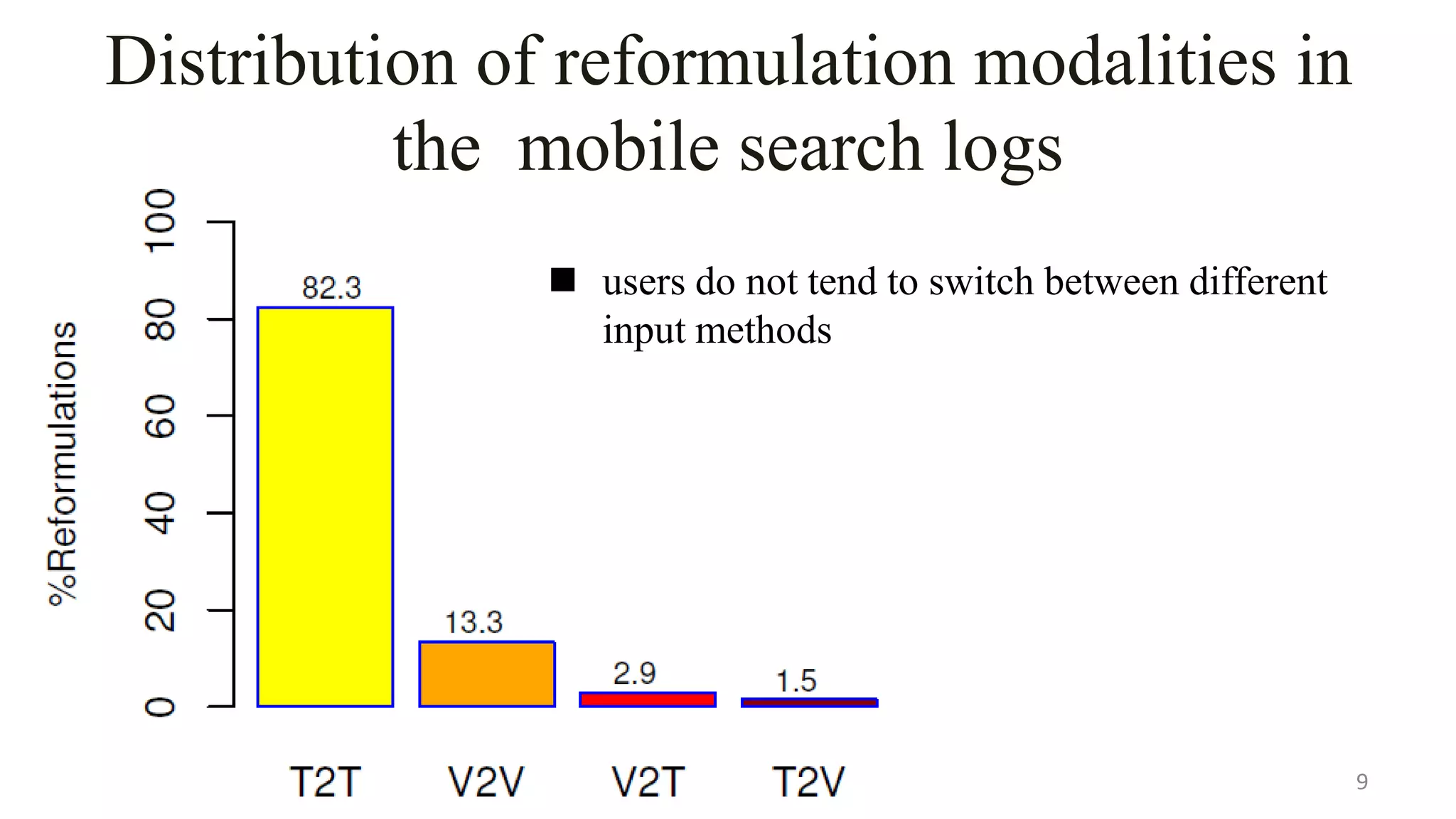
Distribution of reformulation modalities in
the mobile search logs
9
 users do not tend to switch between different
input methods
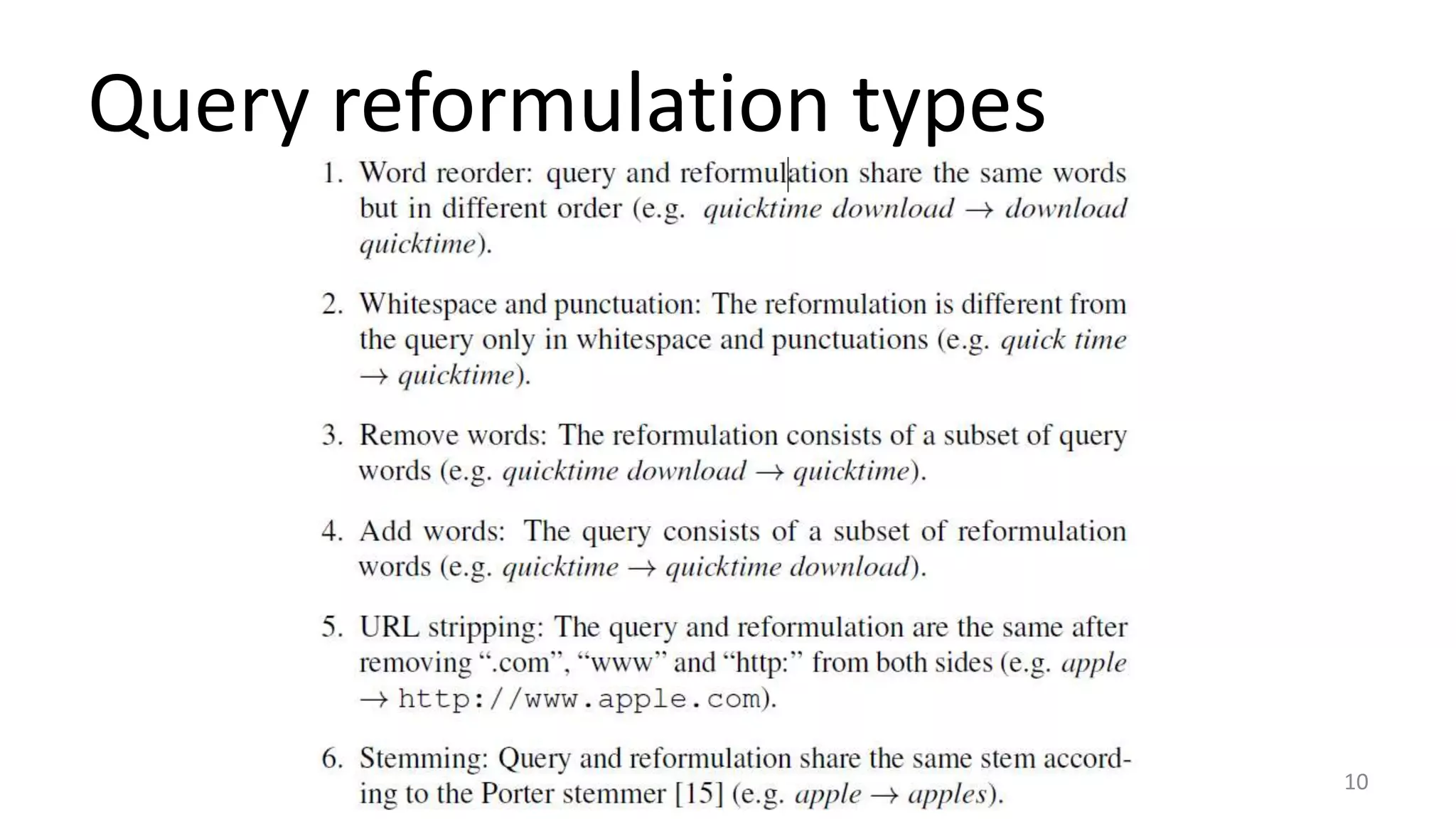
Query reformulation types
10
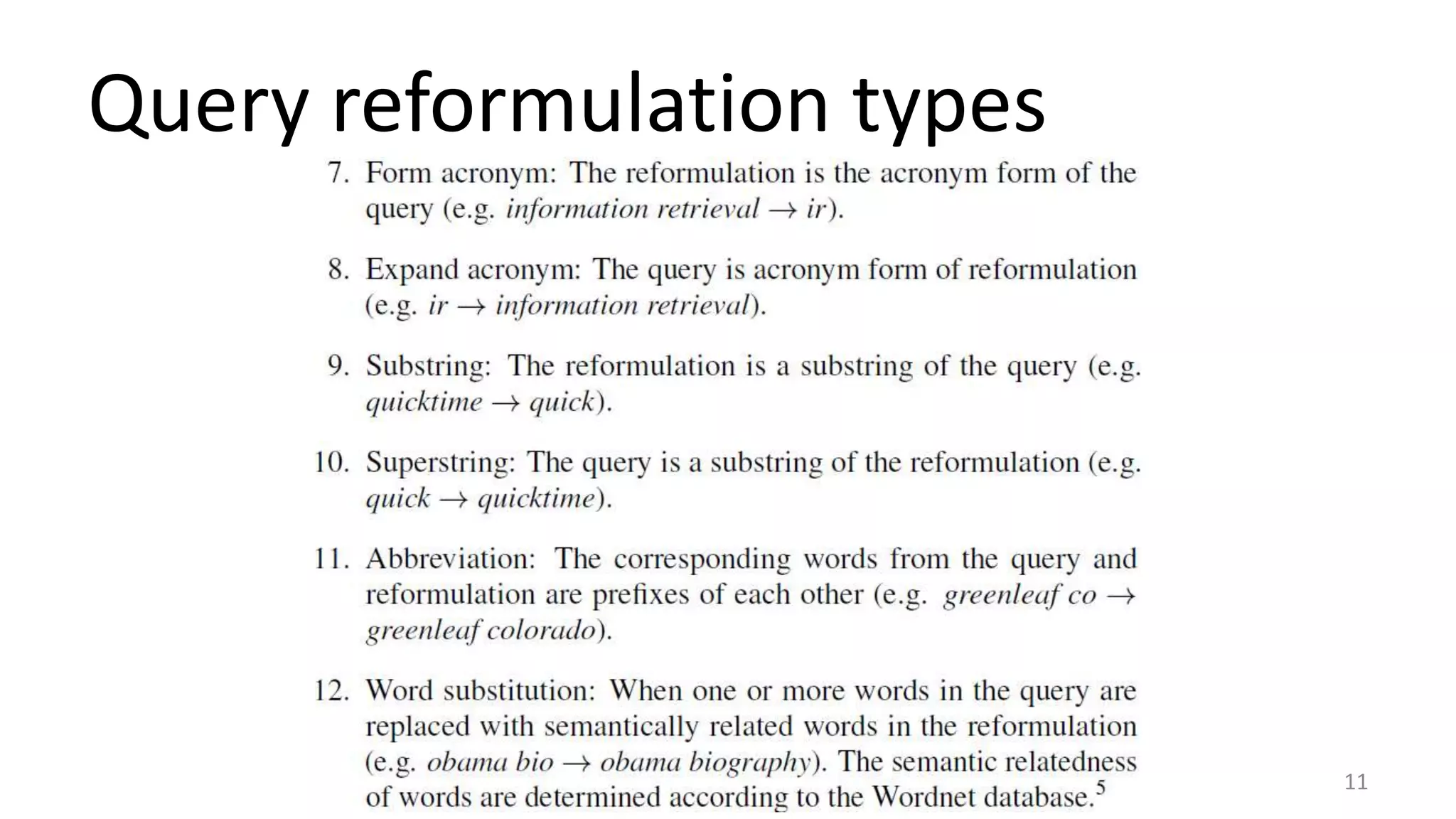
Query reformulation types
11
Query reformulation
12
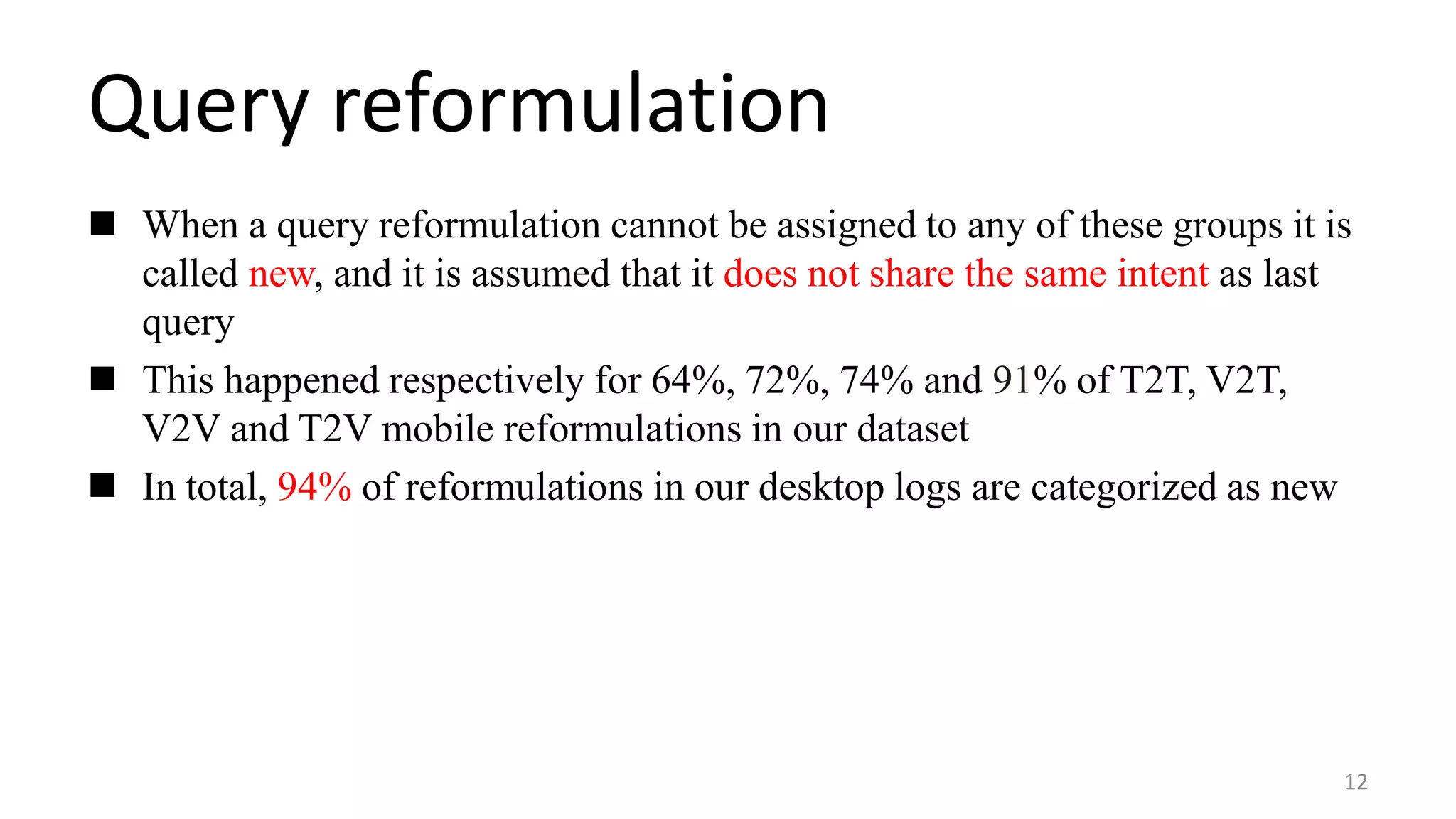
 When a query reformulation cannot be assigned to any of these groups it is
called new, and it is assumed that it does not share the same intent as last
query
 This happened respectively for 64%, 72%, 74% and 91% of T2T, V2T,
V2V and T2V mobile reformulations in our dataset
 In total, 94% of reformulations in our desktop logs are categorized as new
Data analysis
13
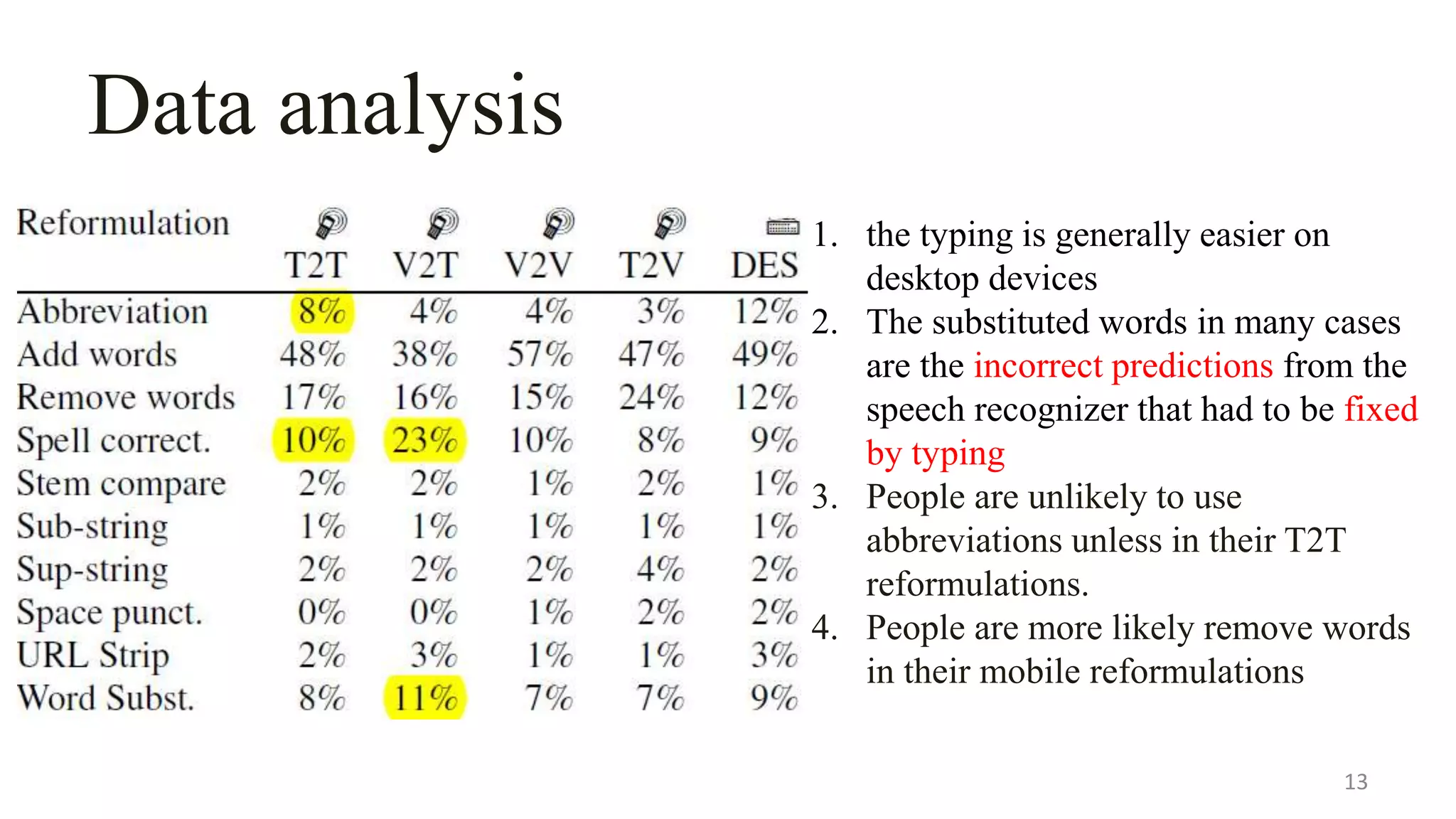
1. the typing is generally easier on
desktop devices
2. The substituted words in many cases
are the incorrect predictions from the
speech recognizer that had to be fixed
by typing
3. People are unlikely to use
abbreviations unless in their T2T
reformulations.
4. People are more likely remove words
in their mobile reformulations
Data analysis
14
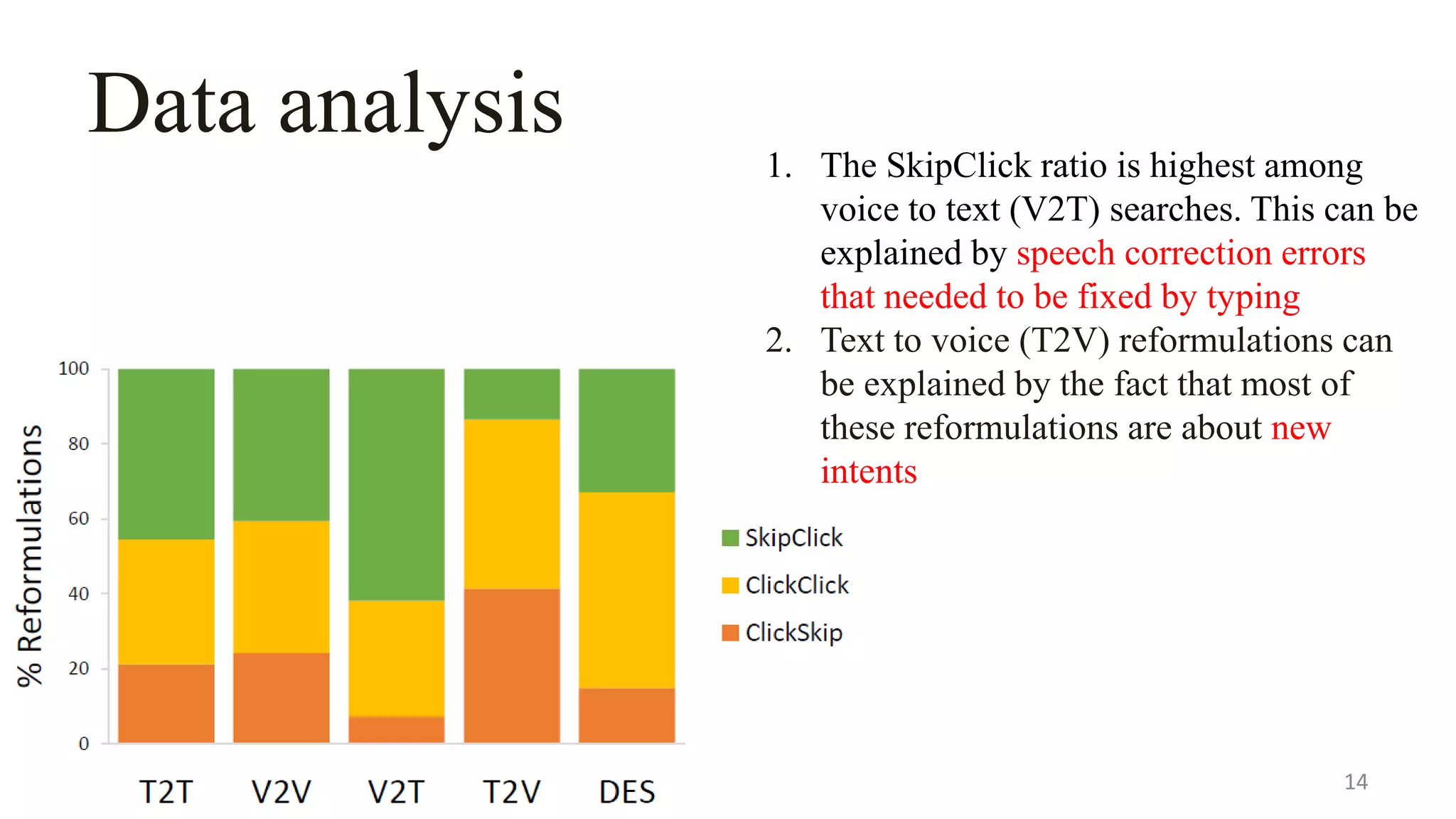
1. The SkipClick ratio is highest among
voice to text (V2T) searches. This can be
explained by speech correction errors
that needed to be fixed by typing
2. Text to voice (T2V) reformulations can
be explained by the fact that most of
these reformulations are about new
intents
Outline
Introduction
Related Work
Data analysis
Conclusion
15
Conclusion
 Users rarely switch between different input types unless they
are searching for a new intent or correcting speech recognizers
errors
 Users are more likely to drop words and spell-correct their
mobile queries and less likely to use abbreviations
16
Thanks for listening.
17

Mobile query reformulations