Connected Learning in Glocal Learning Networks
Saara Nissinen, Early Stage Researcher, UEF
Designed by: Freepik
ITK Doctoral Consortium | March 20th, 2019 | Aulanko, Hämeenlinna
Sub-studies
I Nissinen, S., Vartiainen, H., Vanninen, P., & Pöllänen, S. (2019).
Connected Learning Projects in Glocal Networks: Teachers’
Insights. Manuscript submitted for publication.
II Nissinen, S., Vartiainen, H., Vanninen, P., & Pöllänen, S. (2019).
Connected Learning in International Learning Projects: Emergence
of a Hybrid Learning System. Manuscript accepted for publication.
III Nissinen, S., Vartiainen, H., Vanninen, P., & Pöllänen, S.
Connected Learning and Joint creation of Knowledge in a Glocal
Learning Network. Upcoming research.
ITK Doctoral Consortium | March 20th, 2019 | Aulanko, Hämeenlinna
Designed by: Freepik
“Many young people
are taking to digital tools
and networks to connect
with communities of
interest, gain
specialized skills and
expertise, and engage
in shared projects and
causes…”
(Ito et al., 2018)
ITK Doctoral Consortium | March 20th, 2019 | Aulanko, Hämeenlinna
How do we transfer these
participatory practices to formal
education?
(Jenkins et al., 2016; Kafai & Peppler, 2011)
✓ Knowledge creative
activities should be linked to
the learners’ own interests
(Ito et al., 2013, 4; Scardamalia & Bereiter,
2006)
ITK Doctoral Consortium | March 20th, 2019 | Aulanko, Hämeenlinna
Connected Learning
Designed by: Freepik
✓ Approached from the
sociocultural perspective (see
Kumpulainen & Sefton-Green, 2012)
✓ Enhances the
connection between the
learners’ academic and
unscholarly environments,
and extended communities
(Ito et al., 2013)
ITK Doctoral Consortium | March 20th, 2019 | Aulanko, Hämeenlinna
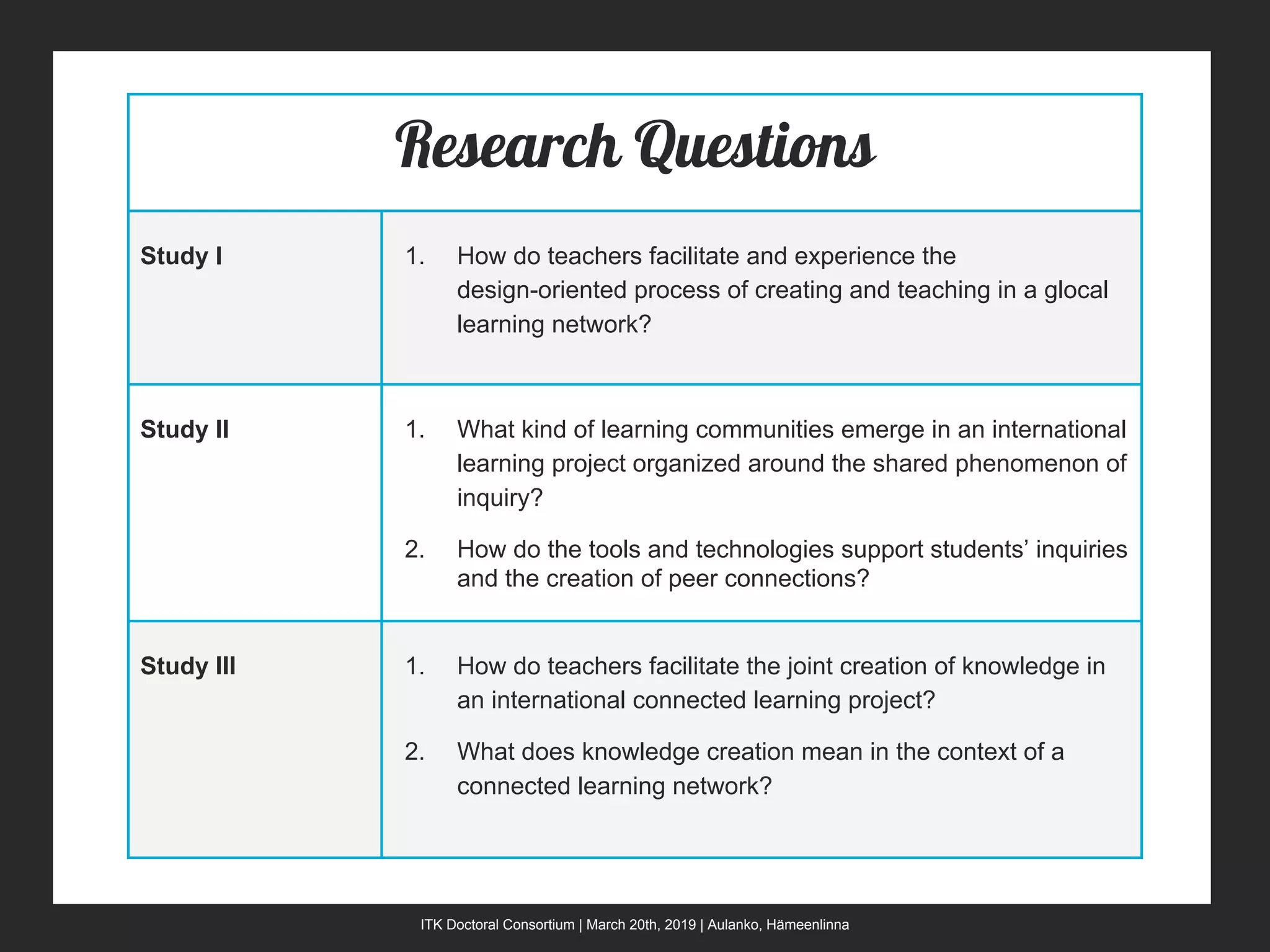
Research Questions
Study I 1. How do teachers facilitate and experience the
design-oriented process of creating and teaching in a glocal
learning network?
Study II 1. What kind of learning communities emerge in an international
learning project organized around the shared phenomenon of
inquiry?
2. How do the tools and technologies support students’ inquiries
and the creation of peer connections?
Study III 1. How do teachers facilitate the joint creation of knowledge in
an international connected learning project?
2. What does knowledge creation mean in the context of a
connected learning network?
ITK Doctoral Consortium | March 20th, 2019 | Aulanko, Hämeenlinna
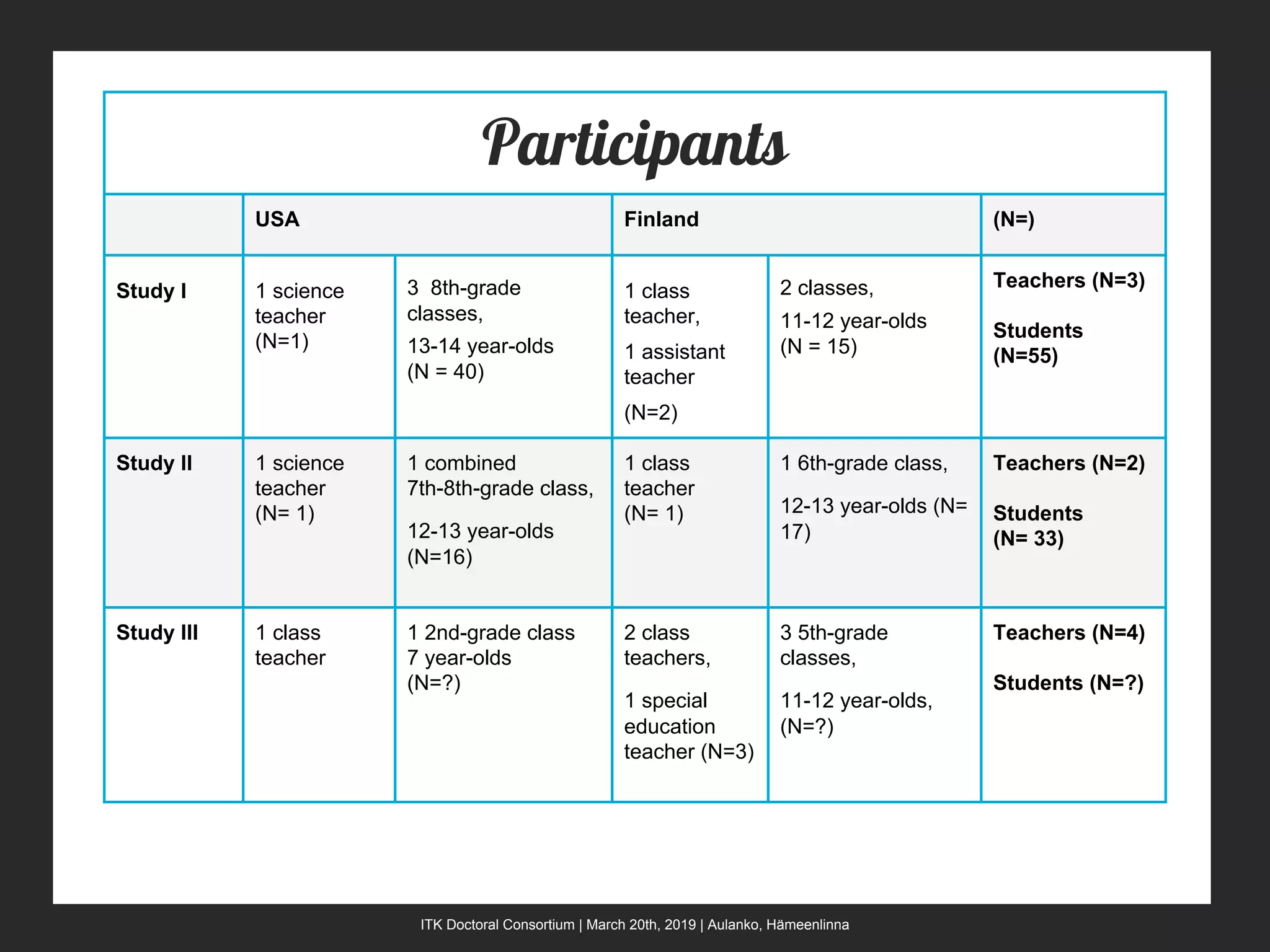
Participants
USA Finland (N=)
Study I 1 science
teacher
(N=1)
3 8th-grade
classes,
13-14 year-olds
(N = 40)
1 class
teacher,
1 assistant
teacher
(N=2)
2 classes,
11-12 year-olds
(N = 15)
Teachers (N=3)
Students
(N=55)
Study II 1 science
teacher
(N= 1)
1 combined
7th-8th-grade class,
12-13 year-olds
(N=16)
1 class
teacher
(N= 1)
1 6th-grade class,
12-13 year-olds (N=
17)
Teachers (N=2)
Students
(N= 33)
Study III 1 class
teacher
1 2nd-grade class
7 year-olds
(N=?)
2 class
teachers,
1 special
education
teacher (N=3)
3 5th-grade
classes,
11-12 year-olds,
(N=?)
Teachers (N=4)
Students (N=?)
ITK Doctoral Consortium | March 20th, 2019 | Aulanko, Hämeenlinna
Qualitative Data
Study I
Teacher’s interviews Teacher’s reports Project blog Digital artifact
published on
the Openforest
portal
Study II Recorded
Skype
meetings
Blogs Questionnaire
Text Pictures Video ThingLink360
Study III Teacher’s interviews Teacher’s reports Joint digital artifact produced by
students
ITK Doctoral Consortium | March 20th, 2019 | Aulanko, Hämeenlinna
Analyses
Study I - deductive content analysis by Atlas.ti program
- two independent coders analyzed 83 text segments (13.02%) using
QCAmap software
Study II - deductive content analysis by Atlas.ti program to de- and re-construct the
emergent learning system of a glocal learning network (fig. 1)
Study III - deductive content analysis
Figure 1. The emergent learning system of a glocal learning network. (Liljeström, Enkenberg, Vanninen, Vartiainen, & Pöllänen, 2014)
ITK Doctoral Consortium | March 20th, 2019 | Aulanko, Hämeenlinna
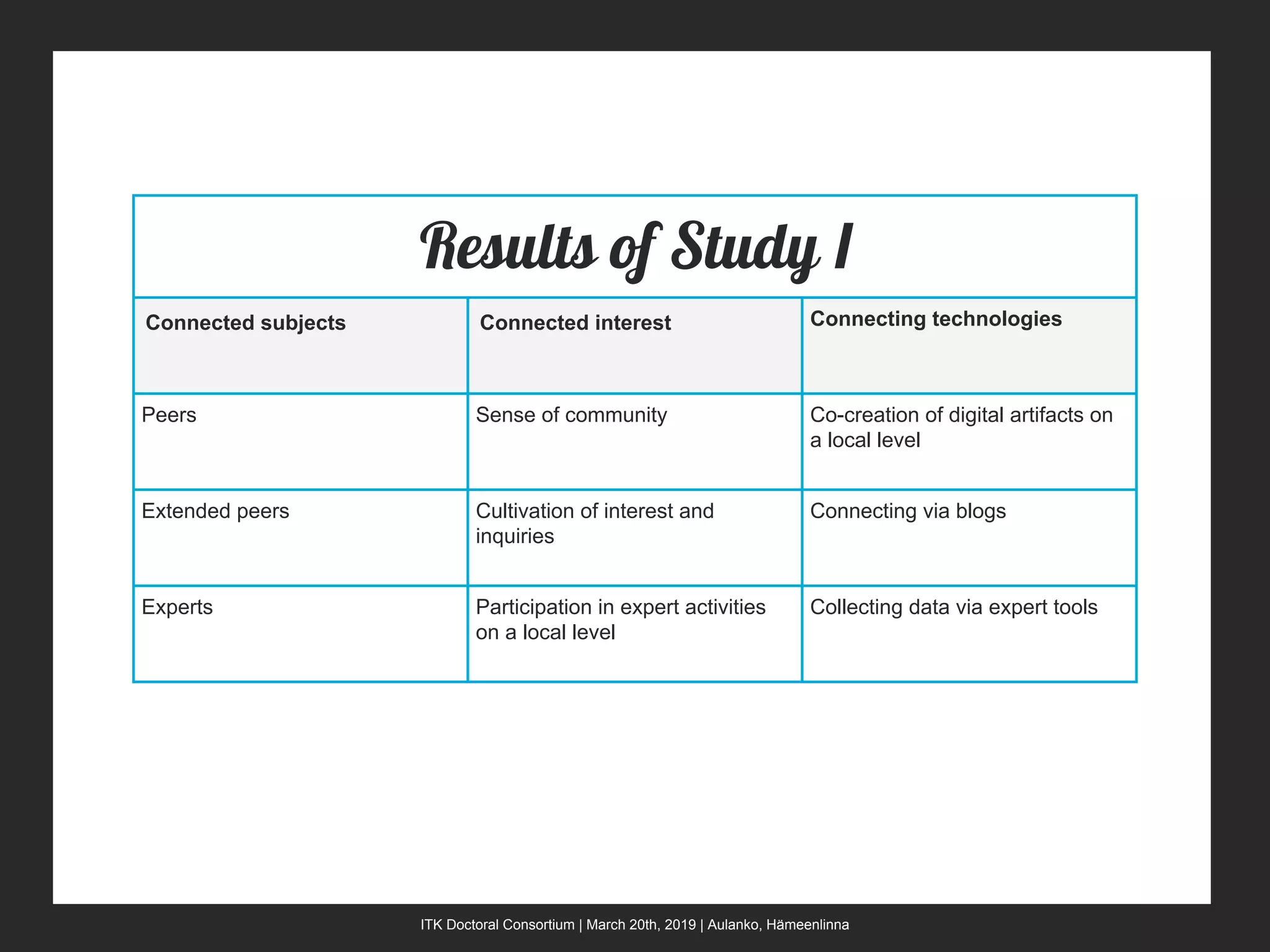
Results of Study I
Connected subjects Connected interest Connecting technologies
Peers Sense of community Co-creation of digital artifacts on
a local level
Extended peers Cultivation of interest and
inquiries
Connecting via blogs
Experts Participation in expert activities
on a local level
Collecting data via expert tools
ITK Doctoral Consortium | March 20th, 2019 | Aulanko, Hämeenlinna
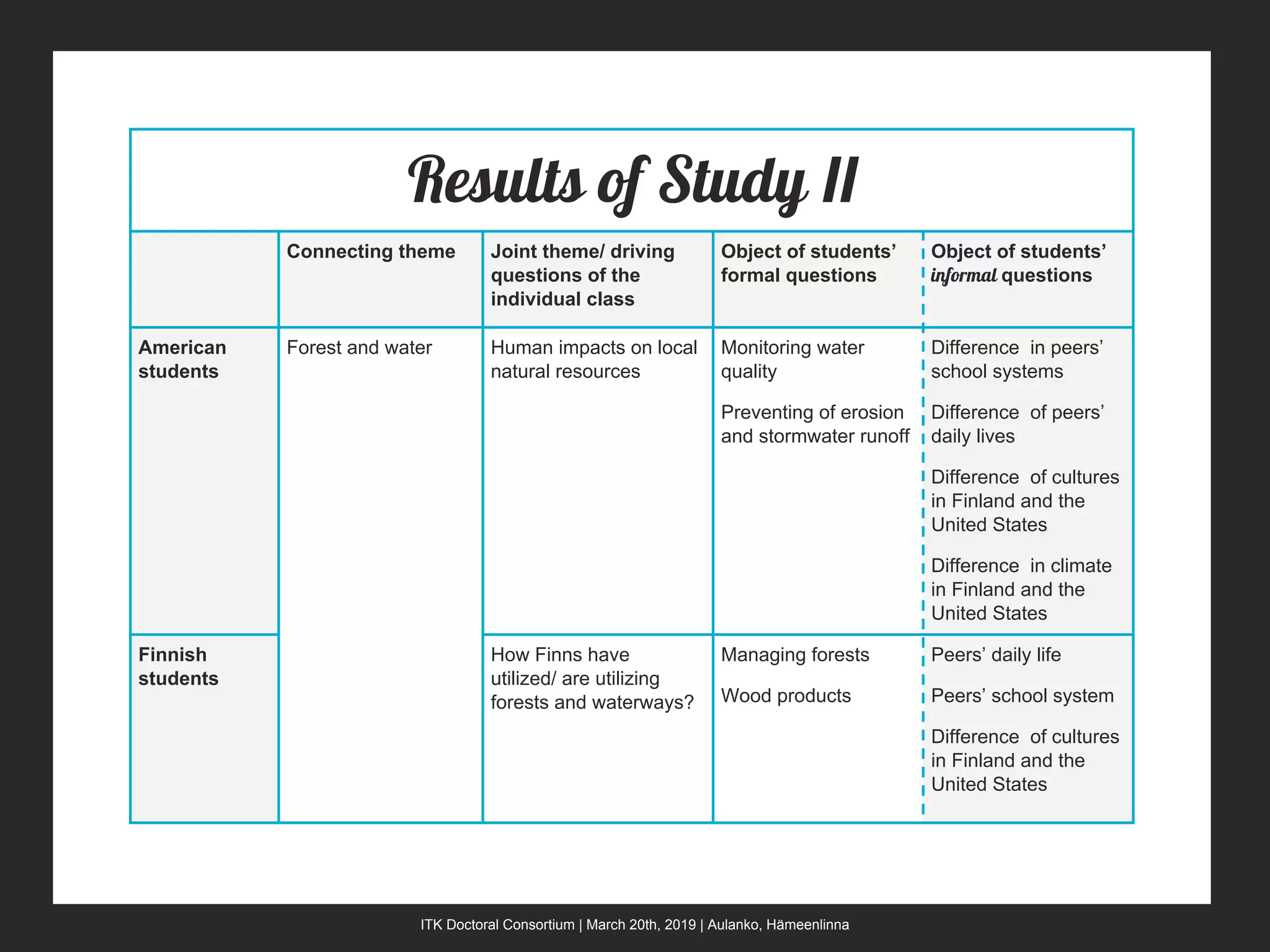
Results of Study II
Connecting theme Joint theme/ driving
questions of the
individual class
Object of students’
formal questions
Object of students’
informal questions
American
students
Forest and water Human impacts on local
natural resources
Monitoring water
quality
Preventing of erosion
and stormwater runoff
Difference in peers’
school systems
Difference of peers’
daily lives
Difference of cultures
in Finland and the
United States
Difference in climate
in Finland and the
United States
Finnish
students
How Finns have
utilized/ are utilizing
forests and waterways?
Managing forests
Wood products
Peers’ daily life
Peers’ school system
Difference of cultures
in Finland and the
United States
ITK Doctoral Consortium | March 20th, 2019 | Aulanko, Hämeenlinna
Results of Study II
Community
resources
Information resources Tools and technological resources
for formal inquiries
and connection
for informal
connection
American
students
Peers
School board
member
Books, handouts,
Internet, EPA-website,
local forest, creek, and
pond
Blogger, YouTube,
email, Skype, video
editing applications,
digital cameras,
canoe, water purity
and quality measuring
tools, shovel, funnel,
nets, magnifying
glass, chest waders,
sampling equipment,
probes, pH-strips,
Chromebooks, tablets
(Android), paper, pen,
scissors​
Smartphone
application;Snapchat,
FaceTime, and email
Finnish
students
Peers
Senior foresters
ICT expert
Books, Internet,
Museum artifacts
iPads, 360 camera,
Thinglink VR, Blogger,
YouTube, email,
Skype, video editing
applications
ITK Doctoral Consortium | March 20th, 2019 | Aulanko, HämeenlinnaDesigned by: Freepik
✓ Design oriented networks
enhanced creating extended
learning networks and connections
between learners, peers and
experts especially in local context
✓ Technology was an important tool
for sharing knowledge between
the international communities, but
the technology supported creation
of knowledge stayed on a local
level
✓ Future challenge is to engage
students and teachers towards
shared learning objects in
international context (from dialogical to
trialogical collaboration [Hakkarainen & Paavola,
2009]).
Conclusions of
Study I
ITK Doctoral Consortium | March 20th, 2019 | Aulanko, Hämeenlinna
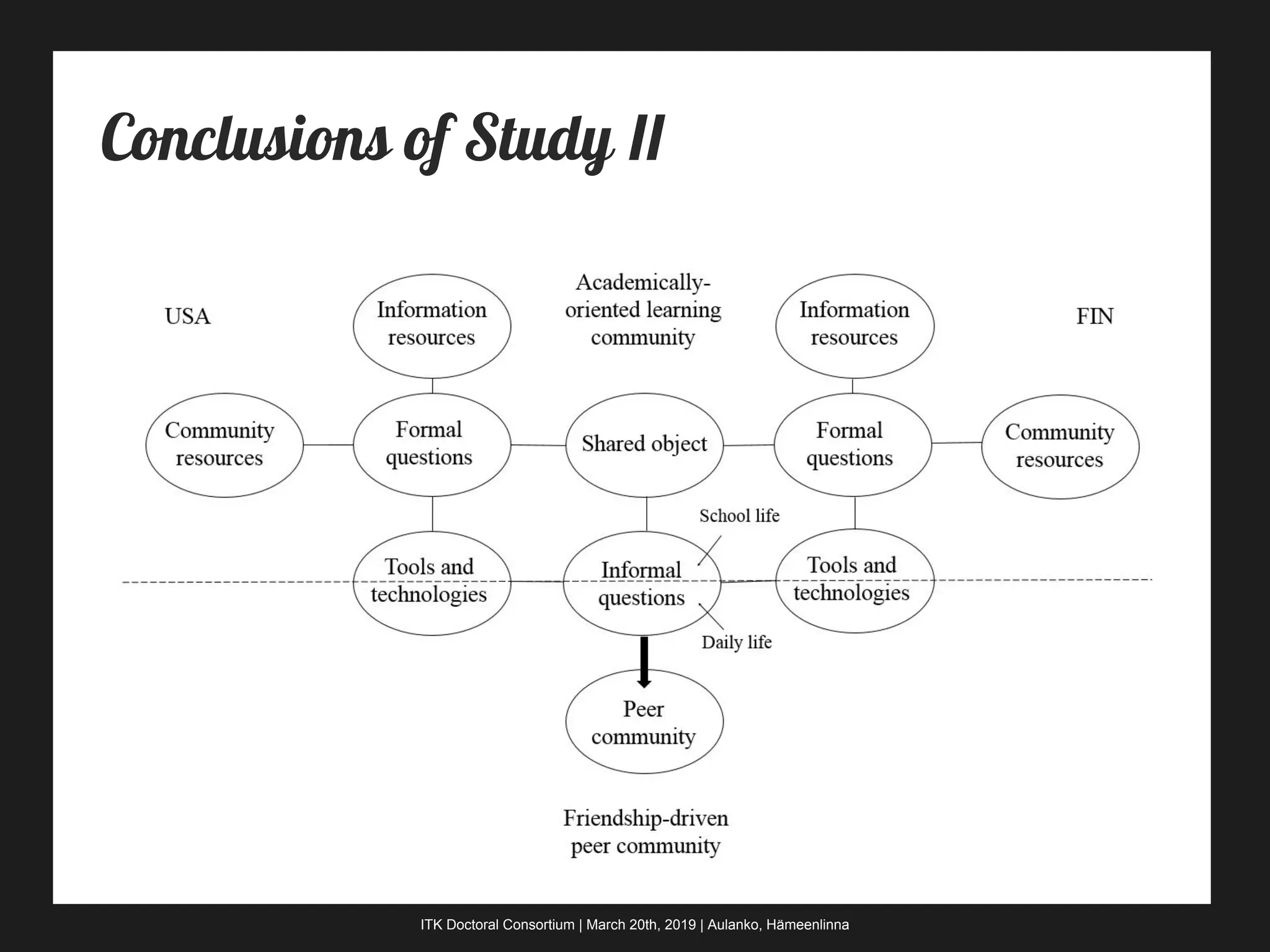
Conclusions of Study II
ITK Doctoral Consortium | March 20th, 2019 | Aulanko, Hämeenlinna
Thank you!
Contact information:
M.Ed., Ma., Saara Nissinen saara.nissinen@uef.fi
Supervisors:
Professor Sinikka Pöllänen sinikka.pollanen@uef.fi
Dr. Henriikka Vartiainen henriikka.vartiainen@uef.fi
Dr. Petteri Vanninen petteri.vanninen@uef.
fi
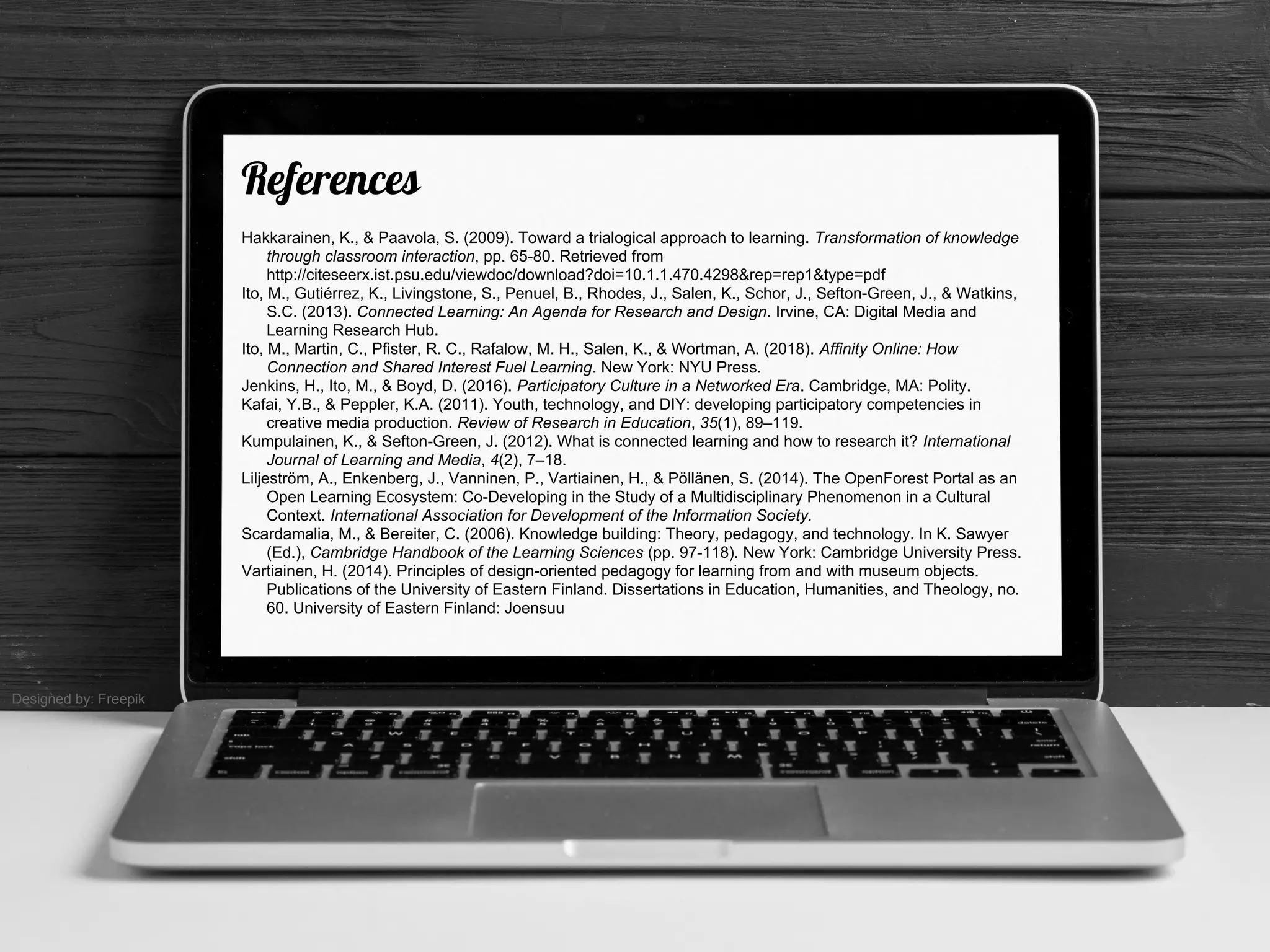
References
Hakkarainen, K., & Paavola, S. (2009). Toward a trialogical approach to learning. Transformation of knowledge
through classroom interaction, pp. 65-80. Retrieved from
http://citeseerx.ist.psu.edu/viewdoc/download?doi=10.1.1.470.4298&rep=rep1&type=pdf
Ito, M., Gutiérrez, K., Livingstone, S., Penuel, B., Rhodes, J., Salen, K., Schor, J., Sefton-Green, J., & Watkins,
S.C. (2013). Connected Learning: An Agenda for Research and Design. Irvine, CA: Digital Media and
Learning Research Hub.
Ito, M., Martin, C., Pfister, R. C., Rafalow, M. H., Salen, K., & Wortman, A. (2018). Affinity Online: How
Connection and Shared Interest Fuel Learning. New York: NYU Press.
Jenkins, H., Ito, M., & Boyd, D. (2016). Participatory Culture in a Networked Era. Cambridge, MA: Polity.
Kafai, Y.B., & Peppler, K.A. (2011). Youth, technology, and DIY: developing participatory competencies in
creative media production. Review of Research in Education, 35(1), 89–119.
Kumpulainen, K., & Sefton-Green, J. (2012). What is connected learning and how to research it? International
Journal of Learning and Media, 4(2), 7–18.
Liljeström, A., Enkenberg, J., Vanninen, P., Vartiainen, H., & Pöllänen, S. (2014). The OpenForest Portal as an
Open Learning Ecosystem: Co-Developing in the Study of a Multidisciplinary Phenomenon in a Cultural
Context. International Association for Development of the Information Society.
Scardamalia, M., & Bereiter, C. (2006). Knowledge building: Theory, pedagogy, and technology. In K. Sawyer
(Ed.), Cambridge Handbook of the Learning Sciences (pp. 97-118). New York: Cambridge University Press.
Vartiainen, H. (2014). Principles of design-oriented pedagogy for learning from and with museum objects.
Publications of the University of Eastern Finland. Dissertations in Education, Humanities, and Theology, no.
60. University of Eastern Finland: Joensuu
Designed by: Freepik
Readings
Vartiainen, H., Nissinen, S., Pöllänen,
S., & Vanninen, P. (2018).
Teachers’ Insights Into Connected
Learning Networks: Emerging
Activities and Forms of
Participation. AERA Open.
https://doi.org/10.1177/233285841
8799694
Designed by: Freepik

ITK Doctoral Consortium 20.3.2019

  • 1.
    Connected Learning inGlocal Learning Networks Saara Nissinen, Early Stage Researcher, UEF Designed by: Freepik ITK Doctoral Consortium | March 20th, 2019 | Aulanko, Hämeenlinna
  • 2.
    Sub-studies I Nissinen, S.,Vartiainen, H., Vanninen, P., & Pöllänen, S. (2019). Connected Learning Projects in Glocal Networks: Teachers’ Insights. Manuscript submitted for publication. II Nissinen, S., Vartiainen, H., Vanninen, P., & Pöllänen, S. (2019). Connected Learning in International Learning Projects: Emergence of a Hybrid Learning System. Manuscript accepted for publication. III Nissinen, S., Vartiainen, H., Vanninen, P., & Pöllänen, S. Connected Learning and Joint creation of Knowledge in a Glocal Learning Network. Upcoming research. ITK Doctoral Consortium | March 20th, 2019 | Aulanko, Hämeenlinna Designed by: Freepik
  • 3.
    Designed by: Freepik “Manyyoung people are taking to digital tools and networks to connect with communities of interest, gain specialized skills and expertise, and engage in shared projects and causes…” (Ito et al., 2018) ITK Doctoral Consortium | March 20th, 2019 | Aulanko, Hämeenlinna
  • 4.
    ITK Doctoral Consortium| March 20th, 2019 | Aulanko, Hämeenlinna How do we transfer these participatory practices to formal education? (Jenkins et al., 2016; Kafai & Peppler, 2011)
  • 5.
    ✓ Knowledge creative activitiesshould be linked to the learners’ own interests (Ito et al., 2013, 4; Scardamalia & Bereiter, 2006) ITK Doctoral Consortium | March 20th, 2019 | Aulanko, Hämeenlinna Connected Learning Designed by: Freepik ✓ Approached from the sociocultural perspective (see Kumpulainen & Sefton-Green, 2012) ✓ Enhances the connection between the learners’ academic and unscholarly environments, and extended communities (Ito et al., 2013)
  • 6.
    ITK Doctoral Consortium| March 20th, 2019 | Aulanko, Hämeenlinna Research Questions Study I 1. How do teachers facilitate and experience the design-oriented process of creating and teaching in a glocal learning network? Study II 1. What kind of learning communities emerge in an international learning project organized around the shared phenomenon of inquiry? 2. How do the tools and technologies support students’ inquiries and the creation of peer connections? Study III 1. How do teachers facilitate the joint creation of knowledge in an international connected learning project? 2. What does knowledge creation mean in the context of a connected learning network?
  • 7.
    ITK Doctoral Consortium| March 20th, 2019 | Aulanko, Hämeenlinna Participants USA Finland (N=) Study I 1 science teacher (N=1) 3 8th-grade classes, 13-14 year-olds (N = 40) 1 class teacher, 1 assistant teacher (N=2) 2 classes, 11-12 year-olds (N = 15) Teachers (N=3) Students (N=55) Study II 1 science teacher (N= 1) 1 combined 7th-8th-grade class, 12-13 year-olds (N=16) 1 class teacher (N= 1) 1 6th-grade class, 12-13 year-olds (N= 17) Teachers (N=2) Students (N= 33) Study III 1 class teacher 1 2nd-grade class 7 year-olds (N=?) 2 class teachers, 1 special education teacher (N=3) 3 5th-grade classes, 11-12 year-olds, (N=?) Teachers (N=4) Students (N=?)
  • 8.
    ITK Doctoral Consortium| March 20th, 2019 | Aulanko, Hämeenlinna Qualitative Data Study I Teacher’s interviews Teacher’s reports Project blog Digital artifact published on the Openforest portal Study II Recorded Skype meetings Blogs Questionnaire Text Pictures Video ThingLink360 Study III Teacher’s interviews Teacher’s reports Joint digital artifact produced by students
  • 9.
    ITK Doctoral Consortium| March 20th, 2019 | Aulanko, Hämeenlinna Analyses Study I - deductive content analysis by Atlas.ti program - two independent coders analyzed 83 text segments (13.02%) using QCAmap software Study II - deductive content analysis by Atlas.ti program to de- and re-construct the emergent learning system of a glocal learning network (fig. 1) Study III - deductive content analysis Figure 1. The emergent learning system of a glocal learning network. (Liljeström, Enkenberg, Vanninen, Vartiainen, & Pöllänen, 2014)
  • 10.
    ITK Doctoral Consortium| March 20th, 2019 | Aulanko, Hämeenlinna Results of Study I Connected subjects Connected interest Connecting technologies Peers Sense of community Co-creation of digital artifacts on a local level Extended peers Cultivation of interest and inquiries Connecting via blogs Experts Participation in expert activities on a local level Collecting data via expert tools
  • 11.
    ITK Doctoral Consortium| March 20th, 2019 | Aulanko, Hämeenlinna Results of Study II Connecting theme Joint theme/ driving questions of the individual class Object of students’ formal questions Object of students’ informal questions American students Forest and water Human impacts on local natural resources Monitoring water quality Preventing of erosion and stormwater runoff Difference in peers’ school systems Difference of peers’ daily lives Difference of cultures in Finland and the United States Difference in climate in Finland and the United States Finnish students How Finns have utilized/ are utilizing forests and waterways? Managing forests Wood products Peers’ daily life Peers’ school system Difference of cultures in Finland and the United States
  • 12.
    ITK Doctoral Consortium| March 20th, 2019 | Aulanko, Hämeenlinna Results of Study II Community resources Information resources Tools and technological resources for formal inquiries and connection for informal connection American students Peers School board member Books, handouts, Internet, EPA-website, local forest, creek, and pond Blogger, YouTube, email, Skype, video editing applications, digital cameras, canoe, water purity and quality measuring tools, shovel, funnel, nets, magnifying glass, chest waders, sampling equipment, probes, pH-strips, Chromebooks, tablets (Android), paper, pen, scissors​ Smartphone application;Snapchat, FaceTime, and email Finnish students Peers Senior foresters ICT expert Books, Internet, Museum artifacts iPads, 360 camera, Thinglink VR, Blogger, YouTube, email, Skype, video editing applications
  • 13.
    ITK Doctoral Consortium| March 20th, 2019 | Aulanko, HämeenlinnaDesigned by: Freepik ✓ Design oriented networks enhanced creating extended learning networks and connections between learners, peers and experts especially in local context ✓ Technology was an important tool for sharing knowledge between the international communities, but the technology supported creation of knowledge stayed on a local level ✓ Future challenge is to engage students and teachers towards shared learning objects in international context (from dialogical to trialogical collaboration [Hakkarainen & Paavola, 2009]). Conclusions of Study I
  • 14.
    ITK Doctoral Consortium| March 20th, 2019 | Aulanko, Hämeenlinna Conclusions of Study II
  • 15.
    ITK Doctoral Consortium| March 20th, 2019 | Aulanko, Hämeenlinna Thank you! Contact information: M.Ed., Ma., Saara Nissinen saara.nissinen@uef.fi Supervisors: Professor Sinikka Pöllänen sinikka.pollanen@uef.fi Dr. Henriikka Vartiainen henriikka.vartiainen@uef.fi Dr. Petteri Vanninen petteri.vanninen@uef. fi
  • 16.
    References Hakkarainen, K., &Paavola, S. (2009). Toward a trialogical approach to learning. Transformation of knowledge through classroom interaction, pp. 65-80. Retrieved from http://citeseerx.ist.psu.edu/viewdoc/download?doi=10.1.1.470.4298&rep=rep1&type=pdf Ito, M., Gutiérrez, K., Livingstone, S., Penuel, B., Rhodes, J., Salen, K., Schor, J., Sefton-Green, J., & Watkins, S.C. (2013). Connected Learning: An Agenda for Research and Design. Irvine, CA: Digital Media and Learning Research Hub. Ito, M., Martin, C., Pfister, R. C., Rafalow, M. H., Salen, K., & Wortman, A. (2018). Affinity Online: How Connection and Shared Interest Fuel Learning. New York: NYU Press. Jenkins, H., Ito, M., & Boyd, D. (2016). Participatory Culture in a Networked Era. Cambridge, MA: Polity. Kafai, Y.B., & Peppler, K.A. (2011). Youth, technology, and DIY: developing participatory competencies in creative media production. Review of Research in Education, 35(1), 89–119. Kumpulainen, K., & Sefton-Green, J. (2012). What is connected learning and how to research it? International Journal of Learning and Media, 4(2), 7–18. Liljeström, A., Enkenberg, J., Vanninen, P., Vartiainen, H., & Pöllänen, S. (2014). The OpenForest Portal as an Open Learning Ecosystem: Co-Developing in the Study of a Multidisciplinary Phenomenon in a Cultural Context. International Association for Development of the Information Society. Scardamalia, M., & Bereiter, C. (2006). Knowledge building: Theory, pedagogy, and technology. In K. Sawyer (Ed.), Cambridge Handbook of the Learning Sciences (pp. 97-118). New York: Cambridge University Press. Vartiainen, H. (2014). Principles of design-oriented pedagogy for learning from and with museum objects. Publications of the University of Eastern Finland. Dissertations in Education, Humanities, and Theology, no. 60. University of Eastern Finland: Joensuu Designed by: Freepik
  • 17.
    Readings Vartiainen, H., Nissinen,S., Pöllänen, S., & Vanninen, P. (2018). Teachers’ Insights Into Connected Learning Networks: Emerging Activities and Forms of Participation. AERA Open. https://doi.org/10.1177/233285841 8799694 Designed by: Freepik