LEVEL 5

Spanish: The Grammar Frontier
It’s not what you think!
• There are no grammar books nor boring lessons
  in sight.

• The next episode is covered in 3 sub levels, each
  limited to 6 or 7 super basic words.

• For each sub level, you will learn a simple
  grammar rule.

                                    Check it out:
Basic Nouns


• The only grammar bit about the
  nouns level is the Definite and
  Indefinite articles:
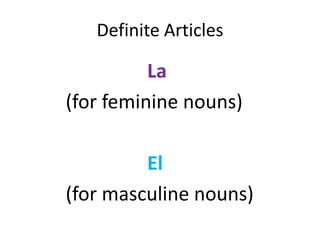
Definite Articles

          La
(for feminine nouns)

         El
(for masculine nouns)
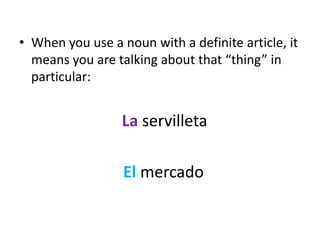
• When you use a noun with a definite article, it
  means you are talking about that “thing” in
  particular:


                  La servilleta

                  El mercado
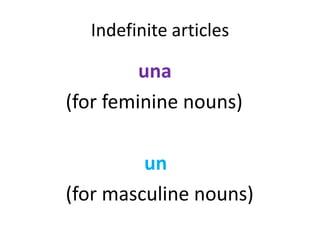
Indefinite articles

         una
(for feminine nouns)

         un
(for masculine nouns)
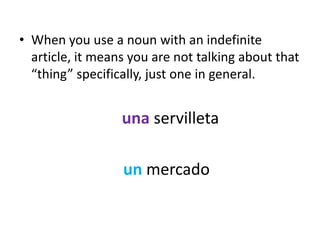
• When you use a noun with an indefinite
  article, it means you are not talking about that
  “thing” specifically, just one in general.


                  una servilleta

                  un mercado
Basic Adjectives
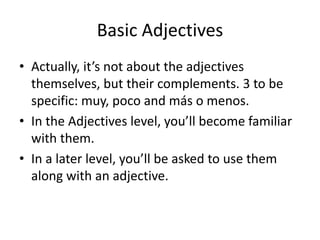
• Actually, it’s not about the adjectives
  themselves, but their complements. 3 to be
  specific: muy, poco and más o menos.
• In the Adjectives level, you’ll become familiar
  with them.
• In a later level, you’ll be asked to use them
  along with an adjective.
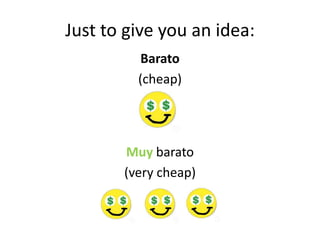
Just to give you an idea:
          Barato
         (cheap)


       Muy barato
       (very cheap)
Basic Verbs
• In the verbs level, we are sticking to basics: 1st
  person in the present tense. With a slight twist:
• You’ll learn how to conjugate 7 verbs in the 2nd
  person: You.
• In Spanish, there are two pronouns for You:


                        • Tú
                        • Usted
Tú / Usted
• These pronouns have a cultural connotation:
  – Tú is used when speaking to someone in a casual
    or familiar context. Use it when talking to friends
    or people you know.
  – Usted is used when speaking to people older than
    you, or in a formal context , such as the
    workplace.
  – In some Latin American countries like Colombia,
    USTED is used for all contexts and people,
    regardless if you are close to them or not.
• Depending on which pronoun you are using, the verbs
  are conjugated slighty different.

• Some times you’ll only need to add or substract an S at
  the end of the verb:

                 • Puedes (tú) --- Puede (usted)

• Others, the whole word changes, or a prefix is added to it:

                 • Te gusta (tú) --- Le gusta (usted)
                 • Eres (tú) --- Es (usted)
Not too hard, right?
• It’s all a matter of practice. So get ready to start!

• Please come back as often as you need to this
  introduction, it will help you remember the basic
  rules and learn the vocabulary better.

• At the end of the 3 sub levels, you’ll be able to
  join all of the words into small phrases, which
  you can practice with the final Sentence set.
And……go!

Level 5

  • 1.
    LEVEL 5 Spanish: TheGrammar Frontier
  • 2.
    It’s not whatyou think! • There are no grammar books nor boring lessons in sight. • The next episode is covered in 3 sub levels, each limited to 6 or 7 super basic words. • For each sub level, you will learn a simple grammar rule. Check it out:
  • 3.
    Basic Nouns • Theonly grammar bit about the nouns level is the Definite and Indefinite articles:
  • 4.
    Definite Articles La (for feminine nouns) El (for masculine nouns)
  • 5.
    • When youuse a noun with a definite article, it means you are talking about that “thing” in particular: La servilleta El mercado
  • 6.
    Indefinite articles una (for feminine nouns) un (for masculine nouns)
  • 7.
    • When youuse a noun with an indefinite article, it means you are not talking about that “thing” specifically, just one in general. una servilleta un mercado
  • 8.
    Basic Adjectives • Actually,it’s not about the adjectives themselves, but their complements. 3 to be specific: muy, poco and más o menos. • In the Adjectives level, you’ll become familiar with them. • In a later level, you’ll be asked to use them along with an adjective.
  • 9.
    Just to giveyou an idea: Barato (cheap) Muy barato (very cheap)
  • 10.
    Basic Verbs • Inthe verbs level, we are sticking to basics: 1st person in the present tense. With a slight twist: • You’ll learn how to conjugate 7 verbs in the 2nd person: You. • In Spanish, there are two pronouns for You: • Tú • Usted
  • 11.
    Tú / Usted •These pronouns have a cultural connotation: – Tú is used when speaking to someone in a casual or familiar context. Use it when talking to friends or people you know. – Usted is used when speaking to people older than you, or in a formal context , such as the workplace. – In some Latin American countries like Colombia, USTED is used for all contexts and people, regardless if you are close to them or not.
  • 12.
    • Depending onwhich pronoun you are using, the verbs are conjugated slighty different. • Some times you’ll only need to add or substract an S at the end of the verb: • Puedes (tú) --- Puede (usted) • Others, the whole word changes, or a prefix is added to it: • Te gusta (tú) --- Le gusta (usted) • Eres (tú) --- Es (usted)
  • 13.
    Not too hard,right? • It’s all a matter of practice. So get ready to start! • Please come back as often as you need to this introduction, it will help you remember the basic rules and learn the vocabulary better. • At the end of the 3 sub levels, you’ll be able to join all of the words into small phrases, which you can practice with the final Sentence set.
  • 14.