Mind the Spanish Verbs

         Part II
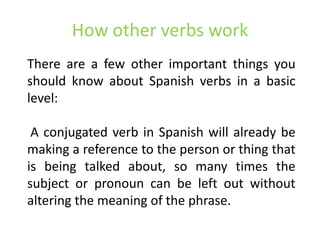
How other verbs work
There are a few other important things you
should know about Spanish verbs in a basic
level:

 A conjugated verb in Spanish will already be
making a reference to the person or thing that
is being talked about, so many times the
subject or pronoun can be left out without
altering the meaning of the phrase.
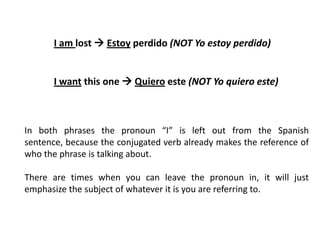
I am lost  Estoy perdido (NOT Yo estoy perdido)


       I want this one  Quiero este (NOT Yo quiero este)


In both phrases the pronoun “I” is left out from the Spanish
sentence, because the conjugated verb already makes the reference of
who the phrase is talking about.

There are times when you can leave the pronoun in, it will just
emphasize the subject of whatever it is you are referring to.
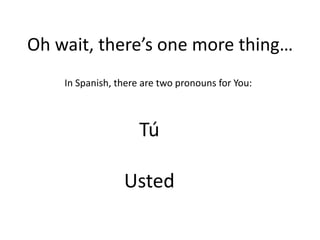
Oh wait, there’s one more thing…
    In Spanish, there are two pronouns for You:


                     Tú

                 Usted
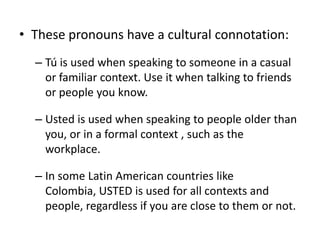
• These pronouns have a cultural connotation:
  – Tú is used when speaking to someone in a casual
    or familiar context. Use it when talking to friends
    or people you know.

  – Usted is used when speaking to people older than
    you, or in a formal context , such as the
    workplace.

  – In some Latin American countries like
    Colombia, USTED is used for all contexts and
    people, regardless if you are close to them or not.
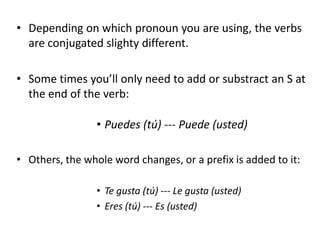
• Depending on which pronoun you are using, the verbs
  are conjugated slighty different.

• Some times you’ll only need to add or substract an S at
  the end of the verb:

                 • Puedes (tú) --- Puede (usted)

• Others, the whole word changes, or a prefix is added to it:

                 • Te gusta (tú) --- Le gusta (usted)
                 • Eres (tú) --- Es (usted)
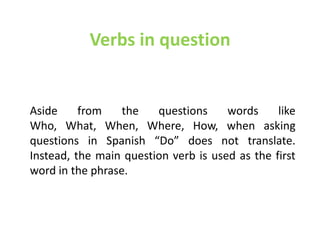
Verbs in question


Aside     from    the   questions     words     like
Who, What, When, Where, How, when asking
questions in Spanish “Do” does not translate.
Instead, the main question verb is used as the first
word in the phrase.
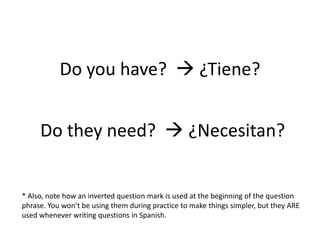
Do you have?  ¿Tiene?


     Do they need?  ¿Necesitan?


* Also, note how an inverted question mark is used at the beginning of the question
phrase. You won’t be using them during practice to make things simpler, but they ARE
used whenever writing questions in Spanish.
Right, so…
Let’s keep moving! The following levels will
  show you these simple rules in action.

Mind the spanish verbs ii

  • 1.
    Mind the SpanishVerbs Part II
  • 2.
    How other verbswork There are a few other important things you should know about Spanish verbs in a basic level: A conjugated verb in Spanish will already be making a reference to the person or thing that is being talked about, so many times the subject or pronoun can be left out without altering the meaning of the phrase.
  • 3.
    I am lost Estoy perdido (NOT Yo estoy perdido) I want this one  Quiero este (NOT Yo quiero este) In both phrases the pronoun “I” is left out from the Spanish sentence, because the conjugated verb already makes the reference of who the phrase is talking about. There are times when you can leave the pronoun in, it will just emphasize the subject of whatever it is you are referring to.
  • 4.
    Oh wait, there’sone more thing… In Spanish, there are two pronouns for You: Tú Usted
  • 5.
    • These pronounshave a cultural connotation: – Tú is used when speaking to someone in a casual or familiar context. Use it when talking to friends or people you know. – Usted is used when speaking to people older than you, or in a formal context , such as the workplace. – In some Latin American countries like Colombia, USTED is used for all contexts and people, regardless if you are close to them or not.
  • 6.
    • Depending onwhich pronoun you are using, the verbs are conjugated slighty different. • Some times you’ll only need to add or substract an S at the end of the verb: • Puedes (tú) --- Puede (usted) • Others, the whole word changes, or a prefix is added to it: • Te gusta (tú) --- Le gusta (usted) • Eres (tú) --- Es (usted)
  • 7.
    Verbs in question Aside from the questions words like Who, What, When, Where, How, when asking questions in Spanish “Do” does not translate. Instead, the main question verb is used as the first word in the phrase.
  • 8.
    Do you have? ¿Tiene? Do they need?  ¿Necesitan? * Also, note how an inverted question mark is used at the beginning of the question phrase. You won’t be using them during practice to make things simpler, but they ARE used whenever writing questions in Spanish.
  • 9.
    Right, so… Let’s keepmoving! The following levels will show you these simple rules in action.