Individuals & Societies for the IB MYP 4&5: by Concept
294
Time, place andspace Causality; Perspective Orientation in space andtime
Our perspective changes over time;
reflection allows us to see the causes
and impacts of events in different
times and places.
12 How has our perspective
changed now?

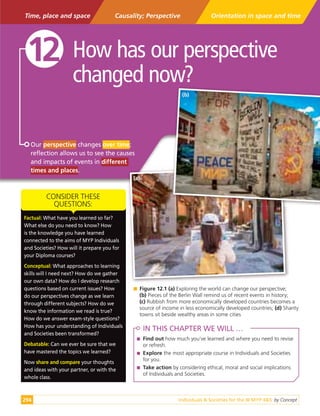
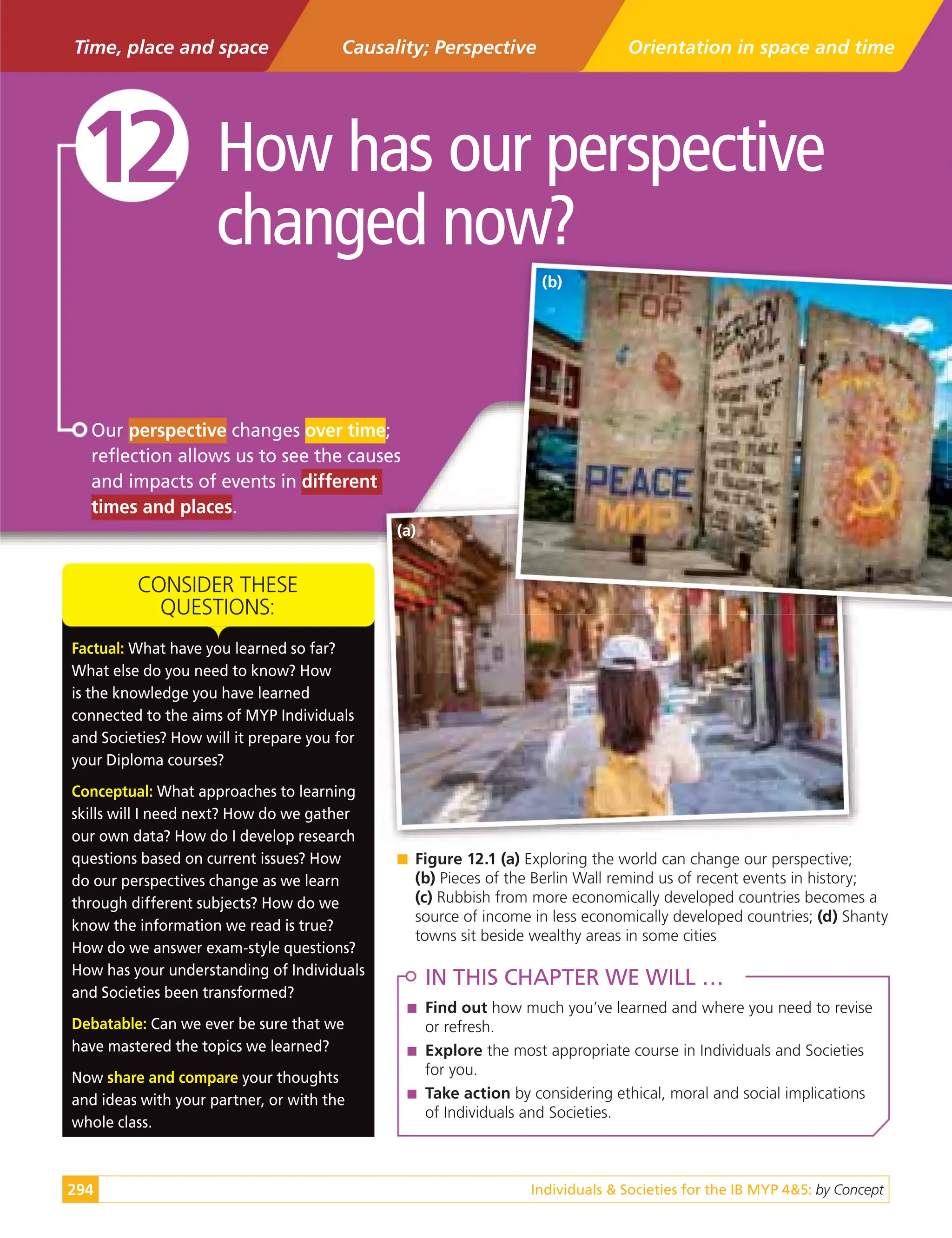
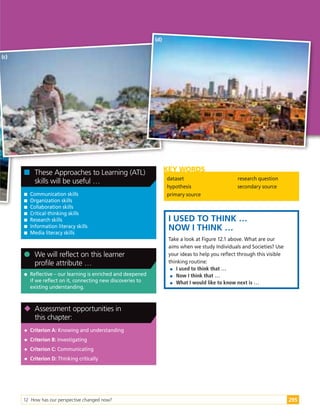
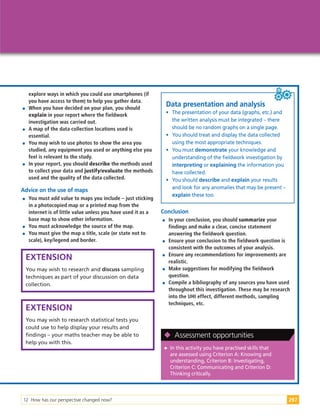
 Figure 12.1 (a) Exploring the world can change our perspective;
(b) Pieces of the Berlin Wall remind us of recent events in history;
(c) Rubbish from more economically developed countries becomes a
source of income in less economically developed countries; (d) Shanty
towns sit beside wealthy areas in some cities
Factual: What have you learned so far?
What else do you need to know? How
is the knowledge you have learned
connected to the aims of MYP Individuals
and Societies? How will it prepare you for
your Diploma courses?
Conceptual: What approaches to learning
skills will I need next? How do we gather
our own data? How do I develop research
questions based on current issues? How
do our perspectives change as we learn
through different subjects? How do we
know the information we read is true?
How do we answer exam-style questions?
How has your understanding of Individuals
and Societies been transformed?
Debatable: Can we ever be sure that we
have mastered the topics we learned?
Now share and compare your thoughts
and ideas with your partner, or with the
whole class.
CONSIDER THESE
QUESTIONS:
IN THIS CHAPTER WE WILL …

 Find out how much you’ve learned and where you need to revise
or refresh.

 Explore the most appropriate course in Individuals and Societies
for you.

 Take action by considering ethical, moral and social implications
of Individuals and Societies.
(a)
(b)
12 How has our perspective changed now? 295

 Communication skills

 Organization skills

 Collaboration skills

 Critical-thinking skills

 Research skills

 Information literacy skills

 Media literacy skills

 These Approaches to Learning (ATL)
skills will be useful …

 Reflective – our learning is enriched and deepened
if we reflect on it, connecting new discoveries to
existing understanding.

 We will reflect on this learner
profile attribute …

 Criterion A: Knowing and understanding

 Criterion B: Investigating

 Criterion C: Communicating

 Criterion D: Thinking critically

 Assessment opportunities in
this chapter:
dataset
hypothesis
primary source
research question
secondary source
KEY WORDS
I USED TO THINK …
NOW I THINK …
Take a look at Figure 12.1 above. What are our
aims when we study Individuals and Societies? Use
your ideas to help you reflect through this visible
thinking routine:

 I used to think that …

 Now I think that …

 What I would like to know next is …
(c)
(d)
Individuals & Societies for the IB MYP 4&5: by Concept
296
What approaches to
learning skills will
I need next? HOW DO WE GATHER
OUR OWN DATA?
ACTIVITY: Urban heat
island effect

 Research skills: Process data and report results

 ATL
In Chapter 7 we explored the concept of urban stress
as part of our focus on sustainability in urban systems.
A concept relating to urban stress is the phenomenon
of the urban heat island (UHI). This is an urban area
that is significantly warmer than its surrounding rural
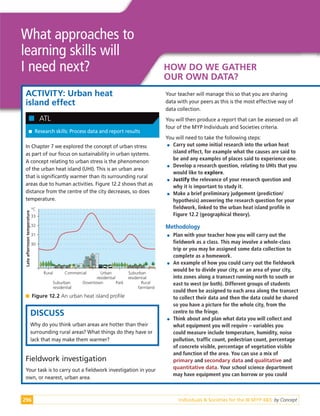
areas due to human activities. Figure 12.2 shows that as
distance from the centre of the city decreases, so does
temperature.
L
a
t
e
a
f
t
e
r
n
o
o
n
t
e
m
p
e
r
a
t
u
r
e
Rural Commercial Urban Suburban
residential residential
°C
33
32
31
30
Suburban Downtown Park Rural
residential farmland

 Figure 12.2 An urban heat island profile
DISCUSS
Why do you think urban areas are hotter than their
surrounding rural areas? What things do they have or
lack that may make them warmer?
Fieldwork investigation
Your task is to carry out a fieldwork investigation in your
own, or nearest, urban area.
Your teacher will manage this so that you are sharing
data with your peers as this is the most effective way of
data collection.
You will then produce a report that can be assessed on all
four of the MYP Individuals and Societies criteria.
You will need to take the following steps:

 Carry out some initial research into the urban heat
island effect, for example what the causes are said to
be and any examples of places said to experience one.

 Develop a research question, relating to UHIs that you
would like to explore.

 Justify the relevance of your research question and
why it is important to study it.

 Make a brief preliminary judgement (prediction/
hypothesis) answering the research question for your
fieldwork, linked to the urban heat island profile in
Figure 12.2 (geographical theory).
Methodology

 Plan with your teacher how you will carry out the
fieldwork as a class. This may involve a whole-class
trip or you may be assigned some data collection to
complete as a homework.

 An example of how you could carry out the fieldwork
would be to divide your city, or an area of your city,
into zones along a transect running north to south or
east to west (or both). Different groups of students
could then be assigned to each area along the transect
to collect their data and then the data could be shared
so you have a picture for the whole city, from the
centre to the fringe.

 Think about and plan what data you will collect and
what equipment you will require – variables you
could measure include temperature, humidity, noise
pollution, traffic count, pedestrian count, percentage
of concrete visible, percentage of vegetation visible
and function of the area. You can use a mix of
primary and secondary data and qualitative and
quantitative data. Your school science department
may have equipment you can borrow or you could
12 How has our perspective changed now? 297
explore ways in which you could use smartphones (if
you have access to them) to help you gather data.

 When you have decided on your plan, you should
explain in your report where the fieldwork
investigation was carried out.

 A map of the data collection locations used is
essential.

 You may wish to use photos to show the area you
studied, any equipment you used or anything else you
feel is relevant to the study.

 In your report, you should describe the methods used
to collect your data and justify/evaluate the methods
used and the quality of the data collected.
Advice on the use of maps

 You must add value to maps you include – just sticking
in a photocopied map or a printed map from the
internet is of little value unless you have used it as a
base map to show other information.

 You must acknowledge the source of the map.

 You must give the map a title, scale (or state not to
scale), key/legend and border.
EXTENSION
You may wish to research and discuss sampling
techniques as part of your discussion on data
collection.
EXTENSION
You may wish to research statistical tests you
could use to help display your results and
findings – your maths teacher may be able to
help you with this.
Conclusion

 In your conclusion, you should summarize your
findings and make a clear, concise statement
answering the fieldwork question.

 Ensure your conclusion to the fieldwork question is
consistent with the outcomes of your analysis.

 Ensure any recommendations for improvements are
realistic.

 Make suggestions for modifying the fieldwork
question.

 Compile a bibliography of any sources you have used
throughout this investigation. These may be research
into the UHI effect, different methods, sampling
techniques, etc.

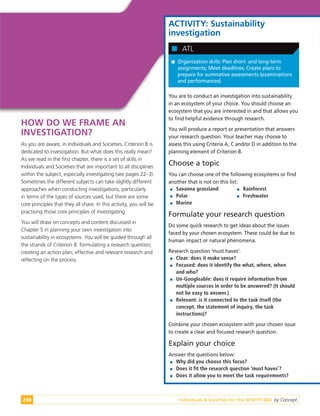
 In this activity you have practised skills that
are assessed using Criterion A: Knowing and
understanding, Criterion B: Investigating,
Criterion C: Communicating and Criterion D:
Thinking critically.

 Assessment opportunities
Data presentation and analysis
• The presentation of your data (graphs, etc.) and
the written analysis must be integrated – there
should be no random graphs on a single page.
• You should treat and display the data collected
using the most appropriate techniques.
• You must demonstrate your knowledge and
understanding of the fieldwork investigation by
interpreting or explaining the information you
have collected.
• You should describe and explain your results
and look for any anomalies that may be present –
explain these too.
Individuals & Societies for the IB MYP 4&5: by Concept
298
HOW DO WE FRAME AN
INVESTIGATION?
As you are aware, in Individuals and Societies, Criterion B is
dedicated to investigation. But what does this really mean?
As we read in the first chapter, there is a set of skills in
Individuals and Societies that are important to all disciplines
within the subject, especially investigating (see pages 22–3).
Sometimes the different subjects can take slightly different
approaches when conducting investigations, particularly
in terms of the types of sources used, but there are some
core principles that they all share. In this activity, you will be
practising those core principles of investigating.
You will draw on concepts and content discussed in
Chapter 5 in planning your own investigation into
sustainability in ecosystems. You will be guided through all
the strands of Criterion B: formulating a research question;
creating an action plan; effective and relevant research and
reflecting on the process.
ACTIVITY: Sustainability
investigation

 Organization skills: Plan short- and long-term
assignments; Meet deadlines; Create plans to
prepare for summative assessments (examinations
and performances)

 ATL
You are to conduct an investigation into sustainability
in an ecosystem of your choice. You should choose an
ecosystem that you are interested in and that allows you
to find helpful evidence through research.
You will produce a report or presentation that answers
your research question. Your teacher may choose to
assess this using Criteria A, C and/or D in addition to the
planning element of Criterion B.
Choose a topic
You can choose one of the following ecosystems or find
another that is not on this list:

 Savanna grassland

 Polar

 Marine

 Rainforest

 Freshwater
Formulate your research question
Do some quick research to get ideas about the issues
faced by your chosen ecosystem. These could be due to
human impact or natural phenomena.
Research question ‘must haves’:

 Clear: does it make sense?

 Focused: does it identify the what, where, when
and who?

 Un-Googleable: does it require information from
multiple sources in order to be answered? (It should
not be easy to answer.)

 Relevant: is it connected to the task itself (the
concept, the statement of inquiry, the task
instructions)?
Combine your chosen ecosystem with your chosen issue
to create a clear and focused research question.
Explain your choice
Answer the questions below:

 Why did you choose this focus?

 Does it fit the research question ‘must haves’?

 Does it allow you to meet the task requirements?
12 How has our perspective changed now? 299
Research methods
Copy and complete Table 12.1 to record your ideas and
help order your notes.

 Guiding questions: Identify questions to guide your
research. What information must you have in order to
respond to your research question?

 Notes: Information you find that answers the key
questions. These notes can be copied from your
sources.

 My notes: Your own words – usually in bullet points.

 Sources – The sources you have used.

 Table 12.1 Questions, notes and sources
Guiding questions Notes My notes Sources
Report or presentation structure
Your report or presentation will be made up of four main
sections, and has a 1,000-word limit/8-minute time limit.
Introduction (100 words or 1 minute)

 Identify the purpose of your investigation.

 Identify and explain your research question.
Overview(250 words or 2 minutes)

 Include the core facts and information about the
ecosystem and your specific area of focus (evaluating
sustainability).

 Aim to answer the 5Ws (see Creating a geographical
case study, page 124) + H (how) regarding
sustainability (both positive and negative actions) on
your chosen ecosystem.

 Use visuals to show/demonstrate information (maps,
graphs, photos, quotations).
Analysis (400 words or 4 minutes)

 This is where you answer or respond to your
research question. It requires you to think and draw
conclusions.

 Aim to identify three main points. You have to process
the information you have found in your research to
identify these points.

 Use evidence from your research to support each
point. Use clear sections or paragraphs.

 Aim to include multiple perspectives in your
explanations of each point.

 Use some visuals.
Conclusion (150 words or 1 minute)

 Summarize your main points using your research
question as your basis.

 Aim to give a concise response to your research question.
Structure requirements

 Your report/presentation should have a cover/title
page/slide, four main sections with sub-headings, and
a bibliography.

 Include a variety of relevant pictures/photos, graphs,
tables, diagrams, statistics and maps and explicitly
reference each one. These should also be included
in your bibliography if they are taken from another
source.

 All presentations should have minimal words on the
screen, useful images and a bibliography on last slide.
Practise your presentation and write out notecards
before you make your presentation to ensure your
communication is clear.
Reflection
Evaluate the process and results of your investigation.

 What interested you about the topic you chose? Are
you glad you chose it? Why?

 Which resources did you find especially helpful and why?

 What was difficult about the process?

 Did you find it difficult or easy to follow your action
plan? Why?

 What did you enjoy about the investigation? What
didn’t you like?

 What new skills did you develop during this
investigation?

 What did you find challenging about this investigation?

 What problems did you encounter during the
investigation and how did you fix them?

 In your next investigation, what will you do
differently?

 What did you think of the product you made?

 Is it your best work? Why/why not?
Remember, this should be a criticalevaluation of your
process and result. Use specific examples throughout.

 In this activity you have practised skills that
are assessed using Criterion A: Knowing and
understanding, Criterion B: Investigating,
Criterion C: Communicating and Criterion D:
Thinking critically.

 Assessment opportunities
Individuals & Societies for the IB MYP 4&5: by Concept
300
How do I develop
research questions
based on current
issues?
ACTIVITY: Austerity – does it do more harm than good?

 Information literacy skills: Collect and analyse
data to identify solutions and/or make informed
decisions

 ATL
Austerity refers to a set of government policies that
involve cuts in government spending or increases in
tax rates (or both) in order to reduce the total level of
borrowing by the government. These policies have a
direct effect on the level of aggregate demand in the
economy, but in some circumstances are necessary to
prevent bigger economic problems. Countries that have
implemented these policies recently include:

 Brazil

 Greece

 Portugal

 Spain

 the United Kingdom

 Latvia.
The aim of the task is to write a 1,200–1,500-word essay
arguing for or against the use of austerity in one of the
countries listed. You will need to select a narrow focus for
the research (you will not be able to deal with the entire
country’s economy in 1,500 words) and develop a research
question.
Preliminary research
You will need to carry out preliminary research before
you start your project. Make notes on the following:

 How do governments borrow money? (Find out what a
government bond is.)

 What do the terms ‘bond yield’ and ‘bond price’ mean?

 Why do bond prices rise and fall?

 Why do bond yields rise and fall?

 How do governments raise more revenue?

 How do governments cut their spending?
Research question
Once you have chosen your country, you need to develop
your research question. The best research questions are
open ended, debatable and do not already indicate the
direction of your answer.
Your research question will need a narrow focus, and you
will need to start gathering your evidence at this stage,
before you start the writing process, so that you know
whether you will be able to answer your question. You
need to know that you have enough data, quotes from
credible sources, and other evidence first.
To find a more narrow focus, think about an aspect of the
country you want to investigate. Consider an industry or
an aspect of life in the country.
Once you have developed your research question, submit
it to your teacher for approval. Take on any feedback
from your teacher about the question, and revise it
if necessary.
Research and planning
This part will take the most time, and it is a mistake to think
otherwise. When it comes to writing the actual essay, you
will have already gathered all the material you need, and
will have a clear plan for how your argument will be broken
down into parts. The research process will include:
We know that to find the right answers we need to start
out with the right questions. You will have worked on
developing research questions in all your MYP subjects as
this is a key approaches to learning skill. In Individuals and
Societies our questions are very often prompted by what is
happening in the world right now.
12 How has our perspective changed now? 301

 gathering data from reliable sources, such as
government statistics organizations

 reading newspaper articles from the relevant period of
time (try using the advanced search function of Google
News)

 finding quotes from important economists or politicians
to support any argument that you want to make.
You will need to plan the main arguments that you will
make to answer the question. Each argument and section
of your essay will be based on the evidence you have
gathered. Submit your essay outline to your teacher. It
should include the following:

 Introduction
Give some background to the country’s economy
during the period in question. Information that
might be relevant includes: the country’s GDP and
rank in terms of relative size, its main industries
and a short timeline prior to austerity being
implemented.
Justify the relevance of your research question and
why it is significant.
Make a brief preliminary judgement (prediction/
hypothesis) that answers the question, and explain
the approach you will take to answer it.

 Three main sections to your argument
The main sections of the essay should be structured
in such a way that enables the reader to follow
what you are saying, and that presents the reader
with credible and sufficient evidence for the
argument being made. Use the PEEL paragraph
structure as follows:
Point: The first sentence should make a clear point,
and express a particular controlling idea. The rest
of the paragraph should not stray from this idea.
Explain: You will need to develop this point further,
by explaining any economic theory fully or by
making any link between cause and effect clear.
If you are suggesting that one particular group is
affected, in what way are they affected and why?
Evidence: You will need to present the evidence
that you have gathered to support this point
that you are making. This makes the work
more believable and so you must choose your
evidence carefully. Make sure the facts or quotes
are from credible sources. This evidence needs
to demonstrate your scholarship, not your
ability to type a few words into a search engine
and hope for the best!
Link: The link between this point and the
question you are answering needs to be made
explicit. You should also set out the end of each
paragraph to lead nicely on to the next.

 Conclusion
Your conclusion should present your answer to the
question, outlining the reasons why austerity is or is
not effective as a government policy in your chosen
country. It is important to be clear about why your
answer can be argued for over and above any
possible counter-arguments.

 In this activity you have practised skills that
are assessed using Criterion A: Knowing and
understanding, Criterion B: Investigating,
Criterion C: Communicating and Criterion D:
Thinking critically.

 Assessment opportunities
Individuals & Societies for the IB MYP 4&5: by Concept
302
ACTIVITY: Educating citizens of a country or the world?

 Organization skills: Create plans to prepare
for summative assessments (examinations and
performances)

 ATL
Education policy is a hotly debated topic in every
country. The following questions are often asked:

 What is the purpose of education?

 What skills should students leave school with?

 Should we prioritize some kinds of learning/some
subjects over others?

 What proportion of the government’s budget should
be spent on education?

 Should there be private schools?

 Should there be standardized testing? At what ages?
Imagine you are a university lecturer interested in
studying education policy. You would like to publish
research for the Organisation for Economic Co-operation
and Development (OECD) about the effectiveness of
education systems. Select one of the OECD countries
(see OECD.org), and carry out an investigation into the
successes and weaknesses of its education system.
As part of your preliminary research you need to:

 keep an active notebook containing all your research
and making note of any sources as you go along

 submit an action plan to your teacher, using a copy of
Table 12.2 below.
Your report should include:

 an outline of the education system that currently
exists in the country

 a section that analyses the effectiveness of current
practices, including statistics for attainment, literacy
and shares of the population who leave education
with qualifications

 a section that explains the current government’s
plans for improvement

 a section that discusses government plans and
suggests other approaches that might be used.

 In this activity you have practised skills that
are assessed using Criterion A: Knowing and
understanding, Criterion B: Investigating,
Criterion C: Communicating and Criterion D:
Thinking critically.

 Assessment opportunities

 Table 12.2 Action plan
Task
Resources,
e.g. books, specific webpages, databases Due date Complete
Date to submit completed work:
12 How has our perspective changed now? 303
How do our perspectives change as
we learn through different subjects?
Individuals and Societies is the study of social relationships;
but by now you will probably have recognized the different
approaches taken by the different subjects within this
subject area. Each of the subjects has its own methodology,
and each looks at different conceptual relationships, even
within the same social events. As a consequence, each
subject produces a different set of understandings or
answers to the questions we have about societies.
An example might be the Wall Street Crash of 1929.
Causes:
 Historians’ perspective of the roaring ‘20s
Renewed optimism since the First World War
The new industrial age of steel and electricity
Rapid growth in incomes
Increasing use of the radio in the home
The cultural exuberance of the period, with changing
tastes in music, fashion and leisure activities
Protectionism during the interwar period that
contributed to an increase in manufacturing
Republican government policies supported business
growth and investment
 Economists’ perspective:
Market optimism and overconfidence
The rise of American Consumerism leading to
the overproduction of consumer goods that were
attained as a result of easy credit schemes
The stock market boom and the ‘long bull market’
which led to the system of buying stocks ‘on
margin’ with loans from stock brokers
The fall in demand for consumer products and the
unequal distribution of wealth across America
Weaknesses in the American banking system
Panic-selling of massive amounts of stocks and shares
Effects:
 Geographers’ perspective:
High levels of unemployment
Bankruptcies
Suicides
Starvation
Migration
Evictions and wage cuts that led to the Great
Depression
Reduction in trade between countries (higher
trade barriers)
 Historians’ perspective:
Breakdown in communication between countries,
generating suspicion
Countries become insular (forcing people to buy
national goods in order to create jobs and rebuild
the economy)
Global nature of the crisis results in a loss of
confidence in democracy and a rise in extremist
groups promising to solve a nation’s problems,
e.g. Nazism in Germany (Hitler), Fascism in Italy
(Mussolini) and Spain (Franco)
A cause of the Second World War
Individuals & Societies for the IB MYP 4&5: by Concept
304
ACTIVITY: Taking a viewpoint

 Media literacy skills: Seek a range of perspectives
from multiple and varied sources

 ATL
Choose any twentieth-century event and analyse the
event in two clear sections: causes and effects.
Your project will be made up of five sections, all of which
will be assessed:
1 Research question and justification – 100 words
2 Action plan – 200 words
3 Investigation essay – 1,000 words
4 Reflection – 200 words
5 References
The perspectives of two of the Individuals and Societies
subjects we have explored in this book (historian,
geographer and economist) must be given in your
investigation section.
1 Research question and justification

 Formulate your own research question.

 Include a short paragraph to justify the relevance
of the topic and question as being important
to investigate.
2 Action plan

 Formulate an action plan for how you will complete
the investigation from start to finish. Include a time
frame for how long you think each section might
take you.

 Describe the methods you will use to find the
information you require.
3 Investigation essay
a Describe the event and give it context.
b Analyse the causes from the different perspectives.

 Identify the opinions of academics who have a
view on the causes.
c Analyse the consequences from different
perspectives.

 Identify the opinions of academics who have a
view on the consequences.
d Conclusion

 Summarize the key points of your investigation.

 Evaluate what the most influential cause and
most impactful consequence was, based on the
weight of evidence.
In this section you should:

 use a wide range of terminology in context

 demonstrate knowledge and understanding of
subject-specific content and concepts through
developed descriptions, explanations and examples

 communicate information and ideas effectively using
an appropriate style for the audience and purpose

 structure information and ideas in a way that is
appropriate to the specified format

 discuss concepts, issues, models, visual
representation and theories.
Evaluation of sources
You should choose two sources that you used most
prominently and, with reference to their origin,
purpose and content, discuss the values and limitations
of each source.
You may wish to structure your evaluation like this:
Source A
Values paragraph:
• The origin is of value because …
• The purpose can be considered a value to an
individual studying the Wall Street Crash because …
• The content of the source is valuable due to …
Source A
Limitations paragraph:
• The origin can be seen as a slight limitation due to …
• The purpose is limited because …
• The content has limitations because of … which
requires the individual to seek out further sources.
Source B
Values paragraph: follow the same structure as the
Source A values paragraph
Source B
Limitations paragraph: follow the same structure as the
Source A limitations paragraph
In this section you should:
• synthesize information to make valid, well-
supported arguments
• analyse and evaluate a wide range of sources/data
in terms of origin and purpose, examining values and
limitations
• interpret different perspectives and their implications.
12 How has our perspective changed now? 305
4 Reflection

 Explain why the chosen research question and topic
were relevant and appropriate.

 Explain the research methods you used to collect and
record appropriate, varied and relevant information.

 Evaluate the process and results of your investigation.
5 References
Your investigation should include in-text citations
(Harvard) or footnotes (MLA) as well as a bibliography to
show that you have documented sources of information
using a recognized convention.
It is very important to reference your work in order to:

 demonstrate to your readers that you have conducted a
thorough and appropriate literature search, and reading

 acknowledge that you have used the ideas and written
material belonging to other people/authors in your
own work.
If you do not do this, you can be accused of plagiarism,
which has serious consequences. The IB MYP provides
further guidance on this at:
www.ibo.org/globalassets/publications/become-an-ib-
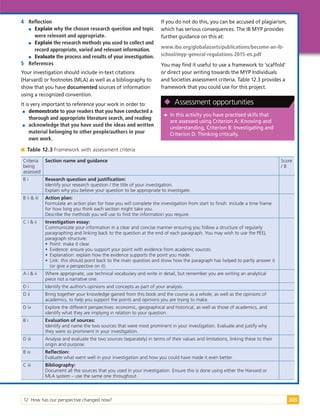
school/myp-general-regulations-2015-en.pdf
You may find it useful to use a framework to ‘scaffold’
or direct your writing towards the MYP Individuals
and Societies assessment criteria. Table 12.3 provides a
framework that you could use for this project.

 In this activity you have practised skills that
are assessed using Criterion A: Knowing and
understanding, Criterion B: Investigating and
Criterion D: Thinking critically.

 Assessment opportunities

 Table 12.3 Framework with assessment criteria
Criteria
being
assessed
Section name and guidance Score
/ 8
B i Research question and justification:
Identify your research question / the title of your investigation.
Explain why you believe your question to be appropriate to investigate.
B ii & iii Action plan:
Formulate an action plan for how you will complete the investigation from start to finish. Include a time frame
for how long you think each section might take you.
Describe the methods you will use to find the information you require.
C i & ii Investigation essay:
Communicate your information in a clear and concise manner ensuring you follow a structure of regularly
paragraphing and linking back to the question at the end of each paragraph. You may wish to use the PEEL
paragraph structure:
• Point: make it clear.
• Evidence: ensure you support your point with evidence from academic sources.
• Explanation: explain how the evidence supports the point you made.
• Link: this should point back to the main question and show how the paragraph has helped to partly answer it
(or give a perspective on it).
A i & ii Where appropriate, use technical vocabulary and write in detail, but remember you are writing an analytical
piece not a narrative one.
D i Identify the author’s opinions and concepts as part of your analysis.
D ii Bring together your knowledge gained from this book and the course as a whole, as well as the opinions of
academics, to help you support the points and opinions you are trying to make.
D iv Explore the different perspectives: economic, geographical and historical, as well as those of academics, and
identify what they are implying in relation to your question.
B i Evaluation of sources:
Identify and name the two sources that were most prominent in your investigation. Evaluate and justify why
they were so prominent in your investigation.
D iii Analyse and evaluate the two sources (separately) in terms of their values and limitations, linking these to their
origin and purpose.
B iv Reflection:
Evaluate what went well in your investigation and how you could have made it even better.
C iii Bibliography:
Document all the sources that you used in your investigation. Ensure this is done using either the Harvard or
MLA system – use the same one throughout.
Individuals & Societies for the IB MYP 4&5: by Concept
306
ACTIVITY: Competing claims

 Collaboration skills: Build consensus

 ATL
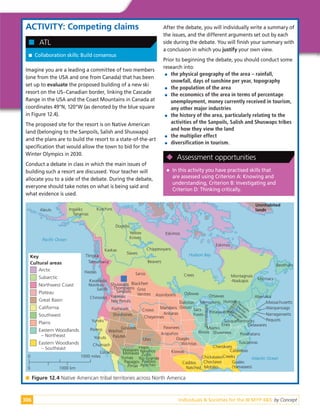
Imagine you are a leading a committee of two members
(one from the USA and one from Canada) that has been
set up to evaluate the proposed building of a new ski
resort on the US–Canadian border, linking the Cascade
Range in the USA and the Coast Mountains in Canada at
coordinates 49°N, 120°W (as denoted by the blue square
in Figure 12.4).
The proposed site for the resort is on Native American
land (belonging to the Sanpoils, Salish and Shuswaps)
and the plans are to build the resort to a state-of-the-art
specification that would allow the town to bid for the
Winter Olympics in 2030.
Conduct a debate in class in which the main issues of
building such a resort are discussed. Your teacher will
allocate you to a side of the debate. During the debate,
everyone should take notes on what is being said and
what evidence is used.
After the debate, you will individually write a summary of
the issues, and the different arguments set out by each
side during the debate. You will finish your summary with
a conclusion in which you justify your own view.
Prior to beginning the debate, you should conduct some
research into:

 the physical geography of the area – rainfall,
snowfall, days of sunshine per year, topography

 the population of the area

 the economics of the area in terms of percentage
unemployment, money currently received in tourism,
any other major industries

 the history of the area, particularly relating to the
activities of the Sanpoils, Salish and Shuswaps tribes
and how they view the land

 the multiplier effect

 diversification in tourism.

 In this activity you have practised skills that
are assessed using Criterion A: Knowing and
understanding, Criterion B: Investigating and
Criterion D: Thinking critically.

 Assessment opportunities
Pacific Ocean
Atlantic Ocean
Hudson Bay
Uninhabited
lands
Aleuts
Eskimos
Eskimos
Ingaliks
Tanainas
Kutchins
Dogribs
Yellow
Knives
Kaskas
Slaves
Chippewyans
Beavers
Crees Montagnais
-Naskapis
Tlingka
Taimahiana
Haidas
Kwakiotis
Nootkas
Salish
Chinooks
Beothuks
Micmacs
Ojibwas
Ottawas Abenakis
Dakotas
(Sioux)
Menominis Hurons
Sacs
Foxes
W
i
n
n
e
b
a
g
o
s
Potaswatomis
Illinois
Miamis
Shawnees
Eries
Susquehannocks
Delawares
Powhatans
Tuscaroras
Massachusetts
Wanpanoags
Narragansetts
Pequots
I
r
o
q
u
o
i
s
M
ohawks
Oneidas
Onondegas
Cayuges
Senecas
Shuswaps
Thompsons
Sanpoils
Yakimas
Nez Percés
Flatheads
Sarsis
Blackfeet
Gros
Ventres Assiniboins
Crows
Cheyennes
Mandans
Arikaras
Pawnees
Arapahos
Osages
Wichitas
Kiowas
Shoshones
Washos
Palutes
Gosiutes
Utes
Yuroks
Pomos
Yokuts
Chumash
Luisanas
Walapais
Mohaves
Yumas
Papagos
Pimas
Hopis
Navahos
Zuñis
Rio Grande
Pueblos
Apaches
Caddos
Natchez
Cherokees
Catawbas
Creeks
Guales
(Yamasees)
Chickasaws
Choctaws
Mobiles
Key
Cultural areas
Arctic
Subarctic
Northwest Coast
Plateau
Great Basin
California
Southwest
Plains
Eastern Woodlands
– Northeast
Eastern Woodlands
– Southeast
0 1000 miles
0 1000 km

 Figure 12.4 Native American tribal territories across North America
12 How has our perspective changed now? 307
How do we know the information
we read is true?
ACTIVITY: The role of the news media today

 Critical-thinking skills: Identify obstacles and
challenges

 ATL
Read the following extract from an interview with a
British television news producer in 2018.
In a worldwith ‘information’atyourfingertips, how
can you tellwhatis legitimate andwhatis not?
Historically if, forexample, a Washington Post
[American broadsheet newspaper] article hadquoted
30 separate sources, itwas easy to see itwas more
credible than an article from, say, the Mirror[British
tabloid paper] quoting one unnamedsource.
When writing an essay, yourteachers ask you to
showtextcitations orfootnotes to demonstrate the
credibility ofwhatyou are saying – the same cannotbe
saidwhen socialmedia is used. Itmakes evaluating the
credibility/validity ofevidence even more important.
The ‘Fake News’era is constantly evolving and
shifting. PresidentTrump wants people to believe it
is misreporting andtherefore wrong – is this a tactic
ora genuine thought, i.e. the journalisthas a political
motive?This creates scepticism ofrealinformation.
PresidentTrump’s aim is to create an atmosphere of
suspicion aroundany story abouthim ... to create an
unavoidable cacophony ofmisdirection where people
do notknowwhatto believe – this undermines what
the free press brings to a democracy.
Republicans andTrump supporters may considerthis
to be wrong however, andthatTrump is being unfairly
targeted. Eitherway, ithas resultedin a lack oftrust
in the press. A testamentto the public’s confusion is
that, in 2018, CNN hadboth its highestapprovaland
disapprovalrating ofalltime.
Collins Dictionary lexicographers said that use of the term
‘fake news’ had increased by 365 per cent since 2016.
In April 2018, it was stated in the Telegraph that ‘“Fake
news” was not a term many people used 18 months
ago, but it is now seen as one of the greatest threats to
democracy, free debate and the Western order.’
Create a 6–8 minute presentation describing and
analysing the role that the news media play in shaping
public opinion and keeping governments to account
and how you, as students, can use your research skills to
validate the legitimacy of what you read, see and hear. Be
sure to address the following points in your presentation:

 Using a formal definition of ‘fake news’, justify why
it is important to address this issue.

 Describe and explain how this issue has come to our
attention in recent years.

 Evaluate the role that the news has played in recent
times and in some example countries.

 Explore how we can ensure we identify the differences
between credible and untrustworthy sources, and find
out the real facts, for use in our written work.

 Identify the methods we can use to find out where a
source comes from.

 Use a conclusion to summarize your key
recommendations on how to validate the legitimacy
of information in the era of fake news.

 Document the sources you have used in a
bibliography at the end of your presentation.
The topic of ‘fake news’ overlaps with recent political
events that have caused some contention between people
in their countries. We must always remember that people’s
political views are their own, and that there are ways to
engage in debate with people without upsetting them
(see the Guardian, 2019, ‘The science of influencing people:
six ways to win an argument’). It is important to remain
objective and balanced when discussing such issues.

 In this activity you have practised skills that
are assessed using Criterion A: Knowing and
understanding, Criterion B: Investigating, Criterion C:
Communicating and Criterion D: Thinking critically.

 Assessment opportunities
Individuals & Societies for the IB MYP 4&5: by Concept
308
How do we
answer exam-style
questions?
As you progress towards the Diploma Programme (DP) it
is increasingly important that you become familiar with
answering exam-style questions. The DP exams follow this
format in many subjects – the subjects you are familiar with
from Individuals and Societies especially. The activity below
relates to the population topics covered in Chapter 6.
ACTIVITY: Answering exam
questions

 Communication skills: Use appropriate forms of
writing for different purposes and audiences

 ATL
1 a Define the term ‘population density’. [1 mark]
b Define the term ‘population distribution’. [1 mark]
c Explain the meaning of the term
‘densely populated’. [2 marks]
d Using examples of places you have studied,
describe the physical factors that may
cause areas to be sparsely populated. [6 marks]
2 a Define the term ‘birth rate’. [1 mark]
b Define the term ‘death rate’. [1 mark]
c Explain why LEDCs often have a high
birth rate. [3 marks]
d On a copy of the diagram below (the demographic
transition model) draw three lines to represent
the birth rate, death rate and total population.
(Make sure you label them or use different
colours.) [3 marks]
Time
D
e
a
t
h
r
a
t
e
p
e
r
1
,
0
0
0
p
o
p
u
l
a
t
i
o
n
0
25
20
15
10
5
0
B
i
r
t
h
r
a
t
e
p
e
r
1
,
0
0
0
p
o
p
u
l
a
t
i
o
n
Stage 1 Stage 2 Stage 3 Stage 4 Stage 5
40
32
24
16
8
0
3 a Look the population pyramid below. State
whether it shows Sweden or India. [1 mark]
100+
95–99
90–94
85–89
80–84
75–79
70–74
65–69
60–64
55–59
50–54
45–49
40–44
35–39
30–34
25–29
20–24
15–19
10–14
5–9
0–4
Male Female
10% 8% 6% 4% 2% 0% 0% 2% 4% 6% 8% 10%
0.0%
0.0%
0.3%
0.6%
1.1%
1.7%
2.5%
3.2%
2.7%
3.0%
3.2%
3.6%
3.2%
3.1%
3.2%
3.5%
3.5%
2.8%
3.1%
3.1%
0.0%
0.1%
0.6%
1.0%
1.4%
1.9%
2.6%
3.2%
2.7%
2.9%
3.1%
3.5%
3.1%
3.0%
3.1%
3.4%
3.4%
2.4%
2.7%
2.9%
2.6%
2.9%
b Examine the pyramid and explain what you
can identify about the country from its
structure. [5 marks]

 In this activity you have practised skills that
are assessed using Criterion A: Knowing and
understanding.

 Assessment opportunities
12 How has our perspective changed now? 309
Reflection
In this chapter we have practised all the skills required to
be successful in an MYP Individuals and Societies course.
We have explained complex concepts and problems,
we have gathered research to support our writing with
evidence, we have evaluated claims and constructed
counter-arguments. We have considered ideas from
multiple perspectives and analysed the implications of
those views. We know how to cite our sources in-text
and how to construct our reference list at the end of
our work.
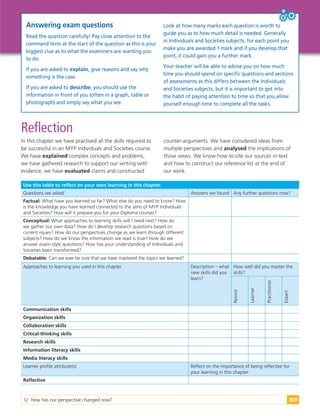
Use this table to reflect on your own learning in this chapter.
Questions we asked Answers we found Any further questions now?
Factual: What have you learned so far? What else do you need to know? How
is the knowledge you have learned connected to the aims of MYP Individuals
and Societies? How will it prepare you for your Diploma courses?
Conceptual: What approaches to learning skills will I need next? How do
we gather our own data? How do I develop research questions based on
current issues? How do our perspectives change as we learn through different
subjects? How do we know the information we read is true? How do we
answer exam-style questions? How has your understanding of Individuals and
Societies been transformed?
Debatable: Can we ever be sure that we have mastered the topics we learned?
Approaches to learning you used in this chapter Description – what
new skills did you
learn?
How well did you master the
skills?
N
o
v
i
c
e
L
e
a
r
n
e
r
P
r
a
c
t
i
t
i
o
n
e
r
E
x
p
e
r
t
Communication skills
Organization skills
Collaboration skills
Critical-thinking skills
Research skills
Information literacy skills
Media literacy skills
Learner profile attribute(s) Reflect on the importance of being reflective for
your learning in this chapter.
Reflective
Answering exam questions
Read the question carefully! Pay close attention to the
command term at the start of the question as this is your
biggest clue as to what the examiners are wanting you
to do.
If you are asked to explain, give reasons and say why
something is the case.
If you are asked to describe, you should use the
information in front of you (often in a graph, table or
photograph) and simply say what you see.
Look at how many marks each question is worth to
guide you as to how much detail is needed. Generally
in Individuals and Societies subjects, for each point you
make you are awarded 1 mark and if you develop that
point, it could gain you a further mark.
Your teacher will be able to advise you on how much
time you should spend on specific questions and sections
of assessments as this differs between the Individuals
and Societies subjects, but it is important to get into
the habit of paying attention to time so that you allow
yourself enough time to complete all the tasks.

Topic 12 How has our perspective changed.pdf

  • 1.
    Individuals & Societiesfor the IB MYP 4&5: by Concept 294 Time, place andspace Causality; Perspective Orientation in space andtime Our perspective changes over time; reflection allows us to see the causes and impacts of events in different times and places. 12 How has our perspective changed now?   Figure 12.1 (a) Exploring the world can change our perspective; (b) Pieces of the Berlin Wall remind us of recent events in history; (c) Rubbish from more economically developed countries becomes a source of income in less economically developed countries; (d) Shanty towns sit beside wealthy areas in some cities Factual: What have you learned so far? What else do you need to know? How is the knowledge you have learned connected to the aims of MYP Individuals and Societies? How will it prepare you for your Diploma courses? Conceptual: What approaches to learning skills will I need next? How do we gather our own data? How do I develop research questions based on current issues? How do our perspectives change as we learn through different subjects? How do we know the information we read is true? How do we answer exam-style questions? How has your understanding of Individuals and Societies been transformed? Debatable: Can we ever be sure that we have mastered the topics we learned? Now share and compare your thoughts and ideas with your partner, or with the whole class. CONSIDER THESE QUESTIONS: IN THIS CHAPTER WE WILL …   Find out how much you’ve learned and where you need to revise or refresh.   Explore the most appropriate course in Individuals and Societies for you.   Take action by considering ethical, moral and social implications of Individuals and Societies. (a) (b)
  • 2.
    12 How hasour perspective changed now? 295   Communication skills   Organization skills   Collaboration skills   Critical-thinking skills   Research skills   Information literacy skills   Media literacy skills   These Approaches to Learning (ATL) skills will be useful …   Reflective – our learning is enriched and deepened if we reflect on it, connecting new discoveries to existing understanding.   We will reflect on this learner profile attribute …   Criterion A: Knowing and understanding   Criterion B: Investigating   Criterion C: Communicating   Criterion D: Thinking critically   Assessment opportunities in this chapter: dataset hypothesis primary source research question secondary source KEY WORDS I USED TO THINK … NOW I THINK … Take a look at Figure 12.1 above. What are our aims when we study Individuals and Societies? Use your ideas to help you reflect through this visible thinking routine:   I used to think that …   Now I think that …   What I would like to know next is … (c) (d)
  • 3.
    Individuals & Societiesfor the IB MYP 4&5: by Concept 296 What approaches to learning skills will I need next? HOW DO WE GATHER OUR OWN DATA? ACTIVITY: Urban heat island effect   Research skills: Process data and report results   ATL In Chapter 7 we explored the concept of urban stress as part of our focus on sustainability in urban systems. A concept relating to urban stress is the phenomenon of the urban heat island (UHI). This is an urban area that is significantly warmer than its surrounding rural areas due to human activities. Figure 12.2 shows that as distance from the centre of the city decreases, so does temperature. L a t e a f t e r n o o n t e m p e r a t u r e Rural Commercial Urban Suburban residential residential °C 33 32 31 30 Suburban Downtown Park Rural residential farmland   Figure 12.2 An urban heat island profile DISCUSS Why do you think urban areas are hotter than their surrounding rural areas? What things do they have or lack that may make them warmer? Fieldwork investigation Your task is to carry out a fieldwork investigation in your own, or nearest, urban area. Your teacher will manage this so that you are sharing data with your peers as this is the most effective way of data collection. You will then produce a report that can be assessed on all four of the MYP Individuals and Societies criteria. You will need to take the following steps:   Carry out some initial research into the urban heat island effect, for example what the causes are said to be and any examples of places said to experience one.   Develop a research question, relating to UHIs that you would like to explore.   Justify the relevance of your research question and why it is important to study it.   Make a brief preliminary judgement (prediction/ hypothesis) answering the research question for your fieldwork, linked to the urban heat island profile in Figure 12.2 (geographical theory). Methodology   Plan with your teacher how you will carry out the fieldwork as a class. This may involve a whole-class trip or you may be assigned some data collection to complete as a homework.   An example of how you could carry out the fieldwork would be to divide your city, or an area of your city, into zones along a transect running north to south or east to west (or both). Different groups of students could then be assigned to each area along the transect to collect their data and then the data could be shared so you have a picture for the whole city, from the centre to the fringe.   Think about and plan what data you will collect and what equipment you will require – variables you could measure include temperature, humidity, noise pollution, traffic count, pedestrian count, percentage of concrete visible, percentage of vegetation visible and function of the area. You can use a mix of primary and secondary data and qualitative and quantitative data. Your school science department may have equipment you can borrow or you could
  • 4.
    12 How hasour perspective changed now? 297 explore ways in which you could use smartphones (if you have access to them) to help you gather data.   When you have decided on your plan, you should explain in your report where the fieldwork investigation was carried out.   A map of the data collection locations used is essential.   You may wish to use photos to show the area you studied, any equipment you used or anything else you feel is relevant to the study.   In your report, you should describe the methods used to collect your data and justify/evaluate the methods used and the quality of the data collected. Advice on the use of maps   You must add value to maps you include – just sticking in a photocopied map or a printed map from the internet is of little value unless you have used it as a base map to show other information.   You must acknowledge the source of the map.   You must give the map a title, scale (or state not to scale), key/legend and border. EXTENSION You may wish to research and discuss sampling techniques as part of your discussion on data collection. EXTENSION You may wish to research statistical tests you could use to help display your results and findings – your maths teacher may be able to help you with this. Conclusion   In your conclusion, you should summarize your findings and make a clear, concise statement answering the fieldwork question.   Ensure your conclusion to the fieldwork question is consistent with the outcomes of your analysis.   Ensure any recommendations for improvements are realistic.   Make suggestions for modifying the fieldwork question.   Compile a bibliography of any sources you have used throughout this investigation. These may be research into the UHI effect, different methods, sampling techniques, etc.   In this activity you have practised skills that are assessed using Criterion A: Knowing and understanding, Criterion B: Investigating, Criterion C: Communicating and Criterion D: Thinking critically.   Assessment opportunities Data presentation and analysis • The presentation of your data (graphs, etc.) and the written analysis must be integrated – there should be no random graphs on a single page. • You should treat and display the data collected using the most appropriate techniques. • You must demonstrate your knowledge and understanding of the fieldwork investigation by interpreting or explaining the information you have collected. • You should describe and explain your results and look for any anomalies that may be present – explain these too.
  • 5.
    Individuals & Societiesfor the IB MYP 4&5: by Concept 298 HOW DO WE FRAME AN INVESTIGATION? As you are aware, in Individuals and Societies, Criterion B is dedicated to investigation. But what does this really mean? As we read in the first chapter, there is a set of skills in Individuals and Societies that are important to all disciplines within the subject, especially investigating (see pages 22–3). Sometimes the different subjects can take slightly different approaches when conducting investigations, particularly in terms of the types of sources used, but there are some core principles that they all share. In this activity, you will be practising those core principles of investigating. You will draw on concepts and content discussed in Chapter 5 in planning your own investigation into sustainability in ecosystems. You will be guided through all the strands of Criterion B: formulating a research question; creating an action plan; effective and relevant research and reflecting on the process. ACTIVITY: Sustainability investigation   Organization skills: Plan short- and long-term assignments; Meet deadlines; Create plans to prepare for summative assessments (examinations and performances)   ATL You are to conduct an investigation into sustainability in an ecosystem of your choice. You should choose an ecosystem that you are interested in and that allows you to find helpful evidence through research. You will produce a report or presentation that answers your research question. Your teacher may choose to assess this using Criteria A, C and/or D in addition to the planning element of Criterion B. Choose a topic You can choose one of the following ecosystems or find another that is not on this list:   Savanna grassland   Polar   Marine   Rainforest   Freshwater Formulate your research question Do some quick research to get ideas about the issues faced by your chosen ecosystem. These could be due to human impact or natural phenomena. Research question ‘must haves’:   Clear: does it make sense?   Focused: does it identify the what, where, when and who?   Un-Googleable: does it require information from multiple sources in order to be answered? (It should not be easy to answer.)   Relevant: is it connected to the task itself (the concept, the statement of inquiry, the task instructions)? Combine your chosen ecosystem with your chosen issue to create a clear and focused research question. Explain your choice Answer the questions below:   Why did you choose this focus?   Does it fit the research question ‘must haves’?   Does it allow you to meet the task requirements?
  • 6.
    12 How hasour perspective changed now? 299 Research methods Copy and complete Table 12.1 to record your ideas and help order your notes.   Guiding questions: Identify questions to guide your research. What information must you have in order to respond to your research question?   Notes: Information you find that answers the key questions. These notes can be copied from your sources.   My notes: Your own words – usually in bullet points.   Sources – The sources you have used.   Table 12.1 Questions, notes and sources Guiding questions Notes My notes Sources Report or presentation structure Your report or presentation will be made up of four main sections, and has a 1,000-word limit/8-minute time limit. Introduction (100 words or 1 minute)   Identify the purpose of your investigation.   Identify and explain your research question. Overview(250 words or 2 minutes)   Include the core facts and information about the ecosystem and your specific area of focus (evaluating sustainability).   Aim to answer the 5Ws (see Creating a geographical case study, page 124) + H (how) regarding sustainability (both positive and negative actions) on your chosen ecosystem.   Use visuals to show/demonstrate information (maps, graphs, photos, quotations). Analysis (400 words or 4 minutes)   This is where you answer or respond to your research question. It requires you to think and draw conclusions.   Aim to identify three main points. You have to process the information you have found in your research to identify these points.   Use evidence from your research to support each point. Use clear sections or paragraphs.   Aim to include multiple perspectives in your explanations of each point.   Use some visuals. Conclusion (150 words or 1 minute)   Summarize your main points using your research question as your basis.   Aim to give a concise response to your research question. Structure requirements   Your report/presentation should have a cover/title page/slide, four main sections with sub-headings, and a bibliography.   Include a variety of relevant pictures/photos, graphs, tables, diagrams, statistics and maps and explicitly reference each one. These should also be included in your bibliography if they are taken from another source.   All presentations should have minimal words on the screen, useful images and a bibliography on last slide. Practise your presentation and write out notecards before you make your presentation to ensure your communication is clear. Reflection Evaluate the process and results of your investigation.   What interested you about the topic you chose? Are you glad you chose it? Why?   Which resources did you find especially helpful and why?   What was difficult about the process?   Did you find it difficult or easy to follow your action plan? Why?   What did you enjoy about the investigation? What didn’t you like?   What new skills did you develop during this investigation?   What did you find challenging about this investigation?   What problems did you encounter during the investigation and how did you fix them?   In your next investigation, what will you do differently?   What did you think of the product you made?   Is it your best work? Why/why not? Remember, this should be a criticalevaluation of your process and result. Use specific examples throughout.   In this activity you have practised skills that are assessed using Criterion A: Knowing and understanding, Criterion B: Investigating, Criterion C: Communicating and Criterion D: Thinking critically.   Assessment opportunities
  • 7.
    Individuals & Societiesfor the IB MYP 4&5: by Concept 300 How do I develop research questions based on current issues? ACTIVITY: Austerity – does it do more harm than good?   Information literacy skills: Collect and analyse data to identify solutions and/or make informed decisions   ATL Austerity refers to a set of government policies that involve cuts in government spending or increases in tax rates (or both) in order to reduce the total level of borrowing by the government. These policies have a direct effect on the level of aggregate demand in the economy, but in some circumstances are necessary to prevent bigger economic problems. Countries that have implemented these policies recently include:   Brazil   Greece   Portugal   Spain   the United Kingdom   Latvia. The aim of the task is to write a 1,200–1,500-word essay arguing for or against the use of austerity in one of the countries listed. You will need to select a narrow focus for the research (you will not be able to deal with the entire country’s economy in 1,500 words) and develop a research question. Preliminary research You will need to carry out preliminary research before you start your project. Make notes on the following:   How do governments borrow money? (Find out what a government bond is.)   What do the terms ‘bond yield’ and ‘bond price’ mean?   Why do bond prices rise and fall?   Why do bond yields rise and fall?   How do governments raise more revenue?   How do governments cut their spending? Research question Once you have chosen your country, you need to develop your research question. The best research questions are open ended, debatable and do not already indicate the direction of your answer. Your research question will need a narrow focus, and you will need to start gathering your evidence at this stage, before you start the writing process, so that you know whether you will be able to answer your question. You need to know that you have enough data, quotes from credible sources, and other evidence first. To find a more narrow focus, think about an aspect of the country you want to investigate. Consider an industry or an aspect of life in the country. Once you have developed your research question, submit it to your teacher for approval. Take on any feedback from your teacher about the question, and revise it if necessary. Research and planning This part will take the most time, and it is a mistake to think otherwise. When it comes to writing the actual essay, you will have already gathered all the material you need, and will have a clear plan for how your argument will be broken down into parts. The research process will include: We know that to find the right answers we need to start out with the right questions. You will have worked on developing research questions in all your MYP subjects as this is a key approaches to learning skill. In Individuals and Societies our questions are very often prompted by what is happening in the world right now.
  • 8.
    12 How hasour perspective changed now? 301   gathering data from reliable sources, such as government statistics organizations   reading newspaper articles from the relevant period of time (try using the advanced search function of Google News)   finding quotes from important economists or politicians to support any argument that you want to make. You will need to plan the main arguments that you will make to answer the question. Each argument and section of your essay will be based on the evidence you have gathered. Submit your essay outline to your teacher. It should include the following:   Introduction Give some background to the country’s economy during the period in question. Information that might be relevant includes: the country’s GDP and rank in terms of relative size, its main industries and a short timeline prior to austerity being implemented. Justify the relevance of your research question and why it is significant. Make a brief preliminary judgement (prediction/ hypothesis) that answers the question, and explain the approach you will take to answer it.   Three main sections to your argument The main sections of the essay should be structured in such a way that enables the reader to follow what you are saying, and that presents the reader with credible and sufficient evidence for the argument being made. Use the PEEL paragraph structure as follows: Point: The first sentence should make a clear point, and express a particular controlling idea. The rest of the paragraph should not stray from this idea. Explain: You will need to develop this point further, by explaining any economic theory fully or by making any link between cause and effect clear. If you are suggesting that one particular group is affected, in what way are they affected and why? Evidence: You will need to present the evidence that you have gathered to support this point that you are making. This makes the work more believable and so you must choose your evidence carefully. Make sure the facts or quotes are from credible sources. This evidence needs to demonstrate your scholarship, not your ability to type a few words into a search engine and hope for the best! Link: The link between this point and the question you are answering needs to be made explicit. You should also set out the end of each paragraph to lead nicely on to the next.   Conclusion Your conclusion should present your answer to the question, outlining the reasons why austerity is or is not effective as a government policy in your chosen country. It is important to be clear about why your answer can be argued for over and above any possible counter-arguments.   In this activity you have practised skills that are assessed using Criterion A: Knowing and understanding, Criterion B: Investigating, Criterion C: Communicating and Criterion D: Thinking critically.   Assessment opportunities
  • 9.
    Individuals & Societiesfor the IB MYP 4&5: by Concept 302 ACTIVITY: Educating citizens of a country or the world?   Organization skills: Create plans to prepare for summative assessments (examinations and performances)   ATL Education policy is a hotly debated topic in every country. The following questions are often asked:   What is the purpose of education?   What skills should students leave school with?   Should we prioritize some kinds of learning/some subjects over others?   What proportion of the government’s budget should be spent on education?   Should there be private schools?   Should there be standardized testing? At what ages? Imagine you are a university lecturer interested in studying education policy. You would like to publish research for the Organisation for Economic Co-operation and Development (OECD) about the effectiveness of education systems. Select one of the OECD countries (see OECD.org), and carry out an investigation into the successes and weaknesses of its education system. As part of your preliminary research you need to:   keep an active notebook containing all your research and making note of any sources as you go along   submit an action plan to your teacher, using a copy of Table 12.2 below. Your report should include:   an outline of the education system that currently exists in the country   a section that analyses the effectiveness of current practices, including statistics for attainment, literacy and shares of the population who leave education with qualifications   a section that explains the current government’s plans for improvement   a section that discusses government plans and suggests other approaches that might be used.   In this activity you have practised skills that are assessed using Criterion A: Knowing and understanding, Criterion B: Investigating, Criterion C: Communicating and Criterion D: Thinking critically.   Assessment opportunities   Table 12.2 Action plan Task Resources, e.g. books, specific webpages, databases Due date Complete Date to submit completed work:
  • 10.
    12 How hasour perspective changed now? 303 How do our perspectives change as we learn through different subjects? Individuals and Societies is the study of social relationships; but by now you will probably have recognized the different approaches taken by the different subjects within this subject area. Each of the subjects has its own methodology, and each looks at different conceptual relationships, even within the same social events. As a consequence, each subject produces a different set of understandings or answers to the questions we have about societies. An example might be the Wall Street Crash of 1929. Causes:  Historians’ perspective of the roaring ‘20s Renewed optimism since the First World War The new industrial age of steel and electricity Rapid growth in incomes Increasing use of the radio in the home The cultural exuberance of the period, with changing tastes in music, fashion and leisure activities Protectionism during the interwar period that contributed to an increase in manufacturing Republican government policies supported business growth and investment  Economists’ perspective: Market optimism and overconfidence The rise of American Consumerism leading to the overproduction of consumer goods that were attained as a result of easy credit schemes The stock market boom and the ‘long bull market’ which led to the system of buying stocks ‘on margin’ with loans from stock brokers The fall in demand for consumer products and the unequal distribution of wealth across America Weaknesses in the American banking system Panic-selling of massive amounts of stocks and shares Effects:  Geographers’ perspective: High levels of unemployment Bankruptcies Suicides Starvation Migration Evictions and wage cuts that led to the Great Depression Reduction in trade between countries (higher trade barriers)  Historians’ perspective: Breakdown in communication between countries, generating suspicion Countries become insular (forcing people to buy national goods in order to create jobs and rebuild the economy) Global nature of the crisis results in a loss of confidence in democracy and a rise in extremist groups promising to solve a nation’s problems, e.g. Nazism in Germany (Hitler), Fascism in Italy (Mussolini) and Spain (Franco) A cause of the Second World War
  • 11.
    Individuals & Societiesfor the IB MYP 4&5: by Concept 304 ACTIVITY: Taking a viewpoint   Media literacy skills: Seek a range of perspectives from multiple and varied sources   ATL Choose any twentieth-century event and analyse the event in two clear sections: causes and effects. Your project will be made up of five sections, all of which will be assessed: 1 Research question and justification – 100 words 2 Action plan – 200 words 3 Investigation essay – 1,000 words 4 Reflection – 200 words 5 References The perspectives of two of the Individuals and Societies subjects we have explored in this book (historian, geographer and economist) must be given in your investigation section. 1 Research question and justification   Formulate your own research question.   Include a short paragraph to justify the relevance of the topic and question as being important to investigate. 2 Action plan   Formulate an action plan for how you will complete the investigation from start to finish. Include a time frame for how long you think each section might take you.   Describe the methods you will use to find the information you require. 3 Investigation essay a Describe the event and give it context. b Analyse the causes from the different perspectives.   Identify the opinions of academics who have a view on the causes. c Analyse the consequences from different perspectives.   Identify the opinions of academics who have a view on the consequences. d Conclusion   Summarize the key points of your investigation.   Evaluate what the most influential cause and most impactful consequence was, based on the weight of evidence. In this section you should:   use a wide range of terminology in context   demonstrate knowledge and understanding of subject-specific content and concepts through developed descriptions, explanations and examples   communicate information and ideas effectively using an appropriate style for the audience and purpose   structure information and ideas in a way that is appropriate to the specified format   discuss concepts, issues, models, visual representation and theories. Evaluation of sources You should choose two sources that you used most prominently and, with reference to their origin, purpose and content, discuss the values and limitations of each source. You may wish to structure your evaluation like this: Source A Values paragraph: • The origin is of value because … • The purpose can be considered a value to an individual studying the Wall Street Crash because … • The content of the source is valuable due to … Source A Limitations paragraph: • The origin can be seen as a slight limitation due to … • The purpose is limited because … • The content has limitations because of … which requires the individual to seek out further sources. Source B Values paragraph: follow the same structure as the Source A values paragraph Source B Limitations paragraph: follow the same structure as the Source A limitations paragraph In this section you should: • synthesize information to make valid, well- supported arguments • analyse and evaluate a wide range of sources/data in terms of origin and purpose, examining values and limitations • interpret different perspectives and their implications.
  • 12.
    12 How hasour perspective changed now? 305 4 Reflection   Explain why the chosen research question and topic were relevant and appropriate.   Explain the research methods you used to collect and record appropriate, varied and relevant information.   Evaluate the process and results of your investigation. 5 References Your investigation should include in-text citations (Harvard) or footnotes (MLA) as well as a bibliography to show that you have documented sources of information using a recognized convention. It is very important to reference your work in order to:   demonstrate to your readers that you have conducted a thorough and appropriate literature search, and reading   acknowledge that you have used the ideas and written material belonging to other people/authors in your own work. If you do not do this, you can be accused of plagiarism, which has serious consequences. The IB MYP provides further guidance on this at: www.ibo.org/globalassets/publications/become-an-ib- school/myp-general-regulations-2015-en.pdf You may find it useful to use a framework to ‘scaffold’ or direct your writing towards the MYP Individuals and Societies assessment criteria. Table 12.3 provides a framework that you could use for this project.   In this activity you have practised skills that are assessed using Criterion A: Knowing and understanding, Criterion B: Investigating and Criterion D: Thinking critically.   Assessment opportunities   Table 12.3 Framework with assessment criteria Criteria being assessed Section name and guidance Score / 8 B i Research question and justification: Identify your research question / the title of your investigation. Explain why you believe your question to be appropriate to investigate. B ii & iii Action plan: Formulate an action plan for how you will complete the investigation from start to finish. Include a time frame for how long you think each section might take you. Describe the methods you will use to find the information you require. C i & ii Investigation essay: Communicate your information in a clear and concise manner ensuring you follow a structure of regularly paragraphing and linking back to the question at the end of each paragraph. You may wish to use the PEEL paragraph structure: • Point: make it clear. • Evidence: ensure you support your point with evidence from academic sources. • Explanation: explain how the evidence supports the point you made. • Link: this should point back to the main question and show how the paragraph has helped to partly answer it (or give a perspective on it). A i & ii Where appropriate, use technical vocabulary and write in detail, but remember you are writing an analytical piece not a narrative one. D i Identify the author’s opinions and concepts as part of your analysis. D ii Bring together your knowledge gained from this book and the course as a whole, as well as the opinions of academics, to help you support the points and opinions you are trying to make. D iv Explore the different perspectives: economic, geographical and historical, as well as those of academics, and identify what they are implying in relation to your question. B i Evaluation of sources: Identify and name the two sources that were most prominent in your investigation. Evaluate and justify why they were so prominent in your investigation. D iii Analyse and evaluate the two sources (separately) in terms of their values and limitations, linking these to their origin and purpose. B iv Reflection: Evaluate what went well in your investigation and how you could have made it even better. C iii Bibliography: Document all the sources that you used in your investigation. Ensure this is done using either the Harvard or MLA system – use the same one throughout.
  • 13.
    Individuals & Societiesfor the IB MYP 4&5: by Concept 306 ACTIVITY: Competing claims   Collaboration skills: Build consensus   ATL Imagine you are a leading a committee of two members (one from the USA and one from Canada) that has been set up to evaluate the proposed building of a new ski resort on the US–Canadian border, linking the Cascade Range in the USA and the Coast Mountains in Canada at coordinates 49°N, 120°W (as denoted by the blue square in Figure 12.4). The proposed site for the resort is on Native American land (belonging to the Sanpoils, Salish and Shuswaps) and the plans are to build the resort to a state-of-the-art specification that would allow the town to bid for the Winter Olympics in 2030. Conduct a debate in class in which the main issues of building such a resort are discussed. Your teacher will allocate you to a side of the debate. During the debate, everyone should take notes on what is being said and what evidence is used. After the debate, you will individually write a summary of the issues, and the different arguments set out by each side during the debate. You will finish your summary with a conclusion in which you justify your own view. Prior to beginning the debate, you should conduct some research into:   the physical geography of the area – rainfall, snowfall, days of sunshine per year, topography   the population of the area   the economics of the area in terms of percentage unemployment, money currently received in tourism, any other major industries   the history of the area, particularly relating to the activities of the Sanpoils, Salish and Shuswaps tribes and how they view the land   the multiplier effect   diversification in tourism.   In this activity you have practised skills that are assessed using Criterion A: Knowing and understanding, Criterion B: Investigating and Criterion D: Thinking critically.   Assessment opportunities Pacific Ocean Atlantic Ocean Hudson Bay Uninhabited lands Aleuts Eskimos Eskimos Ingaliks Tanainas Kutchins Dogribs Yellow Knives Kaskas Slaves Chippewyans Beavers Crees Montagnais -Naskapis Tlingka Taimahiana Haidas Kwakiotis Nootkas Salish Chinooks Beothuks Micmacs Ojibwas Ottawas Abenakis Dakotas (Sioux) Menominis Hurons Sacs Foxes W i n n e b a g o s Potaswatomis Illinois Miamis Shawnees Eries Susquehannocks Delawares Powhatans Tuscaroras Massachusetts Wanpanoags Narragansetts Pequots I r o q u o i s M ohawks Oneidas Onondegas Cayuges Senecas Shuswaps Thompsons Sanpoils Yakimas Nez Percés Flatheads Sarsis Blackfeet Gros Ventres Assiniboins Crows Cheyennes Mandans Arikaras Pawnees Arapahos Osages Wichitas Kiowas Shoshones Washos Palutes Gosiutes Utes Yuroks Pomos Yokuts Chumash Luisanas Walapais Mohaves Yumas Papagos Pimas Hopis Navahos Zuñis Rio Grande Pueblos Apaches Caddos Natchez Cherokees Catawbas Creeks Guales (Yamasees) Chickasaws Choctaws Mobiles Key Cultural areas Arctic Subarctic Northwest Coast Plateau Great Basin California Southwest Plains Eastern Woodlands – Northeast Eastern Woodlands – Southeast 0 1000 miles 0 1000 km   Figure 12.4 Native American tribal territories across North America
  • 14.
    12 How hasour perspective changed now? 307 How do we know the information we read is true? ACTIVITY: The role of the news media today   Critical-thinking skills: Identify obstacles and challenges   ATL Read the following extract from an interview with a British television news producer in 2018. In a worldwith ‘information’atyourfingertips, how can you tellwhatis legitimate andwhatis not? Historically if, forexample, a Washington Post [American broadsheet newspaper] article hadquoted 30 separate sources, itwas easy to see itwas more credible than an article from, say, the Mirror[British tabloid paper] quoting one unnamedsource. When writing an essay, yourteachers ask you to showtextcitations orfootnotes to demonstrate the credibility ofwhatyou are saying – the same cannotbe saidwhen socialmedia is used. Itmakes evaluating the credibility/validity ofevidence even more important. The ‘Fake News’era is constantly evolving and shifting. PresidentTrump wants people to believe it is misreporting andtherefore wrong – is this a tactic ora genuine thought, i.e. the journalisthas a political motive?This creates scepticism ofrealinformation. PresidentTrump’s aim is to create an atmosphere of suspicion aroundany story abouthim ... to create an unavoidable cacophony ofmisdirection where people do notknowwhatto believe – this undermines what the free press brings to a democracy. Republicans andTrump supporters may considerthis to be wrong however, andthatTrump is being unfairly targeted. Eitherway, ithas resultedin a lack oftrust in the press. A testamentto the public’s confusion is that, in 2018, CNN hadboth its highestapprovaland disapprovalrating ofalltime. Collins Dictionary lexicographers said that use of the term ‘fake news’ had increased by 365 per cent since 2016. In April 2018, it was stated in the Telegraph that ‘“Fake news” was not a term many people used 18 months ago, but it is now seen as one of the greatest threats to democracy, free debate and the Western order.’ Create a 6–8 minute presentation describing and analysing the role that the news media play in shaping public opinion and keeping governments to account and how you, as students, can use your research skills to validate the legitimacy of what you read, see and hear. Be sure to address the following points in your presentation:   Using a formal definition of ‘fake news’, justify why it is important to address this issue.   Describe and explain how this issue has come to our attention in recent years.   Evaluate the role that the news has played in recent times and in some example countries.   Explore how we can ensure we identify the differences between credible and untrustworthy sources, and find out the real facts, for use in our written work.   Identify the methods we can use to find out where a source comes from.   Use a conclusion to summarize your key recommendations on how to validate the legitimacy of information in the era of fake news.   Document the sources you have used in a bibliography at the end of your presentation. The topic of ‘fake news’ overlaps with recent political events that have caused some contention between people in their countries. We must always remember that people’s political views are their own, and that there are ways to engage in debate with people without upsetting them (see the Guardian, 2019, ‘The science of influencing people: six ways to win an argument’). It is important to remain objective and balanced when discussing such issues.   In this activity you have practised skills that are assessed using Criterion A: Knowing and understanding, Criterion B: Investigating, Criterion C: Communicating and Criterion D: Thinking critically.   Assessment opportunities
  • 15.
    Individuals & Societiesfor the IB MYP 4&5: by Concept 308 How do we answer exam-style questions? As you progress towards the Diploma Programme (DP) it is increasingly important that you become familiar with answering exam-style questions. The DP exams follow this format in many subjects – the subjects you are familiar with from Individuals and Societies especially. The activity below relates to the population topics covered in Chapter 6. ACTIVITY: Answering exam questions   Communication skills: Use appropriate forms of writing for different purposes and audiences   ATL 1 a Define the term ‘population density’. [1 mark] b Define the term ‘population distribution’. [1 mark] c Explain the meaning of the term ‘densely populated’. [2 marks] d Using examples of places you have studied, describe the physical factors that may cause areas to be sparsely populated. [6 marks] 2 a Define the term ‘birth rate’. [1 mark] b Define the term ‘death rate’. [1 mark] c Explain why LEDCs often have a high birth rate. [3 marks] d On a copy of the diagram below (the demographic transition model) draw three lines to represent the birth rate, death rate and total population. (Make sure you label them or use different colours.) [3 marks] Time D e a t h r a t e p e r 1 , 0 0 0 p o p u l a t i o n 0 25 20 15 10 5 0 B i r t h r a t e p e r 1 , 0 0 0 p o p u l a t i o n Stage 1 Stage 2 Stage 3 Stage 4 Stage 5 40 32 24 16 8 0 3 a Look the population pyramid below. State whether it shows Sweden or India. [1 mark] 100+ 95–99 90–94 85–89 80–84 75–79 70–74 65–69 60–64 55–59 50–54 45–49 40–44 35–39 30–34 25–29 20–24 15–19 10–14 5–9 0–4 Male Female 10% 8% 6% 4% 2% 0% 0% 2% 4% 6% 8% 10% 0.0% 0.0% 0.3% 0.6% 1.1% 1.7% 2.5% 3.2% 2.7% 3.0% 3.2% 3.6% 3.2% 3.1% 3.2% 3.5% 3.5% 2.8% 3.1% 3.1% 0.0% 0.1% 0.6% 1.0% 1.4% 1.9% 2.6% 3.2% 2.7% 2.9% 3.1% 3.5% 3.1% 3.0% 3.1% 3.4% 3.4% 2.4% 2.7% 2.9% 2.6% 2.9% b Examine the pyramid and explain what you can identify about the country from its structure. [5 marks]   In this activity you have practised skills that are assessed using Criterion A: Knowing and understanding.   Assessment opportunities
  • 16.
    12 How hasour perspective changed now? 309 Reflection In this chapter we have practised all the skills required to be successful in an MYP Individuals and Societies course. We have explained complex concepts and problems, we have gathered research to support our writing with evidence, we have evaluated claims and constructed counter-arguments. We have considered ideas from multiple perspectives and analysed the implications of those views. We know how to cite our sources in-text and how to construct our reference list at the end of our work. Use this table to reflect on your own learning in this chapter. Questions we asked Answers we found Any further questions now? Factual: What have you learned so far? What else do you need to know? How is the knowledge you have learned connected to the aims of MYP Individuals and Societies? How will it prepare you for your Diploma courses? Conceptual: What approaches to learning skills will I need next? How do we gather our own data? How do I develop research questions based on current issues? How do our perspectives change as we learn through different subjects? How do we know the information we read is true? How do we answer exam-style questions? How has your understanding of Individuals and Societies been transformed? Debatable: Can we ever be sure that we have mastered the topics we learned? Approaches to learning you used in this chapter Description – what new skills did you learn? How well did you master the skills? N o v i c e L e a r n e r P r a c t i t i o n e r E x p e r t Communication skills Organization skills Collaboration skills Critical-thinking skills Research skills Information literacy skills Media literacy skills Learner profile attribute(s) Reflect on the importance of being reflective for your learning in this chapter. Reflective Answering exam questions Read the question carefully! Pay close attention to the command term at the start of the question as this is your biggest clue as to what the examiners are wanting you to do. If you are asked to explain, give reasons and say why something is the case. If you are asked to describe, you should use the information in front of you (often in a graph, table or photograph) and simply say what you see. Look at how many marks each question is worth to guide you as to how much detail is needed. Generally in Individuals and Societies subjects, for each point you make you are awarded 1 mark and if you develop that point, it could gain you a further mark. Your teacher will be able to advise you on how much time you should spend on specific questions and sections of assessments as this differs between the Individuals and Societies subjects, but it is important to get into the habit of paying attention to time so that you allow yourself enough time to complete all the tasks.