Lesson
Planning
& TEKS
2
Waste of Time?
What do you
waste your
time on when
you’re lesson
planning?
1.
WHAT is backwards
design?
And how is it different from what
teachers have been doing?
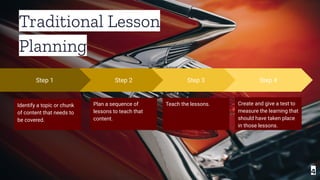
Traditional Lesson
Planning
4
Step 1
Identify a topic or chunk
of content that needs to
be covered.
Step 2
Plan a sequence of
lessons to teach that
content.
Step 3
Teach the lessons.
Step 4
Create and give a test to
measure the learning that
should have taken place
in those lessons.
Then
teachers
got
smarter.
5
1989
Stephen
Covey
The
7
Habits
of Highly Effective
People
Habit #2: Keeping
the
End
in
M
ind.
1998
W
iggins
&
M
cTighe
Understanding
by Design
Backw
ard
Planning
&
Design
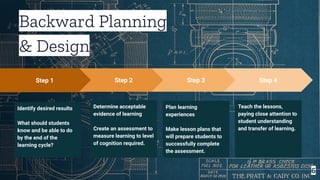
Backward Planning
& Design
6
Step 1
Identify desired results
What should students
know and be able to do
by the end of the
learning cycle?
Step 2
Determine acceptable
evidence of learning
Create an assessment to
measure learning to level
of cognition required.
Step 3
Plan learning
experiences
Make lesson plans that
will prepare students to
successfully complete
the assessment.
Step 4
Teach the lessons,
paying close attention to
student understanding
and transfer of learning.
Is the focus on
teaching or
learning in this
design
process?
2.
WHY do teachers use
backwards design?
Assessment time!
Come on, you know this.
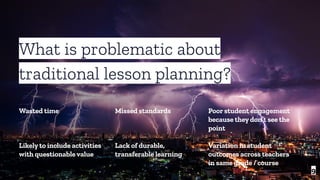
What is problematic about
traditional lesson planning?
9
Likely to include activities
with questionable value
Lack of durable,
transferable learning
Poor student engagement
because they don’t see the
point
Wasted time Missed standards
Variation in student
outcomes across teachers
in same grade / course
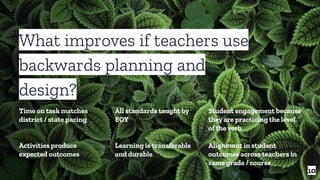
What improves if teachers use
backwards planning and
design?
10
Activities produce
expected outcomes
Learning is transferable
and durable
Student engagement because
they are practicing the level
of the verb
Time on task matches
district / state pacing
All standards taught by
EOY
Alignment in student
outcomes across teachers in
same grade / course
3.
HOW do you plan with
the end in mind?
Don’t worry. That’s why we hired
Instructional Coaches.
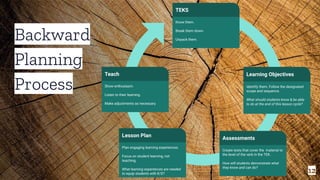
Backward
Planning
Process
12
Know them.
Break them down.
Unpack them.
TEKS
Show enthusiasm.
Listen to their learning.
Make adjustments as necessary.
Teach
Create tests that cover the material to
the level of the verb in the TEK.
How will students demonstrate what
they know and can do?
Assessments
Plan engaging learning experiences.
Focus on student learning, not
teaching.
What learning experiences are needed
to equip students with K/S?
Lesson Plan
Identify them. Follow the designated
scope and sequence.
What should students know & be able
to do at the end of this lesson cycle?
Learning Objectives
13
Collaborate
“Great discoveries and
improvements invariably involve
the cooperation of many minds.”
Alexander Graham Bell
5.
TEKS in a nutshell
Start from the beginning.
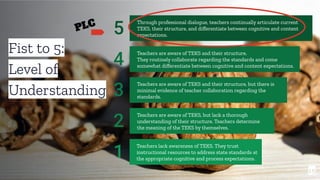
Fist to 5:
Level of
Understanding
15
5
Through professional dialogue, teachers continually articulate current
TEKS, their structure, and differentiate between cognitive and content
expectations.
4
Teachers are aware of TEKS and their structure.
They routinely collaborate regarding the standards and come
somewhat differentiate between cognitive and content expectations.

3
Teachers are aware of TEKS and their structure, but there is
minimal evidence of teacher collaboration regarding the
standards.
1
Teachers lack awareness of TEKS. They trust
instructional resources to address state standards at
the appropriate cognitive and process expectations.
2
Teachers are aware of TEKS, but lack a thorough
understanding of their structure. Teachers determine
the meaning of the TEKS by themselves.
PLC
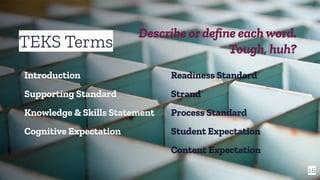
Introduction
TEKS Terms
16
Describe or define each word.
Tough, huh?
Supporting Standard
Knowledge & Skills Statement
Readiness Standard
Strand
Process Standard
Student Expectation
Cognitive Expectation
Content Expectation
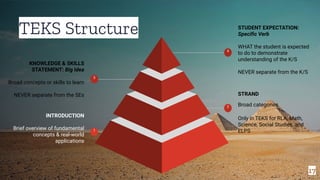
TEKS Structure
17
STRAND
Broad categories
Only in TEKS for RLA, Math,
Science, Social Studies, and
ELPS
2
INTRODUCTION
Brief overview of fundamental
concepts & real-world
applications
1
STUDENT EXPECTATION:
Specific Verb
WHAT the student is expected
to do to demonstrate
understanding of the K/S
NEVER separate from the K/S
4
KNOWLEDGE & SKILLS
STATEMENT: Big Idea
Broad concepts or skills to learn
NEVER separate from the SEs
3
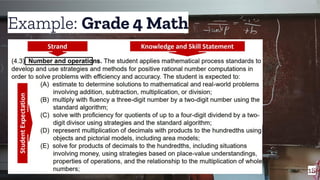
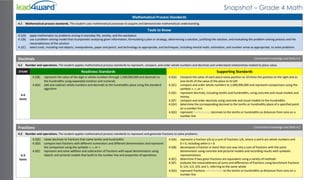
Example: Grade 4 Math
18
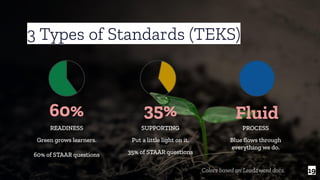
3 Types of Standards (TEKS)
19
60%
READINESS
Green grows learners.
60% of STAAR questions
35%
SUPPORTING
Put a little light on it.
35% of STAAR questions
PROCESS
Blue flows through
everything we do.
Fluid
Colors based on Lead4ward docs.
20
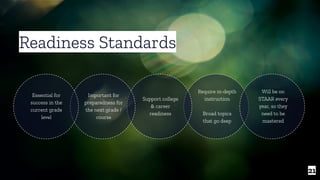
Readiness Standards
21
Require in-depth
instruction
Broad topics
that go deep
Support college
& career
readiness
Important for
preparedness for
the next grade /
course
Essential for
success in the
current grade
level
Will be on
STAAR every
year, so they
need to be
mastered
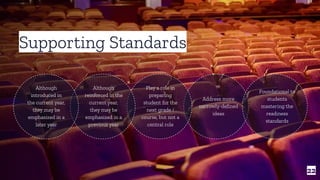
Supporting Standards
22
Address more
narrowly-defined
ideas
Play a role in
preparing
student for the
next grade /
course, but not a
central role
Although
reinforced in the
current year,
they may be
emphasized in a
previous year
Although
introduced in
the current year,
they may be
emphasized in a
later year
Foundational to
students
mastering the
readiness
standards
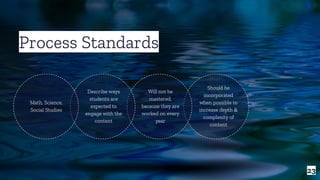
Process Standards
23
Should be
incorporated
when possible to
increase depth &
complexity of
content
Will not be
mastered,
because they are
worked on every
year
Describe ways
students are
expected to
engage with the
content
Math, Science,
Social Studies
24
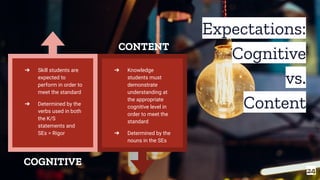
Expectations:
Cognitive
vs.
Content
➔ Skill students are
expected to
perform in order to
meet the standard
➔ Determined by the
verbs used in both
the K/S
statements and
SEs = Rigor
➔ Knowledge
students must
demonstrate
understanding at
the appropriate
cognitive level in
order to meet the
standard
➔ Determined by the
nouns in the SEs
COGNITIVE
CONTENT
5.
TEKS Breakdown
Sooooooooooo much to unpack.
26
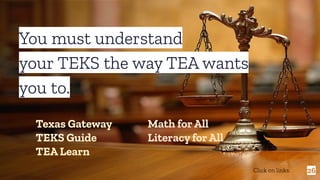
You must understand
your TEKS the way TEA wants
you to.
Texas Gateway
TEKS Guide
TEA Learn
Math forAll
Literacy forAll
Click on links.
27
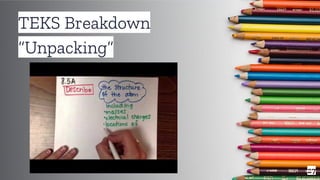
TEKS Breakdown
“Unpacking”
28
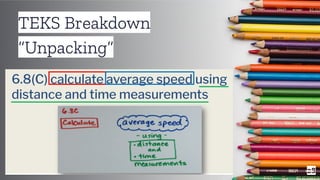
TEKS Breakdown
“Unpacking”
29
TEKS Breakdown
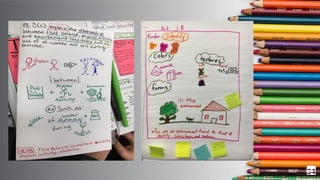
30
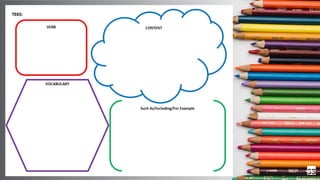
31
32
33
34
35
36
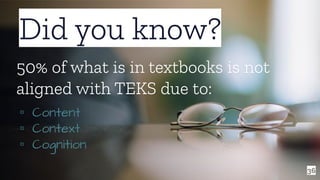
Did you know?
50% of what is in textbooks is not
aligned with TEKS due to:
▫ Content
▫ Context
▫ Cognition
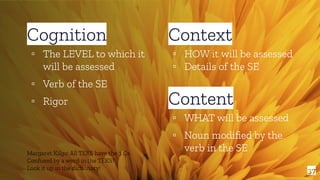
Content
▫ WHAT will be assessed
▫ Noun modified by the
verb in the SE
Context
▫ HOW it will be assessed
▫ Details of the SE
37
Cognition
▫ The LEVEL to which it
will be assessed
▫ Verb of the SE
▫ Rigor
Margaret Kilgo: All TEKS have the 3 Cs.
Confused by a word in the TEKS?
Look it up in the dictionary!
38
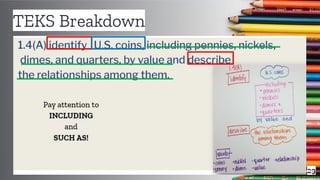
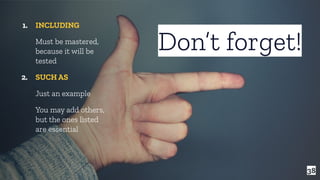
Don’t forget!
1. INCLUDING
Must be mastered,
because it will be
tested
2. SUCH AS
Just an example
You may add others,
but the ones listed
are essential
39
We can do this!
Questions? Comments? Profound statements?
Rachel Bounds
@EduBeautiful
40
Credits
Special thanks to all the people who made and
released these awesome resources for free:
▫ Presentation template by SlidesCarnival
▫ Photographs by Unsplash
▫ Some photos royalty free from Google Photos

Lesson Planning and TEKS.pdf

  • 1.
  • 2.
    2 Waste of Time? Whatdo you waste your time on when you’re lesson planning?
  • 3.
    1. WHAT is backwards design? Andhow is it different from what teachers have been doing?
  • 4.
    Traditional Lesson Planning 4 Step 1 Identifya topic or chunk of content that needs to be covered. Step 2 Plan a sequence of lessons to teach that content. Step 3 Teach the lessons. Step 4 Create and give a test to measure the learning that should have taken place in those lessons.
  • 5.
    Then teachers got smarter. 5 1989 Stephen Covey The 7 Habits of Highly Effective People Habit#2: Keeping the End in M ind. 1998 W iggins & M cTighe Understanding by Design Backw ard Planning & Design
  • 6.
    Backward Planning & Design 6 Step1 Identify desired results What should students know and be able to do by the end of the learning cycle? Step 2 Determine acceptable evidence of learning Create an assessment to measure learning to level of cognition required. Step 3 Plan learning experiences Make lesson plans that will prepare students to successfully complete the assessment. Step 4 Teach the lessons, paying close attention to student understanding and transfer of learning.
  • 7.
    Is the focuson teaching or learning in this design process?
  • 8.
    2. WHY do teachersuse backwards design? Assessment time! Come on, you know this.
  • 9.
    What is problematicabout traditional lesson planning? 9 Likely to include activities with questionable value Lack of durable, transferable learning Poor student engagement because they don’t see the point Wasted time Missed standards Variation in student outcomes across teachers in same grade / course
  • 10.
    What improves ifteachers use backwards planning and design? 10 Activities produce expected outcomes Learning is transferable and durable Student engagement because they are practicing the level of the verb Time on task matches district / state pacing All standards taught by EOY Alignment in student outcomes across teachers in same grade / course
  • 11.
    3. HOW do youplan with the end in mind? Don’t worry. That’s why we hired Instructional Coaches.
  • 12.
    Backward Planning Process 12 Know them. Break themdown. Unpack them. TEKS Show enthusiasm. Listen to their learning. Make adjustments as necessary. Teach Create tests that cover the material to the level of the verb in the TEK. How will students demonstrate what they know and can do? Assessments Plan engaging learning experiences. Focus on student learning, not teaching. What learning experiences are needed to equip students with K/S? Lesson Plan Identify them. Follow the designated scope and sequence. What should students know & be able to do at the end of this lesson cycle? Learning Objectives
  • 13.
    13 Collaborate “Great discoveries and improvementsinvariably involve the cooperation of many minds.” Alexander Graham Bell
  • 14.
    5. TEKS in anutshell Start from the beginning.
  • 15.
    Fist to 5: Levelof Understanding 15 5 Through professional dialogue, teachers continually articulate current TEKS, their structure, and differentiate between cognitive and content expectations. 4 Teachers are aware of TEKS and their structure. They routinely collaborate regarding the standards and come somewhat differentiate between cognitive and content expectations. 3 Teachers are aware of TEKS and their structure, but there is minimal evidence of teacher collaboration regarding the standards. 1 Teachers lack awareness of TEKS. They trust instructional resources to address state standards at the appropriate cognitive and process expectations. 2 Teachers are aware of TEKS, but lack a thorough understanding of their structure. Teachers determine the meaning of the TEKS by themselves. PLC

  • 16.
    Introduction TEKS Terms 16 Describe ordefine each word. Tough, huh? Supporting Standard Knowledge & Skills Statement Readiness Standard Strand Process Standard Student Expectation Cognitive Expectation Content Expectation
  • 17.
    TEKS Structure 17 STRAND Broad categories Onlyin TEKS for RLA, Math, Science, Social Studies, and ELPS 2 INTRODUCTION Brief overview of fundamental concepts & real-world applications 1 STUDENT EXPECTATION: Specific Verb WHAT the student is expected to do to demonstrate understanding of the K/S NEVER separate from the K/S 4 KNOWLEDGE & SKILLS STATEMENT: Big Idea Broad concepts or skills to learn NEVER separate from the SEs 3
  • 18.
  • 19.
    3 Types ofStandards (TEKS) 19 60% READINESS Green grows learners. 60% of STAAR questions 35% SUPPORTING Put a little light on it. 35% of STAAR questions PROCESS Blue flows through everything we do. Fluid Colors based on Lead4ward docs.
  • 20.
  • 21.
    Readiness Standards 21 Require in-depth instruction Broadtopics that go deep Support college & career readiness Important for preparedness for the next grade / course Essential for success in the current grade level Will be on STAAR every year, so they need to be mastered
  • 22.
    Supporting Standards 22 Address more narrowly-defined ideas Playa role in preparing student for the next grade / course, but not a central role Although reinforced in the current year, they may be emphasized in a previous year Although introduced in the current year, they may be emphasized in a later year Foundational to students mastering the readiness standards
  • 23.
    Process Standards 23 Should be incorporated whenpossible to increase depth & complexity of content Will not be mastered, because they are worked on every year Describe ways students are expected to engage with the content Math, Science, Social Studies
  • 24.
    24 Expectations: Cognitive vs. Content ➔ Skill studentsare expected to perform in order to meet the standard ➔ Determined by the verbs used in both the K/S statements and SEs = Rigor ➔ Knowledge students must demonstrate understanding at the appropriate cognitive level in order to meet the standard ➔ Determined by the nouns in the SEs COGNITIVE CONTENT
  • 25.
  • 26.
    26 You must understand yourTEKS the way TEA wants you to. Texas Gateway TEKS Guide TEA Learn Math forAll Literacy forAll Click on links.
  • 27.
  • 28.
  • 29.
  • 30.
  • 31.
  • 32.
  • 33.
  • 34.
  • 35.
  • 36.
    36 Did you know? 50%of what is in textbooks is not aligned with TEKS due to: ▫ Content ▫ Context ▫ Cognition
  • 37.
    Content ▫ WHAT willbe assessed ▫ Noun modified by the verb in the SE Context ▫ HOW it will be assessed ▫ Details of the SE 37 Cognition ▫ The LEVEL to which it will be assessed ▫ Verb of the SE ▫ Rigor Margaret Kilgo: All TEKS have the 3 Cs. Confused by a word in the TEKS? Look it up in the dictionary!
  • 38.
    38 Don’t forget! 1. INCLUDING Mustbe mastered, because it will be tested 2. SUCH AS Just an example You may add others, but the ones listed are essential
  • 39.
    39 We can dothis! Questions? Comments? Profound statements? Rachel Bounds @EduBeautiful
  • 40.
    40 Credits Special thanks toall the people who made and released these awesome resources for free: ▫ Presentation template by SlidesCarnival ▫ Photographs by Unsplash ▫ Some photos royalty free from Google Photos