DEVELOPING ENGLISH THROUGH ART ORIENTED ACTIVITIES
PRIMARY SCHOOL BELTINCI, SLOVENIA
TEACHER: TADEJA HALAS
LESSON PLAN: SENSES
Science through Art
RESOURCES:
LEVEL: LOWER SECONDARY LESSON NUMBER: 4
AGE OF STUDENTS: 13,14
UNIT: SENSES SUBUNIT: Science through Art
GENERAL GOALS:
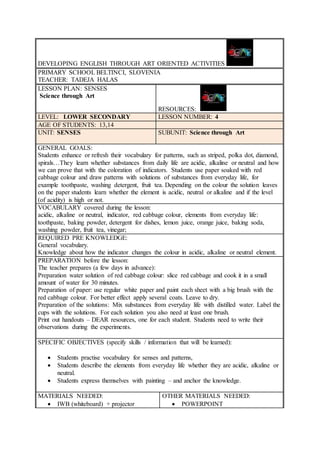
Students enhance or refresh their vocabulary for patterns, such as striped, polka dot, diamond,
spirals…They learn whether substances from daily life are acidic, alkaline or neutral and how
we can prove that with the coloration of indicators. Students use paper soaked with red
cabbage colour and draw patterns with solutions of substances from everyday life, for
example toothpaste, washing detergent, fruit tea. Depending on the colour the solution leaves
on the paper students learn whether the element is acidic, neutral or alkaline and if the level
(of acidity) is high or not.
VOCABULARY covered during the lesson:
acidic, alkaline or neutral, indicator, red cabbage colour, elements from everyday life:
toothpaste, baking powder, detergent for dishes, lemon juice, orange juice, baking soda,
washing powder, fruit tea, vinegar;
REQUIRED PRE KNOWLEDGE:
General vocabulary.
Knowledge about how the indicator changes the colour in acidic, alkaline or neutral element.
PREPARATION before the lesson:
The teacher prepares (a few days in advance):
Preparation water solution of red cabbage colour: slice red cabbage and cook it in a small
amount of water for 30 minutes.
Preparation of paper: use regular white paper and paint each sheet with a big brush with the
red cabbage colour. For better effect apply several coats. Leave to dry.
Preparation of the solutions: Mix substances from everyday life with distilled water. Label the
cups with the solutions. For each solution you also need at least one brush.
Print out handouts – DEAR resources, one for each student. Students need to write their
observations during the experiments.
SPECIFIC OBJECTIVES (specify skills / information that will be learned):
 Students practise vocabulary for senses and patterns,
 Students describe the elements from everyday life whether they are acidic, alkaline or
neutral.
 Students express themselves with painting – and anchor the knowledge.
MATERIALS NEEDED:
 IWB (whiteboard) + projector
OTHER MATERIALS NEEDED:
 POWERPOINT
 Computer with Wi-Fi connection – things from everyday life, patterns
 Video of the colouration of the
indicator
 Water solutions of substances from
everyday life: toothpaste, baking
powder, detergent for dishes or
washing powder, lemon juice, apple
juice, baking soda, washing powder,
fruit tea, vinegar;
 Paper soaked with red cabbage colour
 brushes;
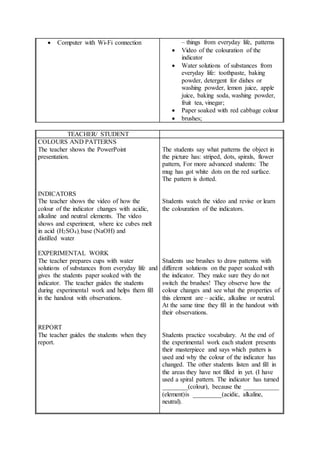
TEACHER/ STUDENT
COLOURS AND PATTERNS
The teacher shows the PowerPoint
presentation.
INDICATORS
The teacher shows the video of how the
colour of the indicator changes with acidic,
alkaline and neutral elements. The video
shows and experiment, where ice cubes melt
in acid (H2SO4), base (NaOH) and
distilled water
EXPERIMENTAL WORK
The teacher prepares cups with water
solutions of substances from everyday life and
gives the students paper soaked with the
indicator. The teacher guides the students
during experimental work and helps them fill
in the handout with observations.
REPORT
The teacher guides the students when they
report.
The students say what patterns the object in
the picture has: striped, dots, spirals, flower
pattern, For more advanced students: The
mug has got white dots on the red surface.
The pattern is dotted.
Students watch the video and revise or learn
the colouration of the indicators.
Students use brushes to draw patterns with
different solutions on the paper soaked with
the indicator. They make sure they do not
switch the brushes! They observe how the
colour changes and see what the properties of
this element are – acidic, alkaline or neutral.
At the same time they fill in the handout with
their observations.
Students practice vocabulary. At the end of
the experimental work each student presents
their masterpiece and says which patters is
used and why the colour of the indicator has
changed. The other students listen and fill in
the areas they have not filled in yet. (I have
used a spiral pattern. The indicator has turned
________(colour), because the ___________
(element)is _________(acidic, alkaline,
neutral).
Lesson plan lower_secondary_senses_lesson_4

Lesson plan lower_secondary_senses_lesson_4

  • 1.
    DEVELOPING ENGLISH THROUGHART ORIENTED ACTIVITIES PRIMARY SCHOOL BELTINCI, SLOVENIA TEACHER: TADEJA HALAS LESSON PLAN: SENSES Science through Art RESOURCES: LEVEL: LOWER SECONDARY LESSON NUMBER: 4 AGE OF STUDENTS: 13,14 UNIT: SENSES SUBUNIT: Science through Art GENERAL GOALS: Students enhance or refresh their vocabulary for patterns, such as striped, polka dot, diamond, spirals…They learn whether substances from daily life are acidic, alkaline or neutral and how we can prove that with the coloration of indicators. Students use paper soaked with red cabbage colour and draw patterns with solutions of substances from everyday life, for example toothpaste, washing detergent, fruit tea. Depending on the colour the solution leaves on the paper students learn whether the element is acidic, neutral or alkaline and if the level (of acidity) is high or not. VOCABULARY covered during the lesson: acidic, alkaline or neutral, indicator, red cabbage colour, elements from everyday life: toothpaste, baking powder, detergent for dishes, lemon juice, orange juice, baking soda, washing powder, fruit tea, vinegar; REQUIRED PRE KNOWLEDGE: General vocabulary. Knowledge about how the indicator changes the colour in acidic, alkaline or neutral element. PREPARATION before the lesson: The teacher prepares (a few days in advance): Preparation water solution of red cabbage colour: slice red cabbage and cook it in a small amount of water for 30 minutes. Preparation of paper: use regular white paper and paint each sheet with a big brush with the red cabbage colour. For better effect apply several coats. Leave to dry. Preparation of the solutions: Mix substances from everyday life with distilled water. Label the cups with the solutions. For each solution you also need at least one brush. Print out handouts – DEAR resources, one for each student. Students need to write their observations during the experiments. SPECIFIC OBJECTIVES (specify skills / information that will be learned):  Students practise vocabulary for senses and patterns,  Students describe the elements from everyday life whether they are acidic, alkaline or neutral.  Students express themselves with painting – and anchor the knowledge. MATERIALS NEEDED:  IWB (whiteboard) + projector OTHER MATERIALS NEEDED:  POWERPOINT
  • 2.
     Computer withWi-Fi connection – things from everyday life, patterns  Video of the colouration of the indicator  Water solutions of substances from everyday life: toothpaste, baking powder, detergent for dishes or washing powder, lemon juice, apple juice, baking soda, washing powder, fruit tea, vinegar;  Paper soaked with red cabbage colour  brushes; TEACHER/ STUDENT COLOURS AND PATTERNS The teacher shows the PowerPoint presentation. INDICATORS The teacher shows the video of how the colour of the indicator changes with acidic, alkaline and neutral elements. The video shows and experiment, where ice cubes melt in acid (H2SO4), base (NaOH) and distilled water EXPERIMENTAL WORK The teacher prepares cups with water solutions of substances from everyday life and gives the students paper soaked with the indicator. The teacher guides the students during experimental work and helps them fill in the handout with observations. REPORT The teacher guides the students when they report. The students say what patterns the object in the picture has: striped, dots, spirals, flower pattern, For more advanced students: The mug has got white dots on the red surface. The pattern is dotted. Students watch the video and revise or learn the colouration of the indicators. Students use brushes to draw patterns with different solutions on the paper soaked with the indicator. They make sure they do not switch the brushes! They observe how the colour changes and see what the properties of this element are – acidic, alkaline or neutral. At the same time they fill in the handout with their observations. Students practice vocabulary. At the end of the experimental work each student presents their masterpiece and says which patters is used and why the colour of the indicator has changed. The other students listen and fill in the areas they have not filled in yet. (I have used a spiral pattern. The indicator has turned ________(colour), because the ___________ (element)is _________(acidic, alkaline, neutral).