I.F.D.C. LENGUAS VIVAS
TALLER DE PRÁCTICA DOCENTE
Tutora: Aurelia Velázquez
ALUMNO RESIDENTE: Paula Pilotti
Período de Práctica: Nivel secundario
Institución Educativa: Instituto Privado Gustavo Martínez Zuviría
Dirección: Roca y Saenz Peña
Sala / Grado / Año - sección: 3ro sección A
Cantidad de alumnos: 29
Nivel lingüístico del curso: Pre - Intermedio
Tipo de Planificación: Clase
Unidad Temática: “Feelings”
Clase Nº: 1
Fecha: 16/08/18
Hora: 7.30 a 8.50 hs
Duración de la clase: 80´
Fecha de primera entrega: 10/08/18
· Teaching points: “zero conditional”
· Revision: Feelings (angry, sad, happy)
· Aims or goals:
During this lesson, learners will be able to…
- Identify and use “0 conditional”.
- Develop their reading skill by answering questions from a
reading activity.
- To deepen their understanding on feelings.
• Language focus:
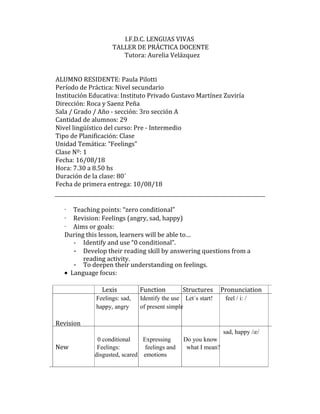
Lexis Function Structures Pronunciation
Feelings: sad, Identify the use Let´s start! feel / i: /
happy, angry of present simple
Revision
sad, happy /æ/
0 conditional Expressing Do you know
New Feelings: feelings and what I mean?
disgusted, scared emotions
• Teaching approach: The lesson is based on the Communicative
Approach and PPP. The class is aimed at making students use the
new lexis applying it describing how they feel in different
situations.
· Integration of skills: The lesson will integrate listening, speaking,
reading and writing skills.
· Materials and resources: Pictures, a computer, loudspeakers, a
board, projector, a video, copies.
· Pedagogical use of ICT in class or at home: In this lesson, a video
will be used to support the exposure to the teaching point.
· Seating arrangement: Students will sit in pairs and at a moment
they will form groups of 6 since they are allowed to move.
· Assessment: what will be assessed and how: I will check that
students comprehend and identify the use of “0 conditional” by
making sentences and different kind of activities. I will provide
them with the necessary input and I will encourage them to
produce the chunks of language I am teaching.
Lesson 1
Routine: 5/7´
Purpose: to start the lesson, get students into mood for work and
establish rapport.
I´ll get into the classroom and greet students: “Hello! How are you
today?” EA: “Hello, fine!”
I will explain that I will be their teacher for some lessons and I will write
my name on the board and the date. Then, I will ask them to write their
names on a piece of paper, so I can call them by their names without
problem.
Transition: Nice to meet all of you! Let´s know each other better!
Warm-up 10´:
Purpose: to introduce the topic and teaching points.
In order to have a visual representation about feelings, we will watch a
short video that clearly expresses them. New vocabulary is presented to
animated examples such as DISGUSTED and SCARED.
Link: https://www.youtube.com/watch?v=dOkyKyVFnSs
“I will invite you to watch a video about feelings! Let´s revise some points!”
The students will be sitting on their seats in pairs as usual. They will
watch the video once, and then I will ask about disgusted and scared
meaning to check comprehension. If they don´t understand the meaning,
I will use gestures.
Transition: Good! Go on working together!
Presentation 15´:
Purpose: to further exposure the learners to the target language, to
foster comprehension of images/pictures.
I will show students some pictures related to feelings and at the same
time I will say “0 conditional” sentences to introduce the topic.
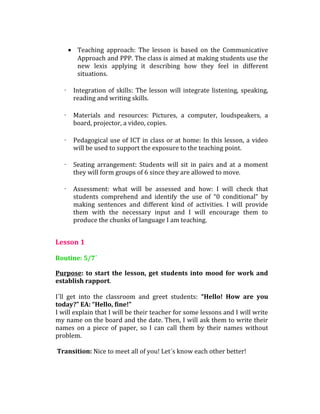
If I have an exam, I am nervous.
If I pass my exam, I am happy.
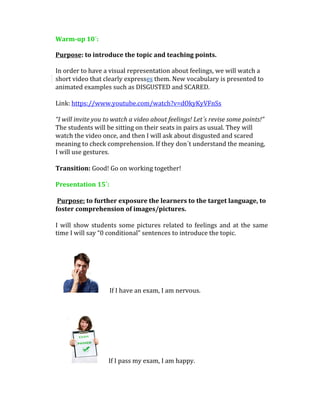
If I go on holidays, I feel relaxed.
If I have a health problem, I feel sad.
If someone says lies, I feel angry.
“What makes you nervous/happy/relaxed/sad/angry?” I will choose
some volunteers to talk about their feelings and give examples.
Transition: “Very well done, nice topic”
Development
ACTIVITY 1 - 20’
Purpose: this activity is aimed at fostering contextualized practice
of the teaching points.
I will form groups of 6 students. I will give each group a copy to complete.
They will debate with their mates the correct answer and they will write
it down. Then, we will compare the answers with the rest of the groups
to listen to the different ideas.
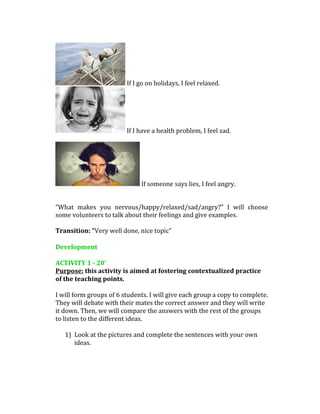
1) Look at the pictures and complete the sentences with your own
ideas.
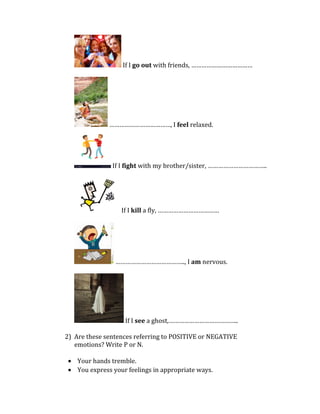
If I go out with friends, ………………………………
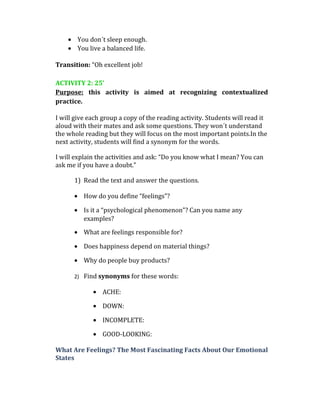
………………………………, I feel relaxed.
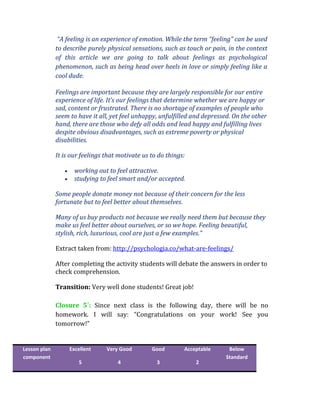
If I fight with my brother/sister, ……………………………..
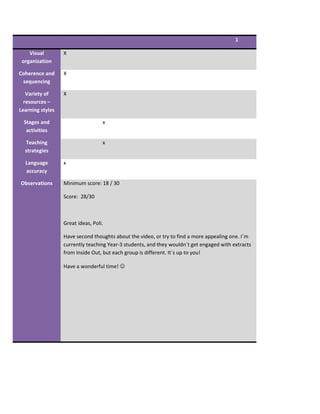
If I kill a fly, ………………………………
………………………………….., I am nervous.
If I see a ghost,…………………………………..
2) Are these sentences referring to POSITIVE or NEGATIVE
emotions? Write P or N.
• Your hands tremble.
• You express your feelings in appropriate ways.
• You don´t sleep enough.
• You live a balanced life.
Transition: “Oh excellent job!
ACTIVITY 2: 25’
Purpose: this activity is aimed at recognizing contextualized
practice.
I will give each group a copy of the reading activity. Students will read it
aloud with their mates and ask some questions. They won´t understand
the whole reading but they will focus on the most important points.In the
next activity, students will find a synonym for the words.
I will explain the activities and ask: “Do you know what I mean? You can
ask me if you have a doubt.”
1) Read the text and answer the questions.
• How do you define “feelings”?
• Is it a “psychological phenomenon”? Can you name any
examples?
• What are feelings responsible for?
• Does happiness depend on material things?
• Why do people buy products?
2) Find synonyms for these words:
• ACHE:
• DOWN:
• INCOMPLETE:
• GOOD-LOOKING:
What Are Feelings? The Most Fascinating Facts About Our Emotional
States
“A feeling is an experience of emotion. While the term “feeling” can be used
to describe purely physical sensations, such as touch or pain, in the context
of this article we are going to talk about feelings as psychological
phenomenon, such as being head over heels in love or simply feeling like a
cool dude.
Feelings are important because they are largely responsible for our entire
experience of life. It’s our feelings that determine whether we are happy or
sad, content or frustrated. There is no shortage of examples of people who
seem to have it all, yet feel unhappy, unfulfilled and depressed. On the other
hand, there are those who defy all odds and lead happy and fulfilling lives
despite obvious disadvantages, such as extreme poverty or physical
disabilities.
It is our feelings that motivate us to do things:
• working out to feel attractive.
• studying to feel smart and/or accepted.
Some people donate money not because of their concern for the less
fortunate but to feel better about themselves.
Many of us buy products not because we really need them but because they
make us feel better about ourselves, or so we hope. Feeling beautiful,
stylish, rich, luxurious, cool are just a few examples.”
Extract taken from: http://psychologia.co/what-are-feelings/
After completing the activity students will debate the answers in order to
check comprehension.
Transition: Very well done students! Great job!
Closure 5´: Since next class is the following day, there will be no
homework. I will say: “Congratulations on your work! See you
tomorrow!”
Lesson plan
component
Excellent
5
Very Good
4
Good
3
Acceptable
2
Below
Standard
1
Visual
organization
X
Coherence and
sequencing
X
Variety of
resources –
Learning styles
X
Stages and
activities
x
Teaching
strategies
x
Language
accuracy
x
Observations Minimum score: 18 / 30
Score: 28/30
Great ideas, Poli.
Have second thoughts about the video, or try to find a more appealing one. I´m
currently teaching Year-3 students, and they wouldn´t get engaged with extracts
from Inside Out, but each group is different. It´s up to you!
Have a wonderful time! 
Lesson plan 1
Lesson plan 1

Lesson plan 1

  • 1.
    I.F.D.C. LENGUAS VIVAS TALLERDE PRÁCTICA DOCENTE Tutora: Aurelia Velázquez ALUMNO RESIDENTE: Paula Pilotti Período de Práctica: Nivel secundario Institución Educativa: Instituto Privado Gustavo Martínez Zuviría Dirección: Roca y Saenz Peña Sala / Grado / Año - sección: 3ro sección A Cantidad de alumnos: 29 Nivel lingüístico del curso: Pre - Intermedio Tipo de Planificación: Clase Unidad Temática: “Feelings” Clase Nº: 1 Fecha: 16/08/18 Hora: 7.30 a 8.50 hs Duración de la clase: 80´ Fecha de primera entrega: 10/08/18 · Teaching points: “zero conditional” · Revision: Feelings (angry, sad, happy) · Aims or goals: During this lesson, learners will be able to… - Identify and use “0 conditional”. - Develop their reading skill by answering questions from a reading activity. - To deepen their understanding on feelings. • Language focus: Lexis Function Structures Pronunciation Feelings: sad, Identify the use Let´s start! feel / i: / happy, angry of present simple Revision sad, happy /æ/ 0 conditional Expressing Do you know New Feelings: feelings and what I mean? disgusted, scared emotions
  • 2.
    • Teaching approach:The lesson is based on the Communicative Approach and PPP. The class is aimed at making students use the new lexis applying it describing how they feel in different situations. · Integration of skills: The lesson will integrate listening, speaking, reading and writing skills. · Materials and resources: Pictures, a computer, loudspeakers, a board, projector, a video, copies. · Pedagogical use of ICT in class or at home: In this lesson, a video will be used to support the exposure to the teaching point. · Seating arrangement: Students will sit in pairs and at a moment they will form groups of 6 since they are allowed to move. · Assessment: what will be assessed and how: I will check that students comprehend and identify the use of “0 conditional” by making sentences and different kind of activities. I will provide them with the necessary input and I will encourage them to produce the chunks of language I am teaching. Lesson 1 Routine: 5/7´ Purpose: to start the lesson, get students into mood for work and establish rapport. I´ll get into the classroom and greet students: “Hello! How are you today?” EA: “Hello, fine!” I will explain that I will be their teacher for some lessons and I will write my name on the board and the date. Then, I will ask them to write their names on a piece of paper, so I can call them by their names without problem. Transition: Nice to meet all of you! Let´s know each other better!
  • 3.
    Warm-up 10´: Purpose: tointroduce the topic and teaching points. In order to have a visual representation about feelings, we will watch a short video that clearly expresses them. New vocabulary is presented to animated examples such as DISGUSTED and SCARED. Link: https://www.youtube.com/watch?v=dOkyKyVFnSs “I will invite you to watch a video about feelings! Let´s revise some points!” The students will be sitting on their seats in pairs as usual. They will watch the video once, and then I will ask about disgusted and scared meaning to check comprehension. If they don´t understand the meaning, I will use gestures. Transition: Good! Go on working together! Presentation 15´: Purpose: to further exposure the learners to the target language, to foster comprehension of images/pictures. I will show students some pictures related to feelings and at the same time I will say “0 conditional” sentences to introduce the topic. If I have an exam, I am nervous. If I pass my exam, I am happy.
  • 4.
    If I goon holidays, I feel relaxed. If I have a health problem, I feel sad. If someone says lies, I feel angry. “What makes you nervous/happy/relaxed/sad/angry?” I will choose some volunteers to talk about their feelings and give examples. Transition: “Very well done, nice topic” Development ACTIVITY 1 - 20’ Purpose: this activity is aimed at fostering contextualized practice of the teaching points. I will form groups of 6 students. I will give each group a copy to complete. They will debate with their mates the correct answer and they will write it down. Then, we will compare the answers with the rest of the groups to listen to the different ideas. 1) Look at the pictures and complete the sentences with your own ideas.
  • 5.
    If I goout with friends, ……………………………… ………………………………, I feel relaxed. If I fight with my brother/sister, …………………………….. If I kill a fly, ……………………………… ………………………………….., I am nervous. If I see a ghost,………………………………….. 2) Are these sentences referring to POSITIVE or NEGATIVE emotions? Write P or N. • Your hands tremble. • You express your feelings in appropriate ways.
  • 6.
    • You don´tsleep enough. • You live a balanced life. Transition: “Oh excellent job! ACTIVITY 2: 25’ Purpose: this activity is aimed at recognizing contextualized practice. I will give each group a copy of the reading activity. Students will read it aloud with their mates and ask some questions. They won´t understand the whole reading but they will focus on the most important points.In the next activity, students will find a synonym for the words. I will explain the activities and ask: “Do you know what I mean? You can ask me if you have a doubt.” 1) Read the text and answer the questions. • How do you define “feelings”? • Is it a “psychological phenomenon”? Can you name any examples? • What are feelings responsible for? • Does happiness depend on material things? • Why do people buy products? 2) Find synonyms for these words: • ACHE: • DOWN: • INCOMPLETE: • GOOD-LOOKING: What Are Feelings? The Most Fascinating Facts About Our Emotional States
  • 7.
    “A feeling isan experience of emotion. While the term “feeling” can be used to describe purely physical sensations, such as touch or pain, in the context of this article we are going to talk about feelings as psychological phenomenon, such as being head over heels in love or simply feeling like a cool dude. Feelings are important because they are largely responsible for our entire experience of life. It’s our feelings that determine whether we are happy or sad, content or frustrated. There is no shortage of examples of people who seem to have it all, yet feel unhappy, unfulfilled and depressed. On the other hand, there are those who defy all odds and lead happy and fulfilling lives despite obvious disadvantages, such as extreme poverty or physical disabilities. It is our feelings that motivate us to do things: • working out to feel attractive. • studying to feel smart and/or accepted. Some people donate money not because of their concern for the less fortunate but to feel better about themselves. Many of us buy products not because we really need them but because they make us feel better about ourselves, or so we hope. Feeling beautiful, stylish, rich, luxurious, cool are just a few examples.” Extract taken from: http://psychologia.co/what-are-feelings/ After completing the activity students will debate the answers in order to check comprehension. Transition: Very well done students! Great job! Closure 5´: Since next class is the following day, there will be no homework. I will say: “Congratulations on your work! See you tomorrow!” Lesson plan component Excellent 5 Very Good 4 Good 3 Acceptable 2 Below Standard
  • 8.
    1 Visual organization X Coherence and sequencing X Variety of resources– Learning styles X Stages and activities x Teaching strategies x Language accuracy x Observations Minimum score: 18 / 30 Score: 28/30 Great ideas, Poli. Have second thoughts about the video, or try to find a more appealing one. I´m currently teaching Year-3 students, and they wouldn´t get engaged with extracts from Inside Out, but each group is different. It´s up to you! Have a wonderful time! 