CONSCIENCE
Various notions of Conscience
• Feeling of guilt, worry, dissatisfaction,
restlessness or a feeling of “hiya” when they
do something wrong.
• Sincerity: to be “true to one’s self”: “I can
do anything as long as it does not hurt
anybody”
• What “authorities” tell them to do: the laws
of the government, the Church, the parents,
the “barkada.”
THE SUBJECTIVE NORM OF
MORALITY
CONSCIENCE
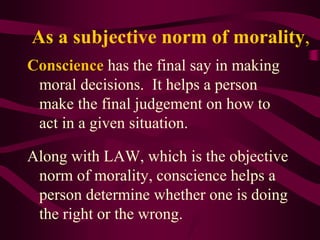
As a subjective norm of morality,
Conscience has the final say in making
moral decisions. It helps a person
make the final judgement on how to
act in a given situation.
Along with LAW, which is the objective
norm of morality, conscience helps a
person determine whether one is doing
the right or the wrong.
CONSCIENCE
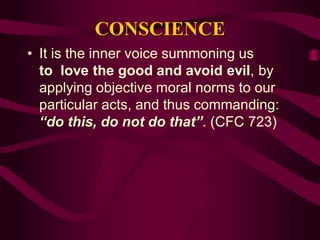
• It is the inner voice summoning us
to love the good and avoid evil, by
applying objective moral norms to our
particular acts, and thus commanding:
“do this, do not do that”. (CFC 723)
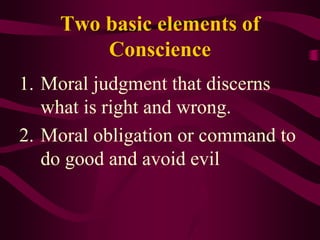
Two basic elements of
Conscience
1. Moral judgment that discerns
what is right and wrong.
2. Moral obligation or command to
do good and avoid evil
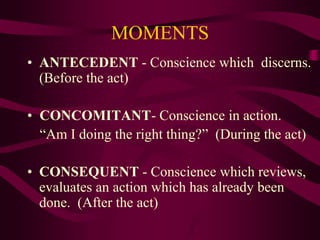
MOMENTS
• ANTECEDENT - Conscience which discerns.
(Before the act)
• CONCOMITANT- Conscience in action.
“Am I doing the right thing?” (During the act)
• CONSEQUENT - Conscience which reviews,
evaluates an action which has already been
done. (After the act)
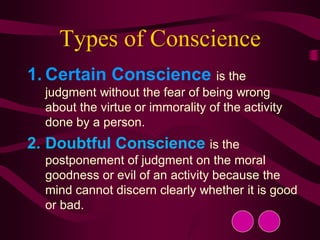
Types of Conscience
1. Certain Conscience is the
judgment without the fear of being wrong
about the virtue or immorality of the activity
done by a person.
2. Doubtful Conscience is the
postponement of judgment on the moral
goodness or evil of an activity because the
mind cannot discern clearly whether it is good
or bad.
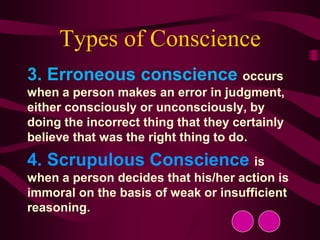
Types of Conscience
3. Erroneous conscience occurs
when a person makes an error in judgment,
either consciously or unconsciously, by
doing the incorrect thing that they certainly
believe that was the right thing to do.
4. Scrupulous Conscience is
when a person decides that his/her action is
immoral on the basis of weak or insufficient
reasoning.
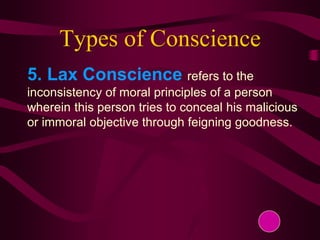
Types of Conscience
5. Lax Conscience refers to the
inconsistency of moral principles of a person
wherein this person tries to conceal his malicious
or immoral objective through feigning goodness.
Certain Conscience
• An example of this is when a girl
who accidentally got pregnant,
wanting to abort the baby but it is
against her conscience and against
the law.
• This type of conscience is in
congruence with the moral law.
Doubtful Conscience
• An example of doubtful conscience is
when you decide to cheat on your
exams because you were not able to
review or try your best to take the exam
without cheating even if it results to
failure.
• With this type of conscience, a person
cannot decide whether an act is right or
wrong.
Erroneous conscience
• An example of Erroneous
Conscience is when you accuse
one of your classmates that they
stole your wallet but when you went
home, your wallet was on your bed.
• With this type of conscience, a
person is not aware or is ignorant
that what he has done is wrong.
Scrupulous Conscience
• An example of scrupulous consciences is
when a person at the grocery gave P100.00 to
the cashier for a P88.00 worth of purchase
grocery supplies. However, because the
cashier is in a hurry, instead of P12 pesos
change, she erroneously gave P15.
• The person is in dilemma whether to tell the
cashier and bring back the P3 pesos or to
keep it instead. In the end, this person gave
back the P3 change because of his
scrupulous conscience.
Lax Conscience
• An example of lax conscience is when
you volunteer to help in repacking good
for the people in your community but is
actually keeping the goods for yourself.
• A person’s immorality is masked by
moral actions.

conscience.pdf powerpoint presentation in values ed

  • 1.
  • 2.
    Various notions ofConscience • Feeling of guilt, worry, dissatisfaction, restlessness or a feeling of “hiya” when they do something wrong. • Sincerity: to be “true to one’s self”: “I can do anything as long as it does not hurt anybody” • What “authorities” tell them to do: the laws of the government, the Church, the parents, the “barkada.”
  • 3.
    THE SUBJECTIVE NORMOF MORALITY CONSCIENCE
  • 5.
    As a subjectivenorm of morality, Conscience has the final say in making moral decisions. It helps a person make the final judgement on how to act in a given situation. Along with LAW, which is the objective norm of morality, conscience helps a person determine whether one is doing the right or the wrong.
  • 6.
    CONSCIENCE • It isthe inner voice summoning us to love the good and avoid evil, by applying objective moral norms to our particular acts, and thus commanding: “do this, do not do that”. (CFC 723)
  • 7.
    Two basic elementsof Conscience 1. Moral judgment that discerns what is right and wrong. 2. Moral obligation or command to do good and avoid evil
  • 8.
    MOMENTS • ANTECEDENT -Conscience which discerns. (Before the act) • CONCOMITANT- Conscience in action. “Am I doing the right thing?” (During the act) • CONSEQUENT - Conscience which reviews, evaluates an action which has already been done. (After the act)
  • 9.
    Types of Conscience 1.Certain Conscience is the judgment without the fear of being wrong about the virtue or immorality of the activity done by a person. 2. Doubtful Conscience is the postponement of judgment on the moral goodness or evil of an activity because the mind cannot discern clearly whether it is good or bad.
  • 10.
    Types of Conscience 3.Erroneous conscience occurs when a person makes an error in judgment, either consciously or unconsciously, by doing the incorrect thing that they certainly believe that was the right thing to do. 4. Scrupulous Conscience is when a person decides that his/her action is immoral on the basis of weak or insufficient reasoning.
  • 11.
    Types of Conscience 5.Lax Conscience refers to the inconsistency of moral principles of a person wherein this person tries to conceal his malicious or immoral objective through feigning goodness.
  • 13.
    Certain Conscience • Anexample of this is when a girl who accidentally got pregnant, wanting to abort the baby but it is against her conscience and against the law. • This type of conscience is in congruence with the moral law.
  • 14.
    Doubtful Conscience • Anexample of doubtful conscience is when you decide to cheat on your exams because you were not able to review or try your best to take the exam without cheating even if it results to failure. • With this type of conscience, a person cannot decide whether an act is right or wrong.
  • 15.
    Erroneous conscience • Anexample of Erroneous Conscience is when you accuse one of your classmates that they stole your wallet but when you went home, your wallet was on your bed. • With this type of conscience, a person is not aware or is ignorant that what he has done is wrong.
  • 16.
    Scrupulous Conscience • Anexample of scrupulous consciences is when a person at the grocery gave P100.00 to the cashier for a P88.00 worth of purchase grocery supplies. However, because the cashier is in a hurry, instead of P12 pesos change, she erroneously gave P15. • The person is in dilemma whether to tell the cashier and bring back the P3 pesos or to keep it instead. In the end, this person gave back the P3 change because of his scrupulous conscience.
  • 17.
    Lax Conscience • Anexample of lax conscience is when you volunteer to help in repacking good for the people in your community but is actually keeping the goods for yourself. • A person’s immorality is masked by moral actions.