Concept: Introduction toFunctions
EQ: How do we interpret and represent
functions using function notation?
(F.IF.2)
Vocabulary: Function notation, f(x),
Domain, Range
Lesson 3.2 – Function Notation
2.
Activating Strategy
Do youhave a nickname? If so,
raise your hand to share it with us.
How do you think a nickname and
function notation are related?
3.
Introduction
Recall that ina function, every element
of the domain is paired with exactly one
element of the range. That is, for every
value of x, there is exactly one value of y.
Today, we will learn about Function
notation.
4.
Introduction, continued
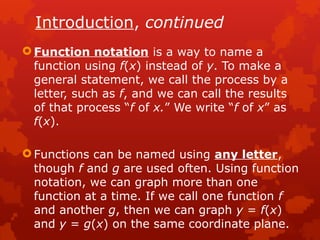
Function notationis a way to name a
function using f(x) instead of y. To make a
general statement, we call the process by a
letter, such as f, and we can call the results
of that process “f of x.” We write “f of x” as
f(x).
Functions can be named using any letter,
though f and g are used often. Using function
notation, we can graph more than one
function at a time. If we call one function f
and another g, then we can graph y = f(x)
and y = g(x) on the same coordinate plane.
5.
Key Concepts
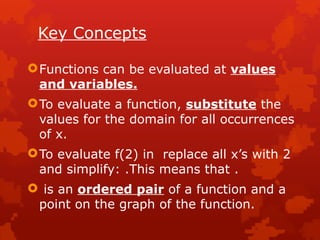
Functions canbe evaluated at values
and variables.
To evaluate a function, substitute the
values for the domain for all occurrences
of x.
To evaluate f(2) in replace all x’s with 2
and simplify: .This means that .
is an ordered pair of a function and a
point on the graph of the function.
6.
Key Concepts, continued
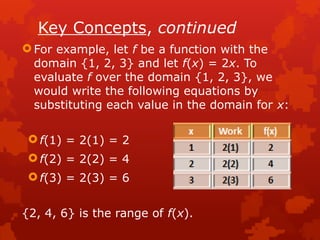
Forexample, let f be a function with the
domain {1, 2, 3} and let f(x) = 2x. To
evaluate f over the domain {1, 2, 3}, we
would write the following equations by
substituting each value in the domain for x:
f(1) = 2(1) = 2
f(2) = 2(2) = 4
f(3) = 2(3) = 6
{2, 4, 6} is the range of f(x).
7.
Steps for EvaluatingFunctions
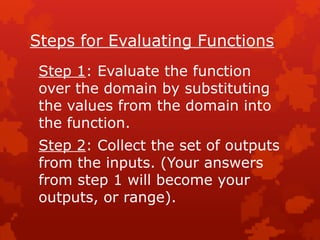
Step 1: Evaluate the function
over the domain by substituting
the values from the domain into
the function.
Step 2: Collect the set of outputs
from the inputs. (Your answers
from step 1 will become your
outputs, or range).
8.
Example 1:
Evaluate overthe domain .
What is the range?
To evaluate over the domain ,
substitute the values from the
domain into .
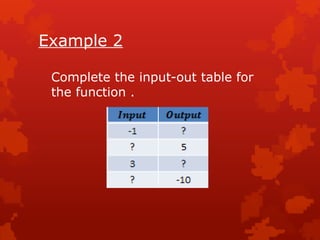
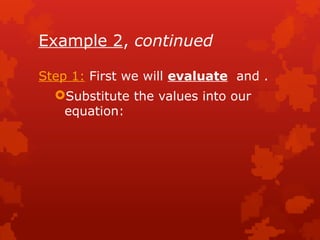
Example 2, continued
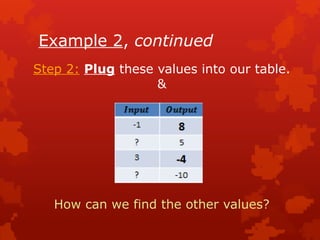
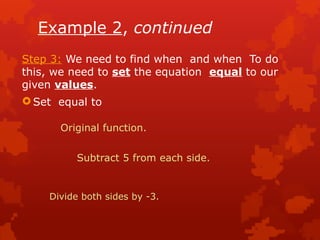
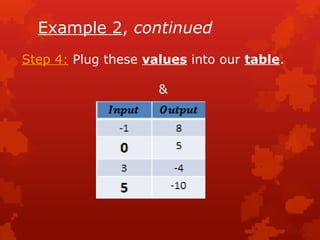
Step3: We need to find when and when To do
this, we need to set the equation equal to our
given values.
Set equal to
Original function.
Subtract 5 from each side.
Divide both sides by -3.
18.
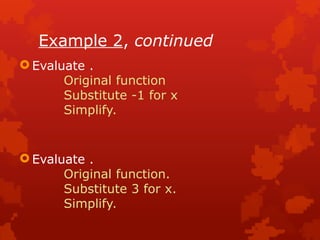
Example 2, continued
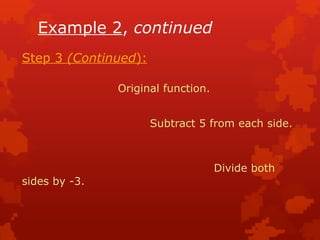
Step3 (Continued):
Original function.
Subtract 5 from each side.
Divide both
sides by -3.
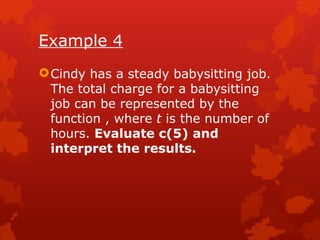
Example 4
Cindy hasa steady babysitting job.
The total charge for a babysitting
job can be represented by the
function , where t is the number of
hours. Evaluate c(5) and
interpret the results.
24.
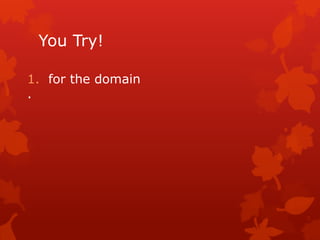
You Try!
4. Thelocal Italian restaurant has had a
steady increase in customers and is,
therefore, hiring people at a steady rate.
The function of the increase in employees
is , where x is in months. Evaluate and
interpret the results.
25.
Summary: 3-2-1
List 3main things you know
about function notation,
give 2 examples of function
notation, and 1 question
you have about function
notation.
Editor's Notes
#2 Ask students if they have a nickname. Go around the room and ask for their nickname. Emphasize the fact that either name, they are the same person.
-Well, it’s the same with the variable ‘y’. ‘y’ has a nickname….f(x), g(x), h(x), and any other letter(x). This is called ‘Function Notation’. The reason why this is done is to distinguish a relation from a function. Not every equation is a function. By using f(x), we are simply being more specific about an equation that it’s a function. It’s also done to be helpful when identifying several functions on the same coordinate grid.