Intermediate Accounting Stice19th Edition
Solutions Manual download
https://testbankmall.com/product/intermediate-accounting-
stice-19th-edition-solutions-manual/
Find test banks or solution manuals at testbankmall.com today!
2.
Here are somerecommended products for you. Click the link to
download, or explore more at testbankmall.com
Intermediate Accounting Stice 19th Edition Test Bank
https://testbankmall.com/product/intermediate-accounting-stice-19th-
edition-test-bank/
Solution Manual for Intermediate Accounting, 19th Edition,
Earl K. Stice James D. Stice
https://testbankmall.com/product/solution-manual-for-intermediate-
accounting-19th-edition-earl-k-stice-james-d-stice/
Test Bank for Intermediate Accounting, 19th Edition, Earl
K. Stice, James D. Stice
https://testbankmall.com/product/test-bank-for-intermediate-
accounting-19th-edition-earl-k-stice-james-d-stice/
Test Bank for Environment The Science Behind the Stories,
4th Edition : Withgott
https://testbankmall.com/product/test-bank-for-environment-the-
science-behind-the-stories-4th-edition-withgott/
3.
Test Bank forFundamentals of Taxation 2020 Edition, 13th
Edition, Ana Cruz, Michael Deschamps, Frederick Niswander,
Debra Prendergast, Dan Schisler
https://testbankmall.com/product/test-bank-for-fundamentals-of-
taxation-2020-edition-13th-edition-ana-cruz-michael-deschamps-
frederick-niswander-debra-prendergast-dan-schisler/
Federal Taxation 2013 Pratt 7th Edition Solutions Manual
https://testbankmall.com/product/federal-taxation-2013-pratt-7th-
edition-solutions-manual/
Solutions Manual to accompany CMOS VLSI Design 3rd edition
9780321149015
https://testbankmall.com/product/solutions-manual-to-accompany-cmos-
vlsi-design-3rd-edition-9780321149015/
Test Bank for The Economics of Money, Banking and
Financial Markets: The Business School Edition, 3/E
Frederic S. Mishkin
https://testbankmall.com/product/test-bank-for-the-economics-of-money-
banking-and-financial-markets-the-business-school-
edition-3-e-frederic-s-mishkin/
Test Bank for Police Administration Structures Processes
and Behavior 8th Edition Charles R Swanson Download
https://testbankmall.com/product/test-bank-for-police-administration-
structures-processes-and-behavior-8th-edition-charles-r-swanson-
download/
4.
Test bank forFinancial and Managerial Accounting 3rd
Edition by Weygandt
https://testbankmall.com/product/test-bank-for-financial-and-
managerial-accounting-3rd-edition-by-weygandt/
5.
2-2 Chapter 2A Review of the Accounting Cycle
2-16
• In the past, many companies used manual systems to record, classify,
summarize, and report accounting data.
• Today, most companies use computers and electronic technology as an
integral part of their accounting systems.
• In the future, technological advances will continue to significantly impact the
accounting process of recording and reporting data for decision-making
purposes.
2-1
6.
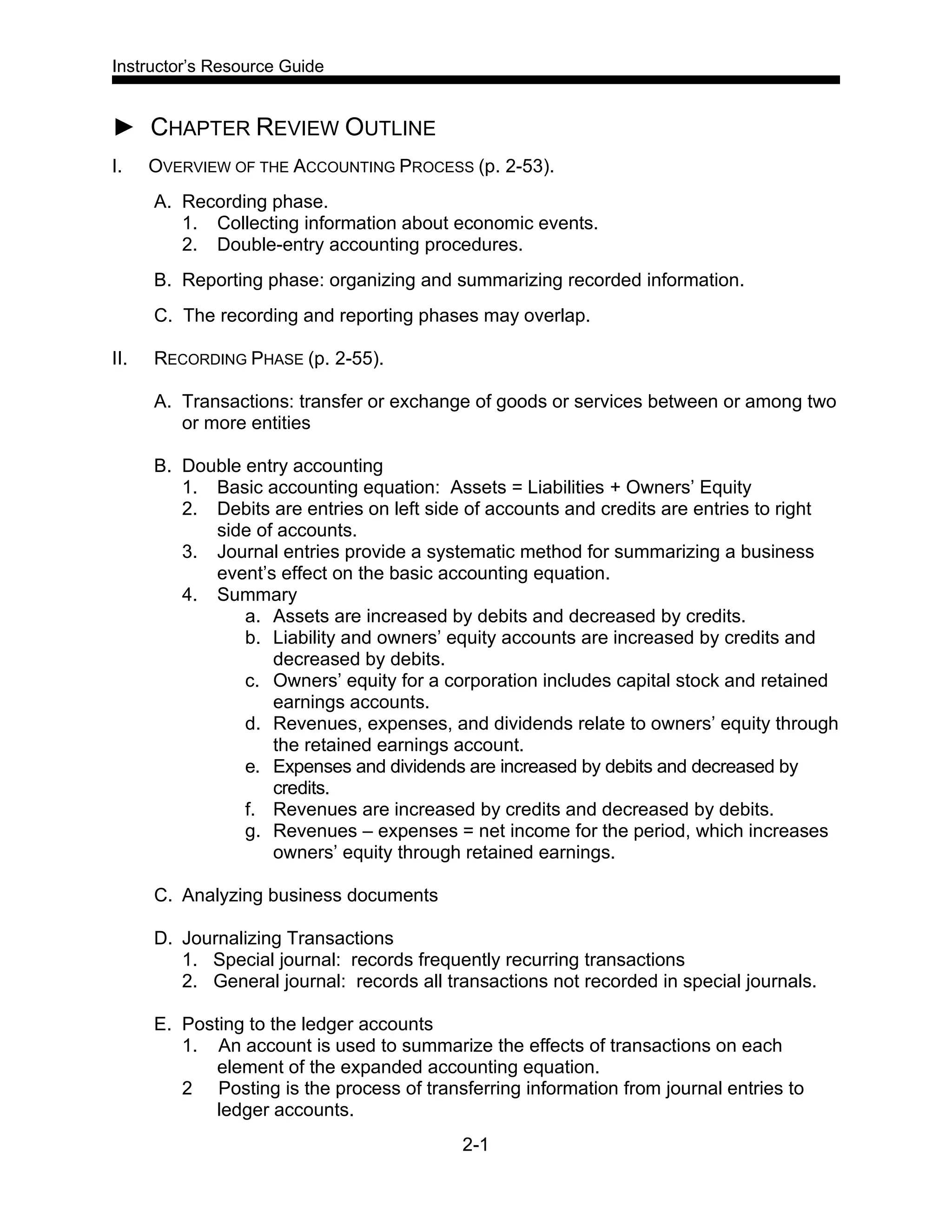
Instructor’s Resource Guide
2-1
►CHAPTER REVIEW OUTLINE
I. OVERVIEW OF THE ACCOUNTING PROCESS (p. 2-53).
A. Recording phase.
1. Collecting information about economic events.
2. Double-entry accounting procedures.
B. Reporting phase: organizing and summarizing recorded information.
C. The recording and reporting phases may overlap.
II. RECORDING PHASE (p. 2-55).
A. Transactions: transfer or exchange of goods or services between or among two
or more entities
B. Double entry accounting
1. Basic accounting equation: Assets = Liabilities + Owners’ Equity
2. Debits are entries on left side of accounts and credits are entries to right
side of accounts.
3. Journal entries provide a systematic method for summarizing a business
event’s effect on the basic accounting equation.
4. Summary
a. Assets are increased by debits and decreased by credits.
b. Liability and owners’ equity accounts are increased by credits and
decreased by debits.
c. Owners’ equity for a corporation includes capital stock and retained
earnings accounts.
d. Revenues, expenses, and dividends relate to owners’ equity through
the retained earnings account.
e. Expenses and dividends are increased by debits and decreased by
credits.
f. Revenues are increased by credits and decreased by debits.
g. Revenues – expenses = net income for the period, which increases
owners’ equity through retained earnings.
C. Analyzing business documents
D. Journalizing Transactions
1. Special journal: records frequently recurring transactions
2. General journal: records all transactions not recorded in special journals.
E. Posting to the ledger accounts
1. An account is used to summarize the effects of transactions on each
element of the expanded accounting equation.
2 Posting is the process of transferring information from journal entries to
ledger accounts.
7.
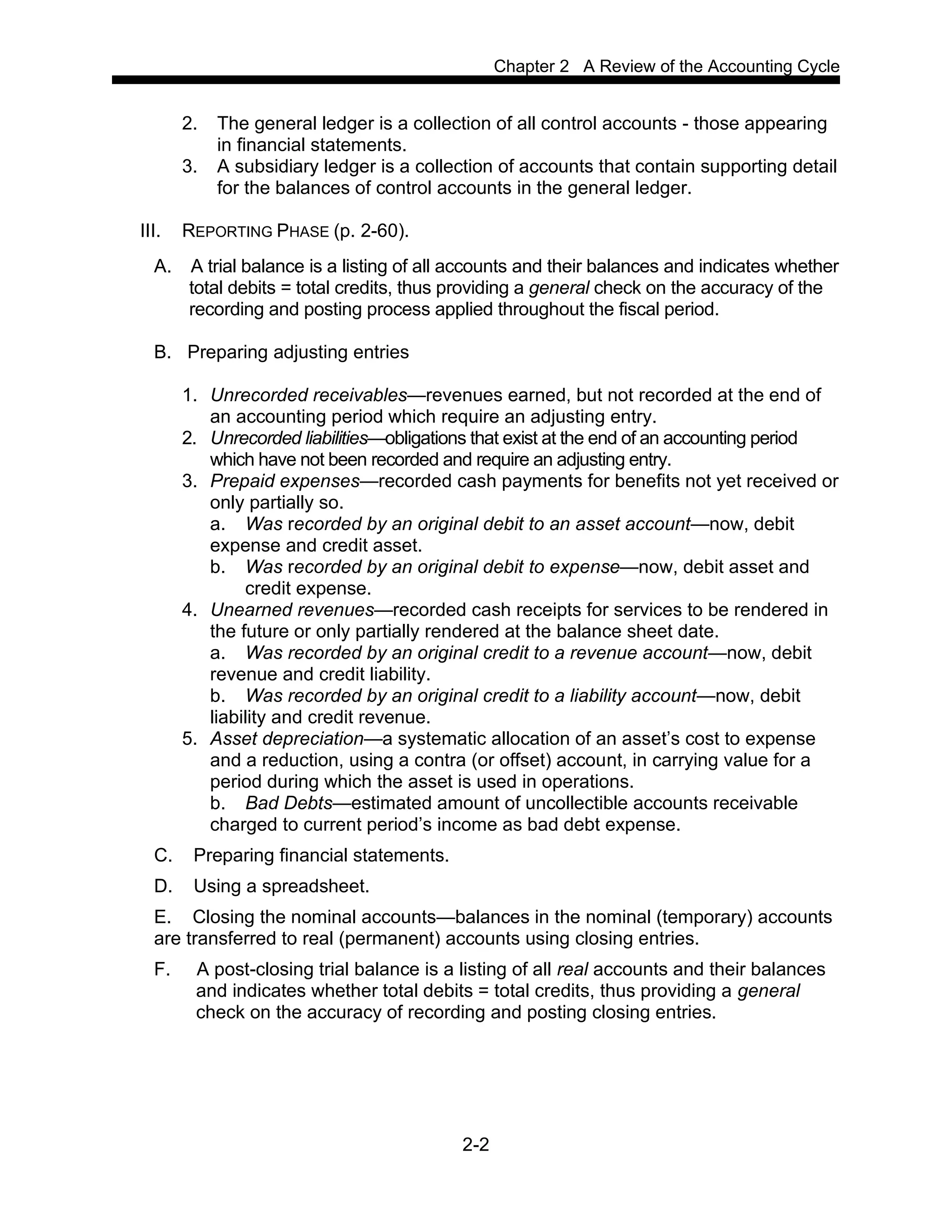
Chapter 2 AReview of the Accounting Cycle
2-2
2. The general ledger is a collection of all control accounts - those appearing
in financial statements.
3. A subsidiary ledger is a collection of accounts that contain supporting detail
for the balances of control accounts in the general ledger.
III. REPORTING PHASE (p. 2-60).
A. A trial balance is a listing of all accounts and their balances and indicates whether
total debits = total credits, thus providing a general check on the accuracy of the
recording and posting process applied throughout the fiscal period.
B. Preparing adjusting entries
1. Unrecorded receivables—revenues earned, but not recorded at the end of
an accounting period which require an adjusting entry.
2. Unrecorded liabilities—obligations that exist at the end of an accounting period
which have not been recorded and require an adjusting entry.
3. Prepaid expenses—recorded cash payments for benefits not yet received or
only partially so.
a. Was recorded by an original debit to an asset account—now, debit
expense and credit asset.
b. Was recorded by an original debit to expense—now, debit asset and
credit expense.
4. Unearned revenues—recorded cash receipts for services to be rendered in
the future or only partially rendered at the balance sheet date.
a. Was recorded by an original credit to a revenue account—now, debit
revenue and credit liability.
b. Was recorded by an original credit to a liability account—now, debit
liability and credit revenue.
5. Asset depreciation—a systematic allocation of an asset’s cost to expense
and a reduction, using a contra (or offset) account, in carrying value for a
period during which the asset is used in operations.
b. Bad Debts—estimated amount of uncollectible accounts receivable
charged to current period’s income as bad debt expense.
C. Preparing financial statements.
D. Using a spreadsheet.
E. Closing the nominal accounts—balances in the nominal (temporary) accounts
are transferred to real (permanent) accounts using closing entries.
F. A post-closing trial balance is a listing of all real accounts and their balances
and indicates whether total debits = total credits, thus providing a general
check on the accuracy of recording and posting closing entries.
8.
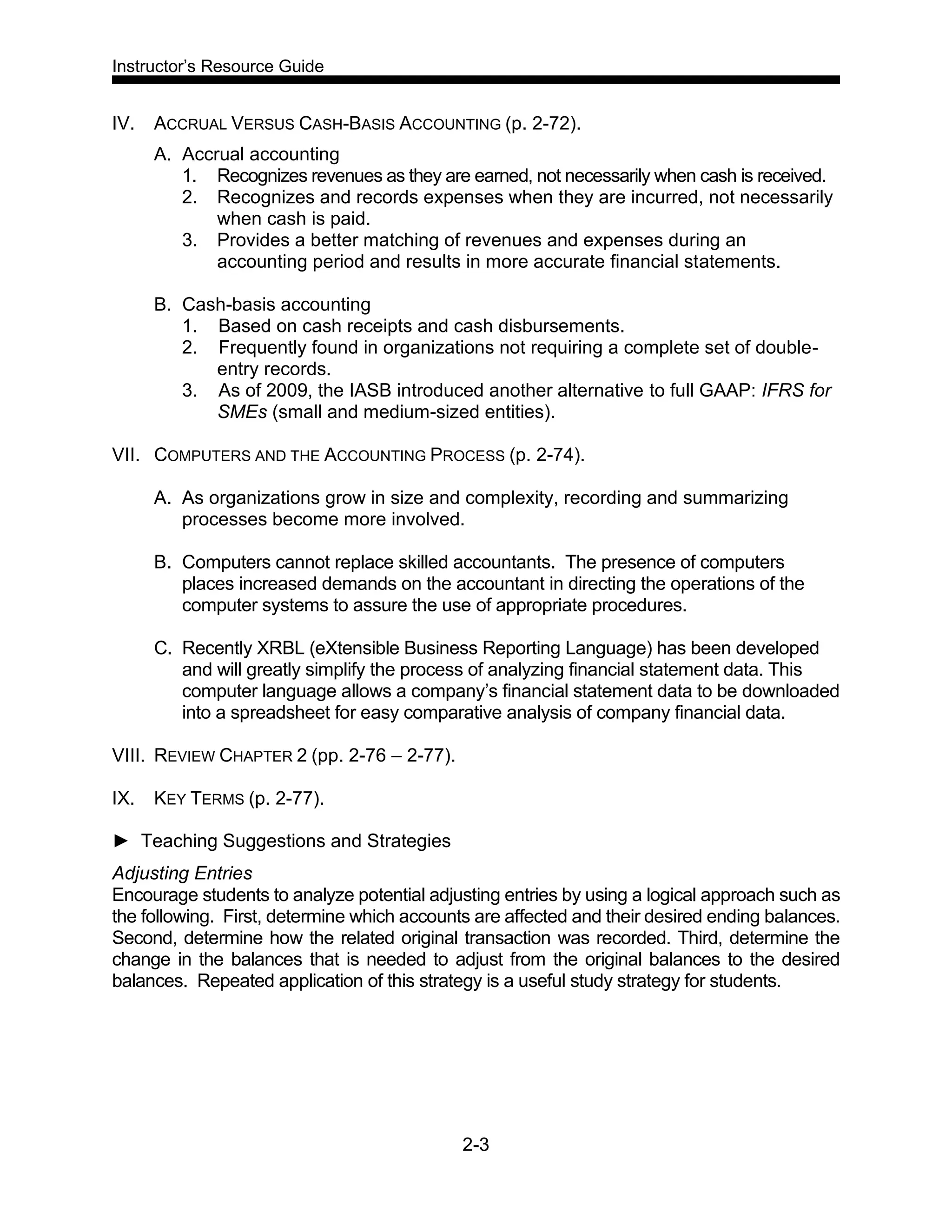
Instructor’s Resource Guide
2-3
IV.ACCRUAL VERSUS CASH-BASIS ACCOUNTING (p. 2-72).
A. Accrual accounting
1. Recognizes revenues as they are earned, not necessarily when cash is received.
2. Recognizes and records expenses when they are incurred, not necessarily
when cash is paid.
3. Provides a better matching of revenues and expenses during an
accounting period and results in more accurate financial statements.
B. Cash-basis accounting
1. Based on cash receipts and cash disbursements.
2. Frequently found in organizations not requiring a complete set of double-
entry records.
3. As of 2009, the IASB introduced another alternative to full GAAP: IFRS for
SMEs (small and medium-sized entities).
VII. COMPUTERS AND THE ACCOUNTING PROCESS (p. 2-74).
A. As organizations grow in size and complexity, recording and summarizing
processes become more involved.
B. Computers cannot replace skilled accountants. The presence of computers
places increased demands on the accountant in directing the operations of the
computer systems to assure the use of appropriate procedures.
C. Recently XRBL (eXtensible Business Reporting Language) has been developed
and will greatly simplify the process of analyzing financial statement data. This
computer language allows a company’s financial statement data to be downloaded
into a spreadsheet for easy comparative analysis of company financial data.
VIII. REVIEW CHAPTER 2 (pp. 2-76 – 2-77).
IX. KEY TERMS (p. 2-77).
► Teaching Suggestions and Strategies
Adjusting Entries
Encourage students to analyze potential adjusting entries by using a logical approach such as
the following. First, determine which accounts are affected and their desired ending balances.
Second, determine how the related original transaction was recorded. Third, determine the
change in the balances that is needed to adjust from the original balances to the desired
balances. Repeated application of this strategy is a useful study strategy for students.
9.
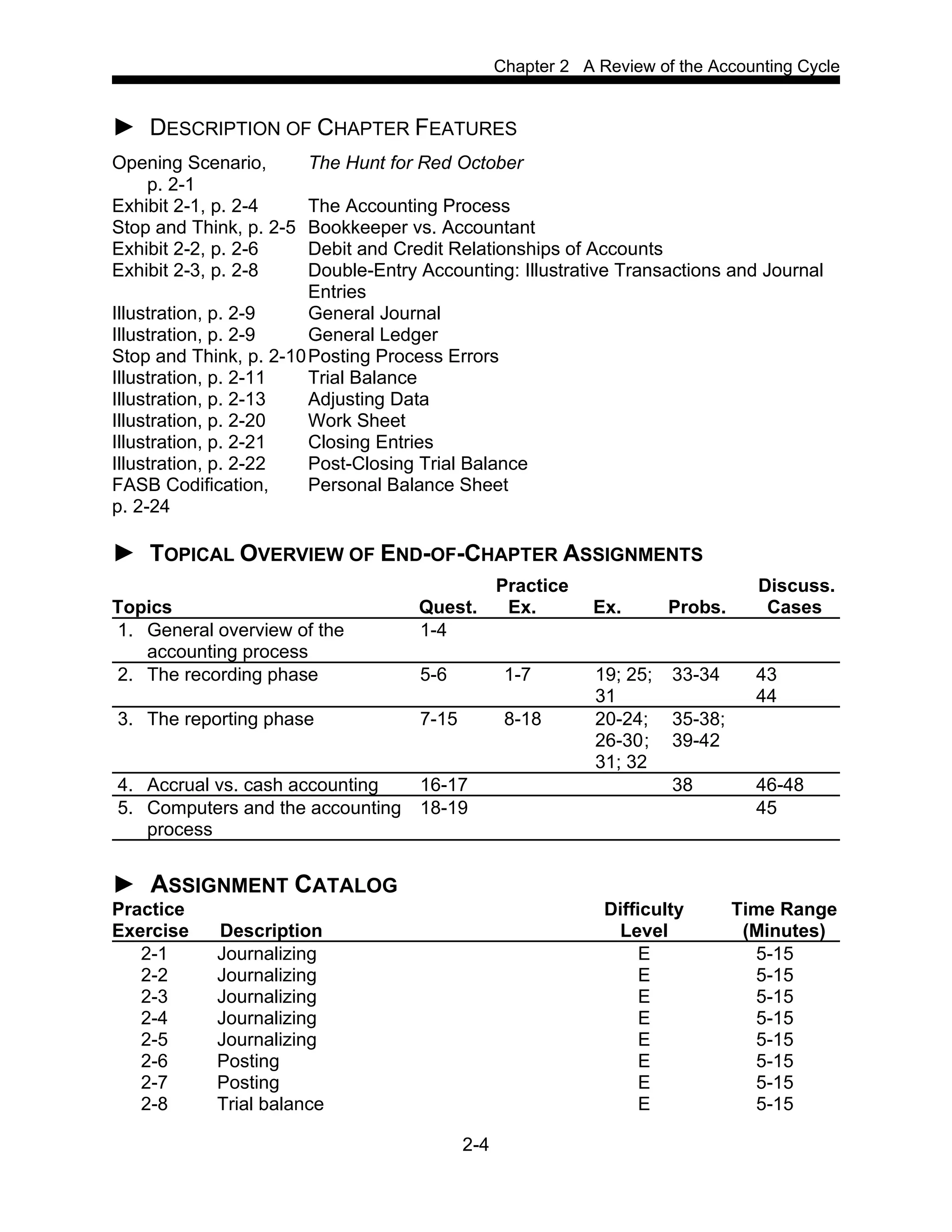
Chapter 2 AReview of the Accounting Cycle
2-4
► DESCRIPTION OF CHAPTER FEATURES
Opening Scenario, The Hunt for Red October
p. 2-1
Exhibit 2-1, p. 2-4 The Accounting Process
Stop and Think, p. 2-5 Bookkeeper vs. Accountant
Exhibit 2-2, p. 2-6 Debit and Credit Relationships of Accounts
Exhibit 2-3, p. 2-8 Double-Entry Accounting: Illustrative Transactions and Journal
Entries
Illustration, p. 2-9 General Journal
Illustration, p. 2-9 General Ledger
Stop and Think, p. 2-10Posting Process Errors
Illustration, p. 2-11 Trial Balance
Illustration, p. 2-13 Adjusting Data
Illustration, p. 2-20 Work Sheet
Illustration, p. 2-21 Closing Entries
Illustration, p. 2-22 Post-Closing Trial Balance
FASB Codification, Personal Balance Sheet
p. 2-24
► TOPICAL OVERVIEW OF END-OF-CHAPTER ASSIGNMENTS
Practice Discuss.
Topics Quest. Ex. Ex. Probs. Cases
1. General overview of the 1-4
accounting process
2. The recording phase 5-6 1-7 19; 25; 33-34 43
31 44
3. The reporting phase 7-15 8-18 20-24; 35-38;
26-30; 39-42
31; 32
4. Accrual vs. cash accounting 16-17 38 46-48
5. Computers and the accounting 18-19 45
process
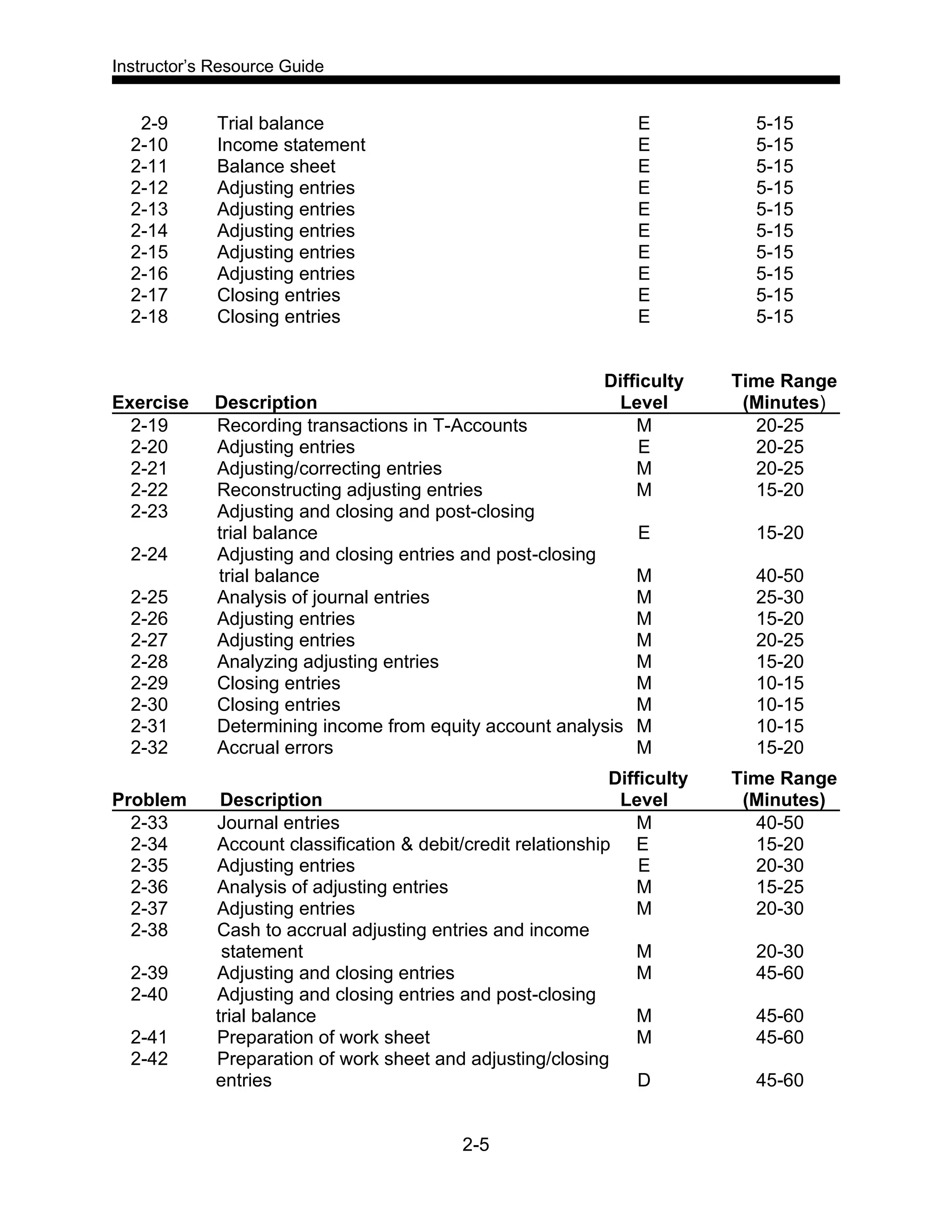
► ASSIGNMENT CATALOG
Practice Difficulty Time Range
Exercise Description Level (Minutes)
2-1 Journalizing E 5-15
2-2 Journalizing E 5-15
2-3 Journalizing E 5-15
2-4 Journalizing E 5-15
2-5 Journalizing E 5-15
2-6 Posting E 5-15
2-7 Posting E 5-15
2-8 Trial balance E 5-15
10.
Instructor’s Resource Guide
2-5
2-9Trial balance E 5-15
2-10 Income statement E 5-15
2-11 Balance sheet E 5-15
2-12 Adjusting entries E 5-15
2-13 Adjusting entries E 5-15
2-14 Adjusting entries E 5-15
2-15 Adjusting entries E 5-15
2-16 Adjusting entries E 5-15
2-17 Closing entries E 5-15
2-18 Closing entries E 5-15
Difficulty Time Range
Exercise Description Level (Minutes)
2-19 Recording transactions in T-Accounts M 20-25
2-20 Adjusting entries E 20-25
2-21 Adjusting/correcting entries M 20-25
2-22 Reconstructing adjusting entries M 15-20
2-23 Adjusting and closing and post-closing
trial balance E 15-20
2-24 Adjusting and closing entries and post-closing
trial balance M 40-50
2-25 Analysis of journal entries M 25-30
2-26 Adjusting entries M 15-20
2-27 Adjusting entries M 20-25
2-28 Analyzing adjusting entries M 15-20
2-29 Closing entries M 10-15
2-30 Closing entries M 10-15
2-31 Determining income from equity account analysis M 10-15
2-32 Accrual errors M 15-20
Difficulty Time Range
Problem Description Level (Minutes)
2-33 Journal entries M 40-50
2-34 Account classification & debit/credit relationship E 15-20
2-35 Adjusting entries E 20-30
2-36 Analysis of adjusting entries M 15-25
2-37 Adjusting entries M 20-30
2-38 Cash to accrual adjusting entries and income
statement M 20-30
2-39 Adjusting and closing entries M 45-60
2-40 Adjusting and closing entries and post-closing
trial balance M 45-60
2-41 Preparation of work sheet M 45-60
2-42 Preparation of work sheet and adjusting/closing
entries D 45-60
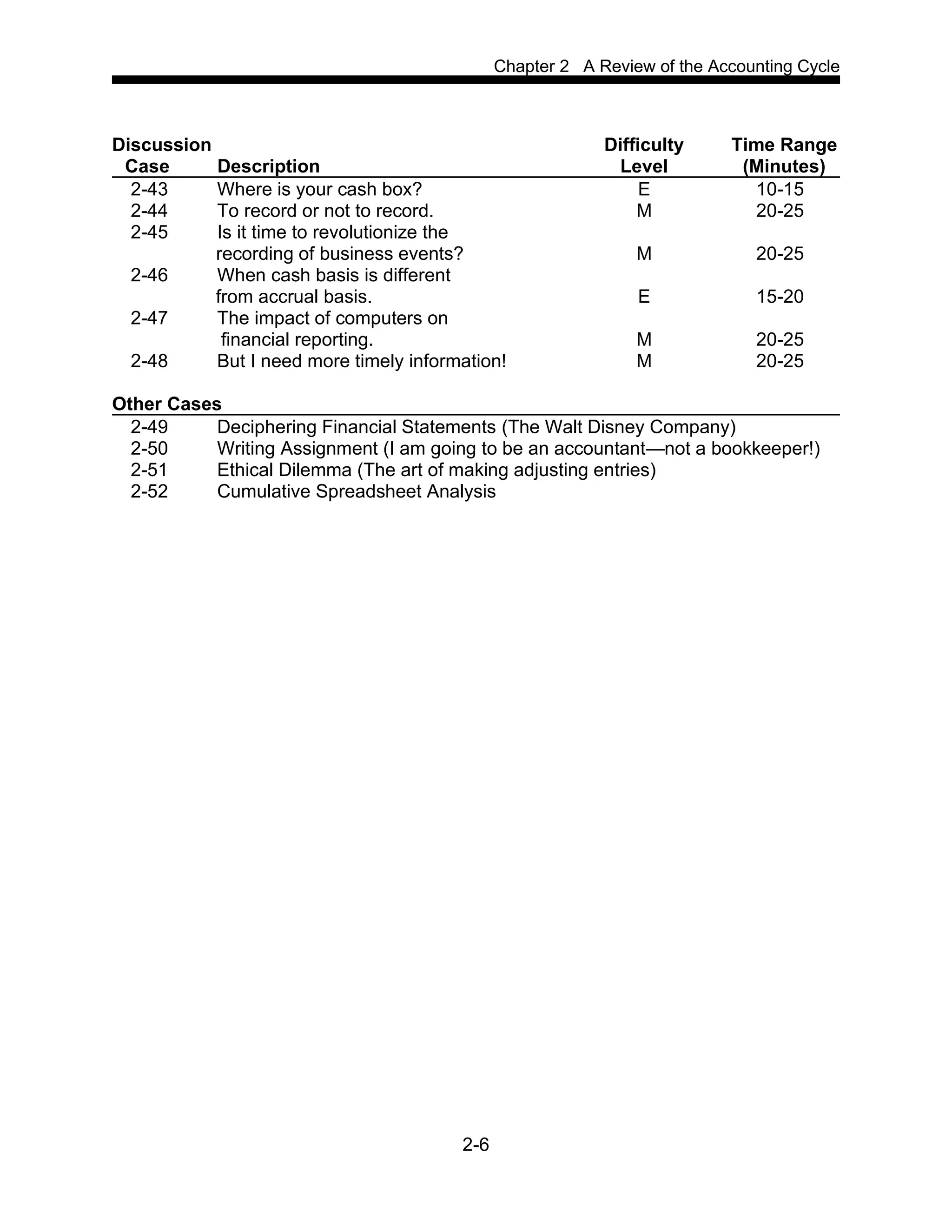
11.
Chapter 2 AReview of the Accounting Cycle
2-6
Discussion Difficulty Time Range
Case Description Level (Minutes)
2-43 Where is your cash box? E 10-15
2-44 To record or not to record. M 20-25
2-45 Is it time to revolutionize the
recording of business events? M 20-25
2-46 When cash basis is different
from accrual basis. E 15-20
2-47 The impact of computers on
financial reporting. M 20-25
2-48 But I need more timely information! M 20-25
Other Cases
2-49 Deciphering Financial Statements (The Walt Disney Company)
2-50 Writing Assignment (I am going to be an accountant—not a bookkeeper!)
2-51 Ethical Dilemma (The art of making adjusting entries)
2-52 Cumulative Spreadsheet Analysis
, y
He wentdown to the fire
where the daughter was making
a cake for the breakfast, and she
said to him:
“How are you to-day, father;
are you anything better?”
“I got a good sleep,” said he,
“but I’m not a taste better than I
was last night; and indeed, if
you’d believe me, I think there’s
something inside of me running
back and forwards.”
“Arrah, that can’t be,” says the
daughter, “but it’s a cold you got
and you lying out on the fresh
grass; and if you’re not better in
the evening we’ll send for the
doctor.”
He was saying then that there
was a pain on him, but that he
did not know rightly what place
the pain was in. He was in the
same way in the evening, and
they had to send for the doctor,
and when the doctor was not
coming quickly there was great
fright on him. The people of the
house were doing all they could
to put courage in him.
The doctor came at last, and
he asked what was on him, and
he said again that there was
something like a birdeen leaping
in his stomach The docto
14.
in his stomach.The doctor
stripped him and examined him
well, but saw nothing out of the
way with him. He put his ear to
his side and to his back, but he
heard nothing, though the poor
man himself was calling out:
“Now! now! don’t you hear it?
Now, aren’t you listening to it
jumping?” But the doctor could
perceive nothing at all, and he
thought at last that the man was
out of his senses, and that there
was nothing the matter with
him.
He said to the woman of the
house when he came out, that
there was nothing on her
husband, but that he believed
himself to be sick, and that he
would send her medicine the
next day for him, that would
give him a good sleep and settle
the heat of his body. He did that,
and the poor man swallowed all
the medicines and got another
great sleep, but when he awoke
in the morning he was worse
than ever, but he said he did not
hear the thing jumping inside
him any longer.
They sent for the doctor
again, and he came; but he was
able to do nothing. He left other
medicines with them, and said
he would come again at the end
15.
he would comeagain at the end
of a week to see him. The poor
man got no relief from all that
the doctor left with him, and
when he came again he found
him to be worse than before;
but he was not able to do
anything, and he did not know
what sort of sickness was on
him. “I won’t be taking your
money from you any more,” says
he to the woman of the house,
“because I can do nothing in this
case, and as I don’t understand
what’s on him, I won’t let on[25]
to be understanding it. I’ll come
to see him from time to time,
but I’ll take no money from you.”
The woman of the house
could hardly keep in her anger.
Scarcely ever was the doctor
gone till she gathered the people
of the house round her and they
took counsel. “That doctor
braduch,” says she, “he’s not
worth a traneen; do you know
what he said—that he wouldn’t
take any money from me any
more, and he said himself he
knew nothing about anything;
suf on him, the behoonuch, he’ll
cross this threshold no more;
we’ll go to the other doctor; if
he’s farther from us, itself, I
don’t mind that, we must get
him.” Everybody in the house
16.
y y
was onone word with her, and
they sent for the other doctor;
but when he came he had no
better knowledge than the first
one had, only that he had
knowledge enough to take their
money. He came often to see
the sick man, and every time he
would come he would have
every name longer than another
to give his sickness; names he
did not understand himself, nor
no one else, but he had them to
frighten the people.
They remained that way for
two months, without anyone
knowing what was on the poor
man; and when that doctor was
doing him no good they got
another doctor, and then another
doctor, until there was not a
doctor in the county, at last, that
they had not got, and they lost a
power of money over them, and
they had to sell a portion of their
cattle to get money to pay them.
They were that way for half a
year, keeping doctors with him,
and the doctors giving him
medicines, and the poor man
that was stout and well-fed
before, getting bare and thin,
until at last there was not an
ounce of flesh on him, but the
skin and the bones only.
17.
He was sobad at last that it
was scarcely he was able to
walk. His appetite went from
him, and it was a great trouble
to him to swallow a piece of soft
bread or to drink a sup of new
milk, and everyone was saying
that he was better to die, and
that was no wonder, for there
was not in him but like a shadow
in a bottle.
One day that he was sitting on
a chair in the door of the house,
sunning himself in the heat, and
the people of the house all gone
out but himself, there came up
to the door a poor old man that
used to be asking alms from
place to place, and he
recognised the man of the house
sitting in the chair, but he was so
changed and so worn that it was
hardly he knew him. “I’m here
again, asking alms in the name
of God,” said the poor man;
“but, glory be to God, master,
what happened to you, for
you’re not the same man I saw
when I was here half a year ago;
may God relieve you!”
“Arrah, Shamus,” said the sick
man, “it’s I that can’t tell you
what happened to me; but I
know one thing, that I won’t be
long in this world.”
18.
o g ts o d
“But I’m grieved to see you
how you are,” said the
beggarman. “Tell me how it
began with you, and what the
doctors say.”
“The doctors, is it?” says the
sick man, “my curse on them;
but I oughtn’t to be cursing and
I so near the grave; suf on
them, they know nothing.”
“Perhaps,” says the
beggarman, “I could find you a
relief myself, if you were to tell
me what’s on you. They say that
I be knowledgable about
diseases and the herbs to cure
them.”
The sick man smiled, and he
said: “There isn’t a medicine
man in the county that I hadn’t
in this house with me, and isn’t
half the cattle I had on the farm
sold to pay them. I never got a
relief no matter how small, from
a man of them; but I’ll tell you
how it happened to me first.”
Then he gave him an account of
everything he felt and of
everything the doctors had
ordered.
The beggarman listened to
him carefully, and when he had
finished all his story, he asked
him: “What sort of field was it
19.
him: What sortof field was it
you fell asleep in?”
“A meadow that was in it that
time,” says the sick man; “but it
was just after being cut.”
“Was it wet,” says the
beggarman.
“It was not,” says he.
“Was there a little stream or a
brook of water running through
it?” said the beggarman.
“There was,” says he.
“Can I see the field?”
“You can, indeed, and I’ll
show it to you.”
He rose off his chair, and as
bad as he was, he pulled himself
along until he came to the place
where he lay down to sleep that
evening. The beggarman
examined the place for a long
time, and then he stooped down
over the grass and went
backwards and forwards with his
body bent, and his head down,
groping among the herbs and
weeds that were growing thickly
in it.
He rose at last and said: “It is
as I thought,” and he stooped
himself down again and began
searching as before. He raised
his head a second time, and he
20.
had a littlegreen herb in his
hand. “Do you see this?” said
he. “Any place in Ireland that
this herb grows, there be’s an
alt-pluachra near it, and you
have swallowed an alt-pluachra.”
“How do you know that?” said
the sick man. “If that was so,
sure the doctors would tell it to
me before now.”
“The doctors!” said the
beggarman. “Ah! God give you
sense, sure they’re only a flock
of omadawns. I tell you again,
and believe me, that it’s an alt-
pluachra you swallowed. Didn’t
you say yourself that you felt
something leaping in your
stomach the first day after you
being sick? That was the alt-
pluachra; and as the place he
was in was strange to him at
first, he was uneasy in it, moving
backwards and forwards, but
when he was a couple of days
there, he settled himself, and he
found the place comfortable, and
that’s the reason you’re keeping
so thin, for every bit you’re
eating the alt-pluachra is getting
the good out of it, and you said
yourself that one side of you was
swelled; that’s the place where
the nasty thing is living.”
The sick man would not
21.
The sick manwould not
believe him at first, but the
beggarman kept on talking and
proving on him that it was the
truth he was saying, and when
his wife and daughter came back
again to the house, the
beggarman told them the same
things, and they were ready
enough to believe him.
The sick man put no faith in it
himself, but they were all talking
to him about it until they
prevailed on him at last to call in
three doctors together until he
should tell them this new story.
The three came together, and
when they heard all the boccuch
(beggarman) was saying, and all
the talk of the women, it is what
they laughed, and said they
were fools altogether, and that it
was something else entirely that
was the matter with the man of
the house, and every name they
had on his sickness this time was
twice—three times—as long as
ever before. They left the poor
man a bottle or two to drink,
and they went away, and they
humbugging the women for
saying that he had swallowed an
alt-pluachra.
The boccuch said when they
were gone away: “I don’t
wonder at all that you’re not
22.
y
getting better, ifit’s fools like
those you have with you. There’s
not a doctor or a medicine-man
in Ireland now that’ll do you any
good, but only one man, and
that’s Mac Dermott the Prince of
Coolavin, on the brink of Lough
Gara, the best doctor in
Connacht or the five provinces.”
“Where is Lough Gara?” said
the poor man.
“Down in the County Sligo,”
says he; “it’s a big lake, and the
prince is living on the brink of it;
and if you’ll take my advice you’ll
go there, for it’s the last hope
you have; and you, Mistress,”
said he, turning to the woman of
the house, “ought to make him
go, if you wish your man to be
alive.”
“Musha!” says the woman, “I’d
do anything that would cure
him.”
“If so, send him to the Prince
of Coolavin,” says he.
“I’d do anything at all to cure
myself,” says the sick man, “for I
know I haven’t long to live on
this world if I don’t get some
relief, or without something to
be done for me.”
“Then go to the Prince of
Coolavin ” says the beggarman
23.
Coolavin,” says thebeggarman.
“Anything that you think would
do yourself good, you ought to
do it, father,” says the daughter.
“There’s nothing will do him
good but to go to the Prince of
Coolavin,” said the beggarman.
So they were arguing and
striving until the night came, and
the beggarman got a bed of
straw in the barn, and he began
arguing again in the morning
that he ought to go to the
prince, and the wife and
daughter were on one word with
him; and they prevailed at last
on the sick man, and he said
that he would go, and the
daughter said that she would go
with him to take care of him,
and the boccuch said that he
would go with them to show
them the road; “and I’ll be on
the pinch of death, for ye, with
anxiety,” said the wife, “until ye
come back again.”
They harnessed the horse,
and they put him under the cart,
and they took a week’s provision
with them—bread, and bacon,
and eggs, and they went off.
They could not go very far the
first day, for the sick man was so
weak, that he was not able to
bear the shaking he was getting
24.
bear the shakinghe was getting
in the cart; but he was better
the second day, and they all
passed the night in a farmer’s
house on the side of the road,
and they went on again in the
morning; but on the third day, in
the evening, they came to the
dwelling of the prince. He had a
nice house, on the brink of the
lake, with a straw roof, in among
the trees.
They left the horse and the
cart in a little village near the
prince’s place, and they all
walked together, until they came
to the house. They went into the
kitchen, and asked, “Couldn’t
they see the prince?” The
servant said that he was eating
his meal, but that he would
come, perhaps, when he was
ready.
The prince himself came in at
that moment, and asked what it
was they wanted. The sick man
rose up and told him, that it was
looking for assistance from his
honour he was, and he told him
his whole story. “And now can
your honour help me?” he said,
when he had finished it.
“I hope I can,” said the prince;
“anyhow, I’ll do my best for you,
as you came so far to see me.
I’d have a bad right not to do my
25.
I d havea bad right not to do my
best. Come up into the parlour
with me. The thing that old man
told you is true. You swallowed
an alt-pluachra, or something
else. Come up to the parlour
with me.”
He brought him up to the
parlour with him, and it
happened that the meal he had
that day was a big piece of
salted beef. He cut a large slice
off it, and put it on a plate, and
gave it to the poor man to eat.
“Oro! what is your honour
doing there?” says the poor
man; “I didn’t swallow as much
as the size of an egg of meat
this quarter,[26] and I can’t eat
anything.”
“Be silent, man,” says the
prince; “eat that, when I tell
you.”
The poor man eat as much as
he was able, but when he left
the knife and fork out of his
hand, the prince made him take
them up again, and begin out of
the new (over again). He kept
him there eating until he was
ready to burst, and at last he
was not able to swallow another
bit, if he were to get a hundred
pounds.
h h h h
26.
When the princesaw that he
would not be able to swallow
any more, he brought him out of
the house, and he said to the
daughter and the old beggarman
to follow them, and he brought
the man out with him to a fine
green meadow that was
forenent[27] the house, and a
little stream of water running
through it.
He brought him to the brink of
the stream, and told him to lie
down on his stomach over the
stream, and to hold his face over
the water, to open his mouth as
wide as he could, and to keep it
nearly touching the water, and
“wait there quiet and easy,” says
he; “and for your life don’t stir,
till you see what will happen to
you.”
The poor man promised that
he would be quiet, and he
stretched his body on the grass,
and held his mouth open, over
the stream of water, and
remained there without stirring.
The prince went backwards,
about five yards, and drew the
daughter and the old man with
him, and the last word he said to
the sick man was: “Be certain,
and for your life, don’t put a stir
out of you, whatever thing at all
27.
out of you,whatever thing at all
happens to you.”
The sick man was not lying
like that more than a quarter of
an hour, when something began
moving inside of him, and he felt
something coming up in his
throat, and going back again. It
came up and went back three or
four times after other. At last it
came to the mouth, stood on the
tip of his tongue, but frightened,
and ran back again. However, at
the end of a little space, it rose
up a second time, and stood on
his tongue, and at last jumped
down into the water. The prince
was observing him closely, and
just as the man was going to
rise, he called out: “Don’t stir
yet.”
The poor man had to open his
mouth again, and he waited the
same way as before; and he was
not there a minute until the
second one came up the same
way as the last, and went back
and came up two or three times,
as if it got frightened; but at
last, it also, like the first one,
came up to the mouth, stood on
the tongue, and when it felt the
smell of the water below it,
leaped down into the little
stream.
The prince said in a whisper:
28.
The prince saidin a whisper:
“Now the thirst’s coming on
them; the salt that was in the
beef is working them; now
they’ll come out.” And before the
word had left his mouth, the
third one fell, with a plop, into
the water; and a moment after
that, another one jumped down,
and then another, until he
counted five, six, seven, eight,
nine, ten, eleven, twelve.
“There’s a dozen of them
now,” said the prince; “that’s the
clutch; the old mother didn’t
come yet.”
The poor sick man was getting
up again, but the prince called to
him: “Stay as you are; the
mother didn’t come up.”
He remained as he was, but
no other one came out, though
he stayed there more than a
quarter of an hour. The prince
himself was getting uneasy for
fear the old alt-pluachra might
not stir at all. The poor man was
so tired and so weak that he
wished to get up; and, in spite
of all the prince told him, he was
trying to stand on his feet, when
the prince caught him by one
leg, and the boccuch by the
other, and they held him down in
spite of him.
29.
They remained another
quarterof an hour without
speaking a word, or making a
sound, and at the end of that
time the poor man felt
something stirring again in his
side, but seven times worse than
before; and it’s scarcely he could
keep himself from screeching.
That thing kept moving for a
good while, and he thought the
side was being torn out of
himself with it. Then it began
coming up, and it reached the
mouth, and went back again. At
last it came up so far that the
poor man put the two fingers to
his mouth and thought to catch
hold of it. But if he put in his
fingers quick, the old alt-
pluachra went back quicker.
“Oh, you behoonach!” cried
the prince, “what made you do
that? Didn’t I tell you not to let a
stir out of you? Remain quiet if
she comes up again.”
They had to remain there for
half an hour, because the old
mother of the alt-pluachras was
scared, and she was afraid to
come out. But she came up at
last, perhaps, because there was
too much thirst on her to let her
stand the smell of the water that
was tempting her, or perhaps
30.
she was lonesomeafter her
children going from her. Anyhow,
she came up to his mouth, and
stood there while you would be
counting about four score; and
when she saw nothing, and
nothing frightened her, she gave
a jump down into the water, like
her clutch before her; and the
plop of her into the water was
seven times heavier than theirs.
The prince and the other two
had been watching the whole,
and they scarcely dared to
breathe, for fear of startling the
horrid beast. As soon as ever
she jumped down into the water,
they pulled back the man, and
put him standing again on his
two feet.
He was for three hours before
he could speak a word; but the
first thing he said was: “I’m a
new man.”
The prince kept him in his own
house for a fortnight, and gave
him great care and good
feeding. He allowed him to go
then, and the daughter and the
boccuch with him; and he
refused to take as much as a
penny from them.
“I’m better pleased than ten
pounds on my own hand,” said
he “that m c e t ned o t so
31.
he, “that mycure turned out so
well; and I’d be long sorry to
take a farthing from you; you
lost plenty with doctors before.”
They came home safely, and
he became healthy and fat. He
was so thankful to the poor
boccuch that he kept him in his
own house till his death. As long
as he was alive he never lay
down on green grass again; and
another thing, if there was any
sickness or ill-health on him, it
isn’t the doctors he used to call
in to him.
That was small wonder!
32.
PÁIDÍN
O’CEALLAIĠ
AGUS AN EASÓĠ.
Aḃfad ó ṡoin ḃí fear d’ar’
ḃ’ainm Páidín O’Ceallaiġ ’nna
ċóṁnuiḋe i ngar do Ṫuaim i
gcondaé na Gailliṁe. Aon ṁaidin
aṁáin d’éiriġ sé go moċ agus ní
raiḃ ḟios aige cia an t-am a ḃi sé,
mar ḃí solas breáġ ó’n ngealaiġ.
Ḃí dúil aige le dul go h-aonaċ
Ċáṫair-na-mart le storc asail do
ḋíol.
Ní raiḃ sé níos mó ’na trí ṁíle
air an mbóṫar go dtáinig
dorċadas mór air, agus ṫosuiġ ciṫ
trom ag tuitim. Ċonnairc sé teaċ
mór ameasg crann timċioll cúig
ċeud slat ó’n mbóṫar agus
duḃairt sé leis féin, “raċfaiḋ mé
ċum an tíġe sin, go dtéiḋ an ciṫ
ṫart.” Nuair ċuaiḋ sé ċum an tíġe,
ḃí an doras fosgailte, agus
asteaċ leis. Ċonnairc sé seomra
mór air ṫaoiḃ a láiṁe ċlé, agus
teine ḃreáġ ’san ngráta. Ṡuiḋ sé
síos air stol le cois an ḃalla, agus
níor ḃfada gur ṫosuiġ sé ag
tuitim ’nna ċodlaḋ, nuair
ċonnairc sé easóg ṁór ag teaċt
33.
g g
ċum nateineaḋ agus leag si
giniḋ air leic an teaġlaiġ agus
d’imṫiġ. Níor ḃfada go dtáinig sí
air ais le giniḋ eile agus leag air
leic an teaġlaiġ é, agus d’imṫiġ.
Ḃí sí ag imṫeaċt agus ag teaċt go
raiḃ cárnán mór giniḋ air an
teaġlaċ. Aċt faoi ḋeireaḋ nuair
d’imṫiġ sí d’éiriġ Páidín, agus ċuir
sé an méad óir a ḃí cruinniġṫe
aici ann a ṗóca, agus amaċ leis.
Ní raiḃ sé a ḃ-fad imṫiġṫe gur
ċualaiḋ sé an easóg ag teaċt
’nna ḋiaiġ agus í ag sgreadaoil
ċoṁ h-árd le píobaiḃ. Ċuaiḋ sí
roiṁ Páidín air an mbóṫar agus í
ag lubarnuiġ anonn ’s anall agus
ag iarraiḋ greim sgornaiġ d’ḟáġail
air. Ḃí maide maiṫ daraċ ag
Páidín agus ċongḃuiġ sé í uaiḋ
go dtáinig beirt ḟear suas. Ḃí
madaḋ maiṫ ag fear aca, agus
ruaig sé asteaċ i bpoll ’san
mballa í.
Cuaiḋ Páidín ċum an aonaiġ,
agus ann áit é ḃeiṫ tíġeaċt a
ḃaile leis an airgiod a fuair sé air
a ṡean-asal, mar ṡaoil sé air
maidin go mbeiḋeaḋ sé ag
deanaṁ, ċeannuiġ sé capall le
cuid de’n airgiod a ḃain sé de’n
easóig, agus ṫáinig sé a ḃaile
agus é ag marcuiġeaċt. Nuair
ṫáinig sé ċoṁ fada leis an áit ar
ċuir an madaḋ an easóg ann san
34.
bpoll, ṫáinig síamaċ roiṁe, ṫug
léim suas, agus fuair greim
sgornaiġ air an g-capall. Ṫosuiġ
an capall ag riṫ, agus níor ḟeud
Páidín a ċeapaḋ, no go dtug sé
léim asteaċ i g-clais ṁóir a ḃí
líonta d’uisge agus de ṁúlaċ. Ḃí
sé ’gá ḃáṫaḋ agus ’gá ṫaċtaḋ go
luaṫ, go dtáinig fir suas a ḃí teaċt
as Gailliṁ agus ḋíḃir siad an
easóg.
Ṫug Páidín an capall a ḃaile
leis, agus ċuir sé asteaċ i dteaċ
na mbó é, agus ṫuit sé ’nna
ċodlaḋ.
Air maidin, lá air na ṁáraċ,
d’éiriġ Páidín go moċ, agus ċuaiḋ
sé amaċ le uisge agus féar
ṫaḃairt do’n capall. Nuair ċuaiḋ
sé amaċ ċonnairc sé an easóg ag
teaċt amaċ as teaċ na mbó, agus
í foluiġṫe le fuil. “Mo ṡeaċt míle
mallaċt ort,” ar Páidín, “tá
faitċios orm go ḃfuil anaċain
déanta agad.” Cuaiḋ sé asteaċ,
agus fuair sé an capall, péire bó-
bainne, agus dá laoġ marḃ
Ṫáinig sé amaċ agus ċuir sé
madaḋ a ḃí aige anḋiaiġ na h-
easóige. Fuair an madaḋ greim
uirri agus fuair sise greim air an
madaḋ. Buḋ madaḋ maiṫ é, aċt
b’éigin dó a ġreim sgaoileaḋ sul
ṫáinig Páidín suas; aċt ċongḃuiġ
sé a ṡúil uirri go ḃfacaiḋ sé í ag
d l b ṫá b ḃí
35.
dul asteaċ imboṫán beag a ḃí air
ḃruaċ loċa. Ṫáinig Páidín ag riṫ,
agus nuair ḃí sé ag an mboṫáinín
beag ṫug sé craṫaḋ do’n ṁadaḋ
agus ċuir sé fearg air, agus ċuir
sé asteaċ roiṁe é. Nuair ċuaiḋ
an madaḋ asteaċ ṫosuiġ sé ag
taṫfant. Ċuaiḋ Páidín asteaċ agus
ċonnairc sé sean-ċailleaċ ann
san g-coirnéul. D’ḟiafruiġ sé ḋí an
ḃfacaiḋ sí easóg ag teaċt asteaċ.
“Ní ḟacaiḋ mé,” ar san ċailleaċ,
“tá mé breóiḋte le galar millteaċ
agus muna dtéiḋ tu amaċ go
tapa glacfaiḋ tu uaim é.”
Coṁ fad agus ḃí Páidín agus
an ċailleaċ, ag caint, ḃí an
madaḋ ag teannaḋ asteaċ, no go
dtug sé léim suas faoi ḋeireaḋ,
agus rug sé greim sgornaiġ air
an g-cailliġ.
Sgreaḋ sise, agus duḃairt, “tóg
díom do ṁadaḋ a Páidín Ui
Ċeallaiġ, agus deunfaiḋ mé fear
saiḋḃir díot.”
Chuir Páidín iaċ (d’ḟiaċaiḃ) air
an madaḋ a ġreim sgaoileaḋ,
agus duḃairt sé, “Innis dam cia
ṫu, no cad fáṫ ar ṁarḃ tu mo
ċapall agus mo ḃa?”
“Agus cad fáṫ dtug tusa leat
an t-ór a raiḃ mé cúig ċeud
ḃliaḋain ’gá ċruinniuġaḋ ameasg
cnoc agus gleann an doṁain.”
36.
“Ṡaoil mé gureasóg a ḃí
ionnad,” ar Páidín, “no ni
ḃainfinn le do ċuid óir; agus niḋ
eile, má tá tu cúig ċeud bliaḋain
air an tsaoġal so tá sé i n-am
duit imṫeaċt ċum suaiṁnis.”
“Rinne mé coir ṁór i m’óige,
agus táim le ḃeiṫ sgaoilte óm’
ḟulaing má ṫig leat fiċe púnta íoc
air son ceud agus trí fiċid
aifrionn dam.”
“Cá ḃfuil an t-airgiod?” ar
Páidín.
“Éiriġ agus róṁar faoi sgeiċ
atá os cionn tobair ḃig i g-
coirneul na páirce sin amuiġ,
agus geoḃaiḋ tu pota líonta d’ór.
Íoc an fiċe púnta air son na n-
aifrionn agus ḃéiḋ an ċuid eile
agad féin. Nuair a ḃainfeas tu an
leac de’n ṗota feicfiḋ tu madaḋ
mór duḃ ag teaċt amaċ, aċt ná
bíoḋ aon ḟaitċios ort; is mac
daṁsa é. Nuair a ġeoḃas tu an t-
ór, ceannuiġ an teaċ ann a
ḃfacaiḋ tu mise i dtosaċ, geoḃaiḋ
tu saor é, mar tá sé faoi ċáil go
ḃfuil taiḋḃse ann. Béiḋ mo ṁac-
sa ṡíos ann san tsoiléar, ní
ḋéanfaiḋ sé aon doċar duit, aċt
béiḋ sé ’nna ċaraid maiṫ ḋuit.
Béiḋ mise marḃ mí ó’n lá so,
agus nuair ġeoḃas tu marḃ mé
cuir splanc faoi an mboṫán agus
dóiġ é Ná h innis d’aon neaċ
37.
dóiġ é. Náh-innis d aon neaċ
beó aon níḋ air biṫ de m’ṫaoiḃ-se,
agus béiḋ an t-áḋ ort.”
“Cad é an t-ainm atá ort?” ar
Páidín.
“Máire ni Ciarḃáin,” ar san
ċailleaċ.
Ċuaiḋ Páidín a ḃaile agus nuair
ṫáinig dorċadas na h-oiḋċe ṫug
sé láiḋe leis agus ċuaiḋ sé ċum
na sgeiċe a ḃí i g-coirneul na
páirce agus ṫosuiġ sé ag róṁar.
Níor ḃfada go ḃfuair sé an pota
agus nuair ḃain sé an leac dé
léim an madaḋ mór duḃ amaċ,
agus as go bráṫ leis, agus madaḋ
Ṗáidin ’nn a ḋiaiġ.
Ṫug Páidín an t-ór a ḃaile agus
ċuir sé i ḃfolaċ i dteaċ na mbó é.
Timċioll mí ’nna ḋiaiġ sin, ċuaiḋ
sé go h-aonaċ i nGailliṁ agus
ċeannuiġ sé péire bó, capall
agus duisín caora. Ní raiḃ ḟios ag
na cóṁarsannaiḃ cia an áit a
ḃfuair sé an t-airgiod. Duḃairt
cuid aca go raiḃ roinn aige leis
na daoniḃ maiṫe.
Aon lá aṁáin ġleus Páidín é
féin agus ċuaiḋ sé ċum an duine-
uasail ar leis an teaċ mór, agus
d’ iarr air, an teaċ agus an talaṁ
do ḃí ’nna ṫimcioll, do ḋíol leis.
“Tig leat an teaċ ḃeiṫ agad gan
ċíos, aċt ta taiḋḃse ann, agus
38.
, , g
níorṁaiṫ liom ṫu dul do
ċóṁnuiḋe ann, gan a innsint, aċt
ní sgarfainn leis an talaṁ gan
ceud púnta níos mó ’ná tá agad-
sa le tairgsint dam.”
“B’éidir go ḃfuil an oiread
agam-sa ’s atá agad féin,” ar
Páidín, “béiḋ mé ann so amáraċ
leis an airgiod má tá tusa réiḋ le
seilḃ do ṫaḃairt dam.”
“Béiḋ mé réiḋ,” ar san duine-
uasal.
Ċuaiḋ Páidín aḃaile agus
d’innis d’á ṁnaoi go raiḃ teaċ
mór agus gaḃáltas talṁan
ceannuiġṫe aige.
“Cia an áit a ḃfuair tu an t-
airgiod?” ar san ḃean.
“Naċ cuma ḋuit?” ar Páidín.
Lá air na ṁáraċ, ċuaiḋ Páidín
ċum an duine-uasail, ṫug ceud
púnta ḋó, agus fuair seilḃ an tiġe
agus an talṁan, agus d’ḟág an
duine-uasal an truscán aige
asteaċ leis an margaḋ.
D’ḟan Páidín ann san teaċ an
oiḋċe sin, agus nuair ṫáinig an
dorċadas ċuaiḋ sé síos ann san
tsoiléar, agus ċonnairc sé fear
beag le na ḋá ċois sgarṫa air
ḃáirille.
“’Niḋ Dia ḋuit, a ḋuine ċóir,” ar
san fear beag
39.
san fear beag.
“Gombuḋ h-é ḋuit,” ar Páidín.
“Ná bíoḋ aon ḟaitċios ort
róṁam-sa,” ar san fear beag,
“béid mé mo ċaraid maiṫ ḋuit-se
má tá tu ionnán run do
ċongḃáil.”
“Táim go deiṁin. Ċongḃuiġ
mé rún do ṁátar, agus
congḃóċaiḋ mé do rún-sa mar an
g-ceudna.”
“B’éidir go ḃfuil tart ort,” ar
san fear ḃeag.
“Ní’l mé saor uaíḋ,” air Páidín.
Ċuir an fear beag láṁ ann a
ḃrollaċ, agus ṫarraing sé corn óir
amaċ, agus ṫug do Páidín é,
agus duḃairt leis, “tarraing fíon
as an mbáirille sin fúm.”
Ṫarraing Páidín lán coirn agus
ṡeaċaid do’n ḟear beag é. “Ól, ṫu
féin, i dtosaċ,” ar seisean. D’ól
Páidín, ṫarraing corn eile agus
ṫug dón ḟear beag é, agus d’ól sé
é.
“Líon suas agus ól arís,” ar san
fear beag, “is mian liom-sa ḃeiṫ
go súgaċ anoċt.”
Ḃí an ḃeirt ag ól gó raḃadar
leaṫ air meisge. Ann sin ṫug an
fear beag léim anuas air an urlár,
agus duḃairt le Páidín, “naċ ḃfuil
dúil agad i g-ceól?”
40.
g g
“Tá godeiṁin,” ar Páidín,
“agus is maiṫ an daṁsóir mé.”
“Tóg suas an leac ṁór atá ’san
g-coirneul úd, agus geoḃaiḋ tu
mo ṗíobaiḋ fúiṫi.”
Ṫóg Páidín an leac, fuair na
píobaiḋ, agus ṫug do ’n ḟear beag
iad. D’ḟáisg sé na píobaiḋ air,
agus ṫosuiġ sé ag seinm ceóil
ḃinn. Ṫosuiġ Páidín ag daṁsa go
raiḃ sé tuirseaċ. Ann sin bí deoċ
eile aca, agus duḃairt an fear
beag:
“Deun mar duḃairt mo ṁáṫair
leat, agus taisbéanfaiḋ mise
saiḋḃreas mór duit. Tig leat do
ḃean ṫaḃairt ann so, aċt ná h-
innis dí go ḃfuil mise ann, agus
ní ḟeicfiḋ fí mé. Am air biṫ a
ḃéiḋeas lionn nó fíon ag teastáil
uait tar ann so agus tarraing é.
Slán leat anois, agus téiḋ ann do
ċodlaḋ, agus tar ċugam-sa an
oiḋċe amáraċ.”
Cuaiḋ Páidín ’nna leabuiḋ,
agus níor ḃfada go raiḃ sé ’nna
ċodlaḋ.
Air maidin, lá air na ṁáraċ,
ċuaiḋ Páidín a ḃaile agus ṫug a
ḃean agus a ċlann go dtí an teaċ
mór, agus ḃíodar go sona. An
oiḋċe sin ċuaiḋ Páidín síos ann
san tsoiléar. Ċuir an fear beag
fáilte oiṁe ag s d’ia ai “ aiḃ
41.
fáilte roiṁe, agusd’iarr air “raiḃ
fonn daṁsa air?”
“Ní’l go ḃfáġ’ mé deoċ,” ar
Páidín.
“Ól do ṡaiṫ,” ar san fear beag,
“ní ḃéiḋ an ḃáirille sin folaṁ fad
do ḃeaṫa.”
D’ól Páidín lán an ċoirn agus
ṫug deoċ do ’n ḟear ḃeag; ann
sin duḃairt an fear beag leis:
“Táim ag dul go Dún-na-síḋ
anoċt, le ceól do ṡeinm do na
daoiniḃ maiṫe, agus má ṫagann
tu liom feicfiḋ tu greann breáġ.
Ḃéarfaiḋ mé capall duit naċ
ḃfacaiḋ tu a leiṫeid asiaṁ roiṁe.”
“Raċfad agus fáilte,” ar Páidín,
“aċt cia an leis-sgeul a ḋeunfas
mé le mo ṁnaoi?”
“Téiḋ do ċodlaḋ léiṫe, agus
ḃéarfaiḋ mise amaċ ó n-a taoiḃ
ṫu, a gan ḟios dí, agus ḃéarfaiḋ
mé air ais ṫu an ċaoi ċeudna,” ar
san fear beag.
“Táim úṁal,” ar Páidín, “béiḋ
deoċ eile agam sul a dtéiḋ mé as
do láṫair.”
D’ól sé deoċ andiaiġ díġe, go
raiḃ sé leaṫ air meisge agus
ċuaiḋ sé ’nn a leabuiḋ ann sin le
na ṁnaoi.
Nuair ḋúisiġ sé fuair sé é féin
ag marcuiġeaċt air sguaib i ngar
42.
ag marcuiġeaċt airsguaib i ngar
do Ḍún-na-síḋ, agus an fear
beag ag marcuiġeaċt air sguaib
eile le na ṫaoiḃ. Nuair táinig siad
ċoṁ fada le cnoc glas an Dúin,
laḃair an fear beag cúpla focal
nár ṫuig Páidín; d’ḟosgail an cnoc
glas, agus ċuaiḋ Páidín asteaċ i
seomra breáġ.
Ní ḟacaiḋ Páidín aon
ċruinniuġaḋ ariaṁ mar ḃí ann
san dún. Ḃí an áit líonta de
ḋaoiniḃ beaga, ḃí fir agus mná
ann, sean agus óg. Chuireadar
uile fáilte roiṁ Dóṁnal agus roiṁ
Páidín O Ceallaiġ. B’é Dóṁnal
ainm an ṗíoḃaire ḃig. Ṫáinig ríġ
agus bainríoġan na síḋ ’nna láṫair
agus duḃairt siad:
“Támaoid uile ag dul go Cnoc
Maṫa anoċt, air cuairt go h-árd-
riġ agus go bainríoġain ár
ndaoine.”
D’éiriġ an t-iomlán aca, agus
ċuaiḋ siad amaċ. Ḃí capaill réiḋ
ag gaċ aon aca, agus an Cóiste
Boḋar le h-aġaiḋ an ríġ agus an
bainríoġna. Ċuadar asteaċ ’san
g-cóiste. Léim gaċ duine air a
ċapall féin, agus bí cinnte naċ
raiḃ Páidín air deireaḋ. Ċuaiḋ an
píobaire amaċ rompa, agus
ṫosuiġ ag seinm ceóil dóiḃ, agus
as go bráṫ leó. Níor ḃfada go
dtángadar go Cnoc Maṫa.
D’ḟosgail an cnoc ag s ċ aiḋ an
43.
D’ḟosgail an cnocagus ċuaiḋ an
sluaġ síḋ asteaċ.
Ḃí Finḃeara agus Nuala ann
sin, árd-ríġ agus bainríoġan
Ṡluaiġ-síḋ Ċonnaċt, agus mílte
de ḋaoiniḃ beaga. Ṫáinig
Finḃeara a láṫair agus duḃairt:
“Támaoid dul báire ḃualaḋ ann
aġaiḋ sluaiġ-síḋ Ṁúṁan anoċt,
agus muna mbuailfimíd iad tá ár
g-clú imṫiġṫe go deó. Tá an báire
le ḃeiṫ buailte air Ṁáiġ-Túra faoi
ṡliaḃ Belgadáin.”
“Támaoid uile réiḋ,” ar sluaġ-
siḋ Ċonnaċt, “agus ní’l aṁras
againn naċ mbuailfimíd iad.”
“Amaċ liḃ uile,” ar san t-árd-
ríġ, “béiḋ fir Ċnuic Néifin air an
talaṁ rómainn.”
D’imṫiġeadar uile amaċ, agus
Dóṁnal beag agus dá ’r ḋeug
píobaire eile rómpa ag seinm
ceóil ḃinn. Nuair ṫángadar go
Máġ-Túra ḃí sluaġ-síḋ Ṁúṁan
agus siḋḟir Ċnuic Néifin rompa.
Anois, is éigin do’n tsluaġ-síḋ
beirt ḟear beó do ḃeiṫ i láṫair
nuair a ḃíonn siad ag troid no ag
bualaḋ báire, agus sin é an fáṫ
rug Ḍóṁnal beag Páidín O
Ceallaiġ leis. Ḃí fear dar ab ainm
an Stangaire Buiḋe ó Innis i g-
condaé an Chláir le sluaġ-síḋ
Ṁúṁan.
44.
Níor ḃfada gurġlac an dá
ṡluaġ taoḃa, caiṫeaḋ suas an
liaṫróid agus ṫosuiġ an greann ná
ríriḃ.
Ḃí siad ag bualaḋ báire agus
na píobairiḋe ag seinm ceóil, go
ḃfacaiḋ Páidín O Ceallaiġ sluaġ
Ṁúṁan ag fáġail na láiṁe láidre,
agus ṫosuiġ sé ag cuideaċtain le
sluaġ-siḋ Ċonnaċt. Ṫáinig an
Stangaire i láṫair agus d’ionnsuiġ
sé Páidín O Ceallaiġ, aċt níor
ḃfada gur ċuir Páidín an
Stangaire Buiḋe air a ṫar-an-
áirde. Ó ḃualaḋ-báire, ṫosuiġ an
dá ṡluaġ ag troid, aċt níor ḃfada
gur ḃuail sluaġ Ċonnaċt an sluaġ
eile. Ann sin rinne sluaġ Ṁúṁan
priompolláin díoḃ féin, agus
ṫosuiġ siad ag iṫe uile níḋ glas
d’á dtáinig siad suas leis. Ḃíodar
ag sgrios na tíre rompa, go
dtangadar ċoṁ fada le Conga,
nuair d’éiriġ na mílte colam as
Ṗoll-mór agus ṡluig siad na
priompolláin. Ní’l aon ainm air an
bpoll go dtí an lá so aċt Poll-na-
gcolam.
Nuair ġnóṫuiġ sluaġ Ċonnaċt
an caṫ, ṫángadar air ais go Cnoc
Maṫa, luṫġáireaċ go leór, agus
ṫug an ríġ Finḃeara sporán óir do
Ṗáidín O Ceallaiġ, agus ṫug an
píobaire beag a ḃaile é, agus ċuir
sé ’nna ċodlaḋ le na ṁnaoi é.
45.
Ċuaiḋ mí ṫartann sin, agus ní
ṫárla aon niḋ do b’ḟiú a innsint;
aċt aon oiḋċe aṁáin ċuaiḋ Páidín
síos ’san tsoiléar agus duḃairt an
fear beag leis, “Tá mo ṁáṫair
marḃ, agus dóġ an boṫán os a
cionn.”
“Is fíor duit,” ar Páidín,
“duḃairt sí naċ raiḃ sí le ḃeiṫ air
an t-saoġal so aċt mí, agus tá an
ṁí suas andé.”
Air maidin, an lá air na ṁáraċ,
ċuaiḋ Páidín cum an ḃoṫáin agus
fuair sé an ċailleaċ marḃ. Chuirsé
splanc faoi an mboṫán agus ḋóiġ
sé é Ṫáinig sé a ḃaile ann sin,
agus d’innis sé do’n ḟear beag go
raiḃ an boṫán dóiġte. Ṫug an
fear beag sporán dó agus
duḃairt, “Ní ḃéiḋ an sporán sin
folaṁ ċoṁ ḟad agus ḃéiḋeas tu
beó. Slán leat anois. Ní ḟeicfiḋ tu
mé níos mó, aċt bíoḋ cuiṁne
gráḋaċ agad air an easóig. B’ise
tosaċ agus príoṁ-áḋḃar do
ṡaiḋḃris.”
Ṁair Páidín agus a ḃean
bliaḋanta anḋiaiġ seó, ann san
teaċ mór, agus nuair fuair sé bas
d’ḟág sé saiḋḃreas mór ’nna
ḋíaiġ, agus muiriġín ṁór le na
ċaṫaḋ.
Sin ċugaiḃ mo sgeul anois ó
ṫús go deire, mar ċualaiḋ mise ó
PAUDYEEN
O’KELLY AND
THE WEASEL.
Along time ago there was
once a man of the name of
Paudyeen O’Kelly, living near
Tuam, in the county Galway. He
rose up one morning early, and
he did not know what time of
day it was, for there was fine
light coming from the moon. He
wanted to go to the fair of
Cauher-na-mart to sell a sturk of
an ass that he had.
He had not gone more than
three miles of the road when a
great darkness came on, and a
shower began falling. He saw a
large house among trees about
five hundred yards in from the
road, and he said to himself that
he would go to that house till
the shower would be over. When
he got to the house he found the
door open before him, and in
with him. He saw a large room
to his left, and a fine fire in the
grate. He sat down on a stool
that was beside the wall, and
began falling asleep, when he
48.
Welcome to ourwebsite – the perfect destination for book lovers and
knowledge seekers. We believe that every book holds a new world,
offering opportunities for learning, discovery, and personal growth.
That’s why we are dedicated to bringing you a diverse collection of
books, ranging from classic literature and specialized publications to
self-development guides and children's books.
More than just a book-buying platform, we strive to be a bridge
connecting you with timeless cultural and intellectual values. With an
elegant, user-friendly interface and a smart search system, you can
quickly find the books that best suit your interests. Additionally,
our special promotions and home delivery services help you save time
and fully enjoy the joy of reading.
Join us on a journey of knowledge exploration, passion nurturing, and
personal growth every day!
testbankmall.com


![he would come again at the end
of a week to see him. The poor
man got no relief from all that
the doctor left with him, and
when he came again he found
him to be worse than before;
but he was not able to do
anything, and he did not know
what sort of sickness was on
him. “I won’t be taking your
money from you any more,” says
he to the woman of the house,
“because I can do nothing in this
case, and as I don’t understand
what’s on him, I won’t let on[25]
to be understanding it. I’ll come
to see him from time to time,
but I’ll take no money from you.”
The woman of the house
could hardly keep in her anger.
Scarcely ever was the doctor
gone till she gathered the people
of the house round her and they
took counsel. “That doctor
braduch,” says she, “he’s not
worth a traneen; do you know
what he said—that he wouldn’t
take any money from me any
more, and he said himself he
knew nothing about anything;
suf on him, the behoonuch, he’ll
cross this threshold no more;
we’ll go to the other doctor; if
he’s farther from us, itself, I
don’t mind that, we must get
him.” Everybody in the house](https://image.slidesharecdn.com/8881-250505005125-85bafed8/75/Intermediate-Accounting-Stice-19th-Edition-Solutions-Manual-15-2048.jpg)
![I d have a bad right not to do my
best. Come up into the parlour
with me. The thing that old man
told you is true. You swallowed
an alt-pluachra, or something
else. Come up to the parlour
with me.”
He brought him up to the
parlour with him, and it
happened that the meal he had
that day was a big piece of
salted beef. He cut a large slice
off it, and put it on a plate, and
gave it to the poor man to eat.
“Oro! what is your honour
doing there?” says the poor
man; “I didn’t swallow as much
as the size of an egg of meat
this quarter,[26] and I can’t eat
anything.”
“Be silent, man,” says the
prince; “eat that, when I tell
you.”
The poor man eat as much as
he was able, but when he left
the knife and fork out of his
hand, the prince made him take
them up again, and begin out of
the new (over again). He kept
him there eating until he was
ready to burst, and at last he
was not able to swallow another
bit, if he were to get a hundred
pounds.
h h h h](https://image.slidesharecdn.com/8881-250505005125-85bafed8/75/Intermediate-Accounting-Stice-19th-Edition-Solutions-Manual-25-2048.jpg)
![When the prince saw that he
would not be able to swallow
any more, he brought him out of
the house, and he said to the
daughter and the old beggarman
to follow them, and he brought
the man out with him to a fine
green meadow that was
forenent[27] the house, and a
little stream of water running
through it.
He brought him to the brink of
the stream, and told him to lie
down on his stomach over the
stream, and to hold his face over
the water, to open his mouth as
wide as he could, and to keep it
nearly touching the water, and
“wait there quiet and easy,” says
he; “and for your life don’t stir,
till you see what will happen to
you.”
The poor man promised that
he would be quiet, and he
stretched his body on the grass,
and held his mouth open, over
the stream of water, and
remained there without stirring.
The prince went backwards,
about five yards, and drew the
daughter and the old man with
him, and the last word he said to
the sick man was: “Be certain,
and for your life, don’t put a stir
out of you, whatever thing at all](https://image.slidesharecdn.com/8881-250505005125-85bafed8/75/Intermediate-Accounting-Stice-19th-Edition-Solutions-Manual-26-2048.jpg)