Lesson 25
New Technologies
for Community
Education
Computers
Computer
 A computer is a programmable
machine.
The two principal characteristics of a
computer are:
◦ it responds to a specific set of instructions
in a well-defined manner;
◦ it can execute a prerecorded list of
instructions (a program).
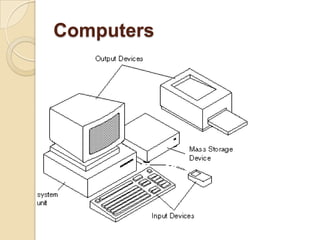
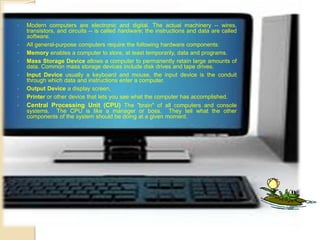
Modern Computers Defined Modern computers are electronic and digital. The actual machinery -- wires,
transistors, and circuits -- is called hardware; the instructions and data are called
software.
 All general-purpose computers require the following hardware components:
 Memory enables a computer to store, at least temporarily, data and programs.
 Mass Storage Device allows a computer to permanently retain large amounts of
data. Common mass storage devices include disk drives and tape drives.
 Input Device usually a keyboard and mouse, the input device is the conduit
through which data and instructions enter a computer.
 Output Device a display screen,
 Printer or other device that lets you see what the computer has accomplished.
 Central Processing Unit (CPU) The "brain" of all computers and console
systems. The CPU is like a manager or boss. They tell what the other
components of the system should be doing at a given moment.
COMPUTERS
 used as teaching aids to help individuals to learn. They serve
to access information for learning, as well as to promote the
formation of new ideas.
 students can be assisted in writing, graphing, idea generating,
word processing, and applying managerial principles to
problem solving and research.
 can now be programmed to be interactive.
 Learners can proceed at their own pace, skip ahead, or review.
 For the uneducated, non-traditional and reentry students, computers
allow individual learning in an environment where they can avoid
embarrassment, track their own progress, and engage in drill and
practice until they are competent.
 student get a variety of responses by way of animation, graphics, and
audio.
 beneficial to instruction are computer learning in mathematics,
computational skills, basic reading skills, and general education.
 lend itself to positive attitudes toward learning such as by way
on increased motivation and improved self esteem among
learners.
 Used as enhancements to traditional instruction.
HIGH TECH
PERIPHERALS
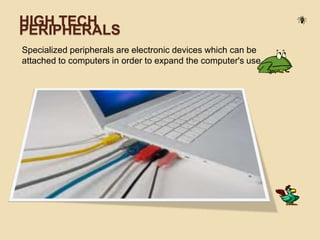
Specialized peripherals are electronic devices which can be
attached to computers in order to expand the computer's use.
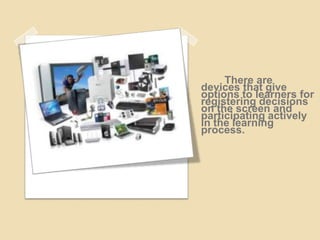
There are
devices that give
options to learners for
registering decisions
on the screen and
participating actively
in the learning
process.
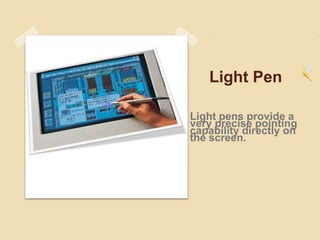
Light Pen
Light pens provide a
very precise pointing
capability directly on
the screen.
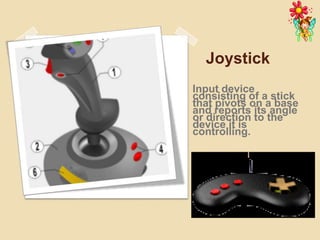
Joystick
Input device
consisting of a stick
that pivots on a base
and reports its angle
or direction to the
device it is
controlling.
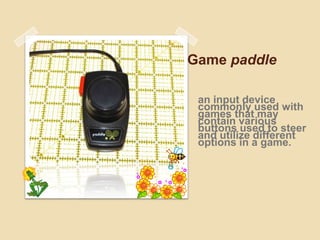
Game paddle
an input device
commonly used with
games that may
contain various
buttons used to steer
and utilize different
options in a game.
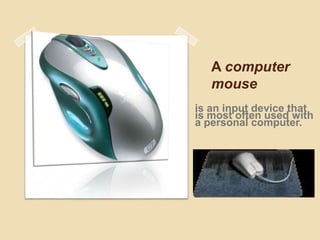
A computer
mouse
is an input device that
is most often used with
a personal computer.
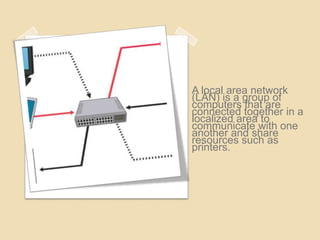
A local area network
(LAN) is a group of
computers that are
connected together in a
localized area to
communicate with one
another and share
resources such as
printers.
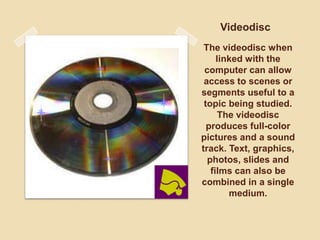
The videodisc when
linked with the
computer can allow
access to scenes or
segments useful to a
topic being studied.
The videodisc
produces full-color
pictures and a sound
track. Text, graphics,
photos, slides and
films can also be
combined in a single
medium.
Videodisc
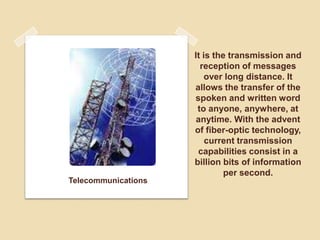
Telecommunications
It is the transmission and
reception of messages
over long distance. It
allows the transfer of the
spoken and written word
to anyone, anywhere, at
anytime. With the advent
of fiber-optic technology,
current transmission
capabilities consist in a
billion bits of information
per second.
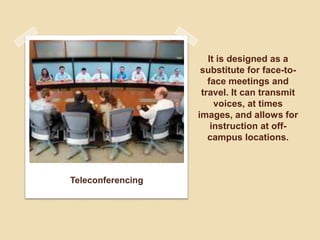
It is designed as a
substitute for face-to-
face meetings and
travel. It can transmit
voices, at times
images, and allows for
instruction at off-
campus locations.
Teleconferencing
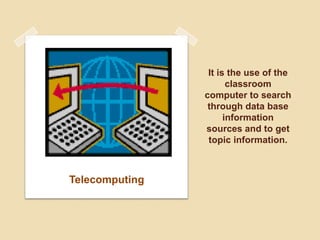
It is the use of the
classroom
computer to search
through data base
information
sources and to get
topic information.
Telecomputing
Implications of the New Technologies
o Methods and content of instruction, both
supplementing and changing the relationship
between the teacher and the learner.
o Have the potential of broadening the gap between
haves and have-nots in society and throughout the
world.
o Have freed many individuals to enjoy their leisure
and to work at home in a distraction-free
environment.
o Most educational services are foreseen to be
delivered electronically by teleconferencing, cable
and satellite television, computer networks and other
Lesson 25 New Technologies for Community Education

Lesson 25 New Technologies for Community Education

  • 1.
    Lesson 25 New Technologies forCommunity Education
  • 2.
  • 3.
    Computer  A computeris a programmable machine. The two principal characteristics of a computer are: ◦ it responds to a specific set of instructions in a well-defined manner; ◦ it can execute a prerecorded list of instructions (a program).
  • 4.
    Modern Computers DefinedModern computers are electronic and digital. The actual machinery -- wires, transistors, and circuits -- is called hardware; the instructions and data are called software.  All general-purpose computers require the following hardware components:  Memory enables a computer to store, at least temporarily, data and programs.  Mass Storage Device allows a computer to permanently retain large amounts of data. Common mass storage devices include disk drives and tape drives.  Input Device usually a keyboard and mouse, the input device is the conduit through which data and instructions enter a computer.  Output Device a display screen,  Printer or other device that lets you see what the computer has accomplished.  Central Processing Unit (CPU) The "brain" of all computers and console systems. The CPU is like a manager or boss. They tell what the other components of the system should be doing at a given moment.
  • 5.
    COMPUTERS  used asteaching aids to help individuals to learn. They serve to access information for learning, as well as to promote the formation of new ideas.  students can be assisted in writing, graphing, idea generating, word processing, and applying managerial principles to problem solving and research.  can now be programmed to be interactive.  Learners can proceed at their own pace, skip ahead, or review.  For the uneducated, non-traditional and reentry students, computers allow individual learning in an environment where they can avoid embarrassment, track their own progress, and engage in drill and practice until they are competent.  student get a variety of responses by way of animation, graphics, and audio.  beneficial to instruction are computer learning in mathematics, computational skills, basic reading skills, and general education.  lend itself to positive attitudes toward learning such as by way on increased motivation and improved self esteem among learners.  Used as enhancements to traditional instruction.
  • 6.
    HIGH TECH PERIPHERALS Specialized peripheralsare electronic devices which can be attached to computers in order to expand the computer's use.
  • 7.
    There are devices thatgive options to learners for registering decisions on the screen and participating actively in the learning process.
  • 8.
    Light Pen Light pensprovide a very precise pointing capability directly on the screen.
  • 9.
    Joystick Input device consisting ofa stick that pivots on a base and reports its angle or direction to the device it is controlling.
  • 10.
    Game paddle an inputdevice commonly used with games that may contain various buttons used to steer and utilize different options in a game.
  • 11.
    A computer mouse is aninput device that is most often used with a personal computer.
  • 12.
    A local areanetwork (LAN) is a group of computers that are connected together in a localized area to communicate with one another and share resources such as printers.
  • 13.
    The videodisc when linkedwith the computer can allow access to scenes or segments useful to a topic being studied. The videodisc produces full-color pictures and a sound track. Text, graphics, photos, slides and films can also be combined in a single medium. Videodisc
  • 14.
    Telecommunications It is thetransmission and reception of messages over long distance. It allows the transfer of the spoken and written word to anyone, anywhere, at anytime. With the advent of fiber-optic technology, current transmission capabilities consist in a billion bits of information per second.
  • 15.
    It is designedas a substitute for face-to- face meetings and travel. It can transmit voices, at times images, and allows for instruction at off- campus locations. Teleconferencing
  • 16.
    It is theuse of the classroom computer to search through data base information sources and to get topic information. Telecomputing
  • 17.
    Implications of theNew Technologies o Methods and content of instruction, both supplementing and changing the relationship between the teacher and the learner. o Have the potential of broadening the gap between haves and have-nots in society and throughout the world. o Have freed many individuals to enjoy their leisure and to work at home in a distraction-free environment. o Most educational services are foreseen to be delivered electronically by teleconferencing, cable and satellite television, computer networks and other