Defining Truth in Scripture and ConversationObjective and Subjective
What is objective truth?What is subjective truth?Are both necessary in Christianity?What have you experienced in regards to relativism?Let’s think…
Introduce our weekly arguments.Know and apply objective and subjective truth appropriately and with humility concerning:The ability to know anything at all!The Old and New TestamentThe Church todayThe physical world around usThe plurality of different religious convictionsPractice responding to a relativistic, or Post-Modernist worldview.Where we are going
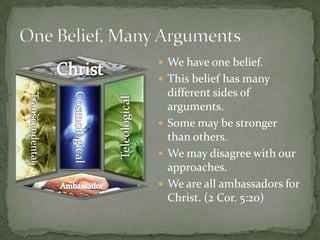
We have one belief.This belief has many different sides of arguments.Some may be stronger than others.We may disagree with our approaches.We are all ambassadors for Christ. (2 Cor. 5:20)One Belief, Many ArgumentsChristCosmologicalTeleologicalTranscendentalAmbassador
You are a king, then!" said Pilate.       Jesus answered, "You are right in saying I am a king. In fact, for this reason I was born, and for this I came into the world, to testify to the truth. Everyone on the side of truth listens to me."  "What is truth?" Pilate asked.What is Truth?
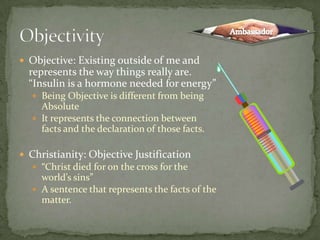
ObjectivityAmbassadorObjective: Existing outside of me and represents the way things really are. “Insulin is a hormone needed for energy”Being Objective is different from being AbsoluteIt represents the connection between facts and the declaration of those facts.Christianity: Objective Justification“Christ died for on the cross for the world’s sins”A sentence that represents the facts of the matter.
2 major categories of Subjective truth.1. Opinions concerning personal like and dislike. “I like ice cream”An objective truth applied to a particular contextChristianity: Subjective Justification“I am saved on account of Christ alone.”SubjectivityAmbassador
I find religion is meaningless -- solely defined for myself.This is indirect relativismHow should we respond to this?What do I know?Ambassador
There is no truth…One must be able to understand the statement, therefore each word must have truth outside of the sentence.The sentiment represented in the sentence must also be true in order for the statement to have meaning.Therefore, it must be TRUE that there is no truth. Stupid.Question: How do you know that there is no truth? How can you make that truth statement if what you say is true?What do I know?Ambassador
There are many truths…Possibly true if the truth statements are completely subjective (definition 1). However, Christianity and Islam cannot be both true, since both make competing and exclusive claims to truth.  One is true, one is false, or they are both false for some third, exclusive claim.Question: How can something be both true and not true? Is that not a contradiction?Many TruthsAmbassador
Scripture reveals the objective will of GodIn a particular place and time.Referring to a specific audience addressed.With the intent and consistent motivation that Christ is at the forefront of humanity in terms of salvation.Therefore:We can’t make God’s word “subjective” to our current time where it has not given us reason to do so.OT and NTAmbassador
We have an inner testimony of the SpiritThis is a subjective truth that no one else can share in the same way.However, our inner testimony is objective in the sense that no other religion has a true experience, but a false one.Therefore:The inner testimony is a proof of God’s existence and the truth of Christ, but it may not be a convincing proof for others.Church TodayAmbassador
Unless we can utilize our faculties to understand truth and make truth claims that are consistent with the facts, we have no knowledge of the world.Cogito ergo Sum: I think therefore I am.Science, philosophy, and theology are all important truth bearing systems.The world aroundAmbassador
Questions to clarify: What do you mean?What do you believe?How do you know what is true?What are your requirements for truth.Statements to make:Objective truth must exist, or else nothing is meaningful.Certain objective truths proceed others (Logic before science).AmbassadorAmbassador
Why is it illogical to suggest that Logic, Reason, and other concepts be subjective? Could society construct their own definitions of Reason, Logic, Morality?Also! Start thinking about Christ, and the evidences for His death and resurrection!To think about and discuss

Lesson 2: Objective and subjective

  • 1.
    Defining Truth inScripture and ConversationObjective and Subjective
  • 2.
    What is objectivetruth?What is subjective truth?Are both necessary in Christianity?What have you experienced in regards to relativism?Let’s think…
  • 3.
    Introduce our weeklyarguments.Know and apply objective and subjective truth appropriately and with humility concerning:The ability to know anything at all!The Old and New TestamentThe Church todayThe physical world around usThe plurality of different religious convictionsPractice responding to a relativistic, or Post-Modernist worldview.Where we are going
  • 4.
    We have onebelief.This belief has many different sides of arguments.Some may be stronger than others.We may disagree with our approaches.We are all ambassadors for Christ. (2 Cor. 5:20)One Belief, Many ArgumentsChristCosmologicalTeleologicalTranscendentalAmbassador
  • 5.
    You are aking, then!" said Pilate.       Jesus answered, "You are right in saying I am a king. In fact, for this reason I was born, and for this I came into the world, to testify to the truth. Everyone on the side of truth listens to me."  "What is truth?" Pilate asked.What is Truth?
  • 6.
    ObjectivityAmbassadorObjective: Existing outsideof me and represents the way things really are. “Insulin is a hormone needed for energy”Being Objective is different from being AbsoluteIt represents the connection between facts and the declaration of those facts.Christianity: Objective Justification“Christ died for on the cross for the world’s sins”A sentence that represents the facts of the matter.
  • 7.
    2 major categoriesof Subjective truth.1. Opinions concerning personal like and dislike. “I like ice cream”An objective truth applied to a particular contextChristianity: Subjective Justification“I am saved on account of Christ alone.”SubjectivityAmbassador
  • 8.
    I find religionis meaningless -- solely defined for myself.This is indirect relativismHow should we respond to this?What do I know?Ambassador
  • 9.
    There is notruth…One must be able to understand the statement, therefore each word must have truth outside of the sentence.The sentiment represented in the sentence must also be true in order for the statement to have meaning.Therefore, it must be TRUE that there is no truth. Stupid.Question: How do you know that there is no truth? How can you make that truth statement if what you say is true?What do I know?Ambassador
  • 10.
    There are manytruths…Possibly true if the truth statements are completely subjective (definition 1). However, Christianity and Islam cannot be both true, since both make competing and exclusive claims to truth. One is true, one is false, or they are both false for some third, exclusive claim.Question: How can something be both true and not true? Is that not a contradiction?Many TruthsAmbassador
  • 11.
    Scripture reveals theobjective will of GodIn a particular place and time.Referring to a specific audience addressed.With the intent and consistent motivation that Christ is at the forefront of humanity in terms of salvation.Therefore:We can’t make God’s word “subjective” to our current time where it has not given us reason to do so.OT and NTAmbassador
  • 12.
    We have aninner testimony of the SpiritThis is a subjective truth that no one else can share in the same way.However, our inner testimony is objective in the sense that no other religion has a true experience, but a false one.Therefore:The inner testimony is a proof of God’s existence and the truth of Christ, but it may not be a convincing proof for others.Church TodayAmbassador
  • 13.
    Unless we canutilize our faculties to understand truth and make truth claims that are consistent with the facts, we have no knowledge of the world.Cogito ergo Sum: I think therefore I am.Science, philosophy, and theology are all important truth bearing systems.The world aroundAmbassador
  • 14.
    Questions to clarify:What do you mean?What do you believe?How do you know what is true?What are your requirements for truth.Statements to make:Objective truth must exist, or else nothing is meaningful.Certain objective truths proceed others (Logic before science).AmbassadorAmbassador
  • 15.
    Why is itillogical to suggest that Logic, Reason, and other concepts be subjective? Could society construct their own definitions of Reason, Logic, Morality?Also! Start thinking about Christ, and the evidences for His death and resurrection!To think about and discuss