Data ProcessingLesson 2
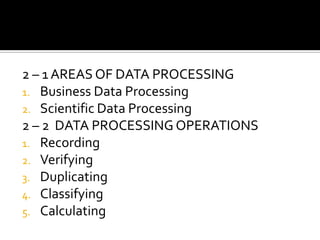
2 – 1 AREAS OF DATA PROCESSINGBusiness Data ProcessingScientific Data Processing2 – 2  DATA PROCESSING OPERATIONSRecordingVerifyingDuplicatingClassifyingCalculating
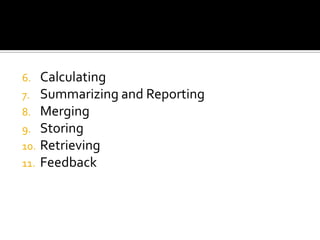
Calculating Summarizing and ReportingMergingStoringRetrievingFeedback
2-3 METHODS OF PROCESSING DATABatch ProcessingOn-line ProcessingReal-time ProcessingDistributed Processing
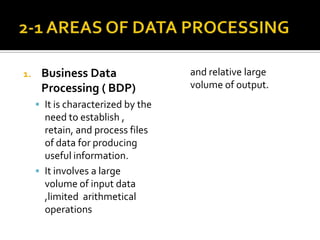
2-1 AREAS OF DATA PROCESSINGBusiness Data Processing ( BDP)It is characterized by the need to establish , retain, and process files of data for producing useful information.It involves a large  volume of input data ,limited  arithmetical  operations 	and relative large volume of output.
2-1 AREAS OF DATA PROCESSINGScientific Data Processing ( SDP)In science, data processing involves a limited volume of input and many logical or arithmetic  calculations.
2-2 Data Processing OperationsRecording – refers  to the transfer of data unto some form or document.  It relates to the documentation  of intermediate figures and facts resulting from calculations Verifying – the checking  of any possible errors  in the recorded data.
2-2 Data Processing OperationsDuplicating – reproducing the data unto many forms of documents.Classifying – identifying and arranging items with like characteristics into groups or classes .Sorting – arranging data in a specific orderCalculating – the arithmetic  manipulation of data.Summarizing and Reporting Summarizing – reducing  masses of data to  a more usable form.Merging – this operation takes two or more sets of data and puts them together to form a single sorted set of data.Storing – placing similar data into files for future reference .Retrieving – recovering stored data and / or information when needed.Feedback – is the comparison  of the output and the goal set  in advance; any discrepancy is analyzed, corrected  and fed back to the proper stage in the processing operation.
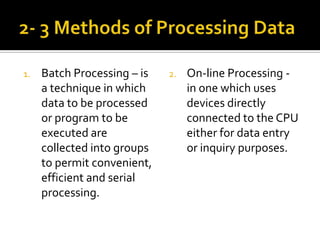
2- 3 Methods of Processing Data Batch Processing – is a technique in which data to be processed or program to be executed are collected into groups to permit convenient, efficient and serial processing.On-line Processing -  in one which uses devices directly connected to the CPU either for data entry or inquiry purposes.
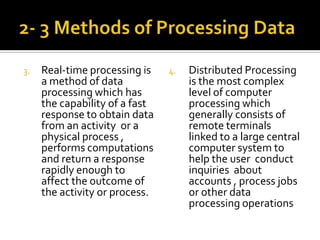
2- 3 Methods of Processing Data Real-time processing is a method of data processing which has the capability of a fast response to obtain data from an activity  or a physical process , performs computations and return a response rapidly enough to affect the outcome of the activity or process. Distributed Processing is the most complex level of computer processing which generally consists of remote terminals linked to a large central computer system to help the user  conduct inquiries  about accounts , process jobs or other data processing operations
Advantages of distributed processing systemCentral processor time is reducedSophisticated computers and a growing library of applications program may be immediately available to end users whenever neededSkilled professionals are available to help users develop their own specialized applicationsManagers may be able to react rapidly to new development and interact with the system in order to seek solutions to unusual problems.
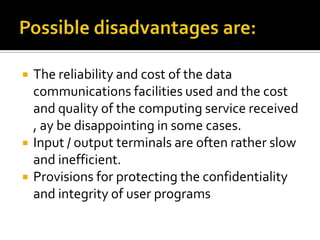
Possible disadvantages are:	The reliability and cost of the data communications facilities used and the cost and quality of the computing service received , ay be disappointing in some cases.Input / output terminals are often rather slow and inefficient.Provisions for protecting the confidentiality and integrity of user programs
Lesson 2   data processing

Lesson 2 data processing

  • 1.
  • 2.
    2 – 1AREAS OF DATA PROCESSINGBusiness Data ProcessingScientific Data Processing2 – 2 DATA PROCESSING OPERATIONSRecordingVerifyingDuplicatingClassifyingCalculating
  • 3.
    Calculating Summarizing andReportingMergingStoringRetrievingFeedback
  • 4.
    2-3 METHODS OFPROCESSING DATABatch ProcessingOn-line ProcessingReal-time ProcessingDistributed Processing
  • 5.
    2-1 AREAS OFDATA PROCESSINGBusiness Data Processing ( BDP)It is characterized by the need to establish , retain, and process files of data for producing useful information.It involves a large volume of input data ,limited arithmetical operations and relative large volume of output.
  • 6.
    2-1 AREAS OFDATA PROCESSINGScientific Data Processing ( SDP)In science, data processing involves a limited volume of input and many logical or arithmetic calculations.
  • 7.
    2-2 Data ProcessingOperationsRecording – refers to the transfer of data unto some form or document. It relates to the documentation of intermediate figures and facts resulting from calculations Verifying – the checking of any possible errors in the recorded data.
  • 8.
    2-2 Data ProcessingOperationsDuplicating – reproducing the data unto many forms of documents.Classifying – identifying and arranging items with like characteristics into groups or classes .Sorting – arranging data in a specific orderCalculating – the arithmetic manipulation of data.Summarizing and Reporting Summarizing – reducing masses of data to a more usable form.Merging – this operation takes two or more sets of data and puts them together to form a single sorted set of data.Storing – placing similar data into files for future reference .Retrieving – recovering stored data and / or information when needed.Feedback – is the comparison of the output and the goal set in advance; any discrepancy is analyzed, corrected and fed back to the proper stage in the processing operation.
  • 9.
    2- 3 Methodsof Processing Data Batch Processing – is a technique in which data to be processed or program to be executed are collected into groups to permit convenient, efficient and serial processing.On-line Processing - in one which uses devices directly connected to the CPU either for data entry or inquiry purposes.
  • 10.
    2- 3 Methodsof Processing Data Real-time processing is a method of data processing which has the capability of a fast response to obtain data from an activity or a physical process , performs computations and return a response rapidly enough to affect the outcome of the activity or process. Distributed Processing is the most complex level of computer processing which generally consists of remote terminals linked to a large central computer system to help the user conduct inquiries about accounts , process jobs or other data processing operations
  • 11.
    Advantages of distributedprocessing systemCentral processor time is reducedSophisticated computers and a growing library of applications program may be immediately available to end users whenever neededSkilled professionals are available to help users develop their own specialized applicationsManagers may be able to react rapidly to new development and interact with the system in order to seek solutions to unusual problems.
  • 12.
    Possible disadvantages are: Thereliability and cost of the data communications facilities used and the cost and quality of the computing service received , ay be disappointing in some cases.Input / output terminals are often rather slow and inefficient.Provisions for protecting the confidentiality and integrity of user programs