+   Supporting
    Your Claims,
    Introducing
    Sources, and
    Documenting
    Sources


    October 3, 2012
+
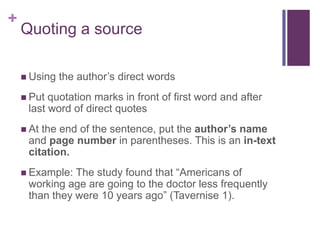
    Quoting a source

     Using   the author’s direct words
     Put quotation marks in front of first word and after
     last word of direct quotes
     Atthe end of the sentence, put the author’s name
     and page number in parentheses. This is an in-text
     citation.
     Example: The study found that “Americans of
     working age are going to the doctor less frequently
     than they were 10 years ago” (Tavernise 1).
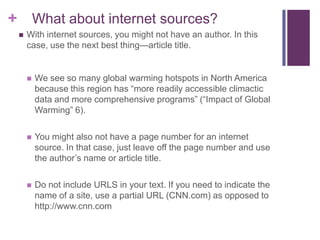
+ What about internet sources?
    With internet sources, you might not have an author. In this
     case, use the next best thing—article title.


        We see so many global warming hotspots in North America
         because this region has “more readily accessible climactic
         data and more comprehensive programs” (“Impact of Global
         Warming” 6).

        You might also not have a page number for an internet
         source. In that case, just leave off the page number and use
         the author’s name or article title.

        Do not include URLS in your text. If you need to indicate the
         name of a site, use a partial URL (CNN.com) as opposed to
         http://www.cnn.com
+
    Works Cited

       You also need a works cited page (In MLA format, this will be a
        separate page at the end of your essay.

       Use the Purdue OWL MLA page for help

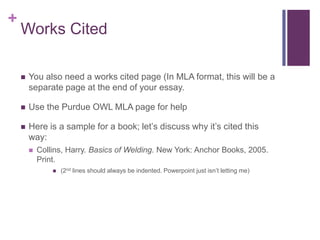
       Here is a sample for a book; let’s discuss why it’s cited this
        way:
           Collins, Harry. Basics of Welding. New York: Anchor Books, 2005.
            Print.
                   (2nd lines should always be indented. Powerpoint just isn’t letting me)
+
    Works Cited: internet Sources
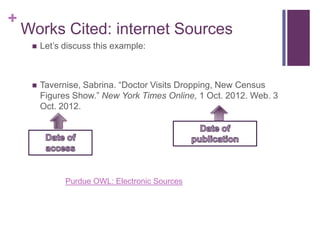
        Let’s discuss this example:


        Tavernise, Sabrina. “Doctor Visits Dropping, New Census
         Figures Show.” New York Times Online, 1 Oct. 2012. Web. 3
         Oct. 2012.


               Purdue OWL: Electronic Sources
+
    Introducing Sources

       Three steps:
           Introduce the author (“According to…” “X has written”)
           Provide the source (“According to X in his article X”)
           Cite the source (in-text citation)
+
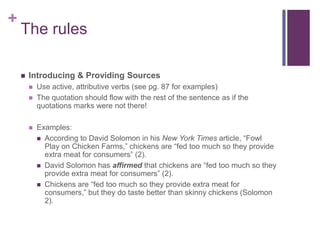
    The rules

       Introducing & Providing Sources
           Use active, attributive verbs (see pg. 87 for examples)
           The quotation should flow with the rest of the sentence as if the
            quotations marks were not there!

           Examples:
             According to David Solomon in his New York Times article, “Fowl
              Play on Chicken Farms,” chickens are “fed too much so they provide
              extra meat for consumers” (2).
             David Solomon has affirmed that chickens are “fed too much so they
              provide extra meat for consumers” (2).
             Chickens are “fed too much so they provide extra meat for
              consumers,” but they do taste better than skinny chickens (Solomon
              2).
+
    Paraphrasing

       You can also paraphrase a source
           No direct quotes
           Summarize the author’s main point in your own words
           Use same rules for in-text citations
+
    Altering Quoted Material

       Use ellipses (…) if you’re removing the MIDDLE of a sentence
        or quote.
               “As baby boomers retire…they leave a working-age population
                that is on average younger and that tends to use less healthcare”
                (Tavernise).

       Use brackets to change a word.
           Example:
               “Books used in class are useful for learning grammar.”
               Booked used in [my classes] are useful for learning grammar.”
+
    Activity

       Log in to My Pima, go to our course, and click on “Links”; Click on the
        Washington Post article

       Working with a partner, read the article and then write a one-
        paragraph summary of the article.

       Use one direct quote from the article within your summary.
             Use direct verbs, and make sure the sentence flows!

             Use the appropriate in-text citations

             Provide a Works Cited page

             Visit the Purdue Owl with questions!

Lesson 10 3

  • 1.
    + Supporting Your Claims, Introducing Sources, and Documenting Sources October 3, 2012
  • 2.
    + Quoting a source  Using the author’s direct words  Put quotation marks in front of first word and after last word of direct quotes  Atthe end of the sentence, put the author’s name and page number in parentheses. This is an in-text citation.  Example: The study found that “Americans of working age are going to the doctor less frequently than they were 10 years ago” (Tavernise 1).
  • 3.
    + What aboutinternet sources?  With internet sources, you might not have an author. In this case, use the next best thing—article title.  We see so many global warming hotspots in North America because this region has “more readily accessible climactic data and more comprehensive programs” (“Impact of Global Warming” 6).  You might also not have a page number for an internet source. In that case, just leave off the page number and use the author’s name or article title.  Do not include URLS in your text. If you need to indicate the name of a site, use a partial URL (CNN.com) as opposed to http://www.cnn.com
  • 4.
    + Works Cited  You also need a works cited page (In MLA format, this will be a separate page at the end of your essay.  Use the Purdue OWL MLA page for help  Here is a sample for a book; let’s discuss why it’s cited this way:  Collins, Harry. Basics of Welding. New York: Anchor Books, 2005. Print.  (2nd lines should always be indented. Powerpoint just isn’t letting me)
  • 5.
    + Works Cited: internet Sources  Let’s discuss this example:  Tavernise, Sabrina. “Doctor Visits Dropping, New Census Figures Show.” New York Times Online, 1 Oct. 2012. Web. 3 Oct. 2012. Purdue OWL: Electronic Sources
  • 6.
    + Introducing Sources  Three steps:  Introduce the author (“According to…” “X has written”)  Provide the source (“According to X in his article X”)  Cite the source (in-text citation)
  • 7.
    + The rules  Introducing & Providing Sources  Use active, attributive verbs (see pg. 87 for examples)  The quotation should flow with the rest of the sentence as if the quotations marks were not there!  Examples:  According to David Solomon in his New York Times article, “Fowl Play on Chicken Farms,” chickens are “fed too much so they provide extra meat for consumers” (2).  David Solomon has affirmed that chickens are “fed too much so they provide extra meat for consumers” (2).  Chickens are “fed too much so they provide extra meat for consumers,” but they do taste better than skinny chickens (Solomon 2).
  • 8.
    + Paraphrasing  You can also paraphrase a source  No direct quotes  Summarize the author’s main point in your own words  Use same rules for in-text citations
  • 9.
    + Altering Quoted Material  Use ellipses (…) if you’re removing the MIDDLE of a sentence or quote.  “As baby boomers retire…they leave a working-age population that is on average younger and that tends to use less healthcare” (Tavernise).  Use brackets to change a word.  Example:  “Books used in class are useful for learning grammar.”  Booked used in [my classes] are useful for learning grammar.”
  • 10.
    + Activity  Log in to My Pima, go to our course, and click on “Links”; Click on the Washington Post article  Working with a partner, read the article and then write a one- paragraph summary of the article.  Use one direct quote from the article within your summary.  Use direct verbs, and make sure the sentence flows!  Use the appropriate in-text citations  Provide a Works Cited page  Visit the Purdue Owl with questions!