VALUES EDUCATION 6:
PSYCHO-SPIRITUAL DEVELOPMENT
MODULE 1
LESSON 1:
MEANING, ESSENCE, NATURE AND PURPOSES OF RELIGION AND SPIRITUALITY
A. RELIGION is a structured system of beliefs, practices, and rituals that typically
involves a connection to the sacred or divine and provides a framework for
understanding the meaning of life, human existence, and the nature of the universe.
The word religion has its roots in the Latin religionem (nominative religio), which
signifies "respect for what is sacred," "reverence for the gods," "conscientiousness," and
"moral obligation." In its earliest uses, it referred to "fear of the gods," "divine service,"
and "religious observance," as well as "a faith," "a mode of worship," or "cult." By the
5th century, in Late Latin, the term also referred specifically to "monastic life."
The term religion was first introduced by Cicero, who derived it from relegere, meaning
"to go through again" (as in reading or reflecting upon something), which comes from
re- ("again") and legere ("to read"). This etymology suggests a thoughtful or reverent
process of reconsidering or re-examining matters of faith and divine devotion.
However, later scholars and writers—such as Servius, Lactantius, and Augustine—
interpreted religio as stemming from religare, meaning "to bind fast" or "to tie,"
suggesting a bond or obligation between humans and the divine. This interpretation
implies that religion involves a binding relationship, a connection of reverence and
duty to a higher power. Another possible origin could be the word religiens, meaning
"careful" or "attentive," the opposite of negligens.
In English, the word "religion" emerged around the 1300s, initially referring to a
"particular system of faith in the worship of divine beings." By the 1530s, the term had
also come to signify the "recognition of and allegiance to a higher, unseen power or
powers" as a way of life, emphasizing devotion and moral obligation.
This evolution of the term reflects its complex role in human culture—both as a
system of beliefs and practices, and as a deeply personal relationship with the divine
or sacred, grounded in reverence, moral duty, and spiritual community.
The Core Elements of Religion: 1. Belief in a Higher Power or Powers: Most religions
include some concept of a divine being (God, gods, or a universal force). These higher
powers are typically believed to have created or govern the universe, and to have a
1
guiding influence over human affairs. Some religions are monotheistic (belief in one
god), while others are polytheistic (belief in many gods), or even pantheistic (belief that
the divine is identical to the universe). 2. Sacred Texts and Teachings: Many religions
have sacred writings or scriptures that contain the teachings, laws, and stories central
to the belief system. These texts are seen as divinely inspired or authoritative, guiding
adherents on how to live a moral and spiritual life. Examples include the Bible
(Christianity), the Quran (Islam), the Vedas (Hinduism), and the Tripitaka (Buddhism).
3. Rituals and Worship: Religion typically involves a set of rituals or ceremonies that
are performed to honor the divine or express devotion. These can include practices like
prayer, meditation, sacraments, festivals, pilgrimages, and other sacred acts. Rituals
often serve as a way for believers to connect with the divine and their community.4.
Moral and Ethical Code: Most religions offer a moral framework that dictates how
followers should behave in their relationships with others, themselves, and the world
around them. These codes often include rules about how to treat others, what is right
and wrong, and how to live a virtuous life. For example, Christianity has the Ten
Commandments, while Islam follows the Five Pillars of Islam. 5. Community and
Social Structure: Religion often involves a community of believers who come together
to share in worship, spiritual practices, and a sense of belonging. Many religions have
a hierarchical structure with religious leaders (priests, imams, monks, etc.) who
provide guidance, leadership, and teachings to the community. 6. Sacred Spaces and
Symbols: Religions often have sacred places (temples, churches, mosques, shrines)
where believers gather to worship and seek connection to the divine. Sacred symbols
(like the cross in Christianity, the star and crescent in Islam, or the om symbol in
Hinduism) also serve as representations of the divine or central beliefs of the faith. 7.
Concepts of Afterlife and Salvation: Many religions offer explanations for life after
death and concepts of salvation or enlightenment. This could involve being reunited
with the divine in an afterlife (heaven, nirvana, etc.), reincarnation, or some form of
spiritual liberation. These beliefs give followers a sense of purpose and hope beyond
their current existence.
Religion can be expressed in many ways, ranging from highly organized, formalized
traditions to more informal, individual practices. Some of the world's major religions
include:
1. Abrahamic Religions: Christianity, Islam, Judaism, which trace their spiritual
lineage to the prophet Abraham.
2. Indian Religions: Hinduism, Buddhism, Jainism, and Sikhism, which
originated in South Asia and have diverse beliefs and practices related to the nature of
life, karma, and spiritual liberation.
3. East Asian Religions: Taoism, Confucianism, Shinto, among others, which focus
on harmony, balance, and the relationship between humans and the universe.
4. Indigenous Religions: Traditional beliefs and practices rooted in the customs
and spiritual practices of specific indigenous cultures, often closely tied to nature and
the land.
2
Religion serves multiple functions in the lives of individuals and communities: 1.
Existential Questions: Religion helps people find answers to life’s big questions—why
we exist, what happens after death, and what the meaning of life is. 2. Social
Cohesion: It fosters a sense of community and belonging, bringing people together
around shared beliefs, practices, and values. 3. Psychological Comfort: Religion often
provides comfort in times of suffering, uncertainty, and loss, offering a sense of hope,
peace, and purpose. 4. Moral and Ethical Guidance: Religious teachings offer
guidelines for living a moral and virtuous life, promoting values like compassion,
justice, and kindness.
-----------
Religion it normally contains four “C”: Creed, Code, Cult, Community Structure.
1. Creed refers to the cognitive aspect of religion; it is everything the goes into the
“explanation” of the ultimate meaning of life.
2. Code of the behavior or ethics includes all the rules and custom of actions that
somehow follow from one aspect or another of the Creed.
3. Cult means all the ritual activities that relate the follower to one aspect or other
to the Transcendent, either directly or indirectly, prayer being an example of the Creed
and certain formal behavior toward representatives of the Transcendent, like priest, of
the code.
4. Community-structure refers to the relationship among the followers.
Transcendence (comes from the latin prefix trans-meaning “beyond,” & the word
scandare, meaning “to climb” – “you have gone beyond ordinary limitations”
The Transcendence as the roots of the word indicate, means “that which goes beyond”
the every-day, the ordinary, the surface experience of reality. It can mean spirits, gods,
a Personal God, and Impersonal God, Emptiness, etc., etc.
Purpose: It provides an explanation of the meaning of life; therefore, all Religion is
constitutively related to humans; it is to provide our understanding of life or
facilitating spirituality itself.
It is the explanation of the meaning of the Ultimate Reality and how Ultimate Reality
relates to all finite reality, and most especially to humans.
Religion is much more than just an intellectual explanation of the meaning of life-
absolutely vital to Religion as the theoretical dimension is. Religion is also “how to live
according” to that explanation. It is a “WAY” of living, of life.
3
B. SPIRITUALITY is a broad and complex concept that generally refers to the
search for meaning, purpose, and connection with something greater than oneself. It
is often concerned with a person’s inner life, their experiences of transcendence, and
their sense of belonging to a larger, often divine, reality.
Here are some key aspects that capture the essence of spirituality: Search for Meaning
and Purpose: Spirituality is often defined as the search for deeper meaning and
understanding in life. This might involve asking existential questions like "What is the
purpose of life?" or "What happens after we die?" It can also be a search for personal
fulfillment, growth, and alignment with one's values or deeper sense of self.
Connection to the Transcendent or Divine: For many, spirituality involves a connection
to something transcendent, which could be understood as God, the universe, or some
higher power or force. This transcendent connection may not always be religious or
theistic; some people experience spirituality through nature, art, or relationships,
seeking experiences that feel connected to something beyond the ordinary world.
Inner Experience: Spirituality is often viewed as an inner experience, focusing on
personal reflection, meditation, or prayer. It involves cultivating a sense of peace,
calm, or insight that transcends day-to-day concerns. Practices like mindfulness,
meditation, and contemplation are central to many spiritual practices.
Transformation and Growth: Spirituality often emphasizes personal transformation,
growth, and healing. It encourages self-awareness, a deeper understanding of one's
inner life, and the development of qualities such as compassion, empathy, and
gratitude. Many spiritual traditions believe that engaging in spiritual practices can
lead to a greater sense of inner peace, well-being, and connectedness with others and
the world.
Ethical and Moral Life: Many forms of spirituality are closely linked to living a moral or
ethical life, whether through compassion, kindness, honesty, or service to others. It
involves striving to align one’s actions and behaviors with higher values, principles, or
virtues.
Not Necessarily Tied to Organized Religion: While spirituality can exist within organized
religious frameworks (like Christianity, Buddhism, etc.), it is also distinct from
religion. Spirituality doesn’t always require adherence to institutional practices or
beliefs. Some people identify as “spiritual but not religious,” meaning they engage in
personal spiritual practices without subscribing to a specific religious tradition.
Spirituality reflects ones integrative view of life while affecting the human soul.
-“the experience or expression of the sacred”
-“the search for meaning in life events and a yearning for connectedness to the
universe”
-“a person’s experience of, or a belief in, a power apart from his or her own existence”
-“a quality that goes beyond religious affiliation, that strives for inspiration, reverence,
awe, meaning and purpose, even in those who do not believe in God. The spiritual
dimension tries to be in harmony with the universe, strives for answers about the
4
infinite, and comes essentially into focus in times of emotional stress, physical (and
mental) illness, loss, bereavement and death”
The term spirit means "animating or vital principle in man ".It is derived from the Old
French espirit, which comes from the Latin word spiritus (soul, ghost, courage, vigor,
breath) and is related to spirare (to breathe). In the Vulgate, the Latin word spiritus is
used to translate the Greek pneuma and Hebrew ruach (breadth).
Spirituality is the search of the sacred. It is about seeking a meaningful connection
with something bigger than yourself, which can result in positive emotions, such as
peace, awe, contentment, gratitude, and acceptance.
Spirituality is something an individual can have without being implicated in the
ambivalent complexity of human societies and institutions. (Grassie 2010). Spirituality
can be described as one’s integrative view of life involves a quest for the meaning and
ultimate value of life. Hence, can be spiritual without being religion.
LESSON 2:
SPIRITUALITY VS RELIGION
Individual vs. Group Beliefs: Spirituality is a personal journey of connecting with the
divine, while religion involves a group of people with shared beliefs and practices.
Religion builds character by adhering to rules, uniting people through common beliefs.
Spirituality, on the other hand, focuses on the individual’s soul and personal
connection with the divine.
Progression of Beliefs: Spirituality evolves as a person learns and grows through their
own experiences. Beliefs are flexible and may change over time. Religion, however, has
fixed beliefs that are taught by religious leaders and remain steady. Religious followers
often need to follow these rules without questioning them, while spirituality
encourages personal exploration and listening to one's inner voice.
Spirituality does not have strict rules. People develop their own truths, guided by
intuition and personal experience. While some spiritual traditions offer tools for
growth, they aren't mandatory beliefs. Religion, in contrast, has defined rules and
doctrines, with consequences for not following them, such as fear of punishment or
reward in the afterlife. Spirituality focuses on inner peace, while religion emphasizes
the consequences of following or not following rules.
Origination of Beliefs: Spirituality is based on personal experience, where people create
their own beliefs through trial and error. It encourages people to trust their instincts
and follow their own paths. Religion is based on teachings from religious founders and
scriptures, and followers learn beliefs from these external sources. Spirituality
emphasizes self-discovery, while religion focuses on external teachings.
5
Religion and Spirituality are not the same but are connected. Both involve a search for
meaning and purpose, but spirituality is about personal growth and connection, while
religion focuses on following specific teachings. Whether you practice spirituality or
religion, both paths can bring peace, happiness, and a deeper appreciation for life.
Community vs. Individual: Religion places a strong emphasis on community and
shared practices. Religious people typically gather for worship, sacraments, festivals,
and other communal activities that reinforce their collective beliefs and values.
Spirituality, on the other hand, is more likely to be an individual pursuit, with people
seeking meaning or connection in ways that may not involve community or external
authority. However, it is possible for spirituality to be shared in smaller groups or
through practices like group meditation or yoga.
Moral and Ethical Framework: Religion provides a specific moral and ethical framework
that dictates how adherents should behave in various aspects of life, from
relationships to business practices. These guidelines are often codified in sacred texts
or passed down through religious leaders. Spirituality may or may not include an
ethical component, and it tends to be more focused on personal experience and
growth. Spiritual individuals may adopt moral principles, but these are often shaped
by their own reflections and experiences rather than dictated by external religious
authorities.
The Role of Rituals and Practices: Religion often includes specific rituals and
ceremonies (e.g., mass, prayer services, pilgrimages, baptism, fasting, etc.) that are
seen as essential to spiritual life and devotion. Spirituality may involve rituals (such as
meditation, prayer, or yoga), but they tend to be personalized or adapted to the
individual's needs. Spiritual practices are often chosen for their ability to foster inner
peace, mindfulness, or connection to the divine, rather than following a prescribed set
of rituals.
Exclusivity vs. Inclusivity: Religion often involves specific beliefs and teachings that
define the group. There are generally specific doctrines that determine who is
considered a member and who is not, which can sometimes create divisions between
religious groups. Spirituality, in contrast, is often seen as inclusive and can be non-
denominational, allowing for more openness to other worldviews. A person can be
spiritual while drawing from multiple religious or philosophical traditions,
incorporating practices or beliefs from different sources.
Purpose and Meaning: Religion offers a sense of meaning and purpose through its
doctrines, narratives, and ultimate goals (e.g., salvation, enlightenment, heaven).
Religions often offer explanations for the big questions of life, such as why we exist,
what happens after death, and how we should live.: Spirituality is often more
existential, with a focus on finding personal meaning and purpose through inner
experience. For spiritual individuals, the journey toward understanding or connecting
with the sacred is often more important than the end goal, which may or may not
involve a specific afterlife or spiritual reward.
Can Spirituality Exist Without Religion?
6
Yes, spirituality can exist without religion. Many people identify as spiritual but not
religious , choosing to explore personal growth and connection to the sacred without
formal religious affiliation. However, for others, spirituality and religion are
intertwined, and the practices and beliefs of a particular religion provide the
framework for their spiritual journey.
In summary, religion tends to be more institutionalized, communal, and doctrinal,
while spirituality is more personal, experiential, and often individualistic. While they
can exist separately, they also overlap in various ways, with many religious people also
seeing their faith as a deeply spiritual pursuit.
LESSON 3:
PSYCHODYNAMIC APPROACHES IN UNDERSTANDING RELIGION AND
SPIRITUALITY focus on how unconscious processes, early life experiences, and
internal conflicts influence religious beliefs and spiritual practices. This perspective is
rooted in the idea that religion and spirituality are deeply connected to psychological
development, often involving both conscious and unconscious motivations.
Sigmund Freud, the founder of psychoanalysis, had a critical view of religion, seeing it
as an illusion that prevents individuals from confronting reality and achieving
emotional maturity. He believed that religion inhibited people’s ability to think
critically and develop independently. Despite his dismissive stance, some 20th-century
theologians, such as Paul Tillich and Reinhold Niebuhr, saw value in Freud’s work, as
they recognized the potential for religion to foster illusions while still seeking insights
into the human condition.
Freud’s ideas were particularly influential among Catholic writers, including those in
Europe, like Antoine Vergote, who explored the relationship between psychoanalysis
and religion. On the other hand, Erik Fromm, another influential psychoanalyst, took
a somewhat different approach to religion. While ambivalent about religion, Fromm
believed it could be a source of orientation and meaning for individuals. However, he
argued that traditional, authoritarian religions—such as Christianity—promoted
dependency and suppressed human reason, which he saw as harmful.
Instead, Fromm advocated for a humanistic form of spirituality that centered on
human power and potential, viewing God more as a symbol of what humans could
become rather than an external authority. Fromm was critical of traditional religion,
describing it as an “empty shell” that no longer served a meaningful role in
contemporary society. He also criticized modern society for replacing religious
authority with materialism and consumerism, which led to alienation and
complacency. In contrast, Fromm found Zen Buddhism to be a more anti-
authoritarian spiritual path that aligned with his views on human autonomy. His
interest in Zen led to collaborations with the Japanese scholar D.T. Suzuki, fostering a
dialogue between psychoanalysis and Buddhism that has continued to influence both
fields. Overall, both Freud and Fromm critiqued the ways in which traditional religion
could restrict personal growth, yet Fromm was more open to the potential for
spirituality that emphasizes human agency and anti-authoritarianism.
7
----------------------------------------------------------------------------------------------------------
D.T. Suzuki (1870–1966) was a prominent Japanese scholar and philosopher best
known for his work in bringing Zen Buddhism to the Western world. His efforts played
a crucial role in fostering a dialogue between psychoanalysis and Buddhism, a
dialogue that has continued to influence both fields into the present day. This dialogue
primarily revolved around common themes such as the nature of the self,
consciousness, spiritual practice, and the potential for human development.
Here’s an expanded look at Suzuki's contributions to the intersection of
psychoanalysis and Buddhism:
Introducing Zen Buddhism to the West
Zen Buddhism: Zen is a form of Mahayana Buddhism that emphasizes meditation
(zazen) and the direct experience of awakening (satori). Zen teachings challenge
intellectualization and place emphasis on direct, non-conceptual experience as the
path to enlightenment.
Suzuki's influence was instrumental in making Zen Buddhism accessible to Western
audiences. He wrote several influential works, including “Zen and Japanese Culture”
and “Essays in Zen Buddhism”, where he explained Zen concepts in a manner that
resonated with Western intellectuals, artists, and philosophers.
Dialogue with Psychoanalysis
Psychoanalysis and Buddhism share several overlapping concerns, especially
regarding the nature of the self and human suffering. Both traditions offer paths to
greater self-awareness and freedom from the constraints that hinder personal and
spiritual development.
Freud and Buddhism: While Freud was generally dismissive of religion and spiritual
practices, Suzuki saw Buddhism as offering insights into the unconscious mind, a key
area of psychoanalysis. For example, both psychoanalysis and Zen Buddhism explore
how individuals experience and deal with their inner conflicts and repressed desires.
Psychoanalysis and the Self: Freud's model of the unconscious, with its emphasis on
repressed desires and internal conflicts, shares a conceptual link with Buddhist
teachings about the illusory nature of the self (anatman). In Buddhism, the ego is seen
as an attachment that causes suffering, while psychoanalysis sees the ego as an
internalized set of defenses and repressions that can distort self-awareness and lead to
psychological distress.
Suzuki helped foster an appreciation for how mindfulness and meditative practices in
Buddhism could aid in exploring the unconscious mind. Unlike the psychoanalytic
approach that often emphasizes introspection and verbalization, Zen meditation
encourages direct, non-verbal insights into one’s mental states.
Influence on Human Development and Self-Actualization
8
Maslow's Humanistic Psychology: Abraham Maslow, a prominent figure in the
humanistic psychology movement, was one of the scholars who found Suzuki’s work
particularly intriguing. Maslow, who was interested in the psychology of self-
actualization and peak experiences, saw parallels between the Zen practice of non-
attachment and the actualization of the self that he championed.
Transpersonal Psychology: Suzuki's ideas also influenced the development of
transpersonal psychology, which looks at the potential for spiritual growth and
development beyond ordinary self-concept and ego. In both Zen Buddhism and
transpersonal psychology, achieving higher states of consciousness and self-
awareness is seen as an essential part of personal development and fulfillment.
The Impact of Suzuki’s Work on Psychoanalysts
Erik Fromm: One of the most notable psychoanalysts influenced by Suzuki was Erik
Fromm, who integrated Zen Buddhism with his work on humanistic psychology and
his critique of authoritarian religious structures. Fromm argued that Zen provided a
model for an alternative to authoritarian religion—a path that emphasized individual
freedom, mindfulness, and the transcendence of the ego.
Carl Jung: Another influential figure who was drawn to Buddhist thought was Carl
Jung, who was fascinated by the exploration of the unconscious and the symbolic
aspects of spirituality. While Jung did not specifically align with Zen Buddhism, he
found resonance in its emphasis on achieving balance, overcoming the ego, and
integrating unconscious material into the conscious self.
From Psychoanalysis to Zen: Suzuki’s work provided a bridge for psychoanalysts and
psychologists who were seeking to understand spirituality as a form of psychological
healing. His discussions on the impermanence of the self and the dissolution of the
ego found resonance with psychological approaches that emphasized personal
transformation and self-understanding.
Key Concepts from Zen Buddhism that Resonate with Psychoanalysis
MINDFULNESS: Both Zen Buddhism and psychoanalysis recognize the importance of
mindfulness—a focused awareness of the present moment. Zen meditation emphasizes
awareness without judgment or attachment, allowing individuals to experience the
world as it truly is. In psychoanalysis, awareness and insight into unconscious
material are crucial for healing.
NON-ATTACHMENT: A key tenet of Zen Buddhism is the idea of non-attachment or
non-clinging to the self, thoughts, or experiences. Suzuki’s teachings about the
impermanent and ever-changing nature of life helped psychoanalysts see the potential
for letting go of rigid psychological structures and defenses that prevent emotional
growth.
THE EMPTY SELF: The Buddhist idea of emptiness (shunyata)—the notion that the
self is not a fixed, substantial entity—aligns with psychodynamic views that challenge
9
the solidity and permanence of the ego. In Zen, overcoming the attachments to the self
leads to the experience of profound interconnectedness and spiritual liberation.
Critiques of the Dialogue Between Psychoanalysis and Buddhism
Cultural Appropriations and Misunderstandings: Some critics argue that the
application of Buddhist principles, especially Zen, in Western psychoanalysis can lead
to oversimplifications or misappropriations of cultural and spiritual practices. The
rituals and spirituality of Zen may be treated more as techniques for self-improvement
rather than integral aspects of a broader spiritual path.
Potential Limitations: While both Buddhism and psychoanalysis offer profound
insights into human suffering, they diverge in their methods and end goals.
Psychoanalysis is often more focused on mental health treatment, while Zen aims at
spiritual enlightenment. The blending of the two approaches risks underplaying the
distinct spiritual commitments that are central to Buddhist practice.
Conclusion: The Ongoing Dialogue
D.T. Suzuki’s contributions to fostering a dialogue between psychoanalysis and
Buddhism helped create a framework for understanding the intersection of psychology
and spirituality. His work highlighted the ways in which the exploration of
consciousness, the dissolution of the ego, and the cultivation of mindfulness can
enhance both psychological well-being and spiritual growth. Today, his legacy
continues to influence both fields, particularly in the realms of transpersonal
psychology, mindfulness-based therapies, and integrative approaches to mental
health. Suzuki's ideas remain an important point of connection for those interested in
understanding the deep interrelations between the human mind, spiritual practice,
and personal transformation.
Sigmund Freud
View of Religion: Freud saw religion primarily as an illusion and a form of defense
mechanism. He argued that religious beliefs served as a psychological coping
mechanism for people to deal with life's anxieties, especially the fear of death and
feelings of helplessness. Freud believed that religion was rooted in unconscious
desires, particularly the need for paternal protection, which he associated with the
figure of God.
Religion as Illusion: According to Freud, religious beliefs are not based on rational
evidence but are wish-fulfilling illusions. They fulfill emotional needs by offering
comfort and protection, much like a child’s reliance on parental figures.
Impact on Religion: Despite Freud's criticism, his work had an indirect influence on
theologians and psychologists alike, as some found his insights helpful in
understanding the psychological underpinnings of religious belief.
Erich Fromm
10
View of Religion: Fromm was interested in how religion relates to human freedom and
the individual’s psychological development. He was critical of authoritarian religions
(such as traditional Christianity), which he believed suppressed personal freedom and
fostered dependency. He saw these types of religion as detrimental to self-reliance and
autonomy.
Humanistic Religion: Fromm advocated for a humanistic form of spirituality, where
the focus was on human potential and the divine was understood as a symbol of
human strength, rather than an external, controlling power. For him, religion should
support personal growth and the search for meaning, rather than promoting
submission to authority.
Authoritarian vs. Humanistic: He distinguished between authoritarian religions, which
stifle personal freedom, and humanistic religions, which support self-actualization and
social justice. Fromm believed that the former led to feelings of guilt, fear, and
aggression, while the latter nurtured self-awareness and genuine freedom.
Impact of Psychodynamic Theory on Understanding Religion
Psychological Defense Mechanisms: Religious beliefs can be understood as defense
mechanisms that help individuals cope with existential fears, such as the fear of
death, meaninglessness, and powerlessness. This is in line with Freud's view of
religion as an illusion that protects individuals from the harsh realities of life.
Religious Development and Childhood: Psychodynamic theory emphasizes the role of
early childhood experiences in shaping religious beliefs. For example, Freud's model of
the psyche suggests that the relationship with parental figures is mirrored in the way
individuals view God and engage with religious teachings.
Religious Conflicts and Unresolved Issues: Psychodynamic perspectives also highlight
how unresolved psychological conflicts may manifest in religious beliefs. For instance,
a person struggling with feelings of guilt or inadequacy might seek salvation or
forgiveness through religious rituals.
Salient Points of Psychodynamic Approaches in Religion and Spirituality
Unconscious Motivation: Religious beliefs and practices may be driven by unconscious
motivations, such as a need for safety, security, or to resolve inner conflicts.
Defense Mechanisms: Religion may serve as a psychological defense against anxiety
and existential concerns, providing comfort, order, and meaning.
Early Childhood Influence: Religious attitudes may be shaped by early family
dynamics, particularly relationships with parental figures.
Authoritarian vs. Humanistic: The way people approach religion (authoritarian vs.
humanistic) can deeply affect their psychological well-being and sense of autonomy.
11
Universal Spirituality: Transpersonal psychology offers a perspective that spiritual
experiences transcend cultural and religious boundaries, focusing on higher states of
consciousness and self-actualization.
Psychodynamic approaches to religion and spirituality explore how unconscious
forces, early life experiences, and psychological conflicts contribute to the development
and experience of religious beliefs. These theories have shaped the understanding of
how individuals engage with spirituality, whether in the form of structured religious
practices or personal mystical experiences
LESSON 4:
HUMANISTIC AND TRANSPERSONAL APPROACHES TO RELIGION AND
SPIRITUALITY offer distinctive ways of understanding human experience, often
focusing on personal growth, self-actualization, and higher states of consciousness.
Both perspectives integrate spiritual and psychological dimensions but with different
emphasis.
a. Humanistic Approach to Religion and Spirituality
The Humanistic approach to religion and spirituality, rooted in Humanism,
emphasizes individual autonomy, personal growth, and the search for meaning. In this
framework, spirituality is often viewed as a path toward self-actualization—realizing
one’s fullest potential.
Maslow’s Hierarchy of Needs: Abraham Maslow’s work is key here, particularly his
concept of self-actualization, the process of becoming the best version of oneself.
Maslow included spiritual experiences in his understanding of self-actualization,
suggesting that transcendence (connecting to something larger than oneself) is a
natural human drive once more basic needs (like safety, belonging, and esteem) are
met.
Focus on Personal Growth and Meaning: In the Humanistic framework, religion and
spirituality are seen as tools for personal development. The emphasis is not on
adhering to a particular set of religious doctrines, but on exploring one’s own beliefs
and experiences. It’s more about finding meaning and authenticity in life than following
a prescribed path. Humanistic psychologists such as Carl Rogers emphasized the
importance of self-acceptance and authenticity in spiritual life.
Psychological Health: Humanistic approaches view spirituality as a path to
psychological well-being. The quest for inner peace, balance, and a sense of purpose is
considered an essential component of mental health. The focus is often on therapeutic
practices, such as mindfulness or meditation, that help individuals connect to their
inner lives and achieve harmony between their inner and outer worlds.
Empowerment and Individual Choice: Humanism also stresses the autonomy of the
individual in making spiritual choices. There is a rejection of the idea that individuals
must rely on external authorities (e.g., organized religions or dogmas). Instead,
12
individuals are encouraged to explore their spirituality in ways that resonate with their
personal experiences and values.
b. Transpersonal Approach to Religion and Spirituality
The Transpersonal approach extends beyond the individual to consider higher states
of consciousness and spiritual experiences. This perspective blends psychology with
mystical and transcendent experiences, seeking to understand the spiritual dimension
of human existence.
Higher States of Consciousness: Transpersonal psychology, influenced by figures like
Stanislav Grof and Ken Wilber, looks at altered states of consciousness (through
meditation, psychedelic experiences, or deep states of introspection) as key to
understanding the deeper dimensions of the self. The transpersonal approach is
interested in experiences of oneness, unity, and transcendence that can lead to
profound shifts in perception and consciousness.
Integration of Spiritual and Psychological Growth: Transpersonal psychologists view
spiritual experiences as not only meaningful but also essential to a person’s
psychological and emotional growth. These experiences can help people transcend
ordinary consciousness and experience a sense of connection to the universe, to
others, or to a higher power.
As such, transpersonal psychology often focuses on integrating spiritual insights into
everyday life, not just for transcendence but for personal healing and growth.
The Quest for Spiritual Transcendence: Whereas Humanistic psychology is more about
self-actualization, Transpersonal psychology is about spiritual transcendence—moving
beyond the ego to experience a sense of connection to something greater than the self.
This could involve mystical experiences, visions, or a sense of divine presence. It often
embraces practices like meditation, mindfulness, or other spiritual rituals that
facilitate accessing higher states of consciousness.
Spirituality as a Healing Force: Transpersonal psychology also emphasizes the
therapeutic potential of spirituality. It is not simply about achieving personal goals but
also about healing and transformation at a deeper, soul level. For example, through
spiritual practices, individuals might work through emotional blockages, trauma, or
existential crises, ultimately finding peace and unity.
Holistic View of Human Experience: Transpersonal psychology integrates a more
holistic view of human nature, seeing the physical, emotional, psychological, and
spiritual dimensions as interconnected. It also tends to acknowledge paranormal or
mystical experiences as valid parts of human consciousness, valuing them as
experiences that can deepen one’s understanding of reality and self.
Key Differences and Connections
Humanistic approaches focus on individual growth and self-discovery, emphasizing
the importance of meaning, personal values, and psychological health.
13
Transpersonal approaches, while also concerned with personal growth, go beyond the
ego to explore higher, spiritual realms of consciousness. They tend to emphasize the
transcendence of the self and connection to the divine or the cosmos.
Both approaches reject dogma and emphasize personal experience. They seek to
integrate spirituality into daily life in a way that fosters both psychological and
spiritual well-being. Both humanistic and transpersonal approaches can be deeply
therapeutic, as they both look at personal suffering and growth as part of a larger
spiritual journey.
In sum, Humanistic approaches to religion and spirituality are grounded in the belief
that spirituality is about individual growth, meaning, and authenticity, while
Transpersonal approaches explore the expansive potential of human consciousness
and the possibility of transcending the ego to experience deeper spiritual connections.
Both frameworks invite individuals to explore and integrate their spiritual journeys,
but from different vantage points—one rooted in psychological well-being and self-
actualization, the other in transcendent, mystical, or cosmic dimensions of existence.
In the 1960s, the dialogue between psychology and religion began to regain
momentum with the rise of humanistic psychology and the application of social-
personality psychology to the study of religion. Humanistic psychology, which emerged
as a "third force" alongside psychoanalysis and behaviorism, focused on studying the
positive and uniquely human qualities of individuals, such as self-transcendence and
mystical experiences. It promoted an individualistic and subjective view of the human
person and tended to take anti-traditionalist stances on religion. Prominent figures in
the humanistic psychology movement included Carl Rogers, Rollo May, and Abraham
Maslow. While May and Rogers influenced the pastoral counseling movement, Maslow
played a crucial role in the creation of transpersonal psychology, which emphasized
human development and experiences that extend beyond typical individual
experiences, fostering a dialogue between psychology and certain Asian religious
traditions.
Maslow, known for his motivational theory of personality, believed that people are
driven by a hierarchy of needs, with self-actualization representing the highest goal—a
state of personal fulfillment where one becomes everything they are capable of
becoming.
Initially, Maslow held a negative view of religion, believing that while it might serve to
meet basic needs like safety, religious explanations for spiritual matters were
unscientific. He argued that a "humanistic faith," based on empirical study of human
nature, could provide genuine values and answers to religious questions. However,
later in his career, Maslow moderated his view, acknowledging that a truly religious
person might use their faith to construct authentic values.
One of Maslow's major contributions was his study of self-actualizers, individuals he
considered exemplary, such as D.T. Suzuki and Thomas More, who demonstrated
creativity, deep interpersonal relationships, and an efficient perception of reality. While
these individuals were not religious in a traditional sense, they shared common traits
14
with peak experiences—ecstatic, self-transcending states that Maslow viewed as
central to religious or mystical experiences. Maslow argued that religious experiences
were essentially natural human phenomena that could be explained without
theological context, and he believed all religions were fundamentally the same, a view
now questioned by modern religious studies.
Transpersonal Psychology (4th Force in Psychology)
Developed by: Abraham Maslow, Stanislav Grof, and Anthony Sutich.
View of Religion and Spirituality: Transpersonal psychology examines religious and
spiritual experiences as aspects of higher consciousness and self-transcendence. It
focuses on mystical experiences, altered states of consciousness, and the potential for
human development beyond the personal ego.
Peak Experiences: Maslow’s concept of "peak experiences" — moments of intense, self-
transcending spirituality — is central to transpersonal psychology. These experiences
are seen as profound, transformative moments that go beyond ordinary human
experience and are often described as spiritual or mystical in nature.
Universal Spirituality: Transpersonal psychologists often argue that all religions share
a universal core, emphasizing the importance of transcending the self and achieving a
sense of unity with the world or a higher power. They view mystical experiences across
religious traditions as essentially the same, focusing on human potential and spiritual
growth.
The Transpersonal Psychology Movement
The Transpersonal Psychology Movement, founded in the late 1960s by Abraham
Maslow, Stanislav Grof, and Anthony Sutich, emerged as a "fourth force" in
psychology, building on Maslow’s work on self-actualization and peak experiences.
Transpersonal psychology explores the potential for human development beyond
personal experiences, emphasizing advanced states of consciousness and the
universal aspects of human cognition. It assumes that higher levels of functioning are
achieved by transcending personal boundaries, and that while religions contain
transpersonal elements, much of their content is culture-specific and not directly
relevant to universal human concerns. This idea aligns with the perennial philosophy,
which suggests that all religions share a common core of spiritual truth.
Transpersonal psychology also asserts that humans possess untapped potential,
which can be developed through conscious effort and study. The field includes a broad
range of topics, such as mystical, transcendent, and even psychic experiences, and
explores methods for altering consciousness, such as meditation and the use of drugs.
One of the key figures in this movement, Ken Wilber, has explored the evolution of
consciousness and critiqued modern rationality, advocating for a more holistic
approach to understanding the world. However, critiques of transpersonal psychology
have pointed out its "Orientocentric" focus, primarily on non-theistic Asian traditions
like Zen Buddhism, and its neglect of more relational or communal aspects of
15
spirituality. Critics argue that this individualistic focus overlooks the importance of
social and relational dimensions of spiritual development.
Gordon Allport
Gordon Allport (1897–1967), a social psychologist and personality theorist, was an
important early figure in the psychological study of religion. He sought to move beyond
moral judgments about human behavior and to establish a scientific understanding of
human development. Unlike some of his contemporaries, Allport had a positive view of
Christianity but recognized that some forms of religious involvement could be
negative. He was particularly interested in authoritarianism and prejudice, especially
in the aftermath of Nazism and World War II. In his research, Allport found that many
religious individuals exhibited high levels of prejudice, despite their religion’s
teachings against it. He explained this by looking at the motivations behind religious
commitment. He distinguished between two types of religious motivation: extrinsic and
intrinsic. Those with extrinsic motivations use religion to achieve personal goals and
were more likely to display prejudice, while those with intrinsic motivations pursued
religion for its own sake and were less likely to exhibit such attitudes.
Allport's work on religious motivation has been influential and expanded over time.
Richard Gorsuch and others conceptualized religious motivation as involving intrinsic
and extrinsic dimensions and found that genuine religious involvement, like church
attendance, was correlated with intrinsic religiosity. Later, Daniel Batson introduced a
third dimension, the quest orientation, which reflects an open-ended search for
existential answers, coupled with skepticism towards definitive answers. This quest
orientation was associated with positive religious benefits but with the freedom that
intrinsic religiosity might limit.
Allport’s views on religious motivation were later incorporated into the Multivariate
Belief-Motivation Theory of Religiousness, which explores three interacting factors:
motivation (intrinsic-extrinsic), beliefs (such as one's concept of God), and coping
style. However, some critics, including Kirkpatrick and Hood, argued against the
concept of religious motivation, questioning its methodology and reducing religion to
mere human motivation. Despite this, Allport remained sympathetic toward religion,
emphasizing its positive effects on individuals and society. He believed psychology and
religion both seek truth and thus should not be in conflict, though he rejected the
reduction of religion to psychological terms. However, not all social psychologists
share this view, with some, like Batson, offering a more negative assessment of
religion's role in society, though these views have been challenged in recent years.
Salient Points:
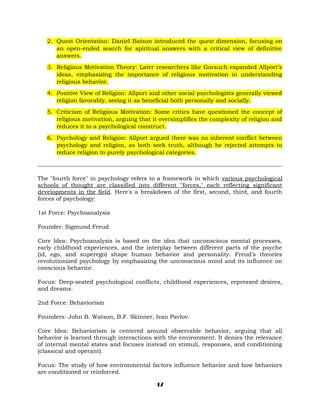
1. Religious Motivation: Allport identified two primary types of religious motivation
—extrinsic (using religion for personal gain) and intrinsic (religion pursued for
its own sake). Intrinsic religiosity is linked with less prejudice and more positive
outcomes.
16
2. Quest Orientation: Daniel Batson introduced the quest dimension, focusing on
an open-ended search for spiritual answers with a critical view of definitive
answers.
3. Religious Motivation Theory: Later researchers like Gorsuch expanded Allport’s
ideas, emphasizing the importance of religious motivation in understanding
religious behavior.
4. Positive View of Religion: Allport and other social psychologists generally viewed
religion favorably, seeing it as beneficial both personally and socially.
5. Criticism of Religious Motivation: Some critics have questioned the concept of
religious motivation, arguing that it oversimplifies the complexity of religion and
reduces it to a psychological construct.
6. Psychology and Religion: Allport argued there was no inherent conflict between
psychology and religion, as both seek truth, although he rejected attempts to
reduce religion to purely psychological categories.
_____________________________________________________________________________________
The "fourth force" in psychology refers to a framework in which various psychological
schools of thought are classified into different "forces," each reflecting significant
developments in the field. Here's a breakdown of the first, second, third, and fourth
forces of psychology:
1st Force: Psychoanalysis
Founder: Sigmund Freud.
Core Idea: Psychoanalysis is based on the idea that unconscious mental processes,
early childhood experiences, and the interplay between different parts of the psyche
(id, ego, and superego) shape human behavior and personality. Freud’s theories
revolutionized psychology by emphasizing the unconscious mind and its influence on
conscious behavior.
Focus: Deep-seated psychological conflicts, childhood experiences, repressed desires,
and dreams.
2nd Force: Behaviorism
Founders: John B. Watson, B.F. Skinner, Ivan Pavlov.
Core Idea: Behaviorism is centered around observable behavior, arguing that all
behavior is learned through interactions with the environment. It denies the relevance
of internal mental states and focuses instead on stimuli, responses, and conditioning
(classical and operant).
Focus: The study of how environmental factors influence behavior and how behaviors
are conditioned or reinforced.
17
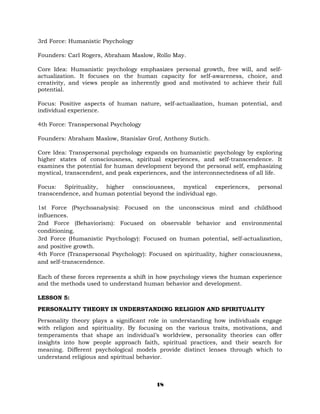
3rd Force: Humanistic Psychology
Founders: Carl Rogers, Abraham Maslow, Rollo May.
Core Idea: Humanistic psychology emphasizes personal growth, free will, and self-
actualization. It focuses on the human capacity for self-awareness, choice, and
creativity, and views people as inherently good and motivated to achieve their full
potential.
Focus: Positive aspects of human nature, self-actualization, human potential, and
individual experience.
4th Force: Transpersonal Psychology
Founders: Abraham Maslow, Stanislav Grof, Anthony Sutich.
Core Idea: Transpersonal psychology expands on humanistic psychology by exploring
higher states of consciousness, spiritual experiences, and self-transcendence. It
examines the potential for human development beyond the personal self, emphasizing
mystical, transcendent, and peak experiences, and the interconnectedness of all life.
Focus: Spirituality, higher consciousness, mystical experiences, personal
transcendence, and human potential beyond the individual ego.
1st Force (Psychoanalysis): Focused on the unconscious mind and childhood
influences.
2nd Force (Behaviorism): Focused on observable behavior and environmental
conditioning.
3rd Force (Humanistic Psychology): Focused on human potential, self-actualization,
and positive growth.
4th Force (Transpersonal Psychology): Focused on spirituality, higher consciousness,
and self-transcendence.
Each of these forces represents a shift in how psychology views the human experience
and the methods used to understand human behavior and development.
LESSON 5:
PERSONALITY THEORY IN UNDERSTANDING RELIGION AND SPIRITUALITY
Personality theory plays a significant role in understanding how individuals engage
with religion and spirituality. By focusing on the various traits, motivations, and
temperaments that shape an individual’s worldview, personality theories can offer
insights into how people approach faith, spiritual practices, and their search for
meaning. Different psychological models provide distinct lenses through which to
understand religious and spiritual behavior.
18
Overview of key personality theories and how they intersect with religion and
spirituality
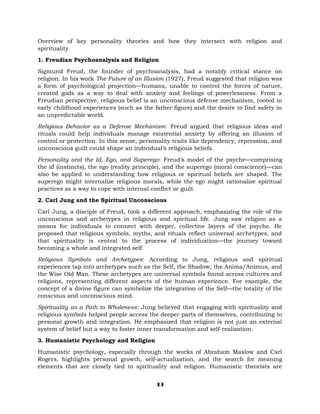
1. Freudian Psychoanalysis and Religion
Sigmund Freud, the founder of psychoanalysis, had a notably critical stance on
religion. In his work The Future of an Illusion (1927), Freud suggested that religion was
a form of psychological projection—humans, unable to control the forces of nature,
created gods as a way to deal with anxiety and feelings of powerlessness. From a
Freudian perspective, religious belief is an unconscious defense mechanism, rooted in
early childhood experiences (such as the father figure) and the desire to find safety in
an unpredictable world.
Religious Behavior as a Defense Mechanism: Freud argued that religious ideas and
rituals could help individuals manage existential anxiety by offering an illusion of
control or protection. In this sense, personality traits like dependency, repression, and
unconscious guilt could shape an individual’s religious beliefs.
Personality and the Id, Ego, and Superego: Freud’s model of the psyche—comprising
the id (instincts), the ego (reality principle), and the superego (moral conscience)—can
also be applied to understanding how religious or spiritual beliefs are shaped. The
superego might internalize religious morals, while the ego might rationalize spiritual
practices as a way to cope with internal conflict or guilt.
2. Carl Jung and the Spiritual Unconscious
Carl Jung, a disciple of Freud, took a different approach, emphasizing the role of the
unconscious and archetypes in religious and spiritual life. Jung saw religion as a
means for individuals to connect with deeper, collective layers of the psyche. He
proposed that religious symbols, myths, and rituals reflect universal archetypes, and
that spirituality is central to the process of individuation—the journey toward
becoming a whole and integrated self.
Religious Symbols and Archetypes: According to Jung, religious and spiritual
experiences tap into archetypes such as the Self, the Shadow, the Anima/Animus, and
the Wise Old Man. These archetypes are universal symbols found across cultures and
religions, representing different aspects of the human experience. For example, the
concept of a divine figure can symbolize the integration of the Self—the totality of the
conscious and unconscious mind.
Spirituality as a Path to Wholeness: Jung believed that engaging with spirituality and
religious symbols helped people access the deeper parts of themselves, contributing to
personal growth and integration. He emphasized that religion is not just an external
system of belief but a way to foster inner transformation and self-realization.
3. Humanistic Psychology and Religion
Humanistic psychology, especially through the works of Abraham Maslow and Carl
Rogers, highlights personal growth, self-actualization, and the search for meaning
elements that are closely tied to spirituality and religion. Humanistic theorists are
19
interested in how individuals use religion to fulfill basic psychological needs and attain
self-actualization.
Maslow’s Hierarchy of Needs: In his well-known Hierarchy of Needs, Maslow placed
self-actualization at the top of human needs, which represents the realization of one's
full potential. Spiritual experiences can be seen as part of this journey toward self-
actualization, where individuals transcend their ego, achieve a sense of unity with the
universe, or experience peak experiences of transcendence and awe. In Maslow’s view,
certain religious experiences could be fulfilling, but the pursuit of personal growth,
creativity, and self-understanding is essential.
Carl Rogers and the Self-Actualized Individual: Rogers, like Maslow, focused on the
importance of self-actualization. He believed that religious and spiritual practices
could be tools for fostering self-acceptance and authenticity. For Rogers, the fully
functioning person—one who is open to experience, self-aware, and continually growing
—may find spirituality or religion to be a source of personal meaning and direction.
Religion, in this sense, provides a framework to help individuals align their self-
concept with their ideal self.
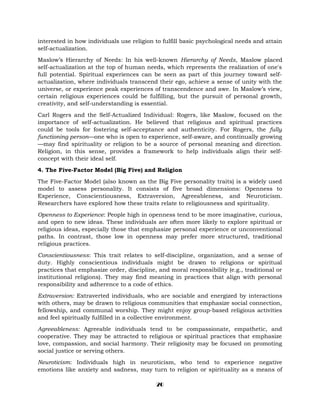
4. The Five-Factor Model (Big Five) and Religion
The Five-Factor Model (also known as the Big Five personality traits) is a widely used
model to assess personality. It consists of five broad dimensions: Openness to
Experience, Conscientiousness, Extraversion, Agreeableness, and Neuroticism.
Researchers have explored how these traits relate to religiousness and spirituality.
Openness to Experience: People high in openness tend to be more imaginative, curious,
and open to new ideas. These individuals are often more likely to explore spiritual or
religious ideas, especially those that emphasize personal experience or unconventional
paths. In contrast, those low in openness may prefer more structured, traditional
religious practices.
Conscientiousness: This trait relates to self-discipline, organization, and a sense of
duty. Highly conscientious individuals might be drawn to religions or spiritual
practices that emphasize order, discipline, and moral responsibility (e.g., traditional or
institutional religions). They may find meaning in practices that align with personal
responsibility and adherence to a code of ethics.
Extraversion: Extraverted individuals, who are sociable and energized by interactions
with others, may be drawn to religious communities that emphasize social connection,
fellowship, and communal worship. They might enjoy group-based religious activities
and feel spiritually fulfilled in a collective environment.
Agreeableness: Agreeable individuals tend to be compassionate, empathetic, and
cooperative. They may be attracted to religious or spiritual practices that emphasize
love, compassion, and social harmony. Their religiosity may be focused on promoting
social justice or serving others.
Neuroticism: Individuals high in neuroticism, who tend to experience negative
emotions like anxiety and sadness, may turn to religion or spirituality as a means of
20
coping with stress, anxiety, and existential concerns. Some studies suggest that
individuals with higher neuroticism might seek religious support to help manage their
emotional turmoil.
5. Attachment Theory and Religion
Attachment theory, developed by John Bowlby and Mary Ainsworth, has also been
applied to understanding religious and spiritual experiences. Attachment theory posits
that early relationships with caregivers shape an individual's emotional and relational
patterns throughout life.
Secure Attachment and Religion: Individuals with a secure attachment style—who feel
safe, loved, and supported—may approach religion in a way that fosters personal
growth and connection with others. They may experience religion as a positive force for
creating meaningful relationships and building a sense of community.
Insecure Attachment and Religion: On the other hand, individuals with insecure
attachment styles—those who have experienced inconsistent or unreliable caregiving—
may turn to religion for comfort, safety, or a sense of control. For example, anxious
individuals may seek reassurance from religious beliefs, while avoidant individuals
might distance themselves from religious institutions.
Personality theories provide a rich framework for understanding the diverse ways in
which people engage with religion and spirituality. Whether through the lens of
Freudian psychoanalysis, Jungian archetypes, humanistic self-actualization, the Big
Five personality traits, or attachment theory, personality influences how individuals
experience religious beliefs, practices, and spiritual growth. By examining the
interplay between personality traits and spiritual or religious development, we can
better understand why individuals approach faith in such varied ways.
LESSON 6: POSITIVE PSYCHOLOGY
POSITIVE PSYCHOLOGY is a branch of psychology that focuses on studying and
promoting the positive aspects of human experience, such as happiness, well-being,
strengths, and flourishing, rather than focusing solely on pathology or what is wrong
with individuals. It was popularized by Martin Seligman in the late 1990s, who argued
that psychology should not only focus on treating mental illness but also on
understanding and fostering the factors that contribute to human thriving.
Key Concepts of Positive Psychology
Well-Being: One of the central themes in positive psychology is the study of well-being.
This includes subjective well-being (emotional reactions and cognitive judgments
about one's life) as well as eudaimonic well-being (the realization of one's potential and
living a meaningful life). Seligman proposed a model of well-being known as PERMA,
which includes five key elements:
P (Positive Emotion): Experiencing feelings like joy, gratitude, hope, and love.
E (Engagement): Being deeply involved or absorbed in activities that use your skills.
21
R (Relationships): Having positive, supportive social connections.
M (Meaning): Having a sense of purpose or belonging to something larger than
yourself.
A (Accomplishment): Feeling a sense of achievement or mastery.
Strengths and Virtues: Positive psychology emphasizes identifying and cultivating
personal strengths, such as courage, creativity, kindness, and perseverance. One of
the major contributions of positive psychology is the VIA Classification of Character
Strengths, developed by Seligman and his colleagues, which identifies 24 character
strengths across six broad virtues (wisdom, courage, humanity, justice, temperance,
and transcendence). By focusing on strengths, individuals can build resilience,
improve their relationships, and increase their overall sense of well-being.
Gratitude: Gratitude is a key area of focus within positive psychology. Research has
shown that practicing gratitude can improve mental health, boost happiness, and
strengthen relationships. Simple practices such as keeping a gratitude journal or
regularly expressing thanks can significantly enhance well-being.
Optimism and Hope: Positive psychology highlights the importance of cultivating an
optimistic outlook and fostering hope. Optimism refers to the tendency to expect
positive outcomes, while hope involves setting goals and creating pathways to achieve
them. Both are associated with better physical and mental health, as well as greater
resilience in the face of adversity.
Flow: The concept of flow, introduced by psychologist Mihaly Csikszentmihalyi, is
another important area of positive psychology. Flow refers to the deeply immersive
experience of engaging in an activity where one's skills are perfectly matched with the
challenges at hand. This state is often linked to high levels of satisfaction and
fulfillment. People experience flow when they are fully absorbed in activities they
enjoy, whether it's work, hobbies, or creative endeavors.
Resilience: Positive psychology also focuses on the concept of resilience, which is the
ability to bounce back from adversity, stress, or challenges. Developing resilience
involves cultivating coping strategies, fostering social support, and maintaining a
positive outlook even in difficult circumstances.
How Positive Psychology is Applied
Therapy and Mental Health: In therapeutic settings, positive psychology is often used
alongside traditional therapy techniques to help individuals focus on their strengths,
improve their sense of purpose, and increase their overall life satisfaction. Positive
psychotherapy, for example, emphasizes helping clients identify and amplify their
strengths and positive emotions, rather than focusing exclusively on treating
symptoms of mental illness.
Workplace and Organizations: Positive psychology principles are applied in the
workplace to enhance employee well-being, productivity, and job satisfaction. Creating
22
environments that foster meaning, engagement, and positive relationships can lead to
greater success for individuals and organizations.
Education: Positive psychology is also applied in educational settings, with an
emphasis on promoting students' well-being, character strengths, and emotional
intelligence. Programs that teach students how to develop resilience, gratitude, and
self-compassion have been shown to improve academic performance and personal
growth.
Health and Wellness: In the realm of health, positive psychology encourages practices
that support physical, mental, and emotional well-being, such as mindfulness,
meditation, exercise, and social connection.
23

REFERENCE-PYSCHOSPIRITUAL-DEVELOPMENT.docx

  • 1.
    VALUES EDUCATION 6: PSYCHO-SPIRITUALDEVELOPMENT MODULE 1 LESSON 1: MEANING, ESSENCE, NATURE AND PURPOSES OF RELIGION AND SPIRITUALITY A. RELIGION is a structured system of beliefs, practices, and rituals that typically involves a connection to the sacred or divine and provides a framework for understanding the meaning of life, human existence, and the nature of the universe. The word religion has its roots in the Latin religionem (nominative religio), which signifies "respect for what is sacred," "reverence for the gods," "conscientiousness," and "moral obligation." In its earliest uses, it referred to "fear of the gods," "divine service," and "religious observance," as well as "a faith," "a mode of worship," or "cult." By the 5th century, in Late Latin, the term also referred specifically to "monastic life." The term religion was first introduced by Cicero, who derived it from relegere, meaning "to go through again" (as in reading or reflecting upon something), which comes from re- ("again") and legere ("to read"). This etymology suggests a thoughtful or reverent process of reconsidering or re-examining matters of faith and divine devotion. However, later scholars and writers—such as Servius, Lactantius, and Augustine— interpreted religio as stemming from religare, meaning "to bind fast" or "to tie," suggesting a bond or obligation between humans and the divine. This interpretation implies that religion involves a binding relationship, a connection of reverence and duty to a higher power. Another possible origin could be the word religiens, meaning "careful" or "attentive," the opposite of negligens. In English, the word "religion" emerged around the 1300s, initially referring to a "particular system of faith in the worship of divine beings." By the 1530s, the term had also come to signify the "recognition of and allegiance to a higher, unseen power or powers" as a way of life, emphasizing devotion and moral obligation. This evolution of the term reflects its complex role in human culture—both as a system of beliefs and practices, and as a deeply personal relationship with the divine or sacred, grounded in reverence, moral duty, and spiritual community. The Core Elements of Religion: 1. Belief in a Higher Power or Powers: Most religions include some concept of a divine being (God, gods, or a universal force). These higher powers are typically believed to have created or govern the universe, and to have a 1
  • 2.
    guiding influence overhuman affairs. Some religions are monotheistic (belief in one god), while others are polytheistic (belief in many gods), or even pantheistic (belief that the divine is identical to the universe). 2. Sacred Texts and Teachings: Many religions have sacred writings or scriptures that contain the teachings, laws, and stories central to the belief system. These texts are seen as divinely inspired or authoritative, guiding adherents on how to live a moral and spiritual life. Examples include the Bible (Christianity), the Quran (Islam), the Vedas (Hinduism), and the Tripitaka (Buddhism). 3. Rituals and Worship: Religion typically involves a set of rituals or ceremonies that are performed to honor the divine or express devotion. These can include practices like prayer, meditation, sacraments, festivals, pilgrimages, and other sacred acts. Rituals often serve as a way for believers to connect with the divine and their community.4. Moral and Ethical Code: Most religions offer a moral framework that dictates how followers should behave in their relationships with others, themselves, and the world around them. These codes often include rules about how to treat others, what is right and wrong, and how to live a virtuous life. For example, Christianity has the Ten Commandments, while Islam follows the Five Pillars of Islam. 5. Community and Social Structure: Religion often involves a community of believers who come together to share in worship, spiritual practices, and a sense of belonging. Many religions have a hierarchical structure with religious leaders (priests, imams, monks, etc.) who provide guidance, leadership, and teachings to the community. 6. Sacred Spaces and Symbols: Religions often have sacred places (temples, churches, mosques, shrines) where believers gather to worship and seek connection to the divine. Sacred symbols (like the cross in Christianity, the star and crescent in Islam, or the om symbol in Hinduism) also serve as representations of the divine or central beliefs of the faith. 7. Concepts of Afterlife and Salvation: Many religions offer explanations for life after death and concepts of salvation or enlightenment. This could involve being reunited with the divine in an afterlife (heaven, nirvana, etc.), reincarnation, or some form of spiritual liberation. These beliefs give followers a sense of purpose and hope beyond their current existence. Religion can be expressed in many ways, ranging from highly organized, formalized traditions to more informal, individual practices. Some of the world's major religions include: 1. Abrahamic Religions: Christianity, Islam, Judaism, which trace their spiritual lineage to the prophet Abraham. 2. Indian Religions: Hinduism, Buddhism, Jainism, and Sikhism, which originated in South Asia and have diverse beliefs and practices related to the nature of life, karma, and spiritual liberation. 3. East Asian Religions: Taoism, Confucianism, Shinto, among others, which focus on harmony, balance, and the relationship between humans and the universe. 4. Indigenous Religions: Traditional beliefs and practices rooted in the customs and spiritual practices of specific indigenous cultures, often closely tied to nature and the land. 2
  • 3.
    Religion serves multiplefunctions in the lives of individuals and communities: 1. Existential Questions: Religion helps people find answers to life’s big questions—why we exist, what happens after death, and what the meaning of life is. 2. Social Cohesion: It fosters a sense of community and belonging, bringing people together around shared beliefs, practices, and values. 3. Psychological Comfort: Religion often provides comfort in times of suffering, uncertainty, and loss, offering a sense of hope, peace, and purpose. 4. Moral and Ethical Guidance: Religious teachings offer guidelines for living a moral and virtuous life, promoting values like compassion, justice, and kindness. ----------- Religion it normally contains four “C”: Creed, Code, Cult, Community Structure. 1. Creed refers to the cognitive aspect of religion; it is everything the goes into the “explanation” of the ultimate meaning of life. 2. Code of the behavior or ethics includes all the rules and custom of actions that somehow follow from one aspect or another of the Creed. 3. Cult means all the ritual activities that relate the follower to one aspect or other to the Transcendent, either directly or indirectly, prayer being an example of the Creed and certain formal behavior toward representatives of the Transcendent, like priest, of the code. 4. Community-structure refers to the relationship among the followers. Transcendence (comes from the latin prefix trans-meaning “beyond,” & the word scandare, meaning “to climb” – “you have gone beyond ordinary limitations” The Transcendence as the roots of the word indicate, means “that which goes beyond” the every-day, the ordinary, the surface experience of reality. It can mean spirits, gods, a Personal God, and Impersonal God, Emptiness, etc., etc. Purpose: It provides an explanation of the meaning of life; therefore, all Religion is constitutively related to humans; it is to provide our understanding of life or facilitating spirituality itself. It is the explanation of the meaning of the Ultimate Reality and how Ultimate Reality relates to all finite reality, and most especially to humans. Religion is much more than just an intellectual explanation of the meaning of life- absolutely vital to Religion as the theoretical dimension is. Religion is also “how to live according” to that explanation. It is a “WAY” of living, of life. 3
  • 4.
    B. SPIRITUALITY isa broad and complex concept that generally refers to the search for meaning, purpose, and connection with something greater than oneself. It is often concerned with a person’s inner life, their experiences of transcendence, and their sense of belonging to a larger, often divine, reality. Here are some key aspects that capture the essence of spirituality: Search for Meaning and Purpose: Spirituality is often defined as the search for deeper meaning and understanding in life. This might involve asking existential questions like "What is the purpose of life?" or "What happens after we die?" It can also be a search for personal fulfillment, growth, and alignment with one's values or deeper sense of self. Connection to the Transcendent or Divine: For many, spirituality involves a connection to something transcendent, which could be understood as God, the universe, or some higher power or force. This transcendent connection may not always be religious or theistic; some people experience spirituality through nature, art, or relationships, seeking experiences that feel connected to something beyond the ordinary world. Inner Experience: Spirituality is often viewed as an inner experience, focusing on personal reflection, meditation, or prayer. It involves cultivating a sense of peace, calm, or insight that transcends day-to-day concerns. Practices like mindfulness, meditation, and contemplation are central to many spiritual practices. Transformation and Growth: Spirituality often emphasizes personal transformation, growth, and healing. It encourages self-awareness, a deeper understanding of one's inner life, and the development of qualities such as compassion, empathy, and gratitude. Many spiritual traditions believe that engaging in spiritual practices can lead to a greater sense of inner peace, well-being, and connectedness with others and the world. Ethical and Moral Life: Many forms of spirituality are closely linked to living a moral or ethical life, whether through compassion, kindness, honesty, or service to others. It involves striving to align one’s actions and behaviors with higher values, principles, or virtues. Not Necessarily Tied to Organized Religion: While spirituality can exist within organized religious frameworks (like Christianity, Buddhism, etc.), it is also distinct from religion. Spirituality doesn’t always require adherence to institutional practices or beliefs. Some people identify as “spiritual but not religious,” meaning they engage in personal spiritual practices without subscribing to a specific religious tradition. Spirituality reflects ones integrative view of life while affecting the human soul. -“the experience or expression of the sacred” -“the search for meaning in life events and a yearning for connectedness to the universe” -“a person’s experience of, or a belief in, a power apart from his or her own existence” -“a quality that goes beyond religious affiliation, that strives for inspiration, reverence, awe, meaning and purpose, even in those who do not believe in God. The spiritual dimension tries to be in harmony with the universe, strives for answers about the 4
  • 5.
    infinite, and comesessentially into focus in times of emotional stress, physical (and mental) illness, loss, bereavement and death” The term spirit means "animating or vital principle in man ".It is derived from the Old French espirit, which comes from the Latin word spiritus (soul, ghost, courage, vigor, breath) and is related to spirare (to breathe). In the Vulgate, the Latin word spiritus is used to translate the Greek pneuma and Hebrew ruach (breadth). Spirituality is the search of the sacred. It is about seeking a meaningful connection with something bigger than yourself, which can result in positive emotions, such as peace, awe, contentment, gratitude, and acceptance. Spirituality is something an individual can have without being implicated in the ambivalent complexity of human societies and institutions. (Grassie 2010). Spirituality can be described as one’s integrative view of life involves a quest for the meaning and ultimate value of life. Hence, can be spiritual without being religion. LESSON 2: SPIRITUALITY VS RELIGION Individual vs. Group Beliefs: Spirituality is a personal journey of connecting with the divine, while religion involves a group of people with shared beliefs and practices. Religion builds character by adhering to rules, uniting people through common beliefs. Spirituality, on the other hand, focuses on the individual’s soul and personal connection with the divine. Progression of Beliefs: Spirituality evolves as a person learns and grows through their own experiences. Beliefs are flexible and may change over time. Religion, however, has fixed beliefs that are taught by religious leaders and remain steady. Religious followers often need to follow these rules without questioning them, while spirituality encourages personal exploration and listening to one's inner voice. Spirituality does not have strict rules. People develop their own truths, guided by intuition and personal experience. While some spiritual traditions offer tools for growth, they aren't mandatory beliefs. Religion, in contrast, has defined rules and doctrines, with consequences for not following them, such as fear of punishment or reward in the afterlife. Spirituality focuses on inner peace, while religion emphasizes the consequences of following or not following rules. Origination of Beliefs: Spirituality is based on personal experience, where people create their own beliefs through trial and error. It encourages people to trust their instincts and follow their own paths. Religion is based on teachings from religious founders and scriptures, and followers learn beliefs from these external sources. Spirituality emphasizes self-discovery, while religion focuses on external teachings. 5
  • 6.
    Religion and Spiritualityare not the same but are connected. Both involve a search for meaning and purpose, but spirituality is about personal growth and connection, while religion focuses on following specific teachings. Whether you practice spirituality or religion, both paths can bring peace, happiness, and a deeper appreciation for life. Community vs. Individual: Religion places a strong emphasis on community and shared practices. Religious people typically gather for worship, sacraments, festivals, and other communal activities that reinforce their collective beliefs and values. Spirituality, on the other hand, is more likely to be an individual pursuit, with people seeking meaning or connection in ways that may not involve community or external authority. However, it is possible for spirituality to be shared in smaller groups or through practices like group meditation or yoga. Moral and Ethical Framework: Religion provides a specific moral and ethical framework that dictates how adherents should behave in various aspects of life, from relationships to business practices. These guidelines are often codified in sacred texts or passed down through religious leaders. Spirituality may or may not include an ethical component, and it tends to be more focused on personal experience and growth. Spiritual individuals may adopt moral principles, but these are often shaped by their own reflections and experiences rather than dictated by external religious authorities. The Role of Rituals and Practices: Religion often includes specific rituals and ceremonies (e.g., mass, prayer services, pilgrimages, baptism, fasting, etc.) that are seen as essential to spiritual life and devotion. Spirituality may involve rituals (such as meditation, prayer, or yoga), but they tend to be personalized or adapted to the individual's needs. Spiritual practices are often chosen for their ability to foster inner peace, mindfulness, or connection to the divine, rather than following a prescribed set of rituals. Exclusivity vs. Inclusivity: Religion often involves specific beliefs and teachings that define the group. There are generally specific doctrines that determine who is considered a member and who is not, which can sometimes create divisions between religious groups. Spirituality, in contrast, is often seen as inclusive and can be non- denominational, allowing for more openness to other worldviews. A person can be spiritual while drawing from multiple religious or philosophical traditions, incorporating practices or beliefs from different sources. Purpose and Meaning: Religion offers a sense of meaning and purpose through its doctrines, narratives, and ultimate goals (e.g., salvation, enlightenment, heaven). Religions often offer explanations for the big questions of life, such as why we exist, what happens after death, and how we should live.: Spirituality is often more existential, with a focus on finding personal meaning and purpose through inner experience. For spiritual individuals, the journey toward understanding or connecting with the sacred is often more important than the end goal, which may or may not involve a specific afterlife or spiritual reward. Can Spirituality Exist Without Religion? 6
  • 7.
    Yes, spirituality canexist without religion. Many people identify as spiritual but not religious , choosing to explore personal growth and connection to the sacred without formal religious affiliation. However, for others, spirituality and religion are intertwined, and the practices and beliefs of a particular religion provide the framework for their spiritual journey. In summary, religion tends to be more institutionalized, communal, and doctrinal, while spirituality is more personal, experiential, and often individualistic. While they can exist separately, they also overlap in various ways, with many religious people also seeing their faith as a deeply spiritual pursuit. LESSON 3: PSYCHODYNAMIC APPROACHES IN UNDERSTANDING RELIGION AND SPIRITUALITY focus on how unconscious processes, early life experiences, and internal conflicts influence religious beliefs and spiritual practices. This perspective is rooted in the idea that religion and spirituality are deeply connected to psychological development, often involving both conscious and unconscious motivations. Sigmund Freud, the founder of psychoanalysis, had a critical view of religion, seeing it as an illusion that prevents individuals from confronting reality and achieving emotional maturity. He believed that religion inhibited people’s ability to think critically and develop independently. Despite his dismissive stance, some 20th-century theologians, such as Paul Tillich and Reinhold Niebuhr, saw value in Freud’s work, as they recognized the potential for religion to foster illusions while still seeking insights into the human condition. Freud’s ideas were particularly influential among Catholic writers, including those in Europe, like Antoine Vergote, who explored the relationship between psychoanalysis and religion. On the other hand, Erik Fromm, another influential psychoanalyst, took a somewhat different approach to religion. While ambivalent about religion, Fromm believed it could be a source of orientation and meaning for individuals. However, he argued that traditional, authoritarian religions—such as Christianity—promoted dependency and suppressed human reason, which he saw as harmful. Instead, Fromm advocated for a humanistic form of spirituality that centered on human power and potential, viewing God more as a symbol of what humans could become rather than an external authority. Fromm was critical of traditional religion, describing it as an “empty shell” that no longer served a meaningful role in contemporary society. He also criticized modern society for replacing religious authority with materialism and consumerism, which led to alienation and complacency. In contrast, Fromm found Zen Buddhism to be a more anti- authoritarian spiritual path that aligned with his views on human autonomy. His interest in Zen led to collaborations with the Japanese scholar D.T. Suzuki, fostering a dialogue between psychoanalysis and Buddhism that has continued to influence both fields. Overall, both Freud and Fromm critiqued the ways in which traditional religion could restrict personal growth, yet Fromm was more open to the potential for spirituality that emphasizes human agency and anti-authoritarianism. 7
  • 8.
    ---------------------------------------------------------------------------------------------------------- D.T. Suzuki (1870–1966)was a prominent Japanese scholar and philosopher best known for his work in bringing Zen Buddhism to the Western world. His efforts played a crucial role in fostering a dialogue between psychoanalysis and Buddhism, a dialogue that has continued to influence both fields into the present day. This dialogue primarily revolved around common themes such as the nature of the self, consciousness, spiritual practice, and the potential for human development. Here’s an expanded look at Suzuki's contributions to the intersection of psychoanalysis and Buddhism: Introducing Zen Buddhism to the West Zen Buddhism: Zen is a form of Mahayana Buddhism that emphasizes meditation (zazen) and the direct experience of awakening (satori). Zen teachings challenge intellectualization and place emphasis on direct, non-conceptual experience as the path to enlightenment. Suzuki's influence was instrumental in making Zen Buddhism accessible to Western audiences. He wrote several influential works, including “Zen and Japanese Culture” and “Essays in Zen Buddhism”, where he explained Zen concepts in a manner that resonated with Western intellectuals, artists, and philosophers. Dialogue with Psychoanalysis Psychoanalysis and Buddhism share several overlapping concerns, especially regarding the nature of the self and human suffering. Both traditions offer paths to greater self-awareness and freedom from the constraints that hinder personal and spiritual development. Freud and Buddhism: While Freud was generally dismissive of religion and spiritual practices, Suzuki saw Buddhism as offering insights into the unconscious mind, a key area of psychoanalysis. For example, both psychoanalysis and Zen Buddhism explore how individuals experience and deal with their inner conflicts and repressed desires. Psychoanalysis and the Self: Freud's model of the unconscious, with its emphasis on repressed desires and internal conflicts, shares a conceptual link with Buddhist teachings about the illusory nature of the self (anatman). In Buddhism, the ego is seen as an attachment that causes suffering, while psychoanalysis sees the ego as an internalized set of defenses and repressions that can distort self-awareness and lead to psychological distress. Suzuki helped foster an appreciation for how mindfulness and meditative practices in Buddhism could aid in exploring the unconscious mind. Unlike the psychoanalytic approach that often emphasizes introspection and verbalization, Zen meditation encourages direct, non-verbal insights into one’s mental states. Influence on Human Development and Self-Actualization 8
  • 9.
    Maslow's Humanistic Psychology:Abraham Maslow, a prominent figure in the humanistic psychology movement, was one of the scholars who found Suzuki’s work particularly intriguing. Maslow, who was interested in the psychology of self- actualization and peak experiences, saw parallels between the Zen practice of non- attachment and the actualization of the self that he championed. Transpersonal Psychology: Suzuki's ideas also influenced the development of transpersonal psychology, which looks at the potential for spiritual growth and development beyond ordinary self-concept and ego. In both Zen Buddhism and transpersonal psychology, achieving higher states of consciousness and self- awareness is seen as an essential part of personal development and fulfillment. The Impact of Suzuki’s Work on Psychoanalysts Erik Fromm: One of the most notable psychoanalysts influenced by Suzuki was Erik Fromm, who integrated Zen Buddhism with his work on humanistic psychology and his critique of authoritarian religious structures. Fromm argued that Zen provided a model for an alternative to authoritarian religion—a path that emphasized individual freedom, mindfulness, and the transcendence of the ego. Carl Jung: Another influential figure who was drawn to Buddhist thought was Carl Jung, who was fascinated by the exploration of the unconscious and the symbolic aspects of spirituality. While Jung did not specifically align with Zen Buddhism, he found resonance in its emphasis on achieving balance, overcoming the ego, and integrating unconscious material into the conscious self. From Psychoanalysis to Zen: Suzuki’s work provided a bridge for psychoanalysts and psychologists who were seeking to understand spirituality as a form of psychological healing. His discussions on the impermanence of the self and the dissolution of the ego found resonance with psychological approaches that emphasized personal transformation and self-understanding. Key Concepts from Zen Buddhism that Resonate with Psychoanalysis MINDFULNESS: Both Zen Buddhism and psychoanalysis recognize the importance of mindfulness—a focused awareness of the present moment. Zen meditation emphasizes awareness without judgment or attachment, allowing individuals to experience the world as it truly is. In psychoanalysis, awareness and insight into unconscious material are crucial for healing. NON-ATTACHMENT: A key tenet of Zen Buddhism is the idea of non-attachment or non-clinging to the self, thoughts, or experiences. Suzuki’s teachings about the impermanent and ever-changing nature of life helped psychoanalysts see the potential for letting go of rigid psychological structures and defenses that prevent emotional growth. THE EMPTY SELF: The Buddhist idea of emptiness (shunyata)—the notion that the self is not a fixed, substantial entity—aligns with psychodynamic views that challenge 9
  • 10.
    the solidity andpermanence of the ego. In Zen, overcoming the attachments to the self leads to the experience of profound interconnectedness and spiritual liberation. Critiques of the Dialogue Between Psychoanalysis and Buddhism Cultural Appropriations and Misunderstandings: Some critics argue that the application of Buddhist principles, especially Zen, in Western psychoanalysis can lead to oversimplifications or misappropriations of cultural and spiritual practices. The rituals and spirituality of Zen may be treated more as techniques for self-improvement rather than integral aspects of a broader spiritual path. Potential Limitations: While both Buddhism and psychoanalysis offer profound insights into human suffering, they diverge in their methods and end goals. Psychoanalysis is often more focused on mental health treatment, while Zen aims at spiritual enlightenment. The blending of the two approaches risks underplaying the distinct spiritual commitments that are central to Buddhist practice. Conclusion: The Ongoing Dialogue D.T. Suzuki’s contributions to fostering a dialogue between psychoanalysis and Buddhism helped create a framework for understanding the intersection of psychology and spirituality. His work highlighted the ways in which the exploration of consciousness, the dissolution of the ego, and the cultivation of mindfulness can enhance both psychological well-being and spiritual growth. Today, his legacy continues to influence both fields, particularly in the realms of transpersonal psychology, mindfulness-based therapies, and integrative approaches to mental health. Suzuki's ideas remain an important point of connection for those interested in understanding the deep interrelations between the human mind, spiritual practice, and personal transformation. Sigmund Freud View of Religion: Freud saw religion primarily as an illusion and a form of defense mechanism. He argued that religious beliefs served as a psychological coping mechanism for people to deal with life's anxieties, especially the fear of death and feelings of helplessness. Freud believed that religion was rooted in unconscious desires, particularly the need for paternal protection, which he associated with the figure of God. Religion as Illusion: According to Freud, religious beliefs are not based on rational evidence but are wish-fulfilling illusions. They fulfill emotional needs by offering comfort and protection, much like a child’s reliance on parental figures. Impact on Religion: Despite Freud's criticism, his work had an indirect influence on theologians and psychologists alike, as some found his insights helpful in understanding the psychological underpinnings of religious belief. Erich Fromm 10
  • 11.
    View of Religion:Fromm was interested in how religion relates to human freedom and the individual’s psychological development. He was critical of authoritarian religions (such as traditional Christianity), which he believed suppressed personal freedom and fostered dependency. He saw these types of religion as detrimental to self-reliance and autonomy. Humanistic Religion: Fromm advocated for a humanistic form of spirituality, where the focus was on human potential and the divine was understood as a symbol of human strength, rather than an external, controlling power. For him, religion should support personal growth and the search for meaning, rather than promoting submission to authority. Authoritarian vs. Humanistic: He distinguished between authoritarian religions, which stifle personal freedom, and humanistic religions, which support self-actualization and social justice. Fromm believed that the former led to feelings of guilt, fear, and aggression, while the latter nurtured self-awareness and genuine freedom. Impact of Psychodynamic Theory on Understanding Religion Psychological Defense Mechanisms: Religious beliefs can be understood as defense mechanisms that help individuals cope with existential fears, such as the fear of death, meaninglessness, and powerlessness. This is in line with Freud's view of religion as an illusion that protects individuals from the harsh realities of life. Religious Development and Childhood: Psychodynamic theory emphasizes the role of early childhood experiences in shaping religious beliefs. For example, Freud's model of the psyche suggests that the relationship with parental figures is mirrored in the way individuals view God and engage with religious teachings. Religious Conflicts and Unresolved Issues: Psychodynamic perspectives also highlight how unresolved psychological conflicts may manifest in religious beliefs. For instance, a person struggling with feelings of guilt or inadequacy might seek salvation or forgiveness through religious rituals. Salient Points of Psychodynamic Approaches in Religion and Spirituality Unconscious Motivation: Religious beliefs and practices may be driven by unconscious motivations, such as a need for safety, security, or to resolve inner conflicts. Defense Mechanisms: Religion may serve as a psychological defense against anxiety and existential concerns, providing comfort, order, and meaning. Early Childhood Influence: Religious attitudes may be shaped by early family dynamics, particularly relationships with parental figures. Authoritarian vs. Humanistic: The way people approach religion (authoritarian vs. humanistic) can deeply affect their psychological well-being and sense of autonomy. 11
  • 12.
    Universal Spirituality: Transpersonalpsychology offers a perspective that spiritual experiences transcend cultural and religious boundaries, focusing on higher states of consciousness and self-actualization. Psychodynamic approaches to religion and spirituality explore how unconscious forces, early life experiences, and psychological conflicts contribute to the development and experience of religious beliefs. These theories have shaped the understanding of how individuals engage with spirituality, whether in the form of structured religious practices or personal mystical experiences LESSON 4: HUMANISTIC AND TRANSPERSONAL APPROACHES TO RELIGION AND SPIRITUALITY offer distinctive ways of understanding human experience, often focusing on personal growth, self-actualization, and higher states of consciousness. Both perspectives integrate spiritual and psychological dimensions but with different emphasis. a. Humanistic Approach to Religion and Spirituality The Humanistic approach to religion and spirituality, rooted in Humanism, emphasizes individual autonomy, personal growth, and the search for meaning. In this framework, spirituality is often viewed as a path toward self-actualization—realizing one’s fullest potential. Maslow’s Hierarchy of Needs: Abraham Maslow’s work is key here, particularly his concept of self-actualization, the process of becoming the best version of oneself. Maslow included spiritual experiences in his understanding of self-actualization, suggesting that transcendence (connecting to something larger than oneself) is a natural human drive once more basic needs (like safety, belonging, and esteem) are met. Focus on Personal Growth and Meaning: In the Humanistic framework, religion and spirituality are seen as tools for personal development. The emphasis is not on adhering to a particular set of religious doctrines, but on exploring one’s own beliefs and experiences. It’s more about finding meaning and authenticity in life than following a prescribed path. Humanistic psychologists such as Carl Rogers emphasized the importance of self-acceptance and authenticity in spiritual life. Psychological Health: Humanistic approaches view spirituality as a path to psychological well-being. The quest for inner peace, balance, and a sense of purpose is considered an essential component of mental health. The focus is often on therapeutic practices, such as mindfulness or meditation, that help individuals connect to their inner lives and achieve harmony between their inner and outer worlds. Empowerment and Individual Choice: Humanism also stresses the autonomy of the individual in making spiritual choices. There is a rejection of the idea that individuals must rely on external authorities (e.g., organized religions or dogmas). Instead, 12
  • 13.
    individuals are encouragedto explore their spirituality in ways that resonate with their personal experiences and values. b. Transpersonal Approach to Religion and Spirituality The Transpersonal approach extends beyond the individual to consider higher states of consciousness and spiritual experiences. This perspective blends psychology with mystical and transcendent experiences, seeking to understand the spiritual dimension of human existence. Higher States of Consciousness: Transpersonal psychology, influenced by figures like Stanislav Grof and Ken Wilber, looks at altered states of consciousness (through meditation, psychedelic experiences, or deep states of introspection) as key to understanding the deeper dimensions of the self. The transpersonal approach is interested in experiences of oneness, unity, and transcendence that can lead to profound shifts in perception and consciousness. Integration of Spiritual and Psychological Growth: Transpersonal psychologists view spiritual experiences as not only meaningful but also essential to a person’s psychological and emotional growth. These experiences can help people transcend ordinary consciousness and experience a sense of connection to the universe, to others, or to a higher power. As such, transpersonal psychology often focuses on integrating spiritual insights into everyday life, not just for transcendence but for personal healing and growth. The Quest for Spiritual Transcendence: Whereas Humanistic psychology is more about self-actualization, Transpersonal psychology is about spiritual transcendence—moving beyond the ego to experience a sense of connection to something greater than the self. This could involve mystical experiences, visions, or a sense of divine presence. It often embraces practices like meditation, mindfulness, or other spiritual rituals that facilitate accessing higher states of consciousness. Spirituality as a Healing Force: Transpersonal psychology also emphasizes the therapeutic potential of spirituality. It is not simply about achieving personal goals but also about healing and transformation at a deeper, soul level. For example, through spiritual practices, individuals might work through emotional blockages, trauma, or existential crises, ultimately finding peace and unity. Holistic View of Human Experience: Transpersonal psychology integrates a more holistic view of human nature, seeing the physical, emotional, psychological, and spiritual dimensions as interconnected. It also tends to acknowledge paranormal or mystical experiences as valid parts of human consciousness, valuing them as experiences that can deepen one’s understanding of reality and self. Key Differences and Connections Humanistic approaches focus on individual growth and self-discovery, emphasizing the importance of meaning, personal values, and psychological health. 13
  • 14.
    Transpersonal approaches, whilealso concerned with personal growth, go beyond the ego to explore higher, spiritual realms of consciousness. They tend to emphasize the transcendence of the self and connection to the divine or the cosmos. Both approaches reject dogma and emphasize personal experience. They seek to integrate spirituality into daily life in a way that fosters both psychological and spiritual well-being. Both humanistic and transpersonal approaches can be deeply therapeutic, as they both look at personal suffering and growth as part of a larger spiritual journey. In sum, Humanistic approaches to religion and spirituality are grounded in the belief that spirituality is about individual growth, meaning, and authenticity, while Transpersonal approaches explore the expansive potential of human consciousness and the possibility of transcending the ego to experience deeper spiritual connections. Both frameworks invite individuals to explore and integrate their spiritual journeys, but from different vantage points—one rooted in psychological well-being and self- actualization, the other in transcendent, mystical, or cosmic dimensions of existence. In the 1960s, the dialogue between psychology and religion began to regain momentum with the rise of humanistic psychology and the application of social- personality psychology to the study of religion. Humanistic psychology, which emerged as a "third force" alongside psychoanalysis and behaviorism, focused on studying the positive and uniquely human qualities of individuals, such as self-transcendence and mystical experiences. It promoted an individualistic and subjective view of the human person and tended to take anti-traditionalist stances on religion. Prominent figures in the humanistic psychology movement included Carl Rogers, Rollo May, and Abraham Maslow. While May and Rogers influenced the pastoral counseling movement, Maslow played a crucial role in the creation of transpersonal psychology, which emphasized human development and experiences that extend beyond typical individual experiences, fostering a dialogue between psychology and certain Asian religious traditions. Maslow, known for his motivational theory of personality, believed that people are driven by a hierarchy of needs, with self-actualization representing the highest goal—a state of personal fulfillment where one becomes everything they are capable of becoming. Initially, Maslow held a negative view of religion, believing that while it might serve to meet basic needs like safety, religious explanations for spiritual matters were unscientific. He argued that a "humanistic faith," based on empirical study of human nature, could provide genuine values and answers to religious questions. However, later in his career, Maslow moderated his view, acknowledging that a truly religious person might use their faith to construct authentic values. One of Maslow's major contributions was his study of self-actualizers, individuals he considered exemplary, such as D.T. Suzuki and Thomas More, who demonstrated creativity, deep interpersonal relationships, and an efficient perception of reality. While these individuals were not religious in a traditional sense, they shared common traits 14
  • 15.
    with peak experiences—ecstatic,self-transcending states that Maslow viewed as central to religious or mystical experiences. Maslow argued that religious experiences were essentially natural human phenomena that could be explained without theological context, and he believed all religions were fundamentally the same, a view now questioned by modern religious studies. Transpersonal Psychology (4th Force in Psychology) Developed by: Abraham Maslow, Stanislav Grof, and Anthony Sutich. View of Religion and Spirituality: Transpersonal psychology examines religious and spiritual experiences as aspects of higher consciousness and self-transcendence. It focuses on mystical experiences, altered states of consciousness, and the potential for human development beyond the personal ego. Peak Experiences: Maslow’s concept of "peak experiences" — moments of intense, self- transcending spirituality — is central to transpersonal psychology. These experiences are seen as profound, transformative moments that go beyond ordinary human experience and are often described as spiritual or mystical in nature. Universal Spirituality: Transpersonal psychologists often argue that all religions share a universal core, emphasizing the importance of transcending the self and achieving a sense of unity with the world or a higher power. They view mystical experiences across religious traditions as essentially the same, focusing on human potential and spiritual growth. The Transpersonal Psychology Movement The Transpersonal Psychology Movement, founded in the late 1960s by Abraham Maslow, Stanislav Grof, and Anthony Sutich, emerged as a "fourth force" in psychology, building on Maslow’s work on self-actualization and peak experiences. Transpersonal psychology explores the potential for human development beyond personal experiences, emphasizing advanced states of consciousness and the universal aspects of human cognition. It assumes that higher levels of functioning are achieved by transcending personal boundaries, and that while religions contain transpersonal elements, much of their content is culture-specific and not directly relevant to universal human concerns. This idea aligns with the perennial philosophy, which suggests that all religions share a common core of spiritual truth. Transpersonal psychology also asserts that humans possess untapped potential, which can be developed through conscious effort and study. The field includes a broad range of topics, such as mystical, transcendent, and even psychic experiences, and explores methods for altering consciousness, such as meditation and the use of drugs. One of the key figures in this movement, Ken Wilber, has explored the evolution of consciousness and critiqued modern rationality, advocating for a more holistic approach to understanding the world. However, critiques of transpersonal psychology have pointed out its "Orientocentric" focus, primarily on non-theistic Asian traditions like Zen Buddhism, and its neglect of more relational or communal aspects of 15
  • 16.
    spirituality. Critics arguethat this individualistic focus overlooks the importance of social and relational dimensions of spiritual development. Gordon Allport Gordon Allport (1897–1967), a social psychologist and personality theorist, was an important early figure in the psychological study of religion. He sought to move beyond moral judgments about human behavior and to establish a scientific understanding of human development. Unlike some of his contemporaries, Allport had a positive view of Christianity but recognized that some forms of religious involvement could be negative. He was particularly interested in authoritarianism and prejudice, especially in the aftermath of Nazism and World War II. In his research, Allport found that many religious individuals exhibited high levels of prejudice, despite their religion’s teachings against it. He explained this by looking at the motivations behind religious commitment. He distinguished between two types of religious motivation: extrinsic and intrinsic. Those with extrinsic motivations use religion to achieve personal goals and were more likely to display prejudice, while those with intrinsic motivations pursued religion for its own sake and were less likely to exhibit such attitudes. Allport's work on religious motivation has been influential and expanded over time. Richard Gorsuch and others conceptualized religious motivation as involving intrinsic and extrinsic dimensions and found that genuine religious involvement, like church attendance, was correlated with intrinsic religiosity. Later, Daniel Batson introduced a third dimension, the quest orientation, which reflects an open-ended search for existential answers, coupled with skepticism towards definitive answers. This quest orientation was associated with positive religious benefits but with the freedom that intrinsic religiosity might limit. Allport’s views on religious motivation were later incorporated into the Multivariate Belief-Motivation Theory of Religiousness, which explores three interacting factors: motivation (intrinsic-extrinsic), beliefs (such as one's concept of God), and coping style. However, some critics, including Kirkpatrick and Hood, argued against the concept of religious motivation, questioning its methodology and reducing religion to mere human motivation. Despite this, Allport remained sympathetic toward religion, emphasizing its positive effects on individuals and society. He believed psychology and religion both seek truth and thus should not be in conflict, though he rejected the reduction of religion to psychological terms. However, not all social psychologists share this view, with some, like Batson, offering a more negative assessment of religion's role in society, though these views have been challenged in recent years. Salient Points: 1. Religious Motivation: Allport identified two primary types of religious motivation —extrinsic (using religion for personal gain) and intrinsic (religion pursued for its own sake). Intrinsic religiosity is linked with less prejudice and more positive outcomes. 16
  • 17.
    2. Quest Orientation:Daniel Batson introduced the quest dimension, focusing on an open-ended search for spiritual answers with a critical view of definitive answers. 3. Religious Motivation Theory: Later researchers like Gorsuch expanded Allport’s ideas, emphasizing the importance of religious motivation in understanding religious behavior. 4. Positive View of Religion: Allport and other social psychologists generally viewed religion favorably, seeing it as beneficial both personally and socially. 5. Criticism of Religious Motivation: Some critics have questioned the concept of religious motivation, arguing that it oversimplifies the complexity of religion and reduces it to a psychological construct. 6. Psychology and Religion: Allport argued there was no inherent conflict between psychology and religion, as both seek truth, although he rejected attempts to reduce religion to purely psychological categories. _____________________________________________________________________________________ The "fourth force" in psychology refers to a framework in which various psychological schools of thought are classified into different "forces," each reflecting significant developments in the field. Here's a breakdown of the first, second, third, and fourth forces of psychology: 1st Force: Psychoanalysis Founder: Sigmund Freud. Core Idea: Psychoanalysis is based on the idea that unconscious mental processes, early childhood experiences, and the interplay between different parts of the psyche (id, ego, and superego) shape human behavior and personality. Freud’s theories revolutionized psychology by emphasizing the unconscious mind and its influence on conscious behavior. Focus: Deep-seated psychological conflicts, childhood experiences, repressed desires, and dreams. 2nd Force: Behaviorism Founders: John B. Watson, B.F. Skinner, Ivan Pavlov. Core Idea: Behaviorism is centered around observable behavior, arguing that all behavior is learned through interactions with the environment. It denies the relevance of internal mental states and focuses instead on stimuli, responses, and conditioning (classical and operant). Focus: The study of how environmental factors influence behavior and how behaviors are conditioned or reinforced. 17
  • 18.
    3rd Force: HumanisticPsychology Founders: Carl Rogers, Abraham Maslow, Rollo May. Core Idea: Humanistic psychology emphasizes personal growth, free will, and self- actualization. It focuses on the human capacity for self-awareness, choice, and creativity, and views people as inherently good and motivated to achieve their full potential. Focus: Positive aspects of human nature, self-actualization, human potential, and individual experience. 4th Force: Transpersonal Psychology Founders: Abraham Maslow, Stanislav Grof, Anthony Sutich. Core Idea: Transpersonal psychology expands on humanistic psychology by exploring higher states of consciousness, spiritual experiences, and self-transcendence. It examines the potential for human development beyond the personal self, emphasizing mystical, transcendent, and peak experiences, and the interconnectedness of all life. Focus: Spirituality, higher consciousness, mystical experiences, personal transcendence, and human potential beyond the individual ego. 1st Force (Psychoanalysis): Focused on the unconscious mind and childhood influences. 2nd Force (Behaviorism): Focused on observable behavior and environmental conditioning. 3rd Force (Humanistic Psychology): Focused on human potential, self-actualization, and positive growth. 4th Force (Transpersonal Psychology): Focused on spirituality, higher consciousness, and self-transcendence. Each of these forces represents a shift in how psychology views the human experience and the methods used to understand human behavior and development. LESSON 5: PERSONALITY THEORY IN UNDERSTANDING RELIGION AND SPIRITUALITY Personality theory plays a significant role in understanding how individuals engage with religion and spirituality. By focusing on the various traits, motivations, and temperaments that shape an individual’s worldview, personality theories can offer insights into how people approach faith, spiritual practices, and their search for meaning. Different psychological models provide distinct lenses through which to understand religious and spiritual behavior. 18
  • 19.
    Overview of keypersonality theories and how they intersect with religion and spirituality 1. Freudian Psychoanalysis and Religion Sigmund Freud, the founder of psychoanalysis, had a notably critical stance on religion. In his work The Future of an Illusion (1927), Freud suggested that religion was a form of psychological projection—humans, unable to control the forces of nature, created gods as a way to deal with anxiety and feelings of powerlessness. From a Freudian perspective, religious belief is an unconscious defense mechanism, rooted in early childhood experiences (such as the father figure) and the desire to find safety in an unpredictable world. Religious Behavior as a Defense Mechanism: Freud argued that religious ideas and rituals could help individuals manage existential anxiety by offering an illusion of control or protection. In this sense, personality traits like dependency, repression, and unconscious guilt could shape an individual’s religious beliefs. Personality and the Id, Ego, and Superego: Freud’s model of the psyche—comprising the id (instincts), the ego (reality principle), and the superego (moral conscience)—can also be applied to understanding how religious or spiritual beliefs are shaped. The superego might internalize religious morals, while the ego might rationalize spiritual practices as a way to cope with internal conflict or guilt. 2. Carl Jung and the Spiritual Unconscious Carl Jung, a disciple of Freud, took a different approach, emphasizing the role of the unconscious and archetypes in religious and spiritual life. Jung saw religion as a means for individuals to connect with deeper, collective layers of the psyche. He proposed that religious symbols, myths, and rituals reflect universal archetypes, and that spirituality is central to the process of individuation—the journey toward becoming a whole and integrated self. Religious Symbols and Archetypes: According to Jung, religious and spiritual experiences tap into archetypes such as the Self, the Shadow, the Anima/Animus, and the Wise Old Man. These archetypes are universal symbols found across cultures and religions, representing different aspects of the human experience. For example, the concept of a divine figure can symbolize the integration of the Self—the totality of the conscious and unconscious mind. Spirituality as a Path to Wholeness: Jung believed that engaging with spirituality and religious symbols helped people access the deeper parts of themselves, contributing to personal growth and integration. He emphasized that religion is not just an external system of belief but a way to foster inner transformation and self-realization. 3. Humanistic Psychology and Religion Humanistic psychology, especially through the works of Abraham Maslow and Carl Rogers, highlights personal growth, self-actualization, and the search for meaning elements that are closely tied to spirituality and religion. Humanistic theorists are 19
  • 20.
    interested in howindividuals use religion to fulfill basic psychological needs and attain self-actualization. Maslow’s Hierarchy of Needs: In his well-known Hierarchy of Needs, Maslow placed self-actualization at the top of human needs, which represents the realization of one's full potential. Spiritual experiences can be seen as part of this journey toward self- actualization, where individuals transcend their ego, achieve a sense of unity with the universe, or experience peak experiences of transcendence and awe. In Maslow’s view, certain religious experiences could be fulfilling, but the pursuit of personal growth, creativity, and self-understanding is essential. Carl Rogers and the Self-Actualized Individual: Rogers, like Maslow, focused on the importance of self-actualization. He believed that religious and spiritual practices could be tools for fostering self-acceptance and authenticity. For Rogers, the fully functioning person—one who is open to experience, self-aware, and continually growing —may find spirituality or religion to be a source of personal meaning and direction. Religion, in this sense, provides a framework to help individuals align their self- concept with their ideal self. 4. The Five-Factor Model (Big Five) and Religion The Five-Factor Model (also known as the Big Five personality traits) is a widely used model to assess personality. It consists of five broad dimensions: Openness to Experience, Conscientiousness, Extraversion, Agreeableness, and Neuroticism. Researchers have explored how these traits relate to religiousness and spirituality. Openness to Experience: People high in openness tend to be more imaginative, curious, and open to new ideas. These individuals are often more likely to explore spiritual or religious ideas, especially those that emphasize personal experience or unconventional paths. In contrast, those low in openness may prefer more structured, traditional religious practices. Conscientiousness: This trait relates to self-discipline, organization, and a sense of duty. Highly conscientious individuals might be drawn to religions or spiritual practices that emphasize order, discipline, and moral responsibility (e.g., traditional or institutional religions). They may find meaning in practices that align with personal responsibility and adherence to a code of ethics. Extraversion: Extraverted individuals, who are sociable and energized by interactions with others, may be drawn to religious communities that emphasize social connection, fellowship, and communal worship. They might enjoy group-based religious activities and feel spiritually fulfilled in a collective environment. Agreeableness: Agreeable individuals tend to be compassionate, empathetic, and cooperative. They may be attracted to religious or spiritual practices that emphasize love, compassion, and social harmony. Their religiosity may be focused on promoting social justice or serving others. Neuroticism: Individuals high in neuroticism, who tend to experience negative emotions like anxiety and sadness, may turn to religion or spirituality as a means of 20
  • 21.
    coping with stress,anxiety, and existential concerns. Some studies suggest that individuals with higher neuroticism might seek religious support to help manage their emotional turmoil. 5. Attachment Theory and Religion Attachment theory, developed by John Bowlby and Mary Ainsworth, has also been applied to understanding religious and spiritual experiences. Attachment theory posits that early relationships with caregivers shape an individual's emotional and relational patterns throughout life. Secure Attachment and Religion: Individuals with a secure attachment style—who feel safe, loved, and supported—may approach religion in a way that fosters personal growth and connection with others. They may experience religion as a positive force for creating meaningful relationships and building a sense of community. Insecure Attachment and Religion: On the other hand, individuals with insecure attachment styles—those who have experienced inconsistent or unreliable caregiving— may turn to religion for comfort, safety, or a sense of control. For example, anxious individuals may seek reassurance from religious beliefs, while avoidant individuals might distance themselves from religious institutions. Personality theories provide a rich framework for understanding the diverse ways in which people engage with religion and spirituality. Whether through the lens of Freudian psychoanalysis, Jungian archetypes, humanistic self-actualization, the Big Five personality traits, or attachment theory, personality influences how individuals experience religious beliefs, practices, and spiritual growth. By examining the interplay between personality traits and spiritual or religious development, we can better understand why individuals approach faith in such varied ways. LESSON 6: POSITIVE PSYCHOLOGY POSITIVE PSYCHOLOGY is a branch of psychology that focuses on studying and promoting the positive aspects of human experience, such as happiness, well-being, strengths, and flourishing, rather than focusing solely on pathology or what is wrong with individuals. It was popularized by Martin Seligman in the late 1990s, who argued that psychology should not only focus on treating mental illness but also on understanding and fostering the factors that contribute to human thriving. Key Concepts of Positive Psychology Well-Being: One of the central themes in positive psychology is the study of well-being. This includes subjective well-being (emotional reactions and cognitive judgments about one's life) as well as eudaimonic well-being (the realization of one's potential and living a meaningful life). Seligman proposed a model of well-being known as PERMA, which includes five key elements: P (Positive Emotion): Experiencing feelings like joy, gratitude, hope, and love. E (Engagement): Being deeply involved or absorbed in activities that use your skills. 21
  • 22.
    R (Relationships): Havingpositive, supportive social connections. M (Meaning): Having a sense of purpose or belonging to something larger than yourself. A (Accomplishment): Feeling a sense of achievement or mastery. Strengths and Virtues: Positive psychology emphasizes identifying and cultivating personal strengths, such as courage, creativity, kindness, and perseverance. One of the major contributions of positive psychology is the VIA Classification of Character Strengths, developed by Seligman and his colleagues, which identifies 24 character strengths across six broad virtues (wisdom, courage, humanity, justice, temperance, and transcendence). By focusing on strengths, individuals can build resilience, improve their relationships, and increase their overall sense of well-being. Gratitude: Gratitude is a key area of focus within positive psychology. Research has shown that practicing gratitude can improve mental health, boost happiness, and strengthen relationships. Simple practices such as keeping a gratitude journal or regularly expressing thanks can significantly enhance well-being. Optimism and Hope: Positive psychology highlights the importance of cultivating an optimistic outlook and fostering hope. Optimism refers to the tendency to expect positive outcomes, while hope involves setting goals and creating pathways to achieve them. Both are associated with better physical and mental health, as well as greater resilience in the face of adversity. Flow: The concept of flow, introduced by psychologist Mihaly Csikszentmihalyi, is another important area of positive psychology. Flow refers to the deeply immersive experience of engaging in an activity where one's skills are perfectly matched with the challenges at hand. This state is often linked to high levels of satisfaction and fulfillment. People experience flow when they are fully absorbed in activities they enjoy, whether it's work, hobbies, or creative endeavors. Resilience: Positive psychology also focuses on the concept of resilience, which is the ability to bounce back from adversity, stress, or challenges. Developing resilience involves cultivating coping strategies, fostering social support, and maintaining a positive outlook even in difficult circumstances. How Positive Psychology is Applied Therapy and Mental Health: In therapeutic settings, positive psychology is often used alongside traditional therapy techniques to help individuals focus on their strengths, improve their sense of purpose, and increase their overall life satisfaction. Positive psychotherapy, for example, emphasizes helping clients identify and amplify their strengths and positive emotions, rather than focusing exclusively on treating symptoms of mental illness. Workplace and Organizations: Positive psychology principles are applied in the workplace to enhance employee well-being, productivity, and job satisfaction. Creating 22
  • 23.
    environments that fostermeaning, engagement, and positive relationships can lead to greater success for individuals and organizations. Education: Positive psychology is also applied in educational settings, with an emphasis on promoting students' well-being, character strengths, and emotional intelligence. Programs that teach students how to develop resilience, gratitude, and self-compassion have been shown to improve academic performance and personal growth. Health and Wellness: In the realm of health, positive psychology encourages practices that support physical, mental, and emotional well-being, such as mindfulness, meditation, exercise, and social connection. 23