UNDERSTANDIN
G
GLOBALIZATION
Unit 1
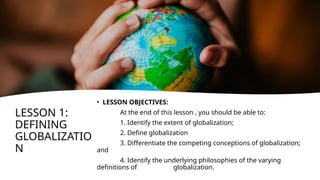
LESSON 1:
DEFINING
GLOBALIZATIO
N
• LESSON OBJECTIVES:
At the end of this lesson , you should be able to:
1. Identify the extent of globalization;
2. Define globalization
3. Differentiate the competing conceptions of globalization;
and
4. Identify the underlying philosophies of the varying
definitions of globalization.
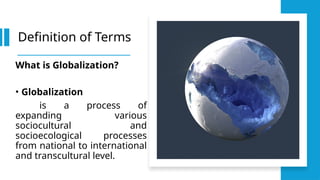
Definition of Terms
What is Globalization?
• Globalization
is a process of
expanding various
sociocultural and
socioecological processes
from national to international
and transcultural level.
INTRODUCTION
Globalization has been a critical discourse in
the international development policy arena.
There are numerous definitions of
globalization, and one definition tends to
focus on the economic side of globalization.
In this section, we will unpack
the concept of globalization by
looking at the current state of
globalization, assessing the
different views and definitions of
globalization and understanding
the sociocultural and
socioeconomic changes that
come to it.
Extent of Globalization
How are you connected
with the world?
How do we measure global
connectivity?
Extent of
Globalization
• Modern technologies and cheaper air travel made possible
this connection and flow of people and information.
• One of the recent indicators of global connections is the
Global Connectedness Index (GCI)- a measurement of
flows and interconnections of a country to other global
players through exchanges in trade, capital, people, and
information.
What does
GCI measure?
• Trade- the flow of goods and services
• Capital/Investment- The flow and
stock of foreign direct investment(FDI)
and portfolio equity.
• Information- The flow of
international internet bandwidth,
telephone calls, and printed material
• People- The flow of people across
borders for short-term (tourism),
medium-term( students studying
abroad) , and long-term( migration)
• Based on the GCI 2018
report, the world’s level of
connectedness in terms of
international trade, capital,
information, and people is at
its peak in 2017.
• Netherlands is the world’s
most globally connected
country, While Europe is the
most highly globally
connected continent.
Netherlands
Europe
• Economies in Southeast Asia
like Cambodia, Malaysia,
Singapore, and Vietnam
have exceeded expectations
for global connectivity,
particularly in trade flow.
• Scholte (2005)- argues that
globalization is not just about
going beyond territorial
boundaries, but it also about
changes in the temporal
connections of people
• Elden (2005)- contends that
globalization is not merely
about westernization
ex. Naval voyages and
early trade have not been
always from the west.
Socioeconomic
Changes in
Globalization
• Scholte (2005) identifies
macro-structural changes
in a globalized society such
as product and services
integration through
commodity value chains,
emerging institutional
arrangements, pluralistic
identity, and growth of
supra-territorial relations
Four Key Shifts in Society by Scholte
(2005)
Growth of trans- and supra-territorial connectivity
The shift from capitalism to hype-capitalism focused on production
A move from nationalism toward identifying pluralism ang hybridity
From rationalism toward knowledge reflexivity
Factors Driving
Globalization
• Reduction of trade barriers
in 1947, richer countries banded
together to reduce taxes on imports or
tariffs under the General Agreement on
Tariffs and Trade( GATT), which was
later transformed to the World Trade
Organization (WTO) in 1994.
• Modern Technology Developments
facilitated faster communication
and access to data or information. This
further promoted the development of
an information society.
Views about
Globalization
What is your views about globalization?
 There are diverging views about globalization.
 Some authors highlight the positive economic
impacts of globalization such as on the level of
employment and balance of trade.
 Some highlight the negative impacts of
globalization, specifically the inequity among
countries and between the rich and the poor.
• Vandermoortle (2002), argues that
though globalization and
exponential growth, theoretically,
could reduce poverty, it does not
benefit all nations.
• Beck (2018), contends the
multidimensionality of globalization.
These include the economic,
political, cultural, ecological
dimensions.
GROUP TASKS
•Form 2 teams and discuss the
advantages/benefits of
globalization, while the other
group will focus on the
disadvantages and negative
impacts of globalization.
Defining
Globalization
• Group Work
• Write down your group’s definition of
globalization. The group may
research different definitions of
globalization.
• Based on the definitions shared by
the different groups, what are the
common characteristics of
globalization?
• Definition of globalization in terms of
economic aspect, cultural aspect,
political aspect, etc.?

Lesson-1-Defining-Globalization (1).pptx

  • 1.
  • 2.
    LESSON 1: DEFINING GLOBALIZATIO N • LESSONOBJECTIVES: At the end of this lesson , you should be able to: 1. Identify the extent of globalization; 2. Define globalization 3. Differentiate the competing conceptions of globalization; and 4. Identify the underlying philosophies of the varying definitions of globalization.
  • 3.
    Definition of Terms Whatis Globalization? • Globalization is a process of expanding various sociocultural and socioecological processes from national to international and transcultural level.
  • 4.
    INTRODUCTION Globalization has beena critical discourse in the international development policy arena. There are numerous definitions of globalization, and one definition tends to focus on the economic side of globalization.
  • 5.
    In this section,we will unpack the concept of globalization by looking at the current state of globalization, assessing the different views and definitions of globalization and understanding the sociocultural and socioeconomic changes that come to it.
  • 6.
    Extent of Globalization Howare you connected with the world? How do we measure global connectivity?
  • 7.
    Extent of Globalization • Moderntechnologies and cheaper air travel made possible this connection and flow of people and information. • One of the recent indicators of global connections is the Global Connectedness Index (GCI)- a measurement of flows and interconnections of a country to other global players through exchanges in trade, capital, people, and information.
  • 8.
    What does GCI measure? •Trade- the flow of goods and services • Capital/Investment- The flow and stock of foreign direct investment(FDI) and portfolio equity. • Information- The flow of international internet bandwidth, telephone calls, and printed material • People- The flow of people across borders for short-term (tourism), medium-term( students studying abroad) , and long-term( migration)
  • 9.
    • Based onthe GCI 2018 report, the world’s level of connectedness in terms of international trade, capital, information, and people is at its peak in 2017. • Netherlands is the world’s most globally connected country, While Europe is the most highly globally connected continent.
  • 10.
  • 11.
  • 12.
    • Economies inSoutheast Asia like Cambodia, Malaysia, Singapore, and Vietnam have exceeded expectations for global connectivity, particularly in trade flow.
  • 14.
    • Scholte (2005)-argues that globalization is not just about going beyond territorial boundaries, but it also about changes in the temporal connections of people • Elden (2005)- contends that globalization is not merely about westernization ex. Naval voyages and early trade have not been always from the west.
  • 15.
    Socioeconomic Changes in Globalization • Scholte(2005) identifies macro-structural changes in a globalized society such as product and services integration through commodity value chains, emerging institutional arrangements, pluralistic identity, and growth of supra-territorial relations
  • 16.
    Four Key Shiftsin Society by Scholte (2005) Growth of trans- and supra-territorial connectivity The shift from capitalism to hype-capitalism focused on production A move from nationalism toward identifying pluralism ang hybridity From rationalism toward knowledge reflexivity
  • 17.
    Factors Driving Globalization • Reductionof trade barriers in 1947, richer countries banded together to reduce taxes on imports or tariffs under the General Agreement on Tariffs and Trade( GATT), which was later transformed to the World Trade Organization (WTO) in 1994. • Modern Technology Developments facilitated faster communication and access to data or information. This further promoted the development of an information society.
  • 18.
    Views about Globalization What isyour views about globalization?  There are diverging views about globalization.  Some authors highlight the positive economic impacts of globalization such as on the level of employment and balance of trade.  Some highlight the negative impacts of globalization, specifically the inequity among countries and between the rich and the poor.
  • 19.
    • Vandermoortle (2002),argues that though globalization and exponential growth, theoretically, could reduce poverty, it does not benefit all nations. • Beck (2018), contends the multidimensionality of globalization. These include the economic, political, cultural, ecological dimensions.
  • 20.
    GROUP TASKS •Form 2teams and discuss the advantages/benefits of globalization, while the other group will focus on the disadvantages and negative impacts of globalization.
  • 21.
    Defining Globalization • Group Work •Write down your group’s definition of globalization. The group may research different definitions of globalization. • Based on the definitions shared by the different groups, what are the common characteristics of globalization? • Definition of globalization in terms of economic aspect, cultural aspect, political aspect, etc.?