REPORT
WRITING
What is a Report?
Report Writing IRL
Language & Style
Key Elements of a Report
Structure & Organisation
CONTENTS
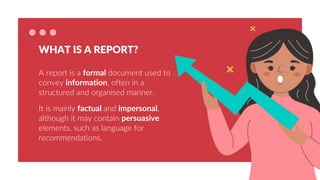
A report is a formal document used to
convey information, often in a
structured and organised manner.
WHAT IS A REPORT?
It is mainly factual and impersonal,
although it may contain persuasive
elements, such as language for
recommendations.
Report writing holds practical
significance in real-life situations:
• in academia
• in business
• in politics
• in everyday life
REPORT WRITING IRL
LANGUAGE & STYLE
• Reports use formal and neutral language.
• They are written in an impersonal tone, so
personal opinions should be avoided.
• If required, persuasive language may be
used to make a recommendation.
• Title: it should be clear and concise.
• Introduction: it introduces the topic and
purpose of the report.
• Main Body: it develops the main ideas;
presenting facts, findings, or analysis.
• Conclusion: it summarises the main ideas
and may provide a recommendation.
KEY ELEMENTS OF A REPORT
• Use sub-headings to organise the
report into sections.
• Use bulleted lists for presenting key
points or supporting evidence.
• Ensure a logical flow from one
section to the next.
STRUCTURE & ORGANISATION
Here’s a model answer.
Let’s analyse the structure and
identify the key elements.
This report aims to analyse the impact of online learning on student performance in the context of
EFL (English as a Foreign Language) education. As educational institutions worldwide have
transitioned to virtual classrooms, it is essential to evaluate how this shift influences students.
Introduction:
Based on our research, online learning has both positive and negative effects. Students appreciate the
flexibility and convenience of remote classes. However, challenges such as technical issues and
distractions at home can hinder their learning experience.
Findings:
Our survey of 300 EFL students found that 70% believe online learning improves their ability to
manage time efficiently. On the contrary, 45% reported difficulties in maintaining focus during online
classes.
Evidence:
To enhance the online learning experience, we recommend:
• Providing technical support to students.
• Incorporating interactive and engaging teaching methods.
• Encouraging peer collaboration through virtual study groups.
Recommendations:
In conclusion, online learning has a significant impact on EFL student performance. To maximise the
benefits and mitigate challenges, educators and institutions must adapt to the evolving educational
landscape.
Conclusion
Impact of Online Learning on Student Performance.
INTRODUCTION
MAIN BODY
CONCLUSION
This report aims to analyse the impact of online learning on student performance in the context of
EFL (English as a Foreign Language) education. As educational institutions worldwide have
transitioned to virtual classrooms, it is essential to evaluate how this shift influences students.
Introduction:
Findings:
Evidence:
Based on our research, online learning has both positive and negative effects. Students appreciate the
flexibility and convenience of remote classes. However, challenges such as technical issues and
distractions at home can hinder their learning experience.
Our survey of 300 EFL students found that 70% believe online learning improves their ability to
manage time efficiently. On the contrary, 45% reported difficulties in maintaining focus during online
classes.
To enhance the online learning experience, we recommend:
• Providing technical support to students.
• Incorporating interactive and engaging teaching methods.
• Encouraging peer collaboration through virtual study groups.
Recommendations:
In conclusion, online learning has a significant impact on EFL student performance. To maximise the
benefits and mitigate challenges, educators and institutions must adapt to the evolving educational
landscape.
Conclusion
Impact of Online Learning on Student Performance.
TITLE
This report aims to analyse the impact of online learning on student performance in the context of
EFL (English as a Foreign Language) education. As educational institutions worldwide have
transitioned to virtual classrooms, it is essential to evaluate how this shift influences students.
Introduction:
Findings:
Evidence:
Based on our research, online learning has both positive and negative effects. Students appreciate the
flexibility and convenience of remote classes. However, challenges such as technical issues and
distractions at home can hinder their learning experience.
Our survey of 300 EFL students found that 70% believe online learning improves their ability to
manage time efficiently. On the contrary, 45% reported difficulties in maintaining focus during online
classes.
To enhance the online learning experience, we recommend:
• Providing technical support to students.
• Incorporating interactive and engaging teaching methods.
• Encouraging peer collaboration through virtual study groups.
Recommendations:
In conclusion, online learning has a significant impact on EFL student performance. To maximise the
benefits and mitigate challenges, educators and institutions must adapt to the evolving educational
landscape.
Conclusion
Impact of Online Learning on Student Performance.
SUB-HEADINGS
BULLETED LISTS
This report aims to analyse the impact of online learning on student performance in the context of
EFL (English as a Foreign Language) education. As educational institutions worldwide have
transitioned to virtual classrooms, it is essential to evaluate how this shift influences students.
Introduction:
Findings:
Evidence:
Based on our research, online learning has both positive and negative effects. Students appreciate the
flexibility and convenience of remote classes. However, challenges such as technical issues and
distractions at home can hinder their learning experience.
Our survey of 300 EFL students found that 70% believe online learning improves their ability to
manage time efficiently. On the contrary, 45% reported difficulties in maintaining focus during online
classes.
To enhance the online learning experience, we recommend:
• Providing technical support to students.
• Incorporating interactive and engaging teaching methods.
• Encouraging peer collaboration through virtual study groups.
Recommendations:
In conclusion, online learning has a significant impact on EFL student performance. To maximise the
benefits and mitigate challenges, educators and institutions must adapt to the evolving educational
landscape.
Conclusion
Impact of Online Learning on Student Performance.
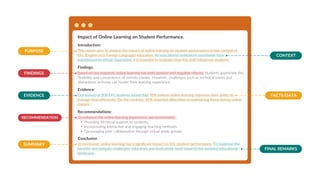
PURPOSE
CONTEXT
FINDINGS
EVIDENCE FACTS/DATA
RECOMMENDATION
SUMMARY
FINAL REMARKS
RESOURCES

REPORT WRITING TEMPLATE SAMPLE FOR PRESENTATION

  • 1.
  • 2.
    What is aReport? Report Writing IRL Language & Style Key Elements of a Report Structure & Organisation CONTENTS
  • 3.
    A report isa formal document used to convey information, often in a structured and organised manner. WHAT IS A REPORT? It is mainly factual and impersonal, although it may contain persuasive elements, such as language for recommendations.
  • 4.
    Report writing holdspractical significance in real-life situations: • in academia • in business • in politics • in everyday life REPORT WRITING IRL
  • 5.
    LANGUAGE & STYLE •Reports use formal and neutral language. • They are written in an impersonal tone, so personal opinions should be avoided. • If required, persuasive language may be used to make a recommendation.
  • 6.
    • Title: itshould be clear and concise. • Introduction: it introduces the topic and purpose of the report. • Main Body: it develops the main ideas; presenting facts, findings, or analysis. • Conclusion: it summarises the main ideas and may provide a recommendation. KEY ELEMENTS OF A REPORT
  • 7.
    • Use sub-headingsto organise the report into sections. • Use bulleted lists for presenting key points or supporting evidence. • Ensure a logical flow from one section to the next. STRUCTURE & ORGANISATION
  • 8.
    Here’s a modelanswer. Let’s analyse the structure and identify the key elements. This report aims to analyse the impact of online learning on student performance in the context of EFL (English as a Foreign Language) education. As educational institutions worldwide have transitioned to virtual classrooms, it is essential to evaluate how this shift influences students. Introduction: Based on our research, online learning has both positive and negative effects. Students appreciate the flexibility and convenience of remote classes. However, challenges such as technical issues and distractions at home can hinder their learning experience. Findings: Our survey of 300 EFL students found that 70% believe online learning improves their ability to manage time efficiently. On the contrary, 45% reported difficulties in maintaining focus during online classes. Evidence: To enhance the online learning experience, we recommend: • Providing technical support to students. • Incorporating interactive and engaging teaching methods. • Encouraging peer collaboration through virtual study groups. Recommendations: In conclusion, online learning has a significant impact on EFL student performance. To maximise the benefits and mitigate challenges, educators and institutions must adapt to the evolving educational landscape. Conclusion Impact of Online Learning on Student Performance.
  • 9.
    INTRODUCTION MAIN BODY CONCLUSION This reportaims to analyse the impact of online learning on student performance in the context of EFL (English as a Foreign Language) education. As educational institutions worldwide have transitioned to virtual classrooms, it is essential to evaluate how this shift influences students. Introduction: Findings: Evidence: Based on our research, online learning has both positive and negative effects. Students appreciate the flexibility and convenience of remote classes. However, challenges such as technical issues and distractions at home can hinder their learning experience. Our survey of 300 EFL students found that 70% believe online learning improves their ability to manage time efficiently. On the contrary, 45% reported difficulties in maintaining focus during online classes. To enhance the online learning experience, we recommend: • Providing technical support to students. • Incorporating interactive and engaging teaching methods. • Encouraging peer collaboration through virtual study groups. Recommendations: In conclusion, online learning has a significant impact on EFL student performance. To maximise the benefits and mitigate challenges, educators and institutions must adapt to the evolving educational landscape. Conclusion Impact of Online Learning on Student Performance. TITLE
  • 10.
    This report aimsto analyse the impact of online learning on student performance in the context of EFL (English as a Foreign Language) education. As educational institutions worldwide have transitioned to virtual classrooms, it is essential to evaluate how this shift influences students. Introduction: Findings: Evidence: Based on our research, online learning has both positive and negative effects. Students appreciate the flexibility and convenience of remote classes. However, challenges such as technical issues and distractions at home can hinder their learning experience. Our survey of 300 EFL students found that 70% believe online learning improves their ability to manage time efficiently. On the contrary, 45% reported difficulties in maintaining focus during online classes. To enhance the online learning experience, we recommend: • Providing technical support to students. • Incorporating interactive and engaging teaching methods. • Encouraging peer collaboration through virtual study groups. Recommendations: In conclusion, online learning has a significant impact on EFL student performance. To maximise the benefits and mitigate challenges, educators and institutions must adapt to the evolving educational landscape. Conclusion Impact of Online Learning on Student Performance. SUB-HEADINGS BULLETED LISTS
  • 11.
    This report aimsto analyse the impact of online learning on student performance in the context of EFL (English as a Foreign Language) education. As educational institutions worldwide have transitioned to virtual classrooms, it is essential to evaluate how this shift influences students. Introduction: Findings: Evidence: Based on our research, online learning has both positive and negative effects. Students appreciate the flexibility and convenience of remote classes. However, challenges such as technical issues and distractions at home can hinder their learning experience. Our survey of 300 EFL students found that 70% believe online learning improves their ability to manage time efficiently. On the contrary, 45% reported difficulties in maintaining focus during online classes. To enhance the online learning experience, we recommend: • Providing technical support to students. • Incorporating interactive and engaging teaching methods. • Encouraging peer collaboration through virtual study groups. Recommendations: In conclusion, online learning has a significant impact on EFL student performance. To maximise the benefits and mitigate challenges, educators and institutions must adapt to the evolving educational landscape. Conclusion Impact of Online Learning on Student Performance. PURPOSE CONTEXT FINDINGS EVIDENCE FACTS/DATA RECOMMENDATION SUMMARY FINAL REMARKS
  • 12.