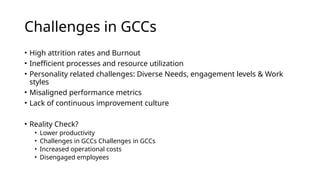
Challenges in GCCs
•High attrition rates and Burnout
• Inefficient processes and resource utilization
• Personality related challenges: Diverse Needs, engagement levels & Work
styles
• Misaligned performance metrics
• Lack of continuous improvement culture
• Reality Check?
• Lower productivity
• Challenges in GCCs Challenges in GCCs
• Increased operational costs
• Disengaged employees
3.
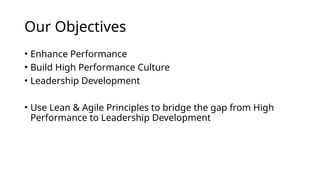
Our Objectives
• EnhancePerformance
• Build High Performance Culture
• Leadership Development
• Use Lean & Agile Principles to bridge the gap from High
Performance to Leadership Development
4.
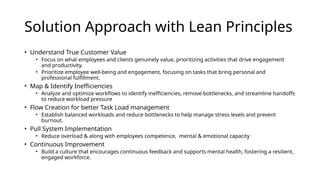
Solution Approach withLean Principles
• Understand True Customer Value
• Focus on what employees and clients genuinely value, prioritizing activities that drive engagement
and productivity.
• Prioritize employee well-being and engagement, focusing on tasks that bring personal and
professional fulfillment.
• Map & Identify Inefficiencies
• Analyze and optimize workflows to identify inefficiencies, remove bottlenecks, and streamline handoffs
to reduce workload pressure
• Flow Creation for better Task Load management
• Establish balanced workloads and reduce bottlenecks to help manage stress levels and prevent
burnout.
• Pull System Implementation
• Reduce overload & along with employees competence, mental & emotional capacity
• Continuous Improvement
• Build a culture that encourages continuous feedback and supports mental health, fostering a resilient,
engaged workforce.
5.
Drive Key Outcomes
•Performance Metrics
• Reduced operational costs, improved KPIs, and streamlined
workflows.
• Employee Retention
• Enhanced job satisfaction and engagement, leading to lower
attrition.
• Agility and Competitiveness
• GCCs become more adaptable and aligned with business goals.
6.
How Lean ProcessesHelp?
• Increased Efficiency
• Value Stream Mapping reduces unnecessary tasks, saving time and resources.
• Helps cut down non-essential tasks, easily workload pressures and reducing mental strain
• Improved Engagement
• Customer Value Focus aligns employees' tasks with meaningful outcomes, enhancing job
satisfaction and personal fulfilment
• Reduced Bottlenecks
• Flow Creation allows for balanced workloads, preventing burnout and reducing attrition.
• Enhanced Agility
• Pull System enables timely task prioritization, aligning with current demand and improving
responsiveness.
• Sustained Improvement
• Continuous Improvement Culture promotes a proactive approach to performance
management.
7.
Solution Approach
• CustomerValue: Focus on well-being and engagement in
career paths.
• Value Stream Mapping: Define skill-building steps for
leadership.
• Flow Creation: Simplify transition to management roles.
• Pull System: Provide on-demand leadership resources.
• Continuous Improvement & Mental Health: Supportive
culture prepares engineers for management demands.
8.
8
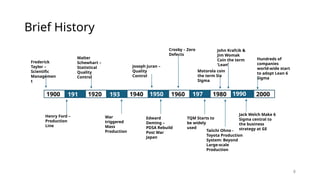
Brief History
1900 2000
1980
1960
1940
1920
Frederick
Taylor–
Scientific
Managemen
t
Henry Ford –
Production
Line
Walter
Schewhart –
Statistical
Quality
Control
Joseph Juran –
Quality
Control
191
0
193
0
1950 197
0
1990
War
triggered
Mass
Production
Edward
Deming –
PDSA Rebuild
Post War
Japan
Hundreds of
companies
world-wide start
to adopt Lean 6
Sigma
John Krafcik &
Jim Womak
Coin the term
‘Lean’
Taiichi Ohno -
Toyota Production
System: Beyond
Large-scale
Production
TQM Starts to
be widely
used
Jack Welch Make 6
Sigma central to
the business
strategy at GE
Crosby – Zero
Defects
Motorola coin
the term Six
Sigma
9.
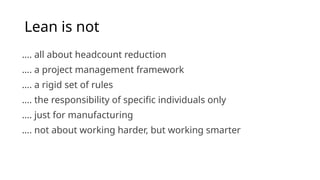
Lean is not
….all about headcount reduction
…. a project management framework
…. a rigid set of rules
…. the responsibility of specific individuals only
…. just for manufacturing
…. not about working harder, but working smarter
10.
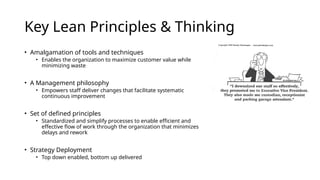
Key Lean Principles& Thinking
• Amalgamation of tools and techniques
• Enables the organization to maximize customer value while
minimizing waste
• A Management philosophy
• Empowers staff deliver changes that facilitate systematic
continuous improvement
• Set of defined principles
• Standardized and simplify processes to enable efficient and
effective flow of work through the organization that minimizes
delays and rework
• Strategy Deployment
• Top down enabled, bottom up delivered
11.
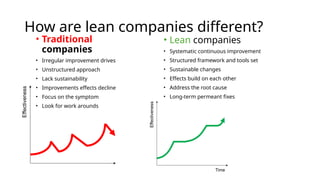
How are leancompanies different?
• Lean companies
• Systematic continuous improvement
• Structured framework and tools set
• Sustainable changes
• Effects build on each other
• Address the root cause
• Long-term permeant fixes
• Traditional
companies
• Irregular improvement drives
• Unstructured approach
• Lack sustainability
• Improvements effects decline
• Focus on the symptom
• Look for work arounds
Effectiveness
12.
12
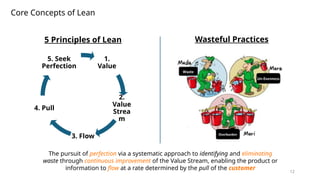
The pursuit ofperfection via a systematic approach to identifying and eliminating
waste through continuous improvement of the Value Stream, enabling the product or
information to flow at a rate determined by the pull of the customer
1.
Value
2.
Value
Strea
m
3. Flow
4. Pull
5. Seek
Perfection
5 Principles of Lean Wasteful Practices
Core Concepts of Lean
13.
What Zero (s)do we value?
• Zero scope creep
• Zero Defects
• Minimal to Zero Testing
• Zero Reporting
• Zero Wastage
• Zero Conflicts| One alignment – does not mean no fierce
conversations. All of us have one common goal
• Zero Attrition
14.
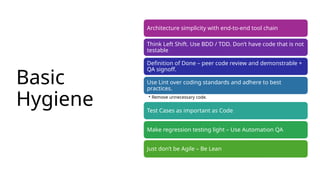
Basic
Hygiene
Architecture simplicity withend-to-end tool chain
Think Left Shift. Use BDD / TDD. Don’t have code that is not
testable
Definition of Done – peer code review and demonstrable +
QA signoff.
Use Lint over coding standards and adhere to best
practices.
• Remove unnecessary code.
Test Cases as important as Code
Make regression testing light – Use Automation QA
Just don’t be Agile – Be Lean
15.
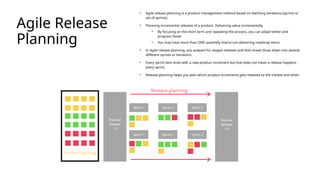
Agile Release
Planning
• Agilerelease planning is a product management method based on batching iterations (sprints or
set of sprints).
• Planning incremental releases of a product. Delivering value incrementally.
• By focusing on the short term and repeating the process, you can adapt better and
progress faster.
• You may have more than ONE assembly line/scrum delivering roadmap items
• In Agile release planning, you prepare for staged releases and then break those down into several
different sprints or iterations.
• Every sprint item ends with a new product increment but that does not mean a release happens
every sprint.
• Release planning helps you plan which product increments gets released to the market and when
16.
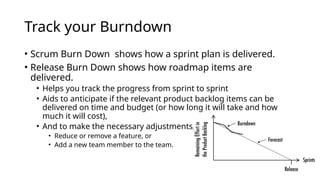
Track your Burndown
•Scrum Burn Down shows how a sprint plan is delivered.
• Release Burn Down shows how roadmap items are
delivered.
• Helps you track the progress from sprint to sprint
• Aids to anticipate if the relevant product backlog items can be
delivered on time and budget (or how long it will take and how
much it will cost),
• And to make the necessary adjustments, such as,
• Reduce or remove a feature, or
• Add a new team member to the team.
17.
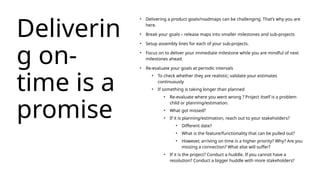
Deliverin
g on-
time isa
promise
• Delivering a product goals/roadmaps can be challenging. That’s why you are
here.
• Break your goals – release maps into smaller milestones and sub-projects
• Setup assembly lines for each of your sub-projects.
• Focus on to deliver your immediate milestone while you are mindful of next
milestones ahead.
• Re-evaluate your goals at periodic intervals
• To check whether they are realistic; validate your estimates
continuously
• If something is taking longer than planned
• Re-evaluate where you went wrong ? Project itself is a problem
child or planning/estimation.
• What got missed?
• If it is planning/estimation, reach out to your stakeholders?
• Different date?
• What is the feature/functionality that can be pulled out?
• However, arriving on time is a higher priority? Why? Are you
missing a connection? What else will suffer?
• If it is the project? Conduct a huddle. If you cannot have a
resolution? Conduct a bigger huddle with more stakeholders?
18.
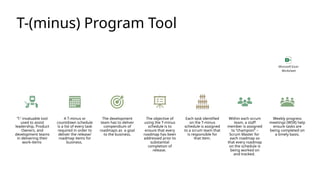
T-(minus) Program Tool
‘T-’invaluable tool
used to assist
leadership, Product
Owners, and
development teams
in delivering their
work-items
A T-minus or
countdown schedule
is a list of every task
required in order to
deliver the release/
roadmap items for
business.
The development
team has to deliver
compendium of
roadmaps as a goal
to the business.
The objective of
using the T-minus
schedule is to
ensure that every
roadmap has been
addressed prior to
substantial
completion of
release.
Each task identified
on the T-minus
schedule is assigned
to a scrum team that
is responsible for
that item.
Within each scrum
team, a staff
member is assigned
to “champion” –
Scrum Master for
each roadmap so
that every roadmap
on the schedule is
being worked on
and tracked.
Weekly progress
meetings (WSR) help
ensure tasks are
being completed on
a timely basis.
Microsoft Excel
Worksheet
19.
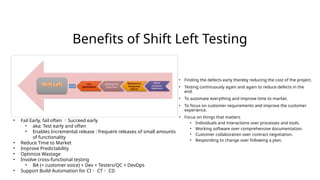
Benefits of ShiftLeft Testing
• Finding the defects early thereby reducing the cost of the project.
• Testing continuously again and again to reduce defects in the
end.
• To automate everything and improve time to market.
• To focus on customer requirements and improve the customer
experience.
• Focus on things that matters
• Individuals and interactions over processes and tools.
• Working software over comprehensive documentation.
• Customer collaboration over contract negotiation.
• Responding to change over following a plan.
• Fail Early, fail often Succeed early
• aka: Test early and often
• Enables Incremental release : frequent releases of small amounts
of functionality
• Reduce Time to Market
• Improve Predictability
• Optimize Wastage
• Involve cross-functional testing
• BA (+ customer voice) + Dev + Testers/QC + DevOps
• Support Build Automation for CI CT CD
To Do
[Dev Team]
Decidesthe card to be
picked for development
[QA Team]
Performs action on test
plan, required test data
[PO]
Grooming Session
with Dev & QA
Team
[QA & TL]
Requirements are
Atomic & less
dependence on
other Tickets
Acceptance Criteria
[Sign Off]
[Scrum Master]
Story Pointing
using Poker
Planning
Scrum Master &
PO
KTLO / Backlog &
Integration Team
IN Progress QC Ready In QC Done
Dev QA QA
Lead
TL Arch
[PO]
Reviews QA Test Cases
[Sign Off]
[QA]
Test case [Sign Off]
QA Reviews Dev
Adherence
[QA] Smoke Testing
[Arch]
Assess regression impact
, performance impact,
security impact [Sign Off]
Scrum
Lead
Dev QA
[QA]
Automation Test execution
Build Acceptance Test execution
If fail
[Arch]
Dev RCA assessment if there is a
regression defect
[Dev]
Dev testing or fix sprint regression
defects
If Pass
[PO]
Sprint Functional Demo to Dev
Stakeholders
Release notes
Release communication
Update User Guide [Training]
[Scrum Master]
Tags Release in Jira
Conduct Release retrospective
[Devops]
Release version details
EXIT
ENTR
Y
Groomed & Story
Pointed Sprint
Plan
Prioritized Backlog Tagged to active or
future sprint
Impacted modules are
listed
Code Analyzer results and
coding guidelines
adherence
Dev testing results in
Dev-INT environment in
JIRA
Regression Test results update in
JIRA
JIRA updated with build and
environment details with status change
and resolution as fixed
Ticket Sign off by QA Lead
Release sign off by PO
[DEV]
TDD Test Cases in GWT
Development as per
Coding Guidelines &
Standards [Sign Off]
100% Dev Test
Coverage [Incl.. Code
Analyzer]
[TL]
Code Walk Thru [Sign
Off]
Code check-in to right
branch after Dev Integ-
Testing with Dev Build
#
10X – Dev Process
Dev Unit Testing results
in JIRA
Picked up card with
resolution as
Development
QA logs defect
QA continues Regression Testing
and PO Demo
Arch Scrum
Master &
PO
Devop
s
QA
Lead
22.
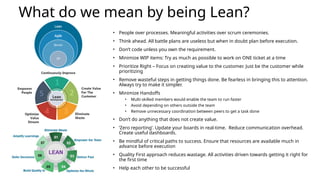
What do wemean by being Lean?
• People over processes. Meaningful activities over scrum ceremonies.
• Think ahead. All battle plans are useless but when in doubt plan before execution.
• Don’t code unless you own the requirement.
• Minimize WIP items: Try as much as possible to work on ONE ticket at a time
• Prioritize Right – Focus on creating value to the customer. Just be the customer while
prioritizing
• Remove wasteful steps in getting things done. Be fearless in bringing this to attention.
Always try to make it simpler.
• Minimize Handoffs
• Multi-skilled members would enable the team to run faster
• Avoid depending on others outside the team
• Remove unnecessary coordination between peers to get a task done
• Don’t do anything that does not create value.
• ‘Zero reporting’. Update your boards in real-time. Reduce communication overhead.
Create useful dashboards.
• Be mindful of critical paths to success. Ensure that resources are available much in
advance before execution
• Quality First approach reduces wastage. All activities driven towards getting it right for
the first time
• Help each other to be successful
23.
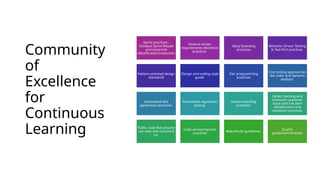
Community
of
Excellence
for
Continuous
Learning
Sprint practices :
ConductSprint Rituals
and issue/risk
identification/resolution
Feature-driven
requirements elicitation
practices
Story boarding
practices
Behavior Driven Testing
& Test-first practices
Pattern-oriented design
standards
Design and coding style
guide
Pair programming
practices
Unit testing approaches
like static and dynamic
analysis
Automated test
generation practices
Automated regression
testing
Feature backlog
practices
Defect backlog and
resolution practices
Issue and risk item
identification and
resolution practices
Public code that anyone
can view and comment
on
Code versioning best
practices
Make/build guidelines
Quality
guideline/checklists
24.
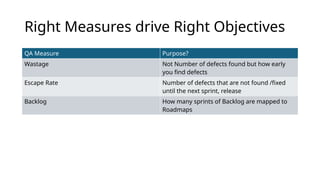
Right Measures driveRight Objectives
QA Measure Purpose?
Wastage Not Number of defects found but how early
you find defects
Escape Rate Number of defects that are not found /fixed
until the next sprint, release
Backlog How many sprints of Backlog are mapped to
Roadmaps
![To Do
[Dev Team]
Decides the card to be
picked for development
[QA Team]
Performs action on test
plan, required test data
[PO]
Grooming Session
with Dev & QA
Team
[QA & TL]
Requirements are
Atomic & less
dependence on
other Tickets
Acceptance Criteria
[Sign Off]
[Scrum Master]
Story Pointing
using Poker
Planning
Scrum Master &
PO
KTLO / Backlog &
Integration Team
IN Progress QC Ready In QC Done
Dev QA QA
Lead
TL Arch
[PO]
Reviews QA Test Cases
[Sign Off]
[QA]
Test case [Sign Off]
QA Reviews Dev
Adherence
[QA] Smoke Testing
[Arch]
Assess regression impact
, performance impact,
security impact [Sign Off]
Scrum
Lead
Dev QA
[QA]
Automation Test execution
Build Acceptance Test execution
If fail
[Arch]
Dev RCA assessment if there is a
regression defect
[Dev]
Dev testing or fix sprint regression
defects
If Pass
[PO]
Sprint Functional Demo to Dev
Stakeholders
Release notes
Release communication
Update User Guide [Training]
[Scrum Master]
Tags Release in Jira
Conduct Release retrospective
[Devops]
Release version details
EXIT
ENTR
Y
Groomed & Story
Pointed Sprint
Plan
Prioritized Backlog Tagged to active or
future sprint
Impacted modules are
listed
Code Analyzer results and
coding guidelines
adherence
Dev testing results in
Dev-INT environment in
JIRA
Regression Test results update in
JIRA
JIRA updated with build and
environment details with status change
and resolution as fixed
Ticket Sign off by QA Lead
Release sign off by PO
[DEV]
TDD Test Cases in GWT
Development as per
Coding Guidelines &
Standards [Sign Off]
100% Dev Test
Coverage [Incl.. Code
Analyzer]
[TL]
Code Walk Thru [Sign
Off]
Code check-in to right
branch after Dev Integ-
Testing with Dev Build
#
10X – Dev Process
Dev Unit Testing results
in JIRA
Picked up card with
resolution as
Development
QA logs defect
QA continues Regression Testing
and PO Demo
Arch Scrum
Master &
PO
Devop
s
QA
Lead](https://image.slidesharecdn.com/shiftleft-250427104856-3c52f2e2/85/Shift-Left-using-Lean-for-Agile-Software-Development-21-320.jpg)